1948
FACTORY ACT
BY UDIT SANWAL
JAMIA HAMDARD
INTRODUCTION
01
02
03
04
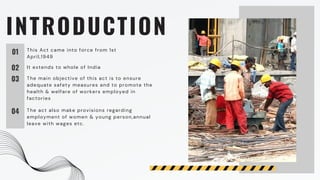
This Act came into force from 1st
April,1949
It extends to whole of India
The main objective of this act is to ensure
adequate safety measures and to promote the
health & welfare of workers employed in
factories
The act also make provisions regarding
employment of women & young person,annual
leave with wages etc.
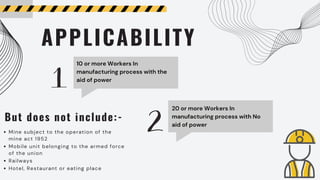
10 or more Workers In
manufacturing process with the
aid of power
APPLICABILITY
20 or more Workers In
manufacturing process with No
aid of power
But does not include:-
Mine subject to the operation of the
mine act 1952
Mobile unit belonging to the armed force
of the union
Railways
Hotel, Restaurant or eating place
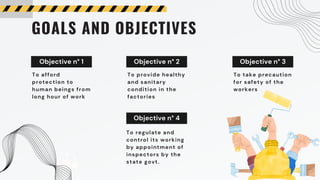
Objective n° 1 Objective n° 2 Objective n° 3
GOALS AND OBJECTIVES
To afford
protection to
human beings from
long hour of work
To provide healthy
and sanitary
condition in the
factories
To take precaution
for safety of the
workers
Objective n° 4
To regulate and
control its working
by appointment of
inspectors by the
state govt.
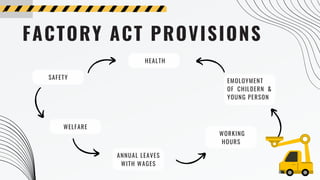
FACTORY ACT PROVISIONS
HEALTH
SAFETY
WORKING
HOURS
WELFARE
ANNUAL LEAVES
WITH WAGES
EMOLOYMENT
OF CHILDERN &
YOUNG PERSON
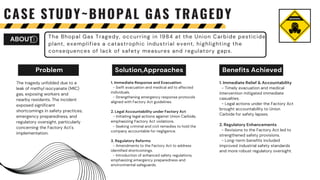
CASE STUDY~BHOPAL GAS TRAGEDY
ABOUT
Problem Benefits Achieved
Solution,Approaches
The tragedy unfolded due to a
leak of methyl isocyanate (MIC)
gas, exposing workers and
nearby residents. The incident
exposed significant
shortcomings in safety practices,
emergency preparedness, and
regulatory oversight, particularly
concerning the Factory Act's
implementation.
The Bhopal Gas Tragedy, occurring in 1984 at the Union Carbide pesticide
plant, exemplifies a catastrophic industrial event, highlighting the
consequences of lack of safety measures and regulatory gaps.
1. Immediate Response and Evacuation:
- Swift evacuation and medical aid to affected
individuals.
- Strengthening emergency response protocols
aligned with Factory Act guidelines.
2. Legal Accountability under Factory Act
- Initiating legal actions against Union Carbide,
emphasizing Factory Act violations.
- Seeking criminal and civil remedies to hold the
company accountable for negligence.
3. Regulatory Reforms
- Amendments to the Factory Act to address
identified shortcomings.
- Introduction of enhanced safety regulations,
emphasizing emergency preparedness and
environmental safeguards.
1. Immediate Relief & Accountability
- Timely evacuation and medical
intervention mitigated immediate
casualties.
- Legal actions under the Factory Act
brought accountability to Union
Carbide for safety lapses.
2. Regulatory Enhancements
- Revisions to the Factory Act led to
strengthened safety provisions.
- Long-term benefits included
improved industrial safety standards
and more robust regulatory oversight.
CONCLUSION
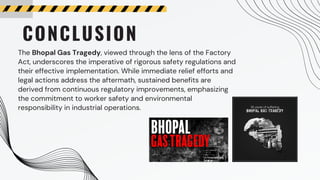
The Bhopal Gas Tragedy, viewed through the lens of the Factory
Act, underscores the imperative of rigorous safety regulations and
their effective implementation. While immediate relief efforts and
legal actions address the aftermath, sustained benefits are
derived from continuous regulatory improvements, emphasizing
the commitment to worker safety and environmental
responsibility in industrial operations.
THANK'S FOR
WATCHING

Factory Act 1948 with case study

  • 1.
    1948 FACTORY ACT BY UDITSANWAL JAMIA HAMDARD
  • 2.
    INTRODUCTION 01 02 03 04 This Act cameinto force from 1st April,1949 It extends to whole of India The main objective of this act is to ensure adequate safety measures and to promote the health & welfare of workers employed in factories The act also make provisions regarding employment of women & young person,annual leave with wages etc.
  • 3.
    10 or moreWorkers In manufacturing process with the aid of power APPLICABILITY 20 or more Workers In manufacturing process with No aid of power But does not include:- Mine subject to the operation of the mine act 1952 Mobile unit belonging to the armed force of the union Railways Hotel, Restaurant or eating place
  • 4.
    Objective n° 1Objective n° 2 Objective n° 3 GOALS AND OBJECTIVES To afford protection to human beings from long hour of work To provide healthy and sanitary condition in the factories To take precaution for safety of the workers Objective n° 4 To regulate and control its working by appointment of inspectors by the state govt.
  • 5.
    FACTORY ACT PROVISIONS HEALTH SAFETY WORKING HOURS WELFARE ANNUALLEAVES WITH WAGES EMOLOYMENT OF CHILDERN & YOUNG PERSON
  • 6.
    CASE STUDY~BHOPAL GASTRAGEDY ABOUT Problem Benefits Achieved Solution,Approaches The tragedy unfolded due to a leak of methyl isocyanate (MIC) gas, exposing workers and nearby residents. The incident exposed significant shortcomings in safety practices, emergency preparedness, and regulatory oversight, particularly concerning the Factory Act's implementation. The Bhopal Gas Tragedy, occurring in 1984 at the Union Carbide pesticide plant, exemplifies a catastrophic industrial event, highlighting the consequences of lack of safety measures and regulatory gaps. 1. Immediate Response and Evacuation: - Swift evacuation and medical aid to affected individuals. - Strengthening emergency response protocols aligned with Factory Act guidelines. 2. Legal Accountability under Factory Act - Initiating legal actions against Union Carbide, emphasizing Factory Act violations. - Seeking criminal and civil remedies to hold the company accountable for negligence. 3. Regulatory Reforms - Amendments to the Factory Act to address identified shortcomings. - Introduction of enhanced safety regulations, emphasizing emergency preparedness and environmental safeguards. 1. Immediate Relief & Accountability - Timely evacuation and medical intervention mitigated immediate casualties. - Legal actions under the Factory Act brought accountability to Union Carbide for safety lapses. 2. Regulatory Enhancements - Revisions to the Factory Act led to strengthened safety provisions. - Long-term benefits included improved industrial safety standards and more robust regulatory oversight.
  • 7.
    CONCLUSION The Bhopal GasTragedy, viewed through the lens of the Factory Act, underscores the imperative of rigorous safety regulations and their effective implementation. While immediate relief efforts and legal actions address the aftermath, sustained benefits are derived from continuous regulatory improvements, emphasizing the commitment to worker safety and environmental responsibility in industrial operations.
  • 8.