Social Mobility
Dr. Anil Bhatt, Dept of Higher Education
Social Mobility
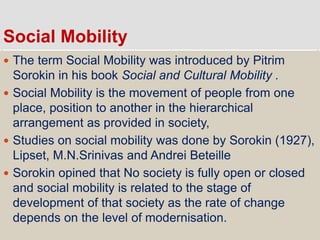
 The term Social Mobility was introduced by Pitrim
Sorokin in his book Social and Cultural Mobility .
 Social Mobility is the movement of people from one
place, position to another in the hierarchical
arrangement as provided in society,
 Studies on social mobility was done by Sorokin (1927),
Lipset, M.N.Srinivas and Andrei Beteille
 Sorokin opined that No society is fully open or closed
and social mobility is related to the stage of
development of that society as the rate of change
depends on the level of modernisation.
DEFINITIONS
 Bogardus- Any change in social position or
status is called social mobility.
 Mike O Donell- Social Mobility is a movement
up and down the social hierarchy.
 Horton and Hunt- Social mobility is the
movement of upper and lower status.
 Fitcher- Social Mobility is a movement of an
individual , group or category from one social
status to another.
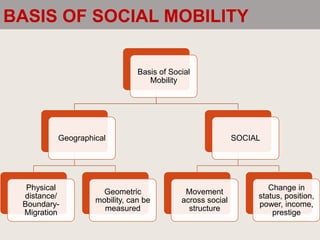
BASIS OF SOCIAL MOBILITY
Basis of Social
Mobility
Geographical
Physical
distance/
Boundary-
Migration
Geometric
mobility, can be
measured
SOCIAL
Movement
across social
structure
Change in
status, position,
power, income,
prestige
Characteristics of Social
Mobility
 Involves Change
 Related to social structure
 Involves change in Occupation
 Involves consequent change in Status
 Promotion within the same social hierarchy
 It has no specific direction
 Increased social mobility indicates Progress
or development
 Less social mobility is an indicator of less
equal society.
 Rate of mobility may vary in different societies
Social Mobility is essential…………
 Many sociologists believe that social mobility is a
good benchmark to measure the success of a
democratic society. When individuals have a high
degree of mobility and are able to easily change
their circumstances to fit their own needs, a
society will prosper. On the other hand, when the
roles and social positions in society are rigid, this
will stifle growth.
 Social mobility refers to the idea of people moving
"up" or "down" a social hierarchy. In the context of
education it would normally refer to people from
lower social and economic backgrounds achieving
higher status occupations thanks to good
education and qualifications. It is closely linked to
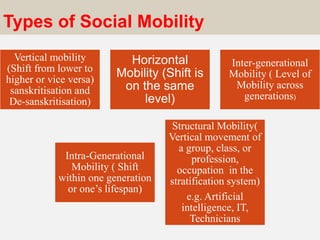
Types of Social Mobility
Vertical mobility
(Shift from lower to
higher or vice versa)
sanskritisation and
De-sanskritisation)
Horizontal
Mobility (Shift is
on the same
level)
Inter-generational
Mobility ( Level of
Mobility across
generations)
Intra-Generational
Mobility ( Shift
within one generation
or one’s lifespan)
Structural Mobility(
Vertical movement of
a group, class, or
profession,
occupation in the
stratification system)
e.g. Artificial
intelligence, IT,
Technicians
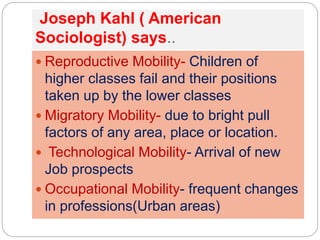
Joseph Kahl ( American
Sociologist) says..
 Reproductive Mobility- Children of
higher classes fail and their positions
taken up by the lower classes
 Migratory Mobility- due to bright pull
factors of any area, place or location.
 Technological Mobility- Arrival of new
Job prospects
 Occupational Mobility- frequent changes
in professions(Urban areas)
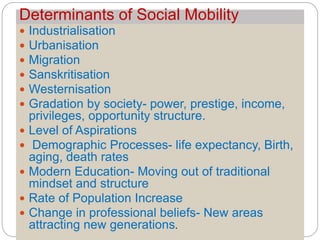
Determinants of Social Mobility
 Industrialisation
 Urbanisation
 Migration
 Sanskritisation
 Westernisation
 Gradation by society- power, prestige, income,
privileges, opportunity structure.
 Level of Aspirations
 Demographic Processes- life expectancy, Birth,
aging, death rates
 Modern Education- Moving out of traditional
mindset and structure
 Rate of Population Increase
 Change in professional beliefs- New areas
attracting new generations.
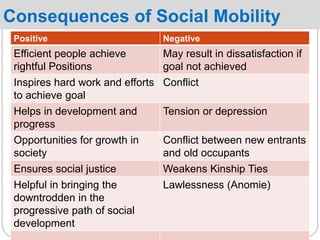
Consequences of Social Mobility
Positive Negative
Efficient people achieve
rightful Positions
May result in dissatisfaction if
goal not achieved
Inspires hard work and efforts
to achieve goal
Conflict
Helps in development and
progress
Tension or depression
Opportunities for growth in
society
Conflict between new entrants
and old occupants
Ensures social justice Weakens Kinship Ties
Helpful in bringing the
downtrodden in the
progressive path of social
development
Lawlessness (Anomie)
Statistics………
Social mobility in India is quite low and
was ranked 76th out of 82 economies in
the 2020. Social Mobility Index compiled
by the World Economic Forum (Press
Trust of India, 2020). To some extent, this
can be attributed to the large size of the
Indian demographic and their dependence
on historical jobs.
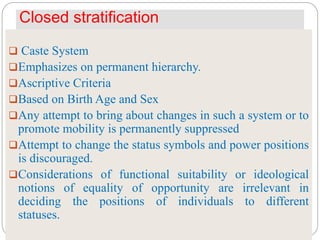
Closed stratification
 Caste System
Emphasizes on permanent hierarchy.
Ascriptive Criteria
Based on Birth Age and Sex
Any attempt to bring about changes in such a system or to
promote mobility is permanently suppressed
Attempt to change the status symbols and power positions
is discouraged.
Considerations of functional suitability or ideological
notions of equality of opportunity are irrelevant in
deciding the positions of individuals to different
statuses.
OPEN STRATIFICATION
 Class System
 Norms prescribed and encourage mobility.
 There are independent principles of ranking like status, class and
power.
 Assignment of different positions in the social structure on the basis of
their merit or achievement.
 Characterized with occupational diversity, a flexible hierarchy,
differentiated social structure and rapidity of change.
 In such systems the hold of ascription based corporate groups like
caste, kinship or extended family etc declines.
 The dominant values in such a system emphasize on equality and
freedom of the individual and on change and innovation
 For example caste system in India provides little scope for social
mobility. By comparison, social class, system of stratification, in
industrial societies provides immense scope for social mobility.
Suggestions to improve social
mobility in India
India must address the specific policy areas that constrain
equal access to opportunities.
 Coupling of local employment generation strategies with policies
that make geographic mobility easier
 harnessing the equalizing effects of education by investing in early
childhood education and creating more pathways to higher education
attainment for the poor
 Supporting youth in finding desirable and satisfactory career options
through increased investment in mentorship and career guidance
programmes
 Re-designing social protection schemes to meet the needs of a
unique and diverse population
 Carving out a role for companies and holding them accountable for
improvements in social mobility.
THANK YOU
Dr. Anil Bhatt
Dept of Sociology
Govt of Uttarakhand

SOCIAL MOBILITY.pptx

  • 1.
    Social Mobility Dr. AnilBhatt, Dept of Higher Education
  • 2.
    Social Mobility  Theterm Social Mobility was introduced by Pitrim Sorokin in his book Social and Cultural Mobility .  Social Mobility is the movement of people from one place, position to another in the hierarchical arrangement as provided in society,  Studies on social mobility was done by Sorokin (1927), Lipset, M.N.Srinivas and Andrei Beteille  Sorokin opined that No society is fully open or closed and social mobility is related to the stage of development of that society as the rate of change depends on the level of modernisation.
  • 3.
    DEFINITIONS  Bogardus- Anychange in social position or status is called social mobility.  Mike O Donell- Social Mobility is a movement up and down the social hierarchy.  Horton and Hunt- Social mobility is the movement of upper and lower status.  Fitcher- Social Mobility is a movement of an individual , group or category from one social status to another.
  • 4.
    BASIS OF SOCIALMOBILITY Basis of Social Mobility Geographical Physical distance/ Boundary- Migration Geometric mobility, can be measured SOCIAL Movement across social structure Change in status, position, power, income, prestige
  • 5.
    Characteristics of Social Mobility Involves Change  Related to social structure  Involves change in Occupation  Involves consequent change in Status  Promotion within the same social hierarchy  It has no specific direction  Increased social mobility indicates Progress or development  Less social mobility is an indicator of less equal society.  Rate of mobility may vary in different societies
  • 6.
    Social Mobility isessential…………  Many sociologists believe that social mobility is a good benchmark to measure the success of a democratic society. When individuals have a high degree of mobility and are able to easily change their circumstances to fit their own needs, a society will prosper. On the other hand, when the roles and social positions in society are rigid, this will stifle growth.  Social mobility refers to the idea of people moving "up" or "down" a social hierarchy. In the context of education it would normally refer to people from lower social and economic backgrounds achieving higher status occupations thanks to good education and qualifications. It is closely linked to
  • 7.
    Types of SocialMobility Vertical mobility (Shift from lower to higher or vice versa) sanskritisation and De-sanskritisation) Horizontal Mobility (Shift is on the same level) Inter-generational Mobility ( Level of Mobility across generations) Intra-Generational Mobility ( Shift within one generation or one’s lifespan) Structural Mobility( Vertical movement of a group, class, or profession, occupation in the stratification system) e.g. Artificial intelligence, IT, Technicians
  • 8.
    Joseph Kahl (American Sociologist) says..  Reproductive Mobility- Children of higher classes fail and their positions taken up by the lower classes  Migratory Mobility- due to bright pull factors of any area, place or location.  Technological Mobility- Arrival of new Job prospects  Occupational Mobility- frequent changes in professions(Urban areas)
  • 9.
    Determinants of SocialMobility  Industrialisation  Urbanisation  Migration  Sanskritisation  Westernisation  Gradation by society- power, prestige, income, privileges, opportunity structure.  Level of Aspirations  Demographic Processes- life expectancy, Birth, aging, death rates  Modern Education- Moving out of traditional mindset and structure  Rate of Population Increase  Change in professional beliefs- New areas attracting new generations.
  • 10.
    Consequences of SocialMobility Positive Negative Efficient people achieve rightful Positions May result in dissatisfaction if goal not achieved Inspires hard work and efforts to achieve goal Conflict Helps in development and progress Tension or depression Opportunities for growth in society Conflict between new entrants and old occupants Ensures social justice Weakens Kinship Ties Helpful in bringing the downtrodden in the progressive path of social development Lawlessness (Anomie)
  • 11.
    Statistics……… Social mobility inIndia is quite low and was ranked 76th out of 82 economies in the 2020. Social Mobility Index compiled by the World Economic Forum (Press Trust of India, 2020). To some extent, this can be attributed to the large size of the Indian demographic and their dependence on historical jobs.
  • 12.
    Closed stratification  CasteSystem Emphasizes on permanent hierarchy. Ascriptive Criteria Based on Birth Age and Sex Any attempt to bring about changes in such a system or to promote mobility is permanently suppressed Attempt to change the status symbols and power positions is discouraged. Considerations of functional suitability or ideological notions of equality of opportunity are irrelevant in deciding the positions of individuals to different statuses.
  • 13.
    OPEN STRATIFICATION  ClassSystem  Norms prescribed and encourage mobility.  There are independent principles of ranking like status, class and power.  Assignment of different positions in the social structure on the basis of their merit or achievement.  Characterized with occupational diversity, a flexible hierarchy, differentiated social structure and rapidity of change.  In such systems the hold of ascription based corporate groups like caste, kinship or extended family etc declines.  The dominant values in such a system emphasize on equality and freedom of the individual and on change and innovation  For example caste system in India provides little scope for social mobility. By comparison, social class, system of stratification, in industrial societies provides immense scope for social mobility.
  • 14.
    Suggestions to improvesocial mobility in India India must address the specific policy areas that constrain equal access to opportunities.  Coupling of local employment generation strategies with policies that make geographic mobility easier  harnessing the equalizing effects of education by investing in early childhood education and creating more pathways to higher education attainment for the poor  Supporting youth in finding desirable and satisfactory career options through increased investment in mentorship and career guidance programmes  Re-designing social protection schemes to meet the needs of a unique and diverse population  Carving out a role for companies and holding them accountable for improvements in social mobility.
  • 15.
    THANK YOU Dr. AnilBhatt Dept of Sociology Govt of Uttarakhand