Andy Hayes
Social Impact of
Technology
Section 70
April 2014
TECHNOLOGY
MAKES US A MARKETING TOOL,
DEMOGRAPHIC, AND TARGET
¡ The Paradigm of
“Free”
¡ The Value of Your
Information
¡ You as a:
• Marketing Tool
• Demographic
• Target
¡ Google
¡ Facebook
¡ Astroturfing
¡ Your ISP too?
¡ Conclusions
¡ Sources
TOPICS
On the internet, if you’re not the paying customer,
you are the product.
¡  Users have come to expect web-based content and services to
be provided for free.
¡  Since the proliferation of the internet and the resulting dot-com
boom, free access to search engines, webmail, and social
networking have been provided for free.
¡  More recently, mobile apps and cloud storage have offered free
basic offerings, with modest cost for heavier/extended use.
¡  It is the need to monetize these services, given to the end user
for free, that drives companies to collect, analyze, and sell
information from users.
¡  This information-based market makes every internet user a
marketing tool, a demographic, and a target.
THE PARADIGM OF “FREE”
How do advertisers know what you like? Every
Facebook post, Google search, and iPhone app of yours
tells them for you.
¡  Every product has a target market – the people most likely to buy
based on their demographics and interests.
¡  Advertising campaigns can be extremely expensive. Online
advertisements are paid by number of clicks and views. Targeting
the exposure of these ads ensures that every click or view is
coming from someone most likely to buy.
¡  Nearly every advertisement you see online is tailored to you
because of your demographic. Manufacturers have a profile of their
ideal customer. Advertisers have a profile of you, based on your
information. When you see advertisements, it’s because these two
profiles have aligned for the advertised product and you.
THE VALUE OF YOUR INFORMATION
¡  Marketing Tool
• The information that you give out to any website, knowingly or not, is used to
market to you more effectively. This information can also be extrapolated to
others who fit your demographics. You’re helping marketers sell to you and
your friends.
¡  Demographic
• While we all have personal demographics, every piece of technology you own,
every website you visit, and every blogger’s opinion you adopt puts you in a
demographic. The more you browse, the more boxes you tick. 18-24 years old,
OSX user, Reddit member, Facebook addict with lots of Photoshop questions:
Google knows what I’m up to, and they know exactly how to market to me.
¡  Target
• You are a target market. Always have been, even if you existed before the web.
That shouldn’t be news to you, but what’s new is the sheer number of people,
organizations, and companies who have a vested interest in getting your
attention. The more technology embedded in your lifestyle, the more avenues
there are to market to you.
• As will be touched on in the Astroturfing and ISP sections, there’s the
opportunity for those tracking you on the web to commit egregious breaches of
your privacy, making you a target of hackers and overzealous law enforcement.
Whether the NSA gets your information from Facebook illicitly, or your Internet
provider hands over your files to the OPP without a warrant, your rights are
reduced when your information is collected.
YOU AS A…
Google isn’t a search engine anymore, they’re an
advertising company. Their public-facing products
serve to collect information to market with or sell.
¡  Google products are ubiquitous on the web. They’re often the
best or most popular of their kind: Search, YouTube, Gmail,
Maps, Drive, Docs, Android OS, and the Play Store.
¡  Google tracks a user’s activity across their various services on
the web. Your Gmail messages are tied to your searches,
recently watched YouTube videos, and (through your Android
device and Maps) your phone number and location.
¡  The aggregated information you provide gives Google an
extremely accurate picture with which to advertise to you.
GOOGLE
You took your videos off YouTube, migrated your
email, and closed your G+ account. Google is still
tracking you. Here’s how.
¡  Google Analytics is a paid Google product, targeted at website
owners.
¡  Analytics can be added to any website you own, including those
based around a CMS such as Squarespace or Wordpress.org.
¡  Analytics uses tracking cookies to follow a user around the web
after they visit a website. The website’s owner can see
anonymized information about visitors including: time spent on
website, repeat visits, pages viewed, advertisements clicked,
links followed, device, browser, and referring Google searches.
¡  PS, Google still reads every email you send to a Gmail user.
GOOGLE ANALYTICS
GOOGLE
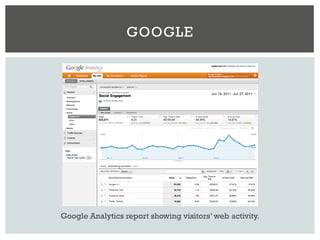
Google Analytics report showing visitors’ web activity.
News at Eleven says Facebook is a privacy threat, and they’re more
right than they know – The largest threat is not on Facebook, it is
Facebook.
¡  Facebook’s primary collection of data comes from what we’re intending to
share with our friends – full name, email, phone number, address, and of
course what we like.
¡  Facebook’s collection does not end on their website or app. Every visit
adds a tracking cookie to your computer that catalogues your activity on
the web and reports it to Facebook. This cookie never expires, not even if
you log out – it must be manually deleted.
¡  Installing the Facebook app on your mobile device allows Facebook full
access to your text messages and contacts. Their new Messenger app can
place calls directly from the app – keeping an eye on all your social
interactions.
¡  “Login with Facebook” feature allows Facebook to not only see other sites
you’re visiting (they can anyway), but see exactly what you’re doing on any
site they sign you into.
FACEBOOK
Facebook realized that savvy browsers pay no
attention to ads, but let their guard down for posts.
So they started selling posts as ads.
¡  Any given post from a page only reaches ~10% of
subscribers. Page owners must pay to promote further.
¡  Facebook gives page owners the option to promote based
on demographics and interests. The targeting metrics will
astound you – nearly every piece of data that Facebook
mines can be put to use.
MARKETING WITH FACEBOOK
FACEBOOK
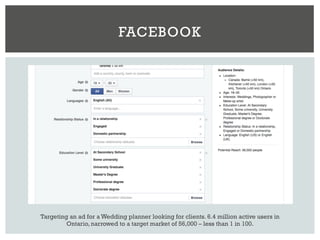
Targeting an ad for a Wedding planner looking for clients. 6.4 million active users in
Ontario, narrowed to a target market of 56,000 – less than 1 in 100.
On the Internet, nobody can see who signs your
paycheque.
¡  Astroturfing is when a paid representative posts online in
support of their company or organization under the guise of an
unaffiliated individual posting their opinion.
¡  Astroturfers are common on blogging platforms such as Tumblr,
Wordpress, and Twitter. They may comment on Disqus threads,
post on Reddit, or even edit Wikipedia articles about their
companies (all more commonly than you may think).
¡  Etymology: The term was coined to describe a fake grassroots
movement. Astroturfing is often political in nature: PACs,
religious groups, and the US Military (Operation Earnest Voice)
are known for using it.
ASTROTURFING
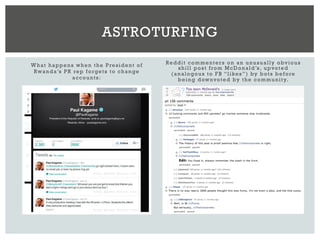
What happens when the President of
Rwanda’s PR rep forgets to change
accounts:
Reddit commenters on an unusually obvious
shill post from McDonald’s, upvoted
(analogous to FB “likes”) by bots before
being downvoted by the community.
ASTROTURFING
When the service is free, you’re the product. When the service
is paid…well, you’re still the product.
¡  Bell Canada rolled out a program in mid-November 2013 that tracks
customers’ television, web browsing, calling, and cellular usage. In a
press statement, it was explained that this data was used specifically
for targeted advertising to customers, as well as sale to third party
companies. All existing and new customers are enrolled, unless an opt-
out request is given.
¡  Bell’s collected information can be cross-referenced with the
customer’s account information to provide similarly comprehensive
profiles for marketing as giants Facebook and Google do.
¡  “The scope of Bell’s intended personal data usage is remarkable…For
law enforcement, Bell is effectively offering one of the most detailed
profiling services in Canada, which the company can disclose without a
court order as part of an investigation under Canadian privacy law” –
Michael Geist, a technology law expert.
¡  NB: Rogers Communications maintains a similar program, though
customers are opted out by default. I’ve found no evidence of data
collection/aggregation by Telus in my research.
YOUR ISP TOO?
It’s simple: if you’re a web user, it’s hard not to lose
a little privacy.
¡  In researching this project, I was astounded by the depth and
breadth of information collected by most major tech companies. It’s
unsurprising that the NSA chose to precipitate leaks from them,
rather than directly collecting citizen data.
¡  Focusing on Facebook and Google was a choice to give two prime
examples of companies who aggregate huge amounts of user data.
They are by no means exclusive. Apple, for example, collects
through their devices heavily.
¡  Skepticism on the web is necessary. Advertisements are no longer
on the banners and borders – they’re the video you’re watching or
the blog post you’re reading. And it’s no accident that you found
them.
¡  There is a need for greater public awareness, and greater industry
regulation. The internet is maturing faster than social constructs
and policy can be formed to reign it in.
CONCLUSIONS
Oboler, A.,Welsh, K., Cruz, K. (2012) “The danger of big data: Social media as computational social science”.First Monday. Accessed from:
http://firstmonday.org/ojs/index.php/fm/article/view/3993/3269
Fisher, D. (2014) “Government Requests for Google User Data Continue to Climb”. Threatpost. Accessed from:
http://threatpost.com/government-requests-for-google-user-data-continue-to-climb/105066
Johnson, C. (2013) “Facebook is tracking what you don’t do on Facebook”.ArsTechnica.Accessed from:
http://arstechnica.com/business/2013/12/facebook-collects-conducts-research-on-status-updates-you-never-post/
Edwards, J. (2014) “See All the Companies That Are TrackingYou on Facebook”.Business Insider. Accessed from:
http://www.businessinsider.com/block-companies-tracking-you-on-facebook-2014-1
del Castillo, M. (2013) “6 Kinds ofYour Information Google Openly Admits to Collecting”. Upstart Business Journal.Accessed from:
http://upstart.bizjournals.com/news/technology/2013/08/15/6-data-categories-google-collects.html?page=all
Unknown (2014) “Analytics Set Up (Web)”. Google Support. Accessed from: https://support.google.com/analytics/answer/1086338?hl=en
Geist, M. (2013) “The Great Canadian Personal Data Grab Continues: Bell Expands its Consumer Monitoring and Profiling”. Michael Geist. Accessed from:
http://www.michaelgeist.ca/content/view/6977/125/
Krashinsky, S. (2013) “Bell planning to use customers’ data to target ads”. The Globe and Mail. Accessed from:
http://www.theglobeandmail.com/report-on-business/industry-news/marketing/bell-customer-phone-and-internet-data-will-be-used-to-target-ads/article14984876/
Fielding, N., Cobain, I. (2011) “Revealed: US Spy operation that manipulates social media”.The Guardian. Accessed from:
http://www.theguardian.com/technology/2011/mar/17/us-spy-operation-social-networks
Blue,V. (2012) “Corruption in Wikiland? Paid PR scandal erupts at Wikipedia”.CNET. Accessed from:
http://www.cnet.com/news/corruption-in-wikiland-paid-pr-scandal-erupts-at-wikipedia/
Taylor, A. (2014) “A stray tweet may have exposed Paul Kagame’s Twitter ghostwriter, and maybe much more”.Washington Post. Accessed from:
http://www.washingtonpost.com/blogs/worldviews/wp/2014/03/07/a-stray-tweet-may-have-exposed-paul-kagames-twitter-ghostwriter-and-maybe-much-more/
Horrocks, I. (2014) “Astroturfing and Sockpuppetry: Governments are paying people to fake support”. Planet Ivy. Accessed from:
http://planetivy.com/dogma/91697/astroturfing-sockpuppetry-governments-paying-people-fake-support/
Henry, A. (2011) “Facebook Is TrackingYour Every Move on the Web; Here’s How to Stop It”. LifeHacker. Accessed from: http://lifehacker.com/5843969/facebook-is-tracking-
your-every-move-on-the-web-heres-how-to-stop-it
SOURCES

Social Impact of Technology - Final Presentation

  • 1.
    Andy Hayes Social Impactof Technology Section 70 April 2014 TECHNOLOGY MAKES US A MARKETING TOOL, DEMOGRAPHIC, AND TARGET
  • 2.
    ¡ The Paradigm of “Free” ¡ TheValue of Your Information ¡ You as a: • Marketing Tool • Demographic • Target ¡ Google ¡ Facebook ¡ Astroturfing ¡ Your ISP too? ¡ Conclusions ¡ Sources TOPICS
  • 3.
    On the internet,if you’re not the paying customer, you are the product. ¡  Users have come to expect web-based content and services to be provided for free. ¡  Since the proliferation of the internet and the resulting dot-com boom, free access to search engines, webmail, and social networking have been provided for free. ¡  More recently, mobile apps and cloud storage have offered free basic offerings, with modest cost for heavier/extended use. ¡  It is the need to monetize these services, given to the end user for free, that drives companies to collect, analyze, and sell information from users. ¡  This information-based market makes every internet user a marketing tool, a demographic, and a target. THE PARADIGM OF “FREE”
  • 4.
    How do advertisersknow what you like? Every Facebook post, Google search, and iPhone app of yours tells them for you. ¡  Every product has a target market – the people most likely to buy based on their demographics and interests. ¡  Advertising campaigns can be extremely expensive. Online advertisements are paid by number of clicks and views. Targeting the exposure of these ads ensures that every click or view is coming from someone most likely to buy. ¡  Nearly every advertisement you see online is tailored to you because of your demographic. Manufacturers have a profile of their ideal customer. Advertisers have a profile of you, based on your information. When you see advertisements, it’s because these two profiles have aligned for the advertised product and you. THE VALUE OF YOUR INFORMATION
  • 5.
    ¡  Marketing Tool •The information that you give out to any website, knowingly or not, is used to market to you more effectively. This information can also be extrapolated to others who fit your demographics. You’re helping marketers sell to you and your friends. ¡  Demographic • While we all have personal demographics, every piece of technology you own, every website you visit, and every blogger’s opinion you adopt puts you in a demographic. The more you browse, the more boxes you tick. 18-24 years old, OSX user, Reddit member, Facebook addict with lots of Photoshop questions: Google knows what I’m up to, and they know exactly how to market to me. ¡  Target • You are a target market. Always have been, even if you existed before the web. That shouldn’t be news to you, but what’s new is the sheer number of people, organizations, and companies who have a vested interest in getting your attention. The more technology embedded in your lifestyle, the more avenues there are to market to you. • As will be touched on in the Astroturfing and ISP sections, there’s the opportunity for those tracking you on the web to commit egregious breaches of your privacy, making you a target of hackers and overzealous law enforcement. Whether the NSA gets your information from Facebook illicitly, or your Internet provider hands over your files to the OPP without a warrant, your rights are reduced when your information is collected. YOU AS A…
  • 6.
    Google isn’t asearch engine anymore, they’re an advertising company. Their public-facing products serve to collect information to market with or sell. ¡  Google products are ubiquitous on the web. They’re often the best or most popular of their kind: Search, YouTube, Gmail, Maps, Drive, Docs, Android OS, and the Play Store. ¡  Google tracks a user’s activity across their various services on the web. Your Gmail messages are tied to your searches, recently watched YouTube videos, and (through your Android device and Maps) your phone number and location. ¡  The aggregated information you provide gives Google an extremely accurate picture with which to advertise to you. GOOGLE
  • 7.
    You took yourvideos off YouTube, migrated your email, and closed your G+ account. Google is still tracking you. Here’s how. ¡  Google Analytics is a paid Google product, targeted at website owners. ¡  Analytics can be added to any website you own, including those based around a CMS such as Squarespace or Wordpress.org. ¡  Analytics uses tracking cookies to follow a user around the web after they visit a website. The website’s owner can see anonymized information about visitors including: time spent on website, repeat visits, pages viewed, advertisements clicked, links followed, device, browser, and referring Google searches. ¡  PS, Google still reads every email you send to a Gmail user. GOOGLE ANALYTICS
  • 8.
    GOOGLE Google Analytics reportshowing visitors’ web activity.
  • 9.
    News at Elevensays Facebook is a privacy threat, and they’re more right than they know – The largest threat is not on Facebook, it is Facebook. ¡  Facebook’s primary collection of data comes from what we’re intending to share with our friends – full name, email, phone number, address, and of course what we like. ¡  Facebook’s collection does not end on their website or app. Every visit adds a tracking cookie to your computer that catalogues your activity on the web and reports it to Facebook. This cookie never expires, not even if you log out – it must be manually deleted. ¡  Installing the Facebook app on your mobile device allows Facebook full access to your text messages and contacts. Their new Messenger app can place calls directly from the app – keeping an eye on all your social interactions. ¡  “Login with Facebook” feature allows Facebook to not only see other sites you’re visiting (they can anyway), but see exactly what you’re doing on any site they sign you into. FACEBOOK
  • 10.
    Facebook realized thatsavvy browsers pay no attention to ads, but let their guard down for posts. So they started selling posts as ads. ¡  Any given post from a page only reaches ~10% of subscribers. Page owners must pay to promote further. ¡  Facebook gives page owners the option to promote based on demographics and interests. The targeting metrics will astound you – nearly every piece of data that Facebook mines can be put to use. MARKETING WITH FACEBOOK
  • 11.
    FACEBOOK Targeting an adfor a Wedding planner looking for clients. 6.4 million active users in Ontario, narrowed to a target market of 56,000 – less than 1 in 100.
  • 12.
    On the Internet,nobody can see who signs your paycheque. ¡  Astroturfing is when a paid representative posts online in support of their company or organization under the guise of an unaffiliated individual posting their opinion. ¡  Astroturfers are common on blogging platforms such as Tumblr, Wordpress, and Twitter. They may comment on Disqus threads, post on Reddit, or even edit Wikipedia articles about their companies (all more commonly than you may think). ¡  Etymology: The term was coined to describe a fake grassroots movement. Astroturfing is often political in nature: PACs, religious groups, and the US Military (Operation Earnest Voice) are known for using it. ASTROTURFING
  • 13.
    What happens whenthe President of Rwanda’s PR rep forgets to change accounts: Reddit commenters on an unusually obvious shill post from McDonald’s, upvoted (analogous to FB “likes”) by bots before being downvoted by the community. ASTROTURFING
  • 14.
    When the serviceis free, you’re the product. When the service is paid…well, you’re still the product. ¡  Bell Canada rolled out a program in mid-November 2013 that tracks customers’ television, web browsing, calling, and cellular usage. In a press statement, it was explained that this data was used specifically for targeted advertising to customers, as well as sale to third party companies. All existing and new customers are enrolled, unless an opt- out request is given. ¡  Bell’s collected information can be cross-referenced with the customer’s account information to provide similarly comprehensive profiles for marketing as giants Facebook and Google do. ¡  “The scope of Bell’s intended personal data usage is remarkable…For law enforcement, Bell is effectively offering one of the most detailed profiling services in Canada, which the company can disclose without a court order as part of an investigation under Canadian privacy law” – Michael Geist, a technology law expert. ¡  NB: Rogers Communications maintains a similar program, though customers are opted out by default. I’ve found no evidence of data collection/aggregation by Telus in my research. YOUR ISP TOO?
  • 15.
    It’s simple: ifyou’re a web user, it’s hard not to lose a little privacy. ¡  In researching this project, I was astounded by the depth and breadth of information collected by most major tech companies. It’s unsurprising that the NSA chose to precipitate leaks from them, rather than directly collecting citizen data. ¡  Focusing on Facebook and Google was a choice to give two prime examples of companies who aggregate huge amounts of user data. They are by no means exclusive. Apple, for example, collects through their devices heavily. ¡  Skepticism on the web is necessary. Advertisements are no longer on the banners and borders – they’re the video you’re watching or the blog post you’re reading. And it’s no accident that you found them. ¡  There is a need for greater public awareness, and greater industry regulation. The internet is maturing faster than social constructs and policy can be formed to reign it in. CONCLUSIONS
  • 16.
    Oboler, A.,Welsh, K.,Cruz, K. (2012) “The danger of big data: Social media as computational social science”.First Monday. Accessed from: http://firstmonday.org/ojs/index.php/fm/article/view/3993/3269 Fisher, D. (2014) “Government Requests for Google User Data Continue to Climb”. Threatpost. Accessed from: http://threatpost.com/government-requests-for-google-user-data-continue-to-climb/105066 Johnson, C. (2013) “Facebook is tracking what you don’t do on Facebook”.ArsTechnica.Accessed from: http://arstechnica.com/business/2013/12/facebook-collects-conducts-research-on-status-updates-you-never-post/ Edwards, J. (2014) “See All the Companies That Are TrackingYou on Facebook”.Business Insider. Accessed from: http://www.businessinsider.com/block-companies-tracking-you-on-facebook-2014-1 del Castillo, M. (2013) “6 Kinds ofYour Information Google Openly Admits to Collecting”. Upstart Business Journal.Accessed from: http://upstart.bizjournals.com/news/technology/2013/08/15/6-data-categories-google-collects.html?page=all Unknown (2014) “Analytics Set Up (Web)”. Google Support. Accessed from: https://support.google.com/analytics/answer/1086338?hl=en Geist, M. (2013) “The Great Canadian Personal Data Grab Continues: Bell Expands its Consumer Monitoring and Profiling”. Michael Geist. Accessed from: http://www.michaelgeist.ca/content/view/6977/125/ Krashinsky, S. (2013) “Bell planning to use customers’ data to target ads”. The Globe and Mail. Accessed from: http://www.theglobeandmail.com/report-on-business/industry-news/marketing/bell-customer-phone-and-internet-data-will-be-used-to-target-ads/article14984876/ Fielding, N., Cobain, I. (2011) “Revealed: US Spy operation that manipulates social media”.The Guardian. Accessed from: http://www.theguardian.com/technology/2011/mar/17/us-spy-operation-social-networks Blue,V. (2012) “Corruption in Wikiland? Paid PR scandal erupts at Wikipedia”.CNET. Accessed from: http://www.cnet.com/news/corruption-in-wikiland-paid-pr-scandal-erupts-at-wikipedia/ Taylor, A. (2014) “A stray tweet may have exposed Paul Kagame’s Twitter ghostwriter, and maybe much more”.Washington Post. Accessed from: http://www.washingtonpost.com/blogs/worldviews/wp/2014/03/07/a-stray-tweet-may-have-exposed-paul-kagames-twitter-ghostwriter-and-maybe-much-more/ Horrocks, I. (2014) “Astroturfing and Sockpuppetry: Governments are paying people to fake support”. Planet Ivy. Accessed from: http://planetivy.com/dogma/91697/astroturfing-sockpuppetry-governments-paying-people-fake-support/ Henry, A. (2011) “Facebook Is TrackingYour Every Move on the Web; Here’s How to Stop It”. LifeHacker. Accessed from: http://lifehacker.com/5843969/facebook-is-tracking- your-every-move-on-the-web-heres-how-to-stop-it SOURCES