INTRODUCTION
• Technology now a days takes over for so many different
  things and activities. Everything a person does is now
  connected to the latest in developed technology.
• Cell phones, computers, social media and many other
  types of technology have changed the way businesses
  advertise and market their products. These technological
  advancements have turned people into a marketing tool,
  demographic and target for these companies.
AGENDA
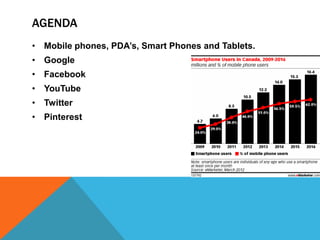
• Mobile phones, PDA‟s, Smart Phones and Tablets.
• Google
• Facebook
• YouTube
• Twitter
• Pinterest
SMART PHONES AND TABLETS
•   Inpresent time almost everybody has a smart phone, these
    phones have created the opportunity for more creative
    marketing. Smart phones are: Always on, always with us and
    always connected.
•   These phones are used for a multitude of functions. Search
    engines, viewing pictures and videos, social media
    connection, shopping and directions.
•   In seconds a person can find a local business that they are
    looking for, check if it has there item in stock and then find
    directions to their location. This function is a huge benefit to
    all businesses.
•   With advertisements on smart phone internet, people are
    inclined to click the ad, view the businesses web site, buy a
    product or find the phone number to call and acquire
    information.
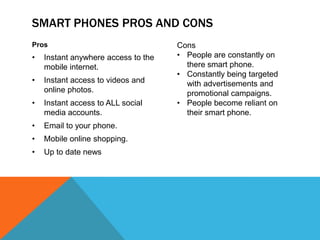
SMART PHONES PROS AND CONS
Pros                                 Cons
•   Instant anywhere access to the   • People are constantly on
    mobile internet.                   there smart phone.
                                     • Constantly being targeted
•   Instant access to videos and       with advertisements and
    online photos.                     promotional campaigns.
•   Instant access to ALL social     • People become reliant on
    media accounts.                    their smart phone.
•   Email to your phone.
•   Mobile online shopping.
•   Up to date news
GOOGLE
• Google is now tracking the most commonly searched
  topics and words that are entered into its search engine.
• Once signed into the a Google or Gmail account all
  searches are recorded into profiles. Google uses these
  narrowed down searches to form demographics and
  targeted audiences.
• Google uses this this information to customize which
  advertisements are viewable to certain people at certain
  times.
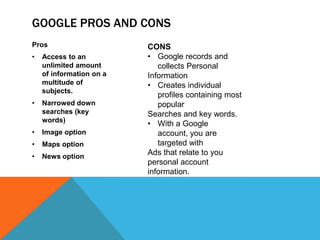
GOOGLE PROS AND CONS
Pros                      CONS
•   Access to an          • Google records and
    unlimited amount         collects Personal
    of information on a   Information
    multitude of          • Creates individual
    subjects.
                             profiles containing most
•   Narrowed down            popular
    searches (key         Searches and key words.
    words)
                          • With a Google
•   Image option             account, you are
•   Maps option              targeted with
•   News option
                          Ads that relate to you
                          personal account
                          information.
FACEBOOK
• Facebook was started and quickly became one of the
  most popular social media web sites of all time. Since
  then it has turned into more a marketing tool than
  anything else.
• Companies have began to create Business pages to
  promote there name and product on Facebook.
• This allows them to target and interact with different
  costumers.
• Many Businesses will have a “give away” containing of a
  picture of the product that people have to “like” and
  “share” in order to win. This creates huge public
  awareness of products that are popular.
FACEBOOK
• In addition to advertising products on Facebook
  businesses for example, the NY times, when purchasing
  your subscription (typically online) they give you the
  option to “share” your activity with the NY Times on your
  Facebook page.
• This function creates awareness that people are
  purchasing a certain product or service and are satisfied
  doing so.
• Facebook allows marketers to refine their targeted
  demographics into age, sex, relationship status and
  geographic location.
FACEBOOK PROS AND CONS
Pros                        Cons
•   Connect and easily      • Facebook records and
    contact individual        sells personal
    persons.                  information for marketing
•   Access to up to date      purposes.
    information on          • Targets individuals with
    products.                 specific advertisements
•   Access to promotional     based on account
    events conducted by       information.
    businesses and          • Takes ownership of ANY
    organizations.            photo posted to
                              Facebook.
YOUTUBE
• You tube is used by companies to create videos that are
  high quality yet very simple to view and only viewable on
  the internet or a smart phone.
• The goal of many companies is to have their video “go
  viral” which means it is viewed millions of times in many
  different countries. A viral video can create huge
  awareness of a company and or product.
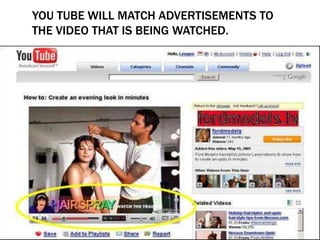
• You tube has now incorporated advertisement before a
  “popular” or “highly watched” videos.
• Some of these advertisements give you the option to skip
  the add or watch it, but recently many ads are mandatory
  before you get to watch your video.
YOU TUBE WILL MATCH ADVERTISEMENTS TO
THE VIDEO THAT IS BEING WATCHED.
YOUTUBE PROS AND CONS
Pros
                                      Cons
•   Access to millions of videos      • The majority of videos
    under a multitude of topics
                                        have a MANDATORY
•   Access to instructional videos.     advertisement that
•   Access to millions of music         you have to watch
    videos and commercials.             first.
•   All instantly and in HD           • Pop up ads during the
                                        video you are
                                        watching.
                                      • Advertisements that
                                        match the video you
                                        have searched for.
TWITTER
•   In a way twitter is similar to Facebook in the sense that a
    business can connect with thousands even millions of
    people with in seconds.
•   Businesses can send out exclusive information to targeted
    groups with the click of a button.
•   Every individual that is “following” a business will receive
    their up to date information immediately after it is published
    by the company.
•   Twitter allows companies to pay to be promoted and
    advertised for people to “follow”
•   Ad campaigns through twitter get distributed very quickly to
    very large targeted demographs.
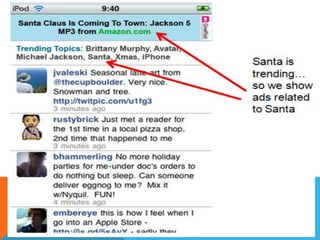
•   Twitter matches topics that are currently “trending” with ads
    that are of a similar topic.
TWITTER PROS AND CONS
Pros                                 Cons
•   Access to up to date and         • Targeted with spam
    exclusive information.             advertisements
•   Immediate information on         • Constantly updating news
    celebrities and sports teams.      feed.
                                     • Advertisements around the
•   News feeds
                                       home page.
•   Local news
•   Quick and easy distribution of
    information.
PINTEREST
• Pinterest is a socially interactive web site that give‟s its
  users the abillity to view products and objects in basicaly
  every topic or industry.
• When users like certain products they can „Pin‟ those
  products in order to view them later and/or receive
  information on how to purchase them.
CONCLUSION
In conclusion, after reviewing pros and cons, Technological advancements
    including, the internet, mobile internet, social networks, smart phones
    and tablets create a unique and much more interesting way of
    marketing and promoting their business.
With that being said, these technologies have also given these companies
   the opportunity to turn the general population into a marketing tool, a
   demographic and a target.
REFERENCES
•   Gatto, K. (2013). Tech news daily: How Facebook sells your personal
    information. Retrieved from: http://www.technewsdaily.com/16515-
    facebook-personal-information.html
•   Macke, J. (2012) Yahoo Finance: 3 Ways Facebook Plans to exploit its
    users. Retrieved from: http://finance.yahoo.com/blogs/breakout/3-ways-
    facebook-ipo-exploit-users-172215377.html
•   Glass, J. (2012). Nerve. Web culture: Twitter is stealing and harvesting
    personal information. Retrieved from:
    http://www.nerve.com/news/web/twitter-is-stealing-and-harvesting-our-
    personal-information-ohshit
REFERENCES
•   Click-On-It Mobile. (Producers). (2011). Social Media: The power of
    mobile advertising. [video] Retrieved from:
    http://www.youtube.com/watch?v=hYHXIC37tr0&feature=related
•   Ask Men (N.D.). Google tracking: How Google has been tracking your
    browsing .Retrieved from:
    http://ca.askmen.com/entertainment/guy_gear_300/349_google-
    tracking.html
•   Greg, R. (2006). Information today: Tracking your search history.
    Retrieved from: http://www.infotoday.com/online/mar06/OnTheNet.shtml
•   Anderson, N. (2010). ARS technica. Civilization and discontents: Why
    Google keeps your data forever, tracks you with ads. Retrieved from:
    http://arstechnica.com/tech-policy/2010/03/google-keeps-your-data-to-
    learn-from-good-guys-fight-off-bad-guys/

Technology has turned people into marketing tools, demographics and targets.

  • 2.
    INTRODUCTION • Technology nowa days takes over for so many different things and activities. Everything a person does is now connected to the latest in developed technology. • Cell phones, computers, social media and many other types of technology have changed the way businesses advertise and market their products. These technological advancements have turned people into a marketing tool, demographic and target for these companies.
  • 3.
    AGENDA • Mobile phones,PDA‟s, Smart Phones and Tablets. • Google • Facebook • YouTube • Twitter • Pinterest
  • 4.
    SMART PHONES ANDTABLETS • Inpresent time almost everybody has a smart phone, these phones have created the opportunity for more creative marketing. Smart phones are: Always on, always with us and always connected. • These phones are used for a multitude of functions. Search engines, viewing pictures and videos, social media connection, shopping and directions. • In seconds a person can find a local business that they are looking for, check if it has there item in stock and then find directions to their location. This function is a huge benefit to all businesses. • With advertisements on smart phone internet, people are inclined to click the ad, view the businesses web site, buy a product or find the phone number to call and acquire information.
  • 5.
    SMART PHONES PROSAND CONS Pros Cons • Instant anywhere access to the • People are constantly on mobile internet. there smart phone. • Constantly being targeted • Instant access to videos and with advertisements and online photos. promotional campaigns. • Instant access to ALL social • People become reliant on media accounts. their smart phone. • Email to your phone. • Mobile online shopping. • Up to date news
  • 7.
    GOOGLE • Google isnow tracking the most commonly searched topics and words that are entered into its search engine. • Once signed into the a Google or Gmail account all searches are recorded into profiles. Google uses these narrowed down searches to form demographics and targeted audiences. • Google uses this this information to customize which advertisements are viewable to certain people at certain times.
  • 8.
    GOOGLE PROS ANDCONS Pros CONS • Access to an • Google records and unlimited amount collects Personal of information on a Information multitude of • Creates individual subjects. profiles containing most • Narrowed down popular searches (key Searches and key words. words) • With a Google • Image option account, you are • Maps option targeted with • News option Ads that relate to you personal account information.
  • 9.
    FACEBOOK • Facebook wasstarted and quickly became one of the most popular social media web sites of all time. Since then it has turned into more a marketing tool than anything else. • Companies have began to create Business pages to promote there name and product on Facebook. • This allows them to target and interact with different costumers. • Many Businesses will have a “give away” containing of a picture of the product that people have to “like” and “share” in order to win. This creates huge public awareness of products that are popular.
  • 10.
    FACEBOOK • In additionto advertising products on Facebook businesses for example, the NY times, when purchasing your subscription (typically online) they give you the option to “share” your activity with the NY Times on your Facebook page. • This function creates awareness that people are purchasing a certain product or service and are satisfied doing so. • Facebook allows marketers to refine their targeted demographics into age, sex, relationship status and geographic location.
  • 11.
    FACEBOOK PROS ANDCONS Pros Cons • Connect and easily • Facebook records and contact individual sells personal persons. information for marketing • Access to up to date purposes. information on • Targets individuals with products. specific advertisements • Access to promotional based on account events conducted by information. businesses and • Takes ownership of ANY organizations. photo posted to Facebook.
  • 12.
    YOUTUBE • You tubeis used by companies to create videos that are high quality yet very simple to view and only viewable on the internet or a smart phone. • The goal of many companies is to have their video “go viral” which means it is viewed millions of times in many different countries. A viral video can create huge awareness of a company and or product. • You tube has now incorporated advertisement before a “popular” or “highly watched” videos. • Some of these advertisements give you the option to skip the add or watch it, but recently many ads are mandatory before you get to watch your video.
  • 13.
    YOU TUBE WILLMATCH ADVERTISEMENTS TO THE VIDEO THAT IS BEING WATCHED.
  • 14.
    YOUTUBE PROS ANDCONS Pros Cons • Access to millions of videos • The majority of videos under a multitude of topics have a MANDATORY • Access to instructional videos. advertisement that • Access to millions of music you have to watch videos and commercials. first. • All instantly and in HD • Pop up ads during the video you are watching. • Advertisements that match the video you have searched for.
  • 15.
    TWITTER • In a way twitter is similar to Facebook in the sense that a business can connect with thousands even millions of people with in seconds. • Businesses can send out exclusive information to targeted groups with the click of a button. • Every individual that is “following” a business will receive their up to date information immediately after it is published by the company. • Twitter allows companies to pay to be promoted and advertised for people to “follow” • Ad campaigns through twitter get distributed very quickly to very large targeted demographs. • Twitter matches topics that are currently “trending” with ads that are of a similar topic.
  • 17.
    TWITTER PROS ANDCONS Pros Cons • Access to up to date and • Targeted with spam exclusive information. advertisements • Immediate information on • Constantly updating news celebrities and sports teams. feed. • Advertisements around the • News feeds home page. • Local news • Quick and easy distribution of information.
  • 18.
    PINTEREST • Pinterest isa socially interactive web site that give‟s its users the abillity to view products and objects in basicaly every topic or industry. • When users like certain products they can „Pin‟ those products in order to view them later and/or receive information on how to purchase them.
  • 19.
    CONCLUSION In conclusion, afterreviewing pros and cons, Technological advancements including, the internet, mobile internet, social networks, smart phones and tablets create a unique and much more interesting way of marketing and promoting their business. With that being said, these technologies have also given these companies the opportunity to turn the general population into a marketing tool, a demographic and a target.
  • 20.
    REFERENCES • Gatto, K. (2013). Tech news daily: How Facebook sells your personal information. Retrieved from: http://www.technewsdaily.com/16515- facebook-personal-information.html • Macke, J. (2012) Yahoo Finance: 3 Ways Facebook Plans to exploit its users. Retrieved from: http://finance.yahoo.com/blogs/breakout/3-ways- facebook-ipo-exploit-users-172215377.html • Glass, J. (2012). Nerve. Web culture: Twitter is stealing and harvesting personal information. Retrieved from: http://www.nerve.com/news/web/twitter-is-stealing-and-harvesting-our- personal-information-ohshit
  • 21.
    REFERENCES • Click-On-It Mobile. (Producers). (2011). Social Media: The power of mobile advertising. [video] Retrieved from: http://www.youtube.com/watch?v=hYHXIC37tr0&feature=related • Ask Men (N.D.). Google tracking: How Google has been tracking your browsing .Retrieved from: http://ca.askmen.com/entertainment/guy_gear_300/349_google- tracking.html • Greg, R. (2006). Information today: Tracking your search history. Retrieved from: http://www.infotoday.com/online/mar06/OnTheNet.shtml • Anderson, N. (2010). ARS technica. Civilization and discontents: Why Google keeps your data forever, tracks you with ads. Retrieved from: http://arstechnica.com/tech-policy/2010/03/google-keeps-your-data-to- learn-from-good-guys-fight-off-bad-guys/