Prof. Jürgen Rosemann
 Ir. Wang Chiu‐Yuan


(Social) Housing
Approaches and Experiences from Europe and Asia


                                                  1
The Housing Question:
• The capitalistic system ('the market') is 
  unable to provide the working class  with 
  sufficient and affordable houses.
• The Bourgeoisie 'solves' the problem by 
  offering bad, overcrowded and unhealthy 
  housing conditions.
• Bad housing conditions are increasing 
  because of the sudden inflow of the 
  population to the big cities.                                  2
                Friedrich Engels: About the Housing Question  
                                                    1872/73
3
The New Housing Question:
• How to provide the urban poor with 
  acceptable and affordable shelter?

• How to combat social contradictions and 
  segregation?

• How to generate a more integrated urban 
  society?                                   4
•   To Buy or to Rent
•   To concentrate on the urban poor or to integrate 
    different social classes
                                                        5
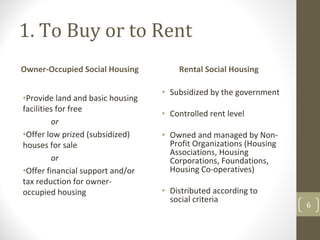
1. To Buy or to Rent
Owner‐Occupied Social Housing          Rental Social Housing

                                   • Subsidized by the government
•Provide land and basic housing 
facilities for free
                                   • Controlled rent level
         or
•Offer low prized (subsidized)     • Owned and managed by Non‐
houses for sale                      Profit Organizations (Housing 
                                     Associations, Housing 
         or                          Corporations, Foundations, 
•Offer financial support and/or      Housing Co‐operatives)
tax reduction for owner‐
occupied housing                   • Distributed according to 
                                     social criteria
                                                                      6
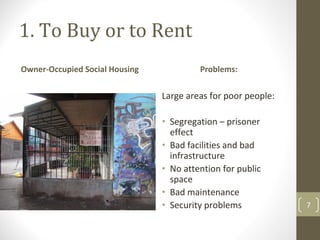
1. To Buy or to Rent
Owner‐Occupied Social Housing            Problems:


                                Large areas for poor people:

                                • Segregation – prisoner 
                                  effect
                                • Bad facilities and bad 
                                  infrastructure
                                • No attention for public 
                                  space
                                • Bad maintenance
Santiago de Chile               • Security problems            7
1. To Buy or to Rent
                                         Exception: 
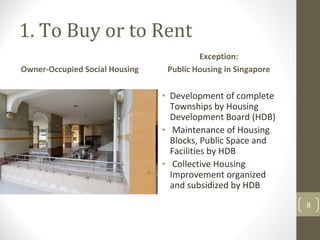
Owner‐Occupied Social Housing    Public Housing in Singapore


                                • Development of complete 
                                  Townships by Housing 
                                  Development Board (HDB)
                                • Maintenance of Housing 
                                  Blocks, Public Space and 
                                  Facilities by HDB
                                • Collective Housing 
                                  Improvement organized 
                                  and subsidized by HDB
                                                               8
2. Target Groups
Social Housing accessible only      Social Housing accessible
     for the urban poor:          for wide levels of the society:
• Low rent                        • Higher rent (individual 
• Low production costs –            aid for poor people)
  low quality                     • Higher costs – higher 
• High subsidies per unit           quality
• Limited number of units         • Lower subsidies per unit 
  (limited public means)          • Large number of units

• Stigmatized areas:              • Integrated areas: living 
  concentration of poor             together of different 
  people ‐ segregation              social classes                  9
2. Target Groups
Social Housing accessible only           Social Housing accessible
     for the urban poor:               for wide levels of the society:


                                                                            10

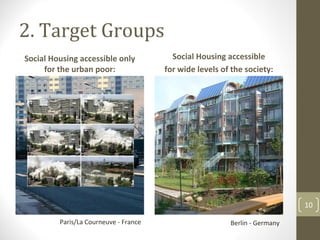
         Paris/La Courneuve ‐ France                     Berlin ‐ Germany
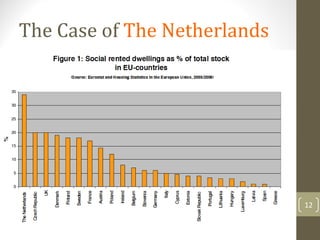
The Case of The Netherlands
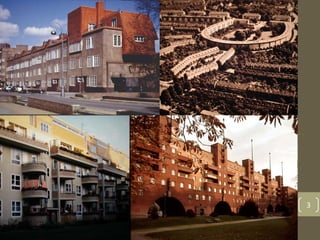
Housing Act from 1901:

• Housing as a right for everybody and its provision as an 
  obligation of the society
• Control of the housing stock and limitations for private 
  landlords
• Establishing of urban planning (extension plans for 
  municipalities with more than 10.000 inhabitants)

• Introduction of the social housing system                   11
The Case of The Netherlands


                              12
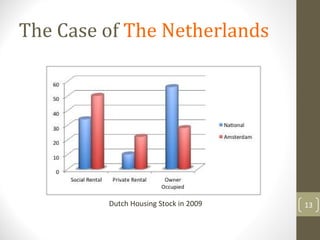
The Case of The Netherlands


         Dutch Housing Stock in 2009    13
Housing Management 
and Organization
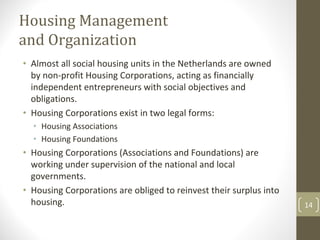
• Almost all social housing units in the Netherlands are owned 
  by non‐profit Housing Corporations, acting as financially 
  independent entrepreneurs with social objectives and 
  obligations.
• Housing Corporations exist in two legal forms:
  • Housing Associations
  • Housing Foundations
• Housing Corporations (Associations and Foundations) are 
  working under supervision of the national and local 
  governments.
• Housing Corporations are obliged to reinvest their surplus into 
  housing.                                                           14
Housing Management 
and Organization
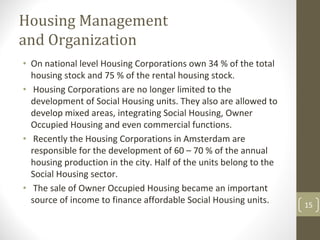
• On national level Housing Corporations own 34 % of the total 
  housing stock and 75 % of the rental housing stock.
• Housing Corporations are no longer limited to the 
  development of Social Housing units. They also are allowed to 
  develop mixed areas, integrating Social Housing, Owner 
  Occupied Housing and even commercial functions.
• Recently the Housing Corporations in Amsterdam are 
  responsible for the development of 60 – 70 % of the annual 
  housing production in the city. Half of the units belong to the 
  Social Housing sector.
• The sale of Owner Occupied Housing became an important 
  source of income to finance affordable Social Housing units.       15
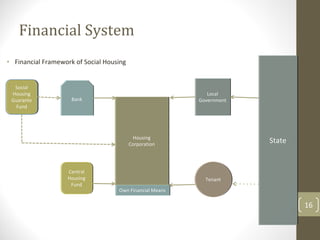
Financial System
• Financial Framework of Social Housing


  Social
   Social
 Housing
  Housing                                                    Local
                                                             Local
 Guarante
 Guarante            Bank
                     Bank                                 Government
                                                          Government
   Fund
   Fund


                                            Housing
                                            Housing
                                          Corporation
                                          Corporation
                                                                       State
                                                                       State


                   Central
                    Central
                   Housing
                   Housing                                  Tenant
                                                            Tenant
                     Fund
                     Fund
                                    Own Financial Means
                                    Own Financial Means

                                                                               16
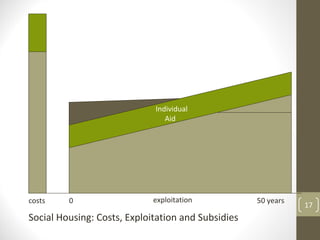
Individual
                                Aid


costs    0                   exploitation           50 years
                                                               17
Social Housing: Costs, Exploitation and Subsidies
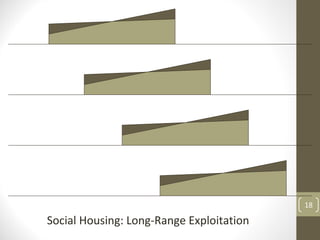
18

Social Housing: Long‐Range Exploitation
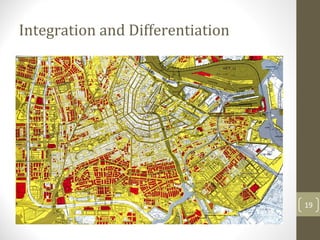
Integration and Differentiation


                                  19
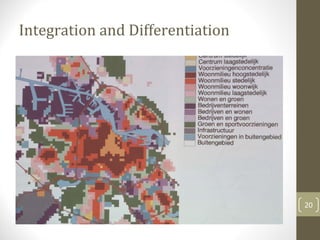
Integration and Differentiation


                                  20
The Idea of Differentiated Housing 
Milieu’s
• Housing no longer has to focus on the (statistical) average. 
  The city is a collection of minorities, each of them with special 
  demands, priorities and wishes.
• Housing has to be differentiated according to different life‐
  styles, different patterns of behavior and different value 
  systems.
• The combination of compatible life‐styles is able to bridge 
  social contradictions and to contribute to social integration.
• To generate an integrated urban society, social housing has to 
  be combined with owner occupied housing and with other 
  urban functions.
• The combination with owner occupied housing and with 
  commercial functions can generate additional means to 
                                                                       21
  improve the quality of social housing.
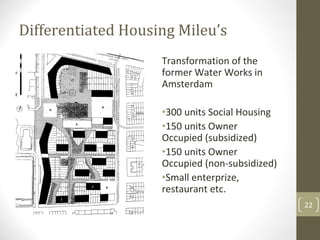
Differentiated Housing Mileu’s
                    Transformation of the 
                    former Water Works in 
                    Amsterdam

                    •300 units Social Housing
                    •150 units Owner 
                    Occupied (subsidized)
                    •150 units Owner 
                    Occupied (non‐subsidized)
                    •Small enterprize, 
                    restaurant etc.
                                                22
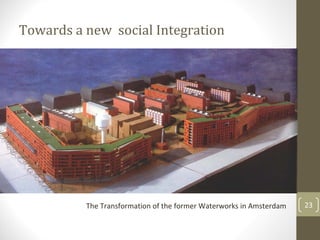
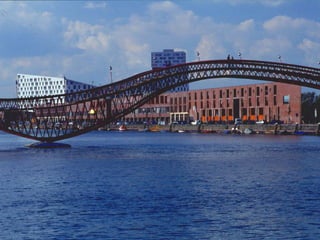
Towards a new  social Integration


          The Transformation of the former Waterworks in Amsterdam   23
26
27
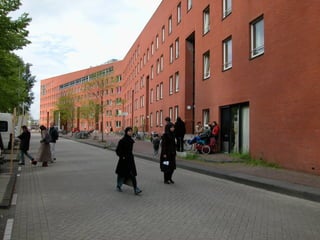
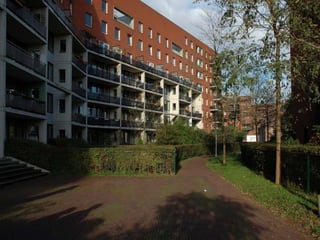
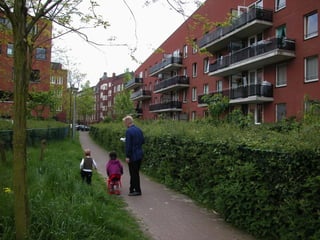
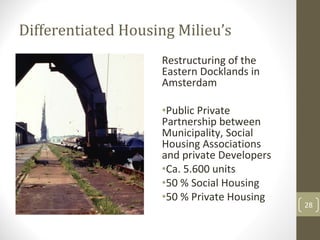
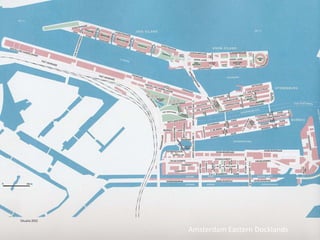
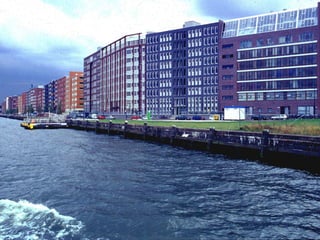
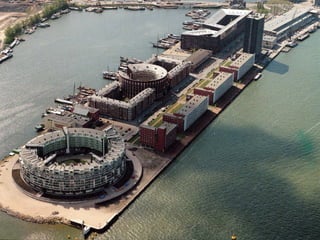
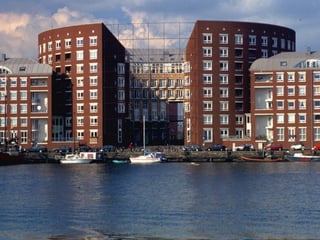
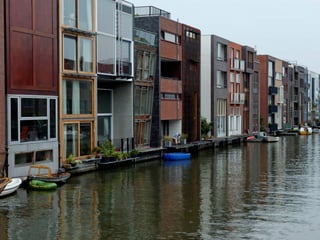
Differentiated Housing Milieu’s
                    Restructuring of the 
                    Eastern Docklands in 
                    Amsterdam

                    •Public Private 
                    Partnership between 
                    Municipality, Social 
                    Housing Associations 
                    and private Developers
                    •Ca. 5.600 units
                    •50 % Social Housing
                    •50 % Private Housing
                                             28
Amsterdam Eastern Docklands
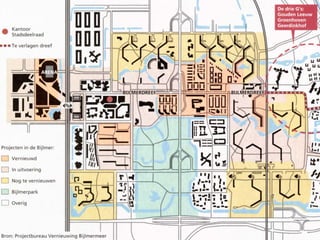
Differentiated Housing Milieu’s
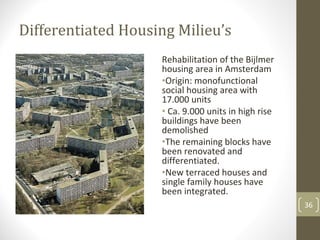
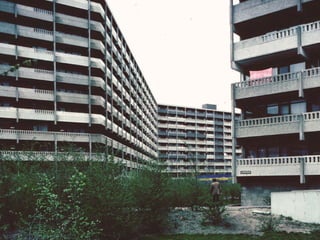
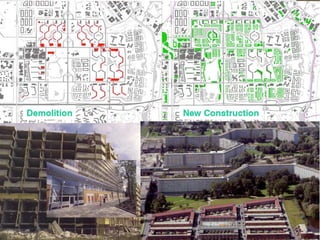
                    Rehabilitation of the Bijlmer 
                    housing area in Amsterdam
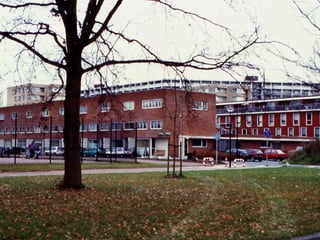
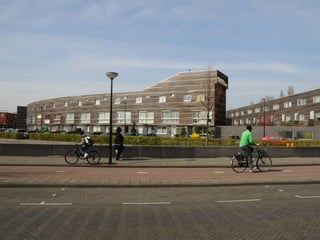
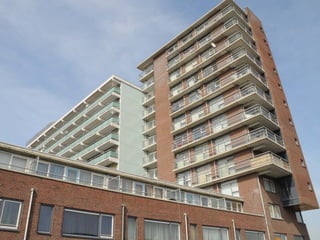
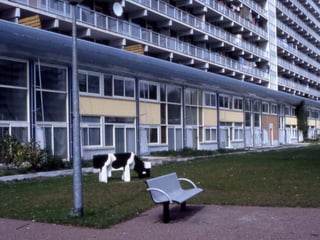
                    •Origin: monofunctional 
                    social housing area with 
                    17.000 units
                    • Ca. 9.000 units in high rise 
                    buildings have been 
                    demolished
                    •The remaining blocks have 
                    been renovated and 
                    differentiated.
                    •New terraced houses and 
                    single family houses have 
                    been integrated.
                                                      36
38
41
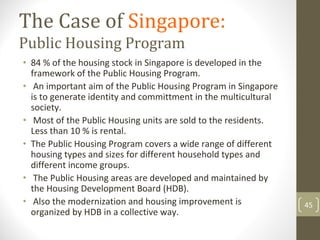
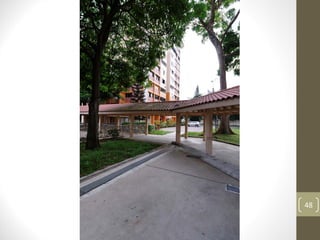
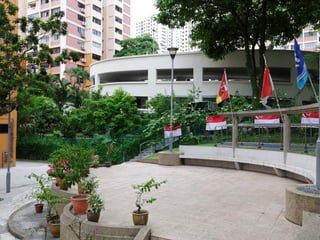
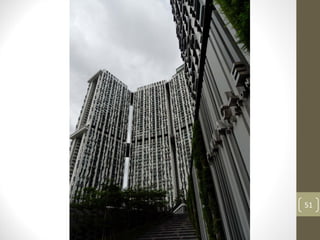
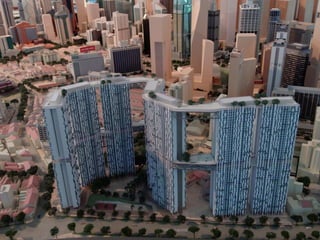
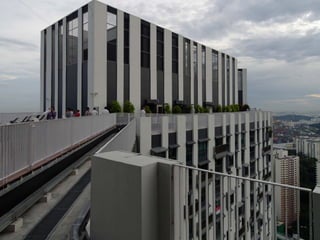
The Case of Singapore:
Public Housing Program
• 84 % of the housing stock in Singapore is developed in the 
  framework of the Public Housing Program.
• An important aim of the Public Housing Program in Singapore 
  is to generate identity and committment in the multicultural 
  society.
• Most of the Public Housing units are sold to the residents. 
  Less than 10 % is rental.
• The Public Housing Program covers a wide range of different 
  housing types and sizes for different household types and 
  different income groups. 
• The Public Housing areas are developed and maintained by 
  the Housing Development Board (HDB).
• Also the modernization and housing improvement is               45
  organized by HDB in a collective way.
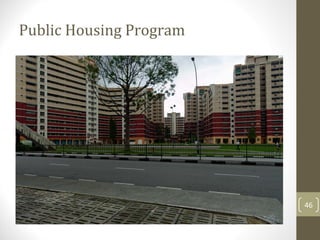
Public Housing Program


                         46
47
48
49
50
51
52
53
54
Conclusions:
• Social integration is a key issue of urban culture and urban identity.

• Social housing can ease the social contradictions, can support a more 
  integrated – more harmonious – urban society and in this way can 
  contribute to the sustainability of the city.

• However, social housing is not a singular solution. It has to be
  embedded in a differentiated and on the same time integrating housing 
  policy  that makes the city accessible and worth living for everybody.

• The quality of design is a decisive factor to make the living‐together of 
  different social classes acceptable, thus social integration possible.

• There is no general receipt for Social Housing. Social housing always has 
  to be adapted to local conditions and changing demands.                      55

Social housing jurgen rosemann

  • 1.
  • 2.
    The Housing Question: • The capitalistic system ('the market') is  unable to provide the working class  with  sufficient and affordable houses. • The Bourgeoisie 'solves' the problem by  offering bad, overcrowded and unhealthy  housing conditions. • Bad housing conditions are increasing  because of the sudden inflow of the  population to the big cities. 2 Friedrich Engels: About the Housing Question   1872/73
  • 3.
  • 4.
    The New Housing Question: • How to provide the urban poor with  acceptable and affordable shelter? • How to combat social contradictions and  segregation? • How to generate a more integrated urban  society? 4
  • 5.
    To Buy or to Rent • To concentrate on the urban poor or to integrate  different social classes 5
  • 6.
    1. To Buy or to Rent Owner‐Occupied Social Housing Rental Social Housing • Subsidized by the government •Provide land and basic housing  facilities for free • Controlled rent level or •Offer low prized (subsidized)  • Owned and managed by Non‐ houses for sale Profit Organizations (Housing  Associations, Housing  or Corporations, Foundations,  •Offer financial support and/or  Housing Co‐operatives) tax reduction for owner‐ occupied housing • Distributed according to  social criteria 6
  • 7.
    1. To Buy or to Rent Owner‐Occupied Social Housing Problems: Large areas for poor people: • Segregation – prisoner  effect • Bad facilities and bad  infrastructure • No attention for public  space • Bad maintenance Santiago de Chile • Security problems 7
  • 8.
    1. To Buy or to Rent Exception:  Owner‐Occupied Social Housing Public Housing in Singapore • Development of complete  Townships by Housing  Development Board (HDB) • Maintenance of Housing  Blocks, Public Space and  Facilities by HDB • Collective Housing  Improvement organized  and subsidized by HDB 8
  • 9.
    2. Target Groups Social Housing accessible only  Social Housing accessible for the urban poor: for wide levels of the society: • Low rent • Higher rent (individual  • Low production costs – aid for poor people) low quality • Higher costs – higher  • High subsidies per unit quality • Limited number of units  • Lower subsidies per unit  (limited public means) • Large number of units • Stigmatized areas:  • Integrated areas: living  concentration of poor  together of different  people ‐ segregation social classes 9
  • 10.
    2. Target Groups Social Housing accessible only  Social Housing accessible for the urban poor: for wide levels of the society: 10 Paris/La Courneuve ‐ France Berlin ‐ Germany
  • 11.
    The Case of The Netherlands Housing Act from 1901: • Housing as a right for everybody and its provision as an  obligation of the society • Control of the housing stock and limitations for private  landlords • Establishing of urban planning (extension plans for  municipalities with more than 10.000 inhabitants) • Introduction of the social housing system 11
  • 12.
  • 13.
    The Case of The Netherlands Dutch Housing Stock in 2009  13
  • 14.
    Housing Management  and Organization • Almost all social housing units in the Netherlands are owned  by non‐profit Housing Corporations, acting as financially  independent entrepreneurs with social objectives and  obligations. • Housing Corporations exist in two legal forms: • Housing Associations • Housing Foundations • Housing Corporations (Associations and Foundations) are  working under supervision of the national and local  governments. • Housing Corporations are obliged to reinvest their surplus into  housing. 14
  • 15.
    Housing Management  and Organization • On national level Housing Corporations own 34 % of the total  housing stock and 75 % of the rental housing stock. • Housing Corporations are no longer limited to the  development of Social Housing units. They also are allowed to  develop mixed areas, integrating Social Housing, Owner  Occupied Housing and even commercial functions. • Recently the Housing Corporations in Amsterdam are  responsible for the development of 60 – 70 % of the annual  housing production in the city. Half of the units belong to the  Social Housing sector. • The sale of Owner Occupied Housing became an important  source of income to finance affordable Social Housing units. 15
  • 16.
    Financial System • Financial Framework of Social Housing Social Social Housing Housing Local Local Guarante Guarante Bank Bank Government Government Fund Fund Housing Housing Corporation Corporation State State Central Central Housing Housing Tenant Tenant Fund Fund Own Financial Means Own Financial Means 16
  • 17.
    Individual Aid costs 0 exploitation 50 years 17 Social Housing: Costs, Exploitation and Subsidies
  • 18.
  • 19.
  • 20.
  • 21.
    The Idea of Differentiated Housing  Milieu’s • Housing no longer has to focus on the (statistical) average.  The city is a collection of minorities, each of them with special  demands, priorities and wishes. • Housing has to be differentiated according to different life‐ styles, different patterns of behavior and different value  systems. • The combination of compatible life‐styles is able to bridge  social contradictions and to contribute to social integration. • To generate an integrated urban society, social housing has to  be combined with owner occupied housing and with other  urban functions. • The combination with owner occupied housing and with  commercial functions can generate additional means to  21 improve the quality of social housing.
  • 22.
    Differentiated Housing Mileu’s Transformation of the  former Water Works in  Amsterdam •300 units Social Housing •150 units Owner  Occupied (subsidized) •150 units Owner  Occupied (non‐subsidized) •Small enterprize,  restaurant etc. 22
  • 23.
    Towards a new  social Integration The Transformation of the former Waterworks in Amsterdam 23
  • 26.
  • 27.
  • 28.
    Differentiated Housing Milieu’s Restructuring of the  Eastern Docklands in  Amsterdam •Public Private  Partnership between  Municipality, Social  Housing Associations  and private Developers •Ca. 5.600 units •50 % Social Housing •50 % Private Housing 28
  • 29.
  • 36.
    Differentiated Housing Milieu’s Rehabilitation of the Bijlmer  housing area in Amsterdam •Origin: monofunctional  social housing area with  17.000 units • Ca. 9.000 units in high rise  buildings have been  demolished •The remaining blocks have  been renovated and  differentiated. •New terraced houses and  single family houses have  been integrated. 36
  • 38.
  • 41.
  • 45.
    The Case of Singapore: Public Housing Program • 84 % of the housing stock in Singapore is developed in the  framework of the Public Housing Program. • An important aim of the Public Housing Program in Singapore  is to generate identity and committment in the multicultural  society. • Most of the Public Housing units are sold to the residents.  Less than 10 % is rental. • The Public Housing Program covers a wide range of different  housing types and sizes for different household types and  different income groups.  • The Public Housing areas are developed and maintained by  the Housing Development Board (HDB). • Also the modernization and housing improvement is  45 organized by HDB in a collective way.
  • 46.
  • 47.
  • 48.
  • 49.
  • 50.
  • 51.
  • 52.
  • 53.
  • 54.
  • 55.
    Conclusions: • Social integration is a key issue of urban culture and urban identity. • Social housing can ease the social contradictions, can support amore  integrated – more harmonious – urban society and in this way can  contribute to the sustainability of the city. • However, social housing is not a singular solution. It has to be embedded in a differentiated and on the same time integrating housing  policy  that makes the city accessible and worth living for everybody. • The quality of design is a decisive factor to make the living‐together of  different social classes acceptable, thus social integration possible. • There is no general receipt for Social Housing. Social housing always has  to be adapted to local conditions and changing demands. 55