Social by design
       Ways to jump-start your social business strategy


       Timi Stoop-Alcala
       Social Business Analyst & Content Strategist
       timi.alcala@socialbizstrategy.com

       June 2012


Tuesday, June 12, 12
This presentation covers:
            - Social business at work (some stories)
            - What companies’ experiences tell us about
            social business
            - Ways to jump-start your social business
            strategy


Tuesday, June 12, 12
At the end of this presentation, I hope we’ll start to
       ask:

       - What’s our end-game for social? [Why engage?]
       - How are we now using social media? [Are we
       using it to solve specific business problems?]
       - How can we begin to be social by design?


Tuesday, June 12, 12
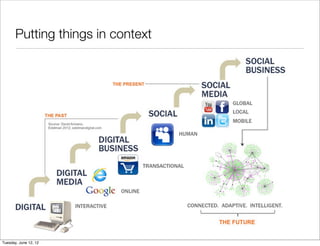
Putting things in context


Tuesday, June 12, 12
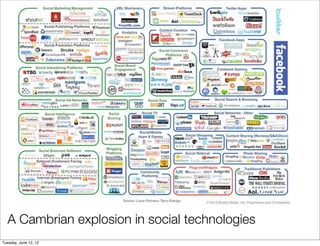
A Cambrian explosion in social technologies
Tuesday, June 12, 12
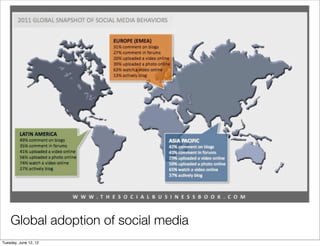
Global adoption of social media
Tuesday, June 12, 12
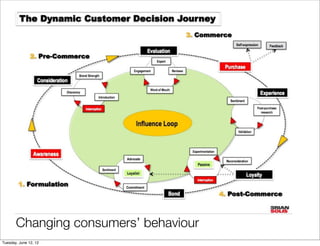
Changing consumers’ behaviour
Tuesday, June 12, 12
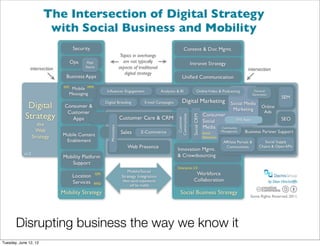
Disrupting business the way we know it
Tuesday, June 12, 12
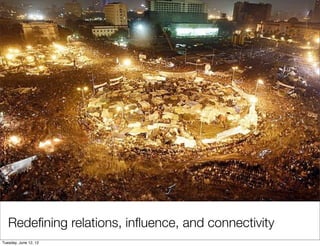
Redefining relations, influence, and connectivity
Tuesday, June 12, 12
BOTTOM LINE

          If you’re not using social media to engage with your customers,
                             partners, and stakeholders...


                                somebody else is.


Tuesday, June 12, 12
THESE WE KNOW NOW TO BE TRUE


                                    To be social is tough.
               The opportunity costs of not getting coordinated and being
                              unprepared internally is steep.
             Social drives adaptation (but is your organisation built to adapt?)

               Technology becomes more sophisticated by the year.
         Customers’ expectations are heightened, and their demands change
            before the organisation can even catch up with the changes.
          Competitors evolve faster and possess better tools, technologies,
                     information and methods of organisation.

Tuesday, June 12, 12
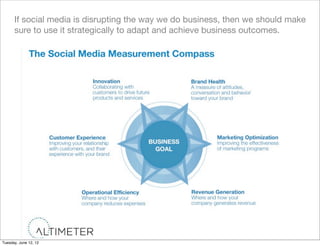
If social media is disrupting the way we do business, then we should make
      sure to use it strategically to adapt and achieve business outcomes.


Tuesday, June 12, 12
How some companies are adopting social business


Tuesday, June 12, 12
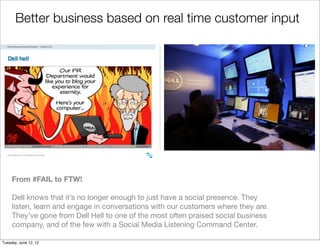
Better business based on real time customer input


     From #FAIL to FTW!

     Dell knows that it’s no longer enough to just have a social presence. They
     listen, learn and engage in conversations with our customers where they are.
     They’ve gone from Dell Hell to one of the most often praised social business
     company, and of the few with a Social Media Listening Command Center.

Tuesday, June 12, 12
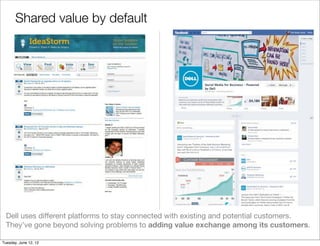
Shared value by default


  Dell uses different platforms to stay connected with existing and potential customers.
  They’ve gone beyond solving problems to adding value exchange among its customers.

Tuesday, June 12, 12
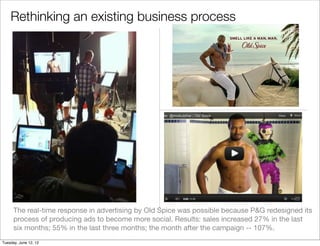
Rethinking an existing business process


      The real-time response in advertising by Old Spice was possible because P&G redesigned its
      process of producing ads to become more social. Results: sales increased 27% in the last
      six months; 55% in the last three months; the month after the campaign -- 107%.
Tuesday, June 12, 12
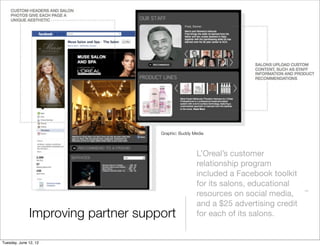
Graphic: Buddy Media


                                                    L’Oreal’s customer
                                                    relationship program
                                                    included a Facebook toolkit
                                                    for its salons, educational
                                                    resources on social media,
                                                    and a $25 advertising credit
              Improving partner support             for each of its salons.


Tuesday, June 12, 12
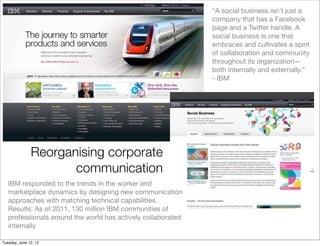
“A social business isn't just a
                                                              company that has a Facebook
                                                              page and a Twitter handle. A
                                                              social business is one that
                                                              embraces and cultivates a spirit
                                                              of collaboration and community
                                                              throughout its organization—
                                                              both internally and externally.”
                                                              - IBM


               Reorganising corporate
                      communication
   IBM responded to the trends in the worker and
   marketplace dynamics by designing new communication
   approaches with matching technical capabilities.
   Results: As of 2011, 130 million IBM communities of
   professionals around the world has actively collaborated
   internally

Tuesday, June 12, 12
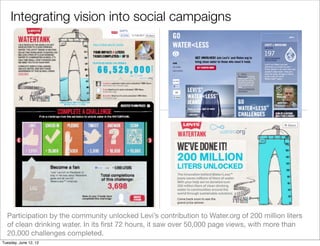
Integrating vision into social campaigns


  Participation by the community unlocked Levi’s contribution to Water.org of 200 million liters
  of clean drinking water. In its first 72 hours, it saw over 50,000 page views, with more than
  20,000 challenges completed.
Tuesday, June 12, 12
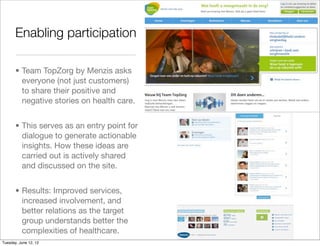
Enabling participation

       • Team TopZorg by Menzis asks
         everyone (not just customers)
         to share their positive and
         negative stories on health care.


       • This serves as an entry point for
         dialogue to generate actionable
         insights. How these ideas are
         carried out is actively shared
         and discussed on the site.


       • Results: Improved services,
         increased involvement, and
         better relations as the target
         group understands better the
         complexities of healthcare.
Tuesday, June 12, 12
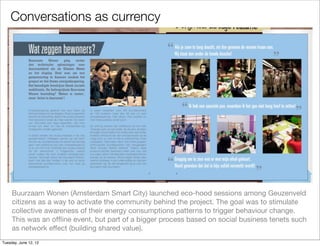
Conversations as currency


     Buurzaam Wonen (Amsterdam Smart City) launched eco-hood sessions among Geuzenveld
     citizens as a way to activate the community behind the project. The goal was to stimulate
     collective awareness of their energy consumptions patterns to trigger behaviour change.
     This was an offline event, but part of a bigger process based on social business tenets such
     as network effect (building shared value).
Tuesday, June 12, 12
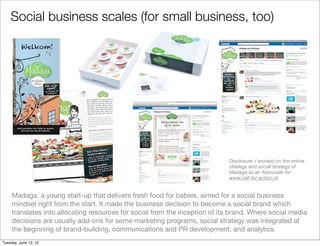
Social business scales (for small business, too)


                                                                             Disclosure: I worked on the online
                                                                             strategy and social strategy of
                                                                             Madaga as an Associate for
                                                                             www.call-for-action.nl


     Madaga, a young start-up that delivers fresh food for babies, aimed for a social business
     mindset right from the start. It made the business decision to become a social brand which
     translates into allocating resources for social from the inception of its brand. Where social media
     decisions are usually add-ons for some marketing programs, social strategy was integrated at
     the beginning of brand-building, communications and PR development, and analytics.
Tuesday, June 12, 12
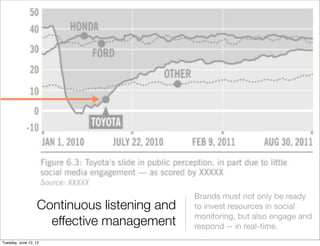
Brands must not only be ready
                  Continuous listening and   to invest resources in social
                                             monitoring, but also engage and
                    effective management     respond -- in real-time.
Tuesday, June 12, 12
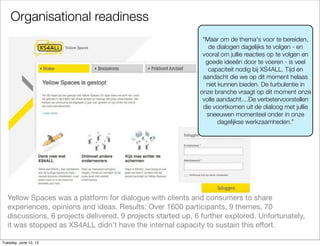
Organisational readiness
                                                              “Maar om de thema's voor te bereiden,
                                                                de dialogen dagelijks te volgen - en
                                                              vooral om jullie reacties op te volgen en
                                                               goede ideeën door te voeren - is veel
                                                                capaciteit nodig bij XS4ALL. Tijd en
                                                              aandacht die we op dit moment helaas
                                                               niet kunnen bieden. De turbulentie in
                                                             onze branche vraagt op dit moment onze
                                                              volle aandacht....De verbetervoorstellen
                                                              die voortkomen uit de dialoog met jullie
                                                               sneeuwen momenteel onder in onze
                                                                    dagelijkse werkzaamheden.”


  Yellow Spaces was a platform for dialogue with clients and consumers to share
  experiences, opinions and ideas. Results: Over 1600 participants, 9 themes, 70
  discussions, 6 projects delivered, 9 projects started up, 6 further explored. Unfortunately,
  it was stopped as XS4ALL didn’t have the internal capacity to sustain this effort.

Tuesday, June 12, 12
What do these experiences tell us about
       social business?


Tuesday, June 12, 12
Some key concepts

       • A shift in mindset


             • Social is not an add-on, but rather, “a layer that’s interwoven into the
               fabric of the organisation.” (David Armano, EVP Edelman Digital) It’s
               essential to align external social media efforts with internal roles,
               processes and structures.


             • It goes beyond campaigns, ad-hoc engagement, and one-time solutions.


             • Transaction becomes a by-product of interaction (rich relations).


             • Be a Platform Provider (not a Gate-keeper): Don’t only manage
               connections, but also facilitate participation. Enable your partners,
               customers and stakeholders to connect and engage with each other.


Tuesday, June 12, 12
Some key concepts

       • Importance of the internal aspect of social business


             • Using internal social media fosters workforce / partners / stakeholders
               engagement and collaboration, e.g. customer relationship management.


             • Listening and engaging is not just about reacting to people’s feedback, but
               analysing their sentiment and deriving actionable insights: it’s about
               business intelligence.


             • Listening (monitoring) is inseparable from engagement. It’s important to be
               prepared organisationally to respond to the rapid information and
               feedback cycle of the social web.


Tuesday, June 12, 12
Some key concepts

       • Importance of the internal aspect of social business


             • US Cellular, Kraft Foods, and Discover Financial Network underscored
               culture change as the number one determinate of social success. IBM
               states that overcoming the organizational challenge is 1.8 times harder
               than the technological obstacles of social. (Dachis Group)

             • Connected employees and leaders create a competitive advantage via a
               culture of sharing. - (Charlene Li, author of the New York Times bestseller
               “Open Leadership”, Founder of Altimeter Group)


Tuesday, June 12, 12
Some key concepts

       • People / Communities: the beating heart of any social business


             • Successful engagement with your target groups entails serious (and
               ongoing) research on your social customers in order to gain insights on the
               relevant communities to be activated.


             • Enlist the relevant community that is large enough to drive the desired
               results. Make sure to plan for too little or too much participation.


             • You can have a social business solution that may not focus primarily on
               online engagement or digital tools. Offline processes that activate relevant
               communities contribute to the whole social experience.


Tuesday, June 12, 12
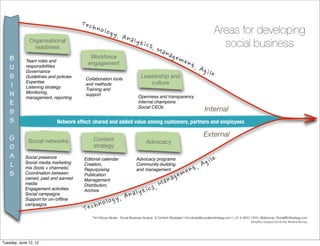
To truly benefit from the social web, your organisation must
        adopt a business-level, people-centric, holistic, and
        scalable framework for using social technologies internally
        and externally with the end goal of creating shared value.

        The challenge: Transforming your organisation into a truly
        socially calibrated business is a long journey. Where do
        you begin?


Tuesday, June 12, 12
Areas for developing
              Organisational
                readiness                                                                                                         social business
    B                                    Workforce
            Team roles and
                                        engagement
    U       responsibilities
            Governance
    S       Guidelines and policies
                                      Collaboration tools
                                                                            Leadership and
    I
            Expertise
                                      and methods                               culture
            Listening strategy
                                      Training and
    N       Monitoring,
            management, reporting
                                      support                             Openness and transparency
    E                                                                     Internal champions

    S
                                                                          Social CEOs
                                                                                                                         Internal
    S                      Network effect: shared and added value among customers, partners and employees

   G                                                                                                                     External
              Social networks              Content                              Advocacy
   O                                       strategy
   A        Social presence           Editorial calendar                 Advocacy programs
   L        Social media marketing
            mix (tools + channels)
                                      Creation,                          Community-building
                                      Repurposing                        and management
   S        Coordination between      Publication
            owned, paid and earned    Management
            media                     Distribution,
            Engagement activities     Archive
            Social campaigns
            Support for on-/offline
            campaigns

                                          Timi Stoop-Alcala - Social Business Analyst & Content Strategist | timi.alcala@socialbizstrategy.com | +31 6 2843 1916 | @delunna | SocialBizStrategy.com
                                                                                                                                                            Graphic adapted from the Dachis Group


Tuesday, June 12, 12
Jump-start your social business strategy


Tuesday, June 12, 12
Start small, but start now
       Create a social business mindset


       Pick one goal.
       Make social a strategic
       component of reaching that goal.

       At the very least:
       - Learn to listen.
       - Research and develop social
       customer personas.
       - Review the current state of your
       social affairs.

Tuesday, June 12, 12
Create an environment for strategic thinking about
       social business

       • Adapt a social business mindset. Always begin with the goal / problem in
         mind. Examine your goals for this year and the problems your business wants
         to solve. Pick one where social can have an impact.


       • Analyse the business case(s). Drill down to specific use case(s). For example:


             • Business case: The network of salons are using and selling fewer L’oreal
               products due to recession. Enhancing the way salons connect, engage
               and deliver services can give them the competitive edge. Social media can
               play a major role in this.


             • Use case: L’oreal salons enhances engagement with their customers on
               Facebook via their own custom Page. They can easily customise
               information and content according to their business needs.


Tuesday, June 12, 12
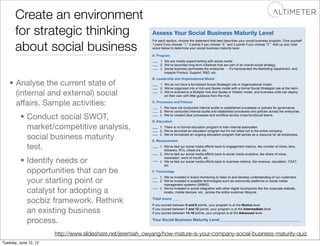
!

       Create an environment
       for strategic thinking                                   Assess Your Social Business Maturity Level

       about social business
                                                                For each section, choose the statement that best describes your social business program. Give yourself
                                                                1 point if you choose “1,” 2 points if you choose “2,” and 3 points if you choose “3.” Add up your total
                                                                score below to determine your social business maturity level.

                                                                A. Program
                                                                ___ 1. We are mostly experimenting with social media.
                                                                ___ 2. We've launched long-term initiatives that are part of an overall social strategy.
                                                                ___ 3. Social business permeates the enterprise — it's transcended the Marketing department, and
                                                                         impacts Product, Support, R&D, etc.
                                                                B. Leadership and Organizational Model
   • Analyse the current state of                               ___ 1. We do not have a formalized Social Strategist role or organizational model.
                                                                ___ 2. We've organized into a Hub and Spoke model with a formal Social Strategist role at the helm.

     (internal and external) social                             ___ 3. We've evolved to a Multiple Hub and Spoke or Holistic model, and business units can deploy
                                                                         on their own with little guidance from the Hub.

     affairs. Sample activities:                                C. Processes and Policies
                                                                ___ 1. We have not conducted internal audits or established processes or policies for governance.
                                                                ___ 2. We've conducted internal audits and established processes and policies across the enterprise.

         • Conduct social SWOT,                                 ___ 3. We've created clear processes and workflow across cross-functional teams.

                                                                D. Education

           market/competitive analysis,                         ___ 1. There is no formal education program to train internal associates.
                                                                ___ 2. We've launched an education program but it's not rolled out to the entire company.

           social business maturity
                                                                ___ 3. We’ve formalized an ongoing education program that serves as a resource for all employees.

                                                                E. Measurement

           test.                                                ___ 1. We’ve tied our social media efforts back to engagement metrics, like number of clicks, fans,
                                                                        followers, RTs, check-ins, etc.
                                                                ___ 2. We’ve tied our social media efforts back to social media analytics, like share of voice,


         • Identify needs or
                                                                        resonation, word of mouth, etc.
                                                                ___
                                                                      3. We’ve tied our social media efforts back to business metrics, like revenue, reputation, CSAT,
                                                                        etc.

           opportunities that can be                            F. Technology


           your starting point or
                                                                ___ 1. We’ve invested in brand monitoring to listen to and develop understanding of our customers.
                                                                ___ 2. We've invested in scalable technologies such as community platforms or social media
                                                                        management systems (SMMS).

           catalyst for adopting a
                                                                ___ 3. We've invested in social integration with other digital touchpoints like the corporate website,
                                                                        kiosks, mobile devices, etc., across the entire customer lifecycle.


           socbiz framework. Rethink                            Total score ____
                                                                If you scored between 0 and 6 points, your program is at the Novice level.

           an existing business                                 If you scored between 7 and 12 points, your program is at the Intermediate level.
                                                                If you scored between 13-18 points, your program is at the Advanced level.
                                                                !


           process.                                         !
                                                                Your Social Business Maturity Level!_________________________________________!


                       http://www.slideshare.net/jeremiah_owyang/how-mature-is-your-company-social-business-maturity-quiz
                                                             !
Tuesday, June 12, 12
Create an environment for strategic thinking about
       social business

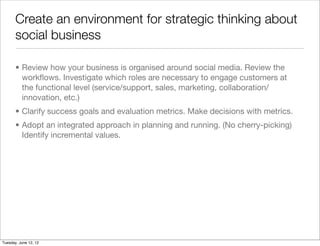
       • Review how your business is organised around social media. Review the
         workflows. Investigate which roles are necessary to engage customers at
         the functional level (service/support, sales, marketing, collaboration/
         innovation, etc.)
       • Clarify success goals and evaluation metrics. Make decisions with metrics.
       • Adopt an integrated approach in planning and running. (No cherry-picking)
         Identify incremental values.


Tuesday, June 12, 12
Create an environment for strategic thinking about
       social business

       • Research is the basis for any strategy. Know your audience well.


             • Conduct socialgraphics research with the end goal of creating your
               company’s social customer personas.


             • Check if your content strategy, brand proposition, and other marketing
               programmes map to socialgraphic insights and the needs of your social
               customer personas.


             • Develop a listening strategy aimed at identifying influencers, hot themes/
               topics, and competitor activities.


Tuesday, June 12, 12
Create an environment for strategic thinking about
       social business

       • Review your brand marketing.


             • What is inherently social about your brand? Which one resonates the most
               with your customers / partners? Which one do you want to amplify?


             • Are you creating marketing programmes with interaction drivers in mind?
               E.g. emotion, fame and fortune, fun and entertainment, utility


             • Are you creating marketing programmes with solid building blocks for
               community development?


Tuesday, June 12, 12
How social success looks like

       • “Social Business by Design”, by Dion Hinchcliffe and Peter Kim, lists six success
        factors. You know when you’re on the road to becoming a social business when
        your company:

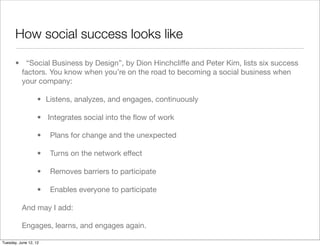
                   • Listens, analyzes, and engages, continuously

                   • Integrates social into the flow of work

                   •   Plans for change and the unexpected

                   •   Turns on the network effect

                   •   Removes barriers to participate

                   •   Enables everyone to participate

          And may I add:

          Engages, learns, and engages again.

Tuesday, June 12, 12
Start being social by intent and design.
       Evolve from a social brand to a social business.


       A social business calibrates organisational structures, processes, culture, and
       leadership to an ecosystem of participation, collaboration, and adaptation, and
       the creation of shared value by default. Why? Because a social approach to
       business provides a more effective to make better decisions, brings agility to
       business functions, enhances workforce productivity, and creates better
       products that all ultimately lead to designing better experiences for your
       customers, partners and workforce.


Tuesday, June 12, 12
Good luck!
       Remember: social business is a journey.


       And it’s not ice-cream


Tuesday, June 12, 12
Social media
      doesn’t
       solve
    everything.


Tuesday, June 12, 12
Thanks for
         listening!

     Blog: http://SocialBizStrategy.com
     www.twitter.com/@delunna
     timi.alcala@socialbizstrategy.com


    All facts and case descriptions were taken from
    these sources unless otherwise specified:
    - Book: ‘Social Business by Design’ -Dion Hinchcliffe
    and Peter Kim (non-Dutch cases)
    - Websites: Altimeter (Open Research Reports),
    Favela Fabric (Dutch cases)
    Images are given aribution where they appear.

Tuesday, June 12, 12

Social by design: jump-start your social business strategy

  • 1.
    Social by design Ways to jump-start your social business strategy Timi Stoop-Alcala Social Business Analyst & Content Strategist timi.alcala@socialbizstrategy.com June 2012 Tuesday, June 12, 12
  • 2.
    This presentation covers: - Social business at work (some stories) - What companies’ experiences tell us about social business - Ways to jump-start your social business strategy Tuesday, June 12, 12
  • 3.
    At the endof this presentation, I hope we’ll start to ask: - What’s our end-game for social? [Why engage?] - How are we now using social media? [Are we using it to solve specific business problems?] - How can we begin to be social by design? Tuesday, June 12, 12
  • 4.
    Putting things incontext Tuesday, June 12, 12
  • 5.
    A Cambrian explosionin social technologies Tuesday, June 12, 12
  • 6.
    Global adoption ofsocial media Tuesday, June 12, 12
  • 7.
  • 8.
    Disrupting business theway we know it Tuesday, June 12, 12
  • 9.
    Redefining relations, influence,and connectivity Tuesday, June 12, 12
  • 10.
    BOTTOM LINE If you’re not using social media to engage with your customers, partners, and stakeholders... somebody else is. Tuesday, June 12, 12
  • 11.
  • 12.
    THESE WE KNOWNOW TO BE TRUE To be social is tough. The opportunity costs of not getting coordinated and being unprepared internally is steep. Social drives adaptation (but is your organisation built to adapt?) Technology becomes more sophisticated by the year. Customers’ expectations are heightened, and their demands change before the organisation can even catch up with the changes. Competitors evolve faster and possess better tools, technologies, information and methods of organisation. Tuesday, June 12, 12
  • 13.
    If social mediais disrupting the way we do business, then we should make sure to use it strategically to adapt and achieve business outcomes. Tuesday, June 12, 12
  • 14.
    How some companiesare adopting social business Tuesday, June 12, 12
  • 15.
  • 16.
    Better business basedon real time customer input From #FAIL to FTW! Dell knows that it’s no longer enough to just have a social presence. They listen, learn and engage in conversations with our customers where they are. They’ve gone from Dell Hell to one of the most often praised social business company, and of the few with a Social Media Listening Command Center. Tuesday, June 12, 12
  • 17.
    Shared value bydefault Dell uses different platforms to stay connected with existing and potential customers. They’ve gone beyond solving problems to adding value exchange among its customers. Tuesday, June 12, 12
  • 18.
    Rethinking an existingbusiness process The real-time response in advertising by Old Spice was possible because P&G redesigned its process of producing ads to become more social. Results: sales increased 27% in the last six months; 55% in the last three months; the month after the campaign -- 107%. Tuesday, June 12, 12
  • 19.
    Graphic: Buddy Media L’Oreal’s customer relationship program included a Facebook toolkit for its salons, educational resources on social media, and a $25 advertising credit Improving partner support for each of its salons. Tuesday, June 12, 12
  • 20.
    “A social businessisn't just a company that has a Facebook page and a Twitter handle. A social business is one that embraces and cultivates a spirit of collaboration and community throughout its organization— both internally and externally.” - IBM Reorganising corporate communication IBM responded to the trends in the worker and marketplace dynamics by designing new communication approaches with matching technical capabilities. Results: As of 2011, 130 million IBM communities of professionals around the world has actively collaborated internally Tuesday, June 12, 12
  • 21.
    Integrating vision intosocial campaigns Participation by the community unlocked Levi’s contribution to Water.org of 200 million liters of clean drinking water. In its first 72 hours, it saw over 50,000 page views, with more than 20,000 challenges completed. Tuesday, June 12, 12
  • 22.
    Enabling participation • Team TopZorg by Menzis asks everyone (not just customers) to share their positive and negative stories on health care. • This serves as an entry point for dialogue to generate actionable insights. How these ideas are carried out is actively shared and discussed on the site. • Results: Improved services, increased involvement, and better relations as the target group understands better the complexities of healthcare. Tuesday, June 12, 12
  • 23.
    Conversations as currency Buurzaam Wonen (Amsterdam Smart City) launched eco-hood sessions among Geuzenveld citizens as a way to activate the community behind the project. The goal was to stimulate collective awareness of their energy consumptions patterns to trigger behaviour change. This was an offline event, but part of a bigger process based on social business tenets such as network effect (building shared value). Tuesday, June 12, 12
  • 24.
    Social business scales(for small business, too) Disclosure: I worked on the online strategy and social strategy of Madaga as an Associate for www.call-for-action.nl Madaga, a young start-up that delivers fresh food for babies, aimed for a social business mindset right from the start. It made the business decision to become a social brand which translates into allocating resources for social from the inception of its brand. Where social media decisions are usually add-ons for some marketing programs, social strategy was integrated at the beginning of brand-building, communications and PR development, and analytics. Tuesday, June 12, 12
  • 25.
    Brands must notonly be ready Continuous listening and to invest resources in social monitoring, but also engage and effective management respond -- in real-time. Tuesday, June 12, 12
  • 26.
    Organisational readiness “Maar om de thema's voor te bereiden, de dialogen dagelijks te volgen - en vooral om jullie reacties op te volgen en goede ideeën door te voeren - is veel capaciteit nodig bij XS4ALL. Tijd en aandacht die we op dit moment helaas niet kunnen bieden. De turbulentie in onze branche vraagt op dit moment onze volle aandacht....De verbetervoorstellen die voortkomen uit de dialoog met jullie sneeuwen momenteel onder in onze dagelijkse werkzaamheden.” Yellow Spaces was a platform for dialogue with clients and consumers to share experiences, opinions and ideas. Results: Over 1600 participants, 9 themes, 70 discussions, 6 projects delivered, 9 projects started up, 6 further explored. Unfortunately, it was stopped as XS4ALL didn’t have the internal capacity to sustain this effort. Tuesday, June 12, 12
  • 27.
    What do theseexperiences tell us about social business? Tuesday, June 12, 12
  • 28.
    Some key concepts • A shift in mindset • Social is not an add-on, but rather, “a layer that’s interwoven into the fabric of the organisation.” (David Armano, EVP Edelman Digital) It’s essential to align external social media efforts with internal roles, processes and structures. • It goes beyond campaigns, ad-hoc engagement, and one-time solutions. • Transaction becomes a by-product of interaction (rich relations). • Be a Platform Provider (not a Gate-keeper): Don’t only manage connections, but also facilitate participation. Enable your partners, customers and stakeholders to connect and engage with each other. Tuesday, June 12, 12
  • 29.
    Some key concepts • Importance of the internal aspect of social business • Using internal social media fosters workforce / partners / stakeholders engagement and collaboration, e.g. customer relationship management. • Listening and engaging is not just about reacting to people’s feedback, but analysing their sentiment and deriving actionable insights: it’s about business intelligence. • Listening (monitoring) is inseparable from engagement. It’s important to be prepared organisationally to respond to the rapid information and feedback cycle of the social web. Tuesday, June 12, 12
  • 30.
    Some key concepts • Importance of the internal aspect of social business • US Cellular, Kraft Foods, and Discover Financial Network underscored culture change as the number one determinate of social success. IBM states that overcoming the organizational challenge is 1.8 times harder than the technological obstacles of social. (Dachis Group) • Connected employees and leaders create a competitive advantage via a culture of sharing. - (Charlene Li, author of the New York Times bestseller “Open Leadership”, Founder of Altimeter Group) Tuesday, June 12, 12
  • 31.
    Some key concepts • People / Communities: the beating heart of any social business • Successful engagement with your target groups entails serious (and ongoing) research on your social customers in order to gain insights on the relevant communities to be activated. • Enlist the relevant community that is large enough to drive the desired results. Make sure to plan for too little or too much participation. • You can have a social business solution that may not focus primarily on online engagement or digital tools. Offline processes that activate relevant communities contribute to the whole social experience. Tuesday, June 12, 12
  • 32.
    To truly benefitfrom the social web, your organisation must adopt a business-level, people-centric, holistic, and scalable framework for using social technologies internally and externally with the end goal of creating shared value. The challenge: Transforming your organisation into a truly socially calibrated business is a long journey. Where do you begin? Tuesday, June 12, 12
  • 33.
    Areas for developing Organisational readiness social business B Workforce Team roles and engagement U responsibilities Governance S Guidelines and policies Collaboration tools Leadership and I Expertise and methods culture Listening strategy Training and N Monitoring, management, reporting support Openness and transparency E Internal champions S Social CEOs Internal S Network effect: shared and added value among customers, partners and employees G External Social networks Content Advocacy O strategy A Social presence Editorial calendar Advocacy programs L Social media marketing mix (tools + channels) Creation, Community-building Repurposing and management S Coordination between Publication owned, paid and earned Management media Distribution, Engagement activities Archive Social campaigns Support for on-/offline campaigns Timi Stoop-Alcala - Social Business Analyst & Content Strategist | timi.alcala@socialbizstrategy.com | +31 6 2843 1916 | @delunna | SocialBizStrategy.com Graphic adapted from the Dachis Group Tuesday, June 12, 12
  • 34.
    Jump-start your socialbusiness strategy Tuesday, June 12, 12
  • 35.
    Start small, butstart now Create a social business mindset Pick one goal. Make social a strategic component of reaching that goal. At the very least: - Learn to listen. - Research and develop social customer personas. - Review the current state of your social affairs. Tuesday, June 12, 12
  • 36.
    Create an environmentfor strategic thinking about social business • Adapt a social business mindset. Always begin with the goal / problem in mind. Examine your goals for this year and the problems your business wants to solve. Pick one where social can have an impact. • Analyse the business case(s). Drill down to specific use case(s). For example: • Business case: The network of salons are using and selling fewer L’oreal products due to recession. Enhancing the way salons connect, engage and deliver services can give them the competitive edge. Social media can play a major role in this. • Use case: L’oreal salons enhances engagement with their customers on Facebook via their own custom Page. They can easily customise information and content according to their business needs. Tuesday, June 12, 12
  • 37.
    ! Create an environment for strategic thinking Assess Your Social Business Maturity Level about social business For each section, choose the statement that best describes your social business program. Give yourself 1 point if you choose “1,” 2 points if you choose “2,” and 3 points if you choose “3.” Add up your total score below to determine your social business maturity level. A. Program ___ 1. We are mostly experimenting with social media. ___ 2. We've launched long-term initiatives that are part of an overall social strategy. ___ 3. Social business permeates the enterprise — it's transcended the Marketing department, and impacts Product, Support, R&D, etc. B. Leadership and Organizational Model • Analyse the current state of ___ 1. We do not have a formalized Social Strategist role or organizational model. ___ 2. We've organized into a Hub and Spoke model with a formal Social Strategist role at the helm. (internal and external) social ___ 3. We've evolved to a Multiple Hub and Spoke or Holistic model, and business units can deploy on their own with little guidance from the Hub. affairs. Sample activities: C. Processes and Policies ___ 1. We have not conducted internal audits or established processes or policies for governance. ___ 2. We've conducted internal audits and established processes and policies across the enterprise. • Conduct social SWOT, ___ 3. We've created clear processes and workflow across cross-functional teams. D. Education market/competitive analysis, ___ 1. There is no formal education program to train internal associates. ___ 2. We've launched an education program but it's not rolled out to the entire company. social business maturity ___ 3. We’ve formalized an ongoing education program that serves as a resource for all employees. E. Measurement test. ___ 1. We’ve tied our social media efforts back to engagement metrics, like number of clicks, fans, followers, RTs, check-ins, etc. ___ 2. We’ve tied our social media efforts back to social media analytics, like share of voice, • Identify needs or resonation, word of mouth, etc. ___ 3. We’ve tied our social media efforts back to business metrics, like revenue, reputation, CSAT, etc. opportunities that can be F. Technology your starting point or ___ 1. We’ve invested in brand monitoring to listen to and develop understanding of our customers. ___ 2. We've invested in scalable technologies such as community platforms or social media management systems (SMMS). catalyst for adopting a ___ 3. We've invested in social integration with other digital touchpoints like the corporate website, kiosks, mobile devices, etc., across the entire customer lifecycle. socbiz framework. Rethink Total score ____ If you scored between 0 and 6 points, your program is at the Novice level. an existing business If you scored between 7 and 12 points, your program is at the Intermediate level. If you scored between 13-18 points, your program is at the Advanced level. ! process. ! Your Social Business Maturity Level!_________________________________________! http://www.slideshare.net/jeremiah_owyang/how-mature-is-your-company-social-business-maturity-quiz ! Tuesday, June 12, 12
  • 38.
    Create an environmentfor strategic thinking about social business • Review how your business is organised around social media. Review the workflows. Investigate which roles are necessary to engage customers at the functional level (service/support, sales, marketing, collaboration/ innovation, etc.) • Clarify success goals and evaluation metrics. Make decisions with metrics. • Adopt an integrated approach in planning and running. (No cherry-picking) Identify incremental values. Tuesday, June 12, 12
  • 39.
    Create an environmentfor strategic thinking about social business • Research is the basis for any strategy. Know your audience well. • Conduct socialgraphics research with the end goal of creating your company’s social customer personas. • Check if your content strategy, brand proposition, and other marketing programmes map to socialgraphic insights and the needs of your social customer personas. • Develop a listening strategy aimed at identifying influencers, hot themes/ topics, and competitor activities. Tuesday, June 12, 12
  • 40.
    Create an environmentfor strategic thinking about social business • Review your brand marketing. • What is inherently social about your brand? Which one resonates the most with your customers / partners? Which one do you want to amplify? • Are you creating marketing programmes with interaction drivers in mind? E.g. emotion, fame and fortune, fun and entertainment, utility • Are you creating marketing programmes with solid building blocks for community development? Tuesday, June 12, 12
  • 41.
    How social successlooks like • “Social Business by Design”, by Dion Hinchcliffe and Peter Kim, lists six success factors. You know when you’re on the road to becoming a social business when your company: • Listens, analyzes, and engages, continuously • Integrates social into the flow of work • Plans for change and the unexpected • Turns on the network effect • Removes barriers to participate • Enables everyone to participate And may I add: Engages, learns, and engages again. Tuesday, June 12, 12
  • 42.
    Start being socialby intent and design. Evolve from a social brand to a social business. A social business calibrates organisational structures, processes, culture, and leadership to an ecosystem of participation, collaboration, and adaptation, and the creation of shared value by default. Why? Because a social approach to business provides a more effective to make better decisions, brings agility to business functions, enhances workforce productivity, and creates better products that all ultimately lead to designing better experiences for your customers, partners and workforce. Tuesday, June 12, 12
  • 43.
    Good luck! Remember: social business is a journey. And it’s not ice-cream Tuesday, June 12, 12
  • 44.
    Social media doesn’t solve everything. Tuesday, June 12, 12
  • 45.
    Thanks for listening! Blog: http://SocialBizStrategy.com www.twitter.com/@delunna timi.alcala@socialbizstrategy.com All facts and case descriptions were taken from these sources unless otherwise specified: - Book: ‘Social Business by Design’ -Dion Hinchcliffe and Peter Kim (non-Dutch cases) - Websites: Altimeter (Open Research Reports), Favela Fabric (Dutch cases) Images are given aribution where they appear. Tuesday, June 12, 12