Attitude, myths and realities of old age
Dr. Bothaina Hussein Hassan, Assistant Professor
Dr. Abeer Abd El-Rahman Mohamed, Lecturer
Dr. Nancy Mahmoud El-Sakhy, Lecturer
Gerontological Nursing
Faculty of Nursing
University of Alexandria
Introduction
As people live longer, the population of older people is
growing significantly. This brings with it many social,
political and economic challenges. The idea of aging is
feared by many because older adults often are ignored.
Also, aging is associated with the reality of infirmity and
death that often denied because people secretly cherish
a belief in their own immortality.
Infirmity threatens the ideology of rugged individualism
and independence, and many people regard growing older as
something that happens to other people and not to
themselves. So, it becomes increasingly important to gain an
insight and understanding into how older people are
perceived by the public.
Attitude
Attitude
Negative attitudes, perceptions and stereotyping can
result in ageist behaviors such as; elder abuse,
mistreatment, and neglect.
Attitude to aging refers to knowledge, experience
(expectations, worries, emotions) and behavior (activities,
decisions) connected with ageing.
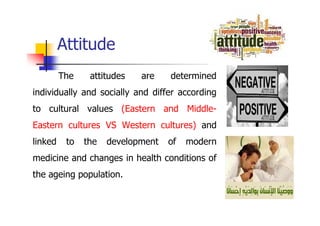
The attitudes are determined
individually and socially and differ according
to cultural values (Eastern and Middle-
Eastern cultures VS Western cultures) and
linked to the development of modern
medicine and changes in health conditions of
the ageing population.
Attitude
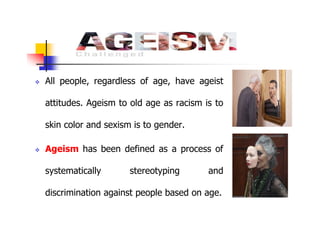
 All people, regardless of age, have ageist
attitudes. Ageism to old age as racism is to
skin color and sexism is to gender.
 Ageism has been defined as a process of
systematically stereotyping and
discrimination against people based on age.
Ageism is a form of oppression.
Unfortunately, many people believe that
old age equates to disabilities, poor
health, the inability to think clearly, and
having a negative outlook on life.
Researches have shown that health care
professionals are significantly more negative in their
attitudes toward older patients than they are toward
younger group. It is also evident in education where
healthcare students’ are unlikely to engage in work in
geriatrics, as this is reportedly the least preferred
area of work.
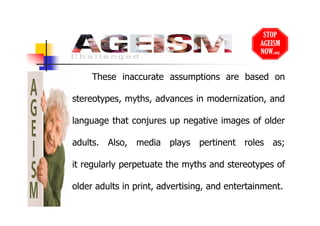
These inaccurate assumptions are based on
stereotypes, myths, advances in modernization, and
language that conjures up negative images of older
adults. Also, media plays pertinent roles as;
it regularly perpetuate the myths and stereotypes of
older adults in print, advertising, and entertainment.
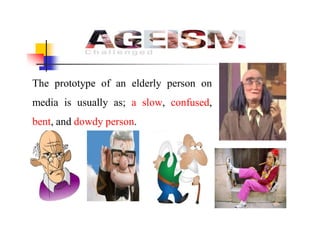
The prototype of an elderly person on
media is usually as; a slow, confused,
bent, and dowdy person.
Myths about aging
The most common myths (stereotypes and prejudices about
ageing) that promote ageism are as the following:
 Myth 1: Older adults are either very rich or very poor
 Myth 2: Older adults are senile (have defective memory
or are disoriented or demented)
 Myths 3: Older adults are neither interested in nor have
the capacity for sexual relations
Myths about aging
 Myths 4: Older adults are miserable and unhappy
 Myths 5: Older adults are very religious
 Myths 6: Older adults are unable to adapt to change
 Myths 7: Older adults are unable to learn new things
 Myths 8: Older adults want to live in nursing homes
 Myths 9: Older adults urinate on their clothes
 Myths 10: Older adults tend to be pretty much alike.
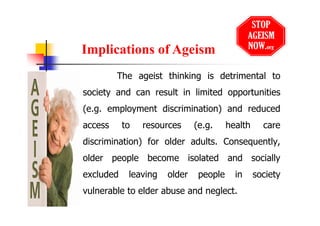
The ageist thinking is detrimental to
society and can result in limited opportunities
(e.g. employment discrimination) and reduced
access to resources (e.g. health care
discrimination) for older adults. Consequently,
older people become isolated and socially
excluded leaving older people in society
vulnerable to elder abuse and neglect.
Implications of Ageism
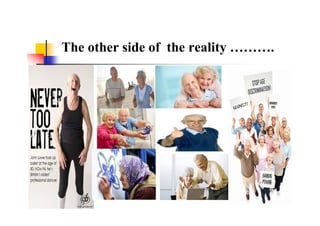
The other side of the reality ……….
Realities
 Older adults are not homogenous. They do not all look,
think, or act alike. Older adults are as unique as younger
adults are. The literature on aging indicates that
chronological age is a weak predictor of capacity for
productive performance.
 Longitudinal studies indicate that the majority of
individuals maintain stable intellectual functioning well
into their seventies and beyond." If they have no major
health problems”.
Strategies to combat the negative attitude
towards older adults
Stopping the spread of ageism is everyone's responsibility
and starts at the individual level.
At the individual level:
older adults should maintain their health and
independence in many ways such as improving eating
habits, drinking sufficient water, taking regular exercise
and keeping our minds busy and our circle of family and
friends active.
Strategies to combat the negative attitude
towards older adults
At the societal level:
Health, social and other services must be accessible and
appropriate to the needs of older people and better
integrated.
Family and friends who care for older people also need to
be supported by the community.
All sectors and levels of government can respond better to
the needs of older people (especially frail or poor people)
for reducing obstacles to their continuing independence.
Strategies to combat the negative attitude
towards older adults
Perceptions of growing older must change, and
some of the myths surrounding the ageing process
must be tackled through:
Conducting researches to enhance understanding of
the relative importance of factors such as age,
gender, knowledge and culture in the formation of
perceptions on ageing and older people.
Strategies to combat the negative attitude
towards older adults
Greater insight into how, and at what stage of the
lifespan, these factors influence the development of
age stereotypes.
Positive ageing campaigns’ should be further
developed promoting how older people make
valuable contributions to society to increase quality
of life, and to reduce social isolation and the
possible associated risks of abuse.
Strategies to combat the negative attitude
towards older adults
Positive ageing education programs should be
targeted at all levels of society but especially
towards those groups that hold less favorable
attitudes towards older people such as, men and
younger people and adolescents.
Educational programs to be developed that target
children and adolescents. These education
initiatives should become part of both the primary
and secondary school curriculum.
Strategies to combat the negative attitude
towards older adults
Innovative educational programs should not only be
developed and implemented, but should also be
systematically evaluated to assess their
effectiveness with various societal groups.
Education of health and social care professionals
includes input from older people themselves to
negate the stereotypical views held by some health
and social care professionals of older people as;
frail, passive and dependent.
Thank you

Atittude myths [compatibility mode]

  • 1.
    Attitude, myths andrealities of old age Dr. Bothaina Hussein Hassan, Assistant Professor Dr. Abeer Abd El-Rahman Mohamed, Lecturer Dr. Nancy Mahmoud El-Sakhy, Lecturer Gerontological Nursing Faculty of Nursing University of Alexandria
  • 2.
    Introduction As people livelonger, the population of older people is growing significantly. This brings with it many social, political and economic challenges. The idea of aging is feared by many because older adults often are ignored. Also, aging is associated with the reality of infirmity and death that often denied because people secretly cherish a belief in their own immortality.
  • 3.
    Infirmity threatens theideology of rugged individualism and independence, and many people regard growing older as something that happens to other people and not to themselves. So, it becomes increasingly important to gain an insight and understanding into how older people are perceived by the public. Attitude
  • 4.
    Attitude Negative attitudes, perceptionsand stereotyping can result in ageist behaviors such as; elder abuse, mistreatment, and neglect. Attitude to aging refers to knowledge, experience (expectations, worries, emotions) and behavior (activities, decisions) connected with ageing.
  • 5.
    The attitudes aredetermined individually and socially and differ according to cultural values (Eastern and Middle- Eastern cultures VS Western cultures) and linked to the development of modern medicine and changes in health conditions of the ageing population. Attitude
  • 6.
     All people,regardless of age, have ageist attitudes. Ageism to old age as racism is to skin color and sexism is to gender.  Ageism has been defined as a process of systematically stereotyping and discrimination against people based on age.
  • 7.
    Ageism is aform of oppression. Unfortunately, many people believe that old age equates to disabilities, poor health, the inability to think clearly, and having a negative outlook on life.
  • 8.
    Researches have shownthat health care professionals are significantly more negative in their attitudes toward older patients than they are toward younger group. It is also evident in education where healthcare students’ are unlikely to engage in work in geriatrics, as this is reportedly the least preferred area of work.
  • 9.
    These inaccurate assumptionsare based on stereotypes, myths, advances in modernization, and language that conjures up negative images of older adults. Also, media plays pertinent roles as; it regularly perpetuate the myths and stereotypes of older adults in print, advertising, and entertainment.
  • 10.
    The prototype ofan elderly person on media is usually as; a slow, confused, bent, and dowdy person.
  • 11.
    Myths about aging Themost common myths (stereotypes and prejudices about ageing) that promote ageism are as the following:  Myth 1: Older adults are either very rich or very poor  Myth 2: Older adults are senile (have defective memory or are disoriented or demented)  Myths 3: Older adults are neither interested in nor have the capacity for sexual relations
  • 12.
    Myths about aging Myths 4: Older adults are miserable and unhappy  Myths 5: Older adults are very religious  Myths 6: Older adults are unable to adapt to change  Myths 7: Older adults are unable to learn new things  Myths 8: Older adults want to live in nursing homes  Myths 9: Older adults urinate on their clothes  Myths 10: Older adults tend to be pretty much alike.
  • 13.
    The ageist thinkingis detrimental to society and can result in limited opportunities (e.g. employment discrimination) and reduced access to resources (e.g. health care discrimination) for older adults. Consequently, older people become isolated and socially excluded leaving older people in society vulnerable to elder abuse and neglect. Implications of Ageism
  • 14.
    The other sideof the reality ……….
  • 15.
    Realities  Older adultsare not homogenous. They do not all look, think, or act alike. Older adults are as unique as younger adults are. The literature on aging indicates that chronological age is a weak predictor of capacity for productive performance.  Longitudinal studies indicate that the majority of individuals maintain stable intellectual functioning well into their seventies and beyond." If they have no major health problems”.
  • 16.
    Strategies to combatthe negative attitude towards older adults Stopping the spread of ageism is everyone's responsibility and starts at the individual level. At the individual level: older adults should maintain their health and independence in many ways such as improving eating habits, drinking sufficient water, taking regular exercise and keeping our minds busy and our circle of family and friends active.
  • 17.
    Strategies to combatthe negative attitude towards older adults At the societal level: Health, social and other services must be accessible and appropriate to the needs of older people and better integrated. Family and friends who care for older people also need to be supported by the community. All sectors and levels of government can respond better to the needs of older people (especially frail or poor people) for reducing obstacles to their continuing independence.
  • 18.
    Strategies to combatthe negative attitude towards older adults Perceptions of growing older must change, and some of the myths surrounding the ageing process must be tackled through: Conducting researches to enhance understanding of the relative importance of factors such as age, gender, knowledge and culture in the formation of perceptions on ageing and older people.
  • 19.
    Strategies to combatthe negative attitude towards older adults Greater insight into how, and at what stage of the lifespan, these factors influence the development of age stereotypes. Positive ageing campaigns’ should be further developed promoting how older people make valuable contributions to society to increase quality of life, and to reduce social isolation and the possible associated risks of abuse.
  • 20.
    Strategies to combatthe negative attitude towards older adults Positive ageing education programs should be targeted at all levels of society but especially towards those groups that hold less favorable attitudes towards older people such as, men and younger people and adolescents. Educational programs to be developed that target children and adolescents. These education initiatives should become part of both the primary and secondary school curriculum.
  • 21.
    Strategies to combatthe negative attitude towards older adults Innovative educational programs should not only be developed and implemented, but should also be systematically evaluated to assess their effectiveness with various societal groups. Education of health and social care professionals includes input from older people themselves to negate the stereotypical views held by some health and social care professionals of older people as; frail, passive and dependent.
  • 22.