SOC and the Cybersecurity Threat
October 12, 2017
Dan Vance, Director
Brian M. Matteson, Manager
Introductions
Dan Vance, CPA
Director: Governance, Risk and Compliance
 Oversight of SOC, internal audit and compliance
 Extensive risk-based audit experience, planning
and implementation
Brian M Matteson, CISSP, CISA
Manager: IT, Security, and IT Audit
 Extensive experience in security strategy and
architecture
 Oversight of IT projects in Columbus market
2
Today’s Agenda
 Cybersecurity & the Need for a
Framework
 SOC Reporting – Background
 Cybersecurity Risk Management
Reporting Framework
 SOC for Cybersecurity Engagement
3
Cybersecurity & the Need
for a Framework
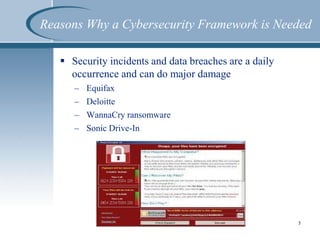
 Security incidents and data breaches are a daily
occurrence and can do major damage
– Equifax
– Deloitte
– WannaCry ransomware
– Sonic Drive-In
5
Reasons Why a Cybersecurity Framework is Needed
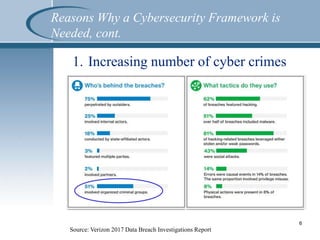
1. Increasing number of cyber crimes
6
Source: Verizon 2017 Data Breach Investigations Report
Reasons Why a Cybersecurity Framework is
Needed, cont.
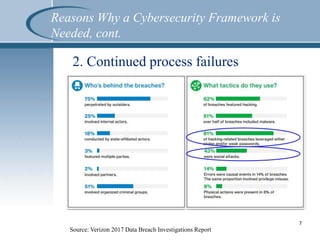
2. Continued process failures
7
Source: Verizon 2017 Data Breach Investigations Report
Reasons Why a Cybersecurity Framework is
Needed, cont.
3. Board of Director’s focus on Cyber
 How to identify upcoming risks
 What policies are needed?
 What is their role in this area and what
skillsets are required?
 How do they obtain comfort?
8
Reasons Why a Cybersecurity Framework is
Needed, cont.
4. Rapidly changing regulatory
environment
 Executive orders
 Federal agencies such as the SEC
 Banking regulators
 State level
 International
9
Reasons Why a Cybersecurity Framework is
Needed, cont.
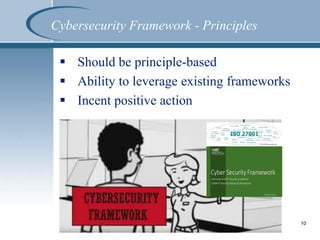
Cybersecurity Framework - Principles
 Should be principle-based
 Ability to leverage existing frameworks
 Incent positive action
10
SOC Reporting - Background
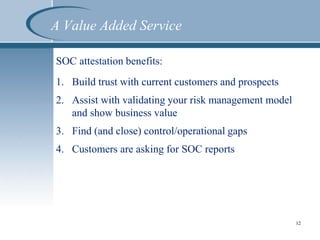
A Value Added Service
SOC attestation benefits:
1. Build trust with current customers and prospects
2. Assist with validating your risk management model
and show business value
3. Find (and close) control/operational gaps
4. Customers are asking for SOC reports
12
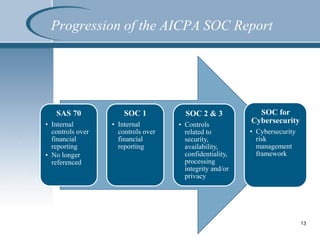
Progression of the AICPA SOC Report
SAS 70
• Internal
controls over
financial
reporting
• No longer
referenced
SOC 1
• Internal
controls over
financial
reporting
SOC 2 & 3
• Controls
related to
security,
availability,
confidentiality,
processing
integrity and/or
privacy
SOC for
Cybersecurity
• Cybersecurity
risk
management
framework
13
SOC Reports – Which Report is Right for You?
©2017 American Institute of CPAs
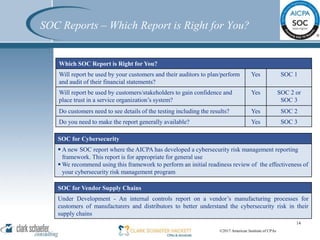
Which SOC Report is Right for You?
Will report be used by your customers and their auditors to plan/perform
and audit of their financial statements?
Yes SOC 1
Will report be used by customers/stakeholders to gain confidence and
place trust in a service organization’s system?
Yes SOC 2 or
SOC 3
Do customers need to see details of the testing including the results? Yes SOC 2
Do you need to make the report generally available? Yes SOC 3
SOC for Cybersecurity
 A new SOC report where the AICPA has developed a cybersecurity risk management reporting
framework. This report is for appropriate for general use
 We recommend using this framework to perform an initial readiness review of the effectiveness of
your cybersecurity risk management program
SOC for Vendor Supply Chains
Under Development - An internal controls report on a vendor’s manufacturing processes for
customers of manufacturers and distributors to better understand the cybersecurity risk in their
supply chains
14
SOC 2 Overview
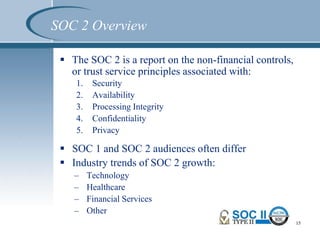
 The SOC 2 is a report on the non-financial controls,
or trust service principles associated with:
1. Security
2. Availability
3. Processing Integrity
4. Confidentiality
5. Privacy
 SOC 1 and SOC 2 audiences often differ
 Industry trends of SOC 2 growth:
– Technology
– Healthcare
– Financial Services
– Other
15
Cybersecurity Risk Management
Reporting Framework
Cybersecurity Risk Management Program
The AICPA defines an entity’s cybersecurity risk
management program as
“a set of policies, processes, and controls
designed to protect information and systems from
security events that could compromise the
achievement of the entity’s cybersecurity
objectives and to detect, respond to, mitigate, and
recover from, on a timely basis, security events
that are not prevented.”
17
SOC Cybersecurity Framework
 Released in April 2017
 Intended to demonstrate the effectiveness of
internal controls aimed at preventing and
detecting cybersecurity threats
 Leverage cybersecurity frameworks to create a
common language for reporting
18
Why Was New SOC Framework Created?
 Increase in cyber crimes – focus on cybersecurity
programs
 Limited industry standards to share reporting on
cybersecurity risk management programs
 Internal stakeholders (e.g., the Board of Directors) as well
as external stakeholders
Benefits of SOC for Cybersecurity
 Competitive advantage
 Providing customers with peace of mind that data is
safeguarded
 Standardized solution
19
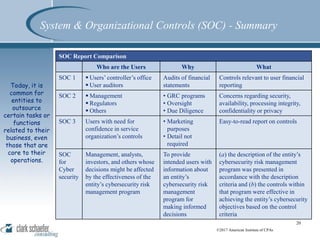
System & Organizational Controls (SOC) - Summary
Today, it is
common for
entities to
outsource
certain tasks or
functions
related to their
business, even
those that are
core to their
operations.
SOC Report Comparison
Who are the Users Why What
SOC 1  Users’ controller’s office
 User auditors
Audits of financial
statements
Controls relevant to user financial
reporting
SOC 2  Management
 Regulators
 Others
• GRC programs
• Oversight
• Due Diligence
Concerns regarding security,
availability, processing integrity,
confidentiality or privacy
SOC 3 Users with need for
confidence in service
organization’s controls
• Marketing
purposes
• Detail not
required
Easy-to-read report on controls
SOC
for
Cyber
security
Management, analysts,
investors, and others whose
decisions might be affected
by the effectiveness of the
entity’s cybersecurity risk
management program
To provide
intended users with
information about
an entity’s
cybersecurity risk
management
program for
making informed
decisions
(a) the description of the entity’s
cybersecurity risk management
program was presented in
accordance with the description
criteria and (b) the controls within
that program were effective in
achieving the entity’s cybersecurity
objectives based on the control
criteria
©2017 American Institute of CPAs
20
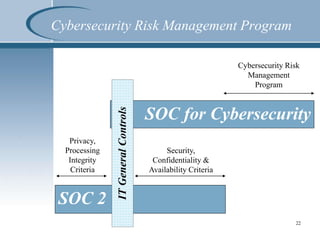
SOC for Cybersecurity
Cybersecurity Risk Management Program
22
SOC for Cybersecurity
SOC 2
ITGeneralControls
Privacy,
Processing
Integrity
Criteria
Security,
Confidentiality &
Availability Criteria
Cybersecurity Risk
Management
Program
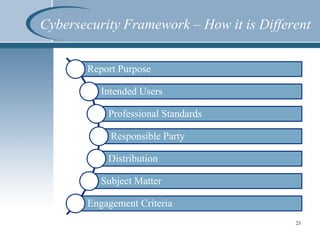
Cybersecurity Framework – How it is Different
23
Report Purpose
Intended Users
Professional Standards
Responsible Party
Distribution
Subject Matter
Engagement Criteria
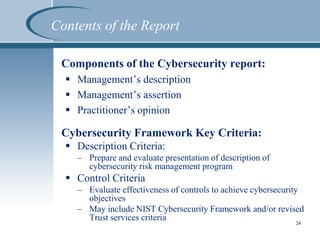
Contents of the Report
Components of the Cybersecurity report:
 Management’s description
 Management’s assertion
 Practitioner’s opinion
24
Cybersecurity Framework Key Criteria:
 Description Criteria:
– Prepare and evaluate presentation of description of
cybersecurity risk management program
 Control Criteria
– Evaluate effectiveness of controls to achieve cybersecurity
objectives
– May include NIST Cybersecurity Framework and/or revised
Trust services criteria
Report Structure – Program Description
Total of 9 sections to be addressed:
1. Nature of Business and Operations
2. Nature of Information at Risk
3. The Cybersecurity Risk Management Program Objectives
4. Factors That Have a Significant Effect on Inherent
Cybersecurity Risks
5. Description of Cybersecurity Risk Governance Structure
6. Cybersecurity Risk Assessment Process
7. Cybersecurity Communications and the Quality of
Cybersecurity Information
8. Monitoring of the Cybersecurity Risk Management
Program
9. Cybersecurity Control Processes Disclosures
25
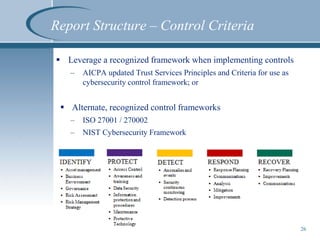
Report Structure – Control Criteria
 Leverage a recognized framework when implementing controls
– AICPA updated Trust Services Principles and Criteria for use as
cybersecurity control framework; or
 Alternate, recognized control frameworks
– ISO 27001 / 270002
– NIST Cybersecurity Framework
26
26
What Now?
 Establish stakeholder expectations
 Factor in stakeholder expectations and
expected communication plan
 Consider undertaking a readiness review to:
– Validate you’re using a cybersecurity
framework to develop an effective program
– Identify potential gaps
 Determine next steps including remediation
27
Questions?
If you wish to discuss any aspect of this presentation in
more detail, please feel free to contact us:
Dan Vance
dvance@clarkschaefer.com
(614) 607-5788
Brian M Matteson
bmatteson@clarkschaefer.com
(614) 607-5289

SOC for Cybersecurity Overview

  • 1.
    SOC and theCybersecurity Threat October 12, 2017 Dan Vance, Director Brian M. Matteson, Manager
  • 2.
    Introductions Dan Vance, CPA Director:Governance, Risk and Compliance  Oversight of SOC, internal audit and compliance  Extensive risk-based audit experience, planning and implementation Brian M Matteson, CISSP, CISA Manager: IT, Security, and IT Audit  Extensive experience in security strategy and architecture  Oversight of IT projects in Columbus market 2
  • 3.
    Today’s Agenda  Cybersecurity& the Need for a Framework  SOC Reporting – Background  Cybersecurity Risk Management Reporting Framework  SOC for Cybersecurity Engagement 3
  • 4.
    Cybersecurity & theNeed for a Framework
  • 5.
     Security incidentsand data breaches are a daily occurrence and can do major damage – Equifax – Deloitte – WannaCry ransomware – Sonic Drive-In 5 Reasons Why a Cybersecurity Framework is Needed
  • 6.
    1. Increasing numberof cyber crimes 6 Source: Verizon 2017 Data Breach Investigations Report Reasons Why a Cybersecurity Framework is Needed, cont.
  • 7.
    2. Continued processfailures 7 Source: Verizon 2017 Data Breach Investigations Report Reasons Why a Cybersecurity Framework is Needed, cont.
  • 8.
    3. Board ofDirector’s focus on Cyber  How to identify upcoming risks  What policies are needed?  What is their role in this area and what skillsets are required?  How do they obtain comfort? 8 Reasons Why a Cybersecurity Framework is Needed, cont.
  • 9.
    4. Rapidly changingregulatory environment  Executive orders  Federal agencies such as the SEC  Banking regulators  State level  International 9 Reasons Why a Cybersecurity Framework is Needed, cont.
  • 10.
    Cybersecurity Framework -Principles  Should be principle-based  Ability to leverage existing frameworks  Incent positive action 10
  • 11.
    SOC Reporting -Background
  • 12.
    A Value AddedService SOC attestation benefits: 1. Build trust with current customers and prospects 2. Assist with validating your risk management model and show business value 3. Find (and close) control/operational gaps 4. Customers are asking for SOC reports 12
  • 13.
    Progression of theAICPA SOC Report SAS 70 • Internal controls over financial reporting • No longer referenced SOC 1 • Internal controls over financial reporting SOC 2 & 3 • Controls related to security, availability, confidentiality, processing integrity and/or privacy SOC for Cybersecurity • Cybersecurity risk management framework 13
  • 14.
    SOC Reports –Which Report is Right for You? ©2017 American Institute of CPAs Which SOC Report is Right for You? Will report be used by your customers and their auditors to plan/perform and audit of their financial statements? Yes SOC 1 Will report be used by customers/stakeholders to gain confidence and place trust in a service organization’s system? Yes SOC 2 or SOC 3 Do customers need to see details of the testing including the results? Yes SOC 2 Do you need to make the report generally available? Yes SOC 3 SOC for Cybersecurity  A new SOC report where the AICPA has developed a cybersecurity risk management reporting framework. This report is for appropriate for general use  We recommend using this framework to perform an initial readiness review of the effectiveness of your cybersecurity risk management program SOC for Vendor Supply Chains Under Development - An internal controls report on a vendor’s manufacturing processes for customers of manufacturers and distributors to better understand the cybersecurity risk in their supply chains 14
  • 15.
    SOC 2 Overview The SOC 2 is a report on the non-financial controls, or trust service principles associated with: 1. Security 2. Availability 3. Processing Integrity 4. Confidentiality 5. Privacy  SOC 1 and SOC 2 audiences often differ  Industry trends of SOC 2 growth: – Technology – Healthcare – Financial Services – Other 15
  • 16.
  • 17.
    Cybersecurity Risk ManagementProgram The AICPA defines an entity’s cybersecurity risk management program as “a set of policies, processes, and controls designed to protect information and systems from security events that could compromise the achievement of the entity’s cybersecurity objectives and to detect, respond to, mitigate, and recover from, on a timely basis, security events that are not prevented.” 17
  • 18.
    SOC Cybersecurity Framework Released in April 2017  Intended to demonstrate the effectiveness of internal controls aimed at preventing and detecting cybersecurity threats  Leverage cybersecurity frameworks to create a common language for reporting 18
  • 19.
    Why Was NewSOC Framework Created?  Increase in cyber crimes – focus on cybersecurity programs  Limited industry standards to share reporting on cybersecurity risk management programs  Internal stakeholders (e.g., the Board of Directors) as well as external stakeholders Benefits of SOC for Cybersecurity  Competitive advantage  Providing customers with peace of mind that data is safeguarded  Standardized solution 19
  • 20.
    System & OrganizationalControls (SOC) - Summary Today, it is common for entities to outsource certain tasks or functions related to their business, even those that are core to their operations. SOC Report Comparison Who are the Users Why What SOC 1  Users’ controller’s office  User auditors Audits of financial statements Controls relevant to user financial reporting SOC 2  Management  Regulators  Others • GRC programs • Oversight • Due Diligence Concerns regarding security, availability, processing integrity, confidentiality or privacy SOC 3 Users with need for confidence in service organization’s controls • Marketing purposes • Detail not required Easy-to-read report on controls SOC for Cyber security Management, analysts, investors, and others whose decisions might be affected by the effectiveness of the entity’s cybersecurity risk management program To provide intended users with information about an entity’s cybersecurity risk management program for making informed decisions (a) the description of the entity’s cybersecurity risk management program was presented in accordance with the description criteria and (b) the controls within that program were effective in achieving the entity’s cybersecurity objectives based on the control criteria ©2017 American Institute of CPAs 20
  • 21.
  • 22.
    Cybersecurity Risk ManagementProgram 22 SOC for Cybersecurity SOC 2 ITGeneralControls Privacy, Processing Integrity Criteria Security, Confidentiality & Availability Criteria Cybersecurity Risk Management Program
  • 23.
    Cybersecurity Framework –How it is Different 23 Report Purpose Intended Users Professional Standards Responsible Party Distribution Subject Matter Engagement Criteria
  • 24.
    Contents of theReport Components of the Cybersecurity report:  Management’s description  Management’s assertion  Practitioner’s opinion 24 Cybersecurity Framework Key Criteria:  Description Criteria: – Prepare and evaluate presentation of description of cybersecurity risk management program  Control Criteria – Evaluate effectiveness of controls to achieve cybersecurity objectives – May include NIST Cybersecurity Framework and/or revised Trust services criteria
  • 25.
    Report Structure –Program Description Total of 9 sections to be addressed: 1. Nature of Business and Operations 2. Nature of Information at Risk 3. The Cybersecurity Risk Management Program Objectives 4. Factors That Have a Significant Effect on Inherent Cybersecurity Risks 5. Description of Cybersecurity Risk Governance Structure 6. Cybersecurity Risk Assessment Process 7. Cybersecurity Communications and the Quality of Cybersecurity Information 8. Monitoring of the Cybersecurity Risk Management Program 9. Cybersecurity Control Processes Disclosures 25
  • 26.
    Report Structure –Control Criteria  Leverage a recognized framework when implementing controls – AICPA updated Trust Services Principles and Criteria for use as cybersecurity control framework; or  Alternate, recognized control frameworks – ISO 27001 / 270002 – NIST Cybersecurity Framework 26 26
  • 27.
    What Now?  Establishstakeholder expectations  Factor in stakeholder expectations and expected communication plan  Consider undertaking a readiness review to: – Validate you’re using a cybersecurity framework to develop an effective program – Identify potential gaps  Determine next steps including remediation 27
  • 28.
    Questions? If you wishto discuss any aspect of this presentation in more detail, please feel free to contact us: Dan Vance dvance@clarkschaefer.com (614) 607-5788 Brian M Matteson bmatteson@clarkschaefer.com (614) 607-5289

Editor's Notes

  • #3 DeAnna Introductions.
  • #4 Brian Good afternoon everyone. Overview of the agenda
  • #29  Thank you so much for your time today, are there any questions?