
So what is ALARP?
The ALARP principle
No industrial activity is entirely free from risk and so many companies and regulators
around the world require that safety risks are reduced to levels that are As Low As
Reasonably Practicable, or "ALARP".
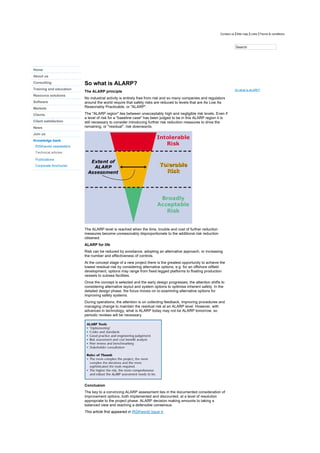
The "ALARP region" lies between unacceptably high and negligible risk levels. Even if
a level of risk for a "baseline case" has been judged to be in this ALARP region it is
still necessary to consider introducing further risk reduction measures to drive the
remaining, or "residual", risk downwards.
The ALARP level is reached when the time, trouble and cost of further reduction
measures become unreasonably disproportionate to the additional risk reduction
obtained.
ALARP for life
Risk can be reduced by avoidance, adopting an alternative approach, or increasing
the number and effectiveness of controls.
At the concept stage of a new project there is the greatest opportunity to achieve the
lowest residual risk by considering alternative options, e.g. for an offshore oilfield
development, options may range from fixed legged platforms to floating production
vessels to subsea facilities.
Once the concept is selected and the early design progresses, the attention shifts to
considering alternative layout and system options to optimise inherent safety. In the
detailed design phase, the focus moves on to examining alternative options for
improving safety systems.
During operations, the attention is on collecting feedback, improving procedures and
managing change to maintain the residual risk at an ALARP level. However, with
advances in technology, what is ALARP today may not be ALARP tomorrow, so
periodic reviews will be necessary.
Conclusion
The key to a convincing ALARP assessment lies in the documented consideration of
improvement options, both implemented and discounted, at a level of resolution
appropriate to the project phase. ALARP decision making amounts to taking a
balanced view and reaching a defensible consensus.
This article first appeared in RISKworld Issue 4.
So what is ALARP?
Home
About us
Consulting
Training and education
Resource solutions
Software
Markets
Clients
Client satisfaction
News
Join us
Knowledge bank
RISKworld newsletters
Technical articles
Publications
Corporate brochures
Contact us Site map Links Terms & conditions
Search
Copyright © Risktec Solutions Ltd 2015. All rights reserved.

So what is alarp risktec

  • 1.
    So what isALARP? The ALARP principle No industrial activity is entirely free from risk and so many companies and regulators around the world require that safety risks are reduced to levels that are As Low As Reasonably Practicable, or "ALARP". The "ALARP region" lies between unacceptably high and negligible risk levels. Even if a level of risk for a "baseline case" has been judged to be in this ALARP region it is still necessary to consider introducing further risk reduction measures to drive the remaining, or "residual", risk downwards. The ALARP level is reached when the time, trouble and cost of further reduction measures become unreasonably disproportionate to the additional risk reduction obtained. ALARP for life Risk can be reduced by avoidance, adopting an alternative approach, or increasing the number and effectiveness of controls. At the concept stage of a new project there is the greatest opportunity to achieve the lowest residual risk by considering alternative options, e.g. for an offshore oilfield development, options may range from fixed legged platforms to floating production vessels to subsea facilities. Once the concept is selected and the early design progresses, the attention shifts to considering alternative layout and system options to optimise inherent safety. In the detailed design phase, the focus moves on to examining alternative options for improving safety systems. During operations, the attention is on collecting feedback, improving procedures and managing change to maintain the residual risk at an ALARP level. However, with advances in technology, what is ALARP today may not be ALARP tomorrow, so periodic reviews will be necessary. Conclusion The key to a convincing ALARP assessment lies in the documented consideration of improvement options, both implemented and discounted, at a level of resolution appropriate to the project phase. ALARP decision making amounts to taking a balanced view and reaching a defensible consensus. This article first appeared in RISKworld Issue 4. So what is ALARP? Home About us Consulting Training and education Resource solutions Software Markets Clients Client satisfaction News Join us Knowledge bank RISKworld newsletters Technical articles Publications Corporate brochures Contact us Site map Links Terms & conditions Search
  • 2.
    Copyright © RisktecSolutions Ltd 2015. All rights reserved.