David Smith
Interesting Times
Shocks, surprises
and opportunities
Three themes
• The broader economic backdrop.
• Britain and Brexit.
• What it means for the economy, and you.
3
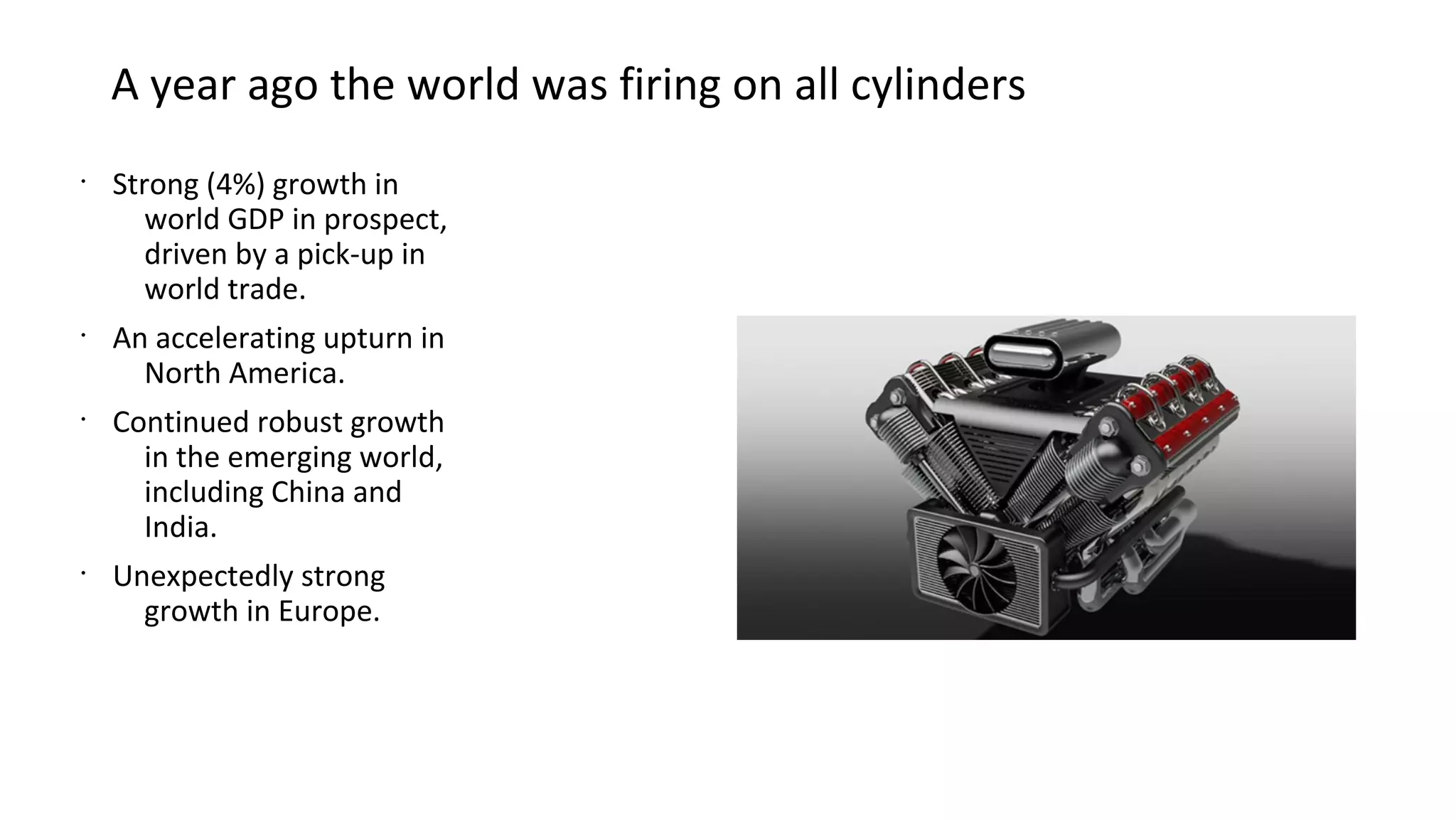
A year ago the world was firing on all cylinders
•
Strong (4%) growth in
world GDP in prospect,
driven by a pick-up in
world trade.
•
An accelerating upturn in
North America.
•
Continued robust growth
in the emerging world,
including China and
India.
•
Unexpectedly strong
growth in Europe.
But the brakes have gone on
5
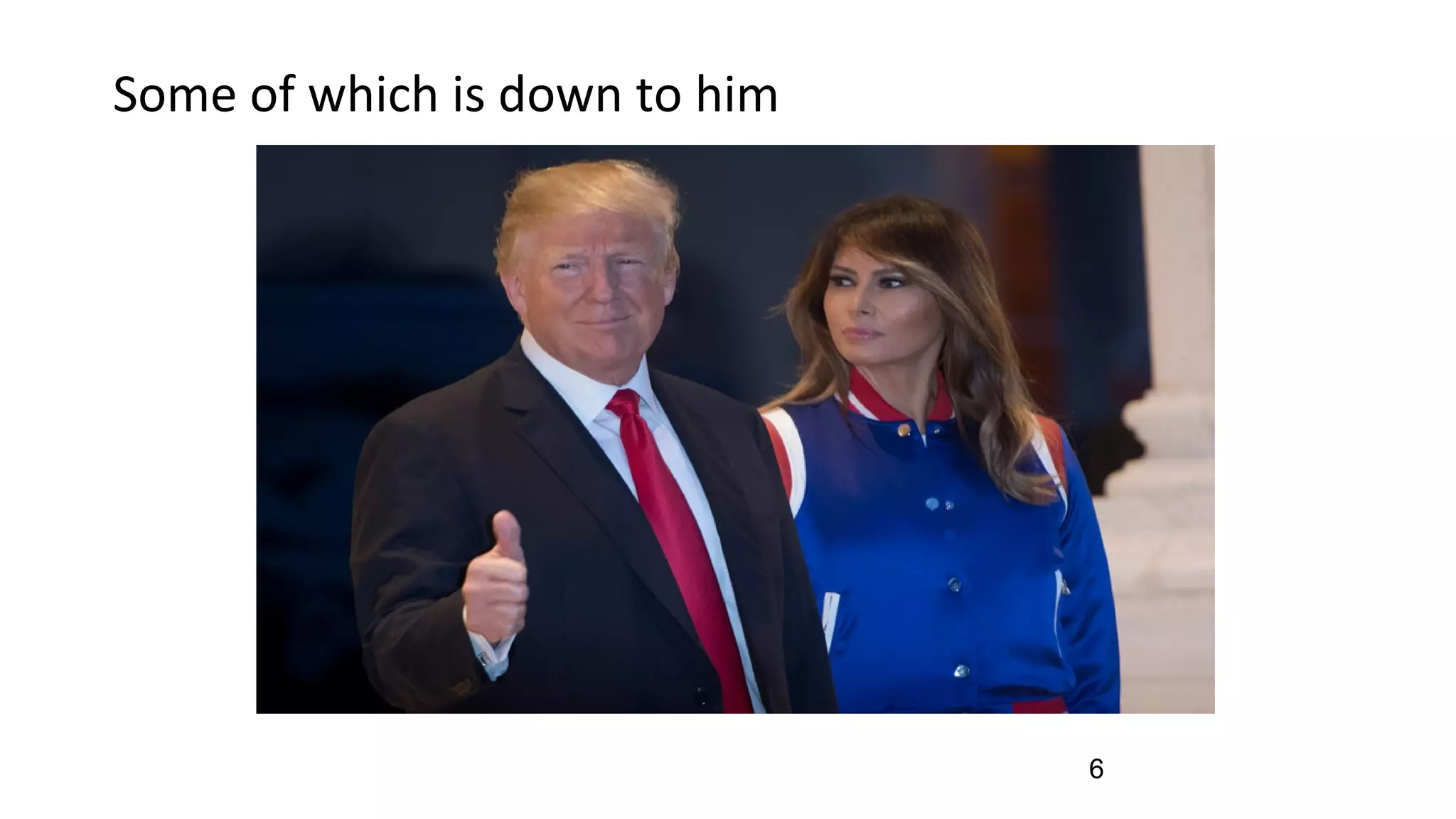
Some of which is down to him
6
Protectionism’s bad for growth
“The global growth forecast for 2019 and 2020 had
already been revised downward, partly because of
the negative effects of tariff increases enacted in the
United States and China earlier that year. Risks to
global growth tilt to the downside. An escalation of
trade tensions beyond those already incorporated in
the forecast remains a key source of risk to the
outlook.” IMF, World Economic Outlook, 2019
7
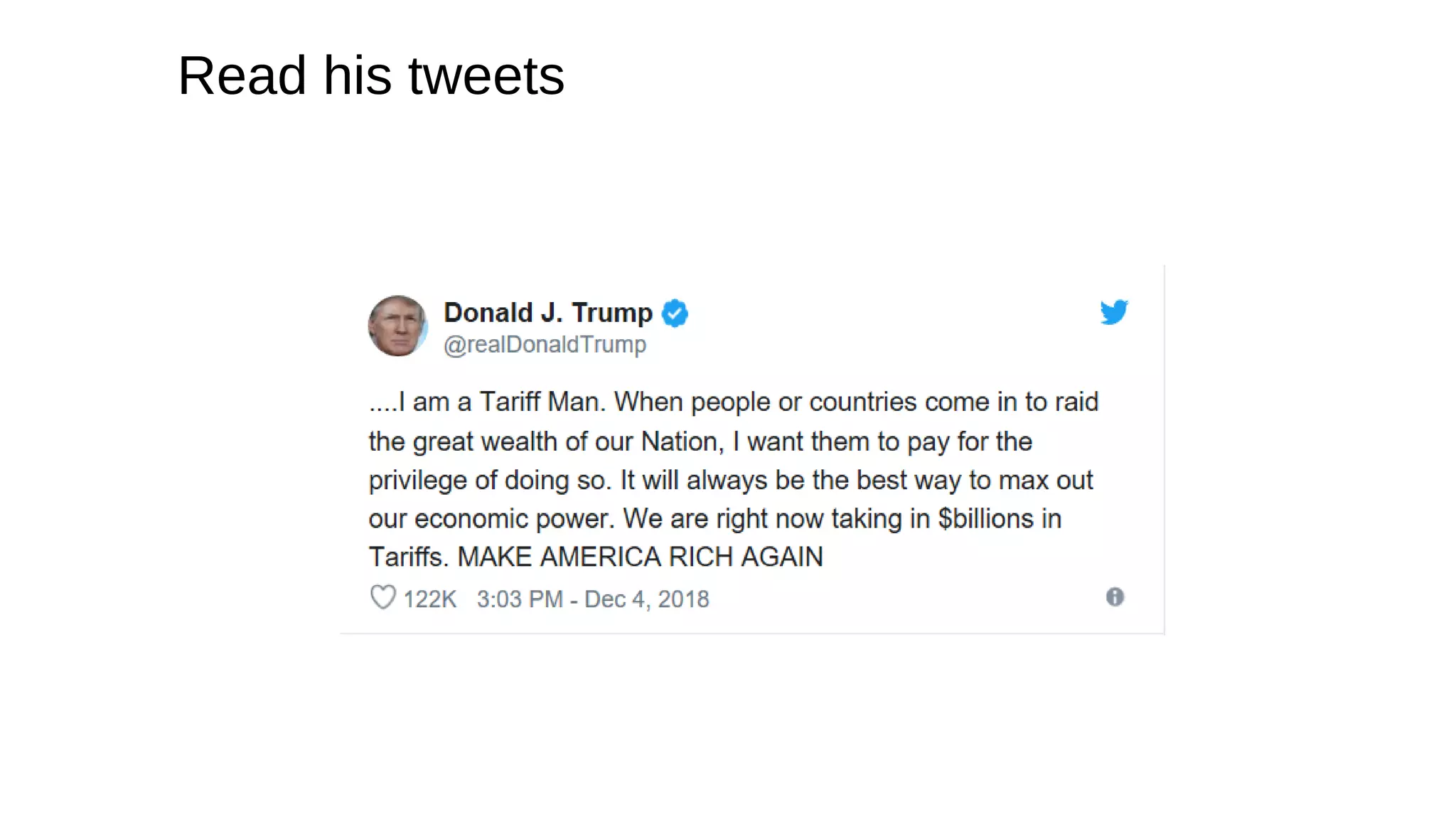
Read his tweets
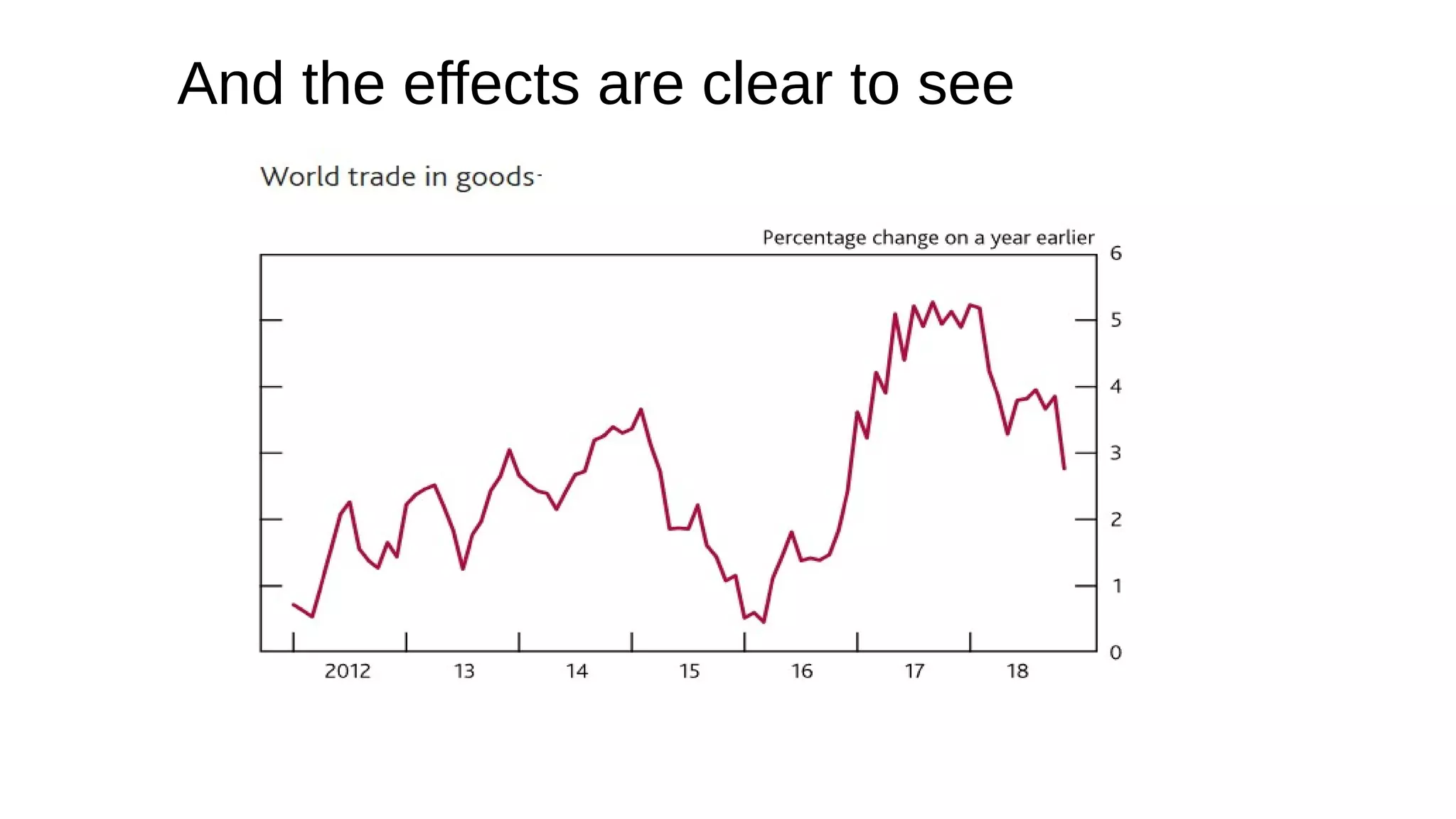
And the effects are clear to see
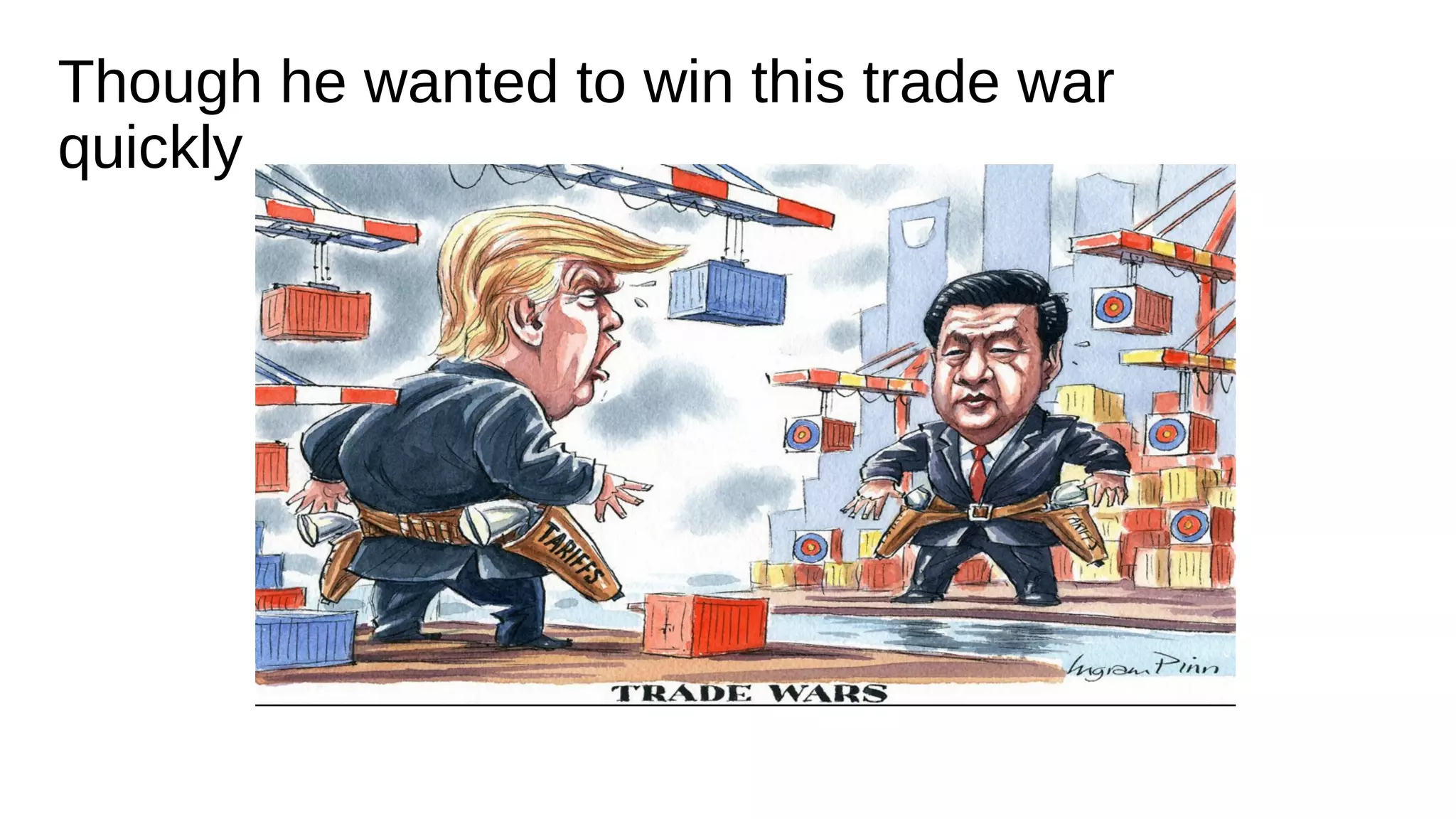
Though he wanted to win this trade war
quickly
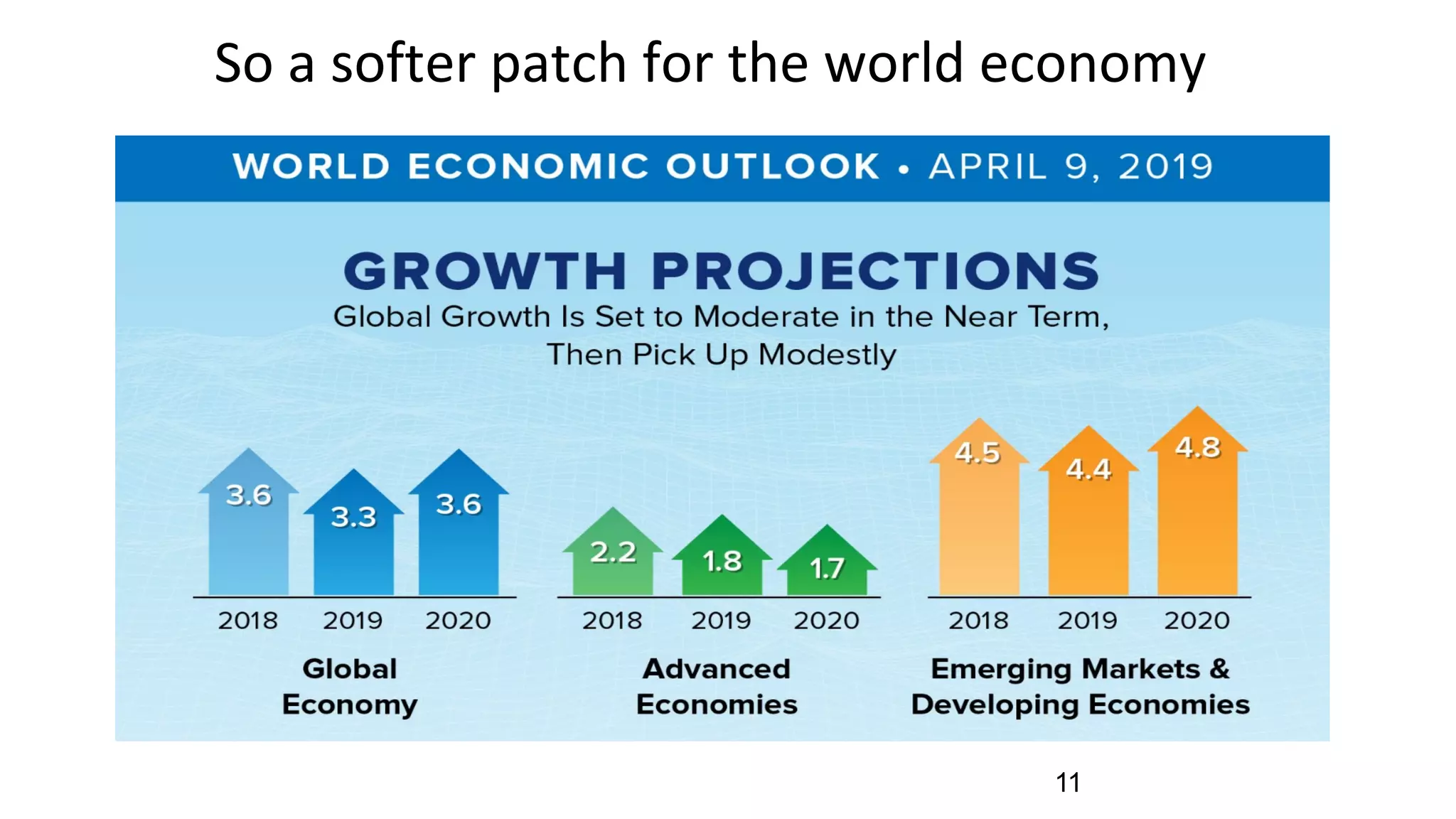
So a softer patch for the world economy
11
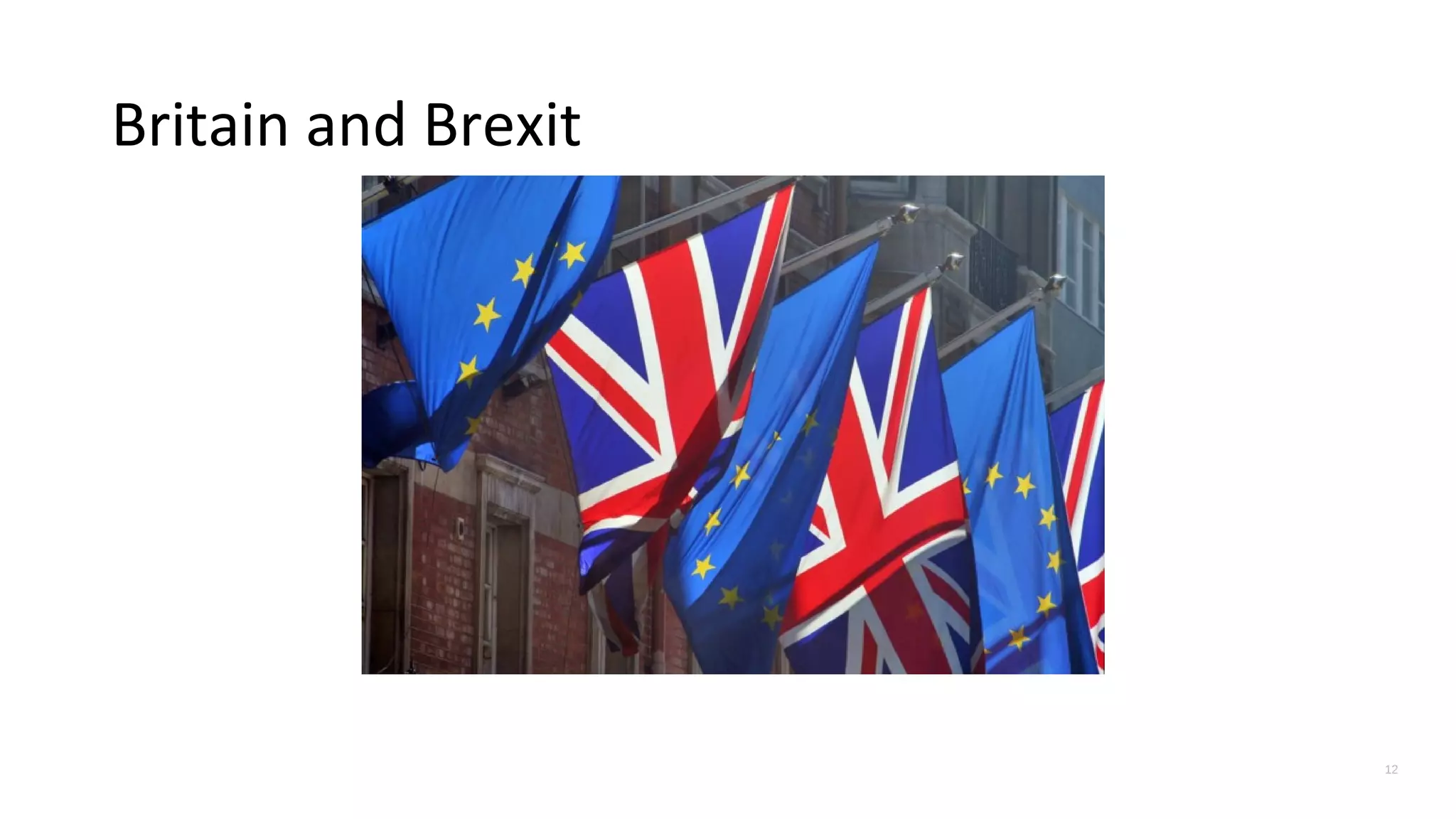
Britain and Brexit
12
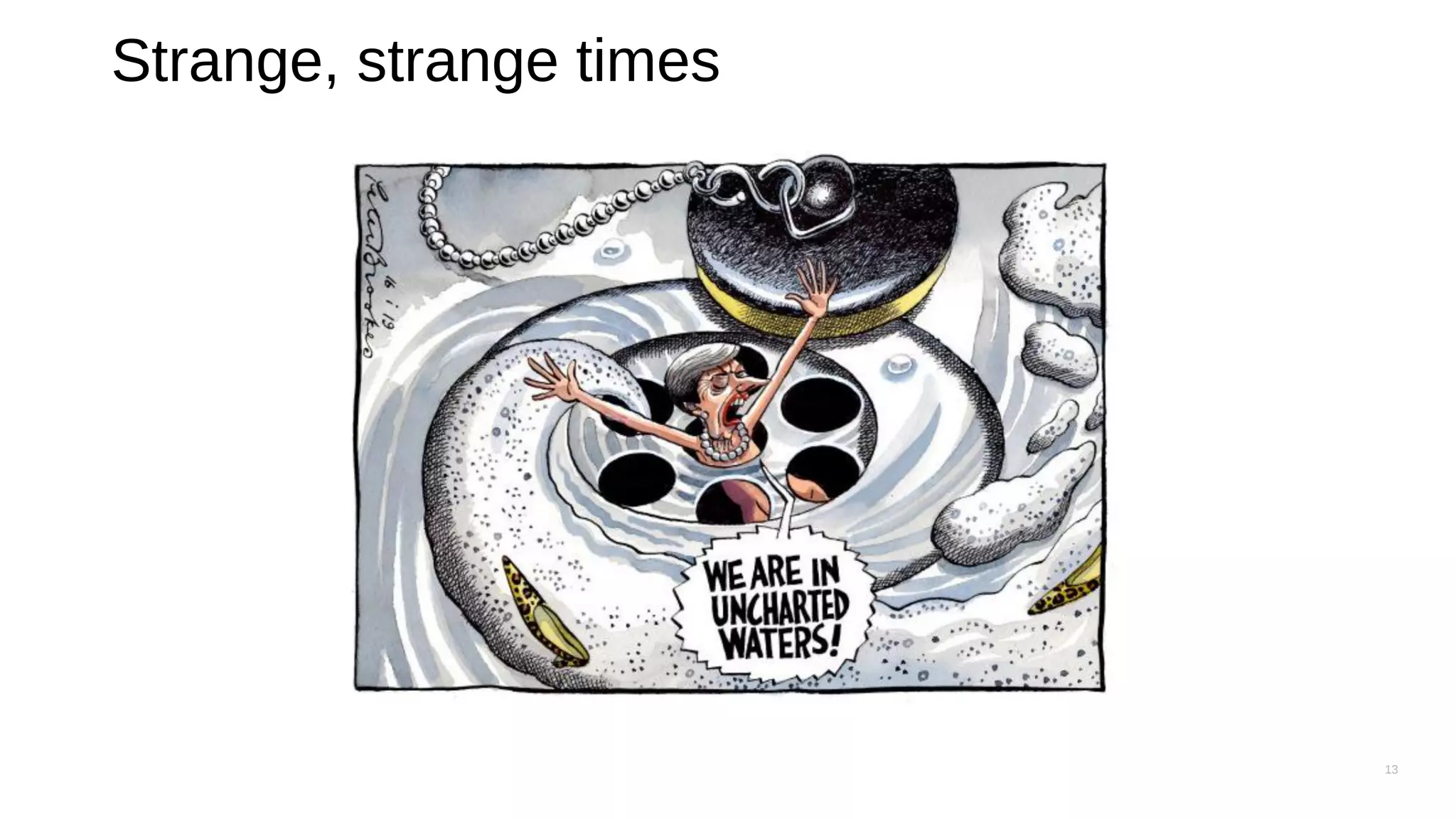
Strange, strange times
13
The Brexit timetable – Phase 1
Article 50 of the withdrawal process was triggered on March 29
2017, and due to be completed within two years: by March 29
2019. It was agreed at an early stage that the withdrawal
agreement would cover three main elements:
• A “divorce bill” covering the UK’s commitments made as an EU
member, including contributions to the budget until the end of
2020. The agreed sum is around £39bn ($51bn).
• Measures to secure the rights of EU citizens in the UK and UK
citizens living in the rest of the EU.
• A legal commitment to maintaining an open border between
Ireland and Northern Ireland, in line with the Good Friday
Agreement which secured an end to “the troubles”.
14
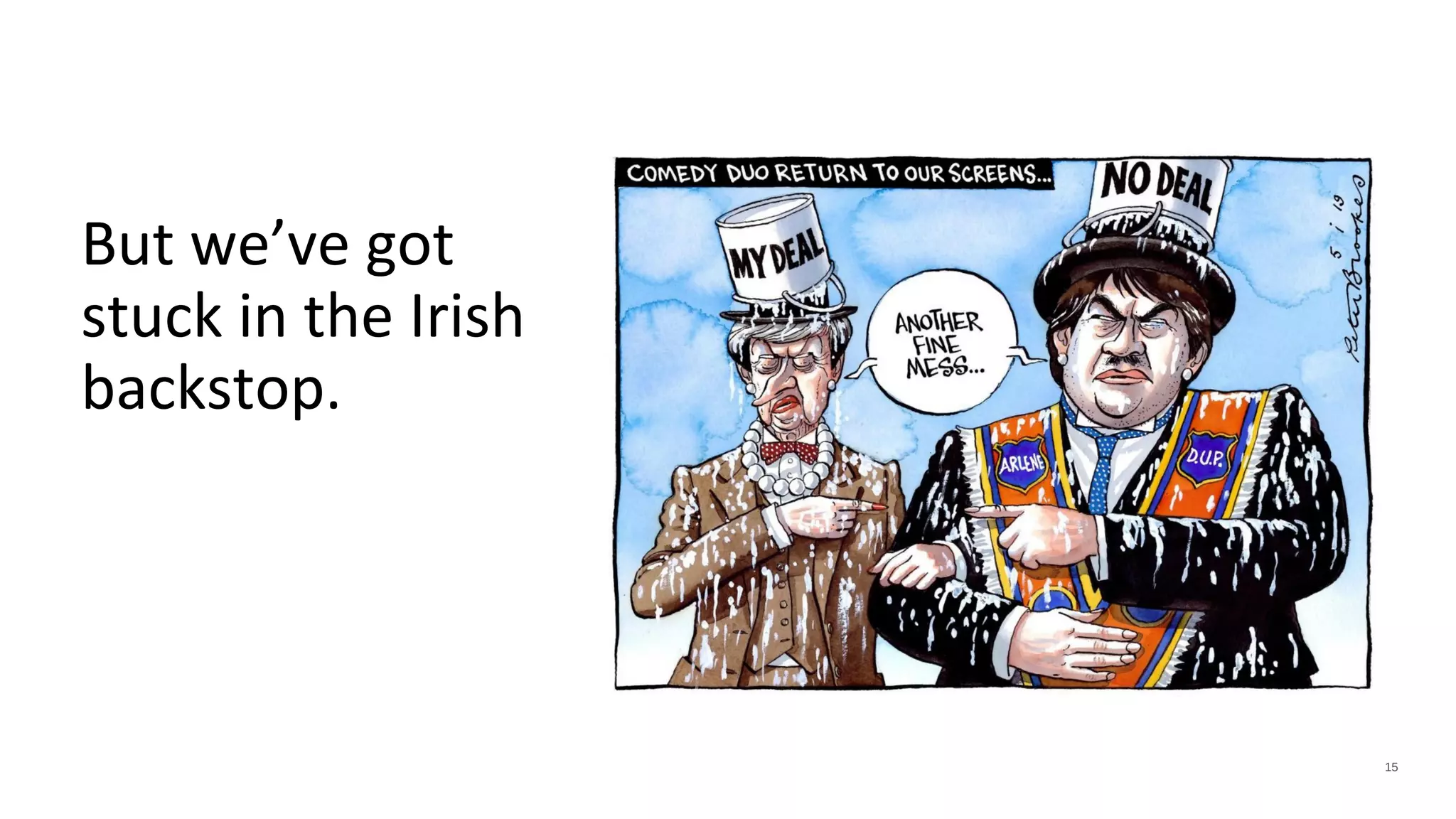
But we’ve got
stuck in the Irish
backstop.
S still in a mess
15
What is the Irish backstop?
In the event of the UK and the EU being unable to negotiate a comprehensive trade
deal by the end of the transition period (December 2020 extendable to December
2022), the backstop will apply. It consists of two elements:
• The whole of the UK will remain in a single customs territory with the EU, similar to
the customs union but with the proviso that the UK would be free to negotiate third
country trade deals.
• Northern Ireland, additionally, to effectively remain in the EU single market, following
EU regulations, so goods can freely cross the border with Ireland.
• It is this, treating Northern Ireland different to the rest of the UK and establishing a
border in the Irish Sea that has so upset the Democratic Unionist Party.
16
17
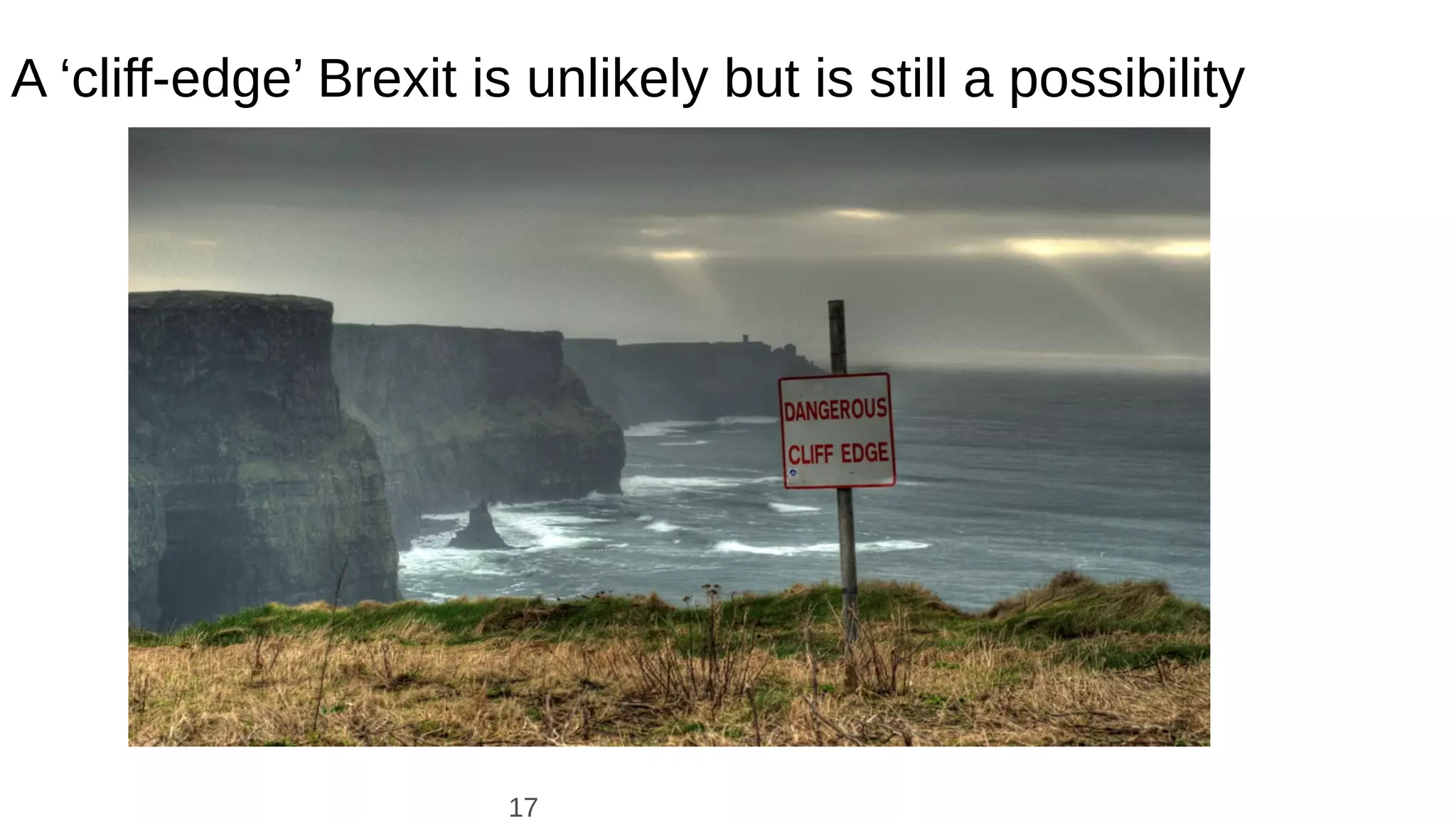
A ‘cliff-edge’ Brexit is unlikely but is still a possibility
18
Because we’re going to have a new prime minister
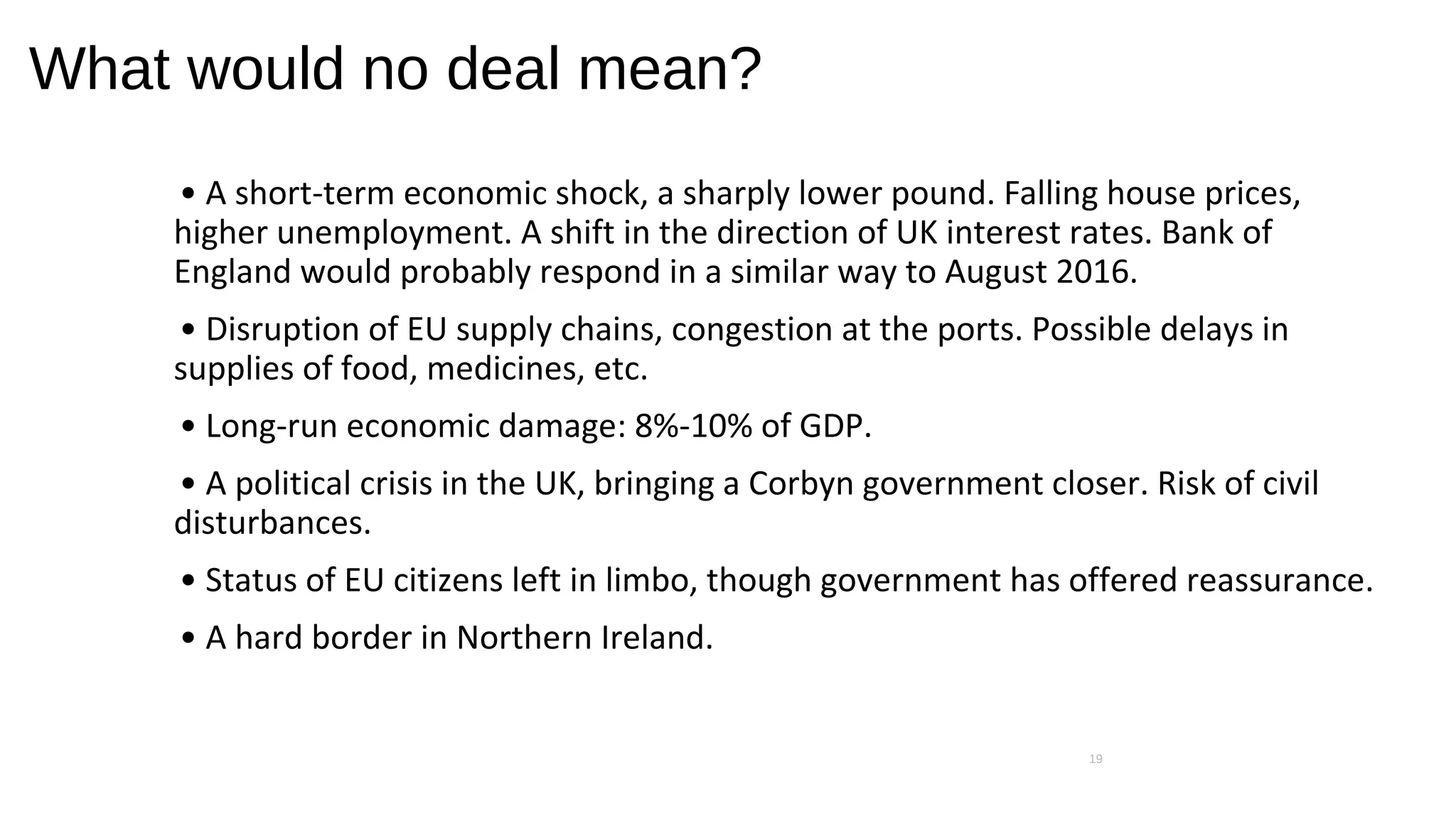
What would no deal mean?
• A short-term economic shock, a sharply lower pound. Falling house prices,
higher unemployment. A shift in the direction of UK interest rates. Bank of
England would probably respond in a similar way to August 2016.
• Disruption of EU supply chains, congestion at the ports. Possible delays in
supplies of food, medicines, etc.
• Long-run economic damage: 8%-10% of GDP.
• A political crisis in the UK, bringing a Corbyn government closer. Risk of civil
disturbances.
• Status of EU citizens left in limbo, though government has offered reassurance.
• A hard border in Northern Ireland.
19
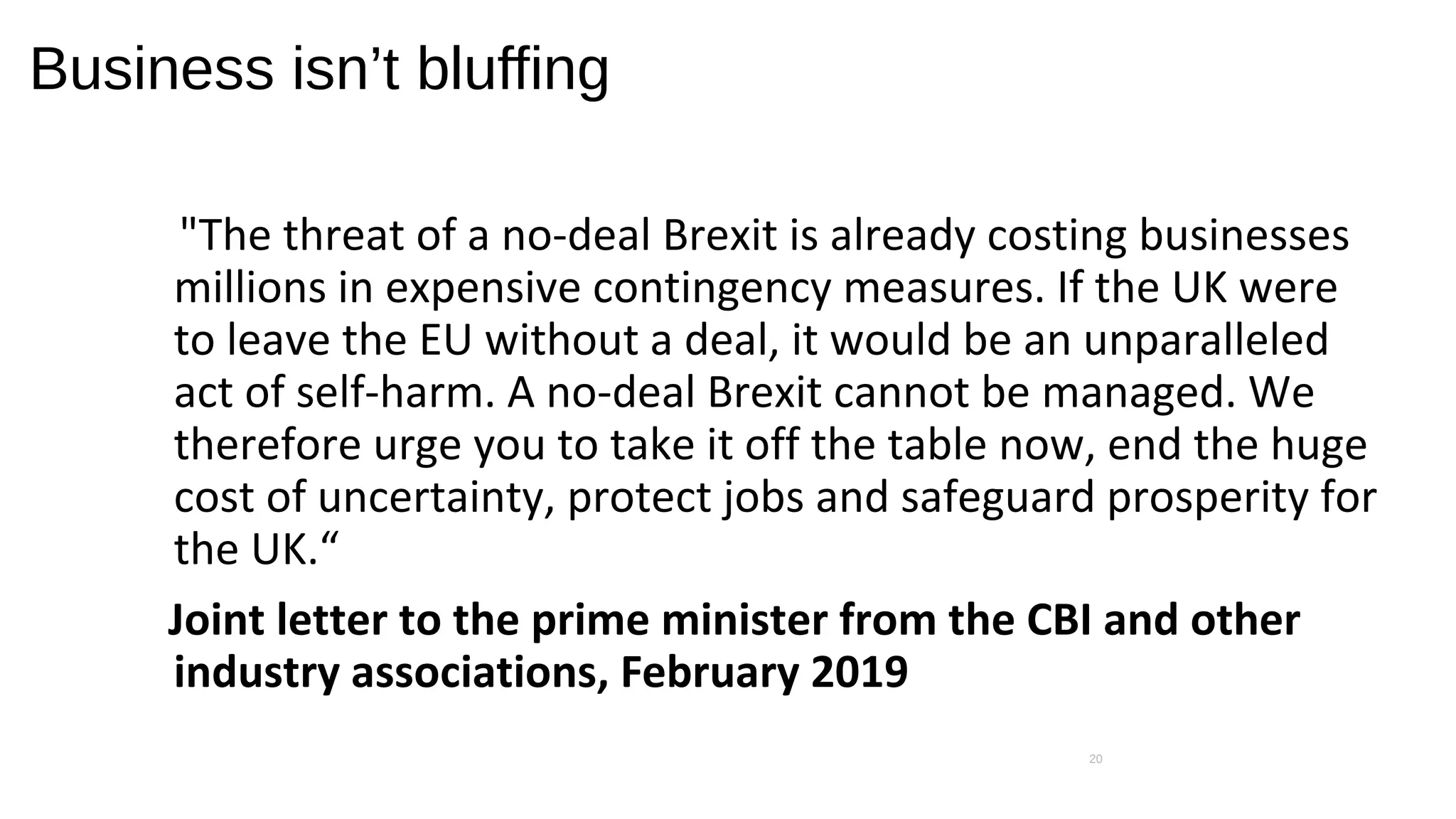
Business isn’t bluffing
"The threat of a no-deal Brexit is already costing businesses
millions in expensive contingency measures. If the UK were
to leave the EU without a deal, it would be an unparalleled
act of self-harm. A no-deal Brexit cannot be managed. We
therefore urge you to take it off the table now, end the huge
cost of uncertainty, protect jobs and safeguard prosperity for
the UK.“
Joint letter to the prime minister from the CBI and other
industry associations, February 2019
20
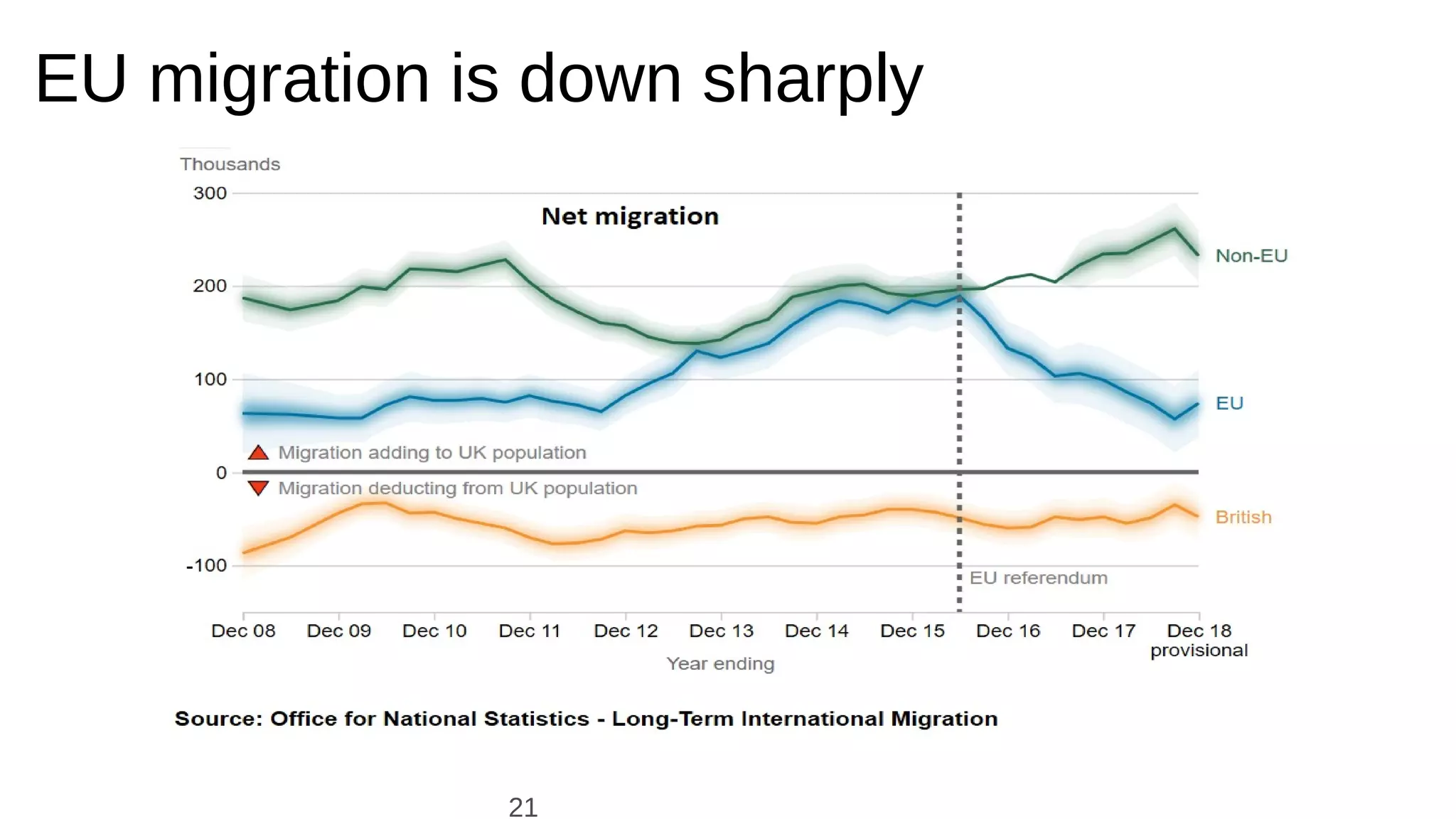
EU migration is down sharply
21
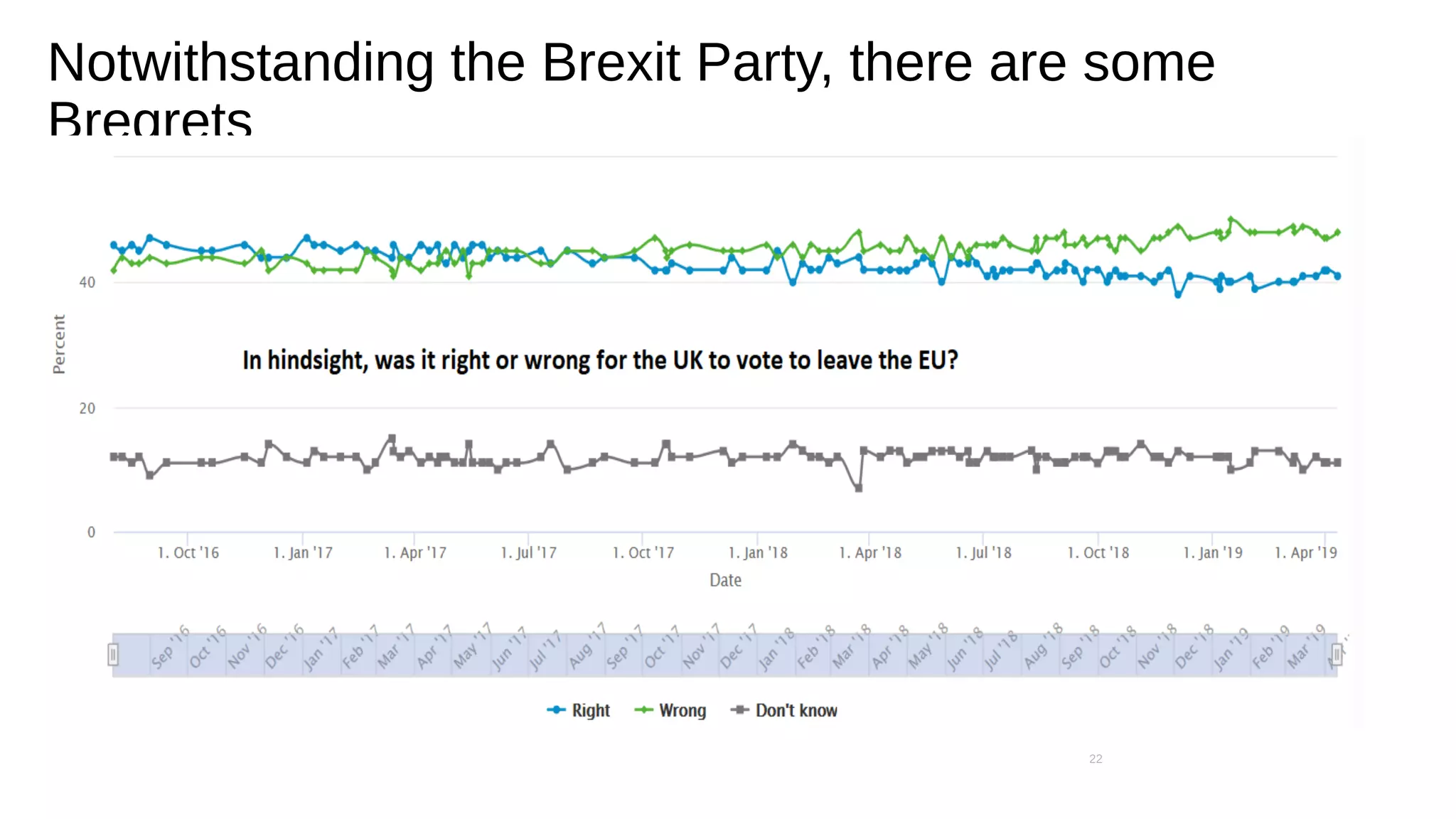
Notwithstanding the Brexit Party, there are some
Bregrets
22
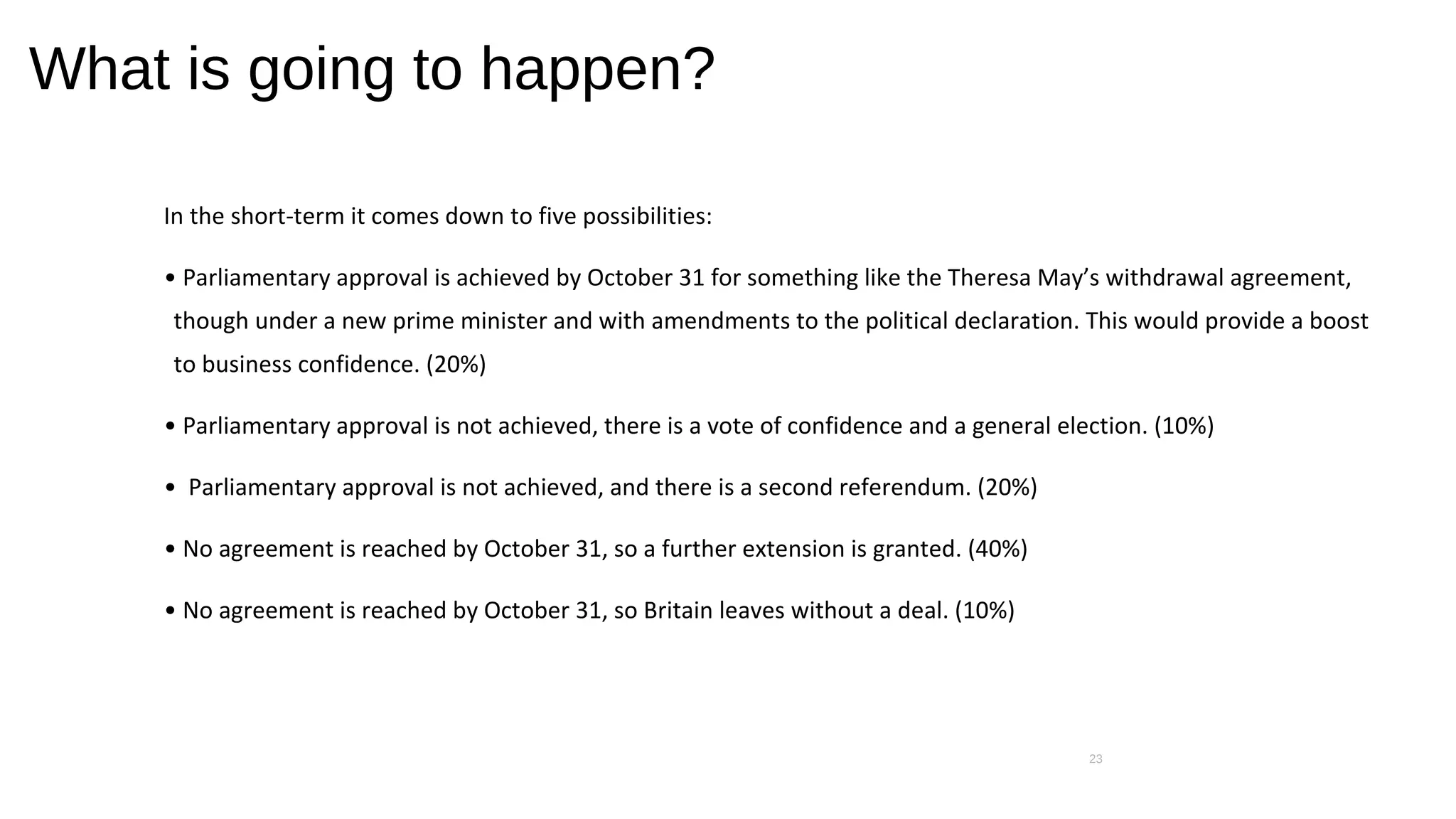
What is going to happen?
In the short-term it comes down to five possibilities:
• Parliamentary approval is achieved by October 31 for something like the Theresa May’s withdrawal agreement,
though under a new prime minister and with amendments to the political declaration. This would provide a boost
to business confidence. (20%)
• Parliamentary approval is not achieved, there is a vote of confidence and a general election. (10%)
• Parliamentary approval is not achieved, and there is a second referendum. (20%)
• No agreement is reached by October 31, so a further extension is granted. (40%)
• No agreement is reached by October 31, so Britain leaves without a deal. (10%)
23
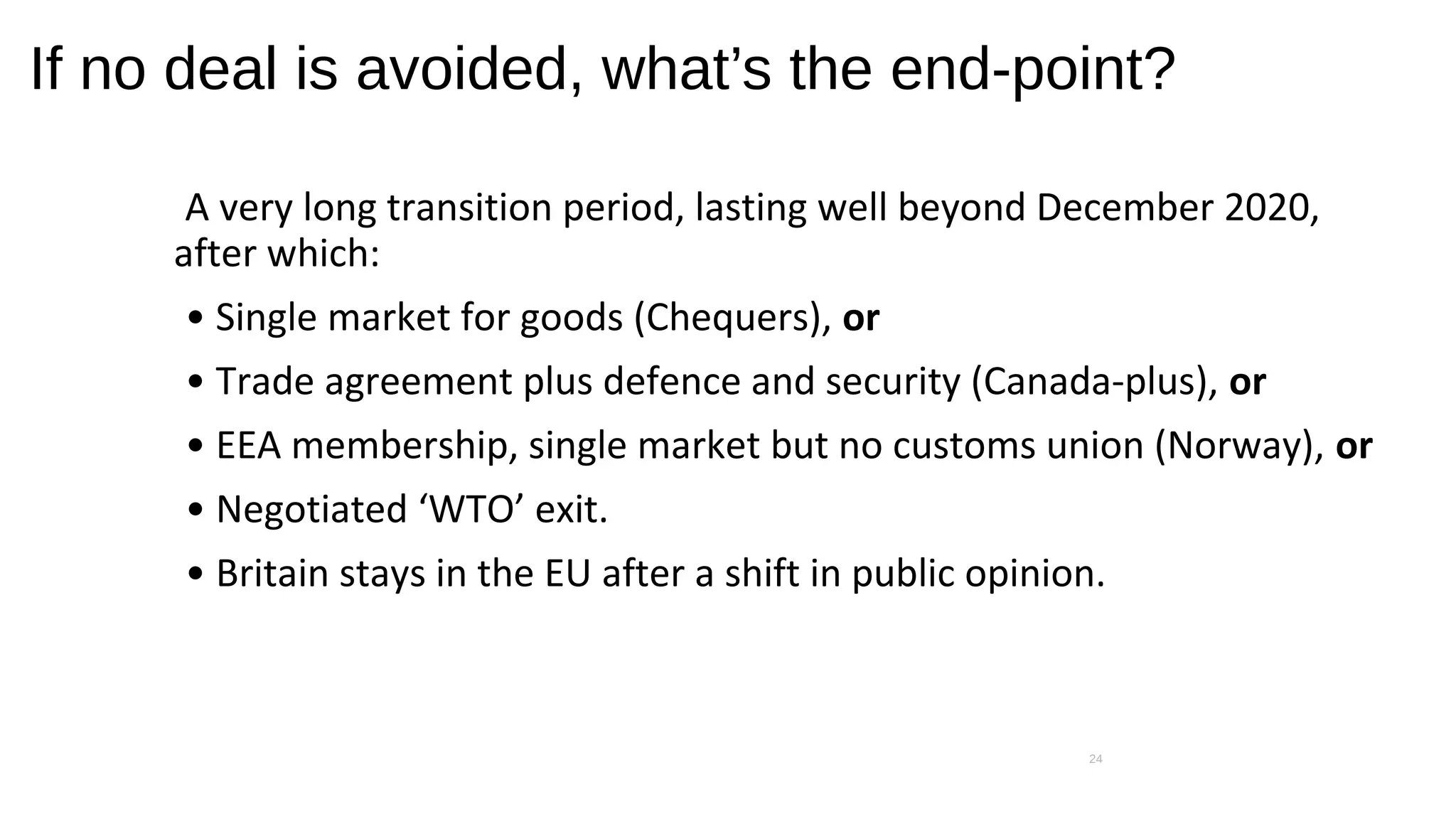
If no deal is avoided, what’s the end-point?
A very long transition period, lasting well beyond December 2020,
after which:
• Single market for goods (Chequers), or
• Trade agreement plus defence and security (Canada-plus), or
• EEA membership, single market but no customs union (Norway), or
• Negotiated ‘WTO’ exit.
• Britain stays in the EU after a shift in public opinion.
24
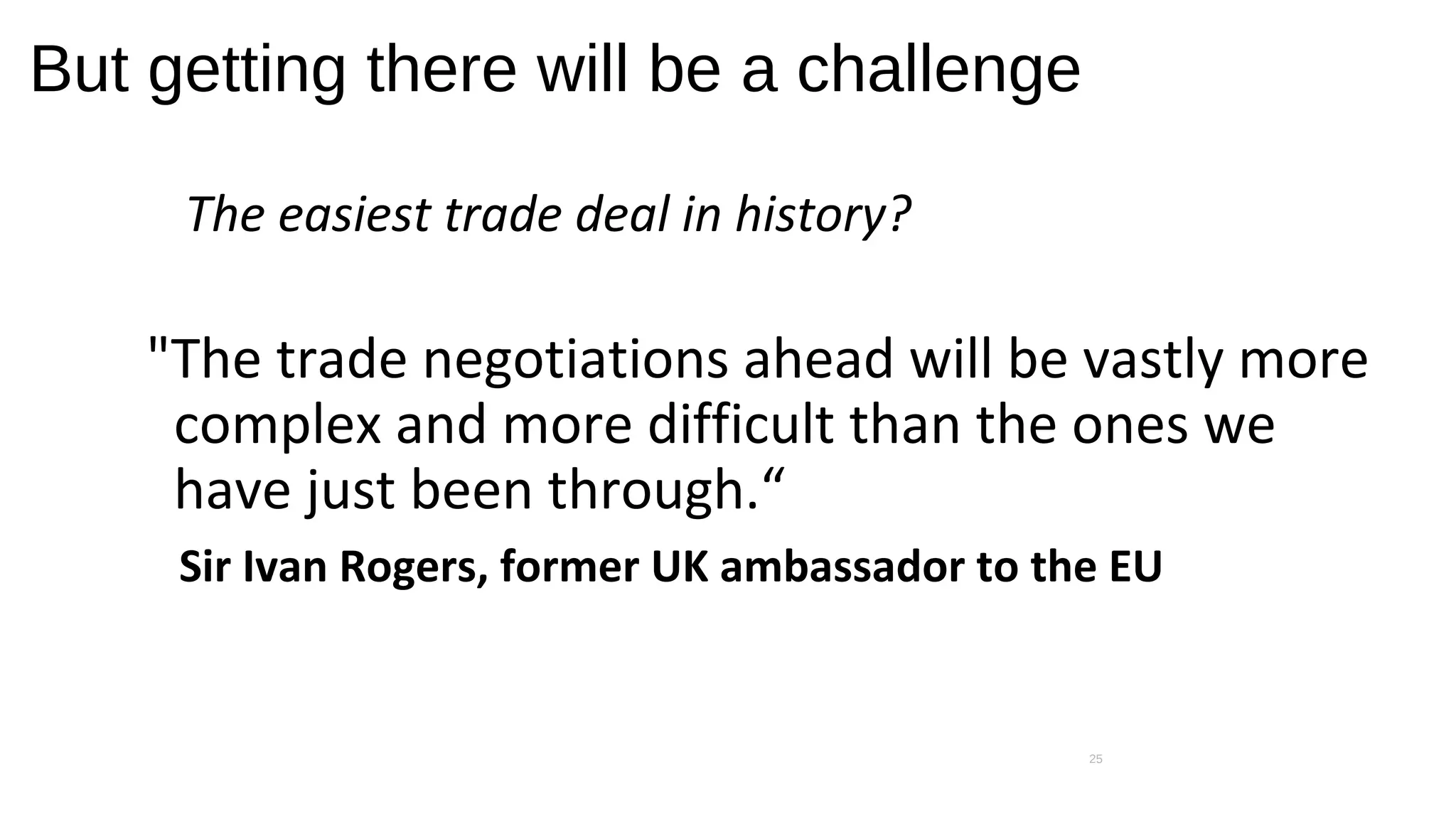
But getting there will be a challenge
The easiest trade deal in history?
"The trade negotiations ahead will be vastly more
complex and more difficult than the ones we
have just been through.“
Sir Ivan Rogers, former UK ambassador to the EU
25
What does this mean for the economy?
26
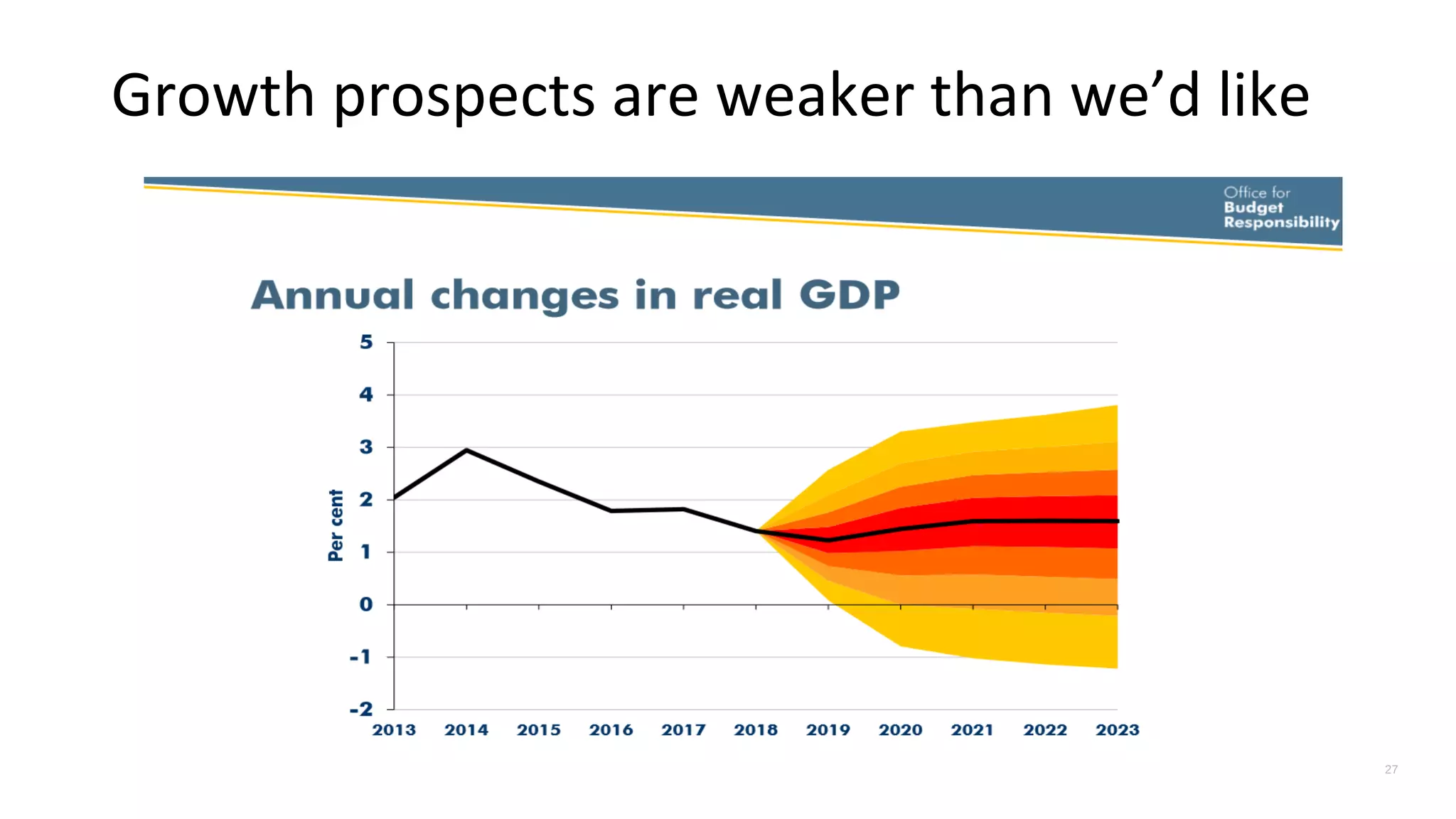
Growth prospects are weaker than we’d like
27
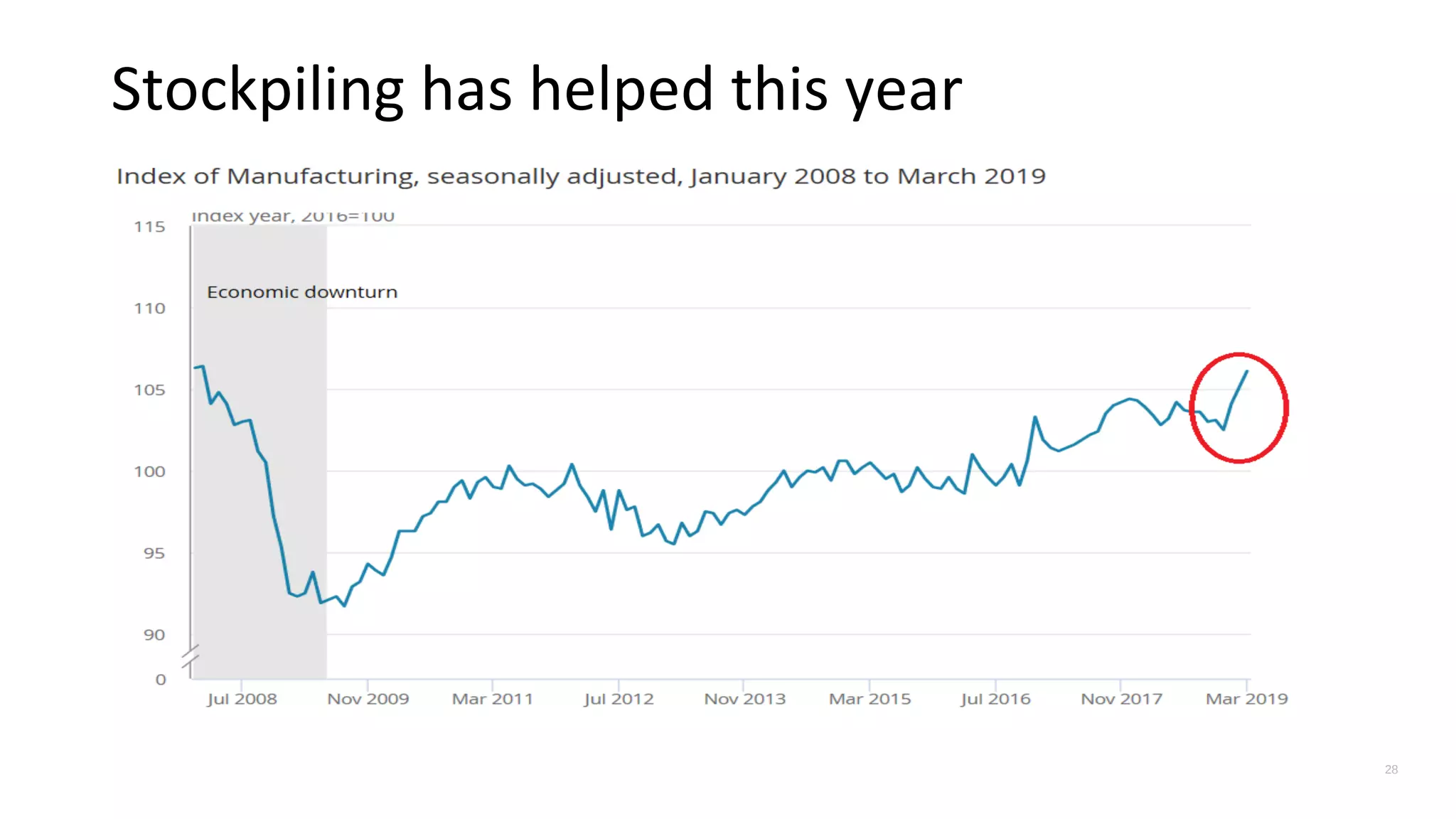
Stockpiling has helped this year
28
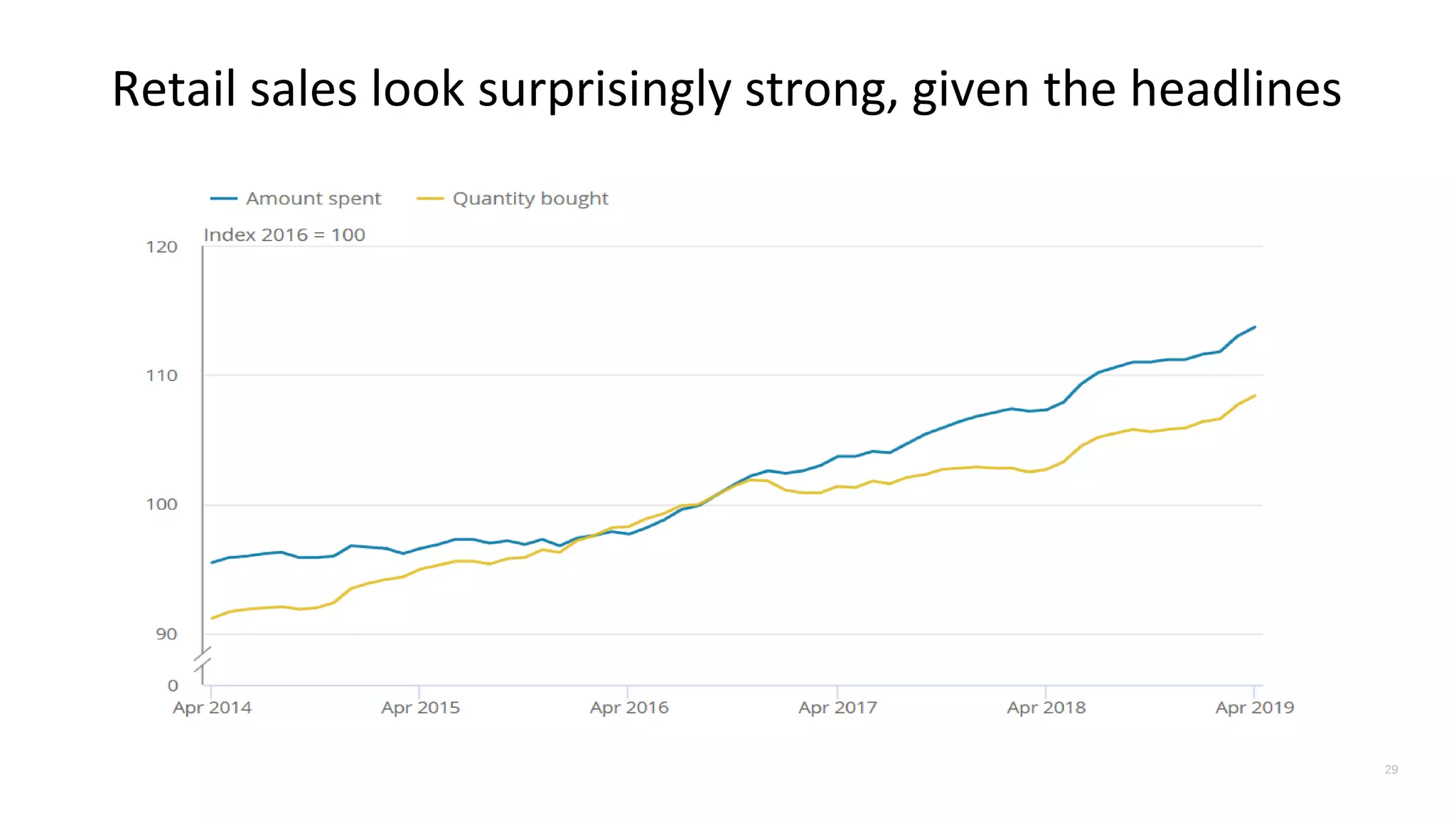
Retail sales look surprisingly strong, given the headlines
29
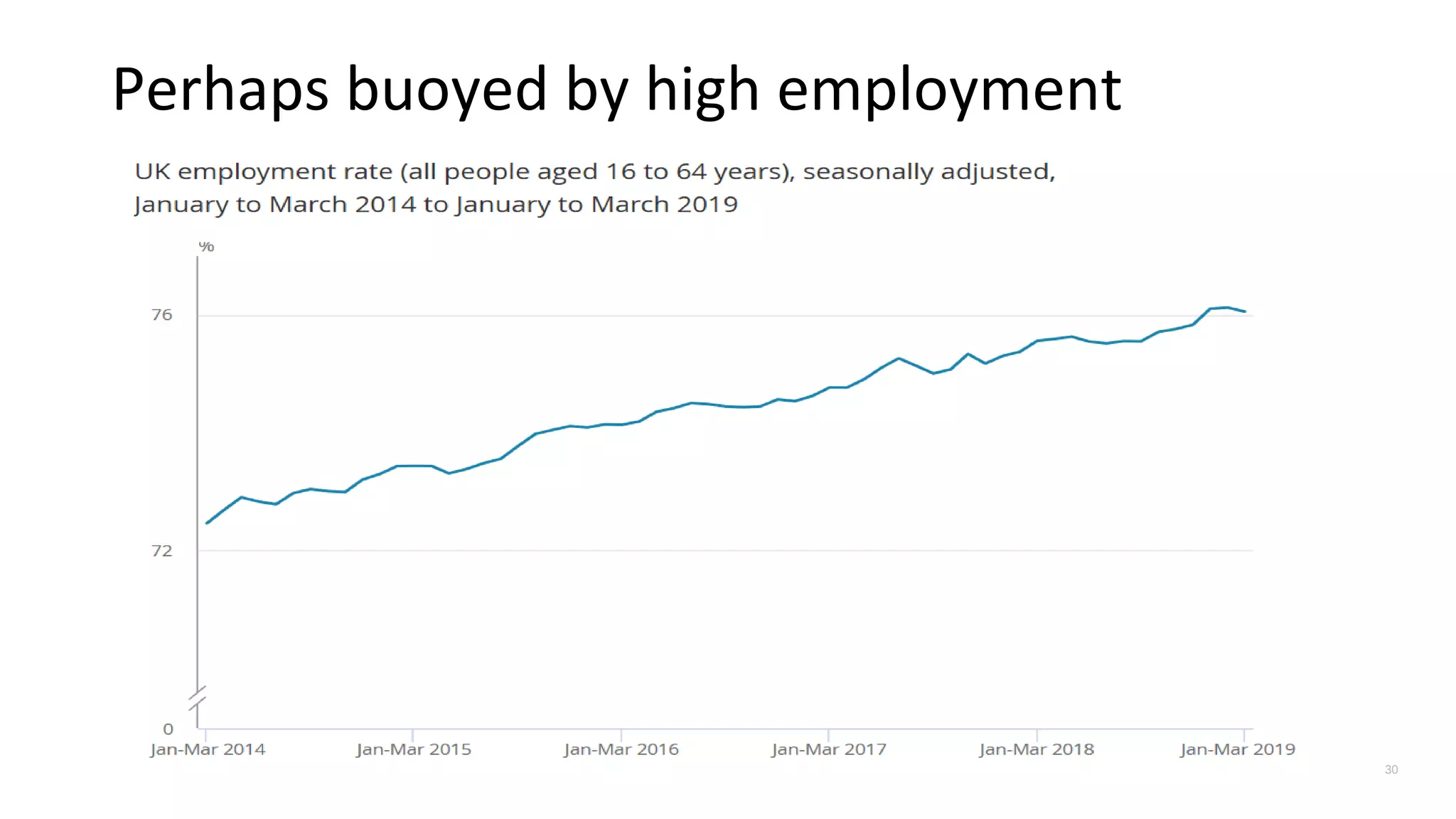
Perhaps buoyed by high employment
30
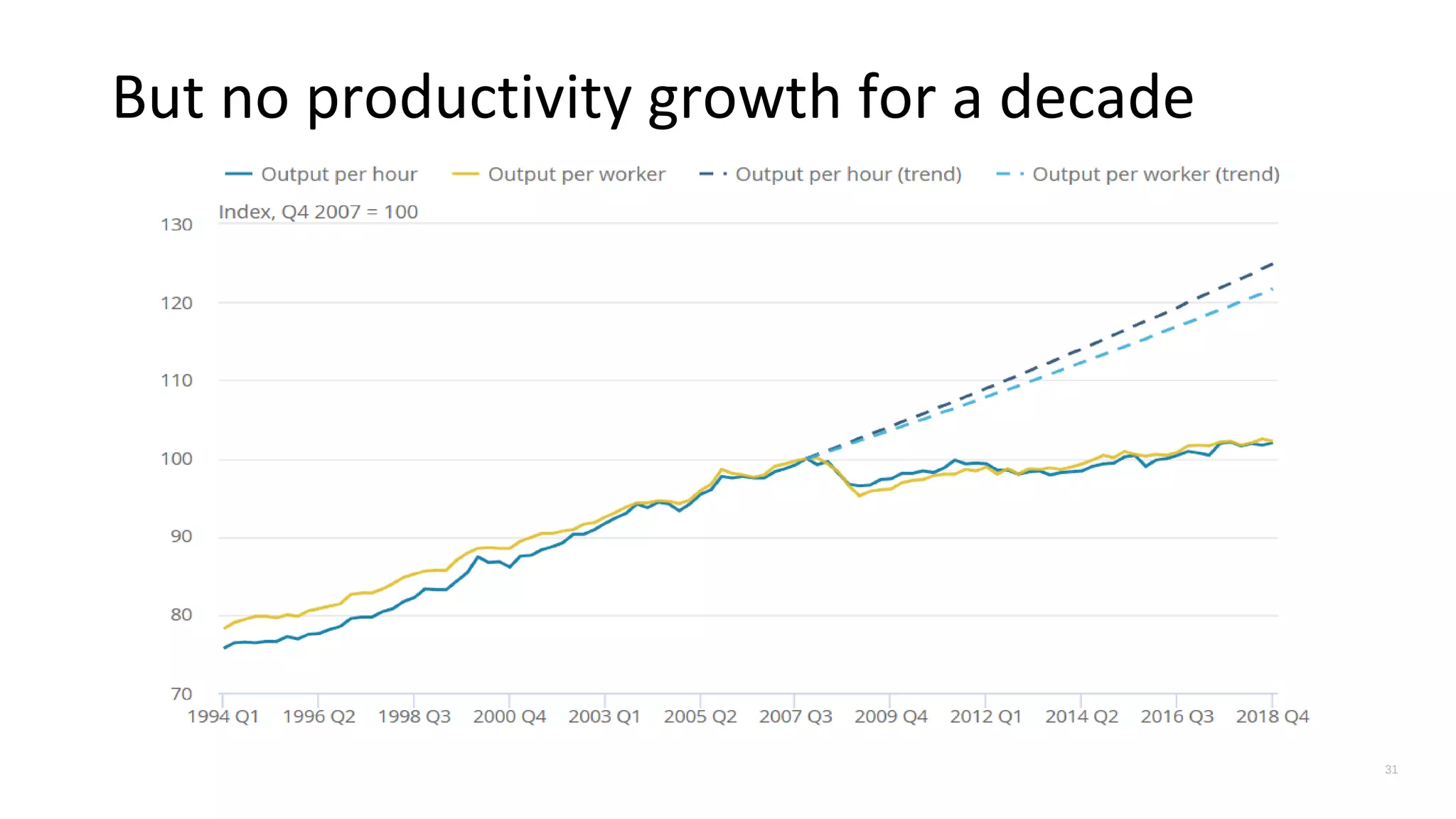
But no productivity growth for a decade
31
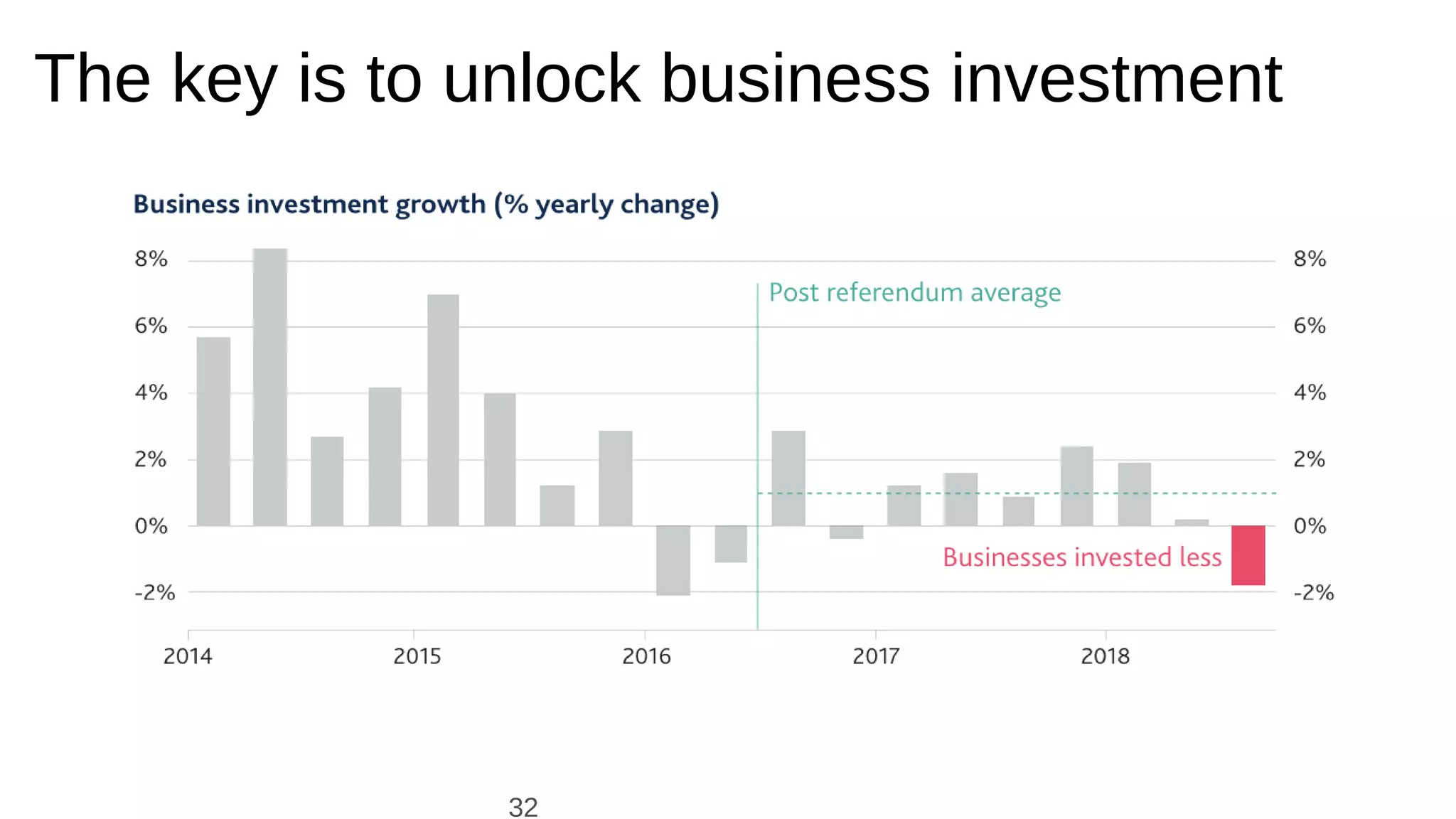
The key is to unlock business investment
32
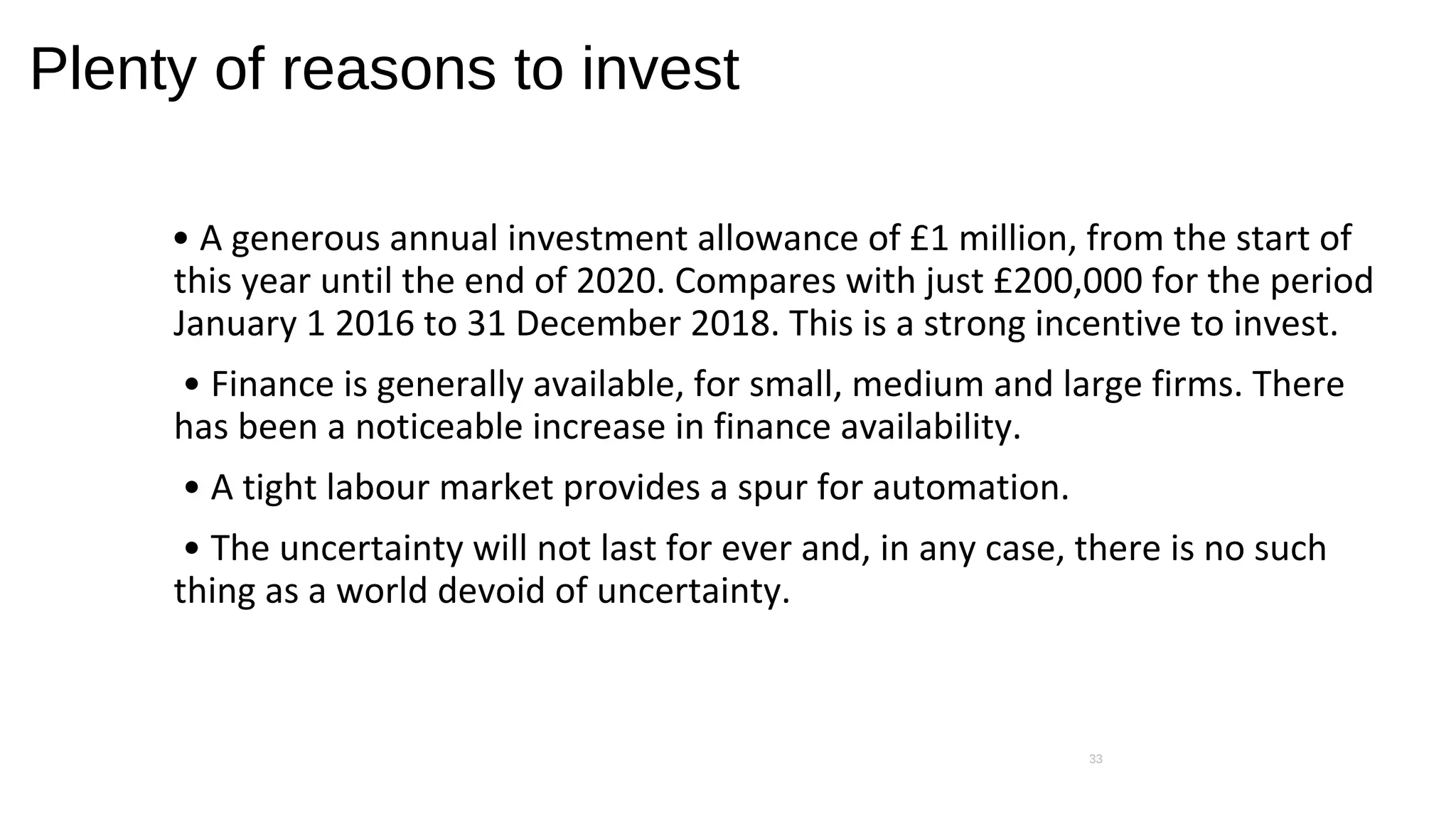
Plenty of reasons to invest
• A generous annual investment allowance of £1 million, from the start of
this year until the end of 2020. Compares with just £200,000 for the period
January 1 2016 to 31 December 2018. This is a strong incentive to invest.
• Finance is generally available, for small, medium and large firms. There
has been a noticeable increase in finance availability.
• A tight labour market provides a spur for automation.
• The uncertainty will not last for ever and, in any case, there is no such
thing as a world devoid of uncertainty.
33
And we can’t afford to miss out on robotics and AI
“Robots increase productivity and competitiveness. Used effectively, they enable
companies to become or remain competitive. This is particularly important for
small-to medium sized (SME) businesses that are the backbone of both
developed and developing country economies. It also enables large companies to
increase their competitiveness through faster product development and
delivery.” International Federation of Robotics.
“Thanks to recent innovations in cloud computing and big data storage
and analysis, artificial intelligence is making great strides in improving
efficiency in manufacturing environments, leading to better performance.
AI also provides critical information to help managers make more informed
business decisions.” Industry Week
34
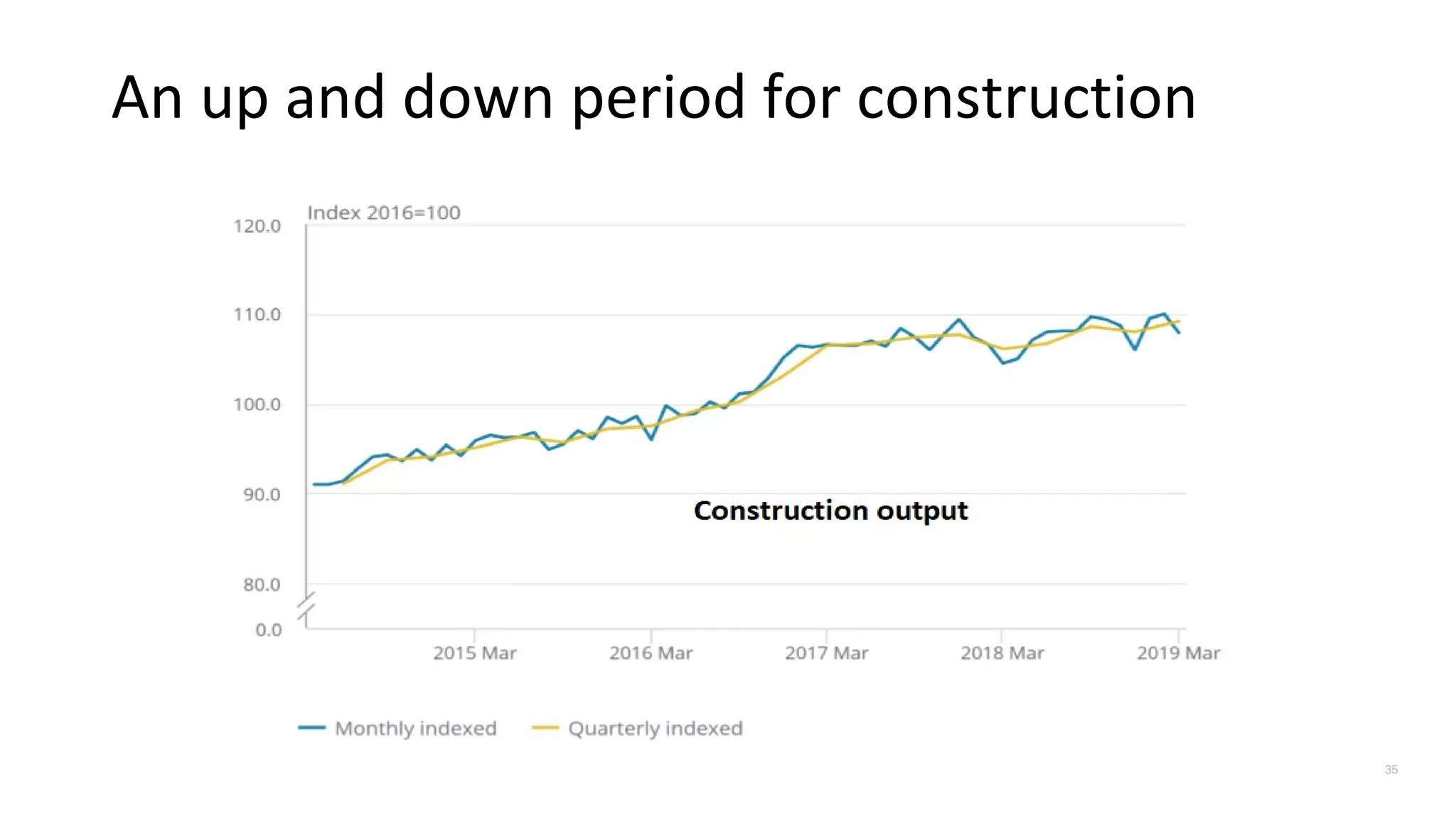
An up and down period for construction
35
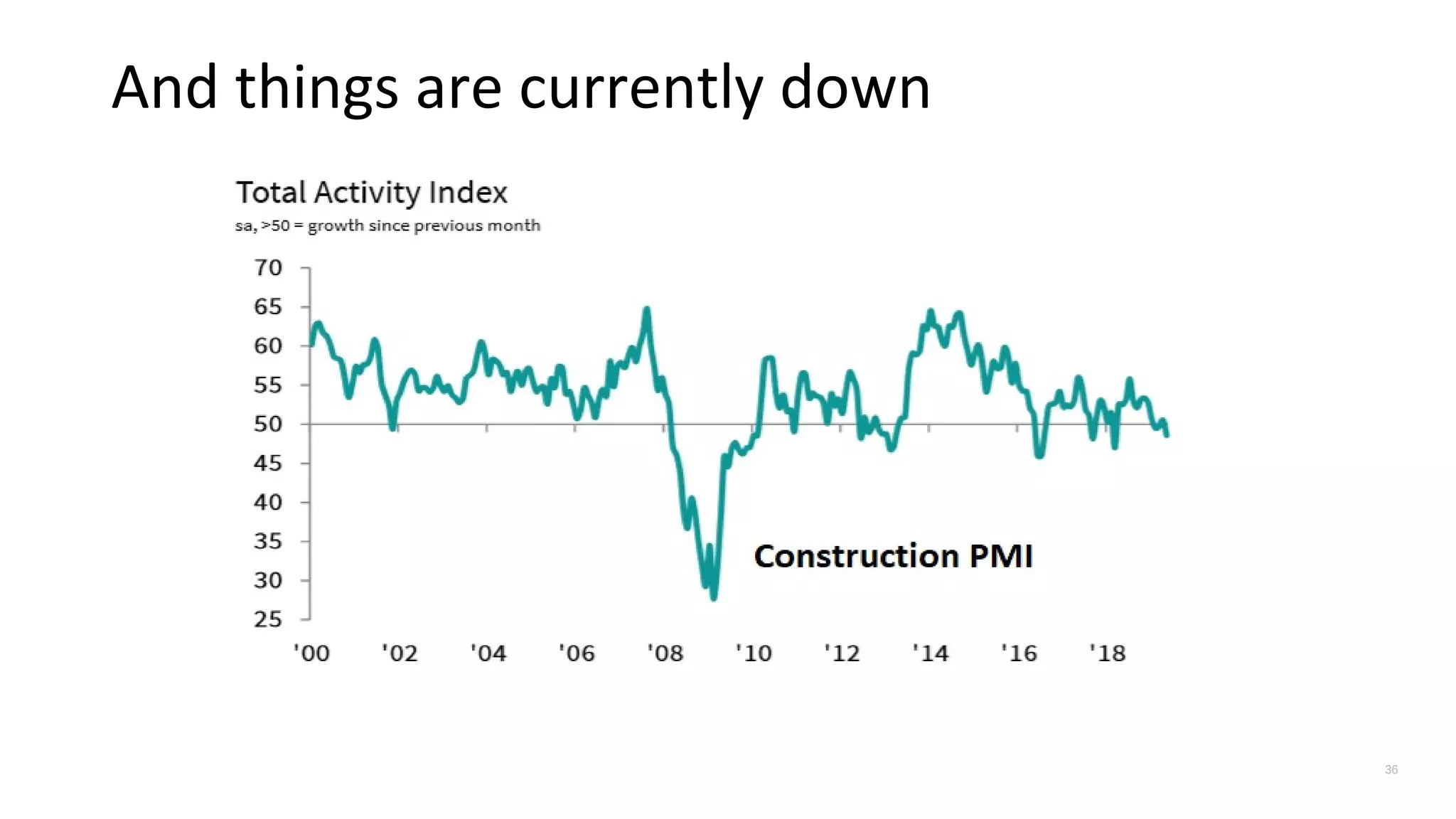
And things are currently down
36
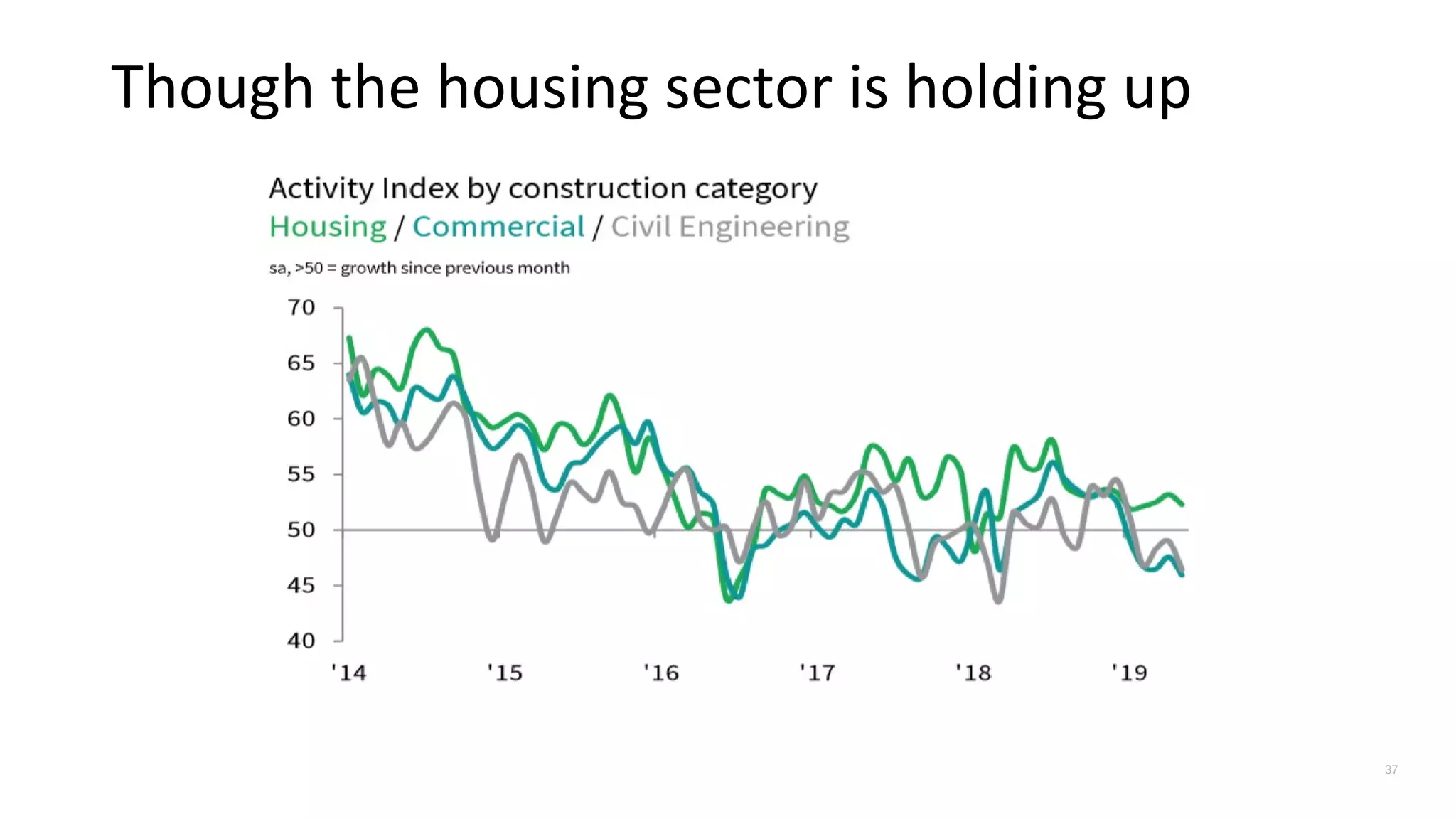
Though the housing sector is holding up
37
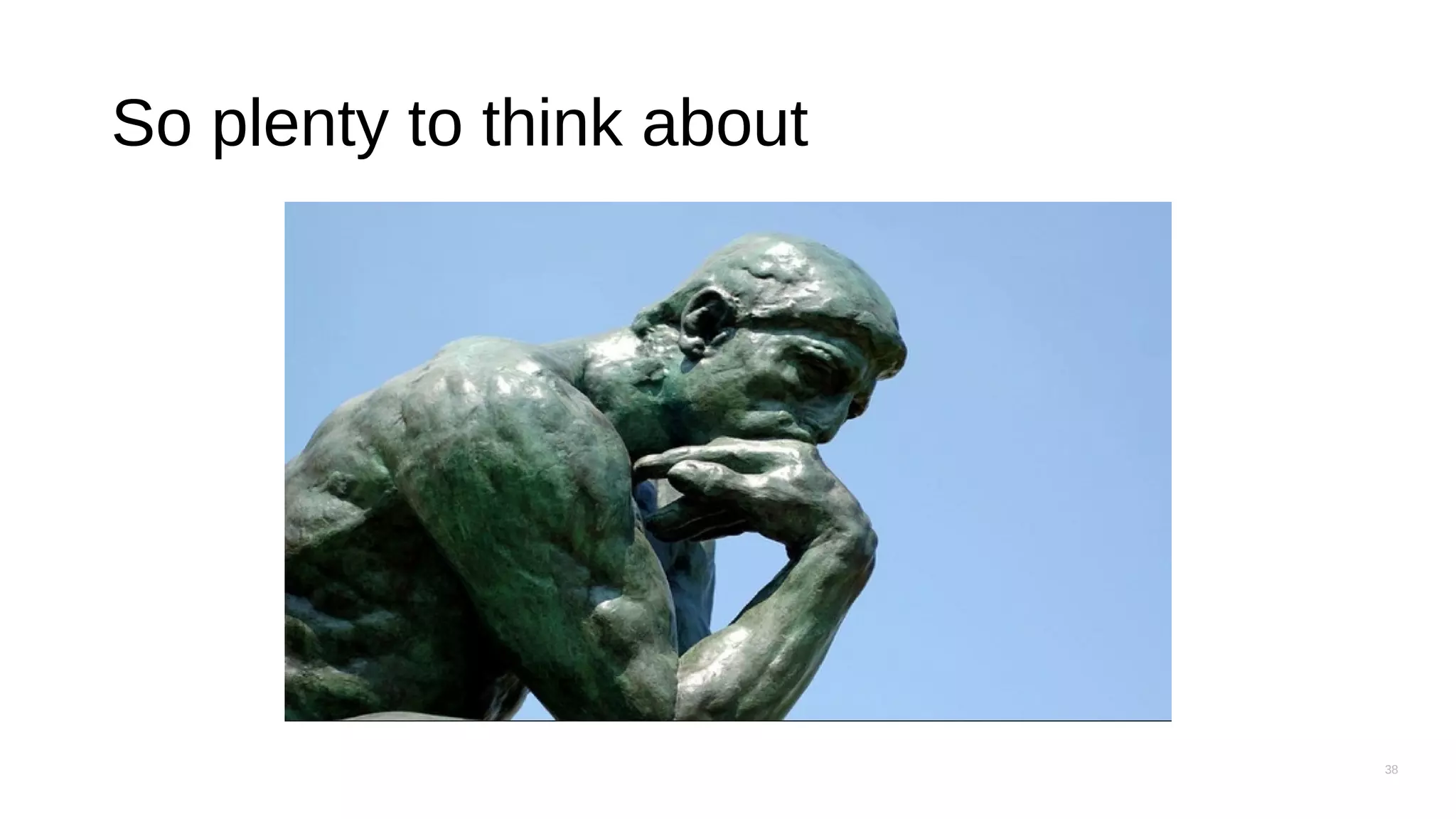
So plenty to think about
38
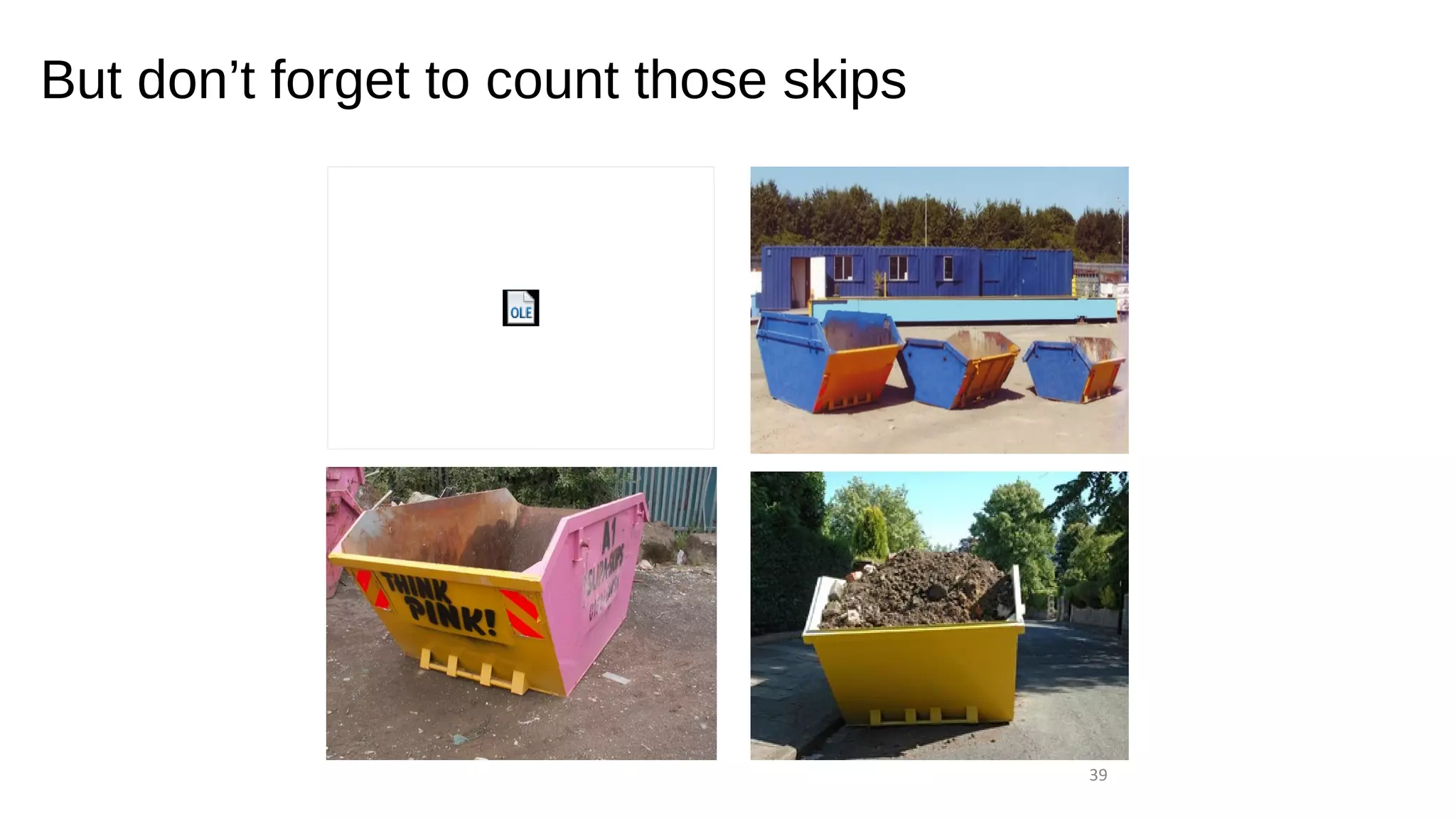
But don’t forget to count those skips
39

So, What Happens Now? #SPRAConference 2019

  • 1.
  • 2.
  • 3.
    Three themes • Thebroader economic backdrop. • Britain and Brexit. • What it means for the economy, and you. 3
  • 4.
    A year agothe world was firing on all cylinders • Strong (4%) growth in world GDP in prospect, driven by a pick-up in world trade. • An accelerating upturn in North America. • Continued robust growth in the emerging world, including China and India. • Unexpectedly strong growth in Europe.
  • 5.
    But the brakeshave gone on 5
  • 6.
    Some of whichis down to him 6
  • 7.
    Protectionism’s bad forgrowth “The global growth forecast for 2019 and 2020 had already been revised downward, partly because of the negative effects of tariff increases enacted in the United States and China earlier that year. Risks to global growth tilt to the downside. An escalation of trade tensions beyond those already incorporated in the forecast remains a key source of risk to the outlook.” IMF, World Economic Outlook, 2019 7
  • 8.
  • 9.
    And the effectsare clear to see
  • 10.
    Though he wantedto win this trade war quickly
  • 11.
    So a softerpatch for the world economy 11
  • 12.
  • 13.
  • 14.
    The Brexit timetable– Phase 1 Article 50 of the withdrawal process was triggered on March 29 2017, and due to be completed within two years: by March 29 2019. It was agreed at an early stage that the withdrawal agreement would cover three main elements: • A “divorce bill” covering the UK’s commitments made as an EU member, including contributions to the budget until the end of 2020. The agreed sum is around £39bn ($51bn). • Measures to secure the rights of EU citizens in the UK and UK citizens living in the rest of the EU. • A legal commitment to maintaining an open border between Ireland and Northern Ireland, in line with the Good Friday Agreement which secured an end to “the troubles”. 14
  • 15.
    But we’ve got stuckin the Irish backstop. S still in a mess 15
  • 16.
    What is theIrish backstop? In the event of the UK and the EU being unable to negotiate a comprehensive trade deal by the end of the transition period (December 2020 extendable to December 2022), the backstop will apply. It consists of two elements: • The whole of the UK will remain in a single customs territory with the EU, similar to the customs union but with the proviso that the UK would be free to negotiate third country trade deals. • Northern Ireland, additionally, to effectively remain in the EU single market, following EU regulations, so goods can freely cross the border with Ireland. • It is this, treating Northern Ireland different to the rest of the UK and establishing a border in the Irish Sea that has so upset the Democratic Unionist Party. 16
  • 17.
    17 A ‘cliff-edge’ Brexitis unlikely but is still a possibility
  • 18.
    18 Because we’re goingto have a new prime minister
  • 19.
    What would nodeal mean? • A short-term economic shock, a sharply lower pound. Falling house prices, higher unemployment. A shift in the direction of UK interest rates. Bank of England would probably respond in a similar way to August 2016. • Disruption of EU supply chains, congestion at the ports. Possible delays in supplies of food, medicines, etc. • Long-run economic damage: 8%-10% of GDP. • A political crisis in the UK, bringing a Corbyn government closer. Risk of civil disturbances. • Status of EU citizens left in limbo, though government has offered reassurance. • A hard border in Northern Ireland. 19
  • 20.
    Business isn’t bluffing "Thethreat of a no-deal Brexit is already costing businesses millions in expensive contingency measures. If the UK were to leave the EU without a deal, it would be an unparalleled act of self-harm. A no-deal Brexit cannot be managed. We therefore urge you to take it off the table now, end the huge cost of uncertainty, protect jobs and safeguard prosperity for the UK.“ Joint letter to the prime minister from the CBI and other industry associations, February 2019 20
  • 21.
    EU migration isdown sharply 21
  • 22.
    Notwithstanding the BrexitParty, there are some Bregrets 22
  • 23.
    What is goingto happen? In the short-term it comes down to five possibilities: • Parliamentary approval is achieved by October 31 for something like the Theresa May’s withdrawal agreement, though under a new prime minister and with amendments to the political declaration. This would provide a boost to business confidence. (20%) • Parliamentary approval is not achieved, there is a vote of confidence and a general election. (10%) • Parliamentary approval is not achieved, and there is a second referendum. (20%) • No agreement is reached by October 31, so a further extension is granted. (40%) • No agreement is reached by October 31, so Britain leaves without a deal. (10%) 23
  • 24.
    If no dealis avoided, what’s the end-point? A very long transition period, lasting well beyond December 2020, after which: • Single market for goods (Chequers), or • Trade agreement plus defence and security (Canada-plus), or • EEA membership, single market but no customs union (Norway), or • Negotiated ‘WTO’ exit. • Britain stays in the EU after a shift in public opinion. 24
  • 25.
    But getting therewill be a challenge The easiest trade deal in history? "The trade negotiations ahead will be vastly more complex and more difficult than the ones we have just been through.“ Sir Ivan Rogers, former UK ambassador to the EU 25
  • 26.
    What does thismean for the economy? 26
  • 27.
    Growth prospects areweaker than we’d like 27
  • 28.
  • 29.
    Retail sales looksurprisingly strong, given the headlines 29
  • 30.
    Perhaps buoyed byhigh employment 30
  • 31.
    But no productivitygrowth for a decade 31
  • 32.
    The key isto unlock business investment 32
  • 33.
    Plenty of reasonsto invest • A generous annual investment allowance of £1 million, from the start of this year until the end of 2020. Compares with just £200,000 for the period January 1 2016 to 31 December 2018. This is a strong incentive to invest. • Finance is generally available, for small, medium and large firms. There has been a noticeable increase in finance availability. • A tight labour market provides a spur for automation. • The uncertainty will not last for ever and, in any case, there is no such thing as a world devoid of uncertainty. 33
  • 34.
    And we can’tafford to miss out on robotics and AI “Robots increase productivity and competitiveness. Used effectively, they enable companies to become or remain competitive. This is particularly important for small-to medium sized (SME) businesses that are the backbone of both developed and developing country economies. It also enables large companies to increase their competitiveness through faster product development and delivery.” International Federation of Robotics. “Thanks to recent innovations in cloud computing and big data storage and analysis, artificial intelligence is making great strides in improving efficiency in manufacturing environments, leading to better performance. AI also provides critical information to help managers make more informed business decisions.” Industry Week 34
  • 35.
    An up anddown period for construction 35
  • 36.
    And things arecurrently down 36
  • 37.
    Though the housingsector is holding up 37
  • 38.
    So plenty tothink about 38
  • 39.
    But don’t forgetto count those skips 39