Extension Experiences in Ethiopia June 30, 2004 Ministry of Agriculture and Rural Development Addis Ababa
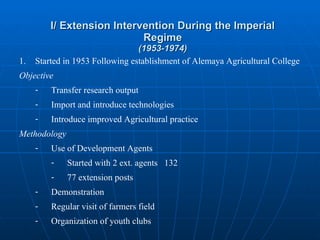
I/ Extension Intervention During the Imperial Regime (1953-1974) Started in 1953 Following establishment of Alemaya Agricultural College Objective Transfer research output Import and introduce technologies Introduce improved Agricultural practice Methodology   Use of Development Agents Started with 2 ext. agents  132 77 extension posts Demonstration  Regular visit of farmers field Organization of youth clubs
2. 1963 Extension activity Transferred to MoA  3. Establishment of comprehensive package  project 1967  Chillalo Agricultural Development Unit (CADU) 1970  Welayita Agricultural Development Unit (WADU) 1972  Ada District Development Project Tach Adiabo and Hadegti Agricultural Development (TAHADU) Southern Region Agricultural Development Project (SORADEP) Humera Agricultural Development (HAD)
4. Start of Minimum Package Program 1 (MPP-1) Established EPID in MoA Objective Provision of Extension Service Provision of Agricultural Support Services Methodology Establishing Minimum Package Areas (50-75 Km) Assignment of extension agents 55 Minimum Package areas 280 districts out of 580 346 development centers
II/ Extension Intervention During the Military Regime (1974-1991) Mpp.1 – continued for about 5 years Following Mpp-I  Mpp-II started in 1980 Objective Improve the productivity of crops and livestock Increase the production of raw materials for domestic industry and export Enhance soil and water conservation activities Establish various farmers organization Construction of rural roads, grain stores and Agric. Offices Dissolved EPID Closed the development centers Pulled extension agents to district office of Agriculture
6. MPP-II replaced by Peasant Agricultural Development Program (PADEP) - 1985 Divided the country into 8 agricultural development zones Table 1 PADEP Project Zones Project Financer  Area of Operation Intended Project Period Program Remark PADEP 1 IDA N.W Ethiopia 1989-1994 Peasant Agric. Sev. Conducted PADEP 2 IDA Western Ethiopia 1990-1995 Peasant Agric. Sev. Not-Conducted PADEP 3 IDF S. Eastern Ethiopia 1987-1992 Peasant Agric. Sev. Conducted PADEP 4 Italian Gov S. Eastern Ethiopia 1989-1992 Integrated Agric. Devt. Not-Conducted PADEP 5 IFAD,IDA,OPEC E. And S.E Ethiopia 1988-1994 Soil and water cons. Small scale irrigation Conducted PADEP 6 EEC Central Ethiopia 1989-1994 Catchments rehabilitation peasant Agric. Devt. Conserv. based Agric. Devt. Conducted PADEP 7 SiDA N.Eastern Ethiopia 1987-1990 Rural Devt. Not-Conducted PADEP 8 SIDA Tigray 1987-1990 Rural Devt. Not-conducted
The areas with peasant Agricultural Development used the T and V extension system. The system in implemented in high potential surplus producing districts. Re-deployment of extension agents at Development centers Establishment RELC
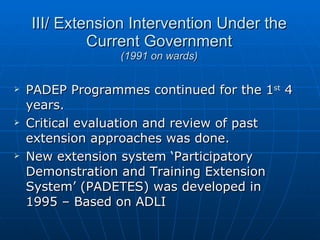
III/ Extension Intervention Under the Current Government (1991 on wards) PADEP Programmes continued for the 1 st  4 years. Critical evaluation and review of past extension approaches was done. New extension system ‘Participatory Demonstration and Training Extension System’ (PADETES) was developed in 1995 – Based on ADLI
Main Features:- Increasing Production and Productivity of small scale farmers through research generated technologies and information Empowering farmers to participate actively in the Development process Increasing the level of food self sufficiency  Ensure the rehabilitation and conservation of natural resource base of Agriculture Encourage farmers organization
Organized Agricultural Extension Department at Federal Level Under the Department  3 main divisions (teams) Moisture Reliable Areas Extension Division Moisture Un-reliable Areas Extension Division Pastoral Areas Extension Division Prior to implementation of PADETES Pilot extension intervention programme of SG-2000 was conducted  1993 Package approach 1993  2 package  160 farmers   1994  4 package  1600 farmers Government adopted the approach
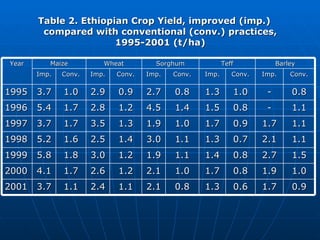
Table 2. Ethiopian Crop Yield, improved (imp.) compared with conventional (conv.) practices, 1995-2001 (t/ha) Year Maize Wheat Sorghum Teff Barley Imp. Conv. Imp. Conv. Imp. Conv. Imp. Conv. Imp. Conv. 1995 3.7 1.0 2.9 0.9 2.7 0.8 1.3 1.0 - 0.8 1996 5.4 1.7 2.8 1.2 4.5 1.4 1.5 0.8 - 1.1 1997 3.7 1.7 3.5 1.3 1.9 1.0 1.7 0.9 1.7 1.1 1998 5.2 1.6 2.5 1.4 3.0 1.1 1.3 0.7 2.1 1.1 1999 5.8 1.8 3.0 1.2 1.9 1.1 1.4 0.8 2.7 1.5 2000 4.1 1.7 2.6 1.2 2.1 1.0 1.7 0.8 1.9 1.0 2001 3.7 1.1 2.4 1.1 2.1 0.8 1.3 0.6 1.7 0.9
Table 3. Number of Farmers (000) participating in national extension programs, Ethiopia, 1995-2001 Year Food Crops High economic value crops Livestock  Post-harvest technology Natural resources Total 1995 32 - - - - 32 1996 350 - - - - 350 1997 584 23 22 0.1 9 638 1998 2,122 275 45 0.2 544 2,987 1999 2,804 390 67 1.0 546 3,808 2000 2,987 387 77 1.2 342 3,794 2001 2,616 441 89 1.7 - -
Table 4 Farm inputs used by national extension programs, Ethiopia, 1995-2000. Year Improved seed (000 t) Fertilizer  (000 t) 1995 2.4 35 1996 6.8 - 1997 7.7 53 1998 13.6 196 1999 17.8 217 2000 18.2 230
Implemented the program in all Regions Increase the number of Development centers and extension workers. Capacity building  Training Materials Currently to up grade the level of knowledge of Development agents 25 TVET Colleges Number of students  1 st  Year 13181 2 nd  Year 14977 3 rd  Year  9400 Establishment of Farmers training centers 15,000 with in 3-4 Years
Short comings  Shortage of transferable  technology Shortage of inputs Market Problem Lack of sound credit system Involvement of extension staffs  in non-extension activities.
THANK YOU

Extension experience (ebrahim mohammed)

  • 1.
    Extension Experiences inEthiopia June 30, 2004 Ministry of Agriculture and Rural Development Addis Ababa
  • 2.
    I/ Extension InterventionDuring the Imperial Regime (1953-1974) Started in 1953 Following establishment of Alemaya Agricultural College Objective Transfer research output Import and introduce technologies Introduce improved Agricultural practice Methodology Use of Development Agents Started with 2 ext. agents 132 77 extension posts Demonstration Regular visit of farmers field Organization of youth clubs
  • 3.
    2. 1963 Extensionactivity Transferred to MoA 3. Establishment of comprehensive package project 1967 Chillalo Agricultural Development Unit (CADU) 1970 Welayita Agricultural Development Unit (WADU) 1972 Ada District Development Project Tach Adiabo and Hadegti Agricultural Development (TAHADU) Southern Region Agricultural Development Project (SORADEP) Humera Agricultural Development (HAD)
  • 4.
    4. Start ofMinimum Package Program 1 (MPP-1) Established EPID in MoA Objective Provision of Extension Service Provision of Agricultural Support Services Methodology Establishing Minimum Package Areas (50-75 Km) Assignment of extension agents 55 Minimum Package areas 280 districts out of 580 346 development centers
  • 5.
    II/ Extension InterventionDuring the Military Regime (1974-1991) Mpp.1 – continued for about 5 years Following Mpp-I Mpp-II started in 1980 Objective Improve the productivity of crops and livestock Increase the production of raw materials for domestic industry and export Enhance soil and water conservation activities Establish various farmers organization Construction of rural roads, grain stores and Agric. Offices Dissolved EPID Closed the development centers Pulled extension agents to district office of Agriculture
  • 6.
    6. MPP-II replacedby Peasant Agricultural Development Program (PADEP) - 1985 Divided the country into 8 agricultural development zones Table 1 PADEP Project Zones Project Financer Area of Operation Intended Project Period Program Remark PADEP 1 IDA N.W Ethiopia 1989-1994 Peasant Agric. Sev. Conducted PADEP 2 IDA Western Ethiopia 1990-1995 Peasant Agric. Sev. Not-Conducted PADEP 3 IDF S. Eastern Ethiopia 1987-1992 Peasant Agric. Sev. Conducted PADEP 4 Italian Gov S. Eastern Ethiopia 1989-1992 Integrated Agric. Devt. Not-Conducted PADEP 5 IFAD,IDA,OPEC E. And S.E Ethiopia 1988-1994 Soil and water cons. Small scale irrigation Conducted PADEP 6 EEC Central Ethiopia 1989-1994 Catchments rehabilitation peasant Agric. Devt. Conserv. based Agric. Devt. Conducted PADEP 7 SiDA N.Eastern Ethiopia 1987-1990 Rural Devt. Not-Conducted PADEP 8 SIDA Tigray 1987-1990 Rural Devt. Not-conducted
  • 7.
    The areas withpeasant Agricultural Development used the T and V extension system. The system in implemented in high potential surplus producing districts. Re-deployment of extension agents at Development centers Establishment RELC
  • 8.
    III/ Extension InterventionUnder the Current Government (1991 on wards) PADEP Programmes continued for the 1 st 4 years. Critical evaluation and review of past extension approaches was done. New extension system ‘Participatory Demonstration and Training Extension System’ (PADETES) was developed in 1995 – Based on ADLI
  • 9.
    Main Features:- IncreasingProduction and Productivity of small scale farmers through research generated technologies and information Empowering farmers to participate actively in the Development process Increasing the level of food self sufficiency Ensure the rehabilitation and conservation of natural resource base of Agriculture Encourage farmers organization
  • 10.
    Organized Agricultural ExtensionDepartment at Federal Level Under the Department 3 main divisions (teams) Moisture Reliable Areas Extension Division Moisture Un-reliable Areas Extension Division Pastoral Areas Extension Division Prior to implementation of PADETES Pilot extension intervention programme of SG-2000 was conducted 1993 Package approach 1993 2 package 160 farmers 1994 4 package 1600 farmers Government adopted the approach
  • 11.
    Table 2. EthiopianCrop Yield, improved (imp.) compared with conventional (conv.) practices, 1995-2001 (t/ha) Year Maize Wheat Sorghum Teff Barley Imp. Conv. Imp. Conv. Imp. Conv. Imp. Conv. Imp. Conv. 1995 3.7 1.0 2.9 0.9 2.7 0.8 1.3 1.0 - 0.8 1996 5.4 1.7 2.8 1.2 4.5 1.4 1.5 0.8 - 1.1 1997 3.7 1.7 3.5 1.3 1.9 1.0 1.7 0.9 1.7 1.1 1998 5.2 1.6 2.5 1.4 3.0 1.1 1.3 0.7 2.1 1.1 1999 5.8 1.8 3.0 1.2 1.9 1.1 1.4 0.8 2.7 1.5 2000 4.1 1.7 2.6 1.2 2.1 1.0 1.7 0.8 1.9 1.0 2001 3.7 1.1 2.4 1.1 2.1 0.8 1.3 0.6 1.7 0.9
  • 12.
    Table 3. Numberof Farmers (000) participating in national extension programs, Ethiopia, 1995-2001 Year Food Crops High economic value crops Livestock Post-harvest technology Natural resources Total 1995 32 - - - - 32 1996 350 - - - - 350 1997 584 23 22 0.1 9 638 1998 2,122 275 45 0.2 544 2,987 1999 2,804 390 67 1.0 546 3,808 2000 2,987 387 77 1.2 342 3,794 2001 2,616 441 89 1.7 - -
  • 13.
    Table 4 Farminputs used by national extension programs, Ethiopia, 1995-2000. Year Improved seed (000 t) Fertilizer (000 t) 1995 2.4 35 1996 6.8 - 1997 7.7 53 1998 13.6 196 1999 17.8 217 2000 18.2 230
  • 14.
    Implemented the programin all Regions Increase the number of Development centers and extension workers. Capacity building Training Materials Currently to up grade the level of knowledge of Development agents 25 TVET Colleges Number of students 1 st Year 13181 2 nd Year 14977 3 rd Year 9400 Establishment of Farmers training centers 15,000 with in 3-4 Years
  • 15.
    Short comings Shortage of transferable technology Shortage of inputs Market Problem Lack of sound credit system Involvement of extension staffs in non-extension activities.
  • 16.