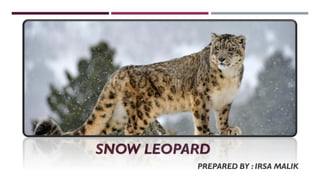
SNOW LEOPARD
PREPARED BY : IRSA MALIK
TOPIC :
SNOW LEOPARD
• PRESENTATION CONTENTS
 Introduction
 Classification
 Status in Pakistan and all over world
 Morphology
 Behaviour
 Prey and predators of snow leopard
 Adaptations
 Breeding& Reproduction
 Parental care
 Life span
 Main threats
 Role of WWF in snow leopard
conservation
 Threats to snow leapord in Pakistan
 SLF Organization
 Conclusion
 References
• INTRODUCTION
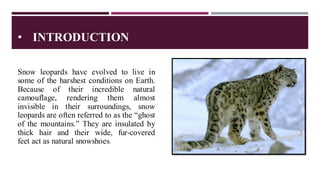
Snow leopards have evolved to live in
some of the harshest conditions on Earth.
Because of their incredible natural
camouflage, rendering them almost
invisible in their surroundings, snow
leopards are often referred to as the “ghost
of the mountains.” They are insulated by
thick hair and their wide, fur-covered
feet act as natural snowshoes.
CLASSIFICATION
Kingdom Animalia
Phylum Chordata
Class Mammalia
Order Cornivora
Family Feildae
Genus Panthera
Specie Panthera unica
 Common name : Snow Leopard
 Scientific name : Pantheraunica
STATUS IN PAKISTAN
 It is estimated that 200–420 snow leopards exist in Pakistan's northern mountains
across Khyber Pakhtunkhwa (KPK), Gilgit-Baltistan (GB), and Azad Jammu and
Kashmir. The snow leopard finds a home in the Hindu Kush and Karakoram
mountains in Pakistan’s northern provinces of Khyber Pakhtunkhwa, Gilgit Baltistan,
and Azad Kashmir.
 A national-level assessment deemed the species “critically endangered” (Sheikh and
Molur, 2004) within the country. The snow leopard is listed as “Vulnerable” on the
International Union for the Conservation of Nature (IUCN) Red List of Threatened
Species. The capture and killing of snow leopards for the illegal wildlife market is a
primary threat to the species' survival.
STATUS IN WORLD
 Snow leopards live in the mountains of Central Asia. While their habitat range covers
2 million km2 (approximately the size of Greenland or Mexico), there are only
between 3,920 and 6,390 snow leopards left in the wild. Snow leopards live in the
high mountains of China and Central Asia, particularly throughout the Himalayas. It is
listed as Vulnerable on the International union for the conservation of nature . It is not
extinct . But thier conservation is necessary. If they are not being conserved they may
stand at the edge of extinction .
 Area of snow leopard habitat
 The area of the habitat for snow leopard can be 80,000km2.
HABITAT
 Snow leopards lis found throughout Central Asia. It is particularly seen in the mountains of The snow
leopard’s habitat extends through twelve countries: Afghanistan, Bhutan, China, India, Kazakhstan,
Kyrgyzstan, Mongolia, Nepal, Pakistan, Russia, Tajikistan, and Uzbekistan. In the Himalayas, snow
leopards are usually found between 3,000 and 5,400 meters above sea level. In Mongolia and Russia,
these cats are found at lower altitudesof 1000 meters.
Feeding Habit
 Snow leopards are carnivores that actively hunt their prey, although they will also eat carrion at times.
Their most common prey is Himalayan blue sheep (also called bharal), and a single meal will keep a
snow leopard going for two weeks.Snow leopards are capable of killing prey up to three times their own
weight. They eat blue sheep, Argali wild sheep, ibex, marmots, pikas, deer and other small mammals. The
animals which snow leopards typically hunt; such as the Argali sheep are also hunted by local
communities.
MORPHOLOGY
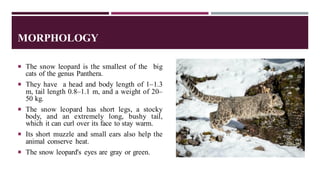
 The snow leopard is the smallest of the big
cats of the genus Panthera.
 They have a head and body length of 1–1.3
m, tail length 0.8–1.1 m, and a weight of 20–
50 kg.
 The snow leopard has short legs, a stocky
body, and an extremely long, bushy tail,
which it can curl over its face to stay warm.
 Its short muzzle and small ears also help the
animal conserve heat.
 The snow leopard's eyes are gray or green.
SIZE OF SNOW LEOPARDS
 Snow leopards are around 75-150cm from head to the base of the tail, with the tail adding on another
80-105cm, which makes them smaller than the other big cats. Snow leopards generally weigh between
25-55kg, although some large males have been recorded weighing up to 75kg. Adult snow leopards
(Panthera uncia or Uncia uncia) can grow to a length of about 2.1 metres (7 feet) from head to tail and
weigh 23–41kg (50–90 pounds)
Litter size of a snow leopard
 Snow leopards have litters of one to five cubs, but litters are most commonly two to three. The cubs are
blind at birth, but already have thick coats. Their eyes open about seven days after they are born, and
they are dependenton their mother for at least the next year.
SIZE OF SNOW LEOPARDS
BEHAVIOUR OF SNOW LEOPARDS
 Snow leopards are shy, elusive cats known for their solitary nature. Snow leopards are most active at
dawn and dusk, which is called a “crepuscular activity pattern”.
 Snow leopards regularly patrol home ranges that can cover hundreds of square kilometers.
 snow leopards are calm and low-key. They mark their territories by urinating on boulders and trees
along ridge lines that define the edges of their territories. They are essentially solitary animals,
associating with other leopards only during the rutting season.
 Snow leopards are usually nocturnal . They sleep in different spots nearly every night and are most
active in the early morning, late afternoon and evening, They prefer steep terrain and cliffs that they
can use to spot prey..
 Snow leopards move very quietly. Their broad paws with extra fur between the toes allows them to
track their prey very quietly and swiftly.
PREYS AND PREDATOR OF SNOW LEOPARD
 Snow leopards hunt a variety of animals that live in
mountains and high elevations such as ;ibex, , urial sheep,
blue sheep, , goat-antelopes known as gorals Tibetan
antelope, musk deer, red deer, wild boars, wild asses, wild
yaks, camels marmots, hares, , partridges and turkey-size
snow cocks. musk deer, , wild boar and marmot.
 They sometimes eat mountain plants such as “Myricaria”,
which is a tall, feathery shrub.Increased hunting of Humans
have caused their habitat loss , declines in natural prey
species. Thus, unfortunately humans act as predators of snow
leopard
ADAPTATIONS OF SNOW LEOPARD
 Snow leopards are well adapted to their high altitude
homes where they are able to encounter deep snow and
rocky terrain with little vegetation.
 Snow leopards have a well-developed chest that helps
them to draw oxygen from the thin air of the high
mountains.
 Snow leopards have powerful legs and are tremendous
jumpers, able to leap as far as 50 feet.
 Adaptations for cold include an enlarged nasal cavity that
allows them to warm the cold air they are about to take
into their lungs.
 They also have long body hair with a dense, woolly
underfur, and a thick tail that can be wrapped around the
body.
 The snow leopards pelage enables them to blend into their
surroundings. Their wide feet act like snow shoes.
BREEDINGAND REPRODUCTION
 Snow leopards give live birth to their offspring
usually in a fur coated den around the spring or
summer . The gestation period varies between 93 to
110 days. The mating season occurs typically in the
late winter months between December and March,
during this time and when the mother is caring for
her cubs marks the only times snow leopards are
not alone.
 The mating season is dictated by the harsh winter
conditions. When food is scarce and difficult to
obtain during the winter snow leopards wait to
mate until late winter After mating they have cubs
during the spring or summer when food is more
plentiful.
MATING PATTERN
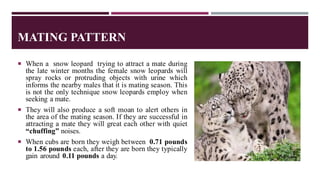
 When a snow leopard trying to attract a mate during
the late winter months the female snow leopards will
spray rocks or protruding objects with urine which
informs the nearby males that it is mating season. This
is not the only technique snow leopards employ when
seeking a mate.
 They will also produce a soft moan to alert others in
the area of the mating season. If they are successful in
attracting a mate they will great each other with quiet
“chuffing” noises.
 When cubs are born they weigh between 0.71 pounds
to 1.56 pounds each, after they are born they typically
gain around 0.11 pounds a day.
PARENTAL CARE
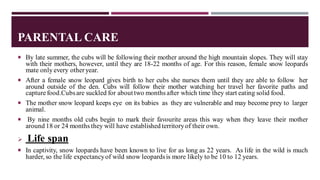
 By late summer, the cubs will be following their mother around the high mountain slopes. They will stay
with their mothers, however, until they are 18-22 months of age. For this reason, female snow leopards
mate only every other year.
 After a female snow leopard gives birth to her cubs she nurses them until they are able to follow her
around outside of the den. Cubs will follow their mother watching her travel her favorite paths and
capture food.Cubsare suckled for about two months after which time they start eating solid food.
 The mother snow leopard keeps eye on its babies as they are vulnerable and may become prey to larger
animal.
 By nine months old cubs begin to mark their favourite areas this way when they leave their mother
around 18 or 24 months they will have established territoryof their own.
 Life span
 In captivity, snow leopards have been known to live for as long as 22 years. As life in the wild is much
harder, so the life expectancyof wild snow leopardsis more likely to be 10 to 12 years.
PARENTALCARE
MAIN THREATS
 Snow leopardscontinueto face a number of threats includinghabitat loss, poachingand increasing
conflict with communities. And climate change is now puttingthe future of their mountain home at even
greater risk.
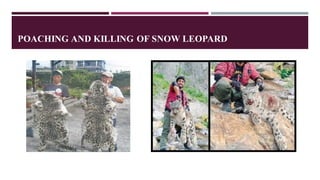
 Poaching Snow leopardshave long been killed for their beautiful fur, but their bones and other body
parts are also used in Traditional Asian Medicine. And the illegal trade in snow leopard parts appears to
be increasing.
 Conflict with communities : Herders sometimes kill snow leopardsin retaliationfor attacking
their livestock. And the decline in the leopard’snatural prey - due to hunting, competition from
increasing livestock herds, and habitat loss - is forcing them to rely more on livestock for food and
increasing the risk of retaliatorykillings.
 Shrinking home: Snow leopardsneed vast areas to thrive, but expanding human and livestock
populationsare rapidly encroachingon their habitat. New roads and mines are also fragmenting their
remaining range.
 Changing climate: All these threatswill be exacerbated by the impact of climate change on the
fragile mountain environment - puttingthe future of snow leopardsat even greater risk. It will also
endanger the livelihoods of local communities and the tens of millions of peopleliving downstreamof
these major watersheds.
POACHING AND KILLING OF SNOW LEOPARD
THREATS TO SNOW LEOPARD
 Habitat degradation and fragmentation
 Reduction of natural prey due to illegal hunting
 Retribution killing for livestock loss
 War and related military activities
IMPACT OF HUMAN ACTIVITIES ON SNOW LEOPARD
SLF ORGANIZATION FOR CONSERVATION IN PAKISTAN
 There are believed to be between 3,920 and 7,500 snow leopards living in the wild
today. New research, including camera trapping, is starting to indicate there may be
more snow leopards than previously thought.
 We partner with the Snow Leopard Foundation (SLF), one of Pakistan’s most respected
conservation nonprofits.
 The organization is led by 2016 Whitley Award winner Dr. Muhammad Ali Nawaz,
who is also an Assistant Professor in the Department of Animal Sciences at Islamabad’s
Quaid-i-Azam University.
CONCLUSION
 Snow leopard are the carnivores belonging to the genus panthera and have evolved to
live even in harshest conditions . There are approximately 3,920 to 7,500 snow
leopards living in the world today. Snow leopards are found in the world wide, ranging
from central Asia to Himalyaand Pakistan's northern mountains. They are around 75cm
- 150cm from head to tail with a maximum life span of 22 years . They breed and
reproduce with a gestation period of 93 to 110 days. According to IUCN it is listed as
Vulnerable in red list and now currently it's critically endangered within Pakistan. It can
be conserved by following strict rules and if it's not conserved it will soon extinct.
REFERENCES
 McCarthy, T.M and Chapron, G. 2003. Snow Leopard Survival Strategy. ISLT and SLN,
Seattle, USA.
 SLWS. 2013. Global Snow Leopard and Ecosystem Protection Program. Snow Leopard
Working Secretariat, Bishkek, Kyrgyz Republic.
 Jackson, R. and Ahlborn, G.G. 1989. Snow leopards (Panthera uncia) in Nepal - Home range
and movements. National Geographic Research 5(2): 161-175.
 Oli, M. K., Taylor, I. R. and Rogers, D. M. E. (1993), Diet of the snow leopard (Panthera
uncia) in the Annapurna Conservation Area, Nepal. Journal of Zoology
 SLWS. 2013. Global Snow Leopard and Ecosystem Protection Program. Snow Leopard
Working Secretariat, Bishkek, Kyrgyz Republic.
 Jackson, R.M. 1996. Home range, movements and habitat use of snow leopard (Uncia uncia) in
Nepal. Ph.D. Thesis, University of London (External Programme), London, United Kingdom.
233 pages.

Snow Leopard

  • 1.
  • 2.
  • 3.
    • PRESENTATION CONTENTS Introduction  Classification  Status in Pakistan and all over world  Morphology  Behaviour  Prey and predators of snow leopard  Adaptations  Breeding& Reproduction  Parental care  Life span  Main threats  Role of WWF in snow leopard conservation  Threats to snow leapord in Pakistan  SLF Organization  Conclusion  References
  • 4.
    • INTRODUCTION Snow leopardshave evolved to live in some of the harshest conditions on Earth. Because of their incredible natural camouflage, rendering them almost invisible in their surroundings, snow leopards are often referred to as the “ghost of the mountains.” They are insulated by thick hair and their wide, fur-covered feet act as natural snowshoes.
  • 5.
    CLASSIFICATION Kingdom Animalia Phylum Chordata ClassMammalia Order Cornivora Family Feildae Genus Panthera Specie Panthera unica  Common name : Snow Leopard  Scientific name : Pantheraunica
  • 6.
    STATUS IN PAKISTAN It is estimated that 200–420 snow leopards exist in Pakistan's northern mountains across Khyber Pakhtunkhwa (KPK), Gilgit-Baltistan (GB), and Azad Jammu and Kashmir. The snow leopard finds a home in the Hindu Kush and Karakoram mountains in Pakistan’s northern provinces of Khyber Pakhtunkhwa, Gilgit Baltistan, and Azad Kashmir.  A national-level assessment deemed the species “critically endangered” (Sheikh and Molur, 2004) within the country. The snow leopard is listed as “Vulnerable” on the International Union for the Conservation of Nature (IUCN) Red List of Threatened Species. The capture and killing of snow leopards for the illegal wildlife market is a primary threat to the species' survival.
  • 7.
    STATUS IN WORLD Snow leopards live in the mountains of Central Asia. While their habitat range covers 2 million km2 (approximately the size of Greenland or Mexico), there are only between 3,920 and 6,390 snow leopards left in the wild. Snow leopards live in the high mountains of China and Central Asia, particularly throughout the Himalayas. It is listed as Vulnerable on the International union for the conservation of nature . It is not extinct . But thier conservation is necessary. If they are not being conserved they may stand at the edge of extinction .  Area of snow leopard habitat  The area of the habitat for snow leopard can be 80,000km2.
  • 8.
    HABITAT  Snow leopardslis found throughout Central Asia. It is particularly seen in the mountains of The snow leopard’s habitat extends through twelve countries: Afghanistan, Bhutan, China, India, Kazakhstan, Kyrgyzstan, Mongolia, Nepal, Pakistan, Russia, Tajikistan, and Uzbekistan. In the Himalayas, snow leopards are usually found between 3,000 and 5,400 meters above sea level. In Mongolia and Russia, these cats are found at lower altitudesof 1000 meters. Feeding Habit  Snow leopards are carnivores that actively hunt their prey, although they will also eat carrion at times. Their most common prey is Himalayan blue sheep (also called bharal), and a single meal will keep a snow leopard going for two weeks.Snow leopards are capable of killing prey up to three times their own weight. They eat blue sheep, Argali wild sheep, ibex, marmots, pikas, deer and other small mammals. The animals which snow leopards typically hunt; such as the Argali sheep are also hunted by local communities.
  • 9.
    MORPHOLOGY  The snowleopard is the smallest of the big cats of the genus Panthera.  They have a head and body length of 1–1.3 m, tail length 0.8–1.1 m, and a weight of 20– 50 kg.  The snow leopard has short legs, a stocky body, and an extremely long, bushy tail, which it can curl over its face to stay warm.  Its short muzzle and small ears also help the animal conserve heat.  The snow leopard's eyes are gray or green.
  • 10.
    SIZE OF SNOWLEOPARDS  Snow leopards are around 75-150cm from head to the base of the tail, with the tail adding on another 80-105cm, which makes them smaller than the other big cats. Snow leopards generally weigh between 25-55kg, although some large males have been recorded weighing up to 75kg. Adult snow leopards (Panthera uncia or Uncia uncia) can grow to a length of about 2.1 metres (7 feet) from head to tail and weigh 23–41kg (50–90 pounds) Litter size of a snow leopard  Snow leopards have litters of one to five cubs, but litters are most commonly two to three. The cubs are blind at birth, but already have thick coats. Their eyes open about seven days after they are born, and they are dependenton their mother for at least the next year.
  • 11.
    SIZE OF SNOWLEOPARDS
  • 12.
    BEHAVIOUR OF SNOWLEOPARDS  Snow leopards are shy, elusive cats known for their solitary nature. Snow leopards are most active at dawn and dusk, which is called a “crepuscular activity pattern”.  Snow leopards regularly patrol home ranges that can cover hundreds of square kilometers.  snow leopards are calm and low-key. They mark their territories by urinating on boulders and trees along ridge lines that define the edges of their territories. They are essentially solitary animals, associating with other leopards only during the rutting season.  Snow leopards are usually nocturnal . They sleep in different spots nearly every night and are most active in the early morning, late afternoon and evening, They prefer steep terrain and cliffs that they can use to spot prey..  Snow leopards move very quietly. Their broad paws with extra fur between the toes allows them to track their prey very quietly and swiftly.
  • 13.
    PREYS AND PREDATOROF SNOW LEOPARD  Snow leopards hunt a variety of animals that live in mountains and high elevations such as ;ibex, , urial sheep, blue sheep, , goat-antelopes known as gorals Tibetan antelope, musk deer, red deer, wild boars, wild asses, wild yaks, camels marmots, hares, , partridges and turkey-size snow cocks. musk deer, , wild boar and marmot.  They sometimes eat mountain plants such as “Myricaria”, which is a tall, feathery shrub.Increased hunting of Humans have caused their habitat loss , declines in natural prey species. Thus, unfortunately humans act as predators of snow leopard
  • 14.
    ADAPTATIONS OF SNOWLEOPARD  Snow leopards are well adapted to their high altitude homes where they are able to encounter deep snow and rocky terrain with little vegetation.  Snow leopards have a well-developed chest that helps them to draw oxygen from the thin air of the high mountains.  Snow leopards have powerful legs and are tremendous jumpers, able to leap as far as 50 feet.  Adaptations for cold include an enlarged nasal cavity that allows them to warm the cold air they are about to take into their lungs.  They also have long body hair with a dense, woolly underfur, and a thick tail that can be wrapped around the body.  The snow leopards pelage enables them to blend into their surroundings. Their wide feet act like snow shoes.
  • 15.
    BREEDINGAND REPRODUCTION  Snowleopards give live birth to their offspring usually in a fur coated den around the spring or summer . The gestation period varies between 93 to 110 days. The mating season occurs typically in the late winter months between December and March, during this time and when the mother is caring for her cubs marks the only times snow leopards are not alone.  The mating season is dictated by the harsh winter conditions. When food is scarce and difficult to obtain during the winter snow leopards wait to mate until late winter After mating they have cubs during the spring or summer when food is more plentiful.
  • 16.
    MATING PATTERN  Whena snow leopard trying to attract a mate during the late winter months the female snow leopards will spray rocks or protruding objects with urine which informs the nearby males that it is mating season. This is not the only technique snow leopards employ when seeking a mate.  They will also produce a soft moan to alert others in the area of the mating season. If they are successful in attracting a mate they will great each other with quiet “chuffing” noises.  When cubs are born they weigh between 0.71 pounds to 1.56 pounds each, after they are born they typically gain around 0.11 pounds a day.
  • 17.
    PARENTAL CARE  Bylate summer, the cubs will be following their mother around the high mountain slopes. They will stay with their mothers, however, until they are 18-22 months of age. For this reason, female snow leopards mate only every other year.  After a female snow leopard gives birth to her cubs she nurses them until they are able to follow her around outside of the den. Cubs will follow their mother watching her travel her favorite paths and capture food.Cubsare suckled for about two months after which time they start eating solid food.  The mother snow leopard keeps eye on its babies as they are vulnerable and may become prey to larger animal.  By nine months old cubs begin to mark their favourite areas this way when they leave their mother around 18 or 24 months they will have established territoryof their own.  Life span  In captivity, snow leopards have been known to live for as long as 22 years. As life in the wild is much harder, so the life expectancyof wild snow leopardsis more likely to be 10 to 12 years.
  • 18.
  • 19.
    MAIN THREATS  Snowleopardscontinueto face a number of threats includinghabitat loss, poachingand increasing conflict with communities. And climate change is now puttingthe future of their mountain home at even greater risk.  Poaching Snow leopardshave long been killed for their beautiful fur, but their bones and other body parts are also used in Traditional Asian Medicine. And the illegal trade in snow leopard parts appears to be increasing.  Conflict with communities : Herders sometimes kill snow leopardsin retaliationfor attacking their livestock. And the decline in the leopard’snatural prey - due to hunting, competition from increasing livestock herds, and habitat loss - is forcing them to rely more on livestock for food and increasing the risk of retaliatorykillings.  Shrinking home: Snow leopardsneed vast areas to thrive, but expanding human and livestock populationsare rapidly encroachingon their habitat. New roads and mines are also fragmenting their remaining range.  Changing climate: All these threatswill be exacerbated by the impact of climate change on the fragile mountain environment - puttingthe future of snow leopardsat even greater risk. It will also endanger the livelihoods of local communities and the tens of millions of peopleliving downstreamof these major watersheds.
  • 20.
    POACHING AND KILLINGOF SNOW LEOPARD
  • 21.
    THREATS TO SNOWLEOPARD  Habitat degradation and fragmentation  Reduction of natural prey due to illegal hunting  Retribution killing for livestock loss  War and related military activities
  • 22.
    IMPACT OF HUMANACTIVITIES ON SNOW LEOPARD
  • 23.
    SLF ORGANIZATION FORCONSERVATION IN PAKISTAN  There are believed to be between 3,920 and 7,500 snow leopards living in the wild today. New research, including camera trapping, is starting to indicate there may be more snow leopards than previously thought.  We partner with the Snow Leopard Foundation (SLF), one of Pakistan’s most respected conservation nonprofits.  The organization is led by 2016 Whitley Award winner Dr. Muhammad Ali Nawaz, who is also an Assistant Professor in the Department of Animal Sciences at Islamabad’s Quaid-i-Azam University.
  • 24.
    CONCLUSION  Snow leopardare the carnivores belonging to the genus panthera and have evolved to live even in harshest conditions . There are approximately 3,920 to 7,500 snow leopards living in the world today. Snow leopards are found in the world wide, ranging from central Asia to Himalyaand Pakistan's northern mountains. They are around 75cm - 150cm from head to tail with a maximum life span of 22 years . They breed and reproduce with a gestation period of 93 to 110 days. According to IUCN it is listed as Vulnerable in red list and now currently it's critically endangered within Pakistan. It can be conserved by following strict rules and if it's not conserved it will soon extinct.
  • 25.
    REFERENCES  McCarthy, T.Mand Chapron, G. 2003. Snow Leopard Survival Strategy. ISLT and SLN, Seattle, USA.  SLWS. 2013. Global Snow Leopard and Ecosystem Protection Program. Snow Leopard Working Secretariat, Bishkek, Kyrgyz Republic.  Jackson, R. and Ahlborn, G.G. 1989. Snow leopards (Panthera uncia) in Nepal - Home range and movements. National Geographic Research 5(2): 161-175.  Oli, M. K., Taylor, I. R. and Rogers, D. M. E. (1993), Diet of the snow leopard (Panthera uncia) in the Annapurna Conservation Area, Nepal. Journal of Zoology  SLWS. 2013. Global Snow Leopard and Ecosystem Protection Program. Snow Leopard Working Secretariat, Bishkek, Kyrgyz Republic.  Jackson, R.M. 1996. Home range, movements and habitat use of snow leopard (Uncia uncia) in Nepal. Ph.D. Thesis, University of London (External Programme), London, United Kingdom. 233 pages.