




Risk Management For Financial
Inclusion With Special Reference
To Banks
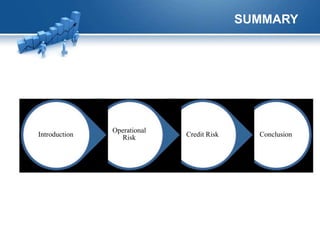
SUMMARY

Introduction

Operational
Risk

Credit Risk

Conclusion
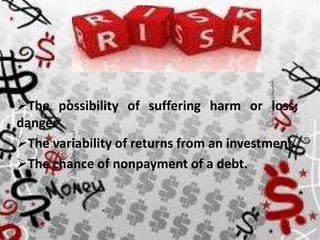
The possibility of suffering harm or loss;
danger
The variability of returns from an investment.
The chance of nonpayment of a debt.
HOW MANAGEMENT IS
ATTACHED TO IT?
Every business faces risks that could present
threats to its success.
Risk management focuses on identifying
what could go wrong, evaluating which risks
should be dealt with and implementing
strategies to deal with those risks.
Businesses that have identified the risks will
be better prepared and have a more costeffective way of dealing with them.
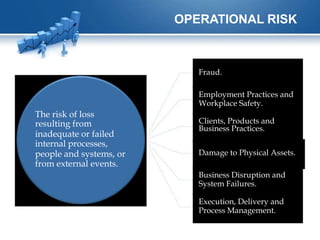
OPERATIONAL RISK

Fraud.
Employment Practices and
Workplace Safety.

The risk of loss
resulting from
inadequate or failed
internal processes,
people and systems, or
from external events.

Clients, Products and
Business Practices.
Damage to Physical Assets.
Business Disruption and
System Failures.
Execution, Delivery and
Process Management.
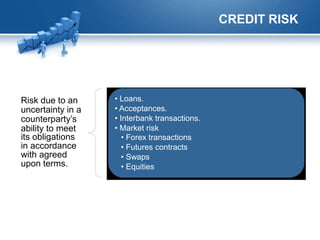
CREDIT RISK

Risk due to an
uncertainty in a
counterparty’s
ability to meet
its obligations
in accordance
with agreed
upon terms.

• Loans.
• Acceptances.
• Interbank transactions.
• Market risk
• Forex transactions
• Futures contracts
• Swaps
• Equities
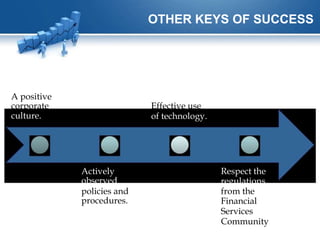
OTHER KEYS OF SUCCESS

A positive
corporate
culture.

Effective use
of technology.

Actively
observed
policies and
procedures.

Respect the
regulations
from the
Financial
Services
Community
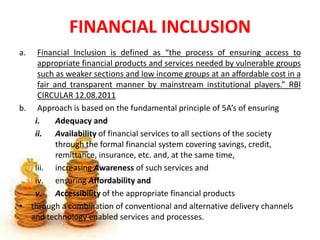
FINANCIAL INCLUSION
a.

Financial Inclusion is defined as “the process of ensuring access to
appropriate financial products and services needed by vulnerable groups
such as weaker sections and low income groups at an affordable cost in a
fair and transparent manner by mainstream institutional players.” RBI
CIRCULAR 12.08.2011
b. Approach is based on the fundamental principle of 5A’s of ensuring
i.
Adequacy and
ii. Availability of financial services to all sections of the society
through the formal financial system covering savings, credit,
remittance, insurance, etc. and, at the same time,
iii. increasing Awareness of such services and
iv. ensuring Affordability and
v.
Accessibility of the appropriate financial products
• through a combination of conventional and alternative delivery channels
and technology enabled services and processes.
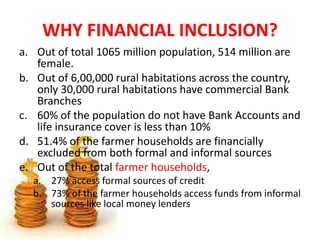
WHY FINANCIAL INCLUSION?
a. Out of total 1065 million population, 514 million are
female.
b. Out of 6,00,000 rural habitations across the country,
only 30,000 rural habitations have commercial Bank
Branches
c. 60% of the population do not have Bank Accounts and
life insurance cover is less than 10%
d. 51.4% of the farmer households are financially
excluded from both formal and informal sources
e. Out of the total farmer households,
a. 27% access formal sources of credit
b. 73% of the farmer households access funds from informal
sources like local money lenders
FINANCIAL INCLUSION
CONCEPT RELATED OR
INTERELATED TO EACH
OTHER
AN EXAMPLE OF ORIENTAL
BANK OF COMMERCE
Financial Inclusion – Who are these People?
Underprivileged section in rural and urban areas
like, Farmers, small vendors, etc.
Agricultural and Industrial Labourers
People engaged in un-organised sectors
Unemployed
Women
Children
Old people
Physically challenged people
Financial Inclusion – Steps Taken









Co-operative Movement
Setting up of State Bank of India
Nationalisation of banks
Lead Bank Scheme
RRBs
Service Area Approach
Microfinance Institutions
Self Help Groups
Financial Inclusion – Why Have We Failed?
Absence of Technology
High incidence of Illiteracy
Absence of reach and coverage
Delivery Mechanism
Not having a Business model
Rich have no compassion for poor
There is NO

in the Team

Risk Management for Financial Inclusion with special reference to Banks

  • 1.
    Risk Management ForFinancial Inclusion With Special Reference To Banks
  • 2.
  • 3.
    The possibility ofsuffering harm or loss; danger The variability of returns from an investment. The chance of nonpayment of a debt.
  • 4.
    HOW MANAGEMENT IS ATTACHEDTO IT? Every business faces risks that could present threats to its success. Risk management focuses on identifying what could go wrong, evaluating which risks should be dealt with and implementing strategies to deal with those risks. Businesses that have identified the risks will be better prepared and have a more costeffective way of dealing with them.
  • 5.
    OPERATIONAL RISK Fraud. Employment Practicesand Workplace Safety. The risk of loss resulting from inadequate or failed internal processes, people and systems, or from external events. Clients, Products and Business Practices. Damage to Physical Assets. Business Disruption and System Failures. Execution, Delivery and Process Management.
  • 6.
    CREDIT RISK Risk dueto an uncertainty in a counterparty’s ability to meet its obligations in accordance with agreed upon terms. • Loans. • Acceptances. • Interbank transactions. • Market risk • Forex transactions • Futures contracts • Swaps • Equities
  • 7.
    OTHER KEYS OFSUCCESS A positive corporate culture. Effective use of technology. Actively observed policies and procedures. Respect the regulations from the Financial Services Community
  • 8.
    FINANCIAL INCLUSION a. Financial Inclusionis defined as “the process of ensuring access to appropriate financial products and services needed by vulnerable groups such as weaker sections and low income groups at an affordable cost in a fair and transparent manner by mainstream institutional players.” RBI CIRCULAR 12.08.2011 b. Approach is based on the fundamental principle of 5A’s of ensuring i. Adequacy and ii. Availability of financial services to all sections of the society through the formal financial system covering savings, credit, remittance, insurance, etc. and, at the same time, iii. increasing Awareness of such services and iv. ensuring Affordability and v. Accessibility of the appropriate financial products • through a combination of conventional and alternative delivery channels and technology enabled services and processes.
  • 9.
    WHY FINANCIAL INCLUSION? a.Out of total 1065 million population, 514 million are female. b. Out of 6,00,000 rural habitations across the country, only 30,000 rural habitations have commercial Bank Branches c. 60% of the population do not have Bank Accounts and life insurance cover is less than 10% d. 51.4% of the farmer households are financially excluded from both formal and informal sources e. Out of the total farmer households, a. 27% access formal sources of credit b. 73% of the farmer households access funds from informal sources like local money lenders
  • 10.
    FINANCIAL INCLUSION CONCEPT RELATEDOR INTERELATED TO EACH OTHER
  • 11.
    AN EXAMPLE OFORIENTAL BANK OF COMMERCE
  • 12.
    Financial Inclusion –Who are these People? Underprivileged section in rural and urban areas like, Farmers, small vendors, etc. Agricultural and Industrial Labourers People engaged in un-organised sectors Unemployed Women Children Old people Physically challenged people
  • 13.
    Financial Inclusion –Steps Taken         Co-operative Movement Setting up of State Bank of India Nationalisation of banks Lead Bank Scheme RRBs Service Area Approach Microfinance Institutions Self Help Groups
  • 14.
    Financial Inclusion –Why Have We Failed? Absence of Technology High incidence of Illiteracy Absence of reach and coverage Delivery Mechanism Not having a Business model Rich have no compassion for poor
  • 15.