Banking Models for MATS
Creating Efficiency and Reducing Risk
Overview
A MAT is a single legal entity and, as such, needs visibility and control
over its finances.
This is lacking in many MATs.
Where a MAT operates individual bank accounts for each of its
schools and each school has its own signatories (potentially
alongside a selection of central signatories) on their own individual
Bank Mandate, this opens up significant risk of fraud and poses a
potential lack of control.
This commonly used banking structure allows rogue employees in a
school to potentially remove central MAT signatories from their
account, apply for unauthorised banking products and change
payment limits leading to an increased risk of staff fraud.
In addition, it creates significant unnecessary work through frequent
mandate variations at school account level.
Moving to a single bank account model has been a solution for some
but if bank accounts at school level are still required, a potential
solution is to look to separate the ‘operational and control’ mandate
from the ‘payment’ mandates.
Separate School Bank accounts with separate Banking Mandates
Where all schools in a MAT operate their own bank account with a separate Banking Mandate for each
account.
What are the Risks & Inefficiencies?
The individual school mandate is highly likely to have at least 2 school staff on it as well as, potentially, representatives from the
central MAT team.
This effectively gives each individual school complete operational control of their banking giving them the ability to:
• Remove the central MAT representatives from the mandate
• Add additional local signatories to the mandate
• Apply for products without the central MAT’s approval or awareness
In addition, due to the nature of schools, excessive volumes of mandate variations across the schools are likely to occur, which is an
administrative drain on resources.
Any fraud or losses due to a structure without sufficient control have the potential to put the MAT at risk of a FNTI and / or
prosecution under company law.
Reducing Risk and Increasing Efficiency
A single ‘Operational and Control’ mandate is set up for the Trust covering all accounts in the MAT with only central signatories on the
mandate (minimum of 2, ideally maximum of 4).
• Any operational amendments of the MATs banking is, therefore, limited to this mandate.
• Schools can not apply for individual products not authorised by the MAT.
A separate ‘Payment Mandate’ is set up through the Bank’s on-line channel to allow the desired level of payment autonomy (either
fully centralised or at school level)
• The MAT allocates (ideally) 2 or 3 administrators to set up users (to create and / or approve payments electronically)
• These administrators can be any members of staff but are ideally senior enough to be trusted to create and delete users across the MAT
Separate School Bank accounts with a Single central ‘Operational and Control’ Mandate
and a separate ‘Electronic Payment’ mandate
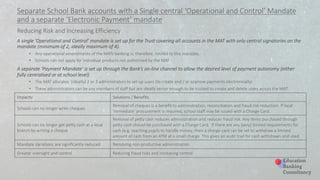
Impacts: Solutions / Benefits
Schools can no longer write cheques
Removal of cheques is a benefit to administration, reconciliation and fraud risk reduction. If local
‘immediate’ procurement is required, school staff may be issued with a Charge Card.
Schools can no longer get petty cash at a local
branch by writing a cheque
Removal of petty cash reduces administration and reduces fraud risk. Any items purchased through
petty cash should be purchased with a Charge Card. If there are any (very) limited requirements for
cash (e.g. teaching pupils to handle money) then a charge card can be set to withdraw a limited
amount of cash from an ATM at a small charge. This gives an audit trail for cash withdrawn and used.
Mandate Variations are significantly reduced Removing non-productive administration
Greater oversight and control Reducing fraud risks and increasing control
A Single Bank Account and Mandate for the Trust
A single Bank account for the whole Trust
Some MATs want to take centralisation one step further and completely remove accounts at school levels. Whils this offers significant
control and centralisation benefits, it does require a more robust central finance team and is often only adopted by larger trusts.
Those MATs looking to adopt this model may be able to gain resource through existing school based SBMs moving to a central
function generating economies of scale.
Schools do not operate a bank account
• Invoices either go directly to the MAT central team or are input at school level
Schools remain responsible for achieving their budget
• Schools are still involved with their budget setting and are required to meet their budget forecasts. The MAT finance softwareallows constand
on-going monitoring of budgets
Notes:
These three broad types of Banking Structure are commonly used across MATs with some adopting hybrid
models.
An option with growing attraction is for all GAG funding to be pooled centrally to support centralisation of
key services (payroll, utilities and centralised services) with the school operating their local fund account.
You should consider your individual MAT strategic direction of travel, appetite for centralisation and
attitude to risk mitigation before deciding the correct model or hybrid model for you.
Who are we and what do we do?
www.educationbanking.co.uk/academies
ianbuss@educationbanking.co.uk
07796 940193

MAT banking models

  • 1.
    Banking Models forMATS Creating Efficiency and Reducing Risk
  • 2.
    Overview A MAT isa single legal entity and, as such, needs visibility and control over its finances. This is lacking in many MATs. Where a MAT operates individual bank accounts for each of its schools and each school has its own signatories (potentially alongside a selection of central signatories) on their own individual Bank Mandate, this opens up significant risk of fraud and poses a potential lack of control. This commonly used banking structure allows rogue employees in a school to potentially remove central MAT signatories from their account, apply for unauthorised banking products and change payment limits leading to an increased risk of staff fraud. In addition, it creates significant unnecessary work through frequent mandate variations at school account level. Moving to a single bank account model has been a solution for some but if bank accounts at school level are still required, a potential solution is to look to separate the ‘operational and control’ mandate from the ‘payment’ mandates.
  • 3.
    Separate School Bankaccounts with separate Banking Mandates Where all schools in a MAT operate their own bank account with a separate Banking Mandate for each account. What are the Risks & Inefficiencies? The individual school mandate is highly likely to have at least 2 school staff on it as well as, potentially, representatives from the central MAT team. This effectively gives each individual school complete operational control of their banking giving them the ability to: • Remove the central MAT representatives from the mandate • Add additional local signatories to the mandate • Apply for products without the central MAT’s approval or awareness In addition, due to the nature of schools, excessive volumes of mandate variations across the schools are likely to occur, which is an administrative drain on resources. Any fraud or losses due to a structure without sufficient control have the potential to put the MAT at risk of a FNTI and / or prosecution under company law.
  • 4.
    Reducing Risk andIncreasing Efficiency A single ‘Operational and Control’ mandate is set up for the Trust covering all accounts in the MAT with only central signatories on the mandate (minimum of 2, ideally maximum of 4). • Any operational amendments of the MATs banking is, therefore, limited to this mandate. • Schools can not apply for individual products not authorised by the MAT. A separate ‘Payment Mandate’ is set up through the Bank’s on-line channel to allow the desired level of payment autonomy (either fully centralised or at school level) • The MAT allocates (ideally) 2 or 3 administrators to set up users (to create and / or approve payments electronically) • These administrators can be any members of staff but are ideally senior enough to be trusted to create and delete users across the MAT Separate School Bank accounts with a Single central ‘Operational and Control’ Mandate and a separate ‘Electronic Payment’ mandate Impacts: Solutions / Benefits Schools can no longer write cheques Removal of cheques is a benefit to administration, reconciliation and fraud risk reduction. If local ‘immediate’ procurement is required, school staff may be issued with a Charge Card. Schools can no longer get petty cash at a local branch by writing a cheque Removal of petty cash reduces administration and reduces fraud risk. Any items purchased through petty cash should be purchased with a Charge Card. If there are any (very) limited requirements for cash (e.g. teaching pupils to handle money) then a charge card can be set to withdraw a limited amount of cash from an ATM at a small charge. This gives an audit trail for cash withdrawn and used. Mandate Variations are significantly reduced Removing non-productive administration Greater oversight and control Reducing fraud risks and increasing control
  • 5.
    A Single BankAccount and Mandate for the Trust A single Bank account for the whole Trust Some MATs want to take centralisation one step further and completely remove accounts at school levels. Whils this offers significant control and centralisation benefits, it does require a more robust central finance team and is often only adopted by larger trusts. Those MATs looking to adopt this model may be able to gain resource through existing school based SBMs moving to a central function generating economies of scale. Schools do not operate a bank account • Invoices either go directly to the MAT central team or are input at school level Schools remain responsible for achieving their budget • Schools are still involved with their budget setting and are required to meet their budget forecasts. The MAT finance softwareallows constand on-going monitoring of budgets
  • 6.
    Notes: These three broadtypes of Banking Structure are commonly used across MATs with some adopting hybrid models. An option with growing attraction is for all GAG funding to be pooled centrally to support centralisation of key services (payroll, utilities and centralised services) with the school operating their local fund account. You should consider your individual MAT strategic direction of travel, appetite for centralisation and attitude to risk mitigation before deciding the correct model or hybrid model for you.
  • 7.
    Who are weand what do we do? www.educationbanking.co.uk/academies ianbuss@educationbanking.co.uk 07796 940193