




A review of facts,figures and results
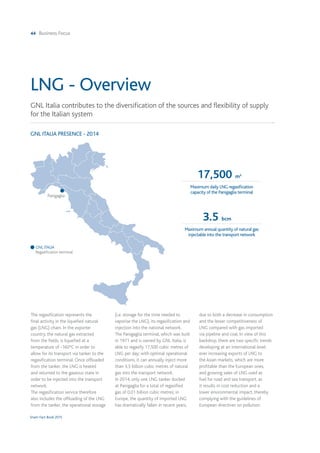
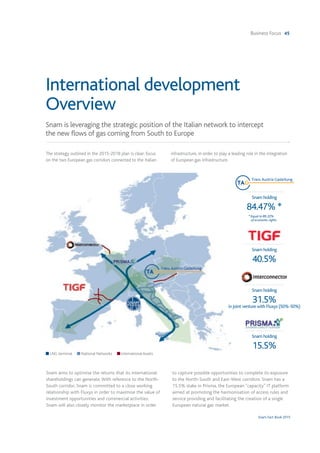
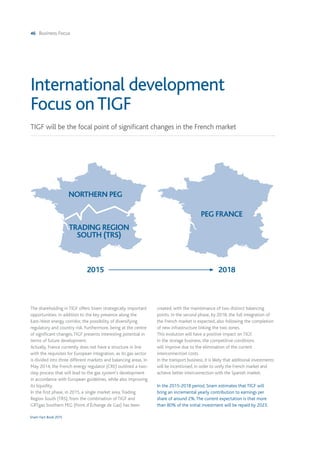
FACT BOOK 2015
Snam Fact Book 2015
Introduction 1
The Fact Book 2015 is the first edition of a new communication tool, aimed
at providing useful features for a better understanding of Snam Group, also
from the viewpoint of those who analyse the Company in order to evaluate
the investment in the shares.
The publication's comprehensive approach makes it possible to cover a
broad range of issues, while also providing a significant level of detail.
Snam's past performance, the development of its structure, and its future
prospects are considered within the context of market scenario and
regulatory framework.With this approach, the reader is able to assess
results achieved and initiatives planned in a more aware and informed
way, considering constraints and opportunities presented by the evolving
external environment.
This publication provides in-depth information about Snam that is
complementary to that included in both the Annual Report and the
Sustainability Report.
Snam Fact Book 2015
2 Index
Snam Fact Book 2015
Index 3
Group Profile
6.	Vision
7. 	 An integrated infrastructure system
8. 	 Management team
9. 	 The evolution of the European gas market
10. 	 The infrastructure role in the gas market
11. 	 Energy policies in Europe and in Italy
12. 	 Regulation in Italy
13. 	 Snam: business model
14. 	 Strategic priorities
15. 	 The first asset: the integrated network
	 of infrastructure
16. 	 Snam: at the heart of the European gas flows
17.	 Expansion in Europe
18.	 Governance in action
19. 	 Remuneration policy
20. 	 The value of sustainability
21.	 Materiality of objectives
22. 	 Investment plan targets
23. 	 Investment plan
24. 	 Operating efficiency
25. 	 Debt management
26. 	 Rating
27. 	 Financial strategy
28. 	 Shareholder remuneration
29. 	 Shareholders
Business Focus
32.	 Transport – Overview
33. 	 Transport – Investments
34. 	 Transport – Projects
35. 	 New techniques for laying pipelines
36. 	 Storage – Overview
37. 	 Storage – Investments
38. 	 Storage – Projects
39. 	 Initiatives and innovation in storage
40. 	 Distribution – Overview
41. 	 Distribution – Investments and Projects
42. 	 Distribution – Concession tenders
43. 	 Distribution – Smart metering and GasToGo
44.	 LNG – Overview
45. 	 International development – Overview
46. 	 International development – Focus on TIGF
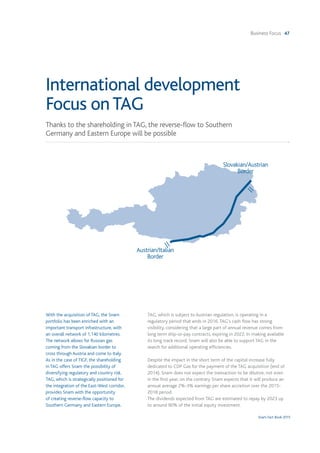
47. 	 International development – Focus on TAG
48. 	 Transparency and quality
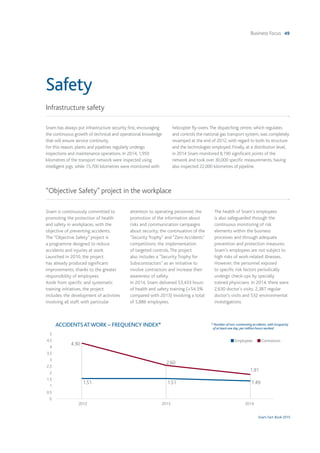
49. 	 Safety
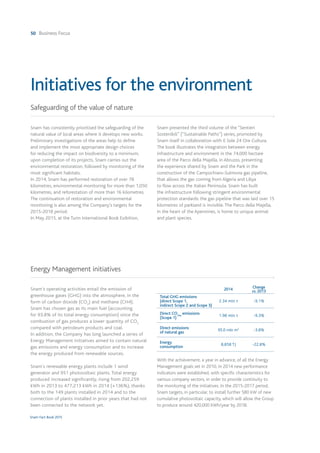
50. 	 Initiatives for the environment
Performance
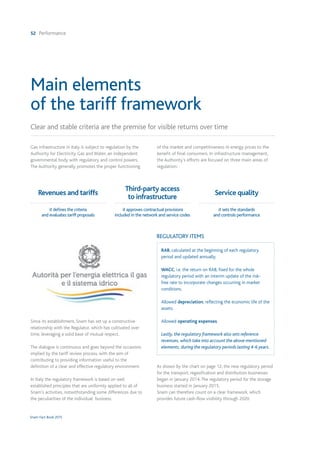
52.	 Main elements of the tariff framework
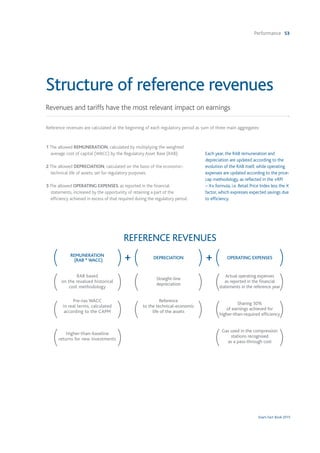
53. 	 Structure of reference revenues
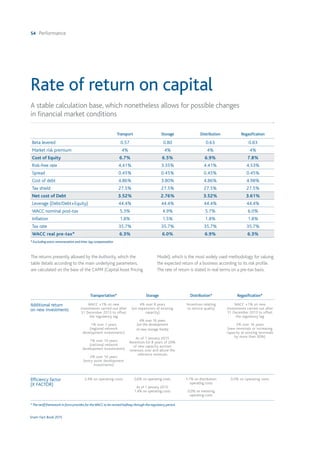
54. 	 Rate of return on capital
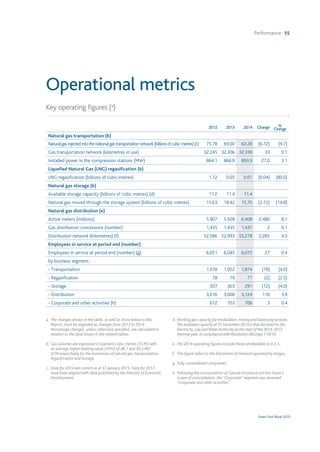
55. 	 Operational metrics
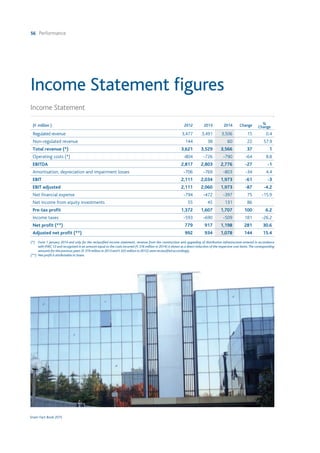
56. 	 Income Statement figures
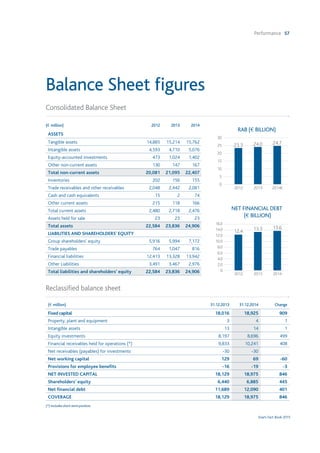
57. 	 Balance Sheet figures
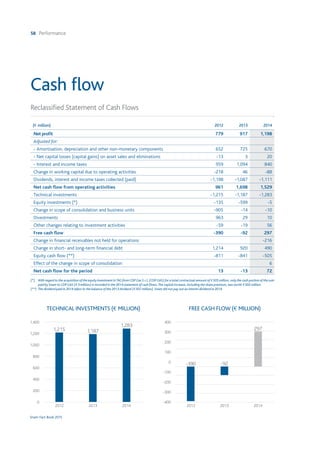
58. 	 Cash flow
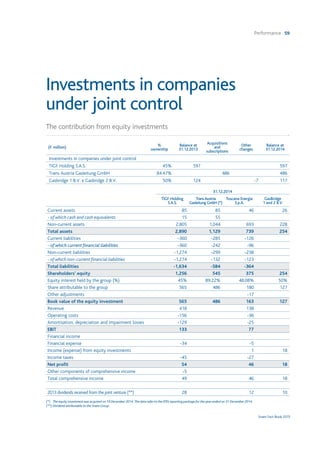
59. 	 Investments in companies under joint control
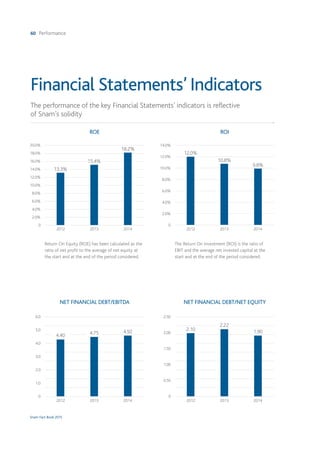
60. 	 Financial Statement’s Indicators
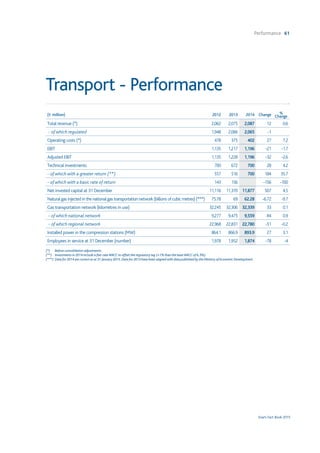
61. 	 Transport – Performance
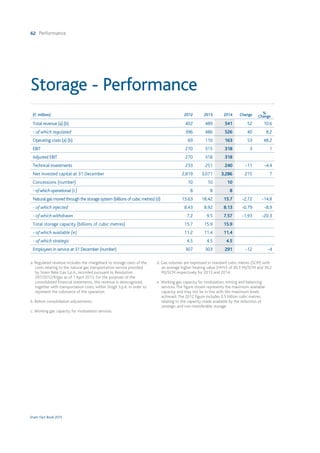
62. 	 Storage – Performance
63. 	 Distribution – Performance
64.	 Regasification – Performance
65. 	 Indicators by business segment
66. 	 Environmental performance
67. 	 Inclusion in SRI indices
68. 	 Snam and the Stock Exchange
69. 	 Translating financial results into shareholder returns
70. 	 Remuneration through dividends
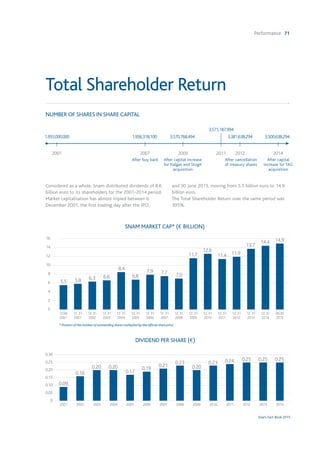
71. 	 Total Shareholder Return
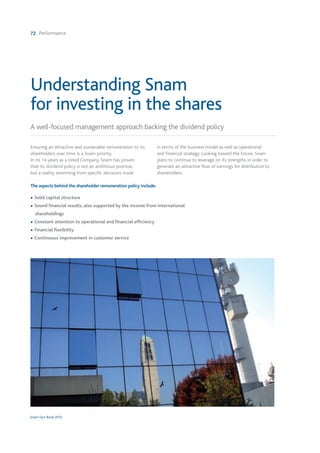
72. 	 Understanding Snam for investing in the shares
73. 	 Glossary
74. 	 Disclaimer
Snam Fact Book 2015
4
Group profile 5
Snam Fact Book 2015
Profilo del gruppoGroup profile
6 Group profile
Snam Fact Book 2015
Vision
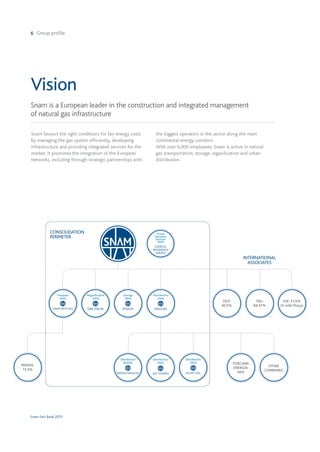
Snam is a European leader in the construction and integrated management
of natural gas infrastructure
Snam favours the right conditions for fair energy costs
by managing the gas system efficiently, developing
infrastructure and providing integrated services for the
market. It promotes the integration of the European
networks, including through strategic partnerships with
the biggest operators in the sector along the main
continental energy corridors.
With over 6,000 employees, Snam is active in natural
gas transportation, storage, regasification and urban
distribution.
Regasification
100%
Storage
100%
Distribution
100%
Distribution
99.69%
Distribution
100%
Distribution
100%
Transport
100%
Group
Insurance
Services
100%
GASRULE
INSURANCE
LIMITED
CONSOLIDATION
PERIMETER
INTERNATIONAL
ASSOCIATES
TIGF:
40.5%
TOSCANA
ENERGIA:
49%
TAG:
84.47%
OTHER
COMPANIES
IUK: 31.6%
JV with Fluxys
PRISMA:
15.5%
Group profile 7
Snam Fact Book 2015
An integrated
infrastructure system
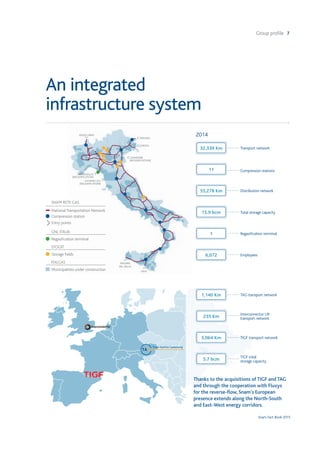
Thanks to the acquisitions of TIGF and TAG
and through the cooperation with Fluxys
for the reverse-flow, Snam’s European
presence extends along the North-South
and East-West energy corridors.
32,339 Km Transport network
Compression stations
15.9 bcm
1 Regasification terminal
6,072 Employees
235 Km Interconnector UK
transport network
5.7 bcm TIGF total
storage capacity
1,140 Km TAG transport network
55,278 Km Distribution network
5,064 Km TIGF transport network
2014
11
TARVISIO
GORIZIA
PANIGAGLIA
(REGASIFICATION)
LIVORNO OLT
(REGASIFICATION)
CAVARZERE
(REGASIFICATION)
PASSO GRIES
MAZARA
DEL VALLO
GELA
Compression station
NationalTransportation Network
Entry points
SNAM RETE GAS
Regasification terminal
GNL ITALIA
Storage fields
STOGIT
Municipalities under construction
ITALGAS
Total storage capacity
8 Group profile
Snam Fact Book 2015
Management team
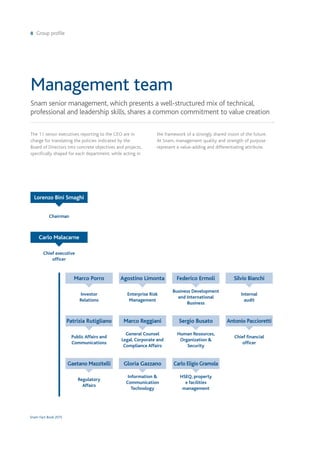
Snam senior management, which presents a well-structured mix of technical,
professional and leadership skills, shares a common commitment to value creation
The 11 senior executives reporting to the CEO are in
charge for translating the policies indicated by the
Board of Directors into concrete objectives and projects,
specifically shaped for each department, while acting in
the framework of a strongly shared vision of the future.
At Snam, management quality and strength of purpose
represent a value-adding and differentiating attribute.
Patrizia Rutigliano
Public Affairs and
Communications
Marco Reggiani
General Counsel
Legal, Corporate and
Compliance Affairs
Sergio Busato
Human Resources,
Organization &
Security
Antonio Paccioretti
Chief financial
officer
Gaetano Mazzitelli
Regulatory
Affairs
Gloria Gazzano
Information &
Communication
Technology
Carlo Eligio Gramola
HSEQ, property
e facilities
management
Lorenzo Bini Smaghi
Chairman
Carlo Malacarne
Chief executive
officer
Marco Porro
Investor
Relations
Agostino Limonta
Enterprise Risk
Management
Federico Ermoli
Business Development
and International
Business
Silvio Bianchi
Internal
audit
Group profile 9
Snam Fact Book 2015
The evolution
of the European gas market
The emerging scenario will lead to increased dependence on extra Europe imports
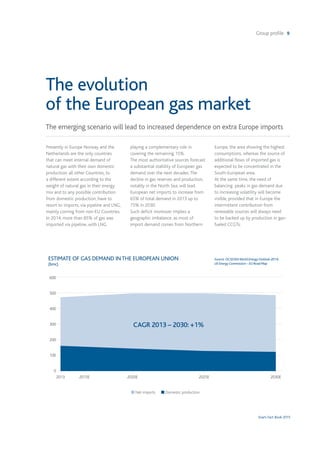
Presently in Europe Norway and the
Netherlands are the only countries
that can meet internal demand of
natural gas with their own domestic
production; all other Countries, to
a different extent according to the
weight of natural gas in their energy
mix and to any possible contribution
from domestic production, have to
resort to imports, via pipeline and LNG,
mainly coming from non-EU Countries.
In 2014, more than 85% of gas was
imported via pipeline, with LNG
playing a complementary role in
covering the remaining 15%.
The most authoritative sources forecast
a substantial stability of European gas
demand over the next decades.The
decline in gas reserves and production,
notably in the North Sea, will lead
European net imports to increase from
65% of total demand in 2013 up to
75% in 2030.
Such deficit moreover implies a
geographic imbalance, as most of
import demand comes from Northern
Europe, the area showing the highest
consumptions, whereas the source of
additional flows of imported gas is
expected to be concentrated in the
South-European area.
At the same time, the need of
balancing peaks in gas demand due
to increasing volatility will become
visible, provided that in Europe the
intermittent contribution from
renewable sources will always need
to be backed up by production in gas-
fueled CCGTs.
600
500
400
300
200
100
0
2013
ESTIMATE OF GAS DEMAND INTHE EUROPEAN UNION
(bmc)
n Net imports n Domestic production
Source: OCSE/IEAWorld Energy Outlook 2014;
UE Energy Commission – EU Road Map
CAGR 2013 – 2030: +1%
2015E 2020E 2025E 2030E
10 Group profile
Snam Fact Book 2015
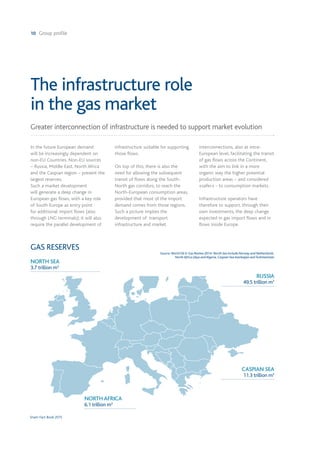
In the future European demand
will be increasingly dependent on
non-EU Countries. Non-EU sources
– Russia, Middle East, North Africa
and the Caspian region – present the
largest reserves.
Such a market development
will generate a deep change in
European gas flows, with a key role
of South Europe as entry point
for additional import flows (also
through LNG terminals); it will also
require the parallel development of
infrastructure suitable for supporting
those flows.
On top of this, there is also the
need for allowing the subsequent
transit of flows along the South-
North gas corridors, to reach the
North-European consumption areas,
provided that most of the import
demand comes from those regions.
Such a picture implies the
development of transport
infrastructure and market
interconnections, also at intra-
European level, facilitating the transit
of gas flows across the Continent,
with the aim to link in a more
organic way the higher potential
production areas – and considered
«safer» - to consumption markets.
Infrastructure operators have
therefore to support, through their
own investments, the deep change
expected in gas import flows and in
flows inside Europe.
Greater interconnection of infrastructure is needed to support market evolution
The infrastructure role
in the gas market
NORTH SEA
3.7 trillion m3
RUSSIA
49.5 trillion m3
CASPIAN SEA
11.3 trillion m3
NORTHAFRICA
6.1 trillion m3
GAS RESERVES
Source:World Oil & Gas Review 2014. North Sea include Norway and Netherlands,
North Africa Libya and Algeria, Caspian Sea Azerbaijan and Turkmenistan
Group profile 11
Snam Fact Book 2015
The choices in the environmental and energy
agenda of the European decision makers
will play a key role in setting the long-term
evolution of gas demand, within a context
oriented to the reduction of gas emissions
causing climate change.
The forthcoming United Nations Climate
Change Conference, which will take place
in December 2015 in Paris, aims to reach
a legally binding and universal agreement,
considering that a specific US-China
agreement has already been signed.
At the moment the European agenda on the
energy policy has been articulated through
two issues:
• «EU 2013 Framework for climate
and energy policies», approved by
the European Council in October 2014,
targeting the 40% reduction in emissions
when compared to 1990 by 2030, in
addiction to the increase in the share of
renewable energy and to the rise of energy
efficiency up to 27%.
• «EU Roadmap 2050», aimed at reducing
gas emissions by 80% within 2050,
when compared to 1990, also thanks to
technological innovation.
Gas plays a key role in the European and national energy strategy
Energy policies
in Europe and in Italy
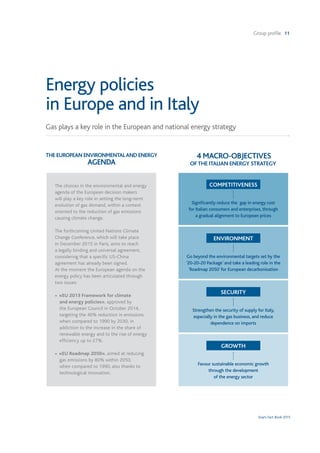
GROWTH
Favour sustainable economic growth
through the development
of the energy sector
SECURITY
Strengthen the security of supply for Italy,
especially in the gas business, and reduce
dependence on imports
ENVIRONMENT
Go beyond the environmental targets set by the
‘20-20-20 Package’ and take a leading role in the
‘Roadmap 2050’ for European decarbonisation
4 MACRO-OBJECTIVES
OFTHE ITALIAN ENERGY STRATEGY
COMPETITIVENESS
Significantly reduce the gap in energy cost
for Italian consumers and enterprises, through
a gradual alignment to European prices
THE EUROPEAN ENVIRONMENTALAND ENERGY
AGENDA
12 Group profile
Snam Fact Book 2015
Regulation in Italy
Snam can build its investment decisions on the basis of a transparent
regulatory framework
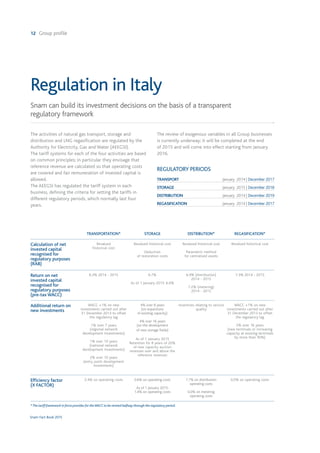
The activities of natural gas transport, storage and
distribution and LNG regasification are regulated by the
Authority for Electricity, Gas and Water (AEEGSI).
The tariff systems for each of the four activities are based
on common principles; in particular they envisage that
reference revenue are calculated so that operating costs
are covered and fair remuneration of invested capital is
allowed.
The AEEGSI has regulated the tariff system in each
business, defining the criteria for setting the tariffs in
different regulatory periods, which normally last four
years.
The review of exogenous variables in all Group businesses
is currently underway; it will be completed at the end
of 2015 and will come into effect starting from January
2016.
TRANSPORT	 January 2014 | December 2017
STORAGE 	 January 2015 | December 2018
DISTRIBUTION 	 January 2014 | December 2019
REGASIFICATION 	 January 2014 | December 2017
REGULATORY PERIODS
TRANSPORTATION* STORAGE DISTRIBUTION* REGASIFICATION*
Calculation of net
invested capital
recognised for
regulatory purposes
(RAB)
Revalued
historical cost
Revalued historical cost
Deduction
of restoration costs
Revalued historical cost
Parametric method
for centralised assets
Revalued historical cost
Return on net
invested capital
recognised for
regulatory purposes
(pre-tax WACC)
6.3% 2014 - 2015 6.7%
As of 1 January 2015: 6.0%
6.9% (distribution)
2014 - 2015
7.2% (metering)
2014 - 2015
7.3% 2014 - 2015
Additional return on
new investments
WACC +1% on new
investments carried out after
31 December 2013 to offset
the regulatory lag
1% over 7 years
(regional network
development investments)
1% over 10 years
(national network
development investments)
2% over 10 years
(entry point development
investments)
4% over 8 years
(on expansions
of existing capacity)
4% over 16 years
(on the development
of new storage fields)
As of 1 January 2015
Retention for 8 years of 20%
of new capacity auction
revenues over and above the
reference revenues
Incentives relating to service
quality
WACC +1% on new
investments carried out after
31 December 2013 to offset
the regulatory lag
2% over 16 years
(new terminals or increasing
capacity at existing terminals
by more than 30%)
Efficiency factor
(X FACTOR)
2.4% on operating costs 0.6% on operating costs
As of 1 January 2015:
1.4% on operating costs
1.7% on distribution
operating costs
0.0% on metering
operating costs
0.0% on operating costs
* The tariff framework in force provides for theWACC to be revised halfway through the regulatory period.
Group profile 13
Snam Fact Book 2015
The evolution of the market scenario opens up new perspectives
Snam follows an ethical and socially
responsible business model that is
capable of generating value for both
the company and the community in
which it operates, based on renowned
professionalism and transparent
dialogue with all stakeholders, whilst
respecting the environment and the
local areas.A clear and sustainable
development strategy in the long term,
based on one of the biggest industrial
investment plans in the Country, allows
the Company to attract capital from
both Italy and abroad, thus promoting
growth and job creation.
With the aim of capturing the
opportunities provided by the current
environment, which is deeply and
rapidly changing, Snam has reviewed
its business model and the sustainable
investment strategies, having two well-
defined objectives: achieve a greater
interconnection and flexibility of the
European gas system and evolve its
own role as market facilitator capable
of providing an ever more differentiated
and innovative range of services.
The new challenges in the European gas
market actually can only be addressed
by the creation of a pan-European
infrastructure network.
The integration of existing European
gas networks will be supported by the
development of bi-directional flows
along main gas corridors.
Moreover, the development of new
services meeting the changed needs
of shippers and final customers will be
increasingly critical, considering that
an efficient market functioning will be
able to foster its liquidity and preserve
security of supply.
The new activities will favour an optimal
access and utilisation, by traders and
shippers, of the whole gas system,
comprising transport networks, storage
sites and LNG regasification terminals.
The profile of such scenario will
translate into revenue and investment
sustainability for infrastructure
operators.
Snam: business model
COMPETITION
AND NEW
CONTRACTTERMS
NEW SERVICES
ANDACTIVITIES
GAS DEMAND
GAS SUPPLY
14 Group profile
Snam Fact Book 2015
Strategic priorities
Investments, operational efficiency, financial efficiency and value creation for
all stakeholder. Strategy focuses on these four areas
DYNAMIC AND SELECTIVE
PORTFOLIO MANAGEMENT
Snam is committed to a selective
management of investment projects,
leveraging on high-quality opportunities in
Italy and focusing on two main European
gas corridors, the East-West and the
North-South, with the aim to integrate and
complement the current asset portfolio as
well as to diversify the Country risk and
regulatory risk.
OPERATIONAL
MANAGEMENT
The continuous improvement of operational
performance is achieved by progressing from
the role of infrastructure operator toward
the role of market facilitator, providing
integrated services to shippers and final
customers.
An improvement that implies also the
continuity of initiatives already undertaken
in terms of control on costs.
FINANCIAL
DISCIPLINE
Pursuing a disciplined financial profile means
investing in value accretive assets, including
through M&A deals, and consolidating a solid
and efficient capital structure.
ATTRACTIVE
AND SUSTAINABLE RETURNS
Value generation for all stakeholders is driven
by profitable and stable growth.
Generating shareholder value, in particular,
means being able to pay sustainable
dividends, guaranteeing an attractive return.
Group profile 15
Snam Fact Book 2015
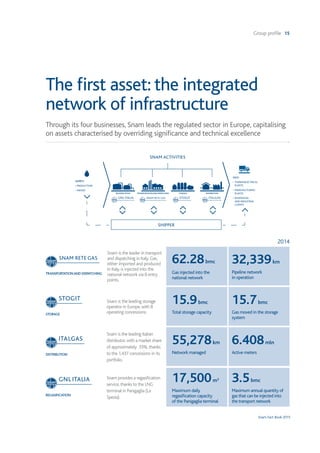
Through its four businesses, Snam leads the regulated sector in Europe, capitalising
on assets characterised by overriding significance and technical excellence
The first asset: the integrated
network of infrastructure
Snam provides a regasification
service, thanks to the LNG
terminal in Panigaglia (La
Spezia).
17,500m3
Maximum daily
regasification capacity
of the Panigaglia terminal
3.5bmc
Maximum annual quantity of
gas that can be injected into
the transport network
REGASIFICATION
Snam is the leader in transport
and dispatching in Italy. Gas,
either imported and produced
in Italy, is injected into the
national network via 8 entry
points.
62.28bmc
Gas injected into the
national network
32,339km
Pipeline network
in operation
TRANSPORTATIONAND DISPATCHING
Snam is the leading storage
operator in Europe, with 8
operating concessions.
15.9bmc
Total storage capacity
15.7bmc
Gas moved in the storage
system
STORAGE
Snam is the leading Italian
distributor, with a market share
of approximately 33%, thanks
to the 1,437 concessions in its
portfolio.
55,278km
Network managed
6.408mln
Active metersDISTRIBUTION
SNAM ACTIVITIES
SALE:
• 	THERMOELECTRICAL
	PLANTS
• 	MANUFACTURING
	PLANTS
• 	RESIDENTIAL
	 AND INDUSTRIAL
	CLIENTS
SUPPLY:
• PRODUCTION
• IMPORT
SHIPPER
2014
TRANSPORTATIONAND DISPATCHINGREGASIFICATION STORAGE DISTRIBUTION
16 Group profile
Snam Fact Book 2015
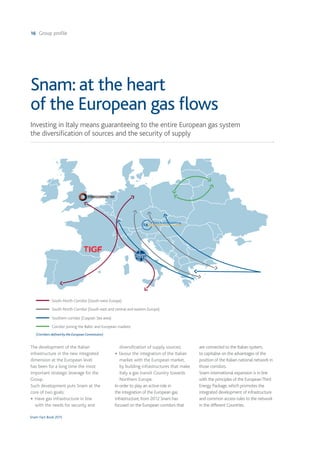
Investing in Italy means guaranteeing to the entire European gas system
the diversification of sources and the security of supply
Snam: at the heart
of the European gas flows
The development of the Italian
infrastructure in the new integrated
dimension at the European level
has been for a long time the most
important strategic leverage for the
Group.
Such development puts Snam at the
core of two goals:
• Have gas infrastructure in line
with the needs for security and
diversification of supply sources;
• favour the integration of the Italian
market with the European market,
by building infrastructures that make
Italy a gas transit Country towards
Northern Europe.
In order to play an active role in
the integration of the European gas
infrastructure, from 2012 Snam has
focused on the European corridors that
are connected to the Italian system,
to capitalise on the advantages of the
position of the Italian national network in
those corridors.
Snam international expansion is in line
with the principles of the EuropeanThird
Energy Package, which promotes the
integrated development of infrastructure
and common access rules to the network
in the different Countries.
(Corridors defined by the European Commission)
South-North Corridor (South-west Europe)
South-North Corridor (South-east and central and eastern Europe)
Southern corridor (Caspian Sea area)
Corridor joining the Baltic and European markets
Group profile 17
Snam Fact Book 2015
Developing an international presence also means, for Snam, enhancing
the value of its Italian assets on the European scene
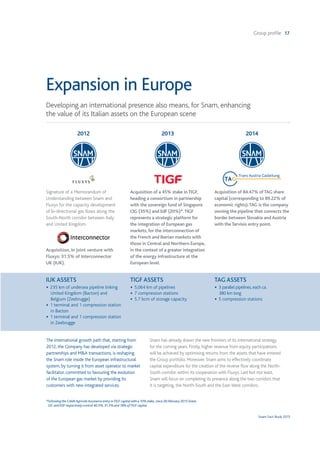
Signature of a Memorandum of
Understanding between Snam and
Fluxys for the capacity development
of bi-directional gas flows along the
South-North corridor between Italy
and United Kingdom.
Acquisition of a 45% stake in TIGF,
heading a consortium in partnership
with the sovereign fund of Singapore
CIG (35%) and EdF (20%)*.TIGF
represents a strategic platform for
the integration of European gas
markets, for the interconnection of
the French and Iberian markets with
those in Central and Northern Europe,
in the context of a greater integration
of the energy infrastructure at the
European level.
Acquisition of 84.47% of TAG share
capital (corresponding to 89.22% of
economic rights).TAG is the company
owning the pipeline that connects the
border between Slovakia and Austria
with the Tarvisio entry point.
Acquisition, in joint venture with
Fluxys: 31.5% of Interconnector
UK (IUK).
The international growth path that, starting from
2012, the Company has developed via strategic
partnerships and M&A transactions, is reshaping
the Snam role inside the European infrastructural
system, by turning it from asset operator to market
facilitator, committed to favouring the evolution
of the European gas market by providing its
customers with new integrated services.
Snam has already drawn the new frontiers of its international strategy
for the coming years. Firstly, higher revenue from equity participations
will be achieved by optimising returns from the assets that have entered
the Group portfolio. Moreover, Snam aims to effectively coordinate
capital expenditure for the creation of the reverse flow along the North-
South corridor, within its cooperation with Fluxys. Last but not least,
Snam will focus on completing its presence along the two corridors that
it is targeting, the North-South and the East-West corridors.
Expansion in Europe
2012 2013 2014
*Following the Crédit Agricole Assurance entry in TIGF capital with a 10% stake, since 26 February 2015 Snam,
GIC and EDF respectively control 40.5%, 31.5% and 18% of TIGF capital.
IUK ASSETS
• 235 km of undersea pipeline linking
United Kingdom (Bacton) and
Belgium (Zeebrugge)
• 1 terminal and 1 compression station
in Bacton
• 1 terminal and 1 compression station
in Zeebrugge
TIGF ASSETS
• 5,064 km of pipelines
• 7 compression stations
• 5.7 bcm of storage capacity
TAG ASSETS
• 3 parallel pipelines, each ca.
380 km long
• 5 compression stations
18 Group profile
Snam Fact Book 2015
Governance in action
A clear and effective Governance system ensures that Snam is managed and
controlled according to well-defined rules of social responsibility, which can
generate value for the Company and the communities in which it operates
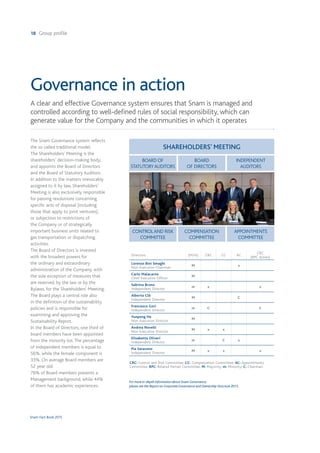
The Snam Governance system reflects
the so called traditional model.
The Shareholders’ Meeting is the
shareholders’ decision-making body,
and appoints the Board of Directors
and the Board of Statutory Auditors.
In addition to the matters irrevocably
assigned to it by law, Shareholders’
Meeting is also exclusively responsible
for passing resolutions concerning
specific acts of disposal (including
those that apply to joint ventures),
or subjection to restrictions of
the Company or of strategically
important business units related to
gas transportation or dispatching
activities.
The Board of Directors is invested
with the broadest powers for
the ordinary and extraordinary
administration of the Company, with
the sole exception of measures that
are reserved, by the law or by the
Bylaws, for the Shareholders' Meeting.
The Board plays a central role also
in the definition of the sustainability
policies and is responsible for
examining and approving the
Sustainability Report.
In the Board of Directors, one third of
board members have been appointed
from the minority list.The percentage
of independent members is equal to
56%, while the female component is
33%. On average Board members are
52 year old.
78% of Board members presents a
Management background, while 44%
of them has academic experiences.
CRC: Control and Risk Committee; CC: Compensation Committee; AC: Appointments
Committee, RPC: Related Parties Committee; M: Majoirity; m: Minority; C: Chairman.
For more in-depth information about Snam Governance,
please see the Report on Corporate Governance and Ownership Structure 2015.
Directors (M/m) CRC CC AC
CRC
(RPC duties)
Lorenzo Bini Smaghi
Non-Executive Chairman
M x
Carlo Malacarne
Chief Executive Officer
M      
Sabrina Bruno
Independent Director
m x x
Alberto Clô
Independent Director
M
 
 
C
Francesco Gori
Independent Director
m C C
Yunpeng He
Non-Executive Director
M        
Andrea Novelli
Non-Executive Director
M x x
Elisabetta Oliveri
Independent Director
m
 
 
C x
Pia Saraceno
Independent Director
M x x x
SHAREHOLDERS’ MEETING
CONTROLAND RISK
COMMITTEE
COMPENSATION
COMMITTEE
APPOINTMENTS
COMMITTEE
BOARD OF
STATUTORYAUDITORS
BOARD
OF DIRECTORS
INDEPENDENT
AUDITORS
Group profile 19
Snam Fact Book 2015
Remuneration policy
The remuneration system aligns management action with the interests of the stakeholders
and shareholders, promoting the value creation in the medium-to-long term
The remuneration policy of Snam
calls for a pay mix in line with the
managerial position held and is
designed in five different components:
fixed remuneration, variable short-
term incentives (annual monetary
incentives), variable long-term
incentives (deferred monetary
incentives) as well as pension and
welfare benefits.
In the case of the Chief Executive
Officer, the variable component
represents 57% of the whole
target pay mix, while in the case
of the executives with strategic
responsibilities, the weight of the
variable component is 50%.
During the 2012-2014 three-year
period, concerning the first section
of the Remuneration Report, which
explains the remuneration policy
for the following year for Directors
and Executives with strategic
responsibilities, votes in favour at the
Shareholders’ Meeting were 97.51%
of total participants, with 94.10% of
minorities in favour; the “say on pay”
figure puts Snam in
second place among FTSE MIB
companies (source Georgeson).
On 24 April 2015 the Shareholders’ Meeting approved the
proposal of the Compensation Committee, supported by
the BoD, of introducing, in addiction to the adjusted net
profit, even the Total Shareholder Return as an indicator
of the Long-Term Monetary Incentive Plan. Such approval
strengthen the premises for a management alignment
with the creation of shareholder value in a long-term
horizon.
In 2014, to be used for variable incentive instruments, the
claw-back clause has been introduced. During 2015 both
the process and the responsibilities connected with the
implementation of such a clause will be determined.
For more in-depth information about the remuneration policies of Snam, please see the Remuneration Report 2015.
20 Group profile
Snam Fact Book 2015
The value of sustainability
The sustainability process is structured and integrated in the Company’s business
model, in a continuous and constructive dialogue with all stakeholders
At Snam, sustainability and the creation of value are closely
connected concepts.
The sustainability creates value for the company and stakeholders
when it contributes to maintaining and improving the opinion and
respect of the Company expressed by the local area, institutions
and employees, and when it is able to facilitate the building of
infrastructure, increase the “gas” system’s productivity for the
benefit of society and decrease environmental and operational risks
connected with business activities.
In keeping with this vision, Snam promotes an ongoing and
constructive dialogue with all stakeholders, in an attempt to create
fertile ground for project development opportunities and social
innovation initiatives with added value in keeping with the company’s
business.
Snam has increasingly integrated the Shared Value approach into its
sustainability path, which creates a stronger link between business
and corporate social responsibility by aligning the company’s vision
concerning value created for itself and its stakeholders.
Thus, for Snam, creating Shared Value means knowing how to play
its traditional innovative role in the Country's development by
reassessing resources developed over time in terms of infrastructure,
technologies, skills and human capital.
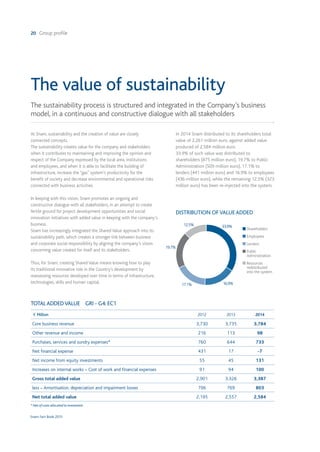
In 2014 Snam distributed to its shareholders total
value of 2,261 million euro, against added value
produced of 2,584 million euro.
33.9% of such value was distributed to
shareholders (875 million euro), 19.7% to Public
Administration (509 million euro), 17.1% to
lenders (441 million euro) and 16.9% to employees
(436 million euro), while the remaining 12.5% (323
million euro) has been re-injected into the system.
TOTALADDEDVALUE GRI - G4: EC1
33.9%
16.9%17.1%
19.7%
12.5%
DISTRIBUTION OFVALUEADDED
n Shareholders
n Employees
n Lenders
n Public
	Administration
n Resources
	redistributed
	 into the system
€ Million 2012 2013 2014
Core business revenue 3,730 3,735 3,784
Other revenue and income 216 113 98
Purchases, services and sundry expenses* 760 644 733
Net financial expense 431 17 -7
Net income from equity investments 55 45 131
Increases on internal works – Cost of work and financial expenses 91 94 100
Gross total added value 2,901 3,326 3,387
less – Amortisation, depreciation and impairment losses 706 769 803
Net total added value 2,195 2,557 2,584
* Net of costs allocated to investment
Group profile 21
Snam Fact Book 2015
MATERIALITY GRID
	 MATERIAL ASPECTS
Economic / Governance
	 • Creation of sustainable value
	 • Corporate governance management
	 • Risk and crisis management
	 • Management transparency
	 • Anti-corruption
Social
	 • Health and safety
	 • Developing promotion of human capital
	 • Employment and safeguarding jobs
	 • Relations with regulatory authorities
	 • Quality and development of services
	 • Supply chain management
	 • Stakeholder engagement
Environmental
	 • Protecting the local area and biodiversity
	 • Climate change and Energy efficiency
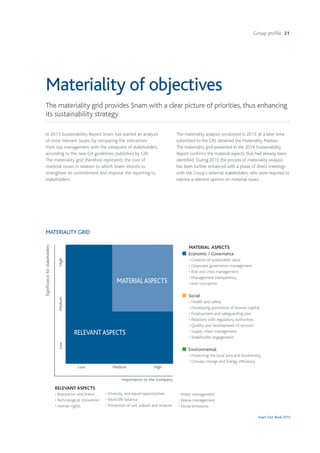
The materiality grid provides Snam with a clear picture of priorities, thus enhancing
its sustainability strategy
In 2013 Sustainability Report Snam has started an analysis
of most relevant issues, by comparing the indications
from top management with the viewpoint of stakeholders,
according to the new G4 guidelines, published by GRI.
The materiality grid therefore represents the core of
material issues in relation to which Snam intends to
strengthen its commitment and improve the reporting to
stakeholders.
The materiality analysis conducted in 2013, at a later time
submitted to the GRI, obtained the Materiality Matters.
The materiality grid presented in the 2014 Sustainability
Report confirms the material aspects that had already been
identified. During 2015 the process of materiality analysis
has been further enhanced with a phase of direct meetings
with the Group’s external stakeholders, who were required to
express a relevant opinion on material issues.
Materiality of objectives
Importance to the Company
Low Medium High
Significanceforstakeholders
LowMediumHigh
RELEVANTASPECTS
MATERIALASPECTS
RELEVANT ASPECTS
• Reputation and brand
• Technological innovation
• Human rights
• Diversity and equal opportunities
• Work/life balance
• Protection of soil, subsoil and stratum
• Water management
• Waste management
• Noise emissions
22 Group profile
Snam Fact Book 2015
Investment plan targets
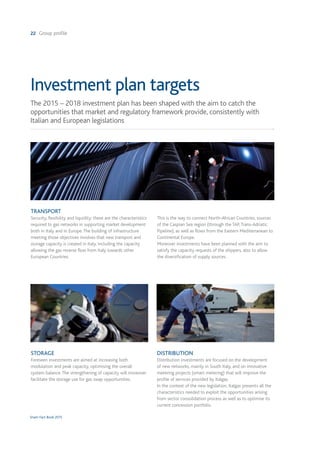
The 2015 – 2018 investment plan has been shaped with the aim to catch the
opportunities that market and regulatory framework provide, consistently with
Italian and European legislations
TRANSPORT
Security, flexibility and liquidity: these are the characteristics
required to gas networks in supporting market development
both in Italy and in Europe.The building of infrastructure
meeting those objectives involves that new transport and
storage capacity is created in Italy, including the capacity
allowing the gas reverse flow from Italy towards other
European Countries.
This is the way to connect North-African Countries, sources
of the Caspian Sea region (through the TAP,Trans-Adriatic
Pipeline), as well as flows from the Eastern Mediterranean to
Continental Europe.
Moreover investments have been planned with the aim to
satisfy the capacity requests of the shippers, also to allow
the diversification of supply sources.
STORAGE
Foreseen investments are aimed at increasing both
modulation and peak capacity, optimising the overall
system balance.The strengthening of capacity will moreover
facilitate the storage use for gas swap opportunities.
DISTRIBUTION
Distribution investments are focused on the development
of new networks, mainly in South Italy, and on innovative
metering projects (smart metering) that will improve the
profile of services provided by Italgas.
In the context of the new legislation, Italgas presents all the
characteristics needed to exploit the opportunities arising
from sector consolidation process as well as to optimise its
current concession portfolio.
Group profile 23
Snam Fact Book 2015
Investment plan
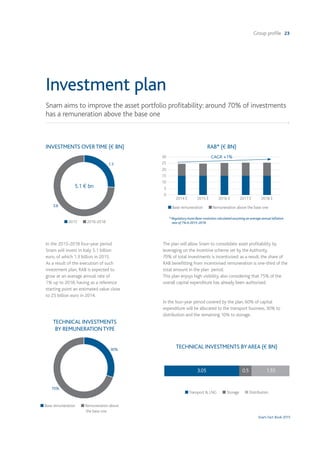
Snam aims to improve the asset portfolio profitability: around 70% of investments
has a remuneration above the base one
In the 2015-2018 four-year period
Snam will invest in Italy 5.1 billion
euro, of which 1.3 billion in 2015.
As a result of the execution of such
investment plan, RAB is expected to
grow at an average annual rate of
1% up to 2018, having as a reference
starting point an estimated value close
to 25 billion euro in 2014.
The plan will allow Snam to consolidate asset profitability by
leveraging on the incentive scheme set by the Authority.
70% of total investments is incentivised: as a result, the share of
RAB benefitting from incentivised remuneration is one-third of the
total amount in the plan period.
This plan enjoys high visibility, also considering that 75% of the
overall capital expenditure has already been authorised.
In the four-year period covered by the plan, 60% of capital
expenditure will be allocated to the transport business, 30% to
distribution and the remaining 10% to storage.
3.8
1.3
5.1 € bn
INVESTMENTS OVERTIME (€ BN)
n 2015 n 2016-2018
n Base remuneration n Remuneration above the base one
30
25
20
15
10
5
0
2014 E 2015 E 2016 E 2017 E 2018 E
RAB* (€ BN)
CAGR +1%
70%
30%
TECHNICAL INVESTMENTS
BY REMUNERATIONTYPE
n Base remuneration n Remuneration above
the base one
TECHNICAL INVESTMENTS BYAREA (€ BN)
3.05 0.5 1.55
nTransport & LNG n Storage n Distribution
* Regulatory Asset Base: evolution calculated assuming an average annual inflation
	 rate of 1% in 2015-2018
24 Group profile
Snam Fact Book 2015
Operating efficiency
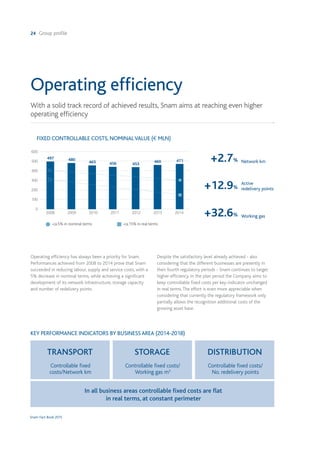
With a solid track record of achieved results, Snam aims at reaching even higher
operating efficiency
600
500
400
300
200
100
0
2008 2009 2010 2011 2012 2013 2014
FIXED CONTROLLABLE COSTS, NOMINALVALUE (€ MLN)
l -ca.5% in nominal terms n -ca.15% in real terms
KEY PERFORMANCE INDICATORS BY BUSINESSAREA (2014-2018)
TRANSPORT
In all business areas controllable fixed costs are flat
in real terms, at constant perimeter
STORAGE DISTRIBUTION
+2.7%
+12.9%
+32.6%
Network km
Active
redelivery points
Working gas
Controllable fixed
costs/Network km
Controllable fixed costs/
Working gas m3
Controllable fixed costs/
No. redelivery points
Operating efficiency has always been a priority for Snam.
Performances achieved from 2008 to 2014 prove that Snam
succeeded in reducing labour, supply and service costs, with a
5% decrease in nominal terms, while achieving a significant
development of its network infrastructure, storage capacity
and number of redelivery points.
Despite the satisfactory level already achieved - also
considering that the different businesses are presently in
their fourth regulatory periods - Snam continues to target
higher efficiency. In the plan period the Company aims to
keep controllable fixed costs per key-indicator unchanged
in real terms.The effort is even more appreciable when
considering that currently the regulatory framework only
partially allows the recognition additional costs of the
growing asset base.
497 480
465 456 453
460 471
Group profile 25
Snam Fact Book 2015
Debt management
Snam has achieved a debt structure aligned with its own needs
and featuring a competitive cost
In line with the features of the operating
businesses and with the reference
regulatory context, Snam aims to
achieve and maintain a well-balanced
debt structure, in terms of proportion
of bonds, bank loans and available
committed credit lines.
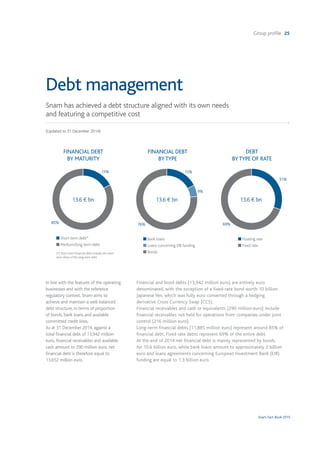
As at 31 December 2014, against a
total financial debt of 13,942 million
euro, financial receivables and available
cash amount to 290 million euro; net
financial debt is therefore equal to
13,652 million euro.
Financial and bond debts (13,942 million euro) are entirely euro
denominated, with the exception of a fixed-rate bond worth 10 billion
Japanese Yen, which was fully euro converted through a hedging
derivative Cross Currency Swap (CCS).
Financial receivables and cash or equivalents (290 million euro) include
financial receivables not held for operations from companies under joint
control (216 million euro).
Long-term financial debts (11,885 million euro) represent around 85% of
financial debt. Fixed rate debts represent 69% of the entire debt.
At the end of 2014 net financial debt is mainly represented by bonds,
for 10.6 billion euro, while bank loans amount to approximately 2 billion
euro and loans agreements concerning European Investment Bank (EIB)
funding are equal to 1.3 billion euro.
FINANCIAL DEBT
BY MATURITY
85%
15%
13.6 € bn
n Short term debt*
n Medium/long term debt
(*) Short-term financial debt includes the short
term share of the long-term debt.
DEBT
BYTYPE OF RATE
69%
31%
n Floating rate
n Fixed rate
FINANCIAL DEBT
BYTYPE
n Bank loans
n Loans concerning EIB funding
n Bonds
13.6 € bn
15%
9%
76%
13.6 € bn
(Updated to 31 December 2014)
26 Group profile
Snam Fact Book 2015
Rating
The «investment grade» credit rating reflects the solid capital structure of Snam
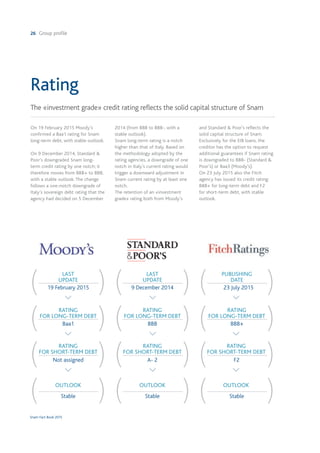
On 19 February 2015 Moody’s
confirmed a Baa1 rating for Snam
long-term debt, with stable outlook.
On 9 December 2014, Standard &
Poor’s downgraded Snam long-
term credit rating by one notch; it
therefore moves from BBB+ to BBB,
with a stable outlook. The change
follows a one-notch downgrade of
Italy’s sovereign debt rating that the
agency had decided on 5 December
2014 (from BBB to BBB-, with a
stable outlook).
Snam long-term rating is a notch
higher than that of Italy. Based on
the methodology adopted by the
rating agencies, a downgrade of one
notch in Italy's current rating would
trigger a downward adjustment in
Snam current rating by at least one
notch.
The retention of an «investment
grade» rating both from Moody’s
and Standard & Poor’s reflects the
solid capital structure of Snam.
Exclusively for the EIB loans, the
creditor has the option to request
additional guarantees if Snam rating
is downgraded to BBB- (Standard &
Poor’s) or Baa3 (Moody’s).
On 23 July 2015 also the Fitch
agency has issued its credit rating:
BBB+ for long-term debt and F2
for short-term debt, with stable
outlook.
LAST
UPDATE
19 February 2015
LAST
UPDATE
9 December 2014
PUBLISHING
DATE
23 July 2015( ( ( ( ( (
RATING
FOR LONG-TERM DEBT
Baa1
RATING
FOR LONG-TERM DEBT
BBB
RATING
FOR LONG-TERM DEBT
BBB+( ( ( ( ( (
RATING
FOR SHORT-TERM DEBT
Not assigned
RATING
FOR SHORT-TERM DEBT
A- 2
RATING
FOR SHORT-TERM DEBT
F2( ( ( ( ( (
OUTLOOK
Stable
OUTLOOK
Stable
OUTLOOK
Stable( ( ( ( ( (
Group profile 27
Snam Fact Book 2015
Financial strategy
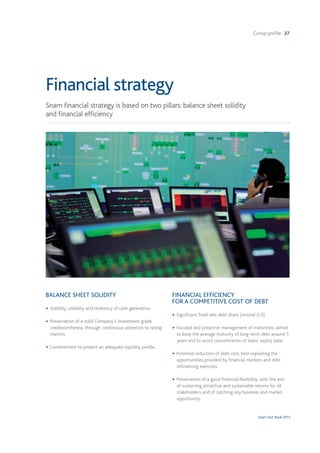
Snam financial strategy is based on two pillars: balance sheet solidity
and financial efficiency
BALANCE SHEET SOLIDITY
• Stability, visibility and resiliency of cash generation.
• Preservation of a solid Company’s investment grade
creditworthiness, through continuous attention to rating
metrics.
• Commitment to protect an adequate liquidity profile.
FINANCIAL EFFICIENCY
FOR A COMPETITIVE COST OF DEBT
• Significant fixed rate debt share (around 2/3).
• Focused and proactive management of maturities, aimed
to keep the average maturity of long-term debt around 5
years and to avoid concentration of loans’ expiry date.
• Potential reduction of debt cost, best exploiting the
opportunities provided by financial markets and debt
refinancing exercises.
• Preservation of a good financial flexibility, with the aim
of sustaining attractive and sustainable returns for all
stakeholders and of catching any business and market
opportunity.
28 Group profile
Snam Fact Book 2015
Shareholder remuneration
At Snam, earnings’ distribution leverages on a solid capital strength
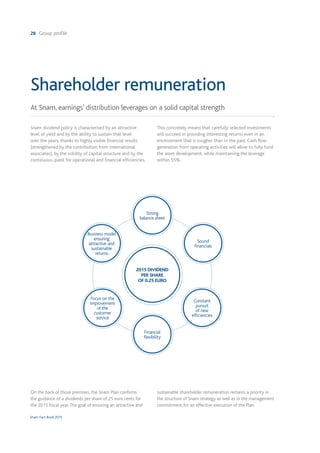
Snam dividend policy is characterised by an attractive
level of yield and by the ability to sustain that level
over the years, thanks to highly visible financial results
(strengthened by the contribution from international
associates), by the solidity of capital structure and by the
continuous quest for operational and financial efficiencies.
This concretely means that carefully selected investments
will succeed in providing interesting returns even in an
environment that is tougher than in the past. Cash flow
generation from operating activities will allow to fully fund
the asset development, while maintaining the leverage
within 55%.
On the back of those premises, the Snam Plan confirms
the guidance of a dividends per share of 25 euro cents for
the 2015 fiscal year.The goal of ensuring an attractive and
sustainable shareholder remuneration remains a priority in
the structure of Snam strategy as well as in the management
commitment for an effective execution of the Plan.
2015 DIVIDEND
PER SHARE
OF 0.25 EURO
Business model
ensuring
attractive and
sustainable
returns
Focus on the
improvement
of the
customer
service
Sound
financials
Constant
pursuit
of new
efficiencies
Strong
balance sheet
Financial
flexibility
Group profile 29
Snam Fact Book 2015
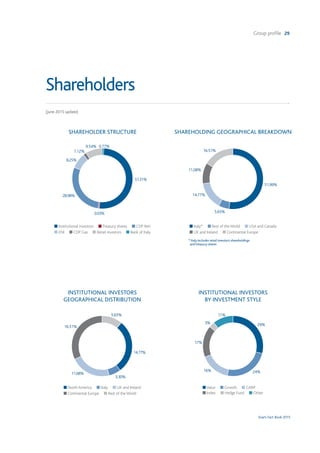
(June 2015 update)
Shareholders
SHAREHOLDER STRUCTURE
INSTITUTIONAL INVESTORS
GEOGRAPHICAL DISTRIBUTION
n Institutional investors nTreasury shares n CDP Reti
n ENI n CDP Gas n Retail investors n Bank of Italy
n NorthAmerica n Italy n UK and Ireland
n Continental Europe n Rest of theWorld
SHAREHOLDING GEOGRAPHICAL BREAKDOWN
n Italy* n Rest of theWorld n USA and Canada
n UK and Ireland n Continental Europe
28.98%
8.25%
51.31%
0.03%
1.12%
9.54%
14.77%
16.51%
14.77%
51.99%
16.51%
11.08%
5.65%
* Italy includes retail investors shareholdings
	 and treasury shares
5.65%
3.30%
11.08%
INSTITUTIONAL INVESTORS
BY INVESTMENT STYLE
nValue n Growth n GARP
n Index n Hedge Fund n Other
	
16% 24%
3%
11%
17%
29%
0.77%
30 Group profile
Snam Fact Book 2015
Business FocusBusiness Focus
32 Business Focus
Snam Fact Book 2015
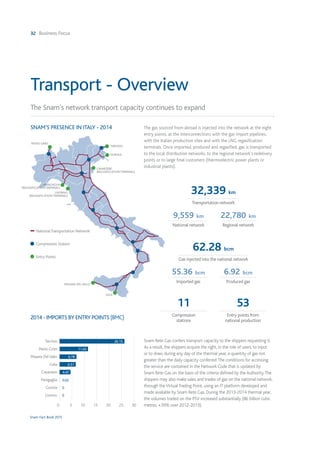
2014 - IMPORTS BY ENTRY POINTS (BMC)
Transport - Overview
The Snam’s network transport capacity continues to expand
The gas sourced from abroad is injected into the network at the eight
entry points, at the interconnections with the gas import pipelines,
with the Italian production sites and with the LNG regasification
terminals. Once imported, produced and regasified, gas is transported
to the local distribution networks, to the regional network's redelivery
points or to large final customers (thermoelectric power plants or
industrial plants).
Snam Rete Gas confers transport capacity to the shippers requesting it.
As a result, the shippers acquire the right, in the role of users, to input
or to draw, during any day of the thermal year, a quantity of gas not
greater than the daily capacity conferred.The conditions for accessing
the service are contained in the Network Code that is updated by
Snam Rete Gas on the basis of the criteria defined by theAuthority.The
shippers may also make sales and trades of gas on the national network,
through theVirtualTrading Point, using an IT platform developed and
made available by Snam Rete Gas. During the 2013-2014 thermal year,
the volumes traded on the PSV increased substantially (86 billion cubic
metres, +39% over 2012-2013).
Tarvisio
Passo Gries
Mazara DelVallo
Gela
Cavarzere
Panigaglia
Gorizia
Livorno
0 5 10 15 20 25 30
26.15
11.43
6.78
6.51
4.47
0.02
0
0
SNAM’S PRESENCE IN ITALY - 2014
TARVISIO
GORIZIA
PANIGAGLIA
(REGASIFICATION TERMINAL)
LIVORNO
(REGASIFICATION TERMINAL)
CAVARZERE
(REGASIFICATION TERMINAL)
PASSO GRIES
MAZARA DEL VALLO
GELA
Compression Station
Entry Points
NationalTransportation Network
32,339 km
Transportation network
9,559 km
National network
22,780 km
Regional network
62.28 bcm
Gas injected into the national network
55.36 bcm
Imported gas
6.92 bcm
Produced gas
11
Compression
stations
53
Entry points from
national production
Business Focus 33
Snam Fact Book 2015
Transport - Investments
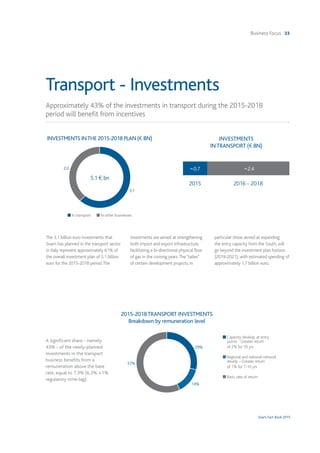
Approximately 43% of the investments in transport during the 2015-2018
period will benefit from incentives
The 3.1 billion euro investments that
Snam has planned in the transport sector
in Italy represent approximately 61% of
the overall investment plan of 5.1 billion
euro for the 2015-2018 period.The
investments are aimed at strengthening
both import and export infrastructure,
facilitating a bi-directional physical flow
of gas in the coming years.The“tailes”
of certain development projects, in
particular those aimed at expanding
the entry capacity from the South, will
go beyond the investment plan horizon
(2019-2021), with estimated spending of
approximately 1.7 billion euro.
A significant share - namely
43% - of the newly-planned
investments in the transport
business benefits from a
remuneration above the base
rate, equal to 7.3% (6.3% +1%
regulatory time-lag).
INVESTMENTS INTHE 2015-2018 PLAN () BN)
n In transport n In other businesses
2.0
3.1
5.1 € bn
INVESTMENTS
INTRANSPORT () BN)
2015 2016 - 2018
~0.7 ~2.4
2015-2018TRANSPORT INVESTMENTS
Breakdown by remuneration level
57%
29%
14%
n Capacity develop. at entry
	 points - Greater return
	 of 2% for 10 yrs
n Regional and national network
	 develp. - Greater return
	 of 1% for 7-10 yrs
n Basic rate of return
34 Business Focus
Snam Fact Book 2015
Transport - Projects
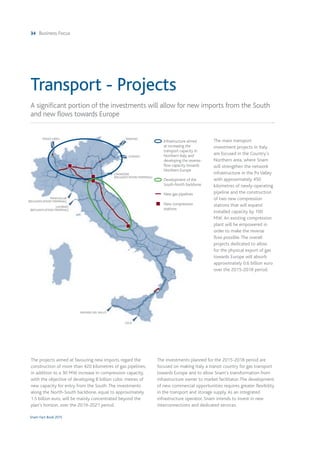
A significant portion of the investments will allow for new imports from the South
and new flows towards Europe
The main transport
investment projects in Italy
are focused in the Country’s
Northern area, where Snam
will strengthen the network
infrastructure in the Po Valley
with approximately 450
kilometres of newly-operating
pipeline and the construction
of two new compression
stations that will expand
installed capacity by 100
MW.An existing compression
plant will be empowered in
order to make the reverse
flow possible.The overall
projects dedicated to allow
for the physical export of gas
towards Europe will absorb
approximately 0.6 billion euro
over the 2015-2018 period.
The projects aimed at favouring new imports regard the
construction of more than 420 kilometres of gas pipelines,
in addition to a 30 MW increase in compression capacity,
with the objective of developing 8 billion cubic metres of
new capacity for entry from the South.The investments
along the North-South backbone, equal to approximately
1.5 billion euro, will be mainly concentrated beyond the
plan’s horizon, over the 2019-2021 period.
The investments planned for the 2015-2018 period are
focused on making Italy a transit country for gas transport
towards Europe and to allow Snam's transformation from
infrastructure owner to market facilitator.The development
of new commercial opportunities requires greater flexibility
in the transport and storage supply.As an integrated
infrastructure operator, Snam intends to invest in new
interconnections and dedicated services.
TARVISIO
GORIZIA
PANIGAGLIA
(REGASIFICATION TERMINAL)
LIVORNO
(REGASIFICATION TERMINAL)
CAVARZERE
(REGASIFICATION TERMINAL)
PASSO GRIES
MAZARA DEL VALLO
GELA
Infrastructure aimed
at increasing the
transport capacity in
Northern Italy and
developing the reverse-
flow capacity towards
Northern Europe
Development of the
South-North backbone
New gas pipelines
New compression
stations
Business Focus 35
Snam Fact Book 2015
During the planning and construction
of gas pipelines, it is becoming
increasingly difficult to avoid
interference with environmental
protection areas distributed across the
entire national territory. Should the
involvement of one of these areas be
unavoidable, Snam identifies the route
with the least impact and employs
alternative techniques to traditional
digging that are less invasive to the
territory.These execution techniques,
known as "trenchless", are of
three types: Horizontal Directional
Drilling (HDD), Micro/Minitunnelling
and Direct Pipe. In using these
techniques, it is possible to construct
underground crossings, without
changing the external landscape or
altering the present ecosystems.
Their application is particularly
useful when crossing riverbeds and
morphologically complex areas or
areas with significant natural value,
where normal open-air digging could
produce a significant environmental
impact.The most recent and
sophisticated technology is Direct
Pipe, which Snam has started to use in
2012 when it constructed the 1,200
millimetry diameter Poggio Renatico-
Cremona gas pipeline.This technique
allows for constructing underground
crossings by combining the potential
of curvilinear microtunnelling with
that of HDD.
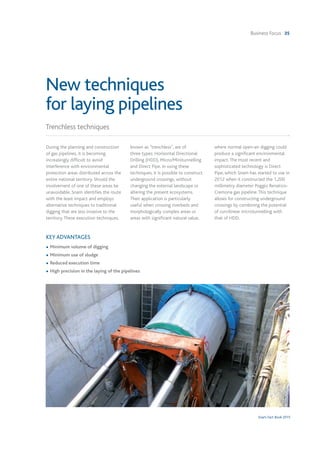
KEY ADVANTAGES
• Minimum volume of digging
• Minimum use of sludge
• Reduced execution time
• High precision in the laying of the pipelines
Trenchless techniques
New techniques
for laying pipelines
36 Business Focus
Snam Fact Book 2015
Stogit, which Snam acquired from eni in 2009, carries out
its activity through an integrated infrastructure system
consisting of fields, gas treatment plants, compression
stations and operational dispatching stations.The storage
activity embodies two distinct phases: the first, generally
during the April-October period, in which natural gas
coming from the national transport network is injected
into the storage fields; the second, during the November-
March period, in which the natural gas is withdrawn from
the storage fields, processed and delivered to users through
the transport network.Thanks to the storage system, it
is possible to fulfil the different requirements between
gas supply and consumption, because the supply flow is
almost constant during the year, whereas demand presents
both seasonality (being mainly concentrated in the winter
months) and volatility features (peaks in demand, even as
a consequence of the greater use of renewable sources).
The other essential function of the storage activity is to
ensure the availability of quantities of strategic gas, with
the objective of facing any interruptions or reductions of
supply, or getting beyond any temporary crises within the
gas system.
In addition to responding to the balancing needs, storage has also the function
of guaranteeing the availability of strategic gas
Storage - Overview
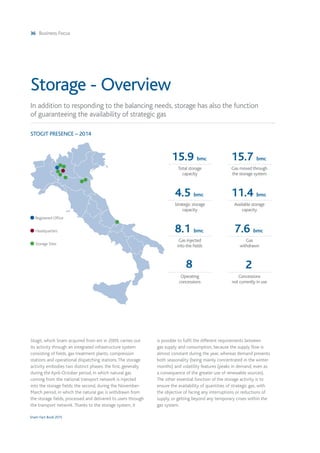
15.9 bmc
Total storage
capacity
4.5 bmc
Strategic storage
capacity
8.1 bmc
Gas injected
into the fields
8
Operating
concessions
15.7 bmc
Gas moved through
the storage system
11.4 bmc
Available storage
capacity
7.6 bmc
Gas
withdrawn
2
Concessions
not currently in use
STOGIT PRESENCE – 2014
Registered Office
Headquarters
Storage Sites
Business Focus 37
Snam Fact Book 2015
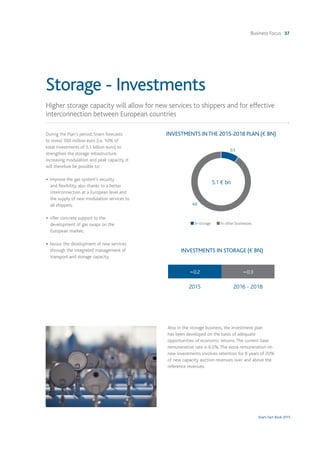
During the Plan’s period, Snam forecasts
to invest 500 million euro (i.e. 10% of
total investments of 5.1 billion euro) to
strengthen the storage infrastructure,
increasing modulation and peak capacity. It
will therefore be possible to:
• improve the gas system's security
and flexibility, also thanks to a better
interconnection at a European level and
the supply of new modulation services to
all shippers;
• offer concrete support to the
development of gas swaps on the
European market;
• favour the development of new services
through the integrated management of
transport and storage capacity.
Also in the storage business, the investment plan
has been developed on the basis of adequate
opportunities of economic returns.The current base
remuneration rate is 6.0%.The extra remuneration on
new investments involves retention for 8 years of 20%
of new capacity auction revenues over and above the
reference revenues.
Storage - Investments
Higher storage capacity will allow for new services to shippers and for effective
interconnection between European countries
INVESTMENTS INTHE 2015-2018 PLAN () BN)
0.5
n In storage n In other businesses
INVESTMENTS IN STORAGE () BN)
2016 - 2018
~0.2 ~0.3
2015
5.1 € bn
4.6
38 Business Focus
Snam Fact Book 2015
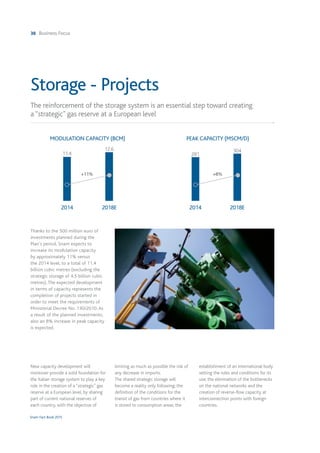
Thanks to the 500 million euro of
investments planned during the
Plan’s period, Snam expects to
increase its modulation capacity
by approximately 11% versus
the 2014 level, to a total of 11.4
billion cubic metres (excluding the
strategic storage of 4.5 billion cubic
metres). The expected development
in terms of capacity represents the
completion of projects started in
order to meet the requirements of
Ministerial Decree No. 130/2010. As
a result of the planned investments,
also an 8% increase in peak capacity
is expected.
New capacity development will
moreover provide a solid foundation for
the Italian storage system to play a key
role in the creation of a “strategic” gas
reserve at a European level, by sharing
part of current national reserves of
each country, with the objective of
limiting as much as possible the risk of
any decrease in imports.
The shared strategic storage will
become a reality only following: the
definition of the conditions for the
transit of gas from countries where it
is stored to consumption areas; the
establishment of an international body
setting the rules and conditions for its
use; the elimination of the bottlenecks
on the national networks and the
creation of reverse-flow capacity at
interconnection points with foreign
countries.
Storage - Projects
The reinforcement of the storage system is an essential step toward creating
a “strategic” gas reserve at a European level
MODULATION CAPACITY (BCM) PEAK CAPACITY (MSCM/D)
2014 2018E 2014
281
2018E
30412.6
+11% +8%
11.4
Business Focus 39
Snam Fact Book 2015
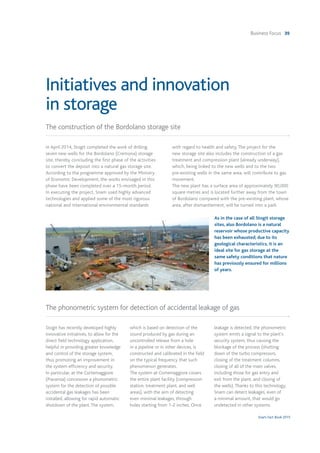
In April 2014, Stogit completed the work of drilling
seven new wells for the Bordolano (Cremona) storage
site, thereby concluding the first phase of the activities
to convert the deposit into a natural gas storage site.
According to the programme approved by the Ministry
of Economic Development, the works envisaged in this
phase have been completed over a 15-month period.
In executing the project, Snam used highly advanced
technologies and applied some of the most rigorous
national and international environmental standards
with regard to health and safety. The project for the
new storage site also includes the construction of a gas
treatment and compression plant (already underway),
which, being linked to the new wells and to the two
pre-existing wells in the same area, will contribute to gas
movement.
The new plant has a surface area of approximately 90,000
square metres and is located further away from the town
of Bordolano compared with the pre-existing plant, whose
area, after dismantlement, will be turned into a park.
Stogit has recently developed highly
innovative initiatives, to allow for the
direct field technology application,
helpful in providing greater knowledge
and control of the storage system,
thus promoting an improvement in
the system efficiency and security.
In particular, at the Cortemaggiore
(Piacenza) concession a phonometric
system for the detection of possible
accidental gas leakages has been
installed, allowing for rapid automatic
shutdown of the plant.The system,
which is based on detection of the
sound produced by gas during an
uncontrolled release from a hole
in a pipeline or in other devices, is
constructed and calibrated in the field
on the typical frequency that such
phenomenon generates.
The system at Cortemaggiore covers
the entire plant facility (compression
station, treatment plant, and well
areas), with the aim of detecting
even minimal leakages, through
holes starting from 1-2 inches. Once
leakage is detected, the phonometric
system emits a signal to the plant's
security system, thus causing the
blockage of the process (shutting
down of the turbo compressors,
closing of the treatment columns,
closing of all of the main valves,
including those for gas entry and
exit from the plant, and closing of
the wells).Thanks to this technology,
Snam can detect leakages, even of
a minimal amount, that would go
undetected in other systems.
As in the case of all Stogit storage
sites, also Bordolano is a natural
reservoir whose productive capacity
has been exhausted; due to its
geological characteristics, it is an
ideal site for gas storage at the
same safety conditions that nature
has previously ensured for millions
of years.
The construction of the Bordolano storage site
Initiatives and innovation
in storage
The phonometric system for detection of accidental leakage of gas
40 Business Focus
Snam Fact Book 2015
With its subsidiaries, Napoletanagas,AES Torino and ACAM
GAS, Italgas is Italy's leading distributor of natural gas to
urban networks.
The distribution service involves the gas distribution through
local pipelines, starting from the points of connection with
the transport networks until the points of redelivery to end-
customers.The service is performed on behalf of the sales
companies authorised to sell gas.
Italgas, which Snam acquired from eni in 2009, manages
an integrated system of infrastructure, mainly self-owned,
comprising gas withdrawal stations, local pipelines,
pressure reduction plants and redelivery points where gas
meters are installed. The system is overseen, 24 h and 365
days a year, by the Integrated Supervision Centre.
Like the storage business, the distribution business
operates under service concessions awarded by local
municipalities.
At the end of 2014, Italgas has a distribution network of
55,278 kilometres and concessions in 1,437 municipalities,
including 1,361 in operation and 76 with networks to
be completed and/or to be built, with some 6.41 million
active gas meters at the points of gas redelivery to end-
customers. Italgas controls about 1/3 of the market in
Italy. More than 75% of the company's operations are in
areas where the company has prominent positioning, with
evident benefits in terms of the cost structure.
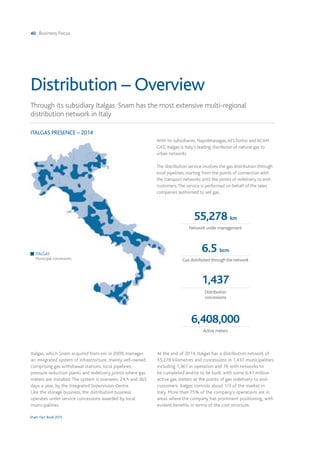
Through its subsidiary Italgas, Snam has the most extensive multi-regional
distribution network in Italy
Distribution – Overview
55,278 km
Network under management
1,437
Distribution
concessions
6.5 bcm
Gas distributed through the network
6,408,000
Active meters
ITALGAS PRESENCE – 2014
ITALGAS
Municipal concessions
Business Focus 41
Snam Fact Book 2015
Snam will invest 1.5 billion euro, representing approximately
29% of the total investments (5.1 billion euro) envisaged in
the Plan, for the execution of two main types of projects: a)
extraordinary maintenance and expansion of the network, b)
Smart metering.
a)	Approximately 900 million euro will be aimed to the
replacement of 800 kilometres of existing gas pipeline and
to the development of the distribution network, with the
addition of new pipelines and the increase in the number
of connections in the current network, for a total of
approximately 1,000 kilometres.The rate of remuneration
set by current regulation for such investments is 6.9%.
b)	Some 450 million euro will be invested in the Smart
metering project. Based on the current regulatory
framework, the rate of remuneration is higher (7.2%) for
these investments.
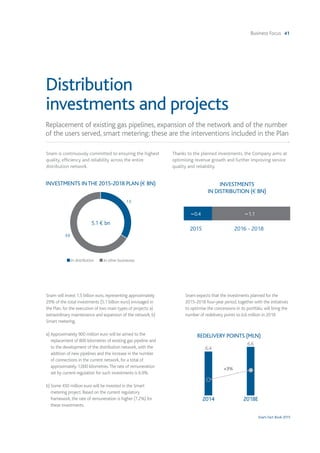
Snam expects that the investments planned for the
2015-2018 four-year period, together with the initiatives
to optimise the concessions in its portfolio, will bring the
number of redelivery points to 6.6 million in 2018
Replacement of existing gas pipelines, expansion of the network and of the number
of the users served, smart metering: these are the interventions included in the Plan
Distribution
investments and projects
Snam is continuously committed to ensuring the highest
quality, efficiency and reliability across the entire
distribution network.
Thanks to the planned investments, the Company aims at
optimising revenue growth and further improving service
quality and reliability.
INVESTMENTS INTHE 2015-2018 PLAN () BN)
n In distribution n In other businesses
3.6
1.5
5.1 € bn
INVESTMENTS
IN DISTRIBUTION () BN)
2015 2016 - 2018
~0.4 ~1.1
REDELIVERY POINTS (MLN)
2014 2018E
6.6
+3%
6.4
42 Business Focus
Snam Fact Book 2015
Distribution
Concession tenders
The imminent consolidation process offers Italgas the opportunity
of strengthening its market share and unlocking further value
In the next four years, the sector in Italy will undergo a
significant transformation.Through Italgas, Snam is ideally
positioned to benefit from a transparent and efficient
process for the assignment of concessions.
The current legislative framework makes it likely an
acceleration in the consolidation process of the gas
distribution sector in Italy, which, according to the newly-
adopted scheme, is based on concessions related to 177 gas
areas (ATEM).
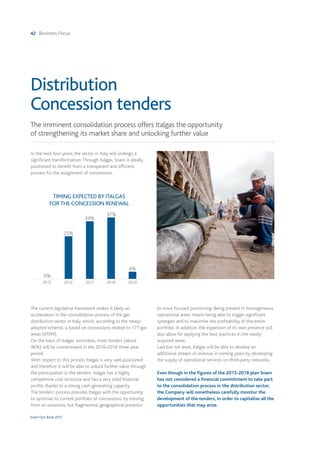
On the basis of Italgas' estimates, most tenders (about
96%) will be concentrated in the 2016-2018 three-year
period.
With respect to this process Italgas is very well positioned
and therefore it will be able to unlock further value through
the participation in the tenders. Italgas has a highly
competitive cost structure and has a very solid financial
profile, thanks to a strong cash-generating capacity.
The tenders’ process provides Italgas with the opportunity
to optimise its current portfolio of concessions, by moving
from an extensive, but fragmented, geographical presence
to more focused positioning. Being present in homogeneous
operational areas means being able to trigger significant
synergies and to maximise the profitability of the entire
portfolio. In addition, the expansion of its own presence will
also allow for applying the best practices in the newly-
acquired areas.
Last but not least, Italgas will be able to develop an
additional stream of revenue in coming years by developing
the supply of operational services on third-party networks.
Even though in the figures of the 2015-2018 plan Snam
has not considered a financial commitment to take part
to the consolidation process in the distribution sector,
the Company will nonetheless carefully monitor the
development of the tenders, in order to capitalise all the
opportunities that may arise.
TIMING EXPECTED BY ITALGAS
FORTHE CONCESSION RENEWAL
2015 2016 2017 2018 2019
25%
0%
4%
37%
34%
Business Focus 43
Snam Fact Book 2015
Distribution
Smart Metering and GasToGo
An innovative metering management platform
The GasToGo project
Consistent with the sector regulation
promoted in Europe (Energy Efficiency
Directive) and at a national level
(AEEGSI regulation on the responsibility
of metering and on the Smart Metering
execution plan), Italgas has been the
first distributor to adopt sophisticated
technologies for its meters, inaugurating
in 2009 a project known as “Smart
metering of gas redelivery points”.
The test phase, which involved more
than 10 meter suppliers and more
than 5,000 residential redelivery
points, implied a careful evaluation of
applications and technological solutions
on the market, aimed at identifying
suppliers with technological skills and
innovation capacity to support the
company in implementing smart-
metering IT systems.
The release of the new “Automatic
Meter Management” (AMM) and
“Meter Data Management” (MDM)
systems, inclusive of all functions
needed for managing industrial and
commercial customers, was completed
in August 2013 (first version:
November 2012). Over the two-year
period, the project involved more than
200 employees nationwide, for a total
commitment of more than 10,000 Full
Time Equivalent (FTEs).
The solution developed allows for
scalability of the measurement data in
terms of size and granularity, so as to
be able to manage also the volumes
related to the residential market.
The 100,000 meters already managed
will be flanked by those for the
residential market (approximately 4
million users according to forecasts
from the Italian Authority AEEGSI).
In addition to the scalability,
Italgas is expanding the Work Force
Management system, with the
objective of using a single tool to
manage and optimise the installation,
configuration and maintenance
processes for the meters in the field.
The report "Status Review of
Regulatory Aspects of Smart
Metering", published by the Council of
European Energy Regulators (CEER) in
2013, which verified the application
of the best-practice guidelines for
smart meters that were approved in
February 2011, indicated Italy as the
European country with the highest
presence of smart measurement
systems.
In 2012, Italgas launched “GasToGo”, a new app developed for
tablets, which, being integrated with corporate and consumer
applications, is allowing for significant increase in operating
efficiency, cost reduction, and service quality.Thanks to
GasToGo, Italgas manages over 3 million activities, handled
by employees and outside service providers, including around
2 million at customer and the remainder for maintenance
and emergencies.The personnel involved gets a daily list
of activities, delivered directly to their tablets, based on an
optimised path; they can reference multimedia documents,
georeference the network assets and work with others through
email, chats and video calls.
As a result, the reporting times have been cut from 20 days to
1 day; previous paper-based processes have been transformed
to digital processes with savings of more than 5 tonnes of
paper per year; the distances travelled have been reduced by
30%, from an average of 14.9 kilometres to 10.6 kilometres
for each activity, with consequent decline of CO2
emissions;
the productivity of the personnel involved has also increased
by 100%.
GasToGo, which won the SMAU Mob App Award 2013, is still
undergoing development, through direct integration with smart-
metering devices and with new augmented reality features.
44 Business Focus
Snam Fact Book 2015
LNG - Overview
GNL Italia contributes to the diversification of the sources and flexibility of supply
for the Italian system
The regasification represents the
final activity in the liquefied natural
gas (LNG) chain. In the exporter
country, the natural gas extracted
from the fields, is liquefied at a
temperature of -160°C in order to
allow for its transport via tanker to the
regasification terminal. Once offloaded
from the tanker, the LNG is heated
and returned to the gaseous state in
order to be injected into the transport
network.
The regasification service therefore
also includes the offloading of the LNG
from the tanker, the operational storage
(i.e. storage for the time needed to
vaporise the LNG), its regasification and
injection into the national network.
The Panigaglia terminal, which was built
in 1971 and is owned by GNL Italia, is
able to regasify 17,500 cubic metres of
LNG per day; with optimal operational
conditions, it can annually inject more
than 3.5 billion cubic metres of natural
gas into the transport network.
In 2014, only one LNG tanker docked
at Panigaglia for a total of regasified
gas of 0.01 billion cubic metres; in
Europe, the quantity of imported LNG
has dramatically fallen in recent years,
due to both a decrease in consumption
and the lesser competitiveness of
LNG compared with gas imported
via pipeline and coal. In view of this
backdrop, there are two specific trends
developing at an international level:
ever increasing exports of LNG to
the Asian markets, which are more
profitable than the European ones,
and growing sales of LNG used as
fuel for road and sea transport, as
it results in cost reduction and a
lower environmental impact, thereby
complying with the guidelines of
European directives on pollution.
17,500 m3
Maximum daily LNG regasification
capacity of the Panigaglia terminal
3.5 bcm
Maximum annual quantity of natural gas
injectable into the transport network
GNL ITALIA PRESENCE - 2014
Panigaglia
GNL ITALIA
Regasification terminal
Business Focus 45
Snam Fact Book 2015
Snam aims to optimise the returns that its international
shareholdings can generate.With reference to the North-
South corridor, Snam is committed to a close working
relationship with Fluxys in order to maximise the value of
investment opportunities and commercial activities.
Snam will also closely monitor the marketplace in order
to capture possible opportunities to complete its exposure
to the North-South and East-West corridors. Snam has a
15.5% stake in Prisma, the European “capacity” IT platform
aimed at promoting the harmonisation of access rules and
service providing and facilitating the creation of a single
European natural gas market.
Snam is leveraging the strategic position of the Italian network to intercept
the new flows of gas coming from South to Europe
International development
Overview
The strategy outlined in the 2015-2018 plan is clear: focus
on the two European gas corridors connected to the Italian
infrastructure, in order to play a leading role in the integration
of European gas infrastructure.
n LNG terminal n National Networks n InternationalAssets
Snam holding
40.5%
Snam holding
31.5%
in joint venture with Fluxys (50%-50%)
Snam holding
15.5%
Snam holding
84.47% *
* Equal to 89.22%
of economic rights
Snam aims to optimise the returns that its international
shareholdings can generate.With reference to the North-
South corridor, Snam is committed to a close working
relationship with Fluxys in order to maximise the value of
investment opportunities and commercial activities.
Snam will also closely monitor the marketplace in order
to capture possible opportunities to complete its exposure
to the North-South and East-West corridors. Snam has a
15.5% stake in Prisma, the European “capacity” IT platform
aimed at promoting the harmonisation of access rules and
service providing and facilitating the creation of a single
European natural gas market.
Snam is leveraging the strategic position of the Italian network to intercept
the new flows of gas coming from South to Europe
Overview
The strategy outlined in the 2015-2018 plan is clear: focus
on the two European gas corridors connected to the Italian
infrastructure, in order to play a leading role in the integration
of European gas infrastructure.
n LNG terminalLNG terminalLNG terminal n National Networks n InternationalAssets
Snam holding
40.5%
Snam holding
31.5%
in joint venture with Fluxys (50%-50%)
Snam holding
15.5%
Snam holding
84.47% *
* Equal to 89.22%
of economic rights
46 Business Focus
Snam Fact Book 2015
The shareholding in TIGF offers Snam strategically important
opportunities: in addition to the key presence along the
East-West energy corridor, the possibility of diversifying
regulatory and country risk. Furthermore, being at the centre
of significant changes,TIGF presents interesting potential in
terms of future development.
Actually, France currently does not have a structure in line
with the requisites for European integration, as its gas sector
is divided into three different markets and balancing areas. In
May 2014, the French energy regulator (CRE) outlined a two-
step process that will lead to the gas system's development
in accordance with European guidelines, while also improving
its liquidity.
In the first phase, in 2015, a single market area,Trading
Region South (TRS), from the combination of TIGF and
GRTgaz Southern PEG (Point d’Échange de Gaz) has been
created, with the maintenance of two distinct balancing
points. In the second phase, by 2018, the full integration of
the French market is expected, also following the completion
of new infrastructure linking the two zones.
This evolution will have a positive impact on TIGF.
In the storage business, the competitive conditions
will improve due to the elimination of the current
interconnection costs.
In the transport business, it is likely that additional investments
will be incentivised, in order to unify the French market and
achieve better interconnection with the Spanish market.
In the 2015-2018 period, Snam estimates that TIGF will
bring an incremental yearly contribution to earnings per
share of around 2%.The current expectation is that more
than 80% of the initial investment will be repaid by 2023.
TIGF will be the focal point of significant changes in the French market
International development
Focus onTIGF
NORTHERN PEG
PEG FRANCE
TRADING REGION
SOUTH (TRS)
2015 2018
Business Focus 47
Snam Fact Book 2015
With the acquisition of TAG, the Snam
portfolio has been enriched with an
important transport infrastructure, with
an overall network of 1,140 kilometres.
The network allows for Russian gas
coming from the Slovakian border to
cross through Austria and come to Italy.
As in the case of TIGF, the shareholding
in TAG offers Snam the possibility of
diversifying regulatory and country risk.
TAG, which is strategically positioned for
the integration of the East-West corridor,
provides Snam with the opportunity
of creating reverse-flow capacity to
Southern Germany and Eastern Europe.
TAG, which is subject to Austrian regulation, is operating in a
regulatory period that ends in 2016.TAG's cash flow has strong
visibility, considering that a large part of annual revenue comes from
long term ship-or-pay contracts, expiring in 2022. In making available
its long track record, Snam will also be able to support TAG in the
search for additional operating efficiencies.
Despite the impact in the short term of the capital increase fully
dedicated to CDP Gas for the payment of the TAG acquisition (end of
2014), Snam does not expect the transaction to be dilutive, not even
in the first year; on the contrary Snam expects that it will produce an
annual average 2%-3% earnings per share accretion over the 2015-
2018 period.
The dividends expected from TAG are estimated to repay by 2023 up
to around 90% of the initial equity investment.
Thanks to the shareholding in TAG, the reverse-flow to Southern
Germany and Eastern Europe will be possible
International development
Focus onTAG
Slovakian/Austrian
Border
Austrian/Italian
Border
48 Business Focus
Snam Fact Book 2015
In 2014, Snam provided work to 970 companies, signing
1,573 supply contracts for a total value of 1.17 billion euro.
The supply chain therefore has important implications
for both the quality of Snam's businesses and the effects
on the suppliers involved. In order to favour an ever
clearer, transparent and responsible relationship with
its counterparties, in 2013 Snam launched the Supplier
Portal, the web-based platform designed to optimise
the operations of the supply chain; it has since been
continuously enhanced with new sections.
In 2014, more than 83,000 visitors accessed the portal for
a total of 221,000 times.
As regards the management of the strategic supply chain,
further enhancements to the Supplier Portal are among the
priorities identified for the 2015-2018 period.
Suppliers Portal
Transparency and quality
The Italian gas market is characterised by a constant
upward trend in the number of operators. In 2014, the
number of users active in transportation rose from 108
to 134 (+24%); during the same year, 45 connection
agreements have been signed for the creation of new
delivery/redelivery points.
Current rules, which allow operators to carry out gas
exchanges by purchasing transportation capacity also on
a daily basis (not only over a time horizon of a year or
many years as in the past), have led to an increase in the
frequency of transactions.
Over time Snam has developed IT systems and web portals
to manage exchanges among operators and relations
between the Company and the operators, continuously
developing these tools in relation to changing needs.
During 2014, systems to improve management linked
to the Balancing Scheme were developed together with
users of the web portals. In addition, new functions were
introduced, which, on the basis of information provided by
distribution companies, make it possible to assess the so-
called Appropriate Capacity allowing users to monitor their
balancing position to protect the gas system.
In 2014, Snam also created the ServiRe Portal, a new
platform dedicated to the transport sector that supports
the following aspects:
• activities of termination and opening the transport
network's Redelivery Points;
• activities in preparation for the organisation and
activation of an alternate supply service (using canister
trucks), due to transportation service interruptions;
• management of users of the transportation service,
distribution companies and owners of plants connected
to the methane pipeline network that are available
24-hours a day.
With the launch of the new Portal, a well-defined channel
of communication has been created and the real-time
monitoring of progress made on requests, thereby
simplifying the related activities for users.
ServiRe Portal
Business Focus 49
Snam Fact Book 2015
Snam has always put infrastructure security first, encouraging
the continuous growth of technical and operational knowledge
that will ensure service continuity.
For this reason, plants and pipelines regularly undergo
inspections and maintenance operations. In 2014, 1,950
kilometres of the transport network were inspected using
intelligent pigs, while 15,700 kilometres were monitored with
helicopter fly-overs.The dispatching centre, which regulates
and controls the national gas transport system, was completely
revamped at the end of 2012, with regard to both its structure
and the technologies employed. Finally, at a distribution level,
in 2014 Snam monitored 8,190 significant points of the
network and took over 30,000 specific measurements, having
also inspected 22,000 kilometres of pipeline.
Snam is continuously committed to
promoting the protection of health
and safety in workplaces, with the
objective of preventing accidents.
The “Objective Safety” project is
a programme designed to reduce
accidents and injuries at work.
Launched in 2010, the project
has already produced significant
improvements, thanks to the greater
responsibility of employees.
Aside from specific and systematic
training initiatives, the project
includes: the development of activities
involving all staff, with particular
attention to operating personnel; the
promotion of the information about
risks and communication campaigns
about security; the continuation of the
"Security Trophy" and "Zero Accidents"
competitions; the implementation
of targeted controls.The project
also includes a "Security Trophy for
Subscontractors" as an initiative to
involve contractors and increase their
awareness of safety.
In 2014, Snam delivered 53,433 hours
of health and safety training (+54.3%
compared with 2013) involving a total
of 5,886 employees.
The health of Snam's employees
is also safeguarded through the
continuous monitoring of risk
elements within the business
processes and through adequate
prevention and protection measures.
Snam's employees are not subject to
high risks of work-related illnesses.
However, the personnel exposed
to specific risk factors periodically
undergo check-ups by specially
trained physicians. In 2014, there were
2,630 doctor’s visits, 2,387 regular
doctor’s visits and 532 environmental
investigations.
Infrastructure safety
“Objective Safety” project in the workplace
Safety
2012 2013 2014
1.51
4.30
2.60
1.91
1.51 1.49
5
4.5
4
3.5
3
2.5
2
1.5
1
0.5
0
n Employees n Contractors
ACCIDENTSATWORK – FREQUENCY INDEX* * Number of non-commuting accidents, with incapacity
of at least one day, per million hours worked.
50 Business Focus
Snam Fact Book 2015
Snam has consistently prioritised the safeguarding of the
natural value of local areas where it develops new works.
Preliminary investigations of the areas help to define
and implement the most appropriate design choices
for reducing the impact on biodiversity to a minimum;
upon completion of its projects, Snam carries out the
environmental restoration, followed by monitoring of the
most significant habitats.
In 2014, Snam has performed restoration of over 78
kilometres, environmental monitoring for more than 1,050
kilometres, and reforestation of more than 16 kilometres.
The continuation of restoration and environmental
monitoring is also among the Company's targets for the
2015-2018 period.
In May 2015, at the Turin International Book Exibition,
Snam presented the third volume of the “Sentieri
Sostenibili” (“Sustainable Paths”) series, promoted by
Snam itself in collaboration with Il Sole 24 Ore Cultura.
The book illustrates the integration between energy
infrastructure and environment in the 74,000 hectare
area of the Parco della Majella, in Abruzzo, presenting
the experience shared by Snam and the Park in the
construction of the Campochiaro-Sulmona gas pipeline,
that allows the gas coming from Algeria and Libya
to flow across the Italian Peninsula. Snam has built
the infrastructure following stringent environmental
protection standards: the gas pipeline that was laid over 15
kilometres of parkland is invisible. The Parco della Majella,
in the heart of the Apennines, is home to unique animal
and plant species.
Snam's operating activities entail the emission of
greenhouse gases (GHG) into the atmosphere, in the
form of carbon dioxide (CO2
) and methane (CH4).
Snam has chosen gas as its main fuel (accounting
for 93.8% of its total energy consumption) since the
combustion of gas produces a lower quantity of CO2
compared with petroleum products and coal.
In addition, the Company has long launched a series of
Energy Management initiatives aimed to contain natural
gas emissions and energy consumption and to increase
the energy produced from renewable sources.
Snam's renewable energy plants include 1 wind
generator and 951 photovoltaic plants. Total energy
produced increased significantly, rising from 202,259
kWh in 2013 to 477,213 kWh in 2014 (+136%), thanks
both to the 149 plants installed in 2014 and to the
connection of plants installed in prior years that had not
been connected to the network yet.
With the achievement, a year in advance, of all the Energy
Management goals set in 2010, in 2014 new performance
indicators were established, with specific characteristics for
various company sectors, in order to provide continuity to
the monitoring of the initiatives. In the 2015-2017 period,
Snam targets, in particular, to install further 580 kW of new
cumulative photovoltaic capacity, which will allow the Group
to produce around 420,000 kWh/year by 2018.
Safeguarding of the value of nature
Energy Management initiatives
Initiatives for the environment
2014 Change
vs. 2013
Total GHG emissions
(direct Scope 1,
indirect Scope 2 and Scope 3)
2.34 mln t -9.1%
Direct CO2eq
emissions
(Scope 1)
1.98 mln t -9.3%
Direct emissions
of natural gas
95.0 mln m3
-3.8%
Energy
consumption
8,858 TJ -22.8%
Performance
52 Performance
Snam Fact Book 2015
Main elements
of the tariff framework
Clear and stable criteria are the premise for visible returns over time
Gas infrastructure in Italy is subject to regulation by the
Authority for Electricity Gas and Water, an independent
governmental body with regulatory and control powers.
The Authority generally promotes the proper functioning
of the market and competitiveness in energy prices to the
benefit of final consumers. In infrastructure management,
the Authority’s efforts are focused on three main areas of
regulation:
Since its establishment, Snam has set up a constructive
relationship with the Regulator, which has cultivated over
time, leveraging a solid base of mutual respect.
The dialogue is continuous and goes beyond the occasions
implied by the tariff review process, with the aim of
contributing to providing information useful to the
definition of a clear and effective regulatory environment.
In Italy the regulatory framework is based on well
established principles that are uniformly applied to all of
Snam’s activities, notwithstanding some differences due to
the peculiarities of the individual business.
As shown by the chart on page 12, the new regulatory period
for the transport, regasification and distribution businesses
began in January 2014.The regulatory period for the storage
business started in January 2015.
Snam can therefore count on a clear framework, which
provides future cash-flow visibility through 2020.
RAB, calculated at the beginning of each regulatory
period and updated annually.
WACC, i.e. the return on RAB, fixed for the whole
regulatory period with an interim update of the risk-
free rate to incorporate changes occurring in market
conditions.
Allowed depreciation, reflecting the economic life of the
assets.
Allowed operating expenses.
Lastly, the regulatory framework also sets reference
revenues, which take into account the above mentioned
elements, during the regulatory periods lasting 4-6 years.
it defines the criteria
and evaluates tariff proposals
Revenues and tariffs
it approves contractual provisions
included in the network and service codes
Third-party access
to infrastructure
it sets the standards
and controls performance
Service quality
REGULATORY ITEMS
Performance 53
Snam Fact Book 2015
Structure of reference revenues
Revenues and tariffs have the most relevant impact on earnings
1 The allowed REMUNERATION, calculated by multiplying the weighted
average cost of capital (WACC) by the Regulatory Asset Base (RAB);
2 The allowed DEPRECIATION, calculated on the basis of the economic-
technical life of assets, set for regulatory purposes;
3 The allowed OPERATING EXPENSES, as reported in the financial
statements, increased by the opportunity of retaining a part of the
efficiency achieved in excess of that required during the regulatory period.
Reference revenues are calculated at the beginning of each regulatory period as sum of three main aggregates:
Each year, the RAB remuneration and
depreciation are updated according to the
evolution of the RAB itself, while operating
expenses are updated according to the price-
cap methodology, as reflected in the «RPI
– X» formula, i.e. Retail Price Index less the X
factor, which expresses expected savings due
to efficiency.
REFERENCE REVENUES
REMUNERATION
(RAB * WACC)
DEPRECIATION OPERATING EXPENSES
RAB based
on the revalued historical
cost methodology
Straight-line
depreciation
Actual operating expenses
as reported in the financial
statements in the reference year
Pre-tax WACC
in real terms, calculated
according to the CAPM
Reference
to the technical-economic
life of the assets
Sharing 50%
of earnings achieved for
higher-than-required efficiency
Higher-than-baseline
returns for new investments
Gas used in the compression
stations recognised
as a pass-through cost
+ +( ( (( ( (
( ( (( ( (
( ( (( ( (
( (( (
54 Performance
Snam Fact Book 2015
Rate of return on capital
A stable calculation base, which nonetheless allows for possible changes
in financial market conditions
The returns presently allowed by the Authority, which the
table details according to the main underlying parameters,
are calculated on the base of the CAPM (Capital Asset Pricing
Model), which is the most widely used methodology for valuing
the expected return of a business according to its risk profile.
The rate of return is stated in real terms on a pre-tax basis.
Transport Storage Distribution Regasification
Beta levered 0.57 0.80 0.63 0.83
Market risk premium 4% 4% 4% 4%
Cost of Equity 6.7% 6.5% 6.9% 7.8%
Risk-free rate 4.41% 3.35% 4.41% 4.53%
Spread 0.45% 0.45% 0.45% 0.45%
Cost of debt 4.86% 3.80% 4.86% 4.98%
Tax shield 27.5% 27.5% 27.5% 27.5%
Net cost of Debt 3.52% 2.76% 3.52% 3.61%
Leverage (Debt/Debt+Equity) 44.4% 44.4% 44.4% 44.4%
WACC nominal post-tax 5.3% 4.9% 5.7% 6.0%
Inflation 1.8% 1.5% 1.8% 1.8%
Tax rate 35.7% 35.7% 35.7% 35.7%
WACC real pre-tax* 6.3% 6.0% 6.9% 6.3%
* Excluding extra-remuneration and time-lag compensation
Transportation* Storage Distribution* Regasification*
Additional return
on new investments
WACC +1% on new
investments carried out after
31 December 2013 to offset
the regulatory lag
1% over 7 years
(regional network
development investments)
1% over 10 years
(national network
development investments)
2% over 10 years
(entry point development
investments)
4% over 8 years
(on expansions of existing
capacity)
4% over 16 years
(on the development
of new storage fields)
As of 1 January 2015
Retention for 8 years of 20%
of new capacity auction
revenues over and above the
reference revenues
Incentives relating
to service quality
WACC +1% on new
investments carried out after
31 December 2013 to offset
the regulatory lag
2% over 16 years
(new terminals or increasing
capacity at existing terminals
by more than 30%)
Efficiency factor
(X FACTOR)
2.4% on operating costs 0.6% on operating costs
As of 1 January 2015:
1.4% on operating costs
1.7% on distribution
operating costs
0.0% on metering
operating costs
0.0% on operating costs
* The tariff framework in force provides for theWACC to be revised halfway through the regulatory period.
Performance 55
Snam Fact Book 2015
Operational metrics
Key operating figures (a
)
a.	The changes shown in the table, as well as those below in this
Report, must be regarded as changes from 2013 to 2014.
Percentage changes, unless otherwise specified, are calculated in
relation to the data shown in the related tables.
b.	Gas volumes are expressed in standard cubic metres (SCM) with
an average higher heating value (HHV) of 38.1 and 39.2 MJ/
SCM respectively for the businesses of natural gas transportation,
regasification and storage.
c.	 Data for 2014 are correct as at 31 January 2015. Data for 2013
have been aligned with data published by the Ministry of Economic
Development.
d.	Working gas capacity for modulation,mining and balancing services.
The available capacity at 31 December 2014 is that declared to the
Electricity,Gas andWaterAuthority at the start of the 2014-2015
thermal year,in compliance with ResolutionARG/gas 119/10.
e.	 The 2014 operating figures include those attributable to A.E.S..
f.	 This figure refers to the kilometres of network operated by Italgas.
g.	Fully consolidated companies.
h.	Following the incorporation of Gasrule Insurance Ltd into Snam’s
scope of consolidation, the“Corporate” segment was renamed
“Corporate and other activities”.
2012 2013 2014 Change %
Change
Natural gas transportation (b)
Naturalgasinjectedintothenationalgastransportationnetwork(billionsofcubicmetres)(c) 75.78 69.00 62.28 (6.72) (9.7)
Gas transportation network (kilometres in use) 32,245 32,306 32,339 33 0.1
Installed power in the compression stations (MW) 864.1 866.9 893.9 27.0 3.1
Liquefied Natural Gas (LNG) regasification (b)
LNG regasification (billions of cubic metres) 1.12 0.05 0.01 (0.04) (80.0)
Natural gas storage (b)
Available storage capacity (billions of cubic metres) (d) 11.2 11.4 11.4
Natural gas moved through the storage system (billions of cubic metres) 15.63 18.42 15.70 (2.72) (14.8)
Natural gas distribution (e)
Active meters (millions) 5.907 5.928 6.408 0.480 8.1
Gas distribution concessions (number) 1,435 1,435 1,437 2 0.1
Distribution network (kilometres) (f) 52,586 52,993 55,278 2,285 4.3
Employees in service at period end (number)
Employees in service at period end (number) (g) 6,051 6,045 6,072 27 0.4
by business segment:
- Transportation 1,978 1,952 1,874 (78) (4.0)
- Regasification 78 79 77 (2) (2.5)
- Storage 307 303 291 (12) (4.0)
- Distribution 3,016 3,008 3,124 116 3.9
- Corporate and other activities (h) 672 703 706 3 0.4
56 Performance
Snam Fact Book 2015
Income Statement figures
Income Statement
(€ million ) 2012 2013 2014 Change %
Change
Regulated revenue 3,477 3,491 3,506 15 0.4
Non-regulated revenue 144 38 60 22 57.9
Total revenue (*) 3,621 3,529 3,566 37 1
Operating costs (*) -804 -726 -790 -64 8.8
EBITDA 2,817 2,803 2,776 -27 -1
Amortisation, depreciation and impairment losses -706 -769 -803 -34 4.4
EBIT 2,111 2,034 1,973 -61 -3
EBIT adjusted 2,111 2,060 1,973 -87 -4.2
Net financial expense -794 -472 -397 75 -15.9
Net income from equity investments 55 45 131 86
Pre-tax profit 1,372 1,607 1,707 100 6.2
Income taxes -593 -690 -509 181 -26.2
Net profit (**) 779 917 1,198 281 30.6
Adjusted net profit (**) 992 934 1,078 144 15.4
(*)	 From 1 January 2014 and only for the reclassified income statement, revenue from the construction and upgrading of distribution infrastructure entered in accordance
with IFRIC 12 and recognised in an amount equal to the costs incurred (€ 316 million in 2014) is shown as a direct reduction of the respective cost items. The corresponding
amounts for the previous years (€ 319 million in 2013 and € 325 million in 2012) were reclassified accordingly.
(**)	 Net profit is attributable to Snam.
Performance 57
Snam Fact Book 2015
Balance Sheet figures
Reclassified balance sheet
Consolidated Balance Sheet
(€ million) 31.12.2013 31.12.2014 Change
Fixed capital 18,016 18,925 909
Property, plant and equipment 3 4 1
Intangible assets 13 14 1
Equity investments 8,197 8,696 499
Financial receivables held for operations (*) 9,833 10,241 408
Net receivables (payables) for investments -30 -30
Net working capital 129 69 -60
Provisions for employee benefits -16 -19 -3
NET INVESTED CAPITAL 18,129 18,975 846
Shareholders’ equity 6,440 6,885 445
Net financial debt 11,689 12,090 401
COVERAGE 18,129 18,975 846
(*) Includes short-term portions
(€ million) 2012 2013 2014
ASSETS
Tangible assets 14,885 15,214 15,762
Intangible assets 4,593 4,710 5,076
Equity-accounted investments 473 1,024 1,402
Other non-current assets 130 147 167
Total non-current assets 20,081 21,095 22,407
Inventories 202 156 155
Trade receivables and other receivables 2,048 2,442 2,081
Cash and cash equivalents 15 2 74
Other current assets 215 118 166
Total current assets 2,480 2,718 2,476
Assets held for sale 23 23 23
Total assets 22,584 23,836 24,906
LIABILITIES AND SHAREHOLDERS' EQUITY
Group shareholders' equity 5,916 5,994 7,172
Trade payables 764 1,047 816
Financial liabilities 12,413 13,328 13,942
Other Liabilities 3,491 3,467 2,976
Total liabilities and shareholders' equity 22,584 23,836 24,906
RAB (€ BILLION)
23.3 24.0 24.7
2012 2013 2014E
30
25
20
15
10
5
0
NET FINANCIAL DEBT
(€ BILLION)
12.4 13.3 13.6
2012 2013 2014
16.0
14.0
12.0
10.0
8.0
6.0
4.0
2.0
0
58 Performance
Snam Fact Book 2015
Cash flow
Reclassified Statement of Cash Flows
(€ million) 2012 2013 2014
Net profit 779 917 1,198
Adjusted for:
- Amortisation, depreciation and other non-monetary components 652 725 670
- Net capital losses (capital gains) on asset sales and eliminations -13 3 20
- Interest and income taxes 959 1,094 840
Change in working capital due to operating activities -218 46 -88
Dividends, interest and income taxes collected (paid) -1,198 -1,087 -1,111
Net cash flow from operating activities 961 1,698 1,529
Technical investments -1,215 -1,187 -1,283
Equity investments (*) -135 -599 -5
Change in scope of consolidation and business units -905 -14 -10
Divestments 963 29 10
Other changes relating to investment activities -59 -19 56
Free cash flow -390 -92 297
Change in financial receivables not held for operations -216
Change in short- and long-term financial debt 1,214 920 490
Equity cash flow (**) -811 -841 -505
Effect of the change in scope of consolidation 6
Net cash flow for the period 13 -13 72
(*)	 With regard to the acquisition of the equity investment inTAG from CDP Gas S.r.l.(CDP GAS) for a total contractual amount of €505 million,only the cash portion of the sum
paid by Snam to CDP GAS (€ 3 million) is recorded in the 2014 statement of cash flows.The capital increase, including the share premium, was worth € 502 million.
(**)	 The dividend paid in 2014 refers to the balance of the 2013 dividend (€ 507 million). Snam did not pay out an interim dividend in 2014.
TECHNICAL INVESTMENTS (€ MILLION)
1,215 1,187
1,283
2012 2013 2014
1,400
1,200
1,000
800
600
400
200
0
FREE CASH FLOW (€ MILLION)
-390 -92
297
2012 2013 2014
400
300
200
100
0
-100
-200
-300
-400
Performance 59
Snam Fact Book 2015
The contribution from equity investments
Investments in companies
under joint control
31.12.2014
TIGF Holding
S.A.S.
TransAustria
Gasleitung GmbH (*)
Toscana Energia
S.p.A.
GasBridge
1 and 2 B.V.
Current assets 85 85 46 26
- of which cash and cash equivalents 15 55
Non-current assets 2,805 1,044 693 228
Total assets 2,890 1,129 739 254
Current liabilities -360 -285 -126
- of which current financial liabilities -360 -242 -96
Non-current liabilities -1,274 -299 -238
- of which non-current financial liabilities -1,274 -132 -123
Total liabilities -1,634 -584 -364
Shareholders’ equity 1,256 545 375 254
Equity interest held by the group (%) 45% 89.22% 48.08% 50%
Share attributable to the group 565 486 180 127
Other adjustments -17
Book value of the equity investment 565 486 163 127
Revenue 418 138
Operating costs -156 -36
Amortisation, depreciation and impairment losses -129 -25
EBIT 133 77
Financial income
Financial expense -34 -5
Income (expense) from equity investments 1 18
Income taxes -45 -27
Net profit 54 46 18
Other components of comprehensive income -5
Total comprehensive income 49 46 18
2013 dividends received from the joint venture (**) 28 12 10
(*) The equity investment was acquired on 19 December 2014.The data refer to the IFRS reporting package for the year ended on 31 December 2014.
(**) Dividend attributable to the Snam Group.
(€ million) %
ownership
Balance at
31.12.2013
Acquisitions
and
subscriptions
Other
changes
Balance at
31.12.2014
Investments in companies under joint control
TIGF Holding S.A.S. 45% 597 597
Trans Austria Gasleitung GmbH 84.47% 486 486
Gasbridge 1 B.V. e Gasbridge 2 B.V. 50% 124 -7 117
60 Performance
Snam Fact Book 2015
Financial Statements’ Indicators
Return On Equity (ROE) has been calculated as the
ratio of net profit to the average of net equity at
the start and at the end of the period considered.
NET FINANCIAL DEBT/EBITDA
4.40 4.75 4.92
2012 2013 2014
6.0
5.0
4.0
3.0
2.0
1.0
0
NET FINANCIAL DEBT/NET EQUITY
2.10
2.22
1.90
2012 2013 2014
2.50
2.00
1.50
1.00
0.50
0
The Return On Investment (ROI) is the ratio of
EBIT and the average net invested capital at the
start and at the end of the period considered.
ROI
12.0%
10.8%
9.8%
2012 2013 2014
14.0%
12.0%
10.0%
8.0%
6.0%
4.0%
2.0%
0
ROE
2012 2013 2014
20.0%
18.0%
16.0%
14.0%
12.0%
10.0%
8.0%
6.0%
4.0%
2.0%
0
15.4%
13.3%
18.2%
The performance of the key Financial Statements’ indicators is reflective
of Snam’s solidity
Performance 61
Snam Fact Book 2015
(€ million) 2012 2013 2014 Change %
Change
Total revenue (*) 2,062 2,075 2,087 12 0.6
- of which regulated 1,948 2,066 2,065 -1
Operating costs (*) 478 375 402 27 7.2
EBIT 1,135 1,217 1,196 -21 -1.7
Adjusted EBIT 1,135 1,228 1,196 -32 -2.6
Technical investments 700 672 700 28 4.2
- of which with a greater return (**) 557 516 700 184 35.7
- of which with a basic rate of return 143 156 -156 -100
Net invested capital at 31 December 11,116 11,370 11,877 507 4.5
Natural gas injected in the national gas transportation network (billions of cubic metres) (***) 75.78 69 62.28 -6.72 -9.7
Gas transportation network (kilometres in use) 32,245 32,306 32,339 33 0.1
- of which national network 9,277 9,475 9,559 84 0.9
- of which regional network 22,968 22,831 22,780 -51 -0.2
Installed power in the compression stations (MW) 864.1 866.9 893.9 27 3.1
Employees in service at 31 December (number) 1,978 1,952 1,874 -78 -4
(*) 	 Before consolidation adjustments.
(**)	 Investments in 2014 include a flat-rateWACC to offset the regulatory lag (+1% than the baseWACC of 6.3%).
(***)	 Data for 2014 are correct as at 31 January 2015. Data for 2013 have been aligned with data published by the Ministry of Economic Development.
Transport - Performance
62 Performance
Snam Fact Book 2015
Storage - Performance
(€ million) 2012 2013 2014 Change %
Change
Total revenue (a) (b) 402 489 541 52 10.6
- of which regulated 396 486 526 40 8.2
Operating costs (a) (b) 69 110 163 53 48.2
EBIT 270 315 318 3 1
Adjusted EBIT 270 318 318
Technical investments 233 251 240 -11 -4.4
Net invested capital at 31 December 2,819 3,071 3,286 215 7
Concessions (number) 10 10 10
-ofwhichoperational(c) 8 8 8
Natural gas moved through the storage system (billions of cubic metres) (d) 15.63 18.42 15.7 -2.72 -14.8
- of which injected 8.43 8.92 8.13 -0.79 -8.9
- of which withdrawn 7.2 9.5 7.57 -1.93 -20.3
Total storage capacity (billions of cubic metres) 15.7 15.9 15.9
- of which available (e) 11.2 11.4 11.4
- of which strategic 4.5 4.5 4.5
Employees in service at 31 December (number) 307 303 291 -12 -4
a. Regulated revenue includes the chargeback to storage users of the
costs relating to the natural gas transportation service provided
by Snam Rete Gas S.p.A., recorded pursuant to Resolution
297/2012/R/gas as of 1 April 2013. For the purposes of the
consolidated financial statements, this revenue is derecognised,
together with transportation costs, within Stogit S.p.A. in order to
represent the substance of the operation.
b. Before consolidation adjustments.
c. Working gas capacity for modulation services.
d. Gas volumes are expressed in standard cubic metres (SCM) with
an average higher heating value (HHV) of 39.3 MJ/SCM and 39.2
MJ/SCM respectively for 2013 and 2014.
e. Working gas capacity for modulation, mining and balancing
services.The figure shown represents the maximum available
capacity and may not be in line with the maximum levels
achieved.The 2012 figure includes 0.5 billion cubic metres
relating to the capacity made available by the reduction of
strategic and non-transferable storage.
Performance 63
Snam Fact Book 2015
Distribution - Performance
(€ million) 2012 2013 2014 Change %
Change
Total revenue (*) (**) 1,186 1,038 1,053 15 1.4
- of which regulated 1,155 1,008 1,026 18 1.8
Operating costs (*) (**) 373 319 331 12 3.8
EBIT (**) 626 505 477 -28 -5.5
Adjusted EBIT (**) 626 516 477 -39 -7.6
Technical investments (***) 359 358 359 1 0.3
Net invested capital at 31 December 3,850 4,019 4,368 349 8.7
Gas distribution (millions of cubic metres) (***) 7,462 7,352 6,500 -852 -11.6
Distribution concessions (number) (***) 1,435 1,435 1,437 2 0.1
Distribution network (kilometres) (***) 52,586 52,993 55,278 2,285 4.3
Active meters (millions) (***) 5.907 5.928 6.408 0.48 8.1
Employees in service at 31 December (number) (***) 3,016 3,008 3,124 116 3.9
(*) 	 From 1 January 2014 and only for the reclassified income statement, revenue from the construction and upgrading of distribution infrastructure entered in accordance
with IFRIC 12 and recognised in an amount equal to the costs incurred (€ 316 million in 2014) is shown as a direct reduction of the respective cost items.The corresponding
amounts for previous years (€ 319 million and € 325 million respectively in 2013 and 2012) were reclassified accordingly.
(**) 	 Before consolidation adjustments.
(***) 	The 2014 operating figures include those attributable to A.E.S.
64 Performance
Snam Fact Book 2015
(€ million) 2012 2013 2014 Change %
Change
Total revenue (*) (**) 35 31 28 -3 -9.7
- of which regulated 34 31 25 -6 -19.4
Operating costs (**) 25 21 23 2 9.5
EBIT 5 5 -5 -100
Net invested capital at 31 December 77 75 84 9 12
Technical investments 3 5 7 2 40
- of which with a greater return (***) 3 7 4
- of which with a basic return 3 2 -2 -100
Volumes of LNG regasified (billions of cubic metres) 1.12 0.05 0.01 -0.04 -80
Tanker loads (number) 31 1 1
Employees in service at 31 December (number) 78 79 77 -2 -2.5
(*) 	 RegulatedrevenueincludestherechargingtocustomersofthechargesrelatingtothenaturalgastransportationservicesuppliedbySnamReteGasS.p.A.Forthepurposesofthe
consolidated financial statements,this revenue is derecognised,together with transportation costs,within GNL Italia S.p.A.in order to represent the substance of the operation.
(**)	 Before consolidation adjustments.
(***)	 Investments in 2014 include a flat-rate increase inWACC to offset the regulatory lag (+1% than the baseWACC of 7.3%).
Regasification - Performance
Performance 65
Snam Fact Book 2015
Indicators by business segment
RAB - 2014E
REVENUES - 2014
nTransport and LNG n Distribution n Storage
TECHNICAL INVESTMENTS - 2014
nTransport and LNG n Distribution
n Storage n Corporate and other activities
22.7% 61.1%
16.2%
24.7
€ bn
28% 57%
15%
27.3%
53.8%
1.31
€ bn
18.3%
EBIT - 2014
nTransport and LNG n Distribution n Storage
16%
60%
24%
0.5%
3.57
€ bn
1. 97
€ bn
66 Performance
Snam Fact Book 2015
Environmental performance
2012 2013 2014
Energy consumption (TJ) 12,801 11,467 8,858
Natural gas emissions (106
m3
) 98.4 98.8 95
GHG emissions scope 1-2-3 (103
t CO2eq) 2,631 2,574 2,341
GHG emissions scope 1 (103
t CO2eq) 2,234 2,181 1,978
GHG emissions scope 2 (103
t CO2eq) 33.1 32.2 31.5
GHG emissions scope 3 (103
t CO2eq) 360 361 333
NOx emissions (t) 985 837 497
CO emissions (t) 363 327 265
Total waste production (t) 31,865 61,217 57,819
Non-hazardous waste production (t) 30,117 58,039 54,144
Hazardous waste production (t) 1,748 3,178 3,676
Waste recovered from production activities (%) 47 96 54
Freshwater procurement (103
m3
) 460 281 339
Freshwater discharged (103
m3
) 199 188 258
Sea water procurement (103
m3
) 4,000 4,000 4,000
Sea water discharged (103
m3
) 4,000 4,000 4,000
Snam Group
CO2 emissions/energy used (kg/GJ) 54 54.3 54
NOx emissions/energy used (kg/GJ) 0.077 0.073 0.056
Natural gas transport
Energy consumption/energy compressed (%) 0.27 0.25 0.23
CO2 emissions/gas compressed (kg/106
m3
) 5,991 5,834 5,941
Natural gas emissions/km of network (m3
/km) 1,288 1,238 1,151
NOx emissions/gas compressed (kg/106
m3
) 8.3 7.5 6.3
Average rated turbine NOx emissions/total installed capacity ([mg/Nm3
]/MW) 5.9 5.7 5.4
DLE turbine hours of operation/total turbine hours of operation (%) 75 76 87
Liquefied natural gas regasification
Energy consumption/LNG injected into the network (%) 1.44 (*) (*)
CO2eq emissions/LNG injected into the network (kg/106
m3
) 47,553 (*) (*)
Natural gas storage
Natural gas emissions for storage/gas stored (%) 0.07 0.061 0.067
NOx emissions/gas stored kg/106
m3
45.6 39.1 28
Average rated turbine NOx emissions/total installed capacity ([mg/Nm3
]/MW) 13.6 9.6 6.2
Natural gas distribution
Natural gas emissions/km of network (m3
/km) 840 828 813
CO2eq emissions/gas distributed (kg/106
m3
) 96,000 97,712 111,475
(*) Data not significant due to reduced regasification activity
KPI description KPI date Pre-set target Target achieved in 2014 Status Activities
Natural gas recovered out of total potential
emissions from maintenance activities
2010 Recover 30% in 2014 37% Transportation
Contain natural gas emissions
in the transportation network
2014
Keep annual emissions of natural
gas below 1,240 m3
/km until 2017
1,151 m3
/km Transportation
Replacement of cast-iron networks 2010
Replace the entire grey
cast-iron network by 2015
298 km Distribution
Contain natural gas emissions
in the distribution network
2014
Reach emissions of natural gas
of 790 m3
/km in 2017
802 m3
/km Distribution
Performance 67
Snam Fact Book 2015
Again in 2014, Snam's ongoing commitment to integrate
sustainability into corporate policies was a crucial factor in
the inclusion of the Snam shares in a growing number of
specialised indices, based on criteria evaluating financial,
social and environmental performance.
As a result of its presence in these indices, Snam can enjoy
increasingly greater visibility among socially responsible
investors and, more generally, with respect to the financial
community at large. On the basis of public information
available and Snam most recent shareholder analysis, funds
with an investment process including SRI criteria were
owners of approximately 4.4% of Snam share capital at 31
December 2014, vs. 3% at the end of 2013.
In 2014 the Snam shares have been confirmed in the Vigeo
World 120 and Vigeo Europe 120 indices. For the second
consecutive year the Snam shares were included in the
sustainability CDP Italy 100 Climate Disclosure Leadership
Index (CDLI), direct emanation of CDP, one of the most
important non-profit organisations addressing the climate
change issue at an international level. Snam working
relationship with CDP dates back to 2007. In September
2014 the Snam share also entered two indices, MSCI
World and MSCI ACWI ESG, which include the companies
with high sustainability ratings in the reference sector. In
September 2015 the Snam shares have been confirmed in
the Dow Jones Sustainability World Index as well as in the
FTSE4Good index series (of which the Company has been a
component since 2002).
Snam is moreover present in the United Nations Global
Compact 100 (“GC 100”) Index, developed by the Global
Compact of the United Nations, which includes the top 100
companies that stand out at a global level for their focus on
ESG issues. Snam is also listed in six among the leading ECPI
indices, the Stoxx Global ESG Leaders indices, the Oekom
Research index and the Ethibel Pioneer and Excellence
indices.
The presence in the SRI indices is a confirmation of Snam commitment to
sustainability issues, as well as an opportunity for visibility
Inclusion in SRI indices
68 Performance
Snam Fact Book 2015
Snam and the Stock Exchange
CODES
ISIN: IT0003153415
Alphanumeric: SRG
Reuters SRG.MI
Bloomberg SRG.IM
SUSTAINABILITY INDICES: SNAM’S INCLUSION
Key share figures 2012 2013 2014
Number of shares in share capital (a) (millions) 3,381.6 3,381.6 3,500.6
Number of shares outstanding on 31 December (a) (millions) 3,378.7 3,380.0 3,499.5
Average number of shares outstanding during the year (millions) 3,378.7 3,379.5 3,384.7
Year-end official share price (€) 3.52 4.04 4.11
Average official share price during the period (€) 3.43 3.66 4.23
Market capitalisation (b) (€ million) 11,893 13,655 14,383
Dividend per share (€ per share) 0.25 0.25 0.25
Dividends per period (c) (€ million) 845 845 875
Dividends paid in the period (d) (€ million) 811 845 507
a.	The shares recorded at 31 December 2014 include 119 million
shares issued under the Snam capital increase launched in relation
to the acquisition of the equity investment in TAG.The shares have
been freely tradable since 27 January 2015.
b.	The product of the number of shares outstanding (exact number)
multiplied by the year-end official share price.
c.	 The amount for 2014 was estimated on the basis of the number of
shares outstanding on 31 December 2014.
d.	The dividend paid in 2014 was the balance of the 2013 dividend.
Snam did not pay out any interim dividends in 2014.
GROUP BOOK VALUE PER SHARE (€)
1.75 1.77
2.12
2012 2013 2014
2.5
2.0
1.5
1.0
0.5
0
PRICE/BOOKVALUE
1.95 2.06 2.00
2012 2013 2014
2.5
2.0
1.5
1.0
0.5
0
Performance 69
Snam Fact Book 2015
Translating financial results
into shareholder returns
Generating profitable results: the first step in being able to remunerate shareholders
Despite an unfavourable macroeconomic and operational
backdrop in the past three years, Snam managed
to continue growing, while also maintaining a solid
profitability profile.
Thanks to a business model allowing for strong, visible
cash flow generation and improvements achieved in terms
of financial strength, Snam net profit reached levels that
made it possible to pay dividends in line with the declared
objective, thereby providing an attractive and sustainable
return to shareholders.
Earnings per share are based on the average number
of outstanding shares in each year.
EARNINGS PER SHARE (€)
0.231
0.271
0.354
2012 2013 2014
0.40
0.35
0.30
0.25
0.20
0.15
0.10
0.05
0
EBIT (€ MILLION)
2,111 2,034 1,973
2012 2013 2014
2,500
2,000
1,500
1,000
500
0
Adjusted earnings per share are based on the average
number of outstanding shares in each year.
ADJUSTED EARNINGS PER SHARE (€)
0.294
0.276
0.318
2012 2013 2014
0.35
0.30
0.25
0.20
0.15
0.10
0.05
0
AVERAGE NUMBER OF OUTSTANDING
SHARES INTHEYEAR (MILLION)
3,378.7 3,379.5
3,384.7
2012 2013 2014
3,390
3,380
3,370
3,360
3,350
3,340
3,330
3,320
3,310
3,300
70 Performance
Snam Fact Book 2015
DIVIDENDYIELD (%)
Remuneration
through dividends
Dividend yield equal to 6.1% in 2014
The Snam shares provide a high dividend yield in absolute
terms; this return is even more impressive if compared to the
average yield of peers and the yield presently provided by
bonds whose rating is comparable to Snam’s.
Over the past years, the Company has provided its
shareholders with an attractive level of remuneration,
in line with its strategic targets in terms of earnings’
distribution policy,
This policy has proven sustainable due to the good financial
results achieved over time.The dividends paid by Snam in 2014
amounted to a pay-out of 73.0% of earnings.When calculated
on the adjusted net profit, the comparable pay-out is 81.2%.
Dividends for the period/Net profit
PAYOUT (%)
108.5
92.1
73.0
2012 2013 2014
120
100
80
60
40
20
0
Dividend for the period/Year-end official share price
Dividends for the period/Adjusted net profit
ADJUSTED PAYOUT (%)
85.2
90.5
81.2
2012 2013 2014
100
90
80
70
60
50
40
30
20
10
0
2001 2002 2003 2004 2005 2006 2007 2008 2009 2010 2011 2012 2013 2014
8.0
7.0
6.0
5.0
4.0
3.0
2.0
1.0
0.0
3.2
4.9 4.9 4.8
5.8 5.8
6.2 6.2 6.1
7.1 7.1
4.4
5.9
4.7
Performance 71
Snam Fact Book 2015
Considered as a whole, Snam distributed dividends of 8.6
billion euro to its shareholders for the 2001-2014 period.
Market capitalisation has almost tripled between 6
December 2001, the first trading day after the IPO,
and 30 June 2015, moving from 5.5 billion euro to 14.9
billion euro.
The Total Shareholder Return over the same period was
395%.
Total Shareholder Return
NUMBER OF SHARES IN SHARE CAPITAL
After buy back After capital increase
for Italgas and Stogit
acquisition
After cancellation
of treasury shares
After capital
increase for TAG
acquisition
2001
|
2009
|
2007
|
2012
|
2011
|
2014
|
1,955,000,000 1,956,318,100 3,570,768,494 3,381,638,294
3,571,187,994
3,500,638,294
SNAM MARKET CAP* (€ BILLION)
5.5 5.8 6.3 6.6 6.8
8.4 7.9 7.7 7.0
11.7
12.6
11.4 11.9
13.7
14.4 14.9
12.06
2001
12. 31
2001
12. 31
2002
12. 31
2003
12. 31
2004
12. 31
2005
12. 31
2006
12. 31
2007
12. 31
2008
12. 31
2009
12. 31
2010
12. 31
2011
12. 31
2012
12. 31
2013
12. 31
2014
06.30
2015
16
14
12
10
8
6
4
2
0
DIVIDEND PER SHARE (€)
0.09
0.16
0.20 0.20
0.17
0.19
0.21
0.23 0.23 0.24 0.25 0.25 0.25
0.20
2001 2002 2003 2004 2005 2006 2007 2008 2009 2010 2011 2012 2013 2014
0.30
0.25
0.20
0.15
0.10
0.05
0
* Product of the number of outstanding shares multiplied by the official share price.
72 Performance
Snam Fact Book 2015
Understanding Snam
for investing in the shares
A well-focused management approach backing the dividend policy
Ensuring an attractive and sustainable remuneration to its
shareholders over time is a Snam priority.
In its 14 years as a listed Company, Snam has proven
that its dividend policy is not an ambitious promise,
but a reality stemming from specific decisions made
in terms of the business model as well as operational
and financial strategy. Looking toward the future, Snam
plans to continue to leverage on its strengths in order to
generate an attractive flow of earnings for distribution to
shareholders.
The aspects behind the shareholder remuneration policy include:
• Solid capital structure
• Sound financial results, also supported by the income from International
shareholdings
• Constant attention to operational and financial efficiency
• Financial flexibility
• Continuous improvement in customer service
Snam Fact Book 2015
Glossario 73
Economic-financial terms
TREASURY SHARES
Shares owned by the Company, which it has
repurchased for a variety of objectives.
CAGR
Compound Average Growth Rate
CORPORATE GOVERNANCE
Set of rules that monitor and guide the companies’
management and control.The corporate governance
systems establish the segregation of duties and
rights amongst the corporate roles by assigning
tasks, responsibilities and decision-making powers.
MARKET CAPITALIZATION
Value of a listed company that is obtained by
multiplying the share price by the number of
outstanding shares.
ORDINARY AND EXTRAORDINARY DIVIDEND
The ordinary dividend stems from earnings. In
the case of an extraordinary dividend, however,
shareholders receive, rather than a share of net
profit, a part of the Company’s distributable
reserves.This amount may come from provisions
made in prior years, from the disposal of Company
assets or from other corporate strategies.
DIVIDEND YIELD
It measures the yield of an equity investment linked
to the dividend distribution, in terms of percentage
ratio of dividend for the fiscal year to the share
price at the end of the year.
CAPITAL GAIN
It measures the return of an equity investment
linked to price changes, in terms of the percentage
ratio share price at the beginning of the period to
share price at the end of the period.
TOTAL SHAREHOLDER RETURN (TSR)
It measures the overall percentage return of an
equity investment, calculated on an annual basis,
considering both the price change, measured
in terms of capital gain, and the dividend yield,
assuming that the distributed dividend is re-
invested in the stock at the ex-dividend date.
WACC
Weighted Average Cost of Capital.
Regulatory terms
THERMALYEAR
Period of time into which the regulatory period is
divided for the businesses of natural gas transport,
storage and distribution as well as for LNG
regasification.
REGULATEDACTIVITIES
Activities subject to regulation by the Regulatory
Authority for Electricity, Gas and Water. In the gas
business transportation, distribution, storage and
regasification are regulated activities.
NETWORK CODE
Document governing the rights and obligations
of the parties involved in providing the
transportation service.
REGULATORY PERIOD
Period of time for which the regulation is defined
by the Authority for each different sector.
REGULATORYASSET BASE (RAB)
Value of net invested capital calculated as per the
criteria established by the Regulatory Authority
for Electricity, Gas and Water for companies
operating in the transportation and dispatch
of natural gas, LNG regasification, storage and
distribution in order to set the reference revenue.
Technical terms
COMPRESSION STATIONS
Facilities that increase the pressure of gas in the
pipelines to bring it to the necessary level to ensure
the required gas flows or facilities that lower the gas
pressure to allow the injection into storage fields.
The Compression Stations are positioned along the
National Pipeline Network and generally comprise
several compression units.
DISPATCHING CENTRE
Operating centre continuously controlled, which
is responsible for monitoring, overseeing and
remote control of the transport network.The
dispatching centre receives telecommunication
information about the gas pressure, capacity and
temperature as well as about the state of the
valves at the interception of the pipelines and
of the Compression Stations. On the back of the
information received and according to transport
programs, the Dispatching Centre regulates gas
flows, remotely controlling valves and compression
units.
NATURAL GAS
Mixture of hydrocarbons, composed mainly of
methane and with some small amounts of ethane,
propane and higher hydrocarbons.The natural gas
injected into the pipeline network must respect a
set quality to guarantee its compatibility with the
gas already in the pipelines.
LIQUEFIED NATURAL GAS (LNG)
Natural gas, which has been liquefied by cooling at -
161°C under normal atmospheric pressure in order
to make it suitable for transportation by special
ships (tankers) or for storage in tanks. In order to
be injected into the transportation network, the
liquid product must first be reconverted into its gas
state in regasification plants and brought up to the
pressure in the pipelines.
REDELIVERY POINT
The physical point or local group of physical points
on the network where the Transporter redelivers
the transported gas to the Shipper and where it is
measured.
NATURAL GAS TRANSPORTATION NETWORK
The network consists of pipelines, compression
stations and infrastructure, which work both
at national and regional levels, to ensure the
transportation of gas by interconnections to
the international networks, to production and
storage facilities, to the redelivery points (for gas
distribution and consumption).
NATIONAL GAS PIPELINE NETWORK
The network comprises pipelines and plants that
are sized and checked to meet the requirements for
imports, exports and the main national production
and storage facilities; the pipelines transfer large
quantities of gas from entry points to large areas of
consumption.
REGIONAL TRANSPORTATION NETWORK
The network consists of a pipeline that allows
natural gas to be transported across geographic
areas, typically at a regional level.
SHIPPER OR USER
User of the gas system. Shippers purchase natural
gas from producers, importers or other Shippers and
sell it to other Shippers or to final users, including
electricity producers and industrial plants, which are
usually connected to the Transport Network, or to
the residential and commercial clients, which are
connected to the local distribution network, or to
other Shippers.
MODULATION STORAGE
Modulation storage aims to respond to changing
hourly, daily and seasonal demands.
MINING STORAGE
Mining storage is necessary for technical and
economic reasons in order to enable the optimum
cultivation of Italy’s natural gas fields.
STRATEGIC STORAGE
Strategic storage aims to compensate for a lack of
or reduction in supplies, either from import or for
crises in the gas system.
Glossary
Snam Fact Book 2015
74 Disclaimer
The Snam Fact Book is a supplement of the Annual Report and provides financial
and operating information integrating the Report itself.The Fact Book contains
forward-looking statements, especially regarding: evolution of natural gas demand,
investment plans, future management performance, projects’ execution, dividend
policy.These forward-looking statements present, by their very nature, a certain
degree of risk and uncertainty, as they depend on events and developments that
will occur in the future. Therefore, Snam’s actual results may differ from those
expressed due to several factors.Among them: predictable evolution of demand, offer
and prices of natural gas, actual operating performances, general macroeconomic
conditions, geopolitical factors, such as International tensions, impact of energy
and environmental regulations, success in the development and application of new
technologies, changes in the expectations of stakeholders and other changes in
business conditions.
Disclaimer
Snam Fact Book 2015
76
The Fact Book is a publication managed by the Investor Relations Department.
Concept, editorial support and layout: Blue Arrow, Milano
Graphic project: Inarea
Printing AG Printing
Printed on ecological paper: Fedrigoni Symbol Freelife
Contacts:
Investor Relations Department
Piazza Santa Barbara, 7
20097 San Donato Milanese (MI)
Switchboard + 39 02.3703.1
investor.relations@snam.it - www.snam.it
Snam S.p.A.
Headquarters: S. Donato Milanese (MI), P.zza S. Barbara 7
Share capital 3,696,851,994.00 Euro
Fiscal code and Milan Company Register number
13271390158 - R.E.A. Milan number 1633443
VAT Number 13271390158
1st
edition
October 2015
 Snam Fact Book 2015

Snam Fact Book 2015

  • 1.
    A review offacts,figures and results FACT BOOK 2015
  • 3.
    Snam Fact Book2015 Introduction 1 The Fact Book 2015 is the first edition of a new communication tool, aimed at providing useful features for a better understanding of Snam Group, also from the viewpoint of those who analyse the Company in order to evaluate the investment in the shares. The publication's comprehensive approach makes it possible to cover a broad range of issues, while also providing a significant level of detail. Snam's past performance, the development of its structure, and its future prospects are considered within the context of market scenario and regulatory framework.With this approach, the reader is able to assess results achieved and initiatives planned in a more aware and informed way, considering constraints and opportunities presented by the evolving external environment. This publication provides in-depth information about Snam that is complementary to that included in both the Annual Report and the Sustainability Report.
  • 4.
    Snam Fact Book2015 2 Index
  • 5.
    Snam Fact Book2015 Index 3 Group Profile 6. Vision 7. An integrated infrastructure system 8. Management team 9. The evolution of the European gas market 10. The infrastructure role in the gas market 11. Energy policies in Europe and in Italy 12. Regulation in Italy 13. Snam: business model 14. Strategic priorities 15. The first asset: the integrated network of infrastructure 16. Snam: at the heart of the European gas flows 17. Expansion in Europe 18. Governance in action 19. Remuneration policy 20. The value of sustainability 21. Materiality of objectives 22. Investment plan targets 23. Investment plan 24. Operating efficiency 25. Debt management 26. Rating 27. Financial strategy 28. Shareholder remuneration 29. Shareholders Business Focus 32. Transport – Overview 33. Transport – Investments 34. Transport – Projects 35. New techniques for laying pipelines 36. Storage – Overview 37. Storage – Investments 38. Storage – Projects 39. Initiatives and innovation in storage 40. Distribution – Overview 41. Distribution – Investments and Projects 42. Distribution – Concession tenders 43. Distribution – Smart metering and GasToGo 44. LNG – Overview 45. International development – Overview 46. International development – Focus on TIGF 47. International development – Focus on TAG 48. Transparency and quality 49. Safety 50. Initiatives for the environment Performance 52. Main elements of the tariff framework 53. Structure of reference revenues 54. Rate of return on capital 55. Operational metrics 56. Income Statement figures 57. Balance Sheet figures 58. Cash flow 59. Investments in companies under joint control 60. Financial Statement’s Indicators 61. Transport – Performance 62. Storage – Performance 63. Distribution – Performance 64. Regasification – Performance 65. Indicators by business segment 66. Environmental performance 67. Inclusion in SRI indices 68. Snam and the Stock Exchange 69. Translating financial results into shareholder returns 70. Remuneration through dividends 71. Total Shareholder Return 72. Understanding Snam for investing in the shares 73. Glossary 74. Disclaimer
  • 6.
  • 7.
    Group profile 5 SnamFact Book 2015 Profilo del gruppoGroup profile
  • 8.
    6 Group profile SnamFact Book 2015 Vision Snam is a European leader in the construction and integrated management of natural gas infrastructure Snam favours the right conditions for fair energy costs by managing the gas system efficiently, developing infrastructure and providing integrated services for the market. It promotes the integration of the European networks, including through strategic partnerships with the biggest operators in the sector along the main continental energy corridors. With over 6,000 employees, Snam is active in natural gas transportation, storage, regasification and urban distribution. Regasification 100% Storage 100% Distribution 100% Distribution 99.69% Distribution 100% Distribution 100% Transport 100% Group Insurance Services 100% GASRULE INSURANCE LIMITED CONSOLIDATION PERIMETER INTERNATIONAL ASSOCIATES TIGF: 40.5% TOSCANA ENERGIA: 49% TAG: 84.47% OTHER COMPANIES IUK: 31.6% JV with Fluxys PRISMA: 15.5%
  • 9.
    Group profile 7 SnamFact Book 2015 An integrated infrastructure system Thanks to the acquisitions of TIGF and TAG and through the cooperation with Fluxys for the reverse-flow, Snam’s European presence extends along the North-South and East-West energy corridors. 32,339 Km Transport network Compression stations 15.9 bcm 1 Regasification terminal 6,072 Employees 235 Km Interconnector UK transport network 5.7 bcm TIGF total storage capacity 1,140 Km TAG transport network 55,278 Km Distribution network 5,064 Km TIGF transport network 2014 11 TARVISIO GORIZIA PANIGAGLIA (REGASIFICATION) LIVORNO OLT (REGASIFICATION) CAVARZERE (REGASIFICATION) PASSO GRIES MAZARA DEL VALLO GELA Compression station NationalTransportation Network Entry points SNAM RETE GAS Regasification terminal GNL ITALIA Storage fields STOGIT Municipalities under construction ITALGAS Total storage capacity
  • 10.
    8 Group profile SnamFact Book 2015 Management team Snam senior management, which presents a well-structured mix of technical, professional and leadership skills, shares a common commitment to value creation The 11 senior executives reporting to the CEO are in charge for translating the policies indicated by the Board of Directors into concrete objectives and projects, specifically shaped for each department, while acting in the framework of a strongly shared vision of the future. At Snam, management quality and strength of purpose represent a value-adding and differentiating attribute. Patrizia Rutigliano Public Affairs and Communications Marco Reggiani General Counsel Legal, Corporate and Compliance Affairs Sergio Busato Human Resources, Organization & Security Antonio Paccioretti Chief financial officer Gaetano Mazzitelli Regulatory Affairs Gloria Gazzano Information & Communication Technology Carlo Eligio Gramola HSEQ, property e facilities management Lorenzo Bini Smaghi Chairman Carlo Malacarne Chief executive officer Marco Porro Investor Relations Agostino Limonta Enterprise Risk Management Federico Ermoli Business Development and International Business Silvio Bianchi Internal audit
  • 11.
    Group profile 9 SnamFact Book 2015 The evolution of the European gas market The emerging scenario will lead to increased dependence on extra Europe imports Presently in Europe Norway and the Netherlands are the only countries that can meet internal demand of natural gas with their own domestic production; all other Countries, to a different extent according to the weight of natural gas in their energy mix and to any possible contribution from domestic production, have to resort to imports, via pipeline and LNG, mainly coming from non-EU Countries. In 2014, more than 85% of gas was imported via pipeline, with LNG playing a complementary role in covering the remaining 15%. The most authoritative sources forecast a substantial stability of European gas demand over the next decades.The decline in gas reserves and production, notably in the North Sea, will lead European net imports to increase from 65% of total demand in 2013 up to 75% in 2030. Such deficit moreover implies a geographic imbalance, as most of import demand comes from Northern Europe, the area showing the highest consumptions, whereas the source of additional flows of imported gas is expected to be concentrated in the South-European area. At the same time, the need of balancing peaks in gas demand due to increasing volatility will become visible, provided that in Europe the intermittent contribution from renewable sources will always need to be backed up by production in gas- fueled CCGTs. 600 500 400 300 200 100 0 2013 ESTIMATE OF GAS DEMAND INTHE EUROPEAN UNION (bmc) n Net imports n Domestic production Source: OCSE/IEAWorld Energy Outlook 2014; UE Energy Commission – EU Road Map CAGR 2013 – 2030: +1% 2015E 2020E 2025E 2030E
  • 12.
    10 Group profile SnamFact Book 2015 In the future European demand will be increasingly dependent on non-EU Countries. Non-EU sources – Russia, Middle East, North Africa and the Caspian region – present the largest reserves. Such a market development will generate a deep change in European gas flows, with a key role of South Europe as entry point for additional import flows (also through LNG terminals); it will also require the parallel development of infrastructure suitable for supporting those flows. On top of this, there is also the need for allowing the subsequent transit of flows along the South- North gas corridors, to reach the North-European consumption areas, provided that most of the import demand comes from those regions. Such a picture implies the development of transport infrastructure and market interconnections, also at intra- European level, facilitating the transit of gas flows across the Continent, with the aim to link in a more organic way the higher potential production areas – and considered «safer» - to consumption markets. Infrastructure operators have therefore to support, through their own investments, the deep change expected in gas import flows and in flows inside Europe. Greater interconnection of infrastructure is needed to support market evolution The infrastructure role in the gas market NORTH SEA 3.7 trillion m3 RUSSIA 49.5 trillion m3 CASPIAN SEA 11.3 trillion m3 NORTHAFRICA 6.1 trillion m3 GAS RESERVES Source:World Oil & Gas Review 2014. North Sea include Norway and Netherlands, North Africa Libya and Algeria, Caspian Sea Azerbaijan and Turkmenistan
  • 13.
    Group profile 11 SnamFact Book 2015 The choices in the environmental and energy agenda of the European decision makers will play a key role in setting the long-term evolution of gas demand, within a context oriented to the reduction of gas emissions causing climate change. The forthcoming United Nations Climate Change Conference, which will take place in December 2015 in Paris, aims to reach a legally binding and universal agreement, considering that a specific US-China agreement has already been signed. At the moment the European agenda on the energy policy has been articulated through two issues: • «EU 2013 Framework for climate and energy policies», approved by the European Council in October 2014, targeting the 40% reduction in emissions when compared to 1990 by 2030, in addiction to the increase in the share of renewable energy and to the rise of energy efficiency up to 27%. • «EU Roadmap 2050», aimed at reducing gas emissions by 80% within 2050, when compared to 1990, also thanks to technological innovation. Gas plays a key role in the European and national energy strategy Energy policies in Europe and in Italy GROWTH Favour sustainable economic growth through the development of the energy sector SECURITY Strengthen the security of supply for Italy, especially in the gas business, and reduce dependence on imports ENVIRONMENT Go beyond the environmental targets set by the ‘20-20-20 Package’ and take a leading role in the ‘Roadmap 2050’ for European decarbonisation 4 MACRO-OBJECTIVES OFTHE ITALIAN ENERGY STRATEGY COMPETITIVENESS Significantly reduce the gap in energy cost for Italian consumers and enterprises, through a gradual alignment to European prices THE EUROPEAN ENVIRONMENTALAND ENERGY AGENDA
  • 14.
    12 Group profile SnamFact Book 2015 Regulation in Italy Snam can build its investment decisions on the basis of a transparent regulatory framework The activities of natural gas transport, storage and distribution and LNG regasification are regulated by the Authority for Electricity, Gas and Water (AEEGSI). The tariff systems for each of the four activities are based on common principles; in particular they envisage that reference revenue are calculated so that operating costs are covered and fair remuneration of invested capital is allowed. The AEEGSI has regulated the tariff system in each business, defining the criteria for setting the tariffs in different regulatory periods, which normally last four years. The review of exogenous variables in all Group businesses is currently underway; it will be completed at the end of 2015 and will come into effect starting from January 2016. TRANSPORT January 2014 | December 2017 STORAGE January 2015 | December 2018 DISTRIBUTION January 2014 | December 2019 REGASIFICATION January 2014 | December 2017 REGULATORY PERIODS TRANSPORTATION* STORAGE DISTRIBUTION* REGASIFICATION* Calculation of net invested capital recognised for regulatory purposes (RAB) Revalued historical cost Revalued historical cost Deduction of restoration costs Revalued historical cost Parametric method for centralised assets Revalued historical cost Return on net invested capital recognised for regulatory purposes (pre-tax WACC) 6.3% 2014 - 2015 6.7% As of 1 January 2015: 6.0% 6.9% (distribution) 2014 - 2015 7.2% (metering) 2014 - 2015 7.3% 2014 - 2015 Additional return on new investments WACC +1% on new investments carried out after 31 December 2013 to offset the regulatory lag 1% over 7 years (regional network development investments) 1% over 10 years (national network development investments) 2% over 10 years (entry point development investments) 4% over 8 years (on expansions of existing capacity) 4% over 16 years (on the development of new storage fields) As of 1 January 2015 Retention for 8 years of 20% of new capacity auction revenues over and above the reference revenues Incentives relating to service quality WACC +1% on new investments carried out after 31 December 2013 to offset the regulatory lag 2% over 16 years (new terminals or increasing capacity at existing terminals by more than 30%) Efficiency factor (X FACTOR) 2.4% on operating costs 0.6% on operating costs As of 1 January 2015: 1.4% on operating costs 1.7% on distribution operating costs 0.0% on metering operating costs 0.0% on operating costs * The tariff framework in force provides for theWACC to be revised halfway through the regulatory period.
  • 15.
    Group profile 13 SnamFact Book 2015 The evolution of the market scenario opens up new perspectives Snam follows an ethical and socially responsible business model that is capable of generating value for both the company and the community in which it operates, based on renowned professionalism and transparent dialogue with all stakeholders, whilst respecting the environment and the local areas.A clear and sustainable development strategy in the long term, based on one of the biggest industrial investment plans in the Country, allows the Company to attract capital from both Italy and abroad, thus promoting growth and job creation. With the aim of capturing the opportunities provided by the current environment, which is deeply and rapidly changing, Snam has reviewed its business model and the sustainable investment strategies, having two well- defined objectives: achieve a greater interconnection and flexibility of the European gas system and evolve its own role as market facilitator capable of providing an ever more differentiated and innovative range of services. The new challenges in the European gas market actually can only be addressed by the creation of a pan-European infrastructure network. The integration of existing European gas networks will be supported by the development of bi-directional flows along main gas corridors. Moreover, the development of new services meeting the changed needs of shippers and final customers will be increasingly critical, considering that an efficient market functioning will be able to foster its liquidity and preserve security of supply. The new activities will favour an optimal access and utilisation, by traders and shippers, of the whole gas system, comprising transport networks, storage sites and LNG regasification terminals. The profile of such scenario will translate into revenue and investment sustainability for infrastructure operators. Snam: business model COMPETITION AND NEW CONTRACTTERMS NEW SERVICES ANDACTIVITIES GAS DEMAND GAS SUPPLY
  • 16.
    14 Group profile SnamFact Book 2015 Strategic priorities Investments, operational efficiency, financial efficiency and value creation for all stakeholder. Strategy focuses on these four areas DYNAMIC AND SELECTIVE PORTFOLIO MANAGEMENT Snam is committed to a selective management of investment projects, leveraging on high-quality opportunities in Italy and focusing on two main European gas corridors, the East-West and the North-South, with the aim to integrate and complement the current asset portfolio as well as to diversify the Country risk and regulatory risk. OPERATIONAL MANAGEMENT The continuous improvement of operational performance is achieved by progressing from the role of infrastructure operator toward the role of market facilitator, providing integrated services to shippers and final customers. An improvement that implies also the continuity of initiatives already undertaken in terms of control on costs. FINANCIAL DISCIPLINE Pursuing a disciplined financial profile means investing in value accretive assets, including through M&A deals, and consolidating a solid and efficient capital structure. ATTRACTIVE AND SUSTAINABLE RETURNS Value generation for all stakeholders is driven by profitable and stable growth. Generating shareholder value, in particular, means being able to pay sustainable dividends, guaranteeing an attractive return.
  • 17.
    Group profile 15 SnamFact Book 2015 Through its four businesses, Snam leads the regulated sector in Europe, capitalising on assets characterised by overriding significance and technical excellence The first asset: the integrated network of infrastructure Snam provides a regasification service, thanks to the LNG terminal in Panigaglia (La Spezia). 17,500m3 Maximum daily regasification capacity of the Panigaglia terminal 3.5bmc Maximum annual quantity of gas that can be injected into the transport network REGASIFICATION Snam is the leader in transport and dispatching in Italy. Gas, either imported and produced in Italy, is injected into the national network via 8 entry points. 62.28bmc Gas injected into the national network 32,339km Pipeline network in operation TRANSPORTATIONAND DISPATCHING Snam is the leading storage operator in Europe, with 8 operating concessions. 15.9bmc Total storage capacity 15.7bmc Gas moved in the storage system STORAGE Snam is the leading Italian distributor, with a market share of approximately 33%, thanks to the 1,437 concessions in its portfolio. 55,278km Network managed 6.408mln Active metersDISTRIBUTION SNAM ACTIVITIES SALE: • THERMOELECTRICAL PLANTS • MANUFACTURING PLANTS • RESIDENTIAL AND INDUSTRIAL CLIENTS SUPPLY: • PRODUCTION • IMPORT SHIPPER 2014 TRANSPORTATIONAND DISPATCHINGREGASIFICATION STORAGE DISTRIBUTION
  • 18.
    16 Group profile SnamFact Book 2015 Investing in Italy means guaranteeing to the entire European gas system the diversification of sources and the security of supply Snam: at the heart of the European gas flows The development of the Italian infrastructure in the new integrated dimension at the European level has been for a long time the most important strategic leverage for the Group. Such development puts Snam at the core of two goals: • Have gas infrastructure in line with the needs for security and diversification of supply sources; • favour the integration of the Italian market with the European market, by building infrastructures that make Italy a gas transit Country towards Northern Europe. In order to play an active role in the integration of the European gas infrastructure, from 2012 Snam has focused on the European corridors that are connected to the Italian system, to capitalise on the advantages of the position of the Italian national network in those corridors. Snam international expansion is in line with the principles of the EuropeanThird Energy Package, which promotes the integrated development of infrastructure and common access rules to the network in the different Countries. (Corridors defined by the European Commission) South-North Corridor (South-west Europe) South-North Corridor (South-east and central and eastern Europe) Southern corridor (Caspian Sea area) Corridor joining the Baltic and European markets
  • 19.
    Group profile 17 SnamFact Book 2015 Developing an international presence also means, for Snam, enhancing the value of its Italian assets on the European scene Signature of a Memorandum of Understanding between Snam and Fluxys for the capacity development of bi-directional gas flows along the South-North corridor between Italy and United Kingdom. Acquisition of a 45% stake in TIGF, heading a consortium in partnership with the sovereign fund of Singapore CIG (35%) and EdF (20%)*.TIGF represents a strategic platform for the integration of European gas markets, for the interconnection of the French and Iberian markets with those in Central and Northern Europe, in the context of a greater integration of the energy infrastructure at the European level. Acquisition of 84.47% of TAG share capital (corresponding to 89.22% of economic rights).TAG is the company owning the pipeline that connects the border between Slovakia and Austria with the Tarvisio entry point. Acquisition, in joint venture with Fluxys: 31.5% of Interconnector UK (IUK). The international growth path that, starting from 2012, the Company has developed via strategic partnerships and M&A transactions, is reshaping the Snam role inside the European infrastructural system, by turning it from asset operator to market facilitator, committed to favouring the evolution of the European gas market by providing its customers with new integrated services. Snam has already drawn the new frontiers of its international strategy for the coming years. Firstly, higher revenue from equity participations will be achieved by optimising returns from the assets that have entered the Group portfolio. Moreover, Snam aims to effectively coordinate capital expenditure for the creation of the reverse flow along the North- South corridor, within its cooperation with Fluxys. Last but not least, Snam will focus on completing its presence along the two corridors that it is targeting, the North-South and the East-West corridors. Expansion in Europe 2012 2013 2014 *Following the Crédit Agricole Assurance entry in TIGF capital with a 10% stake, since 26 February 2015 Snam, GIC and EDF respectively control 40.5%, 31.5% and 18% of TIGF capital. IUK ASSETS • 235 km of undersea pipeline linking United Kingdom (Bacton) and Belgium (Zeebrugge) • 1 terminal and 1 compression station in Bacton • 1 terminal and 1 compression station in Zeebrugge TIGF ASSETS • 5,064 km of pipelines • 7 compression stations • 5.7 bcm of storage capacity TAG ASSETS • 3 parallel pipelines, each ca. 380 km long • 5 compression stations
  • 20.
    18 Group profile SnamFact Book 2015 Governance in action A clear and effective Governance system ensures that Snam is managed and controlled according to well-defined rules of social responsibility, which can generate value for the Company and the communities in which it operates The Snam Governance system reflects the so called traditional model. The Shareholders’ Meeting is the shareholders’ decision-making body, and appoints the Board of Directors and the Board of Statutory Auditors. In addition to the matters irrevocably assigned to it by law, Shareholders’ Meeting is also exclusively responsible for passing resolutions concerning specific acts of disposal (including those that apply to joint ventures), or subjection to restrictions of the Company or of strategically important business units related to gas transportation or dispatching activities. The Board of Directors is invested with the broadest powers for the ordinary and extraordinary administration of the Company, with the sole exception of measures that are reserved, by the law or by the Bylaws, for the Shareholders' Meeting. The Board plays a central role also in the definition of the sustainability policies and is responsible for examining and approving the Sustainability Report. In the Board of Directors, one third of board members have been appointed from the minority list.The percentage of independent members is equal to 56%, while the female component is 33%. On average Board members are 52 year old. 78% of Board members presents a Management background, while 44% of them has academic experiences. CRC: Control and Risk Committee; CC: Compensation Committee; AC: Appointments Committee, RPC: Related Parties Committee; M: Majoirity; m: Minority; C: Chairman. For more in-depth information about Snam Governance, please see the Report on Corporate Governance and Ownership Structure 2015. Directors (M/m) CRC CC AC CRC (RPC duties) Lorenzo Bini Smaghi Non-Executive Chairman M x Carlo Malacarne Chief Executive Officer M       Sabrina Bruno Independent Director m x x Alberto Clô Independent Director M     C Francesco Gori Independent Director m C C Yunpeng He Non-Executive Director M         Andrea Novelli Non-Executive Director M x x Elisabetta Oliveri Independent Director m     C x Pia Saraceno Independent Director M x x x SHAREHOLDERS’ MEETING CONTROLAND RISK COMMITTEE COMPENSATION COMMITTEE APPOINTMENTS COMMITTEE BOARD OF STATUTORYAUDITORS BOARD OF DIRECTORS INDEPENDENT AUDITORS
  • 21.
    Group profile 19 SnamFact Book 2015 Remuneration policy The remuneration system aligns management action with the interests of the stakeholders and shareholders, promoting the value creation in the medium-to-long term The remuneration policy of Snam calls for a pay mix in line with the managerial position held and is designed in five different components: fixed remuneration, variable short- term incentives (annual monetary incentives), variable long-term incentives (deferred monetary incentives) as well as pension and welfare benefits. In the case of the Chief Executive Officer, the variable component represents 57% of the whole target pay mix, while in the case of the executives with strategic responsibilities, the weight of the variable component is 50%. During the 2012-2014 three-year period, concerning the first section of the Remuneration Report, which explains the remuneration policy for the following year for Directors and Executives with strategic responsibilities, votes in favour at the Shareholders’ Meeting were 97.51% of total participants, with 94.10% of minorities in favour; the “say on pay” figure puts Snam in second place among FTSE MIB companies (source Georgeson). On 24 April 2015 the Shareholders’ Meeting approved the proposal of the Compensation Committee, supported by the BoD, of introducing, in addiction to the adjusted net profit, even the Total Shareholder Return as an indicator of the Long-Term Monetary Incentive Plan. Such approval strengthen the premises for a management alignment with the creation of shareholder value in a long-term horizon. In 2014, to be used for variable incentive instruments, the claw-back clause has been introduced. During 2015 both the process and the responsibilities connected with the implementation of such a clause will be determined. For more in-depth information about the remuneration policies of Snam, please see the Remuneration Report 2015.
  • 22.
    20 Group profile SnamFact Book 2015 The value of sustainability The sustainability process is structured and integrated in the Company’s business model, in a continuous and constructive dialogue with all stakeholders At Snam, sustainability and the creation of value are closely connected concepts. The sustainability creates value for the company and stakeholders when it contributes to maintaining and improving the opinion and respect of the Company expressed by the local area, institutions and employees, and when it is able to facilitate the building of infrastructure, increase the “gas” system’s productivity for the benefit of society and decrease environmental and operational risks connected with business activities. In keeping with this vision, Snam promotes an ongoing and constructive dialogue with all stakeholders, in an attempt to create fertile ground for project development opportunities and social innovation initiatives with added value in keeping with the company’s business. Snam has increasingly integrated the Shared Value approach into its sustainability path, which creates a stronger link between business and corporate social responsibility by aligning the company’s vision concerning value created for itself and its stakeholders. Thus, for Snam, creating Shared Value means knowing how to play its traditional innovative role in the Country's development by reassessing resources developed over time in terms of infrastructure, technologies, skills and human capital. In 2014 Snam distributed to its shareholders total value of 2,261 million euro, against added value produced of 2,584 million euro. 33.9% of such value was distributed to shareholders (875 million euro), 19.7% to Public Administration (509 million euro), 17.1% to lenders (441 million euro) and 16.9% to employees (436 million euro), while the remaining 12.5% (323 million euro) has been re-injected into the system. TOTALADDEDVALUE GRI - G4: EC1 33.9% 16.9%17.1% 19.7% 12.5% DISTRIBUTION OFVALUEADDED n Shareholders n Employees n Lenders n Public Administration n Resources redistributed into the system € Million 2012 2013 2014 Core business revenue 3,730 3,735 3,784 Other revenue and income 216 113 98 Purchases, services and sundry expenses* 760 644 733 Net financial expense 431 17 -7 Net income from equity investments 55 45 131 Increases on internal works – Cost of work and financial expenses 91 94 100 Gross total added value 2,901 3,326 3,387 less – Amortisation, depreciation and impairment losses 706 769 803 Net total added value 2,195 2,557 2,584 * Net of costs allocated to investment
  • 23.
    Group profile 21 SnamFact Book 2015 MATERIALITY GRID MATERIAL ASPECTS Economic / Governance • Creation of sustainable value • Corporate governance management • Risk and crisis management • Management transparency • Anti-corruption Social • Health and safety • Developing promotion of human capital • Employment and safeguarding jobs • Relations with regulatory authorities • Quality and development of services • Supply chain management • Stakeholder engagement Environmental • Protecting the local area and biodiversity • Climate change and Energy efficiency The materiality grid provides Snam with a clear picture of priorities, thus enhancing its sustainability strategy In 2013 Sustainability Report Snam has started an analysis of most relevant issues, by comparing the indications from top management with the viewpoint of stakeholders, according to the new G4 guidelines, published by GRI. The materiality grid therefore represents the core of material issues in relation to which Snam intends to strengthen its commitment and improve the reporting to stakeholders. The materiality analysis conducted in 2013, at a later time submitted to the GRI, obtained the Materiality Matters. The materiality grid presented in the 2014 Sustainability Report confirms the material aspects that had already been identified. During 2015 the process of materiality analysis has been further enhanced with a phase of direct meetings with the Group’s external stakeholders, who were required to express a relevant opinion on material issues. Materiality of objectives Importance to the Company Low Medium High Significanceforstakeholders LowMediumHigh RELEVANTASPECTS MATERIALASPECTS RELEVANT ASPECTS • Reputation and brand • Technological innovation • Human rights • Diversity and equal opportunities • Work/life balance • Protection of soil, subsoil and stratum • Water management • Waste management • Noise emissions
  • 24.
    22 Group profile SnamFact Book 2015 Investment plan targets The 2015 – 2018 investment plan has been shaped with the aim to catch the opportunities that market and regulatory framework provide, consistently with Italian and European legislations TRANSPORT Security, flexibility and liquidity: these are the characteristics required to gas networks in supporting market development both in Italy and in Europe.The building of infrastructure meeting those objectives involves that new transport and storage capacity is created in Italy, including the capacity allowing the gas reverse flow from Italy towards other European Countries. This is the way to connect North-African Countries, sources of the Caspian Sea region (through the TAP,Trans-Adriatic Pipeline), as well as flows from the Eastern Mediterranean to Continental Europe. Moreover investments have been planned with the aim to satisfy the capacity requests of the shippers, also to allow the diversification of supply sources. STORAGE Foreseen investments are aimed at increasing both modulation and peak capacity, optimising the overall system balance.The strengthening of capacity will moreover facilitate the storage use for gas swap opportunities. DISTRIBUTION Distribution investments are focused on the development of new networks, mainly in South Italy, and on innovative metering projects (smart metering) that will improve the profile of services provided by Italgas. In the context of the new legislation, Italgas presents all the characteristics needed to exploit the opportunities arising from sector consolidation process as well as to optimise its current concession portfolio.
  • 25.
    Group profile 23 SnamFact Book 2015 Investment plan Snam aims to improve the asset portfolio profitability: around 70% of investments has a remuneration above the base one In the 2015-2018 four-year period Snam will invest in Italy 5.1 billion euro, of which 1.3 billion in 2015. As a result of the execution of such investment plan, RAB is expected to grow at an average annual rate of 1% up to 2018, having as a reference starting point an estimated value close to 25 billion euro in 2014. The plan will allow Snam to consolidate asset profitability by leveraging on the incentive scheme set by the Authority. 70% of total investments is incentivised: as a result, the share of RAB benefitting from incentivised remuneration is one-third of the total amount in the plan period. This plan enjoys high visibility, also considering that 75% of the overall capital expenditure has already been authorised. In the four-year period covered by the plan, 60% of capital expenditure will be allocated to the transport business, 30% to distribution and the remaining 10% to storage. 3.8 1.3 5.1 € bn INVESTMENTS OVERTIME (€ BN) n 2015 n 2016-2018 n Base remuneration n Remuneration above the base one 30 25 20 15 10 5 0 2014 E 2015 E 2016 E 2017 E 2018 E RAB* (€ BN) CAGR +1% 70% 30% TECHNICAL INVESTMENTS BY REMUNERATIONTYPE n Base remuneration n Remuneration above the base one TECHNICAL INVESTMENTS BYAREA (€ BN) 3.05 0.5 1.55 nTransport & LNG n Storage n Distribution * Regulatory Asset Base: evolution calculated assuming an average annual inflation rate of 1% in 2015-2018
  • 26.
    24 Group profile SnamFact Book 2015 Operating efficiency With a solid track record of achieved results, Snam aims at reaching even higher operating efficiency 600 500 400 300 200 100 0 2008 2009 2010 2011 2012 2013 2014 FIXED CONTROLLABLE COSTS, NOMINALVALUE (€ MLN) l -ca.5% in nominal terms n -ca.15% in real terms KEY PERFORMANCE INDICATORS BY BUSINESSAREA (2014-2018) TRANSPORT In all business areas controllable fixed costs are flat in real terms, at constant perimeter STORAGE DISTRIBUTION +2.7% +12.9% +32.6% Network km Active redelivery points Working gas Controllable fixed costs/Network km Controllable fixed costs/ Working gas m3 Controllable fixed costs/ No. redelivery points Operating efficiency has always been a priority for Snam. Performances achieved from 2008 to 2014 prove that Snam succeeded in reducing labour, supply and service costs, with a 5% decrease in nominal terms, while achieving a significant development of its network infrastructure, storage capacity and number of redelivery points. Despite the satisfactory level already achieved - also considering that the different businesses are presently in their fourth regulatory periods - Snam continues to target higher efficiency. In the plan period the Company aims to keep controllable fixed costs per key-indicator unchanged in real terms.The effort is even more appreciable when considering that currently the regulatory framework only partially allows the recognition additional costs of the growing asset base. 497 480 465 456 453 460 471
  • 27.
    Group profile 25 SnamFact Book 2015 Debt management Snam has achieved a debt structure aligned with its own needs and featuring a competitive cost In line with the features of the operating businesses and with the reference regulatory context, Snam aims to achieve and maintain a well-balanced debt structure, in terms of proportion of bonds, bank loans and available committed credit lines. As at 31 December 2014, against a total financial debt of 13,942 million euro, financial receivables and available cash amount to 290 million euro; net financial debt is therefore equal to 13,652 million euro. Financial and bond debts (13,942 million euro) are entirely euro denominated, with the exception of a fixed-rate bond worth 10 billion Japanese Yen, which was fully euro converted through a hedging derivative Cross Currency Swap (CCS). Financial receivables and cash or equivalents (290 million euro) include financial receivables not held for operations from companies under joint control (216 million euro). Long-term financial debts (11,885 million euro) represent around 85% of financial debt. Fixed rate debts represent 69% of the entire debt. At the end of 2014 net financial debt is mainly represented by bonds, for 10.6 billion euro, while bank loans amount to approximately 2 billion euro and loans agreements concerning European Investment Bank (EIB) funding are equal to 1.3 billion euro. FINANCIAL DEBT BY MATURITY 85% 15% 13.6 € bn n Short term debt* n Medium/long term debt (*) Short-term financial debt includes the short term share of the long-term debt. DEBT BYTYPE OF RATE 69% 31% n Floating rate n Fixed rate FINANCIAL DEBT BYTYPE n Bank loans n Loans concerning EIB funding n Bonds 13.6 € bn 15% 9% 76% 13.6 € bn (Updated to 31 December 2014)
  • 28.
    26 Group profile SnamFact Book 2015 Rating The «investment grade» credit rating reflects the solid capital structure of Snam On 19 February 2015 Moody’s confirmed a Baa1 rating for Snam long-term debt, with stable outlook. On 9 December 2014, Standard & Poor’s downgraded Snam long- term credit rating by one notch; it therefore moves from BBB+ to BBB, with a stable outlook. The change follows a one-notch downgrade of Italy’s sovereign debt rating that the agency had decided on 5 December 2014 (from BBB to BBB-, with a stable outlook). Snam long-term rating is a notch higher than that of Italy. Based on the methodology adopted by the rating agencies, a downgrade of one notch in Italy's current rating would trigger a downward adjustment in Snam current rating by at least one notch. The retention of an «investment grade» rating both from Moody’s and Standard & Poor’s reflects the solid capital structure of Snam. Exclusively for the EIB loans, the creditor has the option to request additional guarantees if Snam rating is downgraded to BBB- (Standard & Poor’s) or Baa3 (Moody’s). On 23 July 2015 also the Fitch agency has issued its credit rating: BBB+ for long-term debt and F2 for short-term debt, with stable outlook. LAST UPDATE 19 February 2015 LAST UPDATE 9 December 2014 PUBLISHING DATE 23 July 2015( ( ( ( ( ( RATING FOR LONG-TERM DEBT Baa1 RATING FOR LONG-TERM DEBT BBB RATING FOR LONG-TERM DEBT BBB+( ( ( ( ( ( RATING FOR SHORT-TERM DEBT Not assigned RATING FOR SHORT-TERM DEBT A- 2 RATING FOR SHORT-TERM DEBT F2( ( ( ( ( ( OUTLOOK Stable OUTLOOK Stable OUTLOOK Stable( ( ( ( ( (
  • 29.
    Group profile 27 SnamFact Book 2015 Financial strategy Snam financial strategy is based on two pillars: balance sheet solidity and financial efficiency BALANCE SHEET SOLIDITY • Stability, visibility and resiliency of cash generation. • Preservation of a solid Company’s investment grade creditworthiness, through continuous attention to rating metrics. • Commitment to protect an adequate liquidity profile. FINANCIAL EFFICIENCY FOR A COMPETITIVE COST OF DEBT • Significant fixed rate debt share (around 2/3). • Focused and proactive management of maturities, aimed to keep the average maturity of long-term debt around 5 years and to avoid concentration of loans’ expiry date. • Potential reduction of debt cost, best exploiting the opportunities provided by financial markets and debt refinancing exercises. • Preservation of a good financial flexibility, with the aim of sustaining attractive and sustainable returns for all stakeholders and of catching any business and market opportunity.
  • 30.
    28 Group profile SnamFact Book 2015 Shareholder remuneration At Snam, earnings’ distribution leverages on a solid capital strength Snam dividend policy is characterised by an attractive level of yield and by the ability to sustain that level over the years, thanks to highly visible financial results (strengthened by the contribution from international associates), by the solidity of capital structure and by the continuous quest for operational and financial efficiencies. This concretely means that carefully selected investments will succeed in providing interesting returns even in an environment that is tougher than in the past. Cash flow generation from operating activities will allow to fully fund the asset development, while maintaining the leverage within 55%. On the back of those premises, the Snam Plan confirms the guidance of a dividends per share of 25 euro cents for the 2015 fiscal year.The goal of ensuring an attractive and sustainable shareholder remuneration remains a priority in the structure of Snam strategy as well as in the management commitment for an effective execution of the Plan. 2015 DIVIDEND PER SHARE OF 0.25 EURO Business model ensuring attractive and sustainable returns Focus on the improvement of the customer service Sound financials Constant pursuit of new efficiencies Strong balance sheet Financial flexibility
  • 31.
    Group profile 29 SnamFact Book 2015 (June 2015 update) Shareholders SHAREHOLDER STRUCTURE INSTITUTIONAL INVESTORS GEOGRAPHICAL DISTRIBUTION n Institutional investors nTreasury shares n CDP Reti n ENI n CDP Gas n Retail investors n Bank of Italy n NorthAmerica n Italy n UK and Ireland n Continental Europe n Rest of theWorld SHAREHOLDING GEOGRAPHICAL BREAKDOWN n Italy* n Rest of theWorld n USA and Canada n UK and Ireland n Continental Europe 28.98% 8.25% 51.31% 0.03% 1.12% 9.54% 14.77% 16.51% 14.77% 51.99% 16.51% 11.08% 5.65% * Italy includes retail investors shareholdings and treasury shares 5.65% 3.30% 11.08% INSTITUTIONAL INVESTORS BY INVESTMENT STYLE nValue n Growth n GARP n Index n Hedge Fund n Other 16% 24% 3% 11% 17% 29% 0.77%
  • 32.
    30 Group profile SnamFact Book 2015
  • 33.
  • 34.
    32 Business Focus SnamFact Book 2015 2014 - IMPORTS BY ENTRY POINTS (BMC) Transport - Overview The Snam’s network transport capacity continues to expand The gas sourced from abroad is injected into the network at the eight entry points, at the interconnections with the gas import pipelines, with the Italian production sites and with the LNG regasification terminals. Once imported, produced and regasified, gas is transported to the local distribution networks, to the regional network's redelivery points or to large final customers (thermoelectric power plants or industrial plants). Snam Rete Gas confers transport capacity to the shippers requesting it. As a result, the shippers acquire the right, in the role of users, to input or to draw, during any day of the thermal year, a quantity of gas not greater than the daily capacity conferred.The conditions for accessing the service are contained in the Network Code that is updated by Snam Rete Gas on the basis of the criteria defined by theAuthority.The shippers may also make sales and trades of gas on the national network, through theVirtualTrading Point, using an IT platform developed and made available by Snam Rete Gas. During the 2013-2014 thermal year, the volumes traded on the PSV increased substantially (86 billion cubic metres, +39% over 2012-2013). Tarvisio Passo Gries Mazara DelVallo Gela Cavarzere Panigaglia Gorizia Livorno 0 5 10 15 20 25 30 26.15 11.43 6.78 6.51 4.47 0.02 0 0 SNAM’S PRESENCE IN ITALY - 2014 TARVISIO GORIZIA PANIGAGLIA (REGASIFICATION TERMINAL) LIVORNO (REGASIFICATION TERMINAL) CAVARZERE (REGASIFICATION TERMINAL) PASSO GRIES MAZARA DEL VALLO GELA Compression Station Entry Points NationalTransportation Network 32,339 km Transportation network 9,559 km National network 22,780 km Regional network 62.28 bcm Gas injected into the national network 55.36 bcm Imported gas 6.92 bcm Produced gas 11 Compression stations 53 Entry points from national production
  • 35.
    Business Focus 33 SnamFact Book 2015 Transport - Investments Approximately 43% of the investments in transport during the 2015-2018 period will benefit from incentives The 3.1 billion euro investments that Snam has planned in the transport sector in Italy represent approximately 61% of the overall investment plan of 5.1 billion euro for the 2015-2018 period.The investments are aimed at strengthening both import and export infrastructure, facilitating a bi-directional physical flow of gas in the coming years.The“tailes” of certain development projects, in particular those aimed at expanding the entry capacity from the South, will go beyond the investment plan horizon (2019-2021), with estimated spending of approximately 1.7 billion euro. A significant share - namely 43% - of the newly-planned investments in the transport business benefits from a remuneration above the base rate, equal to 7.3% (6.3% +1% regulatory time-lag). INVESTMENTS INTHE 2015-2018 PLAN () BN) n In transport n In other businesses 2.0 3.1 5.1 € bn INVESTMENTS INTRANSPORT () BN) 2015 2016 - 2018 ~0.7 ~2.4 2015-2018TRANSPORT INVESTMENTS Breakdown by remuneration level 57% 29% 14% n Capacity develop. at entry points - Greater return of 2% for 10 yrs n Regional and national network develp. - Greater return of 1% for 7-10 yrs n Basic rate of return
  • 36.
    34 Business Focus SnamFact Book 2015 Transport - Projects A significant portion of the investments will allow for new imports from the South and new flows towards Europe The main transport investment projects in Italy are focused in the Country’s Northern area, where Snam will strengthen the network infrastructure in the Po Valley with approximately 450 kilometres of newly-operating pipeline and the construction of two new compression stations that will expand installed capacity by 100 MW.An existing compression plant will be empowered in order to make the reverse flow possible.The overall projects dedicated to allow for the physical export of gas towards Europe will absorb approximately 0.6 billion euro over the 2015-2018 period. The projects aimed at favouring new imports regard the construction of more than 420 kilometres of gas pipelines, in addition to a 30 MW increase in compression capacity, with the objective of developing 8 billion cubic metres of new capacity for entry from the South.The investments along the North-South backbone, equal to approximately 1.5 billion euro, will be mainly concentrated beyond the plan’s horizon, over the 2019-2021 period. The investments planned for the 2015-2018 period are focused on making Italy a transit country for gas transport towards Europe and to allow Snam's transformation from infrastructure owner to market facilitator.The development of new commercial opportunities requires greater flexibility in the transport and storage supply.As an integrated infrastructure operator, Snam intends to invest in new interconnections and dedicated services. TARVISIO GORIZIA PANIGAGLIA (REGASIFICATION TERMINAL) LIVORNO (REGASIFICATION TERMINAL) CAVARZERE (REGASIFICATION TERMINAL) PASSO GRIES MAZARA DEL VALLO GELA Infrastructure aimed at increasing the transport capacity in Northern Italy and developing the reverse- flow capacity towards Northern Europe Development of the South-North backbone New gas pipelines New compression stations
  • 37.
    Business Focus 35 SnamFact Book 2015 During the planning and construction of gas pipelines, it is becoming increasingly difficult to avoid interference with environmental protection areas distributed across the entire national territory. Should the involvement of one of these areas be unavoidable, Snam identifies the route with the least impact and employs alternative techniques to traditional digging that are less invasive to the territory.These execution techniques, known as "trenchless", are of three types: Horizontal Directional Drilling (HDD), Micro/Minitunnelling and Direct Pipe. In using these techniques, it is possible to construct underground crossings, without changing the external landscape or altering the present ecosystems. Their application is particularly useful when crossing riverbeds and morphologically complex areas or areas with significant natural value, where normal open-air digging could produce a significant environmental impact.The most recent and sophisticated technology is Direct Pipe, which Snam has started to use in 2012 when it constructed the 1,200 millimetry diameter Poggio Renatico- Cremona gas pipeline.This technique allows for constructing underground crossings by combining the potential of curvilinear microtunnelling with that of HDD. KEY ADVANTAGES • Minimum volume of digging • Minimum use of sludge • Reduced execution time • High precision in the laying of the pipelines Trenchless techniques New techniques for laying pipelines
  • 38.
    36 Business Focus SnamFact Book 2015 Stogit, which Snam acquired from eni in 2009, carries out its activity through an integrated infrastructure system consisting of fields, gas treatment plants, compression stations and operational dispatching stations.The storage activity embodies two distinct phases: the first, generally during the April-October period, in which natural gas coming from the national transport network is injected into the storage fields; the second, during the November- March period, in which the natural gas is withdrawn from the storage fields, processed and delivered to users through the transport network.Thanks to the storage system, it is possible to fulfil the different requirements between gas supply and consumption, because the supply flow is almost constant during the year, whereas demand presents both seasonality (being mainly concentrated in the winter months) and volatility features (peaks in demand, even as a consequence of the greater use of renewable sources). The other essential function of the storage activity is to ensure the availability of quantities of strategic gas, with the objective of facing any interruptions or reductions of supply, or getting beyond any temporary crises within the gas system. In addition to responding to the balancing needs, storage has also the function of guaranteeing the availability of strategic gas Storage - Overview 15.9 bmc Total storage capacity 4.5 bmc Strategic storage capacity 8.1 bmc Gas injected into the fields 8 Operating concessions 15.7 bmc Gas moved through the storage system 11.4 bmc Available storage capacity 7.6 bmc Gas withdrawn 2 Concessions not currently in use STOGIT PRESENCE – 2014 Registered Office Headquarters Storage Sites
  • 39.
    Business Focus 37 SnamFact Book 2015 During the Plan’s period, Snam forecasts to invest 500 million euro (i.e. 10% of total investments of 5.1 billion euro) to strengthen the storage infrastructure, increasing modulation and peak capacity. It will therefore be possible to: • improve the gas system's security and flexibility, also thanks to a better interconnection at a European level and the supply of new modulation services to all shippers; • offer concrete support to the development of gas swaps on the European market; • favour the development of new services through the integrated management of transport and storage capacity. Also in the storage business, the investment plan has been developed on the basis of adequate opportunities of economic returns.The current base remuneration rate is 6.0%.The extra remuneration on new investments involves retention for 8 years of 20% of new capacity auction revenues over and above the reference revenues. Storage - Investments Higher storage capacity will allow for new services to shippers and for effective interconnection between European countries INVESTMENTS INTHE 2015-2018 PLAN () BN) 0.5 n In storage n In other businesses INVESTMENTS IN STORAGE () BN) 2016 - 2018 ~0.2 ~0.3 2015 5.1 € bn 4.6
  • 40.
    38 Business Focus SnamFact Book 2015 Thanks to the 500 million euro of investments planned during the Plan’s period, Snam expects to increase its modulation capacity by approximately 11% versus the 2014 level, to a total of 11.4 billion cubic metres (excluding the strategic storage of 4.5 billion cubic metres). The expected development in terms of capacity represents the completion of projects started in order to meet the requirements of Ministerial Decree No. 130/2010. As a result of the planned investments, also an 8% increase in peak capacity is expected. New capacity development will moreover provide a solid foundation for the Italian storage system to play a key role in the creation of a “strategic” gas reserve at a European level, by sharing part of current national reserves of each country, with the objective of limiting as much as possible the risk of any decrease in imports. The shared strategic storage will become a reality only following: the definition of the conditions for the transit of gas from countries where it is stored to consumption areas; the establishment of an international body setting the rules and conditions for its use; the elimination of the bottlenecks on the national networks and the creation of reverse-flow capacity at interconnection points with foreign countries. Storage - Projects The reinforcement of the storage system is an essential step toward creating a “strategic” gas reserve at a European level MODULATION CAPACITY (BCM) PEAK CAPACITY (MSCM/D) 2014 2018E 2014 281 2018E 30412.6 +11% +8% 11.4
  • 41.
    Business Focus 39 SnamFact Book 2015 In April 2014, Stogit completed the work of drilling seven new wells for the Bordolano (Cremona) storage site, thereby concluding the first phase of the activities to convert the deposit into a natural gas storage site. According to the programme approved by the Ministry of Economic Development, the works envisaged in this phase have been completed over a 15-month period. In executing the project, Snam used highly advanced technologies and applied some of the most rigorous national and international environmental standards with regard to health and safety. The project for the new storage site also includes the construction of a gas treatment and compression plant (already underway), which, being linked to the new wells and to the two pre-existing wells in the same area, will contribute to gas movement. The new plant has a surface area of approximately 90,000 square metres and is located further away from the town of Bordolano compared with the pre-existing plant, whose area, after dismantlement, will be turned into a park. Stogit has recently developed highly innovative initiatives, to allow for the direct field technology application, helpful in providing greater knowledge and control of the storage system, thus promoting an improvement in the system efficiency and security. In particular, at the Cortemaggiore (Piacenza) concession a phonometric system for the detection of possible accidental gas leakages has been installed, allowing for rapid automatic shutdown of the plant.The system, which is based on detection of the sound produced by gas during an uncontrolled release from a hole in a pipeline or in other devices, is constructed and calibrated in the field on the typical frequency that such phenomenon generates. The system at Cortemaggiore covers the entire plant facility (compression station, treatment plant, and well areas), with the aim of detecting even minimal leakages, through holes starting from 1-2 inches. Once leakage is detected, the phonometric system emits a signal to the plant's security system, thus causing the blockage of the process (shutting down of the turbo compressors, closing of the treatment columns, closing of all of the main valves, including those for gas entry and exit from the plant, and closing of the wells).Thanks to this technology, Snam can detect leakages, even of a minimal amount, that would go undetected in other systems. As in the case of all Stogit storage sites, also Bordolano is a natural reservoir whose productive capacity has been exhausted; due to its geological characteristics, it is an ideal site for gas storage at the same safety conditions that nature has previously ensured for millions of years. The construction of the Bordolano storage site Initiatives and innovation in storage The phonometric system for detection of accidental leakage of gas
  • 42.
    40 Business Focus SnamFact Book 2015 With its subsidiaries, Napoletanagas,AES Torino and ACAM GAS, Italgas is Italy's leading distributor of natural gas to urban networks. The distribution service involves the gas distribution through local pipelines, starting from the points of connection with the transport networks until the points of redelivery to end- customers.The service is performed on behalf of the sales companies authorised to sell gas. Italgas, which Snam acquired from eni in 2009, manages an integrated system of infrastructure, mainly self-owned, comprising gas withdrawal stations, local pipelines, pressure reduction plants and redelivery points where gas meters are installed. The system is overseen, 24 h and 365 days a year, by the Integrated Supervision Centre. Like the storage business, the distribution business operates under service concessions awarded by local municipalities. At the end of 2014, Italgas has a distribution network of 55,278 kilometres and concessions in 1,437 municipalities, including 1,361 in operation and 76 with networks to be completed and/or to be built, with some 6.41 million active gas meters at the points of gas redelivery to end- customers. Italgas controls about 1/3 of the market in Italy. More than 75% of the company's operations are in areas where the company has prominent positioning, with evident benefits in terms of the cost structure. Through its subsidiary Italgas, Snam has the most extensive multi-regional distribution network in Italy Distribution – Overview 55,278 km Network under management 1,437 Distribution concessions 6.5 bcm Gas distributed through the network 6,408,000 Active meters ITALGAS PRESENCE – 2014 ITALGAS Municipal concessions
  • 43.
    Business Focus 41 SnamFact Book 2015 Snam will invest 1.5 billion euro, representing approximately 29% of the total investments (5.1 billion euro) envisaged in the Plan, for the execution of two main types of projects: a) extraordinary maintenance and expansion of the network, b) Smart metering. a) Approximately 900 million euro will be aimed to the replacement of 800 kilometres of existing gas pipeline and to the development of the distribution network, with the addition of new pipelines and the increase in the number of connections in the current network, for a total of approximately 1,000 kilometres.The rate of remuneration set by current regulation for such investments is 6.9%. b) Some 450 million euro will be invested in the Smart metering project. Based on the current regulatory framework, the rate of remuneration is higher (7.2%) for these investments. Snam expects that the investments planned for the 2015-2018 four-year period, together with the initiatives to optimise the concessions in its portfolio, will bring the number of redelivery points to 6.6 million in 2018 Replacement of existing gas pipelines, expansion of the network and of the number of the users served, smart metering: these are the interventions included in the Plan Distribution investments and projects Snam is continuously committed to ensuring the highest quality, efficiency and reliability across the entire distribution network. Thanks to the planned investments, the Company aims at optimising revenue growth and further improving service quality and reliability. INVESTMENTS INTHE 2015-2018 PLAN () BN) n In distribution n In other businesses 3.6 1.5 5.1 € bn INVESTMENTS IN DISTRIBUTION () BN) 2015 2016 - 2018 ~0.4 ~1.1 REDELIVERY POINTS (MLN) 2014 2018E 6.6 +3% 6.4
  • 44.
    42 Business Focus SnamFact Book 2015 Distribution Concession tenders The imminent consolidation process offers Italgas the opportunity of strengthening its market share and unlocking further value In the next four years, the sector in Italy will undergo a significant transformation.Through Italgas, Snam is ideally positioned to benefit from a transparent and efficient process for the assignment of concessions. The current legislative framework makes it likely an acceleration in the consolidation process of the gas distribution sector in Italy, which, according to the newly- adopted scheme, is based on concessions related to 177 gas areas (ATEM). On the basis of Italgas' estimates, most tenders (about 96%) will be concentrated in the 2016-2018 three-year period. With respect to this process Italgas is very well positioned and therefore it will be able to unlock further value through the participation in the tenders. Italgas has a highly competitive cost structure and has a very solid financial profile, thanks to a strong cash-generating capacity. The tenders’ process provides Italgas with the opportunity to optimise its current portfolio of concessions, by moving from an extensive, but fragmented, geographical presence to more focused positioning. Being present in homogeneous operational areas means being able to trigger significant synergies and to maximise the profitability of the entire portfolio. In addition, the expansion of its own presence will also allow for applying the best practices in the newly- acquired areas. Last but not least, Italgas will be able to develop an additional stream of revenue in coming years by developing the supply of operational services on third-party networks. Even though in the figures of the 2015-2018 plan Snam has not considered a financial commitment to take part to the consolidation process in the distribution sector, the Company will nonetheless carefully monitor the development of the tenders, in order to capitalise all the opportunities that may arise. TIMING EXPECTED BY ITALGAS FORTHE CONCESSION RENEWAL 2015 2016 2017 2018 2019 25% 0% 4% 37% 34%
  • 45.
    Business Focus 43 SnamFact Book 2015 Distribution Smart Metering and GasToGo An innovative metering management platform The GasToGo project Consistent with the sector regulation promoted in Europe (Energy Efficiency Directive) and at a national level (AEEGSI regulation on the responsibility of metering and on the Smart Metering execution plan), Italgas has been the first distributor to adopt sophisticated technologies for its meters, inaugurating in 2009 a project known as “Smart metering of gas redelivery points”. The test phase, which involved more than 10 meter suppliers and more than 5,000 residential redelivery points, implied a careful evaluation of applications and technological solutions on the market, aimed at identifying suppliers with technological skills and innovation capacity to support the company in implementing smart- metering IT systems. The release of the new “Automatic Meter Management” (AMM) and “Meter Data Management” (MDM) systems, inclusive of all functions needed for managing industrial and commercial customers, was completed in August 2013 (first version: November 2012). Over the two-year period, the project involved more than 200 employees nationwide, for a total commitment of more than 10,000 Full Time Equivalent (FTEs). The solution developed allows for scalability of the measurement data in terms of size and granularity, so as to be able to manage also the volumes related to the residential market. The 100,000 meters already managed will be flanked by those for the residential market (approximately 4 million users according to forecasts from the Italian Authority AEEGSI). In addition to the scalability, Italgas is expanding the Work Force Management system, with the objective of using a single tool to manage and optimise the installation, configuration and maintenance processes for the meters in the field. The report "Status Review of Regulatory Aspects of Smart Metering", published by the Council of European Energy Regulators (CEER) in 2013, which verified the application of the best-practice guidelines for smart meters that were approved in February 2011, indicated Italy as the European country with the highest presence of smart measurement systems. In 2012, Italgas launched “GasToGo”, a new app developed for tablets, which, being integrated with corporate and consumer applications, is allowing for significant increase in operating efficiency, cost reduction, and service quality.Thanks to GasToGo, Italgas manages over 3 million activities, handled by employees and outside service providers, including around 2 million at customer and the remainder for maintenance and emergencies.The personnel involved gets a daily list of activities, delivered directly to their tablets, based on an optimised path; they can reference multimedia documents, georeference the network assets and work with others through email, chats and video calls. As a result, the reporting times have been cut from 20 days to 1 day; previous paper-based processes have been transformed to digital processes with savings of more than 5 tonnes of paper per year; the distances travelled have been reduced by 30%, from an average of 14.9 kilometres to 10.6 kilometres for each activity, with consequent decline of CO2 emissions; the productivity of the personnel involved has also increased by 100%. GasToGo, which won the SMAU Mob App Award 2013, is still undergoing development, through direct integration with smart- metering devices and with new augmented reality features.
  • 46.
    44 Business Focus SnamFact Book 2015 LNG - Overview GNL Italia contributes to the diversification of the sources and flexibility of supply for the Italian system The regasification represents the final activity in the liquefied natural gas (LNG) chain. In the exporter country, the natural gas extracted from the fields, is liquefied at a temperature of -160°C in order to allow for its transport via tanker to the regasification terminal. Once offloaded from the tanker, the LNG is heated and returned to the gaseous state in order to be injected into the transport network. The regasification service therefore also includes the offloading of the LNG from the tanker, the operational storage (i.e. storage for the time needed to vaporise the LNG), its regasification and injection into the national network. The Panigaglia terminal, which was built in 1971 and is owned by GNL Italia, is able to regasify 17,500 cubic metres of LNG per day; with optimal operational conditions, it can annually inject more than 3.5 billion cubic metres of natural gas into the transport network. In 2014, only one LNG tanker docked at Panigaglia for a total of regasified gas of 0.01 billion cubic metres; in Europe, the quantity of imported LNG has dramatically fallen in recent years, due to both a decrease in consumption and the lesser competitiveness of LNG compared with gas imported via pipeline and coal. In view of this backdrop, there are two specific trends developing at an international level: ever increasing exports of LNG to the Asian markets, which are more profitable than the European ones, and growing sales of LNG used as fuel for road and sea transport, as it results in cost reduction and a lower environmental impact, thereby complying with the guidelines of European directives on pollution. 17,500 m3 Maximum daily LNG regasification capacity of the Panigaglia terminal 3.5 bcm Maximum annual quantity of natural gas injectable into the transport network GNL ITALIA PRESENCE - 2014 Panigaglia GNL ITALIA Regasification terminal
  • 47.
    Business Focus 45 SnamFact Book 2015 Snam aims to optimise the returns that its international shareholdings can generate.With reference to the North- South corridor, Snam is committed to a close working relationship with Fluxys in order to maximise the value of investment opportunities and commercial activities. Snam will also closely monitor the marketplace in order to capture possible opportunities to complete its exposure to the North-South and East-West corridors. Snam has a 15.5% stake in Prisma, the European “capacity” IT platform aimed at promoting the harmonisation of access rules and service providing and facilitating the creation of a single European natural gas market. Snam is leveraging the strategic position of the Italian network to intercept the new flows of gas coming from South to Europe International development Overview The strategy outlined in the 2015-2018 plan is clear: focus on the two European gas corridors connected to the Italian infrastructure, in order to play a leading role in the integration of European gas infrastructure. n LNG terminal n National Networks n InternationalAssets Snam holding 40.5% Snam holding 31.5% in joint venture with Fluxys (50%-50%) Snam holding 15.5% Snam holding 84.47% * * Equal to 89.22% of economic rights Snam aims to optimise the returns that its international shareholdings can generate.With reference to the North- South corridor, Snam is committed to a close working relationship with Fluxys in order to maximise the value of investment opportunities and commercial activities. Snam will also closely monitor the marketplace in order to capture possible opportunities to complete its exposure to the North-South and East-West corridors. Snam has a 15.5% stake in Prisma, the European “capacity” IT platform aimed at promoting the harmonisation of access rules and service providing and facilitating the creation of a single European natural gas market. Snam is leveraging the strategic position of the Italian network to intercept the new flows of gas coming from South to Europe Overview The strategy outlined in the 2015-2018 plan is clear: focus on the two European gas corridors connected to the Italian infrastructure, in order to play a leading role in the integration of European gas infrastructure. n LNG terminalLNG terminalLNG terminal n National Networks n InternationalAssets Snam holding 40.5% Snam holding 31.5% in joint venture with Fluxys (50%-50%) Snam holding 15.5% Snam holding 84.47% * * Equal to 89.22% of economic rights
  • 48.
    46 Business Focus SnamFact Book 2015 The shareholding in TIGF offers Snam strategically important opportunities: in addition to the key presence along the East-West energy corridor, the possibility of diversifying regulatory and country risk. Furthermore, being at the centre of significant changes,TIGF presents interesting potential in terms of future development. Actually, France currently does not have a structure in line with the requisites for European integration, as its gas sector is divided into three different markets and balancing areas. In May 2014, the French energy regulator (CRE) outlined a two- step process that will lead to the gas system's development in accordance with European guidelines, while also improving its liquidity. In the first phase, in 2015, a single market area,Trading Region South (TRS), from the combination of TIGF and GRTgaz Southern PEG (Point d’Échange de Gaz) has been created, with the maintenance of two distinct balancing points. In the second phase, by 2018, the full integration of the French market is expected, also following the completion of new infrastructure linking the two zones. This evolution will have a positive impact on TIGF. In the storage business, the competitive conditions will improve due to the elimination of the current interconnection costs. In the transport business, it is likely that additional investments will be incentivised, in order to unify the French market and achieve better interconnection with the Spanish market. In the 2015-2018 period, Snam estimates that TIGF will bring an incremental yearly contribution to earnings per share of around 2%.The current expectation is that more than 80% of the initial investment will be repaid by 2023. TIGF will be the focal point of significant changes in the French market International development Focus onTIGF NORTHERN PEG PEG FRANCE TRADING REGION SOUTH (TRS) 2015 2018
  • 49.
    Business Focus 47 SnamFact Book 2015 With the acquisition of TAG, the Snam portfolio has been enriched with an important transport infrastructure, with an overall network of 1,140 kilometres. The network allows for Russian gas coming from the Slovakian border to cross through Austria and come to Italy. As in the case of TIGF, the shareholding in TAG offers Snam the possibility of diversifying regulatory and country risk. TAG, which is strategically positioned for the integration of the East-West corridor, provides Snam with the opportunity of creating reverse-flow capacity to Southern Germany and Eastern Europe. TAG, which is subject to Austrian regulation, is operating in a regulatory period that ends in 2016.TAG's cash flow has strong visibility, considering that a large part of annual revenue comes from long term ship-or-pay contracts, expiring in 2022. In making available its long track record, Snam will also be able to support TAG in the search for additional operating efficiencies. Despite the impact in the short term of the capital increase fully dedicated to CDP Gas for the payment of the TAG acquisition (end of 2014), Snam does not expect the transaction to be dilutive, not even in the first year; on the contrary Snam expects that it will produce an annual average 2%-3% earnings per share accretion over the 2015- 2018 period. The dividends expected from TAG are estimated to repay by 2023 up to around 90% of the initial equity investment. Thanks to the shareholding in TAG, the reverse-flow to Southern Germany and Eastern Europe will be possible International development Focus onTAG Slovakian/Austrian Border Austrian/Italian Border
  • 50.
    48 Business Focus SnamFact Book 2015 In 2014, Snam provided work to 970 companies, signing 1,573 supply contracts for a total value of 1.17 billion euro. The supply chain therefore has important implications for both the quality of Snam's businesses and the effects on the suppliers involved. In order to favour an ever clearer, transparent and responsible relationship with its counterparties, in 2013 Snam launched the Supplier Portal, the web-based platform designed to optimise the operations of the supply chain; it has since been continuously enhanced with new sections. In 2014, more than 83,000 visitors accessed the portal for a total of 221,000 times. As regards the management of the strategic supply chain, further enhancements to the Supplier Portal are among the priorities identified for the 2015-2018 period. Suppliers Portal Transparency and quality The Italian gas market is characterised by a constant upward trend in the number of operators. In 2014, the number of users active in transportation rose from 108 to 134 (+24%); during the same year, 45 connection agreements have been signed for the creation of new delivery/redelivery points. Current rules, which allow operators to carry out gas exchanges by purchasing transportation capacity also on a daily basis (not only over a time horizon of a year or many years as in the past), have led to an increase in the frequency of transactions. Over time Snam has developed IT systems and web portals to manage exchanges among operators and relations between the Company and the operators, continuously developing these tools in relation to changing needs. During 2014, systems to improve management linked to the Balancing Scheme were developed together with users of the web portals. In addition, new functions were introduced, which, on the basis of information provided by distribution companies, make it possible to assess the so- called Appropriate Capacity allowing users to monitor their balancing position to protect the gas system. In 2014, Snam also created the ServiRe Portal, a new platform dedicated to the transport sector that supports the following aspects: • activities of termination and opening the transport network's Redelivery Points; • activities in preparation for the organisation and activation of an alternate supply service (using canister trucks), due to transportation service interruptions; • management of users of the transportation service, distribution companies and owners of plants connected to the methane pipeline network that are available 24-hours a day. With the launch of the new Portal, a well-defined channel of communication has been created and the real-time monitoring of progress made on requests, thereby simplifying the related activities for users. ServiRe Portal
  • 51.
    Business Focus 49 SnamFact Book 2015 Snam has always put infrastructure security first, encouraging the continuous growth of technical and operational knowledge that will ensure service continuity. For this reason, plants and pipelines regularly undergo inspections and maintenance operations. In 2014, 1,950 kilometres of the transport network were inspected using intelligent pigs, while 15,700 kilometres were monitored with helicopter fly-overs.The dispatching centre, which regulates and controls the national gas transport system, was completely revamped at the end of 2012, with regard to both its structure and the technologies employed. Finally, at a distribution level, in 2014 Snam monitored 8,190 significant points of the network and took over 30,000 specific measurements, having also inspected 22,000 kilometres of pipeline. Snam is continuously committed to promoting the protection of health and safety in workplaces, with the objective of preventing accidents. The “Objective Safety” project is a programme designed to reduce accidents and injuries at work. Launched in 2010, the project has already produced significant improvements, thanks to the greater responsibility of employees. Aside from specific and systematic training initiatives, the project includes: the development of activities involving all staff, with particular attention to operating personnel; the promotion of the information about risks and communication campaigns about security; the continuation of the "Security Trophy" and "Zero Accidents" competitions; the implementation of targeted controls.The project also includes a "Security Trophy for Subscontractors" as an initiative to involve contractors and increase their awareness of safety. In 2014, Snam delivered 53,433 hours of health and safety training (+54.3% compared with 2013) involving a total of 5,886 employees. The health of Snam's employees is also safeguarded through the continuous monitoring of risk elements within the business processes and through adequate prevention and protection measures. Snam's employees are not subject to high risks of work-related illnesses. However, the personnel exposed to specific risk factors periodically undergo check-ups by specially trained physicians. In 2014, there were 2,630 doctor’s visits, 2,387 regular doctor’s visits and 532 environmental investigations. Infrastructure safety “Objective Safety” project in the workplace Safety 2012 2013 2014 1.51 4.30 2.60 1.91 1.51 1.49 5 4.5 4 3.5 3 2.5 2 1.5 1 0.5 0 n Employees n Contractors ACCIDENTSATWORK – FREQUENCY INDEX* * Number of non-commuting accidents, with incapacity of at least one day, per million hours worked.
  • 52.
    50 Business Focus SnamFact Book 2015 Snam has consistently prioritised the safeguarding of the natural value of local areas where it develops new works. Preliminary investigations of the areas help to define and implement the most appropriate design choices for reducing the impact on biodiversity to a minimum; upon completion of its projects, Snam carries out the environmental restoration, followed by monitoring of the most significant habitats. In 2014, Snam has performed restoration of over 78 kilometres, environmental monitoring for more than 1,050 kilometres, and reforestation of more than 16 kilometres. The continuation of restoration and environmental monitoring is also among the Company's targets for the 2015-2018 period. In May 2015, at the Turin International Book Exibition, Snam presented the third volume of the “Sentieri Sostenibili” (“Sustainable Paths”) series, promoted by Snam itself in collaboration with Il Sole 24 Ore Cultura. The book illustrates the integration between energy infrastructure and environment in the 74,000 hectare area of the Parco della Majella, in Abruzzo, presenting the experience shared by Snam and the Park in the construction of the Campochiaro-Sulmona gas pipeline, that allows the gas coming from Algeria and Libya to flow across the Italian Peninsula. Snam has built the infrastructure following stringent environmental protection standards: the gas pipeline that was laid over 15 kilometres of parkland is invisible. The Parco della Majella, in the heart of the Apennines, is home to unique animal and plant species. Snam's operating activities entail the emission of greenhouse gases (GHG) into the atmosphere, in the form of carbon dioxide (CO2 ) and methane (CH4). Snam has chosen gas as its main fuel (accounting for 93.8% of its total energy consumption) since the combustion of gas produces a lower quantity of CO2 compared with petroleum products and coal. In addition, the Company has long launched a series of Energy Management initiatives aimed to contain natural gas emissions and energy consumption and to increase the energy produced from renewable sources. Snam's renewable energy plants include 1 wind generator and 951 photovoltaic plants. Total energy produced increased significantly, rising from 202,259 kWh in 2013 to 477,213 kWh in 2014 (+136%), thanks both to the 149 plants installed in 2014 and to the connection of plants installed in prior years that had not been connected to the network yet. With the achievement, a year in advance, of all the Energy Management goals set in 2010, in 2014 new performance indicators were established, with specific characteristics for various company sectors, in order to provide continuity to the monitoring of the initiatives. In the 2015-2017 period, Snam targets, in particular, to install further 580 kW of new cumulative photovoltaic capacity, which will allow the Group to produce around 420,000 kWh/year by 2018. Safeguarding of the value of nature Energy Management initiatives Initiatives for the environment 2014 Change vs. 2013 Total GHG emissions (direct Scope 1, indirect Scope 2 and Scope 3) 2.34 mln t -9.1% Direct CO2eq emissions (Scope 1) 1.98 mln t -9.3% Direct emissions of natural gas 95.0 mln m3 -3.8% Energy consumption 8,858 TJ -22.8%
  • 53.
  • 54.
    52 Performance Snam FactBook 2015 Main elements of the tariff framework Clear and stable criteria are the premise for visible returns over time Gas infrastructure in Italy is subject to regulation by the Authority for Electricity Gas and Water, an independent governmental body with regulatory and control powers. The Authority generally promotes the proper functioning of the market and competitiveness in energy prices to the benefit of final consumers. In infrastructure management, the Authority’s efforts are focused on three main areas of regulation: Since its establishment, Snam has set up a constructive relationship with the Regulator, which has cultivated over time, leveraging a solid base of mutual respect. The dialogue is continuous and goes beyond the occasions implied by the tariff review process, with the aim of contributing to providing information useful to the definition of a clear and effective regulatory environment. In Italy the regulatory framework is based on well established principles that are uniformly applied to all of Snam’s activities, notwithstanding some differences due to the peculiarities of the individual business. As shown by the chart on page 12, the new regulatory period for the transport, regasification and distribution businesses began in January 2014.The regulatory period for the storage business started in January 2015. Snam can therefore count on a clear framework, which provides future cash-flow visibility through 2020. RAB, calculated at the beginning of each regulatory period and updated annually. WACC, i.e. the return on RAB, fixed for the whole regulatory period with an interim update of the risk- free rate to incorporate changes occurring in market conditions. Allowed depreciation, reflecting the economic life of the assets. Allowed operating expenses. Lastly, the regulatory framework also sets reference revenues, which take into account the above mentioned elements, during the regulatory periods lasting 4-6 years. it defines the criteria and evaluates tariff proposals Revenues and tariffs it approves contractual provisions included in the network and service codes Third-party access to infrastructure it sets the standards and controls performance Service quality REGULATORY ITEMS
  • 55.
    Performance 53 Snam FactBook 2015 Structure of reference revenues Revenues and tariffs have the most relevant impact on earnings 1 The allowed REMUNERATION, calculated by multiplying the weighted average cost of capital (WACC) by the Regulatory Asset Base (RAB); 2 The allowed DEPRECIATION, calculated on the basis of the economic- technical life of assets, set for regulatory purposes; 3 The allowed OPERATING EXPENSES, as reported in the financial statements, increased by the opportunity of retaining a part of the efficiency achieved in excess of that required during the regulatory period. Reference revenues are calculated at the beginning of each regulatory period as sum of three main aggregates: Each year, the RAB remuneration and depreciation are updated according to the evolution of the RAB itself, while operating expenses are updated according to the price- cap methodology, as reflected in the «RPI – X» formula, i.e. Retail Price Index less the X factor, which expresses expected savings due to efficiency. REFERENCE REVENUES REMUNERATION (RAB * WACC) DEPRECIATION OPERATING EXPENSES RAB based on the revalued historical cost methodology Straight-line depreciation Actual operating expenses as reported in the financial statements in the reference year Pre-tax WACC in real terms, calculated according to the CAPM Reference to the technical-economic life of the assets Sharing 50% of earnings achieved for higher-than-required efficiency Higher-than-baseline returns for new investments Gas used in the compression stations recognised as a pass-through cost + +( ( (( ( ( ( ( (( ( ( ( ( (( ( ( ( (( (
  • 56.
    54 Performance Snam FactBook 2015 Rate of return on capital A stable calculation base, which nonetheless allows for possible changes in financial market conditions The returns presently allowed by the Authority, which the table details according to the main underlying parameters, are calculated on the base of the CAPM (Capital Asset Pricing Model), which is the most widely used methodology for valuing the expected return of a business according to its risk profile. The rate of return is stated in real terms on a pre-tax basis. Transport Storage Distribution Regasification Beta levered 0.57 0.80 0.63 0.83 Market risk premium 4% 4% 4% 4% Cost of Equity 6.7% 6.5% 6.9% 7.8% Risk-free rate 4.41% 3.35% 4.41% 4.53% Spread 0.45% 0.45% 0.45% 0.45% Cost of debt 4.86% 3.80% 4.86% 4.98% Tax shield 27.5% 27.5% 27.5% 27.5% Net cost of Debt 3.52% 2.76% 3.52% 3.61% Leverage (Debt/Debt+Equity) 44.4% 44.4% 44.4% 44.4% WACC nominal post-tax 5.3% 4.9% 5.7% 6.0% Inflation 1.8% 1.5% 1.8% 1.8% Tax rate 35.7% 35.7% 35.7% 35.7% WACC real pre-tax* 6.3% 6.0% 6.9% 6.3% * Excluding extra-remuneration and time-lag compensation Transportation* Storage Distribution* Regasification* Additional return on new investments WACC +1% on new investments carried out after 31 December 2013 to offset the regulatory lag 1% over 7 years (regional network development investments) 1% over 10 years (national network development investments) 2% over 10 years (entry point development investments) 4% over 8 years (on expansions of existing capacity) 4% over 16 years (on the development of new storage fields) As of 1 January 2015 Retention for 8 years of 20% of new capacity auction revenues over and above the reference revenues Incentives relating to service quality WACC +1% on new investments carried out after 31 December 2013 to offset the regulatory lag 2% over 16 years (new terminals or increasing capacity at existing terminals by more than 30%) Efficiency factor (X FACTOR) 2.4% on operating costs 0.6% on operating costs As of 1 January 2015: 1.4% on operating costs 1.7% on distribution operating costs 0.0% on metering operating costs 0.0% on operating costs * The tariff framework in force provides for theWACC to be revised halfway through the regulatory period.
  • 57.
    Performance 55 Snam FactBook 2015 Operational metrics Key operating figures (a ) a. The changes shown in the table, as well as those below in this Report, must be regarded as changes from 2013 to 2014. Percentage changes, unless otherwise specified, are calculated in relation to the data shown in the related tables. b. Gas volumes are expressed in standard cubic metres (SCM) with an average higher heating value (HHV) of 38.1 and 39.2 MJ/ SCM respectively for the businesses of natural gas transportation, regasification and storage. c. Data for 2014 are correct as at 31 January 2015. Data for 2013 have been aligned with data published by the Ministry of Economic Development. d. Working gas capacity for modulation,mining and balancing services. The available capacity at 31 December 2014 is that declared to the Electricity,Gas andWaterAuthority at the start of the 2014-2015 thermal year,in compliance with ResolutionARG/gas 119/10. e. The 2014 operating figures include those attributable to A.E.S.. f. This figure refers to the kilometres of network operated by Italgas. g. Fully consolidated companies. h. Following the incorporation of Gasrule Insurance Ltd into Snam’s scope of consolidation, the“Corporate” segment was renamed “Corporate and other activities”. 2012 2013 2014 Change % Change Natural gas transportation (b) Naturalgasinjectedintothenationalgastransportationnetwork(billionsofcubicmetres)(c) 75.78 69.00 62.28 (6.72) (9.7) Gas transportation network (kilometres in use) 32,245 32,306 32,339 33 0.1 Installed power in the compression stations (MW) 864.1 866.9 893.9 27.0 3.1 Liquefied Natural Gas (LNG) regasification (b) LNG regasification (billions of cubic metres) 1.12 0.05 0.01 (0.04) (80.0) Natural gas storage (b) Available storage capacity (billions of cubic metres) (d) 11.2 11.4 11.4 Natural gas moved through the storage system (billions of cubic metres) 15.63 18.42 15.70 (2.72) (14.8) Natural gas distribution (e) Active meters (millions) 5.907 5.928 6.408 0.480 8.1 Gas distribution concessions (number) 1,435 1,435 1,437 2 0.1 Distribution network (kilometres) (f) 52,586 52,993 55,278 2,285 4.3 Employees in service at period end (number) Employees in service at period end (number) (g) 6,051 6,045 6,072 27 0.4 by business segment: - Transportation 1,978 1,952 1,874 (78) (4.0) - Regasification 78 79 77 (2) (2.5) - Storage 307 303 291 (12) (4.0) - Distribution 3,016 3,008 3,124 116 3.9 - Corporate and other activities (h) 672 703 706 3 0.4
  • 58.
    56 Performance Snam FactBook 2015 Income Statement figures Income Statement (€ million ) 2012 2013 2014 Change % Change Regulated revenue 3,477 3,491 3,506 15 0.4 Non-regulated revenue 144 38 60 22 57.9 Total revenue (*) 3,621 3,529 3,566 37 1 Operating costs (*) -804 -726 -790 -64 8.8 EBITDA 2,817 2,803 2,776 -27 -1 Amortisation, depreciation and impairment losses -706 -769 -803 -34 4.4 EBIT 2,111 2,034 1,973 -61 -3 EBIT adjusted 2,111 2,060 1,973 -87 -4.2 Net financial expense -794 -472 -397 75 -15.9 Net income from equity investments 55 45 131 86 Pre-tax profit 1,372 1,607 1,707 100 6.2 Income taxes -593 -690 -509 181 -26.2 Net profit (**) 779 917 1,198 281 30.6 Adjusted net profit (**) 992 934 1,078 144 15.4 (*) From 1 January 2014 and only for the reclassified income statement, revenue from the construction and upgrading of distribution infrastructure entered in accordance with IFRIC 12 and recognised in an amount equal to the costs incurred (€ 316 million in 2014) is shown as a direct reduction of the respective cost items. The corresponding amounts for the previous years (€ 319 million in 2013 and € 325 million in 2012) were reclassified accordingly. (**) Net profit is attributable to Snam.
  • 59.
    Performance 57 Snam FactBook 2015 Balance Sheet figures Reclassified balance sheet Consolidated Balance Sheet (€ million) 31.12.2013 31.12.2014 Change Fixed capital 18,016 18,925 909 Property, plant and equipment 3 4 1 Intangible assets 13 14 1 Equity investments 8,197 8,696 499 Financial receivables held for operations (*) 9,833 10,241 408 Net receivables (payables) for investments -30 -30 Net working capital 129 69 -60 Provisions for employee benefits -16 -19 -3 NET INVESTED CAPITAL 18,129 18,975 846 Shareholders’ equity 6,440 6,885 445 Net financial debt 11,689 12,090 401 COVERAGE 18,129 18,975 846 (*) Includes short-term portions (€ million) 2012 2013 2014 ASSETS Tangible assets 14,885 15,214 15,762 Intangible assets 4,593 4,710 5,076 Equity-accounted investments 473 1,024 1,402 Other non-current assets 130 147 167 Total non-current assets 20,081 21,095 22,407 Inventories 202 156 155 Trade receivables and other receivables 2,048 2,442 2,081 Cash and cash equivalents 15 2 74 Other current assets 215 118 166 Total current assets 2,480 2,718 2,476 Assets held for sale 23 23 23 Total assets 22,584 23,836 24,906 LIABILITIES AND SHAREHOLDERS' EQUITY Group shareholders' equity 5,916 5,994 7,172 Trade payables 764 1,047 816 Financial liabilities 12,413 13,328 13,942 Other Liabilities 3,491 3,467 2,976 Total liabilities and shareholders' equity 22,584 23,836 24,906 RAB (€ BILLION) 23.3 24.0 24.7 2012 2013 2014E 30 25 20 15 10 5 0 NET FINANCIAL DEBT (€ BILLION) 12.4 13.3 13.6 2012 2013 2014 16.0 14.0 12.0 10.0 8.0 6.0 4.0 2.0 0
  • 60.
    58 Performance Snam FactBook 2015 Cash flow Reclassified Statement of Cash Flows (€ million) 2012 2013 2014 Net profit 779 917 1,198 Adjusted for: - Amortisation, depreciation and other non-monetary components 652 725 670 - Net capital losses (capital gains) on asset sales and eliminations -13 3 20 - Interest and income taxes 959 1,094 840 Change in working capital due to operating activities -218 46 -88 Dividends, interest and income taxes collected (paid) -1,198 -1,087 -1,111 Net cash flow from operating activities 961 1,698 1,529 Technical investments -1,215 -1,187 -1,283 Equity investments (*) -135 -599 -5 Change in scope of consolidation and business units -905 -14 -10 Divestments 963 29 10 Other changes relating to investment activities -59 -19 56 Free cash flow -390 -92 297 Change in financial receivables not held for operations -216 Change in short- and long-term financial debt 1,214 920 490 Equity cash flow (**) -811 -841 -505 Effect of the change in scope of consolidation 6 Net cash flow for the period 13 -13 72 (*) With regard to the acquisition of the equity investment inTAG from CDP Gas S.r.l.(CDP GAS) for a total contractual amount of €505 million,only the cash portion of the sum paid by Snam to CDP GAS (€ 3 million) is recorded in the 2014 statement of cash flows.The capital increase, including the share premium, was worth € 502 million. (**) The dividend paid in 2014 refers to the balance of the 2013 dividend (€ 507 million). Snam did not pay out an interim dividend in 2014. TECHNICAL INVESTMENTS (€ MILLION) 1,215 1,187 1,283 2012 2013 2014 1,400 1,200 1,000 800 600 400 200 0 FREE CASH FLOW (€ MILLION) -390 -92 297 2012 2013 2014 400 300 200 100 0 -100 -200 -300 -400
  • 61.
    Performance 59 Snam FactBook 2015 The contribution from equity investments Investments in companies under joint control 31.12.2014 TIGF Holding S.A.S. TransAustria Gasleitung GmbH (*) Toscana Energia S.p.A. GasBridge 1 and 2 B.V. Current assets 85 85 46 26 - of which cash and cash equivalents 15 55 Non-current assets 2,805 1,044 693 228 Total assets 2,890 1,129 739 254 Current liabilities -360 -285 -126 - of which current financial liabilities -360 -242 -96 Non-current liabilities -1,274 -299 -238 - of which non-current financial liabilities -1,274 -132 -123 Total liabilities -1,634 -584 -364 Shareholders’ equity 1,256 545 375 254 Equity interest held by the group (%) 45% 89.22% 48.08% 50% Share attributable to the group 565 486 180 127 Other adjustments -17 Book value of the equity investment 565 486 163 127 Revenue 418 138 Operating costs -156 -36 Amortisation, depreciation and impairment losses -129 -25 EBIT 133 77 Financial income Financial expense -34 -5 Income (expense) from equity investments 1 18 Income taxes -45 -27 Net profit 54 46 18 Other components of comprehensive income -5 Total comprehensive income 49 46 18 2013 dividends received from the joint venture (**) 28 12 10 (*) The equity investment was acquired on 19 December 2014.The data refer to the IFRS reporting package for the year ended on 31 December 2014. (**) Dividend attributable to the Snam Group. (€ million) % ownership Balance at 31.12.2013 Acquisitions and subscriptions Other changes Balance at 31.12.2014 Investments in companies under joint control TIGF Holding S.A.S. 45% 597 597 Trans Austria Gasleitung GmbH 84.47% 486 486 Gasbridge 1 B.V. e Gasbridge 2 B.V. 50% 124 -7 117
  • 62.
    60 Performance Snam FactBook 2015 Financial Statements’ Indicators Return On Equity (ROE) has been calculated as the ratio of net profit to the average of net equity at the start and at the end of the period considered. NET FINANCIAL DEBT/EBITDA 4.40 4.75 4.92 2012 2013 2014 6.0 5.0 4.0 3.0 2.0 1.0 0 NET FINANCIAL DEBT/NET EQUITY 2.10 2.22 1.90 2012 2013 2014 2.50 2.00 1.50 1.00 0.50 0 The Return On Investment (ROI) is the ratio of EBIT and the average net invested capital at the start and at the end of the period considered. ROI 12.0% 10.8% 9.8% 2012 2013 2014 14.0% 12.0% 10.0% 8.0% 6.0% 4.0% 2.0% 0 ROE 2012 2013 2014 20.0% 18.0% 16.0% 14.0% 12.0% 10.0% 8.0% 6.0% 4.0% 2.0% 0 15.4% 13.3% 18.2% The performance of the key Financial Statements’ indicators is reflective of Snam’s solidity
  • 63.
    Performance 61 Snam FactBook 2015 (€ million) 2012 2013 2014 Change % Change Total revenue (*) 2,062 2,075 2,087 12 0.6 - of which regulated 1,948 2,066 2,065 -1 Operating costs (*) 478 375 402 27 7.2 EBIT 1,135 1,217 1,196 -21 -1.7 Adjusted EBIT 1,135 1,228 1,196 -32 -2.6 Technical investments 700 672 700 28 4.2 - of which with a greater return (**) 557 516 700 184 35.7 - of which with a basic rate of return 143 156 -156 -100 Net invested capital at 31 December 11,116 11,370 11,877 507 4.5 Natural gas injected in the national gas transportation network (billions of cubic metres) (***) 75.78 69 62.28 -6.72 -9.7 Gas transportation network (kilometres in use) 32,245 32,306 32,339 33 0.1 - of which national network 9,277 9,475 9,559 84 0.9 - of which regional network 22,968 22,831 22,780 -51 -0.2 Installed power in the compression stations (MW) 864.1 866.9 893.9 27 3.1 Employees in service at 31 December (number) 1,978 1,952 1,874 -78 -4 (*) Before consolidation adjustments. (**) Investments in 2014 include a flat-rateWACC to offset the regulatory lag (+1% than the baseWACC of 6.3%). (***) Data for 2014 are correct as at 31 January 2015. Data for 2013 have been aligned with data published by the Ministry of Economic Development. Transport - Performance
  • 64.
    62 Performance Snam FactBook 2015 Storage - Performance (€ million) 2012 2013 2014 Change % Change Total revenue (a) (b) 402 489 541 52 10.6 - of which regulated 396 486 526 40 8.2 Operating costs (a) (b) 69 110 163 53 48.2 EBIT 270 315 318 3 1 Adjusted EBIT 270 318 318 Technical investments 233 251 240 -11 -4.4 Net invested capital at 31 December 2,819 3,071 3,286 215 7 Concessions (number) 10 10 10 -ofwhichoperational(c) 8 8 8 Natural gas moved through the storage system (billions of cubic metres) (d) 15.63 18.42 15.7 -2.72 -14.8 - of which injected 8.43 8.92 8.13 -0.79 -8.9 - of which withdrawn 7.2 9.5 7.57 -1.93 -20.3 Total storage capacity (billions of cubic metres) 15.7 15.9 15.9 - of which available (e) 11.2 11.4 11.4 - of which strategic 4.5 4.5 4.5 Employees in service at 31 December (number) 307 303 291 -12 -4 a. Regulated revenue includes the chargeback to storage users of the costs relating to the natural gas transportation service provided by Snam Rete Gas S.p.A., recorded pursuant to Resolution 297/2012/R/gas as of 1 April 2013. For the purposes of the consolidated financial statements, this revenue is derecognised, together with transportation costs, within Stogit S.p.A. in order to represent the substance of the operation. b. Before consolidation adjustments. c. Working gas capacity for modulation services. d. Gas volumes are expressed in standard cubic metres (SCM) with an average higher heating value (HHV) of 39.3 MJ/SCM and 39.2 MJ/SCM respectively for 2013 and 2014. e. Working gas capacity for modulation, mining and balancing services.The figure shown represents the maximum available capacity and may not be in line with the maximum levels achieved.The 2012 figure includes 0.5 billion cubic metres relating to the capacity made available by the reduction of strategic and non-transferable storage.
  • 65.
    Performance 63 Snam FactBook 2015 Distribution - Performance (€ million) 2012 2013 2014 Change % Change Total revenue (*) (**) 1,186 1,038 1,053 15 1.4 - of which regulated 1,155 1,008 1,026 18 1.8 Operating costs (*) (**) 373 319 331 12 3.8 EBIT (**) 626 505 477 -28 -5.5 Adjusted EBIT (**) 626 516 477 -39 -7.6 Technical investments (***) 359 358 359 1 0.3 Net invested capital at 31 December 3,850 4,019 4,368 349 8.7 Gas distribution (millions of cubic metres) (***) 7,462 7,352 6,500 -852 -11.6 Distribution concessions (number) (***) 1,435 1,435 1,437 2 0.1 Distribution network (kilometres) (***) 52,586 52,993 55,278 2,285 4.3 Active meters (millions) (***) 5.907 5.928 6.408 0.48 8.1 Employees in service at 31 December (number) (***) 3,016 3,008 3,124 116 3.9 (*) From 1 January 2014 and only for the reclassified income statement, revenue from the construction and upgrading of distribution infrastructure entered in accordance with IFRIC 12 and recognised in an amount equal to the costs incurred (€ 316 million in 2014) is shown as a direct reduction of the respective cost items.The corresponding amounts for previous years (€ 319 million and € 325 million respectively in 2013 and 2012) were reclassified accordingly. (**) Before consolidation adjustments. (***) The 2014 operating figures include those attributable to A.E.S.
  • 66.
    64 Performance Snam FactBook 2015 (€ million) 2012 2013 2014 Change % Change Total revenue (*) (**) 35 31 28 -3 -9.7 - of which regulated 34 31 25 -6 -19.4 Operating costs (**) 25 21 23 2 9.5 EBIT 5 5 -5 -100 Net invested capital at 31 December 77 75 84 9 12 Technical investments 3 5 7 2 40 - of which with a greater return (***) 3 7 4 - of which with a basic return 3 2 -2 -100 Volumes of LNG regasified (billions of cubic metres) 1.12 0.05 0.01 -0.04 -80 Tanker loads (number) 31 1 1 Employees in service at 31 December (number) 78 79 77 -2 -2.5 (*) RegulatedrevenueincludestherechargingtocustomersofthechargesrelatingtothenaturalgastransportationservicesuppliedbySnamReteGasS.p.A.Forthepurposesofthe consolidated financial statements,this revenue is derecognised,together with transportation costs,within GNL Italia S.p.A.in order to represent the substance of the operation. (**) Before consolidation adjustments. (***) Investments in 2014 include a flat-rate increase inWACC to offset the regulatory lag (+1% than the baseWACC of 7.3%). Regasification - Performance
  • 67.
    Performance 65 Snam FactBook 2015 Indicators by business segment RAB - 2014E REVENUES - 2014 nTransport and LNG n Distribution n Storage nTransport and LNG n Distribution n Storage TECHNICAL INVESTMENTS - 2014 nTransport and LNG n Distribution n Storage n Corporate and other activities 22.7% 61.1% 16.2% 24.7 € bn 28% 57% 15% 27.3% 53.8% 1.31 € bn 18.3% EBIT - 2014 nTransport and LNG n Distribution n Storage 16% 60% 24% 0.5% 3.57 € bn 1. 97 € bn
  • 68.
    66 Performance Snam FactBook 2015 Environmental performance 2012 2013 2014 Energy consumption (TJ) 12,801 11,467 8,858 Natural gas emissions (106 m3 ) 98.4 98.8 95 GHG emissions scope 1-2-3 (103 t CO2eq) 2,631 2,574 2,341 GHG emissions scope 1 (103 t CO2eq) 2,234 2,181 1,978 GHG emissions scope 2 (103 t CO2eq) 33.1 32.2 31.5 GHG emissions scope 3 (103 t CO2eq) 360 361 333 NOx emissions (t) 985 837 497 CO emissions (t) 363 327 265 Total waste production (t) 31,865 61,217 57,819 Non-hazardous waste production (t) 30,117 58,039 54,144 Hazardous waste production (t) 1,748 3,178 3,676 Waste recovered from production activities (%) 47 96 54 Freshwater procurement (103 m3 ) 460 281 339 Freshwater discharged (103 m3 ) 199 188 258 Sea water procurement (103 m3 ) 4,000 4,000 4,000 Sea water discharged (103 m3 ) 4,000 4,000 4,000 Snam Group CO2 emissions/energy used (kg/GJ) 54 54.3 54 NOx emissions/energy used (kg/GJ) 0.077 0.073 0.056 Natural gas transport Energy consumption/energy compressed (%) 0.27 0.25 0.23 CO2 emissions/gas compressed (kg/106 m3 ) 5,991 5,834 5,941 Natural gas emissions/km of network (m3 /km) 1,288 1,238 1,151 NOx emissions/gas compressed (kg/106 m3 ) 8.3 7.5 6.3 Average rated turbine NOx emissions/total installed capacity ([mg/Nm3 ]/MW) 5.9 5.7 5.4 DLE turbine hours of operation/total turbine hours of operation (%) 75 76 87 Liquefied natural gas regasification Energy consumption/LNG injected into the network (%) 1.44 (*) (*) CO2eq emissions/LNG injected into the network (kg/106 m3 ) 47,553 (*) (*) Natural gas storage Natural gas emissions for storage/gas stored (%) 0.07 0.061 0.067 NOx emissions/gas stored kg/106 m3 45.6 39.1 28 Average rated turbine NOx emissions/total installed capacity ([mg/Nm3 ]/MW) 13.6 9.6 6.2 Natural gas distribution Natural gas emissions/km of network (m3 /km) 840 828 813 CO2eq emissions/gas distributed (kg/106 m3 ) 96,000 97,712 111,475 (*) Data not significant due to reduced regasification activity KPI description KPI date Pre-set target Target achieved in 2014 Status Activities Natural gas recovered out of total potential emissions from maintenance activities 2010 Recover 30% in 2014 37% Transportation Contain natural gas emissions in the transportation network 2014 Keep annual emissions of natural gas below 1,240 m3 /km until 2017 1,151 m3 /km Transportation Replacement of cast-iron networks 2010 Replace the entire grey cast-iron network by 2015 298 km Distribution Contain natural gas emissions in the distribution network 2014 Reach emissions of natural gas of 790 m3 /km in 2017 802 m3 /km Distribution
  • 69.
    Performance 67 Snam FactBook 2015 Again in 2014, Snam's ongoing commitment to integrate sustainability into corporate policies was a crucial factor in the inclusion of the Snam shares in a growing number of specialised indices, based on criteria evaluating financial, social and environmental performance. As a result of its presence in these indices, Snam can enjoy increasingly greater visibility among socially responsible investors and, more generally, with respect to the financial community at large. On the basis of public information available and Snam most recent shareholder analysis, funds with an investment process including SRI criteria were owners of approximately 4.4% of Snam share capital at 31 December 2014, vs. 3% at the end of 2013. In 2014 the Snam shares have been confirmed in the Vigeo World 120 and Vigeo Europe 120 indices. For the second consecutive year the Snam shares were included in the sustainability CDP Italy 100 Climate Disclosure Leadership Index (CDLI), direct emanation of CDP, one of the most important non-profit organisations addressing the climate change issue at an international level. Snam working relationship with CDP dates back to 2007. In September 2014 the Snam share also entered two indices, MSCI World and MSCI ACWI ESG, which include the companies with high sustainability ratings in the reference sector. In September 2015 the Snam shares have been confirmed in the Dow Jones Sustainability World Index as well as in the FTSE4Good index series (of which the Company has been a component since 2002). Snam is moreover present in the United Nations Global Compact 100 (“GC 100”) Index, developed by the Global Compact of the United Nations, which includes the top 100 companies that stand out at a global level for their focus on ESG issues. Snam is also listed in six among the leading ECPI indices, the Stoxx Global ESG Leaders indices, the Oekom Research index and the Ethibel Pioneer and Excellence indices. The presence in the SRI indices is a confirmation of Snam commitment to sustainability issues, as well as an opportunity for visibility Inclusion in SRI indices
  • 70.
    68 Performance Snam FactBook 2015 Snam and the Stock Exchange CODES ISIN: IT0003153415 Alphanumeric: SRG Reuters SRG.MI Bloomberg SRG.IM SUSTAINABILITY INDICES: SNAM’S INCLUSION Key share figures 2012 2013 2014 Number of shares in share capital (a) (millions) 3,381.6 3,381.6 3,500.6 Number of shares outstanding on 31 December (a) (millions) 3,378.7 3,380.0 3,499.5 Average number of shares outstanding during the year (millions) 3,378.7 3,379.5 3,384.7 Year-end official share price (€) 3.52 4.04 4.11 Average official share price during the period (€) 3.43 3.66 4.23 Market capitalisation (b) (€ million) 11,893 13,655 14,383 Dividend per share (€ per share) 0.25 0.25 0.25 Dividends per period (c) (€ million) 845 845 875 Dividends paid in the period (d) (€ million) 811 845 507 a. The shares recorded at 31 December 2014 include 119 million shares issued under the Snam capital increase launched in relation to the acquisition of the equity investment in TAG.The shares have been freely tradable since 27 January 2015. b. The product of the number of shares outstanding (exact number) multiplied by the year-end official share price. c. The amount for 2014 was estimated on the basis of the number of shares outstanding on 31 December 2014. d. The dividend paid in 2014 was the balance of the 2013 dividend. Snam did not pay out any interim dividends in 2014. GROUP BOOK VALUE PER SHARE (€) 1.75 1.77 2.12 2012 2013 2014 2.5 2.0 1.5 1.0 0.5 0 PRICE/BOOKVALUE 1.95 2.06 2.00 2012 2013 2014 2.5 2.0 1.5 1.0 0.5 0
  • 71.
    Performance 69 Snam FactBook 2015 Translating financial results into shareholder returns Generating profitable results: the first step in being able to remunerate shareholders Despite an unfavourable macroeconomic and operational backdrop in the past three years, Snam managed to continue growing, while also maintaining a solid profitability profile. Thanks to a business model allowing for strong, visible cash flow generation and improvements achieved in terms of financial strength, Snam net profit reached levels that made it possible to pay dividends in line with the declared objective, thereby providing an attractive and sustainable return to shareholders. Earnings per share are based on the average number of outstanding shares in each year. EARNINGS PER SHARE (€) 0.231 0.271 0.354 2012 2013 2014 0.40 0.35 0.30 0.25 0.20 0.15 0.10 0.05 0 EBIT (€ MILLION) 2,111 2,034 1,973 2012 2013 2014 2,500 2,000 1,500 1,000 500 0 Adjusted earnings per share are based on the average number of outstanding shares in each year. ADJUSTED EARNINGS PER SHARE (€) 0.294 0.276 0.318 2012 2013 2014 0.35 0.30 0.25 0.20 0.15 0.10 0.05 0 AVERAGE NUMBER OF OUTSTANDING SHARES INTHEYEAR (MILLION) 3,378.7 3,379.5 3,384.7 2012 2013 2014 3,390 3,380 3,370 3,360 3,350 3,340 3,330 3,320 3,310 3,300
  • 72.
    70 Performance Snam FactBook 2015 DIVIDENDYIELD (%) Remuneration through dividends Dividend yield equal to 6.1% in 2014 The Snam shares provide a high dividend yield in absolute terms; this return is even more impressive if compared to the average yield of peers and the yield presently provided by bonds whose rating is comparable to Snam’s. Over the past years, the Company has provided its shareholders with an attractive level of remuneration, in line with its strategic targets in terms of earnings’ distribution policy, This policy has proven sustainable due to the good financial results achieved over time.The dividends paid by Snam in 2014 amounted to a pay-out of 73.0% of earnings.When calculated on the adjusted net profit, the comparable pay-out is 81.2%. Dividends for the period/Net profit PAYOUT (%) 108.5 92.1 73.0 2012 2013 2014 120 100 80 60 40 20 0 Dividend for the period/Year-end official share price Dividends for the period/Adjusted net profit ADJUSTED PAYOUT (%) 85.2 90.5 81.2 2012 2013 2014 100 90 80 70 60 50 40 30 20 10 0 2001 2002 2003 2004 2005 2006 2007 2008 2009 2010 2011 2012 2013 2014 8.0 7.0 6.0 5.0 4.0 3.0 2.0 1.0 0.0 3.2 4.9 4.9 4.8 5.8 5.8 6.2 6.2 6.1 7.1 7.1 4.4 5.9 4.7
  • 73.
    Performance 71 Snam FactBook 2015 Considered as a whole, Snam distributed dividends of 8.6 billion euro to its shareholders for the 2001-2014 period. Market capitalisation has almost tripled between 6 December 2001, the first trading day after the IPO, and 30 June 2015, moving from 5.5 billion euro to 14.9 billion euro. The Total Shareholder Return over the same period was 395%. Total Shareholder Return NUMBER OF SHARES IN SHARE CAPITAL After buy back After capital increase for Italgas and Stogit acquisition After cancellation of treasury shares After capital increase for TAG acquisition 2001 | 2009 | 2007 | 2012 | 2011 | 2014 | 1,955,000,000 1,956,318,100 3,570,768,494 3,381,638,294 3,571,187,994 3,500,638,294 SNAM MARKET CAP* (€ BILLION) 5.5 5.8 6.3 6.6 6.8 8.4 7.9 7.7 7.0 11.7 12.6 11.4 11.9 13.7 14.4 14.9 12.06 2001 12. 31 2001 12. 31 2002 12. 31 2003 12. 31 2004 12. 31 2005 12. 31 2006 12. 31 2007 12. 31 2008 12. 31 2009 12. 31 2010 12. 31 2011 12. 31 2012 12. 31 2013 12. 31 2014 06.30 2015 16 14 12 10 8 6 4 2 0 DIVIDEND PER SHARE (€) 0.09 0.16 0.20 0.20 0.17 0.19 0.21 0.23 0.23 0.24 0.25 0.25 0.25 0.20 2001 2002 2003 2004 2005 2006 2007 2008 2009 2010 2011 2012 2013 2014 0.30 0.25 0.20 0.15 0.10 0.05 0 * Product of the number of outstanding shares multiplied by the official share price.
  • 74.
    72 Performance Snam FactBook 2015 Understanding Snam for investing in the shares A well-focused management approach backing the dividend policy Ensuring an attractive and sustainable remuneration to its shareholders over time is a Snam priority. In its 14 years as a listed Company, Snam has proven that its dividend policy is not an ambitious promise, but a reality stemming from specific decisions made in terms of the business model as well as operational and financial strategy. Looking toward the future, Snam plans to continue to leverage on its strengths in order to generate an attractive flow of earnings for distribution to shareholders. The aspects behind the shareholder remuneration policy include: • Solid capital structure • Sound financial results, also supported by the income from International shareholdings • Constant attention to operational and financial efficiency • Financial flexibility • Continuous improvement in customer service
  • 75.
    Snam Fact Book2015 Glossario 73 Economic-financial terms TREASURY SHARES Shares owned by the Company, which it has repurchased for a variety of objectives. CAGR Compound Average Growth Rate CORPORATE GOVERNANCE Set of rules that monitor and guide the companies’ management and control.The corporate governance systems establish the segregation of duties and rights amongst the corporate roles by assigning tasks, responsibilities and decision-making powers. MARKET CAPITALIZATION Value of a listed company that is obtained by multiplying the share price by the number of outstanding shares. ORDINARY AND EXTRAORDINARY DIVIDEND The ordinary dividend stems from earnings. In the case of an extraordinary dividend, however, shareholders receive, rather than a share of net profit, a part of the Company’s distributable reserves.This amount may come from provisions made in prior years, from the disposal of Company assets or from other corporate strategies. DIVIDEND YIELD It measures the yield of an equity investment linked to the dividend distribution, in terms of percentage ratio of dividend for the fiscal year to the share price at the end of the year. CAPITAL GAIN It measures the return of an equity investment linked to price changes, in terms of the percentage ratio share price at the beginning of the period to share price at the end of the period. TOTAL SHAREHOLDER RETURN (TSR) It measures the overall percentage return of an equity investment, calculated on an annual basis, considering both the price change, measured in terms of capital gain, and the dividend yield, assuming that the distributed dividend is re- invested in the stock at the ex-dividend date. WACC Weighted Average Cost of Capital. Regulatory terms THERMALYEAR Period of time into which the regulatory period is divided for the businesses of natural gas transport, storage and distribution as well as for LNG regasification. REGULATEDACTIVITIES Activities subject to regulation by the Regulatory Authority for Electricity, Gas and Water. In the gas business transportation, distribution, storage and regasification are regulated activities. NETWORK CODE Document governing the rights and obligations of the parties involved in providing the transportation service. REGULATORY PERIOD Period of time for which the regulation is defined by the Authority for each different sector. REGULATORYASSET BASE (RAB) Value of net invested capital calculated as per the criteria established by the Regulatory Authority for Electricity, Gas and Water for companies operating in the transportation and dispatch of natural gas, LNG regasification, storage and distribution in order to set the reference revenue. Technical terms COMPRESSION STATIONS Facilities that increase the pressure of gas in the pipelines to bring it to the necessary level to ensure the required gas flows or facilities that lower the gas pressure to allow the injection into storage fields. The Compression Stations are positioned along the National Pipeline Network and generally comprise several compression units. DISPATCHING CENTRE Operating centre continuously controlled, which is responsible for monitoring, overseeing and remote control of the transport network.The dispatching centre receives telecommunication information about the gas pressure, capacity and temperature as well as about the state of the valves at the interception of the pipelines and of the Compression Stations. On the back of the information received and according to transport programs, the Dispatching Centre regulates gas flows, remotely controlling valves and compression units. NATURAL GAS Mixture of hydrocarbons, composed mainly of methane and with some small amounts of ethane, propane and higher hydrocarbons.The natural gas injected into the pipeline network must respect a set quality to guarantee its compatibility with the gas already in the pipelines. LIQUEFIED NATURAL GAS (LNG) Natural gas, which has been liquefied by cooling at - 161°C under normal atmospheric pressure in order to make it suitable for transportation by special ships (tankers) or for storage in tanks. In order to be injected into the transportation network, the liquid product must first be reconverted into its gas state in regasification plants and brought up to the pressure in the pipelines. REDELIVERY POINT The physical point or local group of physical points on the network where the Transporter redelivers the transported gas to the Shipper and where it is measured. NATURAL GAS TRANSPORTATION NETWORK The network consists of pipelines, compression stations and infrastructure, which work both at national and regional levels, to ensure the transportation of gas by interconnections to the international networks, to production and storage facilities, to the redelivery points (for gas distribution and consumption). NATIONAL GAS PIPELINE NETWORK The network comprises pipelines and plants that are sized and checked to meet the requirements for imports, exports and the main national production and storage facilities; the pipelines transfer large quantities of gas from entry points to large areas of consumption. REGIONAL TRANSPORTATION NETWORK The network consists of a pipeline that allows natural gas to be transported across geographic areas, typically at a regional level. SHIPPER OR USER User of the gas system. Shippers purchase natural gas from producers, importers or other Shippers and sell it to other Shippers or to final users, including electricity producers and industrial plants, which are usually connected to the Transport Network, or to the residential and commercial clients, which are connected to the local distribution network, or to other Shippers. MODULATION STORAGE Modulation storage aims to respond to changing hourly, daily and seasonal demands. MINING STORAGE Mining storage is necessary for technical and economic reasons in order to enable the optimum cultivation of Italy’s natural gas fields. STRATEGIC STORAGE Strategic storage aims to compensate for a lack of or reduction in supplies, either from import or for crises in the gas system. Glossary
  • 76.
    Snam Fact Book2015 74 Disclaimer The Snam Fact Book is a supplement of the Annual Report and provides financial and operating information integrating the Report itself.The Fact Book contains forward-looking statements, especially regarding: evolution of natural gas demand, investment plans, future management performance, projects’ execution, dividend policy.These forward-looking statements present, by their very nature, a certain degree of risk and uncertainty, as they depend on events and developments that will occur in the future. Therefore, Snam’s actual results may differ from those expressed due to several factors.Among them: predictable evolution of demand, offer and prices of natural gas, actual operating performances, general macroeconomic conditions, geopolitical factors, such as International tensions, impact of energy and environmental regulations, success in the development and application of new technologies, changes in the expectations of stakeholders and other changes in business conditions. Disclaimer
  • 78.
  • 79.
    The Fact Bookis a publication managed by the Investor Relations Department. Concept, editorial support and layout: Blue Arrow, Milano Graphic project: Inarea Printing AG Printing Printed on ecological paper: Fedrigoni Symbol Freelife Contacts: Investor Relations Department Piazza Santa Barbara, 7 20097 San Donato Milanese (MI) Switchboard + 39 02.3703.1 investor.relations@snam.it - www.snam.it Snam S.p.A. Headquarters: S. Donato Milanese (MI), P.zza S. Barbara 7 Share capital 3,696,851,994.00 Euro Fiscal code and Milan Company Register number 13271390158 - R.E.A. Milan number 1633443 VAT Number 13271390158 1st edition October 2015