International Research Journal of Engineering and Technology (IRJET) e-ISSN: 2395-0056
Volume: 07 Issue: 04 | Apr 2020 www.irjet.net p-ISSN: 2395-0072
© 2020, IRJET | Impact Factor value: 7.529 | ISO 9001:2008 Certified Journal | Page 3582
PSEDUO NEWS DETECTION USING MACHINE LEARNING
Akshada Kothavale1, Rohit Kudale2, Jagruti Pawar3, Ishwari Ambre4, Vijay Kukre5
1,2,3,4Student, Dept. of Computer Engineering, A.I.S.S.M.S. Polytechnic Pune, Maharashtra, India
5H.O.D, Dept. of Computer Engineering, A.I.S.S.M.S. Polytechnic Pune, Maharashtra, India
---------------------------------------------------------------------***----------------------------------------------------------------------
Abstract - This paper helps us to identify the precision of the
forgery article using Machine Learning Algorithm. Here the
documentation is separated into trail data file and instruct
data file and the trail data file is separated into groups of
similar details. Trail data file is later paired with these groups
and precision is found using machine learning algorithm. It
helps in knowing whether a given article is forgery or real. It
provides maximum precision and helps to determine the
forgery article
Key Words: Machine Learning, Pseudo Article Precision,
Probability
1. INTRODUCTION
The article documentation can be effortlessly retrieved
through Online Network and social platform.Itissuitablefor
customer to go along with their attentiveness experience
that is accessibleinonlinenetwork.Information-media plays
a huge role in affecting the community and as it is common,
some persons try to take precedence of it. Sometimes
information- media component the details in them possess
way to hold out to their aim. There are many sites which
provide forgery details. They deliberately try to bring out
advertisements, pranks and wrong details under the
appearance of beinggenuine article.Theirfundamentmotive
is to exploit the details that can make audience trust in it.
There are lots of samples of such sites all over the globe.
Therefore, forgery articles infect the brains of the public.
According to investigation of the technologist believe that
many artificial intelligence algorithms can help in exposing
the forgery articles. This is because the artificial intelligence
is now being favored and many gadgets are accessible to
examine it moderately.Inthisthedeeplearningandmachine
learning concepts are used to identify the forgery article
using naïve Bayes classifier. The data file is packed for the
articles which are to be categorized and then the details isto
be split as trail and instruct data and channel is to be doneto
identify the precision. Asthe forgeryarticlesaregrowing day
by day the public are not trusting even if the article is true
and this accumulate the idea of the publicfromthereal issue.
2. EXISTING SYSTEM
There happen to be programs that exist throughoutthisrace
that operate rules of algorithms such as Mashup Trouble
approach to recognize the forgery articles. But such
algorithms have little or no exactness and take additional
disk. This rule practices mortal as insert typically, that the
danger that the most details given by a mortal is very giant
which obstructs the exactness of the forgery article
identification so an algorithm with a productivity higher
than the present algorithm is mandatory. Hybrid technique-
based prototype need huge data sets to trail the data fileand
this procedure also sometimes doesn’t categorize the data
file so there is a higher risk factor of combining with the
unassociated details which will lead to affecttheprecisionof
the news.
3. PROPOSED SYSTEM
The idea we have a tendency to use to classify faux news is
that faux news articles usually useanequivalentsetofwords
whereas true news can have an it's quite evident that few
sets of words have a better frequency of showing in faux
news than in true news and a precise set of words is found.
Of course, it's not possible to assert that the article is faux
simply because of the actual fact that some words seem in it,
thus it's quite unlikely to create a system utterly correct
however the looks of words in larger amount have an effect
on the likelihood of this reality. When we build a exactness
that may be separated into four varieties of results:
1. we have a tendency to predict faux whereas we should
always have the category is actually FAKE: this is often
referred to as a real Negative.
2. we have a tendency to predict faux whereas we should
always have the category is actually TRUE this is often
referred to as a False Negative.
3. we have a tendency to predict TRUE whereas we should
always have the category is actually faux this is often
referred to as a False Positive.
4. we have a tendency to predict TRUE whereas we should
always have the category is actually TRUE: this is often
referred to as a real Positive.
And once this we have a tendency to a attending to do
internet Scraping and obtain live news and not some
historical knowledge or news.
Which is able to create our system ninety-nine correct.
4. PROBLEM STATEMENT
Modern life has become fairly suitable and the people of the
world have to thank the enormous contribution of the
internet technology for communication and information
sharing. There is little question that web has created our
lives easier and access to surplus info viable. But this
information can be generated and manipulated by common
folks in bulk and the spread of such data is reckless due to
the presence of social media. Platforms like Facebook and
Twitter have allowed all kinds of questionable and
inaccurate “news” content to reach wide audiences without
International Research Journal of Engineering and Technology (IRJET) e-ISSN: 2395-0056
Volume: 07 Issue: 04 | Apr 2020 www.irjet.net p-ISSN: 2395-0072
© 2020, IRJET | Impact Factor value: 7.529 | ISO 9001:2008 Certified Journal | Page 3583
proper monitoring. Social media user’s partiality toward
believing what their friends share and what they read
irrespective of authenticityallowthesefakestoriestospread
widely through and crossways multiple platforms. Fake
news could also be a spread of stories media that consists of
deliberate information unfold via ancientmediumoron-line
social media the false info is commonly caused by reporters
paying sources for stories, associate degree unethical follow
referred to as record journalism. Digital news has brought
back and raised the usage of pretend news The news is then
usually reverberated asinformationinsocial media however
sometimes finds its thanks to pretend news is written and
revealed sometimes with the intent to misleadsoastobreak
place of work, entity, or person, and/or gain financially or
politically.
5. NAIVE BAYES CLASSIFIER
In machine learning, naive mathematician classifiers square
measure a part of machine learning. Naive mathematician is
fashionable algorithmic rule that is employed to search out
the accuracy of the news whether or not its real or pretend
mistreatment multinomial NB and pipelining ideas. There
square measure variety of algorithms that target common
principle, thus it's not the sole algorithmic rule for coaching
such classifiers. to ascertain if the news is pretend or real
naïve mathematician will be used. It’s a form of algorithmic
rule is employed in text classification. The utilization of
token is correlative with the news which will be pretend or
not pretend in naïve {Bayes |Thomas mathematician
|mathematician} classifier then the accuracy of the news is
calculated by mistreatment Bayes theorem.
5.1. NAVE BAYES FORMULA DETAILS
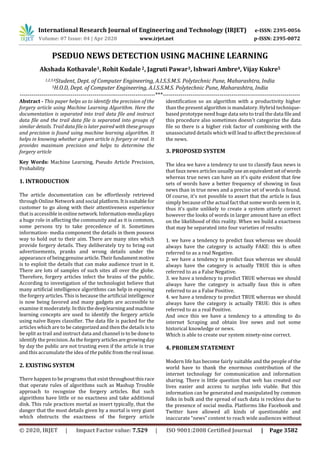
Fig.1- True Positive Rate and False Positive Rate.
The following is that the formula for naive Bayes
classification uses the chance of the previous event and
compares it with the prevailing event. Each and each chance
of the event is calculated and ultimately the chance of the
news as compared to the dataset is calculated. Thus, on
calculative the chance, we will get the approximate worth
and may find whether or not the news is real or faux.
P (A|B) = P (B|A) · P (A) / P (B),
(1) Finding the chance of event, A once event B is TRUE
P (A) = previous chance
P(A|B) =POSTERIOR ROBABILITY
FINDING PROBABILITY:
P (A|B1) = P (A1||B1). P (A2||B1). P (A3||B1)
(2) P (A|B2) =P (A1||B2). P (A||B2). P (A3||B2)
(3) If the chance is zero P (Word) = Word count +1/ (total
variety of words+ No. of distinctive words)
Thus, by exploitation this formula one will notice.
6. SYSTEM ARCHITECTURE
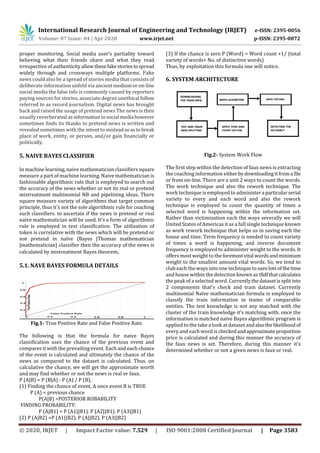
Fig.2- System Work Flow
The first step within the detection of faux news is extracting
the coaching information eitherbydownloadingitfroma file
or from on-line. There are a unit 2 ways to count the words.
The work technique and also the rework technique. The
work technique is employed to administera particularserial
variety to every and each word and also the rework
technique is employed to count the quantity of times a
selected word is happening within the information set.
Rather than victimization each the ways severally we will
United States of Americas it as a full single technique known
as work rework technique that helps us in saving each the
house and time. Term frequency is needed to count variety
of times a word is happening, and inverse document
frequency is employed to administer weight to the words. It
offers most weight to the foremostvital wordsandminimum
weight to the smallest amount vital words. So, we tend to
club each the ways into one technique to savelotsofthetime
and house within the detection known astfidfthatcalculates
the peak of a selected word. Currentlythedatasetissplitinto
2 components that's check and train dataset. Currently
multinomial Naïve mathematician formula is employed to
classify the train information in teams of comparable
entities. The test knowledge is not any matched with the
cluster of the train knowledge it’s matching with. once the
information is matched naïve Bayes algorithmic program is
applied to the take a look at dataset andalsothelikelihood of
every and each word is checkedandapproximateproportion
price is calculated and during this manner the accuracy of
the faux news is set. Therefore, during this manner it's
determined whether or not a given news is faux or real.
International Research Journal of Engineering and Technology (IRJET) e-ISSN: 2395-0056
Volume: 07 Issue: 04 | Apr 2020 www.irjet.net p-ISSN: 2395-0072
© 2020, IRJET | Impact Factor value: 7.529 | ISO 9001:2008 Certified Journal | Page 3584
6.1 MODULE FLOW.
Fig.3- Module Flow
First extract all the info that is to be checked or transfer it if
on the market then divide the info into take a look at and
train, train the information then apply Bayes mathematician
theorem during this manner NaïveBayestheoremisapplied.
A. Data Pre-processing
This contains all the info that should be checked totally and
preprocessed. First, we tend to undergo the train, check and
validation information files then performed some
preprocessing like tokenizing, stemming etc. Here theinfois
checked totally if it's missing value.
B. Feature Extraction
In this dataset we have done feature extractionandselection
methods from scikit and python. To perform feature
selection, we use a method called as tf-idf. We have
additionally utilized word to vector to separate the
highlights, likewise pipelining has been utilized to facilitate
the code
C. Classification.
Here the classification of knowledge theinfotheinformation
is completed in to components that's check information and
train data and also the train dataset is classed into teams
with similar entities. Later thecheck informationismatched,
and also the cluster is assigned to whichever it belongs to
then additional the Naïve Bayes classifier is applied andalso
the likelihood If the word whose likelihood is to be
calculated isn't obtainable within the information set of the
train data then the urologist smoothing is applied here.
Finally, the info is decided if it’s faux or real.
D. Prediction
Our finally elite and best activity classifier was algorithm
that was then saved on disk with name file modal save. Once
you shut this repository, this model area unit about to be
derived to user's machine and may be used by predict.pyfile
to classify the fake news with accuracy. It takes a article as
input from user then model is used for final classification
output that is shown to user in conjunction with probability
of truth
7. CONCLUSION
The dataset used to test the efficiency of the model is
produced by GitHub, containing 11000 news article tagged
as real or fake. The 4 columns consist of index, title, text and
label. News categories included in this dataset comprise of
business, science and technology, entertainment andhealth.
The authenticity of this dataset lies in the fact that it was
checked by journalists and then labelled as “REAL”or“FAKE
ACKNOWLEDGEMENT
The authors would like to thank Mr. Vijay N. Kukre, HOD
Computer EngineeringDepartment,A.I.S.S.M.S.’sPolytechnic
Pune.
REFERENCES
[1] Marco L, E. Tacchini, S. Moret, G. Ballarin, “Automatic
Online Fake News Detection Combining Content and
Social Signals,”
[2] Z. Jin, Juan Cao, (2017, Dec. 16), “News Credibility
Evaluation on Microblog with a Hierarchical
Propagation Model,”Fudan University,Shanghai,China.
[3] Conroy, N. Rubin and Chen. Y, “CIMT Detect: A
Community Infused Matrix-Tensor Coupled
Factorization,” 52(1), pp.1-4, 2018
[4] Markines, B. Cattuto, C., & F. Menczer, “Hybrid Machine
Crowd Approach,” (pp. 41-48), April 2018.
[5] H. Shaori, W. C. Wibowo, “Fake News Identification
Chatacteristics Using Named Entity Recognition and
Phrase Detection,” 2018, 10th ICITEE, Universitas
Indonesia.
[6] Shivam B. Parikh, Pradeep K. Atrey, “Media-Rich Fake
News Detection: A Survey,” 2018, IEEE Conference on
Multimedia Information Processing and Retrieval
(MIPR).
[7] Kai Shu, Suhang Wang, Huan Liu, “Understanding User
Profiles on Social Media for Fake News Detection,”
2018, MIPR.
[8] Stefan Helmsetter,HeikoPaulheim,“WeaklySupervised
Learning for Fake News Detection on Twitter,” IEEE,
May 2018, ASONAM.

Irjet v7 i4693

  • 1.
    International Research Journalof Engineering and Technology (IRJET) e-ISSN: 2395-0056 Volume: 07 Issue: 04 | Apr 2020 www.irjet.net p-ISSN: 2395-0072 © 2020, IRJET | Impact Factor value: 7.529 | ISO 9001:2008 Certified Journal | Page 3582 PSEDUO NEWS DETECTION USING MACHINE LEARNING Akshada Kothavale1, Rohit Kudale2, Jagruti Pawar3, Ishwari Ambre4, Vijay Kukre5 1,2,3,4Student, Dept. of Computer Engineering, A.I.S.S.M.S. Polytechnic Pune, Maharashtra, India 5H.O.D, Dept. of Computer Engineering, A.I.S.S.M.S. Polytechnic Pune, Maharashtra, India ---------------------------------------------------------------------***---------------------------------------------------------------------- Abstract - This paper helps us to identify the precision of the forgery article using Machine Learning Algorithm. Here the documentation is separated into trail data file and instruct data file and the trail data file is separated into groups of similar details. Trail data file is later paired with these groups and precision is found using machine learning algorithm. It helps in knowing whether a given article is forgery or real. It provides maximum precision and helps to determine the forgery article Key Words: Machine Learning, Pseudo Article Precision, Probability 1. INTRODUCTION The article documentation can be effortlessly retrieved through Online Network and social platform.Itissuitablefor customer to go along with their attentiveness experience that is accessibleinonlinenetwork.Information-media plays a huge role in affecting the community and as it is common, some persons try to take precedence of it. Sometimes information- media component the details in them possess way to hold out to their aim. There are many sites which provide forgery details. They deliberately try to bring out advertisements, pranks and wrong details under the appearance of beinggenuine article.Theirfundamentmotive is to exploit the details that can make audience trust in it. There are lots of samples of such sites all over the globe. Therefore, forgery articles infect the brains of the public. According to investigation of the technologist believe that many artificial intelligence algorithms can help in exposing the forgery articles. This is because the artificial intelligence is now being favored and many gadgets are accessible to examine it moderately.Inthisthedeeplearningandmachine learning concepts are used to identify the forgery article using naïve Bayes classifier. The data file is packed for the articles which are to be categorized and then the details isto be split as trail and instruct data and channel is to be doneto identify the precision. Asthe forgeryarticlesaregrowing day by day the public are not trusting even if the article is true and this accumulate the idea of the publicfromthereal issue. 2. EXISTING SYSTEM There happen to be programs that exist throughoutthisrace that operate rules of algorithms such as Mashup Trouble approach to recognize the forgery articles. But such algorithms have little or no exactness and take additional disk. This rule practices mortal as insert typically, that the danger that the most details given by a mortal is very giant which obstructs the exactness of the forgery article identification so an algorithm with a productivity higher than the present algorithm is mandatory. Hybrid technique- based prototype need huge data sets to trail the data fileand this procedure also sometimes doesn’t categorize the data file so there is a higher risk factor of combining with the unassociated details which will lead to affecttheprecisionof the news. 3. PROPOSED SYSTEM The idea we have a tendency to use to classify faux news is that faux news articles usually useanequivalentsetofwords whereas true news can have an it's quite evident that few sets of words have a better frequency of showing in faux news than in true news and a precise set of words is found. Of course, it's not possible to assert that the article is faux simply because of the actual fact that some words seem in it, thus it's quite unlikely to create a system utterly correct however the looks of words in larger amount have an effect on the likelihood of this reality. When we build a exactness that may be separated into four varieties of results: 1. we have a tendency to predict faux whereas we should always have the category is actually FAKE: this is often referred to as a real Negative. 2. we have a tendency to predict faux whereas we should always have the category is actually TRUE this is often referred to as a False Negative. 3. we have a tendency to predict TRUE whereas we should always have the category is actually faux this is often referred to as a False Positive. 4. we have a tendency to predict TRUE whereas we should always have the category is actually TRUE: this is often referred to as a real Positive. And once this we have a tendency to a attending to do internet Scraping and obtain live news and not some historical knowledge or news. Which is able to create our system ninety-nine correct. 4. PROBLEM STATEMENT Modern life has become fairly suitable and the people of the world have to thank the enormous contribution of the internet technology for communication and information sharing. There is little question that web has created our lives easier and access to surplus info viable. But this information can be generated and manipulated by common folks in bulk and the spread of such data is reckless due to the presence of social media. Platforms like Facebook and Twitter have allowed all kinds of questionable and inaccurate “news” content to reach wide audiences without
  • 2.
    International Research Journalof Engineering and Technology (IRJET) e-ISSN: 2395-0056 Volume: 07 Issue: 04 | Apr 2020 www.irjet.net p-ISSN: 2395-0072 © 2020, IRJET | Impact Factor value: 7.529 | ISO 9001:2008 Certified Journal | Page 3583 proper monitoring. Social media user’s partiality toward believing what their friends share and what they read irrespective of authenticityallowthesefakestoriestospread widely through and crossways multiple platforms. Fake news could also be a spread of stories media that consists of deliberate information unfold via ancientmediumoron-line social media the false info is commonly caused by reporters paying sources for stories, associate degree unethical follow referred to as record journalism. Digital news has brought back and raised the usage of pretend news The news is then usually reverberated asinformationinsocial media however sometimes finds its thanks to pretend news is written and revealed sometimes with the intent to misleadsoastobreak place of work, entity, or person, and/or gain financially or politically. 5. NAIVE BAYES CLASSIFIER In machine learning, naive mathematician classifiers square measure a part of machine learning. Naive mathematician is fashionable algorithmic rule that is employed to search out the accuracy of the news whether or not its real or pretend mistreatment multinomial NB and pipelining ideas. There square measure variety of algorithms that target common principle, thus it's not the sole algorithmic rule for coaching such classifiers. to ascertain if the news is pretend or real naïve mathematician will be used. It’s a form of algorithmic rule is employed in text classification. The utilization of token is correlative with the news which will be pretend or not pretend in naïve {Bayes |Thomas mathematician |mathematician} classifier then the accuracy of the news is calculated by mistreatment Bayes theorem. 5.1. NAVE BAYES FORMULA DETAILS Fig.1- True Positive Rate and False Positive Rate. The following is that the formula for naive Bayes classification uses the chance of the previous event and compares it with the prevailing event. Each and each chance of the event is calculated and ultimately the chance of the news as compared to the dataset is calculated. Thus, on calculative the chance, we will get the approximate worth and may find whether or not the news is real or faux. P (A|B) = P (B|A) · P (A) / P (B), (1) Finding the chance of event, A once event B is TRUE P (A) = previous chance P(A|B) =POSTERIOR ROBABILITY FINDING PROBABILITY: P (A|B1) = P (A1||B1). P (A2||B1). P (A3||B1) (2) P (A|B2) =P (A1||B2). P (A||B2). P (A3||B2) (3) If the chance is zero P (Word) = Word count +1/ (total variety of words+ No. of distinctive words) Thus, by exploitation this formula one will notice. 6. SYSTEM ARCHITECTURE Fig.2- System Work Flow The first step within the detection of faux news is extracting the coaching information eitherbydownloadingitfroma file or from on-line. There are a unit 2 ways to count the words. The work technique and also the rework technique. The work technique is employed to administera particularserial variety to every and each word and also the rework technique is employed to count the quantity of times a selected word is happening within the information set. Rather than victimization each the ways severally we will United States of Americas it as a full single technique known as work rework technique that helps us in saving each the house and time. Term frequency is needed to count variety of times a word is happening, and inverse document frequency is employed to administer weight to the words. It offers most weight to the foremostvital wordsandminimum weight to the smallest amount vital words. So, we tend to club each the ways into one technique to savelotsofthetime and house within the detection known astfidfthatcalculates the peak of a selected word. Currentlythedatasetissplitinto 2 components that's check and train dataset. Currently multinomial Naïve mathematician formula is employed to classify the train information in teams of comparable entities. The test knowledge is not any matched with the cluster of the train knowledge it’s matching with. once the information is matched naïve Bayes algorithmic program is applied to the take a look at dataset andalsothelikelihood of every and each word is checkedandapproximateproportion price is calculated and during this manner the accuracy of the faux news is set. Therefore, during this manner it's determined whether or not a given news is faux or real.
  • 3.
    International Research Journalof Engineering and Technology (IRJET) e-ISSN: 2395-0056 Volume: 07 Issue: 04 | Apr 2020 www.irjet.net p-ISSN: 2395-0072 © 2020, IRJET | Impact Factor value: 7.529 | ISO 9001:2008 Certified Journal | Page 3584 6.1 MODULE FLOW. Fig.3- Module Flow First extract all the info that is to be checked or transfer it if on the market then divide the info into take a look at and train, train the information then apply Bayes mathematician theorem during this manner NaïveBayestheoremisapplied. A. Data Pre-processing This contains all the info that should be checked totally and preprocessed. First, we tend to undergo the train, check and validation information files then performed some preprocessing like tokenizing, stemming etc. Here theinfois checked totally if it's missing value. B. Feature Extraction In this dataset we have done feature extractionandselection methods from scikit and python. To perform feature selection, we use a method called as tf-idf. We have additionally utilized word to vector to separate the highlights, likewise pipelining has been utilized to facilitate the code C. Classification. Here the classification of knowledge theinfotheinformation is completed in to components that's check information and train data and also the train dataset is classed into teams with similar entities. Later thecheck informationismatched, and also the cluster is assigned to whichever it belongs to then additional the Naïve Bayes classifier is applied andalso the likelihood If the word whose likelihood is to be calculated isn't obtainable within the information set of the train data then the urologist smoothing is applied here. Finally, the info is decided if it’s faux or real. D. Prediction Our finally elite and best activity classifier was algorithm that was then saved on disk with name file modal save. Once you shut this repository, this model area unit about to be derived to user's machine and may be used by predict.pyfile to classify the fake news with accuracy. It takes a article as input from user then model is used for final classification output that is shown to user in conjunction with probability of truth 7. CONCLUSION The dataset used to test the efficiency of the model is produced by GitHub, containing 11000 news article tagged as real or fake. The 4 columns consist of index, title, text and label. News categories included in this dataset comprise of business, science and technology, entertainment andhealth. The authenticity of this dataset lies in the fact that it was checked by journalists and then labelled as “REAL”or“FAKE ACKNOWLEDGEMENT The authors would like to thank Mr. Vijay N. Kukre, HOD Computer EngineeringDepartment,A.I.S.S.M.S.’sPolytechnic Pune. REFERENCES [1] Marco L, E. Tacchini, S. Moret, G. Ballarin, “Automatic Online Fake News Detection Combining Content and Social Signals,” [2] Z. Jin, Juan Cao, (2017, Dec. 16), “News Credibility Evaluation on Microblog with a Hierarchical Propagation Model,”Fudan University,Shanghai,China. [3] Conroy, N. Rubin and Chen. Y, “CIMT Detect: A Community Infused Matrix-Tensor Coupled Factorization,” 52(1), pp.1-4, 2018 [4] Markines, B. Cattuto, C., & F. Menczer, “Hybrid Machine Crowd Approach,” (pp. 41-48), April 2018. [5] H. Shaori, W. C. Wibowo, “Fake News Identification Chatacteristics Using Named Entity Recognition and Phrase Detection,” 2018, 10th ICITEE, Universitas Indonesia. [6] Shivam B. Parikh, Pradeep K. Atrey, “Media-Rich Fake News Detection: A Survey,” 2018, IEEE Conference on Multimedia Information Processing and Retrieval (MIPR). [7] Kai Shu, Suhang Wang, Huan Liu, “Understanding User Profiles on Social Media for Fake News Detection,” 2018, MIPR. [8] Stefan Helmsetter,HeikoPaulheim,“WeaklySupervised Learning for Fake News Detection on Twitter,” IEEE, May 2018, ASONAM.