   The Multimedia Super Corridor (MSC)
    program was officially initiated by the 4th
    Malaysian Prime Minister; Tun Dr. Mahathir
    Mohammad on 12 February 1996.
   This program is to transform Malaysia into
    a modern state by the year 2020.
   The Smart School Flagship is one of the seven flagship
    applications envisaged under the Multimedia Super
    Corridor initiative.
   The MSC Smart School Flagship Application is a
    collaborative effort between the Ministry of Education
    (MoE) and the Multimedia Development Corporation
    (MDeC).
   The ICT expertise for the initiative was provided by the
    Telekom Smart School (TSS) industry consortium. The
    MDeC, which has been entrusted with the development
    of the MSC, plays a key role in the implementation and
    ensuring that targets are achieved as planned.
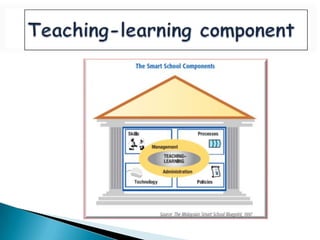
1. Teaching-learning processes
     - core of Smart School
     - comprises 4 areas : curriculum, pedagogy, assessment and
      teaching-learning materials
    - process related : reinvented to help students to learn more
      effective & efficient
 2. Management and administration
     - the driver of the Smart School
     - helps principal to manage the resources & the processes
 3. Human resource, skill and responsibility
   - stakeholders responsible (improvement of school performance)
   - they are equipped with specific skills & requisite knowledge
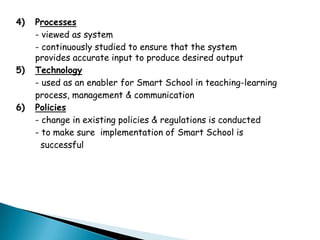
4)   Processes
     - viewed as system
     - continuously studied to ensure that the system
     provides accurate input to produce desired output
5)   Technology
     - used as an enabler for Smart School in teaching-learning
     process, management & communication
6)   Policies
     - change in existing policies & regulations is conducted
     - to make sure implementation of Smart School is
       successful
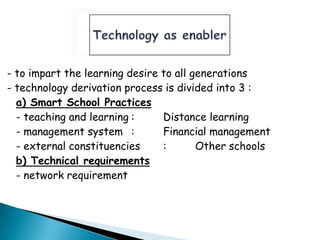
- to impart the learning desire to all generations
- technology derivation process is divided into 3 :
  a) Smart School Practices
  - teaching and learning :     Distance learning
  - management system :         Financial management
  - external constituencies     :       Other schools
  b) Technical requirements
  - network requirement
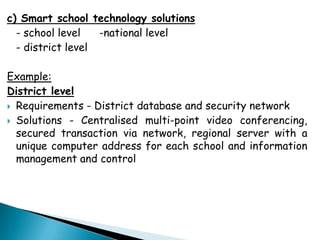
c) Smart school technology solutions
  - school level   -national level
  - district level

Example:
District level
 Requirements - District database and security network

 Solutions - Centralised multi-point video conferencing,
  secured transaction via network, regional server with a
  unique computer address for each school and information
  management and control
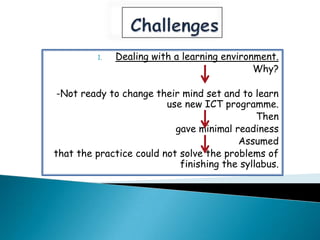
1.   Dealing with a learning environment.
                                             Why?

 -Not ready to change their mind set and to learn
                         use new ICT programme.
                                              Then
                           gave minimal readiness
                                         Assumed
that the practice could not solve the problems of
                            finishing the syllabus.
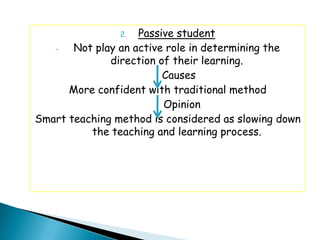
2.  Passive student
   -   Not play an active role in determining the
              direction of their learning.
                         Causes
      More confident with traditional method
                         Opinion
Smart teaching method is considered as slowing down
          the teaching and learning process.
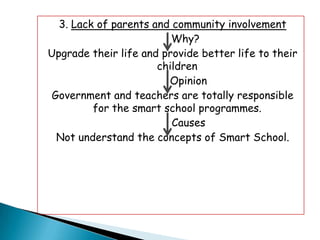
3. Lack of parents and community involvement
                         Why?
Upgrade their life and provide better life to their
                      children
                        Opinion
 Government and teachers are totally responsible
         for the smart school programmes.
                         Causes
  Not understand the concepts of Smart School.
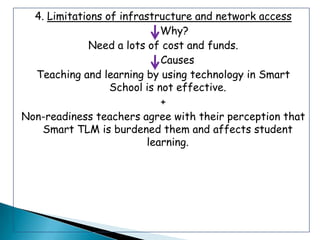
4. Limitations of infrastructure and network access
                             Why?
             Need a lots of cost and funds.
                             Causes
  Teaching and learning by using technology in Smart
                  School is not effective.
                             +
Non-readiness teachers agree with their perception that
    Smart TLM is burdened them and affects student
                          learning.

Smart school initiatives

  • 2.
    The Multimedia Super Corridor (MSC) program was officially initiated by the 4th Malaysian Prime Minister; Tun Dr. Mahathir Mohammad on 12 February 1996.  This program is to transform Malaysia into a modern state by the year 2020.
  • 4.
    The Smart School Flagship is one of the seven flagship applications envisaged under the Multimedia Super Corridor initiative.  The MSC Smart School Flagship Application is a collaborative effort between the Ministry of Education (MoE) and the Multimedia Development Corporation (MDeC).  The ICT expertise for the initiative was provided by the Telekom Smart School (TSS) industry consortium. The MDeC, which has been entrusted with the development of the MSC, plays a key role in the implementation and ensuring that targets are achieved as planned.
  • 7.
    1. Teaching-learning processes - core of Smart School - comprises 4 areas : curriculum, pedagogy, assessment and teaching-learning materials - process related : reinvented to help students to learn more effective & efficient 2. Management and administration - the driver of the Smart School - helps principal to manage the resources & the processes 3. Human resource, skill and responsibility - stakeholders responsible (improvement of school performance) - they are equipped with specific skills & requisite knowledge
  • 8.
    4) Processes - viewed as system - continuously studied to ensure that the system provides accurate input to produce desired output 5) Technology - used as an enabler for Smart School in teaching-learning process, management & communication 6) Policies - change in existing policies & regulations is conducted - to make sure implementation of Smart School is successful
  • 9.
    - to impartthe learning desire to all generations - technology derivation process is divided into 3 : a) Smart School Practices - teaching and learning : Distance learning - management system : Financial management - external constituencies : Other schools b) Technical requirements - network requirement
  • 10.
    c) Smart schooltechnology solutions - school level -national level - district level Example: District level  Requirements - District database and security network  Solutions - Centralised multi-point video conferencing, secured transaction via network, regional server with a unique computer address for each school and information management and control
  • 11.
    1. Dealing with a learning environment. Why? -Not ready to change their mind set and to learn use new ICT programme. Then gave minimal readiness Assumed that the practice could not solve the problems of finishing the syllabus.
  • 12.
    2. Passivestudent - Not play an active role in determining the direction of their learning. Causes More confident with traditional method Opinion Smart teaching method is considered as slowing down the teaching and learning process.
  • 13.
    3. Lack ofparents and community involvement Why? Upgrade their life and provide better life to their children Opinion Government and teachers are totally responsible for the smart school programmes. Causes Not understand the concepts of Smart School.
  • 14.
    4. Limitations ofinfrastructure and network access Why? Need a lots of cost and funds. Causes Teaching and learning by using technology in Smart School is not effective. + Non-readiness teachers agree with their perception that Smart TLM is burdened them and affects student learning.