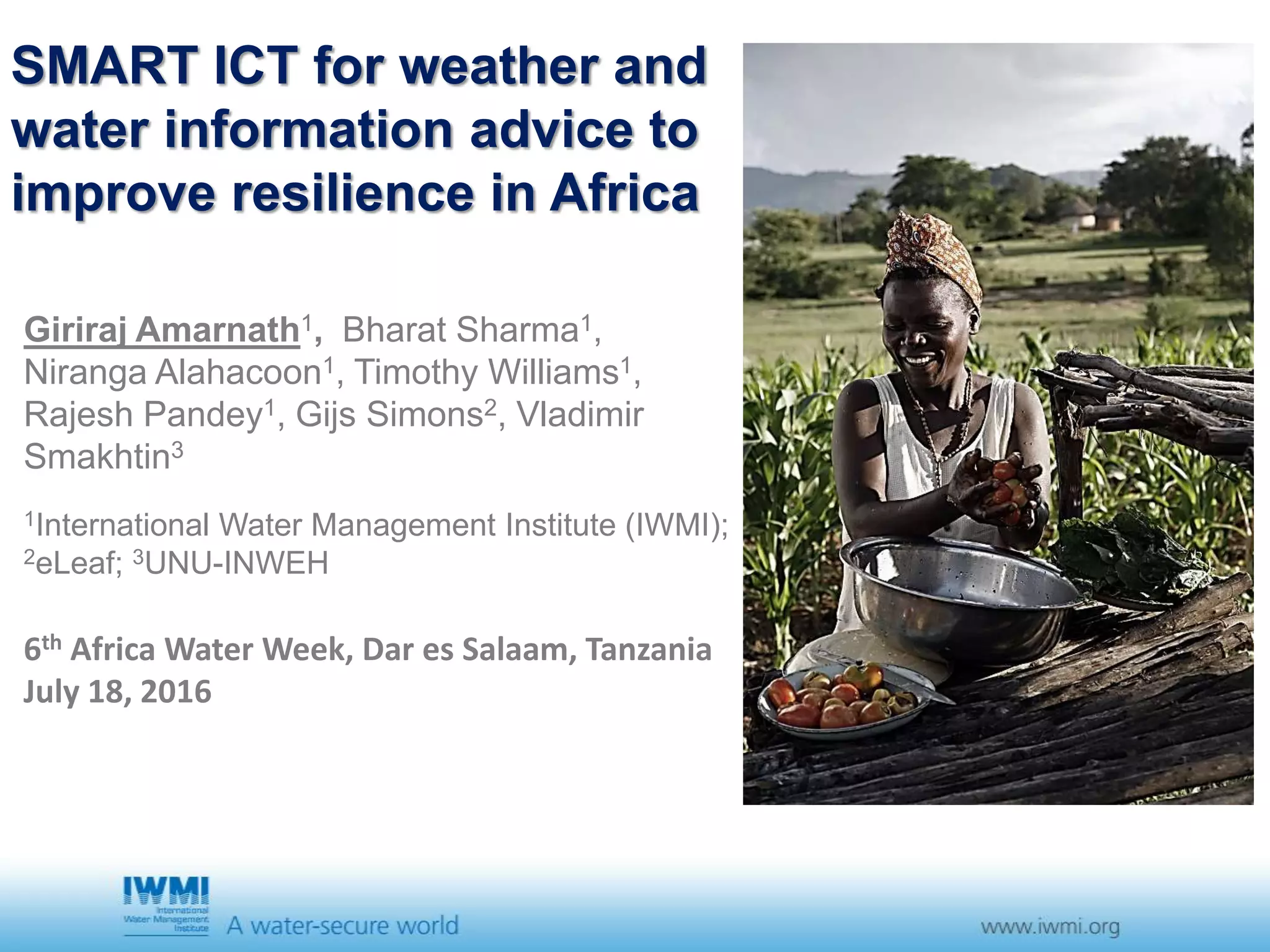
SMART ICT for weather and
water information advice to
improve resilience in Africa
Giriraj Amarnath1, Bharat Sharma1,
Niranga Alahacoon1, Timothy Williams1,
Rajesh Pandey1, Gijs Simons2, Vladimir
Smakhtin3
1International Water Management Institute (IWMI);
2eLeaf; 3UNU-INWEH
6th Africa Water Week, Dar es Salaam, Tanzania
July 18, 2016
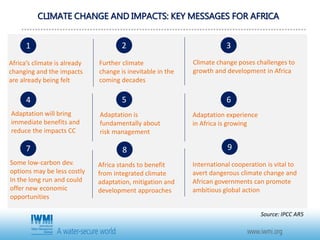
CLIMATE CHANGE AND IMPACTS: KEY MESSAGES FOR AFRICA
Africa’s climate is already
changing and the impacts
are already being felt
1
Further climate
change is inevitable in the
coming decades
2
Climate change poses challenges to
growth and development in Africa
3
Adaptation will bring
immediate benefits and
reduce the impacts CC
Adaptation is
fundamentally about
risk management
Adaptation experience
in Africa is growing
Some low-carbon dev.
options may be less costly
In the long run and could
offer new economic
opportunities
Africa stands to benefit
from integrated climate
adaptation, mitigation and
development approaches
International cooperation is vital to
avert dangerous climate change and
African governments can promote
ambitious global action
4 5 6
7 8 9
Source: IPCC AR5
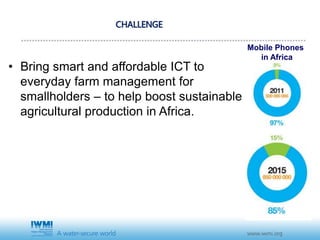
CHALLENGE
• Bring smart and affordable ICT to
everyday farm management for
smallholders – to help boost sustainable
agricultural production in Africa.
Mobile Phones
in Africa
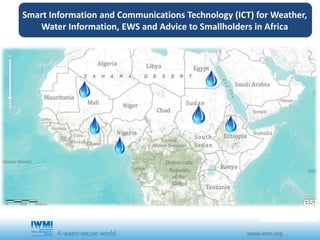
Smart Information and Communications Technology (ICT) for Weather,
Water Information, EWS and Advice to Smallholders in Africa
PARTNERS
• Satellite images are increasingly being used to assist commercial farmers
and agribusinesses
• Innovative approaches and ICT based technologies
• Advice to end users for:
• informed decision making
• enhanced negotiation capacity with water and farm related service
providers
WHAT ARE THE OPPORTUNITIES TO USE ICT TO INCREASE
AGRICULTURAL PRODUCTIVITY?
• IWMI has developed, test and pilot cell-phone and web-based
information systems to provide near real time climate, vegetation, and
water information relevant to the agricultural value chains
• To assist farmers, irrigation boards, agriculture extensions and water user
associations by providing the information needed to make better
management decisions
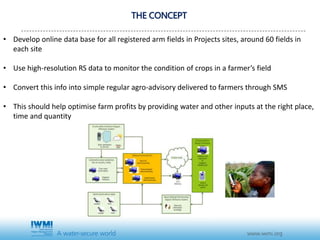
THE CONCEPT
• Develop online data base for all registered arm fields in Projects sites, around 60 fields in
each site
• Use high-resolution RS data to monitor the condition of crops in a farmer’s field
• Convert this info into simple regular agro-advisory delivered to farmers through SMS
• This should help optimise farm profits by providing water and other inputs at the right place,
time and quantity
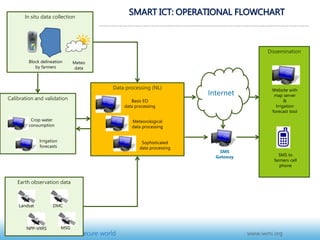
Data processing (NL)
Basis EO
data processing
Sophisticated
data processing
Meteorological
data processing
Internet
Dissemination
Website with
map server
&
Irrigation
forecast tool
Calibration and validation
Crop water
consumption
Irrigation
forecasts
In situ data collection
Block delineation
by farmers
Meteo
data
Earth observation data
DMCLandsat
NPP-VIIRS MSG
SMS
Gateway SMS to
farmers cell
phone
SMART ICT: OPERATIONAL FLOWCHART
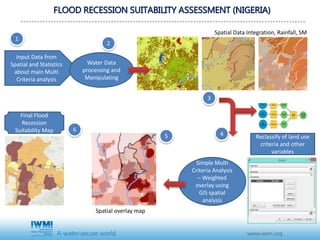
FLOOD RECESSION SUITABILITY ASSESSMENT (NIGERIA)
1
Input Data from
Spatial and Statistics
about main Multi
Criteria analysis
2
Water Data
processing and
Manipulating
Final Flood
Recession
Suitability Map 6
Reclassify of land use
criteria and other
variables
3
4
Simple Multi
Criteria Analysis
– Weighted
overlay using
GIS spatial
analysis
5
Spatial overlay map
Spatial Data Integration, Rainfall, SM
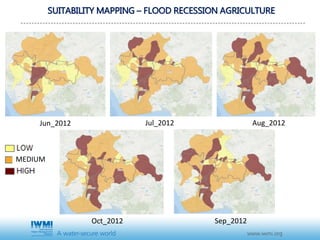
Jun_2012 Jul_2012 Aug_2012
Sep_2012Oct_2012
SUITABILITY MAPPING – FLOOD RECESSION AGRICULTURE
MEDIUM
DATA PRODUCTION
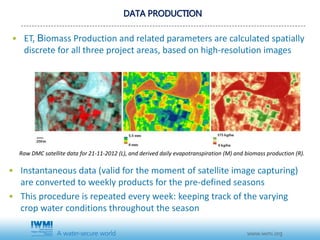
Raw DMC satellite data for 21-11-2012 (L), and derived daily evapotranspiration (M) and biomass production (R).
• ET, Biomass Production and related parameters are calculated spatially
discrete for all three project areas, based on high-resolution images
• Instantaneous data (valid for the moment of satellite image capturing)
are converted to weekly products for the pre-defined seasons
• This procedure is repeated every week: keeping track of the varying
crop water conditions throughout the season
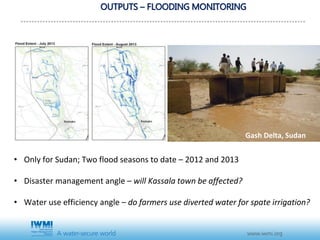
OUTPUTS – FLOODING MONITORING
• Only for Sudan; Two flood seasons to date – 2012 and 2013
• Disaster management angle – will Kassala town be affected?
• Water use efficiency angle – do farmers use diverted water for spate irrigation?
Gash Delta, Sudan
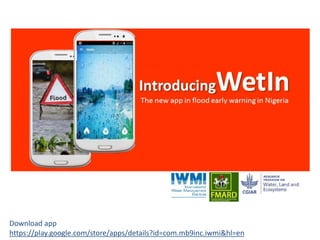
Download app
https://play.google.com/store/apps/details?id=com.mb9inc.iwmi&hl=en
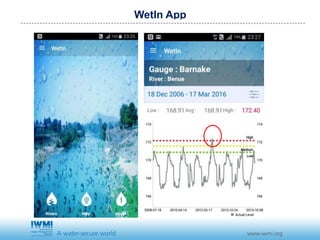
WetIn App
OUTPUTS - WEB PORTAL, AND SMS SERVICE
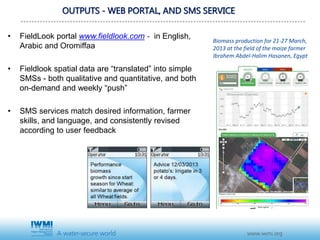
• FieldLook portal www.fieldlook.com - in English,
Arabic and Oromiffaa
• Fieldlook spatial data are “translated” into simple
SMSs - both qualitative and quantitative, and both
on-demand and weekly “push”
• SMS services match desired information, farmer
skills, and language, and consistently revised
according to user feedback
Biomass production for 21-27 March,
2013 at the field of the maize farmer
Ibrahem Abdel-Halim Hasanen, Egypt
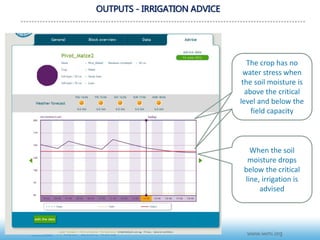
The crop has no
water stress when
the soil moisture is
above the critical
level and below the
field capacity
OUTPUTS - IRRIGATION ADVICE
When the soil
moisture drops
below the critical
line, irrigation is
advised
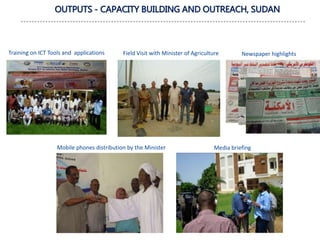
OUTPUTS - CAPACITY BUILDING AND OUTREACH, SUDAN
Training on ICT Tools and applications Field Visit with Minister of Agriculture
Media briefing
Newspaper highlights
Mobile phones distribution by the Minister
http://www.guardian.co.uk/technology/2011/jul/24/mobile-phones-africa-microfinance-farming
More information visit : www.iwmi.cgiar.org
Email: a.giriraj@cgiar.org

Smart ICT for Climate and Weather Information

  • 1.
    SMART ICT forweather and water information advice to improve resilience in Africa Giriraj Amarnath1, Bharat Sharma1, Niranga Alahacoon1, Timothy Williams1, Rajesh Pandey1, Gijs Simons2, Vladimir Smakhtin3 1International Water Management Institute (IWMI); 2eLeaf; 3UNU-INWEH 6th Africa Water Week, Dar es Salaam, Tanzania July 18, 2016
  • 2.
    CLIMATE CHANGE ANDIMPACTS: KEY MESSAGES FOR AFRICA Africa’s climate is already changing and the impacts are already being felt 1 Further climate change is inevitable in the coming decades 2 Climate change poses challenges to growth and development in Africa 3 Adaptation will bring immediate benefits and reduce the impacts CC Adaptation is fundamentally about risk management Adaptation experience in Africa is growing Some low-carbon dev. options may be less costly In the long run and could offer new economic opportunities Africa stands to benefit from integrated climate adaptation, mitigation and development approaches International cooperation is vital to avert dangerous climate change and African governments can promote ambitious global action 4 5 6 7 8 9 Source: IPCC AR5
  • 3.
    CHALLENGE • Bring smartand affordable ICT to everyday farm management for smallholders – to help boost sustainable agricultural production in Africa. Mobile Phones in Africa
  • 4.
    Smart Information andCommunications Technology (ICT) for Weather, Water Information, EWS and Advice to Smallholders in Africa
  • 5.
  • 6.
    • Satellite imagesare increasingly being used to assist commercial farmers and agribusinesses • Innovative approaches and ICT based technologies • Advice to end users for: • informed decision making • enhanced negotiation capacity with water and farm related service providers WHAT ARE THE OPPORTUNITIES TO USE ICT TO INCREASE AGRICULTURAL PRODUCTIVITY? • IWMI has developed, test and pilot cell-phone and web-based information systems to provide near real time climate, vegetation, and water information relevant to the agricultural value chains • To assist farmers, irrigation boards, agriculture extensions and water user associations by providing the information needed to make better management decisions
  • 7.
    THE CONCEPT • Developonline data base for all registered arm fields in Projects sites, around 60 fields in each site • Use high-resolution RS data to monitor the condition of crops in a farmer’s field • Convert this info into simple regular agro-advisory delivered to farmers through SMS • This should help optimise farm profits by providing water and other inputs at the right place, time and quantity
  • 8.
    Data processing (NL) BasisEO data processing Sophisticated data processing Meteorological data processing Internet Dissemination Website with map server & Irrigation forecast tool Calibration and validation Crop water consumption Irrigation forecasts In situ data collection Block delineation by farmers Meteo data Earth observation data DMCLandsat NPP-VIIRS MSG SMS Gateway SMS to farmers cell phone SMART ICT: OPERATIONAL FLOWCHART
  • 9.
    FLOOD RECESSION SUITABILITYASSESSMENT (NIGERIA) 1 Input Data from Spatial and Statistics about main Multi Criteria analysis 2 Water Data processing and Manipulating Final Flood Recession Suitability Map 6 Reclassify of land use criteria and other variables 3 4 Simple Multi Criteria Analysis – Weighted overlay using GIS spatial analysis 5 Spatial overlay map Spatial Data Integration, Rainfall, SM
  • 10.
    Jun_2012 Jul_2012 Aug_2012 Sep_2012Oct_2012 SUITABILITYMAPPING – FLOOD RECESSION AGRICULTURE MEDIUM
  • 11.
    DATA PRODUCTION Raw DMCsatellite data for 21-11-2012 (L), and derived daily evapotranspiration (M) and biomass production (R). • ET, Biomass Production and related parameters are calculated spatially discrete for all three project areas, based on high-resolution images • Instantaneous data (valid for the moment of satellite image capturing) are converted to weekly products for the pre-defined seasons • This procedure is repeated every week: keeping track of the varying crop water conditions throughout the season
  • 12.
    OUTPUTS – FLOODINGMONITORING • Only for Sudan; Two flood seasons to date – 2012 and 2013 • Disaster management angle – will Kassala town be affected? • Water use efficiency angle – do farmers use diverted water for spate irrigation? Gash Delta, Sudan
  • 13.
  • 14.
  • 15.
    OUTPUTS - WEBPORTAL, AND SMS SERVICE • FieldLook portal www.fieldlook.com - in English, Arabic and Oromiffaa • Fieldlook spatial data are “translated” into simple SMSs - both qualitative and quantitative, and both on-demand and weekly “push” • SMS services match desired information, farmer skills, and language, and consistently revised according to user feedback Biomass production for 21-27 March, 2013 at the field of the maize farmer Ibrahem Abdel-Halim Hasanen, Egypt
  • 16.
    The crop hasno water stress when the soil moisture is above the critical level and below the field capacity OUTPUTS - IRRIGATION ADVICE When the soil moisture drops below the critical line, irrigation is advised
  • 17.
    OUTPUTS - CAPACITYBUILDING AND OUTREACH, SUDAN Training on ICT Tools and applications Field Visit with Minister of Agriculture Media briefing Newspaper highlights Mobile phones distribution by the Minister
  • 18.

Editor's Notes

  • #13 (based on monthly stats provided to WUAs)
  • #16 Spatial biomass production is non-uniform, due to factors like soil type, malfunction in irrigation system, different crop variety, diseases, etc. Agricultural extension officer can contact farmer based on anomalies