International Research Journal of Engineering and Technology (IRJET) e-ISSN: 2395-0056
Volume: 04 Issue: 12 | Dec-2017 www.irjet.net p-ISSN: 2395-0072
© 2017, IRJET | Impact Factor value: 6.171 | ISO 9001:2008 Certified Journal | Page 1759
Home Automation System
Siddharth Chittora1
1Basant Kumar Birla Institute of Engineering and Technology, CEERI Road, Pilani, Rajasthan, India – 333031
---------------------------------------------------------------------***---------------------------------------------------------------------
Abstract – Internet of Things (IoT) is augmentation of
present day internet to give communication, connection,
and interconnectivity between different gadgets or physical
articles otherwise called "Things". The term IoT gives us a
simple idea about the capability of system of gadgets to
detect and gather information from our general
surroundings, and sends that information over the Web
where it can be processed and used for different purposes.
Looking at advancement of Automation Technology, we find
that our lives are getting less complex and simpler in all
viewpoints. In the present world, Automatic systems are
being picked over manual systems. With the rapidly
increasing quantity of clients of internet over the last
decade has made Internet an integral part of life, and
Internet of Things is the most recent and rising
technological innovation. Internet of things is an emerging
system of day-to-day objects from industrial machine to
consumer products that can share data and finish errands
while you are occupied with other tasks. Wireless Home
Automation System(WHAS) using IoT is a system that
utilizes PCs or cell phones to control essential home
functions and features through internet from anywhere
around the globe and an automated home can also be called
smart home. It is intended to minimize the electrical power
utilization and human efforts. The home automation
systems contrasts from other system by permitting the user
to work on system from anywhere around the world
through internet.
Key Words: Wireless Home Automation System
(WHAS), Internet of Things, IOT, Wi-Fi, GSM, GPS, GPRS
1. INTRODUCTION
The Internet of things can be characterized as connection
between different kinds of devices like smart phones, PC
and Tablets to internet, which brings in advanced kind of
communication amongst things and individuals and
furthermore between things. With introduction of IoT, we
can see that the research and development of home
Automation is gaining popularity. Also, many different
wireless technologies help in connecting from remote
location to enhance the intelligence of home environment.
IoTs is utilized to bring in creative ideas and extraordinary
growth of smart homes to enhance the quality of life.
Internet helps us to come up with prompt solution to
many issues and additionally making us able to stay
connected even from faraway places which minimizes the
overall cost and energy overhead.
Lately, it can be seen that more and more consumers are
inclined towards the idea of smart home. Homes of the
21st century will turn out to be increasingly self-
controlled also, mechanized because of the solace it gives,
particularly when utilized in a private home. Home
automation system communicates with and reports the
status of the connected devices in an interactive, easy to
use interface enabling the consumer to connect and
control different gadgets with the touch of a button. A
home automation system is a medium through which the
user can connect together different kinds of devices and
electrical appliances and which in turn creates an
ecosystem such that all the components can be connected
centrally. Some of the communication technologies
utilized in creation of the present day's home automation
systems are Bluetooth, Wi-MAX and Wireless LAN (Wi-Fi),
ZigBee, and Global System for Mobile Communication
(GSM).
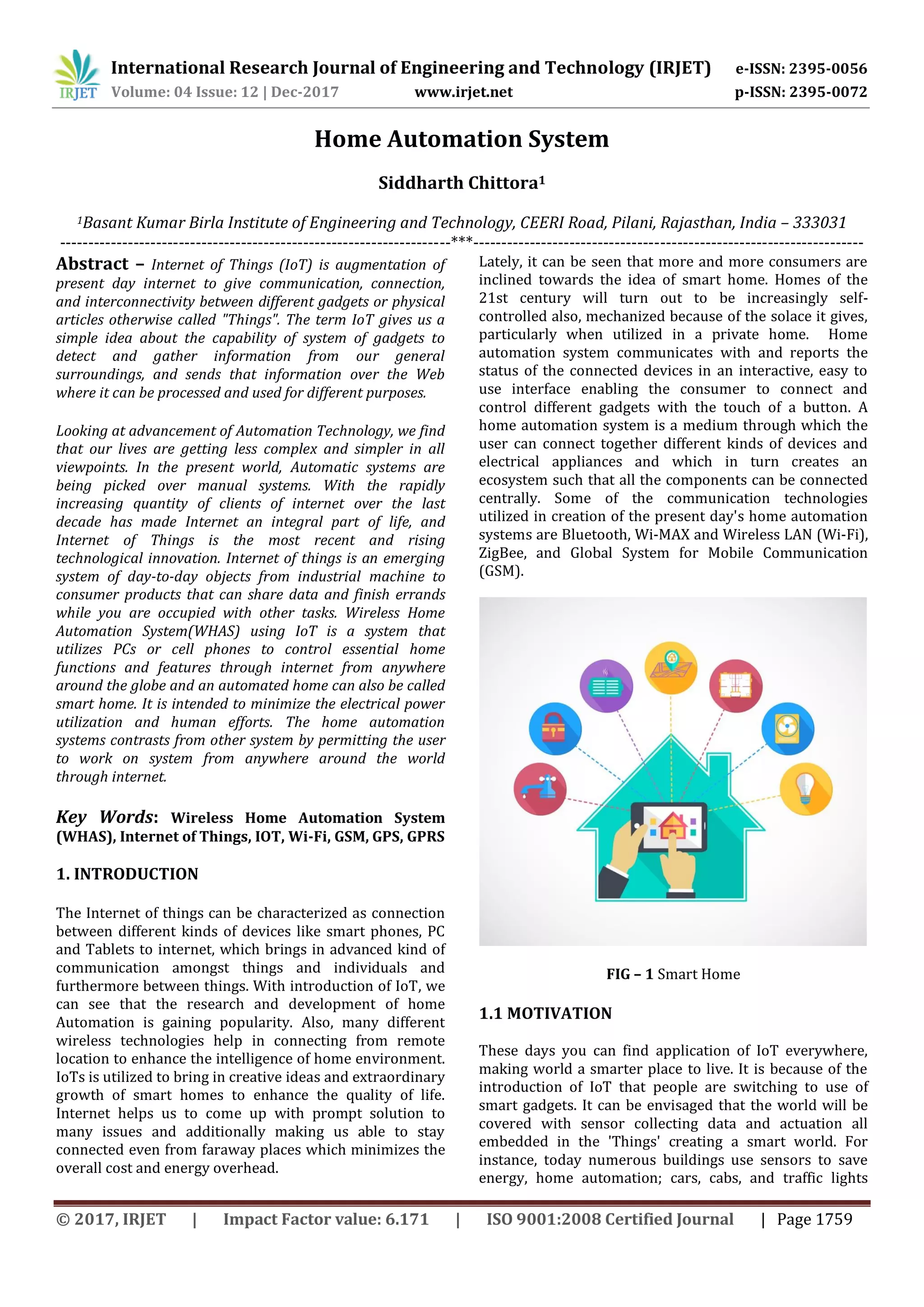
FIG – 1 Smart Home
1.1 MOTIVATION
These days you can find application of IoT everywhere,
making world a smarter place to live. It is because of the
introduction of IoT that people are switching to use of
smart gadgets. It can be envisaged that the world will be
covered with sensor collecting data and actuation all
embedded in the 'Things' creating a smart world. For
instance, today numerous buildings use sensors to save
energy, home automation; cars, cabs, and traffic lights
International Research Journal of Engineering and Technology (IRJET) e-ISSN: 2395-0056
Volume: 04 Issue: 12 | Dec-2017 www.irjet.net p-ISSN: 2395-0072
© 2017, IRJET | Impact Factor value: 6.171 | ISO 9001:2008 Certified Journal | Page 1760
have devices to improve and enhance security and
transportation; people have smart phones with sensors for
running numerous helpful applications; industries are
integrated with the Internet; and healthcare service are
depending on home sensing to become more prompt and
provide better support.
IoT won't be seen as individual system, but as a vital,
coordinated infrastructure whereupon numerous
applications and services can run. A few applications will
be personally customized, for example, digitizing everyday
life exercises, others will be city-wide, for example,
effective, without delay transportation, and others will be
world-wide, for example, worldwide delivery system.
Buildings won't just control energy or security, but also
incorporate individual solace, energy saving, security and
wellbeing and health into convenient and effective spaces.
People may have patches of bionic skin with detection of
physiological parameters being transmitted to the cloud
which houses his digital wellbeing, and to the
encompassing smart spaces for enhanced comfort, health,
productivity, and safety. In fact, smart watches, phones,
body nodes, and clothes will act as personalized
contribution to enhance city-wide services profiting both
the individual and society. Ten "critical" trends and
technologies affecting IT for the following five years were
laid out by Gartner and the Internet of Things was one of
them. These things have an IP address and can be traced.
The Internet is expanding into
enterprise assets and consumer items such as cars and
televisions. These can be applied to people, things,
information, and places, and therefore the so called
“Internet of Things” will be succeeded by the “Internet of
Everything.”
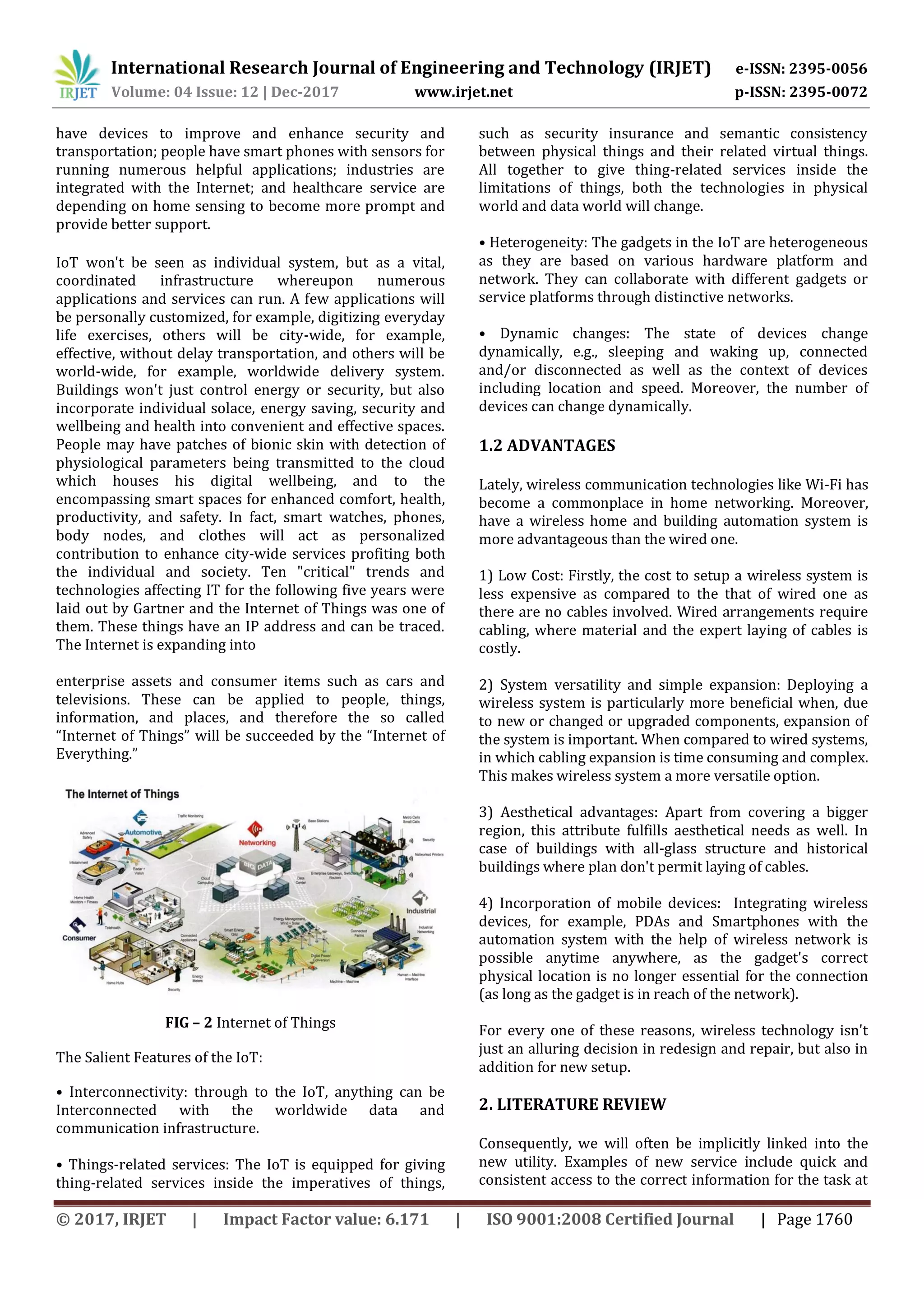
FIG – 2 Internet of Things
The Salient Features of the IoT:
• Interconnectivity: through to the IoT, anything can be
Interconnected with the worldwide data and
communication infrastructure.
• Things-related services: The IoT is equipped for giving
thing-related services inside the imperatives of things,
such as security insurance and semantic consistency
between physical things and their related virtual things.
All together to give thing-related services inside the
limitations of things, both the technologies in physical
world and data world will change.
• Heterogeneity: The gadgets in the IoT are heterogeneous
as they are based on various hardware platform and
network. They can collaborate with different gadgets or
service platforms through distinctive networks.
• Dynamic changes: The state of devices change
dynamically, e.g., sleeping and waking up, connected
and/or disconnected as well as the context of devices
including location and speed. Moreover, the number of
devices can change dynamically.
1.2 ADVANTAGES
Lately, wireless communication technologies like Wi-Fi has
become a commonplace in home networking. Moreover,
have a wireless home and building automation system is
more advantageous than the wired one.
1) Low Cost: Firstly, the cost to setup a wireless system is
less expensive as compared to the that of wired one as
there are no cables involved. Wired arrangements require
cabling, where material and the expert laying of cables is
costly.
2) System versatility and simple expansion: Deploying a
wireless system is particularly more beneficial when, due
to new or changed or upgraded components, expansion of
the system is important. When compared to wired systems,
in which cabling expansion is time consuming and complex.
This makes wireless system a more versatile option.
3) Aesthetical advantages: Apart from covering a bigger
region, this attribute fulfills aesthetical needs as well. In
case of buildings with all-glass structure and historical
buildings where plan don't permit laying of cables.
4) Incorporation of mobile devices: Integrating wireless
devices, for example, PDAs and Smartphones with the
automation system with the help of wireless network is
possible anytime anywhere, as the gadget's correct
physical location is no longer essential for the connection
(as long as the gadget is in reach of the network).
For every one of these reasons, wireless technology isn't
just an alluring decision in redesign and repair, but also in
addition for new setup.
2. LITERATURE REVIEW
Consequently, we will often be implicitly linked into the
new utility. Examples of new service include quick and
consistent access to the correct information for the task at
International Research Journal of Engineering and Technology (IRJET) e-ISSN: 2395-0056
Volume: 04 Issue: 12 | Dec-2017 www.irjet.net p-ISSN: 2395-0072
© 2017, IRJET | Impact Factor value: 6.171 | ISO 9001:2008 Certified Journal | Page 1761
hand, be it, going to work or a gathering, working out,
shopping, socializing, or going to a doctor. Some of the time
these activities will be virtual activities, or may even use
avatars or robots. Many outputs and displays for clients
may be holographic. Credit cards may outdate and
biometrics like voice or retinas will give secure access to
buildings, ATMs, and transportation systems. A detecting
and activation utility won't just exist in public places, but
also extend out to the home and apartment suites. Here
people will be able to run health, energy, security, and
entertainment apps on the infrastructure. Setting up and
running new applications will be as simple as connecting a
toaster to a electrical socket. One application may help
monitor and control heart rate, another perform money
related and investment benefits, another ordering food and
groceries or even anticipating an possible health issue that
ought to be checked to ahead of time to moderate or even
stay away from the problem. People will often be
fundamental parts of the IoT system. The Industrial
Internet is additionally a type of IoT where the devices
(things) are objects in assembly plants, dispatch centers,
process control industries, and so forth.
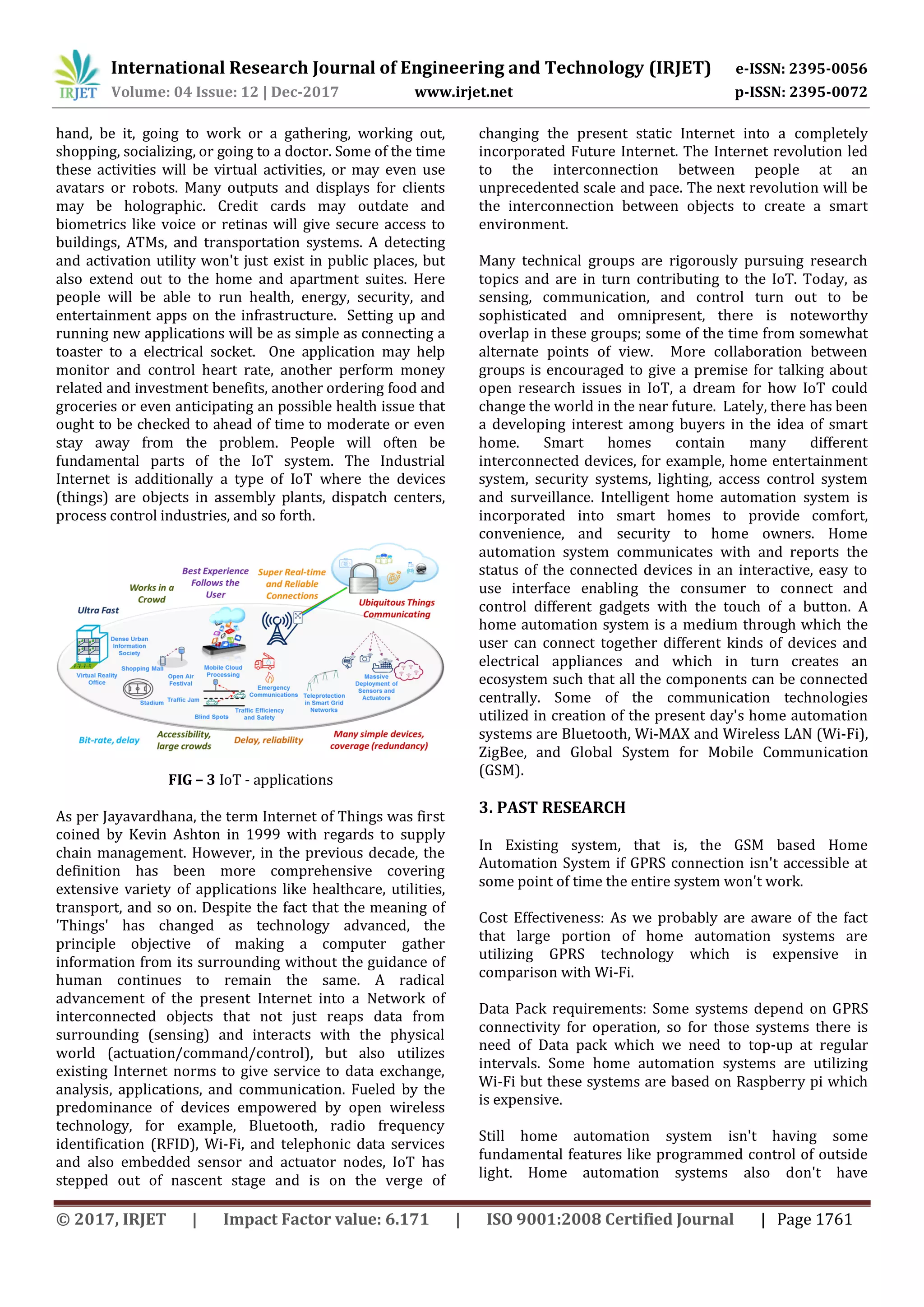
FIG – 3 IoT - applications
As per Jayavardhana, the term Internet of Things was first
coined by Kevin Ashton in 1999 with regards to supply
chain management. However, in the previous decade, the
definition has been more comprehensive covering
extensive variety of applications like healthcare, utilities,
transport, and so on. Despite the fact that the meaning of
'Things' has changed as technology advanced, the
principle objective of making a computer gather
information from its surrounding without the guidance of
human continues to remain the same. A radical
advancement of the present Internet into a Network of
interconnected objects that not just reaps data from
surrounding (sensing) and interacts with the physical
world (actuation/command/control), but also utilizes
existing Internet norms to give service to data exchange,
analysis, applications, and communication. Fueled by the
predominance of devices empowered by open wireless
technology, for example, Bluetooth, radio frequency
identification (RFID), Wi-Fi, and telephonic data services
and also embedded sensor and actuator nodes, IoT has
stepped out of nascent stage and is on the verge of
changing the present static Internet into a completely
incorporated Future Internet. The Internet revolution led
to the interconnection between people at an
unprecedented scale and pace. The next revolution will be
the interconnection between objects to create a smart
environment.
Many technical groups are rigorously pursuing research
topics and are in turn contributing to the IoT. Today, as
sensing, communication, and control turn out to be
sophisticated and omnipresent, there is noteworthy
overlap in these groups; some of the time from somewhat
alternate points of view. More collaboration between
groups is encouraged to give a premise for talking about
open research issues in IoT, a dream for how IoT could
change the world in the near future. Lately, there has been
a developing interest among buyers in the idea of smart
home. Smart homes contain many different
interconnected devices, for example, home entertainment
system, security systems, lighting, access control system
and surveillance. Intelligent home automation system is
incorporated into smart homes to provide comfort,
convenience, and security to home owners. Home
automation system communicates with and reports the
status of the connected devices in an interactive, easy to
use interface enabling the consumer to connect and
control different gadgets with the touch of a button. A
home automation system is a medium through which the
user can connect together different kinds of devices and
electrical appliances and which in turn creates an
ecosystem such that all the components can be connected
centrally. Some of the communication technologies
utilized in creation of the present day's home automation
systems are Bluetooth, Wi-MAX and Wireless LAN (Wi-Fi),
ZigBee, and Global System for Mobile Communication
(GSM).
3. PAST RESEARCH
In Existing system, that is, the GSM based Home
Automation System if GPRS connection isn't accessible at
some point of time the entire system won't work.
Cost Effectiveness: As we probably are aware of the fact
that large portion of home automation systems are
utilizing GPRS technology which is expensive in
comparison with Wi-Fi.
Data Pack requirements: Some systems depend on GPRS
connectivity for operation, so for those systems there is
need of Data pack which we need to top-up at regular
intervals. Some home automation systems are utilizing
Wi-Fi but these systems are based on Raspberry pi which
is expensive.
Still home automation system isn't having some
fundamental features like programmed control of outside
light. Home automation systems also don't have
International Research Journal of Engineering and Technology (IRJET) e-ISSN: 2395-0056
Volume: 04 Issue: 12 | Dec-2017 www.irjet.net p-ISSN: 2395-0072
© 2017, IRJET | Impact Factor value: 6.171 | ISO 9001:2008 Certified Journal | Page 1762
notification facility, where user can without much of a
stretch, make a move according to that notification
4. FUTURE OBJECTIVES
As we can observe that there are quite a few issues in
existing approaches. In this segment we principally
concentrate on, the utilization of loT for the enhanced,
energy efficient and self-learning home automation
system. The principle objective is to plan and implement
cost effective and smart home automated system. We can
utilize Wi-Fi based approach for connection amongst
Server and Home appliances. This smart home automated
system will characterize the implementation of related
software and hardware. The user can operate the home
appliances like lights, fans, TV, etc. through their smart
phones remotely.
5. CONCLUSION
We can observe in the literature segment the scope of
internet of things on current time. We also got some
understanding of what home automation is also, the issues
that still should be resolved. So, in this paper essentially,
we learn about internet of things and we did the relative
examination of different home automation techniques.
There is still great scope of home automation in future
utilizing IoT.
REFERENCES
[1] Bhide, Vishwajeet Hari, and Sanjeev Wagh. "i-
learning IoT: An intelligent self-learning system
for home automation using IoT." Communications
and Signal Processing (ICCSP), 2015 International
Conference on. IEEE, 2015.
[2] Gamba, Mattia, Alessandro Gonella, and Claudio E.
Palazzi. "Design issues and solutions in a modern
home automation system." Computing,
Networking and Communications (ICNC), 2015
International Conference on. IEEE, 2015.
[3] Gubbi, Jaya vardhana, et al. "Internet of Things
(IoT): A vision, architectural elements, and future
directions." Future Generation Computer Systems
29.7 (2013): 1645-1660.
[4] Karimi, Kaivan, and Gary Atkinson. "What the
Internet of Things (IoT) needs to become a
reality." White Paper, Free Scale and ARM (2013).
[5] Stankovic, John. "Research directions for the
internet of things." Internet of Things Journal,
IEEE 1.1 (2014): 3-9.F
[6] "Understanding the Internet of Things (IoT) “, July
2014. Gubbi, Jayavardhana, et al. "Internet of
Things (IoT): A vision, architectural elements, and
future directions." Future Generation Computer
Systems 29.7 (2013): 1645-1660.
[7] Teymourzadeh, Rozita, et al. "Smart GSM Based
Home Automation System." Systems, Process &
Control (ICSPC), 2013 IEEE Conference on. IEEE,
2013.

Home Automation System

  • 1.
    International Research Journalof Engineering and Technology (IRJET) e-ISSN: 2395-0056 Volume: 04 Issue: 12 | Dec-2017 www.irjet.net p-ISSN: 2395-0072 © 2017, IRJET | Impact Factor value: 6.171 | ISO 9001:2008 Certified Journal | Page 1759 Home Automation System Siddharth Chittora1 1Basant Kumar Birla Institute of Engineering and Technology, CEERI Road, Pilani, Rajasthan, India – 333031 ---------------------------------------------------------------------***--------------------------------------------------------------------- Abstract – Internet of Things (IoT) is augmentation of present day internet to give communication, connection, and interconnectivity between different gadgets or physical articles otherwise called "Things". The term IoT gives us a simple idea about the capability of system of gadgets to detect and gather information from our general surroundings, and sends that information over the Web where it can be processed and used for different purposes. Looking at advancement of Automation Technology, we find that our lives are getting less complex and simpler in all viewpoints. In the present world, Automatic systems are being picked over manual systems. With the rapidly increasing quantity of clients of internet over the last decade has made Internet an integral part of life, and Internet of Things is the most recent and rising technological innovation. Internet of things is an emerging system of day-to-day objects from industrial machine to consumer products that can share data and finish errands while you are occupied with other tasks. Wireless Home Automation System(WHAS) using IoT is a system that utilizes PCs or cell phones to control essential home functions and features through internet from anywhere around the globe and an automated home can also be called smart home. It is intended to minimize the electrical power utilization and human efforts. The home automation systems contrasts from other system by permitting the user to work on system from anywhere around the world through internet. Key Words: Wireless Home Automation System (WHAS), Internet of Things, IOT, Wi-Fi, GSM, GPS, GPRS 1. INTRODUCTION The Internet of things can be characterized as connection between different kinds of devices like smart phones, PC and Tablets to internet, which brings in advanced kind of communication amongst things and individuals and furthermore between things. With introduction of IoT, we can see that the research and development of home Automation is gaining popularity. Also, many different wireless technologies help in connecting from remote location to enhance the intelligence of home environment. IoTs is utilized to bring in creative ideas and extraordinary growth of smart homes to enhance the quality of life. Internet helps us to come up with prompt solution to many issues and additionally making us able to stay connected even from faraway places which minimizes the overall cost and energy overhead. Lately, it can be seen that more and more consumers are inclined towards the idea of smart home. Homes of the 21st century will turn out to be increasingly self- controlled also, mechanized because of the solace it gives, particularly when utilized in a private home. Home automation system communicates with and reports the status of the connected devices in an interactive, easy to use interface enabling the consumer to connect and control different gadgets with the touch of a button. A home automation system is a medium through which the user can connect together different kinds of devices and electrical appliances and which in turn creates an ecosystem such that all the components can be connected centrally. Some of the communication technologies utilized in creation of the present day's home automation systems are Bluetooth, Wi-MAX and Wireless LAN (Wi-Fi), ZigBee, and Global System for Mobile Communication (GSM). FIG – 1 Smart Home 1.1 MOTIVATION These days you can find application of IoT everywhere, making world a smarter place to live. It is because of the introduction of IoT that people are switching to use of smart gadgets. It can be envisaged that the world will be covered with sensor collecting data and actuation all embedded in the 'Things' creating a smart world. For instance, today numerous buildings use sensors to save energy, home automation; cars, cabs, and traffic lights
  • 2.
    International Research Journalof Engineering and Technology (IRJET) e-ISSN: 2395-0056 Volume: 04 Issue: 12 | Dec-2017 www.irjet.net p-ISSN: 2395-0072 © 2017, IRJET | Impact Factor value: 6.171 | ISO 9001:2008 Certified Journal | Page 1760 have devices to improve and enhance security and transportation; people have smart phones with sensors for running numerous helpful applications; industries are integrated with the Internet; and healthcare service are depending on home sensing to become more prompt and provide better support. IoT won't be seen as individual system, but as a vital, coordinated infrastructure whereupon numerous applications and services can run. A few applications will be personally customized, for example, digitizing everyday life exercises, others will be city-wide, for example, effective, without delay transportation, and others will be world-wide, for example, worldwide delivery system. Buildings won't just control energy or security, but also incorporate individual solace, energy saving, security and wellbeing and health into convenient and effective spaces. People may have patches of bionic skin with detection of physiological parameters being transmitted to the cloud which houses his digital wellbeing, and to the encompassing smart spaces for enhanced comfort, health, productivity, and safety. In fact, smart watches, phones, body nodes, and clothes will act as personalized contribution to enhance city-wide services profiting both the individual and society. Ten "critical" trends and technologies affecting IT for the following five years were laid out by Gartner and the Internet of Things was one of them. These things have an IP address and can be traced. The Internet is expanding into enterprise assets and consumer items such as cars and televisions. These can be applied to people, things, information, and places, and therefore the so called “Internet of Things” will be succeeded by the “Internet of Everything.” FIG – 2 Internet of Things The Salient Features of the IoT: • Interconnectivity: through to the IoT, anything can be Interconnected with the worldwide data and communication infrastructure. • Things-related services: The IoT is equipped for giving thing-related services inside the imperatives of things, such as security insurance and semantic consistency between physical things and their related virtual things. All together to give thing-related services inside the limitations of things, both the technologies in physical world and data world will change. • Heterogeneity: The gadgets in the IoT are heterogeneous as they are based on various hardware platform and network. They can collaborate with different gadgets or service platforms through distinctive networks. • Dynamic changes: The state of devices change dynamically, e.g., sleeping and waking up, connected and/or disconnected as well as the context of devices including location and speed. Moreover, the number of devices can change dynamically. 1.2 ADVANTAGES Lately, wireless communication technologies like Wi-Fi has become a commonplace in home networking. Moreover, have a wireless home and building automation system is more advantageous than the wired one. 1) Low Cost: Firstly, the cost to setup a wireless system is less expensive as compared to the that of wired one as there are no cables involved. Wired arrangements require cabling, where material and the expert laying of cables is costly. 2) System versatility and simple expansion: Deploying a wireless system is particularly more beneficial when, due to new or changed or upgraded components, expansion of the system is important. When compared to wired systems, in which cabling expansion is time consuming and complex. This makes wireless system a more versatile option. 3) Aesthetical advantages: Apart from covering a bigger region, this attribute fulfills aesthetical needs as well. In case of buildings with all-glass structure and historical buildings where plan don't permit laying of cables. 4) Incorporation of mobile devices: Integrating wireless devices, for example, PDAs and Smartphones with the automation system with the help of wireless network is possible anytime anywhere, as the gadget's correct physical location is no longer essential for the connection (as long as the gadget is in reach of the network). For every one of these reasons, wireless technology isn't just an alluring decision in redesign and repair, but also in addition for new setup. 2. LITERATURE REVIEW Consequently, we will often be implicitly linked into the new utility. Examples of new service include quick and consistent access to the correct information for the task at
  • 3.
    International Research Journalof Engineering and Technology (IRJET) e-ISSN: 2395-0056 Volume: 04 Issue: 12 | Dec-2017 www.irjet.net p-ISSN: 2395-0072 © 2017, IRJET | Impact Factor value: 6.171 | ISO 9001:2008 Certified Journal | Page 1761 hand, be it, going to work or a gathering, working out, shopping, socializing, or going to a doctor. Some of the time these activities will be virtual activities, or may even use avatars or robots. Many outputs and displays for clients may be holographic. Credit cards may outdate and biometrics like voice or retinas will give secure access to buildings, ATMs, and transportation systems. A detecting and activation utility won't just exist in public places, but also extend out to the home and apartment suites. Here people will be able to run health, energy, security, and entertainment apps on the infrastructure. Setting up and running new applications will be as simple as connecting a toaster to a electrical socket. One application may help monitor and control heart rate, another perform money related and investment benefits, another ordering food and groceries or even anticipating an possible health issue that ought to be checked to ahead of time to moderate or even stay away from the problem. People will often be fundamental parts of the IoT system. The Industrial Internet is additionally a type of IoT where the devices (things) are objects in assembly plants, dispatch centers, process control industries, and so forth. FIG – 3 IoT - applications As per Jayavardhana, the term Internet of Things was first coined by Kevin Ashton in 1999 with regards to supply chain management. However, in the previous decade, the definition has been more comprehensive covering extensive variety of applications like healthcare, utilities, transport, and so on. Despite the fact that the meaning of 'Things' has changed as technology advanced, the principle objective of making a computer gather information from its surrounding without the guidance of human continues to remain the same. A radical advancement of the present Internet into a Network of interconnected objects that not just reaps data from surrounding (sensing) and interacts with the physical world (actuation/command/control), but also utilizes existing Internet norms to give service to data exchange, analysis, applications, and communication. Fueled by the predominance of devices empowered by open wireless technology, for example, Bluetooth, radio frequency identification (RFID), Wi-Fi, and telephonic data services and also embedded sensor and actuator nodes, IoT has stepped out of nascent stage and is on the verge of changing the present static Internet into a completely incorporated Future Internet. The Internet revolution led to the interconnection between people at an unprecedented scale and pace. The next revolution will be the interconnection between objects to create a smart environment. Many technical groups are rigorously pursuing research topics and are in turn contributing to the IoT. Today, as sensing, communication, and control turn out to be sophisticated and omnipresent, there is noteworthy overlap in these groups; some of the time from somewhat alternate points of view. More collaboration between groups is encouraged to give a premise for talking about open research issues in IoT, a dream for how IoT could change the world in the near future. Lately, there has been a developing interest among buyers in the idea of smart home. Smart homes contain many different interconnected devices, for example, home entertainment system, security systems, lighting, access control system and surveillance. Intelligent home automation system is incorporated into smart homes to provide comfort, convenience, and security to home owners. Home automation system communicates with and reports the status of the connected devices in an interactive, easy to use interface enabling the consumer to connect and control different gadgets with the touch of a button. A home automation system is a medium through which the user can connect together different kinds of devices and electrical appliances and which in turn creates an ecosystem such that all the components can be connected centrally. Some of the communication technologies utilized in creation of the present day's home automation systems are Bluetooth, Wi-MAX and Wireless LAN (Wi-Fi), ZigBee, and Global System for Mobile Communication (GSM). 3. PAST RESEARCH In Existing system, that is, the GSM based Home Automation System if GPRS connection isn't accessible at some point of time the entire system won't work. Cost Effectiveness: As we probably are aware of the fact that large portion of home automation systems are utilizing GPRS technology which is expensive in comparison with Wi-Fi. Data Pack requirements: Some systems depend on GPRS connectivity for operation, so for those systems there is need of Data pack which we need to top-up at regular intervals. Some home automation systems are utilizing Wi-Fi but these systems are based on Raspberry pi which is expensive. Still home automation system isn't having some fundamental features like programmed control of outside light. Home automation systems also don't have
  • 4.
    International Research Journalof Engineering and Technology (IRJET) e-ISSN: 2395-0056 Volume: 04 Issue: 12 | Dec-2017 www.irjet.net p-ISSN: 2395-0072 © 2017, IRJET | Impact Factor value: 6.171 | ISO 9001:2008 Certified Journal | Page 1762 notification facility, where user can without much of a stretch, make a move according to that notification 4. FUTURE OBJECTIVES As we can observe that there are quite a few issues in existing approaches. In this segment we principally concentrate on, the utilization of loT for the enhanced, energy efficient and self-learning home automation system. The principle objective is to plan and implement cost effective and smart home automated system. We can utilize Wi-Fi based approach for connection amongst Server and Home appliances. This smart home automated system will characterize the implementation of related software and hardware. The user can operate the home appliances like lights, fans, TV, etc. through their smart phones remotely. 5. CONCLUSION We can observe in the literature segment the scope of internet of things on current time. We also got some understanding of what home automation is also, the issues that still should be resolved. So, in this paper essentially, we learn about internet of things and we did the relative examination of different home automation techniques. There is still great scope of home automation in future utilizing IoT. REFERENCES [1] Bhide, Vishwajeet Hari, and Sanjeev Wagh. "i- learning IoT: An intelligent self-learning system for home automation using IoT." Communications and Signal Processing (ICCSP), 2015 International Conference on. IEEE, 2015. [2] Gamba, Mattia, Alessandro Gonella, and Claudio E. Palazzi. "Design issues and solutions in a modern home automation system." Computing, Networking and Communications (ICNC), 2015 International Conference on. IEEE, 2015. [3] Gubbi, Jaya vardhana, et al. "Internet of Things (IoT): A vision, architectural elements, and future directions." Future Generation Computer Systems 29.7 (2013): 1645-1660. [4] Karimi, Kaivan, and Gary Atkinson. "What the Internet of Things (IoT) needs to become a reality." White Paper, Free Scale and ARM (2013). [5] Stankovic, John. "Research directions for the internet of things." Internet of Things Journal, IEEE 1.1 (2014): 3-9.F [6] "Understanding the Internet of Things (IoT) “, July 2014. Gubbi, Jayavardhana, et al. "Internet of Things (IoT): A vision, architectural elements, and future directions." Future Generation Computer Systems 29.7 (2013): 1645-1660. [7] Teymourzadeh, Rozita, et al. "Smart GSM Based Home Automation System." Systems, Process & Control (ICSPC), 2013 IEEE Conference on. IEEE, 2013.