1
Smart City: Definitions, Architectures, Development
Life Cycle, Technologies, Application Domains,
Case Studies, Challenges and Opportunities
Ra’Fat Al-Msie’deen
Department of Software Engineering, Faculty of IT, Mutah University, Mutah 61710, Karak, Jordan
e-mail: rafatalmsiedeen@mutah.edu.jo
Abstract
The idea of Smart Cities (SCs) has gained substantial attention in recent years. The SC paradigm aims to improve citizens’
quality of life and protect the city’s environment. As we enter the age of next-generation SCs, it is important to explore all relevant
aspects of the SC paradigm, including its definitions, architectures, technologies, application domains, case studies, challenges,
and research opportunities. In recent years, the advancement of Information and Communication Technologies (ICT) has produced
a trend of supporting daily objects with smartness, targeting to make human life easier and more comfortable. The paradigm of
SCs appears as a response to the purpose of building the city of the future with advanced features. SCs still face many challenges
in their implementation, but increasingly more studies regarding SCs are implemented. Nowadays, different cities are employing
SC features to enhance services or the residents quality of life. This article offers various definitions of SCs from the literature
and introduces the author’s own definition of SCs. It also presents the existing architectures and technologies associated with SCs.
Additionally, it outlines an 8-phase development life cycle for SCs. The article summarizes the different domains where smart
technologies are applied and highlights the top SCs globally in 2024. It provides a detailed introduction to Amman as a smart
city and concludes with a discussion of the challenges and research opportunities related to SCs.
Index Terms
Smart Cities (SCs), Information and Communication Technologies (ICT), Internet of Things (IoT), Smart City Development
Life Cycle (SCDLC), Cloud Computing (CC), Systematic literature survey, Artificial intelligence (AI), Big Data Analytics (BDA),
Urban sustainability, Amman City.
I. INTRODUCTION: SMART CITIES
Currently, a large portion of the world’s population resides in urban cities, and this trend is expected to continue [1]. This
increase is due to factors such as migration from rural areas and natural population growth. People migrate to cities for better
job opportunities, improved quality of life, and enhanced education and healthcare. Consequently, governments need to address
the challenges posed by rapid and uncontrolled urban growth, including traffic congestion, air and water pollution, pressure on
city services, and high living costs [2]. To tackle these issues, the concept of SC has emerged, aiming to provide sustainability
and comfort through modern technology, addressing many problems faced by traditional cities [3] [4].
Along with the evolution of society, there has been a significant development of ICT. Technologies like the Internet of
Things (IoT) and cloud computing have gained importance in recent times [5]. IoT is the heart of SCs. These technologies
are becoming a main part of the evolution of cities. Therefore, urbanization and ICT have led to the emergence of the SC
paradigm [1]. SCs have been greatly developed and have significantly extended their capabilities in recent years. In general,
SC is an urban area that exploits ICT to improve the quality of life of its citizens (i.e., the heart of a SC) as well as the
sustainability and efficiency of its operations.
SCs are those modern cities that employ modern ICT facilities to satisfy their citizens [6]. According to recent research
studies, by 2030, sixty percent of the country’s population will be occupied in modern cities [7]. Therefore, living in modern
cities poses a great challenge for governments, as it is not easy to manage these large cities using traditional methods, especially
when the number of citizens increases significantly and thus the demand for services increases. Thus, modern SCs will be
able to accommodate these large numbers of citizens and manage their various needs, as SCs are equipped with modern ICT
facilities.
A SC represents a sustainable environment capable of providing all its services in an easy and comfortable way to its
residents. Its goal is to facilitate the lives of its citizens, so that all or part of the services are done electronically. Therefore,
the citizen can save time and effort instead of visiting the physical buildings of ministries and government departments in
order to conduct some transactions. For example, instead of going to the Electricity Authority building to pay the bill in the
traditional way, the citizen pays the bill electronically. On the other hand, modern technology plays a major role in building
and thriving SCs, as technology is considered the backbone of any SC. The SC also exploits natural energy sources in order
to provide its services, such as wind energy and solar energy. Moreover, citizens must have a good level of education and not
be technology illiterate, because this helps in the acceptance and prosperity of SCs around the world.
2
Urban cities are characterized by their large populations, complex buildings, numerous transportation systems, high con-
sumption of resources such as water, food, and energy, and large amounts of waste materials. These urban characteristics of
cities result in numerous impacts on the city’s environment. Therefore, it is necessary to maintain the sustainability of these
urban cities [8] [9]. SCs are built by considering the economic, social, and environmental effects of current residents without
affecting the ability of future generations to develop and maintain cities and practice all the acquired experiences of previous
inhabitants [10]. Therefore, sustainable urban cities focus on how to achieve the well-being and comfort of their residents
while ensuring that the requirements and aspirations of future generations are met by focusing on education, developing city
infrastructure, changing citizens’ habits and behaviors, and maintaining the environment and its resources.
IoT technology is centered on embedding sensors into everyday objects and utilizing connectivity to enable information
exchange for various applications. There are more objects available than people in a city, so the amount of connectivity that
IoT devices hold is vast. Unlike the internet, which is a grid of networks, the IoT is a network of interconnected devices. IoT
devices are crucial in people’s daily lives in the city, managing large volumes of data. IoT devices can be viewed as a mesh
of communicated devices that implies sending and operating devices that offer the capacity for information exchange among
distinct platforms in a city [11]. IoT devices have lots of valuable applications when they appear in SCs [12]. A SC can be
recognized as a city that is supplied with technology, like sensors and cameras that gather data; it is exploited to make critical
decisions in the management of city operations [13].
This article covers the main topics relevant to the smart city paradigm; mainly, it covers the following topics: smart city
definitions, architectures, technologies, application domains, case studies, challenges, and research opportunities. Figure 1
summarizes the main topics of this article. This figure employs a feature model (FM) to discover the topics covered in this
study [14] [15]. Interested readers can find more information about this FM in [16] and [17].
Fig. 1. Main topics covered in this study.
3
Actually, there has been no international standardization of SCs until now; however, several features characterize SCs [18] [19]
[20] [21]. These features include: smart economy (e.g., smart tourism and advertising, and digital currency); smart governance
(e.g., electronic government services like e-payment); smart living (e.g., quality of life, such as safety and security, citizen
habits, and behavior); smart citizens (e.g., creative and qualified citizens); smart mobility (e.g., electric cars, car sharing, smart
transportation); smart environment (e.g., food, weather, green areas, energy, waste management, and water); smart infrastructure
(e.g., smart homes, buildings, streets, grids, and energy); smart education and healthcare (e.g., electronic services like distance
learning and e-learning); and smart transportation (e.g., smart parking and traffic). SC applications have expanded rapidly due
to advances in sensor technology and improvements in wireless networking [18] [22]. Figure 2 illustrates the key applications
of SCs, based on the application taxonomy proposed by the author.
Fig. 2. Key categories of SC applications.
In this systematic literature survey, recent studies are reviewed to address various aspects of SCs, including definitions,
common architectures, technologies, application domains, challenges, and research opportunities. The survey highlights several
exemplary SCs to provide valuable insights for researchers. It covers key aspects of SCs, proposes a unique definition, and
outlines several challenges. Based on the literature review, the author suggests various research opportunities relevant to any
well-planned SC. Additionally, the survey includes a detailed investigation of the densely populated city of Amman as a case
study of a SC.
This article aims to analyze the existing work regarding the area of SCs. The survey is divided into the following sections:
Section II presents the different definitions of SC. Section III describes the most common architectures of SC. Section IV shows
the suggested development life cycle of SCs. Section V presents the SC technologies. Section VI presents the classifications
of the applications to specific domains of the city (such as healthcare, transport, and education). Section VII provides real
examples of cities around the world that implement the SC paradigm. Section VIII presents the challenges of SCs (i.e., open
and specific challenges). Section IX presents the promising research opportunities relevant to the research area based on the
knowledge acquired through the literature, and, finally, section X gives a summary of this work.
II. SMART CITY DEFINITIONS
The aim of this section is to provide a taxonomy of smart city definitions. The suggested taxonomy is closely related to the
taxonomy proposed by Yin et al. [23] and Sánchez-Corcuera et al. [1]. The proposed taxonomy makes use of four categories:
technology-based, domain-based, data-based, and integration-based definitions. Table I presents the suggested taxonomy and
its categories. Also, it provides a short description of each category.
In the last two decades, the concept of SC has become more and more popular, but there is still confusion around what a
SC is, specifically since many similar concepts are often utilized interchangeably [35]. Nowadays, SC paradigm is a promising
4
TABLE I
DEFINITIONS OF SMART CITY: CATEGORY TAXONOMY USED TO CATEGORIZE DIFFERENT SC DEFINITIONS.
Category Description References
Technology-based definitions In this category, the definitions are focused on the importance of technology. Therefore, some
literature defines a smart city based on its inclusion of ICT.
[24] [25] [26] [27]
Domain-based definitions A city includes numerous domains, such as healthcare, education, transportation, and government.
Some literature defines smart cities based on those domains.
[28] [29] [30]
Data-based definitions In this category, the definitions are centered around the transmission or use of the data.
Consequently, some literature defines a smart city based on its transmission or use of the data.
[31] [32]
Integration-based definitions A city includes several sectors that exploit ICT. In this category, literature defines a smart city
based on its ability to integrate all elements that compose a city into a single system.
[33] [34]
and applicable approach. Every SC has characteristics, requirements, and infrastructure, and people expect a lot from this city
so that it provides them with flexible, comfortable, and high-quality services. In this section, the author reviews literature on
the different definitions of the smartness of a city. Table II presents different samples of SC definitions from the literature.
TABLE II
DEFINITIONS OF SMART CITY: SAMPLES OF DIFFERENT SC DEFINITIONS FROM LITERATURE.
Reference Definition Category
Dashkevych and Portnov [36] “Smart cities are cities that balance economic, environmental, and societal advances to
improve the wellbeing of residents through a widespread introduction of ICT and other
technological tools.”
Technology-based definitions
Tahmasseby [37] “One that employs ICT to fulfill market demand, i.e., the citizens.”; “An ultra-modern
urban area that addresses the needs of businesses, institutions, and especially citizens.”
Technology-based definitions
Dameri et al. [34] “A SC is a well-defined geographical area where the cooperation between ICT, logistics,
energy production and so on are able to provide benefits for the citizens such as well-
being, inclusion, environmental quality and intelligent development, among others.”
Integration-based definitions
Hader et al. [31] “The smartness of a city is the ability to transmit and receive data using communication
protocols.”
Data-based definitions
Lazaroiu and Roscia [30] “A city that performs well in some applied domains (e.g., mobility, government, living
and people).”
Domain-based definitions
Palmisano [24] “A SC is defined by the use of ICT to sense, analyze, and integrate the key information
of core systems in running cities.”
Technology-based definitions
Harrison et al. [25] “A SC is an urban area that exploits operational data, that is, data extracted from traffic,
power consumption, and so forth, in order to optimize the operations.”
Technology-based definitions
Odendaal [28] “A SC is a region which capitalizes the opportunities presented by ICT in promoting
its prosperity and influence.”
Domain-based definitions
Yamamoto et al. [32] “A city that gathers data first and then provides services using it.” Data-based definitions
Monzón [33] “A SC is an integrated system where human and social capital are combined using the
ICTs in order to achieve a sustainable and resilient development with a high quality of
life.”
Integration-based definitions
Su et al. [26] “A SC is the product of a digital city combined with the IoT.” Technology-based definitions
Marsal-Llacuna et al. [38] “SCs initiatives try to improve urban performance by using data, information and
Information Technologies (IT) to provide more efficient services to citizens, to monitor
and optimize existing infrastructure, to increase collaboration among different economic
actors, and to encourage innovative business models in both the private and public
sectors.”
Technology-based definitions
Gracias et al. [39] “Smart cities use digital technologies, communication technologies, and data analytics
to create an efficient and effective service environment that improves urban quality of
life and promotes sustainability.”
Data-based definitions
Al-Msie’deen (author’s definition) A smart city is a city that is prepared based on up-to-date traditional (streets, hospitals,
and schools) and modern communication (ICT, AI, and IoT) infrastructure to improve
the quality of life for its citizens (city services such as education, healthcare, traffic,
and so on).
Technology-based definitions
Many definitions of SCs exist (the concept was first utilized in the 1990s) [35]. A smart city, according to the author, is a
city that is prepared based on up-to-date traditional (streets, hospitals, and schools) and modern communication (ICT, AI, and
IoT) infrastructure to improve the quality of life for its citizens (city services such as education, healthcare, traffic, and so on).
III. SMART CITY ARCHITECTURES
This section presents the common architecture of SCs. Since the SC paradigm was created, several researchers have tried
to present the most suitable architecture according to ICT solutions [1]. Because of the diverse requirements and everyday
circumstances in cities that have executed SC architectures, these architecture executions have not been following a standard,
and consequently, they have diverse characteristics [40]. In fact, there isn’t an ideal architecture for SCs. Table III presents the
5
most popular SC architectures. The architectures given in Table III are complementary and can be executed in the same city,
where each architecture has its own characteristics [41].
TABLE III
SMART CITY ARCHITECTURES.
Architecture of SCs Description/Definition Projects
Cloud computing architecture “Cloud computing is a model for enabling ubiquitous, convenient, on-demand
network access to a shared pool of configurable computing resources (e.g., net-
works, servers, storage, applications, and services) that can be rapidly pro-
visioned and released with minimal management effort or service provider
interaction. This cloud model is composed of five essential characteristics, three
service models, and four deployment models.” [42]
Smart car parking system [43], air
quality prediction [44], healthcare
framework [45] and New York city
noise [46].
Fog computing architecture “Fog computing is a layered model for enabling ubiquitous access to a shared
continuum of scalable computing resources. The model facilitates the deploy-
ment of distributed, latency-aware applications and services, and consists of fog
nodes (physical or virtual), residing between smart end-devices and centralized
(cloud) services. The fog nodes are context aware and support a common
data management and communication system. Fog computing minimizes the
request-response time from/to supported applications, and provides, for the end-
devices, local computing resources and, when needed, network connectivity to
centralized services.” [47]
Smart dashboard [48], smart home
application [49], smart waste man-
agement [50], smart parking sys-
tem [51], [52], and urban surveil-
lance video stream [53].
Edge computing architecture “Edge computing is a new paradigm in which the resources of an edge server
are placed at the edge of the Internet, in close proximity to mobile devices,
sensors, end users, and the emerging IoT.” [54]
Smart healthcare [55], secure
healthcare system [56], renewable
energy from agricultural waste
[57], urban street cleanliness
assessment system [58], and
cyber-physical-social system [59].
Cloud computing architecture is split into numerous layers (e.g., infrastructure-as-a-service). Each of the layers consumes
the services offered by the other layers and also offers its own services to the other layers. Fog computing architecture is an
extension of cloud computing architecture. This extension is achieved by enhancing the performance and duties of the network’s
end nodes. In this type of architecture, the data storage and processing devices are installed on the same local network. Thus,
the fog computing architecture creates low-latency communication between its components. This architecture is utilized for
applications where low latency is needed. Whereas edge computing follows the assumption that if the data is produced at the
network’s edge (e.g., sensor), then it would be more effective to process that data at the same edge [1].
IV. SMART CITY DEVELOPMENT LIFE CYCLE
Often, existing cities (i.e., traditional cities) are transformed into SCs through the use of modern ICT tools. Seldom is a
SC built entirely from scratch. In both scenarios, a series of phases must be followed to systematically convert ordinary cities
into SCs. In brief, these phases can be summarized as follows: planning, analysis, design, development and implementation,
operation and management, evaluation and optimization, sustainability and scaling, and finally, review and innovation (see
Figure 3).
The Smart City Development Life Cycle (SCDLC) proposed by Al-Msie’deen in this article outlines a comprehensive
approach to SC initiatives (cf. Figure 3). It begins with Planning, which establishes the city’s mission, vision, objectives, and
strategies. Next, the Analysis phase involves identifying city requirements, stakeholder needs, city services, and conducting a
feasibility study. In the Design phase, the city’s infrastructure, architecture, technologies, roadmaps, and platforms are developed
and specified. The Development and Implementation phase focuses on deploying and integrating smart solutions. The Operation
and Management phase ensures ongoing monitoring, data analytics, maintenance, and support. The Evaluation and Optimization
phase assesses performance, drives continuous improvement, and collects citizen feedback. The Sustainability and Scaling phase
emphasizes ensuring project sustainability, scaling successful initiatives, integrating innovations, and leveraging partnerships
and collaboration. Finally, the Review and Innovation phase involves evaluating completed projects and selecting new initiatives
for future development, ensuring the city’s continuous evolution.
At each phase of SC development, a specific set of activities is followed. For example, in the analysis phase, city requirements,
services, stakeholders, and the feasibility of proposed projects are determined (see Figure 3). Current studies do not include a
term called Smart City Development Life Cycle (SCDLC), which is introduced in this article. The purpose of this concept is
to propose initial phases (along with corresponding activities for each phase) for developing SCs or innovative projects within
a city. This term can be adopted by researchers and scientists as a starting point for further developing the concept into a
standardized form.
6
Fig. 3. Smart cities development life cycle (SCDLC) — Life Cycle Phases.
V. SMART CITY TECHNOLOGIES
Nowadays, technologies are the backbone of several SCs around the world. The use of the latest technologies (e.g., IoT, big
data, or cloud computing) inside the city aims at solving city-critical problems and improving a variety of public services and
functions within the city. This section presents the major technologies that define the smartness of a city. Table IV presents
the most important technologies for SC.
SC leverages modern technologies such as IoT, smart sensors, 5G networks, smart traffic lights, autonomous vehicles, Global
Positioning System (GPS), and Electric Vehicle (EV) charging stations to improve transportation. Also, SC employs smart
meters, smart grids, and renewable energy sources for effective energy management. Moreover, the environmental monitoring
of SC is improved through air quality sensors and smart waste bins. Furthermore, the public safety sector in SC benefits from
smart surveillance cameras and emergency response systems.
Numerous sectors inside SC benefit from modern technologies. The healthcare sector exploits telemedicine platforms and
wearable health devices to improve its services. Furthermore, citizen engagement is facilitated through mobile apps and online
participation platforms. Additionally, smart buildings use building management systems and smart security systems. Finally,
data analytics and AI underpin these technologies for constructing more effective, sustainable, and livable urban environments.
Furthermore, context-aware applications play a crucial role in a SC. The primary function of these applications is to gather
and utilize information about the state of citizens and their devices to provide the most suitable services within the city [77].
Today, context awareness is essential and is commonly referred to as ubiquitous computing, meaning omnipresent or universal
[78]. Therefore, the ability of an application to collect information about its environment (or context) at any time and adapt
its behavior accordingly through appropriate functions or services is known as context awareness [79]. For example, when a
citizen enters a restaurant, they receive an alert on their smartphone about the food and drink menu. Similarly, when a traveler
arrives at the airport, a welcome message is sent to their phone, and so on.
7
TABLE IV
SC TECHNOLOGIES: MAJOR TECHNOLOGIES THAT DEFINE THE SMARTNESS OF A CITY.
Technology Definition/Description Reference
Internet of Things (IoT) “The network of devices that contain the hardware, software, firmware, and actuators which
allow the devices to connect, interact, and freely exchange data and information.”
[60]
“As used in this publication, user or industrial devices that are connected to the internet. IoT
devices include sensors, controllers, and household appliances.”
[61]
ICT “Includes all categories of ubiquitous technology used for gathering, storing, transmitting,
retrieving, or processing information (e.g., microelectronics, printed circuit boards, computing
systems, software, signal processors, mobile telephony, satellite communications, networks). ICT
is not limited to information technology but reflects the merging of information technology and
communications.”
[62]
“ICT encompasses all technologies for the capture, storage, retrieval, processing, display, repre-
sentation, organization, management, security, transfer, and interchange of data and information.”
[63]
Blockchain “Blockchains are distributed digital ledgers of cryptographically signed transactions that are
grouped into blocks. Each block is cryptographically linked to the previous one (making it tamper
evident) after validation and undergoing a consensus decision. As new blocks are added, older
blocks become more difficult to modify (creating tamper resistance). New blocks are replicated
across copies of the ledger within the network, and any conflicts are resolved automatically using
established rules.”
[64]
Artificial Intelligence (AI) AI is a technology that assists computers and other smart devices (e.g., mobile devices, smart
sensors, and wearable devices) to simulate human intelligence in addition to problem-solving
capabilities. The two most common sub-disciplines of AI are Machine Learning (ML) and Deep
Learning (DL).
[65]
Sensors “A device that produces a voltage or current output that is representative of some physical
property being measured (e.g., speed, temperature, and flow).”
[66]
“A portion of an IoT device capable of providing an observation of an aspect of the physical
world in the form of measurement data.”
[67]
Geospatial technology “The geospatial technology is an emerging technique to study real earth geographic information
using Geographical Information System (GIS), Remote Sensing (RS) and other ground informa-
tion from various devices and instruments.”
[68]
Big data analytics “Big data analytics refers to those advanced technologies that are involved in analyzing large-
scale heterogeneous datasets, big data mining, and statistical analysis.”
[69]
“Big data analytics is a phenomenon that analyses large volumes of data using sophisticated
tools and techniques to extract valuable insights and to solve business use-cases.”
[70]
Cloud Computing (CC) “Cloud computing is a new type of distributed computing technology that combines traditional
computer technology with modern network technology. It is based on advanced virtualization
technology and allows network application infrastructure to be expanded at low cost.”
[71]
5G networks “The term 5G stands for the fifth generation of network technology. The 5G network was
deployed worldwide in 2019 instead of the 4G network that was introduced in 2009. Inside SCs,
the 5G network connects approximately everyone and everything, involving machines, objects,
and tools. The main features of 5G networks are large bandwidth, high speeds, lower latency
times, and minor energy consumption.”
[72], [73]
Software-Defined Network (SDN) SDN is the physical division of the network control plane from other planes (i.e., data and
application planes), where a control plane manages numerous machines. Thus, SDN turns the
network from conventional individual machines into a centralized control system. SDN identifies
three distinct planes, which are the control, data, and application planes. Division of network
planes allows the network controller to have a universal view, enable the management of the
network during run time, handle less data traffic, and improve network flexibility.
[18] [74]
Network Function Virtualization (NFV) NFV combines the network’s hardware resources and embedded software systems into one
cohesive logical unit, which is called a virtual network. To allow network functions to run
on a processing-based platform, NFV separates software functions from hardware resources.
NFV uses two common schemes of virtualization, which are internal and external virtualization.
Internal virtualization uses a single server-based software container to deliver network functions.
While external virtualization offers several physical resources as one cohesive virtual unit.
[18] [75] [76]
VI. SMART CITY APPLICATION DOMAINS
This section presents the application domain taxonomy of different SC approaches. A SC encompasses numerous domains
where the advent of ICT leads to pivotal transformation and change. In this work, the author decided to adopt Yin’s taxonomy
for application domains and divide domains into four categories (i.e., business, citizen, environment, and government-related
categories) with a broader extension [23]. Table V presents the application domain taxonomy utilized to categorize various SC
approaches.
8
TABLE V
APPLICATION DOMAIN TAXONOMY OF VARIOUS SC APPROACHES.
Domain Description Subdomain References
Business-related domain
Domains related to business conducted in the city and aimed at
improving the efficiency and quality of business activities in a city
(i.e., making the business more prosperous).
Advertisement [80], [81]
Agriculture [82], [83]
Entrepreneurship [84], [85], [86]
Enterprise management [87], [88]
Transaction [89], [90], [91]
Logistics [92], [93]
Environment-related domain
Domains related to city environment resources and aimed at
improving the efficiency and quality of services that are derived
from the local environment of the city, such as renewable energy
(i.e., providing a more sustainable environment in the city).
Renewable energy [94], [95], [96]
Pollution control [97], [98]
Waste management [99], [100], [101]
Housing [102], [103], [104]
Smart grid [105], [106], [107]
Public space [108], [109], [110]
Water management [111], [112], [113]
Building [114], [115], [116]
Government-related domain
Domains that are related to government and aim at improving the
internal and external efficiency of the government (i.e., making the
government more efficient).
Emergency response [117], [118], [119]
Public service [120], [121]
Public safety [122], [123], [124]
Transparent government [125], [126]
E-government [127], [128], [129]
City monitoring [130], [131], [132], [133]
Citizen-related domains
Domains that are related to citizens of a city and aim at improving
the essential services provided to citizens, such as sport, education,
and healthcare (i.e., making the citizens of a city happier and more
comfortable).
Healthcare [134], [135], [136]
Tourism [137], [138], [139]
Education [140], [141], [142]
Smart traffic [143], [144], [145]
Public transport [146], [147], [148]
Entertainment [149], [150], [151]
VII. SMART CITY CASE STUDIES
Through the last decade, several cities around the world have attempted to change from a conventional city to a SC. But, in
several cases, those endeavors have been unsuccessful, even though there have been considerable investments from the public
and private sectors. This section presents those modern cities where the SC concept has been appropriately implemented. Table
VI presents the top 10 smart cities in 2024 [152].
The information presented in Table VI is taken from the IMD smart city index for 2024. This index ranks 142 smart cities
worldwide according to the data analyzed by scholars as well as the survey answers of 120 citizens in each city. Also, it
provides an overview of how a city’s infrastructure and technology influence its overall performance and the quality of life for
its residents.
There are many indexes specializing in classifying and ranking SCs around the world. Each index usually issues an annual
report containing the ranking of SCs around the world and what changes and improvements have been made for each city
during that year. Most of these indexes use different surveys distributed to the residents of these cities, and these surveys are
analyzed and studied well. Cities are also evaluated based on many different criteria, such as the technology used and the
infrastructure of these cities. Among these indexes, I mention the following: the IMD Smart City Index [153], the IMD World
Digital Competitiveness Ranking [154], the WIPO Global Innovation Index [155], the Roland Berger Digital Inclusion Index
[156], and the UN E-Government Development Index [157].
In the IMD smart city index for 2024, just as last year, Zurich caught first place, followed by Oslo and then Canberra city
(cf. Table VI). In a SC, all ideas are developed and implemented. SC Zurich stands for innovation in the city management of
Zurich. By examining, learning, and supporting innovative ideas, SC Zurich utilizes digital change as a chance for the city.
The aim is to maintain and further increase the high quality of life in Zurich now and in the future, to encourage sustainable
growth, and to strengthen Zurich as a location of innovation and business [158].
Oslo is the capital of Norway and is ranked 2nd
in the IMD Smart Cities Index 2024 [152]. Oslo aims to improve the
lives of its citizens by being a sustainable and innovative city. This city considers the use of modern technology in all sectors
as essential for citizens to benefit from it in their daily lives. It uses many modern technology solutions in a safe way to
develop and manage key domains of the city. The most important domains where modern technology is employed are water
management (resp. energy and waste management), mobility, education, healthcare, and so forth. This city collaborates with
relevant stakeholders internally and externally to be smart in most of the important domains of the city. There are several
smart projects in Oslo, such as electrical buses and green energy systems. In this city, the requirements of the residents are the
steering philosophy for the development [159]. Also, Oslo is ready to digitize any emergent services that can be digitalized;
there is no problem with this issue.
Canberra (the capital city of Australia) is the world’s third smartest city in the IMD smart city index for 2024. Canberra
is a unique and distinctive city with an excellent quality of life that most other cities around the world aspire to. Canberra
9
contains the biggest public Wi-Fi network in Australia. The government wants Canberra to be sustainable, green, and open to
all. Canberra is focused on using technology to improve the quality of life for all its residents [160]. The key principles driving
Canberra’s development are: people (i.e., citizens are the center of everything); data (i.e., data collection, protection, sharing, and
making better decisions); design (i.e., the way to manage change and confirm outcomes are realized); and strategies (i.e., open
relationships with industry groups). There are several projects and initiatives in Canberra city, such as the 3D Canberra planning
tool, a digital health record for the ACT, community hubs, a child and youth record information system, digital education, an
integrated court management system, a transport Canberra journey planner, and so on.
TABLE VI
THE TOP SMART CITIES IN 2024 [152].
City Country SC rank 2024 SC rank 2023 Change
Zurich Switzerland 1 1 —
Oslo Norway 2 2 —
Canberra Australia 3 3 —
Geneva Switzerland 4 9 +5 △
Singapore Singapore 5 7 +2 △
Copenhagen Denmark 6 4 -2 ▽
Lausanne Switzerland 7 5 -2 ▽
London United Kingdom 8 6 -2 ▽
Helsinki Finland 9 8 -1 ▽
Abu Dhabi United Arab Emirates 10 13 +3 △
Rankings out of 142 cities. △ ▽ Change from previous year. No arrow indicates no change.
According to the IMD SC Index 2024 [152], Copenhagen (Denmark) was ranked in 2024 as one of the best SCs in the world.
Copenhagen aims to rank as the world’s first zero-carbon footprint city in 2025. To do so, Copenhagen City implements a
diversity of projects relevant to waste, transport, and water. One of the reasons relevant to this achievement is the Copenhagen
Solutions Lab [161]. Copenhagen employs the SC paradigm in several areas, including digital services, environment, and
climate.
Singapore is the smartest city in Asia, where 99% of Singapore government services are digital from end to end [162].
The government vision for Singapore is one where a digital government, economy, and society employ technology to impact
transformation in urban living, transport, health, government services, and businesses. The Ministry of digital development and
information suggested the term smart nation. The smart nation initiative aims at seamless integration of technology in all city
domains to transform how citizens live, play, and work.
A. Amman smart city
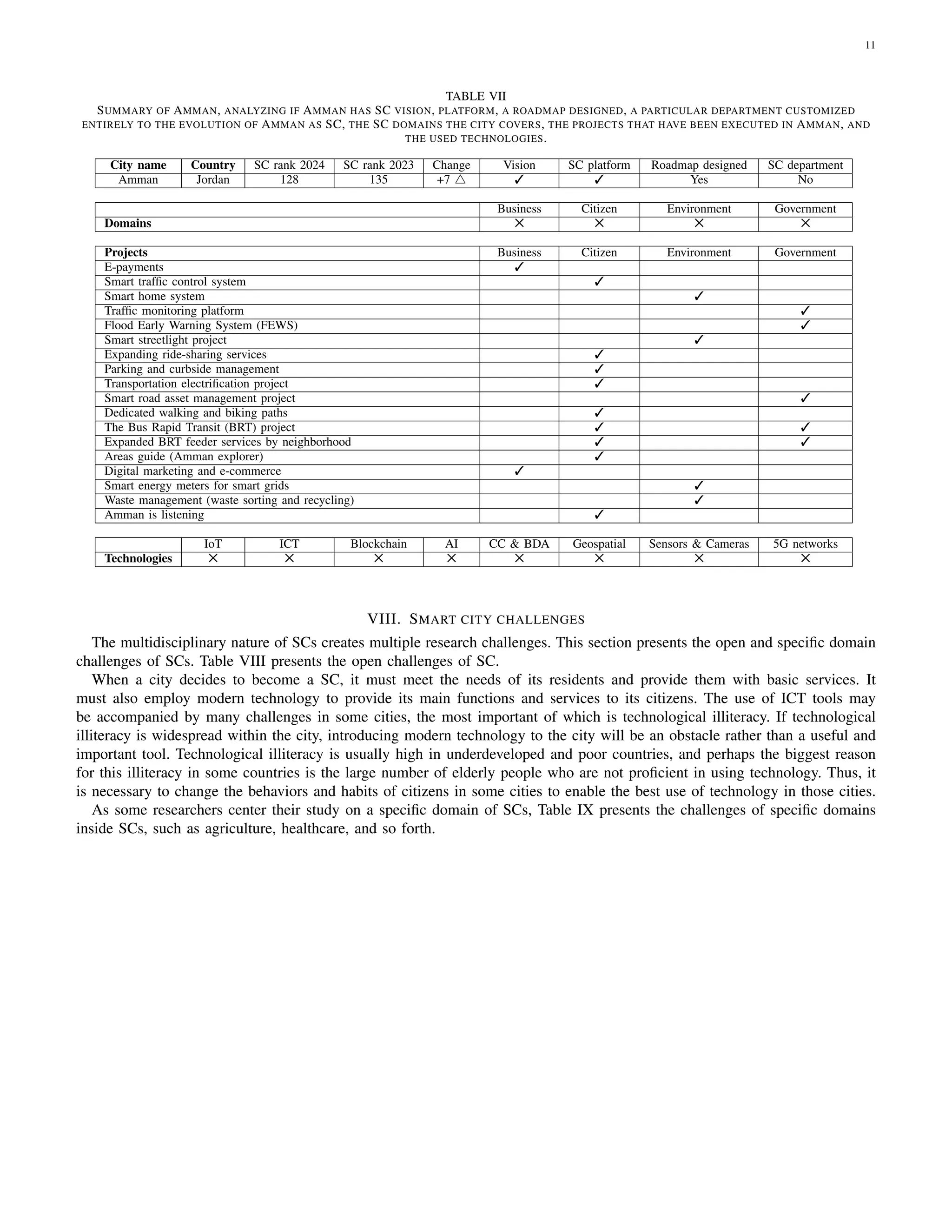
This section presents Amman as a SC (cf. summary in Table VII). Amman ranks 128th
in the IMD SC Index 2024 (i.e., 128
out of 142), while the city is ranked 135th
in the same index in 2023. Amman is the capital of Jordan. It is located in the
northwest of Jordan [8]. Amman has an area of about 7,579 km2
. The population of Amman is expected to reach six million
in 2025. Amman’s vision is to improve the quality of life for Amman’s citizens with the utilization of practical technology
and achieve resilient and sustainable development. The basic elements of the approach toward SC are automation using new
technology, business process re-engineering, and the private sector. The city approach aims at identifying the essential resources
to achieve the SC vision, assessing stakeholder concerns and user needs, and defining the potential projects to be included in
the city roadmap.
Amman was built as a traditional city with basic infrastructure (i.e., buildings, streets, hospitals, universities, schools, and
so on). Currently, the city adopts modern technology infrastructure, such as 4G/5G networks, high-speed communication lines,
machines and computers with high specifications, high-speed internal networks, data centers of high standards, disaster recovery
methodologies, secure firewalls, blockchain, cybersecurity, AI, etc.
The digital transformation in Amman led to several improvements in various domains of the city. Some of these improvements
include: 100% of e-services completed; 134 services available online; paperless procedures at Greater Amman Municipality
(GAM); the GAM app; the Unified Inspection System (UIS); QR code apps; and a decrease in the number of visitors to city
government facilities by 98%.
In 2019, GAM developed a SC roadmap for Amman [163]. This roadmap exploits the latest improvements in technologies
(AI and big data) to resolve the city’s urban planning requests. Moreover, this roadmap tries to increase the use of e-services
and automate procedures in several ministries to attain transparency and increase the efficiency of government services and
functions. Also, the roadmap intends to improve city services and reduce traffic congestion inside Amman.
Many benefits have been achieved in the city of Amman after applying the SC paradigm. Some of these benefits include
e-payments (e.g., eFAWATEERcom), end-to-end services, efficiency of city functions and services (cost, quality, and speed),
simple procedures (i.e., e-transactions), traffic congestion management, paperless procedures (i.e., eco-friendly), employee
training, etc.
10
Fig. 4. Amman smart city challenges.
Amman, a highly urbanized capital, faces several open challenges. Some of those challenges are rapidly growing population
and traffic congestion, large number of refugees in Jordan, human resources capabilities for smart solutions, economic challenges
globally and regionally, citizen behavior and habits, and so on (cf. Figure 4).
The ICT sector evolves rapidly in Jordan, especially in Amman. The ICT sector plays an important role in Gross Domestic
Product (GDP), where it is considered the third biggest contributor to GDP. Thus, one of the main drivers of Amman’s
sustainable growth is the ICT sector. This sector can assist in modernizing the public sector and providing smart infrastructure,
such as smart building and transport, e-services, and data collection and analytics. Finally, this sector can also offer support
for evidence-based policymaking.
The ”Amman is listening” project is one of the unique initiatives currently in the city of Amman. This platform is designed
to better understand the needs of citizens and provide useful information about services or activities that they inquire about.
The primary goal of the ”Amman is listening” project is to improve trust between the government and citizens. The platform
also allows residents to suggest ideas to the government to enhance service delivery. It plays a crucial role during critical times
and crises by continuing to provide services to residents in need. Key outputs of the project include providing data transparency
for all city residents, enabling any resident to send their feedback through the application, and notifying residents of important
information during times of crisis [164].
In Jordan, the urban challenges of Amman city continue to expand as more people move from rural communities [165],
[166], [167] to the city for a better life, economic chances, and protection. Consequently, the significant increase in the number
of residents of Amman adds more challenges to the government. For example, there is a major challenge in collecting, storing,
updating, maintaining the security of urban data, and sharing it transparently with residents [8].
In conclusion, several factors are behind the success story of Amman as a SC. Some of those factors are using the right
policies and regulations, applying the correct administrative conditions, obtaining the right funds for SC initiatives across
different sectors in the city, etc.
11
TABLE VII
SUMMARY OF AMMAN, ANALYZING IF AMMAN HAS SC VISION, PLATFORM, A ROADMAP DESIGNED, A PARTICULAR DEPARTMENT CUSTOMIZED
ENTIRELY TO THE EVOLUTION OF AMMAN AS SC, THE SC DOMAINS THE CITY COVERS, THE PROJECTS THAT HAVE BEEN EXECUTED IN AMMAN, AND
THE USED TECHNOLOGIES.
City name Country SC rank 2024 SC rank 2023 Change Vision SC platform Roadmap designed SC department
Amman Jordan 128 135 +7 △ ✓ ✓ Yes No
Business Citizen Environment Government
Domains ✕ ✕ ✕ ✕
Projects Business Citizen Environment Government
E-payments ✓
Smart traffic control system ✓
Smart home system ✓
Traffic monitoring platform ✓
Flood Early Warning System (FEWS) ✓
Smart streetlight project ✓
Expanding ride-sharing services ✓
Parking and curbside management ✓
Transportation electrification project ✓
Smart road asset management project ✓
Dedicated walking and biking paths ✓
The Bus Rapid Transit (BRT) project ✓ ✓
Expanded BRT feeder services by neighborhood ✓ ✓
Areas guide (Amman explorer) ✓
Digital marketing and e-commerce ✓
Smart energy meters for smart grids ✓
Waste management (waste sorting and recycling) ✓
Amman is listening ✓
IoT ICT Blockchain AI CC & BDA Geospatial Sensors & Cameras 5G networks
Technologies ✕ ✕ ✕ ✕ ✕ ✕ ✕ ✕
VIII. SMART CITY CHALLENGES
The multidisciplinary nature of SCs creates multiple research challenges. This section presents the open and specific domain
challenges of SCs. Table VIII presents the open challenges of SC.
When a city decides to become a SC, it must meet the needs of its residents and provide them with basic services. It
must also employ modern technology to provide its main functions and services to its citizens. The use of ICT tools may
be accompanied by many challenges in some cities, the most important of which is technological illiteracy. If technological
illiteracy is widespread within the city, introducing modern technology to the city will be an obstacle rather than a useful and
important tool. Technological illiteracy is usually high in underdeveloped and poor countries, and perhaps the biggest reason
for this illiteracy in some countries is the large number of elderly people who are not proficient in using technology. Thus, it
is necessary to change the behaviors and habits of citizens in some cities to enable the best use of technology in those cities.
As some researchers center their study on a specific domain of SCs, Table IX presents the challenges of specific domains
inside SCs, such as agriculture, healthcare, and so forth.
12
TABLE VIII
OPEN CHALLENGES FOR SCS.
Reference Challenges
Singh et al. [21] Design and operational costs; heterogeneity; security; privacy; data collection and analysis; waste
management; big data and connectivity; and failure management.
Chourabi et al. [168] Managerial and organizational challenges (e.g., project size and resistance to change); technological
challenges (e.g., lack of IT staff with integration skills); government challenges (e.g., leadership and
transparency); policy context challenges (e.g., integration of the ICT with political and institutional
components); people and communities challenges (e.g., education and quality of life); economic
challenges (e.g., innovation and entrepreneurship); built infrastructure challenges (e.g., IT infrastructure
like security and privacy); natural environment challenges (i.e., challenges relevant to the sustainability
of the introduction of ICT).
Yin et al. [23] Challenges of city traffic, citizen behavior, and city planning.
Bergh and Viaene [169] Expert team; coordination mechanism; relation between IT and business; motivated workers; real
implementation; and ecosystem.
Pierce and Andersson [170] Collaboration (e.g., weak collaboration with stakeholders); financial (e.g., limited funds); governance
(e.g., outdated regulations); awareness (e.g., lack of experience in SC technologies); interoperability
(i.e., SC integration); and privacy (e.g., big data).
Anand and Anand [171] Water sector (e.g., lack of drinkable water and rainwater collection systems); energy sector (e.g., lack
of electricity in some urban areas); waste sector (e.g., lack of waste collection system); mobility sector
(e.g., road infrastructure, congestion, and an inadequate public transport system); built environment sector
(e.g., high house prices); education sector (e.g., literacy rate and quality of education); healthcare sector
(e.g., health insurance rate and lack of public/private services).
Silva et al. [172] Waste management; performance; sustainability; heterogeneity (i.e., interoperability); cost operation
(i.e., cost of deploying the city and maintenance cost); information security; connectivity; system failures;
big data; and carbon footprints.
Monzón [173] Governance (e.g., government instability and high levels of violence/corruption), economy (e.g., economic
crises and downturns), mobility (e.g., reduce private car numbers in the city center), environment
(e.g., urban sprawl and pollution), people and living (e.g., scarcity of resources and technology illiteracy).
Paes et al. [174] Environmental (e.g., waste reduction and adoption of alternative energies); economic (e.g., infrastructure
of cities and cooperation between government, industry, and academia); technological (e.g., big data
and electronic devices and sensors); and social (e.g., citizen participation and culture/habits of citizens)
challenges.
Ali et al. [18] Cost of operation, massive connected devices, scalability, big data, security, infrastructure, and connec-
tivity.
Al-Msie’deen (author’s opinion) City’s infrastructure (i.e., traditional, ICT, and IoT infrastructure); data security, safety, and privacy;
interoperability; governance and policy issues; coordination and collaboration between private and public
sectors; investment and funding; mobility; technological integration; connectivity; public awareness and
acceptance; and sustainable energy.
13
TABLE IX
DOMAIN SPECIFIC CHALLENGES FOR SCS.
Domain Challenge(s) References
Innovation Strategic vision (e.g., the ambiguity of being a SC); organizational capabilities and agility
(e.g., administrative constraints and human resources); technology domestication (e.g., techno-
logical determinism); ecosystem development (e.g., governance models and business models);
and transboundary innovation (e.g., scalable boundary-spanning collaborations).
[175]
IoT Technical challenges (e.g., interoperability, standardization, data privacy/security, and net-
work/device compatibility); social challenges (e.g., accessibility, inclusiveness, user accep-
tance/adoption, and ethical/legal considerations); and economic challenges (e.g., return on
investment, implementation/deployment processes, and cost/funding).
[176]
Challenges related to wearable and autonomous computing systems. [177]
Challenges related to security and privacy, smart sensors, networking, and big data analytics. [178]
Artificial intelligence (AI) Challenges related to security/surveillance; energy consumption/distribution; operationalizing
new technologies; predicting future needs; AI’s ethical use; and measuring the environmental
effects of AI infrastructure.
[179]
Agriculture Challenges related to the smart farm, such as the high cost of technology, constructing farms
inside cities, the energy outlay, the high real estate cost, the need for IT skills, and a lack of
awareness.
[180]
Waste management Lack of strict government regulatory policies, proper financial planning, and benchmarking
processes.
[181]
Electronic waste (e-waste) and the identification of waste materials before the separation process
(an expensive job).
[182]
Traffic Traffic congestion, heterogeneous traffic flow, capacity of the roads, vehicle-to-vehicle commu-
nication, and berth scheduling.
[183]
Energy Implementation challenges (e.g., technical complexity, resistance to change, privacy and security
concerns, high implementation costs, and limited data access); variability (resp. intermittency) of
renewable energy sources; and managing energy consumption in cities (i.e., mismatch between
energy supply and demand).
[184]
Challenges related to achieving lower energy consumption. [185]
Healthcare Technological challenges (e.g., costs, poor data quality, and data governance/ethical concerns);
organizational challenges (e.g., poor planning, poor leadership, and change culture); environment
challenges (e.g., poor computer skills and end user behavior).
[186]
Challenges related to health monitoring. [187]
Privacy and security Challenges related to data privacy and protection. [188]
Challenges related to data storage-related privacy. [189]
Challenges related to cybersecurity threats. [190]
Citizen Challenges related to the digital divide and literacy, people with disabilities, and encouraging
citizens as ICT users.
[191]
14
IX. SMART CITIES RESEARCH OPPORTUNITIES
Based on the knowledge acquired through the literature review, this section presents the research opportunities that are
promising and related to the SC paradigm.
TABLE X
SMART CITIES RESEARCH OPPORTUNITIES.
Domain/Sector Research opportunities
Water Water management, water storage, water meter reading system, rainwater harvesting systems, water quality
monitoring, wastewater management, controlling flood, etc.
Food Crop management, food safety and quality, food distribution and logistics, smart farming, transgenic research,
food waste reduction, etc.
Computer Vision (CV) City monitoring, face recognition, Traffic Management Systems (TMS), smart waste collection, crowd manage-
ment, fire detection, intelligent surveillance systems, etc.
Healthcare E-Services, Human Computer Interaction (HCI), disease detection and monitoring, medical/health crisis,
telemedicine, wearable devices, biometric sensors, Electronic Health Records (EHR), bioinformatics and biomed-
ical image analysis, etc.
Education Digital and distance learning, e-learning, smart learning hubs, learning analytics, metaverse, virtual reality, smart
classrooms, etc.
AI Cybersecurity, controlling pollution, parking systems, public transportation, waste management, traffic manage-
ment, energy tracking, security, encryption, big data, intelligent drainage systems, etc.
Blockchain Finance, privacy, data management, supply chain, logistics, emergency response systems, smart contracts for public
services, transparent voting systems, etc.
Waste Smart waste collection, recycling and waste sorting, waste to energy technologies, smart waste monitoring and
analytics, etc.
Agriculture Drones for crop monitoring, aquaponics systems, rooftop and balcony gardens, greenhouse, vertical farming
systems, automated smart irrigation systems, raising chickens and beekeeping, etc.
Energy Renewable energy, energy storage systems, electric vehicles, smart meters, data privacy and security, energy data
analytics, energy consumption, etc.
IoT Smart street lighting, smart parking systems, air/water quality monitoring, emergency response systems, smart
surveillance, smart meters/grids, smart waste bins, remote health monitoring, participatory sensing, fire detection,
agriculture, noise pollution, etc.
Several studies have been done in the fields of water and food management inside SCs. These fields have not been very
well explored yet; thus, it is possible to advance these fields in several areas, such as crop management, transgenic research,
water management, water storage, and so on.
Computer Vision (CV) is a multidiscipline field including engineering, biology, mathematics, psychology, and physics
disciplines. It aims to address how computers obtain useful interpretations of digital images and videos. Thus, it improves
a computer’s ability to obtain, process, analyze, and interpret digital media. CV involves vast subdomains, such as object
tracking, motion estimation, virtual reality, and face recognition [192]. CV studies are quite important to SCs, especially in the
healthcare domain. Also, it can be utilized in other domains, like city monitoring, advertisement, traffic management systems,
and logistics [1]. Pushing this field forward and utilizing modern techniques inside SCs might be a key advancement.
In the upcoming years, the SC paradigm in healthcare is expected to become more significant due to the growing urban
population and rising healthcare demands. This will present new opportunities for both healthcare providers and patients [193].
Recently, the most research effort has been done in the healthcare area inside SCs. Several improvements were made regarding
this domain in bioinformatics, biomedical image analysis, and so on. In fact, more studies are needed to improve this domain
in order to be totally accepted by patients in the city. Also, more research is needed to improve electronic services for both
clinics and hospitals.
Regarding the education sector, there are numerous studies that have been done in the literature [141] [194] [195]. Smart
education is the main component of SC development. SCs always include new education services and applications for citizens
to exploit. For me, the basic step towards SC development is the education of city citizens. Thus, education must be the
primary focus of a SC in order for its residents to thrive. Education inside SCs has not been very well studied yet; therefore,
it is possible to advance this sector in numerous areas, such as e-learning, smart dashboards, smart campuses [196], interactive
multimedia [197], the metaverse [198], virtual reality [199], smart classrooms [200], and so on.
Furthermore, there is some research done in the area of AI techniques in numerous domains of SC [201], [202]. SCs are
continuously including new services and applications for citizens to use based on AI. AI aims at improving the performance
of the city in some domains, such as traffic management and city monitoring. Actually, more studies should be done on AI
techniques. AI has not been very well exploited yet, so it is possible to utilize it in several areas of SC, such as cybersecurity,
controlling pollution, parking systems, public transportation, waste management, traffic management, energy tracking, security,
encryption, and so on. Moreover, blockchain is a technology for resolving privacy and data management concerns in the context
of SCs. Thus, there are some studies to be done on blockchain techniques. The blockchain is the king of transparency. Several
research opportunities for SCs need further study. Table X presents some research opportunities for SCs based on the author’s
point of view.
15
X. SUMMARY AND FINAL THOUGHTS
In summary, the implementation of SCs is still missing many points: the definition of the SC concept; choosing the appropriate
architecture of SC; addressing the open and domain challenges of SC; following a SC roadmap where future phases that the
city should take are obviously planned and designed in advance; settling the best practice guidelines in the field of SC; and
discussing research opportunities for SC. This paper has included information mined from current literature in order to answer
the above points and to be a useful source for researchers in the area of SCs.
In order to create smart, green, digital, and human-centric cities of the future, there is a need to give more care to education,
investments, strategies, and the sharing of experiences. In that scenario, integrating inclusion with digital transformation will
still be a big challenge for all types of cities around the world.
Furthermore, this work has analyzed whether Amman has a SC vision, a platform, a designed roadmap, a dedicated department
focused on the evolution of Amman as a SC, the SC domains the city covers, the projects that have been executed in Amman,
and the technologies used.
Currently, there are many existing definitions of the SC in the literature, and this in itself constitutes a major challenge
for research. Each definition focuses on specific aspects of the SC and is not comprehensive in all aspects. Therefore, great
progress will be achieved in the field of SCs by finding a single definition of SC and applying this unified definition to every
research project to proceed in the same direction (i.e., standard definition of SC).
Moreover, we cannot consider a city that exploits ICT tools to be a SC. There are many benefits of technology, but only
employing this modern technology and introducing it into cities does not make them SCs. Technology alone doesn’t make the
city secure, doesn’t provide basic needs (e.g., food, energy, water, and others), and does not protect the city’s environment. For
example, a city can monitor the entire traffic system and share information with its citizens, but the city doesn’t solve traffic
congestion problems. Can such a city be considered smart? The main point is that modern technology is a key tool to create
smarter cities, but it does not build a SC in itself. Though it does help to improve services like traffic, logistics, and so forth,
it also helps to connect the city and its citizens. Consequently, a smart city must meet the primitive needs of citizens (water,
food, and so forth) and introduce modern technology to accomplish considerable enhancement in all domains of the city. The
incorporation of modern technology and meeting the main needs and services of the inhabitants as a whole, without partition,
establishes the basis for a smart city.
On the other hand, cities must define a roadmap for the SC so that the future steps of the city are clearly planned and
designed. This roadmap helps maintain the city in the future and allows cooperation between the different groups working on
its development (e.g., the ministry of electricity, water, agriculture, and so on). Without a roadmap, many cities will face the
problem of connecting different and diverse initiatives to each other. To summarize, cities that aim to transform into the SC
paradigm must prepare a clear roadmap in advance and form a specific department to manage the phases of city development,
services, and maintenance.
Currently, SC paradigm can be applied to traditional cities (already built), or new cities can be built from scratch to be
smart from the beginning. As an author, I prefer that SCs be planned, designed, and developed from scratch. I do not prefer
applying the concept of SCs to existing cities in their usual form and pre-built without considering many aspects that may
hinder the sustainability of SCs. When SCs are prepared from scratch, there is room to provide all means of sustainability for
the city. For example, many green spaces and parks can be provided in different areas of the city, and roads can be designed
to accommodate future growth, with multiple lanes on each street and dedicated paths for bicycles, walkers, and the disabled.
Furthermore, agricultural lands can be designated around the city to ensure that future population and building growth can be
accommodated (cf. Figure 5).
Establishing energy farms around the city and in the right place and using them to operate the city is a great gain for those
SCs built from scratch. It is possible to benefit from renewable and clean energy sources, such as solar and wind energy
(cf. Figure 5). In traditional cities, there may not be enough space to establish such farms to harvest energy and use it to
operate the city. The only solution for traditional and old cities may be to use the roofs of buildings and houses to harvest this
energy.
In many crowded urban cities, citizens face difficulty finding suitable places to park their cars. Due to the high population
density and the large number of buildings, constructing adequate free parking spaces is impossible. However, when designing
SCs in new geographical areas from scratch, incorporating solutions for such problems can be a significant achievement
(cf. Figure 5). For instance, in the Jordanian capital, Amman, there is a notable scarcity of free parking spaces available to
the public. Additionally, government facilities and restaurants provide only a limited number of parking spaces, which are
frequently reserved for their employees. This situation leads to substantial congestion and increases the likelihood of accidents,
especially since most restaurants are situated on main streets.
Figure 5 illustrates that planning SCs in advance can address the issues currently faced by crowded urban areas. By
providing traditional infrastructure, such as streets and buildings, according to the latest international standards and preparing
the infrastructure for modern technology with all dimensions considered, many problems can be mitigated. Furthermore, farms
are placed outside the city’s future borders, and special industrial zones can be established beyond its regulatory boundaries.
Additionally, energy-harvesting farms can be located outside the city limits. However, even with meticulous planning and
16
Fig. 5. Building smart cities from scratch.
preparation, the sustainability and success of a SC are not guaranteed. The most critical factor for the success of SCs is
their citizens. Therefore, it is essential to focus on education, developing environmentally friendly habits and behaviors, and
making excellent use of ICT tools. Moreover, the SC paradigm can also be applied to existing cities if it is well planned and
implemented.
Education plays a crucial role in the prosperity of SCs, as these cities continuously introduce new services for citizens through
specialized applications. To ensure that citizens can use these applications effectively, it is essential to provide appropriate
training. Typically, instructions for using an application are provided within its documentation. In software engineering, such
documentation (i.e., user tutorials) is considered a critical component of the software development life cycle, with various
types of documents collectively known as user manuals [197] [203]. Additionally, simulation can be employed to demonstrate
certain procedures within SCs, where specific scenarios are recreated using specialized simulation software (e.g., Arena [204]).
For instance, public safety protocols can be simulated for events such as a fire in a particular building or a car accident within
the city.
After completing the planning and design process to make a city smart, an important question arises: What is the appropriate
architecture for this city? This survey presents the most common architectures used in implementing SCs based on IoT. It’s
important to note that a single architecture can be selected to fit a specific city, or multiple architectures can be employed within
the same city. Depending on the city’s unique needs and requirements, the chosen architecture can be adapted accordingly. Thus,
selecting the right architecture for SCs before beginning development and implementation can help reduce future problems
and costs. There is an urgent need to establish a committee with the mission of standardizing the architecture of smart cities.
The committee’s tasks include developing best practices for implementing technical infrastructure in smart cities, providing
ICT tools to collect and analyze data from various IoT devices, and ensuring that data collected from different devices (such
as sensors and actuators) is represented in a unified format.
After analyzing several SCs, it is clear that most are limited to offering free WiFi and smartphone applications to facilitate
electronic transactions and gather resident feedback. However, these features alone do not qualify a city as smart. To truly
be considered smart, cities must effectively utilize the city-specific data they collect to provide innovative services. All city
data should be collected on a single platform and presented in a manner that is useful to decision-makers, as valuable insights
and future projections can be drawn from current data. SCs need to leverage data and technology to drive sustainability and
efficiency, and they should continuously seek innovative solutions to enhance the quality of life for their citizens.
REFERENCES
[1] Sánchez-Corcuera R, Núñez-Marcos A, Sesma-Solance J, Bilbao-Jayo A, Mulero R, Zulaika U, et al. Smart cities survey: Technologies, application do-
mains and challenges for the cities of the future. Int J Distributed Sens Networks. 2019;15(6). Available from: https://doi.org/10.1177/1550147719853984.
17
[2] Al-Msie’deen R. Amman City, Jordan: Toward a Sustainable City from the Ground Up. Arxiv. 2024:1-12. Available from: https://arxiv.org/abs/2408.
01454.
[3] Manoharan G, Durai S, Rajesh GA, Razak A, Rao CBS, Ashtikar SP. Chapter Five - An investigation into the effectiveness of smart city projects by
identifying the framework for measuring performance. In: Basetti V, Shiva CK, Ungarala MR, Rangarajan SS, editors. Artificial Intelligence and Machine
Learning in Smart City Planning. Elsevier; 2023. p. 71-84. Available from: https://www.sciencedirect.com/science/article/pii/B9780323995030000041.
[4] Shekarappa G S, Badi M, Raj S, Mahapatra S. Chapter Twenty-one - An overview of smart city planning—The future technology. In: Basetti V, Shiva
CK, Ungarala MR, Rangarajan SS, editors. Artificial Intelligence and Machine Learning in Smart City Planning. Elsevier; 2023. p. 319-35. Available
from: https://www.sciencedirect.com/science/article/pii/B9780323995030000168.
[5] Bellini P, Nesi P, Pantaleo G. IoT-Enabled Smart Cities: A Review of Concepts, Frameworks and Key Technologies. Applied Sciences. 2022;12(3).
Available from: https://www.mdpi.com/2076-3417/12/3/1607.
[6] Hamid B, Jhanjhi N, Humayun M, Khan A, Alsayat A. Cyber Security Issues and Challenges for Smart Cities: A survey. In: 2019 13th International
Conference on Mathematics, Actuarial Science, Computer Science and Statistics (MACS); 2019. p. 1-7.
[7] AlDairi A, Tawalbeh L. Cyber Security Attacks on Smart Cities and Associated Mobile Technologies. Procedia Computer Science. 2017;109:1086-
91. 8th International Conference on Ambient Systems, Networks and Technologies, ANT-2017 and the 7th International Conference on Sustainable
Energy Information Technology, SEIT 2017, 16-19 May 2017, Madeira, Portugal. Available from: https://www.sciencedirect.com/science/article/pii/
S1877050917310669.
[8] Sharaf FM. Assessment of Urban Sustainability—The Case of Amman City in Jordan. Sustainability. 2023;15(7). Available from: https://www.mdpi.
com/2071-1050/15/7/5875.
[9] Chelleri L, Schuetze T, Salvati L. Integrating resilience with urban sustainability in neglected neighborhoods: Challenges and opportunities of
transitioning to decentralized water management in Mexico City. Habitat International. 2015;48:122-30. Available from: https://www.sciencedirect.
com/science/article/pii/S0197397515000648.
[10] Conti S, Dias A, Pereira L. Perceived City Sustainability and Tourist Behavioural Intentions. Smart Cities. 2023;6(2):692-708. Available from:
https://www.mdpi.com/2624-6511/6/2/33.
[11] Tan J, Sha X, Lu T, Dai B. A Short Survey on Future Research of AI and IoT Technologies. In: 2022 International Wireless Communications and
Mobile Computing (IWCMC); 2022. p. 190-5.
[12] hoon Kim T, Ramos C, Mohammed S. Smart City and IoT. Future Generation Computer Systems. 2017;76:159-62. Available from: https://www.
sciencedirect.com/science/article/pii/S0167739X17305253.
[13] Chataut R, Phoummalayvane A, Akl R. Unleashing the Power of IoT: A Comprehensive Review of IoT Applications and Future Prospects in Healthcare,
Agriculture, Smart Homes, Smart Cities, and Industry 4.0. Sensors. 2023;23(16). Available from: https://www.mdpi.com/1424-8220/23/16/7194.
[14] Al-Msie’deen R, Seriai A, Huchard M, Urtado C, Vauttier S. Documenting the Mined Feature Implementations from the Object-oriented Source Code
of a Collection of Software Product Variants. In: Reformat MZ, editor. The 26th International Conference on Software Engineering and Knowledge
Engineering, Hyatt Regency, Vancouver, BC, Canada, July 1-3, 2013. Knowledge Systems Institute Graduate School; 2014. p. 138-43. Available from:
https://hal-lirmm.ccsd.cnrs.fr/lirmm-01003860/file/FD.pdf.
[15] Al-Msie’deen R, Huchard M, Seriai A, Urtado C, Vauttier S. Automatic Documentation of [Mined] Feature Implementations from Source Code
Elements and Use-Case Diagrams with the REVPLINE Approach. Int J Softw Eng Knowl Eng. 2014;24(10):1413-38. Available from: https://doi.org/
10.1142/S0218194014400142.
[16] Al-Msie’deen R, Huchard M, Seriai A, Urtado C, Vauttier S. Reverse Engineering Feature Models from Software Configurations using Formal Concept
Analysis. In: Bertet K, Rudolph S, editors. Proceedings of the Eleventh International Conference on Concept Lattices and Their Applications, Košice,
Slovakia, October 7-10, 2014. vol. 1252 of CEUR Workshop Proceedings. CEUR-WS.org; 2014. p. 95-106. Available from: https://ceur-ws.org/
Vol-1252/cla2014 submission 13.pdf.
[17] Al-Msie’deen R. Reverse Engineering Feature Models From Software Variants to Build Software Product Lines: REVPLINE Approach. Montpellier
2 University, France; 2014. Available from: https://tel.archives-ouvertes.fr/tel-01015102.
[18] Ali SA, Elsaid SA, Ateya AA, ElAffendi M, El-Latif AAA. Enabling Technologies for Next-Generation Smart Cities: A Comprehensive Review and
Research Directions. Future Internet. 2023;15(12):1-43. Available from: https://www.mdpi.com/1999-5903/15/12/398.
[19] Qiao L, Li Y, Chen D, Serikawa S, Guizani M, Lv Z. A survey on 5G/6G, AI, and Robotics. Computers and Electrical Engineering. 2021;95:107372.
Available from: https://www.sciencedirect.com/science/article/pii/S0045790621003414.
[20] Mukhopadhyay S, Suryadevara NK. Smart Cities and Homes: Current Status and Future Possibilities. Journal of Sensor and Actuator Networks.
2023;12(2). Available from: https://www.mdpi.com/2224-2708/12/2/25.
[21] Singh T, Solanki A, Sharma SK, Nayyar A, Paul A. A Decade Review on Smart Cities: Paradigms, Challenges and Opportunities. IEEE Access.
2022;10:68319-64.
[22] Haque AKMB, Bhushan B, Dhiman G. Conceptualizing smart city applications: Requirements, architecture, security issues, and emerging trends.
Expert Syst J Knowl Eng. 2022;39(5). Available from: https://doi.org/10.1111/exsy.12753.
[23] Yin C, Xiong Z, Chen H, Wang J, Cooper D, David B. A literature survey on smart cities. Sci China Inf Sci. 2015;58(10):1-18. Available from:
https://doi.org/10.1007/s11432-015-5397-4.
[24] Palmisano SJ. A Smarter Planet: The Next Leadership Agenda. IBM. 2008:1-8.
[25] Harrison C, Eckman B, Hamilton R, Hartswick P, Kalagnanam J, Paraszczak JR, et al. Foundations for Smarter Cities. IBM J Res Dev. 2010;54(4):1-16.
Available from: https://doi.org/10.1147/JRD.2010.2048257.
[26] Su K, Li J, Fu H. Smart city and the applications. In: 2011 International Conference on Electronics, Communications and Control (ICECC); 2011. p.
1028-31.
[27] Coe A, Paquet G, Roy J. E-Governance and Smart Communities: A Social Learning Challenge. Social Science Computer Review. 2001;19(1):80-93.
Available from: https://doi.org/10.1177/089443930101900107.
[28] Odendaal N. Information and communication technology and local governance: understanding the difference between cities in developed and emerging
economies. Comput Environ Urban Syst. 2003;27(6):585-607. Available from: https://doi.org/10.1016/S0198-9715(03)00016-4.
[29] Andrea Caragliu CDB, Nijkamp P. Smart Cities in Europe. Journal of Urban Technology. 2011;18(2):65-82. Available from: https://doi.org/10.1080/
10630732.2011.601117.
[30] Lazaroiu GC, Roscia M. Definition methodology for the smart cities model. Energy. 2012;47(1):326-32. Asia-Pacific Forum on Renewable Energy
2011. Available from: https://www.sciencedirect.com/science/article/pii/S0360544212007062.
[31] Al-Hader M, Rodzi A, Sharif AR, Ahmad N. Smart City Components Architicture. In: 2009 International Conference on Computational Intelligence,
Modelling and Simulation; 2009. p. 93-7.
[32] Yamamoto S, Matsumoto S, Nakamura M. Using cloud technologies for large-scale house data in smart city. In: 4th IEEE International Conference
on Cloud Computing Technology and Science Proceedings, CloudCom 2012, Taipei, Taiwan, December 3-6, 2012. IEEE Computer Society; 2012. p.
141-8. Available from: https://doi.org/10.1109/CloudCom.2012.6427546.
[33] Monzón A. Smart Cities Concept and Challenges - Bases for the Assessment of Smart City Projects. In: Helfert M, Krempels K, Donnellan B, Klein
C, editors. SMARTGREENS 2015 - Proceedings of the 4th International Conference on Smart Cities and Green ICT Systems, Lisbon, Portugal, 20-22
May, 2015. SciTePress; 2015. p. IS-11.
[34] Dameri RP. Searching for Smart City definition: a comprehensive proposal. International Journal of Computers & Technology. 2013
Oct;11(5):2544–2551. Available from: https://rajpub.com/index.php/ijct/article/view/1142ijct.
18
[35] Vito Albino UB, Dangelico RM. Smart Cities: Definitions, Dimensions, Performance, and Initiatives. Journal of Urban Technology. 2015;22(1):3-21.
Available from: https://doi.org/10.1080/10630732.2014.942092.
[36] Dashkevych O, Portnov BA. Criteria for Smart City Identification: A Systematic Literature Review. Sustainability. 2022;14(8). Available from:
https://www.mdpi.com/2071-1050/14/8/4448.
[37] Tahmasseby S. The Implementation of Smart Mobility for Smart Cities: A Case Study in Qatar. Civil Engineering Journal. 2022;8(10):2154-71.
Available from: https://www.civilejournal.org/index.php/cej/article/view/3569.
[38] Marsal-Llacuna ML, Colomer-Llinàs J, Meléndez-Frigola J. Lessons in urban monitoring taken from sustainable and livable cities to better address the
Smart Cities initiative. Technological Forecasting and Social Change. 2015;90:611-22. Available from: https://www.sciencedirect.com/science/article/
pii/S0040162514000456.
[39] Gracias JS, Parnell GS, Specking E, Pohl EA, Buchanan R. Smart Cities—A Structured Literature Review. Smart Cities. 2023;6(4):1719-43. Available
from: https://www.mdpi.com/2624-6511/6/4/80.
[40] Longo F, Puliafito A, Rana O. Guest Editors’ Introduction to the Special Issue on Fog, Edge, and Cloud Integration for Smart Environments. ACM
Trans Internet Technol. 2019 apr;19(2). Available from: https://doi.org/10.1145/3319404.
[41] Almeida A, Mulero R, Rametta P, Urošević V, Andrić M, Patrono L. A critical analysis of an IoT—aware AAL system for elderly monitoring. Future
Generation Computer Systems. 2019;97:598-619. Available from: https://www.sciencedirect.com/science/article/pii/S0167739X18321769.
[42] Mell P, Grance T. The NIST Definition of Cloud Computing (NIST Special Publication 800-145). National Institute of Standards and Technology.
2011. Gaithersburg, MD 20899-8930. Available from: https://csrc.nist.gov/pubs/sp/800/145/final.
[43] Ji Z, Ganchev I, O’Droma M, Zhao L, Zhang X. A Cloud-Based Car Parking Middleware for IoT-Based Smart Cities: Design and Implementation.
Sensors. 2014;14(12):22372-93. Available from: https://doi.org/10.3390/s141222372.
[44] Niveshitha N, Amsaad F, Jhanjhi NZ. Air Quality Prediction in Smart Cities Using Cloud Machine Learning. In: 2023 Second International Conference
On Smart Technologies For Smart Nation (SmartTechCon); 2023. p. 1115-9.
[45] Kaur MJ, Maheshwari P. Building smart cities applications using IoT and cloud-based architectures. In: 2016 International Conference on Industrial
Informatics and Computer Systems (CIICS); 2016. p. 1-5.
[46] Zheng Y, Liu T, Wang Y, Zhu Y, Liu Y, Chang E. Diagnosing New York city’s noises with ubiquitous data. In: Brush AJ, Friday A, Kientz JA, Scott
J, Song J, editors. Proceedings of the 2014 ACM International Joint Conference on Pervasive and Ubiquitous Computing, UbiComp ’14, Seattle, WA,
USA, September 13-17, 2014. ACM; 2014. p. 715-25. Available from: https://doi.org/10.1145/2632048.2632102.
[47] Iorga M, Feldman L, Barton R, Martin MJ, Goren N, Mahmoudi C. Fog Computing Conceptual Model (NIST Special Publication 500-325). National
Institute of Standards and Technology. 2018:1-15. U.S. Department of Commerce. Available from: https://nvlpubs.nist.gov/nistpubs/SpecialPublications/
NIST.SP.500-325.pdf.
[48] Patel M, Mehta A, Chauhan NC. Design of Smart Dashboard based on IoT & Fog Computing for Smart Cities. In: 2021 5th International Conference
on Trends in Electronics and Informatics (ICOEI); 2021. p. 458-62.
[49] Kanyilmaz A, Cetin A. Fog Based Architecture Design for IoT with Private Nodes: A Smart Home Application. In: 2019 7th International Istanbul
Smart Grids and Cities Congress and Fair (ICSG); 2019. p. 194-8.
[50] Kaur M, Aron R, Wadhwa H, Oo HN. CNN-based Smart Waste Management System in Fog Computing Environment. In: 2023 IEEE 12th International
Conference on Communication Systems and Network Technologies (CSNT); 2023. p. 774-9.
[51] Tang C, Wei X, Zhu C, Chen W, Rodrigues JJPC. Towards Smart Parking Based on Fog Computing. IEEE Access. 2018;6:70172-85.
[52] Tandon R, Gupta PK. Optimizing Smart Parking System by Using Fog Computing. In: Singh M, Gupta PK, Tyagi V, Flusser J, Ören TI, Kashyap
R, editors. Advances in Computing and Data Sciences - Third International Conference, ICACDS 2019, Ghaziabad, India, April 12-13, 2019, Revised
Selected Papers, Part II. vol. 1046 of Communications in Computer and Information Science. Springer; 2019. p. 724-37. Available from: https:
//doi.org/10.1007/978-981-13-9942-8 67.
[53] Chen N, Chen Y, You Y, Ling H, Liang P, Zimmermann R. Dynamic Urban Surveillance Video Stream Processing Using Fog Computing. In: 2016
IEEE Second International Conference on Multimedia Big Data (BigMM); 2016. p. 105-12.
[54] Shi W, Pallis G, Xu Z. Edge Computing [Scanning the Issue]. Proc IEEE. 2019;107(8):1474-81. Available from: https://doi.org/10.1109/JPROC.2019.
2928287.
[55] Coelho Silva M, Gomes Campos Bianchi A, Pontes Ribeiro S, Sá Silva J, Augusto Rabelo Oliveira R. Edge Computing Smart Healthcare Cooperative
Architecture for COVID-19 Medical Facilities. IEEE Latin America Transactions. 2022;20(10):2229-36.
[56] G S, T GK, N R. Edge Computing Based Secure Healthcare System. In: 2023 Innovations in Power and Advanced Computing Technologies (i-PACT);
2023. p. 1-5.
[57] Bhende N, Kesavan R. Energy-Optimized Edge-Computing Framework for the Sustainable Development of Modern Agriculture. Engineering
Proceedings. 2023;56(1). Available from: https://www.mdpi.com/2673-4591/56/1/134.
[58] Nagaraj P, Lakshmanaprakash S, Muneeswaran V. Edge Computing and Deep Learning Based Urban Street Cleanliness Assessment System. In: 2022
International Conference on Data Science, Agents & Artificial Intelligence (ICDSAAI). vol. 01; 2022. p. 1-6.
[59] Wang X, Yang LT, Xie X, Jin J, Deen MJ. A Cloud-Edge Computing Framework for Cyber-Physical-Social Services. IEEE Communications Magazine.
2017;55(11):80-5.
[60] Ross R, Pillitteri V, Dempsey K. Assessing Enhanced Security Requirements for Controlled Unclassified Information (NIST Special Publication
800-172A). National Institute of Standards and Technology. 2022:1-62. Gaithersburg, MD. Available from: https://nvlpubs.nist.gov/nistpubs/
SpecialPublications/NIST.SP.800-172A.pdf.
[61] Akram M, Barker WC, Clatterbuck R, Dodson D, Everhart B, Gilbert J, et al. Securing Web Transactions: TLS Server Certificate Management (NIST
special publication 1800-16). The National Cybersecurity Center of Excellence (NCCoE) at the National Institute of Standards and Technology (NIST).
2020:1-432. Gaithersburg, MD. Available from: https://nvlpubs.nist.gov/nistpubs/SpecialPublications/NIST.SP.1800-16.pdf.
[62] instruction 5200 44 D. Protection of Mission Critical Functions to Achieve Trusted Systems and Networks (TSN). 2024:1-22. Available from:
https://www.esd.whs.mil/Portals/54/Documents/DD/issuances/dodi/520044p.pdf?ver=FykYguJCo0S8RyRGdriRvg%3d%3d.
[63] Hogan M, Newton E, Laboratory IT. Supplemental Information for the Interagency Report on Strategic U.S. Government Engagement in International
Standardization to Achieve U.S. Objectives for Cybersecurity (NISTIR 8074). National Institute of Standards and Technology - US Department of
Commerce. 2015;2:1-79. Prepared by the International Cybersecurity Standardization Working Group of the National Security Council’s - Cyber
Interagency Policy Committee. Available from: https://nvlpubs.nist.gov/nistpubs/ir/2015/NIST.IR.8074v2.pdf.
[64] Yaga D, Mell P, Roby N, Scarfone K. Blockchain Technology Overview (NISTIR 8202). National Institute of Standards and Technology. 2018:1-68.
U.S. Department of Commerce. Available from: https://nvlpubs.nist.gov/nistpubs/ir/2018/NIST.IR.8202.pdf.
[65] IBM. What is Artificial Intelligence (AI)?; 2024. Available from: https://www.ibm.com/topics/artificial-intelligence.
[66] Stouffer K, Pease M, Tang C, Zimmerman T, Pillitteri V, Lightman S, et al. Guide to Operational Technology (OT) Security (NIST Special Publication
NIST SP 800-82r3). National Institute of Standards and Technology. 2023:1-316. Gaithersburg, MD. Available from: https://nvlpubs.nist.gov/nistpubs/
SpecialPublications/NIST.SP.800-82r3.pdf.
[67] Fagan M, Megas KN, Scarfone K, Smith M. Foundational Cybersecurity Activities for IoT Device Manufacturers (NISTIR 8259). National Institute
of Standards and Technology. 2020:1-36. Gaithersburg, MD. Available from: https://nvlpubs.nist.gov/nistpubs/ir/2020/NIST.IR.8259.pdf.
[68] Singh RK, Kumar P, Mukherjee S, Suman S, Pandey V, Srivastava PK. Chapter 3 - Application of geospatial technology in agricultural water
management. In: Srivastava PK, Gupta M, Tsakiris G, Quinn NW, editors. Agricultural Water Management. Academic Press; 2021. p. 31-45. Available
from: https://www.sciencedirect.com/science/article/pii/B9780128123621000035.
19
[69] Pramanik MI, Lau RYK, Azad MAK, Hossain MS, Chowdhury MKH, Karmaker BK. Healthcare informatics and analytics in big data. Expert Systems
with Applications. 2020;152:113388. Available from: https://www.sciencedirect.com/science/article/pii/S0957417420302128.
[70] Zhang JZ, Srivastava PR, Sharma D, Eachempati P. Big data analytics and machine learning: A retrospective overview and bibliometric analysis. Expert
Systems with Applications. 2021;184:115561. Available from: https://www.sciencedirect.com/science/article/pii/S0957417421009672.
[71] Feng L, You Y, Liao W, Pang J, Hu R, Feng L. Multi-scale change monitoring of water environment using cloud computing in optimal resolution
remote sensing images. Energy Reports. 2022;8:13610-20. Available from: https://www.sciencedirect.com/science/article/pii/S235248472201856X.
[72] Satheeshkumar R, Saini K, Daniel A, Khari M. Chapter Seventeen - 5G—Communication in HealthCare applications. In: Raj P, Saini K, Surianarayanan
C, editors. Edge/Fog Computing Paradigm: The Concept Platforms and Applications. vol. 127 of Advances in Computers. Elsevier; 2022. p. 485-506.
Available from: https://www.sciencedirect.com/science/article/pii/S0065245822000432.
[73] Casini M. Chapter 3 - Building digital revolution. In: Casini M, editor. Construction 4.0. Woodhead Publishing Series in Civil and Structural Engineering.
Woodhead Publishing; 2022. p. 151-86. Available from: https://www.sciencedirect.com/science/article/pii/B9780128217979000131.
[74] Rana DS, Dhondiyal SA, Chamoli SK. Software Defined Networking (SDN) Challenges, issues and Solution. International Journal of Computer Sciences
and Engineering. 2019;7(1):884 889. Available from: https://ijcseonline.isroset.org/pdf paper view.php?paper id=3602&149-IJCSE-05165.pdf.
[75] Zong Y, Feng C, Guan Y, Liu Y, Guo L. Virtual Network Embedding for Multi-Domain Heterogeneous Converged Optical Networks: Issues and
Challenges. Sensors. 2020;20(9). Available from: https://www.mdpi.com/1424-8220/20/9/2655.
[76] Alam I, Sharif K, Li F, Latif Z, Karim MM, Biswas S, et al. A Survey of Network Virtualization Techniques for Internet of Things Using SDN and
NFV. ACM Comput Surv. 2020 apr;53(2). Available from: https://doi.org/10.1145/3379444.
[77] Han SN, Khan I, Lee GM, Crespi N, Glitho RH. Service composition for IP smart object using realtime Web protocols: Concept and research challenges.
Computer Standards & Interfaces. 2016;43:79-90. Available from: https://www.sciencedirect.com/science/article/pii/S0920548915000914.
[78] Gajjar MJ. Chapter 2 - Context-aware computing. In: Gajjar MJ, editor. Mobile Sensors and Context-Aware Computing. Morgan Kaufmann; 2017. p.
17-35. Available from: https://www.sciencedirect.com/science/article/pii/B9780128016602000021.
[79] Jaskó S, Skrop A, Holczinger T, Chován T, Abonyi J. Development of manufacturing execution systems in accordance with Industry 4.0 requirements: A
review of standard- and ontology-based methodologies and tools. Computers in Industry. 2020;123:103300. Available from: https://www.sciencedirect.
com/science/article/pii/S0166361520305340.
[80] Vangelov N. Digital Marketing and Outdoor Advertising in Smart Cities. Smart Cities and Regional Development (SCRD) Journal. 2022 Jun;6(3):81–91.
Available from: https://scrd.eu/index.php/scrd/article/view/138.
[81] Vangelov NV. Digital advertising in smart cities – methods for raising consumer engagement. Smart Cities and Regional Development (SCRD) Journal.
2024 Feb;8(2):53–62. Available from: https://scrd.eu/index.php/scrd/article/view/473.
[82] Ruiz-Vanoye JA, Barrera-Cámara RA, Dı́az-Parra O, Ramos-Fernández JC, Fuentes-Penna A, Ochoa-Zezzatti A, et al. Chapter 14 - Surveying smart
farming for smart cities. In: Abraham A, Dash S, Rodrigues JJPC, Acharya B, Pani SK, editors. AI, Edge and IoT-based Smart Agriculture. Intelligent
Data-Centric Systems. Academic Press; 2022. p. 241-62. Available from: https://www.sciencedirect.com/science/article/pii/B9780128236949000141.
[83] Addas A, Tahir M, Ismat N. Enhancing Precision of Crop Farming towards Smart Cities: An Application of Artificial Intelligence. Sustainability.
2024;16(1). Available from: https://www.mdpi.com/2071-1050/16/1/355.
[84] Kummitha RKR. Smart cities and entrepreneurship: An agenda for future research. Technological Forecasting and Social Change. 2019;149:119763.
Available from: https://www.sciencedirect.com/science/article/pii/S0040162518311624.
[85] You JE, Choi JW. The Effect of Smart City on the Promotion of Entrepreneurship. In: Almusaed A, Almssad A, editors. Sustainable Smart Cities.
Rijeka: IntechOpen; 2022. Available from: https://doi.org/10.5772/intechopen.107996.
[86] Dana LP, Salamzadeh A, Hadizadeh M, Heydari G, Shamsoddin S. Urban entrepreneurship and sustainable businesses in smart cities: Exploring the
role of digital technologies. Sustainable Technology and Entrepreneurship. 2022;1(2):100016. Available from: https://www.sciencedirect.com/science/
article/pii/S2773032822000165.
[87] Yan H, Fang X, Jain DK. Innovative Research on Intelligent Enterprise Management Mode under the Background of Smart City. 2022 jan;2022.
Available from: https://doi.org/10.1155/2022/5225576.
[88] Zhu W. Research on Innovation Model of Enterprise Management Mode Based on Big Data from the Perspective of Smart City. 2023;5(21):176-81.
Available from: https://francis-press.com/papers/12981.
[89] Xiao W, Liu C, Wang H, Zhou M, Hossain MS, Alrashoud M, et al. Blockchain for Secure-GaS: Blockchain-Powered Secure Natural Gas IoT System
With AI-Enabled Gas Prediction and Transaction in Smart City. IEEE Internet of Things Journal. 2021;8(8):6305-12.
[90] Sanghami SV, Lee JJ, Hu Q. Machine-Learning-Enhanced Blockchain Consensus With Transaction Prioritization for Smart Cities. IEEE Internet of
Things Journal. 2023;10(8):6661-72.
[91] Zheng H, Wen B, Li Y. Recognize Illegal Transactions in the Bitcoin Network Using Graph Attention with DIKW. In: 2021 IEEE 23rd Int Conf on High
Performance Computing & Communications; 7th Int Conf on Data Science & Systems; 19th Int Conf on Smart City; 7th Int Conf on Dependability
in Sensor, Cloud & Big Data Systems & Application (HPCC/DSS/SmartCity/DependSys); 2021. p. 2118-23.
[92] Korczak J, Kijewska K. Smart Logistics in the development of Smart Cities. Transportation Research Procedia. 2019;39:201-11. 3rd International
Conference ”Green Cities – Green Logistics for Greener Cities”, Szczecin, 13-14 September 2018. Available from: https://www.sciencedirect.com/
science/article/pii/S2352146519301103.
[93] Kauf S. Smart logistics as a basis for the development of the smart city. Transportation Research Procedia. 2019;39:143-9. 3rd International Conference
”Green Cities – Green Logistics for Greener Cities”, Szczecin, 13-14 September 2018. Available from: https://www.sciencedirect.com/science/article/
pii/S2352146519301048.
[94] Vukovic NA, Nekhorosheva DE. Renewable Energy in Smart Cities: Challenges and Opportunities by the Case Study of Russia. Smart Cities.
2022;5(4):1208-28. Available from: https://www.mdpi.com/2624-6511/5/4/61.
[95] Wang H, Wang Y. Smart Cities Net Zero Planning considering renewable energy landscape design in Digital Twin. Sustainable Energy Technologies
and Assessments. 2024;63:103629. Available from: https://www.sciencedirect.com/science/article/pii/S2213138824000250.
[96] Sravya K, Himaja M, Prapti K, Prasad KMVV. Renewable energy sources for smart city applications: A review. In: 3rd Smart Cities Symposium (SCS
2020). vol. 2020; 2020. p. 684-8.
[97] Yogi KS, Sharma A, Dankan Gowda V, Saxena R, Barua T, Mohiuddin K. Innovative Urban Solutions with IoT-Driven Traffic and Pollution Control.
In: 2024 International Conference on Automation and Computation (AUTOCOM); 2024. p. 136-41.
[98] Salman MY, Hasar H. Review on environmental aspects in smart city concept: Water, waste, air pollution and transportation smart applications using
IoT techniques. Sustainable Cities and Society. 2023;94:104567. Available from: https://www.sciencedirect.com/science/article/pii/S2210670723001786.
[99] Effendy VA, Wirani Y, Sucahyo YG. Smart Waste Management Planning to Support the Implementation of Smart City in the New National Capital
City of Indonesia. In: 2023 10th International Conference on ICT for Smart Society (ICISS); 2023. p. 1-6.
[100] Hussain I, Elomri A, Kerbache L, Omri AE. Smart city solutions: Comparative analysis of waste management models in IoT-enabled environments
using multiagent simulation. Sustainable Cities and Society. 2024;103:105247. Available from: https://www.sciencedirect.com/science/article/pii/
S2210670724000763.
[101] Malik S, Malik PK, Kumar GR, Singh R, Naim A. The Internet of Things and Its Intervention For Waste Management in Smart Cities. In: 2023 3rd
International Conference on Advancement in Electronics & Communication Engineering (AECE); 2023. p. 171-5.
[102] Madhav PV, Reddy VS, Jena B, Rishik D, Ashfaque M, Raju RC, et al. Design and Implementation of Smart Housing System for Elderly Persons. In:
2023 International Conference on Recent Advances in Electrical, Electronics, Ubiquitous Communication, and Computational Intelligence (RAEEUCCI);
2023. p. 1-5.
20
[103] Maalsen S. Smart housing: the political and market responses of the intersections between housing, new sharing economies and smart cities. Cities.
2019;84:1-7. Available from: https://www.sciencedirect.com/science/article/pii/S0264275117309472.
[104] Popova S, Izonin I. Application of the Smart House System for Reconstruction of Residential Buildings from an Obsolete Housing Stock. Smart Cities.
2023;6(1):57-71. Available from: https://www.mdpi.com/2624-6511/6/1/4.
[105] Zaman M, Puryear N, Malik A, Abdelwahed S. Emulation of Smart Grid Technologies and Topologies in a Small Scale Smart City Testbed. In: 2023
IEEE 20th International Conference on Smart Communities: Improving Quality of Life using AI, Robotics and IoT (HONET); 2023. p. 234-9.
[106] Lin H, Wang W, Zou Y, Chen H. An evaluation model for smart grids in support of smart cities based on the Hierarchy of Needs Theory. Global
Energy Interconnection. 2023;6(5):634-44. Available from: https://www.sciencedirect.com/science/article/pii/S2096511723000841.
[107] Ohanu CP, Rufai SA, Oluchi UC. A comprehensive review of recent developments in smart grid through renewable energy resources integration.
Heliyon. 2024;10(3):e25705. Available from: https://www.sciencedirect.com/science/article/pii/S2405844024017365.
[108] Duivenvoorden E, Hartmann T, Brinkhuijsen M, Hesselmans T. Managing public space – A blind spot of urban planning and design. Cities.
2021;109:103032. Available from: https://www.sciencedirect.com/science/article/pii/S0264275120313809.
[109] BOUMALI BE, TAMINE R. Synergy between smart cities and industry 4.0 in public spaces: bibliometric analysis. Procedia Computer Science.
2022;204:775-83. International Conference on Industry Sciences and Computer Science Innovation. Available from: https://www.sciencedirect.com/
science/article/pii/S1877050922008328.
[110] Lau BPL, Wijerathne N, Ng BKK, Yuen C. Sensor Fusion for Public Space Utilization Monitoring in a Smart City. IEEE Internet of Things Journal.
2018;5(2):473-81.
[111] Bouramdane AA. Optimal Water Management Strategies: Paving the Way for Sustainability in Smart Cities. Smart Cities. 2023;6(5):2849-82. Available
from: https://www.mdpi.com/2624-6511/6/5/128.
[112] Iancu G, Ciolofan SN, Drăgoicea M. Real-time IoT architecture for water management in smart cities. Discover Applied Sciences. 2024;6(191).
Available from: https://link.springer.com/article/10.1007/s42452-024-05855-9.
[113] Ghosh A. Time Series Transformer for Long Term Rainfall Forecasting Towards Water Distribution Management in Smart Cities. In: 2023 IEEE
International Conference on Big Data (BigData); 2023. p. 3380-6.
[114] Selvaraj R, Kuthadi VM, Baskar S. Smart building energy management and monitoring system based on artificial intelligence in smart city. Sustainable
Energy Technologies and Assessments. 2023;56:103090. Available from: https://www.sciencedirect.com/science/article/pii/S2213138823000838.
[115] Kim D, Yoon Y, Lee J, Mago PJ, Lee K, Cho H. Design and Implementation of Smart Buildings: A Review of Current Research Trend. Energies.
2022;15(12). Available from: https://www.mdpi.com/1996-1073/15/12/4278.
[116] Englezos D, Hadjidemetriou L, Papadopoulos P, Timotheou S, Polycarpou M, Panayiotou C. A Digital Twin Architecture for Smart Buildings. In:
2022 IEEE International Smart Cities Conference (ISC2); 2022. p. 1-7.
[117] Capodieci N, Cavicchioli R, Muzzini F, Montagna L. Improving emergency response in the era of ADAS vehicles in the Smart City. ICT Express.
2021;7(4):481-6. Available from: https://www.sciencedirect.com/science/article/pii/S2405959521000382.
[118] Costa DG, Peixoto JPJ, Jesus TC, Portugal P, Vasques F, Rangel E, et al. A Survey of Emergencies Management Systems in Smart Cities. IEEE
Access. 2022;10:61843-72.
[119] Jesus TC, Portugal P, Costa DG, Vasques F. Reliability and Detectability of Emergency Management Systems in Smart Cities under Common Cause
Failures. Sensors. 2024;24(9). Available from: https://www.mdpi.com/1424-8220/24/9/2955.
[120] Matlala LS. Navigating the Nexus: The Integration of Social Media in Citizen-Based Monitoring for Public Service Delivery within the Smart City
Landscape in South Africa. In: Liao H, Duenas-Cid D, Macadar MA, Bernardini F, editors. Proceedings of the 25th Annual International Conference on
Digital Government Research, DGO 2024, Taipei, Taiwan, June 11-14, 2024. ACM; 2024. p. 884-98. Available from: https://doi.org/10.1145/3657054.
3657158.
[121] Sitnikov P, Dodonova E, Dokov E, Ivaschenko A, Efanov I. Digital Transformation of Public Service Delivery Processes in a Smart City. In:
Arai K, editor. Intelligent Systems and Applications - Proceedings of the 2021 Intelligent Systems Conference, IntelliSys 2021, Amsterdam, The
Netherlands, 2-3 September, 2021, Volume 3. vol. 296 of Lecture Notes in Networks and Systems. Springer; 2021. p. 332-43. Available from:
https://doi.org/10.1007/978-3-030-82199-9 21.
[122] Maltezos E, Karagiannidis L, Dadoukis A, Petousakis K, Misichroni F, Ouzounoglou E, et al. Public safety in smart cities under the edge computing
concept. In: 2021 IEEE International Mediterranean Conference on Communications and Networking (MeditCom); 2021. p. 88-93.
[123] Colla M, Santos GD. Public Safety Decision-Making in the Context of Smart and Sustainable Cities. Procedia Manufacturing. 2019;39:1937-45.
25th International Conference on Production Research Manufacturing Innovation: Cyber Physical Manufacturing August 9-14, 2019; Chicago, Illinois
(USA). Available from: https://www.sciencedirect.com/science/article/pii/S2351978920302857.
[124] Currin A, Flowerday S, de la Rey E, van der Schyff K, Foster G. A smart city qualitative data analysis model: Participatory crowdsourcing of public
safety reports in South Africa. Electron J Inf Syst Dev Ctries. 2022;88(6). Available from: https://doi.org/10.1002/isd2.12232.
[125] Omar AA, Jamil AK, Khandakar A, Uzzal AR, Bosri R, Mansoor N, et al. A Transparent and Privacy-Preserving Healthcare Platform With Novel
Smart Contract for Smart Cities. IEEE Access. 2021;9:90738-49.
[126] Johannessen MR, Berntzen L. The Transparent Smart City. In: Bolı́var MPR, editor. Smart Technologies for Smart Governments. Public Administration
and Information Technology. Springer; 2018. p. 67-94. Available from: https://ideas.repec.org/h/spr/paitcp/978-3-319-58577-2 5.html.
[127] Myeong S, Bokhari SAA. Building Participative E-Governance in Smart Cities: Moderating Role of Institutional and Technological Innovation.
Sustainability. 2023;15(20). Available from: https://www.mdpi.com/2071-1050/15/20/15075.
[128] Kim C, ah Kim K. The Institutional Change from E-Government toward Smarter City; Comparative Analysis between Royal Borough of Greenwich,
UK, and Seongdong-gu, South Korea. Journal of Open Innovation: Technology, Market, and Complexity. 2021;7(1):42. Available from: https://www.
sciencedirect.com/science/article/pii/S2199853122008113.
[129] Darmawan AK, Siahaan DO, Susanto TD, Hoiriyah, Umam BA, Bakir B. Exploring Factors Influencing Smart Sustainable City Adoption using
E-Government Services Effectiveness Evaluation Framework (E-GEEF). In: 2020 3rd International Conference on Information and Communications
Technology (ICOIACT); 2020. p. 234-9.
[130] Astrain JJ, Falcone F, Lopez-Martin AJ, Sanchis P, Villadangos J, Matias IR. Monitoring of Electric Buses Within an Urban Smart City Environment.
IEEE Sensors Journal. 2022;22(12):11364-72.
[131] Tariq A, Ali S, Xing X, Wang G. Intelligent Surveillance in Smart City Using 3D Road Monitoring. In: 2020 IEEE 8th International Conference on
Smart City and Informatization (iSCI); 2020. p. 31-6.
[132] Buelvas P JH, Avila B FE, Gaviria G N, Munera R DA. Data Quality Estimation in a Smart City’s Air Quality Monitoring IoT Application. In: 2021
2nd Sustainable Cities Latin America Conference (SCLA); 2021. p. 1-6.
[133] Zahra A, Ghafoor M, Munir K, Ullah A, Abideen ZU. Application of region-based video surveillance in smart cities using deep learning. Multimedia
Tools and Applications. 2024;83(5):15313-38. Available from: https://doi.org/10.1007/s11042-021-11468-w.
[134] Ahmad KAB, Khujamatov H, Akhmedov N, Bajuri MY, Ahmad MN, Ahmadian A. Emerging trends and evolutions for smart city healthcare systems.
Sustainable Cities and Society. 2022;80:103695. Available from: https://www.sciencedirect.com/science/article/pii/S2210670722000294.
[135] Kamruzzaman MM. New Opportunities, Challenges, and Applications of Edge-AI for Connected Healthcare in Smart Cities. In: 2021 IEEE Globecom
Workshops (GC Wkshps); 2021. p. 1-6.
[136] Sharma S, Tripathi SK, Sinha S. Internet-of-Things Enabled Automation of E-Logistic Framework for Healthcare Sector in Smart Cities. In: 2023
International Conference on Electrical, Electronics, Communication and Computers (ELEXCOM); 2023. p. 1-6.
21
[137] Lee P, Hunter WC, Chung N. Smart Tourism City: Developments and Transformations. Sustainability. 2020;12(10). Available from: https://www.mdpi.
com/2071-1050/12/10/3958.
[138] Heebkhoksung K, Rattanawong W, Vongmanee V. Development of Smart Sport Tourism Model Based on Smart City Integrated with Sport Tourism
Principles. In: 2023 8th International Conference on Business and Industrial Research (ICBIR); 2023. p. 627-31.
[139] Wael R, Talaat H, Soubra H. Smart Tourism in Smart Cities: Current Trends and Future Challenges in Sustainability and Digitization. In: 2023 2nd
International Conference on Smart Cities 4.0; 2023. p. 95-8.
[140] Molnar A. Smart cities education: An insight into existing drawbacks. Telematics and Informatics. 2021;57:101509. Available from: https://www.
sciencedirect.com/science/article/pii/S0736585320301684.
[141] Badshah A, Nasralla MM, Jalal A, Farman H. Smart Education in Smart Cities: Challenges And Solution. In: 2023 IEEE International Smart Cities
Conference (ISC2); 2023. p. 01-8.
[142] Čiutiene R, Kholiavko N, Karpenko A, Plynokos D. Conceptual Framework for Implementing a User Education System Based on Blended Learning
in Smart Cities. In: 2023 IEEE European Technology and Engineering Management Summit (E-TEMS); 2023. p. 172-7.
[143] Saleem M, Abbas S, Ghazal TM, Adnan Khan M, Sahawneh N, Ahmad M. Smart cities: Fusion-based intelligent traffic congestion control system for
vehicular networks using machine learning techniques. Egyptian Informatics Journal. 2022;23(3):417-26. Available from: https://www.sciencedirect.
com/science/article/pii/S111086652200024X.
[144] Ismaeel AG, Mary J, Chelliah A, Logeshwaran J, Mahmood SN, Alani S, et al. Enhancing Traffic Intelligence in Smart Cities Using Sustainable Deep
Radial Function. Sustainability. 2023;15(19). Available from: https://www.mdpi.com/2071-1050/15/19/14441.
[145] Alkhatib AAA, Maria KA, AlZu’bi S, Maria EA. Smart Traffic Scheduling for Crowded Cities Road Networks. Egyptian Informatics Journal.
2022;23(4):163-76. Available from: https://www.sciencedirect.com/science/article/pii/S1110866522000688.
[146] Kuo YH, Leung JMY, Yan Y. Public transport for smart cities: Recent innovations and future challenges. European Journal of Operational Research.
2023;306(3):1001-26. Available from: https://www.sciencedirect.com/science/article/pii/S037722172200546X.
[147] Anwar AHMM, Oakil AT. In: Belaı̈d F, Arora A, editors. Smart Transportation Systems in Smart Cities: Practices, Challenges, and Opportunities for
Saudi Cities. Cham: Springer International Publishing; 2024. p. 315-37. Available from: https://doi.org/10.1007/978-3-031-35664-3 17.
[148] Kruszyna M. Should Smart Cities Introduce a New Form of Public Transport Vehicles? Smart Cities. 2023;6(5):2932-43. Available from: https:
//www.mdpi.com/2624-6511/6/5/131.
[149] Li S, Yuan F, Liu J. Smart city VR landscape planning and user virtual entertainment experience based on artificial intelligence. Entertainment
Computing. 2024;51:100743. Available from: https://www.sciencedirect.com/science/article/pii/S1875952124001113.
[150] Nijholt A. Virtual and Augmented Reality Animals in Smart and Playful Cities: (Invited Paper). In: 2020 Joint 9th International Conference on
Informatics, Electronics & Vision (ICIEV) and 2020 4th International Conference on Imaging, Vision & Pattern Recognition (icIVPR); 2020. p. 1-7.
[151] Nijholt AN. Playable Cities for Children? In: Fukuda S, editor. Advances in Affective and Pleasurable Design. Cham: Springer International Publishing;
2019. p. 14-20.
[152] IMD. IMD - Smart City Index 2024; 2024. Available from: https://www.imd.org/smart-city-observatory/home/.
[153] IMD. IMD Smart City Index; 2024. Available from: https://www.imd.org/smart-city-observatory/home/rankings/.
[154] IMD. IMD World Digital Competitiveness Ranking; 2024. Available from: https://worldcompetitiveness.imd.org/rankings/digital.
[155] WIPO. WIPO Global Innovation Index; 2024. Available from: https://www.wipo.int/global innovation index/en/.
[156] Roland-Berger. Roland Berger Digital Inclusion Index; 2024. Available from: https://www.rolandberger.com/en/Insights/Publications/
Bridging-the-digital-divide.html.
[157] United-Nations. UN E-Government Development Index; 2024. Available from: https://publicadministration.un.org/egovkb/en-us/About/Overview/
-E-Government-Development-Index.
[158] Zurich SC. Smart City Zurich; 2024. Available from: https://www.stadt-zuerich.ch/portal/de/index/politik u recht/stadtrat/weitere-politikfelder/smartcity.
html.
[159] City-Labs. Smart Oslo & Baerum - Nordic Smart City Network; 2024. A collaboration of City Labs - Nordic Smart City Network. Available from:
https://nscn.eu/Oslo.
[160] ACT-Government. Canberra - digital strategy; 2024. Digital Strategy. Available from: https://www.cmtedd.act.gov.au/digital-strategy/home.
[161] Copenhagen SC. Copenhagen Solutions Lab; 2024. Available from: https://cphsolutionslab.dk/.
[162] Singapore SC. Smart Nation Singapore; 2024. Available from: https://www.smartnation.gov.sg/.
[163] GAM. Voluntary Local Review - The City of Amman, Jordan; July 2022. Available from: https://www.ammancity.gov.jo/site doc/AmmanVLRreport.pdf.
[164] SDG-Local-Action. Amman is listening; 2024. Amman is listening - SDG local action. Available from: https://sdglocalaction.org/amman-is-listening/.
[165] Al-Msie’deen R. A Requirement Model of Local News Application for Rural Communities: A New Model for Rural News. LAP LAMBERT Academic
Publishing; 2014. Available from: https://www.amazon.com/Requirement-Model-Local-Application-Communities/dp/3848490242.
[166] Al-Msie’deen R. A Requirement Model Of Local News WEB/WAP Application For Rural Communities. Utara, Malaysian: Universiti Utara Malaysia;
2008. Available from: https://etd.uum.edu.my/498/.
[167] Alfrijat AM, Al-Msie’deen R. A requirement model of local news WAP/WEB application for rural community. Advances in Computer Science and
Engineering. 2010;4(1):37 -53. Available from: https://www.pphmj.com/abstract/4617.htm.
[168] Chourabi H, Nam T, Walker ST, Gil-Garcı́a JR, Mellouli S, Nahon K, et al. Understanding Smart Cities: An Integrative Framework. In: 45th Hawaii
International International Conference on Systems Science (HICSS-45 2012), Proceedings, 4-7 January 2012, Grand Wailea, Maui, HI, USA. IEEE
Computer Society; 2012. p. 2289-97. Available from: https://doi.org/10.1109/HICSS.2012.615.
[169] den Bergh JV, Viaene S. Key Challenges for the Smart City: Turning Ambition into Reality. In: Bui TX, Jr RHS, editors. 48th Hawaii International
Conference on System Sciences, HICSS 2015, Kauai, Hawaii, USA, January 5-8, 2015. IEEE Computer Society; 2015. p. 2385-94. Available from:
https://doi.org/10.1109/HICSS.2015.642.
[170] Pierce P, Andersson B. Challenges with smart cities initiatives - A municipal decision makers’ perspective. In: Bui T, editor. 50th Hawaii International
Conference on System Sciences, HICSS 2017, Hilton Waikoloa Village, Hawaii, USA, January 4-7, 2017. ScholarSpace / AIS Electronic Library
(AISeL); 2017. p. 1-10. Available from: https://hdl.handle.net/10125/41495.
[171] Anand SK, Anand M. Smart Cities: Environmental Challenges and Green Computing. International Journal of Advanced Research in Computer Science.
2017;8(4):221-6. Available from: https://www.ijarcs.info/index.php/Ijarcs/article/view/3737.
[172] Silva BN, Khan M, Han K. Towards sustainable smart cities: A review of trends, architectures, components, and open challenges in smart cities.
Sustainable Cities and Society. 2018;38:697-713. Available from: https://www.sciencedirect.com/science/article/pii/S2210670717311125.
[173] Monzón A. Smart Cities Concept and Challenges - Bases for the Assessment of Smart City Projects. In: Helfert M, Krempels K, Donnellan B, Klein
C, editors. SMARTGREENS 2015 - Proceedings of the 4th International Conference on Smart Cities and Green ICT Systems, Lisbon, Portugal, 20-22
May, 2015. SciTePress; 2015. p. IS-11.
[174] Paes VdC, Pessoa CHM, Pagliusi RP, Barbosa CE, Argôlo M, de Lima YO, et al. Analyzing the Challenges for Future Smart and Sustainable Cities.
Sustainability. 2023;15(10). Available from: https://www.mdpi.com/2071-1050/15/10/7996.
[175] José R, Rodrigues H. A Review on Key Innovation Challenges for Smart City Initiatives. Smart Cities. 2024;7(1):141-62. Available from: https:
//www.mdpi.com/2624-6511/7/1/6.
[176] Liu J, Hu H, Xu W, Luo D. Chapter Eight - Internet of things challenges and future scope for enhanced living environments. In: Marques G, editor.
Internet of Things: Architectures for Enhanced Living Environments. vol. 133 of Advances in Computers. Elsevier; 2024. p. 201-46. Available from:
https://www.sciencedirect.com/science/article/pii/S0065245823000827.
22
[177] Balsamo D, Merrett GV, Zaghari B, Wei Y, Ramchurn S, Stein S, et al. Wearable and autonomous computing for future smart cities: Open challenges.
In: 2017 25th International Conference on Software, Telecommunications and Computer Networks (SoftCOM); 2017. p. 1-5.
[178] Syed AS, Sierra-Sosa D, Kumar A, Elmaghraby A. IoT in Smart Cities: A Survey of Technologies, Practices and Challenges. Smart Cities. 2021;4(2):429-
75. Available from: https://www.mdpi.com/2624-6511/4/2/24.
[179] Szorenyi A. The Use of Artificial Intelligence In Cities - What opportunities and challenges does AI pose in cities and how can international
organizations support AI’s ethical use? The Global Cities Hub - Geneva. 2024 MAY:1-12. Available from: https://globalcitieshub.org/en/
the-ethical-use-of-artificial-intelligence-in-cities/.
[180] Moghayedi A, Richter I, Owoade FM, Kapanji-Kakoma KK, Kaliyadasa E, Francis S, et al. Effects of Urban Smart Farming on Local Economy and
Food Production in Urban Areas in African Cities. Sustainability. 2022;14(17). Available from: https://www.mdpi.com/2071-1050/14/17/10836.
[181] Yadav H, Soni U, Kumar G. Analysing Challenges to Smart Waste Management for a Sustainable Circular Economy in Developing countries: A fuzzy
DEMATEL study. Smart and Sustainable Built Environment. 2023 February;12(2):361-84. Available from: https://www.emerald.com/insight/content/
doi/10.1108/SASBE-06-2021-0097/full/html.
[182] Szpilko D, de la Torre Gallegos A, Jimenez Naharro F, Rzepka A, Remiszewska A. Waste Management in the Smart City: Current Practices and Future
Directions. Resources. 2023;12(10). Available from: https://www.mdpi.com/2079-9276/12/10/115.
[183] Musa AA, Malami SI, Alanazi F, Ounaies W, Alshammari M, Haruna SI. Sustainable Traffic Management for Smart Cities Using Internet-of-
Things-Oriented Intelligent Transportation Systems (ITS): Challenges and Recommendations. Sustainability. 2023;15(13). Available from: https:
//www.mdpi.com/2071-1050/15/13/9859.
[184] Pandiyan P, Saravanan S, Usha K, Kannadasan R, Alsharif MH, Kim MK. Technological advancements toward smart energy management in smart
cities. Energy Reports. 2023;10:648-77. Available from: https://www.sciencedirect.com/science/article/pii/S2352484723010995.
[185] Tirado Herrero S, Nicholls L, Strengers Y. Smart home technologies in everyday life: do they address key energy challenges in households? Current
Opinion in Environmental Sustainability. 2018;31:65-70. Sustainability governance and transformation 2018. Available from: https://www.sciencedirect.
com/science/article/pii/S1877343517300891.
[186] Renukappa S, Mudiyi P, Suresh S, Abdalla W, Subbarao C. Evaluation of challenges for adoption of smart healthcare strategies. Smart Health.
2022;26:100330. Available from: https://www.sciencedirect.com/science/article/pii/S2352648322000642.
[187] Mshali H, Lemlouma T, Moloney M, Magoni D. A survey on health monitoring systems for health smart homes. International Journal of Industrial
Ergonomics. 2018;66:26-56. Available from: https://www.sciencedirect.com/science/article/pii/S0169814117300082.
[188] Fabrègue BFG, Bogoni A. Privacy and Security Concerns in the Smart City. Smart Cities. 2023;6(1):586-613. Available from: https://www.mdpi.com/
2624-6511/6/1/27.
[189] Elmaghraby AS, Losavio MM. Cyber security challenges in Smart Cities: Safety, security and privacy. Journal of Advanced Research. 2014;5(4):491-7.
Cyber Security. Available from: https://www.sciencedirect.com/science/article/pii/S2090123214000290.
[190] Frick KT, Abreu GM, Malkin N, Pan A, Post AE. The Cybersecurity Risks of Smart City Technologies - What Do The Experts Think?; 2021. Available
from: https://cltc.berkeley.edu/wp-content/uploads/2021/03/Smart City Cybersecurity.pdf.
[191] Kolotouchkina O, Barroso CL, Sánchez JLM. Smart cities, the digital divide, and people with disabilities. Cities. 2022;123:103613. Available from:
https://www.sciencedirect.com/science/article/pii/S026427512200052X.
[192] Zou L. Chapter 5 - Meta-learning for computer vision. In: Zou L, editor. Meta-Learning. Academic Press; 2023. p. 91-208. Available from:
https://www.sciencedirect.com/science/article/pii/B9780323899314000122.
[193] Mohammadzadeh Z, Saeidnia HR, Lotfata A, Hassanzadeh M, Ghiasi N. Smart city healthcare delivery innovations: a systematic review of essential
technologies and indicators for developing nations. BMC Health Services Research. 2023;(1180):1-14. Available from: https://doi.org/10.1186/
s12913-023-10200-8.
[194] Dicheva NK, Ur Rehman I, Husamaldin L, Aleshaiker S. Improving Nursing Educational Practices and Professional Development through Smart
Education in Smart Cities: A Systematic Literature Review *. In: 2023 IEEE International Smart Cities Conference (ISC2); 2023. p. 1-7.
[195] Dubey S, Tiwary AK. Smart Education based on Blockchain Technology. In: 2023 International Conference on Sustainable Computing and Smart
Systems (ICSCSS); 2023. p. 1485-90.
[196] Alnoman A. A Framework for Technology-based Student-centered Learning in Smart Campus. In: 2022 Advances in Science and Engineering
Technology International Conferences (ASET); 2022. p. 1-4.
[197] Al-Msie’deen R, Blasi AH, Alsuwaiket MA. Constructing a software requirements specification and design for electronic IT news magazine
system. International Journal of Advanced and Applied Sciences. 2021;8(11):104-18. Available from: https://www.science-gate.com/IJAAS/2021/
V8I11/1021833ijaas202111014.html.
[198] Kusuma AT, Supangkat SH. Metaverse Fundamental Technologies for Smart City: A Literature Review. In: 2022 International Conference on ICT for
Smart Society (ICISS); 2022. p. 1-7.
[199] Bourhim Em, Cherkaoui A. How Can The Virtual Reality Help In Implementation Of The Smart City? In: 2019 10th International Conference on
Computing, Communication and Networking Technologies (ICCCNT); 2019. p. 1-6.
[200] Kang J, Yang W. Research on Teaching Strategies to Promote Classroom Interaction in Smart Classroom Environment. In: 2023 International Symposium
on Educational Technology (ISET); 2023. p. 121-3.
[201] Herath HMKKMB, Mittal M. Adoption of artificial intelligence in smart cities: A comprehensive review. International Journal of Information
Management Data Insights. 2022;2(1):100076. Available from: https://www.sciencedirect.com/science/article/pii/S2667096822000192.
[202] El Ghati O, Alaoui-Fdili O, Chahbouni O, Alioua N, Bouarifi W. Artificial intelligence-powered visual internet of things in smart cities: A
comprehensive review. Sustainable Computing: Informatics and Systems. 2024;43:101004. Available from: https://www.sciencedirect.com/science/
article/pii/S2210537924000490.
[203] Al-Msie’deen R. Object-oriented Software Documentation. Lap Lambert Academic Publishing; 2019. ISBN: 9786200477279.
[204] Kelton WD, Zupick N, Ivey N. Simulation with Arena. McGraw-Hill Education; 2024. Available from: https://www.mheducation.com/highered/product/
simulation-arena-kelton-ivey/M9781264162444.html.

Smart City: Definitions, Architectures, Development Life Cycle, Technologies, Application Domains, Case Studies, Challenges and Opportunities

  • 1.
    1 Smart City: Definitions,Architectures, Development Life Cycle, Technologies, Application Domains, Case Studies, Challenges and Opportunities Ra’Fat Al-Msie’deen Department of Software Engineering, Faculty of IT, Mutah University, Mutah 61710, Karak, Jordan e-mail: rafatalmsiedeen@mutah.edu.jo Abstract The idea of Smart Cities (SCs) has gained substantial attention in recent years. The SC paradigm aims to improve citizens’ quality of life and protect the city’s environment. As we enter the age of next-generation SCs, it is important to explore all relevant aspects of the SC paradigm, including its definitions, architectures, technologies, application domains, case studies, challenges, and research opportunities. In recent years, the advancement of Information and Communication Technologies (ICT) has produced a trend of supporting daily objects with smartness, targeting to make human life easier and more comfortable. The paradigm of SCs appears as a response to the purpose of building the city of the future with advanced features. SCs still face many challenges in their implementation, but increasingly more studies regarding SCs are implemented. Nowadays, different cities are employing SC features to enhance services or the residents quality of life. This article offers various definitions of SCs from the literature and introduces the author’s own definition of SCs. It also presents the existing architectures and technologies associated with SCs. Additionally, it outlines an 8-phase development life cycle for SCs. The article summarizes the different domains where smart technologies are applied and highlights the top SCs globally in 2024. It provides a detailed introduction to Amman as a smart city and concludes with a discussion of the challenges and research opportunities related to SCs. Index Terms Smart Cities (SCs), Information and Communication Technologies (ICT), Internet of Things (IoT), Smart City Development Life Cycle (SCDLC), Cloud Computing (CC), Systematic literature survey, Artificial intelligence (AI), Big Data Analytics (BDA), Urban sustainability, Amman City. I. INTRODUCTION: SMART CITIES Currently, a large portion of the world’s population resides in urban cities, and this trend is expected to continue [1]. This increase is due to factors such as migration from rural areas and natural population growth. People migrate to cities for better job opportunities, improved quality of life, and enhanced education and healthcare. Consequently, governments need to address the challenges posed by rapid and uncontrolled urban growth, including traffic congestion, air and water pollution, pressure on city services, and high living costs [2]. To tackle these issues, the concept of SC has emerged, aiming to provide sustainability and comfort through modern technology, addressing many problems faced by traditional cities [3] [4]. Along with the evolution of society, there has been a significant development of ICT. Technologies like the Internet of Things (IoT) and cloud computing have gained importance in recent times [5]. IoT is the heart of SCs. These technologies are becoming a main part of the evolution of cities. Therefore, urbanization and ICT have led to the emergence of the SC paradigm [1]. SCs have been greatly developed and have significantly extended their capabilities in recent years. In general, SC is an urban area that exploits ICT to improve the quality of life of its citizens (i.e., the heart of a SC) as well as the sustainability and efficiency of its operations. SCs are those modern cities that employ modern ICT facilities to satisfy their citizens [6]. According to recent research studies, by 2030, sixty percent of the country’s population will be occupied in modern cities [7]. Therefore, living in modern cities poses a great challenge for governments, as it is not easy to manage these large cities using traditional methods, especially when the number of citizens increases significantly and thus the demand for services increases. Thus, modern SCs will be able to accommodate these large numbers of citizens and manage their various needs, as SCs are equipped with modern ICT facilities. A SC represents a sustainable environment capable of providing all its services in an easy and comfortable way to its residents. Its goal is to facilitate the lives of its citizens, so that all or part of the services are done electronically. Therefore, the citizen can save time and effort instead of visiting the physical buildings of ministries and government departments in order to conduct some transactions. For example, instead of going to the Electricity Authority building to pay the bill in the traditional way, the citizen pays the bill electronically. On the other hand, modern technology plays a major role in building and thriving SCs, as technology is considered the backbone of any SC. The SC also exploits natural energy sources in order to provide its services, such as wind energy and solar energy. Moreover, citizens must have a good level of education and not be technology illiterate, because this helps in the acceptance and prosperity of SCs around the world.
  • 2.
    2 Urban cities arecharacterized by their large populations, complex buildings, numerous transportation systems, high con- sumption of resources such as water, food, and energy, and large amounts of waste materials. These urban characteristics of cities result in numerous impacts on the city’s environment. Therefore, it is necessary to maintain the sustainability of these urban cities [8] [9]. SCs are built by considering the economic, social, and environmental effects of current residents without affecting the ability of future generations to develop and maintain cities and practice all the acquired experiences of previous inhabitants [10]. Therefore, sustainable urban cities focus on how to achieve the well-being and comfort of their residents while ensuring that the requirements and aspirations of future generations are met by focusing on education, developing city infrastructure, changing citizens’ habits and behaviors, and maintaining the environment and its resources. IoT technology is centered on embedding sensors into everyday objects and utilizing connectivity to enable information exchange for various applications. There are more objects available than people in a city, so the amount of connectivity that IoT devices hold is vast. Unlike the internet, which is a grid of networks, the IoT is a network of interconnected devices. IoT devices are crucial in people’s daily lives in the city, managing large volumes of data. IoT devices can be viewed as a mesh of communicated devices that implies sending and operating devices that offer the capacity for information exchange among distinct platforms in a city [11]. IoT devices have lots of valuable applications when they appear in SCs [12]. A SC can be recognized as a city that is supplied with technology, like sensors and cameras that gather data; it is exploited to make critical decisions in the management of city operations [13]. This article covers the main topics relevant to the smart city paradigm; mainly, it covers the following topics: smart city definitions, architectures, technologies, application domains, case studies, challenges, and research opportunities. Figure 1 summarizes the main topics of this article. This figure employs a feature model (FM) to discover the topics covered in this study [14] [15]. Interested readers can find more information about this FM in [16] and [17]. Fig. 1. Main topics covered in this study.
  • 3.
    3 Actually, there hasbeen no international standardization of SCs until now; however, several features characterize SCs [18] [19] [20] [21]. These features include: smart economy (e.g., smart tourism and advertising, and digital currency); smart governance (e.g., electronic government services like e-payment); smart living (e.g., quality of life, such as safety and security, citizen habits, and behavior); smart citizens (e.g., creative and qualified citizens); smart mobility (e.g., electric cars, car sharing, smart transportation); smart environment (e.g., food, weather, green areas, energy, waste management, and water); smart infrastructure (e.g., smart homes, buildings, streets, grids, and energy); smart education and healthcare (e.g., electronic services like distance learning and e-learning); and smart transportation (e.g., smart parking and traffic). SC applications have expanded rapidly due to advances in sensor technology and improvements in wireless networking [18] [22]. Figure 2 illustrates the key applications of SCs, based on the application taxonomy proposed by the author. Fig. 2. Key categories of SC applications. In this systematic literature survey, recent studies are reviewed to address various aspects of SCs, including definitions, common architectures, technologies, application domains, challenges, and research opportunities. The survey highlights several exemplary SCs to provide valuable insights for researchers. It covers key aspects of SCs, proposes a unique definition, and outlines several challenges. Based on the literature review, the author suggests various research opportunities relevant to any well-planned SC. Additionally, the survey includes a detailed investigation of the densely populated city of Amman as a case study of a SC. This article aims to analyze the existing work regarding the area of SCs. The survey is divided into the following sections: Section II presents the different definitions of SC. Section III describes the most common architectures of SC. Section IV shows the suggested development life cycle of SCs. Section V presents the SC technologies. Section VI presents the classifications of the applications to specific domains of the city (such as healthcare, transport, and education). Section VII provides real examples of cities around the world that implement the SC paradigm. Section VIII presents the challenges of SCs (i.e., open and specific challenges). Section IX presents the promising research opportunities relevant to the research area based on the knowledge acquired through the literature, and, finally, section X gives a summary of this work. II. SMART CITY DEFINITIONS The aim of this section is to provide a taxonomy of smart city definitions. The suggested taxonomy is closely related to the taxonomy proposed by Yin et al. [23] and Sánchez-Corcuera et al. [1]. The proposed taxonomy makes use of four categories: technology-based, domain-based, data-based, and integration-based definitions. Table I presents the suggested taxonomy and its categories. Also, it provides a short description of each category. In the last two decades, the concept of SC has become more and more popular, but there is still confusion around what a SC is, specifically since many similar concepts are often utilized interchangeably [35]. Nowadays, SC paradigm is a promising
  • 4.
    4 TABLE I DEFINITIONS OFSMART CITY: CATEGORY TAXONOMY USED TO CATEGORIZE DIFFERENT SC DEFINITIONS. Category Description References Technology-based definitions In this category, the definitions are focused on the importance of technology. Therefore, some literature defines a smart city based on its inclusion of ICT. [24] [25] [26] [27] Domain-based definitions A city includes numerous domains, such as healthcare, education, transportation, and government. Some literature defines smart cities based on those domains. [28] [29] [30] Data-based definitions In this category, the definitions are centered around the transmission or use of the data. Consequently, some literature defines a smart city based on its transmission or use of the data. [31] [32] Integration-based definitions A city includes several sectors that exploit ICT. In this category, literature defines a smart city based on its ability to integrate all elements that compose a city into a single system. [33] [34] and applicable approach. Every SC has characteristics, requirements, and infrastructure, and people expect a lot from this city so that it provides them with flexible, comfortable, and high-quality services. In this section, the author reviews literature on the different definitions of the smartness of a city. Table II presents different samples of SC definitions from the literature. TABLE II DEFINITIONS OF SMART CITY: SAMPLES OF DIFFERENT SC DEFINITIONS FROM LITERATURE. Reference Definition Category Dashkevych and Portnov [36] “Smart cities are cities that balance economic, environmental, and societal advances to improve the wellbeing of residents through a widespread introduction of ICT and other technological tools.” Technology-based definitions Tahmasseby [37] “One that employs ICT to fulfill market demand, i.e., the citizens.”; “An ultra-modern urban area that addresses the needs of businesses, institutions, and especially citizens.” Technology-based definitions Dameri et al. [34] “A SC is a well-defined geographical area where the cooperation between ICT, logistics, energy production and so on are able to provide benefits for the citizens such as well- being, inclusion, environmental quality and intelligent development, among others.” Integration-based definitions Hader et al. [31] “The smartness of a city is the ability to transmit and receive data using communication protocols.” Data-based definitions Lazaroiu and Roscia [30] “A city that performs well in some applied domains (e.g., mobility, government, living and people).” Domain-based definitions Palmisano [24] “A SC is defined by the use of ICT to sense, analyze, and integrate the key information of core systems in running cities.” Technology-based definitions Harrison et al. [25] “A SC is an urban area that exploits operational data, that is, data extracted from traffic, power consumption, and so forth, in order to optimize the operations.” Technology-based definitions Odendaal [28] “A SC is a region which capitalizes the opportunities presented by ICT in promoting its prosperity and influence.” Domain-based definitions Yamamoto et al. [32] “A city that gathers data first and then provides services using it.” Data-based definitions Monzón [33] “A SC is an integrated system where human and social capital are combined using the ICTs in order to achieve a sustainable and resilient development with a high quality of life.” Integration-based definitions Su et al. [26] “A SC is the product of a digital city combined with the IoT.” Technology-based definitions Marsal-Llacuna et al. [38] “SCs initiatives try to improve urban performance by using data, information and Information Technologies (IT) to provide more efficient services to citizens, to monitor and optimize existing infrastructure, to increase collaboration among different economic actors, and to encourage innovative business models in both the private and public sectors.” Technology-based definitions Gracias et al. [39] “Smart cities use digital technologies, communication technologies, and data analytics to create an efficient and effective service environment that improves urban quality of life and promotes sustainability.” Data-based definitions Al-Msie’deen (author’s definition) A smart city is a city that is prepared based on up-to-date traditional (streets, hospitals, and schools) and modern communication (ICT, AI, and IoT) infrastructure to improve the quality of life for its citizens (city services such as education, healthcare, traffic, and so on). Technology-based definitions Many definitions of SCs exist (the concept was first utilized in the 1990s) [35]. A smart city, according to the author, is a city that is prepared based on up-to-date traditional (streets, hospitals, and schools) and modern communication (ICT, AI, and IoT) infrastructure to improve the quality of life for its citizens (city services such as education, healthcare, traffic, and so on). III. SMART CITY ARCHITECTURES This section presents the common architecture of SCs. Since the SC paradigm was created, several researchers have tried to present the most suitable architecture according to ICT solutions [1]. Because of the diverse requirements and everyday circumstances in cities that have executed SC architectures, these architecture executions have not been following a standard, and consequently, they have diverse characteristics [40]. In fact, there isn’t an ideal architecture for SCs. Table III presents the
  • 5.
    5 most popular SCarchitectures. The architectures given in Table III are complementary and can be executed in the same city, where each architecture has its own characteristics [41]. TABLE III SMART CITY ARCHITECTURES. Architecture of SCs Description/Definition Projects Cloud computing architecture “Cloud computing is a model for enabling ubiquitous, convenient, on-demand network access to a shared pool of configurable computing resources (e.g., net- works, servers, storage, applications, and services) that can be rapidly pro- visioned and released with minimal management effort or service provider interaction. This cloud model is composed of five essential characteristics, three service models, and four deployment models.” [42] Smart car parking system [43], air quality prediction [44], healthcare framework [45] and New York city noise [46]. Fog computing architecture “Fog computing is a layered model for enabling ubiquitous access to a shared continuum of scalable computing resources. The model facilitates the deploy- ment of distributed, latency-aware applications and services, and consists of fog nodes (physical or virtual), residing between smart end-devices and centralized (cloud) services. The fog nodes are context aware and support a common data management and communication system. Fog computing minimizes the request-response time from/to supported applications, and provides, for the end- devices, local computing resources and, when needed, network connectivity to centralized services.” [47] Smart dashboard [48], smart home application [49], smart waste man- agement [50], smart parking sys- tem [51], [52], and urban surveil- lance video stream [53]. Edge computing architecture “Edge computing is a new paradigm in which the resources of an edge server are placed at the edge of the Internet, in close proximity to mobile devices, sensors, end users, and the emerging IoT.” [54] Smart healthcare [55], secure healthcare system [56], renewable energy from agricultural waste [57], urban street cleanliness assessment system [58], and cyber-physical-social system [59]. Cloud computing architecture is split into numerous layers (e.g., infrastructure-as-a-service). Each of the layers consumes the services offered by the other layers and also offers its own services to the other layers. Fog computing architecture is an extension of cloud computing architecture. This extension is achieved by enhancing the performance and duties of the network’s end nodes. In this type of architecture, the data storage and processing devices are installed on the same local network. Thus, the fog computing architecture creates low-latency communication between its components. This architecture is utilized for applications where low latency is needed. Whereas edge computing follows the assumption that if the data is produced at the network’s edge (e.g., sensor), then it would be more effective to process that data at the same edge [1]. IV. SMART CITY DEVELOPMENT LIFE CYCLE Often, existing cities (i.e., traditional cities) are transformed into SCs through the use of modern ICT tools. Seldom is a SC built entirely from scratch. In both scenarios, a series of phases must be followed to systematically convert ordinary cities into SCs. In brief, these phases can be summarized as follows: planning, analysis, design, development and implementation, operation and management, evaluation and optimization, sustainability and scaling, and finally, review and innovation (see Figure 3). The Smart City Development Life Cycle (SCDLC) proposed by Al-Msie’deen in this article outlines a comprehensive approach to SC initiatives (cf. Figure 3). It begins with Planning, which establishes the city’s mission, vision, objectives, and strategies. Next, the Analysis phase involves identifying city requirements, stakeholder needs, city services, and conducting a feasibility study. In the Design phase, the city’s infrastructure, architecture, technologies, roadmaps, and platforms are developed and specified. The Development and Implementation phase focuses on deploying and integrating smart solutions. The Operation and Management phase ensures ongoing monitoring, data analytics, maintenance, and support. The Evaluation and Optimization phase assesses performance, drives continuous improvement, and collects citizen feedback. The Sustainability and Scaling phase emphasizes ensuring project sustainability, scaling successful initiatives, integrating innovations, and leveraging partnerships and collaboration. Finally, the Review and Innovation phase involves evaluating completed projects and selecting new initiatives for future development, ensuring the city’s continuous evolution. At each phase of SC development, a specific set of activities is followed. For example, in the analysis phase, city requirements, services, stakeholders, and the feasibility of proposed projects are determined (see Figure 3). Current studies do not include a term called Smart City Development Life Cycle (SCDLC), which is introduced in this article. The purpose of this concept is to propose initial phases (along with corresponding activities for each phase) for developing SCs or innovative projects within a city. This term can be adopted by researchers and scientists as a starting point for further developing the concept into a standardized form.
  • 6.
    6 Fig. 3. Smartcities development life cycle (SCDLC) — Life Cycle Phases. V. SMART CITY TECHNOLOGIES Nowadays, technologies are the backbone of several SCs around the world. The use of the latest technologies (e.g., IoT, big data, or cloud computing) inside the city aims at solving city-critical problems and improving a variety of public services and functions within the city. This section presents the major technologies that define the smartness of a city. Table IV presents the most important technologies for SC. SC leverages modern technologies such as IoT, smart sensors, 5G networks, smart traffic lights, autonomous vehicles, Global Positioning System (GPS), and Electric Vehicle (EV) charging stations to improve transportation. Also, SC employs smart meters, smart grids, and renewable energy sources for effective energy management. Moreover, the environmental monitoring of SC is improved through air quality sensors and smart waste bins. Furthermore, the public safety sector in SC benefits from smart surveillance cameras and emergency response systems. Numerous sectors inside SC benefit from modern technologies. The healthcare sector exploits telemedicine platforms and wearable health devices to improve its services. Furthermore, citizen engagement is facilitated through mobile apps and online participation platforms. Additionally, smart buildings use building management systems and smart security systems. Finally, data analytics and AI underpin these technologies for constructing more effective, sustainable, and livable urban environments. Furthermore, context-aware applications play a crucial role in a SC. The primary function of these applications is to gather and utilize information about the state of citizens and their devices to provide the most suitable services within the city [77]. Today, context awareness is essential and is commonly referred to as ubiquitous computing, meaning omnipresent or universal [78]. Therefore, the ability of an application to collect information about its environment (or context) at any time and adapt its behavior accordingly through appropriate functions or services is known as context awareness [79]. For example, when a citizen enters a restaurant, they receive an alert on their smartphone about the food and drink menu. Similarly, when a traveler arrives at the airport, a welcome message is sent to their phone, and so on.
  • 7.
    7 TABLE IV SC TECHNOLOGIES:MAJOR TECHNOLOGIES THAT DEFINE THE SMARTNESS OF A CITY. Technology Definition/Description Reference Internet of Things (IoT) “The network of devices that contain the hardware, software, firmware, and actuators which allow the devices to connect, interact, and freely exchange data and information.” [60] “As used in this publication, user or industrial devices that are connected to the internet. IoT devices include sensors, controllers, and household appliances.” [61] ICT “Includes all categories of ubiquitous technology used for gathering, storing, transmitting, retrieving, or processing information (e.g., microelectronics, printed circuit boards, computing systems, software, signal processors, mobile telephony, satellite communications, networks). ICT is not limited to information technology but reflects the merging of information technology and communications.” [62] “ICT encompasses all technologies for the capture, storage, retrieval, processing, display, repre- sentation, organization, management, security, transfer, and interchange of data and information.” [63] Blockchain “Blockchains are distributed digital ledgers of cryptographically signed transactions that are grouped into blocks. Each block is cryptographically linked to the previous one (making it tamper evident) after validation and undergoing a consensus decision. As new blocks are added, older blocks become more difficult to modify (creating tamper resistance). New blocks are replicated across copies of the ledger within the network, and any conflicts are resolved automatically using established rules.” [64] Artificial Intelligence (AI) AI is a technology that assists computers and other smart devices (e.g., mobile devices, smart sensors, and wearable devices) to simulate human intelligence in addition to problem-solving capabilities. The two most common sub-disciplines of AI are Machine Learning (ML) and Deep Learning (DL). [65] Sensors “A device that produces a voltage or current output that is representative of some physical property being measured (e.g., speed, temperature, and flow).” [66] “A portion of an IoT device capable of providing an observation of an aspect of the physical world in the form of measurement data.” [67] Geospatial technology “The geospatial technology is an emerging technique to study real earth geographic information using Geographical Information System (GIS), Remote Sensing (RS) and other ground informa- tion from various devices and instruments.” [68] Big data analytics “Big data analytics refers to those advanced technologies that are involved in analyzing large- scale heterogeneous datasets, big data mining, and statistical analysis.” [69] “Big data analytics is a phenomenon that analyses large volumes of data using sophisticated tools and techniques to extract valuable insights and to solve business use-cases.” [70] Cloud Computing (CC) “Cloud computing is a new type of distributed computing technology that combines traditional computer technology with modern network technology. It is based on advanced virtualization technology and allows network application infrastructure to be expanded at low cost.” [71] 5G networks “The term 5G stands for the fifth generation of network technology. The 5G network was deployed worldwide in 2019 instead of the 4G network that was introduced in 2009. Inside SCs, the 5G network connects approximately everyone and everything, involving machines, objects, and tools. The main features of 5G networks are large bandwidth, high speeds, lower latency times, and minor energy consumption.” [72], [73] Software-Defined Network (SDN) SDN is the physical division of the network control plane from other planes (i.e., data and application planes), where a control plane manages numerous machines. Thus, SDN turns the network from conventional individual machines into a centralized control system. SDN identifies three distinct planes, which are the control, data, and application planes. Division of network planes allows the network controller to have a universal view, enable the management of the network during run time, handle less data traffic, and improve network flexibility. [18] [74] Network Function Virtualization (NFV) NFV combines the network’s hardware resources and embedded software systems into one cohesive logical unit, which is called a virtual network. To allow network functions to run on a processing-based platform, NFV separates software functions from hardware resources. NFV uses two common schemes of virtualization, which are internal and external virtualization. Internal virtualization uses a single server-based software container to deliver network functions. While external virtualization offers several physical resources as one cohesive virtual unit. [18] [75] [76] VI. SMART CITY APPLICATION DOMAINS This section presents the application domain taxonomy of different SC approaches. A SC encompasses numerous domains where the advent of ICT leads to pivotal transformation and change. In this work, the author decided to adopt Yin’s taxonomy for application domains and divide domains into four categories (i.e., business, citizen, environment, and government-related categories) with a broader extension [23]. Table V presents the application domain taxonomy utilized to categorize various SC approaches.
  • 8.
    8 TABLE V APPLICATION DOMAINTAXONOMY OF VARIOUS SC APPROACHES. Domain Description Subdomain References Business-related domain Domains related to business conducted in the city and aimed at improving the efficiency and quality of business activities in a city (i.e., making the business more prosperous). Advertisement [80], [81] Agriculture [82], [83] Entrepreneurship [84], [85], [86] Enterprise management [87], [88] Transaction [89], [90], [91] Logistics [92], [93] Environment-related domain Domains related to city environment resources and aimed at improving the efficiency and quality of services that are derived from the local environment of the city, such as renewable energy (i.e., providing a more sustainable environment in the city). Renewable energy [94], [95], [96] Pollution control [97], [98] Waste management [99], [100], [101] Housing [102], [103], [104] Smart grid [105], [106], [107] Public space [108], [109], [110] Water management [111], [112], [113] Building [114], [115], [116] Government-related domain Domains that are related to government and aim at improving the internal and external efficiency of the government (i.e., making the government more efficient). Emergency response [117], [118], [119] Public service [120], [121] Public safety [122], [123], [124] Transparent government [125], [126] E-government [127], [128], [129] City monitoring [130], [131], [132], [133] Citizen-related domains Domains that are related to citizens of a city and aim at improving the essential services provided to citizens, such as sport, education, and healthcare (i.e., making the citizens of a city happier and more comfortable). Healthcare [134], [135], [136] Tourism [137], [138], [139] Education [140], [141], [142] Smart traffic [143], [144], [145] Public transport [146], [147], [148] Entertainment [149], [150], [151] VII. SMART CITY CASE STUDIES Through the last decade, several cities around the world have attempted to change from a conventional city to a SC. But, in several cases, those endeavors have been unsuccessful, even though there have been considerable investments from the public and private sectors. This section presents those modern cities where the SC concept has been appropriately implemented. Table VI presents the top 10 smart cities in 2024 [152]. The information presented in Table VI is taken from the IMD smart city index for 2024. This index ranks 142 smart cities worldwide according to the data analyzed by scholars as well as the survey answers of 120 citizens in each city. Also, it provides an overview of how a city’s infrastructure and technology influence its overall performance and the quality of life for its residents. There are many indexes specializing in classifying and ranking SCs around the world. Each index usually issues an annual report containing the ranking of SCs around the world and what changes and improvements have been made for each city during that year. Most of these indexes use different surveys distributed to the residents of these cities, and these surveys are analyzed and studied well. Cities are also evaluated based on many different criteria, such as the technology used and the infrastructure of these cities. Among these indexes, I mention the following: the IMD Smart City Index [153], the IMD World Digital Competitiveness Ranking [154], the WIPO Global Innovation Index [155], the Roland Berger Digital Inclusion Index [156], and the UN E-Government Development Index [157]. In the IMD smart city index for 2024, just as last year, Zurich caught first place, followed by Oslo and then Canberra city (cf. Table VI). In a SC, all ideas are developed and implemented. SC Zurich stands for innovation in the city management of Zurich. By examining, learning, and supporting innovative ideas, SC Zurich utilizes digital change as a chance for the city. The aim is to maintain and further increase the high quality of life in Zurich now and in the future, to encourage sustainable growth, and to strengthen Zurich as a location of innovation and business [158]. Oslo is the capital of Norway and is ranked 2nd in the IMD Smart Cities Index 2024 [152]. Oslo aims to improve the lives of its citizens by being a sustainable and innovative city. This city considers the use of modern technology in all sectors as essential for citizens to benefit from it in their daily lives. It uses many modern technology solutions in a safe way to develop and manage key domains of the city. The most important domains where modern technology is employed are water management (resp. energy and waste management), mobility, education, healthcare, and so forth. This city collaborates with relevant stakeholders internally and externally to be smart in most of the important domains of the city. There are several smart projects in Oslo, such as electrical buses and green energy systems. In this city, the requirements of the residents are the steering philosophy for the development [159]. Also, Oslo is ready to digitize any emergent services that can be digitalized; there is no problem with this issue. Canberra (the capital city of Australia) is the world’s third smartest city in the IMD smart city index for 2024. Canberra is a unique and distinctive city with an excellent quality of life that most other cities around the world aspire to. Canberra
  • 9.
    9 contains the biggestpublic Wi-Fi network in Australia. The government wants Canberra to be sustainable, green, and open to all. Canberra is focused on using technology to improve the quality of life for all its residents [160]. The key principles driving Canberra’s development are: people (i.e., citizens are the center of everything); data (i.e., data collection, protection, sharing, and making better decisions); design (i.e., the way to manage change and confirm outcomes are realized); and strategies (i.e., open relationships with industry groups). There are several projects and initiatives in Canberra city, such as the 3D Canberra planning tool, a digital health record for the ACT, community hubs, a child and youth record information system, digital education, an integrated court management system, a transport Canberra journey planner, and so on. TABLE VI THE TOP SMART CITIES IN 2024 [152]. City Country SC rank 2024 SC rank 2023 Change Zurich Switzerland 1 1 — Oslo Norway 2 2 — Canberra Australia 3 3 — Geneva Switzerland 4 9 +5 △ Singapore Singapore 5 7 +2 △ Copenhagen Denmark 6 4 -2 ▽ Lausanne Switzerland 7 5 -2 ▽ London United Kingdom 8 6 -2 ▽ Helsinki Finland 9 8 -1 ▽ Abu Dhabi United Arab Emirates 10 13 +3 △ Rankings out of 142 cities. △ ▽ Change from previous year. No arrow indicates no change. According to the IMD SC Index 2024 [152], Copenhagen (Denmark) was ranked in 2024 as one of the best SCs in the world. Copenhagen aims to rank as the world’s first zero-carbon footprint city in 2025. To do so, Copenhagen City implements a diversity of projects relevant to waste, transport, and water. One of the reasons relevant to this achievement is the Copenhagen Solutions Lab [161]. Copenhagen employs the SC paradigm in several areas, including digital services, environment, and climate. Singapore is the smartest city in Asia, where 99% of Singapore government services are digital from end to end [162]. The government vision for Singapore is one where a digital government, economy, and society employ technology to impact transformation in urban living, transport, health, government services, and businesses. The Ministry of digital development and information suggested the term smart nation. The smart nation initiative aims at seamless integration of technology in all city domains to transform how citizens live, play, and work. A. Amman smart city This section presents Amman as a SC (cf. summary in Table VII). Amman ranks 128th in the IMD SC Index 2024 (i.e., 128 out of 142), while the city is ranked 135th in the same index in 2023. Amman is the capital of Jordan. It is located in the northwest of Jordan [8]. Amman has an area of about 7,579 km2 . The population of Amman is expected to reach six million in 2025. Amman’s vision is to improve the quality of life for Amman’s citizens with the utilization of practical technology and achieve resilient and sustainable development. The basic elements of the approach toward SC are automation using new technology, business process re-engineering, and the private sector. The city approach aims at identifying the essential resources to achieve the SC vision, assessing stakeholder concerns and user needs, and defining the potential projects to be included in the city roadmap. Amman was built as a traditional city with basic infrastructure (i.e., buildings, streets, hospitals, universities, schools, and so on). Currently, the city adopts modern technology infrastructure, such as 4G/5G networks, high-speed communication lines, machines and computers with high specifications, high-speed internal networks, data centers of high standards, disaster recovery methodologies, secure firewalls, blockchain, cybersecurity, AI, etc. The digital transformation in Amman led to several improvements in various domains of the city. Some of these improvements include: 100% of e-services completed; 134 services available online; paperless procedures at Greater Amman Municipality (GAM); the GAM app; the Unified Inspection System (UIS); QR code apps; and a decrease in the number of visitors to city government facilities by 98%. In 2019, GAM developed a SC roadmap for Amman [163]. This roadmap exploits the latest improvements in technologies (AI and big data) to resolve the city’s urban planning requests. Moreover, this roadmap tries to increase the use of e-services and automate procedures in several ministries to attain transparency and increase the efficiency of government services and functions. Also, the roadmap intends to improve city services and reduce traffic congestion inside Amman. Many benefits have been achieved in the city of Amman after applying the SC paradigm. Some of these benefits include e-payments (e.g., eFAWATEERcom), end-to-end services, efficiency of city functions and services (cost, quality, and speed), simple procedures (i.e., e-transactions), traffic congestion management, paperless procedures (i.e., eco-friendly), employee training, etc.
  • 10.
    10 Fig. 4. Ammansmart city challenges. Amman, a highly urbanized capital, faces several open challenges. Some of those challenges are rapidly growing population and traffic congestion, large number of refugees in Jordan, human resources capabilities for smart solutions, economic challenges globally and regionally, citizen behavior and habits, and so on (cf. Figure 4). The ICT sector evolves rapidly in Jordan, especially in Amman. The ICT sector plays an important role in Gross Domestic Product (GDP), where it is considered the third biggest contributor to GDP. Thus, one of the main drivers of Amman’s sustainable growth is the ICT sector. This sector can assist in modernizing the public sector and providing smart infrastructure, such as smart building and transport, e-services, and data collection and analytics. Finally, this sector can also offer support for evidence-based policymaking. The ”Amman is listening” project is one of the unique initiatives currently in the city of Amman. This platform is designed to better understand the needs of citizens and provide useful information about services or activities that they inquire about. The primary goal of the ”Amman is listening” project is to improve trust between the government and citizens. The platform also allows residents to suggest ideas to the government to enhance service delivery. It plays a crucial role during critical times and crises by continuing to provide services to residents in need. Key outputs of the project include providing data transparency for all city residents, enabling any resident to send their feedback through the application, and notifying residents of important information during times of crisis [164]. In Jordan, the urban challenges of Amman city continue to expand as more people move from rural communities [165], [166], [167] to the city for a better life, economic chances, and protection. Consequently, the significant increase in the number of residents of Amman adds more challenges to the government. For example, there is a major challenge in collecting, storing, updating, maintaining the security of urban data, and sharing it transparently with residents [8]. In conclusion, several factors are behind the success story of Amman as a SC. Some of those factors are using the right policies and regulations, applying the correct administrative conditions, obtaining the right funds for SC initiatives across different sectors in the city, etc.
  • 11.
    11 TABLE VII SUMMARY OFAMMAN, ANALYZING IF AMMAN HAS SC VISION, PLATFORM, A ROADMAP DESIGNED, A PARTICULAR DEPARTMENT CUSTOMIZED ENTIRELY TO THE EVOLUTION OF AMMAN AS SC, THE SC DOMAINS THE CITY COVERS, THE PROJECTS THAT HAVE BEEN EXECUTED IN AMMAN, AND THE USED TECHNOLOGIES. City name Country SC rank 2024 SC rank 2023 Change Vision SC platform Roadmap designed SC department Amman Jordan 128 135 +7 △ ✓ ✓ Yes No Business Citizen Environment Government Domains ✕ ✕ ✕ ✕ Projects Business Citizen Environment Government E-payments ✓ Smart traffic control system ✓ Smart home system ✓ Traffic monitoring platform ✓ Flood Early Warning System (FEWS) ✓ Smart streetlight project ✓ Expanding ride-sharing services ✓ Parking and curbside management ✓ Transportation electrification project ✓ Smart road asset management project ✓ Dedicated walking and biking paths ✓ The Bus Rapid Transit (BRT) project ✓ ✓ Expanded BRT feeder services by neighborhood ✓ ✓ Areas guide (Amman explorer) ✓ Digital marketing and e-commerce ✓ Smart energy meters for smart grids ✓ Waste management (waste sorting and recycling) ✓ Amman is listening ✓ IoT ICT Blockchain AI CC & BDA Geospatial Sensors & Cameras 5G networks Technologies ✕ ✕ ✕ ✕ ✕ ✕ ✕ ✕ VIII. SMART CITY CHALLENGES The multidisciplinary nature of SCs creates multiple research challenges. This section presents the open and specific domain challenges of SCs. Table VIII presents the open challenges of SC. When a city decides to become a SC, it must meet the needs of its residents and provide them with basic services. It must also employ modern technology to provide its main functions and services to its citizens. The use of ICT tools may be accompanied by many challenges in some cities, the most important of which is technological illiteracy. If technological illiteracy is widespread within the city, introducing modern technology to the city will be an obstacle rather than a useful and important tool. Technological illiteracy is usually high in underdeveloped and poor countries, and perhaps the biggest reason for this illiteracy in some countries is the large number of elderly people who are not proficient in using technology. Thus, it is necessary to change the behaviors and habits of citizens in some cities to enable the best use of technology in those cities. As some researchers center their study on a specific domain of SCs, Table IX presents the challenges of specific domains inside SCs, such as agriculture, healthcare, and so forth.
  • 12.
    12 TABLE VIII OPEN CHALLENGESFOR SCS. Reference Challenges Singh et al. [21] Design and operational costs; heterogeneity; security; privacy; data collection and analysis; waste management; big data and connectivity; and failure management. Chourabi et al. [168] Managerial and organizational challenges (e.g., project size and resistance to change); technological challenges (e.g., lack of IT staff with integration skills); government challenges (e.g., leadership and transparency); policy context challenges (e.g., integration of the ICT with political and institutional components); people and communities challenges (e.g., education and quality of life); economic challenges (e.g., innovation and entrepreneurship); built infrastructure challenges (e.g., IT infrastructure like security and privacy); natural environment challenges (i.e., challenges relevant to the sustainability of the introduction of ICT). Yin et al. [23] Challenges of city traffic, citizen behavior, and city planning. Bergh and Viaene [169] Expert team; coordination mechanism; relation between IT and business; motivated workers; real implementation; and ecosystem. Pierce and Andersson [170] Collaboration (e.g., weak collaboration with stakeholders); financial (e.g., limited funds); governance (e.g., outdated regulations); awareness (e.g., lack of experience in SC technologies); interoperability (i.e., SC integration); and privacy (e.g., big data). Anand and Anand [171] Water sector (e.g., lack of drinkable water and rainwater collection systems); energy sector (e.g., lack of electricity in some urban areas); waste sector (e.g., lack of waste collection system); mobility sector (e.g., road infrastructure, congestion, and an inadequate public transport system); built environment sector (e.g., high house prices); education sector (e.g., literacy rate and quality of education); healthcare sector (e.g., health insurance rate and lack of public/private services). Silva et al. [172] Waste management; performance; sustainability; heterogeneity (i.e., interoperability); cost operation (i.e., cost of deploying the city and maintenance cost); information security; connectivity; system failures; big data; and carbon footprints. Monzón [173] Governance (e.g., government instability and high levels of violence/corruption), economy (e.g., economic crises and downturns), mobility (e.g., reduce private car numbers in the city center), environment (e.g., urban sprawl and pollution), people and living (e.g., scarcity of resources and technology illiteracy). Paes et al. [174] Environmental (e.g., waste reduction and adoption of alternative energies); economic (e.g., infrastructure of cities and cooperation between government, industry, and academia); technological (e.g., big data and electronic devices and sensors); and social (e.g., citizen participation and culture/habits of citizens) challenges. Ali et al. [18] Cost of operation, massive connected devices, scalability, big data, security, infrastructure, and connec- tivity. Al-Msie’deen (author’s opinion) City’s infrastructure (i.e., traditional, ICT, and IoT infrastructure); data security, safety, and privacy; interoperability; governance and policy issues; coordination and collaboration between private and public sectors; investment and funding; mobility; technological integration; connectivity; public awareness and acceptance; and sustainable energy.
  • 13.
    13 TABLE IX DOMAIN SPECIFICCHALLENGES FOR SCS. Domain Challenge(s) References Innovation Strategic vision (e.g., the ambiguity of being a SC); organizational capabilities and agility (e.g., administrative constraints and human resources); technology domestication (e.g., techno- logical determinism); ecosystem development (e.g., governance models and business models); and transboundary innovation (e.g., scalable boundary-spanning collaborations). [175] IoT Technical challenges (e.g., interoperability, standardization, data privacy/security, and net- work/device compatibility); social challenges (e.g., accessibility, inclusiveness, user accep- tance/adoption, and ethical/legal considerations); and economic challenges (e.g., return on investment, implementation/deployment processes, and cost/funding). [176] Challenges related to wearable and autonomous computing systems. [177] Challenges related to security and privacy, smart sensors, networking, and big data analytics. [178] Artificial intelligence (AI) Challenges related to security/surveillance; energy consumption/distribution; operationalizing new technologies; predicting future needs; AI’s ethical use; and measuring the environmental effects of AI infrastructure. [179] Agriculture Challenges related to the smart farm, such as the high cost of technology, constructing farms inside cities, the energy outlay, the high real estate cost, the need for IT skills, and a lack of awareness. [180] Waste management Lack of strict government regulatory policies, proper financial planning, and benchmarking processes. [181] Electronic waste (e-waste) and the identification of waste materials before the separation process (an expensive job). [182] Traffic Traffic congestion, heterogeneous traffic flow, capacity of the roads, vehicle-to-vehicle commu- nication, and berth scheduling. [183] Energy Implementation challenges (e.g., technical complexity, resistance to change, privacy and security concerns, high implementation costs, and limited data access); variability (resp. intermittency) of renewable energy sources; and managing energy consumption in cities (i.e., mismatch between energy supply and demand). [184] Challenges related to achieving lower energy consumption. [185] Healthcare Technological challenges (e.g., costs, poor data quality, and data governance/ethical concerns); organizational challenges (e.g., poor planning, poor leadership, and change culture); environment challenges (e.g., poor computer skills and end user behavior). [186] Challenges related to health monitoring. [187] Privacy and security Challenges related to data privacy and protection. [188] Challenges related to data storage-related privacy. [189] Challenges related to cybersecurity threats. [190] Citizen Challenges related to the digital divide and literacy, people with disabilities, and encouraging citizens as ICT users. [191]
  • 14.
    14 IX. SMART CITIESRESEARCH OPPORTUNITIES Based on the knowledge acquired through the literature review, this section presents the research opportunities that are promising and related to the SC paradigm. TABLE X SMART CITIES RESEARCH OPPORTUNITIES. Domain/Sector Research opportunities Water Water management, water storage, water meter reading system, rainwater harvesting systems, water quality monitoring, wastewater management, controlling flood, etc. Food Crop management, food safety and quality, food distribution and logistics, smart farming, transgenic research, food waste reduction, etc. Computer Vision (CV) City monitoring, face recognition, Traffic Management Systems (TMS), smart waste collection, crowd manage- ment, fire detection, intelligent surveillance systems, etc. Healthcare E-Services, Human Computer Interaction (HCI), disease detection and monitoring, medical/health crisis, telemedicine, wearable devices, biometric sensors, Electronic Health Records (EHR), bioinformatics and biomed- ical image analysis, etc. Education Digital and distance learning, e-learning, smart learning hubs, learning analytics, metaverse, virtual reality, smart classrooms, etc. AI Cybersecurity, controlling pollution, parking systems, public transportation, waste management, traffic manage- ment, energy tracking, security, encryption, big data, intelligent drainage systems, etc. Blockchain Finance, privacy, data management, supply chain, logistics, emergency response systems, smart contracts for public services, transparent voting systems, etc. Waste Smart waste collection, recycling and waste sorting, waste to energy technologies, smart waste monitoring and analytics, etc. Agriculture Drones for crop monitoring, aquaponics systems, rooftop and balcony gardens, greenhouse, vertical farming systems, automated smart irrigation systems, raising chickens and beekeeping, etc. Energy Renewable energy, energy storage systems, electric vehicles, smart meters, data privacy and security, energy data analytics, energy consumption, etc. IoT Smart street lighting, smart parking systems, air/water quality monitoring, emergency response systems, smart surveillance, smart meters/grids, smart waste bins, remote health monitoring, participatory sensing, fire detection, agriculture, noise pollution, etc. Several studies have been done in the fields of water and food management inside SCs. These fields have not been very well explored yet; thus, it is possible to advance these fields in several areas, such as crop management, transgenic research, water management, water storage, and so on. Computer Vision (CV) is a multidiscipline field including engineering, biology, mathematics, psychology, and physics disciplines. It aims to address how computers obtain useful interpretations of digital images and videos. Thus, it improves a computer’s ability to obtain, process, analyze, and interpret digital media. CV involves vast subdomains, such as object tracking, motion estimation, virtual reality, and face recognition [192]. CV studies are quite important to SCs, especially in the healthcare domain. Also, it can be utilized in other domains, like city monitoring, advertisement, traffic management systems, and logistics [1]. Pushing this field forward and utilizing modern techniques inside SCs might be a key advancement. In the upcoming years, the SC paradigm in healthcare is expected to become more significant due to the growing urban population and rising healthcare demands. This will present new opportunities for both healthcare providers and patients [193]. Recently, the most research effort has been done in the healthcare area inside SCs. Several improvements were made regarding this domain in bioinformatics, biomedical image analysis, and so on. In fact, more studies are needed to improve this domain in order to be totally accepted by patients in the city. Also, more research is needed to improve electronic services for both clinics and hospitals. Regarding the education sector, there are numerous studies that have been done in the literature [141] [194] [195]. Smart education is the main component of SC development. SCs always include new education services and applications for citizens to exploit. For me, the basic step towards SC development is the education of city citizens. Thus, education must be the primary focus of a SC in order for its residents to thrive. Education inside SCs has not been very well studied yet; therefore, it is possible to advance this sector in numerous areas, such as e-learning, smart dashboards, smart campuses [196], interactive multimedia [197], the metaverse [198], virtual reality [199], smart classrooms [200], and so on. Furthermore, there is some research done in the area of AI techniques in numerous domains of SC [201], [202]. SCs are continuously including new services and applications for citizens to use based on AI. AI aims at improving the performance of the city in some domains, such as traffic management and city monitoring. Actually, more studies should be done on AI techniques. AI has not been very well exploited yet, so it is possible to utilize it in several areas of SC, such as cybersecurity, controlling pollution, parking systems, public transportation, waste management, traffic management, energy tracking, security, encryption, and so on. Moreover, blockchain is a technology for resolving privacy and data management concerns in the context of SCs. Thus, there are some studies to be done on blockchain techniques. The blockchain is the king of transparency. Several research opportunities for SCs need further study. Table X presents some research opportunities for SCs based on the author’s point of view.
  • 15.
    15 X. SUMMARY ANDFINAL THOUGHTS In summary, the implementation of SCs is still missing many points: the definition of the SC concept; choosing the appropriate architecture of SC; addressing the open and domain challenges of SC; following a SC roadmap where future phases that the city should take are obviously planned and designed in advance; settling the best practice guidelines in the field of SC; and discussing research opportunities for SC. This paper has included information mined from current literature in order to answer the above points and to be a useful source for researchers in the area of SCs. In order to create smart, green, digital, and human-centric cities of the future, there is a need to give more care to education, investments, strategies, and the sharing of experiences. In that scenario, integrating inclusion with digital transformation will still be a big challenge for all types of cities around the world. Furthermore, this work has analyzed whether Amman has a SC vision, a platform, a designed roadmap, a dedicated department focused on the evolution of Amman as a SC, the SC domains the city covers, the projects that have been executed in Amman, and the technologies used. Currently, there are many existing definitions of the SC in the literature, and this in itself constitutes a major challenge for research. Each definition focuses on specific aspects of the SC and is not comprehensive in all aspects. Therefore, great progress will be achieved in the field of SCs by finding a single definition of SC and applying this unified definition to every research project to proceed in the same direction (i.e., standard definition of SC). Moreover, we cannot consider a city that exploits ICT tools to be a SC. There are many benefits of technology, but only employing this modern technology and introducing it into cities does not make them SCs. Technology alone doesn’t make the city secure, doesn’t provide basic needs (e.g., food, energy, water, and others), and does not protect the city’s environment. For example, a city can monitor the entire traffic system and share information with its citizens, but the city doesn’t solve traffic congestion problems. Can such a city be considered smart? The main point is that modern technology is a key tool to create smarter cities, but it does not build a SC in itself. Though it does help to improve services like traffic, logistics, and so forth, it also helps to connect the city and its citizens. Consequently, a smart city must meet the primitive needs of citizens (water, food, and so forth) and introduce modern technology to accomplish considerable enhancement in all domains of the city. The incorporation of modern technology and meeting the main needs and services of the inhabitants as a whole, without partition, establishes the basis for a smart city. On the other hand, cities must define a roadmap for the SC so that the future steps of the city are clearly planned and designed. This roadmap helps maintain the city in the future and allows cooperation between the different groups working on its development (e.g., the ministry of electricity, water, agriculture, and so on). Without a roadmap, many cities will face the problem of connecting different and diverse initiatives to each other. To summarize, cities that aim to transform into the SC paradigm must prepare a clear roadmap in advance and form a specific department to manage the phases of city development, services, and maintenance. Currently, SC paradigm can be applied to traditional cities (already built), or new cities can be built from scratch to be smart from the beginning. As an author, I prefer that SCs be planned, designed, and developed from scratch. I do not prefer applying the concept of SCs to existing cities in their usual form and pre-built without considering many aspects that may hinder the sustainability of SCs. When SCs are prepared from scratch, there is room to provide all means of sustainability for the city. For example, many green spaces and parks can be provided in different areas of the city, and roads can be designed to accommodate future growth, with multiple lanes on each street and dedicated paths for bicycles, walkers, and the disabled. Furthermore, agricultural lands can be designated around the city to ensure that future population and building growth can be accommodated (cf. Figure 5). Establishing energy farms around the city and in the right place and using them to operate the city is a great gain for those SCs built from scratch. It is possible to benefit from renewable and clean energy sources, such as solar and wind energy (cf. Figure 5). In traditional cities, there may not be enough space to establish such farms to harvest energy and use it to operate the city. The only solution for traditional and old cities may be to use the roofs of buildings and houses to harvest this energy. In many crowded urban cities, citizens face difficulty finding suitable places to park their cars. Due to the high population density and the large number of buildings, constructing adequate free parking spaces is impossible. However, when designing SCs in new geographical areas from scratch, incorporating solutions for such problems can be a significant achievement (cf. Figure 5). For instance, in the Jordanian capital, Amman, there is a notable scarcity of free parking spaces available to the public. Additionally, government facilities and restaurants provide only a limited number of parking spaces, which are frequently reserved for their employees. This situation leads to substantial congestion and increases the likelihood of accidents, especially since most restaurants are situated on main streets. Figure 5 illustrates that planning SCs in advance can address the issues currently faced by crowded urban areas. By providing traditional infrastructure, such as streets and buildings, according to the latest international standards and preparing the infrastructure for modern technology with all dimensions considered, many problems can be mitigated. Furthermore, farms are placed outside the city’s future borders, and special industrial zones can be established beyond its regulatory boundaries. Additionally, energy-harvesting farms can be located outside the city limits. However, even with meticulous planning and
  • 16.
    16 Fig. 5. Buildingsmart cities from scratch. preparation, the sustainability and success of a SC are not guaranteed. The most critical factor for the success of SCs is their citizens. Therefore, it is essential to focus on education, developing environmentally friendly habits and behaviors, and making excellent use of ICT tools. Moreover, the SC paradigm can also be applied to existing cities if it is well planned and implemented. Education plays a crucial role in the prosperity of SCs, as these cities continuously introduce new services for citizens through specialized applications. To ensure that citizens can use these applications effectively, it is essential to provide appropriate training. Typically, instructions for using an application are provided within its documentation. In software engineering, such documentation (i.e., user tutorials) is considered a critical component of the software development life cycle, with various types of documents collectively known as user manuals [197] [203]. Additionally, simulation can be employed to demonstrate certain procedures within SCs, where specific scenarios are recreated using specialized simulation software (e.g., Arena [204]). For instance, public safety protocols can be simulated for events such as a fire in a particular building or a car accident within the city. After completing the planning and design process to make a city smart, an important question arises: What is the appropriate architecture for this city? This survey presents the most common architectures used in implementing SCs based on IoT. It’s important to note that a single architecture can be selected to fit a specific city, or multiple architectures can be employed within the same city. Depending on the city’s unique needs and requirements, the chosen architecture can be adapted accordingly. Thus, selecting the right architecture for SCs before beginning development and implementation can help reduce future problems and costs. There is an urgent need to establish a committee with the mission of standardizing the architecture of smart cities. The committee’s tasks include developing best practices for implementing technical infrastructure in smart cities, providing ICT tools to collect and analyze data from various IoT devices, and ensuring that data collected from different devices (such as sensors and actuators) is represented in a unified format. After analyzing several SCs, it is clear that most are limited to offering free WiFi and smartphone applications to facilitate electronic transactions and gather resident feedback. However, these features alone do not qualify a city as smart. To truly be considered smart, cities must effectively utilize the city-specific data they collect to provide innovative services. All city data should be collected on a single platform and presented in a manner that is useful to decision-makers, as valuable insights and future projections can be drawn from current data. SCs need to leverage data and technology to drive sustainability and efficiency, and they should continuously seek innovative solutions to enhance the quality of life for their citizens. REFERENCES [1] Sánchez-Corcuera R, Núñez-Marcos A, Sesma-Solance J, Bilbao-Jayo A, Mulero R, Zulaika U, et al. Smart cities survey: Technologies, application do- mains and challenges for the cities of the future. Int J Distributed Sens Networks. 2019;15(6). Available from: https://doi.org/10.1177/1550147719853984.
  • 17.
    17 [2] Al-Msie’deen R.Amman City, Jordan: Toward a Sustainable City from the Ground Up. Arxiv. 2024:1-12. Available from: https://arxiv.org/abs/2408. 01454. [3] Manoharan G, Durai S, Rajesh GA, Razak A, Rao CBS, Ashtikar SP. Chapter Five - An investigation into the effectiveness of smart city projects by identifying the framework for measuring performance. In: Basetti V, Shiva CK, Ungarala MR, Rangarajan SS, editors. Artificial Intelligence and Machine Learning in Smart City Planning. Elsevier; 2023. p. 71-84. Available from: https://www.sciencedirect.com/science/article/pii/B9780323995030000041. [4] Shekarappa G S, Badi M, Raj S, Mahapatra S. Chapter Twenty-one - An overview of smart city planning—The future technology. In: Basetti V, Shiva CK, Ungarala MR, Rangarajan SS, editors. Artificial Intelligence and Machine Learning in Smart City Planning. Elsevier; 2023. p. 319-35. Available from: https://www.sciencedirect.com/science/article/pii/B9780323995030000168. [5] Bellini P, Nesi P, Pantaleo G. IoT-Enabled Smart Cities: A Review of Concepts, Frameworks and Key Technologies. Applied Sciences. 2022;12(3). Available from: https://www.mdpi.com/2076-3417/12/3/1607. [6] Hamid B, Jhanjhi N, Humayun M, Khan A, Alsayat A. Cyber Security Issues and Challenges for Smart Cities: A survey. In: 2019 13th International Conference on Mathematics, Actuarial Science, Computer Science and Statistics (MACS); 2019. p. 1-7. [7] AlDairi A, Tawalbeh L. Cyber Security Attacks on Smart Cities and Associated Mobile Technologies. Procedia Computer Science. 2017;109:1086- 91. 8th International Conference on Ambient Systems, Networks and Technologies, ANT-2017 and the 7th International Conference on Sustainable Energy Information Technology, SEIT 2017, 16-19 May 2017, Madeira, Portugal. Available from: https://www.sciencedirect.com/science/article/pii/ S1877050917310669. [8] Sharaf FM. Assessment of Urban Sustainability—The Case of Amman City in Jordan. Sustainability. 2023;15(7). Available from: https://www.mdpi. com/2071-1050/15/7/5875. [9] Chelleri L, Schuetze T, Salvati L. Integrating resilience with urban sustainability in neglected neighborhoods: Challenges and opportunities of transitioning to decentralized water management in Mexico City. Habitat International. 2015;48:122-30. Available from: https://www.sciencedirect. com/science/article/pii/S0197397515000648. [10] Conti S, Dias A, Pereira L. Perceived City Sustainability and Tourist Behavioural Intentions. Smart Cities. 2023;6(2):692-708. Available from: https://www.mdpi.com/2624-6511/6/2/33. [11] Tan J, Sha X, Lu T, Dai B. A Short Survey on Future Research of AI and IoT Technologies. In: 2022 International Wireless Communications and Mobile Computing (IWCMC); 2022. p. 190-5. [12] hoon Kim T, Ramos C, Mohammed S. Smart City and IoT. Future Generation Computer Systems. 2017;76:159-62. Available from: https://www. sciencedirect.com/science/article/pii/S0167739X17305253. [13] Chataut R, Phoummalayvane A, Akl R. Unleashing the Power of IoT: A Comprehensive Review of IoT Applications and Future Prospects in Healthcare, Agriculture, Smart Homes, Smart Cities, and Industry 4.0. Sensors. 2023;23(16). Available from: https://www.mdpi.com/1424-8220/23/16/7194. [14] Al-Msie’deen R, Seriai A, Huchard M, Urtado C, Vauttier S. Documenting the Mined Feature Implementations from the Object-oriented Source Code of a Collection of Software Product Variants. In: Reformat MZ, editor. The 26th International Conference on Software Engineering and Knowledge Engineering, Hyatt Regency, Vancouver, BC, Canada, July 1-3, 2013. Knowledge Systems Institute Graduate School; 2014. p. 138-43. Available from: https://hal-lirmm.ccsd.cnrs.fr/lirmm-01003860/file/FD.pdf. [15] Al-Msie’deen R, Huchard M, Seriai A, Urtado C, Vauttier S. Automatic Documentation of [Mined] Feature Implementations from Source Code Elements and Use-Case Diagrams with the REVPLINE Approach. Int J Softw Eng Knowl Eng. 2014;24(10):1413-38. Available from: https://doi.org/ 10.1142/S0218194014400142. [16] Al-Msie’deen R, Huchard M, Seriai A, Urtado C, Vauttier S. Reverse Engineering Feature Models from Software Configurations using Formal Concept Analysis. In: Bertet K, Rudolph S, editors. Proceedings of the Eleventh International Conference on Concept Lattices and Their Applications, Košice, Slovakia, October 7-10, 2014. vol. 1252 of CEUR Workshop Proceedings. CEUR-WS.org; 2014. p. 95-106. Available from: https://ceur-ws.org/ Vol-1252/cla2014 submission 13.pdf. [17] Al-Msie’deen R. Reverse Engineering Feature Models From Software Variants to Build Software Product Lines: REVPLINE Approach. Montpellier 2 University, France; 2014. Available from: https://tel.archives-ouvertes.fr/tel-01015102. [18] Ali SA, Elsaid SA, Ateya AA, ElAffendi M, El-Latif AAA. Enabling Technologies for Next-Generation Smart Cities: A Comprehensive Review and Research Directions. Future Internet. 2023;15(12):1-43. Available from: https://www.mdpi.com/1999-5903/15/12/398. [19] Qiao L, Li Y, Chen D, Serikawa S, Guizani M, Lv Z. A survey on 5G/6G, AI, and Robotics. Computers and Electrical Engineering. 2021;95:107372. Available from: https://www.sciencedirect.com/science/article/pii/S0045790621003414. [20] Mukhopadhyay S, Suryadevara NK. Smart Cities and Homes: Current Status and Future Possibilities. Journal of Sensor and Actuator Networks. 2023;12(2). Available from: https://www.mdpi.com/2224-2708/12/2/25. [21] Singh T, Solanki A, Sharma SK, Nayyar A, Paul A. A Decade Review on Smart Cities: Paradigms, Challenges and Opportunities. IEEE Access. 2022;10:68319-64. [22] Haque AKMB, Bhushan B, Dhiman G. Conceptualizing smart city applications: Requirements, architecture, security issues, and emerging trends. Expert Syst J Knowl Eng. 2022;39(5). Available from: https://doi.org/10.1111/exsy.12753. [23] Yin C, Xiong Z, Chen H, Wang J, Cooper D, David B. A literature survey on smart cities. Sci China Inf Sci. 2015;58(10):1-18. Available from: https://doi.org/10.1007/s11432-015-5397-4. [24] Palmisano SJ. A Smarter Planet: The Next Leadership Agenda. IBM. 2008:1-8. [25] Harrison C, Eckman B, Hamilton R, Hartswick P, Kalagnanam J, Paraszczak JR, et al. Foundations for Smarter Cities. IBM J Res Dev. 2010;54(4):1-16. Available from: https://doi.org/10.1147/JRD.2010.2048257. [26] Su K, Li J, Fu H. Smart city and the applications. In: 2011 International Conference on Electronics, Communications and Control (ICECC); 2011. p. 1028-31. [27] Coe A, Paquet G, Roy J. E-Governance and Smart Communities: A Social Learning Challenge. Social Science Computer Review. 2001;19(1):80-93. Available from: https://doi.org/10.1177/089443930101900107. [28] Odendaal N. Information and communication technology and local governance: understanding the difference between cities in developed and emerging economies. Comput Environ Urban Syst. 2003;27(6):585-607. Available from: https://doi.org/10.1016/S0198-9715(03)00016-4. [29] Andrea Caragliu CDB, Nijkamp P. Smart Cities in Europe. Journal of Urban Technology. 2011;18(2):65-82. Available from: https://doi.org/10.1080/ 10630732.2011.601117. [30] Lazaroiu GC, Roscia M. Definition methodology for the smart cities model. Energy. 2012;47(1):326-32. Asia-Pacific Forum on Renewable Energy 2011. Available from: https://www.sciencedirect.com/science/article/pii/S0360544212007062. [31] Al-Hader M, Rodzi A, Sharif AR, Ahmad N. Smart City Components Architicture. In: 2009 International Conference on Computational Intelligence, Modelling and Simulation; 2009. p. 93-7. [32] Yamamoto S, Matsumoto S, Nakamura M. Using cloud technologies for large-scale house data in smart city. In: 4th IEEE International Conference on Cloud Computing Technology and Science Proceedings, CloudCom 2012, Taipei, Taiwan, December 3-6, 2012. IEEE Computer Society; 2012. p. 141-8. Available from: https://doi.org/10.1109/CloudCom.2012.6427546. [33] Monzón A. Smart Cities Concept and Challenges - Bases for the Assessment of Smart City Projects. In: Helfert M, Krempels K, Donnellan B, Klein C, editors. SMARTGREENS 2015 - Proceedings of the 4th International Conference on Smart Cities and Green ICT Systems, Lisbon, Portugal, 20-22 May, 2015. SciTePress; 2015. p. IS-11. [34] Dameri RP. Searching for Smart City definition: a comprehensive proposal. International Journal of Computers & Technology. 2013 Oct;11(5):2544–2551. Available from: https://rajpub.com/index.php/ijct/article/view/1142ijct.
  • 18.
    18 [35] Vito AlbinoUB, Dangelico RM. Smart Cities: Definitions, Dimensions, Performance, and Initiatives. Journal of Urban Technology. 2015;22(1):3-21. Available from: https://doi.org/10.1080/10630732.2014.942092. [36] Dashkevych O, Portnov BA. Criteria for Smart City Identification: A Systematic Literature Review. Sustainability. 2022;14(8). Available from: https://www.mdpi.com/2071-1050/14/8/4448. [37] Tahmasseby S. The Implementation of Smart Mobility for Smart Cities: A Case Study in Qatar. Civil Engineering Journal. 2022;8(10):2154-71. Available from: https://www.civilejournal.org/index.php/cej/article/view/3569. [38] Marsal-Llacuna ML, Colomer-Llinàs J, Meléndez-Frigola J. Lessons in urban monitoring taken from sustainable and livable cities to better address the Smart Cities initiative. Technological Forecasting and Social Change. 2015;90:611-22. Available from: https://www.sciencedirect.com/science/article/ pii/S0040162514000456. [39] Gracias JS, Parnell GS, Specking E, Pohl EA, Buchanan R. Smart Cities—A Structured Literature Review. Smart Cities. 2023;6(4):1719-43. Available from: https://www.mdpi.com/2624-6511/6/4/80. [40] Longo F, Puliafito A, Rana O. Guest Editors’ Introduction to the Special Issue on Fog, Edge, and Cloud Integration for Smart Environments. ACM Trans Internet Technol. 2019 apr;19(2). Available from: https://doi.org/10.1145/3319404. [41] Almeida A, Mulero R, Rametta P, Urošević V, Andrić M, Patrono L. A critical analysis of an IoT—aware AAL system for elderly monitoring. Future Generation Computer Systems. 2019;97:598-619. Available from: https://www.sciencedirect.com/science/article/pii/S0167739X18321769. [42] Mell P, Grance T. The NIST Definition of Cloud Computing (NIST Special Publication 800-145). National Institute of Standards and Technology. 2011. Gaithersburg, MD 20899-8930. Available from: https://csrc.nist.gov/pubs/sp/800/145/final. [43] Ji Z, Ganchev I, O’Droma M, Zhao L, Zhang X. A Cloud-Based Car Parking Middleware for IoT-Based Smart Cities: Design and Implementation. Sensors. 2014;14(12):22372-93. Available from: https://doi.org/10.3390/s141222372. [44] Niveshitha N, Amsaad F, Jhanjhi NZ. Air Quality Prediction in Smart Cities Using Cloud Machine Learning. In: 2023 Second International Conference On Smart Technologies For Smart Nation (SmartTechCon); 2023. p. 1115-9. [45] Kaur MJ, Maheshwari P. Building smart cities applications using IoT and cloud-based architectures. In: 2016 International Conference on Industrial Informatics and Computer Systems (CIICS); 2016. p. 1-5. [46] Zheng Y, Liu T, Wang Y, Zhu Y, Liu Y, Chang E. Diagnosing New York city’s noises with ubiquitous data. In: Brush AJ, Friday A, Kientz JA, Scott J, Song J, editors. Proceedings of the 2014 ACM International Joint Conference on Pervasive and Ubiquitous Computing, UbiComp ’14, Seattle, WA, USA, September 13-17, 2014. ACM; 2014. p. 715-25. Available from: https://doi.org/10.1145/2632048.2632102. [47] Iorga M, Feldman L, Barton R, Martin MJ, Goren N, Mahmoudi C. Fog Computing Conceptual Model (NIST Special Publication 500-325). National Institute of Standards and Technology. 2018:1-15. U.S. Department of Commerce. Available from: https://nvlpubs.nist.gov/nistpubs/SpecialPublications/ NIST.SP.500-325.pdf. [48] Patel M, Mehta A, Chauhan NC. Design of Smart Dashboard based on IoT & Fog Computing for Smart Cities. In: 2021 5th International Conference on Trends in Electronics and Informatics (ICOEI); 2021. p. 458-62. [49] Kanyilmaz A, Cetin A. Fog Based Architecture Design for IoT with Private Nodes: A Smart Home Application. In: 2019 7th International Istanbul Smart Grids and Cities Congress and Fair (ICSG); 2019. p. 194-8. [50] Kaur M, Aron R, Wadhwa H, Oo HN. CNN-based Smart Waste Management System in Fog Computing Environment. In: 2023 IEEE 12th International Conference on Communication Systems and Network Technologies (CSNT); 2023. p. 774-9. [51] Tang C, Wei X, Zhu C, Chen W, Rodrigues JJPC. Towards Smart Parking Based on Fog Computing. IEEE Access. 2018;6:70172-85. [52] Tandon R, Gupta PK. Optimizing Smart Parking System by Using Fog Computing. In: Singh M, Gupta PK, Tyagi V, Flusser J, Ören TI, Kashyap R, editors. Advances in Computing and Data Sciences - Third International Conference, ICACDS 2019, Ghaziabad, India, April 12-13, 2019, Revised Selected Papers, Part II. vol. 1046 of Communications in Computer and Information Science. Springer; 2019. p. 724-37. Available from: https: //doi.org/10.1007/978-981-13-9942-8 67. [53] Chen N, Chen Y, You Y, Ling H, Liang P, Zimmermann R. Dynamic Urban Surveillance Video Stream Processing Using Fog Computing. In: 2016 IEEE Second International Conference on Multimedia Big Data (BigMM); 2016. p. 105-12. [54] Shi W, Pallis G, Xu Z. Edge Computing [Scanning the Issue]. Proc IEEE. 2019;107(8):1474-81. Available from: https://doi.org/10.1109/JPROC.2019. 2928287. [55] Coelho Silva M, Gomes Campos Bianchi A, Pontes Ribeiro S, Sá Silva J, Augusto Rabelo Oliveira R. Edge Computing Smart Healthcare Cooperative Architecture for COVID-19 Medical Facilities. IEEE Latin America Transactions. 2022;20(10):2229-36. [56] G S, T GK, N R. Edge Computing Based Secure Healthcare System. In: 2023 Innovations in Power and Advanced Computing Technologies (i-PACT); 2023. p. 1-5. [57] Bhende N, Kesavan R. Energy-Optimized Edge-Computing Framework for the Sustainable Development of Modern Agriculture. Engineering Proceedings. 2023;56(1). Available from: https://www.mdpi.com/2673-4591/56/1/134. [58] Nagaraj P, Lakshmanaprakash S, Muneeswaran V. Edge Computing and Deep Learning Based Urban Street Cleanliness Assessment System. In: 2022 International Conference on Data Science, Agents & Artificial Intelligence (ICDSAAI). vol. 01; 2022. p. 1-6. [59] Wang X, Yang LT, Xie X, Jin J, Deen MJ. A Cloud-Edge Computing Framework for Cyber-Physical-Social Services. IEEE Communications Magazine. 2017;55(11):80-5. [60] Ross R, Pillitteri V, Dempsey K. Assessing Enhanced Security Requirements for Controlled Unclassified Information (NIST Special Publication 800-172A). National Institute of Standards and Technology. 2022:1-62. Gaithersburg, MD. Available from: https://nvlpubs.nist.gov/nistpubs/ SpecialPublications/NIST.SP.800-172A.pdf. [61] Akram M, Barker WC, Clatterbuck R, Dodson D, Everhart B, Gilbert J, et al. Securing Web Transactions: TLS Server Certificate Management (NIST special publication 1800-16). The National Cybersecurity Center of Excellence (NCCoE) at the National Institute of Standards and Technology (NIST). 2020:1-432. Gaithersburg, MD. Available from: https://nvlpubs.nist.gov/nistpubs/SpecialPublications/NIST.SP.1800-16.pdf. [62] instruction 5200 44 D. Protection of Mission Critical Functions to Achieve Trusted Systems and Networks (TSN). 2024:1-22. Available from: https://www.esd.whs.mil/Portals/54/Documents/DD/issuances/dodi/520044p.pdf?ver=FykYguJCo0S8RyRGdriRvg%3d%3d. [63] Hogan M, Newton E, Laboratory IT. Supplemental Information for the Interagency Report on Strategic U.S. Government Engagement in International Standardization to Achieve U.S. Objectives for Cybersecurity (NISTIR 8074). National Institute of Standards and Technology - US Department of Commerce. 2015;2:1-79. Prepared by the International Cybersecurity Standardization Working Group of the National Security Council’s - Cyber Interagency Policy Committee. Available from: https://nvlpubs.nist.gov/nistpubs/ir/2015/NIST.IR.8074v2.pdf. [64] Yaga D, Mell P, Roby N, Scarfone K. Blockchain Technology Overview (NISTIR 8202). National Institute of Standards and Technology. 2018:1-68. U.S. Department of Commerce. Available from: https://nvlpubs.nist.gov/nistpubs/ir/2018/NIST.IR.8202.pdf. [65] IBM. What is Artificial Intelligence (AI)?; 2024. Available from: https://www.ibm.com/topics/artificial-intelligence. [66] Stouffer K, Pease M, Tang C, Zimmerman T, Pillitteri V, Lightman S, et al. Guide to Operational Technology (OT) Security (NIST Special Publication NIST SP 800-82r3). National Institute of Standards and Technology. 2023:1-316. Gaithersburg, MD. Available from: https://nvlpubs.nist.gov/nistpubs/ SpecialPublications/NIST.SP.800-82r3.pdf. [67] Fagan M, Megas KN, Scarfone K, Smith M. Foundational Cybersecurity Activities for IoT Device Manufacturers (NISTIR 8259). National Institute of Standards and Technology. 2020:1-36. Gaithersburg, MD. Available from: https://nvlpubs.nist.gov/nistpubs/ir/2020/NIST.IR.8259.pdf. [68] Singh RK, Kumar P, Mukherjee S, Suman S, Pandey V, Srivastava PK. Chapter 3 - Application of geospatial technology in agricultural water management. In: Srivastava PK, Gupta M, Tsakiris G, Quinn NW, editors. Agricultural Water Management. Academic Press; 2021. p. 31-45. Available from: https://www.sciencedirect.com/science/article/pii/B9780128123621000035.
  • 19.
    19 [69] Pramanik MI,Lau RYK, Azad MAK, Hossain MS, Chowdhury MKH, Karmaker BK. Healthcare informatics and analytics in big data. Expert Systems with Applications. 2020;152:113388. Available from: https://www.sciencedirect.com/science/article/pii/S0957417420302128. [70] Zhang JZ, Srivastava PR, Sharma D, Eachempati P. Big data analytics and machine learning: A retrospective overview and bibliometric analysis. Expert Systems with Applications. 2021;184:115561. Available from: https://www.sciencedirect.com/science/article/pii/S0957417421009672. [71] Feng L, You Y, Liao W, Pang J, Hu R, Feng L. Multi-scale change monitoring of water environment using cloud computing in optimal resolution remote sensing images. Energy Reports. 2022;8:13610-20. Available from: https://www.sciencedirect.com/science/article/pii/S235248472201856X. [72] Satheeshkumar R, Saini K, Daniel A, Khari M. Chapter Seventeen - 5G—Communication in HealthCare applications. In: Raj P, Saini K, Surianarayanan C, editors. Edge/Fog Computing Paradigm: The Concept Platforms and Applications. vol. 127 of Advances in Computers. Elsevier; 2022. p. 485-506. Available from: https://www.sciencedirect.com/science/article/pii/S0065245822000432. [73] Casini M. Chapter 3 - Building digital revolution. In: Casini M, editor. Construction 4.0. Woodhead Publishing Series in Civil and Structural Engineering. Woodhead Publishing; 2022. p. 151-86. Available from: https://www.sciencedirect.com/science/article/pii/B9780128217979000131. [74] Rana DS, Dhondiyal SA, Chamoli SK. Software Defined Networking (SDN) Challenges, issues and Solution. International Journal of Computer Sciences and Engineering. 2019;7(1):884 889. Available from: https://ijcseonline.isroset.org/pdf paper view.php?paper id=3602&149-IJCSE-05165.pdf. [75] Zong Y, Feng C, Guan Y, Liu Y, Guo L. Virtual Network Embedding for Multi-Domain Heterogeneous Converged Optical Networks: Issues and Challenges. Sensors. 2020;20(9). Available from: https://www.mdpi.com/1424-8220/20/9/2655. [76] Alam I, Sharif K, Li F, Latif Z, Karim MM, Biswas S, et al. A Survey of Network Virtualization Techniques for Internet of Things Using SDN and NFV. ACM Comput Surv. 2020 apr;53(2). Available from: https://doi.org/10.1145/3379444. [77] Han SN, Khan I, Lee GM, Crespi N, Glitho RH. Service composition for IP smart object using realtime Web protocols: Concept and research challenges. Computer Standards & Interfaces. 2016;43:79-90. Available from: https://www.sciencedirect.com/science/article/pii/S0920548915000914. [78] Gajjar MJ. Chapter 2 - Context-aware computing. In: Gajjar MJ, editor. Mobile Sensors and Context-Aware Computing. Morgan Kaufmann; 2017. p. 17-35. Available from: https://www.sciencedirect.com/science/article/pii/B9780128016602000021. [79] Jaskó S, Skrop A, Holczinger T, Chován T, Abonyi J. Development of manufacturing execution systems in accordance with Industry 4.0 requirements: A review of standard- and ontology-based methodologies and tools. Computers in Industry. 2020;123:103300. Available from: https://www.sciencedirect. com/science/article/pii/S0166361520305340. [80] Vangelov N. Digital Marketing and Outdoor Advertising in Smart Cities. Smart Cities and Regional Development (SCRD) Journal. 2022 Jun;6(3):81–91. Available from: https://scrd.eu/index.php/scrd/article/view/138. [81] Vangelov NV. Digital advertising in smart cities – methods for raising consumer engagement. Smart Cities and Regional Development (SCRD) Journal. 2024 Feb;8(2):53–62. Available from: https://scrd.eu/index.php/scrd/article/view/473. [82] Ruiz-Vanoye JA, Barrera-Cámara RA, Dı́az-Parra O, Ramos-Fernández JC, Fuentes-Penna A, Ochoa-Zezzatti A, et al. Chapter 14 - Surveying smart farming for smart cities. In: Abraham A, Dash S, Rodrigues JJPC, Acharya B, Pani SK, editors. AI, Edge and IoT-based Smart Agriculture. Intelligent Data-Centric Systems. Academic Press; 2022. p. 241-62. Available from: https://www.sciencedirect.com/science/article/pii/B9780128236949000141. [83] Addas A, Tahir M, Ismat N. Enhancing Precision of Crop Farming towards Smart Cities: An Application of Artificial Intelligence. Sustainability. 2024;16(1). Available from: https://www.mdpi.com/2071-1050/16/1/355. [84] Kummitha RKR. Smart cities and entrepreneurship: An agenda for future research. Technological Forecasting and Social Change. 2019;149:119763. Available from: https://www.sciencedirect.com/science/article/pii/S0040162518311624. [85] You JE, Choi JW. The Effect of Smart City on the Promotion of Entrepreneurship. In: Almusaed A, Almssad A, editors. Sustainable Smart Cities. Rijeka: IntechOpen; 2022. Available from: https://doi.org/10.5772/intechopen.107996. [86] Dana LP, Salamzadeh A, Hadizadeh M, Heydari G, Shamsoddin S. Urban entrepreneurship and sustainable businesses in smart cities: Exploring the role of digital technologies. Sustainable Technology and Entrepreneurship. 2022;1(2):100016. Available from: https://www.sciencedirect.com/science/ article/pii/S2773032822000165. [87] Yan H, Fang X, Jain DK. Innovative Research on Intelligent Enterprise Management Mode under the Background of Smart City. 2022 jan;2022. Available from: https://doi.org/10.1155/2022/5225576. [88] Zhu W. Research on Innovation Model of Enterprise Management Mode Based on Big Data from the Perspective of Smart City. 2023;5(21):176-81. Available from: https://francis-press.com/papers/12981. [89] Xiao W, Liu C, Wang H, Zhou M, Hossain MS, Alrashoud M, et al. Blockchain for Secure-GaS: Blockchain-Powered Secure Natural Gas IoT System With AI-Enabled Gas Prediction and Transaction in Smart City. IEEE Internet of Things Journal. 2021;8(8):6305-12. [90] Sanghami SV, Lee JJ, Hu Q. Machine-Learning-Enhanced Blockchain Consensus With Transaction Prioritization for Smart Cities. IEEE Internet of Things Journal. 2023;10(8):6661-72. [91] Zheng H, Wen B, Li Y. Recognize Illegal Transactions in the Bitcoin Network Using Graph Attention with DIKW. In: 2021 IEEE 23rd Int Conf on High Performance Computing & Communications; 7th Int Conf on Data Science & Systems; 19th Int Conf on Smart City; 7th Int Conf on Dependability in Sensor, Cloud & Big Data Systems & Application (HPCC/DSS/SmartCity/DependSys); 2021. p. 2118-23. [92] Korczak J, Kijewska K. Smart Logistics in the development of Smart Cities. Transportation Research Procedia. 2019;39:201-11. 3rd International Conference ”Green Cities – Green Logistics for Greener Cities”, Szczecin, 13-14 September 2018. Available from: https://www.sciencedirect.com/ science/article/pii/S2352146519301103. [93] Kauf S. Smart logistics as a basis for the development of the smart city. Transportation Research Procedia. 2019;39:143-9. 3rd International Conference ”Green Cities – Green Logistics for Greener Cities”, Szczecin, 13-14 September 2018. Available from: https://www.sciencedirect.com/science/article/ pii/S2352146519301048. [94] Vukovic NA, Nekhorosheva DE. Renewable Energy in Smart Cities: Challenges and Opportunities by the Case Study of Russia. Smart Cities. 2022;5(4):1208-28. Available from: https://www.mdpi.com/2624-6511/5/4/61. [95] Wang H, Wang Y. Smart Cities Net Zero Planning considering renewable energy landscape design in Digital Twin. Sustainable Energy Technologies and Assessments. 2024;63:103629. Available from: https://www.sciencedirect.com/science/article/pii/S2213138824000250. [96] Sravya K, Himaja M, Prapti K, Prasad KMVV. Renewable energy sources for smart city applications: A review. In: 3rd Smart Cities Symposium (SCS 2020). vol. 2020; 2020. p. 684-8. [97] Yogi KS, Sharma A, Dankan Gowda V, Saxena R, Barua T, Mohiuddin K. Innovative Urban Solutions with IoT-Driven Traffic and Pollution Control. In: 2024 International Conference on Automation and Computation (AUTOCOM); 2024. p. 136-41. [98] Salman MY, Hasar H. Review on environmental aspects in smart city concept: Water, waste, air pollution and transportation smart applications using IoT techniques. Sustainable Cities and Society. 2023;94:104567. Available from: https://www.sciencedirect.com/science/article/pii/S2210670723001786. [99] Effendy VA, Wirani Y, Sucahyo YG. Smart Waste Management Planning to Support the Implementation of Smart City in the New National Capital City of Indonesia. In: 2023 10th International Conference on ICT for Smart Society (ICISS); 2023. p. 1-6. [100] Hussain I, Elomri A, Kerbache L, Omri AE. Smart city solutions: Comparative analysis of waste management models in IoT-enabled environments using multiagent simulation. Sustainable Cities and Society. 2024;103:105247. Available from: https://www.sciencedirect.com/science/article/pii/ S2210670724000763. [101] Malik S, Malik PK, Kumar GR, Singh R, Naim A. The Internet of Things and Its Intervention For Waste Management in Smart Cities. In: 2023 3rd International Conference on Advancement in Electronics & Communication Engineering (AECE); 2023. p. 171-5. [102] Madhav PV, Reddy VS, Jena B, Rishik D, Ashfaque M, Raju RC, et al. Design and Implementation of Smart Housing System for Elderly Persons. In: 2023 International Conference on Recent Advances in Electrical, Electronics, Ubiquitous Communication, and Computational Intelligence (RAEEUCCI); 2023. p. 1-5.
  • 20.
    20 [103] Maalsen S.Smart housing: the political and market responses of the intersections between housing, new sharing economies and smart cities. Cities. 2019;84:1-7. Available from: https://www.sciencedirect.com/science/article/pii/S0264275117309472. [104] Popova S, Izonin I. Application of the Smart House System for Reconstruction of Residential Buildings from an Obsolete Housing Stock. Smart Cities. 2023;6(1):57-71. Available from: https://www.mdpi.com/2624-6511/6/1/4. [105] Zaman M, Puryear N, Malik A, Abdelwahed S. Emulation of Smart Grid Technologies and Topologies in a Small Scale Smart City Testbed. In: 2023 IEEE 20th International Conference on Smart Communities: Improving Quality of Life using AI, Robotics and IoT (HONET); 2023. p. 234-9. [106] Lin H, Wang W, Zou Y, Chen H. An evaluation model for smart grids in support of smart cities based on the Hierarchy of Needs Theory. Global Energy Interconnection. 2023;6(5):634-44. Available from: https://www.sciencedirect.com/science/article/pii/S2096511723000841. [107] Ohanu CP, Rufai SA, Oluchi UC. A comprehensive review of recent developments in smart grid through renewable energy resources integration. Heliyon. 2024;10(3):e25705. Available from: https://www.sciencedirect.com/science/article/pii/S2405844024017365. [108] Duivenvoorden E, Hartmann T, Brinkhuijsen M, Hesselmans T. Managing public space – A blind spot of urban planning and design. Cities. 2021;109:103032. Available from: https://www.sciencedirect.com/science/article/pii/S0264275120313809. [109] BOUMALI BE, TAMINE R. Synergy between smart cities and industry 4.0 in public spaces: bibliometric analysis. Procedia Computer Science. 2022;204:775-83. International Conference on Industry Sciences and Computer Science Innovation. Available from: https://www.sciencedirect.com/ science/article/pii/S1877050922008328. [110] Lau BPL, Wijerathne N, Ng BKK, Yuen C. Sensor Fusion for Public Space Utilization Monitoring in a Smart City. IEEE Internet of Things Journal. 2018;5(2):473-81. [111] Bouramdane AA. Optimal Water Management Strategies: Paving the Way for Sustainability in Smart Cities. Smart Cities. 2023;6(5):2849-82. Available from: https://www.mdpi.com/2624-6511/6/5/128. [112] Iancu G, Ciolofan SN, Drăgoicea M. Real-time IoT architecture for water management in smart cities. Discover Applied Sciences. 2024;6(191). Available from: https://link.springer.com/article/10.1007/s42452-024-05855-9. [113] Ghosh A. Time Series Transformer for Long Term Rainfall Forecasting Towards Water Distribution Management in Smart Cities. In: 2023 IEEE International Conference on Big Data (BigData); 2023. p. 3380-6. [114] Selvaraj R, Kuthadi VM, Baskar S. Smart building energy management and monitoring system based on artificial intelligence in smart city. Sustainable Energy Technologies and Assessments. 2023;56:103090. Available from: https://www.sciencedirect.com/science/article/pii/S2213138823000838. [115] Kim D, Yoon Y, Lee J, Mago PJ, Lee K, Cho H. Design and Implementation of Smart Buildings: A Review of Current Research Trend. Energies. 2022;15(12). Available from: https://www.mdpi.com/1996-1073/15/12/4278. [116] Englezos D, Hadjidemetriou L, Papadopoulos P, Timotheou S, Polycarpou M, Panayiotou C. A Digital Twin Architecture for Smart Buildings. In: 2022 IEEE International Smart Cities Conference (ISC2); 2022. p. 1-7. [117] Capodieci N, Cavicchioli R, Muzzini F, Montagna L. Improving emergency response in the era of ADAS vehicles in the Smart City. ICT Express. 2021;7(4):481-6. Available from: https://www.sciencedirect.com/science/article/pii/S2405959521000382. [118] Costa DG, Peixoto JPJ, Jesus TC, Portugal P, Vasques F, Rangel E, et al. A Survey of Emergencies Management Systems in Smart Cities. IEEE Access. 2022;10:61843-72. [119] Jesus TC, Portugal P, Costa DG, Vasques F. Reliability and Detectability of Emergency Management Systems in Smart Cities under Common Cause Failures. Sensors. 2024;24(9). Available from: https://www.mdpi.com/1424-8220/24/9/2955. [120] Matlala LS. Navigating the Nexus: The Integration of Social Media in Citizen-Based Monitoring for Public Service Delivery within the Smart City Landscape in South Africa. In: Liao H, Duenas-Cid D, Macadar MA, Bernardini F, editors. Proceedings of the 25th Annual International Conference on Digital Government Research, DGO 2024, Taipei, Taiwan, June 11-14, 2024. ACM; 2024. p. 884-98. Available from: https://doi.org/10.1145/3657054. 3657158. [121] Sitnikov P, Dodonova E, Dokov E, Ivaschenko A, Efanov I. Digital Transformation of Public Service Delivery Processes in a Smart City. In: Arai K, editor. Intelligent Systems and Applications - Proceedings of the 2021 Intelligent Systems Conference, IntelliSys 2021, Amsterdam, The Netherlands, 2-3 September, 2021, Volume 3. vol. 296 of Lecture Notes in Networks and Systems. Springer; 2021. p. 332-43. Available from: https://doi.org/10.1007/978-3-030-82199-9 21. [122] Maltezos E, Karagiannidis L, Dadoukis A, Petousakis K, Misichroni F, Ouzounoglou E, et al. Public safety in smart cities under the edge computing concept. In: 2021 IEEE International Mediterranean Conference on Communications and Networking (MeditCom); 2021. p. 88-93. [123] Colla M, Santos GD. Public Safety Decision-Making in the Context of Smart and Sustainable Cities. Procedia Manufacturing. 2019;39:1937-45. 25th International Conference on Production Research Manufacturing Innovation: Cyber Physical Manufacturing August 9-14, 2019; Chicago, Illinois (USA). Available from: https://www.sciencedirect.com/science/article/pii/S2351978920302857. [124] Currin A, Flowerday S, de la Rey E, van der Schyff K, Foster G. A smart city qualitative data analysis model: Participatory crowdsourcing of public safety reports in South Africa. Electron J Inf Syst Dev Ctries. 2022;88(6). Available from: https://doi.org/10.1002/isd2.12232. [125] Omar AA, Jamil AK, Khandakar A, Uzzal AR, Bosri R, Mansoor N, et al. A Transparent and Privacy-Preserving Healthcare Platform With Novel Smart Contract for Smart Cities. IEEE Access. 2021;9:90738-49. [126] Johannessen MR, Berntzen L. The Transparent Smart City. In: Bolı́var MPR, editor. Smart Technologies for Smart Governments. Public Administration and Information Technology. Springer; 2018. p. 67-94. Available from: https://ideas.repec.org/h/spr/paitcp/978-3-319-58577-2 5.html. [127] Myeong S, Bokhari SAA. Building Participative E-Governance in Smart Cities: Moderating Role of Institutional and Technological Innovation. Sustainability. 2023;15(20). Available from: https://www.mdpi.com/2071-1050/15/20/15075. [128] Kim C, ah Kim K. The Institutional Change from E-Government toward Smarter City; Comparative Analysis between Royal Borough of Greenwich, UK, and Seongdong-gu, South Korea. Journal of Open Innovation: Technology, Market, and Complexity. 2021;7(1):42. Available from: https://www. sciencedirect.com/science/article/pii/S2199853122008113. [129] Darmawan AK, Siahaan DO, Susanto TD, Hoiriyah, Umam BA, Bakir B. Exploring Factors Influencing Smart Sustainable City Adoption using E-Government Services Effectiveness Evaluation Framework (E-GEEF). In: 2020 3rd International Conference on Information and Communications Technology (ICOIACT); 2020. p. 234-9. [130] Astrain JJ, Falcone F, Lopez-Martin AJ, Sanchis P, Villadangos J, Matias IR. Monitoring of Electric Buses Within an Urban Smart City Environment. IEEE Sensors Journal. 2022;22(12):11364-72. [131] Tariq A, Ali S, Xing X, Wang G. Intelligent Surveillance in Smart City Using 3D Road Monitoring. In: 2020 IEEE 8th International Conference on Smart City and Informatization (iSCI); 2020. p. 31-6. [132] Buelvas P JH, Avila B FE, Gaviria G N, Munera R DA. Data Quality Estimation in a Smart City’s Air Quality Monitoring IoT Application. In: 2021 2nd Sustainable Cities Latin America Conference (SCLA); 2021. p. 1-6. [133] Zahra A, Ghafoor M, Munir K, Ullah A, Abideen ZU. Application of region-based video surveillance in smart cities using deep learning. Multimedia Tools and Applications. 2024;83(5):15313-38. Available from: https://doi.org/10.1007/s11042-021-11468-w. [134] Ahmad KAB, Khujamatov H, Akhmedov N, Bajuri MY, Ahmad MN, Ahmadian A. Emerging trends and evolutions for smart city healthcare systems. Sustainable Cities and Society. 2022;80:103695. Available from: https://www.sciencedirect.com/science/article/pii/S2210670722000294. [135] Kamruzzaman MM. New Opportunities, Challenges, and Applications of Edge-AI for Connected Healthcare in Smart Cities. In: 2021 IEEE Globecom Workshops (GC Wkshps); 2021. p. 1-6. [136] Sharma S, Tripathi SK, Sinha S. Internet-of-Things Enabled Automation of E-Logistic Framework for Healthcare Sector in Smart Cities. In: 2023 International Conference on Electrical, Electronics, Communication and Computers (ELEXCOM); 2023. p. 1-6.
  • 21.
    21 [137] Lee P,Hunter WC, Chung N. Smart Tourism City: Developments and Transformations. Sustainability. 2020;12(10). Available from: https://www.mdpi. com/2071-1050/12/10/3958. [138] Heebkhoksung K, Rattanawong W, Vongmanee V. Development of Smart Sport Tourism Model Based on Smart City Integrated with Sport Tourism Principles. In: 2023 8th International Conference on Business and Industrial Research (ICBIR); 2023. p. 627-31. [139] Wael R, Talaat H, Soubra H. Smart Tourism in Smart Cities: Current Trends and Future Challenges in Sustainability and Digitization. In: 2023 2nd International Conference on Smart Cities 4.0; 2023. p. 95-8. [140] Molnar A. Smart cities education: An insight into existing drawbacks. Telematics and Informatics. 2021;57:101509. Available from: https://www. sciencedirect.com/science/article/pii/S0736585320301684. [141] Badshah A, Nasralla MM, Jalal A, Farman H. Smart Education in Smart Cities: Challenges And Solution. In: 2023 IEEE International Smart Cities Conference (ISC2); 2023. p. 01-8. [142] Čiutiene R, Kholiavko N, Karpenko A, Plynokos D. Conceptual Framework for Implementing a User Education System Based on Blended Learning in Smart Cities. In: 2023 IEEE European Technology and Engineering Management Summit (E-TEMS); 2023. p. 172-7. [143] Saleem M, Abbas S, Ghazal TM, Adnan Khan M, Sahawneh N, Ahmad M. Smart cities: Fusion-based intelligent traffic congestion control system for vehicular networks using machine learning techniques. Egyptian Informatics Journal. 2022;23(3):417-26. Available from: https://www.sciencedirect. com/science/article/pii/S111086652200024X. [144] Ismaeel AG, Mary J, Chelliah A, Logeshwaran J, Mahmood SN, Alani S, et al. Enhancing Traffic Intelligence in Smart Cities Using Sustainable Deep Radial Function. Sustainability. 2023;15(19). Available from: https://www.mdpi.com/2071-1050/15/19/14441. [145] Alkhatib AAA, Maria KA, AlZu’bi S, Maria EA. Smart Traffic Scheduling for Crowded Cities Road Networks. Egyptian Informatics Journal. 2022;23(4):163-76. Available from: https://www.sciencedirect.com/science/article/pii/S1110866522000688. [146] Kuo YH, Leung JMY, Yan Y. Public transport for smart cities: Recent innovations and future challenges. European Journal of Operational Research. 2023;306(3):1001-26. Available from: https://www.sciencedirect.com/science/article/pii/S037722172200546X. [147] Anwar AHMM, Oakil AT. In: Belaı̈d F, Arora A, editors. Smart Transportation Systems in Smart Cities: Practices, Challenges, and Opportunities for Saudi Cities. Cham: Springer International Publishing; 2024. p. 315-37. Available from: https://doi.org/10.1007/978-3-031-35664-3 17. [148] Kruszyna M. Should Smart Cities Introduce a New Form of Public Transport Vehicles? Smart Cities. 2023;6(5):2932-43. Available from: https: //www.mdpi.com/2624-6511/6/5/131. [149] Li S, Yuan F, Liu J. Smart city VR landscape planning and user virtual entertainment experience based on artificial intelligence. Entertainment Computing. 2024;51:100743. Available from: https://www.sciencedirect.com/science/article/pii/S1875952124001113. [150] Nijholt A. Virtual and Augmented Reality Animals in Smart and Playful Cities: (Invited Paper). In: 2020 Joint 9th International Conference on Informatics, Electronics & Vision (ICIEV) and 2020 4th International Conference on Imaging, Vision & Pattern Recognition (icIVPR); 2020. p. 1-7. [151] Nijholt AN. Playable Cities for Children? In: Fukuda S, editor. Advances in Affective and Pleasurable Design. Cham: Springer International Publishing; 2019. p. 14-20. [152] IMD. IMD - Smart City Index 2024; 2024. Available from: https://www.imd.org/smart-city-observatory/home/. [153] IMD. IMD Smart City Index; 2024. Available from: https://www.imd.org/smart-city-observatory/home/rankings/. [154] IMD. IMD World Digital Competitiveness Ranking; 2024. Available from: https://worldcompetitiveness.imd.org/rankings/digital. [155] WIPO. WIPO Global Innovation Index; 2024. Available from: https://www.wipo.int/global innovation index/en/. [156] Roland-Berger. Roland Berger Digital Inclusion Index; 2024. Available from: https://www.rolandberger.com/en/Insights/Publications/ Bridging-the-digital-divide.html. [157] United-Nations. UN E-Government Development Index; 2024. Available from: https://publicadministration.un.org/egovkb/en-us/About/Overview/ -E-Government-Development-Index. [158] Zurich SC. Smart City Zurich; 2024. Available from: https://www.stadt-zuerich.ch/portal/de/index/politik u recht/stadtrat/weitere-politikfelder/smartcity. html. [159] City-Labs. Smart Oslo & Baerum - Nordic Smart City Network; 2024. A collaboration of City Labs - Nordic Smart City Network. Available from: https://nscn.eu/Oslo. [160] ACT-Government. Canberra - digital strategy; 2024. Digital Strategy. Available from: https://www.cmtedd.act.gov.au/digital-strategy/home. [161] Copenhagen SC. Copenhagen Solutions Lab; 2024. Available from: https://cphsolutionslab.dk/. [162] Singapore SC. Smart Nation Singapore; 2024. Available from: https://www.smartnation.gov.sg/. [163] GAM. Voluntary Local Review - The City of Amman, Jordan; July 2022. Available from: https://www.ammancity.gov.jo/site doc/AmmanVLRreport.pdf. [164] SDG-Local-Action. Amman is listening; 2024. Amman is listening - SDG local action. Available from: https://sdglocalaction.org/amman-is-listening/. [165] Al-Msie’deen R. A Requirement Model of Local News Application for Rural Communities: A New Model for Rural News. LAP LAMBERT Academic Publishing; 2014. Available from: https://www.amazon.com/Requirement-Model-Local-Application-Communities/dp/3848490242. [166] Al-Msie’deen R. A Requirement Model Of Local News WEB/WAP Application For Rural Communities. Utara, Malaysian: Universiti Utara Malaysia; 2008. Available from: https://etd.uum.edu.my/498/. [167] Alfrijat AM, Al-Msie’deen R. A requirement model of local news WAP/WEB application for rural community. Advances in Computer Science and Engineering. 2010;4(1):37 -53. Available from: https://www.pphmj.com/abstract/4617.htm. [168] Chourabi H, Nam T, Walker ST, Gil-Garcı́a JR, Mellouli S, Nahon K, et al. Understanding Smart Cities: An Integrative Framework. In: 45th Hawaii International International Conference on Systems Science (HICSS-45 2012), Proceedings, 4-7 January 2012, Grand Wailea, Maui, HI, USA. IEEE Computer Society; 2012. p. 2289-97. Available from: https://doi.org/10.1109/HICSS.2012.615. [169] den Bergh JV, Viaene S. Key Challenges for the Smart City: Turning Ambition into Reality. In: Bui TX, Jr RHS, editors. 48th Hawaii International Conference on System Sciences, HICSS 2015, Kauai, Hawaii, USA, January 5-8, 2015. IEEE Computer Society; 2015. p. 2385-94. Available from: https://doi.org/10.1109/HICSS.2015.642. [170] Pierce P, Andersson B. Challenges with smart cities initiatives - A municipal decision makers’ perspective. In: Bui T, editor. 50th Hawaii International Conference on System Sciences, HICSS 2017, Hilton Waikoloa Village, Hawaii, USA, January 4-7, 2017. ScholarSpace / AIS Electronic Library (AISeL); 2017. p. 1-10. Available from: https://hdl.handle.net/10125/41495. [171] Anand SK, Anand M. Smart Cities: Environmental Challenges and Green Computing. International Journal of Advanced Research in Computer Science. 2017;8(4):221-6. Available from: https://www.ijarcs.info/index.php/Ijarcs/article/view/3737. [172] Silva BN, Khan M, Han K. Towards sustainable smart cities: A review of trends, architectures, components, and open challenges in smart cities. Sustainable Cities and Society. 2018;38:697-713. Available from: https://www.sciencedirect.com/science/article/pii/S2210670717311125. [173] Monzón A. Smart Cities Concept and Challenges - Bases for the Assessment of Smart City Projects. In: Helfert M, Krempels K, Donnellan B, Klein C, editors. SMARTGREENS 2015 - Proceedings of the 4th International Conference on Smart Cities and Green ICT Systems, Lisbon, Portugal, 20-22 May, 2015. SciTePress; 2015. p. IS-11. [174] Paes VdC, Pessoa CHM, Pagliusi RP, Barbosa CE, Argôlo M, de Lima YO, et al. Analyzing the Challenges for Future Smart and Sustainable Cities. Sustainability. 2023;15(10). Available from: https://www.mdpi.com/2071-1050/15/10/7996. [175] José R, Rodrigues H. A Review on Key Innovation Challenges for Smart City Initiatives. Smart Cities. 2024;7(1):141-62. Available from: https: //www.mdpi.com/2624-6511/7/1/6. [176] Liu J, Hu H, Xu W, Luo D. Chapter Eight - Internet of things challenges and future scope for enhanced living environments. In: Marques G, editor. Internet of Things: Architectures for Enhanced Living Environments. vol. 133 of Advances in Computers. Elsevier; 2024. p. 201-46. Available from: https://www.sciencedirect.com/science/article/pii/S0065245823000827.
  • 22.
    22 [177] Balsamo D,Merrett GV, Zaghari B, Wei Y, Ramchurn S, Stein S, et al. Wearable and autonomous computing for future smart cities: Open challenges. In: 2017 25th International Conference on Software, Telecommunications and Computer Networks (SoftCOM); 2017. p. 1-5. [178] Syed AS, Sierra-Sosa D, Kumar A, Elmaghraby A. IoT in Smart Cities: A Survey of Technologies, Practices and Challenges. Smart Cities. 2021;4(2):429- 75. Available from: https://www.mdpi.com/2624-6511/4/2/24. [179] Szorenyi A. The Use of Artificial Intelligence In Cities - What opportunities and challenges does AI pose in cities and how can international organizations support AI’s ethical use? The Global Cities Hub - Geneva. 2024 MAY:1-12. Available from: https://globalcitieshub.org/en/ the-ethical-use-of-artificial-intelligence-in-cities/. [180] Moghayedi A, Richter I, Owoade FM, Kapanji-Kakoma KK, Kaliyadasa E, Francis S, et al. Effects of Urban Smart Farming on Local Economy and Food Production in Urban Areas in African Cities. Sustainability. 2022;14(17). Available from: https://www.mdpi.com/2071-1050/14/17/10836. [181] Yadav H, Soni U, Kumar G. Analysing Challenges to Smart Waste Management for a Sustainable Circular Economy in Developing countries: A fuzzy DEMATEL study. Smart and Sustainable Built Environment. 2023 February;12(2):361-84. Available from: https://www.emerald.com/insight/content/ doi/10.1108/SASBE-06-2021-0097/full/html. [182] Szpilko D, de la Torre Gallegos A, Jimenez Naharro F, Rzepka A, Remiszewska A. Waste Management in the Smart City: Current Practices and Future Directions. Resources. 2023;12(10). Available from: https://www.mdpi.com/2079-9276/12/10/115. [183] Musa AA, Malami SI, Alanazi F, Ounaies W, Alshammari M, Haruna SI. Sustainable Traffic Management for Smart Cities Using Internet-of- Things-Oriented Intelligent Transportation Systems (ITS): Challenges and Recommendations. Sustainability. 2023;15(13). Available from: https: //www.mdpi.com/2071-1050/15/13/9859. [184] Pandiyan P, Saravanan S, Usha K, Kannadasan R, Alsharif MH, Kim MK. Technological advancements toward smart energy management in smart cities. Energy Reports. 2023;10:648-77. Available from: https://www.sciencedirect.com/science/article/pii/S2352484723010995. [185] Tirado Herrero S, Nicholls L, Strengers Y. Smart home technologies in everyday life: do they address key energy challenges in households? Current Opinion in Environmental Sustainability. 2018;31:65-70. Sustainability governance and transformation 2018. Available from: https://www.sciencedirect. com/science/article/pii/S1877343517300891. [186] Renukappa S, Mudiyi P, Suresh S, Abdalla W, Subbarao C. Evaluation of challenges for adoption of smart healthcare strategies. Smart Health. 2022;26:100330. Available from: https://www.sciencedirect.com/science/article/pii/S2352648322000642. [187] Mshali H, Lemlouma T, Moloney M, Magoni D. A survey on health monitoring systems for health smart homes. International Journal of Industrial Ergonomics. 2018;66:26-56. Available from: https://www.sciencedirect.com/science/article/pii/S0169814117300082. [188] Fabrègue BFG, Bogoni A. Privacy and Security Concerns in the Smart City. Smart Cities. 2023;6(1):586-613. Available from: https://www.mdpi.com/ 2624-6511/6/1/27. [189] Elmaghraby AS, Losavio MM. Cyber security challenges in Smart Cities: Safety, security and privacy. Journal of Advanced Research. 2014;5(4):491-7. Cyber Security. Available from: https://www.sciencedirect.com/science/article/pii/S2090123214000290. [190] Frick KT, Abreu GM, Malkin N, Pan A, Post AE. The Cybersecurity Risks of Smart City Technologies - What Do The Experts Think?; 2021. Available from: https://cltc.berkeley.edu/wp-content/uploads/2021/03/Smart City Cybersecurity.pdf. [191] Kolotouchkina O, Barroso CL, Sánchez JLM. Smart cities, the digital divide, and people with disabilities. Cities. 2022;123:103613. Available from: https://www.sciencedirect.com/science/article/pii/S026427512200052X. [192] Zou L. Chapter 5 - Meta-learning for computer vision. In: Zou L, editor. Meta-Learning. Academic Press; 2023. p. 91-208. Available from: https://www.sciencedirect.com/science/article/pii/B9780323899314000122. [193] Mohammadzadeh Z, Saeidnia HR, Lotfata A, Hassanzadeh M, Ghiasi N. Smart city healthcare delivery innovations: a systematic review of essential technologies and indicators for developing nations. BMC Health Services Research. 2023;(1180):1-14. Available from: https://doi.org/10.1186/ s12913-023-10200-8. [194] Dicheva NK, Ur Rehman I, Husamaldin L, Aleshaiker S. Improving Nursing Educational Practices and Professional Development through Smart Education in Smart Cities: A Systematic Literature Review *. In: 2023 IEEE International Smart Cities Conference (ISC2); 2023. p. 1-7. [195] Dubey S, Tiwary AK. Smart Education based on Blockchain Technology. In: 2023 International Conference on Sustainable Computing and Smart Systems (ICSCSS); 2023. p. 1485-90. [196] Alnoman A. A Framework for Technology-based Student-centered Learning in Smart Campus. In: 2022 Advances in Science and Engineering Technology International Conferences (ASET); 2022. p. 1-4. [197] Al-Msie’deen R, Blasi AH, Alsuwaiket MA. Constructing a software requirements specification and design for electronic IT news magazine system. International Journal of Advanced and Applied Sciences. 2021;8(11):104-18. Available from: https://www.science-gate.com/IJAAS/2021/ V8I11/1021833ijaas202111014.html. [198] Kusuma AT, Supangkat SH. Metaverse Fundamental Technologies for Smart City: A Literature Review. In: 2022 International Conference on ICT for Smart Society (ICISS); 2022. p. 1-7. [199] Bourhim Em, Cherkaoui A. How Can The Virtual Reality Help In Implementation Of The Smart City? In: 2019 10th International Conference on Computing, Communication and Networking Technologies (ICCCNT); 2019. p. 1-6. [200] Kang J, Yang W. Research on Teaching Strategies to Promote Classroom Interaction in Smart Classroom Environment. In: 2023 International Symposium on Educational Technology (ISET); 2023. p. 121-3. [201] Herath HMKKMB, Mittal M. Adoption of artificial intelligence in smart cities: A comprehensive review. International Journal of Information Management Data Insights. 2022;2(1):100076. Available from: https://www.sciencedirect.com/science/article/pii/S2667096822000192. [202] El Ghati O, Alaoui-Fdili O, Chahbouni O, Alioua N, Bouarifi W. Artificial intelligence-powered visual internet of things in smart cities: A comprehensive review. Sustainable Computing: Informatics and Systems. 2024;43:101004. Available from: https://www.sciencedirect.com/science/ article/pii/S2210537924000490. [203] Al-Msie’deen R. Object-oriented Software Documentation. Lap Lambert Academic Publishing; 2019. ISBN: 9786200477279. [204] Kelton WD, Zupick N, Ivey N. Simulation with Arena. McGraw-Hill Education; 2024. Available from: https://www.mheducation.com/highered/product/ simulation-arena-kelton-ivey/M9781264162444.html.