Institute of Asset Management
NxtGen Talk from the Top:
Tomorrow’s City
Richard Bonner
© Arcadis 2015
Smart City – Mega Trends
Smart Cities - PCC Presentation 2
EC Harris / ARCADIS strategic global research informs our opinions and view points
© Arcadis 2015
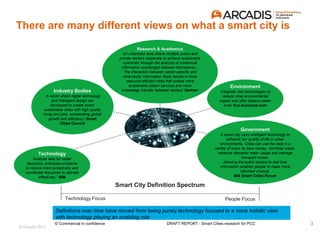
There are many different views on what a smart city is
Definitions over time have moved from being purely technology focused to a more holistic view
with technology playing an enabling role
Technology
‘Analyze data for better
decisions, anticipate problems
to resolve them proactively and
coordinate resources to operate
effectively.” IBM
Research & Academics
‘an urbanized area where multiple public and
private sectors cooperate to achieve sustainable
outcomes through the analysis of contextual
information exchanged between themselves...
The interaction between sector-specific and
intra-sector information flows results in more
resource-efficient cities that enable more
sustainable citizen services and more
knowledge transfer between sectors’ Gartner
Environment
‘Integrate new technologies to
reduce cities environmental
impact and offer citizens better
lives’ Eco-business.com
Industry Bodies
‘A world where digital technology
and intelligent design are
harnessed to create smart,
sustainable cities with high quality
living and jobs, accelerating global
growth and efficiency’ Smart
Cities Council
Government
A smart city uses intelligent technology to
enhance our quality of life in urban
environments. Cities can use the data in a
variety of ways; to save money, minimise waste,
measure domestic water usage and manage
transport routes.
Allowing the public access to real time
information enables people to make more
informed choices.
BIS Smart Cities Forum
Smart City Definition Spectrum
Technology Focus People Focus
3© Commercial in confidence DRAFT REPORT - Smart Cities research for PCC
© Arcadis 2015
•
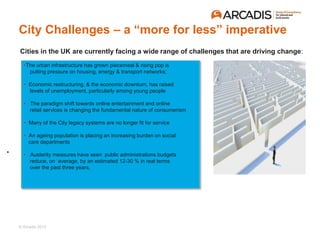
Cities in the UK are currently facing a wide range of challenges that are driving change:
•The urban infrastructure has grown piecemeal & rising pop is
putting pressure on housing, energy & transport networks;
• Economic restructuring, & the economic downturn, has raised
levels of unemployment, particularly among young people
• The paradigm shift towards online entertainment and online
retail services is changing the fundamental nature of consumerism
• Many of the City legacy systems are no longer fit for service
• An ageing population is placing an increasing burden on social
care departments
• Austerity measures have seen public administrations budgets
reduce, on average, by an estimated 12-30 % in real terms
over the past three years,
City Challenges – a “more for less” imperative
© Arcadis 2015
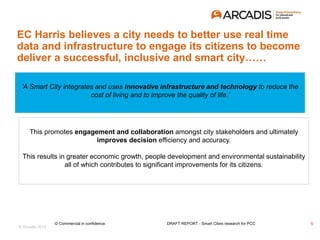
‘A Smart City integrates and uses innovative infrastructure and technology to reduce the
cost of living and to improve the quality of life.’
EC Harris believes a city needs to better use real time
data and infrastructure to engage its citizens to become
deliver a successful, inclusive and smart city……
This promotes engagement and collaboration amongst city stakeholders and ultimately
improves decision efficiency and accuracy.
This results in greater economic growth, people development and environmental sustainability
all of which contributes to significant improvements for its citizens.
5© Commercial in confidence DRAFT REPORT - Smart Cities research for PCC
© Arcadis 2015
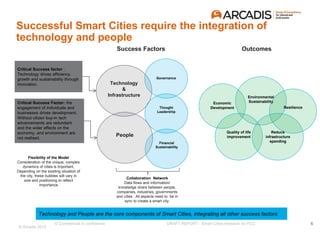
Successful Smart Cities require the integration of
technology and people
Success Factors
Technology and People are the core components of Smart Cities, integrating all other success factors
Flexibility of the Model
Consideration of the unique, complex
dynamics of cities is important.
Depending on the existing situation of
the city, these bubbles will vary in
size and positioning to reflect
importance
Technology
&
Infrastructure
Governance
Thought
Leadership
Collaboration Network
Data flows and information/
knowledge share between people,
companies, industries, governments
and cities . All aspects need to be in
sync to create a smart city.
Critical Success factor :
Technology drives efficiency,
growth and sustainability through
innovation.
Critical Success Factor: the
engagement of individuals and
businesses drives development.
Without citizen buy-in tech
advancements are redundant
and the wider effects on the
economy, and environment are
not realised.
People
Financial
Sustainability
Economic
Development
Environmental
Sustainability
Quality of life
improvement
Resilience
Reduce
infrastructure
spending
Outcomes
6© Commercial in confidence DRAFT REPORT - Smart Cities research for PCC
© Arcadis 2015
Data store
Data Use
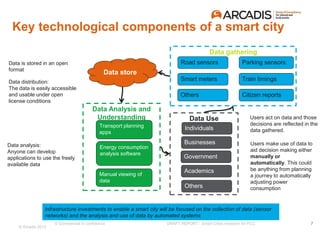
Data distribution:
The data is easily accessible
and usable under open
license conditions
Users make use of data to
aid decision making either
manually or
automatically. This could
be anything from planning
a journey to automatically
adjusting power
consumption
Data gathering
Road sensors
Smart meters
Parking sensors
Train timings
Data is stored in an open
format
Others Citizen reports
Data Analysis and
Understanding
Businesses
Individuals
Government
Academics
Others
Users act on data and those
decisions are reflected in the
data gathered.
Transport planning
apps
Energy consumption
analysis software
Manual viewing of
data
Data analysis:
Anyone can develop
applications to use the freely
available data
Key technological components of a smart city
Infrastructure investments to enable a smart city will be focused on the collection of data (sensor
networks) and the analysis and use of data by automated systems
7© Commercial in confidence DRAFT REPORT - Smart Cities research for PCC
© Arcadis 2015
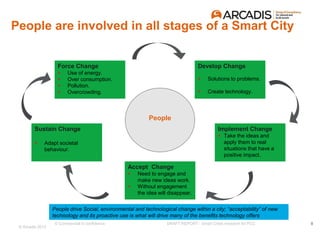
People are involved in all stages of a Smart City
People
Force Change
 Use of energy.
 Over consumption.
 Pollution.
 Overcrowding.
Sustain Change
 Adapt societal
behaviour.
Accept Change
 Need to engage and
make new ideas work.
 Without engagement
the idea will disappear.
Implement Change
 Take the ideas and
apply them to real
situations that have a
positive impact.
Develop Change
 Solutions to problems.
 Create technology.
People drive Social, environmental and technological change within a city; “acceptability” of new
technology and its proactive use is what will drive many of the benefits technology offers
8© Commercial in confidence DRAFT REPORT - Smart Cities research for PCC
© Arcadis 2015
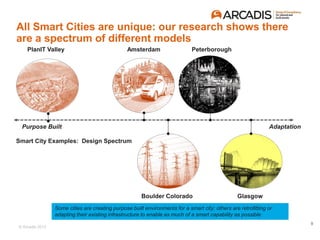
All Smart Cities are unique: our research shows there
are a spectrum of different models
Purpose Built Adaptation
Smart City Examples: Design Spectrum
Some cities are creating purpose built environments for a smart city; others are retrofitting or
adapting their existing infrastructure to enable as much of a smart capability as possible
9
PlanIT Valley Amsterdam
GlasgowBoulder Colorado
Peterborough
© Arcadis 2015
Conclusion
10

Smart cities presentation

  • 1.
    Institute of AssetManagement NxtGen Talk from the Top: Tomorrow’s City Richard Bonner
  • 2.
    © Arcadis 2015 SmartCity – Mega Trends Smart Cities - PCC Presentation 2 EC Harris / ARCADIS strategic global research informs our opinions and view points
  • 3.
    © Arcadis 2015 Thereare many different views on what a smart city is Definitions over time have moved from being purely technology focused to a more holistic view with technology playing an enabling role Technology ‘Analyze data for better decisions, anticipate problems to resolve them proactively and coordinate resources to operate effectively.” IBM Research & Academics ‘an urbanized area where multiple public and private sectors cooperate to achieve sustainable outcomes through the analysis of contextual information exchanged between themselves... The interaction between sector-specific and intra-sector information flows results in more resource-efficient cities that enable more sustainable citizen services and more knowledge transfer between sectors’ Gartner Environment ‘Integrate new technologies to reduce cities environmental impact and offer citizens better lives’ Eco-business.com Industry Bodies ‘A world where digital technology and intelligent design are harnessed to create smart, sustainable cities with high quality living and jobs, accelerating global growth and efficiency’ Smart Cities Council Government A smart city uses intelligent technology to enhance our quality of life in urban environments. Cities can use the data in a variety of ways; to save money, minimise waste, measure domestic water usage and manage transport routes. Allowing the public access to real time information enables people to make more informed choices. BIS Smart Cities Forum Smart City Definition Spectrum Technology Focus People Focus 3© Commercial in confidence DRAFT REPORT - Smart Cities research for PCC
  • 4.
    © Arcadis 2015 • Citiesin the UK are currently facing a wide range of challenges that are driving change: •The urban infrastructure has grown piecemeal & rising pop is putting pressure on housing, energy & transport networks; • Economic restructuring, & the economic downturn, has raised levels of unemployment, particularly among young people • The paradigm shift towards online entertainment and online retail services is changing the fundamental nature of consumerism • Many of the City legacy systems are no longer fit for service • An ageing population is placing an increasing burden on social care departments • Austerity measures have seen public administrations budgets reduce, on average, by an estimated 12-30 % in real terms over the past three years, City Challenges – a “more for less” imperative
  • 5.
    © Arcadis 2015 ‘ASmart City integrates and uses innovative infrastructure and technology to reduce the cost of living and to improve the quality of life.’ EC Harris believes a city needs to better use real time data and infrastructure to engage its citizens to become deliver a successful, inclusive and smart city…… This promotes engagement and collaboration amongst city stakeholders and ultimately improves decision efficiency and accuracy. This results in greater economic growth, people development and environmental sustainability all of which contributes to significant improvements for its citizens. 5© Commercial in confidence DRAFT REPORT - Smart Cities research for PCC
  • 6.
    © Arcadis 2015 SuccessfulSmart Cities require the integration of technology and people Success Factors Technology and People are the core components of Smart Cities, integrating all other success factors Flexibility of the Model Consideration of the unique, complex dynamics of cities is important. Depending on the existing situation of the city, these bubbles will vary in size and positioning to reflect importance Technology & Infrastructure Governance Thought Leadership Collaboration Network Data flows and information/ knowledge share between people, companies, industries, governments and cities . All aspects need to be in sync to create a smart city. Critical Success factor : Technology drives efficiency, growth and sustainability through innovation. Critical Success Factor: the engagement of individuals and businesses drives development. Without citizen buy-in tech advancements are redundant and the wider effects on the economy, and environment are not realised. People Financial Sustainability Economic Development Environmental Sustainability Quality of life improvement Resilience Reduce infrastructure spending Outcomes 6© Commercial in confidence DRAFT REPORT - Smart Cities research for PCC
  • 7.
    © Arcadis 2015 Datastore Data Use Data distribution: The data is easily accessible and usable under open license conditions Users make use of data to aid decision making either manually or automatically. This could be anything from planning a journey to automatically adjusting power consumption Data gathering Road sensors Smart meters Parking sensors Train timings Data is stored in an open format Others Citizen reports Data Analysis and Understanding Businesses Individuals Government Academics Others Users act on data and those decisions are reflected in the data gathered. Transport planning apps Energy consumption analysis software Manual viewing of data Data analysis: Anyone can develop applications to use the freely available data Key technological components of a smart city Infrastructure investments to enable a smart city will be focused on the collection of data (sensor networks) and the analysis and use of data by automated systems 7© Commercial in confidence DRAFT REPORT - Smart Cities research for PCC
  • 8.
    © Arcadis 2015 Peopleare involved in all stages of a Smart City People Force Change  Use of energy.  Over consumption.  Pollution.  Overcrowding. Sustain Change  Adapt societal behaviour. Accept Change  Need to engage and make new ideas work.  Without engagement the idea will disappear. Implement Change  Take the ideas and apply them to real situations that have a positive impact. Develop Change  Solutions to problems.  Create technology. People drive Social, environmental and technological change within a city; “acceptability” of new technology and its proactive use is what will drive many of the benefits technology offers 8© Commercial in confidence DRAFT REPORT - Smart Cities research for PCC
  • 9.
    © Arcadis 2015 AllSmart Cities are unique: our research shows there are a spectrum of different models Purpose Built Adaptation Smart City Examples: Design Spectrum Some cities are creating purpose built environments for a smart city; others are retrofitting or adapting their existing infrastructure to enable as much of a smart capability as possible 9 PlanIT Valley Amsterdam GlasgowBoulder Colorado Peterborough
  • 10.