SMART CITIES READINESS GUIDE
The planning manual for building tomorrow’s cities today
SMART CITIES
READINESS GUIDE
The planning manual for building tomorrow’s cities today
Smart
Cities
Council
© 2014 SMART CITIES COUNCIL
Acknowledgments
The Readiness Guide is, first and foremost, a collaborative effort. We are grateful for the
expertise, the energy and the meticulous diligence of dozens of enthusiastic smart city
advocates – subject matter experts from around the world, municipal government lead-
ers and their staffs, technology advocates and business leaders among them.
We extend our sincere thanks and congratulations to the Lead and Associate Partners of
the Smart Cities Council for their involvement and passion for this project: Alstom Grid,
Bechtel, Cisco, EDF, Enel, GE, IBM, Itron, MasterCard, Microsoft, National Grid, Qualcomm,
S&C Electric Company, ABB, Alphinat, BehaviorMatrix, Camgian Microsystems, CH2M
HILL, DNV GL- Energy, Enevo, GRID2020, Imex Systems, MaxWest Environmental
Systems, Neptune Technology Group, Opower, Oracle, OSIsoft, Saudi Telecom,
Schneider Electric, Siemens, Sungard and UST Global.
The Readiness Guide would also not have been possible without the help of the Council’s
Advisory Board, a collection of the world’s foremost smart city thinkers, doers and vision-
aries. Our 60-plus Advisors are listed on page 291 of this Guide’s Appendix.
Finally, we would like to thank the city mayors and their hardworking staffs who gave us
real-world insights and provided us with critical early feedback. Their contributions repre-
sent the bridge between political infrastructure realities and 21st Century
innovation. Special thanks to: Mayor Elizabeth Kautz, Burnsville, MN; Mayor Rawlings-
Blake, Baltimore, MD; Mayor Jim Schmitt, Green Bay, WI; Mayor Kim McMillan,
Clarksville, TN; Mayor Pedro Segarra, Hartford, CT; Mayor Jim Hovland, Edina, MN;
Mayor Buddy Dyer, Orlando, FL; and Mayor Mike Rawlings, Dallas, TX.
Authors and Key Contributors:
This Guide was written by Smart Cities Council Chairman Jesse Berst,
Editorial Director Liz Enbysk and Research Director Christopher Williams.
It was conceptualized by Chris Caine, President and CEO of Mercator XXI;
researched by Christopher Williams; illustrated by Scott Dunn, and designed
and produced by Tahne Davis and Anne Schoenecker of Davis Design, Seattle.
TABLE OF CONTENTS
1. Introduction to Smart Cities
2. How to Use the Readiness Guide
3. Universal
4. Built Environment
5. Energy
6. Telecommunications
7. Transportation
8. Water and Wastewater
9. Health and Human Services
10. Public Safety
11. Smart Payments and Finance
12. Smart People
13. Ideas to Action
Appendix
CHAPTER 1: INTRODUCTION TO SMART CITIES | Smart Cities Council Readiness Guide
INTRODUCTION
TO SMART CITIES
Welcome to the Readiness Guide. This document was
assembled with input from many of the world’s leading
smart city practitioners – the members and advisors of
the Smart Cities Council. It will help you create a vision
for the future of your own city. Equally important, it will
help you build an action plan to get to that better future.
5
CHAPTER 1
The first goal of the Readiness Guide is to give
you a “vision” of a smart city, to help you under-
stand how technology will transform the cities
of tomorrow.
Second is to help you construct your own road-
map to that future. It suggests the goals to
which you should aspire, the features and func-
tions you should specify, the best practices that
will gain you the maximum benefits for the mini-
mum cost, at reduced risk.
The Readiness Guide is intended for mayors,
city managers, city planners and their staff. It
helps cities help themselves by providing
objective, vendor-neutral information to make
confident, educated choices about the tech-
nologies that can transform a city.
Cities around the world are already making
tremendous progress in achieving economic,
environmental and social sustainability, in
export-based initiatives and in the creation of
21st century jobs. All of these are excellent
ways to improve city living standards and econ-
omies. The concept of smart cities doesn’t
compete with these efforts. Instead, smart city
technologies can support and enhance work
already underway.
In this chapter, we will define the smart city,
explore its benefits and introduce the frame-
work that underlies this Readiness Guide.
Taking a holistic
view of ‘city’
This introductory section defines smart cities
and explores the trends that are driving this
global phenomenon. It also discusses some of
the barriers cities may face and strategies to
overcome them.
Before we define the “smart” piece, however,
we should first deal with the word “city.” Real-
world smart city examples are rarely a city in
the strictest term. Many are more than a
single city, such as a metropolitan region, a
cluster of cities, counties and groups of coun-
ties, a collection of nearby towns or a regional
coalition. Other examples are less than a full-
scale city, such as districts, neighborhoods,
townships, villages, campuses and military
bases. Indeed, many municipalities are taking
a neighborhood-by-neighborhood approach to
modernization. This Guide is designed to
address all of these human ecosystems.
Because it is in common use, we will continue
to use “city” throughout this Guide. But we use
it to mean all relevant examples big and small.
Regardless of size, we are taking a compre-
hensive, holistic view that includes the entirety
of human activity in an area, including city
governments, schools, hospitals, infrastruc-
ture, resources, businesses and people. As
you’ll read, smart technologies have matured
to the point that cities of all sizes can afford
and benefit from their implementation. For
example, new cloud computing offerings allow
even the smallest city to affordably tap into
enormous computing power. So the lessons of
this Guide apply regardless of size – and you’ll
see real-world examples in the case studies
featured throughout.
The definition
of a smart city
A smart city uses information and communi-
cations technology (ICT) to enhance its livability,
workability and sustainability. In simplest
terms, there are three parts to that job: collect-
ing, communicating and “crunching.” First, a
smart city collects information about itself
through sensors, other devices and existing
systems. Next, it communicates that data
using wired or wireless networks. Third, it
“crunches” (analyzes) that data to understand
what’s happening now and what’s likely to
happen next.
Collecting data. Smart devices are logically
located throughout the city to measure and
monitor conditions. For instance, smart meters
can measure electricity, gas and water usage
6CHAPTER 1: INTRODUCTION TO SMART CITIES | Smart Cities Council Readiness Guide
with great accuracy. Smart traffic sensors can
report on road conditions and congestion. Smart
GPS gear can pinpoint the exact locations of the
city’s buses or the whereabouts of emergency
crews. Automated weather stations can report
conditions. And the smartphones carried by
many city dwellers are also sensors that can –
when specifically authorized by their users to do
so – collect their position, speed, where they clus-
ter at different times of the day and the environ-
mental conditions around them.
A smart city, then, is one that knows about itself
and makes itself more known to its populace. No
longer do we have to wonder if a street is
congested – the street reports its condition. No
longer do we have to wonder if we’re losing water
to leaks – the smart water network detects and
reports leaks as soon as they occur. No longer do
we have to guess the progress of the city’s
garbage trucks – the trucks report where they’ve
been already and where they are headed next.
Communicating data. Once you’ve collected the
data, you need to send it along. Smart cities typi-
cally mix and match a variety of wired and wire-
less communications pathways, from fiber-optic
to cellular to cable. The ultimate goal is to have
connectivity everywhere, to every person and
every device.
Crunching data. After collecting and communi-
cating the data, you analyze it for one of three
purposes: 1) presenting, 2) perfecting or 3)
predicting. If you’ve read about “analytics” or “Big
Data,” then you may already know about the
astonishing things that become possible by
crunching large amounts of data. Importantly,
crunching data turns information into intelligence
that helps people and machines to act and make
better decisions. This begins a virtuous cycle
wherein data is made useful, people make use of
that data to improve decisions and behavior,
which in turn means more and better data is
collected, thereby further improving decisions
and behavior.
Presenting information tells us what’s going on
right now. In the aerospace and defense indus-
tries, they call this “situational awareness.”
Software monitors the huge flow of incoming
data, then summarizes and visualizes it in a way
that makes it easy for human operators to under-
stand. For instance, a smart operations center
can monitor all aspects of an emergency situa-
tion, including the actions and locations of police,
fire, ambulances, traffic, downed power lines,
closed streets and much more.
Perfecting operations uses the power of
computers to optimize complex systems. For
instance, balancing the supply and demand on
an electricity network; or synchronizing traffic
signals to minimize congestion; or selecting the
ideal routes for a delivery fleet to minimize time
and fuel costs; or optimizing the energy usage
of an entire high-rise to achieve maximum
comfort at minimum cost.
Figure 1.1
THE THREE CORE
FUNCTIONS OF A
SMART CITY
Collect
information about current
conditions across all responsibility
areas (power, water, traffic,
weather, buildings, etc.).
Communicate
information, sometimes to other
devices, sometimes to a control
center and sometimes to servers
running powerful software.
Crunch
data, analyzing it to present
information, to perfect (optimize)
operations and to predict what
might happen next.
1
2
3
Collect Communicate “Crunch”
7CHAPTER 1: INTRODUCTION TO SMART CITIES | Smart Cities Council Readiness Guide
Predicting what’s next is perhaps the most
exciting part of analytics. Cities such as
Singapore already crunch data to predict traf-
fic jams while there is still time to minimize
their effects. Cities such as Rio de Janeiro
already predict just where flooding will occur
from a particular storm, so emergency crews
and evacuation teams know just where to go.
Cities can derive benefit by collecting, commu-
nicating and crunching information from a
single department. But the greatest benefits
come when data is connected with multiple
departments and third parties. Many cities
combine historic traffic data with information
about population growth and business expan-
sion to know when and where to add or
subtract bus and train routes. Other cities
correlate multiple data sources to predict
crime the way we predict weather. Or predict
which expensive transformers are about to fail
on the power grid and which will still be good
for years to come.
As we’ll see in more detail, a smart city is a
system of systems – water, power, transpor-
tation, emergency response, built environ-
ment, etc.– with each one affecting all the
others. In the last few years, we’ve refined our
ability to merge multiple data streams and
mine them for amazing insights. It is those
insights – presenting, perfecting and predict-
ing – that enhance the livability, workability
and sustainability of a smart city.
Smart cities collect, communicate and crunch data.
The city of Rio de Janeiro collects information from 30 different city
departments about transportation, water, energy, weather and other
conditions. Then it communicates those conditions to powerful
computers, which crunch the data and present it in a unified control
center the city developed with IBM. Not only does the city gain full
situational awareness, it can even predict some conditions in
advance, such as where floods will occur during severe storms. It can
also develop actionable tasks based on modeled patterns, creating a
competitive advantage for smart cities.
Figure 1.2
8CHAPTER 1: INTRODUCTION TO SMART CITIES | Smart Cities Council Readiness Guide
OTHER SMART
CITY DEFINITIONS
The Council defines a smart city as one that “uses infor-
mation and communications technology (ICT) to
enhance its livability, workability and sustainability.” Other
organizations have their own definitions.
For instance, Forrester Research emphasizes the use of
computing to monitor infrastructure and improve servic-
es: “The use of smart computing technologies to make
the critical infrastructure components and services of a
city – which include city administration, education,
healthcare, public safety, real estate, transportation and
utilities – more intelligent, interconnected and efficient.”
The U.S. Office of Scientific and Technical Information also
stresses infrastructure, explaining that “a city that monitors
and integrates conditions of all of its critical infrastructures
– including roads, bridges, tunnels, rails, subways, airports,
seaports, communications, water, power, even major build-
ings – can better optimize its resources, plan its preventive
maintenance activities, and monitor security aspects while
maximizing services to its citizens.”
Meanwhile, in 2010 IBM’s Journal of Research and
Development paid particular attention to the wide range of
smart devices that collect information, calling it “an instru-
mented, interconnected and intelligent city.”
These and other definitions are valid and helpful under-
standings of what smart cities are. The Council stands
behind its comprehensive definition. But we mention these
others so that cities that have planned and invested under
these and other models will understand that we share
complementary, not competitive, views of the smart city
Livability,
workability and
sustainability are
the goals.
Smart cities use
information and
communications
technologies to achieve
them. Seoul, South
Korea – pictured here
– is often cited as one
of the world’s most
vibrant, sustainable
cities.
Figure 1.3
9CHAPTER 1: INTRODUCTION TO SMART CITIES | Smart Cities Council Readiness Guide
The drivers of
smart cities
Powerful forces are converging to make smart
cities a growing trend all around the world. It is
valuable for city leaders to understand what’s
behind this momentum and how it will play out
in their region. Chances are some of the pain
points described below will hit close to home.
Growing urbanization. Cities deliver many
benefits – greater employment opportunities,
greater access to healthcare and education,
and greater access to entertainment, culture
and the arts. As a result, people are moving to
cities at an unprecedented rate. Over 700
million people will be added to urban popula-
tions over the next 10 years. The United
Nations projects that the world’s cities will
need to accommodate an additional 3 billion
residents by the middle of the century. A
recent UN report suggests that 40,000 new
cities will be needed worldwide.
Growing stress. Today’s cities face significant
challenges – increasing populations, environ-
mental and regulatory requirements, declining
tax bases and budgets and increased costs –
at the same time many are experiencing diffi-
cult growing pains ranging from pollution,
crowding and sprawl to inadequate housing,
high unemployment and rising crime rates.
Inadequate infrastructure. Urbanization is
putting significant strain on city infrastruc-
tures that were, in most cases, built for popu-
lations a fraction of their current size. Much of
the developed world has infrastructure that is
near or past its design life, requiring massive
upgrades. For instance, in 2013 the American
Society of Civil Engineers gave the United
States an overall grade of D+ for its infrastruc-
ture. Meanwhile, much of the developing world
has missing or inadequate infrastructure,
requiring massive build-outs. The 2012 black-
out in India that left more than 600 million
people without electricity is a prime example;
the country has inadequate power generation
to meet ever-increasing demand. The bottom
line? McKinsey & Company estimates that
cities will need to double their capital invest-
ment by 2025, to $20 trillion from today’s $10
trillion per year.
Growing economic competition. The world
has seen a rapid rise in competition between
cities to secure the investments, jobs, busi-
nesses and talent for economic success.
Increasingly, both businesses and individuals
evaluate a city’s “technology quotient” in decid-
ing where to locate. A real challenge for cities
with economies based on heavy industry is
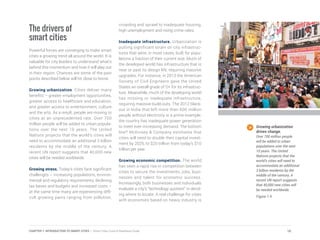
Growing urbanization
drives change.
Over 700 million people
will be added to urban
populations over the next
10 years. The United
Nations projects that the
world’s cities will need to
accommodate an additional
3 billion residents by the
middle of the century. A
recent UN report suggests
that 40,000 new cities will
be needed worldwide.
Figure 1.4
10CHAPTER 1: INTRODUCTION TO SMART CITIES | Smart Cities Council Readiness Guide
creating job opportunities that appeal to
recent university graduates so they will stay
and help build the kind of high-quality work-
force that new industries, for instance those in
technology, demand.
Growing expectations. Citizens are increas-
ingly getting instant, anywhere, anytime,
personalized access to information and servic-
es via mobile devices and computers. And they
increasingly expect that same kind of access to
city services. In fact, a May 2013 United
Nations survey of over 560,000 citizens from
194 countries revealed their top priorities are a
good education, better healthcare and an
honest and responsive government. We also
know that people want to live in cities that can
provide efficient transportation, high-bandwidth
communications and healthy job markets.
Growing environmental challenges. Cities
house half of the world’s population but use
two-thirds of the world’s energy and generate
three-fourths of the world’s CO2
emissions. If
we are going to mitigate climate change, it will
have to happen in cities. Many regions and
cities have aggressive climate and environ-
mental goals – goals that cannot be reached
without the help of smart technologies.
Rapidly improving technology capabilities.
Many of the smart city drivers listed above are
negatives – problems that demand solutions.
One-stop shopping for city services.
Citizens increasingly expect instant, anywhere, anytime personalized
access to information. The web portal pictured here is from the province
of Quebec, Canada and uses technology from Council member Alphinat.
Its goal is to give businesses “one-stop shopping” for virtually all of their
needs – permits, licensing, taxes, etc. In many cities taking care of
business needs requires dealing individually with numerous different city
departments.
Figure 1.5
11CHAPTER 1: INTRODUCTION TO SMART CITIES | Smart Cities Council Readiness Guide
There are positive drivers as well, especially
the rapid progress in technology. The costs of
collecting, communicating and crunching data
have plunged. What’s more, much of the need-
ed technology is already in place:
•	 Over the last decade, many regions have
begun to modernize their electric power
grids and, to a lesser extent, their water and
gas networks. Hundreds of millions of smart
meters and smart sensors are now in place,
producing data of value to a smart city.
•	 With the arrival of smart thermostats and
building management systems, there are
now millions of buildings with some of the
pieces needed to be smart, on the cusp of
being able to ‘talk’ and ‘listen.’
•	 On the health and human services front,
we’re seeing better access to healthcare
with in-home consultations via computer.
Meanwhile most agencies are switching to
electronic records and many are using
analytics to improve results.
•	 Our highways and byways are becoming
smarter thanks to intelligent transportation
management software, roadway sensors
and smart parking apps. Navigation apps
and equipment display real-time traffic so
users can find – and even be automatically
pointed to – less congested alternatives.
And we are seeing more electric vehicles on
our roads which help reduce pollution.
•	 Over the last two decades, we have deployed
high-bandwidth networks worldwide that
connect one billion computers and four
billion cell phones. These networks are
already in place in almost all major cities and
can be leveraged for smart city applications.
•	 An increasing number of cities are starting
to benefit from a large network of Near-field
Communication (NFC) equipped point of
sales with the roll-out of contactless cards
technology. It means hundreds of merchants
are already capable of accepting mobile
payments and wallets for seamless
consumer experience and value added
services, but also cashless cities are able to
reduce frauds and benefiting from better
insights on their citizen purchasing journeys.
Let’s consider that final example in more detail.
It’s important to realize that today’s ubiquitous
smartphones are becoming both a “delivery
platform” and a “sensor network” for smart city
applications. The delivery platform is obvious –
a smartphone is a great place for a resident to
receive alerts and access city services. But
today’s smartphones can also be leveraged to
collect information when the user agrees to
share data. For instance, one launched in 2013
has the following sensors: a GPS locator, a
microphone, a gyroscope, a light sensor, a
camera, an accelerometer, a barometer, a ther-
mometer, a magnetometer and a hygrometer.
“By the end of the decade, many infrastructure
technologies – smart meters, intelligent traffic
systems, building energy management – will
be deployed across North America and Europe
and, increasingly, in the rest of the world,” says
Navigant Research analyst Eric Woods. Once
Rapid progress in
technology.
An increasing number of
cities are starting to benefit
from technology that
allows merchants to accept
payments via smartphones
and wallets.
Figure 1.6
12CHAPTER 1: INTRODUCTION TO SMART CITIES | Smart Cities Council Readiness Guide
in place, that technology provides the basis for
a wide range of innovative smart city applica-
tions and services.
Rapidly declining technology costs. Even as
capabilities are climbing, technology costs are
plummeting. Hardware costs are declining at
a steady pace. But it is software costs that
have plunged the most, thanks to four trends.
The first trend is the advent of inexpensive
mobile apps and information services view-
able by mobile phones. Those phones are so
popular that millions of developers have
turned their attention to building applications,
many of which cost only a few dollars.
The second trend is the arrival of social media.
Applications such as Facebook and Twitter
act as free “platforms” to deliver alerts,
updates or even small-scale apps. They also
act as “listening posts” that help cities monitor
citizen needs and preferences. In fact, compa-
nies such as IBM and Microsoft now have the
capability to use machine intelligence to moni-
tor social media and derive trends.
The third trend is the maturation of cloud
computing. Cloud computing delivers power-
ful solutions via the Internet. Suppliers save
money because they can build one solution
and sell it to many different users, gaining
tremendous economies of scale. Users save
money because they don’t have to buy and
maintain giant data centers or hire and train
large IT staffs. Only a few years ago, advanced
applications were available only to the very
biggest agencies and corporations. Today –
thanks to cloud computing – they are not out
of reach for even the smallest township. And
they are available without a giant upfront
investment, simply by paying a monthly fee.
The fourth trend is about the data. From an
analytics perspective, we can now cost effec-
tively handle the high volume, velocity and
variety of data – e.g. Big Data.
And there’s much more to come. The smart
city is part of an even larger trend – the
“Internet of Things.” Technology provider Cisco
estimates there were 200 million devices
connected to the Internet in the year 2000. By
2012, that number had increased to 10 billion.
There are approximately 200 connectable
“things” per person today, or 1.5 trillion things
globally, Cisco estimates.
Clearly we are entering a remarkable new
phase. Research firm IDC predicted in 2012
that the smart city market would grow by 27%
year over year. Meanwhile, Navigant Research
said it would hit $20 billion in worldwide sales
by 2020. And Cisco in early 2013 predicted the
overall Internet of Things market will create an
astonishing $14.4 trillion in additional net profit
for the world’s industries in the next decade.
No surprise the world’s biggest corporations
and brightest entrepreneurs are racing to
bring their best ideas to this market. And the
fierce competition is raising capabilities,
increasing choice and lowering costs at a
rapid pace, making smart cities more viable
every day.
The “Internet of Things.”
Cisco estimates there were
200 million devices
connected to the Internet in
the year 2000. By 2012, that
number had increased to 10
billion.
Figure 1.7
13CHAPTER 1: INTRODUCTION TO SMART CITIES | Smart Cities Council Readiness Guide
The barriers
to smart cities
Despite the powerful drivers in favor, the path
to smart cities has obstacles along the way.
Members of the Smart Cities Council have
worked on thousands of smart city projects all
over the world. As they’ve collaborated with
local governments certain barriers have
emerged frequently.
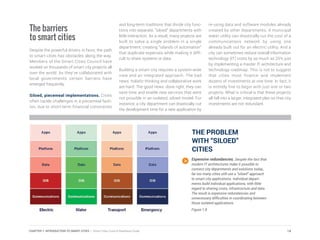
Siloed, piecemeal implementations. Cities
often tackle challenges in a piecemeal fash-
ion, due to short-term financial constraints
and long-term traditions that divide city func-
tions into separate, “siloed” departments with
little interaction. As a result, many projects are
built to solve a single problem in a single
department, creating “islands of automation”
that duplicate expenses while making it diffi-
cult to share systems or data.
Building a smart city requires a system-wide
view and an integrated approach. The bad
news: holistic thinking and collaborative work
are hard. The good news: done right, they can
save time and enable new services that were
not possible in an isolated, siloed model. For
instance, a city department can drastically cut
the development time for a new application by
re-using data and software modules already
created by other departments. A municipal
water utility can drastically cut the cost of a
communications network by using one
already built out for an electric utility. And a
city can sometimes reduce overall information
technology (IT) costs by as much as 25% just
by implementing a master IT architecture and
technology roadmap. This is not to suggest
that cities must finance and implement
dozens of investments at one time. In fact, it
is entirely fine to begin with just one or two
projects. What is critical is that these projects
all fall into a larger, integrated plan so that city
investments are not redundant.
THE PROBLEM
WITH “SILOED”
CITIES
Expensive redundancies. Despite the fact that
modern IT architectures make it possible to
connect city departments and solutions today,,
far too many cities still use a “siloed” approach
to smart city applications. Individual depart-
ments build individual applications, with little
regard to sharing costs, infrastructure and data.
The result is expensive redundancies and
unnecessary difficulties in coordinating between
those isolated applications.
Figure 1.8
14CHAPTER 1: INTRODUCTION TO SMART CITIES | Smart Cities Council Readiness Guide
Most experts agree that technology will not be
the gating factor for the smart city transfor-
mation. Instead, we will be limited by our
human ability to coordinate and collaborate
between departmental and technology silos.
Lack of financing. Tax revenues are shrinking
in many cities, making infrastructure projects
increasingly difficult to finance. In fact, some
cities have been forced to implement austerity
measures – such as furloughing employees
one day a month or cutting back on travel and
discretionary expenses. Yet if those cities
remain old-fashioned while others modernize,
they will suffer even more, since cities must
now compete globally. Fortunately, new finan-
cial models are emerging. And payment inno-
vations like e-Procurement or electronic bene-
fits can help cities reduce costs and free up
money to invest in infrastructure and other
improvements. Some of them require little or
no upfront capital from the city. Instead, the
city “rents” its solution as it goes. And perfor-
mance contracts and shared revenue models
between the city and solution vendors provide
cities with attractive financing solutions.
What’s more, many smart city solutions have
a rapid payback so that they save money over
the long run. In many cases, the technology
can actually improve the city’s economic
return.
A new view of city apps.
Early city applications were inward-facing and intended just for city
employees. Today, more and more cities are producing outward-facing
apps. For example, to get citizens involved in cleaning up London before
the 2012 Summer Olympics, the city worked with Council member
Microsoft on the Love Clean London portal (above) and companion mobile
app that gave citizens an easy way to alert authorities to litter and graffiti
by texting or uploading images. It’s still being used today.
Figure 1.9
15CHAPTER 1: INTRODUCTION TO SMART CITIES | Smart Cities Council Readiness Guide
Lack of ICT know-how. Although industry has
developed highly sophisticated ICT skills, few
city governments have had the budget or the
vision to push the state of the art. Since smart
cities are essentially the injection of ICT into
every phase of operations, this lack of ICT
skills puts cities at a disadvantage.
Fortunately, more and more applications are
offered as a service. That is, they are hosted in
the cloud (out on the Internet) where they
have access to tremendous computing power,
virtually unlimited storage and innovative soft-
ware. Another plus is that the smart city
sector has developed a large cadre of experi-
enced global, regional and local consultants
and service providers who are partnering with
cities to deploy ICT solutions.
Lack of integrated services. To the extent
cities applied ICT in the past, they applied it to
their internal, siloed operations. The result has
been a grab-bag of aging applications that
only city employees can use. Although this
was an acceptable practice in the last century,
today we can and must allow citizen access
and self-service. There is no reason that citi-
zens who want, for instance, to open a restau-
rant should have to make multiple applica-
tions to multiple city departments. In a smart
city, a single portal can gather all the data and
parcel it out to the appropriate departments.
Likewise, residents should have instant
access to up-to-the-minute information about
their energy and water usage, their taxes and
fees, their social services programs and more.
And ideas like Open Data not only improve
transparency, they enforce a people-first
perspective that is critical in smart cities
Lack of citizen engagement. The smart cities
movement is often held back by a lack of clari-
ty about what a smart city is and what it can
do for citizens. As a result, many stakeholders
are unaware of the smart city options that
have found success already. Often, there is a
communications issue. Cities should be wary
of being too abstract with their smart city
initiatives, recognize that citizens care about
services that make their lives better, and
adjust their engagement accordingly. Cities
need to recognize when they need citizen and
business awareness versus complete ‘buy in.’
Remedying the citizen engagement challenge
will require visionary leadership that paints a
picture of the benefits technology can bring. In
the U.S. in the late 2000s, several electric power
utilities learned this lesson the hard way. They
rolled out smart meters without explaining how
customers would benefit. They suffered
consumer backlash and resistance as a result.
Lack of a smart city visionary. Every parade
needs a leader. Sometimes that leadership
comes from an elected official – a mayor or
council person who acts as the smart city
champion. Smart city leadership can also
come from elsewhere in the administration –
The barriers to smart cities.
Despite the powerful drivers in
favor, the path to smart cities
has obstacles along the way.
Sometimes it comes down to
lack of a smart city visionary.
Cities need a smart city
champion – a mayor, a city
manager, a planning director.
Or it can come from outside
city hall – civic or business
leaders or a public-private
partnership, for example.
Figure 1.10
16CHAPTER 1: INTRODUCTION TO SMART CITIES | Smart Cities Council Readiness Guide
a city manager or a planning director, for
instance. Or it can come from outside city hall
altogether with involvement from business lead-
ers, civic organizations or public-private
partnerships.
The benefits
of smart cities
Now let’s look at why it is so worthwhile to over-
come those barriers and take advantage of the
technology advances described earlier that allow
you to re-imagine your city. With the right plan-
ning and investment, government leaders can
make our cities more livable, more workable and
more sustainable – both economically and envi-
ronmentally. Let’s examine those overall goals,
which are the very purpose of becoming smart.
Enhanced livability means a better quality of life
for city residents. In the smart city, people have
access to a comfortable, clean, engaged,
healthy and safe lifestyle. Some of the most
highly valued aspects include inexpensive ener-
gy, convenient mass transit, good schools, fast-
er emergency responses, clean water and air,
low crime and access to diverse entertainment
and cultural options.
Enhanced workability means accelerated
economic development. Put another way, it
means more jobs and better jobs and increased
local GDP. In the smart city, people have access to
the foundations of prosperity – the fundamental
infrastructure services that let them compete in
the world economy. Those services include
broadband connectivity; clean, reliable, inexpen-
sive energy; educational opportunities; affordable
housing and commercial space; and efficient
transportation.
Enhanced sustainability means giving people
access to the resources they need without
compromising the ability of future generations
to meet their own needs. Merriam-Webster
defines sustainability as a method of using a
resource so that it is not depleted or permanent-
ly damaged. When the Council uses the term, it
refers not only to the environment, but also to
economic realities. Smart cities enable the effi-
cient use of natural, human and economic
resources and promote cost saving in times of
austerity, and they are careful stewards of
taxpayer dollars. It isn’t about investing huge
sums of money into new infrastructure, it’s
about making infrastructure do more and last
longer for less.
Life is better in a smart city – better for people
and better for businesses. In the chapters to
come, we will discuss dozens of specific bene-
fits that accrue to cities that embrace the smart
city vision. But let’s take a moment to summa-
rize them by imagining a day in the life of a citi-
zen in our smart city.
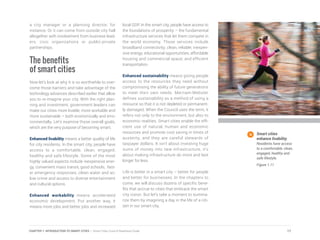
Smart cities
enhance livability.
Residents have access
to a comfortable, clean,
engaged, healthy and
safe lifestyle.
Figure 1.11
17CHAPTER 1: INTRODUCTION TO SMART CITIES | Smart Cities Council Readiness Guide
A DAY IN YOUR NEW URBAN LIFE:
HOW SMART CITIES
MAKE FOR HAPPIER
CITIZENS
It’s Monday morning, a rare day off for Josie. But when
the alarm on her smart wristphone chirps, she doesn’t
reach for the snooze button. “Too much to do today,” she
reminds herself. Peeking around her bedroom’s solar
curtain, she’s pleased to see the sun shining brightly.
“Perfect,” she decides. “I can bike over to the mall, drop
off the bike and pick up a car when I’m done.”
Josie doesn’t actually own a bike or a car; living in a city
with abundant share programs means she doesn’t have
to. And since the café she runs is only 10 blocks from her
condo, she typically walks to work – or if the weather is
really lousy hops on a bus. She’s proud that her city has a
smart transportation system that uses advanced tech-
nologies to streamline traffic flow – and that it works.
Wandering into the kitchen, Josie pours herself a cup of
coffee that started brewing when her alarm went off.
Between her smart wristphone and her smart thermostat,
pretty much every creature comfort in her condo is auto-
mated. She told the system her preferences, of course, but
from then on it took care of the details. If it notices her
overriding the original settings, it quickly adapts to her
new wishes. Her shower is programmed to run at the
same temperature every day and her refrigerator sends an
alert to her phone when she’s running low on items she
typically has on hand. She just brings up the list when
she’s at the grocery store.
She knows she’ll miss her condo when she and Miguel
move into the loft they found. But the condo is on the small
side for two people. Though the loft is small too, it has trans-
formable spaces thanks to “robot walls” that can be moved
to create different spaces for different needs. Josie is espe-
cially happy with the new TeleWall. The high-definition big-
screen will let Miguel telecommute much of the time and
she plans to use it for the online courses she’s taking.
Continued on next page
Sensors and
digitization
will change lives.
Day-to-day living will
become much more
convenient in
tomorrow’s smart
cities, thanks to the
digitization of just
about everything.
Figure 1.12
18CHAPTER 1: INTRODUCTION TO SMART CITIES | Smart Cities Council Readiness Guide
After a quick trip to the roof to check on the garden she shares with the
building’s other tenants, she grabs her backpack and looks at a phone
app to see the closest available bike-share. Turns out, there is one just
around the corner. But if Josie had been running late or faced with rainy
weather, she had only to enter her destination into her city transit app to
get a route plan optimized for her preferences.
Jumping on her bike, she picks her destination from her favorites list and
transfers her phone display to an overlay in her glasses. She instantly sees
an alert from the city’s traffic system warning of a downtown parade that
threatens to jam up her usual route. She picks an alternate route calculat-
ed by the system and follows the directions as they appear in her glasses.
The purpose of her trip to the mall is to find something to wear to a
party. But as she walks past the virtual city hall that occupies a small
storefront near the mall entrance, she realizes she can take care of
another item on her to-do list.
“This is pretty sweet,” she says as she sits down in a private “closet”
equipped with high-definition video equipment that allows her to inter-
act with a remote city agent. She tells him she needs a permit for a
street fair her cafe is going to participate in but doesn’t know what it’s
called. The agent quickly finds the form she needs, transmits it to the
touchscreen in front of her and Josie is able to fill it out and send it back
within minutes. Before she leaves the agent mentions a new waste
management system the city is testing at restaurants. It’s “pay as you
throw” – meaning the less they throw away and the more they recycle
the lower their monthly bill. Josie likes the sound of that and signs up
on the spot. She asks for daily updates. Since her bins are monitored by
smart sensors, the city knows moment by moment how much trash
Josie’s cafe has accumulated. It can warn her when it looks like she’ll
exceed the goal she set for herself, while there is still time to improve.
She spends another hour trying on dresses suggested by the store’s
shopping service, which taps into a history of past purchases that Josie
has rated and posted for just this purpose. Then glancing at her wrist,
she realizes she has to get moving. She promised to take her grand-
mother to a medical appointment and doesn’t want to be late. As she
walks toward the mall exit, she passes a car-share wall display that has
embedded smart tags. She waves her wristphone at the wall to find the
nearest electric car– and sees there’s one just two blocks away that’s
fully charged and ready to go.
During the medical appointment, Josie is relieved to see the specialist
her grandmother is seeing for the first time pull up electronic records
that provide a complete view of her medical history. She’s heard stories
about elderly patients suffering harmful drug interactions because one
doctor doesn’t know what the other is prescribing.
When she finally gets home that evening, it is dinner time and Josie’s
hoping a robot will appear with a gourmet meal – but then she sees
Miguel waiting for her with a pizza box and figures that’s close enough.
Figure 1.13
19CHAPTER 1: INTRODUCTION TO SMART CITIES | Smart Cities Council Readiness Guide
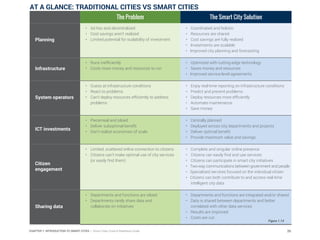
The Problem The Smart City Solution
Planning
•	 Ad hoc and decentralized
•	 Cost savings aren’t realized
•	 Limited potential for scalability of investment
•	 Coordinated and holistic
•	 Resources are shared
•	 Cost savings are fully realized
•	 Investments are scalable
• Improved city planning and forecasting
Infrastructure
•	 Runs inefficiently
•	 Costs more money and resources to run
•	 Optimized with cutting-edge technology
•	 Saves money and resources
• Improved service-level agreements
System operators
•	 Guess at infrastructure conditions
•	 React to problems
•	 Can’t deploy resources efficiently to address
problems
•	 Enjoy real-time reporting on infrastructure conditions
•	 Predict and prevent problems
•	 Deploy resources more efficiently
•	 Automate maintenance
•	 Save money
ICT investments
•	 Piecemeal and siloed
•	 Deliver suboptimal benefit
•	 Don’t realize economies of scale
•	 Centrally planned
•	 Deployed across city departments and projects
•	 Deliver optimal benefit
•	 Provide maximum value and savings
Citizen
engagement
•	 Limited, scattered online connection to citizens
•	 Citizens can’t make optimal use of city services
(or easily find them)
•	 Complete and singular online presence
•	 Citizens can easily find and use services
•	 Citizens can participate in smart city initiatives
• Two-way communications between government and people
• Specialized services focused on the individual citizen
• Citizens can both contribute to and access real-time
intelligent city data
Sharing data
•	 Departments and functions are siloed
•	 Departments rarely share data and
collaborate on initiatives
•	 Departments and functions are integrated and/or shared
•	 Data is shared between departments and better
correlated with other data services
•	 Results are improved
•	 Costs are cut
AT A GLANCE: TRADITIONAL CITIES VS SMART CITIES
Figure 1.14
20CHAPTER 1: INTRODUCTION TO SMART CITIES | Smart Cities Council Readiness Guide
CHAPTER 2: HOW TO USE THE READINESS GUIDE | Smart Cities Council Readiness Guide 21
HOW TO USE THE
READINESS GUIDE
The role of the Readiness Guide is to help you transition to
a smart city, at your own pace and on your own terms. This
chapterexplainstheSmartCitiesFrameworkthatsupports
that mission. We think you will find it a useful mechanism
to understand the totality of a smart city and how the piec-
es work together.
Thischaptergivesyouwhatyouneedtoconstructa“target
list” or “wish list” for your city. When you are ready to turn
that list into an actual plan, you’ll find guidance in Chapter
13, “Ideas to Action.”
CHAPTER 2
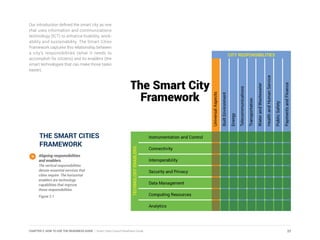
Our introduction defined the smart city as one
that uses information and communications
technology (ICT) to enhance livability, work-
ability and sustainability. The Smart Cities
Framework captures this relationship between
a city’s responsibilities (what it needs to
accomplish for citizens) and its enablers (the
smart technologies that can make those tasks
easier).
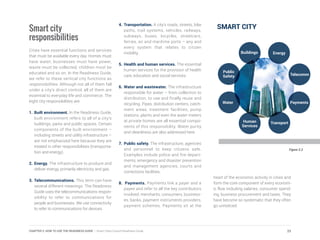
THE SMART CITIES
FRAMEWORK
Aligning responsibilities
and enablers.
The vertical responsibilities
denote essential services that
cities require. The horizontal
enablers are technology
capabilities that improve
those responsibilities.
Figure 2.1
22CHAPTER 2: HOW TO USE THE READINESS GUIDE | Smart Cities Council Readiness Guide
CHAPTER 2: HOW TO USE THE READINESS GUIDE | Smart Cities Council Readiness Guide 23
Smart city
responsibilities
Cities have essential functions and services
that must be available every day. Homes must
have water, businesses must have power,
waste must be collected, children must be
educated and so on. In the Readiness Guide,
we refer to these vertical city functions as
responsibilities. Although not all of them fall
under a city’s direct control, all of them are
essential to everyday life and commerce. The
eight city responsibilities are:
1.	Built environment. In the Readiness Guide,
built environment refers to all of a city’s
buildings, parks and public spaces. Certain
components of the built environment –
including streets and utility infrastructure –
are not emphasized here because they are
treated in other responsibilities (transporta-
tion and energy).
2.	Energy. The infrastructure to produce and
deliver energy, primarily electricity and gas.
3.	Telecommunications. This term can have
several different meanings. The Readiness
Guide uses the telecommunications respon-
sibility to refer to communications for
people and businesses. We use connectivity
to refer to communications for devices.
4.	Transportation. A city’s roads, streets, bike
paths, trail systems, vehicles, railways,
subways, buses, bicycles, streetcars,
ferries, air and maritime ports – any and
every system that relates to citizen
mobility.
5.	Health and human services. The essential
human services for the provision of health
care, education and social services.
6.	Water and wastewater. The infrastructure
responsible for water – from collection to
distribution, to use and finally reuse and
recycling. Pipes, distribution centers, catch-
ment areas, treatment facilities, pump
stations, plants and even the water meters
at private homes are all essential compo-
nents of this responsibility. Water purity
and cleanliness are also addressed here.
7.	Public safety. The infrastructure, agencies
and personnel to keep citizens safe.
Examples include police and fire depart-
ments, emergency and disaster prevention
and management agencies, courts and
corrections facilities.
8. Payments. Payments link a payer and a
payee and refer to all the key contributors
involved: merchants, consumers, business-
es, banks, payment instruments providers,
payment schemes. Payments sit at the
Figure 2.2
Buildings
Public
Safety
Energy
Telecomm
TransportHuman
Services
Water
SMART CITY
heart of the economic activity in cities and
form the core component of every econom-
ic flow including salaries, consumer spend-
ing, business procurement and taxes. They
have become so systematic that they often
go unnoticed.
Payments
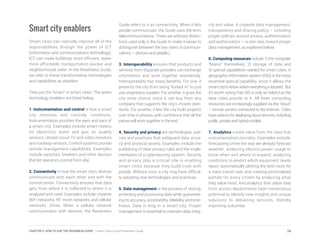
Smart city enablers
Smart cities can radically improve all of the
responsibilities through the power of ICT
(information and communications technology).
ICT can make buildings more efficient, water
more affordable, transportation quicker and
neighborhoods safer. In the Readiness Guide,
we refer to these transformative technologies
and capabilities as enablers.
They put the “smart” in smart cities. The seven
technology enablers are listed below.
1. Instrumentation and control is how a smart
city monitors and controls conditions.
Instrumentation provides the eyes and ears of
a smart city. Examples include smart meters
for electricity, water and gas; air quality
sensors; closed circuit TV and video monitors
and roadway sensors. Control systems provide
remote management capabilities. Examples
include switches, breakers and other devices
that let operators control from afar.
2. Connectivity is how the smart city’s devices
communicate with each other and with the
control center. Connectivity ensures that data
gets from where it is collected to where it is
analyzed and used. Examples include citywide
WiFi networks, RF mesh networks and cellular
networks. (Note: When a cellular network
communicates with devices, the Readiness
Guide refers to it as connectivity. When it lets
people communicate, the Guide uses the term
telecommunications. These are arbitrary distinc-
tions used only in the Guide to make it easier to
distinguish between the two sides of communi-
cations – devices and people.)
3. Interoperability ensures that products and
services from disparate providers can exchange
information and work together seamlessly.
Interoperability has many benefits. For one, it
prevents the city from being “locked in” to just
one proprietary supplier. For another, it gives the
city more choice, since it can buy from any
company that supports the city’s chosen stan-
dards. For another, it lets the city build projects
over time in phases, with confidence that all the
pieces will work together in the end.
4. Security and privacy are technologies, poli-
cies and practices that safeguard data, priva-
cy and physical assets. Examples include the
publishing of clear privacy rules and the imple-
mentation of a cybersecurity system. Security
and privacy play a critical role in enabling
smart cities because they build trust with
people. Without trust, a city may have difficul-
ty adopting new technologies and practices.
5. Data management is the process of storing,
protecting and processing data while guarantee-
ing its accuracy, accessibility, reliability and time-
liness. Data is king in a smart city. Proper
management is essential to maintain data integ-
rity and value. A citywide data management,
transparency and sharing policy – including
proper policies around access, authentication
and authorization – is one step toward proper
data management, as explained below.
6. Computing resources include 1) the computer
“brains” themselves, 2) storage of data and
3) special capabilities needed for smart cities. A
geographic information system (GIS) is the most
essential special capability, since it allows the
smart city to know where everything is located. But
it’s worth noting that GIS is only as helpful as the
data cities provide to it. All three computing
resources are increasingly supplied via the “cloud”
– remote servers connected to the Internet. Cities
have options for deploying cloud services, including
public, private and hybrid models.
7. Analytics create value from the data that
instrumentation provides. Examples include:
forecasting crime the way we already forecast
weather; analyzing electric power usage to
know when and where to expand; analyzing
conditions to predict which equipment needs
repair; automatically plotting the best route for
a mass transit user, and creating personalized
portals for every citizen by analyzing what
they value most. And analytics that utilize data
from across departments have tremendous
potential to identify new insights and unique
solutions to delivering services, thereby
improving outcomes.
24CHAPTER 2: HOW TO USE THE READINESS GUIDE | Smart Cities Council Readiness Guide
The role of dependencies
in smart city planning
In the previous chapter we explored the
dangers and pitfalls of siloed cities. Cities that
don’t coordinate their various departments at
the technology planning level often end up
with redundant investments in technologies,
training and even personnel.
But there’s an even deeper connection
between smart city responsibilities that can’t
be overlooked. That’s the matter of depen-
dences. Since so many city systems, services
and infrastructures are connected in one way
or another, becoming smart in one area is
often dependent on progress being made in
another.
As cities develop long-term goals and plans, it
is important to consider how desired improve-
ments to the performance of a single respon-
sibility may require improvements in a respon-
sibility on which there is a dependency. For
example, cities cannot expect to foster a
healthy population if water systems cannot
ensure water quality. Yet water systems rely
heavily on energy systems to pump and move
water through city infrastructure. So, as you
plan projects to improve water infrastructure,
be sure to examine any requirements that
need to be addressed by electrical systems
and the distribution grid. Think holistically to
avoid having to make major system changes
or unanticipated course corrections further
into your smart city planning.
As you move through the chapters in this
Guide, we will highlight dependencies that
merit consideration. You’ll come to realize that
understanding dependencies is another
reason to bring cross-departmental teams
together early in your smart city planning
process.
The role of dependencies.
A healthy population is
dependent in part on quality
drinking water which, in turn, is
dependent on energy systems
that pump the water. Thinking
holistically early in the smart
city planning process will help
avoid unexpected roadblocks
later.
Figure 2.3
25CHAPTER 2: HOW TO USE THE READINESS GUIDE | Smart Cities Council Readiness Guide
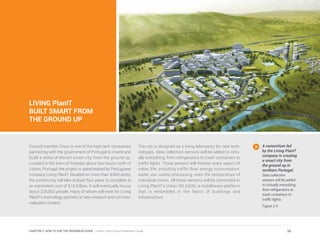
LIVING PlanIT
BUILT SMART FROM
THE GROUND UP
Council member Cisco is one of the high-tech companies
partnering with the government of Portugal to invent and
build a state-of-the-art smart city from the ground up.
Located in the town of Paredes about two hours north of
Lisbon, Portugal, the project is spearheaded by Portuguese
company Living PlanIT. Situated on more than 4,000 acres,
the community will take at least four years to complete at
an estimated cost of $10 billion. It will eventually house
about 225,000 people, many of whom will work for Living
PlanIT’s technology partners at new research and commer-
cialization centers.
The city is designed as a living laboratory for new tech-
nologies. Data collection sensors will be added to virtu-
ally everything, from refrigerators to trash containers to
traffic lights. Those sensors will monitor every aspect of
urban life, including traffic flow, energy consumption,
water use, waste processing, even the temperature of
individual rooms. All these sensors will be connected to
Living PlanIT’s Urban OS (UOS), a middleware platform
that is embedded in the fabric of buildings and
infrastructure.
A consortium led
by the Living PlanIT
company is creating
a smart city from
the ground up in
northern Portugal.
Data collection
sensors will be added
to virtually everything,
from refrigerators to
trash containers to
traffic lights.
Figure 2.4
26CHAPTER 2: HOW TO USE THE READINESS GUIDE | Smart Cities Council Readiness Guide
UOS will integrate with the Microsoft Devices & Services Platform to
enable city governments to deliver a comprehensive set of services.
Cisco is acting as the master planner for information technology and
communications design and architecture. Cisco is also building a
cutting-edge data center at an estimated cost of $38 million.
The city’s digital control system will accommodate an expanding list of
applications, from managing electricity demand to routing traffic to find-
ing a parking spot, to name just a few. In the event of a fire, for instance,
sensors can pinpoint the location, alert people nearby, notify the fire
station and manage the traffic lights so fire engines can reach the build-
ing as quickly as possible.
Or the control system might notice that the interior of a building is
getting too hot. With its knowledge of the outside temperature plus the
building’s equipment and orientation, it could relay a command to dark-
en the smart glass on the building’s sunward side to reduce the sun’s
warming effect.
The consortium hopes to ultimately create a platform to enable a new
generation of intelligent cities. “Software has transformed industries –
medicine, education, science, finance, manufacturing,” explains Steve
Lewis, Living PlanIT’s co-founder and CEO. “And software will transform
our cities to achieve their economic, social and environmental potential.”
Developing an
intelligent city platform.
The city’s digital control
system will accommodate
an expanding list of
applications, from
managing electricity
demand to routing traffic
to finding a parking spot,
to name just a few.
Figure 2.5
27CHAPTER 2: HOW TO USE THE READINESS GUIDE | Smart Cities Council Readiness Guide
The Readiness Guide
structure
The Readiness Guide is comprised of multiple
chapters. One chapter examines “universal”
principles – enablers common to all responsi-
bilities. The chapters that follow detail how
individual city responsibilities – power, trans-
portation, public safety, payments, etc. –
should use the technology enablers. Two final
chapters cover how to translate the Guide’s
theories into a roadmap.
Each chapter has three sections. The first
section envisions what each responsibility
could look like by the year 2030. The second
section examines the benefits that arise from
each target. Targets are goals – end points or
outcomes a city should work toward. A third
section provides a checklist of the relevant
targets for that responsibility. You can use
these checklists (and the summary checklist in
the final chapter) to create a “wish list” that can
inform and improve your smart city roadmap.
Scattered throughout are brief examples to
show how cities are applying these theories in
real life.
What this guide does NOT do. We’ve talked
about what the Guide wants to do, but it’s also
important to acknowledge the things that are
outside its scope.
The Guide does NOT suggest what your city’s
overall goals should be. Smart city technolo-
gies are a means to an end. Every city should
decide for itself what ends it hopes to achieve.
But whatever you’re after, the targets
described in this guide represent the best
technical foundation for pursuing those goals.
The Guide does NOT propose which respon-
sibilities should be prioritized. Every city has
its own unique strengths and weaknesses, its
own unique history and resources, its own
unique preferences and aspirations. Some
cities may choose to tackle transportation
first, for instance, while others may feel that
energy is more urgent.
The Guide does NOT pretend that its targets
are set in stone. Change is continuous, and
technology advances are famously unpredict-
able. The targets shown here are the best
recommendations we can make today, as
informed by a large contingent of the world’s top
experts. They will put cities on the right path, but
cities will still need to make periodic evaluations
and course corrections as technology evolves.
Roadmapping
is how a city
translates the
theories of the
Readiness
Guide into a
plan of action.
Figure 2.6
28CHAPTER 2: HOW TO USE THE READINESS GUIDE | Smart Cities Council Readiness Guide
Located in the heart of the Mediterranean and known for
its stable economy and pro-business government, Malta
is a group of small islands 50 miles to the south of Sicily.
Home to roughly 400,000 people, it has the highest popu-
lation density in Europe, putting a genuine strain on power,
gas, waste management and other essential services.
In 2008, the national energy and water providers partnered
with Smart Cities Council members IBM, Itron and other
suppliers to gradually roll out smart meters for all electric
and water customers. The utilities are saving money by
not employing meter readers. What’s more, the metering
data is integrated into new back-office applications for bill-
ing. It is also used for analytics that locate problems and
determine when and whether to expand the grid.
So far, results have been very successful. For instance,
the new smart water grid has increased theft detection,
while also introducing new pricing options for customers
that reward conservation.
With those smart grids in place, Malta has the founda-
tional elements for a smart island. And the government is
taking things even further in one corner. It is transforming
an industrial park into a state-of-the-art information tech-
nology and media city. The goal of SmartCity Malta is to
put everything a high-tech company needs to succeed in
one place, including state-of-the-art ICT infrastructure
along with a host of IT, media and production services.
MALTA: WHY NOT A
SMART ISLAND?
The world’s first
smart island.
Thanks to its smart water
and electricity networks,
Malta is the world’s first
smart island. It is also the
home of SmartCity Malta
(shown here), a cutting
edge development
designed to attract
high-tech industry.
Figure 2.7
29CHAPTER 2: HOW TO USE THE READINESS GUIDE | Smart Cities Council Readiness Guide
Conclusion
As you review the chapters that follow, you
can use the checklists at the end of each one
to note where your city is currently weak or
strong. Once you’ve completed those assess-
ments, you can transfer them to the summary
checklist in the final chapter, Ideas to Action.
With that summary in place, you’ll be ready to
build your smart city roadmap, using the tips
and techniques provided in that last chapter.
The mission of the Smart Cities Council
Readiness Guide is to set you on the path to
becoming a city of the future – a smart city
with enhanced livability, workability and
sustainability. It will take patience to march
through each chapter to compile your own
“wish list” of essential features. And it will take
leadership to build those features into a
comprehensive smart city plan that has the
support of the public.
But amazing advantages await those cities
that make the effort. Their citizens will have a
healthier, happier place to live along with
better, higher-paying jobs. And all of that in a
sustainable fashion that doesn’t rob from the
next generation.
Figure 2.8
30CHAPTER 2: HOW TO USE THE READINESS GUIDE | Smart Cities Council Readiness Guide
CHAPTER 3: UNIVERSAL | Smart Cities Council Readiness Guide
UNIVERSAL ASPECTS OF A
SMART CITY
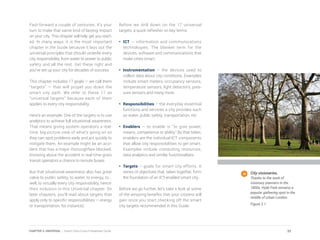
Some of today’s greatest cities benefitted from visionaries
who – centuries ago – saw possibilities for civic better-
ment and made it happen. A compelling example comes
from leaders back in the 1800s. Way before the phrase
“urban sprawl” had entered our psyche, they committed
to preserving vast amounts of open spaces for public use.
Think of Hyde Park in London, Central Park jutting through
Manhattan or Ueno Park in Tokyo. They are all testaments
to leaders “thinking outside the box” a very long time ago.
31
CHAPTER 3
Fast-forward a couple of centuries. It’s your
turn to make that same kind of lasting impact
on your city. This chapter will help get you start-
ed. In many ways, it is the most important
chapter in the Guide because it lays out the
universal principles that should underlie every
city responsibility, from water to power to public
safety and all the rest. Get these right and
you’ve set up your city for decades of success.
This chapter includes 17 goals — we call them
“targets” — that will propel you down the
smart city path. We refer to these 17 as
“universal targets” because each of them
applies to every city responsibility.
Here’s an example: One of the targets is to use
analytics to achieve full situational awareness.
That means giving system operators a real-
time, big-picture view of what’s going on so
they can spot problems early and act quickly to
mitigate them. An example might be an acci-
dent that has a major thoroughfare blocked.
Knowing about the accident in real time gives
transit operators a chance to reroute buses.
But that situational awareness also has great
value to public safety, to water, to energy, to...
well, to virtually every city responsibility, hence
their inclusion in this Universal chapter. (In
later chapters, you’ll read about targets that
apply only to specific responsibilities – energy
or transportation, for instance).
Before we drill down on the 17 universal
targets, a quick refresher on key terms:
•	ICT — information and communications
technologies. The blanket term for the
devices, software and communications that
make cities smart.
•	Instrumentation – the devices used to
collect data about city conditions. Examples
include smart meters, occupancy sensors,
temperature sensors, light detectors, pres-
sure sensors and many more.
•	Responsibilities – the everyday essential
functions and services a city provides such
as water, public safety, transportation, etc.
•	Enablers – to enable is “to give power,
means, competence or ability.” By that token,
enablers are the individual ICT components
that allow city responsibilities to get smart.
Examples include computing resources,
data analytics and similar functionalities.
•	Targets – goals for smart city efforts. A
series of objectives that, taken together, form
the foundation of an ICT-enabled smart city.
Before we go further, let’s take a look at some
of the amazing benefits that your citizens will
gain once you start checking off the smart
city targets recommended in this Guide.
City visionaries.
Thanks to the work of
visionary planners in the
1800s, Hyde Park remains a
popular gathering spot in the
middle of urban London.
Figure 3.1
32CHAPTER 3: UNIVERSAL | Smart Cities Council Readiness Guide
Benefits of realizing the
universal targets
We’ve talked about the hurdles cities face on
their smart city journey and how realizing
targets will require commitment, planning and
execution. Now let’s talk about the rewards!
Because the 17 universal targets described
here apply to every responsibility, the benefits
highlighted below are also citywide in their
application. We’ve organized the benefits by
our three core smart city objectives –
enhanced livability, workability and
sustainability.
Livability will mean different things to different
people because we all define quality of life in
different ways. Yet the smart city benefits high-
lighted below have the potential to help
everyone:
Revolutionizing people’s relationship with
their government. By providing instant, elec-
tronic access to the information people need,
the services they require, and the interaction
they want with officials, cities build citizen
trust and satisfaction.
Improving city service by sharing data. Many
of the most exciting city applications come
from sharing data between departments. Or, in
a similar fashion, by sharing data with outside
developers who can innovate new applications.
For instance, cities including Amsterdam,
London, Philadelphia and San Francisco have
instituted “Open Data” programs. They have
resulted in hundreds of innovative applications,
including trip planners, parking spot finders,
bus locators, crime reporting and alerts, and
business planning tools, to name just a few.
Enabling real-time alerts and real-time moni-
toring. Health and public safety are improved
when citizens are alerted to fires, floods, air-
quality issues, public disturbances, pipeline
leaks, downed electricity lines, chemical spills,
snowstorms and snow plows, metro lines, bus
locations, etc.
Creating citywide situational awareness.
When you are able to fully visualize your city’s
traffic, energy, gas and water networks, you
can best ensure reliability and resiliency of
those essential services.
Protecting personal privacy. People have a
right to and great desire for privacy and that
issue will certainly crop up when you start
marching down the smart city path. The
Guide’s universal principles include recom-
mendations on privacy.
Revolutionizing
people’s relationship
with their government.
By providing instant,
electronic access to the
information people need,
when and where they
need it, cities build new
trust with their citizens.
Figure 3.2
33CHAPTER 3: UNIVERSAL | Smart Cities Council Readiness Guide
Workability means accelerated economic
development.
Creating world-class infrastructure. Businesses
weight the efficiency and reliability of city infra-
structures when they make their investments.
They have many options. Why locate in city A,
when nearby city B has a more efficient trans-
portation network, a more reliable and cost-
effective energy grid, or a more advanced law
enforcement program? Cities that have opti-
mized their infrastructures are more attractive
investment locations.
Protecting business from cybercrime. Hacking
and theft are serious risks to businesses. A
2012 study reported that incidents of cyber-
crime doubled over the last three years, while
their financial impact rose by 40%. Enforcing
cybersecurity as described in this Guide will help
city government achieve safety and resiliency,
and create trust for companies contemplating a
move to your city.
Unleashing innovation. Cities that free up
their data via Open Data or similar programs
will unleash the power of people on their data
sets and benefit from new ideas. Data is a
valuable and profitable resource that can fuel
innovation and invention, thereby creating new
businesses, revenue streams and jobs.
Creating a “recruiting tool” for attracting
talent and jobs. Increasingly mobile busi-
nesses and professionals are attracted to
cities that have a strong, compelling vision for
a better future.
Supporting skills development. According to a
2012 study, despite the relatively high unem-
ployment rate in the United States, 49% of
employers reported having difficulty in filling
science, technology, engineering and mathe-
matics (STEM) jobs. City-supported skill devel-
opment can be an enormous draw to business-
es looking for specialized talent.
Sustainability is how smart cities provide
necessary and desirable services in a way that
doesn’t deplete resources.
Reducing resource use through optimization.
The optimization gains from analytics and
improved planning mean that cities, their busi-
nesses and their residents consume fewer
resources. By harnessing the power of ICT,
smart cities can curb the theft of resources and
deliver a better future for generations to come.
Enabling a broad selection of technology
choices. Cities that pursue interoperability in
their smart technology investments will save
money by being able to pick from the widest
variety of solutions possible.
Creating world-class
infrastructure.
Cities that have optimized
their infrastructures –
transportation, energy,
etc.– will be more
attractive to businesses.
Figure 3.3
34CHAPTER 3: UNIVERSAL | Smart Cities Council Readiness Guide
Optimize waste logistics:
SMART SENSORS PROVIDE
COST SAVING SOLUTIONS IN
FINLAND
Located 50 kilometers east of Helsinki, the Finnish capital,
is Porvoo, an old medieval town situated in the pictur-
esque scenery of the Finnish archipelago.
In the summer of 2011, the scenery at the local recycling
stations was less picturesque; overflowing waste contain-
ers and angry customers. The local waste management
authority, Itä-Uudenmaan Jätehuolto, was having consid-
erable challenges handling the increasing amount of
waste that the many guests were generating during the
summer season. Overfilling at the local recycling stations
was becoming more common, causing increased littering
and cleaning costs. Customers were demanding
increased collection intervals, while the service was
getting too expensive to maintain.
To tackle the problem the authority decided to pursue a
smart city solution, installing wireless fill-level sensors at
recycling. The sensor system provided by Finland-based
logistics solution company Enevo, a Council member,
measures and forecasts when waste containers will be
full. By combining the forecasts with traffic and vehicle
information, Enevo’s system can generate millions of
different route options and suggest the most cost-effi-
cient to the user.
By utilizing Enevo’s smart sensor service ONe,
Itä-Uudenmaan Jätehuolto was able to:
•	 Reduce the amount of collections by 51%
•	 Reduce unnecessary driving and emissions
•	 Reduce the overfilling problem at recycling stations
•	 Achieve a net savings rate of 47%
Reducing resource use
through optimization.
By installing Enevo smart
sensors the local waste
management authority
was able to cut the
amount of collections by
51% and achieve a net
savings rate of 47%. The
image above shows a
typical recycling station
in the Porvoo region.
Figure 3.4
35CHAPTER 3: UNIVERSAL | Smart Cities Council Readiness Guide
Reducing duplication of effort. When smart
city efforts are confined to departmental silos,
functions are needlessly repeated. This unnec-
essary duplication may range from market
research to community outreach to technical
design to security planning to staff training to
procurement processes to designing user
interfaces and much more. Agreeing in
advance on universal principles takes care of
these things once, for use in all departments.
Reducing costs through infrastructure shar-
ing. Some early smart city efforts have over-
looked the potential to share costs. Here are
just a few of the elements that can often be
purchased or designed just once and reused
many times: geographical information systems
(GIS); communications networks; cybersecurity
designs and implementations; database
management systems; enterprise service
buses; workforce and field crew management
architecture, and operations centers.
Additionally, in some cases costs can be
reduced by partnering with private sector
providers (operators) who have already
deployed networks and services.
Reducing costs by re-using software modules.
By realizing the targets in this Guide, cities can
construct their applications in a way that
creates a collaborative and secure environment,
makes it easy to share code modules between
different applications, minimizing expensive
programming.
Increasing economies of scale. By agreeing
on universal standards and specifications,
cities can often lower their purchasing costs
while increasing interoperability. Otherwise,
each city department makes its own small,
slightly different order with diminished
bargaining power.
Embedding best practices. By way of exam-
ple, consider something as crucial as cyberse-
curity. Now suppose that every department is
responsible on its own for researching, plan-
ning and implementing that security. It’s not
hard to recognize that some departments will
not have the skills and resources to do the
best possible job. By contrast, if the city
adopts a universal security framework, it can
be assured that the individual departmental
implementations will be state-of-the-art.
Enabling better financial forecasting.
Financial forecasting is an important disci-
pline and it can be greatly enhanced with the
help of the data flowing from smart cities.
Combining and correlating growth projections,
depreciation and historic operating patterns
can improve cities’ 5-, 10- and 20-year plans.
And by monitoring key performance indica-
tors, cities can measure their progress and
their return on investment.
Squeezing the maximum value from city
assets. Electronically monitoring the actual
condition of assets at every moment helps
predict when they will need maintenance in
time to prevent breakdowns. With device
management and asset optimization, cities
will save money while still ensuring the reliabil-
ity of their technology deployments.
Using computer simulations to plan with
great precision. Thanks to computer modeling
and simulations, cities can test assumptions,
try different scenarios and make mistakes in
the simulations instead of costly mistakes in
real life. Many experts predict that smart city
technologies will change the very nature of
planning – from a once-in-a-decade activity
based on estimates to an ongoing process
based upon real-time data.
36CHAPTER 3: UNIVERSAL | Smart Cities Council Readiness Guide
How to use this chapter
(and the ones that follow)
The goal of the Readiness Guide is to help you
make two key decisions: 1) where you want to
end up and 2) where you should start.
This chapter and those that follow will help
you with the first issue. They suggest the
targets at which you should aim. Your only job
is to review those targets and determine a)
whether they apply to your city and b) how far
along you are already.
When it comes to which ones apply, we are
biased – we think every target in this Guide is
essential to the long-term success of a smart
city. Not to be overly dramatic, but you ignore
these targets – especially the universal
targets – at your own peril.
The universal targets are highlighted on the
checklist you’ll see on the next page (and
again at the end of the chapter). Each target
is explained in detail on the pages that follow.
When it comes to how far along you are, you
can use the column at the far right of the
checklist to record your estimate. You’ll use
that estimate of progress in the final chapter,
Ideas to Action, where you will set your
priorities.
Knowing where you are strong and weak will
help you choose where to point your smart
city efforts first.
You don’t have to over-think the process. Nor do
you have to become an expert in every target.
When you have gone through all the chapters
and completed the consolidated target list in the
final chapter, you will be handing it to specialists
to build detailed project plans. You can count on
their expertise for the details.
A few large cities will hand their target list to
in-house staff. But most cities will use outside
experts. Either way, your job is to hand those
experts your “wish list” – your prioritized target
list. That list will tell them, in general terms, where
you want to start and where you want to end up.
So don’t feel overwhelmed as you read
through the targets. Your job is not to solve all
of these issues. That’s where the experts
come in. Your job is to know which issues
need a solution and to decide which issues to
tackle first.
If you have further questions about targets
and checklists, reach out to the Smart Cities
Council via the website or the contact infor-
mation in the appendix.
And now, on to the universal targets. As you
read through each one, jump to a checklist to
record your assessment of your city’s progress.
After completing this chapter and the ones that
follow, use the summary checklist in the final
chapter to combine your results into one
document.
Universal targets.
Knowing where you are
strong and weak will help
you choose where to point
your smart city efforts first.
Figure 3.5
37CHAPTER 3: UNIVERSAL | Smart Cities Council Readiness Guide
Enabler Universal Targets
How smart cities deploy and use ICT to enhance
livability, workability and sustainability
Implementation Progress
Instrumentation & Control Implement optimal instrumentation
Connectivity Connect devices with citywide, multi-service communications
Interoperability
Adhere to open standards
Use open integration architectures and loosely coupled interfaces
Prioritize use of legacy investments
Security & Privacy
Publish privacy rules
Create a security framework
Implement cybersecurity
Data Management Create a citywide data management, transparency and sharing policy
Computing Resources
Consider a cloud computing framework
Use an open innovation platform
Have access to a central GIS
Have access to comprehensive device management
Analytics
Achieve full situational awareness
Achieve operational optimization
Achieve asset optimization
Pursue predictive analytics
Figure 3.6
None Partial Over 50% Complete
UNIVERSAL TARGETSTECHNOLOGY
38CHAPTER 3: UNIVERSAL | Smart Cities Council Readiness Guide
Action items.
Cities that achieve
the universal targets
described in this
chapter gain a wide
variety of powerful
benefits.
Figure 3.7
UNIVERSAL
39CHAPTER 3: UNIVERSAL | Smart Cities Council Readiness Guide
Instrumentation
and control
Instrumentation is the bedrock of smart cities.
It provides the key source of data that allows a
city to make informed decisions on how to
reduce costs and allocate funding. In energy,
instrumentation may mean smart meters that
measure energy flow. In transportation it may
mean embedded devices in roads and high-
ways that measure traffic.
Implement optimal instrumentation. The
purpose of this target is two-fold. 1) We use
instrumentation to gather information about
city conditions. 2) We use control devices to
take action remotely — for instance, to throw a
switch or open a valve. Becoming smart is all
about having the right data to work with to
make better decisions. So the overarching
goal is optimal instrumentation and control.
Optimal is the key word here. The ideal smart
city will have exactly the devices it needs,
exactly where needed. In many responsibility
areas, optimal may mean a device at every end
point. In water, for instance, it may mean a
smart water meter at every customer premise.
In other cases, it may mean a sensor “every so
often” – as frequently as needed to generate
enough data to provide a full picture of what’s
going on.
Three issues are worth mentioning as they
apply to instrumentation; these three will be
addressed in more detail later in the chapter:
1.	Privacy and security — Given the amount
of data generated, cities must be absolute-
ly vigilant about respecting privacy and
implementing security.
2.	Legacy devices — Your city may already
have lots of data available without the need
for additional instrumentation immediately.
For instance, anonymous cell phone GPS
data can tell you where people are, or how
fast they are moving on roadways. Key
intersections may already have traffic
sensors. Streetlights may already detect
ambient light. Water, power or gas utilities
may already have smart meters. You may
decide to add additional sensors – espe-
cially now that prices are plummeting –
but it’s often possible to get started with
the data you are getting already.
3. Connectivity — In smart cities, instrumen-
tation needs to be connectible. Having
sensors that need to be checked manually
is not optimal – for instance, you wouldn’t
want to have to send a technician to every
water pump in your city.
Implementing optimal instrumentation creates
the data critical to a smart city. It is also the
first step in connecting city infrastructure to
the “Internet of Things,” which is described
next in the connectivity discussion.
Implement optimal
instrumentation.
Optimal instrumentation is
what creates the data
critical to a smart city.
Figure 3.8
40CHAPTER 3: UNIVERSAL | Smart Cities Council Readiness Guide
Optimal instrumentation:
HOW SMART WASTEWATER
MANAGEMENT SAVED AN
INDIANA CITY MILLIONS
South Bend, Indiana had a serious problem: wastewater
spilling into the St. Joseph River and welling up in base-
ments. The city’s wastewater pipes and treatment facili-
ties just couldn’t handle the volume.
The city was looking at an estimate of $120 million for a
daunting infrastructure upgrade. Instead, it entered a
public-private partnership with Notre Dame University,
local tech company EmNet and Smart Cities Council
member IBM to come up with a new way to monitor and
control its wastewater collection system. The new
approach cost the city 1/20th of the initial estimate – a
much more budget-friendly $6 million.
The integration of IBM technology with smart valves and
sensors from business partner EmNet helped the city to
be proactive in its wastewater management, avoiding
additional infrastructure investments while improving
public health. Meanwhile, Notre Dame students came up
with innovative apps to allow residents to report flooding,
social media tools that collect information on water
systems and more. As a result, the technology and
research made it possible to automate what had been
manual and labor-intensive data collection.
With the new system in place, the city is now able to monitor
and actively control its wastewater collection system, which
has helped cut down on sewer back-ups and overflows.
Figure 1.2
Implementation
and control.
An innovative, affordable
solution for South Bend’s
maxed-out wastewater
system uses smart
sensors (instrumenta-
tion) plus smart valves
(control) plus smart
software from Council
member IBM.
Figure 3.9
41CHAPTER 3: UNIVERSAL | Smart Cities Council Readiness Guide
Connectivity
Take a moment to consider the incredible
ways technology has changed our lives in the
last four decades – microprocessors, ATMs,
the World Wide Web, email, Google maps,
smartphones and iPads to name a few. Clearly
we’ve been on a connectivity roll for a while.
And it’s not going to stop. Today we are enter-
ing the Internet of Things (IoT) era where
people talk to devices and devices talk to each
other. This helps explains why connectivity is
such a robust smart city enabler, and why
machine-to-machine communications is all
the buzz these days.
Connect devices with citywide, multi-service
communications. Above we discussed gath-
ering data through optimal instrumentation.
Once those instruments are generating infor-
mation, they need to be connected so they
can communicate to provide data, as well as
be able to receive orders.
The target, therefore, is to connect all devices
to a citywide communications system. In rare
cases, cities use a single communications
network for all device connectivity. In most
cases, cities use a variety of communications
channels, including cellular, fiber, WiFi, power-
line and RF mesh.
But it’s not enough to have just any communi-
cations system. It’s critical to have systems that
are reliable and secure, based on open stan-
dards, high data rates and able to offer real-time
communications to those devices that need it.
Most cities will have multiple communications
systems, because no single network can real-
istically support every single application now
and into the future. To save costs, cities ought
to give strong consideration to the following
approaches:
•	 Minimize the number of networks supported
at city expense. To the extent that the city
or its utilities need their own private
networks, they should try to establish multi-
purpose networks rather than a collection of
single-purpose communications networks.
•	 Investigate the viability of existing public
networks before building your own private
network. For instance, existing cellular
networks have the capacity to support
smart grids, smart traffic management and
smart water networks.
•	 Encourage cross-departmental planning
and design to learn whether multiple depart-
ments can share a single network.
•	 Investigate policies and incentives that
encourage the private sector to invest in
building and maintaining citywide networks.
•	 Prioritize technologies and tools that can
manage “hybrid” (mixed) networks. Tools
exist that can merge different communi-
cations technologies, even old analog
technologies such as radio.
Connecting instrumentation and control devices
allows a city to feed data into analytical
programs that greatly improve outcomes,
minimize resource use and save money, as we
will cover in detail later.
Connect devices.
Multi-service
communications
systems can carry
messages for multiple
applications from
multiple sources.
Figure 3.10
42CHAPTER 3: UNIVERSAL | Smart Cities Council Readiness Guide
Citywide communications:
ONE NETWORK RUNS
THREE METERS —
WATER, HEAT, GAS
Smart Cities Council member Itron deployed water, heat
and gas meters, a wireless fixed network and software for
Sino-Singapore Tianjin Eco-City in Tianjin, China. It is
China’s only unified platform that manages water, heat
and gas data together under one system.
The network allows the city to achieve its vision of energy
and water resource conservation by providing actionable
data such as high accuracy readings and reading rates,
automatic meter reading and graphical data analysis to
educate residents about their energy and water usage.
Sino-Singapore Tianjin Eco-City is a flagship government-
to-government project between Singapore and China.
Established in 2007, it is built on the vision of being “a
thriving city which is socially harmonious, environmental-
ly-friendly and resource-efficient.” When completed in
2020, it is estimated to have approximately 350,000
residents.
Minimize the
number of networks.
The comprehensive
solution that Itron
deployed in Tianjin,
China measures,
collects and analyzes
data from water, heat
and gas meters, using
a single communica-
tions system.
Figure 3.11
43CHAPTER 3: UNIVERSAL | Smart Cities Council Readiness Guide
Figure 3.12
Interoperability
Interoperability ensures the technologies you
deploy work well together. There are three
interoperability targets:
Adhere to open standards. If you hope to
achieve your smart city goals, different tech-
nologies from different vendors must be able
to work together. In particular, they must be
able to exchange information. Adhering to
standards helps to guarantee that the prod-
ucts you buy can use predefined mechanisms
to talk to each other.
And you don’t want just any standards, you
want “open” standards – standards that have
been defined by an industry group and
published for all to use. This contrasts with
“proprietary” standards, which typically come
from a single vendor who retains control over
who can use them and when they will change.
Open standards help cities control both their
expenses and their risk. They allow cities to mix
and match products from different vendors with-
out jeopardizing the ability to exchange data. Put
another way, open standards contribute to
interoperability, choice and flexibility. They also
make maintenance easier, because there are
communities of specialists trained in published
standards, such as those from Council advisors
the International Electrotechnical Commission
(IEC), the Institute of Electrical and Electronics
Engineers (IEEE), the International
Telecommunication Union (ITU), the American
National Standards Institute (ANSI) and many
others including 3GPP for 3G/4G and the WiFi
Alliance.
Although open standards are absolutely essen-
tial to the long-term success of a smart city,
putting them into practice can be challenging.
There are hundreds if not thousands of stan-
dards that apply to one aspect or another of
urban life. The best advice is to leave the heavy
lifting to the experts. When you get to the
project planning phase (as described in the final
chapter), select suppliers with a public, proven
commitment to open standards. Give them the
task of selecting the best ones to use, subject to
the oversight of your project manager or
systems integrator.
When it comes to the smart grid portion, there
is happily some good news. The IEC has
undertaken the job of creating a free Smart
Grid Standards Mapping Tool that makes it
far easier to discover and choose between
standards. Using either a diagram or a list, you
can drill down to a specific aspect, then see a
list of all the standards that relate. The IEC
lists not just its own standards, but those
from other organizations as well.
44CHAPTER 3: UNIVERSAL | Smart Cities Council Readiness Guide
Use open integration architectures and
loosely coupled interfaces to facilitate shar-
ing of data and reuse of code. This gets a bit
technical, but the important thing to under-
stand is that you can build your applications in
a way that makes it easy to reuse code
“modules,” saving time and expense. Systems
that are “loosely coupled” don’t have compo-
nents that are dependent on each other, theo-
retically making it easier to swap them in and
out. Open integration architectures are
enhanced by methodologies such as service-
oriented architecture (SOA) and enterprise
service bus (ESB). Benefits include:
•	 Faster software implementations because
they can be assembled in part from previously
written modules
•	 More robust implementations because the
city can have standardized tools and best
practices
•	 Greater scalability because the loose coupling
that is part of an open integration architecture
allows for high availability, fault tolerance and
load balancing — techniques that allow
systems to deal with huge amounts of data
•	 Easier changes because you alter only the
affected module(s), not the entire applica-
tion, and because changing one module has
minimal impact on the rest of the system
Figure 3.13
OPEN INTEGRATION ARCHITECTURE SYSTEM
SERVICE BUS
Application ApplicationApplication
Web service
(module)
Web service
(module)
Web service
(module)
Web service
(module)
45CHAPTER 3: UNIVERSAL | Smart Cities Council Readiness Guide
Prioritize legacy investments. No city can
afford to rip out its current infrastructure and
replace everything from scratch. Priority must
go to making the most of existing invest-
ments. Typically, that means retrofitting exist-
ing assets — streets, buildings, equipment —
with sensors and communications.
Fortunately, a wave of new, low-cost technolo-
gies makes it possible to connect legacy
assets. In the area of emergency response, it
is now possible to integrate old, analog radios
with state-of-the-art IP-based communica-
tions, stitching them together into a seamless
network. Likewise, a city government can
often find ways to continue using old software
by sending its data to new software modules
that add value on top. Likewise, an electric
power utility doesn’t have to replace its old
transformers, it can simply add transformer
monitors to report on their conditions.
Prioritize legacy
investments.
Council member Grid20/20,
produces an inexpensive
monitor that can be
attached to existing
transformers to collect
important information about
their conditions. In similar
fashion, many legacy assets
and investments can be
connected to the smart city.
Figure 3.14
46CHAPTER 3: UNIVERSAL | Smart Cities Council Readiness Guide
Security and privacy
One of the greatest challenges for smart city
leaders is to reassure residents that their rights
will be respected and their data protected. This
section highlights three important targets that
address those issues.
Publish privacy rules. Make it a priority to
produce clear privacy policies that are easily
accessible. The rules should balance residents’
desire for privacy and control with the ability to
gain access to data to provide better services.
They should stipulate:
•	Which data sets are owned by which
stakeholders
•	 What rights and protections are afforded by
ownership
•	 Which data sets are private (requiring autho-
rization prior to sharing)
•	 Which data sets can be shared with the city
or authorized third parties
•	 How data can be shared if defined protocols
for making information anonymous are
followed
Publishing privacy rules can save time, money
and headaches. It can also unleash innovation.
Entrepreneurs are more comfortable building
new products and services if they know the
rules in advance and they know those rules will
apply equally to their competition.
It’s one thing to have privacy rules. It’s another
to ensure that residents and businesses know
about them — and yet another to actively
enforce them in collaboration with national and
state/province level authorities.
A 2013 column in the Boston Globe titled “The
Too-Smart City” garnered a lot of attention. It
took a “big brother is watching” slant on the
smart cities movement: “A city tracking its citi-
zens, even for helpful reasons, encroaches on
the personal liberty we count on in public
spaces.”
Cities and cultures will have different priorities
for privacy. There are several sources of guid-
ance on privacy rules that cities may want to
review. As you will see, you don’t need to invent
your privacy guidelines from scratch. There are
several sources of helpful examples, including:
*	 European Union Privacy Directive
*	 Electronic Privacy Information Center
(EPIC)
*	 International Association of Privacy
Professionals
*	 Criminal Justice Information Services
*	 Federal Information Processing Standard
*	 Office of the Information and Privacy
Commissioner of Ontario, Canada
Figure 3.15
47CHAPTER 3: UNIVERSAL | Smart Cities Council Readiness Guide
Publish privacy rules:
CALIFORNIA UTILITY
TAKES LESSONS FROM
CANADA FOR ITS
PRIVACY FRAMEWORK
The city of San Diego, California’s municipal utility
in 2012 launched a Privacy by Design smart grid
initiative in conjunction with Ontario, Canada
Privacy Commissioner Ann Cavoukian, a recog-
nized champion of consumer privacy safeguards.
“Our cross-border partnership with SDG&E
follows similar successful alliances forged with
other organizations globally, as well as in my
jurisdiction of Ontario, Canada, to build in Privacy
by Design,” said Cavoukian. “Privacy is a funda-
mental right of every energy customer, and I am
very pleased to be working with SDG&E to
ensure that our innovative privacy framework is
an integral part of the smart grid deployment.”
Developed by Dr. Cavoukian, Privacy by Design
has been made an international standard, and is
a practical solution for ensuring privacy that can
be designed into the ever-growing and systemic
efforts of ICT, and of large-scale networked data
systems, as the default condition.
The 7 Foundational Principles
1. Proactive not Reactive; Preventative not Remedial
The Privacy by Design (PbD) approach is characterized by proactive rather than reactive measures. It
anticipates and prevents privacy invasive events before they happen. PbD does not wait for privacy
risks to materialize, nor does it offer remedies for resolving privacy infractions once they have occurred
— it aims to prevent them from occurring. In short, Privacy by Design comes before-the-fact, not after.
2. Privacy as the Default Setting
We can all be certain of one thing — the default rules! Privacy by Design seeks to deliver the maxi-
mum degree of privacy by ensuring that personal data are automatically protected in any given IT
system or business practice. If an individual does nothing, their privacy still remains intact. No action
is required on the part of the individual to protect their privacy — it is built into the system, by default.
3. Privacy Embedded into Design
Privacy by Design is embedded into the design and architecture of IT systems and business practices.
It is not bolted on as an add-on, after the fact. The result is that privacy becomes an essential
component of the core functionality being delivered. Privacy is integral to the system, without
diminishing functionality.
4. Full Functionality — Positive-Sum, not Zero-Sum
Privacy by Design seeks to accommodate all legitimate interests and objectives in a positive-sum
“win-win” manner, not through a dated, zero-sum approach, where unnecessary trade-offs are made.
Privacy by Design avoids the pretense of false dichotomies, such as privacy vs. security, demonstrating
that it is possible to have both.
5. End-to-End Security — Full Lifecycle Protection
Privacy by Design, having been embedded into the system prior to the first element of information
being collected, extends securely throughout the entire lifecycle of the data involved — strong security
measures are essential to privacy, from start to finish. This ensures that all data are securely retained,
and then securely destroyed at the end of the process, in a timely fashion. Thus, Privacy by Design
ensures cradle to grave, secure lifecycle management of information, end-to-end.
6. Visibility and Transparency — Keep Open
Privacy by Design seeks to assure all stakeholders that whatever the business practice or technology
involved, it is in fact, operating according to the stated promises and objectives, subject to independent
verification. Its component parts and operations remain visible and transparent, to users and providers
alike. Remember, trust but verify.
7. Respect for User Privacy — Keep it User-Centric
Above all, Privacy by Design requires architects and operators to keep the interests of the individual
uppermost by offering such measures as strong privacy defaults, appropriate notice, and empowering
user-friendly options. Keep it user-centric.
Publish
privacy rules.
Cities can turn to
several established
systems to get
started. For
instance, the Privacy
by Design system,
originally developed
in Ontario, Canada, is
based on seven
fundamental
principles.
Figure 3.16
48CHAPTER 3: UNIVERSAL | Smart Cities Council Readiness Guide
Create a citywide security policy that continu-
ally assesses risks. Privacy is freedom from
public scrutiny. Security is freedom from
danger and for that a city needs a rigorous, city-
wide security policy. That policy should encom-
pass data, devices and communications
systems at minimum. Smart cities generate a
lot of data. They also connect critical infrastruc-
ture to the Internet. Those actions create many
benefits, but they also create new threats. It’s
best not to leave it to each individual depart-
ment to come up with a security plan. Instead,
implement and enforce best practices citywide.
A security policy should use a risk manage-
ment framework that continually assesses
vulnerabilities. Risk management is the identifi-
cation, assessment and prioritization of risks
combined with a plan to minimize their
impacts. Risk management continues through-
out the technology lifecycle and drives the
evolution of security protocols and practices.
A smart city’s risk management framework
must be comprehensive, encompassing the
cybersecurity as well as the physical security of
all assets — from massive infrastructure to tiny
mobile devices. The framework should encom-
pass not just the necessary technical steps,
but also a thorough program of education and
training. (Many famous security breaches were
launched with the help of “social engineering”
to convince a naive person to take a step that
made the system vulnerable.)
Risk management cannot avoid all risk, but it
can minimize adverse effects. It lessens
unwelcome surprises, assists in correct priori-
tization and reassures residents. A security
framework is a combination of well-defined
policies, procedures, standards and guidelines
that provide consistency citywide. It also
promotes a proactive approach to security, iden-
tifying and mitigating threats before they occur.
Create a citywide
security policy
that continually
assesses risks.
It’s important to
remember that (like
privacy) security
requirements specified
during the design phase
must be continually
updated to counter new
threats and to ensure they
remain in compliance.
Figure 3.17
49CHAPTER 3: UNIVERSAL | Smart Cities Council Readiness Guide
Create a citywide security policy:
HOW JACKSONVILLE MADE
ITS VIRTUAL ENVIRONMENT
MORE SECURE
Jacksonville is the 14th largest city in North Carolina and
home to more than 70,000 residents. Jacksonville’s
Information Technology Services (ITS) department
provides citywide support for all computer, phone, security
and geographic information systems through its opera-
tions center for over 500 end users.
As the city’s workers became more and more dependent
on the ITS department, Jacksonville’s IT director Earl
Bunting along with other city officials, decided it was time
to refresh the department’s infrastructure to ensure it
remained fully functional at all times. It also wanted to
give employees access to needed materials, but in a
secure fashion.
Jacksonville decided to upgrade to a Virtualization
Experience Infrastructure (VXI) from Council member
Cisco, which supports Jacksonville’s operations centers.
The approach goes beyond traditional virtual desktops to
deliver next-generation virtual workspaces by unifying
virtual desktops, voice and video.
While Jacksonville citizens and employees have seen a
number of benefits from the upgrade, the solution has
also helped Jacksonville’s virtual environment become
more secure. “Our IT department no longer has to waste
time monitoring for threats,” says Bunting. “VXI has made
our environment increasingly secure and protected us
from the growing number of online threats that comes
with such a large number of users.”
Create a citywide
security policy that
continually assesses
risks.
Upgrading its ICT
infrastructure provided
many benefits for
Jacksonville, North
Carolina, including
better protection from
the growing number of
online threats.
Figure 3.18
50CHAPTER 3: UNIVERSAL | Smart Cities Council Readiness Guide
Data management
The streams of data that smart cities collect
create enormous opportunities, but also
require special handling. Smart cities treat
public data as a citywide asset. That data
needs to be accessible to other systems and
stakeholders including, where possible, the
research community to help ensure that the
analytic environment is always current.
Citizens, of course, will expect full access to
their own data. These requirements demand a
citywide policy.
As we move forward, city data will be used by
multiple applications from multiple depart-
ments. And it may be used by outside develop-
ers as the foundation for useful services to
benefit residents. An error in master data can
cause errors in all the applications that use it.
In a similar fashion, an error in releasing data
to those not authorized can cause a cascade
of problems.
One more time for emphasis: A smart city’s
most precious resource is the data it produces.
Do not squander and endanger that valuable
commodity by failing to carefully define a thor-
ough data policy, as explained below.
Create a citywide data management, trans-
parency and sharing policy. Ideally, cities
should build a master plan and an information
data model that spells out how data is
governed, stored and made accessible. Best
practices call for a clear governance directive
that a) establishes the chain of authority and
control over data assets and b) spells out who
makes access decisions and who determines
accountability. The citywide data manage-
ment policy defines a city information model
for all entities and assets that preserves rela-
tionships, attributes and behaviors.
This citywide policy should cover both private
and public data and ensure that data from
each department is made available to others.
It must also align with the policies in the secu-
rity and privacy targets discussed previously.
It is important for data to be stored on secure,
reliable and scalable systems long enough to
enable the dependable pattern analysis and
reliable forecasting explained in the analytics
target later in this Guide.
A citywide data management plan will increase
the city’s agility (ability to quickly build new
applications as needed) and accuracy (by
ensuring everyone is working with correct
data). It can also lower costs by reducing
errors and eliminating unnecessary duplica-
tion. A citywide plan also makes it much easier
to enforce privacy, security and best practices.
Create a citywide
data management,
transparency and
sharing policy.
The policy should cover
both private and public
data and ensure that
data from each
department is made
available to others.
Figure 3.19
51CHAPTER 3: UNIVERSAL | Smart Cities Council Readiness Guide
Computing resources
Keeping up with ever-advancing computing
technologies in an era of budget constraints
can put city leaders between the proverbial
rock and hard place. But smart cities find a
way – and sometimes find the more advanced
solution is more budget-friendly too. Even so,
there is a right way and a wrong way to pursue
your computing objectives, as you’ll discover
in reading about the four targets in this
section.
Consider a cloud computing framework.
There are many ways to deploy computers, but
most cities should consider cloud computing
first. It is the computing framework best
equipped to deliver efficiency and optimization.
Cloud computing is the practice of using a
network of remote servers to store, manage and
process data. Typically those servers are
accessed via the Internet. Please note that cloud
computing can be delivered as a service from a
third party – sometimes called “hosted solu-
tions” or “software-as-a-service” (SaaS). Or it can
be built and operated by a city using the same
architectural principles as third-party providers.
Cloud computing provides a common, shared
foundation across departments and across
different computer systems. Consider these
attributes:
•	 Identity services for consistent and secure
single sign-on
•	Virtualization for seamless application
portability. Virtualization is the creation of a
virtual (rather than actual) version of some-
thing, such as an operating system. A
single server can run as multiple “virtual”
computers with different operating
systems, for instance.
•	 Management functions for full visibility
and control
•	Scalability to support millions of data
collection points
•	Industry-standard frameworks and
languages for writing applications
Applications and services reside in the cloud,
where they are accessible from any device.
Additionally, those applications and services
are typically built with an event-triggered
enterprise service bus architecture that
provides a structured method for combining
loosely coupled software components. As we
discussed earlier in the interoperability target,
this approach makes it easy to share data and
reuse software code between departments.
The benefits of cloud computing are many:
•	Growth – It becomes easier to add comput-
ing power in small increments
•	Power – It’s typically less costly and
simpler to scale up computing services
•	Reliability – If one computer crashes,
others can easily pick up the slack
•	Cost – It becomes possible to mix and
match hardware from different vendors,
increasing choice and thus driving down
expenditures. In addition, many third-party
providers will “rent” software to cities for a
monthly charge, with little or no upfront cost.
•	 Advanced features – Smaller cities can
gain the same functionality as their larger
cousins by tapping into cloud offerings from
third parties. The provider sells the service
to many different customers, allowing it to
enjoy economies of scale that make it
possible to create advanced features.
Smaller cities would never be able to afford
the large ICT staff and server farm required
to host such applications on their own.
Cloud computing may not be an immediate
option for every city. Cities that have already
made large investments in other approaches
may settle on a hybrid computing model. And
cities in geographies with a cultural emphasis
on centralization may prefer a centralized
computing model.
52CHAPTER 3: UNIVERSAL | Smart Cities Council Readiness Guide
Consider cloud computing:
BARCELONA REALIZES
VISION OF INNOVATIVE
CITY GOVERNANCE
WITH CLOUD, DEVICES
AND APPS
Barcelona, Spain has a global reputation for innovation.
Many of the technological solutions that the city has
adopted in recent years are at the leading edge of city
management.
Council member Microsoft is a close partner in this effort.
It has helped the city drive new services for citizens and
visitors and create and support new technology-based
companies and entrepreneurs, while also enabling the city
government to reduce costs through new cloud comput-
ing services and devices.
In 2011, Barcelona began to use Windows Azure cloud-
based services to make information available to citizens,
which could be easily accessed over the Internet.
The main driver for adoption of a public cloud was better
management of the public data that is collected by the
city’s municipal operations and recordkeeping practices.
In addition to storing data in the cloud for others to
analyze, the Barcelona City Council is harnessing the
opportunities that city data presents through Big Data and
analytics solutions. Having gained confidence in the scal-
ability and security features of Windows Azure, the City
Council embarked on an Open Data initiative intended to
standardize digital formats and streamline data analysis.
The ultimate goal of the initiative is to promote economic
growth by encouraging data sharing between city govern-
ment and the private sector.
Consider
cloud computing.
Barcelona has utilized
the power of the
Microsoft Windows
Azure cloud -based
platform to help
businesses be more
productive and to draw
more visitors to the city.
Figure 3.20
53CHAPTER 3: UNIVERSAL | Smart Cities Council Readiness Guide
•	 Establish an open innovation platform -
Open Data. Today’s Open Data movement
represents one of the most powerful oppor-
tunities cities have to connect with citizens
in meaningful, life-impacting ways. The
move to make public data freely accessible
to anyone who wants to use it for legiti-
mate purposes has been referred to as “the
big bang” for all of the Big Data that cities
are amassing today. U.S. President Barack
Obama characterizes Open Data as “the
new default for government information.”
However you label it, by making raw public
information easy to access, you allow city
employees, utilities, citizens and third-party
developers to create innovative applications
and services for the benefit of the city and its
residents.
Most of this information has been collected at
taxpayer expense. And most of it is available to
the public in theory. Until recently, however, it
could not be accessed in a useful way. (You
can’t build a data-based application if you have
to go city hall and pull it out of paper files.)
New York City has been one of several leaders in
the Open Data movement. In September 2013,
officials there announced that since the launch
of its Open Data portal in 2011, the city has
opened up more than 1,100 data sets from over
60 agencies. These data sets total more than
600 million rows and have received more than
2.8 million views. NYC also announced a city-
wide plan to unlock all of its public data by 2018.
NYC, of course, is not alone. Government agen-
cies around the world are embracing Open
Data, providing dozens if not hundreds of appli-
cations that take advantage of city data. These
applications range from:
•	 Transit planning apps that show the best	
way to travel
•	 Crime reporting apps that show trouble
spots
•	 Street monitoring apps that pinpoint
potholes and problems
•	 Mapping apps for first responders
•	 Location apps that show where to find
ATMs, hotspots, day care centers, urgent
care centers, government offices, parks,
meeting spaces, etc.
Clearly Open Data and similar innovation plat-
forms can improve public services in countless
ways. It can also make government agencies
more accountable, generate new revenue
streams and help to stimulate economic
growth.
Crime reporting apps.
Amber Alerts, shown
here on a Windows
phone, alert the public
about missing children
and where to call if they
have useful information.
Figure 3.21
54CHAPTER 3: UNIVERSAL | Smart Cities Council Readiness Guide
But cities often confront stumbling blocks on
the road to an Open Data environment. Two
that may be most challenging:
1. Governance and privacy issues. Who owns
the data, who controls it, what safeguards are
in place to protect personal information when
a city decides to open its data for public
consumption? Open Data policies must be
clarified in the broader data management,
transparency and sharing policy discussed
earlier.
2. Non-standard data formats. Rather than
spending taxpayer dollars to reinvent the
wheel in every city, one of the promises of
Open Data is the ability to share apps between
cities. But that requires cities to use the same
data schema, which is often not the case.
However there is an initiative underway involv-
ing seven major U.S. cities – Boston, Chicago,
Los Angeles, New York City, Philadelphia, San
Francisco and Seattle – to create a database
of standardized Open Data applications.
Fortunately, help is at hand for cities that want
to join the Open Data movement, as you’ll read
in the adjacent sidebar.
OPEN DATA: HOW TO GET
STARTED
There’s no single path to an Open Data initia-
tive, but most cities will want to take these
three steps:
Create a team of Open Data advocates: You’ll
want a team that includes personnel from a
number of departments, including but not limit-
ed to: IT, communications/media and manag-
ers from departments with data sets with citi-
zen appeal – for example, public safety, transit,
public health. Perhaps most important is to
have executive-level representation on the
team – the city manager or mayor, for instance.
Develop an Open Data policy: First, develop
an Open Data policy that is included in and
consistent with the city’s broader data
management, transparency and sharing poli-
cy. Second, create an Open Data policy road-
map that outlines your goals, which data sets
you will start with (this can be expanded once
you’ve tried a few pilots), where and how you
will make them available (a new web portal, on
your existing city website, etc.) and what
needs to get done by when and by whom.
Third, smart city planners should emphasize
the importance of open software interfaces
and open data encodings, preferably open
interfaces and encodings that implement free-
ly usable global interface and encoding stan-
dards. These enable technical interoperability
Establish an
open innovation
platform.
Data.gov
showcases
examples of cities
and developers
working together
to improve the
lives of city
residents.
Figure 3.22
55CHAPTER 3: UNIVERSAL | Smart Cities Council Readiness Guide
between diverse systems, which enables
Open Data policies to work.
Choose your first project: Typically the safest
approach is to choose a relatively small, low-
cost pilot project to get some experience,
work out any problems and get a success
under your belt. You may want to take the
approach that other cities have found
successful and reach out to your local devel-
oper community via contests and hackathons.
They’ll likely have ideas about which data sets
would make useful apps. Another route is to
analyze what kinds of information is most
requested by members of the public.
Once a city opens up its data, citizens and
businesses start to rely on it. They may even
have their business and revenue streams
depend on it. Cities should make sure their
Open Data implementation offers a 24x7x365
availability in a secure and performant
manner. As such, a choice for Open Data
becomes a core responsibility of the city,
reflected in a strong information back bone.
Useful Open Data resources
There are many, many places to turn for ideas
and inspiration on Open Data initiatives. We’ll
highlight a few and link to several others.
City Forward is a free, web-based platform that
enables users – city officials, researchers,
academics and interested citizens worldwide –
to view and interact with publicly available city
data about cities and metropolitan areas around
the world. On the site, which is a philanthropic
donation of services and technology from
Council member IBM, users can search for data
by city, subject or source.
Code for America (CfA), described as a “Peace
Corps for geeks” by Jennifer Pahlka who
founded it in 2009, runs a fellowship program
designed to leverage technology and govern-
ment data to make cities run better. Among
the apps developed by CfA’s fellows are
Boston’s adopt-a-hydrant app and Honolulu’s
tsunami warning app.
Data-Smart City Solutions – an initiative by
the Ash Center at Harvard Kennedy School
and powered by Bloomberg Philanthropies –
features news and trends in civic data. It’s a
helpful resource if you want to see what other
cities are doing with Open Data.
Data.gov showcases examples of cities and
developers working together to improve the
lives of city residents.
You may also want to visit:
•	 The Open Data Foundation
•	 World Bank’s Data page
•	 Open Data Commons
Freeing London’s data.
The London Datastore was established in 2010 by
the Greater London Authority (GLA) with the goal
of “freeing London’s data” so the world at large
could use it as they saw fit. Some people see Open
Data as part and parcel with the move to greater
transparency. The idea is that information
collected at public expense should be available to
all, except where release would infringe privacy or
commercial confidentiality. But the success of
London’s experiment shows that it is also a way
to garner a long list of useful applications for
government, for business and for everyday
citizens, usually at zero expense to the city.
Figure 3.23
56CHAPTER 3: UNIVERSAL | Smart Cities Council Readiness Guide
Establish an Open Data platform:
HOW EDMONTON
REDUCES
CONSTRUCTION
SEASON ANGST
Street construction projects are a big deal for businesses
in the area where the construction is occurring, for citi-
zens who need to get from Point A to Point B in a timely
fashion and for neighborhood residents who must endure
the noise.
Edmonton, Canada enjoys a very short period of warm
weather when all construction projects seem to take
place, thus at any given point during this time, the number
of active projects is quite large. As Smart Cities Council
member Center for Technology in Government (CTG) put
it, “Edmonton is known for its two seasons: Winter and
Road Construction. It makes perfect sense that one of its
flagship Open Data initiatives would involve releasing
street construction data.”
And that’s what Edmonton did. The city website presents
construction project information using both static and
interactive maps. The interactive map allows users to click
on a blue dot and bring up a description of the project at
that location. A local developer also took the information
and created a mobile app for smartphones.
As a result of the new tools, CTG reports use of the data
set has increased substantially. From its launch in April
2012, monthly views increased to over 1,200, then
declined gradually to less than 250 by mid-October, when
the construction season was largely over. As of October
2012 there had been just short of 11,000 views, over 300
downloads of the data, and links to the site had been
embedded over 7,800 times.
Establish an Open
Data platform.
The construction
season in Edmonton,
Canada, is short and
intense. An Open
Data initiative has
helped citizens cope
with the disruptions.
Figure 3.24
57CHAPTER 3: UNIVERSAL | Smart Cities Council Readiness Guide
Have access to a central GIS. A geographic
information system (GIS) that maps all of the
city’s assets and location information is a big
contributor to what makes a smart city smart.
Most cities will want to implement a single,
central GIS system so that data from one
department (traffic alerts, for instance) can be
shared with others (such as emergency
responders). Some cities even share the cost
of GIS services with outside organizations,
such as utilities and phone companies.
GIS is tailor-made for smart cities. To name
just a few of the great applications of this
technology, cities can use GIS to:
•	 Map crime data to aid their public safety work
•	 Locate pipes, pumps, cables and other
assets to help better monitor and analyze
the efficacy of their water infrastructure
•	 Maximize traffic flow and share helpful traf-
fic maps with the public
•	Conduct better environmental impact
assessments for their buildings and parks
There are also many benefits to cities with GIS:
•	 Spatial decision-making is greatly improved
•	 Efficiency gains accrue through more intel-
ligent maintenance scheduling and delivery
routes
•	 Improved accuracy of essential records
such as property boundaries and locations
of key assets
•	Resiliency is boosted through improved
situational awareness in times of stress
Everything in a city has a location. In a smart
city, location information is being used and
produced for countless purposes by countless
different systems. Cities need to encourage
use of open standards that provide seamless
Have access to
a central GIS.
The Houston, Texas public
works department GIS is
available online. The
rendering above shows
water main locations.
Having a GIS that maps all
of a city’s assets and
location information is a
big contributor to what
makes a smart city smart.
Figure 3.25
58CHAPTER 3: UNIVERSAL | Smart Cities Council Readiness Guide
communication of geographic information
between different systems. Open interface
and encoding standards prevent vendor lock-
in and enable systems of many kinds to share
all types of geographic information. Most GISs
implement open encoding and interface stan-
dards that enable them to “talk to” other GISs
as well as diverse mobile devices, emergency
response systems, smart grids, sensor webs,
smart vehicles and more.
Application developers discover countless
opportunities for innovation when cities
provide access to 3D urban models, address
data, elevation data, zoning, bus routes etc.
via encodings and interfaces that implement
open standards.
Have access to comprehensive network and
device management. Eventually cities could
have hundreds of thousands or even millions
of small devices connected to their networks.
That’s a lot of devices! Smart cities (or their
suppliers) will need a robust device manage-
ment platform that handles tasks such as
device detection and registration, device
configuration, device connection and discon-
nection, device security, device troubleshoot-
ing and device updates and upgrades. Such a
platform is able to support virtually any kind of
device, and it can span multiple communica-
tions networks.
Being able to manage devices remotely and
with computer assistance offers significant
benefits. Among them:
•	 Cities can save time, improve their infra-
structure security and quickly and easily
implement any necessary software upgrades
•	 Cost savings accrue to cities through the
central management of their devices
•	 It is easier to enforce consistency and
compliance with the city’s data management,
security and privacy policies
Have access to comprehensive
network and device management.
Cities can save time, improve security
and easily and quickly upgrade software
via device management.
Figure 3.26
59CHAPTER 3: UNIVERSAL | Smart Cities Council Readiness Guide
Analytics
We don’t want to diminish the importance of
the other enablers. But truth be told, analytics
is a super enabler. Analytics takes massive
quantities of data and turns it into actionable
intelligence that enhances livability, workability
and sustainability in very direct ways. In this
section we’ll cover three targets that let cities
tap into the full power of analytics.
Achieve full situational awareness. Gain full
knowledge of what is going on throughout the
city.
This situational awareness can be delivered in
many ways. From “dashboards” to visualiza-
tions to command and control centers and to
alerts delivered to computers or phones. The
exact method of delivery depends on the
unique circumstances of your city.
In most cities, this kind of awareness doesn’t
happen today. If you consider systems such
as energy, water, traffic, policing and emergen-
cy response, you’ll recognize that today’s oper-
ators are often “flying blind.” They may know
general parameters, but they don’t know
precisely what is going on at every point
throughout the system. One example is an
electric utility that has not yet deployed smart
meters or other sensing technologies across
the electric grid. If power is out in a neighbor-
hood, the utility may not know it until a
customer calls in. Same story with transit
operators, who may not get a heads-up that a
bus has been disabled in an accident until the
driver has a chance to make a call.
Giving operators full situational awareness
has a long list of benefits. One is safety – for
instance, we don’t want police officers or fire-
fighters sent into danger without a full picture
of what they’re getting into. A second is reli-
ability and resiliency – for instance, utility
workers can restore outages much more
quickly if they aren’t waiting for someone to
call in and report them. And third is efficiency
– a full picture of the entire system makes it
much easier to make the correct choices and
trade-offs. Additionally, operating budgets,
staff and shift requirements can be reduced
through mobile and remote monitoring and
control technologies.
Achieve full
situational
awareness.
Having a full
picture of an entire
city system makes
it much easier to
make the correct
choices and
trade-offs.
Figure 3.27
60CHAPTER 3: UNIVERSAL | Smart Cities Council Readiness Guide
Achieve operational optimization. Taking
steps to arrive at the best decisions (including
financial decisions) for the overall system.
A simple definition is “the process of making
something as good as possible.” It implies
balancing tradeoffs to achieve the best
results. Today, infrastructure and system opti-
mization – if it occurs at all – happens with-
out the ability to truly see the big picture. But
in the smart city of tomorrow, optimization will
have data from many sensors and subsys-
tems plus the computer power to analyze all
of that input to find the best path forward.
As you can see, infrastructure and system
operational optimization offers many benefits.
For instance, in energy and water scenarios it:
•	 Provides for the efficient generation, distri-
bution, consumption and reporting of
resources, both in the aggregate and at the
individual business/citizen level
•	 Strikes an optimal balance between asset
and citizen needs and health
•	 Enables the application of learning in the
continuous maintenance, tuning and
commissioning of assets
Bottom line, operational optimization delivers
cost saving, resource saving and better
outcomes to cities and people.
Achieve operational
optimization.
Smart cities combine
data from sensors and
subsystems with
computing power to
determine the best
path forward.
Figure 3.28
61CHAPTER 3: UNIVERSAL | Smart Cities Council Readiness Guide
Achieve operational optimization:
A SMART CITY AT THE
FOOT OF THE SIERRA
NEVADA MOUNTAINS
Carson City is the capital of the state of Nevada. Its Public
Works Department is responsible for taking care of the
city’s water, wastewater, transportation, landfill, fleet, envi-
ronmental and renewable power systems. In order to
achieve its goals, the department created an infrastructure
revolving around the capabilities of its people and technol-
ogy from Council member Schneider Electric.
Carson City has created a totally integrated management
system that controls the city’s water and wastewater
system. The solution also includes management of the
department’s solar plants that provide up to 748,000 kWh of
clean power annually. The department even maintains the
city’s traffic lights. “What we’ve created here is a smarter
Carson City. One with a complete solution that involves the
Wonderware® System Platform running the Wonderware
mobile reporting application with SmartGlance on virtual
machines. The solution provides our team with communica-
tions over wireless platforms that include both standard and
mobile monitoring and control,” says James Jacklett,
Electrical/Signal Supervisor at Carson City Public Works
Department.
The ability of the department’s engineers and operators to
use mobile devices to control the water, wastewater, ener-
gy and transportation systems has allowed Carson City to
become more efficient by making sure that people are
always on the move. The solution provides management
with instant access to key performance indicators and crit-
ical process information right on their mobile devices.
Leveraging virtualization, tablets and smartphones to
increase the efficiency of its operators and management
has resulted in increased situational awareness, a higher
level of operational readiness and a 15% reduction in man
hours.
Achieve operational
optimization.
Carson City Public
Works officials say
leveraging virtualiza-
tion, tablets and
smartphones to
increase the efficiency
of its operators and
management has
resulted in a higher
level of operational
readiness.
Figure 3.29
62CHAPTER 3: UNIVERSAL | Smart Cities Council Readiness Guide
Achieve asset optimization. Smart cities gain
the maximum lifetime value from all of their
assets by applying advanced analytics to the
data gathered from their instrumentation. In
other words, city assets – roads, power poles,
transformers, pumps and so on – are
equipped with sensors and instrumentation
that report their condition. Then asset
management systems can analyze that data
to optimize asset performance and maximize
their lifetime value.
Even a medium-sized city can save tens of
millions of dollars over time through asset
optimization. For instance, a city can service
its buses based on their actual condition not
on a guess or an average or fixed schedule –
sometimes referred to as “condition-based” or
“predictive” maintenance.
Likewise, a city can replace or upgrade only
the equipment that actually needs it, whether
water pumps or bridges. Doing that extends
the useful life of assets that may be past their
design life on paper but are still performing
well in real life.
Good asset management systems can also
determine the “criticality” of an asset, so the
city can accurately prioritize which assets
need attention first because of the impact their
failure would have on the system as a whole.
Pursue predictive analytics. As we’ve said,
smart cities can pull data pieces together to
analyze what is happening in real time and
make operational decisions. But the value of
that data doesn’t end there. Through predic-
tive analytics cities can get a glimpse of
what’s going to happen next – from where
crime is most likely to occur to where street-
lights are going to fail to where traffic conges-
tion will stall the morning commute.
With predictive analytics you can uncover
patterns and associations you might not
discover as quickly otherwise. Schools, for
instance, might use analytics to identify
patterns in dropout rates and then which
students are at-risk and which retention strat-
egies might prove effective.
Here’s another example: Data scientists at the
U.S. Department of Energy’s Pacific Northwest
National Laboratory, a Council member, have
created a social media analysis tool capable
of analyzing billions of tweets and other social
media messages in just seconds. The idea is
to discover patterns and make sense of the
data and ultimately to surface useful informa-
tion that can enhance public safety and
health. An increasing number of messages on
social media about social unrest could provide
early warning that can help authorities protect
citizens from riots or other disturbances.
Pursue predictive
analytics.
Cities can get more from
the data they collect
through predictive
analytics, which predict
what is likely to happen
next.
Figure 3.30
63CHAPTER 3: UNIVERSAL | Smart Cities Council Readiness Guide
ADDITIONAL RESOURCES
Target: Use open integration architectures
Arkansas integrates 30 systems for better social and healthcare delivery
The Arkansas Department of Human Services is using a service-oriented architecture to integrate 30 different systems, a first
step toward modernizing the way it delivers social and healthcare services to residents. Using advanced technologies from
Council member IBM’s smart cities portfolio, the goal is to transform an IT infrastructure that is composed of more than 30
discrete system silos in an aging architecture.
Target: Consider cloud computing
How the cloud helps a South Korean port city diversify its economy
Busan is South Korea’s second largest city and the fifth-largest container-handling port in the world, but it wants to find ways to
attract new types of industries by building a desirable workforce. It turned to Council member Cisco to develop a cloud-based
platform designed to spur innovation and economic growth.
Target: Achieve operational optimization
City of Charlotte facilitates tourism planning processes with event permitting solution
When news broke that the 2012 Democratic National Convention would be held in Charlotte, North Carolina, the city knew
immediately that it was time to replace its manual processes for event permitting with software. The city chose a cloud-based
solution from Council member Microsoft that automates event request and back-end approval workflows, offers detailed report-
ing, and enables mobile workforce management of event evaluations and approvals.
Target: Achieve asset optimization
Boston pilots asset management platform to keep the street lights on
The city of Boston maintains over 60,000 street lights that keep residential streets and main thoroughfares appropriately lit. At
any given time, roughly three percent of these lights are out, with their bulbs needing to be replaced or wiring needing to be fixed.
Leveraging the Maximo solution from Council member IBM, Boston’s Public Works Department is piloting a new asset manage-
ment platform with predictive analytics capabilities to better coordinate street light repair and maintenance.
Enhance workability
Buenos Aires launches initiative to support investors, generate jobs
Buenos Aires, Argentina, officials created a new department dedicated to working with businesses that want to locate or relo-
cate in the city. To support the department’s operations, the city worked with Microsoft partner Accendo to deploy a custom
solution based on the Microsoft platform. With this solution, the department has streamlined processes, reducing the time need-
ed for a project to meet formal requirements by more than 65%, and created a more transparent working environment.
64CHAPTER 3: UNIVERSAL | Smart Cities Council Readiness Guide
Enabler Universal Targets
How smart cities deploy and use ICT to enhance
livability, workability and sustainability
Implementation Progress
Instrumentation & Control Implement optimal instrumentation
Connectivity Connect devices with citywide, multi-service communications
Interoperability
Adhere to open standards
Use open integration architectures and loosely coupled interfaces
Prioritize use of legacy investments
Security & Privacy
Publish privacy rules
Create a security framework
Implement cybersecurity
Data Management Create a citywide data management, transparency and sharing policy
Computing Resources
Consider a cloud computing framework
Use an open innovation platform
Have access to a central GIS
Have access to comprehensive device management
Analytics
Achieve full situational awareness
Achieve operational optimization
Achieve asset optimization
Pursue predictive analytics
Figure 3.31
None Partial Over 50% Complete
UNIVERSAL TARGETSTECHNOLOGY
65CHAPTER 3: UNIVERSAL | Smart Cities Council Readiness Guide
CHAPTER 4: BUILT ENVIRONMENT | Smart Cities Council Readiness Guide
BUILT ENVIRONMENT
The built environment is an essential piece of the
smart city puzzle. Buildings are the biggest single
source of carbon emissions, accounting for about 40
percent of the world’s carbon footprint, according to the
World Business Council for Sustainable Development.
Buildings are energy hogs too, eating up nearly half of
all energy consumed in the United States. Any city seri-
ous about livability, workability and sustainability must
raise the “intelligence quotient” of its built environment.
66
CHAPTER 4
This chapter will give city leaders and planners
the tools to make the built environment part of
the solution. It begins by defining the terms
and explaining how buildings interact with
information and communications technologies
(ICT). It turns next to the way smart buildings
create benefits for a city. Finally, it lists the
technology targets that allow a city to achieve
those benefits. As we go along, we’ll pause for
brief case studies from around the world.
Key definitions
The term ‘built environment’ encompasses all
human-made infrastructures. It refers to build-
ings, of course, but also to parks, stadiums and
public spaces. However, three aspects of the
built environment – streets, energy infrastruc-
ture and water infrastructure – are not empha-
sized here because they are addressed in sepa-
rate chapters.
Buildings are a prominent part of every city,
from private homes to offices, factories, stores,
schools, hotels, restaurants and theaters.
‘Smart buildings’ is the common shorthand for
structures empowered by ICT. Smart buildings
use sensors, meters, systems and software to
monitor and control a wide range of building
functions – lighting, energy, water, HVAC,
communications, video monitoring, intrusion
detection, elevator monitoring and fire safety
among them.
Why make buildings smarter? In its June 2013
Global Sustainability Perspective, real estate
developer Jones Lang LaSalle put it this way:
“Advances in smart building technology are
enabling a new era in building energy efficiency
and carbon footprint reduction, yielding a
return on investment for building owners with-
in one to two years. We can now perform real-
time remote monitoring and control of entire
portfolios of buildings, leading to dramatic
improvements in building performance and
meaningful energy savings.”
Built environment
encompasses all human-
made infrastructures.
Smart buildings use sensors,
meters, systems and software
to monitor and control a wide
range of building functions
– lighting, energy, water, HVAC,
communications, video
monitoring, intrusion
detection, elevator monitoring
and fire safety among them.
Figure 4.1
67CHAPTER 4: BUILT ENVIRONMENT | Smart Cities Council Readiness Guide
SMART BUILT ENVIRONMENT
Making buildings
smarter.
Smart buildings use
sensors, meters,
systems and software
to monitor and control
a wide range of
building functions –
lighting, energy, water,
HVAC, communica-
tions, video
monitoring, intrusion
detection, elevator
monitoring and fire
safety among them.
Figure 4.2
68CHAPTER 4: BUILT ENVIRONMENT | Smart Cities Council Readiness Guide
Achieve operational optimization:
SUN LIFE STADIUM
USES DATA ANALYTICS
TO SCORE WITH FANS
Sports franchises everywhere are competing for eyeballs
with big-screen HDTVs, all manner of mobile devices and
other venues broadcasting games. So officials at
Florida’s Sun Life Stadium – home of the Miami
Dolphins football team – considered ways to make the
game-day experience for fans even better. They decided
to borrow some smart cities technologies.
“The goal was to save our fans time by alleviating friction
points, and on the monetary side, to enable a more effi-
cient business that would lessen the need to raise ticket
prices and provide the resources to invest in the future,”
explained Jim Rushton, the Chief Revenue Officer. “It was
a clear mandate for a new way of doing business.”
One solution the stadium settled on was using data
analytics to optimize operations and traffic flow – long
lines being one of the “friction points” Rushton
mentioned.
Working with Smart Cities Council member IBM and
leveraging the IBM Intelligent Operations Center, data is
streamed in real time from stadium point-of-sale
systems, turnstile scans at gates, weather feeds and
other sources. The stadium’s command center inte-
grates all the data sources into a common control room
console. The combination of real-time monitoring with
business rules and intelligent controls enables stadium
officials to optimize the operations and traffic flow.
Achieve operational
optimization.
Officials at Sun Life
Stadium used smart
city technologies to
optimize operations
and traffic flow.
Among many other
benefits, the effort
has reduced long
lines.
Figure 4.3
69CHAPTER 4: BUILT ENVIRONMENT | Smart Cities Council Readiness Guide
The city-building
connection
In most cities, the built environment is a patch-
work of private and city-owned buildings. But
even though a city government may own only a
small fraction of the buildings, it can hold great
sway over all buildings in its jurisdiction. For
instance, it can:
Lead by example and ensure that its own build-
ings adhere to the targets explained in this
chapter, unleashing the power of ICT in public
buildings.
Create and enforce codes and standards that
embody the changes it wants
Create incentives for owners to make their
buildings smart
Educate residents through public awareness
and outreach campaigns
Provide support and guidance by giving
access to advice and trained staff via web,
phone or in person
The methods cities adopt for driving change in
built environments will vary, of course, but
leaders pursuing a smart cities agenda will
want smart buildings as an action item.
So what are the technology and best practices
targets that enable a smarter built environment?
This chapter will discuss how targets introduced
in the Universal chapter apply to the built envi-
ronment. But first, a quick look at dependencies
in the built environment and then the benefits an
intelligent built environment provides.
Dependencies within the
built environment
Improvements in the built environment will need
to be planned with an understanding of depen-
dencies on other city systems and services. If
we limit our dependency list to just three other
systems for the sake of simplicity, it is easy to
see that buildings rely on services from energy,
communications and water systems.
The connection is pretty straightforward.
Commercial, industrial and residential building
systems alike all require electricity and/or natu-
ral gas. Building occupants require potable
water and wastewater removal. And reliable
communications are a requirement today for
business and industry as well as residents.
Benefits of realizing the
targets
Here are just a few of the ways an intelligent
built environment can enhance livability, work-
ability and sustainability.
Livability
Improving occupant comfort. With full situa-
tional awareness and optimization of building
conditions, a smart building can tailor light, heat
and cooling to each area or even to each indi-
vidual. Since most people spend nearly all of
their time indoors, improving that environment
improves their comfort quotient.
Enhancing occupant safety. ICT can greatly
improve safety and security via access cards,
video monitoring, fire and smoke alarms and
similar means. Full situational awareness
means that building operators have a
complete picture of their building and its envi-
rons, and are able to respond to issues or
threats in real time. In some cases, these
systems can even correct problems remotely
and automatically.
Improving occupant health. Indoor air can be
more polluted than the air outdoors. Smart
buildings monitor air conditions to ensure that
occupants aren’t exposed to high levels of
70CHAPTER 4: BUILT ENVIRONMENT | Smart Cities Council Readiness Guide
carbon dioxide, radon, chemicals or other
potential health hazards.
Providing convenience and “remote control”
capabilities. Who hasn’t left for vacation only to
wonder if you remembered to activate the
burglar alarm? Thanks to advances in ICT,
remote control capabilities can remotely moni-
tor and manage security and energy systems
from afar using a computer, tablet or
smartphone.
Workability
Lowering business utility bills. Smart buildings
save on power, water, gas and waste, giving
owners and occupants a competitive advantage.
Increasing worker satisfaction. Who doesn’t
want to work in a state-of-the-art building
where the air is fresh, creature comforts are
automated and safety and security are wired
in? Businesses located in smart buildings are
more attractive to potential employees, which
allows them to compete for the best and
brightest.
Sustainability
The built environment can make a major contri-
bution to lowering emissions and lowering
resource use. It is not an exaggeration to say
that it is impossible to meet sustainability
Providing remote
control capabilities.
Many of the smart building technologies
discussed in this chapter apply to commercial
and industrial buildings. Increasingly, however,
the same kind of power is available to
residential buildings. Council member
Microsoft, for instance, recently teamed with
home automation and control company
INSTEON on a connected home app for
Windows 8.1 and Windows Phone 8 devices.
Users can remotely monitor and control their
homes via wireless cameras.
Figure 4.4
71CHAPTER 4: BUILT ENVIRONMENT | Smart Cities Council Readiness Guide
Building smarter, more sustainable cities requires the
support of public, private and civic stakeholders. Envision
Charlotte is charting a new course. By taking a holistic
and integrated approach to engaging these disparate
groups and demonstrating the benefits – both environ-
mental and economic – of lasting change, the initiative
has assembled a strong consortium of public and private
interests with shared vision and momentum.
The ambitious project will transform the downtown – called
Center City – into an incubator for innovative technological
solutions. The initiative’s aims are not small: energy and
water efficiency, waste reduction, green building and site
planning, as well as engaged businesses and citizens.
Smart Cities Council member Itron is lending its expertise to
the Smart Water Now program, which will aggregate infor-
mation into a single number representing total usage, then
drive awareness and behavior change to reduce consump-
tion. The results will lower operational costs, improve
sustainability, engage occupants and contribute to the over-
all value proposition of working and living in Center City.
Awareness and knowledge are key ingredients of sustain-
ability and change. But what’s the best way to get informa-
tion to people who need it? Measurement technology, like
Itron’s smart meters and communications, provide unprec-
edented insights with near-real-time data. By rendering the
data in intuitive ways – trending, benchmarking against
other buildings in the area, or correlating with other data
sets like weather – program participants are better able to
assess how they can build, operate and live smarter.
Reducing water and
energy waste.
Kiosks in buildings
throughout Center
City help participants
see a more direct link
between their daily
business and
personal activities,
and the impacts to
energy and water
usage.
Figure 4.5
Reducing water and energy waste:
ENVISION CHARLOTTE:
CONNECTING PEOPLE
WITH INFORMATION
AND INSIGHTS
72CHAPTER 4: BUILT ENVIRONMENT | Smart Cities Council Readiness Guide
goals without using smart technology to
improve the built environment. Examples include:
Reducing energy waste. Most buildings can
save 10 to 30 percent on energy just by install-
ing an intelligent building management system
to manage devices such as occupancy
sensors, light dimmers and smart thermostats.
There are many other ways a smart building
can reduce overall costs too. For instance,
buildings with smart meters or smart thermo-
stats can participate in utility demand response
programs. By briefly reducing consumption
during peak times they allow the utility to make
do with fewer expensive standby power plants.
(See the Energy chapter for details.) Or a build-
ing can employ “thermal storage,” which uses
cheap power in the middle of the night to freeze
ice. During the day, when power prices are high,
it uses the ice to help cool the building.
Reducing water waste. In the same way that
ICT helps smart buildings save energy, it helps
them save water too. Operational optimization
helps smart buildings manage water resourc-
es with precise efficiency, eliminating waste
and reducing cost for owners and occupants.
Sometimes it’s just a matter of better schedul-
ing. For instance, scheduling pumping and irri-
gation at night when power is cheaper.
Reducing carbon emissions. Smart buildings
use less energy and less water – important
because water requires large amounts of ener-
gy to pump and treat. As a result, carbon and
other greenhouse gas emissions are lower in
smart cities.
Reducing the frequency and cost of repairs.
Today’s building management systems can
monitor key equipment to notice problems as
soon as they arrive -- or, in some cases, predict
problems before they occur. They can priori-
tize work orders so the maintenance crew
always works on the most important problem
first. And they can keep equipment fine-tuned
so it operates at maximum efficiency.
Enabling distributed generation. Not only can
ICT reduce energy waste, it can help buildings
produce their own energy via on-site solar
panels, wind turbines, fuel cells and the like.
Distributed generation won’t replace power
plants outright. But together with energy stor-
age and demand response, it can reduce the
number of peaker power plants. (Peaker
plants run only when there is high demand for
power and sit idle the rest of the time.)
Distributed generation also helps reduce the
environmental costs associated with transmit-
ting energy over long distances.
Providing ROI for building owners. Smart
buildings are a win for building owners.
Operational optimization delivers both cost
savings and enhanced value per square foot.
Sustainability
benefits.
Most buildings can
reduce energy waste
by 10 to 30 percent.
Figure 4.6
73CHAPTER 4: BUILT ENVIRONMENT | Smart Cities Council Readiness Guide
‘SMART CODE’ HELPS
WEST AFRICAN CITY
ENHANCE LIVABILITY
Enhance livability.
Better quality
infrastructure will
help improve the
quality of life in
Libreville, where
several development
projects are expected
to help accommodate
rapid growth in the
west African city.
Figure 4.7
Libreville is the capital of Gabon, a rapidly developing
country in west Africa. Recent growth – to almost 1
million people – has outpaced the city’s ability to accom-
modate change and has taken place largely without the
benefit of comprehensive urban planning. As a result,
Libreville suffers from unplanned land uses and incompat-
ible development.
The government has introduced the “Smart Code” into
Gabon and adopted it as the primary basis for urban land
development in Libreville. The Smart Code provides a
framework for flexibility that is not possible with tradition-
al zoning, making it possible to incorporate new ideas in
land planning as well as smart technologies in transport
and water utilities.
Council member Bechtel is working with the Gabonese
government to deliver several development projects
intended to address pressing issues related to the hous-
ing stock and enhancing Libreville’s built environment.
Better quality infrastructure, adapted to the local culture
and integrated with new commercial services, will signifi-
cantly improve the city’s quality of life. A particular focus
is on improving less developed neighborhoods, the
quartiers sous integrés, with the benefits of better hous-
ing, transport and water and sanitary systems services.
74CHAPTER 4: BUILT ENVIRONMENT | Smart Cities Council Readiness Guide
Built environment targets
To this point we’ve defined the built environ-
ment, discussed how cities can influence their
buildings and highlighted the benefits of smart
buildings. We’ll conclude by examining the
technologies and best practices that can bring
those benefits to your city.
We presume that you’ve already read the
Universal chapter, which explains the targets
that apply throughout a city. When it comes to
the built environment, those universal goals
are sufficient – there are no additional build-
ing-specific targets.
For convenience, you will see a checklist at the
end of the chapter that lists the universal
targets. Below we point out refinements to
several of them that demonstrate their rele-
vance to the built environment.
Instrumentation
and control
Buildings that use smart devices to monitor
conditions like energy use, water use, air quali-
ty and heat can capture data that building
managers can use to make better decisions
about managing resources.
Implement optimal instrumentation. You’ll
want to keep several things in mind as you
determine optimal instrumentation for
buildings.
For one thing, don’t think that building instru-
mentation simply means a smart meter. You
can now remotely monitor almost any building
condition – occupancy, light level, air quality,
temperature, etc.
For another, you will want to distinguish
between existing and new buildings. In exist-
ing buildings, you want to take full advantage
of any sensors or switches that are already
present. Fortunately, companies are starting
to make software that can talk to legacy
equipment from many different manufactur-
ers. It is usually much less expensive to find a
software “overseer” than to rip out old instru-
mentation and replace it with new.
When it comes to new buildings, you can be
more ambitious. It is much less costly to put
state-of-the-art instrumentation into a new
building than to retrofit it into an existing build-
ing. Thus, as you plan the city’s building codes
and incentives, you can raise the bar for new
buildings as compared to old.
This is an area that will require holistic think-
ing and collaboration between departments
Implement optimal
instrumentation.
Building managers can
use data captured from
smart devices to make
better decisions about
resource usage.
Figure 4.8
75CHAPTER 4: BUILT ENVIRONMENT | Smart Cities Council Readiness Guide
and between outside stakeholders. For
instance, the electric power utility may want
smart meters, thermostats and appliances to
adhere to communications protocols.
Likewise, the fire department may have
requirements for fire alarms and smoke detec-
tors. Obviously, the city’s codes and recom-
mendations should be compatible.
Connectivity
Once you’ve deployed smart sensors and
systems in a building, the next step is to allow
them to communicate the information they
gather.
Connect devices with citywide, multi-service
communications. In a few cases, a building’s
sensors and systems may communicate
directly with the citywide communications
system. For instance, a smart meter or a
smart thermostat may tie in directly so it can
talk to the electric power utility. In a similar
fashion, some utilities talk directly to building
load control switches to turn equipment off if
the grid is under stress. (The owners get
compensation from the utility.)
In most cases, though, the building’s sensors
will communicate internally to a building
management system. That software then
monitors and summarizes that internal data
and shares it externally as permitted by build-
ing owners.
When it comes to new buildings – and some-
times even for old ones -- many forward think-
ing building owners are choosing a single,
“merged” IP network – one that can carry all
traffic, whether data, voice or video.
Interoperability
Interoperability targets ensure that your built
environment plays nicely with others. Of the
three universal interoperability targets, two
require additional discussion.
Adhere to open standards. Building technolo-
gy must adhere to the same communications
standards as all other smart city gear – even
when the building industry is a barrier to this
smart city goal. And it must also contend with
standards unique to the built environment.
When it comes to communicating between
the building and the rest of the city, you can
rely on the standards set forth in the
Telecommunications chapter, notably IPv6.
But when it comes to the equipment and the
communications within the building, you will
have to navigate a maze of options.
Connect devices with
citywide, multi-service
communications.
Many forward thinking
building owners are
choosing a single, “merged”
IP network – one that can
carry all traffic, whether
data, voice or video.
Figure 4.9
76CHAPTER 4: BUILT ENVIRONMENT | Smart Cities Council Readiness Guide
Adhere to open standards:
GERMAN CITY
CONSOLIDATES
BUILDING MANAGEMENT
AND CUTS ENERGY USE
The city of Bremen, Germany wanted to unify more than
1,200 municipal properties under a single, open building
management system (BMS) to optimize the efficiency of
heating systems and reduce energy consumption.
The challenge was that six control stations across the
city were running a variety of proprietary building control
systems. After analyzing the options, the city’s property
services company settled on a vendor-agnostic BMS
based on the Wonderware® solution from Smart Cities
Council member Schneider Electric.
That approach allowed the city to consolidate the various
legacy systems into a single operator interface.
Now regional supervisors working from any location can
log onto the system and troubleshoot problems in real
time at any of the city of Bremen’s buildings. Wonderware
InTouch® also sends alerts and alarms to individual work-
stations, so operators can take swift corrective measures
and supervisors have visibility to their actions.
Energy consumption in the buildings is down 15 percent
to 18 percent.
Adhere to open
standards.
Choosing a
vendor-agnostic
building management
system, Bremen,
Germany was able to
consolidate various
legacy building
management systems
into a single operator
interface.
Figure 4.10
77CHAPTER 4: BUILT ENVIRONMENT | Smart Cities Council Readiness Guide
The buildings sector has been slow to adopt
open standards. In areas such as internal
communications within a building, the sector
has several competing “standards,” including
BACnet and LonWorks.
In short, you will need a) the help of an expert
to make the right choices and b) a firm deter-
mination to stay open no matter what induce-
ments are offered to use a proprietary system
instead.
Prioritize the use of legacy investments. It
bears repeating – cities and building owners
should make every effort to tap into existing
devices and equipment before retrofitting
buildings with new gear. Older devices can
often be integrated with building management
systems, thereby avoiding unnecessary
replacement. Using existing equipment when
possible is a wise way to get maximum value
from your investments. For an example, see
the 88 Acres case study linked at the end of
this chapter; it explains how Microsoft lever-
aged legacy investments when it rolled out
smart buildings on its campus in Redmond,
Washington.
Security and privacy
Of the three universal security and privacy
targets, one needs extra discussion.
Publish privacy rules. It’s important to
remember that information coming from build-
ings is often extremely sensitive. Consider
occupancy sensors, which could reveal when
high-value merchandise is unguarded. Or
consider energy usage – should that be
shared to help the city analyze its energy effi-
ciency targets? Or consider public buildings
that use video surveillance to record comings
and goings. In what circumstances can the
videos be viewed and by whom? In short, be
sure to consider your city’s built environment
when planning your citywide privacy policies.
Data management
Our universal data management target deserves
emphasis for the built environment.
Create and adhere to a citywide data manage-
ment, transparency and sharing policy. The
information that can be gleaned from buildings is
invaluable for city goals such as energy efficien-
cy, carbon footprint reduction, economic devel-
opment, transit planning and land use planning.
It is crucial that your built environment initiatives
adhere to a careful data architecture so that
information can flow seamlessly as needed.
Computing resources
Local governments are typically responsible
for many buildings – everything from jails to
public swimming pools to sewage treatment
facilities to bus barns and city hall itself. Of the
four universal targets in this section, two
deserve emphasis.
Consider a cloud computing framework.
A few years ago, only the biggest buildings could
cost-justify a top-of-the-line building manage-
ment system. And until recently, only a few large
property owners could afford a system to over-
see a whole portfolio of buildings in different
neighborhoods or even different cities.
Today, thanks to cloud computing, these
advanced capabilities are affordable and widely
available. Cloud computing gives access to:
• High-powered computers
•	 Sophisticated software
•	 Expert staff
•	 24x7 staffing and monitoring
•	 Redundant backup
•	 Advanced security, both cyber and physical
78CHAPTER 4: BUILT ENVIRONMENT | Smart Cities Council Readiness Guide
Consider a cloud computing framework:
MICROSOFT BRINGS
SMART BUILDINGS TO
SEATTLE
Seattle, Washington has a goal to better understand
how to create economic opportunity for the city while
saving energy and developing a sustainable urban
environment.
Council member Microsoft has been working with Seattle’s
Office of Economic Development to develop an approach to
driving energy efficiency at city scale. The result is a smart
buildings pilot for the downtown area inspired by the smart
buildings pilot implemented on Microsoft’s Redmond
campus. That pilot used Big Data to provide forecasted
energy savings of 10 percent per year. It’s anticipated those
savings will be surpassed by the Seattle pilot with energy
and maintenance savings between 10 and 25%.
Working with Seattle and its utility Seattle City Light,
Microsoft has joined with the Seattle 2030 District, a
public-private collaborative of downtown Seattle property
owners and managers that has established a 50% energy
use reduction goal by 2030. The pilot will increase energy
efficiency in large commercial buildings across Seattle’s
downtown corridor; the initial set of buildings totals
approximately 2 million square feet. It’s a mix of unique
building uses, from the Seattle Municipal Tower and the
Sheraton Hotel to Boeing facilities and a University of
Washington School of Medicine research building.
A cloud solution based on Microsoft Azure cloud tech-
nology will collect data from the myriad systems in
those buildings and use data analytics to provide a
prescriptive approach to how the building management
systems can be tuned to improve energy efficiency.
Consider a cloud
computing framework.
Thanks to the advent of
cloud computing,, building
management systems that
monitor and control energy
usage are more affordable
and more widely available
than they were just a few
years ago.
Figure 4.11
79CHAPTER 4: BUILT ENVIRONMENT | Smart Cities Council Readiness Guide
Instead of financing a huge data center and
staffing it with specialists, a city can often
simply rent all the hardware and software
power it needs via the cloud.
Have access to a central GIS. A robust
geographic information system (GIS) is invalu-
able for many city functions related to build-
ings, including maintenance, public works,
parks, building codes, planning and many
more. The information you glean about your
buildings becomes much more powerful when
located on a map.
Analytics
Below we explain how the four universal analyt-
ics targets apply to the built environment.
Achieve full situational awareness.
Situational awareness has two aspects in the
built environment. The first is awareness of
individual buildings (or collections of buildings).
Today’s systems can monitor and display every
important parameter. They can even be
programmed to alert operators when condi-
tions go out of bounds. Building managers can
quickly spot problems and dispatch resources
to restore functionality. In some cases, problem
identification and resolution can be automated,
or even predictive, so that problems are
resolved before they cause damage.
Achieve operational optimization. The ultimate
goal of a smart building, is to have everything
running as smoothly and efficiently as possible.
Smart buildings use analytics to ensure that a
building’s resource usage is efficient. And with
the power of analytics, buildings can optimize
their conditions to ensure the continued
health, productivity and comfort of occupants.
Achieve asset optimization. Sophisticated
asset management software can calculate
which buildings should be replaced or repaired
and when.
Pursue predictive analytics. Unexpected
equipment failures can take a toll on mainte-
nance budgets; so can work stoppages
caused by equipment failures. Predictive
maintenance uses analytics to predict which
building equipment is close to failure so it can
be repaired or replaced before it fails.
Achieve operational
optimization.
Smart buildings use
analytics to ensure that a
building’s resource usage is
efficient.
Figure 4.12
80CHAPTER 4: BUILT ENVIRONMENT | Smart Cities Council Readiness Guide
Achieve operational optimization:
SMART CONTROL
SYSTEMS GIVE
ABANDONED
BUILDING A NEW LIFE
An “intervention” staged at a long-abandoned building in
Molise, Italy was designed to bring it up to current energy
efficiency standards and to give it a useful life again.
Toward that end, Council member ABB provided a build-
ing automation system based on the international KNX
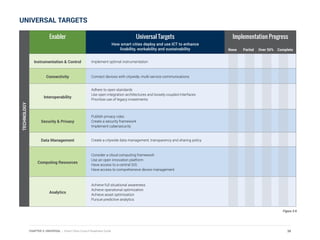
standard with functions including:
•	 Modifying lighting based on the presence of people in
different settings and the level of natural lighting.
•	 Controlling air conditioning based on the presence of
people in different settings, window opening and solar
radiation.
•	 Control and supervision through a PC and a Touch
Panel installed in the porter’s lodge. The system
manages internal and external lighting, occupancy
sensors, air conditioning, sunshades and more.
Through the PC it is also possible to pre-program on
and off times, for example external lighting and corri-
dor lighting.
For the lighting system alone, the estimated electricity
saving is about 50-60 MWh, corresponding to a saving
of about 10,000 Euros (roughly $13,000).
Achieve operational
optimization.
A long abandoned
building in Molise,
Italy served as a
proving ground for
smart control
systems to meet
energy efficiency
mandates.
Figure 4.13
81CHAPTER 4: BUILT ENVIRONMENT | Smart Cities Council Readiness Guide
ADDITIONAL RESOURCES
Target: Prioritize the use of legacy investments
88 Acres - how Microsoft quietly built the city of the future
A team of engineers at Microsoft cast aside suggestions that the company spend US$60 million to turn its 500-acre
headquarters into a smart campus to achieve energy savings and other efficiency gains. Instead, applying an “Internet
of Things meets Big Data” approach, they invented a data-driven software solution that is saving Microsoft millions of
dollars. Now Microsoft and its partners are helping building managers around he world deploy the same solution.
Target: Achieve operational optimization
Classroom sensors reduce the number of sick kids – and save money
Analyzing ventilation rates from sensors in more than 150 California classrooms for over two years, researchers at
Lawrence Berkeley National Lab found that bringing rates up to the state-mandated standard could reduce student
absences by approximately 3.4 percent. Improving ventilation reduces the amount of carbon dioxide students
breathe.
Target: Achieve asset optimization
Building life-cycle cost tool helps compare alternative designs
The National Institute of Standards and Technology (NIST) developed the Building Life-Cycle Cost (BLCC) program to
provide computational support for the analysis of capital investments in buildings. The software can evaluate federal,
state, and local government projects for both new and existing buildings.
Benefit: Providing ROI for building owners
Report explores synergies between cities and building owners in the smart city ecosystem
Cooperation among stakeholders in the urban smart building ecosystem can help accelerate investment in smart
technologies to meet energy efficiency targets and business objectives, according to a report from International Data
Corp. (IDC). Smart building technologies enable the optimization of facilities and generate economic and environmen-
tal benefits, key goals in the development of sustainable smart cities.
82CHAPTER 4: BUILT ENVIRONMENT | Smart Cities Council Readiness Guide
Enabler Built Environment Targets
How smart cities deploy and use ICT to enhance their built environment
Implementation Progress
Instrumentation & Control Implement optimal instrumentation
Connectivity Connect devices with citywide, multi-service communications
Interoperability
Adhere to open standards
Use open integration architectures and loosely coupled interfaces
Prioritize use of legacy investments
Security & Privacy
Publish privacy rules
Create a security framework
Implement cybersecurity
Data Management Create a citywide data management, transparency and sharing policy
Computing Resources
Consider a cloud computing framework
Use an open innovation platform
Have access to a central GIS
Have access to comprehensive device management
Analytics
Achieve full situational awareness
Achieve operational optimization
Achieve asset optimization
Pursue predictive analytics
Figure 4.14
None Partial Over 50% Complete
TECHNOLOGYBUILT ENVIRONMENT TARGETS
83CHAPTER 4: BUILT ENVIRONMENT | Smart Cities Council Readiness Guide
CHAPTER 5: ENERGY | Smart Cities Council Readiness Guide 84
ENERGY
Cities can’t function without energy. It fuels our cars,
subways and trains. It cools, heats and lights our homes
and businesses. It pumps our water and processes the
food we eat. And it powers the technologies that are the
foundation of a smart city.
CHAPTER 5
So it’s easy to see why energy is integral to all
city responsibilities and profoundly impacts
livability, workability and sustainability. This
chapter covers energy’s critical role in smart
cities, from enabling small-scale power plants
that generate energy close to where it’s used to
advanced technologies that help keep the
lights on during power outages. We use the
term “energy” broadly throughout to encom-
pass all infrastructures that cities use to
produce and deliver energy – electricity, gas,
steam, renewables, etc.
Energy as a smart cities starting place. Since
city leaders are well aware of their own city’s
pain points, we said in the introduction to this
Readiness Guide that we won’t recommend
which responsibility areas cities should tackle
first. But given the critical role energy plays in
just about everything that happens in a city,
leaders uncertain where to start their smart
city journey should consider making smart
energy a priority.
That’s because the success of a smart city
relies on creating and supporting a smart
energy system. That’s a system that knows in
real time where a transformer has blown and
automatically reroutes power to keep the lights
on in homes and businesses. It’s a system that
collects and manipulates data from sensors
and smart devices to give operators a complete
view of the energy infrastructure – for
instance, how much power solar installations
are generating or when they need to signal a
demand response call to help balance the load
on the electric and gas grid.
ICT’s role in smart energy. Information and
communications technologies (ICT) help cities
optimize these energy systems, making them
more efficient and more resilient. Implementing
smart energy systems also helps preserve
precious natural resources and gives residents,
businesses and cities themselves a whole host
of ways to monitor and control their energy
consumption to save money.
There are a number of components of a smart
energy system. In the pages that follow we’ll
identify the technologies and technology-
supporting practices involved and the array of
benefits that cities accrue when they implement
them.
ICT’s role in more
sustainable cities.
Amsterdam leveraged
public-private partnerships
to build a broadband
platform for service
delivery to achieve social,
economic and environ-
mental sustainability.
Figure 5.1
85CHAPTER 5: ENERGY | Smart Cities Council Readiness Guide
ENERGY
Energy’s critical
role in smart cities.
Smart energy powers
the technologies that
are the foundation of
a smart city, from
smart meters that
offer two-way
communications
between customer
premises and utilities,
to outage manage-
ment systems that
make the power grid
more resilient.
Figure 5.2
86CHAPTER 5: ENERGY | Smart Cities Council Readiness Guide
PIONEERING MUNICIPAL
UTILITY – A SMART
GRID POSTER CHILD
As the first American utility to receive smart grid stimu-
lus funding and as the first to be “completely operational
with smart grid technology,” Glendale Water and Power
(GWP), located in Southern California, is a bit of a smart
grid poster child.
In the GWP system, a single communication system is
handling both power and water. Anchored by a suite of
technology from Smart Cities Council member Itron, the
system includes an Itron advanced wireless communi-
cation network that integrates both electric and water
meters. It also features leak detection technology for the
water system and Itron’s meter data management solu-
tion to manage the huge volumes of data the system
generates and enable other smart grid programs and
applications.
GWP completed installation of the system, which includ-
ed 83,000 Itron smart electric meters and 33,000 smart
water meters in 2011. Components of the overall smart
grid system included in-home display units that provide
electricity and water usage information, costs and
control to consumers as well as thermal storage units,
electric vehicle smart charging, demand response and
distribution automation.
Speaking at a conference after the installation was
complete, then GWP General Manager Glenn Steiger
Energy as a smart
city starting place.
Substation upgrades
that were part of
Glendale Water &
Power’s modernization
effort allow more power
to flow through its
system, increasing its
ability to meet
customer demand.
Figure 5.3
87CHAPTER 5: ENERGY | Smart Cities Council Readiness Guide
talked about the project. “The key thing to remember is that smart grid
is really an IT communication system,” he explained. “The heart of the
system and the ongoing applications are IT-driven. To be successful,
you have to shift focus from hardware and infrastructure to IT.”
On the water side, the system is providing leak detection capability that is
saving precious water in perennially water-challenged Southern
California, and also saving money in water they didn’t have to purchase.
“We’re actually optimizing the water system with the data we’re collecting
through the electric system,” Steiger said, referring to the energy costs
associated with treating and delivering clean water to Glendale residents.
Smart grid technology ultimately comes down to saving money, Steiger
said, for the municipal utility but also cost containment for its custom-
ers. GWP’s system and the data it delivers have enabled it to streamline
operations, improve business processes, and roll fewer trucks, he
added. That means keeping costs low for customers, which leads to
strong customer support.
Dependencies in energy
Improvements in a city’s energy infrastructure
– deploying a smart grid, for instance – can’t
occur without an understanding of dependen-
cies between energy and other city systems
and services. Three stand out: communica-
tions, transportation and the built
environment.
A smart grid is by definition a specialized
communications network that moves electrici-
ty and data to balance supply and demand
and maintain reliable service. The distribution
lines and underground cables that are part of
the energy grid often follow the layout of city
streets (part of the built environment), creat-
ing dependencies between utility services and
the various transportation systems that also
rely on streets.
The built environment is also a major consumer
of electricity and natural gas – and potentially a
producer of electricity too. As distributed genera-
tion evolves and building owners adopt solar,
fuel cell and related technologies, utilities and
city governments will form even closer alliances.
Benefits of realizing the
energy targets
What kind of results can smart cities expect
once they’ve walked down the smart energy
path? We’ve highlighted many of them below,
based on their relevance to livability, workabili-
ty and sustainability.
Livability
Empowering customers with choice and
control. Instrumentation, connectivity and
analytics combine to give electric and gas
customers more information about when and
where they are using energy, plus tools to help
them control that usage so they can lower
their bills.
Improving reliability and resilience. Smart
grids can “self-heal” from simple problems,
making them more resilient to storms and
disasters. With outage management systems,
trouble areas can be pinpointed, shaving hours
or even days from restoration times. And most
smart grids make it easy to combine central-
ized, “long-distance” generation with local
distributed generation, making the system
more resistant to supply interruptions.
Lowering costs for citizens. Operational opti-
mization means fewer resources are
consumed and paid for. These savings can be
passed along to citizens, resulting in lower
energy bills.
88CHAPTER 5: ENERGY | Smart Cities Council Readiness Guide
Workability
Improving competitive advantage. A U.S.
Department of Energy lab estimates that
economic losses from outages cost $80-130
billion per year in the U.S. alone. Businesses in
cities with modern, ultra-reliable energy
systems have a competitive advantage.
Creating new jobs. Renewable energy and
local energy typically produce more local jobs
than “traditional” energy (where energy may
be shipped from large centralized plants
outside the region).
Generating business investment in cities. A
study of the correlation between smart grid –
a key component of the smart city – and
economic growth discovered that cities with a
smart grid have an annual GDP growth rate
that is 0.7% higher, office occupancy rates
2.5% higher, and an unemployment rate 1%
lower when compared to less advanced cities.
Sustainability
Using less energy. Smart energy is cleaner
and more efficient, producing less impact on
the environment. First, it makes it easier to
use wind, solar and other renewable sources.
Second, it wastes less energy during trans-
mission and delivery. Third, it gives customers
tools to reduce their energy usage and costs.
And there are add-on effects, because using
less energy means using less water too.
Decreasing reliance on nonrenewable energy
sources. Smart grids make it far easier for
customers to generate energy on premise (for
instance, via rooftop solar) and to trade energy
back and forth with the grid. Implementing the
right devices and instrumentation, such as
improved solar meters, have led many financiers
to offer $0 down residential and commercial
solar programs, reducing the barriers to solar
generation. And smart energy, with the help of
reliable two-way communications, makes grids
more flexible overall to customer demand.
Lessening energy operating costs. Smart
energy reduces operating costs compared to
traditional methods. For example, sensors and
monitors can report on the actual condition of
expensive equipment so it can be serviced
based on actual condition and not a guess.
This kind of asset management can squeeze
many extra years of use from an asset, without
compromising safety. For another, smart
systems can manage peak times by briefly
reducing demand (called demand response)
instead of building new standby power plants
that will only get used a few times per year, and
can even dim LED street lights to enable lower
operating costs.
Creating new jobs.
Solar installations and
other forms of
renewable energy and
distributed generation
create new, green jobs.
Figure 5.4
89CHAPTER 5: ENERGY | Smart Cities Council Readiness Guide
Instrumentation
and control
We start our discussion of this chapter’s
targets with optimal instrumentation which,
when applied to smart energy, refers to smart
devices such as sensors and smart meters
that gather information about the flow and
condition of power and about the condition of
equipment within the energy infrastructure.
Implement optimal instrumentation. Thanks
to real-time information supplied by smart
devices, system operators can predict, diag-
nose and mitigate issues that might previous-
ly have caused an outage or blackout.
Examples of energy instrumentation include
the deployment of smart meters and distribu-
tion system sensors.
Smart meters, which are installed on homes
and businesses, are perhaps the most visible
instrument in a smart energy network and
certainly the most controversial due to
concerns about potential health impacts and
privacy. All of which points to the importance
of developing an effective citizen engagement
strategy long before you start deploying them.
Today there are smart meters for electricity,
gas and water. They provide two-way commu-
nication between the customer premise and
the utility. In the old days meters had to be
read manually; smart meters transmit energy
usage details directly to the utility. When smart
meters are combined with smart thermostats,
smart appliances and/or energy management
devices, consumers can participate in energy-
saving demand response programs where they
voluntarily allow the utility to send a signal to
the smart meter or other device to temporarily
make a modest adjustment in energy usage.
Implement optimal
instrumentation.
Smart meters are part
of the smart energy
network and also part
of a citywide two-way
communications
system.
Figure 5.5
90CHAPTER 5: ENERGY | Smart Cities Council Readiness Guide
In 2013, GE and Florida Power & Light Company (FPL)
celebrated completion of Energy Smart Florida (ESF), an
initiative implemented to modernize the electric grid and
build out a more reliable and efficient electrical
infrastructure.
As part of the effort, FPL installed 4.5 million GE smart
meters across its 35-county service territory, empower-
ing FPL’s customers to take control of their energy use.
Council member GE’s smart grid solutions enable effec-
tive two-way communication between FPL and its
customers. For example, FPL’s advanced metering infra-
structure provides its customers with hourly data on their
energy usage. Each customer with an activated smart
meter can view his or her own “Energy Dashboard”
through FPL’s website. The dashboard displays informa-
tion about consumption and costs a day after it has been
recorded by the smart meter. Each customer can view his
or her own power use by the hour, day and month and
can receive bill estimates based on current usage
patterns.
Many customers are regular dashboard users and have
provided comments to FPL on how much they like it. For
example, one FPL customer said, “If people choose to use
the customer portal, they will definitely see benefits.
Changing our energy habits has saved our family about
$100 dollars a month compared to similar homes in our
area.” Another customer noted, “I think the online portal is
the greatest tool FPL has to offer. In today’s economy,
every dollar is important. Thanks to the smart grid, my
family is saving as much as $30 a month.”
Implement optimal
instrumentation.
GE smart meters
installed in Floida
Power & Light’s
service territory,
along with an online
dashboard, are
helping utility
customers take
control of their
energy use.
Figure 5.6
Implement optimal instrumentation:
SMART METERS GIVE FP&L
CUSTOMERS CONTROL OF
THEIR ENERGY USE
91CHAPTER 5: ENERGY | Smart Cities Council Readiness Guide
Connectivity
Not only are the smart meters and sensors part
of the smart energy network, they are also part
of a citywide two-way communications system
– that “system of systems” discussed earlier.
Connect devices with citywide, multi-service
communications. Connectivity allows data
collected throughout the smart energy
network to be transmitted for analysis and
action. For example, connectivity might mean
that your smart meters, distribution system
sensors and utility are connected through two-
way communications.
Interoperability
Utilities around the world have started building
out smart electric grids and smart gas grids,
both of which are part of what this Guide refers
to as the all-encompassing smart energy
network. But one of the stumbling blocks early
on was a lack of standards – and as you can
imagine there are numerous pieces of a smart
grid that have to work together and talk to each
other. Thanks to a number of standards bodies
around the world that undertook the task of
developing specifications, a lot of the issues that
plagued the smart grid pioneers have been
resolved. Below is a quick look at interoperability
targets, including one that specifically applies to
energy:
Adhere to open standards to increase choice
and decrease costs. With open standards
products can be mixed and matched from
different vendors.
There are hundreds of standards just for the
energy responsibility of a smart city. As we
discussed in the Universal chapter, selecting
standards is a job for specialists. Your job is first
to insist on using them whenever possible and
second to hire a supplier with a demonstrated
knowledge and commitment to open standards.
But the standards selection process is easier in
the energy sector than in others thanks to the
free Smart Grid Standards Mapping Tool from
the International Electrotechnical Commission, a
Council advisor. You can simply point and click
to identify any standard in relation to its role
within the smart grid. New standards are added
regularly.
Use open integration architectures and loose-
ly coupled interfaces so it is easier and simpler
to share data between applications.
Prioritize use of legacy investments to avoid
unnecessary spending and from stranding
existing assets. This practice ensures maxi-
mum value and lifetime from existing technol-
ogy investments.
Enabling distributed generation with intercon-
nection standards. Recent decades have seen
the proliferation of “distributed generation” – of
small, decentralized power plants located at or
near the spot energy is used. Think rooftop solar
installations on high-rise apartment buildings or
wind turbines helping power a shopping mall.
What are required to make distributed generation
work effectively are straightforward, easy-to-
use interconnection standards that define how
the energy sources tie in to the energy grid. It’s
a relatively new business model for utilities,
although many have or are in the process of
developing protocols to accommodate distrib-
uted generation. Getting it right gives the city
and its residents more options for economical
and clean power generation without compro-
mising secure and reliable grid operations.
Cities that own their local energy or gas utility
can prioritize development of interconnection
standards. Those with energy providers that
are not municipally owned may need to find
ways to encourage them to modernize their
interconnection standards to accommodate
what is clearly the wave of the future.
Distributed generation has enormous potential,
including higher efficiency and greater resilience
against natural or man-made disasters. It also
reduces dependence on fossil fuels.
92CHAPTER 5: ENERGY | Smart Cities Council Readiness Guide
Enabling distributed generation:
MONITORING AN
EXTENSIVE NETWORK
OF RENEWABLE ENERGY
GENERATION PLANTS
9REN Group designs, develops, builds and operates
renewable turnkey power plants using photovoltaics,
solar thermal energy and wind. The Spanish company
operates some 570 photovoltaic installations, mainly in
Spain and Italy. In addition to photovoltaic plants, the
company has built 183 solar thermal plants as well as
mini-wind installations. 9REN plants generate more than
10,000 megawatt-hours (MWh) of clean energy each
month.
To manage and monitor its photovoltaic plant facilities,
9REN created EOSystem, a solution built on the
Wonderware® System Platform from Council member
Schneider Electric. EOSystem is a real-time monitoring
technology that provides instantaneous information from
all photovoltaic installations operated by 9REN through-
out Europe and the Middle East. System Platform
provides a single, scalable software solution for all the
supervisory control and data acquisition (SCADA) and
supervisory human machine interface (HMI) needs for
monitoring 9REN’s renewable energy installations.
From a single control center, 9REN can effectively moni-
tor the operations infrastructure at each facility. “The
Wonderware System Platform lets us access all our
installations in real time,” said Antonio Palacios Higueras,
services technical manager for 9REN. “Because of this,
we only require one person to control the operation of all
of the 568 plants, regardless of location. We also have
achieved a significant cost reduction in time per designer
and project.”
Enabling distributed
generation.
From a single control
center, 9REN can
effectively monitor the
operations infrastruc-
ture at each of its
renewable energy
facilities, which
includes some 570
photovoltaic
installations.
Figure 5.7
93CHAPTER 5: ENERGY | Smart Cities Council Readiness Guide
Security and privacy
There are at least three extremely compelling
reasons why smart cities take security and
privacy seriously in the context of energy as
these three targets demonstrate.
Publish privacy rules. Smart meters have
raised privacy concerns around the world.
People worry that their daily habits are being
tracked by their local utility via smart meters,
which is why smart cities not only publish and
adhere to privacy rules but they let citizens
know about it proactively. Making privacy a
priority can help ward off consumer backlash
that could stall smart energy deployments.
Create a security framework. Security breach-
es can have a ripple effect. Developing a
comprehensive security framework mitigates
risk by identifying and addressing threats
before they can cause damage. This is critical
in the energy infrastructure – even more so
given its inherent importance to the operation
of other key infrastructures.
Implement cybersecurity. Cyber attacks
against energy companies in the U.S. have
been well-documented. But what were once
thought to be attempts to steal information or
trade secrets are now focused on causing
serious damage to networks and equipment,
according to warnings from the U.S. govern-
ment. The take-away here for cities is that
implementing cybersecurity safeguards early
on maximizes protection while avoiding the
potentially significant costs associated with
an attack.
Data management
There is a tremendous amount of data pour-
ing in from sensors, smart meters and other
intelligent devices deployed throughout the
energy infrastructure of a smart city.
Create and adhere to a citywide data manage-
ment, transparency and sharing policy. Energy
usage data should be integrated in the policy
that was discussed in detail in the Universal
chapter. And as noted in the previous section,
energy usage data needs to comply with over-
all security and privacy rules.
That said, access to timely, accurate energy
usage data is an essential component of a
cleaner, more efficient energy system. So it’s
imperative that local utilities grant cities
access to aggregated, summary usage data
which can be invaluable for city planning, for
carbon reduction programs, for energy effi-
ciency programs, for low-income assistance
programs, for improving city performance and
for many other purposes.
To promote energy efficiency, it’s also impor-
tant for smart cities to encourage utilities to
give electric and gas customers access to
their own usage data. For example, cities can
provide a web portal for viewing and managing
energy usage in real time. That way customers
can drill down on when and how they use
energy to make choices and trade-offs that
can reduce their energy usage and utility bills.
Create and adhere to a citywide
data management, transparency
and sharing policy.
When utility customers have access
to data about when and how they
use energy they can make choices
and tradeoffs that can reduce their
energy usage and utility bills.
Figure 5.8
94CHAPTER 5: ENERGY | Smart Cities Council Readiness Guide
Create a citywide data sharing policy:
SEATTLE’S
BIG BUILDING
BENCHMARKING
PROGRAM IS WORKING
Commercial buildings are one of the biggest consumers
of energy. So it’s significant that the vast majority – or
87% – of large building owners and managers in Seattle,
Washington are now tracking and reporting building
energy performance to the city under Seattle’s Energy
Benchmarking and Reporting Ordinance.
Benchmarking tracks the total amount of energy that a
building uses and allows comparisons of energy perfor-
mance to similar buildings. Seattle officials note it is a stan-
dard practice for owners and managers working to improve
building energy efficiency and reduce energy costs.
Being able to see the data on their own building consump-
tion and others is definitely opening the eyes of building
owners and managers. One of them is Stephen Chandler,
Facilities Manager at Verity Credit Union. “Energy bills only
tell you so much,” he says. “Benchmarking lets you see
trends and how your building compares with others. As a
facilities manager, I am always looking for ways to lower
costs, and being energy efficient is a way to do that which
benefits my company and its customers.”
Since 2008, Verity Credit Union has reduced its annual
energy consumption by 20% by tracking its use through
benchmarking and making cost-effective energy efficien-
cy improvements, according to the city.
Create and adhere
to a citywide data
management,
transparency and
sharing policy.
Being able to see the
data on their own
building consumption
and others is opening
the eyes of building
owners and managers
in Seattle.
Figure 5.9
95ENERGY | Smart Cities Council Readiness Guide
Computing resources
Basically all of the computing resources that
cities use rely on energy in some way, shape or
form, so it makes sense for cities to constantly
monitor for efficiencies and economies as they
use, deploy and procure computing resources.
As discussed in detail in the Universal chapter:
Consider a cloud computing framework to
enable scalability of systems, reduce costs
and improve reliability.
Use an open innovation platform to empower
innovators, increase accountability, generate
new revenue streams and stimulate economic
growth.
Have access to a central geographic informa-
tion system (GIS) to improve decision-making
capabilities, enable efficiency gains through
more intelligent scheduling and routing,
provide improved accuracy of essential
records and boost resiliency of key assets.
Have access to a comprehensive device
management system to improve infrastruc-
ture security and resiliency, deliver cost
savings and enforce compliance with city data
management, security and privacy policies.
This target, as we noted, takes on special
importance in the energy discussion due to
the numerous smart devices and other
computing resources deployed throughout
smart cities.
Analytics
As we’ve said previously, analytics are abso-
lutely critical to smart city success and
perhaps nowhere is that more evident than in
a smart energy network that powers so much
of what a city is and does. We’ll quickly review
three of the analytics targets already
discussed in the Universal chapter and then
introduce two more that speak volumes about
energy’s importance in a smart city.
Achieve full situational awareness. This
refers to giving operators a complete picture
of their energy system at any given moment
to increase its reliability and resiliency and
quickly respond to trouble. A complete operat-
ing picture is incredibly important to city ener-
gy systems. One example: It helps operators
detect energy theft and thereby conserve
resources.
Achieve operational optimization. Building
the very best smart energy network possible is
what cities want to achieve from the instru-
mentation and connectivity investments they
make in their energy infrastructure.
Consider a cloud
computing framework.
With computing
resources reliant on
energy, monitoring for
efficiencies and
economies is a smart
approach. Cloud
computing offers a way
to reduce costs and
increase reliability and
scalability.
Figure 5.10
96CHAPTER 5: ENERGY | Smart Cities Council Readiness Guide
Consider a cloud computing framework:
RESIDENTS TRIM ENERGY
USE BY 20 PERCENT WHEN
GIVEN REAL-TIME DATA
A consortium of companies is taking energy conserva-
tion to the next level by creating an entire eco-minded
neighborhood just outside of Paris, France.
IssyGrid is France’s first smart grid neighborhood,
a demonstration project aimed at reducing energy use in
the French town of Issy-les-Moulineaux. It is run by a
consortium of corporate partners and local utilities that
consider energy conservation an opportunity for bus-
inesses to solve. About 200 test homes and four
commercial buildings in the community have been outfit-
ted with energy consumption monitoring devices, with
the goal of ultimately expanding the program to the
entire town. IssyGrid collects energy consumption data
and processes it in real time using Windows Azure, the
cloud services platform from Council member Microsoft.
The consortium analyzes the data by using Microsoft
SQL Server 2012 data management software. Then
IssyGrid provides the data to citizens so that they can
see how they are using electricity. This enables them to
take specific actions to conserve – by turning off the
television or lowering the temperature by two degrees.
The result: They reduce their consumption – and their
energy bills – by 10 to 20 percent.
Consider a cloud
computing
framework.
IssyGrid collects
energy consump-
tion data and
processes it in
real time using
Windows Azure,
the Microsoft
cloud services
platform.
Figure 5.11
97CHAPTER 5: ENERGY | Smart Cities Council Readiness Guide
Optimized energy systems help conserve
energy, delivering cost savings to cities, resi-
dents and businesses and also reducing the
drain on energy resources.
Achieve asset optimization. This target plays
an important role in the energy sphere, helping
cities maximize the value of their assets by 1)
calculating which energy assets need to be
repaired or replaced and when, and 2) by
predictive maintenance, which uses analytics
to spot equipment that is close to failure so it
can be repaired or replaced before problems
arise.
Pursue predictive analytics. Drawing from
instrumentation deployed across a city, analyt-
ics can enable advanced forecasting and
management of a diverse, secure and resilient
energy system. ICT helps cities account for
demand, weather, effects from distributed
resources that may be variable and other oper-
ational considerations. Understanding what to
expect helps cities save on costs, conserve
resources and prepare for extreme events.
Now we’ll introduce two new energy-specific
targets that are critical to smart city success.
Automate fault and outage management.
This is about the “self-healing” grid we referred
to earlier. The idea is that the utility that serves
your city would enable remote sensors, smart
meters and other advanced smart grid tech-
nologies deployed throughout the energy
network to automatically reduce the number
of outages and the duration of those that do
occur. For instance, a sensor might detect a
fault on the electric grid and be able to locate
it and isolate it before it has time to affect
other areas. Or smart meters may alert a utili-
ty’s outage management system of trouble,
allowing the utility to immediately dispatch
crews and keep customers updated during
and after the incident. Before the advent of
these advanced technologies, utilities often-
times didn’t know about an outage until
customers started calling in.
A quick look at economic losses incurred from
power outages explains why this is so impor-
tant. A study by the Berkeley National Lab
back in 2004 estimated that outages cost
$80-130 billion per year in economic losses in
the U.S. alone. After Superstorm Sandy, which
wreaked havoc across the northeastern U.S. in
2012, the U.S. Congress approved more than
$60 billion in emergency aid, which is roughly
what state governments reported in damages
and other losses.
By encouraging automated solutions a city or
utility can make the energy supply more reli-
able, improve response to outages which in
turn makes businesses more competitive and
residents more comfortable.
Automate fault and
outage management.
Automated solutions
help make the energy
supply more reliable
and improve outage
response.
Figure 5.12
98CHAPTER 5: ENERGY | Smart Cities Council Readiness Guide
Automate fault and outage management:
CHATTANOOGA
SMART GRID
REDUCES OUTAGE
TIME 55 PERCENT
In 2011 the Electric Power Board (EPB) installed a smart grid
in Chattanooga, Tennessee that has achieved a 55 percent
reduction in outage time. The area’s businesses will save an
estimated $40-$45 million a year, while the overall savings are
likely to be $600 million over the first 10 years of deployment.
The project included many smart city functions:
•	 Ultra high-speed Internet, voice and video access to all
residents
•	 A citywide WiFi network for the city and utility
•	 Street light controls
•	 Surveillance cameras
•	 Enhanced police and fire response
In addition to the smart city features, the project (video) also
included a high-speed grid monitoring and control system
along with Council member S&C Electric’s IntelliRupter
circuit reclosers at key points along the power lines. Those
smart switches allow operators to pinpoint the location of
an outage, cutting down on the need for physical inspectors
and saving hours or even days.
When a tornado hit the town in March of 2012, it took out
power to only 3,400 residents, half the amount that
would have been affected before.
Automate fault
and outage
management.
The smart grid
installed in
Chattanooga,
Tennessee has
achieved a 55
percent reduction
in outage time.
Figure 5.13
99CHAPTER 5: ENERGY | Smart Cities Council Readiness Guide
Creating a self-healing grid:
CENTERPOINT ENERGY
AUTOMATES FAULT AND
OUTAGE MANAGEMENT
TO GET LIGHTS BACK
ON SOONER
CenterPoint Energy was looking to improve to improve power
reliability and restoration in greater Houston. It is using $50
million of its U.S. Department of Energy grant to build a self-
healing smart grid that will use smart meters, power line
sensors, remote switches and other automated equipment.
CenterPoint Energy has begun building an “intelligent grid”
with power line monitoring equipment, remote switches and
other automated equipment that will locate power line outag-
es as they occur. This can speed recovery since repair crews
won’t have to search for the source of an outage and can
begin repairs sooner.
In 2012 when there was an opportunity to use intelligent grid
automation to re-route and restore power, it saved more than
611,000 customer minutes over 20 outages. This was a 21
percent improvement in outage response, with about 70
percent of affected customers experiencing an outage of just
a few minutes rather than at least a half hour.
In addition, CenterPoint Energy has installed 2.2 million smart
electric meters across Houston, and can use Power Off
Notifications as an additional early detection system for
power outages.
Creating a
self-healing grid.
Using intelligent
grid automation to
re-route and restore
power, CenterPoint
Energy has seen a
21 percent
improvement in
outage response.
Figure 5.14
100CHAPTER 5: ENERGY | Smart Cities Council Readiness Guide
CenterPoint selected Ventyx, a subsidiary of Smart Cities Council member
ABB, to implement an Advanced Distribution Management System (ADMS),
the computer system which will be the intelligent grid’s “brain.” Due for
completion in 2014, the ADMS will process data from power line sensors as
well as from smart electric meters to identify the location of power outages
and remotely control intelligent grid switching devices to shorten the dura-
tion of power outages.
“This system will give us greater insight into the health of our electric infra-
structure and eventually create a ‘self-healing’ grid,” said Kenny Mercado, divi-
sion senior vice president for CenterPoint Energy’s Regulated Operations
Technology. “With this technology, we will be able to automatically reroute
power around many outage locations to help us get the lights on sooner.”
The ADMS will allow the intelligent grid to “self-heal” in the event of a
major storm to restore power to as much of the system as possible. Then
the damage to the system as a whole can be diagnosed and restored
according to current practices. In many cases, the time to restore power
through the intelligent grid could be significantly reduced.
Use advanced smart grid technologies.
When deployed throughout the energy network,
automated technologies help reduce the
number of outages and the duration of those
that do occur.
Figure 5.15
101CHAPTER 5: ENERGY | Smart Cities Council Readiness Guide
Segment and personalize programs for
customers. This is one of the big pluses of
today’s smart energy networks. They can
consider multiple variables – like a utility
customer’s preferences, system parameters,
weather, cost of energy – to optimize and
personalize rates and programs. As part of that
personalization, a smart city’s utility, whether
municipally owned or a private utility that oper-
ates in the city, can identify energy use
patterns and then make customized recom-
mendations to help customers get the best
possible rates or assist with fraud and service
connection issues.
Today many electric and gas utilities charge a
single rate for every residential customer at
every time of the day. In reality, the cost of
energy varies widely depending on the time. In
particular, electric energy can be very inexpen-
sive at night when demand is low and the
output from wind farms is high. But it can be
very costly during hot summer days when air
conditioners are cranked up, demand is very
high and energy is scarce.
Smart meters and smart grids make it possi-
ble for utilities to offer a variety of programs to
encourage energy efficiency and cost savings.
Examples include time-of-use rates, peak-time
rebates, efficiency incentives and demand
response programs. Council member Opower,
for example, works with utilities around the
world on customer engagement programs
that use data analytics and behavioral science
to motivate customers to be more efficient.
The Smart Grid Consumer Collaborative is a
nonprofit organization focused on advancing a
consumer-safe, consumer-friendly smart grid
and has researched consumers and published
reports on smart grid consumer education
and segmentation. SGCC’s research shows
that consumers fall into five broad segments
ranging from Concern Greens, those people
who want a cleaner energy portfolio, to Do-It-
Yourself and Save, those people who want to
save money and are likely to enroll in
programs that will help them take action to do
that. Both of these segments would likely be
responsive to personalized programs that
match their values around energy. Joining
with organizations like SGCC to obtain materi-
als, collaborate with others
and learn best practices for citizen engage-
ment is one way to increase the likelihood that
smart energy projects receive consumer
support.
Personalizing programs not only increases
customer satisfaction, it also provides an
avenue for the utility and the city to advance
their goals. For instance, a demand response
program that reduces demand during peak
load periods can avoid or delay the need for
new power plants and associated power lines.
So can conservation and efficiency initiatives,
which also help cities meet their carbon miti-
gation goals. Special incentives and programs
for commercial and industrial customers can
help attract and retain businesses.
Segment and
personalize
programs for
customers.
Smart meters and
smart grids make it
possible for utilities to
offer a variety of
programs to encourage
energy efficiency and
cost savings.
Figure 5.16
102CHAPTER 5: ENERGY | Smart Cities Council Readiness Guide
Segment and personalize programs
for customers:
COMPANY’S DEMAND
RESPONSE INCENTIVES
PAY FOR MORE
TECHNOLOGY
When energy demand is high and supply is short, San
Francisco, California-based Pacific Gas & Electric
(PG&E) offers financial incentives to companies that
reduce their load in response to a request.
NetApp, a Sunnyvale, California company that creates
storage and data management solutions, signed up for
PG&E’s Demand Bidding Program, which means the utili-
ty pays NetApp $0.50/kWh when the request is made
the day before and $0.60/kWh if the request is made the
same day.
It started several years ago when NetApp saw an oppor-
tunity to significantly reduce energy consumption at its
headquarters, which has 1.2 million square feet of space
in 10 buildings. The headquarters uses 54 million kilo-
watt hours annually, with a peak demand of 7.6 mega-
watts. In 2008, NetApp’s annual utility bill was US$7.7
million, 89 percent of that for electricity.
Segment and personalize
programs for customers.
California’s Pacific Gas &
Electric offers financial
incentives to companies
that reduce their energy
load in response to a
request. NetApp installed
Cisco’s Network Building
Mediator to enable its
participation in the
program.
Figure 5.17
103CHAPTER 5: ENERGY | Smart Cities Council Readiness Guide
Energy-efficient equipment is only part of the solution. “You also need
to make intelligent decisions about equipment settings, and that
requires gathering and analyzing information from disparate building
systems, including metering systems and PDUs [power distribution
units],” says David Shroyer, a NetApp controls engineer.
To aid that effort the company deployed the Network Building Mediator
from Council member Cisco, which aggregates information from all of
NetApp’s building systems, including lighting, heating, ventilation, air
conditioning, temperature sensors and PDUs, from multiple vendors.
Building engineers and facilities personnel can control systems in any
building using a web-based interface. Demand response payments
from PG&E paid for the system and NetApp has since deployed
Network Building Mediator for automated demand response at its prop-
erties in Europe and India.
“Within 20 minutes of the demand-response signal from the utility, the
Cisco Network Building Mediator reduces lighting by 50 percent and rais-
es the temperature set point by four degrees, shedding 1.1 megawatts.”
Facility helps public and private
sector researchers scale up clean
energy technologies
Located at the National Renewable Energy
Laboratory’s campus in Golden, Colorado, the
new 182,500-square-foot Energy Systems
Integration Facility (ESIF) is the first facility in
the United States to help both public and
private sector researchers scale-up promising
clean energy technologies – from solar
modules and wind turbines to electric vehicles
and efficient, interactive home appliances –
and test how they interact with each other and
the grid at utility-scale. The U.S. Congress
provided $135 million to construct and equip
the facility.
ESIF, which opened in 2013, houses more
than 15 experimental laboratories and several
outdoor test beds, including an interactive
hardware-in-the-loop system that lets
researchers and manufacturers test their
products at full power and real grid load levels.
The facility will also feature a petascale super-
computer that can support large-scale model-
ing and simulation at one quadrillion opera-
tions per second.
Figure 5.18
104CHAPTER 5: ENERGY | Smart Cities Council Readiness Guide
ADDITIONAL RESOURCES
Target: Implement optimal instrumentation
ABB uses Windows Embedded Server to deliver compact, robust power automation solution
State Grid Corporation of China (SGCC) wanted a monitoring and control system for power transmission and
distribution equipment located in harsh, demanding environments. Working with Council member ABB, SGCC
implemented a compact and rugged data acquisition and supervisory control system for production process
control and scheduling automation. A Windows Embedded Server appliance from Council member Microsoft
monitors and controls on-site equipment, including measurement and signal alarms.
Target: Create and adhere to a citywide data management, transparency and sharing policy including energy data
City of Dubuque: Investing in sustainability for future generations and future prosperity
Combining smart meters and powerful analytics, Dubuque, Iowa has given its citizens the insights they need to
adjust their energy and water consumption, with results – such as up to an 11% reduction in electricity usage and
a 7% reduction in water usage – to show for it. Working with Council member IBM, Dubuque’s smart city pilot
used cloud-based services to enable more efficient delivery and use of municipal services.
Target: Enable distributed generation with interconnection standards
Energy transition in urban environments: battling integration challenges with evolving technologies
As increasing urbanization challenges cities, there are key technologies and social innovations needing further
development. Among them, as this white paper from Council member Alstom discusses, are the issues resulting
from integration of distributed renewable energy resources with utility grids.
105CHAPTER 5: ENERGY | Smart Cities Council Readiness Guide
Enabler Energy Targets
How smart cities deploy and use ICT to enhance their energy infrastructures
Implementation Progress
Instrumentation & Control Implement optimal instrumentation
Connectivity Connect devices with citywide, multi-service communications
Interoperability
Adhere to open standards
Use open integration architectures and loosely coupled interfaces
Prioritize use of legacy investments
Enable distributed generation with interconnection standards
Security & Privacy
Publish privacy rules
Create a security framework
Implement cybersecurity
Data Management
Create a citywide data management, transparency and sharing policy
(Supplement: including energy usage data)
Computing Resources
Consider a cloud computing framework
Use an open innovation platform
Have access to a central GIS
Have access to comprehensive device management
Analytics
Achieve full situational awareness
Achieve operational optimization
Achieve asset optimization
Pursue predictive analytics
Automate fault and outage management
Segment and personalize programs for customers
Figure 5.19
None Partial Over 50% Complete
TECHNOLOGY
ENERGY TARGETS
In the checklist below, targets specifically pertaining to the energy responsibility are in bold, universal targets are not.
106CHAPTER 5: ENERGY | Smart Cities Council Readiness Guide
CHAPTER 6: TELECOMMUNICATIONS | Smart Cities Council Readiness Guide
TELECOMMUNICATIONS
Ubiquitous broadband telecommunication is a prerequi-
siteforasmartcity.Thischapterexplainshowtoachieve
a telecommunications architecture that can serve as the
foundation of a smart city and the foundation for major
improvementsinlivability,workabilityandsustainability.
107
CHAPTER 6
We begin by defining telecommunications,
both as it exists today and as it will evolve
tomorrow. After we discuss the “what,” we’ll
talk about the “why” – why telecommunica-
tions is so vital to smart city success. We’ll
finish by discussing the targets for telecom-
munications – the end states at which you
should aim your efforts. Along the way, we will
pay brief visits to telecommunications
success stories from around the world.
First, though, a word about our use of the
terms “telecommunications” and “connectivity.”
Dictionaries define telecommunications as the
electronic transmission of signals. When we use
the word in this Guide, we are talking about a
city responsibility to provide the policy environ-
ment and incentives to achieve high-quality
telecommunications. However, city responsi-
bilities such as power, public safety and trans-
portation depend on telecommunications. In
that sense, telecommunications is also an
enabler. When we are talking about the technol-
ogy in that sense, we use the term “connectivi-
ty” to make the distinction. You’ll see the word
“connectivity” listed in the Smart Cities Council
Framework along with other enablers such as
instrumentation and computing resources.
In the 21st century, people and businesses
consume telecommunications like a resource,
just as they consume electricity to light their
homes and water to quench their thirst. As a
result, it is vital that cities take on the responsi-
bility of ensuring adequate telecommunications
so their residents have access to high-quality
communications. Cities don’t have to build, own
and operate the infrastructure – in fact most
will not. But they must at least continue to set
the conditions and policies that incentivize the
private sector to install state-of-the-art
telecommunications.
Telecommunications also acts as an enabler
by providing connectivity. All the other
responsibilities – water, power, transportation,
etc. – require connectivity to communicate
with the sensors and devices they use to
collect data. That’s why the Universal chapter
already specified a universal target of
“Connect devices with citywide, multi-service
communications.” In other words, you’ve got
two important reasons to pay close attention
to telecommunications: 1) for the value it
creates on its own and 2) for the value it
enables for all the other responsibilities.
Telecommunications
is a city responsibility.
In the 21st Century,
an adequate tele-
communications
infrastructure is
vital for business
and industry as
well as residents.
Figure 6.1
108CHAPTER 6: TELECOMMUNICATIONS | Smart Cities Council Readiness Guide
TELECOMMUNICATIONS
Telecommunications
targets and benefits.
To build a proper
foundation for a smart
city, you must have
high-speed broadband
and citywide
communications. With
those elements in
place, you can expect
benefits like the ones
called out here.
Figure 6.2
109CHAPTER 6: TELECOMMUNICATIONS | Smart Cities Council Readiness Guide
Telecommunications
today and tomorrow
Before we define the targets for tomorrow’s
telecommunications, we should first examine
how it works today. Most cities already have
many existing communications networks
operating side-by-side. A typical city may have
multiple cellular/mobile networks plus cable,
satellite, RF mesh, microwave, radio, fiber
optics, WiFi for homes and offices, ZigBee for
smart meters and appliances and more (see
list on the next page). Sadly, it can be chal-
lenging to bridge between today’s networks,
making it difficult to achieve the seamless,
end-to-end connectivity required for a true
smart city.
If that is today’s reality, then where do we want
to go next? The smart city of the future is likely
to have an underlying fiber optic network as
both a metro loop around the city (like a ring
road for traffic) and then local access that links
buildings to this loop. Incredibly, tests have
been able to send 100 terabits per second
through a single optical fiber – enough to
download the entire contents of the Library of
Congress in seconds! Although fibers do not
run at this speed in normal usage, the extraor-
dinary headroom in terms of performance
increases is clear. Wireless access to this
underlying network may be provided by WiFi, by
RF Mesh, by cellular/mobile technologies or
some combination.
Some businesses have taken steps to support
this ‘high-speed fiber backbone.’ These fiber
optic networks provide the bandwidth and
speed demanded by the Digital Age. The opti-
cal network will terminate in network equip-
ment (eg., an optical network unit) that will
then break out and deliver IP and other traffic
types to their destinations via a local access
network. But a city also needs omnipresent
wireless to provide access to sensors, control-
lers, laptops, tablets, smartphones and other
mobile devices.
Most importantly, this future city will have a
converged architecture embodied in an all-IP,
packet-based core network – a unified infra-
structure that integrates various wired and
wireless technologies, thereby achieving the
seamless connectivity required. When we say
“converged” or “unified” we do not mean that a
city will end up with a single telecommunica-
tions system. Rather, we mean that it will end
up with a single architecture – a single set of
standards – that allow multiple networks to
transmit information smoothly. As we move
towards the future, interoperability will be key.
Those three elements – fiber plus wireless
plus a converged, delayered architecture are
the essentials to achieve the high speed, high
reliability and high availability telecommunica-
tions required in a modern city.
The telecommunications foundation.
The smart city of the future will have a
fiber optic loop that reaches most
buildings, combined with citywide
wireless communications such as 3G/4G
cellular, Ethernet, WiFi, RF mesh or some
combination.
Figure 6.3
110CHAPTER 6: TELECOMMUNICATIONS | Smart Cities Council Readiness Guide
TELECOMMUNICATIONS
TERMINOLOGY
Most cities already have multiple telecommu-
nications networks in place. Here are 10 of the
telecommunications terms and technologies
seen most often.
Cable – Coaxial cable, an inner conductor
surrounded by insulation and a conductive
shield, originally used for cable television but
increasingly used as well for voice and data.
Cellular/mobile – A radio network of transceiv-
ers called base stations distributed over land
areas called cells. Cellular/mobile uses licensed
frequencies and services provided by regional
and/or nationwide operators. It is typically used
for mobile broadband data, voice and text servic-
es. It is increasingly being used in machine-to-
machine applications. For example, to collect
data from smart meters and other sensors.
Comes in various flavors including 3G (3rd
generation) and 4G-LTE (Long-Term Evolution).
Fiber / FTTH – Fiber optics are thin, flexible
strands of glass that transmit signals as light.
The bandwidth enables single fiber optic cables
to easily deliver 1 Gbps (one thousand million
bits per second) services and even faster. Fiber
to the Home, or FTTH, describes fiber being
deployed to directly connect an operator’s
central distribution office to individual homes.
Microwave – Line-of-sight devices that must
typically be placed in high locations so the
sender and receiver can “see” each other.
Often relayed from station to station.
POTS – or Plain Old Telephone Service, typi-
cally delivered to homes and businesses over
twisted pair wires. POTS is a part of the Public
Switch Telecom Network (PTSN).
Powerline – Transmitting data over existing
electric power lines both inside the home
(HomePlug) or outside (Broadband over
Powerline). Typically used to collect data from
smart meters and other sensors.
RF Mesh -- A system using radio frequency (RF)
in a “mesh” configuration such that individual
nodes pass a message along until it reaches a
“collector” or “gateway” that can forward it to
the backhaul network. Typically used to collect
data from smart meters and other sensors.
Satellite – Communications satellites can be
thought of as microwave relay stations placed
very, very high (typically 22,000 miles above
the earth). They are often used to relay global
positioning signals or to deliver television
services to homes and businesses.
WiFi – A popular networking technology that
uses unlicensed radio waves for short- to
medium-range wireless connections.
ZigBee – A communication protocol for
“personal area networks” (PANs) created by
small, low-power digital radios. Typically used to
connect smart meters to thermostats and home
appliances that are a short distance apart.
Figure 6.4
111CHAPTER 6: TELECOMMUNICATIONS | Smart Cities Council Readiness Guide
The importance of
telecommunications
Telecommunications is used in two ways:
1.	To connect to devices people use indirectly
– such as sensors and switches. By 2020
there could be upwards of 50 billion devices
and sensors connected in M2M (machine to
machine) applications.
2.	To connect to devices people use directly.
Today that means computers, tablets and
smartphones. Soon it may also mean
smart watches and smart “glasses” (see
nearby photos).
In both ways, telecommunications plays a
pivotal role in the daily pulse of a city:
•	 Banks rely on it to process transactions
•	Online retailers use it to receive and
acknowledge orders
•	 Cloud computing data centers require it to
communicate with thousands or even
millions of computers
•	 Emergency responders need it to receive
and act upon life-saving alerts
•	 Parents rely on it to stay in touch with their
children
•	 Families use it to get access to movies, tele-
vision and the Internet
Connecting to
telecommunications.
Today most people connect
via phones, tablets or
computers. Soon many people
may use smart watches and
smart glasses as well. For
instance, Google Glass is a
technology that allows users to
see information overlaid on top
of their normal view of the world.
It accepts commands via voice
recognition. Images: Vancouver
Sun and John Angelo
Figure 6.5
112CHAPTER 6: TELECOMMUNICATIONS | Smart Cities Council Readiness Guide
Connecting to devices people
use indirectly:
CELLULAR
COMMUNICATIONS
TAPPED FOR
MASSIVE UK SMART
METER ROLL OUT
In March 2011, the United Kingdom (UK) issued a policy to
roll out smart metering to all residential and small- and
medium-sized non-domestic gas and electricity custom-
ers in a cost-effective way, which optimizes the benefits to
consumers, energy suppliers, network operators and other
energy market participants and delivers environmental
and other policy goals.
Among the policy objectives outlined by the UK
Department of Energy & Climate Change (DECC) – the
agency leading the smart meter initiative – is ensure that
the communications infrastructure, metering and data
management arrangements meet national requirements
for security and resilience and command the confidence
of stakeholders.
The DECC selected Telefónica UK, a cellular communica-
tions provider with an extensive existing wireless network,
as the preferred communications service provider for the
Central and Southern regions. Telefónica UK, with over 23
million customers, operates under the O2 brand running
standards-based 2G and 3G networks, with 4G coming.
David Plumb, Digital and New Business Director of
Telefónica UK, said: “It’s a huge endorsement of cellular
as the right communications technology and of our vision
for smart meters to be the foundation of a smarter ener-
gy future for the UK.”
Connecting to devices
people use indirectly.
A massive UK smart
meter roll out will rely on
cellular communications
to provide the
communications
infrastructure in the
Central and Southern
regions, transmitting
data from meters on
homes and businesses
to utilities.
Figure 6.6
113CHAPTER 6: TELECOMMUNICATIONS | Smart Cities Council Readiness Guide
The list of ways telecommunications factors
into daily life could go on and on, of course.
Telecommunications is a necessity for pros-
perity in the modern economy. And a necessi-
ty for the digital lifestyle increasingly demand-
ed by citizens. (In a 2011 Reuters survey, for
instance, 61% of Americans said it would be
easier to live without air travel than without
the Internet.)
Our reliance on telecommunications will only
increase as more people are connected to the
Internet each day, and as we invent new uses
– from tablets, to video streaming, to video
phone calls. Council member Qualcomm – a
world leader in 3G, 4G and next-generation
wireless technologies – estimates that the
world will soon demand 1,000 times more
mobile data traffic than consumed in 2012.
Dependencies in
telecommunications
As cities contemplate improvements in tele-
communications services, they will need to
plan them with an understanding of their
dependencies on energy systems and servic-
es. This one is pretty simple: communications
require power. Period.
Better ways to deliver services.
SeeClickFix allows anyone to report and track non-emergency issues
anywhere in the world via computer or mobile device, empowering
citizens, community groups and governments to improve their
neighborhoods. It uses “distributed sensing” to recognize patterns
such as those that gradually take place on a street. Citizens can
report issues on the go, and set up watch areas to monitor their
block. Governments can watch for potholes and cracked sidewalks.
Police can monitor crime issues reported within the precinct.
Figure 6.7
114CHAPTER 6: TELECOMMUNICATIONS | Smart Cities Council Readiness Guide
Benefits of
telecommunications
Telecommunications play a critical role in
promoting livability, workability and sustain-
ability in cities.
Livability
Reducing the “digital divide.” Residents with-
out access to the Internet are at an education-
al and economic disadvantage. By ensuring
top-notch telecommunications everywhere,
cities can help the disadvantaged level the
playing field.
	
Empowering a connected lifestyle. Access to
the Internet and mobile apps delivers an amaz-
ing body of human knowledge and connection,
ranging from personal interests and hobbies to
entertainment options, to job searching, to
social media, to online courses and more. In
developing countries around the world, mobile
devices are now enabling people to have their
first experiences with the Internet.
Better ways to deliver services. High-speed
broadband creates a whole new way to deliver
services. Government can deliver personalized
alerts and applications directly to residents’
smartphones. M2M solutions can be supported.
Schools can make education available 24x7 to
anyone with a computer or mobile device.
Medical professionals can deliver advice and
perform simple examinations remotely.
Enabling safe e-transactions. Many people
have come to rely on online shopping and
banking. Building a telecommunications infra-
structure with solid cybersecurity makes citi-
zen life more convenient and more secure.
Enabling safe, easy online and mobile
payments reduces the “friction” of the local
economy, leading to higher sales and more
jobs.
Improving access to health and education.
Telecommunications is the bedrock for online
education and telemedicine, enabling the
delivery of these services above and beyond
their traditional boundaries, and allowing
health and education professionals to serve a
far wider audience than ever before.
Enabling sustainable transportation. Citywide
telecommunications makes it possible to
monitor and optimize the flow of cars and
pedestrians. Fleet managers can track their
vehicles and optimize their routes, saving time
and fuel while reducing pollution and minimiz-
ing the number of trucks on the road. Parking
spaces can signal when they are free, so driv-
ers can drive directly to an open spot and
avoid circling the block repeatedly.
Reducing congestion.
Chicago suffers through
numerous snowstorms each
winter. Using an application
called Clear Streets, residents
can now see which streets
have been plowed because the
city’s snowplows report their
position via telecommunica-
tions. Residents can enter their
address to learn whether a
plow has already been by.
Figure 6.8
115CHAPTER 6: TELECOMMUNICATIONS | Smart Cities Council Readiness Guide
Workability
Enhancing mobility. All over the world, mobile
apps are helping people plan their routes, make
better use of mass transit, and otherwise travel
with greater convenience and speed and less
congestion and pollution.
Enabling telecommuting. Fast, reliable
Internet access enables telecommuting, creat-
ing a more flexible and satisfying lifestyle while
improving productivity.
Attracting business and investment. Broadband
and high-speed Internet access are no longer a
convenience, they are an economic and busi-
ness requirement. Cities with superior telecom-
munications have an edge when courting busi-
ness investment. This advantage was captured
in a stunning 2011 study by the World Bank that
found that GDP rises 1.3% for every 10%
increase in broadband penetration. Similar
effects have been found for mobile broadband.
Real estate developers and business owners
consider a robust telecommunications infra-
structure a requirement. A city’s attractiveness
is directly related to its ability to offer the servic-
es that support growth and create competitive
differentiation. What’s more, citywide telecom-
munications help attract investment to areas
that would not otherwise see it, such as low-
income inner-city neighborhoods.
Enhancing mobility.
It can be challenging to use
public transit, especially if
riders don’t know which bus to
take and when their bus is
going to arrive. WhichBus is a
simple way to navigate public
transit in Seattle, Washington,
USA. It combines both trip
planning and real-time arrival
information. It is available on
any browser, including phones
and tablets.
Figure 6.9
116CHAPTER 6: TELECOMMUNICATIONS | Smart Cities Council Readiness Guide
Creating jobs. A 2010 Communications
Workers of America study found that every $5
billion investment in broadband creates
100,000 direct jobs plus another 150,000
“spinoff” positions.
Helping people boost their professional
skills. Expanded access to broadband gives
people better access to online professional
training programs, online tertiary education
and city employment services.
Increasing business access to the global
economy. A smart telecommunications
network allows local businesses to gain access
to national and international markets, and for
rural areas to connect to the world economy.
Sustainability
Reducing the need for transportation.
Advanced telecommunications enables video-
conferencing, telecommuting, telemedicine and
online education – all things that lessen the
need for lengthy commutes that pollute the air
and prolong our dependence on fossil fuels.
Getting more from existing assets. When
expensive equipment – transformers, pumps,
power plants, power lines – can be remotely
monitored, it can be pushed to its maximum
capacity without fear of overload. By the same
token, its actual condition can be monitored so
repairs can be made before the equipment fails,
thereby extending its life.
Reducing energy and water use. Smart grids
need to connect their embedded devices to
technicians and control centers if they are to
succeed and reduce resource waste – and
they rely on telecommunications for this
service. Likewise, telecommunications
enables smart buildings to report their condi-
tions and optimize their systems to use as
little water and power as possible.
Reducing the need
for transportation.
Advanced telecommuni-
cations means people
can more easily work
from home, access
medical advice via
telemedicine and learn
online – all of which
reduce the need for
lengthy commutes
that pollute the air.
Figure 6.10
117CHAPTER 6: TELECOMMUNICATIONS | Smart Cities Council Readiness Guide
Telecommunications
targets
To this point, we’ve defined telecommunica-
tions and discussed its importance. Now we’ll
discuss the specific targets that will allow a city
to enjoy benefits like those described above.
Instrumentation
and control
We use the term “smart cities” but they are
also referred to as “digital cities.” And for good
reason, as you’ll see in this section, where we
introduce the two telecommunications-specif-
ic targets – broadband access and citywide
wireless.
Ensure ubiquitous high-speed broadband
access. This is the first target exclusive to the
telecommunications responsibility. Smart
cities ensure best-of-breed, high-speed broad-
band access across their geography to all or
most buildings. Since cities have different
legacy investments and circumstances, and
because technology will change rapidly in 20
years, we cannot make a definitive technical
specification. As noted, however, today this
typically means a fiber optic backbone
combined with increasingly high bandwidth
wireless technologies. Your goal should be to
eventually connect virtually every business
and home to that fiber loop (or to whatever
technology you use in its place).
Important note:
This target does not imply
that a city needs to build out
high-speed access at its own
expense. In most parts of the
world, broadband access is
provided by the private sector.
Elsewhere, public-private
partnerships play a role. Even
so, a city can provide valuable
leadership, helpful incentives,
and encouraging policies that
go a long way to ensuring that
residents and businesses
have the access they need.
Ensure ubiquitous
broadband access.
Smart cities ensure
best-of-breed, high-speed
broadband access across
their geography to all or
most buildings.
Figure 6.11
118CHAPTER 6: TELECOMMUNICATIONS | Smart Cities Council Readiness Guide
Ensure ubiquitous high-speed
broadband access:
ROBUST
TELECOMMUNICATIONS
HELP AMSTERDAM
COMPETE
Amsterdam, the financial and cultural capital of the
Netherlands, strives to be one of Europe’s greenest, most
sustainable cities while continuing to maintain economic
growth. Over the past decade, the city developed a plan
for collaborating, envisioning, developing and testing
connected solutions that could pave the way to a smart-
er, greener urban environment.
It teamed in numerous public-private partnerships to
create the platforms and services needed to help achieve
its goals. SmartCities Amsterdam is the public-private
organization that oversees projects with more than 70
partners, including Council member Cisco and many
other organizations.
“Broadband is the essential infrastructure for SmartCities
projects,” says Maaike Osieck, Communications Lead for
SmartCities Amsterdam. “From connected buildings, to
fiber to the home for residential service delivery, Cisco
routing and switching solutions power the core network
and aggregation capabilities that underlie projects
designed to improve sustainable living and working, public
spaces and mobility.” Those solutions adhere to IPv6.
Amsterdam’s vision evolved into a Cisco Smart+Connected
Communities initiative to transform to a connected
community. Its vision is wide-ranging, aiming to provide
services for connected real estate, government services,
utilities, transportation and healthcare. Teaming with a large
ecosystem of private and commercial partners, Amsterdam
Ensure high-speed
broadband access.
Amsterdam has worked
with Cisco and other
companies to achieve
broadband access
throughout the city. As a
result, says one official,
Amsterdam has “a
wide-open marketplace for
innovative services and
economic growth, as well
as a fast track for the
smarter and cheaper
delivery of healthcare,
education and other public
services.”
Figure 6.12
119CHAPTER 6: TELECOMMUNICATIONS | Smart Cities Council Readiness Guide
deployed a citywide network that forms a strong foundation for the delivery
of smart services and a wide-open marketplace supporting economic
growth.
A citywide broadband network creates the foundation. Initiated in 2008,
the network originally connected 40,000 households and small busi-
nesses through fiber to the home. Three years later, 140,000 homes
and businesses had been connected and the city continues to deploy
fiber across all areas of the city.
With widespread connectivity in place, the city and Cisco created a
foundation to develop Smart Work Centers, which are sustainable work
environments designed to deliver information to users, no matter where
they choose to work. Located near residential communities, they help
reduce or eliminate commuting while enabling workers to access their
full corporate resources. Space can be rented by anyone from sole
proprietors to multi-national corporations. Workers have access to
office space, meeting rooms, broadband connectivity and Cisco
TelePresence collaboration systems.
“This robust broadband foundation enables our city to compete with
other European cities,” says Frans-Anton Vermast, Advisor, Public and
International Affairs, Physical Planning Department, City of Amsterdam.
“In this way, we help ensure a wide open marketplace for innovative
services and economic growth, as well as a fast track for the smarter
and cheaper delivery of healthcare, education and other public services.”
Ensure a citywide wireless network. This is
the second and final target unique to telecom-
munications. A citywide wireless network
ensures that people – whether at work, at play
or otherwise on the go – are not tethered to
stationary points of Internet access. A cellular
or WiFi network empowers a city and everyone
in it, creating competitive advantage and
convenience.
Local-area wireless networks relying on unli-
censed spectrum (ie WiFi) cannot be guaran-
teed to deliver this service reliably and in 100%
of the areas needed. The optimal solution
would be 3G/4G operator-managed networks
(operating in licensed spectrum), likely
augmented by WiFi and in the future, small
cells, to handle more data in high-usage areas.
Because cities have several technology choic-
es, most will want to work with private provid-
ers to identify the solution(s) right for them.
Citywide public wireless has been a luxury until
recently. But we are seeing evidence that it is
gradually becoming a must-have, at least for
those cities that hope to attract high-income
technology professionals. For instance, Austin,
Texas in the spring of 2013 hammered out an
agreement to deploy an ultra-high-speed
Google Fiber network and later announced that
a significant WiFi network would hook into it.
The city of Vancouver, B.C. began deploying a
citywide wireless network as outlined in its
2013 Digital Strategy, which calls wireless
access “a fundamental aspect of any digital’
city” and one that “is expected by citizens.” And
many cities are using mobile/cellular, including
LTE, to ensure citywide coverage. Going
forward, citywide wireless access is likely to be
heterogeneous – that is, citizens and business-
es will access a variety of wireless technolo-
gies in both licensed and unlicensed bands to
get the best experiences.
120CHAPTER 6: TELECOMMUNICATIONS | Smart Cities Council Readiness Guide
Ensure a citywide wireless network:
SILICON VALLEY POWER
PROVIDES A FREE PUBLIC
WIFI NETWORK
In 2013, Silicon Valley Power (SVP) opened up its exist-
ing Tropos wireless communications network provided
by Smart Cities Council member ABB to provide free
public outdoor WiFi access throughout the city of
Santa Clara. Residents and visitors use client laptops,
tablets and smartphones with standard WiFi connec-
tions to access the Internet throughout the outdoor
areas of Santa Clara. The new Santa Clara Free WiFi
service replaces an outdated and limited system and
provides WiFi access to residents as well as the tens
of thousands of workers who commute to the city to
work for companies that form the cornerstone of the
high-tech industry.
The SVP MeterConnect program includes the Tropos
field area communications network, which is based on
open-standard IP networking and radios. Previously
used to read smart meters, it has now been opened up
for use by residents as well.
In the future, the city plans to use the same network to
provide mobile access for municipal field workers
(public safety, building and fire inspectors, parks and
recreation and others) to reduce operational costs and
deliver greater bandwidth.
Ensure a citywide
wireless network.
Silicon Valley Power’s
MeterConnect program
includes a WiFi
communications system
that connects smart
meters to SVP offices
while also providing
citywide access for
other city services. It is
also an example of a
multi-service communi-
cations system.
Figure 6.13
121CHAPTER 6: TELECOMMUNICATIONS | Smart Cities Council Readiness Guide
Connectivity
So far we’ve talked about the telecommunica-
tions responsibility – how telecommunication
can empower a smart city and its residents. In
this section, we highlight how connectivity
acts as an enabler of smart cities.
Connect all devices with a citywide, multi-
service communications system(s). This
universal target deserves additional discus-
sion as it applies to telecommunications.
Earlier we discussed the importance of high-
speed access and citywide wireless. For
connectivity purposes – for connecting
sensors, switches and devices – it is not
strictly necessary to have either one. In theory,
connectivity can be accomplished with low-
speed wireline technology. Many electric
power utilities, for instance, use low-speed
powerline technology to talk to their smart
meters and sensors.
Regardless of the telecommunications tech-
nology you choose for device connectivity,
strive to make it a “multi-service” network.
That is, try to use it for a variety of purposes
across different city departments. If each
department stands up its own special-purpose
network, your city will spend far more than
needed. What’s more, it will have a harder time
managing and maintaining all those disparate
networks. And a harder time passing data
back and forth between departments. In fact,
the services architecture layer should be
abstracted from the underlying access
network technologies. This enables the
network to be continually upgraded with less
disruption of the service layer
The clear trend worldwide is to move away from
slow, single-purpose communications to fast,
multi-service networks. This implies that you
may be able to achieve device connectivity by
using a high-capacity network that is already in
place – be it cellular/mobile 3G or 4G-LTE, WiFi
or other solutions like RF mesh, though data
rates vary dramatically. You should identify
which technology makes the most sense for
your city according to your performance and
cost requirements, and your circumstances.
If you are approaching device connectivity for
the first time, then your technical team must
take a hard look at two aspects: bandwidth
and latency. Bandwidth is the amount of data
that can flow through at one time (just as the
width of a pipe determines how much water
can flow through). Latency is the time lag to
get data back and forth. A network can be high
bandwidth (lots of data at the same time) but
also high latency (a slow roundtrip). Or vice
versa.
Your technical team must carefully determine
your bandwidth and latency requirements. For
instance, a network for monitoring street lights
may be able to get by with high latency (a slow
roundtrip). After all, it doesn’t really matter if a
light turns on or off a few seconds late. But a
network for monitoring electric power substa-
tions may need very low latency (a fast
roundtrip). That network must be able to send
and receive signals very rapidly so it can prevent
a small outage from cascading to a big blackout.
Whatever your current requirements, try to
leave headroom for future growth. At the very
least, make sure that the products you choose
are “future-friendly” – are capable of expansion
when the time comes. In the early days of the
smart grid, for instance, some pioneering utili-
ties selected underpowered connectivity solu-
tions in the hopes of saving money. But they
spent more money in the long run. Many of
them had to go back and upgrade their initial
network a few years later. Others had to put in
a new system parallel to the old one to get
enough capacity. If you build it, they will come,
so build in as much extra capacity as your
budget allows.
122CHAPTER 6: TELECOMMUNICATIONS | Smart Cities Council Readiness Guide
Leicester City Council provides universal public services
to the largest city in the East Midlands, UK, with a popula-
tion of more than 300,000.
Faced with the challenge of funding cuts, rising customer
expectations and having to move premises, the council
embarked on a business transformation strategy. It
needed to take control of its data, enhance customer
experience and modernize its ICT infrastructure to
support flexible, collaborative working. As part of this
modernization program the council looked to replace its
Novell email, diary and file and print solution, along with
its existing private branch exchange (PBX) telephone
system, supporting more than 8,000 unique numbers.
It deployed a solution using Council member Microsoft’s
desktop, server, collaboration, unified communications,
business intelligence and mapping technologies—replac-
ing the Novell systems with a Microsoft platform.
As a result, efficiencies have been achieved across the
council through the adoption of new ways of working and
the migration to Microsoft technology. Having docu-
ments in electronic format has helped staff access key
information quickly and securely, resulting in better
service productivity, improved decision making and
increased staff sense of worth. The council’s carbon foot-
print has been reduced through green ICT and collabora-
tion with other agencies has been enhanced through
better data management.
Connect devices with
a multi-service
communications
system.
The Leicester City
Council’s business
transformation strategy
included Microsoft
desktop, server,
collaboration, unified
communications,
business intelligence
and mapping
technologies.
Figure 6.14
Connect devices with a multi-service
communications system:
CITY COUNCIL MAKES
SIGNIFICANT SAVINGS WITH
UNIFIED COMMUNICATIONS
123CHAPTER 6: TELECOMMUNICATIONS | Smart Cities Council Readiness Guide
Interoperability
Telecommunications networks are major
expenditures that cities must get right. These
interoperability targets ensure that the
systems you use will not strand you with a
dead-end system, or tie you to a single vendor.
Adhere to open standards. By insisting on open
standards, cities increase choice and decrease
cost, as products can be mixed and matched
from different vendors. Telecommunications has
dozens of relevant standards, but the most
important is IPv6 (Internet Protocol version 6),
since IPv6 has the huge address space required
to accommodate the millions of devices that will
ultimately connect to the network. In addition to
building the core architecture around IPv6, cities
should adhere to published standards from
accredited groups such IEEE, WiFi Alliance, IEC,
3GPP and the ITU. Cities can get ahead by lever-
aging standards that have global scale and
interoperability, with strong vendor base and
widespread demand.
Prioritize the use of legacy investments.
Every city wants to wring maximum value out
of its technology investments. If there are ways
to use existing assets in the build out of a tele-
communications network, it will save money
for other purposes and reduce the number of
stranded assets. During the dot-com bubble,
many different companies built optical fiber
networks, each hoping to corner the market.
However, the advent of a technique called
“wavelength-division multiplexing” increased
the capacity of a single fiber by a factor of 100.
As a result, the value of those networks
collapsed. The misfortune of those companies
means that many cities have miles of “dark
fiber” under their streets – fiber that can be
repurposed at a fraction of its original cost.
Longmont, Colorado, for example, recently
located and repurposed an 18-mile fiber optic
loop that was installed in 1997 for $1.1 million
by a local power company. It was abandoned
after an early partner in the broadband venture
went bankrupt. Finding and repurposing fiber
can save cities millions in installation costs
while re-invigorating the local economy.
Privacy and security
For all of the benefits that broadband and
wireless technologies provide, there are impor-
tant privacy and security considerations that
need to be addressed. In particular:
Create a security framework. This universal
target is especially important to telecommuni-
cations, since the telecommunications
network is one of the “access points” for cyber
criminals. There is no point in hardening the
Prioritize the use of
legacy investments.
Longmont, Colorado has
repurposed a fiber optic
loop abandoned in 1997.
Cities can often find ways
to reduce costs by using
existing assets to build
out their telecommunica-
tions networks.
Figure 6.15
124CHAPTER 6: TELECOMMUNICATIONS | Smart Cities Council Readiness Guide
rest of the city if the telecommunications
system has its door unlocked. Your citywide
security framework should explicitly lay out
minimum security standards for any telecom-
munications network it employs.
Implement cybersecurity. The same is true for
this universal target. The more telecommuni-
cations, the more vulnerability to cyber attack.
Insisting on cybersecurity measures early on
maximizes protection while minimizing costs.
Computing resources
An advanced telecommunications system
that includes high-speed broadband and city-
wide wireless not only makes it easier for city
residents and businesses to access the
Internet anytime from anywhere. It also
enables these important targets.
Have access to a central GIS. The point of
citywide wireless is to empower residents as
they move about the city. Once they are
mobile, they will of course want access to
global positioning and geographic informa-
tion. For instance, city employees will want the
ability to see field assets on a map with
descriptions – traffic signals, street lights,
water mains, park facilities, etc.
Have access to comprehensive network and
device management. Once a city has
high-speed access and citywide wireless, the
number of connected devices will skyrocket. You
will need device management software to provi-
sion and manage those devices. Departments
with maintenance operations will need to
manage mobile phones, tablets and laptops
connected to the network. Municipal power and
water utilities may need to monitor and manage
thousands or even millions of smart meters and
sensors. Likewise, if the city operates any tele-
communications networks of its own, it will need
network management software. For instance,
some municipal electric power utilities seek
“hybrid” management software that can oversee
multiple networks from a single console. (Many
utilities have multiple networks in place side-by-
side.) And don’t forget the importance of a
comprehensive device management program to
enforce compliance with city data management,
security and privacy policies.
Partnering with suppliers, operators and
service providers is the typical path to get
access to network and device management.
Analytics
We mentioned in an earlier chapter how
smartphones create the equivalent of human
sensors that collect and broadcast data over
telecommunications networks. These add to
the data stream that cities can use to analyze
patterns and trends and improve city services.
One of the universal targets for analytics
deserves additional discussion in the context
of telecommunications.
Achieve asset optimization. This universal
target refers primarily to the use of sophisticated
software to a) run equipment to capacity while
still staying safe and b) predicting when expen-
sive equipment will need repair and c) calculat-
ing which equipment is most critical to prioritize
replacements and upgrades. When it comes to
telecommunications, it can also refer to a
“manual” process – namely, the idea of multi-
service networks – using a single telecommuni-
cations network for multiple purposes to extract
maximum value from your investment.
Achieve asset optimization.
In telecommunications,
multi-service networks can
maximum ROI.
Figure 6.16
125CHAPTER 6: TELECOMMUNICATIONS | Smart Cities Council Readiness Guide
COORDINATION HELPS
DELIVER A NATIONAL
BROADBAND-STYLE
NETWORK IN MUSCAT, OMAN
The wastewater company in Muscat, the capital of the
Sultanate of Oman in the Gulf, has shown great vision as it
looked to install a new sewer system across 70% of the
Governorate of Muscat.
Recognizing they would be digging up streets with large
trenches, the company engaged in a study to consider the
benefit of creating an FTTH network at the same time.
Trenching and the associated civil works can be as high as
80 percent of the total network cost for FTTH. But being
able to install ducts into an existing open trench, with the
backfill and reinstatement already going to be paid for by
the main sewer project, was very attractive.
By the end of the project, Muscat will have a FTTH network
at a cost far below what would normally need to be spent
and with open-access planned in from the start.
The team at Haya Water, their consultants, the Ministry of
Communication, Finance Ministry and the telecom’s
regulator all worked hard to put in place the right condi-
tions and investment for the development. In fact, the
attractiveness of this network for the 70 percent of the
governorate meant the government and relevant bodies
decided to invest in brownfield deployments across the
other 30%. This is more expensive as it does not benefit
from the ‘free ride’ of trenches dug for another purpose.
However, it shows the determination of all parties
to create a world-class network.
Coordination reduces
costs and disruption.
One thing which annoys
residents and
businesses is when
streets are dug up by
one company, repaired
and then dug up a
month later by another.
The project in Muscat is
an example of what can
be created with vision
and coordination.
Figure 6.17
126CHAPTER 6: TELECOMMUNICATIONS | Smart Cities Council Readiness Guide
ADDITIONAL RESOURCES
Target: Ensure ubiquitous high-speed broadband access
Speed matters: benefits of broadband
This white paper on the benefits of broadband from the Communications Workers of America makes the point that high-
speed Internet access has become vital to the success of individuals and communities. It suggests governmental
action—in partnership with the private sector—is essential to stimulate broadband investment.
Benefits of collaboration
How a Florida city got 1 gigabyte service (and saved $200,000)
Envious of the Google Fiber cities program that had passed Jacksonville, Florida by, the city’s IT team started looking at
other ways to get a high-speed network in Jacksonville. In 2012 the discussion turned to ways to get 1 gigabyte service,
which aligned with the mayor’s vision for technology enhancements and consolidation.
Broadband beyond your borders
Preparing for public safety broadband
City leaders exploring the deployment of a broadband network for public safety may find some useful pointers from this
best practices document prepared for state leaders in the U.S. when legislation was passed calling for a nationwide
broadband network dedicated to public safety communications. The document explains what such a deployment
means from a technology standpoint and provides readiness advice for leaders.
127CHAPTER 6: TELECOMMUNICATIONS | Smart Cities Council Readiness Guide
Enabler Telecommunications Targets
How smart cities deploy and use ICT to enhance their telecommunications
Implementation Progress
Instrumentation & Control
Implement optimal instrumentation
Ensure ubiquitous high-speed broadband access
Ensure a citywide wireless network
Connectivity Connect devices with citywide, multi-service communications
Interoperability
Adhere to open standards
Use open integration architectures and loosely coupled interfaces
Prioritize use of legacy investments
Security & Privacy
Publish privacy rules
Create a security framework
Implement cybersecurity
Data Management Create a citywide data management, transparency and sharing policy
Computing Resources
Consider a cloud computing framework
Use an open innovation platform
Have access to a central GIS
Have access to comprehensive device management
Analytics
Achieve full situational awareness
Achieve operational optimization
Achieve asset optimization
Pursue predictive analytics
Figure 6.18
None Partial Over 50% Complete
TECHNOLOGYTELECOMMUNICATIONS TARGETS
In the checklist below, targets specifically pertaining to the telecommunications responsibility are in bold, universal targets are not.
128CHAPTER 6: TELECOMMUNICATIONS | Smart Cities Council Readiness Guide
CHAPTER 7: TRANSPORTATION | Smart Cities Council Readiness Guide
TRANSPORTATION
Inthischapterwerefertotransportationasanyandevery
system that moves people around a city. Think of a city’s
streets, vehicles, railways, subways, buses, bicycles,
streetcars, ferries and so on. All play an essential role in
the hustle and bustle of today’s cities – in commuting to
work,runningerrands,attendingclasses,enjoyinganight
out, shipping and receiving products, delivering pizzas.
We rely on the vast web of transportation networks in
our cities. We trust that they will get us where we need
to be in an efficient, safe manner for a reasonable price.
129
CHAPTER 7
But that’s not always the case. Transportation
networks in cities around the world struggle with
serious problems, like congestion. A recent study
calculated that traffic congestion in 2011
wasted $121 billion in the United States alone
in time, fuel and money. Another study predicts
that emissions from vehicles idling in traffic
jams will result in 1,600 premature deaths and
$13 billion in “total social costs” in the U.S. by
2020.
Of course it’s not a problem the U.S. faces alone.
A 2012 Congestion Index comparing congestion
levels in 2012 versus 2011 in 161 cities across
five continents ranked the top 10 most congested
cities as:
Fortunately, there are a lot of ways cities can fix
traffic congestion by deploying ICT, as you’ll read
about in the pages that follow.
The promise of smart transportation and the
reality of city congestion mean that this market
subsector is growing rapidly. A 2012 study by
MarketsAndMarkets found that global spend-
ing on smart transportation initiatives
will quadruple to more than $102 billion in
2018 from almost $27 billion in 2012.
As you explore this chapter you’ll discover
there are four targets that cities need to
achieve to put smart transportation into high
gear. We’ll also briefly discuss how the univer-
sal targets apply to transportation. But first, a
quick look at transportation dependencies and
then we’ll highlight the incredible benefits in
livability, workability and sustainability that
smart transportation networks provide.
1. Moscow
2. Istanbul
3. Warsaw
4. Marseille
5. Palermo
6. Los Angeles
7. Sydney
8. Stuttgart
9. Paris
10. Rome
The promise of smart
transportation.
Cities around the world
struggle with traffic
congestion. Fortunately
there are a lot of
opportunities to improve
traffic flows using ICT.
Figure 7.1
130CHAPTER 7: TRANSPORTATION | Smart Cities Council Readiness Guide
Easing traffic congestion
by deploying ICT.
We rely on the vast web of
transportation networks in
our cities, yet so many metro
areas struggle with
congestion. Advanced
analytics and instrumenta-
tion can provide cities with
the information they need to
minimize it.
Figure 7.2
TRANSPORTATION
131CHAPTER 7: TRANSPORTATION | Smart Cities Council Readiness Guide
Achieve operational optimization:
WHAT A DIFFERENCE
FAST, ACCURATE
TRAFFIC DATA MAKES
IN BUCHEON CITY
Located at the crossroads of Seoul and Incheon in the
western part of Korea, Bucheon City is an attractive and
bustling area that promotes itself as the cultural hub of
metropolitan Seoul.
The city lacked the insight it needed to reduce traffic
congestion and minimize emergency response times for
traffic incidents. Traffic data from its existing solution
was highly inaccurate (≤ 50 percent). For areas where a
vehicle detection monitor was not installed, the city was
monitoring traffic flow and counting manually from
closed-circuit television video, a time-consuming task that
often resulted in inaccurate and unreliable traffic data.
Without a better traffic monitoring system, the city strug-
gled to reduce congestion, manage urban traffic and
meet the needs of its citizens.
To overcome the problem, Bucheon City implemented a
solution that provides real-time traffic information and
alerts to help drivers avoid congestion.
Utilizing the Smart Vision Suite Traffic Extension and
other solutions from Smart Cities Council member IBM,
Bucheon City:
•	 Increased accuracy of traffic volume data from 50
percent (or less) to 90 percent, ensuring that drivers
receive more accurate reports on traffic tie-ups,
suggested route changes, etc.
•	 Increased speed of collecting traffic data by over
1,200 percent, enabling the city to deliver traffic infor-
mation to drivers, law enforcement and emergency
responders in real time
•	 Saved on costs by using existing closed-circuit televi-
sion video without the need for installing an additional
vehicle detection system
•	 Reduced labor costs for manually monitoring traffic
volume and counting vehicles
Achieve operational
optimization.
Bucheon City increased
traffic data collection speed
by over 1,200 percent,
enabling the city to deliver
traffic information to drivers,
law enforcement and
emergency responders in
real time.
Figure 7.3
132CHAPTER 7: TRANSPORTATION | Smart Cities Council Readiness Guide
Dependencies in
transportation
Improving transportation infrastructure and
services are a high priority for many cities. As
they plan improvements they will want to be
cognizant of the interdependencies between
transportation systems and energy and
communications systems as well as the built
environment. The connection between trans-
portation and the built environment is straight-
forward – roads, rails and ports are typically
essential components of a smart transporta-
tion system – but can also represent massive
construction investments.
Beyond cost considerations, the various modes
of transport all require power and communica-
tions to function properly within a smart trans-
portation environment – especially true as
cities move to electrified light rail or buses and
set up recharging infrastructure for electric
vehicles.
Benefits of
smart transportation
In the highlights that follow you’ll get a better
understanding how smart transportation
improves a city’s livability, workability and
sustainability:
Livability
Reducing traffic and congestion. Advanced
analytics and instrumentation can provide
cities with the information they need to mini-
mize congestion. Traffic lights can be synchro-
nized and adjusted for optimal traffic flow.
In-vehicle collision-avoidance systems can
take action to prevent congestion-causing
accidents. Incident detention and notification
systems can analyze information from camer-
as and vehicles to detect traffic problems,
alert drivers and suggest alternative routes.
Parking can be made more efficient through
instrumentation and mobile apps.
Reducing trip time. With the help of analytics
and ICT, traveler information systems and real-
time route planning can plot multi-modal routes
for travelers. Smart city transportation
networks direct people when and where to
switch from a bus to the subway, for example,
to arrive at destinations at the lowest cost or
fastest time. And traffic and weather alerts can
be delivered via smartphone applications to
alleviate commute times.
Empowering people with choice and control.
Smart transportation gives people the power
to make better transportation decisions. In
smart cities, multi-modal fare cards are used
to pay for all forms of city transportation or
parking. And data gathering instrumentation
and open data policies empower them with
Empowering people with
choice and control.
Smart transportation gives
people the power to make
better transportation
decisions.
Figure 7.4
their own transportation information. People
create ridesharing apps to optimally pair
passengers and drivers, neighborhood-specif-
ic parking and traffic maps, apps that publish
wait times for parking lots and so on.
Improving public safety. Smart transportation
has a strong link to public safety. First
responders require mobility to perform their
lifesaving work, and ICT can make their jobs
easier by optimizing traffic lights when neces-
sary and empowering them to see potential
traffic snarls in real time so they can select
the most efficient travel routes.
133CHAPTER 7: TRANSPORTATION | Smart Cities Council Readiness Guide
CHAPTER 7: TRANSPORTATION | Smart Cities Council Readiness Guide 134
The Community Geomatics Centre (CGC) is a division of
the nonprofit Sault Ste. Marie Innovation Centre, a
Council Advisor located in Sault Ste. Marie, Ontario. The
CGC is unique in Canada and promotes and establishes
partnerships and technological means to efficiently share
geospatial data, tools and knowledge amongst communi-
ty organizations to create a safer, healthier and more
prosperous community.
The City of Sault Ste. Marie’s population is aging rapidly,
as is the population of visually impaired individuals. With
the commitment to implement audible pedestrian cross-
walks in the city, the CGC was approached to prioritize
intersections for audible pedestrian crosswalk infrastruc-
ture implementation over time.
The CGC acquired postal codes of all visually impaired
citizens through the Canadian Institute for the Blind
(CNIB) and had these citizens complete a survey about
the businesses and locations they visited when outside
of their homes.
This data was combined with pedestrian collision data,
transit routes and stops, speed limit and intersection
characteristic data. Data elements were weighted and
processed to rank intersections from high to low priority
for implementation.
During the past few years, several high priority intersec-
tions have had the audible crosswalk technology imple-
mented as determined by the suitability analysis.
Improving public safety.
Several data variables,
including transit routes and
stops, are weighted and
processed to create a
suitability index for the
implementation of audible
pedestrian crosswalks in
Sault Ste. Marie, Ontario.
Figure 7.3
Improving public safety:
PRIORITIZING THE
IMPLEMENTATION OF
AUDIBLE PEDESTRIAN
CROSSWALKS
Increasing cities’
competitive advantage.
The quality of a city’s
transportation infrastructure is
a major factor in business and
industry investment decisions.
Pictured here is a light rail
station in Shanghai – one of
Asia’s leading commercial,
financial and transport hubs.
Figure 7.5
Workability
Increasing cities’ competitive advantage. The
quality of cities’ transportation infrastructure
is a major factor in business and industry
investment decisions. Business and industry
often depend on reliable employee travel and/
or transport of goods. Transportation
networks that offer reliability are sought out.
Becoming more attractive to talent.
Professionals, like businesses, consider mobil-
ity when deciding where to locate. Cities with
efficient transport will see their businesses
thrive, thereby increasing the tax and employ-
ment base.
Sustainability
Reducing pollution from transportation.
Pollution is a problem in both the developed
and developing worlds, and transportation is a
major contributor. Smart technologies and
practices can significantly reduce transporta-
tion’s environmental impact. Traffic manage-
ment creates a more efficient road network
and reduces travel time, reducing vehicle
emissions. And smart public transit is easier
and more convenient, attracting more riders
and reducing reliance on automobiles. Smart
cities also encourage the use of electric vehi-
cles by example, choosing them whenever
possible for their own fleets and providing
charging stations in public buildings.
Improving transportation budgets. Cities
spend billions on their public transportation
systems, and yet they are often inefficient,
with capacity not in line with demand. Smart
technologies unleash the savings and efficien-
cy potential of transportation investments. For
example, information from embedded smart
devices can be analyzed to determine subway
system expansion needs with respect to high-
est transit priority, future demand needs – and
then servicing that demand at the lowest cost.
Additionally, analytics can make the most out
of expensive transportation assets. Sensors
and monitors can report on the actual condi-
tion of infrastructure so that operators can
make better decisions, servicing equipment
based on actual condition and not on a guess.
This kind of asset management can squeeze
many extra years of use from an investment,
and all without compromising equipment or
passenger safety.
135CHAPTER 7: TRANSPORTATION | Smart Cities Council Readiness Guide
Reducing trip time:
CROSSRAIL PROJECT
CONNECTS LONDON’S
MAIN BUSINESS
CENTERS
With the goal of improving rail capacity, reducing traffic
congestion and reducing public transit travel times in
London, Crossrail Ltd and Transport for London (TfL) –
the companies responsible for delivery and rail opera-
tions in London, respectively – began construction of a
new 118 kilometer east-west rail line. The line will, for
the first time, produce a direct connection between all of
London’s main business centers, linking Heathrow,
Paddington, the West End, the City and Canary Wharf.
Up to 24 trains per hour will operate in the central section
between Paddington and Whitechapel during peak peri-
ods, with each train able to carry 1,500 passengers. An
estimated 200 million people will travel on Crossrail each
year.
When Crossrail opens in 2018, it will increase London’s
rail-based transport network capacity by 10 percent and
dramatically cut journey times across the city. It has been
estimated that Crossrail will generate an economic
impact of about £42 billion.
Smart City Council member Bechtel is the delivery part-
ner for the central section of the project including the
tunneling and underground stations.
Reducing trip time.
When Crossrail opens in
2018, it will increase
London’s rail-based
transport network capacity
by 10 percent and
dramatically cut journey
times across the city. The
image above shows the
Canary Wharf Station aerial
view looking east towards
Woolwich.
Figure 7.6
136CHAPTER 7: TRANSPORTATION | Smart Cities Council Readiness Guide
Instrumentation
and control
As we turn to the transportation targets, this
first one highlights the many types of smart
devices that help cities monitor and control
traffic – roadway sensors, smart streetlights
and GPS devices to name just a few.
Implement optimal devices and other instru-
mentation for all transportation modes.
Deploying the right devices in the right places
— covering all modes of transport — provides
the data smart cities use to analyze traffic in
real time. In some cases, optimal instrumenta-
tion may mean a smart device for every vehi-
cle, for instance, a GPS tracker for every bus. In
other cases it may mean a smart device “every
so often.” For example, a roadway sensor
placed every so often as needed to provide a
picture of traffic on city highways and byways.
Gathering and analyzing data from all modes
of transportation within a city enables multi-
modal optimization.
Connectivity
The data collected from a city’s smart trans-
portation network often impacts more than
just transportation operators. A fire crew
racing to an apartment blaze will want to
know about a blocking accident so they can
take an alternate route. Likewise, long waits at
a city ferry terminal may be something the
communications office needs to know in real
time so they can alert the traveling public.
Connect devices with citywide, multi-service
communications. It’s not enough to embed
smart devices throughout a transportation
network. The data the devices gather needs to be
channeled through a citywide communications
system so it can be analyzed and acted upon.
Interoperability
Cities can rarely afford an out-with-the-old,
in-with-the-new overhaul of their transporta-
tion systems, much as they might want to. The
targets in this section highlight some of the
ways cites can make sure they’re making deci-
sions today that will bode well into the future.
Adhere to open standards. Insisting on open
standards will increase choice and decrease
costs, as products can be mixed and matched
from different vendors.
Use open integration architectures and
loosely coupled interfaces. Cities that adopt
open integration architectures make it much
easier and simpler to share data between
applications.
Prioritize the use of legacy investments. As
you well know, transportation systems can be
a huge investment and most cities can ill-
afford to scrap equipment that still has life-
time value. So as cities add intelligence to
their transportation network, it makes sense
to use existing equipment and systems when-
ever possible to avoid unnecessary spending
and stranding assets.
Enable multi-channel access to an integrated
customer transportation account. One goal of
a smart transportation system is to encourage
people to use it – so making it incredibly
convenient will be a big factor. A couple ways
smart cities can do that is to enable people to
1) pay for all city transportation services with
a single account and 2) enable access to this
account through multiple channels – integrat-
ed fare cards, cell phones, websites, on-vehicle
transponders, etc.
A single account covering multiple modes of
transportation and offering multiple channels
of access lowers barriers to mass use.
Increased usage boosts efficiency and reve-
nue and decreases road congestion. Although
it is unlikely a city can integrate all modes of
transport at once, it’s a goal worth working
toward.
137CHAPTER 7: TRANSPORTATION | Smart Cities Council Readiness Guide
To complete the 120-kilometer Beijing-to-Tianjin line in
time for the 2008 Olympic Games, the China Ministry of
Railways selected solutions from Council member
Schneider Electric to help run its passenger information
system. The Wonderware® System Platform is off-the-
shelf, standardized and scalable software, which
contrasted with previous systems China used that were
based on proprietary solutions that were expensive, hard
to configure and difficult to maintain.
With the first leg complete, the Ministry is now deploying
the high-speed line throughout China. When completed in
2020, it will carry both passengers and goods and be able
to reach distances of 4,000 kilometers (2,500 miles) in a
day.
But it is a massive and complex undertaking involving
12,000 kilometers of rail line, 800 stations and the collab-
oration of more than 60 different third-party vendors for
each station’s facilities management system.
Interoperability was obviously an issue, but because the
Schneider Electric platform is based on open standards,
every vendor can communicate seamlessly with each
other and new features can be plugged in and expanded
to new stations in a very short time.
More than 220 stations across 15 high-speed rail lines are
controlled by Schneider Electric today. Once complete,
more than 800 stations will be running the solutions
throughout the rail network.
Adhere to open
standards.
China’s railway operators
have a single, scalable
platform for supervisory
functions required to
manage overall passenger
facility operations in
hundreds of stations around
the country.
Figure 7.7
Adhere to open standards:
OFF-THE-SHELF
SOLUTION HELPS
MANAGE CHINA’S
HIGH-SPEED RAIL LINE
138CHAPTER 7: TRANSPORTATION | Smart Cities Council Readiness Guide
Security and privacy
The security and privacy concerns that apply
to other city infrastructures are equally impor-
tant in the realm of public transportation.
Publish privacy rules. As we mentioned in the
last section, transit authorities are moving to
single account payment systems, which will
generate data that can track where an individ-
ual has been and when. Some transit systems
also use video surveillance for security
purposes. Those are just two reasons why
publishing privacy rules will help cities get in
front of a potential consumer backlash.
Create a security framework. One of the realities
of life today is that a driver never knows who’s
hopping on a bus or what’s in the backpack
he’s carrying. And what about the package left
behind on a subway seat? A security frame-
work mitigates risk by taking a proactive
approach and using ICT technologies to identi-
fy and address threats before they can cause
damage.
Implement cybersecurity. Smart transporta-
tion systems collect all manner of data that
could make them vulnerable to cyber attack –
from smart card payment information to rider-
ship details. Having strong cybersecurity
measures in place will help ward off trouble.
Data management
With smart sensors, smart payment systems,
GPS and all the other intelligent devices that
are gathering data as part of a smart transpor-
tation system, the city and its residents are all
better off when there’s a plan for managing it.
Create and adhere to a citywide data manage-
ment, transparency and sharing policy.
Citywide data management plans make it
easier to enforce the privacy and security best
practices discussed in the last section. But
they also can help improve data accuracy and
lower costs by eliminating unnecessary
duplication.
Computing resources
Transportation systems involve a lot of data, a
lot of logistics, and a lot of detail that ICT can
help cities get under control. The targets below
illustrate some of the ways they can do that.
Consider a cloud computing framework.
A cloud computing framework enables scalabili-
ty of systems, reduces costs and improves
reliability.
Use an open innovation platform. A lot of
cities are seeing amazing results with open
innovation platforms that empower developers
to create apps that city residents can use.
Smart parking apps, for instance, are very popu-
lar. Apps that people can use to synch up with
bus and train schedules are too.
Have access to a central GIS. City decision-
making capabilities are greatly improved with
a central GIS. A transit system, for instance,
can see efficiency gains through more intelli-
gent scheduling and routing.
Have access to comprehensive network and
device management. To manage the large,
scattered deployments of smart devices
across the transportation infrastructure,
smart cities rely on comprehensive device
management programs that improve security
and resiliency, deliver cost savings and
enforce compliance with city data manage-
ment, security and privacy policies.
Use an open innovation
platform.
Many cities are having great
success with open
innovation platforms that
encourage developers to
create apps. Parking apps
like SFpark pictured here are
very popular.
Figure 7.8
139CHAPTER 7: TRANSPORTATION | Smart Cities Council Readiness Guide
Achieve multi-modal operational
optimization:
WHY ADAPTIVE TRAFFIC
SIGNALS GET A GREEN
LIGHT IN PITTSBURGH
Carnegie Mellon University has worked with the city of
Pittsburgh and East Liberty Development Inc. to deploy
“adaptive traffic signals” for the city’s busy East Liberty
area. The pilot program saw reductions of 40 percent in
vehicle wait time, 26 percent in travel time and 21 percent
in vehicle emissions.
The traffic signal control technology promises to dramati-
cally reduce harmful vehicle emissions and frustratingly
long travel times through urban neighborhoods.
Pittsburgh Mayor Luke Ravenstahl cheered the
pilot’s success as “a breakthrough in making our city’s
traffic system work far more efficiently without having to
resort to expensive widening roads, eliminating street
parking, or re-routing. It makes the city more attractive to
employers and residents alike.”
Achieve multi-modal
operational optimization
for transportation.
The traffic signal control
technology promises to
dramatically reduce harmful
vehicle emissions and
frustratingly long travel
times through urban
neighborhoods.
Figure 7.9
140CHAPTER 7: TRANSPORTATION | Smart Cities Council Readiness Guide
Analytics
No surprise that analytics can have a major
impact in a transportation network. This
section includes some new targets that reveal
how.
Achieve full situational awareness. Using the
smart devices deployed across various trans-
portation modes, smart cities use analytics to
provide their transportation managers with a
complete operating picture. This increases the
reliability and resiliency of the infrastructure,
and allows for the quickest possible incident
response time. Full situational awareness also
enables dynamic, multi-modal disaster and
recovery plans.
Achieve multi-modal operational optimiza-
tion for transportation. When it comes to opti-
mizing transportation operations, the goal is
to make sure the optimization takes place
across all modes, in or near real time depend-
ing on circumstances. Cities that optimize
transport modes individually limit the returns
on their technology investments, since a
change or incident in one mode will likely
impact another. An example is a problem that
shuts down a subway line, sending a big influx
of riders to the closest bus.
There are many ways that multi-modal optimi-
zation improves transit operations, including:
•	 Improved mobility. Travel is as fast, efficient
and safe as possible. Traffic lights are opti-
mized to eliminate structural traffic problems.
Or to find the best compromise to allow
streetcars to pass with minimum delays for
auto traffic. Likewise, data analysis might
suggest a new bus route along a particularly
crowded transit corridor. Or a smartphone
app could alert drivers to the best route, send-
ing them around congestion and accidents.
Improved mobility is important to residents,
of course, but is also critical for businesses
that move people or goods around a city.
•	 Cost savings. In addition to the cost bene-
fits of reduced congestion, multi-modal
transport optimization brings cost benefits
to cities through more efficient energy
usage and improved customer experience.
(As noted earlier, the better the experience
the more willing people are to use public
transportation.) In some scenarios system
optimization can reduce costs through
shared infrastructure – especially ICT
resources – and by getting more out of
existing infrastructure. It can also defer or
delay the need for new roadways or addi-
tional buses by optimizing the use of what
the city has in place already.
Achieve multi-modal
operational optimization
for transportation.
Having more transportation
choices available improves the
customer experience, which
leads to more people using
public transportation.
Figure 7.10
141CHAPTER 7: TRANSPORTATION | Smart Cities Council Readiness Guide
Pursue predictive analytics:
CONNECTED
BOULEVARD:
THE WORLD’S
SMARTEST STREET
Council member Cisco has teamed with the city of Nice,
France, to pilot a next-generation smart street they are
calling “Connected Boulevard.”
Boulevard Victor Hugo, located in the center of Nice, is
host of the proof-of-concept zone and almost 200 differ-
ent sensors and detecting devices. In addition to these, it
also plays host to “guest” devices such as mobile phones
and tablets used in the streets that get connected onto
its wireless mesh network.
Data captured through these “things” is being processed
and analyzed to offer the city and its residents invaluable
context-aware information on parking, traffic, street light-
ing, waste disposal, as well as environmental quality as
experienced in real time. Early projections from pilot tests
of smart parking services have shown a potential for up
to 30 percent decrease in traffic congestion, significant
air pollution reductions, combined with an increase in
parking revenues.
Further benefits are also being realized from estimates in
synchronizing street lighting on a need-basis. For exam-
ple, by calibrating street light intensity with pedestrian
and traffic peaks and real-time environmental conditions
such as fog and rain, the city could potentially save 20 to
80 percent in electricity bills. On the environmental
aspect, more accurate data of humidity and temperature
levels, in addition to air particles are being processed for
understanding context-critical patterns.
Pursue predictive
analytics.
Boulevard Victor Hugo in
Nice, France is host to a
Connected Boulevard
proof-of-concept zone that
includes almost 200
different sensors and
detecting devices.
Figure 7.11
142CHAPTER 7: TRANSPORTATION | Smart Cities Council Readiness Guide
This is possible because Connected Boulevard is made up of more than
just sensors and devices. The Connected Boulevard equips the city with
the capacity to capture data from daily life through the hybrid network
infrastructure of the city that includes Cisco WiFi network. The data is
processed into real-time information and converted into intelligence
with the help of context-aware location analytics, before being dissemi-
nated to serve multiple services in city operations and for city dwellers.
It is an Internet-centric “always-on” platform designed to be resilient,
extensible, highly secure and agile, through four interoperable layers:
Layer 1: Sensors and networked devices with mesh technologies
Layer 2: Data capture, processing, storage and analytics at distributed
points across the city
Layer 3: Central data collection, including computing, storage and
analytics, combined with integrated and open standard application
programming interfaces
Layer 4: New and innovative applications and services
As Nice Mayor Christian Estrosi said, “For Nice to continue welcoming
millions more visitors and companies while ensuring a high quality of life,
using Internet intelligence is key. Many more things are going to get
connected between people, with and between objects, creating valuable
interactions and processes including that of public administration. Our abil-
ity as a city to harness this data is crucial to understanding what’s going on
in real time and to enhance a multitude of services for city-dwellers.”
•	Flexibility. Multi-modal transport optimiza-
tion can be a tool that smart cities use to
accomplish specific transportation goals. If
pollution is a major problem, then a city can
effectively optimize its transport system to
promote bus use over private car use, and
subway use over bus use. Or if a city suffers
from rush-hour bus congestion, it can opti-
mize its transport system to increase
subway use during that time.
Achieve asset optimization. The goal is to
ensure a city can extract maximum value
from its transportation infrastructure and
instrumentation investments. This includes
calculating precisely which transportation
assets should be replaced or repaired and
when, to achieve maximum return on
investment.
Pursue predictive analytics. The importance
of using analytics to predict when elements of
a transportation infrastructure are close to
failure can’t be overstated. Consider the value
of predictive maintenance, for example, in
relation to the integrity of critical infrastructure
such as bridges and highways. Not only can
predictive maintenance save money, it can
also save lives.
Enable dynamic, demand-based pricing.
Smart cities have systems in place to use
dynamic, demand-based pricing as a tool to
influence customer behavior. As cities better
understand people’s transportation behavior
through instrumentation and analytics, they
can influence that behavior by changing pric-
es throughout the day to accomplish their
transportation goals.
For example, a city with crippling morning
smog can analyze vehicle use at that time and
tailor parking prices for vehicles based on
distance traveled. Or a city with high road
congestion can toll the road with variable pricing
and/or alter its bus and subway pricing in target-
ed areas to reduce traffic. Cities have different
transportation circumstances and priorities, and
different political operating environments, so the
use of dynamic pricing to influence behavior is
likely to differ from city to city.
143CHAPTER 7: TRANSPORTATION | Smart Cities Council Readiness Guide
Provide flexible transportation options:
FRENCH CITIES CUT
DRIVERS’ COSTS BY
90 PERCENT WITH
INTELLIGENT
CAR-SHARING
Syndicat Mixte Autolib is an electric car-sharing program
established by the city of Paris and 46 surrounding munici-
palities to relieve traffic congestion, reduce noise and air
pollution and provide people with more flexible transit
options.
Implemented by logistics company IER, the intelligent
system based on Council member Microsoft’s Windows
Embedded provides connectivity between the in-car
system, registration and rental kiosks, charging stations
and a central management system.
Available around the clock, the solution has reduced
carbon dioxide emissions by 1.5 metric tons annually and
replaced 25,000 privately owned gas vehicles. By using
Autolib, former car owners have cut their transportation
costs by approximately 90 percent annually. Autolib
subscribers also enjoy an enhanced driving experience
with GPS navigation, free parking and personalized
settings.
The flexible solution also simplifies implementation and
minimizes deployment risk, which makes it easier for
Autolib to implement new features and services.
Provide flexible
transportation options.
Microsoft Windows
Embedded provides
connectivity between the
Autolib in-car system,
registration and rental
kiosks, charging stations
and a central management
system.
Figure 7.12
144CHAPTER 7: TRANSPORTATION | Smart Cities Council Readiness Guide
ADDITIONAL RESOURCES
Target: Achieve full situational awareness
Situational awareness keeps Dublin commuters on the move
Collaboration between the city of Dublin and Council member IBM is helping keep 1.2 million residents moving effi-
ciently through Dublin’s extensive network of roads, tramways and bus lanes. Integrating data from a citywide
network of sensors with geospatial data means the city’s road and traffic department is able to better monitor and
manage traffic in real time.
Target: Use an open innovation platform
London Transport manages 2.3 million website hits a day with new data feed
Transport for London (TfL) decided to open its real-time data to partners and organizations so they could develop
citizen-centric web applications to help relieve congestion and ease commuting for the traveling public. In just six
weeks, TfL, Microsoft and the local developer community created an application programming interface that floats
real-time data onto the cloud using Microsoft’s cloud services, saving TfL millions of pounds.
Sustainable urban transport best practices
The Transit-Oriented Development (TOD) Standard
An effort by the Institute for Transportation and Development Policy (ITDP), the Transit-Oriented Development
Standard outlined in this white paper draws on international expertise to come to a common understanding of
what constitutes urban development best practice in promoting sustainable urban transport.
Public transit funding mechanisms
A decision-support framework for using value capture to fund public transit
Local and state governments provide 75 percent of transit funds in the United States. With all levels of governments
under significant fiscal stress, any new transit funding mechanism is worth consideration. The report from the
Mineta Transportation Institute is intended to assist practitioners in gauging the legal, financial and administrative
suitability of Value Capture mechanisms for meeting project-specific funding requirements.
145CHAPTER 7: TRANSPORTATION | Smart Cities Council Readiness Guide
Enabler Transportation Targets
How smart cities deploy and use ICT to enhance their transportation networks
Implementation Progress
Instrumentation & Control
Implement optimal instrumentation
Supplement: for all transportation modes
Connectivity Connect devices with citywide, multi-service communications
Interoperability
Adhere to open standards
Use open integration architectures and loosely coupled interfaces
Prioritize use of legacy investments
Enable multi-channel access to an integrated customer transportation account
Security & Privacy
Publish privacy rules
Create a security framework
Implement cybersecurity
Data Management Create a citywide data management, transparency and sharing policy
Computing Resources
Consider a cloud computing framework
Use an open innovation platform
Have access to a central GIS
Have access to comprehensive device management
Analytics
Achieve full situational awareness
Achieve operational optimization
Pursue predictive analytics
Supplement: integrate all transport modes for multi-modal transportation
optimization
Achieve asset optimization
Enable dynamic, demand-based pricing
Figure 7.13
None Partial Over 50% Complete
TRANSPORTATION TARGETS
In the checklist below, targets specifically pertaining to the transportation responsibility are in bold, universal targets are not.TECHNOLOGY
146CHAPTER 7: TRANSPORTATION | Smart Cities Council Readiness Guide
CHAPTER 8: WATER AND WASTEWATER | Smart Cities Council Readiness Guide
WATER AND
WASTEWATER
Few people need to be reminded of water’s importance.
Along with energy, it is essential for everyday life. Water
provides sustenance, supports industry and irrigates
fields. But city administrations are struggling to meet
rising demand from growing populations while contend-
ing with issues such as water quality, flooding, drought
and aging infrastructure.
147
CHAPTER 8
This chapter will give cities tools to apply
smart technology for an economical and
sustainable water supply. It begins by outlin-
ing urban water realities. Next it explains the
benefits cities can achieve by increasing the
intelligence of their water systems. Finally, it
talks about the technology targets cities
should aim for to gain those benefits.
We need water for human consumption, of
course. And to produce food. But not everyone
realizes we need large volumes of water to
produce energy. Thermoelectric power plants
boil water to create steam to drive electricity-
producing turbines. In 2005, U.S. power plants
withdrew four times as much water as all U.S.
residences, accounting for 41 percent of total
water use.
The so-called “energy-water nexus” works in
both directions. It takes a lot of water to create
electricity. It takes a lot of electricity to pump
and treat water. Worldwide, we use an average
of 7 percent of total electricity to pump and
treat water and wastewater, but the percent-
age can be much higher.
But perhaps this next statistic explains the
challenge best of all. According to the United
Nations, about two-thirds of the world’s popu-
lation – 4.6 billion people – will face water
-stressed conditions in the next decade.
The energy-water nexus.
In the U.S. in 2005, power
plants withdrew four times
as much water as all U.S.
residences, accounting for
41 percent of total water use.
Figure 8.1
148CHAPTER 8: WATER AND WASTEWATER | Smart Cities Council Readiness Guide
Water targets
and benefits.
Due to population
growth and climate
change many cities
face severe water
challenges. Smart
water systems can
make dramatic
improvements to the
cost, safety and
reliability of urban
water supplies
Figure 8.2
WATER AND WASTEWATER
149CHAPTER 8: WATER AND WASTEWATER | Smart Cities Council Readiness Guide
RISKS TO URBAN
WATER SUPPLIES
Think you don’t really need to worry about
water in your area? Think again. Here is a
partial list of the issues confronting urban
water supplies.
Sea levels on the rise. For coastal cities,
water quality will be further eroded by rising
sea levels, which can increase salt concentra-
tions in groundwater and estuarine rivers.
Flooding on the rise. Increased flooding will
affect hundreds of millions of people who live
close to coastlines, flood plains and deltas.
Even inland cities face the problem of flooding
as a result of more intense rainfall or snowmelt.
Storms on the rise. Hurricanes, tornadoes
and other extreme weather events will
become more frequent and rainfall more
intense in many areas.
Droughts on the rise. Meanwhile, some regions
will receive less rainfall than usual, leading to
droughts more severe than in the past.
Fresh water on the decline. Higher tempera-
tures reduce the amount of water stored in
mountain snowfields. They also dry out the
soil, which then soaks up more water, reduc-
ing the recharge of underground aquifers. The
result could be reductions in available water
for drinking, household use and industry.
Water quality on the decline. Water quality
will become a concern for some cities.
Changes in rainfall patterns may change the
watershed, affecting quality.
Aging infrastructure. Water and wastewater
infrastructure in cities around the world is
aging and must be replaced to protect its effi-
ciency and the quality of its product.
Competition from agriculture. According to the
World Economic Forum, to meet demand from
growing populations we will need to grow and
process 70 percent more food by 2050. Yet as
early as 2030 we will be confronting a water
shortage of approximately 40 percent due to a
toxic combination of rising demand and
climate-change-driven shifts.
Competition from recreation. In some parts of
the world, boaters, skiers, fishermen, campers
and other outdoor enthusiasts have mounted
strong protests when cities attempt to get
more water from popular lakes and rivers.
Figure 8.3
150CHAPTER 8: WATER AND WASTEWATER | Smart Cities Council Readiness Guide
Why make water
systems smart?
Smart cities use information and communica-
tions technology (ICT) to achieve a sustainable,
efficient and clean water supply. Most people
refer to an ICT-enabled water system as a “smart
water system” or a “smart water network.” Smart
water is driven by three urgent realities:
1.	Water is scarce. Cities around the world
suffer from water shortages. In addition,
population growth and extreme weather
patterns that create droughts and floods are
expected to increase in the coming decades,
making water an even more precious
resource.
2.	 Water is at risk. Drought, flooding, salinization
and other factors can wreak havoc on a water
supply. (See list on previous page.)
3.	Water is underpriced. Water today is
often priced far below the level that would
accurately reflect its scarcity. This price/
value imbalance will rectify as water scar-
city becomes more apparent. As a result,
the price of water will rise significantly in
the future.
Already we see regions where water periodi-
cally becomes scarce. We see regions where
water is prohibitively expensive. For these
reasons and many other reasons, every city
must use smart technology to preserve and
enhance its water supply while keeping the
cost of water as low as possible. ICT can
contribute in at least seven ways:
1. Map and monitor the physical infrastructure.
Most water utilities do not know with great
precision where their pipes and valves are
located. In particular, they don’t know the
actual condition of that infrastructure. ICT
gives a highly accurate picture of location
and “health.”
	 “Possessing a clear and comprehensive
picture of the entire infrastructure can save
a water company tens or hundreds of thou-
sands in repairs each year,” explains the
Smart Water Network Forum, an industry
forum that acts as an advisor to the Smart
Cities Council. “Survey-quality GPS, some-
times combined with electromagnetic or
ground-penetrating radar, can map pipe
infrastructure, creating three-dimensional
maps that show exactly where the pipe is,
correcting the widespread errors in existing
maps, and ensuring that repair crews will
find the pipe when they dig.”
Smart water systems.
Every city must use
smart technology to
preserve and enhance
its water supply while
keeping the cost of water
as low as possible.
Figure 8.4
151CHAPTER 8: WATER AND WASTEWATER | Smart Cities Council Readiness Guide
2. Accurately measure what is consumed.
Smart water meters can give customers
highly accurate records of their consump-
tion while also helping utilities spot
“non-revenue water” (NRW) that is being
lost to defective equipment, leaks and theft.
3. Monitor drinking water quality. A smart
water system can have sensors placed stra-
tegically throughout the network to detect
contaminants. Those sensors can monitor
the acidity and alkalinity, watch for biological
indicators, measure chlorine and other chem-
icals and watch for heavy metals, then alert
human operators when problems arise so
they can intervene quickly to mitigate threats.
4. Present, perfect and predict conditions.
Using data from the first two examples
above, a smart water system can present
current conditions to give operators full situ-
ational awareness; perfect the system by
optimizing it; and predict leaks, floods and
equipment failures. “Utilities can achieve
better operations through better knowledge
and tighter control of the network’s exten-
sive and complex assets,” explains the
Smart Water Network Forum. Modern “dash-
boards” and tools can “improve the efficien-
cy, longevity and reliability of the underlying
physical water network by better measuring,
collecting, analyzing and acting upon a wide
range of events.”
5. Make better use of diffuse and distributed
non-traditional water resources through
recapture, recycling and reuse and through
better planning. Water is so much broader
than pipes and treatment plants. Rain falls
everywhere – on our rooftops. Into our soil,
gardens and grass. On our roads. This
water can all be captured and put to use
with the help of ICT. Instrumentation
diffused into these “green water systems”
can store water, while advanced analytics
are critical to managing this distributed
resource. You can have the insight to under-
stand where your green water systems are,
how they are performing and how the water
they capture can be best deployed.
6. Better prepare for storms. Some parts of
the world – North America for instance –
must confront challenging water quality
and storm water regulations. And many
parts of the world are faced with flooding
that is reaching new extremes. A smart
water system can not only monitor flood-
ing, it can predict events in time to prepare
for flood control and disaster management.
7. Harness the energy and nutrient resources
in water and wastewater. ICT helps us
capture the full potential of water. Beyond
its own value as a scare resource, water
systems house nutrients and even energy.
Technology enables us to reduce and
	
	 recapture excess kinetic energy in water
supply piping, recover energy and nutrients
in wastewater, and avoid the damaging
dumping of nutrients into carefully
balanced ecosystems.
Present, perfect
and predict.
A smart water system
can not only monitor
flooding, it can predict
it in time to prepare.
Figure 8.5
152CHAPTER 8: WATER AND WASTEWATER | Smart Cities Council Readiness Guide
THE NETHERLANDS
IS TAKING BETTER
CARE OF STORM
AND FLOOD WATER
The Netherlands is working with Council member IBM to
transform flood control and the entire Dutch water
system. The need is high. Of the total Dutch population,
66 percent live in flood-prone areas. More than 4,000
square miles (26 percent of the country) is below sea
level.
The financial stakes are high as well. The ongoing cost to
manage water, including anticipating flooding, droughts
and low water levels is up to €7 billion each year and
expected to increase €1- 2 billion by 2020. The project
with IBM is expected to reduce costs by up to 15 percent.
The Rijkswaterstaat (the Dutch Ministry for Water), the local
Water Authority Delfland, Deltares Science Institute and the
University of Delft are working with IBM on the “Digital Delta”
program. They will investigate how to integrate and analyze
water data from a wide range of data sources, including
precipitation measurements, water level and water quality
monitors, levee sensors, radar data, model predictions as
well as current and historic maintenance data from sluices,
pumping stations, locks and dams. The initiative will
provide water experts with a real-time intelligent dash-
board. That dashboard will combine, process and visual-
ize data from multiple organizations – data that today is
kept in separate “silos.”
The new management system will address concerns rang-
ing from the quality of drinking water, to the increasing
frequency and impact of extreme weather-related events, to
the risk of floods and droughts. By modeling weather
events, the Netherlands will be able to determine the best
course of action.
Digital Delta is a cloud-based system. “As flooding is an
increasing problem in many regions of the world, we
hope that the Digital Delta project can serve as a replica-
ble solution for better water management anywhere in
the world,” said Jan Hendrik Dronkers, director general of
the Dutch water ministry.
Take better care of
runoff, storm, flood
and wastewater.
This Dutch storm surge
barrier is just one piece
of Holland’s vast flood
control system. The
country is working with
Council member IBM to
use ICT to transform flood
control management.
Figure 8.6
153CHAPTER 8: WATER AND WASTEWATER | Smart Cities Council Readiness Guide
Water realities
Before we look at specific targets for the water
responsibility, let’s quickly consider four realities
that affect when, where and how a city should
approach the transformation of its water
system.
1.	 Smart cities “close the loop” around local
watersheds. A watershed is the land area
that drains into a particular river, lake or
ocean. “Closing the loop” refers to reduc-
ing (or even ending) the import of water
from other watersheds while taking full
advantage of the water available within
the loop. Giving preference to locally
available water allows a city to be more
confident in the sustainability of its water
program.
ICT helps cities close the loop by maximiz-
ing the potential of non-traditional sources.
The idea is to supplement traditional water
sources such as reservoirs and aquifers by
capturing storm water runoff, gray water
and purple water and by tapping natural
systems like wetlands, rivers and lakes. ICT
can oversee and optimize the capture of
water from these sources. Closed-loop
systems also use different grades of water
for different needs. For example, treated
wastewater isn’t suitable for drinking but
may be perfectly suitable to water crops.
2.	 Smart water requires collaboration.
Perhaps more than any other city responsi-
bility, water is a regional issue. The water
source that city residents use to quench
their thirst may be the same that a factory
uses for its operations or a farmer to water
his crops 100 miles away. Water is tied into
vast watersheds that link many population
centers. Because of that, a smart water
vision requires a collaborative approach
between cities and a lengthy list of stake-
holders. The list includes other cities in the
watershed, regional or national government
entities that may have regulatory authority,
utilities, the private sector, agricultural orga-
nizations, citizen and community groups,
etc. In some cases, international collabora-
tion may be necessary.
3.	 Smart water requires smart policy. There
are many ways that local, regional and
national governments can enhance the
prospects for smart water. One instance:
policy improvements that clear the way for
public-private partnerships to help with the
financing. Another is mandates for efficien-
cy, conservation, leak reduction or water
quality. Yet another is working with suppli-
ers to craft a careful business case that
demonstrates the return on investment.
Smart cities “close the loop”
around local watersheds.
A watershed is an area of land
where all of the water that
drains off of it goes into the
same place. “Closing the loop”
means giving preference
to water from the local
watershed, which allows a
city to be more confident in
the sustainability of its
water program.
Figure 8.7
154CHAPTER 8: WATER AND WASTEWATER | Smart Cities Council Readiness Guide
Whatever steps a city takes, it should NOT
mandate a specific technology. Rather, it
should mandate the results it wants, and
then work with advisors and suppliers to
determine the best way to achieve that
result.
4.	 Smart water may need creative financing
and staffing. Many city budgets are under
great pressure. Even if a city can make a
strong business case for rapid payback, it
may not have the funds to finance the proj-
ect. Fortunately, several alternative mecha-
nisms have arisen to lighten that load. For
instance, some suppliers will sell software-
as-a-service (SaaS) on a monthly fee basis.
This eliminates the need for the city to make
a big capital purchase and install, maintain
and update all the hardware and software
on its own. Instead, the supplier handles all
that in the cloud, and the city simply pays a
monthly charge. In many ways, this is simi-
lar to leasing a car instead of buying it.
Another option is a risk-sharing contract.
The city pays a reduced fee to the supplier,
and then shares a portion of the saved
costs or additional revenue back to the
supplier.
It is worth noting that some developing
countries have funding available for infra-
structure projects, often thanks to grants
and programs from development banks.
Utilities in those regions have the chance to
leapfrog the developed world by jumping
straight to a state-of-the-art smart water
system.
Even cities with adequate funding may lack
adequate in-house ICT skills and personnel
to run a sophisticated smart water system.
Here again, SaaS offers a solution, since the
supplier provides the bulk of the needed
personnel and spreads the cost by making
the service available to many cities at once.
Dependencies for water
and wastewater
Planning improvements in water and waste-
water infrastructure will need to take into
account dependencies on other city systems
and services. Looking at just a few of these
dependencies, it is easy to see how smart
water services are heavily influenced by local
government policies and how closely they are
aligned with communications and energy
systems in a smart city context. Contaminant
warning systems rely on communications and
energy systems. And pumps that move water
throughout a city infrastructure require power.
Flood control systems (e.g. pumps or gates)
require resilient energy systems to operate.
Smart water requires
smart policy.
There are many ways that
governments can enhance
the prospects for smart
water. One instance: policy
improvements that clear
the way for public-private
partnerships to help with
the financing.
Figure 8.8
155CHAPTER 8: WATER AND WASTEWATER | Smart Cities Council Readiness Guide
WATER AGENCY
BUILDS “BORDERLESS”
INFRASTRUCTURE
TO IMPROVE
COLLABORATION
California Natural Resources Agency manages the state’s
natural resources, including water. One of its largest
departments is the Department of Water Resources
(DWR), with about 3,500 employees. DWR supplies and
manages the water delivery systems, provides flood
protection through improvement of levees, inspects
1,200 dams and helps coordinate the state’s integrated
water management.
To accomplish those tasks, department personnel need to
access and manipulate large data sets to model the
effects of the environment on the water system. “Many of
our missions require close collaboration with other federal,
state, and local government organizations, subject matter
experts, and the people of California,” says CEO Tim Garza.
But DWR had limited ability to share data outside the depart-
ment, which made it difficult to make timely decisions.
The agency wanted a new data center infrastructure that
could adapt easily to support changing business needs.
The immediate need was for borderless collaboration
with all stakeholders, including local, state and federal
government and private sector entities.
The solution the agency chose was a borderless infra-
structure based on Council member Cisco’s Data Center
Business Advantage solutions and Cisco’s planning,
design and implementation services.
Results enabled secure collaboration by creating 20
distinct security zones, reduced total cost of ownership
for the network by 30 percent and accelerated network
performance by 40 percent.
Smart water requires
smart collaboration.
California Department of
Water Resources required a
secure way to share data with
other water management
agencies. New “borderless
infrastructure” from Cisco
created 20 distinct security
zones, making it easy for
multiple departments to
collaborate safely.
Figure 8.9
156CHAPTER 8: WATER AND WASTEWATER | Smart Cities Council Readiness Guide
Benefits of a smart water
system
In this section we highlight benefits that smart
water systems can deliver and their impact on
livability, workability and sustainability.
Livability
Promoting water quality and reliability. Smart
cities use ICT to protect the safety and reliabil-
ity of their water supply. Remote sensors can
detect impurities, protecting water supply
from the intentional or unintentional introduc-
tion of contaminants. The affected areas can
often be isolated automatically, preventing the
spread. Meanwhile, the system alerts human
operators so they can deploy repair crews to
fix the problem.
Increasing resilience. Smart security
measures help protect water infrastructure
from external cyber threats. Video cameras
and access cards can provide physical securi-
ty. Automated fault management can ensure
problems are found and dealt with before they
affect a wide area. In a disaster scenario,
analytics can immediately tell cities what
equipment needs replacing, and can prioritize
tasks for maintenance crews so water delivery
is restored as quickly as possible.
Increasing customer choice and control. ICT
can empower customers with information
about when and where they are using water,
plus tools to help them control that use. This
allows them to change behavior and make
trade-offs to lower their bills.
Reducing damaging floods and overflows.
Full situational awareness informed by weather
data helps cities see exactly where floods and
overflows are occurring. Some systems can
even predict floods in advance, so emergency
crews can be dispatched in advance.
Technology also allows cities to more effective-
ly plan flood prevention efforts.
Saving energy on building cooling. Green
roofs and other green water systems not only
capture water for use before it enters a crowd-
ed sewer, they also serve to cool the buildings
and streets and other infrastructure in which
they are housed. This can save energy on
building cooling while simultaneously reduc-
ing the dangerous urban heat island effect.
Workability
Increasing economic development. Smart
water can differentiate a city in the competi-
tion for business and investment. Smart water
is financially attractive to industrial consum-
ers in particular, since they are often the larg-
est users of a city water supply. Water-
intensive businesses often decide whether to
expand and where to relocate by looking first
at a region’s water availability.
Lowering operational costs. ICT solutions can
dramatically reduce costs for both water
providers and customers. Cities can optimize
their water infrastructure for efficiency, saving
the cost of wasted resources. Advanced
analytics, using data from smart water meters
in homes and businesses can identify ways
customers can reduce consumption and save
money on water bills.
Sustainability
Eliminating wasteful leaks. Smart water
meters and sensors reduce water loss.
Through situational awareness and automat-
ed fault management, water utilities can
immediately identify and repair leaks and
problems. Most cities that install smart water
networks discover they have been losing at
least 10 percent to leaks and percentages as
high as 50 percent are not unusual.
Getting the maximum value from existing
infrastructure. Building entirely new water
systems is not an option for most cities. With
ICT, cities can make their existing systems far
more productive.
157CHAPTER 8: WATER AND WASTEWATER | Smart Cities Council Readiness Guide
Enhancing sustainability:
THE GREENING OF AN
INDUSTRIAL CITY IN
THE SAUDI DESERT
Enhancing
sustainability.
Jubail’s mission is to
diversify and expand the
Saudi economy through
major heavy industrial
development while
simultaneously being a
“green” city providing a very
high quality of life for the
city’s inhabitants.
Figure 8.10
The Royal Commission for Jubail is a special-purpose
government agency empowered to develop and operate
industrial cities. Council member Bechtel has provided
engineering and construction management services to
the Royal Commission since its inception in the 1970s.
Jubail’s mission is to diversify and expand the Saudi
economy through major heavy industrial development
while simultaneously being a “green” city providing a very
high quality of life for the city’s inhabitants. Of course,
Saudi Arabia is a desert country with limited water
resources, making this a difficult objective.
Over the last 30 years, Jubail has grown to become the
largest petrochemical industrial complex in the Middle
East and now has a resident population of about 150,000
people. Jubail has also become one of the greenest
cities in the Kingdom with extensive parks, open spaces
and tree plantings. Despite the lack of water, this has
been achieved by highly efficient water and wastewater
treatment systems using the latest technologies.
The city appears to be an oasis in the desert and provides
highly attractive landscapes, parks and waterfront areas
for the city’s residents. As a result, the city is becoming
an ever-more attractive destination for young Saudi fami-
lies, attracted by the promise of good jobs and a green
environment.
158CHAPTER 8: WATER AND WASTEWATER | Smart Cities Council Readiness Guide
THE COMPELLING
CASE FOR
SMARTER WATER
Non-revenue water (NRW) – water that is produced but
lost before it reaches the customer – is a major chal-
lenge for water utilities around the world. NRW has a
significant financial impact on utilities and their custom-
ers. It also represents the loss of a precious resource.
NRW occurs for a variety of reasons:
•	 Unmetered consumption (where water meters do not
exist so usage can’t be accurately measured)
•	 Authorized but unbilled consumption (firefighting, for
instance)
•	 Apparent losses (water theft and metering inaccuracies)
•	 Real losses (leaks and bursts)
A 2011 study by the Smart Water Networks Forum
(SWAN), a Council advisor, compiled NRW losses in
urban centers around the world. The findings were stag-
gering. The NRW in Guayaquil, Ecuador topped the list at
73 percent, but Adana, Turkey wasn’t far behind at 69
percent. NRW ranging from 30 to 50 percent were not
uncommon. Conversely Singapore, which is recognized
as a leader and innovator in smart water, reported NRW
losses of just 4 percent.
As Navigant Research analyst Neil Strother states:
“Losses from NRW represent $14 billion in missed revenue
opportunity each year, according to the World Bank. The
economic case for better water metering is compelling.”
The compelling case
for smarter water.
Losses from non-reve-
nue water – which can
include everything from
water theft to leaks and
billing irregularities –
represent an estimated
$14 billion in missed
revenue opportunity
each year, according to
the World Bank.
Figure 8.11
159CHAPTER 8: WATER AND WASTEWATER | Smart Cities Council Readiness Guide
Navigant has forecast that the global installed base of smart water
meters will reach 29.9 million by 2017, up from just 10.3 million meters
in 2011. By the end of the forecast period, Navigant anticipates that 3.3
million smart water meters will be shipped each year, representing an
annual market value of $476 million.
And smart water meters are only part of the larger market. In 2011, Lux
Research said that the market for technologies to inspect and repair the
world’s aging water infrastructure was approaching $20 billion world-
wide and growing at a healthy 10 percent. It reported that many munici-
palities were desperately seeking cost-effective new ways to maintain
their pipe networks. Lux claimed that the most successful solutions
would be those that can monitor the entire water infrastructure and
reveal the sections in most urgent need of repair.
“Outdated water infrastructure and record deficits are both fueling demand
for low-cost inspection and repair solutions – namely software and sensor
technologies that can provide a snapshot of a utility’s entire infrastructure,”
said Brent Giles, a Lux Research senior analyst. “Without this holistic view,
utilities cannot prioritize the most critical repairs – and may end up throw-
ing money down the drain to address the leaks that are visible today rather
than the ones that could prove catastrophic tomorrow.”
Water targets
Many technologies and best practices can
help cities develop a smart water system. Five
targets specifically relate to water and waste-
water and will be discussed in detail below.
We’ll also talk about several of the universal
targets as they apply to smart water.
Implement optimal instrumentation and
control across the watershed. We’ve added
on to this universal target to remind you that
most cities will need information that extends
beyond their city boundaries. A smart water
network uses sensors to capture data on the
condition of the water and the equipment.
These devices are installed in both traditional
and non-traditional segments of the water-
shed – from the pipes and pumps to green
water systems in gardens or rooftops that
collect storm runoff or grey water. As noted
above (and as illustrated in the case study
from the Netherlands), cities will want to
collaborate to gather data not just within city
limits, but from the larger watershed as well.
Smart water networks also utilize sensors that
monitor water quality. This may include track-
ing different grades of water to ensure they are
properly routed for the appropriate end use.
In addition to sensors for the physical infra-
structure, some cities will want to consider
smart water meters. In regions with conserva-
tion mandates, smart meters can give
customers the detailed information they need
to curb consumption. Smart meters can also
reduce the need for additional sensors on
pipes, pumps and switches.
160CHAPTER 8: WATER AND WASTEWATER | Smart Cities Council Readiness Guide
Connect devices with citywide,
multi-service communications:
TIANJIN ECO-CITY –
SMART COMMUNICATIONS
FOR SMART METERS
Tianjin Eco-City is a flagship collaborative project
between Singapore and China. Established in 2007, it is
built on the vision of being “a thriving city which is social-
ly harmonious, environmentally friendly and resource-effi-
cient.” Located in the city’s Binhai New District, the
community will cover a land area of about 30 square kilo-
meters. When completed in 2020, it will house approxi-
mately 350,000 residents.
Tianjin has some of China’s strictest building energy-effi-
ciency standards. Each apartment comes with an under-
ground parking space, and government officials say that
charging stations and subsidies for electric cars are
planned.
In June 2013, Council member Itron completed the installa-
tion of 25,000 smart meters for water, heat and gas. The
pilot project measures, collects and analyzes data from the
meters to produce actionable intelligence. For instance,
residents see graphical data to learn about their energy and
water usage. It also helps simplify the billing process and
provides detailed consumption information which reduces
billing disputes.
“With this project, Itron is providing China’s only unified
platform that manages water, heat and gas data together
under one system,” said Mingus Yu, general manager,
Water and Heat, for Itron in China. “Through this success-
ful deployment, Itron is demonstrating its commitment to
supporting the Chinese government’s smart city plan.”
Both Singapore and China see Tianjin as a way to demon-
strate their commitment to sustainability.
Connect devices with
citywide, multi-service
communications.
Itron installed 25,000
smart meters for water,
heat and gas in China’s
Tianjin Eco-City. The
unified platform
manages water, heat
and gas data together
under one system.
Figure 8.12
161CHAPTER 8: WATER AND WASTEWATER | Smart Cities Council Readiness Guide
Connect devices with citywide, multi-service
communications. This universal target applies
equally to water. It is worth reminding, howev-
er, that most cities should NOT build a
communications network just for smart water
purposes. Instead, they should seek to piggy-
back on an existing network. Or share costs
with other departments to build a system they
all can use. For instance, in Tianjin China, a
single communications network carries the
signals for smart meters of several different
kinds. (See sidebar on previous page.)
Create and adhere to a citywide data manage-
ment, transparency and sharing policy,
including water usage data. In the Universal
chapter, we discussed the merits of a citywide
data management policy. In this chapter, we
want to recommend additional rules that apply
specifically to water.
Cities may not own their own municipal water
utility, but they will want to have access to
overall usage data provided by the local utility.
It’s important to ensure that the data
conforms to the citywide data management
policy, even if it originated elsewhere. Cities
will also want to encourage utilities to grant
water customers access to their own
consumption data so they can see hour-by-
hour how, when and where they use water.
Armed with this type of information, they can
make choices and tradeoffs that can reduce
their water usage and their utility bills.
From a smart city perspective, water usage
data is invaluable for long-range planning, for
making zoning decisions, for water efficiency
programs, for low-income assistance
programs – and for setting an example by
reducing water consumption in city facilities.
Consider a cloud computing framework. With
the cost of cloud services declining, this
universal target can make sense for cities
large and small. It is particularly germane to
the water sector in North America. In that part
of the world there are few large water compa-
nies. Instead, water is managed by more than
18,000 small- to medium-sized organizations.
Few of them have the budget for a large ICT
staff and powerful server farms. Yet they can
get the same power and benefits as larger
organizations by turning to software-as-a-
service running in the cloud.
Have access to a central GIS. A central
geographic information system (GIS)
improves decision-making capabilities city-
wide, hence its inclusion as a universal target.
Two reminders germane to water: 1) In many
parts of the world the water system is well
over 100 years old and many water utilities
don’t know exactly where all the pipes and
valves are located. 2) A city water department
should seek to share costs with other depart-
ments if it needs to build a GIS system from
scratch. A central GIS enables efficiency
gains through more intelligent scheduling and
routing, provides improved accuracy of essen-
tial records and boosts resiliency of key
assets.
Achieve full situational awareness across the
watershed, informed by weather data.
Situational awareness is a universal target.
When it comes to the water responsibility, it
means getting a complete view of what’s
happening across a watershed. Such insight is
essential for cities that want to ‘close the loop’
and promote sustainability by relying on their
local watershed rather than importing water
from elsewhere. That situational awareness
should be further expanded by including local
and regional weather data. Weather data can
help give an accurate view of current condi-
tions and can help predict future problems.
162CHAPTER 8: WATER AND WASTEWATER | Smart Cities Council Readiness Guide
Achieve operational optimization:
LONG BEACH WATER
OPERATORS SEE THE BIG
PICTURE IN REAL TIME
The Long Beach, California water department is responsi-
ble for keeping the city’s 487,000 residents adequately
supplied with clean, good-tasting water. It is also respon-
sible for the safe delivery of wastewater to its nearby
sewage treatment facilities. It’s a complex system
consisting of nearly 30,000 different data points.
Operating its remote facilities and treatment plants effi-
ciently requires Long Beach Water to use sophisticated
technology to help maintain communications over the
entire system in real time.
To enable its control room staff to effectively monitor and
manage more than 90 remote telemetry units and its
groundwater treatment facility, the water department
uses a comprehensive Wonderware® solution from
Council member Schneider Electric.
The system is PC-based and uses the Microsoft
Windows operating system with Wonderware’s InTouch®
human machine interface (HMI) software, which provides
real-time visualization capabilities to monitor and control
different sites.
The department polls the 40 remote sites throughout the
water system an average of once every minute to ensure
efficient operations. The data is stored in a Wonderware
Historian, enabling the water department’s main office to
have simultaneous access to multiple data inputs from
pumps, valves and equipment throughout the city.
Operators have a complete picture of the city’s water
system processes at any given time, thereby improving
overall performance. With this level of visibility, subtle inef-
ficiencies and any water-quality problems can be correct-
ed immediately. And additional data critical to operations,
such as where a leak on a pipeline has occurred, can be
transferred back to the central site in real time.
Achieve operational
optimization.
Long Beach Water
operators have a
complete picture of
the city’s water system
processes at any
given time.
Figure 8.13
163CHAPTER 8: WATER AND WASTEWATER | Smart Cities Council Readiness Guide
Achieve operational optimization for sustain-
ability, efficiency, cleanliness and safety.
Operational optimization is a universal target.
We have extended it to emphasize its value in
a smart water network. Here are examples.
•	Optimize water capture. A city might
discover it is overdrawing from one source,
and underdrawing from another. Correcting
the situation creates a more optimized
operation and a more sustainable water
supply.
•	 Optimize water distribution. Analytics can
ensure water goes where it is needed, when
it is needed. Demand and supply can be
balanced, so that water is distributed,
consumed and reported with maximum effi-
ciency. With smart meters providing data on
consumption at customer premises, water
pricing can move to a variable model to
acknowledge that water is more expensive
to procure in certain seasons and certain
times of the day.
•	 Optimize water use. Smart devices can
monitor conditions and assign different water
grades. Some grades might be acceptable
for your garden, but not for your cooking.
Automate fault and leak management. A
smart water network can automate many parts
of the leak management process. Leak
management systems automate both the prior-
itization of repair work and the dispatch of
crews. They make water systems more resilient
to natural disasters and intentional damage.
Pursue predictive analytics. This universal
target applies to water in powerful ways. By
analyzing the data from a smart water infra-
structure and combining it with weather data,
cities can predict problems, such as areas
prone to flooding. In some cities – including
Rio de Janeiro – smart systems can monitor
incoming storms and predict where floods will
occur later that day, so emergency steps can
be taken in advance.
Pursue predictive
analytics.
By analyzing the data
from a smart water
infrastructure and
combining it with
weather data, cities
can predict problems,
such as areas prone
to flooding.
Figure 8.14
164CHAPTER 8: WATER AND WASTEWATER | Smart Cities Council Readiness Guide
Achieve operational optimization:
FLORIDA CITY OPTIMIZES
WASTEWATER
MANAGEMENT WITH
RENEWABLE ENERGY
FROM WASTE
Planning for continued long-term growth and expansion
of its international airport led the City of Sanford, Florida
to a decision to build a state-of-the-art wastewater treat-
ment plant and recycled water distribution center.
Historically, Sanford had disposed of its wastewater treat-
ment sludge (biosolids) by land application on a city-
owned 1,868 acre rural site. Regulatory issues and environ-
mental concerns resulted in a decision to install a natural
gas-fired biosolids dryer to produce only Class A biosolids.
Soon after the dryer decision, natural gas prices rose to a
historic high, demonstrating the characteristic volatility of
natural gas prices. This, and predicted long-term price
escalation, set the stage for Sanford to consider alternative
solutions.
The Sanford Utility Department sought to identify a meth-
od of biosolids management and disposal that would be
long-term, cost effective, regulatory compliant and envi-
ronmentally superior. Operating and capital budget
constraints were major concerns.
To meet the challenge, Council member MaxWest
Environmental Systems proposed to design, permit,
finance, build, own and operate an integrated biosolids
gasification system. Biosolids from the city’s other plant
would be trucked to a receiving station for combined
dewatering, drying and gasifying. The proprietary
MaxWest System utilizes energy embedded in biosolids
as a source of renewable heat energy to dry biosolids to
Class A standards, replacing the use of natural gas. Over
the life of the 20-year contract, Sanford could save up to
$10 million.
Achieve operational
optimization.
Visitors to the utility
department in Sanford,
Florida, USA will see a
commercially operating
regional biosolids disposal
system with financial and
environmental benefits
to the host utility
and surrounding
wastewater systems.
Figure 8.15
165CHAPTER 8: WATER AND WASTEWATER | Smart Cities Council Readiness Guide
ADDITIONAL RESOURCES
Target: Implement optimal instrumentation across the watershed
Smart water metering solution reduces water usage by 10 percent in Australian city
Kalgoorlie-Boulder, Australia is a semi-desert, arid area, with low rainfall. It is situated 600 km east of Perth, has a
population of about 35,000 people and has no locally available, natural water supply. All the water is piped from
Perth. After installing a smart water metering solution from Council member Itron, the Water Corporation of
Western Australia was able to reduce the city of Kalgoorlie’s water use by 10 percent and eliminate occupational
safety and health risks. The system provided the ability to detect leaks and empower customers with consumption
data. Water Corporation has since installed another 14,000 smart water meters in the Pilbara region.
Target: Achieve operational optimization for sustainability, efficiency, cleanliness and safety
Nurturing Ireland’s emerging blue economy by listening to sensors in the sea
The Irish Marine Institute plays a role that straddles marine science and economic development. And as sensors
have become cheaper and more sophisticated, the Institute envisioned their widespread deployment in the ocean
as part of a “smart ocean” strategy. Working with Council member IBM and others, the Institute is using real-time
data streamed from sensor-enabled buoys in Galway Bay to develop analytical and predictive models that help
the maritime community interact more intelligently with their ocean environment.
Target: Achieve full situational awareness across the watershed
A layered view of data technologies for the water distribution network
This brief white paper from Council advisor SWAN highlights the entire system of data technologies connected to
or serving the water distribution network. For discussion purposes it separates the various components into layers,
each of which can be made more intelligent as the water network evolves into a smart water grid. highlights the
entire system of data technologies connected to or serving the water distribution network. For discussion purpos-
es it separates the various components into layers, each of which can be made more intelligent as the water
network evolves into a smart water grid.
166CHAPTER 8: WATER AND WASTEWATER | Smart Cities Council Readiness Guide
Enabler Water and Wastewater Targets:
How smart cities deploy and use ICT to enhance their water infrastructures
Implementation Progress
Instrumentation & Control Implement optimal instrumentation (Supplement: across the watershed)
Connectivity Connect devices with citywide, multi-service communications
Interoperability
Adhere to open standards
Use open integration architectures and loosely coupled interfaces
Prioritize use of legacy investments
Security & Privacy
Publish privacy rules
Create a security framework
Implement cybersecurity
Data Management
Create a citywide data management, transparency and sharing policy
(Supplement: including water usage data)
Computing Resources
Consider a cloud computing framework
Use an open innovation platform
Have access to a central GIS
Have access to comprehensive device management
Analytics
Achieve full situational awareness
(Supplement: across the watershed, and informed by weather data)
Achieve operational optimization
(Supplement: for sustainability, efficiency, cleanliness and safety)
Achieve asset optimization
Automate fault and leak management
Pursue predictive analytics
Figure 8.16
None Partial Over 50% Complete
TECHNOLOGY
WATER AND WASTEWATER TARGETS
In the checklist below, targets specifically pertaining to the water and wastewater responsibility are in bold, universal targets are not.
167CHAPTER 8: WATER AND WASTEWATER | Smart Cities Council Readiness Guide
CHAPTER 9: HEALTH AND HUMAN SERVICES | Smart Cities Council Readiness Guide
HEALTH AND HUMAN
SERVICES
Advances in information and communications technolo-
gies (ICT) will transform the delivery of essential health and
humanservicesinpowerfulways–andsmartcitieswillride
the wave to ensure a better life for residents.
168
CHAPTER 9
Let’s imagine Los Angeles in the year 2030. An
ill student is home in bed, following her algebra
instructor’s lesson over her smartphone. The
instructor asks the class to solve for X, and our
student raises her hand miles away to solve the
equation in real time. Later that night, through
an app on the same phone, she downloads her
algebra homework assignment and in a virtual
classroom she and her fellow students work
together to apply the day’s lessons.
She finishes her homework and opens up a new
app – one that transmits data from her ongoing
radiology treatment to her specialist in New
York. She uses the mobile medical devices her
hospital supplied and sends her health update
off in a matter of minutes. Downstairs, her
mother is online accessing her daughter’s medi-
cal records through the same portal that she
has used to receive job training and employ-
ment referrals.
Welcome to the future of health and human
services delivery, enabled by advanced tech-
nologies that will help smart cities improve the
well-being of their citizens.
But before we dive too far into this chapter,
let’s deal with some definitions. In the
Readiness Guide we consider human services
those that cities provide to support the well-
being of residents – their health and welfare,
their education, the clean air they breathe and
even the food they eat. Whereas in previous
chapters we showed how ICT makes infra-
structure smarter, in this chapter we explore
how ICT empowers people to be smarter and
healthier. The importance of smart human
services can’t be understated – after all, an
educated and healthy city is a wealthy and
successful city.
Making health and human
services smarter
For our purposes, we have identified four inter-
related and codependent categories of human
services that ICT can transform to improve
outcomes for city residents. As you look to
transform these health and human service
areas, it is important that you work with both
public and private organizations and infra-
structure in your city as often some of the
assets involved are not owned by the city.
1. Public health is the macro, citywide view
of health. Epidemiology, air quality, UV radi-
ation, health research and development,
population health management, food safe-
ty, health literacy and other large-scale
issues are the concern of city public health
agencies. Smart public health uses ICT to
improve outcomes for citizens and cities
alike. City agencies can use sensors to
collect data on air quality, noise pollution,
UV radiation, diseases and a host of other
factors that impact public well-being. They
can also proactively receive health informa-
tion directly from citizens, by encouraging
them to share their health feedback and
experiences through mobile apps. This
data can then be analyzed to detect trends
and potential problems – and to inform city
decision-making – which might include
anything from zoning laws to emission
standards to mobilizing health providers to
respond to an outbreak.
2. Health is how cities support the mental
and physical well-being of residents.
Today the traditional ways cities
approached healthcare are being chal-
lenged by several factors, all of which have
converged to place an enormous strain on
already tight budgets:
•	 Non-communicable chronic diseases like
heart disease, diabetes, obesity, stress,
mental health problems and so on have
grown significantly in the last decade, and
are often concentrated in urban areas.
•	 Many regions of the world have inadequate
health services that are strained by increas-
ing demand at the same time populations
are aging and people are living longer.
169CHAPTER 9: HEALTH AND HUMAN SERVICES | Smart Cities Council Readiness Guide
• Urban populations continue to swell around
the globe; over half of all people now live in
cities and the trend is expected to continue.
The emerging discipline of smarter healthcare
– sometimes referred to as e-health or e-Care
– uses technology to overcome these chal-
lenges (and greatly improve outcomes) in
these ways:
• It broadens and deepens access to health
services.
• It addresses health factors holistically,
across a broader range of city services and
departments, and by focusing on prevention
and healthier living.
• It supports better cooperation, collaboration
and productivity between multidisciplinary
and often geo-dispersed teams of health
professionals.
Remote delivery of health services (as you’ll
read about in case studies later in this chap-
ter) makes it possible for a patient to receive
advice and treatment from a doctor without
having to leave home or work. And the doctor
can assess and treat conditions in real time
and with maximum efficiency. This is one
example of how smart cities use ICT to
improve health – reaching more people in less
time and using fewer resources without
compromising the quality of health outcomes.
Here’s another: Health care providers are
rapidly ditching paper-based patient medical
records for electronic health records (EHRs).
A doctor enters the exam room, chats with the
patient and conducts an exam. The doctor
then turns to a keyboard to enter data into
fields on a computer screen. The patient’s
health profile gets electronically updated right
then and there.
There’s a big upside to having this digital
version of a person’s medical history. It
makes their diagnoses, lab tests, allergies,
current prescriptions and other bits of health
information easy to share and manage. It
allows for coordination of their care between
clinicians. It helps control the administrative
cost of delivering care. All of these are essen-
tials in smart healthcare and certainly in
smart cities that are proactive about enhanc-
ing livability for their residents.
Additionally, natural user interfaces and
analytics can “learn” about patients as they
grow a health history and suggest tailored and
specific medical interventions – of course,
within the limits of security and privacy stan-
dards and with a person’s permission.
There’s also the convenience factor. A mother
gets a text on her smartphone that it’s time for
her child’s vaccination; she can make and/or
reschedule the appointment on her phone or
on a web portal. In so many ways, information
can be a powerful tool in healthcare – and ICT
can help get it to the people who need it, when
they need it.
3. Human services refer to a new and broader
spectrum of easily accessed services that
help people live better lives. These include
services to help people deal with substance
abuse, domestic violence, HIV/AIDS, nutrition
and physical fitness. It includes helping the
homeless find beds to sleep in, disabled
people find accessibility features across
cities and dysfunctional families get counsel-
ing services.
While it is common for cities to treat health
and human services separately, smart cities
integrate a client’s human services history
into their health portfolio for better outcomes
and greater efficiency.
4. Education and skill development are a
priority in a smart city. They provide oppor-
tunities for all ages and all levels, ranging
from toddler story hours at the public
library to computer classes at the senior
center. K-12 education, workforce training
programs and higher education are all
essential. But today education is mostly
stuck in the physical world. With the right
deployment of ICT, cities can revolutionize
the connection between student and teach-
er, school and learning.
170CHAPTER 9: HEALTH AND HUMAN SERVICES | Smart Cities Council Readiness Guide
HEALTH AND HUMAN SERVICES
Smart health and
human services is
about using ICT to
improve outcomes.
This includes everything
from improving access
to medical advice via
telemedicine to
integrating patients’
health and human
services history into a
single, easily accessible
online portfolio.
Figure 9.1
171CHAPTER 9: HEALTH AND HUMAN SERVICES | Smart Cities Council Readiness Guide
BROADBAND PUTS
PATIENTS AT HOME
FACE-TO-FACE WITH
HOSPITAL CLINICIANS
ICT technology developed by a UK consortium allows
patients with chronic illnesses to consult with hospital
clinicians in the comfort of their own homes. Not only
does the technology allow the patients to avoid the often
painful, time-consuming and expensive process of travel-
ing to the hospital for outpatient services, advocates say
it could save the National Health Service (NHS) millions
of pounds a year.
The Assisted Living Innovation Platform uses a set-top
box linked to a patient’s home television and standard
broadband connection, allowing hospital specialists to
consult with their patients face to face. Using technology
similar to Skype, the set-top box is a more advanced
video conferencing unit complete with web camera that
sits on top of the TV. The patient can see the clinician on
their TV screen and the clinician can see the patient on
their computer screen in the hospital. The system also
delivers educational materials related to a patient’s condi-
tion direct to their television. Patients can also use it to
access a 24-hour “telehealth” hub staffed by nurses who
can refer patients to specialists as needed.
Analysis of the telemedicine project, which was support-
ed in part by the UK Technology Strategy Board, an advis-
er to the Smart Cities Council, found:
•	 The net saving to NHS from use of the system by a
patient with chronic obstructive pulmonary disease of
moderate severity is anticipated to be between £3-4k
per patient per year.
•	 Of the first 150 calls triaged through the 24-hour hub,
33 percent resulted in an avoided admission and 9
percent in an avoided GP visit. Another 13 percent were
admitted but care was streamlined as a result of
targeted treatment.
Connect all devices
with a citywide
communications
system.
The UK’s National Health
Service (NHS) estimates 70
percent of its total
expenditure is committed
to helping people manage
their long-term conditions,
such as diabetes. Remotely
connecting patients with
hospital clinicians via a
television hookup can
improve the efficiency of
NHS and the patients’
quality of life.
Figure 9.2
172CHAPTER 9: HEALTH AND HUMAN SERVICES | Smart Cities Council Readiness Guide
Dependencies in health
and human services
When planning improvements in the public
health arena, it’s important for cities to recog-
nize dependencies between healthcare servic-
es and other city systems and services.
Clearly, public healthcare services rely heavily
on a city’s public safety, communications and
water systems. One example: The health of a
city’s population is at risk if municipal water
supplies are contaminated.
On the human services front, consider the
dependencies between education and commu-
nications, energy systems and government
administrative services. For example, enhancing
communications technologies and access to
them can help conquer the “digital divide” that
challenges low-income students. The same
communications technologies can improve
access to remote education services. Local
government policies are needed to support such
programs.
Benefits of health and
human services
Before we examine this chapter’s targets in
detail, consider how smart health and human
services enhance livability, workability and
sustainability:
Livability
Improving patient satisfaction. One of the
primary benefits of remote delivery of heatlh-
care services – or telemedicine – is increased
patient satisfaction, especially for the elderly
and mobility-challenged, but others too.
Imagine if instead of taking time off work,
making a trip to the doctor’s office and then
sitting in a waiting room, you could transmit
your health data on your own time, and your
physician could review it with you via a video
feed. Telemedicine eliminates much of the
hassle associated with healthcare.
Improving the delivery of health, education
and other human services. City services are
often under-utilized because those most in
need of them may not know they are available,
aren’t sure they qualify, or don’t know how to
access them. An integrated, personalized citi-
zen portal ensures easy, on-demand access to
information people need.
Ensuring better, faster response to public
health emergencies. The combination of
smart devices, advanced and predictive
analytics – even social media – empower
public health officials like never before. They
can monitor the outbreak of a disease or a
hazardous fuel spill in real time, predict how it
Improving patient
satisfaction.
With telemedicine,
patients can reduce the
amount of time they
have to take off work to
travel to a doctor’s
office and sit in a
waiting room.
Figure 9.3
173CHAPTER 9: HEALTH AND HUMAN SERVICES | Smart Cities Council Readiness Guide
Preventing diseases and disorders
before they occur:
LEAD AND DRINKING
WATER: PROTECTING
VULNERABLE CITIZENS
The Community Geomatics Centre (CGC) is a division of
the nonprofit Sault Ste. Marie Innovation Centre, a
Council Advisor located in Sault Ste. Marie Ontario. The
CGC promotes partnerships and technological means to
efficiently share geospatial data, tools and knowledge
among community organizations to create a safer,
healthier and more prosperous community.
A 2007 study completed in London, Ontario determined
that running a water tap in a home did not always flush
out unacceptable levels of lead in drinking water. Within a
day of the study’s release, the CGC utilized data from
Algoma Public Health, the local water utility, the munici-
pal social services office and Child Care Algoma to
address the issue.
As a first step, the CGC queried the community GIS
system and determined that all known lead pipes were
installed between 1943 and 1948, a period when copper
was in short supply because of the war.
Using postal code level data, the CGC was able to match
known or probable lead based on the age of the homes
and pipes with active pregnancies. Exposure to lead has
its greatest effect during neurological development. If a
postal match was made, exact addresses were provided.
Any home with an active pregnancy, and known or proba-
ble lead, received a free water filter through the health unit.
The same process was also applied to supply free filters
to those residents on social assistance. As well, home
daycare locations were checked against known or possi-
ble lead. To date, over 150 families on social assistance
and over 200 families with active pregnancies received
free filters.
Preventing diseases
and disorders before
they emerge.
The CGC lead pipe
initiative demonstrates
the benefits of data
visualization and
breaking down
information silos to
improve public health.
The map bove shows
lead testing results, ages
of homes and pipes and
addresses refusing
testing for a small
neighborhood area in
Sault Ste. Marie.
Figure 9.4
174CHAPTER 9: HEALTH AND HUMAN SERVICES | Smart Cities Council Readiness Guide
will spread and alert the public instantly
through a wide range of communications
channels.
Broadening access to healthcare. As cities
grow larger, medical resources and access to
expertise are stretched further and further. But
ICT helps doctors reach as many patients as
possible, improving health outcomes across
cities.
Preventing diseases and disorders before they
emerge. ICT unearths an understanding of city
populations that city health managers can use
to build targeted prevention campaigns. What’s
more, ICT can deliver these campaigns directly
to citizens’ fingertips so that information is
widely digested and acted upon.
Workability
Improved public health means fewer work
hours missed. A 2012 study estimated that
illness cost the United States economy around
$576 billion a year. Cities that use ICT to bolster
awareness of public health issues and promote
remedies optimize their citizens’ well-being,
which translates into a more productive work-
force and a stronger economy as a result.
Smart education makes a city more attractive
to business and talent. Cities that make educa-
tion a priority and use technology to empower
current and future workers with a superior
education and continuing online education and
training – particularly in high-demand fields such
as math, science and technology – can capital-
ize on this demand to draw new businesses and
investment that bolsters the local economy.
Smart healthcare and social services make a
city more attractive to business and talent too.
Cities that offer access to state-of-the-art health-
care and social service programs have a
competitive advantage in attracting the creative
class of tomorrow. Put simply, if you’re a top
talent, you’re not going to locate your family
somewhere they’d have to leave when they need-
ed quality health and human services.
Sustainability
Telemedicine is cost effective. By promoting its
use, cities can ensure that medical providers can
perform more great work with fewer resources.
Reduced long-term health costs. By deploying
smart devices that measure and monitor
public health conditions, and then using that
information to inform decisions citywide, cities
can take steps to potentially reduce the cost of
healthcare through prevention campaigns.
Smart learning mean less travel. Improved
service delivery of educational opportunities
utilizing ICT cuts down on travel, which
promotes the conservation of energy
resources.
Smart learning enhances
sustainability.
Improved service delivery
that utilizes ICT cuts down
on travel, which promotes
the conservation of energy
resources.
Figure 9.5
175CHAPTER 9: HEALTH AND HUMAN SERVICES | Smart Cities Council Readiness Guide
Smart education makes a city more
attractive to business:
DEEPER STUDENT
INSIGHTS LEAVE A
DEEP IMPACT
For the Hamilton County, Tennessee Department of
Education, the essence of educational intelligence is
insight through granularity. And it’s one reason the coun-
ty’s graduation rate has increased and standardized test
scores are up too.
The department started down the educational intelli-
gence. path a few years ago, when it began looking into
why its students were consistently scoring below state
benchmarks on standardized tests. Administrators didn’t
get far before realizing they lacked the kind of detailed,
granular data that would be necessary to understand the
factors that contributed to the poor performance, much
less act on the problem.
What little performance data Hamilton County had been
receiving came from state scoring reports (as part of No
Child Left Behind), which provided a lumpy, aggregate
measure of whether the county’s 40,000 students were
on track.
Implementing smart performance tracking technologies
from Council member IBM, Hamilton County educators
developed a performance modeling tool that extracts
individual student data from the county’s 78 schools and
uses it to create predictive profiles, which help to flag
those students in need of proactive intervention by teach-
ers or counselors. Using built-in algorithms, the model
determines which factors are the strongest predictors of
a student failing or dropping out.
Identifying those students labeled “fragile” or “off-track” is
just the beginning of a process whose ultimate aim is the
success of the student.
Smart education
makes a city more
attractive to business.
Using analytics and
performance modeling
tools, educators in
Hamilton, County,
Tennessee have
determined how to
identify at-risk students
and implement processes
to help them succeed.
Figure 9.6
176CHAPTER 9: HEALTH AND HUMAN SERVICES | Smart Cities Council Readiness Guide
Health and human
services targets
As you’ll see in the pages that follow, there are
two targets specific to this health and human
services chapter and they will be discussed in
detail. We’ll also explain how other universal
targets apply to health and human services.
Instrumentation
and control
Health and human services use instrumentation
and control in two slightly different ways, but
the primary mission remains the same as in
other city responsibility areas. It’s all about data
collection.
Implement optimal devices and other instru-
mentation for each human service.
Implementing the right data-capturing devices
across all of a city’s health and human services
responsibility areas is the objective here. Given
the new and different types of services
involved, different kinds of instrumentation will
be required.
For instance in a smart city, instrumentation
can include smartphones and apps that allow
people to directly participate in city public
health and human services monitoring by
providing feedback about conditions and
experiences. For example, Council Partner
IBM has created the Accessible Way app that
allows users to report on the accessibility of
their cities, and in doing so help construct a
crowd-sourced knowledge base about urban
mobility challenges.
In the healthcare, social services and educa-
tion arenas, devices collect data from people
for the most part. These include devices that
may monitor how patients in a study are
responding to a new medication or ones that
record academic progress in a new teacher’s
classroom. The purpose is to provide action-
able data that can be analyzed for trends or
problems.
Data-capturing devices are critical for the tele-
medicine systems mentioned earlier. Patients
use devices to acquire data on their health
status in the comfort of their homes and then
transmit it to remote care providers. This great-
er efficiency can save time, money and resourc-
es. Similar savings can occur when health
professionals remotely monitor patients with
chronic conditions like diabetes or heart
disease. And the opportunity to use ICT for real-
time, interactive checkups allows physicians to
deliver emergency medical help that can save
lives where more time-consuming traditional
medicine may be too late.
In education, there are many ways to improve
outcomes through ICT. Applying data analyt-
ics to test results, attendance and graduation
rates can help pinpoint problems and trends.
Today’s smart devices combined with all
manner of web apps and social media tools
connect students to teachers, to other
students and to diverse learning opportunities
in ways never imagined a few short years ago.
In one example, school-owned smartphones
that allowed a 24/7 wireless connection to
teachers improved algebra proficiency results
by 30 percent.
177CHAPTER 9: HEALTH AND HUMAN SERVICES | Smart Cities Council Readiness Guide
Privacy and security
Nowhere perhaps is privacy and security more
critical than in health and human services.
Citizens must be able to completely trust the
public agencies that maintain files with what
may be very sensitive personal information.
These targets outline how smart cities handle
this.
Publish privacy rules. Even though there are
often very specific laws regarding how health
information is handled, smart cities still need
to be very transparent about their commitment
to safeguarding the privacy of all citizens.
Create a security framework. Mitigate risk by
taking a proactive approach to security – iden-
tifying and addressing threats before they can
cause damage.
Implement cybersecurity. Cyber crimes are
on the rise and this is another critical step
toward protecting data that may reveal sensi-
tive personal information about citizens
served by health and human service agencies.
Implementing cybersecurity early on maximiz-
es protection while minimizing costs.
De-identify patient and student data for stor-
age and research in the cloud. Before storing
health and human services data in the cloud, it’s
imperative to remove any personally identifying
information that ties an individual to specific
data. That helps protect a person’s privacy in
the event the data is stolen or otherwise
compromised.
By taking these steps, cities will do much to
assuage potential privacy concerns that could
become a barrier to telemedicine or other
advances in health and human services
technologies.
Connectivity
We talked earlier about how public health
agencies use smart devices and other instru-
mentation to collect data about air quality,
disease outbreaks and the like. Collecting it is
only a starting place.
Connect devices with citywide, multi-service
communications. Connecting the smart
devices deployed around cities for public
health data-capture to a citywide communica-
tions system is important for realizing
improved public health outcomes in the same
way that smart gas or water meters must be
connected to optimize those infrastructures.
Water quality monitors that detect a chemical
leak that could contaminate a popular swim-
ming beach isn’t useful unless the information
is communicated in real time to all of the city
departments that might need to get involved.
De-identify patient
and student data for
storage in the cloud.
Remove any personally
identifying information
that ties an individual to
specific data before
storing it in the cloud to
help assuage potential
privacy concerns that
could become a barrier
to telemedicine or other
advances in health and
human services
technologies.
Figure 9.7
178CHAPTER 9: HEALTH AND HUMAN SERVICES | Smart Cities Council Readiness Guide
Create a security framework:
REDUCING IT
MANAGEMENT WORRIES
IN HEALTHCARE
DELIVERY WITH IP
ADDRESS SOLUTION
Every day in Stockholm, Sweden, nearly 21,000 people
visit a doctor; about 3,500 people are admitted to the
city’s seven hospitals; and about 80 children are born.
They are the concern of hospital administrators, doctors,
nurses, physician’s assistants and midwives.
The IT managers at Stockholms Läns Landsting, the
Stockholm County Council may not know the names of any
of these people on any given day, but they are concerned
for them too, because the medical care they receive is
dependent, in part, on the directory services infrastructure.
That infrastructure includes about 1,000 server computers
and 50,000 client devices, mostly desktop PCs. And it’s
growing. Those computers require management and
maintenance of various sorts from hardware replace-
ments to software updates.
But with its existing system it was possible for computers
to be misidentified with incorrect or multiple addresses.
This would be a problem for any enterprise, but it was a
special problem for a network focusing on healthcare deliv-
ery. Olle Rundlöf, Directory Services Server Manager at
Stockholm County Council, makes the problem clear with a
single example: “Imagine a hospital’s office PCs undergoing
a regular, scheduled update,” he says. “Now, imagine a
surgeon’s PC in an operating room being misidentified as
one of those office PCs and updating and rebooting itself
during a crucial moment in a surgical operation.”
The Council migrated to a solution from Smart Cities
Council member Microsoft and adopted the IP Address
Management in Windows Server 2012 to gain the security
and near-total availability that it needs. The solution also
reduces time spent managing the address space and
allows it to adopt new devices and solutions as it’s ready
to do so.
Create a security
framework:
A system that could
misidentify computers
with incorrect or
multiple addresses
would be a problem for
any enterprise, but it
was a special problem
for a network focusing
on healthcare delivery.
Figure 9.8
179CHAPTER 9: HEALTH AND HUMAN SERVICES | Smart Cities Council Readiness Guide
Data management
To reinforce the privacy and security strate-
gies highlighted in the previous section, smart
cities will want to make sure all departments
are following the same rules.
Create and adhere to a citywide data
management, transparency and sharing poli-
cy. Again, due to the sensitive nature of data
involving health and human services, it goes
without saying that a policy needs to be very
explicit about who owns which data sets, who
has access, how it can be shared and when it
should not be shared.
When cities adopt an open data policy for non-
sensitive information, they unleash enormous
possibilities. In conjunction with a strong and
clear privacy policy, city health and human
services data can be used to create new
health, social services and education apps –
an easy win for cities and residents.
Architect a single health history for citizens.
As we mentioned earlier, smart cities integrate
personal health data from their different agen-
cies and departments so that patients can
enjoy the benefits of a single health history.
This repository can be more than passive stor-
age – it can be an online, security-enhanced
storage, sharing and services platform that
citizens can access.
Computing resources
There’s nowhere in a smart city that comput-
ing resources aren’t a major player. Below is a
quick refresher on four targets to consider in a
health and human services context.
Consider a cloud computing framework.
Cloud computing has become more affordable
and more prevalent. Smart cities of all sizes
may see advantages in the cloud’s scalability,
reliability and cost. However, as we mentioned
earlier, before uploading personally identifiable
health and human services data to the cloud,
steps must be taken to “de-identify” it.
Use an open innovation platform. An open
innovation platform empowers innovators. And
the possibilities in the health and human servic-
es arena are limitless. In New York City, for
example, residents can download an app that
provides all sorts of useful information about
local restaurants – including what grade they
received in their most recent health inspections.
Have access to a central GIS. With health and
human service agencies spread out in many
parts of a city, a GIS will prove useful for smart
cities. A central GIS enables efficiency gains
through more intelligent scheduling and rout-
ing, provides improved accuracy of essential
records and boosts resiliency of key assets.
Have access to comprehensive device
management. It’s important to include devic-
es used by health and human services work-
ers in the field – smartphones, laptops, etc. –
as part of a city’s device management system
to ensure they comply with city data manage-
ment, security and privacy policies.
Use an open
innovation
platform.
App development
possibilities in the
health and human
services realm are
limitless. This app
provides details on
recent health
inspections at New
York City
restaurants.
Figure 9.9
180CHAPTER 9: HEALTH AND HUMAN SERVICES | Smart Cities Council Readiness Guide
Consider a cloud computing
framework:
SCHOOL DISTRICT
USES DATACENTER
SERVICES TO REDUCE
COSTS, IMPROVE
EDUCATION
Tainan City Education Center is responsible for the technol-
ogy needs of the Taiwan city’s 275 public K–9 schools.
This includes Internet connection infrastructure; IT educa-
tion to help students achieve high levels of technology liter-
acy, and value-added services to assist the schools’ teach-
ers and administrators, such as electronic administration,
educational technology recommendations and self-service
application development.
Each school has traditionally hosted its own server infra-
structure, and the large number and geographic distribu-
tion of the schools has made it challenging and costly to
provide a consistently high level of IT support.
The education center has begun migrating to a new
centralized IT infrastructure based on a private cloud
model developed in consultation with Microsoft Services
Consulting. Microsoft is a Smart Cities Council member.
Education center officials anticipate that the new infra-
structure will save the city US$344,000 per year in hard-
ware and support costs, and it will reduce the district’s
carbon emissions by 2,610 tons annually. In addition,
teachers can take advantage of cutting-edge technology to
improve classroom materials, and students have increased
access to educational resources.
Consider a cloud
computing framework.
Migrating to a new
centralized IT infrastruc-
ture based on a private
cloud model is expected
to save Tainan City
US$344,000 per year and
improve educational
resources in classrooms.
Figure 9.10
181CHAPTER 9: HEALTH AND HUMAN SERVICES | Smart Cities Council Readiness Guide
WIRELESS VIDEO
SOLUTION HELPS
HOSPITAL PATIENTS
COMMUNICATE WITH
DOCTORS
Bradford Royal Infirmary and St. Luke’s Hospital are
teaching hospitals in the United Kingdom that serve the
healthcare needs of 500,000 citizens, of which 22
percent are from black or minority ethnic (BME) origins.
Many of them do not speak or understand English, a situ-
ation that often resulted in patient communication prob-
lems at the hospitals.
With over 900 beds and 5,200 staff collectively, these two
busy hospitals deal with over 120,000 accident and
emergency (A&E) attendances a year, nearly 50 percent
of whom are estimated to be from the BME communities.
Effective communication between doctors, nurses and
patients is vital, but interpretation services were inconsis-
tent. For face-to-face consultations, clinicians used
in-house interpreters or hired interpreters from their
professional register who specialized in a core set of
languages. However, these interpreters were not always
available at short notice, so clinicians were often forced
to communicate via patients’ relatives and friends. The
alternative was to use a telephone interpreting agency,
but this approach was expensive and unpopular with
medical staff because it lacked the visual interaction
needed in a patient consultation.
In addition to inconsistency and expense, these methods
of interpretation had other disadvantages. Using nonpro-
fessionals increased the risk of misinterpretation, which
could create potential risks when delivering medical care.
Similarly, using a male interpreter could be embarrassing
for women, particularly if their condition was of a sensi-
tive nature.
Innovating with ICT.
A wireless video
solution allows two UK
hospitals to provide
much-needed
interpretive services to
patients on a timely
basis, providing a better
patient experience with
less risk of incorrect
treatment or cultural
offense due to language
issues – and also
reducing hospital costs.
Figure 9.11
182CHAPTER 9: HEALTH AND HUMAN SERVICES | Smart Cities Council Readiness Guide
That’s when they came up with the idea of video interpreting. They
already used wired and wireless networks from Council member Cisco,
so they consulted experts from the Cisco Healthcare Team to help
design a wireless-based video solution. A proof of-concept was subse-
quently arranged to thoroughly test the Cisco solution and gather feed-
back from both clinicians and patients.
The result is a fleet of trolley-based interpreting endpoints, which are
powered by battery packs, allowing easy transportation to any hospital
location. The trolley offers a simple keyboard and screen with video
communication. Using a mouse, clinicians select the language they
require and the preferred gender of the interpreter. The system uses one
of the hospital’s 350 Cisco wireless access points to connect to a dedi-
cated team of interpreters who constitute, in effect, a small contact
center. To help ensure quality of services, video interpreting services are
segregated from other traffic on the wireless network.
The primary focus is to make hospital services more accessible to non-
English speakers, but a hospital official estimates the solution will
reduce interpretation costs by 30 percent.
Analytics
The four targets highlighted here demonstrate
how analytics are particularly important as
cities monitor trends and developments in
public health.
Achieve full situational awareness. Smart
cities use monitoring devices to take the pulse
of the city and its people. Situational aware-
ness aids that effort by increasing the reliabili-
ty and resiliency of the public health infra-
structure and those monitoring devices, allow-
ing for quick response to incidents that threat-
en public health and well-being.
Achieve operational optimization. Analytics
help cities ensure the best possible public health
outcomes. For example, they may reveal a
sudden shift in air quality in a particular part of a
city that requires corrective action. Or analysis
of health records may reveal an abnormally high
number of lung cancer cases in a community,
prompting an investigation by public health
officials.
Achieve asset optimization. The objective
here is to ensure maximum value is extracted
from a city’s investments in health and human
services infrastructure – which includes every-
thing from computers in offices to field devices
that monitor things like water quality at public
beaches. Calculating precisely which assets
should be replaced or repaired and when helps
achieve maximum return on investment.
Pursue predictive analytics. Analyzing health
and human services data to spot patterns and
trends and take action before situations wors-
en can make a city more livable. By monitoring
the path and characteristics of a virus, for
instance, public health officials can predict
where it will strike next and alert residents
how they can protect themselves.
As we’ve said, predictive analytics can also
help people understand what their own health
might look like in the future, offering incentive
for behavior changes.
183CHAPTER 9: HEALTH AND HUMAN SERVICES | Smart Cities Council Readiness Guide
Pursue predictive analytics:
USING BIG DATA
TO SOLVE BIG
HEALTHCARE ISSUES
IN THE CLOUD
A team from Council member GE has gathered demo-
graphic, economic, and epidemiological data and built a
system, called Corvix, to simulate, improve and expand
the treatment of heart disease.
“We are converting big data into intelligent data,” says
Mitch Higashi, chief economist at GE Healthcare. “We are
creating digital clones of human beings and they live out
their lives in the cloud. It’s almost like running different
versions of the future. How does the population health
trajectory change over time? We can accelerate getting
to the right answer.”
The team is testing the system in the Indian state of
Andhra Pradesh.
Higashi says that the system seeks to find an “optimal
solution” to a problem, a point where the most “players”
receive the most benefit.
Healthcare, for example, has a number of stakeholders,
from patients and government officials, to doctors, equip-
ment makers and hospitals. The GE system could help
planners build hospitals in the right place for the right
price and fill them with the right equipment so that the
most people can live longer and better lives. “Quality-
adjusted life-years is one of the outputs of the model,”
Higashi says. “That’s the utility measure we use.”
Data scientists and health economists at GE Healthcare
spent two years developing the system.
Pursue predictive
analytics.
Data scientists and
health economists
partnered with a
national lab for help
building a new
operating system for
Corvix that converts
data sets into virtual
beings.
Figure 9.12
184CHAPTER 9: HEALTH AND HUMAN SERVICES | Smart Cities Council Readiness Guide
ADDITIONAL RESOURCES
Target: Implement optimal instrumentation
Air quality agency automates permitting; higher efficiency leads to better air quality
Bay Area Air Quality Management District (the Air District) regulates air pollution in the San Francisco Bay Area.
Regulatory oversight for a diverse set of 25,000 businesses has required the Air District to make its business
processes smart, efficient and automated. The Air District worked with Microsoft and Vertigo Software to imple-
ment a foundation for an automated, online permitting and inspection system. It expects the solution to help it cut
permit processing time from 45 days to a matter of minutes for simpler applications.
Target: Create a security framework
Nurses on the go: Moving sensitive information securely from remote locations
The Visiting Nurse Service of New York (VNSNY) is dedicated to home and community-based healthcare. It
has approximately 18,000 employees, including nurses and other healthcare professionals who use tablets to
record information from their home health visits. Realizing it needed a way to securely transfer data, including
patients’ health information, to company systems, VNSNY implemented WebSphere MQ software from Council
member IBM.
Target: Achieve operatonal optimization
Big data solution transforms healthcare with faster access to information
Ascribe, a leading provider of IT solutions for the healthcare industry, wanted to help clinicians identify trends
and improve services by supplying faster access to information. However, exploding volumes of structured
and unstructured data hindered insight. To solve the problem, Ascribe designed a hybrid-cloud solution with
built-in business intelligence tools based on Council member Microsoft’s SQL Server 2012 and Windows
Azure.
185CHAPTER 9: HEALTH AND HUMAN SERVICES | Smart Cities Council Readiness Guide
Enabler Health and Human Services Targets:
How smart cities deploy and use ICT to enhance health and human services
Implementation Progress
Instrumentation & Control Implement optimal instrumentation
Connectivity Connect devices with citywide, multi-service communications
Interoperability
Adhere to open standards
Use open integration architectures and loosely coupled interfaces
Prioritize use of legacy investments
Security & Privacy
Publish privacy rules
Create a security framework
Implement cybersecurity
De-identify patient and student data for storage and research in the cloud
Data Management
Create a citywide data management, transparency and sharing policy
Architect a single health history for citizens
Computing Resources
Consider a cloud computing framework
Use an open innovation platform
Have access to a central GIS
Have access to comprehensive device management
Analytics
Achieve full situational awareness
Achieve operational optimization
Achieve asset optimization
Pursue predictive analytics
Figure 9.13
None Partial Over 50% Complete
TECHNOLOGYHEALTH AND HUMAN SERVICES TARGETS
In the checklist below, targets specifically pertaining to the health and human services responsibility are in bold, universal targets are not.
186CHAPTER 9: HEALTH AND HUMAN SERVICES | Smart Cities Council Readiness Guide
CHAPTER 10: PUBLIC SAFETY | Smart Cities Council Readiness Guide
PUBLIC SAFETY
From the standpoint of the average citizen, public safety
is one of the most visible and perhaps most understood of
city responsibilities. We see aid vehicles on highways and
byways, lights flashing as they race to the scene of an acci-
dent. We watch firefighters on the nightly news risking life
and limb to save people from a burning building. And we
pass police officers on bikes and on foot as they patrol city
streets.
187
CHAPTER 10
In the Readiness Guide, public safety includes all the infrastructure,
agencies and personnel that cities call on to keep their citizens safe
— police and fire departments, emergency and disaster prevention
personnel, courts, correction facilities, neighborhood watch groups,
fire hydrants and squad cars. It’s a lengthy list that may include
infrastructure and resources from other city departments and non-
city agencies and even private citizens.
Smart cities empower these agencies and personnel with informa-
tion and communications technologies (ICT) to create “smart public
safety” and greatly improve safety outcomes. The brief scenario at
right illustrates the smart public safety concept.
Figure 10.2
In 10 minutes, a tornado will touch down in a suburb of
Eindhoven in the Netherlands. Wind and audio sensors
deployed across the city have been tracking the super cell
as it moves towards a densely populated area.
Eindhoven’s command center mobilizes fire and emergency
management personnel and resources with a single
command, and these personnel move into position. The
tornado touches down, damaging several homes. As the
tornado dissipates, the two public safety agencies begin
their combined search and rescue and triage operations
seamlessly – each knowing which resources the other has
brought to bear thanks to a citywide communications
network. That means they aren’t wasting time duplicating
effort.
Through their mobile devices, the fire and medical first
responders stay current on conditions across the neighbor-
hood as it is explored by their colleagues. At the end of the
operation, quick response time and efficient division of labor
between agencies are credited with saving lives and
resources.
Enabling smart public
safety. Smart cities
empower their public
safety agencies and
personnel with ICT to
improve safety
outcomes.
Figure 10.1
188CHAPTER 10: PUBLIC SAFETY | Smart Cities Council Readiness Guide
PUBLIC SAFETY
Smart public safety
is about using
intelligence.
This intelligence is
what helps people
make better decisions
– from determining
when and where
crimes are most likely
to occur to when a
wildfire will threaten
homes.
Figure 10.3
189CHAPTER 10: PUBLIC SAFETY | Smart Cities Council Readiness Guide
It’s about the data
At its core, smart public safety is all about the
use of “intelligence” – information that helps
people make better decisions. For example,
intelligence might hint at the identity of a crimi-
nal. Or it might suggest to emergency person-
nel that a wildfire is likely to occur on the
outskirts of town. This kind of public safety
intelligence creates immeasurable value not
only to first responders, but to city residents
and businesses too. As cities become safer,
people are happier and healthier, businesses
take note and tax revenue increases.
Let’s look at four specific ways ICT-enabled
smart cities improve public safety outcomes:
•	 Generating their own public safety data
•	 Accessing the universe of relevant data
•	 Correlating data sources to create intelligence
•	 Delivering intelligence to decision makers
Generating public safety data is a first step
in realizing intelligence. Many cities will have
much of this data as well as mechanisms for
generating it in place already. It’s what we call
legacy information, or legacy investments.
Think of your own criminal database and
records that include fingerprints, mug shots,
video evidence and so on. Smart cities
augment existing sensors with others to
Using ICT to
create intelligence.
After being held at
gunpoint on a city
street, Shayan Pahlevani
co-founded a company
that makes the free
CrimePush app that lets
smartphone users push
a button to report a
crime in progress.
Figure 10.4
obtain all relevant information in their environ-
ment. Sensors might include CCTV, other video
sensors or audio sensors.
But this data alone isn’t enough to create
actionable intelligence. Cities must augment it
with many other data sources, traditional and
non-traditional. In fact, accessing the universe
of relevant public safety data is absolutely criti-
cal for improving safety outcomes. Public safe-
ty requires close cooperation and data sharing
across city departments. Police might need
access to drivers’ license records from a licens-
ing department. Or fire personnel might need to
understand weather data from a meteorological
agency housed in an energy department.
190CHAPTER 10: PUBLIC SAFETY | Smart Cities Council Readiness Guide
Accessing the universe of relevant data aids
decision making. Other states, provinces and
regions keep records. National governments
and their agencies keep records. Even interna-
tional organizations like Interpol keep records.
And helpful, relevant information can come
from non-traditional sources as well – consid-
er the wealth of data that exists in social
media. Indeed, by 2030 every city asset,
across much of the world, might be sending
data in an Internet of Things. Smart public
safety agencies seek access to all of it, for
every new piece of data that a city has access
to makes their intelligence that much stronger
and that much more precise.
Accessing all of this information is both a big
task and a critical one. Fortunately, ICT and
good interoperability and data management
policy can help. Already, standards exist that
can ensure that the data cities collect and use
is interoperable.
Smart cities employ ICT to correlate data and
create intelligence. Computing power and
analytics transform otherwise useless piles of
data into decisions, insight and foresight. For
example, armed with this intelligence smart
cities predict crime, so that their law enforce-
ment agencies can better protect citizens and
make more efficient use of resources.
Additionally, thanks to the open government
movement discussed in the Universal chapter,
we’re seeing more and more crime data
making its way into applications that everyday
citizens can use. Buying a house and want to
make sure you’re in a safe neighborhood? On
vacation in a new city and want to steer clear
of crime-infested areas? Chances are there’s
an app that can help.
Finally, smart cities deliver this intelligence
to decision makers. Public safety intelligence
is about saving lives and property, so it must
be accessible “no matter where, no matter
what.” With ICT, smart public safety agencies
can disseminate intelligence to multiple
departments and thousands of employees so
there is a common operating picture.
On the law enforcement side of public safety,
intelligence will often lead to arrests, and the
involvement of city courts and corrections
systems. ICT plays a role in these systems as
well. Proper data management systems can
help courts make effective use of the enormity
of information that they hold. Public defenders
can level the playing field with private lawyers
and their large staffs with the help of ICT.
Dependencies in public
safety
Cities contemplating Improvements in public
safety will want to take into account public
safety’s dependencies on other city systems
and services. For example, police, fire and
emergency services all rely on communica-
tions, transportation systems and energy. In
normal daily operations, police and fire depart-
ments rely on communications and energy
systems to maintain real-time situational
awareness of activities taking place across a
city. And in the urgent case of a natural disas-
ter, first responders will rely on the resilience
and reliability of communications, electrical
power and transportation systems to help
them establish command and control, gain
situational awareness, coordinate inbound aid
resources and potentially outbound
evacuations.
Figure 10.5
191CHAPTER 10: PUBLIC SAFETY | Smart Cities Council Readiness Guide
More to smart public
safety than meets the eye
As we mentioned earlier, public safety may be
one of the more visible and best understood of
city responsibilities. But many may not realize
how the benefits stack up when cities make it
smarter. Here are some highlights that align
with our livability, workability and sustainabili-
ty goals.
Livability
Reducing response times. Citywide public
safety situational awareness provides emer-
gency managers and other public safety
personnel with an immediate and real-time
understanding of incidents, allowing them to
respond more quickly.
Making more arrests. Police and investigator
outcomes in criminal cases are improved
through access to data. Analysis of the
universe of relevant public safety data can
unearth links between suspects, crimes and
other incidents that result in higher case
closure rates – meaning fewer criminals on
the street.
Lowering crime rates with more resolution
and more prevention. Smart public safety
lowers crime rates in two ways. First, it
empowers police to realize better outcomes,
with more cases solved and more arrests
made. Second, through analytics it allows for
the identification and prevention of threats
before they cause harm.
Making people ‘feel’ safer and mitigating
pain and suffering. There is an intangible but
very real value to the feeling of safety in a
community – when people feel safer, their
lives seem more livable. Through improved
outcomes, smart public safety also delivers a
freedom from the pain and suffering that
crime and other incidents cause to citizens.
Workability
Attracting business and talent. Lower crime
rates and resiliency to natural disasters like
fires and floods aid cities in the competition
for businesses and jobs, and they help ensure
that once businesses do locate in a city, they
can operate safely.
Mitigating reduced earnings and lost
productivity. Crime and disaster can result in
injuries to employees and damage to business
infrastructure. Improved public safety means
that not only do smart cities become more
attractive to business, but businesses that
operate in smart cities are able to do so more
securely and with fewer safety-associated
costs and risks.
Ensuring fewer business resources go to
crime prevention. Crime forces businesses to
spend more money than they otherwise would
to pay for security and insurance. When crime
rates are lowered through smart public safety,
businesses win.
Sustainability
Creating operational savings and enabling
better resource deployment. To put it simply,
smart public safety agencies cost less. In one
estimate, a hypothetical public safety agency
with $350 million in operating costs can save
up to $60 million annually through smart tech-
nologies and best practices. Savings rise to
$200 million when society, other agencies and
victim costs are considered.
Avoiding criminal justice and correction costs
through crime prevention. Unleashing analyt-
ics on an integrated public safety information
database increases cities’ crime prevention
capabilities. When prevention efforts are
empowered, cities spend less on prosecuting
and jailing criminals.
Creating higher property values and increas-
ing tax revenue. As neighborhoods across
cities become safer, property values rise and
increase the prosperity of their residents. This
in turn expands the tax base for smart cities’
governments.
192CHAPTER 10: PUBLIC SAFETY | Smart Cities Council Readiness Guide
Public safety targets
The technology targets described in this
chapter can help cities develop a smart public
safety infrastructure that uses intelligence to
protect lives and property and save resources.
There is one new target specific to public
safety we’ll introduce in this chapter, and we’ll
also highlight how public safety intersects
with the universal targets discussed earlier.
Instrumentation and
control
In a smart city, first responders use and obtain
data in the field, and therefore they must have a
two-way relationship with command centers.
That is, police, investigators, firefighters and
EMS technicians must not only input data to a
command center, they also need to interact
with the command center and others in the
field. This two-way relationship requires devices
that can display information in useful ways, and
devices such as video feeds that can transmit
data to storage. This target addresses that
need.
Implement optimal devices and other instru-
mentation. In public safety, these devices
include those that help agencies and person-
nel capture data and those that enable first
responders to use that data in the field.
For many cities, a large part of capturing data
will be surveillance devices, for instance those
deployed in neighborhoods or precincts desig-
nated as high-risk areas. Some cities may
even prefer to adopt a citywide surveillance
system to enable more detailed awareness.
Importantly, these surveillance networks
should produce evidence-quality video. Data-
capturing instrumentation is also likely to
include audio and pressure sensors in critical
areas, or devices purposed for disaster
prevention and awareness – weather instru-
mentation, water sensors and so on. It is likely
that some of this instrumentation is the prov-
ince of other city responsibilities; one of this
Guide’s universal targets recommends smart
cities share infrastructure when possible.
Connectivity
Communications are a critical part of a smart
city’s public safety strategy, as this target
explains.
Connect devices with citywide, multi-service
communications. To be effective – and that’s
absolutely what a smart city wants in its
public safety system – two-way communica-
tion is essential. So is a citywide communica-
tions system that loops in all the personnel,
smart devices, databases and ICT systems
that have a role in public safety outcomes. As
we mentioned earlier, a city might require
multiple networks and share them when
appropriate, but the key is to ensure all devic-
es are able to communicate effectively on a
citywide network.
Connect devices.
A citywide communica-
tions system that loops in
all the personnel, smart
devices, databases and
ICT systems that have a
role in public safety
outcomes is essential in
a smart city.
Figure 10.6
193CHAPTER 10: PUBLIC SAFETY | Smart Cities Council Readiness Guide
Connect devices with citywide,
multi-service communications:
WIRELESS MESH
COMMUNICATIONS
GIVE ROCK HILL
POLICE AND FIRE
ACCESS TO CRITICAL
DATA IN THE FIELD
Wireless mesh communications technology from Smart
Cities Council member ABB deployed in Rock Hill, South
Carolina allows city police officers to spend two more
hours per day in the field.
That’s because their cars are like mini-offices. With routers
mounted in police vehicles, officers have high-speed
access to criminal records, including mug shots, right in
their vehicles. Within seconds they can perform a back-
ground search from a laptop computer or pull up mug
shots and fingerprint profiles to help identify a suspect
quickly. With the ability to create and file reports from their
laptops, each officer spends an average of two additional
hours each day in the field protecting the community.
Rock Hill fire department vehicles are equipped with
mobile routers enabling firefighters to download docu-
mentation such as building blueprints and hazmat data
on their way to an emergency call so they are better
prepared upon arrival.
“We’re really pleased with the fact that Rock Hill is not
just staying abreast, but is actually on the cutting edge of
the latest technology, and that the implementation of this
technology provides a direct benefit to our citizens,” said
Rock Hill Mayor Doug Echols.
Connect devices
with citywide,
multi-service
communications.
Rock Hill fire department
vehicles are equipped
with mobile routers
enabling firefighters to
download documenta-
tion such as building
blueprints and hazmat
data on their way to an
emergency call so they
are better prepared upon
arrival.
Figure 10.7
194CHAPTER 10: PUBLIC SAFETY | Smart Cities Council Readiness Guide
Interoperability
Interoperability is key in smart public safety
because it opens up the world of data and
helps generate integrated intelligence, as you’ll
read in the targets highlighted below.
Adhere to open standards. Open standards for
data are a major step in creating actionable,
life-saving intelligence for public safety deci-
sion makers. Smart cities adhere to data stan-
dards that ensure all of the data they collect –
not just by public safety instrumentation and
personnel, but across their responsibilities and
departments – is handled the same way.
Standards exist already for the recording, stor-
ing, transmission and use of data. Smart cities
use the best and most widely adopted stan-
dards possible so they have easier access to
data from other agencies. They also help
promote the use of standards nationally and
internationally so that more and more data
from across the world can be efficiently shared.
Additionally, by requiring open standards in
the procurement of public safety systems and
equipment, cities increase the choices avail-
able to them and decrease costs because
open standards mean products can be mixed
and matched from different vendors.
Use open integration architectures and loosely
coupled interfaces. There are a number of
reasons for sharing public safety data within
city departments. And in some cases public
safety applications used by one department
can be adapted for use by another. Both
scenarios are made much simpler when open
integration architectures are used.
Prioritize the use of legacy investments,
including physically stored data. Earlier we
mentioned how cities can avoid redundant
and unnecessary investments in data-captur-
ing devices. Police, courts and other agencies
involved in public safety gather massive
amounts of data, but often critical pieces –
mug shots, arrest records, court files, finger-
prints and the like – are stored physically.
Similarly, some CCTV systems produce physi-
cal tape. Smart cities digitize these data
sources, connecting them to the rest of the
universe of relevant public safety data to
create more robust intelligence.
Privacy and security
Even those responsible for safeguarding the
public’s privacy and security will want to deliv-
er on ICT-related privacy and security targets
as they move toward a smarter public safety
infrastructure.
Publish privacy rules. By its nature, there is the
potential for privacy red flags in much of the
day-to-day work that public safety is responsi-
ble for. That’s why it is so important to address
the legal, privacy and ownership issues with a
comprehensive privacy policy. Different cities
will have different strategies for dealing with
access to video, phone records, social network
traffic and the like. But all will want to develop
rules and governance protocols that are not
only transparent but have been vetted with citi-
zens and other stakeholders.
Data management
We mentioned in the last section the importance
of privacy rules in the public safety realm; the
targets here are an important follow on given the
amount of often-sensitive data involved.
Create and adhere to a citywide data manage-
ment, transparency and sharing policy. Data
management policies make it clear what city
departments can and can’t do with the data
they collect. This alleviates confusion,
improves data accuracy, eliminates unneces-
sary duplication and reduces the likelihood of
privacy or security breaches.
195CHAPTER 10: PUBLIC SAFETY | Smart Cities Council Readiness Guide
Computing resources
Advanced computing capabilities have dramat-
ically changed the public safety playing field as
these targets reveal.
Use an open innovation platform. Here’s a
prime example of why this target is so impor-
tant. Like so many other cities today, Glasgow,
Scotland holds regular “future hacks” or “hack-
athons” to encourage software developers to
focus their brainpower on apps that can help
solve city problems.
According to The Guardian, an event in early
2014 challenged the coders to do something
that improved public safety. The winning
team presented the idea of helping emergency
services find people quicker when they are
calling from a mobile phone.
“At the moment, if someone calls 999 their
location can be determined using the nearest
mobile phone masts,” said Joshua McGhee, a
computing science student who worked on
the winning design. “But that doesn’t give very
detailed information. Instead we’re providing
geotagged data which lets services see exact-
ly where someone is, even if the user isn’t sure
where they are themselves.”
The Glasgow future hacks are sponsored by
the UK Technology Strategy Board’s Future
Cities Demonstrator Program and Glasgow
City Council. The Strategy Board is a member
of the Council’s Advisory Board.
Have access to a central GIS. Public safety’s
focus on location and on being able to act
decisively in time-sensitive situations makes
GIS critically important. It improves decision-
making capabilities, enables efficiency gains
through more intelligent scheduling and rout-
ing, provides improved accuracy of essential
records and boosts resiliency of key assets.
Have access to comprehensive device
management. This target is also extremely
relevant in public safety, given the number of
devices dispatched in the field and the serious
problems that could occur if they end up in the
wrong hands. A comprehensive device
management system helps enforce compli-
ance with city data management, security and
privacy policies.
Have access to
comprehensive
device management.
Public safety data in the
wrong hands could lead
to massive problems.
Protecting data with
device management
software reduces the
risk.
Figure 10.8
196CHAPTER 10: PUBLIC SAFETY | Smart Cities Council Readiness Guide
WHY HAYWARD
STREAMLINED NETWORK
TRAFFIC ONTO A SINGLE,
FLEXIBLE PLATFORM
Like many cities, Hayward, California’s IT department
faces growing demand for services while budgetary
resources recede.
Located in California’s Bay Area, Hayward has a population
approaching 150,000 and is the third largest city in Alameda
County. The city’s network provides vital technology support
to its onsite and remote staff, as well as a number of impor-
tant community services for city residents.
The network is the hub of all activities that keep it moving
forward, including mission-critical public safety systems.
As demand has grown and with technology continually
evolving, the city administration realized its infrastructure
was at risk of becoming outdated and complex, which
was making it too costly to scale, let alone maintain.
Hayward began looking for an answer that would result in a
network capable of scaling the services and applications
to more effectively support staff and the public. At the
same time, the city needed a streamlined solution to
reduce complexity and cost..
Council member Cisco’s Nexus 5500 and 2200 Series
Switches provided a platform to accomplish exactly what
the city needed: new technology that would update and
simplify its infrastructure and result in overall
sustainability.
Using the Cisco solution to converge the data and stor-
age networks improved how the network is managed and
created a robust, more compact architecture that is very
efficient. Streamlining the network traffic onto a single,
flexible platform has improved the network’s overall
performance and enabled the city to handle its existing
load and boost capacity. The change transformed the
total network footprint into a smaller configuration that
required less space, power and cooling.
Computing
resources.
Converging its data
and storage networks
improved how the city
of Hayward’s network
is managed and
created a robust, more
compact and more
efficient solution.
Figure 10.9
197CHAPTER 10: PUBLIC SAFETY | Smart Cities Council Readiness Guide
Analytics
There’s a big story to tell about the impact
analytics can have in the public safety sector,
as the targets below explain.
Achieve full situational awareness. In smart
public safety, full situational awareness (also
referred to as a “complete operating picture”)
is created and maintained through the use of
city command centers. Command centers are
so important because they assimilate a single
version of “the truth” so everyone involved in a
situation is working off the same information.
When time is a factor and lives are at risk, you
want to be sure that the left hand knows what
the right hand is doing. You want thousands
of employees, and a handful of different agen-
cies and city departments, to have the exact
same information.
Command centers deploy analytics capabili-
ties across the universe of relevant public
safety data – the discipline often referred to
as Big Data. They correlate, in an automated
way, these hundreds or thousands of data
sources, criminal profiles or social media
streams, for instance, to create intelligence.
And they use this intelligence to render a
complete operating picture for public safety
personnel – actionable intelligence that helps
keep people safe (themselves included). This
correlation of data is an ongoing and automat-
ed process, so new data is always informing
the constantly evolving public safety picture
across the city.
Command centers also provide unified threat
assessment functionality and are responsible
for the coordination and control of incident
response and management. With this real-
time understanding, emergency managers can
assess safety needs and prioritize actions and
resources. Because it is a central command,
there is authority to deploy resources across
agencies, departments and service boundaries
to achieve desired outcomes without jurisdic-
tional issues. This is critical because often in
emergency situations, other city departments
must be part of the response – for example,
transportation or public health.
A complete
operating picture.
When time is a
factor and lives are
at risk, cities want
to ensure that
everyone working
on an incident
response has the
same information.
Figure 10.10
198CHAPTER 10: PUBLIC SAFETY | Smart Cities Council Readiness Guide
Achieve full situational awareness:
MADRID REDUCES
PUBLIC SAFETY
RESPONSE TIMES
BY 25 PERCENT
On March 11, 2004, Madrid suffered a major terror attack
when several commuter trains were bombed. As with the
9/11 attacks in the United States, this tragic incident
highlighted the need for greater coordination among first
responders. “The different emergency entities — the
police, the fire department, the ambulance service and
the mobile police — intervened independently, and all of
them had disparate communication systems and tech-
nologies,” says Fernando Garcia Ruiz, head of innovation
and development, Department of Security for the City of
Madrid. There was no way to organize a unified response
to incidents, and there was a lack of centralized
command and control.
A key lesson was that more than one major incident can
happen simultaneously, and emergency assets may be
needed in more than one place. Different incidents may
be related, or have nothing to do with one another – with-
out a clear overall picture, it may be impossible to tell if
there is an important pattern emerging. This potential for
complexity poses a significant challenge for emergency
managers. They not only need to coordinate activity, but
also require a thorough understanding of everything
happening in the metropolitan area so as to properly allo-
cate limited resources to provide the best response to
each incident. In addition, proactive measures such as
limiting access to impacted areas, or crowd and traffic
control for public events, has to be included in the mix.
Achieve full
situational
awareness.
The combination of
forward-looking system
design and end-to-end
integration gives
emergency managers
in Madrid the tools
needed to not only deal
with today’s threats,
but also handle rapidly
evolving situations and
technologies as they
emerge.
Figure 10.11
199CHAPTER 10: PUBLIC SAFETY | Smart Cities Council Readiness Guide
The need, therefore, was not only for top-down coordination, but also
for the ability to capture and integrate information to give managers the
understanding and insight required to quickly make the right decisions.
In the aftermath of the bombings, the Madrid City Council took action to
better protect the public by commissioning an advanced emergency
command center for the city—the Centro Integrado de Seguridad y
Emergencias de Madrid, or CISEM.
The mission was ambitious: reduce emergency response time, integrate
information, standardize procedures and protocols, provide seamless
coordination and planning, enable shared use of resources, optimize infor-
mation management and promote prevention through better planning.
Indra, a regional systems integrator specializing in the public sector,
teamed with Council member IBM to provide the integrated, service-
oriented IT infrastructure that would make CISEM a reality, along with
needed business process transformation to enable coordination among
all of the stakeholders.
Now the combination of forward-looking system design and end-to-end
integration gives emergency managers in Madrid the tools needed to
not only deal with today’s threats, but also handle rapidly evolving situa-
tions and technologies as they emerge. Any sensor input — video, data
or voice — from any source can be readily incorporated into the data
stream and accessed by anyone who needs it.
Situational awareness is now at an unprecedented level. The single,
unified view of status and events reduces confusion and enables far faster
and more effective decision making. Managers are now better able to
deploy the right assets the first time, reducing response time by 25 percent.
Council
Achieve full situational awareness.
Indra, a regional systems integrator,
teamed with Council member IBM to
provide the integrated, service-oriented IT
infrastructure that made CISEM a reality.
Figure 10.12
200CHAPTER 10: PUBLIC SAFETY | Smart Cities Council Readiness Guide
Achieve operational optimization. This target
offers savings potential for cities’ public safety
agencies. Along with full situational aware-
ness, analytics can unearth new insights into
how cities deploy their public safety resourc-
es, thereby generating savings.
Operational optimization also holds great
promise for city court systems. Courts have
access to an enormous quantity of data, often
so much so that the data can be difficult to
make use of. Public defenders often have
much smaller staffs than the lawyers they are
up against, and these larger staffs can devote
much more time and energy to research that
wins cases. ICT levels the playing field. With
analytics and operational optimization, city
courts can transform the way they access
information, improving outcomes for not just
the courts, but the cities and the people that
they represent and protect.
Pursue predictive analytics. The insights
analytics provide can lead to better public
safety planning and decision-making by
projecting trends and predicting outcomes to
the point that they can even prevent some
crimes from occurring. Full situational aware-
ness allows cities to allocate their resources
more efficiently for incident response and
management. And they can simulate, for
example, a potential natural disaster and take
steps to mitigate some of the likely devasta-
tion before the disaster occurs.
All of the applications of analytics discussed
in this section deliver tangible operational
savings. Better planning, decision-making,
predicting and resource allocation all lead to
money saved for public safety agency opera-
tions budgets.
Achieve operational
optimization.
ICT helps level the playing
field for public defenders
who often don’t have the
funds for research that
private attorneys do. With
analytics and operational
optimization, city courts
can transform the way
they access information.
Figure 10.13
201CHAPTER 10: PUBLIC SAFETY | Smart Cities Council Readiness Guide
Achieve operational optimization:
THAI LAW ENFORCEMENT
AGENCY OPTIMIZES
INVESTIGATIONS WITH
BIG DATA SOLUTION
Established under Thailand’s Ministry of Justice, the
Department of Special Investigation (DSI) is a national
law enforcement agency dedicated to stopping serious
criminal activity. DSI needed better tools for mining large
sets of structured and unstructured data to improve
investigation processes and reduce manual procedures.
The agency’s large data sets included more than 1 million
records gathered from multiple sources in both struc-
tured and unstructured formats, such as images, videos
and documents.
“It was very difficult to mine through the data, and the
results were too broad with unclear targets,” says Police
Colonel Yannaphon Youngyuen, Deputy Director of the
DSI. “This often forced us to send personnel to the actual
crime scenes, which cost us a lot of time and money.”
DSI implemented a Big Data solution based on Council
member Microsoft’s platform and Apache Hadoop soft-
ware to give investigating officers self-service business
intelligence tools and data-management capabilities.
With them, DSI has improved accuracy and shortened
criminal case investigation time from two years to 15
days. DSI plans to implement its own private cloud to
manage the security of confidential data.
Achieve operational
optimization.
DSI needed better tools for
mining large sets of
structured and unstruc-
tured data to improve
investigation processes.
The Microsoft Big Data
solution it implemented
has dramatically
shortened time spent on
criminal investigations.
Figure 10.14
202CHAPTER 10: PUBLIC SAFETY | Smart Cities Council Readiness Guide
ADDITIONAL RESOURCES
Target: Pursue predictive analytics:
Miami-Dade Police Department: New patterns offer breakthroughs for cold cases
Florida’s Miami-Dade Police Department recognized that reducing street crime is key not only to its citizens’
quality of life, but also to the vitality of an essential economic driver – tourism. By using advanced models to
analyze cold robbery cases against its historical crime data, the department’s robbery unit is uncovering
insights that are key to solving them. And as the successes mount, the unit’s detectives are embracing a new
crime-fighting tool as a way to give them a second chance on what used to be dead-end cases.
Target: Create a data management sharing policy:
Small city deploys big city crime-fighting tools
To begin responding to high-priority calls before an officer is dispatched, the Ogden Police Department needed
improved access to the data in its many systems. The department chose Fusion Core Solution, a web portal
based on Council member Microsoft’s platform and Esri ArcGIS mapping software. Department analysts now
can provide important information to officers who are en route to a call, thereby increasing officer safety and
effectiveness and reducing call handle times.
Target: Pursue predictive analytics:
How digging through the deluge of social media data could lead to safer cities
A data scientist at Pacific Northwest National Laboratory, a Council advisor, has created a social media analysis
tool capable of analyzing billions of tweets and other social media messages in just seconds. The idea is to
discover patterns and make sense of the data – and ultimately – surface useful information that can enhance
public safety and health.
203CHAPTER 10: PUBLIC SAFETY | Smart Cities Council Readiness Guide
Enabler Public Safety Targets
How smart cities deploy and use ICT to enhance public safety
Implementation Progress
Instrumentation & Control Implement optimal instrumentation
Connectivity Connect devices with citywide, multi-service communications
Interoperability
Adhere to open standards
Use open integration architectures and loosely coupled interfaces
Prioritize use of legacy investments (Supplement: including physically stored data)
Security & Privacy
Publish privacy rules
Create a security framework
Implement cybersecurity
Data Management
Create a citywide data management, transparency and sharing policy
Computing Resources
Consider a cloud computing framework
Use an open innovation platform
Have access to a central GIS
Have access to comprehensive device management
Analytics
Achieve full situational awareness
Achieve operational optimization
Achieve asset optimization
Pursue predictive analytics
Figure 10.15
None Partial Over 50% Complete
TECHNOLOGY
PUBLIC SAFETY TARGETS
In the checklist below, targets specifically pertaining to the public safety responsibility are in bold, universal targets are not.
204CHAPTER 10: PUBLIC SAFETY | Smart Cities Council Readiness Guide
CHAPTER 11: SMART PAYMENTS AND FINANCE | Smart Cities Council Readiness Guide
SMART PAYMENTS AND
FINANCE
“More with less” is one of the promises of smart city
technology -- and nowhere is this more true than in
payments and finance. By leveraging the techniques
explained in this chapter, city governments can spend
less while offering citizens more benefits, more conve-
nience and more inclusion.
205
CHAPTER 11
Today cities are the hub of world economic
growth, generating an estimated 80 percent of
global GDP, according to the World Bank. Yet
many cities are severely challenged by rising
(or slowing) population growth, by aging or
inadequate infrastructure, by increasing oper-
ational costs and by “do more with less”
austerity pressures.
So how can they compete effectively? How
can they pay for the smart infrastructure
improvements that attract and keep new busi-
nesses, skilled workers, tourists and other
accoutrements of a robust economy?
They can start at city hall.
Cities bring in revenue – from the money driv-
ers put in parking meters to the sales tax
shoppers pay to the fees developers shell out
for building permits. Money flows the other
way too, of course, from salaries paid to city
employees to goods and services procured
from vendors.
In fact, cities make huge volumes of payments
to suppliers, to employees and to citizens
receiving benefits. They also collect big
amounts in taxes, fines and use payments.
This makes payment systems an important
target for modernization. Cash causes prob-
lems while increasing costs. By digitalizing
both disbursements and collections, a city
generates significant savings and increases
operational efficiency.
But in many cities, that economic engine
needs a tune-up. New digital tools – some-
times referred to as e-government or mobile
government solutions – can drive more effi-
cient service delivery. For example:
•	 City dashboards allow cities to measure
progress toward stated goals against a set
of key performance indicators (KPIs). With
Digitalizing payment
mechanisms.
Digitalizing a city’s
disparate payment
mechanisms into an
integrated whole
provides greater
efficiency and
oversight.
Figure 11.1
206CHAPTER 11: SMART PAYMENTS AND FINANCE | Smart Cities Council Readiness Guide
the help of KPIs, cities can continually moni-
tor and improve their strategies.
•	 E-procurement moves the entire procure-
ment process to an integrated electronic
platform. This allows a city to get real-time
access to a database of suppliers to make
price comparisons. The Korean On-Line
E-Procurement System (KONEPS) delivered
an estimated $8 billion in savings in 2010.
And the SmartPay program of the U.S.
General Service Administration reports esti-
mated savings of $70 per transaction ($1.7
billion annually) when electronic payments
replaced written purchase orders.
•	 Electronic payment systems “digitalize” a
city’s disparate payment mechanisms
(licenses, social service payments, transit
payments, parking meters) into an integrat-
ed whole, providing greater efficiency and
better oversight. Electronic disbursement of
salaries and benefits reduce costs to 60
percent, according to research by Council
member MasterCard. Reducing the cash in
a city’s ecosystem also reduces the grey
economy, since digitalization provides more
transparency and control while increasing
collections.
•	 Advanced revenue collection and payment
systems enable individuals and businesses
to submit tax, application permits and the
Cash is costly:
Collecting cash and coins from city parking lots and
terminals creates huge costs for cities. By
digitalizing disbursements and collections, a city
generates significant savings and efficiencies.
Figure 11.2
like online. These electronic forms and auto-
fill features can save money and time while
reducing errors. Cities can also strengthen
compliance by integrating business analytics,
big data, business rules and workflow. Some
cities report revenue increases of 5 percent or
more as a result.
207CHAPTER 11: SMART PAYMENTS AND FINANCE | Smart Cities Council Readiness Guide
Technology + transparency:
A win-win for cities
Another important reason for a financial tune-
is to enable greater transparency into city
operations. When citizens have visibility into
city finances they may be more inclined to
vote yes on the next bond issue to pay for an
infrastructure upgrade.
In early 2014, Edmonton, Alberta added data
on its operating budget to the city’s open data
catalog. Cities often post their budgets online,
but the Edmonton approach will allow citizens
to actually manipulate or reformat it. Mayor
Don Iveson told the local media that it’s about
freeing up the information the city has and
that citizens have paid for. “Open government,”
he said, “is about trusting that our public is
going to add value to our decision making if
they can see more of the information.”
Similarly, Los Angeles Mayor Eric Garcetti
launched a new website to make it easier for
people to review his city’s finances. It features
interactive graphs of the current and past
budget, including multi-year trends and
departmental revenue and expenditure details.
Increasing transparency also allows cities to
get more visibility and control over civil
Promoting transparency:
Los Angeles, California residents can examine their city’s finances
via interactive graphs comparing current and past budgets.
Figure 11.3
208CHAPTER 11: SMART PAYMENTS AND FINANCE | Smart Cities Council Readiness Guide
servants’ spending as well as over the use of
public benefits. For instance:
•	 Virtual payment cards can be generated
on-the-fly and used only for a specific
amount and with a specific supplier. This
avoids loss of control over expenses when
multiple people get corporate cards or
access to payment instruments. Likewise,
travel and expense (T&E) can be loaded and
controlled remotely and given to city
employees for specific purposes.
•	 Prepaid benefits cards give government
agencies much greater control over the use
of public funds. For instance, usage can be
limited by time of day, category of
merchants, or geographical area. Prepaid
cards can be used for all kinds of city
programs, including student benefits, cafe-
teria cards, childcare subsidies, pensions,
etc. The city of Toronto is saving roughly
$2.5 million per year by eliminating checks
in favor of prepaid benefits cards.
Numerous systems can help cities become
more efficient and more transparent. In this
chapter we’ll introduce a smarter approach to
financial management and payments. We’ll
also step outside city hall to explore ways to
promote smarter payment practices across
the city.
What this chapter won’t
cover
Cities rely on a wide range of financial tools to
pay for civic improvements – taxes, grants,
bond issues, public-private partnerships and a
host of emerging alternative funding mecha-
nisms. Those tools are not covered in the
Readiness Guide. In March 2014, the Council
in collaboration with the Arizona State
University Center for Urban Innovation
published the Smart Cities Financing Guide. It
offers detailed analysis and case studies of 28
of the most promising financing tools avail-
able to help cities and regional governments
pay for smart city projects. You can download
the current version of the Guide at the Council
website. Frequent updates are anticipated as
new financing opportunities and best practic-
es emerge.
Trends shaping financial
management systems
Major trends are affecting cities and raising
challenges that argue against doing business
as usual. These trends make a smarter
approach to financial and payment systems
even more critical, both as an economic
enabler but also as a source of cost savings.
These trends include digitalization, ubiquity,
convergence, transparency and personaliza-
tion. Each one has benefits... and dangers too.
Digitalization. Smartphones and other digital
devices are everywhere. But digitalization can go
far beyond what we see today. For instance,
where pay-by-weight waste collection is in place,
a simple chip can automate payment. Likewise,
Smart Cities Financing Guide.
Download the Guide containing detailed
analysis and case studies of 28 municipal
finance tools at the Council’s website.
Figure 11.4
209CHAPTER 11: SMART PAYMENTS AND FINANCE | Smart Cities Council Readiness Guide
Reducing time and inconvenience:
PARKING PAYMENTS
GO MOBILE
PayByPhone is a mobile application providing an innovative payment solution for city
parking and transport services. And it offers a lot more than just payment, with value-
added services that enhance livability for citizens and visitors while saving costs for
city administrations.
Anyone, whether resident or visitor, can simply scan the parking meter’s NFC sticker
and download or open the mobile application. The driver can then pay for the parking,
monitor its payments, extend the parking session, be reminded if the session expires
and even locate his car if lost. And all that remotely. Payment is made through a credit
card. Parking is controlled through mobile terminals and using car identification
numbers, city parking is fully digitalized, saving huge costs.
The PayByPhone app is available in dozens of cities in North America and a number of
them in the UK, France and Australia.
many cities have mobile apps that enable residents to pay
water bills or pay for parking spaces with a mobile phone. We
will see even more of that in the future. But the digitalization
trend also triggers challenges for cities, such as development
of the required connectivity, interoperability and robust security.
Ubiquity. City employees are no longer constrained to stay
in the office to communicate. Field workers – from public
safety personnel to transit operators – typically carry smart-
phones, tablets or laptops on the job. As valuable as these
tools can be, they raise security issues if privileged informa-
tion on them gets in the wrong hands.
Convergence. Urban consumers now have much more than
music and pictures on their smartphones – they may also
have payment instruments and loyalty cards. Because they
connect to the Internet from multiple devices, they cannot
store and use local data. Instead, that data needs to follow
them around. To allow that “follow me everywhere” capabili-
ty, payment systems must provide secure and convenient
solutions based on cloud computing.
Transparency and control. Many new services allow citi-
zens to make better choices – for instance, by delivering
price comparisons or nutrition tips. And this also applies to
public institutions. Citizens increasingly expect full visibility
into public expenditures and return on investment.
Personalization. People want applications, offers and
services tailored to their individual needs and delivered at
just the right time – for example at the point of sale while
shopping. As they become accustomed to personalization,
they will expect it from their city government too.
Reduced time and
inconvenience.
Cities can save money
while enhancing
livability for residents
and visitors alike with
the convenient
PayByPhone mobile
application.
Figure 11.5
210CHAPTER 11: SMART PAYMENTS AND FINANCE | Smart Cities Council Readiness Guide
The inclusion challenges
cities can’t ignore
In many parts of the world, smartphones, and
tablets seem ubiquitous. But a large portion of
the global population does not yet have
access to digital technology.
Similarly, the World Bank reported in 2012 that
2.5 billion adults worldwide don’t have a
formal bank account. A full three-quarters of
the world’s poor do not have an account.
“Providing financial services to the 2.5 billion
people who are ‘unbanked’ could boost
economic growth and opportunity for the
world’s poor,” said World Bank Group President
Robert B. Zoellick. “Harnessing the power of
financial services can really help people to pay
for schooling, save for a home, or start a small
business that can provide jobs for others.”
Also, given the migratory nature of society
today, many cities are seeing increasingly
large segments of their populations who do
not speak the native language.
All of these circumstances – lack of Internet
access, digital technologies, banking services
and language barriers – present challenges to
cities, especially in financial services. Citizens
without Internet access still need a way to
take advantage of city services. Those who
don’t use traditional banking still need a way
to submit and receive payments. Those who
don’t speak the native language still need a
way to understand things like city tax and
permitting requirements.
Thankfully, we are starting to see advanced tech-
nologies that promote inclusivity. Among them:
Virtual city halls and kiosks. In Nice, France,
a “virtual city hall cabin” was set up in a shop-
ping mall in 2013. The “cabin” is equipped with
Cisco high-definition video equipment that
allows residents to interact face-to-face with a
remote agent who receives and processes
requests. The point is to bring public services
closer to places residents typically frequent
(such as municipal libraries and shopping
malls), with extended operating hours.
Although convenience is one objective, this
scenario also enables citizens without Internet
access to connect to city services without
making a trip to city hall.
Prepaid cards for unbanked citizens. Cities
can provide their financially excluded citizens
with prepaid products seamlessly collect and
make payments. In 2013, Oakland, California
became the first municipality in the U.S. to
issue a city ID prepaid debit card to provide a
government ID for residents lacking an official
form of identification and to provide optional,
secure financial services and products to
those unbanked and under-banked. All city
residents able to provide proof of identity and
residency in Oakland are eligible for the card.
Mobile apps with translation capabilities. As
cities create apps that give access to city
services, they can overcome language barriers
via translation technology. For example, the
city of Costa Mesa, California launched its
Costa Mesa Connect app in partnership with
New York-based PublicStuff. The app features
One Voice Translation to support over 17
languages. When a resident submits a request
in another language, the request is automati-
cally translated into English for city staff. Any
subsequent updates on the request are auto-
matically translated back into the resident’s
preferred language.
Prepaid cards for unbanked citizens.
In 2013, Oakland, California became the first municipality
in the U.S. to issue city ID prepaid debit card.
Figure 11.6
211CHAPTER 11: SMART PAYMENTS AND FINANCE | Smart Cities Council Readiness Guide
The city of Toronto faced a growing need to streamline the disbursement of
social benefits. And to reduce the cost of collecting the funds for those recipi-
ents, since one in four do not have a bank account to receive direct bank
deposits.
To face this challenge, the city developed the Instant Issue City Services
Benefits program: a new MasterCard prepaid card that can be instantly issued
with secured printing, personalization and encoding, at any one of the 15
Toronto Employment and Social Services offices. Funds are loaded on the
prepaid card, which is then usable anywhere by the recipient.
Switching from direct deposits and check cashing services generated huge
savings for both recipients and the city. Published estimates claim more than
$250 a year can be saved for a single client receiving $600 a month. The city
itself expects net savings of at least $2.5 million annually by eliminating the cost
of issuing checks.
Finally, this new digitalized instrument also provides the city of Toronto with a
powerful tool to get more insights on social assistance recipients and their
specific needs through the understanding of their spending behaviors.
Doing more with less:
TORONTO’S
BENEFITS CARD
Doing more with
less.
By switching to
prepaid cards, Toronto
will save millions of
dollars over the old
method of writing
checks and making
direct deposits. The
prepaid cards are
easier for recipients
who do not have a
bank account.
Figure 11.7
Benefits of smart
payments and finance
Before we give you specific guidance for
improving financial management and payment,
let’s examine how those improvements
enhance a city’s livability, workability and
sustainability.
Livability
Making convenience a priority with smart
payments. Long lines at the counter, long hold
times on the phone and slow response to
emails don’t cut it in today’s fast-paced world.
Smart payments offer faster, more convenient
solutions. A few examples:
•	 The New Delhi (India) Municipal Council
introduced smart cards that residents can
use to pay their utility bills.
•	 In London, services such as PaybyPhone
enable consumers to pay for parking from
their mobile phone; no need to carry change.
They can even top up the meter remotely,
saving a trip back to the parking spot.
•	 Instead of standing in line to buy tickets,
public transit riders in Sydney, Australia use
their prepaid Opal cards to tap on a card
212CHAPTER 11: SMART PAYMENTS AND FINANCE | Smart Cities Council Readiness Guide
reader at the start of a trip and again at the
end. And not only do Opal cards offer conve-
nience for bus, ferry and train riders, they
also offer fare incentives, including free travel
after eight paid journeys in a week.
Offering one-stop city services. By moderniz-
ing IT infrastructure with e-government solu-
tions, cities can transform service delivery in
exciting ways. No longer do constituents have
to work their way through a maze of city
departments when they are trying to take care
of city business. By securely integrating previ-
ously siloed information from multiple depart-
ments into a single system view, city staff and
constituents alike can be more efficient. A
couple wanting to get married, for instance, can
log on and apply for a marriage license, reserve
a city facility for their reception and pay
required fees in a single transaction. With every
interaction, they build an identity with the city
which allows them to consume a wide range of
services through a single, secure portal.
Providing financial peace of mind. Connected,
mobile citizens will benefit from emerging digi-
tal form factors – digital wallets, for example –
that provide a single interface for all of their
payment mechanisms, loyalty programs, trans-
portation tokens and more. Using technologies
such as near-field communications (NFC),
contactless wallets of the future will be the
repositories for ID cards, social and health
programs, transportation cards – enhancing
livability by having everything at hand and
recognized in a second.
Using consumer data to unearth trends. Once
cities use data analytics to understand citizen
behaviors and preferences, they can modify
systems to better meet their needs. For
instance, public transit operators can analyze
payment data to adjust transportation capacity
in real time. Or city public health officials might
take a cue from disease detectives in British
Columbia. They tracked and ended an outbreak
of hepatitis A by analyzing food purchase histo-
ries on grocery store loyalty cards.
Workability
Nurturing a business-friendly environment. A
smart city creates the best possible economic
environment. One way is through the use of
smart payment systems for city government.
Another is by integrating a city’s own systems
with payment networks to make it easier for
consumers and local businesses to conduct
commerce globally.
Attracting new businesses. Cities that offer a
welcome climate for companies and highly
skilled workers build wealth through the
creation of jobs and tax income. Streamlining
permitting and licensing processes, leaving out
unnecessary steps and reducing paperwork are
Using consumer data to unearth
trends.
Public transit operators can leverage
payment data to adjust transportation
capacity in real time.
Figure 11.8
213CHAPTER 11: SMART PAYMENTS AND FINANCE | Smart Cities Council Readiness Guide
Enhancing security and reducing fraud:
ELECTRONIC DISBURSEMENT IMPROVES
CONTROL AND REDUCES FRAUD
Disbursements of benefits are moving from cash to electronic payments,
and the South African Social Security Agency (SASSA) is one such example.
Instead of issuing social grants as cash, it deposits money into recipient’s
bank accounts that they can then access using a MasterCard debit card.
This payment system supports biometric verification of the recipient. Funds
are only released into the recipient’s bank account after that verification. By
using this electronic disbursement solution, SASSA aims to eradicate fraud
and illegal collection of grants while also lowering its payment costs by 60
percent. (MasterCard research)
Enhancing security and
reducing fraud.
By switching to a payment
system that enforces biometric
verification, the South African
Social Security Agency reduced
fraud and reduced costs while
also making it easier for
recipients to access and
spend their money.
Figure 11.9
all ways cities can make it clear they are open
for business.
Increasing the velocity of money. By enabling
quick payroll and benefits disbursements
through the types of e-government and smart
payment solutions mentioned earlier, individu-
als get quick access to their money so they can
spend it at city merchants. M-Pesa, a success-
ful payment innovation in Kenya, has made it
quick and easy for employers to pay workers
through mobile remittances, even for people
who do not have banking accounts.
Enhancing security and reducing fraud. The
migration to smarter payment and financial
systems is a tremendous protection for busi-
ness, consumers and the city itself. With the
right acceptance tools and payment instru-
ments, merchants know if customers are trust-
worthy. And they can be paid quickly to reduce
working capital requirements.
Creating a welcoming environment for visi-
tors. Travelers have different needs than resi-
dents. Coming from afar, they need convenient
and interoperable payment solutions. They also
need helpful information in an unknown envi-
ronment. To attract travelers and tourists, cities
need citywide payment systems that can inter-
operate with those from other parts of the
world. For instance, by using their mobile
commerce wallets, visitors can be recognized
214CHAPTER 11: SMART PAYMENTS AND FINANCE | Smart Cities Council Readiness Guide
as such, contacted in their native language, and
provided with relevant information, since the
system will know the hotel they are staying at,
their plane departure times, etc. Integrating
their hometown payment instrument into
smart city systems enables them to navigate
as seamlessly as if they were at home.
Sustainability
Improving planning. Payments are an incom-
parable source of insight on residents’ ways of
living, commuting and consuming. Through
analysis of payment data, city governments
can adapt city infrastructures and services to
citizens’ preferences while decreasing ineffi-
cient spending. For instance: Putting a new
post office at the best location possible to
maximize its use, based on insights gained
from shopping patterns. Similarly, cities can
tailor transportation and other public services
based on shopping data.
Supporting public policies. Environmental
challenges increase the need for innovative
solutions to reduce waste, reduce emissions,
save energy and foster green transportation.
Payment is central to making solutions acces-
sible. Here are a few examples: NFC-enabled
public charging stations that enable electric
vehicle users to easily pay and recharge; free-
way and bridge tolling payment solutions with
automatic detection of car registration plates;
Creating a welcoming
atmosphere for visitors.
To make the most of globalization,
city leaders need to ensure they
can welcome business travelers
and tourists from around the world
by offering them a seamless
payment experience.
Figure 11.10
215CHAPTER 11: SMART PAYMENTS AND FINANCE | Smart Cities Council Readiness Guide
city parking payment solutions; smart payment
devices connected to household energy
consumption to help citizens make the most of
their solar panels.
Saving resources. The flow of out-bound and
in-bound paper checks, paper invoices, enve-
lopes, etc. alone can add up quickly – especial-
ly when you consider how many city agencies
around the world are still paper-based.
Automating processes to enable electronic
invoicing and pay-by-phone, pay-by-portal and
related technologies can make a huge dent in
the number of trees lost to old-fashioned
practices.
Smart finance systems
and payment targets
The best practices and targets listed below will
help cities foster smarter approaches to finan-
cial management. Several targets are specifi-
cally related to smart finance and payment
systems and this next section will focus on
them. We will also address several targets from
the Universal chapter and how they apply here
as well. If we fail to mention a Universal target
below, it does not mean that it does not apply
to city finance and payments. Rather, we
simply felt it did not require additional
explanation.
Instrumentationandcontrol
Ensure access to robust banking services.
Cities in the developed world may take conve-
nient, ubiquitous banking as a given. In other
parts of the world, however, it is a significant
issue. Access to banking services is the key
underlying prerequisite to smart payments. It
has various implications, from the need for a
network of capable ATMs (automated teller
machines) to a sufficient number of bank
offices.
City leaders must encourage a widespread,
safe banking system. If cash and credit cards
are currently the basic form factors, the city
should encourage smarter versions such as
NFC-enabled cards and mobile phones linked
to banking. Electronic payments are also key,
as more and more transactions are done
remotely. As an illustration, the city of Nice,
France massively communicated the benefits
of contactless cards. By pioneering that tech-
nology, the city created a favorable climate for
adoption and the benefits that followed.
Implement optimal instrumentation. There
are at least two payment areas where cities
need to ensure that the right devices are
deployed:
Implement optimal instrumen-
tation. In some parts of the world,
convenient, ubiquitous banking is a
significant issue. Access to
banking services is a prerequisite
of smart payments.
Figure 11.11
•	 Acceptance devices. Parking meters, ATMs,
utility meters, vending machines and point-
of-sale terminals are increasingly used to
make payments. Acceptance networks
must adapt to emerging payment methods,
216CHAPTER 11: SMART PAYMENTS AND FINANCE | Smart Cities Council Readiness Guide
Connect devices with
citywide, multi-service
communications.
Smart cities need
connectivity throughout
to allow stakeholders to
carry out transactions
anywhere, anytime.
Figure 11.12
such as contactless cards and phones, as
well as electronic wallets.
•	 Payment form factors. Smart payment devic-
es do more than paying. For instance, digital
wallets gather all customers’ existing
payments cards in a single device and also
combine them with rewards and loyalty
cards. They also enrich their functionalities
with innovative features to facilitate day-to-
day life. In Hong Kong and London for
instance, the mass transit systems rolled
out contactless electronic cards that people
can use to pay for transit, but can also use
in shops.
Connectivity
Connectivity and telecommunications are
crucial for the development of smarter finan-
cial systems and payments. The smart cities
model relies heavily on a fast, secure, real-time
transfer of information.
Connect devices with citywide, multi-service
communications. Smart cities need connec-
tivity throughout to allow stakeholders to carry
out transactions anywhere, anytime. Access
to high-speed wireless Internet is a prerequi-
site. So is good coverage, including areas such
as subways and mass transit systems where
people spend significant time. Everyone also
benefits from a fast and secure network, as it
decreases the risk of fraud and reduces
processing time to create a seamless
experience.
Connect all financial systems with a citywide,
data platform. Cities need to collect and use
data in real time to have complete situational
awareness into financial flow. A holistic view
that integrates financial data from all city
departments is key to understanding trends
and making informed projections about future
investments. It is also essential in providing
transparency to citizens.
Interoperability
Interoperability maximizes the value of smart
financial systems and payments.
Adhere to open standards (including across
all finance and payment infrastructures).
Adopting open standards has significant advan-
tages. It ensures fast and broad participation,
minimizes risk (through investment in tested
standards) and drives procurement efficiency
(by offering access to greater choice and lower
prices). It also facilitates participation by foreign
consumers, tourists and business travelers.
Open standards must be used at multiple
levels including 1) the communications tech-
nology, 2) the interaction between payment
devices and 3) the data exchanged between
the devices. NFC is the perfect example. This
contactless communications standard has
been broadly adopted by leading merchants,
issuers and city leaders around the world.
Cities should give preference to global stan-
dards to make it easier to do business globally
and to attract tourists from other countries.
217CHAPTER 11: SMART PAYMENTS AND FINANCE | Smart Cities Council Readiness Guide
The city of Redmond, Washington – home to Council
member Microsoft’s corporate campus and a number of
the software giant’s partner companies – is proud of its
responsiveness and the wide range of services it offers to
constituents. Aiming to take the city into the future, poli-
cymakers developed a visionary technology plan.
Redmond sought to make its business processes more
efficient and transparent. It started by replacing an ERP
system that was unable to meet public-sector needs and
could not accommodate the way the city’s employees
worked. The city implemented Microsoft Dynamics AX

2012 for public sector organizations together with other
software tools. Now, with streamlined operations and
employees empowered with meaningful data, Redmond
can provide citizens greater service quality and more
effective communications.
The city’s work culture is transforming for optimal trans-
parency and accountability. As city project leaders realized
what the new ERP system and other technologies would
help employees accomplish, they took advantage of
opportunities to revise business processes for greater effi-
ciency and simplicity. Those included a new chart of
accounts, workflows and approvals for spending and
invoices, budgeting and other tasks.
From eliminating duplicate data entry to replacing dispa-
rate tasks with streamlined workflows, Redmond is gener-
ating efficiencies by using the financial management
capabilities in the new ERP system. “We can now decen-
tralize many functions and assign resources to more
important functions or, in some cases, actually reduce the
level of full-time employees dedicated to certain tasks,”
says Redmond Mayor John Marchione.
Connect all financial
systems with a
citywide data platform.
Instead of calling the
finance group to ask for
information, employees
throughout the city of
Redmond can now
access their Role Centers
in Microsoft Dynamics
and easily find what they
need.
Figure 11.13
Connect all financial systems with a
citywide data platform:
CITY MEETS THE FUTURE
WITH ACCOUNTABILITY
AND EFFICIENCY
218CHAPTER 11: SMART PAYMENTS AND FINANCE | Smart Cities Council Readiness Guide
Use open integration architectures and
loosely coupled interfaces. Companies are
increasingly adopting open integration archi-
tectures and exposing their APIs so that third
parties can integrate with their systems. In the
payments industry, companies such as
MasterCard are adopting this approach. Cities
should also adopt a similar strategy when
developing their payment infrastructure to
rapidly “bulk up” their payment ecosystem and
provide more value for all participants.
Prioritize legacy investments. Most cities simply
cannot afford to replace all of their financial
systems overnight, which means priority must go
to making the most of existing investments while
formulating a roadmap for prudently moving
forward with upgrades. Often cities can continue
using old software by sending data to new soft-
ware modules that add value on top.
Enable multi-channel access to an integrated
customer and business service platform.
Cities can’t assume that every citizen and
every business has a smartphone, computer
or reliable Internet access to avail themselves
of city resources, sign up for benefits, pay their
bills, etc. Public kiosks in downtown centers
and libraries are one way to bridge the digital
divide. Integrated customer and business
service platforms also must accommodate
people with special needs – different languag-
es and disabilities, for example.
Have access to comprehensive device
management. Implementing smart payments
will explode the number of devices and the
volume of data on a city’s network.
Comprehensive device and network manage-
ment will improve security, resilience and
reliability of the payment system, deliver cost
savings and enforce compliance with city data
management, security and privacy policies.
Security and privacy
A key goal of a payment system – smart or other-
wise – is to enforce trust between participants.
Similarly, a city gathers significant amounts of
financial data from citizens and businesses when
they apply for permits, licenses and other
services. A security or privacy breach, therefore,
threatens a city’s overall integrity.
Publish privacy rules (and apply them to the
city’s financial and payment systems). Cities
should publish and enforce clear rules on
privacy that apply equally to financial data.
From a privacy perspective this includes:
•	 The respect of anonymity – data should not
be “personified” when analyzed
•	The type of information that can be
captured from the client
•	 What can be shared
•	 Who has access to it
•	 How the information is stored and used
•	 How participants can access it and edit or
delete it
Enable multi-channel access to
an integrated customer and
business service platform.
A virtual city hall in a Nice, France
shopping mall is equipped with
Cisco technology that allows
two-way audio and video
communication between citizens
and a city agent.
Figure 11.14
219CHAPTER 11: SMART PAYMENTS AND FINANCE | Smart Cities Council Readiness Guide
Create a security framework. Cities also need
to define the levels of security required for
payment, such as two-factor authentication or
PIN numbers. Digital wallets are a good exam-
ple. They secure several payment means, as
well as other documents (loyalty cards, etc.) in
a single application. This avoids having one’s
payment references in multiple locations.
However, cities need to recognize that overly
stringent rules can discourage participation –
they must strike the right balance. Remember
as well that security specifics may already be
defined by law or by commercial terms.
Implement cybersecurity. As we’ve noted,
smart cities generate mountains of financial
data. They also connect critical infrastructure
to the Internet. Those actions create many
benefits, but they also create new threats. It’s
best not to leave it to each individual depart-
ment to come up with a security plan. Instead,
implement and enforce best practices citywide.
Data management
Create a citywide data management, trans-
parency and sharing policy. Given the sensi-
tivity of financial data, we want to emphasize
the importance of a citywide policy for how
data is governed, stored and made accessible.
Best practices call for a clear governance
directive that establishes the chain of authori-
ty and control over data assets and spells out
who makes access decisions and who deter-
mines accountability. This citywide policy
should cover both private and public data and
ensure that data from each department is
made available to others. It must also align
with the policies in the security and privacy
targets discussed previously. A city-
wide data management plan will increase the
city’s agility (ability to quickly build new appli-
cations as needed) and accuracy (by ensuring
everyone is working with correct data). It can
also lower costs by reducing errors and elimi-
nating unnecessary duplication.
Computing Resources
With close to three trillion payment transac-
tions globally every year, payments involve
large volumes of data. True value can be
derived from payment systems if that data
can be analyzed.
Consider a cloud computing framework.
Cloud computing is a valid consideration for
every city responsibility, but it is virtually a
requirement for smart payments. To be
usable, the payment solution has to allow
information to be securely stored yet accessi-
ble anytime, from any place and any device.
Only a cloud computing framework can meet
these stringent requirements. Cities may want
to consider a hybrid approach – the public
cloud for storage and processing, but a local
or private cloud for elements with higher-level
security and privacy requirements. Either way,
cities should ensure that the cloud service
they choose includes data encryption, effec-
tive data anonymization and mobile location
privacy.
Publish privacy rules (and apply them
to the city’s payment systems).
Cities must publish clear rules on
privacy that apply equally to financial
data.
Figure 11.15
220CHAPTER 11: SMART PAYMENTS AND FINANCE | Smart Cities Council Readiness Guide
Analytics
Analytics based on payments data can have a
significant positive impact on local
commerce. It can also inform and improve
government policies.
Achieve full situational awareness (including
local commerce trends). Develop a deep
understanding of local commerce trends by
analyzing payments data. Insights can include
macro indicators like retail sales that help
decipher the state of the economy and set
policy direction. Micro indicators such as tour-
ist spending behavior by city of origin can help
identify places to target for marketing and
promotional activities.
Achieve operational optimization. Capture
and analyze transactional data to get useful
insights – for example, citizen usage of public
services. Insights such as the number of
people using the city’s mass transit system
(from ticket purchase/validation) versus driv-
ing into the city (from toll fees or parking
payments) can help cities set policies to
reduce congestion. Likewise, accurate moni-
toring of spending in post offices or licensing
offices can allow a better allocation of staff
and an improved management of opening
hours.
Implement a KPI dashboard. Use a city dash-
board to measure progress toward stated
goals against a set of key performance indica-
tors (KPIs). With a dashboard city officials can
continually monitor and improve their
management strategies when new data
suggests a course change. A city and its dash-
board is one key to ensuring efficient manage-
ment of a city’s services across multiple
sectors – transportation, energy and water for
example. Comparing performance on stan-
dardized KPIs with other municipalities can be
an effective way to promote best practices.
Pursue predictive analytics. Payments data
can predict people’s preferences and signifi-
cantly improve the city’s ability to plan for the
future. Cities should develop and leverage this
capability. For example, a city might adapt its
development plan after learning that people
are shifting their spending from neighborhood
convenience stores to larger stores at the city
outskirts. Predictive models can also be set up
to determine the most appropriate locations
for commercial or public services.
Achieve full situational
awareness (including commerce
trends). Analyzing payments
data that includes macro
indicators like retail sales help
cities decipher the state of the
economy and set policy
direction.
Figure 11.16
221CHAPTER 11: SMART PAYMENTS AND FINANCE | Smart Cities Council Readiness Guide
Three essential
assets to achieve
payment insights
for cities
Council member MasterCard is a
world leader in payments data and
analysis. The company suggests the
three assets shown in the chart are
essential to achieving deep insights
from payments data. You may find it
useful to pass along to your ICT staff
as they begin to evaluate options.
Asset Characteristic Factors
Data Sources
Get access to transaction data
• Directly or through partnership
• Maximize quality and
“representativeness”
Combine with other available data
• Structured or unstructured
Quality / representativeness
Availability / diversity
Confidentiality / compliance
Flexible Technology
Ability to store, structure, cleanse
and process
• With large databases
• Including unstructured data
Sharing and analytics tools to deliver
insights
• From basic to advanced, for business
users to data scientists
Integration into existing tools and
systems
Ability to manage unstructured data
including open source tools such as
Hadoop
Data cleansing process in place
Data visualization tools
Data analysis and mining tools
Expertise
Ability to deliver value and insights
• Specialists in all aspects of Big Data
• Conversion of data into actionable
insights
• Advanced analytics and statistical
modeling
Organization structure to support Big Data
Availability of analytics resources and skills
Specialists in regulation, privacy laws and
data usage
Figure 11.17
222CHAPTER 11: SMART PAYMENTS AND FINANCE | Smart Cities Council Readiness Guide
With the ability to visualize infrastructure and analyze
maintenance costs - including how long major assets
such as roads or pipes will last - cities can save time and
money in the planning process and millions in construc-
tion and maintenance costs. Even modest-sized cities
often own more than $1 billion in assets and spend
millions each year maintaining them.
Cambridge, Ontario has more than 250,000 infrastructure
assets with a total value of $1.6 billion, including more
than 300 miles of roads and more than 1,200 miles of
underground water mains, sewage and storm pipes. The
city is using Council member IBM’s new infrastructure
planning software to examine millions of disparate pieces
of information to perform what-if analyses to help make
better decisions. Algorithms process the data and predict
which assets will fail and when, helping city staff look
across all departments and decide, for example, whether
a sewer pipe should be re-lined or replaced entirely, or if a
roadway should be resurfaced at the same time. It also
incorporates a financial planning tool to help more effec-
tively use funding for each project. Through better project
coordination, less time spent on capital forecasting, and
improved asset management, the city is expected to save
at least $100,000 per year.
“When developing new infrastructure, it should be from
the ground up – underground sewer pipes to surface
streets and storm drains. We should only have to dig up a
street once to fix all of its underlying systems,” said Mike
Hausser, director of asset management and support
services with Cambridge. Using IBM’s Intelligent
Operations software based on cloud computing stan-
dards, Cambridge is able to coordinate efforts in servic-
ing, maintaining and updating its infrastructure, which can
lower costs for city departments and improve the quality
of services to citizens.
Consider a cloud
computing framework.
Using IBM’s Intelligent
Operations software
based on cloud
computing standards,
Cambridge is able to
coordinate infrastructure
upgrades and a financial
planning tool to help
more effectively use
funding for each project.
Figure 11.18
Consider a cloud computing framework:
CAMBRIDGE, ONTARIO
EXPECTS TO SAVE $100,000
ANNUALLY WITH
INFRASTRUCTURE PLANNING
223CHAPTER 11: SMART PAYMENTS AND FINANCE | Smart Cities Council Readiness Guide
Enabler Payments and Finance Targets
How smart cities deploy and use ICT to enhance their payments
Implementation Progress
Instrumentation & Control
Ensure access to robust banking services
Implement optimal instrumentation (including acceptance devices and
new payment form factors)
Connect devices with citywide, multi-service communications
Connectivity
Connect devices with citywide, multi-service communications
Connect all financial systems with a citywide data platform
Interoperability
Adhere to open standards (including across finance and payment infrastructures)
Use open integration architectures and loosely coupled interfaces
Prioritize use of legacy investments
Enable multi-channel access to an integrated customer and business service
platform
Security & Privacy
Publish privacy rules (and apply them to the city’s financial and payment systems)
Create a security framework
Implement cybersecurity
Data Management Create a citywide data management, transparency and sharing policy
Computing Resources
Consider a cloud computing framework
Use an open innovation platform
Have access to a central GIS
Have access to comprehensive device management
Analytics
Achieve full situational awareness (including local commerce trends)
Achieve operational optimization
Achieve asset optimization
Implement a KPI dashboard
Pursue predictive analytics Figure 11.19
None Partial Over 50% Complete
TECHNOLOGY
PAYMENTS AND FINANCE TARGETS
In the checklist below, targets specifically pertaining to the payments and finance responsibility are in bold, universal targets are not.
224CHAPTER 11: SMART PAYMENTS AND FINANCE | Smart Cities Council Readiness Guide
CHAPTER 12 SMART PEOPLE | Smart Cities Council Readiness Guide
SMART PEOPLE
At its core, a smart city uses advanced technologies
to improve livability, workability and sustainability. And
the ultimate goal of this Readiness Guide is to help city
officials build an understanding of these technologies –
and how they fit together – to create ICT-enabled cities
of the future. This chapter focuses on the “secret sauce”
that turns the idea of a smart city into reality. In a nutshell,
we’retalkingaboutpeople–electedofficials,cityplanners,
policymakers, citizens, business leaders, financiers and
public-private partnerships.
225
CHAPTER 12
No matter how integral technology targets
are, a smart city vision will never be fully real-
ized if those targets aren’t planned, deployed
and managed correctly. That’s why we’ve iden-
tified what we’re calling supporting practices
for cities to consider as they plot a course
towards the future. As you’ll see in the pages
ahead, these supporting practices are all
dependent on people making smart decisions
to get maximum value out of their technology
investments.
The three supporting practices we’ll drill down
on in this chapter are:
1.	Policy and leadership. This includes the
management policies and leadership capa-
bilities that cities use to plan for and
support ICT investments. For example, ICT
will benefit cities, their residents and busi-
nesses most when a comprehensive smart
city plan has been created.
2.	Finance and procurement. These practices
help cities buy and pay for the technologies
they need. Employing proven techniques
can help a city get the right technology, at
the right time, at the right price. One exam-
ple is developing an integrated procure-
ment plan for technology across all city
departments.
3.	Citizen engagement. This encompasses
the outreach, inclusion and cooperation
cities need to get the best results from
technology investments. Experience has
proven that for smart cities to work, citizens
must be considered and consulted from
day one and at every step along the way.
Fortunately, social media and web portals
make citizen engagement far easier today.
In the chart below you’ll see supporting prac-
tices that will help cities realize the technology
targets discussed in previous chapters.
Unless otherwise noted, these supporting
practices apply to every city responsibility
area covered in this Guide. In the Ideas to
Action chapter that follows this one, we will
explore how cities can enact these policies to
best achieve the technology targets and
become smart cities.
Policy & Leadership
• Share infrastructure
• Promote a smart city workforce
• Consider the full lifecycle of built environments
• Build and adhere to a multi-modal transportation plan
• Develop a seamless and efficient NFC payment system
Finance & Procurement
• Adhere to a disciplined and integrated procurement plan for
technology
• Consider all funding mechanisms
Citizen Engagement
• Continuously pursue two-way communication with citizens on
strategies for and benefits of ICT before and during their
deployment
• Offer an integrated, personalized citizen portal for services
• Disseminate timely information about public safety, public
health, transportation and other services that impact the public
Figure 12.1
SUPPORTING PRACTICES
226CHAPTER 12: SMART PEOPLE | Smart Cities Council Readiness Guide
Policy and leadership
supporting practices
Build a comprehensive smart city plan. To
borrow from Hollywood, creating a smart city in
some ways resembles making a major motion
picture. First you need a script with a plot that
will capture the imagination and enthusiasm of
its intended audience. You need to work with a
studio to share resources and with other enti-
ties for location shots. You need a talented
director, a quality cast and you need lots of
extras – all of whom help bring the movie to life
– as in lights, camera, action. For cities, the
“script” is a comprehensive smart city plan. The
studio and locations are shared infrastructure,
and the cast and crew represent the smart
workforce. Let’s zoom in on these concepts.
The plan, which is continually evaluated and
updated much like a movie script during
rehearsals, encompasses all work streams in
every single responsibility and enabler
discussed in this Readiness Guide. The plan
organizes city efforts and resources across
departments, identifies and articulates city
priorities and plans action steps to achieve the
targets this Guide recommends.
A comprehensive smart city plan calls for 1)
measurable targets for livability, workability
and sustainability and 2) timely reports of
progress toward those targets. The plan is
articulated in ways that citizens and commu-
nities (the audience) will understand because
they see its connection to their lives.
Arguably this may be the most important
piece of the entire Readiness Guide since by
definition a comprehensive plan will consider
all the other aspects of an ICT-enabled smart
city. A comprehensive plan sets the stage by:
•	 Maximizing synergies and minimizing costs.
Considering the big picture can help a city
find ways to share infrastructure and share
costs – doing away with unnecessary dupli-
cation of ICT investments.
•	Identifying the best places to start.
Picking the “low-hanging fruit” – which are
projects that have a big return for a relative-
ly small investment in money and time –
often makes most sense. If a city starts
with those “big bang” projects, it can build
momentum and public support. And it can
potentially generate revenue for use on
future projects.
•	 Enabling cities to build separate projects.
With a plan in place, you can be confident
everything will work together in the end
because you’re adhering to principles and
standards that ensure interoperability and
collaboration. With such a framework a city
can move towards its targets one step at a
time, knowing that individual projects will be
compatible with each other, even if they are
built separately at different times.
•	 Increasing public support. Since a compre-
hensive plan promotes the future benefits
and paints a picture of the future improve-
ments in livability, workability and sustainabil-
ity, it can dramatically increase public under-
standing and support. It can also help rally
support and financing from the private sector.
•	 Attracting talent and business. A smart city
wants to woo today’s mobile professionals
and easy-to-relocate high-tech businesses,
but both are increasingly choosy when
deciding where to establish themselves.
They are attracted to cities that have a
strong, compelling vision for a better future
and a path to get there, which is what your
comprehensive plan lays out.
• Emphasizing the need for change and
change management. Smart cities are
visionary projects. As with all visionary proj-
ects, organizations undertaking them will be
most successful if they are good at articu-
lating and fostering change. Comprehensive
smart city plans promote “change manage-
ment” strategies that ensure minimum
negative impacts and maximum positive
outcomes in their pursuit of the smart city.
227CHAPTER 12: SMART PEOPLE | Smart Cities Council Readiness Guide
HOW DO YOU
TRANSFORM A CITY?
TRY ASKING
SOME MAYORS
That’s exactly what Smart Cities Council member IBM did
in conjunction with its Smarter Cities Challenge grant
program, a multi-year, 100-city initiative designed to get
cities started on ambitious projects. IBM has donated
$50 million in employees’ time to work with city leaders.
As part of that effort, IBM harvested insights from partici-
pating mayors and put them in a report – How to Reinvent
a City. Among the lessons for leaders from leaders:
Think like a CEO. When city leaders are trying to over-
come inertia, it helps to radically rethink what a city is and
does. Traditionally, mayors have defined their cities and
their leadership roles within the parameters of politics
and traditional public services. That’s too narrow a view.
Today, some of the more innovative leaders see their
cities as businesses and themselves as chief executives.
Engage citizens and businesses on their terms. City
leaders understand that citizen engagement is essential
to understanding the wishes of their constituents – not
to mention getting re-elected. But some of the typical
methods yield unsatisfactory results. The public needs
easy, open and continuous access to a wide variety of
data and planning information, and people must be
brought into a project early so they can participate in
designing it.
Be bold and brave. Access to an abundance of data
helps city leaders understand how things work and how
they might work better, but unless mayors are bold they
won’t get big things done. Politics will get in the way. So
it’s essential for mayors to not only propose bold plans
but to make it clear to those around them that they are
deeply committed to making them work.
Policy and leadership
supporting practices.
Today, some of the
more innovative
leaders see their
cities as businesses
and themselves as
chief executives.
Figure 12.2
228CHAPTER 12: SMART PEOPLE | Smart Cities Council Readiness Guide
Share infrastructure. It doesn’t take someone
from the city budget office to see the value in
reducing needless duplication and redundant
spending. And that’s what can happen when
cities recognize interdependencies between
departments and the value of cross-coordina-
tion. Actively seeking ways to share ICT infra-
structure between city departments – and
having backup plans in place should problems
occur – simply makes sense.
Beyond reducing redundant spending and
effort, benefits of sharing infrastructure
between departments can:
•	 Uncover wasteful duplication
•	 Surface potential synergies and new solu-
tion opportunities
•	 Reduce arguments and friction
•	 Unearth and enforce best practices citywide
Another big benefit of sharing infrastructure is
that a city can improve overall results by bring-
ing multiple minds and multiple viewpoints to
the table. Additionally, future expansion and
applications are fast-tracked when infrastruc-
ture is shared because computing and infor-
mation assets are no longer stranded in sepa-
rate “silos.”
In some cases, it may also make sense for a
smart city to explore the benefits of sharing its
infrastructure with the private sector. For
example, this is important when it comes to
broadband and cellular connectivity. Often it is
private sector operators who are best suited
to deploy and maintain these networks with a
high degree of reliability, security and
coverage.
Share infrastructure.
Smart cities actively
seek ways to share ICT
infrastructure between
city departments.
Figure 12.3
229CHAPTER 12: SMART PEOPLE | Smart Cities Council Readiness Guide
Share infrastructure:
ONLINE SERVICES
“FACTORY” ALLOWS
CROSS-AGENCY
ACCESS FOR CITIZENS
One of the roles of Direction Générale de Modernisation
de l’État (DGME), the French agency responsible for
modernization, is guiding French ministries and agencies
in their e-government initiatives.
The problem DGME faced in the past was that many of its
projects were built in silos with high associated costs. To
respond to that challenge, DGME chose Council member
Alphinat to develop an “online services factory” that
allows delivery of cross-agency online services that focus
on the needs of citizens and municipalities.
Alphinat’s SmartGuide suite, combined with infrastructure
and professional services from Bull, resulted in what’s
referred to as “My Online Services” -- a web-based, one-stop-
shop capable of automating online service creation, deploy-
ment and maintenance while reducing custom coding and
promoting reuse of components and existing ICT assets.
For the end-user, the measuring stick of success is its
ease of use. In less than a year after its launch, three
million accounts were created and the portal offers close
to 1,300 forms, registers two million downloads per
month and delivers a wide range of citizen-centric, cross-
agency services such as change address declaration,
voter registration, citizen census and grants requests.
And the objectives the DGME had set out in terms of
quality of service to citizens have been met with conve-
nient 24/7 access to government services that save time
and eliminate redundant operations.
Share infrastructure.
In less than a year after
launch of the DGME
online services factory,
three million accounts
were created giving
citizens 24/7 access
to a wide variety of
services from multiple
agencies.
Figure 12.4
230CHAPTER 12: SMART PEOPLE | Smart Cities Council Readiness Guide
Promote a smart city workforce. It is one thing
to enable the infrastructure of a smart city, but
finding the highly trained workers in both the
public and private sector that smart cities will
need to operate that infrastructure will be chal-
lenging. Skilled ICT workers are currently in high
demand. Because of that, policies and
programs focused on building the skills neces-
sary to install, maintain and optimize smart city
technologies should be a priority.
Many options exist for promoting a smart city
workforce, and cities should find those that
best fit their own needs and circumstances.
For instance, you may choose to:
•	Organize or partner with professional
groups to identify skills needed
•	 Promote relevant licensing exams and
continuing education curriculums
•	Use a ‘sustainable’ designation for
professionals
•	 Publish guidelines or create incentives to
include smart technology topics in public and
private education and workforce training
Besides boosting the skills and competencies
of city personnel, an active campaign to train
and groom a smart city workforce will provide
a competitive advantage to a city in the battle
to attract business and jobs.
Promote a smart city workforce.
Organizing professional groups to
identify ICT skills needed is one
way cities can promote a smarter
workforce. Creating a sustainable
designation for professionals is
another.
Figure 12.5
Consider the full lifecycle of built environ-
ments. Built environments progress through
several life stages including planning, design,
construction, operation, retrofit and end-of-life.
Smart cities consider the full lifecycle of their
built environments when enacting policies and
making decisions relevant to buildings.
This is a key point because it ensures that
cities get the most out of ICT deployments in
231CHAPTER 12: SMART PEOPLE | Smart Cities Council Readiness Guide
Promote a smart city workforce:
TRAINING MAY BE
THE TICKET TO AN ICT
WORKFORCE IN TODAY’S
COMPETITIVE CLIMATE
An “ICT Skills Audit” released in May 2013 found 4,500
vacancies in Ireland’s ICT sector. The reason? A severe
skills shortage in the country’s workforce.
“We have been increasingly concerned at the growing
skill shortages in the sector, while recognizing an increas-
ing, and untapped, opportunity to create a talent pipeline
comprising of those job-seekers with transferable skills
from declining sectors,” said Peter Davitt, chief executive
of the non-profit training promotion agency Fastrack to IT
(FIT), which performed the audit.
According to the Irish Examiner, FIT works with govern-
ment departments and national education and training
agencies in Ireland and it has a number of IT companies on
its board, including Smart Cities Council members. FIT runs
training programs to “re-skill” workers and says it is on
target to engage 30,000 people through its training “inter-
ventions” over the next three years.
And of course the situation in Ireland is not unique; all
over the world companies are clamoring for workers with
ICT skills. That means cities and other government agen-
cies will have to be very competitive – or take a cue from
FIT and establish aggressive training programs.
Promote a smart
city workforce.
Competition for
skilled ICT workers
will challenge many
cities; making
training opportuni-
ties available may
be the best route to
a skilled smart city
workforce.
Figure 12.6
232CHAPTER 12: SMART PEOPLE | Smart Cities Council Readiness Guide
their built environments. By considering the
full lifecycle of built environments, cities are
able to recycle and reuse data from built envi-
ronments when planning for their replace-
ments. This can save resources and ensure
better outcomes for future building inhabitants.
Build and adhere to a multi-modal transpor-
tation plan. Smart cities build a holistic, inte-
grated plan that encompasses all of their
existing transport modes as well as those they
want to pursue in the future. This integrated
and multi-modal plan connects cities’ technol-
ogy investments in transportation infrastruc-
ture to ensure sharing, scalability, connectivity
and efficiency. The plan takes into account
shifts in population, demand and regional
interconnectivity. Cities with an integrated
transport authority will find it easier to imple-
ment a single, multi-modal transport plan.
Those without a single authority will have to
build coalitions and create both mandates and
incentives for a combined plan.
Pursue the removal of regulatory barriers to
telemedicine. The potential for telemedicine to
improve access to and the cost effectiveness of
a city’s healthcare system is huge, but unfortu-
nately regulatory barriers hinder its widespread
adoption. Technology is often said to develop
more quickly than the laws that govern and
affect its use, and telemedicine is proof of that.
Medical licensing, credentialing and malpractice
protections often vary from country to country
or even state to state, creating artificial barriers
to telemedicine. For example, a doctor licensed
in Texas with a certain type of radiological
expertise may not be able to deliver services to a
patient in dire need in Michigan without meeting
a series of costly, redundant and time-consum-
ing requirements. Insurance is another factor
slowing adoption of telemedicine; the industry is
not fully onboard with the concept yet.
The answer may be a united effort by smart
cities and smart healthcare proponents to
advocate for adoption of telemedicine at local
and national levels so that citizens everywhere
have access to the future of health delivery
sooner rather than later.
Develop a seamless and efficient NFC
payment system. Payment systems are a city
economy’s backbone: the core component
enabling city merchants and public services to
receive payments and citizens to circulate,
shop, entertain in their everyday lives, benefit-
ing from strong livability solutions. Smart
cities create the momentum amongst key
innovative payment stakeholders to imple-
ment seamless and efficient payment
systems. Bringing together merchants, banks,
telecom operators and payment instruments’
providers is critical to set up the right model
and kick off the roll-out of new and innovative
payment solutions. Such systems need to
develop consumer and merchant equipment
in parallel and city leaders need to avoid falling
into a chicken-and-egg situation.
Setting up a citywide public initiative onboard-
ing all key stakeholders and leveraging public
services to lead by example is a best practice
to consider in order to enable innovations. As
an illustration, in the French city of Nice, the
Cityzi initiative successfully teamed the
French mobile network operators, the major
retail banks, the two international payment
schemes and key city merchants to develop
mobile payments-related solutions.
Build and adhere to a multi-modal
transportation plan. Smart cities build
transportation plans that include existing
transport modes as well as those they want
to pursue in the future.
Figure 12.7
233CHAPTER 12: SMART PEOPLE | Smart Cities Council Readiness Guide
Finance and procurement
supporting practices
Let’s face it: Implementing smart city technol-
ogies in an era when so many cities are
budget-strapped is going to be a financial
challenge. But it doesn’t have to be an insur-
mountable one. Cities will need to get creative,
though. In this section we’ll discuss how to
develop a solid procurement plan and how
cities should look beyond traditional funding
mechanisms for their technology needs.
Adhere to a disciplined and integrated tech-
nology procurement plan. There are two key
words here: disciplined and integrated. First, a
city’s procurement plan for smart city technol-
ogies should include a disciplined business
case that identifies and quantifies costs and
benefits over the project lifetime. Secondly, all
city departments need to be integrated in the
procurement plan to ensure economies of
scale, best practices, elimination of redundant
purchases and interoperability.
It’s also important to think of your procure-
ment plan as a living document, one that
includes (and regularly updates) a technology
roadmap that identifies the optimal sequence
of investments and implementations. Of
course, cities should start with whatever proj-
ect they want and be flexible about taking on
new projects and changing plans as needed.
The important thing is that smart city proj-
ects are deployed so that they work together.
Your procurement plan should favor inter-
changeable hardware and software from
diverse vendors to stimulate innovation and
competition and to allow for interoperable
systems. The plan should also establish selec-
tion criteria that go beyond just the “lowest
price.” It prioritizes for solutions that are the:
•	 Least prone to obsolescence
•	 Most easily expanded to meet future needs
•	 Most resilient
•	 Most cost-effective
•	 Easiest to install and use
• Most relevant to addressing the objective
Adhering to a disciplined procurement plan
can dramatically decrease overall costs. It can
also greatly extend the life and value of the
technologies purchased because the plan will
include provisions to ensure interoperability
and open standards.
Consider all funding mechanisms. Too often
cities consider only a single “traditional” meth-
od to finance the technology it needs. In some
regions, that method may be funding from the
central government. In other parts of the
world, it may be municipal bonds. But in an
era when so many municipal budgets are
already strained, you’ll need to explore the
widest possible range of funding mecha-
nisms. And the results may surprise you.
There are dozens of different ways to finance
infrastructure. Among them:
•	 Public/private partnerships
•	 Performance contracting
•	 Philanthropic grants
•	 Development bank loans
•	Pay-as-you-go
•	Sale/leaseback
•	 Revolving funds
•	Grant funding including refurbishment
subsidies
•	 Guarantee schemes
•	 Utility incentives
•	 On-bill repayment through local utilities
•	 Local incentives and credit programs
•	 Reduced permitting time
•	 Density bonuses
•	Pay-for-performance
To increase bargaining power, cities should also
consider joint procurements and buying coalitions
with other cities, states, regions, federal agencies
and the military. By considering all financing
options, a city may be able to afford smart city
improvements years earlier than more tradition-
al means might allow. The sooner installed, the
sooner the city will realize the payback.
234CHAPTER 12: SMART PEOPLE | Smart Cities Council Readiness Guide
Consider all funding mechanisms:
CHICAGO MAYOR
PROMOTES AN
“INFRASTRUCTURE
TRUST” PAYMENT MODEL
“We have a critical need in this city, which is we have a
21st century economy sitting on a 20th century founda-
tion. And unless we modernize it, we won’t get moving.”
That’s Mayor Rahm Emanuel explaining the idea behind
his Chicago Infrastructure Trust, launched in April 2012
to provide alternative financing and project delivery
options for transformative infrastructure projects. The
plan is to construct innovative financing strategies and
attract capital from private investors, among others.
One example is a proposed project called Retrofit One. It’s
an initiative between the city, Chicago Public Schools and
the trust to provide funding for energy efficiency projects
including lighting, windows, HVAC units and water pump-
ing stations to reduce energy consumption.
Though the trust is just getting started, some are calling
it “the next big thing” in financing urban infrastructure.
And although the practice of governments getting the
private sector to pitch in to pay for public assets isn’t
really new – that a city is getting aggressive about it is
worth watching.
Consider all
funding
mechanisms.
Chicago Mayor
Rahm Emanuel
launched the Chicago
Infrastructure Trust
to attract private
investors to help
finance public
infrastructure
projects.
Figure 12.8
235CHAPTER 12: SMART PEOPLE | Smart Cities Council Readiness Guide
Citizen engagement
supporting practices
Anyone who has run for public office under-
stands that you don’t win if you don’t get
enough people to support you. The same
formula applies to a smart cities campaign.
Your best chance for success is to win the
support of the people who live and work in
your city. Citizens are the priority stakeholder
in a smart city and so much of a smart city is
achievable only when citizens have bought into
the vision actively and willingly. In this section
we highlight two ways to make that happen.
Continuously pursue two-way communica-
tion with citizens on strategies for and bene-
fits of ICT before and during their deploy-
ment. To develop a smart city that captures
the interest and enthusiasm of the people who
live in it, encourage them to help create the
vision. Hold public meetings, organize neigh-
borhood brainstorming sessions, try crowd-
sourcing, solicit ideas via social media or
mobile apps – and take every opportunity
along the way to inform and educate them on
the exciting ways ICT technologies will trans-
form their city and their lives for the better.
Maintaining this ongoing, two-way dialog
between your city and its citizens will only
improve the outcome. For example, citizens
who are educated about smart water and ener-
gy meters are more likely to use them correct-
ly. Citizens who are aware of mobile apps for
reporting a pothole or ordering a city service
are more apt to take advantage of them.
Being proactive about getting citizens involved
not only brings in a broader perspective and
builds trust, but it can also reduce potentially
derailing opposition to technology implemen-
tation. For example, by understanding and
addressing your city’s most immediate prob-
lems through technology, you will build trust
necessary to pursue longer-term projects in
the future. Incredibly, some research even indi-
cates that active two-way communication
reduces tax delinquency, since citizens are
more willing to pay when they believe their
concerns are taken into account by
government.
Continuously pursue
two-way communica-
tion with citizens on
ICT strategies.
Public meetings, social
media and crowd-sourc-
ing can help keep citizens
in the know about smart
city benefits.
Figure 12.9
236CHAPTER 12: SMART PEOPLE | Smart Cities Council Readiness Guide
Continuously pursue two-way
communication with citizens:
CITIZENS HELP
FORT COLLINS
DESIGN ITS FUTURE
Like many cities in 2010, the recession hit the city of Fort
Collins, Colorado and it didn’t have a lot of money to
spend revising its long-term city plan.
As Mayor Karen Weitkunat told The New York Times, “We
could do an urban design plan, but we didn’t have the
money to pay for any of it. It put a reality check on what
we were here to do.”
But that didn’t stop the city, already labeled an innovator
for some of the things it has done in energy. Here’s how
the Times describes what happened when Fort Collins
decided to rewrite the urban planning model:
“So Fort Collins reached out as it never had before,
seeking volunteers and input, and, just as crucially,
ideas about how to finance a new future in an age of
limits. And those reaching back, including some people
and organizations who had never participated in city
planning, from arts groups and beer brewers to technol-
ogy entrepreneurs and professors at Colorado State
University, created the city’s new vision of itself — an
ambitious and comprehensive plan, even by the stan-
dards of bigger cities in more prosperous times.
Democratized by necessity, the process led to goals
that went beyond the predictable safe streets and
commerce that planners might have otherwise
emerged. In a departure from the old command-down
process — planners proposing, residents disposing in
public planning meetings — ideas bubbled up in new
ferment.”
Continuously
pursue two-way
communication
with citizens.
When the city of Fort
Collins, hampered by
budget constraints,
took a new approach
to long-range planning
by reaching out to the
community, it struck
an interest with
groups that had never
before participated in
city planning.
Figure 12.10
237CHAPTER 12: SMART PEOPLE | Smart Cities Council Readiness Guide
Offer an integrated, personalized citizen
portal for services. We’ve talked about how
important it is for citizens to be involved in the
pursuit and realization of a smart city. That’s
why it’s crucial that cities create an integrated,
comprehensive online portal for people to
access their smart city services.
Today websites and mobile applications can
recognize individual citizens and deliver person-
ally tailored information to them. Such digital
interactions with citizens allow smart cities to
enhance their efficiency and effectiveness at
the same time they heighten citizen
satisfaction.
Until recently, it was far too expensive to
personalize service for each resident. Today,
however, the technology exists to personalize
virtually every interaction. In the Web 1.0 world,
governmental cyber services typically meant a
series of websites. Those sites were typically
designed from the point of view of the govern-
ment. It was up to the citizens to navigate their
way around to find what they needed, a chore
that was often time-consuming and frustrating.
Now we have the ability to create personalized
customer portals and personalized outbound
messages. More and more citizens are
coming to expect personalization, since they
receive it in so many other parts of their lives.
And when these portals are designed with
mobile in mind, it helps people capitalize on
the timeliness of their personalized data
Personalized cyber services increase citizen
satisfaction and compliance while reducing
mistakes and misunderstandings that can
occur when they are forced to dig up informa-
tion on their own.
Finally, as unified, single-window views of
services are made available to citizens
through personalized portals, it is important
that cities ensure that the same care goes into
giving city workers the proper tools to be
responsive.
Disseminate timely information about public
safety, public health, transportation and
other services that impact the public. Smart
cities can get more mileage out of their ICT
investments when they use the information
provided via instrumentation and analytics to
inform the public about issues and events that
could impact their lives and livelihoods.
Publishing interactive crime maps is one
example; sending alerts via social media when
air pollution reaches a worrisome level is
another; encouraging creation of apps that
provide results of restaurant inspections or
traffic updates is also useful.
Disseminate timely information
about public safety, public health,
transportation and other services
that impact the public.
The INRIX Traffic app shown here on a
Windows phone helps users decide
which route is the best choice to get
around traffic, including recommended
departure times and arrival time updates.
Figure 12.11
238CHAPTER 12: SMART PEOPLE | Smart Cities Council Readiness Guide
Offer an integrated citizen portal for
services:
BOROUGH’S CITIZEN
PORTAL CUTS COSTS,
IMPROVES SERVICES
As a leader in public sector IT, the London Borough of
Newham wanted to improve its service delivery and
digital engagement with citizens, while reducing
costs. By sharing services with the neighboring local
authority of Havering, Newham is pioneering a trans-
formation in both councils using a trio of technolo-
gies from Council member Microsoft – Dynamics
CRM, SharePoint Server and BizTalk Server.
Its online portal service, which is available to every
resident, will encourage more people to conduct
transactions online rather than at council offices.
With reusable technology, the platform will contribute
to Newham and Havering’s target of more than £11
million cashable savings between them, without
cutting front-line services.
The council is starting with its most used citizen
services in initiating greater digital engagement with
residents. These include service requests for waste
bins and recycling, parking enforcement and reve-
nues and benefits.
Potential exists for other authorities – including the
London Borough of Waltham Forest – to join them,
further improving efficiency and providing high-quali-
ty customer service.
Offer an integrated
citizen portal for
services.
The Newham portal
meets the challenge
of delivering
high-quality services
with fewer resources,
given the U.K.’s tight
fiscal policies for local
and regional
government.
Figure 12.12
239CHAPTER 12: SMART PEOPLE | Smart Cities Council Readiness Guide
ADDITIONAL RESOURCES
Attracting talent and business
Egyptian World Heritage site launches mobile portal to enhance and revitalize local tourism
The city of Luxor, Egypt, wanted to help its approximately 12,000 daily visitors get the most out of their trips. Making it easy
for visitors to find tour guides, hotels, restaurants, transportation, and other services would help support the city’s tourism
industry — one of the most important segments of its economy. In 2012, the Egyptian Ministry of Communications and
Information Technology (MCIT) launched the Luxor Mobile Portal, powered by Microsoft’s cloud services.
Offering an integrated, personalized citizen portal for services
Polish cities’ cloud-based web chat improves citizen access to services
Working with Council member IBM, eight cities in Poland have adopted a virtual web chat program to improve citizen servic-
es. The program developed by InteliWISE runs on the municipal websites and uses cloud-based virtual agents to help citizens
who want instant access to information about government services without searching on the web or making a trip to city hall.
Engaging citizens on their terms
A virtual city hall in a shopping mall
Residents of Nice, France are remotely accessing city services confidentially and well beyond normal city hall operating
hours – all from a popular shopping mall. The Nice Cote d’Azur Metropolitan Area and the City of Nice have joined forces
with Council member Cisco to launch a worldwide pilot of the ‘virtual city hall cabin’ – transforming the delivery of services
to citizens right from the Nice Etoile shopping mall.
Making citizen engagement “frictionless”
Demise of the public meeting
Governing Magazine chronicles the revolution that is occurring now that technology has made citizen engagement “fric-
tionless.” One example: How Austin, Texas city planners got creative with a “meeting in a box” initiative that was so
successful it got 18,000 people involved in a planning initiative – way more than the usual suspects who typically weigh in
on planning matters in Austin.
240CHAPTER 12: SMART PEOPLE | Smart Cities Council Readiness Guide
CHAPTER 13: IDEAS TO ACTION | Smart Cities Council Readiness Guide 241
IDEAS TO ACTION
In this chapter, you’ll learn how a simple roadmapping
process can put you on the path to a smart city. We’ve
hinted at this next point before, but now we’re just going
to say it: Technology is the easy part. The hard part is
turning ideas into action. Fortunately, help is at hand
fromthosewhohavegonebefore. Inreviewinghundreds
of successful pilots and interviewing dozens of experts,
several themes have emerged, which we have shared on
the pages that follow.
CHAPTER 13
If you’ve completed the other chapters in this
Guide, you now have a set of targets to guide
your smart city efforts. But you don’t yet know
where to apply those principles first or how to
translate those concepts into on-the-ground real-
ities. In these next pages, we’ll explain how a
roadmap can be the bridge between ideas and
action. We’ll cover:
•	 The importance of a roadmap
•	 The elements of a roadmap
•	 The process of building a roadmap
•	 Success strategies for a roadmap.
Please note that the Smart Cities Council does
NOT believe in roadmaps in isolation. Rather, the
roadmap should be linked to a city’s vision docu-
ment or comprehensive plan. We believe whole-
heartedly in digital technology. But that technolo-
gy should be in service to a city’s larger goals.
The importance of a
roadmap
Why a roadmap? The path to a smart city is a
long one. It can easily take 5, 10, even 15 years
to make smart technologies pervasive. It is
essential to have a clear, consensus goal to
motivate citizens. And clear targets to guide the
course corrections that will be needed along the
way.
As we use the term in this Guide, a roadmap is a
simplified outline of the major steps to becom-
ing a smart city. It is NOT a vision document or a
master plan or a detailed project plan. Those
other things come into play, but you also need a
high-level, “30,000-foot view” of your future. As
experts point out, academics think about the
“why” of smart cities while technology compa-
nies focus on the “what.” Yet you also need to
figure out the “how”... and that’s where a road-
map comes in.
Overcoming smart city hurdles
A roadmap can help you overcome obstacles to
a smart city transformation. One such hurdle is
human nature. People are naturally resistant to
change. Yet we live in an era where change is
constant. As a result, an entire management
science has arisen around “change manage-
ment” – around successfully transitioning
companies to a desired future state.
Cities face a similar challenge... but they can’t
simply order residents to attend a change
management seminar. Nor can they fire the
ones who won’t go along. Instead, city govern-
ment must influence and inspire the population.
A roadmap is a powerful tool in that effort.
Effecting change is made even more difficult by
the stove-piped nature of most city govern-
ments. For at least the last 100 years, cities have
been divided into departments, each with its
Figure 13.1
242CHAPTER 13: IDEAS TO ACTION | Smart Cities Council Readiness Guide
own specialty and each with a high degree of
autonomy. Although it’s not necessary to abolish
departments to become a smart city, it is neces-
sary for those departments to collaborate more
effectively and to share resources. As you will
read below, the roadmapping effort is a “forcing
function” that obliges departments to work
together.
Becoming a smart city is further compounded
by overlapping boundaries. Urban challenges –
crime, transportation, water supply, economic
development, etc. – don’t stop neatly at city
borders. Jurisdictions overlap as well. Many
metropolitan regions have dozens of cities and
townships within their sphere. They also
embrace hundreds of school districts, water
districts, transit authorities, port authorities,
human services agencies and other organiza-
tions. Consider the Greater Chicago metropolis
by way of example. It crosses 14 counties in
three states and contains approximately 350
municipalities, 350 school districts and 140
library districts.
Meanwhile, cities are also subject to rules and
regulations from federal agencies, state or
provincial governments, county or parish govern-
ments, public utility commissions and so on.
And, to top it off, cities must contend with myri-
ad advocacy groups, special interest groups,
neighborhood associations, business associa-
tions and other groups whose agendas can
sometimes be at cross purposes. The United
States provides an example. By one count, it has
roughly 20,000 municipal governments, 13,000
school districts and 37,381 special authorities.
As Brookings Institution scholar Bruce Katz
explained in 2011, “an excess of municipal
governments (and the general absence of
metropolitan governments) means that there is
no ‘one stop shop’ for the application of innova-
tive technologies. The public institutions that
make decisions about transport are different
from the ones that make decisions about educa-
tion or water. These separate entities rarely coor-
dinate with each other to integrate technology
(and share information) between themselves or
with utilities and other private or quasi public
entities.”
Done right, roadmapping is a process that
involves and pulls together these disparate
groups.
Other roadmapping benefits
In addition to the advantages mentioned above,
a smart city roadmap has these additional
benefits:
•	 Maximizing synergies and minimizing
costs. Considering the big picture can help
a city find ways to share infrastructure and
share costs – doing away with unnecessary
duplication of ICT investments.
Overcoming smart
city hurdles.
Urban challenges don’t
stop neatly at city
borders as evident in the
Greater Chicago metro
area which crosses 14
counties in three states.
Roadmapping can help
pull together disparate
regional groups.
Figure 13.2
243CHAPTER 13: IDEAS TO ACTION | Smart Cities Council Readiness Guide
• Identifying the best places to start.
Picking the “low-hanging fruit” – projects
that have a big return for a relatively small
investment in money and time – usually
makes sense. If a city starts with quick, “big
bang” projects, it can build momentum and
public support. It can also help pay for future
projects with savings from the early ones.
• Enabling cities to build in stages. With a plan
in place, you can be confident everything will
work together in the end because you’re
adhering to principles and standards that
ensure interoperability and collaboration.
With such a framework, a city can move
forward one step at a time, knowing that indi-
vidual projects will be compatible with each
other, even if they are built at different times.
•	Increasing public support. A roadmap
paints a picture of future improvements in
livability, workability and sustainability. It can
dramatically increase public understanding
and cooperation. It can also rally support
and financing from the private sector.
•	 Attracting talent and business. Cities every-
where want to woo talented professionals and
job-creating businesses, but both are increas-
ingly choosy when deciding where to establish
themselves. They are attracted to cities that
have a strong, compelling vision for a better
future and a path to get there. Your roadmap,
in other words, is also a recruiting tool.
Figure 13.3
The elements of a
roadmap
Many authorities recommend that your road-
map include these five elements at a
minimum:
1.	 An assessment of where you are
2.	 A vision for where you want to go
3.	 Project plans for the key components
4.	 Milestones to mark progress
5.	 Metrics to measure and prove success
Assessment – a clear picture of where the city
is now, measured in terms of the key perfor-
mance indicators you will use to quantify
success. For instance, in pages to follow you’ll
learn how Vancouver, B.C.’s action plan includ-
ed baseline numbers to indicate the city’s
current level of performance.
Vision – a clear picture of the ultimate
outcomes, expressed in terms of citizen bene-
fits. The vision should not be expressed solely
as technical achievements but also as the life-
style and workstyle improvements the tech-
nology makes possible. It is essential to build
that vision with citizen involvement. First,
you’ll get better and more diverse suggestions.
Second, you’ll build consensus and commit-
ment. You’ll also want to re-imagine what your
city’s departmental organization should look
like.
YOUR ROADMAP
Assessment Vision Project plans Milestones Metrics
1 2 3 4 5
244CHAPTER 13: IDEAS TO ACTION | Smart Cities Council Readiness Guide
Project plans – “blueprints” for the most
important components of the smart city.
Possibilities include master plans for land use
and the built environment; for digital infra-
structure (communications and computing
resources); for data; for transportation; for
business and commerce, and for city services.
These plans are also helpful for creating visi-
bility around smart city drivers.
Milestones – waypoints at which you measure
progress, share lessons learned and discuss
course corrections and strengthen commit-
ment. For instance, Vancouver has annual imple-
mentation updates. (Click to view an overview of
Vancouver’s 2011-2012 Implementation
Update.) It also holds an annual Vancouver
Cities Summit, a discussion platform for busi-
ness and urban leaders to exchange ideas and
best practices. And it issues periodic updates in
various media to keep citizens informed and
enthused (see Figure 13.4)
Your residents can be a valuable tool in the
measurement process. Social media can help
you reach out to them to see how technology
adoption is progressing, further connecting
government and people.
Metrics – key performance indicators that
quantify success. Examples include carbon foot-
print, average commute time, percentage of citi-
zens with broadband, energy efficiency achieve-
Milestones to
mark progress.
Vancouver has
annual implementa-
tion updates and
monitors what’s
been accomplished
so far and what still
needs to be done as
2020 approaches
Figure 13.4
ments, water efficiency achievements, new busi-
nesses formed, patents filed, students graduated,
doctors and hospital beds per capita, percentage
of city services available online, etc. In some
cases, it is possible to choose metrics that also let
you calculate your return on investment.
Installing metrics early in your smart city efforts
can ensure transparency and improve citizen
buy-in. Vancouver’s action plan has a list of very
specific targets. For instance, it seeks to double
the number of green jobs from 2010 to 2020,
and double the number of companies who have
“greened” their operations. It seeks to reduce
greenhouse gas emissions by 33 percent over
2007 levels. It has similar easy-to-measure
targets for all 10 of its sub-components.
245CHAPTER 13: IDEAS TO ACTION | Smart Cities Council Readiness Guide
MOBILIZING 35,000
VANCOUVERITES TO
BUILD AN ACTION PLAN
In 2009, Vancouver Mayor Gregor Robertson put together
a Greenest City Action Team. Its job was to construct a
plan to transform Vancouver into the greenest city on
earth. Although only part of the plan references digital
technology, all of it represents a sterling example of
engendering citizen involvement.
More than 35,000 people participated in the process in
one way or another. Many of them monitored progress
online via social media (and continue to do so). Others
took part in face-to-face workshops and events. More
than five dozen city staff, 120 different organizations and
9,500 individuals actively contributed ideas and feedback.
Those contributors had a strong preference to create
opportunities immediately as they worked for long-term
success – to build a strong local economy and vibrant
neighborhoods while creating a city that meets the needs
of generations to come.
The resulting Vancouver Greenest City 2020 Action Plan
was adopted by the Vancouver City Council in July 2011.
The plan addresses three overarching areas of focus:
carbon, waste and ecosystems. It is divided into 10
smaller plans, each with a long-term goal for 2050 and a
shorter-term target for 2020.
Vancouver’s
action plan.
The No. 1 goal of
Vancouver B.C.’s 2020
Action Plan was to secure
the city’s international
reputation as a mecca
of green enterprise by
doubling the number of
green jobs and doubling
the number of companies
actively engaged in green
operations.
Figure 13.5
246CHAPTER 13: IDEAS TO ACTION | Smart Cities Council Readiness Guide
Goal Targets
1. Green Economy Secure Vancouver’s international reputation as
a mecca of green enterprise
•	 Double the number of green jobs
•	 Double the number of companies actively engaged
in greening operations
2. Climate Leadership Eliminate Vancouver’s dependence on fossil fuels
•	 Reduce community-based greenhouse gas emissions
by 33 percent from 2007 levels
3. Green Buildings Lead the world in green building design and
construction
•	 Require all buildings constructed from 2020 onward
to be carbon neutral in operations
•	 Reduce energy use and greenhouse gas emissions in
existing buildings by 20 percent over 2007 levels
4. Green
Transportation
Make walking, cycling and public transit preferred
transportation options
•	 Make the majority (over 50 percent) of trips by foot,
bicycle and public transit
•	 Reduce the average distance driven per resident by
20 percent from 2007 levels
5. Zero Waste Create zero waste •	 Reduce solid waste going to the landfill or incinerator
by 50 percent from 2008 levels
VANCOUVER PLAN GOALS
The Vancouver Greenest City 2020 Action Plan includes 10 “sub-plans,”
each with a long-term goal plus metrics to measure success.
Continued on next page
247CHAPTER 13: IDEAS TO ACTION | Smart Cities Council Readiness Guide
Goal Targets
6. Access to Nature
Vancouver residents will enjoy incomparable
access to green spaces, including the world’s most
spectacular urban forest
•	 All Vancouver residents live within a five-minute
walk of a park, greenway or other green space by
2020
•	 Plant 150,000 new trees by 2020
7. Lighter Footprint Achieve a “one-planet” ecological footprint
•	 Reduce Vancouver’s ecological footprint by 33
percent over 2006 goals
8. Clean Water
Clean Water	Vancouver will have the best
drinking water of any city in the world
•	 Meet or beat the strongest of provincial and federal
drinking water quality standards and guidelines
9. Clean Air
Breathe the cleanest air of any major city in the
world
•	 Always meet or beat the most stringent air quality
guidelines from Metro Vancouver, British Columbia,
Canada and the World Health Organization
10. Local Food
Vancouver will become a global leader in
urban food systems
•	 Increase citywide and neighbourhood food assets
by a minimum of 50 percent over 2010 levels
VANCOUVER PLAN GOALS
Figure 13.6
248CHAPTER 13: IDEAS TO ACTION | Smart Cities Council Readiness Guide
The process of building
a roadmap
There’s no “standard” way to create a smart
city roadmap. Below we’ve suggested one
approach that combines advice from many
experts. It includes six steps:
1.	 Find a champion
2.	 Assemble a team
3.	 Borrow from the larger vision
4.	 Establish metrics
5.	 Prioritize your targets
6.	 Use experts to produce specific plans
Find a champion
The best roadmapping strategy is to involve all
important stakeholder groups. Even so, the
effort is unlikely to succeed without a champi-
on. Typically this is the mayor or city manager.
But some successful efforts have been led by
private developers, civic groups, local universi-
ties, city council members or other prominent
individuals.
The champion’s job is to sell the overall vision
to city employees and city residents, and to the
financial and technical partners the city must
recruit. The job requires energy and salesman-
ship throughout the life of the project. Most
experts call for a strong external leader – typi-
cally an elected official – teamed with a strong
internal advocate – typically someone in a
staff position who can lead the day-to-day
activities.
Assemble a team
When you assemble your team, you will be
balancing two needs. On the one hand, you
need expertise from many different areas,
which suggests a large team. On the other
hand, you need to be fast and efficient, which
argues for a small team. Some experts feel the
ideal situation is a small group at the core that
meets on a regular basis with a much larger
group of experts and stakeholders.
Many practitioners suggest that cities start by
setting up an interdepartmental task force.
Since a smart city is a “system of systems,”
every decision taken in one area has an impact
on others. It is essential to take a cross-func-
tional approach. Some cities bring in a repre-
sentative from every major department. Others
form a core team and consult with other
departments as needed. The planning and ICT
departments are almost always involved. It’s
also common for the mayor to lead the task
force or to designate a senior staffer.
The task force must have the authority to
demand cooperation. Equally important, it
should have oversight of departmental proj-
ects, at least to the extent of ensuring that
Asssemble a
team.
Many practitioners
suggest that cities
start by setting up
an interdepartmen-
tal task force.
Figure 13.7
249CHAPTER 13: IDEAS TO ACTION | Smart Cities Council Readiness Guide
those projects adhere to established stan-
dards. Even if departmental infrastructure will
not be interconnected immediately, you want
the ability to do so when the time is right. And
that requires that departments adhere careful-
ly to standards for interoperability, security,
privacy, data management, etc.
Many cities will move from an outside task force
to an inside smart city department that will, in
some ways, resemble today’s well-accepted ICT
departments. Like ICT, the smart city depart-
ment will have cross-cutting responsibilities.
Unlike ICT, however, it will not have specialization
as its goal. Rather, its role will be one of coordi-
nation, setting overall standards and ensuring
that 1) all departments have a common smart
city platform to build upon and 2) all individual
projects are coordinated with the larger smart
city vision.
Some cities put external stakeholders on the
task force. However, the most common meth-
od is to use city employees and paid consul-
tants for the working team, then to hold meet-
ings to gather input from important stakehold-
er groups. Some cities own and operate most
services – transportation, electric power,
water, telecommunications, etc. In other cases,
the private sector provides all or most of those
services, with the city government providing
boundaries and oversight. Cities that do not
control their own infrastructure must consult
closely with the electric, gas and water utilities
that service their territory.
Skilled smart city suppliers can also be a
resource at this stage, especially those experi-
enced in master planning and systems integra-
tion. Even if the city does not hire them imme-
diately, they can provide directional guidance
and recommendations based on their experi-
ence helping many different cities.
Although the Smart Cities Council does not do
consulting for pay, it does work with selected
Spotlight Cities in the early stages of their
planning. The Council advises those cities in
their use of the Readiness Guide. And it
assembles ad hoc teams of experts for brief
“mentoring” sessions to get cities “unstuck.”
Borrow from the larger vision
We’ve emphasized that a smart city roadmap
should be in service to larger community
goals. Many cities maintain 10- or 20-year
plans that are updated regularly. Others have
vision documents, typically around goals for
sustainability or economic development. And
most large private developments have a
master plan that has given careful consider-
ation to the region’s strengths, needs and
cultural preferences.
Many cities also have plans for particular
neighborhoods, such as ecodistrict plans or
revitalization plans. For instance, the Loop
Media Hub Ecodistrict, led by Council advisor
David Sandel, is a St. Louis community initia-
tive. It hopes to accelerate economic growth
by providing one gigabit (1000 megabits) of
Internet access to each building along the
city’s Loop Trolley right-of-way.
Your smart city roadmap should draw from
these plans to establish your goals, priorities and
metrics. Smart technology should be the means
to an end. So first you need to determine what
that end should look like. Every city has a unique
mix of strengths, challenges and cultural prefer-
ences. Thus, every city will have different goals.
Is your economy based on manufacturing? On
tourism? On high-tech services? Every city
should tailor its roadmap to buttress its
strengths and compensate for its challenges.
For instance, cities emphasizing a lower carbon
footprint (as with the Vancouver, B.C. example
featured earlier) might prioritize projects that
impact emissions, such as smart grid, energy
efficiency and electric vehicles. Cities aiming to
become high-tech hubs might emphasize such
things as broadband connections and mass
transit.
If your city has no long-term plans, even for
individual districts, then you may want to
include a visioning exercise as an early step in
your roadmapping process.
250CHAPTER 13: IDEAS TO ACTION | Smart Cities Council Readiness Guide
Starting small:
BUILDING A SMART
CITY ONE ECODISTRICT
AT A TIME
Portland, Oregon-based EcoDistricts seeks to inspire cities
to remake themselves from the neighborhoods up. The
nonprofit organization works with city builders and entrepre-
neurs, policymakers and innovators to create vibrant neigh-
borhoods and smart cities. It disseminates district-scale
best practices to create the neighborhoods of the future.
An EcoDistrict is a neighborhood with a broad commit-
ment to accelerate local sustainability. EcoDistricts
commit to achieving ambitious sustainability goals and
tracking the results. Success is measured around eight
performance areas, including: energy, water, equitable
development, community identity, access and mobility,
habitat and ecosystem function, health and well-being,
and materials management.
Although every EcoDistrict is different, many include
elements such as district energy, green job creation, liva-
bility enhancements, stormwater strategies and compre-
hensive transportation planning. The EcoDistricts organi-
zation has created a tool to guide cities and urban devel-
opment practitioners from concept through implementa-
tion, with an emphasis on process management and
community collaboration.
Starting small.
The EcoDistrict
Framework
provides tools to
take a neighbor-
hood-by-neighbor-
hood approach to
building a smart,
sustainable city.
Figure 13.8
251CHAPTER 13: IDEAS TO ACTION | Smart Cities Council Readiness Guide
Establish metrics
At this point, you have a team in place and you
have broad goals pulled from your city’s long-
term vision.
A valuable next step is to establish metrics to
measure progress towards those goals. A
comprehensive smart city roadmap should
have 1) measurable goals for livability, work-
ability and sustainability and 2) timely reports
of progress toward those objectives.
Some of those metrics will be “inward-looking”
as a way for city government to monitor its
own performance. But we urge you to include
metrics that speak directly to citizens and
their quality of life.
Elsewhere in this chapter and in the appendix,
you will find examples of city plans and
metrics to study for ideas. You may also want
to consult published “city indicators.”
Examples include the Global City Indicators
Facility (GCIF), Mercer Quality of Living
Survey, the USGBC LEED for Neighborhood
Development and the Circles of Sustainability
Urban Profile from the UN Global Compact
Cities Programme.
Prioritize your targets
With your vision and your metrics in place, you
are ready to prioritize the targets you devel-
oped in earlier chapters to achieve those
goals. We have placed a summary checklist at
the end of this chapter. Use it to consolidate
the work from the previous chapters and
determine which targets to emphasize first.
How do you choose your priorities? These four
steps will help:
1.	 Start with the fundamentals
2.	 Consider overall goals
3.	 Bolster your weak spots
4.	 Seek out quick paybacks
Each of these four steps will screen out some
of the possibilities. If you apply these filters in
order, you’ll end up with a much shorter list of
possible first projects.
Start with the fundamentals. Certain targets
are so essential that every city should put
them in place at the beginning. Or, at the very
least, get started on them right away, even if
they also do other projects in parallel. Review
the five targets below to see if your city is
missing any of these basics:
•	 Citywide multi-service communications
•	 Adhere to open standards
•	 Publish privacy rules
•	 Create a security framework
•	 Create a citywide data management, trans-
parency and sharing policy
Prioritize your
targets.
Start with the
fundamentals.
Certain targets are
so essential that
every city should
put them in place
at the beginning.
Figure 13.9
252CHAPTER 13: IDEAS TO ACTION | Smart Cities Council Readiness Guide
These five targets have the most profound
effect on a city’s ability to transform itself. Put
another way, these five targets are the ones
that will get you in the most trouble if you fail
to get them right. Imagine, for example, leav-
ing each individual department to figure out
cybersecurity on its own. Some departments
may have access to specialized expertise
in-house or via consultants. But others are
likely to fail at this challenging task, putting
the entire city at risk.
Reminder: You don’t have to build all of these
things yourself, but you must ensure that they
are in place. In some cases, the private sector
may step up. (Many cities already have city-
wide communications in place, for instance.)
In other cases, you may be able to borrow
ideas from cities that have gone before rather
than start from scratch. (You can already find
several solid privacy frameworks, for
instance.) In other cases, your city may have
un- or under-utilized assets that can be put
into service. For instance, many cities have
unused “dark fiber” – fiber optic cables that
were installed but never put into service – that
can be used for citywide communications.
Consider overall goals. Once you’re comfortable
that you have the fundamentals in play, filter
your possible projects against your city’s overall
goals. As explained earlier, look to broader city
vision documents and plans that set out long-
term goals. Your smart city roadmap should
prioritize projects that make progress against
those objectives.
If your plan calls for the expansion of tourism,
for instance, you’ll want to prioritize projects that
contribute to that objective. If your long-term
plan calls for you to accommodate a large influx
of new residents, you should emphasize
projects that help you answer that imperative.
Bolster your weak spots. If you still have too
many possibilities, you can narrow your choices
by looking for projects that shore up your weak
spots. The checklists in each chapter (and the
summary checklist at the end of this chapter),
contain a column to note where you are weak
or strong.
Seek out quick paybacks. Finally, if you still
have more candidates than you can tackle, look
for easy wins. Give preference to projects that
can be completed quickly and that have a rapid
return on investment. Time and again, we hear
from smart city experts that it is essential to
demonstrate success early. For your long-term
smart city transformation to succeed, you must
have some early, short-term wins. These early
successes will build enthusiasm and momen-
tum. And, done right, they will create value
streams that can help to pay for future projects.
For instance, Council member Grid20/20
produces distribution transformer monitors.
With the help of those monitors, utilities can
(among other things) easily spot power that is
being lost to theft. Depending on the part of
the world, energy theft can suck away 5 to 35
percent of the total power. Thus, a monitoring
solution from Grid20/20 can often pay for
itself in a year or two, freeing up money to
apply to other projects.
Seek out quick paybacks.
With the help of distribution
transformer monitors, utilities
can easily spot energy theft
and the solution can often
pay for itself in a year or two.
Figure 13.10
253CHAPTER 13: IDEAS TO ACTION | Smart Cities Council Readiness Guide
Seek out quick paybacks:
8 AREAS THAT CAN
PRODUCE WINS
QUICKLY
Although every city is different, here are seven areas that
have proved to be excellent places to look for quick
payback. By the way, payback isn’t always financial.
Sometimes it comes in other forms, such as popularity
rankings, business startups or civic enthusiasm.
Smart transportation. This sector is the number one
source of smart city projects. Most cities suffer from
congestion and most citizens put traffic at the top of the
list of things they want solved. According to some stud-
ies, congestion reduces a city’s gross domestic product
by somewhere between 1 and 3 percent. Smart transpor-
tation may not result in fare decreases. But it often reduc-
es costs for the operators. And it almost always rewards
citizens with lower congestion and shorter travel times.
Energy efficiency. Energy efficiency programs can often
get underway without large expenditures. Many gains are
possible through simple behavior changes – for instance,
learning ways to save water, substituting more efficient
light bulbs or learning to postpone non-essential electric
use to non-peak times. What’s more, many energy servic-
es contractors will undertake work for no upfront costs.
Instead, they take a portion of the savings.
Smart grids. The payback from a smart grid is not neces-
sarily in lower electric rates. Rather, it may come in the
form of reduced outages and greater reliability against
storms and sabotage. In areas subject to hurricanes,
tornadoes, tsunamis, earthquakes or floods, resilience is
highly valued. City governments can gain great approval if
they improve reliability and resiliency – and face great
wrath if they do not.
Seek out quick
paybacks.
Remember,
paybacks on your
smart city projects
aren’t always
financial. There’s
much value in civic
enthusiasm for
your smart city
efforts.
Figure 13.11
254CHAPTER 13: IDEAS TO ACTION | Smart Cities Council Readiness Guide
Smart water networks. Council member Itron
estimates that 30 percent of all the water
pumped worldwide does not reach its destina-
tion. A smart water network can pinpoint leaks
and theft, gaining a quick payback in regions
where water is scarce and costly.
Smart street lights. A confluence of several
factors make smart street lighting an excellent
prospect for a first project. First, the latest
generation of LED lighting makes possible big
savings in energy costs. Second, the same
LEDs that save energy also save on “truck
rolls.” They last much longer, so maintenance
crews don’t have to spend as much time
replacing lamps. Third, by networking the
street lights – adding communications to
each one – you make possible numerous
smart applications, including remote diagnos-
tics and control. Fourth, once you have a
“canopy network” in place for street lights (and
paid for by the savings in energy and mainte-
nance), you can use that network for other
smart city applications. After all, street lights
already have power, already exist throughout
the city and already sit up high – the perfect
places to play host to a citywide network.
Public safety. Smart policing can have a
dramatic impact on crime rates and public
confidence. By feeding current and past crime
statistics into analytical programs, cities can
predict where crime is most likely to occur. And
by equipping officers with cameras, laptops,
tablets or smartphones, they can reduce the
time spent on bureaucratic paperwork and
increase the time on patrol.
Digital government services. You can often
get a quick win by converting a government
service from “manual” operation to a more
convenient online or smartphone version.
Done well, such projects can save money for
the city while simultaneously improving citizen
satisfaction (no more standing in line). There
are dozens if not hundreds of possibilities,
including licenses, permits, registration for
social services, purchase of fare cards, report-
ing potholes and many, many more.
Seek out quick
paybacks.
Smart street
lighting can be an
excellent
prospect for a
first smart city
project.
Figure 13.12
Setting up simple e-government apps can be
a matter of months or even weeks. For
instance, Council advisor Living Labs Global
has founded a website called Citymart.com
where you can browse for smart city apps
from more than 1,000 suppliers around the
world. And in early 2014, the Council launched
its Smart Cities Apps Gallery to showcase
apps being developed by and for cities around
the world.
Smart payments: Payback from smarter
payments can be quick – and significant. Cash
and other physical means of payments are
generating huge costs for city administrations,
as well as being very risky and needing secured
transfers. By digitalizing all disbursements and
collections, a city can generate significant
savings and increase its operational efficiency.
For example, by switching city service benefits
from direct deposits and check cashing services
to a prepaid card, the city of Toronto generated
huge savings for both social assistance recipi-
ents and the city. Public estimates claim that
more than $250 a year can be saved for a single
client receiving $600 a month, and the city itself
expects net savings of at least $2.5 million
annually by eliminating the cost of issuing
checks. This program was rolled out in less than
a year.
255CHAPTER 13: IDEAS TO ACTION | Smart Cities Council Readiness Guide
Seek out quick paybacks:
DUBUQUE, IOWA:
INVESTING IN
SUSTAINABILITY
Roy Buol will tell you that the theme of making Dubuque
a more sustainable city was central to his successful run
for mayor in 2005. He’ll tell you how much the issue reso-
nated with the thousands of voters he spoke with in the
course of knocking on thousands of doors. But one thing
he won’t do is take top credit for Dubuque becoming the
model of a sustainable midsize city that it is today.
To Buol, that credit goes to the 60,000 citizens of
Dubuque who worked to establish a unified vision of what
sustainability means to them as a community. “My role
was really to focus and channel a set of beliefs and priori-
ties that was already there,” Buol explains.
One key question was where to start. After the first few
months of planning, several ideas made it to the table,
reflecting the wish lists of a variety of groups. The filter-
ing process took the form of a two-day workshop that
dove deeply into issues of payback, practicality and
timing. Moderated jointly by Council member IBM and
key city officials, and involving no fewer than 83 people
with diverse perspectives, the sessions produced both a
clear consensus on where to focus and a roadmap for
action.
The decision to lead off with a water conservation initia-
tive was in many ways an outgrowth of Dubuque’s exist-
ing efforts to revitalize its Mississippi waterfront areas.
But another key factor was the pragmatic desire to take
advantage of a water meter replacement program that
was already in the works, which would effectively lower
the risk and cost of implementing it.
Seek out quick
paybacks.
As its first sustainability
project, Dubuque chose
water conservation, an
outgrowth of existing
initiatives which
lowered risk and cost
of implementation.
Figure 13.13
256CHAPTER 13: IDEAS TO ACTION | Smart Cities Council Readiness Guide
Use experts to produce the specific plan(s).
At this stage, you have a prioritized list of
targets plus ideas for your first projects. You
may even have a cross-departmental imple-
mentation calendar that looks several years
ahead.
If you are not already consulting with experts,
now is the time to bring them on board. Their
job will be to produce specific, detailed project
plans and engineering specifications. (If you are
building a district or city from scratch, then the
experts’ job will be to produce a master plan.)
Finding the right experts is an important task.
They must have a holistic, big-picture outlook
to help your city find cross-departmental
synergies. But they must also have access to
specialized knowledge to produce detailed
technical specifications. Ideally, they will also
have experience in smart city projects.
“Outsourcing” all or part of your project imple-
mentation can have important benefits. First,
few city employees will have the up-to-the-
minute technical skills to ensure that the city
is getting state-of-the-art solutions. Second,
few city employees have the time to take on
such a complicated extra job. Smart city proj-
ects demand focused effort. Most city
employees – and most city leaders – are
focused on too many initiatives to truly drive
the smart city charge, even if they have the
technology skills. Outsourcing allows for a
passionate focus on the project. And
outsourcing can survive and bridge a change
in government if elections or appointments
occur in the middle of the project.
Where do you find such experts? Many cities
have had success working with regional
universities. Many cities bring in consulting
firms to administer the overall process, trust-
ing those consultants to bring in other special-
ists as needed. And many cities have found
success working directly with experienced
smart city suppliers like the Council members
listed in this Guide’s appendix.
The suppliers in the appendix have demon-
strated exceptional smart city capabilities.
They have collectively worked on thousands of
projects that relate to smart cities. They know
what works in real life, what problems are like-
ly to occur, and which technologies are truly
ready for prime time. It is no exaggeration to
say that they represent the planet’s very best
smart city suppliers.
And they’ve also demonstrated a vitally impor-
tant characteristic – the willingness and ability
to collaborate with others. No single company
can create the totality of a smart city. It takes
a small army of specialists to build out the
“system of complex systems” that is a smart
city. Membership in the Smart Cities Council
signals a firm’s commitment to collaborating
with other companies to produce the best
possible solutions.
Use experts.
Finding the right
experts is an
important task. They
must have a holistic,
big-picture outlook to
help your city find
cross-departmental
synergies.
Figure 13.14
257CHAPTER 13: IDEAS TO ACTION | Smart Cities Council Readiness Guide
USING AN EXPERT TO
IMPROVE CITIZEN
INVOLVEMENT
When Council member National Grid set out to create a
smart grid pilot in the city of Worcester, Massachusetts,
USA, it put community involvement at the core. “The center-
piece of our new effort was a community summit,” explains
Cheri Warren, Vice President of Asset Management. Along
with the city government, National Grid co-hosted a “Green
to Growth” summit in September 2011. The two-day forum
was attended by more than 300 residential and commercial
customers, government officials and other stakeholders.
Few people will appreciate modernization if it’s imposed from
the top down. But many people can get enthused about a
better energy world for themselves and their children. The
summit meeting included a “dream phase,” where residents
could decide how they wanted their energy future to look.
Thirteen different initiatives came from the meeting. National
Grid is leading some of them. Others are being led by the
community.
The Community Summit was a two-day event led by Dr.
David Cooperrider of Case Western Reserve, who has
co-developed a methodology called Appreciative Inquiry. It is
a way to lead groups through a collective inquiry into the best
of what is now and to imagine the best of what could be.
From there, the desired future state is collectively designed.
The system attempts to create a consensus vision that is so
compelling it does not require the use of incentives or
coercion.
“We didn’t stop at a one-time event,” says Warren. National
Grid co-leads a community council that meets every other
month. The council includes two representatives from the
city, two from National Grid and several volunteers. It will
further develop energy opportunity areas identified during the
summit. For instance, National Grid helped build out a
“Sustainability Hub,” a showcase and hands-on education
center in partnership with the city and nearby Clark University.
Use experts.
National Grid used an
expert consulting firm to
involve the local
community in designing
and supporting a smart
grid pilot project in
Worcester, Massachusetts,
USA. It also helped fund a
Sustainability Hub to
educate the public about
energy efficiency.
Figure 13.15
258CHAPTER 13: IDEAS TO ACTION | Smart Cities Council Readiness Guide
Success strategies
for a roadmap
Much of this Guide gives advice with a techni-
cal flavor. However, when it comes to building
a compelling and effective roadmap, the most
important advice pulls from common sense.
Cities should:
•	 Think big... but start small
•	 Work together... but move fast
•	 Emphasize synergies and interdependencies
•	 Borrow from the best
•	 Harvest good ideas
Think big... Earlier we said that a smart city
roadmap should be subservient to a city’s
long-term vision. Don’t hold back when setting
those long-term goals. Be bold. Aim high. With
the help of digital technology and willing citi-
zens, virtually any city can achieve a greater
level of health, happiness and prosperity. Yes,
it will take longer for some cities. But the
beauty of the digital revolution is that it offers
hope to all, regardless of location. Indeed, in
some cases digital technology allows cities in
emerging economies to leapfrog cities from
the developed world. Since they have much
smaller investments in legacy infrastructure,
they can jump straight to the better technolo-
gies now available.
... but start small. With your grand plan in
place, start small at first. Pick a project that
has a small upfront investment, a quick turn-
around and a rapid payback. Ideally, this first
target will be a consensus priority – some-
thing that is near the top of the list for all of
the key stakeholder groups. Invest in one or a
few select projects with the biggest and fast-
est payback. On the financial side, this allows
you to apply the savings from the first
project(s) to finance the next one(s). On the
public relations front, it allows you to get an
early win that builds support and momentum.
Starting small can also mean taking a neigh-
borhood-by-neighborhood approach. Many
cities start their smart city journey by desig-
nating one area for a pilot project. Districts –
neighborhoods, if you prefer – are small
enough but big enough too. They are small
enough to be manageable and nimble. But
they are big enough to have a critical mass of
constituents and to gain some economies of
scale. And they are small enough to innovate
quickly but big enough to have a meaningful
impact.
If the neighborhood approach is not right for
your city, you might look for other self-
contained environments such as industrial
parks, campuses, leisure complexes, transport
hubs, etc.
Start small.
With your grand plan
in place, start small
at first. Pick a
project that has a
small upfront
investment, a quick
turnaround and a
rapid payback.
Figure 13.16
259CHAPTER 13: IDEAS TO ACTION | Smart Cities Council Readiness Guide
Work together... Time and again, we hear that
collaboration is key to successful smart city
projects. “When it comes to achieving the
high-tech, sustainable, and smart cities of the
future, there is one word that sums up the
pathway to success: partnership,” explained
Terry Kirby in The Guardian in May 2013. Kirby
and other observers say those partnerships
should include (at a minimum) local govern-
ments, local utilities, local universities, local
business groups, local developers and proper-
ty owners and relevant advocacy groups (such
as those that promote sustainability).
Smart city pioneers agree that collaboration is
key – and that it can be surprisingly hard to
achieve given the “stove-piped” structure of
many city governments and the sometimes
adversarial relationship between the public and
private sectors. First, city governments need to
get better at collaborating internally after
decades of working in departments with strict
boundaries. Second, cities need to get better at
collaborating with business and with the public.
Gartner analyst Andrea Di Maio argued in 2012
that “technology is mostly irrelevant unless poli-
cymakers, city managers, heads of department
and city CIOs get the fundamentals right. What
really matters is how different sectors cooperate
and how they can exchange meaningful infor-
mation. Of course there is technology involved,
but that’s not enough to make cities smart.
Cooperation requires solid governance and a
roadmap that is respectful of 1) the different –
and potential diverging – business objectives
and timeframes of different stakeholders and 2)
the inevitable resource constraints.”
... but move fast. Those who hesitate may not
be lost, but they will be passed by. As part of
your planning, identify “hot spots” or priorities to
enable a quick start on the journey to becoming
smarter. For one thing, cities are in constant
competition with each other to attract busi-
ness, talent and creative types. Cities need to
begin their smart city journey soon, or they will
forever be playing catch-up to their rivals.
Move fast.
Identify “hot spots”
or priorities to
enable a quick start
on the journey to
becoming smarter.
Figure 13.17
260CHAPTER 13: IDEAS TO ACTION | Smart Cities Council Readiness Guide
In addition, starting fast with an easy win can
help with the political realities. Many elected
officials operate on a relatively short horizon.
Yes, they may have long-term goals for their
cities. But they must operate within the
constraints of frequent elections. They must
show short-term progress along the way if
they hope to be re-elected.
Emphasize synergies and interdependencies.
Done well, your roadmap will consider the totali-
ty of the city, not just one or two important
departments. In the beginning and at every prog-
ress review you should be looking for inter-
departmental synergies.
If, for example, you target water alone, you will
fail to capture the interdependencies with
other departments such as energy. For
instance, pumping water for irrigation and
human consumption can represent 20 percent
of a city’s overall energy budget. Often a city
can slash its energy bill just by shifting pump-
ing to off-peak hours when there is less
demand on the power grid. Likewise, the same
communications system that carries messag-
es for smart water meters can often handle
smart electric meters as well, doing away with
the expense of a second network. These kinds
of synergies and savings don’t show up when
systems are studied in isolation.
In previous chapters, we’ve highlighted the
interdependencies between different responsi-
bilities. For instance, the built environment
relies heavily on services from energy, tele-
communications and water systems.
Likewise, public safety relies heavily on servic-
es from telecommunications, energy and
transportation
The roadmapping phase is when you put the
theories of synergy and interdependency into
practice. All the more reason to work together
– to construct a task force that gets input
from all the departments.
Borrow from the best. Study those who’ve
gone before. It’s smart to learn from your
mistakes. It’s even smarter to learn from the
mistakes of others. And it’s smartest of all to
learn from the successes of others. Hundreds
of cities have embarked on smart city initiatives
big and small, so there’s no need to invent your
smart city plan from scratch. Study their road-
maps and plans (most are public documents).
Harvest good ideas wherever you find them.
You’ll find links to several smart city plans and
related tools in the appendix of this Guide. The
Smart Cities Council website can also help.
You’ll find success stories in the examples
and case studies section. And you’ll find
advice on building plans in the visioning and
roadmapping tools section.
Now you’re ready to get started. It will be hard
work, but it will also be rewarding. The road-
map you create will be the jumping off point
for a better city for current residents and the
generations that follow.
Harvest good ideas.
The old port city of Santander,
Spain has garnered international
attention for the thousands of
sensors that is making it smarter.
Figure 13.18
261CHAPTER 13: IDEAS TO ACTION | Smart Cities Council Readiness Guide
ADDITIONAL RESOURCES
Building a roadmap
The 5 principles of Shanghai’s smart city roadmap
With approximately 24 million residents, Shanghai is the largest city by population in the People’s Republic of China. In
2011, the City of Shanghai set forth a three-year action plan to construct a full-fledged smart city roadmap. Operating under
the city’s motto “Better City, Better Life,” the plan was grounded on five “implementation principles.” First on the list was to
put the fundamentals in place, including an ICT platform for building smart applications and a unified planning function.
Working together, but moving fast
Smart City Vienna incorporates stakeholder input from the start
In its ranking of the top 10 smart cities on the planet, Fast Company magazine noted that Vienna, Austria was the only
city that ranked in the top 10 in every judging category: How did that happen? From the beginning of its smart city journey,
Vienna adopted an integrated stakeholder process that brought together constituents along with experts from relevant
fields. In all, more than 650 experts were involved in preparation of the city’s roadmaps.
Leading the broadband boom
How Korea leapfrogged the United States in broadband
The Internet flowered in America in the 1990s, when South Korea was in great distress due to the Asian financial crisis. But
then South Korea decided to build the infrastructure to become a “knowledge superpower.” First it deregulated the telecom
sector to foster competition. Next it began to market broadband as a way for students to enhance their prospects in school
By 2012, South Korea’s high-speed Internet penetration rate topped 100 percent – the highest in the world.
Emphasizing synergies and interdependencies
Improving government interoperability: A capability framework for government managers
This comprehensive white paper by the Center for Technology in Government, a Council advisor, provides guidance for
government managers as they begin to move beyond the vision of a more effective government to the reality. It defines
government interoperability as the mix of policy, management and technology capabilities needed by a network of
organizations to deliver coordinated government programs and services.
262CHAPTER 13: IDEAS TO ACTION | Smart Cities Council Readiness Guide
Enabler
Universal Targets
How smart cities deploy and use ICT to enhance
livability, workability and sustainability
Implementation Progress
Instrumentation
Implement optimal instrumentation
• Supplement: for all transportation modes (Transportation)
• Supplement: across the watershed (Water and Wastewater)
Ensure universal high-speed broadband access (Telecommunications) 	
Ensure a citywide wireless network (Telecommunications)
Connectivity Connect devices with citywide, multi-service communications
Interoperability
Adhere to open standards
Use open integration architectures and loosely coupled interfaces
Prioritize use of legacy investments
• Supplement: including physically stored data (Public Safety)
Enable distributed generation with interconnection standards (Energy)
Enable multi-channel access to an integrated customer transportation
account (Transportation)
Security & Privacy
Publish privacy rules
Create a security framework
Implement cybersecurity
De-identify patient and student data for storage in the cloud
(Health and Human Services)
CREATING YOUR ROADMAP
Continued on next page
None Partial Over 50% Complete
Priority
1-high
2-medium
3-low
263CHAPTER 13: IDEAS TO ACTION | Smart Cities Council Readiness Guide
Enabler
Universal Targets
How smart cities deploy and use ICT to enhance
livability, workability and sustainability
Implementation Progress
Data Management
Create a citywide data management, transparency and sharing policy
• Supplement: including energy usage data (Energy)
• Supplement: including water usage data (Water and Wastewater)
Architect a single health history for citizens (Health and Human Services)	
Computing Resources
Consider a cloud computing framework
Use an open innovation platform
Have access to a central GIS
Have access to comprehensive device management
Analytics
Achieve full situational awareness
• Supplement: across the watershed, and informed by weather data
(Water and Wastewater)
Achieve operational optimization
• Supplement: for sustainability, efficiency, and cleanliness and safety
(Water and Wastewater)
Achieve asset optimization
Pursue predictive analytics
• Supplement: integrate all transport modes for multi-modal transportation
optimization (Transportation)
Automate fault and outage management (Energy)
Automate fault and leak management (Water and Wastewater)
Segment and personalize programs for customers (Energy)
Enable dynamic, demand-based pricing (Transportation)
CREATING YOUR ROADMAP
None Partial Over 50% Complete
Priority
1-high
2-medium
3-low
Figure 13.19
264CHAPTER 13: IDEAS TO ACTION | Smart Cities Council Readiness Guide
Appendix
1.	About the Smart Cities Council
	 There is no other organization like the Smart Cities Council. We act as a market accelerator and advisor to cities – advocating for the transformation
of urban areas into more livable, workable and sustainable communities. The Council is a coalition of leading technology companies with deep
expertise in areas such as energy, water, communications and transportation. We have come together to provide a collaborative, vendor-neutral
framework to guide cities through their smart city planning and implementation. We envision a world where technology and intelligent design are
harnessed to create smart, sustainable and prosperous cities. We work to create cities that exemplify our three core values: livability, workability
and sustainability. Visit www.smartcitiescouncil.com to learn more.
2.	The Future of the Readiness Guide
	 This Readiness Guide is the first collaborative and comprehensive framework for a smart city, against which cities can assess their readiness to
innovate – identifying a path, taking next steps and measuring progress. It was prepared with input from best-in-class companies across many indus-
tries. In addition, more than 50 of the world’s foremost independent experts on smart city development from academia, research and advocacy have
reviewed and contributed to the Guide. Version 1.0 was released at the Smart City Expo World Congress in Barcelona, Spain on Nov. 19, 2013. This is
Version 1.5. We will continue to revise and update it.
3.	City master plans
	 As noted in the Ideas to Action chapter of this Guide, cities don’t have to reinvent the wheel when planning a smart city roadmap. To provide ideas
and inspiration, we’ve gathered a selection of visioning/roadmap/master plan documents from cities around the world. If you have others you’d like
to recommend, please direct them to Editorial Director Liz Enbysk: liz.enbysk@smartcitiescouncil.com
4.	Council Partners
	 On the pages that follow, you will meet our Partners and Advisors. We invite you to join with us too. Learn more by contacting Council Executive
Director Philip Bane: Philip.Bane@smartcitiescouncil.com
Belfast City Masterplan
Birmingham’s Smart City Vision
Chicago Technology Plan
Digital Masterplan for Dublin
Imagine Austin
Jobs and Growth Plan for London
New York City Digital Leadership 2013 Roadmap
Philadelphia 2035 Citywide Vision
Portland Plan
Stockholm Vision 2020
265APPENDIX | Smart Cities Council Readiness Guide
Cities seeking expert guidance regarding their smart city initiatives
will discover valuable partners in the companies
featured on the pages that follow.
Smart
Cities
Council
INTRODUCING SMART CITIES COUNCIL
LEAD PARTNERS
266APPENDIX | Smart Cities Council Readiness Guide
As a leading producer of smart technologies
and services, Alstom Grid is pleased to lend
its expertise to the Smart Cities Council’s
efforts to support and educate city leaders,
planners and citizens.
To meet today’s increasing global energy
demands and challenges, networks must evolve
and become smarter. Alstom Grid enables an
efficient transmission and distribution of
electricity and supports the development of
Smart Grids and Supergrids with engineered
solutions for applications in utility and industry
settings; updating existing grids, integrating and
customizing solutions such as alternating
current and direct current substations, from
medium up to ultra-high voltages. Alstom Grid
is a key player in developing and implementing
solutions to manage electric grids in the new
era of increasing renewable energies and
distributed energy resources, by enabling real-
time, two-way management of electricity and
information.
At the heart of the Smart Grid revolution, its
solutions provide immediate benefits in many
eco-city projects, thus enabling end-consumers
to benefit from better energy consumption.
Alstom Grid’s knowhow is displayed in over 30
large scale demonstration projects in the US
and Europe, with partners from both the public
and private sectors.
The North Carolina Smart Grid Project in the
USA led by the US Department of Energy (DoE)
is designed to integrate distributed energy
resources into the electrical grid efficiently in
order to help the DoE reach its smart grid
targets for 2030, including a 40% improvement
in system efficiency. The NiceGrid smart
district project developed with the French
Distribution System Operator ERDF, located in
the city of Nice (French Riviera), aims at
developing several microgrids with integrated
renewable energy sources and electricity
storage with a scalable and cloud-based
IT platform.
Alstom developed a number
of demonstration projects in
leading smart grid countries, in
partnership with governments,
utilities, industries, academic
and research institutions.
Clean grid
Learn more
Global grid
Learn more
Smart grid
Learn more
Electrical network systems
Learn more
Video overview
See video
267APPENDIX | Smart Cities Council Readiness Guide
Bechtel is pleased to support the Smart
Cities Council’s aspirations to foster the
creation of smarter cities around the world
by sharing our experience delivering major
infrastructure projects and knowledge of
planning, financing and sustainable
solutions.
As a company, we work hard to build a more
sustainable world. In our work with cities and
governments we enhance local communities
and improve the quality of life for people
around the world. Time and again our work
has demonstrated that the only limits on
human achievement are those that we place
on ourselves.
Bechtel is a global leader in engineering,
procurement, construction and project manage-
ment. Bechtel’s diverse portfolio encompasses
energy, transportation, communications,
mining, oil and gas and government services.
We have been privileged to contribute towards
some of the most significant urban infrastruc-
ture projects around the world, including the
Channel Tunnel, Hong Kong International
Airport, the Athens Metro system and work on
more than 20 new cities and communities. In
order to deliver projects of such magnitude
successfully, we combine smart planning,
technical know-how and an integrated
approach to make visions become a reality.
We look forward to sharing the benefits of this
experience and our knowledge of planning,
financing and sustainable solutions, to
support the Council’s aspirations to foster the
creation of smarter cities around the world.
Since its founding in 1898, Bechtel has worked
on more than 22,000 projects in 140 countries
on all seven continents. Today, our 53,000
employees team with customers, partners and
suppliers on diverse projects in nearly 50
countries. We stand apart for our ability to get
the job done right - no matter how big, how
complex or how remote. www.bechtel.com
Learn more about Bechtel’s
infrastructure work in Gabon here.
Learn more
Jim Dutton, Bechtel’s Programme Director
in Gabon, explains to Project magazine
how Bechtel is contributing to Gabon’s
sustainable development.
Read more
Bechtel is working with the
President of Gabon to build a
sustainable, mixed-use housing
and neighborhood development in
Angondje, Libreville.
268APPENDIX | Smart Cities Council Readiness Guide
As world populations shift to urban areas,
community leaders are pressed for answers to
related problems. These include overcrowding,
pollution, budget and resource constraints,
inadequate infrastructures and the need for
continuing growth. Cisco Smart+Connected
Communities solutions use intelligent
networking capabilities to bring together
people, services, community assets and
information to help community leaders
address these world challenges. By connecting
the unconnected, we can do amazing things to
address these real world challenges and
create a more sustainable environment.
City transforms economic
sustainability with public cloud.
Cisco Smart+Connected Communities
-- help transform physical communities
to connected communities and achieve
economic, social and environmental
sustainability.
Transforming communities
Retrofitting existing cities with smart
solutions is the urban challenge of the
21st century.
Learn more
269APPENDIX | Smart Cities Council Readiness Guide
The Electricite de France Group, one of the
world’s leading electric utilities, has a mission
“to bring sustainable energy solutions home to
everyone.” With sustainability at the core of its
strategy, the group is creating ways to cut CO2
emissions by developing alternatives to fossil
fuels; by building safer power grids; by fostering
innovations with tangible benefits to
customers; and by reducing environmental
impact, especially on biodiversity.
EDF Group believe that the application of
innovation to industrial expertise will transform
how our cities use energy, optimising our
collective resources and massively reducing
carbon emissions. Today, EDF R&D teams
across the world are exploring the technologies
of the future while also developing solutions for
today, including energy efficiency in buildings,
electric transport, smart grids and the integra-
tion of renewables into the energy system.
Together we are building
a Free-CO2 future.
EDF website
Learn more
The energy mix for a greener future
Learn more
Access to energy remains a global issue
Learn more
Marine current energy: a resource for
the future
Learn more
270APPENDIX | Smart Cities Council Readiness Guide
Enel is a multinational group based in Italy, a
leading integrated player in the power and gas
markets of Europe and Latin America, operat-
ing in 40 countries across 4 continents over-
seeing power generation from over 98 GW of
net installed capacity and distributing electrici-
ty and gas through a network spanning around
1.9 million km to serve approximately 61
million customers.
Enel was the first utility in the world to replace
the traditional electromechanical meters with
smart meters that make it possible to measure
consumption in real time and manage contrac-
tual relationships remotely. This innovative tool
is key to the development of smart grids,
smart cities and electric mobility.
Enel is strongly committed to renewable ener-
gy sources and to the research and develop-
ment of new environmentally friendly technol-
ogies. Enel Green Power [EGP] is the Group’s
publicly listed Company dedicated to the
growth and management of power generation
from renewable energy, operating around 8.7
GW of net installed capacity relying on hydro,
wind, geothermal, solar, biomass and
co-generation sources in Europe and the
Americas.
Enel on sustainability >
Enel on innovation >
Enel website >
Strongly committed to renewable
energy sources.
271APPENDIX | Smart Cities Council Readiness Guide
GE’s Digital Energy business is a global leader in
protection and control, communications, power
sensing and power quality solutions. Its
products and services increase the reliability of
electrical power networks and critical
equipment for utility, industrial and large
commercial customers. From protecting and
optimizing assets such as generators, transmis-
sion lines and motors, to ensuring secure
wireless data transmission and providing
uninterruptible power, GE’s Digital Energy
business delivers industry-leading technologies
to solve the unique challenges of each
customer. For more information, visit
http://www.gedigitalenergy.com. We enable utilities with solutions to
monitor and control the generation,
transmission, distribution and use
of power.
Empowering the Industrial Internet with
software and analytics solutions to
provide utilities with big data manage-
ment and predictive intelligence.
Learn more
Providing HV transmission solutions for a
safe, reliable and secure electrical grid.
Learn more
GE raises the bar on electrical system
performance and reliability.
Learn more
272APPENDIX | Smart Cities Council Readiness Guide
As a leading producer of smart technologies
and services, IBM is pleased to lend its
expertise to the Smart Cities Council’s
efforts to support and educate city leaders,
planners and citizens.
IBM is helping cities around the world use the
vast amount of information already available
to deliver more efficient citizen services. IBM’s
experience with cities continuously fuels more
effective solutions and best practices to help
city leaders transform their communities.
IBM Smarter Cities Press Kit
Press Kit
IBM Smarter Cities Web Page
Web Page
White Paper: Smarter, More Competitive
Cities
Cities
People for Smarter Cities
Smarter Cities
IBM Smarter Cities You
Tube Channel
YouTube
IBM worked with Rio de Janeiro
to design a command center that
integrates over 20 city departments
to improve emergency response
management and collaboration
across the city. Predictive analytics
capabilities use information to
decide how to best react to current
events and how to best plan for
what is likely to happen in the
future in order to minimize impact
on citizens.
273APPENDIX | Smart Cities Council Readiness Guide
“By enabling cities to better manage energy
and water resources, Itron believes that, with
collaboration and innovation, we can help
cities not only adapt to address challenges,
but also thrive. By drawing on today’s best
minds and technology, the Smart Cities
Council and its members are committed to
achieving just that.” –Russ Vanos, Itron’s
senior vice president of strategy and business
development.
Itron is a world-leading technology and servic-
es company dedicated to the resourceful use
of energy and water. We provide comprehen-
sive solutions that measure, manage and
analyze energy and water. Our broad product
portfolio includes electricity, gas, water and
thermal energy measurement devices and
control technology; communications systems;
software; as well as managed and consulting
services. With thousands of employees
supporting nearly 8,000 customers in more
than 100 countries, Itron applies knowledge
and technology to better manage energy and
water resources. Together, we can create a
more resourceful world. Join us: www.itron.
com.
As a founding member and lead partner in the
Smart Cities Council, Itron is advancing smart
cities initiatives through collaboration, innova-
tion and leadership. We see energy and water—
and their convergence, the energy-water
nexus—as the building blocks for smarter cities.
Our continued livelihood and sustainability will
depend on creative solutions and a new brand
of resourcefulness.
Itron’s Stephen Johnson discusses Itron
Embedded Sensing, a measurement,
monitoring and control platform for
intelligent edge devices.
Itron Embedded Sensing
Itron’s leak detection solution helps
Providence Water recover nearly 1 percent
of unaccounted for water through proactive
detection and mitigation.
Read more
Itron’s water AMI solution helps Houston
utility achieve ambitious operational and
customer service goals.
Read more
Tianjin, China Eco-City:
Itron’s technology will enable
conservation and consumer engagement
efforts.
Read article
Envision Charlotte: Itron teams
up with partners to connect
consumers with water usage
and conservation information.
Read article
274APPENDIX | Smart Cities Council Readiness Guide
MasterCard shares the Smart Cities Council’s
vision of a world where digital technologies
and intelligent design are harnessed to create
smart, sustainable cities with high-quality
living and high-quality jobs.
MasterCard is a global payments and technol-
ogy company. We operate the world’s fastest
payments processing network, connecting
consumers, financial institutions, merchants,
governments, cities and businesses in more
than 210 countries and territories.
Our products and solutions are advancing the
way consumer and business cardholders
around the world shop, dine, travel, and
manage their money, enabling transactions
that drive global commerce and improve
peoples’ lives.
Passionate about innovation, MasterCard is
constantly seeking to develop and test new
payment channels and digital solutions that
are safe, simple and smart.
Cities are becoming smarter, and whether it is
to simplify internal processes, facilitate micro
payments (transit, commerce...), optimize
collection of funds or improve disbursement
methods, MasterCard is developing inventive
ways to support Cities digital strategy, drive
local business growth, fuel commercial devel-
opment, increase citizen’s satisfaction and
reduce costs.
Special and Unique Offers with MasterCard
Priceless Cities. www.priceless.com
London bus passengers speed
up their journey times with
contactless card payments.
London bus cards
The global journey from cash to
cashless: boosting economic growth
and advancing financial inclusion.
Learn more
Digital sharing and trust project:
understanding the five online
personas.
Learn more
275APPENDIX | Smart Cities Council Readiness Guide
Founded in 1975, Microsoft is the worldwide
leader in software, services and solutions that
help people and businesses realize their full
potential. Microsoft CityNext is an extension
of that vision with a people-first approach to
innovation that empowers government, busi-
nesses and citizens to shape the future of
their city. People-first means harnessing all
the ideas, energy and expertise of a city’s
people as they create a healthier, safer, more
sustainable place to live.
With a broad devices and services platform, a
vast global network of partners, and a history
of successful education and social programs,
Microsoft helps cities find the right answers
for their local challenges and opportunities.
Together with our partners, we are committed
to helping cities
•	 Transform operations and infrastructure by
improving city functions with innovative
partner solutions, leveraging the power of
cloud computing to reduce costs and
increase efficiencies, empowering employees
with enterprise grade devices and apps, and
enabling innovation on your terms with a
modern solutions and big data platform.
•	 Engage citizens and businesses by deliver-
ing personalized services and apps with a
people-centric approach, enabling real-time
dialogue via social media and spurring city
app development and economic growth with
open data initiatives.
•	 Accelerate innovation and opportunity
through programs that empower youth with
21st century learning and personal
development opportunities, expand digital
inclusion with access and skills training, and
nurture new businesses and innovators with
resources and support to help cities
compete in the global marketplace.
Through a people-first approach and strategic
partnerships, cities can enable sustainable
cycles of innovation, opportunity, and progress
for years to come.
Learn more about how
Microsoft and our partners are
helping cities innovate with a
people-first approach at
http://microsoft.com/citynext
Find out how Microsoft and our partners are
enabling cities worldwide to harness the new
era of innovation.
Learn more
Microsoft CityNext helps dynamic city leaders
turn their smart city vision into reality.
Watch here
Learn how Microsoft cloud services and devices
play a role In Barcelona’s innovative initiatives.
Read more
Read why Frankfurt am Main, Germany is
consolidating its highly decentralized IT
infrastructure.
Read more
Auckland, New Zealand, is using Microsoft
technologies to provide new transportation
services.
Read more
276APPENDIX | Smart Cities Council Readiness Guide
National Grid is a British multinational utility
that delivers electricity and gas to Britain and
the Northeastern United States. As one of the
largest investor-owned energy companies in
the world, National Grid is at the heart of the
need to create sustainable energy solutions for
the future and lay a foundation for economic
prosperity in the 21st century. To that end,
National Grid is working to address energy
needs while meeting the challenges posed by
climate change.
The Sustainability Hub houses
interactive exhibits and
demonstrations to help people
maximize their energy savings.
New England’s first-of-its-kind Sustainability
Hub opened its doors in October, 2013, in
Worcester, Mass. and is now providing
hands-on education about energy efficiency
and emerging energy technologies for
National Grid’s customers and the community
at large. The 2,200 square foot interactive
space was donated by Clark University and is
an integral part of National Grid’s Smart
Energy Solutions Program, the largest and
most comprehensive smart grid program in
Massachusetts.
Learn more
National Grid’s vision is to deploy smart grid
technology in order to optimize the flow of
green energy resources, enhance the
performance of the electric distribution grid,
and provide customers with the ability to
make informed decisions about how they use
energy. A smart grid will be the fundamental
service platform for future years. It will help
towards reducing energy consumption and
greenhouse gas emissions while enhancing
the reliability of National Grid’s infrastructure.
Learn more
277APPENDIX | Smart Cities Council Readiness Guide
Qualcomm Incorporated is the world leader in
3G, 4G and next-generation wireless
technologies. Qualcomm Incorporated includes
Qualcomm’s licensing business, QTL, and the
vast majority of its patent portfolio. Qualcomm
Technologies, Inc., a wholly-owned subsidiary of
Qualcomm Incorporated, operates, along with
its subsidiaries, substantially all of Qualcomm’s
engineering, research and development
functions, and substantially all of its products
and services businesses, including its semicon-
ductor business, QCT. For more than 25 years,
Qualcomm ideas and inventions have driven
the evolution of digital communications, linking
people everywhere more closely to information,
entertainment and each other. Qualcomm
innovation and technology can be used by cities
worldwide to provide smart, efficient and
sustainable services, including:
Cellular Grid Connectivity- ubiquitous consumer
coverage, high bandwidth and real-time
communications of 3G and LTE cellular
networks that enable critical smart grid
functionality such as advanced smart metering,
demand response, distribution automation, and
outage management.
Home Area Connectivity- unsurpassed whole
home coverage, performance and reliability in
an energy efficient manner.
Connected Vehicle- anywhere/anytime
emergency assistance services, remote moni-
toring and diagnostics, advanced driver assis-
tance features, GPS and GLONASS-enabled
position-location features and services.
Wireless Electric Vehicle Charging- a simple,
no fuss way to charge your electric vehicle.
No cables, no wires, just park and charge.
Mobile and Wireless Health- broadband
technologies enabling mHealth devices and
services for chronic disease management,
remote patient monitoring, diagnostic care, as
well as products associated with general
health, wellness, fitness, and aging.
Mobile Learning- mobile broadband technolo-
gies enabling personalized experiences within
collaborative communities, transforming the
work of teachers/students in K-20 schooling.
For local, state and federal
government personnel, good
situational awareness can
help save lives and better
protect assets.
Qualcomm Government Technologies leverages
Qualcomm’s wireless expertise, innovative
technologies and vast industry reach to provide
capabilities and services that enable govern-
ment customers – federal, state, and local.
Learn more
Real-time situational awareness.
Learn more
Next-generation wireless.
Learn more
Secure wireless communications.
Learn more
278APPENDIX | Smart Cities Council Readiness Guide
S&C is proud to support the Smart Cities
Council as it seeks to accelerate the transition
to smart, sustainable cities.
S&C, with global headquarters in Chicago,
USA, is applying its heritage of innovation to
address challenges facing the world’s power
grids. S&C’s innovative solutions for power
delivery are helping cities transition to the
cleaner, more reliable supply of electricity
required in the 21st century. S&C’s solutions
reduce the length and frequency of power
outages, improve energy efficiency, support
smart microgrids, and make it practical to use
intermittent renewable energy sources like
wind and solar power on a larger scale. S&C
has introduced ground-breaking technology to
make power grids self-healing, allow use of
grid-scale energy storage, and advance
microgrid systems. Additional information is
available at sandc.com.
From Old Grid to Smart Grid:
The Economic Impact on
Electricity Customers
Watch video
Chattanooga Shows Smart Grid
Can Deliver Results
Case Study
Microgrids: An Old Idea with
New Potential
Read more
The Role of Energy Storage
in Smart Microgrids
Read more
Perfect Power at Illinois
Institute of Technology
Case study
Chattanooga, USA deployed
S&C’s self-healing smart grid
solution to improve power
reliability. The system is
exceeding outage reduction
goals of 40%.
279APPENDIX | Smart Cities Council Readiness Guide
INTRODUCING SMART CITIES COUNCIL
ASSOCIATE PARTNERS
Council Associate Partners are leaders in their sectors.
Learn more about them on the pages that follow.
Smart
Cities
Council
280APPENDIX | Smart Cities Council Readiness Guide
ABB strongly supports the Smart Cities Council’s goals of livability, workability and
sustainability”
“Cities today are home to over 50 percent of the world’s population and account for 80
percent of global GDP. By 2050, an additional 2.9 billion people will be living in cities,
and urban dwellers will represent 70 percent of the world’s population. About 90
percent of this growth will be in developing economies as people are drawn to urban
areas by the perceived economic advantages. These cities will need new and intelli-
gent infrastructure to meet the needs of their citizens and businesses.
Other cities that are not facing dramatic population increases are setting goals to
ensure their long-term prosperity. With businesses and workforce becoming increas-
ingly mobile, they are shaping their futures around competitiveness, liveability and
sustainability.
An effective way to support these city goals is by using technology to more intelligent-
ly monitor, optimize and control key systems and infrastructure. In other words, to
operate as a ‘smart city’.
Many intelligent power and automation solutions already exist to enable cities to
automate their key public and industrial services in the areas of:
− City Communication Platforms
− Electricity Grids
− Water Networks
− Transport
− Buildings
− District Heating and Cooling
ABB’s heritage in power and automation is one of continued innovation and delivery
on behalf of our customers, spanning over 125 years. Our products and solutions are
at the heart of a city’s critical infrastructure, relied upon for everything from the supply
of power, water and heat, to the automation of factories and the buildings we live and
work in.”
As a leading producer of smart technologies and services, Alphinat is pleased to
contribute to the Smart Cities Council Readiness Guide and other materials to
help accelerate the move to smart, sustainable cities.
Alphinat is a software editor of SmartGuide® the leading “one stop” Web, Mobile
and Cloud Solution Development Platform that enable cities to easily create, deploy
and manage intelligent personalized web applications. With our partners we are
looking to give client cities constituents a simpler user experience that can, guide
them to an optimal experience in a mobile or traditional browser-based environ-
ment. SmartGuide provides organizations and other software editors with the agili-
ty to quickly deliver efficient online services to their stakeholders unleashing the full
value of existing IT assets. An Alphinat partner is delivering intelligent e-services
for municipalities in the Netherlands in SaaS and on-premises modes incorporating
SmartGuide® into their suite giving municipal clients the ability to quickly deploy
intelligent online services. Citizens no longer need to fill in data already known to
the government. Furthermore, these online services are accessible on Smartphone
or tablets. SmartGuide allows municipalities to deliver e-services with personal-
ized, real time data exchange. With these intelligent e-services, municipalities great-
ly enhance the quality of their online service delivery and increase citizen satisfac-
tion. The e-services offered automatically determine whether a citizen is entitled to
a particular service such as a tax refund or a parking permit. These complex real-
time validations delivered by the digital service bureau result in tremendous time
savings for citizens and the community. Alphinat technology can benefit city of all
sizes by helping them modernize, automate and render cost-effective a many busi-
ness processes at a fraction of the cost associated with conventional customized
solutions. Alphinat is headquartered in Montreal, Quebec, with offices in Paris, New
York and Zurich. For more information, visit http://www.alphinat.com or
http://www.alphinat.com/en/files/Alphinat_DGME_Case_Study.pdf.
ABB Smart Cities portal
Smart Cities
ABB Smart Grids portal:
Smart Grids
281APPENDIX | Smart Cities Council Readiness Guide
Named by Inc. Magazine as one of America’s fastest growing private companies,
Camgian Microsystems builds advanced information systems powered from the
network’s edge. Camgian specializes in engineering intelligent edge devices
designed at the intersection of advanced sensing, real-time processing and low-
power electronics.
From ultra-low power processors to advanced sensing platforms, Camgian engi-
neers are pioneering leading-edge innovations that are enabling a new generation
of high performance wireless information technologies and products for govern-
ment and commercial markets.
Our product portfolio includes:
Quantus, a complete end-to-end solution that allows enterprises to monitor liquid
assets by utilizing differential pressure sensors, wireless communications and
secure-cloud based analytics and reporting. This provides organizations with a real-
time, unified view of their assets. By offering the complete product with hardware,
software, and communications, Camgian provides a complete, integrated solution
to its customers. Read more >
Egburt will be introduced in Fall 2014 to bring edge computing to the Internet of
Things (IoT) market. Egburt will offer enterprises a fundamentally new way to
implement IoT solutions where all crucial data and real-time, actionable analytics
remain local with higher-level information processing, visualization, and distribution
performed in a secure, cloud environment. Read more >
Visit: http://www.camgian.com/
BehaviorMatrix measures, tracks and analyzes mass amounts of structured and
unstructured data, mined from public digital conversation, providing organizations
with valuable insight into key behavioral and emotional metrics that drive the
perception around their brands.
BehaviorMatrix is an applied behavioral analytics company founded by veteran tech-
nology entrepreneurs, visionaries and cognitive behavioral experts. BehaviorMatrix
offers a suite of customized data and analysis services that measure consumer
emotion in a whole new way, unlocking valuable insights for brands and public
figures.
This innovative system is built on the proven theory that emotion guides behavior.
Using the proprietary, patent-pending technology of our SMARTview™ platform, we
mine digital content to derive perception and insight from unfiltered and unstructured
digital social conversations. In this way, we convert qualitative information into quan-
titative actionable insights, providing immense value for brand marketers, political
candidates and pharmaceutical & life sciences companies, to name a few.
Our products, including Emotional Indexes, EmScape Reports and EmPower Reports,
can illuminate the emotions around your brand giving you the power to change
perceptions that drive action.
Visit: http://behaviormatrix.com/
282APPENDIX | Smart Cities Council Readiness Guide
As a global leader in consulting, design, design-build, operations, and program
management, CH2M HILL has the human and technical resources, the international
footprint, and the depth of know-how and experience to help clients achieve
success in any corner of the world.
CH2M HILL has 26,000 employees on six continents working on some of the most
complex and exciting projects on the planet. From our Colorado headquarters to the
many large cities and small towns around the world where our employees live and
work, we are committed to the vision and core values of our founders to build a better
world and make a difference in the lives of others.
We partner with clients in energy, water, environment and infrastructure to design
integrated solutions that deliver lasting value.
From major sewerage programs in London and Abu Dhabi to super cleanrooms in
China, from nuclear cleanup in Scotland to major highways and airports in the United
States, CH2M HILL’s project experience is as diverse as the world itself. Our talented
staff works hard to provide clean drinking water, efficient transportation, lean produc-
tion facilities, environmental remediation and safe energy, offering communities
sustainable economic and social benefits. Our technical expertise is both broad and
deep, servicing large and small clients across all sectors and leveraging our global
reach and local presence.
CH2M HILL is the only engineer-procure-construct company that offers this wide
spectrum of expertise, knowledge, and services across varied industries and govern-
ment agencies. This scope and scale sets the firm apart in its capability to partner
with clients and achieve strategic and operational goals.
Read about some of our projects in these sectors:
*	 Energy >
*	 Transit & Rail >
*	 Water >
Three thousand energy experts in DNV GL deliver world-renowned testing and
game changing expertise for the energy value chain, including renewables and
energy efficiency.
In DNV GL we unite the strengths of DNV, KEMA, Garrad Hassan, and GL
Renewables Certification. Our energy experts support customers around the globe
in delivering a safe, reliable, efficient, and sustainable energy supply. Our testing,
certification and advisory services are delivered independent from each other.
We deliver world-renowned testing, certification and advisory services to the energy
value chain including renewables and energy efficiency. Our expertise spans
onshore and offshore wind power, solar, conventional generation, transmission and
distribution, smart grids, and sustainable energy use, as well as energy markets
and regulations. Our testing, certification and advisory services are delivered inde-
pendent from each other.
Through our expertise and services, we aim to support you with integrity and fore-
sight, as we strive for safety and sustainability in the energy industry that’s our
broader vision.
With unprecedented change occurring in the energy industry around the world –
from growing energy demand and the globalization of markets, to the expansion of
renewables and an increased focus on sustainability, your ability to nimble while
managing risk and complexity is critical to your success.
As DNV GL, we understand what the bigger picture means to you - being safer,
smarter and greener - and together with you we can tackle the ‘energy trilemma’ of
delivering affordable, reliable and clean energy.
Learn more about DNV GL - Energy >
283APPENDIX | Smart Cities Council Readiness Guide
Enevo is pleased to support the Smart Cities Council and contribute to its
Readiness Guide.
Enevo brings together software and telecommunication engineers, data analysts,
network gurus and seasoned waste management experts to create smart logistics
optimizations solutions for the waste management and recycling industry. We help
both commercial waste management companies and public organizations to oper-
ate more resource efficiently.
Until now collecting waste has been done using static routes and schedules where
containers are collected every day or every week regardless if they are full or not.
Our flagship solution Enevo ONe changes all this by using smart wireless sensors
to gather fill-level data from waste containers. The service then automatically
generates schedules and optimised routes which take into account an extensive
set of parameters (future fill-level projections, truck availability, traffic information,
road restrictions etc.). New schedules and routes are planned not only looking at
the current situation, but considering the future outlook as well.
Collection based on Enevo’s smart plans significantly reduces:
*	 Costs
*	 Emissions
*	 Road wear
*	 Vehicle wear
*	 Noise pollution
*	 Work hours
Enevo ONe provides organizations up to 50% in direct cost savings in waste logis-
tics. And that’s not all. Reducing the amount of overfull containers means less litter
and happier customers! Enevo ONe provides a significant increase in efficiency
across the whole value chain.
Visit the Enevo website >
Learn more about Enevo ONe
GRID20/20, Inc. wholeheartedly endorses and supports the Smart Cities Council
efforts to enhance our world’s metropolitan areas through more efficient, produc-
tive, enjoyable, and sustainable living experiences.
GRID20/20, Inc. provides electric utilities with essential Distribution Transformer
Monitoring. Using a patented hardware device known as the OptaNODETM DTM GP,
we capture a robust set of data points such as Energy, Current, and Voltage from
transformer assets. Each OptaNODETM DTM GP device carries onboard
communications module options including GSM, and RF Mesh for a virtual plug and
play experience, and RF LAN for autonomous collaboration with a predominant AMI
provider. The GRID20/20 turnkey solution includes highly accurate patented hardware
sensing, a DNP3 headend repository for SCADA, MDM, or AMI collection engine
integrations, plus OptaNODETM INSIGHT advanced analytics.
The OptaNODETM DTM GP device is the easiest to install in the world. GRID20/20
provides a wide range of value propositions addressing Asset Loading, Power Theft
Identification, Outage Notification/Restoration Enhancement, Conservation Voltage
Reduction, Peak Contribution for Targeted Demand Response, Bi-directional energy
recognition from distributed generation sources, and Preventive Maintenance
awareness. GRID20/20 drives critical, timely management data from within the heart
of the distribution grid to utility operators. The ROI benefits are supported by direct
and immediate cost savings, and enhanced electric customer service experiences.
GRID20/20 website >
Integrated distribution
transformer monitoring for
advanced grid intelligence.
Learn more >
284APPENDIX | Smart Cities Council Readiness Guide
Imex Systems is helping build the next generation of smart governments and
smart cities. We recognize government challenges and help to align and integrate
people, processes and technology to become efficient and citizen centric.
Our mission is helping governments to better utilize technology to serve their citi-
zens, and to become Smart Governments. We transform how governments deliver
services, not just implement an e-Government system.
We turn a number of departmental systems within a government into a single enter-
prise system for end-to-end service delivery, allowing for a better understanding of
the citizen’s interaction with the government.
Our products and services help governments to provide “Any Time, Any Where, Any
Device and Any Channel” convenience for citizens to access government services.
Governments can communicate instantly and effectively with their citizens – to
keep them well informed, whether it is an emergency or change to a service.
Visit the website to learn about all of our solutions, which include:
Our payment systems that help governments better manage their revenue using a
variety of payment methods and technologies, from traditional cash transactions to
cutting edge mobile payments.
Our On-Premise and Cloud solutions that can help every government from a small
township to a large federal government, whether it is an advanced economy or an
emerging country.
MaxWest Environmental Systems Inc. is a leading renewable energy company that
offers local governments and private wastewater treatment companies a safe, cost
effective and environmentally friendly alternative for sustainable biosolids disposal.
To achieve this, the MaxWest Gasification System captures wastewater biosolid’s
energy, reducing its volume by over 95% and potentially benefiting from future green-
house gas and carbon credits. It is the first full-scale commercialized gasification
technology that converts biosolids into green, recyclable thermal energy, provides a
long-term stabilized biosolids cost, reduces the production of greenhouse gases and
improves the facility’s carbon footprint.
Municipalities face unique challenges of serving federal, civilian
and dedicated environmental groups that require operation
within tightly controlled budget constraints, meeting increasing
environmental regulations and maintaining a positive
relationship with members of the communities which they
serve. A biogasification system allows them to save costs while
meeting emission requirements and enhancing sustainability.
Learn more
Cities facing regulatory and environmental issues relating to
biosolids management and disposal will want to know how
Sanford, Florida worked with MaxWest Environmental Systems
to create a biosolids gasification system expected to result in
long-term cost savings that could reach $10 million.
Learn more
285APPENDIX | Smart Cities Council Readiness Guide
Neptune Technology Group Inc. is a pioneer in the development of automatic meter
reading (AMR) and advanced metering infrastructure (AMI) technologies for more
than 47 years.
Since 1892 Neptune has continually focused on the evolving needs of utilities – revenue
optimization, operational efficiencies and improved customer service. The company
offers a fully integrated migration path for its utility customers to meet their needs now
and in the future.
Each utility has its own unique needs, based on size, geography, infrastructure and
other factors. Neptune makes it a point to understand your specific needs so that we
can offer a solution that suits you the best. That’s how we strive to become your most
valued partner.
Once we understand the challenges that your utility is facing, our people are trained to
help you determine the best meter reading systems and tools that can be used to
meet those needs, maximizing accuracy and efficiency while reducing costs and
labor. And while providing for your present needs, Neptune helps utilities to always
keep an eye toward the future not only with advanced technology but also with
systems that allow for easy migration to adapt to changing requirements.
At Neptune, we have a rich history of innovation in meter reading systems on which
we continue to build. Read about our:
Residential water meters
Commercial and industrial water meters
Fire service water meters
Learn more at: https://www.neptunetg.com/
As a leading producer of innovative technologies and services, Opower is pleased to
lend its expertise to the Smart Cities Council’s efforts to support and educate city
leaders, planners and citizens.
Working with 93 utility partners and serving more than 18 million consumers across
seven countries, Opower is the world’s leading provider of customer engagement
solutions for the utility industry.
By providing the tools, information and incentives consumers need to make smarter
decisions about their energy use, Opower’s engagement platform and solution suite,
Opower 4, enables utilities to involve their customers in programs that support energy
efficiency goals, smart grid and new rate structures, brand loyalty and lowering the cost
of service.
Proven to drive behavioral change at scale, Opower has helped its utility partners
achieve more than 2.7 TWhs in energy savings, and drives significant increases in
customer program participation and overall customer satisfaction. Founded in 2007
and privately held, Opower is headquartered in Arlington, Virginia, with offices in San
Francisco, London and Singapore.
Opower website
5 Universal Truths about Energy Consumers: Learn more
Behavioral demand response: Learn more
286APPENDIX | Smart Cities Council Readiness Guide
Oracle’s Smart City Platform provides all ingredients to establish a Sentient City
Network, allowing cities to become livable to its residents.
Starting with traditional City Service and City Operations, the Citizen Empowerment
and Sustainable City capabilities of the platform are at the basis of further innovation
and ignite the collaborative creativity of both cities and residents. The Oracle Smart
City Platform supports the joint responsibility held by citizens and governments to
shape the city of the future today.
Information technology is becoming a strong enabler for cities to turn into intelligent
cities, cities of the 21st century that appreciate the power of the communities while
also respecting their legal and political responsibilities.
Cities that understand this potential will create a Citywide Nervous System that
establishes the foundation for intense collaboration between all constituents in a city.
Oracle’s Smart City Platform addresses the requirements of cities that want to estab-
lish this Sentient City Network: listening to what is happening in a city, intelligently
defining the response to citizen and environmental feedback and controlling the
actions that are needed to improve the quality of life of citizens.
•	 Oracle Smart City Platform: Learn more >
•	 Internet of Things and Oracle solutions: Learn more >
•	 Oracle’s activities in Smart Grid: Learn more >
OSIsoft delivers the PI System, the industry standard in enterprise infrastructure,
for management of real-time data and events.
Electric and water companies worldwide use the system to provide the real-time data
infrastructure and collaboration tools they need to meet key challenges. Among them:
*	 Maximizing asset performance
*	 Optimizing production
*	 Mitigating risk
*	 Enabling the smart grid
With installations in over 110 countries, the OSIsoft PI System is also used in manufac-
turing, life sciences, data centers, facilities and the process industries. This global
installed base relies upon the OSIsoft PI System to safeguard data and deliver enter-
prise-wide visibility into operational, manufacturing and business data.
OSIsoft website >
What is the PI System? >
287APPENDIX | Smart Cities Council Readiness Guide
Saudi Telecom Company (STC) is the largest telecommunication services
provider in the Middle East and North Africa. It is the leading operator within the
Kingdom of Saudi Arabia, and its international presence extends to nine
countries.
The company is working continuously to fulfill and satisfy the market requirements,
keeping pace with the emerging technologies in the telecommunications sector and
satisfying its customer’s needs. STC has put in its consideration that this is the way
to reinforce its position and identity in view of a changing world where the role and
usage of telecommunications became more significant.
STC offers mobile, landline, television and Internet services. Its goals include becom-
ing the next-generation leader in broadband.
Saudi Telecom Company is a member of the Telecom Council of Silicon Valley. The
Council connects companies and individuals involved in the communications tech-
nology industry with one another for business development, collaboration and
education. STC is the first telecom company in the Middle East to join the Council,
which has over 100 member companies
Saudi Telecom website
As a leading provider of smart technologies and services, Schneider Electric is
pleased to lend its expertise to the Smart Cities Council’s efforts to support and
educate city leaders, planners and citizens.
Schneider Electric is a global specialist in energy management and efficiency tech-
nologies. In January 2014, the company acquired Invensys and its leading automa-
tion and information technology, systems, software, and services for production,
manufacturing and infrastructure industries. Through our Wonderware® software
product line and partner ecosystem, we provide unique, modern industrial software
solutions and systems that help improve critical infrastructure operations for cities
of any size. These solutions help cities and municipalities provide essential, life-
sustaining services like clean drinking water, sanitary wastewater treatment, reliable
electricity, safe and efficient transportation, and many other services.
With Wonderware software, cities are able to utilize critical data to make better, fast-
er decisions, and they can design response mechanisms that promote efficiencies
based on economic and environmental considerations. They can securely manage
their entire infrastructure systems from ONE integrated platform, viewing real-time
operational information of practically any kind from anywhere at any time and
provide it to anyone. Wonderware software’s flexible, open, scalable
architecture integrates and connects with virtually any legacy system, allowing
cities to leverage existing investments and build on in-place infrastructure.
At Schneider Electric, we are committed to helping cities transform their operations
– to be smarter, more efficient, more sustainable and more livable.
Schneider Electric website
Wonderware Software for Smart Cities
Carson City Public Works Leverages Smart City Technology in the U.S.
Wonderware Software Facilitates Unprecedented Spanish Airport Expansion
288APPENDIX | Smart Cities Council Readiness Guide
The megatrends urbanization, climate change, globalization and demographic
change will shape the future of cities. With the need to improve the quality of life
and economic competitiveness, cities have to become more resource-efficient
and environmentally friendly.
Technologies are major levers and base for further sustainable city development.
An effective infrastructure contributes to economic prosperity, improving quality of
live. Urban residents need clean air, potable water as well as security. They need
efficient buildings, a reliable power grid and capable mobility solutions.
The complexity involved requires a holistic view and sustainable solutions for cities.
Siemens has the portfolio, know-how and consulting expertise to make cities more
livable, competitive and sustainable.
Infrastructure is the backbone of our economy. It moves people and goods, it
powers our lives, it fuels growth. Across the world, more and more people are strug-
gling with systems that are aging or overwhelmed. Siemens offerings include:
*	 Total integrated power solutions for safe, reliable, efficient power distribution
*	 Smart grid technologies that balance supply and demand, prevent power
outages and integrate renewable power cost-effectively
*	 Integrated mobility solutions that move people and goods faster, safer and
with fewer resources
*	 Smart building technologies that drive energy efficiency, reduce costs, and
protect and secure all assets
Siemens website >
Infrastructure & Cities Sector >
SunGard Public Sector is a leading provider of software and services for local
governments, public safety and justice agencies and nonprofits. More than 150
million citizens in North America live in municipalities that rely on our products
and services.
For more than 30 years, SunGard Public Sector has leveraged ground-breaking
technology and our innate understanding of the needs of the public sector toward
the development of public administration and public safety software. SunGard
Public Sector’s products enable our customers to experience the future happening
today. Visit us online at www.sungardps.com.
SunGard Public Sector’s software products not only enhance the way municipali-
ties, public safety and justice agencies, and nonprofits conduct business—they
redefine the way citizens and employees interact with government.
Leesburg, Florida has been a model for community-centered government for over 150
years. Just hours from the heart of Orlando, the community that made a name for
itself in the citrus industry is now a full-service city responsible for providing utilities
not only for itself, but for parts of the county as well. To manage its workload while
maintaining efficiency, Leesburg has chosen SunGard Public Sector’s Click2Gov
Customer Information System. Click2Gov offers up-to-date, online views of customer
utility accounts. Citizens may now easily view their account information and make
their monthly payments by choosing from several convenient payment methods,
including over-the-phone, bank drafts, or online. Read more
The City of Elk Grove is located just south of the state’s capital, Sacramento.
Because of its small size, city officials knew they did not want to employ a large IT
staff to operate its information systems. Elk Grove needed one simple system that
could be accessed by all the departments. The solution was SunGard HTE’s Naviline
software, powered by IBM’s System i hardware. Read more
289APPENDIX | Smart Cities Council Readiness Guide
UST Global’s Public Sector Team develops and provides innovative solutions and
trusted partnerships for the public sector. We bring years of experience gained
from a broad and deep range of technology solutions, services and partnerships
by virtue of servicing top Fortune 500 companies across the globe.
In the wake of urbanization, aging infrastructure, inflation, and the growth of big
data, global government and non-government organizations that provide critical
health, social and other services to citizens and consumers face several unique
challenges.
UST Global realizes that Information Technology plays a major role in enabling
public sector organizations to develop, maintain, manage, and improve the often-
indispensable human services and programs. We offer a wide range of solutions
and services for public sector markets. Among them:
Solutions
Smart Cities: Intelligent City Operations, Intelligent Water Management
Solutions, Intelligent Transport Management Solution
Cloud-based SAP OnDemand Travel & Expenses
Healthcare
Claims Processing
Testing and QA Services
Electronic Health Records (EHR) and Related Hospital Management System
Medicaid Management Information Systems (MMIS) Support
All-Payer Claims Database (APCD) Development and Support
Cloud-based HIPAA-complaint Medical Records Exchange
Technology
Enterprise Content Management (ECM)
Web Portal Development
Business Intelligence and Data Analytics
Big Data and Data Warehousing
Mobility
Managed Security Solutions
Cloud Computing and Enablement
Legacy Modernization
Visit the UST Global website to learn more
290APPENDIX | Smart Cities Council Readiness Guide
ADVISORY BOARD
Advanced Energy Economy
American Council for an Energy-Efficient Economy
American National Standards Institute
Architecture 2030
Arizona State University School of Public Affairs
Boyd Cohen, Universidad del Desarrollo
Carnegie Mellon University Intelligent Coordination
and Logistics Laboratory
Center for Public Policy Innovation (CPPI)
Center for Technology in Government
Chambers for Innovation and Clean Energy
CITRIS (Center for Information Technology
Research in the Interest of Society)
Climate Solutions / New Energy Cities
Dr. Irving Wladawsky-Berger Strategic Advisor, Citigroup
Dubai Real Estate Institute
EcoDistricts
Electric Drive Transportation Association
Energy Future Coalition, UN Foundation
Environmental Defense Fund
ESADE Institute of Governance and Public Management
Fibre to the Home Council - MENA
Global Cities Research Institute, RMIT
Global Infrastructure Basel
Governance and Innovation Program
IEEE Standards Association
India Smart Grid Forum
Institute for Electric Innovation
Institute of Electrical and Electronics Engineers (IEEE)
Institute for Energy & Sustainability (IES)
Institute of Transportation Studies, UC Davis
Inter-American Development Bank
International City/County Management Assn (ICMA)
International Electrotechnical Commission (IEC)
International Organization for Standardization
International Telecommunication Union (ITU)
International Water Association
Joint Institute for Strategic Energy Analysis
Living Labs Global
LOCUS: Responsible Real Estate Developers and
Investors
Loop Media Hub Ecodistrict
Los Angeles Department of Water & Power
McDonnell Academy Global Energy & Environment
Partnership (MAGEEP)
Microgrid Institute
Mike Singh
Myongji University, Public Administration
National Governors Association
National Renewable Energy Laboratory
Natural Resources Defense Council
New York City Transit Authority
Open Geospatial Consortium
Pacific Northwest National Laboratory
Pew Charitable Trusts, American Cities Project
Plug-in Hybrid & Electric Vehicle Research Center,
UC Davis
Portland Development Commission
Public Financial Management – PFM Group
Research Institute for Water Security, Wuhan University
Rockefeller Institute for Government
San Francisco Municipal Transportation Agency
Sault Ste. Marie Innovation Center
Smart Growth America
Smart Water Networks Forum (SWAN)
Terrapin Bright Green
The Climate Group
Transportation and Sustainability Research Center,
UC Berkeley
UK Technology Strategy Board
U.S. Green Building Council
Water Alliance
Waterloo Institute for Sustainable Energy, University
of Waterloo
World Bank Urban Advisory Unit
SmartCitiesCouncil
291APPENDIX | Smart Cities Council Readiness Guide

SmartCitiesCouncil-READINESSGUIDEV1.5-7.17.14

  • 1.
    SMART CITIES READINESSGUIDE The planning manual for building tomorrow’s cities today
  • 2.
    SMART CITIES READINESS GUIDE Theplanning manual for building tomorrow’s cities today Smart Cities Council © 2014 SMART CITIES COUNCIL
  • 3.
    Acknowledgments The Readiness Guideis, first and foremost, a collaborative effort. We are grateful for the expertise, the energy and the meticulous diligence of dozens of enthusiastic smart city advocates – subject matter experts from around the world, municipal government lead- ers and their staffs, technology advocates and business leaders among them. We extend our sincere thanks and congratulations to the Lead and Associate Partners of the Smart Cities Council for their involvement and passion for this project: Alstom Grid, Bechtel, Cisco, EDF, Enel, GE, IBM, Itron, MasterCard, Microsoft, National Grid, Qualcomm, S&C Electric Company, ABB, Alphinat, BehaviorMatrix, Camgian Microsystems, CH2M HILL, DNV GL- Energy, Enevo, GRID2020, Imex Systems, MaxWest Environmental Systems, Neptune Technology Group, Opower, Oracle, OSIsoft, Saudi Telecom, Schneider Electric, Siemens, Sungard and UST Global. The Readiness Guide would also not have been possible without the help of the Council’s Advisory Board, a collection of the world’s foremost smart city thinkers, doers and vision- aries. Our 60-plus Advisors are listed on page 291 of this Guide’s Appendix. Finally, we would like to thank the city mayors and their hardworking staffs who gave us real-world insights and provided us with critical early feedback. Their contributions repre- sent the bridge between political infrastructure realities and 21st Century innovation. Special thanks to: Mayor Elizabeth Kautz, Burnsville, MN; Mayor Rawlings- Blake, Baltimore, MD; Mayor Jim Schmitt, Green Bay, WI; Mayor Kim McMillan, Clarksville, TN; Mayor Pedro Segarra, Hartford, CT; Mayor Jim Hovland, Edina, MN; Mayor Buddy Dyer, Orlando, FL; and Mayor Mike Rawlings, Dallas, TX. Authors and Key Contributors: This Guide was written by Smart Cities Council Chairman Jesse Berst, Editorial Director Liz Enbysk and Research Director Christopher Williams. It was conceptualized by Chris Caine, President and CEO of Mercator XXI; researched by Christopher Williams; illustrated by Scott Dunn, and designed and produced by Tahne Davis and Anne Schoenecker of Davis Design, Seattle.
  • 4.
    TABLE OF CONTENTS 1.Introduction to Smart Cities 2. How to Use the Readiness Guide 3. Universal 4. Built Environment 5. Energy 6. Telecommunications 7. Transportation 8. Water and Wastewater 9. Health and Human Services 10. Public Safety 11. Smart Payments and Finance 12. Smart People 13. Ideas to Action Appendix
  • 5.
    CHAPTER 1: INTRODUCTIONTO SMART CITIES | Smart Cities Council Readiness Guide INTRODUCTION TO SMART CITIES Welcome to the Readiness Guide. This document was assembled with input from many of the world’s leading smart city practitioners – the members and advisors of the Smart Cities Council. It will help you create a vision for the future of your own city. Equally important, it will help you build an action plan to get to that better future. 5 CHAPTER 1
  • 6.
    The first goalof the Readiness Guide is to give you a “vision” of a smart city, to help you under- stand how technology will transform the cities of tomorrow. Second is to help you construct your own road- map to that future. It suggests the goals to which you should aspire, the features and func- tions you should specify, the best practices that will gain you the maximum benefits for the mini- mum cost, at reduced risk. The Readiness Guide is intended for mayors, city managers, city planners and their staff. It helps cities help themselves by providing objective, vendor-neutral information to make confident, educated choices about the tech- nologies that can transform a city. Cities around the world are already making tremendous progress in achieving economic, environmental and social sustainability, in export-based initiatives and in the creation of 21st century jobs. All of these are excellent ways to improve city living standards and econ- omies. The concept of smart cities doesn’t compete with these efforts. Instead, smart city technologies can support and enhance work already underway. In this chapter, we will define the smart city, explore its benefits and introduce the frame- work that underlies this Readiness Guide. Taking a holistic view of ‘city’ This introductory section defines smart cities and explores the trends that are driving this global phenomenon. It also discusses some of the barriers cities may face and strategies to overcome them. Before we define the “smart” piece, however, we should first deal with the word “city.” Real- world smart city examples are rarely a city in the strictest term. Many are more than a single city, such as a metropolitan region, a cluster of cities, counties and groups of coun- ties, a collection of nearby towns or a regional coalition. Other examples are less than a full- scale city, such as districts, neighborhoods, townships, villages, campuses and military bases. Indeed, many municipalities are taking a neighborhood-by-neighborhood approach to modernization. This Guide is designed to address all of these human ecosystems. Because it is in common use, we will continue to use “city” throughout this Guide. But we use it to mean all relevant examples big and small. Regardless of size, we are taking a compre- hensive, holistic view that includes the entirety of human activity in an area, including city governments, schools, hospitals, infrastruc- ture, resources, businesses and people. As you’ll read, smart technologies have matured to the point that cities of all sizes can afford and benefit from their implementation. For example, new cloud computing offerings allow even the smallest city to affordably tap into enormous computing power. So the lessons of this Guide apply regardless of size – and you’ll see real-world examples in the case studies featured throughout. The definition of a smart city A smart city uses information and communi- cations technology (ICT) to enhance its livability, workability and sustainability. In simplest terms, there are three parts to that job: collect- ing, communicating and “crunching.” First, a smart city collects information about itself through sensors, other devices and existing systems. Next, it communicates that data using wired or wireless networks. Third, it “crunches” (analyzes) that data to understand what’s happening now and what’s likely to happen next. Collecting data. Smart devices are logically located throughout the city to measure and monitor conditions. For instance, smart meters can measure electricity, gas and water usage 6CHAPTER 1: INTRODUCTION TO SMART CITIES | Smart Cities Council Readiness Guide
  • 7.
    with great accuracy.Smart traffic sensors can report on road conditions and congestion. Smart GPS gear can pinpoint the exact locations of the city’s buses or the whereabouts of emergency crews. Automated weather stations can report conditions. And the smartphones carried by many city dwellers are also sensors that can – when specifically authorized by their users to do so – collect their position, speed, where they clus- ter at different times of the day and the environ- mental conditions around them. A smart city, then, is one that knows about itself and makes itself more known to its populace. No longer do we have to wonder if a street is congested – the street reports its condition. No longer do we have to wonder if we’re losing water to leaks – the smart water network detects and reports leaks as soon as they occur. No longer do we have to guess the progress of the city’s garbage trucks – the trucks report where they’ve been already and where they are headed next. Communicating data. Once you’ve collected the data, you need to send it along. Smart cities typi- cally mix and match a variety of wired and wire- less communications pathways, from fiber-optic to cellular to cable. The ultimate goal is to have connectivity everywhere, to every person and every device. Crunching data. After collecting and communi- cating the data, you analyze it for one of three purposes: 1) presenting, 2) perfecting or 3) predicting. If you’ve read about “analytics” or “Big Data,” then you may already know about the astonishing things that become possible by crunching large amounts of data. Importantly, crunching data turns information into intelligence that helps people and machines to act and make better decisions. This begins a virtuous cycle wherein data is made useful, people make use of that data to improve decisions and behavior, which in turn means more and better data is collected, thereby further improving decisions and behavior. Presenting information tells us what’s going on right now. In the aerospace and defense indus- tries, they call this “situational awareness.” Software monitors the huge flow of incoming data, then summarizes and visualizes it in a way that makes it easy for human operators to under- stand. For instance, a smart operations center can monitor all aspects of an emergency situa- tion, including the actions and locations of police, fire, ambulances, traffic, downed power lines, closed streets and much more. Perfecting operations uses the power of computers to optimize complex systems. For instance, balancing the supply and demand on an electricity network; or synchronizing traffic signals to minimize congestion; or selecting the ideal routes for a delivery fleet to minimize time and fuel costs; or optimizing the energy usage of an entire high-rise to achieve maximum comfort at minimum cost. Figure 1.1 THE THREE CORE FUNCTIONS OF A SMART CITY Collect information about current conditions across all responsibility areas (power, water, traffic, weather, buildings, etc.). Communicate information, sometimes to other devices, sometimes to a control center and sometimes to servers running powerful software. Crunch data, analyzing it to present information, to perfect (optimize) operations and to predict what might happen next. 1 2 3 Collect Communicate “Crunch” 7CHAPTER 1: INTRODUCTION TO SMART CITIES | Smart Cities Council Readiness Guide
  • 8.
    Predicting what’s nextis perhaps the most exciting part of analytics. Cities such as Singapore already crunch data to predict traf- fic jams while there is still time to minimize their effects. Cities such as Rio de Janeiro already predict just where flooding will occur from a particular storm, so emergency crews and evacuation teams know just where to go. Cities can derive benefit by collecting, commu- nicating and crunching information from a single department. But the greatest benefits come when data is connected with multiple departments and third parties. Many cities combine historic traffic data with information about population growth and business expan- sion to know when and where to add or subtract bus and train routes. Other cities correlate multiple data sources to predict crime the way we predict weather. Or predict which expensive transformers are about to fail on the power grid and which will still be good for years to come. As we’ll see in more detail, a smart city is a system of systems – water, power, transpor- tation, emergency response, built environ- ment, etc.– with each one affecting all the others. In the last few years, we’ve refined our ability to merge multiple data streams and mine them for amazing insights. It is those insights – presenting, perfecting and predict- ing – that enhance the livability, workability and sustainability of a smart city. Smart cities collect, communicate and crunch data. The city of Rio de Janeiro collects information from 30 different city departments about transportation, water, energy, weather and other conditions. Then it communicates those conditions to powerful computers, which crunch the data and present it in a unified control center the city developed with IBM. Not only does the city gain full situational awareness, it can even predict some conditions in advance, such as where floods will occur during severe storms. It can also develop actionable tasks based on modeled patterns, creating a competitive advantage for smart cities. Figure 1.2 8CHAPTER 1: INTRODUCTION TO SMART CITIES | Smart Cities Council Readiness Guide
  • 9.
    OTHER SMART CITY DEFINITIONS TheCouncil defines a smart city as one that “uses infor- mation and communications technology (ICT) to enhance its livability, workability and sustainability.” Other organizations have their own definitions. For instance, Forrester Research emphasizes the use of computing to monitor infrastructure and improve servic- es: “The use of smart computing technologies to make the critical infrastructure components and services of a city – which include city administration, education, healthcare, public safety, real estate, transportation and utilities – more intelligent, interconnected and efficient.” The U.S. Office of Scientific and Technical Information also stresses infrastructure, explaining that “a city that monitors and integrates conditions of all of its critical infrastructures – including roads, bridges, tunnels, rails, subways, airports, seaports, communications, water, power, even major build- ings – can better optimize its resources, plan its preventive maintenance activities, and monitor security aspects while maximizing services to its citizens.” Meanwhile, in 2010 IBM’s Journal of Research and Development paid particular attention to the wide range of smart devices that collect information, calling it “an instru- mented, interconnected and intelligent city.” These and other definitions are valid and helpful under- standings of what smart cities are. The Council stands behind its comprehensive definition. But we mention these others so that cities that have planned and invested under these and other models will understand that we share complementary, not competitive, views of the smart city Livability, workability and sustainability are the goals. Smart cities use information and communications technologies to achieve them. Seoul, South Korea – pictured here – is often cited as one of the world’s most vibrant, sustainable cities. Figure 1.3 9CHAPTER 1: INTRODUCTION TO SMART CITIES | Smart Cities Council Readiness Guide
  • 10.
    The drivers of smartcities Powerful forces are converging to make smart cities a growing trend all around the world. It is valuable for city leaders to understand what’s behind this momentum and how it will play out in their region. Chances are some of the pain points described below will hit close to home. Growing urbanization. Cities deliver many benefits – greater employment opportunities, greater access to healthcare and education, and greater access to entertainment, culture and the arts. As a result, people are moving to cities at an unprecedented rate. Over 700 million people will be added to urban popula- tions over the next 10 years. The United Nations projects that the world’s cities will need to accommodate an additional 3 billion residents by the middle of the century. A recent UN report suggests that 40,000 new cities will be needed worldwide. Growing stress. Today’s cities face significant challenges – increasing populations, environ- mental and regulatory requirements, declining tax bases and budgets and increased costs – at the same time many are experiencing diffi- cult growing pains ranging from pollution, crowding and sprawl to inadequate housing, high unemployment and rising crime rates. Inadequate infrastructure. Urbanization is putting significant strain on city infrastruc- tures that were, in most cases, built for popu- lations a fraction of their current size. Much of the developed world has infrastructure that is near or past its design life, requiring massive upgrades. For instance, in 2013 the American Society of Civil Engineers gave the United States an overall grade of D+ for its infrastruc- ture. Meanwhile, much of the developing world has missing or inadequate infrastructure, requiring massive build-outs. The 2012 black- out in India that left more than 600 million people without electricity is a prime example; the country has inadequate power generation to meet ever-increasing demand. The bottom line? McKinsey & Company estimates that cities will need to double their capital invest- ment by 2025, to $20 trillion from today’s $10 trillion per year. Growing economic competition. The world has seen a rapid rise in competition between cities to secure the investments, jobs, busi- nesses and talent for economic success. Increasingly, both businesses and individuals evaluate a city’s “technology quotient” in decid- ing where to locate. A real challenge for cities with economies based on heavy industry is Growing urbanization drives change. Over 700 million people will be added to urban populations over the next 10 years. The United Nations projects that the world’s cities will need to accommodate an additional 3 billion residents by the middle of the century. A recent UN report suggests that 40,000 new cities will be needed worldwide. Figure 1.4 10CHAPTER 1: INTRODUCTION TO SMART CITIES | Smart Cities Council Readiness Guide
  • 11.
    creating job opportunitiesthat appeal to recent university graduates so they will stay and help build the kind of high-quality work- force that new industries, for instance those in technology, demand. Growing expectations. Citizens are increas- ingly getting instant, anywhere, anytime, personalized access to information and servic- es via mobile devices and computers. And they increasingly expect that same kind of access to city services. In fact, a May 2013 United Nations survey of over 560,000 citizens from 194 countries revealed their top priorities are a good education, better healthcare and an honest and responsive government. We also know that people want to live in cities that can provide efficient transportation, high-bandwidth communications and healthy job markets. Growing environmental challenges. Cities house half of the world’s population but use two-thirds of the world’s energy and generate three-fourths of the world’s CO2 emissions. If we are going to mitigate climate change, it will have to happen in cities. Many regions and cities have aggressive climate and environ- mental goals – goals that cannot be reached without the help of smart technologies. Rapidly improving technology capabilities. Many of the smart city drivers listed above are negatives – problems that demand solutions. One-stop shopping for city services. Citizens increasingly expect instant, anywhere, anytime personalized access to information. The web portal pictured here is from the province of Quebec, Canada and uses technology from Council member Alphinat. Its goal is to give businesses “one-stop shopping” for virtually all of their needs – permits, licensing, taxes, etc. In many cities taking care of business needs requires dealing individually with numerous different city departments. Figure 1.5 11CHAPTER 1: INTRODUCTION TO SMART CITIES | Smart Cities Council Readiness Guide
  • 12.
    There are positivedrivers as well, especially the rapid progress in technology. The costs of collecting, communicating and crunching data have plunged. What’s more, much of the need- ed technology is already in place: • Over the last decade, many regions have begun to modernize their electric power grids and, to a lesser extent, their water and gas networks. Hundreds of millions of smart meters and smart sensors are now in place, producing data of value to a smart city. • With the arrival of smart thermostats and building management systems, there are now millions of buildings with some of the pieces needed to be smart, on the cusp of being able to ‘talk’ and ‘listen.’ • On the health and human services front, we’re seeing better access to healthcare with in-home consultations via computer. Meanwhile most agencies are switching to electronic records and many are using analytics to improve results. • Our highways and byways are becoming smarter thanks to intelligent transportation management software, roadway sensors and smart parking apps. Navigation apps and equipment display real-time traffic so users can find – and even be automatically pointed to – less congested alternatives. And we are seeing more electric vehicles on our roads which help reduce pollution. • Over the last two decades, we have deployed high-bandwidth networks worldwide that connect one billion computers and four billion cell phones. These networks are already in place in almost all major cities and can be leveraged for smart city applications. • An increasing number of cities are starting to benefit from a large network of Near-field Communication (NFC) equipped point of sales with the roll-out of contactless cards technology. It means hundreds of merchants are already capable of accepting mobile payments and wallets for seamless consumer experience and value added services, but also cashless cities are able to reduce frauds and benefiting from better insights on their citizen purchasing journeys. Let’s consider that final example in more detail. It’s important to realize that today’s ubiquitous smartphones are becoming both a “delivery platform” and a “sensor network” for smart city applications. The delivery platform is obvious – a smartphone is a great place for a resident to receive alerts and access city services. But today’s smartphones can also be leveraged to collect information when the user agrees to share data. For instance, one launched in 2013 has the following sensors: a GPS locator, a microphone, a gyroscope, a light sensor, a camera, an accelerometer, a barometer, a ther- mometer, a magnetometer and a hygrometer. “By the end of the decade, many infrastructure technologies – smart meters, intelligent traffic systems, building energy management – will be deployed across North America and Europe and, increasingly, in the rest of the world,” says Navigant Research analyst Eric Woods. Once Rapid progress in technology. An increasing number of cities are starting to benefit from technology that allows merchants to accept payments via smartphones and wallets. Figure 1.6 12CHAPTER 1: INTRODUCTION TO SMART CITIES | Smart Cities Council Readiness Guide
  • 13.
    in place, thattechnology provides the basis for a wide range of innovative smart city applica- tions and services. Rapidly declining technology costs. Even as capabilities are climbing, technology costs are plummeting. Hardware costs are declining at a steady pace. But it is software costs that have plunged the most, thanks to four trends. The first trend is the advent of inexpensive mobile apps and information services view- able by mobile phones. Those phones are so popular that millions of developers have turned their attention to building applications, many of which cost only a few dollars. The second trend is the arrival of social media. Applications such as Facebook and Twitter act as free “platforms” to deliver alerts, updates or even small-scale apps. They also act as “listening posts” that help cities monitor citizen needs and preferences. In fact, compa- nies such as IBM and Microsoft now have the capability to use machine intelligence to moni- tor social media and derive trends. The third trend is the maturation of cloud computing. Cloud computing delivers power- ful solutions via the Internet. Suppliers save money because they can build one solution and sell it to many different users, gaining tremendous economies of scale. Users save money because they don’t have to buy and maintain giant data centers or hire and train large IT staffs. Only a few years ago, advanced applications were available only to the very biggest agencies and corporations. Today – thanks to cloud computing – they are not out of reach for even the smallest township. And they are available without a giant upfront investment, simply by paying a monthly fee. The fourth trend is about the data. From an analytics perspective, we can now cost effec- tively handle the high volume, velocity and variety of data – e.g. Big Data. And there’s much more to come. The smart city is part of an even larger trend – the “Internet of Things.” Technology provider Cisco estimates there were 200 million devices connected to the Internet in the year 2000. By 2012, that number had increased to 10 billion. There are approximately 200 connectable “things” per person today, or 1.5 trillion things globally, Cisco estimates. Clearly we are entering a remarkable new phase. Research firm IDC predicted in 2012 that the smart city market would grow by 27% year over year. Meanwhile, Navigant Research said it would hit $20 billion in worldwide sales by 2020. And Cisco in early 2013 predicted the overall Internet of Things market will create an astonishing $14.4 trillion in additional net profit for the world’s industries in the next decade. No surprise the world’s biggest corporations and brightest entrepreneurs are racing to bring their best ideas to this market. And the fierce competition is raising capabilities, increasing choice and lowering costs at a rapid pace, making smart cities more viable every day. The “Internet of Things.” Cisco estimates there were 200 million devices connected to the Internet in the year 2000. By 2012, that number had increased to 10 billion. Figure 1.7 13CHAPTER 1: INTRODUCTION TO SMART CITIES | Smart Cities Council Readiness Guide
  • 14.
    The barriers to smartcities Despite the powerful drivers in favor, the path to smart cities has obstacles along the way. Members of the Smart Cities Council have worked on thousands of smart city projects all over the world. As they’ve collaborated with local governments certain barriers have emerged frequently. Siloed, piecemeal implementations. Cities often tackle challenges in a piecemeal fash- ion, due to short-term financial constraints and long-term traditions that divide city func- tions into separate, “siloed” departments with little interaction. As a result, many projects are built to solve a single problem in a single department, creating “islands of automation” that duplicate expenses while making it diffi- cult to share systems or data. Building a smart city requires a system-wide view and an integrated approach. The bad news: holistic thinking and collaborative work are hard. The good news: done right, they can save time and enable new services that were not possible in an isolated, siloed model. For instance, a city department can drastically cut the development time for a new application by re-using data and software modules already created by other departments. A municipal water utility can drastically cut the cost of a communications network by using one already built out for an electric utility. And a city can sometimes reduce overall information technology (IT) costs by as much as 25% just by implementing a master IT architecture and technology roadmap. This is not to suggest that cities must finance and implement dozens of investments at one time. In fact, it is entirely fine to begin with just one or two projects. What is critical is that these projects all fall into a larger, integrated plan so that city investments are not redundant. THE PROBLEM WITH “SILOED” CITIES Expensive redundancies. Despite the fact that modern IT architectures make it possible to connect city departments and solutions today,, far too many cities still use a “siloed” approach to smart city applications. Individual depart- ments build individual applications, with little regard to sharing costs, infrastructure and data. The result is expensive redundancies and unnecessary difficulties in coordinating between those isolated applications. Figure 1.8 14CHAPTER 1: INTRODUCTION TO SMART CITIES | Smart Cities Council Readiness Guide
  • 15.
    Most experts agreethat technology will not be the gating factor for the smart city transfor- mation. Instead, we will be limited by our human ability to coordinate and collaborate between departmental and technology silos. Lack of financing. Tax revenues are shrinking in many cities, making infrastructure projects increasingly difficult to finance. In fact, some cities have been forced to implement austerity measures – such as furloughing employees one day a month or cutting back on travel and discretionary expenses. Yet if those cities remain old-fashioned while others modernize, they will suffer even more, since cities must now compete globally. Fortunately, new finan- cial models are emerging. And payment inno- vations like e-Procurement or electronic bene- fits can help cities reduce costs and free up money to invest in infrastructure and other improvements. Some of them require little or no upfront capital from the city. Instead, the city “rents” its solution as it goes. And perfor- mance contracts and shared revenue models between the city and solution vendors provide cities with attractive financing solutions. What’s more, many smart city solutions have a rapid payback so that they save money over the long run. In many cases, the technology can actually improve the city’s economic return. A new view of city apps. Early city applications were inward-facing and intended just for city employees. Today, more and more cities are producing outward-facing apps. For example, to get citizens involved in cleaning up London before the 2012 Summer Olympics, the city worked with Council member Microsoft on the Love Clean London portal (above) and companion mobile app that gave citizens an easy way to alert authorities to litter and graffiti by texting or uploading images. It’s still being used today. Figure 1.9 15CHAPTER 1: INTRODUCTION TO SMART CITIES | Smart Cities Council Readiness Guide
  • 16.
    Lack of ICTknow-how. Although industry has developed highly sophisticated ICT skills, few city governments have had the budget or the vision to push the state of the art. Since smart cities are essentially the injection of ICT into every phase of operations, this lack of ICT skills puts cities at a disadvantage. Fortunately, more and more applications are offered as a service. That is, they are hosted in the cloud (out on the Internet) where they have access to tremendous computing power, virtually unlimited storage and innovative soft- ware. Another plus is that the smart city sector has developed a large cadre of experi- enced global, regional and local consultants and service providers who are partnering with cities to deploy ICT solutions. Lack of integrated services. To the extent cities applied ICT in the past, they applied it to their internal, siloed operations. The result has been a grab-bag of aging applications that only city employees can use. Although this was an acceptable practice in the last century, today we can and must allow citizen access and self-service. There is no reason that citi- zens who want, for instance, to open a restau- rant should have to make multiple applica- tions to multiple city departments. In a smart city, a single portal can gather all the data and parcel it out to the appropriate departments. Likewise, residents should have instant access to up-to-the-minute information about their energy and water usage, their taxes and fees, their social services programs and more. And ideas like Open Data not only improve transparency, they enforce a people-first perspective that is critical in smart cities Lack of citizen engagement. The smart cities movement is often held back by a lack of clari- ty about what a smart city is and what it can do for citizens. As a result, many stakeholders are unaware of the smart city options that have found success already. Often, there is a communications issue. Cities should be wary of being too abstract with their smart city initiatives, recognize that citizens care about services that make their lives better, and adjust their engagement accordingly. Cities need to recognize when they need citizen and business awareness versus complete ‘buy in.’ Remedying the citizen engagement challenge will require visionary leadership that paints a picture of the benefits technology can bring. In the U.S. in the late 2000s, several electric power utilities learned this lesson the hard way. They rolled out smart meters without explaining how customers would benefit. They suffered consumer backlash and resistance as a result. Lack of a smart city visionary. Every parade needs a leader. Sometimes that leadership comes from an elected official – a mayor or council person who acts as the smart city champion. Smart city leadership can also come from elsewhere in the administration – The barriers to smart cities. Despite the powerful drivers in favor, the path to smart cities has obstacles along the way. Sometimes it comes down to lack of a smart city visionary. Cities need a smart city champion – a mayor, a city manager, a planning director. Or it can come from outside city hall – civic or business leaders or a public-private partnership, for example. Figure 1.10 16CHAPTER 1: INTRODUCTION TO SMART CITIES | Smart Cities Council Readiness Guide
  • 17.
    a city manageror a planning director, for instance. Or it can come from outside city hall altogether with involvement from business lead- ers, civic organizations or public-private partnerships. The benefits of smart cities Now let’s look at why it is so worthwhile to over- come those barriers and take advantage of the technology advances described earlier that allow you to re-imagine your city. With the right plan- ning and investment, government leaders can make our cities more livable, more workable and more sustainable – both economically and envi- ronmentally. Let’s examine those overall goals, which are the very purpose of becoming smart. Enhanced livability means a better quality of life for city residents. In the smart city, people have access to a comfortable, clean, engaged, healthy and safe lifestyle. Some of the most highly valued aspects include inexpensive ener- gy, convenient mass transit, good schools, fast- er emergency responses, clean water and air, low crime and access to diverse entertainment and cultural options. Enhanced workability means accelerated economic development. Put another way, it means more jobs and better jobs and increased local GDP. In the smart city, people have access to the foundations of prosperity – the fundamental infrastructure services that let them compete in the world economy. Those services include broadband connectivity; clean, reliable, inexpen- sive energy; educational opportunities; affordable housing and commercial space; and efficient transportation. Enhanced sustainability means giving people access to the resources they need without compromising the ability of future generations to meet their own needs. Merriam-Webster defines sustainability as a method of using a resource so that it is not depleted or permanent- ly damaged. When the Council uses the term, it refers not only to the environment, but also to economic realities. Smart cities enable the effi- cient use of natural, human and economic resources and promote cost saving in times of austerity, and they are careful stewards of taxpayer dollars. It isn’t about investing huge sums of money into new infrastructure, it’s about making infrastructure do more and last longer for less. Life is better in a smart city – better for people and better for businesses. In the chapters to come, we will discuss dozens of specific bene- fits that accrue to cities that embrace the smart city vision. But let’s take a moment to summa- rize them by imagining a day in the life of a citi- zen in our smart city. Smart cities enhance livability. Residents have access to a comfortable, clean, engaged, healthy and safe lifestyle. Figure 1.11 17CHAPTER 1: INTRODUCTION TO SMART CITIES | Smart Cities Council Readiness Guide
  • 18.
    A DAY INYOUR NEW URBAN LIFE: HOW SMART CITIES MAKE FOR HAPPIER CITIZENS It’s Monday morning, a rare day off for Josie. But when the alarm on her smart wristphone chirps, she doesn’t reach for the snooze button. “Too much to do today,” she reminds herself. Peeking around her bedroom’s solar curtain, she’s pleased to see the sun shining brightly. “Perfect,” she decides. “I can bike over to the mall, drop off the bike and pick up a car when I’m done.” Josie doesn’t actually own a bike or a car; living in a city with abundant share programs means she doesn’t have to. And since the café she runs is only 10 blocks from her condo, she typically walks to work – or if the weather is really lousy hops on a bus. She’s proud that her city has a smart transportation system that uses advanced tech- nologies to streamline traffic flow – and that it works. Wandering into the kitchen, Josie pours herself a cup of coffee that started brewing when her alarm went off. Between her smart wristphone and her smart thermostat, pretty much every creature comfort in her condo is auto- mated. She told the system her preferences, of course, but from then on it took care of the details. If it notices her overriding the original settings, it quickly adapts to her new wishes. Her shower is programmed to run at the same temperature every day and her refrigerator sends an alert to her phone when she’s running low on items she typically has on hand. She just brings up the list when she’s at the grocery store. She knows she’ll miss her condo when she and Miguel move into the loft they found. But the condo is on the small side for two people. Though the loft is small too, it has trans- formable spaces thanks to “robot walls” that can be moved to create different spaces for different needs. Josie is espe- cially happy with the new TeleWall. The high-definition big- screen will let Miguel telecommute much of the time and she plans to use it for the online courses she’s taking. Continued on next page Sensors and digitization will change lives. Day-to-day living will become much more convenient in tomorrow’s smart cities, thanks to the digitization of just about everything. Figure 1.12 18CHAPTER 1: INTRODUCTION TO SMART CITIES | Smart Cities Council Readiness Guide
  • 19.
    After a quicktrip to the roof to check on the garden she shares with the building’s other tenants, she grabs her backpack and looks at a phone app to see the closest available bike-share. Turns out, there is one just around the corner. But if Josie had been running late or faced with rainy weather, she had only to enter her destination into her city transit app to get a route plan optimized for her preferences. Jumping on her bike, she picks her destination from her favorites list and transfers her phone display to an overlay in her glasses. She instantly sees an alert from the city’s traffic system warning of a downtown parade that threatens to jam up her usual route. She picks an alternate route calculat- ed by the system and follows the directions as they appear in her glasses. The purpose of her trip to the mall is to find something to wear to a party. But as she walks past the virtual city hall that occupies a small storefront near the mall entrance, she realizes she can take care of another item on her to-do list. “This is pretty sweet,” she says as she sits down in a private “closet” equipped with high-definition video equipment that allows her to inter- act with a remote city agent. She tells him she needs a permit for a street fair her cafe is going to participate in but doesn’t know what it’s called. The agent quickly finds the form she needs, transmits it to the touchscreen in front of her and Josie is able to fill it out and send it back within minutes. Before she leaves the agent mentions a new waste management system the city is testing at restaurants. It’s “pay as you throw” – meaning the less they throw away and the more they recycle the lower their monthly bill. Josie likes the sound of that and signs up on the spot. She asks for daily updates. Since her bins are monitored by smart sensors, the city knows moment by moment how much trash Josie’s cafe has accumulated. It can warn her when it looks like she’ll exceed the goal she set for herself, while there is still time to improve. She spends another hour trying on dresses suggested by the store’s shopping service, which taps into a history of past purchases that Josie has rated and posted for just this purpose. Then glancing at her wrist, she realizes she has to get moving. She promised to take her grand- mother to a medical appointment and doesn’t want to be late. As she walks toward the mall exit, she passes a car-share wall display that has embedded smart tags. She waves her wristphone at the wall to find the nearest electric car– and sees there’s one just two blocks away that’s fully charged and ready to go. During the medical appointment, Josie is relieved to see the specialist her grandmother is seeing for the first time pull up electronic records that provide a complete view of her medical history. She’s heard stories about elderly patients suffering harmful drug interactions because one doctor doesn’t know what the other is prescribing. When she finally gets home that evening, it is dinner time and Josie’s hoping a robot will appear with a gourmet meal – but then she sees Miguel waiting for her with a pizza box and figures that’s close enough. Figure 1.13 19CHAPTER 1: INTRODUCTION TO SMART CITIES | Smart Cities Council Readiness Guide
  • 20.
    The Problem TheSmart City Solution Planning • Ad hoc and decentralized • Cost savings aren’t realized • Limited potential for scalability of investment • Coordinated and holistic • Resources are shared • Cost savings are fully realized • Investments are scalable • Improved city planning and forecasting Infrastructure • Runs inefficiently • Costs more money and resources to run • Optimized with cutting-edge technology • Saves money and resources • Improved service-level agreements System operators • Guess at infrastructure conditions • React to problems • Can’t deploy resources efficiently to address problems • Enjoy real-time reporting on infrastructure conditions • Predict and prevent problems • Deploy resources more efficiently • Automate maintenance • Save money ICT investments • Piecemeal and siloed • Deliver suboptimal benefit • Don’t realize economies of scale • Centrally planned • Deployed across city departments and projects • Deliver optimal benefit • Provide maximum value and savings Citizen engagement • Limited, scattered online connection to citizens • Citizens can’t make optimal use of city services (or easily find them) • Complete and singular online presence • Citizens can easily find and use services • Citizens can participate in smart city initiatives • Two-way communications between government and people • Specialized services focused on the individual citizen • Citizens can both contribute to and access real-time intelligent city data Sharing data • Departments and functions are siloed • Departments rarely share data and collaborate on initiatives • Departments and functions are integrated and/or shared • Data is shared between departments and better correlated with other data services • Results are improved • Costs are cut AT A GLANCE: TRADITIONAL CITIES VS SMART CITIES Figure 1.14 20CHAPTER 1: INTRODUCTION TO SMART CITIES | Smart Cities Council Readiness Guide
  • 21.
    CHAPTER 2: HOWTO USE THE READINESS GUIDE | Smart Cities Council Readiness Guide 21 HOW TO USE THE READINESS GUIDE The role of the Readiness Guide is to help you transition to a smart city, at your own pace and on your own terms. This chapterexplainstheSmartCitiesFrameworkthatsupports that mission. We think you will find it a useful mechanism to understand the totality of a smart city and how the piec- es work together. Thischaptergivesyouwhatyouneedtoconstructa“target list” or “wish list” for your city. When you are ready to turn that list into an actual plan, you’ll find guidance in Chapter 13, “Ideas to Action.” CHAPTER 2
  • 22.
    Our introduction definedthe smart city as one that uses information and communications technology (ICT) to enhance livability, work- ability and sustainability. The Smart Cities Framework captures this relationship between a city’s responsibilities (what it needs to accomplish for citizens) and its enablers (the smart technologies that can make those tasks easier). THE SMART CITIES FRAMEWORK Aligning responsibilities and enablers. The vertical responsibilities denote essential services that cities require. The horizontal enablers are technology capabilities that improve those responsibilities. Figure 2.1 22CHAPTER 2: HOW TO USE THE READINESS GUIDE | Smart Cities Council Readiness Guide
  • 23.
    CHAPTER 2: HOWTO USE THE READINESS GUIDE | Smart Cities Council Readiness Guide 23 Smart city responsibilities Cities have essential functions and services that must be available every day. Homes must have water, businesses must have power, waste must be collected, children must be educated and so on. In the Readiness Guide, we refer to these vertical city functions as responsibilities. Although not all of them fall under a city’s direct control, all of them are essential to everyday life and commerce. The eight city responsibilities are: 1. Built environment. In the Readiness Guide, built environment refers to all of a city’s buildings, parks and public spaces. Certain components of the built environment – including streets and utility infrastructure – are not emphasized here because they are treated in other responsibilities (transporta- tion and energy). 2. Energy. The infrastructure to produce and deliver energy, primarily electricity and gas. 3. Telecommunications. This term can have several different meanings. The Readiness Guide uses the telecommunications respon- sibility to refer to communications for people and businesses. We use connectivity to refer to communications for devices. 4. Transportation. A city’s roads, streets, bike paths, trail systems, vehicles, railways, subways, buses, bicycles, streetcars, ferries, air and maritime ports – any and every system that relates to citizen mobility. 5. Health and human services. The essential human services for the provision of health care, education and social services. 6. Water and wastewater. The infrastructure responsible for water – from collection to distribution, to use and finally reuse and recycling. Pipes, distribution centers, catch- ment areas, treatment facilities, pump stations, plants and even the water meters at private homes are all essential compo- nents of this responsibility. Water purity and cleanliness are also addressed here. 7. Public safety. The infrastructure, agencies and personnel to keep citizens safe. Examples include police and fire depart- ments, emergency and disaster prevention and management agencies, courts and corrections facilities. 8. Payments. Payments link a payer and a payee and refer to all the key contributors involved: merchants, consumers, business- es, banks, payment instruments providers, payment schemes. Payments sit at the Figure 2.2 Buildings Public Safety Energy Telecomm TransportHuman Services Water SMART CITY heart of the economic activity in cities and form the core component of every econom- ic flow including salaries, consumer spend- ing, business procurement and taxes. They have become so systematic that they often go unnoticed. Payments
  • 24.
    Smart city enablers Smartcities can radically improve all of the responsibilities through the power of ICT (information and communications technology). ICT can make buildings more efficient, water more affordable, transportation quicker and neighborhoods safer. In the Readiness Guide, we refer to these transformative technologies and capabilities as enablers. They put the “smart” in smart cities. The seven technology enablers are listed below. 1. Instrumentation and control is how a smart city monitors and controls conditions. Instrumentation provides the eyes and ears of a smart city. Examples include smart meters for electricity, water and gas; air quality sensors; closed circuit TV and video monitors and roadway sensors. Control systems provide remote management capabilities. Examples include switches, breakers and other devices that let operators control from afar. 2. Connectivity is how the smart city’s devices communicate with each other and with the control center. Connectivity ensures that data gets from where it is collected to where it is analyzed and used. Examples include citywide WiFi networks, RF mesh networks and cellular networks. (Note: When a cellular network communicates with devices, the Readiness Guide refers to it as connectivity. When it lets people communicate, the Guide uses the term telecommunications. These are arbitrary distinc- tions used only in the Guide to make it easier to distinguish between the two sides of communi- cations – devices and people.) 3. Interoperability ensures that products and services from disparate providers can exchange information and work together seamlessly. Interoperability has many benefits. For one, it prevents the city from being “locked in” to just one proprietary supplier. For another, it gives the city more choice, since it can buy from any company that supports the city’s chosen stan- dards. For another, it lets the city build projects over time in phases, with confidence that all the pieces will work together in the end. 4. Security and privacy are technologies, poli- cies and practices that safeguard data, priva- cy and physical assets. Examples include the publishing of clear privacy rules and the imple- mentation of a cybersecurity system. Security and privacy play a critical role in enabling smart cities because they build trust with people. Without trust, a city may have difficul- ty adopting new technologies and practices. 5. Data management is the process of storing, protecting and processing data while guarantee- ing its accuracy, accessibility, reliability and time- liness. Data is king in a smart city. Proper management is essential to maintain data integ- rity and value. A citywide data management, transparency and sharing policy – including proper policies around access, authentication and authorization – is one step toward proper data management, as explained below. 6. Computing resources include 1) the computer “brains” themselves, 2) storage of data and 3) special capabilities needed for smart cities. A geographic information system (GIS) is the most essential special capability, since it allows the smart city to know where everything is located. But it’s worth noting that GIS is only as helpful as the data cities provide to it. All three computing resources are increasingly supplied via the “cloud” – remote servers connected to the Internet. Cities have options for deploying cloud services, including public, private and hybrid models. 7. Analytics create value from the data that instrumentation provides. Examples include: forecasting crime the way we already forecast weather; analyzing electric power usage to know when and where to expand; analyzing conditions to predict which equipment needs repair; automatically plotting the best route for a mass transit user, and creating personalized portals for every citizen by analyzing what they value most. And analytics that utilize data from across departments have tremendous potential to identify new insights and unique solutions to delivering services, thereby improving outcomes. 24CHAPTER 2: HOW TO USE THE READINESS GUIDE | Smart Cities Council Readiness Guide
  • 25.
    The role ofdependencies in smart city planning In the previous chapter we explored the dangers and pitfalls of siloed cities. Cities that don’t coordinate their various departments at the technology planning level often end up with redundant investments in technologies, training and even personnel. But there’s an even deeper connection between smart city responsibilities that can’t be overlooked. That’s the matter of depen- dences. Since so many city systems, services and infrastructures are connected in one way or another, becoming smart in one area is often dependent on progress being made in another. As cities develop long-term goals and plans, it is important to consider how desired improve- ments to the performance of a single respon- sibility may require improvements in a respon- sibility on which there is a dependency. For example, cities cannot expect to foster a healthy population if water systems cannot ensure water quality. Yet water systems rely heavily on energy systems to pump and move water through city infrastructure. So, as you plan projects to improve water infrastructure, be sure to examine any requirements that need to be addressed by electrical systems and the distribution grid. Think holistically to avoid having to make major system changes or unanticipated course corrections further into your smart city planning. As you move through the chapters in this Guide, we will highlight dependencies that merit consideration. You’ll come to realize that understanding dependencies is another reason to bring cross-departmental teams together early in your smart city planning process. The role of dependencies. A healthy population is dependent in part on quality drinking water which, in turn, is dependent on energy systems that pump the water. Thinking holistically early in the smart city planning process will help avoid unexpected roadblocks later. Figure 2.3 25CHAPTER 2: HOW TO USE THE READINESS GUIDE | Smart Cities Council Readiness Guide
  • 26.
    LIVING PlanIT BUILT SMARTFROM THE GROUND UP Council member Cisco is one of the high-tech companies partnering with the government of Portugal to invent and build a state-of-the-art smart city from the ground up. Located in the town of Paredes about two hours north of Lisbon, Portugal, the project is spearheaded by Portuguese company Living PlanIT. Situated on more than 4,000 acres, the community will take at least four years to complete at an estimated cost of $10 billion. It will eventually house about 225,000 people, many of whom will work for Living PlanIT’s technology partners at new research and commer- cialization centers. The city is designed as a living laboratory for new tech- nologies. Data collection sensors will be added to virtu- ally everything, from refrigerators to trash containers to traffic lights. Those sensors will monitor every aspect of urban life, including traffic flow, energy consumption, water use, waste processing, even the temperature of individual rooms. All these sensors will be connected to Living PlanIT’s Urban OS (UOS), a middleware platform that is embedded in the fabric of buildings and infrastructure. A consortium led by the Living PlanIT company is creating a smart city from the ground up in northern Portugal. Data collection sensors will be added to virtually everything, from refrigerators to trash containers to traffic lights. Figure 2.4 26CHAPTER 2: HOW TO USE THE READINESS GUIDE | Smart Cities Council Readiness Guide
  • 27.
    UOS will integratewith the Microsoft Devices & Services Platform to enable city governments to deliver a comprehensive set of services. Cisco is acting as the master planner for information technology and communications design and architecture. Cisco is also building a cutting-edge data center at an estimated cost of $38 million. The city’s digital control system will accommodate an expanding list of applications, from managing electricity demand to routing traffic to find- ing a parking spot, to name just a few. In the event of a fire, for instance, sensors can pinpoint the location, alert people nearby, notify the fire station and manage the traffic lights so fire engines can reach the build- ing as quickly as possible. Or the control system might notice that the interior of a building is getting too hot. With its knowledge of the outside temperature plus the building’s equipment and orientation, it could relay a command to dark- en the smart glass on the building’s sunward side to reduce the sun’s warming effect. The consortium hopes to ultimately create a platform to enable a new generation of intelligent cities. “Software has transformed industries – medicine, education, science, finance, manufacturing,” explains Steve Lewis, Living PlanIT’s co-founder and CEO. “And software will transform our cities to achieve their economic, social and environmental potential.” Developing an intelligent city platform. The city’s digital control system will accommodate an expanding list of applications, from managing electricity demand to routing traffic to finding a parking spot, to name just a few. Figure 2.5 27CHAPTER 2: HOW TO USE THE READINESS GUIDE | Smart Cities Council Readiness Guide
  • 28.
    The Readiness Guide structure TheReadiness Guide is comprised of multiple chapters. One chapter examines “universal” principles – enablers common to all responsi- bilities. The chapters that follow detail how individual city responsibilities – power, trans- portation, public safety, payments, etc. – should use the technology enablers. Two final chapters cover how to translate the Guide’s theories into a roadmap. Each chapter has three sections. The first section envisions what each responsibility could look like by the year 2030. The second section examines the benefits that arise from each target. Targets are goals – end points or outcomes a city should work toward. A third section provides a checklist of the relevant targets for that responsibility. You can use these checklists (and the summary checklist in the final chapter) to create a “wish list” that can inform and improve your smart city roadmap. Scattered throughout are brief examples to show how cities are applying these theories in real life. What this guide does NOT do. We’ve talked about what the Guide wants to do, but it’s also important to acknowledge the things that are outside its scope. The Guide does NOT suggest what your city’s overall goals should be. Smart city technolo- gies are a means to an end. Every city should decide for itself what ends it hopes to achieve. But whatever you’re after, the targets described in this guide represent the best technical foundation for pursuing those goals. The Guide does NOT propose which respon- sibilities should be prioritized. Every city has its own unique strengths and weaknesses, its own unique history and resources, its own unique preferences and aspirations. Some cities may choose to tackle transportation first, for instance, while others may feel that energy is more urgent. The Guide does NOT pretend that its targets are set in stone. Change is continuous, and technology advances are famously unpredict- able. The targets shown here are the best recommendations we can make today, as informed by a large contingent of the world’s top experts. They will put cities on the right path, but cities will still need to make periodic evaluations and course corrections as technology evolves. Roadmapping is how a city translates the theories of the Readiness Guide into a plan of action. Figure 2.6 28CHAPTER 2: HOW TO USE THE READINESS GUIDE | Smart Cities Council Readiness Guide
  • 29.
    Located in theheart of the Mediterranean and known for its stable economy and pro-business government, Malta is a group of small islands 50 miles to the south of Sicily. Home to roughly 400,000 people, it has the highest popu- lation density in Europe, putting a genuine strain on power, gas, waste management and other essential services. In 2008, the national energy and water providers partnered with Smart Cities Council members IBM, Itron and other suppliers to gradually roll out smart meters for all electric and water customers. The utilities are saving money by not employing meter readers. What’s more, the metering data is integrated into new back-office applications for bill- ing. It is also used for analytics that locate problems and determine when and whether to expand the grid. So far, results have been very successful. For instance, the new smart water grid has increased theft detection, while also introducing new pricing options for customers that reward conservation. With those smart grids in place, Malta has the founda- tional elements for a smart island. And the government is taking things even further in one corner. It is transforming an industrial park into a state-of-the-art information tech- nology and media city. The goal of SmartCity Malta is to put everything a high-tech company needs to succeed in one place, including state-of-the-art ICT infrastructure along with a host of IT, media and production services. MALTA: WHY NOT A SMART ISLAND? The world’s first smart island. Thanks to its smart water and electricity networks, Malta is the world’s first smart island. It is also the home of SmartCity Malta (shown here), a cutting edge development designed to attract high-tech industry. Figure 2.7 29CHAPTER 2: HOW TO USE THE READINESS GUIDE | Smart Cities Council Readiness Guide
  • 30.
    Conclusion As you reviewthe chapters that follow, you can use the checklists at the end of each one to note where your city is currently weak or strong. Once you’ve completed those assess- ments, you can transfer them to the summary checklist in the final chapter, Ideas to Action. With that summary in place, you’ll be ready to build your smart city roadmap, using the tips and techniques provided in that last chapter. The mission of the Smart Cities Council Readiness Guide is to set you on the path to becoming a city of the future – a smart city with enhanced livability, workability and sustainability. It will take patience to march through each chapter to compile your own “wish list” of essential features. And it will take leadership to build those features into a comprehensive smart city plan that has the support of the public. But amazing advantages await those cities that make the effort. Their citizens will have a healthier, happier place to live along with better, higher-paying jobs. And all of that in a sustainable fashion that doesn’t rob from the next generation. Figure 2.8 30CHAPTER 2: HOW TO USE THE READINESS GUIDE | Smart Cities Council Readiness Guide
  • 31.
    CHAPTER 3: UNIVERSAL| Smart Cities Council Readiness Guide UNIVERSAL ASPECTS OF A SMART CITY Some of today’s greatest cities benefitted from visionaries who – centuries ago – saw possibilities for civic better- ment and made it happen. A compelling example comes from leaders back in the 1800s. Way before the phrase “urban sprawl” had entered our psyche, they committed to preserving vast amounts of open spaces for public use. Think of Hyde Park in London, Central Park jutting through Manhattan or Ueno Park in Tokyo. They are all testaments to leaders “thinking outside the box” a very long time ago. 31 CHAPTER 3
  • 32.
    Fast-forward a coupleof centuries. It’s your turn to make that same kind of lasting impact on your city. This chapter will help get you start- ed. In many ways, it is the most important chapter in the Guide because it lays out the universal principles that should underlie every city responsibility, from water to power to public safety and all the rest. Get these right and you’ve set up your city for decades of success. This chapter includes 17 goals — we call them “targets” — that will propel you down the smart city path. We refer to these 17 as “universal targets” because each of them applies to every city responsibility. Here’s an example: One of the targets is to use analytics to achieve full situational awareness. That means giving system operators a real- time, big-picture view of what’s going on so they can spot problems early and act quickly to mitigate them. An example might be an acci- dent that has a major thoroughfare blocked. Knowing about the accident in real time gives transit operators a chance to reroute buses. But that situational awareness also has great value to public safety, to water, to energy, to... well, to virtually every city responsibility, hence their inclusion in this Universal chapter. (In later chapters, you’ll read about targets that apply only to specific responsibilities – energy or transportation, for instance). Before we drill down on the 17 universal targets, a quick refresher on key terms: • ICT — information and communications technologies. The blanket term for the devices, software and communications that make cities smart. • Instrumentation – the devices used to collect data about city conditions. Examples include smart meters, occupancy sensors, temperature sensors, light detectors, pres- sure sensors and many more. • Responsibilities – the everyday essential functions and services a city provides such as water, public safety, transportation, etc. • Enablers – to enable is “to give power, means, competence or ability.” By that token, enablers are the individual ICT components that allow city responsibilities to get smart. Examples include computing resources, data analytics and similar functionalities. • Targets – goals for smart city efforts. A series of objectives that, taken together, form the foundation of an ICT-enabled smart city. Before we go further, let’s take a look at some of the amazing benefits that your citizens will gain once you start checking off the smart city targets recommended in this Guide. City visionaries. Thanks to the work of visionary planners in the 1800s, Hyde Park remains a popular gathering spot in the middle of urban London. Figure 3.1 32CHAPTER 3: UNIVERSAL | Smart Cities Council Readiness Guide
  • 33.
    Benefits of realizingthe universal targets We’ve talked about the hurdles cities face on their smart city journey and how realizing targets will require commitment, planning and execution. Now let’s talk about the rewards! Because the 17 universal targets described here apply to every responsibility, the benefits highlighted below are also citywide in their application. We’ve organized the benefits by our three core smart city objectives – enhanced livability, workability and sustainability. Livability will mean different things to different people because we all define quality of life in different ways. Yet the smart city benefits high- lighted below have the potential to help everyone: Revolutionizing people’s relationship with their government. By providing instant, elec- tronic access to the information people need, the services they require, and the interaction they want with officials, cities build citizen trust and satisfaction. Improving city service by sharing data. Many of the most exciting city applications come from sharing data between departments. Or, in a similar fashion, by sharing data with outside developers who can innovate new applications. For instance, cities including Amsterdam, London, Philadelphia and San Francisco have instituted “Open Data” programs. They have resulted in hundreds of innovative applications, including trip planners, parking spot finders, bus locators, crime reporting and alerts, and business planning tools, to name just a few. Enabling real-time alerts and real-time moni- toring. Health and public safety are improved when citizens are alerted to fires, floods, air- quality issues, public disturbances, pipeline leaks, downed electricity lines, chemical spills, snowstorms and snow plows, metro lines, bus locations, etc. Creating citywide situational awareness. When you are able to fully visualize your city’s traffic, energy, gas and water networks, you can best ensure reliability and resiliency of those essential services. Protecting personal privacy. People have a right to and great desire for privacy and that issue will certainly crop up when you start marching down the smart city path. The Guide’s universal principles include recom- mendations on privacy. Revolutionizing people’s relationship with their government. By providing instant, electronic access to the information people need, when and where they need it, cities build new trust with their citizens. Figure 3.2 33CHAPTER 3: UNIVERSAL | Smart Cities Council Readiness Guide
  • 34.
    Workability means acceleratedeconomic development. Creating world-class infrastructure. Businesses weight the efficiency and reliability of city infra- structures when they make their investments. They have many options. Why locate in city A, when nearby city B has a more efficient trans- portation network, a more reliable and cost- effective energy grid, or a more advanced law enforcement program? Cities that have opti- mized their infrastructures are more attractive investment locations. Protecting business from cybercrime. Hacking and theft are serious risks to businesses. A 2012 study reported that incidents of cyber- crime doubled over the last three years, while their financial impact rose by 40%. Enforcing cybersecurity as described in this Guide will help city government achieve safety and resiliency, and create trust for companies contemplating a move to your city. Unleashing innovation. Cities that free up their data via Open Data or similar programs will unleash the power of people on their data sets and benefit from new ideas. Data is a valuable and profitable resource that can fuel innovation and invention, thereby creating new businesses, revenue streams and jobs. Creating a “recruiting tool” for attracting talent and jobs. Increasingly mobile busi- nesses and professionals are attracted to cities that have a strong, compelling vision for a better future. Supporting skills development. According to a 2012 study, despite the relatively high unem- ployment rate in the United States, 49% of employers reported having difficulty in filling science, technology, engineering and mathe- matics (STEM) jobs. City-supported skill devel- opment can be an enormous draw to business- es looking for specialized talent. Sustainability is how smart cities provide necessary and desirable services in a way that doesn’t deplete resources. Reducing resource use through optimization. The optimization gains from analytics and improved planning mean that cities, their busi- nesses and their residents consume fewer resources. By harnessing the power of ICT, smart cities can curb the theft of resources and deliver a better future for generations to come. Enabling a broad selection of technology choices. Cities that pursue interoperability in their smart technology investments will save money by being able to pick from the widest variety of solutions possible. Creating world-class infrastructure. Cities that have optimized their infrastructures – transportation, energy, etc.– will be more attractive to businesses. Figure 3.3 34CHAPTER 3: UNIVERSAL | Smart Cities Council Readiness Guide
  • 35.
    Optimize waste logistics: SMARTSENSORS PROVIDE COST SAVING SOLUTIONS IN FINLAND Located 50 kilometers east of Helsinki, the Finnish capital, is Porvoo, an old medieval town situated in the pictur- esque scenery of the Finnish archipelago. In the summer of 2011, the scenery at the local recycling stations was less picturesque; overflowing waste contain- ers and angry customers. The local waste management authority, Itä-Uudenmaan Jätehuolto, was having consid- erable challenges handling the increasing amount of waste that the many guests were generating during the summer season. Overfilling at the local recycling stations was becoming more common, causing increased littering and cleaning costs. Customers were demanding increased collection intervals, while the service was getting too expensive to maintain. To tackle the problem the authority decided to pursue a smart city solution, installing wireless fill-level sensors at recycling. The sensor system provided by Finland-based logistics solution company Enevo, a Council member, measures and forecasts when waste containers will be full. By combining the forecasts with traffic and vehicle information, Enevo’s system can generate millions of different route options and suggest the most cost-effi- cient to the user. By utilizing Enevo’s smart sensor service ONe, Itä-Uudenmaan Jätehuolto was able to: • Reduce the amount of collections by 51% • Reduce unnecessary driving and emissions • Reduce the overfilling problem at recycling stations • Achieve a net savings rate of 47% Reducing resource use through optimization. By installing Enevo smart sensors the local waste management authority was able to cut the amount of collections by 51% and achieve a net savings rate of 47%. The image above shows a typical recycling station in the Porvoo region. Figure 3.4 35CHAPTER 3: UNIVERSAL | Smart Cities Council Readiness Guide
  • 36.
    Reducing duplication ofeffort. When smart city efforts are confined to departmental silos, functions are needlessly repeated. This unnec- essary duplication may range from market research to community outreach to technical design to security planning to staff training to procurement processes to designing user interfaces and much more. Agreeing in advance on universal principles takes care of these things once, for use in all departments. Reducing costs through infrastructure shar- ing. Some early smart city efforts have over- looked the potential to share costs. Here are just a few of the elements that can often be purchased or designed just once and reused many times: geographical information systems (GIS); communications networks; cybersecurity designs and implementations; database management systems; enterprise service buses; workforce and field crew management architecture, and operations centers. Additionally, in some cases costs can be reduced by partnering with private sector providers (operators) who have already deployed networks and services. Reducing costs by re-using software modules. By realizing the targets in this Guide, cities can construct their applications in a way that creates a collaborative and secure environment, makes it easy to share code modules between different applications, minimizing expensive programming. Increasing economies of scale. By agreeing on universal standards and specifications, cities can often lower their purchasing costs while increasing interoperability. Otherwise, each city department makes its own small, slightly different order with diminished bargaining power. Embedding best practices. By way of exam- ple, consider something as crucial as cyberse- curity. Now suppose that every department is responsible on its own for researching, plan- ning and implementing that security. It’s not hard to recognize that some departments will not have the skills and resources to do the best possible job. By contrast, if the city adopts a universal security framework, it can be assured that the individual departmental implementations will be state-of-the-art. Enabling better financial forecasting. Financial forecasting is an important disci- pline and it can be greatly enhanced with the help of the data flowing from smart cities. Combining and correlating growth projections, depreciation and historic operating patterns can improve cities’ 5-, 10- and 20-year plans. And by monitoring key performance indica- tors, cities can measure their progress and their return on investment. Squeezing the maximum value from city assets. Electronically monitoring the actual condition of assets at every moment helps predict when they will need maintenance in time to prevent breakdowns. With device management and asset optimization, cities will save money while still ensuring the reliabil- ity of their technology deployments. Using computer simulations to plan with great precision. Thanks to computer modeling and simulations, cities can test assumptions, try different scenarios and make mistakes in the simulations instead of costly mistakes in real life. Many experts predict that smart city technologies will change the very nature of planning – from a once-in-a-decade activity based on estimates to an ongoing process based upon real-time data. 36CHAPTER 3: UNIVERSAL | Smart Cities Council Readiness Guide
  • 37.
    How to usethis chapter (and the ones that follow) The goal of the Readiness Guide is to help you make two key decisions: 1) where you want to end up and 2) where you should start. This chapter and those that follow will help you with the first issue. They suggest the targets at which you should aim. Your only job is to review those targets and determine a) whether they apply to your city and b) how far along you are already. When it comes to which ones apply, we are biased – we think every target in this Guide is essential to the long-term success of a smart city. Not to be overly dramatic, but you ignore these targets – especially the universal targets – at your own peril. The universal targets are highlighted on the checklist you’ll see on the next page (and again at the end of the chapter). Each target is explained in detail on the pages that follow. When it comes to how far along you are, you can use the column at the far right of the checklist to record your estimate. You’ll use that estimate of progress in the final chapter, Ideas to Action, where you will set your priorities. Knowing where you are strong and weak will help you choose where to point your smart city efforts first. You don’t have to over-think the process. Nor do you have to become an expert in every target. When you have gone through all the chapters and completed the consolidated target list in the final chapter, you will be handing it to specialists to build detailed project plans. You can count on their expertise for the details. A few large cities will hand their target list to in-house staff. But most cities will use outside experts. Either way, your job is to hand those experts your “wish list” – your prioritized target list. That list will tell them, in general terms, where you want to start and where you want to end up. So don’t feel overwhelmed as you read through the targets. Your job is not to solve all of these issues. That’s where the experts come in. Your job is to know which issues need a solution and to decide which issues to tackle first. If you have further questions about targets and checklists, reach out to the Smart Cities Council via the website or the contact infor- mation in the appendix. And now, on to the universal targets. As you read through each one, jump to a checklist to record your assessment of your city’s progress. After completing this chapter and the ones that follow, use the summary checklist in the final chapter to combine your results into one document. Universal targets. Knowing where you are strong and weak will help you choose where to point your smart city efforts first. Figure 3.5 37CHAPTER 3: UNIVERSAL | Smart Cities Council Readiness Guide
  • 38.
    Enabler Universal Targets Howsmart cities deploy and use ICT to enhance livability, workability and sustainability Implementation Progress Instrumentation & Control Implement optimal instrumentation Connectivity Connect devices with citywide, multi-service communications Interoperability Adhere to open standards Use open integration architectures and loosely coupled interfaces Prioritize use of legacy investments Security & Privacy Publish privacy rules Create a security framework Implement cybersecurity Data Management Create a citywide data management, transparency and sharing policy Computing Resources Consider a cloud computing framework Use an open innovation platform Have access to a central GIS Have access to comprehensive device management Analytics Achieve full situational awareness Achieve operational optimization Achieve asset optimization Pursue predictive analytics Figure 3.6 None Partial Over 50% Complete UNIVERSAL TARGETSTECHNOLOGY 38CHAPTER 3: UNIVERSAL | Smart Cities Council Readiness Guide
  • 39.
    Action items. Cities thatachieve the universal targets described in this chapter gain a wide variety of powerful benefits. Figure 3.7 UNIVERSAL 39CHAPTER 3: UNIVERSAL | Smart Cities Council Readiness Guide
  • 40.
    Instrumentation and control Instrumentation isthe bedrock of smart cities. It provides the key source of data that allows a city to make informed decisions on how to reduce costs and allocate funding. In energy, instrumentation may mean smart meters that measure energy flow. In transportation it may mean embedded devices in roads and high- ways that measure traffic. Implement optimal instrumentation. The purpose of this target is two-fold. 1) We use instrumentation to gather information about city conditions. 2) We use control devices to take action remotely — for instance, to throw a switch or open a valve. Becoming smart is all about having the right data to work with to make better decisions. So the overarching goal is optimal instrumentation and control. Optimal is the key word here. The ideal smart city will have exactly the devices it needs, exactly where needed. In many responsibility areas, optimal may mean a device at every end point. In water, for instance, it may mean a smart water meter at every customer premise. In other cases, it may mean a sensor “every so often” – as frequently as needed to generate enough data to provide a full picture of what’s going on. Three issues are worth mentioning as they apply to instrumentation; these three will be addressed in more detail later in the chapter: 1. Privacy and security — Given the amount of data generated, cities must be absolute- ly vigilant about respecting privacy and implementing security. 2. Legacy devices — Your city may already have lots of data available without the need for additional instrumentation immediately. For instance, anonymous cell phone GPS data can tell you where people are, or how fast they are moving on roadways. Key intersections may already have traffic sensors. Streetlights may already detect ambient light. Water, power or gas utilities may already have smart meters. You may decide to add additional sensors – espe- cially now that prices are plummeting – but it’s often possible to get started with the data you are getting already. 3. Connectivity — In smart cities, instrumen- tation needs to be connectible. Having sensors that need to be checked manually is not optimal – for instance, you wouldn’t want to have to send a technician to every water pump in your city. Implementing optimal instrumentation creates the data critical to a smart city. It is also the first step in connecting city infrastructure to the “Internet of Things,” which is described next in the connectivity discussion. Implement optimal instrumentation. Optimal instrumentation is what creates the data critical to a smart city. Figure 3.8 40CHAPTER 3: UNIVERSAL | Smart Cities Council Readiness Guide
  • 41.
    Optimal instrumentation: HOW SMARTWASTEWATER MANAGEMENT SAVED AN INDIANA CITY MILLIONS South Bend, Indiana had a serious problem: wastewater spilling into the St. Joseph River and welling up in base- ments. The city’s wastewater pipes and treatment facili- ties just couldn’t handle the volume. The city was looking at an estimate of $120 million for a daunting infrastructure upgrade. Instead, it entered a public-private partnership with Notre Dame University, local tech company EmNet and Smart Cities Council member IBM to come up with a new way to monitor and control its wastewater collection system. The new approach cost the city 1/20th of the initial estimate – a much more budget-friendly $6 million. The integration of IBM technology with smart valves and sensors from business partner EmNet helped the city to be proactive in its wastewater management, avoiding additional infrastructure investments while improving public health. Meanwhile, Notre Dame students came up with innovative apps to allow residents to report flooding, social media tools that collect information on water systems and more. As a result, the technology and research made it possible to automate what had been manual and labor-intensive data collection. With the new system in place, the city is now able to monitor and actively control its wastewater collection system, which has helped cut down on sewer back-ups and overflows. Figure 1.2 Implementation and control. An innovative, affordable solution for South Bend’s maxed-out wastewater system uses smart sensors (instrumenta- tion) plus smart valves (control) plus smart software from Council member IBM. Figure 3.9 41CHAPTER 3: UNIVERSAL | Smart Cities Council Readiness Guide
  • 42.
    Connectivity Take a momentto consider the incredible ways technology has changed our lives in the last four decades – microprocessors, ATMs, the World Wide Web, email, Google maps, smartphones and iPads to name a few. Clearly we’ve been on a connectivity roll for a while. And it’s not going to stop. Today we are enter- ing the Internet of Things (IoT) era where people talk to devices and devices talk to each other. This helps explains why connectivity is such a robust smart city enabler, and why machine-to-machine communications is all the buzz these days. Connect devices with citywide, multi-service communications. Above we discussed gath- ering data through optimal instrumentation. Once those instruments are generating infor- mation, they need to be connected so they can communicate to provide data, as well as be able to receive orders. The target, therefore, is to connect all devices to a citywide communications system. In rare cases, cities use a single communications network for all device connectivity. In most cases, cities use a variety of communications channels, including cellular, fiber, WiFi, power- line and RF mesh. But it’s not enough to have just any communi- cations system. It’s critical to have systems that are reliable and secure, based on open stan- dards, high data rates and able to offer real-time communications to those devices that need it. Most cities will have multiple communications systems, because no single network can real- istically support every single application now and into the future. To save costs, cities ought to give strong consideration to the following approaches: • Minimize the number of networks supported at city expense. To the extent that the city or its utilities need their own private networks, they should try to establish multi- purpose networks rather than a collection of single-purpose communications networks. • Investigate the viability of existing public networks before building your own private network. For instance, existing cellular networks have the capacity to support smart grids, smart traffic management and smart water networks. • Encourage cross-departmental planning and design to learn whether multiple depart- ments can share a single network. • Investigate policies and incentives that encourage the private sector to invest in building and maintaining citywide networks. • Prioritize technologies and tools that can manage “hybrid” (mixed) networks. Tools exist that can merge different communi- cations technologies, even old analog technologies such as radio. Connecting instrumentation and control devices allows a city to feed data into analytical programs that greatly improve outcomes, minimize resource use and save money, as we will cover in detail later. Connect devices. Multi-service communications systems can carry messages for multiple applications from multiple sources. Figure 3.10 42CHAPTER 3: UNIVERSAL | Smart Cities Council Readiness Guide
  • 43.
    Citywide communications: ONE NETWORKRUNS THREE METERS — WATER, HEAT, GAS Smart Cities Council member Itron deployed water, heat and gas meters, a wireless fixed network and software for Sino-Singapore Tianjin Eco-City in Tianjin, China. It is China’s only unified platform that manages water, heat and gas data together under one system. The network allows the city to achieve its vision of energy and water resource conservation by providing actionable data such as high accuracy readings and reading rates, automatic meter reading and graphical data analysis to educate residents about their energy and water usage. Sino-Singapore Tianjin Eco-City is a flagship government- to-government project between Singapore and China. Established in 2007, it is built on the vision of being “a thriving city which is socially harmonious, environmental- ly-friendly and resource-efficient.” When completed in 2020, it is estimated to have approximately 350,000 residents. Minimize the number of networks. The comprehensive solution that Itron deployed in Tianjin, China measures, collects and analyzes data from water, heat and gas meters, using a single communica- tions system. Figure 3.11 43CHAPTER 3: UNIVERSAL | Smart Cities Council Readiness Guide
  • 44.
    Figure 3.12 Interoperability Interoperability ensuresthe technologies you deploy work well together. There are three interoperability targets: Adhere to open standards. If you hope to achieve your smart city goals, different tech- nologies from different vendors must be able to work together. In particular, they must be able to exchange information. Adhering to standards helps to guarantee that the prod- ucts you buy can use predefined mechanisms to talk to each other. And you don’t want just any standards, you want “open” standards – standards that have been defined by an industry group and published for all to use. This contrasts with “proprietary” standards, which typically come from a single vendor who retains control over who can use them and when they will change. Open standards help cities control both their expenses and their risk. They allow cities to mix and match products from different vendors with- out jeopardizing the ability to exchange data. Put another way, open standards contribute to interoperability, choice and flexibility. They also make maintenance easier, because there are communities of specialists trained in published standards, such as those from Council advisors the International Electrotechnical Commission (IEC), the Institute of Electrical and Electronics Engineers (IEEE), the International Telecommunication Union (ITU), the American National Standards Institute (ANSI) and many others including 3GPP for 3G/4G and the WiFi Alliance. Although open standards are absolutely essen- tial to the long-term success of a smart city, putting them into practice can be challenging. There are hundreds if not thousands of stan- dards that apply to one aspect or another of urban life. The best advice is to leave the heavy lifting to the experts. When you get to the project planning phase (as described in the final chapter), select suppliers with a public, proven commitment to open standards. Give them the task of selecting the best ones to use, subject to the oversight of your project manager or systems integrator. When it comes to the smart grid portion, there is happily some good news. The IEC has undertaken the job of creating a free Smart Grid Standards Mapping Tool that makes it far easier to discover and choose between standards. Using either a diagram or a list, you can drill down to a specific aspect, then see a list of all the standards that relate. The IEC lists not just its own standards, but those from other organizations as well. 44CHAPTER 3: UNIVERSAL | Smart Cities Council Readiness Guide
  • 45.
    Use open integrationarchitectures and loosely coupled interfaces to facilitate shar- ing of data and reuse of code. This gets a bit technical, but the important thing to under- stand is that you can build your applications in a way that makes it easy to reuse code “modules,” saving time and expense. Systems that are “loosely coupled” don’t have compo- nents that are dependent on each other, theo- retically making it easier to swap them in and out. Open integration architectures are enhanced by methodologies such as service- oriented architecture (SOA) and enterprise service bus (ESB). Benefits include: • Faster software implementations because they can be assembled in part from previously written modules • More robust implementations because the city can have standardized tools and best practices • Greater scalability because the loose coupling that is part of an open integration architecture allows for high availability, fault tolerance and load balancing — techniques that allow systems to deal with huge amounts of data • Easier changes because you alter only the affected module(s), not the entire applica- tion, and because changing one module has minimal impact on the rest of the system Figure 3.13 OPEN INTEGRATION ARCHITECTURE SYSTEM SERVICE BUS Application ApplicationApplication Web service (module) Web service (module) Web service (module) Web service (module) 45CHAPTER 3: UNIVERSAL | Smart Cities Council Readiness Guide
  • 46.
    Prioritize legacy investments.No city can afford to rip out its current infrastructure and replace everything from scratch. Priority must go to making the most of existing invest- ments. Typically, that means retrofitting exist- ing assets — streets, buildings, equipment — with sensors and communications. Fortunately, a wave of new, low-cost technolo- gies makes it possible to connect legacy assets. In the area of emergency response, it is now possible to integrate old, analog radios with state-of-the-art IP-based communica- tions, stitching them together into a seamless network. Likewise, a city government can often find ways to continue using old software by sending its data to new software modules that add value on top. Likewise, an electric power utility doesn’t have to replace its old transformers, it can simply add transformer monitors to report on their conditions. Prioritize legacy investments. Council member Grid20/20, produces an inexpensive monitor that can be attached to existing transformers to collect important information about their conditions. In similar fashion, many legacy assets and investments can be connected to the smart city. Figure 3.14 46CHAPTER 3: UNIVERSAL | Smart Cities Council Readiness Guide
  • 47.
    Security and privacy Oneof the greatest challenges for smart city leaders is to reassure residents that their rights will be respected and their data protected. This section highlights three important targets that address those issues. Publish privacy rules. Make it a priority to produce clear privacy policies that are easily accessible. The rules should balance residents’ desire for privacy and control with the ability to gain access to data to provide better services. They should stipulate: • Which data sets are owned by which stakeholders • What rights and protections are afforded by ownership • Which data sets are private (requiring autho- rization prior to sharing) • Which data sets can be shared with the city or authorized third parties • How data can be shared if defined protocols for making information anonymous are followed Publishing privacy rules can save time, money and headaches. It can also unleash innovation. Entrepreneurs are more comfortable building new products and services if they know the rules in advance and they know those rules will apply equally to their competition. It’s one thing to have privacy rules. It’s another to ensure that residents and businesses know about them — and yet another to actively enforce them in collaboration with national and state/province level authorities. A 2013 column in the Boston Globe titled “The Too-Smart City” garnered a lot of attention. It took a “big brother is watching” slant on the smart cities movement: “A city tracking its citi- zens, even for helpful reasons, encroaches on the personal liberty we count on in public spaces.” Cities and cultures will have different priorities for privacy. There are several sources of guid- ance on privacy rules that cities may want to review. As you will see, you don’t need to invent your privacy guidelines from scratch. There are several sources of helpful examples, including: * European Union Privacy Directive * Electronic Privacy Information Center (EPIC) * International Association of Privacy Professionals * Criminal Justice Information Services * Federal Information Processing Standard * Office of the Information and Privacy Commissioner of Ontario, Canada Figure 3.15 47CHAPTER 3: UNIVERSAL | Smart Cities Council Readiness Guide


  • 48.
    Publish privacy rules: CALIFORNIAUTILITY TAKES LESSONS FROM CANADA FOR ITS PRIVACY FRAMEWORK The city of San Diego, California’s municipal utility in 2012 launched a Privacy by Design smart grid initiative in conjunction with Ontario, Canada Privacy Commissioner Ann Cavoukian, a recog- nized champion of consumer privacy safeguards. “Our cross-border partnership with SDG&E follows similar successful alliances forged with other organizations globally, as well as in my jurisdiction of Ontario, Canada, to build in Privacy by Design,” said Cavoukian. “Privacy is a funda- mental right of every energy customer, and I am very pleased to be working with SDG&E to ensure that our innovative privacy framework is an integral part of the smart grid deployment.” Developed by Dr. Cavoukian, Privacy by Design has been made an international standard, and is a practical solution for ensuring privacy that can be designed into the ever-growing and systemic efforts of ICT, and of large-scale networked data systems, as the default condition. The 7 Foundational Principles 1. Proactive not Reactive; Preventative not Remedial The Privacy by Design (PbD) approach is characterized by proactive rather than reactive measures. It anticipates and prevents privacy invasive events before they happen. PbD does not wait for privacy risks to materialize, nor does it offer remedies for resolving privacy infractions once they have occurred — it aims to prevent them from occurring. In short, Privacy by Design comes before-the-fact, not after. 2. Privacy as the Default Setting We can all be certain of one thing — the default rules! Privacy by Design seeks to deliver the maxi- mum degree of privacy by ensuring that personal data are automatically protected in any given IT system or business practice. If an individual does nothing, their privacy still remains intact. No action is required on the part of the individual to protect their privacy — it is built into the system, by default. 3. Privacy Embedded into Design Privacy by Design is embedded into the design and architecture of IT systems and business practices. It is not bolted on as an add-on, after the fact. The result is that privacy becomes an essential component of the core functionality being delivered. Privacy is integral to the system, without diminishing functionality. 4. Full Functionality — Positive-Sum, not Zero-Sum Privacy by Design seeks to accommodate all legitimate interests and objectives in a positive-sum “win-win” manner, not through a dated, zero-sum approach, where unnecessary trade-offs are made. Privacy by Design avoids the pretense of false dichotomies, such as privacy vs. security, demonstrating that it is possible to have both. 5. End-to-End Security — Full Lifecycle Protection Privacy by Design, having been embedded into the system prior to the first element of information being collected, extends securely throughout the entire lifecycle of the data involved — strong security measures are essential to privacy, from start to finish. This ensures that all data are securely retained, and then securely destroyed at the end of the process, in a timely fashion. Thus, Privacy by Design ensures cradle to grave, secure lifecycle management of information, end-to-end. 6. Visibility and Transparency — Keep Open Privacy by Design seeks to assure all stakeholders that whatever the business practice or technology involved, it is in fact, operating according to the stated promises and objectives, subject to independent verification. Its component parts and operations remain visible and transparent, to users and providers alike. Remember, trust but verify. 7. Respect for User Privacy — Keep it User-Centric Above all, Privacy by Design requires architects and operators to keep the interests of the individual uppermost by offering such measures as strong privacy defaults, appropriate notice, and empowering user-friendly options. Keep it user-centric. Publish privacy rules. Cities can turn to several established systems to get started. For instance, the Privacy by Design system, originally developed in Ontario, Canada, is based on seven fundamental principles. Figure 3.16 48CHAPTER 3: UNIVERSAL | Smart Cities Council Readiness Guide
  • 49.
    Create a citywidesecurity policy that continu- ally assesses risks. Privacy is freedom from public scrutiny. Security is freedom from danger and for that a city needs a rigorous, city- wide security policy. That policy should encom- pass data, devices and communications systems at minimum. Smart cities generate a lot of data. They also connect critical infrastruc- ture to the Internet. Those actions create many benefits, but they also create new threats. It’s best not to leave it to each individual depart- ment to come up with a security plan. Instead, implement and enforce best practices citywide. A security policy should use a risk manage- ment framework that continually assesses vulnerabilities. Risk management is the identifi- cation, assessment and prioritization of risks combined with a plan to minimize their impacts. Risk management continues through- out the technology lifecycle and drives the evolution of security protocols and practices. A smart city’s risk management framework must be comprehensive, encompassing the cybersecurity as well as the physical security of all assets — from massive infrastructure to tiny mobile devices. The framework should encom- pass not just the necessary technical steps, but also a thorough program of education and training. (Many famous security breaches were launched with the help of “social engineering” to convince a naive person to take a step that made the system vulnerable.) Risk management cannot avoid all risk, but it can minimize adverse effects. It lessens unwelcome surprises, assists in correct priori- tization and reassures residents. A security framework is a combination of well-defined policies, procedures, standards and guidelines that provide consistency citywide. It also promotes a proactive approach to security, iden- tifying and mitigating threats before they occur. Create a citywide security policy that continually assesses risks. It’s important to remember that (like privacy) security requirements specified during the design phase must be continually updated to counter new threats and to ensure they remain in compliance. Figure 3.17 49CHAPTER 3: UNIVERSAL | Smart Cities Council Readiness Guide
  • 50.
    Create a citywidesecurity policy: HOW JACKSONVILLE MADE ITS VIRTUAL ENVIRONMENT MORE SECURE Jacksonville is the 14th largest city in North Carolina and home to more than 70,000 residents. Jacksonville’s Information Technology Services (ITS) department provides citywide support for all computer, phone, security and geographic information systems through its opera- tions center for over 500 end users. As the city’s workers became more and more dependent on the ITS department, Jacksonville’s IT director Earl Bunting along with other city officials, decided it was time to refresh the department’s infrastructure to ensure it remained fully functional at all times. It also wanted to give employees access to needed materials, but in a secure fashion. Jacksonville decided to upgrade to a Virtualization Experience Infrastructure (VXI) from Council member Cisco, which supports Jacksonville’s operations centers. The approach goes beyond traditional virtual desktops to deliver next-generation virtual workspaces by unifying virtual desktops, voice and video. While Jacksonville citizens and employees have seen a number of benefits from the upgrade, the solution has also helped Jacksonville’s virtual environment become more secure. “Our IT department no longer has to waste time monitoring for threats,” says Bunting. “VXI has made our environment increasingly secure and protected us from the growing number of online threats that comes with such a large number of users.” Create a citywide security policy that continually assesses risks. Upgrading its ICT infrastructure provided many benefits for Jacksonville, North Carolina, including better protection from the growing number of online threats. Figure 3.18 50CHAPTER 3: UNIVERSAL | Smart Cities Council Readiness Guide
  • 51.
    Data management The streamsof data that smart cities collect create enormous opportunities, but also require special handling. Smart cities treat public data as a citywide asset. That data needs to be accessible to other systems and stakeholders including, where possible, the research community to help ensure that the analytic environment is always current. Citizens, of course, will expect full access to their own data. These requirements demand a citywide policy. As we move forward, city data will be used by multiple applications from multiple depart- ments. And it may be used by outside develop- ers as the foundation for useful services to benefit residents. An error in master data can cause errors in all the applications that use it. In a similar fashion, an error in releasing data to those not authorized can cause a cascade of problems. One more time for emphasis: A smart city’s most precious resource is the data it produces. Do not squander and endanger that valuable commodity by failing to carefully define a thor- ough data policy, as explained below. Create a citywide data management, trans- parency and sharing policy. Ideally, cities should build a master plan and an information data model that spells out how data is governed, stored and made accessible. Best practices call for a clear governance directive that a) establishes the chain of authority and control over data assets and b) spells out who makes access decisions and who determines accountability. The citywide data manage- ment policy defines a city information model for all entities and assets that preserves rela- tionships, attributes and behaviors. This citywide policy should cover both private and public data and ensure that data from each department is made available to others. It must also align with the policies in the secu- rity and privacy targets discussed previously. It is important for data to be stored on secure, reliable and scalable systems long enough to enable the dependable pattern analysis and reliable forecasting explained in the analytics target later in this Guide. A citywide data management plan will increase the city’s agility (ability to quickly build new applications as needed) and accuracy (by ensuring everyone is working with correct data). It can also lower costs by reducing errors and eliminating unnecessary duplica- tion. A citywide plan also makes it much easier to enforce privacy, security and best practices. Create a citywide data management, transparency and sharing policy. The policy should cover both private and public data and ensure that data from each department is made available to others. Figure 3.19 51CHAPTER 3: UNIVERSAL | Smart Cities Council Readiness Guide
  • 52.
    Computing resources Keeping upwith ever-advancing computing technologies in an era of budget constraints can put city leaders between the proverbial rock and hard place. But smart cities find a way – and sometimes find the more advanced solution is more budget-friendly too. Even so, there is a right way and a wrong way to pursue your computing objectives, as you’ll discover in reading about the four targets in this section. Consider a cloud computing framework. There are many ways to deploy computers, but most cities should consider cloud computing first. It is the computing framework best equipped to deliver efficiency and optimization. Cloud computing is the practice of using a network of remote servers to store, manage and process data. Typically those servers are accessed via the Internet. Please note that cloud computing can be delivered as a service from a third party – sometimes called “hosted solu- tions” or “software-as-a-service” (SaaS). Or it can be built and operated by a city using the same architectural principles as third-party providers. Cloud computing provides a common, shared foundation across departments and across different computer systems. Consider these attributes: • Identity services for consistent and secure single sign-on • Virtualization for seamless application portability. Virtualization is the creation of a virtual (rather than actual) version of some- thing, such as an operating system. A single server can run as multiple “virtual” computers with different operating systems, for instance. • Management functions for full visibility and control • Scalability to support millions of data collection points • Industry-standard frameworks and languages for writing applications Applications and services reside in the cloud, where they are accessible from any device. Additionally, those applications and services are typically built with an event-triggered enterprise service bus architecture that provides a structured method for combining loosely coupled software components. As we discussed earlier in the interoperability target, this approach makes it easy to share data and reuse software code between departments. The benefits of cloud computing are many: • Growth – It becomes easier to add comput- ing power in small increments • Power – It’s typically less costly and simpler to scale up computing services • Reliability – If one computer crashes, others can easily pick up the slack • Cost – It becomes possible to mix and match hardware from different vendors, increasing choice and thus driving down expenditures. In addition, many third-party providers will “rent” software to cities for a monthly charge, with little or no upfront cost. • Advanced features – Smaller cities can gain the same functionality as their larger cousins by tapping into cloud offerings from third parties. The provider sells the service to many different customers, allowing it to enjoy economies of scale that make it possible to create advanced features. Smaller cities would never be able to afford the large ICT staff and server farm required to host such applications on their own. Cloud computing may not be an immediate option for every city. Cities that have already made large investments in other approaches may settle on a hybrid computing model. And cities in geographies with a cultural emphasis on centralization may prefer a centralized computing model. 52CHAPTER 3: UNIVERSAL | Smart Cities Council Readiness Guide
  • 53.
    Consider cloud computing: BARCELONAREALIZES VISION OF INNOVATIVE CITY GOVERNANCE WITH CLOUD, DEVICES AND APPS Barcelona, Spain has a global reputation for innovation. Many of the technological solutions that the city has adopted in recent years are at the leading edge of city management. Council member Microsoft is a close partner in this effort. It has helped the city drive new services for citizens and visitors and create and support new technology-based companies and entrepreneurs, while also enabling the city government to reduce costs through new cloud comput- ing services and devices. In 2011, Barcelona began to use Windows Azure cloud- based services to make information available to citizens, which could be easily accessed over the Internet. The main driver for adoption of a public cloud was better management of the public data that is collected by the city’s municipal operations and recordkeeping practices. In addition to storing data in the cloud for others to analyze, the Barcelona City Council is harnessing the opportunities that city data presents through Big Data and analytics solutions. Having gained confidence in the scal- ability and security features of Windows Azure, the City Council embarked on an Open Data initiative intended to standardize digital formats and streamline data analysis. The ultimate goal of the initiative is to promote economic growth by encouraging data sharing between city govern- ment and the private sector. Consider cloud computing. Barcelona has utilized the power of the Microsoft Windows Azure cloud -based platform to help businesses be more productive and to draw more visitors to the city. Figure 3.20 53CHAPTER 3: UNIVERSAL | Smart Cities Council Readiness Guide
  • 54.
    • Establish anopen innovation platform - Open Data. Today’s Open Data movement represents one of the most powerful oppor- tunities cities have to connect with citizens in meaningful, life-impacting ways. The move to make public data freely accessible to anyone who wants to use it for legiti- mate purposes has been referred to as “the big bang” for all of the Big Data that cities are amassing today. U.S. President Barack Obama characterizes Open Data as “the new default for government information.” However you label it, by making raw public information easy to access, you allow city employees, utilities, citizens and third-party developers to create innovative applications and services for the benefit of the city and its residents. Most of this information has been collected at taxpayer expense. And most of it is available to the public in theory. Until recently, however, it could not be accessed in a useful way. (You can’t build a data-based application if you have to go city hall and pull it out of paper files.) New York City has been one of several leaders in the Open Data movement. In September 2013, officials there announced that since the launch of its Open Data portal in 2011, the city has opened up more than 1,100 data sets from over 60 agencies. These data sets total more than 600 million rows and have received more than 2.8 million views. NYC also announced a city- wide plan to unlock all of its public data by 2018. NYC, of course, is not alone. Government agen- cies around the world are embracing Open Data, providing dozens if not hundreds of appli- cations that take advantage of city data. These applications range from: • Transit planning apps that show the best way to travel • Crime reporting apps that show trouble spots • Street monitoring apps that pinpoint potholes and problems • Mapping apps for first responders • Location apps that show where to find ATMs, hotspots, day care centers, urgent care centers, government offices, parks, meeting spaces, etc. Clearly Open Data and similar innovation plat- forms can improve public services in countless ways. It can also make government agencies more accountable, generate new revenue streams and help to stimulate economic growth. Crime reporting apps. Amber Alerts, shown here on a Windows phone, alert the public about missing children and where to call if they have useful information. Figure 3.21 54CHAPTER 3: UNIVERSAL | Smart Cities Council Readiness Guide
  • 55.
    But cities oftenconfront stumbling blocks on the road to an Open Data environment. Two that may be most challenging: 1. Governance and privacy issues. Who owns the data, who controls it, what safeguards are in place to protect personal information when a city decides to open its data for public consumption? Open Data policies must be clarified in the broader data management, transparency and sharing policy discussed earlier. 2. Non-standard data formats. Rather than spending taxpayer dollars to reinvent the wheel in every city, one of the promises of Open Data is the ability to share apps between cities. But that requires cities to use the same data schema, which is often not the case. However there is an initiative underway involv- ing seven major U.S. cities – Boston, Chicago, Los Angeles, New York City, Philadelphia, San Francisco and Seattle – to create a database of standardized Open Data applications. Fortunately, help is at hand for cities that want to join the Open Data movement, as you’ll read in the adjacent sidebar. OPEN DATA: HOW TO GET STARTED There’s no single path to an Open Data initia- tive, but most cities will want to take these three steps: Create a team of Open Data advocates: You’ll want a team that includes personnel from a number of departments, including but not limit- ed to: IT, communications/media and manag- ers from departments with data sets with citi- zen appeal – for example, public safety, transit, public health. Perhaps most important is to have executive-level representation on the team – the city manager or mayor, for instance. Develop an Open Data policy: First, develop an Open Data policy that is included in and consistent with the city’s broader data management, transparency and sharing poli- cy. Second, create an Open Data policy road- map that outlines your goals, which data sets you will start with (this can be expanded once you’ve tried a few pilots), where and how you will make them available (a new web portal, on your existing city website, etc.) and what needs to get done by when and by whom. Third, smart city planners should emphasize the importance of open software interfaces and open data encodings, preferably open interfaces and encodings that implement free- ly usable global interface and encoding stan- dards. These enable technical interoperability Establish an open innovation platform. Data.gov showcases examples of cities and developers working together to improve the lives of city residents. Figure 3.22 55CHAPTER 3: UNIVERSAL | Smart Cities Council Readiness Guide
  • 56.
    between diverse systems,which enables Open Data policies to work. Choose your first project: Typically the safest approach is to choose a relatively small, low- cost pilot project to get some experience, work out any problems and get a success under your belt. You may want to take the approach that other cities have found successful and reach out to your local devel- oper community via contests and hackathons. They’ll likely have ideas about which data sets would make useful apps. Another route is to analyze what kinds of information is most requested by members of the public. Once a city opens up its data, citizens and businesses start to rely on it. They may even have their business and revenue streams depend on it. Cities should make sure their Open Data implementation offers a 24x7x365 availability in a secure and performant manner. As such, a choice for Open Data becomes a core responsibility of the city, reflected in a strong information back bone. Useful Open Data resources There are many, many places to turn for ideas and inspiration on Open Data initiatives. We’ll highlight a few and link to several others. City Forward is a free, web-based platform that enables users – city officials, researchers, academics and interested citizens worldwide – to view and interact with publicly available city data about cities and metropolitan areas around the world. On the site, which is a philanthropic donation of services and technology from Council member IBM, users can search for data by city, subject or source. Code for America (CfA), described as a “Peace Corps for geeks” by Jennifer Pahlka who founded it in 2009, runs a fellowship program designed to leverage technology and govern- ment data to make cities run better. Among the apps developed by CfA’s fellows are Boston’s adopt-a-hydrant app and Honolulu’s tsunami warning app. Data-Smart City Solutions – an initiative by the Ash Center at Harvard Kennedy School and powered by Bloomberg Philanthropies – features news and trends in civic data. It’s a helpful resource if you want to see what other cities are doing with Open Data. Data.gov showcases examples of cities and developers working together to improve the lives of city residents. You may also want to visit: • The Open Data Foundation • World Bank’s Data page • Open Data Commons Freeing London’s data. The London Datastore was established in 2010 by the Greater London Authority (GLA) with the goal of “freeing London’s data” so the world at large could use it as they saw fit. Some people see Open Data as part and parcel with the move to greater transparency. The idea is that information collected at public expense should be available to all, except where release would infringe privacy or commercial confidentiality. But the success of London’s experiment shows that it is also a way to garner a long list of useful applications for government, for business and for everyday citizens, usually at zero expense to the city. Figure 3.23 56CHAPTER 3: UNIVERSAL | Smart Cities Council Readiness Guide
  • 57.
    Establish an OpenData platform: HOW EDMONTON REDUCES CONSTRUCTION SEASON ANGST Street construction projects are a big deal for businesses in the area where the construction is occurring, for citi- zens who need to get from Point A to Point B in a timely fashion and for neighborhood residents who must endure the noise. Edmonton, Canada enjoys a very short period of warm weather when all construction projects seem to take place, thus at any given point during this time, the number of active projects is quite large. As Smart Cities Council member Center for Technology in Government (CTG) put it, “Edmonton is known for its two seasons: Winter and Road Construction. It makes perfect sense that one of its flagship Open Data initiatives would involve releasing street construction data.” And that’s what Edmonton did. The city website presents construction project information using both static and interactive maps. The interactive map allows users to click on a blue dot and bring up a description of the project at that location. A local developer also took the information and created a mobile app for smartphones. As a result of the new tools, CTG reports use of the data set has increased substantially. From its launch in April 2012, monthly views increased to over 1,200, then declined gradually to less than 250 by mid-October, when the construction season was largely over. As of October 2012 there had been just short of 11,000 views, over 300 downloads of the data, and links to the site had been embedded over 7,800 times. Establish an Open Data platform. The construction season in Edmonton, Canada, is short and intense. An Open Data initiative has helped citizens cope with the disruptions. Figure 3.24 57CHAPTER 3: UNIVERSAL | Smart Cities Council Readiness Guide
  • 58.
    Have access toa central GIS. A geographic information system (GIS) that maps all of the city’s assets and location information is a big contributor to what makes a smart city smart. Most cities will want to implement a single, central GIS system so that data from one department (traffic alerts, for instance) can be shared with others (such as emergency responders). Some cities even share the cost of GIS services with outside organizations, such as utilities and phone companies. GIS is tailor-made for smart cities. To name just a few of the great applications of this technology, cities can use GIS to: • Map crime data to aid their public safety work • Locate pipes, pumps, cables and other assets to help better monitor and analyze the efficacy of their water infrastructure • Maximize traffic flow and share helpful traf- fic maps with the public • Conduct better environmental impact assessments for their buildings and parks There are also many benefits to cities with GIS: • Spatial decision-making is greatly improved • Efficiency gains accrue through more intel- ligent maintenance scheduling and delivery routes • Improved accuracy of essential records such as property boundaries and locations of key assets • Resiliency is boosted through improved situational awareness in times of stress Everything in a city has a location. In a smart city, location information is being used and produced for countless purposes by countless different systems. Cities need to encourage use of open standards that provide seamless Have access to a central GIS. The Houston, Texas public works department GIS is available online. The rendering above shows water main locations. Having a GIS that maps all of a city’s assets and location information is a big contributor to what makes a smart city smart. Figure 3.25 58CHAPTER 3: UNIVERSAL | Smart Cities Council Readiness Guide
  • 59.
    communication of geographicinformation between different systems. Open interface and encoding standards prevent vendor lock- in and enable systems of many kinds to share all types of geographic information. Most GISs implement open encoding and interface stan- dards that enable them to “talk to” other GISs as well as diverse mobile devices, emergency response systems, smart grids, sensor webs, smart vehicles and more. Application developers discover countless opportunities for innovation when cities provide access to 3D urban models, address data, elevation data, zoning, bus routes etc. via encodings and interfaces that implement open standards. Have access to comprehensive network and device management. Eventually cities could have hundreds of thousands or even millions of small devices connected to their networks. That’s a lot of devices! Smart cities (or their suppliers) will need a robust device manage- ment platform that handles tasks such as device detection and registration, device configuration, device connection and discon- nection, device security, device troubleshoot- ing and device updates and upgrades. Such a platform is able to support virtually any kind of device, and it can span multiple communica- tions networks. Being able to manage devices remotely and with computer assistance offers significant benefits. Among them: • Cities can save time, improve their infra- structure security and quickly and easily implement any necessary software upgrades • Cost savings accrue to cities through the central management of their devices • It is easier to enforce consistency and compliance with the city’s data management, security and privacy policies Have access to comprehensive network and device management. Cities can save time, improve security and easily and quickly upgrade software via device management. Figure 3.26 59CHAPTER 3: UNIVERSAL | Smart Cities Council Readiness Guide
  • 60.
    Analytics We don’t wantto diminish the importance of the other enablers. But truth be told, analytics is a super enabler. Analytics takes massive quantities of data and turns it into actionable intelligence that enhances livability, workability and sustainability in very direct ways. In this section we’ll cover three targets that let cities tap into the full power of analytics. Achieve full situational awareness. Gain full knowledge of what is going on throughout the city. This situational awareness can be delivered in many ways. From “dashboards” to visualiza- tions to command and control centers and to alerts delivered to computers or phones. The exact method of delivery depends on the unique circumstances of your city. In most cities, this kind of awareness doesn’t happen today. If you consider systems such as energy, water, traffic, policing and emergen- cy response, you’ll recognize that today’s oper- ators are often “flying blind.” They may know general parameters, but they don’t know precisely what is going on at every point throughout the system. One example is an electric utility that has not yet deployed smart meters or other sensing technologies across the electric grid. If power is out in a neighbor- hood, the utility may not know it until a customer calls in. Same story with transit operators, who may not get a heads-up that a bus has been disabled in an accident until the driver has a chance to make a call. Giving operators full situational awareness has a long list of benefits. One is safety – for instance, we don’t want police officers or fire- fighters sent into danger without a full picture of what they’re getting into. A second is reli- ability and resiliency – for instance, utility workers can restore outages much more quickly if they aren’t waiting for someone to call in and report them. And third is efficiency – a full picture of the entire system makes it much easier to make the correct choices and trade-offs. Additionally, operating budgets, staff and shift requirements can be reduced through mobile and remote monitoring and control technologies. Achieve full situational awareness. Having a full picture of an entire city system makes it much easier to make the correct choices and trade-offs. Figure 3.27 60CHAPTER 3: UNIVERSAL | Smart Cities Council Readiness Guide
  • 61.
    Achieve operational optimization.Taking steps to arrive at the best decisions (including financial decisions) for the overall system. A simple definition is “the process of making something as good as possible.” It implies balancing tradeoffs to achieve the best results. Today, infrastructure and system opti- mization – if it occurs at all – happens with- out the ability to truly see the big picture. But in the smart city of tomorrow, optimization will have data from many sensors and subsys- tems plus the computer power to analyze all of that input to find the best path forward. As you can see, infrastructure and system operational optimization offers many benefits. For instance, in energy and water scenarios it: • Provides for the efficient generation, distri- bution, consumption and reporting of resources, both in the aggregate and at the individual business/citizen level • Strikes an optimal balance between asset and citizen needs and health • Enables the application of learning in the continuous maintenance, tuning and commissioning of assets Bottom line, operational optimization delivers cost saving, resource saving and better outcomes to cities and people. Achieve operational optimization. Smart cities combine data from sensors and subsystems with computing power to determine the best path forward. Figure 3.28 61CHAPTER 3: UNIVERSAL | Smart Cities Council Readiness Guide
  • 62.
    Achieve operational optimization: ASMART CITY AT THE FOOT OF THE SIERRA NEVADA MOUNTAINS Carson City is the capital of the state of Nevada. Its Public Works Department is responsible for taking care of the city’s water, wastewater, transportation, landfill, fleet, envi- ronmental and renewable power systems. In order to achieve its goals, the department created an infrastructure revolving around the capabilities of its people and technol- ogy from Council member Schneider Electric. Carson City has created a totally integrated management system that controls the city’s water and wastewater system. The solution also includes management of the department’s solar plants that provide up to 748,000 kWh of clean power annually. The department even maintains the city’s traffic lights. “What we’ve created here is a smarter Carson City. One with a complete solution that involves the Wonderware® System Platform running the Wonderware mobile reporting application with SmartGlance on virtual machines. The solution provides our team with communica- tions over wireless platforms that include both standard and mobile monitoring and control,” says James Jacklett, Electrical/Signal Supervisor at Carson City Public Works Department. The ability of the department’s engineers and operators to use mobile devices to control the water, wastewater, ener- gy and transportation systems has allowed Carson City to become more efficient by making sure that people are always on the move. The solution provides management with instant access to key performance indicators and crit- ical process information right on their mobile devices. Leveraging virtualization, tablets and smartphones to increase the efficiency of its operators and management has resulted in increased situational awareness, a higher level of operational readiness and a 15% reduction in man hours. Achieve operational optimization. Carson City Public Works officials say leveraging virtualiza- tion, tablets and smartphones to increase the efficiency of its operators and management has resulted in a higher level of operational readiness. Figure 3.29 62CHAPTER 3: UNIVERSAL | Smart Cities Council Readiness Guide
  • 63.
    Achieve asset optimization.Smart cities gain the maximum lifetime value from all of their assets by applying advanced analytics to the data gathered from their instrumentation. In other words, city assets – roads, power poles, transformers, pumps and so on – are equipped with sensors and instrumentation that report their condition. Then asset management systems can analyze that data to optimize asset performance and maximize their lifetime value. Even a medium-sized city can save tens of millions of dollars over time through asset optimization. For instance, a city can service its buses based on their actual condition not on a guess or an average or fixed schedule – sometimes referred to as “condition-based” or “predictive” maintenance. Likewise, a city can replace or upgrade only the equipment that actually needs it, whether water pumps or bridges. Doing that extends the useful life of assets that may be past their design life on paper but are still performing well in real life. Good asset management systems can also determine the “criticality” of an asset, so the city can accurately prioritize which assets need attention first because of the impact their failure would have on the system as a whole. Pursue predictive analytics. As we’ve said, smart cities can pull data pieces together to analyze what is happening in real time and make operational decisions. But the value of that data doesn’t end there. Through predic- tive analytics cities can get a glimpse of what’s going to happen next – from where crime is most likely to occur to where street- lights are going to fail to where traffic conges- tion will stall the morning commute. With predictive analytics you can uncover patterns and associations you might not discover as quickly otherwise. Schools, for instance, might use analytics to identify patterns in dropout rates and then which students are at-risk and which retention strat- egies might prove effective. Here’s another example: Data scientists at the U.S. Department of Energy’s Pacific Northwest National Laboratory, a Council member, have created a social media analysis tool capable of analyzing billions of tweets and other social media messages in just seconds. The idea is to discover patterns and make sense of the data and ultimately to surface useful informa- tion that can enhance public safety and health. An increasing number of messages on social media about social unrest could provide early warning that can help authorities protect citizens from riots or other disturbances. Pursue predictive analytics. Cities can get more from the data they collect through predictive analytics, which predict what is likely to happen next. Figure 3.30 63CHAPTER 3: UNIVERSAL | Smart Cities Council Readiness Guide
  • 64.
    ADDITIONAL RESOURCES Target: Useopen integration architectures Arkansas integrates 30 systems for better social and healthcare delivery The Arkansas Department of Human Services is using a service-oriented architecture to integrate 30 different systems, a first step toward modernizing the way it delivers social and healthcare services to residents. Using advanced technologies from Council member IBM’s smart cities portfolio, the goal is to transform an IT infrastructure that is composed of more than 30 discrete system silos in an aging architecture. Target: Consider cloud computing How the cloud helps a South Korean port city diversify its economy Busan is South Korea’s second largest city and the fifth-largest container-handling port in the world, but it wants to find ways to attract new types of industries by building a desirable workforce. It turned to Council member Cisco to develop a cloud-based platform designed to spur innovation and economic growth. Target: Achieve operational optimization City of Charlotte facilitates tourism planning processes with event permitting solution When news broke that the 2012 Democratic National Convention would be held in Charlotte, North Carolina, the city knew immediately that it was time to replace its manual processes for event permitting with software. The city chose a cloud-based solution from Council member Microsoft that automates event request and back-end approval workflows, offers detailed report- ing, and enables mobile workforce management of event evaluations and approvals. Target: Achieve asset optimization Boston pilots asset management platform to keep the street lights on The city of Boston maintains over 60,000 street lights that keep residential streets and main thoroughfares appropriately lit. At any given time, roughly three percent of these lights are out, with their bulbs needing to be replaced or wiring needing to be fixed. Leveraging the Maximo solution from Council member IBM, Boston’s Public Works Department is piloting a new asset manage- ment platform with predictive analytics capabilities to better coordinate street light repair and maintenance. Enhance workability Buenos Aires launches initiative to support investors, generate jobs Buenos Aires, Argentina, officials created a new department dedicated to working with businesses that want to locate or relo- cate in the city. To support the department’s operations, the city worked with Microsoft partner Accendo to deploy a custom solution based on the Microsoft platform. With this solution, the department has streamlined processes, reducing the time need- ed for a project to meet formal requirements by more than 65%, and created a more transparent working environment. 64CHAPTER 3: UNIVERSAL | Smart Cities Council Readiness Guide
  • 65.
    Enabler Universal Targets Howsmart cities deploy and use ICT to enhance livability, workability and sustainability Implementation Progress Instrumentation & Control Implement optimal instrumentation Connectivity Connect devices with citywide, multi-service communications Interoperability Adhere to open standards Use open integration architectures and loosely coupled interfaces Prioritize use of legacy investments Security & Privacy Publish privacy rules Create a security framework Implement cybersecurity Data Management Create a citywide data management, transparency and sharing policy Computing Resources Consider a cloud computing framework Use an open innovation platform Have access to a central GIS Have access to comprehensive device management Analytics Achieve full situational awareness Achieve operational optimization Achieve asset optimization Pursue predictive analytics Figure 3.31 None Partial Over 50% Complete UNIVERSAL TARGETSTECHNOLOGY 65CHAPTER 3: UNIVERSAL | Smart Cities Council Readiness Guide
  • 66.
    CHAPTER 4: BUILTENVIRONMENT | Smart Cities Council Readiness Guide BUILT ENVIRONMENT The built environment is an essential piece of the smart city puzzle. Buildings are the biggest single source of carbon emissions, accounting for about 40 percent of the world’s carbon footprint, according to the World Business Council for Sustainable Development. Buildings are energy hogs too, eating up nearly half of all energy consumed in the United States. Any city seri- ous about livability, workability and sustainability must raise the “intelligence quotient” of its built environment. 66 CHAPTER 4
  • 67.
    This chapter willgive city leaders and planners the tools to make the built environment part of the solution. It begins by defining the terms and explaining how buildings interact with information and communications technologies (ICT). It turns next to the way smart buildings create benefits for a city. Finally, it lists the technology targets that allow a city to achieve those benefits. As we go along, we’ll pause for brief case studies from around the world. Key definitions The term ‘built environment’ encompasses all human-made infrastructures. It refers to build- ings, of course, but also to parks, stadiums and public spaces. However, three aspects of the built environment – streets, energy infrastruc- ture and water infrastructure – are not empha- sized here because they are addressed in sepa- rate chapters. Buildings are a prominent part of every city, from private homes to offices, factories, stores, schools, hotels, restaurants and theaters. ‘Smart buildings’ is the common shorthand for structures empowered by ICT. Smart buildings use sensors, meters, systems and software to monitor and control a wide range of building functions – lighting, energy, water, HVAC, communications, video monitoring, intrusion detection, elevator monitoring and fire safety among them. Why make buildings smarter? In its June 2013 Global Sustainability Perspective, real estate developer Jones Lang LaSalle put it this way: “Advances in smart building technology are enabling a new era in building energy efficiency and carbon footprint reduction, yielding a return on investment for building owners with- in one to two years. We can now perform real- time remote monitoring and control of entire portfolios of buildings, leading to dramatic improvements in building performance and meaningful energy savings.” Built environment encompasses all human- made infrastructures. Smart buildings use sensors, meters, systems and software to monitor and control a wide range of building functions – lighting, energy, water, HVAC, communications, video monitoring, intrusion detection, elevator monitoring and fire safety among them. Figure 4.1 67CHAPTER 4: BUILT ENVIRONMENT | Smart Cities Council Readiness Guide
  • 68.
    SMART BUILT ENVIRONMENT Makingbuildings smarter. Smart buildings use sensors, meters, systems and software to monitor and control a wide range of building functions – lighting, energy, water, HVAC, communica- tions, video monitoring, intrusion detection, elevator monitoring and fire safety among them. Figure 4.2 68CHAPTER 4: BUILT ENVIRONMENT | Smart Cities Council Readiness Guide
  • 69.
    Achieve operational optimization: SUNLIFE STADIUM USES DATA ANALYTICS TO SCORE WITH FANS Sports franchises everywhere are competing for eyeballs with big-screen HDTVs, all manner of mobile devices and other venues broadcasting games. So officials at Florida’s Sun Life Stadium – home of the Miami Dolphins football team – considered ways to make the game-day experience for fans even better. They decided to borrow some smart cities technologies. “The goal was to save our fans time by alleviating friction points, and on the monetary side, to enable a more effi- cient business that would lessen the need to raise ticket prices and provide the resources to invest in the future,” explained Jim Rushton, the Chief Revenue Officer. “It was a clear mandate for a new way of doing business.” One solution the stadium settled on was using data analytics to optimize operations and traffic flow – long lines being one of the “friction points” Rushton mentioned. Working with Smart Cities Council member IBM and leveraging the IBM Intelligent Operations Center, data is streamed in real time from stadium point-of-sale systems, turnstile scans at gates, weather feeds and other sources. The stadium’s command center inte- grates all the data sources into a common control room console. The combination of real-time monitoring with business rules and intelligent controls enables stadium officials to optimize the operations and traffic flow. Achieve operational optimization. Officials at Sun Life Stadium used smart city technologies to optimize operations and traffic flow. Among many other benefits, the effort has reduced long lines. Figure 4.3 69CHAPTER 4: BUILT ENVIRONMENT | Smart Cities Council Readiness Guide
  • 70.
    The city-building connection In mostcities, the built environment is a patch- work of private and city-owned buildings. But even though a city government may own only a small fraction of the buildings, it can hold great sway over all buildings in its jurisdiction. For instance, it can: Lead by example and ensure that its own build- ings adhere to the targets explained in this chapter, unleashing the power of ICT in public buildings. Create and enforce codes and standards that embody the changes it wants Create incentives for owners to make their buildings smart Educate residents through public awareness and outreach campaigns Provide support and guidance by giving access to advice and trained staff via web, phone or in person The methods cities adopt for driving change in built environments will vary, of course, but leaders pursuing a smart cities agenda will want smart buildings as an action item. So what are the technology and best practices targets that enable a smarter built environment? This chapter will discuss how targets introduced in the Universal chapter apply to the built envi- ronment. But first, a quick look at dependencies in the built environment and then the benefits an intelligent built environment provides. Dependencies within the built environment Improvements in the built environment will need to be planned with an understanding of depen- dencies on other city systems and services. If we limit our dependency list to just three other systems for the sake of simplicity, it is easy to see that buildings rely on services from energy, communications and water systems. The connection is pretty straightforward. Commercial, industrial and residential building systems alike all require electricity and/or natu- ral gas. Building occupants require potable water and wastewater removal. And reliable communications are a requirement today for business and industry as well as residents. Benefits of realizing the targets Here are just a few of the ways an intelligent built environment can enhance livability, work- ability and sustainability. Livability Improving occupant comfort. With full situa- tional awareness and optimization of building conditions, a smart building can tailor light, heat and cooling to each area or even to each indi- vidual. Since most people spend nearly all of their time indoors, improving that environment improves their comfort quotient. Enhancing occupant safety. ICT can greatly improve safety and security via access cards, video monitoring, fire and smoke alarms and similar means. Full situational awareness means that building operators have a complete picture of their building and its envi- rons, and are able to respond to issues or threats in real time. In some cases, these systems can even correct problems remotely and automatically. Improving occupant health. Indoor air can be more polluted than the air outdoors. Smart buildings monitor air conditions to ensure that occupants aren’t exposed to high levels of 70CHAPTER 4: BUILT ENVIRONMENT | Smart Cities Council Readiness Guide
  • 71.
    carbon dioxide, radon,chemicals or other potential health hazards. Providing convenience and “remote control” capabilities. Who hasn’t left for vacation only to wonder if you remembered to activate the burglar alarm? Thanks to advances in ICT, remote control capabilities can remotely moni- tor and manage security and energy systems from afar using a computer, tablet or smartphone. Workability Lowering business utility bills. Smart buildings save on power, water, gas and waste, giving owners and occupants a competitive advantage. Increasing worker satisfaction. Who doesn’t want to work in a state-of-the-art building where the air is fresh, creature comforts are automated and safety and security are wired in? Businesses located in smart buildings are more attractive to potential employees, which allows them to compete for the best and brightest. Sustainability The built environment can make a major contri- bution to lowering emissions and lowering resource use. It is not an exaggeration to say that it is impossible to meet sustainability Providing remote control capabilities. Many of the smart building technologies discussed in this chapter apply to commercial and industrial buildings. Increasingly, however, the same kind of power is available to residential buildings. Council member Microsoft, for instance, recently teamed with home automation and control company INSTEON on a connected home app for Windows 8.1 and Windows Phone 8 devices. Users can remotely monitor and control their homes via wireless cameras. Figure 4.4 71CHAPTER 4: BUILT ENVIRONMENT | Smart Cities Council Readiness Guide
  • 72.
    Building smarter, moresustainable cities requires the support of public, private and civic stakeholders. Envision Charlotte is charting a new course. By taking a holistic and integrated approach to engaging these disparate groups and demonstrating the benefits – both environ- mental and economic – of lasting change, the initiative has assembled a strong consortium of public and private interests with shared vision and momentum. The ambitious project will transform the downtown – called Center City – into an incubator for innovative technological solutions. The initiative’s aims are not small: energy and water efficiency, waste reduction, green building and site planning, as well as engaged businesses and citizens. Smart Cities Council member Itron is lending its expertise to the Smart Water Now program, which will aggregate infor- mation into a single number representing total usage, then drive awareness and behavior change to reduce consump- tion. The results will lower operational costs, improve sustainability, engage occupants and contribute to the over- all value proposition of working and living in Center City. Awareness and knowledge are key ingredients of sustain- ability and change. But what’s the best way to get informa- tion to people who need it? Measurement technology, like Itron’s smart meters and communications, provide unprec- edented insights with near-real-time data. By rendering the data in intuitive ways – trending, benchmarking against other buildings in the area, or correlating with other data sets like weather – program participants are better able to assess how they can build, operate and live smarter. Reducing water and energy waste. Kiosks in buildings throughout Center City help participants see a more direct link between their daily business and personal activities, and the impacts to energy and water usage. Figure 4.5 Reducing water and energy waste: ENVISION CHARLOTTE: CONNECTING PEOPLE WITH INFORMATION AND INSIGHTS 72CHAPTER 4: BUILT ENVIRONMENT | Smart Cities Council Readiness Guide
  • 73.
    goals without usingsmart technology to improve the built environment. Examples include: Reducing energy waste. Most buildings can save 10 to 30 percent on energy just by install- ing an intelligent building management system to manage devices such as occupancy sensors, light dimmers and smart thermostats. There are many other ways a smart building can reduce overall costs too. For instance, buildings with smart meters or smart thermo- stats can participate in utility demand response programs. By briefly reducing consumption during peak times they allow the utility to make do with fewer expensive standby power plants. (See the Energy chapter for details.) Or a build- ing can employ “thermal storage,” which uses cheap power in the middle of the night to freeze ice. During the day, when power prices are high, it uses the ice to help cool the building. Reducing water waste. In the same way that ICT helps smart buildings save energy, it helps them save water too. Operational optimization helps smart buildings manage water resourc- es with precise efficiency, eliminating waste and reducing cost for owners and occupants. Sometimes it’s just a matter of better schedul- ing. For instance, scheduling pumping and irri- gation at night when power is cheaper. Reducing carbon emissions. Smart buildings use less energy and less water – important because water requires large amounts of ener- gy to pump and treat. As a result, carbon and other greenhouse gas emissions are lower in smart cities. Reducing the frequency and cost of repairs. Today’s building management systems can monitor key equipment to notice problems as soon as they arrive -- or, in some cases, predict problems before they occur. They can priori- tize work orders so the maintenance crew always works on the most important problem first. And they can keep equipment fine-tuned so it operates at maximum efficiency. Enabling distributed generation. Not only can ICT reduce energy waste, it can help buildings produce their own energy via on-site solar panels, wind turbines, fuel cells and the like. Distributed generation won’t replace power plants outright. But together with energy stor- age and demand response, it can reduce the number of peaker power plants. (Peaker plants run only when there is high demand for power and sit idle the rest of the time.) Distributed generation also helps reduce the environmental costs associated with transmit- ting energy over long distances. Providing ROI for building owners. Smart buildings are a win for building owners. Operational optimization delivers both cost savings and enhanced value per square foot. Sustainability benefits. Most buildings can reduce energy waste by 10 to 30 percent. Figure 4.6 73CHAPTER 4: BUILT ENVIRONMENT | Smart Cities Council Readiness Guide
  • 74.
    ‘SMART CODE’ HELPS WESTAFRICAN CITY ENHANCE LIVABILITY Enhance livability. Better quality infrastructure will help improve the quality of life in Libreville, where several development projects are expected to help accommodate rapid growth in the west African city. Figure 4.7 Libreville is the capital of Gabon, a rapidly developing country in west Africa. Recent growth – to almost 1 million people – has outpaced the city’s ability to accom- modate change and has taken place largely without the benefit of comprehensive urban planning. As a result, Libreville suffers from unplanned land uses and incompat- ible development. The government has introduced the “Smart Code” into Gabon and adopted it as the primary basis for urban land development in Libreville. The Smart Code provides a framework for flexibility that is not possible with tradition- al zoning, making it possible to incorporate new ideas in land planning as well as smart technologies in transport and water utilities. Council member Bechtel is working with the Gabonese government to deliver several development projects intended to address pressing issues related to the hous- ing stock and enhancing Libreville’s built environment. Better quality infrastructure, adapted to the local culture and integrated with new commercial services, will signifi- cantly improve the city’s quality of life. A particular focus is on improving less developed neighborhoods, the quartiers sous integrés, with the benefits of better hous- ing, transport and water and sanitary systems services. 74CHAPTER 4: BUILT ENVIRONMENT | Smart Cities Council Readiness Guide
  • 75.
    Built environment targets Tothis point we’ve defined the built environ- ment, discussed how cities can influence their buildings and highlighted the benefits of smart buildings. We’ll conclude by examining the technologies and best practices that can bring those benefits to your city. We presume that you’ve already read the Universal chapter, which explains the targets that apply throughout a city. When it comes to the built environment, those universal goals are sufficient – there are no additional build- ing-specific targets. For convenience, you will see a checklist at the end of the chapter that lists the universal targets. Below we point out refinements to several of them that demonstrate their rele- vance to the built environment. Instrumentation and control Buildings that use smart devices to monitor conditions like energy use, water use, air quali- ty and heat can capture data that building managers can use to make better decisions about managing resources. Implement optimal instrumentation. You’ll want to keep several things in mind as you determine optimal instrumentation for buildings. For one thing, don’t think that building instru- mentation simply means a smart meter. You can now remotely monitor almost any building condition – occupancy, light level, air quality, temperature, etc. For another, you will want to distinguish between existing and new buildings. In exist- ing buildings, you want to take full advantage of any sensors or switches that are already present. Fortunately, companies are starting to make software that can talk to legacy equipment from many different manufactur- ers. It is usually much less expensive to find a software “overseer” than to rip out old instru- mentation and replace it with new. When it comes to new buildings, you can be more ambitious. It is much less costly to put state-of-the-art instrumentation into a new building than to retrofit it into an existing build- ing. Thus, as you plan the city’s building codes and incentives, you can raise the bar for new buildings as compared to old. This is an area that will require holistic think- ing and collaboration between departments Implement optimal instrumentation. Building managers can use data captured from smart devices to make better decisions about resource usage. Figure 4.8 75CHAPTER 4: BUILT ENVIRONMENT | Smart Cities Council Readiness Guide
  • 76.
    and between outsidestakeholders. For instance, the electric power utility may want smart meters, thermostats and appliances to adhere to communications protocols. Likewise, the fire department may have requirements for fire alarms and smoke detec- tors. Obviously, the city’s codes and recom- mendations should be compatible. Connectivity Once you’ve deployed smart sensors and systems in a building, the next step is to allow them to communicate the information they gather. Connect devices with citywide, multi-service communications. In a few cases, a building’s sensors and systems may communicate directly with the citywide communications system. For instance, a smart meter or a smart thermostat may tie in directly so it can talk to the electric power utility. In a similar fashion, some utilities talk directly to building load control switches to turn equipment off if the grid is under stress. (The owners get compensation from the utility.) In most cases, though, the building’s sensors will communicate internally to a building management system. That software then monitors and summarizes that internal data and shares it externally as permitted by build- ing owners. When it comes to new buildings – and some- times even for old ones -- many forward think- ing building owners are choosing a single, “merged” IP network – one that can carry all traffic, whether data, voice or video. Interoperability Interoperability targets ensure that your built environment plays nicely with others. Of the three universal interoperability targets, two require additional discussion. Adhere to open standards. Building technolo- gy must adhere to the same communications standards as all other smart city gear – even when the building industry is a barrier to this smart city goal. And it must also contend with standards unique to the built environment. When it comes to communicating between the building and the rest of the city, you can rely on the standards set forth in the Telecommunications chapter, notably IPv6. But when it comes to the equipment and the communications within the building, you will have to navigate a maze of options. Connect devices with citywide, multi-service communications. Many forward thinking building owners are choosing a single, “merged” IP network – one that can carry all traffic, whether data, voice or video. Figure 4.9 76CHAPTER 4: BUILT ENVIRONMENT | Smart Cities Council Readiness Guide
  • 77.
    Adhere to openstandards: GERMAN CITY CONSOLIDATES BUILDING MANAGEMENT AND CUTS ENERGY USE The city of Bremen, Germany wanted to unify more than 1,200 municipal properties under a single, open building management system (BMS) to optimize the efficiency of heating systems and reduce energy consumption. The challenge was that six control stations across the city were running a variety of proprietary building control systems. After analyzing the options, the city’s property services company settled on a vendor-agnostic BMS based on the Wonderware® solution from Smart Cities Council member Schneider Electric. That approach allowed the city to consolidate the various legacy systems into a single operator interface. Now regional supervisors working from any location can log onto the system and troubleshoot problems in real time at any of the city of Bremen’s buildings. Wonderware InTouch® also sends alerts and alarms to individual work- stations, so operators can take swift corrective measures and supervisors have visibility to their actions. Energy consumption in the buildings is down 15 percent to 18 percent. Adhere to open standards. Choosing a vendor-agnostic building management system, Bremen, Germany was able to consolidate various legacy building management systems into a single operator interface. Figure 4.10 77CHAPTER 4: BUILT ENVIRONMENT | Smart Cities Council Readiness Guide
  • 78.
    The buildings sectorhas been slow to adopt open standards. In areas such as internal communications within a building, the sector has several competing “standards,” including BACnet and LonWorks. In short, you will need a) the help of an expert to make the right choices and b) a firm deter- mination to stay open no matter what induce- ments are offered to use a proprietary system instead. Prioritize the use of legacy investments. It bears repeating – cities and building owners should make every effort to tap into existing devices and equipment before retrofitting buildings with new gear. Older devices can often be integrated with building management systems, thereby avoiding unnecessary replacement. Using existing equipment when possible is a wise way to get maximum value from your investments. For an example, see the 88 Acres case study linked at the end of this chapter; it explains how Microsoft lever- aged legacy investments when it rolled out smart buildings on its campus in Redmond, Washington. Security and privacy Of the three universal security and privacy targets, one needs extra discussion. Publish privacy rules. It’s important to remember that information coming from build- ings is often extremely sensitive. Consider occupancy sensors, which could reveal when high-value merchandise is unguarded. Or consider energy usage – should that be shared to help the city analyze its energy effi- ciency targets? Or consider public buildings that use video surveillance to record comings and goings. In what circumstances can the videos be viewed and by whom? In short, be sure to consider your city’s built environment when planning your citywide privacy policies. Data management Our universal data management target deserves emphasis for the built environment. Create and adhere to a citywide data manage- ment, transparency and sharing policy. The information that can be gleaned from buildings is invaluable for city goals such as energy efficien- cy, carbon footprint reduction, economic devel- opment, transit planning and land use planning. It is crucial that your built environment initiatives adhere to a careful data architecture so that information can flow seamlessly as needed. Computing resources Local governments are typically responsible for many buildings – everything from jails to public swimming pools to sewage treatment facilities to bus barns and city hall itself. Of the four universal targets in this section, two deserve emphasis. Consider a cloud computing framework. A few years ago, only the biggest buildings could cost-justify a top-of-the-line building manage- ment system. And until recently, only a few large property owners could afford a system to over- see a whole portfolio of buildings in different neighborhoods or even different cities. Today, thanks to cloud computing, these advanced capabilities are affordable and widely available. Cloud computing gives access to: • High-powered computers • Sophisticated software • Expert staff • 24x7 staffing and monitoring • Redundant backup • Advanced security, both cyber and physical 78CHAPTER 4: BUILT ENVIRONMENT | Smart Cities Council Readiness Guide
  • 79.
    Consider a cloudcomputing framework: MICROSOFT BRINGS SMART BUILDINGS TO SEATTLE Seattle, Washington has a goal to better understand how to create economic opportunity for the city while saving energy and developing a sustainable urban environment. Council member Microsoft has been working with Seattle’s Office of Economic Development to develop an approach to driving energy efficiency at city scale. The result is a smart buildings pilot for the downtown area inspired by the smart buildings pilot implemented on Microsoft’s Redmond campus. That pilot used Big Data to provide forecasted energy savings of 10 percent per year. It’s anticipated those savings will be surpassed by the Seattle pilot with energy and maintenance savings between 10 and 25%. Working with Seattle and its utility Seattle City Light, Microsoft has joined with the Seattle 2030 District, a public-private collaborative of downtown Seattle property owners and managers that has established a 50% energy use reduction goal by 2030. The pilot will increase energy efficiency in large commercial buildings across Seattle’s downtown corridor; the initial set of buildings totals approximately 2 million square feet. It’s a mix of unique building uses, from the Seattle Municipal Tower and the Sheraton Hotel to Boeing facilities and a University of Washington School of Medicine research building. A cloud solution based on Microsoft Azure cloud tech- nology will collect data from the myriad systems in those buildings and use data analytics to provide a prescriptive approach to how the building management systems can be tuned to improve energy efficiency. Consider a cloud computing framework. Thanks to the advent of cloud computing,, building management systems that monitor and control energy usage are more affordable and more widely available than they were just a few years ago. Figure 4.11 79CHAPTER 4: BUILT ENVIRONMENT | Smart Cities Council Readiness Guide
  • 80.
    Instead of financinga huge data center and staffing it with specialists, a city can often simply rent all the hardware and software power it needs via the cloud. Have access to a central GIS. A robust geographic information system (GIS) is invalu- able for many city functions related to build- ings, including maintenance, public works, parks, building codes, planning and many more. The information you glean about your buildings becomes much more powerful when located on a map. Analytics Below we explain how the four universal analyt- ics targets apply to the built environment. Achieve full situational awareness. Situational awareness has two aspects in the built environment. The first is awareness of individual buildings (or collections of buildings). Today’s systems can monitor and display every important parameter. They can even be programmed to alert operators when condi- tions go out of bounds. Building managers can quickly spot problems and dispatch resources to restore functionality. In some cases, problem identification and resolution can be automated, or even predictive, so that problems are resolved before they cause damage. Achieve operational optimization. The ultimate goal of a smart building, is to have everything running as smoothly and efficiently as possible. Smart buildings use analytics to ensure that a building’s resource usage is efficient. And with the power of analytics, buildings can optimize their conditions to ensure the continued health, productivity and comfort of occupants. Achieve asset optimization. Sophisticated asset management software can calculate which buildings should be replaced or repaired and when. Pursue predictive analytics. Unexpected equipment failures can take a toll on mainte- nance budgets; so can work stoppages caused by equipment failures. Predictive maintenance uses analytics to predict which building equipment is close to failure so it can be repaired or replaced before it fails. Achieve operational optimization. Smart buildings use analytics to ensure that a building’s resource usage is efficient. Figure 4.12 80CHAPTER 4: BUILT ENVIRONMENT | Smart Cities Council Readiness Guide
  • 81.
    Achieve operational optimization: SMARTCONTROL SYSTEMS GIVE ABANDONED BUILDING A NEW LIFE An “intervention” staged at a long-abandoned building in Molise, Italy was designed to bring it up to current energy efficiency standards and to give it a useful life again. Toward that end, Council member ABB provided a build- ing automation system based on the international KNX standard with functions including: • Modifying lighting based on the presence of people in different settings and the level of natural lighting. • Controlling air conditioning based on the presence of people in different settings, window opening and solar radiation. • Control and supervision through a PC and a Touch Panel installed in the porter’s lodge. The system manages internal and external lighting, occupancy sensors, air conditioning, sunshades and more. Through the PC it is also possible to pre-program on and off times, for example external lighting and corri- dor lighting. For the lighting system alone, the estimated electricity saving is about 50-60 MWh, corresponding to a saving of about 10,000 Euros (roughly $13,000). Achieve operational optimization. A long abandoned building in Molise, Italy served as a proving ground for smart control systems to meet energy efficiency mandates. Figure 4.13 81CHAPTER 4: BUILT ENVIRONMENT | Smart Cities Council Readiness Guide
  • 82.
    ADDITIONAL RESOURCES Target: Prioritizethe use of legacy investments 88 Acres - how Microsoft quietly built the city of the future A team of engineers at Microsoft cast aside suggestions that the company spend US$60 million to turn its 500-acre headquarters into a smart campus to achieve energy savings and other efficiency gains. Instead, applying an “Internet of Things meets Big Data” approach, they invented a data-driven software solution that is saving Microsoft millions of dollars. Now Microsoft and its partners are helping building managers around he world deploy the same solution. Target: Achieve operational optimization Classroom sensors reduce the number of sick kids – and save money Analyzing ventilation rates from sensors in more than 150 California classrooms for over two years, researchers at Lawrence Berkeley National Lab found that bringing rates up to the state-mandated standard could reduce student absences by approximately 3.4 percent. Improving ventilation reduces the amount of carbon dioxide students breathe. Target: Achieve asset optimization Building life-cycle cost tool helps compare alternative designs The National Institute of Standards and Technology (NIST) developed the Building Life-Cycle Cost (BLCC) program to provide computational support for the analysis of capital investments in buildings. The software can evaluate federal, state, and local government projects for both new and existing buildings. Benefit: Providing ROI for building owners Report explores synergies between cities and building owners in the smart city ecosystem Cooperation among stakeholders in the urban smart building ecosystem can help accelerate investment in smart technologies to meet energy efficiency targets and business objectives, according to a report from International Data Corp. (IDC). Smart building technologies enable the optimization of facilities and generate economic and environmen- tal benefits, key goals in the development of sustainable smart cities. 82CHAPTER 4: BUILT ENVIRONMENT | Smart Cities Council Readiness Guide
  • 83.
    Enabler Built EnvironmentTargets How smart cities deploy and use ICT to enhance their built environment Implementation Progress Instrumentation & Control Implement optimal instrumentation Connectivity Connect devices with citywide, multi-service communications Interoperability Adhere to open standards Use open integration architectures and loosely coupled interfaces Prioritize use of legacy investments Security & Privacy Publish privacy rules Create a security framework Implement cybersecurity Data Management Create a citywide data management, transparency and sharing policy Computing Resources Consider a cloud computing framework Use an open innovation platform Have access to a central GIS Have access to comprehensive device management Analytics Achieve full situational awareness Achieve operational optimization Achieve asset optimization Pursue predictive analytics Figure 4.14 None Partial Over 50% Complete TECHNOLOGYBUILT ENVIRONMENT TARGETS 83CHAPTER 4: BUILT ENVIRONMENT | Smart Cities Council Readiness Guide
  • 84.
    CHAPTER 5: ENERGY| Smart Cities Council Readiness Guide 84 ENERGY Cities can’t function without energy. It fuels our cars, subways and trains. It cools, heats and lights our homes and businesses. It pumps our water and processes the food we eat. And it powers the technologies that are the foundation of a smart city. CHAPTER 5
  • 85.
    So it’s easyto see why energy is integral to all city responsibilities and profoundly impacts livability, workability and sustainability. This chapter covers energy’s critical role in smart cities, from enabling small-scale power plants that generate energy close to where it’s used to advanced technologies that help keep the lights on during power outages. We use the term “energy” broadly throughout to encom- pass all infrastructures that cities use to produce and deliver energy – electricity, gas, steam, renewables, etc. Energy as a smart cities starting place. Since city leaders are well aware of their own city’s pain points, we said in the introduction to this Readiness Guide that we won’t recommend which responsibility areas cities should tackle first. But given the critical role energy plays in just about everything that happens in a city, leaders uncertain where to start their smart city journey should consider making smart energy a priority. That’s because the success of a smart city relies on creating and supporting a smart energy system. That’s a system that knows in real time where a transformer has blown and automatically reroutes power to keep the lights on in homes and businesses. It’s a system that collects and manipulates data from sensors and smart devices to give operators a complete view of the energy infrastructure – for instance, how much power solar installations are generating or when they need to signal a demand response call to help balance the load on the electric and gas grid. ICT’s role in smart energy. Information and communications technologies (ICT) help cities optimize these energy systems, making them more efficient and more resilient. Implementing smart energy systems also helps preserve precious natural resources and gives residents, businesses and cities themselves a whole host of ways to monitor and control their energy consumption to save money. There are a number of components of a smart energy system. In the pages that follow we’ll identify the technologies and technology- supporting practices involved and the array of benefits that cities accrue when they implement them. ICT’s role in more sustainable cities. Amsterdam leveraged public-private partnerships to build a broadband platform for service delivery to achieve social, economic and environ- mental sustainability. Figure 5.1 85CHAPTER 5: ENERGY | Smart Cities Council Readiness Guide
  • 86.
    ENERGY Energy’s critical role insmart cities. Smart energy powers the technologies that are the foundation of a smart city, from smart meters that offer two-way communications between customer premises and utilities, to outage manage- ment systems that make the power grid more resilient. Figure 5.2 86CHAPTER 5: ENERGY | Smart Cities Council Readiness Guide
  • 87.
    PIONEERING MUNICIPAL UTILITY –A SMART GRID POSTER CHILD As the first American utility to receive smart grid stimu- lus funding and as the first to be “completely operational with smart grid technology,” Glendale Water and Power (GWP), located in Southern California, is a bit of a smart grid poster child. In the GWP system, a single communication system is handling both power and water. Anchored by a suite of technology from Smart Cities Council member Itron, the system includes an Itron advanced wireless communi- cation network that integrates both electric and water meters. It also features leak detection technology for the water system and Itron’s meter data management solu- tion to manage the huge volumes of data the system generates and enable other smart grid programs and applications. GWP completed installation of the system, which includ- ed 83,000 Itron smart electric meters and 33,000 smart water meters in 2011. Components of the overall smart grid system included in-home display units that provide electricity and water usage information, costs and control to consumers as well as thermal storage units, electric vehicle smart charging, demand response and distribution automation. Speaking at a conference after the installation was complete, then GWP General Manager Glenn Steiger Energy as a smart city starting place. Substation upgrades that were part of Glendale Water & Power’s modernization effort allow more power to flow through its system, increasing its ability to meet customer demand. Figure 5.3 87CHAPTER 5: ENERGY | Smart Cities Council Readiness Guide
  • 88.
    talked about theproject. “The key thing to remember is that smart grid is really an IT communication system,” he explained. “The heart of the system and the ongoing applications are IT-driven. To be successful, you have to shift focus from hardware and infrastructure to IT.” On the water side, the system is providing leak detection capability that is saving precious water in perennially water-challenged Southern California, and also saving money in water they didn’t have to purchase. “We’re actually optimizing the water system with the data we’re collecting through the electric system,” Steiger said, referring to the energy costs associated with treating and delivering clean water to Glendale residents. Smart grid technology ultimately comes down to saving money, Steiger said, for the municipal utility but also cost containment for its custom- ers. GWP’s system and the data it delivers have enabled it to streamline operations, improve business processes, and roll fewer trucks, he added. That means keeping costs low for customers, which leads to strong customer support. Dependencies in energy Improvements in a city’s energy infrastructure – deploying a smart grid, for instance – can’t occur without an understanding of dependen- cies between energy and other city systems and services. Three stand out: communica- tions, transportation and the built environment. A smart grid is by definition a specialized communications network that moves electrici- ty and data to balance supply and demand and maintain reliable service. The distribution lines and underground cables that are part of the energy grid often follow the layout of city streets (part of the built environment), creat- ing dependencies between utility services and the various transportation systems that also rely on streets. The built environment is also a major consumer of electricity and natural gas – and potentially a producer of electricity too. As distributed genera- tion evolves and building owners adopt solar, fuel cell and related technologies, utilities and city governments will form even closer alliances. Benefits of realizing the energy targets What kind of results can smart cities expect once they’ve walked down the smart energy path? We’ve highlighted many of them below, based on their relevance to livability, workabili- ty and sustainability. Livability Empowering customers with choice and control. Instrumentation, connectivity and analytics combine to give electric and gas customers more information about when and where they are using energy, plus tools to help them control that usage so they can lower their bills. Improving reliability and resilience. Smart grids can “self-heal” from simple problems, making them more resilient to storms and disasters. With outage management systems, trouble areas can be pinpointed, shaving hours or even days from restoration times. And most smart grids make it easy to combine central- ized, “long-distance” generation with local distributed generation, making the system more resistant to supply interruptions. Lowering costs for citizens. Operational opti- mization means fewer resources are consumed and paid for. These savings can be passed along to citizens, resulting in lower energy bills. 88CHAPTER 5: ENERGY | Smart Cities Council Readiness Guide
  • 89.
    Workability Improving competitive advantage.A U.S. Department of Energy lab estimates that economic losses from outages cost $80-130 billion per year in the U.S. alone. Businesses in cities with modern, ultra-reliable energy systems have a competitive advantage. Creating new jobs. Renewable energy and local energy typically produce more local jobs than “traditional” energy (where energy may be shipped from large centralized plants outside the region). Generating business investment in cities. A study of the correlation between smart grid – a key component of the smart city – and economic growth discovered that cities with a smart grid have an annual GDP growth rate that is 0.7% higher, office occupancy rates 2.5% higher, and an unemployment rate 1% lower when compared to less advanced cities. Sustainability Using less energy. Smart energy is cleaner and more efficient, producing less impact on the environment. First, it makes it easier to use wind, solar and other renewable sources. Second, it wastes less energy during trans- mission and delivery. Third, it gives customers tools to reduce their energy usage and costs. And there are add-on effects, because using less energy means using less water too. Decreasing reliance on nonrenewable energy sources. Smart grids make it far easier for customers to generate energy on premise (for instance, via rooftop solar) and to trade energy back and forth with the grid. Implementing the right devices and instrumentation, such as improved solar meters, have led many financiers to offer $0 down residential and commercial solar programs, reducing the barriers to solar generation. And smart energy, with the help of reliable two-way communications, makes grids more flexible overall to customer demand. Lessening energy operating costs. Smart energy reduces operating costs compared to traditional methods. For example, sensors and monitors can report on the actual condition of expensive equipment so it can be serviced based on actual condition and not a guess. This kind of asset management can squeeze many extra years of use from an asset, without compromising safety. For another, smart systems can manage peak times by briefly reducing demand (called demand response) instead of building new standby power plants that will only get used a few times per year, and can even dim LED street lights to enable lower operating costs. Creating new jobs. Solar installations and other forms of renewable energy and distributed generation create new, green jobs. Figure 5.4 89CHAPTER 5: ENERGY | Smart Cities Council Readiness Guide
  • 90.
    Instrumentation and control We startour discussion of this chapter’s targets with optimal instrumentation which, when applied to smart energy, refers to smart devices such as sensors and smart meters that gather information about the flow and condition of power and about the condition of equipment within the energy infrastructure. Implement optimal instrumentation. Thanks to real-time information supplied by smart devices, system operators can predict, diag- nose and mitigate issues that might previous- ly have caused an outage or blackout. Examples of energy instrumentation include the deployment of smart meters and distribu- tion system sensors. Smart meters, which are installed on homes and businesses, are perhaps the most visible instrument in a smart energy network and certainly the most controversial due to concerns about potential health impacts and privacy. All of which points to the importance of developing an effective citizen engagement strategy long before you start deploying them. Today there are smart meters for electricity, gas and water. They provide two-way commu- nication between the customer premise and the utility. In the old days meters had to be read manually; smart meters transmit energy usage details directly to the utility. When smart meters are combined with smart thermostats, smart appliances and/or energy management devices, consumers can participate in energy- saving demand response programs where they voluntarily allow the utility to send a signal to the smart meter or other device to temporarily make a modest adjustment in energy usage. Implement optimal instrumentation. Smart meters are part of the smart energy network and also part of a citywide two-way communications system. Figure 5.5 90CHAPTER 5: ENERGY | Smart Cities Council Readiness Guide
  • 91.
    In 2013, GEand Florida Power & Light Company (FPL) celebrated completion of Energy Smart Florida (ESF), an initiative implemented to modernize the electric grid and build out a more reliable and efficient electrical infrastructure. As part of the effort, FPL installed 4.5 million GE smart meters across its 35-county service territory, empower- ing FPL’s customers to take control of their energy use. Council member GE’s smart grid solutions enable effec- tive two-way communication between FPL and its customers. For example, FPL’s advanced metering infra- structure provides its customers with hourly data on their energy usage. Each customer with an activated smart meter can view his or her own “Energy Dashboard” through FPL’s website. The dashboard displays informa- tion about consumption and costs a day after it has been recorded by the smart meter. Each customer can view his or her own power use by the hour, day and month and can receive bill estimates based on current usage patterns. Many customers are regular dashboard users and have provided comments to FPL on how much they like it. For example, one FPL customer said, “If people choose to use the customer portal, they will definitely see benefits. Changing our energy habits has saved our family about $100 dollars a month compared to similar homes in our area.” Another customer noted, “I think the online portal is the greatest tool FPL has to offer. In today’s economy, every dollar is important. Thanks to the smart grid, my family is saving as much as $30 a month.” Implement optimal instrumentation. GE smart meters installed in Floida Power & Light’s service territory, along with an online dashboard, are helping utility customers take control of their energy use. Figure 5.6 Implement optimal instrumentation: SMART METERS GIVE FP&L CUSTOMERS CONTROL OF THEIR ENERGY USE 91CHAPTER 5: ENERGY | Smart Cities Council Readiness Guide
  • 92.
    Connectivity Not only arethe smart meters and sensors part of the smart energy network, they are also part of a citywide two-way communications system – that “system of systems” discussed earlier. Connect devices with citywide, multi-service communications. Connectivity allows data collected throughout the smart energy network to be transmitted for analysis and action. For example, connectivity might mean that your smart meters, distribution system sensors and utility are connected through two- way communications. Interoperability Utilities around the world have started building out smart electric grids and smart gas grids, both of which are part of what this Guide refers to as the all-encompassing smart energy network. But one of the stumbling blocks early on was a lack of standards – and as you can imagine there are numerous pieces of a smart grid that have to work together and talk to each other. Thanks to a number of standards bodies around the world that undertook the task of developing specifications, a lot of the issues that plagued the smart grid pioneers have been resolved. Below is a quick look at interoperability targets, including one that specifically applies to energy: Adhere to open standards to increase choice and decrease costs. With open standards products can be mixed and matched from different vendors. There are hundreds of standards just for the energy responsibility of a smart city. As we discussed in the Universal chapter, selecting standards is a job for specialists. Your job is first to insist on using them whenever possible and second to hire a supplier with a demonstrated knowledge and commitment to open standards. But the standards selection process is easier in the energy sector than in others thanks to the free Smart Grid Standards Mapping Tool from the International Electrotechnical Commission, a Council advisor. You can simply point and click to identify any standard in relation to its role within the smart grid. New standards are added regularly. Use open integration architectures and loose- ly coupled interfaces so it is easier and simpler to share data between applications. Prioritize use of legacy investments to avoid unnecessary spending and from stranding existing assets. This practice ensures maxi- mum value and lifetime from existing technol- ogy investments. Enabling distributed generation with intercon- nection standards. Recent decades have seen the proliferation of “distributed generation” – of small, decentralized power plants located at or near the spot energy is used. Think rooftop solar installations on high-rise apartment buildings or wind turbines helping power a shopping mall. What are required to make distributed generation work effectively are straightforward, easy-to- use interconnection standards that define how the energy sources tie in to the energy grid. It’s a relatively new business model for utilities, although many have or are in the process of developing protocols to accommodate distrib- uted generation. Getting it right gives the city and its residents more options for economical and clean power generation without compro- mising secure and reliable grid operations. Cities that own their local energy or gas utility can prioritize development of interconnection standards. Those with energy providers that are not municipally owned may need to find ways to encourage them to modernize their interconnection standards to accommodate what is clearly the wave of the future. Distributed generation has enormous potential, including higher efficiency and greater resilience against natural or man-made disasters. It also reduces dependence on fossil fuels. 92CHAPTER 5: ENERGY | Smart Cities Council Readiness Guide
  • 93.
    Enabling distributed generation: MONITORINGAN EXTENSIVE NETWORK OF RENEWABLE ENERGY GENERATION PLANTS 9REN Group designs, develops, builds and operates renewable turnkey power plants using photovoltaics, solar thermal energy and wind. The Spanish company operates some 570 photovoltaic installations, mainly in Spain and Italy. In addition to photovoltaic plants, the company has built 183 solar thermal plants as well as mini-wind installations. 9REN plants generate more than 10,000 megawatt-hours (MWh) of clean energy each month. To manage and monitor its photovoltaic plant facilities, 9REN created EOSystem, a solution built on the Wonderware® System Platform from Council member Schneider Electric. EOSystem is a real-time monitoring technology that provides instantaneous information from all photovoltaic installations operated by 9REN through- out Europe and the Middle East. System Platform provides a single, scalable software solution for all the supervisory control and data acquisition (SCADA) and supervisory human machine interface (HMI) needs for monitoring 9REN’s renewable energy installations. From a single control center, 9REN can effectively moni- tor the operations infrastructure at each facility. “The Wonderware System Platform lets us access all our installations in real time,” said Antonio Palacios Higueras, services technical manager for 9REN. “Because of this, we only require one person to control the operation of all of the 568 plants, regardless of location. We also have achieved a significant cost reduction in time per designer and project.” Enabling distributed generation. From a single control center, 9REN can effectively monitor the operations infrastruc- ture at each of its renewable energy facilities, which includes some 570 photovoltaic installations. Figure 5.7 93CHAPTER 5: ENERGY | Smart Cities Council Readiness Guide
  • 94.
    Security and privacy Thereare at least three extremely compelling reasons why smart cities take security and privacy seriously in the context of energy as these three targets demonstrate. Publish privacy rules. Smart meters have raised privacy concerns around the world. People worry that their daily habits are being tracked by their local utility via smart meters, which is why smart cities not only publish and adhere to privacy rules but they let citizens know about it proactively. Making privacy a priority can help ward off consumer backlash that could stall smart energy deployments. Create a security framework. Security breach- es can have a ripple effect. Developing a comprehensive security framework mitigates risk by identifying and addressing threats before they can cause damage. This is critical in the energy infrastructure – even more so given its inherent importance to the operation of other key infrastructures. Implement cybersecurity. Cyber attacks against energy companies in the U.S. have been well-documented. But what were once thought to be attempts to steal information or trade secrets are now focused on causing serious damage to networks and equipment, according to warnings from the U.S. govern- ment. The take-away here for cities is that implementing cybersecurity safeguards early on maximizes protection while avoiding the potentially significant costs associated with an attack. Data management There is a tremendous amount of data pour- ing in from sensors, smart meters and other intelligent devices deployed throughout the energy infrastructure of a smart city. Create and adhere to a citywide data manage- ment, transparency and sharing policy. Energy usage data should be integrated in the policy that was discussed in detail in the Universal chapter. And as noted in the previous section, energy usage data needs to comply with over- all security and privacy rules. That said, access to timely, accurate energy usage data is an essential component of a cleaner, more efficient energy system. So it’s imperative that local utilities grant cities access to aggregated, summary usage data which can be invaluable for city planning, for carbon reduction programs, for energy effi- ciency programs, for low-income assistance programs, for improving city performance and for many other purposes. To promote energy efficiency, it’s also impor- tant for smart cities to encourage utilities to give electric and gas customers access to their own usage data. For example, cities can provide a web portal for viewing and managing energy usage in real time. That way customers can drill down on when and how they use energy to make choices and trade-offs that can reduce their energy usage and utility bills. Create and adhere to a citywide data management, transparency and sharing policy. When utility customers have access to data about when and how they use energy they can make choices and tradeoffs that can reduce their energy usage and utility bills. Figure 5.8 94CHAPTER 5: ENERGY | Smart Cities Council Readiness Guide
  • 95.
    Create a citywidedata sharing policy: SEATTLE’S BIG BUILDING BENCHMARKING PROGRAM IS WORKING Commercial buildings are one of the biggest consumers of energy. So it’s significant that the vast majority – or 87% – of large building owners and managers in Seattle, Washington are now tracking and reporting building energy performance to the city under Seattle’s Energy Benchmarking and Reporting Ordinance. Benchmarking tracks the total amount of energy that a building uses and allows comparisons of energy perfor- mance to similar buildings. Seattle officials note it is a stan- dard practice for owners and managers working to improve building energy efficiency and reduce energy costs. Being able to see the data on their own building consump- tion and others is definitely opening the eyes of building owners and managers. One of them is Stephen Chandler, Facilities Manager at Verity Credit Union. “Energy bills only tell you so much,” he says. “Benchmarking lets you see trends and how your building compares with others. As a facilities manager, I am always looking for ways to lower costs, and being energy efficient is a way to do that which benefits my company and its customers.” Since 2008, Verity Credit Union has reduced its annual energy consumption by 20% by tracking its use through benchmarking and making cost-effective energy efficien- cy improvements, according to the city. Create and adhere to a citywide data management, transparency and sharing policy. Being able to see the data on their own building consumption and others is opening the eyes of building owners and managers in Seattle. Figure 5.9 95ENERGY | Smart Cities Council Readiness Guide
  • 96.
    Computing resources Basically allof the computing resources that cities use rely on energy in some way, shape or form, so it makes sense for cities to constantly monitor for efficiencies and economies as they use, deploy and procure computing resources. As discussed in detail in the Universal chapter: Consider a cloud computing framework to enable scalability of systems, reduce costs and improve reliability. Use an open innovation platform to empower innovators, increase accountability, generate new revenue streams and stimulate economic growth. Have access to a central geographic informa- tion system (GIS) to improve decision-making capabilities, enable efficiency gains through more intelligent scheduling and routing, provide improved accuracy of essential records and boost resiliency of key assets. Have access to a comprehensive device management system to improve infrastruc- ture security and resiliency, deliver cost savings and enforce compliance with city data management, security and privacy policies. This target, as we noted, takes on special importance in the energy discussion due to the numerous smart devices and other computing resources deployed throughout smart cities. Analytics As we’ve said previously, analytics are abso- lutely critical to smart city success and perhaps nowhere is that more evident than in a smart energy network that powers so much of what a city is and does. We’ll quickly review three of the analytics targets already discussed in the Universal chapter and then introduce two more that speak volumes about energy’s importance in a smart city. Achieve full situational awareness. This refers to giving operators a complete picture of their energy system at any given moment to increase its reliability and resiliency and quickly respond to trouble. A complete operat- ing picture is incredibly important to city ener- gy systems. One example: It helps operators detect energy theft and thereby conserve resources. Achieve operational optimization. Building the very best smart energy network possible is what cities want to achieve from the instru- mentation and connectivity investments they make in their energy infrastructure. Consider a cloud computing framework. With computing resources reliant on energy, monitoring for efficiencies and economies is a smart approach. Cloud computing offers a way to reduce costs and increase reliability and scalability. Figure 5.10 96CHAPTER 5: ENERGY | Smart Cities Council Readiness Guide
  • 97.
    Consider a cloudcomputing framework: RESIDENTS TRIM ENERGY USE BY 20 PERCENT WHEN GIVEN REAL-TIME DATA A consortium of companies is taking energy conserva- tion to the next level by creating an entire eco-minded neighborhood just outside of Paris, France. IssyGrid is France’s first smart grid neighborhood, a demonstration project aimed at reducing energy use in the French town of Issy-les-Moulineaux. It is run by a consortium of corporate partners and local utilities that consider energy conservation an opportunity for bus- inesses to solve. About 200 test homes and four commercial buildings in the community have been outfit- ted with energy consumption monitoring devices, with the goal of ultimately expanding the program to the entire town. IssyGrid collects energy consumption data and processes it in real time using Windows Azure, the cloud services platform from Council member Microsoft. The consortium analyzes the data by using Microsoft SQL Server 2012 data management software. Then IssyGrid provides the data to citizens so that they can see how they are using electricity. This enables them to take specific actions to conserve – by turning off the television or lowering the temperature by two degrees. The result: They reduce their consumption – and their energy bills – by 10 to 20 percent. Consider a cloud computing framework. IssyGrid collects energy consump- tion data and processes it in real time using Windows Azure, the Microsoft cloud services platform. Figure 5.11 97CHAPTER 5: ENERGY | Smart Cities Council Readiness Guide
  • 98.
    Optimized energy systemshelp conserve energy, delivering cost savings to cities, resi- dents and businesses and also reducing the drain on energy resources. Achieve asset optimization. This target plays an important role in the energy sphere, helping cities maximize the value of their assets by 1) calculating which energy assets need to be repaired or replaced and when, and 2) by predictive maintenance, which uses analytics to spot equipment that is close to failure so it can be repaired or replaced before problems arise. Pursue predictive analytics. Drawing from instrumentation deployed across a city, analyt- ics can enable advanced forecasting and management of a diverse, secure and resilient energy system. ICT helps cities account for demand, weather, effects from distributed resources that may be variable and other oper- ational considerations. Understanding what to expect helps cities save on costs, conserve resources and prepare for extreme events. Now we’ll introduce two new energy-specific targets that are critical to smart city success. Automate fault and outage management. This is about the “self-healing” grid we referred to earlier. The idea is that the utility that serves your city would enable remote sensors, smart meters and other advanced smart grid tech- nologies deployed throughout the energy network to automatically reduce the number of outages and the duration of those that do occur. For instance, a sensor might detect a fault on the electric grid and be able to locate it and isolate it before it has time to affect other areas. Or smart meters may alert a utili- ty’s outage management system of trouble, allowing the utility to immediately dispatch crews and keep customers updated during and after the incident. Before the advent of these advanced technologies, utilities often- times didn’t know about an outage until customers started calling in. A quick look at economic losses incurred from power outages explains why this is so impor- tant. A study by the Berkeley National Lab back in 2004 estimated that outages cost $80-130 billion per year in economic losses in the U.S. alone. After Superstorm Sandy, which wreaked havoc across the northeastern U.S. in 2012, the U.S. Congress approved more than $60 billion in emergency aid, which is roughly what state governments reported in damages and other losses. By encouraging automated solutions a city or utility can make the energy supply more reli- able, improve response to outages which in turn makes businesses more competitive and residents more comfortable. Automate fault and outage management. Automated solutions help make the energy supply more reliable and improve outage response. Figure 5.12 98CHAPTER 5: ENERGY | Smart Cities Council Readiness Guide
  • 99.
    Automate fault andoutage management: CHATTANOOGA SMART GRID REDUCES OUTAGE TIME 55 PERCENT In 2011 the Electric Power Board (EPB) installed a smart grid in Chattanooga, Tennessee that has achieved a 55 percent reduction in outage time. The area’s businesses will save an estimated $40-$45 million a year, while the overall savings are likely to be $600 million over the first 10 years of deployment. The project included many smart city functions: • Ultra high-speed Internet, voice and video access to all residents • A citywide WiFi network for the city and utility • Street light controls • Surveillance cameras • Enhanced police and fire response In addition to the smart city features, the project (video) also included a high-speed grid monitoring and control system along with Council member S&C Electric’s IntelliRupter circuit reclosers at key points along the power lines. Those smart switches allow operators to pinpoint the location of an outage, cutting down on the need for physical inspectors and saving hours or even days. When a tornado hit the town in March of 2012, it took out power to only 3,400 residents, half the amount that would have been affected before. Automate fault and outage management. The smart grid installed in Chattanooga, Tennessee has achieved a 55 percent reduction in outage time. Figure 5.13 99CHAPTER 5: ENERGY | Smart Cities Council Readiness Guide
  • 100.
    Creating a self-healinggrid: CENTERPOINT ENERGY AUTOMATES FAULT AND OUTAGE MANAGEMENT TO GET LIGHTS BACK ON SOONER CenterPoint Energy was looking to improve to improve power reliability and restoration in greater Houston. It is using $50 million of its U.S. Department of Energy grant to build a self- healing smart grid that will use smart meters, power line sensors, remote switches and other automated equipment. CenterPoint Energy has begun building an “intelligent grid” with power line monitoring equipment, remote switches and other automated equipment that will locate power line outag- es as they occur. This can speed recovery since repair crews won’t have to search for the source of an outage and can begin repairs sooner. In 2012 when there was an opportunity to use intelligent grid automation to re-route and restore power, it saved more than 611,000 customer minutes over 20 outages. This was a 21 percent improvement in outage response, with about 70 percent of affected customers experiencing an outage of just a few minutes rather than at least a half hour. In addition, CenterPoint Energy has installed 2.2 million smart electric meters across Houston, and can use Power Off Notifications as an additional early detection system for power outages. Creating a self-healing grid. Using intelligent grid automation to re-route and restore power, CenterPoint Energy has seen a 21 percent improvement in outage response. Figure 5.14 100CHAPTER 5: ENERGY | Smart Cities Council Readiness Guide
  • 101.
    CenterPoint selected Ventyx,a subsidiary of Smart Cities Council member ABB, to implement an Advanced Distribution Management System (ADMS), the computer system which will be the intelligent grid’s “brain.” Due for completion in 2014, the ADMS will process data from power line sensors as well as from smart electric meters to identify the location of power outages and remotely control intelligent grid switching devices to shorten the dura- tion of power outages. “This system will give us greater insight into the health of our electric infra- structure and eventually create a ‘self-healing’ grid,” said Kenny Mercado, divi- sion senior vice president for CenterPoint Energy’s Regulated Operations Technology. “With this technology, we will be able to automatically reroute power around many outage locations to help us get the lights on sooner.” The ADMS will allow the intelligent grid to “self-heal” in the event of a major storm to restore power to as much of the system as possible. Then the damage to the system as a whole can be diagnosed and restored according to current practices. In many cases, the time to restore power through the intelligent grid could be significantly reduced. Use advanced smart grid technologies. When deployed throughout the energy network, automated technologies help reduce the number of outages and the duration of those that do occur. Figure 5.15 101CHAPTER 5: ENERGY | Smart Cities Council Readiness Guide
  • 102.
    Segment and personalizeprograms for customers. This is one of the big pluses of today’s smart energy networks. They can consider multiple variables – like a utility customer’s preferences, system parameters, weather, cost of energy – to optimize and personalize rates and programs. As part of that personalization, a smart city’s utility, whether municipally owned or a private utility that oper- ates in the city, can identify energy use patterns and then make customized recom- mendations to help customers get the best possible rates or assist with fraud and service connection issues. Today many electric and gas utilities charge a single rate for every residential customer at every time of the day. In reality, the cost of energy varies widely depending on the time. In particular, electric energy can be very inexpen- sive at night when demand is low and the output from wind farms is high. But it can be very costly during hot summer days when air conditioners are cranked up, demand is very high and energy is scarce. Smart meters and smart grids make it possi- ble for utilities to offer a variety of programs to encourage energy efficiency and cost savings. Examples include time-of-use rates, peak-time rebates, efficiency incentives and demand response programs. Council member Opower, for example, works with utilities around the world on customer engagement programs that use data analytics and behavioral science to motivate customers to be more efficient. The Smart Grid Consumer Collaborative is a nonprofit organization focused on advancing a consumer-safe, consumer-friendly smart grid and has researched consumers and published reports on smart grid consumer education and segmentation. SGCC’s research shows that consumers fall into five broad segments ranging from Concern Greens, those people who want a cleaner energy portfolio, to Do-It- Yourself and Save, those people who want to save money and are likely to enroll in programs that will help them take action to do that. Both of these segments would likely be responsive to personalized programs that match their values around energy. Joining with organizations like SGCC to obtain materi- als, collaborate with others and learn best practices for citizen engage- ment is one way to increase the likelihood that smart energy projects receive consumer support. Personalizing programs not only increases customer satisfaction, it also provides an avenue for the utility and the city to advance their goals. For instance, a demand response program that reduces demand during peak load periods can avoid or delay the need for new power plants and associated power lines. So can conservation and efficiency initiatives, which also help cities meet their carbon miti- gation goals. Special incentives and programs for commercial and industrial customers can help attract and retain businesses. Segment and personalize programs for customers. Smart meters and smart grids make it possible for utilities to offer a variety of programs to encourage energy efficiency and cost savings. Figure 5.16 102CHAPTER 5: ENERGY | Smart Cities Council Readiness Guide
  • 103.
    Segment and personalizeprograms for customers: COMPANY’S DEMAND RESPONSE INCENTIVES PAY FOR MORE TECHNOLOGY When energy demand is high and supply is short, San Francisco, California-based Pacific Gas & Electric (PG&E) offers financial incentives to companies that reduce their load in response to a request. NetApp, a Sunnyvale, California company that creates storage and data management solutions, signed up for PG&E’s Demand Bidding Program, which means the utili- ty pays NetApp $0.50/kWh when the request is made the day before and $0.60/kWh if the request is made the same day. It started several years ago when NetApp saw an oppor- tunity to significantly reduce energy consumption at its headquarters, which has 1.2 million square feet of space in 10 buildings. The headquarters uses 54 million kilo- watt hours annually, with a peak demand of 7.6 mega- watts. In 2008, NetApp’s annual utility bill was US$7.7 million, 89 percent of that for electricity. Segment and personalize programs for customers. California’s Pacific Gas & Electric offers financial incentives to companies that reduce their energy load in response to a request. NetApp installed Cisco’s Network Building Mediator to enable its participation in the program. Figure 5.17 103CHAPTER 5: ENERGY | Smart Cities Council Readiness Guide
  • 104.
    Energy-efficient equipment isonly part of the solution. “You also need to make intelligent decisions about equipment settings, and that requires gathering and analyzing information from disparate building systems, including metering systems and PDUs [power distribution units],” says David Shroyer, a NetApp controls engineer. To aid that effort the company deployed the Network Building Mediator from Council member Cisco, which aggregates information from all of NetApp’s building systems, including lighting, heating, ventilation, air conditioning, temperature sensors and PDUs, from multiple vendors. Building engineers and facilities personnel can control systems in any building using a web-based interface. Demand response payments from PG&E paid for the system and NetApp has since deployed Network Building Mediator for automated demand response at its prop- erties in Europe and India. “Within 20 minutes of the demand-response signal from the utility, the Cisco Network Building Mediator reduces lighting by 50 percent and rais- es the temperature set point by four degrees, shedding 1.1 megawatts.” Facility helps public and private sector researchers scale up clean energy technologies Located at the National Renewable Energy Laboratory’s campus in Golden, Colorado, the new 182,500-square-foot Energy Systems Integration Facility (ESIF) is the first facility in the United States to help both public and private sector researchers scale-up promising clean energy technologies – from solar modules and wind turbines to electric vehicles and efficient, interactive home appliances – and test how they interact with each other and the grid at utility-scale. The U.S. Congress provided $135 million to construct and equip the facility. ESIF, which opened in 2013, houses more than 15 experimental laboratories and several outdoor test beds, including an interactive hardware-in-the-loop system that lets researchers and manufacturers test their products at full power and real grid load levels. The facility will also feature a petascale super- computer that can support large-scale model- ing and simulation at one quadrillion opera- tions per second. Figure 5.18 104CHAPTER 5: ENERGY | Smart Cities Council Readiness Guide
  • 105.
    ADDITIONAL RESOURCES Target: Implementoptimal instrumentation ABB uses Windows Embedded Server to deliver compact, robust power automation solution State Grid Corporation of China (SGCC) wanted a monitoring and control system for power transmission and distribution equipment located in harsh, demanding environments. Working with Council member ABB, SGCC implemented a compact and rugged data acquisition and supervisory control system for production process control and scheduling automation. A Windows Embedded Server appliance from Council member Microsoft monitors and controls on-site equipment, including measurement and signal alarms. Target: Create and adhere to a citywide data management, transparency and sharing policy including energy data City of Dubuque: Investing in sustainability for future generations and future prosperity Combining smart meters and powerful analytics, Dubuque, Iowa has given its citizens the insights they need to adjust their energy and water consumption, with results – such as up to an 11% reduction in electricity usage and a 7% reduction in water usage – to show for it. Working with Council member IBM, Dubuque’s smart city pilot used cloud-based services to enable more efficient delivery and use of municipal services. Target: Enable distributed generation with interconnection standards Energy transition in urban environments: battling integration challenges with evolving technologies As increasing urbanization challenges cities, there are key technologies and social innovations needing further development. Among them, as this white paper from Council member Alstom discusses, are the issues resulting from integration of distributed renewable energy resources with utility grids. 105CHAPTER 5: ENERGY | Smart Cities Council Readiness Guide
  • 106.
    Enabler Energy Targets Howsmart cities deploy and use ICT to enhance their energy infrastructures Implementation Progress Instrumentation & Control Implement optimal instrumentation Connectivity Connect devices with citywide, multi-service communications Interoperability Adhere to open standards Use open integration architectures and loosely coupled interfaces Prioritize use of legacy investments Enable distributed generation with interconnection standards Security & Privacy Publish privacy rules Create a security framework Implement cybersecurity Data Management Create a citywide data management, transparency and sharing policy (Supplement: including energy usage data) Computing Resources Consider a cloud computing framework Use an open innovation platform Have access to a central GIS Have access to comprehensive device management Analytics Achieve full situational awareness Achieve operational optimization Achieve asset optimization Pursue predictive analytics Automate fault and outage management Segment and personalize programs for customers Figure 5.19 None Partial Over 50% Complete TECHNOLOGY ENERGY TARGETS In the checklist below, targets specifically pertaining to the energy responsibility are in bold, universal targets are not. 106CHAPTER 5: ENERGY | Smart Cities Council Readiness Guide
  • 107.
    CHAPTER 6: TELECOMMUNICATIONS| Smart Cities Council Readiness Guide TELECOMMUNICATIONS Ubiquitous broadband telecommunication is a prerequi- siteforasmartcity.Thischapterexplainshowtoachieve a telecommunications architecture that can serve as the foundation of a smart city and the foundation for major improvementsinlivability,workabilityandsustainability. 107 CHAPTER 6
  • 108.
    We begin bydefining telecommunications, both as it exists today and as it will evolve tomorrow. After we discuss the “what,” we’ll talk about the “why” – why telecommunica- tions is so vital to smart city success. We’ll finish by discussing the targets for telecom- munications – the end states at which you should aim your efforts. Along the way, we will pay brief visits to telecommunications success stories from around the world. First, though, a word about our use of the terms “telecommunications” and “connectivity.” Dictionaries define telecommunications as the electronic transmission of signals. When we use the word in this Guide, we are talking about a city responsibility to provide the policy environ- ment and incentives to achieve high-quality telecommunications. However, city responsi- bilities such as power, public safety and trans- portation depend on telecommunications. In that sense, telecommunications is also an enabler. When we are talking about the technol- ogy in that sense, we use the term “connectivi- ty” to make the distinction. You’ll see the word “connectivity” listed in the Smart Cities Council Framework along with other enablers such as instrumentation and computing resources. In the 21st century, people and businesses consume telecommunications like a resource, just as they consume electricity to light their homes and water to quench their thirst. As a result, it is vital that cities take on the responsi- bility of ensuring adequate telecommunications so their residents have access to high-quality communications. Cities don’t have to build, own and operate the infrastructure – in fact most will not. But they must at least continue to set the conditions and policies that incentivize the private sector to install state-of-the-art telecommunications. Telecommunications also acts as an enabler by providing connectivity. All the other responsibilities – water, power, transportation, etc. – require connectivity to communicate with the sensors and devices they use to collect data. That’s why the Universal chapter already specified a universal target of “Connect devices with citywide, multi-service communications.” In other words, you’ve got two important reasons to pay close attention to telecommunications: 1) for the value it creates on its own and 2) for the value it enables for all the other responsibilities. Telecommunications is a city responsibility. In the 21st Century, an adequate tele- communications infrastructure is vital for business and industry as well as residents. Figure 6.1 108CHAPTER 6: TELECOMMUNICATIONS | Smart Cities Council Readiness Guide
  • 109.
    TELECOMMUNICATIONS Telecommunications targets and benefits. Tobuild a proper foundation for a smart city, you must have high-speed broadband and citywide communications. With those elements in place, you can expect benefits like the ones called out here. Figure 6.2 109CHAPTER 6: TELECOMMUNICATIONS | Smart Cities Council Readiness Guide
  • 110.
    Telecommunications today and tomorrow Beforewe define the targets for tomorrow’s telecommunications, we should first examine how it works today. Most cities already have many existing communications networks operating side-by-side. A typical city may have multiple cellular/mobile networks plus cable, satellite, RF mesh, microwave, radio, fiber optics, WiFi for homes and offices, ZigBee for smart meters and appliances and more (see list on the next page). Sadly, it can be chal- lenging to bridge between today’s networks, making it difficult to achieve the seamless, end-to-end connectivity required for a true smart city. If that is today’s reality, then where do we want to go next? The smart city of the future is likely to have an underlying fiber optic network as both a metro loop around the city (like a ring road for traffic) and then local access that links buildings to this loop. Incredibly, tests have been able to send 100 terabits per second through a single optical fiber – enough to download the entire contents of the Library of Congress in seconds! Although fibers do not run at this speed in normal usage, the extraor- dinary headroom in terms of performance increases is clear. Wireless access to this underlying network may be provided by WiFi, by RF Mesh, by cellular/mobile technologies or some combination. Some businesses have taken steps to support this ‘high-speed fiber backbone.’ These fiber optic networks provide the bandwidth and speed demanded by the Digital Age. The opti- cal network will terminate in network equip- ment (eg., an optical network unit) that will then break out and deliver IP and other traffic types to their destinations via a local access network. But a city also needs omnipresent wireless to provide access to sensors, control- lers, laptops, tablets, smartphones and other mobile devices. Most importantly, this future city will have a converged architecture embodied in an all-IP, packet-based core network – a unified infra- structure that integrates various wired and wireless technologies, thereby achieving the seamless connectivity required. When we say “converged” or “unified” we do not mean that a city will end up with a single telecommunica- tions system. Rather, we mean that it will end up with a single architecture – a single set of standards – that allow multiple networks to transmit information smoothly. As we move towards the future, interoperability will be key. Those three elements – fiber plus wireless plus a converged, delayered architecture are the essentials to achieve the high speed, high reliability and high availability telecommunica- tions required in a modern city. The telecommunications foundation. The smart city of the future will have a fiber optic loop that reaches most buildings, combined with citywide wireless communications such as 3G/4G cellular, Ethernet, WiFi, RF mesh or some combination. Figure 6.3 110CHAPTER 6: TELECOMMUNICATIONS | Smart Cities Council Readiness Guide
  • 111.
    TELECOMMUNICATIONS TERMINOLOGY Most cities alreadyhave multiple telecommu- nications networks in place. Here are 10 of the telecommunications terms and technologies seen most often. Cable – Coaxial cable, an inner conductor surrounded by insulation and a conductive shield, originally used for cable television but increasingly used as well for voice and data. Cellular/mobile – A radio network of transceiv- ers called base stations distributed over land areas called cells. Cellular/mobile uses licensed frequencies and services provided by regional and/or nationwide operators. It is typically used for mobile broadband data, voice and text servic- es. It is increasingly being used in machine-to- machine applications. For example, to collect data from smart meters and other sensors. Comes in various flavors including 3G (3rd generation) and 4G-LTE (Long-Term Evolution). Fiber / FTTH – Fiber optics are thin, flexible strands of glass that transmit signals as light. The bandwidth enables single fiber optic cables to easily deliver 1 Gbps (one thousand million bits per second) services and even faster. Fiber to the Home, or FTTH, describes fiber being deployed to directly connect an operator’s central distribution office to individual homes. Microwave – Line-of-sight devices that must typically be placed in high locations so the sender and receiver can “see” each other. Often relayed from station to station. POTS – or Plain Old Telephone Service, typi- cally delivered to homes and businesses over twisted pair wires. POTS is a part of the Public Switch Telecom Network (PTSN). Powerline – Transmitting data over existing electric power lines both inside the home (HomePlug) or outside (Broadband over Powerline). Typically used to collect data from smart meters and other sensors. RF Mesh -- A system using radio frequency (RF) in a “mesh” configuration such that individual nodes pass a message along until it reaches a “collector” or “gateway” that can forward it to the backhaul network. Typically used to collect data from smart meters and other sensors. Satellite – Communications satellites can be thought of as microwave relay stations placed very, very high (typically 22,000 miles above the earth). They are often used to relay global positioning signals or to deliver television services to homes and businesses. WiFi – A popular networking technology that uses unlicensed radio waves for short- to medium-range wireless connections. ZigBee – A communication protocol for “personal area networks” (PANs) created by small, low-power digital radios. Typically used to connect smart meters to thermostats and home appliances that are a short distance apart. Figure 6.4 111CHAPTER 6: TELECOMMUNICATIONS | Smart Cities Council Readiness Guide

  • 112.
    The importance of telecommunications Telecommunicationsis used in two ways: 1. To connect to devices people use indirectly – such as sensors and switches. By 2020 there could be upwards of 50 billion devices and sensors connected in M2M (machine to machine) applications. 2. To connect to devices people use directly. Today that means computers, tablets and smartphones. Soon it may also mean smart watches and smart “glasses” (see nearby photos). In both ways, telecommunications plays a pivotal role in the daily pulse of a city: • Banks rely on it to process transactions • Online retailers use it to receive and acknowledge orders • Cloud computing data centers require it to communicate with thousands or even millions of computers • Emergency responders need it to receive and act upon life-saving alerts • Parents rely on it to stay in touch with their children • Families use it to get access to movies, tele- vision and the Internet Connecting to telecommunications. Today most people connect via phones, tablets or computers. Soon many people may use smart watches and smart glasses as well. For instance, Google Glass is a technology that allows users to see information overlaid on top of their normal view of the world. It accepts commands via voice recognition. Images: Vancouver Sun and John Angelo Figure 6.5 112CHAPTER 6: TELECOMMUNICATIONS | Smart Cities Council Readiness Guide
  • 113.
    Connecting to devicespeople use indirectly: CELLULAR COMMUNICATIONS TAPPED FOR MASSIVE UK SMART METER ROLL OUT In March 2011, the United Kingdom (UK) issued a policy to roll out smart metering to all residential and small- and medium-sized non-domestic gas and electricity custom- ers in a cost-effective way, which optimizes the benefits to consumers, energy suppliers, network operators and other energy market participants and delivers environmental and other policy goals. Among the policy objectives outlined by the UK Department of Energy & Climate Change (DECC) – the agency leading the smart meter initiative – is ensure that the communications infrastructure, metering and data management arrangements meet national requirements for security and resilience and command the confidence of stakeholders. The DECC selected Telefónica UK, a cellular communica- tions provider with an extensive existing wireless network, as the preferred communications service provider for the Central and Southern regions. Telefónica UK, with over 23 million customers, operates under the O2 brand running standards-based 2G and 3G networks, with 4G coming. David Plumb, Digital and New Business Director of Telefónica UK, said: “It’s a huge endorsement of cellular as the right communications technology and of our vision for smart meters to be the foundation of a smarter ener- gy future for the UK.” Connecting to devices people use indirectly. A massive UK smart meter roll out will rely on cellular communications to provide the communications infrastructure in the Central and Southern regions, transmitting data from meters on homes and businesses to utilities. Figure 6.6 113CHAPTER 6: TELECOMMUNICATIONS | Smart Cities Council Readiness Guide
  • 114.
    The list ofways telecommunications factors into daily life could go on and on, of course. Telecommunications is a necessity for pros- perity in the modern economy. And a necessi- ty for the digital lifestyle increasingly demand- ed by citizens. (In a 2011 Reuters survey, for instance, 61% of Americans said it would be easier to live without air travel than without the Internet.) Our reliance on telecommunications will only increase as more people are connected to the Internet each day, and as we invent new uses – from tablets, to video streaming, to video phone calls. Council member Qualcomm – a world leader in 3G, 4G and next-generation wireless technologies – estimates that the world will soon demand 1,000 times more mobile data traffic than consumed in 2012. Dependencies in telecommunications As cities contemplate improvements in tele- communications services, they will need to plan them with an understanding of their dependencies on energy systems and servic- es. This one is pretty simple: communications require power. Period. Better ways to deliver services. SeeClickFix allows anyone to report and track non-emergency issues anywhere in the world via computer or mobile device, empowering citizens, community groups and governments to improve their neighborhoods. It uses “distributed sensing” to recognize patterns such as those that gradually take place on a street. Citizens can report issues on the go, and set up watch areas to monitor their block. Governments can watch for potholes and cracked sidewalks. Police can monitor crime issues reported within the precinct. Figure 6.7 114CHAPTER 6: TELECOMMUNICATIONS | Smart Cities Council Readiness Guide
  • 115.
    Benefits of telecommunications Telecommunications playa critical role in promoting livability, workability and sustain- ability in cities. Livability Reducing the “digital divide.” Residents with- out access to the Internet are at an education- al and economic disadvantage. By ensuring top-notch telecommunications everywhere, cities can help the disadvantaged level the playing field. Empowering a connected lifestyle. Access to the Internet and mobile apps delivers an amaz- ing body of human knowledge and connection, ranging from personal interests and hobbies to entertainment options, to job searching, to social media, to online courses and more. In developing countries around the world, mobile devices are now enabling people to have their first experiences with the Internet. Better ways to deliver services. High-speed broadband creates a whole new way to deliver services. Government can deliver personalized alerts and applications directly to residents’ smartphones. M2M solutions can be supported. Schools can make education available 24x7 to anyone with a computer or mobile device. Medical professionals can deliver advice and perform simple examinations remotely. Enabling safe e-transactions. Many people have come to rely on online shopping and banking. Building a telecommunications infra- structure with solid cybersecurity makes citi- zen life more convenient and more secure. Enabling safe, easy online and mobile payments reduces the “friction” of the local economy, leading to higher sales and more jobs. Improving access to health and education. Telecommunications is the bedrock for online education and telemedicine, enabling the delivery of these services above and beyond their traditional boundaries, and allowing health and education professionals to serve a far wider audience than ever before. Enabling sustainable transportation. Citywide telecommunications makes it possible to monitor and optimize the flow of cars and pedestrians. Fleet managers can track their vehicles and optimize their routes, saving time and fuel while reducing pollution and minimiz- ing the number of trucks on the road. Parking spaces can signal when they are free, so driv- ers can drive directly to an open spot and avoid circling the block repeatedly. Reducing congestion. Chicago suffers through numerous snowstorms each winter. Using an application called Clear Streets, residents can now see which streets have been plowed because the city’s snowplows report their position via telecommunica- tions. Residents can enter their address to learn whether a plow has already been by. Figure 6.8 115CHAPTER 6: TELECOMMUNICATIONS | Smart Cities Council Readiness Guide
  • 116.
    Workability Enhancing mobility. Allover the world, mobile apps are helping people plan their routes, make better use of mass transit, and otherwise travel with greater convenience and speed and less congestion and pollution. Enabling telecommuting. Fast, reliable Internet access enables telecommuting, creat- ing a more flexible and satisfying lifestyle while improving productivity. Attracting business and investment. Broadband and high-speed Internet access are no longer a convenience, they are an economic and busi- ness requirement. Cities with superior telecom- munications have an edge when courting busi- ness investment. This advantage was captured in a stunning 2011 study by the World Bank that found that GDP rises 1.3% for every 10% increase in broadband penetration. Similar effects have been found for mobile broadband. Real estate developers and business owners consider a robust telecommunications infra- structure a requirement. A city’s attractiveness is directly related to its ability to offer the servic- es that support growth and create competitive differentiation. What’s more, citywide telecom- munications help attract investment to areas that would not otherwise see it, such as low- income inner-city neighborhoods. Enhancing mobility. It can be challenging to use public transit, especially if riders don’t know which bus to take and when their bus is going to arrive. WhichBus is a simple way to navigate public transit in Seattle, Washington, USA. It combines both trip planning and real-time arrival information. It is available on any browser, including phones and tablets. Figure 6.9 116CHAPTER 6: TELECOMMUNICATIONS | Smart Cities Council Readiness Guide
  • 117.
    Creating jobs. A2010 Communications Workers of America study found that every $5 billion investment in broadband creates 100,000 direct jobs plus another 150,000 “spinoff” positions. Helping people boost their professional skills. Expanded access to broadband gives people better access to online professional training programs, online tertiary education and city employment services. Increasing business access to the global economy. A smart telecommunications network allows local businesses to gain access to national and international markets, and for rural areas to connect to the world economy. Sustainability Reducing the need for transportation. Advanced telecommunications enables video- conferencing, telecommuting, telemedicine and online education – all things that lessen the need for lengthy commutes that pollute the air and prolong our dependence on fossil fuels. Getting more from existing assets. When expensive equipment – transformers, pumps, power plants, power lines – can be remotely monitored, it can be pushed to its maximum capacity without fear of overload. By the same token, its actual condition can be monitored so repairs can be made before the equipment fails, thereby extending its life. Reducing energy and water use. Smart grids need to connect their embedded devices to technicians and control centers if they are to succeed and reduce resource waste – and they rely on telecommunications for this service. Likewise, telecommunications enables smart buildings to report their condi- tions and optimize their systems to use as little water and power as possible. Reducing the need for transportation. Advanced telecommuni- cations means people can more easily work from home, access medical advice via telemedicine and learn online – all of which reduce the need for lengthy commutes that pollute the air. Figure 6.10 117CHAPTER 6: TELECOMMUNICATIONS | Smart Cities Council Readiness Guide
  • 118.
    Telecommunications targets To this point,we’ve defined telecommunica- tions and discussed its importance. Now we’ll discuss the specific targets that will allow a city to enjoy benefits like those described above. Instrumentation and control We use the term “smart cities” but they are also referred to as “digital cities.” And for good reason, as you’ll see in this section, where we introduce the two telecommunications-specif- ic targets – broadband access and citywide wireless. Ensure ubiquitous high-speed broadband access. This is the first target exclusive to the telecommunications responsibility. Smart cities ensure best-of-breed, high-speed broad- band access across their geography to all or most buildings. Since cities have different legacy investments and circumstances, and because technology will change rapidly in 20 years, we cannot make a definitive technical specification. As noted, however, today this typically means a fiber optic backbone combined with increasingly high bandwidth wireless technologies. Your goal should be to eventually connect virtually every business and home to that fiber loop (or to whatever technology you use in its place). Important note: This target does not imply that a city needs to build out high-speed access at its own expense. In most parts of the world, broadband access is provided by the private sector. Elsewhere, public-private partnerships play a role. Even so, a city can provide valuable leadership, helpful incentives, and encouraging policies that go a long way to ensuring that residents and businesses have the access they need. Ensure ubiquitous broadband access. Smart cities ensure best-of-breed, high-speed broadband access across their geography to all or most buildings. Figure 6.11 118CHAPTER 6: TELECOMMUNICATIONS | Smart Cities Council Readiness Guide
  • 119.
    Ensure ubiquitous high-speed broadbandaccess: ROBUST TELECOMMUNICATIONS HELP AMSTERDAM COMPETE Amsterdam, the financial and cultural capital of the Netherlands, strives to be one of Europe’s greenest, most sustainable cities while continuing to maintain economic growth. Over the past decade, the city developed a plan for collaborating, envisioning, developing and testing connected solutions that could pave the way to a smart- er, greener urban environment. It teamed in numerous public-private partnerships to create the platforms and services needed to help achieve its goals. SmartCities Amsterdam is the public-private organization that oversees projects with more than 70 partners, including Council member Cisco and many other organizations. “Broadband is the essential infrastructure for SmartCities projects,” says Maaike Osieck, Communications Lead for SmartCities Amsterdam. “From connected buildings, to fiber to the home for residential service delivery, Cisco routing and switching solutions power the core network and aggregation capabilities that underlie projects designed to improve sustainable living and working, public spaces and mobility.” Those solutions adhere to IPv6. Amsterdam’s vision evolved into a Cisco Smart+Connected Communities initiative to transform to a connected community. Its vision is wide-ranging, aiming to provide services for connected real estate, government services, utilities, transportation and healthcare. Teaming with a large ecosystem of private and commercial partners, Amsterdam Ensure high-speed broadband access. Amsterdam has worked with Cisco and other companies to achieve broadband access throughout the city. As a result, says one official, Amsterdam has “a wide-open marketplace for innovative services and economic growth, as well as a fast track for the smarter and cheaper delivery of healthcare, education and other public services.” Figure 6.12 119CHAPTER 6: TELECOMMUNICATIONS | Smart Cities Council Readiness Guide
  • 120.
    deployed a citywidenetwork that forms a strong foundation for the delivery of smart services and a wide-open marketplace supporting economic growth. A citywide broadband network creates the foundation. Initiated in 2008, the network originally connected 40,000 households and small busi- nesses through fiber to the home. Three years later, 140,000 homes and businesses had been connected and the city continues to deploy fiber across all areas of the city. With widespread connectivity in place, the city and Cisco created a foundation to develop Smart Work Centers, which are sustainable work environments designed to deliver information to users, no matter where they choose to work. Located near residential communities, they help reduce or eliminate commuting while enabling workers to access their full corporate resources. Space can be rented by anyone from sole proprietors to multi-national corporations. Workers have access to office space, meeting rooms, broadband connectivity and Cisco TelePresence collaboration systems. “This robust broadband foundation enables our city to compete with other European cities,” says Frans-Anton Vermast, Advisor, Public and International Affairs, Physical Planning Department, City of Amsterdam. “In this way, we help ensure a wide open marketplace for innovative services and economic growth, as well as a fast track for the smarter and cheaper delivery of healthcare, education and other public services.” Ensure a citywide wireless network. This is the second and final target unique to telecom- munications. A citywide wireless network ensures that people – whether at work, at play or otherwise on the go – are not tethered to stationary points of Internet access. A cellular or WiFi network empowers a city and everyone in it, creating competitive advantage and convenience. Local-area wireless networks relying on unli- censed spectrum (ie WiFi) cannot be guaran- teed to deliver this service reliably and in 100% of the areas needed. The optimal solution would be 3G/4G operator-managed networks (operating in licensed spectrum), likely augmented by WiFi and in the future, small cells, to handle more data in high-usage areas. Because cities have several technology choic- es, most will want to work with private provid- ers to identify the solution(s) right for them. Citywide public wireless has been a luxury until recently. But we are seeing evidence that it is gradually becoming a must-have, at least for those cities that hope to attract high-income technology professionals. For instance, Austin, Texas in the spring of 2013 hammered out an agreement to deploy an ultra-high-speed Google Fiber network and later announced that a significant WiFi network would hook into it. The city of Vancouver, B.C. began deploying a citywide wireless network as outlined in its 2013 Digital Strategy, which calls wireless access “a fundamental aspect of any digital’ city” and one that “is expected by citizens.” And many cities are using mobile/cellular, including LTE, to ensure citywide coverage. Going forward, citywide wireless access is likely to be heterogeneous – that is, citizens and business- es will access a variety of wireless technolo- gies in both licensed and unlicensed bands to get the best experiences. 120CHAPTER 6: TELECOMMUNICATIONS | Smart Cities Council Readiness Guide
  • 121.
    Ensure a citywidewireless network: SILICON VALLEY POWER PROVIDES A FREE PUBLIC WIFI NETWORK In 2013, Silicon Valley Power (SVP) opened up its exist- ing Tropos wireless communications network provided by Smart Cities Council member ABB to provide free public outdoor WiFi access throughout the city of Santa Clara. Residents and visitors use client laptops, tablets and smartphones with standard WiFi connec- tions to access the Internet throughout the outdoor areas of Santa Clara. The new Santa Clara Free WiFi service replaces an outdated and limited system and provides WiFi access to residents as well as the tens of thousands of workers who commute to the city to work for companies that form the cornerstone of the high-tech industry. The SVP MeterConnect program includes the Tropos field area communications network, which is based on open-standard IP networking and radios. Previously used to read smart meters, it has now been opened up for use by residents as well. In the future, the city plans to use the same network to provide mobile access for municipal field workers (public safety, building and fire inspectors, parks and recreation and others) to reduce operational costs and deliver greater bandwidth. Ensure a citywide wireless network. Silicon Valley Power’s MeterConnect program includes a WiFi communications system that connects smart meters to SVP offices while also providing citywide access for other city services. It is also an example of a multi-service communi- cations system. Figure 6.13 121CHAPTER 6: TELECOMMUNICATIONS | Smart Cities Council Readiness Guide
  • 122.
    Connectivity So far we’vetalked about the telecommunica- tions responsibility – how telecommunication can empower a smart city and its residents. In this section, we highlight how connectivity acts as an enabler of smart cities. Connect all devices with a citywide, multi- service communications system(s). This universal target deserves additional discus- sion as it applies to telecommunications. Earlier we discussed the importance of high- speed access and citywide wireless. For connectivity purposes – for connecting sensors, switches and devices – it is not strictly necessary to have either one. In theory, connectivity can be accomplished with low- speed wireline technology. Many electric power utilities, for instance, use low-speed powerline technology to talk to their smart meters and sensors. Regardless of the telecommunications tech- nology you choose for device connectivity, strive to make it a “multi-service” network. That is, try to use it for a variety of purposes across different city departments. If each department stands up its own special-purpose network, your city will spend far more than needed. What’s more, it will have a harder time managing and maintaining all those disparate networks. And a harder time passing data back and forth between departments. In fact, the services architecture layer should be abstracted from the underlying access network technologies. This enables the network to be continually upgraded with less disruption of the service layer The clear trend worldwide is to move away from slow, single-purpose communications to fast, multi-service networks. This implies that you may be able to achieve device connectivity by using a high-capacity network that is already in place – be it cellular/mobile 3G or 4G-LTE, WiFi or other solutions like RF mesh, though data rates vary dramatically. You should identify which technology makes the most sense for your city according to your performance and cost requirements, and your circumstances. If you are approaching device connectivity for the first time, then your technical team must take a hard look at two aspects: bandwidth and latency. Bandwidth is the amount of data that can flow through at one time (just as the width of a pipe determines how much water can flow through). Latency is the time lag to get data back and forth. A network can be high bandwidth (lots of data at the same time) but also high latency (a slow roundtrip). Or vice versa. Your technical team must carefully determine your bandwidth and latency requirements. For instance, a network for monitoring street lights may be able to get by with high latency (a slow roundtrip). After all, it doesn’t really matter if a light turns on or off a few seconds late. But a network for monitoring electric power substa- tions may need very low latency (a fast roundtrip). That network must be able to send and receive signals very rapidly so it can prevent a small outage from cascading to a big blackout. Whatever your current requirements, try to leave headroom for future growth. At the very least, make sure that the products you choose are “future-friendly” – are capable of expansion when the time comes. In the early days of the smart grid, for instance, some pioneering utili- ties selected underpowered connectivity solu- tions in the hopes of saving money. But they spent more money in the long run. Many of them had to go back and upgrade their initial network a few years later. Others had to put in a new system parallel to the old one to get enough capacity. If you build it, they will come, so build in as much extra capacity as your budget allows. 122CHAPTER 6: TELECOMMUNICATIONS | Smart Cities Council Readiness Guide
  • 123.
    Leicester City Councilprovides universal public services to the largest city in the East Midlands, UK, with a popula- tion of more than 300,000. Faced with the challenge of funding cuts, rising customer expectations and having to move premises, the council embarked on a business transformation strategy. It needed to take control of its data, enhance customer experience and modernize its ICT infrastructure to support flexible, collaborative working. As part of this modernization program the council looked to replace its Novell email, diary and file and print solution, along with its existing private branch exchange (PBX) telephone system, supporting more than 8,000 unique numbers. It deployed a solution using Council member Microsoft’s desktop, server, collaboration, unified communications, business intelligence and mapping technologies—replac- ing the Novell systems with a Microsoft platform. As a result, efficiencies have been achieved across the council through the adoption of new ways of working and the migration to Microsoft technology. Having docu- ments in electronic format has helped staff access key information quickly and securely, resulting in better service productivity, improved decision making and increased staff sense of worth. The council’s carbon foot- print has been reduced through green ICT and collabora- tion with other agencies has been enhanced through better data management. Connect devices with a multi-service communications system. The Leicester City Council’s business transformation strategy included Microsoft desktop, server, collaboration, unified communications, business intelligence and mapping technologies. Figure 6.14 Connect devices with a multi-service communications system: CITY COUNCIL MAKES SIGNIFICANT SAVINGS WITH UNIFIED COMMUNICATIONS 123CHAPTER 6: TELECOMMUNICATIONS | Smart Cities Council Readiness Guide
  • 124.
    Interoperability Telecommunications networks aremajor expenditures that cities must get right. These interoperability targets ensure that the systems you use will not strand you with a dead-end system, or tie you to a single vendor. Adhere to open standards. By insisting on open standards, cities increase choice and decrease cost, as products can be mixed and matched from different vendors. Telecommunications has dozens of relevant standards, but the most important is IPv6 (Internet Protocol version 6), since IPv6 has the huge address space required to accommodate the millions of devices that will ultimately connect to the network. In addition to building the core architecture around IPv6, cities should adhere to published standards from accredited groups such IEEE, WiFi Alliance, IEC, 3GPP and the ITU. Cities can get ahead by lever- aging standards that have global scale and interoperability, with strong vendor base and widespread demand. Prioritize the use of legacy investments. Every city wants to wring maximum value out of its technology investments. If there are ways to use existing assets in the build out of a tele- communications network, it will save money for other purposes and reduce the number of stranded assets. During the dot-com bubble, many different companies built optical fiber networks, each hoping to corner the market. However, the advent of a technique called “wavelength-division multiplexing” increased the capacity of a single fiber by a factor of 100. As a result, the value of those networks collapsed. The misfortune of those companies means that many cities have miles of “dark fiber” under their streets – fiber that can be repurposed at a fraction of its original cost. Longmont, Colorado, for example, recently located and repurposed an 18-mile fiber optic loop that was installed in 1997 for $1.1 million by a local power company. It was abandoned after an early partner in the broadband venture went bankrupt. Finding and repurposing fiber can save cities millions in installation costs while re-invigorating the local economy. Privacy and security For all of the benefits that broadband and wireless technologies provide, there are impor- tant privacy and security considerations that need to be addressed. In particular: Create a security framework. This universal target is especially important to telecommuni- cations, since the telecommunications network is one of the “access points” for cyber criminals. There is no point in hardening the Prioritize the use of legacy investments. Longmont, Colorado has repurposed a fiber optic loop abandoned in 1997. Cities can often find ways to reduce costs by using existing assets to build out their telecommunica- tions networks. Figure 6.15 124CHAPTER 6: TELECOMMUNICATIONS | Smart Cities Council Readiness Guide
  • 125.
    rest of thecity if the telecommunications system has its door unlocked. Your citywide security framework should explicitly lay out minimum security standards for any telecom- munications network it employs. Implement cybersecurity. The same is true for this universal target. The more telecommuni- cations, the more vulnerability to cyber attack. Insisting on cybersecurity measures early on maximizes protection while minimizing costs. Computing resources An advanced telecommunications system that includes high-speed broadband and city- wide wireless not only makes it easier for city residents and businesses to access the Internet anytime from anywhere. It also enables these important targets. Have access to a central GIS. The point of citywide wireless is to empower residents as they move about the city. Once they are mobile, they will of course want access to global positioning and geographic informa- tion. For instance, city employees will want the ability to see field assets on a map with descriptions – traffic signals, street lights, water mains, park facilities, etc. Have access to comprehensive network and device management. Once a city has high-speed access and citywide wireless, the number of connected devices will skyrocket. You will need device management software to provi- sion and manage those devices. Departments with maintenance operations will need to manage mobile phones, tablets and laptops connected to the network. Municipal power and water utilities may need to monitor and manage thousands or even millions of smart meters and sensors. Likewise, if the city operates any tele- communications networks of its own, it will need network management software. For instance, some municipal electric power utilities seek “hybrid” management software that can oversee multiple networks from a single console. (Many utilities have multiple networks in place side-by- side.) And don’t forget the importance of a comprehensive device management program to enforce compliance with city data management, security and privacy policies. Partnering with suppliers, operators and service providers is the typical path to get access to network and device management. Analytics We mentioned in an earlier chapter how smartphones create the equivalent of human sensors that collect and broadcast data over telecommunications networks. These add to the data stream that cities can use to analyze patterns and trends and improve city services. One of the universal targets for analytics deserves additional discussion in the context of telecommunications. Achieve asset optimization. This universal target refers primarily to the use of sophisticated software to a) run equipment to capacity while still staying safe and b) predicting when expen- sive equipment will need repair and c) calculat- ing which equipment is most critical to prioritize replacements and upgrades. When it comes to telecommunications, it can also refer to a “manual” process – namely, the idea of multi- service networks – using a single telecommuni- cations network for multiple purposes to extract maximum value from your investment. Achieve asset optimization. In telecommunications, multi-service networks can maximum ROI. Figure 6.16 125CHAPTER 6: TELECOMMUNICATIONS | Smart Cities Council Readiness Guide
  • 126.
    COORDINATION HELPS DELIVER ANATIONAL BROADBAND-STYLE NETWORK IN MUSCAT, OMAN The wastewater company in Muscat, the capital of the Sultanate of Oman in the Gulf, has shown great vision as it looked to install a new sewer system across 70% of the Governorate of Muscat. Recognizing they would be digging up streets with large trenches, the company engaged in a study to consider the benefit of creating an FTTH network at the same time. Trenching and the associated civil works can be as high as 80 percent of the total network cost for FTTH. But being able to install ducts into an existing open trench, with the backfill and reinstatement already going to be paid for by the main sewer project, was very attractive. By the end of the project, Muscat will have a FTTH network at a cost far below what would normally need to be spent and with open-access planned in from the start. The team at Haya Water, their consultants, the Ministry of Communication, Finance Ministry and the telecom’s regulator all worked hard to put in place the right condi- tions and investment for the development. In fact, the attractiveness of this network for the 70 percent of the governorate meant the government and relevant bodies decided to invest in brownfield deployments across the other 30%. This is more expensive as it does not benefit from the ‘free ride’ of trenches dug for another purpose. However, it shows the determination of all parties to create a world-class network. Coordination reduces costs and disruption. One thing which annoys residents and businesses is when streets are dug up by one company, repaired and then dug up a month later by another. The project in Muscat is an example of what can be created with vision and coordination. Figure 6.17 126CHAPTER 6: TELECOMMUNICATIONS | Smart Cities Council Readiness Guide
  • 127.
    ADDITIONAL RESOURCES Target: Ensureubiquitous high-speed broadband access Speed matters: benefits of broadband This white paper on the benefits of broadband from the Communications Workers of America makes the point that high- speed Internet access has become vital to the success of individuals and communities. It suggests governmental action—in partnership with the private sector—is essential to stimulate broadband investment. Benefits of collaboration How a Florida city got 1 gigabyte service (and saved $200,000) Envious of the Google Fiber cities program that had passed Jacksonville, Florida by, the city’s IT team started looking at other ways to get a high-speed network in Jacksonville. In 2012 the discussion turned to ways to get 1 gigabyte service, which aligned with the mayor’s vision for technology enhancements and consolidation. Broadband beyond your borders Preparing for public safety broadband City leaders exploring the deployment of a broadband network for public safety may find some useful pointers from this best practices document prepared for state leaders in the U.S. when legislation was passed calling for a nationwide broadband network dedicated to public safety communications. The document explains what such a deployment means from a technology standpoint and provides readiness advice for leaders. 127CHAPTER 6: TELECOMMUNICATIONS | Smart Cities Council Readiness Guide
  • 128.
    Enabler Telecommunications Targets Howsmart cities deploy and use ICT to enhance their telecommunications Implementation Progress Instrumentation & Control Implement optimal instrumentation Ensure ubiquitous high-speed broadband access Ensure a citywide wireless network Connectivity Connect devices with citywide, multi-service communications Interoperability Adhere to open standards Use open integration architectures and loosely coupled interfaces Prioritize use of legacy investments Security & Privacy Publish privacy rules Create a security framework Implement cybersecurity Data Management Create a citywide data management, transparency and sharing policy Computing Resources Consider a cloud computing framework Use an open innovation platform Have access to a central GIS Have access to comprehensive device management Analytics Achieve full situational awareness Achieve operational optimization Achieve asset optimization Pursue predictive analytics Figure 6.18 None Partial Over 50% Complete TECHNOLOGYTELECOMMUNICATIONS TARGETS In the checklist below, targets specifically pertaining to the telecommunications responsibility are in bold, universal targets are not. 128CHAPTER 6: TELECOMMUNICATIONS | Smart Cities Council Readiness Guide
  • 129.
    CHAPTER 7: TRANSPORTATION| Smart Cities Council Readiness Guide TRANSPORTATION Inthischapterwerefertotransportationasanyandevery system that moves people around a city. Think of a city’s streets, vehicles, railways, subways, buses, bicycles, streetcars, ferries and so on. All play an essential role in the hustle and bustle of today’s cities – in commuting to work,runningerrands,attendingclasses,enjoyinganight out, shipping and receiving products, delivering pizzas. We rely on the vast web of transportation networks in our cities. We trust that they will get us where we need to be in an efficient, safe manner for a reasonable price. 129 CHAPTER 7
  • 130.
    But that’s notalways the case. Transportation networks in cities around the world struggle with serious problems, like congestion. A recent study calculated that traffic congestion in 2011 wasted $121 billion in the United States alone in time, fuel and money. Another study predicts that emissions from vehicles idling in traffic jams will result in 1,600 premature deaths and $13 billion in “total social costs” in the U.S. by 2020. Of course it’s not a problem the U.S. faces alone. A 2012 Congestion Index comparing congestion levels in 2012 versus 2011 in 161 cities across five continents ranked the top 10 most congested cities as: Fortunately, there are a lot of ways cities can fix traffic congestion by deploying ICT, as you’ll read about in the pages that follow. The promise of smart transportation and the reality of city congestion mean that this market subsector is growing rapidly. A 2012 study by MarketsAndMarkets found that global spend- ing on smart transportation initiatives will quadruple to more than $102 billion in 2018 from almost $27 billion in 2012. As you explore this chapter you’ll discover there are four targets that cities need to achieve to put smart transportation into high gear. We’ll also briefly discuss how the univer- sal targets apply to transportation. But first, a quick look at transportation dependencies and then we’ll highlight the incredible benefits in livability, workability and sustainability that smart transportation networks provide. 1. Moscow 2. Istanbul 3. Warsaw 4. Marseille 5. Palermo 6. Los Angeles 7. Sydney 8. Stuttgart 9. Paris 10. Rome The promise of smart transportation. Cities around the world struggle with traffic congestion. Fortunately there are a lot of opportunities to improve traffic flows using ICT. Figure 7.1 130CHAPTER 7: TRANSPORTATION | Smart Cities Council Readiness Guide
  • 131.
    Easing traffic congestion bydeploying ICT. We rely on the vast web of transportation networks in our cities, yet so many metro areas struggle with congestion. Advanced analytics and instrumenta- tion can provide cities with the information they need to minimize it. Figure 7.2 TRANSPORTATION 131CHAPTER 7: TRANSPORTATION | Smart Cities Council Readiness Guide
  • 132.
    Achieve operational optimization: WHATA DIFFERENCE FAST, ACCURATE TRAFFIC DATA MAKES IN BUCHEON CITY Located at the crossroads of Seoul and Incheon in the western part of Korea, Bucheon City is an attractive and bustling area that promotes itself as the cultural hub of metropolitan Seoul. The city lacked the insight it needed to reduce traffic congestion and minimize emergency response times for traffic incidents. Traffic data from its existing solution was highly inaccurate (≤ 50 percent). For areas where a vehicle detection monitor was not installed, the city was monitoring traffic flow and counting manually from closed-circuit television video, a time-consuming task that often resulted in inaccurate and unreliable traffic data. Without a better traffic monitoring system, the city strug- gled to reduce congestion, manage urban traffic and meet the needs of its citizens. To overcome the problem, Bucheon City implemented a solution that provides real-time traffic information and alerts to help drivers avoid congestion. Utilizing the Smart Vision Suite Traffic Extension and other solutions from Smart Cities Council member IBM, Bucheon City: • Increased accuracy of traffic volume data from 50 percent (or less) to 90 percent, ensuring that drivers receive more accurate reports on traffic tie-ups, suggested route changes, etc. • Increased speed of collecting traffic data by over 1,200 percent, enabling the city to deliver traffic infor- mation to drivers, law enforcement and emergency responders in real time • Saved on costs by using existing closed-circuit televi- sion video without the need for installing an additional vehicle detection system • Reduced labor costs for manually monitoring traffic volume and counting vehicles Achieve operational optimization. Bucheon City increased traffic data collection speed by over 1,200 percent, enabling the city to deliver traffic information to drivers, law enforcement and emergency responders in real time. Figure 7.3 132CHAPTER 7: TRANSPORTATION | Smart Cities Council Readiness Guide
  • 133.
    Dependencies in transportation Improving transportationinfrastructure and services are a high priority for many cities. As they plan improvements they will want to be cognizant of the interdependencies between transportation systems and energy and communications systems as well as the built environment. The connection between trans- portation and the built environment is straight- forward – roads, rails and ports are typically essential components of a smart transporta- tion system – but can also represent massive construction investments. Beyond cost considerations, the various modes of transport all require power and communica- tions to function properly within a smart trans- portation environment – especially true as cities move to electrified light rail or buses and set up recharging infrastructure for electric vehicles. Benefits of smart transportation In the highlights that follow you’ll get a better understanding how smart transportation improves a city’s livability, workability and sustainability: Livability Reducing traffic and congestion. Advanced analytics and instrumentation can provide cities with the information they need to mini- mize congestion. Traffic lights can be synchro- nized and adjusted for optimal traffic flow. In-vehicle collision-avoidance systems can take action to prevent congestion-causing accidents. Incident detention and notification systems can analyze information from camer- as and vehicles to detect traffic problems, alert drivers and suggest alternative routes. Parking can be made more efficient through instrumentation and mobile apps. Reducing trip time. With the help of analytics and ICT, traveler information systems and real- time route planning can plot multi-modal routes for travelers. Smart city transportation networks direct people when and where to switch from a bus to the subway, for example, to arrive at destinations at the lowest cost or fastest time. And traffic and weather alerts can be delivered via smartphone applications to alleviate commute times. Empowering people with choice and control. Smart transportation gives people the power to make better transportation decisions. In smart cities, multi-modal fare cards are used to pay for all forms of city transportation or parking. And data gathering instrumentation and open data policies empower them with Empowering people with choice and control. Smart transportation gives people the power to make better transportation decisions. Figure 7.4 their own transportation information. People create ridesharing apps to optimally pair passengers and drivers, neighborhood-specif- ic parking and traffic maps, apps that publish wait times for parking lots and so on. Improving public safety. Smart transportation has a strong link to public safety. First responders require mobility to perform their lifesaving work, and ICT can make their jobs easier by optimizing traffic lights when neces- sary and empowering them to see potential traffic snarls in real time so they can select the most efficient travel routes. 133CHAPTER 7: TRANSPORTATION | Smart Cities Council Readiness Guide
  • 134.
    CHAPTER 7: TRANSPORTATION| Smart Cities Council Readiness Guide 134 The Community Geomatics Centre (CGC) is a division of the nonprofit Sault Ste. Marie Innovation Centre, a Council Advisor located in Sault Ste. Marie, Ontario. The CGC is unique in Canada and promotes and establishes partnerships and technological means to efficiently share geospatial data, tools and knowledge amongst communi- ty organizations to create a safer, healthier and more prosperous community. The City of Sault Ste. Marie’s population is aging rapidly, as is the population of visually impaired individuals. With the commitment to implement audible pedestrian cross- walks in the city, the CGC was approached to prioritize intersections for audible pedestrian crosswalk infrastruc- ture implementation over time. The CGC acquired postal codes of all visually impaired citizens through the Canadian Institute for the Blind (CNIB) and had these citizens complete a survey about the businesses and locations they visited when outside of their homes. This data was combined with pedestrian collision data, transit routes and stops, speed limit and intersection characteristic data. Data elements were weighted and processed to rank intersections from high to low priority for implementation. During the past few years, several high priority intersec- tions have had the audible crosswalk technology imple- mented as determined by the suitability analysis. Improving public safety. Several data variables, including transit routes and stops, are weighted and processed to create a suitability index for the implementation of audible pedestrian crosswalks in Sault Ste. Marie, Ontario. Figure 7.3 Improving public safety: PRIORITIZING THE IMPLEMENTATION OF AUDIBLE PEDESTRIAN CROSSWALKS
  • 135.
    Increasing cities’ competitive advantage. Thequality of a city’s transportation infrastructure is a major factor in business and industry investment decisions. Pictured here is a light rail station in Shanghai – one of Asia’s leading commercial, financial and transport hubs. Figure 7.5 Workability Increasing cities’ competitive advantage. The quality of cities’ transportation infrastructure is a major factor in business and industry investment decisions. Business and industry often depend on reliable employee travel and/ or transport of goods. Transportation networks that offer reliability are sought out. Becoming more attractive to talent. Professionals, like businesses, consider mobil- ity when deciding where to locate. Cities with efficient transport will see their businesses thrive, thereby increasing the tax and employ- ment base. Sustainability Reducing pollution from transportation. Pollution is a problem in both the developed and developing worlds, and transportation is a major contributor. Smart technologies and practices can significantly reduce transporta- tion’s environmental impact. Traffic manage- ment creates a more efficient road network and reduces travel time, reducing vehicle emissions. And smart public transit is easier and more convenient, attracting more riders and reducing reliance on automobiles. Smart cities also encourage the use of electric vehi- cles by example, choosing them whenever possible for their own fleets and providing charging stations in public buildings. Improving transportation budgets. Cities spend billions on their public transportation systems, and yet they are often inefficient, with capacity not in line with demand. Smart technologies unleash the savings and efficien- cy potential of transportation investments. For example, information from embedded smart devices can be analyzed to determine subway system expansion needs with respect to high- est transit priority, future demand needs – and then servicing that demand at the lowest cost. Additionally, analytics can make the most out of expensive transportation assets. Sensors and monitors can report on the actual condi- tion of infrastructure so that operators can make better decisions, servicing equipment based on actual condition and not on a guess. This kind of asset management can squeeze many extra years of use from an investment, and all without compromising equipment or passenger safety. 135CHAPTER 7: TRANSPORTATION | Smart Cities Council Readiness Guide
  • 136.
    Reducing trip time: CROSSRAILPROJECT CONNECTS LONDON’S MAIN BUSINESS CENTERS With the goal of improving rail capacity, reducing traffic congestion and reducing public transit travel times in London, Crossrail Ltd and Transport for London (TfL) – the companies responsible for delivery and rail opera- tions in London, respectively – began construction of a new 118 kilometer east-west rail line. The line will, for the first time, produce a direct connection between all of London’s main business centers, linking Heathrow, Paddington, the West End, the City and Canary Wharf. Up to 24 trains per hour will operate in the central section between Paddington and Whitechapel during peak peri- ods, with each train able to carry 1,500 passengers. An estimated 200 million people will travel on Crossrail each year. When Crossrail opens in 2018, it will increase London’s rail-based transport network capacity by 10 percent and dramatically cut journey times across the city. It has been estimated that Crossrail will generate an economic impact of about £42 billion. Smart City Council member Bechtel is the delivery part- ner for the central section of the project including the tunneling and underground stations. Reducing trip time. When Crossrail opens in 2018, it will increase London’s rail-based transport network capacity by 10 percent and dramatically cut journey times across the city. The image above shows the Canary Wharf Station aerial view looking east towards Woolwich. Figure 7.6 136CHAPTER 7: TRANSPORTATION | Smart Cities Council Readiness Guide
  • 137.
    Instrumentation and control As weturn to the transportation targets, this first one highlights the many types of smart devices that help cities monitor and control traffic – roadway sensors, smart streetlights and GPS devices to name just a few. Implement optimal devices and other instru- mentation for all transportation modes. Deploying the right devices in the right places — covering all modes of transport — provides the data smart cities use to analyze traffic in real time. In some cases, optimal instrumenta- tion may mean a smart device for every vehi- cle, for instance, a GPS tracker for every bus. In other cases it may mean a smart device “every so often.” For example, a roadway sensor placed every so often as needed to provide a picture of traffic on city highways and byways. Gathering and analyzing data from all modes of transportation within a city enables multi- modal optimization. Connectivity The data collected from a city’s smart trans- portation network often impacts more than just transportation operators. A fire crew racing to an apartment blaze will want to know about a blocking accident so they can take an alternate route. Likewise, long waits at a city ferry terminal may be something the communications office needs to know in real time so they can alert the traveling public. Connect devices with citywide, multi-service communications. It’s not enough to embed smart devices throughout a transportation network. The data the devices gather needs to be channeled through a citywide communications system so it can be analyzed and acted upon. Interoperability Cities can rarely afford an out-with-the-old, in-with-the-new overhaul of their transporta- tion systems, much as they might want to. The targets in this section highlight some of the ways cites can make sure they’re making deci- sions today that will bode well into the future. Adhere to open standards. Insisting on open standards will increase choice and decrease costs, as products can be mixed and matched from different vendors. Use open integration architectures and loosely coupled interfaces. Cities that adopt open integration architectures make it much easier and simpler to share data between applications. Prioritize the use of legacy investments. As you well know, transportation systems can be a huge investment and most cities can ill- afford to scrap equipment that still has life- time value. So as cities add intelligence to their transportation network, it makes sense to use existing equipment and systems when- ever possible to avoid unnecessary spending and stranding assets. Enable multi-channel access to an integrated customer transportation account. One goal of a smart transportation system is to encourage people to use it – so making it incredibly convenient will be a big factor. A couple ways smart cities can do that is to enable people to 1) pay for all city transportation services with a single account and 2) enable access to this account through multiple channels – integrat- ed fare cards, cell phones, websites, on-vehicle transponders, etc. A single account covering multiple modes of transportation and offering multiple channels of access lowers barriers to mass use. Increased usage boosts efficiency and reve- nue and decreases road congestion. Although it is unlikely a city can integrate all modes of transport at once, it’s a goal worth working toward. 137CHAPTER 7: TRANSPORTATION | Smart Cities Council Readiness Guide
  • 138.
    To complete the120-kilometer Beijing-to-Tianjin line in time for the 2008 Olympic Games, the China Ministry of Railways selected solutions from Council member Schneider Electric to help run its passenger information system. The Wonderware® System Platform is off-the- shelf, standardized and scalable software, which contrasted with previous systems China used that were based on proprietary solutions that were expensive, hard to configure and difficult to maintain. With the first leg complete, the Ministry is now deploying the high-speed line throughout China. When completed in 2020, it will carry both passengers and goods and be able to reach distances of 4,000 kilometers (2,500 miles) in a day. But it is a massive and complex undertaking involving 12,000 kilometers of rail line, 800 stations and the collab- oration of more than 60 different third-party vendors for each station’s facilities management system. Interoperability was obviously an issue, but because the Schneider Electric platform is based on open standards, every vendor can communicate seamlessly with each other and new features can be plugged in and expanded to new stations in a very short time. More than 220 stations across 15 high-speed rail lines are controlled by Schneider Electric today. Once complete, more than 800 stations will be running the solutions throughout the rail network. Adhere to open standards. China’s railway operators have a single, scalable platform for supervisory functions required to manage overall passenger facility operations in hundreds of stations around the country. Figure 7.7 Adhere to open standards: OFF-THE-SHELF SOLUTION HELPS MANAGE CHINA’S HIGH-SPEED RAIL LINE 138CHAPTER 7: TRANSPORTATION | Smart Cities Council Readiness Guide
  • 139.
    Security and privacy Thesecurity and privacy concerns that apply to other city infrastructures are equally impor- tant in the realm of public transportation. Publish privacy rules. As we mentioned in the last section, transit authorities are moving to single account payment systems, which will generate data that can track where an individ- ual has been and when. Some transit systems also use video surveillance for security purposes. Those are just two reasons why publishing privacy rules will help cities get in front of a potential consumer backlash. Create a security framework. One of the realities of life today is that a driver never knows who’s hopping on a bus or what’s in the backpack he’s carrying. And what about the package left behind on a subway seat? A security frame- work mitigates risk by taking a proactive approach and using ICT technologies to identi- fy and address threats before they can cause damage. Implement cybersecurity. Smart transporta- tion systems collect all manner of data that could make them vulnerable to cyber attack – from smart card payment information to rider- ship details. Having strong cybersecurity measures in place will help ward off trouble. Data management With smart sensors, smart payment systems, GPS and all the other intelligent devices that are gathering data as part of a smart transpor- tation system, the city and its residents are all better off when there’s a plan for managing it. Create and adhere to a citywide data manage- ment, transparency and sharing policy. Citywide data management plans make it easier to enforce the privacy and security best practices discussed in the last section. But they also can help improve data accuracy and lower costs by eliminating unnecessary duplication. Computing resources Transportation systems involve a lot of data, a lot of logistics, and a lot of detail that ICT can help cities get under control. The targets below illustrate some of the ways they can do that. Consider a cloud computing framework. A cloud computing framework enables scalabili- ty of systems, reduces costs and improves reliability. Use an open innovation platform. A lot of cities are seeing amazing results with open innovation platforms that empower developers to create apps that city residents can use. Smart parking apps, for instance, are very popu- lar. Apps that people can use to synch up with bus and train schedules are too. Have access to a central GIS. City decision- making capabilities are greatly improved with a central GIS. A transit system, for instance, can see efficiency gains through more intelli- gent scheduling and routing. Have access to comprehensive network and device management. To manage the large, scattered deployments of smart devices across the transportation infrastructure, smart cities rely on comprehensive device management programs that improve security and resiliency, deliver cost savings and enforce compliance with city data manage- ment, security and privacy policies. Use an open innovation platform. Many cities are having great success with open innovation platforms that encourage developers to create apps. Parking apps like SFpark pictured here are very popular. Figure 7.8 139CHAPTER 7: TRANSPORTATION | Smart Cities Council Readiness Guide
  • 140.
    Achieve multi-modal operational optimization: WHYADAPTIVE TRAFFIC SIGNALS GET A GREEN LIGHT IN PITTSBURGH Carnegie Mellon University has worked with the city of Pittsburgh and East Liberty Development Inc. to deploy “adaptive traffic signals” for the city’s busy East Liberty area. The pilot program saw reductions of 40 percent in vehicle wait time, 26 percent in travel time and 21 percent in vehicle emissions. The traffic signal control technology promises to dramati- cally reduce harmful vehicle emissions and frustratingly long travel times through urban neighborhoods. Pittsburgh Mayor Luke Ravenstahl cheered the pilot’s success as “a breakthrough in making our city’s traffic system work far more efficiently without having to resort to expensive widening roads, eliminating street parking, or re-routing. It makes the city more attractive to employers and residents alike.” Achieve multi-modal operational optimization for transportation. The traffic signal control technology promises to dramatically reduce harmful vehicle emissions and frustratingly long travel times through urban neighborhoods. Figure 7.9 140CHAPTER 7: TRANSPORTATION | Smart Cities Council Readiness Guide
  • 141.
    Analytics No surprise thatanalytics can have a major impact in a transportation network. This section includes some new targets that reveal how. Achieve full situational awareness. Using the smart devices deployed across various trans- portation modes, smart cities use analytics to provide their transportation managers with a complete operating picture. This increases the reliability and resiliency of the infrastructure, and allows for the quickest possible incident response time. Full situational awareness also enables dynamic, multi-modal disaster and recovery plans. Achieve multi-modal operational optimiza- tion for transportation. When it comes to opti- mizing transportation operations, the goal is to make sure the optimization takes place across all modes, in or near real time depend- ing on circumstances. Cities that optimize transport modes individually limit the returns on their technology investments, since a change or incident in one mode will likely impact another. An example is a problem that shuts down a subway line, sending a big influx of riders to the closest bus. There are many ways that multi-modal optimi- zation improves transit operations, including: • Improved mobility. Travel is as fast, efficient and safe as possible. Traffic lights are opti- mized to eliminate structural traffic problems. Or to find the best compromise to allow streetcars to pass with minimum delays for auto traffic. Likewise, data analysis might suggest a new bus route along a particularly crowded transit corridor. Or a smartphone app could alert drivers to the best route, send- ing them around congestion and accidents. Improved mobility is important to residents, of course, but is also critical for businesses that move people or goods around a city. • Cost savings. In addition to the cost bene- fits of reduced congestion, multi-modal transport optimization brings cost benefits to cities through more efficient energy usage and improved customer experience. (As noted earlier, the better the experience the more willing people are to use public transportation.) In some scenarios system optimization can reduce costs through shared infrastructure – especially ICT resources – and by getting more out of existing infrastructure. It can also defer or delay the need for new roadways or addi- tional buses by optimizing the use of what the city has in place already. Achieve multi-modal operational optimization for transportation. Having more transportation choices available improves the customer experience, which leads to more people using public transportation. Figure 7.10 141CHAPTER 7: TRANSPORTATION | Smart Cities Council Readiness Guide
  • 142.
    Pursue predictive analytics: CONNECTED BOULEVARD: THEWORLD’S SMARTEST STREET Council member Cisco has teamed with the city of Nice, France, to pilot a next-generation smart street they are calling “Connected Boulevard.” Boulevard Victor Hugo, located in the center of Nice, is host of the proof-of-concept zone and almost 200 differ- ent sensors and detecting devices. In addition to these, it also plays host to “guest” devices such as mobile phones and tablets used in the streets that get connected onto its wireless mesh network. Data captured through these “things” is being processed and analyzed to offer the city and its residents invaluable context-aware information on parking, traffic, street light- ing, waste disposal, as well as environmental quality as experienced in real time. Early projections from pilot tests of smart parking services have shown a potential for up to 30 percent decrease in traffic congestion, significant air pollution reductions, combined with an increase in parking revenues. Further benefits are also being realized from estimates in synchronizing street lighting on a need-basis. For exam- ple, by calibrating street light intensity with pedestrian and traffic peaks and real-time environmental conditions such as fog and rain, the city could potentially save 20 to 80 percent in electricity bills. On the environmental aspect, more accurate data of humidity and temperature levels, in addition to air particles are being processed for understanding context-critical patterns. Pursue predictive analytics. Boulevard Victor Hugo in Nice, France is host to a Connected Boulevard proof-of-concept zone that includes almost 200 different sensors and detecting devices. Figure 7.11 142CHAPTER 7: TRANSPORTATION | Smart Cities Council Readiness Guide
  • 143.
    This is possiblebecause Connected Boulevard is made up of more than just sensors and devices. The Connected Boulevard equips the city with the capacity to capture data from daily life through the hybrid network infrastructure of the city that includes Cisco WiFi network. The data is processed into real-time information and converted into intelligence with the help of context-aware location analytics, before being dissemi- nated to serve multiple services in city operations and for city dwellers. It is an Internet-centric “always-on” platform designed to be resilient, extensible, highly secure and agile, through four interoperable layers: Layer 1: Sensors and networked devices with mesh technologies Layer 2: Data capture, processing, storage and analytics at distributed points across the city Layer 3: Central data collection, including computing, storage and analytics, combined with integrated and open standard application programming interfaces Layer 4: New and innovative applications and services As Nice Mayor Christian Estrosi said, “For Nice to continue welcoming millions more visitors and companies while ensuring a high quality of life, using Internet intelligence is key. Many more things are going to get connected between people, with and between objects, creating valuable interactions and processes including that of public administration. Our abil- ity as a city to harness this data is crucial to understanding what’s going on in real time and to enhance a multitude of services for city-dwellers.” • Flexibility. Multi-modal transport optimiza- tion can be a tool that smart cities use to accomplish specific transportation goals. If pollution is a major problem, then a city can effectively optimize its transport system to promote bus use over private car use, and subway use over bus use. Or if a city suffers from rush-hour bus congestion, it can opti- mize its transport system to increase subway use during that time. Achieve asset optimization. The goal is to ensure a city can extract maximum value from its transportation infrastructure and instrumentation investments. This includes calculating precisely which transportation assets should be replaced or repaired and when, to achieve maximum return on investment. Pursue predictive analytics. The importance of using analytics to predict when elements of a transportation infrastructure are close to failure can’t be overstated. Consider the value of predictive maintenance, for example, in relation to the integrity of critical infrastructure such as bridges and highways. Not only can predictive maintenance save money, it can also save lives. Enable dynamic, demand-based pricing. Smart cities have systems in place to use dynamic, demand-based pricing as a tool to influence customer behavior. As cities better understand people’s transportation behavior through instrumentation and analytics, they can influence that behavior by changing pric- es throughout the day to accomplish their transportation goals. For example, a city with crippling morning smog can analyze vehicle use at that time and tailor parking prices for vehicles based on distance traveled. Or a city with high road congestion can toll the road with variable pricing and/or alter its bus and subway pricing in target- ed areas to reduce traffic. Cities have different transportation circumstances and priorities, and different political operating environments, so the use of dynamic pricing to influence behavior is likely to differ from city to city. 143CHAPTER 7: TRANSPORTATION | Smart Cities Council Readiness Guide
  • 144.
    Provide flexible transportationoptions: FRENCH CITIES CUT DRIVERS’ COSTS BY 90 PERCENT WITH INTELLIGENT CAR-SHARING Syndicat Mixte Autolib is an electric car-sharing program established by the city of Paris and 46 surrounding munici- palities to relieve traffic congestion, reduce noise and air pollution and provide people with more flexible transit options. Implemented by logistics company IER, the intelligent system based on Council member Microsoft’s Windows Embedded provides connectivity between the in-car system, registration and rental kiosks, charging stations and a central management system. Available around the clock, the solution has reduced carbon dioxide emissions by 1.5 metric tons annually and replaced 25,000 privately owned gas vehicles. By using Autolib, former car owners have cut their transportation costs by approximately 90 percent annually. Autolib subscribers also enjoy an enhanced driving experience with GPS navigation, free parking and personalized settings. The flexible solution also simplifies implementation and minimizes deployment risk, which makes it easier for Autolib to implement new features and services. Provide flexible transportation options. Microsoft Windows Embedded provides connectivity between the Autolib in-car system, registration and rental kiosks, charging stations and a central management system. Figure 7.12 144CHAPTER 7: TRANSPORTATION | Smart Cities Council Readiness Guide
  • 145.
    ADDITIONAL RESOURCES Target: Achievefull situational awareness Situational awareness keeps Dublin commuters on the move Collaboration between the city of Dublin and Council member IBM is helping keep 1.2 million residents moving effi- ciently through Dublin’s extensive network of roads, tramways and bus lanes. Integrating data from a citywide network of sensors with geospatial data means the city’s road and traffic department is able to better monitor and manage traffic in real time. Target: Use an open innovation platform London Transport manages 2.3 million website hits a day with new data feed Transport for London (TfL) decided to open its real-time data to partners and organizations so they could develop citizen-centric web applications to help relieve congestion and ease commuting for the traveling public. In just six weeks, TfL, Microsoft and the local developer community created an application programming interface that floats real-time data onto the cloud using Microsoft’s cloud services, saving TfL millions of pounds. Sustainable urban transport best practices The Transit-Oriented Development (TOD) Standard An effort by the Institute for Transportation and Development Policy (ITDP), the Transit-Oriented Development Standard outlined in this white paper draws on international expertise to come to a common understanding of what constitutes urban development best practice in promoting sustainable urban transport. Public transit funding mechanisms A decision-support framework for using value capture to fund public transit Local and state governments provide 75 percent of transit funds in the United States. With all levels of governments under significant fiscal stress, any new transit funding mechanism is worth consideration. The report from the Mineta Transportation Institute is intended to assist practitioners in gauging the legal, financial and administrative suitability of Value Capture mechanisms for meeting project-specific funding requirements. 145CHAPTER 7: TRANSPORTATION | Smart Cities Council Readiness Guide
  • 146.
    Enabler Transportation Targets Howsmart cities deploy and use ICT to enhance their transportation networks Implementation Progress Instrumentation & Control Implement optimal instrumentation Supplement: for all transportation modes Connectivity Connect devices with citywide, multi-service communications Interoperability Adhere to open standards Use open integration architectures and loosely coupled interfaces Prioritize use of legacy investments Enable multi-channel access to an integrated customer transportation account Security & Privacy Publish privacy rules Create a security framework Implement cybersecurity Data Management Create a citywide data management, transparency and sharing policy Computing Resources Consider a cloud computing framework Use an open innovation platform Have access to a central GIS Have access to comprehensive device management Analytics Achieve full situational awareness Achieve operational optimization Pursue predictive analytics Supplement: integrate all transport modes for multi-modal transportation optimization Achieve asset optimization Enable dynamic, demand-based pricing Figure 7.13 None Partial Over 50% Complete TRANSPORTATION TARGETS In the checklist below, targets specifically pertaining to the transportation responsibility are in bold, universal targets are not.TECHNOLOGY 146CHAPTER 7: TRANSPORTATION | Smart Cities Council Readiness Guide
  • 147.
    CHAPTER 8: WATERAND WASTEWATER | Smart Cities Council Readiness Guide WATER AND WASTEWATER Few people need to be reminded of water’s importance. Along with energy, it is essential for everyday life. Water provides sustenance, supports industry and irrigates fields. But city administrations are struggling to meet rising demand from growing populations while contend- ing with issues such as water quality, flooding, drought and aging infrastructure. 147 CHAPTER 8
  • 148.
    This chapter willgive cities tools to apply smart technology for an economical and sustainable water supply. It begins by outlin- ing urban water realities. Next it explains the benefits cities can achieve by increasing the intelligence of their water systems. Finally, it talks about the technology targets cities should aim for to gain those benefits. We need water for human consumption, of course. And to produce food. But not everyone realizes we need large volumes of water to produce energy. Thermoelectric power plants boil water to create steam to drive electricity- producing turbines. In 2005, U.S. power plants withdrew four times as much water as all U.S. residences, accounting for 41 percent of total water use. The so-called “energy-water nexus” works in both directions. It takes a lot of water to create electricity. It takes a lot of electricity to pump and treat water. Worldwide, we use an average of 7 percent of total electricity to pump and treat water and wastewater, but the percent- age can be much higher. But perhaps this next statistic explains the challenge best of all. According to the United Nations, about two-thirds of the world’s popu- lation – 4.6 billion people – will face water -stressed conditions in the next decade. The energy-water nexus. In the U.S. in 2005, power plants withdrew four times as much water as all U.S. residences, accounting for 41 percent of total water use. Figure 8.1 148CHAPTER 8: WATER AND WASTEWATER | Smart Cities Council Readiness Guide
  • 149.
    Water targets and benefits. Dueto population growth and climate change many cities face severe water challenges. Smart water systems can make dramatic improvements to the cost, safety and reliability of urban water supplies Figure 8.2 WATER AND WASTEWATER 149CHAPTER 8: WATER AND WASTEWATER | Smart Cities Council Readiness Guide
  • 150.
    RISKS TO URBAN WATERSUPPLIES Think you don’t really need to worry about water in your area? Think again. Here is a partial list of the issues confronting urban water supplies. Sea levels on the rise. For coastal cities, water quality will be further eroded by rising sea levels, which can increase salt concentra- tions in groundwater and estuarine rivers. Flooding on the rise. Increased flooding will affect hundreds of millions of people who live close to coastlines, flood plains and deltas. Even inland cities face the problem of flooding as a result of more intense rainfall or snowmelt. Storms on the rise. Hurricanes, tornadoes and other extreme weather events will become more frequent and rainfall more intense in many areas. Droughts on the rise. Meanwhile, some regions will receive less rainfall than usual, leading to droughts more severe than in the past. Fresh water on the decline. Higher tempera- tures reduce the amount of water stored in mountain snowfields. They also dry out the soil, which then soaks up more water, reduc- ing the recharge of underground aquifers. The result could be reductions in available water for drinking, household use and industry. Water quality on the decline. Water quality will become a concern for some cities. Changes in rainfall patterns may change the watershed, affecting quality. Aging infrastructure. Water and wastewater infrastructure in cities around the world is aging and must be replaced to protect its effi- ciency and the quality of its product. Competition from agriculture. According to the World Economic Forum, to meet demand from growing populations we will need to grow and process 70 percent more food by 2050. Yet as early as 2030 we will be confronting a water shortage of approximately 40 percent due to a toxic combination of rising demand and climate-change-driven shifts. Competition from recreation. In some parts of the world, boaters, skiers, fishermen, campers and other outdoor enthusiasts have mounted strong protests when cities attempt to get more water from popular lakes and rivers. Figure 8.3 150CHAPTER 8: WATER AND WASTEWATER | Smart Cities Council Readiness Guide
  • 151.
    Why make water systemssmart? Smart cities use information and communica- tions technology (ICT) to achieve a sustainable, efficient and clean water supply. Most people refer to an ICT-enabled water system as a “smart water system” or a “smart water network.” Smart water is driven by three urgent realities: 1. Water is scarce. Cities around the world suffer from water shortages. In addition, population growth and extreme weather patterns that create droughts and floods are expected to increase in the coming decades, making water an even more precious resource. 2. Water is at risk. Drought, flooding, salinization and other factors can wreak havoc on a water supply. (See list on previous page.) 3. Water is underpriced. Water today is often priced far below the level that would accurately reflect its scarcity. This price/ value imbalance will rectify as water scar- city becomes more apparent. As a result, the price of water will rise significantly in the future. Already we see regions where water periodi- cally becomes scarce. We see regions where water is prohibitively expensive. For these reasons and many other reasons, every city must use smart technology to preserve and enhance its water supply while keeping the cost of water as low as possible. ICT can contribute in at least seven ways: 1. Map and monitor the physical infrastructure. Most water utilities do not know with great precision where their pipes and valves are located. In particular, they don’t know the actual condition of that infrastructure. ICT gives a highly accurate picture of location and “health.” “Possessing a clear and comprehensive picture of the entire infrastructure can save a water company tens or hundreds of thou- sands in repairs each year,” explains the Smart Water Network Forum, an industry forum that acts as an advisor to the Smart Cities Council. “Survey-quality GPS, some- times combined with electromagnetic or ground-penetrating radar, can map pipe infrastructure, creating three-dimensional maps that show exactly where the pipe is, correcting the widespread errors in existing maps, and ensuring that repair crews will find the pipe when they dig.” Smart water systems. Every city must use smart technology to preserve and enhance its water supply while keeping the cost of water as low as possible. Figure 8.4 151CHAPTER 8: WATER AND WASTEWATER | Smart Cities Council Readiness Guide
  • 152.
    2. Accurately measurewhat is consumed. Smart water meters can give customers highly accurate records of their consump- tion while also helping utilities spot “non-revenue water” (NRW) that is being lost to defective equipment, leaks and theft. 3. Monitor drinking water quality. A smart water system can have sensors placed stra- tegically throughout the network to detect contaminants. Those sensors can monitor the acidity and alkalinity, watch for biological indicators, measure chlorine and other chem- icals and watch for heavy metals, then alert human operators when problems arise so they can intervene quickly to mitigate threats. 4. Present, perfect and predict conditions. Using data from the first two examples above, a smart water system can present current conditions to give operators full situ- ational awareness; perfect the system by optimizing it; and predict leaks, floods and equipment failures. “Utilities can achieve better operations through better knowledge and tighter control of the network’s exten- sive and complex assets,” explains the Smart Water Network Forum. Modern “dash- boards” and tools can “improve the efficien- cy, longevity and reliability of the underlying physical water network by better measuring, collecting, analyzing and acting upon a wide range of events.” 5. Make better use of diffuse and distributed non-traditional water resources through recapture, recycling and reuse and through better planning. Water is so much broader than pipes and treatment plants. Rain falls everywhere – on our rooftops. Into our soil, gardens and grass. On our roads. This water can all be captured and put to use with the help of ICT. Instrumentation diffused into these “green water systems” can store water, while advanced analytics are critical to managing this distributed resource. You can have the insight to under- stand where your green water systems are, how they are performing and how the water they capture can be best deployed. 6. Better prepare for storms. Some parts of the world – North America for instance – must confront challenging water quality and storm water regulations. And many parts of the world are faced with flooding that is reaching new extremes. A smart water system can not only monitor flood- ing, it can predict events in time to prepare for flood control and disaster management. 7. Harness the energy and nutrient resources in water and wastewater. ICT helps us capture the full potential of water. Beyond its own value as a scare resource, water systems house nutrients and even energy. Technology enables us to reduce and recapture excess kinetic energy in water supply piping, recover energy and nutrients in wastewater, and avoid the damaging dumping of nutrients into carefully balanced ecosystems. Present, perfect and predict. A smart water system can not only monitor flooding, it can predict it in time to prepare. Figure 8.5 152CHAPTER 8: WATER AND WASTEWATER | Smart Cities Council Readiness Guide
  • 153.
    THE NETHERLANDS IS TAKINGBETTER CARE OF STORM AND FLOOD WATER The Netherlands is working with Council member IBM to transform flood control and the entire Dutch water system. The need is high. Of the total Dutch population, 66 percent live in flood-prone areas. More than 4,000 square miles (26 percent of the country) is below sea level. The financial stakes are high as well. The ongoing cost to manage water, including anticipating flooding, droughts and low water levels is up to €7 billion each year and expected to increase €1- 2 billion by 2020. The project with IBM is expected to reduce costs by up to 15 percent. The Rijkswaterstaat (the Dutch Ministry for Water), the local Water Authority Delfland, Deltares Science Institute and the University of Delft are working with IBM on the “Digital Delta” program. They will investigate how to integrate and analyze water data from a wide range of data sources, including precipitation measurements, water level and water quality monitors, levee sensors, radar data, model predictions as well as current and historic maintenance data from sluices, pumping stations, locks and dams. The initiative will provide water experts with a real-time intelligent dash- board. That dashboard will combine, process and visual- ize data from multiple organizations – data that today is kept in separate “silos.” The new management system will address concerns rang- ing from the quality of drinking water, to the increasing frequency and impact of extreme weather-related events, to the risk of floods and droughts. By modeling weather events, the Netherlands will be able to determine the best course of action. Digital Delta is a cloud-based system. “As flooding is an increasing problem in many regions of the world, we hope that the Digital Delta project can serve as a replica- ble solution for better water management anywhere in the world,” said Jan Hendrik Dronkers, director general of the Dutch water ministry. Take better care of runoff, storm, flood and wastewater. This Dutch storm surge barrier is just one piece of Holland’s vast flood control system. The country is working with Council member IBM to use ICT to transform flood control management. Figure 8.6 153CHAPTER 8: WATER AND WASTEWATER | Smart Cities Council Readiness Guide
  • 154.
    Water realities Before welook at specific targets for the water responsibility, let’s quickly consider four realities that affect when, where and how a city should approach the transformation of its water system. 1. Smart cities “close the loop” around local watersheds. A watershed is the land area that drains into a particular river, lake or ocean. “Closing the loop” refers to reduc- ing (or even ending) the import of water from other watersheds while taking full advantage of the water available within the loop. Giving preference to locally available water allows a city to be more confident in the sustainability of its water program. ICT helps cities close the loop by maximiz- ing the potential of non-traditional sources. The idea is to supplement traditional water sources such as reservoirs and aquifers by capturing storm water runoff, gray water and purple water and by tapping natural systems like wetlands, rivers and lakes. ICT can oversee and optimize the capture of water from these sources. Closed-loop systems also use different grades of water for different needs. For example, treated wastewater isn’t suitable for drinking but may be perfectly suitable to water crops. 2. Smart water requires collaboration. Perhaps more than any other city responsi- bility, water is a regional issue. The water source that city residents use to quench their thirst may be the same that a factory uses for its operations or a farmer to water his crops 100 miles away. Water is tied into vast watersheds that link many population centers. Because of that, a smart water vision requires a collaborative approach between cities and a lengthy list of stake- holders. The list includes other cities in the watershed, regional or national government entities that may have regulatory authority, utilities, the private sector, agricultural orga- nizations, citizen and community groups, etc. In some cases, international collabora- tion may be necessary. 3. Smart water requires smart policy. There are many ways that local, regional and national governments can enhance the prospects for smart water. One instance: policy improvements that clear the way for public-private partnerships to help with the financing. Another is mandates for efficien- cy, conservation, leak reduction or water quality. Yet another is working with suppli- ers to craft a careful business case that demonstrates the return on investment. Smart cities “close the loop” around local watersheds. A watershed is an area of land where all of the water that drains off of it goes into the same place. “Closing the loop” means giving preference to water from the local watershed, which allows a city to be more confident in the sustainability of its water program. Figure 8.7 154CHAPTER 8: WATER AND WASTEWATER | Smart Cities Council Readiness Guide
  • 155.
    Whatever steps acity takes, it should NOT mandate a specific technology. Rather, it should mandate the results it wants, and then work with advisors and suppliers to determine the best way to achieve that result. 4. Smart water may need creative financing and staffing. Many city budgets are under great pressure. Even if a city can make a strong business case for rapid payback, it may not have the funds to finance the proj- ect. Fortunately, several alternative mecha- nisms have arisen to lighten that load. For instance, some suppliers will sell software- as-a-service (SaaS) on a monthly fee basis. This eliminates the need for the city to make a big capital purchase and install, maintain and update all the hardware and software on its own. Instead, the supplier handles all that in the cloud, and the city simply pays a monthly charge. In many ways, this is simi- lar to leasing a car instead of buying it. Another option is a risk-sharing contract. The city pays a reduced fee to the supplier, and then shares a portion of the saved costs or additional revenue back to the supplier. It is worth noting that some developing countries have funding available for infra- structure projects, often thanks to grants and programs from development banks. Utilities in those regions have the chance to leapfrog the developed world by jumping straight to a state-of-the-art smart water system. Even cities with adequate funding may lack adequate in-house ICT skills and personnel to run a sophisticated smart water system. Here again, SaaS offers a solution, since the supplier provides the bulk of the needed personnel and spreads the cost by making the service available to many cities at once. Dependencies for water and wastewater Planning improvements in water and waste- water infrastructure will need to take into account dependencies on other city systems and services. Looking at just a few of these dependencies, it is easy to see how smart water services are heavily influenced by local government policies and how closely they are aligned with communications and energy systems in a smart city context. Contaminant warning systems rely on communications and energy systems. And pumps that move water throughout a city infrastructure require power. Flood control systems (e.g. pumps or gates) require resilient energy systems to operate. Smart water requires smart policy. There are many ways that governments can enhance the prospects for smart water. One instance: policy improvements that clear the way for public-private partnerships to help with the financing. Figure 8.8 155CHAPTER 8: WATER AND WASTEWATER | Smart Cities Council Readiness Guide
  • 156.
    WATER AGENCY BUILDS “BORDERLESS” INFRASTRUCTURE TOIMPROVE COLLABORATION California Natural Resources Agency manages the state’s natural resources, including water. One of its largest departments is the Department of Water Resources (DWR), with about 3,500 employees. DWR supplies and manages the water delivery systems, provides flood protection through improvement of levees, inspects 1,200 dams and helps coordinate the state’s integrated water management. To accomplish those tasks, department personnel need to access and manipulate large data sets to model the effects of the environment on the water system. “Many of our missions require close collaboration with other federal, state, and local government organizations, subject matter experts, and the people of California,” says CEO Tim Garza. But DWR had limited ability to share data outside the depart- ment, which made it difficult to make timely decisions. The agency wanted a new data center infrastructure that could adapt easily to support changing business needs. The immediate need was for borderless collaboration with all stakeholders, including local, state and federal government and private sector entities. The solution the agency chose was a borderless infra- structure based on Council member Cisco’s Data Center Business Advantage solutions and Cisco’s planning, design and implementation services. Results enabled secure collaboration by creating 20 distinct security zones, reduced total cost of ownership for the network by 30 percent and accelerated network performance by 40 percent. Smart water requires smart collaboration. California Department of Water Resources required a secure way to share data with other water management agencies. New “borderless infrastructure” from Cisco created 20 distinct security zones, making it easy for multiple departments to collaborate safely. Figure 8.9 156CHAPTER 8: WATER AND WASTEWATER | Smart Cities Council Readiness Guide
  • 157.
    Benefits of asmart water system In this section we highlight benefits that smart water systems can deliver and their impact on livability, workability and sustainability. Livability Promoting water quality and reliability. Smart cities use ICT to protect the safety and reliabil- ity of their water supply. Remote sensors can detect impurities, protecting water supply from the intentional or unintentional introduc- tion of contaminants. The affected areas can often be isolated automatically, preventing the spread. Meanwhile, the system alerts human operators so they can deploy repair crews to fix the problem. Increasing resilience. Smart security measures help protect water infrastructure from external cyber threats. Video cameras and access cards can provide physical securi- ty. Automated fault management can ensure problems are found and dealt with before they affect a wide area. In a disaster scenario, analytics can immediately tell cities what equipment needs replacing, and can prioritize tasks for maintenance crews so water delivery is restored as quickly as possible. Increasing customer choice and control. ICT can empower customers with information about when and where they are using water, plus tools to help them control that use. This allows them to change behavior and make trade-offs to lower their bills. Reducing damaging floods and overflows. Full situational awareness informed by weather data helps cities see exactly where floods and overflows are occurring. Some systems can even predict floods in advance, so emergency crews can be dispatched in advance. Technology also allows cities to more effective- ly plan flood prevention efforts. Saving energy on building cooling. Green roofs and other green water systems not only capture water for use before it enters a crowd- ed sewer, they also serve to cool the buildings and streets and other infrastructure in which they are housed. This can save energy on building cooling while simultaneously reduc- ing the dangerous urban heat island effect. Workability Increasing economic development. Smart water can differentiate a city in the competi- tion for business and investment. Smart water is financially attractive to industrial consum- ers in particular, since they are often the larg- est users of a city water supply. Water- intensive businesses often decide whether to expand and where to relocate by looking first at a region’s water availability. Lowering operational costs. ICT solutions can dramatically reduce costs for both water providers and customers. Cities can optimize their water infrastructure for efficiency, saving the cost of wasted resources. Advanced analytics, using data from smart water meters in homes and businesses can identify ways customers can reduce consumption and save money on water bills. Sustainability Eliminating wasteful leaks. Smart water meters and sensors reduce water loss. Through situational awareness and automat- ed fault management, water utilities can immediately identify and repair leaks and problems. Most cities that install smart water networks discover they have been losing at least 10 percent to leaks and percentages as high as 50 percent are not unusual. Getting the maximum value from existing infrastructure. Building entirely new water systems is not an option for most cities. With ICT, cities can make their existing systems far more productive. 157CHAPTER 8: WATER AND WASTEWATER | Smart Cities Council Readiness Guide
  • 158.
    Enhancing sustainability: THE GREENINGOF AN INDUSTRIAL CITY IN THE SAUDI DESERT Enhancing sustainability. Jubail’s mission is to diversify and expand the Saudi economy through major heavy industrial development while simultaneously being a “green” city providing a very high quality of life for the city’s inhabitants. Figure 8.10 The Royal Commission for Jubail is a special-purpose government agency empowered to develop and operate industrial cities. Council member Bechtel has provided engineering and construction management services to the Royal Commission since its inception in the 1970s. Jubail’s mission is to diversify and expand the Saudi economy through major heavy industrial development while simultaneously being a “green” city providing a very high quality of life for the city’s inhabitants. Of course, Saudi Arabia is a desert country with limited water resources, making this a difficult objective. Over the last 30 years, Jubail has grown to become the largest petrochemical industrial complex in the Middle East and now has a resident population of about 150,000 people. Jubail has also become one of the greenest cities in the Kingdom with extensive parks, open spaces and tree plantings. Despite the lack of water, this has been achieved by highly efficient water and wastewater treatment systems using the latest technologies. The city appears to be an oasis in the desert and provides highly attractive landscapes, parks and waterfront areas for the city’s residents. As a result, the city is becoming an ever-more attractive destination for young Saudi fami- lies, attracted by the promise of good jobs and a green environment. 158CHAPTER 8: WATER AND WASTEWATER | Smart Cities Council Readiness Guide
  • 159.
    THE COMPELLING CASE FOR SMARTERWATER Non-revenue water (NRW) – water that is produced but lost before it reaches the customer – is a major chal- lenge for water utilities around the world. NRW has a significant financial impact on utilities and their custom- ers. It also represents the loss of a precious resource. NRW occurs for a variety of reasons: • Unmetered consumption (where water meters do not exist so usage can’t be accurately measured) • Authorized but unbilled consumption (firefighting, for instance) • Apparent losses (water theft and metering inaccuracies) • Real losses (leaks and bursts) A 2011 study by the Smart Water Networks Forum (SWAN), a Council advisor, compiled NRW losses in urban centers around the world. The findings were stag- gering. The NRW in Guayaquil, Ecuador topped the list at 73 percent, but Adana, Turkey wasn’t far behind at 69 percent. NRW ranging from 30 to 50 percent were not uncommon. Conversely Singapore, which is recognized as a leader and innovator in smart water, reported NRW losses of just 4 percent. As Navigant Research analyst Neil Strother states: “Losses from NRW represent $14 billion in missed revenue opportunity each year, according to the World Bank. The economic case for better water metering is compelling.” The compelling case for smarter water. Losses from non-reve- nue water – which can include everything from water theft to leaks and billing irregularities – represent an estimated $14 billion in missed revenue opportunity each year, according to the World Bank. Figure 8.11 159CHAPTER 8: WATER AND WASTEWATER | Smart Cities Council Readiness Guide
  • 160.
    Navigant has forecastthat the global installed base of smart water meters will reach 29.9 million by 2017, up from just 10.3 million meters in 2011. By the end of the forecast period, Navigant anticipates that 3.3 million smart water meters will be shipped each year, representing an annual market value of $476 million. And smart water meters are only part of the larger market. In 2011, Lux Research said that the market for technologies to inspect and repair the world’s aging water infrastructure was approaching $20 billion world- wide and growing at a healthy 10 percent. It reported that many munici- palities were desperately seeking cost-effective new ways to maintain their pipe networks. Lux claimed that the most successful solutions would be those that can monitor the entire water infrastructure and reveal the sections in most urgent need of repair. “Outdated water infrastructure and record deficits are both fueling demand for low-cost inspection and repair solutions – namely software and sensor technologies that can provide a snapshot of a utility’s entire infrastructure,” said Brent Giles, a Lux Research senior analyst. “Without this holistic view, utilities cannot prioritize the most critical repairs – and may end up throw- ing money down the drain to address the leaks that are visible today rather than the ones that could prove catastrophic tomorrow.” Water targets Many technologies and best practices can help cities develop a smart water system. Five targets specifically relate to water and waste- water and will be discussed in detail below. We’ll also talk about several of the universal targets as they apply to smart water. Implement optimal instrumentation and control across the watershed. We’ve added on to this universal target to remind you that most cities will need information that extends beyond their city boundaries. A smart water network uses sensors to capture data on the condition of the water and the equipment. These devices are installed in both traditional and non-traditional segments of the water- shed – from the pipes and pumps to green water systems in gardens or rooftops that collect storm runoff or grey water. As noted above (and as illustrated in the case study from the Netherlands), cities will want to collaborate to gather data not just within city limits, but from the larger watershed as well. Smart water networks also utilize sensors that monitor water quality. This may include track- ing different grades of water to ensure they are properly routed for the appropriate end use. In addition to sensors for the physical infra- structure, some cities will want to consider smart water meters. In regions with conserva- tion mandates, smart meters can give customers the detailed information they need to curb consumption. Smart meters can also reduce the need for additional sensors on pipes, pumps and switches. 160CHAPTER 8: WATER AND WASTEWATER | Smart Cities Council Readiness Guide
  • 161.
    Connect devices withcitywide, multi-service communications: TIANJIN ECO-CITY – SMART COMMUNICATIONS FOR SMART METERS Tianjin Eco-City is a flagship collaborative project between Singapore and China. Established in 2007, it is built on the vision of being “a thriving city which is social- ly harmonious, environmentally friendly and resource-effi- cient.” Located in the city’s Binhai New District, the community will cover a land area of about 30 square kilo- meters. When completed in 2020, it will house approxi- mately 350,000 residents. Tianjin has some of China’s strictest building energy-effi- ciency standards. Each apartment comes with an under- ground parking space, and government officials say that charging stations and subsidies for electric cars are planned. In June 2013, Council member Itron completed the installa- tion of 25,000 smart meters for water, heat and gas. The pilot project measures, collects and analyzes data from the meters to produce actionable intelligence. For instance, residents see graphical data to learn about their energy and water usage. It also helps simplify the billing process and provides detailed consumption information which reduces billing disputes. “With this project, Itron is providing China’s only unified platform that manages water, heat and gas data together under one system,” said Mingus Yu, general manager, Water and Heat, for Itron in China. “Through this success- ful deployment, Itron is demonstrating its commitment to supporting the Chinese government’s smart city plan.” Both Singapore and China see Tianjin as a way to demon- strate their commitment to sustainability. Connect devices with citywide, multi-service communications. Itron installed 25,000 smart meters for water, heat and gas in China’s Tianjin Eco-City. The unified platform manages water, heat and gas data together under one system. Figure 8.12 161CHAPTER 8: WATER AND WASTEWATER | Smart Cities Council Readiness Guide
  • 162.
    Connect devices withcitywide, multi-service communications. This universal target applies equally to water. It is worth reminding, howev- er, that most cities should NOT build a communications network just for smart water purposes. Instead, they should seek to piggy- back on an existing network. Or share costs with other departments to build a system they all can use. For instance, in Tianjin China, a single communications network carries the signals for smart meters of several different kinds. (See sidebar on previous page.) Create and adhere to a citywide data manage- ment, transparency and sharing policy, including water usage data. In the Universal chapter, we discussed the merits of a citywide data management policy. In this chapter, we want to recommend additional rules that apply specifically to water. Cities may not own their own municipal water utility, but they will want to have access to overall usage data provided by the local utility. It’s important to ensure that the data conforms to the citywide data management policy, even if it originated elsewhere. Cities will also want to encourage utilities to grant water customers access to their own consumption data so they can see hour-by- hour how, when and where they use water. Armed with this type of information, they can make choices and tradeoffs that can reduce their water usage and their utility bills. From a smart city perspective, water usage data is invaluable for long-range planning, for making zoning decisions, for water efficiency programs, for low-income assistance programs – and for setting an example by reducing water consumption in city facilities. Consider a cloud computing framework. With the cost of cloud services declining, this universal target can make sense for cities large and small. It is particularly germane to the water sector in North America. In that part of the world there are few large water compa- nies. Instead, water is managed by more than 18,000 small- to medium-sized organizations. Few of them have the budget for a large ICT staff and powerful server farms. Yet they can get the same power and benefits as larger organizations by turning to software-as-a- service running in the cloud. Have access to a central GIS. A central geographic information system (GIS) improves decision-making capabilities city- wide, hence its inclusion as a universal target. Two reminders germane to water: 1) In many parts of the world the water system is well over 100 years old and many water utilities don’t know exactly where all the pipes and valves are located. 2) A city water department should seek to share costs with other depart- ments if it needs to build a GIS system from scratch. A central GIS enables efficiency gains through more intelligent scheduling and routing, provides improved accuracy of essen- tial records and boosts resiliency of key assets. Achieve full situational awareness across the watershed, informed by weather data. Situational awareness is a universal target. When it comes to the water responsibility, it means getting a complete view of what’s happening across a watershed. Such insight is essential for cities that want to ‘close the loop’ and promote sustainability by relying on their local watershed rather than importing water from elsewhere. That situational awareness should be further expanded by including local and regional weather data. Weather data can help give an accurate view of current condi- tions and can help predict future problems. 162CHAPTER 8: WATER AND WASTEWATER | Smart Cities Council Readiness Guide
  • 163.
    Achieve operational optimization: LONGBEACH WATER OPERATORS SEE THE BIG PICTURE IN REAL TIME The Long Beach, California water department is responsi- ble for keeping the city’s 487,000 residents adequately supplied with clean, good-tasting water. It is also respon- sible for the safe delivery of wastewater to its nearby sewage treatment facilities. It’s a complex system consisting of nearly 30,000 different data points. Operating its remote facilities and treatment plants effi- ciently requires Long Beach Water to use sophisticated technology to help maintain communications over the entire system in real time. To enable its control room staff to effectively monitor and manage more than 90 remote telemetry units and its groundwater treatment facility, the water department uses a comprehensive Wonderware® solution from Council member Schneider Electric. The system is PC-based and uses the Microsoft Windows operating system with Wonderware’s InTouch® human machine interface (HMI) software, which provides real-time visualization capabilities to monitor and control different sites. The department polls the 40 remote sites throughout the water system an average of once every minute to ensure efficient operations. The data is stored in a Wonderware Historian, enabling the water department’s main office to have simultaneous access to multiple data inputs from pumps, valves and equipment throughout the city. Operators have a complete picture of the city’s water system processes at any given time, thereby improving overall performance. With this level of visibility, subtle inef- ficiencies and any water-quality problems can be correct- ed immediately. And additional data critical to operations, such as where a leak on a pipeline has occurred, can be transferred back to the central site in real time. Achieve operational optimization. Long Beach Water operators have a complete picture of the city’s water system processes at any given time. Figure 8.13 163CHAPTER 8: WATER AND WASTEWATER | Smart Cities Council Readiness Guide
  • 164.
    Achieve operational optimizationfor sustain- ability, efficiency, cleanliness and safety. Operational optimization is a universal target. We have extended it to emphasize its value in a smart water network. Here are examples. • Optimize water capture. A city might discover it is overdrawing from one source, and underdrawing from another. Correcting the situation creates a more optimized operation and a more sustainable water supply. • Optimize water distribution. Analytics can ensure water goes where it is needed, when it is needed. Demand and supply can be balanced, so that water is distributed, consumed and reported with maximum effi- ciency. With smart meters providing data on consumption at customer premises, water pricing can move to a variable model to acknowledge that water is more expensive to procure in certain seasons and certain times of the day. • Optimize water use. Smart devices can monitor conditions and assign different water grades. Some grades might be acceptable for your garden, but not for your cooking. Automate fault and leak management. A smart water network can automate many parts of the leak management process. Leak management systems automate both the prior- itization of repair work and the dispatch of crews. They make water systems more resilient to natural disasters and intentional damage. Pursue predictive analytics. This universal target applies to water in powerful ways. By analyzing the data from a smart water infra- structure and combining it with weather data, cities can predict problems, such as areas prone to flooding. In some cities – including Rio de Janeiro – smart systems can monitor incoming storms and predict where floods will occur later that day, so emergency steps can be taken in advance. Pursue predictive analytics. By analyzing the data from a smart water infrastructure and combining it with weather data, cities can predict problems, such as areas prone to flooding. Figure 8.14 164CHAPTER 8: WATER AND WASTEWATER | Smart Cities Council Readiness Guide
  • 165.
    Achieve operational optimization: FLORIDACITY OPTIMIZES WASTEWATER MANAGEMENT WITH RENEWABLE ENERGY FROM WASTE Planning for continued long-term growth and expansion of its international airport led the City of Sanford, Florida to a decision to build a state-of-the-art wastewater treat- ment plant and recycled water distribution center. Historically, Sanford had disposed of its wastewater treat- ment sludge (biosolids) by land application on a city- owned 1,868 acre rural site. Regulatory issues and environ- mental concerns resulted in a decision to install a natural gas-fired biosolids dryer to produce only Class A biosolids. Soon after the dryer decision, natural gas prices rose to a historic high, demonstrating the characteristic volatility of natural gas prices. This, and predicted long-term price escalation, set the stage for Sanford to consider alternative solutions. The Sanford Utility Department sought to identify a meth- od of biosolids management and disposal that would be long-term, cost effective, regulatory compliant and envi- ronmentally superior. Operating and capital budget constraints were major concerns. To meet the challenge, Council member MaxWest Environmental Systems proposed to design, permit, finance, build, own and operate an integrated biosolids gasification system. Biosolids from the city’s other plant would be trucked to a receiving station for combined dewatering, drying and gasifying. The proprietary MaxWest System utilizes energy embedded in biosolids as a source of renewable heat energy to dry biosolids to Class A standards, replacing the use of natural gas. Over the life of the 20-year contract, Sanford could save up to $10 million. Achieve operational optimization. Visitors to the utility department in Sanford, Florida, USA will see a commercially operating regional biosolids disposal system with financial and environmental benefits to the host utility and surrounding wastewater systems. Figure 8.15 165CHAPTER 8: WATER AND WASTEWATER | Smart Cities Council Readiness Guide
  • 166.
    ADDITIONAL RESOURCES Target: Implementoptimal instrumentation across the watershed Smart water metering solution reduces water usage by 10 percent in Australian city Kalgoorlie-Boulder, Australia is a semi-desert, arid area, with low rainfall. It is situated 600 km east of Perth, has a population of about 35,000 people and has no locally available, natural water supply. All the water is piped from Perth. After installing a smart water metering solution from Council member Itron, the Water Corporation of Western Australia was able to reduce the city of Kalgoorlie’s water use by 10 percent and eliminate occupational safety and health risks. The system provided the ability to detect leaks and empower customers with consumption data. Water Corporation has since installed another 14,000 smart water meters in the Pilbara region. Target: Achieve operational optimization for sustainability, efficiency, cleanliness and safety Nurturing Ireland’s emerging blue economy by listening to sensors in the sea The Irish Marine Institute plays a role that straddles marine science and economic development. And as sensors have become cheaper and more sophisticated, the Institute envisioned their widespread deployment in the ocean as part of a “smart ocean” strategy. Working with Council member IBM and others, the Institute is using real-time data streamed from sensor-enabled buoys in Galway Bay to develop analytical and predictive models that help the maritime community interact more intelligently with their ocean environment. Target: Achieve full situational awareness across the watershed A layered view of data technologies for the water distribution network This brief white paper from Council advisor SWAN highlights the entire system of data technologies connected to or serving the water distribution network. For discussion purposes it separates the various components into layers, each of which can be made more intelligent as the water network evolves into a smart water grid. highlights the entire system of data technologies connected to or serving the water distribution network. For discussion purpos- es it separates the various components into layers, each of which can be made more intelligent as the water network evolves into a smart water grid. 166CHAPTER 8: WATER AND WASTEWATER | Smart Cities Council Readiness Guide
  • 167.
    Enabler Water andWastewater Targets: How smart cities deploy and use ICT to enhance their water infrastructures Implementation Progress Instrumentation & Control Implement optimal instrumentation (Supplement: across the watershed) Connectivity Connect devices with citywide, multi-service communications Interoperability Adhere to open standards Use open integration architectures and loosely coupled interfaces Prioritize use of legacy investments Security & Privacy Publish privacy rules Create a security framework Implement cybersecurity Data Management Create a citywide data management, transparency and sharing policy (Supplement: including water usage data) Computing Resources Consider a cloud computing framework Use an open innovation platform Have access to a central GIS Have access to comprehensive device management Analytics Achieve full situational awareness (Supplement: across the watershed, and informed by weather data) Achieve operational optimization (Supplement: for sustainability, efficiency, cleanliness and safety) Achieve asset optimization Automate fault and leak management Pursue predictive analytics Figure 8.16 None Partial Over 50% Complete TECHNOLOGY WATER AND WASTEWATER TARGETS In the checklist below, targets specifically pertaining to the water and wastewater responsibility are in bold, universal targets are not. 167CHAPTER 8: WATER AND WASTEWATER | Smart Cities Council Readiness Guide
  • 168.
    CHAPTER 9: HEALTHAND HUMAN SERVICES | Smart Cities Council Readiness Guide HEALTH AND HUMAN SERVICES Advances in information and communications technolo- gies (ICT) will transform the delivery of essential health and humanservicesinpowerfulways–andsmartcitieswillride the wave to ensure a better life for residents. 168 CHAPTER 9
  • 169.
    Let’s imagine LosAngeles in the year 2030. An ill student is home in bed, following her algebra instructor’s lesson over her smartphone. The instructor asks the class to solve for X, and our student raises her hand miles away to solve the equation in real time. Later that night, through an app on the same phone, she downloads her algebra homework assignment and in a virtual classroom she and her fellow students work together to apply the day’s lessons. She finishes her homework and opens up a new app – one that transmits data from her ongoing radiology treatment to her specialist in New York. She uses the mobile medical devices her hospital supplied and sends her health update off in a matter of minutes. Downstairs, her mother is online accessing her daughter’s medi- cal records through the same portal that she has used to receive job training and employ- ment referrals. Welcome to the future of health and human services delivery, enabled by advanced tech- nologies that will help smart cities improve the well-being of their citizens. But before we dive too far into this chapter, let’s deal with some definitions. In the Readiness Guide we consider human services those that cities provide to support the well- being of residents – their health and welfare, their education, the clean air they breathe and even the food they eat. Whereas in previous chapters we showed how ICT makes infra- structure smarter, in this chapter we explore how ICT empowers people to be smarter and healthier. The importance of smart human services can’t be understated – after all, an educated and healthy city is a wealthy and successful city. Making health and human services smarter For our purposes, we have identified four inter- related and codependent categories of human services that ICT can transform to improve outcomes for city residents. As you look to transform these health and human service areas, it is important that you work with both public and private organizations and infra- structure in your city as often some of the assets involved are not owned by the city. 1. Public health is the macro, citywide view of health. Epidemiology, air quality, UV radi- ation, health research and development, population health management, food safe- ty, health literacy and other large-scale issues are the concern of city public health agencies. Smart public health uses ICT to improve outcomes for citizens and cities alike. City agencies can use sensors to collect data on air quality, noise pollution, UV radiation, diseases and a host of other factors that impact public well-being. They can also proactively receive health informa- tion directly from citizens, by encouraging them to share their health feedback and experiences through mobile apps. This data can then be analyzed to detect trends and potential problems – and to inform city decision-making – which might include anything from zoning laws to emission standards to mobilizing health providers to respond to an outbreak. 2. Health is how cities support the mental and physical well-being of residents. Today the traditional ways cities approached healthcare are being chal- lenged by several factors, all of which have converged to place an enormous strain on already tight budgets: • Non-communicable chronic diseases like heart disease, diabetes, obesity, stress, mental health problems and so on have grown significantly in the last decade, and are often concentrated in urban areas. • Many regions of the world have inadequate health services that are strained by increas- ing demand at the same time populations are aging and people are living longer. 169CHAPTER 9: HEALTH AND HUMAN SERVICES | Smart Cities Council Readiness Guide
  • 170.
    • Urban populationscontinue to swell around the globe; over half of all people now live in cities and the trend is expected to continue. The emerging discipline of smarter healthcare – sometimes referred to as e-health or e-Care – uses technology to overcome these chal- lenges (and greatly improve outcomes) in these ways: • It broadens and deepens access to health services. • It addresses health factors holistically, across a broader range of city services and departments, and by focusing on prevention and healthier living. • It supports better cooperation, collaboration and productivity between multidisciplinary and often geo-dispersed teams of health professionals. Remote delivery of health services (as you’ll read about in case studies later in this chap- ter) makes it possible for a patient to receive advice and treatment from a doctor without having to leave home or work. And the doctor can assess and treat conditions in real time and with maximum efficiency. This is one example of how smart cities use ICT to improve health – reaching more people in less time and using fewer resources without compromising the quality of health outcomes. Here’s another: Health care providers are rapidly ditching paper-based patient medical records for electronic health records (EHRs). A doctor enters the exam room, chats with the patient and conducts an exam. The doctor then turns to a keyboard to enter data into fields on a computer screen. The patient’s health profile gets electronically updated right then and there. There’s a big upside to having this digital version of a person’s medical history. It makes their diagnoses, lab tests, allergies, current prescriptions and other bits of health information easy to share and manage. It allows for coordination of their care between clinicians. It helps control the administrative cost of delivering care. All of these are essen- tials in smart healthcare and certainly in smart cities that are proactive about enhanc- ing livability for their residents. Additionally, natural user interfaces and analytics can “learn” about patients as they grow a health history and suggest tailored and specific medical interventions – of course, within the limits of security and privacy stan- dards and with a person’s permission. There’s also the convenience factor. A mother gets a text on her smartphone that it’s time for her child’s vaccination; she can make and/or reschedule the appointment on her phone or on a web portal. In so many ways, information can be a powerful tool in healthcare – and ICT can help get it to the people who need it, when they need it. 3. Human services refer to a new and broader spectrum of easily accessed services that help people live better lives. These include services to help people deal with substance abuse, domestic violence, HIV/AIDS, nutrition and physical fitness. It includes helping the homeless find beds to sleep in, disabled people find accessibility features across cities and dysfunctional families get counsel- ing services. While it is common for cities to treat health and human services separately, smart cities integrate a client’s human services history into their health portfolio for better outcomes and greater efficiency. 4. Education and skill development are a priority in a smart city. They provide oppor- tunities for all ages and all levels, ranging from toddler story hours at the public library to computer classes at the senior center. K-12 education, workforce training programs and higher education are all essential. But today education is mostly stuck in the physical world. With the right deployment of ICT, cities can revolutionize the connection between student and teach- er, school and learning. 170CHAPTER 9: HEALTH AND HUMAN SERVICES | Smart Cities Council Readiness Guide
  • 171.
    HEALTH AND HUMANSERVICES Smart health and human services is about using ICT to improve outcomes. This includes everything from improving access to medical advice via telemedicine to integrating patients’ health and human services history into a single, easily accessible online portfolio. Figure 9.1 171CHAPTER 9: HEALTH AND HUMAN SERVICES | Smart Cities Council Readiness Guide
  • 172.
    BROADBAND PUTS PATIENTS ATHOME FACE-TO-FACE WITH HOSPITAL CLINICIANS ICT technology developed by a UK consortium allows patients with chronic illnesses to consult with hospital clinicians in the comfort of their own homes. Not only does the technology allow the patients to avoid the often painful, time-consuming and expensive process of travel- ing to the hospital for outpatient services, advocates say it could save the National Health Service (NHS) millions of pounds a year. The Assisted Living Innovation Platform uses a set-top box linked to a patient’s home television and standard broadband connection, allowing hospital specialists to consult with their patients face to face. Using technology similar to Skype, the set-top box is a more advanced video conferencing unit complete with web camera that sits on top of the TV. The patient can see the clinician on their TV screen and the clinician can see the patient on their computer screen in the hospital. The system also delivers educational materials related to a patient’s condi- tion direct to their television. Patients can also use it to access a 24-hour “telehealth” hub staffed by nurses who can refer patients to specialists as needed. Analysis of the telemedicine project, which was support- ed in part by the UK Technology Strategy Board, an advis- er to the Smart Cities Council, found: • The net saving to NHS from use of the system by a patient with chronic obstructive pulmonary disease of moderate severity is anticipated to be between £3-4k per patient per year. • Of the first 150 calls triaged through the 24-hour hub, 33 percent resulted in an avoided admission and 9 percent in an avoided GP visit. Another 13 percent were admitted but care was streamlined as a result of targeted treatment. Connect all devices with a citywide communications system. The UK’s National Health Service (NHS) estimates 70 percent of its total expenditure is committed to helping people manage their long-term conditions, such as diabetes. Remotely connecting patients with hospital clinicians via a television hookup can improve the efficiency of NHS and the patients’ quality of life. Figure 9.2 172CHAPTER 9: HEALTH AND HUMAN SERVICES | Smart Cities Council Readiness Guide
  • 173.
    Dependencies in health andhuman services When planning improvements in the public health arena, it’s important for cities to recog- nize dependencies between healthcare servic- es and other city systems and services. Clearly, public healthcare services rely heavily on a city’s public safety, communications and water systems. One example: The health of a city’s population is at risk if municipal water supplies are contaminated. On the human services front, consider the dependencies between education and commu- nications, energy systems and government administrative services. For example, enhancing communications technologies and access to them can help conquer the “digital divide” that challenges low-income students. The same communications technologies can improve access to remote education services. Local government policies are needed to support such programs. Benefits of health and human services Before we examine this chapter’s targets in detail, consider how smart health and human services enhance livability, workability and sustainability: Livability Improving patient satisfaction. One of the primary benefits of remote delivery of heatlh- care services – or telemedicine – is increased patient satisfaction, especially for the elderly and mobility-challenged, but others too. Imagine if instead of taking time off work, making a trip to the doctor’s office and then sitting in a waiting room, you could transmit your health data on your own time, and your physician could review it with you via a video feed. Telemedicine eliminates much of the hassle associated with healthcare. Improving the delivery of health, education and other human services. City services are often under-utilized because those most in need of them may not know they are available, aren’t sure they qualify, or don’t know how to access them. An integrated, personalized citi- zen portal ensures easy, on-demand access to information people need. Ensuring better, faster response to public health emergencies. The combination of smart devices, advanced and predictive analytics – even social media – empower public health officials like never before. They can monitor the outbreak of a disease or a hazardous fuel spill in real time, predict how it Improving patient satisfaction. With telemedicine, patients can reduce the amount of time they have to take off work to travel to a doctor’s office and sit in a waiting room. Figure 9.3 173CHAPTER 9: HEALTH AND HUMAN SERVICES | Smart Cities Council Readiness Guide
  • 174.
    Preventing diseases anddisorders before they occur: LEAD AND DRINKING WATER: PROTECTING VULNERABLE CITIZENS The Community Geomatics Centre (CGC) is a division of the nonprofit Sault Ste. Marie Innovation Centre, a Council Advisor located in Sault Ste. Marie Ontario. The CGC promotes partnerships and technological means to efficiently share geospatial data, tools and knowledge among community organizations to create a safer, healthier and more prosperous community. A 2007 study completed in London, Ontario determined that running a water tap in a home did not always flush out unacceptable levels of lead in drinking water. Within a day of the study’s release, the CGC utilized data from Algoma Public Health, the local water utility, the munici- pal social services office and Child Care Algoma to address the issue. As a first step, the CGC queried the community GIS system and determined that all known lead pipes were installed between 1943 and 1948, a period when copper was in short supply because of the war. Using postal code level data, the CGC was able to match known or probable lead based on the age of the homes and pipes with active pregnancies. Exposure to lead has its greatest effect during neurological development. If a postal match was made, exact addresses were provided. Any home with an active pregnancy, and known or proba- ble lead, received a free water filter through the health unit. The same process was also applied to supply free filters to those residents on social assistance. As well, home daycare locations were checked against known or possi- ble lead. To date, over 150 families on social assistance and over 200 families with active pregnancies received free filters. Preventing diseases and disorders before they emerge. The CGC lead pipe initiative demonstrates the benefits of data visualization and breaking down information silos to improve public health. The map bove shows lead testing results, ages of homes and pipes and addresses refusing testing for a small neighborhood area in Sault Ste. Marie. Figure 9.4 174CHAPTER 9: HEALTH AND HUMAN SERVICES | Smart Cities Council Readiness Guide
  • 175.
    will spread andalert the public instantly through a wide range of communications channels. Broadening access to healthcare. As cities grow larger, medical resources and access to expertise are stretched further and further. But ICT helps doctors reach as many patients as possible, improving health outcomes across cities. Preventing diseases and disorders before they emerge. ICT unearths an understanding of city populations that city health managers can use to build targeted prevention campaigns. What’s more, ICT can deliver these campaigns directly to citizens’ fingertips so that information is widely digested and acted upon. Workability Improved public health means fewer work hours missed. A 2012 study estimated that illness cost the United States economy around $576 billion a year. Cities that use ICT to bolster awareness of public health issues and promote remedies optimize their citizens’ well-being, which translates into a more productive work- force and a stronger economy as a result. Smart education makes a city more attractive to business and talent. Cities that make educa- tion a priority and use technology to empower current and future workers with a superior education and continuing online education and training – particularly in high-demand fields such as math, science and technology – can capital- ize on this demand to draw new businesses and investment that bolsters the local economy. Smart healthcare and social services make a city more attractive to business and talent too. Cities that offer access to state-of-the-art health- care and social service programs have a competitive advantage in attracting the creative class of tomorrow. Put simply, if you’re a top talent, you’re not going to locate your family somewhere they’d have to leave when they need- ed quality health and human services. Sustainability Telemedicine is cost effective. By promoting its use, cities can ensure that medical providers can perform more great work with fewer resources. Reduced long-term health costs. By deploying smart devices that measure and monitor public health conditions, and then using that information to inform decisions citywide, cities can take steps to potentially reduce the cost of healthcare through prevention campaigns. Smart learning mean less travel. Improved service delivery of educational opportunities utilizing ICT cuts down on travel, which promotes the conservation of energy resources. Smart learning enhances sustainability. Improved service delivery that utilizes ICT cuts down on travel, which promotes the conservation of energy resources. Figure 9.5 175CHAPTER 9: HEALTH AND HUMAN SERVICES | Smart Cities Council Readiness Guide
  • 176.
    Smart education makesa city more attractive to business: DEEPER STUDENT INSIGHTS LEAVE A DEEP IMPACT For the Hamilton County, Tennessee Department of Education, the essence of educational intelligence is insight through granularity. And it’s one reason the coun- ty’s graduation rate has increased and standardized test scores are up too. The department started down the educational intelli- gence. path a few years ago, when it began looking into why its students were consistently scoring below state benchmarks on standardized tests. Administrators didn’t get far before realizing they lacked the kind of detailed, granular data that would be necessary to understand the factors that contributed to the poor performance, much less act on the problem. What little performance data Hamilton County had been receiving came from state scoring reports (as part of No Child Left Behind), which provided a lumpy, aggregate measure of whether the county’s 40,000 students were on track. Implementing smart performance tracking technologies from Council member IBM, Hamilton County educators developed a performance modeling tool that extracts individual student data from the county’s 78 schools and uses it to create predictive profiles, which help to flag those students in need of proactive intervention by teach- ers or counselors. Using built-in algorithms, the model determines which factors are the strongest predictors of a student failing or dropping out. Identifying those students labeled “fragile” or “off-track” is just the beginning of a process whose ultimate aim is the success of the student. Smart education makes a city more attractive to business. Using analytics and performance modeling tools, educators in Hamilton, County, Tennessee have determined how to identify at-risk students and implement processes to help them succeed. Figure 9.6 176CHAPTER 9: HEALTH AND HUMAN SERVICES | Smart Cities Council Readiness Guide
  • 177.
    Health and human servicestargets As you’ll see in the pages that follow, there are two targets specific to this health and human services chapter and they will be discussed in detail. We’ll also explain how other universal targets apply to health and human services. Instrumentation and control Health and human services use instrumentation and control in two slightly different ways, but the primary mission remains the same as in other city responsibility areas. It’s all about data collection. Implement optimal devices and other instru- mentation for each human service. Implementing the right data-capturing devices across all of a city’s health and human services responsibility areas is the objective here. Given the new and different types of services involved, different kinds of instrumentation will be required. For instance in a smart city, instrumentation can include smartphones and apps that allow people to directly participate in city public health and human services monitoring by providing feedback about conditions and experiences. For example, Council Partner IBM has created the Accessible Way app that allows users to report on the accessibility of their cities, and in doing so help construct a crowd-sourced knowledge base about urban mobility challenges. In the healthcare, social services and educa- tion arenas, devices collect data from people for the most part. These include devices that may monitor how patients in a study are responding to a new medication or ones that record academic progress in a new teacher’s classroom. The purpose is to provide action- able data that can be analyzed for trends or problems. Data-capturing devices are critical for the tele- medicine systems mentioned earlier. Patients use devices to acquire data on their health status in the comfort of their homes and then transmit it to remote care providers. This great- er efficiency can save time, money and resourc- es. Similar savings can occur when health professionals remotely monitor patients with chronic conditions like diabetes or heart disease. And the opportunity to use ICT for real- time, interactive checkups allows physicians to deliver emergency medical help that can save lives where more time-consuming traditional medicine may be too late. In education, there are many ways to improve outcomes through ICT. Applying data analyt- ics to test results, attendance and graduation rates can help pinpoint problems and trends. Today’s smart devices combined with all manner of web apps and social media tools connect students to teachers, to other students and to diverse learning opportunities in ways never imagined a few short years ago. In one example, school-owned smartphones that allowed a 24/7 wireless connection to teachers improved algebra proficiency results by 30 percent. 177CHAPTER 9: HEALTH AND HUMAN SERVICES | Smart Cities Council Readiness Guide
  • 178.
    Privacy and security Nowhereperhaps is privacy and security more critical than in health and human services. Citizens must be able to completely trust the public agencies that maintain files with what may be very sensitive personal information. These targets outline how smart cities handle this. Publish privacy rules. Even though there are often very specific laws regarding how health information is handled, smart cities still need to be very transparent about their commitment to safeguarding the privacy of all citizens. Create a security framework. Mitigate risk by taking a proactive approach to security – iden- tifying and addressing threats before they can cause damage. Implement cybersecurity. Cyber crimes are on the rise and this is another critical step toward protecting data that may reveal sensi- tive personal information about citizens served by health and human service agencies. Implementing cybersecurity early on maximiz- es protection while minimizing costs. De-identify patient and student data for stor- age and research in the cloud. Before storing health and human services data in the cloud, it’s imperative to remove any personally identifying information that ties an individual to specific data. That helps protect a person’s privacy in the event the data is stolen or otherwise compromised. By taking these steps, cities will do much to assuage potential privacy concerns that could become a barrier to telemedicine or other advances in health and human services technologies. Connectivity We talked earlier about how public health agencies use smart devices and other instru- mentation to collect data about air quality, disease outbreaks and the like. Collecting it is only a starting place. Connect devices with citywide, multi-service communications. Connecting the smart devices deployed around cities for public health data-capture to a citywide communica- tions system is important for realizing improved public health outcomes in the same way that smart gas or water meters must be connected to optimize those infrastructures. Water quality monitors that detect a chemical leak that could contaminate a popular swim- ming beach isn’t useful unless the information is communicated in real time to all of the city departments that might need to get involved. De-identify patient and student data for storage in the cloud. Remove any personally identifying information that ties an individual to specific data before storing it in the cloud to help assuage potential privacy concerns that could become a barrier to telemedicine or other advances in health and human services technologies. Figure 9.7 178CHAPTER 9: HEALTH AND HUMAN SERVICES | Smart Cities Council Readiness Guide
  • 179.
    Create a securityframework: REDUCING IT MANAGEMENT WORRIES IN HEALTHCARE DELIVERY WITH IP ADDRESS SOLUTION Every day in Stockholm, Sweden, nearly 21,000 people visit a doctor; about 3,500 people are admitted to the city’s seven hospitals; and about 80 children are born. They are the concern of hospital administrators, doctors, nurses, physician’s assistants and midwives. The IT managers at Stockholms Läns Landsting, the Stockholm County Council may not know the names of any of these people on any given day, but they are concerned for them too, because the medical care they receive is dependent, in part, on the directory services infrastructure. That infrastructure includes about 1,000 server computers and 50,000 client devices, mostly desktop PCs. And it’s growing. Those computers require management and maintenance of various sorts from hardware replace- ments to software updates. But with its existing system it was possible for computers to be misidentified with incorrect or multiple addresses. This would be a problem for any enterprise, but it was a special problem for a network focusing on healthcare deliv- ery. Olle Rundlöf, Directory Services Server Manager at Stockholm County Council, makes the problem clear with a single example: “Imagine a hospital’s office PCs undergoing a regular, scheduled update,” he says. “Now, imagine a surgeon’s PC in an operating room being misidentified as one of those office PCs and updating and rebooting itself during a crucial moment in a surgical operation.” The Council migrated to a solution from Smart Cities Council member Microsoft and adopted the IP Address Management in Windows Server 2012 to gain the security and near-total availability that it needs. The solution also reduces time spent managing the address space and allows it to adopt new devices and solutions as it’s ready to do so. Create a security framework: A system that could misidentify computers with incorrect or multiple addresses would be a problem for any enterprise, but it was a special problem for a network focusing on healthcare delivery. Figure 9.8 179CHAPTER 9: HEALTH AND HUMAN SERVICES | Smart Cities Council Readiness Guide
  • 180.
    Data management To reinforcethe privacy and security strate- gies highlighted in the previous section, smart cities will want to make sure all departments are following the same rules. Create and adhere to a citywide data management, transparency and sharing poli- cy. Again, due to the sensitive nature of data involving health and human services, it goes without saying that a policy needs to be very explicit about who owns which data sets, who has access, how it can be shared and when it should not be shared. When cities adopt an open data policy for non- sensitive information, they unleash enormous possibilities. In conjunction with a strong and clear privacy policy, city health and human services data can be used to create new health, social services and education apps – an easy win for cities and residents. Architect a single health history for citizens. As we mentioned earlier, smart cities integrate personal health data from their different agen- cies and departments so that patients can enjoy the benefits of a single health history. This repository can be more than passive stor- age – it can be an online, security-enhanced storage, sharing and services platform that citizens can access. Computing resources There’s nowhere in a smart city that comput- ing resources aren’t a major player. Below is a quick refresher on four targets to consider in a health and human services context. Consider a cloud computing framework. Cloud computing has become more affordable and more prevalent. Smart cities of all sizes may see advantages in the cloud’s scalability, reliability and cost. However, as we mentioned earlier, before uploading personally identifiable health and human services data to the cloud, steps must be taken to “de-identify” it. Use an open innovation platform. An open innovation platform empowers innovators. And the possibilities in the health and human servic- es arena are limitless. In New York City, for example, residents can download an app that provides all sorts of useful information about local restaurants – including what grade they received in their most recent health inspections. Have access to a central GIS. With health and human service agencies spread out in many parts of a city, a GIS will prove useful for smart cities. A central GIS enables efficiency gains through more intelligent scheduling and rout- ing, provides improved accuracy of essential records and boosts resiliency of key assets. Have access to comprehensive device management. It’s important to include devic- es used by health and human services work- ers in the field – smartphones, laptops, etc. – as part of a city’s device management system to ensure they comply with city data manage- ment, security and privacy policies. Use an open innovation platform. App development possibilities in the health and human services realm are limitless. This app provides details on recent health inspections at New York City restaurants. Figure 9.9 180CHAPTER 9: HEALTH AND HUMAN SERVICES | Smart Cities Council Readiness Guide
  • 181.
    Consider a cloudcomputing framework: SCHOOL DISTRICT USES DATACENTER SERVICES TO REDUCE COSTS, IMPROVE EDUCATION Tainan City Education Center is responsible for the technol- ogy needs of the Taiwan city’s 275 public K–9 schools. This includes Internet connection infrastructure; IT educa- tion to help students achieve high levels of technology liter- acy, and value-added services to assist the schools’ teach- ers and administrators, such as electronic administration, educational technology recommendations and self-service application development. Each school has traditionally hosted its own server infra- structure, and the large number and geographic distribu- tion of the schools has made it challenging and costly to provide a consistently high level of IT support. The education center has begun migrating to a new centralized IT infrastructure based on a private cloud model developed in consultation with Microsoft Services Consulting. Microsoft is a Smart Cities Council member. Education center officials anticipate that the new infra- structure will save the city US$344,000 per year in hard- ware and support costs, and it will reduce the district’s carbon emissions by 2,610 tons annually. In addition, teachers can take advantage of cutting-edge technology to improve classroom materials, and students have increased access to educational resources. Consider a cloud computing framework. Migrating to a new centralized IT infrastruc- ture based on a private cloud model is expected to save Tainan City US$344,000 per year and improve educational resources in classrooms. Figure 9.10 181CHAPTER 9: HEALTH AND HUMAN SERVICES | Smart Cities Council Readiness Guide
  • 182.
    WIRELESS VIDEO SOLUTION HELPS HOSPITALPATIENTS COMMUNICATE WITH DOCTORS Bradford Royal Infirmary and St. Luke’s Hospital are teaching hospitals in the United Kingdom that serve the healthcare needs of 500,000 citizens, of which 22 percent are from black or minority ethnic (BME) origins. Many of them do not speak or understand English, a situ- ation that often resulted in patient communication prob- lems at the hospitals. With over 900 beds and 5,200 staff collectively, these two busy hospitals deal with over 120,000 accident and emergency (A&E) attendances a year, nearly 50 percent of whom are estimated to be from the BME communities. Effective communication between doctors, nurses and patients is vital, but interpretation services were inconsis- tent. For face-to-face consultations, clinicians used in-house interpreters or hired interpreters from their professional register who specialized in a core set of languages. However, these interpreters were not always available at short notice, so clinicians were often forced to communicate via patients’ relatives and friends. The alternative was to use a telephone interpreting agency, but this approach was expensive and unpopular with medical staff because it lacked the visual interaction needed in a patient consultation. In addition to inconsistency and expense, these methods of interpretation had other disadvantages. Using nonpro- fessionals increased the risk of misinterpretation, which could create potential risks when delivering medical care. Similarly, using a male interpreter could be embarrassing for women, particularly if their condition was of a sensi- tive nature. Innovating with ICT. A wireless video solution allows two UK hospitals to provide much-needed interpretive services to patients on a timely basis, providing a better patient experience with less risk of incorrect treatment or cultural offense due to language issues – and also reducing hospital costs. Figure 9.11 182CHAPTER 9: HEALTH AND HUMAN SERVICES | Smart Cities Council Readiness Guide
  • 183.
    That’s when theycame up with the idea of video interpreting. They already used wired and wireless networks from Council member Cisco, so they consulted experts from the Cisco Healthcare Team to help design a wireless-based video solution. A proof of-concept was subse- quently arranged to thoroughly test the Cisco solution and gather feed- back from both clinicians and patients. The result is a fleet of trolley-based interpreting endpoints, which are powered by battery packs, allowing easy transportation to any hospital location. The trolley offers a simple keyboard and screen with video communication. Using a mouse, clinicians select the language they require and the preferred gender of the interpreter. The system uses one of the hospital’s 350 Cisco wireless access points to connect to a dedi- cated team of interpreters who constitute, in effect, a small contact center. To help ensure quality of services, video interpreting services are segregated from other traffic on the wireless network. The primary focus is to make hospital services more accessible to non- English speakers, but a hospital official estimates the solution will reduce interpretation costs by 30 percent. Analytics The four targets highlighted here demonstrate how analytics are particularly important as cities monitor trends and developments in public health. Achieve full situational awareness. Smart cities use monitoring devices to take the pulse of the city and its people. Situational aware- ness aids that effort by increasing the reliabili- ty and resiliency of the public health infra- structure and those monitoring devices, allow- ing for quick response to incidents that threat- en public health and well-being. Achieve operational optimization. Analytics help cities ensure the best possible public health outcomes. For example, they may reveal a sudden shift in air quality in a particular part of a city that requires corrective action. Or analysis of health records may reveal an abnormally high number of lung cancer cases in a community, prompting an investigation by public health officials. Achieve asset optimization. The objective here is to ensure maximum value is extracted from a city’s investments in health and human services infrastructure – which includes every- thing from computers in offices to field devices that monitor things like water quality at public beaches. Calculating precisely which assets should be replaced or repaired and when helps achieve maximum return on investment. Pursue predictive analytics. Analyzing health and human services data to spot patterns and trends and take action before situations wors- en can make a city more livable. By monitoring the path and characteristics of a virus, for instance, public health officials can predict where it will strike next and alert residents how they can protect themselves. As we’ve said, predictive analytics can also help people understand what their own health might look like in the future, offering incentive for behavior changes. 183CHAPTER 9: HEALTH AND HUMAN SERVICES | Smart Cities Council Readiness Guide
  • 184.
    Pursue predictive analytics: USINGBIG DATA TO SOLVE BIG HEALTHCARE ISSUES IN THE CLOUD A team from Council member GE has gathered demo- graphic, economic, and epidemiological data and built a system, called Corvix, to simulate, improve and expand the treatment of heart disease. “We are converting big data into intelligent data,” says Mitch Higashi, chief economist at GE Healthcare. “We are creating digital clones of human beings and they live out their lives in the cloud. It’s almost like running different versions of the future. How does the population health trajectory change over time? We can accelerate getting to the right answer.” The team is testing the system in the Indian state of Andhra Pradesh. Higashi says that the system seeks to find an “optimal solution” to a problem, a point where the most “players” receive the most benefit. Healthcare, for example, has a number of stakeholders, from patients and government officials, to doctors, equip- ment makers and hospitals. The GE system could help planners build hospitals in the right place for the right price and fill them with the right equipment so that the most people can live longer and better lives. “Quality- adjusted life-years is one of the outputs of the model,” Higashi says. “That’s the utility measure we use.” Data scientists and health economists at GE Healthcare spent two years developing the system. Pursue predictive analytics. Data scientists and health economists partnered with a national lab for help building a new operating system for Corvix that converts data sets into virtual beings. Figure 9.12 184CHAPTER 9: HEALTH AND HUMAN SERVICES | Smart Cities Council Readiness Guide
  • 185.
    ADDITIONAL RESOURCES Target: Implementoptimal instrumentation Air quality agency automates permitting; higher efficiency leads to better air quality Bay Area Air Quality Management District (the Air District) regulates air pollution in the San Francisco Bay Area. Regulatory oversight for a diverse set of 25,000 businesses has required the Air District to make its business processes smart, efficient and automated. The Air District worked with Microsoft and Vertigo Software to imple- ment a foundation for an automated, online permitting and inspection system. It expects the solution to help it cut permit processing time from 45 days to a matter of minutes for simpler applications. Target: Create a security framework Nurses on the go: Moving sensitive information securely from remote locations The Visiting Nurse Service of New York (VNSNY) is dedicated to home and community-based healthcare. It has approximately 18,000 employees, including nurses and other healthcare professionals who use tablets to record information from their home health visits. Realizing it needed a way to securely transfer data, including patients’ health information, to company systems, VNSNY implemented WebSphere MQ software from Council member IBM. Target: Achieve operatonal optimization Big data solution transforms healthcare with faster access to information Ascribe, a leading provider of IT solutions for the healthcare industry, wanted to help clinicians identify trends and improve services by supplying faster access to information. However, exploding volumes of structured and unstructured data hindered insight. To solve the problem, Ascribe designed a hybrid-cloud solution with built-in business intelligence tools based on Council member Microsoft’s SQL Server 2012 and Windows Azure. 185CHAPTER 9: HEALTH AND HUMAN SERVICES | Smart Cities Council Readiness Guide
  • 186.
    Enabler Health andHuman Services Targets: How smart cities deploy and use ICT to enhance health and human services Implementation Progress Instrumentation & Control Implement optimal instrumentation Connectivity Connect devices with citywide, multi-service communications Interoperability Adhere to open standards Use open integration architectures and loosely coupled interfaces Prioritize use of legacy investments Security & Privacy Publish privacy rules Create a security framework Implement cybersecurity De-identify patient and student data for storage and research in the cloud Data Management Create a citywide data management, transparency and sharing policy Architect a single health history for citizens Computing Resources Consider a cloud computing framework Use an open innovation platform Have access to a central GIS Have access to comprehensive device management Analytics Achieve full situational awareness Achieve operational optimization Achieve asset optimization Pursue predictive analytics Figure 9.13 None Partial Over 50% Complete TECHNOLOGYHEALTH AND HUMAN SERVICES TARGETS In the checklist below, targets specifically pertaining to the health and human services responsibility are in bold, universal targets are not. 186CHAPTER 9: HEALTH AND HUMAN SERVICES | Smart Cities Council Readiness Guide
  • 187.
    CHAPTER 10: PUBLICSAFETY | Smart Cities Council Readiness Guide PUBLIC SAFETY From the standpoint of the average citizen, public safety is one of the most visible and perhaps most understood of city responsibilities. We see aid vehicles on highways and byways, lights flashing as they race to the scene of an acci- dent. We watch firefighters on the nightly news risking life and limb to save people from a burning building. And we pass police officers on bikes and on foot as they patrol city streets. 187 CHAPTER 10
  • 188.
    In the ReadinessGuide, public safety includes all the infrastructure, agencies and personnel that cities call on to keep their citizens safe — police and fire departments, emergency and disaster prevention personnel, courts, correction facilities, neighborhood watch groups, fire hydrants and squad cars. It’s a lengthy list that may include infrastructure and resources from other city departments and non- city agencies and even private citizens. Smart cities empower these agencies and personnel with informa- tion and communications technologies (ICT) to create “smart public safety” and greatly improve safety outcomes. The brief scenario at right illustrates the smart public safety concept. Figure 10.2 In 10 minutes, a tornado will touch down in a suburb of Eindhoven in the Netherlands. Wind and audio sensors deployed across the city have been tracking the super cell as it moves towards a densely populated area. Eindhoven’s command center mobilizes fire and emergency management personnel and resources with a single command, and these personnel move into position. The tornado touches down, damaging several homes. As the tornado dissipates, the two public safety agencies begin their combined search and rescue and triage operations seamlessly – each knowing which resources the other has brought to bear thanks to a citywide communications network. That means they aren’t wasting time duplicating effort. Through their mobile devices, the fire and medical first responders stay current on conditions across the neighbor- hood as it is explored by their colleagues. At the end of the operation, quick response time and efficient division of labor between agencies are credited with saving lives and resources. Enabling smart public safety. Smart cities empower their public safety agencies and personnel with ICT to improve safety outcomes. Figure 10.1 188CHAPTER 10: PUBLIC SAFETY | Smart Cities Council Readiness Guide
  • 189.
    PUBLIC SAFETY Smart publicsafety is about using intelligence. This intelligence is what helps people make better decisions – from determining when and where crimes are most likely to occur to when a wildfire will threaten homes. Figure 10.3 189CHAPTER 10: PUBLIC SAFETY | Smart Cities Council Readiness Guide
  • 190.
    It’s about thedata At its core, smart public safety is all about the use of “intelligence” – information that helps people make better decisions. For example, intelligence might hint at the identity of a crimi- nal. Or it might suggest to emergency person- nel that a wildfire is likely to occur on the outskirts of town. This kind of public safety intelligence creates immeasurable value not only to first responders, but to city residents and businesses too. As cities become safer, people are happier and healthier, businesses take note and tax revenue increases. Let’s look at four specific ways ICT-enabled smart cities improve public safety outcomes: • Generating their own public safety data • Accessing the universe of relevant data • Correlating data sources to create intelligence • Delivering intelligence to decision makers Generating public safety data is a first step in realizing intelligence. Many cities will have much of this data as well as mechanisms for generating it in place already. It’s what we call legacy information, or legacy investments. Think of your own criminal database and records that include fingerprints, mug shots, video evidence and so on. Smart cities augment existing sensors with others to Using ICT to create intelligence. After being held at gunpoint on a city street, Shayan Pahlevani co-founded a company that makes the free CrimePush app that lets smartphone users push a button to report a crime in progress. Figure 10.4 obtain all relevant information in their environ- ment. Sensors might include CCTV, other video sensors or audio sensors. But this data alone isn’t enough to create actionable intelligence. Cities must augment it with many other data sources, traditional and non-traditional. In fact, accessing the universe of relevant public safety data is absolutely criti- cal for improving safety outcomes. Public safe- ty requires close cooperation and data sharing across city departments. Police might need access to drivers’ license records from a licens- ing department. Or fire personnel might need to understand weather data from a meteorological agency housed in an energy department. 190CHAPTER 10: PUBLIC SAFETY | Smart Cities Council Readiness Guide
  • 191.
    Accessing the universeof relevant data aids decision making. Other states, provinces and regions keep records. National governments and their agencies keep records. Even interna- tional organizations like Interpol keep records. And helpful, relevant information can come from non-traditional sources as well – consid- er the wealth of data that exists in social media. Indeed, by 2030 every city asset, across much of the world, might be sending data in an Internet of Things. Smart public safety agencies seek access to all of it, for every new piece of data that a city has access to makes their intelligence that much stronger and that much more precise. Accessing all of this information is both a big task and a critical one. Fortunately, ICT and good interoperability and data management policy can help. Already, standards exist that can ensure that the data cities collect and use is interoperable. Smart cities employ ICT to correlate data and create intelligence. Computing power and analytics transform otherwise useless piles of data into decisions, insight and foresight. For example, armed with this intelligence smart cities predict crime, so that their law enforce- ment agencies can better protect citizens and make more efficient use of resources. Additionally, thanks to the open government movement discussed in the Universal chapter, we’re seeing more and more crime data making its way into applications that everyday citizens can use. Buying a house and want to make sure you’re in a safe neighborhood? On vacation in a new city and want to steer clear of crime-infested areas? Chances are there’s an app that can help. Finally, smart cities deliver this intelligence to decision makers. Public safety intelligence is about saving lives and property, so it must be accessible “no matter where, no matter what.” With ICT, smart public safety agencies can disseminate intelligence to multiple departments and thousands of employees so there is a common operating picture. On the law enforcement side of public safety, intelligence will often lead to arrests, and the involvement of city courts and corrections systems. ICT plays a role in these systems as well. Proper data management systems can help courts make effective use of the enormity of information that they hold. Public defenders can level the playing field with private lawyers and their large staffs with the help of ICT. Dependencies in public safety Cities contemplating Improvements in public safety will want to take into account public safety’s dependencies on other city systems and services. For example, police, fire and emergency services all rely on communica- tions, transportation systems and energy. In normal daily operations, police and fire depart- ments rely on communications and energy systems to maintain real-time situational awareness of activities taking place across a city. And in the urgent case of a natural disas- ter, first responders will rely on the resilience and reliability of communications, electrical power and transportation systems to help them establish command and control, gain situational awareness, coordinate inbound aid resources and potentially outbound evacuations. Figure 10.5 191CHAPTER 10: PUBLIC SAFETY | Smart Cities Council Readiness Guide
  • 192.
    More to smartpublic safety than meets the eye As we mentioned earlier, public safety may be one of the more visible and best understood of city responsibilities. But many may not realize how the benefits stack up when cities make it smarter. Here are some highlights that align with our livability, workability and sustainabili- ty goals. Livability Reducing response times. Citywide public safety situational awareness provides emer- gency managers and other public safety personnel with an immediate and real-time understanding of incidents, allowing them to respond more quickly. Making more arrests. Police and investigator outcomes in criminal cases are improved through access to data. Analysis of the universe of relevant public safety data can unearth links between suspects, crimes and other incidents that result in higher case closure rates – meaning fewer criminals on the street. Lowering crime rates with more resolution and more prevention. Smart public safety lowers crime rates in two ways. First, it empowers police to realize better outcomes, with more cases solved and more arrests made. Second, through analytics it allows for the identification and prevention of threats before they cause harm. Making people ‘feel’ safer and mitigating pain and suffering. There is an intangible but very real value to the feeling of safety in a community – when people feel safer, their lives seem more livable. Through improved outcomes, smart public safety also delivers a freedom from the pain and suffering that crime and other incidents cause to citizens. Workability Attracting business and talent. Lower crime rates and resiliency to natural disasters like fires and floods aid cities in the competition for businesses and jobs, and they help ensure that once businesses do locate in a city, they can operate safely. Mitigating reduced earnings and lost productivity. Crime and disaster can result in injuries to employees and damage to business infrastructure. Improved public safety means that not only do smart cities become more attractive to business, but businesses that operate in smart cities are able to do so more securely and with fewer safety-associated costs and risks. Ensuring fewer business resources go to crime prevention. Crime forces businesses to spend more money than they otherwise would to pay for security and insurance. When crime rates are lowered through smart public safety, businesses win. Sustainability Creating operational savings and enabling better resource deployment. To put it simply, smart public safety agencies cost less. In one estimate, a hypothetical public safety agency with $350 million in operating costs can save up to $60 million annually through smart tech- nologies and best practices. Savings rise to $200 million when society, other agencies and victim costs are considered. Avoiding criminal justice and correction costs through crime prevention. Unleashing analyt- ics on an integrated public safety information database increases cities’ crime prevention capabilities. When prevention efforts are empowered, cities spend less on prosecuting and jailing criminals. Creating higher property values and increas- ing tax revenue. As neighborhoods across cities become safer, property values rise and increase the prosperity of their residents. This in turn expands the tax base for smart cities’ governments. 192CHAPTER 10: PUBLIC SAFETY | Smart Cities Council Readiness Guide
  • 193.
    Public safety targets Thetechnology targets described in this chapter can help cities develop a smart public safety infrastructure that uses intelligence to protect lives and property and save resources. There is one new target specific to public safety we’ll introduce in this chapter, and we’ll also highlight how public safety intersects with the universal targets discussed earlier. Instrumentation and control In a smart city, first responders use and obtain data in the field, and therefore they must have a two-way relationship with command centers. That is, police, investigators, firefighters and EMS technicians must not only input data to a command center, they also need to interact with the command center and others in the field. This two-way relationship requires devices that can display information in useful ways, and devices such as video feeds that can transmit data to storage. This target addresses that need. Implement optimal devices and other instru- mentation. In public safety, these devices include those that help agencies and person- nel capture data and those that enable first responders to use that data in the field. For many cities, a large part of capturing data will be surveillance devices, for instance those deployed in neighborhoods or precincts desig- nated as high-risk areas. Some cities may even prefer to adopt a citywide surveillance system to enable more detailed awareness. Importantly, these surveillance networks should produce evidence-quality video. Data- capturing instrumentation is also likely to include audio and pressure sensors in critical areas, or devices purposed for disaster prevention and awareness – weather instru- mentation, water sensors and so on. It is likely that some of this instrumentation is the prov- ince of other city responsibilities; one of this Guide’s universal targets recommends smart cities share infrastructure when possible. Connectivity Communications are a critical part of a smart city’s public safety strategy, as this target explains. Connect devices with citywide, multi-service communications. To be effective – and that’s absolutely what a smart city wants in its public safety system – two-way communica- tion is essential. So is a citywide communica- tions system that loops in all the personnel, smart devices, databases and ICT systems that have a role in public safety outcomes. As we mentioned earlier, a city might require multiple networks and share them when appropriate, but the key is to ensure all devic- es are able to communicate effectively on a citywide network. Connect devices. A citywide communica- tions system that loops in all the personnel, smart devices, databases and ICT systems that have a role in public safety outcomes is essential in a smart city. Figure 10.6 193CHAPTER 10: PUBLIC SAFETY | Smart Cities Council Readiness Guide
  • 194.
    Connect devices withcitywide, multi-service communications: WIRELESS MESH COMMUNICATIONS GIVE ROCK HILL POLICE AND FIRE ACCESS TO CRITICAL DATA IN THE FIELD Wireless mesh communications technology from Smart Cities Council member ABB deployed in Rock Hill, South Carolina allows city police officers to spend two more hours per day in the field. That’s because their cars are like mini-offices. With routers mounted in police vehicles, officers have high-speed access to criminal records, including mug shots, right in their vehicles. Within seconds they can perform a back- ground search from a laptop computer or pull up mug shots and fingerprint profiles to help identify a suspect quickly. With the ability to create and file reports from their laptops, each officer spends an average of two additional hours each day in the field protecting the community. Rock Hill fire department vehicles are equipped with mobile routers enabling firefighters to download docu- mentation such as building blueprints and hazmat data on their way to an emergency call so they are better prepared upon arrival. “We’re really pleased with the fact that Rock Hill is not just staying abreast, but is actually on the cutting edge of the latest technology, and that the implementation of this technology provides a direct benefit to our citizens,” said Rock Hill Mayor Doug Echols. Connect devices with citywide, multi-service communications. Rock Hill fire department vehicles are equipped with mobile routers enabling firefighters to download documenta- tion such as building blueprints and hazmat data on their way to an emergency call so they are better prepared upon arrival. Figure 10.7 194CHAPTER 10: PUBLIC SAFETY | Smart Cities Council Readiness Guide
  • 195.
    Interoperability Interoperability is keyin smart public safety because it opens up the world of data and helps generate integrated intelligence, as you’ll read in the targets highlighted below. Adhere to open standards. Open standards for data are a major step in creating actionable, life-saving intelligence for public safety deci- sion makers. Smart cities adhere to data stan- dards that ensure all of the data they collect – not just by public safety instrumentation and personnel, but across their responsibilities and departments – is handled the same way. Standards exist already for the recording, stor- ing, transmission and use of data. Smart cities use the best and most widely adopted stan- dards possible so they have easier access to data from other agencies. They also help promote the use of standards nationally and internationally so that more and more data from across the world can be efficiently shared. Additionally, by requiring open standards in the procurement of public safety systems and equipment, cities increase the choices avail- able to them and decrease costs because open standards mean products can be mixed and matched from different vendors. Use open integration architectures and loosely coupled interfaces. There are a number of reasons for sharing public safety data within city departments. And in some cases public safety applications used by one department can be adapted for use by another. Both scenarios are made much simpler when open integration architectures are used. Prioritize the use of legacy investments, including physically stored data. Earlier we mentioned how cities can avoid redundant and unnecessary investments in data-captur- ing devices. Police, courts and other agencies involved in public safety gather massive amounts of data, but often critical pieces – mug shots, arrest records, court files, finger- prints and the like – are stored physically. Similarly, some CCTV systems produce physi- cal tape. Smart cities digitize these data sources, connecting them to the rest of the universe of relevant public safety data to create more robust intelligence. Privacy and security Even those responsible for safeguarding the public’s privacy and security will want to deliv- er on ICT-related privacy and security targets as they move toward a smarter public safety infrastructure. Publish privacy rules. By its nature, there is the potential for privacy red flags in much of the day-to-day work that public safety is responsi- ble for. That’s why it is so important to address the legal, privacy and ownership issues with a comprehensive privacy policy. Different cities will have different strategies for dealing with access to video, phone records, social network traffic and the like. But all will want to develop rules and governance protocols that are not only transparent but have been vetted with citi- zens and other stakeholders. Data management We mentioned in the last section the importance of privacy rules in the public safety realm; the targets here are an important follow on given the amount of often-sensitive data involved. Create and adhere to a citywide data manage- ment, transparency and sharing policy. Data management policies make it clear what city departments can and can’t do with the data they collect. This alleviates confusion, improves data accuracy, eliminates unneces- sary duplication and reduces the likelihood of privacy or security breaches. 195CHAPTER 10: PUBLIC SAFETY | Smart Cities Council Readiness Guide
  • 196.
    Computing resources Advanced computingcapabilities have dramat- ically changed the public safety playing field as these targets reveal. Use an open innovation platform. Here’s a prime example of why this target is so impor- tant. Like so many other cities today, Glasgow, Scotland holds regular “future hacks” or “hack- athons” to encourage software developers to focus their brainpower on apps that can help solve city problems. According to The Guardian, an event in early 2014 challenged the coders to do something that improved public safety. The winning team presented the idea of helping emergency services find people quicker when they are calling from a mobile phone. “At the moment, if someone calls 999 their location can be determined using the nearest mobile phone masts,” said Joshua McGhee, a computing science student who worked on the winning design. “But that doesn’t give very detailed information. Instead we’re providing geotagged data which lets services see exact- ly where someone is, even if the user isn’t sure where they are themselves.” The Glasgow future hacks are sponsored by the UK Technology Strategy Board’s Future Cities Demonstrator Program and Glasgow City Council. The Strategy Board is a member of the Council’s Advisory Board. Have access to a central GIS. Public safety’s focus on location and on being able to act decisively in time-sensitive situations makes GIS critically important. It improves decision- making capabilities, enables efficiency gains through more intelligent scheduling and rout- ing, provides improved accuracy of essential records and boosts resiliency of key assets. Have access to comprehensive device management. This target is also extremely relevant in public safety, given the number of devices dispatched in the field and the serious problems that could occur if they end up in the wrong hands. A comprehensive device management system helps enforce compli- ance with city data management, security and privacy policies. Have access to comprehensive device management. Public safety data in the wrong hands could lead to massive problems. Protecting data with device management software reduces the risk. Figure 10.8 196CHAPTER 10: PUBLIC SAFETY | Smart Cities Council Readiness Guide
  • 197.
    WHY HAYWARD STREAMLINED NETWORK TRAFFICONTO A SINGLE, FLEXIBLE PLATFORM Like many cities, Hayward, California’s IT department faces growing demand for services while budgetary resources recede. Located in California’s Bay Area, Hayward has a population approaching 150,000 and is the third largest city in Alameda County. The city’s network provides vital technology support to its onsite and remote staff, as well as a number of impor- tant community services for city residents. The network is the hub of all activities that keep it moving forward, including mission-critical public safety systems. As demand has grown and with technology continually evolving, the city administration realized its infrastructure was at risk of becoming outdated and complex, which was making it too costly to scale, let alone maintain. Hayward began looking for an answer that would result in a network capable of scaling the services and applications to more effectively support staff and the public. At the same time, the city needed a streamlined solution to reduce complexity and cost.. Council member Cisco’s Nexus 5500 and 2200 Series Switches provided a platform to accomplish exactly what the city needed: new technology that would update and simplify its infrastructure and result in overall sustainability. Using the Cisco solution to converge the data and stor- age networks improved how the network is managed and created a robust, more compact architecture that is very efficient. Streamlining the network traffic onto a single, flexible platform has improved the network’s overall performance and enabled the city to handle its existing load and boost capacity. The change transformed the total network footprint into a smaller configuration that required less space, power and cooling. Computing resources. Converging its data and storage networks improved how the city of Hayward’s network is managed and created a robust, more compact and more efficient solution. Figure 10.9 197CHAPTER 10: PUBLIC SAFETY | Smart Cities Council Readiness Guide
  • 198.
    Analytics There’s a bigstory to tell about the impact analytics can have in the public safety sector, as the targets below explain. Achieve full situational awareness. In smart public safety, full situational awareness (also referred to as a “complete operating picture”) is created and maintained through the use of city command centers. Command centers are so important because they assimilate a single version of “the truth” so everyone involved in a situation is working off the same information. When time is a factor and lives are at risk, you want to be sure that the left hand knows what the right hand is doing. You want thousands of employees, and a handful of different agen- cies and city departments, to have the exact same information. Command centers deploy analytics capabili- ties across the universe of relevant public safety data – the discipline often referred to as Big Data. They correlate, in an automated way, these hundreds or thousands of data sources, criminal profiles or social media streams, for instance, to create intelligence. And they use this intelligence to render a complete operating picture for public safety personnel – actionable intelligence that helps keep people safe (themselves included). This correlation of data is an ongoing and automat- ed process, so new data is always informing the constantly evolving public safety picture across the city. Command centers also provide unified threat assessment functionality and are responsible for the coordination and control of incident response and management. With this real- time understanding, emergency managers can assess safety needs and prioritize actions and resources. Because it is a central command, there is authority to deploy resources across agencies, departments and service boundaries to achieve desired outcomes without jurisdic- tional issues. This is critical because often in emergency situations, other city departments must be part of the response – for example, transportation or public health. A complete operating picture. When time is a factor and lives are at risk, cities want to ensure that everyone working on an incident response has the same information. Figure 10.10 198CHAPTER 10: PUBLIC SAFETY | Smart Cities Council Readiness Guide
  • 199.
    Achieve full situationalawareness: MADRID REDUCES PUBLIC SAFETY RESPONSE TIMES BY 25 PERCENT On March 11, 2004, Madrid suffered a major terror attack when several commuter trains were bombed. As with the 9/11 attacks in the United States, this tragic incident highlighted the need for greater coordination among first responders. “The different emergency entities — the police, the fire department, the ambulance service and the mobile police — intervened independently, and all of them had disparate communication systems and tech- nologies,” says Fernando Garcia Ruiz, head of innovation and development, Department of Security for the City of Madrid. There was no way to organize a unified response to incidents, and there was a lack of centralized command and control. A key lesson was that more than one major incident can happen simultaneously, and emergency assets may be needed in more than one place. Different incidents may be related, or have nothing to do with one another – with- out a clear overall picture, it may be impossible to tell if there is an important pattern emerging. This potential for complexity poses a significant challenge for emergency managers. They not only need to coordinate activity, but also require a thorough understanding of everything happening in the metropolitan area so as to properly allo- cate limited resources to provide the best response to each incident. In addition, proactive measures such as limiting access to impacted areas, or crowd and traffic control for public events, has to be included in the mix. Achieve full situational awareness. The combination of forward-looking system design and end-to-end integration gives emergency managers in Madrid the tools needed to not only deal with today’s threats, but also handle rapidly evolving situations and technologies as they emerge. Figure 10.11 199CHAPTER 10: PUBLIC SAFETY | Smart Cities Council Readiness Guide
  • 200.
    The need, therefore,was not only for top-down coordination, but also for the ability to capture and integrate information to give managers the understanding and insight required to quickly make the right decisions. In the aftermath of the bombings, the Madrid City Council took action to better protect the public by commissioning an advanced emergency command center for the city—the Centro Integrado de Seguridad y Emergencias de Madrid, or CISEM. The mission was ambitious: reduce emergency response time, integrate information, standardize procedures and protocols, provide seamless coordination and planning, enable shared use of resources, optimize infor- mation management and promote prevention through better planning. Indra, a regional systems integrator specializing in the public sector, teamed with Council member IBM to provide the integrated, service- oriented IT infrastructure that would make CISEM a reality, along with needed business process transformation to enable coordination among all of the stakeholders. Now the combination of forward-looking system design and end-to-end integration gives emergency managers in Madrid the tools needed to not only deal with today’s threats, but also handle rapidly evolving situa- tions and technologies as they emerge. Any sensor input — video, data or voice — from any source can be readily incorporated into the data stream and accessed by anyone who needs it. Situational awareness is now at an unprecedented level. The single, unified view of status and events reduces confusion and enables far faster and more effective decision making. Managers are now better able to deploy the right assets the first time, reducing response time by 25 percent. Council Achieve full situational awareness. Indra, a regional systems integrator, teamed with Council member IBM to provide the integrated, service-oriented IT infrastructure that made CISEM a reality. Figure 10.12 200CHAPTER 10: PUBLIC SAFETY | Smart Cities Council Readiness Guide
  • 201.
    Achieve operational optimization.This target offers savings potential for cities’ public safety agencies. Along with full situational aware- ness, analytics can unearth new insights into how cities deploy their public safety resourc- es, thereby generating savings. Operational optimization also holds great promise for city court systems. Courts have access to an enormous quantity of data, often so much so that the data can be difficult to make use of. Public defenders often have much smaller staffs than the lawyers they are up against, and these larger staffs can devote much more time and energy to research that wins cases. ICT levels the playing field. With analytics and operational optimization, city courts can transform the way they access information, improving outcomes for not just the courts, but the cities and the people that they represent and protect. Pursue predictive analytics. The insights analytics provide can lead to better public safety planning and decision-making by projecting trends and predicting outcomes to the point that they can even prevent some crimes from occurring. Full situational aware- ness allows cities to allocate their resources more efficiently for incident response and management. And they can simulate, for example, a potential natural disaster and take steps to mitigate some of the likely devasta- tion before the disaster occurs. All of the applications of analytics discussed in this section deliver tangible operational savings. Better planning, decision-making, predicting and resource allocation all lead to money saved for public safety agency opera- tions budgets. Achieve operational optimization. ICT helps level the playing field for public defenders who often don’t have the funds for research that private attorneys do. With analytics and operational optimization, city courts can transform the way they access information. Figure 10.13 201CHAPTER 10: PUBLIC SAFETY | Smart Cities Council Readiness Guide
  • 202.
    Achieve operational optimization: THAILAW ENFORCEMENT AGENCY OPTIMIZES INVESTIGATIONS WITH BIG DATA SOLUTION Established under Thailand’s Ministry of Justice, the Department of Special Investigation (DSI) is a national law enforcement agency dedicated to stopping serious criminal activity. DSI needed better tools for mining large sets of structured and unstructured data to improve investigation processes and reduce manual procedures. The agency’s large data sets included more than 1 million records gathered from multiple sources in both struc- tured and unstructured formats, such as images, videos and documents. “It was very difficult to mine through the data, and the results were too broad with unclear targets,” says Police Colonel Yannaphon Youngyuen, Deputy Director of the DSI. “This often forced us to send personnel to the actual crime scenes, which cost us a lot of time and money.” DSI implemented a Big Data solution based on Council member Microsoft’s platform and Apache Hadoop soft- ware to give investigating officers self-service business intelligence tools and data-management capabilities. With them, DSI has improved accuracy and shortened criminal case investigation time from two years to 15 days. DSI plans to implement its own private cloud to manage the security of confidential data. Achieve operational optimization. DSI needed better tools for mining large sets of structured and unstruc- tured data to improve investigation processes. The Microsoft Big Data solution it implemented has dramatically shortened time spent on criminal investigations. Figure 10.14 202CHAPTER 10: PUBLIC SAFETY | Smart Cities Council Readiness Guide
  • 203.
    ADDITIONAL RESOURCES Target: Pursuepredictive analytics: Miami-Dade Police Department: New patterns offer breakthroughs for cold cases Florida’s Miami-Dade Police Department recognized that reducing street crime is key not only to its citizens’ quality of life, but also to the vitality of an essential economic driver – tourism. By using advanced models to analyze cold robbery cases against its historical crime data, the department’s robbery unit is uncovering insights that are key to solving them. And as the successes mount, the unit’s detectives are embracing a new crime-fighting tool as a way to give them a second chance on what used to be dead-end cases. Target: Create a data management sharing policy: Small city deploys big city crime-fighting tools To begin responding to high-priority calls before an officer is dispatched, the Ogden Police Department needed improved access to the data in its many systems. The department chose Fusion Core Solution, a web portal based on Council member Microsoft’s platform and Esri ArcGIS mapping software. Department analysts now can provide important information to officers who are en route to a call, thereby increasing officer safety and effectiveness and reducing call handle times. Target: Pursue predictive analytics: How digging through the deluge of social media data could lead to safer cities A data scientist at Pacific Northwest National Laboratory, a Council advisor, has created a social media analysis tool capable of analyzing billions of tweets and other social media messages in just seconds. The idea is to discover patterns and make sense of the data – and ultimately – surface useful information that can enhance public safety and health. 203CHAPTER 10: PUBLIC SAFETY | Smart Cities Council Readiness Guide
  • 204.
    Enabler Public SafetyTargets How smart cities deploy and use ICT to enhance public safety Implementation Progress Instrumentation & Control Implement optimal instrumentation Connectivity Connect devices with citywide, multi-service communications Interoperability Adhere to open standards Use open integration architectures and loosely coupled interfaces Prioritize use of legacy investments (Supplement: including physically stored data) Security & Privacy Publish privacy rules Create a security framework Implement cybersecurity Data Management Create a citywide data management, transparency and sharing policy Computing Resources Consider a cloud computing framework Use an open innovation platform Have access to a central GIS Have access to comprehensive device management Analytics Achieve full situational awareness Achieve operational optimization Achieve asset optimization Pursue predictive analytics Figure 10.15 None Partial Over 50% Complete TECHNOLOGY PUBLIC SAFETY TARGETS In the checklist below, targets specifically pertaining to the public safety responsibility are in bold, universal targets are not. 204CHAPTER 10: PUBLIC SAFETY | Smart Cities Council Readiness Guide
  • 205.
    CHAPTER 11: SMARTPAYMENTS AND FINANCE | Smart Cities Council Readiness Guide SMART PAYMENTS AND FINANCE “More with less” is one of the promises of smart city technology -- and nowhere is this more true than in payments and finance. By leveraging the techniques explained in this chapter, city governments can spend less while offering citizens more benefits, more conve- nience and more inclusion. 205 CHAPTER 11
  • 206.
    Today cities arethe hub of world economic growth, generating an estimated 80 percent of global GDP, according to the World Bank. Yet many cities are severely challenged by rising (or slowing) population growth, by aging or inadequate infrastructure, by increasing oper- ational costs and by “do more with less” austerity pressures. So how can they compete effectively? How can they pay for the smart infrastructure improvements that attract and keep new busi- nesses, skilled workers, tourists and other accoutrements of a robust economy? They can start at city hall. Cities bring in revenue – from the money driv- ers put in parking meters to the sales tax shoppers pay to the fees developers shell out for building permits. Money flows the other way too, of course, from salaries paid to city employees to goods and services procured from vendors. In fact, cities make huge volumes of payments to suppliers, to employees and to citizens receiving benefits. They also collect big amounts in taxes, fines and use payments. This makes payment systems an important target for modernization. Cash causes prob- lems while increasing costs. By digitalizing both disbursements and collections, a city generates significant savings and increases operational efficiency. But in many cities, that economic engine needs a tune-up. New digital tools – some- times referred to as e-government or mobile government solutions – can drive more effi- cient service delivery. For example: • City dashboards allow cities to measure progress toward stated goals against a set of key performance indicators (KPIs). With Digitalizing payment mechanisms. Digitalizing a city’s disparate payment mechanisms into an integrated whole provides greater efficiency and oversight. Figure 11.1 206CHAPTER 11: SMART PAYMENTS AND FINANCE | Smart Cities Council Readiness Guide
  • 207.
    the help ofKPIs, cities can continually moni- tor and improve their strategies. • E-procurement moves the entire procure- ment process to an integrated electronic platform. This allows a city to get real-time access to a database of suppliers to make price comparisons. The Korean On-Line E-Procurement System (KONEPS) delivered an estimated $8 billion in savings in 2010. And the SmartPay program of the U.S. General Service Administration reports esti- mated savings of $70 per transaction ($1.7 billion annually) when electronic payments replaced written purchase orders. • Electronic payment systems “digitalize” a city’s disparate payment mechanisms (licenses, social service payments, transit payments, parking meters) into an integrat- ed whole, providing greater efficiency and better oversight. Electronic disbursement of salaries and benefits reduce costs to 60 percent, according to research by Council member MasterCard. Reducing the cash in a city’s ecosystem also reduces the grey economy, since digitalization provides more transparency and control while increasing collections. • Advanced revenue collection and payment systems enable individuals and businesses to submit tax, application permits and the Cash is costly: Collecting cash and coins from city parking lots and terminals creates huge costs for cities. By digitalizing disbursements and collections, a city generates significant savings and efficiencies. Figure 11.2 like online. These electronic forms and auto- fill features can save money and time while reducing errors. Cities can also strengthen compliance by integrating business analytics, big data, business rules and workflow. Some cities report revenue increases of 5 percent or more as a result. 207CHAPTER 11: SMART PAYMENTS AND FINANCE | Smart Cities Council Readiness Guide
  • 208.
    Technology + transparency: Awin-win for cities Another important reason for a financial tune- is to enable greater transparency into city operations. When citizens have visibility into city finances they may be more inclined to vote yes on the next bond issue to pay for an infrastructure upgrade. In early 2014, Edmonton, Alberta added data on its operating budget to the city’s open data catalog. Cities often post their budgets online, but the Edmonton approach will allow citizens to actually manipulate or reformat it. Mayor Don Iveson told the local media that it’s about freeing up the information the city has and that citizens have paid for. “Open government,” he said, “is about trusting that our public is going to add value to our decision making if they can see more of the information.” Similarly, Los Angeles Mayor Eric Garcetti launched a new website to make it easier for people to review his city’s finances. It features interactive graphs of the current and past budget, including multi-year trends and departmental revenue and expenditure details. Increasing transparency also allows cities to get more visibility and control over civil Promoting transparency: Los Angeles, California residents can examine their city’s finances via interactive graphs comparing current and past budgets. Figure 11.3 208CHAPTER 11: SMART PAYMENTS AND FINANCE | Smart Cities Council Readiness Guide
  • 209.
    servants’ spending aswell as over the use of public benefits. For instance: • Virtual payment cards can be generated on-the-fly and used only for a specific amount and with a specific supplier. This avoids loss of control over expenses when multiple people get corporate cards or access to payment instruments. Likewise, travel and expense (T&E) can be loaded and controlled remotely and given to city employees for specific purposes. • Prepaid benefits cards give government agencies much greater control over the use of public funds. For instance, usage can be limited by time of day, category of merchants, or geographical area. Prepaid cards can be used for all kinds of city programs, including student benefits, cafe- teria cards, childcare subsidies, pensions, etc. The city of Toronto is saving roughly $2.5 million per year by eliminating checks in favor of prepaid benefits cards. Numerous systems can help cities become more efficient and more transparent. In this chapter we’ll introduce a smarter approach to financial management and payments. We’ll also step outside city hall to explore ways to promote smarter payment practices across the city. What this chapter won’t cover Cities rely on a wide range of financial tools to pay for civic improvements – taxes, grants, bond issues, public-private partnerships and a host of emerging alternative funding mecha- nisms. Those tools are not covered in the Readiness Guide. In March 2014, the Council in collaboration with the Arizona State University Center for Urban Innovation published the Smart Cities Financing Guide. It offers detailed analysis and case studies of 28 of the most promising financing tools avail- able to help cities and regional governments pay for smart city projects. You can download the current version of the Guide at the Council website. Frequent updates are anticipated as new financing opportunities and best practic- es emerge. Trends shaping financial management systems Major trends are affecting cities and raising challenges that argue against doing business as usual. These trends make a smarter approach to financial and payment systems even more critical, both as an economic enabler but also as a source of cost savings. These trends include digitalization, ubiquity, convergence, transparency and personaliza- tion. Each one has benefits... and dangers too. Digitalization. Smartphones and other digital devices are everywhere. But digitalization can go far beyond what we see today. For instance, where pay-by-weight waste collection is in place, a simple chip can automate payment. Likewise, Smart Cities Financing Guide. Download the Guide containing detailed analysis and case studies of 28 municipal finance tools at the Council’s website. Figure 11.4 209CHAPTER 11: SMART PAYMENTS AND FINANCE | Smart Cities Council Readiness Guide
  • 210.
    Reducing time andinconvenience: PARKING PAYMENTS GO MOBILE PayByPhone is a mobile application providing an innovative payment solution for city parking and transport services. And it offers a lot more than just payment, with value- added services that enhance livability for citizens and visitors while saving costs for city administrations. Anyone, whether resident or visitor, can simply scan the parking meter’s NFC sticker and download or open the mobile application. The driver can then pay for the parking, monitor its payments, extend the parking session, be reminded if the session expires and even locate his car if lost. And all that remotely. Payment is made through a credit card. Parking is controlled through mobile terminals and using car identification numbers, city parking is fully digitalized, saving huge costs. The PayByPhone app is available in dozens of cities in North America and a number of them in the UK, France and Australia. many cities have mobile apps that enable residents to pay water bills or pay for parking spaces with a mobile phone. We will see even more of that in the future. But the digitalization trend also triggers challenges for cities, such as development of the required connectivity, interoperability and robust security. Ubiquity. City employees are no longer constrained to stay in the office to communicate. Field workers – from public safety personnel to transit operators – typically carry smart- phones, tablets or laptops on the job. As valuable as these tools can be, they raise security issues if privileged informa- tion on them gets in the wrong hands. Convergence. Urban consumers now have much more than music and pictures on their smartphones – they may also have payment instruments and loyalty cards. Because they connect to the Internet from multiple devices, they cannot store and use local data. Instead, that data needs to follow them around. To allow that “follow me everywhere” capabili- ty, payment systems must provide secure and convenient solutions based on cloud computing. Transparency and control. Many new services allow citi- zens to make better choices – for instance, by delivering price comparisons or nutrition tips. And this also applies to public institutions. Citizens increasingly expect full visibility into public expenditures and return on investment. Personalization. People want applications, offers and services tailored to their individual needs and delivered at just the right time – for example at the point of sale while shopping. As they become accustomed to personalization, they will expect it from their city government too. Reduced time and inconvenience. Cities can save money while enhancing livability for residents and visitors alike with the convenient PayByPhone mobile application. Figure 11.5 210CHAPTER 11: SMART PAYMENTS AND FINANCE | Smart Cities Council Readiness Guide
  • 211.
    The inclusion challenges citiescan’t ignore In many parts of the world, smartphones, and tablets seem ubiquitous. But a large portion of the global population does not yet have access to digital technology. Similarly, the World Bank reported in 2012 that 2.5 billion adults worldwide don’t have a formal bank account. A full three-quarters of the world’s poor do not have an account. “Providing financial services to the 2.5 billion people who are ‘unbanked’ could boost economic growth and opportunity for the world’s poor,” said World Bank Group President Robert B. Zoellick. “Harnessing the power of financial services can really help people to pay for schooling, save for a home, or start a small business that can provide jobs for others.” Also, given the migratory nature of society today, many cities are seeing increasingly large segments of their populations who do not speak the native language. All of these circumstances – lack of Internet access, digital technologies, banking services and language barriers – present challenges to cities, especially in financial services. Citizens without Internet access still need a way to take advantage of city services. Those who don’t use traditional banking still need a way to submit and receive payments. Those who don’t speak the native language still need a way to understand things like city tax and permitting requirements. Thankfully, we are starting to see advanced tech- nologies that promote inclusivity. Among them: Virtual city halls and kiosks. In Nice, France, a “virtual city hall cabin” was set up in a shop- ping mall in 2013. The “cabin” is equipped with Cisco high-definition video equipment that allows residents to interact face-to-face with a remote agent who receives and processes requests. The point is to bring public services closer to places residents typically frequent (such as municipal libraries and shopping malls), with extended operating hours. Although convenience is one objective, this scenario also enables citizens without Internet access to connect to city services without making a trip to city hall. Prepaid cards for unbanked citizens. Cities can provide their financially excluded citizens with prepaid products seamlessly collect and make payments. In 2013, Oakland, California became the first municipality in the U.S. to issue a city ID prepaid debit card to provide a government ID for residents lacking an official form of identification and to provide optional, secure financial services and products to those unbanked and under-banked. All city residents able to provide proof of identity and residency in Oakland are eligible for the card. Mobile apps with translation capabilities. As cities create apps that give access to city services, they can overcome language barriers via translation technology. For example, the city of Costa Mesa, California launched its Costa Mesa Connect app in partnership with New York-based PublicStuff. The app features One Voice Translation to support over 17 languages. When a resident submits a request in another language, the request is automati- cally translated into English for city staff. Any subsequent updates on the request are auto- matically translated back into the resident’s preferred language. Prepaid cards for unbanked citizens. In 2013, Oakland, California became the first municipality in the U.S. to issue city ID prepaid debit card. Figure 11.6 211CHAPTER 11: SMART PAYMENTS AND FINANCE | Smart Cities Council Readiness Guide
  • 212.
    The city ofToronto faced a growing need to streamline the disbursement of social benefits. And to reduce the cost of collecting the funds for those recipi- ents, since one in four do not have a bank account to receive direct bank deposits. To face this challenge, the city developed the Instant Issue City Services Benefits program: a new MasterCard prepaid card that can be instantly issued with secured printing, personalization and encoding, at any one of the 15 Toronto Employment and Social Services offices. Funds are loaded on the prepaid card, which is then usable anywhere by the recipient. Switching from direct deposits and check cashing services generated huge savings for both recipients and the city. Published estimates claim more than $250 a year can be saved for a single client receiving $600 a month. The city itself expects net savings of at least $2.5 million annually by eliminating the cost of issuing checks. Finally, this new digitalized instrument also provides the city of Toronto with a powerful tool to get more insights on social assistance recipients and their specific needs through the understanding of their spending behaviors. Doing more with less: TORONTO’S BENEFITS CARD Doing more with less. By switching to prepaid cards, Toronto will save millions of dollars over the old method of writing checks and making direct deposits. The prepaid cards are easier for recipients who do not have a bank account. Figure 11.7 Benefits of smart payments and finance Before we give you specific guidance for improving financial management and payment, let’s examine how those improvements enhance a city’s livability, workability and sustainability. Livability Making convenience a priority with smart payments. Long lines at the counter, long hold times on the phone and slow response to emails don’t cut it in today’s fast-paced world. Smart payments offer faster, more convenient solutions. A few examples: • The New Delhi (India) Municipal Council introduced smart cards that residents can use to pay their utility bills. • In London, services such as PaybyPhone enable consumers to pay for parking from their mobile phone; no need to carry change. They can even top up the meter remotely, saving a trip back to the parking spot. • Instead of standing in line to buy tickets, public transit riders in Sydney, Australia use their prepaid Opal cards to tap on a card 212CHAPTER 11: SMART PAYMENTS AND FINANCE | Smart Cities Council Readiness Guide
  • 213.
    reader at thestart of a trip and again at the end. And not only do Opal cards offer conve- nience for bus, ferry and train riders, they also offer fare incentives, including free travel after eight paid journeys in a week. Offering one-stop city services. By moderniz- ing IT infrastructure with e-government solu- tions, cities can transform service delivery in exciting ways. No longer do constituents have to work their way through a maze of city departments when they are trying to take care of city business. By securely integrating previ- ously siloed information from multiple depart- ments into a single system view, city staff and constituents alike can be more efficient. A couple wanting to get married, for instance, can log on and apply for a marriage license, reserve a city facility for their reception and pay required fees in a single transaction. With every interaction, they build an identity with the city which allows them to consume a wide range of services through a single, secure portal. Providing financial peace of mind. Connected, mobile citizens will benefit from emerging digi- tal form factors – digital wallets, for example – that provide a single interface for all of their payment mechanisms, loyalty programs, trans- portation tokens and more. Using technologies such as near-field communications (NFC), contactless wallets of the future will be the repositories for ID cards, social and health programs, transportation cards – enhancing livability by having everything at hand and recognized in a second. Using consumer data to unearth trends. Once cities use data analytics to understand citizen behaviors and preferences, they can modify systems to better meet their needs. For instance, public transit operators can analyze payment data to adjust transportation capacity in real time. Or city public health officials might take a cue from disease detectives in British Columbia. They tracked and ended an outbreak of hepatitis A by analyzing food purchase histo- ries on grocery store loyalty cards. Workability Nurturing a business-friendly environment. A smart city creates the best possible economic environment. One way is through the use of smart payment systems for city government. Another is by integrating a city’s own systems with payment networks to make it easier for consumers and local businesses to conduct commerce globally. Attracting new businesses. Cities that offer a welcome climate for companies and highly skilled workers build wealth through the creation of jobs and tax income. Streamlining permitting and licensing processes, leaving out unnecessary steps and reducing paperwork are Using consumer data to unearth trends. Public transit operators can leverage payment data to adjust transportation capacity in real time. Figure 11.8 213CHAPTER 11: SMART PAYMENTS AND FINANCE | Smart Cities Council Readiness Guide
  • 214.
    Enhancing security andreducing fraud: ELECTRONIC DISBURSEMENT IMPROVES CONTROL AND REDUCES FRAUD Disbursements of benefits are moving from cash to electronic payments, and the South African Social Security Agency (SASSA) is one such example. Instead of issuing social grants as cash, it deposits money into recipient’s bank accounts that they can then access using a MasterCard debit card. This payment system supports biometric verification of the recipient. Funds are only released into the recipient’s bank account after that verification. By using this electronic disbursement solution, SASSA aims to eradicate fraud and illegal collection of grants while also lowering its payment costs by 60 percent. (MasterCard research) Enhancing security and reducing fraud. By switching to a payment system that enforces biometric verification, the South African Social Security Agency reduced fraud and reduced costs while also making it easier for recipients to access and spend their money. Figure 11.9 all ways cities can make it clear they are open for business. Increasing the velocity of money. By enabling quick payroll and benefits disbursements through the types of e-government and smart payment solutions mentioned earlier, individu- als get quick access to their money so they can spend it at city merchants. M-Pesa, a success- ful payment innovation in Kenya, has made it quick and easy for employers to pay workers through mobile remittances, even for people who do not have banking accounts. Enhancing security and reducing fraud. The migration to smarter payment and financial systems is a tremendous protection for busi- ness, consumers and the city itself. With the right acceptance tools and payment instru- ments, merchants know if customers are trust- worthy. And they can be paid quickly to reduce working capital requirements. Creating a welcoming environment for visi- tors. Travelers have different needs than resi- dents. Coming from afar, they need convenient and interoperable payment solutions. They also need helpful information in an unknown envi- ronment. To attract travelers and tourists, cities need citywide payment systems that can inter- operate with those from other parts of the world. For instance, by using their mobile commerce wallets, visitors can be recognized 214CHAPTER 11: SMART PAYMENTS AND FINANCE | Smart Cities Council Readiness Guide
  • 215.
    as such, contactedin their native language, and provided with relevant information, since the system will know the hotel they are staying at, their plane departure times, etc. Integrating their hometown payment instrument into smart city systems enables them to navigate as seamlessly as if they were at home. Sustainability Improving planning. Payments are an incom- parable source of insight on residents’ ways of living, commuting and consuming. Through analysis of payment data, city governments can adapt city infrastructures and services to citizens’ preferences while decreasing ineffi- cient spending. For instance: Putting a new post office at the best location possible to maximize its use, based on insights gained from shopping patterns. Similarly, cities can tailor transportation and other public services based on shopping data. Supporting public policies. Environmental challenges increase the need for innovative solutions to reduce waste, reduce emissions, save energy and foster green transportation. Payment is central to making solutions acces- sible. Here are a few examples: NFC-enabled public charging stations that enable electric vehicle users to easily pay and recharge; free- way and bridge tolling payment solutions with automatic detection of car registration plates; Creating a welcoming atmosphere for visitors. To make the most of globalization, city leaders need to ensure they can welcome business travelers and tourists from around the world by offering them a seamless payment experience. Figure 11.10 215CHAPTER 11: SMART PAYMENTS AND FINANCE | Smart Cities Council Readiness Guide
  • 216.
    city parking paymentsolutions; smart payment devices connected to household energy consumption to help citizens make the most of their solar panels. Saving resources. The flow of out-bound and in-bound paper checks, paper invoices, enve- lopes, etc. alone can add up quickly – especial- ly when you consider how many city agencies around the world are still paper-based. Automating processes to enable electronic invoicing and pay-by-phone, pay-by-portal and related technologies can make a huge dent in the number of trees lost to old-fashioned practices. Smart finance systems and payment targets The best practices and targets listed below will help cities foster smarter approaches to finan- cial management. Several targets are specifi- cally related to smart finance and payment systems and this next section will focus on them. We will also address several targets from the Universal chapter and how they apply here as well. If we fail to mention a Universal target below, it does not mean that it does not apply to city finance and payments. Rather, we simply felt it did not require additional explanation. Instrumentationandcontrol Ensure access to robust banking services. Cities in the developed world may take conve- nient, ubiquitous banking as a given. In other parts of the world, however, it is a significant issue. Access to banking services is the key underlying prerequisite to smart payments. It has various implications, from the need for a network of capable ATMs (automated teller machines) to a sufficient number of bank offices. City leaders must encourage a widespread, safe banking system. If cash and credit cards are currently the basic form factors, the city should encourage smarter versions such as NFC-enabled cards and mobile phones linked to banking. Electronic payments are also key, as more and more transactions are done remotely. As an illustration, the city of Nice, France massively communicated the benefits of contactless cards. By pioneering that tech- nology, the city created a favorable climate for adoption and the benefits that followed. Implement optimal instrumentation. There are at least two payment areas where cities need to ensure that the right devices are deployed: Implement optimal instrumen- tation. In some parts of the world, convenient, ubiquitous banking is a significant issue. Access to banking services is a prerequisite of smart payments. Figure 11.11 • Acceptance devices. Parking meters, ATMs, utility meters, vending machines and point- of-sale terminals are increasingly used to make payments. Acceptance networks must adapt to emerging payment methods, 216CHAPTER 11: SMART PAYMENTS AND FINANCE | Smart Cities Council Readiness Guide
  • 217.
    Connect devices with citywide,multi-service communications. Smart cities need connectivity throughout to allow stakeholders to carry out transactions anywhere, anytime. Figure 11.12 such as contactless cards and phones, as well as electronic wallets. • Payment form factors. Smart payment devic- es do more than paying. For instance, digital wallets gather all customers’ existing payments cards in a single device and also combine them with rewards and loyalty cards. They also enrich their functionalities with innovative features to facilitate day-to- day life. In Hong Kong and London for instance, the mass transit systems rolled out contactless electronic cards that people can use to pay for transit, but can also use in shops. Connectivity Connectivity and telecommunications are crucial for the development of smarter finan- cial systems and payments. The smart cities model relies heavily on a fast, secure, real-time transfer of information. Connect devices with citywide, multi-service communications. Smart cities need connec- tivity throughout to allow stakeholders to carry out transactions anywhere, anytime. Access to high-speed wireless Internet is a prerequi- site. So is good coverage, including areas such as subways and mass transit systems where people spend significant time. Everyone also benefits from a fast and secure network, as it decreases the risk of fraud and reduces processing time to create a seamless experience. Connect all financial systems with a citywide, data platform. Cities need to collect and use data in real time to have complete situational awareness into financial flow. A holistic view that integrates financial data from all city departments is key to understanding trends and making informed projections about future investments. It is also essential in providing transparency to citizens. Interoperability Interoperability maximizes the value of smart financial systems and payments. Adhere to open standards (including across all finance and payment infrastructures). Adopting open standards has significant advan- tages. It ensures fast and broad participation, minimizes risk (through investment in tested standards) and drives procurement efficiency (by offering access to greater choice and lower prices). It also facilitates participation by foreign consumers, tourists and business travelers. Open standards must be used at multiple levels including 1) the communications tech- nology, 2) the interaction between payment devices and 3) the data exchanged between the devices. NFC is the perfect example. This contactless communications standard has been broadly adopted by leading merchants, issuers and city leaders around the world. Cities should give preference to global stan- dards to make it easier to do business globally and to attract tourists from other countries. 217CHAPTER 11: SMART PAYMENTS AND FINANCE | Smart Cities Council Readiness Guide
  • 218.
    The city ofRedmond, Washington – home to Council member Microsoft’s corporate campus and a number of the software giant’s partner companies – is proud of its responsiveness and the wide range of services it offers to constituents. Aiming to take the city into the future, poli- cymakers developed a visionary technology plan. Redmond sought to make its business processes more efficient and transparent. It started by replacing an ERP system that was unable to meet public-sector needs and could not accommodate the way the city’s employees worked. The city implemented Microsoft Dynamics AX 2012 for public sector organizations together with other software tools. Now, with streamlined operations and employees empowered with meaningful data, Redmond can provide citizens greater service quality and more effective communications. The city’s work culture is transforming for optimal trans- parency and accountability. As city project leaders realized what the new ERP system and other technologies would help employees accomplish, they took advantage of opportunities to revise business processes for greater effi- ciency and simplicity. Those included a new chart of accounts, workflows and approvals for spending and invoices, budgeting and other tasks. From eliminating duplicate data entry to replacing dispa- rate tasks with streamlined workflows, Redmond is gener- ating efficiencies by using the financial management capabilities in the new ERP system. “We can now decen- tralize many functions and assign resources to more important functions or, in some cases, actually reduce the level of full-time employees dedicated to certain tasks,” says Redmond Mayor John Marchione. Connect all financial systems with a citywide data platform. Instead of calling the finance group to ask for information, employees throughout the city of Redmond can now access their Role Centers in Microsoft Dynamics and easily find what they need. Figure 11.13 Connect all financial systems with a citywide data platform: CITY MEETS THE FUTURE WITH ACCOUNTABILITY AND EFFICIENCY 218CHAPTER 11: SMART PAYMENTS AND FINANCE | Smart Cities Council Readiness Guide
  • 219.
    Use open integrationarchitectures and loosely coupled interfaces. Companies are increasingly adopting open integration archi- tectures and exposing their APIs so that third parties can integrate with their systems. In the payments industry, companies such as MasterCard are adopting this approach. Cities should also adopt a similar strategy when developing their payment infrastructure to rapidly “bulk up” their payment ecosystem and provide more value for all participants. Prioritize legacy investments. Most cities simply cannot afford to replace all of their financial systems overnight, which means priority must go to making the most of existing investments while formulating a roadmap for prudently moving forward with upgrades. Often cities can continue using old software by sending data to new soft- ware modules that add value on top. Enable multi-channel access to an integrated customer and business service platform. Cities can’t assume that every citizen and every business has a smartphone, computer or reliable Internet access to avail themselves of city resources, sign up for benefits, pay their bills, etc. Public kiosks in downtown centers and libraries are one way to bridge the digital divide. Integrated customer and business service platforms also must accommodate people with special needs – different languag- es and disabilities, for example. Have access to comprehensive device management. Implementing smart payments will explode the number of devices and the volume of data on a city’s network. Comprehensive device and network manage- ment will improve security, resilience and reliability of the payment system, deliver cost savings and enforce compliance with city data management, security and privacy policies. Security and privacy A key goal of a payment system – smart or other- wise – is to enforce trust between participants. Similarly, a city gathers significant amounts of financial data from citizens and businesses when they apply for permits, licenses and other services. A security or privacy breach, therefore, threatens a city’s overall integrity. Publish privacy rules (and apply them to the city’s financial and payment systems). Cities should publish and enforce clear rules on privacy that apply equally to financial data. From a privacy perspective this includes: • The respect of anonymity – data should not be “personified” when analyzed • The type of information that can be captured from the client • What can be shared • Who has access to it • How the information is stored and used • How participants can access it and edit or delete it Enable multi-channel access to an integrated customer and business service platform. A virtual city hall in a Nice, France shopping mall is equipped with Cisco technology that allows two-way audio and video communication between citizens and a city agent. Figure 11.14 219CHAPTER 11: SMART PAYMENTS AND FINANCE | Smart Cities Council Readiness Guide
  • 220.
    Create a securityframework. Cities also need to define the levels of security required for payment, such as two-factor authentication or PIN numbers. Digital wallets are a good exam- ple. They secure several payment means, as well as other documents (loyalty cards, etc.) in a single application. This avoids having one’s payment references in multiple locations. However, cities need to recognize that overly stringent rules can discourage participation – they must strike the right balance. Remember as well that security specifics may already be defined by law or by commercial terms. Implement cybersecurity. As we’ve noted, smart cities generate mountains of financial data. They also connect critical infrastructure to the Internet. Those actions create many benefits, but they also create new threats. It’s best not to leave it to each individual depart- ment to come up with a security plan. Instead, implement and enforce best practices citywide. Data management Create a citywide data management, trans- parency and sharing policy. Given the sensi- tivity of financial data, we want to emphasize the importance of a citywide policy for how data is governed, stored and made accessible. Best practices call for a clear governance directive that establishes the chain of authori- ty and control over data assets and spells out who makes access decisions and who deter- mines accountability. This citywide policy should cover both private and public data and ensure that data from each department is made available to others. It must also align with the policies in the security and privacy targets discussed previously. A city- wide data management plan will increase the city’s agility (ability to quickly build new appli- cations as needed) and accuracy (by ensuring everyone is working with correct data). It can also lower costs by reducing errors and elimi- nating unnecessary duplication. Computing Resources With close to three trillion payment transac- tions globally every year, payments involve large volumes of data. True value can be derived from payment systems if that data can be analyzed. Consider a cloud computing framework. Cloud computing is a valid consideration for every city responsibility, but it is virtually a requirement for smart payments. To be usable, the payment solution has to allow information to be securely stored yet accessi- ble anytime, from any place and any device. Only a cloud computing framework can meet these stringent requirements. Cities may want to consider a hybrid approach – the public cloud for storage and processing, but a local or private cloud for elements with higher-level security and privacy requirements. Either way, cities should ensure that the cloud service they choose includes data encryption, effec- tive data anonymization and mobile location privacy. Publish privacy rules (and apply them to the city’s payment systems). Cities must publish clear rules on privacy that apply equally to financial data. Figure 11.15 220CHAPTER 11: SMART PAYMENTS AND FINANCE | Smart Cities Council Readiness Guide
  • 221.
    Analytics Analytics based onpayments data can have a significant positive impact on local commerce. It can also inform and improve government policies. Achieve full situational awareness (including local commerce trends). Develop a deep understanding of local commerce trends by analyzing payments data. Insights can include macro indicators like retail sales that help decipher the state of the economy and set policy direction. Micro indicators such as tour- ist spending behavior by city of origin can help identify places to target for marketing and promotional activities. Achieve operational optimization. Capture and analyze transactional data to get useful insights – for example, citizen usage of public services. Insights such as the number of people using the city’s mass transit system (from ticket purchase/validation) versus driv- ing into the city (from toll fees or parking payments) can help cities set policies to reduce congestion. Likewise, accurate moni- toring of spending in post offices or licensing offices can allow a better allocation of staff and an improved management of opening hours. Implement a KPI dashboard. Use a city dash- board to measure progress toward stated goals against a set of key performance indica- tors (KPIs). With a dashboard city officials can continually monitor and improve their management strategies when new data suggests a course change. A city and its dash- board is one key to ensuring efficient manage- ment of a city’s services across multiple sectors – transportation, energy and water for example. Comparing performance on stan- dardized KPIs with other municipalities can be an effective way to promote best practices. Pursue predictive analytics. Payments data can predict people’s preferences and signifi- cantly improve the city’s ability to plan for the future. Cities should develop and leverage this capability. For example, a city might adapt its development plan after learning that people are shifting their spending from neighborhood convenience stores to larger stores at the city outskirts. Predictive models can also be set up to determine the most appropriate locations for commercial or public services. Achieve full situational awareness (including commerce trends). Analyzing payments data that includes macro indicators like retail sales help cities decipher the state of the economy and set policy direction. Figure 11.16 221CHAPTER 11: SMART PAYMENTS AND FINANCE | Smart Cities Council Readiness Guide
  • 222.
    Three essential assets toachieve payment insights for cities Council member MasterCard is a world leader in payments data and analysis. The company suggests the three assets shown in the chart are essential to achieving deep insights from payments data. You may find it useful to pass along to your ICT staff as they begin to evaluate options. Asset Characteristic Factors Data Sources Get access to transaction data • Directly or through partnership • Maximize quality and “representativeness” Combine with other available data • Structured or unstructured Quality / representativeness Availability / diversity Confidentiality / compliance Flexible Technology Ability to store, structure, cleanse and process • With large databases • Including unstructured data Sharing and analytics tools to deliver insights • From basic to advanced, for business users to data scientists Integration into existing tools and systems Ability to manage unstructured data including open source tools such as Hadoop Data cleansing process in place Data visualization tools Data analysis and mining tools Expertise Ability to deliver value and insights • Specialists in all aspects of Big Data • Conversion of data into actionable insights • Advanced analytics and statistical modeling Organization structure to support Big Data Availability of analytics resources and skills Specialists in regulation, privacy laws and data usage Figure 11.17 222CHAPTER 11: SMART PAYMENTS AND FINANCE | Smart Cities Council Readiness Guide
  • 223.
    With the abilityto visualize infrastructure and analyze maintenance costs - including how long major assets such as roads or pipes will last - cities can save time and money in the planning process and millions in construc- tion and maintenance costs. Even modest-sized cities often own more than $1 billion in assets and spend millions each year maintaining them. Cambridge, Ontario has more than 250,000 infrastructure assets with a total value of $1.6 billion, including more than 300 miles of roads and more than 1,200 miles of underground water mains, sewage and storm pipes. The city is using Council member IBM’s new infrastructure planning software to examine millions of disparate pieces of information to perform what-if analyses to help make better decisions. Algorithms process the data and predict which assets will fail and when, helping city staff look across all departments and decide, for example, whether a sewer pipe should be re-lined or replaced entirely, or if a roadway should be resurfaced at the same time. It also incorporates a financial planning tool to help more effec- tively use funding for each project. Through better project coordination, less time spent on capital forecasting, and improved asset management, the city is expected to save at least $100,000 per year. “When developing new infrastructure, it should be from the ground up – underground sewer pipes to surface streets and storm drains. We should only have to dig up a street once to fix all of its underlying systems,” said Mike Hausser, director of asset management and support services with Cambridge. Using IBM’s Intelligent Operations software based on cloud computing stan- dards, Cambridge is able to coordinate efforts in servic- ing, maintaining and updating its infrastructure, which can lower costs for city departments and improve the quality of services to citizens. Consider a cloud computing framework. Using IBM’s Intelligent Operations software based on cloud computing standards, Cambridge is able to coordinate infrastructure upgrades and a financial planning tool to help more effectively use funding for each project. Figure 11.18 Consider a cloud computing framework: CAMBRIDGE, ONTARIO EXPECTS TO SAVE $100,000 ANNUALLY WITH INFRASTRUCTURE PLANNING 223CHAPTER 11: SMART PAYMENTS AND FINANCE | Smart Cities Council Readiness Guide
  • 224.
    Enabler Payments andFinance Targets How smart cities deploy and use ICT to enhance their payments Implementation Progress Instrumentation & Control Ensure access to robust banking services Implement optimal instrumentation (including acceptance devices and new payment form factors) Connect devices with citywide, multi-service communications Connectivity Connect devices with citywide, multi-service communications Connect all financial systems with a citywide data platform Interoperability Adhere to open standards (including across finance and payment infrastructures) Use open integration architectures and loosely coupled interfaces Prioritize use of legacy investments Enable multi-channel access to an integrated customer and business service platform Security & Privacy Publish privacy rules (and apply them to the city’s financial and payment systems) Create a security framework Implement cybersecurity Data Management Create a citywide data management, transparency and sharing policy Computing Resources Consider a cloud computing framework Use an open innovation platform Have access to a central GIS Have access to comprehensive device management Analytics Achieve full situational awareness (including local commerce trends) Achieve operational optimization Achieve asset optimization Implement a KPI dashboard Pursue predictive analytics Figure 11.19 None Partial Over 50% Complete TECHNOLOGY PAYMENTS AND FINANCE TARGETS In the checklist below, targets specifically pertaining to the payments and finance responsibility are in bold, universal targets are not. 224CHAPTER 11: SMART PAYMENTS AND FINANCE | Smart Cities Council Readiness Guide
  • 225.
    CHAPTER 12 SMARTPEOPLE | Smart Cities Council Readiness Guide SMART PEOPLE At its core, a smart city uses advanced technologies to improve livability, workability and sustainability. And the ultimate goal of this Readiness Guide is to help city officials build an understanding of these technologies – and how they fit together – to create ICT-enabled cities of the future. This chapter focuses on the “secret sauce” that turns the idea of a smart city into reality. In a nutshell, we’retalkingaboutpeople–electedofficials,cityplanners, policymakers, citizens, business leaders, financiers and public-private partnerships. 225 CHAPTER 12
  • 226.
    No matter howintegral technology targets are, a smart city vision will never be fully real- ized if those targets aren’t planned, deployed and managed correctly. That’s why we’ve iden- tified what we’re calling supporting practices for cities to consider as they plot a course towards the future. As you’ll see in the pages ahead, these supporting practices are all dependent on people making smart decisions to get maximum value out of their technology investments. The three supporting practices we’ll drill down on in this chapter are: 1. Policy and leadership. This includes the management policies and leadership capa- bilities that cities use to plan for and support ICT investments. For example, ICT will benefit cities, their residents and busi- nesses most when a comprehensive smart city plan has been created. 2. Finance and procurement. These practices help cities buy and pay for the technologies they need. Employing proven techniques can help a city get the right technology, at the right time, at the right price. One exam- ple is developing an integrated procure- ment plan for technology across all city departments. 3. Citizen engagement. This encompasses the outreach, inclusion and cooperation cities need to get the best results from technology investments. Experience has proven that for smart cities to work, citizens must be considered and consulted from day one and at every step along the way. Fortunately, social media and web portals make citizen engagement far easier today. In the chart below you’ll see supporting prac- tices that will help cities realize the technology targets discussed in previous chapters. Unless otherwise noted, these supporting practices apply to every city responsibility area covered in this Guide. In the Ideas to Action chapter that follows this one, we will explore how cities can enact these policies to best achieve the technology targets and become smart cities. Policy & Leadership • Share infrastructure • Promote a smart city workforce • Consider the full lifecycle of built environments • Build and adhere to a multi-modal transportation plan • Develop a seamless and efficient NFC payment system Finance & Procurement • Adhere to a disciplined and integrated procurement plan for technology • Consider all funding mechanisms Citizen Engagement • Continuously pursue two-way communication with citizens on strategies for and benefits of ICT before and during their deployment • Offer an integrated, personalized citizen portal for services • Disseminate timely information about public safety, public health, transportation and other services that impact the public Figure 12.1 SUPPORTING PRACTICES 226CHAPTER 12: SMART PEOPLE | Smart Cities Council Readiness Guide
  • 227.
    Policy and leadership supportingpractices Build a comprehensive smart city plan. To borrow from Hollywood, creating a smart city in some ways resembles making a major motion picture. First you need a script with a plot that will capture the imagination and enthusiasm of its intended audience. You need to work with a studio to share resources and with other enti- ties for location shots. You need a talented director, a quality cast and you need lots of extras – all of whom help bring the movie to life – as in lights, camera, action. For cities, the “script” is a comprehensive smart city plan. The studio and locations are shared infrastructure, and the cast and crew represent the smart workforce. Let’s zoom in on these concepts. The plan, which is continually evaluated and updated much like a movie script during rehearsals, encompasses all work streams in every single responsibility and enabler discussed in this Readiness Guide. The plan organizes city efforts and resources across departments, identifies and articulates city priorities and plans action steps to achieve the targets this Guide recommends. A comprehensive smart city plan calls for 1) measurable targets for livability, workability and sustainability and 2) timely reports of progress toward those targets. The plan is articulated in ways that citizens and commu- nities (the audience) will understand because they see its connection to their lives. Arguably this may be the most important piece of the entire Readiness Guide since by definition a comprehensive plan will consider all the other aspects of an ICT-enabled smart city. A comprehensive plan sets the stage by: • Maximizing synergies and minimizing costs. Considering the big picture can help a city find ways to share infrastructure and share costs – doing away with unnecessary dupli- cation of ICT investments. • Identifying the best places to start. Picking the “low-hanging fruit” – which are projects that have a big return for a relative- ly small investment in money and time – often makes most sense. If a city starts with those “big bang” projects, it can build momentum and public support. And it can potentially generate revenue for use on future projects. • Enabling cities to build separate projects. With a plan in place, you can be confident everything will work together in the end because you’re adhering to principles and standards that ensure interoperability and collaboration. With such a framework a city can move towards its targets one step at a time, knowing that individual projects will be compatible with each other, even if they are built separately at different times. • Increasing public support. Since a compre- hensive plan promotes the future benefits and paints a picture of the future improve- ments in livability, workability and sustainabil- ity, it can dramatically increase public under- standing and support. It can also help rally support and financing from the private sector. • Attracting talent and business. A smart city wants to woo today’s mobile professionals and easy-to-relocate high-tech businesses, but both are increasingly choosy when deciding where to establish themselves. They are attracted to cities that have a strong, compelling vision for a better future and a path to get there, which is what your comprehensive plan lays out. • Emphasizing the need for change and change management. Smart cities are visionary projects. As with all visionary proj- ects, organizations undertaking them will be most successful if they are good at articu- lating and fostering change. Comprehensive smart city plans promote “change manage- ment” strategies that ensure minimum negative impacts and maximum positive outcomes in their pursuit of the smart city. 227CHAPTER 12: SMART PEOPLE | Smart Cities Council Readiness Guide
  • 228.
    HOW DO YOU TRANSFORMA CITY? TRY ASKING SOME MAYORS That’s exactly what Smart Cities Council member IBM did in conjunction with its Smarter Cities Challenge grant program, a multi-year, 100-city initiative designed to get cities started on ambitious projects. IBM has donated $50 million in employees’ time to work with city leaders. As part of that effort, IBM harvested insights from partici- pating mayors and put them in a report – How to Reinvent a City. Among the lessons for leaders from leaders: Think like a CEO. When city leaders are trying to over- come inertia, it helps to radically rethink what a city is and does. Traditionally, mayors have defined their cities and their leadership roles within the parameters of politics and traditional public services. That’s too narrow a view. Today, some of the more innovative leaders see their cities as businesses and themselves as chief executives. Engage citizens and businesses on their terms. City leaders understand that citizen engagement is essential to understanding the wishes of their constituents – not to mention getting re-elected. But some of the typical methods yield unsatisfactory results. The public needs easy, open and continuous access to a wide variety of data and planning information, and people must be brought into a project early so they can participate in designing it. Be bold and brave. Access to an abundance of data helps city leaders understand how things work and how they might work better, but unless mayors are bold they won’t get big things done. Politics will get in the way. So it’s essential for mayors to not only propose bold plans but to make it clear to those around them that they are deeply committed to making them work. Policy and leadership supporting practices. Today, some of the more innovative leaders see their cities as businesses and themselves as chief executives. Figure 12.2 228CHAPTER 12: SMART PEOPLE | Smart Cities Council Readiness Guide
  • 229.
    Share infrastructure. Itdoesn’t take someone from the city budget office to see the value in reducing needless duplication and redundant spending. And that’s what can happen when cities recognize interdependencies between departments and the value of cross-coordina- tion. Actively seeking ways to share ICT infra- structure between city departments – and having backup plans in place should problems occur – simply makes sense. Beyond reducing redundant spending and effort, benefits of sharing infrastructure between departments can: • Uncover wasteful duplication • Surface potential synergies and new solu- tion opportunities • Reduce arguments and friction • Unearth and enforce best practices citywide Another big benefit of sharing infrastructure is that a city can improve overall results by bring- ing multiple minds and multiple viewpoints to the table. Additionally, future expansion and applications are fast-tracked when infrastruc- ture is shared because computing and infor- mation assets are no longer stranded in sepa- rate “silos.” In some cases, it may also make sense for a smart city to explore the benefits of sharing its infrastructure with the private sector. For example, this is important when it comes to broadband and cellular connectivity. Often it is private sector operators who are best suited to deploy and maintain these networks with a high degree of reliability, security and coverage. Share infrastructure. Smart cities actively seek ways to share ICT infrastructure between city departments. Figure 12.3 229CHAPTER 12: SMART PEOPLE | Smart Cities Council Readiness Guide
  • 230.
    Share infrastructure: ONLINE SERVICES “FACTORY”ALLOWS CROSS-AGENCY ACCESS FOR CITIZENS One of the roles of Direction Générale de Modernisation de l’État (DGME), the French agency responsible for modernization, is guiding French ministries and agencies in their e-government initiatives. The problem DGME faced in the past was that many of its projects were built in silos with high associated costs. To respond to that challenge, DGME chose Council member Alphinat to develop an “online services factory” that allows delivery of cross-agency online services that focus on the needs of citizens and municipalities. Alphinat’s SmartGuide suite, combined with infrastructure and professional services from Bull, resulted in what’s referred to as “My Online Services” -- a web-based, one-stop- shop capable of automating online service creation, deploy- ment and maintenance while reducing custom coding and promoting reuse of components and existing ICT assets. For the end-user, the measuring stick of success is its ease of use. In less than a year after its launch, three million accounts were created and the portal offers close to 1,300 forms, registers two million downloads per month and delivers a wide range of citizen-centric, cross- agency services such as change address declaration, voter registration, citizen census and grants requests. And the objectives the DGME had set out in terms of quality of service to citizens have been met with conve- nient 24/7 access to government services that save time and eliminate redundant operations. Share infrastructure. In less than a year after launch of the DGME online services factory, three million accounts were created giving citizens 24/7 access to a wide variety of services from multiple agencies. Figure 12.4 230CHAPTER 12: SMART PEOPLE | Smart Cities Council Readiness Guide
  • 231.
    Promote a smartcity workforce. It is one thing to enable the infrastructure of a smart city, but finding the highly trained workers in both the public and private sector that smart cities will need to operate that infrastructure will be chal- lenging. Skilled ICT workers are currently in high demand. Because of that, policies and programs focused on building the skills neces- sary to install, maintain and optimize smart city technologies should be a priority. Many options exist for promoting a smart city workforce, and cities should find those that best fit their own needs and circumstances. For instance, you may choose to: • Organize or partner with professional groups to identify skills needed • Promote relevant licensing exams and continuing education curriculums • Use a ‘sustainable’ designation for professionals • Publish guidelines or create incentives to include smart technology topics in public and private education and workforce training Besides boosting the skills and competencies of city personnel, an active campaign to train and groom a smart city workforce will provide a competitive advantage to a city in the battle to attract business and jobs. Promote a smart city workforce. Organizing professional groups to identify ICT skills needed is one way cities can promote a smarter workforce. Creating a sustainable designation for professionals is another. Figure 12.5 Consider the full lifecycle of built environ- ments. Built environments progress through several life stages including planning, design, construction, operation, retrofit and end-of-life. Smart cities consider the full lifecycle of their built environments when enacting policies and making decisions relevant to buildings. This is a key point because it ensures that cities get the most out of ICT deployments in 231CHAPTER 12: SMART PEOPLE | Smart Cities Council Readiness Guide
  • 232.
    Promote a smartcity workforce: TRAINING MAY BE THE TICKET TO AN ICT WORKFORCE IN TODAY’S COMPETITIVE CLIMATE An “ICT Skills Audit” released in May 2013 found 4,500 vacancies in Ireland’s ICT sector. The reason? A severe skills shortage in the country’s workforce. “We have been increasingly concerned at the growing skill shortages in the sector, while recognizing an increas- ing, and untapped, opportunity to create a talent pipeline comprising of those job-seekers with transferable skills from declining sectors,” said Peter Davitt, chief executive of the non-profit training promotion agency Fastrack to IT (FIT), which performed the audit. According to the Irish Examiner, FIT works with govern- ment departments and national education and training agencies in Ireland and it has a number of IT companies on its board, including Smart Cities Council members. FIT runs training programs to “re-skill” workers and says it is on target to engage 30,000 people through its training “inter- ventions” over the next three years. And of course the situation in Ireland is not unique; all over the world companies are clamoring for workers with ICT skills. That means cities and other government agen- cies will have to be very competitive – or take a cue from FIT and establish aggressive training programs. Promote a smart city workforce. Competition for skilled ICT workers will challenge many cities; making training opportuni- ties available may be the best route to a skilled smart city workforce. Figure 12.6 232CHAPTER 12: SMART PEOPLE | Smart Cities Council Readiness Guide
  • 233.
    their built environments.By considering the full lifecycle of built environments, cities are able to recycle and reuse data from built envi- ronments when planning for their replace- ments. This can save resources and ensure better outcomes for future building inhabitants. Build and adhere to a multi-modal transpor- tation plan. Smart cities build a holistic, inte- grated plan that encompasses all of their existing transport modes as well as those they want to pursue in the future. This integrated and multi-modal plan connects cities’ technol- ogy investments in transportation infrastruc- ture to ensure sharing, scalability, connectivity and efficiency. The plan takes into account shifts in population, demand and regional interconnectivity. Cities with an integrated transport authority will find it easier to imple- ment a single, multi-modal transport plan. Those without a single authority will have to build coalitions and create both mandates and incentives for a combined plan. Pursue the removal of regulatory barriers to telemedicine. The potential for telemedicine to improve access to and the cost effectiveness of a city’s healthcare system is huge, but unfortu- nately regulatory barriers hinder its widespread adoption. Technology is often said to develop more quickly than the laws that govern and affect its use, and telemedicine is proof of that. Medical licensing, credentialing and malpractice protections often vary from country to country or even state to state, creating artificial barriers to telemedicine. For example, a doctor licensed in Texas with a certain type of radiological expertise may not be able to deliver services to a patient in dire need in Michigan without meeting a series of costly, redundant and time-consum- ing requirements. Insurance is another factor slowing adoption of telemedicine; the industry is not fully onboard with the concept yet. The answer may be a united effort by smart cities and smart healthcare proponents to advocate for adoption of telemedicine at local and national levels so that citizens everywhere have access to the future of health delivery sooner rather than later. Develop a seamless and efficient NFC payment system. Payment systems are a city economy’s backbone: the core component enabling city merchants and public services to receive payments and citizens to circulate, shop, entertain in their everyday lives, benefit- ing from strong livability solutions. Smart cities create the momentum amongst key innovative payment stakeholders to imple- ment seamless and efficient payment systems. Bringing together merchants, banks, telecom operators and payment instruments’ providers is critical to set up the right model and kick off the roll-out of new and innovative payment solutions. Such systems need to develop consumer and merchant equipment in parallel and city leaders need to avoid falling into a chicken-and-egg situation. Setting up a citywide public initiative onboard- ing all key stakeholders and leveraging public services to lead by example is a best practice to consider in order to enable innovations. As an illustration, in the French city of Nice, the Cityzi initiative successfully teamed the French mobile network operators, the major retail banks, the two international payment schemes and key city merchants to develop mobile payments-related solutions. Build and adhere to a multi-modal transportation plan. Smart cities build transportation plans that include existing transport modes as well as those they want to pursue in the future. Figure 12.7 233CHAPTER 12: SMART PEOPLE | Smart Cities Council Readiness Guide
  • 234.
    Finance and procurement supportingpractices Let’s face it: Implementing smart city technol- ogies in an era when so many cities are budget-strapped is going to be a financial challenge. But it doesn’t have to be an insur- mountable one. Cities will need to get creative, though. In this section we’ll discuss how to develop a solid procurement plan and how cities should look beyond traditional funding mechanisms for their technology needs. Adhere to a disciplined and integrated tech- nology procurement plan. There are two key words here: disciplined and integrated. First, a city’s procurement plan for smart city technol- ogies should include a disciplined business case that identifies and quantifies costs and benefits over the project lifetime. Secondly, all city departments need to be integrated in the procurement plan to ensure economies of scale, best practices, elimination of redundant purchases and interoperability. It’s also important to think of your procure- ment plan as a living document, one that includes (and regularly updates) a technology roadmap that identifies the optimal sequence of investments and implementations. Of course, cities should start with whatever proj- ect they want and be flexible about taking on new projects and changing plans as needed. The important thing is that smart city proj- ects are deployed so that they work together. Your procurement plan should favor inter- changeable hardware and software from diverse vendors to stimulate innovation and competition and to allow for interoperable systems. The plan should also establish selec- tion criteria that go beyond just the “lowest price.” It prioritizes for solutions that are the: • Least prone to obsolescence • Most easily expanded to meet future needs • Most resilient • Most cost-effective • Easiest to install and use • Most relevant to addressing the objective Adhering to a disciplined procurement plan can dramatically decrease overall costs. It can also greatly extend the life and value of the technologies purchased because the plan will include provisions to ensure interoperability and open standards. Consider all funding mechanisms. Too often cities consider only a single “traditional” meth- od to finance the technology it needs. In some regions, that method may be funding from the central government. In other parts of the world, it may be municipal bonds. But in an era when so many municipal budgets are already strained, you’ll need to explore the widest possible range of funding mecha- nisms. And the results may surprise you. There are dozens of different ways to finance infrastructure. Among them: • Public/private partnerships • Performance contracting • Philanthropic grants • Development bank loans • Pay-as-you-go • Sale/leaseback • Revolving funds • Grant funding including refurbishment subsidies • Guarantee schemes • Utility incentives • On-bill repayment through local utilities • Local incentives and credit programs • Reduced permitting time • Density bonuses • Pay-for-performance To increase bargaining power, cities should also consider joint procurements and buying coalitions with other cities, states, regions, federal agencies and the military. By considering all financing options, a city may be able to afford smart city improvements years earlier than more tradition- al means might allow. The sooner installed, the sooner the city will realize the payback. 234CHAPTER 12: SMART PEOPLE | Smart Cities Council Readiness Guide
  • 235.
    Consider all fundingmechanisms: CHICAGO MAYOR PROMOTES AN “INFRASTRUCTURE TRUST” PAYMENT MODEL “We have a critical need in this city, which is we have a 21st century economy sitting on a 20th century founda- tion. And unless we modernize it, we won’t get moving.” That’s Mayor Rahm Emanuel explaining the idea behind his Chicago Infrastructure Trust, launched in April 2012 to provide alternative financing and project delivery options for transformative infrastructure projects. The plan is to construct innovative financing strategies and attract capital from private investors, among others. One example is a proposed project called Retrofit One. It’s an initiative between the city, Chicago Public Schools and the trust to provide funding for energy efficiency projects including lighting, windows, HVAC units and water pump- ing stations to reduce energy consumption. Though the trust is just getting started, some are calling it “the next big thing” in financing urban infrastructure. And although the practice of governments getting the private sector to pitch in to pay for public assets isn’t really new – that a city is getting aggressive about it is worth watching. Consider all funding mechanisms. Chicago Mayor Rahm Emanuel launched the Chicago Infrastructure Trust to attract private investors to help finance public infrastructure projects. Figure 12.8 235CHAPTER 12: SMART PEOPLE | Smart Cities Council Readiness Guide
  • 236.
    Citizen engagement supporting practices Anyonewho has run for public office under- stands that you don’t win if you don’t get enough people to support you. The same formula applies to a smart cities campaign. Your best chance for success is to win the support of the people who live and work in your city. Citizens are the priority stakeholder in a smart city and so much of a smart city is achievable only when citizens have bought into the vision actively and willingly. In this section we highlight two ways to make that happen. Continuously pursue two-way communica- tion with citizens on strategies for and bene- fits of ICT before and during their deploy- ment. To develop a smart city that captures the interest and enthusiasm of the people who live in it, encourage them to help create the vision. Hold public meetings, organize neigh- borhood brainstorming sessions, try crowd- sourcing, solicit ideas via social media or mobile apps – and take every opportunity along the way to inform and educate them on the exciting ways ICT technologies will trans- form their city and their lives for the better. Maintaining this ongoing, two-way dialog between your city and its citizens will only improve the outcome. For example, citizens who are educated about smart water and ener- gy meters are more likely to use them correct- ly. Citizens who are aware of mobile apps for reporting a pothole or ordering a city service are more apt to take advantage of them. Being proactive about getting citizens involved not only brings in a broader perspective and builds trust, but it can also reduce potentially derailing opposition to technology implemen- tation. For example, by understanding and addressing your city’s most immediate prob- lems through technology, you will build trust necessary to pursue longer-term projects in the future. Incredibly, some research even indi- cates that active two-way communication reduces tax delinquency, since citizens are more willing to pay when they believe their concerns are taken into account by government. Continuously pursue two-way communica- tion with citizens on ICT strategies. Public meetings, social media and crowd-sourc- ing can help keep citizens in the know about smart city benefits. Figure 12.9 236CHAPTER 12: SMART PEOPLE | Smart Cities Council Readiness Guide
  • 237.
    Continuously pursue two-way communicationwith citizens: CITIZENS HELP FORT COLLINS DESIGN ITS FUTURE Like many cities in 2010, the recession hit the city of Fort Collins, Colorado and it didn’t have a lot of money to spend revising its long-term city plan. As Mayor Karen Weitkunat told The New York Times, “We could do an urban design plan, but we didn’t have the money to pay for any of it. It put a reality check on what we were here to do.” But that didn’t stop the city, already labeled an innovator for some of the things it has done in energy. Here’s how the Times describes what happened when Fort Collins decided to rewrite the urban planning model: “So Fort Collins reached out as it never had before, seeking volunteers and input, and, just as crucially, ideas about how to finance a new future in an age of limits. And those reaching back, including some people and organizations who had never participated in city planning, from arts groups and beer brewers to technol- ogy entrepreneurs and professors at Colorado State University, created the city’s new vision of itself — an ambitious and comprehensive plan, even by the stan- dards of bigger cities in more prosperous times. Democratized by necessity, the process led to goals that went beyond the predictable safe streets and commerce that planners might have otherwise emerged. In a departure from the old command-down process — planners proposing, residents disposing in public planning meetings — ideas bubbled up in new ferment.” Continuously pursue two-way communication with citizens. When the city of Fort Collins, hampered by budget constraints, took a new approach to long-range planning by reaching out to the community, it struck an interest with groups that had never before participated in city planning. Figure 12.10 237CHAPTER 12: SMART PEOPLE | Smart Cities Council Readiness Guide
  • 238.
    Offer an integrated,personalized citizen portal for services. We’ve talked about how important it is for citizens to be involved in the pursuit and realization of a smart city. That’s why it’s crucial that cities create an integrated, comprehensive online portal for people to access their smart city services. Today websites and mobile applications can recognize individual citizens and deliver person- ally tailored information to them. Such digital interactions with citizens allow smart cities to enhance their efficiency and effectiveness at the same time they heighten citizen satisfaction. Until recently, it was far too expensive to personalize service for each resident. Today, however, the technology exists to personalize virtually every interaction. In the Web 1.0 world, governmental cyber services typically meant a series of websites. Those sites were typically designed from the point of view of the govern- ment. It was up to the citizens to navigate their way around to find what they needed, a chore that was often time-consuming and frustrating. Now we have the ability to create personalized customer portals and personalized outbound messages. More and more citizens are coming to expect personalization, since they receive it in so many other parts of their lives. And when these portals are designed with mobile in mind, it helps people capitalize on the timeliness of their personalized data Personalized cyber services increase citizen satisfaction and compliance while reducing mistakes and misunderstandings that can occur when they are forced to dig up informa- tion on their own. Finally, as unified, single-window views of services are made available to citizens through personalized portals, it is important that cities ensure that the same care goes into giving city workers the proper tools to be responsive. Disseminate timely information about public safety, public health, transportation and other services that impact the public. Smart cities can get more mileage out of their ICT investments when they use the information provided via instrumentation and analytics to inform the public about issues and events that could impact their lives and livelihoods. Publishing interactive crime maps is one example; sending alerts via social media when air pollution reaches a worrisome level is another; encouraging creation of apps that provide results of restaurant inspections or traffic updates is also useful. Disseminate timely information about public safety, public health, transportation and other services that impact the public. The INRIX Traffic app shown here on a Windows phone helps users decide which route is the best choice to get around traffic, including recommended departure times and arrival time updates. Figure 12.11 238CHAPTER 12: SMART PEOPLE | Smart Cities Council Readiness Guide
  • 239.
    Offer an integratedcitizen portal for services: BOROUGH’S CITIZEN PORTAL CUTS COSTS, IMPROVES SERVICES As a leader in public sector IT, the London Borough of Newham wanted to improve its service delivery and digital engagement with citizens, while reducing costs. By sharing services with the neighboring local authority of Havering, Newham is pioneering a trans- formation in both councils using a trio of technolo- gies from Council member Microsoft – Dynamics CRM, SharePoint Server and BizTalk Server. Its online portal service, which is available to every resident, will encourage more people to conduct transactions online rather than at council offices. With reusable technology, the platform will contribute to Newham and Havering’s target of more than £11 million cashable savings between them, without cutting front-line services. The council is starting with its most used citizen services in initiating greater digital engagement with residents. These include service requests for waste bins and recycling, parking enforcement and reve- nues and benefits. Potential exists for other authorities – including the London Borough of Waltham Forest – to join them, further improving efficiency and providing high-quali- ty customer service. Offer an integrated citizen portal for services. The Newham portal meets the challenge of delivering high-quality services with fewer resources, given the U.K.’s tight fiscal policies for local and regional government. Figure 12.12 239CHAPTER 12: SMART PEOPLE | Smart Cities Council Readiness Guide
  • 240.
    ADDITIONAL RESOURCES Attracting talentand business Egyptian World Heritage site launches mobile portal to enhance and revitalize local tourism The city of Luxor, Egypt, wanted to help its approximately 12,000 daily visitors get the most out of their trips. Making it easy for visitors to find tour guides, hotels, restaurants, transportation, and other services would help support the city’s tourism industry — one of the most important segments of its economy. In 2012, the Egyptian Ministry of Communications and Information Technology (MCIT) launched the Luxor Mobile Portal, powered by Microsoft’s cloud services. Offering an integrated, personalized citizen portal for services Polish cities’ cloud-based web chat improves citizen access to services Working with Council member IBM, eight cities in Poland have adopted a virtual web chat program to improve citizen servic- es. The program developed by InteliWISE runs on the municipal websites and uses cloud-based virtual agents to help citizens who want instant access to information about government services without searching on the web or making a trip to city hall. Engaging citizens on their terms A virtual city hall in a shopping mall Residents of Nice, France are remotely accessing city services confidentially and well beyond normal city hall operating hours – all from a popular shopping mall. The Nice Cote d’Azur Metropolitan Area and the City of Nice have joined forces with Council member Cisco to launch a worldwide pilot of the ‘virtual city hall cabin’ – transforming the delivery of services to citizens right from the Nice Etoile shopping mall. Making citizen engagement “frictionless” Demise of the public meeting Governing Magazine chronicles the revolution that is occurring now that technology has made citizen engagement “fric- tionless.” One example: How Austin, Texas city planners got creative with a “meeting in a box” initiative that was so successful it got 18,000 people involved in a planning initiative – way more than the usual suspects who typically weigh in on planning matters in Austin. 240CHAPTER 12: SMART PEOPLE | Smart Cities Council Readiness Guide
  • 241.
    CHAPTER 13: IDEASTO ACTION | Smart Cities Council Readiness Guide 241 IDEAS TO ACTION In this chapter, you’ll learn how a simple roadmapping process can put you on the path to a smart city. We’ve hinted at this next point before, but now we’re just going to say it: Technology is the easy part. The hard part is turning ideas into action. Fortunately, help is at hand fromthosewhohavegonebefore. Inreviewinghundreds of successful pilots and interviewing dozens of experts, several themes have emerged, which we have shared on the pages that follow. CHAPTER 13
  • 242.
    If you’ve completedthe other chapters in this Guide, you now have a set of targets to guide your smart city efforts. But you don’t yet know where to apply those principles first or how to translate those concepts into on-the-ground real- ities. In these next pages, we’ll explain how a roadmap can be the bridge between ideas and action. We’ll cover: • The importance of a roadmap • The elements of a roadmap • The process of building a roadmap • Success strategies for a roadmap. Please note that the Smart Cities Council does NOT believe in roadmaps in isolation. Rather, the roadmap should be linked to a city’s vision docu- ment or comprehensive plan. We believe whole- heartedly in digital technology. But that technolo- gy should be in service to a city’s larger goals. The importance of a roadmap Why a roadmap? The path to a smart city is a long one. It can easily take 5, 10, even 15 years to make smart technologies pervasive. It is essential to have a clear, consensus goal to motivate citizens. And clear targets to guide the course corrections that will be needed along the way. As we use the term in this Guide, a roadmap is a simplified outline of the major steps to becom- ing a smart city. It is NOT a vision document or a master plan or a detailed project plan. Those other things come into play, but you also need a high-level, “30,000-foot view” of your future. As experts point out, academics think about the “why” of smart cities while technology compa- nies focus on the “what.” Yet you also need to figure out the “how”... and that’s where a road- map comes in. Overcoming smart city hurdles A roadmap can help you overcome obstacles to a smart city transformation. One such hurdle is human nature. People are naturally resistant to change. Yet we live in an era where change is constant. As a result, an entire management science has arisen around “change manage- ment” – around successfully transitioning companies to a desired future state. Cities face a similar challenge... but they can’t simply order residents to attend a change management seminar. Nor can they fire the ones who won’t go along. Instead, city govern- ment must influence and inspire the population. A roadmap is a powerful tool in that effort. Effecting change is made even more difficult by the stove-piped nature of most city govern- ments. For at least the last 100 years, cities have been divided into departments, each with its Figure 13.1 242CHAPTER 13: IDEAS TO ACTION | Smart Cities Council Readiness Guide
  • 243.
    own specialty andeach with a high degree of autonomy. Although it’s not necessary to abolish departments to become a smart city, it is neces- sary for those departments to collaborate more effectively and to share resources. As you will read below, the roadmapping effort is a “forcing function” that obliges departments to work together. Becoming a smart city is further compounded by overlapping boundaries. Urban challenges – crime, transportation, water supply, economic development, etc. – don’t stop neatly at city borders. Jurisdictions overlap as well. Many metropolitan regions have dozens of cities and townships within their sphere. They also embrace hundreds of school districts, water districts, transit authorities, port authorities, human services agencies and other organiza- tions. Consider the Greater Chicago metropolis by way of example. It crosses 14 counties in three states and contains approximately 350 municipalities, 350 school districts and 140 library districts. Meanwhile, cities are also subject to rules and regulations from federal agencies, state or provincial governments, county or parish govern- ments, public utility commissions and so on. And, to top it off, cities must contend with myri- ad advocacy groups, special interest groups, neighborhood associations, business associa- tions and other groups whose agendas can sometimes be at cross purposes. The United States provides an example. By one count, it has roughly 20,000 municipal governments, 13,000 school districts and 37,381 special authorities. As Brookings Institution scholar Bruce Katz explained in 2011, “an excess of municipal governments (and the general absence of metropolitan governments) means that there is no ‘one stop shop’ for the application of innova- tive technologies. The public institutions that make decisions about transport are different from the ones that make decisions about educa- tion or water. These separate entities rarely coor- dinate with each other to integrate technology (and share information) between themselves or with utilities and other private or quasi public entities.” Done right, roadmapping is a process that involves and pulls together these disparate groups. Other roadmapping benefits In addition to the advantages mentioned above, a smart city roadmap has these additional benefits: • Maximizing synergies and minimizing costs. Considering the big picture can help a city find ways to share infrastructure and share costs – doing away with unnecessary duplication of ICT investments. Overcoming smart city hurdles. Urban challenges don’t stop neatly at city borders as evident in the Greater Chicago metro area which crosses 14 counties in three states. Roadmapping can help pull together disparate regional groups. Figure 13.2 243CHAPTER 13: IDEAS TO ACTION | Smart Cities Council Readiness Guide
  • 244.
    • Identifying thebest places to start. Picking the “low-hanging fruit” – projects that have a big return for a relatively small investment in money and time – usually makes sense. If a city starts with quick, “big bang” projects, it can build momentum and public support. It can also help pay for future projects with savings from the early ones. • Enabling cities to build in stages. With a plan in place, you can be confident everything will work together in the end because you’re adhering to principles and standards that ensure interoperability and collaboration. With such a framework, a city can move forward one step at a time, knowing that indi- vidual projects will be compatible with each other, even if they are built at different times. • Increasing public support. A roadmap paints a picture of future improvements in livability, workability and sustainability. It can dramatically increase public understanding and cooperation. It can also rally support and financing from the private sector. • Attracting talent and business. Cities every- where want to woo talented professionals and job-creating businesses, but both are increas- ingly choosy when deciding where to establish themselves. They are attracted to cities that have a strong, compelling vision for a better future and a path to get there. Your roadmap, in other words, is also a recruiting tool. Figure 13.3 The elements of a roadmap Many authorities recommend that your road- map include these five elements at a minimum: 1. An assessment of where you are 2. A vision for where you want to go 3. Project plans for the key components 4. Milestones to mark progress 5. Metrics to measure and prove success Assessment – a clear picture of where the city is now, measured in terms of the key perfor- mance indicators you will use to quantify success. For instance, in pages to follow you’ll learn how Vancouver, B.C.’s action plan includ- ed baseline numbers to indicate the city’s current level of performance. Vision – a clear picture of the ultimate outcomes, expressed in terms of citizen bene- fits. The vision should not be expressed solely as technical achievements but also as the life- style and workstyle improvements the tech- nology makes possible. It is essential to build that vision with citizen involvement. First, you’ll get better and more diverse suggestions. Second, you’ll build consensus and commit- ment. You’ll also want to re-imagine what your city’s departmental organization should look like. YOUR ROADMAP Assessment Vision Project plans Milestones Metrics 1 2 3 4 5 244CHAPTER 13: IDEAS TO ACTION | Smart Cities Council Readiness Guide
  • 245.
    Project plans –“blueprints” for the most important components of the smart city. Possibilities include master plans for land use and the built environment; for digital infra- structure (communications and computing resources); for data; for transportation; for business and commerce, and for city services. These plans are also helpful for creating visi- bility around smart city drivers. Milestones – waypoints at which you measure progress, share lessons learned and discuss course corrections and strengthen commit- ment. For instance, Vancouver has annual imple- mentation updates. (Click to view an overview of Vancouver’s 2011-2012 Implementation Update.) It also holds an annual Vancouver Cities Summit, a discussion platform for busi- ness and urban leaders to exchange ideas and best practices. And it issues periodic updates in various media to keep citizens informed and enthused (see Figure 13.4) Your residents can be a valuable tool in the measurement process. Social media can help you reach out to them to see how technology adoption is progressing, further connecting government and people. Metrics – key performance indicators that quantify success. Examples include carbon foot- print, average commute time, percentage of citi- zens with broadband, energy efficiency achieve- Milestones to mark progress. Vancouver has annual implementa- tion updates and monitors what’s been accomplished so far and what still needs to be done as 2020 approaches Figure 13.4 ments, water efficiency achievements, new busi- nesses formed, patents filed, students graduated, doctors and hospital beds per capita, percentage of city services available online, etc. In some cases, it is possible to choose metrics that also let you calculate your return on investment. Installing metrics early in your smart city efforts can ensure transparency and improve citizen buy-in. Vancouver’s action plan has a list of very specific targets. For instance, it seeks to double the number of green jobs from 2010 to 2020, and double the number of companies who have “greened” their operations. It seeks to reduce greenhouse gas emissions by 33 percent over 2007 levels. It has similar easy-to-measure targets for all 10 of its sub-components. 245CHAPTER 13: IDEAS TO ACTION | Smart Cities Council Readiness Guide
  • 246.
    MOBILIZING 35,000 VANCOUVERITES TO BUILDAN ACTION PLAN In 2009, Vancouver Mayor Gregor Robertson put together a Greenest City Action Team. Its job was to construct a plan to transform Vancouver into the greenest city on earth. Although only part of the plan references digital technology, all of it represents a sterling example of engendering citizen involvement. More than 35,000 people participated in the process in one way or another. Many of them monitored progress online via social media (and continue to do so). Others took part in face-to-face workshops and events. More than five dozen city staff, 120 different organizations and 9,500 individuals actively contributed ideas and feedback. Those contributors had a strong preference to create opportunities immediately as they worked for long-term success – to build a strong local economy and vibrant neighborhoods while creating a city that meets the needs of generations to come. The resulting Vancouver Greenest City 2020 Action Plan was adopted by the Vancouver City Council in July 2011. The plan addresses three overarching areas of focus: carbon, waste and ecosystems. It is divided into 10 smaller plans, each with a long-term goal for 2050 and a shorter-term target for 2020. Vancouver’s action plan. The No. 1 goal of Vancouver B.C.’s 2020 Action Plan was to secure the city’s international reputation as a mecca of green enterprise by doubling the number of green jobs and doubling the number of companies actively engaged in green operations. Figure 13.5 246CHAPTER 13: IDEAS TO ACTION | Smart Cities Council Readiness Guide
  • 247.
    Goal Targets 1. GreenEconomy Secure Vancouver’s international reputation as a mecca of green enterprise • Double the number of green jobs • Double the number of companies actively engaged in greening operations 2. Climate Leadership Eliminate Vancouver’s dependence on fossil fuels • Reduce community-based greenhouse gas emissions by 33 percent from 2007 levels 3. Green Buildings Lead the world in green building design and construction • Require all buildings constructed from 2020 onward to be carbon neutral in operations • Reduce energy use and greenhouse gas emissions in existing buildings by 20 percent over 2007 levels 4. Green Transportation Make walking, cycling and public transit preferred transportation options • Make the majority (over 50 percent) of trips by foot, bicycle and public transit • Reduce the average distance driven per resident by 20 percent from 2007 levels 5. Zero Waste Create zero waste • Reduce solid waste going to the landfill or incinerator by 50 percent from 2008 levels VANCOUVER PLAN GOALS The Vancouver Greenest City 2020 Action Plan includes 10 “sub-plans,” each with a long-term goal plus metrics to measure success. Continued on next page 247CHAPTER 13: IDEAS TO ACTION | Smart Cities Council Readiness Guide
  • 248.
    Goal Targets 6. Accessto Nature Vancouver residents will enjoy incomparable access to green spaces, including the world’s most spectacular urban forest • All Vancouver residents live within a five-minute walk of a park, greenway or other green space by 2020 • Plant 150,000 new trees by 2020 7. Lighter Footprint Achieve a “one-planet” ecological footprint • Reduce Vancouver’s ecological footprint by 33 percent over 2006 goals 8. Clean Water Clean Water Vancouver will have the best drinking water of any city in the world • Meet or beat the strongest of provincial and federal drinking water quality standards and guidelines 9. Clean Air Breathe the cleanest air of any major city in the world • Always meet or beat the most stringent air quality guidelines from Metro Vancouver, British Columbia, Canada and the World Health Organization 10. Local Food Vancouver will become a global leader in urban food systems • Increase citywide and neighbourhood food assets by a minimum of 50 percent over 2010 levels VANCOUVER PLAN GOALS Figure 13.6 248CHAPTER 13: IDEAS TO ACTION | Smart Cities Council Readiness Guide
  • 249.
    The process ofbuilding a roadmap There’s no “standard” way to create a smart city roadmap. Below we’ve suggested one approach that combines advice from many experts. It includes six steps: 1. Find a champion 2. Assemble a team 3. Borrow from the larger vision 4. Establish metrics 5. Prioritize your targets 6. Use experts to produce specific plans Find a champion The best roadmapping strategy is to involve all important stakeholder groups. Even so, the effort is unlikely to succeed without a champi- on. Typically this is the mayor or city manager. But some successful efforts have been led by private developers, civic groups, local universi- ties, city council members or other prominent individuals. The champion’s job is to sell the overall vision to city employees and city residents, and to the financial and technical partners the city must recruit. The job requires energy and salesman- ship throughout the life of the project. Most experts call for a strong external leader – typi- cally an elected official – teamed with a strong internal advocate – typically someone in a staff position who can lead the day-to-day activities. Assemble a team When you assemble your team, you will be balancing two needs. On the one hand, you need expertise from many different areas, which suggests a large team. On the other hand, you need to be fast and efficient, which argues for a small team. Some experts feel the ideal situation is a small group at the core that meets on a regular basis with a much larger group of experts and stakeholders. Many practitioners suggest that cities start by setting up an interdepartmental task force. Since a smart city is a “system of systems,” every decision taken in one area has an impact on others. It is essential to take a cross-func- tional approach. Some cities bring in a repre- sentative from every major department. Others form a core team and consult with other departments as needed. The planning and ICT departments are almost always involved. It’s also common for the mayor to lead the task force or to designate a senior staffer. The task force must have the authority to demand cooperation. Equally important, it should have oversight of departmental proj- ects, at least to the extent of ensuring that Asssemble a team. Many practitioners suggest that cities start by setting up an interdepartmen- tal task force. Figure 13.7 249CHAPTER 13: IDEAS TO ACTION | Smart Cities Council Readiness Guide
  • 250.
    those projects adhereto established stan- dards. Even if departmental infrastructure will not be interconnected immediately, you want the ability to do so when the time is right. And that requires that departments adhere careful- ly to standards for interoperability, security, privacy, data management, etc. Many cities will move from an outside task force to an inside smart city department that will, in some ways, resemble today’s well-accepted ICT departments. Like ICT, the smart city depart- ment will have cross-cutting responsibilities. Unlike ICT, however, it will not have specialization as its goal. Rather, its role will be one of coordi- nation, setting overall standards and ensuring that 1) all departments have a common smart city platform to build upon and 2) all individual projects are coordinated with the larger smart city vision. Some cities put external stakeholders on the task force. However, the most common meth- od is to use city employees and paid consul- tants for the working team, then to hold meet- ings to gather input from important stakehold- er groups. Some cities own and operate most services – transportation, electric power, water, telecommunications, etc. In other cases, the private sector provides all or most of those services, with the city government providing boundaries and oversight. Cities that do not control their own infrastructure must consult closely with the electric, gas and water utilities that service their territory. Skilled smart city suppliers can also be a resource at this stage, especially those experi- enced in master planning and systems integra- tion. Even if the city does not hire them imme- diately, they can provide directional guidance and recommendations based on their experi- ence helping many different cities. Although the Smart Cities Council does not do consulting for pay, it does work with selected Spotlight Cities in the early stages of their planning. The Council advises those cities in their use of the Readiness Guide. And it assembles ad hoc teams of experts for brief “mentoring” sessions to get cities “unstuck.” Borrow from the larger vision We’ve emphasized that a smart city roadmap should be in service to larger community goals. Many cities maintain 10- or 20-year plans that are updated regularly. Others have vision documents, typically around goals for sustainability or economic development. And most large private developments have a master plan that has given careful consider- ation to the region’s strengths, needs and cultural preferences. Many cities also have plans for particular neighborhoods, such as ecodistrict plans or revitalization plans. For instance, the Loop Media Hub Ecodistrict, led by Council advisor David Sandel, is a St. Louis community initia- tive. It hopes to accelerate economic growth by providing one gigabit (1000 megabits) of Internet access to each building along the city’s Loop Trolley right-of-way. Your smart city roadmap should draw from these plans to establish your goals, priorities and metrics. Smart technology should be the means to an end. So first you need to determine what that end should look like. Every city has a unique mix of strengths, challenges and cultural prefer- ences. Thus, every city will have different goals. Is your economy based on manufacturing? On tourism? On high-tech services? Every city should tailor its roadmap to buttress its strengths and compensate for its challenges. For instance, cities emphasizing a lower carbon footprint (as with the Vancouver, B.C. example featured earlier) might prioritize projects that impact emissions, such as smart grid, energy efficiency and electric vehicles. Cities aiming to become high-tech hubs might emphasize such things as broadband connections and mass transit. If your city has no long-term plans, even for individual districts, then you may want to include a visioning exercise as an early step in your roadmapping process. 250CHAPTER 13: IDEAS TO ACTION | Smart Cities Council Readiness Guide
  • 251.
    Starting small: BUILDING ASMART CITY ONE ECODISTRICT AT A TIME Portland, Oregon-based EcoDistricts seeks to inspire cities to remake themselves from the neighborhoods up. The nonprofit organization works with city builders and entrepre- neurs, policymakers and innovators to create vibrant neigh- borhoods and smart cities. It disseminates district-scale best practices to create the neighborhoods of the future. An EcoDistrict is a neighborhood with a broad commit- ment to accelerate local sustainability. EcoDistricts commit to achieving ambitious sustainability goals and tracking the results. Success is measured around eight performance areas, including: energy, water, equitable development, community identity, access and mobility, habitat and ecosystem function, health and well-being, and materials management. Although every EcoDistrict is different, many include elements such as district energy, green job creation, liva- bility enhancements, stormwater strategies and compre- hensive transportation planning. The EcoDistricts organi- zation has created a tool to guide cities and urban devel- opment practitioners from concept through implementa- tion, with an emphasis on process management and community collaboration. Starting small. The EcoDistrict Framework provides tools to take a neighbor- hood-by-neighbor- hood approach to building a smart, sustainable city. Figure 13.8 251CHAPTER 13: IDEAS TO ACTION | Smart Cities Council Readiness Guide
  • 252.
    Establish metrics At thispoint, you have a team in place and you have broad goals pulled from your city’s long- term vision. A valuable next step is to establish metrics to measure progress towards those goals. A comprehensive smart city roadmap should have 1) measurable goals for livability, work- ability and sustainability and 2) timely reports of progress toward those objectives. Some of those metrics will be “inward-looking” as a way for city government to monitor its own performance. But we urge you to include metrics that speak directly to citizens and their quality of life. Elsewhere in this chapter and in the appendix, you will find examples of city plans and metrics to study for ideas. You may also want to consult published “city indicators.” Examples include the Global City Indicators Facility (GCIF), Mercer Quality of Living Survey, the USGBC LEED for Neighborhood Development and the Circles of Sustainability Urban Profile from the UN Global Compact Cities Programme. Prioritize your targets With your vision and your metrics in place, you are ready to prioritize the targets you devel- oped in earlier chapters to achieve those goals. We have placed a summary checklist at the end of this chapter. Use it to consolidate the work from the previous chapters and determine which targets to emphasize first. How do you choose your priorities? These four steps will help: 1. Start with the fundamentals 2. Consider overall goals 3. Bolster your weak spots 4. Seek out quick paybacks Each of these four steps will screen out some of the possibilities. If you apply these filters in order, you’ll end up with a much shorter list of possible first projects. Start with the fundamentals. Certain targets are so essential that every city should put them in place at the beginning. Or, at the very least, get started on them right away, even if they also do other projects in parallel. Review the five targets below to see if your city is missing any of these basics: • Citywide multi-service communications • Adhere to open standards • Publish privacy rules • Create a security framework • Create a citywide data management, trans- parency and sharing policy Prioritize your targets. Start with the fundamentals. Certain targets are so essential that every city should put them in place at the beginning. Figure 13.9 252CHAPTER 13: IDEAS TO ACTION | Smart Cities Council Readiness Guide
  • 253.
    These five targetshave the most profound effect on a city’s ability to transform itself. Put another way, these five targets are the ones that will get you in the most trouble if you fail to get them right. Imagine, for example, leav- ing each individual department to figure out cybersecurity on its own. Some departments may have access to specialized expertise in-house or via consultants. But others are likely to fail at this challenging task, putting the entire city at risk. Reminder: You don’t have to build all of these things yourself, but you must ensure that they are in place. In some cases, the private sector may step up. (Many cities already have city- wide communications in place, for instance.) In other cases, you may be able to borrow ideas from cities that have gone before rather than start from scratch. (You can already find several solid privacy frameworks, for instance.) In other cases, your city may have un- or under-utilized assets that can be put into service. For instance, many cities have unused “dark fiber” – fiber optic cables that were installed but never put into service – that can be used for citywide communications. Consider overall goals. Once you’re comfortable that you have the fundamentals in play, filter your possible projects against your city’s overall goals. As explained earlier, look to broader city vision documents and plans that set out long- term goals. Your smart city roadmap should prioritize projects that make progress against those objectives. If your plan calls for the expansion of tourism, for instance, you’ll want to prioritize projects that contribute to that objective. If your long-term plan calls for you to accommodate a large influx of new residents, you should emphasize projects that help you answer that imperative. Bolster your weak spots. If you still have too many possibilities, you can narrow your choices by looking for projects that shore up your weak spots. The checklists in each chapter (and the summary checklist at the end of this chapter), contain a column to note where you are weak or strong. Seek out quick paybacks. Finally, if you still have more candidates than you can tackle, look for easy wins. Give preference to projects that can be completed quickly and that have a rapid return on investment. Time and again, we hear from smart city experts that it is essential to demonstrate success early. For your long-term smart city transformation to succeed, you must have some early, short-term wins. These early successes will build enthusiasm and momen- tum. And, done right, they will create value streams that can help to pay for future projects. For instance, Council member Grid20/20 produces distribution transformer monitors. With the help of those monitors, utilities can (among other things) easily spot power that is being lost to theft. Depending on the part of the world, energy theft can suck away 5 to 35 percent of the total power. Thus, a monitoring solution from Grid20/20 can often pay for itself in a year or two, freeing up money to apply to other projects. Seek out quick paybacks. With the help of distribution transformer monitors, utilities can easily spot energy theft and the solution can often pay for itself in a year or two. Figure 13.10 253CHAPTER 13: IDEAS TO ACTION | Smart Cities Council Readiness Guide
  • 254.
    Seek out quickpaybacks: 8 AREAS THAT CAN PRODUCE WINS QUICKLY Although every city is different, here are seven areas that have proved to be excellent places to look for quick payback. By the way, payback isn’t always financial. Sometimes it comes in other forms, such as popularity rankings, business startups or civic enthusiasm. Smart transportation. This sector is the number one source of smart city projects. Most cities suffer from congestion and most citizens put traffic at the top of the list of things they want solved. According to some stud- ies, congestion reduces a city’s gross domestic product by somewhere between 1 and 3 percent. Smart transpor- tation may not result in fare decreases. But it often reduc- es costs for the operators. And it almost always rewards citizens with lower congestion and shorter travel times. Energy efficiency. Energy efficiency programs can often get underway without large expenditures. Many gains are possible through simple behavior changes – for instance, learning ways to save water, substituting more efficient light bulbs or learning to postpone non-essential electric use to non-peak times. What’s more, many energy servic- es contractors will undertake work for no upfront costs. Instead, they take a portion of the savings. Smart grids. The payback from a smart grid is not neces- sarily in lower electric rates. Rather, it may come in the form of reduced outages and greater reliability against storms and sabotage. In areas subject to hurricanes, tornadoes, tsunamis, earthquakes or floods, resilience is highly valued. City governments can gain great approval if they improve reliability and resiliency – and face great wrath if they do not. Seek out quick paybacks. Remember, paybacks on your smart city projects aren’t always financial. There’s much value in civic enthusiasm for your smart city efforts. Figure 13.11 254CHAPTER 13: IDEAS TO ACTION | Smart Cities Council Readiness Guide
  • 255.
    Smart water networks.Council member Itron estimates that 30 percent of all the water pumped worldwide does not reach its destina- tion. A smart water network can pinpoint leaks and theft, gaining a quick payback in regions where water is scarce and costly. Smart street lights. A confluence of several factors make smart street lighting an excellent prospect for a first project. First, the latest generation of LED lighting makes possible big savings in energy costs. Second, the same LEDs that save energy also save on “truck rolls.” They last much longer, so maintenance crews don’t have to spend as much time replacing lamps. Third, by networking the street lights – adding communications to each one – you make possible numerous smart applications, including remote diagnos- tics and control. Fourth, once you have a “canopy network” in place for street lights (and paid for by the savings in energy and mainte- nance), you can use that network for other smart city applications. After all, street lights already have power, already exist throughout the city and already sit up high – the perfect places to play host to a citywide network. Public safety. Smart policing can have a dramatic impact on crime rates and public confidence. By feeding current and past crime statistics into analytical programs, cities can predict where crime is most likely to occur. And by equipping officers with cameras, laptops, tablets or smartphones, they can reduce the time spent on bureaucratic paperwork and increase the time on patrol. Digital government services. You can often get a quick win by converting a government service from “manual” operation to a more convenient online or smartphone version. Done well, such projects can save money for the city while simultaneously improving citizen satisfaction (no more standing in line). There are dozens if not hundreds of possibilities, including licenses, permits, registration for social services, purchase of fare cards, report- ing potholes and many, many more. Seek out quick paybacks. Smart street lighting can be an excellent prospect for a first smart city project. Figure 13.12 Setting up simple e-government apps can be a matter of months or even weeks. For instance, Council advisor Living Labs Global has founded a website called Citymart.com where you can browse for smart city apps from more than 1,000 suppliers around the world. And in early 2014, the Council launched its Smart Cities Apps Gallery to showcase apps being developed by and for cities around the world. Smart payments: Payback from smarter payments can be quick – and significant. Cash and other physical means of payments are generating huge costs for city administrations, as well as being very risky and needing secured transfers. By digitalizing all disbursements and collections, a city can generate significant savings and increase its operational efficiency. For example, by switching city service benefits from direct deposits and check cashing services to a prepaid card, the city of Toronto generated huge savings for both social assistance recipi- ents and the city. Public estimates claim that more than $250 a year can be saved for a single client receiving $600 a month, and the city itself expects net savings of at least $2.5 million annually by eliminating the cost of issuing checks. This program was rolled out in less than a year. 255CHAPTER 13: IDEAS TO ACTION | Smart Cities Council Readiness Guide
  • 256.
    Seek out quickpaybacks: DUBUQUE, IOWA: INVESTING IN SUSTAINABILITY Roy Buol will tell you that the theme of making Dubuque a more sustainable city was central to his successful run for mayor in 2005. He’ll tell you how much the issue reso- nated with the thousands of voters he spoke with in the course of knocking on thousands of doors. But one thing he won’t do is take top credit for Dubuque becoming the model of a sustainable midsize city that it is today. To Buol, that credit goes to the 60,000 citizens of Dubuque who worked to establish a unified vision of what sustainability means to them as a community. “My role was really to focus and channel a set of beliefs and priori- ties that was already there,” Buol explains. One key question was where to start. After the first few months of planning, several ideas made it to the table, reflecting the wish lists of a variety of groups. The filter- ing process took the form of a two-day workshop that dove deeply into issues of payback, practicality and timing. Moderated jointly by Council member IBM and key city officials, and involving no fewer than 83 people with diverse perspectives, the sessions produced both a clear consensus on where to focus and a roadmap for action. The decision to lead off with a water conservation initia- tive was in many ways an outgrowth of Dubuque’s exist- ing efforts to revitalize its Mississippi waterfront areas. But another key factor was the pragmatic desire to take advantage of a water meter replacement program that was already in the works, which would effectively lower the risk and cost of implementing it. Seek out quick paybacks. As its first sustainability project, Dubuque chose water conservation, an outgrowth of existing initiatives which lowered risk and cost of implementation. Figure 13.13 256CHAPTER 13: IDEAS TO ACTION | Smart Cities Council Readiness Guide
  • 257.
    Use experts toproduce the specific plan(s). At this stage, you have a prioritized list of targets plus ideas for your first projects. You may even have a cross-departmental imple- mentation calendar that looks several years ahead. If you are not already consulting with experts, now is the time to bring them on board. Their job will be to produce specific, detailed project plans and engineering specifications. (If you are building a district or city from scratch, then the experts’ job will be to produce a master plan.) Finding the right experts is an important task. They must have a holistic, big-picture outlook to help your city find cross-departmental synergies. But they must also have access to specialized knowledge to produce detailed technical specifications. Ideally, they will also have experience in smart city projects. “Outsourcing” all or part of your project imple- mentation can have important benefits. First, few city employees will have the up-to-the- minute technical skills to ensure that the city is getting state-of-the-art solutions. Second, few city employees have the time to take on such a complicated extra job. Smart city proj- ects demand focused effort. Most city employees – and most city leaders – are focused on too many initiatives to truly drive the smart city charge, even if they have the technology skills. Outsourcing allows for a passionate focus on the project. And outsourcing can survive and bridge a change in government if elections or appointments occur in the middle of the project. Where do you find such experts? Many cities have had success working with regional universities. Many cities bring in consulting firms to administer the overall process, trust- ing those consultants to bring in other special- ists as needed. And many cities have found success working directly with experienced smart city suppliers like the Council members listed in this Guide’s appendix. The suppliers in the appendix have demon- strated exceptional smart city capabilities. They have collectively worked on thousands of projects that relate to smart cities. They know what works in real life, what problems are like- ly to occur, and which technologies are truly ready for prime time. It is no exaggeration to say that they represent the planet’s very best smart city suppliers. And they’ve also demonstrated a vitally impor- tant characteristic – the willingness and ability to collaborate with others. No single company can create the totality of a smart city. It takes a small army of specialists to build out the “system of complex systems” that is a smart city. Membership in the Smart Cities Council signals a firm’s commitment to collaborating with other companies to produce the best possible solutions. Use experts. Finding the right experts is an important task. They must have a holistic, big-picture outlook to help your city find cross-departmental synergies. Figure 13.14 257CHAPTER 13: IDEAS TO ACTION | Smart Cities Council Readiness Guide
  • 258.
    USING AN EXPERTTO IMPROVE CITIZEN INVOLVEMENT When Council member National Grid set out to create a smart grid pilot in the city of Worcester, Massachusetts, USA, it put community involvement at the core. “The center- piece of our new effort was a community summit,” explains Cheri Warren, Vice President of Asset Management. Along with the city government, National Grid co-hosted a “Green to Growth” summit in September 2011. The two-day forum was attended by more than 300 residential and commercial customers, government officials and other stakeholders. Few people will appreciate modernization if it’s imposed from the top down. But many people can get enthused about a better energy world for themselves and their children. The summit meeting included a “dream phase,” where residents could decide how they wanted their energy future to look. Thirteen different initiatives came from the meeting. National Grid is leading some of them. Others are being led by the community. The Community Summit was a two-day event led by Dr. David Cooperrider of Case Western Reserve, who has co-developed a methodology called Appreciative Inquiry. It is a way to lead groups through a collective inquiry into the best of what is now and to imagine the best of what could be. From there, the desired future state is collectively designed. The system attempts to create a consensus vision that is so compelling it does not require the use of incentives or coercion. “We didn’t stop at a one-time event,” says Warren. National Grid co-leads a community council that meets every other month. The council includes two representatives from the city, two from National Grid and several volunteers. It will further develop energy opportunity areas identified during the summit. For instance, National Grid helped build out a “Sustainability Hub,” a showcase and hands-on education center in partnership with the city and nearby Clark University. Use experts. National Grid used an expert consulting firm to involve the local community in designing and supporting a smart grid pilot project in Worcester, Massachusetts, USA. It also helped fund a Sustainability Hub to educate the public about energy efficiency. Figure 13.15 258CHAPTER 13: IDEAS TO ACTION | Smart Cities Council Readiness Guide
  • 259.
    Success strategies for aroadmap Much of this Guide gives advice with a techni- cal flavor. However, when it comes to building a compelling and effective roadmap, the most important advice pulls from common sense. Cities should: • Think big... but start small • Work together... but move fast • Emphasize synergies and interdependencies • Borrow from the best • Harvest good ideas Think big... Earlier we said that a smart city roadmap should be subservient to a city’s long-term vision. Don’t hold back when setting those long-term goals. Be bold. Aim high. With the help of digital technology and willing citi- zens, virtually any city can achieve a greater level of health, happiness and prosperity. Yes, it will take longer for some cities. But the beauty of the digital revolution is that it offers hope to all, regardless of location. Indeed, in some cases digital technology allows cities in emerging economies to leapfrog cities from the developed world. Since they have much smaller investments in legacy infrastructure, they can jump straight to the better technolo- gies now available. ... but start small. With your grand plan in place, start small at first. Pick a project that has a small upfront investment, a quick turn- around and a rapid payback. Ideally, this first target will be a consensus priority – some- thing that is near the top of the list for all of the key stakeholder groups. Invest in one or a few select projects with the biggest and fast- est payback. On the financial side, this allows you to apply the savings from the first project(s) to finance the next one(s). On the public relations front, it allows you to get an early win that builds support and momentum. Starting small can also mean taking a neigh- borhood-by-neighborhood approach. Many cities start their smart city journey by desig- nating one area for a pilot project. Districts – neighborhoods, if you prefer – are small enough but big enough too. They are small enough to be manageable and nimble. But they are big enough to have a critical mass of constituents and to gain some economies of scale. And they are small enough to innovate quickly but big enough to have a meaningful impact. If the neighborhood approach is not right for your city, you might look for other self- contained environments such as industrial parks, campuses, leisure complexes, transport hubs, etc. Start small. With your grand plan in place, start small at first. Pick a project that has a small upfront investment, a quick turnaround and a rapid payback. Figure 13.16 259CHAPTER 13: IDEAS TO ACTION | Smart Cities Council Readiness Guide
  • 260.
    Work together... Timeand again, we hear that collaboration is key to successful smart city projects. “When it comes to achieving the high-tech, sustainable, and smart cities of the future, there is one word that sums up the pathway to success: partnership,” explained Terry Kirby in The Guardian in May 2013. Kirby and other observers say those partnerships should include (at a minimum) local govern- ments, local utilities, local universities, local business groups, local developers and proper- ty owners and relevant advocacy groups (such as those that promote sustainability). Smart city pioneers agree that collaboration is key – and that it can be surprisingly hard to achieve given the “stove-piped” structure of many city governments and the sometimes adversarial relationship between the public and private sectors. First, city governments need to get better at collaborating internally after decades of working in departments with strict boundaries. Second, cities need to get better at collaborating with business and with the public. Gartner analyst Andrea Di Maio argued in 2012 that “technology is mostly irrelevant unless poli- cymakers, city managers, heads of department and city CIOs get the fundamentals right. What really matters is how different sectors cooperate and how they can exchange meaningful infor- mation. Of course there is technology involved, but that’s not enough to make cities smart. Cooperation requires solid governance and a roadmap that is respectful of 1) the different – and potential diverging – business objectives and timeframes of different stakeholders and 2) the inevitable resource constraints.” ... but move fast. Those who hesitate may not be lost, but they will be passed by. As part of your planning, identify “hot spots” or priorities to enable a quick start on the journey to becoming smarter. For one thing, cities are in constant competition with each other to attract busi- ness, talent and creative types. Cities need to begin their smart city journey soon, or they will forever be playing catch-up to their rivals. Move fast. Identify “hot spots” or priorities to enable a quick start on the journey to becoming smarter. Figure 13.17 260CHAPTER 13: IDEAS TO ACTION | Smart Cities Council Readiness Guide
  • 261.
    In addition, startingfast with an easy win can help with the political realities. Many elected officials operate on a relatively short horizon. Yes, they may have long-term goals for their cities. But they must operate within the constraints of frequent elections. They must show short-term progress along the way if they hope to be re-elected. Emphasize synergies and interdependencies. Done well, your roadmap will consider the totali- ty of the city, not just one or two important departments. In the beginning and at every prog- ress review you should be looking for inter- departmental synergies. If, for example, you target water alone, you will fail to capture the interdependencies with other departments such as energy. For instance, pumping water for irrigation and human consumption can represent 20 percent of a city’s overall energy budget. Often a city can slash its energy bill just by shifting pump- ing to off-peak hours when there is less demand on the power grid. Likewise, the same communications system that carries messag- es for smart water meters can often handle smart electric meters as well, doing away with the expense of a second network. These kinds of synergies and savings don’t show up when systems are studied in isolation. In previous chapters, we’ve highlighted the interdependencies between different responsi- bilities. For instance, the built environment relies heavily on services from energy, tele- communications and water systems. Likewise, public safety relies heavily on servic- es from telecommunications, energy and transportation The roadmapping phase is when you put the theories of synergy and interdependency into practice. All the more reason to work together – to construct a task force that gets input from all the departments. Borrow from the best. Study those who’ve gone before. It’s smart to learn from your mistakes. It’s even smarter to learn from the mistakes of others. And it’s smartest of all to learn from the successes of others. Hundreds of cities have embarked on smart city initiatives big and small, so there’s no need to invent your smart city plan from scratch. Study their road- maps and plans (most are public documents). Harvest good ideas wherever you find them. You’ll find links to several smart city plans and related tools in the appendix of this Guide. The Smart Cities Council website can also help. You’ll find success stories in the examples and case studies section. And you’ll find advice on building plans in the visioning and roadmapping tools section. Now you’re ready to get started. It will be hard work, but it will also be rewarding. The road- map you create will be the jumping off point for a better city for current residents and the generations that follow. Harvest good ideas. The old port city of Santander, Spain has garnered international attention for the thousands of sensors that is making it smarter. Figure 13.18 261CHAPTER 13: IDEAS TO ACTION | Smart Cities Council Readiness Guide
  • 262.
    ADDITIONAL RESOURCES Building aroadmap The 5 principles of Shanghai’s smart city roadmap With approximately 24 million residents, Shanghai is the largest city by population in the People’s Republic of China. In 2011, the City of Shanghai set forth a three-year action plan to construct a full-fledged smart city roadmap. Operating under the city’s motto “Better City, Better Life,” the plan was grounded on five “implementation principles.” First on the list was to put the fundamentals in place, including an ICT platform for building smart applications and a unified planning function. Working together, but moving fast Smart City Vienna incorporates stakeholder input from the start In its ranking of the top 10 smart cities on the planet, Fast Company magazine noted that Vienna, Austria was the only city that ranked in the top 10 in every judging category: How did that happen? From the beginning of its smart city journey, Vienna adopted an integrated stakeholder process that brought together constituents along with experts from relevant fields. In all, more than 650 experts were involved in preparation of the city’s roadmaps. Leading the broadband boom How Korea leapfrogged the United States in broadband The Internet flowered in America in the 1990s, when South Korea was in great distress due to the Asian financial crisis. But then South Korea decided to build the infrastructure to become a “knowledge superpower.” First it deregulated the telecom sector to foster competition. Next it began to market broadband as a way for students to enhance their prospects in school By 2012, South Korea’s high-speed Internet penetration rate topped 100 percent – the highest in the world. Emphasizing synergies and interdependencies Improving government interoperability: A capability framework for government managers This comprehensive white paper by the Center for Technology in Government, a Council advisor, provides guidance for government managers as they begin to move beyond the vision of a more effective government to the reality. It defines government interoperability as the mix of policy, management and technology capabilities needed by a network of organizations to deliver coordinated government programs and services. 262CHAPTER 13: IDEAS TO ACTION | Smart Cities Council Readiness Guide
  • 263.
    Enabler Universal Targets How smartcities deploy and use ICT to enhance livability, workability and sustainability Implementation Progress Instrumentation Implement optimal instrumentation • Supplement: for all transportation modes (Transportation) • Supplement: across the watershed (Water and Wastewater) Ensure universal high-speed broadband access (Telecommunications) Ensure a citywide wireless network (Telecommunications) Connectivity Connect devices with citywide, multi-service communications Interoperability Adhere to open standards Use open integration architectures and loosely coupled interfaces Prioritize use of legacy investments • Supplement: including physically stored data (Public Safety) Enable distributed generation with interconnection standards (Energy) Enable multi-channel access to an integrated customer transportation account (Transportation) Security & Privacy Publish privacy rules Create a security framework Implement cybersecurity De-identify patient and student data for storage in the cloud (Health and Human Services) CREATING YOUR ROADMAP Continued on next page None Partial Over 50% Complete Priority 1-high 2-medium 3-low 263CHAPTER 13: IDEAS TO ACTION | Smart Cities Council Readiness Guide
  • 264.
    Enabler Universal Targets How smartcities deploy and use ICT to enhance livability, workability and sustainability Implementation Progress Data Management Create a citywide data management, transparency and sharing policy • Supplement: including energy usage data (Energy) • Supplement: including water usage data (Water and Wastewater) Architect a single health history for citizens (Health and Human Services) Computing Resources Consider a cloud computing framework Use an open innovation platform Have access to a central GIS Have access to comprehensive device management Analytics Achieve full situational awareness • Supplement: across the watershed, and informed by weather data (Water and Wastewater) Achieve operational optimization • Supplement: for sustainability, efficiency, and cleanliness and safety (Water and Wastewater) Achieve asset optimization Pursue predictive analytics • Supplement: integrate all transport modes for multi-modal transportation optimization (Transportation) Automate fault and outage management (Energy) Automate fault and leak management (Water and Wastewater) Segment and personalize programs for customers (Energy) Enable dynamic, demand-based pricing (Transportation) CREATING YOUR ROADMAP None Partial Over 50% Complete Priority 1-high 2-medium 3-low Figure 13.19 264CHAPTER 13: IDEAS TO ACTION | Smart Cities Council Readiness Guide
  • 265.
    Appendix 1. About the SmartCities Council There is no other organization like the Smart Cities Council. We act as a market accelerator and advisor to cities – advocating for the transformation of urban areas into more livable, workable and sustainable communities. The Council is a coalition of leading technology companies with deep expertise in areas such as energy, water, communications and transportation. We have come together to provide a collaborative, vendor-neutral framework to guide cities through their smart city planning and implementation. We envision a world where technology and intelligent design are harnessed to create smart, sustainable and prosperous cities. We work to create cities that exemplify our three core values: livability, workability and sustainability. Visit www.smartcitiescouncil.com to learn more. 2. The Future of the Readiness Guide This Readiness Guide is the first collaborative and comprehensive framework for a smart city, against which cities can assess their readiness to innovate – identifying a path, taking next steps and measuring progress. It was prepared with input from best-in-class companies across many indus- tries. In addition, more than 50 of the world’s foremost independent experts on smart city development from academia, research and advocacy have reviewed and contributed to the Guide. Version 1.0 was released at the Smart City Expo World Congress in Barcelona, Spain on Nov. 19, 2013. This is Version 1.5. We will continue to revise and update it. 3. City master plans As noted in the Ideas to Action chapter of this Guide, cities don’t have to reinvent the wheel when planning a smart city roadmap. To provide ideas and inspiration, we’ve gathered a selection of visioning/roadmap/master plan documents from cities around the world. If you have others you’d like to recommend, please direct them to Editorial Director Liz Enbysk: liz.enbysk@smartcitiescouncil.com 4. Council Partners On the pages that follow, you will meet our Partners and Advisors. We invite you to join with us too. Learn more by contacting Council Executive Director Philip Bane: Philip.Bane@smartcitiescouncil.com Belfast City Masterplan Birmingham’s Smart City Vision Chicago Technology Plan Digital Masterplan for Dublin Imagine Austin Jobs and Growth Plan for London New York City Digital Leadership 2013 Roadmap Philadelphia 2035 Citywide Vision Portland Plan Stockholm Vision 2020 265APPENDIX | Smart Cities Council Readiness Guide
  • 266.
    Cities seeking expertguidance regarding their smart city initiatives will discover valuable partners in the companies featured on the pages that follow. Smart Cities Council INTRODUCING SMART CITIES COUNCIL LEAD PARTNERS 266APPENDIX | Smart Cities Council Readiness Guide
  • 267.
    As a leadingproducer of smart technologies and services, Alstom Grid is pleased to lend its expertise to the Smart Cities Council’s efforts to support and educate city leaders, planners and citizens. To meet today’s increasing global energy demands and challenges, networks must evolve and become smarter. Alstom Grid enables an efficient transmission and distribution of electricity and supports the development of Smart Grids and Supergrids with engineered solutions for applications in utility and industry settings; updating existing grids, integrating and customizing solutions such as alternating current and direct current substations, from medium up to ultra-high voltages. Alstom Grid is a key player in developing and implementing solutions to manage electric grids in the new era of increasing renewable energies and distributed energy resources, by enabling real- time, two-way management of electricity and information. At the heart of the Smart Grid revolution, its solutions provide immediate benefits in many eco-city projects, thus enabling end-consumers to benefit from better energy consumption. Alstom Grid’s knowhow is displayed in over 30 large scale demonstration projects in the US and Europe, with partners from both the public and private sectors. The North Carolina Smart Grid Project in the USA led by the US Department of Energy (DoE) is designed to integrate distributed energy resources into the electrical grid efficiently in order to help the DoE reach its smart grid targets for 2030, including a 40% improvement in system efficiency. The NiceGrid smart district project developed with the French Distribution System Operator ERDF, located in the city of Nice (French Riviera), aims at developing several microgrids with integrated renewable energy sources and electricity storage with a scalable and cloud-based IT platform. Alstom developed a number of demonstration projects in leading smart grid countries, in partnership with governments, utilities, industries, academic and research institutions. Clean grid Learn more Global grid Learn more Smart grid Learn more Electrical network systems Learn more Video overview See video 267APPENDIX | Smart Cities Council Readiness Guide
  • 268.
    Bechtel is pleasedto support the Smart Cities Council’s aspirations to foster the creation of smarter cities around the world by sharing our experience delivering major infrastructure projects and knowledge of planning, financing and sustainable solutions. As a company, we work hard to build a more sustainable world. In our work with cities and governments we enhance local communities and improve the quality of life for people around the world. Time and again our work has demonstrated that the only limits on human achievement are those that we place on ourselves. Bechtel is a global leader in engineering, procurement, construction and project manage- ment. Bechtel’s diverse portfolio encompasses energy, transportation, communications, mining, oil and gas and government services. We have been privileged to contribute towards some of the most significant urban infrastruc- ture projects around the world, including the Channel Tunnel, Hong Kong International Airport, the Athens Metro system and work on more than 20 new cities and communities. In order to deliver projects of such magnitude successfully, we combine smart planning, technical know-how and an integrated approach to make visions become a reality. We look forward to sharing the benefits of this experience and our knowledge of planning, financing and sustainable solutions, to support the Council’s aspirations to foster the creation of smarter cities around the world. Since its founding in 1898, Bechtel has worked on more than 22,000 projects in 140 countries on all seven continents. Today, our 53,000 employees team with customers, partners and suppliers on diverse projects in nearly 50 countries. We stand apart for our ability to get the job done right - no matter how big, how complex or how remote. www.bechtel.com Learn more about Bechtel’s infrastructure work in Gabon here. Learn more Jim Dutton, Bechtel’s Programme Director in Gabon, explains to Project magazine how Bechtel is contributing to Gabon’s sustainable development. Read more Bechtel is working with the President of Gabon to build a sustainable, mixed-use housing and neighborhood development in Angondje, Libreville. 268APPENDIX | Smart Cities Council Readiness Guide
  • 269.
    As world populationsshift to urban areas, community leaders are pressed for answers to related problems. These include overcrowding, pollution, budget and resource constraints, inadequate infrastructures and the need for continuing growth. Cisco Smart+Connected Communities solutions use intelligent networking capabilities to bring together people, services, community assets and information to help community leaders address these world challenges. By connecting the unconnected, we can do amazing things to address these real world challenges and create a more sustainable environment. City transforms economic sustainability with public cloud. Cisco Smart+Connected Communities -- help transform physical communities to connected communities and achieve economic, social and environmental sustainability. Transforming communities Retrofitting existing cities with smart solutions is the urban challenge of the 21st century. Learn more 269APPENDIX | Smart Cities Council Readiness Guide
  • 270.
    The Electricite deFrance Group, one of the world’s leading electric utilities, has a mission “to bring sustainable energy solutions home to everyone.” With sustainability at the core of its strategy, the group is creating ways to cut CO2 emissions by developing alternatives to fossil fuels; by building safer power grids; by fostering innovations with tangible benefits to customers; and by reducing environmental impact, especially on biodiversity. EDF Group believe that the application of innovation to industrial expertise will transform how our cities use energy, optimising our collective resources and massively reducing carbon emissions. Today, EDF R&D teams across the world are exploring the technologies of the future while also developing solutions for today, including energy efficiency in buildings, electric transport, smart grids and the integra- tion of renewables into the energy system. Together we are building a Free-CO2 future. EDF website Learn more The energy mix for a greener future Learn more Access to energy remains a global issue Learn more Marine current energy: a resource for the future Learn more 270APPENDIX | Smart Cities Council Readiness Guide
  • 271.
    Enel is amultinational group based in Italy, a leading integrated player in the power and gas markets of Europe and Latin America, operat- ing in 40 countries across 4 continents over- seeing power generation from over 98 GW of net installed capacity and distributing electrici- ty and gas through a network spanning around 1.9 million km to serve approximately 61 million customers. Enel was the first utility in the world to replace the traditional electromechanical meters with smart meters that make it possible to measure consumption in real time and manage contrac- tual relationships remotely. This innovative tool is key to the development of smart grids, smart cities and electric mobility. Enel is strongly committed to renewable ener- gy sources and to the research and develop- ment of new environmentally friendly technol- ogies. Enel Green Power [EGP] is the Group’s publicly listed Company dedicated to the growth and management of power generation from renewable energy, operating around 8.7 GW of net installed capacity relying on hydro, wind, geothermal, solar, biomass and co-generation sources in Europe and the Americas. Enel on sustainability > Enel on innovation > Enel website > Strongly committed to renewable energy sources. 271APPENDIX | Smart Cities Council Readiness Guide
  • 272.
    GE’s Digital Energybusiness is a global leader in protection and control, communications, power sensing and power quality solutions. Its products and services increase the reliability of electrical power networks and critical equipment for utility, industrial and large commercial customers. From protecting and optimizing assets such as generators, transmis- sion lines and motors, to ensuring secure wireless data transmission and providing uninterruptible power, GE’s Digital Energy business delivers industry-leading technologies to solve the unique challenges of each customer. For more information, visit http://www.gedigitalenergy.com. We enable utilities with solutions to monitor and control the generation, transmission, distribution and use of power. Empowering the Industrial Internet with software and analytics solutions to provide utilities with big data manage- ment and predictive intelligence. Learn more Providing HV transmission solutions for a safe, reliable and secure electrical grid. Learn more GE raises the bar on electrical system performance and reliability. Learn more 272APPENDIX | Smart Cities Council Readiness Guide
  • 273.
    As a leadingproducer of smart technologies and services, IBM is pleased to lend its expertise to the Smart Cities Council’s efforts to support and educate city leaders, planners and citizens. IBM is helping cities around the world use the vast amount of information already available to deliver more efficient citizen services. IBM’s experience with cities continuously fuels more effective solutions and best practices to help city leaders transform their communities. IBM Smarter Cities Press Kit Press Kit IBM Smarter Cities Web Page Web Page White Paper: Smarter, More Competitive Cities Cities People for Smarter Cities Smarter Cities IBM Smarter Cities You Tube Channel YouTube IBM worked with Rio de Janeiro to design a command center that integrates over 20 city departments to improve emergency response management and collaboration across the city. Predictive analytics capabilities use information to decide how to best react to current events and how to best plan for what is likely to happen in the future in order to minimize impact on citizens. 273APPENDIX | Smart Cities Council Readiness Guide
  • 274.
    “By enabling citiesto better manage energy and water resources, Itron believes that, with collaboration and innovation, we can help cities not only adapt to address challenges, but also thrive. By drawing on today’s best minds and technology, the Smart Cities Council and its members are committed to achieving just that.” –Russ Vanos, Itron’s senior vice president of strategy and business development. Itron is a world-leading technology and servic- es company dedicated to the resourceful use of energy and water. We provide comprehen- sive solutions that measure, manage and analyze energy and water. Our broad product portfolio includes electricity, gas, water and thermal energy measurement devices and control technology; communications systems; software; as well as managed and consulting services. With thousands of employees supporting nearly 8,000 customers in more than 100 countries, Itron applies knowledge and technology to better manage energy and water resources. Together, we can create a more resourceful world. Join us: www.itron. com. As a founding member and lead partner in the Smart Cities Council, Itron is advancing smart cities initiatives through collaboration, innova- tion and leadership. We see energy and water— and their convergence, the energy-water nexus—as the building blocks for smarter cities. Our continued livelihood and sustainability will depend on creative solutions and a new brand of resourcefulness. Itron’s Stephen Johnson discusses Itron Embedded Sensing, a measurement, monitoring and control platform for intelligent edge devices. Itron Embedded Sensing Itron’s leak detection solution helps Providence Water recover nearly 1 percent of unaccounted for water through proactive detection and mitigation. Read more Itron’s water AMI solution helps Houston utility achieve ambitious operational and customer service goals. Read more Tianjin, China Eco-City: Itron’s technology will enable conservation and consumer engagement efforts. Read article Envision Charlotte: Itron teams up with partners to connect consumers with water usage and conservation information. Read article 274APPENDIX | Smart Cities Council Readiness Guide
  • 275.
    MasterCard shares theSmart Cities Council’s vision of a world where digital technologies and intelligent design are harnessed to create smart, sustainable cities with high-quality living and high-quality jobs. MasterCard is a global payments and technol- ogy company. We operate the world’s fastest payments processing network, connecting consumers, financial institutions, merchants, governments, cities and businesses in more than 210 countries and territories. Our products and solutions are advancing the way consumer and business cardholders around the world shop, dine, travel, and manage their money, enabling transactions that drive global commerce and improve peoples’ lives. Passionate about innovation, MasterCard is constantly seeking to develop and test new payment channels and digital solutions that are safe, simple and smart. Cities are becoming smarter, and whether it is to simplify internal processes, facilitate micro payments (transit, commerce...), optimize collection of funds or improve disbursement methods, MasterCard is developing inventive ways to support Cities digital strategy, drive local business growth, fuel commercial devel- opment, increase citizen’s satisfaction and reduce costs. Special and Unique Offers with MasterCard Priceless Cities. www.priceless.com London bus passengers speed up their journey times with contactless card payments. London bus cards The global journey from cash to cashless: boosting economic growth and advancing financial inclusion. Learn more Digital sharing and trust project: understanding the five online personas. Learn more 275APPENDIX | Smart Cities Council Readiness Guide
  • 276.
    Founded in 1975,Microsoft is the worldwide leader in software, services and solutions that help people and businesses realize their full potential. Microsoft CityNext is an extension of that vision with a people-first approach to innovation that empowers government, busi- nesses and citizens to shape the future of their city. People-first means harnessing all the ideas, energy and expertise of a city’s people as they create a healthier, safer, more sustainable place to live. With a broad devices and services platform, a vast global network of partners, and a history of successful education and social programs, Microsoft helps cities find the right answers for their local challenges and opportunities. Together with our partners, we are committed to helping cities • Transform operations and infrastructure by improving city functions with innovative partner solutions, leveraging the power of cloud computing to reduce costs and increase efficiencies, empowering employees with enterprise grade devices and apps, and enabling innovation on your terms with a modern solutions and big data platform. • Engage citizens and businesses by deliver- ing personalized services and apps with a people-centric approach, enabling real-time dialogue via social media and spurring city app development and economic growth with open data initiatives. • Accelerate innovation and opportunity through programs that empower youth with 21st century learning and personal development opportunities, expand digital inclusion with access and skills training, and nurture new businesses and innovators with resources and support to help cities compete in the global marketplace. Through a people-first approach and strategic partnerships, cities can enable sustainable cycles of innovation, opportunity, and progress for years to come. Learn more about how Microsoft and our partners are helping cities innovate with a people-first approach at http://microsoft.com/citynext Find out how Microsoft and our partners are enabling cities worldwide to harness the new era of innovation. Learn more Microsoft CityNext helps dynamic city leaders turn their smart city vision into reality. Watch here Learn how Microsoft cloud services and devices play a role In Barcelona’s innovative initiatives. Read more Read why Frankfurt am Main, Germany is consolidating its highly decentralized IT infrastructure. Read more Auckland, New Zealand, is using Microsoft technologies to provide new transportation services. Read more 276APPENDIX | Smart Cities Council Readiness Guide
  • 277.
    National Grid isa British multinational utility that delivers electricity and gas to Britain and the Northeastern United States. As one of the largest investor-owned energy companies in the world, National Grid is at the heart of the need to create sustainable energy solutions for the future and lay a foundation for economic prosperity in the 21st century. To that end, National Grid is working to address energy needs while meeting the challenges posed by climate change. The Sustainability Hub houses interactive exhibits and demonstrations to help people maximize their energy savings. New England’s first-of-its-kind Sustainability Hub opened its doors in October, 2013, in Worcester, Mass. and is now providing hands-on education about energy efficiency and emerging energy technologies for National Grid’s customers and the community at large. The 2,200 square foot interactive space was donated by Clark University and is an integral part of National Grid’s Smart Energy Solutions Program, the largest and most comprehensive smart grid program in Massachusetts. Learn more National Grid’s vision is to deploy smart grid technology in order to optimize the flow of green energy resources, enhance the performance of the electric distribution grid, and provide customers with the ability to make informed decisions about how they use energy. A smart grid will be the fundamental service platform for future years. It will help towards reducing energy consumption and greenhouse gas emissions while enhancing the reliability of National Grid’s infrastructure. Learn more 277APPENDIX | Smart Cities Council Readiness Guide
  • 278.
    Qualcomm Incorporated isthe world leader in 3G, 4G and next-generation wireless technologies. Qualcomm Incorporated includes Qualcomm’s licensing business, QTL, and the vast majority of its patent portfolio. Qualcomm Technologies, Inc., a wholly-owned subsidiary of Qualcomm Incorporated, operates, along with its subsidiaries, substantially all of Qualcomm’s engineering, research and development functions, and substantially all of its products and services businesses, including its semicon- ductor business, QCT. For more than 25 years, Qualcomm ideas and inventions have driven the evolution of digital communications, linking people everywhere more closely to information, entertainment and each other. Qualcomm innovation and technology can be used by cities worldwide to provide smart, efficient and sustainable services, including: Cellular Grid Connectivity- ubiquitous consumer coverage, high bandwidth and real-time communications of 3G and LTE cellular networks that enable critical smart grid functionality such as advanced smart metering, demand response, distribution automation, and outage management. Home Area Connectivity- unsurpassed whole home coverage, performance and reliability in an energy efficient manner. Connected Vehicle- anywhere/anytime emergency assistance services, remote moni- toring and diagnostics, advanced driver assis- tance features, GPS and GLONASS-enabled position-location features and services. Wireless Electric Vehicle Charging- a simple, no fuss way to charge your electric vehicle. No cables, no wires, just park and charge. Mobile and Wireless Health- broadband technologies enabling mHealth devices and services for chronic disease management, remote patient monitoring, diagnostic care, as well as products associated with general health, wellness, fitness, and aging. Mobile Learning- mobile broadband technolo- gies enabling personalized experiences within collaborative communities, transforming the work of teachers/students in K-20 schooling. For local, state and federal government personnel, good situational awareness can help save lives and better protect assets. Qualcomm Government Technologies leverages Qualcomm’s wireless expertise, innovative technologies and vast industry reach to provide capabilities and services that enable govern- ment customers – federal, state, and local. Learn more Real-time situational awareness. Learn more Next-generation wireless. Learn more Secure wireless communications. Learn more 278APPENDIX | Smart Cities Council Readiness Guide
  • 279.
    S&C is proudto support the Smart Cities Council as it seeks to accelerate the transition to smart, sustainable cities. S&C, with global headquarters in Chicago, USA, is applying its heritage of innovation to address challenges facing the world’s power grids. S&C’s innovative solutions for power delivery are helping cities transition to the cleaner, more reliable supply of electricity required in the 21st century. S&C’s solutions reduce the length and frequency of power outages, improve energy efficiency, support smart microgrids, and make it practical to use intermittent renewable energy sources like wind and solar power on a larger scale. S&C has introduced ground-breaking technology to make power grids self-healing, allow use of grid-scale energy storage, and advance microgrid systems. Additional information is available at sandc.com. From Old Grid to Smart Grid: The Economic Impact on Electricity Customers Watch video Chattanooga Shows Smart Grid Can Deliver Results Case Study Microgrids: An Old Idea with New Potential Read more The Role of Energy Storage in Smart Microgrids Read more Perfect Power at Illinois Institute of Technology Case study Chattanooga, USA deployed S&C’s self-healing smart grid solution to improve power reliability. The system is exceeding outage reduction goals of 40%. 279APPENDIX | Smart Cities Council Readiness Guide
  • 280.
    INTRODUCING SMART CITIESCOUNCIL ASSOCIATE PARTNERS Council Associate Partners are leaders in their sectors. Learn more about them on the pages that follow. Smart Cities Council 280APPENDIX | Smart Cities Council Readiness Guide
  • 281.
    ABB strongly supportsthe Smart Cities Council’s goals of livability, workability and sustainability” “Cities today are home to over 50 percent of the world’s population and account for 80 percent of global GDP. By 2050, an additional 2.9 billion people will be living in cities, and urban dwellers will represent 70 percent of the world’s population. About 90 percent of this growth will be in developing economies as people are drawn to urban areas by the perceived economic advantages. These cities will need new and intelli- gent infrastructure to meet the needs of their citizens and businesses. Other cities that are not facing dramatic population increases are setting goals to ensure their long-term prosperity. With businesses and workforce becoming increas- ingly mobile, they are shaping their futures around competitiveness, liveability and sustainability. An effective way to support these city goals is by using technology to more intelligent- ly monitor, optimize and control key systems and infrastructure. In other words, to operate as a ‘smart city’. Many intelligent power and automation solutions already exist to enable cities to automate their key public and industrial services in the areas of: − City Communication Platforms − Electricity Grids − Water Networks − Transport − Buildings − District Heating and Cooling ABB’s heritage in power and automation is one of continued innovation and delivery on behalf of our customers, spanning over 125 years. Our products and solutions are at the heart of a city’s critical infrastructure, relied upon for everything from the supply of power, water and heat, to the automation of factories and the buildings we live and work in.” As a leading producer of smart technologies and services, Alphinat is pleased to contribute to the Smart Cities Council Readiness Guide and other materials to help accelerate the move to smart, sustainable cities. Alphinat is a software editor of SmartGuide® the leading “one stop” Web, Mobile and Cloud Solution Development Platform that enable cities to easily create, deploy and manage intelligent personalized web applications. With our partners we are looking to give client cities constituents a simpler user experience that can, guide them to an optimal experience in a mobile or traditional browser-based environ- ment. SmartGuide provides organizations and other software editors with the agili- ty to quickly deliver efficient online services to their stakeholders unleashing the full value of existing IT assets. An Alphinat partner is delivering intelligent e-services for municipalities in the Netherlands in SaaS and on-premises modes incorporating SmartGuide® into their suite giving municipal clients the ability to quickly deploy intelligent online services. Citizens no longer need to fill in data already known to the government. Furthermore, these online services are accessible on Smartphone or tablets. SmartGuide allows municipalities to deliver e-services with personal- ized, real time data exchange. With these intelligent e-services, municipalities great- ly enhance the quality of their online service delivery and increase citizen satisfac- tion. The e-services offered automatically determine whether a citizen is entitled to a particular service such as a tax refund or a parking permit. These complex real- time validations delivered by the digital service bureau result in tremendous time savings for citizens and the community. Alphinat technology can benefit city of all sizes by helping them modernize, automate and render cost-effective a many busi- ness processes at a fraction of the cost associated with conventional customized solutions. Alphinat is headquartered in Montreal, Quebec, with offices in Paris, New York and Zurich. For more information, visit http://www.alphinat.com or http://www.alphinat.com/en/files/Alphinat_DGME_Case_Study.pdf. ABB Smart Cities portal Smart Cities ABB Smart Grids portal: Smart Grids 281APPENDIX | Smart Cities Council Readiness Guide
  • 282.
    Named by Inc.Magazine as one of America’s fastest growing private companies, Camgian Microsystems builds advanced information systems powered from the network’s edge. Camgian specializes in engineering intelligent edge devices designed at the intersection of advanced sensing, real-time processing and low- power electronics. From ultra-low power processors to advanced sensing platforms, Camgian engi- neers are pioneering leading-edge innovations that are enabling a new generation of high performance wireless information technologies and products for govern- ment and commercial markets. Our product portfolio includes: Quantus, a complete end-to-end solution that allows enterprises to monitor liquid assets by utilizing differential pressure sensors, wireless communications and secure-cloud based analytics and reporting. This provides organizations with a real- time, unified view of their assets. By offering the complete product with hardware, software, and communications, Camgian provides a complete, integrated solution to its customers. Read more > Egburt will be introduced in Fall 2014 to bring edge computing to the Internet of Things (IoT) market. Egburt will offer enterprises a fundamentally new way to implement IoT solutions where all crucial data and real-time, actionable analytics remain local with higher-level information processing, visualization, and distribution performed in a secure, cloud environment. Read more > Visit: http://www.camgian.com/ BehaviorMatrix measures, tracks and analyzes mass amounts of structured and unstructured data, mined from public digital conversation, providing organizations with valuable insight into key behavioral and emotional metrics that drive the perception around their brands. BehaviorMatrix is an applied behavioral analytics company founded by veteran tech- nology entrepreneurs, visionaries and cognitive behavioral experts. BehaviorMatrix offers a suite of customized data and analysis services that measure consumer emotion in a whole new way, unlocking valuable insights for brands and public figures. This innovative system is built on the proven theory that emotion guides behavior. Using the proprietary, patent-pending technology of our SMARTview™ platform, we mine digital content to derive perception and insight from unfiltered and unstructured digital social conversations. In this way, we convert qualitative information into quan- titative actionable insights, providing immense value for brand marketers, political candidates and pharmaceutical & life sciences companies, to name a few. Our products, including Emotional Indexes, EmScape Reports and EmPower Reports, can illuminate the emotions around your brand giving you the power to change perceptions that drive action. Visit: http://behaviormatrix.com/ 282APPENDIX | Smart Cities Council Readiness Guide
  • 283.
    As a globalleader in consulting, design, design-build, operations, and program management, CH2M HILL has the human and technical resources, the international footprint, and the depth of know-how and experience to help clients achieve success in any corner of the world. CH2M HILL has 26,000 employees on six continents working on some of the most complex and exciting projects on the planet. From our Colorado headquarters to the many large cities and small towns around the world where our employees live and work, we are committed to the vision and core values of our founders to build a better world and make a difference in the lives of others. We partner with clients in energy, water, environment and infrastructure to design integrated solutions that deliver lasting value. From major sewerage programs in London and Abu Dhabi to super cleanrooms in China, from nuclear cleanup in Scotland to major highways and airports in the United States, CH2M HILL’s project experience is as diverse as the world itself. Our talented staff works hard to provide clean drinking water, efficient transportation, lean produc- tion facilities, environmental remediation and safe energy, offering communities sustainable economic and social benefits. Our technical expertise is both broad and deep, servicing large and small clients across all sectors and leveraging our global reach and local presence. CH2M HILL is the only engineer-procure-construct company that offers this wide spectrum of expertise, knowledge, and services across varied industries and govern- ment agencies. This scope and scale sets the firm apart in its capability to partner with clients and achieve strategic and operational goals. Read about some of our projects in these sectors: * Energy > * Transit & Rail > * Water > Three thousand energy experts in DNV GL deliver world-renowned testing and game changing expertise for the energy value chain, including renewables and energy efficiency. In DNV GL we unite the strengths of DNV, KEMA, Garrad Hassan, and GL Renewables Certification. Our energy experts support customers around the globe in delivering a safe, reliable, efficient, and sustainable energy supply. Our testing, certification and advisory services are delivered independent from each other. We deliver world-renowned testing, certification and advisory services to the energy value chain including renewables and energy efficiency. Our expertise spans onshore and offshore wind power, solar, conventional generation, transmission and distribution, smart grids, and sustainable energy use, as well as energy markets and regulations. Our testing, certification and advisory services are delivered inde- pendent from each other. Through our expertise and services, we aim to support you with integrity and fore- sight, as we strive for safety and sustainability in the energy industry that’s our broader vision. With unprecedented change occurring in the energy industry around the world – from growing energy demand and the globalization of markets, to the expansion of renewables and an increased focus on sustainability, your ability to nimble while managing risk and complexity is critical to your success. As DNV GL, we understand what the bigger picture means to you - being safer, smarter and greener - and together with you we can tackle the ‘energy trilemma’ of delivering affordable, reliable and clean energy. Learn more about DNV GL - Energy > 283APPENDIX | Smart Cities Council Readiness Guide
  • 284.
    Enevo is pleasedto support the Smart Cities Council and contribute to its Readiness Guide. Enevo brings together software and telecommunication engineers, data analysts, network gurus and seasoned waste management experts to create smart logistics optimizations solutions for the waste management and recycling industry. We help both commercial waste management companies and public organizations to oper- ate more resource efficiently. Until now collecting waste has been done using static routes and schedules where containers are collected every day or every week regardless if they are full or not. Our flagship solution Enevo ONe changes all this by using smart wireless sensors to gather fill-level data from waste containers. The service then automatically generates schedules and optimised routes which take into account an extensive set of parameters (future fill-level projections, truck availability, traffic information, road restrictions etc.). New schedules and routes are planned not only looking at the current situation, but considering the future outlook as well. Collection based on Enevo’s smart plans significantly reduces: * Costs * Emissions * Road wear * Vehicle wear * Noise pollution * Work hours Enevo ONe provides organizations up to 50% in direct cost savings in waste logis- tics. And that’s not all. Reducing the amount of overfull containers means less litter and happier customers! Enevo ONe provides a significant increase in efficiency across the whole value chain. Visit the Enevo website > Learn more about Enevo ONe GRID20/20, Inc. wholeheartedly endorses and supports the Smart Cities Council efforts to enhance our world’s metropolitan areas through more efficient, produc- tive, enjoyable, and sustainable living experiences. GRID20/20, Inc. provides electric utilities with essential Distribution Transformer Monitoring. Using a patented hardware device known as the OptaNODETM DTM GP, we capture a robust set of data points such as Energy, Current, and Voltage from transformer assets. Each OptaNODETM DTM GP device carries onboard communications module options including GSM, and RF Mesh for a virtual plug and play experience, and RF LAN for autonomous collaboration with a predominant AMI provider. The GRID20/20 turnkey solution includes highly accurate patented hardware sensing, a DNP3 headend repository for SCADA, MDM, or AMI collection engine integrations, plus OptaNODETM INSIGHT advanced analytics. The OptaNODETM DTM GP device is the easiest to install in the world. GRID20/20 provides a wide range of value propositions addressing Asset Loading, Power Theft Identification, Outage Notification/Restoration Enhancement, Conservation Voltage Reduction, Peak Contribution for Targeted Demand Response, Bi-directional energy recognition from distributed generation sources, and Preventive Maintenance awareness. GRID20/20 drives critical, timely management data from within the heart of the distribution grid to utility operators. The ROI benefits are supported by direct and immediate cost savings, and enhanced electric customer service experiences. GRID20/20 website > Integrated distribution transformer monitoring for advanced grid intelligence. Learn more > 284APPENDIX | Smart Cities Council Readiness Guide
  • 285.
    Imex Systems ishelping build the next generation of smart governments and smart cities. We recognize government challenges and help to align and integrate people, processes and technology to become efficient and citizen centric. Our mission is helping governments to better utilize technology to serve their citi- zens, and to become Smart Governments. We transform how governments deliver services, not just implement an e-Government system. We turn a number of departmental systems within a government into a single enter- prise system for end-to-end service delivery, allowing for a better understanding of the citizen’s interaction with the government. Our products and services help governments to provide “Any Time, Any Where, Any Device and Any Channel” convenience for citizens to access government services. Governments can communicate instantly and effectively with their citizens – to keep them well informed, whether it is an emergency or change to a service. Visit the website to learn about all of our solutions, which include: Our payment systems that help governments better manage their revenue using a variety of payment methods and technologies, from traditional cash transactions to cutting edge mobile payments. Our On-Premise and Cloud solutions that can help every government from a small township to a large federal government, whether it is an advanced economy or an emerging country. MaxWest Environmental Systems Inc. is a leading renewable energy company that offers local governments and private wastewater treatment companies a safe, cost effective and environmentally friendly alternative for sustainable biosolids disposal. To achieve this, the MaxWest Gasification System captures wastewater biosolid’s energy, reducing its volume by over 95% and potentially benefiting from future green- house gas and carbon credits. It is the first full-scale commercialized gasification technology that converts biosolids into green, recyclable thermal energy, provides a long-term stabilized biosolids cost, reduces the production of greenhouse gases and improves the facility’s carbon footprint. Municipalities face unique challenges of serving federal, civilian and dedicated environmental groups that require operation within tightly controlled budget constraints, meeting increasing environmental regulations and maintaining a positive relationship with members of the communities which they serve. A biogasification system allows them to save costs while meeting emission requirements and enhancing sustainability. Learn more Cities facing regulatory and environmental issues relating to biosolids management and disposal will want to know how Sanford, Florida worked with MaxWest Environmental Systems to create a biosolids gasification system expected to result in long-term cost savings that could reach $10 million. Learn more 285APPENDIX | Smart Cities Council Readiness Guide
  • 286.
    Neptune Technology GroupInc. is a pioneer in the development of automatic meter reading (AMR) and advanced metering infrastructure (AMI) technologies for more than 47 years. Since 1892 Neptune has continually focused on the evolving needs of utilities – revenue optimization, operational efficiencies and improved customer service. The company offers a fully integrated migration path for its utility customers to meet their needs now and in the future. Each utility has its own unique needs, based on size, geography, infrastructure and other factors. Neptune makes it a point to understand your specific needs so that we can offer a solution that suits you the best. That’s how we strive to become your most valued partner. Once we understand the challenges that your utility is facing, our people are trained to help you determine the best meter reading systems and tools that can be used to meet those needs, maximizing accuracy and efficiency while reducing costs and labor. And while providing for your present needs, Neptune helps utilities to always keep an eye toward the future not only with advanced technology but also with systems that allow for easy migration to adapt to changing requirements. At Neptune, we have a rich history of innovation in meter reading systems on which we continue to build. Read about our: Residential water meters Commercial and industrial water meters Fire service water meters Learn more at: https://www.neptunetg.com/ As a leading producer of innovative technologies and services, Opower is pleased to lend its expertise to the Smart Cities Council’s efforts to support and educate city leaders, planners and citizens. Working with 93 utility partners and serving more than 18 million consumers across seven countries, Opower is the world’s leading provider of customer engagement solutions for the utility industry. By providing the tools, information and incentives consumers need to make smarter decisions about their energy use, Opower’s engagement platform and solution suite, Opower 4, enables utilities to involve their customers in programs that support energy efficiency goals, smart grid and new rate structures, brand loyalty and lowering the cost of service. Proven to drive behavioral change at scale, Opower has helped its utility partners achieve more than 2.7 TWhs in energy savings, and drives significant increases in customer program participation and overall customer satisfaction. Founded in 2007 and privately held, Opower is headquartered in Arlington, Virginia, with offices in San Francisco, London and Singapore. Opower website 5 Universal Truths about Energy Consumers: Learn more Behavioral demand response: Learn more 286APPENDIX | Smart Cities Council Readiness Guide
  • 287.
    Oracle’s Smart CityPlatform provides all ingredients to establish a Sentient City Network, allowing cities to become livable to its residents. Starting with traditional City Service and City Operations, the Citizen Empowerment and Sustainable City capabilities of the platform are at the basis of further innovation and ignite the collaborative creativity of both cities and residents. The Oracle Smart City Platform supports the joint responsibility held by citizens and governments to shape the city of the future today. Information technology is becoming a strong enabler for cities to turn into intelligent cities, cities of the 21st century that appreciate the power of the communities while also respecting their legal and political responsibilities. Cities that understand this potential will create a Citywide Nervous System that establishes the foundation for intense collaboration between all constituents in a city. Oracle’s Smart City Platform addresses the requirements of cities that want to estab- lish this Sentient City Network: listening to what is happening in a city, intelligently defining the response to citizen and environmental feedback and controlling the actions that are needed to improve the quality of life of citizens. • Oracle Smart City Platform: Learn more > • Internet of Things and Oracle solutions: Learn more > • Oracle’s activities in Smart Grid: Learn more > OSIsoft delivers the PI System, the industry standard in enterprise infrastructure, for management of real-time data and events. Electric and water companies worldwide use the system to provide the real-time data infrastructure and collaboration tools they need to meet key challenges. Among them: * Maximizing asset performance * Optimizing production * Mitigating risk * Enabling the smart grid With installations in over 110 countries, the OSIsoft PI System is also used in manufac- turing, life sciences, data centers, facilities and the process industries. This global installed base relies upon the OSIsoft PI System to safeguard data and deliver enter- prise-wide visibility into operational, manufacturing and business data. OSIsoft website > What is the PI System? > 287APPENDIX | Smart Cities Council Readiness Guide
  • 288.
    Saudi Telecom Company(STC) is the largest telecommunication services provider in the Middle East and North Africa. It is the leading operator within the Kingdom of Saudi Arabia, and its international presence extends to nine countries. The company is working continuously to fulfill and satisfy the market requirements, keeping pace with the emerging technologies in the telecommunications sector and satisfying its customer’s needs. STC has put in its consideration that this is the way to reinforce its position and identity in view of a changing world where the role and usage of telecommunications became more significant. STC offers mobile, landline, television and Internet services. Its goals include becom- ing the next-generation leader in broadband. Saudi Telecom Company is a member of the Telecom Council of Silicon Valley. The Council connects companies and individuals involved in the communications tech- nology industry with one another for business development, collaboration and education. STC is the first telecom company in the Middle East to join the Council, which has over 100 member companies Saudi Telecom website As a leading provider of smart technologies and services, Schneider Electric is pleased to lend its expertise to the Smart Cities Council’s efforts to support and educate city leaders, planners and citizens. Schneider Electric is a global specialist in energy management and efficiency tech- nologies. In January 2014, the company acquired Invensys and its leading automa- tion and information technology, systems, software, and services for production, manufacturing and infrastructure industries. Through our Wonderware® software product line and partner ecosystem, we provide unique, modern industrial software solutions and systems that help improve critical infrastructure operations for cities of any size. These solutions help cities and municipalities provide essential, life- sustaining services like clean drinking water, sanitary wastewater treatment, reliable electricity, safe and efficient transportation, and many other services. With Wonderware software, cities are able to utilize critical data to make better, fast- er decisions, and they can design response mechanisms that promote efficiencies based on economic and environmental considerations. They can securely manage their entire infrastructure systems from ONE integrated platform, viewing real-time operational information of practically any kind from anywhere at any time and provide it to anyone. Wonderware software’s flexible, open, scalable architecture integrates and connects with virtually any legacy system, allowing cities to leverage existing investments and build on in-place infrastructure. At Schneider Electric, we are committed to helping cities transform their operations – to be smarter, more efficient, more sustainable and more livable. Schneider Electric website Wonderware Software for Smart Cities Carson City Public Works Leverages Smart City Technology in the U.S. Wonderware Software Facilitates Unprecedented Spanish Airport Expansion 288APPENDIX | Smart Cities Council Readiness Guide
  • 289.
    The megatrends urbanization,climate change, globalization and demographic change will shape the future of cities. With the need to improve the quality of life and economic competitiveness, cities have to become more resource-efficient and environmentally friendly. Technologies are major levers and base for further sustainable city development. An effective infrastructure contributes to economic prosperity, improving quality of live. Urban residents need clean air, potable water as well as security. They need efficient buildings, a reliable power grid and capable mobility solutions. The complexity involved requires a holistic view and sustainable solutions for cities. Siemens has the portfolio, know-how and consulting expertise to make cities more livable, competitive and sustainable. Infrastructure is the backbone of our economy. It moves people and goods, it powers our lives, it fuels growth. Across the world, more and more people are strug- gling with systems that are aging or overwhelmed. Siemens offerings include: * Total integrated power solutions for safe, reliable, efficient power distribution * Smart grid technologies that balance supply and demand, prevent power outages and integrate renewable power cost-effectively * Integrated mobility solutions that move people and goods faster, safer and with fewer resources * Smart building technologies that drive energy efficiency, reduce costs, and protect and secure all assets Siemens website > Infrastructure & Cities Sector > SunGard Public Sector is a leading provider of software and services for local governments, public safety and justice agencies and nonprofits. More than 150 million citizens in North America live in municipalities that rely on our products and services. For more than 30 years, SunGard Public Sector has leveraged ground-breaking technology and our innate understanding of the needs of the public sector toward the development of public administration and public safety software. SunGard Public Sector’s products enable our customers to experience the future happening today. Visit us online at www.sungardps.com. SunGard Public Sector’s software products not only enhance the way municipali- ties, public safety and justice agencies, and nonprofits conduct business—they redefine the way citizens and employees interact with government. Leesburg, Florida has been a model for community-centered government for over 150 years. Just hours from the heart of Orlando, the community that made a name for itself in the citrus industry is now a full-service city responsible for providing utilities not only for itself, but for parts of the county as well. To manage its workload while maintaining efficiency, Leesburg has chosen SunGard Public Sector’s Click2Gov Customer Information System. Click2Gov offers up-to-date, online views of customer utility accounts. Citizens may now easily view their account information and make their monthly payments by choosing from several convenient payment methods, including over-the-phone, bank drafts, or online. Read more The City of Elk Grove is located just south of the state’s capital, Sacramento. Because of its small size, city officials knew they did not want to employ a large IT staff to operate its information systems. Elk Grove needed one simple system that could be accessed by all the departments. The solution was SunGard HTE’s Naviline software, powered by IBM’s System i hardware. Read more 289APPENDIX | Smart Cities Council Readiness Guide
  • 290.
    UST Global’s PublicSector Team develops and provides innovative solutions and trusted partnerships for the public sector. We bring years of experience gained from a broad and deep range of technology solutions, services and partnerships by virtue of servicing top Fortune 500 companies across the globe. In the wake of urbanization, aging infrastructure, inflation, and the growth of big data, global government and non-government organizations that provide critical health, social and other services to citizens and consumers face several unique challenges. UST Global realizes that Information Technology plays a major role in enabling public sector organizations to develop, maintain, manage, and improve the often- indispensable human services and programs. We offer a wide range of solutions and services for public sector markets. Among them: Solutions Smart Cities: Intelligent City Operations, Intelligent Water Management Solutions, Intelligent Transport Management Solution Cloud-based SAP OnDemand Travel & Expenses Healthcare Claims Processing Testing and QA Services Electronic Health Records (EHR) and Related Hospital Management System Medicaid Management Information Systems (MMIS) Support All-Payer Claims Database (APCD) Development and Support Cloud-based HIPAA-complaint Medical Records Exchange Technology Enterprise Content Management (ECM) Web Portal Development Business Intelligence and Data Analytics Big Data and Data Warehousing Mobility Managed Security Solutions Cloud Computing and Enablement Legacy Modernization Visit the UST Global website to learn more 290APPENDIX | Smart Cities Council Readiness Guide
  • 291.
    ADVISORY BOARD Advanced EnergyEconomy American Council for an Energy-Efficient Economy American National Standards Institute Architecture 2030 Arizona State University School of Public Affairs Boyd Cohen, Universidad del Desarrollo Carnegie Mellon University Intelligent Coordination and Logistics Laboratory Center for Public Policy Innovation (CPPI) Center for Technology in Government Chambers for Innovation and Clean Energy CITRIS (Center for Information Technology Research in the Interest of Society) Climate Solutions / New Energy Cities Dr. Irving Wladawsky-Berger Strategic Advisor, Citigroup Dubai Real Estate Institute EcoDistricts Electric Drive Transportation Association Energy Future Coalition, UN Foundation Environmental Defense Fund ESADE Institute of Governance and Public Management Fibre to the Home Council - MENA Global Cities Research Institute, RMIT Global Infrastructure Basel Governance and Innovation Program IEEE Standards Association India Smart Grid Forum Institute for Electric Innovation Institute of Electrical and Electronics Engineers (IEEE) Institute for Energy & Sustainability (IES) Institute of Transportation Studies, UC Davis Inter-American Development Bank International City/County Management Assn (ICMA) International Electrotechnical Commission (IEC) International Organization for Standardization International Telecommunication Union (ITU) International Water Association Joint Institute for Strategic Energy Analysis Living Labs Global LOCUS: Responsible Real Estate Developers and Investors Loop Media Hub Ecodistrict Los Angeles Department of Water & Power McDonnell Academy Global Energy & Environment Partnership (MAGEEP) Microgrid Institute Mike Singh Myongji University, Public Administration National Governors Association National Renewable Energy Laboratory Natural Resources Defense Council New York City Transit Authority Open Geospatial Consortium Pacific Northwest National Laboratory Pew Charitable Trusts, American Cities Project Plug-in Hybrid & Electric Vehicle Research Center, UC Davis Portland Development Commission Public Financial Management – PFM Group Research Institute for Water Security, Wuhan University Rockefeller Institute for Government San Francisco Municipal Transportation Agency Sault Ste. Marie Innovation Center Smart Growth America Smart Water Networks Forum (SWAN) Terrapin Bright Green The Climate Group Transportation and Sustainability Research Center, UC Berkeley UK Technology Strategy Board U.S. Green Building Council Water Alliance Waterloo Institute for Sustainable Energy, University of Waterloo World Bank Urban Advisory Unit SmartCitiesCouncil 291APPENDIX | Smart Cities Council Readiness Guide