26/07/2025 PROJECT PRESENTATION& DEFENSE 1
HO TECHNICAL UNIVERSITY
ELECTRICAL/ELECTRONIC ENGINEERING DEPARTMENT
PROJECT TITLE:
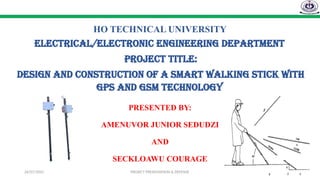
DESIGN AND CONSTRUCTION OF A SMART WALKING STICK WITH
GPS AND GSM TECHNOLOGY
PRESENTED BY:
AMENUVOR JUNIOR SEDUDZI
AND
SECKLOAWU COURAGE
2.
26/07/2025 PROJECT PRESENTATION& DEFENSE 2
Introduction
Problem Definition
Aims and objectives of the study
Literature review
Methodology
Testing and results
Conclusion
Recommendation
References
CONTENT
3.
26/07/2025 PROJECT PRESENTATION& DEFENSE 3
Blindness is a state of lacking the visual perception partially or totally. This
might be due to physiological or neurological factors.
The 2011 statistics by the world health organization (WHO) estimates that there
are 285 million people in the world with visual impairment worldwide, and out
of these 39 million are blind and 246 million have low vision.
Over 190,000 persons in Ghana are blind, according to the 2015 Ghana
Blindness and Visual Impairment Study (GBVIS) conducted under the auspices
of the Ghana Health Service.
Background of the study
4.
26/07/2025 PROJECT PRESENTATION& DEFENSE 4
Traditional walking stick lack the intelligent technology to improve the living standard of blind
people.
Blind people need to be trained by specialists in order to use a walking stick to perform their
daily tasks.
Walking stick can only sense an obstacle up to 1 meter. It is unable to warn the user when there
is an obstacle in their path until the user has touched it.
Some incidents happen due to the blind people not sensing the existence of an obstacle. The
incidents might lead to serious injury on blind people.
Problem Definition
5.
26/07/2025 PROJECT PRESENTATION& DEFENSE 5
AIM/OBJECTIVE OF THE STUDY
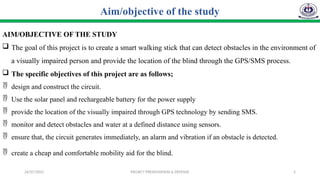
The goal of this project is to create a smart walking stick that can detect obstacles in the environment of
a visually impaired person and provide the location of the blind through the GPS/SMS process.
The specific objectives of this project are as follows;
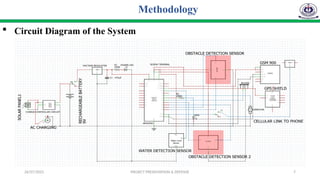
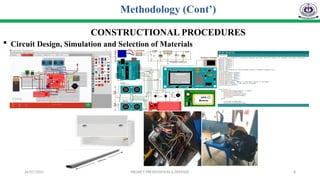
design and construct the circuit.
Use the solar panel and rechargeable battery for the power supply
provide the location of the visually impaired through GPS technology by sending SMS.
monitor and detect obstacles and water at a defined distance using sensors.
ensure that, the circuit generates immediately, an alarm and vibration if an obstacle is detected.
create a cheap and comfortable mobility aid for the blind.
Aim/objective of the study
6.
26/07/2025 PROJECT PRESENTATION& DEFENSE 6
Sri Banu et al in 2017 designed the blind Stick Navigator. The Blind Stick Navigator was created utilizing an
Arduino Uno and 1Sheeld to fix the problem. But the system developed proposed an upgrade due to the
challenges it had after development and testing [19].
The Ultra-Cane [20] is an electronic mobile device that improves on the standard white cane by sensing
possible impediments while still many feet away. This cane utilizes normal AA batteries, and it is difficult for
blind persons to continuously change the batteries when they run out. Good technology, however, lacks a
power supply and is too expensive for low-income citizens, particularly blind individuals.
In [5], the authors present a research solution to design and assemble electron tube systems and other
semiconductor electronic components to build up an amplifier for use in the field of high-quality sound.
Literature Review
26/07/2025 PROJECT PRESENTATION& DEFENSE 10
Testing and Results (Cont’)
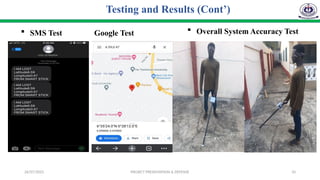
Overall System Accuracy Test
SMS Test Google Test
11.
26/07/2025 PROJECT PRESENTATION& DEFENSE 11
Testing and Results (Cont’)
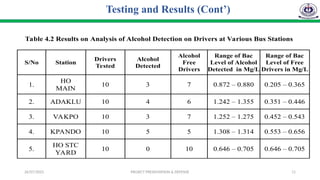
Table 4.2 Results on Analysis of Alcohol Detection on Drivers at Various Bus Stations
S/No Station
Drivers
Tested
Alcohol
Detected
Alcohol
Free
Drivers
Range of Bac
Level of Alcohol
Detected in Mg/L
Range of Bac
Level of Free
Drivers in Mg/L
1.
HO
MAIN
10 3 7 0.872 – 0.880 0.205 – 0.365
2. ADAKLU 10 4 6 1.242 – 1.355 0.351 – 0.446
3. VAKPO 10 3 7 1.252 – 1.275 0.452 – 0.543
4. KPANDO 10 5 5 1.308 – 1.314 0.553 – 0.656
5.
HO STC
YARD
10 0 10 0.646 – 0.705 0.646 – 0.705
12.
26/07/2025 PROJECT PRESENTATION& DEFENSE 12
Conclusion
A simple, cheap, configurable, easy to handle electronic guidance system is designed to
provide constructive assistant and support for blind and visually impaired persons. The system
will be efficient and unique in its capability in specifying the source and distance of the objects
that may encounter the blind.
The results obtained by trial from a volunteer who walked an obstructed path was promising.
The results were promising to an extent that ensures the safety and speed of the mobility of the
deprived user.
13.
26/07/2025 PROJECT PRESENTATION& DEFENSE 13
Recommendation
The prototype of the visually impaired aid is recommended to all blind and visually impaired
persons because this system can detect obstacles, water in all the front directions of the user.
And, it is therefore capable of guiding a visually impaired person to navigate their
environment. However, the walking stick cannot determine the distance of the obstacle
multidimensional. This can be an improvement on this EOA designed stick.
The design of a capacitive ultrasonic sensor, suitable for mounting on the cane, should be
investigated. Capacitive ultrasonic sensor have a better impedance match to air and are
therefore more efficient transmitters and more sensitive receivers.
14.
26/07/2025 PROJECT PRESENTATION& DEFENSE 14
References
[1] W. Jiang, Q. Lin, and H. Wu, “Design and Simulation for a High-efficiency Class-B
Power Amplifier,” vol. 00056, 2017, doi: 10.1051/matecconf/201713900056.
[2] L. Yang and L. Xu, “Class D Power Amplifier for Audio Beam System,” pp. 3469–
3474, 2007.
[3] A. Sengupta, M. K. Mandal, and R. Pal, “Design of a Class-B Power Amplifier at 2 . 4
GHz with Improved Harmonic Suppression,” no. November 2019, 2018, doi:
10.1109/IMaRC.2018.8877260.
[4] O. U. Sahin and D. Systems, “The Design and Implementation of a SONAR Power
Amplifier,” pp. 199–204, 2018.
[5] P. Van Bang and T. D. Chuyen, “Research and Design The Suitable Power Amplifier
for Application in The Area of Sound Selection and Enjoyment,” no. December 2020,
2021, doi: 10.14445/23488379/IJEEE-V7I12P105.
![26/07/2025 PROJECT PRESENTATION & DEFENSE 6
Sri Banu et al in 2017 designed the blind Stick Navigator. The Blind Stick Navigator was created utilizing an
Arduino Uno and 1Sheeld to fix the problem. But the system developed proposed an upgrade due to the
challenges it had after development and testing [19].
The Ultra-Cane [20] is an electronic mobile device that improves on the standard white cane by sensing
possible impediments while still many feet away. This cane utilizes normal AA batteries, and it is difficult for
blind persons to continuously change the batteries when they run out. Good technology, however, lacks a
power supply and is too expensive for low-income citizens, particularly blind individuals.
In [5], the authors present a research solution to design and assemble electron tube systems and other
semiconductor electronic components to build up an amplifier for use in the field of high-quality sound.
Literature Review](https://image.slidesharecdn.com/samplepresentation-250726130117-c0f871e6/85/Smart-assistive-device-for-the-blind-ppt-6-320.jpg)
![26/07/2025 PROJECT PRESENTATION & DEFENSE 14
References
[1] W. Jiang, Q. Lin, and H. Wu, “Design and Simulation for a High-efficiency Class-B
Power Amplifier,” vol. 00056, 2017, doi: 10.1051/matecconf/201713900056.
[2] L. Yang and L. Xu, “Class D Power Amplifier for Audio Beam System,” pp. 3469–
3474, 2007.
[3] A. Sengupta, M. K. Mandal, and R. Pal, “Design of a Class-B Power Amplifier at 2 . 4
GHz with Improved Harmonic Suppression,” no. November 2019, 2018, doi:
10.1109/IMaRC.2018.8877260.
[4] O. U. Sahin and D. Systems, “The Design and Implementation of a SONAR Power
Amplifier,” pp. 199–204, 2018.
[5] P. Van Bang and T. D. Chuyen, “Research and Design The Suitable Power Amplifier
for Application in The Area of Sound Selection and Enjoyment,” no. December 2020,
2021, doi: 10.14445/23488379/IJEEE-V7I12P105.](https://image.slidesharecdn.com/samplepresentation-250726130117-c0f871e6/85/Smart-assistive-device-for-the-blind-ppt-14-320.jpg)