SMALL-SCALE POULTRY
                                    PROCESSING
                                                                             By Anne Fanatico
                                                                          NCAT Agriculture Specialist
                                                                                 May 2003


                                                                                  Introduction
                                                                                  Introduction
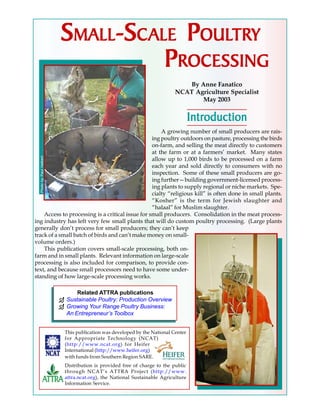
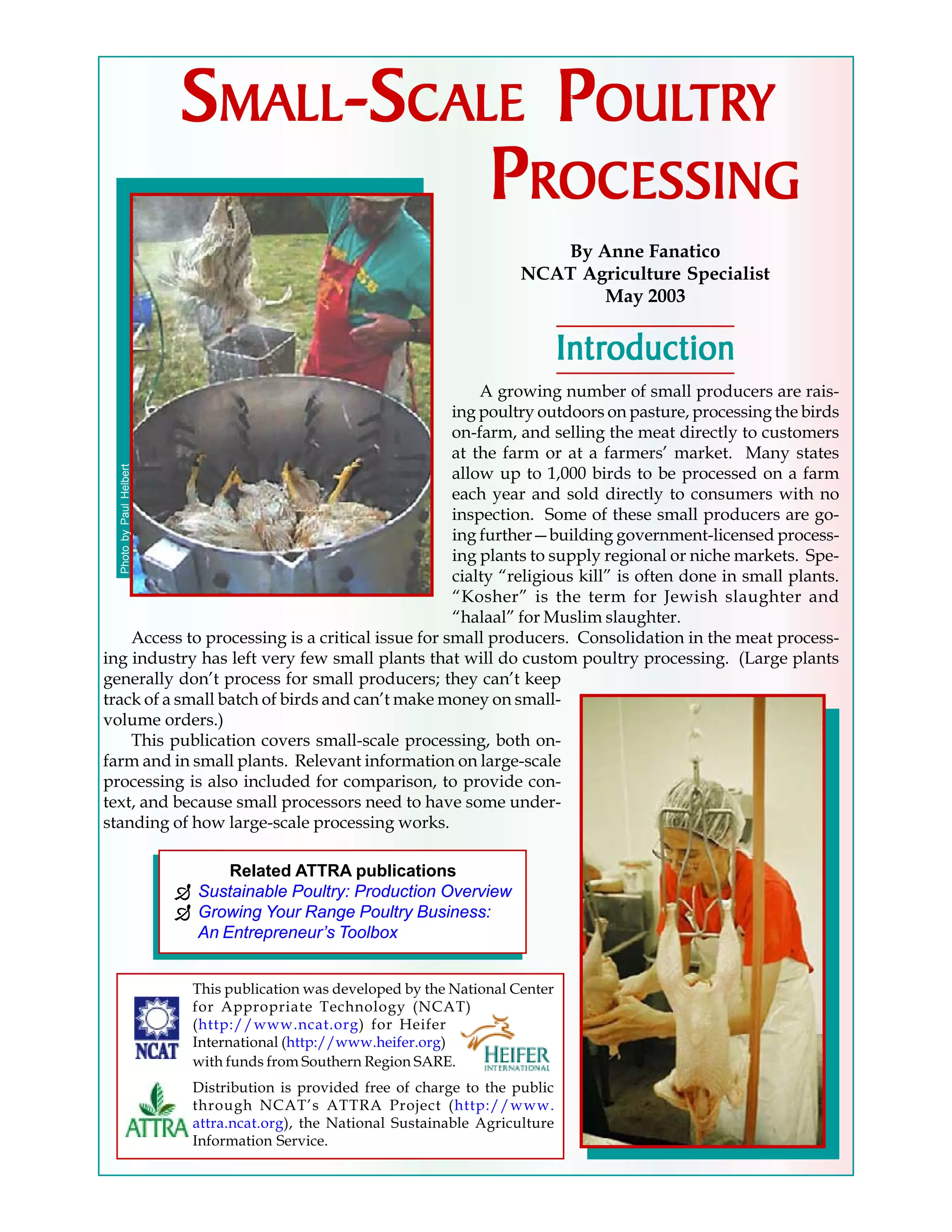
                                                      A growing number of small producers are rais-
                                                  ing poultry outdoors on pasture, processing the birds
                                                  on-farm, and selling the meat directly to customers
                                                  at the farm or at a farmers’ market. Many states
                                                  allow up to 1,000 birds to be processed on a farm
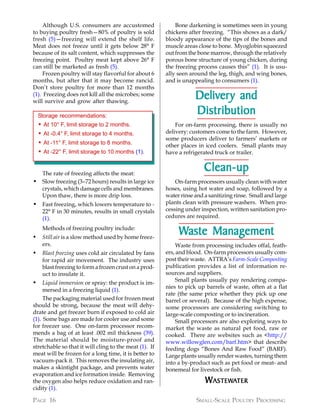
  Photo by Paul Helbert


                                                  each year and sold directly to consumers with no
                                                  inspection. Some of these small producers are go-
                                                  ing further—building government-licensed process-
                                                  ing plants to supply regional or niche markets. Spe-
                                                  cialty “religious kill” is often done in small plants.
                                                  “Kosher” is the term for Jewish slaughter and
                                                  “halaal” for Muslim slaughter.
    Access to processing is a critical issue for small producers. Consolidation in the meat process-
ing industry has left very few small plants that will do custom poultry processing. (Large plants
generally don’t process for small producers; they can’t keep
track of a small batch of birds and can’t make money on small-
volume orders.)
    This publication covers small-scale processing, both on-
farm and in small plants. Relevant information on large-scale
processing is also included for comparison, to provide con-
text, and because small processors need to have some under-
standing of how large-scale processing works.

                              Related ATTRA publications
                          Sustainable Poultry: Production Overview
                          Growing Your Range Poultry Business:
                          An Entrepreneur’s Toolbox


                          This publication was developed by the National Center
                          for Appropriate Technology (NCAT)
                          (http://www.ncat.org) for Heifer
                          International (http://www.heifer.org)
                          with funds from Southern Region SARE.
                          Distribution is provided free of charge to the public
                          through NCAT’s ATTRA Project (http://www.
                          attra.ncat.org), the National Sustainable Agriculture
                          Information Service.
Table of Contents

Introduction ................................................................................. 1
   Table 1. Comparison of types of processing................................ 2
Pre-slaughter ............................................................................... 3
Immobilizing, Killing, and Bleeding ................................................. 4
Feather Removal ........................................................................... 6
   Table 2. Scalding ..................................................................... 7
Removal of Head, Oil Glands, and Feet ........................................... 9
Evisceration ................................................................................. 9
Washing the Carcass ................................................................... 10
Chilling...................................................................................... 10
Cut-up, Deboning, and Further Processing.................................... 13
Aging ........................................................................................14
Packaging ..................................................................................14
Storage ..................................................................................... 15
Delivery and Distribution............................................................. 16
Clean-up ................................................................................... 16
Waste Management .................................................................... 16
   Table 3. Processing Plant Waste Loads per 1000 Chickens ........ 17
Equipment and Supplies .............................................................. 18
Processing Diverse Species..........................................................19
Batch vs. Continuous Processing .................................................. 19
Processing Rate .......................................................................... 19
Processing Setup ........................................................................ 20
Economics ................................................................................. 23
Resources ..................................................................................23
References ................................................................................. 24
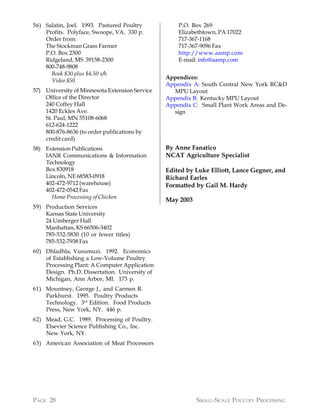
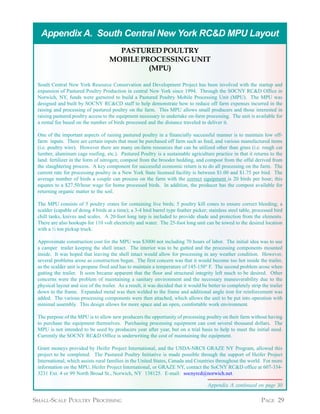
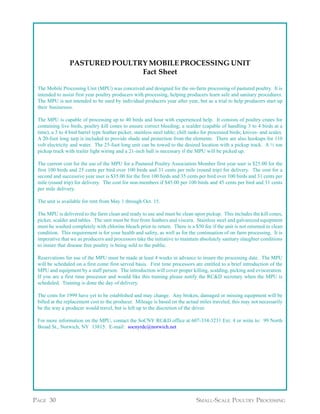
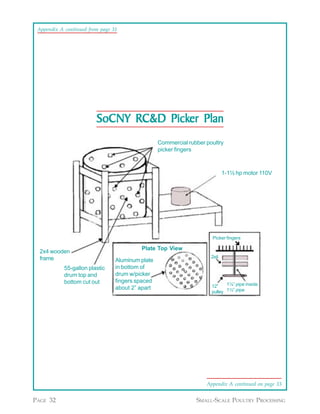
   Appendix A. South Central New York RC&D MPU Layout ......... 29
   Appendix B. Kentucky MPU Layout.......................................... 35
   Appendix C. Small Plant Work Areas and Design ......................36
   Attachment ............................................................................38

PAGE 2                                                         SMALL-SCALE POULTRY PROCESSING
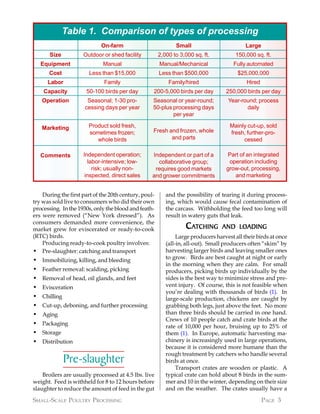
Table 1. Comparison of types of processing
                             On-farm                          Small                         Large
       Size          Outdoor or shed facility          2,000 to 3,000 sq. ft.          150,000 sq. ft.
    Equipment                 Manual                   Manual/Mechanical               Fully automated
      Cost              Less than $15,000              Less than $500,000               $25,000,000
      Labor                   Family                       Family/hired                     Hired
    Capacity          50-100 birds per day         200-5,000 birds per day         250,000 birds per day
    Operation          Seasonal; 1-30 pro-         Seasonal or year-round;          Year-round; process
                      cessing days per year        50-plus processing days                 daily
                                                           per year

    Marketing          Product sold fresh,                                           Mainly cut-up, sold
                       sometimes frozen;           Fresh and frozen, whole           fresh, further-pro-
                          whole birds                     and parts                       cessed

    Comments         Independent operation;        Independent or part of a         Part of an integrated
                       labor-intensive; low-         collaborative group;            operation including
                         risk; usually non-         requires good markets           grow-out, processing,
                      inspected, direct sales      and grower commitments              and marketing


    During the first part of the 20th century, poul-      and the possibility of tearing it during process-
try was sold live to consumers who did their own          ing, which would cause fecal contamination of
processing. In the 1930s, only the blood and feath-       the carcass. Withholding the feed too long will
ers were removed (“New York dressed”). As                 result in watery guts that leak.
consumers demanded more convenience, the
market grew for eviscerated or ready-to-cook                      CATCHING        AND LOADING
(RTC) birds.                                                   Large producers harvest all their birds at once
    Producing ready-to-cook poultry involves:             (all-in, all-out). Small producers often “skim” by
• Pre-slaughter: catching and transport                   harvesting larger birds and leaving smaller ones
•   Immobilizing, killing, and bleeding                   to grow. Birds are best caught at night or early
                                                          in the morning when they are calm. For small
•   Feather removal: scalding, picking                    producers, picking birds up individually by the
•   Removal of head, oil glands, and feet                 sides is the best way to minimize stress and pre-
•   Evisceration                                          vent injury. Of course, this is not feasible when
                                                          you’re dealing with thousands of birds (1). In
•   Chilling                                              large-scale production, chickens are caught by
•   Cut-up, deboning, and further processing              grabbing both legs, just above the feet. No more
•   Aging                                                 than three birds should be carried in one hand.
                                                          Crews of 10 people catch and crate birds at the
•   Packaging
                                                          rate of 10,000 per hour, bruising up to 25% of
•   Storage                                               them (1). In Europe, automatic harvesting ma-
•   Distribution                                          chinery is increasingly used in large operations,
                                                          because it is considered more humane than the
                                                          rough treatment by catchers who handle several
               Pre-slaughter                              birds at once.
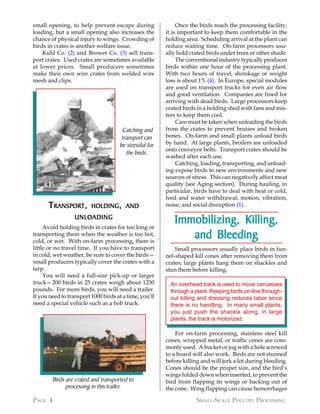
                                                               Transport crates are wooden or plastic. A
    Broilers are usually processed at 4.5 lbs. live       typical crate can hold about 8 birds in the sum-
weight. Feed is withheld for 8 to 12 hours before         mer and 10 in the winter, depending on their size
slaughter to reduce the amount of feed in the gut         and on the weather. The crates usually have a

SMALL-SCALE POULTRY PROCESSING                                                                      PAGE 3
small opening, to help prevent escape during                 Once the birds reach the processing facility,
loading, but a small opening also increases the         it is important to keep them comfortable in the
chance of physical injury to wings. Crowding of         holding area. Scheduling arrival at the plant can
birds in crates is another welfare issue.               reduce waiting time. On-farm processors usu-
    Kuhl Co. (2) and Brower Co. (3) sell trans-         ally hold crated birds under trees or other shade.
port crates. Used crates are sometimes available             The conventional industry typically produces
at lower prices. Small producers sometimes              birds within one hour of the processing plant.
make their own wire crates from welded wire             With two hours of travel, shrinkage or weight
mesh and clips.                                         loss is about 1% (4). In Europe, special modules
                                                        are used on transport trucks for even air flow
                                                        and good ventilation. Companies are fined for
                                                        arriving with dead birds. Large processors keep
                                                        crated birds in a holding shed with fans and mis-
                                                        ters to keep them cool.
                                                             Care must be taken when unloading the birds
                                      Catching and      from the crates to prevent bruises and broken
                                      transport can     bones. On-farm and small plants unload birds
                                     be stressful for   by hand. At large plants, broilers are unloaded
                                                        onto conveyor belts. Transport crates should be
                                        the birds.
                                                        washed after each use.
                                                             Catching, loading, transporting, and unload-
                                                        ing expose birds to new environments and new
                                                        sources of stress. This can negatively affect meat
                                                        quality (see Aging section). During hauling, in
                                                        particular, birds have to deal with heat or cold,
                                                        feed and water withdrawal, motion, vibration,
      TRANSPORT,
       RANSPORT          HOLDING, AND                   noise, and social disruption (1).

                  UNLOADING
     Avoid holding birds in crates for too long or
                                                           Immobilizing, Killing,
transporting them when the weather is too hot,
cold, or wet. With on-farm processing, there is
                                                              and Bleeding
little or no travel time. If you have to transport          Small processors usually place birds in fun-
in cold, wet weather, be sure to cover the birds—       nel-shaped kill cones after removing them from
small producers typically cover the crates with a       crates; large plants hang them on shackles and
tarp.                                                   stun them before killing.
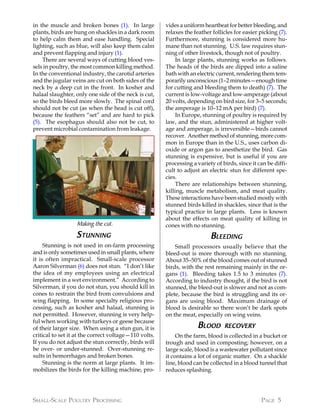
     You will need a full-size pick-up or larger
truck—200 birds in 25 crates weigh about 1250             An overhead track is used to move carcasses
pounds. For more birds, you will need a trailer.          through a plant. Keeping birds on-line through-
If you need to transport 1000 birds at a time, you’ll     out killing and dressing reduces labor since
need a special vehicle such as a bob truck.               there is no handling. In many small plants,
                                                          you just push the shackle along; in large
                                                          plants, the track is motorized.

                                                            For on-farm processing, stainless steel kill
                                                        cones, wrapped metal, or traffic cones are com-
                                                        monly used. A bucket or jug with a hole screwed
                                                        to a board will also work. Birds are not stunned
                                                        before killing and will jerk a lot during bleeding.
                                                        Cones should be the proper size, and the bird’s
                                                        wings folded down when inserted, to prevent the
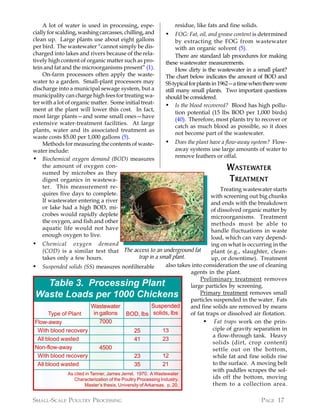
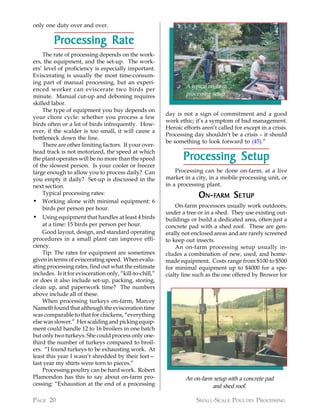
        Birds are crated and transported to             bird from flapping its wings or backing out of
              processing in this trailer.               the cone. Wing flapping can cause hemorrhages

PAGE 4                                                              SMALL-SCALE POULTRY PROCESSING
in the muscle and broken bones (1). In large           vides a uniform heartbeat for better bleeding, and
plants, birds are hung on shackles in a dark room      relaxes the feather follicles for easier picking (7).
to help calm them and ease handling. Special           Furthermore, stunning is considered more hu-
lighting, such as blue, will also keep them calm       mane than not stunning. U.S. law requires stun-
and prevent flapping and injury (1).                   ning of other livestock, though not of poultry.
    There are several ways of cutting blood ves-            In large plants, stunning works as follows.
sels in poultry, the most common killing method.       The heads of the birds are dipped into a saline
In the conventional industry, the carotid arteries     bath with an electric current, rendering them tem-
and the jugular veins are cut on both sides of the     porarily unconscious (1–2 minutes—enough time
neck by a deep cut in the front. In kosher and         for cutting and bleeding them to death) (7). The
halaal slaughter, only one side of the neck is cut,    current is low-voltage and low-amperage (about
so the birds bleed more slowly. The spinal cord        20 volts, depending on bird size, for 3–5 seconds;
should not be cut (as when the head is cut off),       the amperage is 10–12 mA per bird) (7).
because the feathers “set” and are hard to pick             In Europe, stunning of poultry is required by
(5). The esophagus should also not be cut, to          law, and the stun, administered at higher volt-
prevent microbial contamination from leakage.          age and amperage, is irreversible—birds cannot
                                                       recover. Another method of stunning, more com-
                                                       mon in Europe than in the U.S., uses carbon di-
                                                       oxide or argon gas to anesthetize the bird. Gas
                                                       stunning is expensive, but is useful if you are
                                                       processing a variety of birds, since it can be diffi-
                                                       cult to adjust an electric stun for different spe-
                                                       cies.
                                                            There are relationships between stunning,
                                                       killing, muscle metabolism, and meat quality.
                                                       These interactions have been studied mostly with
                                                       stunned birds killed in shackles, since that is the
                                                       typical practice in large plants. Less is known
                                                       about the effects on meat quality of killing in
                  Making the cut.                      cones with no stunning.
                  S TUNNING                                               B LEEDING
     Stunning is not used in on-farm processing            Small processors usually believe that the
and is only sometimes used in small plants, where      bleed-out is more thorough with no stunning.
it is often impractical. Small-scale processor         About 35–50% of the blood comes out of stunned
Aaron Silverman (6) does not stun. “I don’t like       birds, with the rest remaining mainly in the or-
the idea of my employees using an electrical           gans (1). Bleeding takes 1.5 to 3 minutes (7).
implement in a wet environment.” According to          According to industry thought, if the bird is not
Silverman, if you do not stun, you should kill in      stunned, the bleed-out is slower and not as com-
cones to restrain the bird from convulsions and        plete, because the bird is struggling and its or-
wing flapping. In some specialty religious pro-        gans are using blood. Maximum drainage of
cessing, such as kosher and halaal, stunning is        blood is desirable so there won’t be dark spots
not permitted. However, stunning is very help-         on the meat, especially on wing veins.
ful when working with turkeys or geese because
of their larger size. When using a stun gun, it is                  B LOOD      RECOVERY
critical to set it at the correct voltage—110 volts.        On the farm, blood is collected in a bucket or
If you do not adjust the stun correctly, birds will    trough and used in composting; however, on a
be over- or under-stunned. Over-stunning re-           large scale, blood is a wastewater pollutant since
sults in hemorrhages and broken bones.                 it contains a lot of organic matter. On a shackle
     Stunning is the norm at large plants. It im-      line, blood can be collected in a blood tunnel that
mobilizes the birds for the killing machine, pro-      reduces splashing.


SMALL-SCALE POULTRY PROCESSING                                                                  PAGE 5
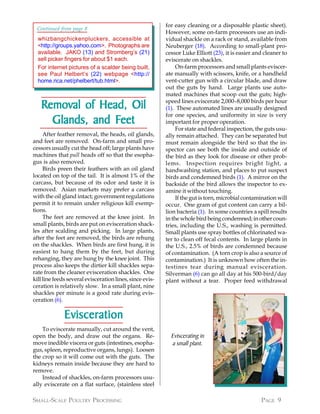
On-farm processors use a single tank of hot
         Feather Removal                                         water, usually scalding one to four birds at a time.
                                                                 Labor is saved when a mechanism such as a bas-
                    S   CALDING                                  ket or arm dunks several birds together. In small
                                                                 plants, scalders with such a mechanism can handle
     Small processors remove the birds from the                  12 birds at once. Some on-farm processors add
killing cones for scalding. In large plants, the                 dish soap to the scald water to help it better pen-
birds stay on the shackles.                                      etrate the feathers and facilitate picking; others
                                                                              do not find this necessary.
                                                                                   It can take a while to heat the
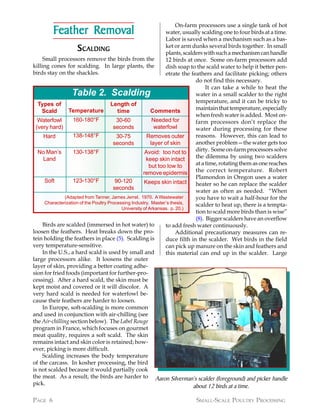
                 Table 2. Scalding                                            water in a small scalder to the right
                                                                              temperature, and it can be tricky to
  Types of                             Length of
                 Temperature                               Comments           maintain that temperature, especially
    Scald                                 time
                                                                              when fresh water is added. Most on-
  Waterfowl         160-180°F             30-60             Needed for        farm processors don’t replace the
 (very hard)                            seconds              waterfowl        water during processing for these
     Hard           138-148°F             30-75          Removes outer        reasons. However, this can lead to
                                        seconds            layer of skin      another problem—the water gets too
  No Man’s          130-138°F                           Avoid: too hot to     dirty. Some on-farm processors solve
     Land                                               keep skin intact      the dilemma by using two scalders
                                                          but too low to      at a time, rotating them as one reaches
                                                       remove epidermis the correct temperature. Robert
                                                                              Plamondon in Oregon uses a water
      Soft          123-130°F            90-120        Keeps skin intact      heater so he can replace the scalder
                                        seconds
                                                                              water as often as needed. “When
               (Adapted from Tanner, James Jerrel. 1970. A Wastewater         you have to wait a half-hour for the
      Characterization of the Poultry Processing Industry. Master’s thesis,   scalder to heat up, there is a tempta-
                                            University of Arkansas. p. 20.)
                                                                              tion to scald more birds than is wise”
                                                                              (8). Bigger scalders have an overflow
     Birds are scalded (immersed in hot water) to                to add fresh water continuously.
loosen the feathers. Heat breaks down the pro-                         Additional precautionary measures can re-
tein holding the feathers in place (5). Scalding is              duce filth in the scalder. Wet birds in the field
very temperature-sensitive.                                      can pick up manure on the skin and feathers and
     In the U.S., a hard scald is used by small and              this material can end up in the scalder. Large
large processors alike. It loosens the outer
layer of skin, providing a better coating adhe-
sion for fried foods (important for further-pro-
cessing). After a hard scald, the skin must be
kept moist and covered or it will discolor. A
very hard scald is needed for waterfowl be-
cause their feathers are harder to loosen.
     In Europe, soft-scalding is more common
and used in conjunction with air-chilling (see
the Air-chilling section below). The Label Rouge
program in France, which focuses on gourmet
meat quality, requires a soft scald. The skin
remains intact and skin color is retained; how-
ever, picking is more difficult.
     Scalding increases the body temperature
of the carcass. In kosher processing, the bird
is not scalded because it would partially cook
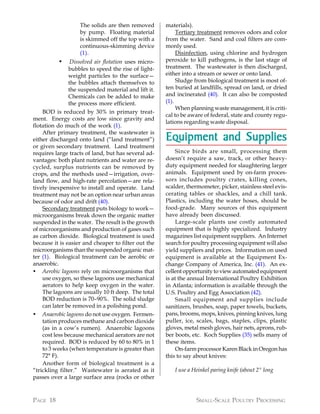
the meat. As a result, the birds are harder to Aaron Silverman’s scalder (foreground) and picker handle
pick.                                                                        about 12 birds at a time.

PAGE 6                                                                     SMALL-SCALE POULTRY PROCESSING
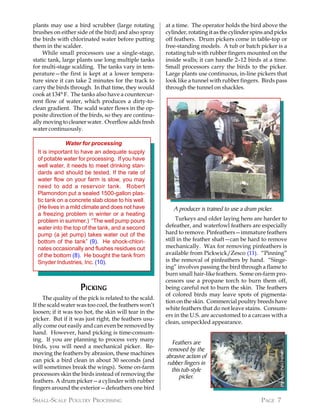
plants may use a bird scrubber (large rotating          at a time. The operator holds the bird above the
brushes on either side of the bird) and also spray      cylinder, rotating it as the cylinder spins and picks
the birds with chlorinated water before putting         off feathers. Drum pickers come in table-top or
them in the scalder.                                    free-standing models. A tub or batch picker is a
    While small processors use a single-stage,          rotating tub with rubber fingers mounted on the
static tank, large plants use long multiple tanks       inside walls; it can handle 2–12 birds at a time.
for multi-stage scalding. The tanks vary in tem-        Small processors carry the birds to the picker.
perature—the first is kept at a lower tempera-          Large plants use continuous, in-line pickers that
ture since it can take 2 minutes for the track to       look like a tunnel with rubber fingers. Birds pass
carry the birds through. In that time, they would       through the tunnel on shackles.
cook at 134° F. The tanks also have a countercur-
rent flow of water, which produces a dirty-to-
clean gradient. The scald water flows in the op-
posite direction of the birds, so they are continu-
ally moving to cleaner water. Overflow adds fresh
water continuously.

               Water for processing
  It is important to have an adequate supply
  of potable water for processing. If you have
  well water, it needs to meet drinking stan-
  dards and should be tested. If the rate of
  water flow on your farm is slow, you may
  need to add a reservoir tank. Robert
  Plamondon put a sealed 1500-gallon plas-
  tic tank on a concrete slab close to his well.
  (He lives in a mild climate and does not have            A producer is trained to use a drum picker.
  a freezing problem in winter or a heating
  problem in summer.) “The well pump pours                   Turkeys and older laying hens are harder to
  water into the top of the tank, and a second          defeather, and waterfowl feathers are especially
  pump (a jet pump) takes water out of the              hard to remove. Pinfeathers—immature feathers
  bottom of the tank” (9). He shock-chlori-             still in the feather shaft—can be hard to remove
  nates occasionally and flushes residues out           mechanically. Wax for removing pinfeathers is
  of the bottom (8). He bought the tank from            available from Pickwick/Zesco (11). “Pinning”
  Snyder Industries, Inc. (10).                         is the removal of pinfeathers by hand. “Singe-
                                                        ing” involves passing the bird through a flame to
                                                        burn small hair-like feathers. Some on-farm pro-
                                                        cessors use a propane torch to burn them off,
                    P ICKING                            being careful not to burn the skin. The feathers
                                                        of colored birds may leave spots of pigmenta-
     The quality of the pick is related to the scald.
                                                        tion on the skin. Commercial poultry breeds have
If the scald water was too cool, the feathers won’t
                                                        white feathers that do not leave stains. Consum-
loosen; if it was too hot, the skin will tear in the
                                                        ers in the U.S. are accustomed to a carcass with a
picker. But if it was just right, the feathers usu-
                                                        clean, unspeckled appearance.
ally come out easily and can even be removed by
hand. However, hand picking is time-consum-
ing. If you are planning to process very many
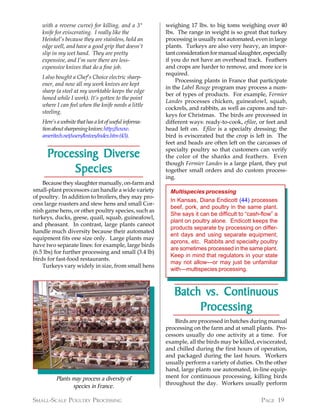
                                                           Feathers are
birds, you will need a mechanical picker. Re-
                                                         removed by the
                                                                                                          Photo by Paul Helbert


moving the feathers by abrasion, these machines
                                                        abrasive action of
can pick a bird clean in about 30 seconds (and          rubber fingers in
will sometimes break the wings). Some on-farm              this tub-style
processors skin the birds instead of removing the              picker.
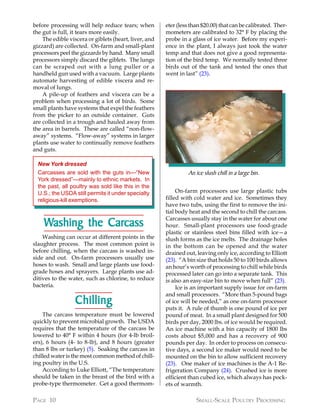
feathers. A drum picker—a cylinder with rubber
fingers around the exterior—defeathers one bird

SMALL-SCALE POULTRY PROCESSING                                                                   PAGE 7
SCALDING       AND PICKING EQUIPMENT                 companies have graveyards with used equip-
                                                      ment, some being turned into scrap metal. Keep
     The companies Pickwick/Zesco (11), Brower
                                                      in mind that while used equipment can help you
(3), and Ashley (12) have supplied small-scale
                                                      cut costs, it may not meet the specifications your
poultry processing equipment for many years.
                                                      facility requires.
Small scalders (one bird at a time) cost less than
$200 and small pickers less than $400. These com-
panies also offer many larger models. A 12- to          Homemade or Modified Equipment
16-bird scalder costs about $10,000.                    Making your own equipment is another way
     Some home businesses have emerged that sell        to lower costs, but consider the time required
relatively inexpensive processing equipment for         to build or find parts. Again, make sure the
on-farm processors.                                     design and materials meet the specifications
                                                        you require. But be forewarned that home-
• Kenneth King of JAKO, Inc. (13) sells a rela-
                                                        made equipment is not likely to meet federal
     tively low-cost scalder and tub picker of his
                                                        or state meat inspection requirements.
     own design. Each piece costs $1,700, com-
     pared to about $3,000 each for comparable          Homemade scalders: When first starting out,
     equipment from conventional suppliers. The         some small-scale producers use a large
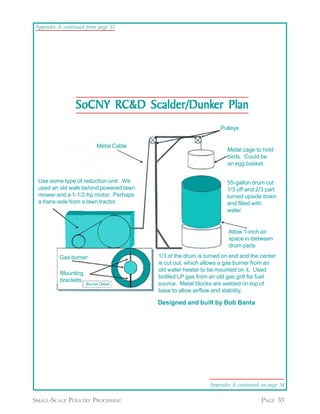
     picker has a plastic barrel. JAKO also sells a     stockpot in the backyard heated with a fire.
     small table-top picker (Lil’ Pick) powered by      On-farm processors have also used propane
     a hand drill for $125.                             burners (from outdoor turkey fryers), water-
                                                        bath pots made for canning, and hospital ster-
• Eli M. Reiff of Poultry Man (14) has equip-           ilizers (common before the advent of the au-
   ment made in a local farm shop. He offers a          toclave). A homemade scalder can be made
   rotary scalder for $1,895 and a tub picker for       with a utility sink, a heating element, and a
   $1,395. He says comparable equipment sells           thermostat for about $50 (19). On-farm pro-
   for $6,000. He also offers a smaller picker for      cessors also make large insulated scalders
   $695.                                                from old electric or propane water heaters.
• David Schaeffer (15) has developed the                Some even have a dunker. It is especially
   Featherman Jr., which picks three chickens           important to use thermometers with home-
   or one turkey. It costs $715 with the motor (1       made scalders to ensure a constant tempera-
   hp 115 Volt Dayton) installed and $520 with          ture.
   no motor. Schaeffer recommends pairing his           For those making homemade equipment, it
   picker with the Ashley M-38 scalder (40,000          is very important to be aware of the danger
   BTU, 38 gallon tank, automatic temperature           of electrocution. Scalders and pickers are
   control, $1250).                                     used around water, which makes improperly
                                                        connected electrical parts even more dan-
• Rob Bauman of R & R Pluckers (16) builds
                                                        gerous. Important safeguards include using
     pickers.
                                                        a competent electrician, following electrical
Note: Prices may have changed.                          code, installing ground fault circuit interrupt-
     According to on-farm processor Jenny Drake,        ers (GFIs), and making sure the power cord
“I KNOW the stuff is expensive, but you will            is of sufficient gauge to handle the current.
kick yourself over and over if you don’t get equip-     Gas-powered water heaters are also used,
ment designed for the scale of operation. We bit        but there is an explosion risk.
the bullet and bought JAKO equipment, and it            Homemade pickers: Many have converted
has been worth every penny.”                            old washing machines or plastic 55-gallon
     Small processors can look for used equipment       drum into pickers. On-farm processor Herrick
from sources such as Grit, the newsletter of the        Kimball has written Anyone Can Build a Tub-
American Pastured Poultry Producers Associa-            Style Mechanical Chicken Plucker (20). He
tion (17), or from Tom Neuberger of South Da-           estimates that this type of picker can be built
kota Poultry Headquarters (18), but availability        for $500—much less than the typical $2,000.
is limited. There may be old poultry processing         He also moderates a listserver called
equipment in your area from small plants of the
past. Large plants in your area that are remodel-                                   Continued on page 9
ing can be a source of used equipment. Large

PAGE 8                                                             SMALL-SCALE POULTRY PROCESSING
for easy cleaning or a disposable plastic sheet).
 Continued from page 8
                                                          However, some on-farm processors use an indi-
  whizbangchickenpluckers, accessible at                  vidual shackle on a rack or stand, available from
  <http://groups.yahoo.com>. Photographs are              Neuberger (18). According to small-plant pro-
  available. JAKO (13) and Stromberg’s (21)               cessor Luke Elliott (23), it is easier and cleaner to
  sell picker fingers for about $1 each.                  eviscerate on shackles.
  For internet pictures of a scalder being built,              On-farm processors and small plants eviscer-
  see Paul Helbert’s (22) webpage <http://                ate manually with scissors, knife, or a handheld
  home.rica.net/phelbert/tub.html>.                       vent-cutter gun with a circular blade, and draw
                                                          out the guts by hand. Large plants use auto-
                                                          mated machines that scoop out the guts; high-

   Removal of Head, Oil                                   speed lines eviscerate 2,000–8,000 birds per hour
                                                          (1). These automated lines are usually designed
                                                          for one species, and uniformity in size is very
     Glands, and Feet
                 Feet                                     important for proper operation.
                                                               For state and federal inspection, the guts usu-
     After feather removal, the heads, oil glands,        ally remain attached. They can be separated but
and feet are removed. On-farm and small pro-              must remain alongside the bird so that the in-
cessors usually cut the head off; large plants have       spector can see both the inside and outside of
machines that pull heads off so that the esopha-          the bird as they look for disease or other prob-
gus is also removed.                                      lems. Inspection requires bright light, a
     Birds preen their feathers with an oil gland         handwashing station, and places to put suspect
located on top of the tail. It is almost 1% of the        birds and condemned birds (1). A mirror on the
carcass, but because of its odor and taste it is          backside of the bird allows the inspector to ex-
removed. Asian markets may prefer a carcass               amine it without touching.
with the oil gland intact; government regulations              If the gut is torn, microbial contamination will
permit it to remain under religious kill exemp-           occur. One gram of gut content can carry a bil-
tions.                                                    lion bacteria (1). In some countries a spill results
     The feet are removed at the knee joint. In           in the whole bird being condemned; in other coun-
small plants, birds are put on evisceration shack-        tries, including the U.S., washing is permitted.
les after scalding and picking. In large plants,          Small plants use spray bottles of chlorinated wa-
after the feet are removed, the birds are rehung          ter to clean off fecal contents. In large plants in
on the shackles. When birds are first hung, it is         the U.S., 2.5% of birds are condemned because
easiest to hang them by the feet, but during              of contamination. (A torn crop is also a source of
rehanging, they are hung by the knee joint. This          contamination.) It is unknown how often the in-
process also keeps the dirtier kill shackles sepa-        testines tear during manual evisceration.
rate from the cleaner evisceration shackles. One          Silverman (6) can go all day at his 500-bird/day
kill line feeds several evisceration lines, since evis-   plant without a tear. Proper feed withdrawal
ceration is relatively slow. In a small plant, nine
shackles per minute is a good rate during evis-
ceration (6).

              Evisceration
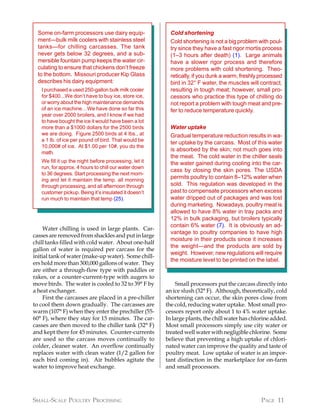
    To eviscerate manually, cut around the vent,
open the body, and draw out the organs. Re-                 Eviscerating in
move inedible viscera or guts (intestines, esopha-          a small plant.
gus, spleen, reproductive organs, lungs). Loosen
the crop so it will come out with the guts. The
kidneys remain inside because they are hard to
remove.
    Instead of shackles, on-farm processors usu-
ally eviscerate on a flat surface, (stainless steel

SMALL-SCALE POULTRY PROCESSING                                                                     PAGE 9
before processing will help reduce tears; when         eter (less than $20.00) that can be calibrated. Ther-
the gut is full, it tears more easily.                 mometers are calibrated to 32° F by placing the
    The edible viscera or giblets (heart, liver, and   probe in a glass of ice water. Before my experi-
gizzard) are collected. On-farm and small-plant        ence in the plant, I always just took the water
processors peel the gizzards by hand. Many small       temp and that does not give a good representa-
processors simply discard the giblets. The lungs       tion of the bird temp. We normally tested three
can be scraped out with a lung puller or a             birds out of the tank and tested the ones that
handheld gun used with a vacuum. Large plants          went in last” (23).
automate harvesting of edible viscera and re-
moval of lungs.
    A pile-up of feathers and viscera can be a
problem when processing a lot of birds. Some
small plants have systems that expel the feathers
from the picker to an outside container. Guts
are collected in a trough and hauled away from
the area in barrels. These are called “non-flow-
away” systems. “Flow-away” systems in larger
plants use water to continually remove feathers
and guts.

  New York dressed
  Carcasses are sold with the guts in—“New                      An ice slush chill in a large bin.
  York dressed”—mainly to ethnic markets. In
  the past, all poultry was sold like this in the
  U.S.; the USDA still permits it under specialty           On-farm processors use large plastic tubs
  religious-kill exemptions.                           filled with cold water and ice. Sometimes they
                                                       have two tubs, using the first to remove the ini-
                                                       tial body heat and the second to chill the carcass.

    Washing the Carcass
                Carcass                                Carcasses usually stay in the water for about one
                                                       hour. Small-plant processors use food-grade
                                                       plastic or stainless steel bins filled with ice—a
    Washing can occur at different points in the       slush forms as the ice melts. The drainage holes
slaughter process. The most common point is            in the bottom can be opened and the water
before chilling, when the carcass is washed in-        drained out, leaving only ice, according to Elliott
side and out. On-farm processors usually use           (23). “A bin size that holds 50 to 100 birds allows
hoses to wash. Small and large plants use food-        an hour’s worth of processing to chill while birds
grade hoses and sprayers. Large plants use ad-         processed later can go into a separate tank. This
ditives to the water, such as chlorine, to reduce      is also an easy-size bin to move when full” (23).
bacteria.                                                   Ice is an important supply issue for on-farm
                                                       and small processors. “More than 5-pound bags
                  Chilling                             of ice will be needed,” as one on-farm processor
                                                       puts it. A rule of thumb is one pound of ice per
    The carcass temperature must be lowered            pound of meat. In a small plant designed for 500
quickly to prevent microbial growth. The USDA          birds per day, 2000 lbs. of ice would be required.
requires that the temperature of the carcass be        An ice machine with a bin capacity of 1800 lbs
lowered to 40° F within 4 hours (for 4-lb broil-       costs about $5,000 and has a recovery of 900
ers), 6 hours (4- to 8-lb), and 8 hours (greater       pounds per day. In order to process on consecu-
than 8 lbs or turkey) (5). Soaking the carcass in      tive days, a second ice maker would need to be
chilled water is the most common method of chill-      mounted on the bin to allow sufficient recovery
ing poultry in the U.S.                                (23). One maker of ice machines is the A-1 Re-
    According to Luke Elliott, “The temperature        frigeration Company (24). Crushed ice is more
should be taken in the breast of the bird with a       efficient than cubed ice, which always has pock-
probe-type thermometer. Get a good thermom-            ets of warmth.

PAGE 10                                                             SMALL-SCALE POULTRY PROCESSING
Some on-farm processors use dairy equip-               Cold shortening
  ment—bulk milk coolers with stainless steel            Cold shortening is not a big problem with poul-
  tanks—for chilling carcasses. The tank                 try since they have a fast rigor mortis process
  never gets below 32 degrees, and a sub-                (1–3 hours after death) (1). Large animals
  mersible fountain pump keeps the water cir-            have a slower rigor process and therefore
  culating to ensure that chickens don’t freeze          more problems with cold shortening. Theo-
  to the bottom. Missouri producer Kip Glass             retically, if you dunk a warm, freshly processed
  describes his dairy equipment:                         bird in 32° F water, the muscles will contract,
   I purchased a used 250-gallon bulk milk cooler        resulting in tough meat; however, small pro-
   for $400...We don’t have to buy ice, store ice,       cessors who practice this type of chilling do
   or worry about the high maintenance demands           not report a problem with tough meat and pre-
   of an ice machine…We have done so far this            fer to reduce temperature quickly.
   year over 2000 broilers, and I know if we had
   to have bought the ice it would have been a lot
   more than a $1000 dollars for the 2500 birds          Water uptake
   we are doing. Figure 2500 birds at 4 lbs., at         Gradual temperature reduction results in wa-
   a 1 lb. of ice per pound of bird. That would be
                                                         ter uptake by the carcass. Most of this water
   10,000# of ice. At $1.00 per 10#, you do the
                                                         is absorbed by the skin; not much goes into
   math.
                                                         the meat. The cold water in the chiller seals
   We fill it up the night before processing, let it     the water gained during cooling into the car-
   run, for approx. 4 hours to chill our water down
                                                         cass by closing the skin pores. The USDA
   to 36 degrees. Start processing the next morn-
   ing and let it maintain the temp. all morning
                                                         permits poultry to contain 8–12% water when
   through processing, and all afternoon through         sold. This regulation was developed in the
   customer pickup. Being it’s insulated it doesn’t      past to compensate processors when excess
   run much to maintain that temp (25).                  water dripped out of packages and was lost
                                                         during marketing. Nowadays, poultry meat is
                                                         allowed to have 8% water in tray packs and
                                                         12% in bulk packaging, but broilers typically
                                                         contain 6% water (7). It is obviously an ad-
     Water chilling is used in large plants. Car-
                                                         vantage to poultry companies to have high
casses are removed from shackles and put in large
                                                         moisture in their products since it increases
chill tanks filled with cold water. About one-half
                                                         the weight—and the products are sold by
gallon of water is required per carcass for the
                                                         weight. However, new regulations will require
initial tank of water (make-up water). Some chill-
                                                         the moisture level to be printed on the label.
ers hold more than 300,000 gallons of water. They
are either a through-flow type with paddles or
rakes, or a counter-current-type with augers to
move birds. The water is cooled to 32 to 39° F by           Small processors put the carcass directly into
a heat exchanger.                                      an ice slush (32° F). Although, theoretically, cold
     First the carcasses are placed in a pre-chiller   shortening can occur, the skin pores close from
to cool them down gradually. The carcasses are         the cold, reducing water uptake. Most small pro-
warm (107° F) when they enter the prechiller (55-      cessors report only about 1 to 4% water uptake.
60° F), where they stay for 15 minutes. The car-       In large plants, the chill water has chlorine added.
casses are then moved to the chiller tank (32° F)      Most small processors simply use city water or
and kept there for 45 minutes. Counter-currents        treated well water with negligible chlorine. Some
are used so the carcass moves continually to           believe that preventing a high uptake of chlori-
colder, cleaner water. An overflow continually         nated water can improve the quality and taste of
replaces water with clean water (1/2 gallon for        poultry meat. Low uptake of water is an impor-
each bird coming in). Air bubbles agitate the          tant distinction in the marketplace for on-farm
water to improve heat exchange.                        and small processors.


SMALL-SCALE POULTRY PROCESSING                                                                  PAGE 11
A IR- CHILLING                             skin is drier (7). Since air chill does not promote
                                                            cold shortening as much as water does, a gradual
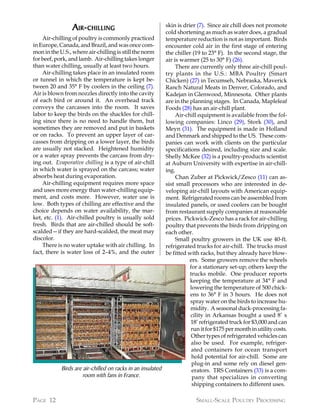
    Air-chilling of poultry is commonly practiced           temperature reduction is not as important. Birds
in Europe, Canada, and Brazil, and was once com-            encounter cold air in the first stage of entering
mon in the U.S., where air-chilling is still the norm       the chiller (19 to 23° F). In the second stage, the
for beef, pork, and lamb. Air-chilling takes longer         air is warmer (25 to 30° F) (26).
than water chilling, usually at least two hours.                 There are currently only three air-chill poul-
    Air-chilling takes place in an insulated room           try plants in the U.S.: MBA Poultry (Smart
or tunnel in which the temperature is kept be-              Chicken) (27) in Tecumseh, Nebraska, Maverick
tween 20 and 35° F by coolers in the ceiling (7).           Ranch Natural Meats in Denver, Colorado, and
Air is blown from nozzles directly into the cavity          Kadejan in Glenwood, Minnesota. Other plants
of each bird or around it. An overhead track                are in the planning stages. In Canada, Mapleleaf
conveys the carcasses into the room. It saves               Foods (28) has an air-chill plant.
labor to keep the birds on the shackles for chill-               Air-chill equipment is available from the fol-
ing since there is no need to handle them, but              lowing companies: Linco (29), Stork (30), and
sometimes they are removed and put in baskets               Meyn (31). The equipment is made in Holland
or on racks. To prevent an upper layer of car-              and Denmark and shipped to the US. These com-
casses from dripping on a lower layer, the birds            panies can work with clients on the particular
are usually not stacked. Heightened humidity                specifications desired, including size and scale.
or a water spray prevents the carcass from dry-             Shelly McKee (32) is a poultry-products scientist
ing out. Evaporative chilling is a type of air-chill        at Auburn University with expertise in air-chill-
in which water is sprayed on the carcass; water             ing.
absorbs heat during evaporation.                                 Chan Zuber at Pickwick/Zesco (11) can as-
    Air-chilling equipment requires more space              sist small processors who are interested in de-
and uses more energy than water-chilling equip-             veloping air-chill layouts with American equip-
ment, and costs more. However, water use is                 ment. Refrigerated rooms can be assembled from
low. Both types of chilling are effective and the           insulated panels, or used coolers can be bought
choice depends on water availability, the mar-              from restaurant supply companies at reasonable
ket, etc. (1). Air-chilled poultry is usually sold          prices. Pickwick-Zesco has a rack for air-chilling
fresh. Birds that are air-chilled should be soft-           poultry that prevents the birds from dripping on
scalded—if they are hard-scalded, the meat may              each other.
discolor.                                                        Small poultry growers in the UK use 40-ft.
    There is no water uptake with air chilling. In          refrigerated trucks for air-chill. The trucks must
fact, there is water loss of 2–4%, and the outer            be fitted with racks, but they already have blow-
                                                                       ers. Some growers remove the wheels
                                                                       for a stationary set-up; others keep the
                                                                       trucks mobile. One producer reports
                                                                       keeping the temperature at 34° F and
                                                                       lowering the temperature of 500 chick-
                                                                       ens to 36° F in 3 hours. He does not
                                                                       spray water on the birds to increase hu-
                                                                       midity. A seasonal duck-processing fa-
                                                                       cility in Arkansas bought a used 8’ x
                                                                       18’ refrigerated truck for $3,000 and can
                                                                       run it for $175 per month in utility costs.
                                                                        Other types of refrigerated vehicles can
                                                                        also be used. For example, refriger-
                                                                        ated containers for ocean transport
                                                                        hold potential for air-chill. Some are
                                                                        plug-in and some rely on diesel gen-
             Birds are air-chilled on racks in an insulated             erators. TRS Containers (33) is a com-
                       room with fans in France.                        pany that specializes in converting
                                                                        shipping containers to different uses.

PAGE 12                                                                  SMALL-SCALE POULTRY PROCESSING
and legs. Breasts and thighs are commonly
 Cut-up,                Yields
                        Average yields for poul-
                                                      deboned in large plants with automated equip-

Deboning,               try carcasses without
                        the feathers, blood, and
                                                      ment. Meat should not be deboned for at least 4
                                                      hours, since rigor mortis is occurring, and

   and                  viscera:
                                                      deboning early would toughen the meat. (See
                                                      the Aging section below.)
                        • 75% for broilers with
 Further                  giblets                               F URTHER      PROCESSING

Processing
Processing              • 65% for broilers with-
                          out giblets
                                                        While the slaughter areas in large plants are
                                                        kept at about 65–80°F, the temperature is
                                                        50°F or lower in further-processing areas.
                        • 78% turkeys with gib-
     CUT-UP               lets (due to the larger
                                                        The cooler and the shipping dock are 34°F
                                                        or lower.
    On-farm proces-       neck)
sors generally sell car-                                  “Further processing” includes not only cut-
casses whole—they do not offer cut-up. In a small     up and deboned, but also portioned, formed,
plant, about 16 to 30% of the birds need to be        cooked, cured, smoked, and brined products.
cut-up because of bruises, broken bones in the        Further processing seems like another world for
picker, etc (23). U.S. customers are very accus-      most small processors today, but in the future it
tomed to the convenience of cut-up poultry and        may be an important value-adding option for
parts. In the industry, about 70% of poultry is       them. It’s important to note that further pro-
sold as parts or further processed. Boneless, skin-   cessing requires government inspection.
less breasts are a particularly popular product,          Portioning and sizing are important in the
and dark meat is exported overseas. Large plants      conventional industry, since many restaurants
use automated equipment to cut-up, while small        only want to buy uniform portions of meat.
processors cut-up manually or use a saw.                  Formed products are made by reducing the
    Cut-up includes removal of the wings, legs,       particle size of the meat, adding ingredients for
and front halves (breast). Whole legs and leg         flavor or functionality, tumbling to increase
quarters can be cut into thighs and drumsticks.       penetration of brine, and forming with a stuffer
Common cut-up configurations consist of eight         or mold. Some products are also coated with
pieces (wings, breasts, thighs, drumsticks). The      breading and cooked. Formed products include
wings can also be cut into drumettes. The re-         the following:
maining racks are a by-product (e.g., soup stock,     • Whole (deli rolls and loafs); these have pieces
pet food, waste).                                        that can still be recognized as meat.
                  D EBONING                           • Comminuted (chicken nuggets, patties); the
                                                         pieces of meat have been chopped and are
  Small plants that debone manually place the            smaller; breast meat or deboned meat and
whole bird on a cone and cut off the wings, breast,      skin are used.
                                                      • Emulsified (hot dog, bologna, sausages); the
                                                           pieces of meat are very small and, when
                                                           mixed with fat and water, may not be recog-
                                                           nizable as meat (7).
                                                           Curing and smoking are ancient ways of pre-
                                                      serving meat that also contribute to flavor. Cur-
                                                      ing uses nitrites as a preservative. Smoking can
                                                      be done without nitrites. Some small proces-
                                                      sors brine poultry. According to small processor
                                                      Brandon Sussman,“while some salt and sugar
                                                      is inevitably retained in the brining process, the
                                                      reason for brining is to improve moisture reten-
                                                      tion and meat texture, not to 'enhance flavor'. I
                                                      believe that there is a certain amount of blood
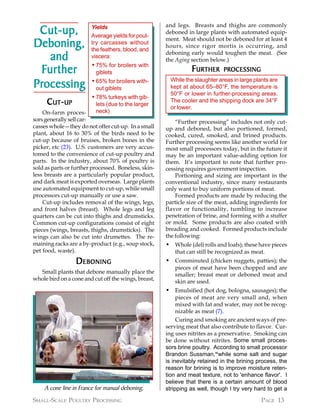
    A cone line in France for manual deboning.        stripping as well, though I try very hard to get a

SMALL-SCALE POULTRY PROCESSING                                                                PAGE 13
good bleed out when killing.” For home use,                 fore slaughter will have little glycogen in the
Sussman uses “1/4 cup Kosher salt + 1/4 cup                 muscles. The limited production of lactic
white sugar to each quart of cold water…1 hour              acid and high ultimate pH that result make
per pound up to 8 hours” (34). On-farm brining is           the meat dark, firm, and dry (1). On the other
usually done during chilling, but can also be done          extreme, the pH can drop quickly and pro-
in the refrigerator. In kosher processing, the meat         duce pale, soft, exudative meat.
is salted to draw out all visible blood, because
the Jewish dietary laws prohibit the eating of blood.
                                                                       Packaging
                    Aging                                     After the carcass is properly chilled, it is
                                                         ready to be packed. Elliott recommends swift
    Tenderness is directly related to aging. Poul-       packing in a cool room once you take the birds
try meat needs to age for at least four hours be-        off ice, to get them packed and into proper stor-
fore it is eaten or frozen, or it will be tough. This    age before they warm up.
is because of rigor mortis—a temporary tough-                 On-farm processors usually don’t have to re-
ening—which is part of the process of muscle             frigerate or deliver. They sell their birds fresh,
death, the natural biochemical process that con-         immediately after slaughter, to customers who
verts the muscle to meat. Although the bird is           come to the farm to pick them up. They usually
dead, there is still energy in the muscle. The           put the chicken in a plastic bag, close it with a
muscle cells continue metabolizing until this en-        twist-tie, and weigh the package. Labeling may
ergy is used up, switching from aerobic metabo-          be as simple as as marking the weight with a
lism to the less efficient anaerobic (without oxy-       “Sharpie” marker on the outside of the bag. Con-
gen). Rigor mortis does not set in immediately           sumers of fresh poultry must eat or freeze the
after slaughter, but gradually as the muscles de-        birds within six days.
plete their energy stores. “Cross bridges” form               Bags are available from Koch (35), Freund
within the muscle structure, and the muscle can-         Container (36), and Brower (3). Try asking for a
not be extended. After a while, the muscle struc-        sample of bags your first season, before buying
ture starts breaking down and the muscle be-             in bulk.
comes flexible again (1).                                     Small processors also package in individual
    Rigor mortis is relatively brief in poultry; it is   bags, but they usually shrink-wrap them. Dip-
largely complete in 4 hours in chickens (6 to 8
hours in turkeys). Rigor is not fully complete for
24 hours, but tenderness only increases margin-
ally after the initial 4 hours. According to Luke
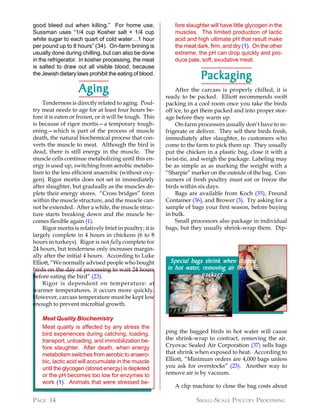
Elliott, “We normally advised people who bought           Special bags shrink when dipped
birds on the day of processing to wait 24 hours          in hot water, removing air from the
                                                                water,              from
before eating the bird” (23).                                          package.
    Rigor is dependent on temperature: at
warmer temperatures, it occurs more quickly.
However, carcass temperature must be kept low
enough to prevent microbial growth.

    Meat Quality Biochemistry
    Meat quality is affected by any stress the
    bird experiences during catching, loading,           ping the bagged birds in hot water will cause
    transport, unloading, and immobilization be-         the shrink-wrap to contract, removing the air.
    fore slaughter. After death, when energy             Cryovac Sealed Air Corporation (37) sells bags
    metabolism switches from aerobic to anaero-          that shrink when exposed to heat. According to
    bic, lactic acid will accumulate in the muscle       Elliott, “Minimum orders are 4,000 bags unless
    until the glycogen (stored energy) is depleted       you ask for overstocks” (23). Another way to
    or the pH becomes too low for enzymes to             remove air is by vacuum.
    work (1). Animals that were stressed be-
                                                            A clip machine to close the bag costs about

PAGE 14                                                              SMALL-SCALE POULTRY PROCESSING
$650 and speeds up packing. Kuhl Corp. (2)            fresh.
sells a smaller hand-held clipper. According to       • Dry tray packs: The meat is packed on
                                                          overwrapped trays. Only the top quarter inch
                                                          of meat is frozen (“crust frozen”) to help in-
                                                          sulate the product. Shelf life is 21 days (when
                                                          stored at 28° F).
                                                      •   Bulk ice packs: Meat that is destined for whole-
                                                          sale and restaurants is packed in boxes of 40
                                                          and 70 pounds with ice on top. There are
                                                          drainage holes in the boxes. The shelf life is
                                                          7 days (when stored at less than 39° F). Modi-
                                                          fied atmosphere packaging (MAP) may be
             Packages and plastic crates                  used in large plants to increase shelf life. Bulk
                                                          packaging may use CO2 snow to increase
                                                          shelf life to 14–21 days and eliminate the nui-
Elliott, ”Tipper Tie, a good packing machine that
                                                          sance of water dripping. However, CO2 can
pulls a vacuum and drops a clip on the bag and
                                                          be a hazard to work with. Other gases such
cuts off the excess bag, can be purchased for
                                                          as N2 and O2 are used with a vaccum and
around $5,000” (23). Expensive vacuum bag-
                                                          back flush to increase shelf life up to 28 days
ging machines can cost up to $60,000 and are
                                                          (stored at 28-32 F) (7).
not necessary for most small processors. The
shelf life of vacuum-packed poultry is usually
5–12 days (1).                                                           Storage
    In addition to individual packaging, small
processors also pack birds on ice in plastic crates
that the customers return.
    Dry tray packs—good for retail trade (in dis-
play cases)—may be an option for small proces-
sors. The bird is placed on a pad in a styrofoam


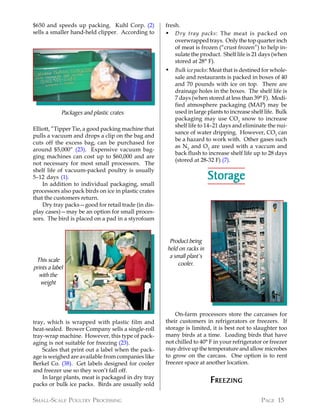
                                                       Product being
                                                      held on racks in
                                                       a small plant’s
 This scale
                                                          cooler.
prints a label
  with the
   weight


                                                          On-farm processors store the carcasses for
tray, which is wrapped with plastic film and          their customers in refrigerators or freezers. If
heat-sealed. Brower Company sells a single-roll       storage is limited, it is best not to slaughter too
tray-wrap machine. However, this type of pack-        many birds at a time. Loading birds that have
aging is not suitable for freezing (23).              not chilled to 40° F in your refrigerator or freezer
    Scales that print out a label when the pack-      may drive up the temperature and allow microbes
age is weighed are available from companies like      to grow on the carcass. One option is to rent
Berkel Co. (38). Get labels designed for cooler       freezer space at another location.
and freezer use so they won’t fall off.
    In large plants, meat is packaged in dry tray
packs or bulk ice packs. Birds are usually sold
                                                                         F REEZING

SMALL-SCALE POULTRY PROCESSING                                                                 PAGE 15
Although U.S. consumers are accustomed                    Bone darkening is sometimes seen in young
to buying poultry fresh—80% of poultry is sold             chickens after freezing. “This shows as a dark/
fresh (5)—freezing will extend the shelf life.             bloody appearance of the tips of the bones and
Meat does not freeze until it gets below 28° F             muscle areas close to bone. Myoglobin squeezed
because of its salt content, which suppresses the          out from the bone marrow, through the relatively
freezing point. Poultry meat kept above 26° F              porous bone structure of young chicken, during
can still be marketed as fresh (5).                        the freezing process causes this” (1). It is usu-
     Frozen poultry will stay flavorful for about 6        ally seen around the leg, thigh, and wing bones,
months, but after that it may become rancid.               and is unappealing to consumers (1).
Don’t store poultry for more than 12 months
(1). Freezing does not kill all the microbes; some
will survive and grow after thawing.
                                                                       Deliver y and
                                                                       Delivery
    Storage recommendations:
                                                                       Distribution
    •   At 10° F, limit storage to 2 months.                   For on-farm processing, there is usually no
    •   At -0.4° F, limit storage to 4 months.             delivery: customers come to the farm. However,
                                                           some producers deliver to farmers’ markets or
    •   At -11° F, limit storage to 8 months.              other places in iced coolers. Small plants may
    •   At -22° F, limit storage to 10 months (1).         have a refrigerated truck or trailer.


  The rate of freezing affects the meat:
                                                                           Clean-up
• Slow freezing (3–72 hours) results in large ice              On-farm processors usually clean with water
  crystals, which damage cells and membranes.              hoses, using hot water and soap, followed by a
  Upon thaw, there is more drip loss.                      water rinse and a sanitizing rinse. Small and large
• Fast freezing, which lowers temperature to -             plants clean with pressure washers. When pro-
        22° F in 30 minutes, results in small crystals     cessing under inspection, written sanitation pro-
        (1).                                               cedures are required.


•
        Methods of freezing poultry include:
        Still air is a slow method used by home freez-
                                                                Waste Management
        ers.                                                    Waste from processing includes offal, feath-
•       Blast freezing uses cold air circulated by fans    ers, and blood. On-farm processors usually com-
        for rapid air movement. The industry uses          post their waste. ATTRA’s Farm-Scale Composting
        blast freezing to form a frozen crust on a prod-   publication provides a list of information re-
        uct to insulate it.                                sources and suppliers.
                                                                Small plants usually pay rendering compa-
•    Liquid immersion or spray: the product is im-
                                                           nies to pick up barrels of waste, often at a flat
     mersed in a freezing liquid (1).
                                                           rate (the same price whether they pick up one
     The packaging material used for frozen meat           barrel or several). Because of the high expense,
should be strong, because the meat will dehy-              some processors are considering switching to
drate and get freezer burn if exposed to cold air          large-scale composting or to incineration.
(1). Some bags are made for cooler use and some                 Small processors are also exploring ways to
for freezer use. One on-farm processor recom-              market the waste as natural pet food, raw or
mends a bag of at least .002 mil thickness (39).           cooked. There are websites such as <http://
The material should be moisture-proof and                  www.willowglen.com/barf.htm> that describe
stretchable so that it will cling to the meat (1). If      feeding dogs “Bones And Raw Food” (BARF).
meat will be frozen for a long time, it is better to       Large plants usually render wastes, turning them
vacuum-pack it. This removes the insulating air,           into a by-product such as pet food or meat- and
makes a skintight package, and prevents water              bonemeal for livestock or fish.
evaporation and ice formation inside. Removing
the oxygen also helps reduce oxidation and ran-                            WASTEWATER
                                                                            ASTEWA
cidity (1).

PAGE 16                                                                SMALL-SCALE POULTRY PROCESSING
A lot of water is used in processing, espe-               residue, like fats and fine solids.
cially for scalding, washing carcasses, chilling, and      •     FOG: Fat, oil, and grease content is determined
clean up. Large plants use about eight gallons                   by extracting the FOG from wastewater
per bird. The wastewater “cannot simply be dis-                  with an organic solvent (5).
charged into lakes and rivers because of the rela-               There are standard lab procedures for making
tively high content of organic matter such as pro-         these wastewater measurements.
tein and fat and the microorganisms present” (1).                How dirty is the wastewater in a small plant?
     On-farm processors often apply the waste-             The chart below indicates the amount of BOD and
water to a garden. Small-plant processors may              SS typical for plants in 1962—a time when there were
discharge into a municipal sewage system, but a            still many small plants. Two important questions
municipality can charge high fees for treating wa-         should be considered.
ter with a lot of organic matter. Some initial treat-      • Is the blood recovered? Blood has high pollu-
ment at the plant will lower this cost. In fact,
                                                                 tion potential (15 lbs BOD per 1,000 birds)
most large plants—and some small ones—have
                                                                 (40). Therefore, most plants try to recover or
extensive water-treatment facilities. At large
                                                                 catch as much blood as possible, so it does
plants, water and its associated treatment as
                                                                 not become part of the wastewater.
waste costs $5.00 per 1,000 gallons (5).
     Methods for measuring the contents of waste-          •   Does the plant have a flow-away system? Flow-
water include:                                                 away systems use large amounts of water to
                                                               remove feathers or offal.
• Biochemical oxygen demand (BOD) measures
     the amount of oxygen con-
     sumed by microbes as they
                                                                                      W ASTEWATER
                                                                                        ASTEWA
     digest organics in wastewa-                                                      T REATMENT
                                                                                        REATMENT
     ter. This measurement re-                                                          Treating wastewater starts
     quires five days to complete.                                                 with screening out big chunks
     If wastewater entering a river                                                and ends with the breakdown
     or lake had a high BOD, mi-                                                   of dissolved organic matter by
     crobes would rapidly deplete                                                  microorganisms. Treatment
     the oxygen, and fish and other                                                methods must be able to
     aquatic life would not have                                                   handle fluctuations in waste
     enough oxygen to live.                                                        load, which can vary depend-
• Chemical oxygen demand                                                           ing on what is occurring in the
    (COD) is a similar test that The access to an underground fat                  plant (e.g., slaughter, clean-
    takes only a few hours.                        trap in a small plant.          up, or downtime). Treatment
• Suspended solids (SS) measures nonfilterable                 also takes into consideration the use of cleaning
                                                                          agents in the plant.
                                                                              Preliminary treatment removes
   Table 3. Processing Plant                                              large particles by screening.
 Waste Loads per 1000 Chickens                                                Primary treatment removes small
                                                                          particles suspended in the water. Fats
                           Wastewater                    Suspended        and fine solids are removed by means
       Type of Plant         in gallons BOD, lbs solids, lbs              of fat traps or dissolved air flotation.
 Flow-away                      7000                                            • Fat traps work on the prin-
  With blood recovery                           25            13                    ciple of gravity separation in
                                                                                    a flow-through tank. Heavy
  All blood wasted                              41            23
                                                                                    solids (dirt, crop content)
 Non-flow-away                  4500                                                settle out on the bottom,
  With blood recovery                           23            12                    while fat and fine solids rise
  All blood wasted                              35            21                    to the surface. A moving belt
                                                                                    with paddles scrapes the sol-
               As cited in Tanner, James Jerrel. 1970. A Wastewater
                  Characterization of the Poultry Processing Industry.              ids off the bottom, moving
                       Master’s thesis, University of Arkansas. p. 20.              them to a collection area.

SMALL-SCALE POULTRY PROCESSING                                                                        PAGE 17
The solids are then removed        materials).
                   by pump. Floating material              Tertiary treatment removes odors and color
                   is skimmed off the top with a      from the water. Sand and coal filters are com-
                   continuous-skimming device         monly used.
                   (1).                                    Disinfection, using chlorine and hydrogen
          •     Dissolved air flotation uses micro-   peroxide to kill pathogens, is the last stage of
               bubbles to speed the rise of light-    treatment. The wastewater is then discharged,
               weight particles to the surface—       either into a stream or sewer or onto land.
               the bubbles attach themselves to            Sludge from biological treatment is most of-
               the suspended material and lift it.    ten buried at landfills, spread on land, or dried
               Chemicals can be added to make         and incinerated (40). It can also be composted
               the process more efficient.            (1).
                                                           When planning waste management, it is criti-
    BOD is reduced by 30% in primary treat-
                                                      cal to be aware of federal, state and county regu-
ment. Energy costs are low since gravity and
                                                      lations regarding waste disposal.
flotation do much of the work (1).
    After primary treatment, the wastewater is
either discharged onto land (“land treatment”)        Equipment and Supplies
or given secondary treatment. Land treatment
requires large tracts of land, but has several ad-         Since birds are small, processing them
vantages: both plant nutrients and water are re-      doesn’t require a saw, track, or other heavy-
cycled, surplus nutrients can be removed by           duty equipment needed for slaughtering larger
crops, and the methods used—irrigation, over-         animals. Equipment used by on-farm proces-
land flow, and high-rate percolation—are rela-        sors includes poultry crates, killing cones,
tively inexpensive to install and operate. Land       scalder, thermometer, picker, stainless steel evis-
treatment may not be an option near urban areas       cerating tables or shackles, and a chill tank.
because of odor and drift (40).                       Plastics, including the water hoses, should be
    Secondary treatment puts biology to work—         food-grade. Many sources of this equipment
microorganisms break down the organic matter          have already been discussed.
suspended in the water. The result is the growth           Large-scale plants use costly automated
of microorganisms and production of gases such        equipment that is highly specialized. Industry
as carbon dioxide. Biological treatment is used       magazines list equipment suppliers. An Internet
because it is easier and cheaper to filter out the    search for poultry processing equipment will also
microorganisms than the suspended organic mat-        yield suppliers and prices. Information on used
ter (1). Biological treatment can be aerobic or       equipment is available at the Equipment Ex-
anaerobic.                                            change Company of America, Inc. (41). An ex-
• Aerobic lagoons rely on microorganisms that         cellent opportunity to view automated equipment
    use oxygen, so these lagoons use mechanical       is at the annual International Poultry Exhibition
    aerators to help keep oxygen in the water.        in Atlanta; information is available through the
    The lagoons are usually 10 ft deep. The total     U.S. Poultry and Egg Association (42).
    BOD reduction is 70–90%. The solid sludge              Small equipment and supplies include
    can later be removed in a polishing pond.         sanitizers, brushes, soap, paper towels, buckets,
• Anaerobic lagoons do not use oxygen. Fermen-        pans, brooms, mops, knives, pinning knives, lung
    tation produces methane and carbon dioxide        puller, ice, scales, bags, staples, clips, plastic
    (as in a cow’s rumen). Anaerobic lagoons          gloves, metal mesh gloves, hair nets, aprons, rub-
    cost less because mechanical aerators are not     ber boots, etc. Koch Supplies (35) sells many of
    required. BOD is reduced by 60 to 80% in 1        these items.
    to 3 weeks (when temperature is greater than           On-farm processor Karen Black in Oregon has
    72° F).                                           this to say about knives:
    Another form of biological treatment is a
“trickling filter.” Wastewater is aerated as it          I use a Heinkel paring knife (about 2" long
passes over a large surface area (rocks or other


PAGE 18                                                           SMALL-SCALE POULTRY PROCESSING
with a reverse curve) for killing, and a 3"          weighing 17 lbs. to big toms weighing over 40
   knife for eviscerating. I really like the            lbs. The range in weight is so great that turkey
   Heinkel’s because they are stainless, hold an        processing is usually not automated, even in large
   edge well, and have a good grip that doesn’t         plants. Turkeys are also very heavy, an impor-
   slip in my wet hand. They are pretty                 tant consideration for manual slaughter, especially
   expensive, and I’m sure there are less-              if you do not have an overhead track. Feathers
   expensive knives that do a fine job.                 and crops are harder to remove, and more ice is
                                                        required.
   I also bought a Chef’s Choice electric sharp-
                                                            Processing plants in France that participate
   ener, and now all my work knives are kept
                                                        in the Label Rouge program may process a num-
   sharp (a steel at my worktable keeps the edge
                                                        ber of types of products. For example, Fermier
   honed while I work). It’s gotten to the point
                                                        Landes processes chicken, guineafowl, squab,
   where I can feel when the knife needs a little
                                                        cockrels, and rabbits, as well as capons and tur-
   steeling.
                                                        keys for Christmas. The birds are processed in
   Here’s a website that has a lot of useful informa-   different ways: ready-to-cook, efilee, or feet and
   tion about sharpening knives: http://www.            head left on. Efilee is a specialty dressing; the
   ameritech.net/users/knives/index.htm (43).           bird is eviscerated but the crop is left in. The
                                                        feet and heads are often left on the carcasses of

      Processing Diverse
      Processing                                        specialty poultry so that customers can verify
                                                        the color of the shanks and feathers. Even
                                                        though Fermier Landes is a large plant, they put
           Species                                      together small orders and do custom process-
                                                        ing.
    Because they slaughter manually, on-farm and
small-plant processors can handle a wide variety          Multispecies processing
of poultry. In addition to broilers, they may pro-
                                                          In Kansas, Diana Endicott (44) processes
cess large roasters and stew hens and small Cor-
                                                          beef, pork, and poultry in the same plant.
nish game hens, or other poultry species, such as
                                                          She says it can be difficult to “cash-flow” a
turkeys, ducks, geese, quail, squab, guineafowl,
                                                          plant on poultry alone. Endicott keeps the
and pheasant. In contrast, large plants cannot
                                                          products separate by processing on differ-
handle much diversity because their automated
                                                          ent days and using separate equipment,
equipment fits one size only. Large plants may
                                                          aprons, etc. Rabbits and specialty poultry
have two separate lines: for example, large birds
                                                          are sometimes processed in the same plant.
(6.5 lbs) for further processing and small (3.4 lb)
                                                          Keep in mind that regulators in your state
birds for fast-food restaurants.
                                                          may not allow—or may just be unfamiliar
    Turkeys vary widely in size, from small hens
                                                          with—multispecies processing.


                                                           Batch vs. Continuous
                                                                Processing
                                                                Processing
                                                            Birds are processed in batches during manual
                                                        processing on the farm and at small plants. Pro-
                                                        cessors usually do one activity at a time. For
                                                        example, all the birds may be killed, eviscerated,
                                                        and chilled during the first hours of operation,
                                                        and packaged during the last hours. Workers
                                                        usually perform a variety of duties. On the other
                                                        hand, large plants use automated, in-line equip-
          Plants may process a diversity of             ment for continuous processing, killing birds
                                                        throughout the day. Workers usually perform
                 species in France.

SMALL-SCALE POULTRY PROCESSING                                                                  PAGE 19
only one duty over and over.

         Processing R ate
         Processing Rate
    The rate of processing depends on the work-
ers, the equipment, and the set-up. The work-
ers’ level of proficiency is especially important.
Eviscerating is usually the most time-consum-
ing part of manual processing, but an experi-
enced worker can eviscerate two birds per
                                                                  A typical on-farm
minute. Manual cut-up and deboning requires                       processing setup.
skilled labor.
    The type of equipment you buy depends on
                                                          day is not a sign of commitment and a good
your chore cycle: whether you process a few
                                                          work ethic; it’s a symptom of bad management.
birds often or a lot of birds infrequently. How-
                                                          Heroic efforts aren’t called for except in a crisis.
ever, if the scalder is too small, it will cause a
                                                          Processing day shouldn’t be a crisis – it should
bottleneck down the line.
                                                          be something to look forward to (45).”
    There are other limiting factors. If your over-

                                                                 Processing Setup
head track is not motorized, the speed at which
the plant operates will be no more than the speed                Processing
of the slowest person. Is your cooler or freezer
large enough to allow you to process daily? Can               Processing can be done on-farm, at a live
you empty it daily? Set-up is discussed in the            market in a city, in a mobile processing unit, or
next section.                                             in a processing plant.
    Typical processing rates:                                           O N- FARM S ETUP
• Working alone with minimal equipment: 6
    birds per person per hour.                                On-farm processors usually work outdoors,
                                                          under a tree or in a shed. They use existing out-
• Using equipment that handles at least 4 birds           buildings or build a dedicated area, often just a
    at a time: 15 birds per person per hour.              concrete pad with a shed roof. These are gen-
    Good layout, design, and standard operating           erally not enclosed areas and are rarely screened
procedures in a small plant can improve effi-             to keep out insects.
ciency.                                                       An on-farm processing setup usually in-
    Tip: The rates for equipment are sometimes            cludes a combination of new, used, and home-
given in terms of eviscerating speed. When evalu-         made equipment. Costs range from $100 to $500
ating processing rates, find out what the estimate        for minimal equipment up to $4000 for a spe-
includes. Is it for evisceration only, “kill-to-chill,”   cialty line such as the one offered by Brower for
or does it also include set-up, packing, storing,
clean up, and paperwork time? The numbers
above include all of these.
    When processing turkeys on-farm, Marcey
Nameth found that although the evisceration time
was comparable to that for chickens, “everything
else was slower.” Her scalding and picking equip-
ment could handle 12 to 16 broilers in one batch
but only two turkeys. She could process only one-
third the number of turkeys compared to broil-
ers. “I found turkeys to be exhausting work. At
least this year I wasn’t shredded by their feet—
last year my shirts were torn to pieces.”
    Processing poultry can be hard work. Robert
Plamondon has this to say about on-farm pro-                      An on-farm setup with a concrete pad
cessing: “Exhaustion at the end of a processing                             and shed roof.

PAGE 20                                                                SMALL-SCALE POULTRY PROCESSING
pastured poultry production. According to Tim           have typically been used with game animals or
Shell, “A 100 bird/hour scalder can be built for        tribal processing of large animals, but interest is
less than $100. A two-bird picker is less than          growing for poultry MPUs. Most MPUs for poul-
$1000, used stainless steel tables and chill vats       try cost $7,000 to $12,000 to outfit, and the capac-
are cheap at second hand restaurant supply              ity is about 400 birds per day.
dumps. You can get set up very well in pro-                  Examples of active MPU groups include:
cessing for $2000 if you already have the shed on       • The Northeast Pastured Poultry Association
the farm to process in (46).” Crews are anywhere             MPU (48) was built with help from the non-
from one to six people.                                      profit Heifer International.
    Upgrading equipment is a common strategy
                                                        • The Nebraska Pastured Poultry IMPACT
for on-farm processors. Many start out with mini-
                                                            group (47) has a 15-minute video.
mal equipment, sell it, and buy a better set of
equipment. It is usually not difficult to resell        • The South-Central NY RC&D’s MPU is pho-
                                                            tographed and described at http://
                                                            www.ibiblio.org/farming-connection/graz-
                                                            ing/pastpoul/resource.htm; the lay-out is in
                                                            Appendix A. Contact Jim McLaughlin (49)
                                                            for details.
                                                            The MPUs listed below have government li-
                                                        censing—something few have, since meat inspec-
                                                        tion authorities are not accustomed to them.
                                                        • Tom Neuberger (18) has a federally exempt
                                                            MPU in South Dakota, an 8’ x 48’ refriger-
                                                            ated truck that cost $25,000 to outfit.
                                                        • The Wagbo Peace Center (50) in Michigan has
                   A typical mobile processing              a state-licensed MPU that serves 12 families.
                         unit for poultry.              • The Island Grown Farmer Cooperative (51)
                                                            in Lopez Island, Washington, has broken new
                                                            ground with a red meat MPU that is feder-
used equipment.                                             ally inspected.
    On-farm facilities have limitations. The facil-     • Terry Swaggerty’s collaborative group in
ity lies unused for several months of the year,             Washington (52) has a grant to build a licensed
since it is too cold in winter to process outdoors.         poultry MPU.
Also, it is not legal in some states to sell meat
from on-farm facilities.                                  Kentucky MPU Case Study
           L IVE M ARKET S ETUP                           The nonprofit organization Heifer International,
                                                          along with Partners for Family Farms and the
    At live markets in larger cities, birds are sold
                                                          Kentucky Department of Agriculture, built an
live to consumers, usually from ethnic groups.
                                                          MPU in Kentucky and has served as a guide
After a customer chooses a bird, it is processed
                                                          for others. The MPU is a federally exempt
at an on-site facility, usually state-licensed. These
                                                          facility that is licensed by Kentucky’s Cabinet
facilities generally process only about 50 birds
                                                          for Health Services and cost about $70,000
per day. The customer has the option of taking
                                                          to build. It is an enclosed gooseneck trailer
home the head, feet, and blood along with the
                                                          20’ long and 8’ wide that can be pulled with a
carcass.
                                                          half-ton truck. The trailer has a collapsible
 MOBILE PROCESSING UNIT (MPU)                             canopy that extends on one side to make a
                                                          screened area for killing, scalding, and pick-
             S ETUP                                       ing. The carcass is then passed inside the
   MPUs are a way for producers to work co-               trailer through a small door for evisceration.
operatively, sharing equipment and labor, with
portable equipment mounted on a trailer. MPUs                                        Continued on page 22


SMALL-SCALE POULTRY PROCESSING                                                                   PAGE 21
Continued from page 21                                 and take down. See Appendix B for the lay-
 The trailer is air-conditioned inside and has          out of the Kentucky MPU. Steve Muntz and
 hot and cold water. It has a capacity of 500           Jeff Dombroskas of Heifer International (53)
 birds per day.                                         are contacts.
 The Kentucky MPU can only be used at ap-
 proved docking stations with a level pad to
 park the unit and another concrete pad that is
                                                                 SMALL PL ANT SETUP
 sloped to drain for the slaughter area. Appro-           Small plants are generally specialized build-
 priate electrical, water, and propane hookups        ings; however, some small plants are former dairy
 are required. Electrical requirements are a          parlors or other renovated buildings.
 200 amp service panel that is either water-              Pickwick/Zesco Co. (11) can send you a
 proof or covered. Water must be from an ap-          booklet called Planning the Small Poultry Process-
 proved municipal source or a tested well, and        ing Operation that includes equipment plans for
 flow rate must be at least 10 gallons per            four different volumes (50 birds/day, 50 to 200
 minute. The setup also requires a 750-gallon         birds/hour, 200 to 500 birds/hour, and 500 to
 grease trap and a 1500-gallon septic tank for        1200 birds/hour). This guide is also available
 wastewater. The wastewater holding tank              at the following website: <http://www.zesco-
 must have a float sensor with an alarm or light      inc.com>. Brower Co. (3) can send you plans
 as a fill indicator, and the water must be           for processing 400 birds/hour, 600 birds/hour,
 pumped out and hauled to an ap-                      and 1200 birds/hour; available at <http://
 proved wastewater treatment                                                 www.browerequip.com>.
                                                                             Small Plant Case
                                                                             Study: Luke Elliott
                                                                             Luke Elliott’s (23)
                                                                              USDA–inspected plant
                                                                              was designed to handle
                                                                              500 birds per day. The
                                                                           2,500-square foot plant
                                        The Kentucky MPU’s outside
                                                                           cost about $80,000, using
                                        kill area is screened; birds are   an existing building shell
                                               eviscerated inside.         that required concrete to
                                                                           be poured for the floor and
                                                                           all internal walls and ceil-
 plant. The MPU user must bring a 100-lb.               ings to be finished. If he had built it from the
 propane cylinder to provide heat for the               ground up, it would have cost $120,000. His
 scalder. MPU users take the feathers and               equipment cost about $45,000 (new) and was
 offal back to their                                                             rated for 150 birds per
 farms for composting.                                                           hour, but he actually
 The MPU has a rental                                                           processed less than
 fee and user agree-                                                            that during the course
 ment.      Producers                                                           of the day. In batch
 wanting to use it must                                                         processing, you need
 be trained as facility                                                         to finish the kill opera-
 managers. A manual                                                             tions in the morning to
 provides instructions                                                          allow sufficient time for
 for use and plans for                                                          chilling, packing, label-
 sanitation and avoiding                                                        ing, preparing for ship-
 the introduction of con-                                                       ment, cleaning up, and
 taminants into the                                                             doing paperwork later
                          Luke Elliott owned and operated a small USDA in the day. With a crew
 food. This MPU takes
 a lot of work to set up                 plant in Arkansas.                     of four, Elliott’s plant


PAGE 22                                                            SMALL-SCALE POULTRY PROCESSING
processed 18 birds per person per hour.              cellent resource for those planning a plant.
  The USDA inspection process was time-con-
  suming. Under bird-by-bird federal inspection,
                                                                  L ARGE P L ANT S ETUP
  Elliott could process only 200 birds per day.            Large, automated plants usually cost about
  Because of pre-operation inspection, he              $25 million and can process one million broilers
  couldn’t start killing before 9 a.m. The inspec-     per week. Industry uses three line speeds (SIS—
  tion process reduced line speed. Also, his           70 birds/min, NELS—91 birds/min, and High-
  overhead track was not motorized—“motor-             speed—140 birds/min or 8400 birds per hour).
  izing is a key factor to increase the produc-        Turkey plants are manual and process about 42
  tion capacity (23).”                                 birds per minute with a very large crew. If you
                                                       want to see what processing looks like at a large
                                                       plant, you may be able to arrange a visit or at
                                                       least buy slides for viewing. Layouts of large
                                                       plants are available in textbooks.

                                                                      Economics
                                                           Refer to Growing Your Range Poultry Business:
                                                       An Entrepreneur’s Toolbox for budgets for process-
                                                       ing on the farm, in an MPU, and in a small plant.
                                                           It costs at least $1.50 to process a bird in a
                                                       small plant. It only costs large processors about
                                                       $0.30 per bird for processing, because of in-
  Plants should have separate rooms for killing and    creased mechanization, greater scale econo-
evisceration to help prevent the edible product from   mies, better use of capacity, and more efficient
  being contaminated by raw or inedible products.      transportation and distribution.


                                                                      Resources
                                                                      Resources
      S MALL P L ANT LAYOUT            AND                 Most small processors recommend learning
            C ONSTRUCTION                              from an experienced processor. See ATTRA’s
                                                       Internships and Apprenticeships for a listing of farm-
    Plants are designed for efficiency, sanitation,    ers seeking interns; some of the farmers process
and adequate work space. For an outline of             poultry. Experienced small processors like Luke
work areas and design considerations for small         Elliott (23) and Aaron Silverman (6) offer con-
plants, see Appendix C. A sample floor plan is         sulting services for a fee.
also included.                                             Books on backyard poultry production de-
    The USDA used to print construction guide-         scribe the on-farm butchering process, especially
lines for plants intending to operate under in-        the evisceration. Pastured Poultry Profits (56), by
spection. However, the USDA no longer makes            Virginia poultry producer Joel Salatin, includes
prior approval decisions. It now relies on the         photographs that show how to eviscerate.
company, through the company’s Hazard                  Salatin’s video is also useful for learning to evis-
Analysis Critical Control Point (HACCP) plan,          cerate by hand.
to produce a product under sanitary conditions.            Some Extension materials that offer how-to
The last guidebook was U.S. Inspected Meat and         information for on-farm slaughter include:
Poultry Plants: A Guide to Construction and Lay-
out (54) from 1984. It applies to large and small
                                                       • Home Processing of Poultry, available from the
plants processing red meat or poultry.                     University of Minnesota Extension Service
    The Virginia Department of Agriculture and             (57) <http://www.extension.umn.edu/distri-
Consumer Services (55) offers the Establishment            bution/livestocksystems/DI0701.html>.
Design and Construction Guidebook, also available      •   Home Processing of Chickens, available from the
on-line at their website. The publication was              University of Nebraska Extension Service (58)
drawn from USDA information and is an ex-                  <http://www.ianr.unl.edu/pubs/foods/

SMALL-SCALE POULTRY PROCESSING                                                                   PAGE 23
heg144.htm>.                                          kansas.
•   Food*A*Syst: A Food Safety Risk Management        5)   Sams, Alan R. 2001 (ed.). Poultry Meat
    Guide for the Producer, with good sections on          Processing. CRC Press, New York, NY.
    processing setup and procedures, delivery              334 p.
    and storage, and disposal of waste, is avail-
                                                      6)   Aaron Silverman
    able from Kansas State Extension Service (59)
                                                           Creative Growers
    <http://www.oznet.ksu.edu/library/fntr2/
                                                           88741 Torrence Rd.
    foodasyst/foodasysbook.pdf>.
                                                           Noti, OR 97461
    Information on low-volume processing on a
                                                           541-935-7952
small commercial scale is hard to find. A disser-
                                                           E-mail: cgrowers@epud.net
tation titled Economics of Establishing a Low-Vol-
ume Poultry Processing Plant (60), written by a       7)   Owens, Casey. 2001 University of Arkan-
Michigan State student, examines four plants:              sas, Poultry Science Department,
with capacities of 200, 350, 500, and 1200 birds           Fayetteville, AR. Personal communica-
per hour.                                                  tion.
    Books about processing in large plants offer      8)   Plamondon, Robert. 2002. Re: Cleanli-
useful cross-over information:                             ness. E-mail posting to PasturePoultry
• Poultry Meat Processing (5), by Alan R. Sams             listserver. February 13.
•    Poultry Products Technology (61), by George J.   9)   Plamondon, Robert. 2002. Re: Domestic
     Mountney and Carmen R. Parkhurst                      Water Storage. E-mail posting to
•    Processing of Poultry (62), by G.C. Mead              PasturePoultry listserver. February 14.
•   Poultry Processing Systems (1), by Shari          10) Snyder Industries, Inc.
    Barbut                                                P.O. Box 4583
    In the past, the American Association of              Lincoln, NE 68504
Meat Processors (63) membership included                  402-467-5221
many small poultry processors. As the number              402- 465-1220 Fax
of small poultry plants grows, trade associations         http://www.snydernet.com
can help further their interests. The American        11) Pickwick/Zesco
Pastured Poultry Producers Association                    Chan Zuber, General Manager
(APPPA) (17) is one such networking resource.             7887 Fuller Road #116
                                                          Eden Prairie, MN 55344
              References                                  952-906-3333
                                                          952-906-3335
1)    Barbut, Shari. 2002. Poultry Processing             E-mail: Chan@zesco-inc.com
      Systems. CRC Press, Boca Raton. FL. 548 p.          http://www.zesco-inc.com
2)    Kuhl Corporation                                12) Ashley Company
      P.O.Box 26                                          P.O. Box 2
      Flemington, NJ 08822                                Greensburg, IN 47240
      908-782-5696                                        812-663-2180
      908-782-2751 Fax
      http://www.kuhlcorp.com                         13) Jako, Inc.
                                                          Kenneth King
3)    Brower Company
      P.O. Box 2000
      Houghton, IA 52631
      319-469-4141
      http://www.browerequip.com
4)    Tanner, James Jerrel. 1969. A Wastewater
      Characterization of the Poultry Processing
      Industry. MS thesis, University of Ar-


PAGE 24                                                          SMALL-SCALE POULTRY PROCESSING
6003 E. Eales Rd.                              Plucker. Tradesman Publications. 58 p.
    Hutchinson, KS 67501                           Order from:
    316-663-1470
                                                   Herrick Kimball
    E-mail: poultry@jakoinc.com
                                                   Tradesman Publications
    http://www.jakoinc.com
                                                   P.O. Box 1117
14) Eli M. Reiff                                   Moravia, NY 13118
    Poultry Man                                    315-497-9618
    RR #2, Box 484                                 $19.95
    Mifflinburg, PA 17844                          E-mail: Hckimball@baldcom.net
    570-966-0769
                                              21) Stromberg’s
15) David Schafer                                 P.O. Box 400
    56 SW 52nd Ave.                               Pine River, MN 56474
    Trenton, MO 64683                             218-587-2222
    660-359-6545                                  http://www.strombergschickens.com/
    E-mail: dna76@juno.com                        products/processing.htm
    dna76@grm.net
                                              22) Paul Helbert
16) R and R Pluckers                              12558 North Valley Pike
    Rob Bauman                                    Tenth Legion, VA 22815
    RD 1                                          540-896-7107
    Oxford, NY 13830                              http://home.rica.net/phelbert/
    607-843-7415                                  chickens.html
17) American Pastured Poultry Producers       23) Luke Elliott
    Association                                   P.O. Box 76
    PO Box 1024                                   Fox, AR 72051
    Chippewa Falls, WI 54729                      870-746-4604
    715-577-5966 (cell)                           Lelliott@mvtel.net
    Contact: Jody Padgham
                                              24) A-1 Refrigeration Company
    E-mail: Grit@apppa.org
                                                  11212 Wright Road
    http://www.apppa.org
                                                  Lynwood, CA 90262
    Membership is $20 per year and includes
                                                  323-979-2244
    quarterly newsletter Grit.
                                                  310-639-9910
18) Tom Neuberger                                 310-604-1596 Fax
    South Dakota Poultry Headquarters             800-669-4423 outside California
    Rt. 1, Box 303                                http://www.A1flakeice.com
    Canistota, SD 57012
                                              25) Kip Glass. 2001. Re: Chilling birds. E-
    605-296-3314
                                                  mail posting to PasturePoultry listserver.
19) Beck-Chenoweth, Herman. 1996. Free-           September 25.
    Range Poultry Production and Marketing.
                                              26) McKee, Shelly. 2001. Chilling difference.
    Back Forty Books, Creola, OH. Order
                                                  WATT Poultry USA. January. p. 18, 20,
    from:
                                                  22-23.
    Back Forty Books
    Natures Pace Sanctuary                    27) MBA Brand Smart Chicken
    Hartshorn, MO 65479                           333 South Third Street
    573-858-3559                                  P.O. Box 257
    $39.50 (plus $4.50 s/h)                       Tecumseh, NE 68450
    E-mail: Herm.NaturesPace@EarthLink.net        402-335-2501
    http://www.back40books.com http://            402-335-2502 Fax
    www.free-rangepoultry.com                     http://www.smartchicken.com
20) Kimball, Herrick. 2002. Anyone Can        28) Maple Leaf Foods Inc.
    Build a Tub-Style Mechanical Chicken          30 St. Clair Avenue West, Suite 1500

SMALL-SCALE POULTRY PROCESSING                                                      PAGE 25
Toronto, Ontario                                603-648-2595
    Canada M4V 3A2                                  E-mail: http://WebsterRidge.com/
    http://www.mapleleaf.com                      email.shtml
                                                    http://www.websterridge.com/recipes/
29) Linco USA, Inc.
                                                  brining.html
    6245 Shiloh Road, Suite A
    Alpharetta, GA 30005-8348                35) Koch Supplies
    770-844-8000                                 1411 West 29th St.
    E-mail: lincousa@mindspring.com              Kansas City, MO 64108
    Contact: Tom Tieleman                        800-777-5624
    120 Park Ave.                                816-561-9783 Fax
    Seaford, DE 19973-9479                       http://www.kochequipment.com
    302-628-9150
                                             36) Freund Container
    404-915-5732 (mobile)
                                                 155 West 84th Street
30) Stork Gamco Inc.                             Chicago, IL 60620
    Airport Parkway                              800-363-9822
    P.O. Box 1258                                773-224-8812 Fax
    Gainesville, GA 30503                        http://www.freundcan.com
    770-532-7041
                                             37) Cryovac Sealed Air Corporation
    770-532-5672 Fax
                                                 Building A
    Contact: Felipe Herrera
                                                 Rogers Bridge Road
    E-mail: f.herrera@gamco.storkgroup.com
                                                 Duncan, SC 29334
31) Meyn Food Processing Technology B.V.         Contact: Don Smith
    P.O. Box 16                                  800-845-7551 ext. 2969
    1510 AA Oostzaan                             800-662-9335
    The Netherlands                              http://www.cryovac.com
    31 (0) 75-6843355
                                             38) Berkel Company
    31 (0) 75-6844150 Fax
                                                 4406 Technology Drive
    http://www.meyn.nl
                                                 South Bend, IN 46628
32) Dr. Shelly McKee                             800-348-0251
    Department of Poultry Science                888-888-2838 Fax
    Auburn University
                                             39) Bentley, Jordon. 2002. Turkey-size
    234 Upchurch Hall
                                                 freezer bags. E-mail posting to
    Auburn, AL 36849
                                                 PasturePoultry listserver. October 22.
    334-844-2765
    E-mail: mckeesr@acesag.auburn.edu        40) Nielsen, V.C. 1989. In: Processing of
                                                 Poultry (ed. G.C. Meade). p. 361-412.
33) TRS Containers
                                                 Elsevier Applied Science, New York, NY.
    P.O. BOX 188
                                                 423 p.
    Avenel, NJ 07001-0188
    732-636-3300                             41) Equipment Exchange Company of
    732-750-1642 Fax                             America, Inc.
    http://www.trscontainers.com                 10042 Keystone Dr.
    http://shippingcontainers.com/               Lake City, PA 16423
    cstmized.htm                                 814-774-0888
    E-mail: TRScontainers@worldnet.att.net       814-774-0880 Fax
                                                 E-mail: info@eeclink.com
34) Brandon Sussman
                                                 http://eeclink.com
      1482 Pleasant St.
      Webster, NH 03303-7613                 42) U.S. Poultry and Egg Association


PAGE 26                                                 SMALL-SCALE POULTRY PROCESSING
1530 Cooledge Road                         51) Island Grown Farmers Cooperative
     Tucker, GA 30084-7303                          c/o Lopez Community Land Trust
     770-493-9401                                   360-468-3723
     770-493-9257 Fax                               Contact: Sandy Wood
     http://www.poultryegg.org                      E-mail: swood@rockisland.com
                                                    Contact: Bruce Dunlop
43) Black, Karen. 2002. Re: processing knife.
                                                    360-468-4620
    E-mail posting to PasturePoultry
                                                    E-mail: bdunlop@lopezislandfarm.com
    listserver. January 13.
                                                52) Terry Swagerty
44) Diana Endicott
                                                    985 S. Elm St
    Health Harvest Produce
                                                    Colville, WA 99126
    Rt. 1, Box 117
                                                    509-684-2588
    Bronson, KS 66716
                                                    E-mail: tswagerty@wsu.edu
    316-939-4922
    E-mail: allnatural@ckt.net                  53) Steve Muntz, Heifer International Appala-
                                                    chia Program Manager
45) Plamondon, Robert. 2001. Re: Processing
                                                    Jeff Dombroskas, Heifer International
    speed. E-mail posting to PasturePoultry
                                                    Appalachia Field Assistant
    listserver. May 17.
                                                    110 N. Maysville St., Suite 100
46) Shell, Tim. 2001. Digest number 212. E-         Mt. Sterling, KY 40353
    mail posting to DayRangePoultry                 859-497-0603
    listserver. May 18.                             859-497-0626
47) Dave Boslee                                     800-359-9581
    IMPACT                                          E-mail: steve.muntz@heifer.org
    402-462-9424                                    E-mail: jeff.dombroskas@heifer.org
      $22.50 for a 15-minute video                  http://www.heifer.org

48) Northeast Pastured Poultry Association      54) USDA FSIS. 1984. U.S. Inspected Meat
    (NEPPA)                                         and Poultry Plants: A Guide to Construc-
    c/o Hudson-Mohawk RC&D Council, Inc.            tion and Layout. Agriculture Handbook
    1024 Route 66                                   570. U.S. Government Printing Office,
    Ghent, NY 12075                                 Washington, DC.
    518-828-4385                                    U.S. Government Printing Office
    Co-chair: Judith Kelinberg 518-371-5592         Superintendent of Documents
                                                    U.S. Government Printing Office
49) Jim McLaughlin                                  Washington, DC 20402
    242 Dan Main Road                               866-512-1800 (toll free)
    Norwich, NY 13815                               202-512-1800
    607-334-2833                                    202-512-2250 Fax
    E-mail: jrmclaughlin@juno.com
    http://www.cornerstone-farm.com             55) Virginia Department of Agriculture and
    http://www.cornerstone-farm.com/                Consumer Services
    mpu.htm                                         Office of Meat and Poultry Services
                                                    1100 Bank St., Suite 614
50) Wagbo Peace Center                              Richmond, VA 23219
    5745 N. M-66                                    804-786-4569
    East Jordan, MI 49727                           http://www.vdacs.state.va.us/
    616-536-0333                                    meat&poultry/index.html
    Contact: Rick Meisterheim


SMALL-SCALE POULTRY PROCESSING                                                      PAGE 27
56) Salatin, Joel. 1993. Pastured Poultry           P.O. Box 269
    Profits. Polyface, Swoope, VA. 330 p.           Elizabethtown, PA 17022
    Order from:                                     717-367-1168
    The Stockman Grass Farmer                       717-367-9096 Fax
    P.O. Box 2300                                   http://www.aamp.com
    Ridgeland, MS 39158-2300                        E-mail: info@aamp.com
    800-748-9808
      Book $30 plus $4.50 s/h
                                                Appendices:
      Video $50
                                                Appendix A: South Central New York RC&D
57) University of Minnesota Extension Service     MPU Layout
    Office of the Director                      Appendix B: Kentucky MPU Layout
    240 Coffey Hall                             Appendix C: Small Plant Work Areas and De-
    1420 Eckles Ave.                              sign
    St. Paul, MN 55108-6068
    612-624-1222
    800-876-8636 (to order publications by
    credit card)
58) Extension Publications                      By Anne Fanatico
    IANR Communications & Information           NCAT Agriculture Specialist
    Technology
    Box 830918                                  Edited by Luke Elliott, Lance Gegner, and
    Lincoln, NE 68583-0918                      Richard Earles
    402-472-9712 (warehouse)                    Formatted by Gail M. Hardy
    402-472-0542 Fax
      Home Processing of Chicken
                                                May 2003
59) Production Services
    Kansas State University
    24 Umberger Hall
    Manhattan, KS 66506-3402
    785-532-5830 (10 or fewer titles)
    785-532-7938 Fax
60) Dhladhla, Vusumuzi. 1992. Economics
    of Establishing a Low-Volume Poultry
    Processing Plant: A Computer Application
    Design. Ph.D. Dissertation. University of
    Michigan, Ann Arbor, MI. 173 p.
61) Mountney, George J., and Carmen R.
    Parkhurst. 1995. Poultry Products
    Technology. 3rd Edition. Food Products
    Press, New York, NY. 446 p.
62) Mead, G.C. 1989. Processing of Poultry.
    Elsevier Science Publishing Co., Inc.
    New York, NY.
63) American Association of Meat Processors


PAGE 28                                                    SMALL-SCALE POULTRY PROCESSING
Appendix A. South Central New York RC&D MPU Layout
                                       PASTURED POULTRY
                                     MOBILE PROCESSING UNIT
                                              (MPU)

 South Central New York Resource Conservation and Development Project has been involved with the startup and
 expansion of Pastured Poultry Production in central New York since 1994. Through the SOCNY RC&D Office in
 Norwich, NY, funds were garnered to build a Pastured Poultry Mobile Processing Unit (MPU). The MPU was
 designed and built by SOCNY RC&CD staff to help demonstrate how to reduce off farm expenses incurred in the
 raising and processing of pastured poultry on the farm. This MPU allows small producers and those interested in
 raising pastured poultry access to the equipment necessary to undertake on-farm processing. The unit is available for
 a rental fee based on the number of birds processed and the distance traveled to deliver it.

 One of the important aspects of raising pastured poultry in a financially successful manner is to maintain low off-
 farm inputs. There are certain inputs that must be purchased off farm such as feed, and various manufactured items
 (i.e. poultry wire). However there are many on-farm resources that can be utilized other than grass (i.e. rough cut
 lumber, aluminum cage roofing, etc.). Pastured Poultry is a sustainable agriculture practice in that it returns to the
 land: fertilizer in the form of nitrogen; compost from the brooder bedding, and compost from the offal derived from
 the slaughtering process. A key component for successful economic return is to do all processing on the farm. The
 current rate for processing poultry in a New York State licensed facility is between $1.00 and $1.75 per bird. The
 average number of birds a couple can process on the farm with the correct equipment is 20 birds per hour; this
 equates to a $27.50/hour wage for home processed birds. In addition, the producer has the compost available for
 returning organic matter to the soil.

 The MPU consists of 5 poultry crates for containing live birds; 5 poultry kill cones to ensure correct bleeding; a
 scalder (capable of doing 4 birds at a time); a 3-4 bird barrel type feather picker; stainless steel table, processed bird
 chill tanks, knives and scales. A 20-foot long tarp is included to provide shade and protection from the elements.
 There are also hookups for 110 volt electricity and water. The 25-foot long unit can be towed to the desired location
 with a ½ ton pickup truck.

 Approximate construction cost for the MPU was $3000 not including 70 hours of labor. The initial idea was to use
 a camper trailer keeping the shell intact. The interior was to be gutted and the processing components mounted
 inside. It was hoped that leaving the shell intact would allow for processing in any weather condition. However,
 several problems arose as construction began. The first concern was that it would become too hot inside the trailer,
 as the scalder unit is propane fired and has to maintain a temperature of 145-150° F. The second problem arose when
 gutting the trailer. It soon became apparent that the floor and structural integrity left much to be desired. Other
 concerns were the problem of maintaining a sanitary environment and the necessary maneuverability due to the
 physical layout and size of the trailer. As a result, it was decided that it would be better to completely strip the trailer
 down to the frame. Expanded metal was then welded to the frame and additional angle iron for reinforcement was
 added. The various processing components were then attached, which allows the unit to be put into operation with
 minimal assembly. This design allows for more space and an open, comfortable work environment.

 The purpose of the MPU is to allow new producers the opportunity of processing poultry on their farm without having
 to purchase the equipment themselves. Purchasing processing equipment can cost several thousand dollars. The
 MPU is not intended to be used by producers year after year, but on a trial basis to help to meet the initial need.
 Currently the SOCNY RC&D Office is underwriting the cost of maintaining the equipment.

 Grant moneys provided by Heifer Project International, and the USDA-NRCS GRAZE NY Program, allowed this
 project to be completed. The Pastured Poultry Initiative is made possible through the support of Heifer Project
 International, which assists rural families in the United States, Canada and Countries throughout the world. For more
 information on the MPU, Heifer Project International, or GRAZE NY, contact the SoCNY RC&D office at 607-334-
 3231 Ext. 4 or 99 North Broad St., Norwich, NY 138125. E-mail: socnyrcd@norwich.net.

                                                                                       Appendix A continued on page 30

SMALL-SCALE POULTRY PROCESSING                                                                                    PAGE 29
Appendix A continued from page 29


                 PASTURED POULTRY MOBILE PROCESSING UNIT
                                Fact Sheet

 The Mobile Processing Unit (MPU) was conceived and designed for the on-farm processing of pastured poultry. It is
 intended to assist first year poultry producers with processing, helping producers learn safe and sanitary procedures.
 The MPU is not intended to be used by individual producers year after year, but as a trial to help producers start up
 their businesses.

 The MPU is capable of processing up to 40 birds and hour with experienced help. It consists of poultry crates for
 containing live birds, poultry kill cones to ensure correct bleeding; a scalder (capable of handling 3 to 4 birds at a
 time), a 3 to 4 bird barrel type feather picker; stainless steel table; chill tanks for processed birds; knives- and scales.
 A 20-foot long tarp is included to provide shade and protection from the elements. There are also hookups for 110
 volt electricity and water. The 25-foot long unit can be towed to the desired location with a pickup track. A ½ ton
 pickup truck with trailer light wiring and a 21-inch ball is necessary if the MPU will be picked up.

 The current cost for the use of the MPU for a Pastured Poultry Association Member first year user is $25.00 for the
 first 100 birds and 25 cents per bird over 100 birds and 31 cents per mile (round trip) for delivery. The cost for a
 second and successive year user is $35.00 for the first 100 birds and 35 cents per bird over 100 birds and 31 cents per
 mile (round trip) for delivery. The cost for non-members if $45.00 per 100 birds and 45 cents per bird and 31 cents
 per mile delivery.

 The unit is available for rent from May 1 through Oct. 15.

 The MPU is delivered to the farm clean and ready to use and must be clean upon pickup. This includes the kill cones,
 picker, scalder and tables. The unit must be free from feathers and viscera. Stainless steel and galvanized equipment
 must be washed completely with chlorine bleach prior to return. There is a $50 fee if the unit is not returned in clean
 condition. This requirement is for your health and safety, as well as for the continuation of on farm processing. It is
 imperative that we as producers and processors take the initiative to maintain absolutely sanitary slaughter conditions
 to insure that disease free poultry is being sold to the public.

 Reservations for use of the MPU must be made at least 4 weeks in advance to insure the processing date. The MPU
 will be scheduled on a first come first served basis. First time processors are entitled to a brief introduction of the
 MPU and equipment by a staff person. The introduction will cover proper killing, scalding, picking and evisceration.
 If you are a first time processor and would like this training please notify the RC&D secretary when the MPU is
 scheduled. Training is done the day of delivery.

 The costs for 1999 have yet to be established and may change. Any broken, damaged or missing equipment will be
 billed at the replacement cost to the producer. Mileage is based on the actual miles traveled, this may not necessarily
 be the way a producer would travel, but is left up to the discretion of the driver.

 For more information on the MPU, contact the SoCNY RC&D office at 607-334-3231 Ext. 4 or write to: 99 North
 Broad St., Norwich, NY 13815. E-mail: socnyrdc@norwich.net


                                                                                       Appendix A continued on page 31

PAGE 30                                                                          SMALL-SCALE POULTRY PROCESSING
Appendix A continued from page 30

             Material List for Chicken Spin Picker and Scalder/Dunker

 2X4 for frame

 1-55 gal. Plastic drum

 100 plucker fingers for drum and bottom plate

 1 – 1 ½ hp motor

 1 – 20” pulley for plate
 (Pulley sizes depend on motor you use)
 1 – 2” pulley for motor

 1 – aluminum disk that will fit inside of your drum for bottom spinner. Keep gap between drum sidewall and plate
 as small as possible. I have seen people use plywood with a piece of thin aluminum bolted to it.

 1 – 1 ¼” pipe approximately 12”

 1 – 1 ½” pipe approximately 12”

 Waterproof electric box and switch GFI.

 12/2 w/ground wire.

 1 – appropriate size v belt

 Misc. metal pieces.

                                                  Scalder/Dunker

 1 – 55 gal steel drum

 1 – 35 gal drum (to make cage for birds to go in) [or egg basket?]

 1 – propane fired unit. Can be purchased new or use an old hot water heater burner. You may also use electric
 heating elements (are more accurate)

 1 – reduction unit of you own choice. Examples: silo distributor drive, manure spreader reduction unit, snow
 blower or rototiller reduction unit, etc.

 Steel for frame

 2 2-3” pulleys

 Cable to run from reduction unit up to top pulleys then down to lowest point cage will be in tank

 4 – ¾” square stock for air space between drums.

 1 – appropriate size v belt

 Misc. metal pieces.


                                                                                 Appendix A continued on page 32


SMALL-SCALE POULTRY PROCESSING                                                                           PAGE 31
Appendix A continued from page 31


                                    Picker
                         SoCNY RC&D Picker Plan
                                                  Commercial rubber poultry
                                                  picker fingers


                                                                            1-1½ hp motor 110V


                                                                      Picker fingers

                                          Plate Top View
  2x4 wooden
  frame                                                               2x4
                                 Aluminum plate
            55-gallon plastic    in bottom of
            drum top and         drum w/picker
            bottom cut out       fingers spaced
                                                                      12”    1¼” pipe inside
                                 about 2” apart
                                                                      pulley 1½” pipe


                                                                    Appendix A continued on page 33


PAGE 32                                                         SMALL-SCALE POULTRY PROCESSING
Appendix A continued from page 32


                           Scalder/Dunker
                SoCNY RC&D Scalder/Dunker Plan
                                                                Pulleys


                          Metal Cable
                                                                   Metal cage to hold
                                                                   birds. Could be
                                                                   an egg basket.


 Use some type of reduction unit. We                               55-gallon drum cut
 used an old walk behind powered lawn                              1/3 off and 2/3 part
 mower and a 1-1/2-hp motor. Perhaps                               turned upside down
 a trans-axle from a lawn tractor.                                 and filled with
                                                                   water.


                                                                    Allow 1-inch air
                                                                    space in-between
                                                                    drum parts

          Gas burner                    1/3 of the drum is turned on end and the center
                                        is cut out, which allows a gas burner from an
                                        old water heater to be mounted on it. Used
          Mounting
                                        bottled LP gas from an old gas grill for fuel
          brackets
                     Burner Detail      source. Metal blocks are welded on top of
                                        base to allow airflow and stability.

                                        Designed and built by Bob Banta


                                                            Appendix A continued on page 34

SMALL-SCALE POULTRY PROCESSING                                                   PAGE 33
Appendix A continued from page 33


PAGE 34                             SMALL-SCALE POULTRY PROCESSING
Appendix B. Kentucky MPU Layout


SMALL-SCALE POULTRY PROCESSING                    PAGE 35
Appendix C. Small Plant Work Areas and Design
    The following outline of work areas and de-        has a stippled surface that may be washed
sign considerations is adapted from Poultry Prod-      down.” Ceilings generally need to be 10
ucts Technology (Mountney and Parkhurst, 1995).        feet high. Windowsills should be sloped at
You may be required to follow some of these            a 45-degree angle. The junction of floors
recommendations if you are operating under             and walls should be covered to a radius of
state or federal inspection or in a federally ex-      at least 2 inches. Windows, doorways, and
empt plant. Plants should be constructed to pro-       other openings should have screens to ex-
vide space for future expansion. The main point        clude insects and rodents.
of the design is to keep edible products from       • Plumbing: Prevent contamination from
coming in contact with raw or inedible prod-           cross-connections, back-siphonage, back-
ucts.                                                  flow, leakage, or condensation. Toilet soil
                 WORK AREAS                            lines should be separate from floor drain-
                                                       age lines to a point outside the building.
• Receiving and holding area: for unloading            Water should be delivered to convenient
   crates and hanging birds or putting them in         outlets for washing carcasses, walls, floors,
   cones.                                              and equipment. Pressure should be at least
• Dressing area: for killing, bleeding, scald-         30 pounds per square inch. According to
   ing, and picking.                                   Elliott, “You will want large water lines to
                                                       supply your plant. Even in small plants the
• Eviscerating area: for eviscerating, inspect-        main water line may be 1 ½ inches or more
   ing, and chilling; separated from the dress-
                                                       in diameter, and the feeder lines are typi-
   ing room by a wall.
                                                       cally 1 inch and no less than ¾ inch. De-
• Packing area: for packing and sometimes              pending on local codes, copper may be re-
   cutting up.                                         quired. All lines should be insulated and
• Refrigerated area: for chilling or freezing.         covered with a special plastic jacket to pre-
                                                       vent condensation from dripping on the
• Shipping area: for moving product onto
                                                       product. Exposed lines must be offset from
   trucks.
                                                       the wall or ceiling to allow cleaning and
• Other areas are needed for offices, inedibles,       washdown behind the lines.”
   cleaning, maintenance, toilets, dressing,
                                                    • Ventilation: Ventilation is required to re-
   lunch, and supplies.
                                                       move dust, moisture, and gases. “A filtered
       D ESIGN C ONSIDERATIONS
                 ONSIDERATIONS                         air positive-pressure type system provides
                                                       clean air from the outside and prevents re-
• Structural materials: These include concrete,        contamination with dust and dirt (Mountney
   brick, glazed tile, and steel.                      and Parkhurst, 1995).” A counter-flow air
• Floors: Floors are concrete, smooth for easy         system (from finished product area to raw)
   cleaning, and sloped to floor drains or cen-        is needed. Air conditioning or a fan and
   tral gutter drains to prevent water from pud-       duct system can be used. According to
   dling. Floors have an abrasive covering in          Elliott, “This is especially true in the kill
   wet areas to prevent slipping.                      room. I suggest a separate heating and cool-
                                                       ing and ventilation system for the kill room—
• Walls, ceilings, posts, and doors: Surfaces
                                                       it is a climate unto itself. A restaurant-type
   are smooth and impervious to water for easy
                                                       vent hood over the scalder is nice, with the
   cleaning. According to small processor Luke
                                                       ability to bring in outside air to the kill
   Elliott, “A common material used for walls
                                                       room.”
   and ceilings is glass board like what you
   may see in a restroom or a restaurant
   kitchen. The material comes in sheets and
                                                                     Appendix C continued on page 37


PAGE 36                                                         SMALL-SCALE POULTRY PROCESSING
Appendix C continued from page 36


 • Lighting: Lights should be covered with a
    nonshattering and watertight cover. Use at
    least 50 foot-candles in inspection areas.
 • Equipment design: Equipment should allow
    easy cleaning and inspection and safe op-
    eration. It should be installed for maximum
    efficiency to reduce reach distances and per-
    mit smooth hand motions patterns. Equip-
    ment used for inedible products must be
    marked. Slaughtering and processing
    rooms and toilets must have foot-pedaled
    hand-washing facilities with hot and cold
    water, soap, and individual towels.
 • Plant safety: Poultry processing has a high
    rate of accidents, so plan for safety. Fire
    extinguishers and first aid should be close
    by.

     Adapted from: Mountney, George J., and
 Carmen R. Parkhurst. 1995. Poultry Products
 Technology. 3rd Edition. Food Products Press,
 New York, NY. 446 p. With comments by Luke
 Elliott, Fox, Arkansas.

    See Attachment.


SMALL-SCALE POULTRY PROCESSING                      PAGE 37
Attachment
   Attached is a generic floorplan of a small plant, developed by Chan Zuber at Pickwick/Zesco.
The floorplan should not be considered approved for licensing; you should check with your state and
federal authorities for licensing.


PAGE 38                                                        SMALL-SCALE POULTRY PROCESSING
SMALL-SCALE POULTRY PROCESSING   PAGE 39
IP231/233

  The electronic version of Small-Scale Poultry
  Processing is located at:
  HTML
  http://www.attra.ncat.org/attra-pub/
  poultryprocess.html
  PDF
  http://www.attra.ncat.org/attra-pub/PDF/
  poultryprocess.pdf


PAGE 40                                           SMALL-SCALE POULTRY PROCESSING

Small-Scale Poultry Processing

  • 1.
    SMALL-SCALE POULTRY PROCESSING By Anne Fanatico NCAT Agriculture Specialist May 2003 Introduction Introduction A growing number of small producers are rais- ing poultry outdoors on pasture, processing the birds on-farm, and selling the meat directly to customers at the farm or at a farmers’ market. Many states allow up to 1,000 birds to be processed on a farm Photo by Paul Helbert each year and sold directly to consumers with no inspection. Some of these small producers are go- ing further—building government-licensed process- ing plants to supply regional or niche markets. Spe- cialty “religious kill” is often done in small plants. “Kosher” is the term for Jewish slaughter and “halaal” for Muslim slaughter. Access to processing is a critical issue for small producers. Consolidation in the meat process- ing industry has left very few small plants that will do custom poultry processing. (Large plants generally don’t process for small producers; they can’t keep track of a small batch of birds and can’t make money on small- volume orders.) This publication covers small-scale processing, both on- farm and in small plants. Relevant information on large-scale processing is also included for comparison, to provide con- text, and because small processors need to have some under- standing of how large-scale processing works. Related ATTRA publications Sustainable Poultry: Production Overview Growing Your Range Poultry Business: An Entrepreneur’s Toolbox This publication was developed by the National Center for Appropriate Technology (NCAT) (http://www.ncat.org) for Heifer International (http://www.heifer.org) with funds from Southern Region SARE. Distribution is provided free of charge to the public through NCAT’s ATTRA Project (http://www. attra.ncat.org), the National Sustainable Agriculture Information Service.
  • 2.
    Table of Contents Introduction................................................................................. 1 Table 1. Comparison of types of processing................................ 2 Pre-slaughter ............................................................................... 3 Immobilizing, Killing, and Bleeding ................................................. 4 Feather Removal ........................................................................... 6 Table 2. Scalding ..................................................................... 7 Removal of Head, Oil Glands, and Feet ........................................... 9 Evisceration ................................................................................. 9 Washing the Carcass ................................................................... 10 Chilling...................................................................................... 10 Cut-up, Deboning, and Further Processing.................................... 13 Aging ........................................................................................14 Packaging ..................................................................................14 Storage ..................................................................................... 15 Delivery and Distribution............................................................. 16 Clean-up ................................................................................... 16 Waste Management .................................................................... 16 Table 3. Processing Plant Waste Loads per 1000 Chickens ........ 17 Equipment and Supplies .............................................................. 18 Processing Diverse Species..........................................................19 Batch vs. Continuous Processing .................................................. 19 Processing Rate .......................................................................... 19 Processing Setup ........................................................................ 20 Economics ................................................................................. 23 Resources ..................................................................................23 References ................................................................................. 24 Appendix A. South Central New York RC&D MPU Layout ......... 29 Appendix B. Kentucky MPU Layout.......................................... 35 Appendix C. Small Plant Work Areas and Design ......................36 Attachment ............................................................................38 PAGE 2 SMALL-SCALE POULTRY PROCESSING
  • 3.
    Table 1. Comparisonof types of processing On-farm Small Large Size Outdoor or shed facility 2,000 to 3,000 sq. ft. 150,000 sq. ft. Equipment Manual Manual/Mechanical Fully automated Cost Less than $15,000 Less than $500,000 $25,000,000 Labor Family Family/hired Hired Capacity 50-100 birds per day 200-5,000 birds per day 250,000 birds per day Operation Seasonal; 1-30 pro- Seasonal or year-round; Year-round; process cessing days per year 50-plus processing days daily per year Marketing Product sold fresh, Mainly cut-up, sold sometimes frozen; Fresh and frozen, whole fresh, further-pro- whole birds and parts cessed Comments Independent operation; Independent or part of a Part of an integrated labor-intensive; low- collaborative group; operation including risk; usually non- requires good markets grow-out, processing, inspected, direct sales and grower commitments and marketing During the first part of the 20th century, poul- and the possibility of tearing it during process- try was sold live to consumers who did their own ing, which would cause fecal contamination of processing. In the 1930s, only the blood and feath- the carcass. Withholding the feed too long will ers were removed (“New York dressed”). As result in watery guts that leak. consumers demanded more convenience, the market grew for eviscerated or ready-to-cook CATCHING AND LOADING (RTC) birds. Large producers harvest all their birds at once Producing ready-to-cook poultry involves: (all-in, all-out). Small producers often “skim” by • Pre-slaughter: catching and transport harvesting larger birds and leaving smaller ones • Immobilizing, killing, and bleeding to grow. Birds are best caught at night or early in the morning when they are calm. For small • Feather removal: scalding, picking producers, picking birds up individually by the • Removal of head, oil glands, and feet sides is the best way to minimize stress and pre- • Evisceration vent injury. Of course, this is not feasible when you’re dealing with thousands of birds (1). In • Chilling large-scale production, chickens are caught by • Cut-up, deboning, and further processing grabbing both legs, just above the feet. No more • Aging than three birds should be carried in one hand. Crews of 10 people catch and crate birds at the • Packaging rate of 10,000 per hour, bruising up to 25% of • Storage them (1). In Europe, automatic harvesting ma- • Distribution chinery is increasingly used in large operations, because it is considered more humane than the rough treatment by catchers who handle several Pre-slaughter birds at once. Transport crates are wooden or plastic. A Broilers are usually processed at 4.5 lbs. live typical crate can hold about 8 birds in the sum- weight. Feed is withheld for 8 to 12 hours before mer and 10 in the winter, depending on their size slaughter to reduce the amount of feed in the gut and on the weather. The crates usually have a SMALL-SCALE POULTRY PROCESSING PAGE 3
  • 4.
    small opening, tohelp prevent escape during Once the birds reach the processing facility, loading, but a small opening also increases the it is important to keep them comfortable in the chance of physical injury to wings. Crowding of holding area. Scheduling arrival at the plant can birds in crates is another welfare issue. reduce waiting time. On-farm processors usu- Kuhl Co. (2) and Brower Co. (3) sell trans- ally hold crated birds under trees or other shade. port crates. Used crates are sometimes available The conventional industry typically produces at lower prices. Small producers sometimes birds within one hour of the processing plant. make their own wire crates from welded wire With two hours of travel, shrinkage or weight mesh and clips. loss is about 1% (4). In Europe, special modules are used on transport trucks for even air flow and good ventilation. Companies are fined for arriving with dead birds. Large processors keep crated birds in a holding shed with fans and mis- ters to keep them cool. Care must be taken when unloading the birds Catching and from the crates to prevent bruises and broken transport can bones. On-farm and small plants unload birds be stressful for by hand. At large plants, broilers are unloaded onto conveyor belts. Transport crates should be the birds. washed after each use. Catching, loading, transporting, and unload- ing expose birds to new environments and new sources of stress. This can negatively affect meat quality (see Aging section). During hauling, in particular, birds have to deal with heat or cold, feed and water withdrawal, motion, vibration, TRANSPORT, RANSPORT HOLDING, AND noise, and social disruption (1). UNLOADING Avoid holding birds in crates for too long or Immobilizing, Killing, transporting them when the weather is too hot, cold, or wet. With on-farm processing, there is and Bleeding little or no travel time. If you have to transport Small processors usually place birds in fun- in cold, wet weather, be sure to cover the birds— nel-shaped kill cones after removing them from small producers typically cover the crates with a crates; large plants hang them on shackles and tarp. stun them before killing. You will need a full-size pick-up or larger truck—200 birds in 25 crates weigh about 1250 An overhead track is used to move carcasses pounds. For more birds, you will need a trailer. through a plant. Keeping birds on-line through- If you need to transport 1000 birds at a time, you’ll out killing and dressing reduces labor since need a special vehicle such as a bob truck. there is no handling. In many small plants, you just push the shackle along; in large plants, the track is motorized. For on-farm processing, stainless steel kill cones, wrapped metal, or traffic cones are com- monly used. A bucket or jug with a hole screwed to a board will also work. Birds are not stunned before killing and will jerk a lot during bleeding. Cones should be the proper size, and the bird’s wings folded down when inserted, to prevent the Birds are crated and transported to bird from flapping its wings or backing out of processing in this trailer. the cone. Wing flapping can cause hemorrhages PAGE 4 SMALL-SCALE POULTRY PROCESSING
  • 5.
    in the muscleand broken bones (1). In large vides a uniform heartbeat for better bleeding, and plants, birds are hung on shackles in a dark room relaxes the feather follicles for easier picking (7). to help calm them and ease handling. Special Furthermore, stunning is considered more hu- lighting, such as blue, will also keep them calm mane than not stunning. U.S. law requires stun- and prevent flapping and injury (1). ning of other livestock, though not of poultry. There are several ways of cutting blood ves- In large plants, stunning works as follows. sels in poultry, the most common killing method. The heads of the birds are dipped into a saline In the conventional industry, the carotid arteries bath with an electric current, rendering them tem- and the jugular veins are cut on both sides of the porarily unconscious (1–2 minutes—enough time neck by a deep cut in the front. In kosher and for cutting and bleeding them to death) (7). The halaal slaughter, only one side of the neck is cut, current is low-voltage and low-amperage (about so the birds bleed more slowly. The spinal cord 20 volts, depending on bird size, for 3–5 seconds; should not be cut (as when the head is cut off), the amperage is 10–12 mA per bird) (7). because the feathers “set” and are hard to pick In Europe, stunning of poultry is required by (5). The esophagus should also not be cut, to law, and the stun, administered at higher volt- prevent microbial contamination from leakage. age and amperage, is irreversible—birds cannot recover. Another method of stunning, more com- mon in Europe than in the U.S., uses carbon di- oxide or argon gas to anesthetize the bird. Gas stunning is expensive, but is useful if you are processing a variety of birds, since it can be diffi- cult to adjust an electric stun for different spe- cies. There are relationships between stunning, killing, muscle metabolism, and meat quality. These interactions have been studied mostly with stunned birds killed in shackles, since that is the typical practice in large plants. Less is known about the effects on meat quality of killing in Making the cut. cones with no stunning. S TUNNING B LEEDING Stunning is not used in on-farm processing Small processors usually believe that the and is only sometimes used in small plants, where bleed-out is more thorough with no stunning. it is often impractical. Small-scale processor About 35–50% of the blood comes out of stunned Aaron Silverman (6) does not stun. “I don’t like birds, with the rest remaining mainly in the or- the idea of my employees using an electrical gans (1). Bleeding takes 1.5 to 3 minutes (7). implement in a wet environment.” According to According to industry thought, if the bird is not Silverman, if you do not stun, you should kill in stunned, the bleed-out is slower and not as com- cones to restrain the bird from convulsions and plete, because the bird is struggling and its or- wing flapping. In some specialty religious pro- gans are using blood. Maximum drainage of cessing, such as kosher and halaal, stunning is blood is desirable so there won’t be dark spots not permitted. However, stunning is very help- on the meat, especially on wing veins. ful when working with turkeys or geese because of their larger size. When using a stun gun, it is B LOOD RECOVERY critical to set it at the correct voltage—110 volts. On the farm, blood is collected in a bucket or If you do not adjust the stun correctly, birds will trough and used in composting; however, on a be over- or under-stunned. Over-stunning re- large scale, blood is a wastewater pollutant since sults in hemorrhages and broken bones. it contains a lot of organic matter. On a shackle Stunning is the norm at large plants. It im- line, blood can be collected in a blood tunnel that mobilizes the birds for the killing machine, pro- reduces splashing. SMALL-SCALE POULTRY PROCESSING PAGE 5
  • 6.
    On-farm processors usea single tank of hot Feather Removal water, usually scalding one to four birds at a time. Labor is saved when a mechanism such as a bas- S CALDING ket or arm dunks several birds together. In small plants, scalders with such a mechanism can handle Small processors remove the birds from the 12 birds at once. Some on-farm processors add killing cones for scalding. In large plants, the dish soap to the scald water to help it better pen- birds stay on the shackles. etrate the feathers and facilitate picking; others do not find this necessary. It can take a while to heat the Table 2. Scalding water in a small scalder to the right temperature, and it can be tricky to Types of Length of Temperature Comments maintain that temperature, especially Scald time when fresh water is added. Most on- Waterfowl 160-180°F 30-60 Needed for farm processors don’t replace the (very hard) seconds waterfowl water during processing for these Hard 138-148°F 30-75 Removes outer reasons. However, this can lead to seconds layer of skin another problem—the water gets too No Man’s 130-138°F Avoid: too hot to dirty. Some on-farm processors solve Land keep skin intact the dilemma by using two scalders but too low to at a time, rotating them as one reaches remove epidermis the correct temperature. Robert Plamondon in Oregon uses a water Soft 123-130°F 90-120 Keeps skin intact heater so he can replace the scalder seconds water as often as needed. “When (Adapted from Tanner, James Jerrel. 1970. A Wastewater you have to wait a half-hour for the Characterization of the Poultry Processing Industry. Master’s thesis, scalder to heat up, there is a tempta- University of Arkansas. p. 20.) tion to scald more birds than is wise” (8). Bigger scalders have an overflow Birds are scalded (immersed in hot water) to to add fresh water continuously. loosen the feathers. Heat breaks down the pro- Additional precautionary measures can re- tein holding the feathers in place (5). Scalding is duce filth in the scalder. Wet birds in the field very temperature-sensitive. can pick up manure on the skin and feathers and In the U.S., a hard scald is used by small and this material can end up in the scalder. Large large processors alike. It loosens the outer layer of skin, providing a better coating adhe- sion for fried foods (important for further-pro- cessing). After a hard scald, the skin must be kept moist and covered or it will discolor. A very hard scald is needed for waterfowl be- cause their feathers are harder to loosen. In Europe, soft-scalding is more common and used in conjunction with air-chilling (see the Air-chilling section below). The Label Rouge program in France, which focuses on gourmet meat quality, requires a soft scald. The skin remains intact and skin color is retained; how- ever, picking is more difficult. Scalding increases the body temperature of the carcass. In kosher processing, the bird is not scalded because it would partially cook the meat. As a result, the birds are harder to Aaron Silverman’s scalder (foreground) and picker handle pick. about 12 birds at a time. PAGE 6 SMALL-SCALE POULTRY PROCESSING
  • 7.
    plants may usea bird scrubber (large rotating at a time. The operator holds the bird above the brushes on either side of the bird) and also spray cylinder, rotating it as the cylinder spins and picks the birds with chlorinated water before putting off feathers. Drum pickers come in table-top or them in the scalder. free-standing models. A tub or batch picker is a While small processors use a single-stage, rotating tub with rubber fingers mounted on the static tank, large plants use long multiple tanks inside walls; it can handle 2–12 birds at a time. for multi-stage scalding. The tanks vary in tem- Small processors carry the birds to the picker. perature—the first is kept at a lower tempera- Large plants use continuous, in-line pickers that ture since it can take 2 minutes for the track to look like a tunnel with rubber fingers. Birds pass carry the birds through. In that time, they would through the tunnel on shackles. cook at 134° F. The tanks also have a countercur- rent flow of water, which produces a dirty-to- clean gradient. The scald water flows in the op- posite direction of the birds, so they are continu- ally moving to cleaner water. Overflow adds fresh water continuously. Water for processing It is important to have an adequate supply of potable water for processing. If you have well water, it needs to meet drinking stan- dards and should be tested. If the rate of water flow on your farm is slow, you may need to add a reservoir tank. Robert Plamondon put a sealed 1500-gallon plas- tic tank on a concrete slab close to his well. (He lives in a mild climate and does not have A producer is trained to use a drum picker. a freezing problem in winter or a heating problem in summer.) “The well pump pours Turkeys and older laying hens are harder to water into the top of the tank, and a second defeather, and waterfowl feathers are especially pump (a jet pump) takes water out of the hard to remove. Pinfeathers—immature feathers bottom of the tank” (9). He shock-chlori- still in the feather shaft—can be hard to remove nates occasionally and flushes residues out mechanically. Wax for removing pinfeathers is of the bottom (8). He bought the tank from available from Pickwick/Zesco (11). “Pinning” Snyder Industries, Inc. (10). is the removal of pinfeathers by hand. “Singe- ing” involves passing the bird through a flame to burn small hair-like feathers. Some on-farm pro- cessors use a propane torch to burn them off, P ICKING being careful not to burn the skin. The feathers of colored birds may leave spots of pigmenta- The quality of the pick is related to the scald. tion on the skin. Commercial poultry breeds have If the scald water was too cool, the feathers won’t white feathers that do not leave stains. Consum- loosen; if it was too hot, the skin will tear in the ers in the U.S. are accustomed to a carcass with a picker. But if it was just right, the feathers usu- clean, unspeckled appearance. ally come out easily and can even be removed by hand. However, hand picking is time-consum- ing. If you are planning to process very many Feathers are birds, you will need a mechanical picker. Re- removed by the Photo by Paul Helbert moving the feathers by abrasion, these machines abrasive action of can pick a bird clean in about 30 seconds (and rubber fingers in will sometimes break the wings). Some on-farm this tub-style processors skin the birds instead of removing the picker. feathers. A drum picker—a cylinder with rubber fingers around the exterior—defeathers one bird SMALL-SCALE POULTRY PROCESSING PAGE 7
  • 8.
    SCALDING AND PICKING EQUIPMENT companies have graveyards with used equip- ment, some being turned into scrap metal. Keep The companies Pickwick/Zesco (11), Brower in mind that while used equipment can help you (3), and Ashley (12) have supplied small-scale cut costs, it may not meet the specifications your poultry processing equipment for many years. facility requires. Small scalders (one bird at a time) cost less than $200 and small pickers less than $400. These com- panies also offer many larger models. A 12- to Homemade or Modified Equipment 16-bird scalder costs about $10,000. Making your own equipment is another way Some home businesses have emerged that sell to lower costs, but consider the time required relatively inexpensive processing equipment for to build or find parts. Again, make sure the on-farm processors. design and materials meet the specifications you require. But be forewarned that home- • Kenneth King of JAKO, Inc. (13) sells a rela- made equipment is not likely to meet federal tively low-cost scalder and tub picker of his or state meat inspection requirements. own design. Each piece costs $1,700, com- pared to about $3,000 each for comparable Homemade scalders: When first starting out, equipment from conventional suppliers. The some small-scale producers use a large picker has a plastic barrel. JAKO also sells a stockpot in the backyard heated with a fire. small table-top picker (Lil’ Pick) powered by On-farm processors have also used propane a hand drill for $125. burners (from outdoor turkey fryers), water- bath pots made for canning, and hospital ster- • Eli M. Reiff of Poultry Man (14) has equip- ilizers (common before the advent of the au- ment made in a local farm shop. He offers a toclave). A homemade scalder can be made rotary scalder for $1,895 and a tub picker for with a utility sink, a heating element, and a $1,395. He says comparable equipment sells thermostat for about $50 (19). On-farm pro- for $6,000. He also offers a smaller picker for cessors also make large insulated scalders $695. from old electric or propane water heaters. • David Schaeffer (15) has developed the Some even have a dunker. It is especially Featherman Jr., which picks three chickens important to use thermometers with home- or one turkey. It costs $715 with the motor (1 made scalders to ensure a constant tempera- hp 115 Volt Dayton) installed and $520 with ture. no motor. Schaeffer recommends pairing his For those making homemade equipment, it picker with the Ashley M-38 scalder (40,000 is very important to be aware of the danger BTU, 38 gallon tank, automatic temperature of electrocution. Scalders and pickers are control, $1250). used around water, which makes improperly connected electrical parts even more dan- • Rob Bauman of R & R Pluckers (16) builds gerous. Important safeguards include using pickers. a competent electrician, following electrical Note: Prices may have changed. code, installing ground fault circuit interrupt- According to on-farm processor Jenny Drake, ers (GFIs), and making sure the power cord “I KNOW the stuff is expensive, but you will is of sufficient gauge to handle the current. kick yourself over and over if you don’t get equip- Gas-powered water heaters are also used, ment designed for the scale of operation. We bit but there is an explosion risk. the bullet and bought JAKO equipment, and it Homemade pickers: Many have converted has been worth every penny.” old washing machines or plastic 55-gallon Small processors can look for used equipment drum into pickers. On-farm processor Herrick from sources such as Grit, the newsletter of the Kimball has written Anyone Can Build a Tub- American Pastured Poultry Producers Associa- Style Mechanical Chicken Plucker (20). He tion (17), or from Tom Neuberger of South Da- estimates that this type of picker can be built kota Poultry Headquarters (18), but availability for $500—much less than the typical $2,000. is limited. There may be old poultry processing He also moderates a listserver called equipment in your area from small plants of the past. Large plants in your area that are remodel- Continued on page 9 ing can be a source of used equipment. Large PAGE 8 SMALL-SCALE POULTRY PROCESSING
  • 9.
    for easy cleaningor a disposable plastic sheet). Continued from page 8 However, some on-farm processors use an indi- whizbangchickenpluckers, accessible at vidual shackle on a rack or stand, available from <http://groups.yahoo.com>. Photographs are Neuberger (18). According to small-plant pro- available. JAKO (13) and Stromberg’s (21) cessor Luke Elliott (23), it is easier and cleaner to sell picker fingers for about $1 each. eviscerate on shackles. For internet pictures of a scalder being built, On-farm processors and small plants eviscer- see Paul Helbert’s (22) webpage <http:// ate manually with scissors, knife, or a handheld home.rica.net/phelbert/tub.html>. vent-cutter gun with a circular blade, and draw out the guts by hand. Large plants use auto- mated machines that scoop out the guts; high- Removal of Head, Oil speed lines eviscerate 2,000–8,000 birds per hour (1). These automated lines are usually designed for one species, and uniformity in size is very Glands, and Feet Feet important for proper operation. For state and federal inspection, the guts usu- After feather removal, the heads, oil glands, ally remain attached. They can be separated but and feet are removed. On-farm and small pro- must remain alongside the bird so that the in- cessors usually cut the head off; large plants have spector can see both the inside and outside of machines that pull heads off so that the esopha- the bird as they look for disease or other prob- gus is also removed. lems. Inspection requires bright light, a Birds preen their feathers with an oil gland handwashing station, and places to put suspect located on top of the tail. It is almost 1% of the birds and condemned birds (1). A mirror on the carcass, but because of its odor and taste it is backside of the bird allows the inspector to ex- removed. Asian markets may prefer a carcass amine it without touching. with the oil gland intact; government regulations If the gut is torn, microbial contamination will permit it to remain under religious kill exemp- occur. One gram of gut content can carry a bil- tions. lion bacteria (1). In some countries a spill results The feet are removed at the knee joint. In in the whole bird being condemned; in other coun- small plants, birds are put on evisceration shack- tries, including the U.S., washing is permitted. les after scalding and picking. In large plants, Small plants use spray bottles of chlorinated wa- after the feet are removed, the birds are rehung ter to clean off fecal contents. In large plants in on the shackles. When birds are first hung, it is the U.S., 2.5% of birds are condemned because easiest to hang them by the feet, but during of contamination. (A torn crop is also a source of rehanging, they are hung by the knee joint. This contamination.) It is unknown how often the in- process also keeps the dirtier kill shackles sepa- testines tear during manual evisceration. rate from the cleaner evisceration shackles. One Silverman (6) can go all day at his 500-bird/day kill line feeds several evisceration lines, since evis- plant without a tear. Proper feed withdrawal ceration is relatively slow. In a small plant, nine shackles per minute is a good rate during evis- ceration (6). Evisceration To eviscerate manually, cut around the vent, open the body, and draw out the organs. Re- Eviscerating in move inedible viscera or guts (intestines, esopha- a small plant. gus, spleen, reproductive organs, lungs). Loosen the crop so it will come out with the guts. The kidneys remain inside because they are hard to remove. Instead of shackles, on-farm processors usu- ally eviscerate on a flat surface, (stainless steel SMALL-SCALE POULTRY PROCESSING PAGE 9
  • 10.
    before processing willhelp reduce tears; when eter (less than $20.00) that can be calibrated. Ther- the gut is full, it tears more easily. mometers are calibrated to 32° F by placing the The edible viscera or giblets (heart, liver, and probe in a glass of ice water. Before my experi- gizzard) are collected. On-farm and small-plant ence in the plant, I always just took the water processors peel the gizzards by hand. Many small temp and that does not give a good representa- processors simply discard the giblets. The lungs tion of the bird temp. We normally tested three can be scraped out with a lung puller or a birds out of the tank and tested the ones that handheld gun used with a vacuum. Large plants went in last” (23). automate harvesting of edible viscera and re- moval of lungs. A pile-up of feathers and viscera can be a problem when processing a lot of birds. Some small plants have systems that expel the feathers from the picker to an outside container. Guts are collected in a trough and hauled away from the area in barrels. These are called “non-flow- away” systems. “Flow-away” systems in larger plants use water to continually remove feathers and guts. New York dressed Carcasses are sold with the guts in—“New An ice slush chill in a large bin. York dressed”—mainly to ethnic markets. In the past, all poultry was sold like this in the U.S.; the USDA still permits it under specialty On-farm processors use large plastic tubs religious-kill exemptions. filled with cold water and ice. Sometimes they have two tubs, using the first to remove the ini- tial body heat and the second to chill the carcass. Washing the Carcass Carcass Carcasses usually stay in the water for about one hour. Small-plant processors use food-grade plastic or stainless steel bins filled with ice—a Washing can occur at different points in the slush forms as the ice melts. The drainage holes slaughter process. The most common point is in the bottom can be opened and the water before chilling, when the carcass is washed in- drained out, leaving only ice, according to Elliott side and out. On-farm processors usually use (23). “A bin size that holds 50 to 100 birds allows hoses to wash. Small and large plants use food- an hour’s worth of processing to chill while birds grade hoses and sprayers. Large plants use ad- processed later can go into a separate tank. This ditives to the water, such as chlorine, to reduce is also an easy-size bin to move when full” (23). bacteria. Ice is an important supply issue for on-farm and small processors. “More than 5-pound bags Chilling of ice will be needed,” as one on-farm processor puts it. A rule of thumb is one pound of ice per The carcass temperature must be lowered pound of meat. In a small plant designed for 500 quickly to prevent microbial growth. The USDA birds per day, 2000 lbs. of ice would be required. requires that the temperature of the carcass be An ice machine with a bin capacity of 1800 lbs lowered to 40° F within 4 hours (for 4-lb broil- costs about $5,000 and has a recovery of 900 ers), 6 hours (4- to 8-lb), and 8 hours (greater pounds per day. In order to process on consecu- than 8 lbs or turkey) (5). Soaking the carcass in tive days, a second ice maker would need to be chilled water is the most common method of chill- mounted on the bin to allow sufficient recovery ing poultry in the U.S. (23). One maker of ice machines is the A-1 Re- According to Luke Elliott, “The temperature frigeration Company (24). Crushed ice is more should be taken in the breast of the bird with a efficient than cubed ice, which always has pock- probe-type thermometer. Get a good thermom- ets of warmth. PAGE 10 SMALL-SCALE POULTRY PROCESSING
  • 11.
    Some on-farm processorsuse dairy equip- Cold shortening ment—bulk milk coolers with stainless steel Cold shortening is not a big problem with poul- tanks—for chilling carcasses. The tank try since they have a fast rigor mortis process never gets below 32 degrees, and a sub- (1–3 hours after death) (1). Large animals mersible fountain pump keeps the water cir- have a slower rigor process and therefore culating to ensure that chickens don’t freeze more problems with cold shortening. Theo- to the bottom. Missouri producer Kip Glass retically, if you dunk a warm, freshly processed describes his dairy equipment: bird in 32° F water, the muscles will contract, I purchased a used 250-gallon bulk milk cooler resulting in tough meat; however, small pro- for $400...We don’t have to buy ice, store ice, cessors who practice this type of chilling do or worry about the high maintenance demands not report a problem with tough meat and pre- of an ice machine…We have done so far this fer to reduce temperature quickly. year over 2000 broilers, and I know if we had to have bought the ice it would have been a lot more than a $1000 dollars for the 2500 birds Water uptake we are doing. Figure 2500 birds at 4 lbs., at Gradual temperature reduction results in wa- a 1 lb. of ice per pound of bird. That would be ter uptake by the carcass. Most of this water 10,000# of ice. At $1.00 per 10#, you do the is absorbed by the skin; not much goes into math. the meat. The cold water in the chiller seals We fill it up the night before processing, let it the water gained during cooling into the car- run, for approx. 4 hours to chill our water down cass by closing the skin pores. The USDA to 36 degrees. Start processing the next morn- ing and let it maintain the temp. all morning permits poultry to contain 8–12% water when through processing, and all afternoon through sold. This regulation was developed in the customer pickup. Being it’s insulated it doesn’t past to compensate processors when excess run much to maintain that temp (25). water dripped out of packages and was lost during marketing. Nowadays, poultry meat is allowed to have 8% water in tray packs and 12% in bulk packaging, but broilers typically contain 6% water (7). It is obviously an ad- Water chilling is used in large plants. Car- vantage to poultry companies to have high casses are removed from shackles and put in large moisture in their products since it increases chill tanks filled with cold water. About one-half the weight—and the products are sold by gallon of water is required per carcass for the weight. However, new regulations will require initial tank of water (make-up water). Some chill- the moisture level to be printed on the label. ers hold more than 300,000 gallons of water. They are either a through-flow type with paddles or rakes, or a counter-current-type with augers to move birds. The water is cooled to 32 to 39° F by Small processors put the carcass directly into a heat exchanger. an ice slush (32° F). Although, theoretically, cold First the carcasses are placed in a pre-chiller shortening can occur, the skin pores close from to cool them down gradually. The carcasses are the cold, reducing water uptake. Most small pro- warm (107° F) when they enter the prechiller (55- cessors report only about 1 to 4% water uptake. 60° F), where they stay for 15 minutes. The car- In large plants, the chill water has chlorine added. casses are then moved to the chiller tank (32° F) Most small processors simply use city water or and kept there for 45 minutes. Counter-currents treated well water with negligible chlorine. Some are used so the carcass moves continually to believe that preventing a high uptake of chlori- colder, cleaner water. An overflow continually nated water can improve the quality and taste of replaces water with clean water (1/2 gallon for poultry meat. Low uptake of water is an impor- each bird coming in). Air bubbles agitate the tant distinction in the marketplace for on-farm water to improve heat exchange. and small processors. SMALL-SCALE POULTRY PROCESSING PAGE 11
  • 12.
    A IR- CHILLING skin is drier (7). Since air chill does not promote cold shortening as much as water does, a gradual Air-chilling of poultry is commonly practiced temperature reduction is not as important. Birds in Europe, Canada, and Brazil, and was once com- encounter cold air in the first stage of entering mon in the U.S., where air-chilling is still the norm the chiller (19 to 23° F). In the second stage, the for beef, pork, and lamb. Air-chilling takes longer air is warmer (25 to 30° F) (26). than water chilling, usually at least two hours. There are currently only three air-chill poul- Air-chilling takes place in an insulated room try plants in the U.S.: MBA Poultry (Smart or tunnel in which the temperature is kept be- Chicken) (27) in Tecumseh, Nebraska, Maverick tween 20 and 35° F by coolers in the ceiling (7). Ranch Natural Meats in Denver, Colorado, and Air is blown from nozzles directly into the cavity Kadejan in Glenwood, Minnesota. Other plants of each bird or around it. An overhead track are in the planning stages. In Canada, Mapleleaf conveys the carcasses into the room. It saves Foods (28) has an air-chill plant. labor to keep the birds on the shackles for chill- Air-chill equipment is available from the fol- ing since there is no need to handle them, but lowing companies: Linco (29), Stork (30), and sometimes they are removed and put in baskets Meyn (31). The equipment is made in Holland or on racks. To prevent an upper layer of car- and Denmark and shipped to the US. These com- casses from dripping on a lower layer, the birds panies can work with clients on the particular are usually not stacked. Heightened humidity specifications desired, including size and scale. or a water spray prevents the carcass from dry- Shelly McKee (32) is a poultry-products scientist ing out. Evaporative chilling is a type of air-chill at Auburn University with expertise in air-chill- in which water is sprayed on the carcass; water ing. absorbs heat during evaporation. Chan Zuber at Pickwick/Zesco (11) can as- Air-chilling equipment requires more space sist small processors who are interested in de- and uses more energy than water-chilling equip- veloping air-chill layouts with American equip- ment, and costs more. However, water use is ment. Refrigerated rooms can be assembled from low. Both types of chilling are effective and the insulated panels, or used coolers can be bought choice depends on water availability, the mar- from restaurant supply companies at reasonable ket, etc. (1). Air-chilled poultry is usually sold prices. Pickwick-Zesco has a rack for air-chilling fresh. Birds that are air-chilled should be soft- poultry that prevents the birds from dripping on scalded—if they are hard-scalded, the meat may each other. discolor. Small poultry growers in the UK use 40-ft. There is no water uptake with air chilling. In refrigerated trucks for air-chill. The trucks must fact, there is water loss of 2–4%, and the outer be fitted with racks, but they already have blow- ers. Some growers remove the wheels for a stationary set-up; others keep the trucks mobile. One producer reports keeping the temperature at 34° F and lowering the temperature of 500 chick- ens to 36° F in 3 hours. He does not spray water on the birds to increase hu- midity. A seasonal duck-processing fa- cility in Arkansas bought a used 8’ x 18’ refrigerated truck for $3,000 and can run it for $175 per month in utility costs. Other types of refrigerated vehicles can also be used. For example, refriger- ated containers for ocean transport hold potential for air-chill. Some are plug-in and some rely on diesel gen- Birds are air-chilled on racks in an insulated erators. TRS Containers (33) is a com- room with fans in France. pany that specializes in converting shipping containers to different uses. PAGE 12 SMALL-SCALE POULTRY PROCESSING
  • 13.
    and legs. Breastsand thighs are commonly Cut-up, Yields Average yields for poul- deboned in large plants with automated equip- Deboning, try carcasses without the feathers, blood, and ment. Meat should not be deboned for at least 4 hours, since rigor mortis is occurring, and and viscera: deboning early would toughen the meat. (See the Aging section below.) • 75% for broilers with Further giblets F URTHER PROCESSING Processing Processing • 65% for broilers with- out giblets While the slaughter areas in large plants are kept at about 65–80°F, the temperature is 50°F or lower in further-processing areas. • 78% turkeys with gib- CUT-UP lets (due to the larger The cooler and the shipping dock are 34°F or lower. On-farm proces- neck) sors generally sell car- “Further processing” includes not only cut- casses whole—they do not offer cut-up. In a small up and deboned, but also portioned, formed, plant, about 16 to 30% of the birds need to be cooked, cured, smoked, and brined products. cut-up because of bruises, broken bones in the Further processing seems like another world for picker, etc (23). U.S. customers are very accus- most small processors today, but in the future it tomed to the convenience of cut-up poultry and may be an important value-adding option for parts. In the industry, about 70% of poultry is them. It’s important to note that further pro- sold as parts or further processed. Boneless, skin- cessing requires government inspection. less breasts are a particularly popular product, Portioning and sizing are important in the and dark meat is exported overseas. Large plants conventional industry, since many restaurants use automated equipment to cut-up, while small only want to buy uniform portions of meat. processors cut-up manually or use a saw. Formed products are made by reducing the Cut-up includes removal of the wings, legs, particle size of the meat, adding ingredients for and front halves (breast). Whole legs and leg flavor or functionality, tumbling to increase quarters can be cut into thighs and drumsticks. penetration of brine, and forming with a stuffer Common cut-up configurations consist of eight or mold. Some products are also coated with pieces (wings, breasts, thighs, drumsticks). The breading and cooked. Formed products include wings can also be cut into drumettes. The re- the following: maining racks are a by-product (e.g., soup stock, • Whole (deli rolls and loafs); these have pieces pet food, waste). that can still be recognized as meat. D EBONING • Comminuted (chicken nuggets, patties); the pieces of meat have been chopped and are Small plants that debone manually place the smaller; breast meat or deboned meat and whole bird on a cone and cut off the wings, breast, skin are used. • Emulsified (hot dog, bologna, sausages); the pieces of meat are very small and, when mixed with fat and water, may not be recog- nizable as meat (7). Curing and smoking are ancient ways of pre- serving meat that also contribute to flavor. Cur- ing uses nitrites as a preservative. Smoking can be done without nitrites. Some small proces- sors brine poultry. According to small processor Brandon Sussman,“while some salt and sugar is inevitably retained in the brining process, the reason for brining is to improve moisture reten- tion and meat texture, not to 'enhance flavor'. I believe that there is a certain amount of blood A cone line in France for manual deboning. stripping as well, though I try very hard to get a SMALL-SCALE POULTRY PROCESSING PAGE 13
  • 14.
    good bleed outwhen killing.” For home use, fore slaughter will have little glycogen in the Sussman uses “1/4 cup Kosher salt + 1/4 cup muscles. The limited production of lactic white sugar to each quart of cold water…1 hour acid and high ultimate pH that result make per pound up to 8 hours” (34). On-farm brining is the meat dark, firm, and dry (1). On the other usually done during chilling, but can also be done extreme, the pH can drop quickly and pro- in the refrigerator. In kosher processing, the meat duce pale, soft, exudative meat. is salted to draw out all visible blood, because the Jewish dietary laws prohibit the eating of blood. Packaging Aging After the carcass is properly chilled, it is ready to be packed. Elliott recommends swift Tenderness is directly related to aging. Poul- packing in a cool room once you take the birds try meat needs to age for at least four hours be- off ice, to get them packed and into proper stor- fore it is eaten or frozen, or it will be tough. This age before they warm up. is because of rigor mortis—a temporary tough- On-farm processors usually don’t have to re- ening—which is part of the process of muscle frigerate or deliver. They sell their birds fresh, death, the natural biochemical process that con- immediately after slaughter, to customers who verts the muscle to meat. Although the bird is come to the farm to pick them up. They usually dead, there is still energy in the muscle. The put the chicken in a plastic bag, close it with a muscle cells continue metabolizing until this en- twist-tie, and weigh the package. Labeling may ergy is used up, switching from aerobic metabo- be as simple as as marking the weight with a lism to the less efficient anaerobic (without oxy- “Sharpie” marker on the outside of the bag. Con- gen). Rigor mortis does not set in immediately sumers of fresh poultry must eat or freeze the after slaughter, but gradually as the muscles de- birds within six days. plete their energy stores. “Cross bridges” form Bags are available from Koch (35), Freund within the muscle structure, and the muscle can- Container (36), and Brower (3). Try asking for a not be extended. After a while, the muscle struc- sample of bags your first season, before buying ture starts breaking down and the muscle be- in bulk. comes flexible again (1). Small processors also package in individual Rigor mortis is relatively brief in poultry; it is bags, but they usually shrink-wrap them. Dip- largely complete in 4 hours in chickens (6 to 8 hours in turkeys). Rigor is not fully complete for 24 hours, but tenderness only increases margin- ally after the initial 4 hours. According to Luke Elliott, “We normally advised people who bought Special bags shrink when dipped birds on the day of processing to wait 24 hours in hot water, removing air from the water, from before eating the bird” (23). package. Rigor is dependent on temperature: at warmer temperatures, it occurs more quickly. However, carcass temperature must be kept low enough to prevent microbial growth. Meat Quality Biochemistry Meat quality is affected by any stress the bird experiences during catching, loading, ping the bagged birds in hot water will cause transport, unloading, and immobilization be- the shrink-wrap to contract, removing the air. fore slaughter. After death, when energy Cryovac Sealed Air Corporation (37) sells bags metabolism switches from aerobic to anaero- that shrink when exposed to heat. According to bic, lactic acid will accumulate in the muscle Elliott, “Minimum orders are 4,000 bags unless until the glycogen (stored energy) is depleted you ask for overstocks” (23). Another way to or the pH becomes too low for enzymes to remove air is by vacuum. work (1). Animals that were stressed be- A clip machine to close the bag costs about PAGE 14 SMALL-SCALE POULTRY PROCESSING
  • 15.
    $650 and speedsup packing. Kuhl Corp. (2) fresh. sells a smaller hand-held clipper. According to • Dry tray packs: The meat is packed on overwrapped trays. Only the top quarter inch of meat is frozen (“crust frozen”) to help in- sulate the product. Shelf life is 21 days (when stored at 28° F). • Bulk ice packs: Meat that is destined for whole- sale and restaurants is packed in boxes of 40 and 70 pounds with ice on top. There are drainage holes in the boxes. The shelf life is 7 days (when stored at less than 39° F). Modi- fied atmosphere packaging (MAP) may be Packages and plastic crates used in large plants to increase shelf life. Bulk packaging may use CO2 snow to increase shelf life to 14–21 days and eliminate the nui- Elliott, ”Tipper Tie, a good packing machine that sance of water dripping. However, CO2 can pulls a vacuum and drops a clip on the bag and be a hazard to work with. Other gases such cuts off the excess bag, can be purchased for as N2 and O2 are used with a vaccum and around $5,000” (23). Expensive vacuum bag- back flush to increase shelf life up to 28 days ging machines can cost up to $60,000 and are (stored at 28-32 F) (7). not necessary for most small processors. The shelf life of vacuum-packed poultry is usually 5–12 days (1). Storage In addition to individual packaging, small processors also pack birds on ice in plastic crates that the customers return. Dry tray packs—good for retail trade (in dis- play cases)—may be an option for small proces- sors. The bird is placed on a pad in a styrofoam Product being held on racks in a small plant’s This scale cooler. prints a label with the weight On-farm processors store the carcasses for tray, which is wrapped with plastic film and their customers in refrigerators or freezers. If heat-sealed. Brower Company sells a single-roll storage is limited, it is best not to slaughter too tray-wrap machine. However, this type of pack- many birds at a time. Loading birds that have aging is not suitable for freezing (23). not chilled to 40° F in your refrigerator or freezer Scales that print out a label when the pack- may drive up the temperature and allow microbes age is weighed are available from companies like to grow on the carcass. One option is to rent Berkel Co. (38). Get labels designed for cooler freezer space at another location. and freezer use so they won’t fall off. In large plants, meat is packaged in dry tray packs or bulk ice packs. Birds are usually sold F REEZING SMALL-SCALE POULTRY PROCESSING PAGE 15
  • 16.
    Although U.S. consumersare accustomed Bone darkening is sometimes seen in young to buying poultry fresh—80% of poultry is sold chickens after freezing. “This shows as a dark/ fresh (5)—freezing will extend the shelf life. bloody appearance of the tips of the bones and Meat does not freeze until it gets below 28° F muscle areas close to bone. Myoglobin squeezed because of its salt content, which suppresses the out from the bone marrow, through the relatively freezing point. Poultry meat kept above 26° F porous bone structure of young chicken, during can still be marketed as fresh (5). the freezing process causes this” (1). It is usu- Frozen poultry will stay flavorful for about 6 ally seen around the leg, thigh, and wing bones, months, but after that it may become rancid. and is unappealing to consumers (1). Don’t store poultry for more than 12 months (1). Freezing does not kill all the microbes; some will survive and grow after thawing. Deliver y and Delivery Storage recommendations: Distribution • At 10° F, limit storage to 2 months. For on-farm processing, there is usually no • At -0.4° F, limit storage to 4 months. delivery: customers come to the farm. However, some producers deliver to farmers’ markets or • At -11° F, limit storage to 8 months. other places in iced coolers. Small plants may • At -22° F, limit storage to 10 months (1). have a refrigerated truck or trailer. The rate of freezing affects the meat: Clean-up • Slow freezing (3–72 hours) results in large ice On-farm processors usually clean with water crystals, which damage cells and membranes. hoses, using hot water and soap, followed by a Upon thaw, there is more drip loss. water rinse and a sanitizing rinse. Small and large • Fast freezing, which lowers temperature to - plants clean with pressure washers. When pro- 22° F in 30 minutes, results in small crystals cessing under inspection, written sanitation pro- (1). cedures are required. • Methods of freezing poultry include: Still air is a slow method used by home freez- Waste Management ers. Waste from processing includes offal, feath- • Blast freezing uses cold air circulated by fans ers, and blood. On-farm processors usually com- for rapid air movement. The industry uses post their waste. ATTRA’s Farm-Scale Composting blast freezing to form a frozen crust on a prod- publication provides a list of information re- uct to insulate it. sources and suppliers. Small plants usually pay rendering compa- • Liquid immersion or spray: the product is im- nies to pick up barrels of waste, often at a flat mersed in a freezing liquid (1). rate (the same price whether they pick up one The packaging material used for frozen meat barrel or several). Because of the high expense, should be strong, because the meat will dehy- some processors are considering switching to drate and get freezer burn if exposed to cold air large-scale composting or to incineration. (1). Some bags are made for cooler use and some Small processors are also exploring ways to for freezer use. One on-farm processor recom- market the waste as natural pet food, raw or mends a bag of at least .002 mil thickness (39). cooked. There are websites such as <http:// The material should be moisture-proof and www.willowglen.com/barf.htm> that describe stretchable so that it will cling to the meat (1). If feeding dogs “Bones And Raw Food” (BARF). meat will be frozen for a long time, it is better to Large plants usually render wastes, turning them vacuum-pack it. This removes the insulating air, into a by-product such as pet food or meat- and makes a skintight package, and prevents water bonemeal for livestock or fish. evaporation and ice formation inside. Removing the oxygen also helps reduce oxidation and ran- WASTEWATER ASTEWA cidity (1). PAGE 16 SMALL-SCALE POULTRY PROCESSING
  • 17.
    A lot ofwater is used in processing, espe- residue, like fats and fine solids. cially for scalding, washing carcasses, chilling, and • FOG: Fat, oil, and grease content is determined clean up. Large plants use about eight gallons by extracting the FOG from wastewater per bird. The wastewater “cannot simply be dis- with an organic solvent (5). charged into lakes and rivers because of the rela- There are standard lab procedures for making tively high content of organic matter such as pro- these wastewater measurements. tein and fat and the microorganisms present” (1). How dirty is the wastewater in a small plant? On-farm processors often apply the waste- The chart below indicates the amount of BOD and water to a garden. Small-plant processors may SS typical for plants in 1962—a time when there were discharge into a municipal sewage system, but a still many small plants. Two important questions municipality can charge high fees for treating wa- should be considered. ter with a lot of organic matter. Some initial treat- • Is the blood recovered? Blood has high pollu- ment at the plant will lower this cost. In fact, tion potential (15 lbs BOD per 1,000 birds) most large plants—and some small ones—have (40). Therefore, most plants try to recover or extensive water-treatment facilities. At large catch as much blood as possible, so it does plants, water and its associated treatment as not become part of the wastewater. waste costs $5.00 per 1,000 gallons (5). Methods for measuring the contents of waste- • Does the plant have a flow-away system? Flow- water include: away systems use large amounts of water to remove feathers or offal. • Biochemical oxygen demand (BOD) measures the amount of oxygen con- sumed by microbes as they W ASTEWATER ASTEWA digest organics in wastewa- T REATMENT REATMENT ter. This measurement re- Treating wastewater starts quires five days to complete. with screening out big chunks If wastewater entering a river and ends with the breakdown or lake had a high BOD, mi- of dissolved organic matter by crobes would rapidly deplete microorganisms. Treatment the oxygen, and fish and other methods must be able to aquatic life would not have handle fluctuations in waste enough oxygen to live. load, which can vary depend- • Chemical oxygen demand ing on what is occurring in the (COD) is a similar test that The access to an underground fat plant (e.g., slaughter, clean- takes only a few hours. trap in a small plant. up, or downtime). Treatment • Suspended solids (SS) measures nonfilterable also takes into consideration the use of cleaning agents in the plant. Preliminary treatment removes Table 3. Processing Plant large particles by screening. Waste Loads per 1000 Chickens Primary treatment removes small particles suspended in the water. Fats Wastewater Suspended and fine solids are removed by means Type of Plant in gallons BOD, lbs solids, lbs of fat traps or dissolved air flotation. Flow-away 7000 • Fat traps work on the prin- With blood recovery 25 13 ciple of gravity separation in a flow-through tank. Heavy All blood wasted 41 23 solids (dirt, crop content) Non-flow-away 4500 settle out on the bottom, With blood recovery 23 12 while fat and fine solids rise All blood wasted 35 21 to the surface. A moving belt with paddles scrapes the sol- As cited in Tanner, James Jerrel. 1970. A Wastewater Characterization of the Poultry Processing Industry. ids off the bottom, moving Master’s thesis, University of Arkansas. p. 20. them to a collection area. SMALL-SCALE POULTRY PROCESSING PAGE 17
  • 18.
    The solids arethen removed materials). by pump. Floating material Tertiary treatment removes odors and color is skimmed off the top with a from the water. Sand and coal filters are com- continuous-skimming device monly used. (1). Disinfection, using chlorine and hydrogen • Dissolved air flotation uses micro- peroxide to kill pathogens, is the last stage of bubbles to speed the rise of light- treatment. The wastewater is then discharged, weight particles to the surface— either into a stream or sewer or onto land. the bubbles attach themselves to Sludge from biological treatment is most of- the suspended material and lift it. ten buried at landfills, spread on land, or dried Chemicals can be added to make and incinerated (40). It can also be composted the process more efficient. (1). When planning waste management, it is criti- BOD is reduced by 30% in primary treat- cal to be aware of federal, state and county regu- ment. Energy costs are low since gravity and lations regarding waste disposal. flotation do much of the work (1). After primary treatment, the wastewater is either discharged onto land (“land treatment”) Equipment and Supplies or given secondary treatment. Land treatment requires large tracts of land, but has several ad- Since birds are small, processing them vantages: both plant nutrients and water are re- doesn’t require a saw, track, or other heavy- cycled, surplus nutrients can be removed by duty equipment needed for slaughtering larger crops, and the methods used—irrigation, over- animals. Equipment used by on-farm proces- land flow, and high-rate percolation—are rela- sors includes poultry crates, killing cones, tively inexpensive to install and operate. Land scalder, thermometer, picker, stainless steel evis- treatment may not be an option near urban areas cerating tables or shackles, and a chill tank. because of odor and drift (40). Plastics, including the water hoses, should be Secondary treatment puts biology to work— food-grade. Many sources of this equipment microorganisms break down the organic matter have already been discussed. suspended in the water. The result is the growth Large-scale plants use costly automated of microorganisms and production of gases such equipment that is highly specialized. Industry as carbon dioxide. Biological treatment is used magazines list equipment suppliers. An Internet because it is easier and cheaper to filter out the search for poultry processing equipment will also microorganisms than the suspended organic mat- yield suppliers and prices. Information on used ter (1). Biological treatment can be aerobic or equipment is available at the Equipment Ex- anaerobic. change Company of America, Inc. (41). An ex- • Aerobic lagoons rely on microorganisms that cellent opportunity to view automated equipment use oxygen, so these lagoons use mechanical is at the annual International Poultry Exhibition aerators to help keep oxygen in the water. in Atlanta; information is available through the The lagoons are usually 10 ft deep. The total U.S. Poultry and Egg Association (42). BOD reduction is 70–90%. The solid sludge Small equipment and supplies include can later be removed in a polishing pond. sanitizers, brushes, soap, paper towels, buckets, • Anaerobic lagoons do not use oxygen. Fermen- pans, brooms, mops, knives, pinning knives, lung tation produces methane and carbon dioxide puller, ice, scales, bags, staples, clips, plastic (as in a cow’s rumen). Anaerobic lagoons gloves, metal mesh gloves, hair nets, aprons, rub- cost less because mechanical aerators are not ber boots, etc. Koch Supplies (35) sells many of required. BOD is reduced by 60 to 80% in 1 these items. to 3 weeks (when temperature is greater than On-farm processor Karen Black in Oregon has 72° F). this to say about knives: Another form of biological treatment is a “trickling filter.” Wastewater is aerated as it I use a Heinkel paring knife (about 2" long passes over a large surface area (rocks or other PAGE 18 SMALL-SCALE POULTRY PROCESSING
  • 19.
    with a reversecurve) for killing, and a 3" weighing 17 lbs. to big toms weighing over 40 knife for eviscerating. I really like the lbs. The range in weight is so great that turkey Heinkel’s because they are stainless, hold an processing is usually not automated, even in large edge well, and have a good grip that doesn’t plants. Turkeys are also very heavy, an impor- slip in my wet hand. They are pretty tant consideration for manual slaughter, especially expensive, and I’m sure there are less- if you do not have an overhead track. Feathers expensive knives that do a fine job. and crops are harder to remove, and more ice is required. I also bought a Chef’s Choice electric sharp- Processing plants in France that participate ener, and now all my work knives are kept in the Label Rouge program may process a num- sharp (a steel at my worktable keeps the edge ber of types of products. For example, Fermier honed while I work). It’s gotten to the point Landes processes chicken, guineafowl, squab, where I can feel when the knife needs a little cockrels, and rabbits, as well as capons and tur- steeling. keys for Christmas. The birds are processed in Here’s a website that has a lot of useful informa- different ways: ready-to-cook, efilee, or feet and tion about sharpening knives: http://www. head left on. Efilee is a specialty dressing; the ameritech.net/users/knives/index.htm (43). bird is eviscerated but the crop is left in. The feet and heads are often left on the carcasses of Processing Diverse Processing specialty poultry so that customers can verify the color of the shanks and feathers. Even though Fermier Landes is a large plant, they put Species together small orders and do custom process- ing. Because they slaughter manually, on-farm and small-plant processors can handle a wide variety Multispecies processing of poultry. In addition to broilers, they may pro- In Kansas, Diana Endicott (44) processes cess large roasters and stew hens and small Cor- beef, pork, and poultry in the same plant. nish game hens, or other poultry species, such as She says it can be difficult to “cash-flow” a turkeys, ducks, geese, quail, squab, guineafowl, plant on poultry alone. Endicott keeps the and pheasant. In contrast, large plants cannot products separate by processing on differ- handle much diversity because their automated ent days and using separate equipment, equipment fits one size only. Large plants may aprons, etc. Rabbits and specialty poultry have two separate lines: for example, large birds are sometimes processed in the same plant. (6.5 lbs) for further processing and small (3.4 lb) Keep in mind that regulators in your state birds for fast-food restaurants. may not allow—or may just be unfamiliar Turkeys vary widely in size, from small hens with—multispecies processing. Batch vs. Continuous Processing Processing Birds are processed in batches during manual processing on the farm and at small plants. Pro- cessors usually do one activity at a time. For example, all the birds may be killed, eviscerated, and chilled during the first hours of operation, and packaged during the last hours. Workers usually perform a variety of duties. On the other hand, large plants use automated, in-line equip- Plants may process a diversity of ment for continuous processing, killing birds throughout the day. Workers usually perform species in France. SMALL-SCALE POULTRY PROCESSING PAGE 19
  • 20.
    only one dutyover and over. Processing R ate Processing Rate The rate of processing depends on the work- ers, the equipment, and the set-up. The work- ers’ level of proficiency is especially important. Eviscerating is usually the most time-consum- ing part of manual processing, but an experi- enced worker can eviscerate two birds per A typical on-farm minute. Manual cut-up and deboning requires processing setup. skilled labor. The type of equipment you buy depends on day is not a sign of commitment and a good your chore cycle: whether you process a few work ethic; it’s a symptom of bad management. birds often or a lot of birds infrequently. How- Heroic efforts aren’t called for except in a crisis. ever, if the scalder is too small, it will cause a Processing day shouldn’t be a crisis – it should bottleneck down the line. be something to look forward to (45).” There are other limiting factors. If your over- Processing Setup head track is not motorized, the speed at which the plant operates will be no more than the speed Processing of the slowest person. Is your cooler or freezer large enough to allow you to process daily? Can Processing can be done on-farm, at a live you empty it daily? Set-up is discussed in the market in a city, in a mobile processing unit, or next section. in a processing plant. Typical processing rates: O N- FARM S ETUP • Working alone with minimal equipment: 6 birds per person per hour. On-farm processors usually work outdoors, under a tree or in a shed. They use existing out- • Using equipment that handles at least 4 birds buildings or build a dedicated area, often just a at a time: 15 birds per person per hour. concrete pad with a shed roof. These are gen- Good layout, design, and standard operating erally not enclosed areas and are rarely screened procedures in a small plant can improve effi- to keep out insects. ciency. An on-farm processing setup usually in- Tip: The rates for equipment are sometimes cludes a combination of new, used, and home- given in terms of eviscerating speed. When evalu- made equipment. Costs range from $100 to $500 ating processing rates, find out what the estimate for minimal equipment up to $4000 for a spe- includes. Is it for evisceration only, “kill-to-chill,” cialty line such as the one offered by Brower for or does it also include set-up, packing, storing, clean up, and paperwork time? The numbers above include all of these. When processing turkeys on-farm, Marcey Nameth found that although the evisceration time was comparable to that for chickens, “everything else was slower.” Her scalding and picking equip- ment could handle 12 to 16 broilers in one batch but only two turkeys. She could process only one- third the number of turkeys compared to broil- ers. “I found turkeys to be exhausting work. At least this year I wasn’t shredded by their feet— last year my shirts were torn to pieces.” Processing poultry can be hard work. Robert Plamondon has this to say about on-farm pro- An on-farm setup with a concrete pad cessing: “Exhaustion at the end of a processing and shed roof. PAGE 20 SMALL-SCALE POULTRY PROCESSING
  • 21.
    pastured poultry production.According to Tim have typically been used with game animals or Shell, “A 100 bird/hour scalder can be built for tribal processing of large animals, but interest is less than $100. A two-bird picker is less than growing for poultry MPUs. Most MPUs for poul- $1000, used stainless steel tables and chill vats try cost $7,000 to $12,000 to outfit, and the capac- are cheap at second hand restaurant supply ity is about 400 birds per day. dumps. You can get set up very well in pro- Examples of active MPU groups include: cessing for $2000 if you already have the shed on • The Northeast Pastured Poultry Association the farm to process in (46).” Crews are anywhere MPU (48) was built with help from the non- from one to six people. profit Heifer International. Upgrading equipment is a common strategy • The Nebraska Pastured Poultry IMPACT for on-farm processors. Many start out with mini- group (47) has a 15-minute video. mal equipment, sell it, and buy a better set of equipment. It is usually not difficult to resell • The South-Central NY RC&D’s MPU is pho- tographed and described at http:// www.ibiblio.org/farming-connection/graz- ing/pastpoul/resource.htm; the lay-out is in Appendix A. Contact Jim McLaughlin (49) for details. The MPUs listed below have government li- censing—something few have, since meat inspec- tion authorities are not accustomed to them. • Tom Neuberger (18) has a federally exempt MPU in South Dakota, an 8’ x 48’ refriger- ated truck that cost $25,000 to outfit. • The Wagbo Peace Center (50) in Michigan has A typical mobile processing a state-licensed MPU that serves 12 families. unit for poultry. • The Island Grown Farmer Cooperative (51) in Lopez Island, Washington, has broken new ground with a red meat MPU that is feder- used equipment. ally inspected. On-farm facilities have limitations. The facil- • Terry Swaggerty’s collaborative group in ity lies unused for several months of the year, Washington (52) has a grant to build a licensed since it is too cold in winter to process outdoors. poultry MPU. Also, it is not legal in some states to sell meat from on-farm facilities. Kentucky MPU Case Study L IVE M ARKET S ETUP The nonprofit organization Heifer International, along with Partners for Family Farms and the At live markets in larger cities, birds are sold Kentucky Department of Agriculture, built an live to consumers, usually from ethnic groups. MPU in Kentucky and has served as a guide After a customer chooses a bird, it is processed for others. The MPU is a federally exempt at an on-site facility, usually state-licensed. These facility that is licensed by Kentucky’s Cabinet facilities generally process only about 50 birds for Health Services and cost about $70,000 per day. The customer has the option of taking to build. It is an enclosed gooseneck trailer home the head, feet, and blood along with the 20’ long and 8’ wide that can be pulled with a carcass. half-ton truck. The trailer has a collapsible MOBILE PROCESSING UNIT (MPU) canopy that extends on one side to make a screened area for killing, scalding, and pick- S ETUP ing. The carcass is then passed inside the MPUs are a way for producers to work co- trailer through a small door for evisceration. operatively, sharing equipment and labor, with portable equipment mounted on a trailer. MPUs Continued on page 22 SMALL-SCALE POULTRY PROCESSING PAGE 21
  • 22.
    Continued from page21 and take down. See Appendix B for the lay- The trailer is air-conditioned inside and has out of the Kentucky MPU. Steve Muntz and hot and cold water. It has a capacity of 500 Jeff Dombroskas of Heifer International (53) birds per day. are contacts. The Kentucky MPU can only be used at ap- proved docking stations with a level pad to park the unit and another concrete pad that is SMALL PL ANT SETUP sloped to drain for the slaughter area. Appro- Small plants are generally specialized build- priate electrical, water, and propane hookups ings; however, some small plants are former dairy are required. Electrical requirements are a parlors or other renovated buildings. 200 amp service panel that is either water- Pickwick/Zesco Co. (11) can send you a proof or covered. Water must be from an ap- booklet called Planning the Small Poultry Process- proved municipal source or a tested well, and ing Operation that includes equipment plans for flow rate must be at least 10 gallons per four different volumes (50 birds/day, 50 to 200 minute. The setup also requires a 750-gallon birds/hour, 200 to 500 birds/hour, and 500 to grease trap and a 1500-gallon septic tank for 1200 birds/hour). This guide is also available wastewater. The wastewater holding tank at the following website: <http://www.zesco- must have a float sensor with an alarm or light inc.com>. Brower Co. (3) can send you plans as a fill indicator, and the water must be for processing 400 birds/hour, 600 birds/hour, pumped out and hauled to an ap- and 1200 birds/hour; available at <http:// proved wastewater treatment www.browerequip.com>. Small Plant Case Study: Luke Elliott Luke Elliott’s (23) USDA–inspected plant was designed to handle 500 birds per day. The 2,500-square foot plant The Kentucky MPU’s outside cost about $80,000, using kill area is screened; birds are an existing building shell eviscerated inside. that required concrete to be poured for the floor and all internal walls and ceil- plant. The MPU user must bring a 100-lb. ings to be finished. If he had built it from the propane cylinder to provide heat for the ground up, it would have cost $120,000. His scalder. MPU users take the feathers and equipment cost about $45,000 (new) and was offal back to their rated for 150 birds per farms for composting. hour, but he actually The MPU has a rental processed less than fee and user agree- that during the course ment. Producers of the day. In batch wanting to use it must processing, you need be trained as facility to finish the kill opera- managers. A manual tions in the morning to provides instructions allow sufficient time for for use and plans for chilling, packing, label- sanitation and avoiding ing, preparing for ship- the introduction of con- ment, cleaning up, and taminants into the doing paperwork later Luke Elliott owned and operated a small USDA in the day. With a crew food. This MPU takes a lot of work to set up plant in Arkansas. of four, Elliott’s plant PAGE 22 SMALL-SCALE POULTRY PROCESSING
  • 23.
    processed 18 birdsper person per hour. cellent resource for those planning a plant. The USDA inspection process was time-con- suming. Under bird-by-bird federal inspection, L ARGE P L ANT S ETUP Elliott could process only 200 birds per day. Large, automated plants usually cost about Because of pre-operation inspection, he $25 million and can process one million broilers couldn’t start killing before 9 a.m. The inspec- per week. Industry uses three line speeds (SIS— tion process reduced line speed. Also, his 70 birds/min, NELS—91 birds/min, and High- overhead track was not motorized—“motor- speed—140 birds/min or 8400 birds per hour). izing is a key factor to increase the produc- Turkey plants are manual and process about 42 tion capacity (23).” birds per minute with a very large crew. If you want to see what processing looks like at a large plant, you may be able to arrange a visit or at least buy slides for viewing. Layouts of large plants are available in textbooks. Economics Refer to Growing Your Range Poultry Business: An Entrepreneur’s Toolbox for budgets for process- ing on the farm, in an MPU, and in a small plant. It costs at least $1.50 to process a bird in a small plant. It only costs large processors about $0.30 per bird for processing, because of in- Plants should have separate rooms for killing and creased mechanization, greater scale econo- evisceration to help prevent the edible product from mies, better use of capacity, and more efficient being contaminated by raw or inedible products. transportation and distribution. Resources Resources S MALL P L ANT LAYOUT AND Most small processors recommend learning C ONSTRUCTION from an experienced processor. See ATTRA’s Internships and Apprenticeships for a listing of farm- Plants are designed for efficiency, sanitation, ers seeking interns; some of the farmers process and adequate work space. For an outline of poultry. Experienced small processors like Luke work areas and design considerations for small Elliott (23) and Aaron Silverman (6) offer con- plants, see Appendix C. A sample floor plan is sulting services for a fee. also included. Books on backyard poultry production de- The USDA used to print construction guide- scribe the on-farm butchering process, especially lines for plants intending to operate under in- the evisceration. Pastured Poultry Profits (56), by spection. However, the USDA no longer makes Virginia poultry producer Joel Salatin, includes prior approval decisions. It now relies on the photographs that show how to eviscerate. company, through the company’s Hazard Salatin’s video is also useful for learning to evis- Analysis Critical Control Point (HACCP) plan, cerate by hand. to produce a product under sanitary conditions. Some Extension materials that offer how-to The last guidebook was U.S. Inspected Meat and information for on-farm slaughter include: Poultry Plants: A Guide to Construction and Lay- out (54) from 1984. It applies to large and small • Home Processing of Poultry, available from the plants processing red meat or poultry. University of Minnesota Extension Service The Virginia Department of Agriculture and (57) <http://www.extension.umn.edu/distri- Consumer Services (55) offers the Establishment bution/livestocksystems/DI0701.html>. Design and Construction Guidebook, also available • Home Processing of Chickens, available from the on-line at their website. The publication was University of Nebraska Extension Service (58) drawn from USDA information and is an ex- <http://www.ianr.unl.edu/pubs/foods/ SMALL-SCALE POULTRY PROCESSING PAGE 23
  • 24.
    heg144.htm>. kansas. • Food*A*Syst: A Food Safety Risk Management 5) Sams, Alan R. 2001 (ed.). Poultry Meat Guide for the Producer, with good sections on Processing. CRC Press, New York, NY. processing setup and procedures, delivery 334 p. and storage, and disposal of waste, is avail- 6) Aaron Silverman able from Kansas State Extension Service (59) Creative Growers <http://www.oznet.ksu.edu/library/fntr2/ 88741 Torrence Rd. foodasyst/foodasysbook.pdf>. Noti, OR 97461 Information on low-volume processing on a 541-935-7952 small commercial scale is hard to find. A disser- E-mail: cgrowers@epud.net tation titled Economics of Establishing a Low-Vol- ume Poultry Processing Plant (60), written by a 7) Owens, Casey. 2001 University of Arkan- Michigan State student, examines four plants: sas, Poultry Science Department, with capacities of 200, 350, 500, and 1200 birds Fayetteville, AR. Personal communica- per hour. tion. Books about processing in large plants offer 8) Plamondon, Robert. 2002. Re: Cleanli- useful cross-over information: ness. E-mail posting to PasturePoultry • Poultry Meat Processing (5), by Alan R. Sams listserver. February 13. • Poultry Products Technology (61), by George J. 9) Plamondon, Robert. 2002. Re: Domestic Mountney and Carmen R. Parkhurst Water Storage. E-mail posting to • Processing of Poultry (62), by G.C. Mead PasturePoultry listserver. February 14. • Poultry Processing Systems (1), by Shari 10) Snyder Industries, Inc. Barbut P.O. Box 4583 In the past, the American Association of Lincoln, NE 68504 Meat Processors (63) membership included 402-467-5221 many small poultry processors. As the number 402- 465-1220 Fax of small poultry plants grows, trade associations http://www.snydernet.com can help further their interests. The American 11) Pickwick/Zesco Pastured Poultry Producers Association Chan Zuber, General Manager (APPPA) (17) is one such networking resource. 7887 Fuller Road #116 Eden Prairie, MN 55344 References 952-906-3333 952-906-3335 1) Barbut, Shari. 2002. Poultry Processing E-mail: Chan@zesco-inc.com Systems. CRC Press, Boca Raton. FL. 548 p. http://www.zesco-inc.com 2) Kuhl Corporation 12) Ashley Company P.O.Box 26 P.O. Box 2 Flemington, NJ 08822 Greensburg, IN 47240 908-782-5696 812-663-2180 908-782-2751 Fax http://www.kuhlcorp.com 13) Jako, Inc. Kenneth King 3) Brower Company P.O. Box 2000 Houghton, IA 52631 319-469-4141 http://www.browerequip.com 4) Tanner, James Jerrel. 1969. A Wastewater Characterization of the Poultry Processing Industry. MS thesis, University of Ar- PAGE 24 SMALL-SCALE POULTRY PROCESSING
  • 25.
    6003 E. EalesRd. Plucker. Tradesman Publications. 58 p. Hutchinson, KS 67501 Order from: 316-663-1470 Herrick Kimball E-mail: poultry@jakoinc.com Tradesman Publications http://www.jakoinc.com P.O. Box 1117 14) Eli M. Reiff Moravia, NY 13118 Poultry Man 315-497-9618 RR #2, Box 484 $19.95 Mifflinburg, PA 17844 E-mail: Hckimball@baldcom.net 570-966-0769 21) Stromberg’s 15) David Schafer P.O. Box 400 56 SW 52nd Ave. Pine River, MN 56474 Trenton, MO 64683 218-587-2222 660-359-6545 http://www.strombergschickens.com/ E-mail: dna76@juno.com products/processing.htm dna76@grm.net 22) Paul Helbert 16) R and R Pluckers 12558 North Valley Pike Rob Bauman Tenth Legion, VA 22815 RD 1 540-896-7107 Oxford, NY 13830 http://home.rica.net/phelbert/ 607-843-7415 chickens.html 17) American Pastured Poultry Producers 23) Luke Elliott Association P.O. Box 76 PO Box 1024 Fox, AR 72051 Chippewa Falls, WI 54729 870-746-4604 715-577-5966 (cell) Lelliott@mvtel.net Contact: Jody Padgham 24) A-1 Refrigeration Company E-mail: Grit@apppa.org 11212 Wright Road http://www.apppa.org Lynwood, CA 90262 Membership is $20 per year and includes 323-979-2244 quarterly newsletter Grit. 310-639-9910 18) Tom Neuberger 310-604-1596 Fax South Dakota Poultry Headquarters 800-669-4423 outside California Rt. 1, Box 303 http://www.A1flakeice.com Canistota, SD 57012 25) Kip Glass. 2001. Re: Chilling birds. E- 605-296-3314 mail posting to PasturePoultry listserver. 19) Beck-Chenoweth, Herman. 1996. Free- September 25. Range Poultry Production and Marketing. 26) McKee, Shelly. 2001. Chilling difference. Back Forty Books, Creola, OH. Order WATT Poultry USA. January. p. 18, 20, from: 22-23. Back Forty Books Natures Pace Sanctuary 27) MBA Brand Smart Chicken Hartshorn, MO 65479 333 South Third Street 573-858-3559 P.O. Box 257 $39.50 (plus $4.50 s/h) Tecumseh, NE 68450 E-mail: Herm.NaturesPace@EarthLink.net 402-335-2501 http://www.back40books.com http:// 402-335-2502 Fax www.free-rangepoultry.com http://www.smartchicken.com 20) Kimball, Herrick. 2002. Anyone Can 28) Maple Leaf Foods Inc. Build a Tub-Style Mechanical Chicken 30 St. Clair Avenue West, Suite 1500 SMALL-SCALE POULTRY PROCESSING PAGE 25
  • 26.
    Toronto, Ontario 603-648-2595 Canada M4V 3A2 E-mail: http://WebsterRidge.com/ http://www.mapleleaf.com email.shtml http://www.websterridge.com/recipes/ 29) Linco USA, Inc. brining.html 6245 Shiloh Road, Suite A Alpharetta, GA 30005-8348 35) Koch Supplies 770-844-8000 1411 West 29th St. E-mail: lincousa@mindspring.com Kansas City, MO 64108 Contact: Tom Tieleman 800-777-5624 120 Park Ave. 816-561-9783 Fax Seaford, DE 19973-9479 http://www.kochequipment.com 302-628-9150 36) Freund Container 404-915-5732 (mobile) 155 West 84th Street 30) Stork Gamco Inc. Chicago, IL 60620 Airport Parkway 800-363-9822 P.O. Box 1258 773-224-8812 Fax Gainesville, GA 30503 http://www.freundcan.com 770-532-7041 37) Cryovac Sealed Air Corporation 770-532-5672 Fax Building A Contact: Felipe Herrera Rogers Bridge Road E-mail: f.herrera@gamco.storkgroup.com Duncan, SC 29334 31) Meyn Food Processing Technology B.V. Contact: Don Smith P.O. Box 16 800-845-7551 ext. 2969 1510 AA Oostzaan 800-662-9335 The Netherlands http://www.cryovac.com 31 (0) 75-6843355 38) Berkel Company 31 (0) 75-6844150 Fax 4406 Technology Drive http://www.meyn.nl South Bend, IN 46628 32) Dr. Shelly McKee 800-348-0251 Department of Poultry Science 888-888-2838 Fax Auburn University 39) Bentley, Jordon. 2002. Turkey-size 234 Upchurch Hall freezer bags. E-mail posting to Auburn, AL 36849 PasturePoultry listserver. October 22. 334-844-2765 E-mail: mckeesr@acesag.auburn.edu 40) Nielsen, V.C. 1989. In: Processing of Poultry (ed. G.C. Meade). p. 361-412. 33) TRS Containers Elsevier Applied Science, New York, NY. P.O. BOX 188 423 p. Avenel, NJ 07001-0188 732-636-3300 41) Equipment Exchange Company of 732-750-1642 Fax America, Inc. http://www.trscontainers.com 10042 Keystone Dr. http://shippingcontainers.com/ Lake City, PA 16423 cstmized.htm 814-774-0888 E-mail: TRScontainers@worldnet.att.net 814-774-0880 Fax E-mail: info@eeclink.com 34) Brandon Sussman http://eeclink.com 1482 Pleasant St. Webster, NH 03303-7613 42) U.S. Poultry and Egg Association PAGE 26 SMALL-SCALE POULTRY PROCESSING
  • 27.
    1530 Cooledge Road 51) Island Grown Farmers Cooperative Tucker, GA 30084-7303 c/o Lopez Community Land Trust 770-493-9401 360-468-3723 770-493-9257 Fax Contact: Sandy Wood http://www.poultryegg.org E-mail: swood@rockisland.com Contact: Bruce Dunlop 43) Black, Karen. 2002. Re: processing knife. 360-468-4620 E-mail posting to PasturePoultry E-mail: bdunlop@lopezislandfarm.com listserver. January 13. 52) Terry Swagerty 44) Diana Endicott 985 S. Elm St Health Harvest Produce Colville, WA 99126 Rt. 1, Box 117 509-684-2588 Bronson, KS 66716 E-mail: tswagerty@wsu.edu 316-939-4922 E-mail: allnatural@ckt.net 53) Steve Muntz, Heifer International Appala- chia Program Manager 45) Plamondon, Robert. 2001. Re: Processing Jeff Dombroskas, Heifer International speed. E-mail posting to PasturePoultry Appalachia Field Assistant listserver. May 17. 110 N. Maysville St., Suite 100 46) Shell, Tim. 2001. Digest number 212. E- Mt. Sterling, KY 40353 mail posting to DayRangePoultry 859-497-0603 listserver. May 18. 859-497-0626 47) Dave Boslee 800-359-9581 IMPACT E-mail: steve.muntz@heifer.org 402-462-9424 E-mail: jeff.dombroskas@heifer.org $22.50 for a 15-minute video http://www.heifer.org 48) Northeast Pastured Poultry Association 54) USDA FSIS. 1984. U.S. Inspected Meat (NEPPA) and Poultry Plants: A Guide to Construc- c/o Hudson-Mohawk RC&D Council, Inc. tion and Layout. Agriculture Handbook 1024 Route 66 570. U.S. Government Printing Office, Ghent, NY 12075 Washington, DC. 518-828-4385 U.S. Government Printing Office Co-chair: Judith Kelinberg 518-371-5592 Superintendent of Documents U.S. Government Printing Office 49) Jim McLaughlin Washington, DC 20402 242 Dan Main Road 866-512-1800 (toll free) Norwich, NY 13815 202-512-1800 607-334-2833 202-512-2250 Fax E-mail: jrmclaughlin@juno.com http://www.cornerstone-farm.com 55) Virginia Department of Agriculture and http://www.cornerstone-farm.com/ Consumer Services mpu.htm Office of Meat and Poultry Services 1100 Bank St., Suite 614 50) Wagbo Peace Center Richmond, VA 23219 5745 N. M-66 804-786-4569 East Jordan, MI 49727 http://www.vdacs.state.va.us/ 616-536-0333 meat&poultry/index.html Contact: Rick Meisterheim SMALL-SCALE POULTRY PROCESSING PAGE 27
  • 28.
    56) Salatin, Joel.1993. Pastured Poultry P.O. Box 269 Profits. Polyface, Swoope, VA. 330 p. Elizabethtown, PA 17022 Order from: 717-367-1168 The Stockman Grass Farmer 717-367-9096 Fax P.O. Box 2300 http://www.aamp.com Ridgeland, MS 39158-2300 E-mail: info@aamp.com 800-748-9808 Book $30 plus $4.50 s/h Appendices: Video $50 Appendix A: South Central New York RC&D 57) University of Minnesota Extension Service MPU Layout Office of the Director Appendix B: Kentucky MPU Layout 240 Coffey Hall Appendix C: Small Plant Work Areas and De- 1420 Eckles Ave. sign St. Paul, MN 55108-6068 612-624-1222 800-876-8636 (to order publications by credit card) 58) Extension Publications By Anne Fanatico IANR Communications & Information NCAT Agriculture Specialist Technology Box 830918 Edited by Luke Elliott, Lance Gegner, and Lincoln, NE 68583-0918 Richard Earles 402-472-9712 (warehouse) Formatted by Gail M. Hardy 402-472-0542 Fax Home Processing of Chicken May 2003 59) Production Services Kansas State University 24 Umberger Hall Manhattan, KS 66506-3402 785-532-5830 (10 or fewer titles) 785-532-7938 Fax 60) Dhladhla, Vusumuzi. 1992. Economics of Establishing a Low-Volume Poultry Processing Plant: A Computer Application Design. Ph.D. Dissertation. University of Michigan, Ann Arbor, MI. 173 p. 61) Mountney, George J., and Carmen R. Parkhurst. 1995. Poultry Products Technology. 3rd Edition. Food Products Press, New York, NY. 446 p. 62) Mead, G.C. 1989. Processing of Poultry. Elsevier Science Publishing Co., Inc. New York, NY. 63) American Association of Meat Processors PAGE 28 SMALL-SCALE POULTRY PROCESSING
  • 29.
    Appendix A. SouthCentral New York RC&D MPU Layout PASTURED POULTRY MOBILE PROCESSING UNIT (MPU) South Central New York Resource Conservation and Development Project has been involved with the startup and expansion of Pastured Poultry Production in central New York since 1994. Through the SOCNY RC&D Office in Norwich, NY, funds were garnered to build a Pastured Poultry Mobile Processing Unit (MPU). The MPU was designed and built by SOCNY RC&CD staff to help demonstrate how to reduce off farm expenses incurred in the raising and processing of pastured poultry on the farm. This MPU allows small producers and those interested in raising pastured poultry access to the equipment necessary to undertake on-farm processing. The unit is available for a rental fee based on the number of birds processed and the distance traveled to deliver it. One of the important aspects of raising pastured poultry in a financially successful manner is to maintain low off- farm inputs. There are certain inputs that must be purchased off farm such as feed, and various manufactured items (i.e. poultry wire). However there are many on-farm resources that can be utilized other than grass (i.e. rough cut lumber, aluminum cage roofing, etc.). Pastured Poultry is a sustainable agriculture practice in that it returns to the land: fertilizer in the form of nitrogen; compost from the brooder bedding, and compost from the offal derived from the slaughtering process. A key component for successful economic return is to do all processing on the farm. The current rate for processing poultry in a New York State licensed facility is between $1.00 and $1.75 per bird. The average number of birds a couple can process on the farm with the correct equipment is 20 birds per hour; this equates to a $27.50/hour wage for home processed birds. In addition, the producer has the compost available for returning organic matter to the soil. The MPU consists of 5 poultry crates for containing live birds; 5 poultry kill cones to ensure correct bleeding; a scalder (capable of doing 4 birds at a time); a 3-4 bird barrel type feather picker; stainless steel table, processed bird chill tanks, knives and scales. A 20-foot long tarp is included to provide shade and protection from the elements. There are also hookups for 110 volt electricity and water. The 25-foot long unit can be towed to the desired location with a ½ ton pickup truck. Approximate construction cost for the MPU was $3000 not including 70 hours of labor. The initial idea was to use a camper trailer keeping the shell intact. The interior was to be gutted and the processing components mounted inside. It was hoped that leaving the shell intact would allow for processing in any weather condition. However, several problems arose as construction began. The first concern was that it would become too hot inside the trailer, as the scalder unit is propane fired and has to maintain a temperature of 145-150° F. The second problem arose when gutting the trailer. It soon became apparent that the floor and structural integrity left much to be desired. Other concerns were the problem of maintaining a sanitary environment and the necessary maneuverability due to the physical layout and size of the trailer. As a result, it was decided that it would be better to completely strip the trailer down to the frame. Expanded metal was then welded to the frame and additional angle iron for reinforcement was added. The various processing components were then attached, which allows the unit to be put into operation with minimal assembly. This design allows for more space and an open, comfortable work environment. The purpose of the MPU is to allow new producers the opportunity of processing poultry on their farm without having to purchase the equipment themselves. Purchasing processing equipment can cost several thousand dollars. The MPU is not intended to be used by producers year after year, but on a trial basis to help to meet the initial need. Currently the SOCNY RC&D Office is underwriting the cost of maintaining the equipment. Grant moneys provided by Heifer Project International, and the USDA-NRCS GRAZE NY Program, allowed this project to be completed. The Pastured Poultry Initiative is made possible through the support of Heifer Project International, which assists rural families in the United States, Canada and Countries throughout the world. For more information on the MPU, Heifer Project International, or GRAZE NY, contact the SoCNY RC&D office at 607-334- 3231 Ext. 4 or 99 North Broad St., Norwich, NY 138125. E-mail: socnyrcd@norwich.net. Appendix A continued on page 30 SMALL-SCALE POULTRY PROCESSING PAGE 29
  • 30.
    Appendix A continuedfrom page 29 PASTURED POULTRY MOBILE PROCESSING UNIT Fact Sheet The Mobile Processing Unit (MPU) was conceived and designed for the on-farm processing of pastured poultry. It is intended to assist first year poultry producers with processing, helping producers learn safe and sanitary procedures. The MPU is not intended to be used by individual producers year after year, but as a trial to help producers start up their businesses. The MPU is capable of processing up to 40 birds and hour with experienced help. It consists of poultry crates for containing live birds, poultry kill cones to ensure correct bleeding; a scalder (capable of handling 3 to 4 birds at a time), a 3 to 4 bird barrel type feather picker; stainless steel table; chill tanks for processed birds; knives- and scales. A 20-foot long tarp is included to provide shade and protection from the elements. There are also hookups for 110 volt electricity and water. The 25-foot long unit can be towed to the desired location with a pickup track. A ½ ton pickup truck with trailer light wiring and a 21-inch ball is necessary if the MPU will be picked up. The current cost for the use of the MPU for a Pastured Poultry Association Member first year user is $25.00 for the first 100 birds and 25 cents per bird over 100 birds and 31 cents per mile (round trip) for delivery. The cost for a second and successive year user is $35.00 for the first 100 birds and 35 cents per bird over 100 birds and 31 cents per mile (round trip) for delivery. The cost for non-members if $45.00 per 100 birds and 45 cents per bird and 31 cents per mile delivery. The unit is available for rent from May 1 through Oct. 15. The MPU is delivered to the farm clean and ready to use and must be clean upon pickup. This includes the kill cones, picker, scalder and tables. The unit must be free from feathers and viscera. Stainless steel and galvanized equipment must be washed completely with chlorine bleach prior to return. There is a $50 fee if the unit is not returned in clean condition. This requirement is for your health and safety, as well as for the continuation of on farm processing. It is imperative that we as producers and processors take the initiative to maintain absolutely sanitary slaughter conditions to insure that disease free poultry is being sold to the public. Reservations for use of the MPU must be made at least 4 weeks in advance to insure the processing date. The MPU will be scheduled on a first come first served basis. First time processors are entitled to a brief introduction of the MPU and equipment by a staff person. The introduction will cover proper killing, scalding, picking and evisceration. If you are a first time processor and would like this training please notify the RC&D secretary when the MPU is scheduled. Training is done the day of delivery. The costs for 1999 have yet to be established and may change. Any broken, damaged or missing equipment will be billed at the replacement cost to the producer. Mileage is based on the actual miles traveled, this may not necessarily be the way a producer would travel, but is left up to the discretion of the driver. For more information on the MPU, contact the SoCNY RC&D office at 607-334-3231 Ext. 4 or write to: 99 North Broad St., Norwich, NY 13815. E-mail: socnyrdc@norwich.net Appendix A continued on page 31 PAGE 30 SMALL-SCALE POULTRY PROCESSING
  • 31.
    Appendix A continuedfrom page 30 Material List for Chicken Spin Picker and Scalder/Dunker 2X4 for frame 1-55 gal. Plastic drum 100 plucker fingers for drum and bottom plate 1 – 1 ½ hp motor 1 – 20” pulley for plate (Pulley sizes depend on motor you use) 1 – 2” pulley for motor 1 – aluminum disk that will fit inside of your drum for bottom spinner. Keep gap between drum sidewall and plate as small as possible. I have seen people use plywood with a piece of thin aluminum bolted to it. 1 – 1 ¼” pipe approximately 12” 1 – 1 ½” pipe approximately 12” Waterproof electric box and switch GFI. 12/2 w/ground wire. 1 – appropriate size v belt Misc. metal pieces. Scalder/Dunker 1 – 55 gal steel drum 1 – 35 gal drum (to make cage for birds to go in) [or egg basket?] 1 – propane fired unit. Can be purchased new or use an old hot water heater burner. You may also use electric heating elements (are more accurate) 1 – reduction unit of you own choice. Examples: silo distributor drive, manure spreader reduction unit, snow blower or rototiller reduction unit, etc. Steel for frame 2 2-3” pulleys Cable to run from reduction unit up to top pulleys then down to lowest point cage will be in tank 4 – ¾” square stock for air space between drums. 1 – appropriate size v belt Misc. metal pieces. Appendix A continued on page 32 SMALL-SCALE POULTRY PROCESSING PAGE 31
  • 32.
    Appendix A continuedfrom page 31 Picker SoCNY RC&D Picker Plan Commercial rubber poultry picker fingers 1-1½ hp motor 110V Picker fingers Plate Top View 2x4 wooden frame 2x4 Aluminum plate 55-gallon plastic in bottom of drum top and drum w/picker bottom cut out fingers spaced 12” 1¼” pipe inside about 2” apart pulley 1½” pipe Appendix A continued on page 33 PAGE 32 SMALL-SCALE POULTRY PROCESSING
  • 33.
    Appendix A continuedfrom page 32 Scalder/Dunker SoCNY RC&D Scalder/Dunker Plan Pulleys Metal Cable Metal cage to hold birds. Could be an egg basket. Use some type of reduction unit. We 55-gallon drum cut used an old walk behind powered lawn 1/3 off and 2/3 part mower and a 1-1/2-hp motor. Perhaps turned upside down a trans-axle from a lawn tractor. and filled with water. Allow 1-inch air space in-between drum parts Gas burner 1/3 of the drum is turned on end and the center is cut out, which allows a gas burner from an old water heater to be mounted on it. Used Mounting bottled LP gas from an old gas grill for fuel brackets Burner Detail source. Metal blocks are welded on top of base to allow airflow and stability. Designed and built by Bob Banta Appendix A continued on page 34 SMALL-SCALE POULTRY PROCESSING PAGE 33
  • 34.
    Appendix A continuedfrom page 33 PAGE 34 SMALL-SCALE POULTRY PROCESSING
  • 35.
    Appendix B. KentuckyMPU Layout SMALL-SCALE POULTRY PROCESSING PAGE 35
  • 36.
    Appendix C. SmallPlant Work Areas and Design The following outline of work areas and de- has a stippled surface that may be washed sign considerations is adapted from Poultry Prod- down.” Ceilings generally need to be 10 ucts Technology (Mountney and Parkhurst, 1995). feet high. Windowsills should be sloped at You may be required to follow some of these a 45-degree angle. The junction of floors recommendations if you are operating under and walls should be covered to a radius of state or federal inspection or in a federally ex- at least 2 inches. Windows, doorways, and empt plant. Plants should be constructed to pro- other openings should have screens to ex- vide space for future expansion. The main point clude insects and rodents. of the design is to keep edible products from • Plumbing: Prevent contamination from coming in contact with raw or inedible prod- cross-connections, back-siphonage, back- ucts. flow, leakage, or condensation. Toilet soil WORK AREAS lines should be separate from floor drain- age lines to a point outside the building. • Receiving and holding area: for unloading Water should be delivered to convenient crates and hanging birds or putting them in outlets for washing carcasses, walls, floors, cones. and equipment. Pressure should be at least • Dressing area: for killing, bleeding, scald- 30 pounds per square inch. According to ing, and picking. Elliott, “You will want large water lines to supply your plant. Even in small plants the • Eviscerating area: for eviscerating, inspect- main water line may be 1 ½ inches or more ing, and chilling; separated from the dress- in diameter, and the feeder lines are typi- ing room by a wall. cally 1 inch and no less than ¾ inch. De- • Packing area: for packing and sometimes pending on local codes, copper may be re- cutting up. quired. All lines should be insulated and • Refrigerated area: for chilling or freezing. covered with a special plastic jacket to pre- vent condensation from dripping on the • Shipping area: for moving product onto product. Exposed lines must be offset from trucks. the wall or ceiling to allow cleaning and • Other areas are needed for offices, inedibles, washdown behind the lines.” cleaning, maintenance, toilets, dressing, • Ventilation: Ventilation is required to re- lunch, and supplies. move dust, moisture, and gases. “A filtered D ESIGN C ONSIDERATIONS ONSIDERATIONS air positive-pressure type system provides clean air from the outside and prevents re- • Structural materials: These include concrete, contamination with dust and dirt (Mountney brick, glazed tile, and steel. and Parkhurst, 1995).” A counter-flow air • Floors: Floors are concrete, smooth for easy system (from finished product area to raw) cleaning, and sloped to floor drains or cen- is needed. Air conditioning or a fan and tral gutter drains to prevent water from pud- duct system can be used. According to dling. Floors have an abrasive covering in Elliott, “This is especially true in the kill wet areas to prevent slipping. room. I suggest a separate heating and cool- ing and ventilation system for the kill room— • Walls, ceilings, posts, and doors: Surfaces it is a climate unto itself. A restaurant-type are smooth and impervious to water for easy vent hood over the scalder is nice, with the cleaning. According to small processor Luke ability to bring in outside air to the kill Elliott, “A common material used for walls room.” and ceilings is glass board like what you may see in a restroom or a restaurant kitchen. The material comes in sheets and Appendix C continued on page 37 PAGE 36 SMALL-SCALE POULTRY PROCESSING
  • 37.
    Appendix C continuedfrom page 36 • Lighting: Lights should be covered with a nonshattering and watertight cover. Use at least 50 foot-candles in inspection areas. • Equipment design: Equipment should allow easy cleaning and inspection and safe op- eration. It should be installed for maximum efficiency to reduce reach distances and per- mit smooth hand motions patterns. Equip- ment used for inedible products must be marked. Slaughtering and processing rooms and toilets must have foot-pedaled hand-washing facilities with hot and cold water, soap, and individual towels. • Plant safety: Poultry processing has a high rate of accidents, so plan for safety. Fire extinguishers and first aid should be close by. Adapted from: Mountney, George J., and Carmen R. Parkhurst. 1995. Poultry Products Technology. 3rd Edition. Food Products Press, New York, NY. 446 p. With comments by Luke Elliott, Fox, Arkansas. See Attachment. SMALL-SCALE POULTRY PROCESSING PAGE 37
  • 38.
    Attachment Attached is a generic floorplan of a small plant, developed by Chan Zuber at Pickwick/Zesco. The floorplan should not be considered approved for licensing; you should check with your state and federal authorities for licensing. PAGE 38 SMALL-SCALE POULTRY PROCESSING
  • 39.
  • 40.
    IP231/233 Theelectronic version of Small-Scale Poultry Processing is located at: HTML http://www.attra.ncat.org/attra-pub/ poultryprocess.html PDF http://www.attra.ncat.org/attra-pub/PDF/ poultryprocess.pdf PAGE 40 SMALL-SCALE POULTRY PROCESSING