12/12
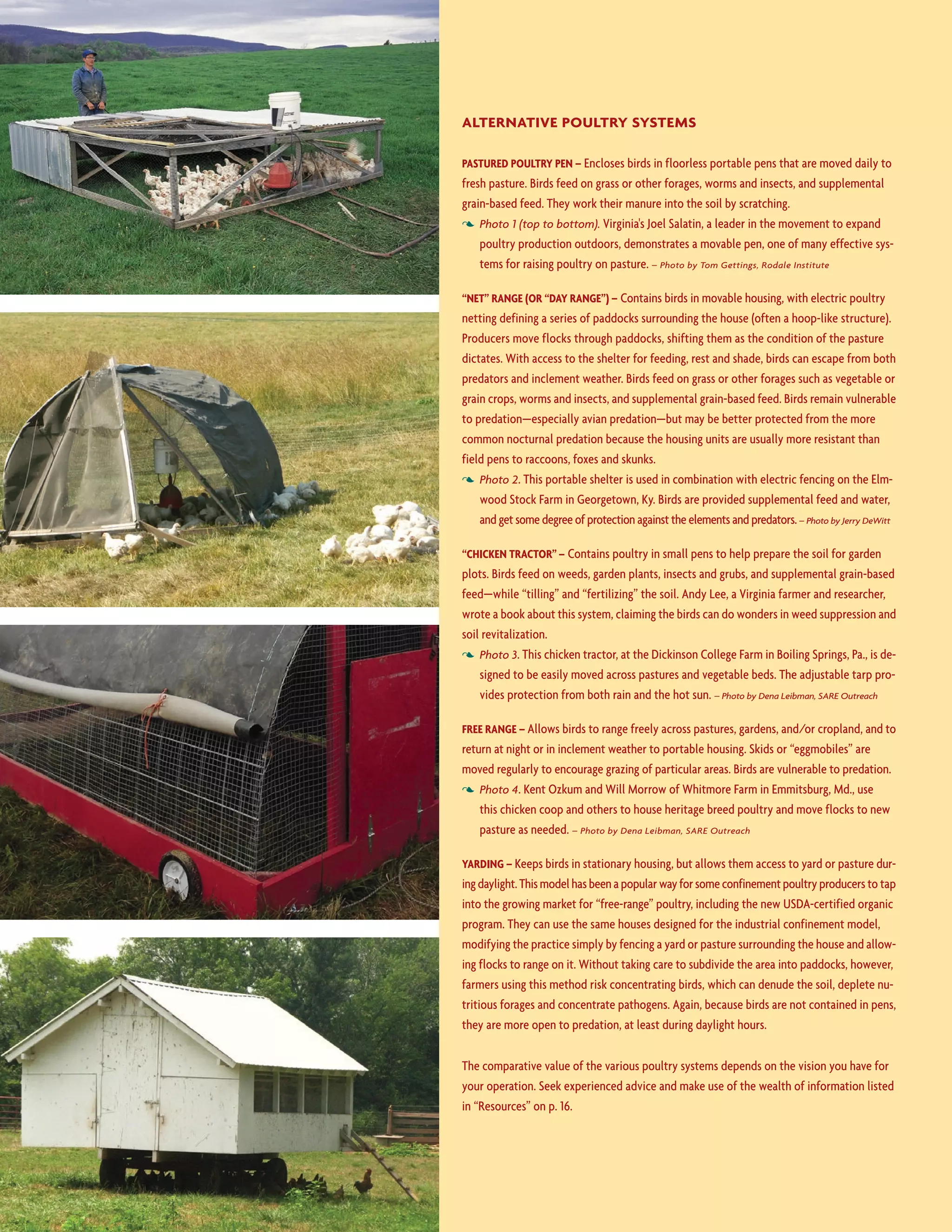
Like many family farmers, Jason and Melissa
Fischbach and their three children work hard to produce
a living off of their diversified Wild Hollow Farm in
Ashland, Wis., integrating vegetable production and
poultry, and raising their birds on pasture. “There’s a
good profit margin raising chickens and turkeys on
grass,” said Jason, “as long as you know your inputs,
get your prices right and keep your mortalities low.”
The small scale of pastured poultry, along with its
quick turn-around and minimal equipment needs,
attracted the Fischbachs to raising poultry on pasture.
The needs of the family played a big role as well. “As
fairly new farmers with little kids, we felt that the chickens
were much safer with the kids around, compared to
cattle or sheep.”
Jason, who is also an Extension agent for the
University of Wisconsin, began raising pastured poultry
when the local farmer already doing so quit: “We
sniffed out an opportunity to make a profit,” said
Jason. At the same time, two other farming families
recognized the same opportunity. Facing similar
challenges, the three farms chose cooperation instead
of competition and formed Pasture Perfect, LLC, a
pastured-poultry cooperative. According to Jason,
“Once all the farms joined together, everything changed
for the good. We were able to buy in larger quantities,
saving money, and help each other with processing.”
Pasture Perfect also received a grant from USDA’s
Sustainable Agriculture Research and Education
program (SARE) to evaluate different feeding options
to fine-tune their day-range production system.
Pasture Perfect sells around 1,500 birds per year
directly from their farms, netting around $2-$6 per
bird in 2011, and their poultry is in high demand. The
Contents
Determining the right
system 2
Industry Changes 2
The Salatin Influence 3
Alternative Poultry Systems 4
Potential for Profit 5
Production Basics 5
Feed 7
Breeds 8
Mortality and Predation 9
On-Farm Processing 10
Cooperative Mobile
Processors 11
Environmental
benefits 12
Soil 12
Forages 12
Animal Health 13
quality of life issues 13
Family and Lifestyle
Benefits 13
Labor 14
Community Benefits 14
Marketing options 15
Marketing Tips 15
The Extra-Healthy Egg? 15
Niches within a Niche 15
Resources 16
Also available at:
www.sare.org/poultry
or order a free hard copy
at (301) 374-9696.
Livestock Alternatives
Profitable Poultry:
Raising Birdson Pasture
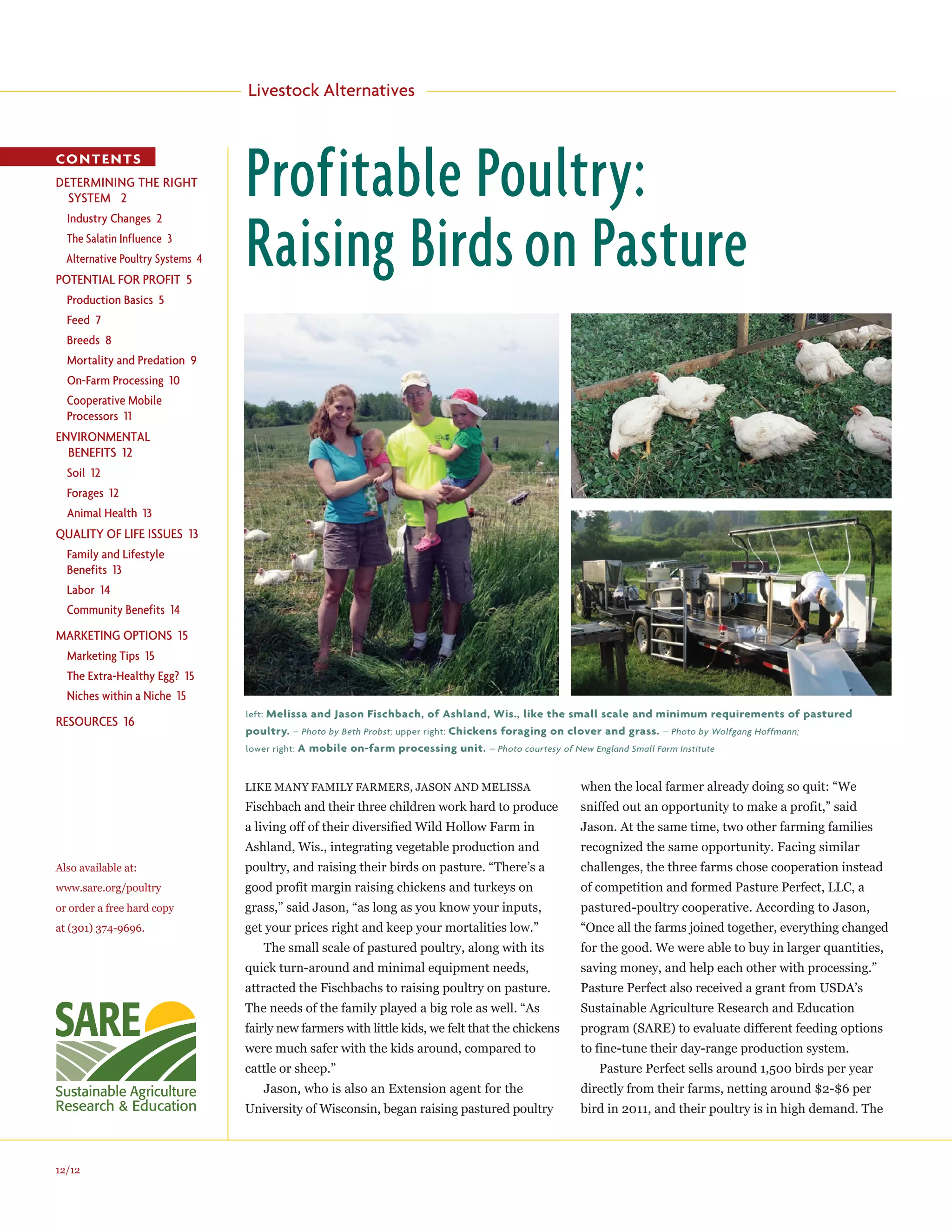
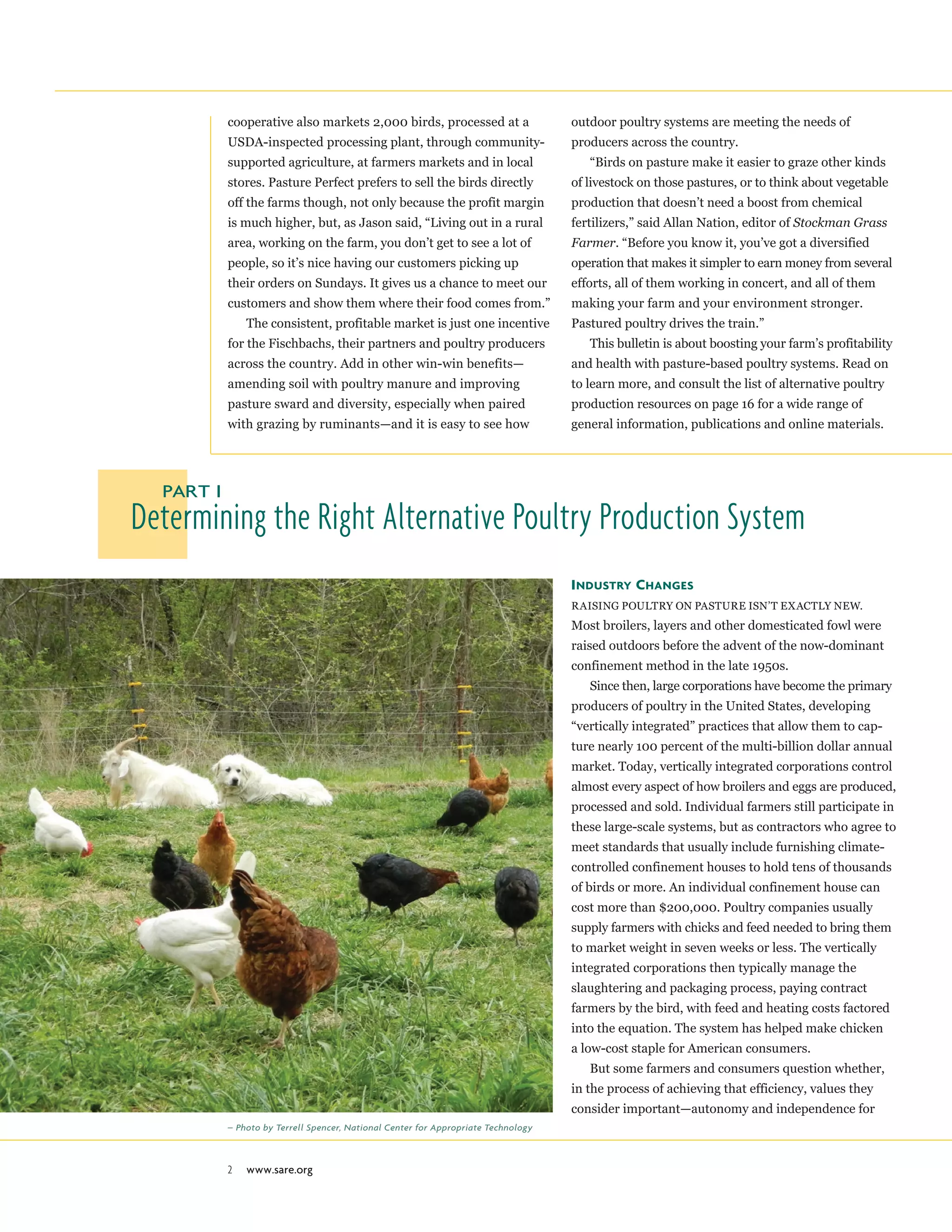
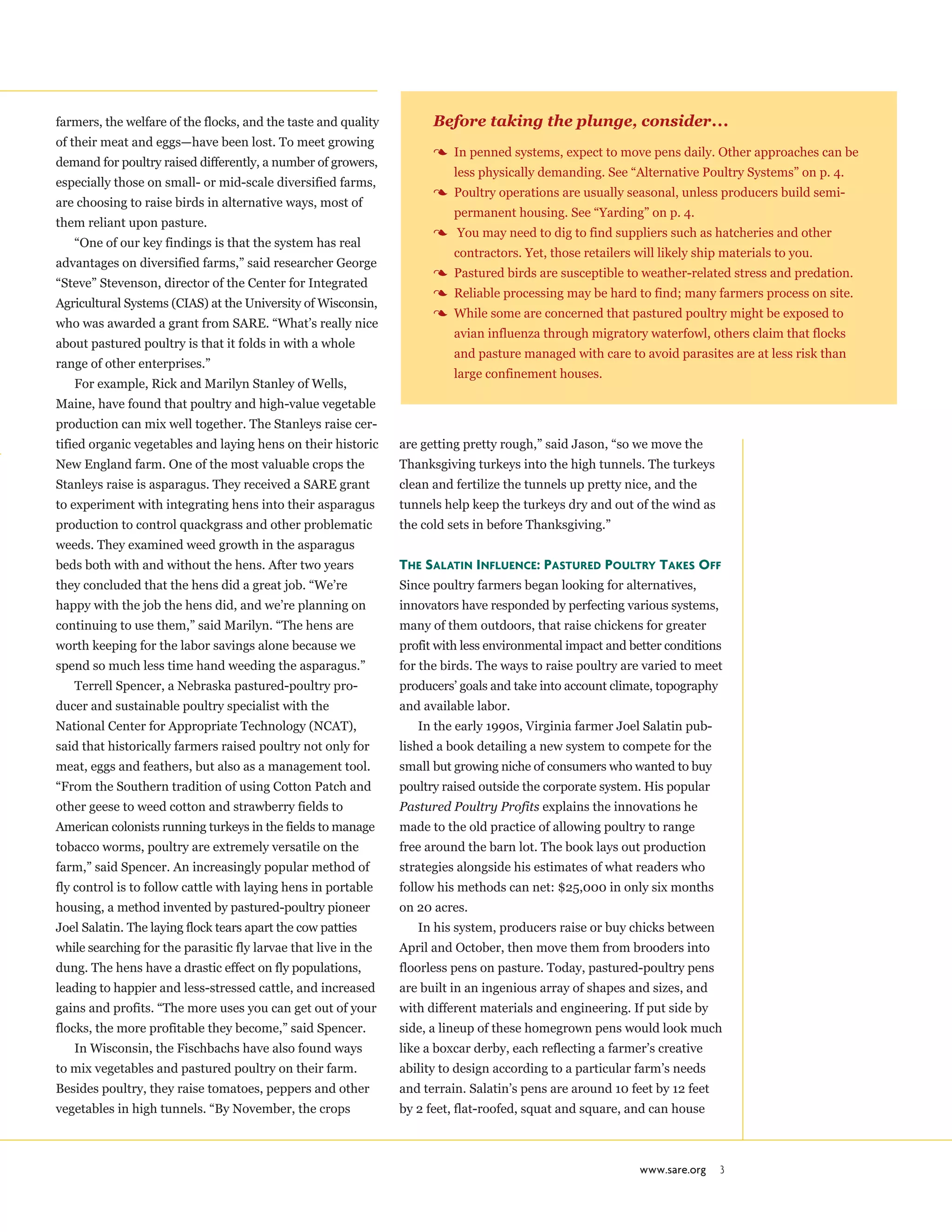
left: Melissa and Jason Fischbach, of Ashland, Wis., like the small scale and minimum requirements of pastured
poultry. – Photo by Beth Probst; upper right: Chickens foraging on clover and grass. – Photo by Wolfgang Hoffmann;
lower right: A mobile on-farm processing unit. – Photo courtesy of New England Small Farm Institute
2 www.sare.org
cooperative also markets 2,000 birds, processed at a
USDA-inspected processing plant, through community-
supported agriculture, at farmers markets and in local
stores. Pasture Perfect prefers to sell the birds directly
off the farms though, not only because the profit margin
is much higher, but, as Jason said, “Living out in a rural
area, working on the farm, you don’t get to see a lot of
people, so it’s nice having our customers picking up
their orders on Sundays. It gives us a chance to meet our
customers and show them where their food comes from.”
The consistent, profitable market is just one incentive
for the Fischbachs, their partners and poultry producers
across the country. Add in other win-win benefits—
amending soil with poultry manure and improving
pasture sward and diversity, especially when paired
with grazing by ruminants—and it is easy to see how
outdoor poultry systems are meeting the needs of
producers across the country.
“Birds on pasture make it easier to graze other kinds
of livestock on those pastures, or to think about vegetable
production that doesn’t need a boost from chemical
fertilizers,” said Allan Nation, editor of Stockman Grass
Farmer. “Before you know it, you’ve got a diversified
operation that makes it simpler to earn money from several
efforts, all of them working in concert, and all of them
making your farm and your environment stronger.
Pastured poultry drives the train.”
This bulletin is about boosting your farm’s profitability
and health with pasture-based poultry systems. Read on
to learn more, and consult the list of alternative poultry
production resources on page 16 for a wide range of
general information, publications and online materials.
Industry Changes
Raising poultry on pasture isn’t exactly new.
Most broilers, layers and other domesticated fowl were
raised outdoors before the advent of the now-dominant
confinement method in the late 1950s.
Since then, large corporations have become the primary
producers of poultry in the United States, developing
“vertically integrated” practices that allow them to cap-
ture nearly 100 percent of the multi-billion dollar annual
market. Today, vertically integrated corporations control
almost every aspect of how broilers and eggs are produced,
processed and sold. Individual farmers still participate in
these large-scale systems, but as contractors who agree to
meet standards that usually include furnishing climate-
controlled confinement houses to hold tens of thousands
of birds or more. An individual confinement house can
cost more than $200,000. Poultry companies usually
supply farmers with chicks and feed needed to bring them
to market weight in seven weeks or less. The vertically
integrated corporations then typically manage the
slaughtering and packaging process, paying contract
farmers by the bird, with feed and heating costs factored
into the equation. The system has helped make chicken
a low-cost staple for American consumers.
But some farmers and consumers question whether,
in the process of achieving that efficiency, values they
consider important—autonomy and independence for
Determining the Right Alternative Poultry Production System
Part I
– Photo by Terrell Spencer, National Center for Appropriate Technology
www.sare.org 3
farmers, the welfare of the flocks, and the taste and quality
of their meat and eggs—have been lost. To meet growing
demand for poultry raised differently, a number of growers,
especially those on small- or mid-scale diversified farms,
are choosing to raise birds in alternative ways, most of
them reliant upon pasture.
“One of our key findings is that the system has real
advantages on diversified farms,” said researcher George
“Steve” Stevenson, director of the Center for Integrated
Agricultural Systems (CIAS) at the University of Wisconsin,
who was awarded a grant from SARE. “What’s really nice
about pastured poultry is that it folds in with a whole
range of other enterprises.”
For example, Rick and Marilyn Stanley of Wells,
Maine, have found that poultry and high-value vegetable
production can mix well together. The Stanleys raise cer-
tified organic vegetables and laying hens on their historic
New England farm. One of the most valuable crops the
Stanleys raise is asparagus. They received a SARE grant
to experiment with integrating hens into their asparagus
production to control quackgrass and other problematic
weeds. They examined weed growth in the asparagus
beds both with and without the hens. After two years
they concluded that the hens did a great job. “We’re
happy with the job the hens did, and we’re planning on
continuing to use them,” said Marilyn. “The hens are
worth keeping for the labor savings alone because we
spend so much less time hand weeding the asparagus.”
Terrell Spencer, a Nebraska pastured-poultry pro-
ducer and sustainable poultry specialist with the
National Center for Appropriate Technology (NCAT),
said that historically farmers raised poultry not only for
meat, eggs and feathers, but also as a management tool.
“From the Southern tradition of using Cotton Patch and
other geese to weed cotton and strawberry fields to
American colonists running turkeys in the fields to manage
tobacco worms, poultry are extremely versatile on the
farm,” said Spencer. An increasingly popular method of
fly control is to follow cattle with laying hens in portable
housing, a method invented by pastured-poultry pioneer
Joel Salatin. The laying flock tears apart the cow patties
while searching for the parasitic fly larvae that live in the
dung. The hens have a drastic effect on fly populations,
leading to happier and less-stressed cattle, and increased
gains and profits. “The more uses you can get out of your
flocks, the more profitable they become,” said Spencer.
In Wisconsin, the Fischbachs have also found ways
to mix vegetables and pastured poultry on their farm.
Besides poultry, they raise tomatoes, peppers and other
vegetables in high tunnels. “By November, the crops
are getting pretty rough,” said Jason, “so we move the
Thanksgiving turkeys into the high tunnels. The turkeys
clean and fertilize the tunnels up pretty nice, and the
tunnels help keep the turkeys dry and out of the wind as
the cold sets in before Thanksgiving.”
The Salatin Influence: Pastured Poultry Takes Off
Since poultry farmers began looking for alternatives,
innovators have responded by perfecting various systems,
many of them outdoors, that raise chickens for greater
profit with less environmental impact and better conditions
for the birds. The ways to raise poultry are varied to meet
producers’ goals and take into account climate, topography
and available labor.
In the early 1990s, Virginia farmer Joel Salatin pub-
lished a book detailing a new system to compete for the
small but growing niche of consumers who wanted to buy
poultry raised outside the corporate system. His popular
Pastured Poultry Profits explains the innovations he
made to the old practice of allowing poultry to range
free around the barn lot. The book lays out production
strategies alongside his estimates of what readers who
follow his methods can net: $25,000 in only six months
on 20 acres.
In his system, producers raise or buy chicks between
April and October, then move them from brooders into
floorless pens on pasture. Today, pastured-poultry pens
are built in an ingenious array of shapes and sizes, and
with different materials and engineering. If put side by
side, a lineup of these homegrown pens would look much
like a boxcar derby, each reflecting a farmer’s creative
ability to design according to a particular farm’s needs
and terrain. Salatin’s pens are around 10 feet by 12 feet
by 2 feet, flat-roofed, squat and square, and can house
Before taking the plunge, consider...
3 In penned systems, expect to move pens daily. Other approaches can be
less physically demanding. See “Alternative Poultry Systems” on p. 4.
3 Poultry operations are usually seasonal, unless producers build semi-
permanent housing. See “Yarding” on p. 4.
3 You may need to dig to find suppliers such as hatcheries and other
contractors. Yet, those retailers will likely ship materials to you.
3 Pastured birds are susceptible to weather-related stress and predation.
3 Reliable processing may be hard to find; many farmers process on site.
3 While some are concerned that pastured poultry might be exposed to
avian influenza through migratory waterfowl, others claim that flocks
and pasture managed with care to avoid parasites are at less risk than
large confinement houses.
4
Alternative Poultry Systems
Pastured Poultry Pen – Encloses birds in floorless portable pens that are moved daily to
fresh pasture. Birds feed on grass or other forages, worms and insects, and supplemental
grain-based feed. They work their manure into the soil by scratching.
3 Photo 1 (top to bottom). Virginia's Joel Salatin, a leader in the movement to expand
poultry production outdoors, demonstrates a movable pen, one of many effective sys-
tems for raising poultry on pasture. – Photo by Tom Gettings, Rodale Institute
“Net” Range (or “Day Range”) – Contains birds in movable housing, with electric poultry
netting defining a series of paddocks surrounding the house (often a hoop-like structure).
Producers move flocks through paddocks, shifting them as the condition of the pasture
dictates. With access to the shelter for feeding, rest and shade, birds can escape from both
predators and inclement weather. Birds feed on grass or other forages such as vegetable or
grain crops, worms and insects, and supplemental grain-based feed. Birds remain vulnerable
to predation—especially avian predation—but may be better protected from the more
common nocturnal predation because the housing units are usually more resistant than
field pens to raccoons, foxes and skunks.
3 Photo 2. This portable shelter is used in combination with electric fencing on the Elm-
wood Stock Farm in Georgetown, Ky. Birds are provided supplemental feed and water,
and get some degree of protection against the elements and predators.– Photo by Jerry DeWitt
“Chicken Tractor” – Contains poultry in small pens to help prepare the soil for garden
plots. Birds feed on weeds, garden plants, insects and grubs, and supplemental grain-based
feed—while “tilling” and “fertilizing” the soil. Andy Lee, a Virginia farmer and researcher,
wrote a book about this system, claiming the birds can do wonders in weed suppression and
soil revitalization.
3 Photo 3. This chicken tractor, at the Dickinson College Farm in Boiling Springs, Pa., is de-
signed to be easily moved across pastures and vegetable beds. The adjustable tarp pro-
vides protection from both rain and the hot sun. – Photo by Dena Leibman, SARE Outreach
Free Range – Allows birds to range freely across pastures, gardens, and/or cropland, and to
return at night or in inclement weather to portable housing. Skids or “eggmobiles” are
moved regularly to encourage grazing of particular areas. Birds are vulnerable to predation.
3 Photo 4. Kent Ozkum and Will Morrow of Whitmore Farm in Emmitsburg, Md., use
this chicken coop and others to house heritage breed poultry and move flocks to new
pasture as needed. – Photo by Dena Leibman, SARE Outreach
Yarding – Keeps birds in stationary housing, but allows them access to yard or pasture dur-
ingdaylight.Thismodelhasbeenapopularwayforsomeconfinementpoultryproducers to tap
into the growing market for “free-range” poultry, including the new USDA-certified organic
program. They can use the same houses designed for the industrial confinement model,
modifying the practice simply by fencing a yard or pasture surrounding the house and allow-
ing flocks to range on it. Without taking care to subdivide the area into paddocks, however,
farmers using this method risk concentrating birds, which can denude the soil, deplete nu-
tritious forages and concentrate pathogens. Again, because birds are not contained in pens,
they are more open to predation, at least during daylight hours.
The comparative value of the various poultry systems depends on the vision you have for
your operation. Seek experienced advice and make use of the wealth of information listed
in “Resources” on p. 16.
up to 80 broilers. He moves the pens daily to fresh pas-
ture. While receiving exercise and fresh air foraging for
plants and insects, the chickens drop manure that adds
fertility to the soil.
Salatin passes along his experiences and ideas,
holding field days and speaking frequently at conferences.
With help from SARE and Heifer International, a nonprofit
organization that promotes community development
through sustainable livestock production, Salatin held
workshops for limited-resource farmers interested in
learning more about pastured poultry.
“You walk away from three days with [Salatin] knowing
everything from how to keep a chicken healthy to how
to keep your customers happy,” said Rosa Shareef, a
farmer from New Medinah, Miss., who attended one of
the workshops.
Tom Delehanty, a former conventional chicken farmer
in Wisconsin, who moved to Socorro, N.M., to raise pas-
tured poultry, credits Salatin’s methods for providing a
jumping-off point from which he designed a field pen to
fit his New Mexico climate. There, mild desert winters
allow him to keep birds on pastures year-round.
www.sare.org 5
Potential for Profit
Part 2
SARE-funded researchers at Wisconsin’s CIAS
studied five farms that raise poultry on pasture and
found that the systems, while highly variable, yielded
a significant profit for growers who incorporate poultry
into diversified farms.
CIAS researcher Stevenson said that in the beginning,
people make it work best at lower numbers, around
1,000 birds per season. But he cautions that the learning
curve is about five years for a grower to become experi-
enced. “By then, people know what they’re doing, their
pastures are in shape, and they have figured out their
management and equipment needs.”
Enterprise growth can be rapid initially on a pastured-
poultry farm, but it should never be rash. “The temptation
is to get too big too fast,” said Spencer from NCAT, “and
then a new farmer makes a big mistake on a large scale,
and it wipes them out. Successful pastured-poultry
growers are good managers, and you can’t be a good
manager until you’ve got some experience under your
belt.”
“It all gets down to the customer,” said Paul Swanson,
a Nebraska Extension educator specializing in sustainable
agriculture who sees growing interest in pastured poultry.
“To sell your product, you need a customer and a growing
number of people who are interested in better tasting,
higher-quality chickens and don’t like the current system.”
Most farmers who have worked with Swanson on
poultry enterprises already had crop farms, and many of
them had beef cattle, too. They diversified to improve
profits. “Chickens are a size that people don’t hesitate to
purchase directly, as opposed to a quarter or half of beef,”
Swanson said. “It’s an opportunity for farmers to try
something without a very large investment.” Most pas-
tured-poultry farmers sell all of the birds they raise even
before processing them.
Many direct-market producers find that poultry is a
real lure that brings customers onto the farm, and many
of them will buy more than just chicken or turkey when
they are there.
Production Basics
Housing. The least expensive approaches are the portable
field pens, pioneered by farmers in Europe more than a
century ago, and more recently made popular in America
by Joel Salatin and Andy Lee, though most producers
Pastured Poultry Economics
Pastured poultry costs and returns vary widely. Before starting your operation, take
advantage of budget tools available online. These calculators are used to estimate
the economic return from your pastured poultry operation. They typically calculate
revenue in terms of the number or weight of birds sold per year, and can include
additional revenue from egg, feather and manure sales. Expenses include not only
the usual costs for chicks, feed, medication, bedding, paid labor and processing, but
also more complex costs, such as marketing, capital investment, equipment depreci-
ation and the value of unpaid labor. Good calculator options include:
3 www.cias.wisc.edu/crops-and-livestock/poultry-enterprise-budget
(University of Wisconsin's Center for Integrated Agricultural Systems)
3 www.windyridgepoultry.com/tools1.htm (Windy Ridge Natural Farms)
3 nwdirect.wsu.edu/barriers/tools.htm (Washington State University)
6 www.sare.org
concede they also demand the most time and labor. For
pastured laying hens, open-faced sheds on skids, called
colony houses, are a proven housing choice.
Salatin’s model also holds promise for producers who
wish to raise poultry with low initial costs. Innovative
farmers have adapted the Salatin design to fit their par-
ticular terrain and needs. In general, simple-to-build
pens are made of inexpensive wood, sheet metal or plastic,
and chicken wire. Making a 10-foot-by-12-foot pen—
suitable for up to 80 mature chickens—should cost no
more than $400, plus labor. Pens can be made less
expensive if the roofing is salvaged.
One mobile pen model, invented by Homer Walden
of Sunnyside Farm, near York, Pa., includes a novel
wheel-and-pull system that makes it easier to move, and
can be used for either layers or broilers. The cost is about
$450 to build.
At the other end of the spectrum are the portable
houses favored by many farmers involved in day-range or
free-range poultry production. Typically much larger and
made of sturdier materials, they can cost significantly
more. Lee designed and built structures he calls “mini-
barns” for his day-range operation. They are made from
lumber, plywood, corrugated tin and fiberglass, and have
wooden runners, or “skids,” at their bases that allow
them to be dragged with relative ease by tractor to fresh
stands of pasture when needed.
The chicken-tractor model, which Lee designed and
describes in his book Chicken Tractor, calls for small
numbers of birds to control weeds and insect pests, and
increase fertility in garden plots. Simple and inexpensive,
the tractor model might be the best way for someone
with limited farming experience to begin raising poultry
outdoors, although it is intended primarily to work in
concert with vegetable production.
Salatin has designed coops on wheels that house laying
hens, called eggmobiles. The eggmobile follows a herd of
beef cattle, where the hens eagerly scratch apart cow patties
to get at the fly grubs inside, reducing parasite numbers
and providing nutrition for the laying flock. Spencer, the
NCAT poultry specialist, built an eggmobile, constructing
housing for his laying flock of 125 hens on top of an old
haywagon chassis. “Parts of our place are really steep and
having the layers on wheels lets us more easily move the
flock from field to field. We just lock the hens in and we
tow it wherever we need them. It helps us take better
care of our pastures.”
Pasturing systems like Lee’s, where the chickens are
not confined in the housing pens, are called day-range
systems and usually depend on portable fencing to manage
where the hens roam. Most producers favor electric fencing
designed for poultry, called poultry netting, or feather
netting. It costs about $160 per 164-foot roll (including
step-in posts, but not the power source). The amount of
poultry netting needed to manage a poultry flock is
determined by several factors. The species, type (layer
vs. broiler), age and breed of the bird, the flock density,
and the condition of the pasture and health of the soil all
dictate how much space to give the poultry being raised.
“If the pasture’s getting hammered, there are too many
birds on too small an area,” said Spencer. “If you pay
attention to your pasture condition, you’ll know if and
how you need to change. It’s pretty simple once you get
an eye for it.” Spencer suggests two rolls of netting per
150 birds.
Brooders. Brooders are secure, climate-controlled
areas where newly hatched chicks can live until sufficiently
feathered to live outdoors. They are made of plywood,
lumber and chicken wire, and contain warming lamps,
drinking water containers, feeders and litter. A basic
brooder that holds as many as 250 chicks can cost as
little as $100 to construct.
Feed and Water Delivery. Beyond a brooder and
field pen, producers only need containers for feed and
water. They can be simple and inexpensive, even home-
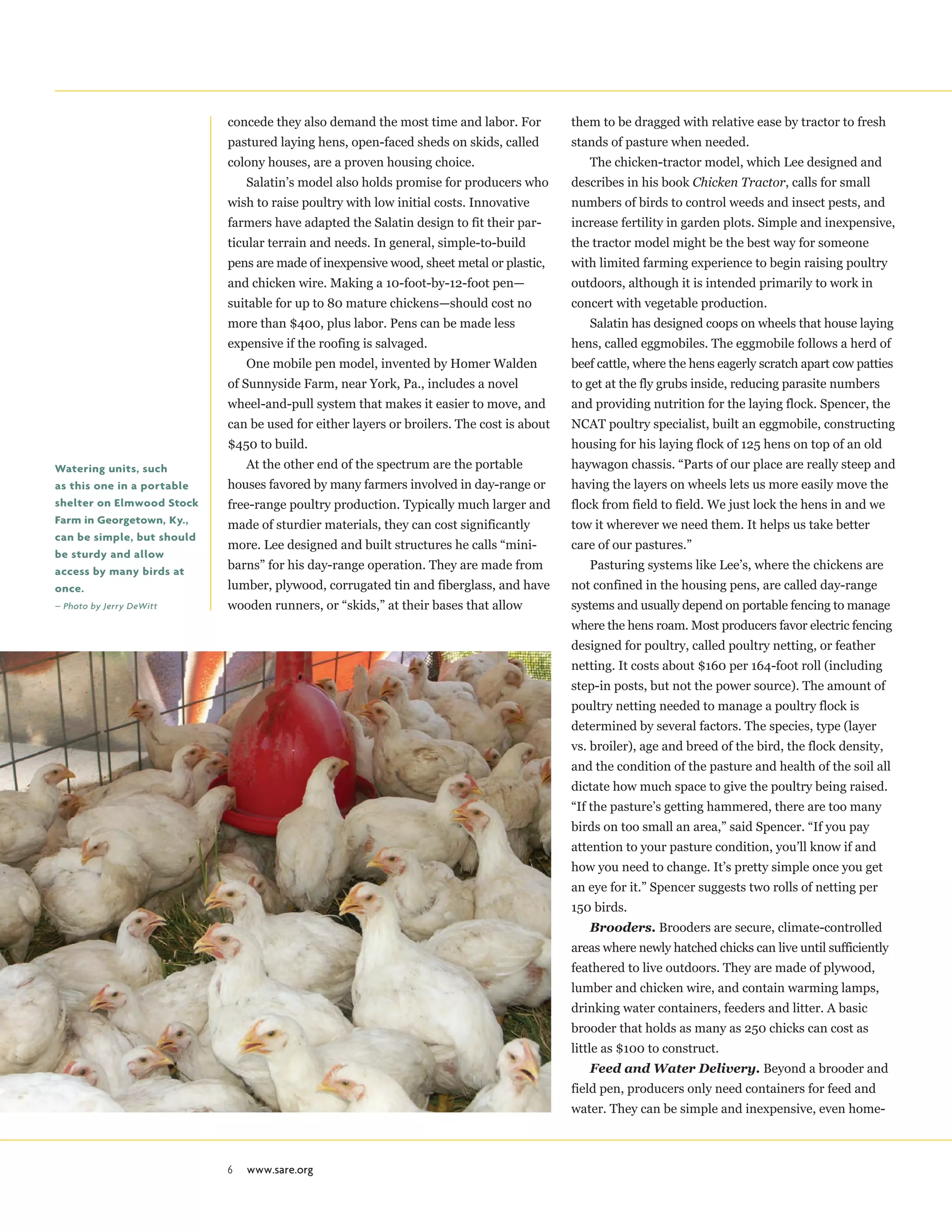
Watering units, such
as this one in a portable
shelter on Elmwood Stock
Farm in Georgetown, Ky.,
can be simple, but should
be sturdy and allow
access by many birds at
once.
– Photo by Jerry DeWitt
made. Ensure that any feeder or watering unit, whether
made at home or purchased from a commercial source,
does the job properly. Feed containers must be rodent
proof, as rodents’ access to the feed can spread salmonella.
If the feed is stored outside or in the field, the containers
must be waterproof. For example, improperly anchored
or poorly designed feeders and watering units can be
tipped over or clogged, increasing opportunities for
spoilage and contamination as well as inducing unneces-
sary stress or endangering the lives of a flock. As pastured-
poultry enterprises grow, labor often becomes problematic.
Producers raising large numbers of poultry design their
feeding and watering systems to be as efficient as possible.
Feed
Most poultry diets contain corn for energy,
soybeans combined with an animal or synthetic source
for protein, as well as vitamin and mineral supplements.
Some growers are switching to soy-free feeds in response
to customers who want to avoid soy in their food chain.
In well-managed pasture systems, producers very rarely
use medications, as proper sanitation and a healthy
growing environment help prevent health issues before
they start. Consumers by and large appreciate poultry
raised without antibiotics and other medications, an
appreciation that is often reflected in their willingness
to pay a premium price for pastured-poultry products.
Besides the feed in the feeder, free-range poultry
have access to a buffet of forages, seeds, insects and
other animals while on pasture. Joel Salatin estimates
that his broilers forage for more than a quarter of their
diet. Other producers guess feed savings of anywhere
from 5-25 percent on pasture. When using low-quality
feeds, the vitamins ingested when the birds forage on
grasses and forbs can balance out nutritional deficiencies
in the feed ration. “There are a lot of environmental and
management factors that affect how much food’s out
there for your birds,” said Spencer. “Soil fertility, bird
genetics, management style, climate, time of season and
unexpected things like drought, flooding, late/early
frosts—all of these can throw a major wrench in your
operation if you don’t plan ahead.”
Where pastured-poultry farmers source their feed
is as diverse as the farmers themselves. Often pastured-
poultry producers begin with prepared rations from their
local feed store. As the operation grows, producers often
buy feed in bulk, enabling them to purchase top-quality
feeds, including organic, soy-free and GMO-free (not
genetically modified) if that is part of the operation,
for prices comparable to conventional feeds. Some pro-
ducers, both small and large, mix and grind their own
feed. Ration recipes can be found in books, websites
and listservs dedicated to pastured- and range-poultry
operations.
Whatever route you take—ready-mixed feed or
preparing your own blend—expect the cost will likely
range between 15-50 cents per pound for conventional
and GMO-free rations. Cornish Cross meat birds will
ingest roughly 10-15 pounds of feed each before reaching
market weight, which means the typical cost of feeding
each bird will range from $2-$6 during its seven- to
eight-week lifetime (or longer for slower growing
breeds). The most productive laying hens consume
around 25 pounds of feed to get to the point of lay.
When evaluating feed options, consider:
3	Organic feeds are increasingly available from mills
and suppliers. Expect to pay two to four times the
cost of conventional rations.
3	Some feeds are medicated to combat coccidiosis,
which is particularly devastating to chicks; experi-
enced farmers typically find that clean brooders,
deep litter and clean living conditions make
medicated feeds unnecessary.
3	Feeds can be ordered in various forms, such as
cracked, mashed and pelletized. Healthy debate
rages as to which form is better for pastured birds.
The process of making feed crumbles and pellets
heats the feed, destroying heat-sensitive vitamins,
yet some argue that heat and pressure free up other
nutrients and make them available to birds. Ground
feed is not typically heat treated, but more feed can
be wasted through spillage in the field. Many produc-
ers report that the higher cost of high-quality feed
www.sare.org 7
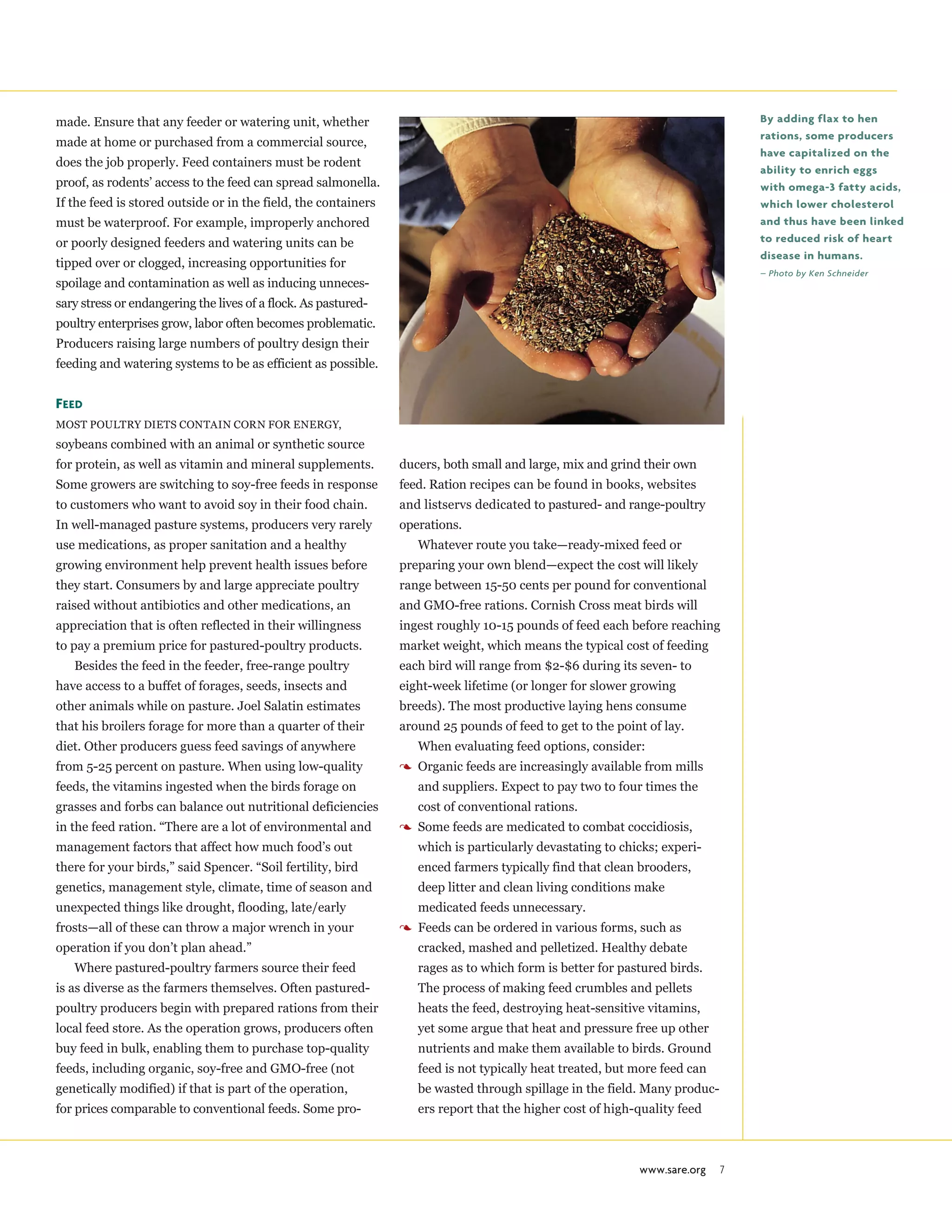
By adding flax to hen
rations, some producers
have capitalized on the
ability to enrich eggs
with omega-3 fatty acids,
which lower cholesterol
and thus have been linked
to reduced risk of heart
disease in humans.
– Photo by Ken Schneider
8 www.sare.org
is often offset by lower consumption rates as the
birds eat less to get the nutrition they need.
3	Some producers have found that vitamin supplements
help reduce mortality, with their costs being more
than offset by greater flock productivity.
For more information see Pastured-Raised Poultry
Nutrition. Download a free copy from ATTRA at
https://attra.ncat.org/attra-pub/poultry, or buy a print
copy by calling (800) 346-9140.
Breeds
Most pastured-poultry producers have adopted
the same breed of meat bird as their confinement counter-
parts: the Cornish Cross. Developed for its large breast,
large appetite and rapid development, the Cornish Cross
also boasts a mild flavor that is familiar and appealing to
most consumers.
Virginia homesteader and author of The Small-
Scale Poultry Flock Harvey Ussery and his wife are
experimenting with hardier varieties of birds, such as
New Hampshires and Plymouth Rocks. Even though
these varieties take longer to reach butchering weight,
the meat boasts more flavor. Ussery wants to educate
consumers about alternatives to Cornish Cross. He said
the fast growth of the Cornish Cross strains the birds’
hearts, digestive systems and leg joints. Moreover,
birds more suited to foraging eat less supplemental
feed. The American Livestock Breeds Conservancy also
recommends Plymouth Rocks, as well as Delawares, as
heritage broiler breeds that perform well on pasture.
Ussery, writing in Grit!, the American Pastured
Poultry Producers Association (APPPA) newsletter,
details the problems he encountered with the Cornish
Cross. Cornish Cross chicks from nearly all hatcheries
in the country come from the same stock. The variety,
he argues, is ill-suited for raising outdoors because it
has been bred for confinement. Properties that make
for good and efficient foragers, he said, have been
“selected out” because they are not needed in confine-
ment production models.
The only appeal of the Cornish Cross, he said, is its
ability to arrive at market weight in a period of about
seven weeks. Emphasis on that single quality has
neglected other important factors, such as flavor, texture,
vigor, health and a bird’s ability to take full advantage
of all the benefits available to it on pasture.
But not all Cornish Cross strains are equal on pasture.
Older (commercially called “low-yield”) strains of Cornish
Cross, such as the occasionally black-flecked feathered
Cobb 500 or the Ross 308, tend to do better on pasture and
are more forgiving on lower-quality nutrition than the
newer (“high-yield”) varieties, such as the Cobb 700.
Many producers are finding a compromise between
the accelerated growth of the Cornish Cross and the
lower feed conversion and dress-out weights of the older
heritage breeds. Several varieties of broilers with names
like Freedom Rangers, Red Rangers and Rosambros have
been selected for high growth rates and hardiness for living
outdoors on range. These birds are raised a few weeks
longer than the Cornish Cross to reach comparable weights,
typically nine to 12 weeks, but have a different texture and
flavor profile than their industrial counterparts. “We love
them,” said NCAT’s Spencer. “You sacrifice a little breast
meat and accept a little more grow-out time, but we’ve
never had a complaint, just a lot of compliments, and it
differentiates us from anything our customers can find in
the stores.”
Some pastured-poultry producers report that they are
growing and selling the Cornish Cross side by side with
broiler strains bred for pastured production. They often
find that more discriminating customers offer little resis-
tance to paying 50 cents per pound more for the flavorful
meat of the latter.
Layers. There is no overwhelmingly favored variety
of laying hen for range poultry production. Several
breeds, including heritage breeds like Leghorns, Anconas
and Minorcas, and highly productive hybrids like com-
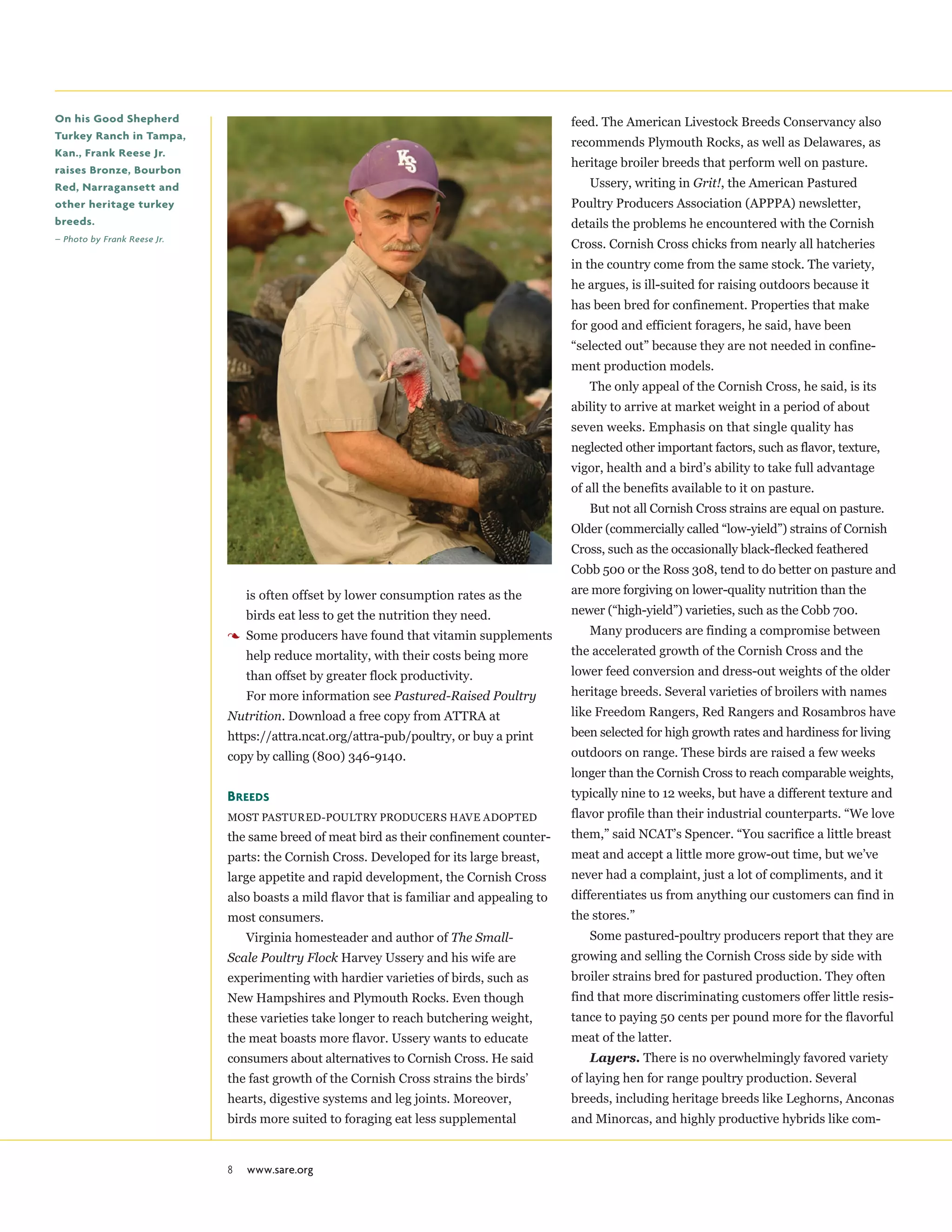
On his Good Shepherd
Turkey Ranch in Tampa,
Kan., Frank Reese Jr.
raises Bronze, Bourbon
Red, Narragansett and
other heritage turkey
breeds.
– Photo by Frank Reese Jr.
www.sare.org 9
mercial Leghorn varieties, supply exceptional numbers of
eggs, according to Kelly Klober, a SARE grantee and
author of the book Talking Chicken. Egg colors are a
regional preference, with brown eggs often—and errone-
ously—being identified as true farm eggs. Some produc-
ers are finding niche markets with heritage layers, such
as the Americauna and Araucana, which lay blue-shelled
eggs popular at Easter. The biggest pitfall in selling eggs
is failing to price them correctly: Ensuring that all input
and labor costs are reflected in the final price is critical
for economic success with layers.
Turkeys. The “Cornish Cross” of turkeys is the Broad
Breasted White. Again borrowed from the confinement
industry, the Broad Breasted is a fast-growing bird that
takes about four months to reach market weights of
about 18-22 pounds. Many who have raised turkeys say
they are more manageable in many ways than broilers,
and that they forage much more aggressively than chick-
ens. Unlike the Cornish Cross, the Broad Breasted White
and Bronze varieties of turkeys maintain much of their
turkey instincts and behaviors.
Joleen Marquardt, a pastured-poultry producer in
Pine Bluff, Wyo., said she and her children were at first
intimidated by the sheer size of their turkeys at process-
ing time, but found them more docile than broilers. “The
weight gets to be a little much after a full day of processing,
but it’s not nearly as bad as I anticipated,” she said.
The alternative to the Broad Breasted turkeys are the
traditional heritage turkey breeds. Heritage breeds take
longer to grow out, but develop a flavorful carcass with
less breast meat and much more dark meat. Varieties
include the Bourbon Red, Spanish Black, the Bronze and
the Royal Palm. More are listed, along with useful infor-
mation about turkey and other heritage-poultry production,
on the website of the American Livestock Breeds Conser-
vancy. (See “Resources,” p. 16.)
Mortality and Predation
More important Than the breed of broiler, layer
or turkey is an assurance that the birds live to be profitable
on the farm. Critically important in any pastured-poultry
operation is that mortality rates must be controlled. New
producers typically have high rates of mortality—some-
times as high as 10-30 percent; experienced farmers
often have mortality rates of 2 percent or lower.
In the brooder, mortality occurs for a number of rea-
sons. Typically, chicks are air-freighted and then shipped
by truck, so any delay in shipping can cause problems
in the brooder. Poultry chicks typically have a nutrition
reservoir of around three days as they absorb the rem-
nants of their egg yolks. The sooner chicks are given access
to food, water and a heat source, the better. Piling, a
common mortality factor, is the result of scared or frantic
chicks or older birds rushing to a corner of a brooder or
pen. As the birds pile on top of each other, the bottom
birds get smothered and die from suffocation. Often, pro-
ducers will use rounded corners in the brooder to avoid
this problem.
It is common, especially among inexperienced pen
producers, for birds to be crushed or injured when field
pens are moved to new stands of grass. This is less of a
concern for producers using one of the systems that do
not require frequent moving of the housing. As producers
and a given flock become more experienced, the birds
become accustomed to frequent movement of their pens
and learn to walk with them.
The other major factor in premature loss of birds is
predation. Due to their small size, chickens are a favorite
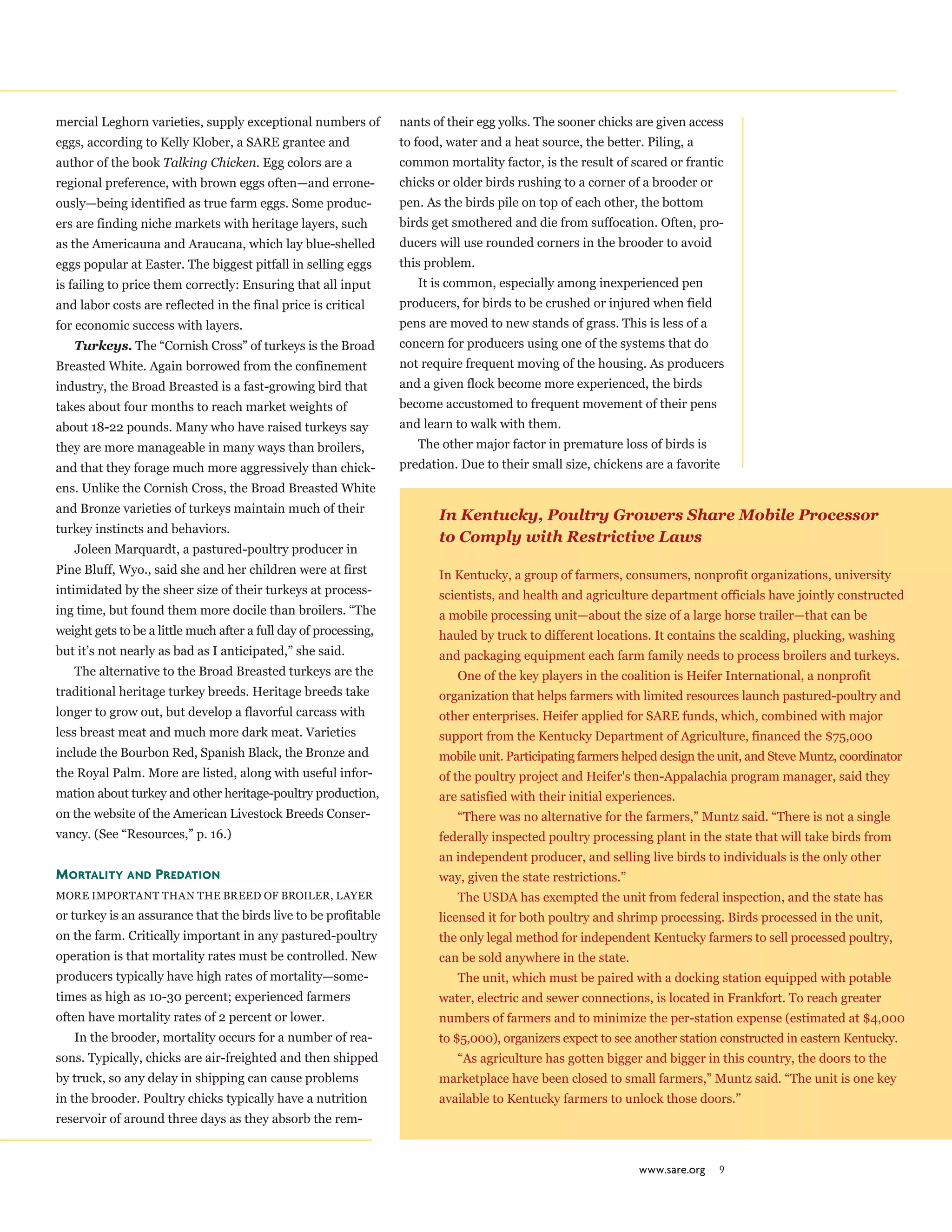
In Kentucky, Poultry Growers Share Mobile Processor
to Comply with Restrictive Laws
In Kentucky, a group of farmers, consumers, nonprofit organizations, university
scientists, and health and agriculture department officials have jointly constructed
a mobile processing unit—about the size of a large horse trailer—that can be
hauled by truck to different locations. It contains the scalding, plucking, washing
and packaging equipment each farm family needs to process broilers and turkeys.
One of the key players in the coalition is Heifer International, a nonprofit
organization that helps farmers with limited resources launch pastured-poultry and
other enterprises. Heifer applied for SARE funds, which, combined with major
support from the Kentucky Department of Agriculture, financed the $75,000
mobile unit. Participating farmers helped design the unit, and Steve Muntz, coordinator
of the poultry project and Heifer's then-Appalachia program manager, said they
are satisfied with their initial experiences.
“There was no alternative for the farmers,” Muntz said. “There is not a single
federally inspected poultry processing plant in the state that will take birds from
an independent producer, and selling live birds to individuals is the only other
way, given the state restrictions.”
The USDA has exempted the unit from federal inspection, and the state has
licensed it for both poultry and shrimp processing. Birds processed in the unit,
the only legal method for independent Kentucky farmers to sell processed poultry,
can be sold anywhere in the state.
The unit, which must be paired with a docking station equipped with potable
water, electric and sewer connections, is located in Frankfort. To reach greater
numbers of farmers and to minimize the per-station expense (estimated at $4,000
to $5,000), organizers expect to see another station constructed in eastern Kentucky.
“As agriculture has gotten bigger and bigger in this country, the doors to the
marketplace have been closed to small farmers,” Muntz said. “The unit is one key
available to Kentucky farmers to unlock those doors.”
10 www.sare.org
not only of people, but also of nearly every predator in
the wild. Flocks raised in a field-pen system tend to be
safer from daytime predators such as dogs, hawks and
the occasional eagle because they are securely enclosed.
Nocturnal predators such as raccoons, foxes, coyotes,
owls and skunks, however, will exploit even the smallest
opening in the pen. Even the most experienced producers
say they have lost a few birds.
Range poultry, on the other hand, are much more
vulnerable to avian predation. Alabama day-range pro-
ducer Charles Ritch, for example, said hawks and owls
are “a big, big problem, and they have been ever since I
started.” He pegs his predation losses at about 5 percent
each season.
Producers with the most success rely on multiple layers
of protection to keep their poultry safe. When combined,
protective measures such as livestock guardian dogs, electric
poultry netting and perimeter fencing often play a synergistic
role in keeping mortality down and poultry profits up.
Most producers expect some premature loss from each
flock despite working to reduce mortality. To minimize loss:
3	Provide sufficient warmth, water and feed, especially
in the crucial first days after you receive your shipment
of chicks.
3	Place pens well inside pastures rather than along
wooded fence lines, because many predators are
reluctant to travel across open territory.
3	Consider installing electric fences and/or using a
trained dog.
On-Farm Processing
Consider slaughtering and processing arrange-
ments early on, because commercial processors that han-
dle relatively small numbers of birds are hard to find. If
you want to sell through grocery stores or to restaurants,
you typically must process in a government-approved
facility, but those who sell directly to the public may be
able to slaughter on farm under a federal exemption.
Tom Delehanty, the New Mexico farmer, cautions
that a fledgling poultry producer be sure to have lots of
help with strong stomachs if they choose to process on
the farm.
“You can’t do it alone, and if any members of your
family or people you hire are going to have a problem
with the pace of the work or with killing, plucking and
gutting chickens, you’d better know about it before you
ever get started in the business,” he said.
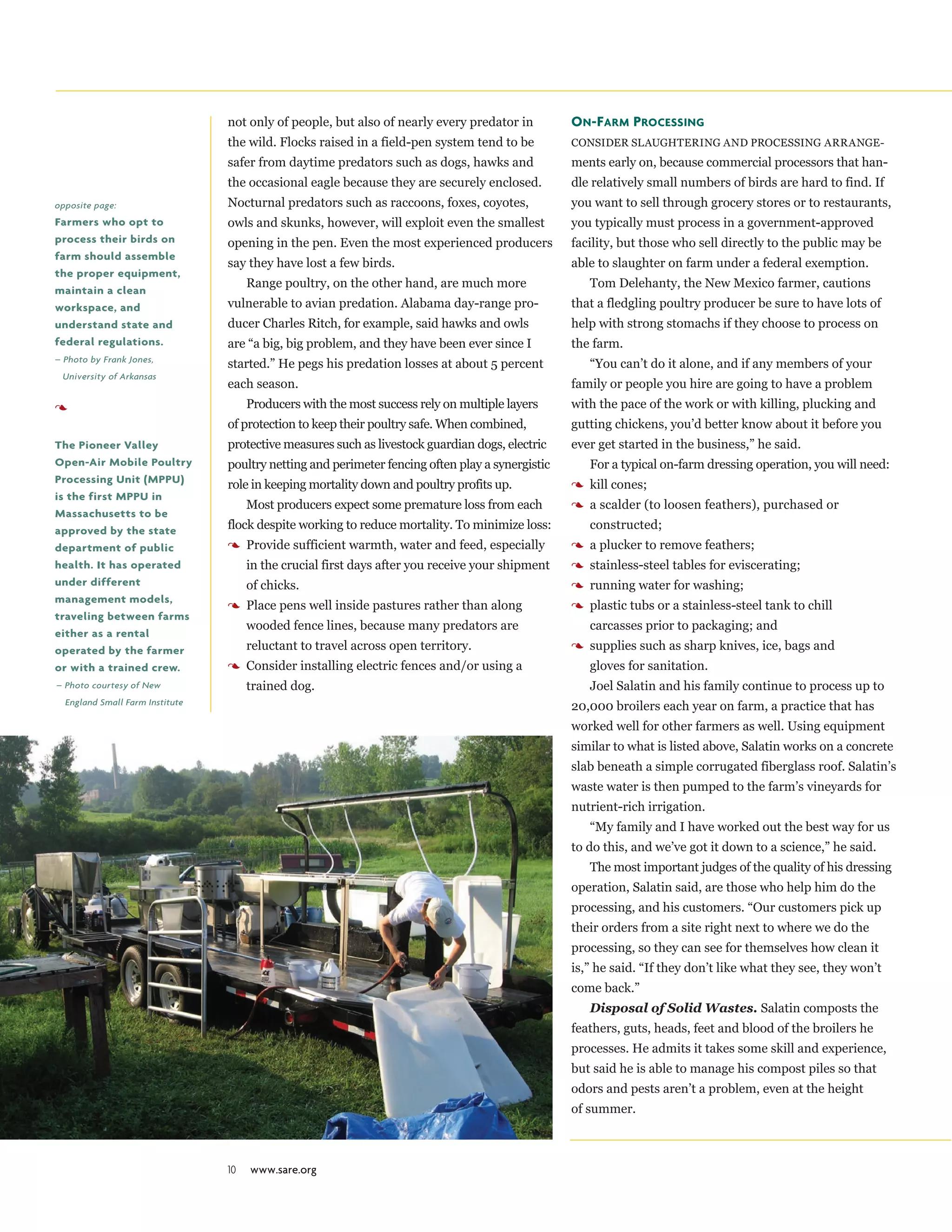
For a typical on-farm dressing operation, you will need:
3	kill cones;
3	a scalder (to loosen feathers), purchased or
constructed;
3	a plucker to remove feathers;
3	stainless-steel tables for eviscerating;
3	running water for washing;
3	plastic tubs or a stainless-steel tank to chill
carcasses prior to packaging; and
3	supplies such as sharp knives, ice, bags and
gloves for sanitation.
Joel Salatin and his family continue to process up to
20,000 broilers each year on farm, a practice that has
worked well for other farmers as well. Using equipment
similar to what is listed above, Salatin works on a concrete
slab beneath a simple corrugated fiberglass roof. Salatin’s
waste water is then pumped to the farm’s vineyards for
nutrient-rich irrigation.
“My family and I have worked out the best way for us
to do this, and we’ve got it down to a science,” he said.
The most important judges of the quality of his dressing
operation, Salatin said, are those who help him do the
processing, and his customers. “Our customers pick up
their orders from a site right next to where we do the
processing, so they can see for themselves how clean it
is,” he said. “If they don’t like what they see, they won’t
come back.”
Disposal of Solid Wastes. Salatin composts the
feathers, guts, heads, feet and blood of the broilers he
processes. He admits it takes some skill and experience,
but said he is able to manage his compost piles so that
odors and pests aren’t a problem, even at the height
of summer.
opposite page:
Farmers who opt to
process their birds on
farm should assemble
the proper equipment,
maintain a clean
workspace, and
understand state and
federal regulations.
– Photo by Frank Jones,
University of Arkansas
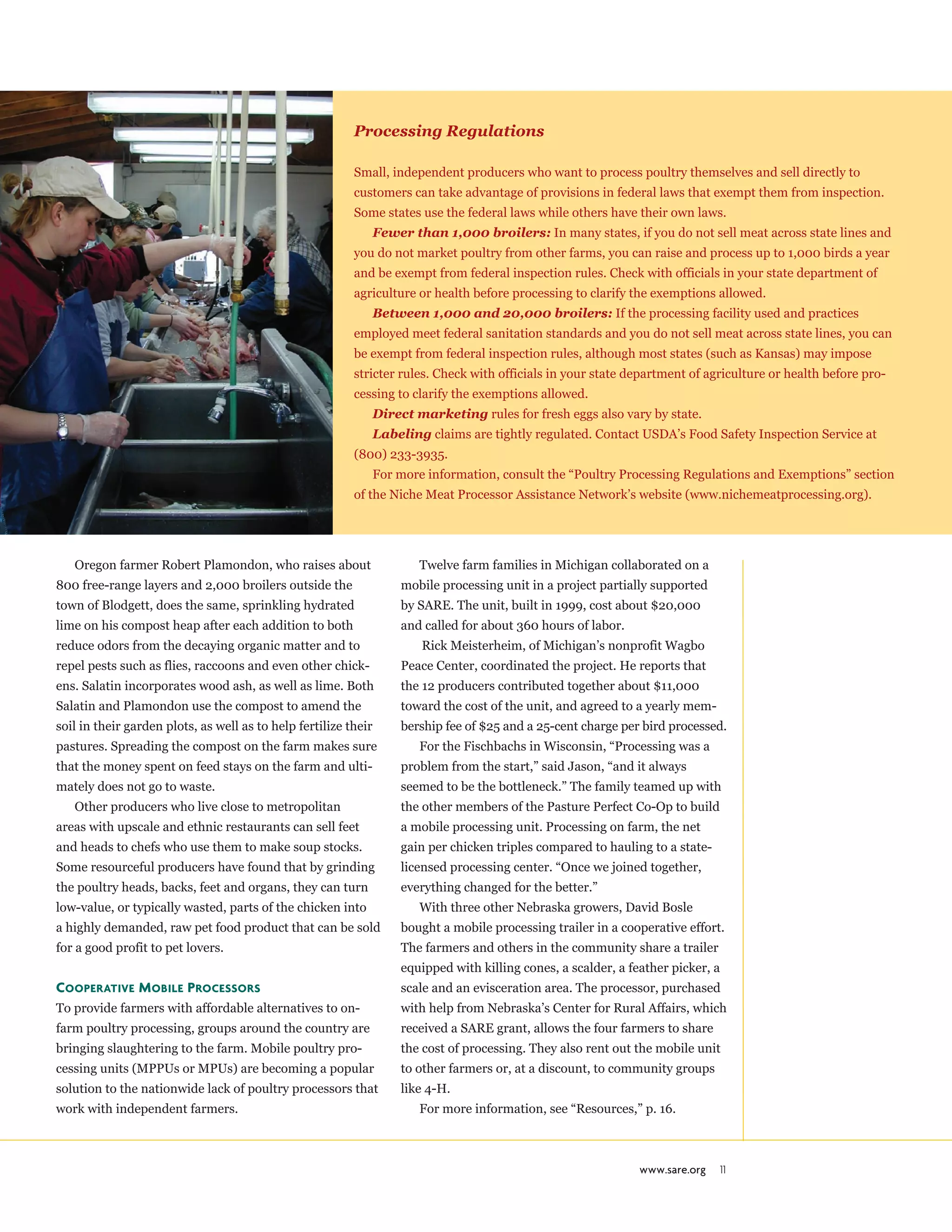
3
The Pioneer Valley
Open-Air Mobile Poultry
Processing Unit (MPPU)
is the first MPPU in
Massachusetts to be
approved by the state
department of public
health. It has operated
under different
management models,
traveling between farms
either as a rental
operated by the farmer
or with a trained crew.
 – Photo courtesy of New
England Small Farm Institute
www.sare.org 11
Processing Regulations
Small, independent producers who want to process poultry themselves and sell directly to
customers can take advantage of provisions in federal laws that exempt them from inspection.
Some states use the federal laws while others have their own laws.
Fewer than 1,000 broilers: In many states, if you do not sell meat across state lines and
you do not market poultry from other farms, you can raise and process up to 1,000 birds a year
and be exempt from federal inspection rules. Check with officials in your state department of
agriculture or health before processing to clarify the exemptions allowed.
Between 1,000 and 20,000 broilers: If the processing facility used and practices
employed meet federal sanitation standards and you do not sell meat across state lines, you can
be exempt from federal inspection rules, although most states (such as Kansas) may impose
stricter rules. Check with officials in your state department of agriculture or health before pro-
cessing to clarify the exemptions allowed.
Direct marketing rules for fresh eggs also vary by state.
Labeling claims are tightly regulated. Contact USDA’s Food Safety Inspection Service at
(800) 233-3935.
For more information, consult the “Poultry Processing Regulations and Exemptions” section
of the Niche Meat Processor Assistance Network’s website (www.nichemeatprocessing.org).
Oregon farmer Robert Plamondon, who raises about
800 free-range layers and 2,000 broilers outside the
town of Blodgett, does the same, sprinkling hydrated
lime on his compost heap after each addition to both
reduce odors from the decaying organic matter and to
repel pests such as flies, raccoons and even other chick-
ens. Salatin incorporates wood ash, as well as lime. Both
Salatin and Plamondon use the compost to amend the
soil in their garden plots, as well as to help fertilize their
pastures. Spreading the compost on the farm makes sure
that the money spent on feed stays on the farm and ulti-
mately does not go to waste.
Other producers who live close to metropolitan
areas with upscale and ethnic restaurants can sell feet
and heads to chefs who use them to make soup stocks.
Some resourceful producers have found that by grinding
the poultry heads, backs, feet and organs, they can turn
low-value, or typically wasted, parts of the chicken into
a highly demanded, raw pet food product that can be sold
for a good profit to pet lovers.
Cooperative Mobile Processors
To provide farmers with affordable alternatives to on-
farm poultry processing, groups around the country are
bringing slaughtering to the farm. Mobile poultry pro-
cessing units (MPPUs or MPUs) are becoming a popular
solution to the nationwide lack of poultry processors that
work with independent farmers.
Twelve farm families in Michigan collaborated on a
mobile processing unit in a project partially supported
by SARE. The unit, built in 1999, cost about $20,000
and called for about 360 hours of labor.
Rick Meisterheim, of Michigan’s nonprofit Wagbo
Peace Center, coordinated the project. He reports that
the 12 producers contributed together about $11,000
toward the cost of the unit, and agreed to a yearly mem-
bership fee of $25 and a 25-cent charge per bird processed.
For the Fischbachs in Wisconsin, “Processing was a
problem from the start,” said Jason, “and it always
seemed to be the bottleneck.” The family teamed up with
the other members of the Pasture Perfect Co-Op to build
a mobile processing unit. Processing on farm, the net
gain per chicken triples compared to hauling to a state-
licensed processing center. “Once we joined together,
everything changed for the better.”
With three other Nebraska growers, David Bosle
bought a mobile processing trailer in a cooperative effort.
The farmers and others in the community share a trailer
equipped with killing cones, a scalder, a feather picker, a
scale and an evisceration area. The processor, purchased
with help from Nebraska’s Center for Rural Affairs, which
received a SARE grant, allows the four farmers to share
the cost of processing. They also rent out the mobile unit
to other farmers or, at a discount, to community groups
like 4-H.
For more information, see “Resources,” p. 16.
12 www.sare.org
Environmental Benefits
Part 3
Poultry can do a lot to remedy problem soil and
control both insect pests and weeds while supplying a
new revenue stream for the farm.
Soil
birds on pasture or cropland act as miniature
manure spreaders that fertilize the soil. They turn and
mix soil and manure as they scratch for insects and
worms, increasing organic matter and improving fertility.
The calcium-rich manure from laying hens can raise the
pH of soil over time, making the ground more conducive
to highly palatable forages like clovers, vetches and
orchardgrass. A word of caution: Birds can’t stay too long
in one area or in high concentrations, especially when the
ground is wet, as this kills forages and compacts the soil.
Steve Stevenson of Wisconsin’s CIAS worked with
farmers who raise other livestock in addition to poultry on
pasture. In each case, the chickens followed the larger
animals, from dairy sheep to beef cattle. “We heard again
and again that chickens do wonders for soil quality and
nutrients,” he said. A flock of laying hens, run two to three
days behind cattle herds, peck and scratch apart the cow
patties as they eagerly gobble up the larva from the para-
sitic flies that prey upon the cows, accomplishing two tasks
at once.
In Louisiana, SARE-funded researchers studying the
benefits of integrating vegetables with broilers or layers
found that vegetables grew best when planted 14 days
after birds were moved across the plot. “We found signifi-
cant improvement in plant performance 14 days after
birds were on the land,” said James McNitt, a researcher
at Southern University in Louisiana, who tested for the
optimum time to plant cucumbers, summer squash, mus-
tard greens and collard greens after pastured poultry.
Mark and Robin Way of Cecil County, Md., appreciate
the extra nitrogen, phosphorous and other nutrients their
flocks give to their hay fields. They move seven pens at a
time across one of their four hay fields, and rotate to a
new field each year.
“We’ve had soil tests, and we’re right where we should
be,” Robin Way said. “The animals do well on the fields. They
pick out bugs, and what they give back is extra nitrogen.”
Tom Delehanty’s birds help him overcome an obstacle
endemic to New Mexico: poor soil. His birds are building
a layer of rich organic matter atop the sandy desert
ground to the point that he is considering expanding into
organic produce.
“Between the rye and oats I plant both as cover crops
and forage, and the scratching the birds do that works
their manure down into the ground, I’m getting fertility
like they’ve never seen around here,” he said. “I’ve got
grain farmers coming from all over the valley to look at
my pastures because they stay green all year long.”
Forages
Research, along with the observations of many
producers, demonstrates that birds and pasture offer
mutual benefits. Planting diverse forages that improve
soil quality by fixing nitrogen or adding organic matter
makes good sense, even though poultry producers some-
times debate how much grass or other forage meat birds
and layers actually eat, and how much benefit they get
from it. Unlike ruminants such as cows, goats and sheep,
birds cannot digest the cellulose in most plants very effi-
ciently, although turkeys and geese are better at it than
chickens. That said, eating greens is the same for poultry
as humans: A greens-only diet is not enough to sustain
life, but greens do make a big difference in health.
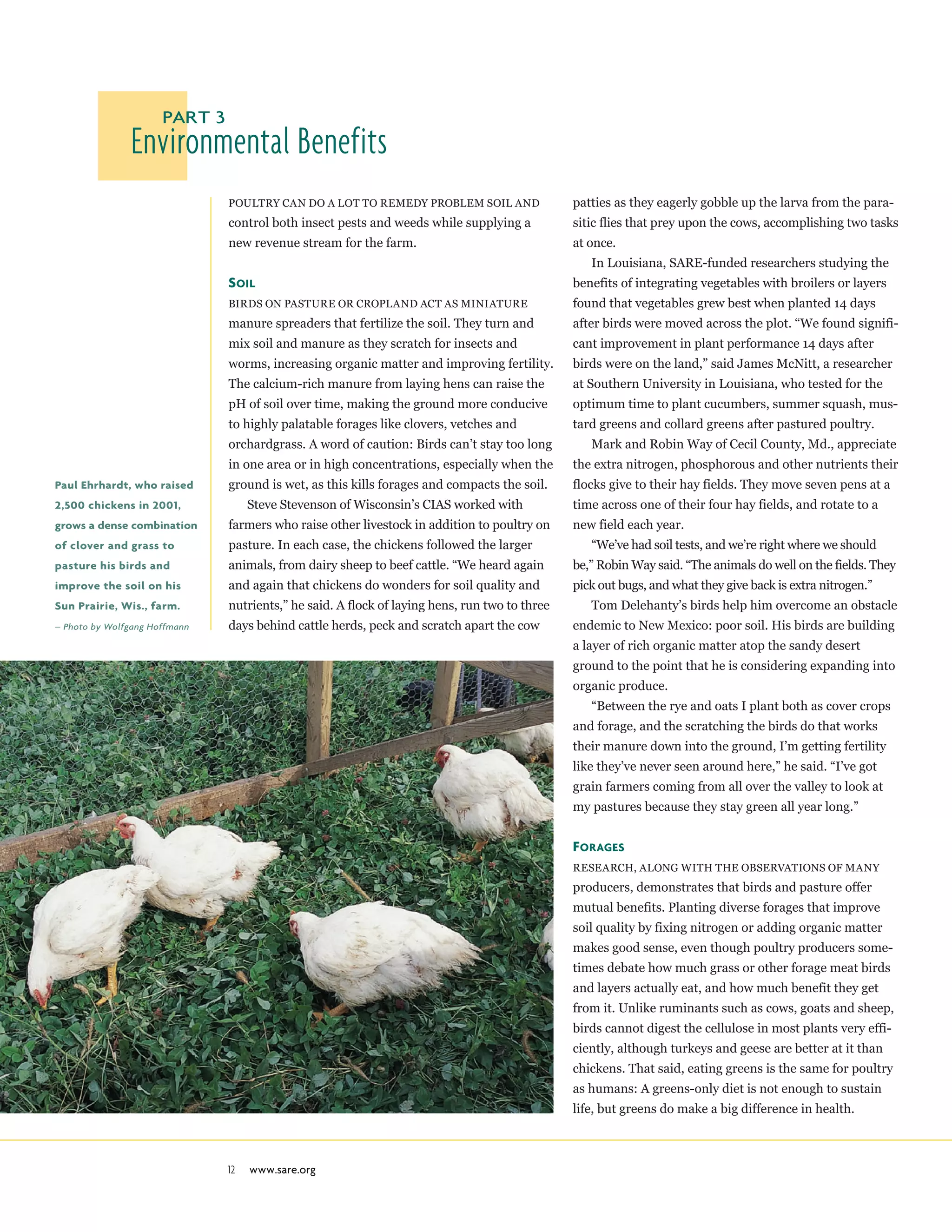
Paul Ehrhardt, who raised
2,500 chickens in 2001,
grows a dense combination
of clover and grass to
pasture his birds and
improve the soil on his
Sun Prairie, Wis., farm.
– Photo by Wolfgang Hoffmann
www.sare.org 13
Joel Salatin has established what he calls a “perma-
nent polyculture” of clovers and grasses in his pastures,
with varieties of native grasses, broadleaves, clovers,
chicories, oats and rye that mature at different times of
the season. His chickens will “eat almost anything as long
as it’s not too tall and not too tough,” he said.
Oregon egg producer Robert Plamondon has found
that pasture research from the early 1900s still applies.
“Everything I’ve read points to oats as the ideal cool-
season green feed,” he said, “while ladino clover, alfalfa
and, to a lesser extent, other clovers are better summer
feeds. My own experience with oats has been very favorable.”
Animal Health
Well-managed Pastured flocks are generally
resistant enough to disease and infections that many
producers forego the use of antibiotics or medicated
feed. Pastured-poultry producers often use this detail as a
marketing tool. It is no secret that consumers want antibi-
otic-free chicken for their families. Significant problems
with cannibalism are rare, so the practice of beak trimming is
uncommon.
By contrast, chickens raised in confined houses are at
risk for a host of respiratory illnesses because air quality
is marred by ammonia and dust made up of excrement,
litter, skin and feathers. To guard against illnesses such
as bronchitis, coccidiosis and necrotic enteritis, confine-
ment chickens receive routine inoculations and antibiot-
ics, in addition to being fed additives such as arsenic.
Pastured birds, however, are more susceptible to
weather-related stress. They can get too cold or too hot,
exposed to rain and wind, and injured by predators.
Chickens handle cold much better than heat, eating extra
feed to produce heat through digestion as needed. Some
steps to reduce heat stress during hot periods include
ensuring adequate access to shade, refreshing water two
to three times per day, and moving pens across pasture
only in the morning or evening, when it is cooler.
Diseases such as coccidiosis can be a concern, espe-
cially in the brooder, if conditions are allowed to become
unsanitary. To keep pathogens under control, use fre-
quent rotations and allow pasture plots time to rest.
Clean pens and brooders regularly between flocks to
keep harmful microbes in check.
Quality of Life Issues
Part 4
Most producers find alternative poultry systems
make economic sense because the cost of establishing
them is low while the potential for significant and steady
income is high. However, much of the growing interest is
because these new systems also promote values such as
family and community cohesion, environmental steward-
ship, working outdoors and independence for farmers.
Family and Lifestyle Benefits
When the Fischbachs started to farm, the size of
their children was a concern. “We were scared that our
kids could get hurt with larger animals like cattle or hogs,”
said Jason, “but poultry are a more manageable, safer
size,” and that gave the Fischbach family peace of mind.
Pastured poultry has also added a community dynamic
to the Fischbachs' life. The co-op farm families process
together, and after they are done, they gather for a picnic
and watch their children play together on the farm.
Joleen Marquardt, a Wyoming pastured-poultry pro-
ducer, held down a variety of jobs off the farm, but thought
that she was missing out on too much of her children’s
lives. She and her husband, Greg, who operate a dryland
wheat farm, were juggling child care with her various jobs.
“I like to work and contribute to the upkeep of the
family,” she said, “but I felt I was losing contact with the
kids.” Her pastured-poultry venture changed all that.
“I kept one of my jobs because I can do it in the winter
months when we can’t raise chickens outdoors, but I focus
on broilers right up through Thanksgiving,” she said. She
can also focus on sons James and Jordan, and daughter
Jessica, because they work right alongside her now instead
of waiting for her to come home from town every evening.
“That’s the biggest benefit,” Marquardt declared. “I
work with my kids, and see them learn how to take care
of the chickens and work with customers.”
Considering what she used to spend on babysitters
and travel, “I didn’t sacrifice anything by starting this
business at home.”
Marquardt’s lifestyle resembles that of many other
range-poultry farmers. Some stages are so labor intensive
14 www.sare.org
they cannot be done alone, and families provide the most
ready workforce. Children with sufficient training can
handle even the most difficult parts of the process,
including moving field pens or relocating larger portable
shelters with a tractor. They also can help dress and
package broilers, or collect and wash eggs.
Labor
Wisconsin’s CIAS researchers, tracking labor on
five pastured-poultry farms, developed a model where
farmers spend 20-22 hours per week handling a 1,000-
bird supplementary enterprise, raising chickens from
chicks through slaughter at eight to 14 weeks.
“Labor can eventually sink your business if you don’t
have a plan to control it. There’s a reason why the industry
went to CAFOs [Concentrated Animal Feeding Operations],
and labor is a big part of that. If you’re going to raise
poultry on pasture on any significant scale, you’re going
to have to be efficient and automate as much as you can,”
said Spencer. Automatic watering systems, storing feed
in waterproof containers in the field, and maximizing the
flock size according to the pasture’s capacity are just a few
of the tricks producers commonly use to reduce labor.
Ohio farmer, author and lecturer Herman Beck-
Chenoweth believes farmers routinely undervalue the
cost of their own labor. “They should keep track of every-
thing, from building pens to learning more about the pro-
cess to marketing, and if it isn’t paying, they should do
something else,” he said, adding that it is important to
ask a fair price for meat and eggs while minimizing the
amount of time spent on poultry chores.
The Salatins have efficiency down to a science.
According to Daniel Salatin, Joel’s son and now the
manager of the poultry operation, two people process
35 to 40 chickens per hour on Polyface Farm.
Community Benefits
At least six families in a traditionally low-income
community in Illinois have re-charged their finances
by adding range-poultry enterprises to their farms.
Farmers in Pembroke Township in north central Illinois
were so inspired by their experiences testing alternative
poultry systems that they formed the Pembroke Farmers
Cooperative to share poultry pens, a refrigerated truck,
a livestock trailer and, not least, valuable production
information.
Jump-started by two SARE grants, awarded as part
of North Central Region SARE’s efforts to target funds
to underserved groups, the Pembroke farmers experi-
mented with both free-range and pen methods. “Through
this project, I learned how to raise a healthier chicken in
a process that is more economically beneficial,” said
Irene Seals, a producer-grant recipient. “Raising pastured
poultry is now a major part of our operation.”
With help from the Kankakee County USDA-Farm
Service Agency (FSA) director, they located a small-scale
processor to slaughter and package their birds, complete
with the co-op label. With processing secured, the families
were able to sell their product within the county or, for an
even better premium, in Chicago.
“It’s a system that I felt really fits their lifestyles and
the community,” said Merrill Marxman, the FSA director.
“We started it as a USDA outreach effort to what we saw
as an impoverished community, and now the co-op has
its own headquarters.”
In another long-running partnership, NCAT, Heifer
International and the University of Arkansas have held pas-
tured poultry workshops throughout the South. Hundreds
of farm families have participated, many of limited
resources who benefit from this relatively inexpensive way
to add new revenue.
The Way family of Cecil County, Md., enjoys farming
and raising livestock, from poultry to rabbits to beef
cattle, on pasture. Robin Way said the family also finds
merit in attracting customers from their community to
experience an integrated farm.
“People are losing small, diversified farms,” she said.
“We try to manage the farm like its own little community,
and we invite people to come see what we do—how the
animal was raised and how it’s processed. We’re proud of
what we have and how we raise them.”
John and Ida Thurman,
shown with Merrill
Marxman of USDA’s
Farm Service Agency
(left), received a SARE
grant to test whether
raising poultry would
stimulate profits and
create jobs. “We have
found that the more
people are doing these
types of chickens,
the more people know
about them, and the
better the market gets,”
John Thurman said.
– Photo by Ken Schneider
www.sare.org 15
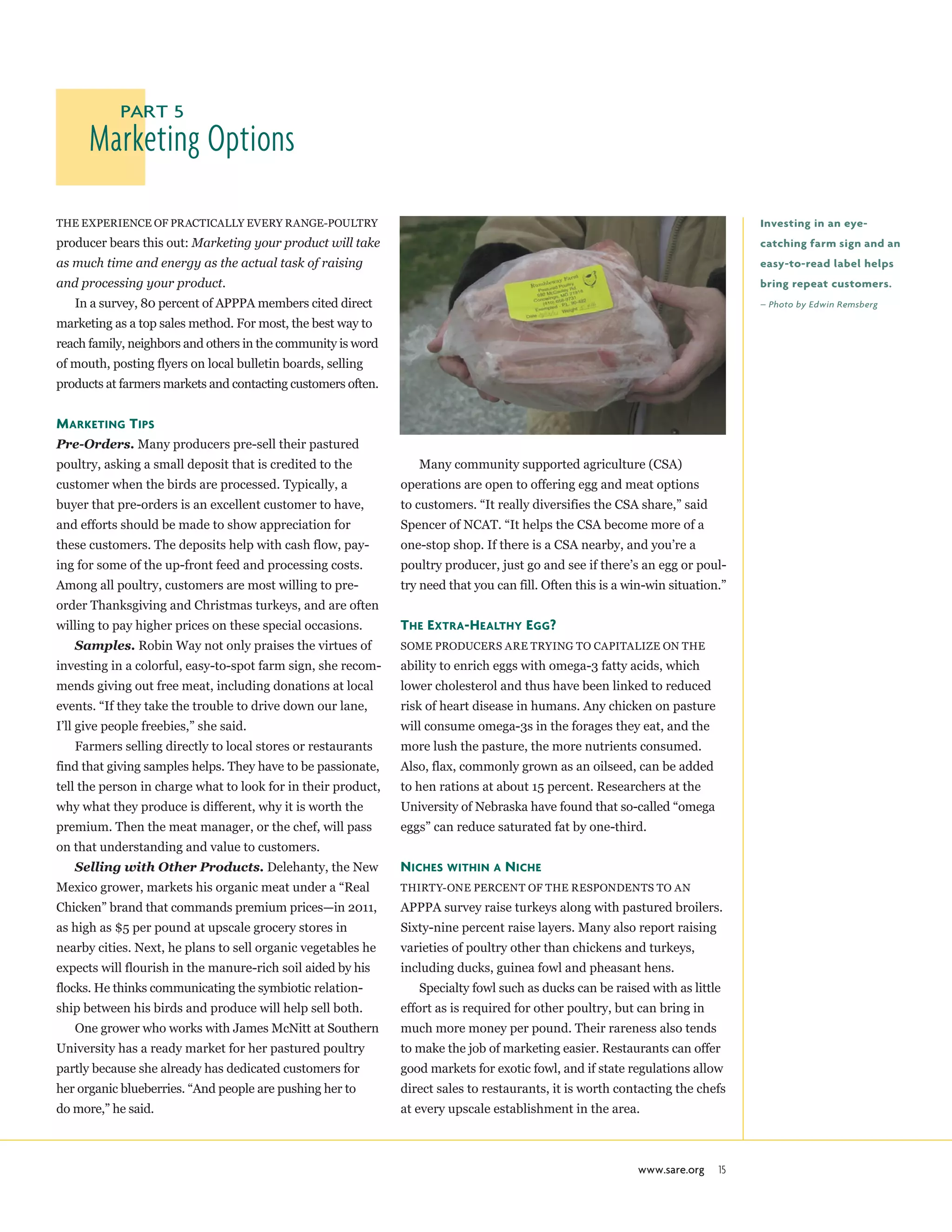
Investing in an eye-
catching farm sign and an
easy-to-read label helps
bring repeat customers.
– Photo by Edwin Remsberg
Marketing Options
Part 5
The experience of practically every range-poultry
producer bears this out: Marketing your product will take
as much time and energy as the actual task of raising
and processing your product.
In a survey, 80 percent of APPPA members cited direct
marketing as a top sales method. For most, the best way to
reach family, neighbors and others in the community is word
of mouth, posting flyers on local bulletin boards, selling
products at farmers markets and contacting customers often.
Marketing Tips
Pre-Orders. Many producers pre-sell their pastured
poultry, asking a small deposit that is credited to the
customer when the birds are processed. Typically, a
buyer that pre-orders is an excellent customer to have,
and efforts should be made to show appreciation for
these customers. The deposits help with cash flow, pay-
ing for some of the up-front feed and processing costs.
Among all poultry, customers are most willing to pre-
order Thanksgiving and Christmas turkeys, and are often
willing to pay higher prices on these special occasions.
Samples. Robin Way not only praises the virtues of
investing in a colorful, easy-to-spot farm sign, she recom-
mends giving out free meat, including donations at local
events. “If they take the trouble to drive down our lane,
I’ll give people freebies,” she said.
Farmers selling directly to local stores or restaurants
find that giving samples helps. They have to be passionate,
tell the person in charge what to look for in their product,
why what they produce is different, why it is worth the
premium. Then the meat manager, or the chef, will pass
on that understanding and value to customers.
Selling with Other Products. Delehanty, the New
Mexico grower, markets his organic meat under a “Real
Chicken” brand that commands premium prices—in 2011,
as high as $5 per pound at upscale grocery stores in
nearby cities. Next, he plans to sell organic vegetables he
expects will flourish in the manure-rich soil aided by his
flocks. He thinks communicating the symbiotic relation-
ship between his birds and produce will help sell both.
One grower who works with James McNitt at Southern
University has a ready market for her pastured poultry
partly because she already has dedicated customers for
her organic blueberries. “And people are pushing her to
do more,” he said.
Many community supported agriculture (CSA)
operations are open to offering egg and meat options
to customers. “It really diversifies the CSA share,” said
Spencer of NCAT. “It helps the CSA become more of a
one-stop shop. If there is a CSA nearby, and you’re a
poultry producer, just go and see if there’s an egg or poul-
try need that you can fill. Often this is a win-win situation.”
The Extra-Healthy Egg?
Some producers are trying to capitalize on the
ability to enrich eggs with omega-3 fatty acids, which
lower cholesterol and thus have been linked to reduced
risk of heart disease in humans. Any chicken on pasture
will consume omega-3s in the forages they eat, and the
more lush the pasture, the more nutrients consumed.
Also, flax, commonly grown as an oilseed, can be added
to hen rations at about 15 percent. Researchers at the
University of Nebraska have found that so-called “omega
eggs” can reduce saturated fat by one-third.
Niches within a Niche
Thirty-one percent of the respondents to an
APPPA survey raise turkeys along with pastured broilers.
Sixty-nine percent raise layers. Many also report raising
varieties of poultry other than chickens and turkeys,
including ducks, guinea fowl and pheasant hens.
Specialty fowl such as ducks can be raised with as little
effort as is required for other poultry, but can bring in
much more money per pound. Their rareness also tends
to make the job of marketing easier. Restaurants can offer
good markets for exotic fowl, and if state regulations allow
direct sales to restaurants, it is worth contacting the chefs
at every upscale establishment in the area.
GENERAL INFORMATION
Sustainable Agriculture Research and Education
(SARE)
SARE Outreach; Patapsco Building, Suite 1122,
College Park, MD 20742-6715; info@sare.org;
www.sare.org
SARE is a nationwide grant making and education
program with the mission of advancing sustainable
innovations to the whole of American agriculture.
SARE Outreach produces information on sustainable
agriculture, primarily based on SARE research results.
National Sustainable Agriculture Information
Service (ATTRA)
P.O. Box 3838, Butte, MT 59702; (800) 275-6228;
attra.ncat.org
Provides assistance and resources to farmers and
other ag professionals. ATTRA has a tremendous
amount of information on nearly every agricultural
enterprise, including sustainable poultry.
Alternative Farming Systems Information Center
(AFSIC)
USDA National Agricultural Library Rm. 132,
Beltsville, MD 20705; (301) 504-6559;
afsic.nal.usda.gov
Provides online information resources, referrals and
database searching, with specialized information on
organic production.
American Livestock Breeds Conservancy
P.O. Box 477, Pittsboro, NC 27312; (919) 542-5704;
www.albc-usa.org
The American Livestock Breeds Conservancy
protects genetic diversity in livestock and poultry
species through the conservation and promotion
of endangered breeds.
PUBLICATIONS
Related ATTRA Publications
See attra.ncat.org for: Growing Your Range Poultry
Business: An Entrepreneur’s Toolbox • Pastured-
Raised Poultry Nutrition • Small-Scale Poultry Pro-
cessing • Small-Scale Egg Handling • Organic Poultry
Production: Providing Adequate Methionine
Building a Sustainable Business: A Guide to
Developing a Business Plan for Farms and Rural
Businesses
SARE; (301) 374-9696; www.sare.org/business
This in-depth guide brings the business planning pro-
cess alive to help transform farm-grown inspiration
into profitable enterprises.
Free download online.
Chicken Tractor
Good Earth Publications; (540) 261-8775;
www.goodearthpublications.com
Day Range Poultry: Every Chicken Owner’s
Guide to Grazing Gardens and Improving
Pastures
Good Earth Publications; (540) 261-8775;
www.goodearthpublications.com
Fresh-Air Poultry Houses – The Classic Guide to
Open-Front Chicken Coops for Healthier Poultry
Norton Creek Press; 36475 Norton Creek Road,
Blodgett, OR 97326; www.nortoncreekpress.com
Grit! – The American Pastured Poultry Producers
Association (APPPA) newsletter
P.O. Box 85, Hughesville, PA 17737-0085;
(570) 584-2309; www.apppa.org
Pastured Poultry Profits
By Joel Salatin, Polyface Farms; Published by Acres
U.S.A.; (800) 355-5313; www.acresusa.com
Raising Poultry on Pasture: Ten Years of Success
APPPA; P.O. Box 85, Hughesville, PA 17737-0085;
(570) 584-2309; www.apppa.org
A comprehensive collection of informative Grit!
articles written by pastured-poultry producers for
pastured-poultry producers.
The Stockman Grass Farmer
The Stockman Grass Farmer; P.O. Box 2300,
Ridgeland, MS 39158-9911; (800) 748-9808;
www.stockmangrassfarmer.com
This monthly magazine is devoted to the art and
science of turning grass into cash.
Storey’s Guide to Raising Chickens
Storey Publishing; 210 MASS MoCA Way,
North Adams, MA 01247; (800) 441-5700;
www.storey.com
Success With Baby Chicks - A Complete Guide
to Hatchery Selection, Mail-Order Chicks, Day-
Old Chick Care, Brooding, Brooder Plans, Feed-
ing and Housing
Norton Creek Press; 36475 Norton Creek Road,
Blodgett, OR 97326; www.nortoncreekpress.com
Talking Chicken
Acres U.S.A.; (800) 355-5313; www.acresusa.com
This 395-page book, written by SARE grantee Kelly
Klober, offers valuable insight into rare, heritage
and heirloom breed selection, chick raising, breeding
and marketing for meat and egg production.
Online sources
American Livestock Breeds Conservancy Turkey
Manual – How to Raise Heritage Turkeys on
Pasture
www.albc-usa.org/EducationalResources/
turkeys.html#manual
A comprehensive, free guide to raising heritage turkeys.
APPPA/Grit! Pastured Poultry Listserv
APPPA; www.apppa.org
Available with membership to APPPA.
ASK FSIS
askfsis.custhelp.com; (800) 233-3935
The online/phone hotline of USDA's Food Safety
Inspection Service (regulates processing of poultry).
Producers can talk with regulatory professionals and
get straight answers. If requested, producers can get
answers in print on letterhead for their records and
protection.
ATTRA Small Poultry Processors and Services
Database
attra.ncat.org/attra-pub/poultry_processors
A state-by-state listing of USDA and state-inspected
processors that work with farmers.
Guide to On-Farm Poultry Slaughter
Cornell University; smallfarms.cornell.edu/2012/
07/20/new-on-farm-poultry-processing-guide
This 28-page guide on regulations is specific to
New York, but has good general information.
New Entry Sustainable Farming Project
nesfp.nutrition.tufts.edu/training/
poultryresources.html
Find online cost calculators for poultry production
and processing; and guidebooks (free PDF down-
loads) on building an on-farm poultry processing
facility, food safety and licensing.
Niche Meat Processors Assistance Network
www.nichemeatprocessing.org
NMPAN is a national network of people and
organizations creating and supporting appropriate-
scale meat processing infrastructure for niche
meat markets. NMPAN provides information and
resources to processors, producers, buyers,
regulators and others.
Pastured Poultry Discussion Group
groups.yahoo.com/group/PasturePoultry/
State Poultry Processing Regulations
www.extension.org/mediawiki/files/2/28/NMPAN_
State_Poultry_Regs_Report_6June2011.pdf
Compiled by NMPAN, this document covers the
state-by-state laws concerning the federal on-farm
poultry slaughtering exemption.
Pastured Poultry Budget Calculators
See the Pastured Poultry Economics sidebar on p. 5.
Alternative Poultry Resources
This bulletin was produced by Sustainable Agriculture Research and Education (SARE), supported by the
National Institute of Food and Agriculture (NIFA), U.S. Department of Agriculture.
This bulletin was co-written by Valerie Berton and David Mudd, with a 2012 revision by Terrell Spencer
of the National Center for Appropriate Technology (NCAT). Special thanks to Anne Fanatico of NCAT for
her advice and careful review. Thanks also to SARE’s team of technical reviewers. Any opinions, findings,
conclusions, or recommendations expressed in this publication are those of the author(s) and do not
necessarily reflect the view of the USDA.
16 www.sare.org Printed on paper that is 100 percent post-consumer waste and process chlorine free.

Profitable poultry

  • 1.
    12/12 Like many familyfarmers, Jason and Melissa Fischbach and their three children work hard to produce a living off of their diversified Wild Hollow Farm in Ashland, Wis., integrating vegetable production and poultry, and raising their birds on pasture. “There’s a good profit margin raising chickens and turkeys on grass,” said Jason, “as long as you know your inputs, get your prices right and keep your mortalities low.” The small scale of pastured poultry, along with its quick turn-around and minimal equipment needs, attracted the Fischbachs to raising poultry on pasture. The needs of the family played a big role as well. “As fairly new farmers with little kids, we felt that the chickens were much safer with the kids around, compared to cattle or sheep.” Jason, who is also an Extension agent for the University of Wisconsin, began raising pastured poultry when the local farmer already doing so quit: “We sniffed out an opportunity to make a profit,” said Jason. At the same time, two other farming families recognized the same opportunity. Facing similar challenges, the three farms chose cooperation instead of competition and formed Pasture Perfect, LLC, a pastured-poultry cooperative. According to Jason, “Once all the farms joined together, everything changed for the good. We were able to buy in larger quantities, saving money, and help each other with processing.” Pasture Perfect also received a grant from USDA’s Sustainable Agriculture Research and Education program (SARE) to evaluate different feeding options to fine-tune their day-range production system. Pasture Perfect sells around 1,500 birds per year directly from their farms, netting around $2-$6 per bird in 2011, and their poultry is in high demand. The Contents Determining the right system 2 Industry Changes 2 The Salatin Influence 3 Alternative Poultry Systems 4 Potential for Profit 5 Production Basics 5 Feed 7 Breeds 8 Mortality and Predation 9 On-Farm Processing 10 Cooperative Mobile Processors 11 Environmental benefits 12 Soil 12 Forages 12 Animal Health 13 quality of life issues 13 Family and Lifestyle Benefits 13 Labor 14 Community Benefits 14 Marketing options 15 Marketing Tips 15 The Extra-Healthy Egg? 15 Niches within a Niche 15 Resources 16 Also available at: www.sare.org/poultry or order a free hard copy at (301) 374-9696. Livestock Alternatives Profitable Poultry: Raising Birdson Pasture left: Melissa and Jason Fischbach, of Ashland, Wis., like the small scale and minimum requirements of pastured poultry. – Photo by Beth Probst; upper right: Chickens foraging on clover and grass. – Photo by Wolfgang Hoffmann; lower right: A mobile on-farm processing unit. – Photo courtesy of New England Small Farm Institute
  • 2.
    2 www.sare.org cooperative alsomarkets 2,000 birds, processed at a USDA-inspected processing plant, through community- supported agriculture, at farmers markets and in local stores. Pasture Perfect prefers to sell the birds directly off the farms though, not only because the profit margin is much higher, but, as Jason said, “Living out in a rural area, working on the farm, you don’t get to see a lot of people, so it’s nice having our customers picking up their orders on Sundays. It gives us a chance to meet our customers and show them where their food comes from.” The consistent, profitable market is just one incentive for the Fischbachs, their partners and poultry producers across the country. Add in other win-win benefits— amending soil with poultry manure and improving pasture sward and diversity, especially when paired with grazing by ruminants—and it is easy to see how outdoor poultry systems are meeting the needs of producers across the country. “Birds on pasture make it easier to graze other kinds of livestock on those pastures, or to think about vegetable production that doesn’t need a boost from chemical fertilizers,” said Allan Nation, editor of Stockman Grass Farmer. “Before you know it, you’ve got a diversified operation that makes it simpler to earn money from several efforts, all of them working in concert, and all of them making your farm and your environment stronger. Pastured poultry drives the train.” This bulletin is about boosting your farm’s profitability and health with pasture-based poultry systems. Read on to learn more, and consult the list of alternative poultry production resources on page 16 for a wide range of general information, publications and online materials. Industry Changes Raising poultry on pasture isn’t exactly new. Most broilers, layers and other domesticated fowl were raised outdoors before the advent of the now-dominant confinement method in the late 1950s. Since then, large corporations have become the primary producers of poultry in the United States, developing “vertically integrated” practices that allow them to cap- ture nearly 100 percent of the multi-billion dollar annual market. Today, vertically integrated corporations control almost every aspect of how broilers and eggs are produced, processed and sold. Individual farmers still participate in these large-scale systems, but as contractors who agree to meet standards that usually include furnishing climate- controlled confinement houses to hold tens of thousands of birds or more. An individual confinement house can cost more than $200,000. Poultry companies usually supply farmers with chicks and feed needed to bring them to market weight in seven weeks or less. The vertically integrated corporations then typically manage the slaughtering and packaging process, paying contract farmers by the bird, with feed and heating costs factored into the equation. The system has helped make chicken a low-cost staple for American consumers. But some farmers and consumers question whether, in the process of achieving that efficiency, values they consider important—autonomy and independence for Determining the Right Alternative Poultry Production System Part I – Photo by Terrell Spencer, National Center for Appropriate Technology
  • 3.
    www.sare.org 3 farmers, thewelfare of the flocks, and the taste and quality of their meat and eggs—have been lost. To meet growing demand for poultry raised differently, a number of growers, especially those on small- or mid-scale diversified farms, are choosing to raise birds in alternative ways, most of them reliant upon pasture. “One of our key findings is that the system has real advantages on diversified farms,” said researcher George “Steve” Stevenson, director of the Center for Integrated Agricultural Systems (CIAS) at the University of Wisconsin, who was awarded a grant from SARE. “What’s really nice about pastured poultry is that it folds in with a whole range of other enterprises.” For example, Rick and Marilyn Stanley of Wells, Maine, have found that poultry and high-value vegetable production can mix well together. The Stanleys raise cer- tified organic vegetables and laying hens on their historic New England farm. One of the most valuable crops the Stanleys raise is asparagus. They received a SARE grant to experiment with integrating hens into their asparagus production to control quackgrass and other problematic weeds. They examined weed growth in the asparagus beds both with and without the hens. After two years they concluded that the hens did a great job. “We’re happy with the job the hens did, and we’re planning on continuing to use them,” said Marilyn. “The hens are worth keeping for the labor savings alone because we spend so much less time hand weeding the asparagus.” Terrell Spencer, a Nebraska pastured-poultry pro- ducer and sustainable poultry specialist with the National Center for Appropriate Technology (NCAT), said that historically farmers raised poultry not only for meat, eggs and feathers, but also as a management tool. “From the Southern tradition of using Cotton Patch and other geese to weed cotton and strawberry fields to American colonists running turkeys in the fields to manage tobacco worms, poultry are extremely versatile on the farm,” said Spencer. An increasingly popular method of fly control is to follow cattle with laying hens in portable housing, a method invented by pastured-poultry pioneer Joel Salatin. The laying flock tears apart the cow patties while searching for the parasitic fly larvae that live in the dung. The hens have a drastic effect on fly populations, leading to happier and less-stressed cattle, and increased gains and profits. “The more uses you can get out of your flocks, the more profitable they become,” said Spencer. In Wisconsin, the Fischbachs have also found ways to mix vegetables and pastured poultry on their farm. Besides poultry, they raise tomatoes, peppers and other vegetables in high tunnels. “By November, the crops are getting pretty rough,” said Jason, “so we move the Thanksgiving turkeys into the high tunnels. The turkeys clean and fertilize the tunnels up pretty nice, and the tunnels help keep the turkeys dry and out of the wind as the cold sets in before Thanksgiving.” The Salatin Influence: Pastured Poultry Takes Off Since poultry farmers began looking for alternatives, innovators have responded by perfecting various systems, many of them outdoors, that raise chickens for greater profit with less environmental impact and better conditions for the birds. The ways to raise poultry are varied to meet producers’ goals and take into account climate, topography and available labor. In the early 1990s, Virginia farmer Joel Salatin pub- lished a book detailing a new system to compete for the small but growing niche of consumers who wanted to buy poultry raised outside the corporate system. His popular Pastured Poultry Profits explains the innovations he made to the old practice of allowing poultry to range free around the barn lot. The book lays out production strategies alongside his estimates of what readers who follow his methods can net: $25,000 in only six months on 20 acres. In his system, producers raise or buy chicks between April and October, then move them from brooders into floorless pens on pasture. Today, pastured-poultry pens are built in an ingenious array of shapes and sizes, and with different materials and engineering. If put side by side, a lineup of these homegrown pens would look much like a boxcar derby, each reflecting a farmer’s creative ability to design according to a particular farm’s needs and terrain. Salatin’s pens are around 10 feet by 12 feet by 2 feet, flat-roofed, squat and square, and can house Before taking the plunge, consider... 3 In penned systems, expect to move pens daily. Other approaches can be less physically demanding. See “Alternative Poultry Systems” on p. 4. 3 Poultry operations are usually seasonal, unless producers build semi- permanent housing. See “Yarding” on p. 4. 3 You may need to dig to find suppliers such as hatcheries and other contractors. Yet, those retailers will likely ship materials to you. 3 Pastured birds are susceptible to weather-related stress and predation. 3 Reliable processing may be hard to find; many farmers process on site. 3 While some are concerned that pastured poultry might be exposed to avian influenza through migratory waterfowl, others claim that flocks and pasture managed with care to avoid parasites are at less risk than large confinement houses.
  • 4.
    4 Alternative Poultry Systems PasturedPoultry Pen – Encloses birds in floorless portable pens that are moved daily to fresh pasture. Birds feed on grass or other forages, worms and insects, and supplemental grain-based feed. They work their manure into the soil by scratching. 3 Photo 1 (top to bottom). Virginia's Joel Salatin, a leader in the movement to expand poultry production outdoors, demonstrates a movable pen, one of many effective sys- tems for raising poultry on pasture. – Photo by Tom Gettings, Rodale Institute “Net” Range (or “Day Range”) – Contains birds in movable housing, with electric poultry netting defining a series of paddocks surrounding the house (often a hoop-like structure). Producers move flocks through paddocks, shifting them as the condition of the pasture dictates. With access to the shelter for feeding, rest and shade, birds can escape from both predators and inclement weather. Birds feed on grass or other forages such as vegetable or grain crops, worms and insects, and supplemental grain-based feed. Birds remain vulnerable to predation—especially avian predation—but may be better protected from the more common nocturnal predation because the housing units are usually more resistant than field pens to raccoons, foxes and skunks. 3 Photo 2. This portable shelter is used in combination with electric fencing on the Elm- wood Stock Farm in Georgetown, Ky. Birds are provided supplemental feed and water, and get some degree of protection against the elements and predators.– Photo by Jerry DeWitt “Chicken Tractor” – Contains poultry in small pens to help prepare the soil for garden plots. Birds feed on weeds, garden plants, insects and grubs, and supplemental grain-based feed—while “tilling” and “fertilizing” the soil. Andy Lee, a Virginia farmer and researcher, wrote a book about this system, claiming the birds can do wonders in weed suppression and soil revitalization. 3 Photo 3. This chicken tractor, at the Dickinson College Farm in Boiling Springs, Pa., is de- signed to be easily moved across pastures and vegetable beds. The adjustable tarp pro- vides protection from both rain and the hot sun. – Photo by Dena Leibman, SARE Outreach Free Range – Allows birds to range freely across pastures, gardens, and/or cropland, and to return at night or in inclement weather to portable housing. Skids or “eggmobiles” are moved regularly to encourage grazing of particular areas. Birds are vulnerable to predation. 3 Photo 4. Kent Ozkum and Will Morrow of Whitmore Farm in Emmitsburg, Md., use this chicken coop and others to house heritage breed poultry and move flocks to new pasture as needed. – Photo by Dena Leibman, SARE Outreach Yarding – Keeps birds in stationary housing, but allows them access to yard or pasture dur- ingdaylight.Thismodelhasbeenapopularwayforsomeconfinementpoultryproducers to tap into the growing market for “free-range” poultry, including the new USDA-certified organic program. They can use the same houses designed for the industrial confinement model, modifying the practice simply by fencing a yard or pasture surrounding the house and allow- ing flocks to range on it. Without taking care to subdivide the area into paddocks, however, farmers using this method risk concentrating birds, which can denude the soil, deplete nu- tritious forages and concentrate pathogens. Again, because birds are not contained in pens, they are more open to predation, at least during daylight hours. The comparative value of the various poultry systems depends on the vision you have for your operation. Seek experienced advice and make use of the wealth of information listed in “Resources” on p. 16.
  • 5.
    up to 80broilers. He moves the pens daily to fresh pas- ture. While receiving exercise and fresh air foraging for plants and insects, the chickens drop manure that adds fertility to the soil. Salatin passes along his experiences and ideas, holding field days and speaking frequently at conferences. With help from SARE and Heifer International, a nonprofit organization that promotes community development through sustainable livestock production, Salatin held workshops for limited-resource farmers interested in learning more about pastured poultry. “You walk away from three days with [Salatin] knowing everything from how to keep a chicken healthy to how to keep your customers happy,” said Rosa Shareef, a farmer from New Medinah, Miss., who attended one of the workshops. Tom Delehanty, a former conventional chicken farmer in Wisconsin, who moved to Socorro, N.M., to raise pas- tured poultry, credits Salatin’s methods for providing a jumping-off point from which he designed a field pen to fit his New Mexico climate. There, mild desert winters allow him to keep birds on pastures year-round. www.sare.org 5 Potential for Profit Part 2 SARE-funded researchers at Wisconsin’s CIAS studied five farms that raise poultry on pasture and found that the systems, while highly variable, yielded a significant profit for growers who incorporate poultry into diversified farms. CIAS researcher Stevenson said that in the beginning, people make it work best at lower numbers, around 1,000 birds per season. But he cautions that the learning curve is about five years for a grower to become experi- enced. “By then, people know what they’re doing, their pastures are in shape, and they have figured out their management and equipment needs.” Enterprise growth can be rapid initially on a pastured- poultry farm, but it should never be rash. “The temptation is to get too big too fast,” said Spencer from NCAT, “and then a new farmer makes a big mistake on a large scale, and it wipes them out. Successful pastured-poultry growers are good managers, and you can’t be a good manager until you’ve got some experience under your belt.” “It all gets down to the customer,” said Paul Swanson, a Nebraska Extension educator specializing in sustainable agriculture who sees growing interest in pastured poultry. “To sell your product, you need a customer and a growing number of people who are interested in better tasting, higher-quality chickens and don’t like the current system.” Most farmers who have worked with Swanson on poultry enterprises already had crop farms, and many of them had beef cattle, too. They diversified to improve profits. “Chickens are a size that people don’t hesitate to purchase directly, as opposed to a quarter or half of beef,” Swanson said. “It’s an opportunity for farmers to try something without a very large investment.” Most pas- tured-poultry farmers sell all of the birds they raise even before processing them. Many direct-market producers find that poultry is a real lure that brings customers onto the farm, and many of them will buy more than just chicken or turkey when they are there. Production Basics Housing. The least expensive approaches are the portable field pens, pioneered by farmers in Europe more than a century ago, and more recently made popular in America by Joel Salatin and Andy Lee, though most producers Pastured Poultry Economics Pastured poultry costs and returns vary widely. Before starting your operation, take advantage of budget tools available online. These calculators are used to estimate the economic return from your pastured poultry operation. They typically calculate revenue in terms of the number or weight of birds sold per year, and can include additional revenue from egg, feather and manure sales. Expenses include not only the usual costs for chicks, feed, medication, bedding, paid labor and processing, but also more complex costs, such as marketing, capital investment, equipment depreci- ation and the value of unpaid labor. Good calculator options include: 3 www.cias.wisc.edu/crops-and-livestock/poultry-enterprise-budget (University of Wisconsin's Center for Integrated Agricultural Systems) 3 www.windyridgepoultry.com/tools1.htm (Windy Ridge Natural Farms) 3 nwdirect.wsu.edu/barriers/tools.htm (Washington State University)
  • 6.
    6 www.sare.org concede theyalso demand the most time and labor. For pastured laying hens, open-faced sheds on skids, called colony houses, are a proven housing choice. Salatin’s model also holds promise for producers who wish to raise poultry with low initial costs. Innovative farmers have adapted the Salatin design to fit their par- ticular terrain and needs. In general, simple-to-build pens are made of inexpensive wood, sheet metal or plastic, and chicken wire. Making a 10-foot-by-12-foot pen— suitable for up to 80 mature chickens—should cost no more than $400, plus labor. Pens can be made less expensive if the roofing is salvaged. One mobile pen model, invented by Homer Walden of Sunnyside Farm, near York, Pa., includes a novel wheel-and-pull system that makes it easier to move, and can be used for either layers or broilers. The cost is about $450 to build. At the other end of the spectrum are the portable houses favored by many farmers involved in day-range or free-range poultry production. Typically much larger and made of sturdier materials, they can cost significantly more. Lee designed and built structures he calls “mini- barns” for his day-range operation. They are made from lumber, plywood, corrugated tin and fiberglass, and have wooden runners, or “skids,” at their bases that allow them to be dragged with relative ease by tractor to fresh stands of pasture when needed. The chicken-tractor model, which Lee designed and describes in his book Chicken Tractor, calls for small numbers of birds to control weeds and insect pests, and increase fertility in garden plots. Simple and inexpensive, the tractor model might be the best way for someone with limited farming experience to begin raising poultry outdoors, although it is intended primarily to work in concert with vegetable production. Salatin has designed coops on wheels that house laying hens, called eggmobiles. The eggmobile follows a herd of beef cattle, where the hens eagerly scratch apart cow patties to get at the fly grubs inside, reducing parasite numbers and providing nutrition for the laying flock. Spencer, the NCAT poultry specialist, built an eggmobile, constructing housing for his laying flock of 125 hens on top of an old haywagon chassis. “Parts of our place are really steep and having the layers on wheels lets us more easily move the flock from field to field. We just lock the hens in and we tow it wherever we need them. It helps us take better care of our pastures.” Pasturing systems like Lee’s, where the chickens are not confined in the housing pens, are called day-range systems and usually depend on portable fencing to manage where the hens roam. Most producers favor electric fencing designed for poultry, called poultry netting, or feather netting. It costs about $160 per 164-foot roll (including step-in posts, but not the power source). The amount of poultry netting needed to manage a poultry flock is determined by several factors. The species, type (layer vs. broiler), age and breed of the bird, the flock density, and the condition of the pasture and health of the soil all dictate how much space to give the poultry being raised. “If the pasture’s getting hammered, there are too many birds on too small an area,” said Spencer. “If you pay attention to your pasture condition, you’ll know if and how you need to change. It’s pretty simple once you get an eye for it.” Spencer suggests two rolls of netting per 150 birds. Brooders. Brooders are secure, climate-controlled areas where newly hatched chicks can live until sufficiently feathered to live outdoors. They are made of plywood, lumber and chicken wire, and contain warming lamps, drinking water containers, feeders and litter. A basic brooder that holds as many as 250 chicks can cost as little as $100 to construct. Feed and Water Delivery. Beyond a brooder and field pen, producers only need containers for feed and water. They can be simple and inexpensive, even home- Watering units, such as this one in a portable shelter on Elmwood Stock Farm in Georgetown, Ky., can be simple, but should be sturdy and allow access by many birds at once. – Photo by Jerry DeWitt
  • 7.
    made. Ensure thatany feeder or watering unit, whether made at home or purchased from a commercial source, does the job properly. Feed containers must be rodent proof, as rodents’ access to the feed can spread salmonella. If the feed is stored outside or in the field, the containers must be waterproof. For example, improperly anchored or poorly designed feeders and watering units can be tipped over or clogged, increasing opportunities for spoilage and contamination as well as inducing unneces- sary stress or endangering the lives of a flock. As pastured- poultry enterprises grow, labor often becomes problematic. Producers raising large numbers of poultry design their feeding and watering systems to be as efficient as possible. Feed Most poultry diets contain corn for energy, soybeans combined with an animal or synthetic source for protein, as well as vitamin and mineral supplements. Some growers are switching to soy-free feeds in response to customers who want to avoid soy in their food chain. In well-managed pasture systems, producers very rarely use medications, as proper sanitation and a healthy growing environment help prevent health issues before they start. Consumers by and large appreciate poultry raised without antibiotics and other medications, an appreciation that is often reflected in their willingness to pay a premium price for pastured-poultry products. Besides the feed in the feeder, free-range poultry have access to a buffet of forages, seeds, insects and other animals while on pasture. Joel Salatin estimates that his broilers forage for more than a quarter of their diet. Other producers guess feed savings of anywhere from 5-25 percent on pasture. When using low-quality feeds, the vitamins ingested when the birds forage on grasses and forbs can balance out nutritional deficiencies in the feed ration. “There are a lot of environmental and management factors that affect how much food’s out there for your birds,” said Spencer. “Soil fertility, bird genetics, management style, climate, time of season and unexpected things like drought, flooding, late/early frosts—all of these can throw a major wrench in your operation if you don’t plan ahead.” Where pastured-poultry farmers source their feed is as diverse as the farmers themselves. Often pastured- poultry producers begin with prepared rations from their local feed store. As the operation grows, producers often buy feed in bulk, enabling them to purchase top-quality feeds, including organic, soy-free and GMO-free (not genetically modified) if that is part of the operation, for prices comparable to conventional feeds. Some pro- ducers, both small and large, mix and grind their own feed. Ration recipes can be found in books, websites and listservs dedicated to pastured- and range-poultry operations. Whatever route you take—ready-mixed feed or preparing your own blend—expect the cost will likely range between 15-50 cents per pound for conventional and GMO-free rations. Cornish Cross meat birds will ingest roughly 10-15 pounds of feed each before reaching market weight, which means the typical cost of feeding each bird will range from $2-$6 during its seven- to eight-week lifetime (or longer for slower growing breeds). The most productive laying hens consume around 25 pounds of feed to get to the point of lay. When evaluating feed options, consider: 3 Organic feeds are increasingly available from mills and suppliers. Expect to pay two to four times the cost of conventional rations. 3 Some feeds are medicated to combat coccidiosis, which is particularly devastating to chicks; experi- enced farmers typically find that clean brooders, deep litter and clean living conditions make medicated feeds unnecessary. 3 Feeds can be ordered in various forms, such as cracked, mashed and pelletized. Healthy debate rages as to which form is better for pastured birds. The process of making feed crumbles and pellets heats the feed, destroying heat-sensitive vitamins, yet some argue that heat and pressure free up other nutrients and make them available to birds. Ground feed is not typically heat treated, but more feed can be wasted through spillage in the field. Many produc- ers report that the higher cost of high-quality feed www.sare.org 7 By adding flax to hen rations, some producers have capitalized on the ability to enrich eggs with omega-3 fatty acids, which lower cholesterol and thus have been linked to reduced risk of heart disease in humans. – Photo by Ken Schneider
  • 8.
    8 www.sare.org is oftenoffset by lower consumption rates as the birds eat less to get the nutrition they need. 3 Some producers have found that vitamin supplements help reduce mortality, with their costs being more than offset by greater flock productivity. For more information see Pastured-Raised Poultry Nutrition. Download a free copy from ATTRA at https://attra.ncat.org/attra-pub/poultry, or buy a print copy by calling (800) 346-9140. Breeds Most pastured-poultry producers have adopted the same breed of meat bird as their confinement counter- parts: the Cornish Cross. Developed for its large breast, large appetite and rapid development, the Cornish Cross also boasts a mild flavor that is familiar and appealing to most consumers. Virginia homesteader and author of The Small- Scale Poultry Flock Harvey Ussery and his wife are experimenting with hardier varieties of birds, such as New Hampshires and Plymouth Rocks. Even though these varieties take longer to reach butchering weight, the meat boasts more flavor. Ussery wants to educate consumers about alternatives to Cornish Cross. He said the fast growth of the Cornish Cross strains the birds’ hearts, digestive systems and leg joints. Moreover, birds more suited to foraging eat less supplemental feed. The American Livestock Breeds Conservancy also recommends Plymouth Rocks, as well as Delawares, as heritage broiler breeds that perform well on pasture. Ussery, writing in Grit!, the American Pastured Poultry Producers Association (APPPA) newsletter, details the problems he encountered with the Cornish Cross. Cornish Cross chicks from nearly all hatcheries in the country come from the same stock. The variety, he argues, is ill-suited for raising outdoors because it has been bred for confinement. Properties that make for good and efficient foragers, he said, have been “selected out” because they are not needed in confine- ment production models. The only appeal of the Cornish Cross, he said, is its ability to arrive at market weight in a period of about seven weeks. Emphasis on that single quality has neglected other important factors, such as flavor, texture, vigor, health and a bird’s ability to take full advantage of all the benefits available to it on pasture. But not all Cornish Cross strains are equal on pasture. Older (commercially called “low-yield”) strains of Cornish Cross, such as the occasionally black-flecked feathered Cobb 500 or the Ross 308, tend to do better on pasture and are more forgiving on lower-quality nutrition than the newer (“high-yield”) varieties, such as the Cobb 700. Many producers are finding a compromise between the accelerated growth of the Cornish Cross and the lower feed conversion and dress-out weights of the older heritage breeds. Several varieties of broilers with names like Freedom Rangers, Red Rangers and Rosambros have been selected for high growth rates and hardiness for living outdoors on range. These birds are raised a few weeks longer than the Cornish Cross to reach comparable weights, typically nine to 12 weeks, but have a different texture and flavor profile than their industrial counterparts. “We love them,” said NCAT’s Spencer. “You sacrifice a little breast meat and accept a little more grow-out time, but we’ve never had a complaint, just a lot of compliments, and it differentiates us from anything our customers can find in the stores.” Some pastured-poultry producers report that they are growing and selling the Cornish Cross side by side with broiler strains bred for pastured production. They often find that more discriminating customers offer little resis- tance to paying 50 cents per pound more for the flavorful meat of the latter. Layers. There is no overwhelmingly favored variety of laying hen for range poultry production. Several breeds, including heritage breeds like Leghorns, Anconas and Minorcas, and highly productive hybrids like com- On his Good Shepherd Turkey Ranch in Tampa, Kan., Frank Reese Jr. raises Bronze, Bourbon Red, Narragansett and other heritage turkey breeds. – Photo by Frank Reese Jr.
  • 9.
    www.sare.org 9 mercial Leghornvarieties, supply exceptional numbers of eggs, according to Kelly Klober, a SARE grantee and author of the book Talking Chicken. Egg colors are a regional preference, with brown eggs often—and errone- ously—being identified as true farm eggs. Some produc- ers are finding niche markets with heritage layers, such as the Americauna and Araucana, which lay blue-shelled eggs popular at Easter. The biggest pitfall in selling eggs is failing to price them correctly: Ensuring that all input and labor costs are reflected in the final price is critical for economic success with layers. Turkeys. The “Cornish Cross” of turkeys is the Broad Breasted White. Again borrowed from the confinement industry, the Broad Breasted is a fast-growing bird that takes about four months to reach market weights of about 18-22 pounds. Many who have raised turkeys say they are more manageable in many ways than broilers, and that they forage much more aggressively than chick- ens. Unlike the Cornish Cross, the Broad Breasted White and Bronze varieties of turkeys maintain much of their turkey instincts and behaviors. Joleen Marquardt, a pastured-poultry producer in Pine Bluff, Wyo., said she and her children were at first intimidated by the sheer size of their turkeys at process- ing time, but found them more docile than broilers. “The weight gets to be a little much after a full day of processing, but it’s not nearly as bad as I anticipated,” she said. The alternative to the Broad Breasted turkeys are the traditional heritage turkey breeds. Heritage breeds take longer to grow out, but develop a flavorful carcass with less breast meat and much more dark meat. Varieties include the Bourbon Red, Spanish Black, the Bronze and the Royal Palm. More are listed, along with useful infor- mation about turkey and other heritage-poultry production, on the website of the American Livestock Breeds Conser- vancy. (See “Resources,” p. 16.) Mortality and Predation More important Than the breed of broiler, layer or turkey is an assurance that the birds live to be profitable on the farm. Critically important in any pastured-poultry operation is that mortality rates must be controlled. New producers typically have high rates of mortality—some- times as high as 10-30 percent; experienced farmers often have mortality rates of 2 percent or lower. In the brooder, mortality occurs for a number of rea- sons. Typically, chicks are air-freighted and then shipped by truck, so any delay in shipping can cause problems in the brooder. Poultry chicks typically have a nutrition reservoir of around three days as they absorb the rem- nants of their egg yolks. The sooner chicks are given access to food, water and a heat source, the better. Piling, a common mortality factor, is the result of scared or frantic chicks or older birds rushing to a corner of a brooder or pen. As the birds pile on top of each other, the bottom birds get smothered and die from suffocation. Often, pro- ducers will use rounded corners in the brooder to avoid this problem. It is common, especially among inexperienced pen producers, for birds to be crushed or injured when field pens are moved to new stands of grass. This is less of a concern for producers using one of the systems that do not require frequent moving of the housing. As producers and a given flock become more experienced, the birds become accustomed to frequent movement of their pens and learn to walk with them. The other major factor in premature loss of birds is predation. Due to their small size, chickens are a favorite In Kentucky, Poultry Growers Share Mobile Processor to Comply with Restrictive Laws In Kentucky, a group of farmers, consumers, nonprofit organizations, university scientists, and health and agriculture department officials have jointly constructed a mobile processing unit—about the size of a large horse trailer—that can be hauled by truck to different locations. It contains the scalding, plucking, washing and packaging equipment each farm family needs to process broilers and turkeys. One of the key players in the coalition is Heifer International, a nonprofit organization that helps farmers with limited resources launch pastured-poultry and other enterprises. Heifer applied for SARE funds, which, combined with major support from the Kentucky Department of Agriculture, financed the $75,000 mobile unit. Participating farmers helped design the unit, and Steve Muntz, coordinator of the poultry project and Heifer's then-Appalachia program manager, said they are satisfied with their initial experiences. “There was no alternative for the farmers,” Muntz said. “There is not a single federally inspected poultry processing plant in the state that will take birds from an independent producer, and selling live birds to individuals is the only other way, given the state restrictions.” The USDA has exempted the unit from federal inspection, and the state has licensed it for both poultry and shrimp processing. Birds processed in the unit, the only legal method for independent Kentucky farmers to sell processed poultry, can be sold anywhere in the state. The unit, which must be paired with a docking station equipped with potable water, electric and sewer connections, is located in Frankfort. To reach greater numbers of farmers and to minimize the per-station expense (estimated at $4,000 to $5,000), organizers expect to see another station constructed in eastern Kentucky. “As agriculture has gotten bigger and bigger in this country, the doors to the marketplace have been closed to small farmers,” Muntz said. “The unit is one key available to Kentucky farmers to unlock those doors.”
  • 10.
    10 www.sare.org not onlyof people, but also of nearly every predator in the wild. Flocks raised in a field-pen system tend to be safer from daytime predators such as dogs, hawks and the occasional eagle because they are securely enclosed. Nocturnal predators such as raccoons, foxes, coyotes, owls and skunks, however, will exploit even the smallest opening in the pen. Even the most experienced producers say they have lost a few birds. Range poultry, on the other hand, are much more vulnerable to avian predation. Alabama day-range pro- ducer Charles Ritch, for example, said hawks and owls are “a big, big problem, and they have been ever since I started.” He pegs his predation losses at about 5 percent each season. Producers with the most success rely on multiple layers of protection to keep their poultry safe. When combined, protective measures such as livestock guardian dogs, electric poultry netting and perimeter fencing often play a synergistic role in keeping mortality down and poultry profits up. Most producers expect some premature loss from each flock despite working to reduce mortality. To minimize loss: 3 Provide sufficient warmth, water and feed, especially in the crucial first days after you receive your shipment of chicks. 3 Place pens well inside pastures rather than along wooded fence lines, because many predators are reluctant to travel across open territory. 3 Consider installing electric fences and/or using a trained dog. On-Farm Processing Consider slaughtering and processing arrange- ments early on, because commercial processors that han- dle relatively small numbers of birds are hard to find. If you want to sell through grocery stores or to restaurants, you typically must process in a government-approved facility, but those who sell directly to the public may be able to slaughter on farm under a federal exemption. Tom Delehanty, the New Mexico farmer, cautions that a fledgling poultry producer be sure to have lots of help with strong stomachs if they choose to process on the farm. “You can’t do it alone, and if any members of your family or people you hire are going to have a problem with the pace of the work or with killing, plucking and gutting chickens, you’d better know about it before you ever get started in the business,” he said. For a typical on-farm dressing operation, you will need: 3 kill cones; 3 a scalder (to loosen feathers), purchased or constructed; 3 a plucker to remove feathers; 3 stainless-steel tables for eviscerating; 3 running water for washing; 3 plastic tubs or a stainless-steel tank to chill carcasses prior to packaging; and 3 supplies such as sharp knives, ice, bags and gloves for sanitation. Joel Salatin and his family continue to process up to 20,000 broilers each year on farm, a practice that has worked well for other farmers as well. Using equipment similar to what is listed above, Salatin works on a concrete slab beneath a simple corrugated fiberglass roof. Salatin’s waste water is then pumped to the farm’s vineyards for nutrient-rich irrigation. “My family and I have worked out the best way for us to do this, and we’ve got it down to a science,” he said. The most important judges of the quality of his dressing operation, Salatin said, are those who help him do the processing, and his customers. “Our customers pick up their orders from a site right next to where we do the processing, so they can see for themselves how clean it is,” he said. “If they don’t like what they see, they won’t come back.” Disposal of Solid Wastes. Salatin composts the feathers, guts, heads, feet and blood of the broilers he processes. He admits it takes some skill and experience, but said he is able to manage his compost piles so that odors and pests aren’t a problem, even at the height of summer. opposite page: Farmers who opt to process their birds on farm should assemble the proper equipment, maintain a clean workspace, and understand state and federal regulations. – Photo by Frank Jones, University of Arkansas 3 The Pioneer Valley Open-Air Mobile Poultry Processing Unit (MPPU) is the first MPPU in Massachusetts to be approved by the state department of public health. It has operated under different management models, traveling between farms either as a rental operated by the farmer or with a trained crew.  – Photo courtesy of New England Small Farm Institute
  • 11.
    www.sare.org 11 Processing Regulations Small,independent producers who want to process poultry themselves and sell directly to customers can take advantage of provisions in federal laws that exempt them from inspection. Some states use the federal laws while others have their own laws. Fewer than 1,000 broilers: In many states, if you do not sell meat across state lines and you do not market poultry from other farms, you can raise and process up to 1,000 birds a year and be exempt from federal inspection rules. Check with officials in your state department of agriculture or health before processing to clarify the exemptions allowed. Between 1,000 and 20,000 broilers: If the processing facility used and practices employed meet federal sanitation standards and you do not sell meat across state lines, you can be exempt from federal inspection rules, although most states (such as Kansas) may impose stricter rules. Check with officials in your state department of agriculture or health before pro- cessing to clarify the exemptions allowed. Direct marketing rules for fresh eggs also vary by state. Labeling claims are tightly regulated. Contact USDA’s Food Safety Inspection Service at (800) 233-3935. For more information, consult the “Poultry Processing Regulations and Exemptions” section of the Niche Meat Processor Assistance Network’s website (www.nichemeatprocessing.org). Oregon farmer Robert Plamondon, who raises about 800 free-range layers and 2,000 broilers outside the town of Blodgett, does the same, sprinkling hydrated lime on his compost heap after each addition to both reduce odors from the decaying organic matter and to repel pests such as flies, raccoons and even other chick- ens. Salatin incorporates wood ash, as well as lime. Both Salatin and Plamondon use the compost to amend the soil in their garden plots, as well as to help fertilize their pastures. Spreading the compost on the farm makes sure that the money spent on feed stays on the farm and ulti- mately does not go to waste. Other producers who live close to metropolitan areas with upscale and ethnic restaurants can sell feet and heads to chefs who use them to make soup stocks. Some resourceful producers have found that by grinding the poultry heads, backs, feet and organs, they can turn low-value, or typically wasted, parts of the chicken into a highly demanded, raw pet food product that can be sold for a good profit to pet lovers. Cooperative Mobile Processors To provide farmers with affordable alternatives to on- farm poultry processing, groups around the country are bringing slaughtering to the farm. Mobile poultry pro- cessing units (MPPUs or MPUs) are becoming a popular solution to the nationwide lack of poultry processors that work with independent farmers. Twelve farm families in Michigan collaborated on a mobile processing unit in a project partially supported by SARE. The unit, built in 1999, cost about $20,000 and called for about 360 hours of labor. Rick Meisterheim, of Michigan’s nonprofit Wagbo Peace Center, coordinated the project. He reports that the 12 producers contributed together about $11,000 toward the cost of the unit, and agreed to a yearly mem- bership fee of $25 and a 25-cent charge per bird processed. For the Fischbachs in Wisconsin, “Processing was a problem from the start,” said Jason, “and it always seemed to be the bottleneck.” The family teamed up with the other members of the Pasture Perfect Co-Op to build a mobile processing unit. Processing on farm, the net gain per chicken triples compared to hauling to a state- licensed processing center. “Once we joined together, everything changed for the better.” With three other Nebraska growers, David Bosle bought a mobile processing trailer in a cooperative effort. The farmers and others in the community share a trailer equipped with killing cones, a scalder, a feather picker, a scale and an evisceration area. The processor, purchased with help from Nebraska’s Center for Rural Affairs, which received a SARE grant, allows the four farmers to share the cost of processing. They also rent out the mobile unit to other farmers or, at a discount, to community groups like 4-H. For more information, see “Resources,” p. 16.
  • 12.
    12 www.sare.org Environmental Benefits Part3 Poultry can do a lot to remedy problem soil and control both insect pests and weeds while supplying a new revenue stream for the farm. Soil birds on pasture or cropland act as miniature manure spreaders that fertilize the soil. They turn and mix soil and manure as they scratch for insects and worms, increasing organic matter and improving fertility. The calcium-rich manure from laying hens can raise the pH of soil over time, making the ground more conducive to highly palatable forages like clovers, vetches and orchardgrass. A word of caution: Birds can’t stay too long in one area or in high concentrations, especially when the ground is wet, as this kills forages and compacts the soil. Steve Stevenson of Wisconsin’s CIAS worked with farmers who raise other livestock in addition to poultry on pasture. In each case, the chickens followed the larger animals, from dairy sheep to beef cattle. “We heard again and again that chickens do wonders for soil quality and nutrients,” he said. A flock of laying hens, run two to three days behind cattle herds, peck and scratch apart the cow patties as they eagerly gobble up the larva from the para- sitic flies that prey upon the cows, accomplishing two tasks at once. In Louisiana, SARE-funded researchers studying the benefits of integrating vegetables with broilers or layers found that vegetables grew best when planted 14 days after birds were moved across the plot. “We found signifi- cant improvement in plant performance 14 days after birds were on the land,” said James McNitt, a researcher at Southern University in Louisiana, who tested for the optimum time to plant cucumbers, summer squash, mus- tard greens and collard greens after pastured poultry. Mark and Robin Way of Cecil County, Md., appreciate the extra nitrogen, phosphorous and other nutrients their flocks give to their hay fields. They move seven pens at a time across one of their four hay fields, and rotate to a new field each year. “We’ve had soil tests, and we’re right where we should be,” Robin Way said. “The animals do well on the fields. They pick out bugs, and what they give back is extra nitrogen.” Tom Delehanty’s birds help him overcome an obstacle endemic to New Mexico: poor soil. His birds are building a layer of rich organic matter atop the sandy desert ground to the point that he is considering expanding into organic produce. “Between the rye and oats I plant both as cover crops and forage, and the scratching the birds do that works their manure down into the ground, I’m getting fertility like they’ve never seen around here,” he said. “I’ve got grain farmers coming from all over the valley to look at my pastures because they stay green all year long.” Forages Research, along with the observations of many producers, demonstrates that birds and pasture offer mutual benefits. Planting diverse forages that improve soil quality by fixing nitrogen or adding organic matter makes good sense, even though poultry producers some- times debate how much grass or other forage meat birds and layers actually eat, and how much benefit they get from it. Unlike ruminants such as cows, goats and sheep, birds cannot digest the cellulose in most plants very effi- ciently, although turkeys and geese are better at it than chickens. That said, eating greens is the same for poultry as humans: A greens-only diet is not enough to sustain life, but greens do make a big difference in health. Paul Ehrhardt, who raised 2,500 chickens in 2001, grows a dense combination of clover and grass to pasture his birds and improve the soil on his Sun Prairie, Wis., farm. – Photo by Wolfgang Hoffmann
  • 13.
    www.sare.org 13 Joel Salatinhas established what he calls a “perma- nent polyculture” of clovers and grasses in his pastures, with varieties of native grasses, broadleaves, clovers, chicories, oats and rye that mature at different times of the season. His chickens will “eat almost anything as long as it’s not too tall and not too tough,” he said. Oregon egg producer Robert Plamondon has found that pasture research from the early 1900s still applies. “Everything I’ve read points to oats as the ideal cool- season green feed,” he said, “while ladino clover, alfalfa and, to a lesser extent, other clovers are better summer feeds. My own experience with oats has been very favorable.” Animal Health Well-managed Pastured flocks are generally resistant enough to disease and infections that many producers forego the use of antibiotics or medicated feed. Pastured-poultry producers often use this detail as a marketing tool. It is no secret that consumers want antibi- otic-free chicken for their families. Significant problems with cannibalism are rare, so the practice of beak trimming is uncommon. By contrast, chickens raised in confined houses are at risk for a host of respiratory illnesses because air quality is marred by ammonia and dust made up of excrement, litter, skin and feathers. To guard against illnesses such as bronchitis, coccidiosis and necrotic enteritis, confine- ment chickens receive routine inoculations and antibiot- ics, in addition to being fed additives such as arsenic. Pastured birds, however, are more susceptible to weather-related stress. They can get too cold or too hot, exposed to rain and wind, and injured by predators. Chickens handle cold much better than heat, eating extra feed to produce heat through digestion as needed. Some steps to reduce heat stress during hot periods include ensuring adequate access to shade, refreshing water two to three times per day, and moving pens across pasture only in the morning or evening, when it is cooler. Diseases such as coccidiosis can be a concern, espe- cially in the brooder, if conditions are allowed to become unsanitary. To keep pathogens under control, use fre- quent rotations and allow pasture plots time to rest. Clean pens and brooders regularly between flocks to keep harmful microbes in check. Quality of Life Issues Part 4 Most producers find alternative poultry systems make economic sense because the cost of establishing them is low while the potential for significant and steady income is high. However, much of the growing interest is because these new systems also promote values such as family and community cohesion, environmental steward- ship, working outdoors and independence for farmers. Family and Lifestyle Benefits When the Fischbachs started to farm, the size of their children was a concern. “We were scared that our kids could get hurt with larger animals like cattle or hogs,” said Jason, “but poultry are a more manageable, safer size,” and that gave the Fischbach family peace of mind. Pastured poultry has also added a community dynamic to the Fischbachs' life. The co-op farm families process together, and after they are done, they gather for a picnic and watch their children play together on the farm. Joleen Marquardt, a Wyoming pastured-poultry pro- ducer, held down a variety of jobs off the farm, but thought that she was missing out on too much of her children’s lives. She and her husband, Greg, who operate a dryland wheat farm, were juggling child care with her various jobs. “I like to work and contribute to the upkeep of the family,” she said, “but I felt I was losing contact with the kids.” Her pastured-poultry venture changed all that. “I kept one of my jobs because I can do it in the winter months when we can’t raise chickens outdoors, but I focus on broilers right up through Thanksgiving,” she said. She can also focus on sons James and Jordan, and daughter Jessica, because they work right alongside her now instead of waiting for her to come home from town every evening. “That’s the biggest benefit,” Marquardt declared. “I work with my kids, and see them learn how to take care of the chickens and work with customers.” Considering what she used to spend on babysitters and travel, “I didn’t sacrifice anything by starting this business at home.” Marquardt’s lifestyle resembles that of many other range-poultry farmers. Some stages are so labor intensive
  • 14.
    14 www.sare.org they cannotbe done alone, and families provide the most ready workforce. Children with sufficient training can handle even the most difficult parts of the process, including moving field pens or relocating larger portable shelters with a tractor. They also can help dress and package broilers, or collect and wash eggs. Labor Wisconsin’s CIAS researchers, tracking labor on five pastured-poultry farms, developed a model where farmers spend 20-22 hours per week handling a 1,000- bird supplementary enterprise, raising chickens from chicks through slaughter at eight to 14 weeks. “Labor can eventually sink your business if you don’t have a plan to control it. There’s a reason why the industry went to CAFOs [Concentrated Animal Feeding Operations], and labor is a big part of that. If you’re going to raise poultry on pasture on any significant scale, you’re going to have to be efficient and automate as much as you can,” said Spencer. Automatic watering systems, storing feed in waterproof containers in the field, and maximizing the flock size according to the pasture’s capacity are just a few of the tricks producers commonly use to reduce labor. Ohio farmer, author and lecturer Herman Beck- Chenoweth believes farmers routinely undervalue the cost of their own labor. “They should keep track of every- thing, from building pens to learning more about the pro- cess to marketing, and if it isn’t paying, they should do something else,” he said, adding that it is important to ask a fair price for meat and eggs while minimizing the amount of time spent on poultry chores. The Salatins have efficiency down to a science. According to Daniel Salatin, Joel’s son and now the manager of the poultry operation, two people process 35 to 40 chickens per hour on Polyface Farm. Community Benefits At least six families in a traditionally low-income community in Illinois have re-charged their finances by adding range-poultry enterprises to their farms. Farmers in Pembroke Township in north central Illinois were so inspired by their experiences testing alternative poultry systems that they formed the Pembroke Farmers Cooperative to share poultry pens, a refrigerated truck, a livestock trailer and, not least, valuable production information. Jump-started by two SARE grants, awarded as part of North Central Region SARE’s efforts to target funds to underserved groups, the Pembroke farmers experi- mented with both free-range and pen methods. “Through this project, I learned how to raise a healthier chicken in a process that is more economically beneficial,” said Irene Seals, a producer-grant recipient. “Raising pastured poultry is now a major part of our operation.” With help from the Kankakee County USDA-Farm Service Agency (FSA) director, they located a small-scale processor to slaughter and package their birds, complete with the co-op label. With processing secured, the families were able to sell their product within the county or, for an even better premium, in Chicago. “It’s a system that I felt really fits their lifestyles and the community,” said Merrill Marxman, the FSA director. “We started it as a USDA outreach effort to what we saw as an impoverished community, and now the co-op has its own headquarters.” In another long-running partnership, NCAT, Heifer International and the University of Arkansas have held pas- tured poultry workshops throughout the South. Hundreds of farm families have participated, many of limited resources who benefit from this relatively inexpensive way to add new revenue. The Way family of Cecil County, Md., enjoys farming and raising livestock, from poultry to rabbits to beef cattle, on pasture. Robin Way said the family also finds merit in attracting customers from their community to experience an integrated farm. “People are losing small, diversified farms,” she said. “We try to manage the farm like its own little community, and we invite people to come see what we do—how the animal was raised and how it’s processed. We’re proud of what we have and how we raise them.” John and Ida Thurman, shown with Merrill Marxman of USDA’s Farm Service Agency (left), received a SARE grant to test whether raising poultry would stimulate profits and create jobs. “We have found that the more people are doing these types of chickens, the more people know about them, and the better the market gets,” John Thurman said. – Photo by Ken Schneider
  • 15.
    www.sare.org 15 Investing inan eye- catching farm sign and an easy-to-read label helps bring repeat customers. – Photo by Edwin Remsberg Marketing Options Part 5 The experience of practically every range-poultry producer bears this out: Marketing your product will take as much time and energy as the actual task of raising and processing your product. In a survey, 80 percent of APPPA members cited direct marketing as a top sales method. For most, the best way to reach family, neighbors and others in the community is word of mouth, posting flyers on local bulletin boards, selling products at farmers markets and contacting customers often. Marketing Tips Pre-Orders. Many producers pre-sell their pastured poultry, asking a small deposit that is credited to the customer when the birds are processed. Typically, a buyer that pre-orders is an excellent customer to have, and efforts should be made to show appreciation for these customers. The deposits help with cash flow, pay- ing for some of the up-front feed and processing costs. Among all poultry, customers are most willing to pre- order Thanksgiving and Christmas turkeys, and are often willing to pay higher prices on these special occasions. Samples. Robin Way not only praises the virtues of investing in a colorful, easy-to-spot farm sign, she recom- mends giving out free meat, including donations at local events. “If they take the trouble to drive down our lane, I’ll give people freebies,” she said. Farmers selling directly to local stores or restaurants find that giving samples helps. They have to be passionate, tell the person in charge what to look for in their product, why what they produce is different, why it is worth the premium. Then the meat manager, or the chef, will pass on that understanding and value to customers. Selling with Other Products. Delehanty, the New Mexico grower, markets his organic meat under a “Real Chicken” brand that commands premium prices—in 2011, as high as $5 per pound at upscale grocery stores in nearby cities. Next, he plans to sell organic vegetables he expects will flourish in the manure-rich soil aided by his flocks. He thinks communicating the symbiotic relation- ship between his birds and produce will help sell both. One grower who works with James McNitt at Southern University has a ready market for her pastured poultry partly because she already has dedicated customers for her organic blueberries. “And people are pushing her to do more,” he said. Many community supported agriculture (CSA) operations are open to offering egg and meat options to customers. “It really diversifies the CSA share,” said Spencer of NCAT. “It helps the CSA become more of a one-stop shop. If there is a CSA nearby, and you’re a poultry producer, just go and see if there’s an egg or poul- try need that you can fill. Often this is a win-win situation.” The Extra-Healthy Egg? Some producers are trying to capitalize on the ability to enrich eggs with omega-3 fatty acids, which lower cholesterol and thus have been linked to reduced risk of heart disease in humans. Any chicken on pasture will consume omega-3s in the forages they eat, and the more lush the pasture, the more nutrients consumed. Also, flax, commonly grown as an oilseed, can be added to hen rations at about 15 percent. Researchers at the University of Nebraska have found that so-called “omega eggs” can reduce saturated fat by one-third. Niches within a Niche Thirty-one percent of the respondents to an APPPA survey raise turkeys along with pastured broilers. Sixty-nine percent raise layers. Many also report raising varieties of poultry other than chickens and turkeys, including ducks, guinea fowl and pheasant hens. Specialty fowl such as ducks can be raised with as little effort as is required for other poultry, but can bring in much more money per pound. Their rareness also tends to make the job of marketing easier. Restaurants can offer good markets for exotic fowl, and if state regulations allow direct sales to restaurants, it is worth contacting the chefs at every upscale establishment in the area.
  • 16.
    GENERAL INFORMATION Sustainable AgricultureResearch and Education (SARE) SARE Outreach; Patapsco Building, Suite 1122, College Park, MD 20742-6715; info@sare.org; www.sare.org SARE is a nationwide grant making and education program with the mission of advancing sustainable innovations to the whole of American agriculture. SARE Outreach produces information on sustainable agriculture, primarily based on SARE research results. National Sustainable Agriculture Information Service (ATTRA) P.O. Box 3838, Butte, MT 59702; (800) 275-6228; attra.ncat.org Provides assistance and resources to farmers and other ag professionals. ATTRA has a tremendous amount of information on nearly every agricultural enterprise, including sustainable poultry. Alternative Farming Systems Information Center (AFSIC) USDA National Agricultural Library Rm. 132, Beltsville, MD 20705; (301) 504-6559; afsic.nal.usda.gov Provides online information resources, referrals and database searching, with specialized information on organic production. American Livestock Breeds Conservancy P.O. Box 477, Pittsboro, NC 27312; (919) 542-5704; www.albc-usa.org The American Livestock Breeds Conservancy protects genetic diversity in livestock and poultry species through the conservation and promotion of endangered breeds. PUBLICATIONS Related ATTRA Publications See attra.ncat.org for: Growing Your Range Poultry Business: An Entrepreneur’s Toolbox • Pastured- Raised Poultry Nutrition • Small-Scale Poultry Pro- cessing • Small-Scale Egg Handling • Organic Poultry Production: Providing Adequate Methionine Building a Sustainable Business: A Guide to Developing a Business Plan for Farms and Rural Businesses SARE; (301) 374-9696; www.sare.org/business This in-depth guide brings the business planning pro- cess alive to help transform farm-grown inspiration into profitable enterprises. Free download online. Chicken Tractor Good Earth Publications; (540) 261-8775; www.goodearthpublications.com Day Range Poultry: Every Chicken Owner’s Guide to Grazing Gardens and Improving Pastures Good Earth Publications; (540) 261-8775; www.goodearthpublications.com Fresh-Air Poultry Houses – The Classic Guide to Open-Front Chicken Coops for Healthier Poultry Norton Creek Press; 36475 Norton Creek Road, Blodgett, OR 97326; www.nortoncreekpress.com Grit! – The American Pastured Poultry Producers Association (APPPA) newsletter P.O. Box 85, Hughesville, PA 17737-0085; (570) 584-2309; www.apppa.org Pastured Poultry Profits By Joel Salatin, Polyface Farms; Published by Acres U.S.A.; (800) 355-5313; www.acresusa.com Raising Poultry on Pasture: Ten Years of Success APPPA; P.O. Box 85, Hughesville, PA 17737-0085; (570) 584-2309; www.apppa.org A comprehensive collection of informative Grit! articles written by pastured-poultry producers for pastured-poultry producers. The Stockman Grass Farmer The Stockman Grass Farmer; P.O. Box 2300, Ridgeland, MS 39158-9911; (800) 748-9808; www.stockmangrassfarmer.com This monthly magazine is devoted to the art and science of turning grass into cash. Storey’s Guide to Raising Chickens Storey Publishing; 210 MASS MoCA Way, North Adams, MA 01247; (800) 441-5700; www.storey.com Success With Baby Chicks - A Complete Guide to Hatchery Selection, Mail-Order Chicks, Day- Old Chick Care, Brooding, Brooder Plans, Feed- ing and Housing Norton Creek Press; 36475 Norton Creek Road, Blodgett, OR 97326; www.nortoncreekpress.com Talking Chicken Acres U.S.A.; (800) 355-5313; www.acresusa.com This 395-page book, written by SARE grantee Kelly Klober, offers valuable insight into rare, heritage and heirloom breed selection, chick raising, breeding and marketing for meat and egg production. Online sources American Livestock Breeds Conservancy Turkey Manual – How to Raise Heritage Turkeys on Pasture www.albc-usa.org/EducationalResources/ turkeys.html#manual A comprehensive, free guide to raising heritage turkeys. APPPA/Grit! Pastured Poultry Listserv APPPA; www.apppa.org Available with membership to APPPA. ASK FSIS askfsis.custhelp.com; (800) 233-3935 The online/phone hotline of USDA's Food Safety Inspection Service (regulates processing of poultry). Producers can talk with regulatory professionals and get straight answers. If requested, producers can get answers in print on letterhead for their records and protection. ATTRA Small Poultry Processors and Services Database attra.ncat.org/attra-pub/poultry_processors A state-by-state listing of USDA and state-inspected processors that work with farmers. Guide to On-Farm Poultry Slaughter Cornell University; smallfarms.cornell.edu/2012/ 07/20/new-on-farm-poultry-processing-guide This 28-page guide on regulations is specific to New York, but has good general information. New Entry Sustainable Farming Project nesfp.nutrition.tufts.edu/training/ poultryresources.html Find online cost calculators for poultry production and processing; and guidebooks (free PDF down- loads) on building an on-farm poultry processing facility, food safety and licensing. Niche Meat Processors Assistance Network www.nichemeatprocessing.org NMPAN is a national network of people and organizations creating and supporting appropriate- scale meat processing infrastructure for niche meat markets. NMPAN provides information and resources to processors, producers, buyers, regulators and others. Pastured Poultry Discussion Group groups.yahoo.com/group/PasturePoultry/ State Poultry Processing Regulations www.extension.org/mediawiki/files/2/28/NMPAN_ State_Poultry_Regs_Report_6June2011.pdf Compiled by NMPAN, this document covers the state-by-state laws concerning the federal on-farm poultry slaughtering exemption. Pastured Poultry Budget Calculators See the Pastured Poultry Economics sidebar on p. 5. Alternative Poultry Resources This bulletin was produced by Sustainable Agriculture Research and Education (SARE), supported by the National Institute of Food and Agriculture (NIFA), U.S. Department of Agriculture. This bulletin was co-written by Valerie Berton and David Mudd, with a 2012 revision by Terrell Spencer of the National Center for Appropriate Technology (NCAT). Special thanks to Anne Fanatico of NCAT for her advice and careful review. Thanks also to SARE’s team of technical reviewers. Any opinions, findings, conclusions, or recommendations expressed in this publication are those of the author(s) and do not necessarily reflect the view of the USDA. 16 www.sare.org Printed on paper that is 100 percent post-consumer waste and process chlorine free.