Sliding Over a Phase Transition*
Andrea Benassi
CNR-IOM Trieste and CNR-IENI Milano
*A.Benassi, A. Vanossi, G.L. Santoro and E. Tosatti PRL 106 256102 (2011)
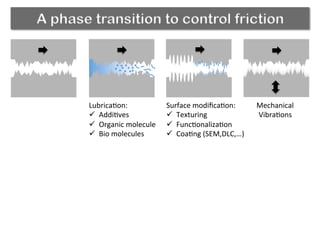
A phase transition to control friction
Lubrica(on:	
  
ü  Addi(ves	
  
ü  Organic	
  molecule	
  
ü  Bio	
  molecules	
  
Surface	
  modifica(on:	
  
ü  Texturing	
  
ü  Func(onaliza(on	
  
ü  Coa(ng	
  (SEM,DLC,…)	
  
Mechanical	
  	
  
Vibra(ons	
  
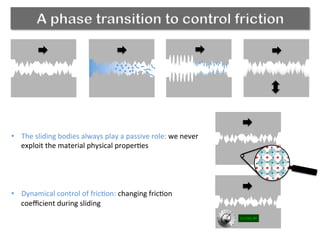
A phase transition to control friction


•  The	
  sliding	
  bodies	
  always	
  play	
  a	
  passive	
  role:	
  we	
  never	
  
exploit	
  the	
  material	
  physical	
  proper(es	


•  Dynamical	
  control	
  of	
  fric(on:	
  changing	
  fric(on	
  
coefficient	
  during	
  sliding	


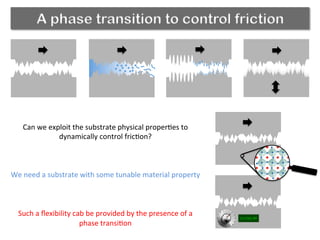
A phase transition to control friction
Can	
  we	
  exploit	
  the	
  substrate	
  physical	
  proper(es	
  to	
  
dynamically	
  control	
  fric(on?	


We	
  need	
  a	
  substrate	
  with	
  some	
  tunable	
  material	
  property	


Such	
  a	
  flexibility	
  cab	
  be	
  provided	
  by	
  the	
  presence	
  of	
  a	
  
phase	
  transi(on	


Some experimental evidence
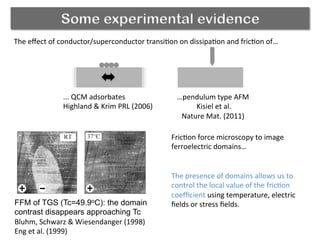
The	
  effect	
  of	
  conductor/superconductor	
  transi(on	
  on	
  dissipa(on	
  and	
  fric(on	
  of…	
  
...	
  QCM	
  adsorbates	
  
Highland	
  &	
  Krim	
  PRL	
  (2006)	
  
…pendulum	
  type	
  AFM	
  
	
  Kisiel	
  et	
  al.	
  	
  
Nature	
  Mat.	
  (2011)	
  
Fric(on	
  force	
  microscopy	
  to	
  image	
  
ferroelectric	
  domains…	
  
FFM of TGS (Tc=49.9oC): the domain
contrast disappears approaching Tc
Bluhm,	
  Schwarz	
  &	
  Wiesendanger	
  (1998)	
  
Eng	
  et	
  al.	
  (1999)	
  
The	
  presence	
  of	
  domains	
  allows	
  us	
  to	
  
control	
  the	
  local	
  value	
  of	
  the	
  fric(on	
  
coefficient	
  using	
  temperature,	
  electric	
  
fields	
  or	
  stress	
  fields.	
  
Our model experiment
Uij = −U + α(|ri − rj| − a)2
+ β(|ri − rj| − a)4
Ui = UM −
2(UM − Um)
a2
0

3
xi
ui
− 4
x3
i
u3
i

u2
i +
UM − Um
a4
0
u4
i


a0
UM
Um
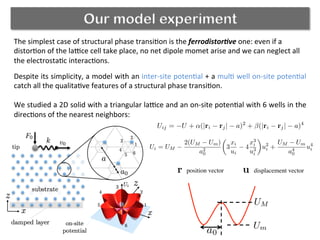
The	
  simplest	
  case	
  of	
  structural	
  phase	
  transi(on	
  is	
  the	
  ferrodistor)ve	
  one:	
  even	
  if	
  a	
  
distor(on	
  of	
  the	
  la`ce	
  cell	
  take	
  place,	
  no	
  net	
  dipole	
  momet	
  arise	
  and	
  we	
  can	
  neglect	
  all	
  
the	
  electrosta(c	
  interac(ons.	


Despite	
  its	
  simplicity,	
  a	
  model	
  with	
  an	
  inter-­‐site	
  poten(al	
  +	
  a	
  mul(	
  well	
  on-­‐site	
  poten(al	
  
catch	
  all	
  the	
  qualita(ve	
  features	
  of	
  a	
  structural	
  phase	
  transi(on.	


We	
  studied	
  a	
  2D	
  solid	
  with	
  a	
  triangular	
  la`ce	
  and	
  an	
  on-­‐site	
  poten(al	
  with	
  6	
  wells	
  in	
  the	
  
direc(ons	
  of	
  the	
  nearest	
  neighbors:	


r uposition vector	

 displacement vector
Our model experiment
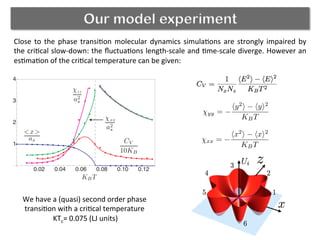
Close	
  to	
  the	
  phase	
  transi(on	
  molecular	
  dynamics	
  simula(ons	
  are	
  strongly	
  impaired	
  by	
  
the	
  cri(cal	
  slow-­‐down:	
  the	
  fluctua(ons	
  length-­‐scale	
  and	
  (me-­‐scale	
  diverge.	
  However	
  an	
  
es(ma(on	
  of	
  the	
  cri(cal	
  temperature	
  can	
  be	
  given:	
  
χxx = −
x2
 − x2
KBT
χyy = −
y2
 − y2
KBT
We	
  have	
  a	
  (quasi)	
  second	
  order	
  phase	
  
transi(on	
  with	
  a	
  cri(cal	
  temperature	
  
	
  KTc=	
  0.075	
  (LJ	
  units)	
  	
  
The friction coefficient
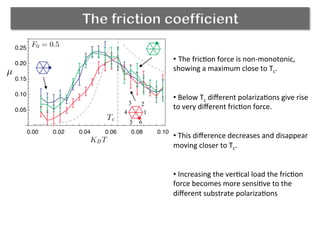
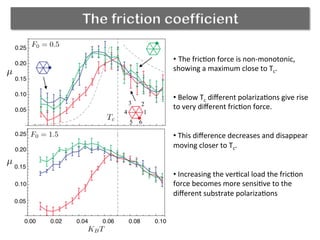
• The	
  fric(on	
  force	
  is	
  non-­‐monotonic,	
  
showing	
  a	
  maximum	
  close	
  to	
  Tc.	


• 	
  Below	
  Tc	
  different	
  polariza(ons	
  give	
  rise	
  
to	
  very	
  different	
  fric(on	
  force.	


• 	
  This	
  difference	
  decreases	
  and	
  disappear	
  
moving	
  closer	
  to	
  Tc.	
  
• 	
  Increasing	
  the	
  ver(cal	
  load	
  the	
  fric(on	
  
force	
  becomes	
  more	
  sensi(ve	
  to	
  the	
  
different	
  substrate	
  polariza(ons	
  
The friction coefficient
• The	
  fric(on	
  force	
  is	
  non-­‐monotonic,	
  
showing	
  a	
  maximum	
  close	
  to	
  Tc.	


• 	
  Below	
  Tc	
  different	
  polariza(ons	
  give	
  rise	
  
to	
  very	
  different	
  fric(on	
  force.	


• 	
  This	
  difference	
  decreases	
  and	
  disappear	
  
moving	
  closer	
  to	
  Tc.	
  
• 	
  Increasing	
  the	
  ver(cal	
  load	
  the	
  fric(on	
  
force	
  becomes	
  more	
  sensi(ve	
  to	
  the	
  
different	
  substrate	
  polariza(ons	
  
A peak at Tc
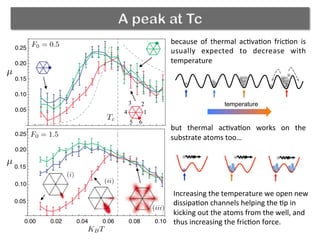
because	
   of	
   thermal	
   ac(va(on	
   fric(on	
   is	
  
usually	
   expected	
   to	
   decrease	
   with	
  
temperature	


but	
   thermal	
   ac(va(on	
   works	
   on	
   the	
  
substrate	
  atoms	
  too…	


Increasing	
  the	
  temperature	
  we	
  open	
  new	
  
dissipa(on	
  channels	
  helping	
  the	
  (p	
  in	
  
kicking	
  out	
  the	
  atoms	
  from	
  the	
  well,	
  and	
  
thus	
  increasing	
  the	
  fric(on	
  force.	
  	
  
temperature


A peak at Tc
Within	
   the	
   linear	
   response	
   theory	
   (Ying	
  
et	
   al.	
   1990-­‐92),	
   the	
   damping	
   coefficient	
  
relates	
   to	
   the	
   microscopic	
   proper(es	
   of	
  
the	
  substrate:	


close	
  to	
  a	
  structural	
  phase	
  transi(on,	
  the	
  
correla(on	
   func(ons	
   diverges,	
   the	
  
viscous	
  damping	
  too	
  and	
  goes	
  to	
  zero.	


ri
r
γ =
1
KBT

ij
Si,jU(r − r0
i )U(r − r0
j )
Sij = Ft[ ri(t)rj(t
) ]
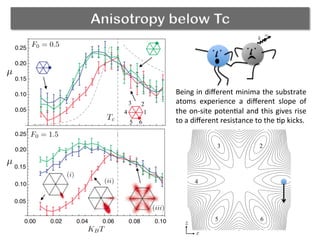
Anisotropy below Tc
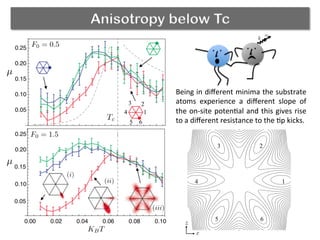
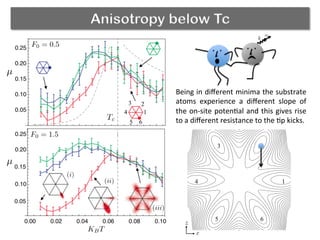
Being	
  in	
  different	
  minima	
  the	
  substrate	
  
atoms	
   experience	
   a	
   different	
   slope	
   of	
  
the	
  on-­‐site	
  poten(al	
  and	
  this	
  gives	
  rise	
  
to	
  a	
  different	
  resistance	
  to	
  the	
  (p	
  kicks.	
  
k
v0
1
23
4
5 6
x
z
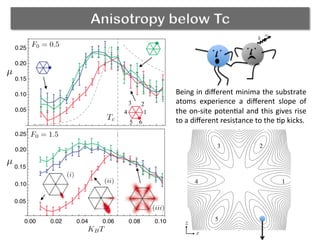
Anisotropy below Tc
Being	
  in	
  different	
  minima	
  the	
  substrate	
  
atoms	
   experience	
   a	
   different	
   slope	
   of	
  
the	
  on-­‐site	
  poten(al	
  and	
  this	
  gives	
  rise	
  
to	
  a	
  different	
  resistance	
  to	
  the	
  (p	
  kicks.	
  
k
v0
1
23
4
5 6
x
z
Anisotropy below Tc
Being	
  in	
  different	
  minima	
  the	
  substrate	
  
atoms	
   experience	
   a	
   different	
   slope	
   of	
  
the	
  on-­‐site	
  poten(al	
  and	
  this	
  gives	
  rise	
  
to	
  a	
  different	
  resistance	
  to	
  the	
  (p	
  kicks.	
  
k
v0
1
23
4
5 6
x
z
Anisotropy below Tc
Being	
  in	
  different	
  minima	
  the	
  substrate	
  
atoms	
   experience	
   a	
   different	
   slope	
   of	
  
the	
  on-­‐site	
  poten(al	
  and	
  this	
  gives	
  rise	
  
to	
  a	
  different	
  resistance	
  to	
  the	
  (p	
  kicks.	
  
k
v0
1
23
4
5 6
x
z
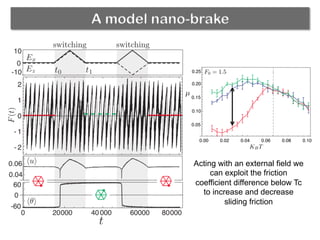
A model nano-brake
Acting with an external field we
can exploit the friction
coefficient difference below Tc
to increase and decrease
sliding friction 	
  
Conclusion
The	
  presence	
  of	
  a	
  phase	
  transi(on	
  provides	
  new	
  degrees	
  of	
  freedom	
  for	
  the	
  substrate	
  
physical	
  proper(es	


This	
  degrees	
  of	
  freedom	
  open	
  up	
  new	
  dissipa(on	
  channels	
  for	
  the	
  slider/(p	
  energy	


Below	
  Tc	
  dissipa(on	
  and	
  fric(on	
  can	
  be	
  controlled	
  ac(ng	
  on	
  this	
  degrees	
  of	
  freedom	
  with	
  
some	
  external	
  field	


Model	
  Improvements:	
  
•  Include	
  dipole-­‐dipole	
  interac(on	
  (ferrodistor(ve	
  to	
  ferroelectric)	
  
•  Include	
  electrosta(c	
  (p-­‐substrate	
  interac(on	
  and	
  piezoelectric	
  response	
  
•  Beker	
  (p	
  descrip(on	


Looking	
  for	
  different	
  kinds	
  of	
  phase	
  transi(on	
  (ferromagne(c?)	


Thanks	
  for	
  your	
  a-en/on!	
  

Sliding over a phase transition

  • 1.
    Sliding Over aPhase Transition* Andrea Benassi CNR-IOM Trieste and CNR-IENI Milano *A.Benassi, A. Vanossi, G.L. Santoro and E. Tosatti PRL 106 256102 (2011)
  • 2.
    A phase transitionto control friction Lubrica(on:   ü  Addi(ves   ü  Organic  molecule   ü  Bio  molecules   Surface  modifica(on:   ü  Texturing   ü  Func(onaliza(on   ü  Coa(ng  (SEM,DLC,…)   Mechanical     Vibra(ons  
  • 3.
    A phase transitionto control friction     •  The  sliding  bodies  always  play  a  passive  role:  we  never   exploit  the  material  physical  proper(es       •  Dynamical  control  of  fric(on:  changing  fric(on   coefficient  during  sliding      
  • 4.
    A phase transitionto control friction Can  we  exploit  the  substrate  physical  proper(es  to   dynamically  control  fric(on?           We  need  a  substrate  with  some  tunable  material  property         Such  a  flexibility  cab  be  provided  by  the  presence  of  a   phase  transi(on            
  • 5.
    Some experimental evidence The  effect  of  conductor/superconductor  transi(on  on  dissipa(on  and  fric(on  of…   ...  QCM  adsorbates   Highland  &  Krim  PRL  (2006)   …pendulum  type  AFM    Kisiel  et  al.     Nature  Mat.  (2011)   Fric(on  force  microscopy  to  image   ferroelectric  domains…   FFM of TGS (Tc=49.9oC): the domain contrast disappears approaching Tc Bluhm,  Schwarz  &  Wiesendanger  (1998)   Eng  et  al.  (1999)   The  presence  of  domains  allows  us  to   control  the  local  value  of  the  fric(on   coefficient  using  temperature,  electric   fields  or  stress  fields.  
  • 6.
    Our model experiment Uij= −U + α(|ri − rj| − a)2 + β(|ri − rj| − a)4 Ui = UM − 2(UM − Um) a2 0 3 xi ui − 4 x3 i u3 i u2 i + UM − Um a4 0 u4 i     a0 UM Um The  simplest  case  of  structural  phase  transi(on  is  the  ferrodistor)ve  one:  even  if  a   distor(on  of  the  la`ce  cell  take  place,  no  net  dipole  momet  arise  and  we  can  neglect  all   the  electrosta(c  interac(ons.           Despite  its  simplicity,  a  model  with  an  inter-­‐site  poten(al  +  a  mul(  well  on-­‐site  poten(al   catch  all  the  qualita(ve  features  of  a  structural  phase  transi(on.     We  studied  a  2D  solid  with  a  triangular  la`ce  and  an  on-­‐site  poten(al  with  6  wells  in  the   direc(ons  of  the  nearest  neighbors:       r uposition vector displacement vector
  • 7.
    Our model experiment Close  to  the  phase  transi(on  molecular  dynamics  simula(ons  are  strongly  impaired  by   the  cri(cal  slow-­‐down:  the  fluctua(ons  length-­‐scale  and  (me-­‐scale  diverge.  However  an   es(ma(on  of  the  cri(cal  temperature  can  be  given:   χxx = − x2 − x2 KBT χyy = − y2 − y2 KBT We  have  a  (quasi)  second  order  phase   transi(on  with  a  cri(cal  temperature    KTc=  0.075  (LJ  units)    
  • 8.
    The friction coefficient • The  fric(on  force  is  non-­‐monotonic,   showing  a  maximum  close  to  Tc.       •   Below  Tc  different  polariza(ons  give  rise   to  very  different  fric(on  force.       •   This  difference  decreases  and  disappear   moving  closer  to  Tc.   •   Increasing  the  ver(cal  load  the  fric(on   force  becomes  more  sensi(ve  to  the   different  substrate  polariza(ons  
  • 9.
    The friction coefficient • The  fric(on  force  is  non-­‐monotonic,   showing  a  maximum  close  to  Tc.       •   Below  Tc  different  polariza(ons  give  rise   to  very  different  fric(on  force.       •   This  difference  decreases  and  disappear   moving  closer  to  Tc.   •   Increasing  the  ver(cal  load  the  fric(on   force  becomes  more  sensi(ve  to  the   different  substrate  polariza(ons  
  • 10.
    A peak atTc because   of   thermal   ac(va(on   fric(on   is   usually   expected   to   decrease   with   temperature               but   thermal   ac(va(on   works   on   the   substrate  atoms  too…       Increasing  the  temperature  we  open  new   dissipa(on  channels  helping  the  (p  in   kicking  out  the  atoms  from  the  well,  and   thus  increasing  the  fric(on  force.     temperature            
  • 11.
    A peak atTc Within   the   linear   response   theory   (Ying   et   al.   1990-­‐92),   the   damping   coefficient   relates   to   the   microscopic   proper(es   of   the  substrate:                           close  to  a  structural  phase  transi(on,  the   correla(on   func(ons   diverges,   the   viscous  damping  too  and  goes  to  zero.       ri r γ = 1 KBT ij Si,jU(r − r0 i )U(r − r0 j ) Sij = Ft[ ri(t)rj(t ) ]
  • 12.
    Anisotropy below Tc Being  in  different  minima  the  substrate   atoms   experience   a   different   slope   of   the  on-­‐site  poten(al  and  this  gives  rise   to  a  different  resistance  to  the  (p  kicks.   k v0 1 23 4 5 6 x z
  • 13.
    Anisotropy below Tc Being  in  different  minima  the  substrate   atoms   experience   a   different   slope   of   the  on-­‐site  poten(al  and  this  gives  rise   to  a  different  resistance  to  the  (p  kicks.   k v0 1 23 4 5 6 x z
  • 14.
    Anisotropy below Tc Being  in  different  minima  the  substrate   atoms   experience   a   different   slope   of   the  on-­‐site  poten(al  and  this  gives  rise   to  a  different  resistance  to  the  (p  kicks.   k v0 1 23 4 5 6 x z
  • 15.
    Anisotropy below Tc Being  in  different  minima  the  substrate   atoms   experience   a   different   slope   of   the  on-­‐site  poten(al  and  this  gives  rise   to  a  different  resistance  to  the  (p  kicks.   k v0 1 23 4 5 6 x z
  • 16.
    A model nano-brake Actingwith an external field we can exploit the friction coefficient difference below Tc to increase and decrease sliding friction  
  • 17.
    Conclusion The  presence  of  a  phase  transi(on  provides  new  degrees  of  freedom  for  the  substrate   physical  proper(es     This  degrees  of  freedom  open  up  new  dissipa(on  channels  for  the  slider/(p  energy     Below  Tc  dissipa(on  and  fric(on  can  be  controlled  ac(ng  on  this  degrees  of  freedom  with   some  external  field       Model  Improvements:   •  Include  dipole-­‐dipole  interac(on  (ferrodistor(ve  to  ferroelectric)   •  Include  electrosta(c  (p-­‐substrate  interac(on  and  piezoelectric  response   •  Beker  (p  descrip(on       Looking  for  different  kinds  of  phase  transi(on  (ferromagne(c?)       Thanks  for  your  a-en/on!