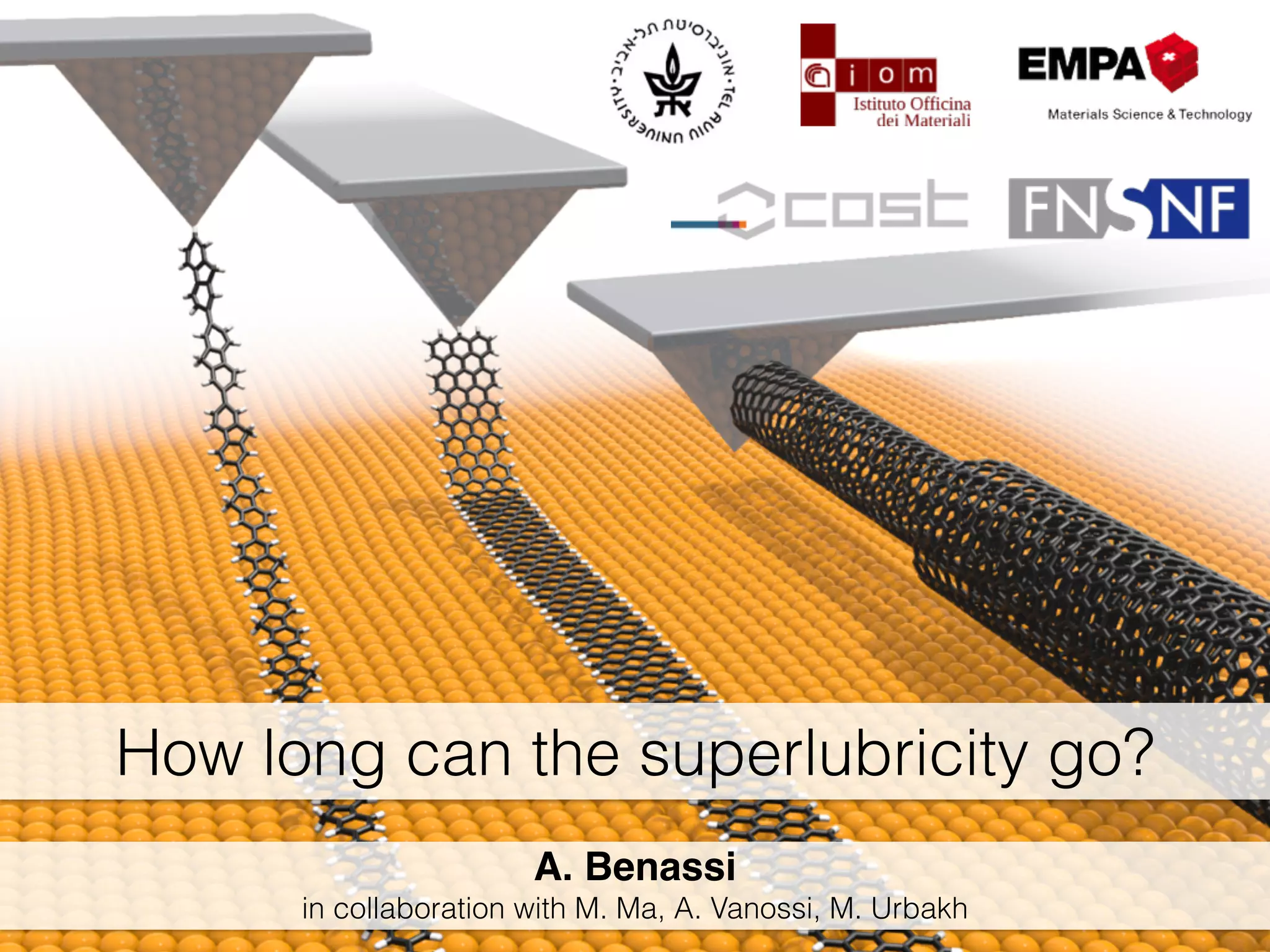
A. Benassi !
in collaboration with M. Ma, A. Vanossi, M. Urbakh
How long can the superlubricity go?
New atomically precise elongated nano-structures
Progresses in nano-synthesis techniques allow to create defect free quasi 1D structures of considerable length that can be
picked up and manipulated:
Kawai et al.
PNAS 111 (2014) 3968
Polymer chains ~100nm
double-walled carbon nanotubes ~1cm
R. Zhang et al.
Nature Nanotech. 8 (2013) 912
Graphene nanoribbons ~50nm
work in progress
with Meyer & Kawai
Understanding their tribological properties is important for:
!
• Nano-manipulation and production of nano structures
for mechanics or electronics purposes

• Bringing peculiar nano-scale friction concepts at larger
scales (i.e. superlubricity)
The breaking of superlubricity
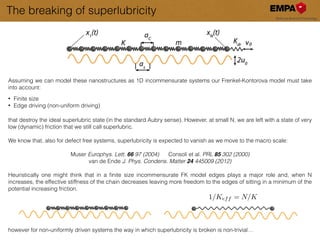
Assuming we can model these nanostructures as 1D incommensurate systems our Frenkel-Kontorova model must take
into account:
!
• Finite size
• Edge driving (non-uniform driving)
!!
that destroy the ideal superlubric state (in the standard Aubry sense). However, at small N, we are left with a state of very
low (dynamic) friction that we still call superlubric.
!
We know that, also for defect free systems, superlubricity is expected to vanish as we move to the macro scale:
!
Muser Europhys. Lett. 66 97 (2004) Consoli et al. PRL 85 302 (2000)
van de Ende J. Phys. Condens. Matter 24 445009 (2012)
!
Heuristically one might think that in a finite size incommensurate FK model edges plays a major role and, when N
increases, the effective stiffness of the chain decreases leaving more freedom to the edges of sitting in a minimum of the
potential increasing friction.
!
!
!
!
!
however for non-uniformly driven systems the way in which superlubricity is broken is non-trivial…
1/Keff = N/K
The breaking of superlubricity
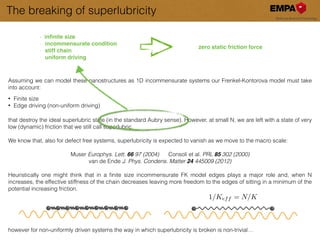
Assuming we can model these nanostructures as 1D incommensurate systems our Frenkel-Kontorova model must take
into account:
!
• Finite size
• Edge driving (non-uniform driving)
!!
that destroy the ideal superlubric state (in the standard Aubry sense). However, at small N, we are left with a state of very
low (dynamic) friction that we still call superlubric.
!
We know that, also for defect free systems, superlubricity is expected to vanish as we move to the macro scale:
!
Muser Europhys. Lett. 66 97 (2004) Consoli et al. PRL 85 302 (2000)
van de Ende J. Phys. Condens. Matter 24 445009 (2012)
!
Heuristically one might think that in a finite size incommensurate FK model edges plays a major role and, when N
increases, the effective stiffness of the chain decreases leaving more freedom to the edges of sitting in a minimum of the
potential increasing friction.
!
!
!
!
!
however for non-uniformly driven systems the way in which superlubricity is broken is non-trivial…
1/Keff = N/K
- infinite size!
- incommensurate condition!
- stiff chain!
- uniform driving
zero static friction force
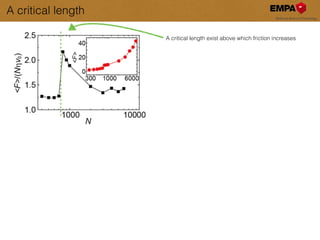
A critical length
A critical length
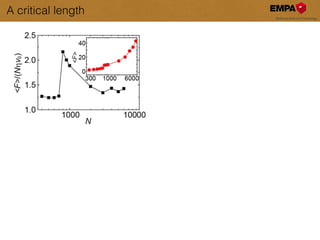
A critical length exist above which friction increases
A critical length
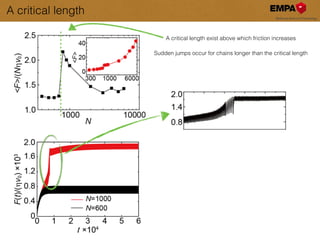
A critical length exist above which friction increases
Sudden jumps occur for chains longer than the critical length
A critical length
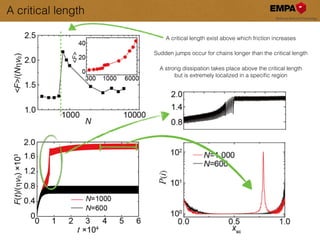
A critical length exist above which friction increases
Sudden jumps occur for chains longer than the critical length
A strong dissipation takes place above the critical length
but is extremely localized in a specific region
A kink of commensuration
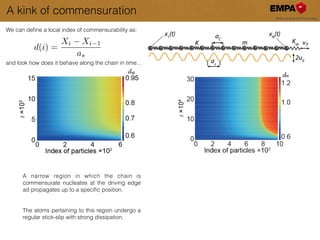
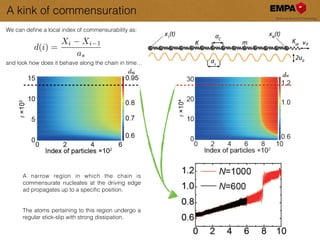
We can define a local index of commensurability as:
and look how does it behave along the chain in time…
d(i) =
Xi Xi 1
as
A narrow region in which the chain is
commensurate nucleates at the driving edge
ad propagates up to a specific position.
!
!
The atoms pertaining to this region undergo a
regular stick-slip with strong dissipation.
We can define a local index of commensurability as:
and look how does it behave along the chain in time…
d(i) =
Xi Xi 1
as
A narrow region in which the chain is
commensurate nucleates at the driving edge
ad propagates up to a specific position.
!
!
The atoms pertaining to this region undergo a
regular stick-slip with strong dissipation.
A kink of commensuration
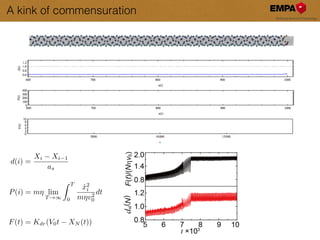
d(i) =
Xi Xi 1
as
P(i) = m⌘ lim
T !1
Z T
0
˙x2
i
m⌘v2
0
dt
F(t) = Kdr(V0t XN (t))
A kink of commensuration
d(i) =
Xi Xi 1
as
P(i) = m⌘ lim
T !1
Z T
0
˙x2
i
m⌘v2
0
dt
F(t) = Kdr(V0t XN (t))
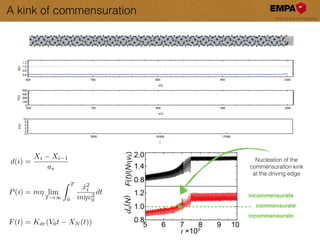
Nucleation of the
commensuration kink
at the driving edge
incommensurate
incommensurate
commensurate
A kink of commensuration
A simple analytical theory
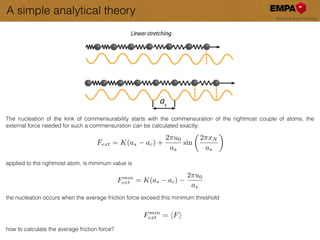
The nucleation of the kink of commensurability starts with the commensuration of the rightmost couple of atoms, the
external force needed for such a commensuration can be calculated exactly:
Fext = K(as ac) +
2⇡u0
as
sin
✓
2⇡xN
as
◆
Fmin
ext = K(as ac)
2⇡u0
as
Fmin
ext = hFi
applied to the rightmost atom, is minimum value is
the nucleation occurs when the average friction force exceed this minimum threshold
how to calculate the average friction force?
A simple analytical theory
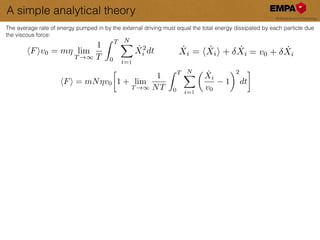
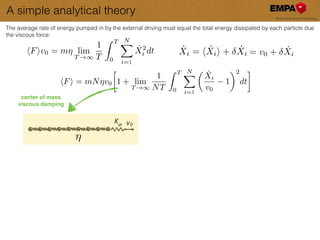
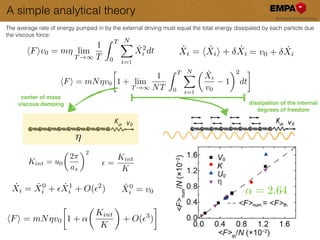
The average rate of energy pumped in by the external driving must equal the total energy dissipated by each particle due
the viscous force:
hFiv0 = m⌘ lim
T !1
1
T
Z T
0
NX
i=0
˙X2
i dt
hFi = mN⌘v0

1 + lim
T !1
1
NT
Z T
0
NX
i=0
✓ ˙Xi
v0
1
◆2
dt
˙Xi = h ˙Xii + ˙Xi = v0 + ˙Xi
1
1
A simple analytical theory
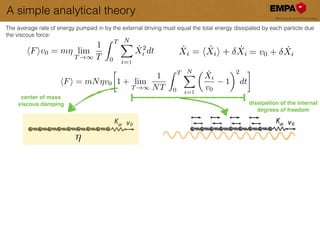
center of mass!
viscous damping
⌘
The average rate of energy pumped in by the external driving must equal the total energy dissipated by each particle due
the viscous force:
hFiv0 = m⌘ lim
T !1
1
T
Z T
0
NX
i=0
˙X2
i dt
hFi = mN⌘v0

1 + lim
T !1
1
NT
Z T
0
NX
i=0
✓ ˙Xi
v0
1
◆2
dt
˙Xi = h ˙Xii + ˙Xi = v0 + ˙Xi
1
1
A simple analytical theory
center of mass!
viscous damping
⌘
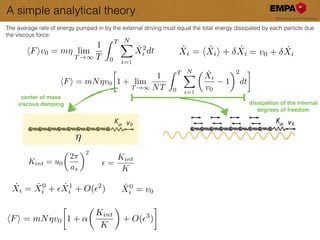
dissipation of the internal !
degrees of freedom
The average rate of energy pumped in by the external driving must equal the total energy dissipated by each particle due
the viscous force:
hFiv0 = m⌘ lim
T !1
1
T
Z T
0
NX
i=0
˙X2
i dt
hFi = mN⌘v0

1 + lim
T !1
1
NT
Z T
0
NX
i=0
✓ ˙Xi
v0
1
◆2
dt
˙Xi = h ˙Xii + ˙Xi = v0 + ˙Xi
1
1
A simple analytical theory
center of mass!
viscous damping
⌘
dissipation of the internal !
degrees of freedom
The average rate of energy pumped in by the external driving must equal the total energy dissipated by each particle due
the viscous force:
hFiv0 = m⌘ lim
T !1
1
T
Z T
0
NX
i=0
˙X2
i dt
hFi = mN⌘v0

1 + lim
T !1
1
NT
Z T
0
NX
i=0
✓ ˙Xi
v0
1
◆2
dt
˙Xi = h ˙Xii + ˙Xi = v0 + ˙Xi
✏ =
Kint
K
˙Xi = ˙X0
i + ✏ ˙X1
i + O(✏2
) ˙X0
i = v0
hFi = mN⌘v0

1 + ↵
✓
Kint
K
◆
+ O(✏3
)
Kint = u0
✓
2⇡
as
◆2
1
1
A simple analytical theory
center of mass!
viscous damping
⌘
dissipation of the internal !
degrees of freedom
The average rate of energy pumped in by the external driving must equal the total energy dissipated by each particle due
the viscous force:
hFiv0 = m⌘ lim
T !1
1
T
Z T
0
NX
i=0
˙X2
i dt
hFi = mN⌘v0

1 + lim
T !1
1
NT
Z T
0
NX
i=0
✓ ˙Xi
v0
1
◆2
dt
˙Xi = h ˙Xii + ˙Xi = v0 + ˙Xi
✏ =
Kint
K
˙Xi = ˙X0
i + ✏ ˙X1
i + O(✏2
) ˙X0
i = v0
hFi = mN⌘v0

1 + ↵
✓
Kint
K
◆
+ O(✏3
)
↵ = 2.64
Kint = u0
✓
2⇡
as
◆2
1
1
A simple analytical theory
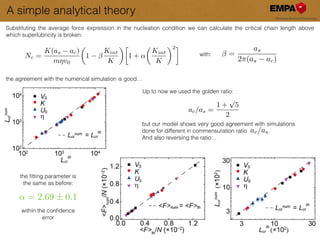
Substituting the average force expression in the nucleation condition we can calculate the critical chain length above
which superlubricity is broken:
the agreement with the numerical simulation is good…
Nc =
K(as ac)
m⌘v0
✓
1
Kint
K
◆
1 + ↵
✓
Kint
K
◆2
=
as
2⇡(as ac)
with:
ac/as =
1 +
p
5
2
but our model shows very good agreement with simulations
done for different in commensuration ratio .
And also reversing the ratio…
ac/as
Up to now we used the golden ratio:
the fitting parameter is
the same as before:
!
!
!
within the confidence
error
↵ = 2.69 ± 0.1
Testing the model with existing experiments
DWCNTs GNRs
R. Zhang et al.
Nature Nanotech. 8 (2013) 912
`c = Ncac = 0.5m
50 times > than the maximum NT size
Under investigation
Moire’ pattern
and ribbon rippling
Orientation dependent friction
Still according to static friction force measurements the
system is superlubric up to 30 nm:
Can the edge driving
allow the nucleation
of a kink of
commensurability ?
0
0.5
1
1.5
2
2.5
0 5 10 15 20 25 30 35
peratomforce[pN]
ribbon length [nm]
Static friction force per atom VS GNR length (0 degs)
MD simulation
More information at:
https://sites.google.com/site/benassia/
Thank you!
Modeling material
properties !
at different length scales

How long can the superlubricity go?

  • 1.
    A. Benassi ! incollaboration with M. Ma, A. Vanossi, M. Urbakh How long can the superlubricity go?
  • 2.
    New atomically preciseelongated nano-structures Progresses in nano-synthesis techniques allow to create defect free quasi 1D structures of considerable length that can be picked up and manipulated: Kawai et al. PNAS 111 (2014) 3968 Polymer chains ~100nm double-walled carbon nanotubes ~1cm R. Zhang et al. Nature Nanotech. 8 (2013) 912 Graphene nanoribbons ~50nm work in progress with Meyer & Kawai Understanding their tribological properties is important for: ! • Nano-manipulation and production of nano structures for mechanics or electronics purposes
 • Bringing peculiar nano-scale friction concepts at larger scales (i.e. superlubricity)
  • 3.
    The breaking ofsuperlubricity Assuming we can model these nanostructures as 1D incommensurate systems our Frenkel-Kontorova model must take into account: ! • Finite size • Edge driving (non-uniform driving) !! that destroy the ideal superlubric state (in the standard Aubry sense). However, at small N, we are left with a state of very low (dynamic) friction that we still call superlubric. ! We know that, also for defect free systems, superlubricity is expected to vanish as we move to the macro scale: ! Muser Europhys. Lett. 66 97 (2004) Consoli et al. PRL 85 302 (2000) van de Ende J. Phys. Condens. Matter 24 445009 (2012) ! Heuristically one might think that in a finite size incommensurate FK model edges plays a major role and, when N increases, the effective stiffness of the chain decreases leaving more freedom to the edges of sitting in a minimum of the potential increasing friction. ! ! ! ! ! however for non-uniformly driven systems the way in which superlubricity is broken is non-trivial… 1/Keff = N/K
  • 4.
    The breaking ofsuperlubricity Assuming we can model these nanostructures as 1D incommensurate systems our Frenkel-Kontorova model must take into account: ! • Finite size • Edge driving (non-uniform driving) !! that destroy the ideal superlubric state (in the standard Aubry sense). However, at small N, we are left with a state of very low (dynamic) friction that we still call superlubric. ! We know that, also for defect free systems, superlubricity is expected to vanish as we move to the macro scale: ! Muser Europhys. Lett. 66 97 (2004) Consoli et al. PRL 85 302 (2000) van de Ende J. Phys. Condens. Matter 24 445009 (2012) ! Heuristically one might think that in a finite size incommensurate FK model edges plays a major role and, when N increases, the effective stiffness of the chain decreases leaving more freedom to the edges of sitting in a minimum of the potential increasing friction. ! ! ! ! ! however for non-uniformly driven systems the way in which superlubricity is broken is non-trivial… 1/Keff = N/K - infinite size! - incommensurate condition! - stiff chain! - uniform driving zero static friction force
  • 5.
  • 6.
    A critical length Acritical length exist above which friction increases
  • 7.
    A critical length Acritical length exist above which friction increases Sudden jumps occur for chains longer than the critical length
  • 8.
    A critical length Acritical length exist above which friction increases Sudden jumps occur for chains longer than the critical length A strong dissipation takes place above the critical length but is extremely localized in a specific region
  • 9.
    A kink ofcommensuration We can define a local index of commensurability as: and look how does it behave along the chain in time… d(i) = Xi Xi 1 as A narrow region in which the chain is commensurate nucleates at the driving edge ad propagates up to a specific position. ! ! The atoms pertaining to this region undergo a regular stick-slip with strong dissipation.
  • 10.
    We can definea local index of commensurability as: and look how does it behave along the chain in time… d(i) = Xi Xi 1 as A narrow region in which the chain is commensurate nucleates at the driving edge ad propagates up to a specific position. ! ! The atoms pertaining to this region undergo a regular stick-slip with strong dissipation. A kink of commensuration
  • 11.
    d(i) = Xi Xi1 as P(i) = m⌘ lim T !1 Z T 0 ˙x2 i m⌘v2 0 dt F(t) = Kdr(V0t XN (t)) A kink of commensuration
  • 12.
    d(i) = Xi Xi1 as P(i) = m⌘ lim T !1 Z T 0 ˙x2 i m⌘v2 0 dt F(t) = Kdr(V0t XN (t)) Nucleation of the commensuration kink at the driving edge incommensurate incommensurate commensurate A kink of commensuration
  • 13.
    A simple analyticaltheory The nucleation of the kink of commensurability starts with the commensuration of the rightmost couple of atoms, the external force needed for such a commensuration can be calculated exactly: Fext = K(as ac) + 2⇡u0 as sin ✓ 2⇡xN as ◆ Fmin ext = K(as ac) 2⇡u0 as Fmin ext = hFi applied to the rightmost atom, is minimum value is the nucleation occurs when the average friction force exceed this minimum threshold how to calculate the average friction force?
  • 14.
    A simple analyticaltheory The average rate of energy pumped in by the external driving must equal the total energy dissipated by each particle due the viscous force: hFiv0 = m⌘ lim T !1 1 T Z T 0 NX i=0 ˙X2 i dt hFi = mN⌘v0  1 + lim T !1 1 NT Z T 0 NX i=0 ✓ ˙Xi v0 1 ◆2 dt ˙Xi = h ˙Xii + ˙Xi = v0 + ˙Xi 1 1
  • 15.
    A simple analyticaltheory center of mass! viscous damping ⌘ The average rate of energy pumped in by the external driving must equal the total energy dissipated by each particle due the viscous force: hFiv0 = m⌘ lim T !1 1 T Z T 0 NX i=0 ˙X2 i dt hFi = mN⌘v0  1 + lim T !1 1 NT Z T 0 NX i=0 ✓ ˙Xi v0 1 ◆2 dt ˙Xi = h ˙Xii + ˙Xi = v0 + ˙Xi 1 1
  • 16.
    A simple analyticaltheory center of mass! viscous damping ⌘ dissipation of the internal ! degrees of freedom The average rate of energy pumped in by the external driving must equal the total energy dissipated by each particle due the viscous force: hFiv0 = m⌘ lim T !1 1 T Z T 0 NX i=0 ˙X2 i dt hFi = mN⌘v0  1 + lim T !1 1 NT Z T 0 NX i=0 ✓ ˙Xi v0 1 ◆2 dt ˙Xi = h ˙Xii + ˙Xi = v0 + ˙Xi 1 1
  • 17.
    A simple analyticaltheory center of mass! viscous damping ⌘ dissipation of the internal ! degrees of freedom The average rate of energy pumped in by the external driving must equal the total energy dissipated by each particle due the viscous force: hFiv0 = m⌘ lim T !1 1 T Z T 0 NX i=0 ˙X2 i dt hFi = mN⌘v0  1 + lim T !1 1 NT Z T 0 NX i=0 ✓ ˙Xi v0 1 ◆2 dt ˙Xi = h ˙Xii + ˙Xi = v0 + ˙Xi ✏ = Kint K ˙Xi = ˙X0 i + ✏ ˙X1 i + O(✏2 ) ˙X0 i = v0 hFi = mN⌘v0  1 + ↵ ✓ Kint K ◆ + O(✏3 ) Kint = u0 ✓ 2⇡ as ◆2 1 1
  • 18.
    A simple analyticaltheory center of mass! viscous damping ⌘ dissipation of the internal ! degrees of freedom The average rate of energy pumped in by the external driving must equal the total energy dissipated by each particle due the viscous force: hFiv0 = m⌘ lim T !1 1 T Z T 0 NX i=0 ˙X2 i dt hFi = mN⌘v0  1 + lim T !1 1 NT Z T 0 NX i=0 ✓ ˙Xi v0 1 ◆2 dt ˙Xi = h ˙Xii + ˙Xi = v0 + ˙Xi ✏ = Kint K ˙Xi = ˙X0 i + ✏ ˙X1 i + O(✏2 ) ˙X0 i = v0 hFi = mN⌘v0  1 + ↵ ✓ Kint K ◆ + O(✏3 ) ↵ = 2.64 Kint = u0 ✓ 2⇡ as ◆2 1 1
  • 19.
    A simple analyticaltheory Substituting the average force expression in the nucleation condition we can calculate the critical chain length above which superlubricity is broken: the agreement with the numerical simulation is good… Nc = K(as ac) m⌘v0 ✓ 1 Kint K ◆ 1 + ↵ ✓ Kint K ◆2 = as 2⇡(as ac) with: ac/as = 1 + p 5 2 but our model shows very good agreement with simulations done for different in commensuration ratio . And also reversing the ratio… ac/as Up to now we used the golden ratio: the fitting parameter is the same as before: ! ! ! within the confidence error ↵ = 2.69 ± 0.1
  • 20.
    Testing the modelwith existing experiments DWCNTs GNRs R. Zhang et al. Nature Nanotech. 8 (2013) 912 `c = Ncac = 0.5m 50 times > than the maximum NT size Under investigation Moire’ pattern and ribbon rippling Orientation dependent friction Still according to static friction force measurements the system is superlubric up to 30 nm: Can the edge driving allow the nucleation of a kink of commensurability ? 0 0.5 1 1.5 2 2.5 0 5 10 15 20 25 30 35 peratomforce[pN] ribbon length [nm] Static friction force per atom VS GNR length (0 degs) MD simulation
  • 21.
    More information at: https://sites.google.com/site/benassia/ Thankyou! Modeling material properties ! at different length scales