
“ADAB IN APPRECIATING THE MADZAAHIB”“All who are non-Mujtahid, by default, is a Muqollid”LESSONS ON ISLAMIC ADABBy: Ustaz Zhulkeflee Hj Ismail1All Rights Reserved© Zhulkeflee2010
2وَمَا كَانَ ٱلۡمُؤۡمِنُونَ لِيَنفِرُواْ ڪَآفَّةً۬‌ۚ فَلَوۡلَا نَفَرَ مِن كُلِّ فِرۡقَةٍ۬ مِّنۡہُمۡ طَآٮِٕفَةٌ۬ لِّيَتَفَقَّهُواْ فِى ٱلدِّينِ وَلِيُنذِرُواْ قَوۡمَهُمۡ إِذَا رَجَعُوٓاْ إِلَيۡہِمۡ لَعَلَّهُمۡ يَحۡذَرُونَAll Rights Reserved© Zhulkeflee2010
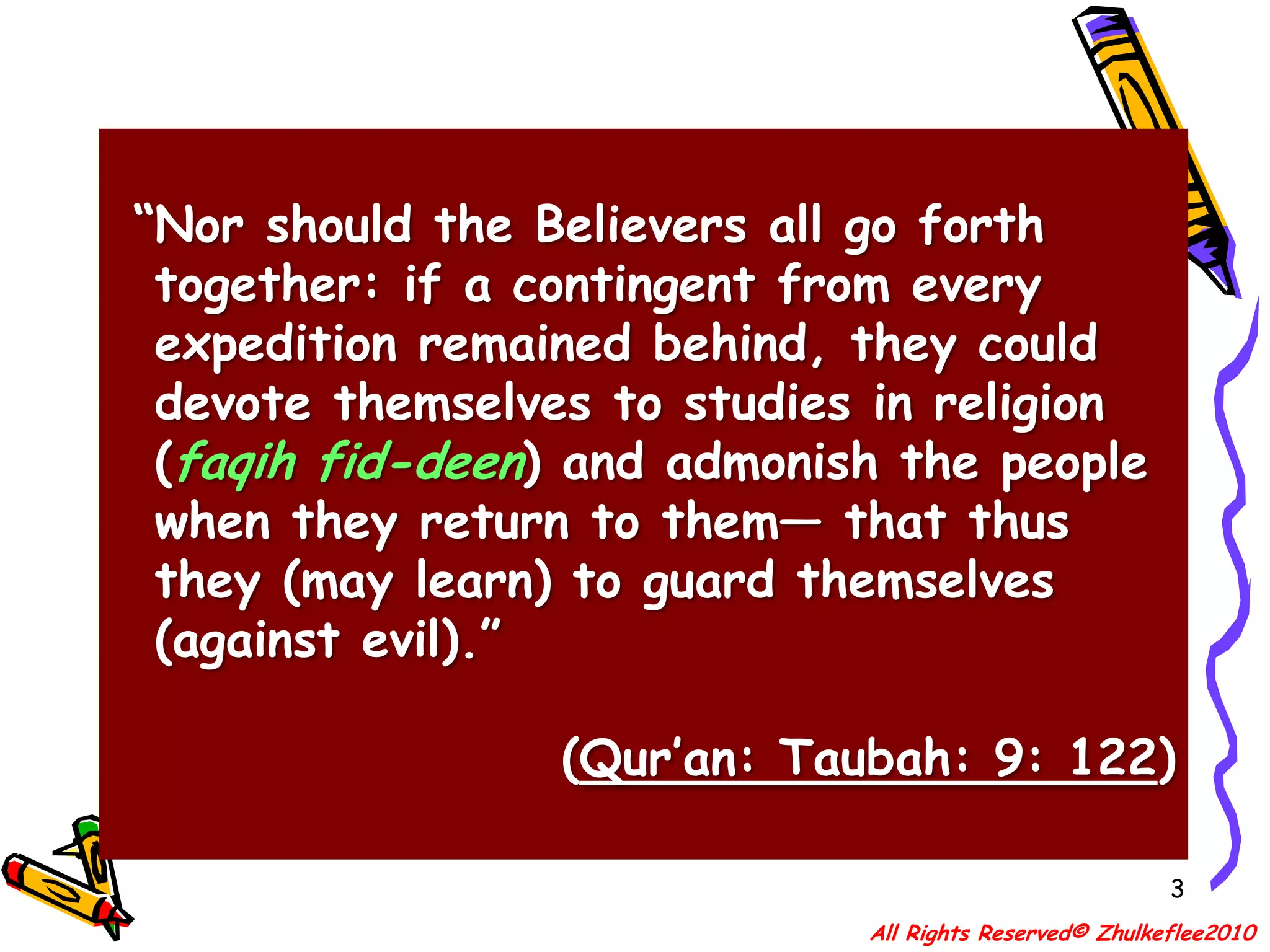
3 “Nor should the Believers all go forth        together: if a contingent from every      expedition remained behind, they could   devote themselves to studies in religion   (faqih fid-deen) and admonish the people   when they return to them― that thus   they (may learn) to guard themselves    (against evil).”(Qur’an: Taubah: 9: 122)All Rights Reserved© Zhulkeflee2010
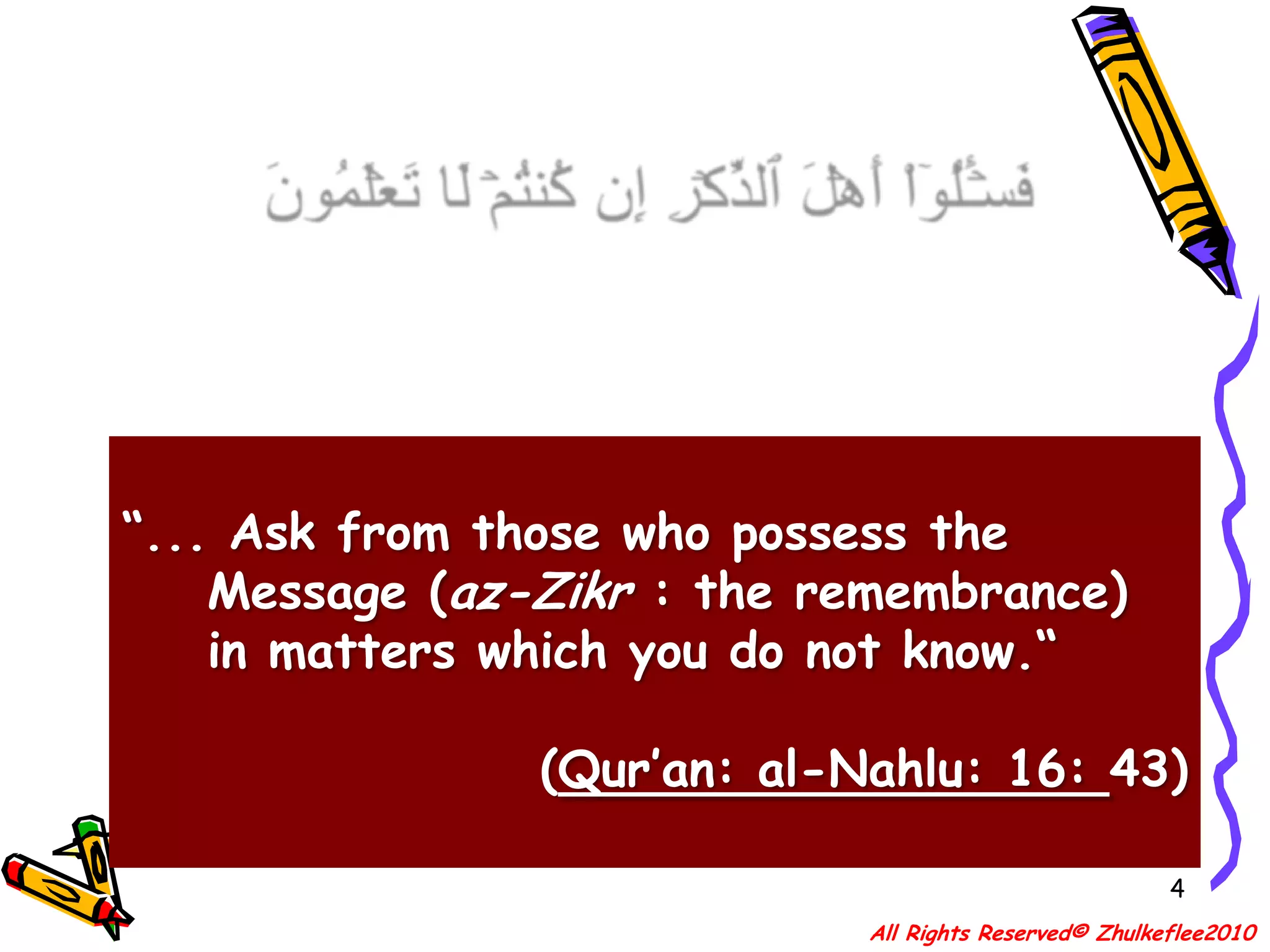
4فَسۡـَٔلُوٓاْ أَهۡلَ ٱلذِّكۡرِ إِن كُنتُمۡ لَا تَعۡلَمُونَ“... Ask from those who possess the     Message (az-Zikr : the remembrance)     in matters which you do not know.“(Qur’an: al-Nahlu: 16: 43)All Rights Reserved© Zhulkeflee2010
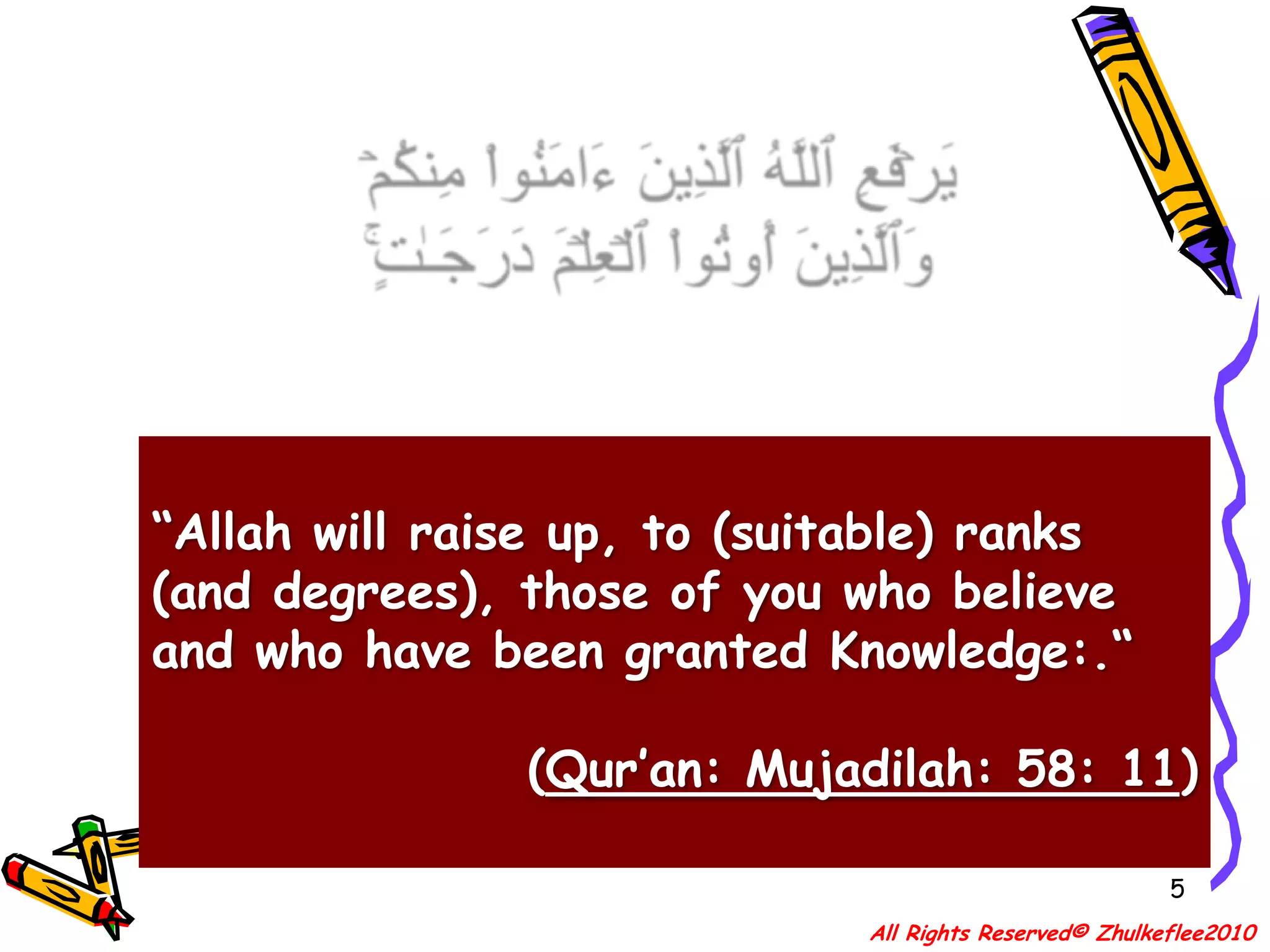
5يَرۡفَعِ ٱللَّهُ ٱلَّذِينَ ءَامَنُواْ مِنكُمۡ وَٱلَّذِينَ أُوتُواْ ٱلۡعِلۡمَ دَرَجَـٰتٍ۬‌ۚ“Allah will raise up, to (suitable) ranks (and degrees), those of you who believe and who have been granted Knowledge:.“(Qur’an: Mujadilah: 58: 11)All Rights Reserved© Zhulkeflee2010
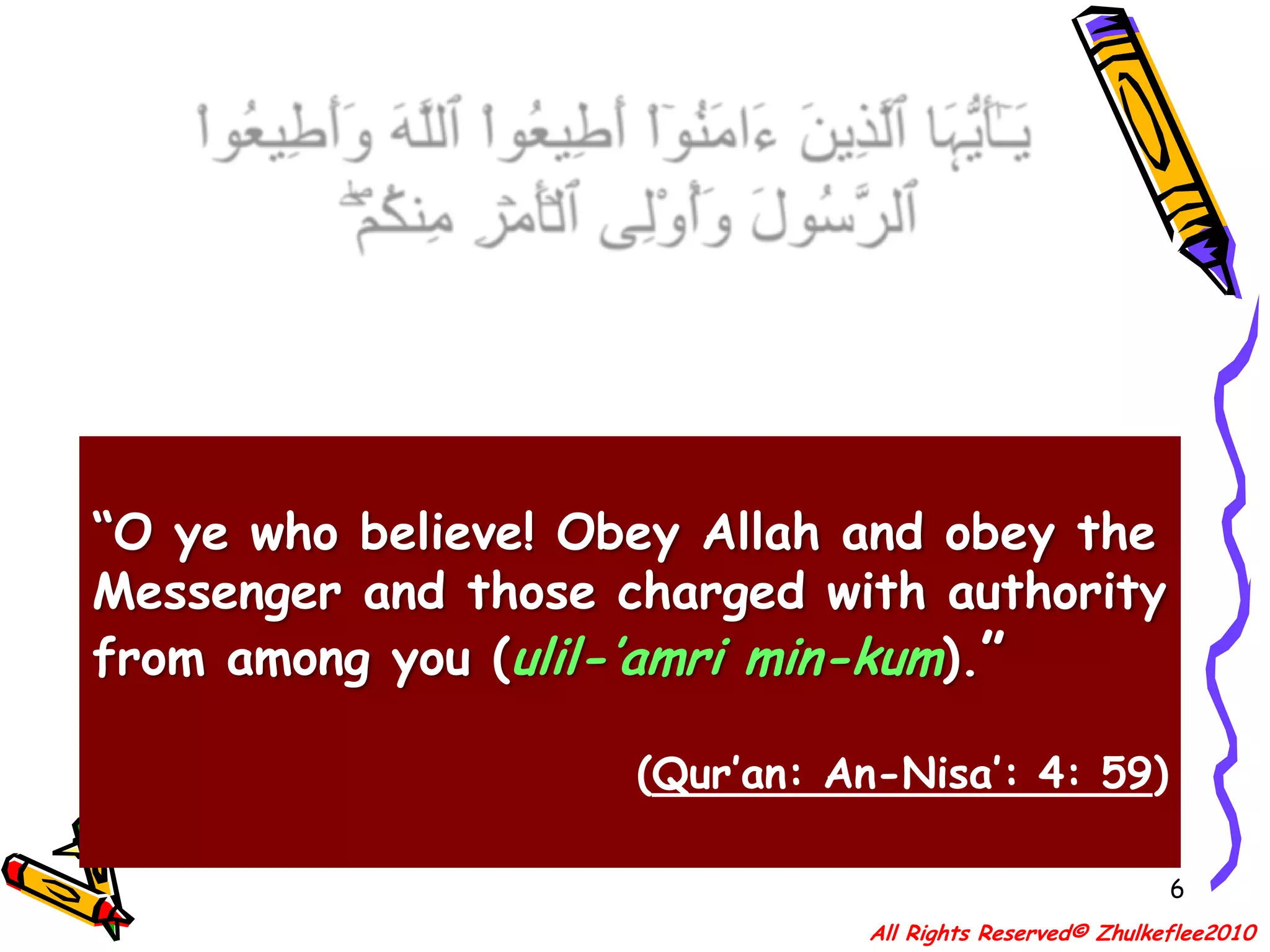
6يَـٰٓأَيُّہَا ٱلَّذِينَ ءَامَنُوٓاْ أَطِيعُواْ ٱللَّهَ وَأَطِيعُواْ ٱلرَّسُولَ وَأُوْلِى ٱلۡأَمۡرِ مِنكُمۡ‌ۖ“O ye who believe! Obey Allah and obey the Messenger and those charged with authority from among you (ulil-’amri min-kum).”(Qur’an: An-Nisa’: 4: 59)All Rights Reserved© Zhulkeflee2010
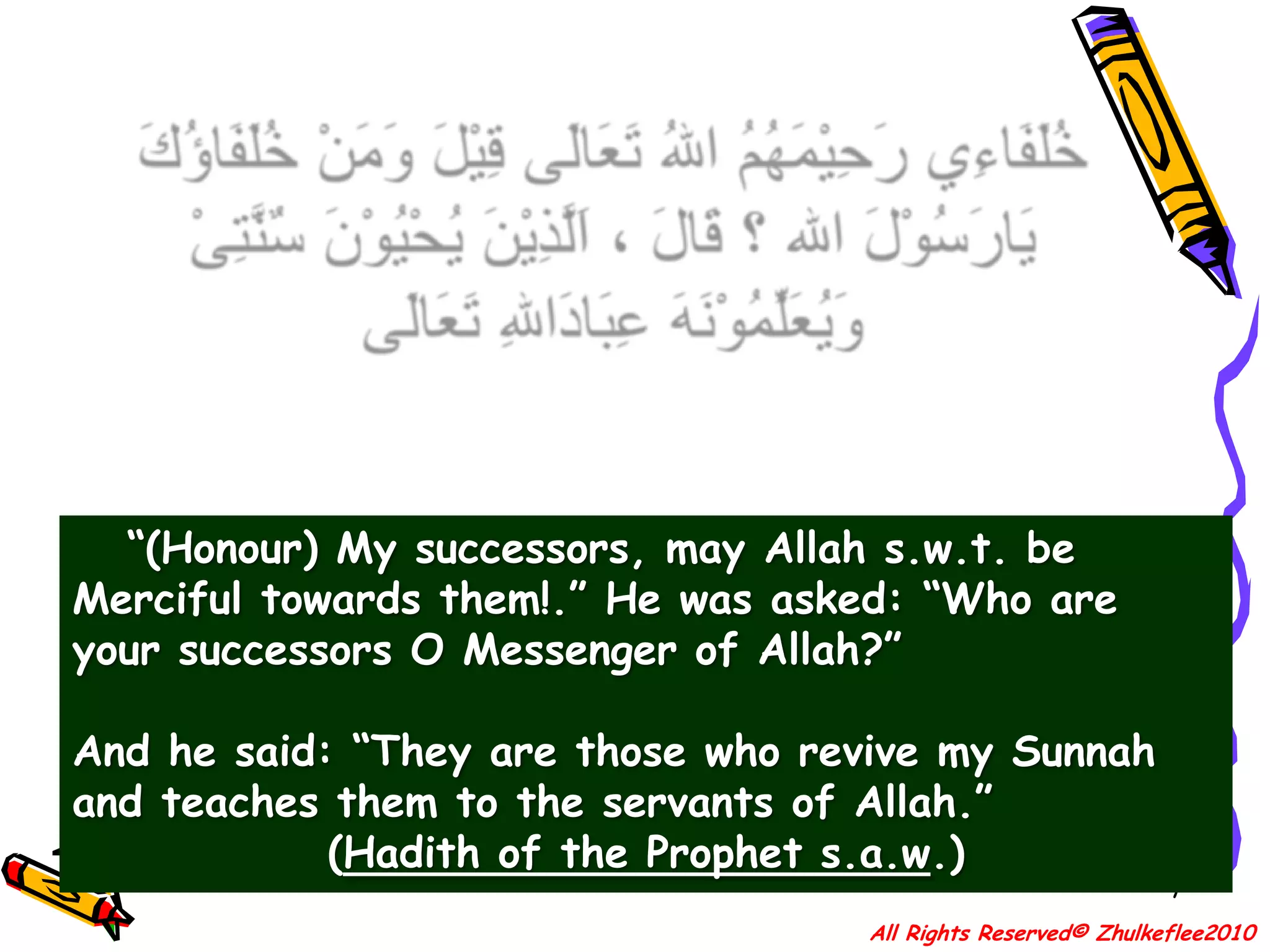
7خُلَفَاءِي رَحِيْمَهُمُ اللهُ تَعَالَى قِيْلَ وَمَنْ خُلَفَاؤُكَ يَارَسُوْلَ الله ؟ قَالَ ، اَلَّذِيْنَ يُحْيُوْنَ سٌنَّتِىْ وَيُعَلِّمُوْنَهَ عِبَادَاللهِ تَعَالَى “(Honour) My successors, may Allah s.w.t. be Merciful towards them!.” He was asked: “Who are your successors O Messenger of Allah?” And he said: “They are those who revive my Sunnah and teaches them to the servants of Allah.”(Hadith of the Prophet s.a.w.)All Rights Reserved© Zhulkeflee2010
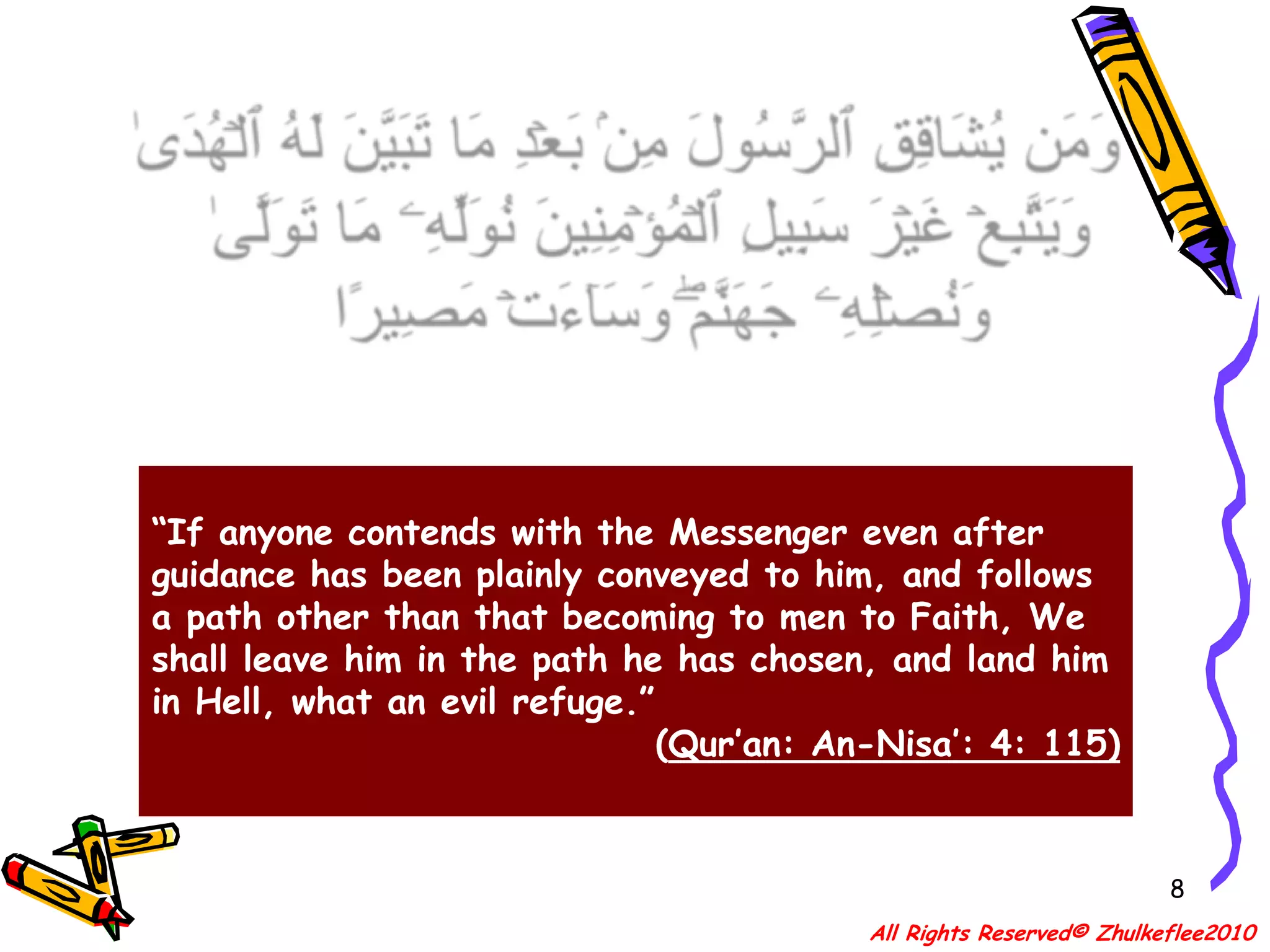
8وَمَن يُشَاقِقِ ٱلرَّسُولَ مِنۢ بَعۡدِ مَا تَبَيَّنَ لَهُ ٱلۡهُدَىٰ وَيَتَّبِعۡ غَيۡرَ سَبِيلِ ٱلۡمُؤۡمِنِينَ نُوَلِّهِۦ مَا تَوَلَّىٰ وَنُصۡلِهِۦ جَهَنَّمَ‌ۖ وَسَآءَتۡ مَصِيرًا “If anyone contends with the Messenger even after guidance has been plainly conveyed to him, and follows a path other than that becoming to men to Faith, We shall leave him in the path he has chosen, and land him in Hell, what an evil refuge.”(Qur’an: An-Nisa’: 4: 115)All Rights Reserved© Zhulkeflee2010
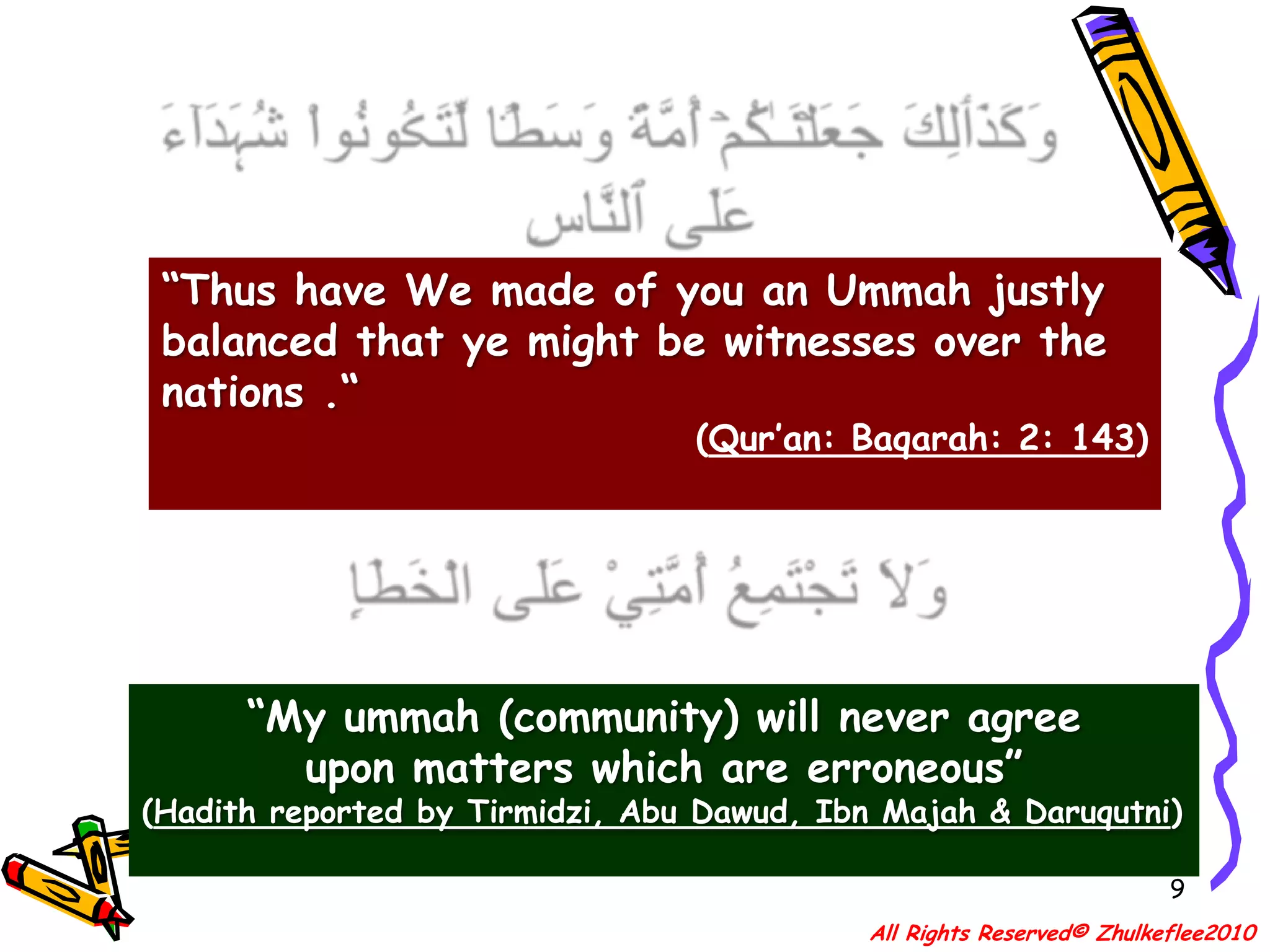
9وَكَذَٲلِكَ جَعَلۡنَـٰكُمۡ أُمَّةً۬ وَسَطً۬ا لِّتَڪُونُواْ شُہَدَآءَ عَلَى ٱلنَّاسِ “Thus have We made of you an Ummah justly balanced that ye might be witnesses over the nations .“(Qur’an: Baqarah: 2: 143)وَلاَ تَجْتَمِعُ أُمَّتِيْ عَلَى الْخَطَإِ“My ummah (community) will never agree upon matters which are erroneous”(Hadith reported by Tirmidzi, Abu Dawud, Ibn Majah & Daruqutni)All Rights Reserved© Zhulkeflee2010
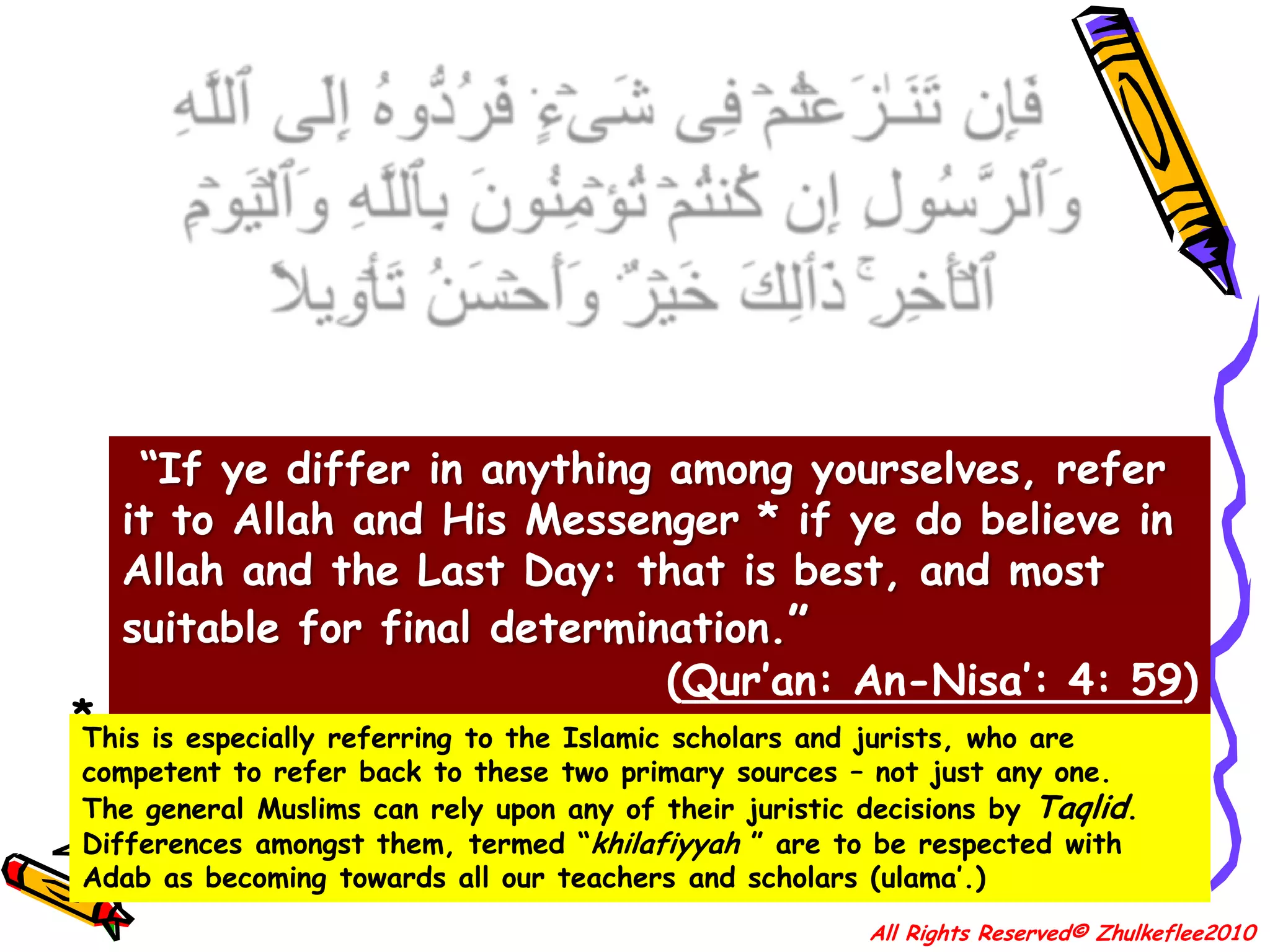
10فَإِن تَنَـٰزَعۡتُمۡ فِى شَىۡءٍ۬ فَرُدُّوهُ إِلَى ٱللَّهِ وَٱلرَّسُولِ إِن كُنتُمۡ تُؤۡمِنُونَ بِٱللَّهِ وَٱلۡيَوۡمِ ٱلۡأَخِرِ‌ۚ ذَٲلِكَ خَيۡرٌ۬ وَأَحۡسَنُ تَأۡوِيلاً “If ye differ in anything among yourselves, refer it to Allah and His Messenger * if ye do believe in Allah and the Last Day: that is best, and most suitable for final determination.”(Qur’an: An-Nisa’: 4: 59)*This is especially referring to the Islamic scholars and jurists, who are competent to refer back to these two primary sources – not just any one.The general Muslims can rely upon any of their juristic decisions by Taqlid. Differences amongst them, termed “khilafiyyah” are to be respected with Adab as becoming towards all our teachers and scholars (ulama’.)All Rights Reserved© Zhulkeflee2010
UNDERSTANDING TERMS:11In Islamic legal theory, the scholars define “taqlid” as : “Accepting the view of someone (who is a faqih / mujtahid) without a proof” قَبُولُ قَوْلِ الْغَيْر مِنْ غَيْرِ حُجَّة  (qabuu-lu qawli’l-ghayr min ghayri Hujjah).”11 – Imam al-Ghazalie r.h.m. Al-Mustasfå min ‘Ilm al-Usul (Cairo: Maktabah al-Tijariyyah, 1356), 2:387.All Rights Reserved© Zhulkeflee2010
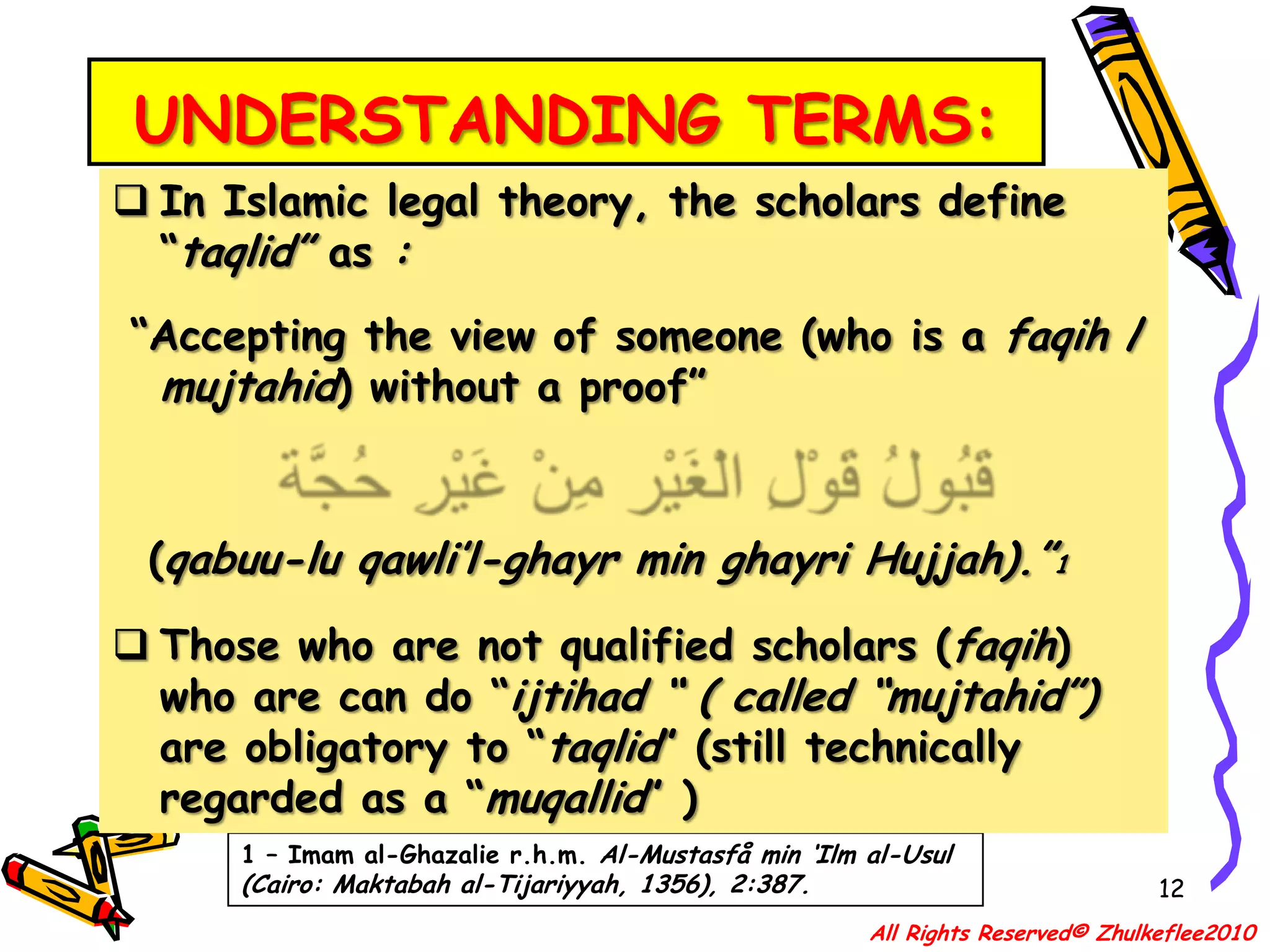
UNDERSTANDING TERMS:12In Islamic legal theory, the scholars define “taqlid” as : “Accepting the view of someone (who is a faqih / mujtahid) without a proof” قَبُولُ قَوْلِ الْغَيْر مِنْ غَيْرِ حُجَّة  (qabuu-lu qawli’l-ghayr min ghayri Hujjah).”1Those who are not qualified scholars (faqih) who are can do “ijtihad “( called “mujtahid”) are obligatory to “taqlid” (still technically regarded as a “muqallid” )1 – Imam al-Ghazalie r.h.m. Al-Mustasfå min ‘Ilm al-Usul (Cairo: Maktabah al-Tijariyyah, 1356), 2:387.All Rights Reserved© Zhulkeflee2010
UNDERSTANDING TERMS:In Islamic legal theory, scholastic method referred to as “ijtihad” means simply, ‘exertion’,13All Rights Reserved© Zhulkeflee2010
UNDERSTANDING TERMS:In Islamic legal theory, scholastic method referred to as “ijtihad” means simply, ‘exertion’,
Religiously speaking, it refers to a jurist (faqih) “expending every possible effort to examine” the textual evidences, so as to arrive at a ruling of the Sacred Law.    The point here is that “ijtihad is not just one of scholarly exertion, but of exhaustion.” Fathoming the intent of the Lawgiver, and inferring new rulings from the primary sources - is indeed a most arduous and demanding task not for just any or everyone - so as to reach a sound legal conclusion.14All Rights Reserved© Zhulkeflee2010
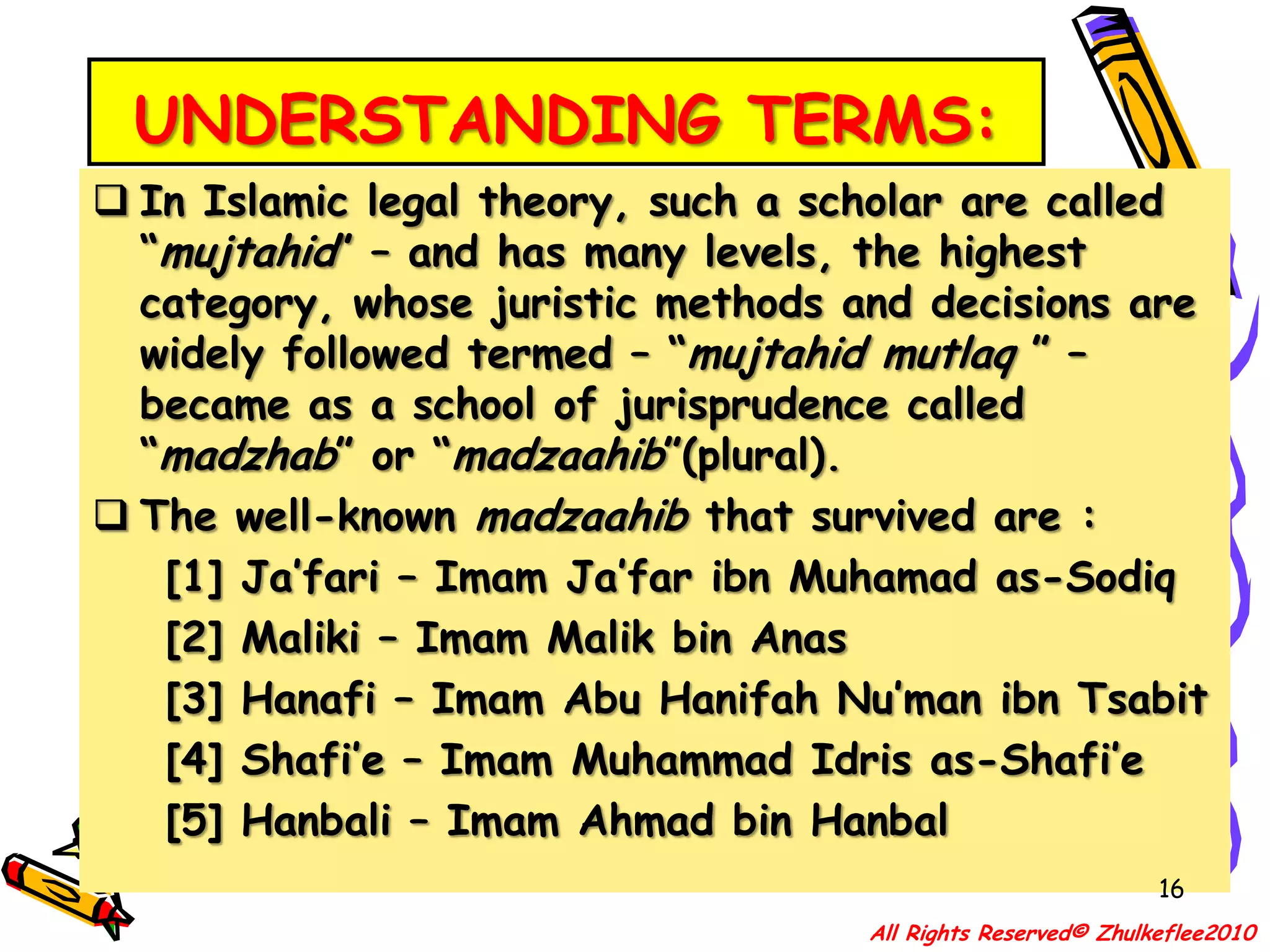
UNDERSTANDING TERMS:In Islamic legal theory, such a scholar are called “mujtahid” – and has many levels, the highest category, whose juristic methods and decisions are widely followed termed – “mujtahid mutlaq ” – became as a school of jurisprudence called “madzhab” or “madzaahib”(plural).15All Rights Reserved© Zhulkeflee2010
UNDERSTANDING TERMS:In Islamic legal theory, such a scholar are called “mujtahid” – and has many levels, the highest category, whose juristic methods and decisions are widely followed termed – “mujtahid mutlaq ” – became as a school of jurisprudence called “madzhab” or “madzaahib”(plural).
The well-known madzaahib that survived are :    [1] Ja’fari – Imam Ja’far ibn Muhamad as-Sodiq    [2] Maliki – Imam Malik bin Anas    [3] Hanafi – Imam Abu Hanifah Nu’man ibn Tsabit     [4] Shafi’e – Imam Muhammad Idris as-Shafi’e    [5] Hanbali – Imam Ahmad bin Hanbal16All Rights Reserved© Zhulkeflee2010
IMPORTANT POINTS TO NOTE:Imam al-Qur†ubi says: “No difference exists among the scholars that the laymen are to perform taqlid of their scholars.” *
Ibn Qudamah explicitly states: “As far as taqlid in the details of the Sacred Law (furu‘) is concerned, it is allowed by consensus (ijma’).” +17* Al-Jami‘ li Ahkam al-Qur’an (Beirut: Dar al-Kutub al-‘Ilmiyyah),+ Al-Rawdatu’l-Nazir wa Jannat al-Manazir (Riyadh: Maktabah al-Rushd), All Rights Reserved© Zhulkeflee2010
IMPORTANT POINTS TO NOTE:Contemporary scholar, Imam al-Shanqi†i wrote:   “The prescribed taqlid, which none of the Muslims contest, is the layman’s performing taqlid of a scholar qualified to issue fatwa on various matters. This type of taqlid was in vogue during the time of theProphet, peace be upon him, and there was no contention about it. The layman asked whosoever he wished from the Companions of the Prophet, may Allah be pleased with them, about the ruling for a given case. Whenever a fatwa was given, he simply complied with it.” *18*Adwa’ al-Bayån, 7:318All Rights Reserved© Zhulkeflee2010
19فَقَالَ; كَيْفَ تَقْضِي؟ قَالَ ; اَقْضِيْ بِمَا فِيْ كِتَابِ الله ، قَالَ ; فَإِنْ لَمْ يَكُنْ فِيْ كِتَابِ الله؟ قَالَ ; فَبِسُنَّةِ رَسُوْلِ اللهِ ص.ع.س. قَالَ ;  فَإِنْ لَمْ يَكُنْ فِيْ  سُنَّةِ رَسُوْل الله؟قَالَ; أَجْتَهِدْ رَأْيِي . قَالَ; اَلْحَمْدُ لِلَّهِ الَّذِيْ وَفَّقَ رَسُوْلَ رَسُوْلِ اللهِ ص.ع.س.All Rights Reserved© Zhulkeflee2010
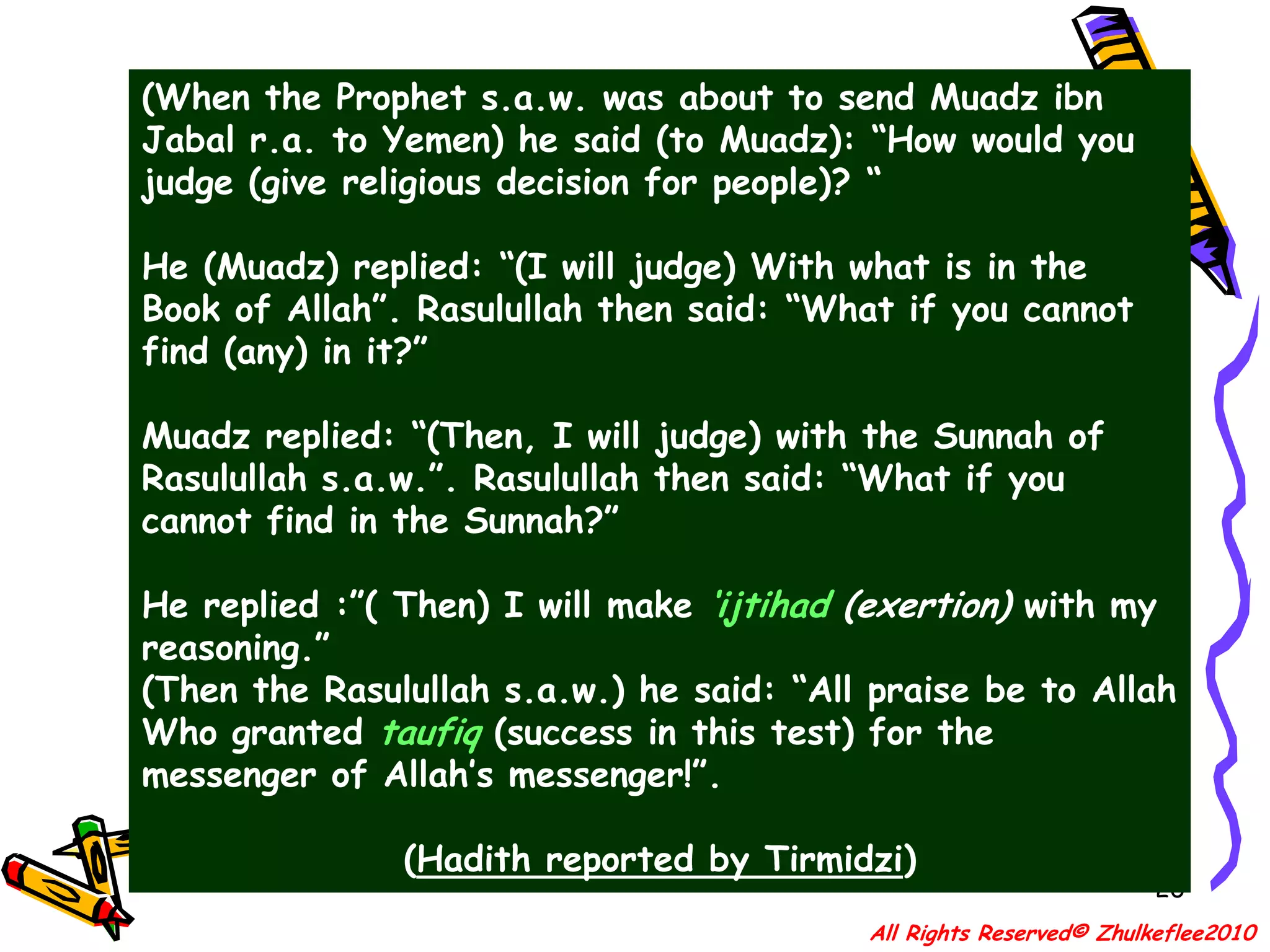
20(When the Prophet s.a.w. was about to send Muadz ibn Jabal r.a. to Yemen) he said (to Muadz): “How would you judge (give religious decision for people)? “ He (Muadz) replied: “(I will judge) With what is in the Book of Allah”. Rasulullah then said: “What if you cannot find (any) in it?” Muadz replied: “(Then, I will judge) with the Sunnah of Rasulullah s.a.w.”. Rasulullah then said: “What if you cannot find in the Sunnah?” He replied :”( Then) I will make ‘ijtihad (exertion) with my reasoning.” (Then the Rasulullah s.a.w.) he said: “All praise be to Allah Who granted taufiq (success in this test) for the messenger of Allah’s messenger!”.(Hadith reported by Tirmidzi)All Rights Reserved© Zhulkeflee2010
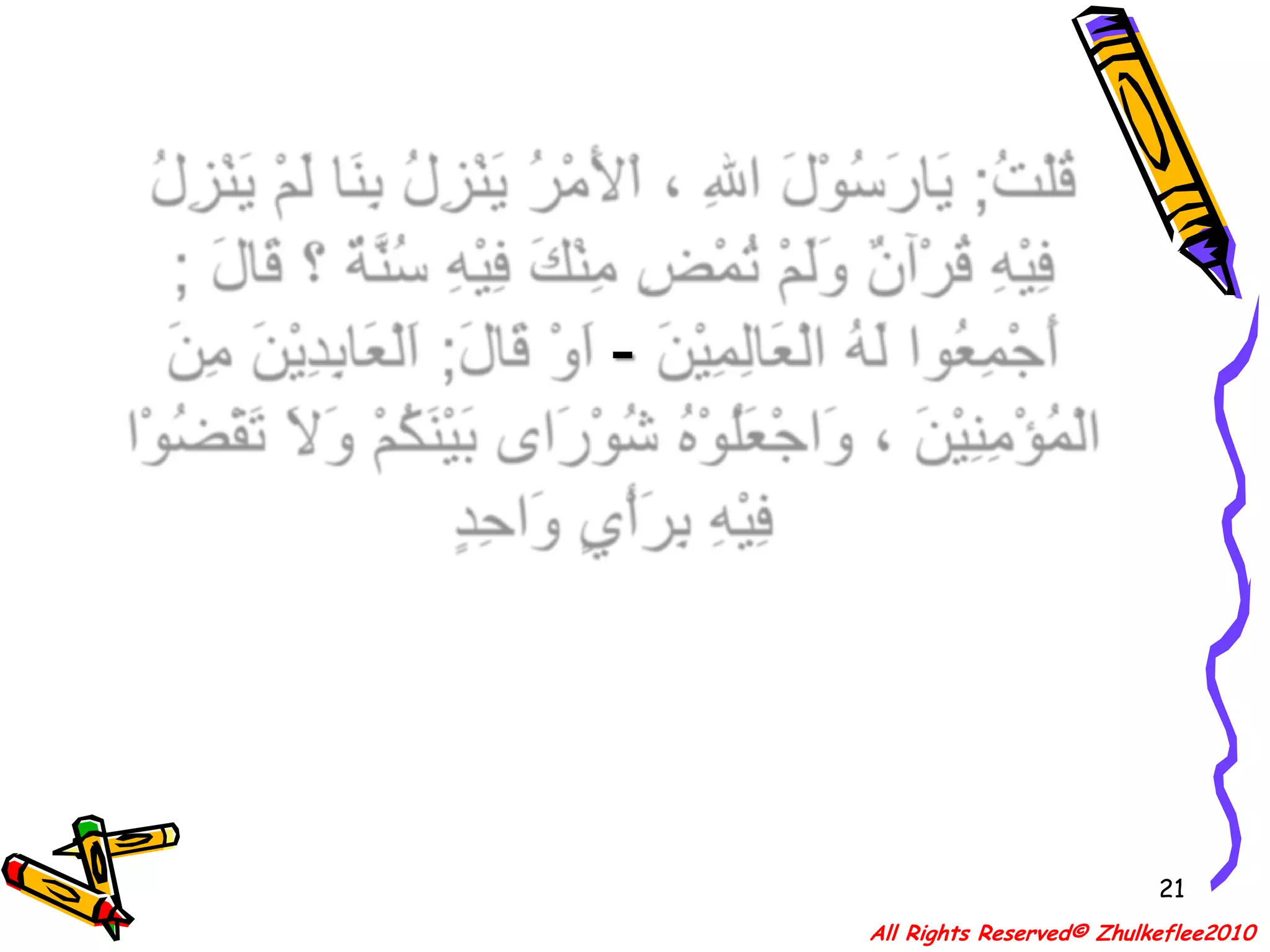
21قُلْتُ; يَارَسُوْلَ اللهِ ، اْلأَمْرُ يَنْزِلُ بِنَا لَمْ يَنْزِلُ فِيْهِ قُرْآنٌ وَلَمْ تُمْضِ مِنْكَ فِيْهِ سُنَّةٌ ؟ قَالَ ; أَجْمِعُوا لَهُ الْعَالِمِيْنَ - اَوْ قَالَ; اَلْعَابِدِيْنَ مِنَ الْمُؤْمِنِيْنَ ، وَاجْعَلُوْهُ شُوْرَاى بَيْنَكُمْ وَلاَ تَقْضُوْا فِيْهِ بِرَأْيٍ وَاحِدٍAll Rights Reserved© Zhulkeflee2010
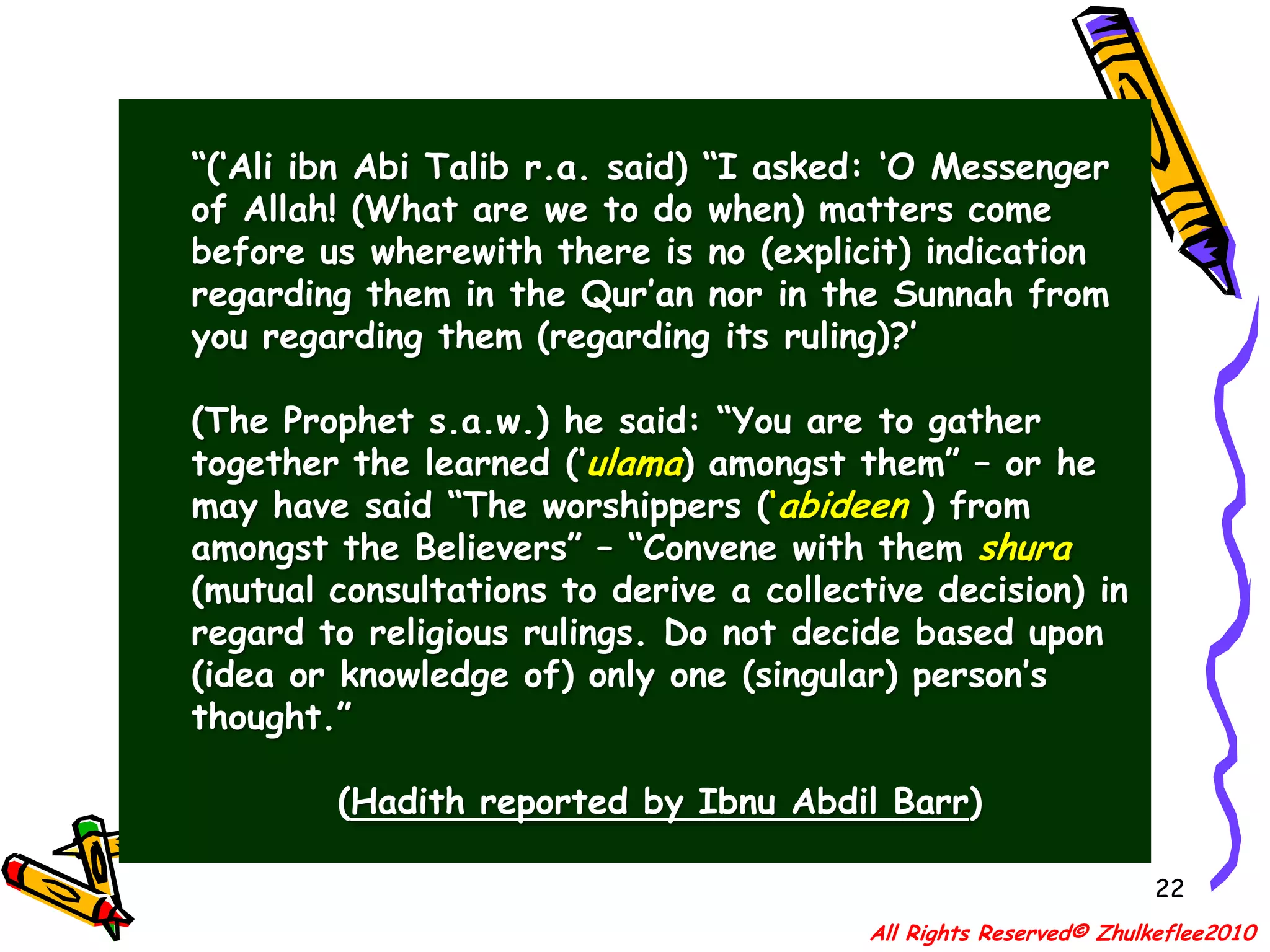
22“(‘Ali ibn Abi Talib r.a. said) “I asked: ‘O Messenger of Allah! (What are we to do when) matters come before us wherewith there is no (explicit) indication regarding them in the Qur’an nor in the Sunnah from you regarding them (regarding its ruling)?’(The Prophet s.a.w.) he said: “You are to gather together the learned (‘ulama) amongst them” – or he may have said “The worshippers (‘abideen) from amongst the Believers” – “Convene with them shura (mutual consultations to derive a collective decision) in regard to religious rulings. Do not decide based upon (idea or knowledge of) only one (singular) person’s thought.”(Hadith reported by IbnuAbdil Barr)All Rights Reserved© Zhulkeflee2010
FURTHER UNDERSTANDING ABOUT “IJTIHAD ” AND “MUJTAHID ”“What are the requirement and necessary qualification for a Mujtahid ?”LESSONS ON ISLAMIC ADABBy: Ustaz Zhulkeflee Hj IsmailAll Rights Reserved© Zhulkeflee2010
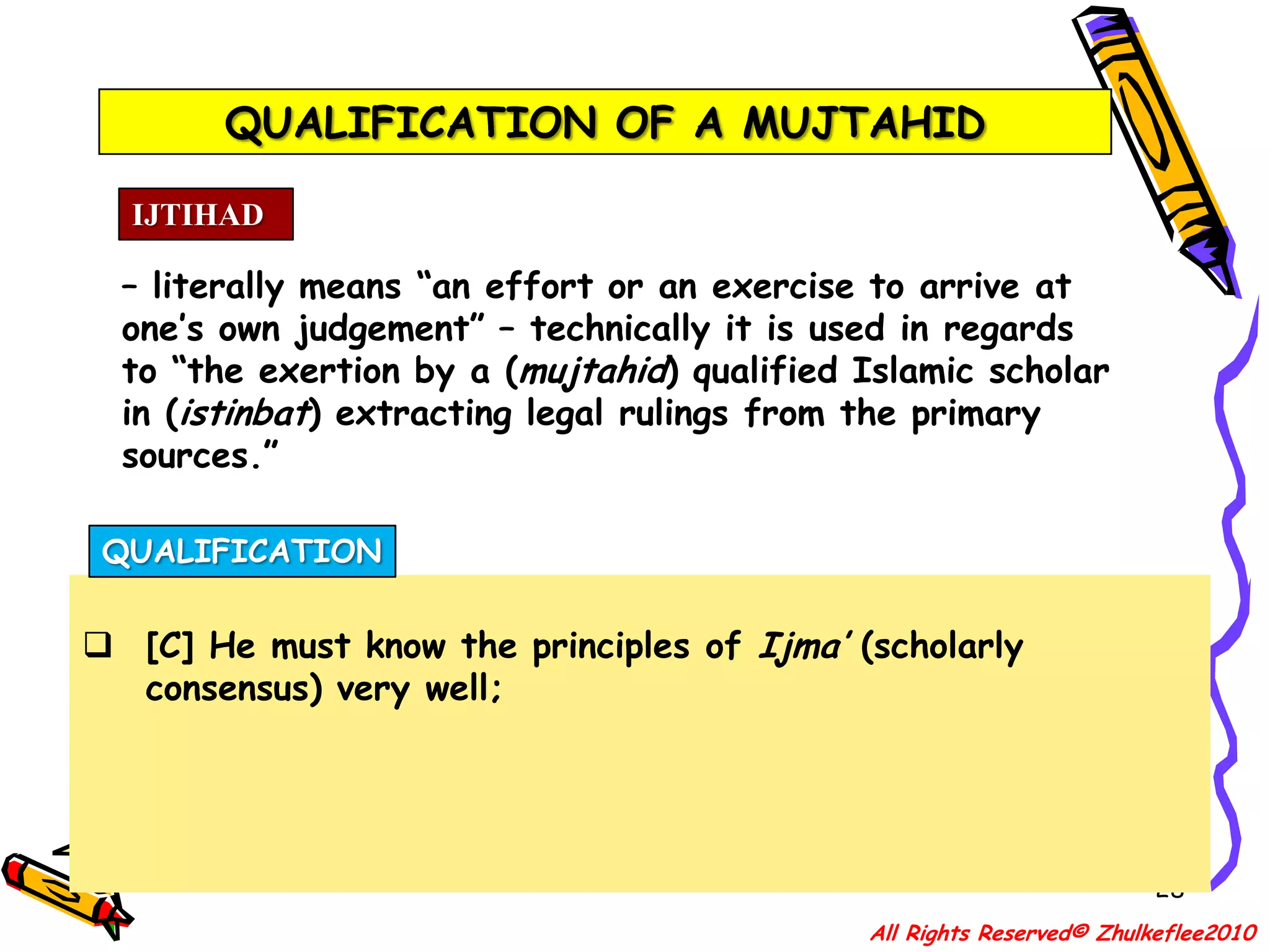
QUALIFICATION OF A MUJTAHID24IJTIHAD– literally means “an effort or an exercise to arrive at one’s own judgement” – technically it is used in regards to “the exertion by a (mujtahid) qualified Islamic scholar in (istinbat) extracting legal rulings from the primary sources.”All Rights Reserved© Zhulkeflee2010
QUALIFICATION OF A MUJTAHID25IJTIHAD– literally means “an effort or an exercise to arrive at one’s own judgement” – technically it is used in regards to “the exertion by a (mujtahid) qualified Islamic scholar in (istinbat) extracting legal rulings from the primary sources.”QUALIFICATIONKnowledgeable about the religion of Islam, the Sunnah (Ways or traditions of the Prophet s.a.w.), Fiqh(Jurisprudence) and Usul-al-Fiqh (Principles of Jurisprudence) especially:All Rights Reserved© Zhulkeflee2010
QUALIFICATION OF A MUJTAHID26IJTIHAD– literally means “an effort or an exercise to arrive at one’s own judgement” – technically it is used in regards to “the exertion by a (mujtahid) qualified Islamic scholar in (istinbat) extracting legal rulings from the primary sources.”QUALIFICATION[A] He must be so very well versed in the study of Qur’an. That he must know the reason why the verses and chapters of the Qur’an were revealed and when each one of them was revealed (Asbab-al-Nuzul);All Rights Reserved© Zhulkeflee2010
QUALIFICATION OF A MUJTAHID27IJTIHAD– literally means “an effort or an exercise to arrive at one’s own judgement” – technically it is used in regards to “the exertion by a (mujtahid) qualified Islamic scholar in (istinbat) extracting legal rulings from the primary sources.”QUALIFICATION[B] He must be well versed in the study of the traditions of the Prophet Muhammad s.a.w. That is, he must know the distinction between authentic Hadith from the spurious and the various other technical categories of Ahadith – viz. Mutawwatir, Shahih, Hasan, Dho’if, Maudhu’ etc.;All Rights Reserved© Zhulkeflee2010
QUALIFICATION OF A MUJTAHID28IJTIHAD– literally means “an effort or an exercise to arrive at one’s own judgement” – technically it is used in regards to “the exertion by a (mujtahid) qualified Islamic scholar in (istinbat) extracting legal rulings from the primary sources.”QUALIFICATION[C] He must know the principles of Ijma’ (scholarly consensus) very well;All Rights Reserved© Zhulkeflee2010
QUALIFICATION OF A MUJTAHID29IJTIHAD– literally means “an effort or an exercise to arrive at one’s own judgement” – technically it is used in regards to “the exertion by a (mujtahid) qualified Islamic scholar in (istinbat) extracting legal rulings from the primary sources.”QUALIFICATION[D] He must know the injunctions of Qiyas (jurisdistic analogy).All Rights Reserved© Zhulkeflee2010
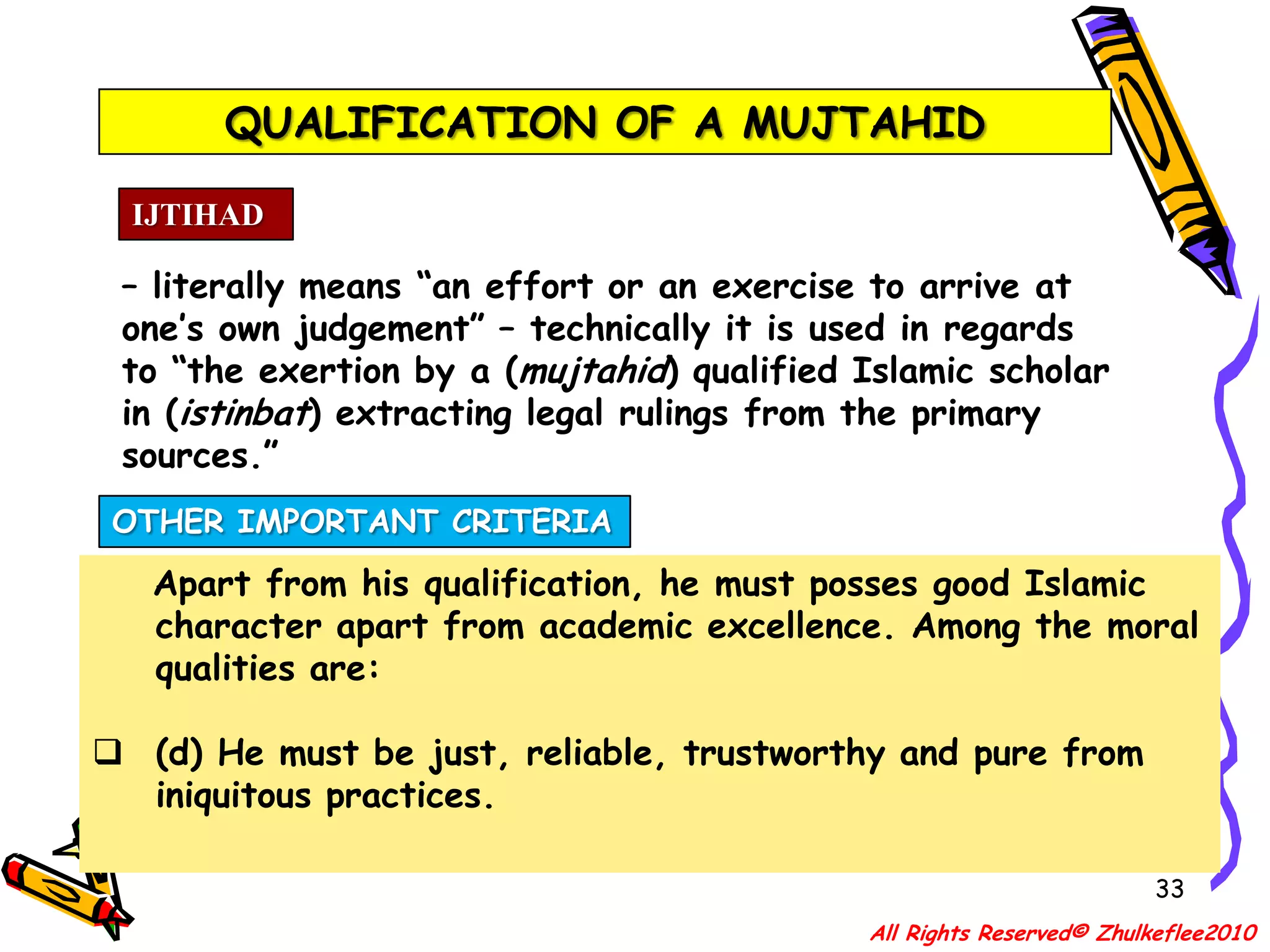
QUALIFICATION OF A MUJTAHID30IJTIHAD– literally means “an effort or an exercise to arrive at one’s own judgement” – technically it is used in regards to “the exertion by a (mujtahid) qualified Islamic scholar in (istinbat) extracting legal rulings from the primary sources.”OTHER IMPORTANT CRITERIA    Apart from his qualification, he must posses good Islamic character apart from academic excellence. Among the moral qualities are:(a) He must be a good Muslim. That he must not be a nominal Muslim; rather, must be a practising one.All Rights Reserved© Zhulkeflee2010
QUALIFICATION OF A MUJTAHID31IJTIHAD– literally means “an effort or an exercise to arrive at one’s own judgement” – technically it is used in regards to “the exertion by a (mujtahid) qualified Islamic scholar in (istinbat) extracting legal rulings from the primary sources.”OTHER IMPORTANT CRITERIA    Apart from his qualification, he must posses good Islamic character apart from academic excellence. Among the moral qualities are:(b) He must be very pious and law-abiding to all the injunctions of the Holy Qur’an.All Rights Reserved© Zhulkeflee2010
QUALIFICATION OF A MUJTAHID32IJTIHAD– literally means “an effort or an exercise to arrive at one’s own judgement” – technically it is used in regards to “the exertion by a (mujtahid) qualified Islamic scholar in (istinbat) extracting legal rulings from the primary sources.”OTHER IMPORTANT CRITERIA    Apart from his qualification, he must posses good Islamic character apart from academic excellence. Among the moral qualities are:(c) He must not be influenced by any heretical influences. All Rights Reserved© Zhulkeflee2010
QUALIFICATION OF A MUJTAHID33IJTIHAD– literally means “an effort or an exercise to arrive at one’s own judgement” – technically it is used in regards to “the exertion by a (mujtahid) qualified Islamic scholar in (istinbat) extracting legal rulings from the primary sources.”OTHER IMPORTANT CRITERIA    Apart from his qualification, he must posses good Islamic character apart from academic excellence. Among the moral qualities are:(d) He must be just, reliable, trustworthy and pure from iniquitous practices.All Rights Reserved© Zhulkeflee2010
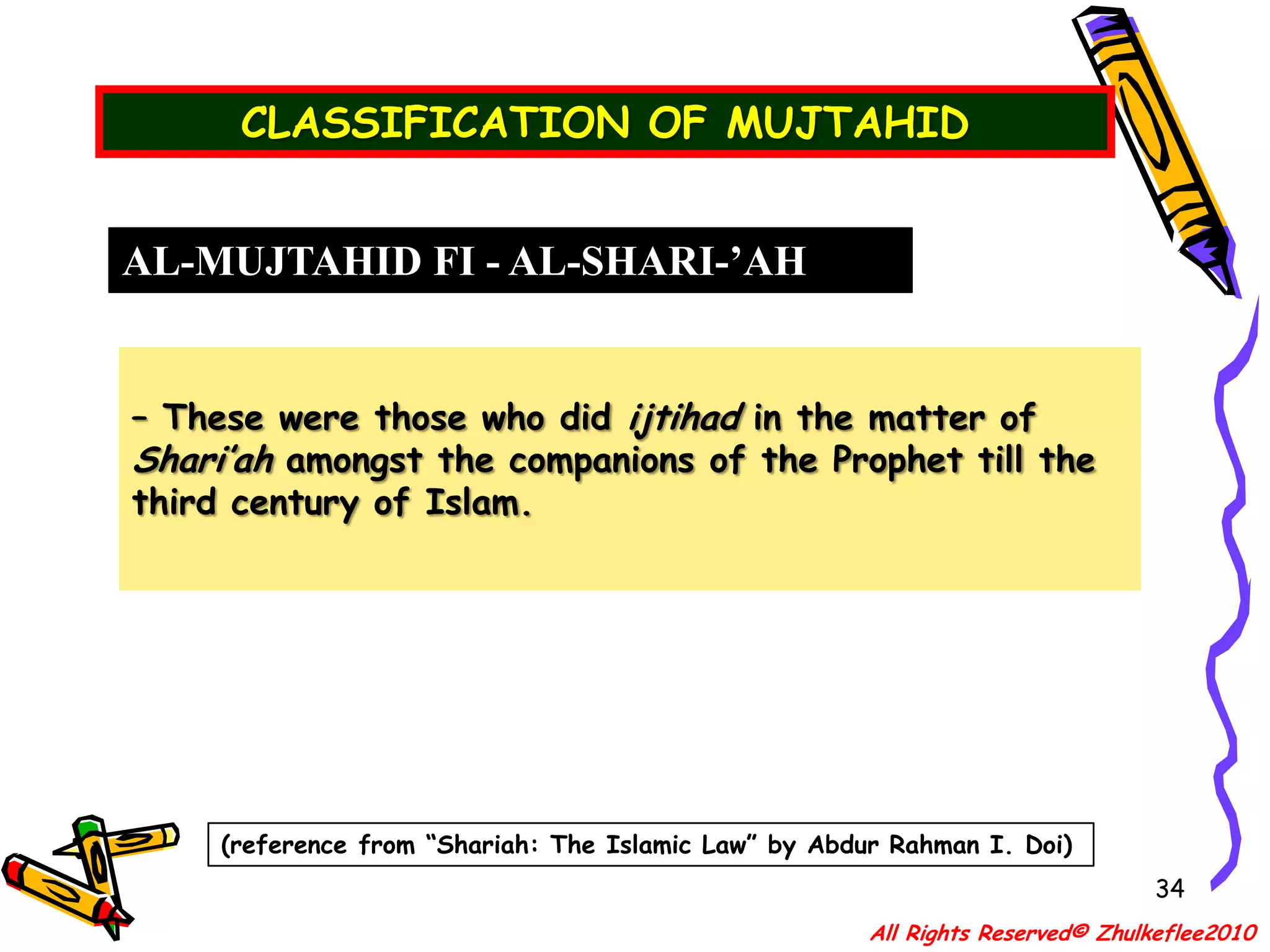
CLASSIFICATION OF MUJTAHID34AL-MUJTAHID FI - AL-SHARI-’AH– These were those who did ijtihad in the matter of Shari’ah amongst the companions of the Prophet till the third century of Islam.(reference from “Shariah: The Islamic Law” by Abdur Rahman I. Doi)All Rights Reserved© Zhulkeflee2010
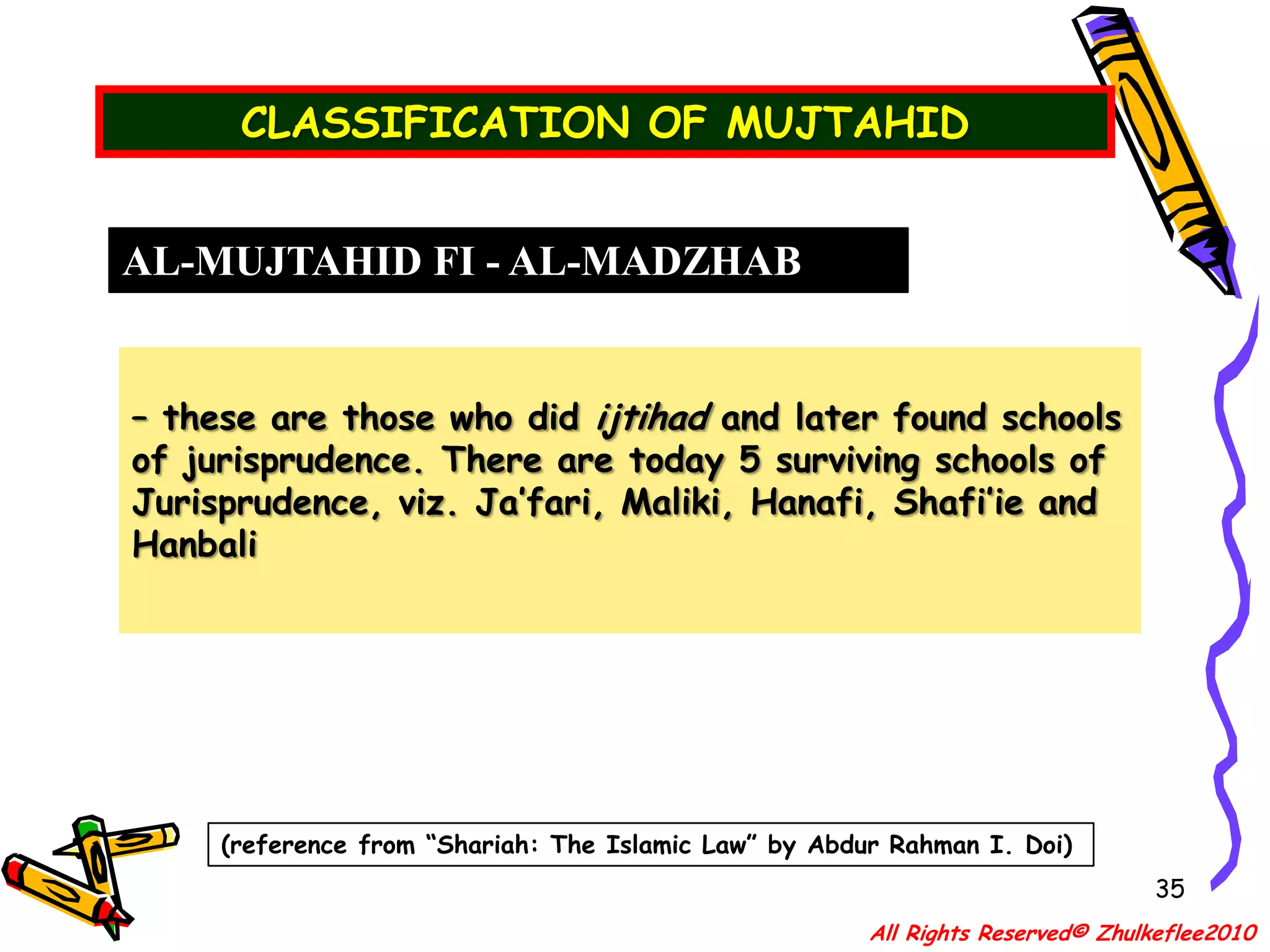
35CLASSIFICATION OF MUJTAHIDAL-MUJTAHID FI - AL-MADZHAB– these are those who did ijtihad and later found schools of jurisprudence. There are today 5 surviving schools of Jurisprudence, viz. Ja’fari, Maliki, Hanafi, Shafi’ie and Hanbali(reference from “Shariah: The Islamic Law” by Abdur Rahman I. Doi)All Rights Reserved© Zhulkeflee2010
36CLASSIFICATION OF MUJTAHIDAL-MUJTAHID FI - AL-MASA-IL– these are those who follow them (mujtahid fi-al-Madzhab) i.e. the present day mujtahids who give Fatwa (or Juristic opinions) on religious matters.(reference from “Shariah: The Islamic Law” by Abdur Rahman I. Doi)All Rights Reserved© Zhulkeflee2010
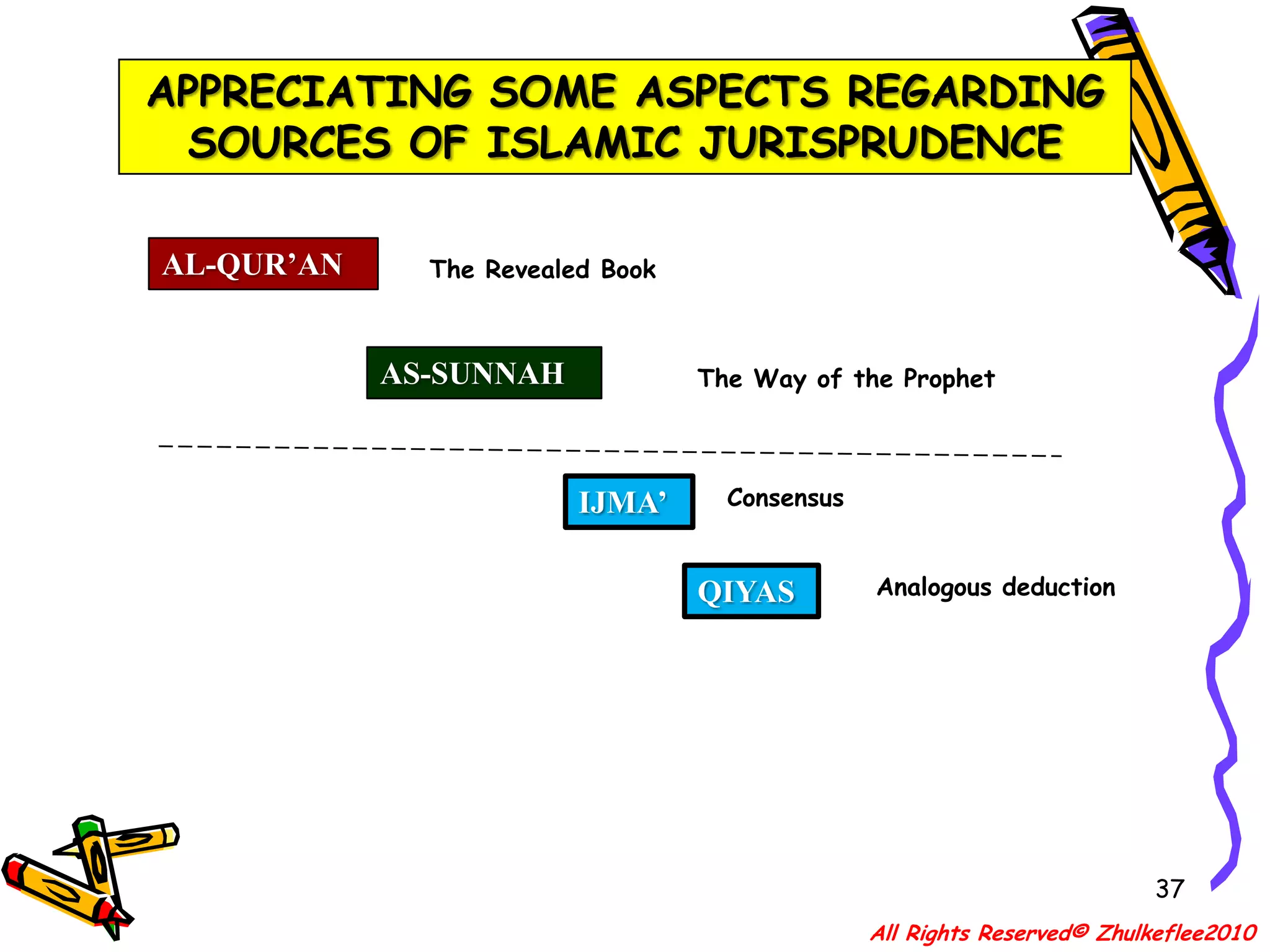
APPRECIATING SOME ASPECTS REGARDING SOURCES OF ISLAMIC JURISPRUDENCE37AL-QUR’ANThe Revealed BookAS-SUNNAHThe Way of the ProphetIJMA’ConsensusQIYASAnalogous deductionAll Rights Reserved© Zhulkeflee2010
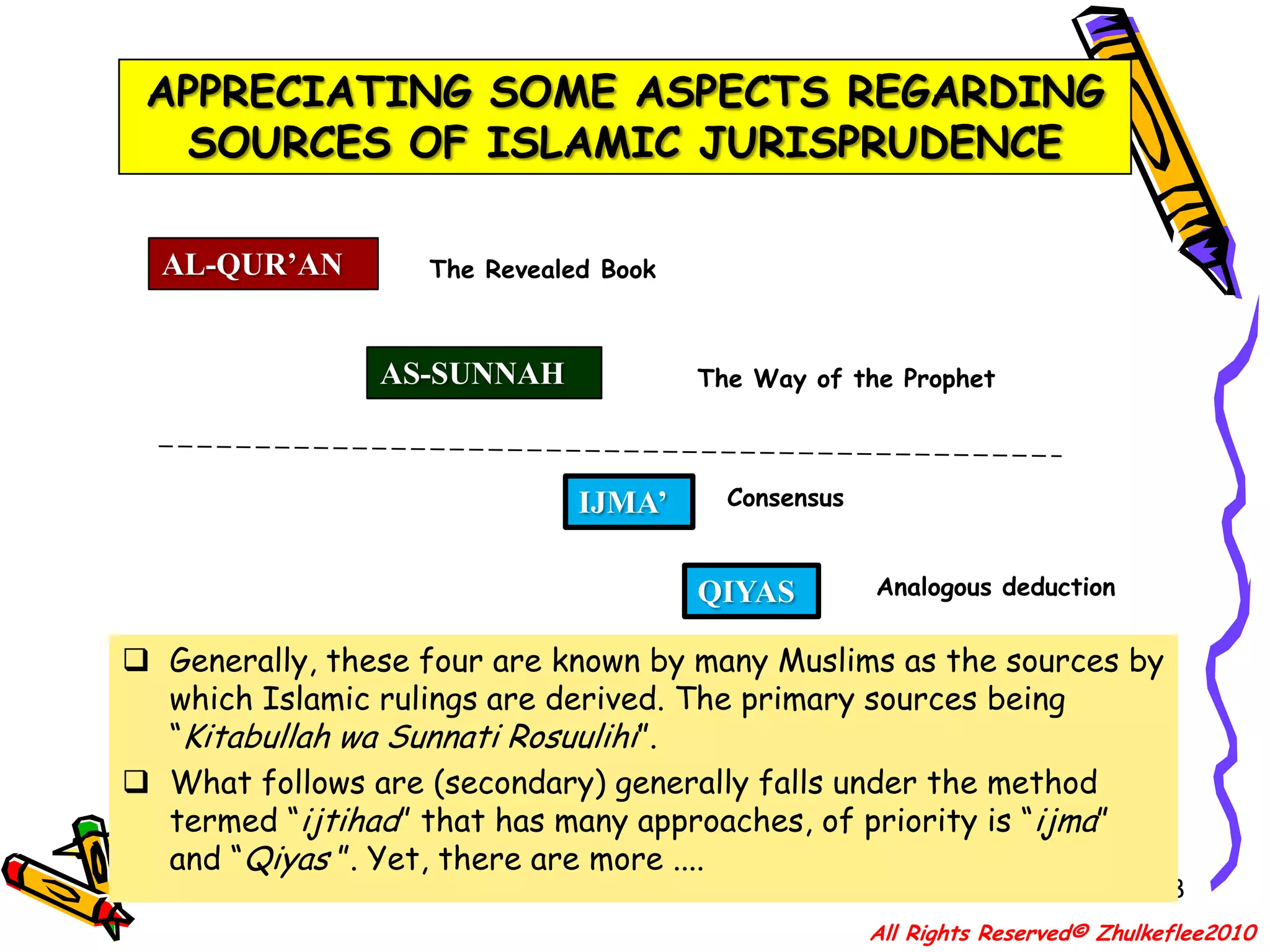
APPRECIATING SOME ASPECTS REGARDING SOURCES OF ISLAMIC JURISPRUDENCE38AL-QUR’ANThe Revealed BookAS-SUNNAHThe Way of the ProphetIJMA’ConsensusQIYASAnalogous deductionGenerally, these four are known by many Muslims as the sources by which Islamic rulings are derived. The primary sources being “Kitabullah wa Sunnati Rosuulihi”.
What follows are (secondary) generally falls under the method termed “ijtihad” that has many approaches, of priority is “ijma” and “Qiyas ”. Yet, there are more ....All Rights Reserved© Zhulkeflee2010
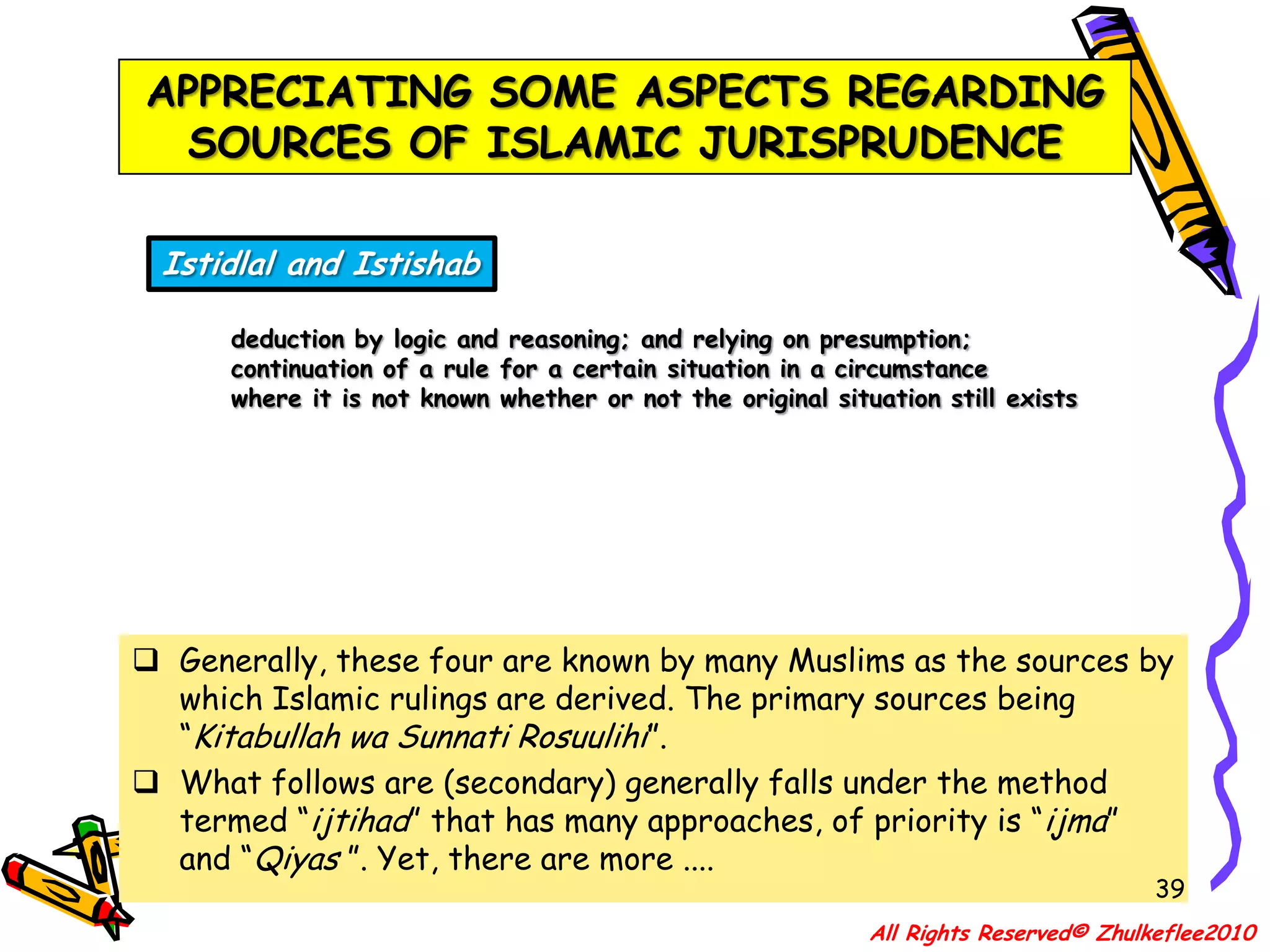
39APPRECIATING SOME ASPECTS REGARDING SOURCES OF ISLAMIC JURISPRUDENCEIstidlal and Istishabdeduction by logic and reasoning; and relying on presumption; continuation of a rule for a certain situation in a circumstance where it is not known whether or not the original situation still existsGenerally, these four are known by many Muslims as the sources by which Islamic rulings are derived. The primary sources being “Kitabullah wa Sunnati Rosuulihi”.
What follows are (secondary) generally falls under the method termed “ijtihad” that has many approaches, of priority is “ijma” and “Qiyas ”. Yet, there are more ....All Rights Reserved© Zhulkeflee2010
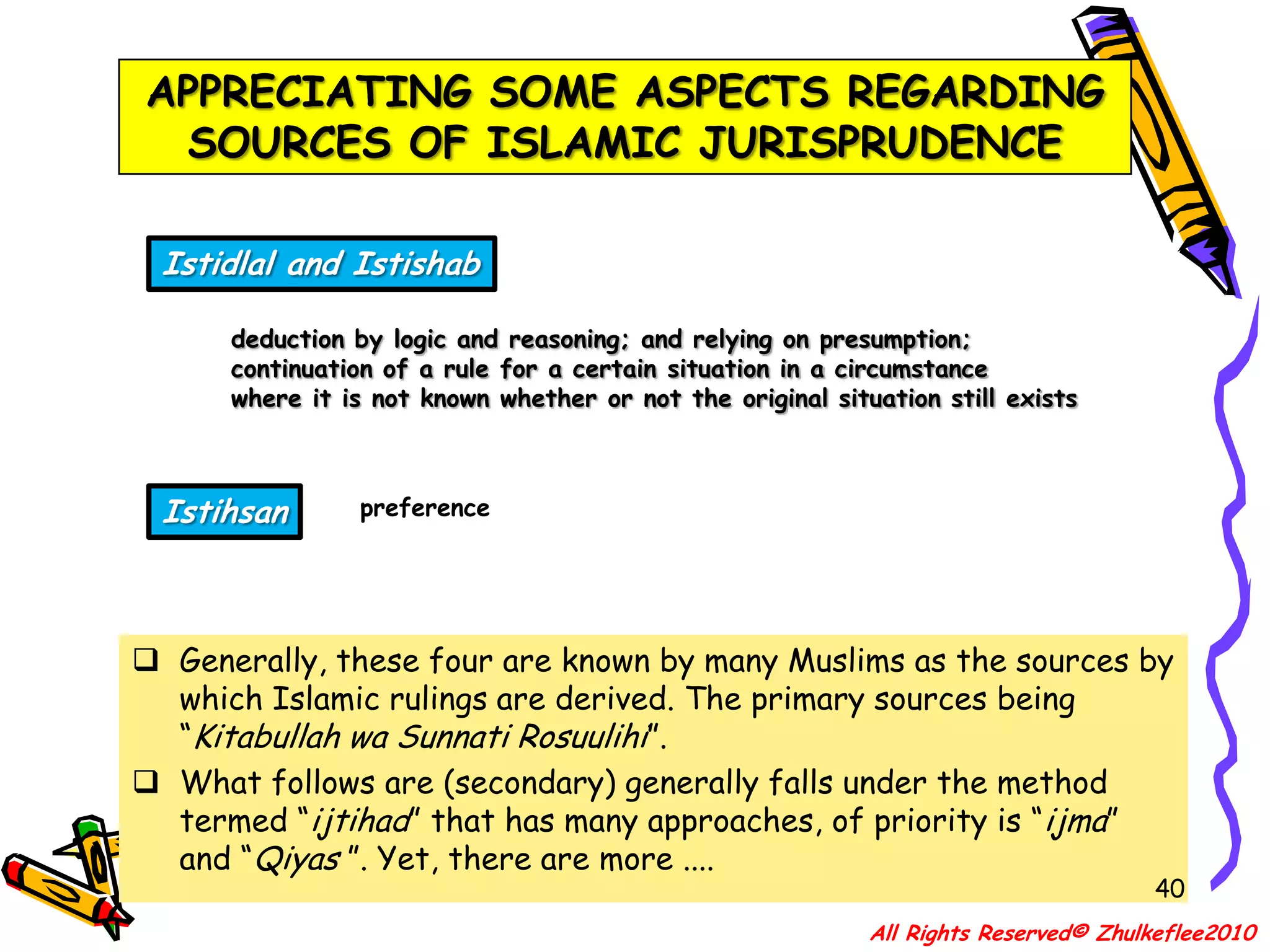
40APPRECIATING SOME ASPECTS REGARDING SOURCES OF ISLAMIC JURISPRUDENCEIstidlal and Istishabdeduction by logic and reasoning; and relying on presumption; continuation of a rule for a certain situation in a circumstance where it is not known whether or not the original situation still existsIstihsanpreferenceGenerally, these four are known by many Muslims as the sources by which Islamic rulings are derived. The primary sources being “Kitabullah wa Sunnati Rosuulihi”.
What follows are (secondary) generally falls under the method termed “ijtihad” that has many approaches, of priority is “ijma” and “Qiyas ”. Yet, there are more ....All Rights Reserved© Zhulkeflee2010
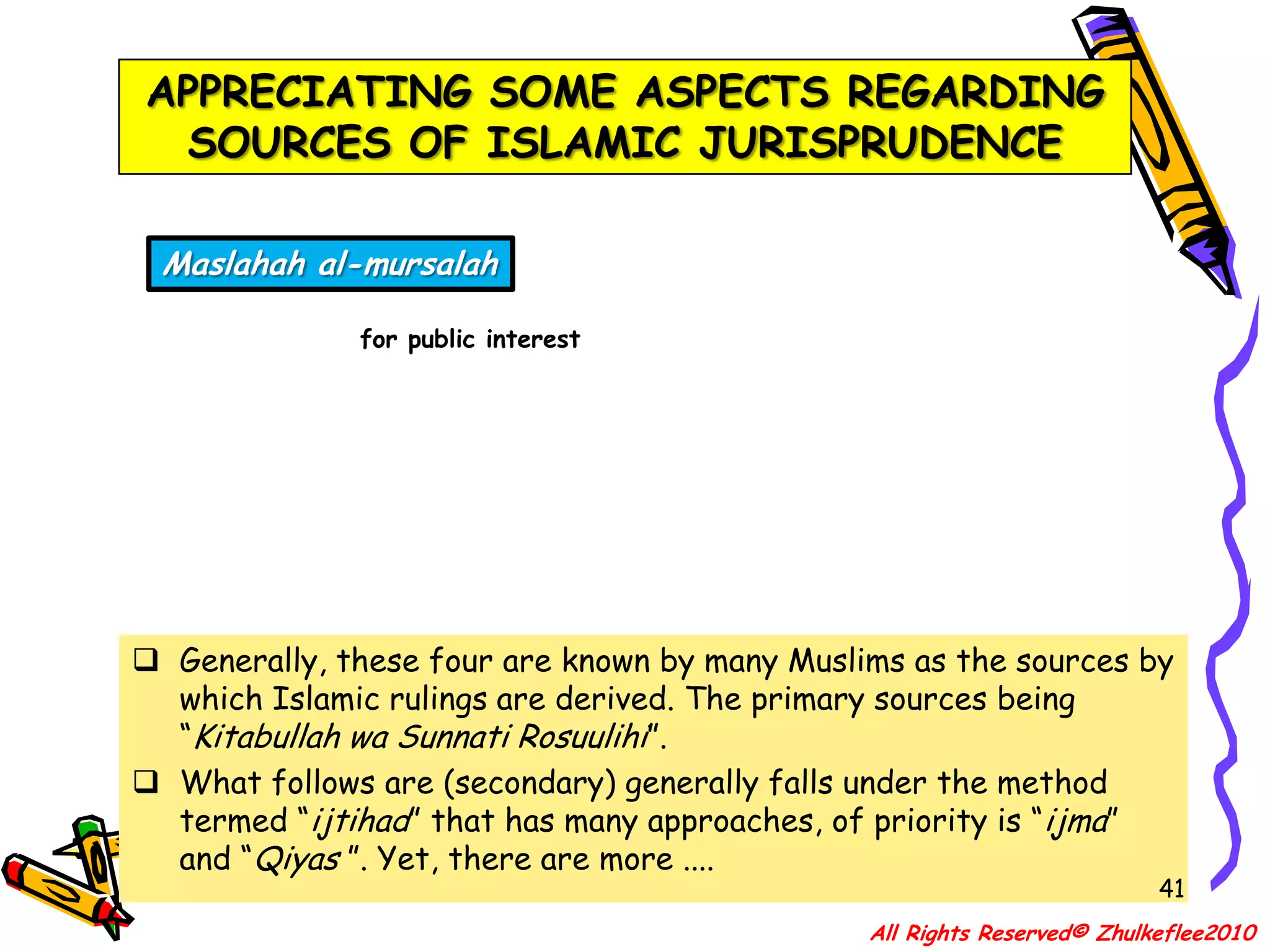
41APPRECIATING SOME ASPECTS REGARDING SOURCES OF ISLAMIC JURISPRUDENCEMaslahah al-mursalahfor public interestGenerally, these four are known by many Muslims as the sources by which Islamic rulings are derived. The primary sources being “Kitabullah wa Sunnati Rosuulihi”.
What follows are (secondary) generally falls under the method termed “ijtihad” that has many approaches, of priority is “ijma” and “Qiyas ”. Yet, there are more ....All Rights Reserved© Zhulkeflee2010
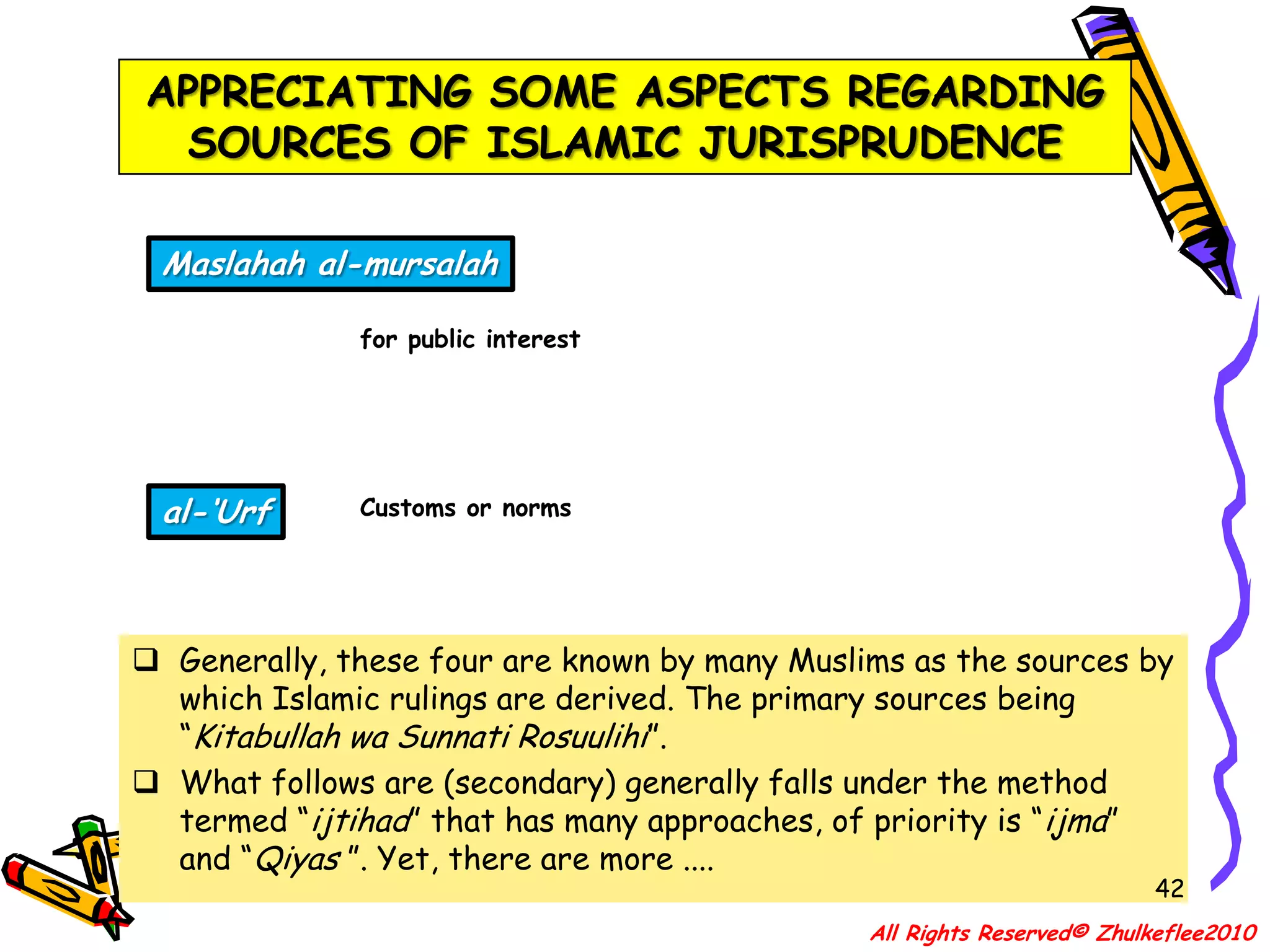
42APPRECIATING SOME ASPECTS REGARDING SOURCES OF ISLAMIC JURISPRUDENCEMaslahah al-mursalahfor public interestal-‘UrfCustoms or normsGenerally, these four are known by many Muslims as the sources by which Islamic rulings are derived. The primary sources being “Kitabullah wa Sunnati Rosuulihi”.
What follows are (secondary) generally falls under the method termed “ijtihad” that has many approaches, of priority is “ijma” and “Qiyas ”. Yet, there are more ....All Rights Reserved© Zhulkeflee2010
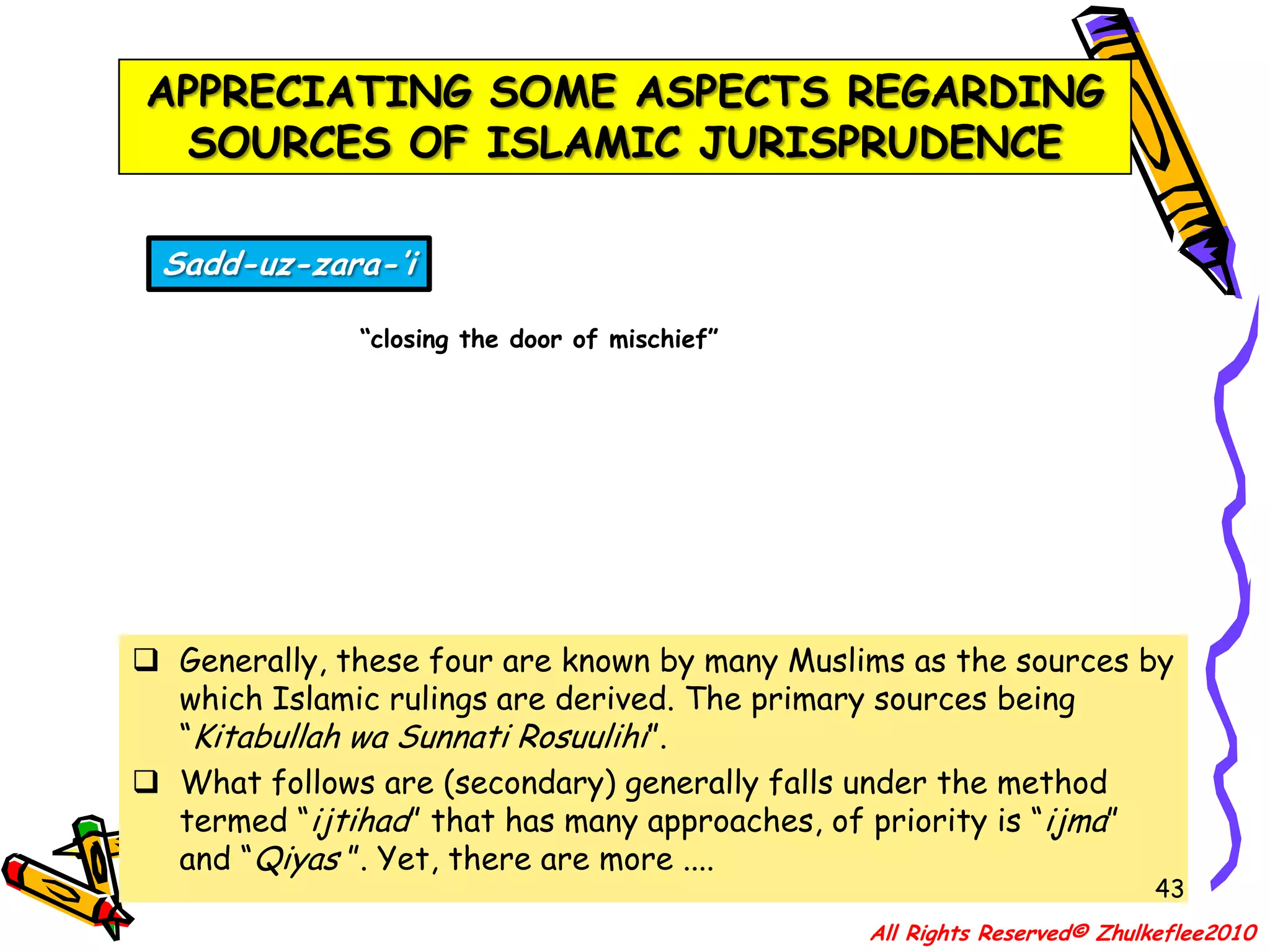
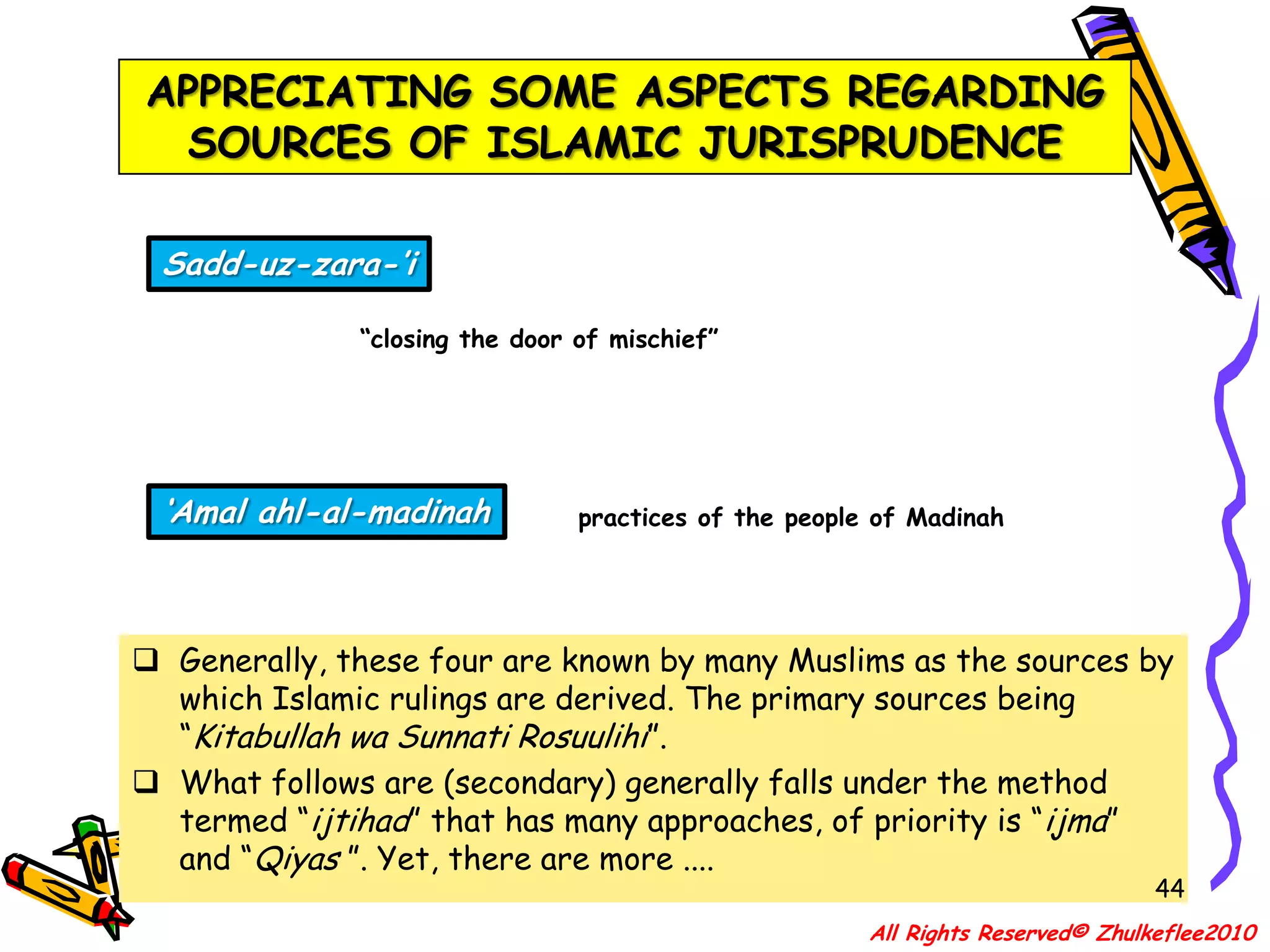
43APPRECIATING SOME ASPECTS REGARDING SOURCES OF ISLAMIC JURISPRUDENCESadd-uz-zara-’i“closing the door of mischief”Generally, these four are known by many Muslims as the sources by which Islamic rulings are derived. The primary sources being “Kitabullah wa Sunnati Rosuulihi”.
What follows are (secondary) generally falls under the method termed “ijtihad” that has many approaches, of priority is “ijma” and “Qiyas ”. Yet, there are more ....All Rights Reserved© Zhulkeflee2010
44APPRECIATING SOME ASPECTS REGARDING SOURCES OF ISLAMIC JURISPRUDENCESadd-uz-zara-’i“closing the door of mischief”‘Amal ahl-al-madinahpractices of the people of MadinahGenerally, these four are known by many Muslims as the sources by which Islamic rulings are derived. The primary sources being “Kitabullah wa Sunnati Rosuulihi”.
What follows are (secondary) generally falls under the method termed “ijtihad” that has many approaches, of priority is “ijma” and “Qiyas ”. Yet, there are more ....All Rights Reserved© Zhulkeflee2010
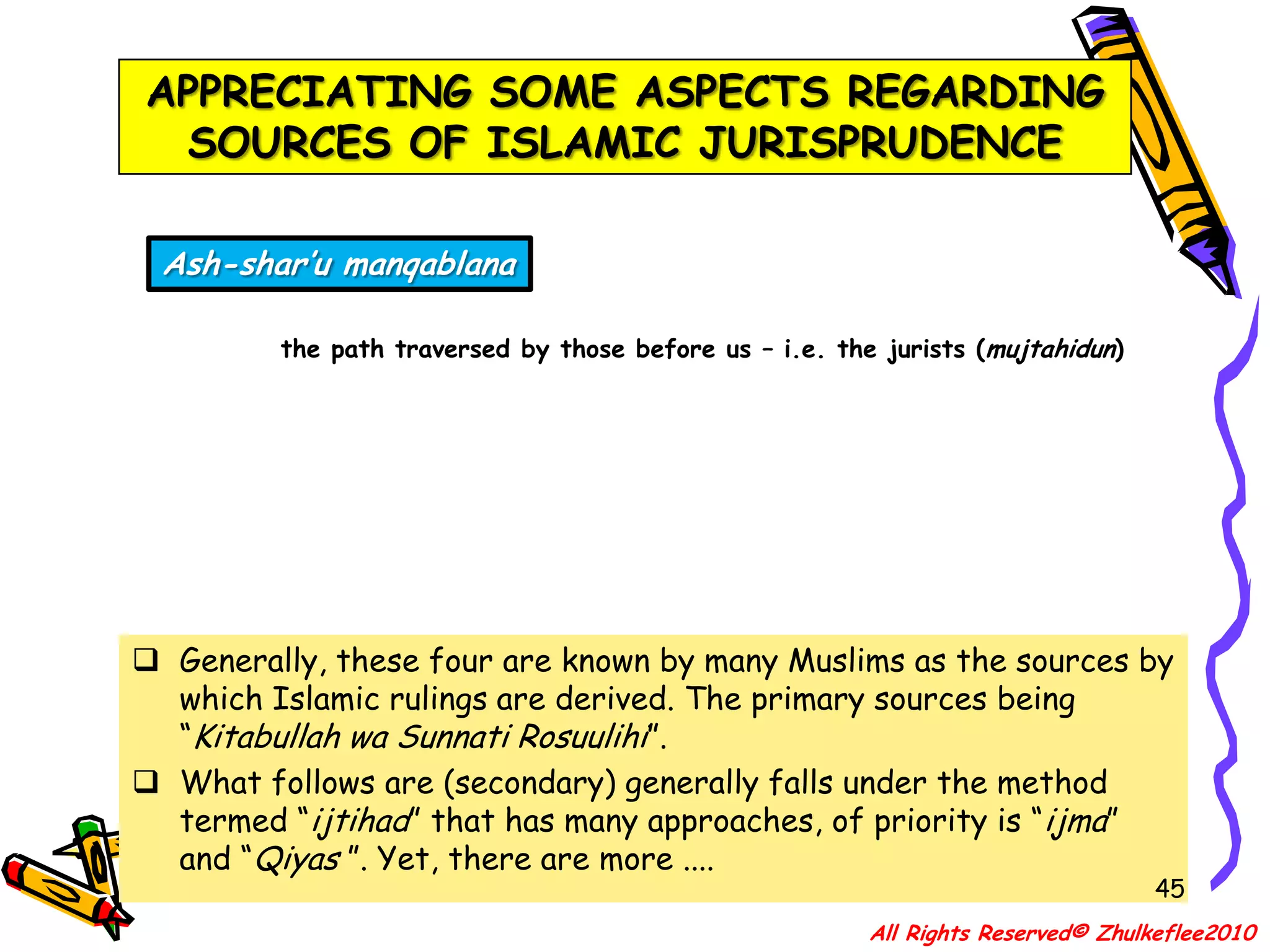
45APPRECIATING SOME ASPECTS REGARDING SOURCES OF ISLAMIC JURISPRUDENCEAsh-shar’u manqablanathe path traversed by those before us – i.e. the jurists (mujtahidun)Generally, these four are known by many Muslims as the sources by which Islamic rulings are derived. The primary sources being “Kitabullah wa Sunnati Rosuulihi”.
What follows are (secondary) generally falls under the method termed “ijtihad” that has many approaches, of priority is “ijma” and “Qiyas ”. Yet, there are more ....All Rights Reserved© Zhulkeflee2010
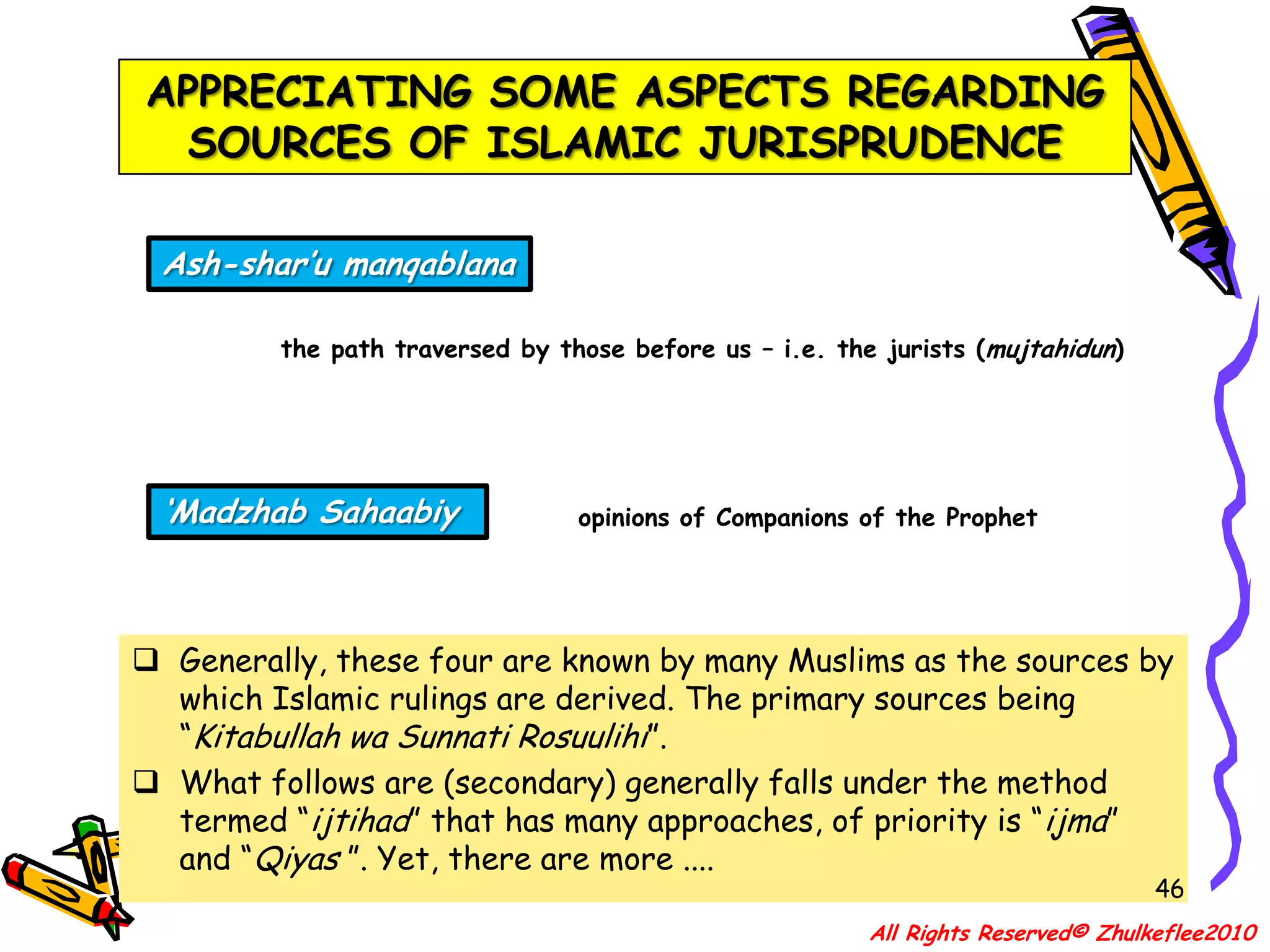
46APPRECIATING SOME ASPECTS REGARDING SOURCES OF ISLAMIC JURISPRUDENCEAsh-shar’u manqablanathe path traversed by those before us – i.e. the jurists (mujtahidun)‘Madzhab Sahaabiy opinions of Companions of the ProphetGenerally, these four are known by many Muslims as the sources by which Islamic rulings are derived. The primary sources being “Kitabullah wa Sunnati Rosuulihi”.
What follows are (secondary) generally falls under the method termed “ijtihad” that has many approaches, of priority is “ijma” and “Qiyas ”. Yet, there are more ....All Rights Reserved© Zhulkeflee2010
47إِذَا ضُيِّعَتِ اْلأَمَانَةُ فَانْتَظَرِ السَّاعَةَقَالَ; كَيْفَ إِضَاعَتُهَا يَارَسُوْل الله ؟ قَالَ ; إِذَا أُسْنِدَ اْلأَمْرُ إِلَى غَيْرِ أَهْلِهِ فَانْتَظِرِ السَّعَةَ“When a trust is neglected, then wait for the time (of its destruction).” Somebody ask: ‘How shall this be neglected O Messenger of Allah?’ He the replied: “When a matter (affair) is given over, not to its rightful (legitimate) person, then wait for its time (of destruction).”(Hadith reported by Bukhary) All Rights Reserved© Zhulkeflee2010
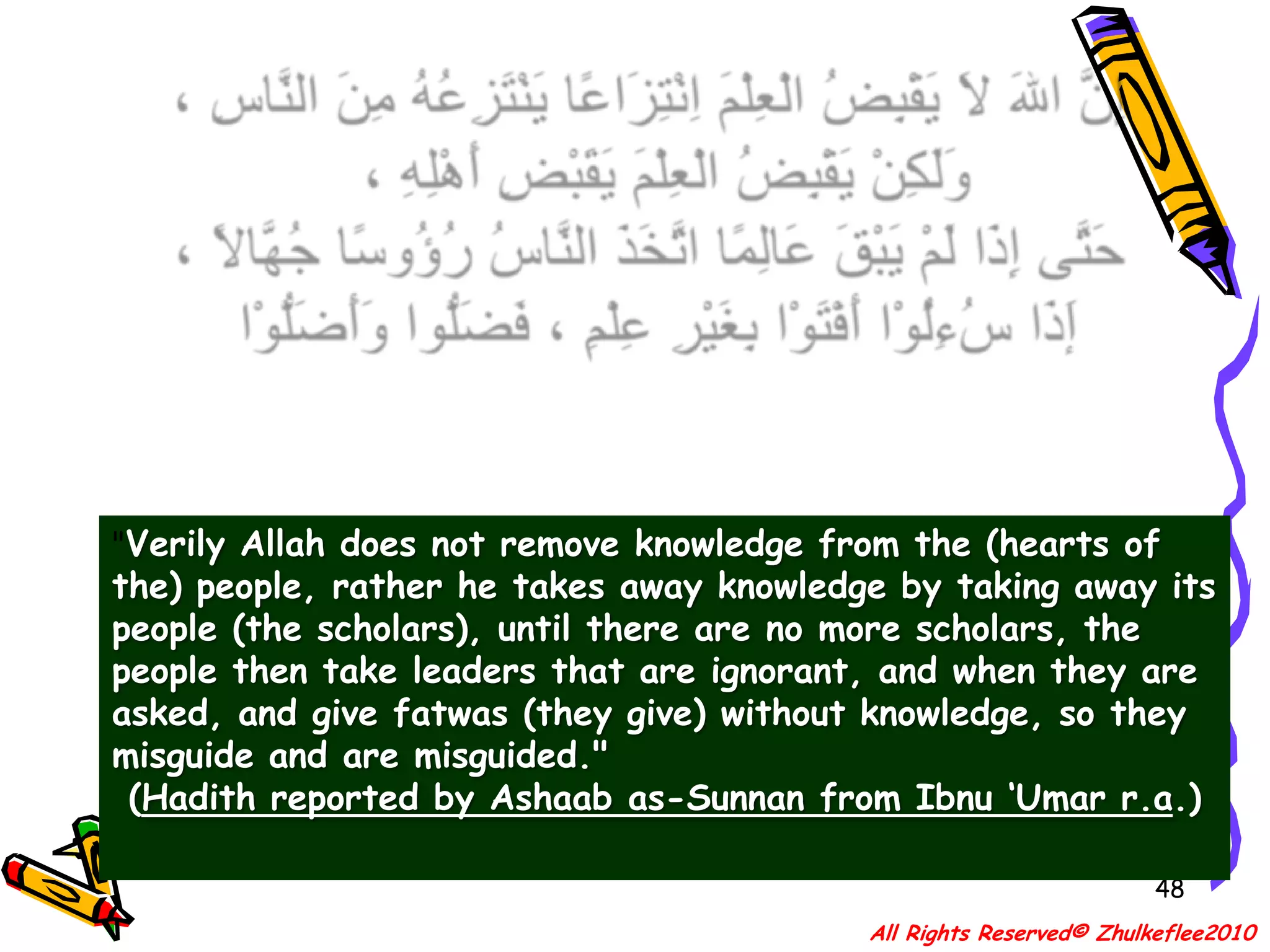
48إِنَّ اللهَ لاَ يَقْبِضُ الْعِلْمَ اِنْتِزَاعًا يَنْتَزِعُهُ مِنَ النَّاسِ ،وَلَكِنْ يَقْبِضُ الْعِلْمَ يَقَبْضِ أَهْلِهِ ، حَتَّى إِذَا لَمْ يَبْقَ عَالِمًا اتَّخَذَ النَّاسُ رُؤُوسًا جُهَّالاً ،إَذَا سُءِلُوْا أَفْتَوْا بِغَيْرِ عِلْمِ ، فَضَلُّوا وَأَضَلُّوْا"Verily Allah does not remove knowledge from the (hearts of the) people, rather he takes away knowledge by taking away its people (the scholars), until there are no more scholars, the people then take leaders that are ignorant, and when they are asked, and give fatwas (they give) without knowledge, so they misguide and are misguided."(Hadith reported by Ashaab as-Sunnan from Ibnu ‘Umar r.a.)All Rights Reserved© Zhulkeflee2010
AN  IMPORTANTCLARIFICATIONCONCERNING “TAQLID”“The learned and wise among Muslims must use constant vigilance in detecting erroneous usage in language which impinges upon semantic change in major key elements and creates general confusion and error in the understanding of Islam and of its worldview.” Prof. Syed Muhammad Naquib Al-AttasLESSONS ON ISLAMIC ADABBy: Ustaz Zhulkeflee Hj IsmailAll Rights Reserved© Zhulkeflee2010
CLARIFYING SOME ERRORS - CONFUSION:Some people carelessly argues:“Taqlid is haram (forbidden)”

[Slideshare]adab followgmadzhab

  • 1.
    “ADAB IN APPRECIATINGTHE MADZAAHIB”“All who are non-Mujtahid, by default, is a Muqollid”LESSONS ON ISLAMIC ADABBy: Ustaz Zhulkeflee Hj Ismail1All Rights Reserved© Zhulkeflee2010
  • 2.
    2وَمَا كَانَ ٱلۡمُؤۡمِنُونَلِيَنفِرُواْ ڪَآفَّةً۬‌ۚ فَلَوۡلَا نَفَرَ مِن كُلِّ فِرۡقَةٍ۬ مِّنۡہُمۡ طَآٮِٕفَةٌ۬ لِّيَتَفَقَّهُواْ فِى ٱلدِّينِ وَلِيُنذِرُواْ قَوۡمَهُمۡ إِذَا رَجَعُوٓاْ إِلَيۡہِمۡ لَعَلَّهُمۡ يَحۡذَرُونَAll Rights Reserved© Zhulkeflee2010
  • 3.
    3 “Nor shouldthe Believers all go forth together: if a contingent from every expedition remained behind, they could devote themselves to studies in religion (faqih fid-deen) and admonish the people when they return to them― that thus they (may learn) to guard themselves (against evil).”(Qur’an: Taubah: 9: 122)All Rights Reserved© Zhulkeflee2010
  • 4.
    4فَسۡـَٔلُوٓاْ أَهۡلَ ٱلذِّكۡرِإِن كُنتُمۡ لَا تَعۡلَمُونَ“... Ask from those who possess the Message (az-Zikr : the remembrance) in matters which you do not know.“(Qur’an: al-Nahlu: 16: 43)All Rights Reserved© Zhulkeflee2010
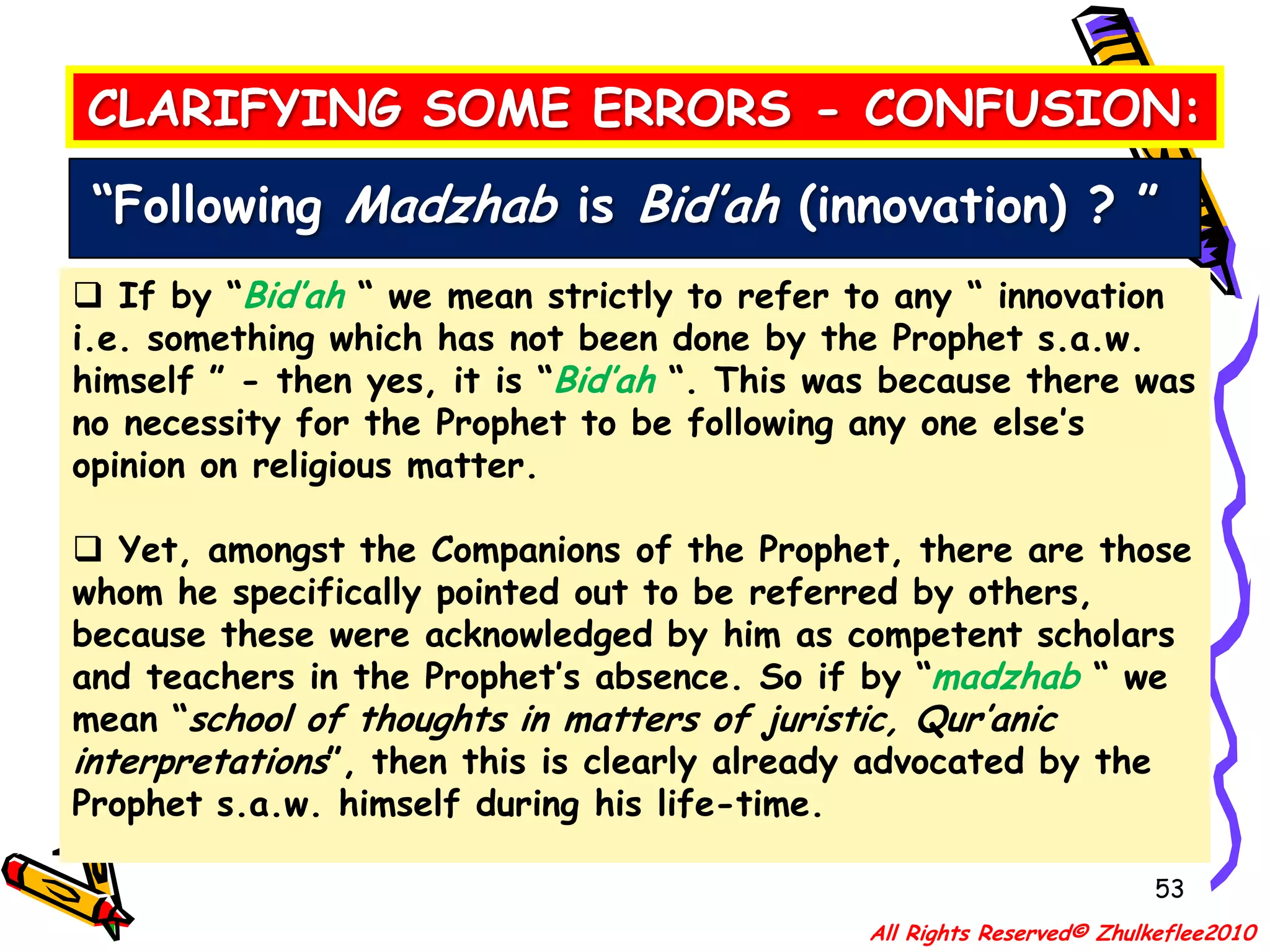
  • 5.
    5يَرۡفَعِ ٱللَّهُ ٱلَّذِينَءَامَنُواْ مِنكُمۡ وَٱلَّذِينَ أُوتُواْ ٱلۡعِلۡمَ دَرَجَـٰتٍ۬‌ۚ“Allah will raise up, to (suitable) ranks (and degrees), those of you who believe and who have been granted Knowledge:.“(Qur’an: Mujadilah: 58: 11)All Rights Reserved© Zhulkeflee2010
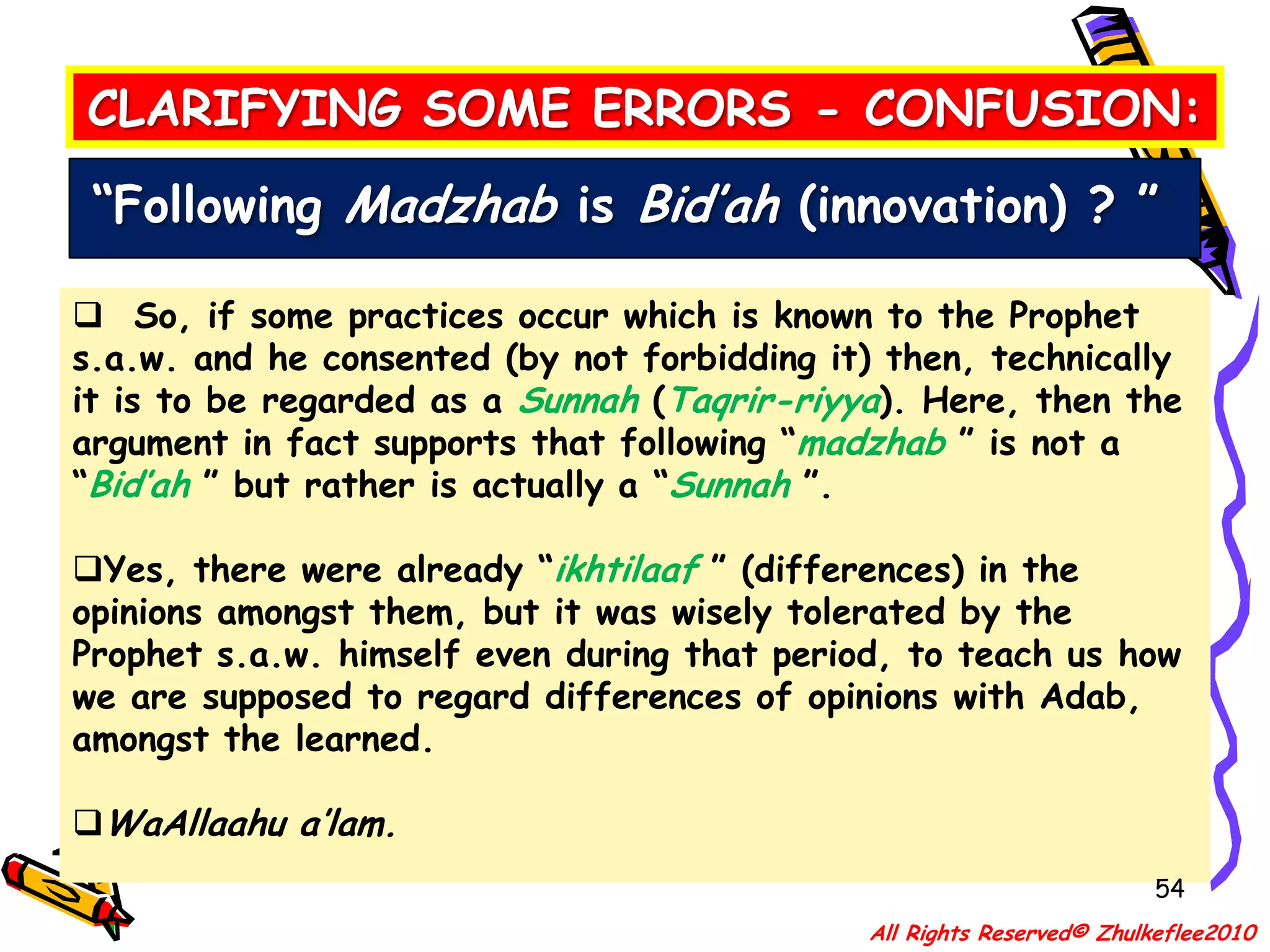
  • 6.
    6يَـٰٓأَيُّہَا ٱلَّذِينَ ءَامَنُوٓاْأَطِيعُواْ ٱللَّهَ وَأَطِيعُواْ ٱلرَّسُولَ وَأُوْلِى ٱلۡأَمۡرِ مِنكُمۡ‌ۖ“O ye who believe! Obey Allah and obey the Messenger and those charged with authority from among you (ulil-’amri min-kum).”(Qur’an: An-Nisa’: 4: 59)All Rights Reserved© Zhulkeflee2010
  • 7.
    7خُلَفَاءِي رَحِيْمَهُمُ اللهُتَعَالَى قِيْلَ وَمَنْ خُلَفَاؤُكَ يَارَسُوْلَ الله ؟ قَالَ ، اَلَّذِيْنَ يُحْيُوْنَ سٌنَّتِىْ وَيُعَلِّمُوْنَهَ عِبَادَاللهِ تَعَالَى “(Honour) My successors, may Allah s.w.t. be Merciful towards them!.” He was asked: “Who are your successors O Messenger of Allah?” And he said: “They are those who revive my Sunnah and teaches them to the servants of Allah.”(Hadith of the Prophet s.a.w.)All Rights Reserved© Zhulkeflee2010
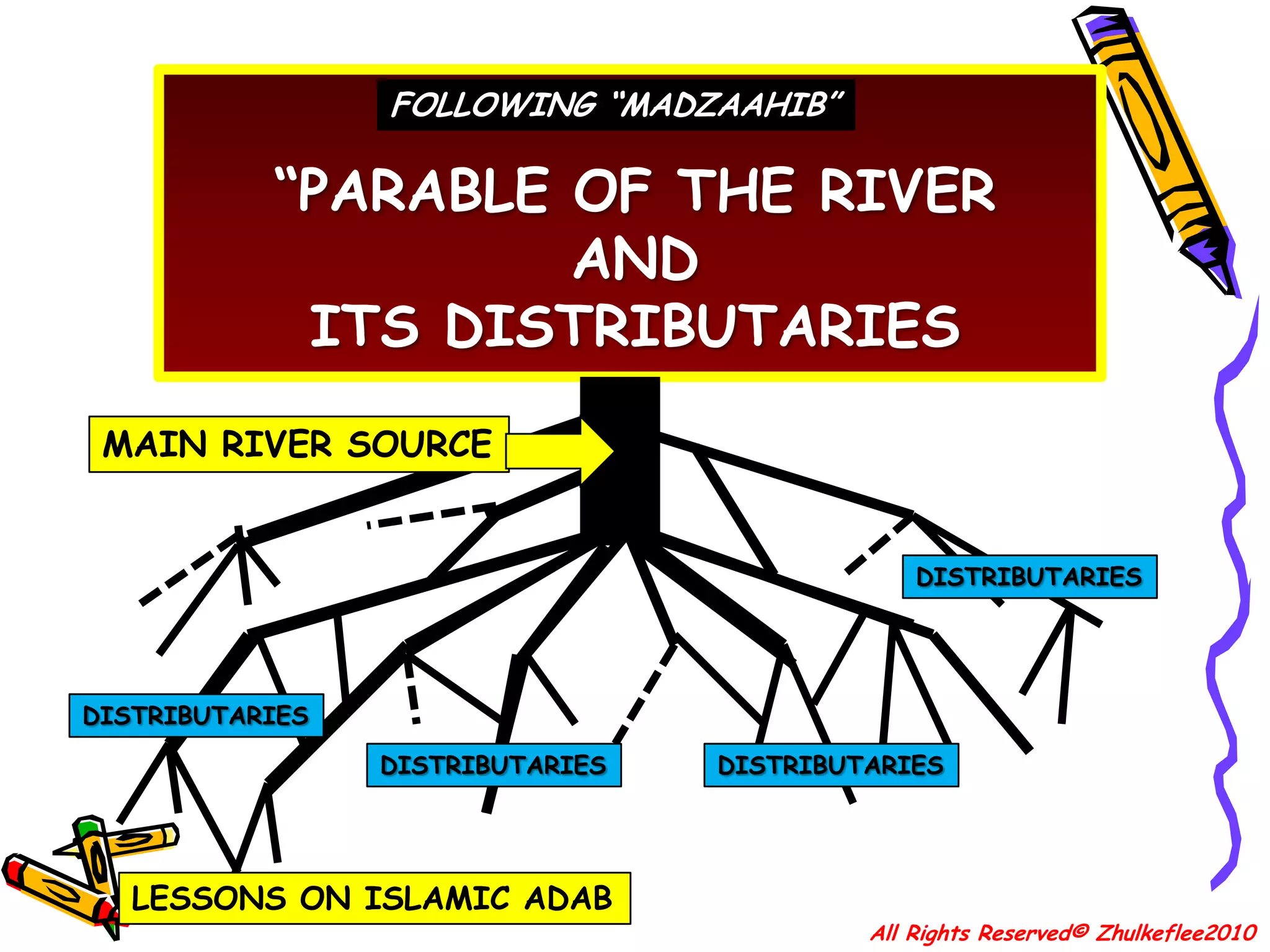
  • 8.
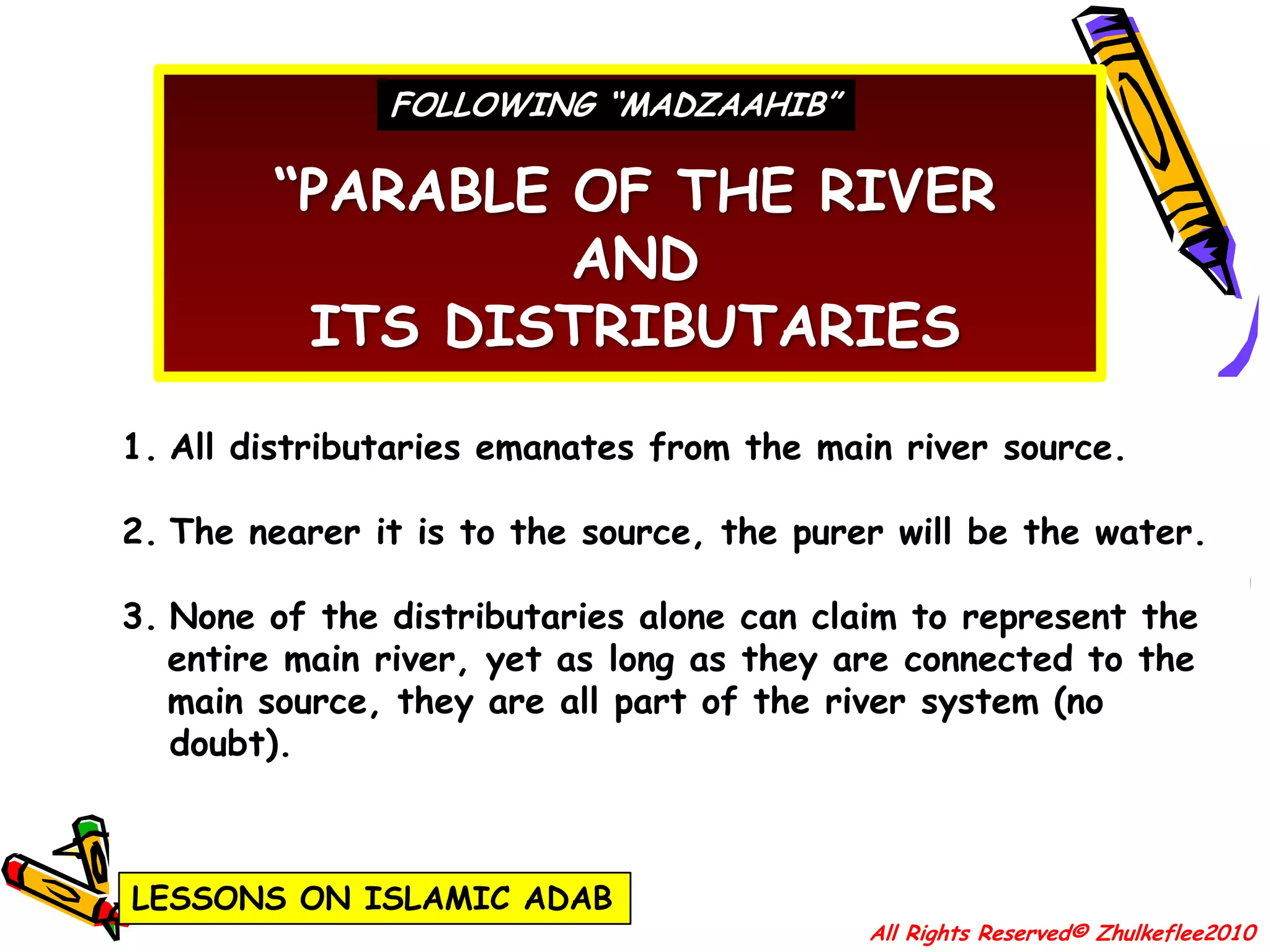
    8وَمَن يُشَاقِقِ ٱلرَّسُولَمِنۢ بَعۡدِ مَا تَبَيَّنَ لَهُ ٱلۡهُدَىٰ وَيَتَّبِعۡ غَيۡرَ سَبِيلِ ٱلۡمُؤۡمِنِينَ نُوَلِّهِۦ مَا تَوَلَّىٰ وَنُصۡلِهِۦ جَهَنَّمَ‌ۖ وَسَآءَتۡ مَصِيرًا “If anyone contends with the Messenger even after guidance has been plainly conveyed to him, and follows a path other than that becoming to men to Faith, We shall leave him in the path he has chosen, and land him in Hell, what an evil refuge.”(Qur’an: An-Nisa’: 4: 115)All Rights Reserved© Zhulkeflee2010
  • 9.
    9وَكَذَٲلِكَ جَعَلۡنَـٰكُمۡ أُمَّةً۬وَسَطً۬ا لِّتَڪُونُواْ شُہَدَآءَ عَلَى ٱلنَّاسِ “Thus have We made of you an Ummah justly balanced that ye might be witnesses over the nations .“(Qur’an: Baqarah: 2: 143)وَلاَ تَجْتَمِعُ أُمَّتِيْ عَلَى الْخَطَإِ“My ummah (community) will never agree upon matters which are erroneous”(Hadith reported by Tirmidzi, Abu Dawud, Ibn Majah & Daruqutni)All Rights Reserved© Zhulkeflee2010
  • 10.
    10فَإِن تَنَـٰزَعۡتُمۡ فِىشَىۡءٍ۬ فَرُدُّوهُ إِلَى ٱللَّهِ وَٱلرَّسُولِ إِن كُنتُمۡ تُؤۡمِنُونَ بِٱللَّهِ وَٱلۡيَوۡمِ ٱلۡأَخِرِ‌ۚ ذَٲلِكَ خَيۡرٌ۬ وَأَحۡسَنُ تَأۡوِيلاً “If ye differ in anything among yourselves, refer it to Allah and His Messenger * if ye do believe in Allah and the Last Day: that is best, and most suitable for final determination.”(Qur’an: An-Nisa’: 4: 59)*This is especially referring to the Islamic scholars and jurists, who are competent to refer back to these two primary sources – not just any one.The general Muslims can rely upon any of their juristic decisions by Taqlid. Differences amongst them, termed “khilafiyyah” are to be respected with Adab as becoming towards all our teachers and scholars (ulama’.)All Rights Reserved© Zhulkeflee2010
  • 11.
    UNDERSTANDING TERMS:11In Islamiclegal theory, the scholars define “taqlid” as : “Accepting the view of someone (who is a faqih / mujtahid) without a proof” قَبُولُ قَوْلِ الْغَيْر مِنْ غَيْرِ حُجَّة (qabuu-lu qawli’l-ghayr min ghayri Hujjah).”11 – Imam al-Ghazalie r.h.m. Al-Mustasfå min ‘Ilm al-Usul (Cairo: Maktabah al-Tijariyyah, 1356), 2:387.All Rights Reserved© Zhulkeflee2010
  • 12.
    UNDERSTANDING TERMS:12In Islamiclegal theory, the scholars define “taqlid” as : “Accepting the view of someone (who is a faqih / mujtahid) without a proof” قَبُولُ قَوْلِ الْغَيْر مِنْ غَيْرِ حُجَّة (qabuu-lu qawli’l-ghayr min ghayri Hujjah).”1Those who are not qualified scholars (faqih) who are can do “ijtihad “( called “mujtahid”) are obligatory to “taqlid” (still technically regarded as a “muqallid” )1 – Imam al-Ghazalie r.h.m. Al-Mustasfå min ‘Ilm al-Usul (Cairo: Maktabah al-Tijariyyah, 1356), 2:387.All Rights Reserved© Zhulkeflee2010
  • 13.
    UNDERSTANDING TERMS:In Islamiclegal theory, scholastic method referred to as “ijtihad” means simply, ‘exertion’,13All Rights Reserved© Zhulkeflee2010
  • 14.
    UNDERSTANDING TERMS:In Islamiclegal theory, scholastic method referred to as “ijtihad” means simply, ‘exertion’,
  • 15.
    Religiously speaking, itrefers to a jurist (faqih) “expending every possible effort to examine” the textual evidences, so as to arrive at a ruling of the Sacred Law. The point here is that “ijtihad is not just one of scholarly exertion, but of exhaustion.” Fathoming the intent of the Lawgiver, and inferring new rulings from the primary sources - is indeed a most arduous and demanding task not for just any or everyone - so as to reach a sound legal conclusion.14All Rights Reserved© Zhulkeflee2010
  • 16.
    UNDERSTANDING TERMS:In Islamiclegal theory, such a scholar are called “mujtahid” – and has many levels, the highest category, whose juristic methods and decisions are widely followed termed – “mujtahid mutlaq ” – became as a school of jurisprudence called “madzhab” or “madzaahib”(plural).15All Rights Reserved© Zhulkeflee2010
  • 17.
    UNDERSTANDING TERMS:In Islamiclegal theory, such a scholar are called “mujtahid” – and has many levels, the highest category, whose juristic methods and decisions are widely followed termed – “mujtahid mutlaq ” – became as a school of jurisprudence called “madzhab” or “madzaahib”(plural).
  • 18.
    The well-known madzaahibthat survived are : [1] Ja’fari – Imam Ja’far ibn Muhamad as-Sodiq [2] Maliki – Imam Malik bin Anas [3] Hanafi – Imam Abu Hanifah Nu’man ibn Tsabit [4] Shafi’e – Imam Muhammad Idris as-Shafi’e [5] Hanbali – Imam Ahmad bin Hanbal16All Rights Reserved© Zhulkeflee2010
  • 19.
    IMPORTANT POINTS TONOTE:Imam al-Qur†ubi says: “No difference exists among the scholars that the laymen are to perform taqlid of their scholars.” *
  • 20.
    Ibn Qudamah explicitlystates: “As far as taqlid in the details of the Sacred Law (furu‘) is concerned, it is allowed by consensus (ijma’).” +17* Al-Jami‘ li Ahkam al-Qur’an (Beirut: Dar al-Kutub al-‘Ilmiyyah),+ Al-Rawdatu’l-Nazir wa Jannat al-Manazir (Riyadh: Maktabah al-Rushd), All Rights Reserved© Zhulkeflee2010
  • 21.
    IMPORTANT POINTS TONOTE:Contemporary scholar, Imam al-Shanqi†i wrote: “The prescribed taqlid, which none of the Muslims contest, is the layman’s performing taqlid of a scholar qualified to issue fatwa on various matters. This type of taqlid was in vogue during the time of theProphet, peace be upon him, and there was no contention about it. The layman asked whosoever he wished from the Companions of the Prophet, may Allah be pleased with them, about the ruling for a given case. Whenever a fatwa was given, he simply complied with it.” *18*Adwa’ al-Bayån, 7:318All Rights Reserved© Zhulkeflee2010
  • 22.
    19فَقَالَ; كَيْفَ تَقْضِي؟قَالَ ; اَقْضِيْ بِمَا فِيْ كِتَابِ الله ، قَالَ ; فَإِنْ لَمْ يَكُنْ فِيْ كِتَابِ الله؟ قَالَ ; فَبِسُنَّةِ رَسُوْلِ اللهِ ص.ع.س. قَالَ ; فَإِنْ لَمْ يَكُنْ فِيْ سُنَّةِ رَسُوْل الله؟قَالَ; أَجْتَهِدْ رَأْيِي . قَالَ; اَلْحَمْدُ لِلَّهِ الَّذِيْ وَفَّقَ رَسُوْلَ رَسُوْلِ اللهِ ص.ع.س.All Rights Reserved© Zhulkeflee2010
  • 23.
    20(When the Prophets.a.w. was about to send Muadz ibn Jabal r.a. to Yemen) he said (to Muadz): “How would you judge (give religious decision for people)? “ He (Muadz) replied: “(I will judge) With what is in the Book of Allah”. Rasulullah then said: “What if you cannot find (any) in it?” Muadz replied: “(Then, I will judge) with the Sunnah of Rasulullah s.a.w.”. Rasulullah then said: “What if you cannot find in the Sunnah?” He replied :”( Then) I will make ‘ijtihad (exertion) with my reasoning.” (Then the Rasulullah s.a.w.) he said: “All praise be to Allah Who granted taufiq (success in this test) for the messenger of Allah’s messenger!”.(Hadith reported by Tirmidzi)All Rights Reserved© Zhulkeflee2010
  • 24.
    21قُلْتُ; يَارَسُوْلَ اللهِ، اْلأَمْرُ يَنْزِلُ بِنَا لَمْ يَنْزِلُ فِيْهِ قُرْآنٌ وَلَمْ تُمْضِ مِنْكَ فِيْهِ سُنَّةٌ ؟ قَالَ ; أَجْمِعُوا لَهُ الْعَالِمِيْنَ - اَوْ قَالَ; اَلْعَابِدِيْنَ مِنَ الْمُؤْمِنِيْنَ ، وَاجْعَلُوْهُ شُوْرَاى بَيْنَكُمْ وَلاَ تَقْضُوْا فِيْهِ بِرَأْيٍ وَاحِدٍAll Rights Reserved© Zhulkeflee2010
  • 25.
    22“(‘Ali ibn AbiTalib r.a. said) “I asked: ‘O Messenger of Allah! (What are we to do when) matters come before us wherewith there is no (explicit) indication regarding them in the Qur’an nor in the Sunnah from you regarding them (regarding its ruling)?’(The Prophet s.a.w.) he said: “You are to gather together the learned (‘ulama) amongst them” – or he may have said “The worshippers (‘abideen) from amongst the Believers” – “Convene with them shura (mutual consultations to derive a collective decision) in regard to religious rulings. Do not decide based upon (idea or knowledge of) only one (singular) person’s thought.”(Hadith reported by IbnuAbdil Barr)All Rights Reserved© Zhulkeflee2010
  • 26.
    FURTHER UNDERSTANDING ABOUT“IJTIHAD ” AND “MUJTAHID ”“What are the requirement and necessary qualification for a Mujtahid ?”LESSONS ON ISLAMIC ADABBy: Ustaz Zhulkeflee Hj IsmailAll Rights Reserved© Zhulkeflee2010
  • 27.
    QUALIFICATION OF AMUJTAHID24IJTIHAD– literally means “an effort or an exercise to arrive at one’s own judgement” – technically it is used in regards to “the exertion by a (mujtahid) qualified Islamic scholar in (istinbat) extracting legal rulings from the primary sources.”All Rights Reserved© Zhulkeflee2010
  • 28.
    QUALIFICATION OF AMUJTAHID25IJTIHAD– literally means “an effort or an exercise to arrive at one’s own judgement” – technically it is used in regards to “the exertion by a (mujtahid) qualified Islamic scholar in (istinbat) extracting legal rulings from the primary sources.”QUALIFICATIONKnowledgeable about the religion of Islam, the Sunnah (Ways or traditions of the Prophet s.a.w.), Fiqh(Jurisprudence) and Usul-al-Fiqh (Principles of Jurisprudence) especially:All Rights Reserved© Zhulkeflee2010
  • 29.
    QUALIFICATION OF AMUJTAHID26IJTIHAD– literally means “an effort or an exercise to arrive at one’s own judgement” – technically it is used in regards to “the exertion by a (mujtahid) qualified Islamic scholar in (istinbat) extracting legal rulings from the primary sources.”QUALIFICATION[A] He must be so very well versed in the study of Qur’an. That he must know the reason why the verses and chapters of the Qur’an were revealed and when each one of them was revealed (Asbab-al-Nuzul);All Rights Reserved© Zhulkeflee2010
  • 30.
    QUALIFICATION OF AMUJTAHID27IJTIHAD– literally means “an effort or an exercise to arrive at one’s own judgement” – technically it is used in regards to “the exertion by a (mujtahid) qualified Islamic scholar in (istinbat) extracting legal rulings from the primary sources.”QUALIFICATION[B] He must be well versed in the study of the traditions of the Prophet Muhammad s.a.w. That is, he must know the distinction between authentic Hadith from the spurious and the various other technical categories of Ahadith – viz. Mutawwatir, Shahih, Hasan, Dho’if, Maudhu’ etc.;All Rights Reserved© Zhulkeflee2010
  • 31.
    QUALIFICATION OF AMUJTAHID28IJTIHAD– literally means “an effort or an exercise to arrive at one’s own judgement” – technically it is used in regards to “the exertion by a (mujtahid) qualified Islamic scholar in (istinbat) extracting legal rulings from the primary sources.”QUALIFICATION[C] He must know the principles of Ijma’ (scholarly consensus) very well;All Rights Reserved© Zhulkeflee2010
  • 32.
    QUALIFICATION OF AMUJTAHID29IJTIHAD– literally means “an effort or an exercise to arrive at one’s own judgement” – technically it is used in regards to “the exertion by a (mujtahid) qualified Islamic scholar in (istinbat) extracting legal rulings from the primary sources.”QUALIFICATION[D] He must know the injunctions of Qiyas (jurisdistic analogy).All Rights Reserved© Zhulkeflee2010
  • 33.
    QUALIFICATION OF AMUJTAHID30IJTIHAD– literally means “an effort or an exercise to arrive at one’s own judgement” – technically it is used in regards to “the exertion by a (mujtahid) qualified Islamic scholar in (istinbat) extracting legal rulings from the primary sources.”OTHER IMPORTANT CRITERIA Apart from his qualification, he must posses good Islamic character apart from academic excellence. Among the moral qualities are:(a) He must be a good Muslim. That he must not be a nominal Muslim; rather, must be a practising one.All Rights Reserved© Zhulkeflee2010
  • 34.
    QUALIFICATION OF AMUJTAHID31IJTIHAD– literally means “an effort or an exercise to arrive at one’s own judgement” – technically it is used in regards to “the exertion by a (mujtahid) qualified Islamic scholar in (istinbat) extracting legal rulings from the primary sources.”OTHER IMPORTANT CRITERIA Apart from his qualification, he must posses good Islamic character apart from academic excellence. Among the moral qualities are:(b) He must be very pious and law-abiding to all the injunctions of the Holy Qur’an.All Rights Reserved© Zhulkeflee2010
  • 35.
    QUALIFICATION OF AMUJTAHID32IJTIHAD– literally means “an effort or an exercise to arrive at one’s own judgement” – technically it is used in regards to “the exertion by a (mujtahid) qualified Islamic scholar in (istinbat) extracting legal rulings from the primary sources.”OTHER IMPORTANT CRITERIA Apart from his qualification, he must posses good Islamic character apart from academic excellence. Among the moral qualities are:(c) He must not be influenced by any heretical influences. All Rights Reserved© Zhulkeflee2010
  • 36.
    QUALIFICATION OF AMUJTAHID33IJTIHAD– literally means “an effort or an exercise to arrive at one’s own judgement” – technically it is used in regards to “the exertion by a (mujtahid) qualified Islamic scholar in (istinbat) extracting legal rulings from the primary sources.”OTHER IMPORTANT CRITERIA Apart from his qualification, he must posses good Islamic character apart from academic excellence. Among the moral qualities are:(d) He must be just, reliable, trustworthy and pure from iniquitous practices.All Rights Reserved© Zhulkeflee2010
  • 37.
    CLASSIFICATION OF MUJTAHID34AL-MUJTAHIDFI - AL-SHARI-’AH– These were those who did ijtihad in the matter of Shari’ah amongst the companions of the Prophet till the third century of Islam.(reference from “Shariah: The Islamic Law” by Abdur Rahman I. Doi)All Rights Reserved© Zhulkeflee2010
  • 38.
    35CLASSIFICATION OF MUJTAHIDAL-MUJTAHIDFI - AL-MADZHAB– these are those who did ijtihad and later found schools of jurisprudence. There are today 5 surviving schools of Jurisprudence, viz. Ja’fari, Maliki, Hanafi, Shafi’ie and Hanbali(reference from “Shariah: The Islamic Law” by Abdur Rahman I. Doi)All Rights Reserved© Zhulkeflee2010
  • 39.
    36CLASSIFICATION OF MUJTAHIDAL-MUJTAHIDFI - AL-MASA-IL– these are those who follow them (mujtahid fi-al-Madzhab) i.e. the present day mujtahids who give Fatwa (or Juristic opinions) on religious matters.(reference from “Shariah: The Islamic Law” by Abdur Rahman I. Doi)All Rights Reserved© Zhulkeflee2010
  • 40.
    APPRECIATING SOME ASPECTSREGARDING SOURCES OF ISLAMIC JURISPRUDENCE37AL-QUR’ANThe Revealed BookAS-SUNNAHThe Way of the ProphetIJMA’ConsensusQIYASAnalogous deductionAll Rights Reserved© Zhulkeflee2010
  • 41.
    APPRECIATING SOME ASPECTSREGARDING SOURCES OF ISLAMIC JURISPRUDENCE38AL-QUR’ANThe Revealed BookAS-SUNNAHThe Way of the ProphetIJMA’ConsensusQIYASAnalogous deductionGenerally, these four are known by many Muslims as the sources by which Islamic rulings are derived. The primary sources being “Kitabullah wa Sunnati Rosuulihi”.
  • 42.
    What follows are(secondary) generally falls under the method termed “ijtihad” that has many approaches, of priority is “ijma” and “Qiyas ”. Yet, there are more ....All Rights Reserved© Zhulkeflee2010
  • 43.
    39APPRECIATING SOME ASPECTSREGARDING SOURCES OF ISLAMIC JURISPRUDENCEIstidlal and Istishabdeduction by logic and reasoning; and relying on presumption; continuation of a rule for a certain situation in a circumstance where it is not known whether or not the original situation still existsGenerally, these four are known by many Muslims as the sources by which Islamic rulings are derived. The primary sources being “Kitabullah wa Sunnati Rosuulihi”.
  • 44.
    What follows are(secondary) generally falls under the method termed “ijtihad” that has many approaches, of priority is “ijma” and “Qiyas ”. Yet, there are more ....All Rights Reserved© Zhulkeflee2010
  • 45.
    40APPRECIATING SOME ASPECTSREGARDING SOURCES OF ISLAMIC JURISPRUDENCEIstidlal and Istishabdeduction by logic and reasoning; and relying on presumption; continuation of a rule for a certain situation in a circumstance where it is not known whether or not the original situation still existsIstihsanpreferenceGenerally, these four are known by many Muslims as the sources by which Islamic rulings are derived. The primary sources being “Kitabullah wa Sunnati Rosuulihi”.
  • 46.
    What follows are(secondary) generally falls under the method termed “ijtihad” that has many approaches, of priority is “ijma” and “Qiyas ”. Yet, there are more ....All Rights Reserved© Zhulkeflee2010
  • 47.
    41APPRECIATING SOME ASPECTSREGARDING SOURCES OF ISLAMIC JURISPRUDENCEMaslahah al-mursalahfor public interestGenerally, these four are known by many Muslims as the sources by which Islamic rulings are derived. The primary sources being “Kitabullah wa Sunnati Rosuulihi”.
  • 48.
    What follows are(secondary) generally falls under the method termed “ijtihad” that has many approaches, of priority is “ijma” and “Qiyas ”. Yet, there are more ....All Rights Reserved© Zhulkeflee2010
  • 49.
    42APPRECIATING SOME ASPECTSREGARDING SOURCES OF ISLAMIC JURISPRUDENCEMaslahah al-mursalahfor public interestal-‘UrfCustoms or normsGenerally, these four are known by many Muslims as the sources by which Islamic rulings are derived. The primary sources being “Kitabullah wa Sunnati Rosuulihi”.
  • 50.
    What follows are(secondary) generally falls under the method termed “ijtihad” that has many approaches, of priority is “ijma” and “Qiyas ”. Yet, there are more ....All Rights Reserved© Zhulkeflee2010
  • 51.
    43APPRECIATING SOME ASPECTSREGARDING SOURCES OF ISLAMIC JURISPRUDENCESadd-uz-zara-’i“closing the door of mischief”Generally, these four are known by many Muslims as the sources by which Islamic rulings are derived. The primary sources being “Kitabullah wa Sunnati Rosuulihi”.
  • 52.
    What follows are(secondary) generally falls under the method termed “ijtihad” that has many approaches, of priority is “ijma” and “Qiyas ”. Yet, there are more ....All Rights Reserved© Zhulkeflee2010
  • 53.
    44APPRECIATING SOME ASPECTSREGARDING SOURCES OF ISLAMIC JURISPRUDENCESadd-uz-zara-’i“closing the door of mischief”‘Amal ahl-al-madinahpractices of the people of MadinahGenerally, these four are known by many Muslims as the sources by which Islamic rulings are derived. The primary sources being “Kitabullah wa Sunnati Rosuulihi”.
  • 54.
    What follows are(secondary) generally falls under the method termed “ijtihad” that has many approaches, of priority is “ijma” and “Qiyas ”. Yet, there are more ....All Rights Reserved© Zhulkeflee2010
  • 55.
    45APPRECIATING SOME ASPECTSREGARDING SOURCES OF ISLAMIC JURISPRUDENCEAsh-shar’u manqablanathe path traversed by those before us – i.e. the jurists (mujtahidun)Generally, these four are known by many Muslims as the sources by which Islamic rulings are derived. The primary sources being “Kitabullah wa Sunnati Rosuulihi”.
  • 56.
    What follows are(secondary) generally falls under the method termed “ijtihad” that has many approaches, of priority is “ijma” and “Qiyas ”. Yet, there are more ....All Rights Reserved© Zhulkeflee2010
  • 57.
    46APPRECIATING SOME ASPECTSREGARDING SOURCES OF ISLAMIC JURISPRUDENCEAsh-shar’u manqablanathe path traversed by those before us – i.e. the jurists (mujtahidun)‘Madzhab Sahaabiy opinions of Companions of the ProphetGenerally, these four are known by many Muslims as the sources by which Islamic rulings are derived. The primary sources being “Kitabullah wa Sunnati Rosuulihi”.
  • 58.
    What follows are(secondary) generally falls under the method termed “ijtihad” that has many approaches, of priority is “ijma” and “Qiyas ”. Yet, there are more ....All Rights Reserved© Zhulkeflee2010
  • 59.
    47إِذَا ضُيِّعَتِ اْلأَمَانَةُفَانْتَظَرِ السَّاعَةَقَالَ; كَيْفَ إِضَاعَتُهَا يَارَسُوْل الله ؟ قَالَ ; إِذَا أُسْنِدَ اْلأَمْرُ إِلَى غَيْرِ أَهْلِهِ فَانْتَظِرِ السَّعَةَ“When a trust is neglected, then wait for the time (of its destruction).” Somebody ask: ‘How shall this be neglected O Messenger of Allah?’ He the replied: “When a matter (affair) is given over, not to its rightful (legitimate) person, then wait for its time (of destruction).”(Hadith reported by Bukhary) All Rights Reserved© Zhulkeflee2010
  • 60.
    48إِنَّ اللهَ لاَيَقْبِضُ الْعِلْمَ اِنْتِزَاعًا يَنْتَزِعُهُ مِنَ النَّاسِ ،وَلَكِنْ يَقْبِضُ الْعِلْمَ يَقَبْضِ أَهْلِهِ ، حَتَّى إِذَا لَمْ يَبْقَ عَالِمًا اتَّخَذَ النَّاسُ رُؤُوسًا جُهَّالاً ،إَذَا سُءِلُوْا أَفْتَوْا بِغَيْرِ عِلْمِ ، فَضَلُّوا وَأَضَلُّوْا"Verily Allah does not remove knowledge from the (hearts of the) people, rather he takes away knowledge by taking away its people (the scholars), until there are no more scholars, the people then take leaders that are ignorant, and when they are asked, and give fatwas (they give) without knowledge, so they misguide and are misguided."(Hadith reported by Ashaab as-Sunnan from Ibnu ‘Umar r.a.)All Rights Reserved© Zhulkeflee2010
  • 61.
    AN IMPORTANTCLARIFICATIONCONCERNING“TAQLID”“The learned and wise among Muslims must use constant vigilance in detecting erroneous usage in language which impinges upon semantic change in major key elements and creates general confusion and error in the understanding of Islam and of its worldview.” Prof. Syed Muhammad Naquib Al-AttasLESSONS ON ISLAMIC ADABBy: Ustaz Zhulkeflee Hj IsmailAll Rights Reserved© Zhulkeflee2010
  • 62.
    CLARIFYING SOME ERRORS- CONFUSION:Some people carelessly argues:“Taqlid is haram (forbidden)”
  • 63.
    “Following Madzhab isBid’ah (innovation) ! ”
  • 64.
    “I want tofollow only the Madzhab of the Prophet s.a.w. ! ”
  • 65.
    “Don’t follow Madzhab,we must all follow only the Qur’an and Sunnah ! ”
  • 66.
    “There is nopriesthood in Islam, so why must we obey the ‘ulama’. After all each one of us can now easily access the Qur’an and Ahadith ! ”50Allow me to respond and clarify ...All Rights Reserved© Zhulkeflee2010
  • 67.
    CLARIFYING SOME ERRORS- CONFUSION:“Taqlid is haram (forbidden)” ?Taqlid is in fact “wajib” (obligatory) for every Muslim who are non-Mujtahid. This has been the consensus (ijma’ ) of Islamic scholars since the Prophet’s time – to follow those who are the learned, and the Qur’anic basis are many viz: Nahl:16:43; Mujadilah: 58: 11;An-Nisa’: 4: 59, 115; Taubah:7:122; etc.
  • 68.
    Example- the KhulafaRashidun, IbnMas’ud, Mu’adz, Ibn ‘Abbas, Ibn ‘Umar, A’ishah, Umm Salamah, etc. They not only convey Ahadith, but also give “iftah” religious rulings on certain matters. This is where Madzhab has its beginnings – i.e. during the Prophet’s time – “MadzhabSahaby” (juristic opinions of the Companions). 51All Rights Reserved© Zhulkeflee2010
  • 69.
    CLARIFYING SOME ERRORS- CONFUSION:“Taqlid is haram (forbidden)” ?Some advocate “it-tiba ’ “ i.e. “following ” by also understanding the basis (dalil) for a decision. This is still regarded as “Taqlid” because the person has to rely upon whatever the scholars have presented for he has no competency to adequately assess the basis from its sources, independently. His knowing of the basis is not compulsory, but only encouraged as a learning process i.e. to aspire to upgrade himself towards becoming knowledgeable of the Deen, to appreciate and learn the methodology.
  • 70.
    It is onlyin matters of Aqeedah or in matters that outwardly opposes known principles and teachings of Islam, that “Taqlid “ (in the sense of following blindly) is Haram (forbidden) i.e. for those who can think and can verify.52All Rights Reserved© Zhulkeflee2010
  • 71.
    CLARIFYING SOME ERRORS- CONFUSION:“Following Madzhab is Bid’ah (innovation) ? ” If by “Bid’ah “ we mean strictly to refer to any “ innovation i.e. something which has not been done by the Prophet s.a.w. himself ” - then yes, it is “Bid’ah “. This was because there was no necessity for the Prophet to be following any one else’s opinion on religious matter.
  • 72.
    Yet, amongst theCompanions of the Prophet, there are those whom he specifically pointed out to be referred by others, because these were acknowledged by him as competent scholars and teachers in the Prophet’s absence. So if by “madzhab “ we mean “school of thoughts in matters of juristic, Qur’anic interpretations”, then this is clearly already advocated by the Prophet s.a.w. himself during his life-time.53All Rights Reserved© Zhulkeflee2010
  • 73.
    CLARIFYING SOME ERRORS- CONFUSION:“Following Madzhab is Bid’ah (innovation) ? ” So, if some practices occur which is known to the Prophet s.a.w. and he consented (by not forbidding it) then, technically it is to be regarded as a Sunnah(Taqrir-riyya). Here, then the argument in fact supports that following “madzhab” is not a “Bid’ah ” but rather is actually a “Sunnah ”.
  • 74.
    Yes, there werealready “ikhtilaaf ” (differences) in the opinions amongst them, but it was wisely tolerated by the Prophet s.a.w. himself even during that period, to teach us how we are supposed to regard differences of opinions with Adab, amongst the learned.
  • 75.
    WaAllaahu a’lam.54All RightsReserved© Zhulkeflee2010
  • 76.
    “ADAB IN APPRECIATINGTHE MADZAAHIB”“All who are non-Mujtahid, by default, is a Muqollid”LESSONS ON ISLAMIC ADABBy: Ustaz Zhulkeflee Hj Ismail55All Rights Reserved© Zhulkeflee2010
  • 77.
    FOLLOWING “MADZAAHIB”“PARABLE OFTHE RIVER AND ITS DISTRIBUTARIESMAIN RIVER SOURCEDISTRIBUTARIESDISTRIBUTARIESDISTRIBUTARIESDISTRIBUTARIESLESSONS ON ISLAMIC ADABAll Rights Reserved© Zhulkeflee2010
  • 78.
    FOLLOWING “MADZAAHIB”“PARABLE OFTHE RIVER AND ITS DISTRIBUTARIESAll distributaries emanates from the main river source.The nearer it is to the source, the purer will be the water.None of the distributaries alone can claim to represent the entire main river, yet as long as they are connected to the main source, they are all part of the river system (no doubt).LESSONS ON ISLAMIC ADABAll Rights Reserved© Zhulkeflee2010
  • 79.
    FOLLOWING “MADZAAHIB”“PARABLE OFTHE RIVER AND ITS DISTRIBUTARIESIt may even merge into one another. Or some may completely disappear from the earth’s surface. Or pure water from the sky may be added to it.Each distributaries could also be affected by the soil upon which it flows through, or impurities may have been thrown into them, or other pollutants inadvertently introduced as when irrigation or dam have to be constructed etc..LESSONS ON ISLAMIC ADABAll Rights Reserved© Zhulkeflee2010
  • 80.
    FOLLOWING “MADZAAHIB”“PARABLE OFTHE RIVER AND ITS DISTRIBUTARIESThus, the concern is for users of each distributaries to be cautious when drinking from it, lest it may become harmful, although one has to still drink from it- or else die from thirst. To deprive any one from the available water that they already can access to, with the excuse that it has become polluted is foolish, just as long as the stream they are drinking from, still contain the water which is from the main source.LESSONS ON ISLAMIC ADABAll Rights Reserved© Zhulkeflee2010
  • 81.
    FOLLOWING “MADZAAHIB”“PARABLE OFTHE RIVER AND ITS DISTRIBUTARIESSimilarly foolish is to argue “my distributaries is better than your distributaries” when both actually possesses life-sustaining water (H2O).Those who have collected for themselves clean water may share them with others – but, it would be sheer arrogance to ‘incite’ common people who have always relied upon these distributaries for their sustenance, to abandon benefitting from the abundant flow of these streams, for the sake of ‘small insignificant cisterns and tanks’ being offered.LESSONS ON ISLAMIC ADABAll Rights Reserved© Zhulkeflee2010
  • 82.
    FOLLOWING “MADZAAHIB”“PARABLE OFTHE RIVER AND ITS DISTRIBUTARIESIt is equally foolish, nay irresponsible, to confuse – or rather to “scare and confound”- the common people whose need for water does not necessarily require him to be expert chemists themselves – only for them to heed whatever advises of the medical experts amongst them as well as from the “water authority”. WaAllaahu a’lam.LESSONS ON ISLAMIC ADABAll Rights Reserved© Zhulkeflee2010
  • 83.
    السَّلامُ عَلَيْكُم وَرَحْمَةُاللّهِوَبَرَكَاتُه All welcome to visit my web-blog:http://an-naseehah.blogspot.com/http://introductiontotauhid.blogspot.com/http://oyoubelievers.blogspot.com/http://al-amthaal.blogspot.com/ http://zhulkeflee-archive.blogspot.com/ http://criteriaforaholybook-quran.blogspot.com/ http://with-the-truthful.blogspot.com/ http ://muqaddam-nurul.blogspot.com/All Rights Reserved© Zhulkeflee2010