MONWABISI MKHIZE
201110525


MEIOSIS SLIDE PRESENTATION
Cell Division
MEIOSIS
Meiosis: Important Vocabulary


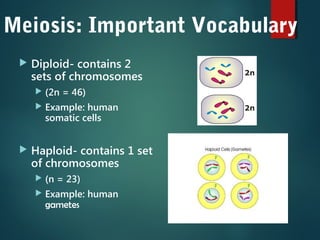
Diploid- contains 2
sets of chromosomes





(2n = 46)
Example: human
somatic cells

Haploid- contains 1 set
of chromosomes


(n = 23)



Example: human
gametes
Meiosis: Important
Vocabulary


Fertilization- fusion of two haploid gametes forms
a diploid zygote



Zygote- fertilized egg cell




The first cell of a new individual

What would happen if gametes were diploid?
Meiosis


Meiosis occurs in sexual reproduction when a diploid
germ cell produces four haploid daughter cells that
can mature to become gametes (sperm or egg).
Meiosis
Goal: reduce genetic material by half
Why?

n (mom) + n (dad) = 2n (offspring)

from mom

from dad

child
too
much!

meiosis reduces
genetic content
Just
right!
Meiosis: cell division in two parts
Sister
chromatids
separate

Chromatids
separate

Meiosis I
(reduction
division)

Meiosis II
(equational
division)

Diploid 2n

Diploid 2n
Haploid n

Result: one copy of each chromosome in a gamete.
Meiosis I : the reduction
division

Spindle
fibers

Nucleus

Prophase I
(early)
(diploid)

Prophase I
(late)
(diploid)

Metaphase I
(diploid)

Nuclear
envelope
Anaphase I
(diploid)

Telophase I
(diploid)
Prophase I

Late prophase
Early prophase
Chromatids pair.
Crossing over
occurs.

Chromosomes
condense.
Spindle forms.
Nuclear
envelope
Metaphase I

Chromatid pairs align
along the equator of the
cell.
Anaphase I
Chromosomes
separate and
move to opposite
poles.
Sister chromatids
remain
Attached at their
centromeres.
Telophase I
Nuclear envelopes
reassemble.
Spindle disappears.
Cytokinesis divides
cell into two.
Meiosis II
Gene X
Sister chromatids carry
identical genetic
information .
Meiosis II produces gametes with
one copy of each chromosome and thus
one copy of each gene.
Meiosis II : the equational
division

Prophase II
(diploid)

Metaphase II

Anaphase II

Telophase II

Four
Non-identical
haploid
daughter cells
Prophase II

Nuclear envelope
fragments.
Spindle forms.
Metaphase II

Chromosomes align
along equator of cell.
Anaphase II

Sister chromatids
separate
and move to opposite
poles.
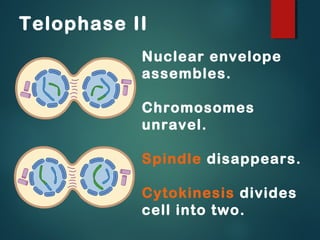
Telophase II
Nuclear envelope
assembles.
Chromosomes
unravel.
Spindle disappears.
Cytokinesis divides
cell into two.
Results of meiosis

Four haploid
cells
•

One copy of
each
chromosome
•
What Meiosis is About

Meiosis allows the creation of unique individuals
through sexual reproduction.
Mitosis

Meiosis

Number of divisions

1

2

Number of daughter
cells

2

4

Yes

No

Same as parent

Half of parent

Where

Somatic cells

Sex cells

When

Throughout life

At sexual maturity

Role

Growth and repair

Sexual reproduction

Genetically
identical?
Chromosome #
MITOSIS

MEIOSIS

Occurs in somatic (body)
cells

Occurs only in gonads (sex
organs: ovary/testes)

Produces cells for repair,
maintenance, growth, asexual
reproduction

Only produces gametes (sex
cells: egg/sperm)

Results in identical diploid
(2n) daughter cells

Reduction division results in
4 haploid (n) cells
KARYOTYPE
1. Photograph a cell in metaphase.
2. Cut out the chromosomes from the picture.
3. Paste homologous pairs together
according to size, banding pattern and
centromere.
Karyotype is
used to
determine
1. If there is an
abnormality
in number or
structure of
the
chromosome
s
(eg. Down’s
syndrome)
•Karyotypes

of embryos are
obtained from:
CVS (chorionic villus sampling) and
amniocentesis.
•Karyotypes

of adults can be
obtained from any growing cells.
•Karyotypes

can not tell if there are
mutations of a gene.
Products of MITOSIS: 2 x 2n
cells.
2n
2n
2n

2 diploid cells
Products of MEIOSIS: 4 x n
cells
2n

n(4

n

n

monoploid cells)

n
MEIOSIS

is two mitotic divisions in a

row,
(meiosis I and II) except you will see
the homologous chromosomes coming
together . -    -- in prophase I the double
homologous chromosomes come together to
form a tetrad

- Crossing-over (synapsis ) occurs in the
tetrad in prophase to increase the variability
in gametes.
- There is no dna replication in the interphase
Homologous
Chromosomes


Pair of chromosomes ( maternal and paternal) that
paternal
are similar in shape and size.



Homologous pairs (tetrads) carry genes
controlling the same inherited traits.



Each locus (position of a gene) is in the same
position on homologues.



Humans have 23 pairs of homologous
chromosomes.
a.
b.

22 pairs of autosomes
1 pair of sex chromosomes
Homologous
Chromosomes
eye color
locus

eye color
locus

hair color
locus

hair color
locus
Paternal

Maternal
Crossing Over (SYNAPSIS)
 Crossing over (variation) may

occur between
nonsister chromatids at the chiasmata.
chiasmata

 Crossing over:
over

segments of nonsister
chromatids break and reattach to the other
chromatid.
chromatid

 Chiasmata (chiasma) are

crossing over.
over

the sites of

Synapsis increases genetic variability –
and that’s a good thing…
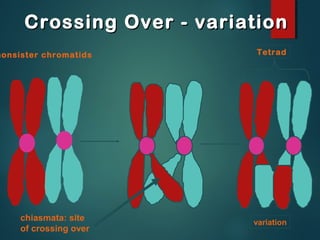
Crossing Over - variation

nonsister chromatids

Tetrad

chiasmata: site
of crossing over

variation
Sex Chromosomes

XX chromosome - female

XY chromosome - male
Cytokinesis:

cytoplasm divides. Total
product is 4 cells, each with only a mom or Dad’s
chromosome, in other words, half the normal
chromosome number, or 4 monoploid (n) cells,
or 4 gametes.

Uneven cytokinesis in females: In
oogenesis, get one big egg and 3 nonfunctional polar bodies:
( who die off) and 1 big functional gamete
Spermatogene
sis
There are equal
divisions
producing four
equal sized
sperm.
Non-disjunction
= Nonseparatio
n of
chromoso
mes
resulting
in diploid
or empty
gametes.
Conditions caused by
non-disjunction
Downs syndrome = Trisomy 21 - 3 copies of
chromosomes 21 equalling a total of 47
chromosomes. = 2n + 1(chance of occurring in
oogenesis increases with maternal age)
Turners syndrome = Monosomy X - has only one
X chromosomes totalling only 45 chromosomes in
her body cells. (monosomy X)
= 2n-1
Klinefelter’s syndrome = XXY - male which has
an extra X chromosome = 2n + 1
Down’s syndrome – trisomy 21
A simple check for the
presence of a bone in the nose
could more accurately test
unborn babies for Down's
syndrome, scientists say.
Researchers say combining
the nose test with existing
screening methods
(amniocentesis, CVS) could
lead to a five-fold reduction in
the number of miscarriages
linked to an invasive
procedure used to confirm
Down's syndrome.
Klinefelter’s syndrome XXY
Normal boy who
develops some
female secondary
sex character-istics
at puberty.
-slightly lower IQ,
infertile, delayed
motor, speech,
maturation
-treated with
testosterone.
REFERENCES
Farrellw (2012) MEIO. ACCESS ON 7 MARCH 2014
http://www.slideshare.net/farrellw/meio-11234603
Docsawyer (2010) MEIOSIS. ACCESS ON 07 MARCH
2014
http://www.slideshare.net/docsawyer/meiosis-notes3075315

Slideshare presantation

  • 1.
  • 2.
  • 3.
    Meiosis: Important Vocabulary  Diploid-contains 2 sets of chromosomes    (2n = 46) Example: human somatic cells Haploid- contains 1 set of chromosomes  (n = 23)  Example: human gametes
  • 4.
    Meiosis: Important Vocabulary  Fertilization- fusionof two haploid gametes forms a diploid zygote  Zygote- fertilized egg cell   The first cell of a new individual What would happen if gametes were diploid?
  • 5.
    Meiosis  Meiosis occurs insexual reproduction when a diploid germ cell produces four haploid daughter cells that can mature to become gametes (sperm or egg).
  • 6.
    Meiosis Goal: reduce geneticmaterial by half Why? n (mom) + n (dad) = 2n (offspring) from mom from dad child too much! meiosis reduces genetic content Just right!
  • 7.
    Meiosis: cell divisionin two parts Sister chromatids separate Chromatids separate Meiosis I (reduction division) Meiosis II (equational division) Diploid 2n Diploid 2n Haploid n Result: one copy of each chromosome in a gamete.
  • 8.
    Meiosis I :the reduction division Spindle fibers Nucleus Prophase I (early) (diploid) Prophase I (late) (diploid) Metaphase I (diploid) Nuclear envelope Anaphase I (diploid) Telophase I (diploid)
  • 9.
    Prophase I Late prophase Earlyprophase Chromatids pair. Crossing over occurs. Chromosomes condense. Spindle forms. Nuclear envelope
  • 10.
    Metaphase I Chromatid pairsalign along the equator of the cell.
  • 11.
    Anaphase I Chromosomes separate and moveto opposite poles. Sister chromatids remain Attached at their centromeres.
  • 12.
    Telophase I Nuclear envelopes reassemble. Spindledisappears. Cytokinesis divides cell into two.
  • 13.
    Meiosis II Gene X Sisterchromatids carry identical genetic information . Meiosis II produces gametes with one copy of each chromosome and thus one copy of each gene.
  • 14.
    Meiosis II :the equational division Prophase II (diploid) Metaphase II Anaphase II Telophase II Four Non-identical haploid daughter cells
  • 15.
  • 16.
  • 17.
  • 18.
    Telophase II Nuclear envelope assembles. Chromosomes unravel. Spindledisappears. Cytokinesis divides cell into two.
  • 19.
    Results of meiosis Fourhaploid cells • One copy of each chromosome •
  • 20.
    What Meiosis isAbout Meiosis allows the creation of unique individuals through sexual reproduction.
  • 21.
    Mitosis Meiosis Number of divisions 1 2 Numberof daughter cells 2 4 Yes No Same as parent Half of parent Where Somatic cells Sex cells When Throughout life At sexual maturity Role Growth and repair Sexual reproduction Genetically identical? Chromosome #
  • 22.
    MITOSIS MEIOSIS Occurs in somatic(body) cells Occurs only in gonads (sex organs: ovary/testes) Produces cells for repair, maintenance, growth, asexual reproduction Only produces gametes (sex cells: egg/sperm) Results in identical diploid (2n) daughter cells Reduction division results in 4 haploid (n) cells
  • 23.
    KARYOTYPE 1. Photograph acell in metaphase. 2. Cut out the chromosomes from the picture. 3. Paste homologous pairs together according to size, banding pattern and centromere.
  • 24.
    Karyotype is used to determine 1.If there is an abnormality in number or structure of the chromosome s (eg. Down’s syndrome)
  • 25.
    •Karyotypes of embryos are obtainedfrom: CVS (chorionic villus sampling) and amniocentesis. •Karyotypes of adults can be obtained from any growing cells. •Karyotypes can not tell if there are mutations of a gene.
  • 26.
    Products of MITOSIS:2 x 2n cells. 2n 2n 2n 2 diploid cells Products of MEIOSIS: 4 x n cells 2n n(4 n n monoploid cells) n
  • 27.
    MEIOSIS is two mitoticdivisions in a row, (meiosis I and II) except you will see the homologous chromosomes coming together . -    -- in prophase I the double homologous chromosomes come together to form a tetrad - Crossing-over (synapsis ) occurs in the tetrad in prophase to increase the variability in gametes. - There is no dna replication in the interphase
  • 29.
    Homologous Chromosomes  Pair of chromosomes( maternal and paternal) that paternal are similar in shape and size.  Homologous pairs (tetrads) carry genes controlling the same inherited traits.  Each locus (position of a gene) is in the same position on homologues.  Humans have 23 pairs of homologous chromosomes. a. b. 22 pairs of autosomes 1 pair of sex chromosomes
  • 30.
    Homologous Chromosomes eye color locus eye color locus haircolor locus hair color locus Paternal Maternal
  • 31.
    Crossing Over (SYNAPSIS) Crossing over (variation) may occur between nonsister chromatids at the chiasmata. chiasmata  Crossing over: over segments of nonsister chromatids break and reattach to the other chromatid. chromatid  Chiasmata (chiasma) are crossing over. over the sites of Synapsis increases genetic variability – and that’s a good thing…
  • 32.
    Crossing Over -variation nonsister chromatids Tetrad chiasmata: site of crossing over variation
  • 33.
    Sex Chromosomes XX chromosome- female XY chromosome - male
  • 34.
    Cytokinesis: cytoplasm divides. Total productis 4 cells, each with only a mom or Dad’s chromosome, in other words, half the normal chromosome number, or 4 monoploid (n) cells, or 4 gametes. Uneven cytokinesis in females: In oogenesis, get one big egg and 3 nonfunctional polar bodies: ( who die off) and 1 big functional gamete
  • 36.
  • 37.
  • 38.
    Conditions caused by non-disjunction Downssyndrome = Trisomy 21 - 3 copies of chromosomes 21 equalling a total of 47 chromosomes. = 2n + 1(chance of occurring in oogenesis increases with maternal age) Turners syndrome = Monosomy X - has only one X chromosomes totalling only 45 chromosomes in her body cells. (monosomy X) = 2n-1 Klinefelter’s syndrome = XXY - male which has an extra X chromosome = 2n + 1
  • 39.
    Down’s syndrome –trisomy 21 A simple check for the presence of a bone in the nose could more accurately test unborn babies for Down's syndrome, scientists say. Researchers say combining the nose test with existing screening methods (amniocentesis, CVS) could lead to a five-fold reduction in the number of miscarriages linked to an invasive procedure used to confirm Down's syndrome.
  • 40.
    Klinefelter’s syndrome XXY Normalboy who develops some female secondary sex character-istics at puberty. -slightly lower IQ, infertile, delayed motor, speech, maturation -treated with testosterone.
  • 41.
    REFERENCES Farrellw (2012) MEIO.ACCESS ON 7 MARCH 2014 http://www.slideshare.net/farrellw/meio-11234603 Docsawyer (2010) MEIOSIS. ACCESS ON 07 MARCH 2014 http://www.slideshare.net/docsawyer/meiosis-notes3075315