esil - universal il
ESIL - Intermediate Language for radare2 toolset
Anton Kochkov (@akochkov)
June 23, 2016
ZeroNights 11-2015
anton kochkov
• Moscow, Russia
• Love Reverse Engineering, foreign languages and travel
• Member of R2 crew, radare2 evangelist
• Security Code Ltd.
2
intermediate languages
what is intermediate language?
• Intermediate language is the language of an abstract machine
designed to aid in the analysis of computer programs. il-wikipedia
• Heavily used for academic research and real world tools
• Vital for decompilation process
• Base for various kind of applications - SMT, AEG, AEP, etc
4
reil1
• Invented by Zynamics company
• BinNavi, BinDiff were both based on top of REIL
• x86, ARM, PowerPC architectures supported
• VM - Infinite memory
• VM - Infinite range of registers
• Missing Floating Point
• Written in Java
1reil.
5
reil
• 17 instructions
• Register aliases (eax, ebx, r0, . . . )2
2reil-zynamics.
6
bap
• BAP - Binary Analysis Platform3
• IL itself called BIL
• Well-maintained framework, various tools included
• Integration with another tools like: TEMU, libVEX, IDA Pro, Qira,
. . .
• Targeted for x86, ARM
• Missing Floating Point
3bap-handbook.
7
bitblaze (vineil/vex)
• BitBlaze4
- also a platform, like BAP
• Uses two intermediate languages
• Vine IL - “low-level” language
• VEX IL (libVEX from valgrind) - “high-level” language
• Written in OCaml + C++
4bitblaze.
8
vine il56
• Implicitly require description of all side-effects
• Quite similar to ESIL
• Very useful for direct code emulation
• Too much unused information
5vine-manual.
6vine-vuln-analysis.
9
vex il
• Infinite memory
• Infinite range of registers
• Support types
• “Variable scope” support
• Used in Valgrind and a few other programs
• Well-tested and actively maintained
10
rreil, openreil, mail
• RREIL7
- modern and flexible alternative to REIL
• RREIL - supports types
• RREIL - unique conceipt of “domains”
• MAIL - IL, constructed specifically for Malware analysis
• MAIL - the only IL, which allows polymorph programs
• RREIL and MAIL - both lacks Floating Point support
7rreil.
11
rreil, openreil, mail
• OpenREIL8
- reinvention and attempt to spruce up REIL
• OpenREIL - self-contained and ready to use framework, like BAP
• OpenREIL has major differencies from the original REIL
• Based on libVEX and has embedded support of SMT-solving
8openreil.
12
esil - what’s different and what’s com-
mon
short description
• Evaluable Strings Intermediate Language9
• Based on RPN (Reverse Polish Notation)(for the sake of speed)
• Designed for evaluation and emulation, not human-reading
• Low-level, pretty much alike Vine IL
• Small set of the instructions
• Implicit specification of all side-effects for each instruction
9r2esil.
14
short description
• Designed with a wide range of different architectures in mind
• Infinite memory
• Infinite set of registers
• Register aliases (“native” names, like “eax” or “cpsr”)
• Ability to call external functions (+syscalls)
• Ability to implement “custom ops” easily
• Without Floating Point support (planned, though)
15
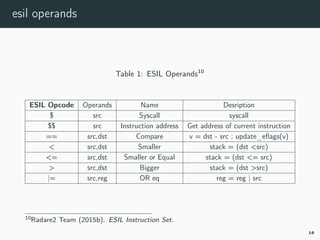
esil operands
Table 1: ESIL Operands10
ESIL Opcode Operands Name Desription
$ src Syscall syscall
$$ src Instruction address Get address of current instruction
== src,dst Compare v = dst - src ; update_eflags(v)
< src,dst Smaller stack = (dst <src)
<= src,dst Smaller or Equal stack = (dst <= src)
> src,dst Bigger stack = (dst >src)
|= src,reg OR eq reg = reg | src
10r2esil-instruction-set.
16
practical usage
radare
11
11r2advert.
18
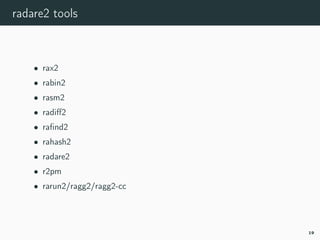
radare2 tools
• rax2
• rabin2
• rasm2
• radiff2
• rafind2
• rahash2
• radare2
• r2pm
• rarun2/ragg2/ragg2-cc
19
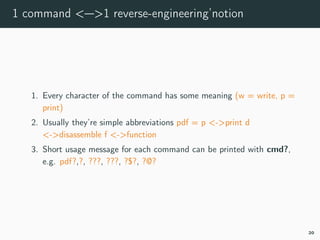
1 command <—>1 reverse-engineering’notion
1. Every character of the command has some meaning (w = write, p =
print)
2. Usually they’re simple abbreviations pdf = p <->print d
<->disassemble f <->function
3. Short usage message for each command can be printed with cmd?,
e.g. pdf?,?, ???, ???, ?$?, ?@?
20
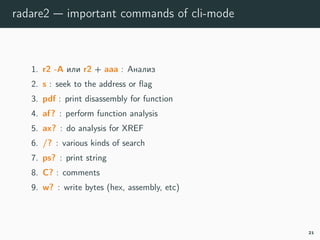
radare2 — important commands of cli-mode
1. r2 -A or r2 + aaaa : run analysis
2. s : seek to the address or flag
3. pdf : print disassembly for function
4. af? : perform function analysis
5. ax? : do analysis for XREF
6. /? : various kinds of search
7. ps? : print string
8. C? : comments
9. w? : write bytes (hex, assembly, etc)
21
radare2 — visual mode
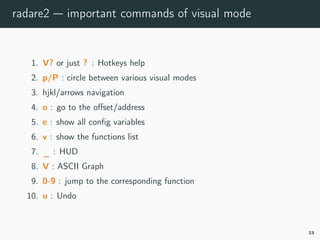
radare2 — important commands of visual mode
1. V? or just ? : Hotkeys help
2. p/P : circle between various visual modes
3. hjkl/arrows navigation
4. o : go to the offset/address
5. e : show all config variables
6. v : show the functions list
7. _ : HUD
8. V : ASCII Graph
9. 0-9 : jump to the corresponding function
10. u : Undo
23
emulation using esil
• ae* - evaluate and show r2 commands
• aei - VM initialization
• aeim - VM memory/stack setup
• aeip - to set IP (Instruction Pointer) for VM
• aes - step in ESIL emulation
• aec[u] - continue [until]
• aef - emulate whole function by name
24
emulation using esil
• DEMO
25
embedded controller - 8051 - esil vm12
• r2 -a 8051 ite_it8502.rom
• . ite_it8502.r2
• e io.cache=true to cache IO while emulating
• run aei
• run aeim
• run aeip to start from current IP
• aecu [addr] to emulate until IP = [addr]
12r2esiltv.
26
full fledged emulation in vm
• Allows to start ESIL VM with predefined properties
• Allows to run the code (e.g. unpack) in this VM
• Allows to set callbacks on some opcodes
• Allows to translate syscalls into real ones (optional)
• Good example - unpacking Baleful code13
13esil-baleful.
27
using esil emulation in analysis
• Using emulation of the code to find indirect jumps
• Using emulation to find some strings addresses
• Started by aae
• aae is a part of aaaa command
28
using background emulation to improve disassembly output
• Shows possible registers and memory values in comments
• Run ESIL VM with default properties in background
• Show “likely/unlikely” for conditional jumps
• e asm.emu=true
29
using background emulation to improve disassembly output
• DEMO
30
converting into another ils - openreil
• OpenREIL - actively maintained framework
• Ability to perform symbolic execution using SMT solver
• Radare2 has a special command to translate ESIL into OpenREIL
• aetr
31
converting into another ils - openreil
• DEMO
32
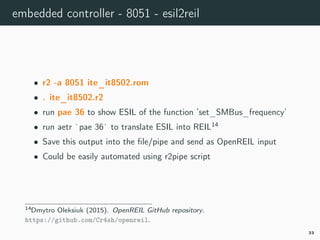
embedded controller - 8051 - esil2reil
• r2 -a 8051 ite_it8502.rom
• . ite_it8502.r2
• run pae 36 to show ESIL of the function ’set_SMBus_frequency’
• run aetr `pae 36` to translate ESIL into REIL14
• Save this output into the file/pipe and send as OpenREIL input
• Could be easily automated using r2pipe script
14openreil.
33
radeco il and radeco decompiler
esil -> radeco16
• Uses ESIL as input
• Request more metadata from radare2 (xrefs, functions, etc)
• Using r2pipe to talk to radare2
• Written in pure Rust
• Biggest part of it written during GSoC 2015
• Authors are: Sushant Dinesh and David Kreuter15
• GSoC 2015 was done under the Openwall’s project umbrella
15radeco-gsoc.
16radeco.
35
why radeco?
• Existent FOSS decompilers are old and not use modern research
• Interesting methods to decompile rarely implemented in FOSS tools
• Radare2 as a RE suite need a good decompiler
• Challenging still viable task for Google Summer of Code
36
radeco il description
• Based purely on graphs
• Based on some concepts from RREIL and MAIL
• Simplification to SSA form while lifting ESIL -> Radeco IL
• Automatically performed DCE (Dead Code Elimination)
• Types inference17
17tie.
37
radeco demo
• DEMO
38
future improvements
supported architectures
• Currently supported: x86, ARM, GameBoy, 8051, etc
• Goal is to add support for all architectures in radare2
• CPU/SoC/chip profiles for a slight differences between them
40
instruction sets
• Floating point (LLVM/McSema)18
• SIMD instructions (SSE, AVX, Neon, etc)
• VLIW and parallel execution (for DSP architectures emulation)
18floating-point-SO.
41
visual debugging and tracing
• General UI improvements
• Simple representation of diffs between emulation and native
execution
• Auto removing dead ways/blocks from ASCII graphs
• Integration with WebUI and Bokken19
19bokken.
42
radeco improvements
• pseudo-C code emission
• Wider support for various: native and custom types
• Recalculating results on the fly, depending from debugging results
• Types inference and function/classes autorecognition2021
20tie.
21il-optimization.
43
references
a lot of them I
45

ESIL - Universal IL (Intermediate Language) for Radare2

  • 1.
    esil - universalil ESIL - Intermediate Language for radare2 toolset Anton Kochkov (@akochkov) June 23, 2016 ZeroNights 11-2015
  • 2.
    anton kochkov • Moscow,Russia • Love Reverse Engineering, foreign languages and travel • Member of R2 crew, radare2 evangelist • Security Code Ltd. 2
  • 3.
  • 4.
    what is intermediatelanguage? • Intermediate language is the language of an abstract machine designed to aid in the analysis of computer programs. il-wikipedia • Heavily used for academic research and real world tools • Vital for decompilation process • Base for various kind of applications - SMT, AEG, AEP, etc 4
  • 5.
    reil1 • Invented byZynamics company • BinNavi, BinDiff were both based on top of REIL • x86, ARM, PowerPC architectures supported • VM - Infinite memory • VM - Infinite range of registers • Missing Floating Point • Written in Java 1reil. 5
  • 6.
    reil • 17 instructions •Register aliases (eax, ebx, r0, . . . )2 2reil-zynamics. 6
  • 7.
    bap • BAP -Binary Analysis Platform3 • IL itself called BIL • Well-maintained framework, various tools included • Integration with another tools like: TEMU, libVEX, IDA Pro, Qira, . . . • Targeted for x86, ARM • Missing Floating Point 3bap-handbook. 7
  • 8.
    bitblaze (vineil/vex) • BitBlaze4 -also a platform, like BAP • Uses two intermediate languages • Vine IL - “low-level” language • VEX IL (libVEX from valgrind) - “high-level” language • Written in OCaml + C++ 4bitblaze. 8
  • 9.
    vine il56 • Implicitlyrequire description of all side-effects • Quite similar to ESIL • Very useful for direct code emulation • Too much unused information 5vine-manual. 6vine-vuln-analysis. 9
  • 10.
    vex il • Infinitememory • Infinite range of registers • Support types • “Variable scope” support • Used in Valgrind and a few other programs • Well-tested and actively maintained 10
  • 11.
    rreil, openreil, mail •RREIL7 - modern and flexible alternative to REIL • RREIL - supports types • RREIL - unique conceipt of “domains” • MAIL - IL, constructed specifically for Malware analysis • MAIL - the only IL, which allows polymorph programs • RREIL and MAIL - both lacks Floating Point support 7rreil. 11
  • 12.
    rreil, openreil, mail •OpenREIL8 - reinvention and attempt to spruce up REIL • OpenREIL - self-contained and ready to use framework, like BAP • OpenREIL has major differencies from the original REIL • Based on libVEX and has embedded support of SMT-solving 8openreil. 12
  • 13.
    esil - what’sdifferent and what’s com- mon
  • 14.
    short description • EvaluableStrings Intermediate Language9 • Based on RPN (Reverse Polish Notation)(for the sake of speed) • Designed for evaluation and emulation, not human-reading • Low-level, pretty much alike Vine IL • Small set of the instructions • Implicit specification of all side-effects for each instruction 9r2esil. 14
  • 15.
    short description • Designedwith a wide range of different architectures in mind • Infinite memory • Infinite set of registers • Register aliases (“native” names, like “eax” or “cpsr”) • Ability to call external functions (+syscalls) • Ability to implement “custom ops” easily • Without Floating Point support (planned, though) 15
  • 16.
    esil operands Table 1:ESIL Operands10 ESIL Opcode Operands Name Desription $ src Syscall syscall $$ src Instruction address Get address of current instruction == src,dst Compare v = dst - src ; update_eflags(v) < src,dst Smaller stack = (dst <src) <= src,dst Smaller or Equal stack = (dst <= src) > src,dst Bigger stack = (dst >src) |= src,reg OR eq reg = reg | src 10r2esil-instruction-set. 16
  • 17.
  • 18.
  • 19.
    radare2 tools • rax2 •rabin2 • rasm2 • radiff2 • rafind2 • rahash2 • radare2 • r2pm • rarun2/ragg2/ragg2-cc 19
  • 20.
    1 command <—>1reverse-engineering’notion 1. Every character of the command has some meaning (w = write, p = print) 2. Usually they’re simple abbreviations pdf = p <->print d <->disassemble f <->function 3. Short usage message for each command can be printed with cmd?, e.g. pdf?,?, ???, ???, ?$?, ?@? 20
  • 21.
    radare2 — importantcommands of cli-mode 1. r2 -A or r2 + aaaa : run analysis 2. s : seek to the address or flag 3. pdf : print disassembly for function 4. af? : perform function analysis 5. ax? : do analysis for XREF 6. /? : various kinds of search 7. ps? : print string 8. C? : comments 9. w? : write bytes (hex, assembly, etc) 21
  • 22.
  • 23.
    radare2 — importantcommands of visual mode 1. V? or just ? : Hotkeys help 2. p/P : circle between various visual modes 3. hjkl/arrows navigation 4. o : go to the offset/address 5. e : show all config variables 6. v : show the functions list 7. _ : HUD 8. V : ASCII Graph 9. 0-9 : jump to the corresponding function 10. u : Undo 23
  • 24.
    emulation using esil •ae* - evaluate and show r2 commands • aei - VM initialization • aeim - VM memory/stack setup • aeip - to set IP (Instruction Pointer) for VM • aes - step in ESIL emulation • aec[u] - continue [until] • aef - emulate whole function by name 24
  • 25.
  • 26.
    embedded controller -8051 - esil vm12 • r2 -a 8051 ite_it8502.rom • . ite_it8502.r2 • e io.cache=true to cache IO while emulating • run aei • run aeim • run aeip to start from current IP • aecu [addr] to emulate until IP = [addr] 12r2esiltv. 26
  • 27.
    full fledged emulationin vm • Allows to start ESIL VM with predefined properties • Allows to run the code (e.g. unpack) in this VM • Allows to set callbacks on some opcodes • Allows to translate syscalls into real ones (optional) • Good example - unpacking Baleful code13 13esil-baleful. 27
  • 28.
    using esil emulationin analysis • Using emulation of the code to find indirect jumps • Using emulation to find some strings addresses • Started by aae • aae is a part of aaaa command 28
  • 29.
    using background emulationto improve disassembly output • Shows possible registers and memory values in comments • Run ESIL VM with default properties in background • Show “likely/unlikely” for conditional jumps • e asm.emu=true 29
  • 30.
    using background emulationto improve disassembly output • DEMO 30
  • 31.
    converting into anotherils - openreil • OpenREIL - actively maintained framework • Ability to perform symbolic execution using SMT solver • Radare2 has a special command to translate ESIL into OpenREIL • aetr 31
  • 32.
    converting into anotherils - openreil • DEMO 32
  • 33.
    embedded controller -8051 - esil2reil • r2 -a 8051 ite_it8502.rom • . ite_it8502.r2 • run pae 36 to show ESIL of the function ’set_SMBus_frequency’ • run aetr `pae 36` to translate ESIL into REIL14 • Save this output into the file/pipe and send as OpenREIL input • Could be easily automated using r2pipe script 14openreil. 33
  • 34.
    radeco il andradeco decompiler
  • 35.
    esil -> radeco16 •Uses ESIL as input • Request more metadata from radare2 (xrefs, functions, etc) • Using r2pipe to talk to radare2 • Written in pure Rust • Biggest part of it written during GSoC 2015 • Authors are: Sushant Dinesh and David Kreuter15 • GSoC 2015 was done under the Openwall’s project umbrella 15radeco-gsoc. 16radeco. 35
  • 36.
    why radeco? • ExistentFOSS decompilers are old and not use modern research • Interesting methods to decompile rarely implemented in FOSS tools • Radare2 as a RE suite need a good decompiler • Challenging still viable task for Google Summer of Code 36
  • 37.
    radeco il description •Based purely on graphs • Based on some concepts from RREIL and MAIL • Simplification to SSA form while lifting ESIL -> Radeco IL • Automatically performed DCE (Dead Code Elimination) • Types inference17 17tie. 37
  • 38.
  • 39.
  • 40.
    supported architectures • Currentlysupported: x86, ARM, GameBoy, 8051, etc • Goal is to add support for all architectures in radare2 • CPU/SoC/chip profiles for a slight differences between them 40
  • 41.
    instruction sets • Floatingpoint (LLVM/McSema)18 • SIMD instructions (SSE, AVX, Neon, etc) • VLIW and parallel execution (for DSP architectures emulation) 18floating-point-SO. 41
  • 42.
    visual debugging andtracing • General UI improvements • Simple representation of diffs between emulation and native execution • Auto removing dead ways/blocks from ASCII graphs • Integration with WebUI and Bokken19 19bokken. 42
  • 43.
    radeco improvements • pseudo-Ccode emission • Wider support for various: native and custom types • Recalculating results on the fly, depending from debugging results • Types inference and function/classes autorecognition2021 20tie. 21il-optimization. 43
  • 44.
  • 45.
    a lot ofthem I 45