Syntactic Salt and Sugar


James Gould
Alex Holmes
Verisign
205
Alex


       2
Jim


      3
Introduction


               4
Format

          Discuss 5 Syntactic Elements
> >


          Lead discussion of each Element
              Introduce newer Elements
      – – –


              Identify Good
              Identify Bad
          Participation is encouraged!
>


                                            5
AGENDA

> DSL
> Project Lambda
> AOP 2
> CDI
> Grab Bag


                   6
AGENDA

> DSL
> Project Lambda
        2
> AOP
> CDI
> Grab Bag


                   7
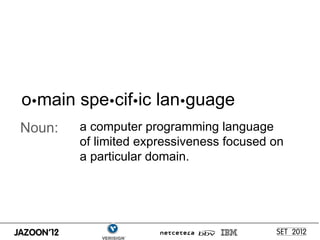
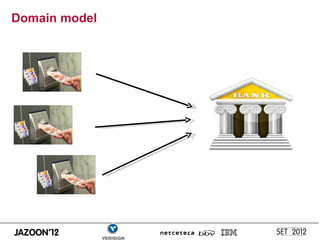
omain specific language
Noun:   a computer programming language
        of limited expressiveness focused on
        a particular domain.
Rich languages
Domain specific language
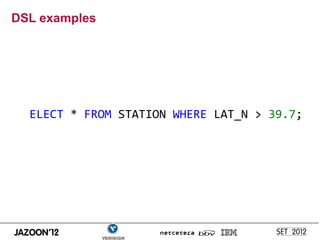
DSL examples


  ELECT * FROM STATION WHERE LAT_N > 39.7;
Domain model
Grammatical Elements of a DSL
                           operators +
  verbs        nouns       separators

  deposit       account     () {} [] . -> => =
  withdraw      amount          < > ! ~ ? : ==
                                ++ || -- *=
                                <<< % ^ ; ,
                                %= && >= -1
                                >>>= // #
Internal DSL


  An internal DSL is a DSL
  represented within the syntax of
  a general-purpose language.
  It's a stylized use of that
  language for a domain-specific     Excerpt from Martin
                                     Fowler’s book “Domain
  purpose.                           Specific Languages”,
                                     published by Addison-
                                     Wesley
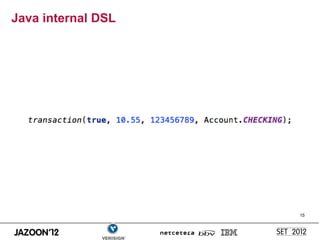
Java internal DSL


                    15
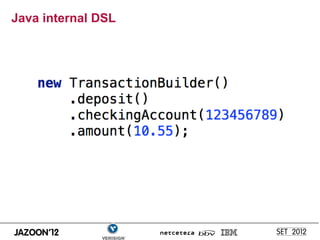
Java internal DSL
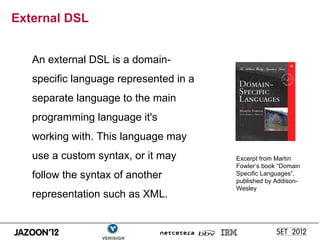
External DSL


   An external DSL is a domain-
   specific language represented in a
   separate language to the main
   programming language it's
   working with. This language may
   use a custom syntax, or it may       Excerpt from Martin
                                        Fowler’s book “Domain
   follow the syntax of another         Specific Languages”,
                                        published by Addison-
                                        Wesley
   representation such as XML.
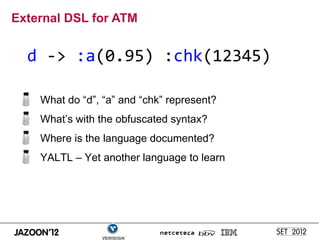
External DSL for ATM


  d -> :a(0.95) :chk(12345)

    What do “d”, “a” and “chk” represent?
    What’s with the obfuscated syntax?
    Where is the language documented?
    YALTL – Yet another language to learn
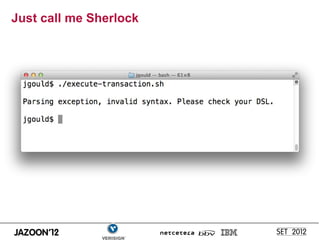
Just call me Sherlock
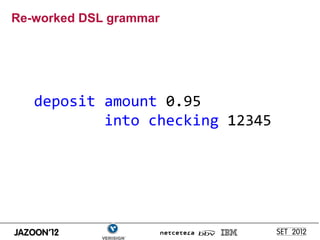
Re-worked DSL grammar


   deposit amount 0.95
           into checking 12345
DSL Sugar


 diomatic way to communicate with domain experts

 an be used by non-programmers

 elf-documenting


                                                   21
DSL Salt


 SL syntax can quickly become salty

 o you really need a DSL?

 upporting a DSL is labor-intensive


                                      22
AGENDA

> DSL
> Project Lambda
        2
> AOP
> CDI
> Grab Bag


                   23
Project Lambda : Introduction


> Included in Java 8
> Defined in JSR-335
  – Lambda Expressions
  – Default Methods


                                24
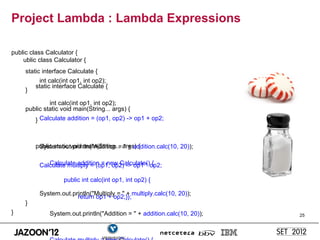
Project Lambda : Lambda Expressions

public class Calculator {
    ublic class Calculator {
     static interface Calculate {
          int calc(int op1, int op2);
         static interface Calculate {
     }

              int calc(int op1, int op2);
     public static void main(String... args) {
         } Calculate addition = (op1, op2) -> op1 + op2;


         public static void main(String... args) {
          System.out.println("Addition = " + addition.calc(10, 20));

             Calculate addition = new Calculate() {
          Calculate multiply = (op1, op2) -> op1 * op2;

                    public int calc(int op1, int op2) {

          System.out.println("Multiply = " + multiply.calc(10, 20));
                       return op1 + op2;}};
     }
}             System.out.println("Addition = " + addition.calc(10, 20));   25
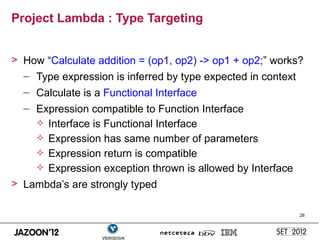
Project Lambda : Type Targeting


> How “Calculate addition = (op1, op2) -> op1 + op2;” works?
  – Type expression is inferred by type expected in context
  – Calculate is a Functional Interface
  – Expression compatible to Function Interface
     Interface is Functional Interface
     Expression has same number of parameters
     Expression return is compatible
     Expression exception thrown is allowed by Interface
> Lambda’s are strongly typed

                                                            26
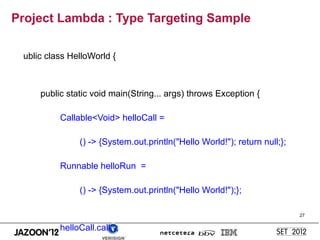
Project Lambda : Type Targeting Sample

 ublic class HelloWorld {


     public static void main(String... args) throws Exception {

          Callable<Void> helloCall =

               () -> {System.out.println("Hello World!"); return null;};

          Runnable helloRun =

               () -> {System.out.println("Hello World!");};

                                                                           27


          helloCall.call();
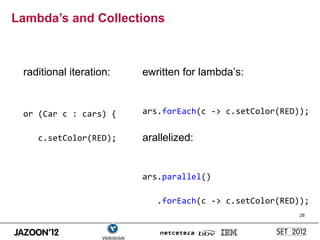
Lambda’s and Collections


 raditional iteration:   ewritten for lambda’s:


 or (Car c : cars) {     ars.forEach(c -> c.setColor(RED));


    c.setColor(RED);     arallelized:


                         ars.parallel()

                            .forEach(c -> c.setColor(RED));
                                                         28
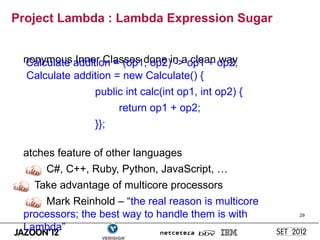
Project Lambda : Lambda Expression Sugar


 nonymous addition = (op1, op2)in aop1 + op2;
 Calculate Inner Classes done -> clean way
  Calculate addition = new Calculate() {
               public int calc(int op1, int op2) {
                     return op1 + op2;
               }};

 atches feature of other languages
     C#, C++, Ruby, Python, JavaScript, …
   Take advantage of multicore processors
     Mark Reinhold – “the real reason is multicore
 processors; the best way to handle them is with     29


 Lambda”
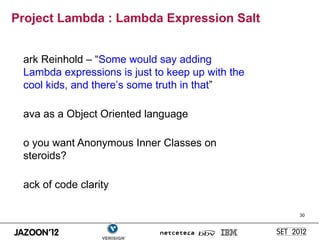
Project Lambda : Lambda Expression Salt


 ark Reinhold – “Some would say adding
 Lambda expressions is just to keep up with the
 cool kids, and there’s some truth in that”

 ava as a Object Oriented language

 o you want Anonymous Inner Classes on
 steroids?

 ack of code clarity

                                                  30
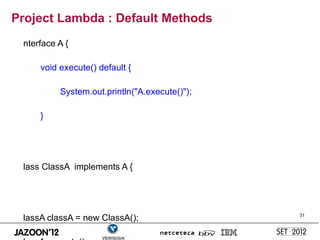
Project Lambda : Default Methods
 nterface A {

     void execute() default {

          System.out.println("A.execute()");

     }


 lass ClassA implements A {


 lassA classA = new ClassA();                  31
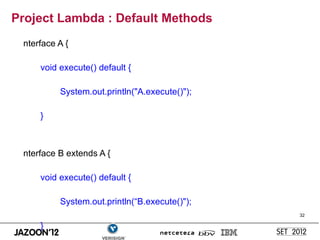
Project Lambda : Default Methods
 nterface A {

     void execute() default {

          System.out.println("A.execute()");

     }


 nterface B extends A {

     void execute() default {

          System.out.println(“B.execute()");
                                               32

     }
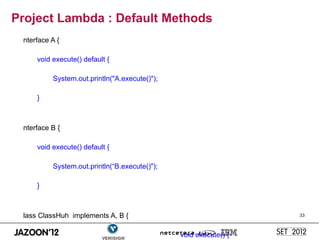
Project Lambda : Default Methods
 nterface A {

     void execute() default {

          System.out.println("A.execute()");

     }


 nterface B {

     void execute() default {

          System.out.println(“B.execute()");

     }


 lass ClassHuh implements A, B {                                  33


                                               void execute() {
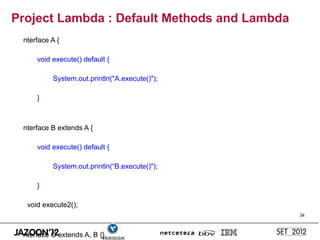
Project Lambda : Default Methods and Lambda
 nterface A {

     void execute() default {

          System.out.println("A.execute()");

     }


 nterface B extends A {

     void execute() default {

          System.out.println(“B.execute()");

     }

  void execute2();
                                               34


 nterface C extends A, B {}
Project Lambda : Default Methods Sugar


 inally able to add code to interfaces!


                                          35
Project Lambda : Default Methods Salt


 dding multiple inheritance to Java

 ixing Default Methods and Lambda Expressions
 adds more confusion


                                                36
AGENDA

> DSL
> Project Lambda
        2
> AOP
> CDI
> Grab Bag


                   37
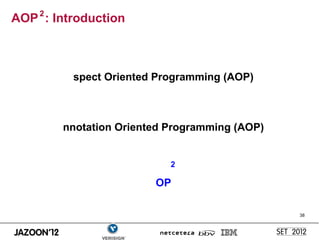
AOP 2 : Introduction


          spect Oriented Programming (AOP)


         nnotation Oriented Programming (AOP)


                            2

                         OP

                                                38
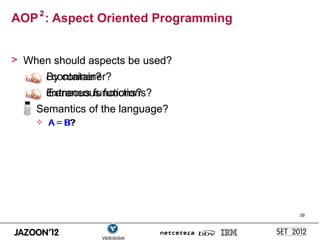
AOP 2 : Aspect Oriented Programming


> When should aspects be used?
  – By container?
      By container?
  – Extraneous functions?
      Extraneous functions?
  – Semantics of the language?
       A = B?
          = B?


                                      39
AOP 2 : Annotation Oriented Programming


> Annotations designed in similar goals as AOP
  – Special markers to classes, methods, and fields
  – Processed by libraries and tools
> Everything seems to be annotated now!


                                                      40
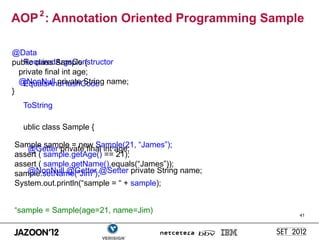
AOP 2 : Annotation Oriented Programming Sample

@Data
   RequiredArgsConstructor
public class Sample {
  private final int age;
  @NonNull private String name;
   EqualsAndHashCode
}
   ToString

   ublic class Sample {

Sample sample = new Sample(21, “James”);
   @Getter private final int age;
assert ( sample.getAge() == 21);
assert ( sample.getName().equals(“James”));
sample.setName(“Jim”);@Setter private String name;
   @NonNull @Getter
System.out.println(“sample = “ + sample);


“sample = Sample(age=21, name=Jim)                   41
AOP 2 : Annotations Sugar


   Communication with compiler
     @Override, @Deprecated, @SuppressWarnings
   Communication with frameworks
     Java Persistence API, Spring


                                                 42
AOP 2 : Annotations Salt


  Configuration
  Added Dependencies
  Used for code generation


                             43
2          2
AOP : AOP


> Annotations and aspects together is a natural fit
  – Annotations provide meta-data
   – Aspects to drive cross-cutting logic based on Annotations


                                                                 44
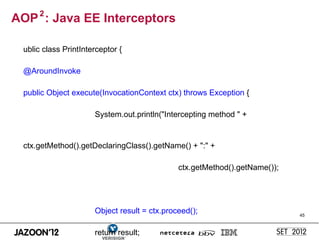
AOP 2 : Java EE Interceptors

  ublic class PrintInterceptor {

  @AroundInvoke

  public Object execute(InvocationContext ctx) throws Exception {

                       System.out.println("Intercepting method " +


  ctx.getMethod().getDeclaringClass().getName() + ":" +

                                               ctx.getMethod().getName());


                       Object result = ctx.proceed();                        45


                       return result;
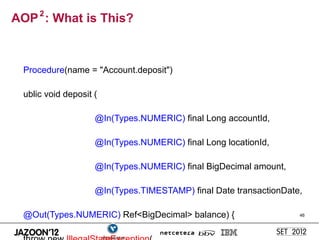
AOP 2 : What is This?


  Procedure(name = "Account.deposit")

  ublic void deposit (

                     @In(Types.NUMERIC) final Long accountId,

                     @In(Types.NUMERIC) final Long locationId,

                     @In(Types.NUMERIC) final BigDecimal amount,

                     @In(Types.TIMESTAMP) final Date transactionDate,

  @Out(Types.NUMERIC) Ref<BigDecimal> balance) {                    46
AGENDA

> DSL
> Project Lambda
        2
> AOP
> CDI
> Grab Bag


                   47
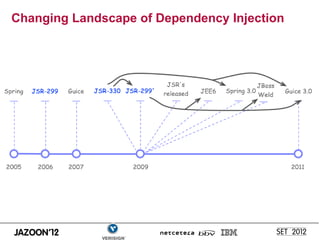
Changing Landscape of Dependency Injection
Huh?
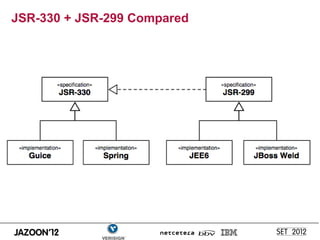
JSR-330 + JSR-299 Compared
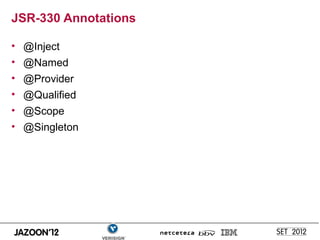
JSR-330 Annotations

• @Inject
• @Named
• @Provider
• @Qualified
• @Scope
• @Singleton
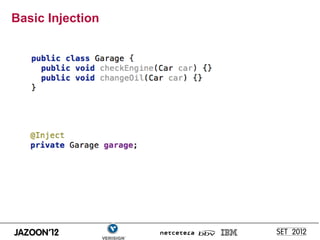
Basic Injection
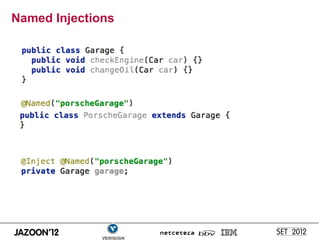
Named Injections
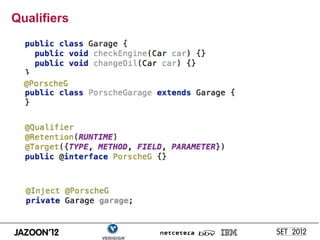
Qualifiers
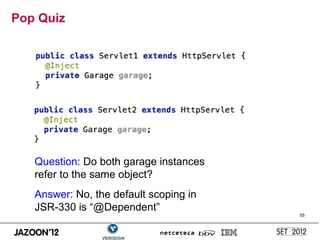
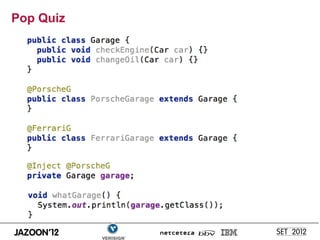
Pop Quiz


   Question: Do both garage instances
   refer to the same object?
   Answer: No, the default scoping in
   JSR-330 is “@Dependent”
                                        55
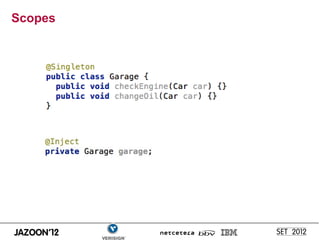
Scopes
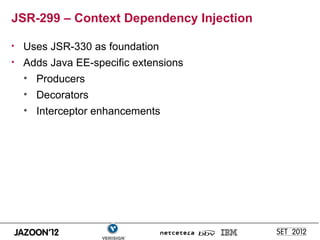
JSR-299 – Context Dependency Injection

•   Uses JSR-330 as foundation
•   Adds Java EE-specific extensions
    • Producers
    • Decorators
    • Interceptor enhancements
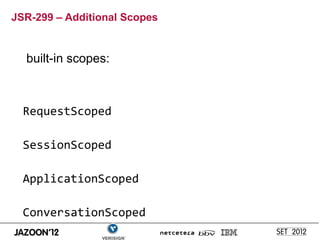
JSR-299 – Additional Scopes


  built-in scopes:


  RequestScoped

  SessionScoped

  ApplicationScoped

  ConversationScoped
Pop Quiz
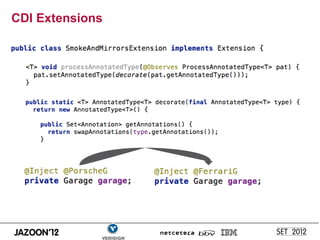
CDI Extensions
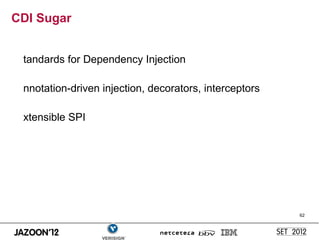
CDI Sugar


 tandards for Dependency Injection

 nnotation-driven injection, decorators, interceptors

 xtensible SPI


                                                        62
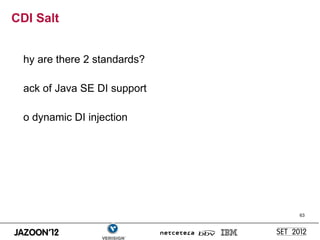
CDI Salt


  hy are there 2 standards?

  ack of Java SE DI support

  o dynamic DI injection


                              63
AGENDA

> DSL
> Project Lambda
        2
> AOP
> CDI
> Grab Bag


                   64
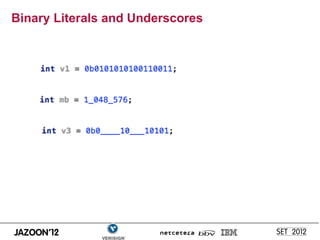
Binary Literals and Underscores
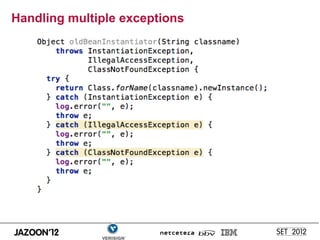
Handling multiple exceptions
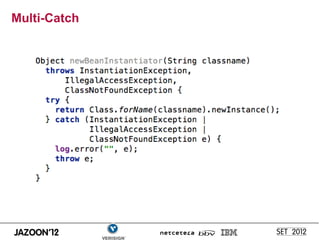
Multi-Catch
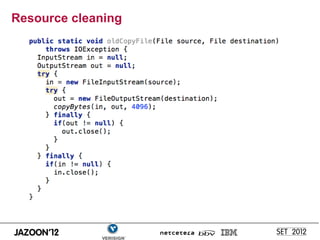
Resource cleaning
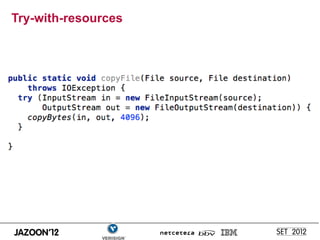
Try-with-resources
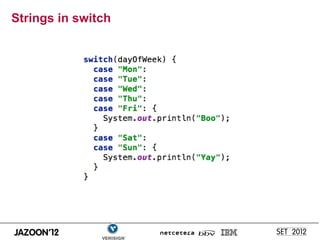
Strings in switch
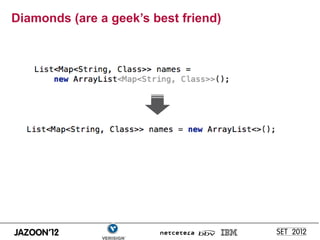
Diamonds (are a geek’s best friend)
Java 7 Language Enhancements: Sugar or Salt?


                                               72
James Gould   verisigninc.com
Verisign      jgould@verisign.com


Alex Holmes   verisign.com
Verisign      alholmes@verisign.com

Syntactic Salt and Sugar Presentation

  • 1.
    Syntactic Salt andSugar James Gould Alex Holmes Verisign 205
  • 2.
  • 3.
  • 4.
  • 5.
    Format Discuss 5 Syntactic Elements > > Lead discussion of each Element Introduce newer Elements – – – Identify Good Identify Bad Participation is encouraged! > 5
  • 6.
    AGENDA > DSL > ProjectLambda > AOP 2 > CDI > Grab Bag 6
  • 7.
    AGENDA > DSL > ProjectLambda 2 > AOP > CDI > Grab Bag 7
  • 8.
    omain specific language Noun: a computer programming language of limited expressiveness focused on a particular domain.
  • 9.
  • 10.
  • 11.
    DSL examples ELECT * FROM STATION WHERE LAT_N > 39.7;
  • 12.
  • 13.
    Grammatical Elements ofa DSL operators + verbs nouns separators deposit account () {} [] . -> => = withdraw amount < > ! ~ ? : == ++ || -- *= <<< % ^ ; , %= && >= -1 >>>= // #
  • 14.
    Internal DSL An internal DSL is a DSL represented within the syntax of a general-purpose language. It's a stylized use of that language for a domain-specific Excerpt from Martin Fowler’s book “Domain purpose. Specific Languages”, published by Addison- Wesley
  • 15.
  • 16.
  • 17.
    External DSL An external DSL is a domain- specific language represented in a separate language to the main programming language it's working with. This language may use a custom syntax, or it may Excerpt from Martin Fowler’s book “Domain follow the syntax of another Specific Languages”, published by Addison- Wesley representation such as XML.
  • 18.
    External DSL forATM d -> :a(0.95) :chk(12345) What do “d”, “a” and “chk” represent? What’s with the obfuscated syntax? Where is the language documented? YALTL – Yet another language to learn
  • 19.
    Just call meSherlock
  • 20.
    Re-worked DSL grammar deposit amount 0.95 into checking 12345
  • 21.
    DSL Sugar diomaticway to communicate with domain experts an be used by non-programmers elf-documenting 21
  • 22.
    DSL Salt SLsyntax can quickly become salty o you really need a DSL? upporting a DSL is labor-intensive 22
  • 23.
    AGENDA > DSL > ProjectLambda 2 > AOP > CDI > Grab Bag 23
  • 24.
    Project Lambda :Introduction > Included in Java 8 > Defined in JSR-335 – Lambda Expressions – Default Methods 24
  • 25.
    Project Lambda :Lambda Expressions public class Calculator { ublic class Calculator { static interface Calculate { int calc(int op1, int op2); static interface Calculate { } int calc(int op1, int op2); public static void main(String... args) { } Calculate addition = (op1, op2) -> op1 + op2; public static void main(String... args) { System.out.println("Addition = " + addition.calc(10, 20)); Calculate addition = new Calculate() { Calculate multiply = (op1, op2) -> op1 * op2; public int calc(int op1, int op2) { System.out.println("Multiply = " + multiply.calc(10, 20)); return op1 + op2;}}; } } System.out.println("Addition = " + addition.calc(10, 20)); 25
  • 26.
    Project Lambda :Type Targeting > How “Calculate addition = (op1, op2) -> op1 + op2;” works? – Type expression is inferred by type expected in context – Calculate is a Functional Interface – Expression compatible to Function Interface  Interface is Functional Interface  Expression has same number of parameters  Expression return is compatible  Expression exception thrown is allowed by Interface > Lambda’s are strongly typed 26
  • 27.
    Project Lambda :Type Targeting Sample ublic class HelloWorld { public static void main(String... args) throws Exception { Callable<Void> helloCall = () -> {System.out.println("Hello World!"); return null;}; Runnable helloRun = () -> {System.out.println("Hello World!");}; 27 helloCall.call();
  • 28.
    Lambda’s and Collections raditional iteration: ewritten for lambda’s: or (Car c : cars) { ars.forEach(c -> c.setColor(RED)); c.setColor(RED); arallelized: ars.parallel() .forEach(c -> c.setColor(RED)); 28
  • 29.
    Project Lambda :Lambda Expression Sugar nonymous addition = (op1, op2)in aop1 + op2; Calculate Inner Classes done -> clean way Calculate addition = new Calculate() { public int calc(int op1, int op2) { return op1 + op2; }}; atches feature of other languages C#, C++, Ruby, Python, JavaScript, … Take advantage of multicore processors Mark Reinhold – “the real reason is multicore processors; the best way to handle them is with 29 Lambda”
  • 30.
    Project Lambda :Lambda Expression Salt ark Reinhold – “Some would say adding Lambda expressions is just to keep up with the cool kids, and there’s some truth in that” ava as a Object Oriented language o you want Anonymous Inner Classes on steroids? ack of code clarity 30
  • 31.
    Project Lambda :Default Methods nterface A { void execute() default { System.out.println("A.execute()"); } lass ClassA implements A { lassA classA = new ClassA(); 31
  • 32.
    Project Lambda :Default Methods nterface A { void execute() default { System.out.println("A.execute()"); } nterface B extends A { void execute() default { System.out.println(“B.execute()"); 32 }
  • 33.
    Project Lambda :Default Methods nterface A { void execute() default { System.out.println("A.execute()"); } nterface B { void execute() default { System.out.println(“B.execute()"); } lass ClassHuh implements A, B { 33 void execute() {
  • 34.
    Project Lambda :Default Methods and Lambda nterface A { void execute() default { System.out.println("A.execute()"); } nterface B extends A { void execute() default { System.out.println(“B.execute()"); } void execute2(); 34 nterface C extends A, B {}
  • 35.
    Project Lambda :Default Methods Sugar inally able to add code to interfaces! 35
  • 36.
    Project Lambda :Default Methods Salt dding multiple inheritance to Java ixing Default Methods and Lambda Expressions adds more confusion 36
  • 37.
    AGENDA > DSL > ProjectLambda 2 > AOP > CDI > Grab Bag 37
  • 38.
    AOP 2 :Introduction spect Oriented Programming (AOP) nnotation Oriented Programming (AOP) 2 OP 38
  • 39.
    AOP 2 :Aspect Oriented Programming > When should aspects be used? – By container? By container? – Extraneous functions? Extraneous functions? – Semantics of the language?  A = B? = B? 39
  • 40.
    AOP 2 :Annotation Oriented Programming > Annotations designed in similar goals as AOP – Special markers to classes, methods, and fields – Processed by libraries and tools > Everything seems to be annotated now! 40
  • 41.
    AOP 2 :Annotation Oriented Programming Sample @Data RequiredArgsConstructor public class Sample { private final int age; @NonNull private String name; EqualsAndHashCode } ToString ublic class Sample { Sample sample = new Sample(21, “James”); @Getter private final int age; assert ( sample.getAge() == 21); assert ( sample.getName().equals(“James”)); sample.setName(“Jim”);@Setter private String name; @NonNull @Getter System.out.println(“sample = “ + sample); “sample = Sample(age=21, name=Jim) 41
  • 42.
    AOP 2 :Annotations Sugar Communication with compiler @Override, @Deprecated, @SuppressWarnings Communication with frameworks Java Persistence API, Spring 42
  • 43.
    AOP 2 :Annotations Salt Configuration Added Dependencies Used for code generation 43
  • 44.
    2 2 AOP : AOP > Annotations and aspects together is a natural fit – Annotations provide meta-data – Aspects to drive cross-cutting logic based on Annotations 44
  • 45.
    AOP 2 :Java EE Interceptors ublic class PrintInterceptor { @AroundInvoke public Object execute(InvocationContext ctx) throws Exception { System.out.println("Intercepting method " + ctx.getMethod().getDeclaringClass().getName() + ":" + ctx.getMethod().getName()); Object result = ctx.proceed(); 45 return result;
  • 46.
    AOP 2 :What is This? Procedure(name = "Account.deposit") ublic void deposit ( @In(Types.NUMERIC) final Long accountId, @In(Types.NUMERIC) final Long locationId, @In(Types.NUMERIC) final BigDecimal amount, @In(Types.TIMESTAMP) final Date transactionDate, @Out(Types.NUMERIC) Ref<BigDecimal> balance) { 46
  • 47.
    AGENDA > DSL > ProjectLambda 2 > AOP > CDI > Grab Bag 47
  • 48.
    Changing Landscape ofDependency Injection
  • 49.
  • 50.
  • 51.
    JSR-330 Annotations • @Inject •@Named • @Provider • @Qualified • @Scope • @Singleton
  • 52.
  • 53.
  • 54.
  • 55.
    Pop Quiz Question: Do both garage instances refer to the same object? Answer: No, the default scoping in JSR-330 is “@Dependent” 55
  • 56.
  • 57.
    JSR-299 – ContextDependency Injection • Uses JSR-330 as foundation • Adds Java EE-specific extensions • Producers • Decorators • Interceptor enhancements
  • 58.
    JSR-299 – AdditionalScopes built-in scopes: RequestScoped SessionScoped ApplicationScoped ConversationScoped
  • 59.
  • 61.
  • 62.
    CDI Sugar tandardsfor Dependency Injection nnotation-driven injection, decorators, interceptors xtensible SPI 62
  • 63.
    CDI Salt hy are there 2 standards? ack of Java SE DI support o dynamic DI injection 63
  • 64.
    AGENDA > DSL > ProjectLambda 2 > AOP > CDI > Grab Bag 64
  • 65.
  • 66.
  • 67.
  • 68.
  • 69.
  • 70.
  • 71.
    Diamonds (are ageek’s best friend)
  • 72.
    Java 7 LanguageEnhancements: Sugar or Salt? 72
  • 73.
    James Gould verisigninc.com Verisign jgould@verisign.com Alex Holmes verisign.com Verisign alholmes@verisign.com