Introduction
Algorithms
Discussion and Open Problems
Introduction to Algorithmic Aspect of Market
Equilibria
Abner Chih Yi Huang
March 26, 2009
CSBB Lab, CS, NTHU
1 / 67
Introduction
Algorithms
Discussion and Open Problems
Materials
Vijay V. Vazirani, chapter 5, Algorithmic Game Theory,
Cambridge University Press, 2008.[5]
Devanur, et al., Market Equilibrium via a Primal-Dual-Type
Algorithm, FOCS’02, 389-395.[1]
Devanur, et al., Market equilibrium via a primal–dual
algorithm for a convex program, J. ACM, 2008, v. 55,
pp.1-18[2]
2 / 67
Introduction
Algorithms
Discussion and Open Problems
Terminology
Market?
Fisher’s model, 1891
Arrow-Debreu model, 1954
Efficiency?
Equilibria? Existence?
3 / 67
Introduction
Algorithms
Discussion and Open Problems
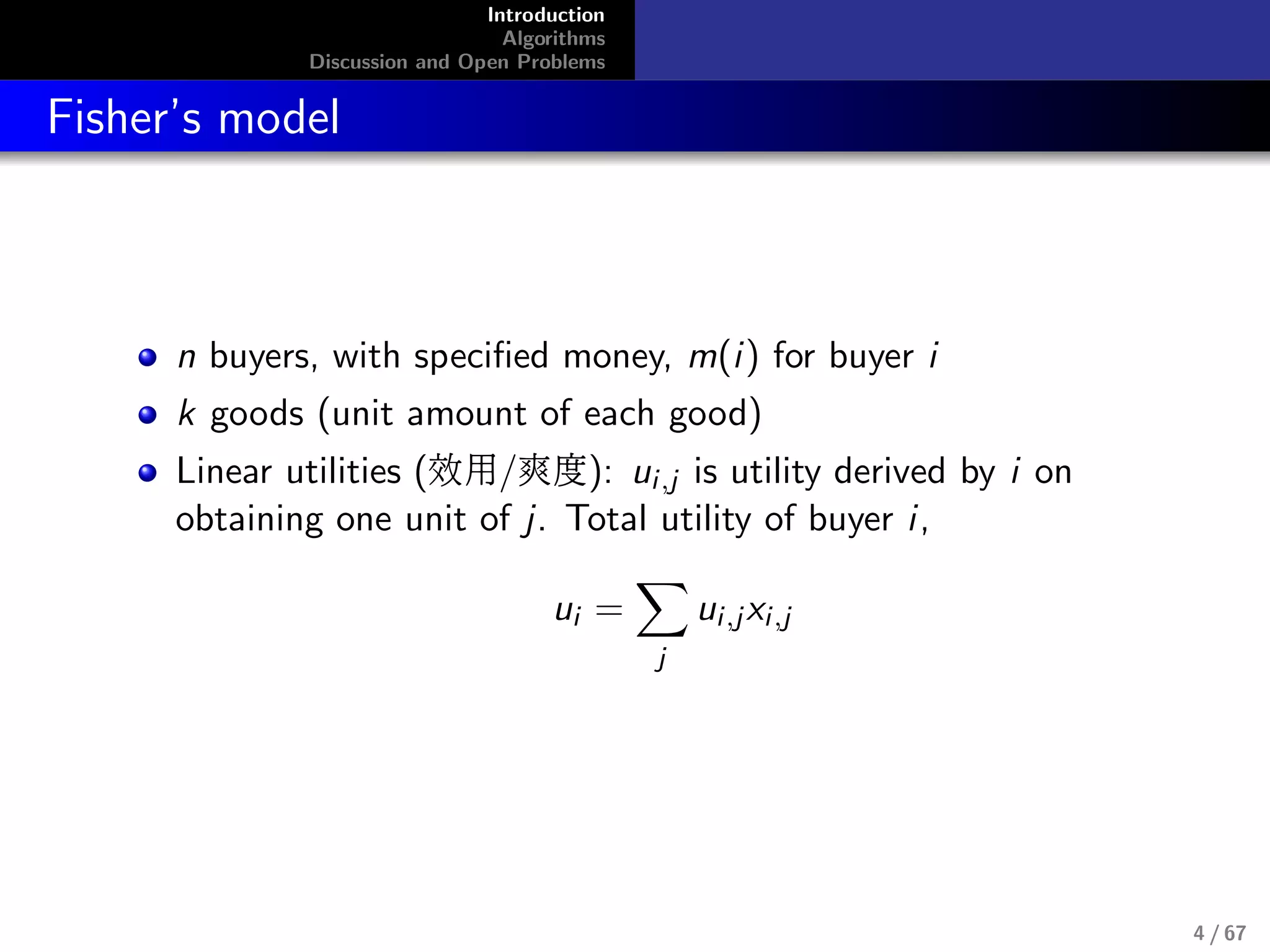
Fisher’s model
n buyers, with specified money, m(i) for buyer i
k goods (unit amount of each good)
Linear utilities (效用/爽度): ui,j is utility derived by i on
obtaining one unit of j. Total utility of buyer i,
ui =
j
ui,jxi,j
4 / 67
Introduction
Algorithms
Discussion and Open Problems
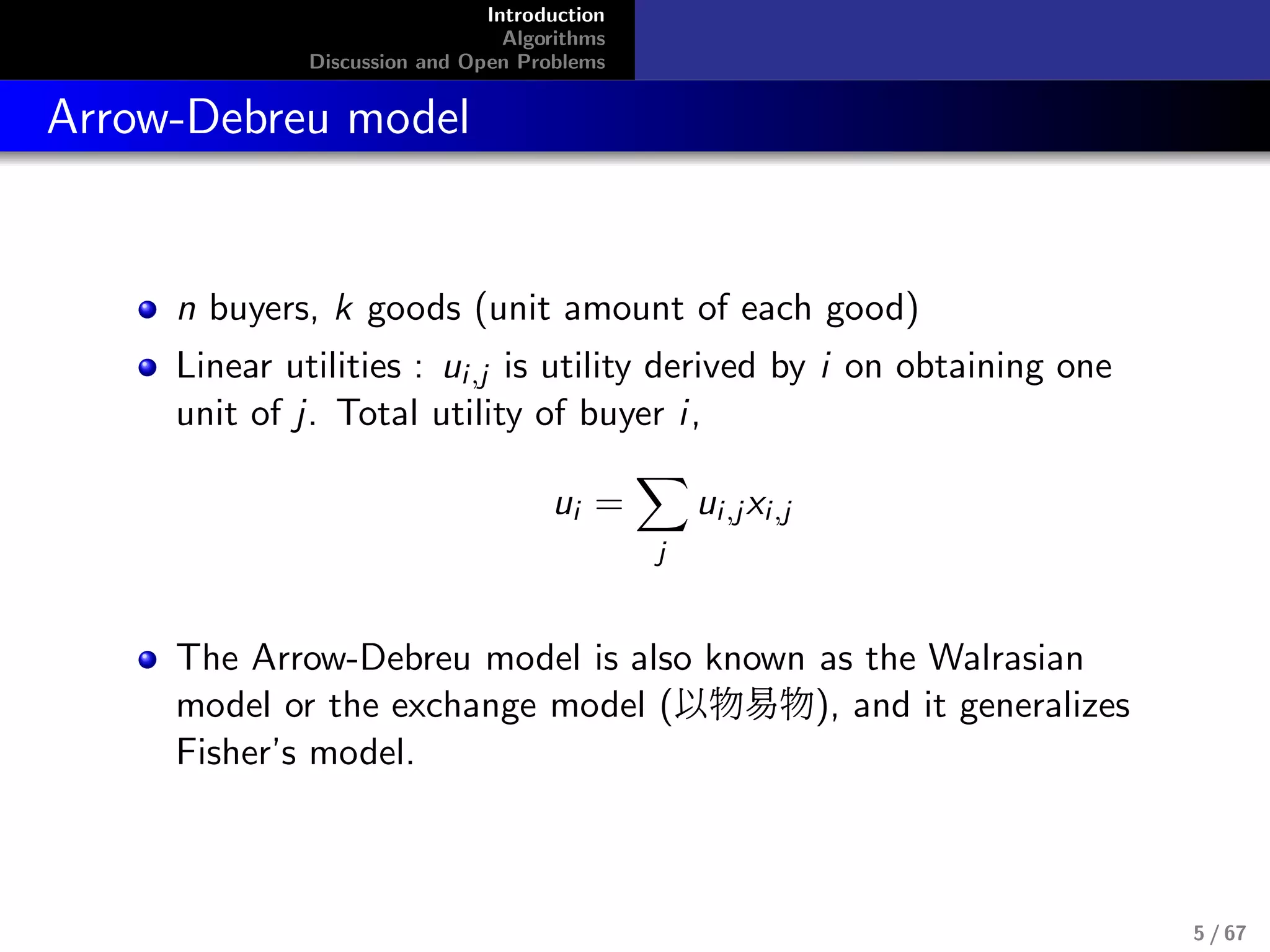
Arrow-Debreu model
n buyers, k goods (unit amount of each good)
Linear utilities : ui,j is utility derived by i on obtaining one
unit of j. Total utility of buyer i,
ui =
j
ui,jxi,j
The Arrow-Debreu model is also known as the Walrasian
model or the exchange model (以物易物), and it generalizes
Fisher’s model.
5 / 67
Introduction
Algorithms
Discussion and Open Problems
Pareto improvement, 1886
Definition
Given a set of alternative allocations of, say, goods or income for a
set of individuals, a movement from one allocation to another that
can make at least one individual better off without making any
other individual worse off is called a Pareto improvement.
Definition
An allocation is Pareto efficient or Pareto optimal when no further
Pareto improvements can be made. This is often called a strong
Pareto optimum (SPO).
6 / 67
Introduction
Algorithms
Discussion and Open Problems
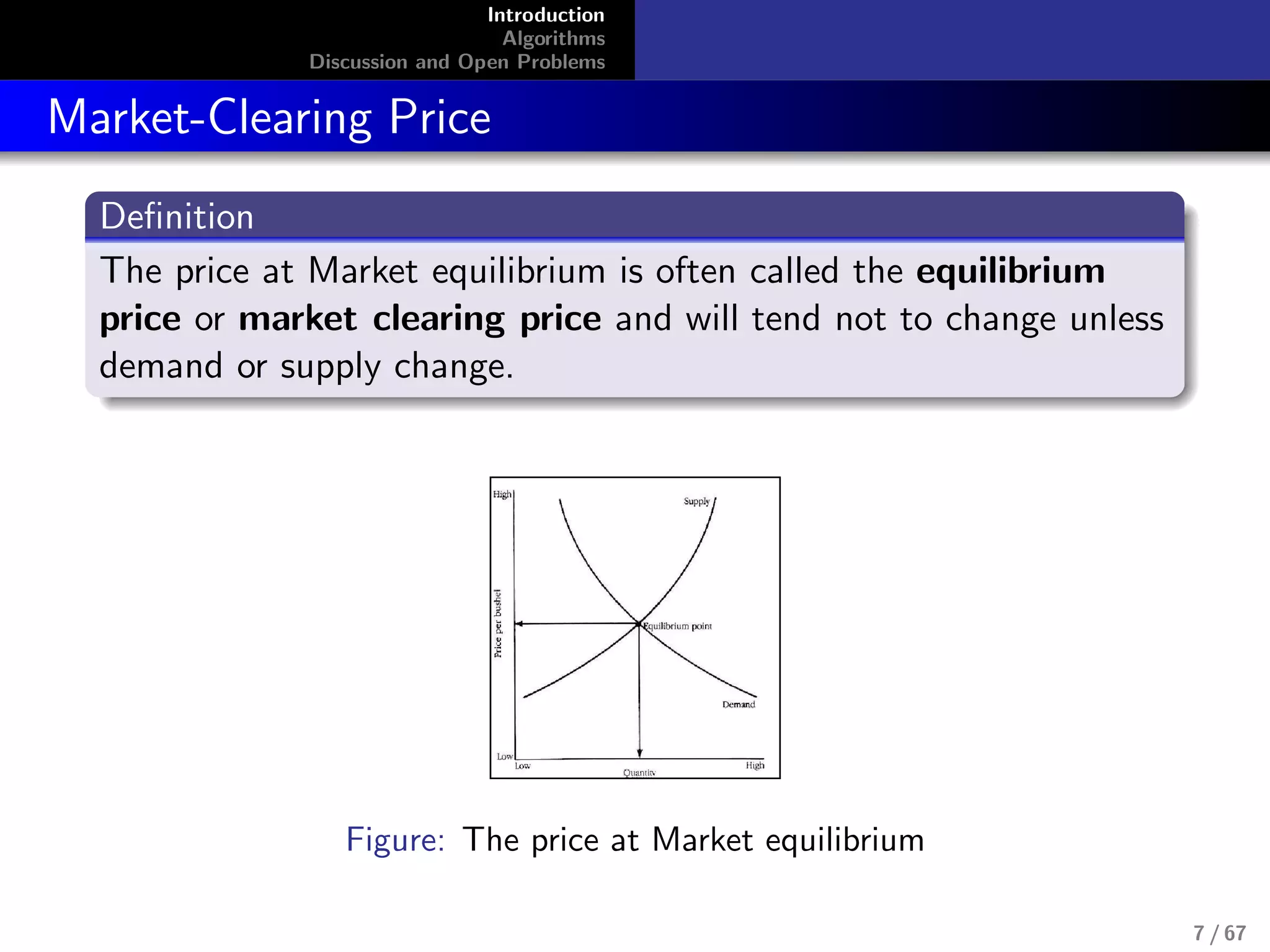
Market-Clearing Price
Definition
The price at Market equilibrium is often called the equilibrium
price or market clearing price and will tend not to change unless
demand or supply change.
Figure: The price at Market equilibrium
7 / 67
Introduction
Algorithms
Discussion and Open Problems
Market Models Have Equilibria
Definition
A competitive equilibrium is a market, for Fisher’s model or
Arrow-Debreu model, with the following assumptions.
complete markets
No Uncertainty, i.e., we can calculate the future
deterministically.
perfect competition
All information are available, i.e., preferences and budgets, are
public.
Zero transaction cost
local nonsatiation of preferences
preference function are continuous and strictly increasing in all
goods, i.e., more is better.
8 / 67
Introduction
Algorithms
Discussion and Open Problems
First Fundamental Theorem of Welfare Economics
Theorem (Arrow-Debreu, 1954)
Any competitive equilibrium or Walrasian equilibrium leads to an
Pareto efficient allocation of resources.
In other words,
Theorem (Adam Smith’s invisible hand)
That competitive markets tend toward the efficient allocation of
resources.
9 / 67
Introduction
Algorithms
Discussion and Open Problems
Combinatorial Algorithm for Fisher’s Model
Problem
Given a market of Fisher’s model, what is the market equilibria? In
the other words, what is the price such that the total utility of all
people in this market is maximum?
INPUT: Linear utility functions of buyers, integral money of
buyers, divisible goods.
OUTPUT: The prices of goods.
Measurement: Total utilities.
10 / 67
Introduction
Algorithms
Discussion and Open Problems
Combinatorial Algorithm for Fisher’s Model
No LP’s known for capturing equilibrium
allocations for Fisher’s model, although this
model doesn’t require integer constraints.
max
i
ui , s.t.,
j
pj xi,j ≤ mi , ui =
j
ui,jxi,j
Devanur, Papadimitriou, Saberi, and Vazirani,
2002[1]
Use primal-dual schema. It is highly successful algorithm
design technique from exact and approximation algorithms
11 / 67
Introduction
Algorithms
Discussion and Open Problems
Combinatorial Algorithm for Fisher’s Model
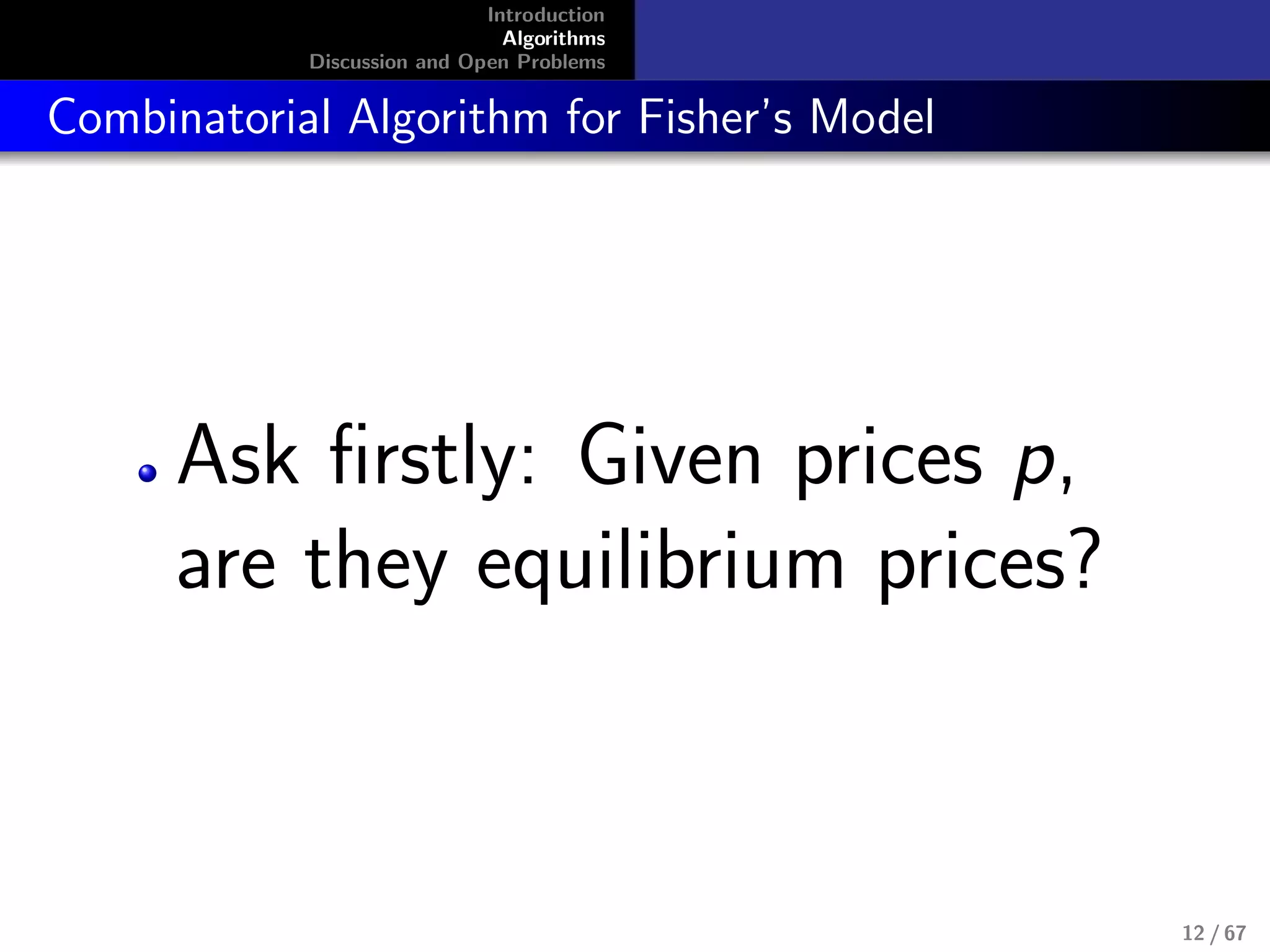
Ask firstly: Given prices p,
are they equilibrium prices?
12 / 67
Introduction
Algorithms
Discussion and Open Problems
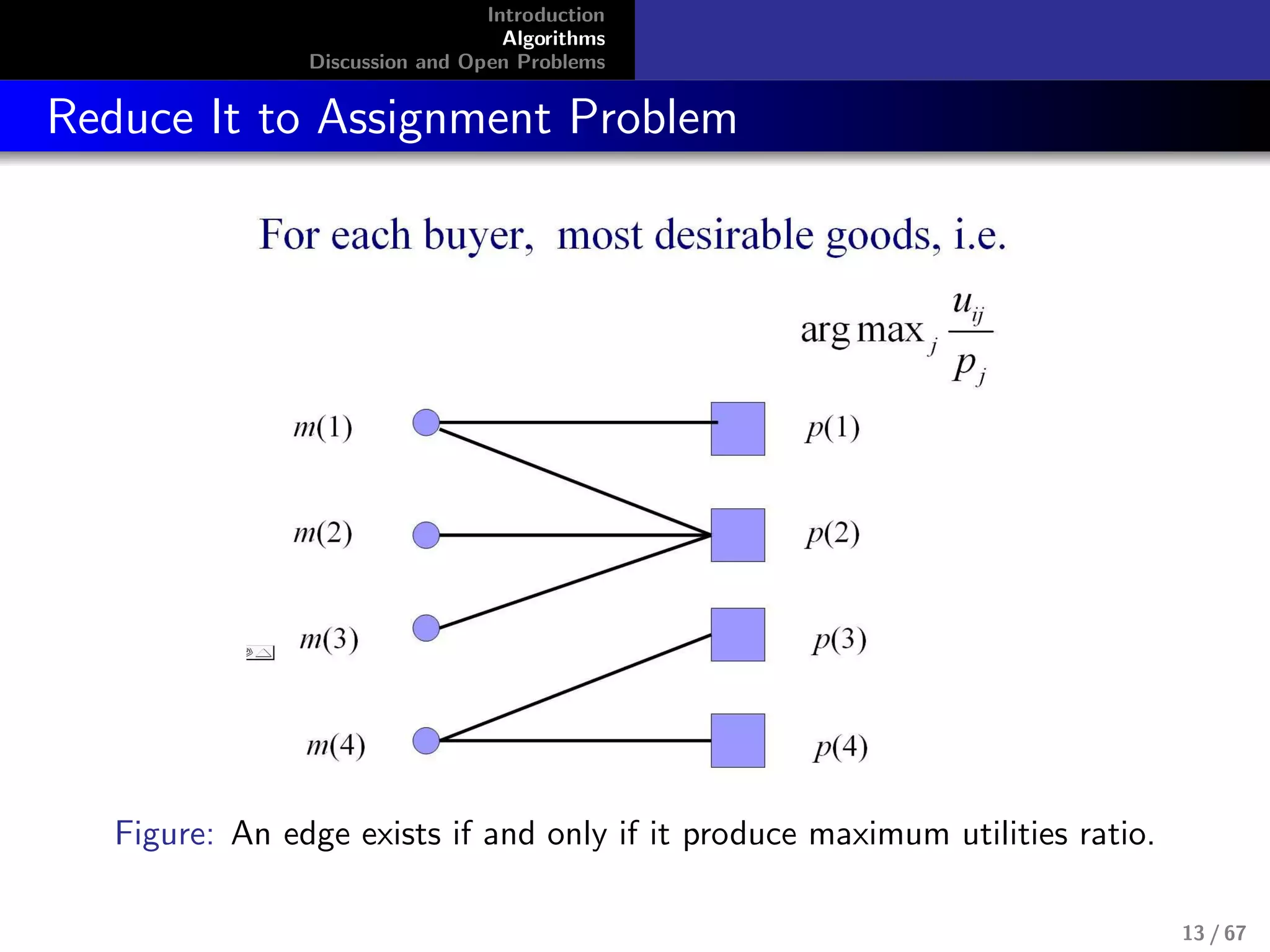
Reduce It to Assignment Problem
Figure: An edge exists if and only if it produce maximum utilities ratio.
13 / 67
Introduction
Algorithms
Discussion and Open Problems
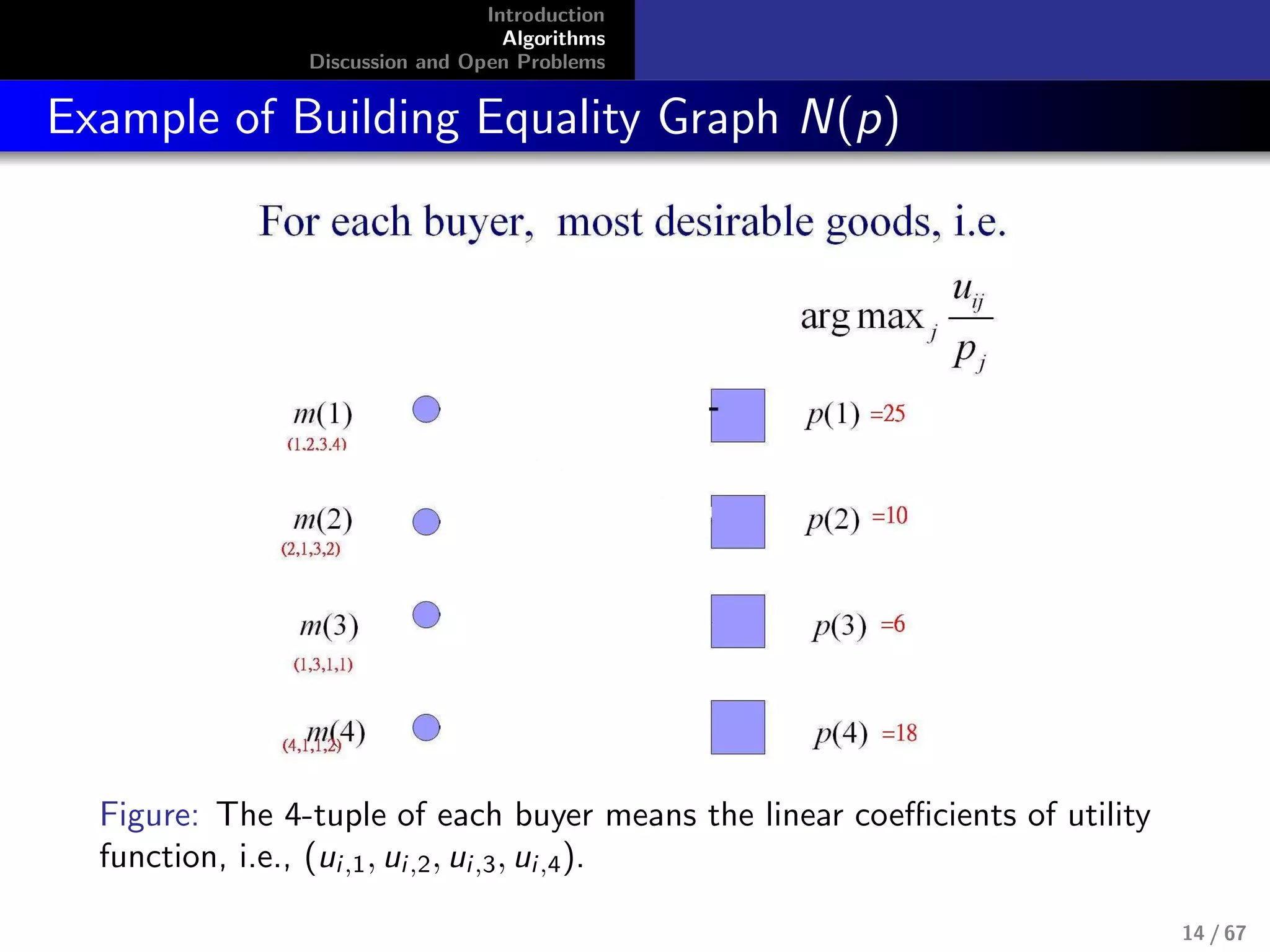
Example of Building Equality Graph N(p)
Figure: The 4-tuple of each buyer means the linear coefficients of utility
function, i.e., (ui,1, ui,2, ui,3, ui,4).
14 / 67
Introduction
Algorithms
Discussion and Open Problems
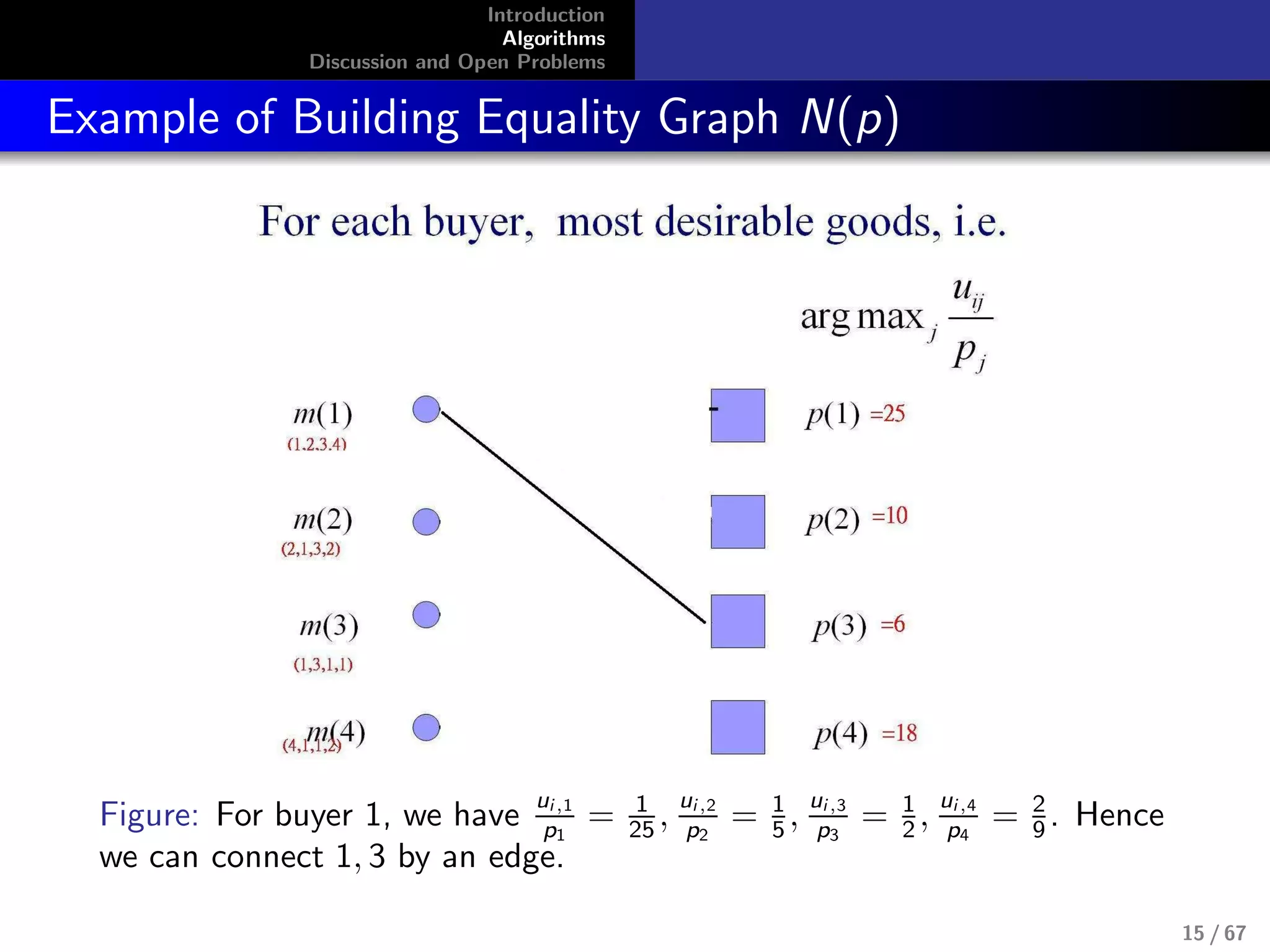
Example of Building Equality Graph N(p)
Figure: For buyer 1, we have
ui,1
p1
= 1
25 ,
ui,2
p2
= 1
5 ,
ui,3
p3
= 1
2 ,
ui,4
p4
= 2
9 . Hence
we can connect 1, 3 by an edge.
15 / 67
Introduction
Algorithms
Discussion and Open Problems
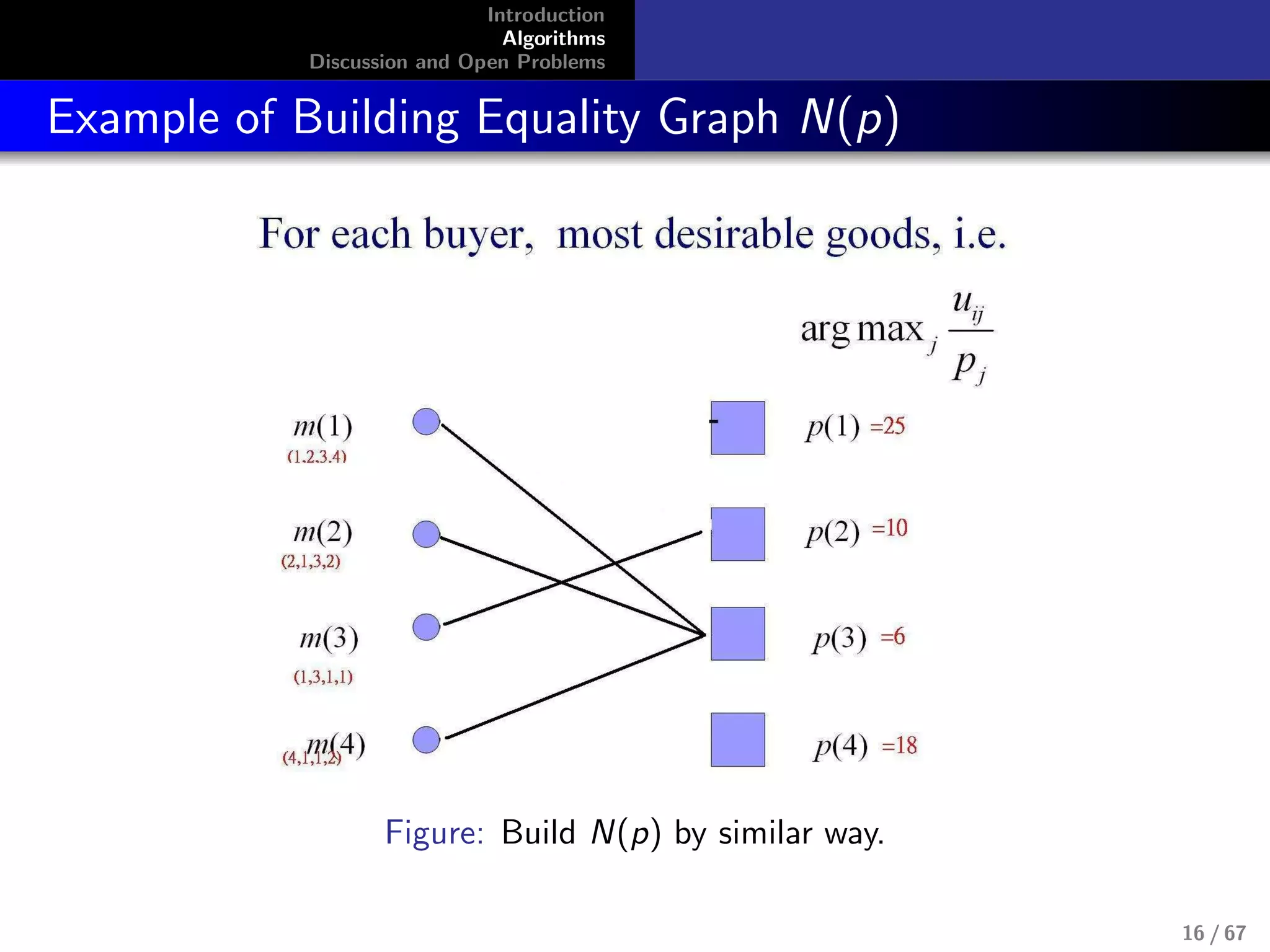
Example of Building Equality Graph N(p)
Figure: Build N(p) by similar way.
16 / 67
Introduction
Algorithms
Discussion and Open Problems
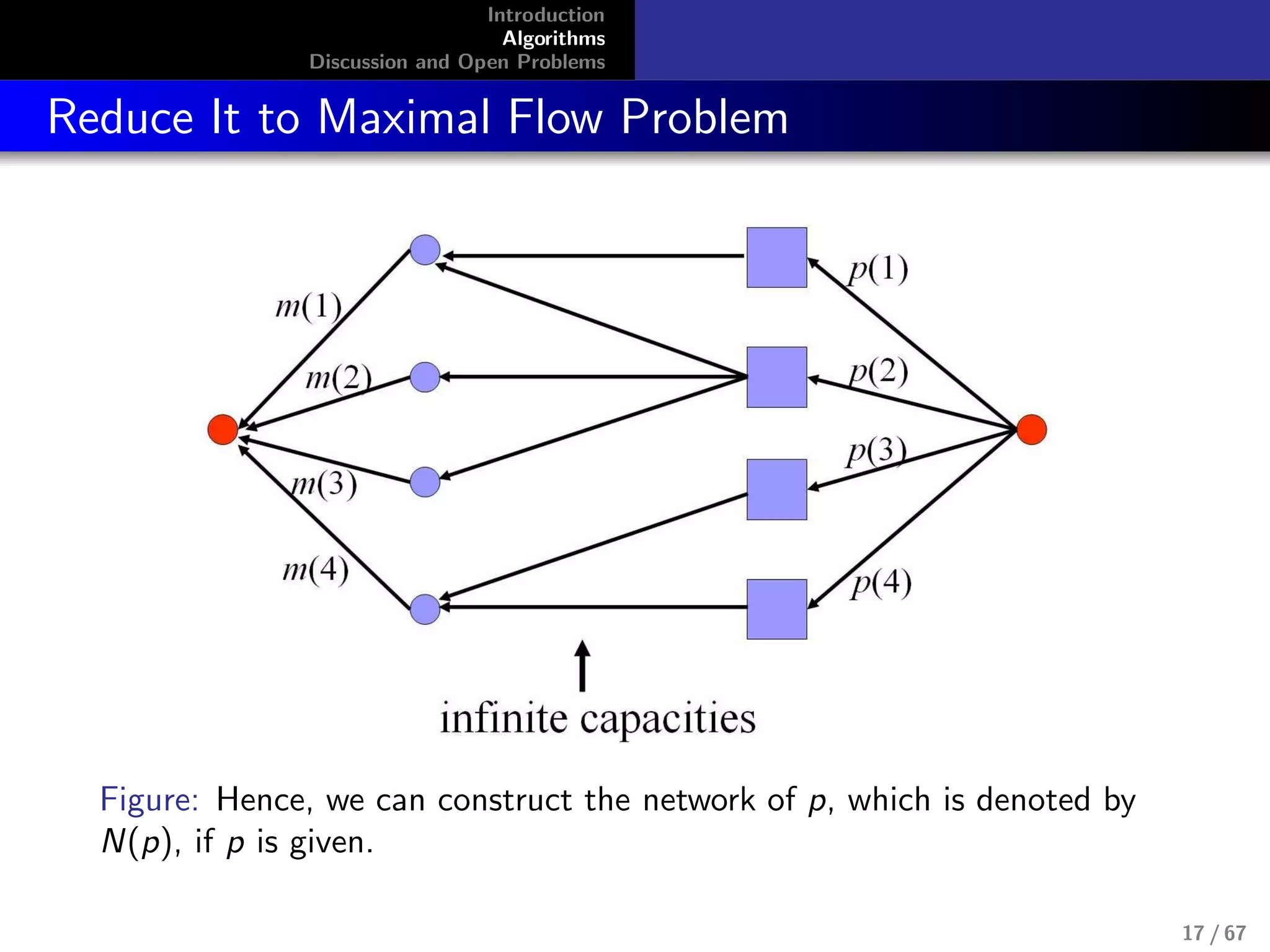
Reduce It to Maximal Flow Problem
Figure: Hence, we can construct the network of p, which is denoted by
N(p), if p is given.
17 / 67
Introduction
Algorithms
Discussion and Open Problems
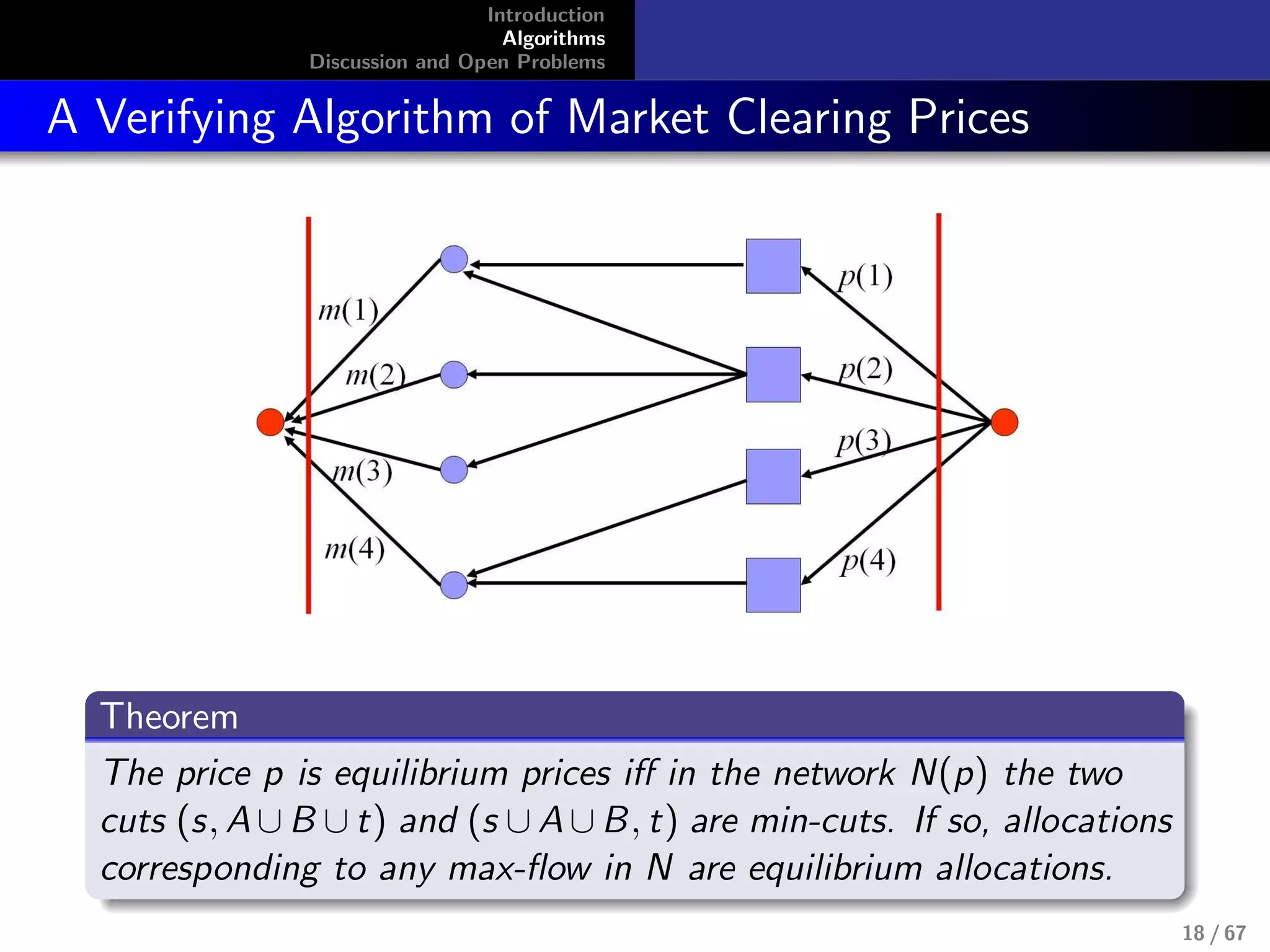
A Verifying Algorithm of Market Clearing Prices
Theorem
The price p is equilibrium prices iff in the network N(p) the two
cuts (s, A ∪ B ∪ t) and (s ∪ A ∪ B, t) are min-cuts. If so, allocations
corresponding to any max-flow in N are equilibrium allocations.
18 / 67
Introduction
Algorithms
Discussion and Open Problems
Computing Market Clearing Prices for Linear Fisher Model
Now we have a verifier.
Could we devise an algorithm to compute
Market Clearing Prices for Linear Fisher
Model?
19 / 67
Introduction
Algorithms
Discussion and Open Problems
Idea of Algorithm
”primal” variables: allocations
”dual” variables: prices of goods
Approach equilibrium prices from below:
start with very low prices;
buyers have surplus money iteratively.
Keep raising prices and decreasing surplus.
i.e., iterations of executing primal & dual
improvements
20 / 67
Introduction
Algorithms
Discussion and Open Problems
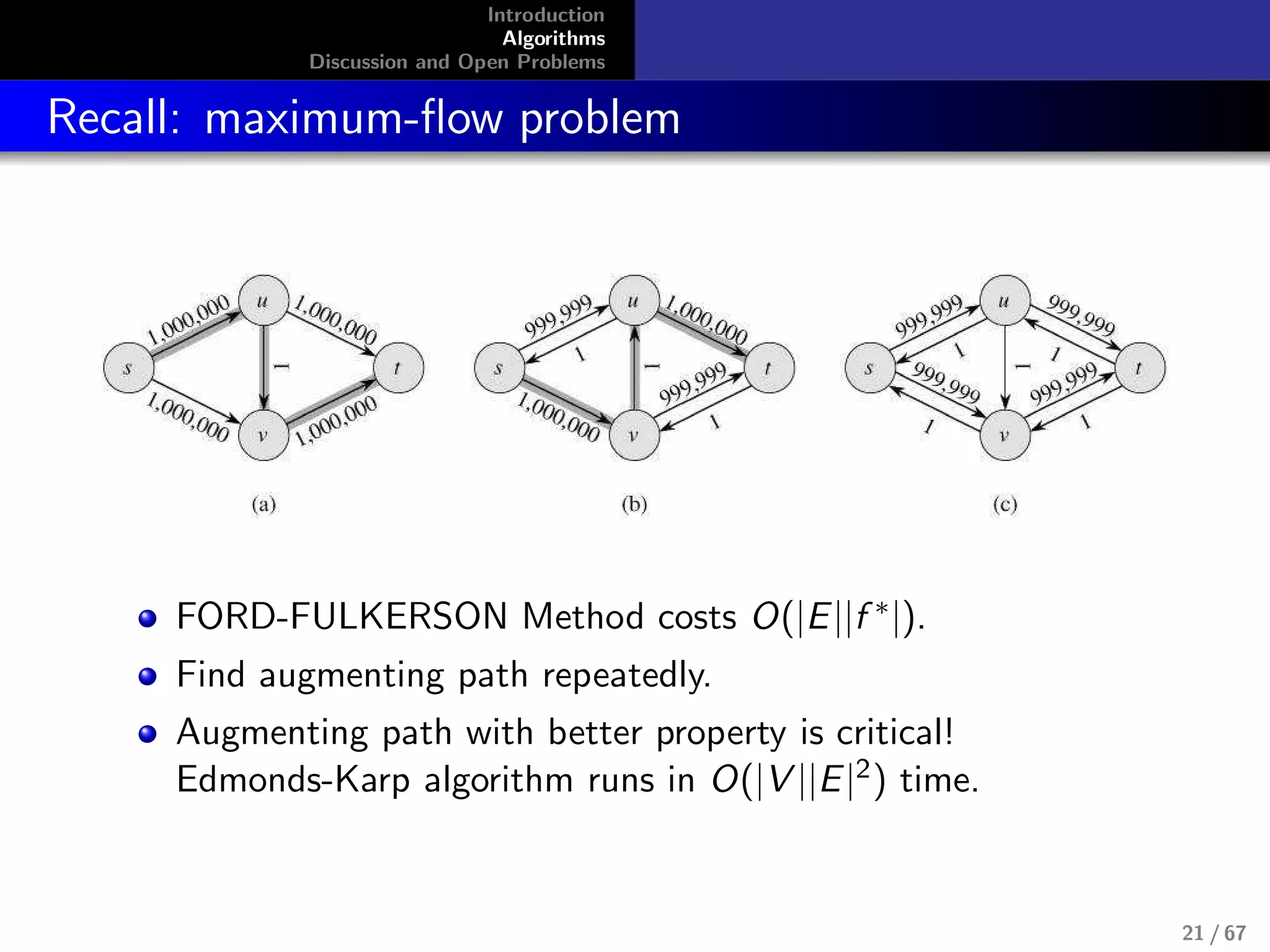
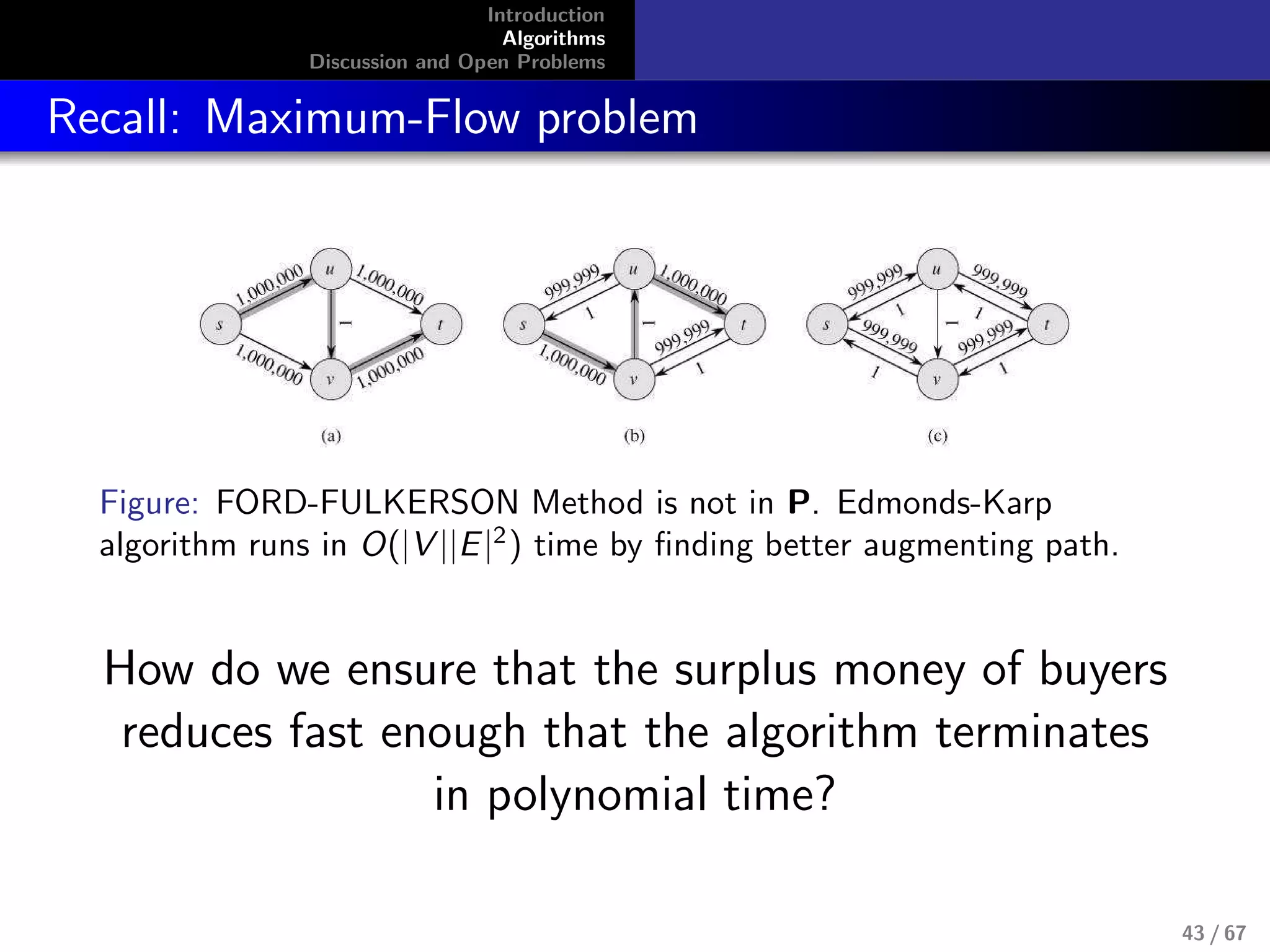
Recall: maximum-flow problem
FORD-FULKERSON Method costs O(|E||f ∗|).
Find augmenting path repeatedly.
Augmenting path with better property is critical!
Edmonds-Karp algorithm runs in O(|V ||E|2) time.
21 / 67
Introduction
Algorithms
Discussion and Open Problems
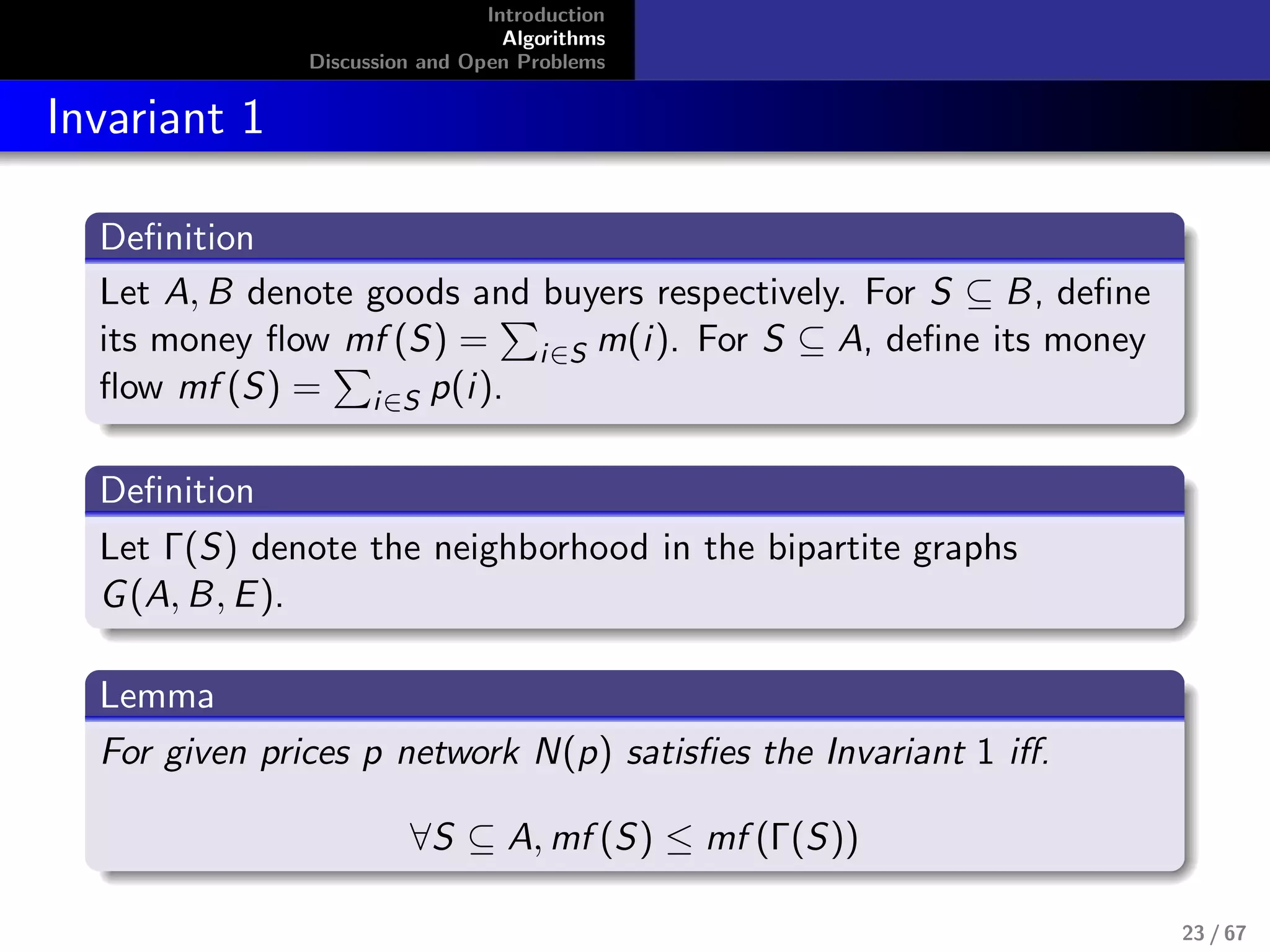
Invariant 1
Invariant 1
Let A, B denote goods and buyers respectively. The
prices p are such that (s, A ∪ B ∪ t) is a min-cut in
N(p).
The Invariant ensures that, at current prices, all
goods can be sold. The only eventuality is that
buyers may be left with surplus money. When the
surplus vanishes, market clearing prices have been
attained.
22 / 67
Introduction
Algorithms
Discussion and Open Problems
Invariant 1
Definition
Let A, B denote goods and buyers respectively. For S ⊆ B, define
its money flow mf (S) = i∈S m(i). For S ⊆ A, define its money
flow mf (S) = i∈S p(i).
Definition
Let Γ(S) denote the neighborhood in the bipartite graphs
G(A, B, E).
Lemma
For given prices p network N(p) satisfies the Invariant 1 iff.
∀S ⊆ A, mf (S) ≤ mf (Γ(S))
23 / 67
Introduction
Algorithms
Discussion and Open Problems
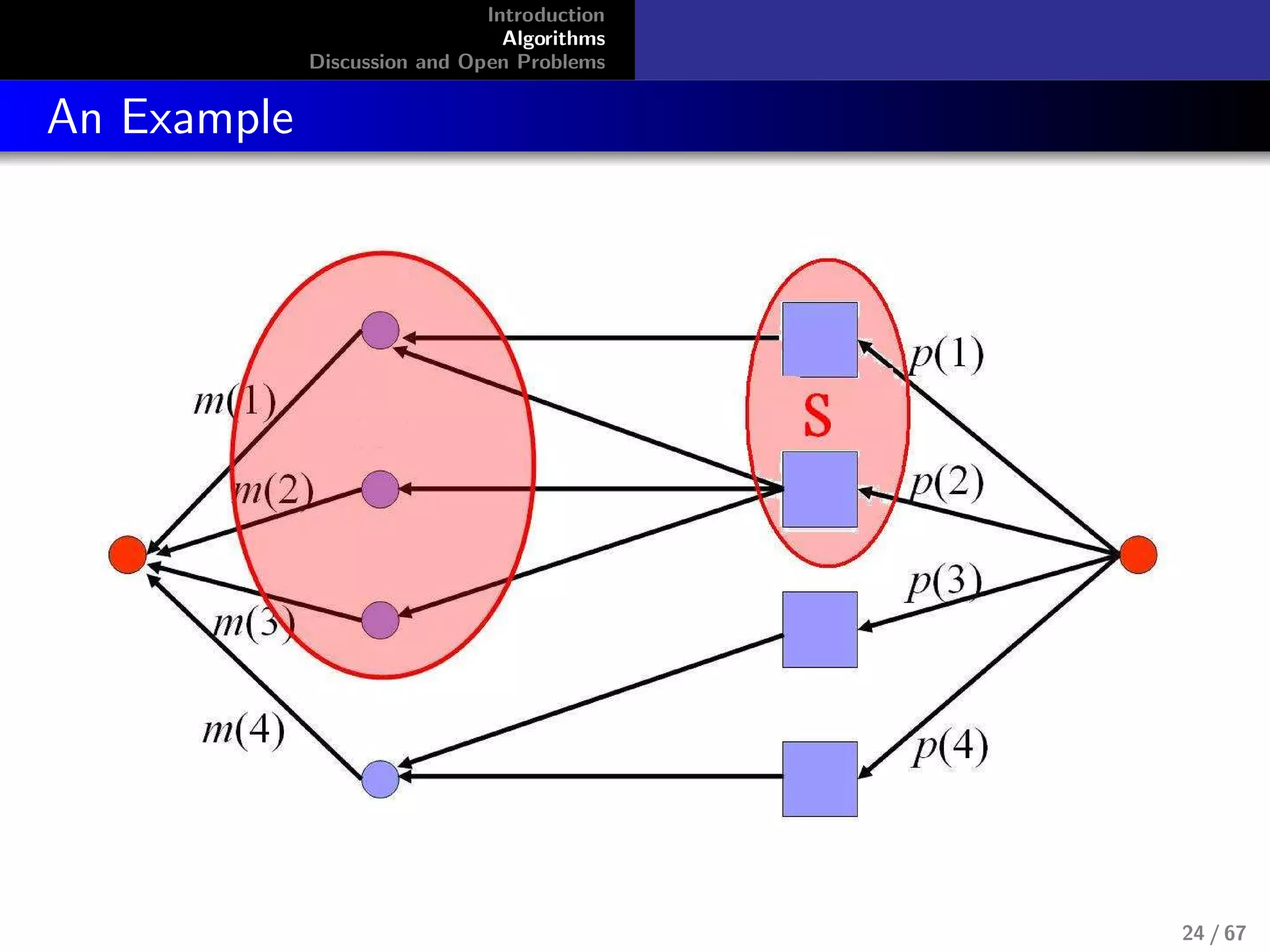
An Example
24 / 67
Introduction
Algorithms
Discussion and Open Problems
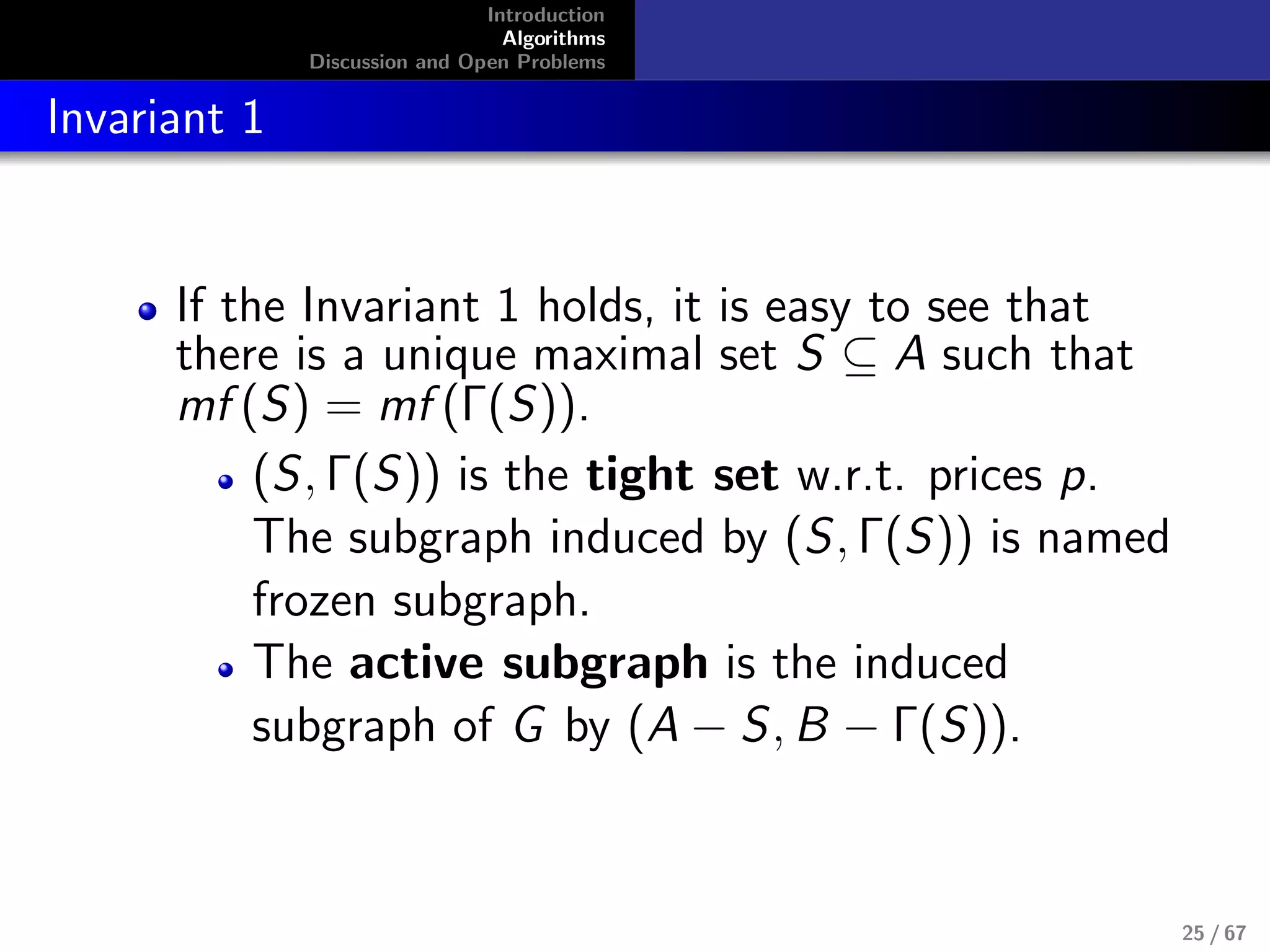
Invariant 1
If the Invariant 1 holds, it is easy to see that
there is a unique maximal set S ⊆ A such that
mf (S) = mf (Γ(S)).
(S, Γ(S)) is the tight set w.r.t. prices p.
The subgraph induced by (S, Γ(S)) is named
frozen subgraph.
The active subgraph is the induced
subgraph of G by (A − S, B − Γ(S)).
25 / 67
Introduction
Algorithms
Discussion and Open Problems
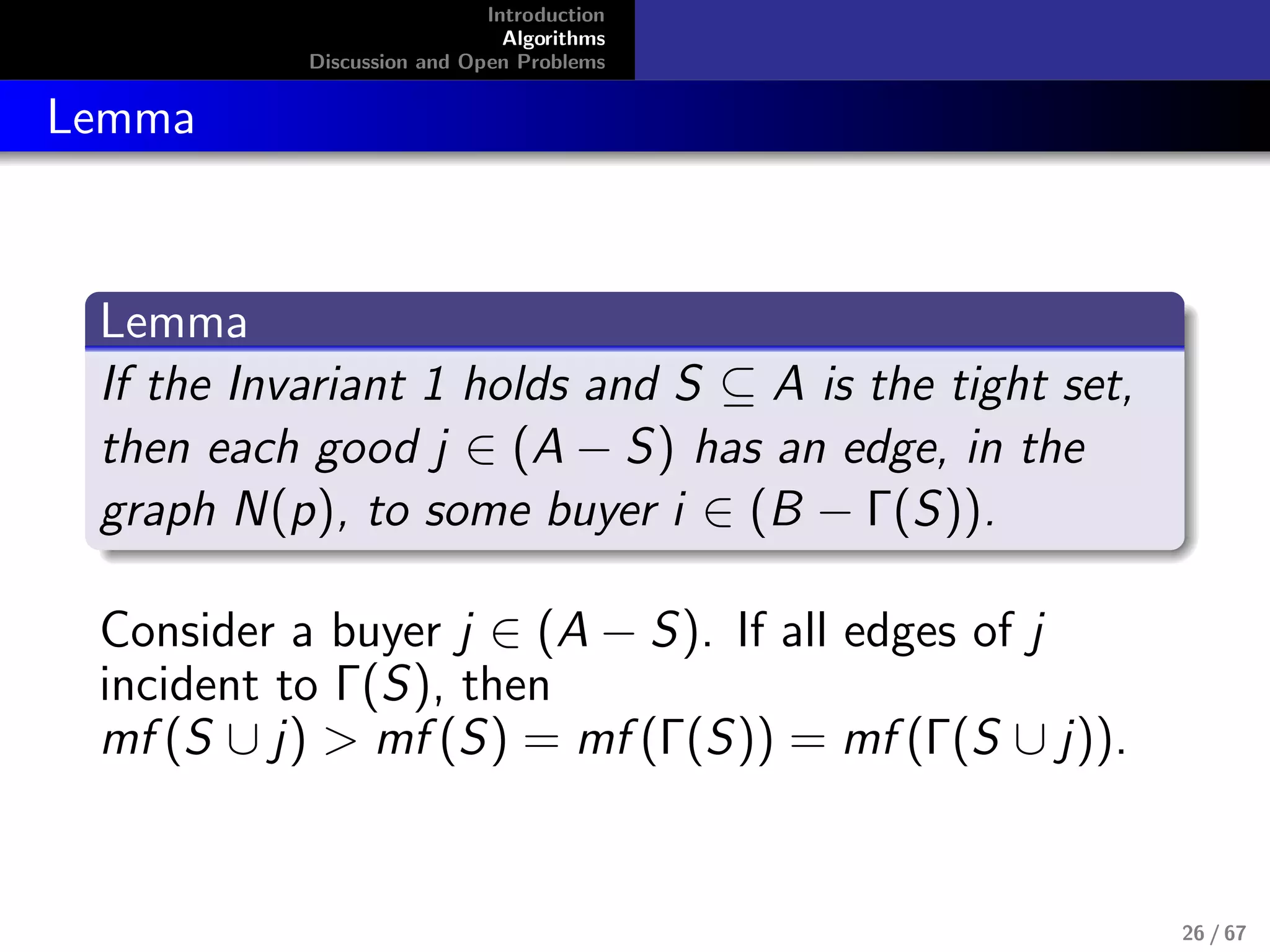
Lemma
Lemma
If the Invariant 1 holds and S ⊆ A is the tight set,
then each good j ∈ (A − S) has an edge, in the
graph N(p), to some buyer i ∈ (B − Γ(S)).
Consider a buyer j ∈ (A − S). If all edges of j
incident to Γ(S), then
mf (S ∪ j) > mf (S) = mf (Γ(S)) = mf (Γ(S ∪ j)).
26 / 67
Introduction
Algorithms
Discussion and Open Problems
Physical Meaning of Invariant 1
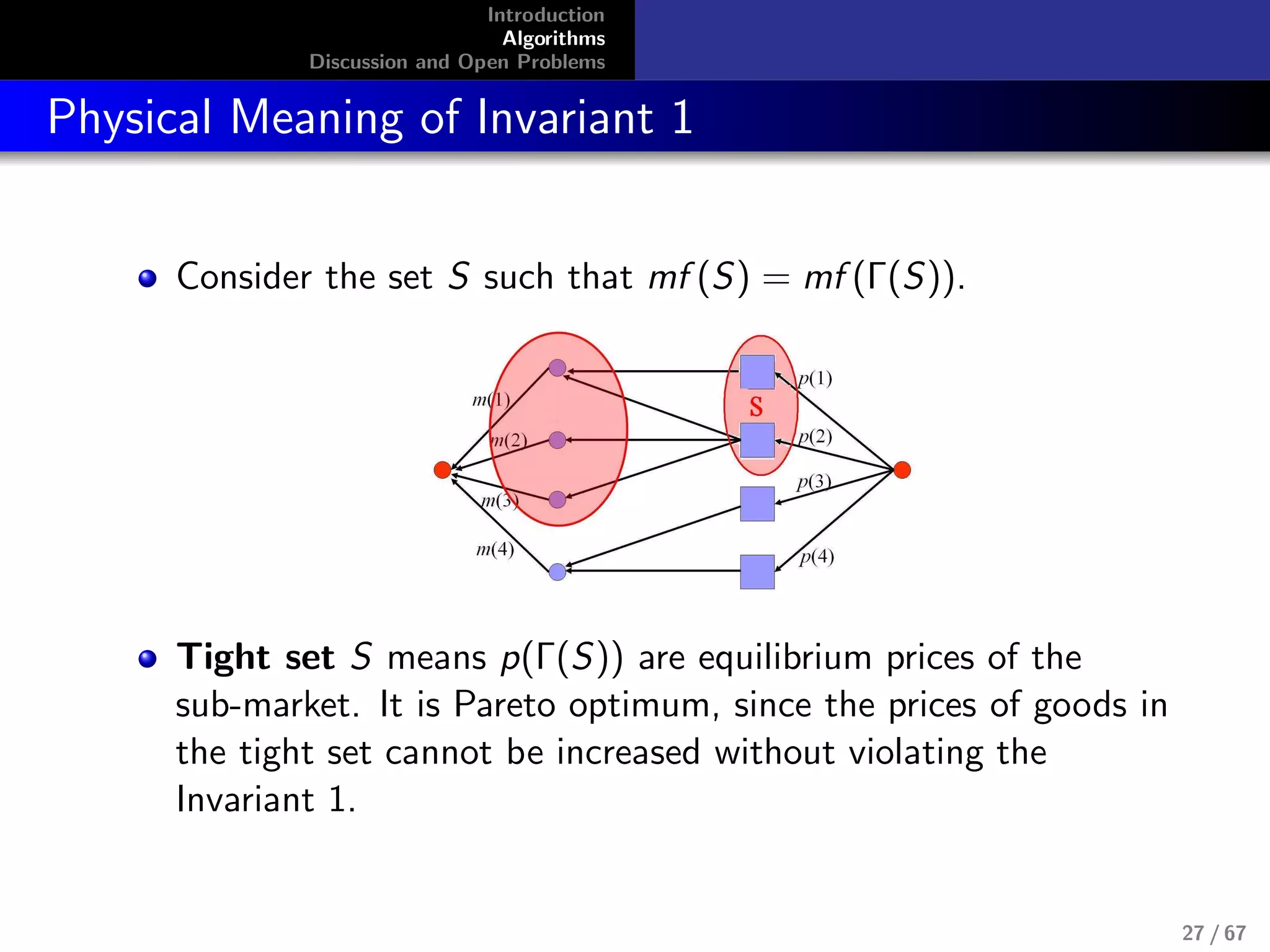
Consider the set S such that mf (S) = mf (Γ(S)).
Tight set S means p(Γ(S)) are equilibrium prices of the
sub-market. It is Pareto optimum, since the prices of goods in
the tight set cannot be increased without violating the
Invariant 1.
27 / 67
Introduction
Algorithms
Discussion and Open Problems
Physical Meaning of Invariant 1
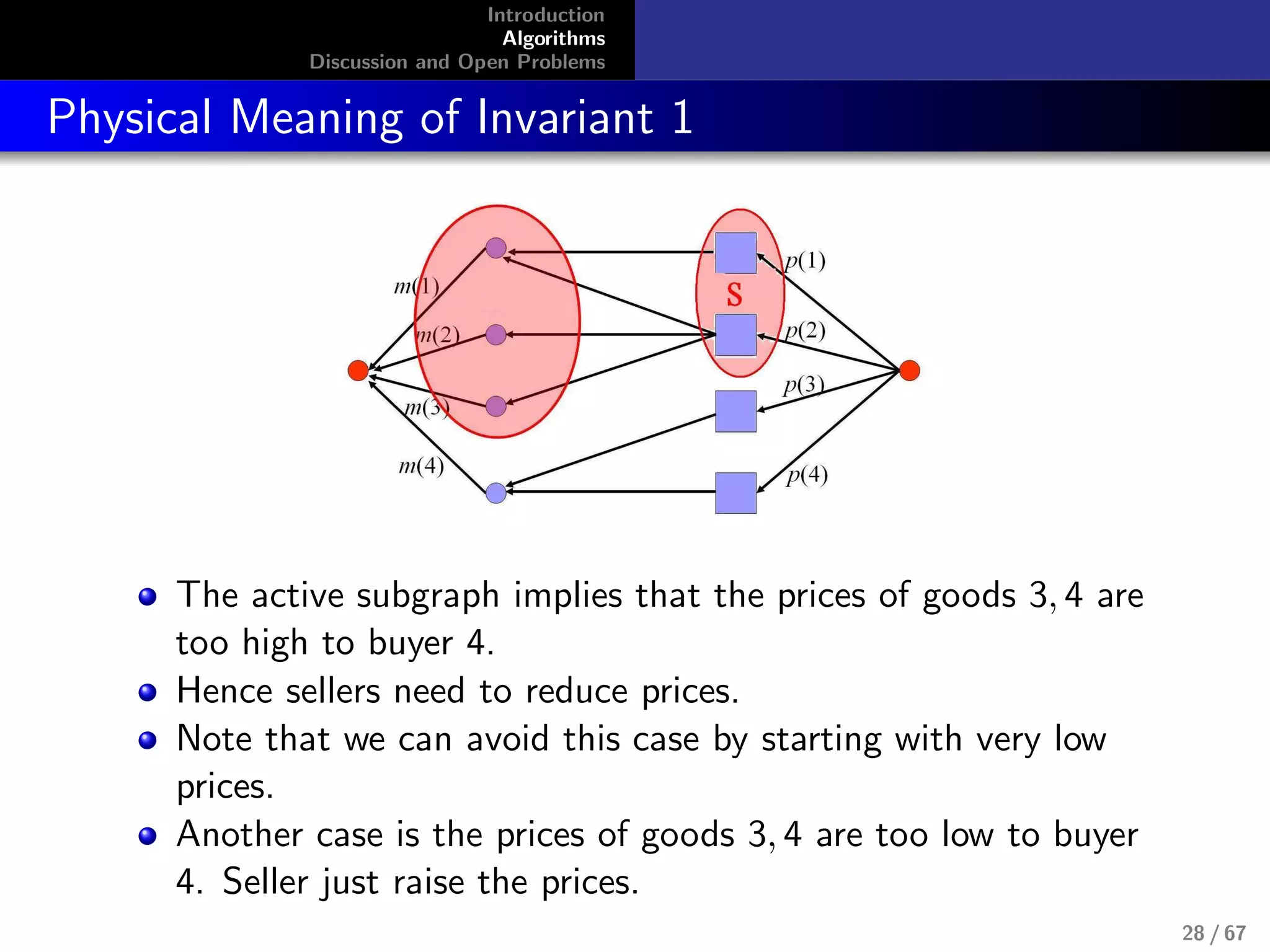
The active subgraph implies that the prices of goods 3, 4 are
too high to buyer 4.
Hence sellers need to reduce prices.
Note that we can avoid this case by starting with very low
prices.
Another case is the prices of goods 3, 4 are too low to buyer
4. Seller just raise the prices.
28 / 67
Introduction
Algorithms
Discussion and Open Problems
Basic Algorithm
29 / 67
Introduction
Algorithms
Discussion and Open Problems
Basic Algorithm
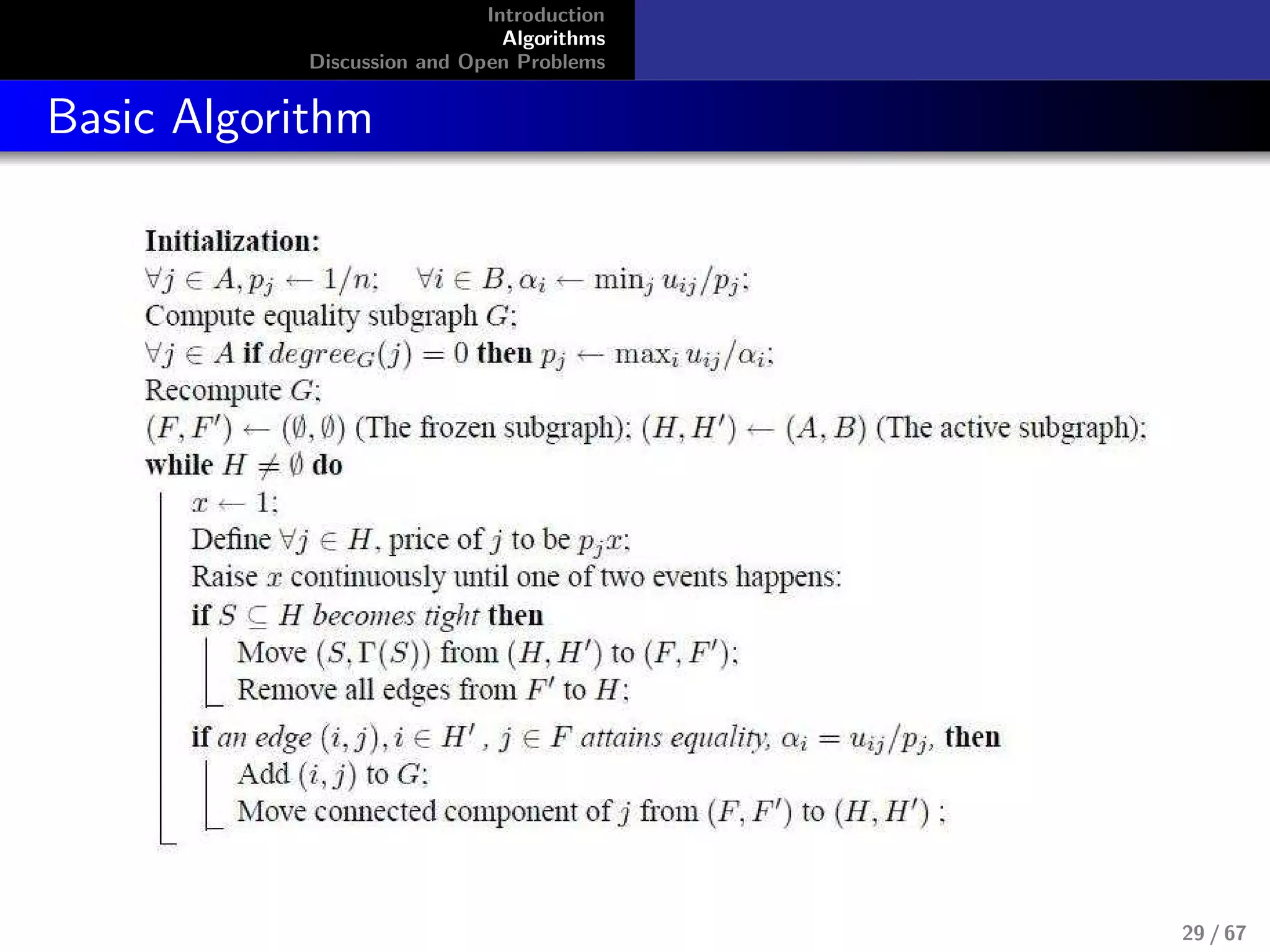
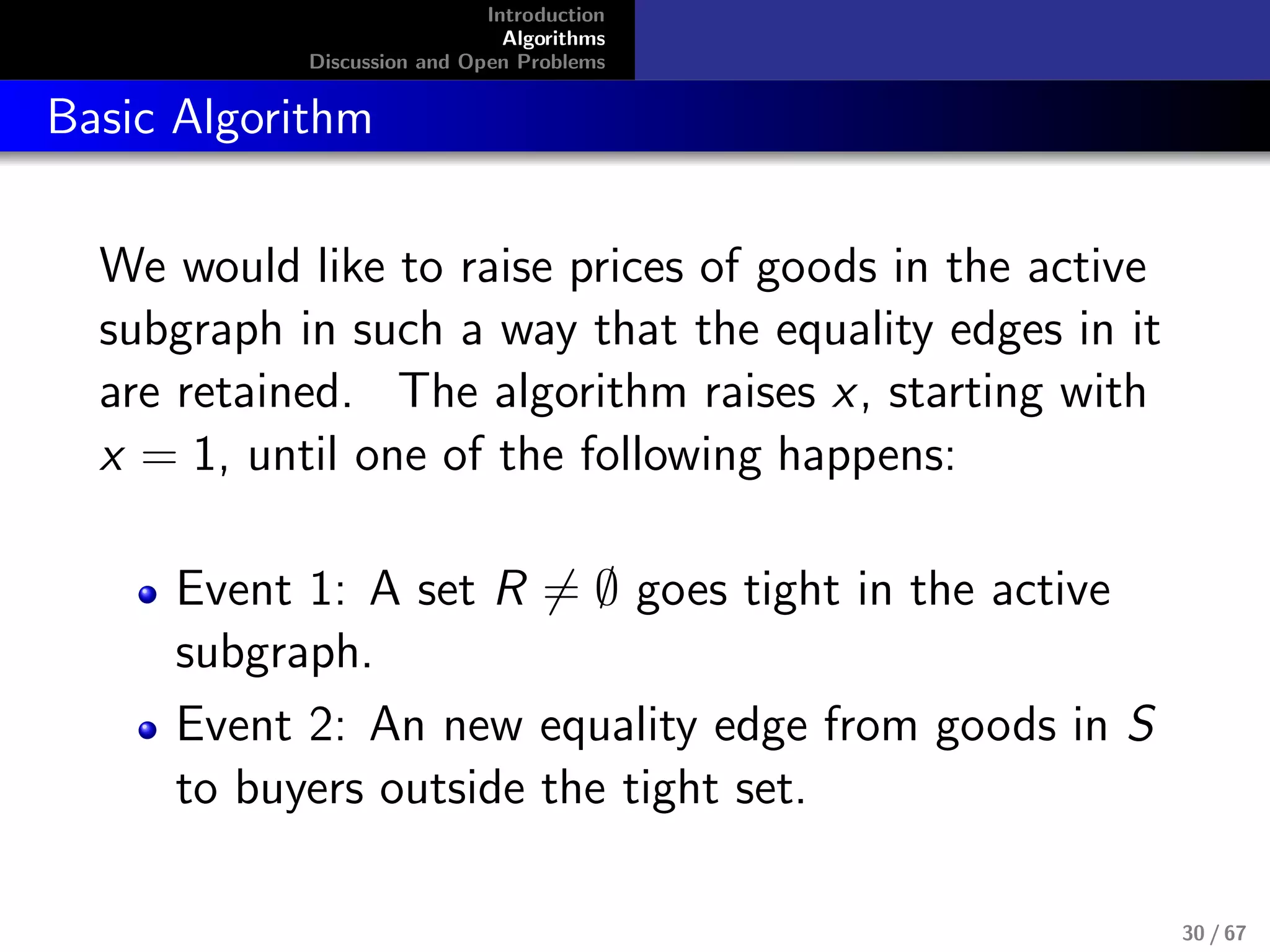
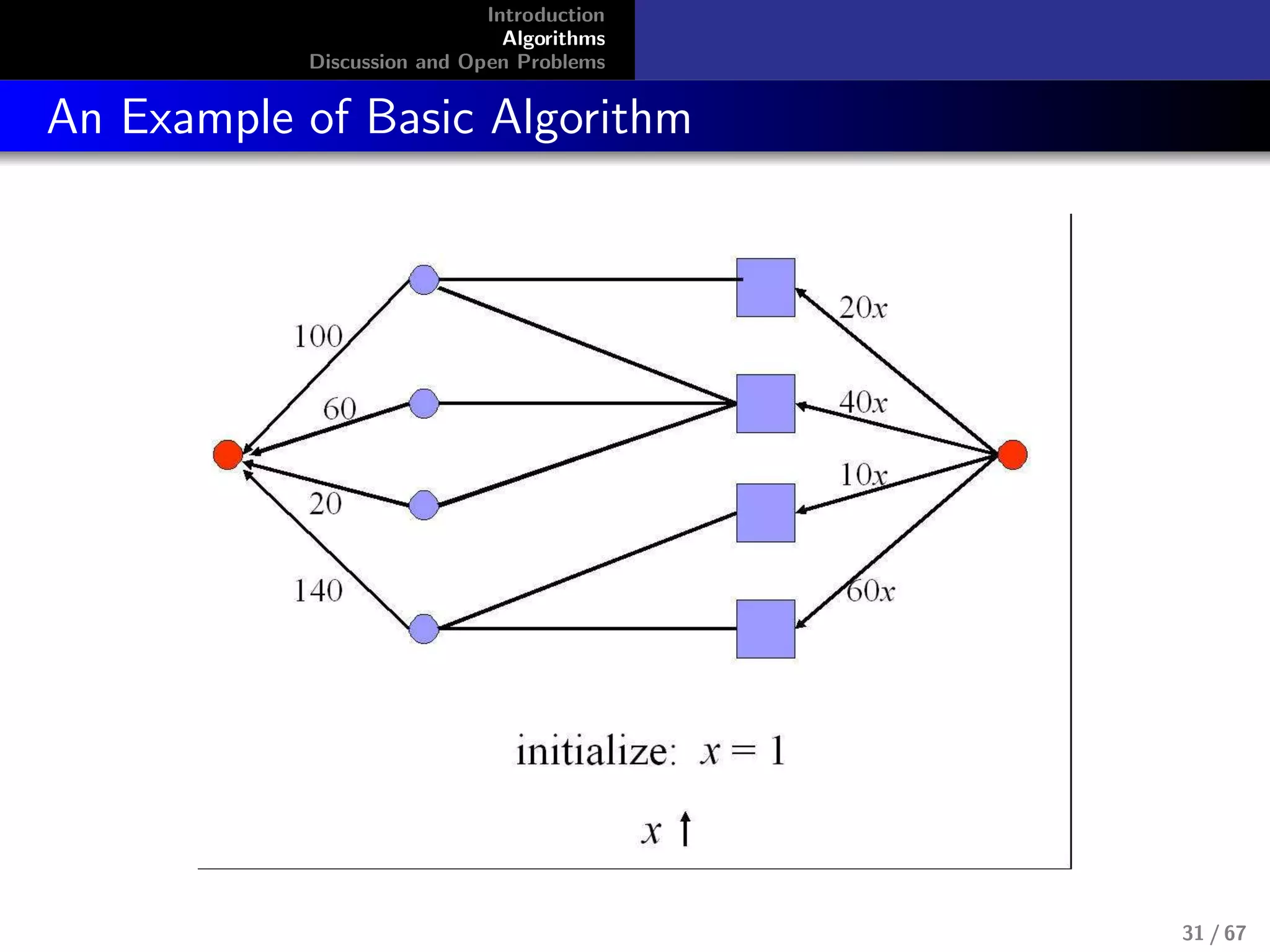
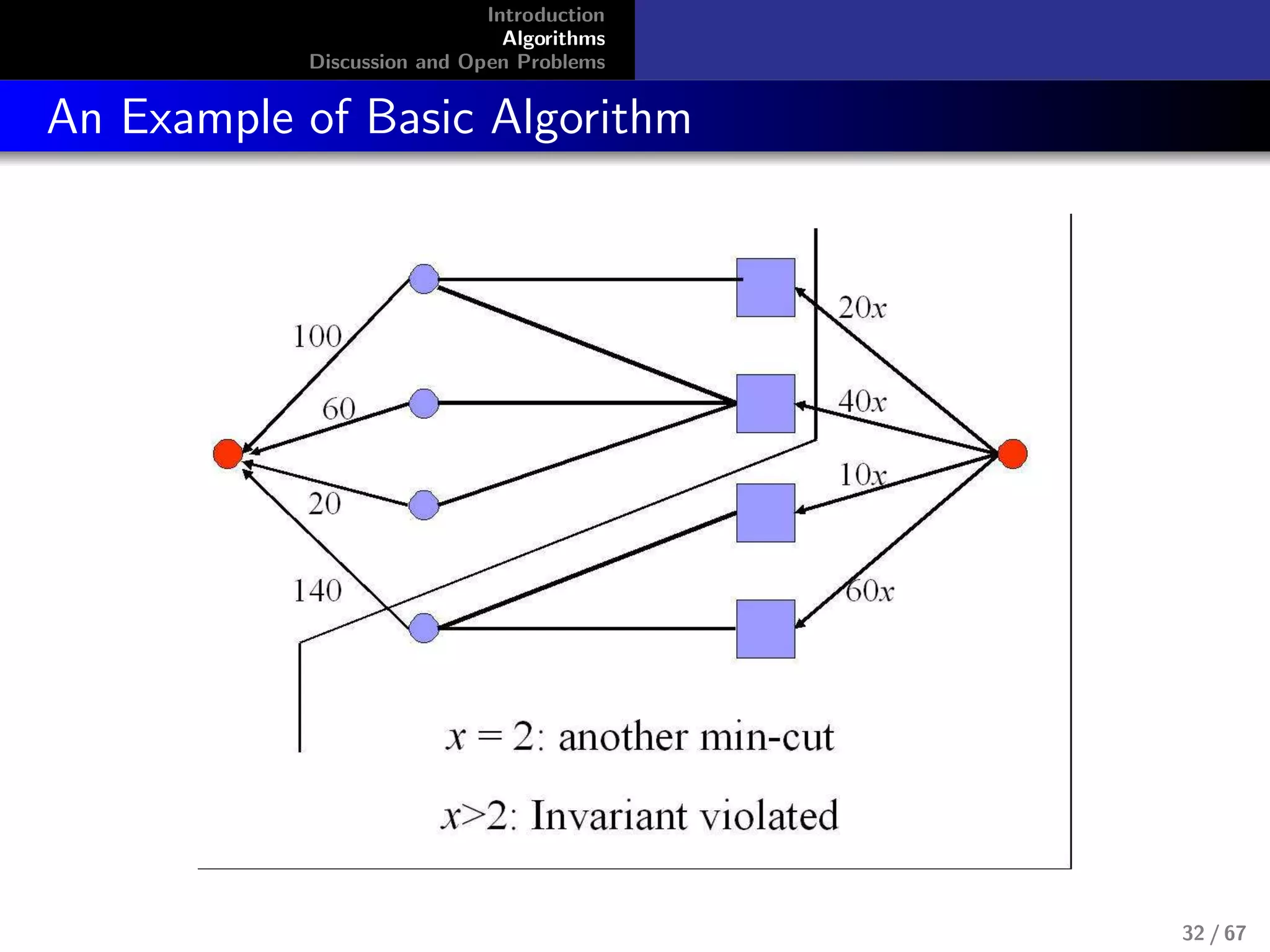
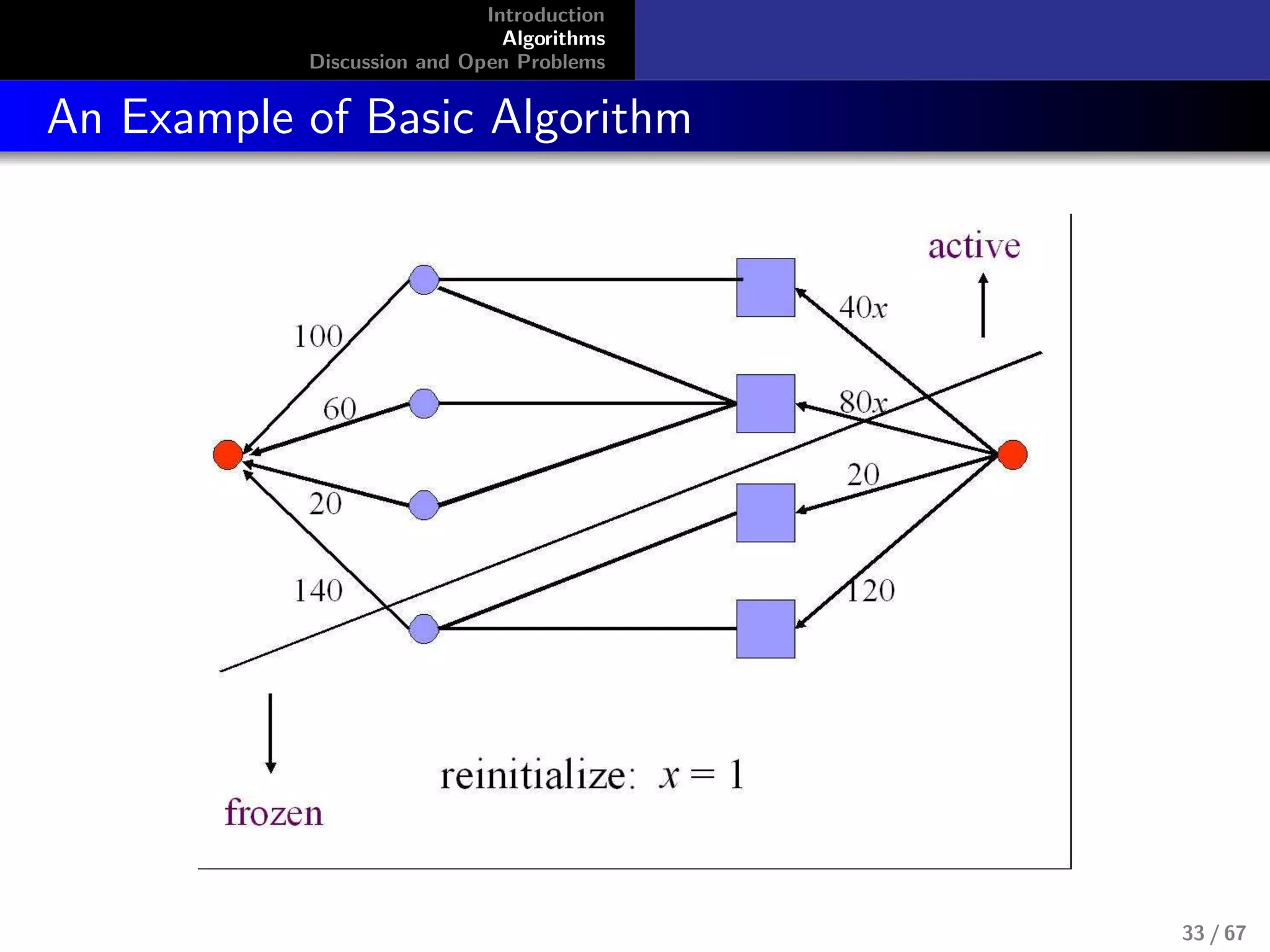
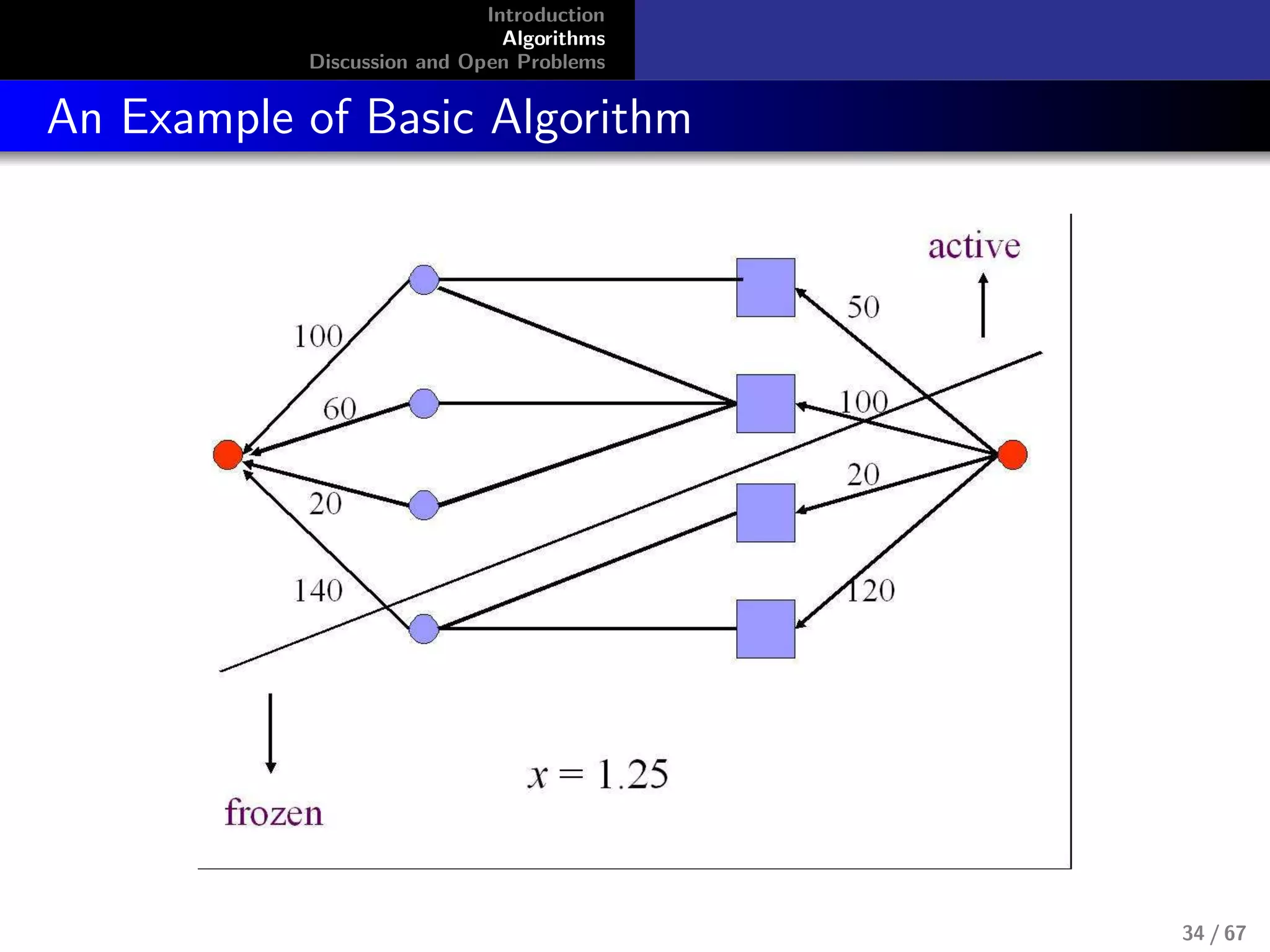
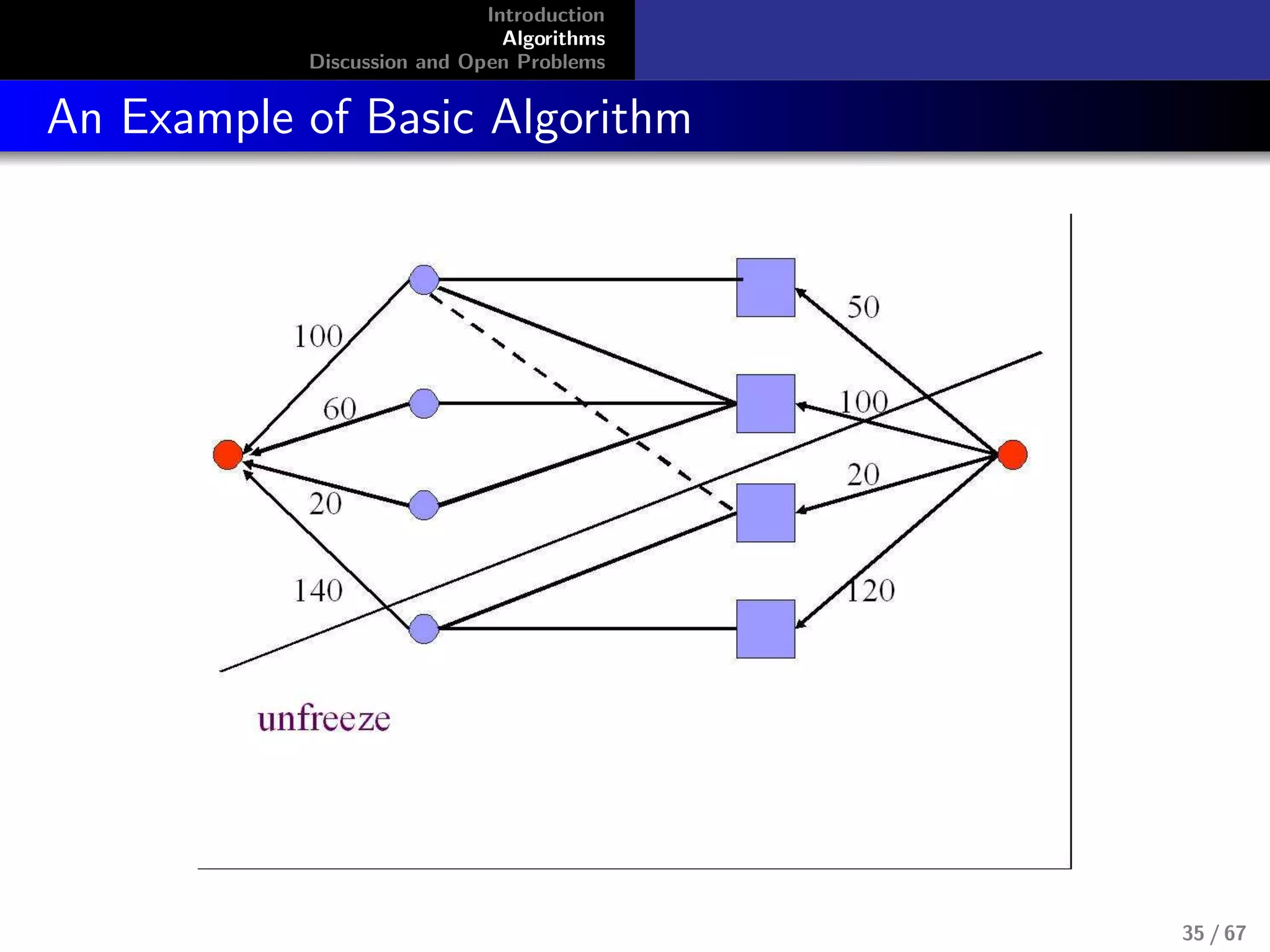
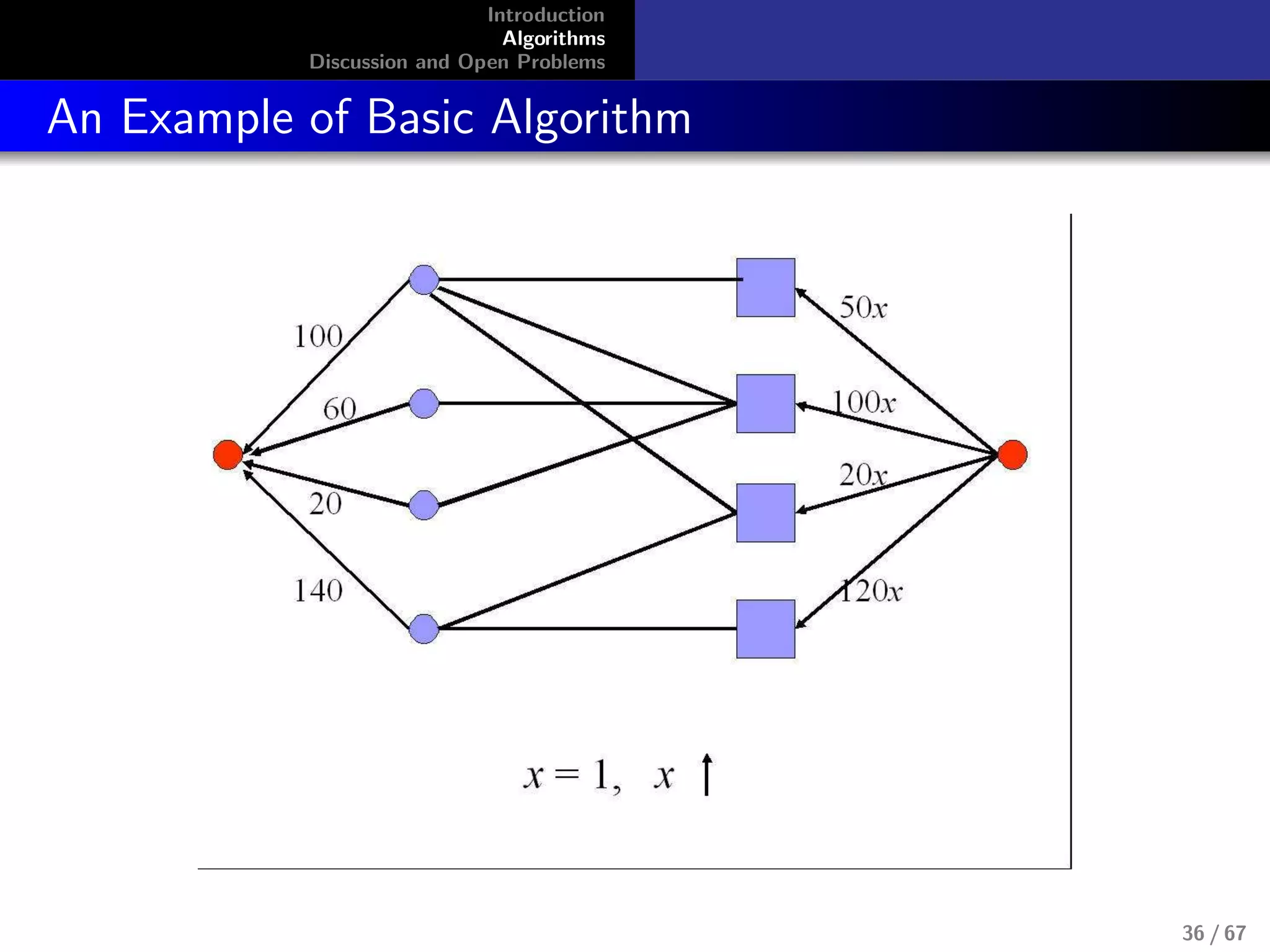
We would like to raise prices of goods in the active
subgraph in such a way that the equality edges in it
are retained. The algorithm raises x, starting with
x = 1, until one of the following happens:
Event 1: A set R = ∅ goes tight in the active
subgraph.
Event 2: An new equality edge from goods in S
to buyers outside the tight set.
30 / 67
Introduction
Algorithms
Discussion and Open Problems
An Example of Basic Algorithm
31 / 67
Introduction
Algorithms
Discussion and Open Problems
An Example of Basic Algorithm
32 / 67
Introduction
Algorithms
Discussion and Open Problems
An Example of Basic Algorithm
33 / 67
Introduction
Algorithms
Discussion and Open Problems
An Example of Basic Algorithm
34 / 67
Introduction
Algorithms
Discussion and Open Problems
An Example of Basic Algorithm
35 / 67
Introduction
Algorithms
Discussion and Open Problems
An Example of Basic Algorithm
36 / 67
Introduction
Algorithms
Discussion and Open Problems
Basic Algorithm
Hence, there is an intuitive approach to solve
this problem by raising the prices of goods in
A − S until arriving the goal.
Like the idea of FORD-FULKERSON Method, it
will increase the utilities by finding tight sets
until the only tight set is (A, B).
We skip the details of finding the tight set. (p.
61)
37 / 67
Introduction
Algorithms
Discussion and Open Problems
Time Complexity of Basic Algorithm
Basic algorithm is to solve this problem by raising the
prices of goods in A − S until arriving the goal.
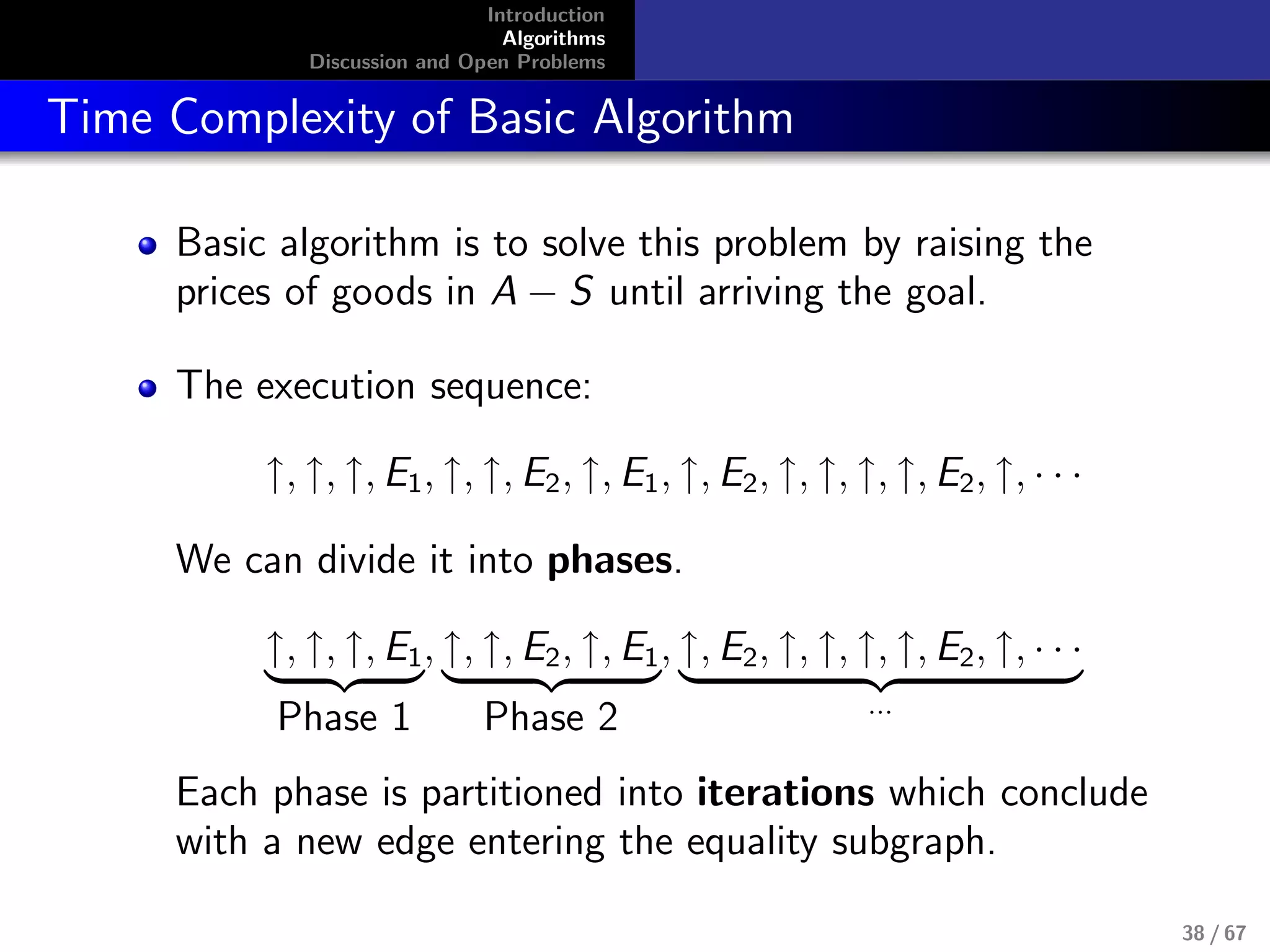
The execution sequence:
↑, ↑, ↑, E1, ↑, ↑, E2, ↑, E1, ↑, E2, ↑, ↑, ↑, ↑, E2, ↑, · · ·
We can divide it into phases.
↑, ↑, ↑, E1
Phase 1
, ↑, ↑, E2, ↑, E1
Phase 2
, ↑, E2, ↑, ↑, ↑, ↑, E2, ↑, · · ·
···
Each phase is partitioned into iterations which conclude
with a new edge entering the equality subgraph.
38 / 67
Introduction
Algorithms
Discussion and Open Problems
Time Complexity of Basic Algorithm
Let M be the total money possessed by the
buyers and let f be the max-flow computed in
network N(p) at current prices p. Thus M − f
is the surplus money with the buyers.
Let U = maxi,j{ui,j} and let ∆ = nUn
.
Lemma
At the termination of a phase, the prices of goods in
the newly tight set must be rational numbers with
denominator ≤ ∆.
39 / 67
Introduction
Algorithms
Discussion and Open Problems
Time Complexity of Basic Algorithm
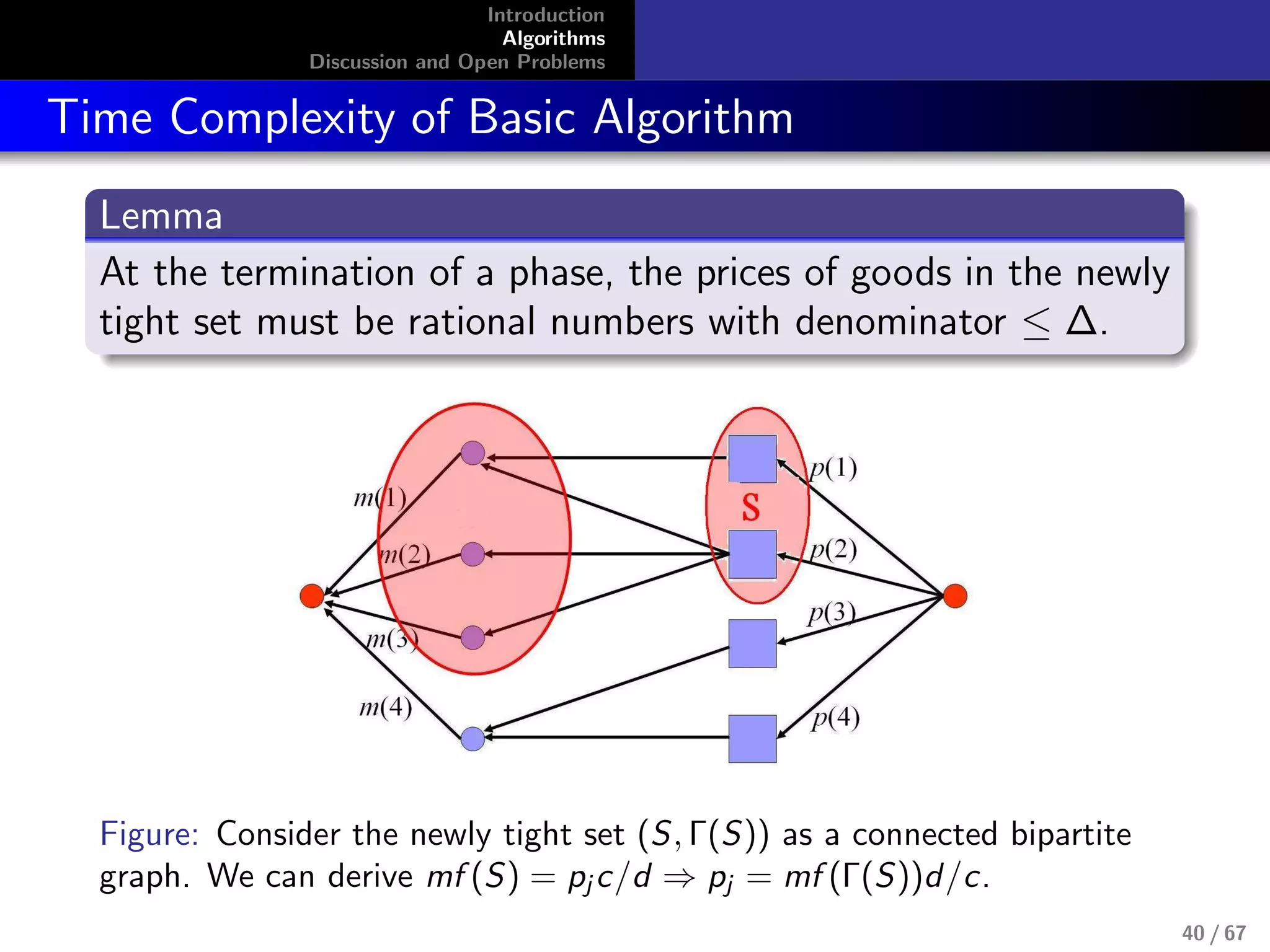
Lemma
At the termination of a phase, the prices of goods in the newly
tight set must be rational numbers with denominator ≤ ∆.
Figure: Consider the newly tight set (S, Γ(S)) as a connected bipartite
graph. We can derive mf (S) = pj c/d ⇒ pj = mf (Γ(S))d/c.
40 / 67
Introduction
Algorithms
Discussion and Open Problems
Time Complexity of Basic Algorithm
Lemma
Each phase consists of at most n iterations.
Lemma
Consider two phases P and P , not necessarily
consecutive, such that good j lies in the newly tight
sets at the end of P as well as P . Then the increase
in the price of j, going from P to P , is ≥ 1/∆2
.
41 / 67
Introduction
Algorithms
Discussion and Open Problems
Time Complexity of Basic Algorithm
lemma
tight set can be found using n max-flow computations.
Lemma
Basic Algorithm terminates with market clearing prices in at
most M∆2
phases, and executes O(Mn2
∆2
) max-flow
computations.
No one discovered a technique to bound the running time
in P of this approach.
42 / 67
Introduction
Algorithms
Discussion and Open Problems
Recall: Maximum-Flow problem
Figure: FORD-FULKERSON Method is not in P. Edmonds-Karp
algorithm runs in O(|V ||E|2
) time by finding better augmenting path.
How do we ensure that the surplus money of buyers
reduces fast enough that the algorithm terminates
in polynomial time?
43 / 67
Introduction
Algorithms
Discussion and Open Problems
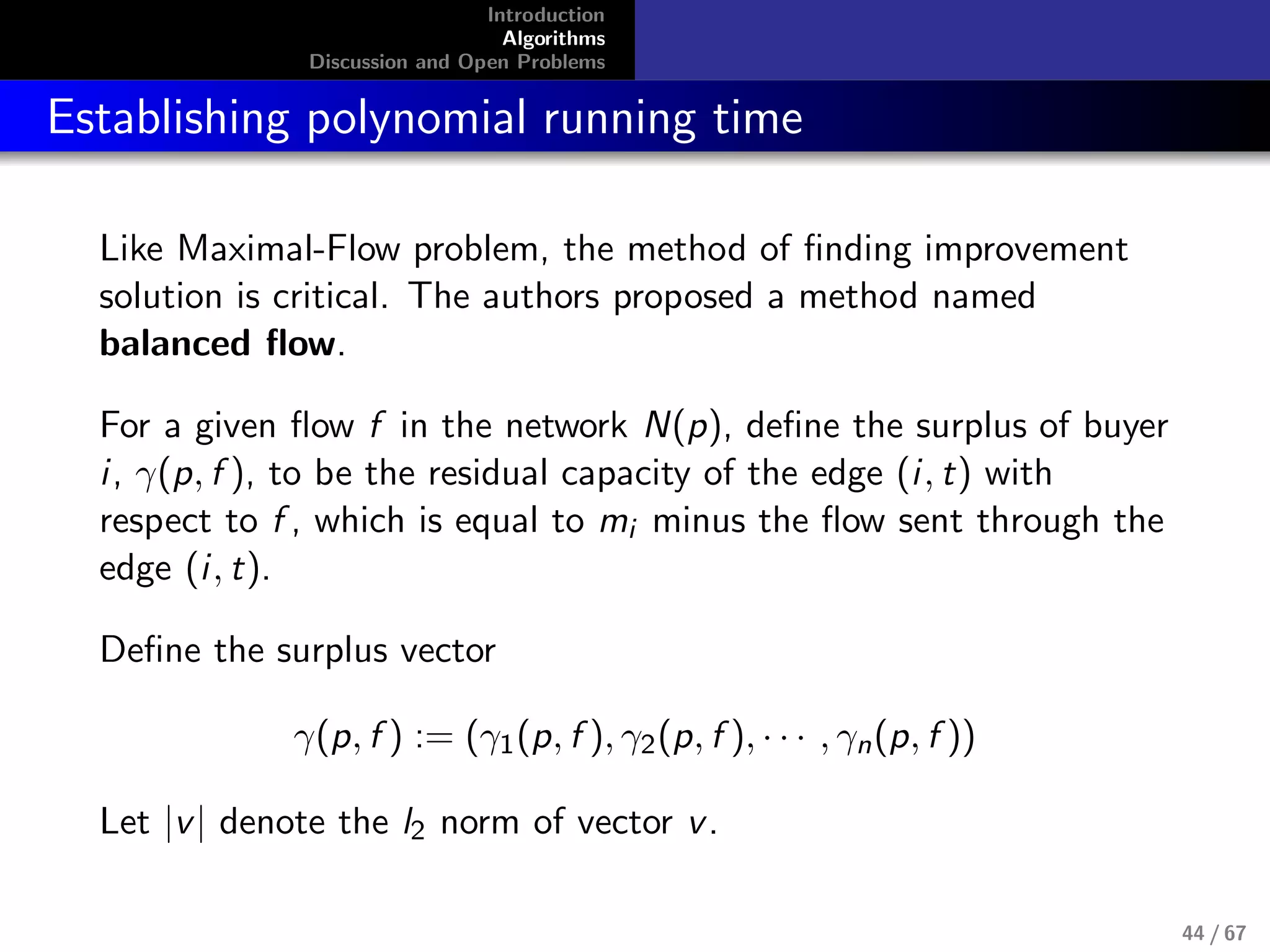
Establishing polynomial running time
Like Maximal-Flow problem, the method of finding improvement
solution is critical. The authors proposed a method named
balanced flow.
For a given flow f in the network N(p), define the surplus of buyer
i, γ(p, f ), to be the residual capacity of the edge (i, t) with
respect to f , which is equal to mi minus the flow sent through the
edge (i, t).
Define the surplus vector
γ(p, f ) := (γ1(p, f ), γ2(p, f ), · · · , γn(p, f ))
Let |v| denote the l2 norm of vector v.
44 / 67
Introduction
Algorithms
Discussion and Open Problems
Balanced Flow
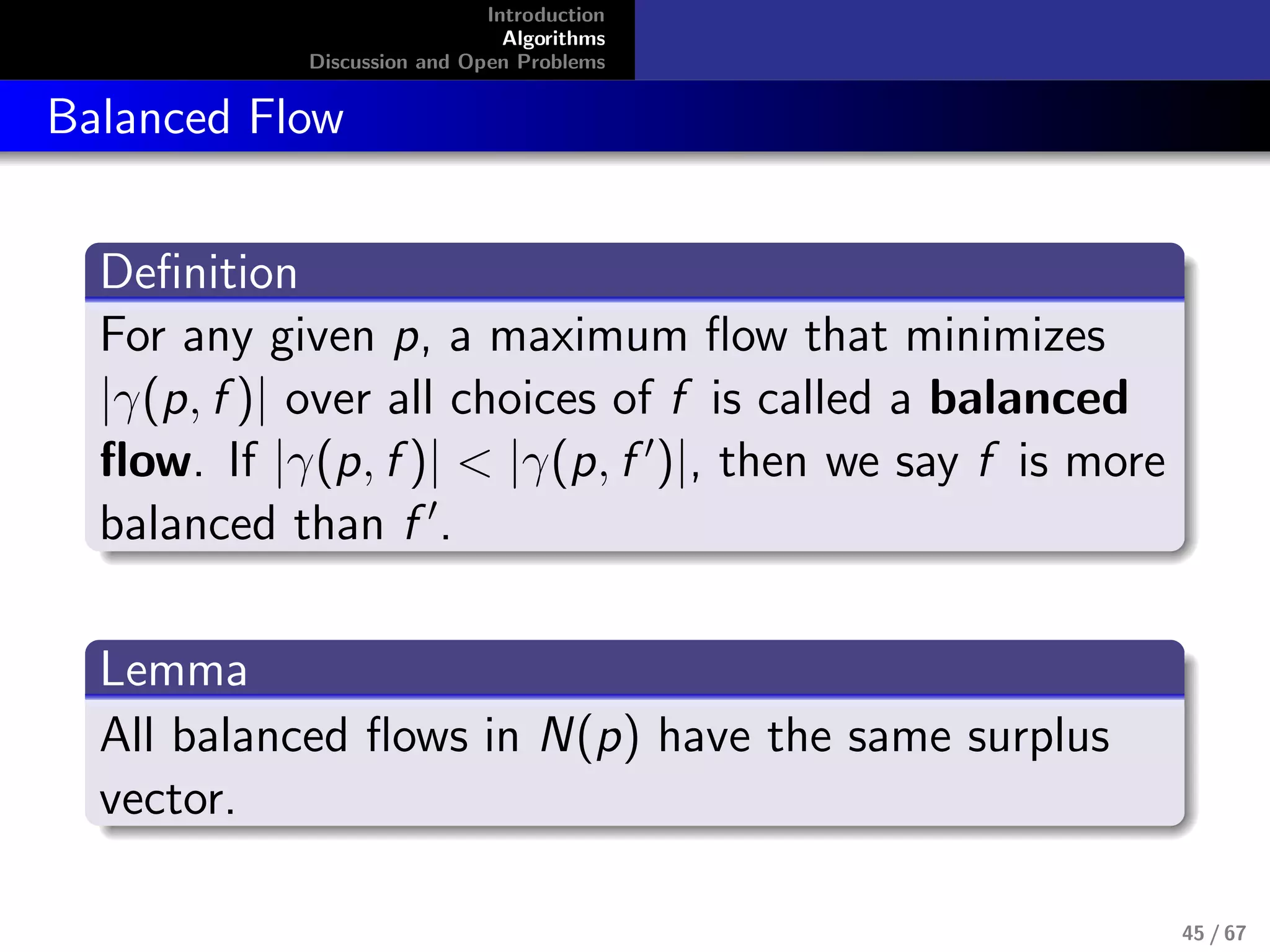
Definition
For any given p, a maximum flow that minimizes
|γ(p, f )| over all choices of f is called a balanced
flow. If |γ(p, f )| < |γ(p, f )|, then we say f is more
balanced than f .
Lemma
All balanced flows in N(p) have the same surplus
vector.
45 / 67
Introduction
Algorithms
Discussion and Open Problems
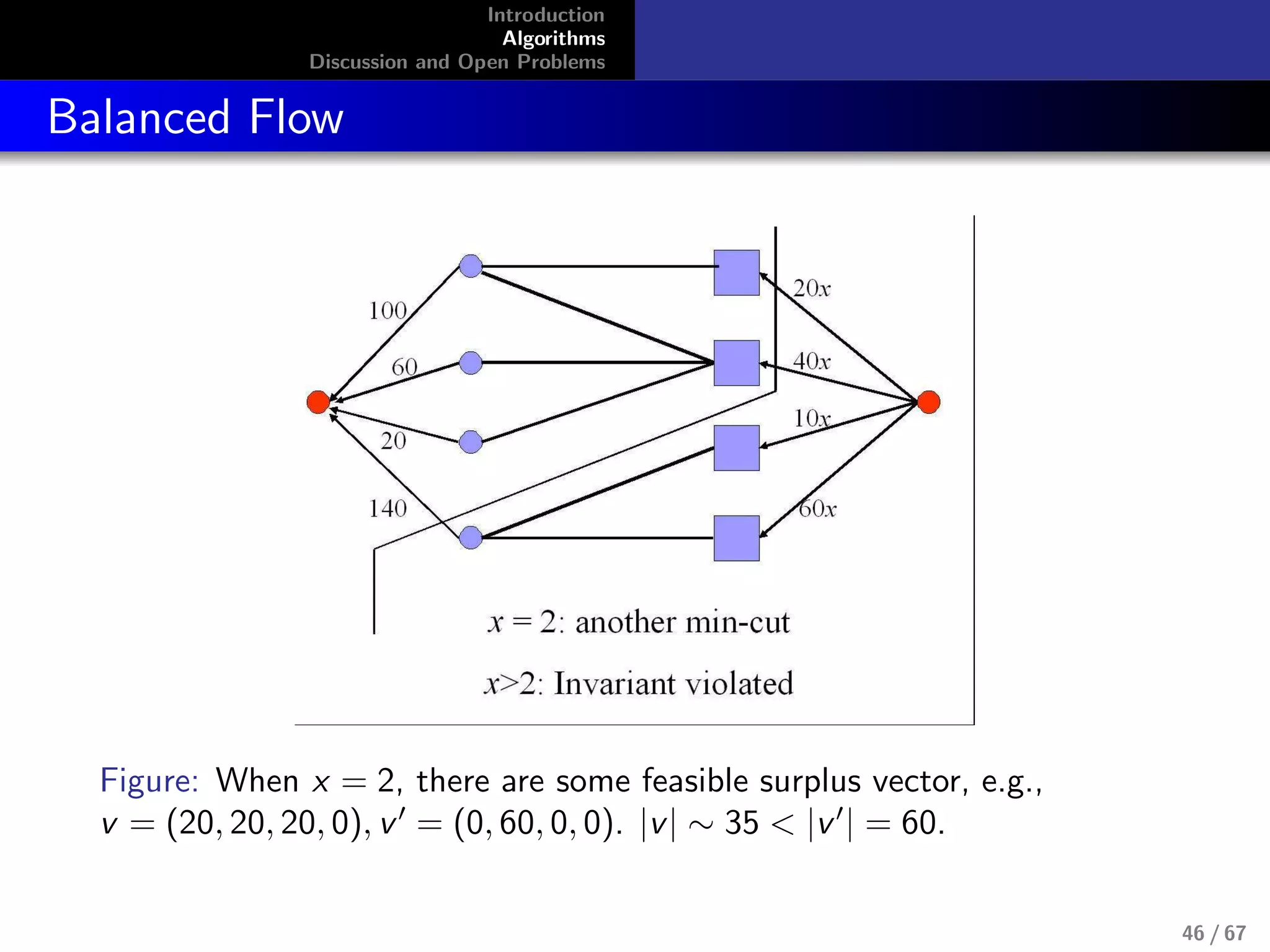
Balanced Flow
Figure: When x = 2, there are some feasible surplus vector, e.g.,
v = (20, 20, 20, 0), v = (0, 60, 0, 0). |v| ∼ 35 < |v | = 60.
46 / 67
Introduction
Algorithms
Discussion and Open Problems
Residual Network
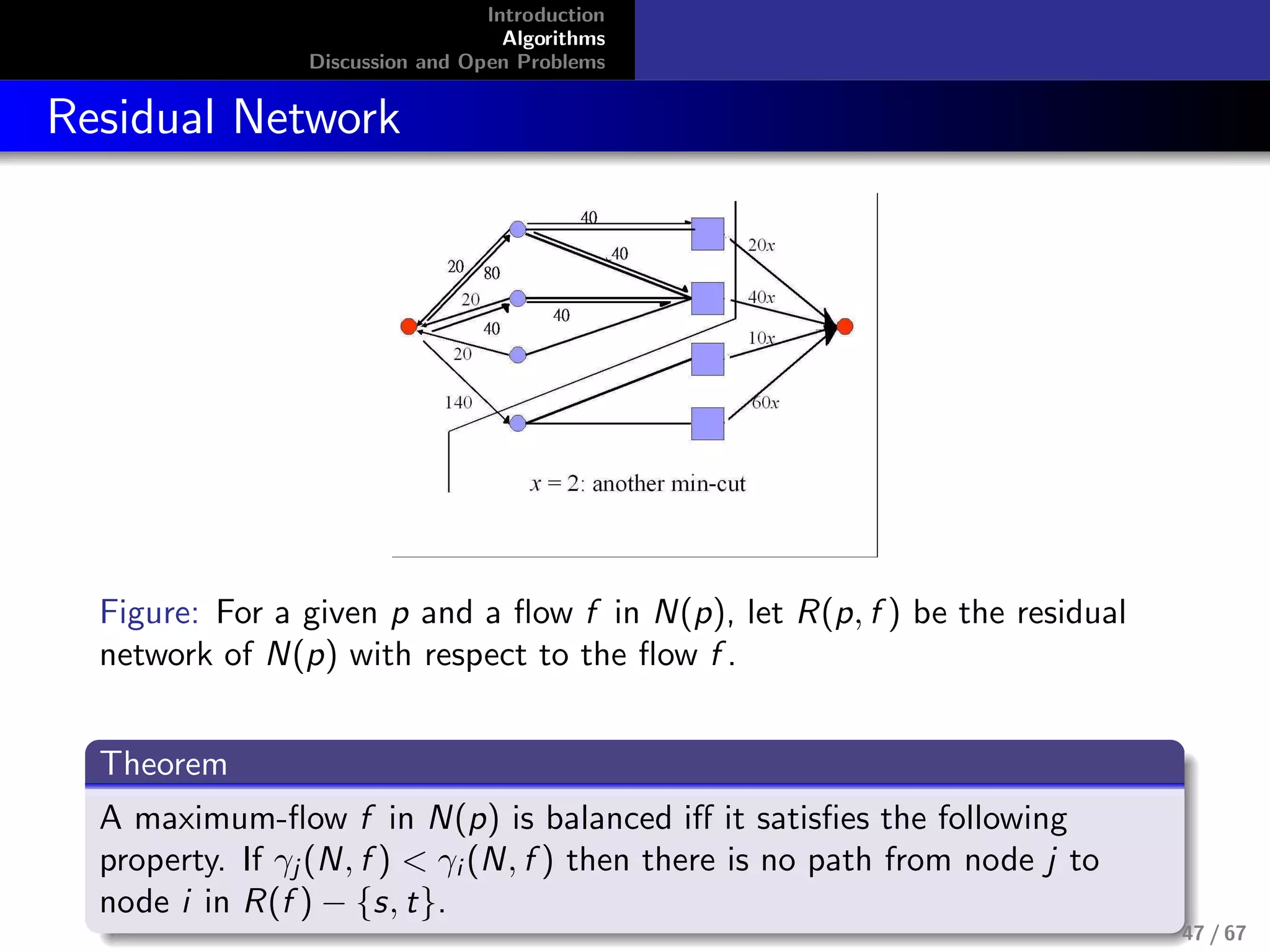
Figure: For a given p and a flow f in N(p), let R(p, f ) be the residual
network of N(p) with respect to the flow f .
Theorem
A maximum-flow f in N(p) is balanced iff it satisfies the following
property. If γj (N, f ) < γi (N, f ) then there is no path from node j to
node i in R(f ) − {s, t}.
47 / 67
Introduction
Algorithms
Discussion and Open Problems
Balanced Flow
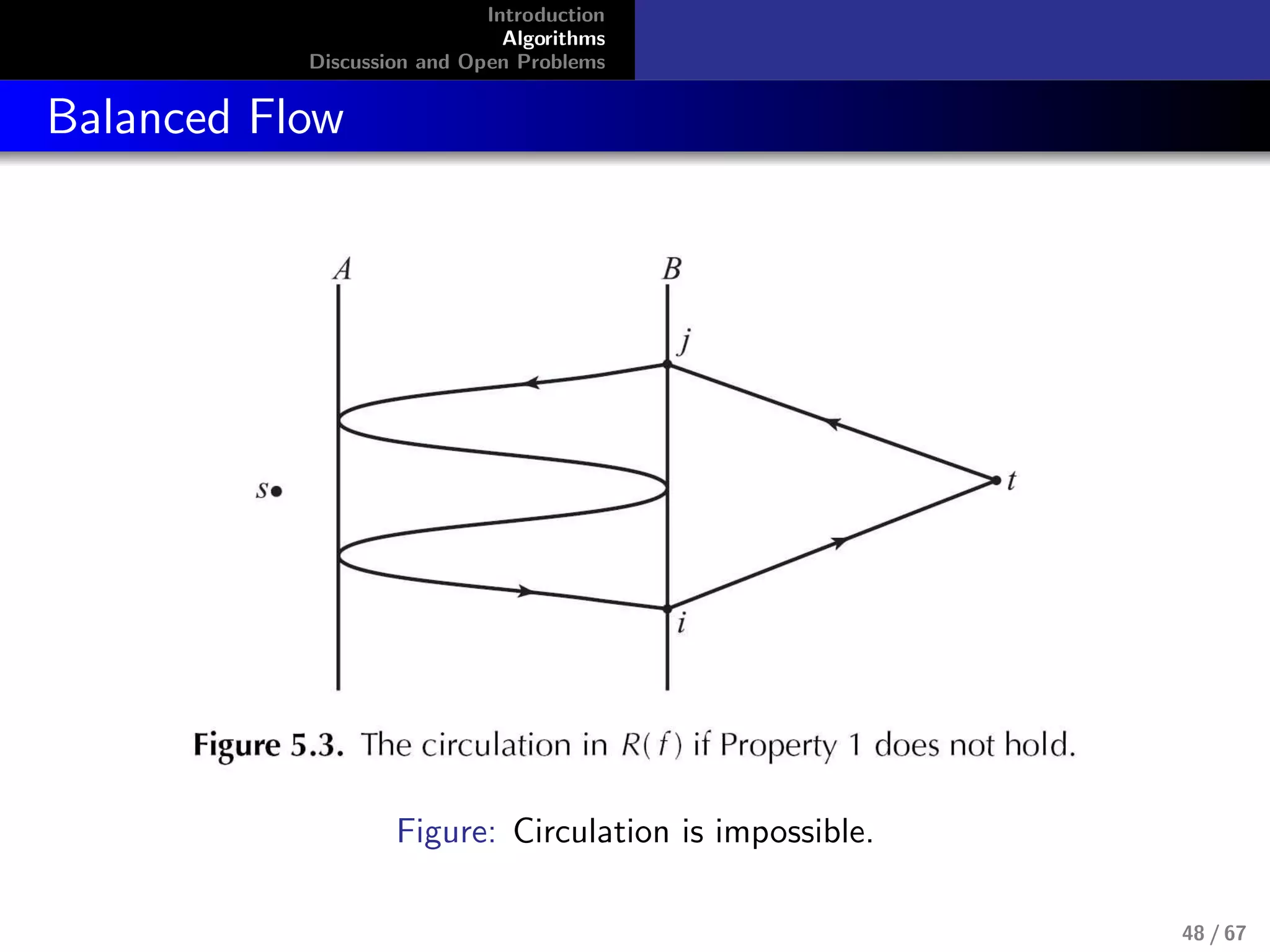
Figure: Circulation is impossible.
48 / 67
Introduction
Algorithms
Discussion and Open Problems
The Improved algorithm
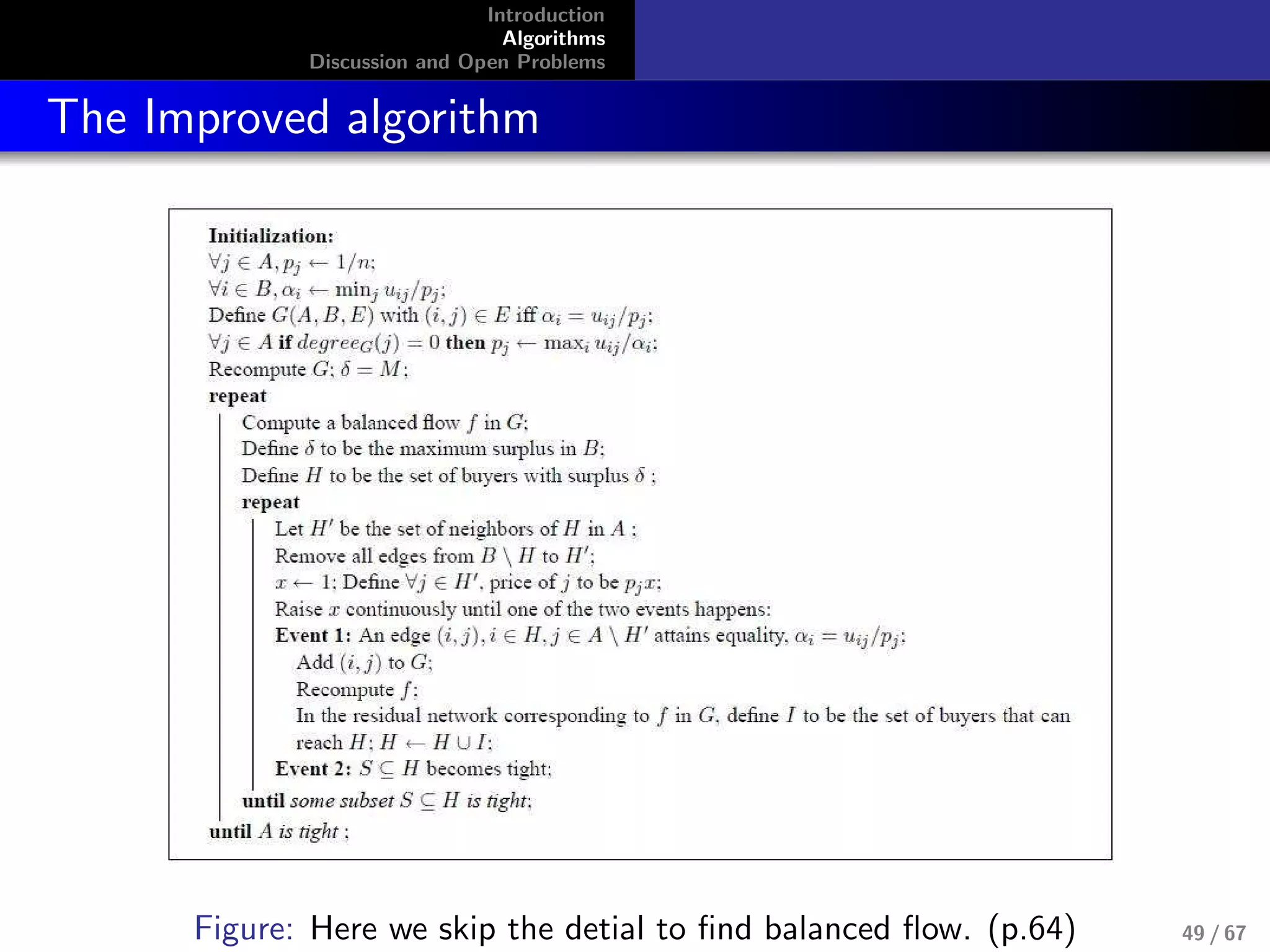
Figure: Here we skip the detial to find balanced flow. (p.64) 49 / 67
Introduction
Algorithms
Discussion and Open Problems
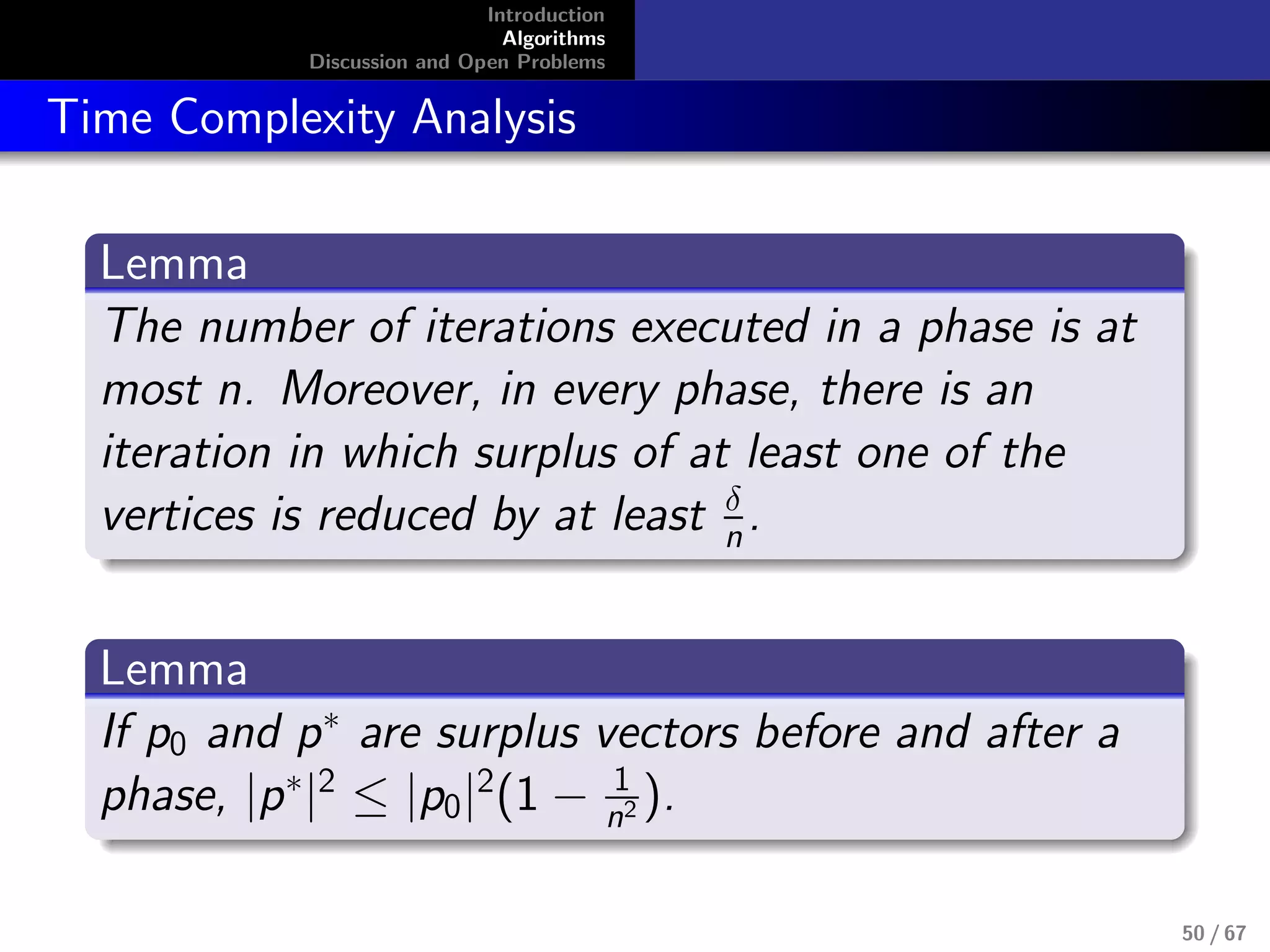
Time Complexity Analysis
Lemma
The number of iterations executed in a phase is at
most n. Moreover, in every phase, there is an
iteration in which surplus of at least one of the
vertices is reduced by at least δ
n.
Lemma
If p0 and p∗
are surplus vectors before and after a
phase, |p∗
|2
≤ |p0|2
(1 − 1
n2 ).
50 / 67
Introduction
Algorithms
Discussion and Open Problems
Time Complexity Analysis
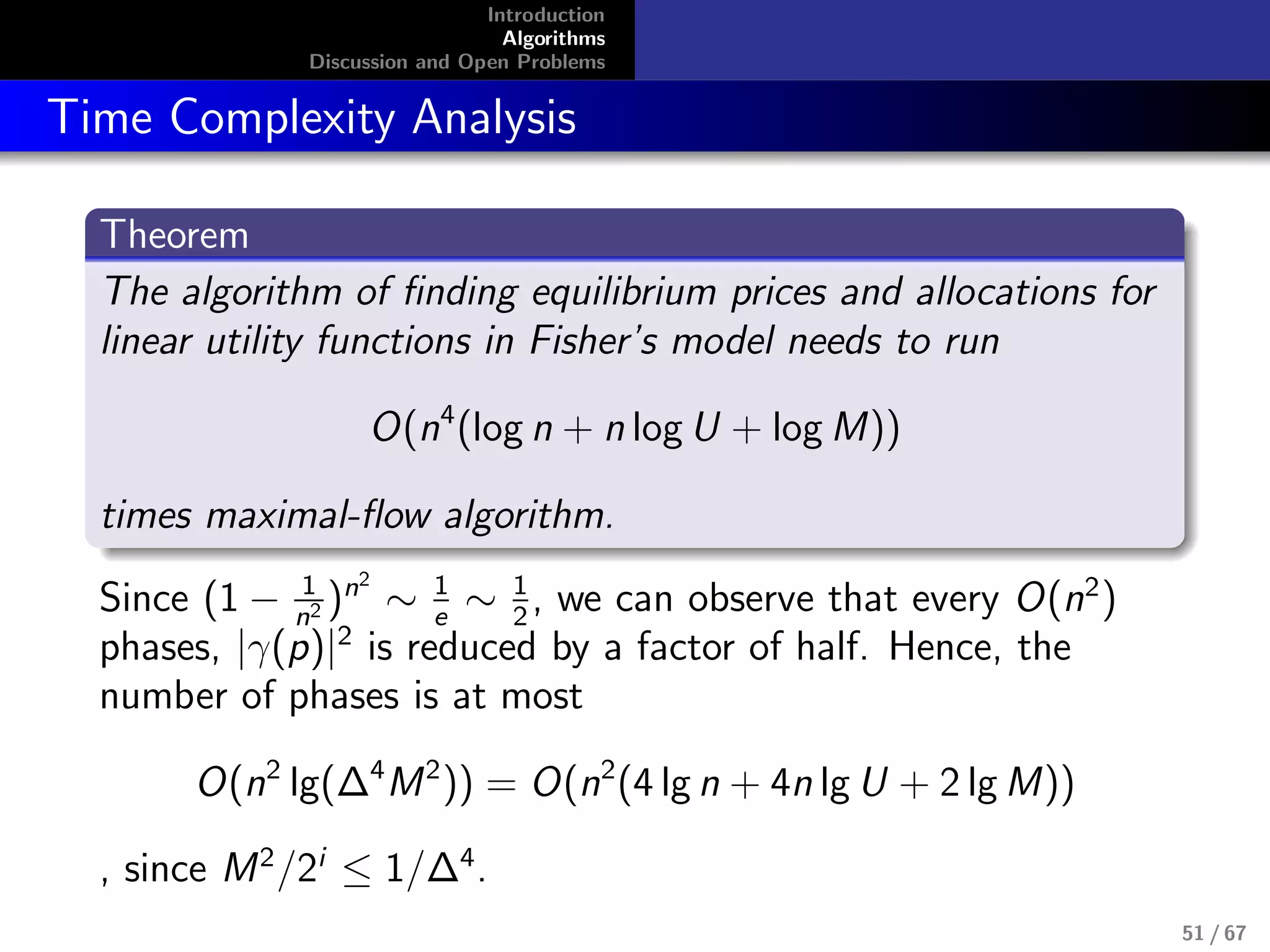
Theorem
The algorithm of finding equilibrium prices and allocations for
linear utility functions in Fisher’s model needs to run
O(n4
(log n + n log U + log M))
times maximal-flow algorithm.
Since (1 − 1
n2 )n2
∼ 1
e
∼ 1
2
, we can observe that every O(n2
)
phases, |γ(p)|2
is reduced by a factor of half. Hence, the
number of phases is at most
O(n2
lg(∆4
M2
)) = O(n2
(4 lg n + 4n lg U + 2 lg M))
, since M2
/2i
≤ 1/∆4
.
51 / 67
Introduction
Algorithms
Discussion and Open Problems
Arrow-Debreu model: An Auction-Based Algorithm
Jain proved that Arrow-Debreu’s Model with Linear Utility
Functions is in P at 2007[4], however it is based on ellipsoid
algorithm. And ellipsoid algorithm is slow in practice.
Garg et al. [3] proposed an auction-based PTAS for the linear
case of the Arrow-Debreu model.
52 / 67
Introduction
Algorithms
Discussion and Open Problems
An Auction-Based Algorithm[3]
1 Initializes the price of each good to be unit, computes the
worth of the initial endowment of each agent, and gives this
money to each agent. All goods are initially fully unsold.
2 LOOP UNTIL (the surplus of the traders becomes sufficiently
small, i.e., amin, or all the goods are assigned.)1
2.1 LOOP UNTIL (no agent has surplus money)
2.1.1 Agent i outbid to buy her optimal good j as many as possible,
i.e., at price (1 + )pj .
2.1.2 If agent i has all good j, update the worth of agents with
price (1 + )pj . And Jump to [2].
1
amin means the minimum amount of initial endowments which a agent has.
53 / 67
Introduction
Algorithms
Discussion and Open Problems
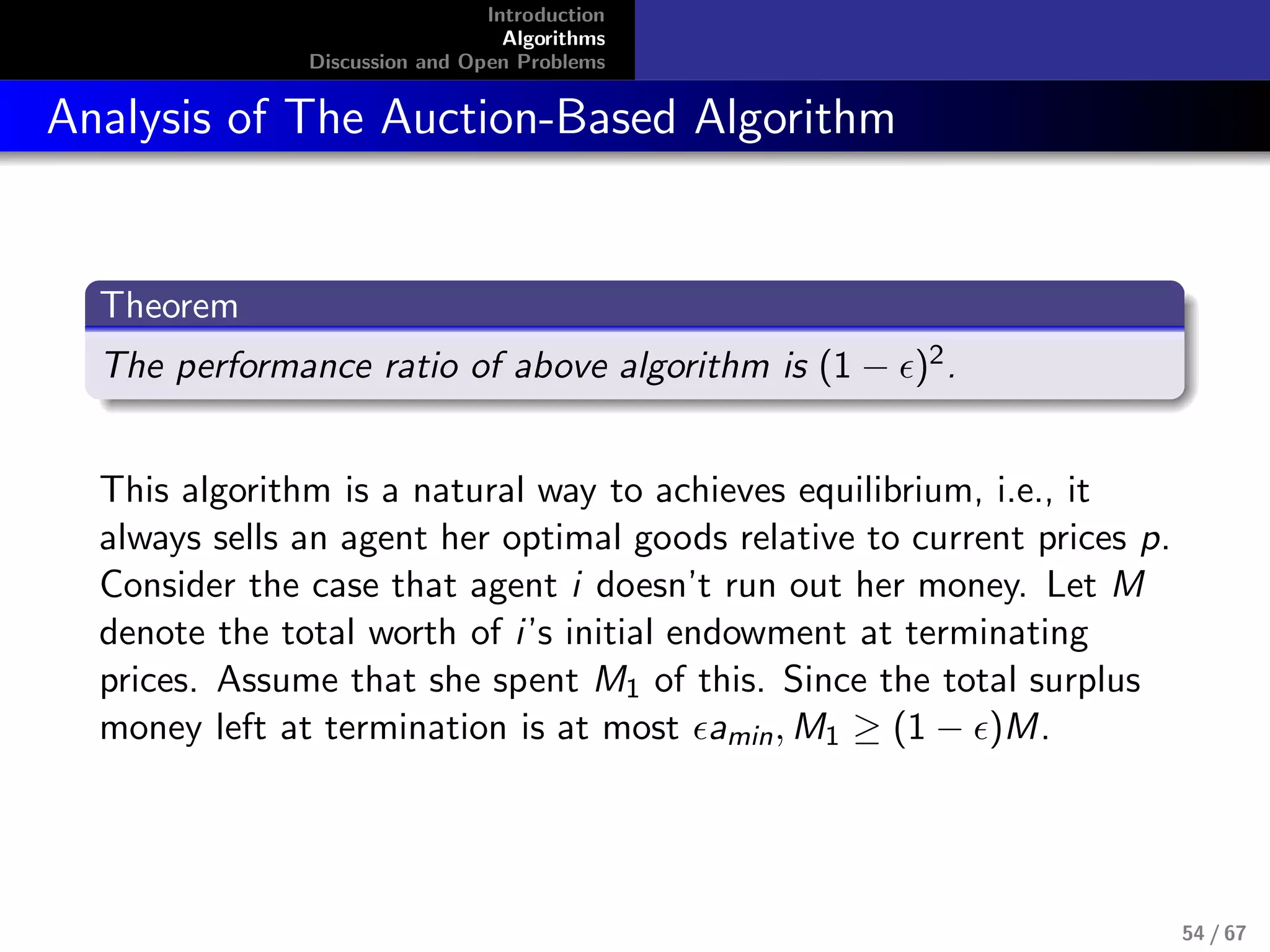
Analysis of The Auction-Based Algorithm
Theorem
The performance ratio of above algorithm is (1 − )2.
This algorithm is a natural way to achieves equilibrium, i.e., it
always sells an agent her optimal goods relative to current prices p.
Consider the case that agent i doesn’t run out her money. Let M
denote the total worth of i’s initial endowment at terminating
prices. Assume that she spent M1 of this. Since the total surplus
money left at termination is at most amin, M1 ≥ (1 − )M.
54 / 67
Introduction
Algorithms
Discussion and Open Problems
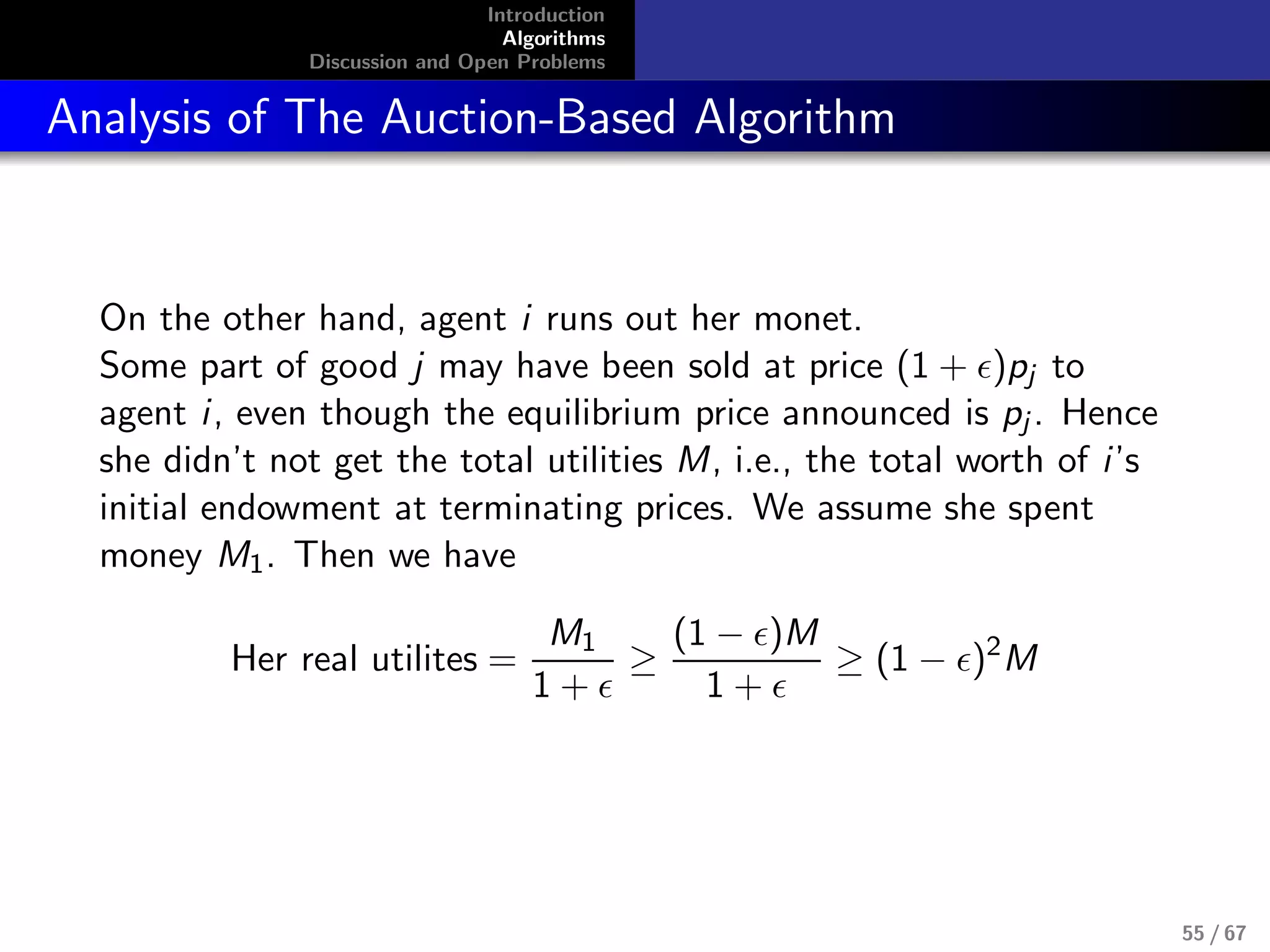
Analysis of The Auction-Based Algorithm
On the other hand, agent i runs out her monet.
Some part of good j may have been sold at price (1 + )pj to
agent i, even though the equilibrium price announced is pj . Hence
she didn’t not get the total utilities M, i.e., the total worth of i’s
initial endowment at terminating prices. We assume she spent
money M1. Then we have
Her real utilites =
M1
1 +
≥
(1 − )M
1 +
≥ (1 − )2
M
55 / 67
Introduction
Algorithms
Discussion and Open Problems
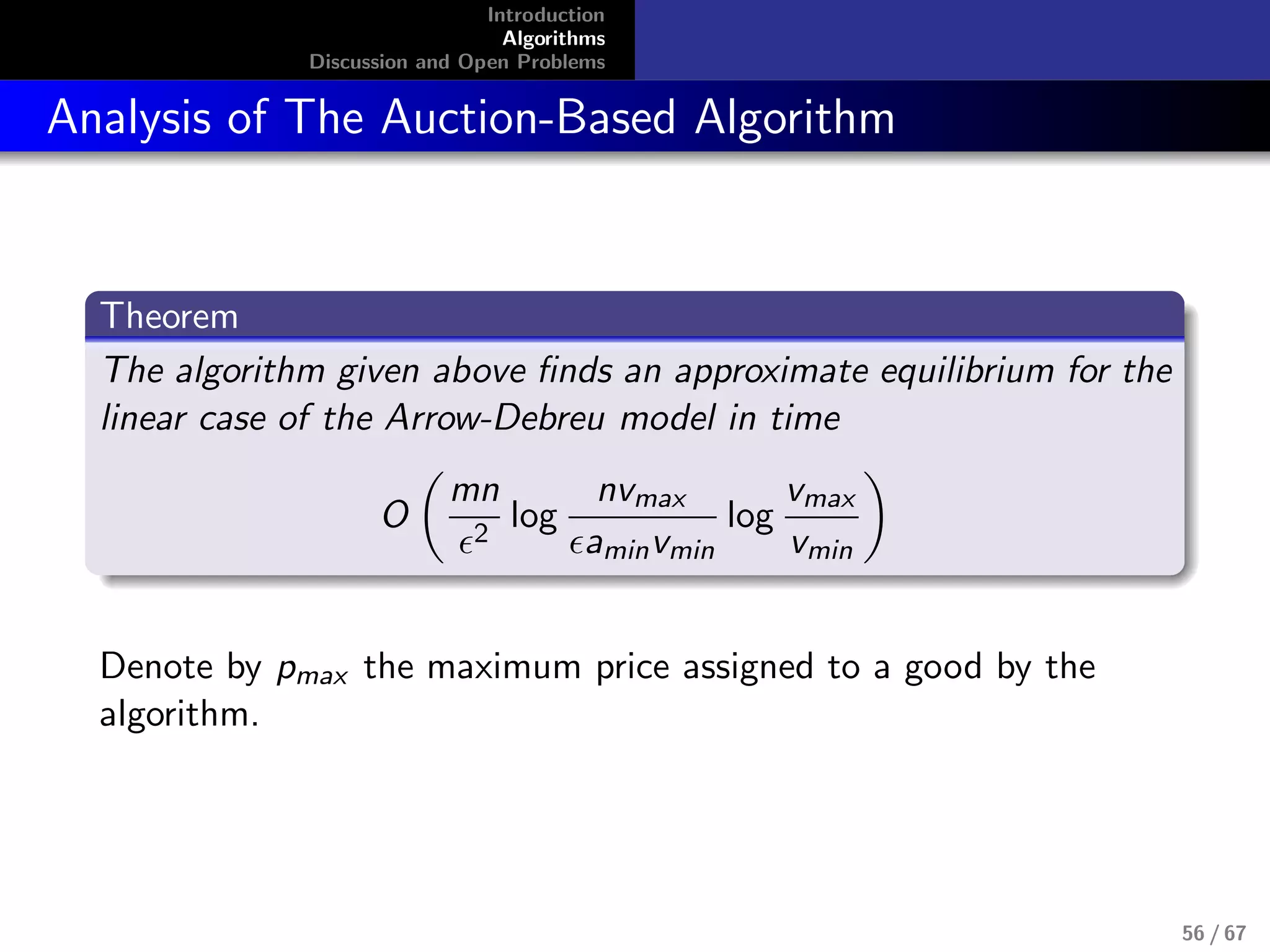
Analysis of The Auction-Based Algorithm
Theorem
The algorithm given above finds an approximate equilibrium for the
linear case of the Arrow-Debreu model in time
O
mn
2
log
nvmax
aminvmin
log
vmax
vmin
Denote by pmax the maximum price assigned to a good by the
algorithm.
56 / 67
Introduction
Algorithms
Discussion and Open Problems
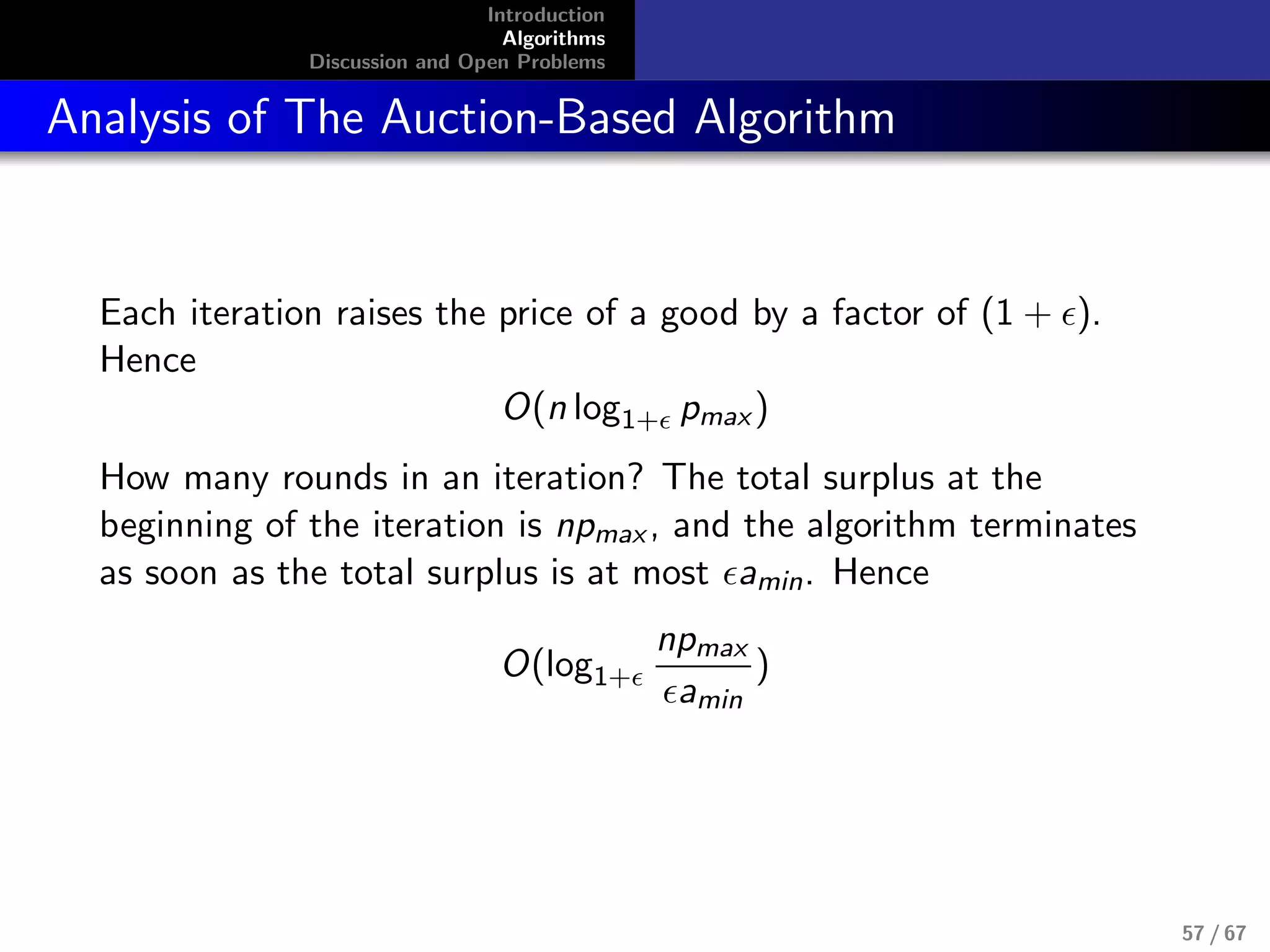
Analysis of The Auction-Based Algorithm
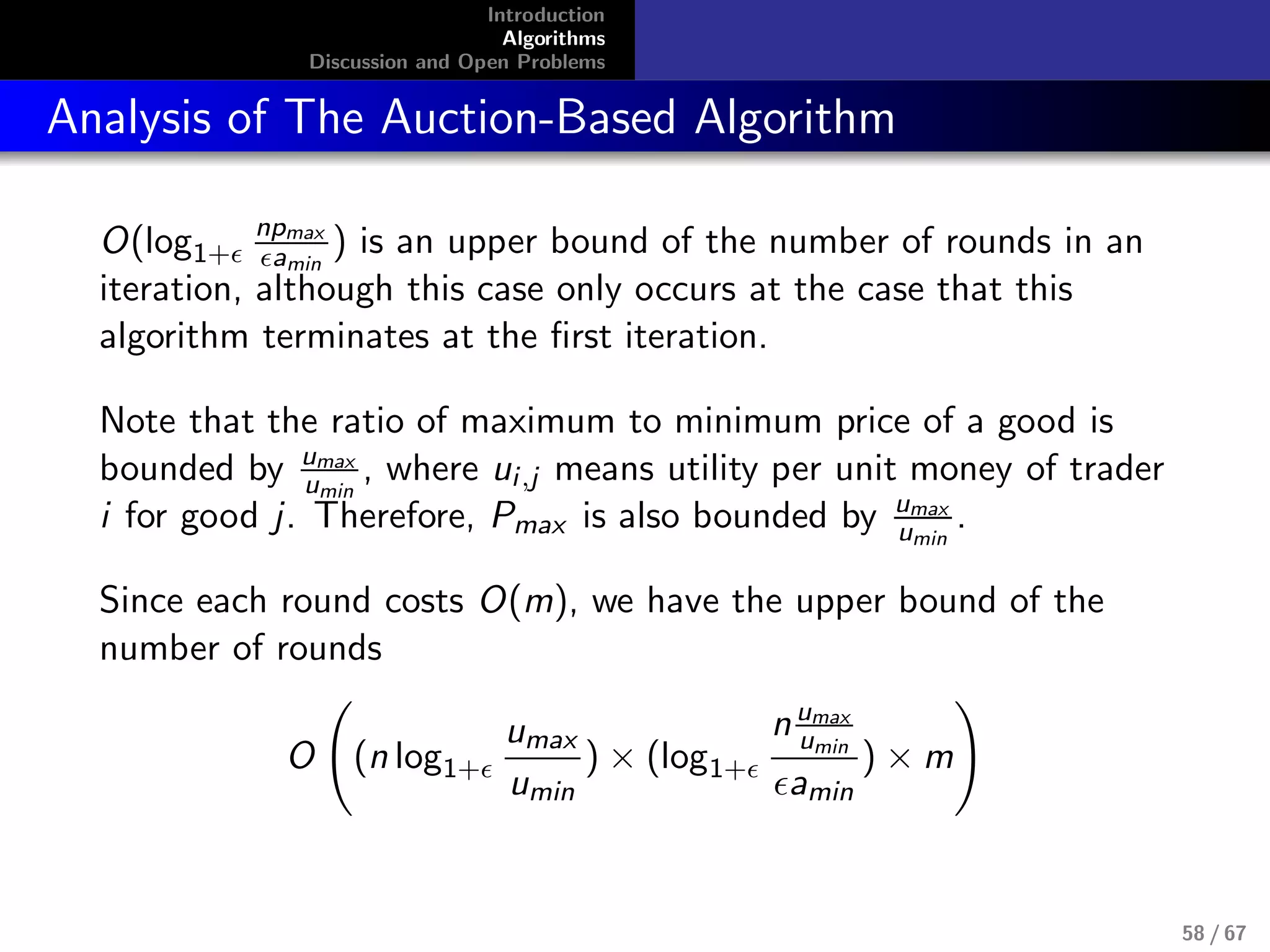
Each iteration raises the price of a good by a factor of (1 + ).
Hence
O(n log1+ pmax)
How many rounds in an iteration? The total surplus at the
beginning of the iteration is npmax, and the algorithm terminates
as soon as the total surplus is at most amin. Hence
O(log1+
npmax
amin
)
57 / 67
Introduction
Algorithms
Discussion and Open Problems
Analysis of The Auction-Based Algorithm
O(log1+
npmax
amin
) is an upper bound of the number of rounds in an
iteration, although this case only occurs at the case that this
algorithm terminates at the first iteration.
Note that the ratio of maximum to minimum price of a good is
bounded by umax
umin
, where ui,j means utility per unit money of trader
i for good j. Therefore, Pmax is also bounded by umax
umin
.
Since each round costs O(m), we have the upper bound of the
number of rounds
O (n log1+
umax
umin
) × (log1+
numax
umin
amin
) × m
58 / 67
Introduction
Algorithms
Discussion and Open Problems
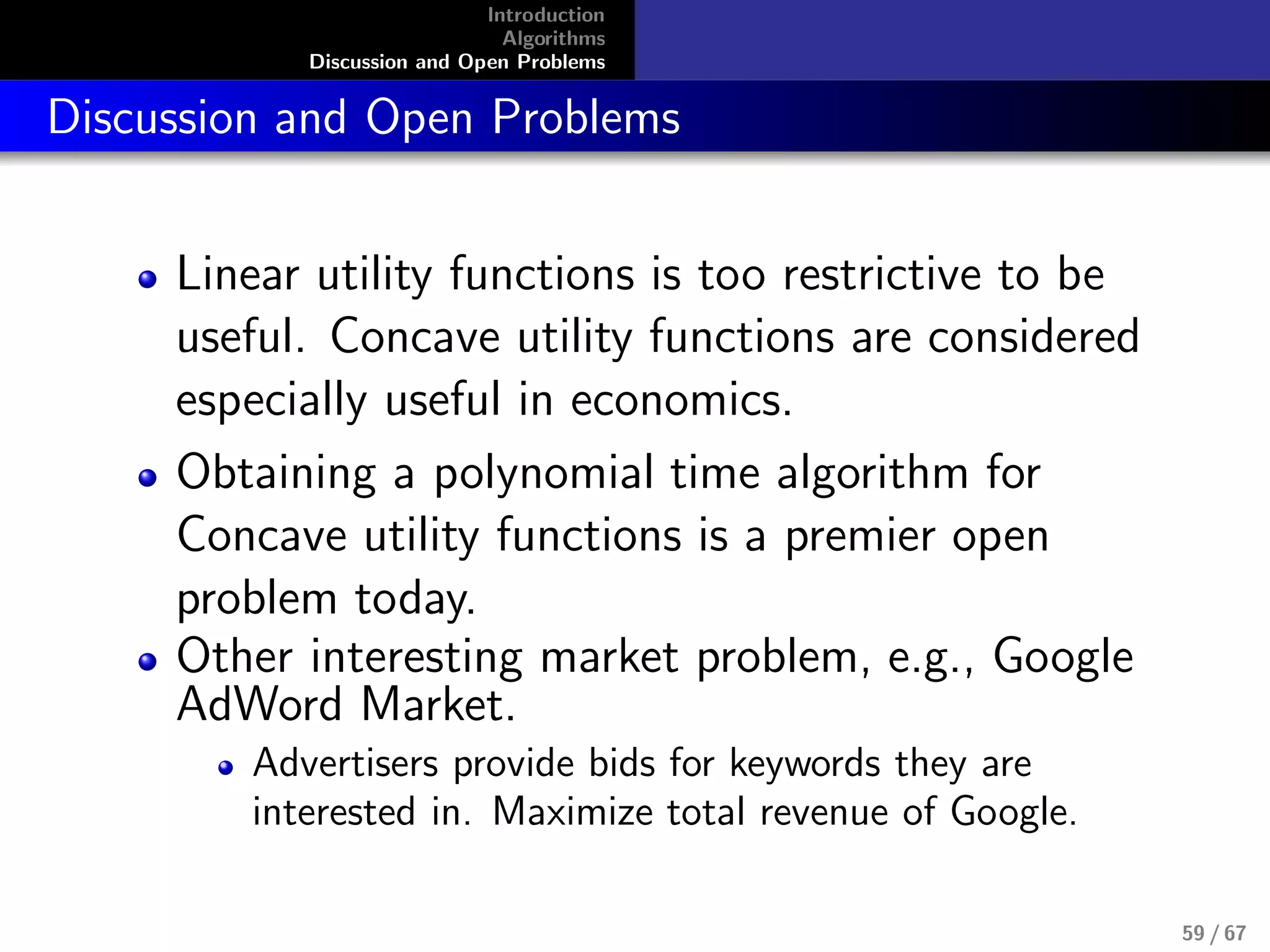
Linear utility functions is too restrictive to be
useful. Concave utility functions are considered
especially useful in economics.
Obtaining a polynomial time algorithm for
Concave utility functions is a premier open
problem today.
Other interesting market problem, e.g., Google
AdWord Market.
Advertisers provide bids for keywords they are
interested in. Maximize total revenue of Google.
59 / 67
Introduction
Algorithms
Discussion and Open Problems
References I
Devanur, N. R., Papadimitriou, C. H., Saberi, A., and Vazirani, V. V.
Market equilibrium via a primal-dual-type algorithm.
In FOCS ’02: Proceedings of the 43rd Symposium on Foundations of Computer Science (Washington, DC,
USA, 2002), IEEE Computer Society, pp. 389–395.
Devanur, N. R., Papadimitriou, C. H., Saberi, A., and Vazirani, V. V.
Market equilibrium via a primal–dual algorithm for a convex program.
J. ACM 55, 5 (2008), 1–18.
Garg, R., and Kapoor, S.
Auction algorithms for market equilibrium.
In STOC ’04: Proceedings of the thirty-sixth annual ACM symposium on Theory of computing (New York,
NY, USA, 2004), ACM, pp. 511–518.
Jain, K.
A polynomial time algorithm for computing an arrow–debreu market equilibrium for linear utilities.
SIAM Journal on Computing 37, 1 (2007), 303–318.
Nisan, N., Roughgarden, T., Tardos, E., and Vazirani, V. V.
Algorithmic Game Theory.
Cambridge University Press, New York, NY, USA, 2007.
60 / 67
Introduction
Algorithms
Discussion and Open Problems
How to Find the Tight Set
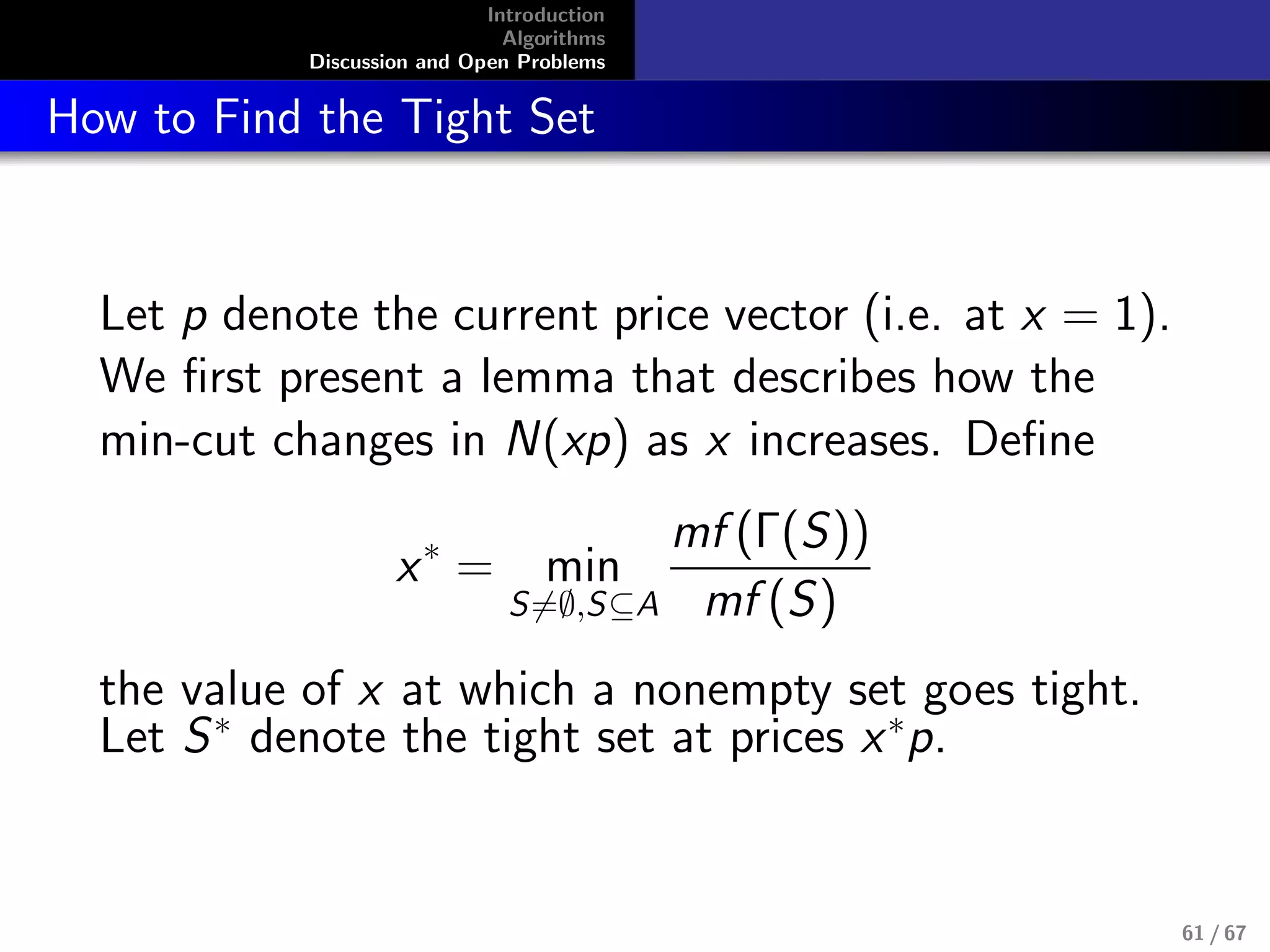
Let p denote the current price vector (i.e. at x = 1).
We first present a lemma that describes how the
min-cut changes in N(xp) as x increases. Define
x∗
= min
S=∅,S⊆A
mf (Γ(S))
mf (S)
the value of x at which a nonempty set goes tight.
Let S∗
denote the tight set at prices x∗
p.
61 / 67
Introduction
Algorithms
Discussion and Open Problems
Find the Tight Set
Recall Lemma 1
For given prices p network N(p) satisfies the
Invariant 1 iff.
∀S ⊆ A, mf (S) ≤ mf (Γ(S))
if x ≤ x∗
, then (s, A ∪ B ∪ t) is a min-cut.
if x > x∗
, then (s, A ∪ B ∪ t) is not a min-cut.
If (s ∪ A1 ∪ B1, A2 ∪ B2 ∪ t) is a min-cut in
N(xp) then S∗
⊂ A1.
62 / 67
Introduction
Algorithms
Discussion and Open Problems
Find the Tight Set
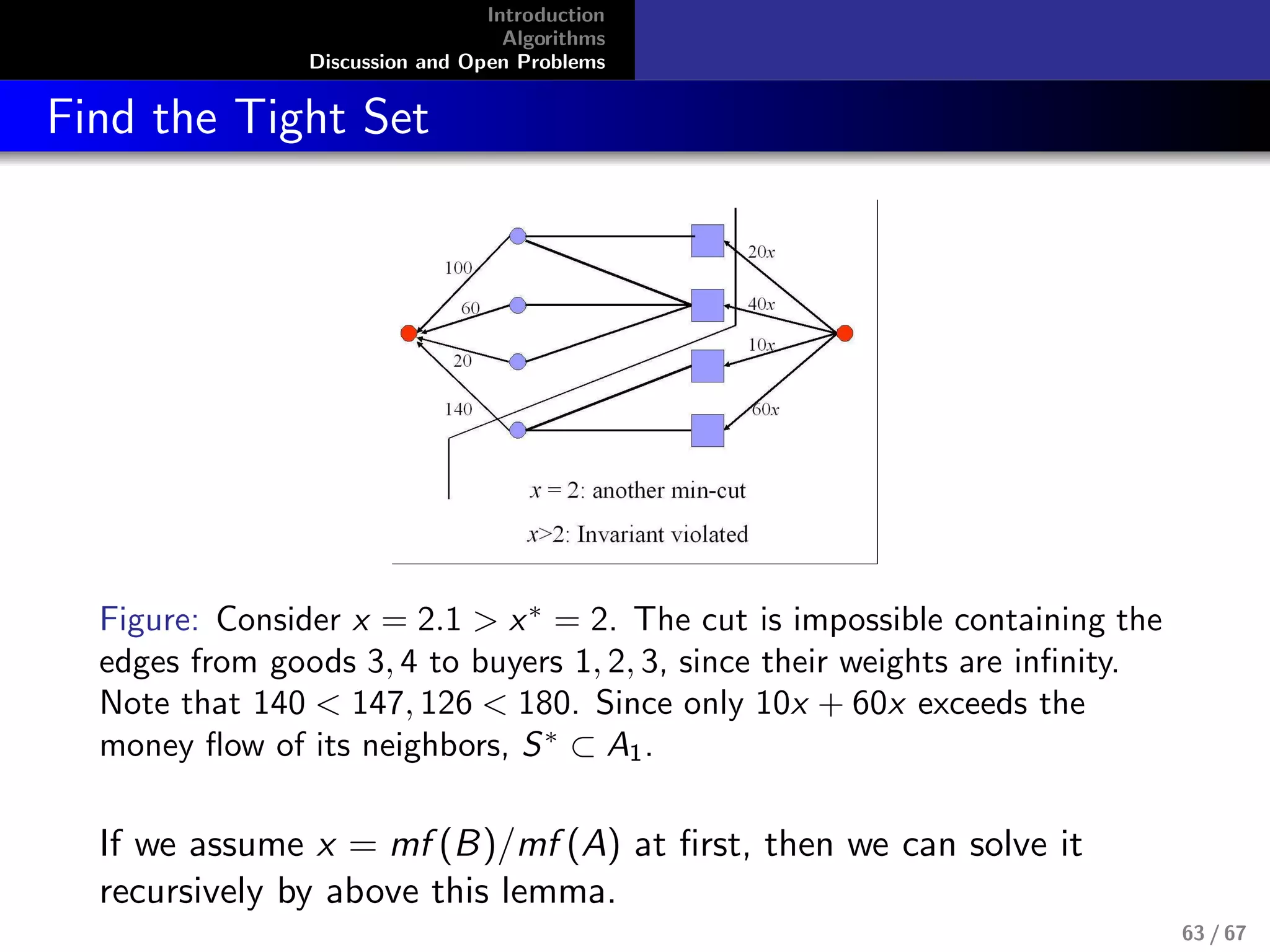
Figure: Consider x = 2.1 > x∗
= 2. The cut is impossible containing the
edges from goods 3, 4 to buyers 1, 2, 3, since their weights are infinity.
Note that 140 < 147, 126 < 180. Since only 10x + 60x exceeds the
money flow of its neighbors, S∗
⊂ A1.
If we assume x = mf (B)/mf (A) at first, then we can solve it
recursively by above this lemma.
63 / 67
Introduction
Algorithms
Discussion and Open Problems
Balanced Flow
Theorem
Computing the balanced flow needs to run at most n times
maximal-flow algorithm.
Sketch of Proof : Let mavg := ( i m(i) − j pj )/|B| . Compute
the maximum flow in the equality subgraph after subtracting mavg
from the capacity of each edge adjacent t. Let (S, T) be the
maximal s-t min-cut in that network. s ∈ S, t ∈ T. If T = {t}
then the current maximum flow is balanced. Otherwise, let N1 and
N2 be the networks induced by T ∪ {s} and S ∪ {t} respectively.
Repeated by divided and conquer approach.
64 / 67
Introduction
Algorithms
Discussion and Open Problems
Sketch of Proof of Theorem of Balanced Flow
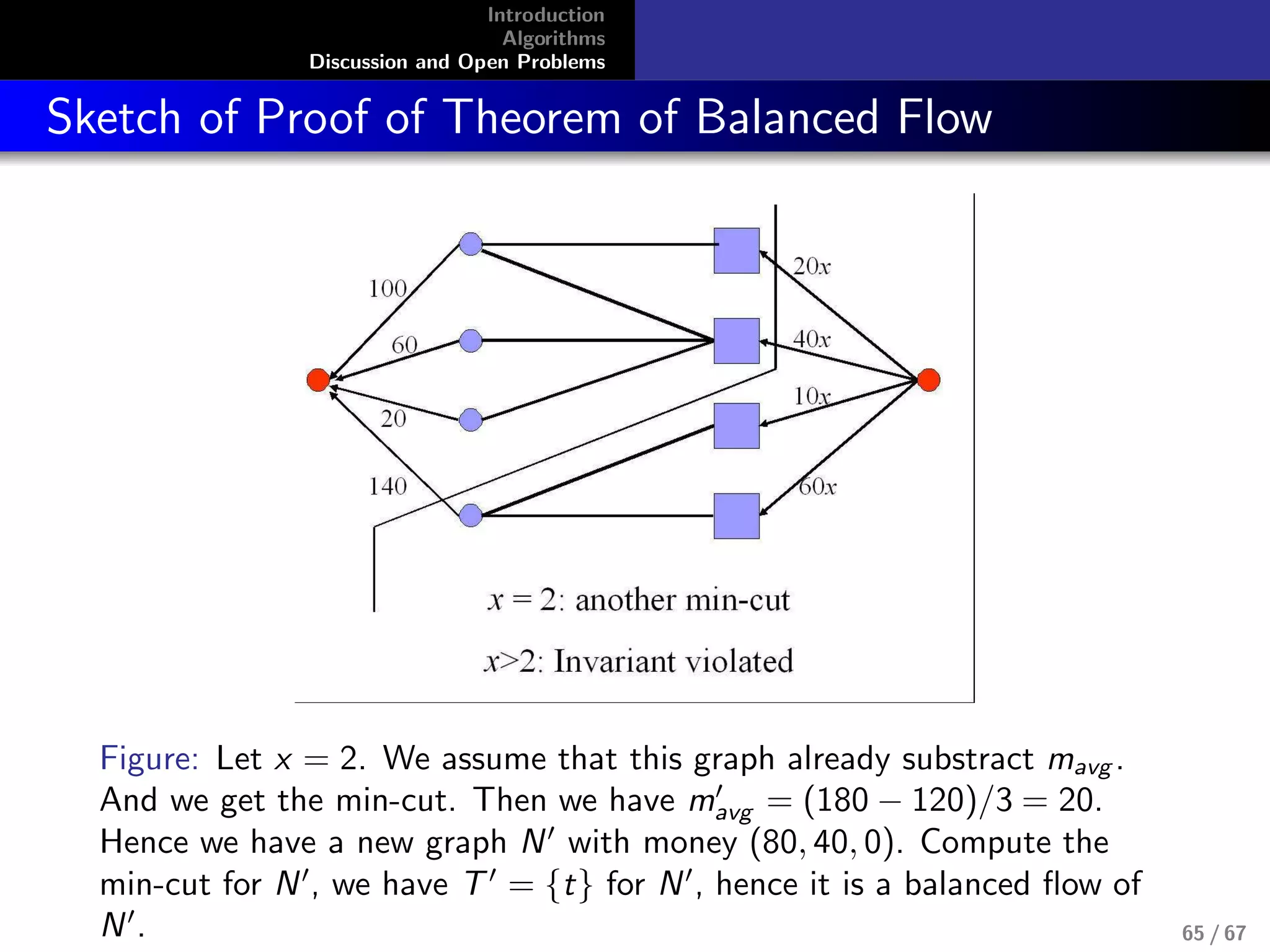
Figure: Let x = 2. We assume that this graph already substract mavg .
And we get the min-cut. Then we have mavg = (180 − 120)/3 = 20.
Hence we have a new graph N with money (80, 40, 0). Compute the
min-cut for N , we have T = {t} for N , hence it is a balanced flow of
N . 65 / 67
Introduction
Algorithms
Discussion and Open Problems
Sketch of Proof of Theorem of Balanced Flow
Claim that the union of balanced flows in N1 and N2
is a balanced flow in N(p).
66 / 67
Introduction
Algorithms
Discussion and Open Problems
Sketch of Proof of Theorem of Balanced Flow
Clearly, the number of goods in the biggest piece
drops by at least 1 in each iteration. Therefore, the
depth of recursion is at most n.
Observe that the sub-instance of size 1 doesn’t need
to compute max-flow.
Hence, the total computational overhead is n
max-flow computations.
67 / 67

Introduction to Algorithmic aspect of Market Equlibra

  • 1.
    Introduction Algorithms Discussion and OpenProblems Introduction to Algorithmic Aspect of Market Equilibria Abner Chih Yi Huang March 26, 2009 CSBB Lab, CS, NTHU 1 / 67
  • 2.
    Introduction Algorithms Discussion and OpenProblems Materials Vijay V. Vazirani, chapter 5, Algorithmic Game Theory, Cambridge University Press, 2008.[5] Devanur, et al., Market Equilibrium via a Primal-Dual-Type Algorithm, FOCS’02, 389-395.[1] Devanur, et al., Market equilibrium via a primal–dual algorithm for a convex program, J. ACM, 2008, v. 55, pp.1-18[2] 2 / 67
  • 3.
    Introduction Algorithms Discussion and OpenProblems Terminology Market? Fisher’s model, 1891 Arrow-Debreu model, 1954 Efficiency? Equilibria? Existence? 3 / 67
  • 4.
    Introduction Algorithms Discussion and OpenProblems Fisher’s model n buyers, with specified money, m(i) for buyer i k goods (unit amount of each good) Linear utilities (效用/爽度): ui,j is utility derived by i on obtaining one unit of j. Total utility of buyer i, ui = j ui,jxi,j 4 / 67
  • 5.
    Introduction Algorithms Discussion and OpenProblems Arrow-Debreu model n buyers, k goods (unit amount of each good) Linear utilities : ui,j is utility derived by i on obtaining one unit of j. Total utility of buyer i, ui = j ui,jxi,j The Arrow-Debreu model is also known as the Walrasian model or the exchange model (以物易物), and it generalizes Fisher’s model. 5 / 67
  • 6.
    Introduction Algorithms Discussion and OpenProblems Pareto improvement, 1886 Definition Given a set of alternative allocations of, say, goods or income for a set of individuals, a movement from one allocation to another that can make at least one individual better off without making any other individual worse off is called a Pareto improvement. Definition An allocation is Pareto efficient or Pareto optimal when no further Pareto improvements can be made. This is often called a strong Pareto optimum (SPO). 6 / 67
  • 7.
    Introduction Algorithms Discussion and OpenProblems Market-Clearing Price Definition The price at Market equilibrium is often called the equilibrium price or market clearing price and will tend not to change unless demand or supply change. Figure: The price at Market equilibrium 7 / 67
  • 8.
    Introduction Algorithms Discussion and OpenProblems Market Models Have Equilibria Definition A competitive equilibrium is a market, for Fisher’s model or Arrow-Debreu model, with the following assumptions. complete markets No Uncertainty, i.e., we can calculate the future deterministically. perfect competition All information are available, i.e., preferences and budgets, are public. Zero transaction cost local nonsatiation of preferences preference function are continuous and strictly increasing in all goods, i.e., more is better. 8 / 67
  • 9.
    Introduction Algorithms Discussion and OpenProblems First Fundamental Theorem of Welfare Economics Theorem (Arrow-Debreu, 1954) Any competitive equilibrium or Walrasian equilibrium leads to an Pareto efficient allocation of resources. In other words, Theorem (Adam Smith’s invisible hand) That competitive markets tend toward the efficient allocation of resources. 9 / 67
  • 10.
    Introduction Algorithms Discussion and OpenProblems Combinatorial Algorithm for Fisher’s Model Problem Given a market of Fisher’s model, what is the market equilibria? In the other words, what is the price such that the total utility of all people in this market is maximum? INPUT: Linear utility functions of buyers, integral money of buyers, divisible goods. OUTPUT: The prices of goods. Measurement: Total utilities. 10 / 67
  • 11.
    Introduction Algorithms Discussion and OpenProblems Combinatorial Algorithm for Fisher’s Model No LP’s known for capturing equilibrium allocations for Fisher’s model, although this model doesn’t require integer constraints. max i ui , s.t., j pj xi,j ≤ mi , ui = j ui,jxi,j Devanur, Papadimitriou, Saberi, and Vazirani, 2002[1] Use primal-dual schema. It is highly successful algorithm design technique from exact and approximation algorithms 11 / 67
  • 12.
    Introduction Algorithms Discussion and OpenProblems Combinatorial Algorithm for Fisher’s Model Ask firstly: Given prices p, are they equilibrium prices? 12 / 67
  • 13.
    Introduction Algorithms Discussion and OpenProblems Reduce It to Assignment Problem Figure: An edge exists if and only if it produce maximum utilities ratio. 13 / 67
  • 14.
    Introduction Algorithms Discussion and OpenProblems Example of Building Equality Graph N(p) Figure: The 4-tuple of each buyer means the linear coefficients of utility function, i.e., (ui,1, ui,2, ui,3, ui,4). 14 / 67
  • 15.
    Introduction Algorithms Discussion and OpenProblems Example of Building Equality Graph N(p) Figure: For buyer 1, we have ui,1 p1 = 1 25 , ui,2 p2 = 1 5 , ui,3 p3 = 1 2 , ui,4 p4 = 2 9 . Hence we can connect 1, 3 by an edge. 15 / 67
  • 16.
    Introduction Algorithms Discussion and OpenProblems Example of Building Equality Graph N(p) Figure: Build N(p) by similar way. 16 / 67
  • 17.
    Introduction Algorithms Discussion and OpenProblems Reduce It to Maximal Flow Problem Figure: Hence, we can construct the network of p, which is denoted by N(p), if p is given. 17 / 67
  • 18.
    Introduction Algorithms Discussion and OpenProblems A Verifying Algorithm of Market Clearing Prices Theorem The price p is equilibrium prices iff in the network N(p) the two cuts (s, A ∪ B ∪ t) and (s ∪ A ∪ B, t) are min-cuts. If so, allocations corresponding to any max-flow in N are equilibrium allocations. 18 / 67
  • 19.
    Introduction Algorithms Discussion and OpenProblems Computing Market Clearing Prices for Linear Fisher Model Now we have a verifier. Could we devise an algorithm to compute Market Clearing Prices for Linear Fisher Model? 19 / 67
  • 20.
    Introduction Algorithms Discussion and OpenProblems Idea of Algorithm ”primal” variables: allocations ”dual” variables: prices of goods Approach equilibrium prices from below: start with very low prices; buyers have surplus money iteratively. Keep raising prices and decreasing surplus. i.e., iterations of executing primal & dual improvements 20 / 67
  • 21.
    Introduction Algorithms Discussion and OpenProblems Recall: maximum-flow problem FORD-FULKERSON Method costs O(|E||f ∗|). Find augmenting path repeatedly. Augmenting path with better property is critical! Edmonds-Karp algorithm runs in O(|V ||E|2) time. 21 / 67
  • 22.
    Introduction Algorithms Discussion and OpenProblems Invariant 1 Invariant 1 Let A, B denote goods and buyers respectively. The prices p are such that (s, A ∪ B ∪ t) is a min-cut in N(p). The Invariant ensures that, at current prices, all goods can be sold. The only eventuality is that buyers may be left with surplus money. When the surplus vanishes, market clearing prices have been attained. 22 / 67
  • 23.
    Introduction Algorithms Discussion and OpenProblems Invariant 1 Definition Let A, B denote goods and buyers respectively. For S ⊆ B, define its money flow mf (S) = i∈S m(i). For S ⊆ A, define its money flow mf (S) = i∈S p(i). Definition Let Γ(S) denote the neighborhood in the bipartite graphs G(A, B, E). Lemma For given prices p network N(p) satisfies the Invariant 1 iff. ∀S ⊆ A, mf (S) ≤ mf (Γ(S)) 23 / 67
  • 24.
  • 25.
    Introduction Algorithms Discussion and OpenProblems Invariant 1 If the Invariant 1 holds, it is easy to see that there is a unique maximal set S ⊆ A such that mf (S) = mf (Γ(S)). (S, Γ(S)) is the tight set w.r.t. prices p. The subgraph induced by (S, Γ(S)) is named frozen subgraph. The active subgraph is the induced subgraph of G by (A − S, B − Γ(S)). 25 / 67
  • 26.
    Introduction Algorithms Discussion and OpenProblems Lemma Lemma If the Invariant 1 holds and S ⊆ A is the tight set, then each good j ∈ (A − S) has an edge, in the graph N(p), to some buyer i ∈ (B − Γ(S)). Consider a buyer j ∈ (A − S). If all edges of j incident to Γ(S), then mf (S ∪ j) > mf (S) = mf (Γ(S)) = mf (Γ(S ∪ j)). 26 / 67
  • 27.
    Introduction Algorithms Discussion and OpenProblems Physical Meaning of Invariant 1 Consider the set S such that mf (S) = mf (Γ(S)). Tight set S means p(Γ(S)) are equilibrium prices of the sub-market. It is Pareto optimum, since the prices of goods in the tight set cannot be increased without violating the Invariant 1. 27 / 67
  • 28.
    Introduction Algorithms Discussion and OpenProblems Physical Meaning of Invariant 1 The active subgraph implies that the prices of goods 3, 4 are too high to buyer 4. Hence sellers need to reduce prices. Note that we can avoid this case by starting with very low prices. Another case is the prices of goods 3, 4 are too low to buyer 4. Seller just raise the prices. 28 / 67
  • 29.
    Introduction Algorithms Discussion and OpenProblems Basic Algorithm 29 / 67
  • 30.
    Introduction Algorithms Discussion and OpenProblems Basic Algorithm We would like to raise prices of goods in the active subgraph in such a way that the equality edges in it are retained. The algorithm raises x, starting with x = 1, until one of the following happens: Event 1: A set R = ∅ goes tight in the active subgraph. Event 2: An new equality edge from goods in S to buyers outside the tight set. 30 / 67
  • 31.
    Introduction Algorithms Discussion and OpenProblems An Example of Basic Algorithm 31 / 67
  • 32.
    Introduction Algorithms Discussion and OpenProblems An Example of Basic Algorithm 32 / 67
  • 33.
    Introduction Algorithms Discussion and OpenProblems An Example of Basic Algorithm 33 / 67
  • 34.
    Introduction Algorithms Discussion and OpenProblems An Example of Basic Algorithm 34 / 67
  • 35.
    Introduction Algorithms Discussion and OpenProblems An Example of Basic Algorithm 35 / 67
  • 36.
    Introduction Algorithms Discussion and OpenProblems An Example of Basic Algorithm 36 / 67
  • 37.
    Introduction Algorithms Discussion and OpenProblems Basic Algorithm Hence, there is an intuitive approach to solve this problem by raising the prices of goods in A − S until arriving the goal. Like the idea of FORD-FULKERSON Method, it will increase the utilities by finding tight sets until the only tight set is (A, B). We skip the details of finding the tight set. (p. 61) 37 / 67
  • 38.
    Introduction Algorithms Discussion and OpenProblems Time Complexity of Basic Algorithm Basic algorithm is to solve this problem by raising the prices of goods in A − S until arriving the goal. The execution sequence: ↑, ↑, ↑, E1, ↑, ↑, E2, ↑, E1, ↑, E2, ↑, ↑, ↑, ↑, E2, ↑, · · · We can divide it into phases. ↑, ↑, ↑, E1 Phase 1 , ↑, ↑, E2, ↑, E1 Phase 2 , ↑, E2, ↑, ↑, ↑, ↑, E2, ↑, · · · ··· Each phase is partitioned into iterations which conclude with a new edge entering the equality subgraph. 38 / 67
  • 39.
    Introduction Algorithms Discussion and OpenProblems Time Complexity of Basic Algorithm Let M be the total money possessed by the buyers and let f be the max-flow computed in network N(p) at current prices p. Thus M − f is the surplus money with the buyers. Let U = maxi,j{ui,j} and let ∆ = nUn . Lemma At the termination of a phase, the prices of goods in the newly tight set must be rational numbers with denominator ≤ ∆. 39 / 67
  • 40.
    Introduction Algorithms Discussion and OpenProblems Time Complexity of Basic Algorithm Lemma At the termination of a phase, the prices of goods in the newly tight set must be rational numbers with denominator ≤ ∆. Figure: Consider the newly tight set (S, Γ(S)) as a connected bipartite graph. We can derive mf (S) = pj c/d ⇒ pj = mf (Γ(S))d/c. 40 / 67
  • 41.
    Introduction Algorithms Discussion and OpenProblems Time Complexity of Basic Algorithm Lemma Each phase consists of at most n iterations. Lemma Consider two phases P and P , not necessarily consecutive, such that good j lies in the newly tight sets at the end of P as well as P . Then the increase in the price of j, going from P to P , is ≥ 1/∆2 . 41 / 67
  • 42.
    Introduction Algorithms Discussion and OpenProblems Time Complexity of Basic Algorithm lemma tight set can be found using n max-flow computations. Lemma Basic Algorithm terminates with market clearing prices in at most M∆2 phases, and executes O(Mn2 ∆2 ) max-flow computations. No one discovered a technique to bound the running time in P of this approach. 42 / 67
  • 43.
    Introduction Algorithms Discussion and OpenProblems Recall: Maximum-Flow problem Figure: FORD-FULKERSON Method is not in P. Edmonds-Karp algorithm runs in O(|V ||E|2 ) time by finding better augmenting path. How do we ensure that the surplus money of buyers reduces fast enough that the algorithm terminates in polynomial time? 43 / 67
  • 44.
    Introduction Algorithms Discussion and OpenProblems Establishing polynomial running time Like Maximal-Flow problem, the method of finding improvement solution is critical. The authors proposed a method named balanced flow. For a given flow f in the network N(p), define the surplus of buyer i, γ(p, f ), to be the residual capacity of the edge (i, t) with respect to f , which is equal to mi minus the flow sent through the edge (i, t). Define the surplus vector γ(p, f ) := (γ1(p, f ), γ2(p, f ), · · · , γn(p, f )) Let |v| denote the l2 norm of vector v. 44 / 67
  • 45.
    Introduction Algorithms Discussion and OpenProblems Balanced Flow Definition For any given p, a maximum flow that minimizes |γ(p, f )| over all choices of f is called a balanced flow. If |γ(p, f )| < |γ(p, f )|, then we say f is more balanced than f . Lemma All balanced flows in N(p) have the same surplus vector. 45 / 67
  • 46.
    Introduction Algorithms Discussion and OpenProblems Balanced Flow Figure: When x = 2, there are some feasible surplus vector, e.g., v = (20, 20, 20, 0), v = (0, 60, 0, 0). |v| ∼ 35 < |v | = 60. 46 / 67
  • 47.
    Introduction Algorithms Discussion and OpenProblems Residual Network Figure: For a given p and a flow f in N(p), let R(p, f ) be the residual network of N(p) with respect to the flow f . Theorem A maximum-flow f in N(p) is balanced iff it satisfies the following property. If γj (N, f ) < γi (N, f ) then there is no path from node j to node i in R(f ) − {s, t}. 47 / 67
  • 48.
    Introduction Algorithms Discussion and OpenProblems Balanced Flow Figure: Circulation is impossible. 48 / 67
  • 49.
    Introduction Algorithms Discussion and OpenProblems The Improved algorithm Figure: Here we skip the detial to find balanced flow. (p.64) 49 / 67
  • 50.
    Introduction Algorithms Discussion and OpenProblems Time Complexity Analysis Lemma The number of iterations executed in a phase is at most n. Moreover, in every phase, there is an iteration in which surplus of at least one of the vertices is reduced by at least δ n. Lemma If p0 and p∗ are surplus vectors before and after a phase, |p∗ |2 ≤ |p0|2 (1 − 1 n2 ). 50 / 67
  • 51.
    Introduction Algorithms Discussion and OpenProblems Time Complexity Analysis Theorem The algorithm of finding equilibrium prices and allocations for linear utility functions in Fisher’s model needs to run O(n4 (log n + n log U + log M)) times maximal-flow algorithm. Since (1 − 1 n2 )n2 ∼ 1 e ∼ 1 2 , we can observe that every O(n2 ) phases, |γ(p)|2 is reduced by a factor of half. Hence, the number of phases is at most O(n2 lg(∆4 M2 )) = O(n2 (4 lg n + 4n lg U + 2 lg M)) , since M2 /2i ≤ 1/∆4 . 51 / 67
  • 52.
    Introduction Algorithms Discussion and OpenProblems Arrow-Debreu model: An Auction-Based Algorithm Jain proved that Arrow-Debreu’s Model with Linear Utility Functions is in P at 2007[4], however it is based on ellipsoid algorithm. And ellipsoid algorithm is slow in practice. Garg et al. [3] proposed an auction-based PTAS for the linear case of the Arrow-Debreu model. 52 / 67
  • 53.
    Introduction Algorithms Discussion and OpenProblems An Auction-Based Algorithm[3] 1 Initializes the price of each good to be unit, computes the worth of the initial endowment of each agent, and gives this money to each agent. All goods are initially fully unsold. 2 LOOP UNTIL (the surplus of the traders becomes sufficiently small, i.e., amin, or all the goods are assigned.)1 2.1 LOOP UNTIL (no agent has surplus money) 2.1.1 Agent i outbid to buy her optimal good j as many as possible, i.e., at price (1 + )pj . 2.1.2 If agent i has all good j, update the worth of agents with price (1 + )pj . And Jump to [2]. 1 amin means the minimum amount of initial endowments which a agent has. 53 / 67
  • 54.
    Introduction Algorithms Discussion and OpenProblems Analysis of The Auction-Based Algorithm Theorem The performance ratio of above algorithm is (1 − )2. This algorithm is a natural way to achieves equilibrium, i.e., it always sells an agent her optimal goods relative to current prices p. Consider the case that agent i doesn’t run out her money. Let M denote the total worth of i’s initial endowment at terminating prices. Assume that she spent M1 of this. Since the total surplus money left at termination is at most amin, M1 ≥ (1 − )M. 54 / 67
  • 55.
    Introduction Algorithms Discussion and OpenProblems Analysis of The Auction-Based Algorithm On the other hand, agent i runs out her monet. Some part of good j may have been sold at price (1 + )pj to agent i, even though the equilibrium price announced is pj . Hence she didn’t not get the total utilities M, i.e., the total worth of i’s initial endowment at terminating prices. We assume she spent money M1. Then we have Her real utilites = M1 1 + ≥ (1 − )M 1 + ≥ (1 − )2 M 55 / 67
  • 56.
    Introduction Algorithms Discussion and OpenProblems Analysis of The Auction-Based Algorithm Theorem The algorithm given above finds an approximate equilibrium for the linear case of the Arrow-Debreu model in time O mn 2 log nvmax aminvmin log vmax vmin Denote by pmax the maximum price assigned to a good by the algorithm. 56 / 67
  • 57.
    Introduction Algorithms Discussion and OpenProblems Analysis of The Auction-Based Algorithm Each iteration raises the price of a good by a factor of (1 + ). Hence O(n log1+ pmax) How many rounds in an iteration? The total surplus at the beginning of the iteration is npmax, and the algorithm terminates as soon as the total surplus is at most amin. Hence O(log1+ npmax amin ) 57 / 67
  • 58.
    Introduction Algorithms Discussion and OpenProblems Analysis of The Auction-Based Algorithm O(log1+ npmax amin ) is an upper bound of the number of rounds in an iteration, although this case only occurs at the case that this algorithm terminates at the first iteration. Note that the ratio of maximum to minimum price of a good is bounded by umax umin , where ui,j means utility per unit money of trader i for good j. Therefore, Pmax is also bounded by umax umin . Since each round costs O(m), we have the upper bound of the number of rounds O (n log1+ umax umin ) × (log1+ numax umin amin ) × m 58 / 67
  • 59.
    Introduction Algorithms Discussion and OpenProblems Discussion and Open Problems Linear utility functions is too restrictive to be useful. Concave utility functions are considered especially useful in economics. Obtaining a polynomial time algorithm for Concave utility functions is a premier open problem today. Other interesting market problem, e.g., Google AdWord Market. Advertisers provide bids for keywords they are interested in. Maximize total revenue of Google. 59 / 67
  • 60.
    Introduction Algorithms Discussion and OpenProblems References I Devanur, N. R., Papadimitriou, C. H., Saberi, A., and Vazirani, V. V. Market equilibrium via a primal-dual-type algorithm. In FOCS ’02: Proceedings of the 43rd Symposium on Foundations of Computer Science (Washington, DC, USA, 2002), IEEE Computer Society, pp. 389–395. Devanur, N. R., Papadimitriou, C. H., Saberi, A., and Vazirani, V. V. Market equilibrium via a primal–dual algorithm for a convex program. J. ACM 55, 5 (2008), 1–18. Garg, R., and Kapoor, S. Auction algorithms for market equilibrium. In STOC ’04: Proceedings of the thirty-sixth annual ACM symposium on Theory of computing (New York, NY, USA, 2004), ACM, pp. 511–518. Jain, K. A polynomial time algorithm for computing an arrow–debreu market equilibrium for linear utilities. SIAM Journal on Computing 37, 1 (2007), 303–318. Nisan, N., Roughgarden, T., Tardos, E., and Vazirani, V. V. Algorithmic Game Theory. Cambridge University Press, New York, NY, USA, 2007. 60 / 67
  • 61.
    Introduction Algorithms Discussion and OpenProblems How to Find the Tight Set Let p denote the current price vector (i.e. at x = 1). We first present a lemma that describes how the min-cut changes in N(xp) as x increases. Define x∗ = min S=∅,S⊆A mf (Γ(S)) mf (S) the value of x at which a nonempty set goes tight. Let S∗ denote the tight set at prices x∗ p. 61 / 67
  • 62.
    Introduction Algorithms Discussion and OpenProblems Find the Tight Set Recall Lemma 1 For given prices p network N(p) satisfies the Invariant 1 iff. ∀S ⊆ A, mf (S) ≤ mf (Γ(S)) if x ≤ x∗ , then (s, A ∪ B ∪ t) is a min-cut. if x > x∗ , then (s, A ∪ B ∪ t) is not a min-cut. If (s ∪ A1 ∪ B1, A2 ∪ B2 ∪ t) is a min-cut in N(xp) then S∗ ⊂ A1. 62 / 67
  • 63.
    Introduction Algorithms Discussion and OpenProblems Find the Tight Set Figure: Consider x = 2.1 > x∗ = 2. The cut is impossible containing the edges from goods 3, 4 to buyers 1, 2, 3, since their weights are infinity. Note that 140 < 147, 126 < 180. Since only 10x + 60x exceeds the money flow of its neighbors, S∗ ⊂ A1. If we assume x = mf (B)/mf (A) at first, then we can solve it recursively by above this lemma. 63 / 67
  • 64.
    Introduction Algorithms Discussion and OpenProblems Balanced Flow Theorem Computing the balanced flow needs to run at most n times maximal-flow algorithm. Sketch of Proof : Let mavg := ( i m(i) − j pj )/|B| . Compute the maximum flow in the equality subgraph after subtracting mavg from the capacity of each edge adjacent t. Let (S, T) be the maximal s-t min-cut in that network. s ∈ S, t ∈ T. If T = {t} then the current maximum flow is balanced. Otherwise, let N1 and N2 be the networks induced by T ∪ {s} and S ∪ {t} respectively. Repeated by divided and conquer approach. 64 / 67
  • 65.
    Introduction Algorithms Discussion and OpenProblems Sketch of Proof of Theorem of Balanced Flow Figure: Let x = 2. We assume that this graph already substract mavg . And we get the min-cut. Then we have mavg = (180 − 120)/3 = 20. Hence we have a new graph N with money (80, 40, 0). Compute the min-cut for N , we have T = {t} for N , hence it is a balanced flow of N . 65 / 67
  • 66.
    Introduction Algorithms Discussion and OpenProblems Sketch of Proof of Theorem of Balanced Flow Claim that the union of balanced flows in N1 and N2 is a balanced flow in N(p). 66 / 67
  • 67.
    Introduction Algorithms Discussion and OpenProblems Sketch of Proof of Theorem of Balanced Flow Clearly, the number of goods in the biggest piece drops by at least 1 in each iteration. Therefore, the depth of recursion is at most n. Observe that the sub-instance of size 1 doesn’t need to compute max-flow. Hence, the total computational overhead is n max-flow computations. 67 / 67