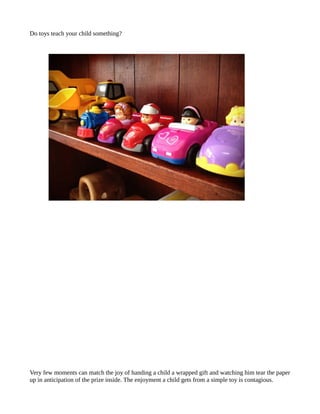
Do toys teach your child something? 
Very few moments can match the joy of handing a child a wrapped gift and watching him tear the paper 
up in anticipation of the prize inside. The enjoyment a child gets from a simple toy is contagious.
Toys inspire children, as well as teach them. They can stimulate a child’s imagination, transforming 
him into a train conductor, a superhero, or an artist. Small, colorful building blocks are transformed 
into towering skyscrapers. Dolls are cuddled and chided. But too much of anything isn’t necessarily 
good. 
Most parents today battle the toy invasion. Toys overflow from bedrooms and playrooms to the living 
room, the kitchen, and even the bathroom. There are just too many. Does a child really need that many 
toys? And where are they all coming from? 
Birthdays are the main culprit. Parties are becoming large and extravagant. When around 30 children 
are invited, each one will walk in with a gift. Then there’s the occasional trip to the toy store as a treat. 
Of course, we indulge our children every once in a while by picking up that toy that we know they’ve 
been yearning for. The intentions are good, but to what end? 
Child psychologists and other experts are also concerned about the excess of toys in our children’s 
playrooms – at best, they say, you’re throwing your money away; at worst, you may be stunting your 
child’s development. 
According to an article in the British newspaper The Guardian, Claire Lerner, a child-development 
worker, carried out a US government-funded study on the effect of overwhelming children with toys. 
Lerner reported that too many playthings can “restrict development and may harm children. They get 
overwhelmed and over-stimulated and cannot concentrate on any one thing long enough to learn from 
it, so they just shut down. Too many toys means they are not learning to play imaginatively either.” A 
study by the University of Stirling in Scotland recently concluded that expensive, hi-tech toys are a 
waste of money. “Children learn just as much from playing with an old mobile phone,” claims the 
study. 
It’s definitely not easy to avoid the deluge of toys, but here are a few tips that might help enhance 
quality and avoid quantity: 
1. Choose toys that allow children to express themselves. “At Bing, we use a lot of basic materials: 
clay, blocks, water, sand, Legos and paint,” explains Tom Limbert, *head teacher of Stanford 
University’s Bing Nursery School of Child Development Research and Training, during an interview 
with Babyzone, an online magazine. Limbert adds that a child can make whatever he wants using these 
materials. There is no designed outcome. The child is encouraged to create something different every 
time. The role of the parents and teachers is to value these ideas and ask questions like, ”What were 
you thinking about when you made that?” or “What does it remind you of?” 
2. When buying a gift for another child, ask the parents what their child’s interests are before you head 
to the toy store. Best case scenario, they’ll give you a few suggestions so you’re sure your present will 
be a big hit with the child. 
3. Select toys that are part of a collection the child can build on. A small box of Lego can help add to 
the fortress he’s already constructing at home. There are also a variety of magnetic toys to choose from. 
Girls might like an outfit for their doll collection or another accessory, rather than yet another doll. 
4. Ask about gift certificates. Many toy stores and bookshops offer gift certificates now. This allows the 
parents to choose something they feel their child needs or would really like. It also lets them pick out 
the gift with the child later on as a treat, so it can stand out from the onslaught of birthday presents. 
5. Donate old toys to charity. Too many toys can be over-stimulating for children. Every now and then 
take stock of what they have, and consider giving some of it away. “I get my child involved. I ask her 
to choose the toys she wants to give to children who don’t have that many. I’m always surprised when 
she cooperates, and I’ve even had to stop her from giving away too many toys once,” recalls one 
mother. 
6. Consider not letting your child open all his gifts on the day of his birthday party. It’s overwhelming 
and they aren’t able to truly appreciate and enjoy each present on its own. “I let my son open one or 
two presents on his birthday – usually from a family member – and I put the rest away. Every time he 
deserves a treat, or even if he simply needs something new to stimulate him, I take out one toy. It’s like
it’s his birthday all over again. He doesn’t get bored with them and toss them around after one day, 
which happened once when I let him open all his presents at once,” suggests Omneya, a mother of four. 
7. Don’t purchase a large, bulky gift for a child unless you run it by his parents first. Big isn’t always 
better. Take the case of one woman who walked into a birthday party with a large car that a toddler can 
actually sit in and drive. While the three year old was ecstatic about the gift, the mother was less so. 
“Where am I going to put it? The corridor is already lined up with tricycles and scooters,” the mother 
stated exasperatedly. 
8. Don’t be embarrassed to re-gift, one mother suggests. A young girl is bound to get many stuffed 
animals and dolls for her birthday, and boys receive enough cars to fill a garage. Place them somewhere 
out of your children’s reach, and make sure they don’t tamper with the packaging so that you are able 
to give the gift to someone else. Yes, it’s practical rather than sentimental, but remind your child that 
it’s the thought that counts (it really is). Be careful, however, not to re-gift to the person who initially 
gave you the gift. 
9. And finally, spend more time playing with your children. Spending time with your child is the best 
present you can give them.

TOYS BY HMFTJ

  • 1.
    Do toys teachyour child something? Very few moments can match the joy of handing a child a wrapped gift and watching him tear the paper up in anticipation of the prize inside. The enjoyment a child gets from a simple toy is contagious.
  • 2.
    Toys inspire children,as well as teach them. They can stimulate a child’s imagination, transforming him into a train conductor, a superhero, or an artist. Small, colorful building blocks are transformed into towering skyscrapers. Dolls are cuddled and chided. But too much of anything isn’t necessarily good. Most parents today battle the toy invasion. Toys overflow from bedrooms and playrooms to the living room, the kitchen, and even the bathroom. There are just too many. Does a child really need that many toys? And where are they all coming from? Birthdays are the main culprit. Parties are becoming large and extravagant. When around 30 children are invited, each one will walk in with a gift. Then there’s the occasional trip to the toy store as a treat. Of course, we indulge our children every once in a while by picking up that toy that we know they’ve been yearning for. The intentions are good, but to what end? Child psychologists and other experts are also concerned about the excess of toys in our children’s playrooms – at best, they say, you’re throwing your money away; at worst, you may be stunting your child’s development. According to an article in the British newspaper The Guardian, Claire Lerner, a child-development worker, carried out a US government-funded study on the effect of overwhelming children with toys. Lerner reported that too many playthings can “restrict development and may harm children. They get overwhelmed and over-stimulated and cannot concentrate on any one thing long enough to learn from it, so they just shut down. Too many toys means they are not learning to play imaginatively either.” A study by the University of Stirling in Scotland recently concluded that expensive, hi-tech toys are a waste of money. “Children learn just as much from playing with an old mobile phone,” claims the study. It’s definitely not easy to avoid the deluge of toys, but here are a few tips that might help enhance quality and avoid quantity: 1. Choose toys that allow children to express themselves. “At Bing, we use a lot of basic materials: clay, blocks, water, sand, Legos and paint,” explains Tom Limbert, *head teacher of Stanford University’s Bing Nursery School of Child Development Research and Training, during an interview with Babyzone, an online magazine. Limbert adds that a child can make whatever he wants using these materials. There is no designed outcome. The child is encouraged to create something different every time. The role of the parents and teachers is to value these ideas and ask questions like, ”What were you thinking about when you made that?” or “What does it remind you of?” 2. When buying a gift for another child, ask the parents what their child’s interests are before you head to the toy store. Best case scenario, they’ll give you a few suggestions so you’re sure your present will be a big hit with the child. 3. Select toys that are part of a collection the child can build on. A small box of Lego can help add to the fortress he’s already constructing at home. There are also a variety of magnetic toys to choose from. Girls might like an outfit for their doll collection or another accessory, rather than yet another doll. 4. Ask about gift certificates. Many toy stores and bookshops offer gift certificates now. This allows the parents to choose something they feel their child needs or would really like. It also lets them pick out the gift with the child later on as a treat, so it can stand out from the onslaught of birthday presents. 5. Donate old toys to charity. Too many toys can be over-stimulating for children. Every now and then take stock of what they have, and consider giving some of it away. “I get my child involved. I ask her to choose the toys she wants to give to children who don’t have that many. I’m always surprised when she cooperates, and I’ve even had to stop her from giving away too many toys once,” recalls one mother. 6. Consider not letting your child open all his gifts on the day of his birthday party. It’s overwhelming and they aren’t able to truly appreciate and enjoy each present on its own. “I let my son open one or two presents on his birthday – usually from a family member – and I put the rest away. Every time he deserves a treat, or even if he simply needs something new to stimulate him, I take out one toy. It’s like
  • 3.
    it’s his birthdayall over again. He doesn’t get bored with them and toss them around after one day, which happened once when I let him open all his presents at once,” suggests Omneya, a mother of four. 7. Don’t purchase a large, bulky gift for a child unless you run it by his parents first. Big isn’t always better. Take the case of one woman who walked into a birthday party with a large car that a toddler can actually sit in and drive. While the three year old was ecstatic about the gift, the mother was less so. “Where am I going to put it? The corridor is already lined up with tricycles and scooters,” the mother stated exasperatedly. 8. Don’t be embarrassed to re-gift, one mother suggests. A young girl is bound to get many stuffed animals and dolls for her birthday, and boys receive enough cars to fill a garage. Place them somewhere out of your children’s reach, and make sure they don’t tamper with the packaging so that you are able to give the gift to someone else. Yes, it’s practical rather than sentimental, but remind your child that it’s the thought that counts (it really is). Be careful, however, not to re-gift to the person who initially gave you the gift. 9. And finally, spend more time playing with your children. Spending time with your child is the best present you can give them.