Elimination of aspiration of the Spanish voiceless stops in the pronunciation of English-speaking learners of Spanish
Elimination of aspiration of the Spanish voiceless stops in the pronunciation of English-speaking learners of Spanish Key words : voiceless stop aspiration L2 second language acquisition pronnunciation
Elimination of aspiration of the Spanish voiceless stops in the pronunciation of English-speaking learners of Spanish One of the most common mistakes made by native English speakers who learn Spanish as second language is pronouncing the Spanish voiceless stops /p, t, k/ with aspiration - /p h,  t h,  k h /. For example, if asked to read the Spanish name Pepe, native English-speaking students read: [p h e.p h e].
Elimination of aspiration of the Spanish voiceless stops in the pronunciation of English-speaking learners of Spanish Research question :  will the aspiration disappear after introducing a pronunciation exercise and after practice? Hypothesis:   English-speaking students who practice the Spanish voiceless stops with a pronunciation exercise will not hav aspiration .
Elimination of aspiration of the Spanish voiceless stops in the pronunciation of English-speaking learners of Spanish TargTaret population Nine seniors at BHS participated in the study Five students were in the experimental group (2 nd  and 3 rd  levels of Spanish, and AP Spanish) Four students comprised the control group All participants’ native language is English
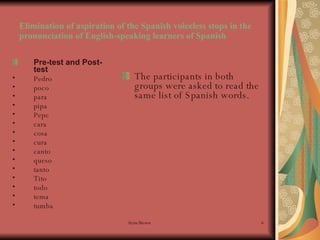
Elimination of aspiration of the Spanish voiceless stops in the pronunciation of English-speaking learners of Spanish Pre-test and Post-test Pedro   poco para  pipa  Pepe cara  cosa  cura  canto queso  tanto  Tito  todo  tema tumba   The participants in both groups were asked to read the same list of Spanish words.
Elimination of aspiration of the Spanish voiceless stops in the pronunciation of English-speaking learners of Spanish Pronunciacion exercise Hold up a sheet of paper in front of your face close to your mouth. Say sounds /p/, /t/, /k/ so that the paper does not move from the air coming out of your mouth. Now say the following words (the above list) trying to produce the same result. The exercise lasted seven minutes at a time
Elimination of aspiration of the Spanish voiceless stops in the pronunciation of English-speaking learners of Spanish
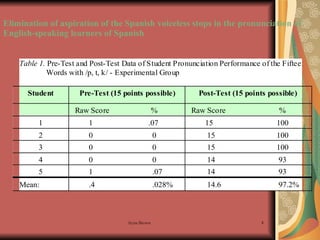
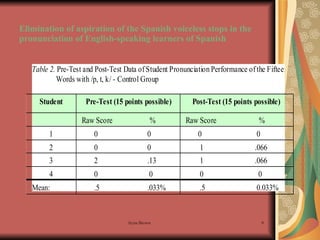
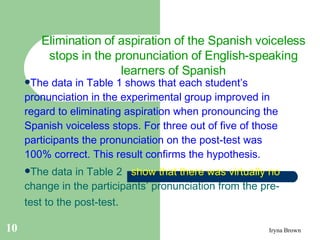
Elimination of aspiration of the Spanish voiceless stops in the pronunciation of English-speaking learners of Spanish The data in Table 1 shows that each student’s pronunciation in the experimental group improved in regard to eliminating aspiration when pronouncing the Spanish voiceless stops. For three out of five of those participants the pronunciation on the post-test was 100% correct. This result confirms the hypothesis. The data in Table 2  show that there was virtually no  change in the participants’ pronunciation from the pre-test to the post-test .

Slide Show P, T, K Bad Design

  • 1.
    Elimination of aspirationof the Spanish voiceless stops in the pronunciation of English-speaking learners of Spanish
  • 2.
    Elimination of aspirationof the Spanish voiceless stops in the pronunciation of English-speaking learners of Spanish Key words : voiceless stop aspiration L2 second language acquisition pronnunciation
  • 3.
    Elimination of aspirationof the Spanish voiceless stops in the pronunciation of English-speaking learners of Spanish One of the most common mistakes made by native English speakers who learn Spanish as second language is pronouncing the Spanish voiceless stops /p, t, k/ with aspiration - /p h, t h, k h /. For example, if asked to read the Spanish name Pepe, native English-speaking students read: [p h e.p h e].
  • 4.
    Elimination of aspirationof the Spanish voiceless stops in the pronunciation of English-speaking learners of Spanish Research question : will the aspiration disappear after introducing a pronunciation exercise and after practice? Hypothesis: English-speaking students who practice the Spanish voiceless stops with a pronunciation exercise will not hav aspiration .
  • 5.
    Elimination of aspirationof the Spanish voiceless stops in the pronunciation of English-speaking learners of Spanish TargTaret population Nine seniors at BHS participated in the study Five students were in the experimental group (2 nd and 3 rd levels of Spanish, and AP Spanish) Four students comprised the control group All participants’ native language is English
  • 6.
    Elimination of aspirationof the Spanish voiceless stops in the pronunciation of English-speaking learners of Spanish Pre-test and Post-test Pedro poco para pipa Pepe cara cosa cura canto queso tanto Tito todo tema tumba The participants in both groups were asked to read the same list of Spanish words.
  • 7.
    Elimination of aspirationof the Spanish voiceless stops in the pronunciation of English-speaking learners of Spanish Pronunciacion exercise Hold up a sheet of paper in front of your face close to your mouth. Say sounds /p/, /t/, /k/ so that the paper does not move from the air coming out of your mouth. Now say the following words (the above list) trying to produce the same result. The exercise lasted seven minutes at a time
  • 8.
    Elimination of aspirationof the Spanish voiceless stops in the pronunciation of English-speaking learners of Spanish
  • 9.
    Elimination of aspirationof the Spanish voiceless stops in the pronunciation of English-speaking learners of Spanish
  • 10.
    Elimination of aspirationof the Spanish voiceless stops in the pronunciation of English-speaking learners of Spanish The data in Table 1 shows that each student’s pronunciation in the experimental group improved in regard to eliminating aspiration when pronouncing the Spanish voiceless stops. For three out of five of those participants the pronunciation on the post-test was 100% correct. This result confirms the hypothesis. The data in Table 2 show that there was virtually no change in the participants’ pronunciation from the pre-test to the post-test .