



By: 
Dr. SADAF BUKHARI 
PGR WMW
*NAME: mehwish 
*AGE: 18yrs 
*SEX: Female 
*MARRITAL STATUS: single 
*RESIDENT OF: sundar,lahore 
*OCCUPATION: beautician 
*D.O.A. : 13/06/14 
*M.O.A. : OPD
* 
*FEVER- 1yr 
*JOINT PAIN- 1yr
* 
My patient was in her USOH 1yr back when 
she developed FEVER that was gradual in 
onset,low-grade,intermittent associated 
with anorexia and malaise but no 
rigors/chills,no aggravating factor and 
relieved by medication.
* 
The pt is also complaining of JOINT PAIN since 1yr that 
was gradual in onset,aching in character, symmetrical, 
initially involving small joints of both hands and then 
progressing to wrists, elbows and shoulders.The pain was 
present throughout the day but aggravated on joint 
movements and was relieved by medication.It was also 
associated with redness and swelling of joints but no 
numbness or tingling.The pain has worsened for the last 
1M and now the patient is unable to perform her daily 
chores and difficulty lifting any object,even difficulty 
walking and climbing stairs. 
There is no H/O morning stiffness..
* 
* The patient is also having RASH over her face,dorsum of 
both hands and extensor surfaces of arms that flares up 
on sun exposure. 
*There is also history of painless oral ulceration, hair 
loss,bluish discolouration of her fingers on exposure to 
cold and weight loss since 3months.. 
*There is no history of dyspnea,cough,sputum,hemoptysis 
or any wheeze.. 
*No history of chest pain, palpitations, syncope, 
orthopnea, PND or pedal edema.. 
*No history of abdominal pain, diarrhea, constipation, 
vomitting,urinary frequency,urgency,burning micturation 
or any genital ulcers.. 
*No history of difficulty standing from sitting posture..
* 
*PAST HISTORY: history of hospital admission 5months back for 
similar complaints.. 
*DRUG HISTORY: on and off intake of NSAIDs for fever and 
joint pain.. 
*PERSONAL HISTORY:non diabetic,non hypertensive,non-smoker.. 
*FAMILY HISTORY:insignificant 
*MENSTRUAL HISTORY:Age of menarche 15yrs with regular 
cycle of 4/28days.. 
*SOCIO-ECONOMIC: belongs to lower middle class..
1.SLE 
2.DRUG INDUCED LUPUS ERYTHEMATOSUS 
3.JRA 
4.SYSTEMIC VASCULITIS
A young thin female sitting comfortably on bed,well 
oriented in time,place and person with branula 
over her right arm having following vitals: 
*PULSE: 78/min 
*B.P. : 120/80 mmHg 
*TEMP: Afebrile 
*R/R: 16/min
* 
*Pallor +ve 
*Jaundice –ive 
*Splinter hemorrhages –ive 
*Peri ungual erythema –ive 
*Nail fold infarct –ive 
*Joint swelling –ive 
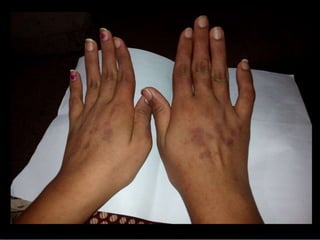
*Proximal IPJ deformity (2nd,3rd,4th digit left hand) + 
*Reddish Plaques(atrophic and non blanchable)over 
dorsum of hands and fingers
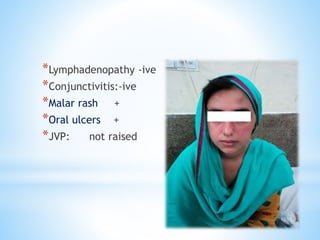
*Lymphadenopathy -ive 
*Conjunctivitis:-ive 
*Malar rash + 
*Oral ulcers + 
*JVP: not raised
* 
MUSCULOSKELETAL SYSTEM: 
*Reddish atrophic plaques over dorsum of both 
hands and fingers,non blanchable 
*no swelling or hypertrophic joint changes. 
*Proximal IPJ deformity of 2nd,3rd and 4th digits with 
painful flexion and extension of these joints. 
*Rest of the joints have normal range of 
movements,both flexion and extension. 
*No proximal myopathy
* 
CNS: 
GCS 15/15 
HMF,CN:intact 
SENSORY SYSTEM:normal 
MOTOR:normal bulk,tone,power and reflexes,both upper limbs and 
lower limbs 
FUNDOSCOPY:normal 
RESP: 
*No chest deformity with thoraco-abdominal breathing pattern 
*Trachea central 
*Chest expansion:4cm 
*Normal vocal fremitus bilaterally 
*Auscultation:NVB with no added sounds,normal vocal 
resonance,no pleural rub..
GIT: 
*Soft,non-tender abdomen 
*No visceromegaly 
*B/S audible(2sets/min) 
*CVS: 
*INSPECTION:No visible pulsations,striae or scar mark 
*APEX BEAT:in 5th ICS,midclavicular line. 
*S1+S2:of normal intensity and character with no added sound 
*No pericardial rub
*A Young Female Having 1yr History Of Fever And Joint 
Pain,associated With Redness And Swelling Of 
Joints.The Pain Has Worsened Over The Period Of 
Time Leading To Proximal IPJ Deformity Of Her 
Hands.. 
*There Is Also History Of Anorexia,malaise,weight 
Loss,oral Ulceration And Hair Loss.. 
*Malar Rash,photosensitivity And Raynauds 
Phenomenon +ive
*1.SLE 
*2.JRA
* 
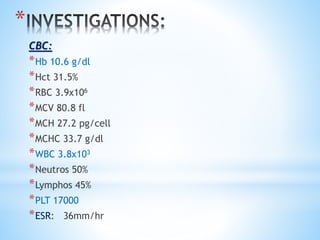
CBC: 
*Hb 10.6 g/dl 
*Hct 31.5% 
*RBC 3.9x10⁶ 
*MCV 80.8 fl 
*MCH 27.2 pg/cell 
*MCHC 33.7 g/dl 
*WBC 3.8x10³ 
*Neutros 50% 
*Lymphos 45% 
*PLT 17000 
*ESR: 36mm/hr
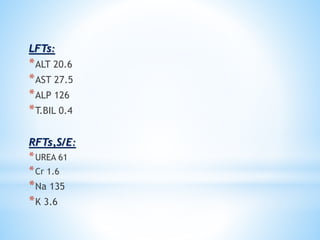
LFTs: 
*ALT 20.6 
*AST 27.5 
*ALP 126 
*T.BIL 0.4 
RFTs,S/E: 
*UREA 61 
*Cr 1.6 
*Na 135 
*K 3.6
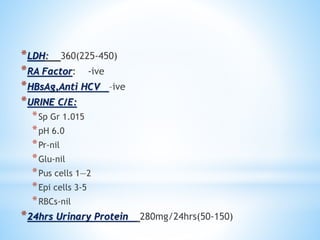
*LDH: 360(225-450) 
*RA Factor: -ive 
*HBsAg,Anti HCV –ive 
*URINE C/E: 
*Sp Gr 1.015 
*pH 6.0 
*Pr-nil 
*Glu-nil 
*Pus cells 1—2 
*Epi cells 3-5 
*RBCs-nil 
*24hrs Urinary Protein 280mg/24hrs(50-150)
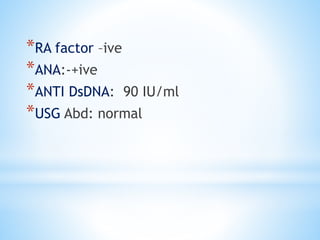
*RA factor –ive 
*ANA:-+ive 
*ANTI DsDNA: 90 IU/ml 
*USG Abd: normal
*
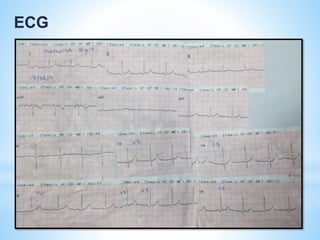
ECG
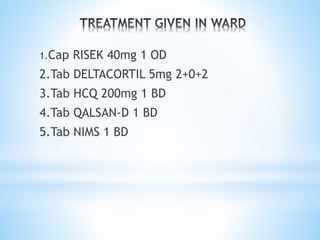
1.Cap RISEK 40mg 1 OD 
2.Tab DELTACORTIL 5mg 2+0+2 
3.Tab HCQ 200mg 1 BD 
4.Tab QALSAN-D 1 BD 
5.Tab NIMS 1 BD
*Joint X-rays: 
To look for erosions, periarticular osteopenia 
+ soft tissue swelling.. 
*CTBrain or Brain MRI ± angiography: 
lupus white matter changes,vasculitis/ stroke 
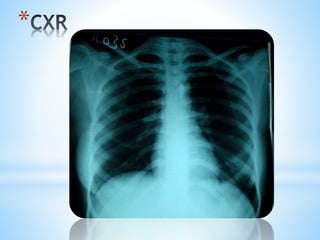
*CXR/CT chest: 
ILD, pneumonitis, pulmonary emboli, 
alveolar hemorrhage 
*ECHO: 
pericardial effusion, pulmonary hypertension 
or Libman-Sacks endocarditis..
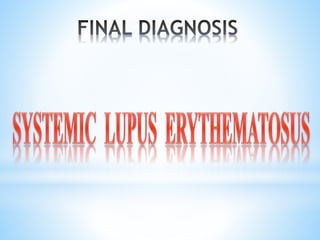
SLE 
*Auto-immune disorder 
*Multisystem microvascular 
inflammation 
*Formation of autoantibodies 
*Mostly occurs in women of 
childbearing age 
*Chronic with relapsing and remitting 
course
PATHOPHYSIOLOGY 
*Proposed mechanism for autoantibodies: 
*Defect in apoptosis 
*↑cell death → disturbance in immune tolerance 
*Plasma + nuclear antigens displayed on cell surface 
*Dysregulated lymphocytes target Ag (normally 
intracellular) 
*Immune complexes form in microvasculature → 
complement activation + inflammation 
*Ag-Ab complexes deposit in basement membranes of 
skin and kidneys
*Constitutional – fatigue, fever, weight loss 
*Skin – malar rash, photosensitive, discoid rash, 
alopecia, Raynaud phenomenon,peri-ungual 
erythema,nail fold infarct,splinter hemorrhages. 
*Joint symptoms- with or without active synovitis 
*Ocular manifestations- conjunctivitis,photophobia 
,blurring of vision 
*Musculoskeletal – arthralgia, myalgia, arthritis
*Neuropsychiatric – headache, mood disorders, cognitive 
disorders, psychosis, seizures, TIA/ stroke, movement 
disorders, mononeuritis 
*Pulmonary – chest pain, dyspnoea 
*Gastrointestinal – Abdominal pain, jaundice 
*Cardiac – heart failure(d/t myocarditis or HTN)/chest pain 
*Haematological – multiple ‘cytopenias’ 
*Other – miscarriages, family history of autoimmune disease
American College of Rheumatology 
4/11 criteria (sens 85%, specif 95%) 
“SOAP BRAIN MD” 
* Serositis – heart, lung, peritoneum 
* Oral ulcers – painless esp palate 
* Arthritis – non-erosive 
* Photosensitivity
*Blood disorders :hemolytic 
anemia,leukopenia(<4000),lymphopenia(<1500),thro 
mbocytopenia (<100,000) 
*Renal involvement 
:proteinuria(>0.5g/day),>3+dipstick proteinuria /± 
casts 
*ANA – titer > 1:160 
*Immunologic phenomena – LE cells, anti-dsDNA Ab, 
anti-Sm Ab, antiphospholipid Ab, false +test for 
syphilis 
*Neurological disorders – seizures/ psychosis 
*Malar rash : cheeks + nasal bridge 
*Discoid rash : rimmed with scaling, follicular 
plugging
*Depends on disease severity 
*Fever, skin, musculoskeletal and serositis = milder 
disease 
*CNS and renal involvement – aggressive Rx 
*Emergencies: - 
- severe CNS involvement 
- systemic vasculitis 
- profound thrombocytopenia 
(TTP-like syndrome) 
- rapidly progressive nephritis 
- diffuse alveolar hemorrhage
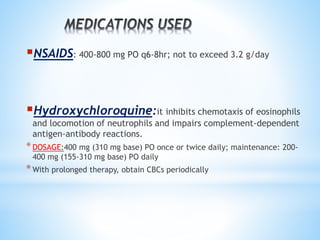
NSAIDS: 400-800 mg PO q6-8hr; not to exceed 3.2 g/day 
Hydroxychloroquine:it inhibits chemotaxis of eosinophils 
and locomotion of neutrophils and impairs complement-dependent 
antigen-antibody reactions. 
* DOSAGE:400 mg (310 mg base) PO once or twice daily; maintenance: 200- 
400 mg (155-310 mg base) PO daily 
*With prolonged therapy, obtain CBCs periodically
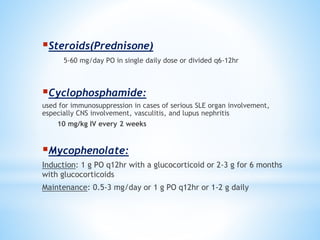
Steroids(Prednisone) 
5-60 mg/day PO in single daily dose or divided q6-12hr 
Cyclophosphamide: 
used for immunosuppression in cases of serious SLE organ involvement, 
especially CNS involvement, vasculitis, and lupus nephritis 
10 mg/kg IV every 2 weeks 
Mycophenolate: 
Induction: 1 g PO q12hr with a glucocorticoid or 2-3 g for 6 months 
with glucocorticoids 
Maintenance: 0.5-3 mg/day or 1 g PO q12hr or 1-2 g daily
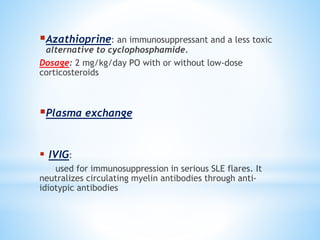
Azathioprine: an immunosuppressant and a less toxic 
alternative to cyclophosphamide. 
Dosage: 2 mg/kg/day PO with or without low-dose 
corticosteroids 
Plasma exchange 
 IVIG: 
used for immunosuppression in serious SLE flares. It 
neutralizes circulating myelin antibodies through anti-idiotypic 
antibodies
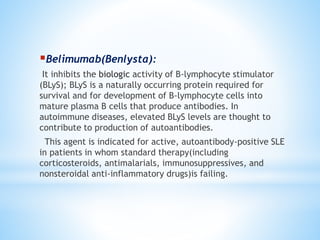
Belimumab(Benlysta): 
It inhibits the biologic activity of B-lymphocyte stimulator 
(BLyS); BLyS is a naturally occurring protein required for 
survival and for development of B-lymphocyte cells into 
mature plasma B cells that produce antibodies. In 
autoimmune diseases, elevated BLyS levels are thought to 
contribute to production of autoantibodies. 
This agent is indicated for active, autoantibody-positive SLE 
in patients in whom standard therapy(including 
corticosteroids, antimalarials, immunosuppressives, and 
nonsteroidal anti-inflammatory drugs)is failing.
LP – nonspecific ↑cells + protein, ↓ glucose 
Skin biopsy 
Renal Biopsy-prognosis and Rx
*A 15yr old female presented in OPD with presenting 
complaints of high grade fever for 2months,associated with 
painful joint movement of the small joints of hands, 
wrist,elbow,ankle and knee..there is also history of limping 
when she wakes up in morning.what is the most probable 
diagnosis? 
*1.SLE 
*2.Scleroderma 
*3.JRA 
*4.Systemic vasculitis 
*5.Septic Arthritis
Which of the following drug is most likely to cause drug 
induced lupus erythematosus? 
1.NSAIDs 
2.Probenecid 
3.Methotrexate 
4.Chlorpromazine 
5.Penicillin
Which of the following antibodies are most specific for 
Drug induced lupus? 
1.Anti-Ds DNA AB 
2.Anti-smith AB 
3.Anti-Ro AB 
4.ANA 
5.Anti histone AB
Sle by dr sadaf b

Sle by dr sadaf b

  • 2.
    By: Dr. SADAFBUKHARI PGR WMW
  • 3.
    *NAME: mehwish *AGE:18yrs *SEX: Female *MARRITAL STATUS: single *RESIDENT OF: sundar,lahore *OCCUPATION: beautician *D.O.A. : 13/06/14 *M.O.A. : OPD
  • 4.
    * *FEVER- 1yr *JOINT PAIN- 1yr
  • 5.
    * My patientwas in her USOH 1yr back when she developed FEVER that was gradual in onset,low-grade,intermittent associated with anorexia and malaise but no rigors/chills,no aggravating factor and relieved by medication.
  • 6.
    * The ptis also complaining of JOINT PAIN since 1yr that was gradual in onset,aching in character, symmetrical, initially involving small joints of both hands and then progressing to wrists, elbows and shoulders.The pain was present throughout the day but aggravated on joint movements and was relieved by medication.It was also associated with redness and swelling of joints but no numbness or tingling.The pain has worsened for the last 1M and now the patient is unable to perform her daily chores and difficulty lifting any object,even difficulty walking and climbing stairs. There is no H/O morning stiffness..
  • 7.
    * * Thepatient is also having RASH over her face,dorsum of both hands and extensor surfaces of arms that flares up on sun exposure. *There is also history of painless oral ulceration, hair loss,bluish discolouration of her fingers on exposure to cold and weight loss since 3months.. *There is no history of dyspnea,cough,sputum,hemoptysis or any wheeze.. *No history of chest pain, palpitations, syncope, orthopnea, PND or pedal edema.. *No history of abdominal pain, diarrhea, constipation, vomitting,urinary frequency,urgency,burning micturation or any genital ulcers.. *No history of difficulty standing from sitting posture..
  • 8.
    * *PAST HISTORY:history of hospital admission 5months back for similar complaints.. *DRUG HISTORY: on and off intake of NSAIDs for fever and joint pain.. *PERSONAL HISTORY:non diabetic,non hypertensive,non-smoker.. *FAMILY HISTORY:insignificant *MENSTRUAL HISTORY:Age of menarche 15yrs with regular cycle of 4/28days.. *SOCIO-ECONOMIC: belongs to lower middle class..
  • 10.
    1.SLE 2.DRUG INDUCEDLUPUS ERYTHEMATOSUS 3.JRA 4.SYSTEMIC VASCULITIS
  • 11.
    A young thinfemale sitting comfortably on bed,well oriented in time,place and person with branula over her right arm having following vitals: *PULSE: 78/min *B.P. : 120/80 mmHg *TEMP: Afebrile *R/R: 16/min
  • 12.
    * *Pallor +ve *Jaundice –ive *Splinter hemorrhages –ive *Peri ungual erythema –ive *Nail fold infarct –ive *Joint swelling –ive *Proximal IPJ deformity (2nd,3rd,4th digit left hand) + *Reddish Plaques(atrophic and non blanchable)over dorsum of hands and fingers
  • 13.
    *Lymphadenopathy -ive *Conjunctivitis:-ive *Malar rash + *Oral ulcers + *JVP: not raised
  • 14.
    * MUSCULOSKELETAL SYSTEM: *Reddish atrophic plaques over dorsum of both hands and fingers,non blanchable *no swelling or hypertrophic joint changes. *Proximal IPJ deformity of 2nd,3rd and 4th digits with painful flexion and extension of these joints. *Rest of the joints have normal range of movements,both flexion and extension. *No proximal myopathy
  • 15.
    * CNS: GCS15/15 HMF,CN:intact SENSORY SYSTEM:normal MOTOR:normal bulk,tone,power and reflexes,both upper limbs and lower limbs FUNDOSCOPY:normal RESP: *No chest deformity with thoraco-abdominal breathing pattern *Trachea central *Chest expansion:4cm *Normal vocal fremitus bilaterally *Auscultation:NVB with no added sounds,normal vocal resonance,no pleural rub..
  • 16.
    GIT: *Soft,non-tender abdomen *No visceromegaly *B/S audible(2sets/min) *CVS: *INSPECTION:No visible pulsations,striae or scar mark *APEX BEAT:in 5th ICS,midclavicular line. *S1+S2:of normal intensity and character with no added sound *No pericardial rub
  • 17.
    *A Young FemaleHaving 1yr History Of Fever And Joint Pain,associated With Redness And Swelling Of Joints.The Pain Has Worsened Over The Period Of Time Leading To Proximal IPJ Deformity Of Her Hands.. *There Is Also History Of Anorexia,malaise,weight Loss,oral Ulceration And Hair Loss.. *Malar Rash,photosensitivity And Raynauds Phenomenon +ive
  • 19.
  • 20.
    * CBC: *Hb10.6 g/dl *Hct 31.5% *RBC 3.9x10⁶ *MCV 80.8 fl *MCH 27.2 pg/cell *MCHC 33.7 g/dl *WBC 3.8x10³ *Neutros 50% *Lymphos 45% *PLT 17000 *ESR: 36mm/hr
  • 21.
    LFTs: *ALT 20.6 *AST 27.5 *ALP 126 *T.BIL 0.4 RFTs,S/E: *UREA 61 *Cr 1.6 *Na 135 *K 3.6
  • 22.
    *LDH: 360(225-450) *RAFactor: -ive *HBsAg,Anti HCV –ive *URINE C/E: *Sp Gr 1.015 *pH 6.0 *Pr-nil *Glu-nil *Pus cells 1—2 *Epi cells 3-5 *RBCs-nil *24hrs Urinary Protein 280mg/24hrs(50-150)
  • 23.
    *RA factor –ive *ANA:-+ive *ANTI DsDNA: 90 IU/ml *USG Abd: normal
  • 24.
  • 25.
  • 27.
    1.Cap RISEK 40mg1 OD 2.Tab DELTACORTIL 5mg 2+0+2 3.Tab HCQ 200mg 1 BD 4.Tab QALSAN-D 1 BD 5.Tab NIMS 1 BD
  • 28.
    *Joint X-rays: Tolook for erosions, periarticular osteopenia + soft tissue swelling.. *CTBrain or Brain MRI ± angiography: lupus white matter changes,vasculitis/ stroke *CXR/CT chest: ILD, pneumonitis, pulmonary emboli, alveolar hemorrhage *ECHO: pericardial effusion, pulmonary hypertension or Libman-Sacks endocarditis..
  • 29.
    SLE *Auto-immune disorder *Multisystem microvascular inflammation *Formation of autoantibodies *Mostly occurs in women of childbearing age *Chronic with relapsing and remitting course
  • 30.
    PATHOPHYSIOLOGY *Proposed mechanismfor autoantibodies: *Defect in apoptosis *↑cell death → disturbance in immune tolerance *Plasma + nuclear antigens displayed on cell surface *Dysregulated lymphocytes target Ag (normally intracellular) *Immune complexes form in microvasculature → complement activation + inflammation *Ag-Ab complexes deposit in basement membranes of skin and kidneys
  • 31.
    *Constitutional – fatigue,fever, weight loss *Skin – malar rash, photosensitive, discoid rash, alopecia, Raynaud phenomenon,peri-ungual erythema,nail fold infarct,splinter hemorrhages. *Joint symptoms- with or without active synovitis *Ocular manifestations- conjunctivitis,photophobia ,blurring of vision *Musculoskeletal – arthralgia, myalgia, arthritis
  • 32.
    *Neuropsychiatric – headache,mood disorders, cognitive disorders, psychosis, seizures, TIA/ stroke, movement disorders, mononeuritis *Pulmonary – chest pain, dyspnoea *Gastrointestinal – Abdominal pain, jaundice *Cardiac – heart failure(d/t myocarditis or HTN)/chest pain *Haematological – multiple ‘cytopenias’ *Other – miscarriages, family history of autoimmune disease
  • 33.
    American College ofRheumatology 4/11 criteria (sens 85%, specif 95%) “SOAP BRAIN MD” * Serositis – heart, lung, peritoneum * Oral ulcers – painless esp palate * Arthritis – non-erosive * Photosensitivity
  • 34.
    *Blood disorders :hemolytic anemia,leukopenia(<4000),lymphopenia(<1500),thro mbocytopenia (<100,000) *Renal involvement :proteinuria(>0.5g/day),>3+dipstick proteinuria /± casts *ANA – titer > 1:160 *Immunologic phenomena – LE cells, anti-dsDNA Ab, anti-Sm Ab, antiphospholipid Ab, false +test for syphilis *Neurological disorders – seizures/ psychosis *Malar rash : cheeks + nasal bridge *Discoid rash : rimmed with scaling, follicular plugging
  • 35.
    *Depends on diseaseseverity *Fever, skin, musculoskeletal and serositis = milder disease *CNS and renal involvement – aggressive Rx *Emergencies: - - severe CNS involvement - systemic vasculitis - profound thrombocytopenia (TTP-like syndrome) - rapidly progressive nephritis - diffuse alveolar hemorrhage
  • 36.
    NSAIDS: 400-800 mgPO q6-8hr; not to exceed 3.2 g/day Hydroxychloroquine:it inhibits chemotaxis of eosinophils and locomotion of neutrophils and impairs complement-dependent antigen-antibody reactions. * DOSAGE:400 mg (310 mg base) PO once or twice daily; maintenance: 200- 400 mg (155-310 mg base) PO daily *With prolonged therapy, obtain CBCs periodically
  • 37.
    Steroids(Prednisone) 5-60 mg/dayPO in single daily dose or divided q6-12hr Cyclophosphamide: used for immunosuppression in cases of serious SLE organ involvement, especially CNS involvement, vasculitis, and lupus nephritis 10 mg/kg IV every 2 weeks Mycophenolate: Induction: 1 g PO q12hr with a glucocorticoid or 2-3 g for 6 months with glucocorticoids Maintenance: 0.5-3 mg/day or 1 g PO q12hr or 1-2 g daily
  • 38.
    Azathioprine: an immunosuppressantand a less toxic alternative to cyclophosphamide. Dosage: 2 mg/kg/day PO with or without low-dose corticosteroids Plasma exchange  IVIG: used for immunosuppression in serious SLE flares. It neutralizes circulating myelin antibodies through anti-idiotypic antibodies
  • 39.
    Belimumab(Benlysta): It inhibitsthe biologic activity of B-lymphocyte stimulator (BLyS); BLyS is a naturally occurring protein required for survival and for development of B-lymphocyte cells into mature plasma B cells that produce antibodies. In autoimmune diseases, elevated BLyS levels are thought to contribute to production of autoantibodies. This agent is indicated for active, autoantibody-positive SLE in patients in whom standard therapy(including corticosteroids, antimalarials, immunosuppressives, and nonsteroidal anti-inflammatory drugs)is failing.
  • 40.
    LP – nonspecific↑cells + protein, ↓ glucose Skin biopsy Renal Biopsy-prognosis and Rx
  • 42.
    *A 15yr oldfemale presented in OPD with presenting complaints of high grade fever for 2months,associated with painful joint movement of the small joints of hands, wrist,elbow,ankle and knee..there is also history of limping when she wakes up in morning.what is the most probable diagnosis? *1.SLE *2.Scleroderma *3.JRA *4.Systemic vasculitis *5.Septic Arthritis
  • 43.
    Which of thefollowing drug is most likely to cause drug induced lupus erythematosus? 1.NSAIDs 2.Probenecid 3.Methotrexate 4.Chlorpromazine 5.Penicillin
  • 44.
    Which of thefollowing antibodies are most specific for Drug induced lupus? 1.Anti-Ds DNA AB 2.Anti-smith AB 3.Anti-Ro AB 4.ANA 5.Anti histone AB