Slavery: The Terrible Transformation CLOSE THE GAPS
economic     indentured servants     freedom        knowledge of the land         House of
BurgessesJamestown chattel                  mortality      diseases                     immune
slavery      barbaric                Racism         cheap labor

ORIGINS

In 1619, slavery started in the British Colonies when “20 men and women naked and in chains“
arrived in________________________, Virginia. John Rolfe published the 1st statement on the
existence of ______________________ in the 1st successful British settlement, “About the last of
August came in a Dutch man of warre (ship) that sold us twenty...”

SOCIAL STATUS OF AFRICANS BEFORE 1660

The Social Status of Africans was remarkably different before the 1660s. They worked
alongside____________________ _____________________. Indentured servants worked 4-7 years
for passage to America from Europe. They were fed and clothed by the master and many earned
land after their service. Africans could gain their ______________________, right to vote, hold
public office, and serve in the militia. They also shared their knowledge offarming, folktales, dances,
arts & handicrafts.

GREED AFTER THE 1660s

Slavery evolved in the British American colonies as a social, _____________________, and legal
institution. Cash crops (indigo, tobacco, & rice) requireda large labor force. Indentured servitude
started to decrease as Europe’s economy improved. Therefore, in 1660, The________________
_____ _______________________in Virginia formally establishes the institution of slavery. Slaves
were treated as____________________(property).

RACISM

Slavery was originally adopted for economic reasons. However, Southern whites justified slavery
based on_____________________. Racism is the belief that some people are inferior because of
their race. Whites concluded that extermination of Indians and enslavement of Africans was logical
BECAUSE whites were civilized & others were __________________________.

Native Americans were not suited for slavery because they had __________________ ____ ________
_________________. Additionally, Native Americans experienced high
____________________(death) rates from European_____________________. Africans were
better suited for slavery because they were ______________________to most European diseases,
had no means (family, friends, knowledge of land) to escape in the Americas and were a permanent
source of cheap labor.


                                                                                                      1
Wars dying tortured               Middle Passage        western coast                shackles         half
diseasebranded exchange           Americas              slave coast                  overboard coffin
        mortality rates                   supply and demand     revolts                      firearms and
gunpowderTriangular Trade                 cash crop                 plantation system         climate
         Abolitionists


THE MIDDLE PASSAGE (c. 1600-1800)“The Middle Passage must have been as near as anyone ever comes to hell on earth.” -
Barry Unsworth, author
The law of _______________ _______ _______________created turmoil in West Africa. The
demand for slaves by Europeans triggered ___________between African tribes. Local kings captured
Africans in ___________________for guns, molasses, & rum. The trade route between Europe,
Africa & the Americas is known as _______________________ _______________________.

For weeks, months, or as long as a year, Africans waited in the dungeons of the slave factories
scattered along Africa's________________ ________________. Out of the roughly 20 million who
were taken from their homes and sold into slavery, _____________didn't complete the journey to the
African coast, most of those ________________along the way.

The captives were about to embark on the infamous________________ _________________, so
called because it was the middle leg of a three-part voyage -- a voyage that began and ended in
Europe. The first leg of the voyage carried a cargo that often included iron, cloth,
brandy,_________________ _____ _______________. Upon landing on Africa's "____________
________________," the cargo was exchanged for Africans. Fully loaded with its human cargo,
“white ships with black cargo” set sail for the__________________, where the slaves were
exchanged for sugar, tobacco, or some other product. The final leg brought the ship back to Europe.

Slaves were _________________with hot irons and restrained with______________. With 300 to 400
people packed in a tiny area -- an area with little ventilation and, in some cases, not even enough
space to place buckets for human waste -- _________________was prevalent. Dr. Alexander
Falconbridge described the conditions stating, “They had not so much room as a man in his
_________________.” The voyage lasted 1-4 months (depending on weather). Faced with the
nightmarish conditions of the voyage and the unknown future that lay beyond, many Africans
preferred to die and some threw themselves ______________________to drown. From the captain's
point of view, his human cargo was extremely valuable. A slave who tried to starve him or herself
was ________________________. If torture didn't work, the slave was force fed with the help of a
contraption called a speculum orum, which held the mouth open.

Middle Passage ________________ _____________were high. Although it's difficult to determine
how many Africans died en route to the new world, it is now believed that between ten and twenty
percent of those transported lost their lives.

African __________________were squashed by public torture and death. A successful revolt was led
by Africans aboard the Spanish ship, Amistad (means friendship) in 1839. The Africans were
eventually freed after their case was argued before the SCOTUS.


                                                                                                                        2
NORTH vs. SOUTHSlavery was the basis for the Southern economy because of
the_________________ ____________. The plantation system is a system of agricultural production
based on large-scale land ownership and the exploitation of labor and the environment. Production is
usually concentrated on a___________ ______________. For instance, the South produced tobacco,
rice, sugar and cotton.

The Northern ________________and region were not conducive for large scale farming. In
addition,______________________fought to end slavery. Eventually Northern colonies outlawed
slavery.

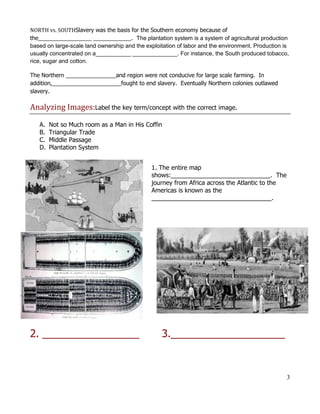
Analyzing Images:Label the key term/concept with the correct image.

   A.   Not so Much room as a Man in His Coffin
   B.   Triangular Trade
   C.   Middle Passage
   D.   Plantation System


                                              1. The entire map
                                              shows:_____________________________. The
                                              journey from Africa across the Atlantic to the
                                              Americas is known as the
                                              ___________________________________.


2. _________________                              3.____________________


                                                                                                   3
4
Slavery in the colonies: “A peculiar Institution”
ORIGINS

In 1619, slavery started in the British Colonies when20 men and women naked and in chains“arrived
in Jamestown, Virginia. John Rolfe published the 1st statement on the existence of slavery in the
1st successful British settlement, “About the last of August came in a Dutch man of warre that sold us
twenty...”

SOCIAL STATUS OF AFRICANS BEFORE 1660

The Social Status of Africans was remarkably different before the 1660s. They worked alongside
indentured servants. Indentured servants worked 4-7 years for passage to America from Europe.
They were fed and clothed by the master and many earned land after their service. Africans could
gain their freedom, right to vote, hold public office, and serve in the militia. They also shared their
knowledge offarming, folktales, dances, arts & handicrafts.

GREED AFTER THE 1660s

Slavery evolved in the British American colonies as a social, economic, and legal institution. Cash
crops (indigo, tobacco, & rice) requireda large labor force. Indentured servitude started to decrease
as Europe’s economy improved. Therefore, in 1660, TheHouse of Burgesses in Virginia formally
establishes the institution of slavery. Slaves were treated aschattel (property).

RACISM

Slavery was originally adopted for economic reasons. However, Southern whites justified slavery
based onRacism. Racism is the belief that some people are inferior because of their race. Whites
concluded that extermination of Indians and enslavement of Africans was logical BECAUSE whites
were civilized & others were BARBARIC.

THE MIDDLE PASSAGE (c. 1600-1800)

The law of supply and demand created turmoil in West Africa. The demand for slaves by
Europeanstriggered wars between African tribes. Local kings captured Africans in exchange for
guns, molasses, & rum. The trade route between Europe, Africa & the Americas is known as
Triangular Trade.

For weeks, months, or as long as a year, Africans waited in the dungeons of the slave factories
scattered along Africa's western coast. Out of the roughly20 million who were taken from their
homes and sold into slavery, half didn't complete the journey to the African coast, most of those
dying along the way.

The captives were about to embark on the infamous Middle Passage, so called because it was the
middle leg of a three-part voyage -- a voyage that began and ended in Europe. The first leg of the
voyage carried a cargo that often included iron, cloth, brandy, firearms, and gunpowder. Upon
landing on Africa's "slave coast," the cargo was exchanged for Africans. Fully loaded with its
human cargo, the ship set sail for the Americas, where the slaves were exchanged for sugar, tobacco,


                                                                                                          5
or some other product. The final leg brought the ship back to Europe.


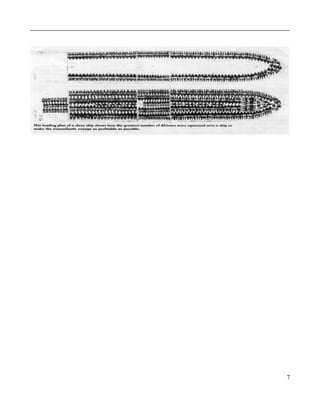
Slaves were branded with hot irons and restrained with shackles. With 300 to 400 people packed in
a tiny area -- an area with little ventilation and, in some cases, not even enough space to place
buckets for human waste -- disease was prevalent. Dr. Alexander Falconbridge described the
conditions stating, “They had not so much room as a man in his coffin.” The voyage lasted 1-4
months (depending on weather). Faced with the nightmarish conditions of the voyage and the
unknown future that lay beyond, many Africans preferred to die and some threw themselves
overboard to drown. From the captain's point of view, his human cargo was extremely valuable. A
slave who tried to starve him or herself was tortured. If torture didn't work, the slave was force fed
with the help of a contraption called a speculum orum, which held the mouth open.

Middle Passage mortality rates were high. Although it's difficult to determine how many Africans
died en route to the new world, it is now believed that between ten and twenty percent of those
transported lost their lives.

African revolts were squashed by public torture and death. A successful revolt was led by Africans
aboard the Spanish ship, Amistad (means friendship) in 1839. The Africans were eventually freed
after their case was argued before the SCOTUS.

The Middle Passage must have been as near as anyone ever comes to hell on earth.- Barry Unsworth, author
WHY AFRICANS?

Native Americans were not suited for slavery because they had knowledge of the land. Additionally,
Native Americans experienced high mortality (death) rates from European diseases. Africans were
better suited for slavery because they were immune to most European diseases, had no means
(family, friends, knowledge of land) to escape in the Americas and were apermanent source of cheap
labor.

NORTH vs. SOUTH

Slavery in the SOUTH was the basis for their economy because of the plantation system. The
plantation system is a system of agricultural production based on large-scale land ownership and the
exploitation of labor and the environment. Production is usually concentrated on a cash crop. For
instance, the plantation system in the South produced tobacco, rice, sugar and cotton for the world
market.

The Northern climate and region were not conducive for large scale farming. In addition, Abolitionists
fought to end slavery. Eventually Northern colonies outlawed slavery.

Sources:
       Dalleck, R. et al (2008). American history. McDougal Littell.
       Garraty, J. ( 1991). The American nation. New York, NY: Harper Collins Publishers.
       http://www.polytechnic.org/faculty/gfeldmeth/USHistory.html
       www.americanabolitionist.liberalarts.iupui.edu/
        file

        PBS Africans In America http://www.pbs.org/wgbh/aia/home.html


Websites to explore: http://www.nmm.ac.uk/freedom/
                                                                                                           6
7

Slavery Close The Gaps

  • 1.
    Slavery: The TerribleTransformation CLOSE THE GAPS economic indentured servants freedom knowledge of the land House of BurgessesJamestown chattel mortality diseases immune slavery barbaric Racism cheap labor ORIGINS In 1619, slavery started in the British Colonies when “20 men and women naked and in chains“ arrived in________________________, Virginia. John Rolfe published the 1st statement on the existence of ______________________ in the 1st successful British settlement, “About the last of August came in a Dutch man of warre (ship) that sold us twenty...” SOCIAL STATUS OF AFRICANS BEFORE 1660 The Social Status of Africans was remarkably different before the 1660s. They worked alongside____________________ _____________________. Indentured servants worked 4-7 years for passage to America from Europe. They were fed and clothed by the master and many earned land after their service. Africans could gain their ______________________, right to vote, hold public office, and serve in the militia. They also shared their knowledge offarming, folktales, dances, arts & handicrafts. GREED AFTER THE 1660s Slavery evolved in the British American colonies as a social, _____________________, and legal institution. Cash crops (indigo, tobacco, & rice) requireda large labor force. Indentured servitude started to decrease as Europe’s economy improved. Therefore, in 1660, The________________ _____ _______________________in Virginia formally establishes the institution of slavery. Slaves were treated as____________________(property). RACISM Slavery was originally adopted for economic reasons. However, Southern whites justified slavery based on_____________________. Racism is the belief that some people are inferior because of their race. Whites concluded that extermination of Indians and enslavement of Africans was logical BECAUSE whites were civilized & others were __________________________. Native Americans were not suited for slavery because they had __________________ ____ ________ _________________. Additionally, Native Americans experienced high ____________________(death) rates from European_____________________. Africans were better suited for slavery because they were ______________________to most European diseases, had no means (family, friends, knowledge of land) to escape in the Americas and were a permanent source of cheap labor. 1
  • 2.
    Wars dying tortured Middle Passage western coast shackles half diseasebranded exchange Americas slave coast overboard coffin mortality rates supply and demand revolts firearms and gunpowderTriangular Trade cash crop plantation system climate Abolitionists THE MIDDLE PASSAGE (c. 1600-1800)“The Middle Passage must have been as near as anyone ever comes to hell on earth.” - Barry Unsworth, author The law of _______________ _______ _______________created turmoil in West Africa. The demand for slaves by Europeans triggered ___________between African tribes. Local kings captured Africans in ___________________for guns, molasses, & rum. The trade route between Europe, Africa & the Americas is known as _______________________ _______________________. For weeks, months, or as long as a year, Africans waited in the dungeons of the slave factories scattered along Africa's________________ ________________. Out of the roughly 20 million who were taken from their homes and sold into slavery, _____________didn't complete the journey to the African coast, most of those ________________along the way. The captives were about to embark on the infamous________________ _________________, so called because it was the middle leg of a three-part voyage -- a voyage that began and ended in Europe. The first leg of the voyage carried a cargo that often included iron, cloth, brandy,_________________ _____ _______________. Upon landing on Africa's "____________ ________________," the cargo was exchanged for Africans. Fully loaded with its human cargo, “white ships with black cargo” set sail for the__________________, where the slaves were exchanged for sugar, tobacco, or some other product. The final leg brought the ship back to Europe. Slaves were _________________with hot irons and restrained with______________. With 300 to 400 people packed in a tiny area -- an area with little ventilation and, in some cases, not even enough space to place buckets for human waste -- _________________was prevalent. Dr. Alexander Falconbridge described the conditions stating, “They had not so much room as a man in his _________________.” The voyage lasted 1-4 months (depending on weather). Faced with the nightmarish conditions of the voyage and the unknown future that lay beyond, many Africans preferred to die and some threw themselves ______________________to drown. From the captain's point of view, his human cargo was extremely valuable. A slave who tried to starve him or herself was ________________________. If torture didn't work, the slave was force fed with the help of a contraption called a speculum orum, which held the mouth open. Middle Passage ________________ _____________were high. Although it's difficult to determine how many Africans died en route to the new world, it is now believed that between ten and twenty percent of those transported lost their lives. African __________________were squashed by public torture and death. A successful revolt was led by Africans aboard the Spanish ship, Amistad (means friendship) in 1839. The Africans were eventually freed after their case was argued before the SCOTUS. 2
  • 3.
    NORTH vs. SOUTHSlaverywas the basis for the Southern economy because of the_________________ ____________. The plantation system is a system of agricultural production based on large-scale land ownership and the exploitation of labor and the environment. Production is usually concentrated on a___________ ______________. For instance, the South produced tobacco, rice, sugar and cotton. The Northern ________________and region were not conducive for large scale farming. In addition,______________________fought to end slavery. Eventually Northern colonies outlawed slavery. Analyzing Images:Label the key term/concept with the correct image. A. Not so Much room as a Man in His Coffin B. Triangular Trade C. Middle Passage D. Plantation System 1. The entire map shows:_____________________________. The journey from Africa across the Atlantic to the Americas is known as the ___________________________________. 2. _________________ 3.____________________ 3
  • 4.
  • 5.
    Slavery in thecolonies: “A peculiar Institution” ORIGINS In 1619, slavery started in the British Colonies when20 men and women naked and in chains“arrived in Jamestown, Virginia. John Rolfe published the 1st statement on the existence of slavery in the 1st successful British settlement, “About the last of August came in a Dutch man of warre that sold us twenty...” SOCIAL STATUS OF AFRICANS BEFORE 1660 The Social Status of Africans was remarkably different before the 1660s. They worked alongside indentured servants. Indentured servants worked 4-7 years for passage to America from Europe. They were fed and clothed by the master and many earned land after their service. Africans could gain their freedom, right to vote, hold public office, and serve in the militia. They also shared their knowledge offarming, folktales, dances, arts & handicrafts. GREED AFTER THE 1660s Slavery evolved in the British American colonies as a social, economic, and legal institution. Cash crops (indigo, tobacco, & rice) requireda large labor force. Indentured servitude started to decrease as Europe’s economy improved. Therefore, in 1660, TheHouse of Burgesses in Virginia formally establishes the institution of slavery. Slaves were treated aschattel (property). RACISM Slavery was originally adopted for economic reasons. However, Southern whites justified slavery based onRacism. Racism is the belief that some people are inferior because of their race. Whites concluded that extermination of Indians and enslavement of Africans was logical BECAUSE whites were civilized & others were BARBARIC. THE MIDDLE PASSAGE (c. 1600-1800) The law of supply and demand created turmoil in West Africa. The demand for slaves by Europeanstriggered wars between African tribes. Local kings captured Africans in exchange for guns, molasses, & rum. The trade route between Europe, Africa & the Americas is known as Triangular Trade. For weeks, months, or as long as a year, Africans waited in the dungeons of the slave factories scattered along Africa's western coast. Out of the roughly20 million who were taken from their homes and sold into slavery, half didn't complete the journey to the African coast, most of those dying along the way. The captives were about to embark on the infamous Middle Passage, so called because it was the middle leg of a three-part voyage -- a voyage that began and ended in Europe. The first leg of the voyage carried a cargo that often included iron, cloth, brandy, firearms, and gunpowder. Upon landing on Africa's "slave coast," the cargo was exchanged for Africans. Fully loaded with its human cargo, the ship set sail for the Americas, where the slaves were exchanged for sugar, tobacco, 5
  • 6.
    or some otherproduct. The final leg brought the ship back to Europe. Slaves were branded with hot irons and restrained with shackles. With 300 to 400 people packed in a tiny area -- an area with little ventilation and, in some cases, not even enough space to place buckets for human waste -- disease was prevalent. Dr. Alexander Falconbridge described the conditions stating, “They had not so much room as a man in his coffin.” The voyage lasted 1-4 months (depending on weather). Faced with the nightmarish conditions of the voyage and the unknown future that lay beyond, many Africans preferred to die and some threw themselves overboard to drown. From the captain's point of view, his human cargo was extremely valuable. A slave who tried to starve him or herself was tortured. If torture didn't work, the slave was force fed with the help of a contraption called a speculum orum, which held the mouth open. Middle Passage mortality rates were high. Although it's difficult to determine how many Africans died en route to the new world, it is now believed that between ten and twenty percent of those transported lost their lives. African revolts were squashed by public torture and death. A successful revolt was led by Africans aboard the Spanish ship, Amistad (means friendship) in 1839. The Africans were eventually freed after their case was argued before the SCOTUS. The Middle Passage must have been as near as anyone ever comes to hell on earth.- Barry Unsworth, author WHY AFRICANS? Native Americans were not suited for slavery because they had knowledge of the land. Additionally, Native Americans experienced high mortality (death) rates from European diseases. Africans were better suited for slavery because they were immune to most European diseases, had no means (family, friends, knowledge of land) to escape in the Americas and were apermanent source of cheap labor. NORTH vs. SOUTH Slavery in the SOUTH was the basis for their economy because of the plantation system. The plantation system is a system of agricultural production based on large-scale land ownership and the exploitation of labor and the environment. Production is usually concentrated on a cash crop. For instance, the plantation system in the South produced tobacco, rice, sugar and cotton for the world market. The Northern climate and region were not conducive for large scale farming. In addition, Abolitionists fought to end slavery. Eventually Northern colonies outlawed slavery. Sources: Dalleck, R. et al (2008). American history. McDougal Littell. Garraty, J. ( 1991). The American nation. New York, NY: Harper Collins Publishers. http://www.polytechnic.org/faculty/gfeldmeth/USHistory.html www.americanabolitionist.liberalarts.iupui.edu/ file PBS Africans In America http://www.pbs.org/wgbh/aia/home.html Websites to explore: http://www.nmm.ac.uk/freedom/ 6
  • 7.