1
Robot Mapping
Extended Kalman Filter
Cyrill Stachniss
2
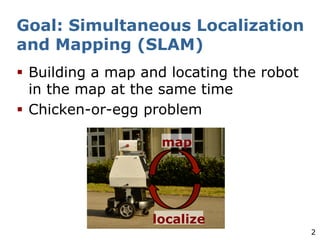
Goal: Simultaneous Localization
and Mapping (SLAM)
§ Building a map and locating the robot
in the map at the same time
§ Chicken-or-egg problem
map
localize
3
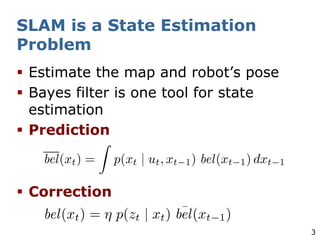
SLAM is a State Estimation
Problem
§ Estimate the map and robot’s pose
§ Bayes filter is one tool for state
estimation
§ Prediction
§ Correction
4
Kalman Filter
§ It is a Bayes filter
§ Estimator for the linear Gaussian case
§ Optimal solution for linear models and
Gaussian distributions
5
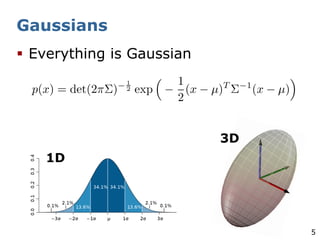
Gaussians
§ Everything is Gaussian
1D
3D
6
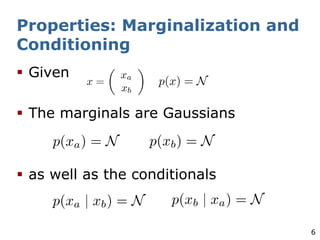
Properties: Marginalization and
Conditioning
§ Given
§ The marginals are Gaussians
§ as well as the conditionals
7
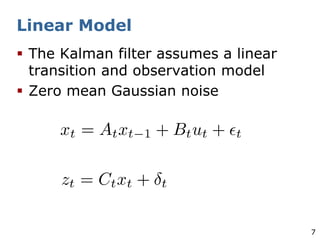
Linear Model
§ The Kalman filter assumes a linear
transition and observation model
§ Zero mean Gaussian noise
8
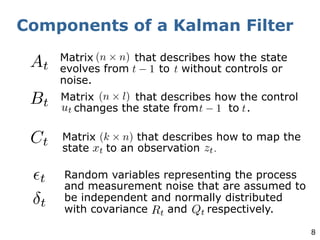
Components of a Kalman Filter
Matrix that describes how the state
evolves from to without controls or
noise.
Matrix that describes how the control
changes the state from to .
Matrix that describes how to map the
state to an observation .
Random variables representing the process
and measurement noise that are assumed to
be independent and normally distributed
with covariance and respectively.
9
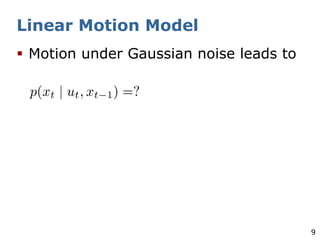
Linear Motion Model
§ Motion under Gaussian noise leads to
10
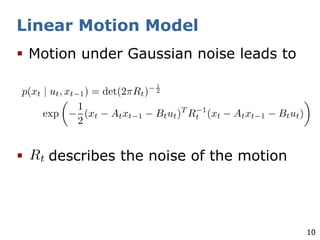
Linear Motion Model
§ Motion under Gaussian noise leads to
§ describes the noise of the motion
11
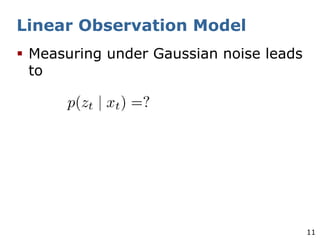
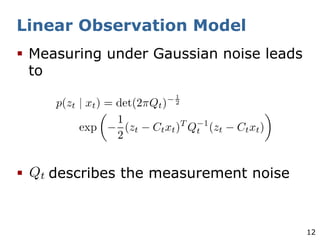
Linear Observation Model
§ Measuring under Gaussian noise leads
to
12
Linear Observation Model
§ Measuring under Gaussian noise leads
to
§ describes the measurement noise
13
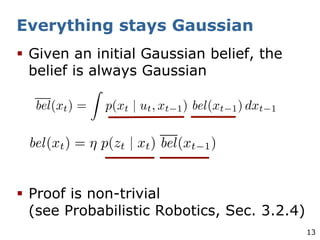
Everything stays Gaussian
§ Given an initial Gaussian belief, the
belief is always Gaussian
§ Proof is non-trivial
(see Probabilistic Robotics, Sec. 3.2.4)
14
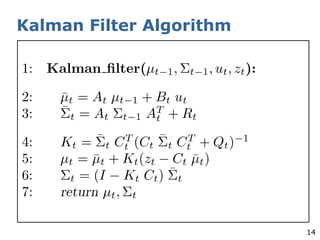
Kalman Filter Algorithm
15
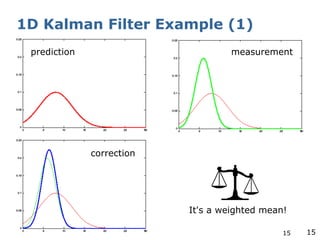
1D Kalman Filter Example (1)
15
prediction measurement
correction
It's a weighted mean!
16
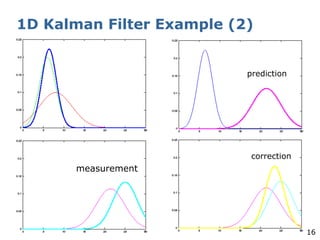
1D Kalman Filter Example (2)
prediction
correction
measurement
17
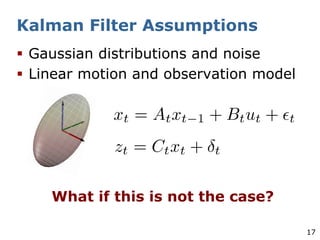
Kalman Filter Assumptions
§ Gaussian distributions and noise
§ Linear motion and observation model
What if this is not the case?
18
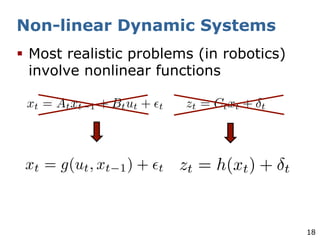
Non-linear Dynamic Systems
§ Most realistic problems (in robotics)
involve nonlinear functions
19
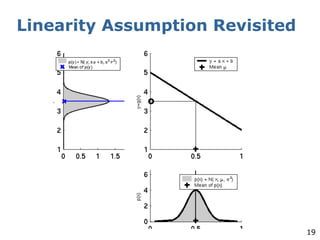
Linearity Assumption Revisited
20
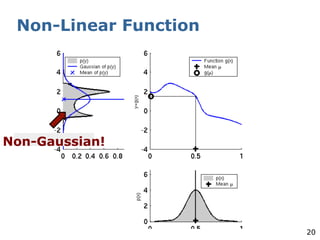
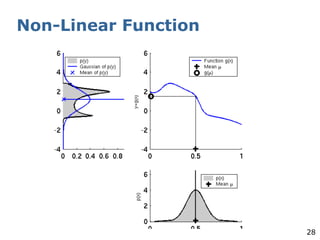
Non-Linear Function
Non-Gaussian!
21
Non-Gaussian Distributions
§ The non-linear functions lead to non-
Gaussian distributions
§ Kalman filter is not applicable
anymore!
What can be done to resolve this?
22
Non-Gaussian Distributions
§ The non-linear functions lead to non-
Gaussian distributions
§ Kalman filter is not applicable
anymore!
What can be done to resolve this?
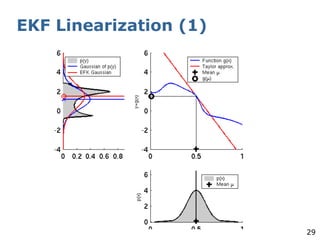
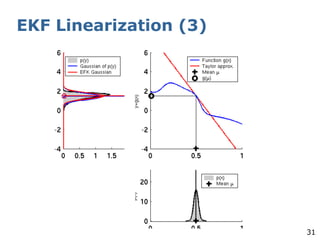
Local linearization!
23
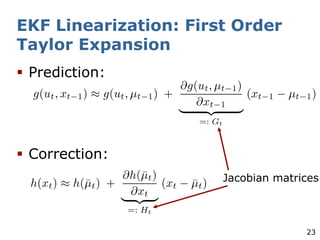
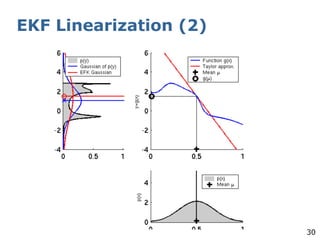
EKF Linearization: First Order
Taylor Expansion
§ Prediction:
§ Correction:
Jacobian matrices
24
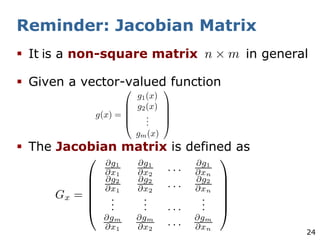
Reminder: Jacobian Matrix
§ It is a non-square matrix in general
§ Given a vector-valued function
§ The Jacobian matrix is defined as
25
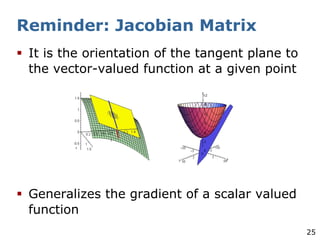
Reminder: Jacobian Matrix
§ It is the orientation of the tangent plane to
the vector-valued function at a given point
§ Generalizes the gradient of a scalar valued
function
26
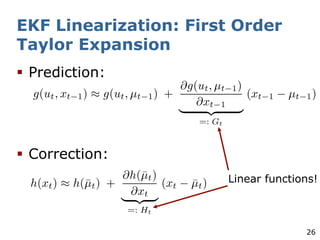
EKF Linearization: First Order
Taylor Expansion
§ Prediction:
§ Correction:
Linear functions!
27
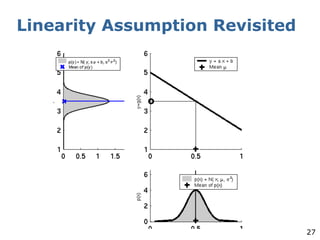
Linearity Assumption Revisited
28
Non-Linear Function
29
EKF Linearization (1)
30
EKF Linearization (2)
31
EKF Linearization (3)
32
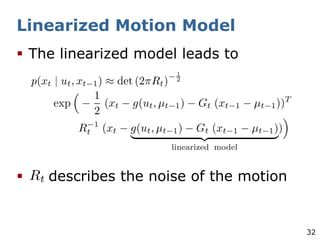
Linearized Motion Model
§ The linearized model leads to
§ describes the noise of the motion
33
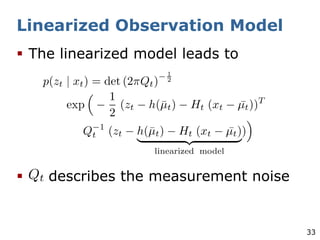
Linearized Observation Model
§ The linearized model leads to
§ describes the measurement noise
34
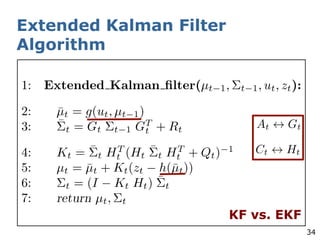
Extended Kalman Filter
Algorithm
KF vs. EKF
35
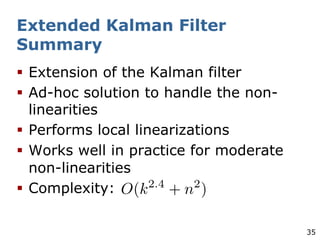
Extended Kalman Filter
Summary
§ Extension of the Kalman filter
§ Ad-hoc solution to handle the non-
linearities
§ Performs local linearizations
§ Works well in practice for moderate
non-linearities
§ Complexity:
36
Literature
Kalman Filter and EKF
§ Thrun et al.: “Probabilistic Robotics”,
Chapter 3
§ Schön and Lindsten: “Manipulating the
Multivariate Gaussian Density”
§ Welch and Bishop: “Kalman Filter
Tutorial”

SLAM using Extended Kalman Filter on a Robot for Localization and Mappings