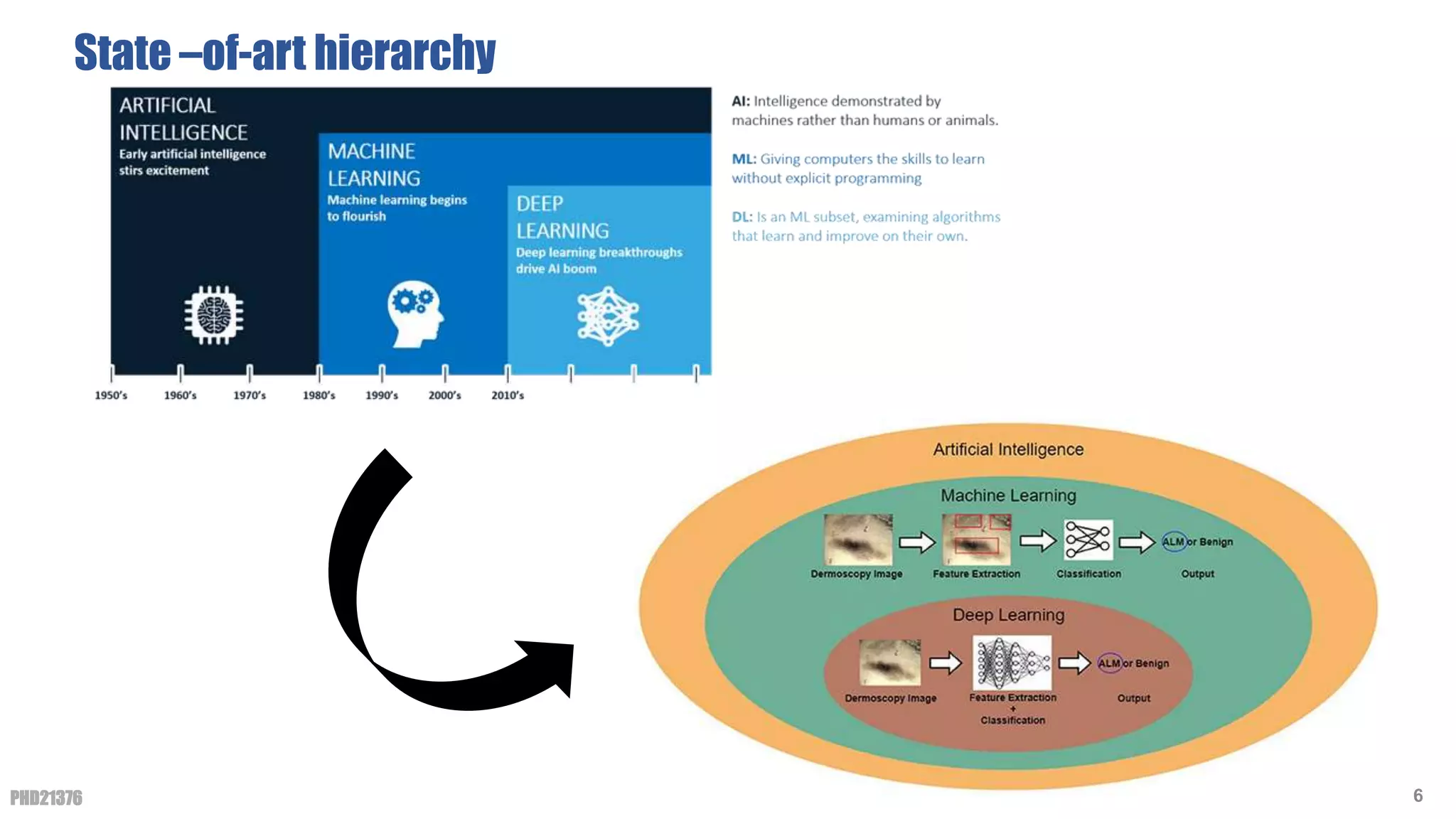
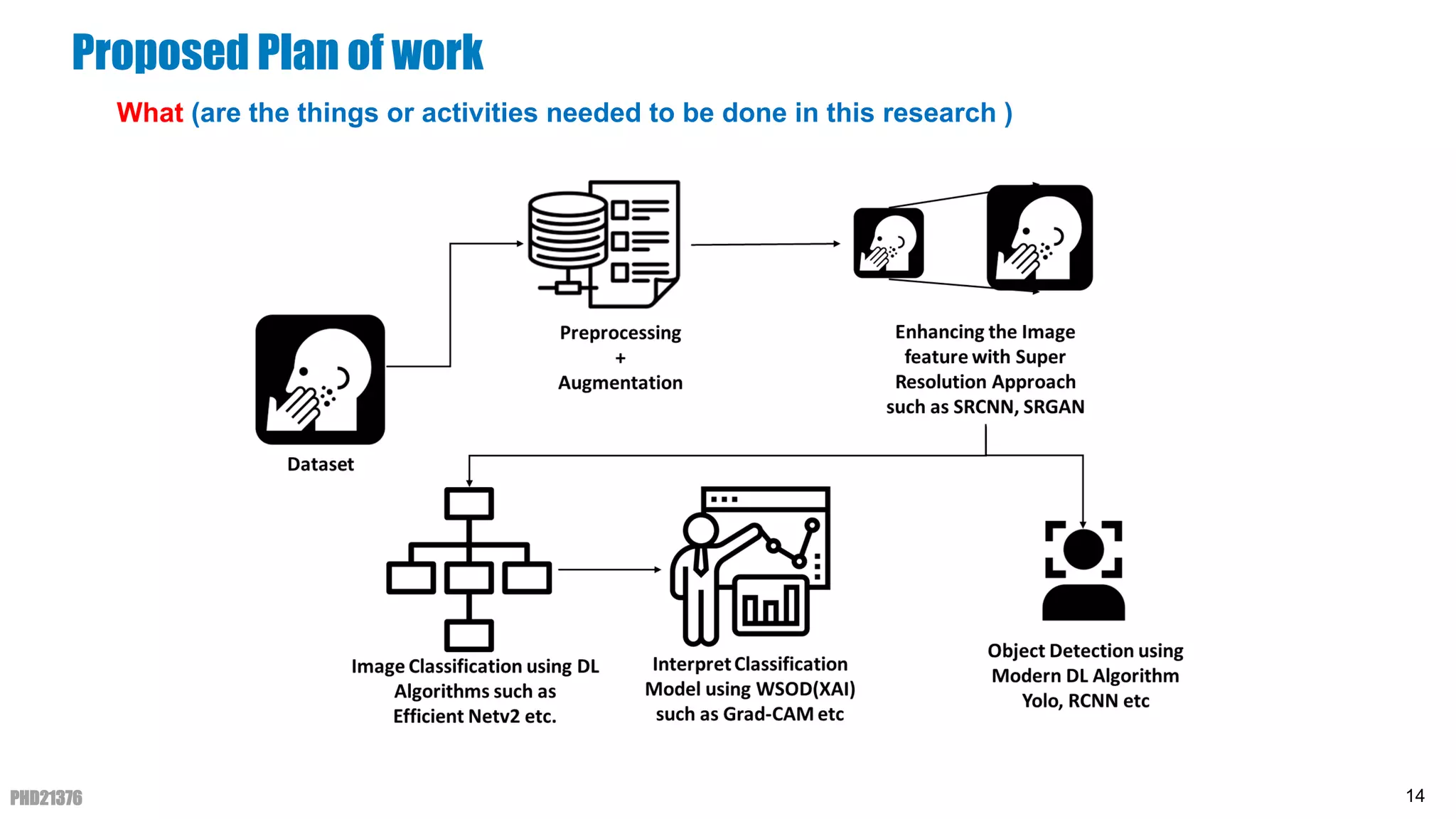
The document presents a research proposal on human skin modeling using deep learning. The goals are to use deep learning techniques to design an intelligent medical image-based skin lesion diagnosis system that can achieve improved segmentation and classification of skin lesions. The proposal discusses the current scope, including machine learning models being used for disease classification from clinical and dermatopathology images. It reviews literature on various deep learning models and datasets used for skin disease classification. The proposed work plan is to apply image augmentation, enhancement, and classification techniques to improve performance, and use weakly supervised object detection and anchor boxes to identify multiple skin lesions. The future impact may include more accurate clinical identification of skin diseases on smart devices using AI.


![Introduction (Why Skin is chosen as a topic area)
• Skin-the largest organ of the human body
• A Barrier- its function to protect the human body against pathogens
• Skin diseases
the fourth most common cause of all human disease
affecting almost one-third of the world’s population- major causes of the global disease burden [GDB]
covers all cultural regions and occurs in all ages
Impacts social, financial and psychological consequences on the patient’s life and society[2]
• Skin cancer is ranked second for causes of worldwide death (except COVID-19 in 2020)
• Skin lesion detection follows :
ABCDE rule( asymmetry, border, color, dermoscopic structure and evolving)
CASH rule (color ,architecture , symmetry and homogeneity)
3
PHD21376](https://image.slidesharecdn.com/prachipancholi-phd21376updated-230125101317-07177d3b/75/SKin-lesion-detection-using-ml-approach-pptx-3-2048.jpg)


![Literature Survey
7
PHD21376
Paper Model /Classifier + Data Sets
used
Features examined Limitations identified
“Classification of skin lesions
using transfer learning and
augmentation with Alex-
net” [7]
DCNN AlexNet , over 2500+
images were taken from DERM IS
,MED-NODE and ISIC Challege
data set 2017
AlexNet model is built and
different parameters are set.
Replacement of the
classification layer with a
softmax layer that works with
two or three kinds of skin
lesions, and augmenting
dataset by fixed and random
rotation angles
“Automatic diagnosis of skin
diseases using convolution
neural network”[6]
CNN AlexNet , 174 images were
taken from DERM Net
The Convolutional Neural
Network (CNN) used in this
paper has utilized around 11
layers viz., Convolution Layer,
Activation Layer, Pooling Layer,
Fully Connected Layer and
Soft-Max Classifier.
The proposed methodogy does
not apply to more class of
diseases , also other challenges
automating the process
includes the variation of skin
tones, location of the disease,
specifications of the image
acquisition system etc](https://image.slidesharecdn.com/prachipancholi-phd21376updated-230125101317-07177d3b/75/SKin-lesion-detection-using-ml-approach-pptx-7-2048.jpg)
![Literature Survey(Contd..)
8
PHD21376
Paper Model /Classifier + Data Sets
used
Features examined Limitations identified
“Man against machine:
diagnostic performance
of a deep learning
convolutional neural
network for
dermoscopic melanoma
recognition in
comparison to 58
dermatologists”[5]
CNN Inception v4 , 100-image
test-set was used (level-I:
dermoscopy only; level-II:
dermoscopy plus clinical
information and images
Proposed model was trained and validated
using dermoscopic images and
corresponding diagnoses. the results were
compared with 58 dermatologists
Test-sets used did not display the
full range of lesions and poor
availability of validated images led
to a shortage of melanocytic
lesions from other skin types and
genetic backgrounds.
“Modeling of Human
Skin by the Use of Deep
Learning”[4]
ISVM , 15000 images were
taken from DERMNZ
Early detection of skin tumors is done by
proposing computer view detection system
for segmentation and recognizing skin
diseases by extracting set of features from
given skin lesions image to produce
appropriate classification
Extraction of any new feature and
training on different dataset is not
done. Also multiple skin lesions
cannot be identified .
“Discriminative Feature
Learning for Skin
Disease
Classification Using
Deep Convolutional
Neural Network”[8]
CNN ResNet 152 and Inception
ResNet-V2, 12000+ faciual skin
disease images were
considered (further labelling is
done by Wuhan Union
Hospital)
Triplet Loss function is consider to interact
capability of performance management
with an extreme of labels also The proposed
method performs layer-wise fine-tuning of
pre-train deep CNN models, instead of block
wise , to improve the performance of the
end-to-end learning method.
Only facial images were analysed .
A properly designeddataset with
the help of a dermatologist and
organized taxonomy is required.](https://image.slidesharecdn.com/prachipancholi-phd21376updated-230125101317-07177d3b/75/SKin-lesion-detection-using-ml-approach-pptx-8-2048.jpg)
![Literature Survey(Contd..)
9
PHD21376
Paper Model /Classifier +
Data Sets used
Features examined Limitations identified
“Classification of Skin
Disease Using Deep
Learning Neural
Networks with MobileNet
V2 and LSTM”[10]
DNN MobielNet V2 +
LSTM, 10000 images
were considered
HAM10000(Kaggle)
dataset.
The MobileNet V2 architecture is designed to
work with a portable device with a stride2
mechanism. the use of the LSTM module with the
MobileNet V2 would enhance the prediction
accuracy by maintaining the previous timestamp
data.
The proposed approach is not
designed to replace but rather to
supplement existing disease-
diagnostic solutions. Laboratory test
results are always more
trustworthy than diagnoses based
solely on visual symptoms, and visual
inspection alone often challenges
early diagnosis
“A convolutional neural
network trained with
dermoscopic images
performed on par with
145 dermatologists in a
clinical melanoma image
classification Task”[9]
CNN ResNet , 12,378
open-source
dermoscopic images
This study compares the performance of a
convolutional neuronal network trained with
dermoscopic images exclusively for identifying
melanoma in clinical photographs with the
manual grading of the same images by
dermatologists
The training, validation and test set
were derived from a mostly fair
skinned population, and the data sets
were comprised of images typically
seen in clinical practice . The proposed
model would perform better if the
clinical data is improvised
“Deep Learning in Skin
Disease Image
Recognition: A Review”[1]
CNN AlexNet,
VGG, Inception,
ResNet, and
DensenNet
A survey has been done for 45 papers and
analysis from the aspects of disease type, data
set,data processing technology, data
augmentation technology, model for skin disease
image recognition, deep learning framework,
evaluation indicators, and model performance is
done
The interpretability research on skin
disease identification models is a big
gap in this survey ; also Embedding AI
diagnosis and treatment of skin
disease on smart devices should be
considered.](https://image.slidesharecdn.com/prachipancholi-phd21376updated-230125101317-07177d3b/75/SKin-lesion-detection-using-ml-approach-pptx-9-2048.jpg)
![Current Scope
Where (This research is currently being used and which area deals with it)
• Currently, Machine Learning models are being used for Disease classification using clinical and derma
pathology images [11]
• Deep Learning plays vital role for accurate feature extraction of lesions [1]
1
0
PHD21376
Specific Field
Used Dataset
Limited to Dermatology
• Research work + Limited
accuracy of Diagnoses
Quality
Parameters
Feature Extraction (Color + Texture)
• Accuracy + Sensitivity +
Specificity
• Derm Quest
• DermNZ
• DermIS](https://image.slidesharecdn.com/prachipancholi-phd21376updated-230125101317-07177d3b/75/SKin-lesion-detection-using-ml-approach-pptx-10-2048.jpg)

![Future Scope
How (this work will have impact on future scenarios)
• Interpretability study on skin disease identification [3]
• Embedding AI diagnosis and treatment of skin disease on smart devices will be a significant
trend in the future. [1]
• Clinical identification of skin disease [1]
13
PHD21376](https://image.slidesharecdn.com/prachipancholi-phd21376updated-230125101317-07177d3b/75/SKin-lesion-detection-using-ml-approach-pptx-13-2048.jpg)

![References
[1] Ling-fang Li1 , Xu Wang1 , Wei-jian Hu 1 , Neal N. XIONG 2 , (Senior Member, IEEE), YONG-XING DU
1 , AND BAO-SHAN LI1, ” Deep Learning in Skin Disease Image Recognition: A Review”, IEEE Access -
November 11, 2020, date of current version December 1, 2020., Volume-8
[2] Nazia Hameed 1,* , Fozia Hameed 2 , Antesar Shabut 3 , Sehresh Khan 4 , Silvia Cirstea 5 and
Alamgir Hossain 6,”An Intelligent Computer-Aided Scheme for Classifying Multiple Skin Lesions”,
Computers 2019, 8, 62; doi:10.3390/computers8030062
[3] Anjali Gautam, Balasubramanian Raman,“Towards accurate classification of skin cancer from
dermatology images”, IET Image Processing, DOI: 10.1049/ipr2.12166, Accepted: 5 February 2021
[4] Xin Xiong,1 Xuexun Guo,2 and Yiping Wang , “Modeling of Human Skin by the Use of Deep Learning”,
Hindawi Complexity Volume 2021, Article ID 5531585, 11 pages https://doi.org/10.1155/2021/5531585
16
PHD21376](https://image.slidesharecdn.com/prachipancholi-phd21376updated-230125101317-07177d3b/75/SKin-lesion-detection-using-ml-approach-pptx-16-2048.jpg)
![References
[5] H. A. Haenssle1, C. Fink, R. Schneiderbauer, F.Toberer,T. Buhl , A. Blum , A. Kalloo , A. Ben Hadj
Hassen , L. Thomas , A. Enk & L. Uhlmann, “Man against machine: diagnostic performance of a deep
learning convolutional neural network for dermoscopic melanoma recognition in comparison to 58
dermatologists”, Annals of Oncology 29: 1836–1842, 2018 doi:10.1093/annonc/mdy166 Published
online 28 May 2018
[6] T. Shanthi a,R.S. Sabeenianb , R. Anand,“Automatic diagnosis of skin diseases using convolution
neural network”, https://doi.org/10.1016/j.micpro.2020.103074 0141-9331/© 2020 Elsevier,
Microprocessors and Microsystems 76 (2020) 103074
[7] Khalid M. HosnyID1 *, Mohamed A. KassemID2 , Mohamed M. Foaud,“Classification of skin
lesions using transfer learning and augmentation with Alex-net”, PLOS ONE |
https://doi.org/10.1371/journal.pone.0217293 May 21, 2019
[8] BELAL AHMAD 1 , MOHD USAMA1 , CHUEN-MIN HUANG2 , KAI HWANG 3 , (Life Fellow, IEEE),
M. SHAMIM HOSSAIN 4 , (Senior Member, IEEE), AND GHULAM MUHAMMAD, “Discriminative
Feature Learning for Skin Disease Classification Using Deep Convolutional Neural Network”,IEEE
Access, Digital Object Identifier 10.1109/ACCESS.2020.2975198
17
PHD21376](https://image.slidesharecdn.com/prachipancholi-phd21376updated-230125101317-07177d3b/75/SKin-lesion-detection-using-ml-approach-pptx-17-2048.jpg)
![References
[9] Titus J. Brinker a,b, *, Achim Hekler a , Alexander H. Enk b, “A convolutional neural network trained
with dermoscopic images performed on par with 145 dermatologists in a clinical melanoma image
classification task”, Europian Journal of Cancer 111(2019) 148-154, Science Direct,
https://doi.org/10.1016/j.ejca.2019.02.005 0959-8049/ª 2019
[10] Parvathaneni Naga Srinivasu, alluri Gnana SivaSai , Muhammad Fazal Ijaz 3, Akash Kumar Bhoi
, Wonjoon Kim and James Jin Kang,” Classification of Skin Disease Using Deep Learning Neural
Networks with MobileNet V2 and LSTM”, Sensors 2021, 21, 2852. https://doi.org/10.3390/s21082852
[11] Stephanie Chan . Vidhatha Reddy . Bridget Myers . Quinn Thibodeaux . Nicholas Brownstone .
Wilson Liao, ” Machine Learning in Dermatology: Current Applications, Opportunities, and
Limitations”, Dermatol Ther (Heidelb) (2020) 10:365–386 https://doi.org/10.1007/s13555-020-00372-0
18
PHD21376](https://image.slidesharecdn.com/prachipancholi-phd21376updated-230125101317-07177d3b/75/SKin-lesion-detection-using-ml-approach-pptx-18-2048.jpg)


