Skill With People
15 SIMPLE STEPS TO BUILDING REL ATIONSHIPS
Human Insight
#1
How
We Learn
and buy
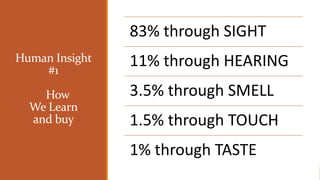
83% through SIGHT
11% through HEARING
3.5% through SMELL
1.5% through TOUCH
1% through TASTE
Human Insight
#2
How
We Retain
Information
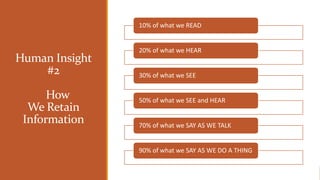
10% of what we READ
20% of what we HEAR
30% of what we SEE
50% of what we SEE and HEAR
70% of what we SAY AS WE TALK
90% of what we SAY AS WE DO A THING
Human Insight #3
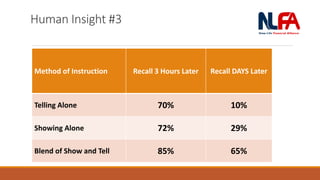
Method of Instruction Recall 3 Hours Later Recall DAYS Later
Telling Alone 70% 10%
Showing Alone 72% 29%
Blend of Show and Tell 85% 65%
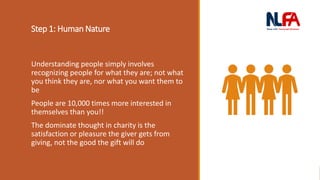
Step 1: Human Nature
Understanding people simply involves
recognizing people for what they are; not what
you think they are, nor what you want them to
be
People are 10,000 times more interested in
themselves than you!!
The dominate thought in charity is the
satisfaction or pleasure the giver gets from
giving, not the good the gift will do
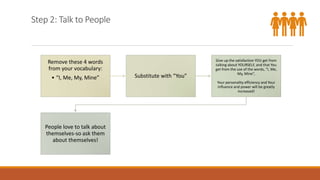
Step 2: Talk to People
Remove these 4 words
from your vocabulary:
• “I, Me, My, Mine” Substitute with “You”
Give up the satisfaction YOU get from
talking about YOURSELF, and that You
get from the use of the words, “I, Me,
My, Mine”,
Your personality efficiency and Your
influence and power will be greatly
increased!
People love to talk about
themselves-so ask them
about themselves!
/
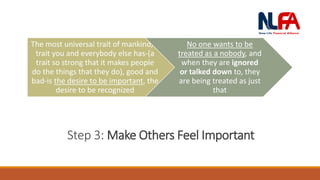
Step 3: Make Others Feel Important
The most universal trait of mankind, a
trait you and everybody else has-(a
trait so strong that it makes people
do the things that they do), good and
bad-is the desire to be important, the
desire to be recognized
No one wants to be
treated as a nobody, and
when they are ignored
or talked down to, they
are being treated as just
that
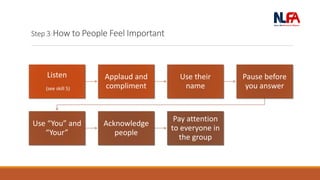
Step 3: How to People Feel Important
Listen
(see skill 5)
Applaud and
compliment
Use their
name
Pause before
you answer
Use “You” and
“Your”
Acknowledge
people
Pay attention
to everyone in
the group
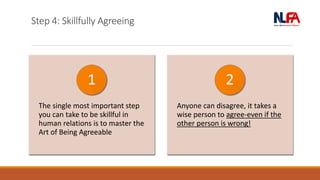
Step 4: Skillfully Agreeing
The single most important step
you can take to be skillful in
human relations is to master the
Art of Being Agreeable
1
Anyone can disagree, it takes a
wise person to agree-even if the
other person is wrong!
2
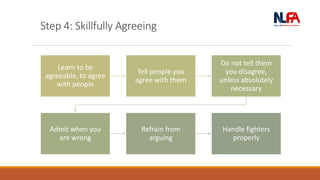
Step 4: Skillfully Agreeing
Learn to be
agreeable, to agree
with people
Tell people you
agree with them
Do not tell them
you disagree,
unless absolutely
necessary
Admit when you
are wrong
Refrain from
arguing
Handle fighters
properly
Step 5: Listening
The more listening you do,
the smarter you will become,
the better you will be liked, and
the better conversationalist you will be
A Good Listener ALWAYS
winds up far ahead of a good talker
5 Rules to be a good listener
1. Look at the person who is talking
2. Lean toward the speaker and listen
intently
3. Ask questions
4. Stick to the person’s subject and don’t
interrupt
5. Use the words – “You” and “Your”
Courtesy pays
Step 6:
Influence
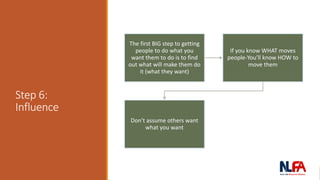
The first BIG step to getting
people to do what you
want them to do is to find
out what will make them do
it (what they want)
If you know WHAT moves
people-You’ll know HOW to
move them
Don’t assume others want
what you want
Step 6:
Influence
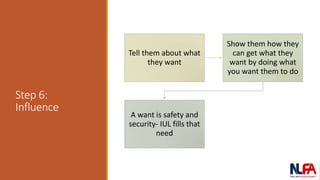
Tell them about what
they want
Show them how they
can get what they
want by doing what
you want them to do
A want is safety and
security- IUL fills that
need
Step 7: Be
Convincing
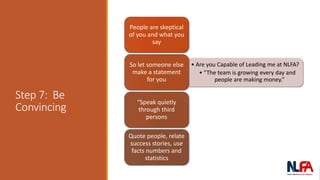
People are skeptical
of you and what you
say
• Are you Capable of Leading me at NLFA?
• “The team is growing every day and
people are making money.”
So let someone else
make a statement
for you
“Speak quietly
through third
persons
Quote people, relate
success stories, use
facts numbers and
statistics
Step 8: Help People Make Up Their
Mind
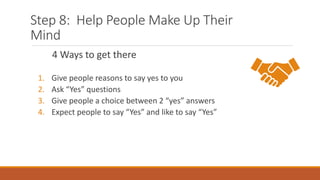
4 Ways to get there
1. Give people reasons to say yes to you
2. Ask “Yes” questions
3. Give people a choice between 2 “yes” answers
4. Expect people to say “Yes” and like to say “Yes”
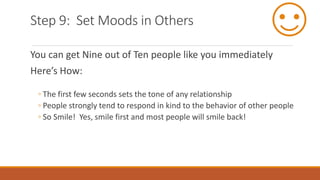
Step 9: Set Moods in Others
You can get Nine out of Ten people like you immediately
Here’s How:
◦ The first few seconds sets the tone of any relationship
◦ People strongly tend to respond in kind to the behavior of other people
◦ So Smile! Yes, smile first and most people will smile back!
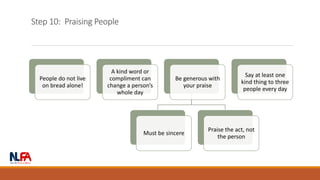
Step 10: Praising People
People do not live
on bread alone!
A kind word or
compliment can
change a person’s
whole day
Be generous with
your praise
Must be sincere
Praise the act, not
the person
Say at least one
kind thing to three
people every day
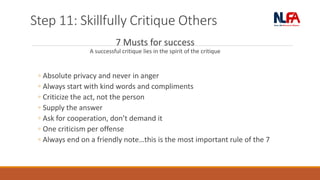
Step 11: Skillfully Critique Others
7 Musts for success
A successful critique lies in the spirit of the critique
◦ Absolute privacy and never in anger
◦ Always start with kind words and compliments
◦ Criticize the act, not the person
◦ Supply the answer
◦ Ask for cooperation, don’t demand it
◦ One criticism per offense
◦ Always end on a friendly note…this is the most important rule of the 7
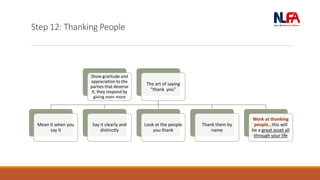
Step 12: Thanking People
Show gratitude and
appreciation to the
parties that deserve
it, they respond by
giving even more
The art of saying
“thank you”
Mean it when you
say it
Say it clearly and
distinctly
Look at the people
you thank
Thank them by
name
Work at thanking
people…this will
be a great asset all
through your life
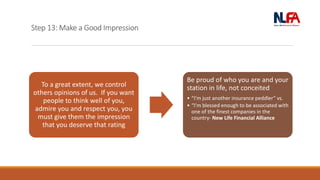
Step 13: Make a Good Impression
To a great extent, we control
others opinions of us. If you want
people to think well of you,
admire you and respect you, you
must give them the impression
that you deserve that rating
Be proud of who you are and your
station in life, not conceited
• “I’m just another insurance peddler” vs.
• “I’m blessed enough to be associated with
one of the finest companies in the
country- New Life Financial Alliance
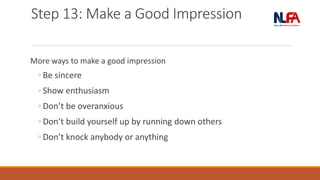
Step 13: Make a Good Impression
More ways to make a good impression
◦ Be sincere
◦ Show enthusiasm
◦ Don’t be overanxious
◦ Don’t build yourself up by running down others
◦ Don’t knock anybody or anything
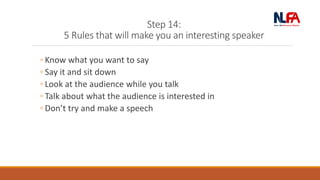
Step 14:
5 Rules that will make you an interesting speaker
◦ Know what you want to say
◦ Say it and sit down
◦ Look at the audience while you talk
◦ Talk about what the audience is interested in
◦ Don’t try and make a speech
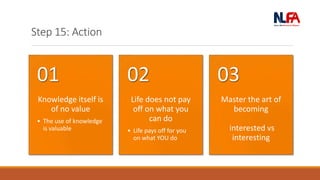
Step 15: Action
Knowledge itself is
of no value
• The use of knowledge
is valuable
01
Life does not pay
off on what you
can do
• Life pays off for you
on what YOU do
02
Master the art of
becoming
interested vs
interesting
03

Skill with people

  • 1.
    Skill With People 15SIMPLE STEPS TO BUILDING REL ATIONSHIPS
  • 2.
    Human Insight #1 How We Learn andbuy 83% through SIGHT 11% through HEARING 3.5% through SMELL 1.5% through TOUCH 1% through TASTE
  • 3.
    Human Insight #2 How We Retain Information 10%of what we READ 20% of what we HEAR 30% of what we SEE 50% of what we SEE and HEAR 70% of what we SAY AS WE TALK 90% of what we SAY AS WE DO A THING
  • 4.
    Human Insight #3 Methodof Instruction Recall 3 Hours Later Recall DAYS Later Telling Alone 70% 10% Showing Alone 72% 29% Blend of Show and Tell 85% 65%
  • 5.
    Step 1: HumanNature Understanding people simply involves recognizing people for what they are; not what you think they are, nor what you want them to be People are 10,000 times more interested in themselves than you!! The dominate thought in charity is the satisfaction or pleasure the giver gets from giving, not the good the gift will do
  • 6.
    Step 2: Talkto People Remove these 4 words from your vocabulary: • “I, Me, My, Mine” Substitute with “You” Give up the satisfaction YOU get from talking about YOURSELF, and that You get from the use of the words, “I, Me, My, Mine”, Your personality efficiency and Your influence and power will be greatly increased! People love to talk about themselves-so ask them about themselves!
  • 7.
    / Step 3: MakeOthers Feel Important The most universal trait of mankind, a trait you and everybody else has-(a trait so strong that it makes people do the things that they do), good and bad-is the desire to be important, the desire to be recognized No one wants to be treated as a nobody, and when they are ignored or talked down to, they are being treated as just that
  • 8.
    Step 3: Howto People Feel Important Listen (see skill 5) Applaud and compliment Use their name Pause before you answer Use “You” and “Your” Acknowledge people Pay attention to everyone in the group
  • 9.
    Step 4: SkillfullyAgreeing The single most important step you can take to be skillful in human relations is to master the Art of Being Agreeable 1 Anyone can disagree, it takes a wise person to agree-even if the other person is wrong! 2
  • 10.
    Step 4: SkillfullyAgreeing Learn to be agreeable, to agree with people Tell people you agree with them Do not tell them you disagree, unless absolutely necessary Admit when you are wrong Refrain from arguing Handle fighters properly
  • 11.
    Step 5: Listening Themore listening you do, the smarter you will become, the better you will be liked, and the better conversationalist you will be A Good Listener ALWAYS winds up far ahead of a good talker
  • 12.
    5 Rules tobe a good listener 1. Look at the person who is talking 2. Lean toward the speaker and listen intently 3. Ask questions 4. Stick to the person’s subject and don’t interrupt 5. Use the words – “You” and “Your” Courtesy pays
  • 13.
    Step 6: Influence The firstBIG step to getting people to do what you want them to do is to find out what will make them do it (what they want) If you know WHAT moves people-You’ll know HOW to move them Don’t assume others want what you want
  • 14.
    Step 6: Influence Tell themabout what they want Show them how they can get what they want by doing what you want them to do A want is safety and security- IUL fills that need
  • 15.
    Step 7: Be Convincing Peopleare skeptical of you and what you say • Are you Capable of Leading me at NLFA? • “The team is growing every day and people are making money.” So let someone else make a statement for you “Speak quietly through third persons Quote people, relate success stories, use facts numbers and statistics
  • 16.
    Step 8: HelpPeople Make Up Their Mind 4 Ways to get there 1. Give people reasons to say yes to you 2. Ask “Yes” questions 3. Give people a choice between 2 “yes” answers 4. Expect people to say “Yes” and like to say “Yes”
  • 17.
    Step 9: SetMoods in Others You can get Nine out of Ten people like you immediately Here’s How: ◦ The first few seconds sets the tone of any relationship ◦ People strongly tend to respond in kind to the behavior of other people ◦ So Smile! Yes, smile first and most people will smile back!
  • 18.
    Step 10: PraisingPeople People do not live on bread alone! A kind word or compliment can change a person’s whole day Be generous with your praise Must be sincere Praise the act, not the person Say at least one kind thing to three people every day
  • 19.
    Step 11: SkillfullyCritique Others 7 Musts for success A successful critique lies in the spirit of the critique ◦ Absolute privacy and never in anger ◦ Always start with kind words and compliments ◦ Criticize the act, not the person ◦ Supply the answer ◦ Ask for cooperation, don’t demand it ◦ One criticism per offense ◦ Always end on a friendly note…this is the most important rule of the 7
  • 20.
    Step 12: ThankingPeople Show gratitude and appreciation to the parties that deserve it, they respond by giving even more The art of saying “thank you” Mean it when you say it Say it clearly and distinctly Look at the people you thank Thank them by name Work at thanking people…this will be a great asset all through your life
  • 21.
    Step 13: Makea Good Impression To a great extent, we control others opinions of us. If you want people to think well of you, admire you and respect you, you must give them the impression that you deserve that rating Be proud of who you are and your station in life, not conceited • “I’m just another insurance peddler” vs. • “I’m blessed enough to be associated with one of the finest companies in the country- New Life Financial Alliance
  • 22.
    Step 13: Makea Good Impression More ways to make a good impression ◦ Be sincere ◦ Show enthusiasm ◦ Don’t be overanxious ◦ Don’t build yourself up by running down others ◦ Don’t knock anybody or anything
  • 23.
    Step 14: 5 Rulesthat will make you an interesting speaker ◦ Know what you want to say ◦ Say it and sit down ◦ Look at the audience while you talk ◦ Talk about what the audience is interested in ◦ Don’t try and make a speech
  • 24.
    Step 15: Action Knowledgeitself is of no value • The use of knowledge is valuable 01 Life does not pay off on what you can do • Life pays off for you on what YOU do 02 Master the art of becoming interested vs interesting 03