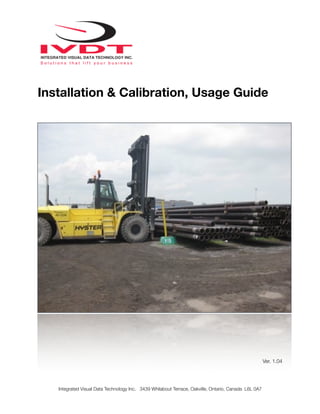
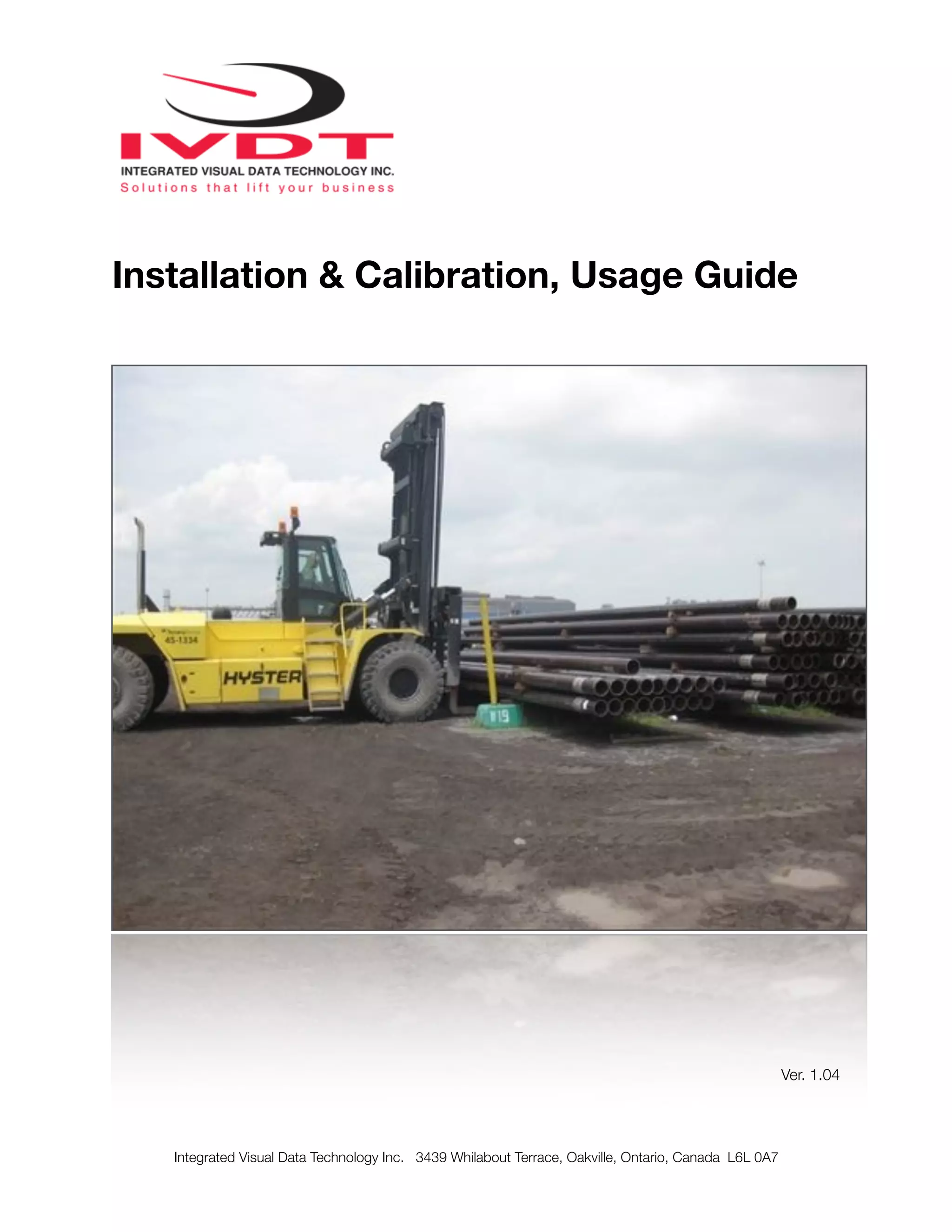
Installation & Calibration, Usage Guide
Ver. 1.04
Integrated Visual Data Technology Inc. 3439 Whilabout Terrace, Oakville, Ontario, Canada L6L 0A7
Installation & Calibration for Tamsa SkidFleet System
This SkidFleet system installation & calibration guide describes how to install, calibrate, test and use your on-board
check weighing & utilization with downtime reasons with overload function. Following the instructions in this guide will
enable you to get your system operating quickly and easily. In the event that you require additional assistance, please
contact customer support via e-mail at support@skidweigh.com or visit www.skidweigh.com or contact us at the
address or contact number below:
Integrated Visual Data Technology Inc.
3439 Whilabout Terrace, Oakville, ON, Canada, L6L 0A7
Phone: 905-469-0985, Fax: 905-825-9494
Safety
Always disconnect the vehicle battery while installing SkidFleet system or any other electronic product. Make sure sure
that unit, pressure transducer and any other associated cables are securely mounted and do not impede any of the
vehicle’s controls. Use care when routing the components cables. Route the cables where they will be protected. Use
commonly accepted install practices for after market industrial vehicle electronic devices. The installation of the SkidFleet
systems should only be performed by an acknowledged lift truck dealer technician or end user electro and hydraulic
technical installer.
Here are two acceptable methods of making a wire connections:
* Soldering your connections (recommended)
* Crimp connectors (with the use of the proper crimping tool)
Regardless of the method you choose, ensure that the connection is mechanically sound and properly insulated. Use
high quality electrical tape and shrink tubing where necessary.
This product is connected directly to the vehicle’s ignition switch, 12 to 55 V DC. There is no on-off switch on the unit.
Integrated Visual Data Technology Inc. 3439 Whilabout Terrace, Oakville, Ontario, Canada L6L 0A7
On-board Load Weighing, Overload Warning and Vehicle Usage
Electro-Magnetic Compatibility
CE conformity to EC directive 89/336 (EMC) by application of harmonized standards: Interference stability EN 61000-6-2
and EN 61326-1 interference emit EN 61000-6-3, EN 61326-1 for the pressure transducer.
SkidFleet Series
Our policy is one of continuous improvement and the information in this document is subject to change without notice.
Check that software version displayed on LCD is the one applicable for your application.
Overview of components
The standard SkidFleet system consist of two main components:
* Digital indicator with wiring harness, mounting bracket
* Hydraulic pressure transducer with 3 wires cable
* Installation & calibration manual and operator usage instruction
Operational principal
The SkidFleet system check weighing operational principal is based on the hydraulic pressure transducer mounted in
the vehicle lifting hydraulic circuit that will automatically activate the “weighing cycle / specific algorithm ” every time a
skid load is lifted just above the ground. The increase in pressure is converted in an electronic signal at the sample rate of
16000 readings which is converted into a load weight reading. The SkidFleet models equipped with the impact detection
system have the impact module mounted inside the SkidFleet enclosure.
Pressure transducer installation
The pressure transducer must be installed in the lifting hydraulic line between the lift control valve and lift
cylinder(s). Mount a T-piece in lifting hydraulic line. In some cases you can install the pressure transducer in the flow
divider, drilling and tapping for 1/4”-18 NPT male in spare plug (if only single or double mast configuration) or in the body
of the flow divider. Also, you can drill and tap on any “larger elbow” that might be available in the hydraulic lifting circuit
found in vehicles with larger hoses to accommodate larger vehicle lifting capacities .
! !
Pressure transducer installation precautions
Before installation of the pressure transducer the hydraulic lift circuit must be pressure free.
There are two ways to do that:
1. Place the forks on the ground in their lowest position and make the hydraulic system pressure free by tilting the mast
Integrated Visual Data Technology Inc. 3439 Whilabout Terrace, Oakville, Ontario, Canada L6L 0A7
forward. The chain(s) should be slack.
2. Lift the forks and position them on the top of a supporting fixture. Start lowering the lifting cylinder into its lowest
position. Be sure that chain(s) are slack.
Make sure that that installed pressure transducer will not touch any moving parts or assembly of the vehicle while in
normal operation. Pressure transducer has 1/4”-18 NPT male thread. Use thread seal to ensure tight fit.
Selecting the mounting location for digital indicator
Use the mounting bracket to fasten digital indicator on the vehicle dashboard, side railing or preferably on the top of the
operator guard enclosure, right hand side.
!
There are many examples of mounting locations that will depend on the vehicle model. However, additional mounting
items such as a flat brackets may be needed to help secure the unit to upper right corner of the guard or side railing.
Compact size
All of the SkidWeigh systems are compact size, housing dimension of only 178 mm x 127 mm x 43 mm.
Electrical Connections
Note: The main cable for pressure transducer and power supply are the same colour code for all SkidFleet versions.
Digital indicator with five wires single cable.
Pressure transducer cable (Cable with 3 wires: red,white and black)
Electrical Connections
- Orange Wire (+) Ignition switch “on position”
- Brown Wire (-) Battery negative
- Red Wire, connect to RED wire of the pressure transducer cable
- Black Wire, connect to BLACK wire of the pressure transducer cable
- White Wire, connect to WHITE wire of the pressure transducer cable
Integrated Visual Data Technology Inc. 3439 Whilabout Terrace, Oakville, Ontario, Canada L6L 0A7
Electrical power short circuit protection
- All of the SkidFleet systems are internally short circuit protected with resettable fuse. There is no need to install external
inline fuse in orange wire connected to the ignition switch, vehicle positive connection 12 to 55 V DC.
- Automotive 60 V load dump protection. Reversal power supply protection.
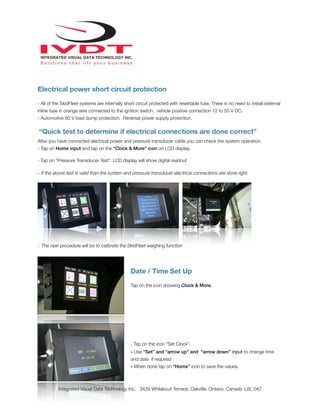
“Quick test to determine if electrical connections are done correct”
After you have connected electrical power and pressure transducer cable you can check the system operation.
- Tap on Home input and tap on the “Clock & More” icon on LCD display.
- Tap on “Pressure Transducer Test”. LCD display will show digital readout
- If the above test is valid than the system and pressure transducer electrical connections are done right.
- The next procedure will be to calibrate the SkidFleet weighing function
Date / Time Set Up
Tap on the icon showing Clock & More.
- Tap on the icon “Set Clock”.
- Use “Set” and “arrow up” and “arrow down” input to change time
and date if required
- When done tap on “Home” icon to save the values.
Integrated Visual Data Technology Inc. 3439 Whilabout Terrace, Oakville, Ontario, Canada L6L 0A7
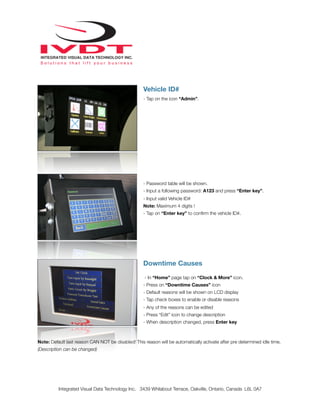
Vehicle ID#
- Tap on the icon “Admin”.
- Password table will be shown.
- Input a following password: A123 and press “Enter key”.
- Input valid Vehicle ID#
Note: Maximum 4 digits !
- Tap on “Enter key” to confirm the vehicle ID#.
Downtime Causes
- In “Home” page tap on “Clock & More” icon.
- Press on “Downtime Causes” icon
- Default reasons will be shown on LCD display
- Tap check boxes to enable or disable reasons
- Any of the reasons can be edited
- Press “Edit” icon to change description
- When description changed, press Enter key
Note: Default last reason CAN NOT be disabled! This reason will be automatically activate after pre determined idle time.
(Description can be changed)
Integrated Visual Data Technology Inc. 3439 Whilabout Terrace, Oakville, Ontario, Canada L6L 0A7
- General Instructions For Load Weight Calibration Procedure
To initiate calibration of the load measurement process you must press “Home” icon and press “Calibrate” icon”.
The TAMSA SkidFleet system calibration is custom made software algorithm that requires manual input to initiate
calibration of empty and loaded forks. During the normal weighing process when loaded forks are lifted the weighing
cycle is initiated by the operator manual input by pressing “Weigh” icon shown on the bottom of the LCD display.
(Length of time required to re-adjust load on the forks before load weighing cycle is activated is not limited)
- Important: Follow instructions on LCD display to complete calibration of empty and loaded forks. ( LCD messages
such as “TAP OK WHEN FORKS UP” , “TAP OK WHEN FORKS DOWN”, “TAP OK WHEN LOAD UP”, etc.)
After the calibration is finished you must input overload value and press “Enter key”.
MAKE SURE THAT YOU HAVE A KNOWN LOAD WEIGHT AND KEEP IT NEARBY TO COMPLETE THE
CALIBRATION.
- For the best results use at least minimum calibration load test weight of 30 to 50% of maximum lifting capacity of the
lift truck. Use customer floor scale or find a known load weight within the operational facility.
Important:
If you want the system to show load weight in pounds, use the known load weight in
pounds and enter that value accordingly. The same would apply if you want the system
to show load weight in kilograms.
Calibration starting point
-Turn ignition switch to on position.
LCD display will show standard weighing mode.
Tap on “Home” icon.
-With LCD showing all of the icons, tap on “Calibrate” icon. The
“Weighing” icon will be shown.
-Tap on “Weighing” icon to initiate calibration process.
Follow instructions shown on LCD display.
Integrated Visual Data Technology Inc. 3439 Whilabout Terrace, Oakville, Ontario, Canada L6L 0A7
Operational Cycle
When ignition switch is turned on system LCD display will show normal
operational mode.
All reporting are automatic except the manual input to initiate load weight.
* Overload warning is automatically detected, shown on LCD screen, recorded and reported to the base station
* Downtime reason automatically detected as the “OTHER”. It’s up to operator to choose a valid cause.
* Default allowed “Idling time” is 300 seconds. ( Idling time defined as vehicle standing without or with load )
* Idling time range is from 1 to 999 seconds and can be changed.
* Weighing cycle initiated by operator by pressing “Weigh” icon located on the bottom of the LCD screen.
* Load weight automatically shown on LCD screen, recorded and reported to the base station
* Minimum load weight before data send to the base station is 100.
* Minimum load weight can be changed to any other value from 1 to 9999.
Manage Data with USB Recordings
(Mobile Units and Base Station)
- Insert memory stick into USB port
- In “Home” page tap on “Clock & More” icon.
- Press on “Saved Data” icon and follow instruction on LCD screen
LCD Screen Showing
2014-Oct-28
Save Data to USB:
Data for Date Above
Everything
Erase All Data
Back
Integrated Visual Data Technology Inc. 3439 Whilabout Terrace, Oakville, Ontario, Canada L6L 0A7
Weight data send to base station
automatically. No operator input required!
- Overload warning (Send)
- Downtime causes (Send)
Integrated Visual Data Technology Inc. 3439 Whilabout Terrace, Oakville, Ontario, Canada L6L 0A7
Quick Start Operational Guide
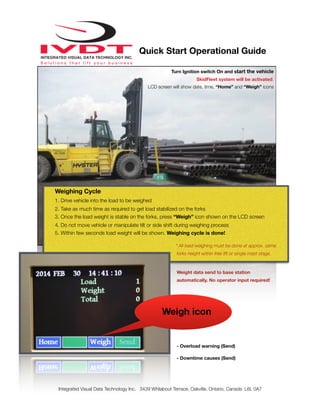
Weighing Cycle
1. Drive vehicle into the load to be weighed
2. Take as much time as required to get load stabilized on the forks
3. Once the load weight is stable on the forks, press “Weigh” icon shown on the LCD screen
4. Do not move vehicle or manipulate tilt or side shift during weighing process
5. Within few seconds load weight will be shown. Weighing cycle is done!
* All load weighing must be done at approx. same
forks height within free lift or single mast stage.
Turn Ignition switch On and start the vehicle
SkidFleet system will be activated.
LCD screen will show date, time, “Home” and “Weigh” icons
Weigh icon

SkidFleet

  • 1.
    Installation & Calibration,Usage Guide Ver. 1.04 Integrated Visual Data Technology Inc. 3439 Whilabout Terrace, Oakville, Ontario, Canada L6L 0A7
  • 2.
    Installation & Calibrationfor Tamsa SkidFleet System This SkidFleet system installation & calibration guide describes how to install, calibrate, test and use your on-board check weighing & utilization with downtime reasons with overload function. Following the instructions in this guide will enable you to get your system operating quickly and easily. In the event that you require additional assistance, please contact customer support via e-mail at support@skidweigh.com or visit www.skidweigh.com or contact us at the address or contact number below: Integrated Visual Data Technology Inc. 3439 Whilabout Terrace, Oakville, ON, Canada, L6L 0A7 Phone: 905-469-0985, Fax: 905-825-9494 Safety Always disconnect the vehicle battery while installing SkidFleet system or any other electronic product. Make sure sure that unit, pressure transducer and any other associated cables are securely mounted and do not impede any of the vehicle’s controls. Use care when routing the components cables. Route the cables where they will be protected. Use commonly accepted install practices for after market industrial vehicle electronic devices. The installation of the SkidFleet systems should only be performed by an acknowledged lift truck dealer technician or end user electro and hydraulic technical installer. Here are two acceptable methods of making a wire connections: * Soldering your connections (recommended) * Crimp connectors (with the use of the proper crimping tool) Regardless of the method you choose, ensure that the connection is mechanically sound and properly insulated. Use high quality electrical tape and shrink tubing where necessary. This product is connected directly to the vehicle’s ignition switch, 12 to 55 V DC. There is no on-off switch on the unit. Integrated Visual Data Technology Inc. 3439 Whilabout Terrace, Oakville, Ontario, Canada L6L 0A7 On-board Load Weighing, Overload Warning and Vehicle Usage
  • 3.
    Electro-Magnetic Compatibility CE conformityto EC directive 89/336 (EMC) by application of harmonized standards: Interference stability EN 61000-6-2 and EN 61326-1 interference emit EN 61000-6-3, EN 61326-1 for the pressure transducer. SkidFleet Series Our policy is one of continuous improvement and the information in this document is subject to change without notice. Check that software version displayed on LCD is the one applicable for your application. Overview of components The standard SkidFleet system consist of two main components: * Digital indicator with wiring harness, mounting bracket * Hydraulic pressure transducer with 3 wires cable * Installation & calibration manual and operator usage instruction Operational principal The SkidFleet system check weighing operational principal is based on the hydraulic pressure transducer mounted in the vehicle lifting hydraulic circuit that will automatically activate the “weighing cycle / specific algorithm ” every time a skid load is lifted just above the ground. The increase in pressure is converted in an electronic signal at the sample rate of 16000 readings which is converted into a load weight reading. The SkidFleet models equipped with the impact detection system have the impact module mounted inside the SkidFleet enclosure. Pressure transducer installation The pressure transducer must be installed in the lifting hydraulic line between the lift control valve and lift cylinder(s). Mount a T-piece in lifting hydraulic line. In some cases you can install the pressure transducer in the flow divider, drilling and tapping for 1/4”-18 NPT male in spare plug (if only single or double mast configuration) or in the body of the flow divider. Also, you can drill and tap on any “larger elbow” that might be available in the hydraulic lifting circuit found in vehicles with larger hoses to accommodate larger vehicle lifting capacities . ! ! Pressure transducer installation precautions Before installation of the pressure transducer the hydraulic lift circuit must be pressure free. There are two ways to do that: 1. Place the forks on the ground in their lowest position and make the hydraulic system pressure free by tilting the mast Integrated Visual Data Technology Inc. 3439 Whilabout Terrace, Oakville, Ontario, Canada L6L 0A7
  • 4.
    forward. The chain(s)should be slack. 2. Lift the forks and position them on the top of a supporting fixture. Start lowering the lifting cylinder into its lowest position. Be sure that chain(s) are slack. Make sure that that installed pressure transducer will not touch any moving parts or assembly of the vehicle while in normal operation. Pressure transducer has 1/4”-18 NPT male thread. Use thread seal to ensure tight fit. Selecting the mounting location for digital indicator Use the mounting bracket to fasten digital indicator on the vehicle dashboard, side railing or preferably on the top of the operator guard enclosure, right hand side. ! There are many examples of mounting locations that will depend on the vehicle model. However, additional mounting items such as a flat brackets may be needed to help secure the unit to upper right corner of the guard or side railing. Compact size All of the SkidWeigh systems are compact size, housing dimension of only 178 mm x 127 mm x 43 mm. Electrical Connections Note: The main cable for pressure transducer and power supply are the same colour code for all SkidFleet versions. Digital indicator with five wires single cable. Pressure transducer cable (Cable with 3 wires: red,white and black) Electrical Connections - Orange Wire (+) Ignition switch “on position” - Brown Wire (-) Battery negative - Red Wire, connect to RED wire of the pressure transducer cable - Black Wire, connect to BLACK wire of the pressure transducer cable - White Wire, connect to WHITE wire of the pressure transducer cable Integrated Visual Data Technology Inc. 3439 Whilabout Terrace, Oakville, Ontario, Canada L6L 0A7
  • 5.
    Electrical power shortcircuit protection - All of the SkidFleet systems are internally short circuit protected with resettable fuse. There is no need to install external inline fuse in orange wire connected to the ignition switch, vehicle positive connection 12 to 55 V DC. - Automotive 60 V load dump protection. Reversal power supply protection. “Quick test to determine if electrical connections are done correct” After you have connected electrical power and pressure transducer cable you can check the system operation. - Tap on Home input and tap on the “Clock & More” icon on LCD display. - Tap on “Pressure Transducer Test”. LCD display will show digital readout - If the above test is valid than the system and pressure transducer electrical connections are done right. - The next procedure will be to calibrate the SkidFleet weighing function Date / Time Set Up Tap on the icon showing Clock & More. - Tap on the icon “Set Clock”. - Use “Set” and “arrow up” and “arrow down” input to change time and date if required - When done tap on “Home” icon to save the values. Integrated Visual Data Technology Inc. 3439 Whilabout Terrace, Oakville, Ontario, Canada L6L 0A7
  • 6.
    Vehicle ID# - Tapon the icon “Admin”. - Password table will be shown. - Input a following password: A123 and press “Enter key”. - Input valid Vehicle ID# Note: Maximum 4 digits ! - Tap on “Enter key” to confirm the vehicle ID#. Downtime Causes - In “Home” page tap on “Clock & More” icon. - Press on “Downtime Causes” icon - Default reasons will be shown on LCD display - Tap check boxes to enable or disable reasons - Any of the reasons can be edited - Press “Edit” icon to change description - When description changed, press Enter key Note: Default last reason CAN NOT be disabled! This reason will be automatically activate after pre determined idle time. (Description can be changed) Integrated Visual Data Technology Inc. 3439 Whilabout Terrace, Oakville, Ontario, Canada L6L 0A7
  • 7.
    - General InstructionsFor Load Weight Calibration Procedure To initiate calibration of the load measurement process you must press “Home” icon and press “Calibrate” icon”. The TAMSA SkidFleet system calibration is custom made software algorithm that requires manual input to initiate calibration of empty and loaded forks. During the normal weighing process when loaded forks are lifted the weighing cycle is initiated by the operator manual input by pressing “Weigh” icon shown on the bottom of the LCD display. (Length of time required to re-adjust load on the forks before load weighing cycle is activated is not limited) - Important: Follow instructions on LCD display to complete calibration of empty and loaded forks. ( LCD messages such as “TAP OK WHEN FORKS UP” , “TAP OK WHEN FORKS DOWN”, “TAP OK WHEN LOAD UP”, etc.) After the calibration is finished you must input overload value and press “Enter key”. MAKE SURE THAT YOU HAVE A KNOWN LOAD WEIGHT AND KEEP IT NEARBY TO COMPLETE THE CALIBRATION. - For the best results use at least minimum calibration load test weight of 30 to 50% of maximum lifting capacity of the lift truck. Use customer floor scale or find a known load weight within the operational facility. Important: If you want the system to show load weight in pounds, use the known load weight in pounds and enter that value accordingly. The same would apply if you want the system to show load weight in kilograms. Calibration starting point -Turn ignition switch to on position. LCD display will show standard weighing mode. Tap on “Home” icon. -With LCD showing all of the icons, tap on “Calibrate” icon. The “Weighing” icon will be shown. -Tap on “Weighing” icon to initiate calibration process. Follow instructions shown on LCD display. Integrated Visual Data Technology Inc. 3439 Whilabout Terrace, Oakville, Ontario, Canada L6L 0A7
  • 8.
    Operational Cycle When ignitionswitch is turned on system LCD display will show normal operational mode. All reporting are automatic except the manual input to initiate load weight. * Overload warning is automatically detected, shown on LCD screen, recorded and reported to the base station * Downtime reason automatically detected as the “OTHER”. It’s up to operator to choose a valid cause. * Default allowed “Idling time” is 300 seconds. ( Idling time defined as vehicle standing without or with load ) * Idling time range is from 1 to 999 seconds and can be changed. * Weighing cycle initiated by operator by pressing “Weigh” icon located on the bottom of the LCD screen. * Load weight automatically shown on LCD screen, recorded and reported to the base station * Minimum load weight before data send to the base station is 100. * Minimum load weight can be changed to any other value from 1 to 9999. Manage Data with USB Recordings (Mobile Units and Base Station) - Insert memory stick into USB port - In “Home” page tap on “Clock & More” icon. - Press on “Saved Data” icon and follow instruction on LCD screen LCD Screen Showing 2014-Oct-28 Save Data to USB: Data for Date Above Everything Erase All Data Back Integrated Visual Data Technology Inc. 3439 Whilabout Terrace, Oakville, Ontario, Canada L6L 0A7
  • 9.
    Weight data sendto base station automatically. No operator input required! - Overload warning (Send) - Downtime causes (Send) Integrated Visual Data Technology Inc. 3439 Whilabout Terrace, Oakville, Ontario, Canada L6L 0A7 Quick Start Operational Guide Weighing Cycle 1. Drive vehicle into the load to be weighed 2. Take as much time as required to get load stabilized on the forks 3. Once the load weight is stable on the forks, press “Weigh” icon shown on the LCD screen 4. Do not move vehicle or manipulate tilt or side shift during weighing process 5. Within few seconds load weight will be shown. Weighing cycle is done! * All load weighing must be done at approx. same forks height within free lift or single mast stage. Turn Ignition switch On and start the vehicle SkidFleet system will be activated. LCD screen will show date, time, “Home” and “Weigh” icons Weigh icon