WELCOME
SIXTH SENSE
TECHNOLOGY
BY
P Mamatha Kumawat
N Charishma
SIXTH SENSE
TECHNOLOGY
Contents:
• Introduction
• History
• Components
• Working
• Advantages
• Disadvantages
• Applications
• Conclusion
Introduction
• It’s beginning of new era of
technology where engineering will
reach new milestones.
• Just like in the science friction
movies where display of computer
screen appears on walls, commands
are given by gestures, the smart
digital environment which talks to us
to do our work and so on, these all
will be possible very soon.
• You imagine it and SIXTH SENSE
TECHNOLOGY will make it
possible.
History
• The history of “6th sense
technology” goes back into
1990’s when Steve Mann first
attempted to propose a neck
worn projector and camera
combination.
• The idea of implementing
computer technologies to daily
tasks as our “6th sense” was
further developed by Pranav
Mistry.
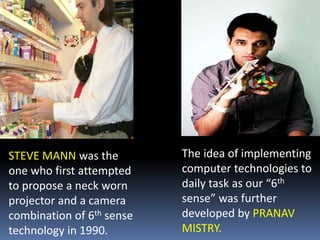
The idea of implementing
computer technologies to
daily task as our “6th
sense” was further
developed by PRANAV
MISTRY.
STEVE MANN was the
one who first attempted
to propose a neck worn
projector and a camera
combination of 6th sense
technology in 1990.
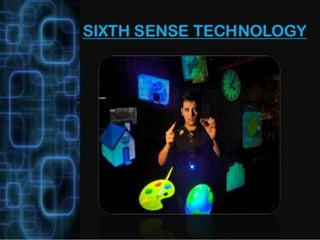
SIXTH SENSE TECHNOLOGY
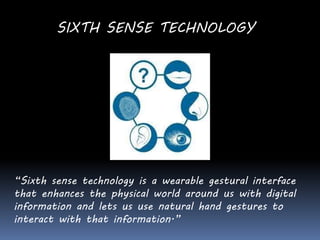
“Sixth sense technology is a wearable gestural interface
that enhances the physical world around us with digital
information and lets us use natural hand gestures to
interact with that information.”
COMPONENTS
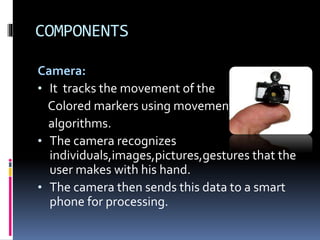
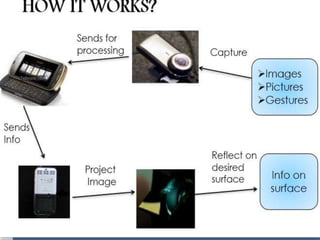
Camera:
• It tracks the movement of the
Colored markers using movement
algorithms.
• The camera recognizes
individuals,images,pictures,gestures that the
user makes with his hand.
• The camera then sends this data to a smart
phone for processing.
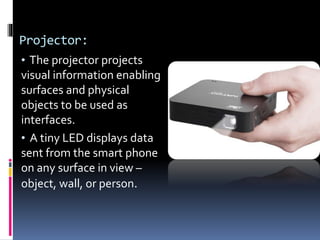
Projector:
• The projector projects
visual information enabling
surfaces and physical
objects to be used as
interfaces.
• A tiny LED displays data
sent from the smart phone
on any surface in view –
object, wall, or person.
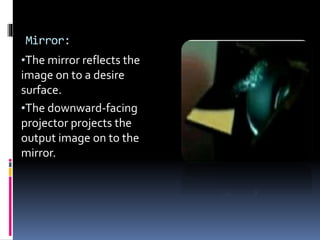
Mirror:
•The mirror reflects the
image on to a desire
surface.
•The downward-facing
projector projects the
output image on to the
mirror.
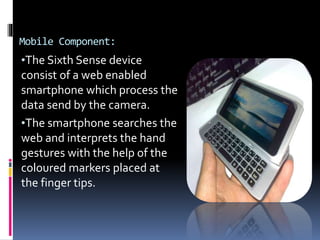
Mobile Component:
•The Sixth Sense device
consist of a web enabled
smartphone which process the
data send by the camera.
•The smartphone searches the
web and interprets the hand
gestures with the help of the
coloured markers placed at
the finger tips.
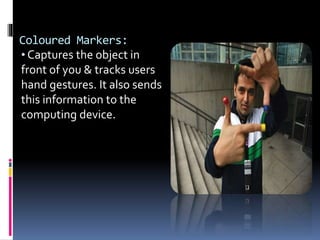
Coloured Markers:
• Captures the object in
front of you & tracks users
hand gestures. It also sends
this information to the
computing device.
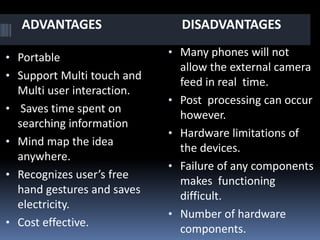
ADVANTAGES DISADVANTAGES
• Portable
• Support Multi touch and
Multi user interaction.
• Saves time spent on
searching information
• Mind map the idea
anywhere.
• Recognizes user’s free
hand gestures and saves
electricity.
• Cost effective.
• Many phones will not
allow the external camera
feed in real time.
• Post processing can occur
however.
• Hardware limitations of
the devices.
• Failure of any components
makes functioning
difficult.
• Number of hardware
components.
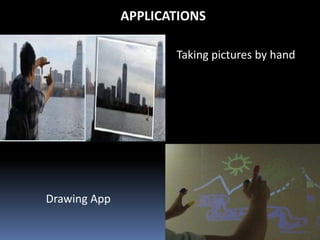
Taking pictures by hand
Drawing App
APPLICATIONS
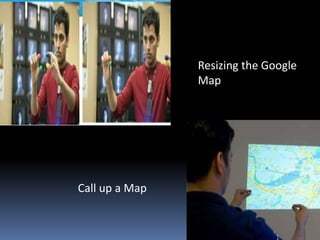
Resizing the Google
Map
Call up a Map
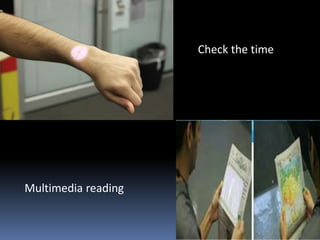
Check the time
Multimedia reading
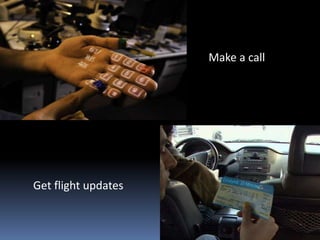
Make a call
Get flight updates
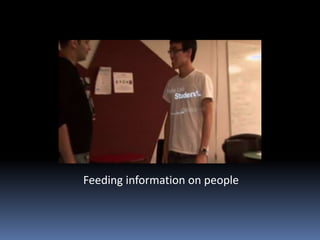
Feeding information on people
CONCLUSION
• Integrating information to every day objects
will not only help us to get rid of the digital
divide, but will also help us in some way to
stay human, to be more connected to our
physical world.
• IT WILL NOT END UP IN MAKING US
MACHINES SITTING INFRONT OF OTHER
MACHINES!!
Sixth Sense Technology

Sixth Sense Technology

  • 1.
  • 2.
  • 3.
    Contents: • Introduction • History •Components • Working • Advantages • Disadvantages • Applications • Conclusion
  • 4.
    Introduction • It’s beginningof new era of technology where engineering will reach new milestones. • Just like in the science friction movies where display of computer screen appears on walls, commands are given by gestures, the smart digital environment which talks to us to do our work and so on, these all will be possible very soon. • You imagine it and SIXTH SENSE TECHNOLOGY will make it possible.
  • 5.
    History • The historyof “6th sense technology” goes back into 1990’s when Steve Mann first attempted to propose a neck worn projector and camera combination. • The idea of implementing computer technologies to daily tasks as our “6th sense” was further developed by Pranav Mistry.
  • 6.
    The idea ofimplementing computer technologies to daily task as our “6th sense” was further developed by PRANAV MISTRY. STEVE MANN was the one who first attempted to propose a neck worn projector and a camera combination of 6th sense technology in 1990.
  • 7.
    SIXTH SENSE TECHNOLOGY “Sixthsense technology is a wearable gestural interface that enhances the physical world around us with digital information and lets us use natural hand gestures to interact with that information.”
  • 8.
    COMPONENTS Camera: • It tracksthe movement of the Colored markers using movement algorithms. • The camera recognizes individuals,images,pictures,gestures that the user makes with his hand. • The camera then sends this data to a smart phone for processing.
  • 9.
    Projector: • The projectorprojects visual information enabling surfaces and physical objects to be used as interfaces. • A tiny LED displays data sent from the smart phone on any surface in view – object, wall, or person.
  • 10.
    Mirror: •The mirror reflectsthe image on to a desire surface. •The downward-facing projector projects the output image on to the mirror.
  • 11.
    Mobile Component: •The SixthSense device consist of a web enabled smartphone which process the data send by the camera. •The smartphone searches the web and interprets the hand gestures with the help of the coloured markers placed at the finger tips.
  • 12.
    Coloured Markers: • Capturesthe object in front of you & tracks users hand gestures. It also sends this information to the computing device.
  • 15.
    ADVANTAGES DISADVANTAGES • Portable •Support Multi touch and Multi user interaction. • Saves time spent on searching information • Mind map the idea anywhere. • Recognizes user’s free hand gestures and saves electricity. • Cost effective. • Many phones will not allow the external camera feed in real time. • Post processing can occur however. • Hardware limitations of the devices. • Failure of any components makes functioning difficult. • Number of hardware components.
  • 16.
    Taking pictures byhand Drawing App APPLICATIONS
  • 17.
  • 18.
  • 19.
    Make a call Getflight updates
  • 20.
  • 21.
    CONCLUSION • Integrating informationto every day objects will not only help us to get rid of the digital divide, but will also help us in some way to stay human, to be more connected to our physical world. • IT WILL NOT END UP IN MAKING US MACHINES SITTING INFRONT OF OTHER MACHINES!!