BY
ISMAIL ZABEEHULLA J
B.Tech.,MBA.,PGDPMIR.,UGC-NET.,
SIX SIGMA
TOPICS COVERED
• INTRODUCTION
• DEFINITION OF SIX SIGMA
• OBJECTIVES AND BENEFITS OF SIX SIGMA
• ELEMENTS OF SIX SIGMA
• SIX SIGMA METHODOLOGIES
• SIX SIGMA TECHNOLOGICAL TOOLS
INTRODUCTION
• Six Sigma is a set of techniques, and tools for
process improvement. It was developed by
Motorola in 1986.
• Sir Bill Smith, “ the Father of six sigma”
introduce this quality improvement Methodology
to Motorola.
• Six Sigma is now an enormous 'brand' in the
world of corporate development.
DEFINITION OF SIX SIGMA:
• Six Sigma is a method aimed to eliminate defects for achieving
six standard deviations , which is the difference between the
mean and the nearest specification limit in the process of a
product /service
• Six Sigma approach is a collection of managerial and statistical
concept and techniques that focuses on reducing variation in
processes and preventing deficiencies in product.
• A six sigma process is one in which 99.9999966 % of the
products manufactured are statistically expected
to be free of defects (3.4 defects per million).
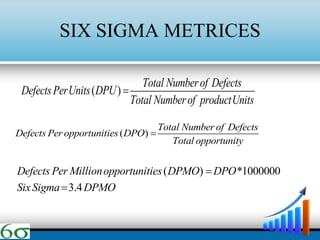
SIX SIGMA METRICES
( )
Total Numberof Defects
DefectsPerUnits DPU
Total Numberof productUnits

( )
Total Number of Defects
Defects Per opportunities DPO
Total opportunity

( ) *1000000
3.4
Defects Per Millionopportunities DPMO DPO
SixSigma DPMO


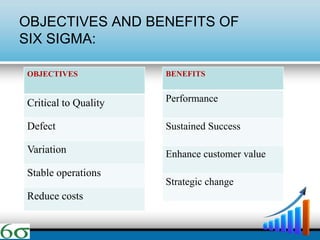
OBJECTIVES AND BENEFITS OF
SIX SIGMA:
OBJECTIVES
Critical to Quality
Defect
Variation
Stable operations
Reduce costs
BENEFITS
Performance
Sustained Success
Enhance customer value
Strategic change
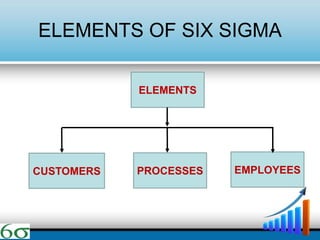
ELEMENTS OF SIX SIGMA
CUSTOMERS EMPLOYEESPROCESSES
ELEMENTS
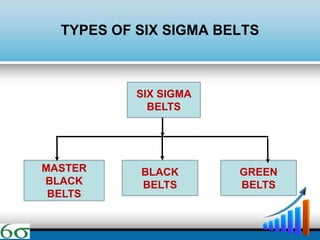
TYPES OF SIX SIGMA BELTS
SIX SIGMA
BELTS
MASTER
BLACK
BELTS
GREEN
BELTS
BLACK
BELTS
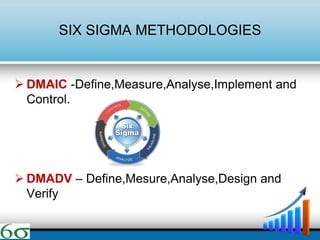
SIX SIGMA METHODOLOGIES
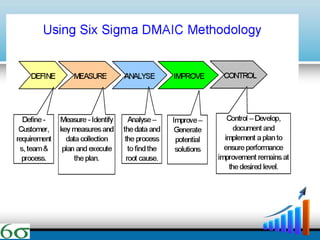
 DMAIC -Define,Measure,Analyse,Implement and
Control.
 DMADV – Define,Mesure,Analyse,Design and
Verify
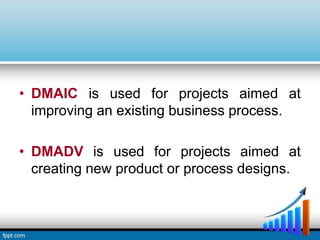
• DMAIC is used for projects aimed at
improving an existing business process.
• DMADV is used for projects aimed at
creating new product or process designs.
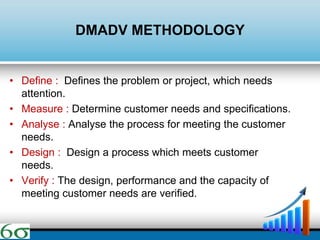
DMADV METHODOLOGY
• Define : Defines the problem or project, which needs
attention.
• Measure : Determine customer needs and specifications.
• Analyse : Analyse the process for meeting the customer
needs.
• Design : Design a process which meets customer
needs.
• Verify : The design, performance and the capacity of
meeting customer needs are verified.
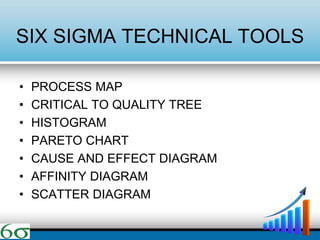
SIX SIGMA TECHNICAL TOOLS
• PROCESS MAP
• CRITICAL TO QUALITY TREE
• HISTOGRAM
• PARETO CHART
• CAUSE AND EFFECT DIAGRAM
• AFFINITY DIAGRAM
• SCATTER DIAGRAM
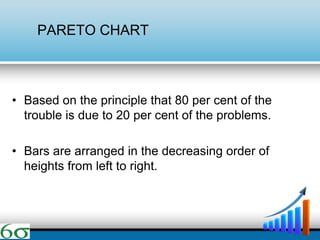
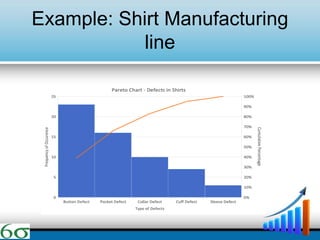
PARETO CHART
• Based on the principle that 80 per cent of the
trouble is due to 20 per cent of the problems.
• Bars are arranged in the decreasing order of
heights from left to right.
Example: Shirt Manufacturing
line
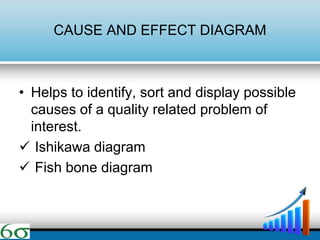
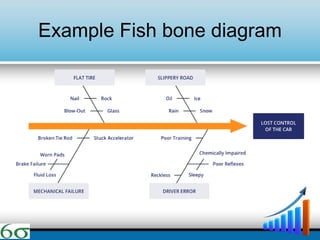
CAUSE AND EFFECT DIAGRAM
• Helps to identify, sort and display possible
causes of a quality related problem of
interest.
 Ishikawa diagram
 Fish bone diagram
Example Fish bone diagram
Affinity Diagram
• It consolidates the huge information into
clusters of ideas which have more
similarity/Affinity.
• It is useful in the measure and the analyse
step of six sigma project.
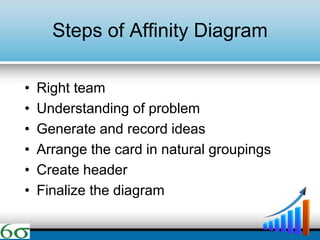
Steps of Affinity Diagram
• Right team
• Understanding of problem
• Generate and record ideas
• Arrange the card in natural groupings
• Create header
• Finalize the diagram
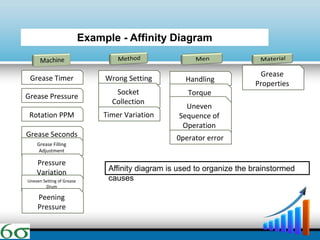
Grease Timer
Grease Pressure
Rotation PPM
Grease Seconds
Grease Filling
Adjustment
Handling
Torque
CheckingUneven
Sequence of
Operation
0perator error
Pressure
Variation
Uneven Setting of Grease
Drum
Grease
Properties
Wrong Setting
Socket
Collection
Timer Variation
Affinity diagram is used to organize the brainstormed
causes
Example - Affinity Diagram
Peening
Pressure
THANK YOU

Six sigma ppt

  • 1.
  • 2.
    TOPICS COVERED • INTRODUCTION •DEFINITION OF SIX SIGMA • OBJECTIVES AND BENEFITS OF SIX SIGMA • ELEMENTS OF SIX SIGMA • SIX SIGMA METHODOLOGIES • SIX SIGMA TECHNOLOGICAL TOOLS
  • 3.
    INTRODUCTION • Six Sigmais a set of techniques, and tools for process improvement. It was developed by Motorola in 1986. • Sir Bill Smith, “ the Father of six sigma” introduce this quality improvement Methodology to Motorola. • Six Sigma is now an enormous 'brand' in the world of corporate development.
  • 4.
    DEFINITION OF SIXSIGMA: • Six Sigma is a method aimed to eliminate defects for achieving six standard deviations , which is the difference between the mean and the nearest specification limit in the process of a product /service • Six Sigma approach is a collection of managerial and statistical concept and techniques that focuses on reducing variation in processes and preventing deficiencies in product. • A six sigma process is one in which 99.9999966 % of the products manufactured are statistically expected to be free of defects (3.4 defects per million).
  • 5.
    SIX SIGMA METRICES () Total Numberof Defects DefectsPerUnits DPU Total Numberof productUnits  ( ) Total Number of Defects Defects Per opportunities DPO Total opportunity  ( ) *1000000 3.4 Defects Per Millionopportunities DPMO DPO SixSigma DPMO  
  • 6.
    OBJECTIVES AND BENEFITSOF SIX SIGMA: OBJECTIVES Critical to Quality Defect Variation Stable operations Reduce costs BENEFITS Performance Sustained Success Enhance customer value Strategic change
  • 7.
    ELEMENTS OF SIXSIGMA CUSTOMERS EMPLOYEESPROCESSES ELEMENTS
  • 8.
    TYPES OF SIXSIGMA BELTS SIX SIGMA BELTS MASTER BLACK BELTS GREEN BELTS BLACK BELTS
  • 9.
    SIX SIGMA METHODOLOGIES DMAIC -Define,Measure,Analyse,Implement and Control.  DMADV – Define,Mesure,Analyse,Design and Verify
  • 10.
    • DMAIC isused for projects aimed at improving an existing business process. • DMADV is used for projects aimed at creating new product or process designs.
  • 12.
    DMADV METHODOLOGY • Define: Defines the problem or project, which needs attention. • Measure : Determine customer needs and specifications. • Analyse : Analyse the process for meeting the customer needs. • Design : Design a process which meets customer needs. • Verify : The design, performance and the capacity of meeting customer needs are verified.
  • 13.
    SIX SIGMA TECHNICALTOOLS • PROCESS MAP • CRITICAL TO QUALITY TREE • HISTOGRAM • PARETO CHART • CAUSE AND EFFECT DIAGRAM • AFFINITY DIAGRAM • SCATTER DIAGRAM
  • 14.
    PARETO CHART • Basedon the principle that 80 per cent of the trouble is due to 20 per cent of the problems. • Bars are arranged in the decreasing order of heights from left to right.
  • 15.
  • 16.
    CAUSE AND EFFECTDIAGRAM • Helps to identify, sort and display possible causes of a quality related problem of interest.  Ishikawa diagram  Fish bone diagram
  • 17.
  • 18.
    Affinity Diagram • Itconsolidates the huge information into clusters of ideas which have more similarity/Affinity. • It is useful in the measure and the analyse step of six sigma project.
  • 19.
    Steps of AffinityDiagram • Right team • Understanding of problem • Generate and record ideas • Arrange the card in natural groupings • Create header • Finalize the diagram
  • 20.
    Grease Timer Grease Pressure RotationPPM Grease Seconds Grease Filling Adjustment Handling Torque CheckingUneven Sequence of Operation 0perator error Pressure Variation Uneven Setting of Grease Drum Grease Properties Wrong Setting Socket Collection Timer Variation Affinity diagram is used to organize the brainstormed causes Example - Affinity Diagram Peening Pressure
  • 21.