Control Methods
Control
Module 01
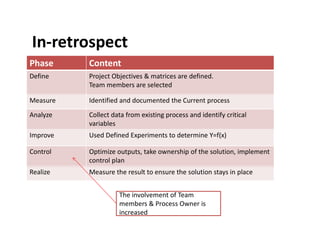
In-retrospect
Phase Content
Define Project Objectives & matrices are defined.
Team members are selected
Measure Identified and documented the Current process
Analyze Collect data from existing process and identify critical
variables
Improve Used Defined Experiments to determine Y=f(x)
Control Optimize outputs, take ownership of the solution, implement
control plan
Realize Measure the result to ensure the solution stays in place
The involvement of Team
members & Process Owner is
increased
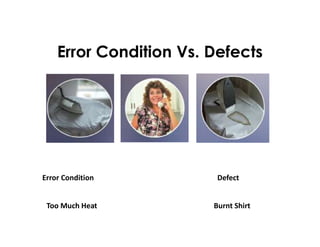
Too Much Heat Burnt Shirt
Error Condition Defect
Error Condition Vs. Defects
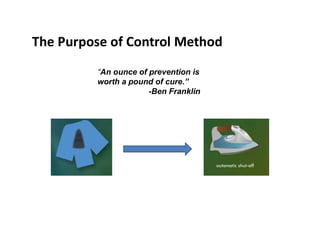
The Purpose of Control Method
“An ounce of prevention is
worth a pound of cure.”
-Ben Franklin
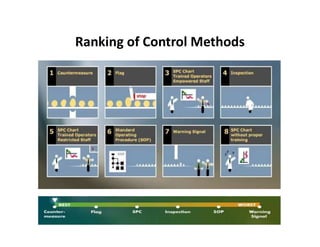
Ranking of Control Methods
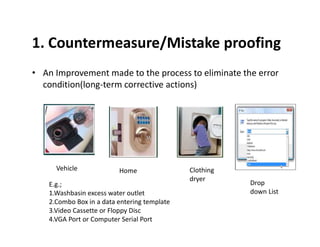
1. Countermeasure/Mistake proofing
• An Improvement made to the process to eliminate the error
condition(long-term corrective actions)
Vehicle Home
Drop
down List
E.g.;
1.Washbasin excess water outlet
2.Combo Box in a data entering template
3.Video Cassette or Floppy Disc
4.VGA Port or Computer Serial Port
Clothing
dryer
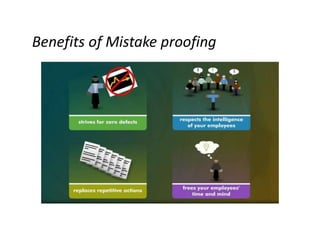
Benefits of Mistake proofing
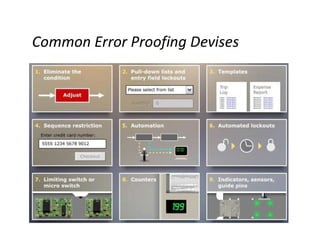
Common Error Proofing Devises
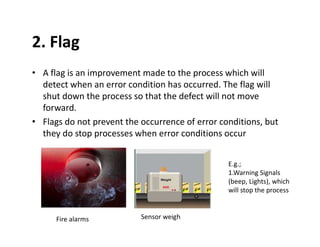
2. Flag
• A flag is an improvement made to the process which will
detect when an error condition has occurred. The flag will
shut down the process so that the defect will not move
forward.
• Flags do not prevent the occurrence of error conditions, but
they do stop processes when error conditions occur
Fire alarms Sensor weigh
E.g.;
1.Warning Signals
(beep, Lights), which
will stop the process
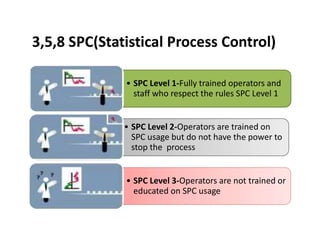
3,5,8 SPC(Statistical Process Control)
• SPC Level 1-Fully trained operators and
staff who respect the rules SPC Level 1
• SPC Level 2-Operators are trained on
SPC usage but do not have the power to
stop the process
• SPC Level 3-Operators are not trained or
educated on SPC usage
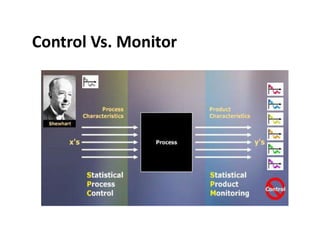
Control Vs. Monitor
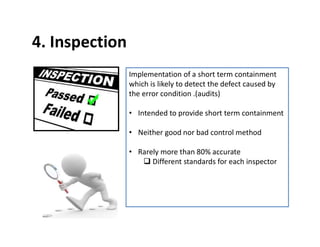
4. Inspection
Implementation of a short term containment
which is likely to detect the defect caused by
the error condition .(audits)
• Intended to provide short term containment
• Neither good nor bad control method
• Rarely more than 80% accurate
 Different standards for each inspector
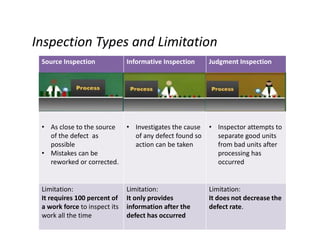
Inspection Types and Limitation
Source Inspection Informative Inspection Judgment Inspection
• As close to the source
of the defect as
possible
• Mistakes can be
reworked or corrected.
• Investigates the cause
of any defect found so
action can be taken
• Inspector attempts to
separate good units
from bad units after
processing has
occurred
Limitation:
It requires 100 percent of
a work force to inspect its
work all the time
Limitation:
It only provides
information after the
defect has occurred
Limitation:
It does not decrease the
defect rate.
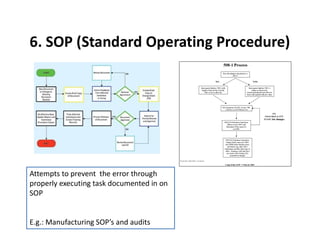
6. SOP (Standard Operating Procedure)
Attempts to prevent the error through
properly executing task documented in on
SOP
E.g.: Manufacturing SOP’s and audits
7. Warning Signal
Attempts to detect defect
If signals occur often , operator
become immune or simply disconnect
these warning signal
e.g.: Blinking or flashing light
Buzzers
Spell checker notification
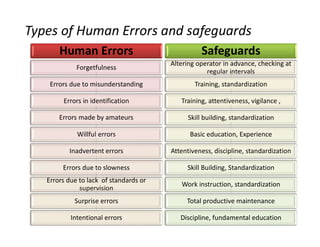
Types of Human Errors and safeguards
Human Errors
Forgetfulness
Errors due to misunderstanding
Errors in identification
Errors made by amateurs
Willful errors
Inadvertent errors
Errors due to slowness
Errors due to lack of standards or
supervision
Surprise errors
Intentional errors
Safeguards
Altering operator in advance, checking at
regular intervals
Training, standardization
Training, attentiveness, vigilance ,
Skill building, standardization
Basic education, Experience
Attentiveness, discipline, standardization
Skill Building, Standardization
Work instruction, standardization
Total productive maintenance
Discipline, fundamental education

Six Sigma Control Methods-Introduction to Control Methods Used in Lean Six Sigma Approach

  • 1.
  • 2.
    In-retrospect Phase Content Define ProjectObjectives & matrices are defined. Team members are selected Measure Identified and documented the Current process Analyze Collect data from existing process and identify critical variables Improve Used Defined Experiments to determine Y=f(x) Control Optimize outputs, take ownership of the solution, implement control plan Realize Measure the result to ensure the solution stays in place The involvement of Team members & Process Owner is increased
  • 3.
    Too Much HeatBurnt Shirt Error Condition Defect Error Condition Vs. Defects
  • 4.
    The Purpose ofControl Method “An ounce of prevention is worth a pound of cure.” -Ben Franklin
  • 5.
  • 6.
    1. Countermeasure/Mistake proofing •An Improvement made to the process to eliminate the error condition(long-term corrective actions) Vehicle Home Drop down List E.g.; 1.Washbasin excess water outlet 2.Combo Box in a data entering template 3.Video Cassette or Floppy Disc 4.VGA Port or Computer Serial Port Clothing dryer
  • 7.
  • 8.
  • 9.
    2. Flag • Aflag is an improvement made to the process which will detect when an error condition has occurred. The flag will shut down the process so that the defect will not move forward. • Flags do not prevent the occurrence of error conditions, but they do stop processes when error conditions occur Fire alarms Sensor weigh E.g.; 1.Warning Signals (beep, Lights), which will stop the process
  • 10.
    3,5,8 SPC(Statistical ProcessControl) • SPC Level 1-Fully trained operators and staff who respect the rules SPC Level 1 • SPC Level 2-Operators are trained on SPC usage but do not have the power to stop the process • SPC Level 3-Operators are not trained or educated on SPC usage
  • 11.
  • 12.
    4. Inspection Implementation ofa short term containment which is likely to detect the defect caused by the error condition .(audits) • Intended to provide short term containment • Neither good nor bad control method • Rarely more than 80% accurate  Different standards for each inspector
  • 13.
    Inspection Types andLimitation Source Inspection Informative Inspection Judgment Inspection • As close to the source of the defect as possible • Mistakes can be reworked or corrected. • Investigates the cause of any defect found so action can be taken • Inspector attempts to separate good units from bad units after processing has occurred Limitation: It requires 100 percent of a work force to inspect its work all the time Limitation: It only provides information after the defect has occurred Limitation: It does not decrease the defect rate.
  • 14.
    6. SOP (StandardOperating Procedure) Attempts to prevent the error through properly executing task documented in on SOP E.g.: Manufacturing SOP’s and audits
  • 15.
    7. Warning Signal Attemptsto detect defect If signals occur often , operator become immune or simply disconnect these warning signal e.g.: Blinking or flashing light Buzzers Spell checker notification
  • 16.
    Types of HumanErrors and safeguards Human Errors Forgetfulness Errors due to misunderstanding Errors in identification Errors made by amateurs Willful errors Inadvertent errors Errors due to slowness Errors due to lack of standards or supervision Surprise errors Intentional errors Safeguards Altering operator in advance, checking at regular intervals Training, standardization Training, attentiveness, vigilance , Skill building, standardization Basic education, Experience Attentiveness, discipline, standardization Skill Building, Standardization Work instruction, standardization Total productive maintenance Discipline, fundamental education