CSP STUDY NOTES
Paul Mcneill, CSP
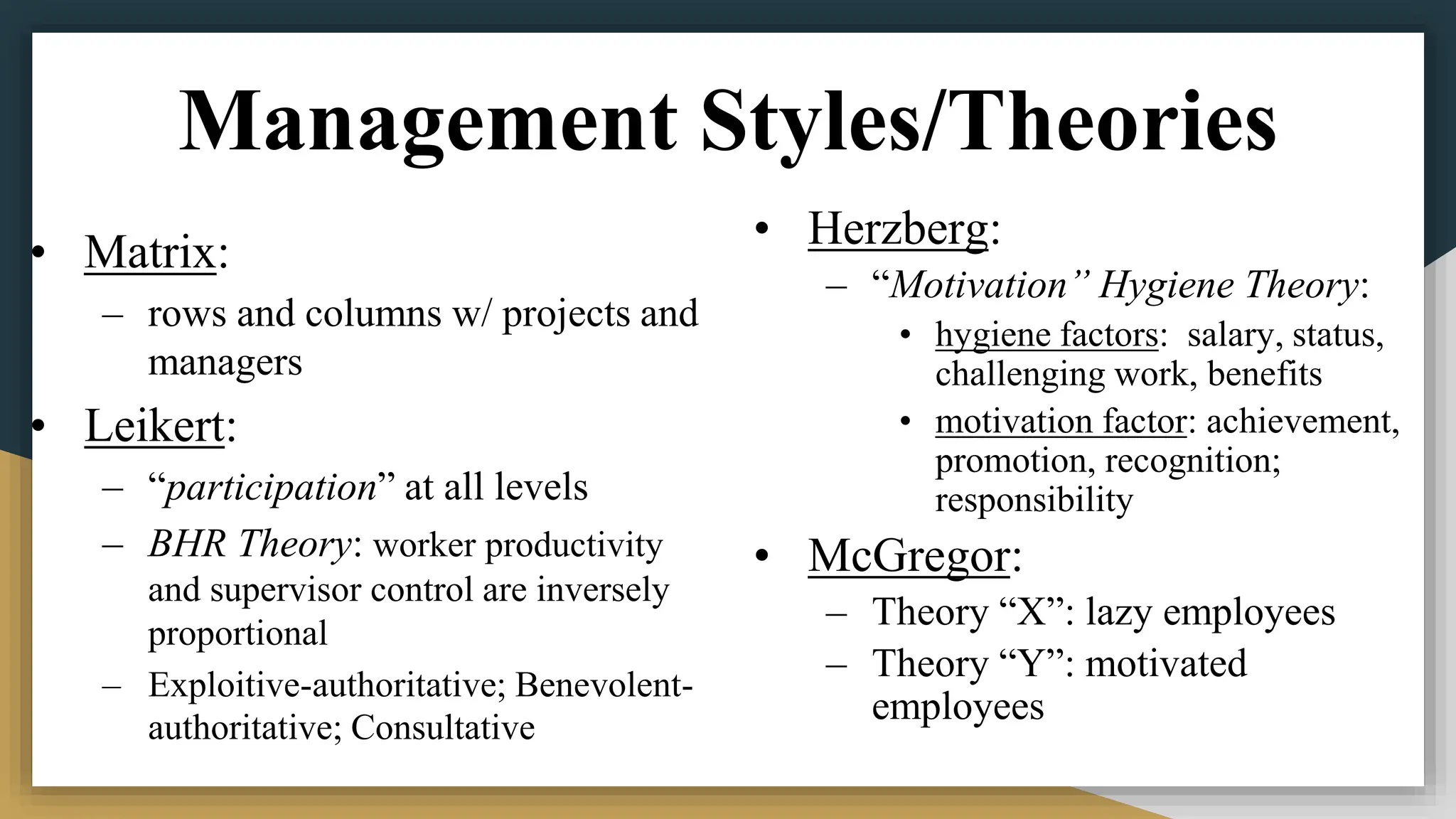
Management Styles/Theories
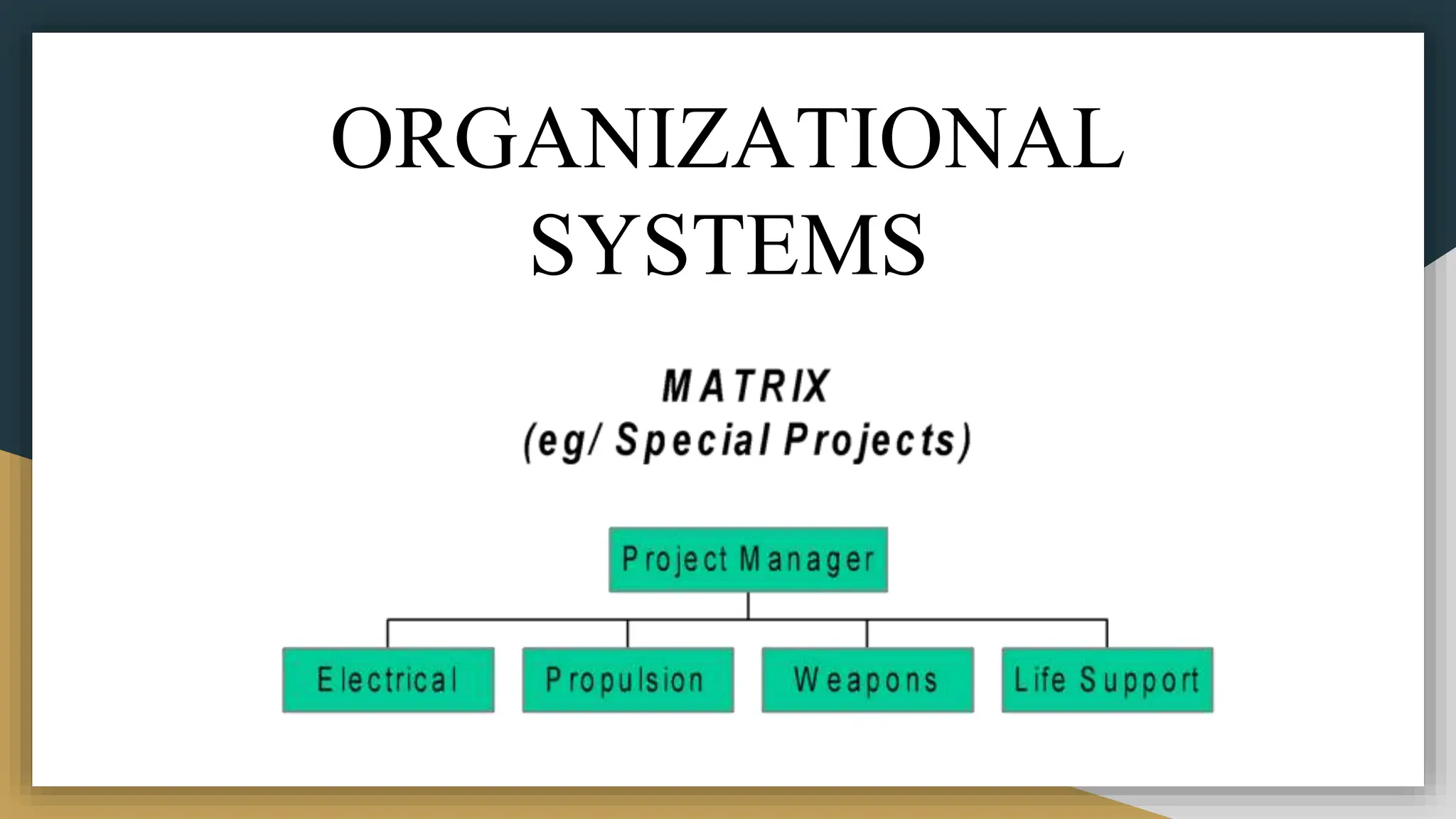
• Matrix:
– rows and columns w/ projects and
managers
• Leikert:
– “participation” at all levels
– BHR Theory: worker productivity
and supervisor control are inversely
proportional
– Exploitive-authoritative; Benevolent-
authoritative; Consultative
• Herzberg:
– “Motivation” Hygiene Theory:
• hygiene factors: salary, status,
challenging work, benefits
• motivation factor: achievement,
promotion, recognition;
responsibility
• McGregor:
– Theory “X”: lazy employees
– Theory “Y”: motivated
employees
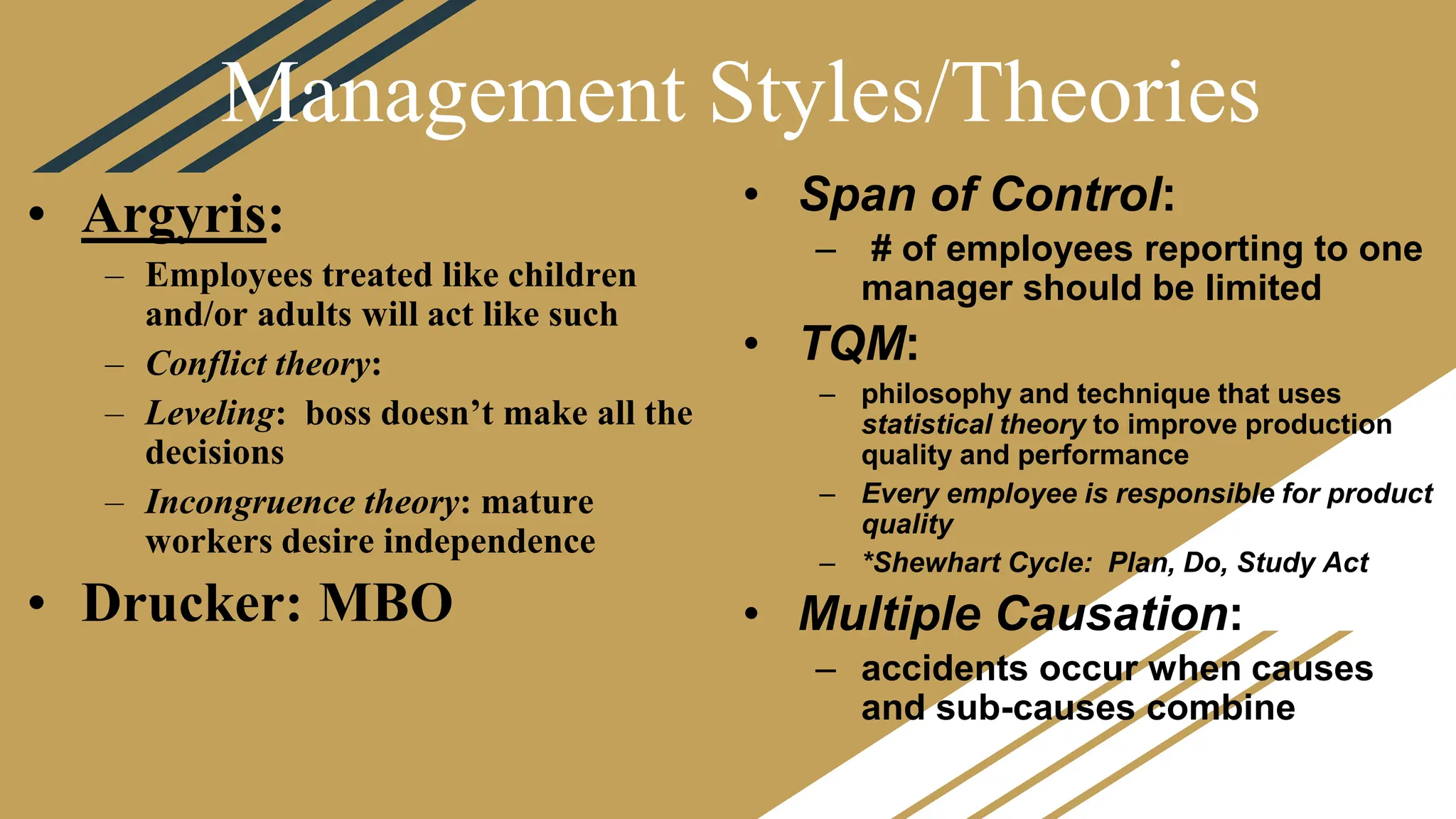
Management Styles/Theories
• Span of Control:
– # of employees reporting to one
manager should be limited
• TQM:
– philosophy and technique that uses
statistical theory to improve production
quality and performance
– Every employee is responsible for product
quality
– *Shewhart Cycle: Plan, Do, Study Act
• Multiple Causation:
– accidents occur when causes
and sub-causes combine
• Argyris:
– Employees treated like children
and/or adults will act like such
– Conflict theory:
– Leveling: boss doesn’t make all the
decisions
– Incongruence theory: mature
workers desire independence
• Drucker: MBO
HEINRICH
• Father of modern safety
• 1st textbook on safety
• Domino Theory of
Accident Causation(5
events): social, fault, unsafe
act, accident, injury
• 3 “E’s” of safety:
Engineering, Education, Enforcement
• 88 (unsafe acts)/10 (unsafe
conditions) /2 % (Acts of God)
• 4 steps of accident
prevention
• 4:1 ($ spent indirect vs direct)
• Pyramid [NM (300), Minor Event
(29), Major Events (1)]
MJE
MNE
Near Miss
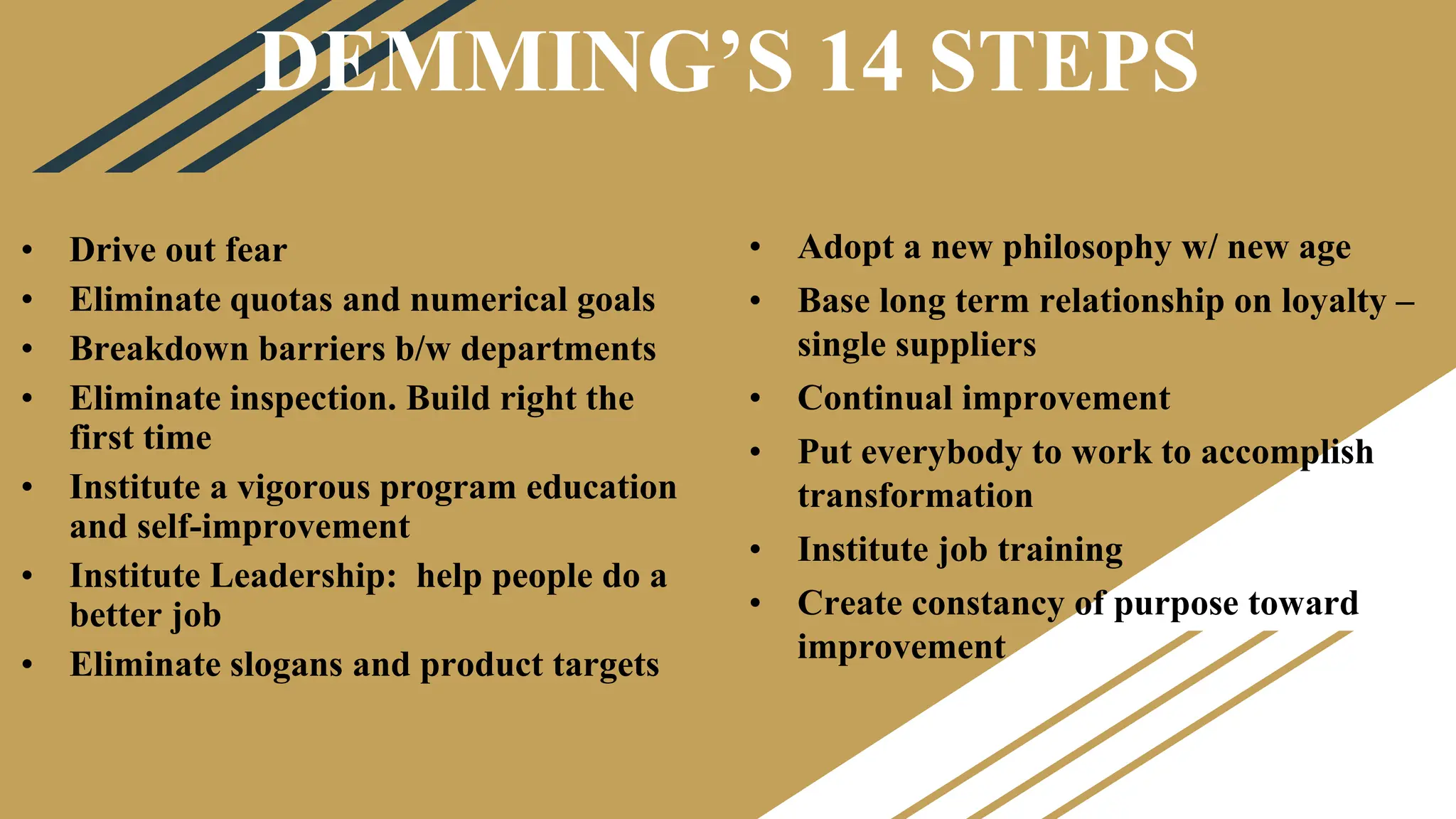
DEMMING’S 14 STEPS
• Adopt a new philosophy w/ new age
• Base long term relationship on loyalty –
single suppliers
• Continual improvement
• Put everybody to work to accomplish
transformation
• Institute job training
• Create constancy of purpose toward
improvement
• Drive out fear
• Eliminate quotas and numerical goals
• Breakdown barriers b/w departments
• Eliminate inspection. Build right the
first time
• Institute a vigorous program education
and self-improvement
• Institute Leadership: help people do a
better job
• Eliminate slogans and product targets
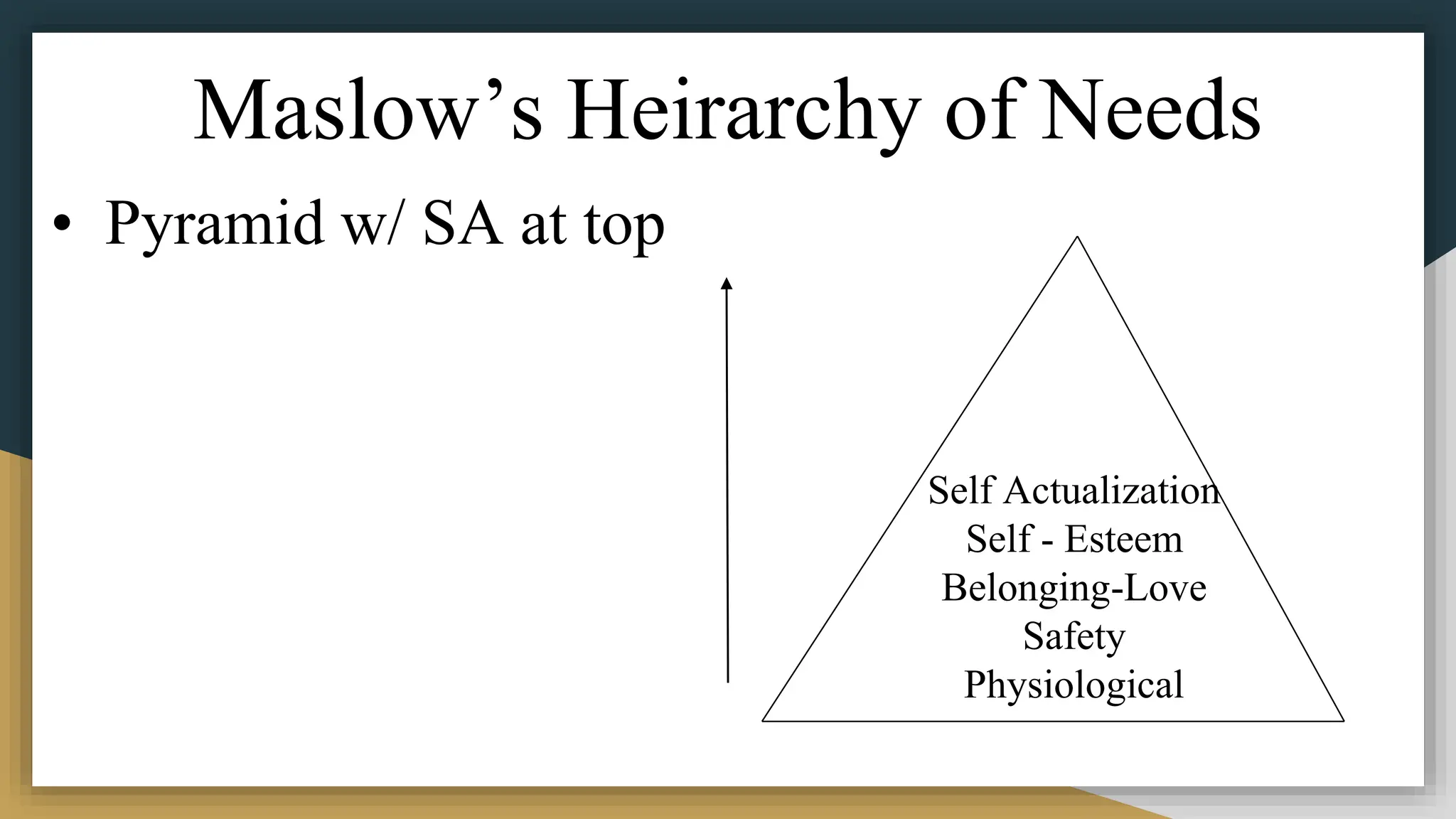
Maslow’s Heirarchy of Needs
• Pyramid w/ SA at top
Self Actualization
Self - Esteem
Belonging-Love
Safety
Physiological
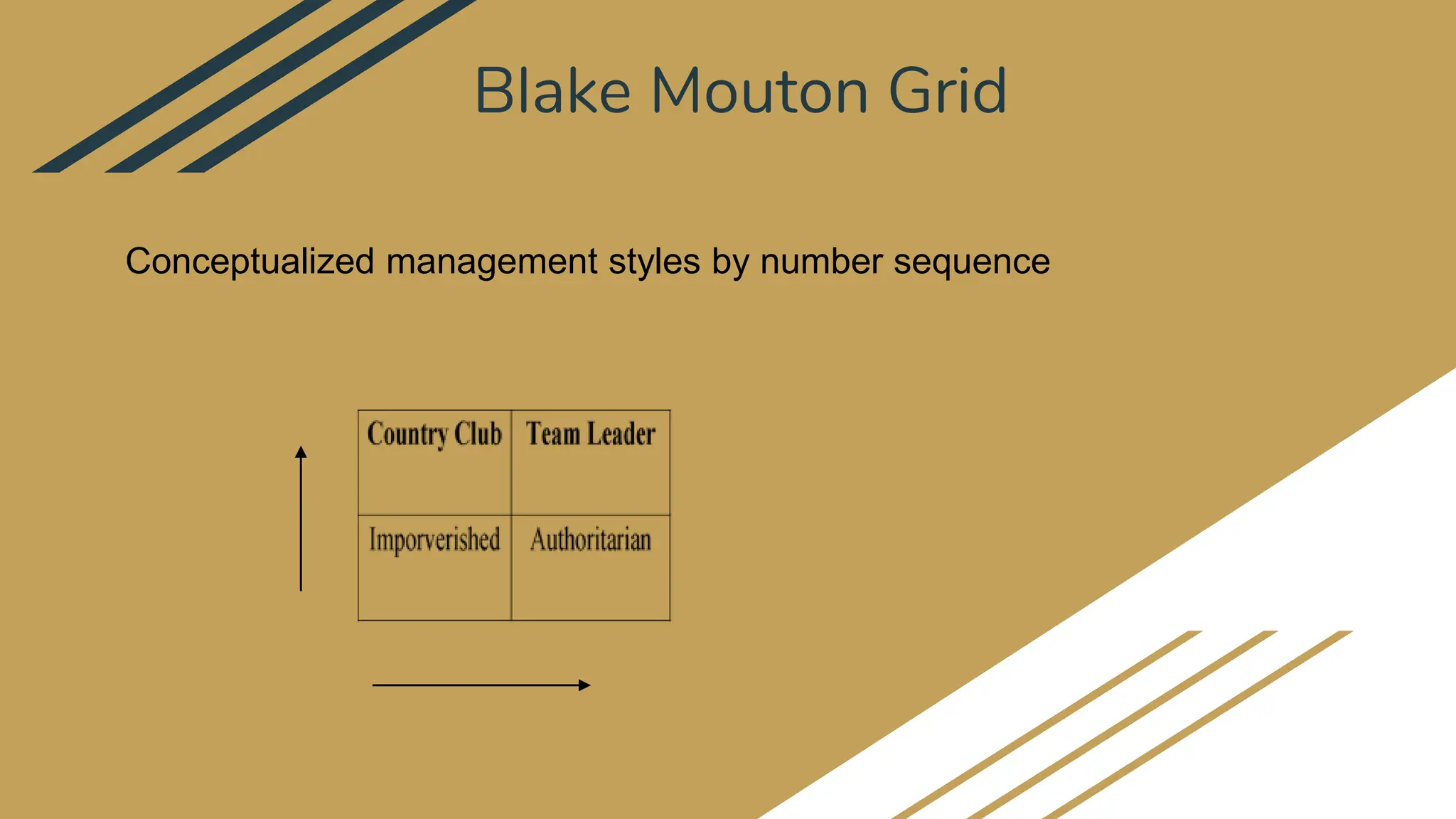
Blake Mouton Grid
Conceptualized management styles by number sequence
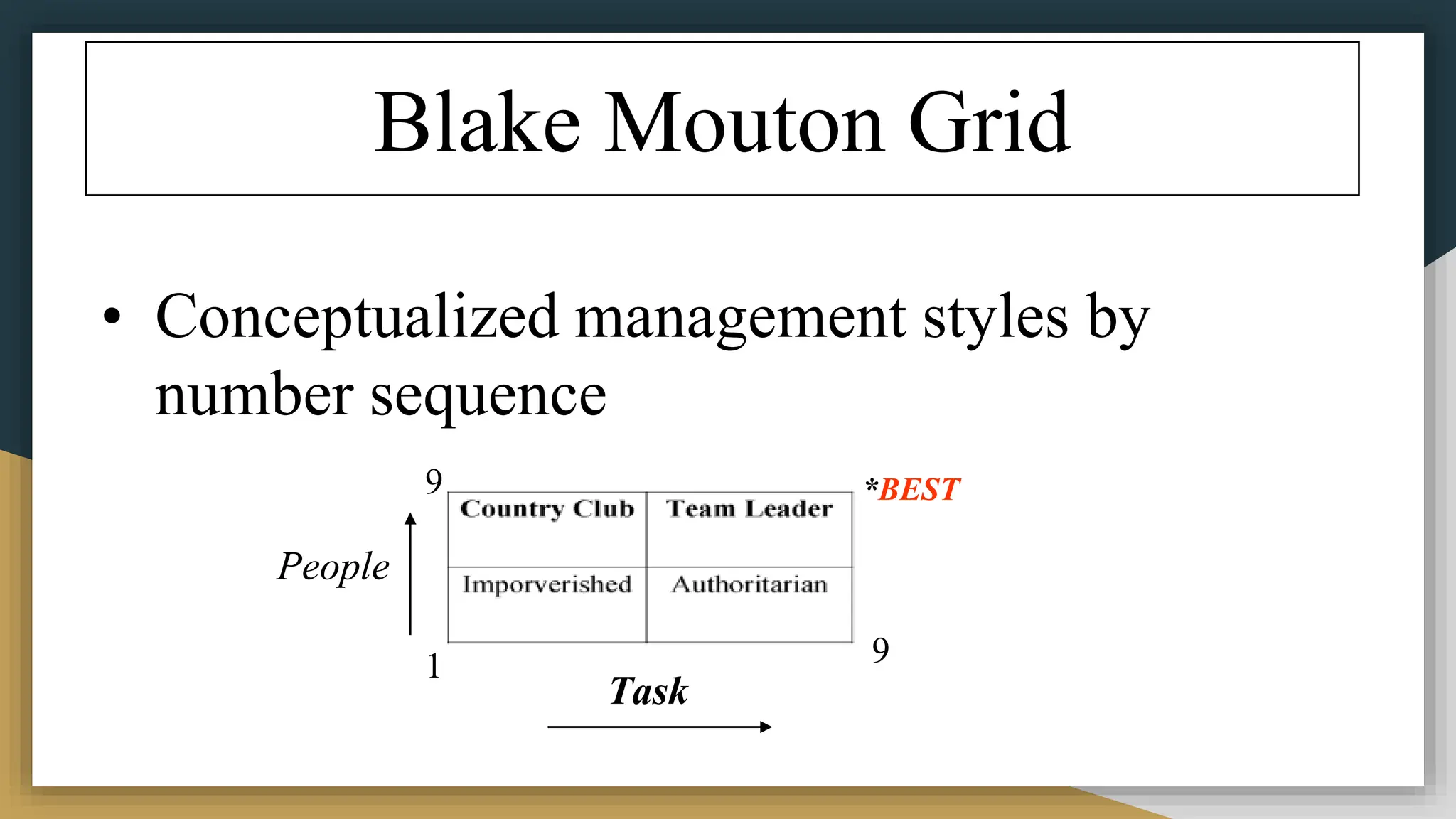
Blake Mouton Grid
• Conceptualized management styles by
number sequence
Task
People
1
9
9
*BEST
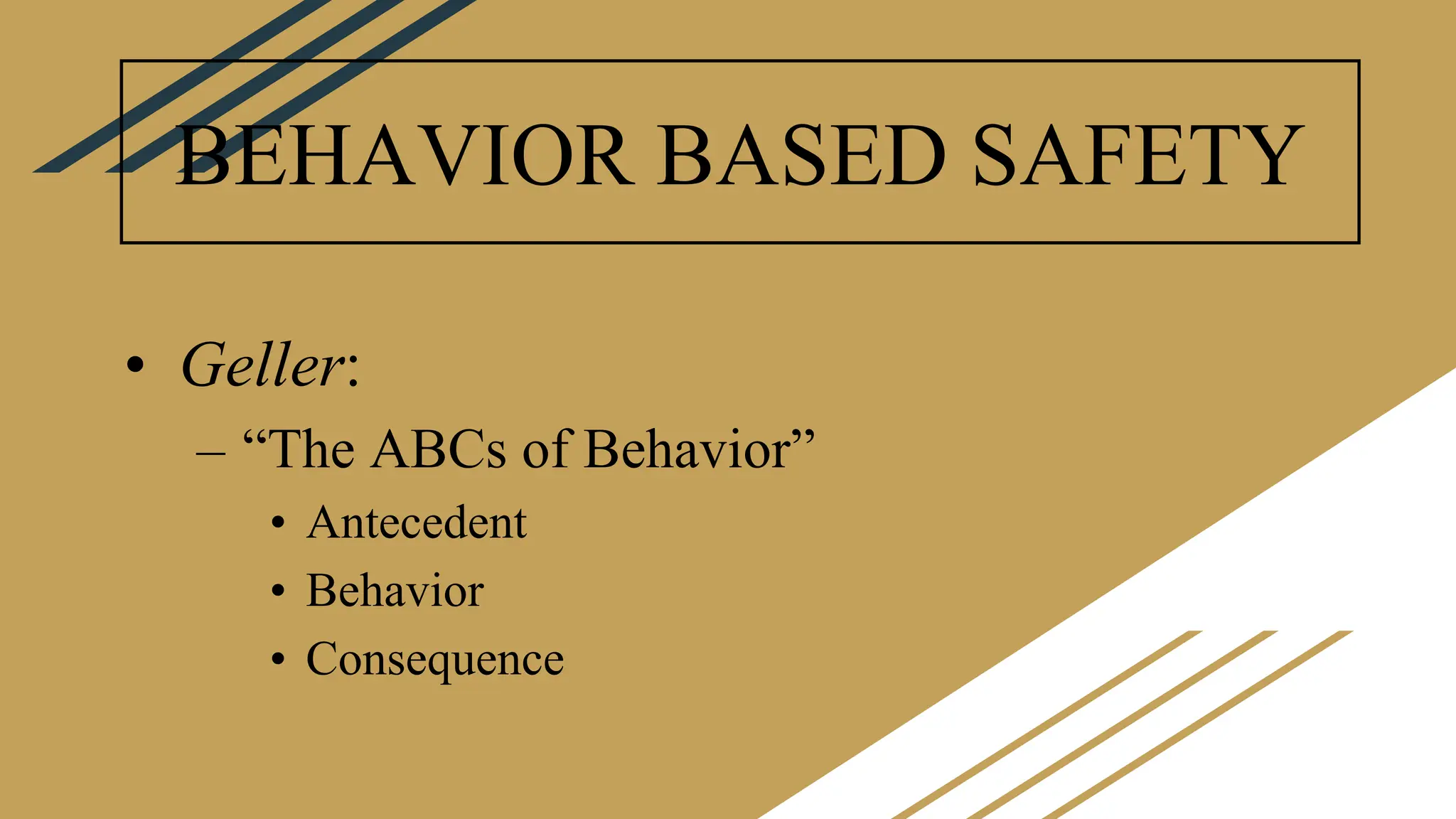
BEHAVIOR BASED SAFETY
• Geller:
– “The ABCs of Behavior”
• Antecedent
• Behavior
• Consequence
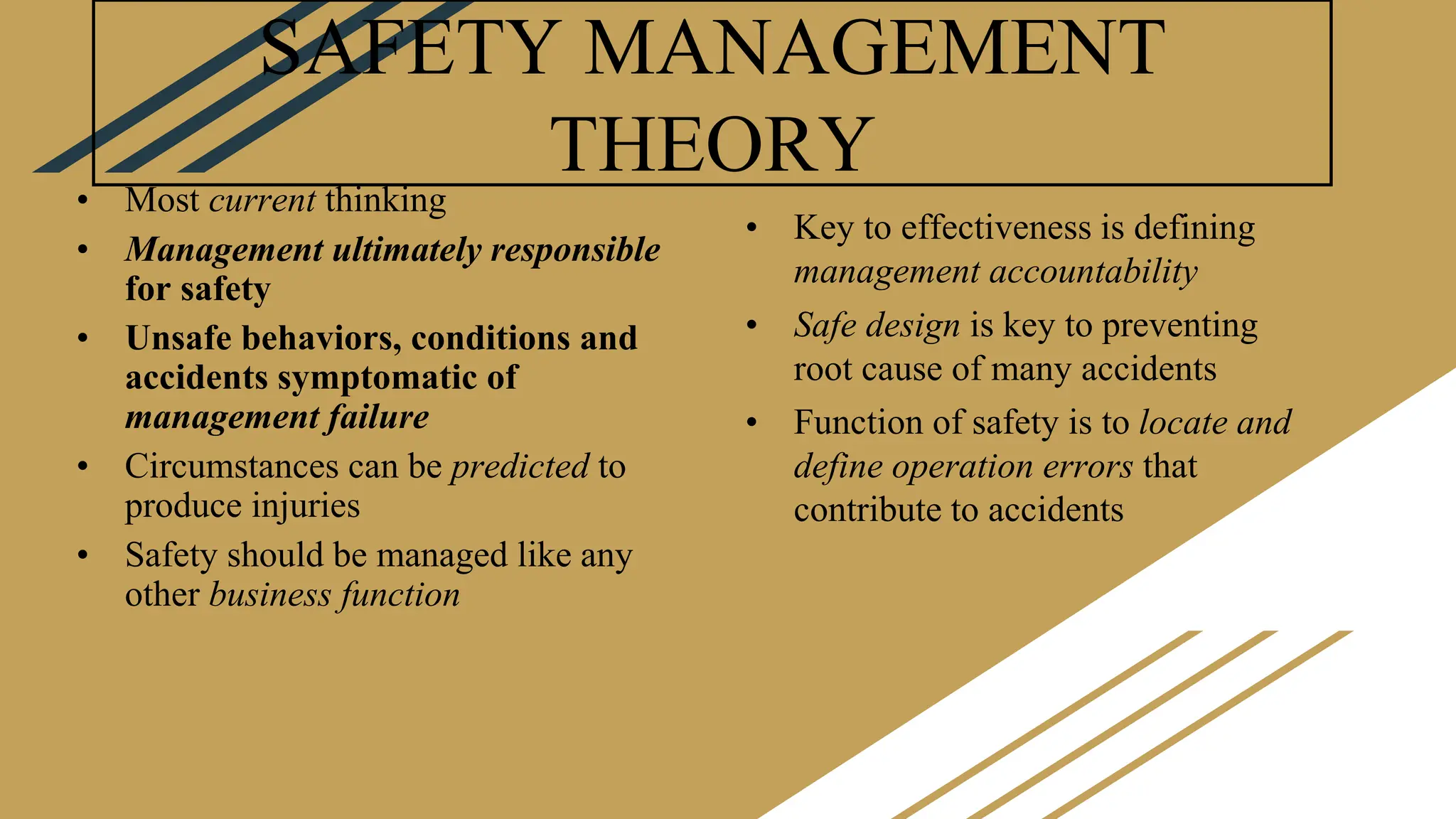
SAFETY MANAGEMENT
THEORY
• Most current thinking
• Management ultimately responsible
for safety
• Unsafe behaviors, conditions and
accidents symptomatic of
management failure
• Circumstances can be predicted to
produce injuries
• Safety should be managed like any
other business function
• Key to effectiveness is defining
management accountability
• Safe design is key to preventing
root cause of many accidents
• Function of safety is to locate and
define operation errors that
contribute to accidents
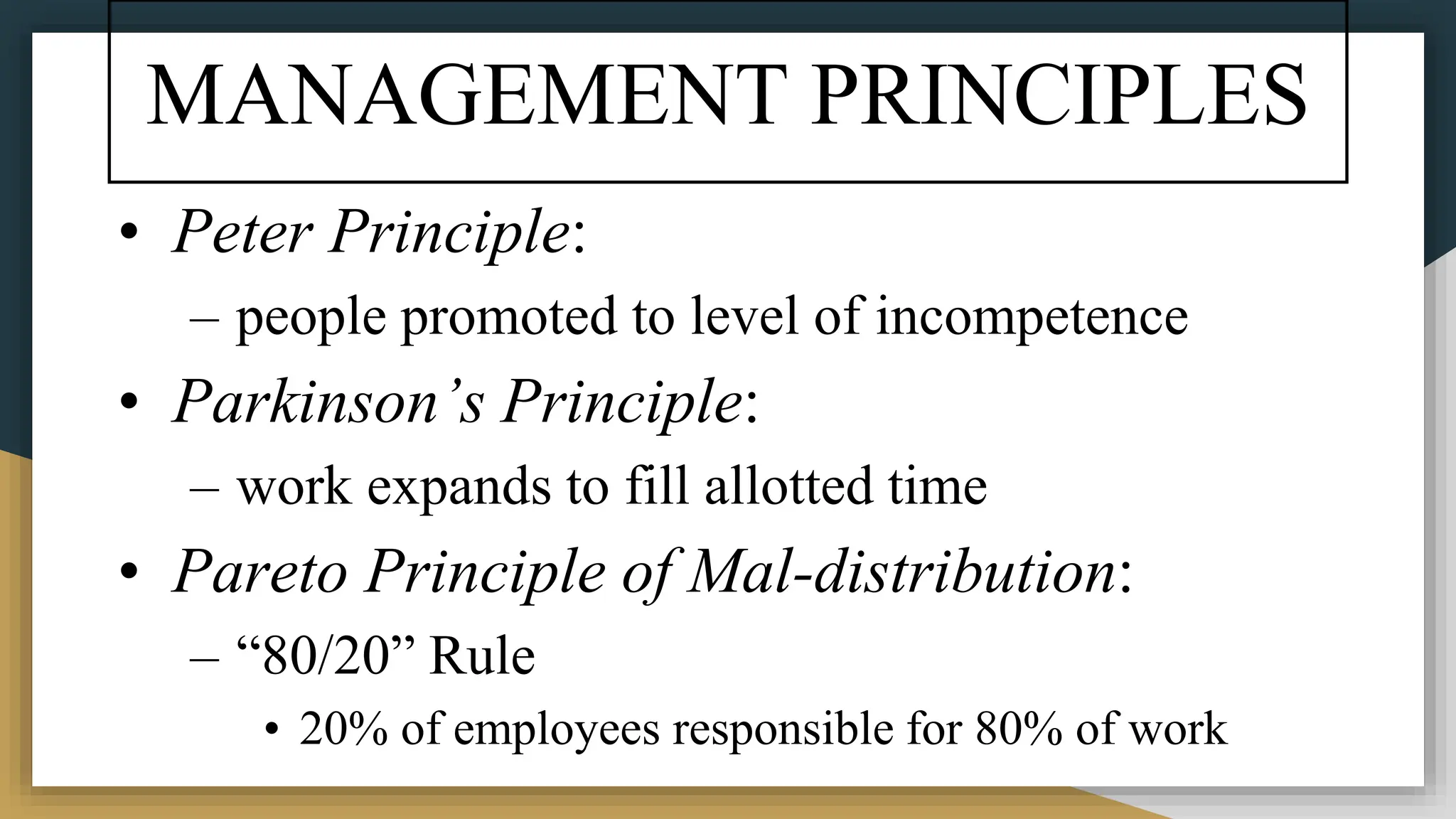
MANAGEMENT PRINCIPLES
• Peter Principle:
– people promoted to level of incompetence
• Parkinson’s Principle:
– work expands to fill allotted time
• Pareto Principle of Mal-distribution:
– “80/20” Rule
• 20% of employees responsible for 80% of work
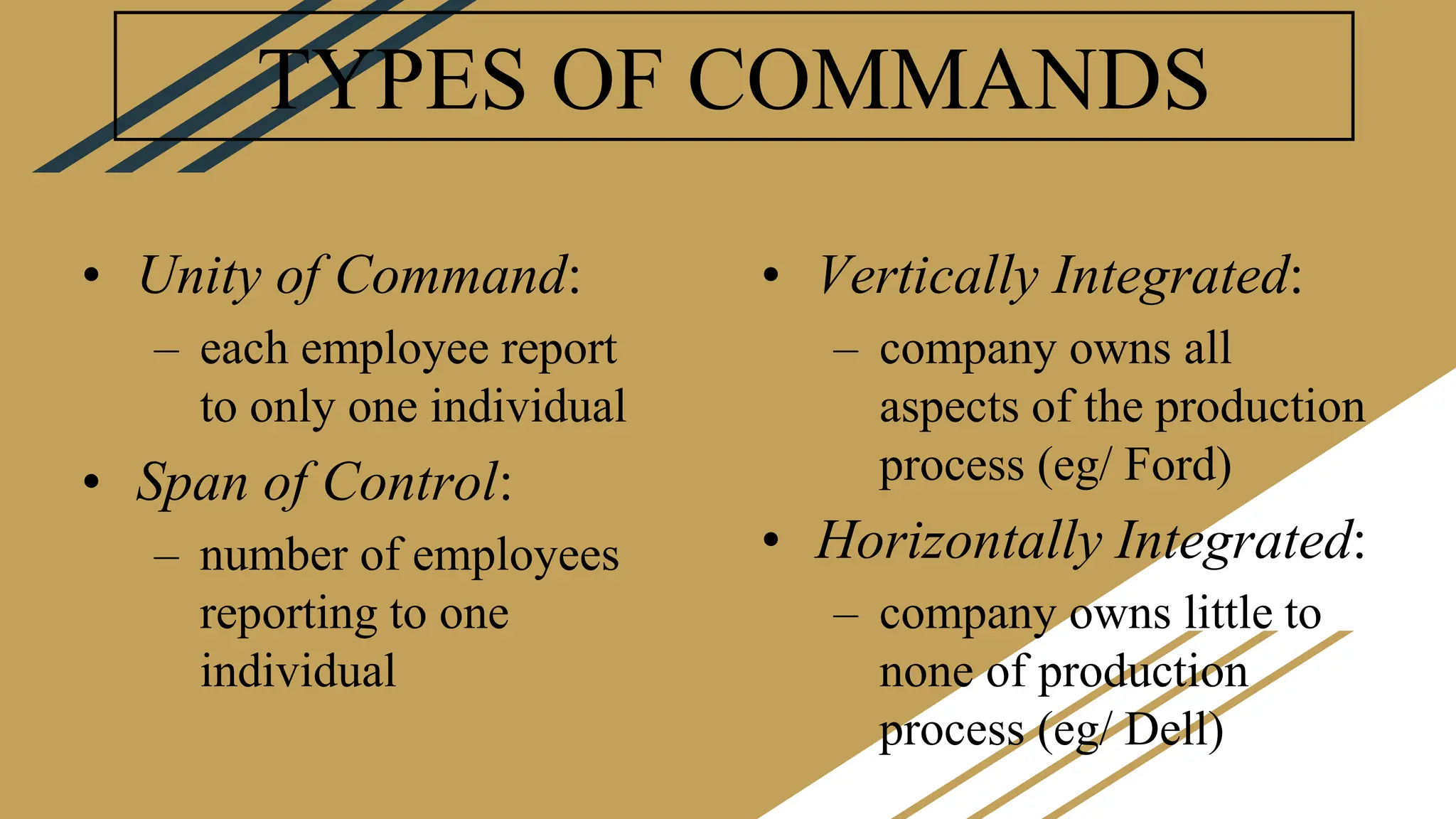
TYPES OF COMMANDS
• Unity of Command:
– each employee report
to only one individual
• Span of Control:
– number of employees
reporting to one
individual
• Vertically Integrated:
– company owns all
aspects of the production
process (eg/ Ford)
• Horizontally Integrated:
– company owns little to
none of production
process (eg/ Dell)
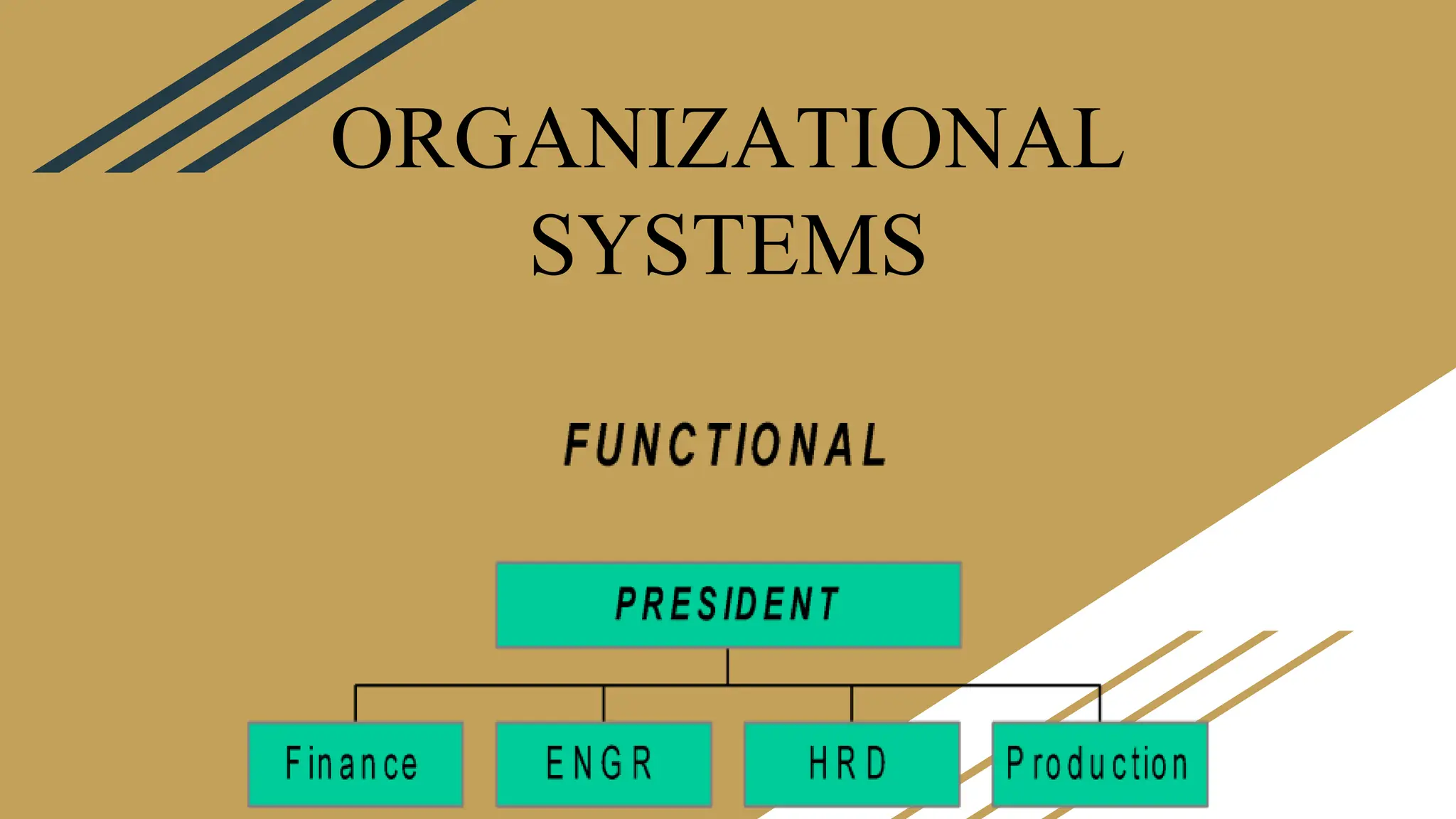
ORGANIZATIONAL
SYSTEMS
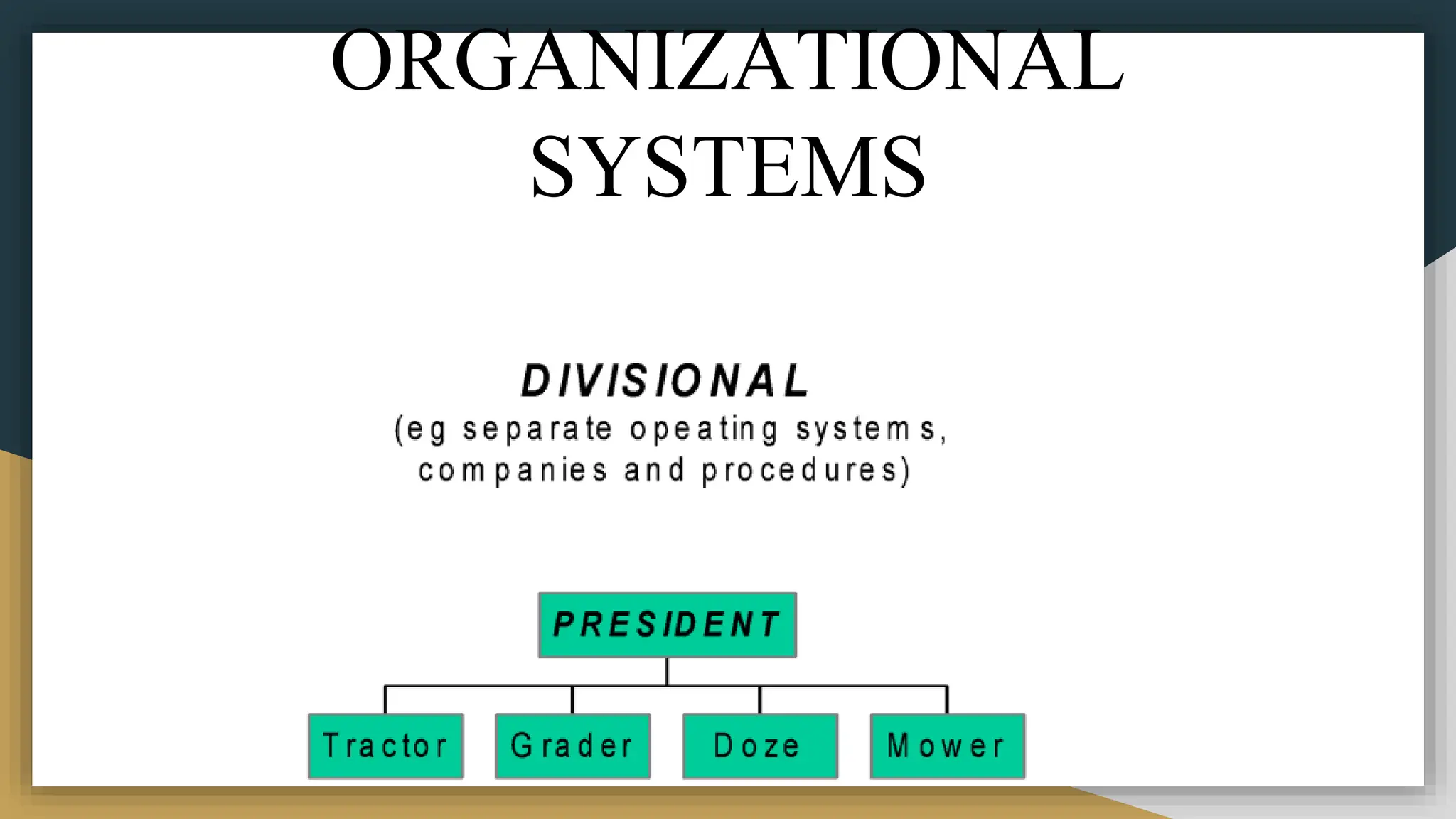
ORGANIZATIONAL
SYSTEMS
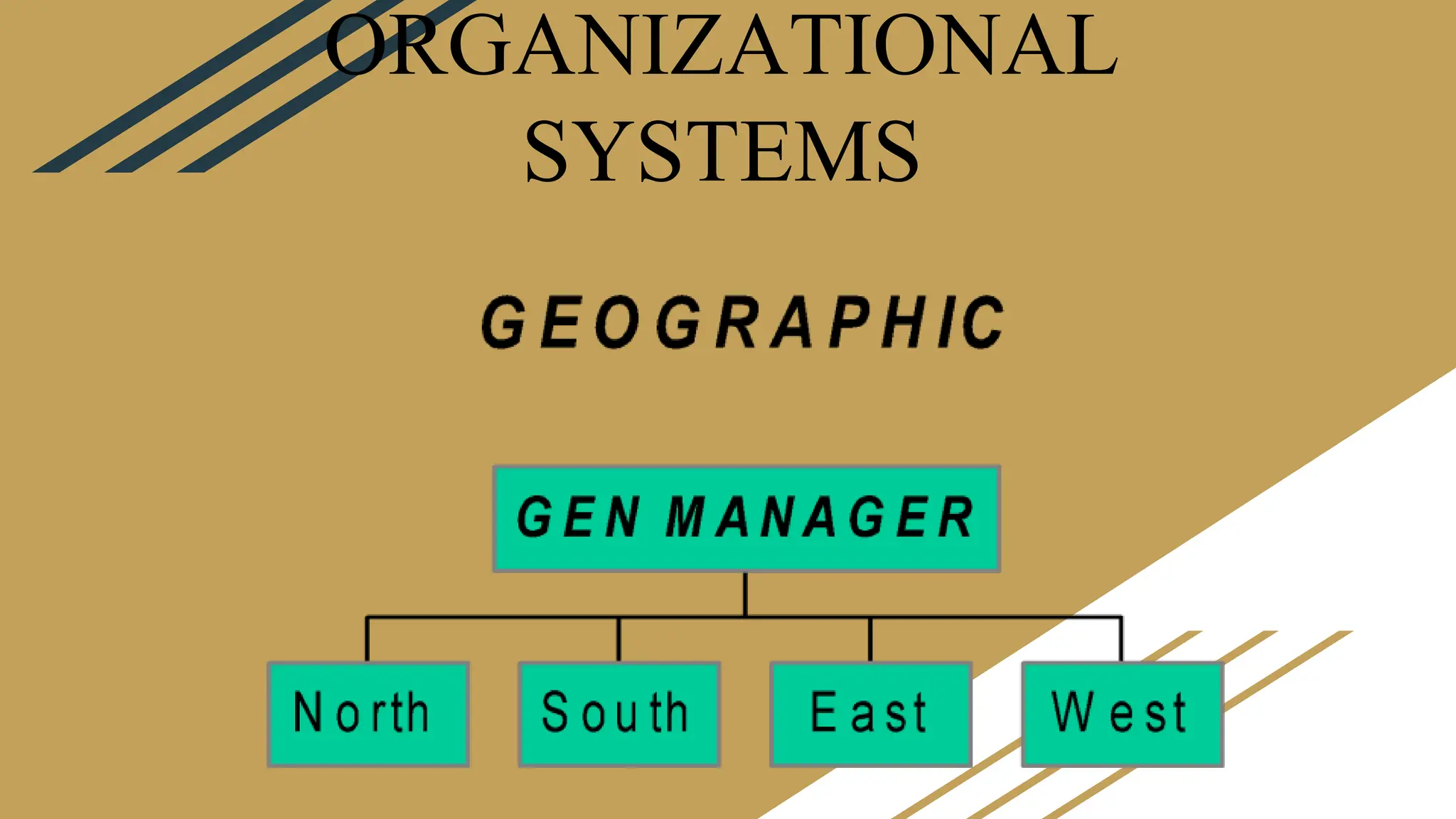
ORGANIZATIONAL
SYSTEMS
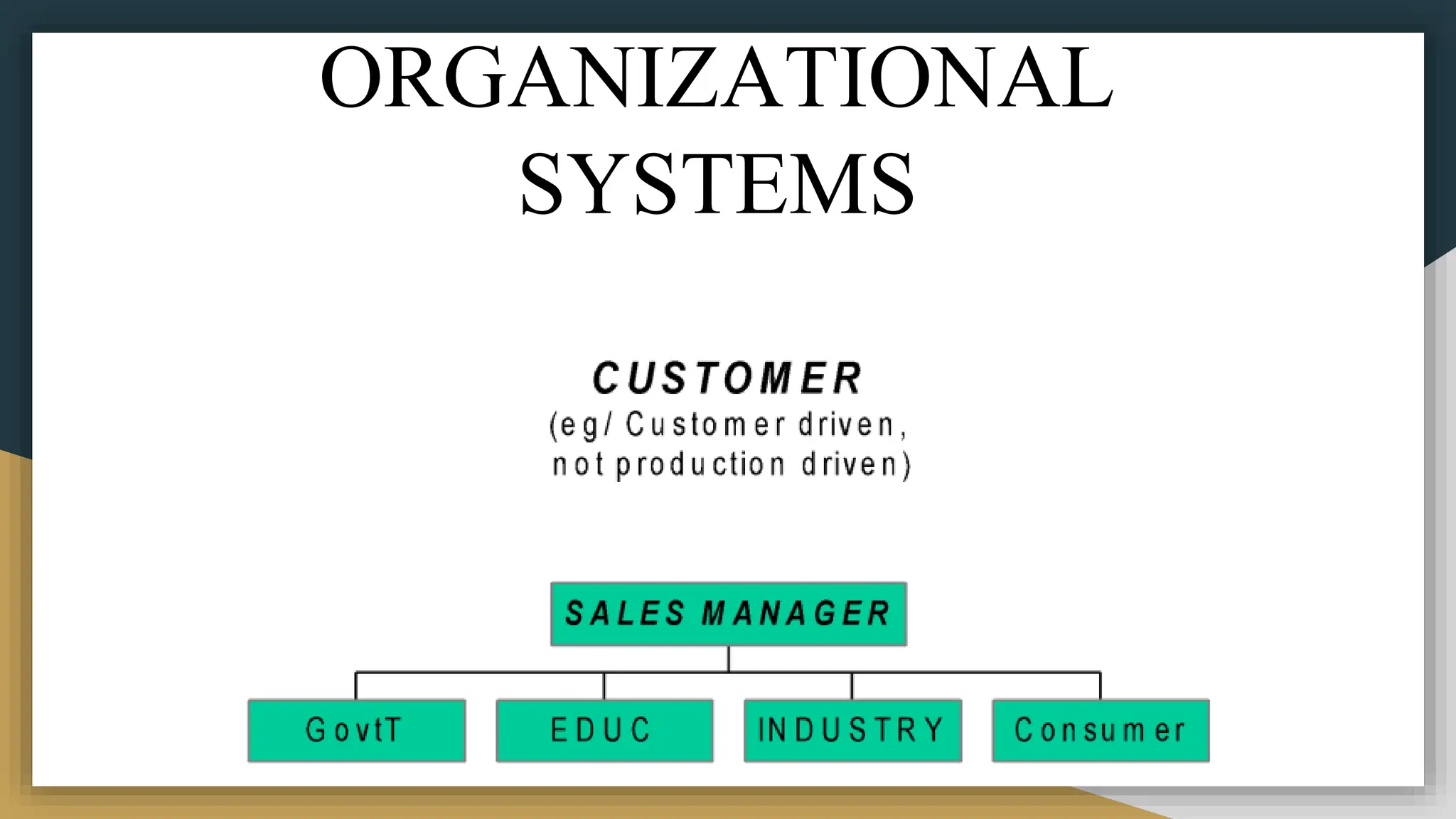
ORGANIZATIONAL
SYSTEMS
ORGANIZATIONAL
SYSTEMS
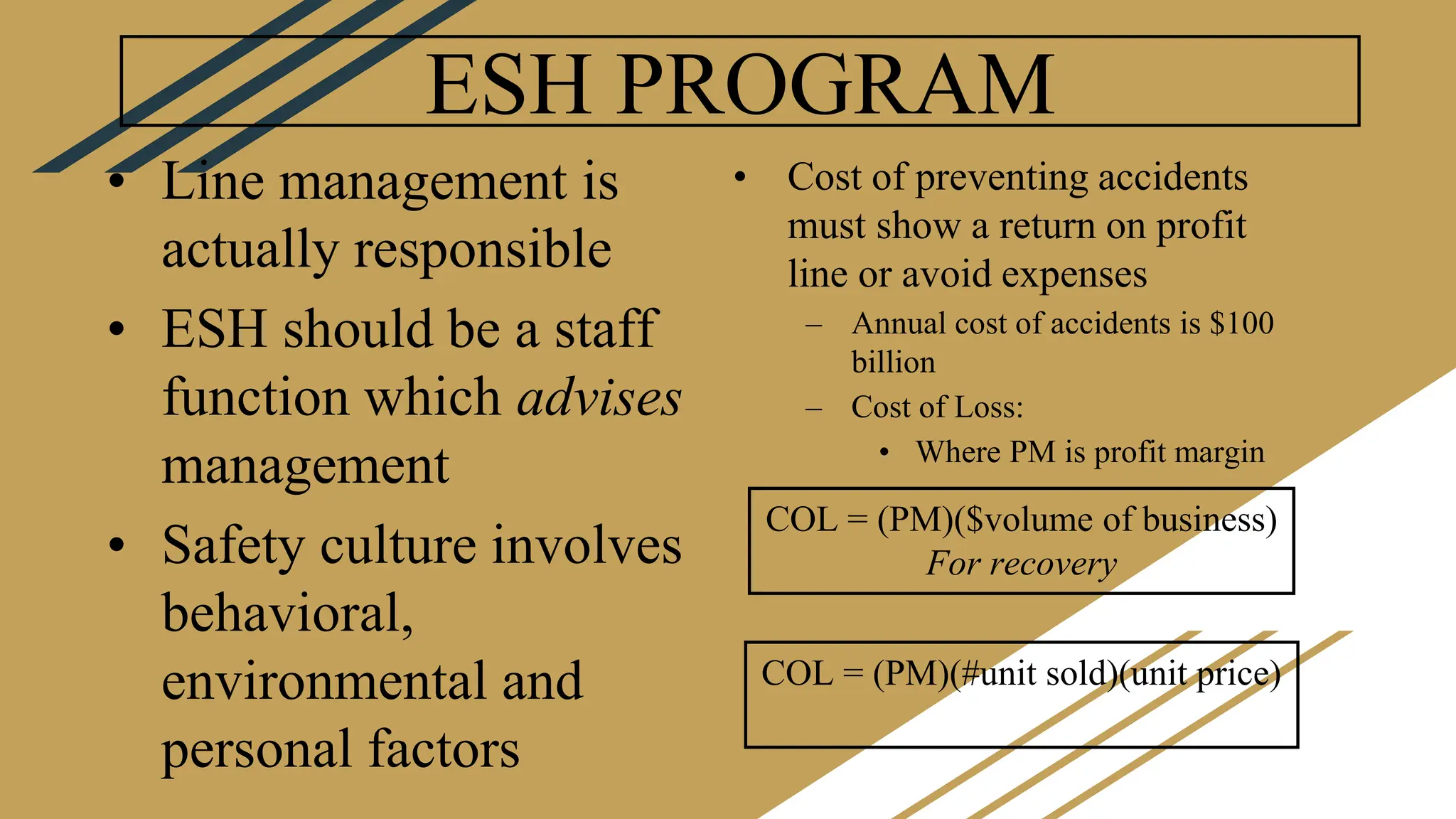
ESH PROGRAM
• Line management is
actually responsible
• ESH should be a staff
function which advises
management
• Safety culture involves
behavioral,
environmental and
personal factors
• Cost of preventing accidents
must show a return on profit
line or avoid expenses
– Annual cost of accidents is $100
billion
– Cost of Loss:
• Where PM is profit margin
COL = (PM)($volume of business)
For recovery
COL = (PM)(#unit sold)(unit price)
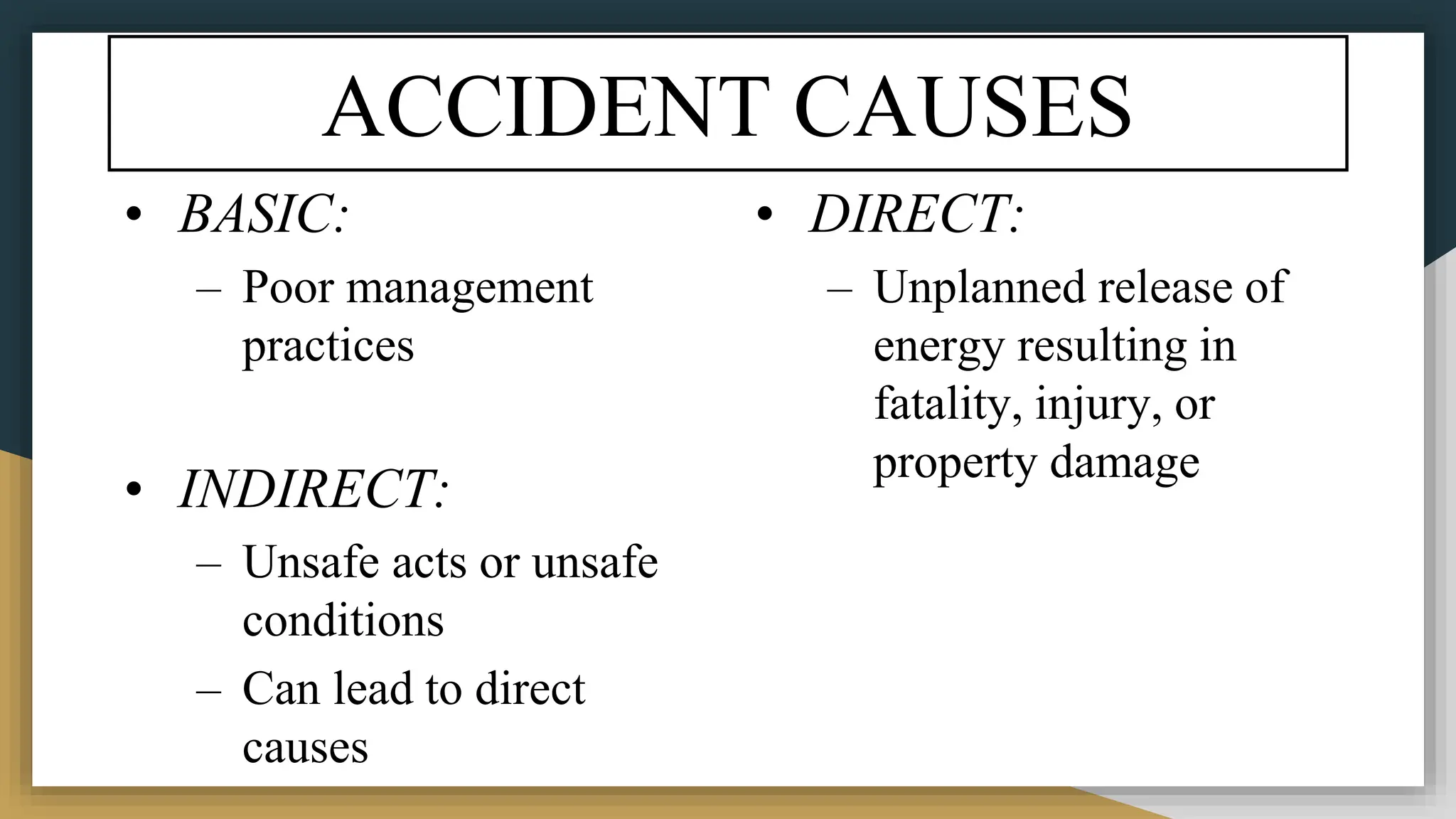
ACCIDENT CAUSES
• BASIC:
– Poor management
practices
• INDIRECT:
– Unsafe acts or unsafe
conditions
– Can lead to direct
causes
• DIRECT:
– Unplanned release of
energy resulting in
fatality, injury, or
property damage
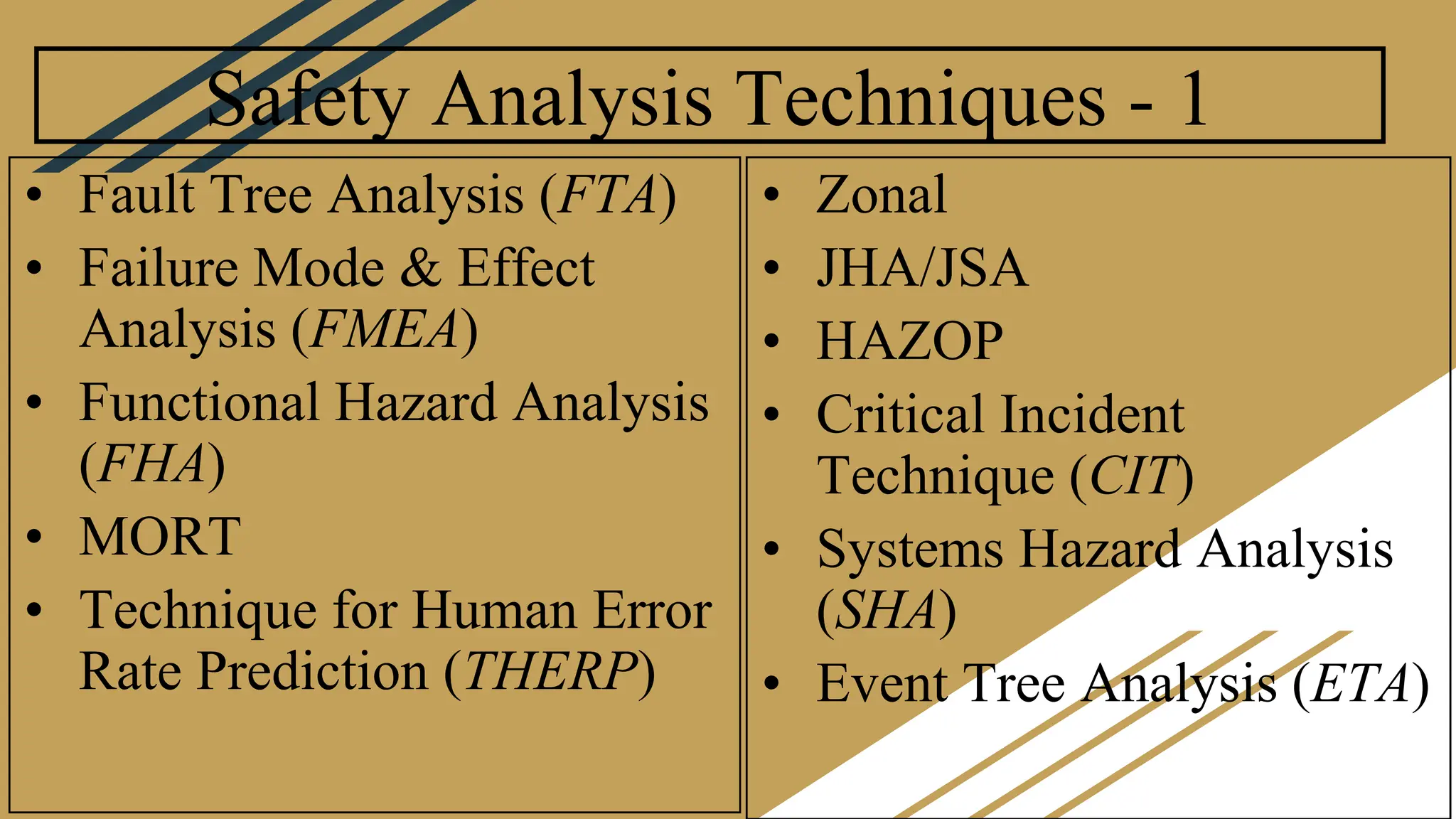
Safety Analysis Techniques - 1
• Fault Tree Analysis (FTA)
• Failure Mode & Effect
Analysis (FMEA)
• Functional Hazard Analysis
(FHA)
• MORT
• Technique for Human Error
Rate Prediction (THERP)
• Zonal
• JHA/JSA
• HAZOP
• Critical Incident
Technique (CIT)
• Systems Hazard Analysis
(SHA)
• Event Tree Analysis (ETA)
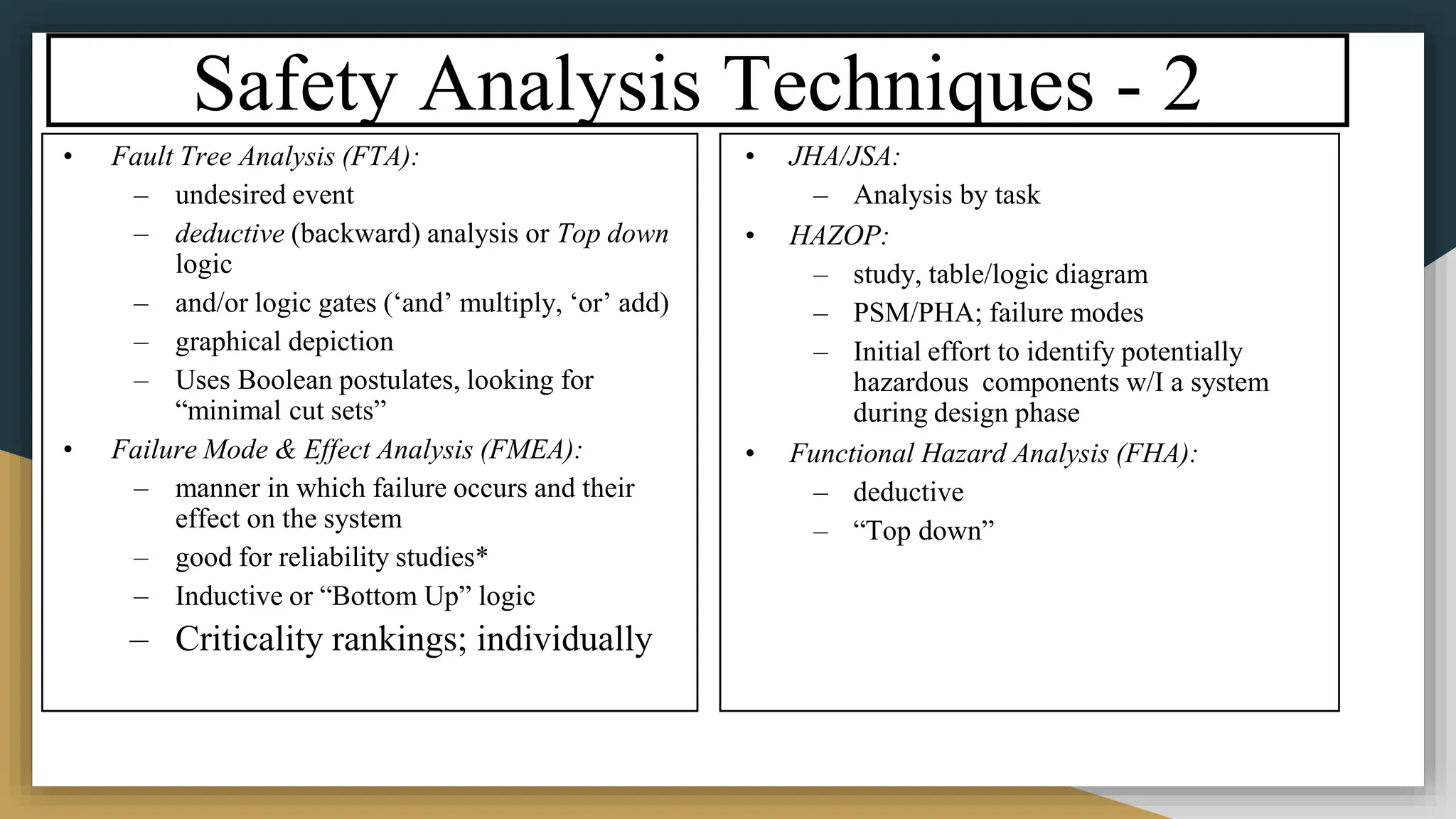
Safety Analysis Techniques - 2
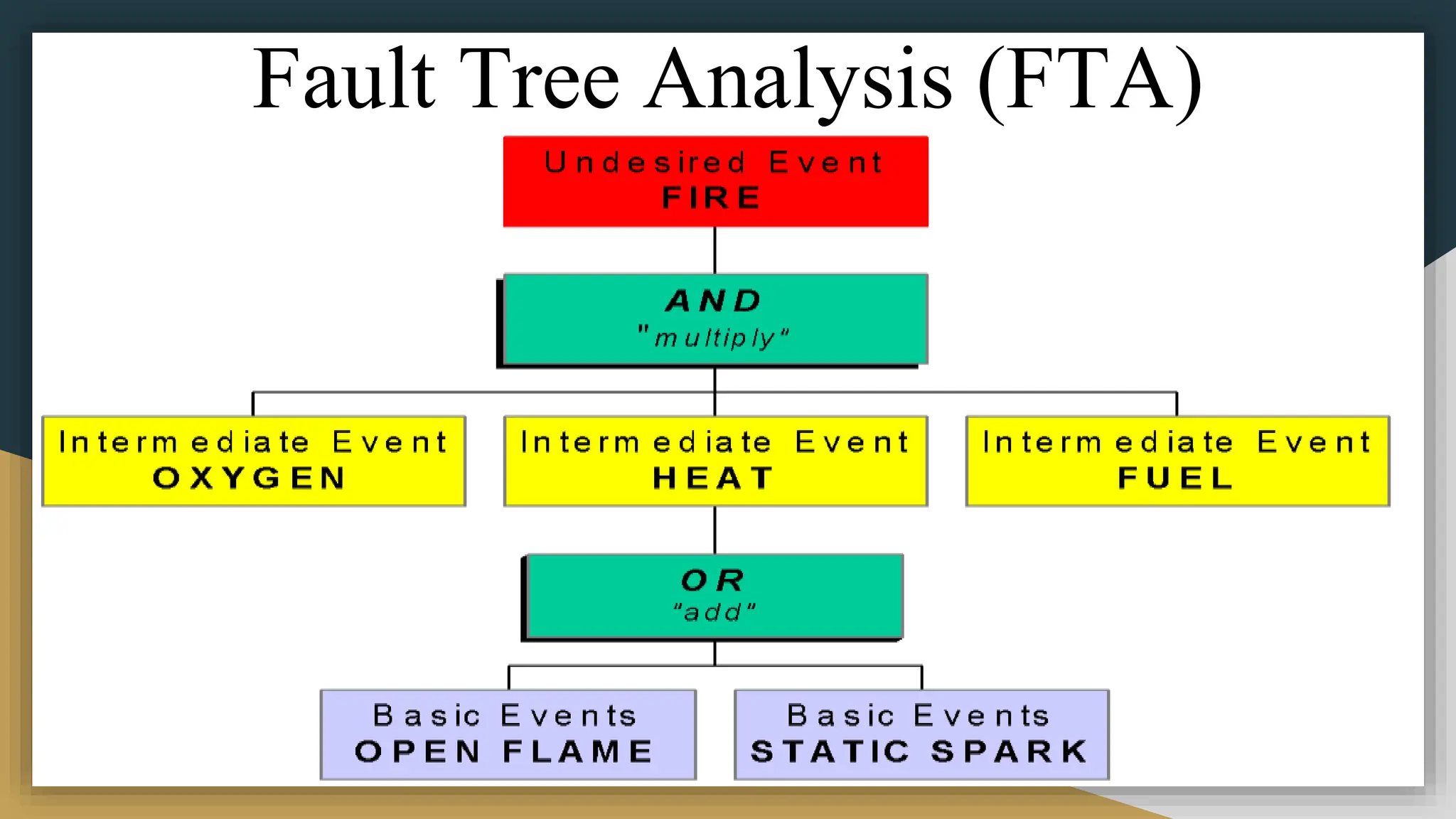
• Fault Tree Analysis (FTA):
– undesired event
– deductive (backward) analysis or Top down
logic
– and/or logic gates (‘and’ multiply, ‘or’ add)
– graphical depiction
– Uses Boolean postulates, looking for
“minimal cut sets”
• Failure Mode & Effect Analysis (FMEA):
– manner in which failure occurs and their
effect on the system
– good for reliability studies*
– Inductive or “Bottom Up” logic
– Criticality rankings; individually
• JHA/JSA:
– Analysis by task
• HAZOP:
– study, table/logic diagram
– PSM/PHA; failure modes
– Initial effort to identify potentially
hazardous components w/I a system
during design phase
• Functional Hazard Analysis (FHA):
– deductive
– “Top down”
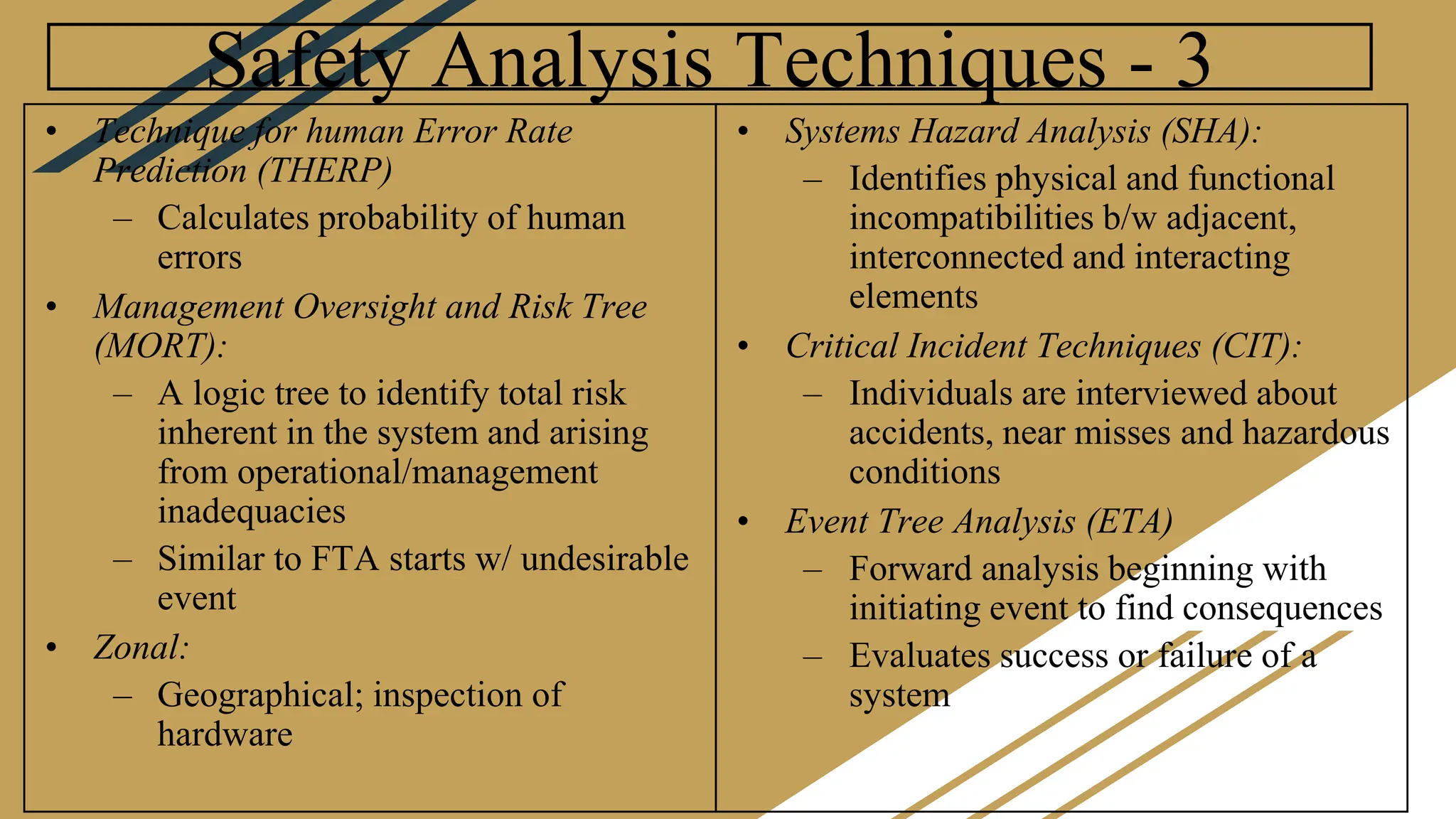
Safety Analysis Techniques - 3
• Technique for human Error Rate
Prediction (THERP)
– Calculates probability of human
errors
• Management Oversight and Risk Tree
(MORT):
– A logic tree to identify total risk
inherent in the system and arising
from operational/management
inadequacies
– Similar to FTA starts w/ undesirable
event
• Zonal:
– Geographical; inspection of
hardware
• Systems Hazard Analysis (SHA):
– Identifies physical and functional
incompatibilities b/w adjacent,
interconnected and interacting
elements
• Critical Incident Techniques (CIT):
– Individuals are interviewed about
accidents, near misses and hazardous
conditions
• Event Tree Analysis (ETA)
– Forward analysis beginning with
initiating event to find consequences
– Evaluates success or failure of a
system
Fault Tree Analysis (FTA)
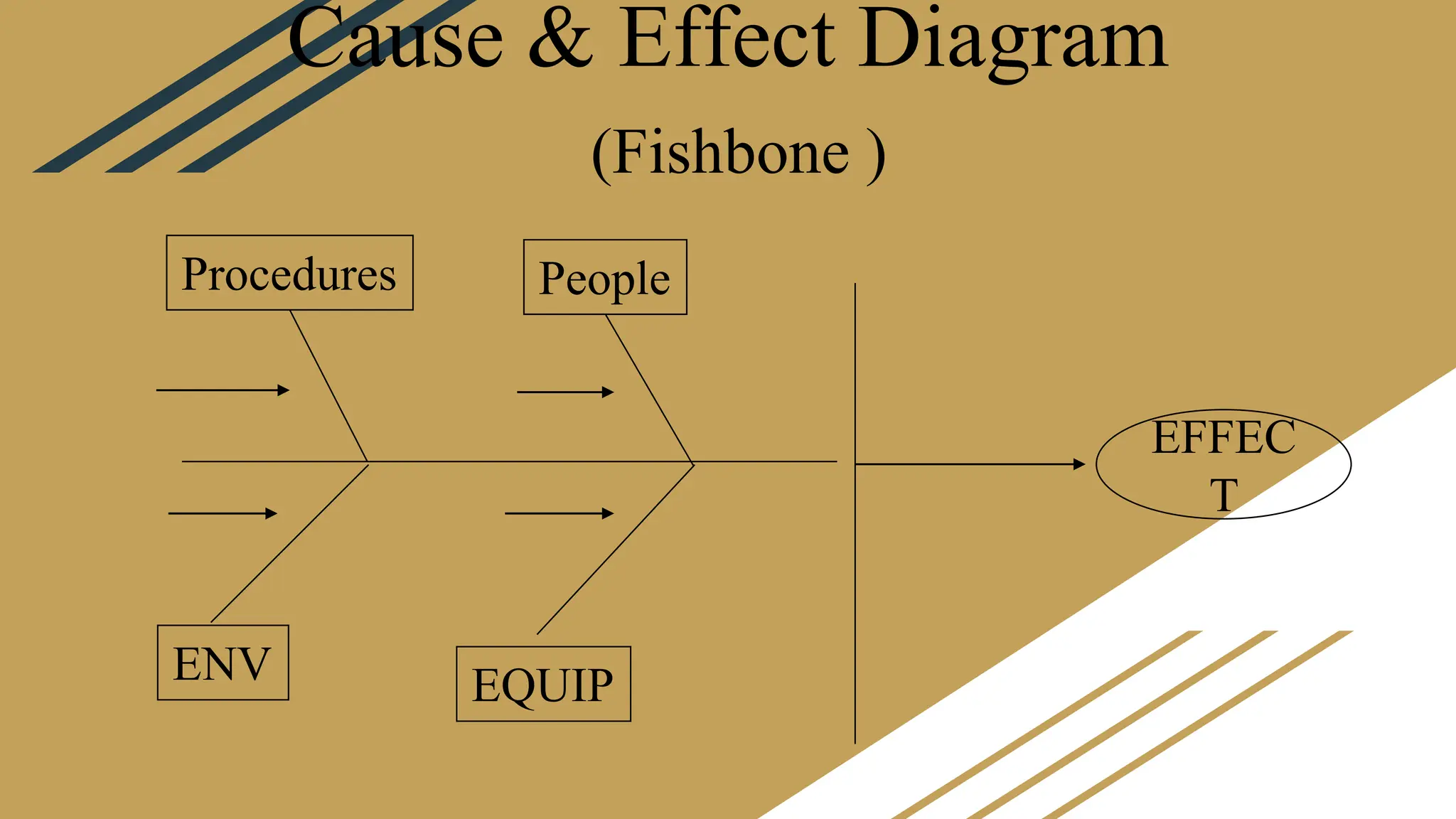
Cause & Effect Diagram
(Fishbone )
Procedures People
ENV EQUIP
EFFEC
T
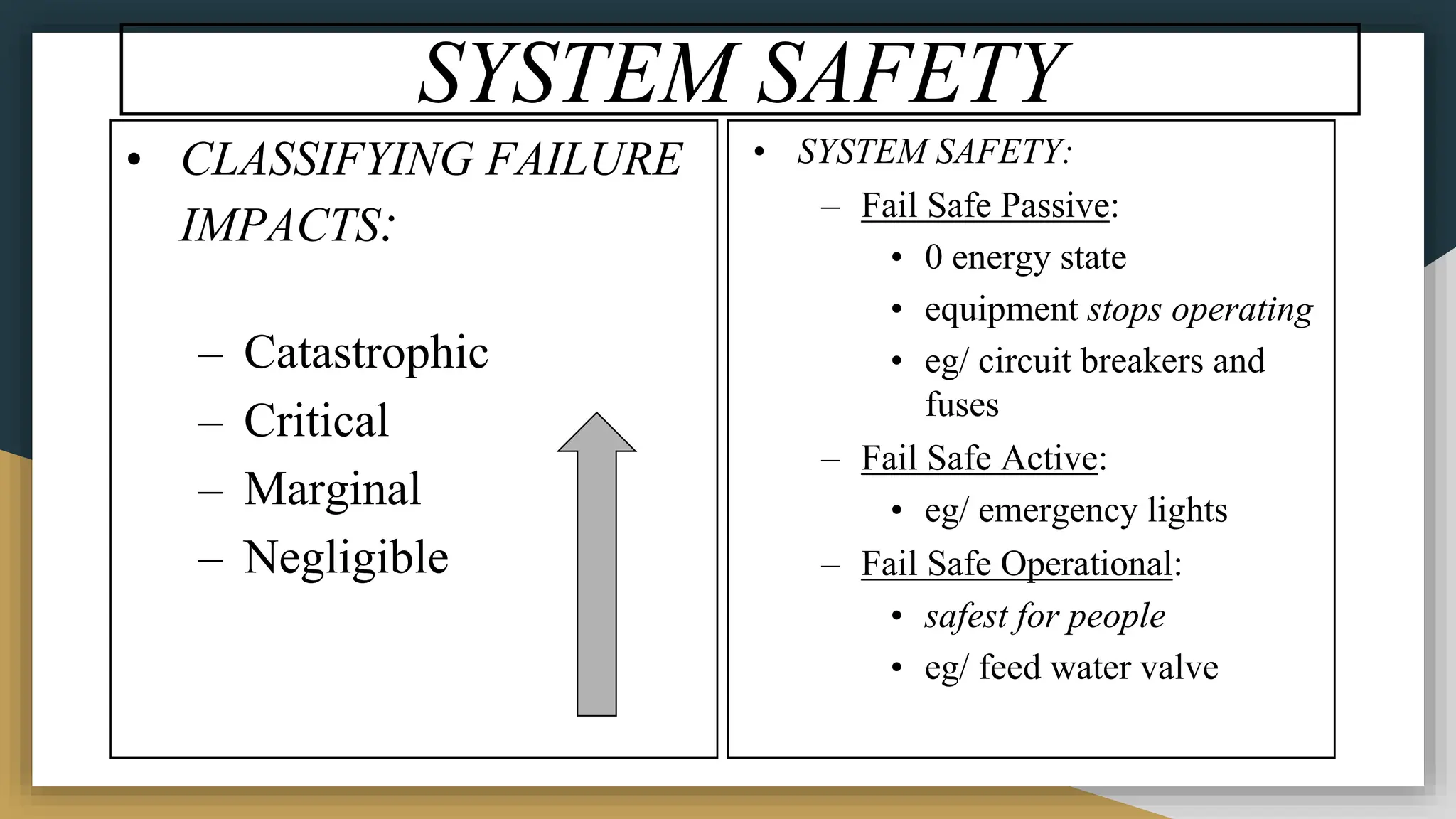
SYSTEM SAFETY
• CLASSIFYING FAILURE
IMPACTS:
– Catastrophic
– Critical
– Marginal
– Negligible
• SYSTEM SAFETY:
– Fail Safe Passive:
• 0 energy state
• equipment stops operating
• eg/ circuit breakers and
fuses
– Fail Safe Active:
• eg/ emergency lights
– Fail Safe Operational:
• safest for people
• eg/ feed water valve
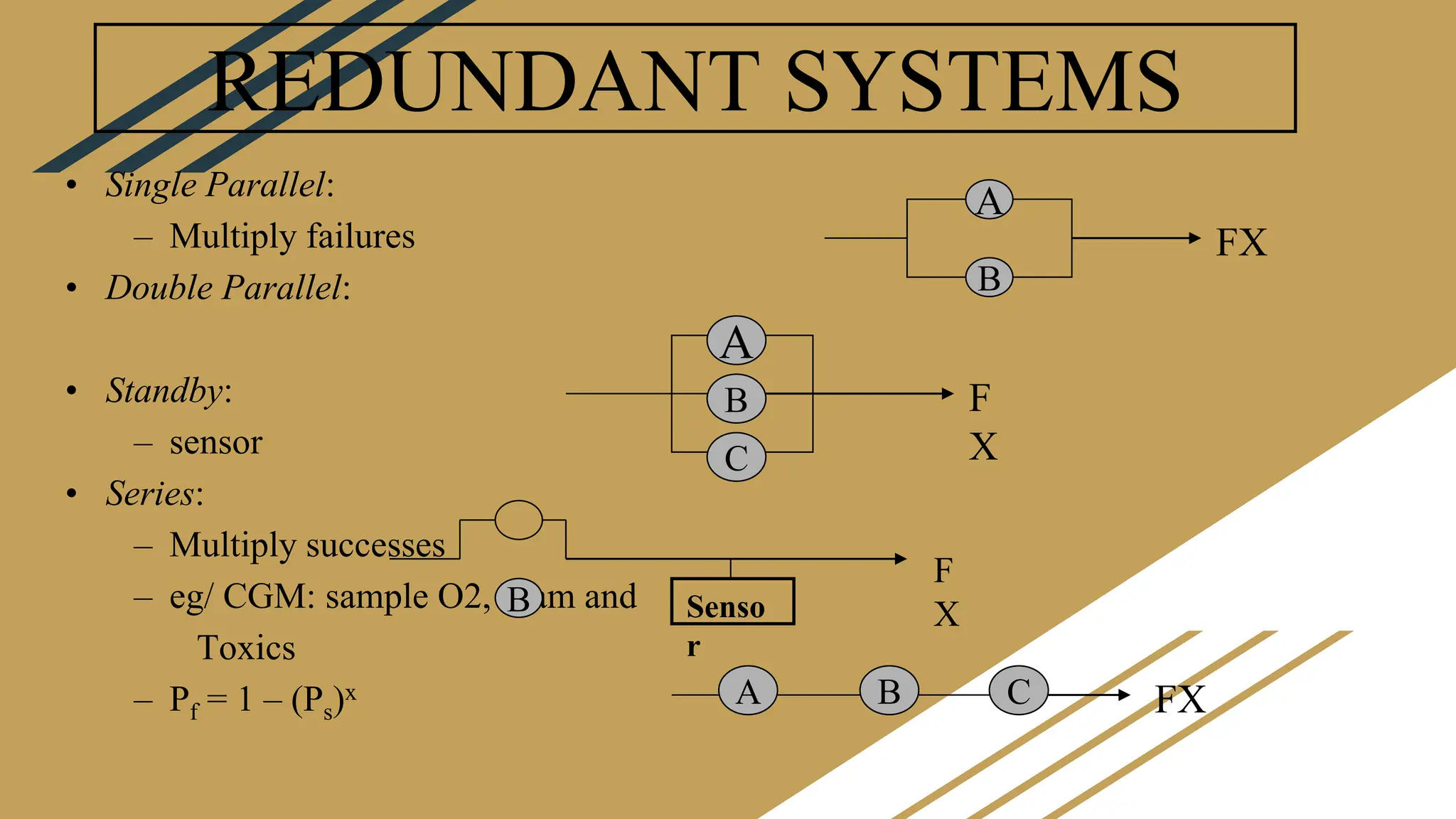
REDUNDANT SYSTEMS
• Single Parallel:
– Multiply failures
• Double Parallel:
• Standby:
– sensor
• Series:
– Multiply successes
– eg/ CGM: sample O2, Flam and
Toxics
– Pf = 1 – (Ps)x
A
B
FX
A
B
C
F
X
A C
B FX
B Senso
r
F
X
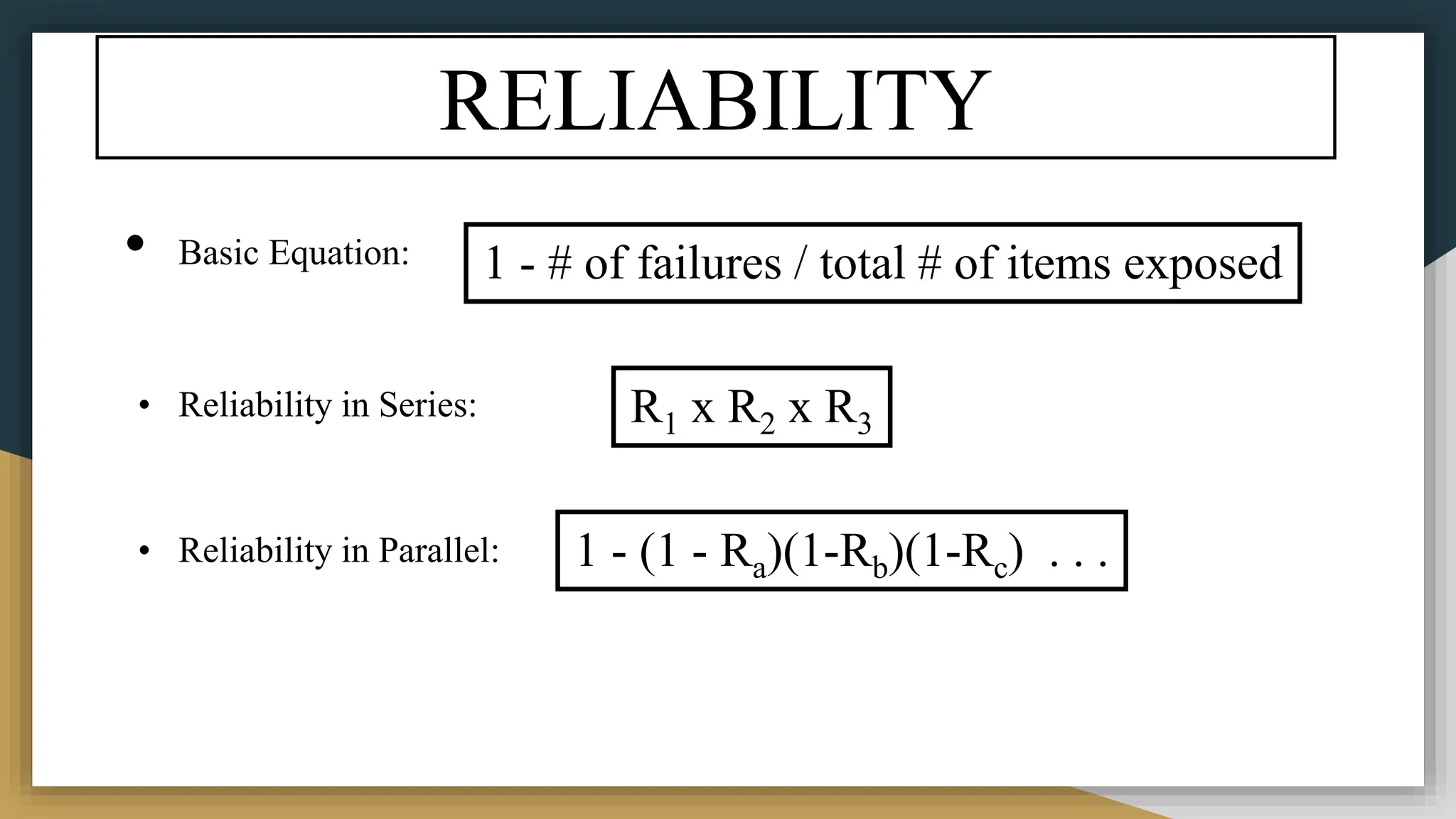
RELIABILITY
• Basic Equation:
• Reliability in Series:
• Reliability in Parallel:
1 - # of failures / total # of items exposed
R1 x R2 x R3
1 - (1 - Ra)(1-Rb)(1-Rc) . . .
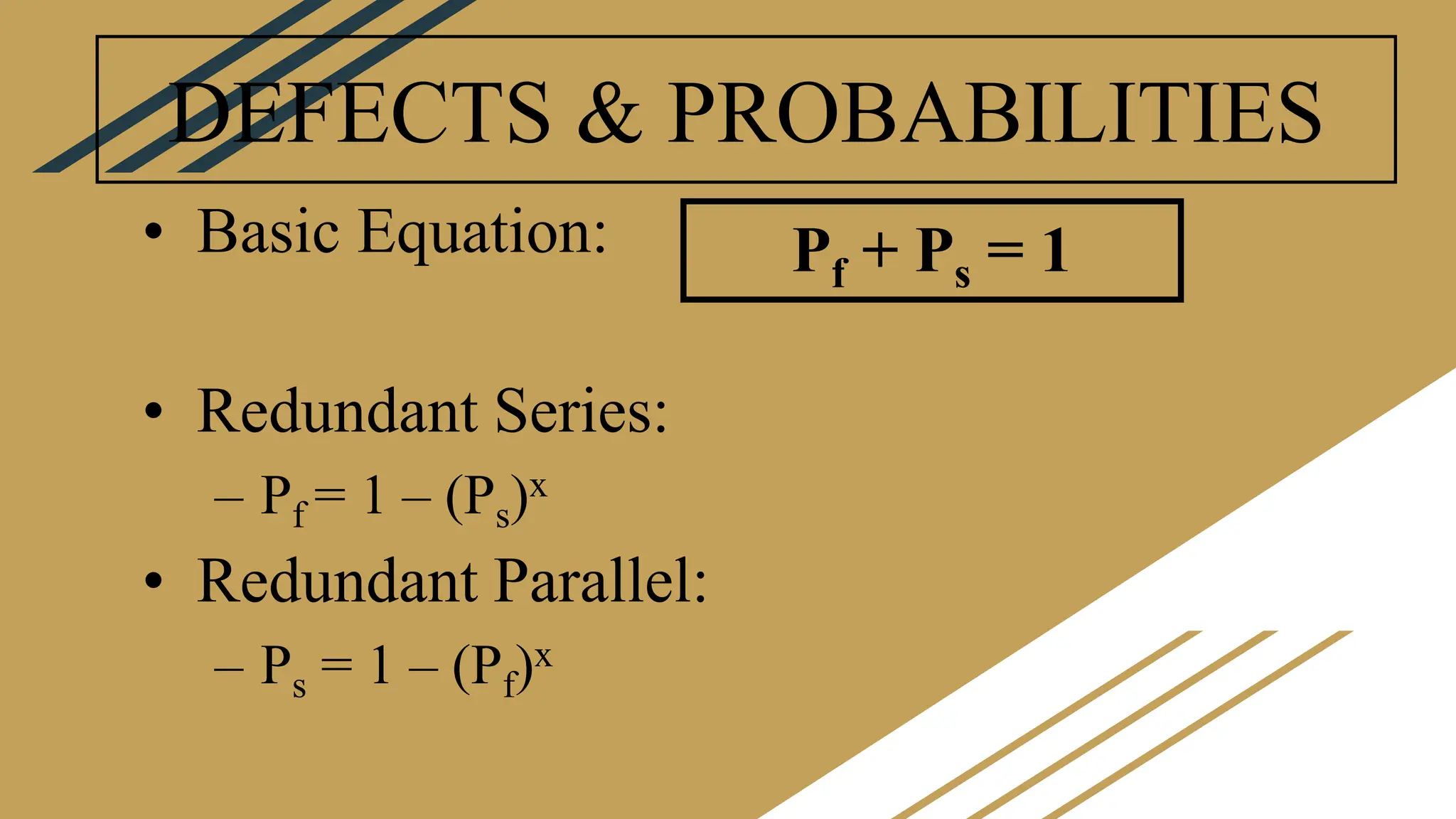
DEFECTS & PROBABILITIES
• Basic Equation:
• Redundant Series:
– Pf = 1 – (Ps)x
• Redundant Parallel:
– Ps = 1 – (Pf)x
Pf + Ps = 1
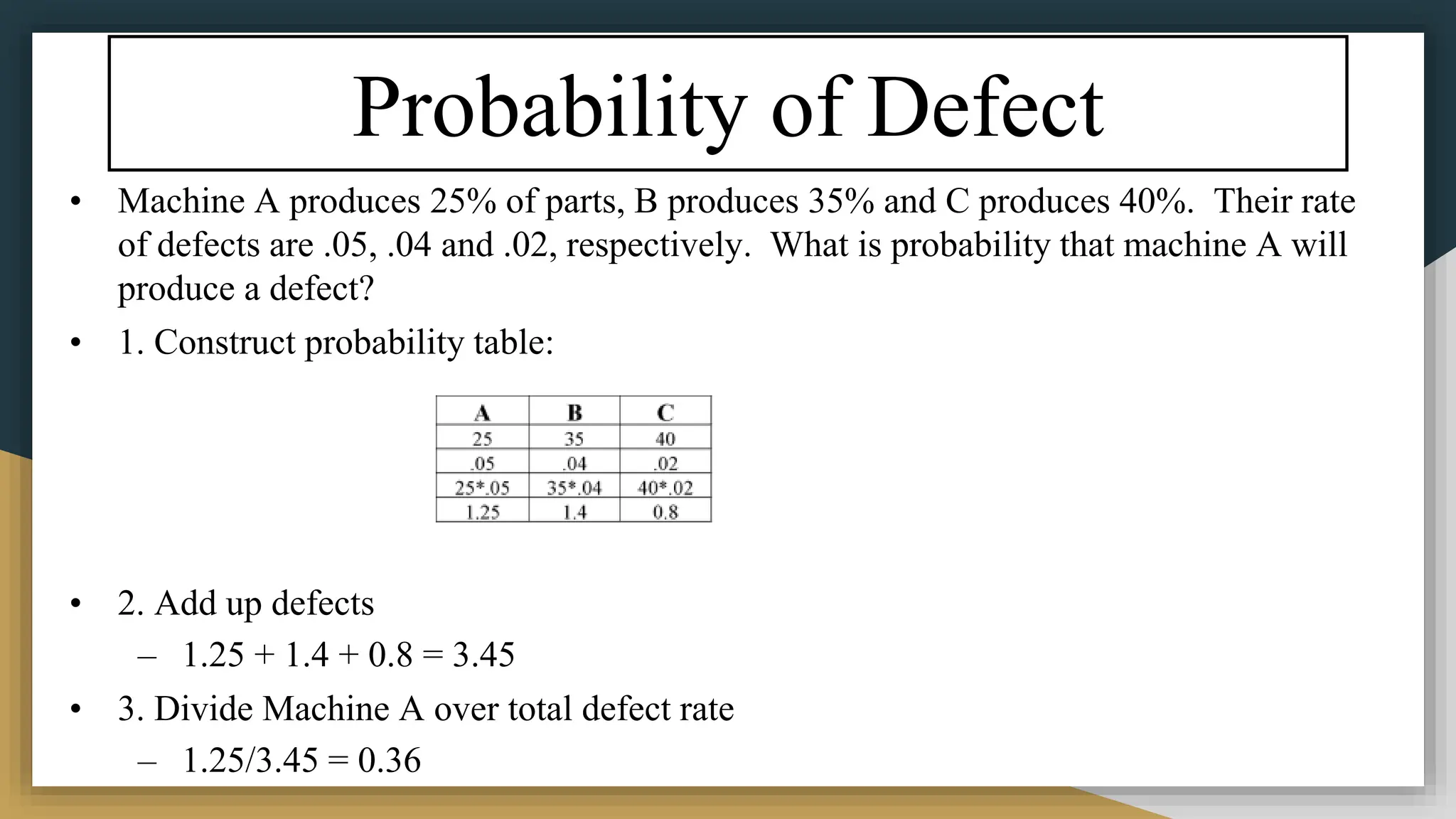
Probability of Defect
• Machine A produces 25% of parts, B produces 35% and C produces 40%. Their rate
of defects are .05, .04 and .02, respectively. What is probability that machine A will
produce a defect?
• 1. Construct probability table:
• 2. Add up defects
– 1.25 + 1.4 + 0.8 = 3.45
• 3. Divide Machine A over total defect rate
– 1.25/3.45 = 0.36
Probability of Success
• Question: An airplane has two engines, each
with a probability of success of 0.90. What is the
probability that the airplane will arrive safely if
one or both engines working will ensure a safe
arrival?
– Both engines working means “and” therefore multiply
• Pf = 1- Ps = 1- 0.9 = 0.1
• Ps = 1- [(0.1)(0.1)] = 0.99 Ps + Pf = 1
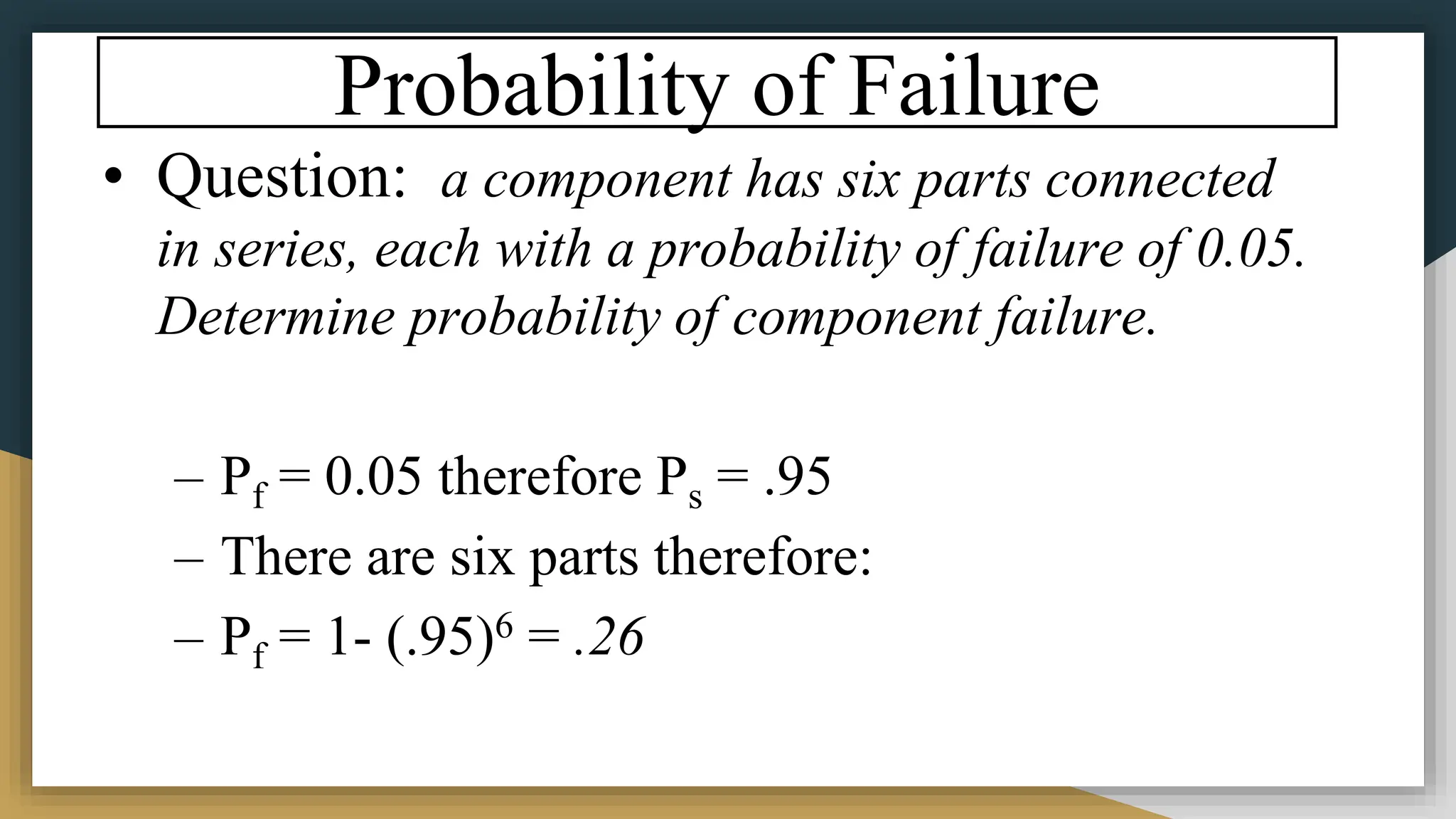
Probability of Failure
• Question: a component has six parts connected
in series, each with a probability of failure of 0.05.
Determine probability of component failure.
– Pf = 0.05 therefore Ps = .95
– There are six parts therefore:
– Pf = 1- (.95)6 = .26
Probability of Success
• Question: A widget is made of three components called
wiglets. Wiglet “A” has a Ps of .30, wiglet “B” has a Ps of
.45 and wiglet “C” has Ps of .60. Calculate Ps if wiglets B
and C are functionally parallel and wiglet “A” is in series.
– Calculate Ps of (B+C)
• Ps(B+C) = 1 – Pf
• Ps(B+C) = 1- [(.55)(.40)] = .78
– Calculate Ps of A(B+C)
• Ps = (.30)(.78) = .23
B
C
A
.30
.45
.60
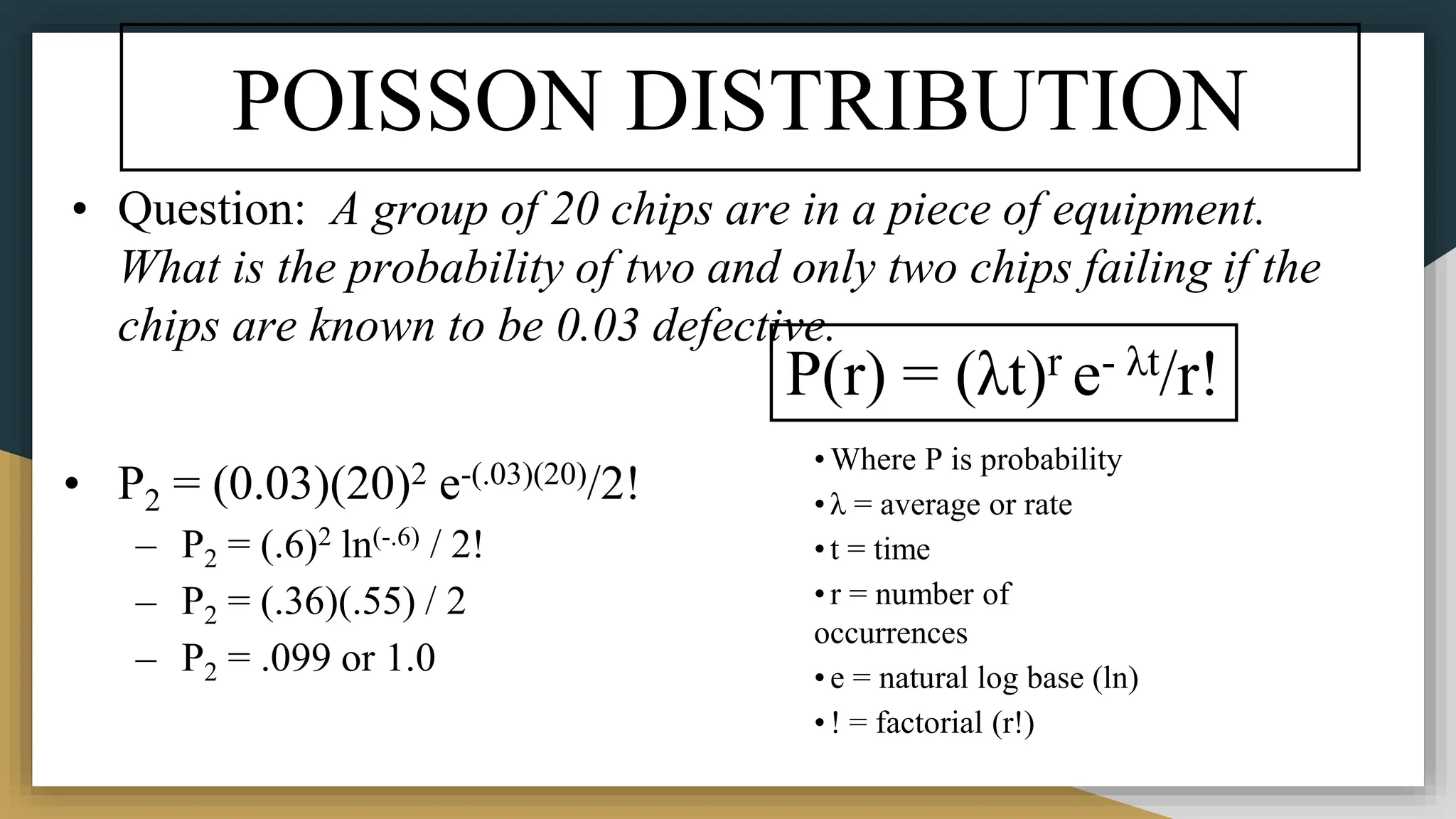
POISSON DISTRIBUTION
• Question: A group of 20 chips are in a piece of equipment.
What is the probability of two and only two chips failing if the
chips are known to be 0.03 defective.
• P2 = (0.03)(20)2 e-(.03)(20)/2!
– P2 = (.6)2 ln(-.6) / 2!
– P2 = (.36)(.55) / 2
– P2 = .099 or 1.0
P(r) = (λt)r e- λt/r!
• Where P is probability
• λ = average or rate
• t = time
• r = number of
occurrences
• e = natural log base (ln)
• ! = factorial (r!)
Probability Calculation
– 1.) Set up diagram
– 2.) Get individual Rates
a. Combo of 2 men
b. Combo of 2 women
c. Combo of 2 men and 2
women
– 3.) Calculate probability
Solution:
1. [6/2]*[4/2]**/[10/4]
2a. 6 nCR 2 = 15
2b. 4 nCR 2 = 6
2c. 10 nCR 4 = 210
3. [15][6]/[210] = 0.43
*Female, **Male
•Question: What is the probability that 2 men and 2 women will be
selected out of a group of 10 with 6 men and 4 women?
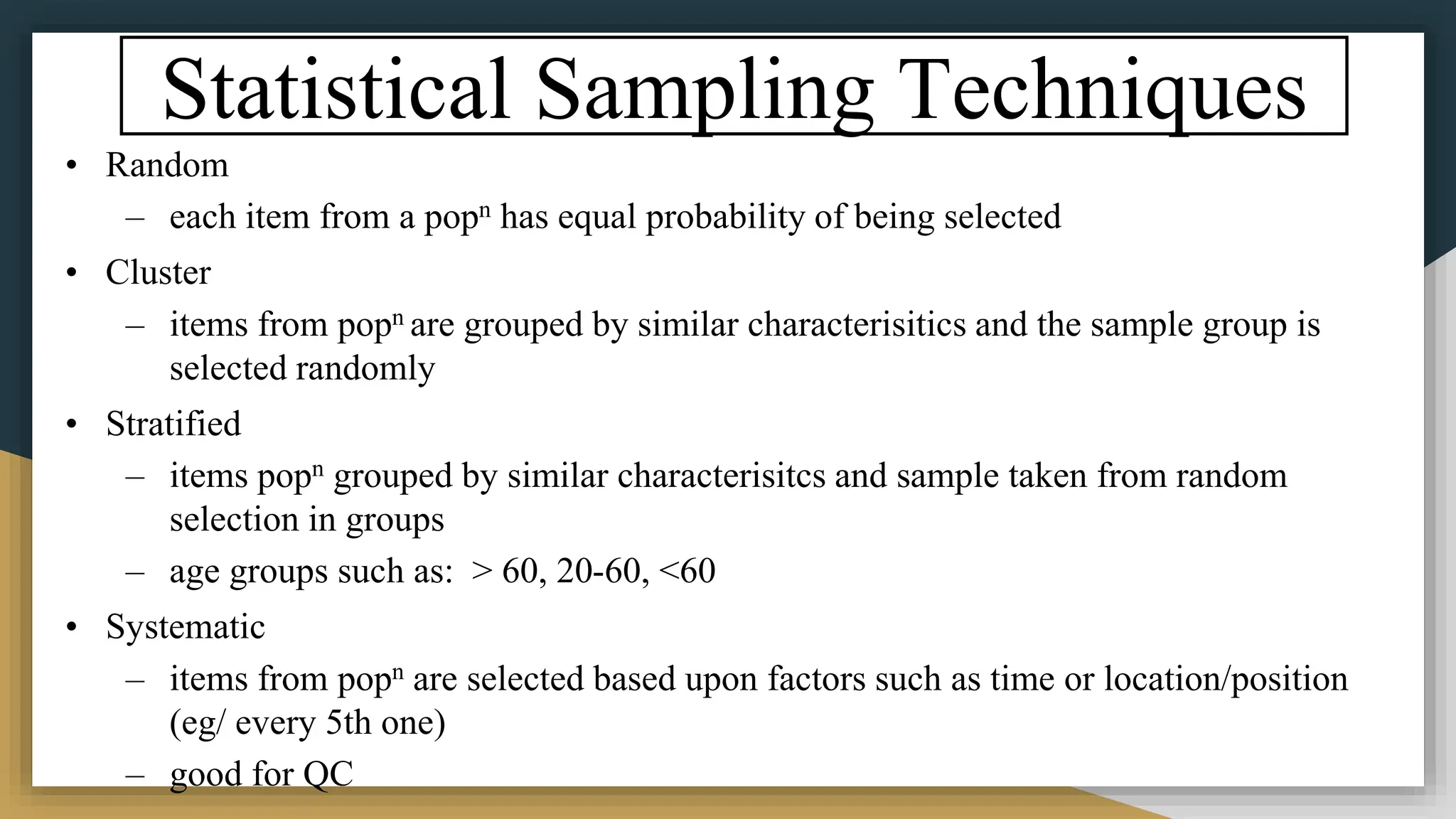
Statistical Sampling Techniques
• Random
– each item from a popn has equal probability of being selected
• Cluster
– items from popn are grouped by similar characterisitics and the sample group is
selected randomly
• Stratified
– items popn grouped by similar characterisitcs and sample taken from random
selection in groups
– age groups such as: > 60, 20-60, <60
• Systematic
– items from popn are selected based upon factors such as time or location/position
(eg/ every 5th one)
– good for QC
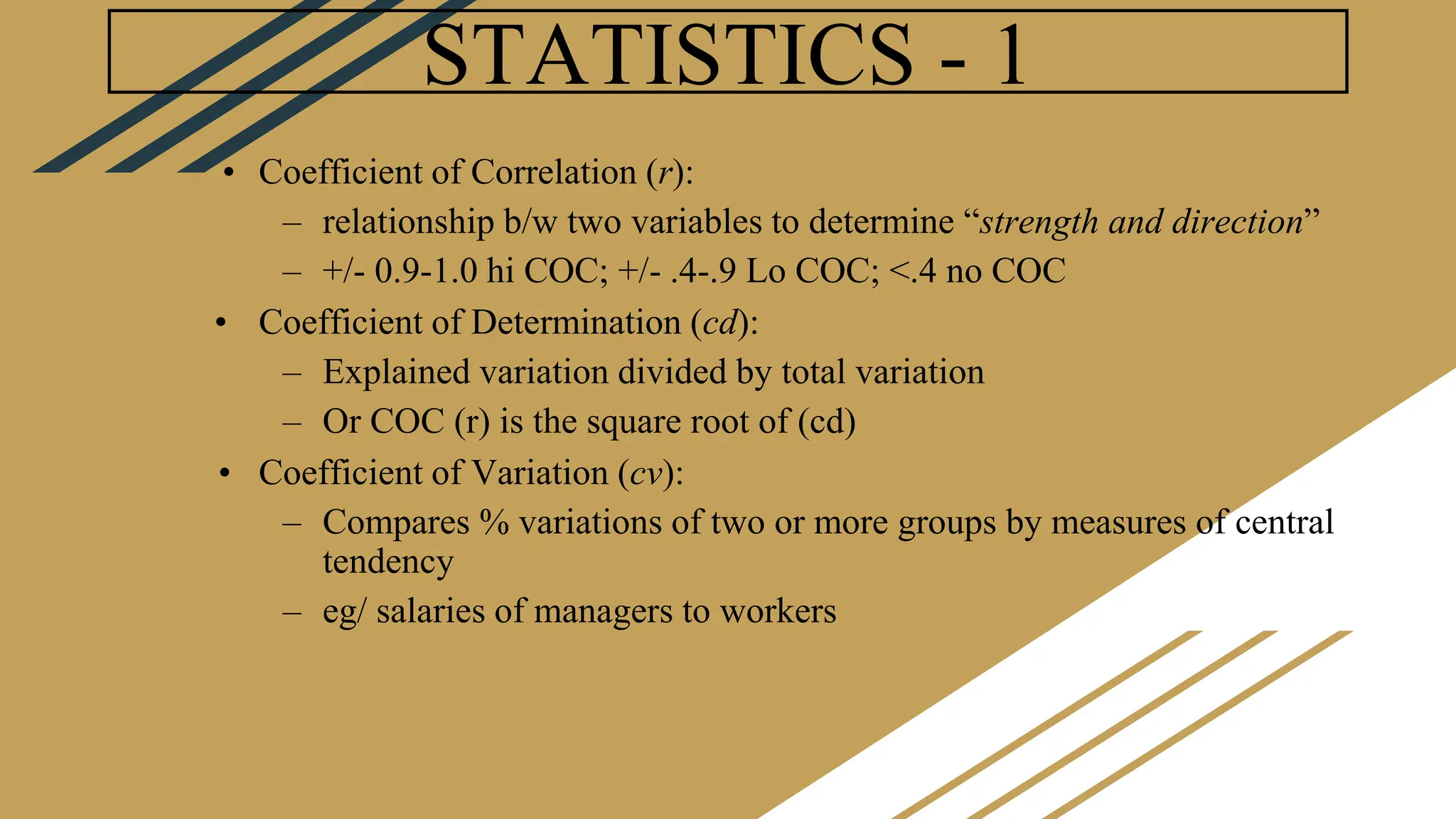
STATISTICS - 1
• Coefficient of Correlation (r):
– relationship b/w two variables to determine “strength and direction”
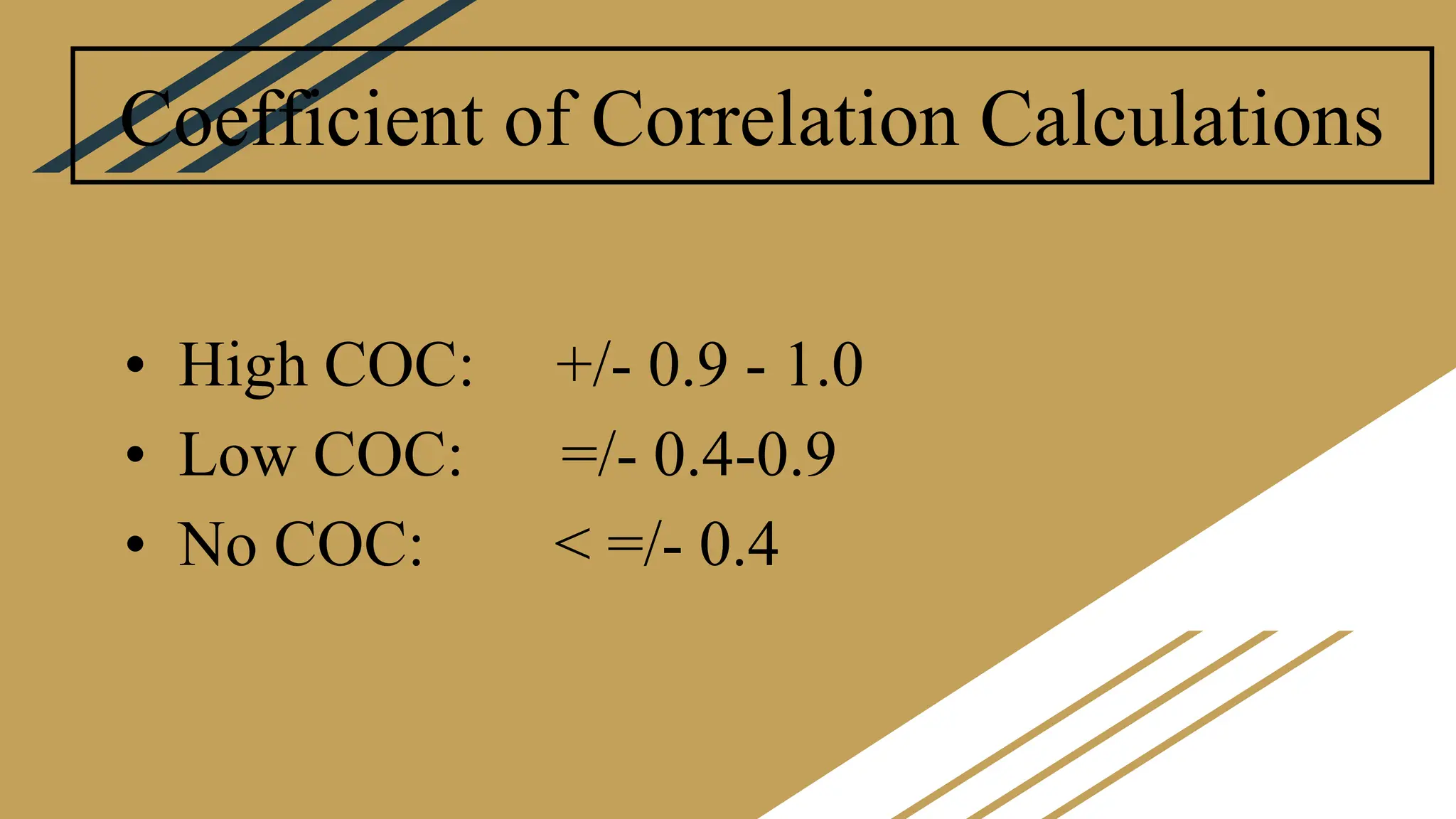
– +/- 0.9-1.0 hi COC; +/- .4-.9 Lo COC; <.4 no COC
• Coefficient of Determination (cd):
– Explained variation divided by total variation
– Or COC (r) is the square root of (cd)
• Coefficient of Variation (cv):
– Compares % variations of two or more groups by measures of central
tendency
– eg/ salaries of managers to workers
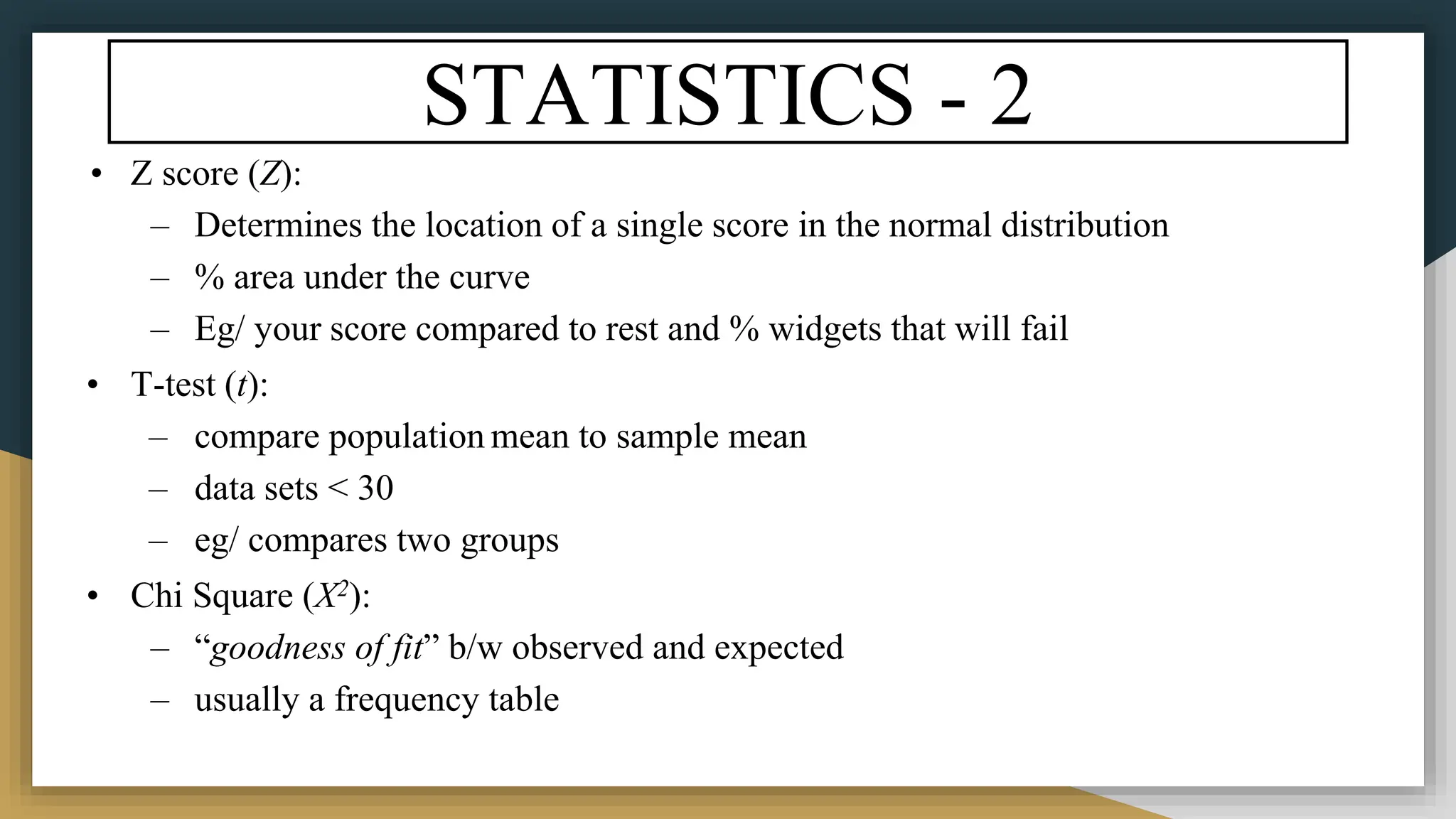
STATISTICS - 2
• Z score (Z):
– Determines the location of a single score in the normal distribution
– % area under the curve
– Eg/ your score compared to rest and % widgets that will fail
• T-test (t):
– compare population mean to sample mean
– data sets < 30
– eg/ compares two groups
• Chi Square (X2):
– “goodness of fit” b/w observed and expected
– usually a frequency table
Coefficient of Correlation Calculations
• High COC: +/- 0.9 - 1.0
• Low COC: =/- 0.4-0.9
• No COC: < =/- 0.4
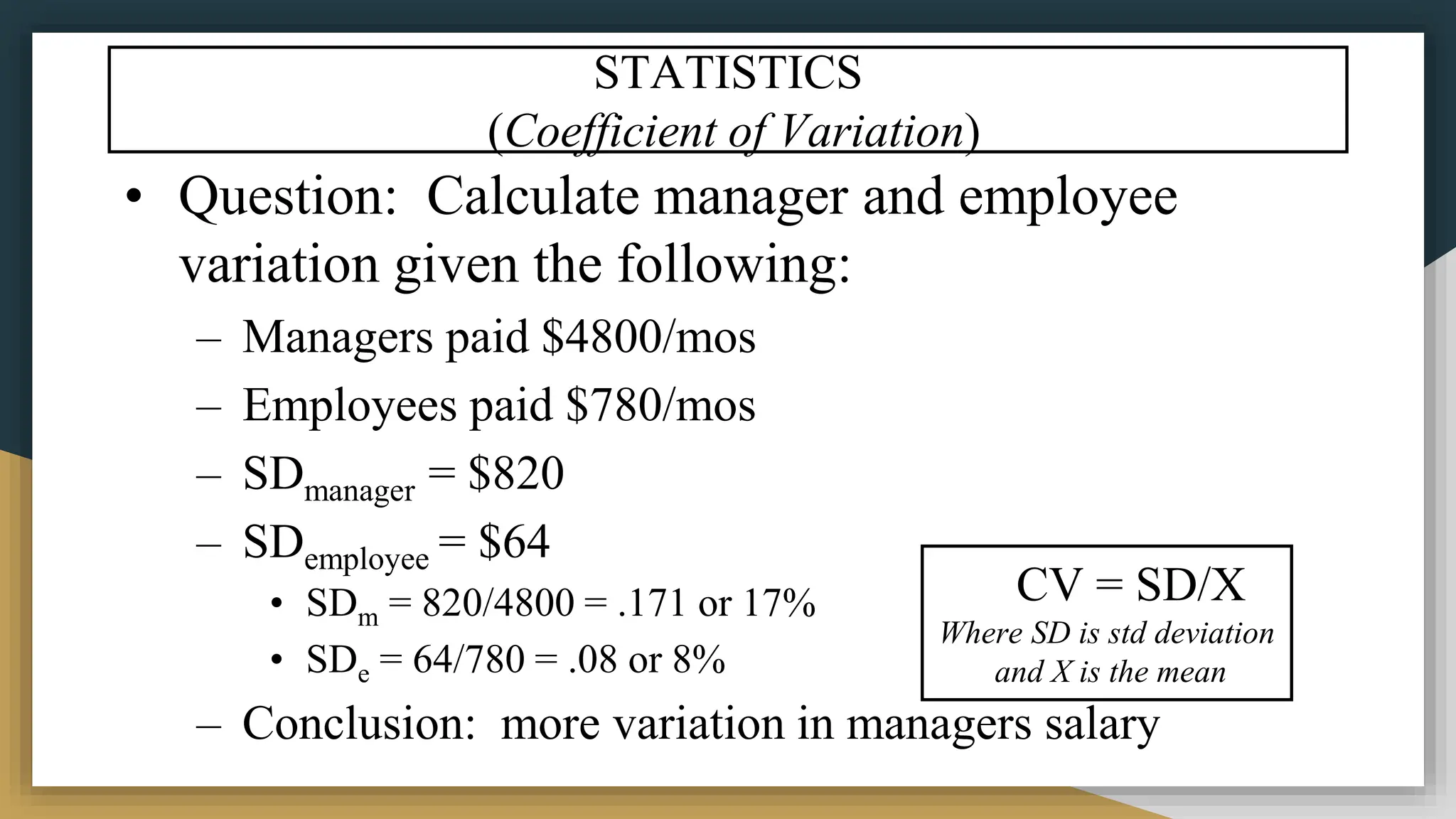
• Question: Calculate manager and employee
variation given the following:
– Managers paid $4800/mos
– Employees paid $780/mos
– SDmanager = $820
– SDemployee = $64
• SDm = 820/4800 = .171 or 17%
• SDe = 64/780 = .08 or 8%
– Conclusion: more variation in managers salary
STATISTICS
(Coefficient of Variation)
CV = SD/X
Where SD is std deviation
and X is the mean
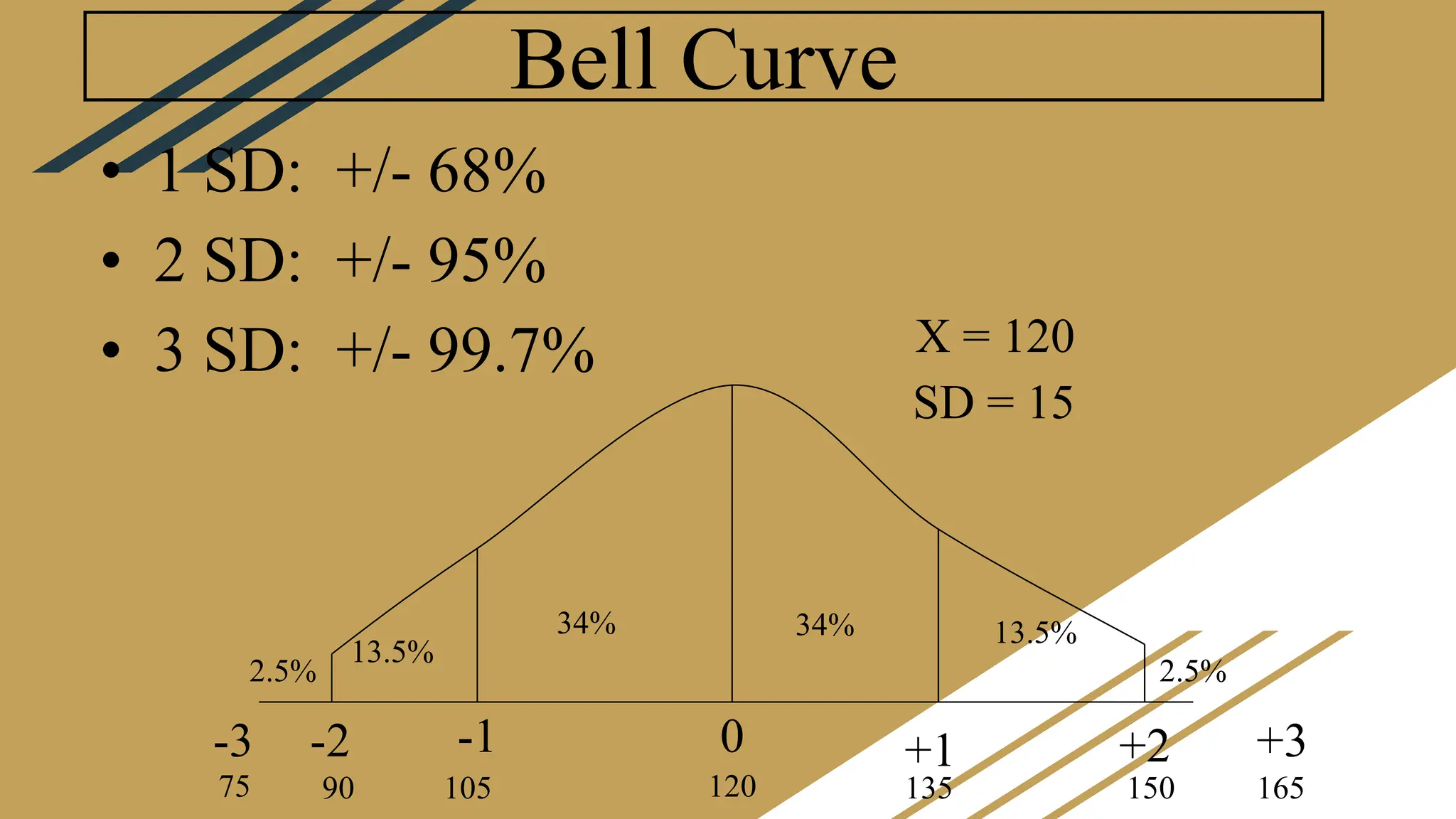
Bell Curve
• 1 SD: +/- 68%
• 2 SD: +/- 95%
• 3 SD: +/- 99.7%
2.5%
13.5%
34% 34% 13.5%
2.5%
0
-1
-2
-3 +1 +2 +3
75 90 105 120 135 150 165
X = 120
SD = 15
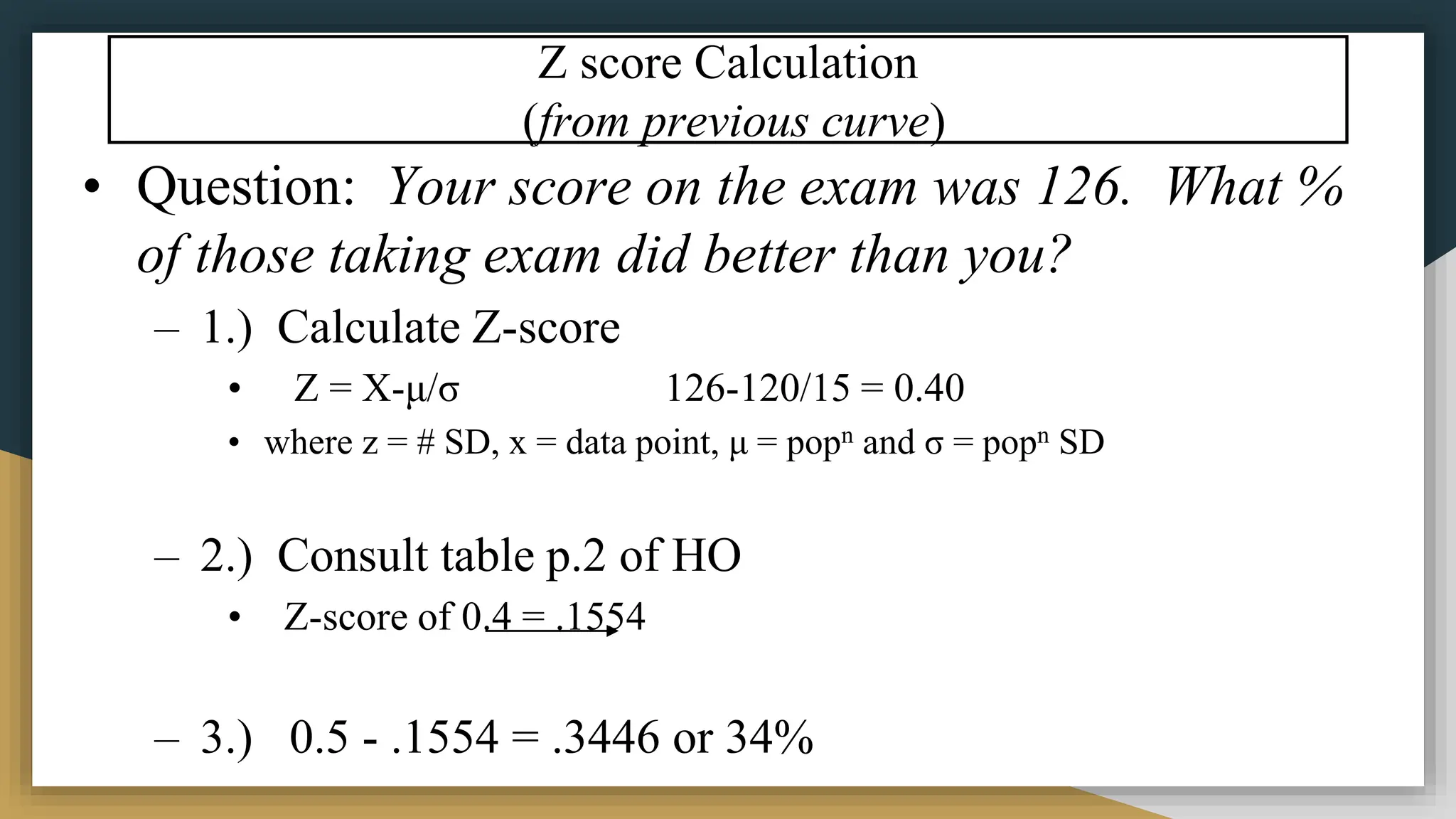
Z score Calculation
(from previous curve)
• Question: Your score on the exam was 126. What %
of those taking exam did better than you?
– 1.) Calculate Z-score
• Z = X-μ/σ 126-120/15 = 0.40
• where z = # SD, x = data point, μ = popn and σ = popn SD
– 2.) Consult table p.2 of HO
• Z-score of 0.4 = .1554
– 3.) 0.5 - .1554 = .3446 or 34%
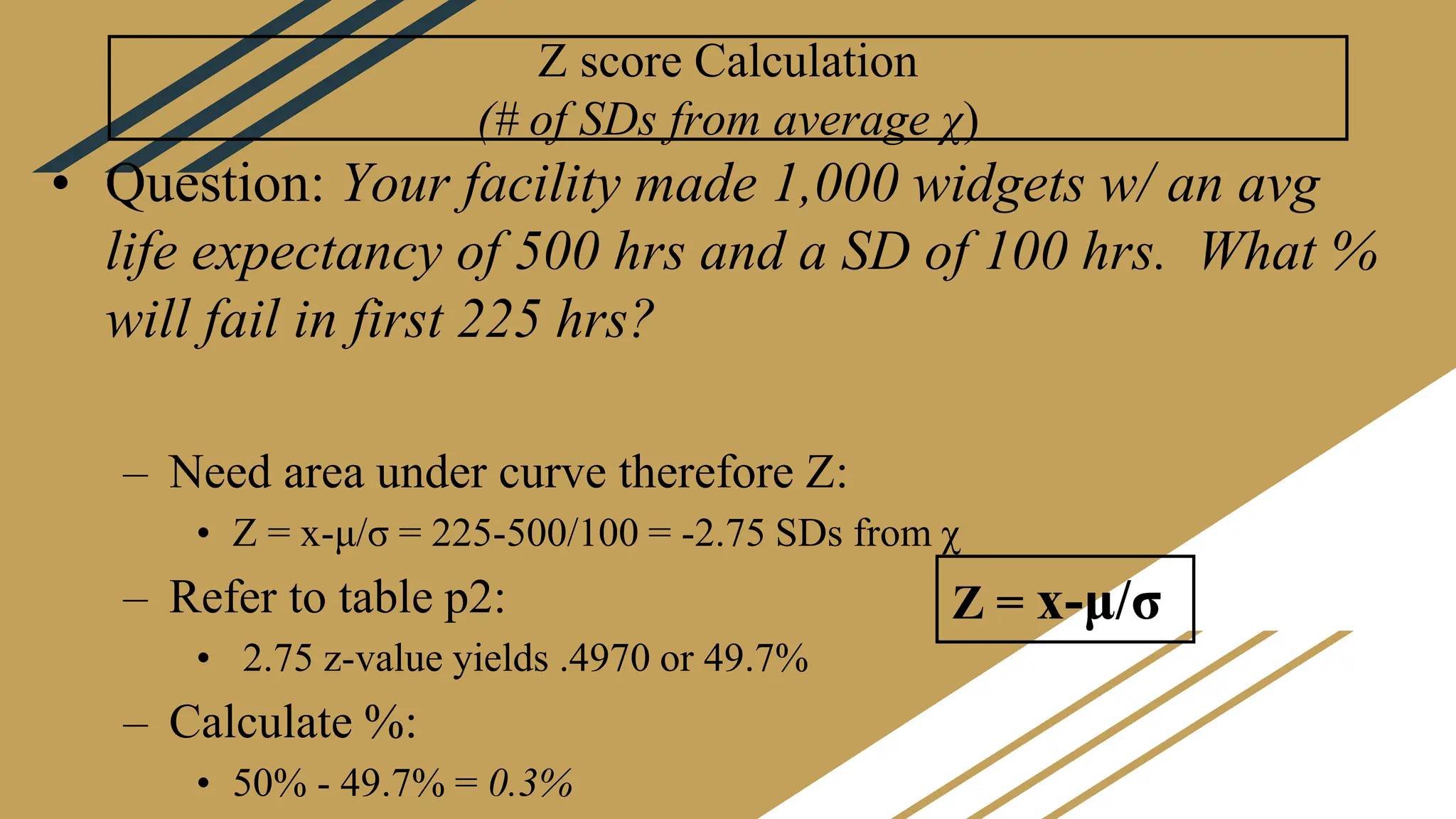
Z score Calculation
(# of SDs from average χ)
• Question: Your facility made 1,000 widgets w/ an avg
life expectancy of 500 hrs and a SD of 100 hrs. What %
will fail in first 225 hrs?
– Need area under curve therefore Z:
• Z = x-μ/σ = 225-500/100 = -2.75 SDs from χ
– Refer to table p2:
• 2.75 z-value yields .4970 or 49.7%
– Calculate %:
• 50% - 49.7% = 0.3%
Z = x-μ/σ
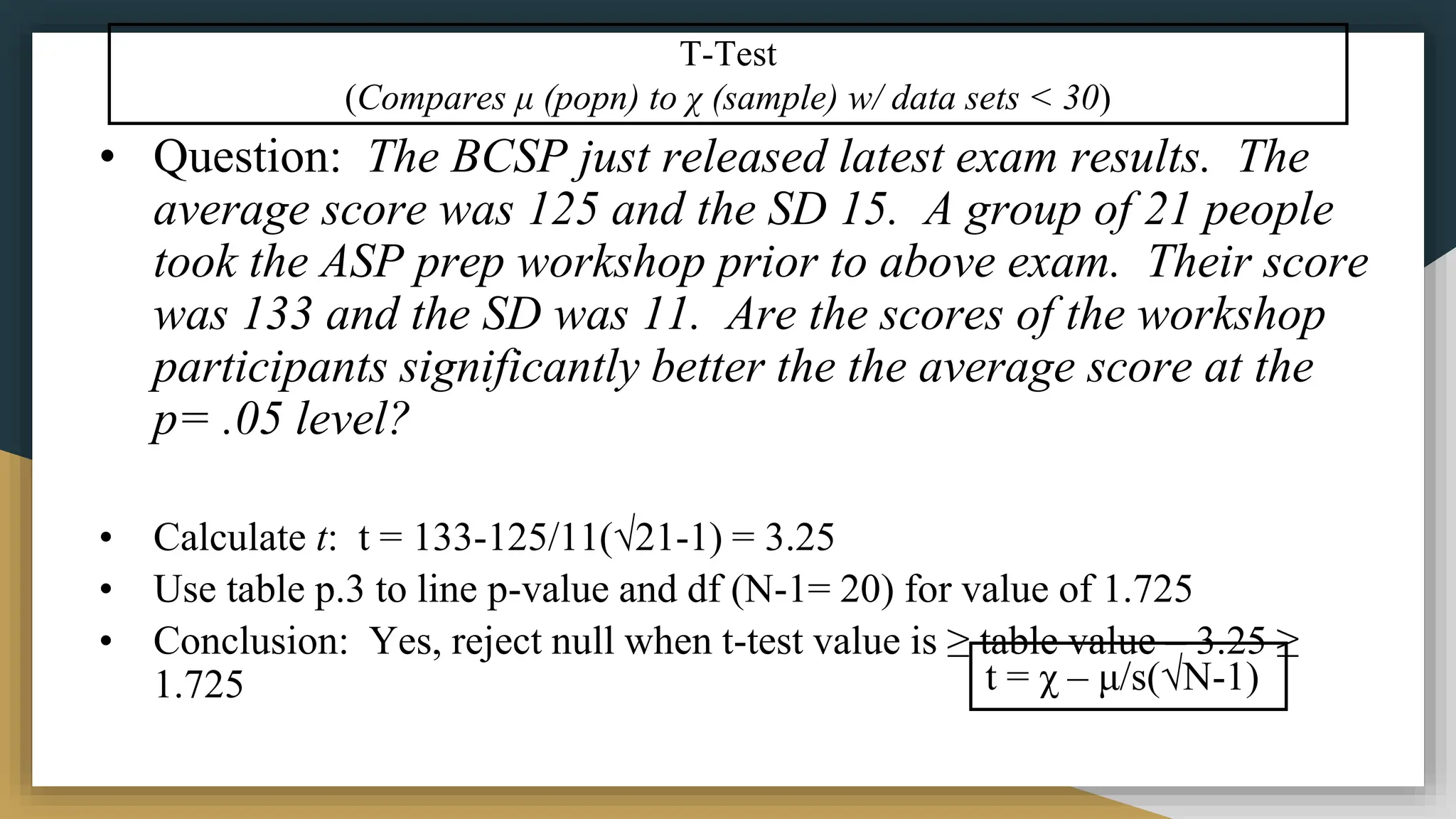
T-Test
(Compares μ (popn) to χ (sample) w/ data sets < 30)
• Question: The BCSP just released latest exam results. The
average score was 125 and the SD 15. A group of 21 people
took the ASP prep workshop prior to above exam. Their score
was 133 and the SD was 11. Are the scores of the workshop
participants significantly better the the average score at the
p= .05 level?
• Calculate t: t = 133-125/11(√21-1) = 3.25
• Use table p.3 to line p-value and df (N-1= 20) for value of 1.725
• Conclusion: Yes, reject null when t-test value is ≥ table value – 3.25 ≥
1.725 t = χ – μ/s(√N-1)
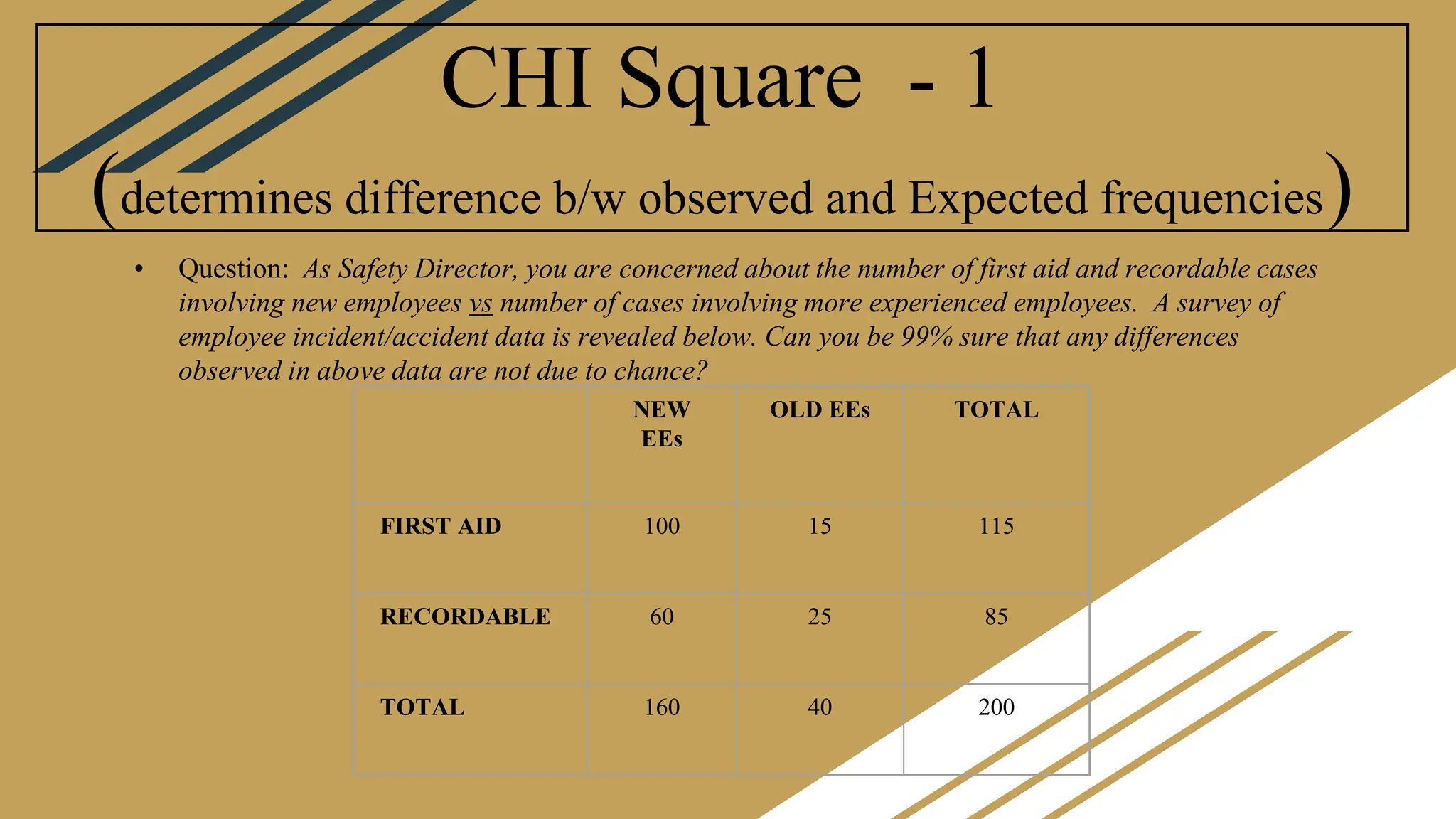
CHI Square - 1
(determines difference b/w observed and Expected frequencies)
• Question: As Safety Director, you are concerned about the number of first aid and recordable cases
involving new employees vs number of cases involving more experienced employees. A survey of
employee incident/accident data is revealed below. Can you be 99% sure that any differences
observed in above data are not due to chance?
NEW
EEs
OLD EEs TOTAL
FIRST AID 100 15 115
RECORDABLE 60 25 85
TOTAL 160 40 200
CHI Square - 2
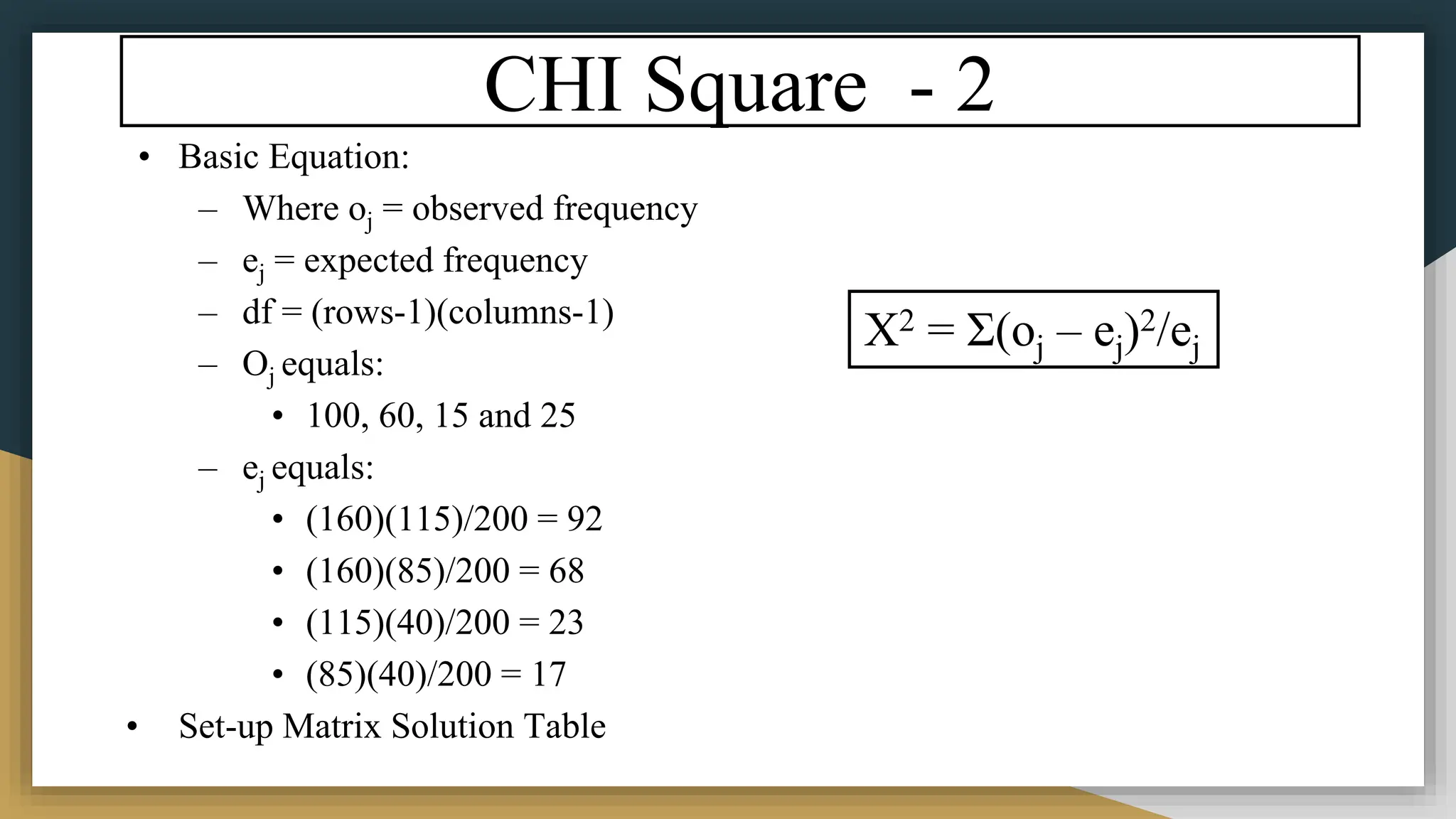
• Basic Equation:
– Where oj = observed frequency
– ej = expected frequency
– df = (rows-1)(columns-1)
– Oj equals:
• 100, 60, 15 and 25
– ej equals:
• (160)(115)/200 = 92
• (160)(85)/200 = 68
• (115)(40)/200 = 23
• (85)(40)/200 = 17
• Set-up Matrix Solution Table
X2 = Σ(oj – ej)2/ej
CHI Square - 3
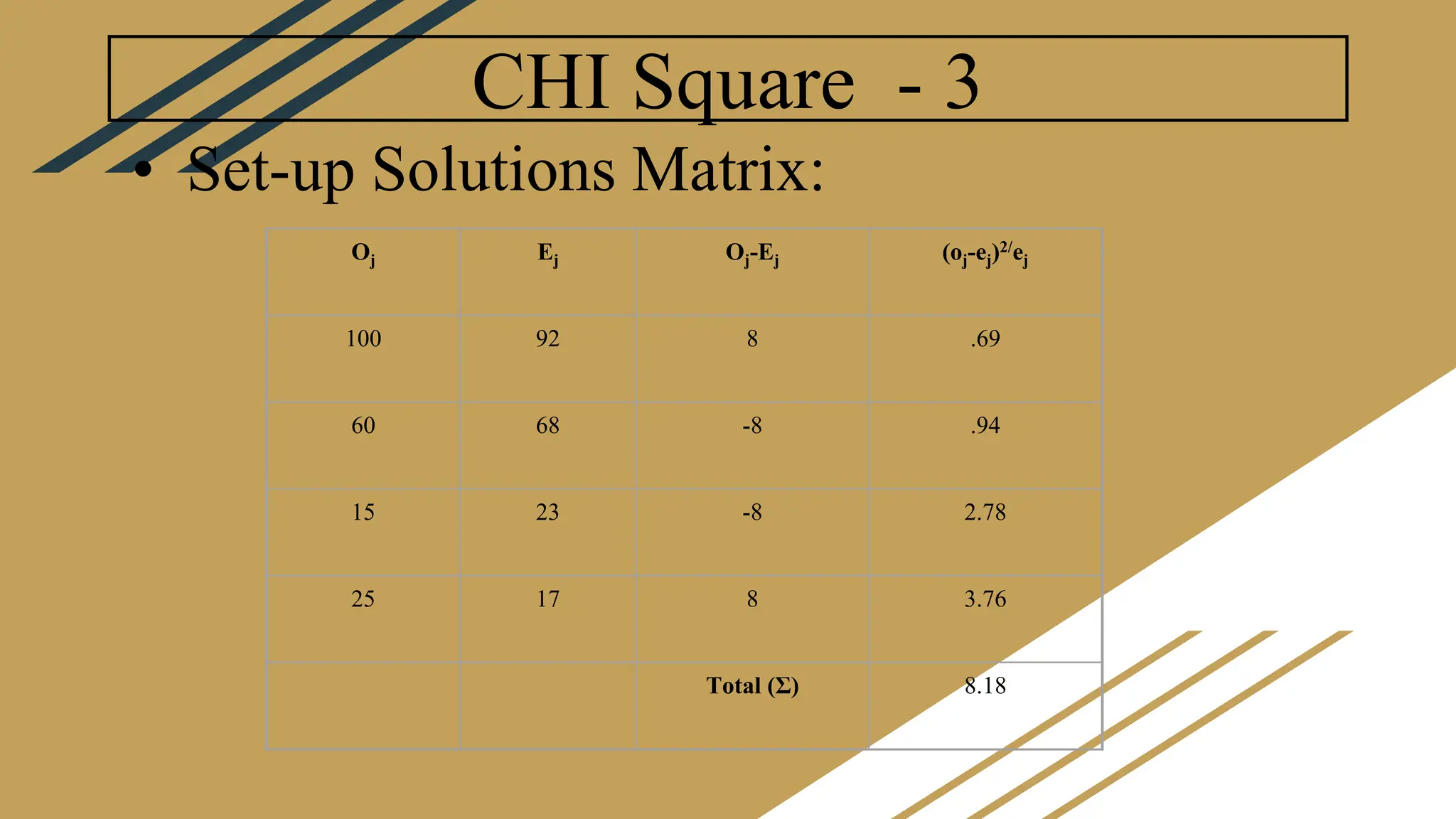
• Set-up Solutions Matrix:
Oj Ej Oj-Ej (oj-ej)2/ej
100 92 8 .69
60 68 -8 .94
15 23 -8 2.78
25 17 8 3.76
Total (Σ) 8.18
CHI Square - 4
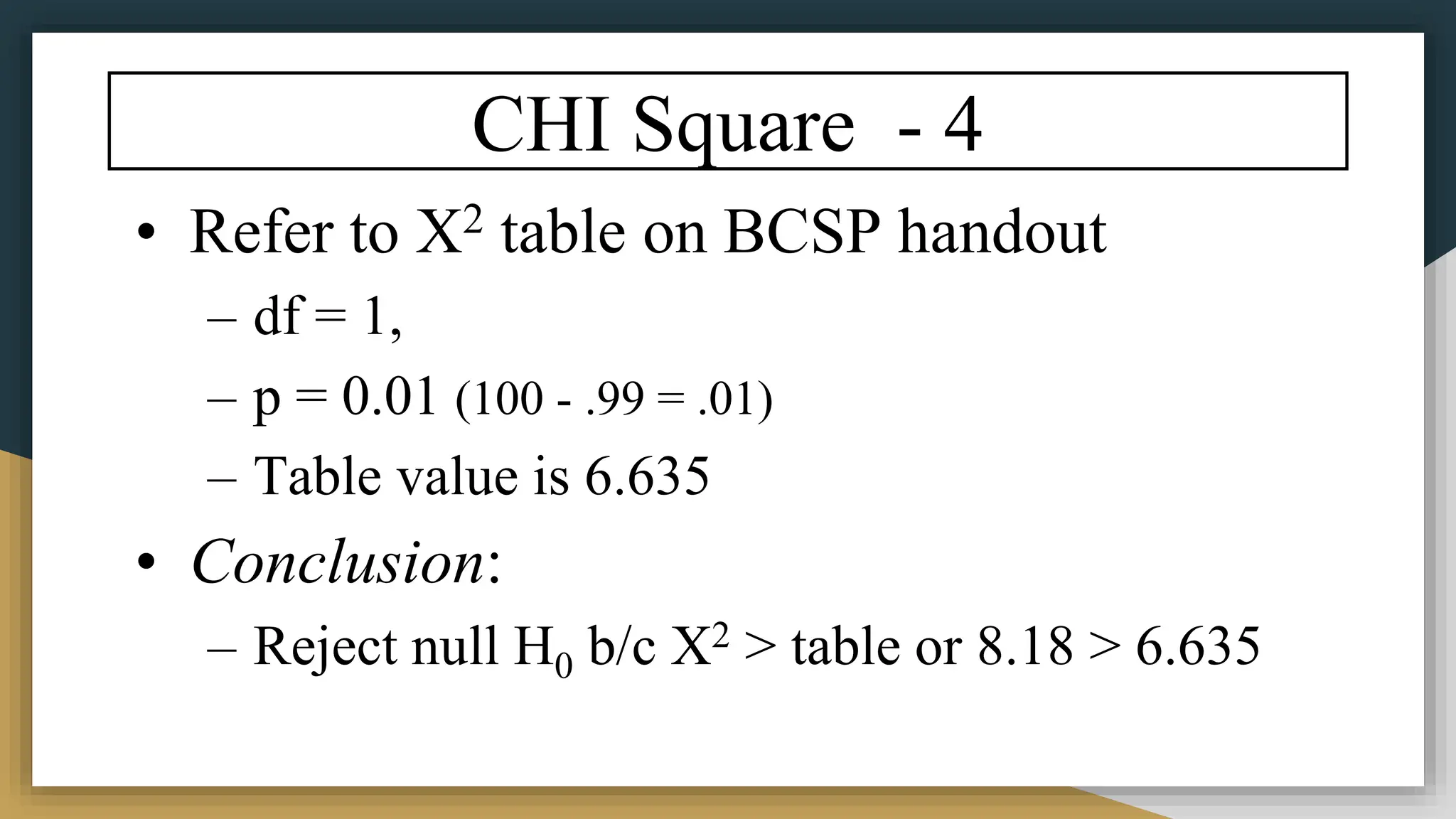
• Refer to X2 table on BCSP handout
– df = 1,
– p = 0.01 (100 - .99 = .01)
– Table value is 6.635
• Conclusion:
– Reject null H0 b/c X2 > table or 8.18 > 6.635
Present Value of Money
• One trip to the bank:
• Many payments/trips to the bank:
P = F(1 + i)-n
where F is future value
P = A [(1+i)-n/i(1+i)n]
where A is amount of monthly payment
and n is # of time periods
Present Value of Money
• Question:
– What is better deal, 1M over term or $3K
monthly?
• Answer:
– for 1M investment up front:
– for $3K monthly:
P = F(1+i)-n
Where F = 1M, i = interest rate and n= periods (eg/25)
P = A[(1+i)n - 1/i(1+i)n]
where A = periodic payments (eg/ $3K) and i = monthly interest (/12)
Future Value of $ from Present Value
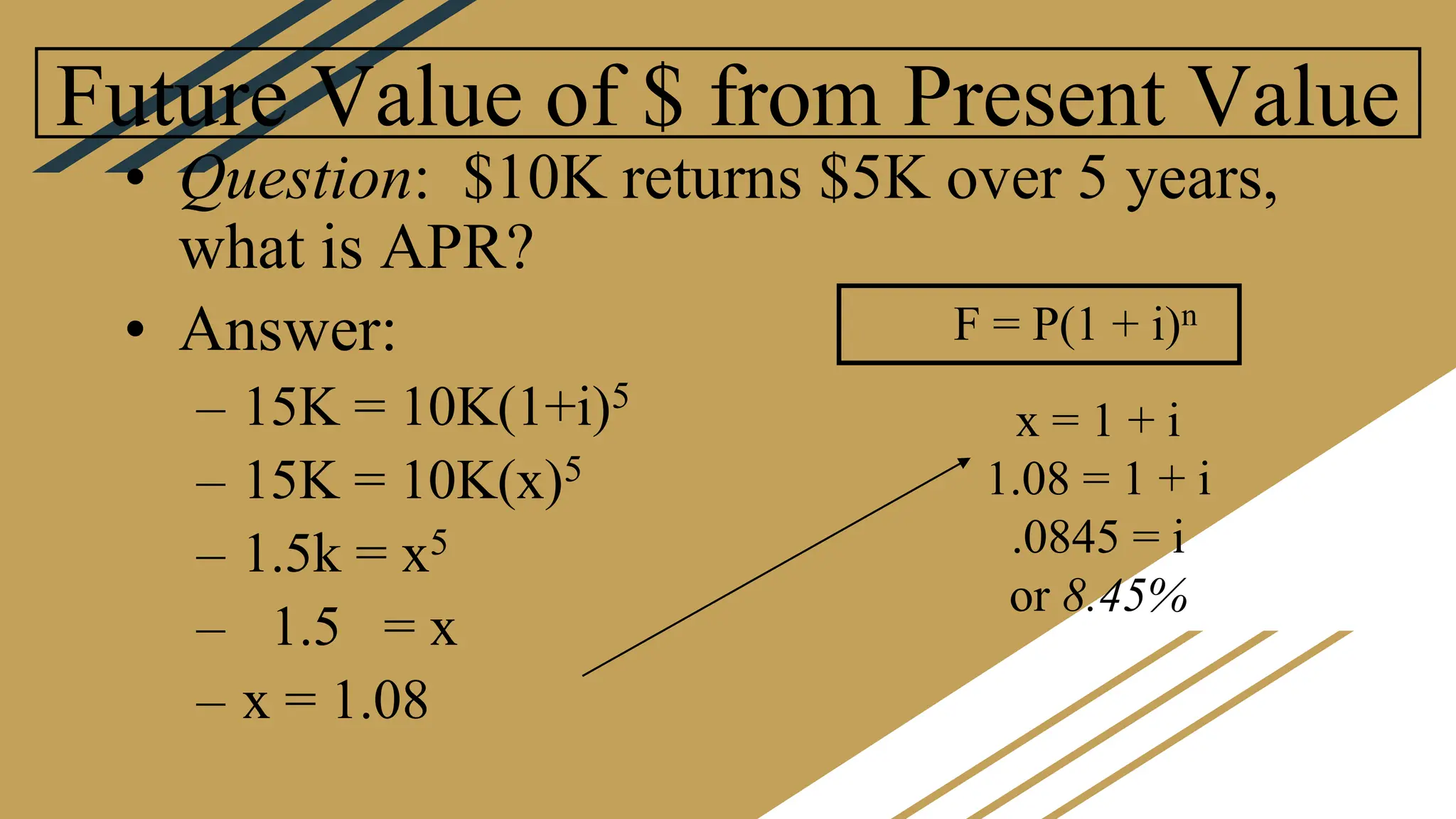
• Question: $10K returns $5K over 5 years,
what is APR?
• Answer:
– 15K = 10K(1+i)5
– 15K = 10K(x)5
– 1.5k = x5
– 1.5 = x
– x = 1.08
F = P(1 + i)n
x = 1 + i
1.08 = 1 + i
.0845 = i
or 8.45%
PRESENT/FUTURE VALUE OF $
• Question: You need to purchase a new machine. Two options: (1) lease a machine for 10 years @ $2K/yr; or, (2)
purchase the machine for $10K with a maintenance agreement of $500/yr. After 10 yrs you can sell the machine
for a salvage value of $5K. Interest will be 15% for 10 yrs. Which option is best?
– Option 1 - Lease (PV regular payments):
• P = (2K)[(1+.15)10-1/(1.5)(1+.15)10] = 3.05/.607 (2K) = $10,038
– Option 2 - Buy (PV lump sum):
• (a) Calculate Maintenance Costs = $10,038 x (500/2000)* = 2509
• (b) Initial cost plus maintenance = 10K + 2509 = $12,509
• © calculate salvage: P = F(1+i)-n = (5K)(1.15)-10 = $1236
• © Cost minus salvage = 12509 - 1236 = $11,273
• *maintenance agreement is 1/4 of original monthly lease amount
– Option 1 is better as $10,038 < $11,273
P = A[(1+i)n-1/i(1+i)n]
P = F(1+i)-n
PRESENT/FUTURE VALUE OF $
• Question: The initial cost of a safety project will be $15K.
The project will cost $2K/yr to maintain, but will save
$4K/yr over 6 yrs @ 7%. Should the company invest in
the startup?
– (a) Calculate PV of maintenance cost: $9533
– (b) Add maintenance cost to project cost: 15K + 9533 = $24,533
– © Calculate PV of savings: use eqn (a) substituting 4K = $19,066
– © Cost is > than Savings
P = A[(1+i)n-1/i(1+i)n]
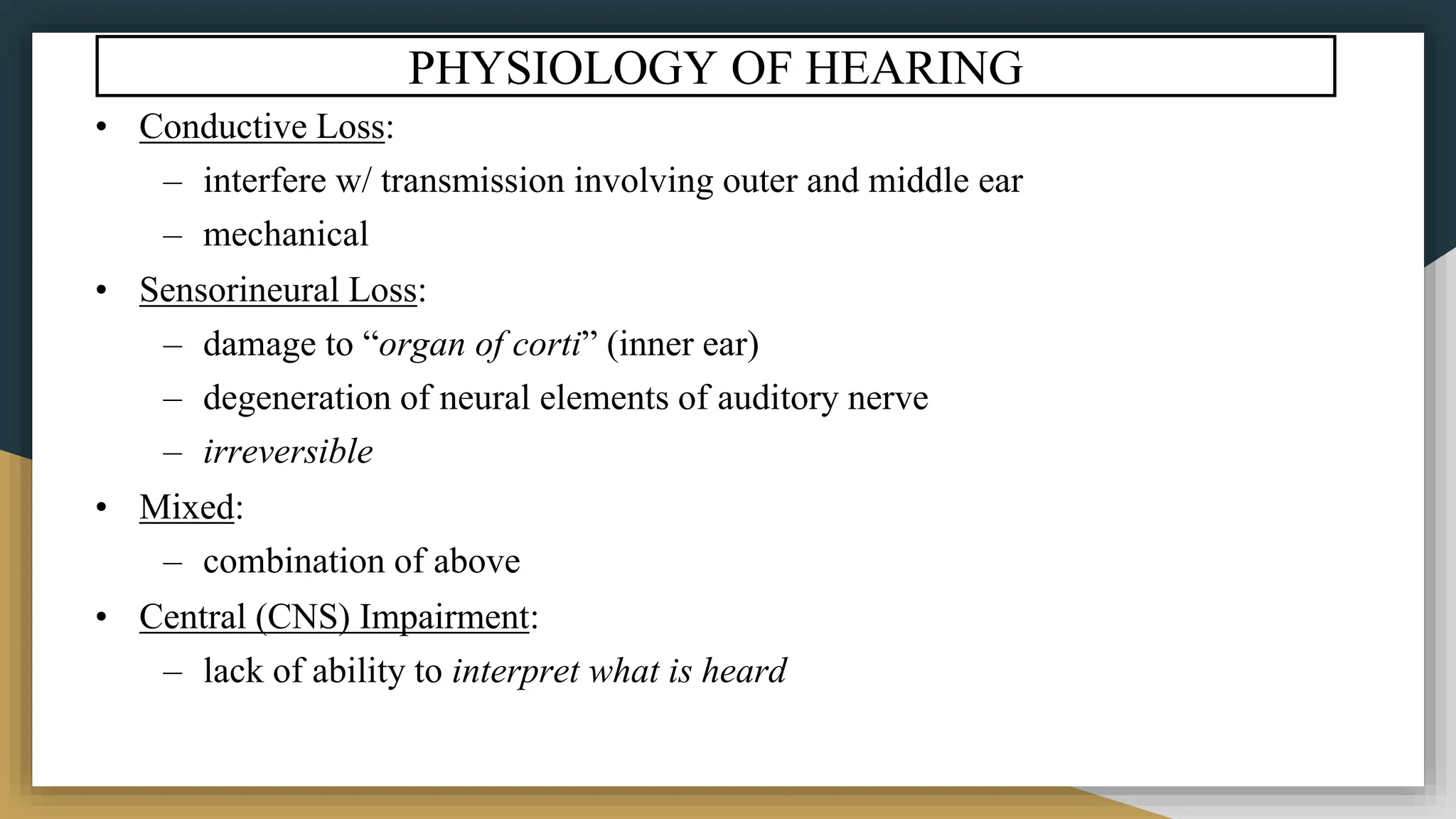
PHYSIOLOGY OF HEARING
• Conductive Loss:
– interfere w/ transmission involving outer and middle ear
– mechanical
• Sensorineural Loss:
– damage to “organ of corti” (inner ear)
– degeneration of neural elements of auditory nerve
– irreversible
• Mixed:
– combination of above
• Central (CNS) Impairment:
– lack of ability to interpret what is heard
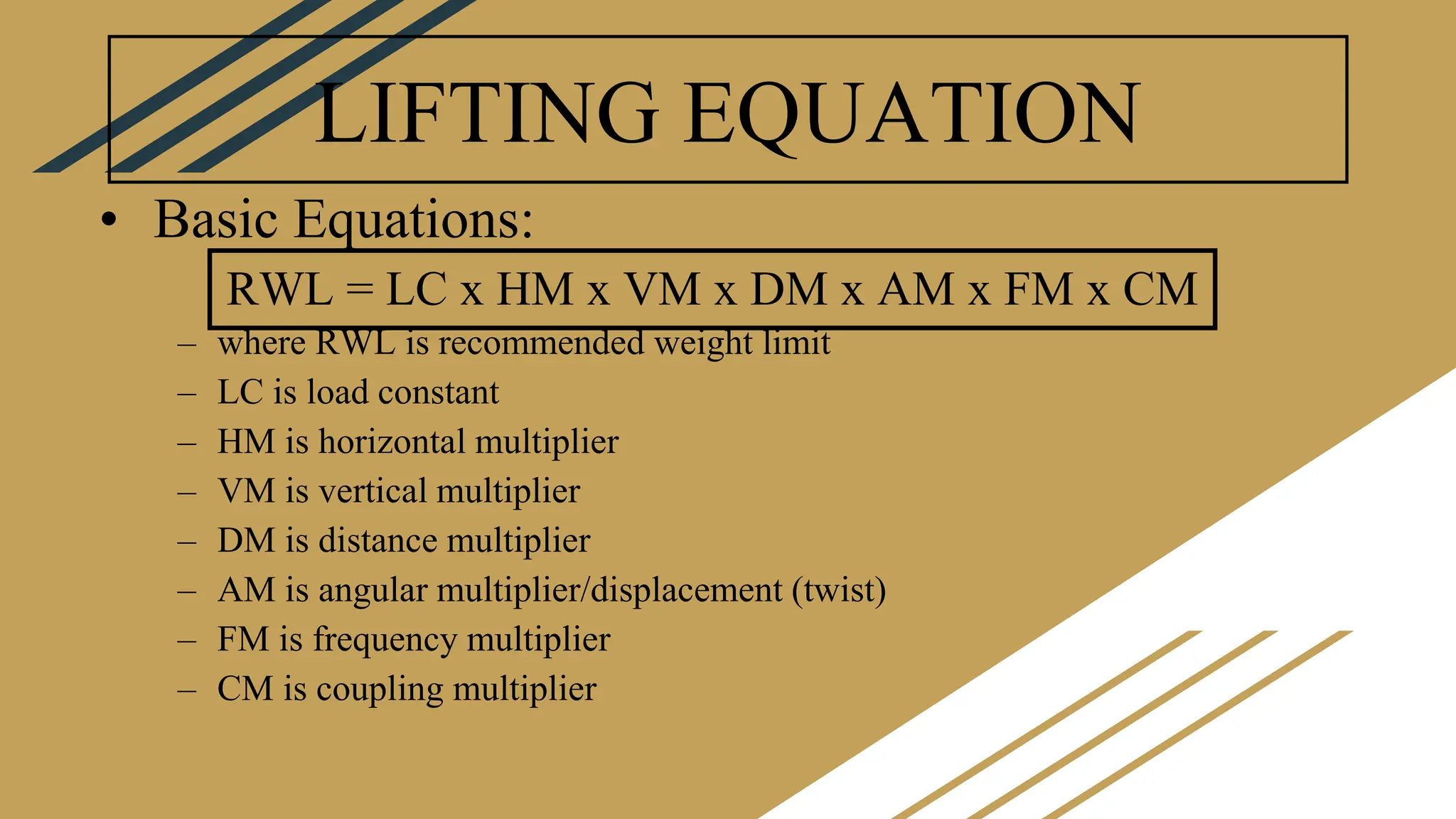
LIFTING EQUATION
• Basic Equations:
– where RWL is recommended weight limit
– LC is load constant
– HM is horizontal multiplier
– VM is vertical multiplier
– DM is distance multiplier
– AM is angular multiplier/displacement (twist)
– FM is frequency multiplier
– CM is coupling multiplier
RWL = LC x HM x VM x DM x AM x FM x CM
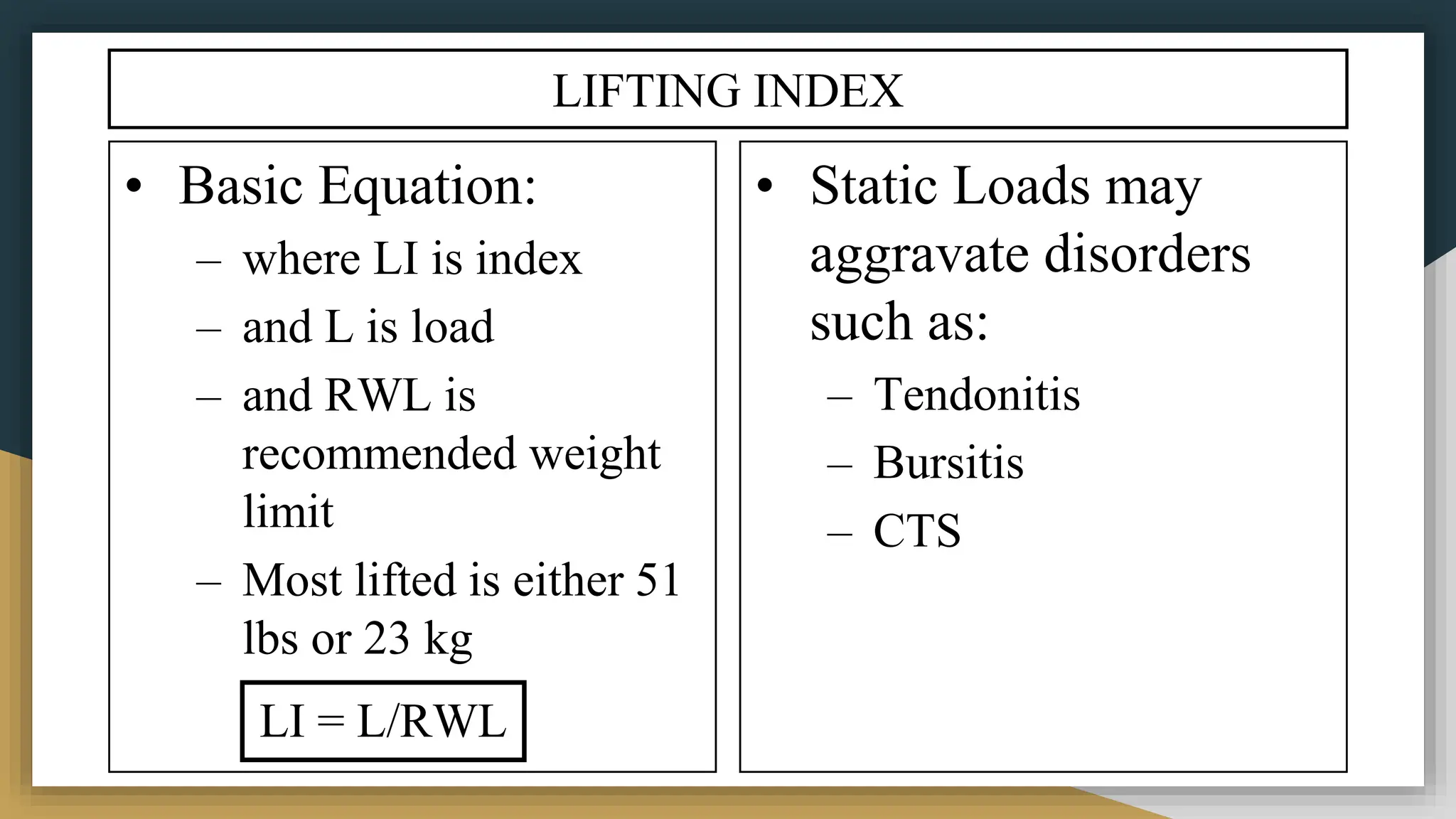
LIFTING INDEX
• Basic Equation:
– where LI is index
– and L is load
– and RWL is
recommended weight
limit
– Most lifted is either 51
lbs or 23 kg
• Static Loads may
aggravate disorders
such as:
– Tendonitis
– Bursitis
– CTS
LI = L/RWL
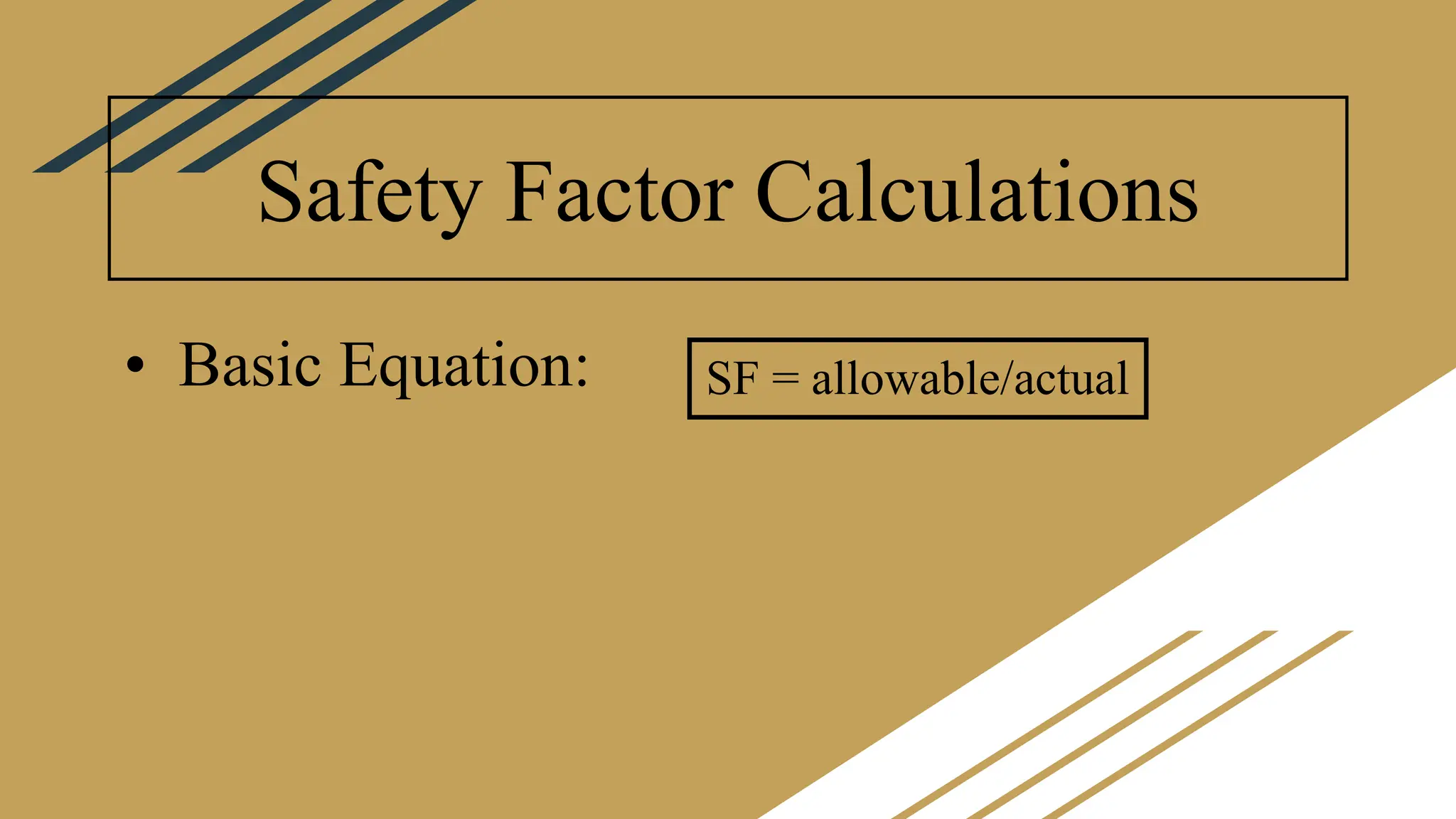
Safety Factor Calculations
• Basic Equation: SF = allowable/actual
Chemistry Terms
• Molarity:
– moles of solute dissolved in 1L of solution
• Molality:
– moles of solute/kg of solvent
• Equivalent:
– qty of acid/base that yields 1 mole H+
• Normality:
– # of equivalents dissolved in a liter
BENZENE
• Sampling Media - charcoal tube
• Bioanalysis - urine test after work shift to
detect presence of phenols
TOXICOLOGY - 1
• Bysinossis: cotton dust
• Leptospirosis: bacteria
in animals
• Erysipeloid: fish
processing
• Trichinosis: pork
processing
• Pulmonary Edema:
acid/gas exposure
• Pnuemoconiosis:
hardening, scarring and
inability to transfer
oxygen form tissues to
blood in lung
• Emphysemsa: smoking
• Tetanus: bacillus
bacteria
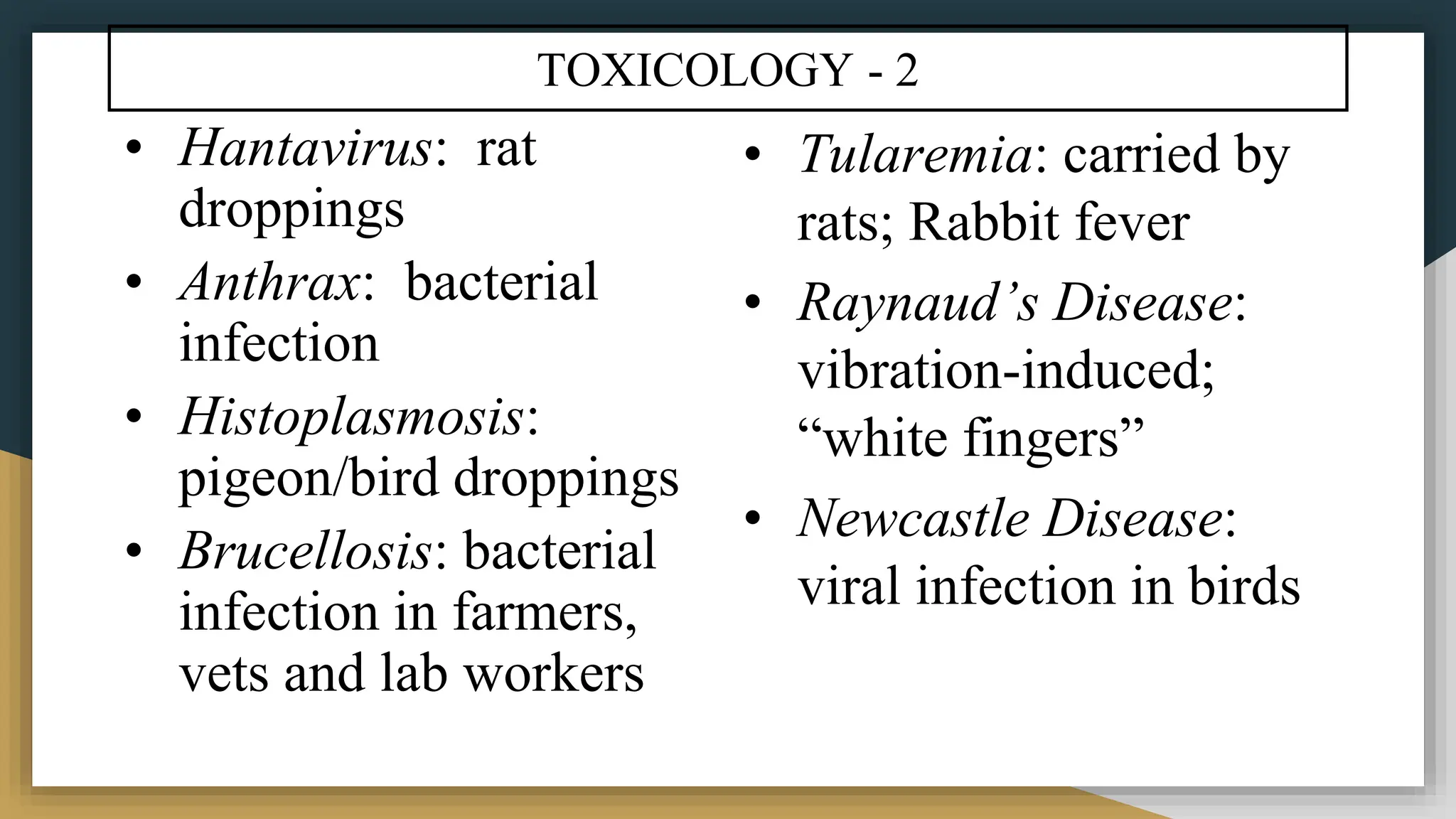
TOXICOLOGY - 2
• Hantavirus: rat
droppings
• Anthrax: bacterial
infection
• Histoplasmosis:
pigeon/bird droppings
• Brucellosis: bacterial
infection in farmers,
vets and lab workers
• Tularemia: carried by
rats; Rabbit fever
• Raynaud’s Disease:
vibration-induced;
“white fingers”
• Newcastle Disease:
viral infection in birds
TOXICOLOGY - 2
• Hantavirus: rat
droppings
• Anthrax: bacterial
infection
• Histoplasmosis:
pigeon/bird droppings
• Brucellosis: bacterial
infection in farmers,
vets and lab workers
• Tularemia: carried by
rats; Rabbit fever
• Raynaud’s Disease:
vibration-induced;
“white fingers”
• Newcastle Disease:
viral infection in birds
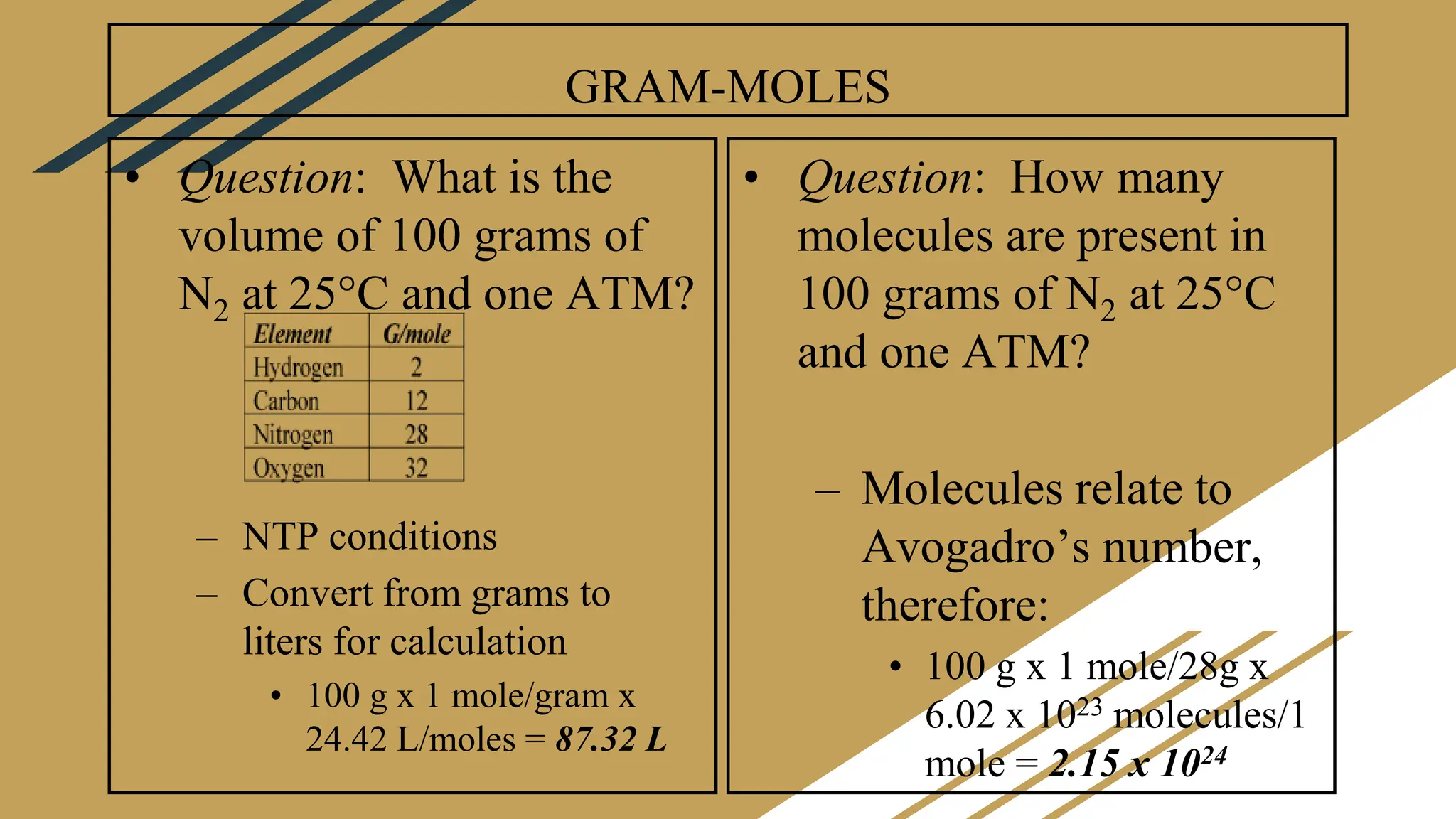
GRAM-MOLES
• Question: What is the
volume of 100 grams of
N2 at 25°C and one ATM?
– NTP conditions
– Convert from grams to
liters for calculation
• 100 g x 1 mole/gram x
24.42 L/moles = 87.32 L
• Question: How many
molecules are present in
100 grams of N2 at 25°C
and one ATM?
– Molecules relate to
Avogadro’s number,
therefore:
• 100 g x 1 mole/28g x
6.02 x 1023 molecules/1
mole = 2.15 x 1024
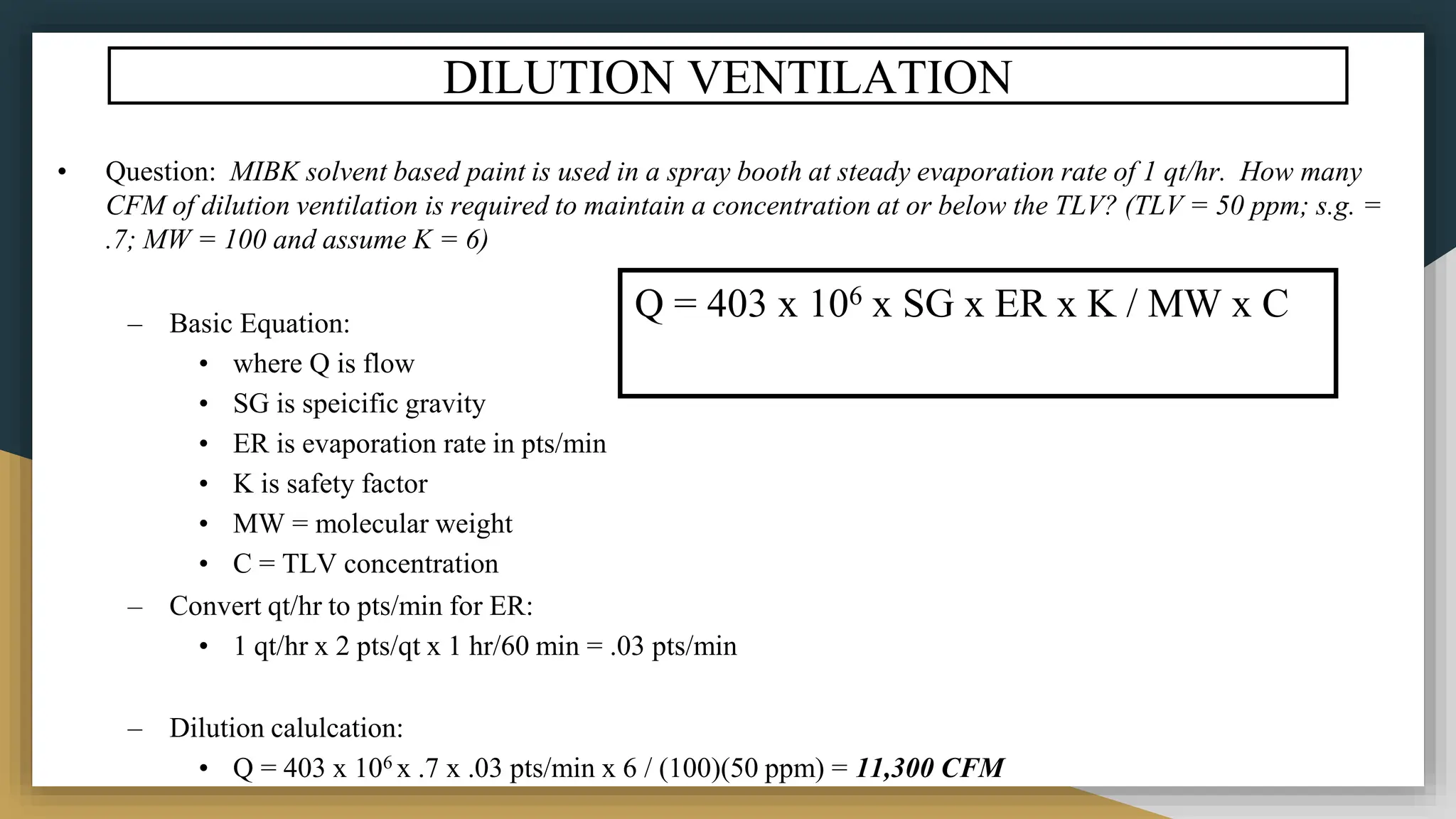
DILUTION VENTILATION
• Question: MIBK solvent based paint is used in a spray booth at steady evaporation rate of 1 qt/hr. How many
CFM of dilution ventilation is required to maintain a concentration at or below the TLV? (TLV = 50 ppm; s.g. =
.7; MW = 100 and assume K = 6)
– Basic Equation:
• where Q is flow
• SG is speicific gravity
• ER is evaporation rate in pts/min
• K is safety factor
• MW = molecular weight
• C = TLV concentration
– Convert qt/hr to pts/min for ER:
• 1 qt/hr x 2 pts/qt x 1 hr/60 min = .03 pts/min
– Dilution calulcation:
• Q = 403 x 106 x .7 x .03 pts/min x 6 / (100)(50 ppm) = 11,300 CFM
Q = 403 x 106 x SG x ER x K / MW x C
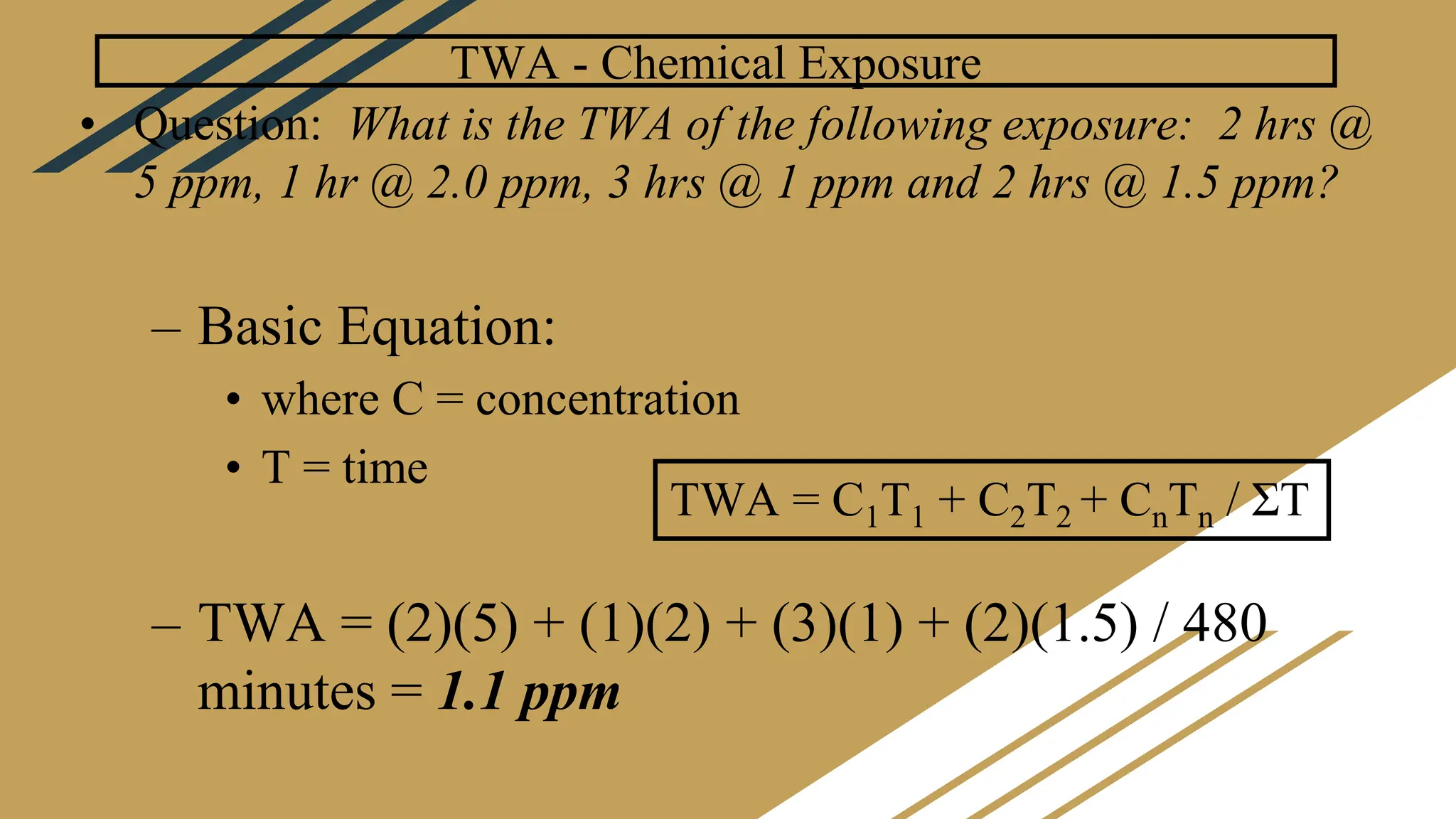
TWA - Chemical Exposure
• Question: What is the TWA of the following exposure: 2 hrs @
5 ppm, 1 hr @ 2.0 ppm, 3 hrs @ 1 ppm and 2 hrs @ 1.5 ppm?
– Basic Equation:
• where C = concentration
• T = time
– TWA = (2)(5) + (1)(2) + (3)(1) + (2)(1.5) / 480
minutes = 1.1 ppm
TWA = C1T1 + C2T2 + CnTn / ΣT
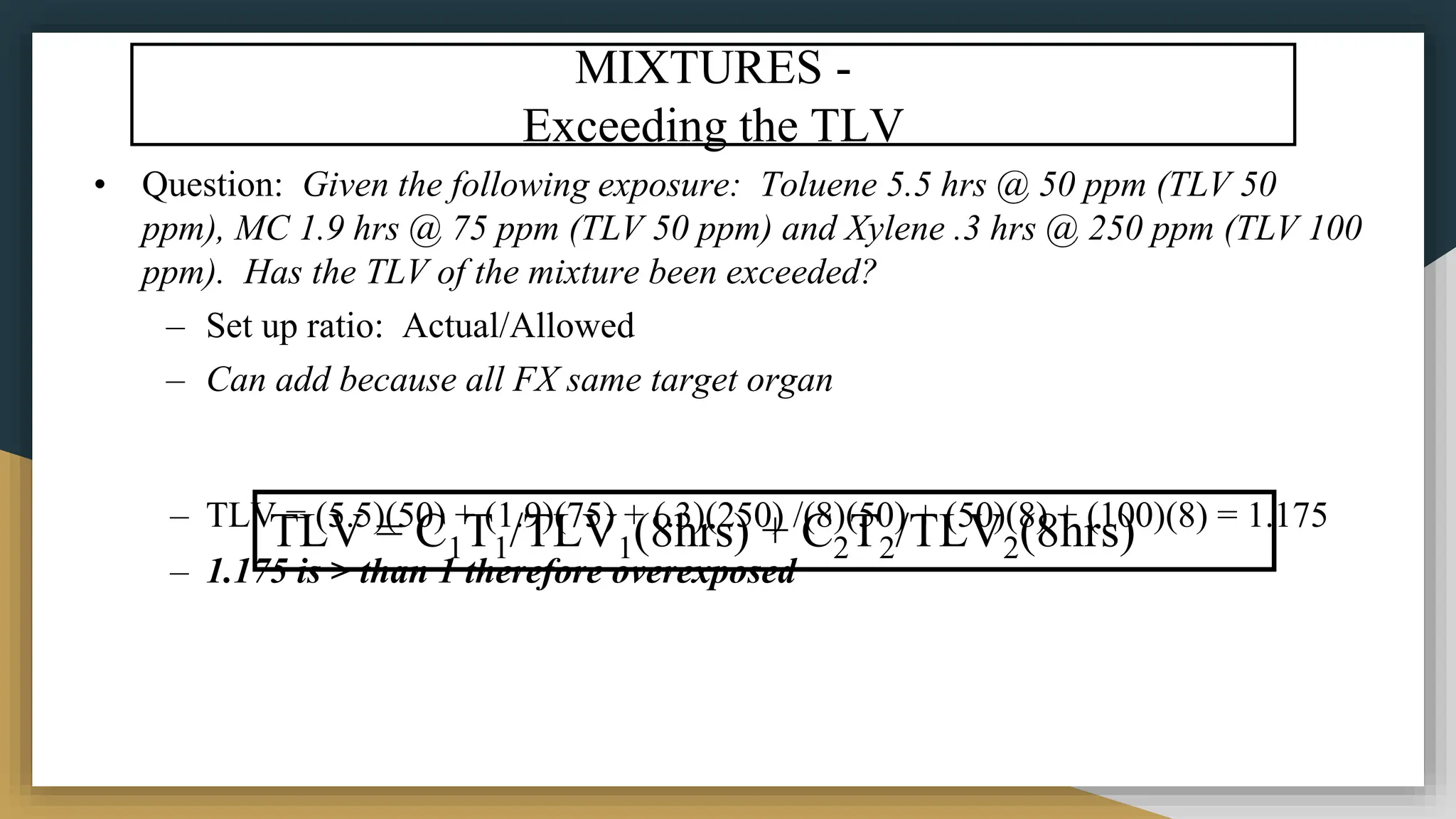
MIXTURES -
Exceeding the TLV
• Question: Given the following exposure: Toluene 5.5 hrs @ 50 ppm (TLV 50
ppm), MC 1.9 hrs @ 75 ppm (TLV 50 ppm) and Xylene .3 hrs @ 250 ppm (TLV 100
ppm). Has the TLV of the mixture been exceeded?
– Set up ratio: Actual/Allowed
– Can add because all FX same target organ
– TLV = (5.5)(50) + (1.9)(75) + (.3)(250) /(8)(50) + (50)(8) + (100)(8) = 1.175
– 1.175 is > than 1 therefore overexposed
TLV = C1T1/TLV1(8hrs) + C2T2/TLV2(8hrs)
CALCULATING [UNK]
• Question: 1-L of benzene breaks and evaporates in a 20x20x10m closed room
at NTP. If the MW is 78 and the sg is .6, what is the concentration?
• Calculate mg:
– 1L of benzene = 600 g (60% of L of H20 is 1)
– 600g x 1000mg/g = 600K mg
• Calculate area: 4000 m3
• Calculate ppm: (600Kmg/4000m3)(24.45)/78 = 47 ppm
ppm = mg/m3 x 24.45/ MW
REDUCING CONCENTRATIONS
• Question: A furniture drying area contains 100 ppm of a solvent. If the volume of
the room is 100Kft3, the ventilation rate 2,000 cfm, how long to reduce the [solvent]
to 25 ppm?
– Where C1 is initial [ ]
– C2 is final [ ]
– Q’ is ventilation rate in cfm
– V is volume of room in ft3
– t1 is start time
– t2 is end time
• Looking for t2:
• t2 = ln(C2/C1)(V/Q’)
• t2= ln (.25)(100Kft3)/(-2000ft3/min) = 69.31 min
ln(C2/C1) = -Q’/V(t2-t1)
SAMPLING SAEs
• Question: A sample reveals xylene exposure for an 8-hr period was 105 ppm. The
PEL for xylene is 100 ppm. The SAE is 0.10. What can you conclude from these
results?
– Where Y = standardized [ ]
– X = given concentration
– CL = confidence limits
• Y = X/PEL = 105/100 = 1.05
• UCL = Y + SAE = 1.05 + 0.1 = 1.15
• LCL = Y - SAE = 1.05 - 0.1 = .95
• Therefore a possible overexposure exists because UCL> 1 and LCL < 1.
Y = X/PEL
UCL = Y + SAE
LCL = Y - SAE
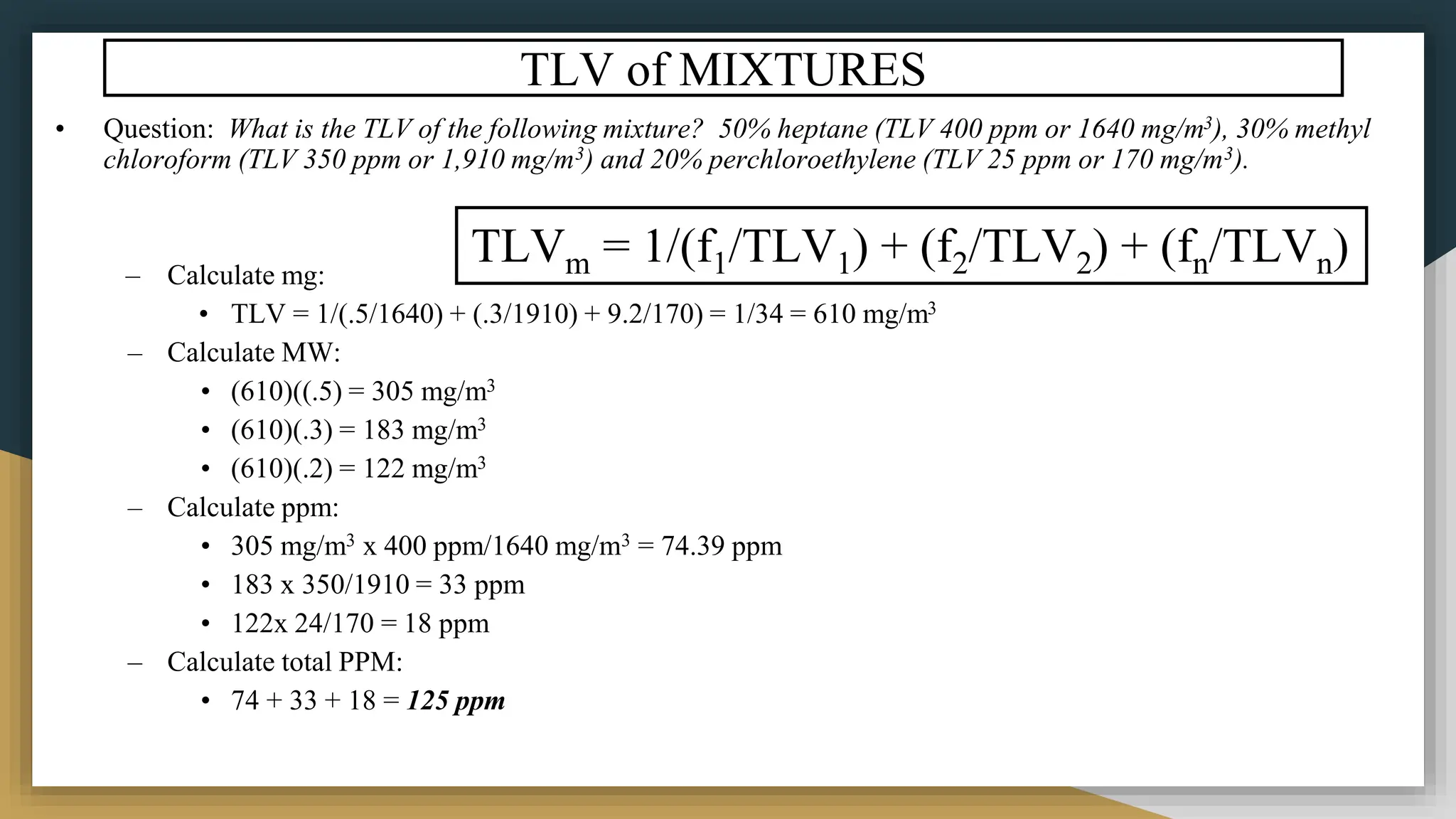
TLV of MIXTURES
• Question: What is the TLV of the following mixture? 50% heptane (TLV 400 ppm or 1640 mg/m3), 30% methyl
chloroform (TLV 350 ppm or 1,910 mg/m3) and 20% perchloroethylene (TLV 25 ppm or 170 mg/m3).
– Calculate mg:
• TLV = 1/(.5/1640) + (.3/1910) + 9.2/170) = 1/34 = 610 mg/m3
– Calculate MW:
• (610)((.5) = 305 mg/m3
• (610)(.3) = 183 mg/m3
• (610)(.2) = 122 mg/m3
– Calculate ppm:
• 305 mg/m3 x 400 ppm/1640 mg/m3 = 74.39 ppm
• 183 x 350/1910 = 33 ppm
• 122x 24/170 = 18 ppm
– Calculate total PPM:
• 74 + 33 + 18 = 125 ppm
TLVm = 1/(f1/TLV1) + (f2/TLV2) + (fn/TLVn)
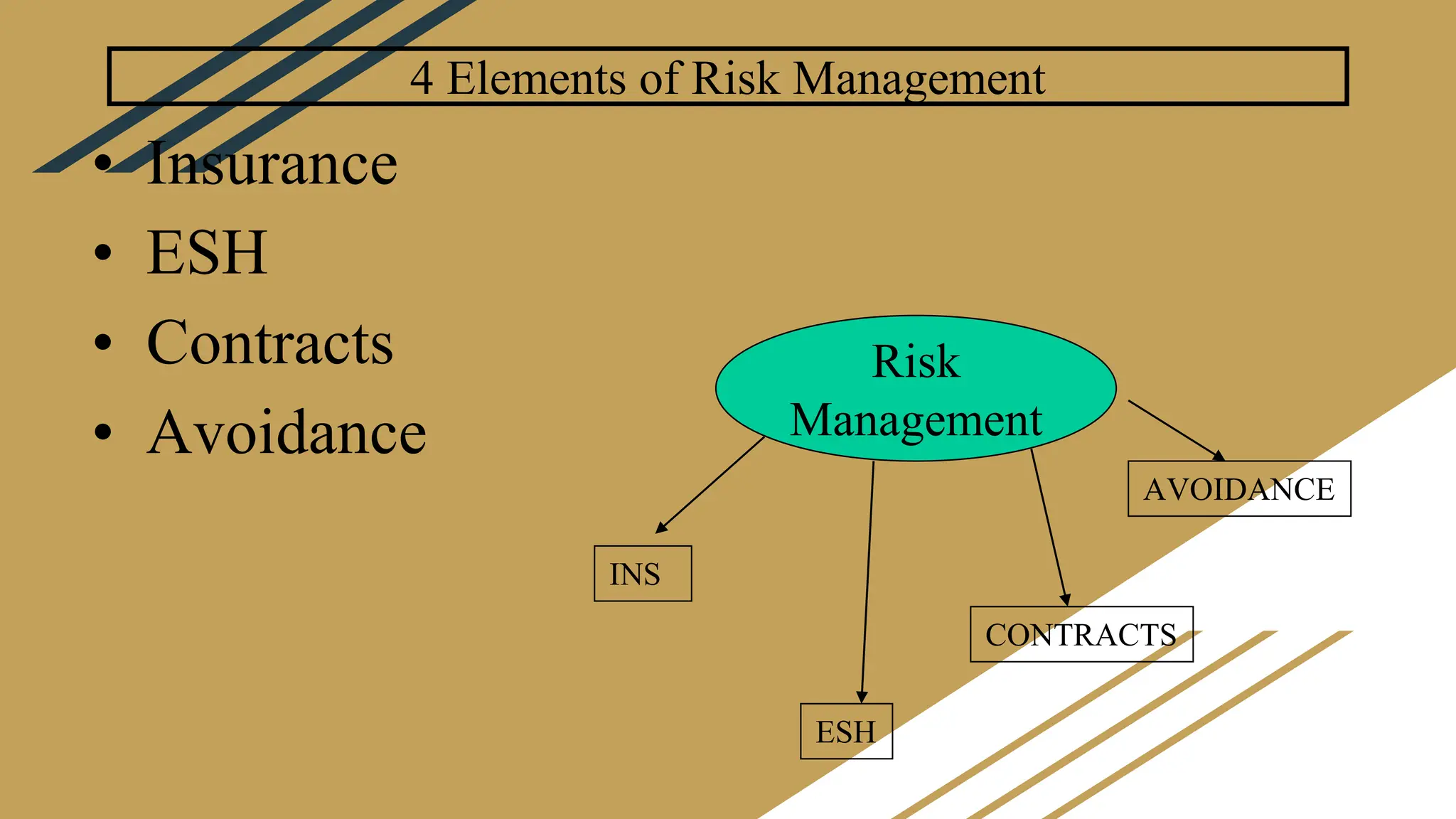
4 Elements of Risk Management
• Insurance
• ESH
• Contracts
• Avoidance
Risk
Management
INS
ESH
CONTRACTS
AVOIDANCE
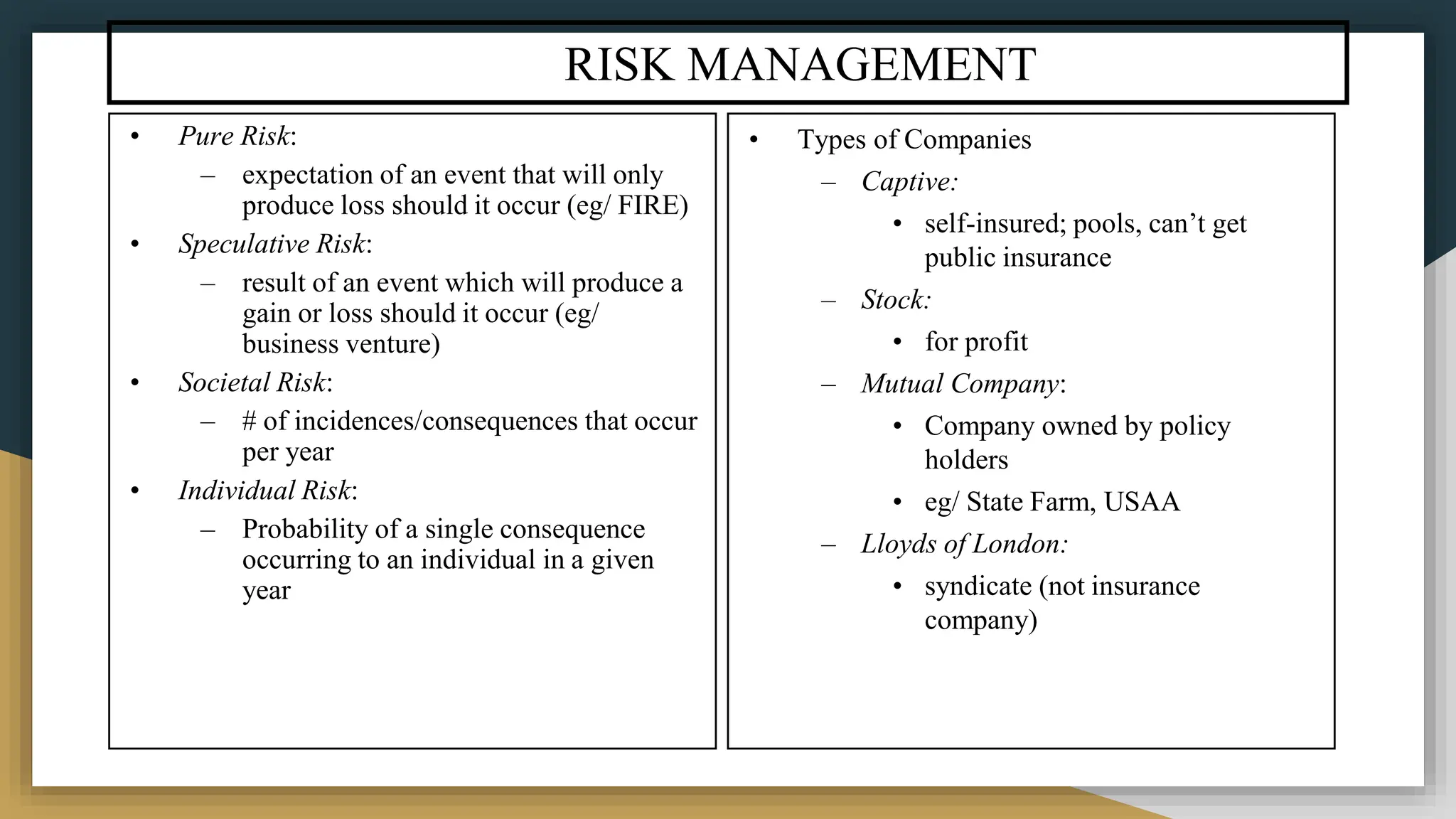
RISK MANAGEMENT
• Pure Risk:
– expectation of an event that will only
produce loss should it occur (eg/ FIRE)
• Speculative Risk:
– result of an event which will produce a
gain or loss should it occur (eg/
business venture)
• Societal Risk:
– # of incidences/consequences that occur
per year
• Individual Risk:
– Probability of a single consequence
occurring to an individual in a given
year
• Types of Companies
– Captive:
• self-insured; pools, can’t get
public insurance
– Stock:
• for profit
– Mutual Company:
• Company owned by policy
holders
• eg/ State Farm, USAA
– Lloyds of London:
• syndicate (not insurance
company)
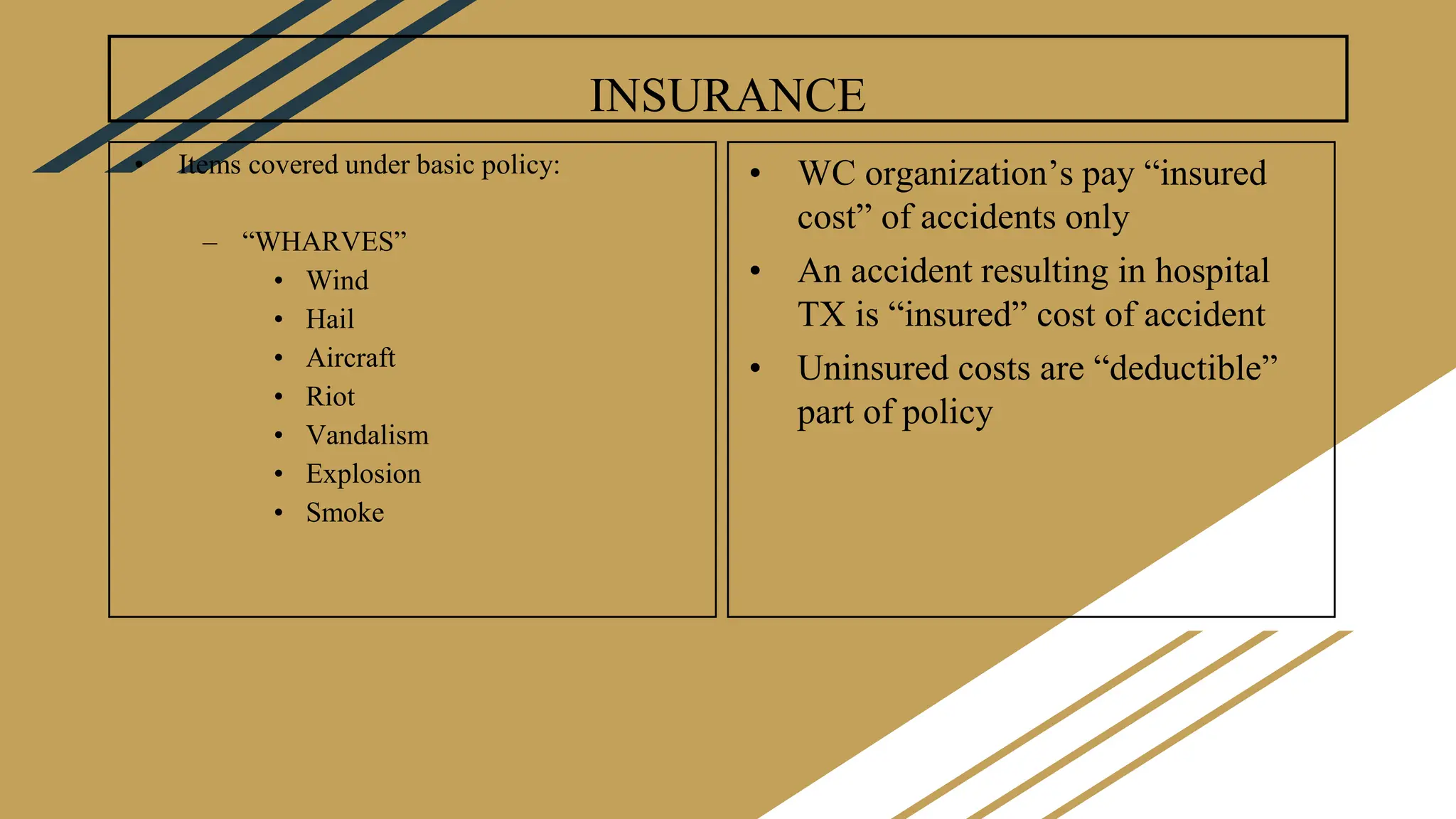
INSURANCE
• Items covered under basic policy:
– “WHARVES”
• Wind
• Hail
• Aircraft
• Riot
• Vandalism
• Explosion
• Smoke
• WC organization’s pay “insured
cost” of accidents only
• An accident resulting in hospital
TX is “insured” cost of accident
• Uninsured costs are “deductible”
part of policy
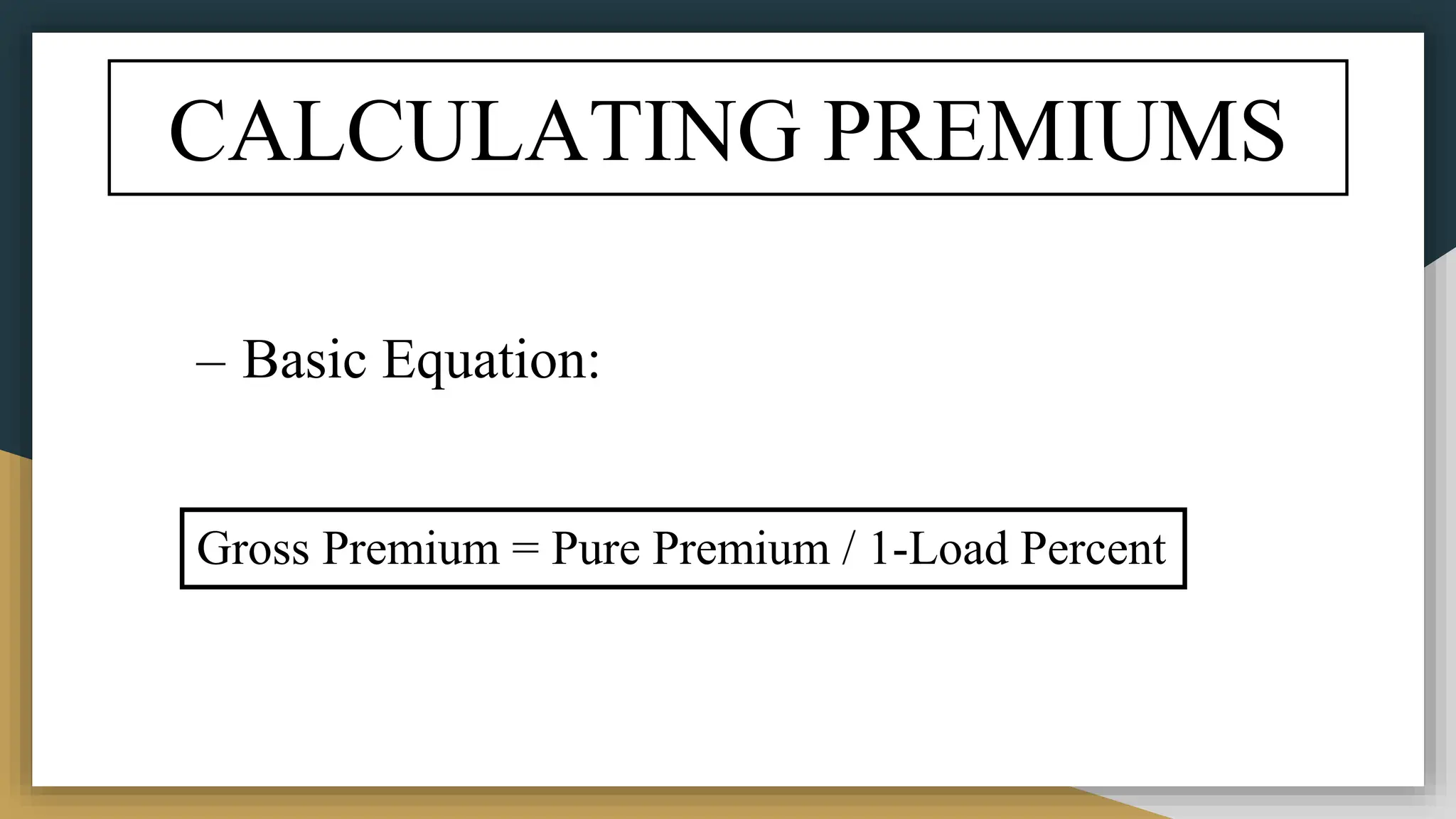
CALCULATING PREMIUMS
– Basic Equation:
Gross Premium = Pure Premium / 1-Load Percent
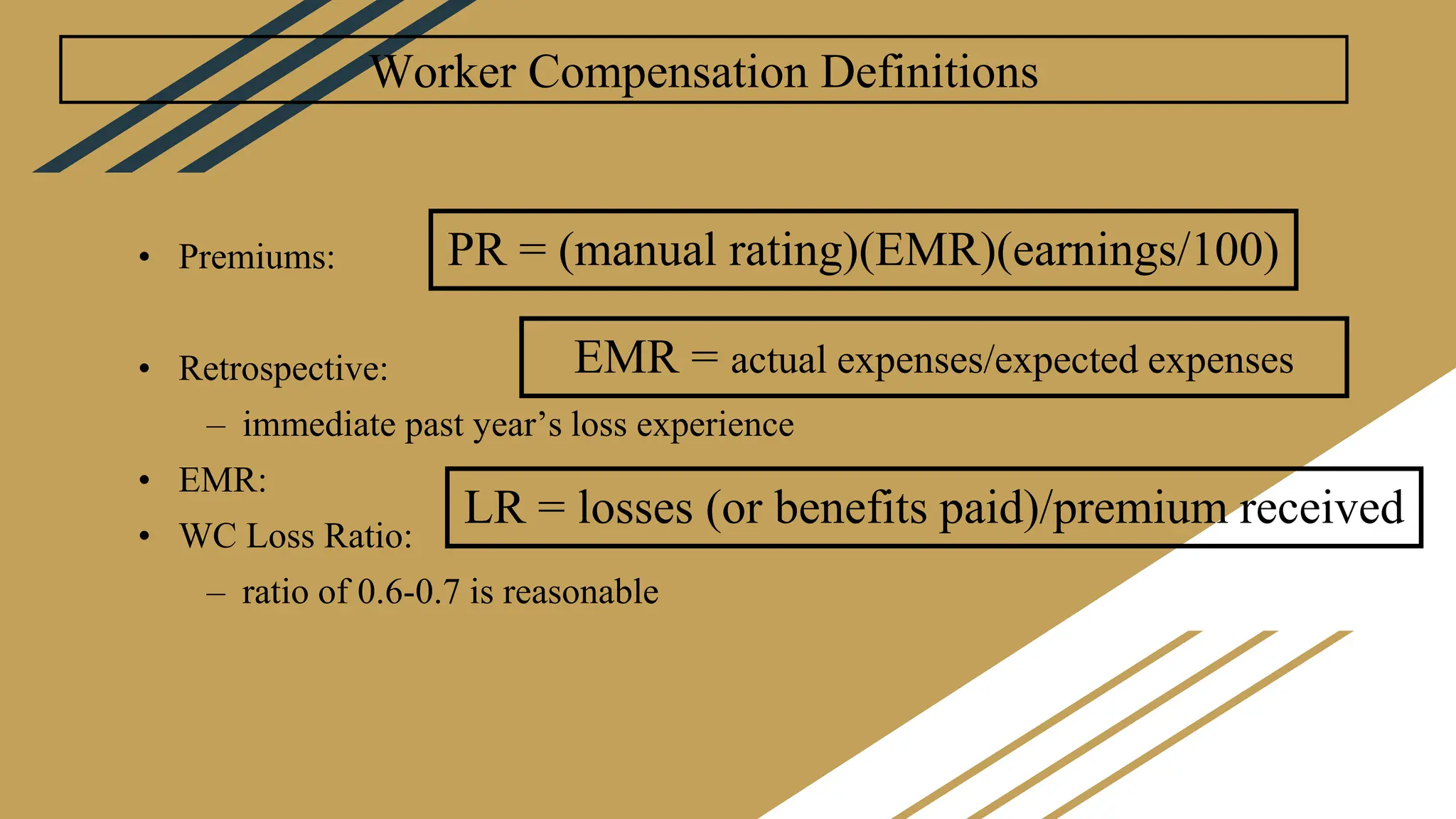
Worker Compensation Definitions
• Premiums:
• Retrospective:
– immediate past year’s loss experience
• EMR:
• WC Loss Ratio:
– ratio of 0.6-0.7 is reasonable
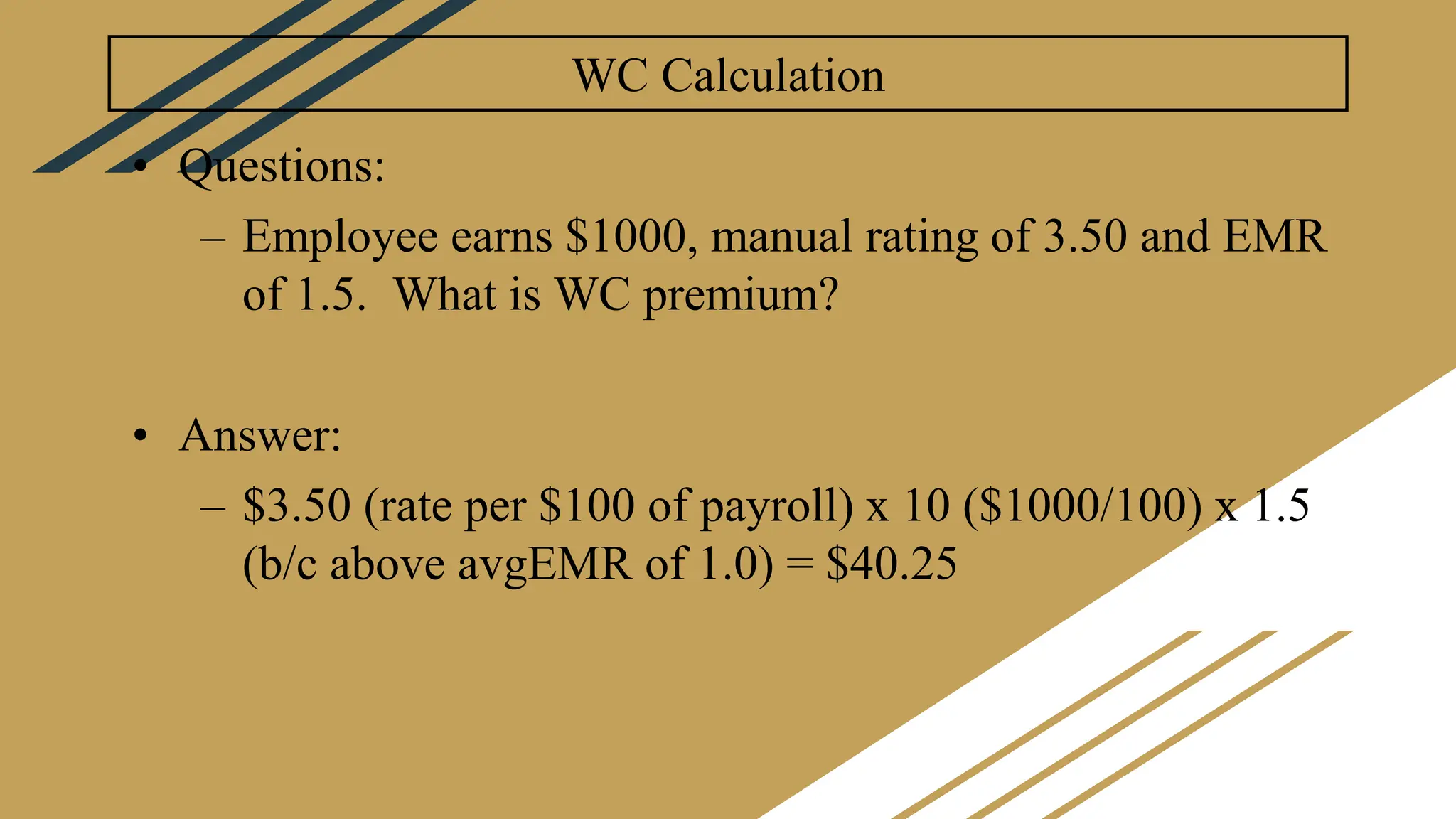
PR = (manual rating)(EMR)(earnings/100)
EMR = actual expenses/expected expenses
LR = losses (or benefits paid)/premium received
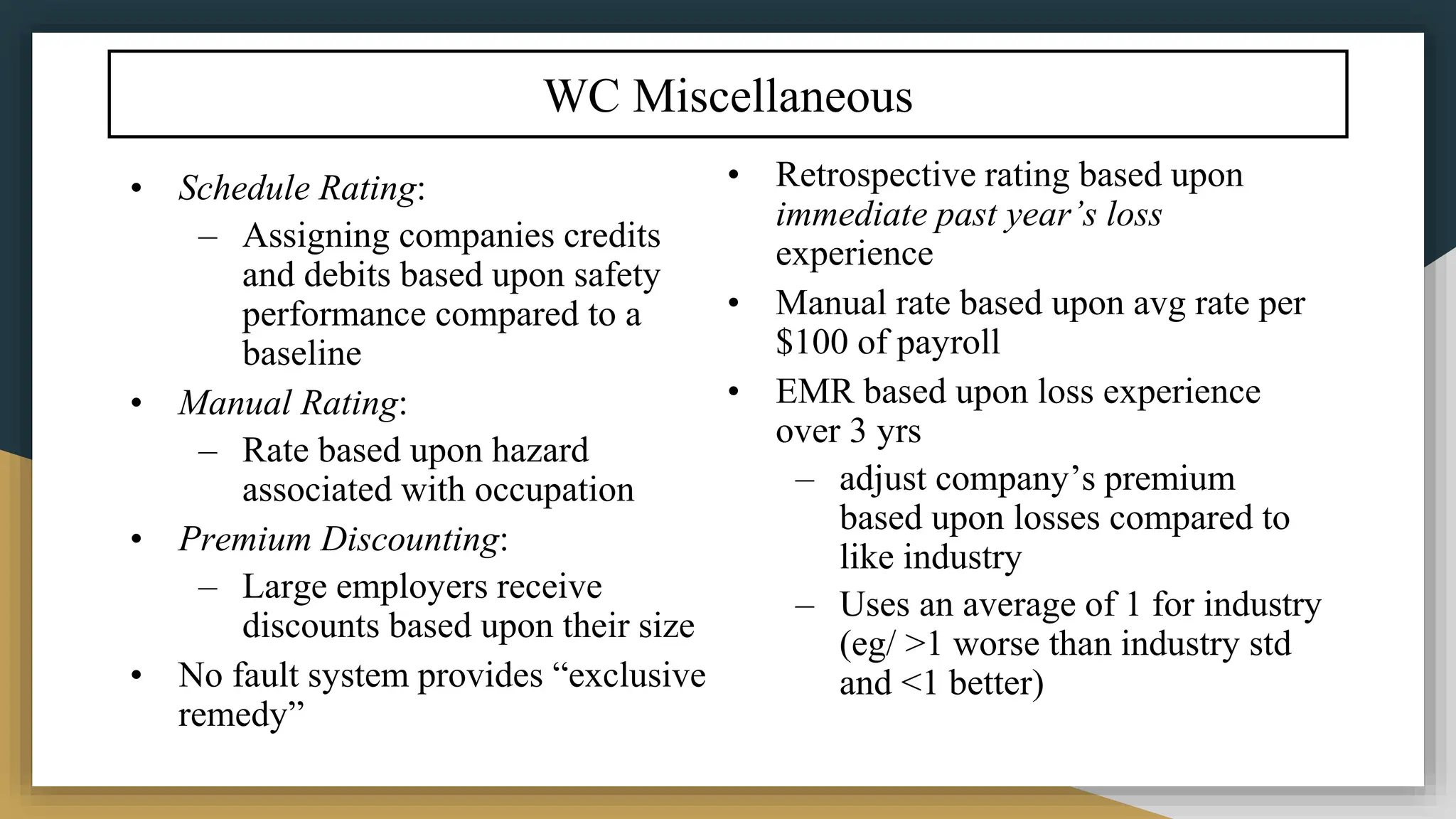
WC Miscellaneous
• Schedule Rating:
– Assigning companies credits
and debits based upon safety
performance compared to a
baseline
• Manual Rating:
– Rate based upon hazard
associated with occupation
• Premium Discounting:
– Large employers receive
discounts based upon their size
• No fault system provides “exclusive
remedy”
• Retrospective rating based upon
immediate past year’s loss
experience
• Manual rate based upon avg rate per
$100 of payroll
• EMR based upon loss experience
over 3 yrs
– adjust company’s premium
based upon losses compared to
like industry
– Uses an average of 1 for industry
(eg/ >1 worse than industry std
and <1 better)
WC Calculation
• Questions:
– Employee earns $1000, manual rating of 3.50 and EMR
of 1.5. What is WC premium?
• Answer:
– $3.50 (rate per $100 of payroll) x 10 ($1000/100) x 1.5
(b/c above avgEMR of 1.0) = $40.25
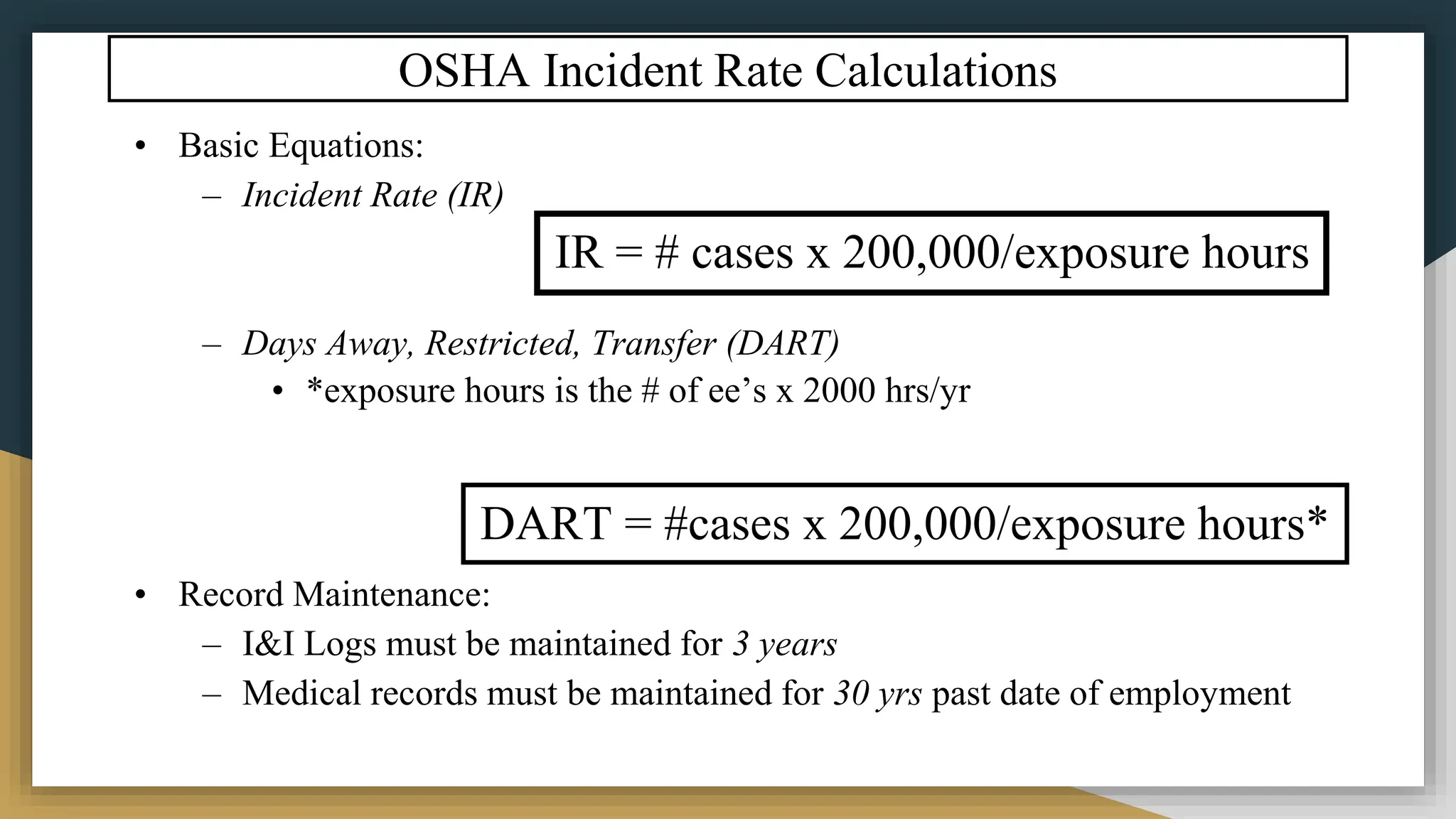
OSHA Incident Rate Calculations
• Basic Equations:
– Incident Rate (IR)
– Days Away, Restricted, Transfer (DART)
• *exposure hours is the # of ee’s x 2000 hrs/yr
• Record Maintenance:
– I&I Logs must be maintained for 3 years
– Medical records must be maintained for 30 yrs past date of employment
IR = # cases x 200,000/exposure hours
DART = #cases x 200,000/exposure hours*
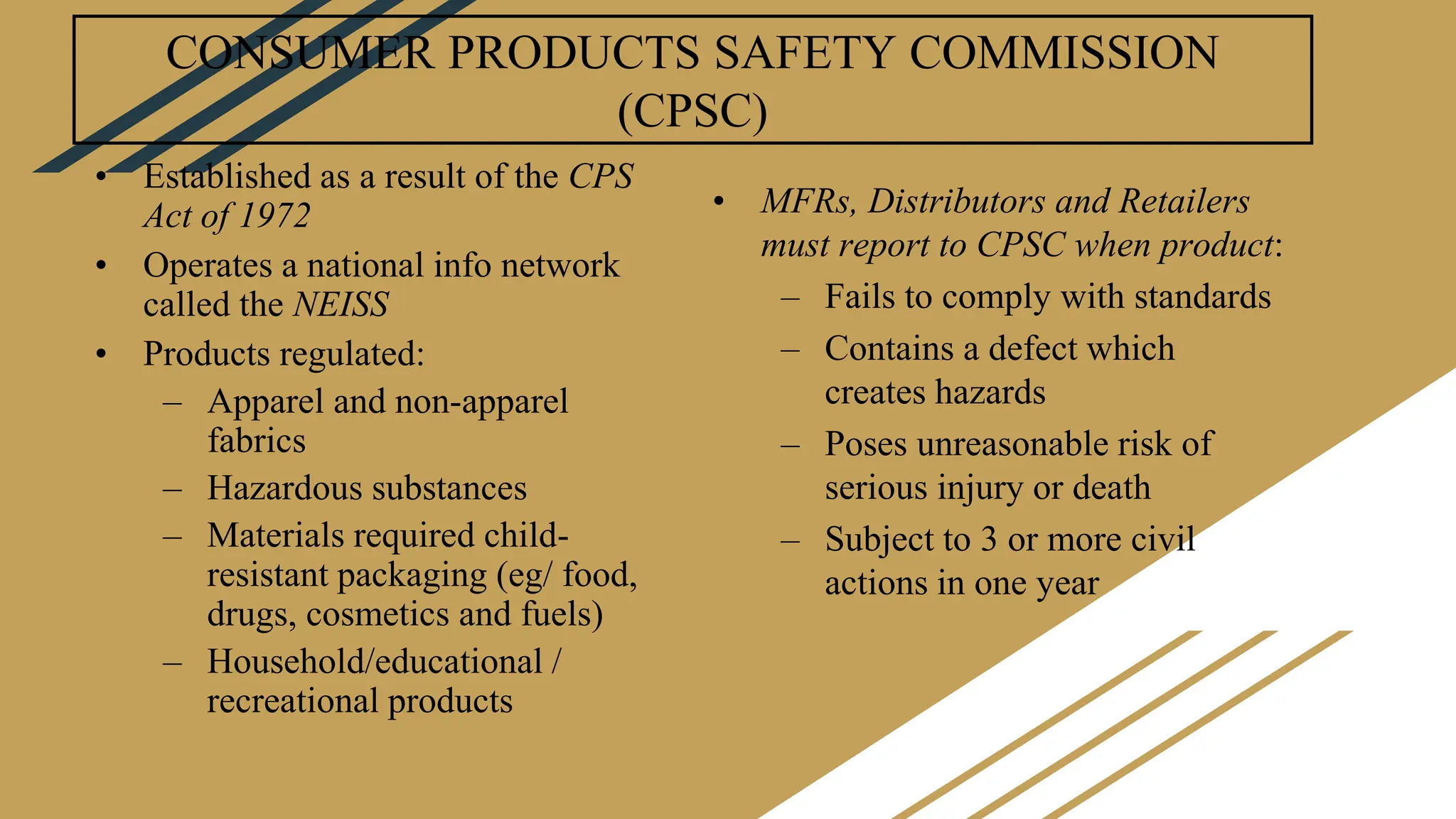
CONSUMER PRODUCTS SAFETY COMMISSION
(CPSC)
• Established as a result of the CPS
Act of 1972
• Operates a national info network
called the NEISS
• Products regulated:
– Apparel and non-apparel
fabrics
– Hazardous substances
– Materials required child-
resistant packaging (eg/ food,
drugs, cosmetics and fuels)
– Household/educational /
recreational products
• MFRs, Distributors and Retailers
must report to CPSC when product:
– Fails to comply with standards
– Contains a defect which
creates hazards
– Poses unreasonable risk of
serious injury or death
– Subject to 3 or more civil
actions in one year
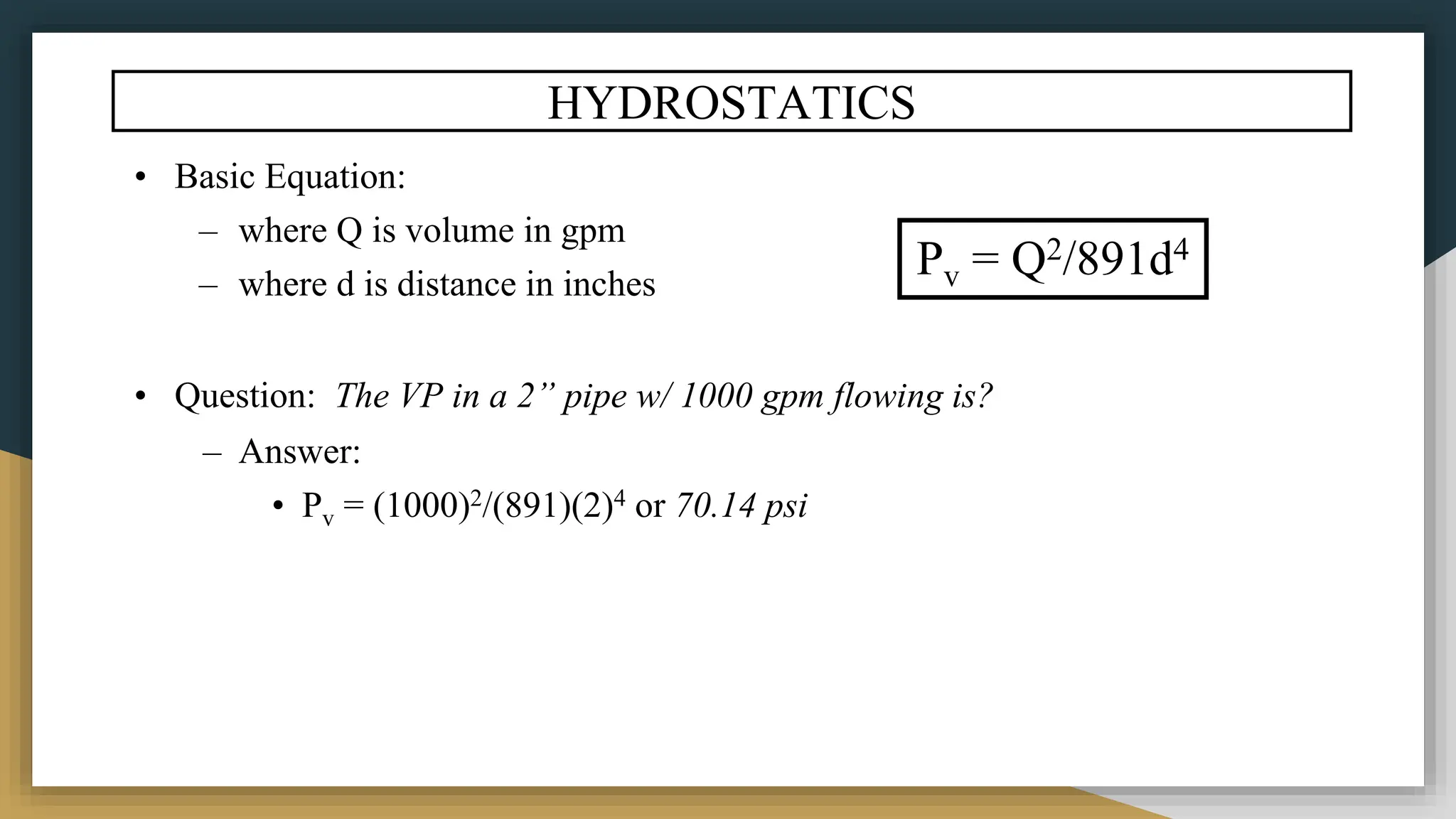
HYDROSTATICS
• Basic Equation:
– where Q is volume in gpm
– where d is distance in inches
• Question: The VP in a 2” pipe w/ 1000 gpm flowing is?
– Answer:
• Pv = (1000)2/(891)(2)4 or 70.14 psi
Pv = Q2/891d4
HYDROSTATICS
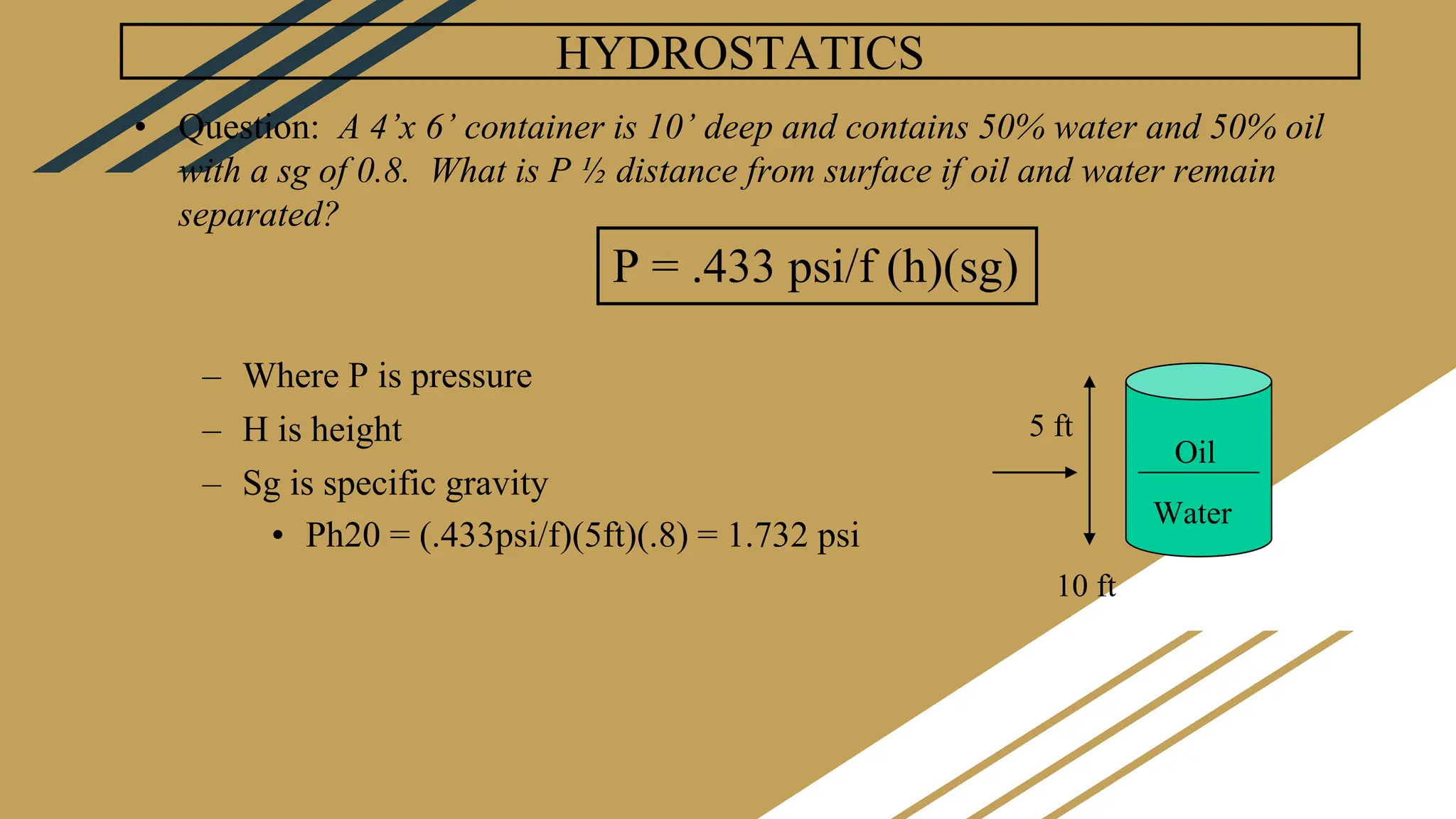
• Question: A 4’x 6’ container is 10’ deep and contains 50% water and 50% oil
with a sg of 0.8. What is P ½ distance from surface if oil and water remain
separated?
– Where P is pressure
– H is height
– Sg is specific gravity
• Ph20 = (.433psi/f)(5ft)(.8) = 1.732 psi
P = .433 psi/f (h)(sg)
Oil
Water
10 ft
5 ft
ELECTRICITY
Ohms Law
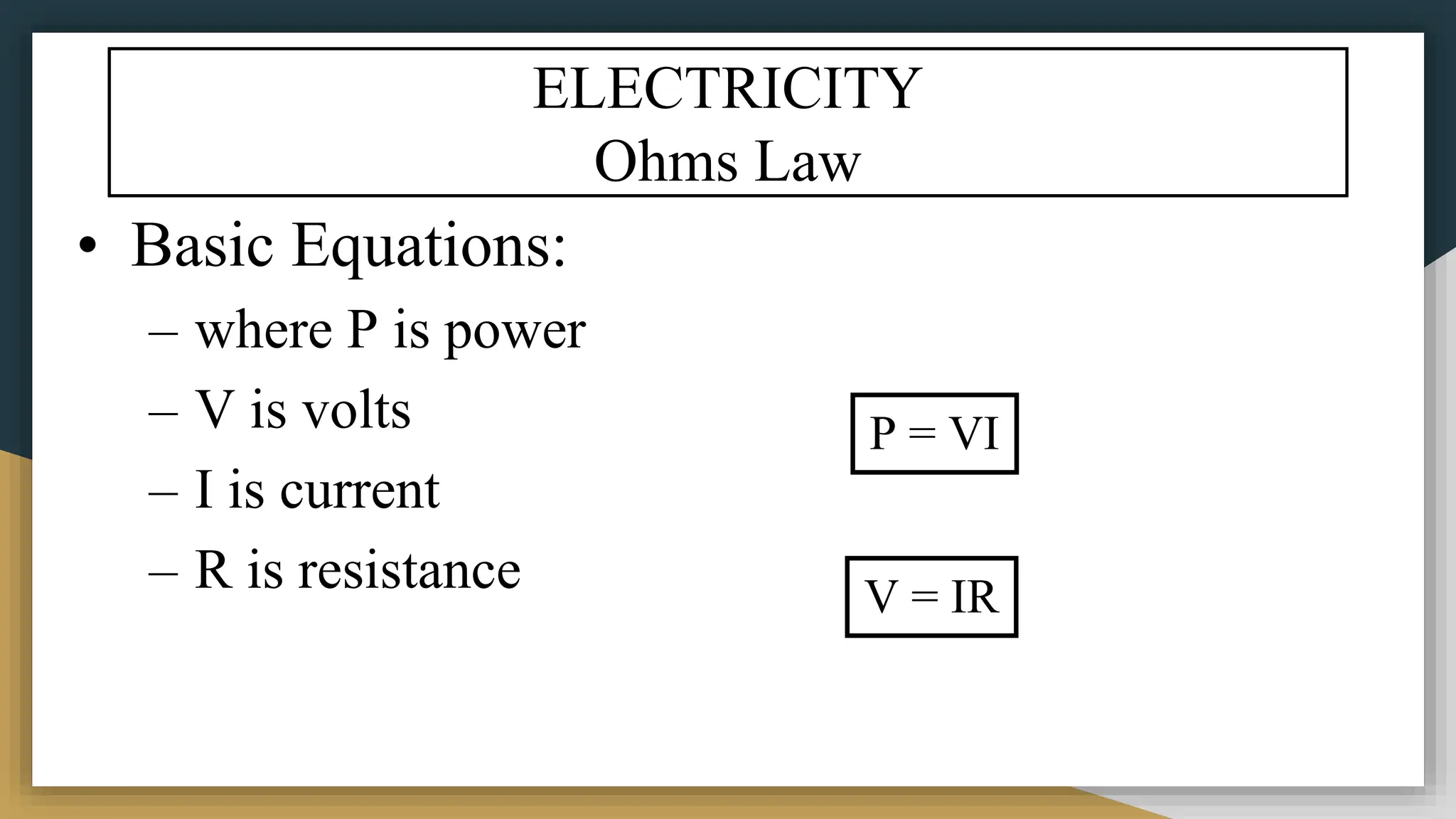
• Basic Equations:
– where P is power
– V is volts
– I is current
– R is resistance
P = VI
V = IR
ELECTRICITY
(Resistance - 1)
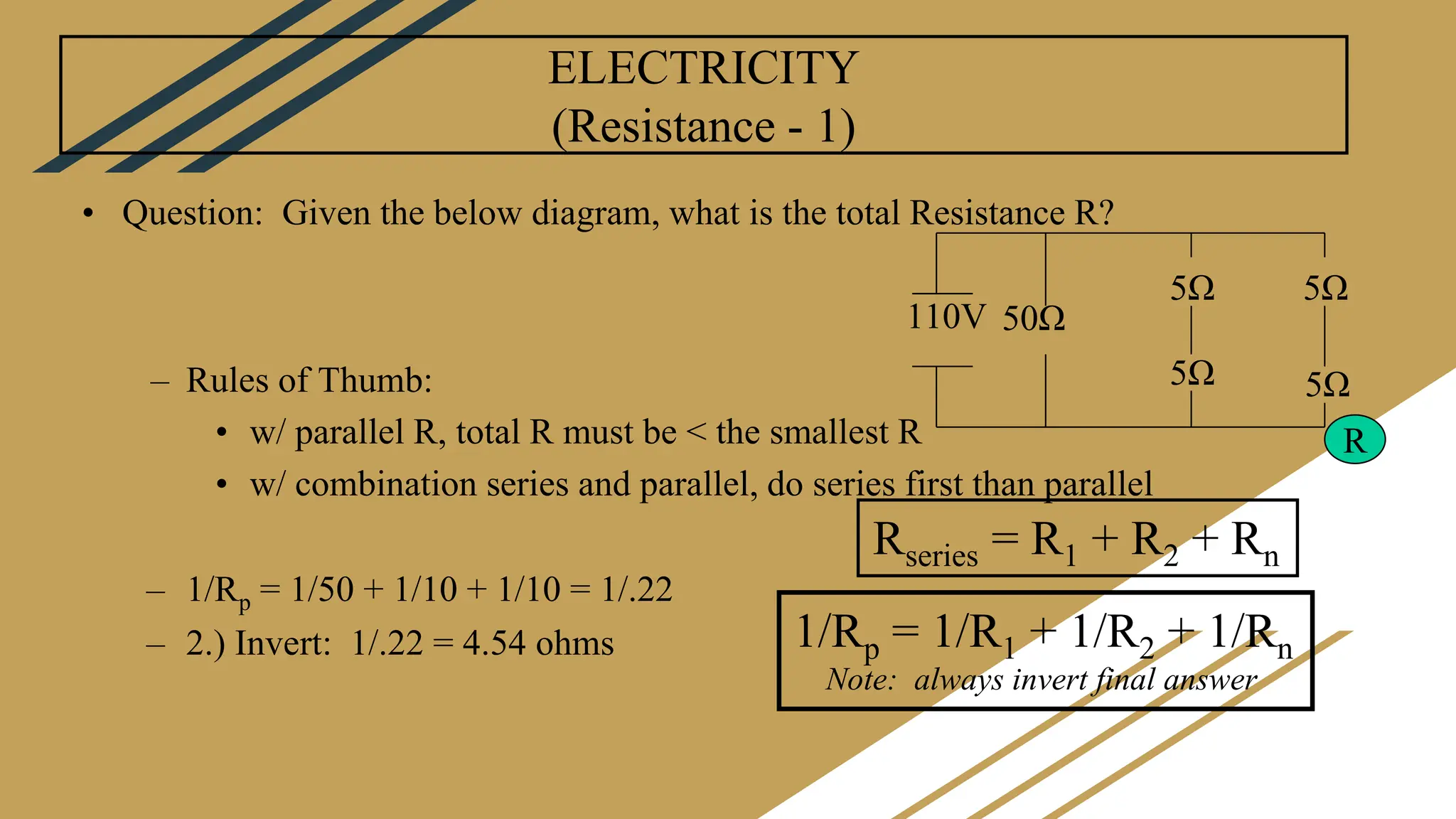
• Question: Given the below diagram, what is the total Resistance R?
– Rules of Thumb:
• w/ parallel R, total R must be < the smallest R
• w/ combination series and parallel, do series first than parallel
– 1/Rp = 1/50 + 1/10 + 1/10 = 1/.22
– 2.) Invert: 1/.22 = 4.54 ohms 1/Rp = 1/R1 + 1/R2 + 1/Rn
Note: always invert final answer
Rseries = R1 + R2 + Rn
110V 50Ω
5Ω
5Ω
5Ω
5Ω
R
ELECTRICITY
(Resistance - 2)
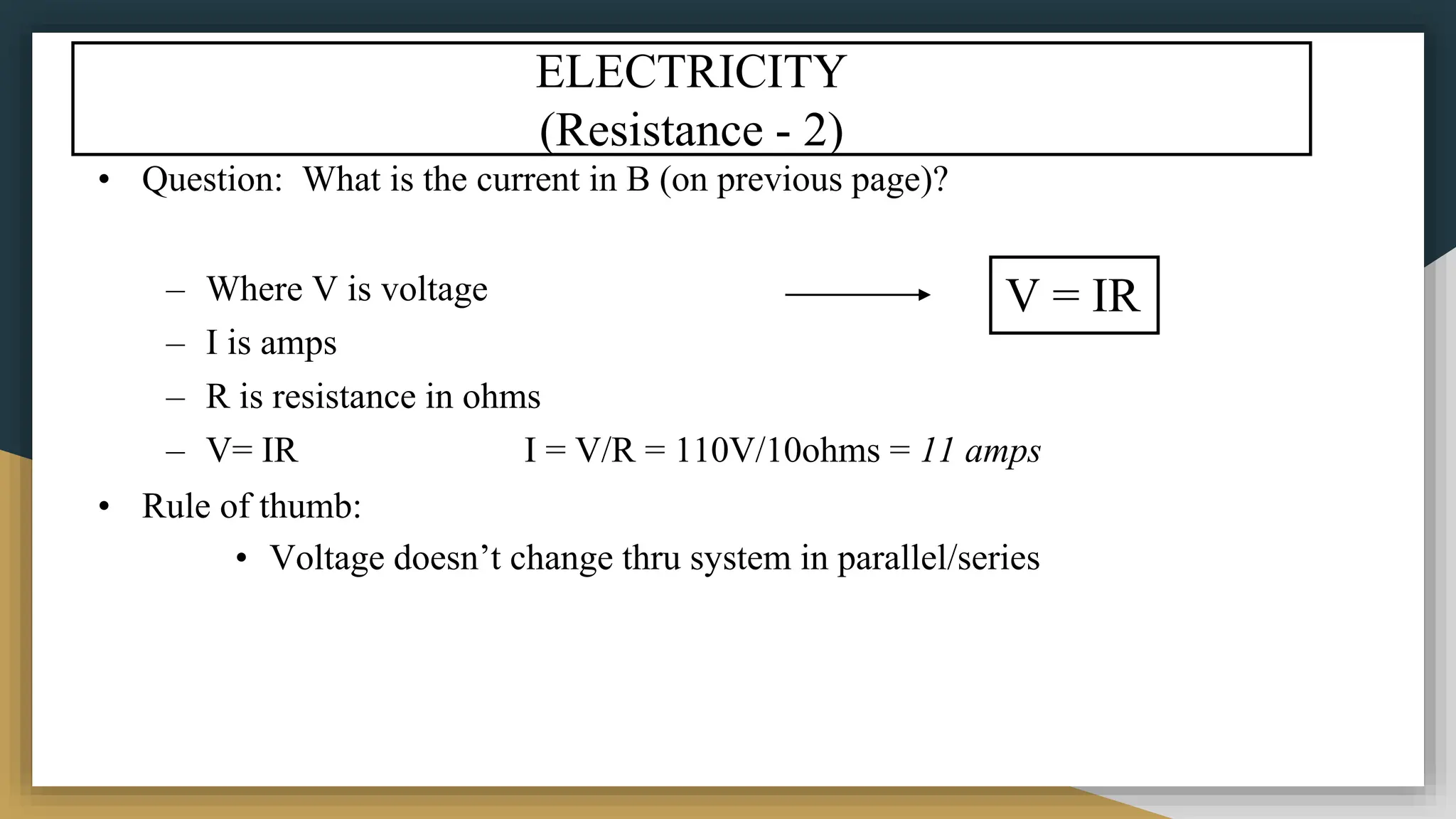
• Question: What is the current in B (on previous page)?
– Where V is voltage
– I is amps
– R is resistance in ohms
– V= IR I = V/R = 110V/10ohms = 11 amps
• Rule of thumb:
• Voltage doesn’t change thru system in parallel/series
V = IR
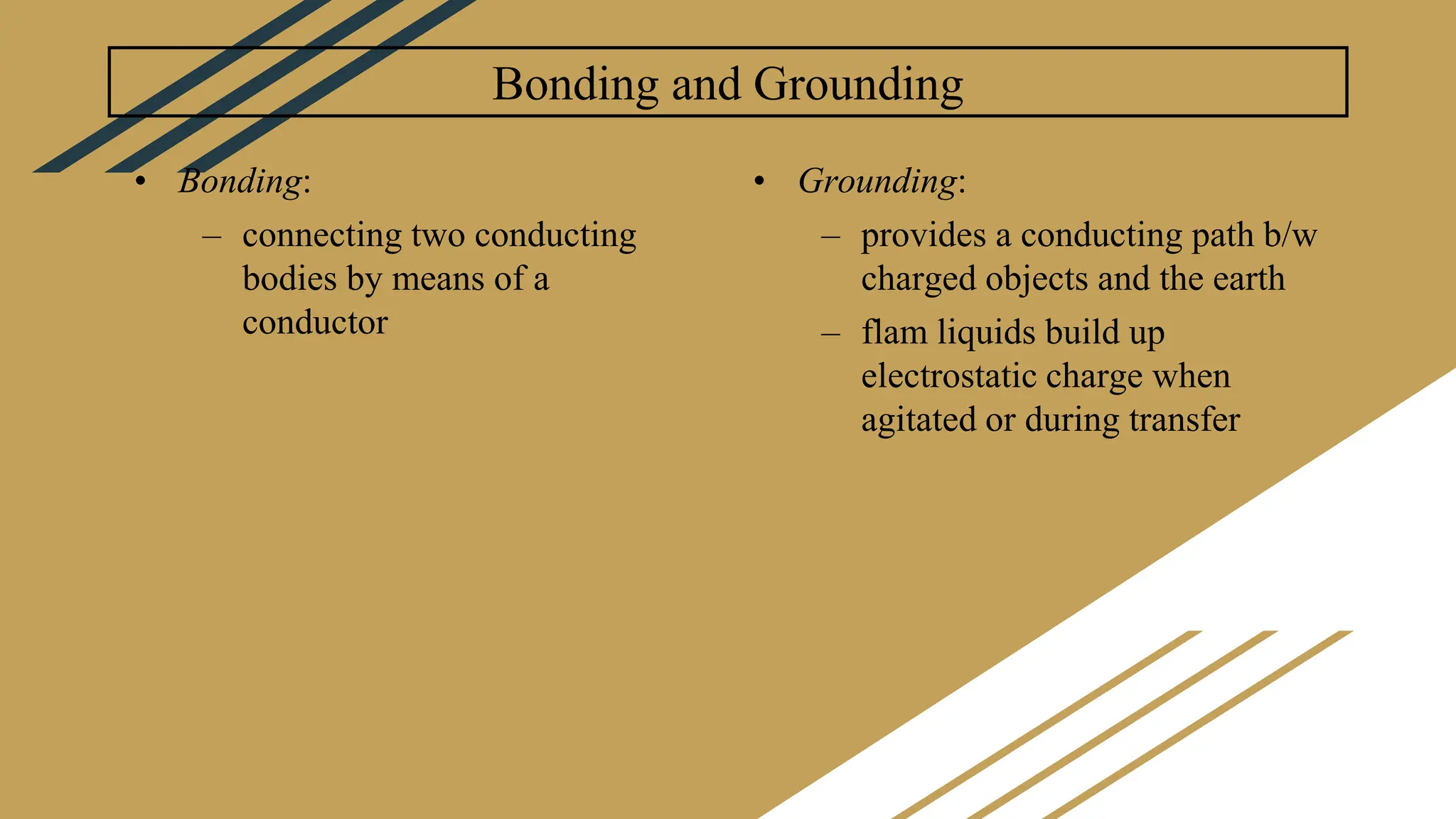
Bonding and Grounding
• Bonding:
– connecting two conducting
bodies by means of a
conductor
• Grounding:
– provides a conducting path b/w
charged objects and the earth
– flam liquids build up
electrostatic charge when
agitated or during transfer
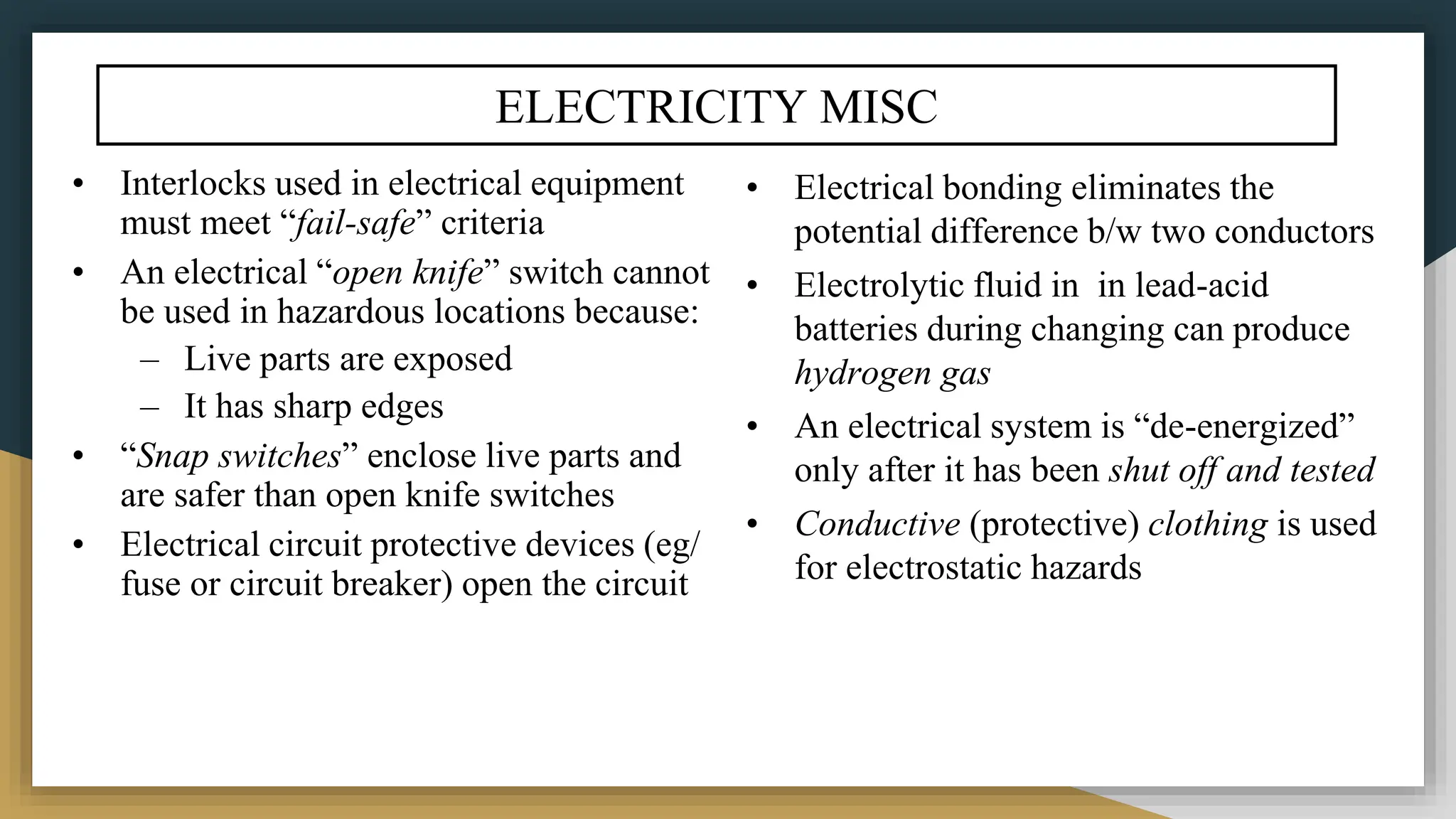
ELECTRICITY MISC
• Interlocks used in electrical equipment
must meet “fail-safe” criteria
• An electrical “open knife” switch cannot
be used in hazardous locations because:
– Live parts are exposed
– It has sharp edges
• “Snap switches” enclose live parts and
are safer than open knife switches
• Electrical circuit protective devices (eg/
fuse or circuit breaker) open the circuit
• Electrical bonding eliminates the
potential difference b/w two conductors
• Electrolytic fluid in in lead-acid
batteries during changing can produce
hydrogen gas
• An electrical system is “de-energized”
only after it has been shut off and tested
• Conductive (protective) clothing is used
for electrostatic hazards
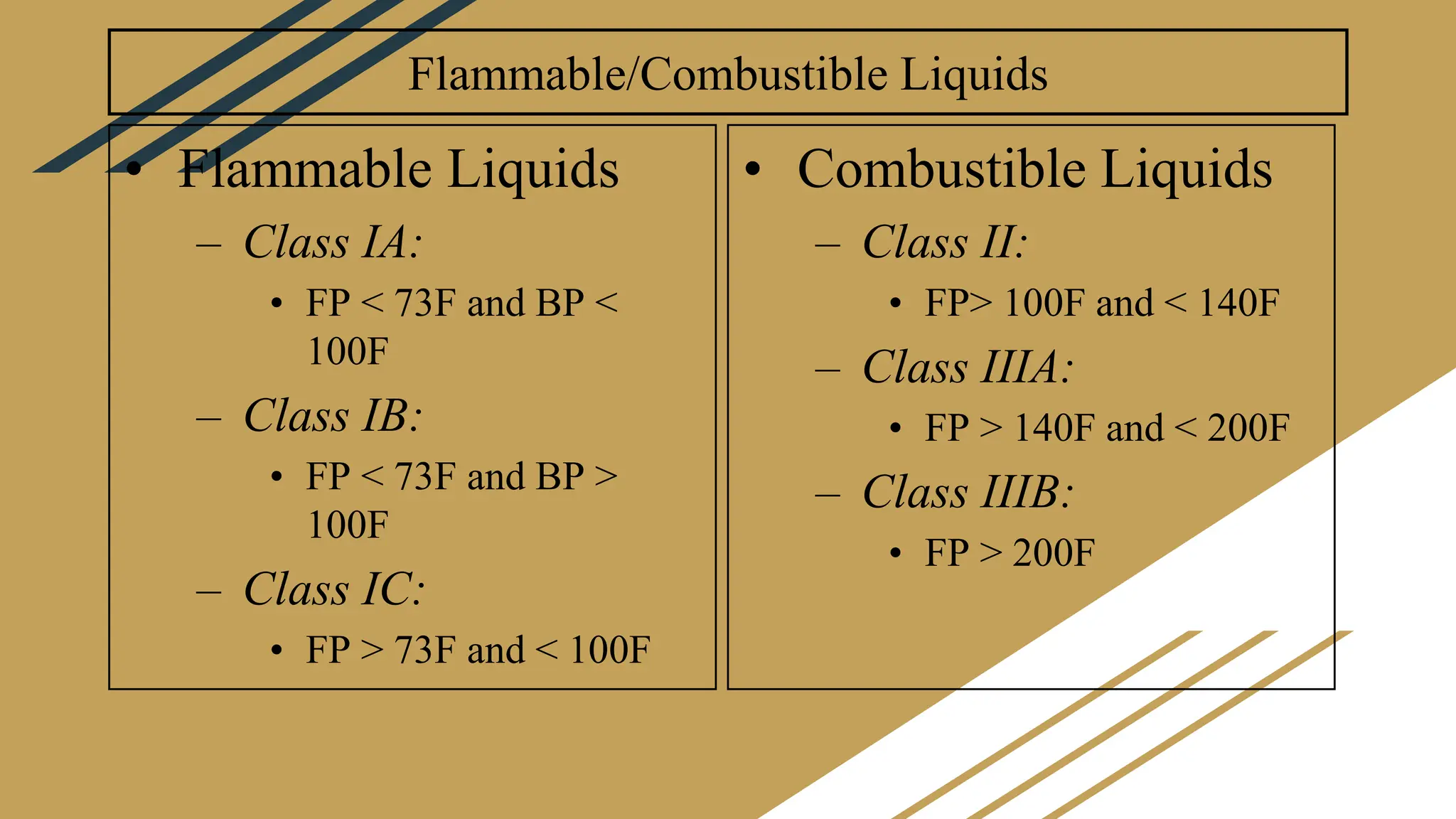
Flammable/Combustible Liquids
• Flammable Liquids
– Class IA:
• FP < 73F and BP <
100F
– Class IB:
• FP < 73F and BP >
100F
– Class IC:
• FP > 73F and < 100F
• Combustible Liquids
– Class II:
• FP> 100F and < 140F
– Class IIIA:
• FP > 140F and < 200F
– Class IIIB:
• FP > 200F
Electrical Classifications (NEC 500)
• Class I:
– Div. 1:ignitable [flam. Gases and vapors] normally exist, (eg/open systems)
– Div. 2: volatile liquids or gases confined
• Class II:
– Div. 1: comb. dust under normal conditions
– Div. 2: sufficient qty of dust not normally present
• Class III:
– Div. 1: ignitable fibers are handled and/or processed
– Div. 2: ignitable fibers are handled only
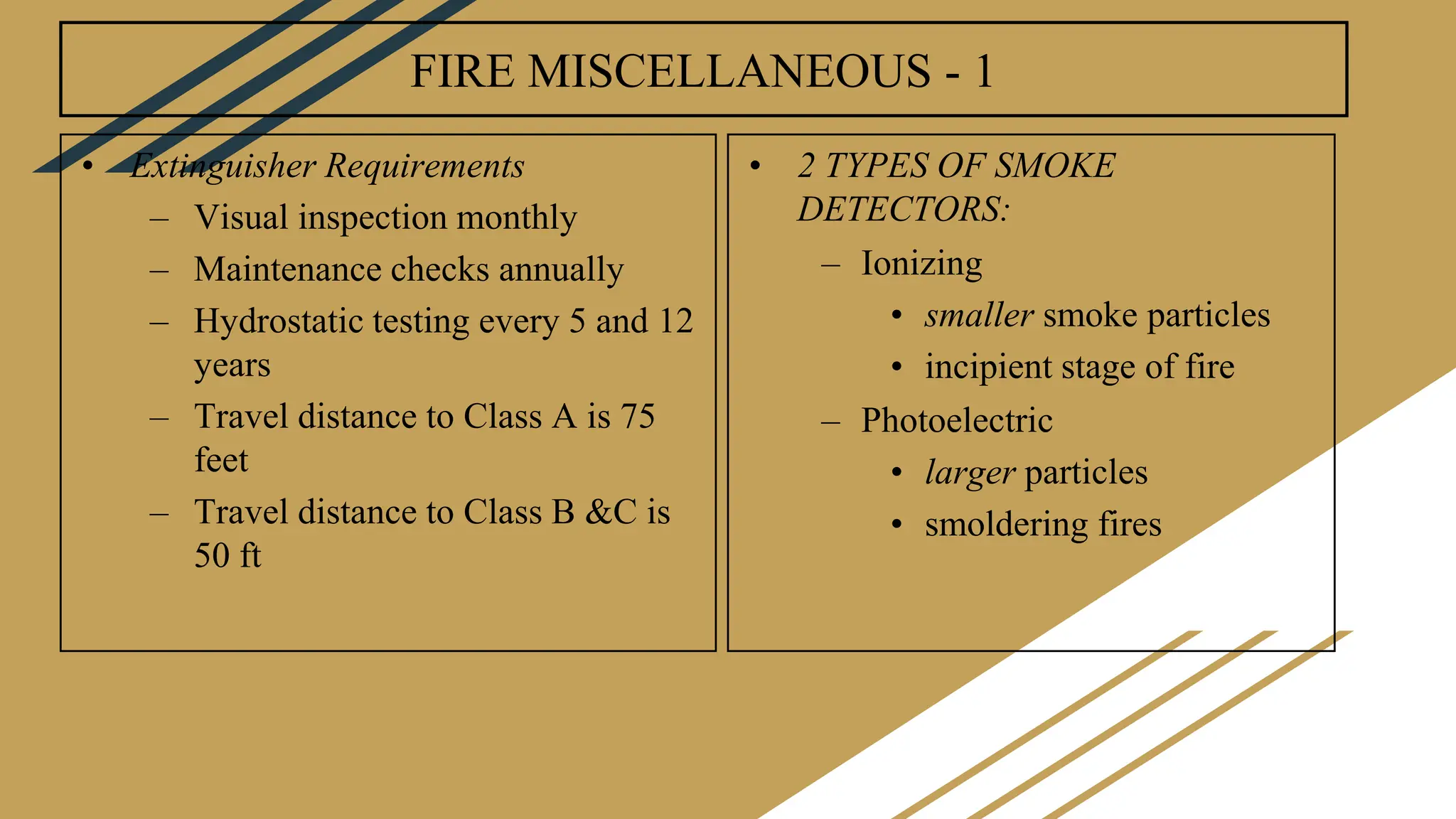
FIRE MISCELLANEOUS - 1
• Extinguisher Requirements
– Visual inspection monthly
– Maintenance checks annually
– Hydrostatic testing every 5 and 12
years
– Travel distance to Class A is 75
feet
– Travel distance to Class B &C is
50 ft
• 2 TYPES OF SMOKE
DETECTORS:
– Ionizing
• smaller smoke particles
• incipient stage of fire
– Photoelectric
• larger particles
• smoldering fires
• TETRAHYDRAN OF COMBUSTION:
– Requires the following 4 elements:
• Fuel
• Oxygen
• Ignition
• Chain Reaction
FIRE MISCELLANEOUS - 2
Fire Prevention
(Basic Principles)
• Combustion
– rapid chemical rxn of 02 w/ a
fuel
– produces CO and CO2 plus
heat
– elements include 02, heat,
ignition
• Convection
– a result of movement of air and
combustion products
– determines direction which a
fire will spread
• Conduction
– mechanism of thermal E
transfer b/w materials
– materials have high conduction
(metals) or low (plastics)
Fire Prevention
Properties of Flam and Comb Liquids - 2
• Flash Point
– lowest temp at which a liquid can generate
enough vapor above its surface to support
combustion in presence of ignition source
• Vapor Pressure
– Pressure exerted by a vapor on its liquid at
equilibrium
– strongly affected by Temperature
• Equilibrium
– Vaporization and condensation of molecules
until the rates of the two become equal
– strongly affected by Temperature
• Fire Point
– lowest temp at which a flam liquid in an open
container gives off enough vapors to continue
to burn once ignited.
• Explosive/flammable Range
– Concentration of flam vapor or gas in air that
can ignite in presence of ignition source
– LFL: min conc of vapor in air below which
flame will not propagate (eg/ 1.4 for gas)
– UFL: max conc of vapor in air below which
flame will not propagate (eg/ 7.6 for gas)
Fire Prevention
Properties of Flam and Comb Liquids - 2
• Autoignition Temp
– lowest temp that will produce combustion w/o
an ignition source
• Specific Gravity
– density of liquid relative to density of water
• Vapor Density
– measure of relative densities of vapors and
gases compared to air
– most flam liquids VP> air therefore ventilation
needed at floor level
– most flam gases VP<1 therefore ventilation
needed above floor level
• Evaporation Rate
– rate at which liquid is converted to vapor at
given T and P
– ER reported in relation to butylacetate
• Water Solubility
– many flam liquids (ROHs, ethers, ketones)
completely soluble in water
– mixture reduces flammability and static charge
• Boiling Point (BP)
– temp at which the liquid transforms into vapor at
given P
– a strong function of P and always decreases with
a decrease in P
• Boiling Liquid-Expanding Vapor Explosion (BLEVE)
– failure of a container at atm P holding a liquid
above it’s B
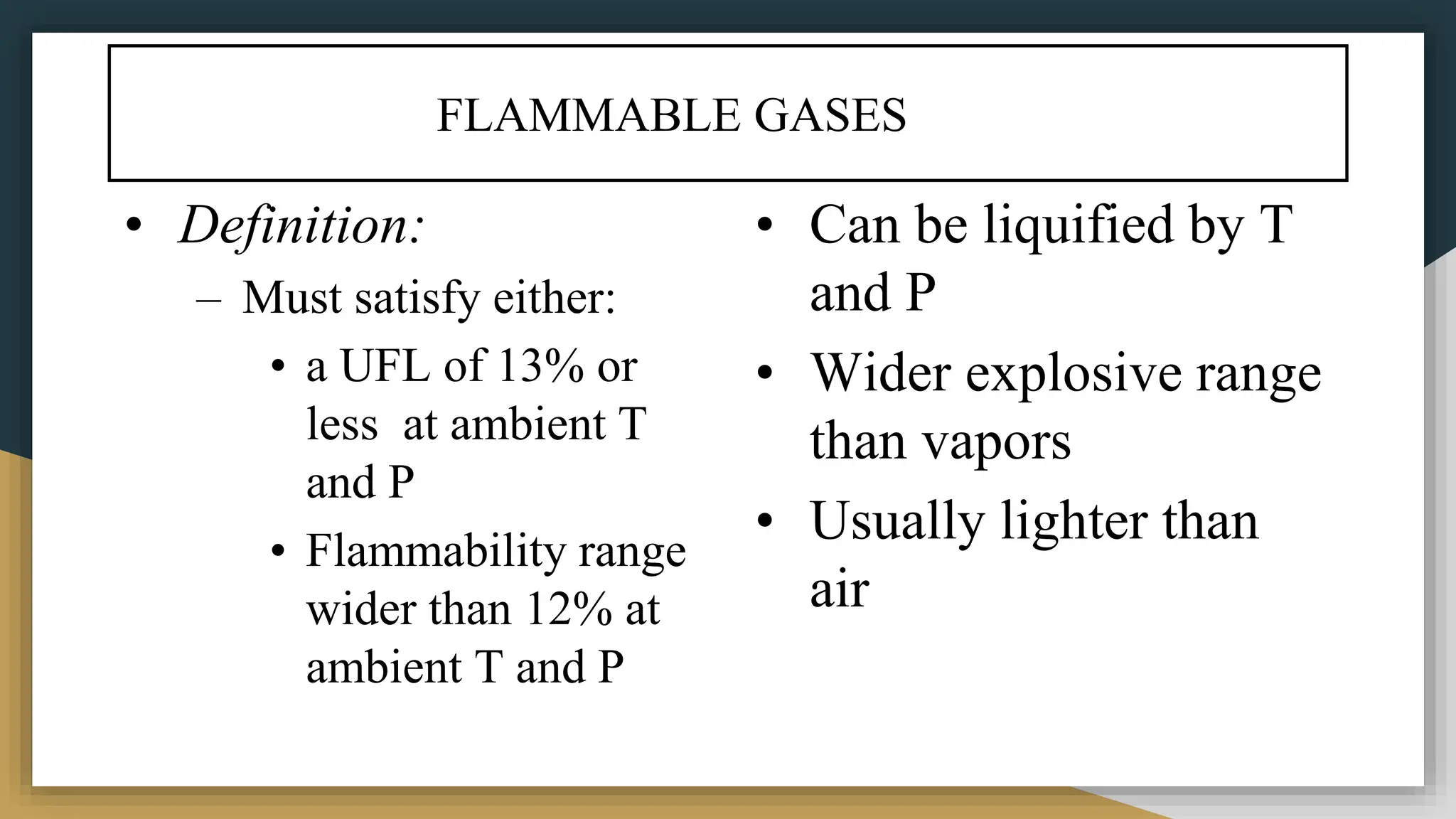
FLAMMABLE GASES
• Definition:
– Must satisfy either:
• a UFL of 13% or
less at ambient T
and P
• Flammability range
wider than 12% at
ambient T and P
• Can be liquified by T
and P
• Wider explosive range
than vapors
• Usually lighter than
air
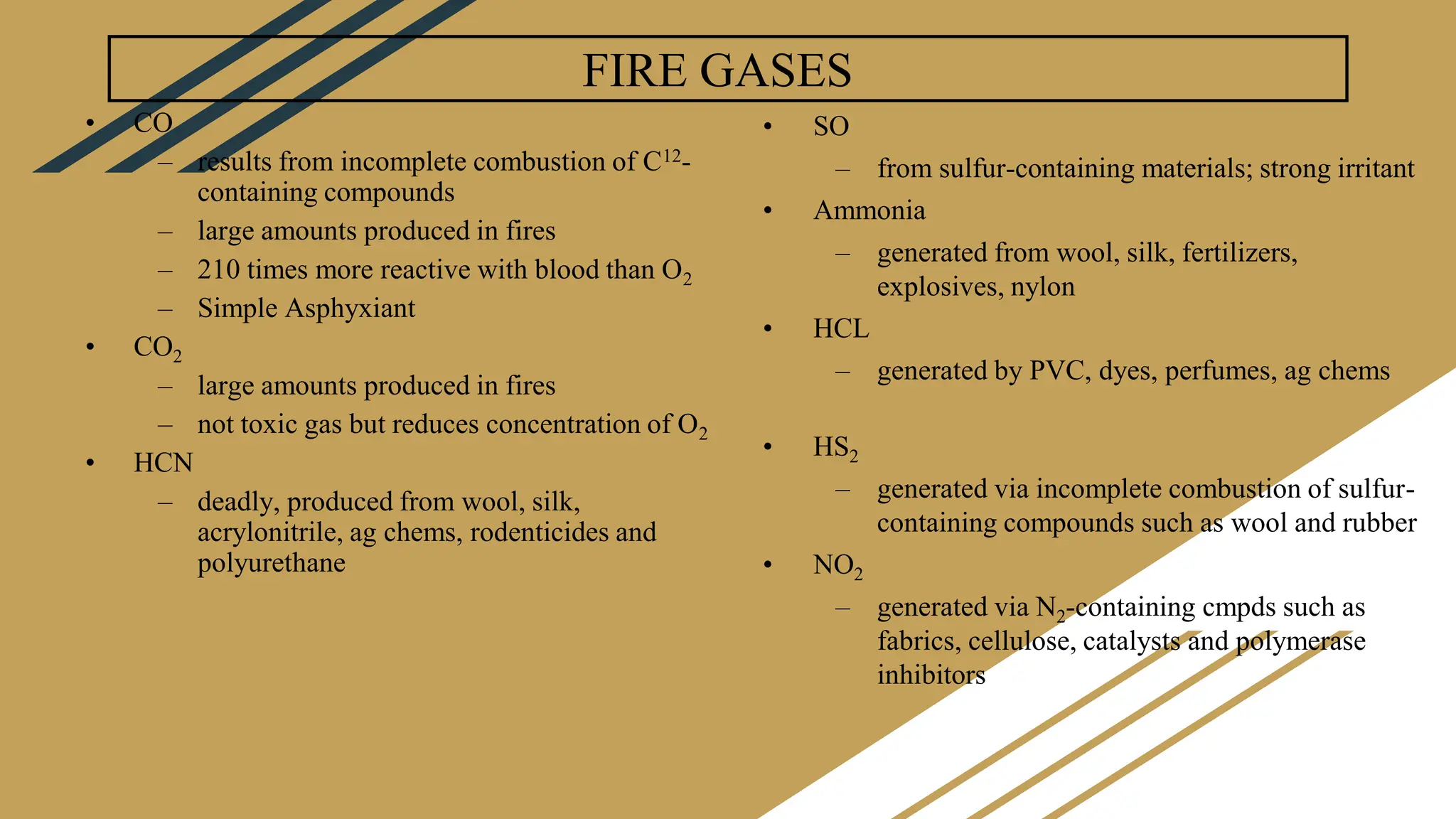
FIRE GASES
• CO
– results from incomplete combustion of C12-
containing compounds
– large amounts produced in fires
– 210 times more reactive with blood than O2
– Simple Asphyxiant
• CO2
– large amounts produced in fires
– not toxic gas but reduces concentration of O2
• HCN
– deadly, produced from wool, silk,
acrylonitrile, ag chems, rodenticides and
polyurethane
• SO
– from sulfur-containing materials; strong irritant
• Ammonia
– generated from wool, silk, fertilizers,
explosives, nylon
• HCL
– generated by PVC, dyes, perfumes, ag chems
• HS2
– generated via incomplete combustion of sulfur-
containing compounds such as wool and rubber
• NO2
– generated via N2-containing cmpds such as
fabrics, cellulose, catalysts and polymerase
inhibitors
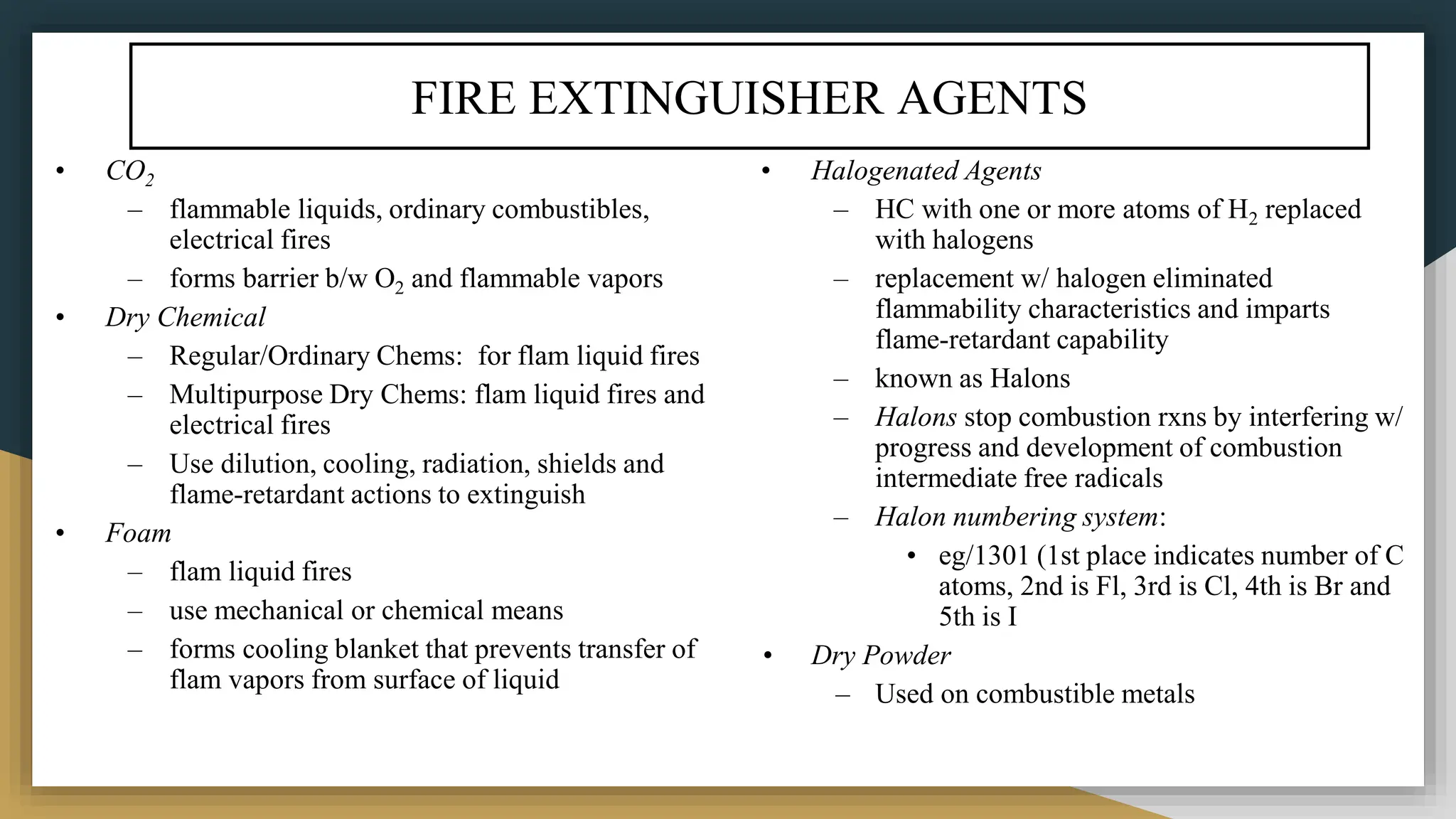
FIRE EXTINGUISHER AGENTS
• CO2
– flammable liquids, ordinary combustibles,
electrical fires
– forms barrier b/w O2 and flammable vapors
• Dry Chemical
– Regular/Ordinary Chems: for flam liquid fires
– Multipurpose Dry Chems: flam liquid fires and
electrical fires
– Use dilution, cooling, radiation, shields and
flame-retardant actions to extinguish
• Foam
– flam liquid fires
– use mechanical or chemical means
– forms cooling blanket that prevents transfer of
flam vapors from surface of liquid
• Halogenated Agents
– HC with one or more atoms of H2 replaced
with halogens
– replacement w/ halogen eliminated
flammability characteristics and imparts
flame-retardant capability
– known as Halons
– Halons stop combustion rxns by interfering w/
progress and development of combustion
intermediate free radicals
– Halon numbering system:
• eg/1301 (1st place indicates number of C
atoms, 2nd is Fl, 3rd is Cl, 4th is Br and
5th is I
• Dry Powder
– Used on combustible metals
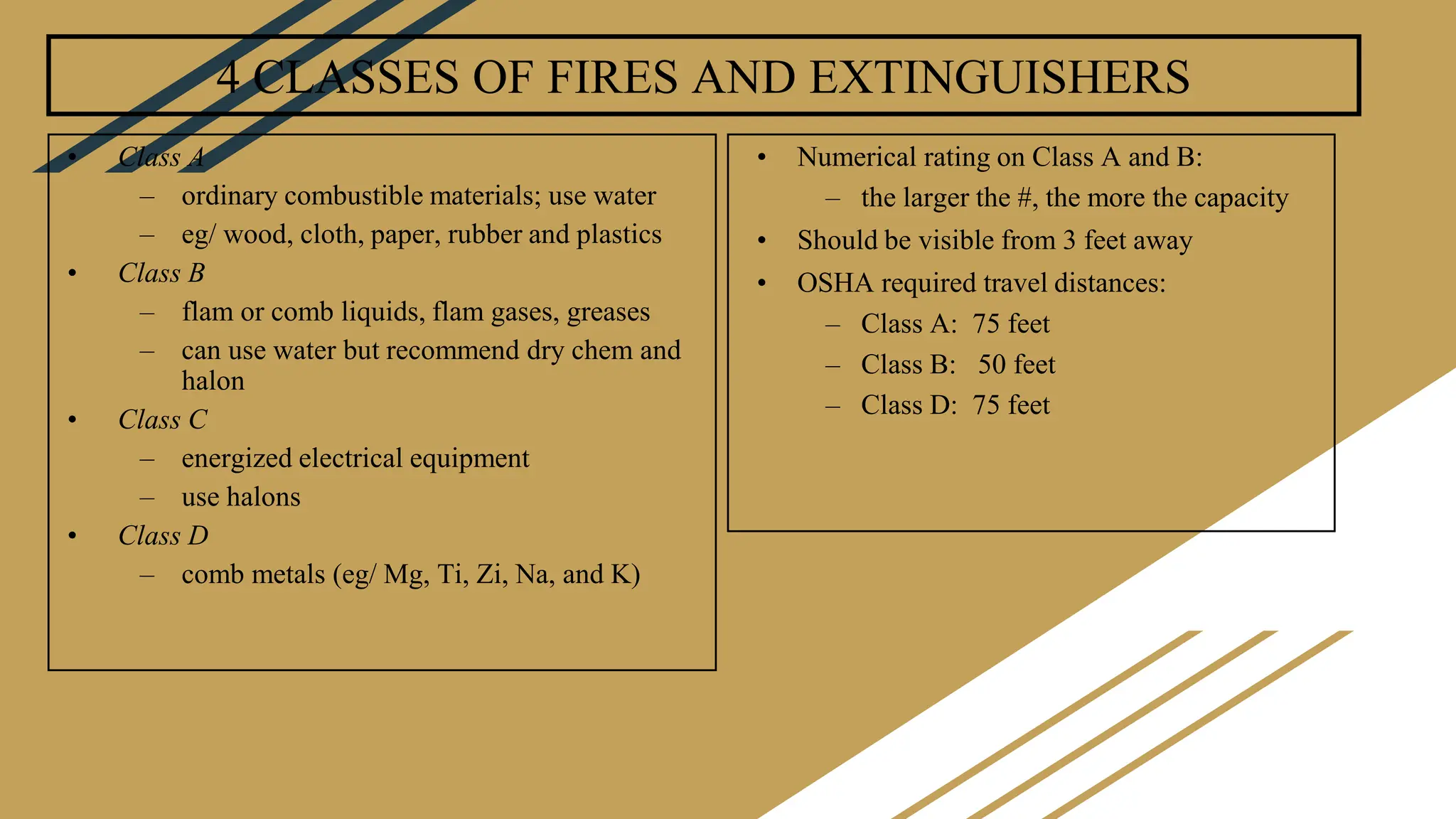
4 CLASSES OF FIRES AND EXTINGUISHERS
• Class A
– ordinary combustible materials; use water
– eg/ wood, cloth, paper, rubber and plastics
• Class B
– flam or comb liquids, flam gases, greases
– can use water but recommend dry chem and
halon
• Class C
– energized electrical equipment
– use halons
• Class D
– comb metals (eg/ Mg, Ti, Zi, Na, and K)
• Numerical rating on Class A and B:
– the larger the #, the more the capacity
• Should be visible from 3 feet away
• OSHA required travel distances:
– Class A: 75 feet
– Class B: 50 feet
– Class D: 75 feet
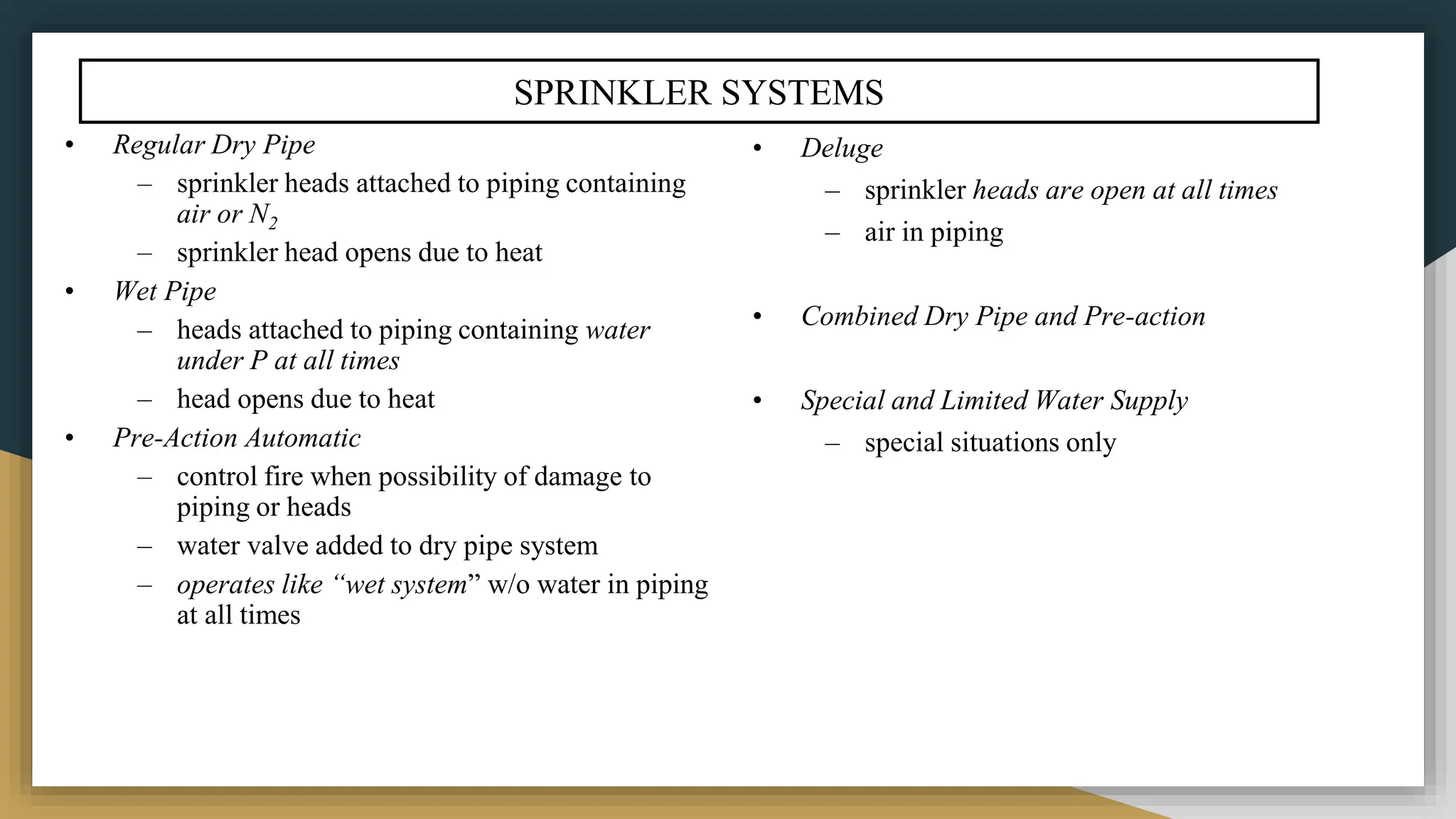
SPRINKLER SYSTEMS
• Regular Dry Pipe
– sprinkler heads attached to piping containing
air or N2
– sprinkler head opens due to heat
• Wet Pipe
– heads attached to piping containing water
under P at all times
– head opens due to heat
• Pre-Action Automatic
– control fire when possibility of damage to
piping or heads
– water valve added to dry pipe system
– operates like “wet system” w/o water in piping
at all times
• Deluge
– sprinkler heads are open at all times
– air in piping
• Combined Dry Pipe and Pre-action
• Special and Limited Water Supply
– special situations only
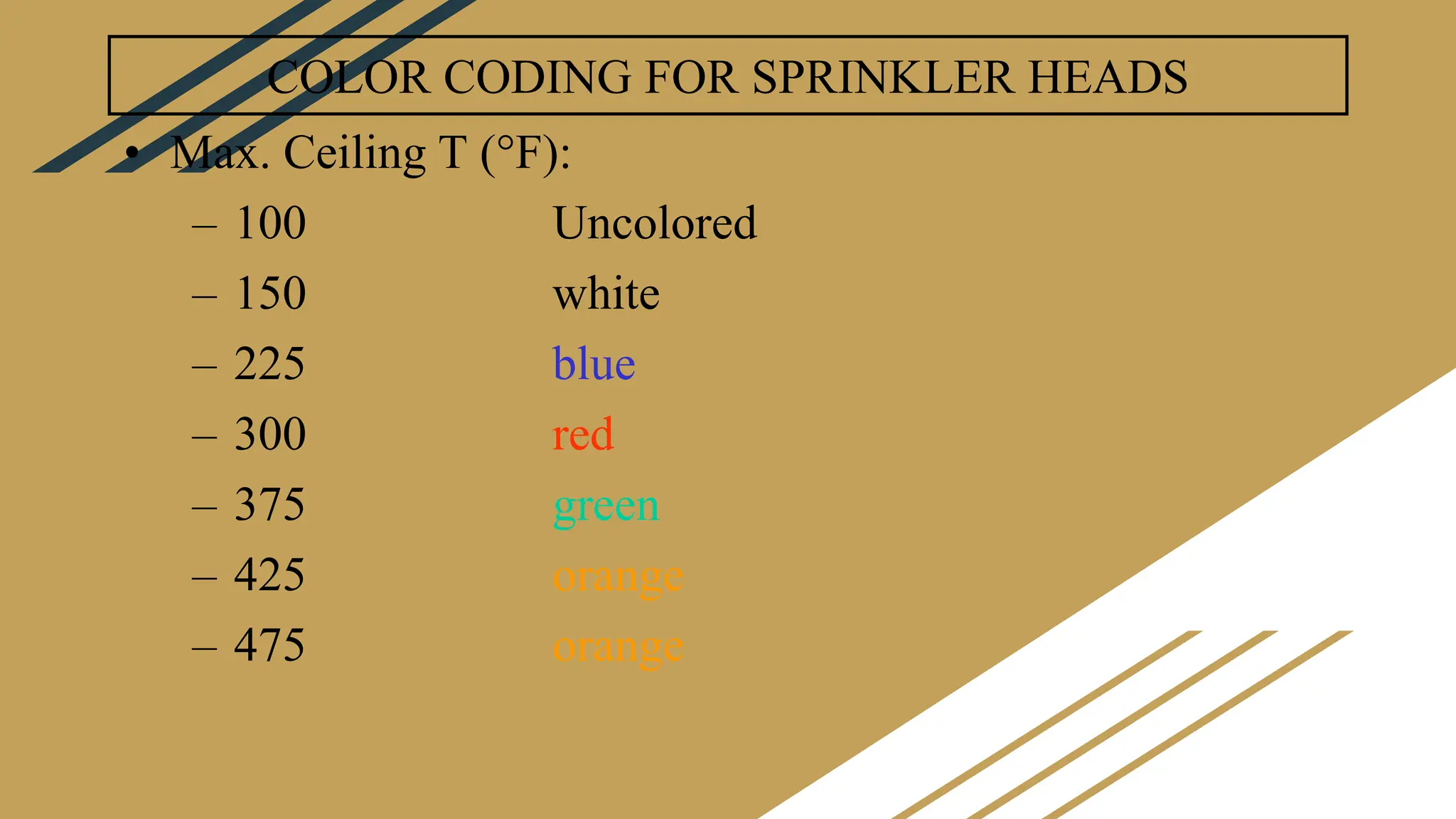
COLOR CODING FOR SPRINKLER HEADS
• Max. Ceiling T (°F):
– 100 Uncolored
– 150 white
– 225 blue
– 300 red
– 375 green
– 425 orange
– 475 orange
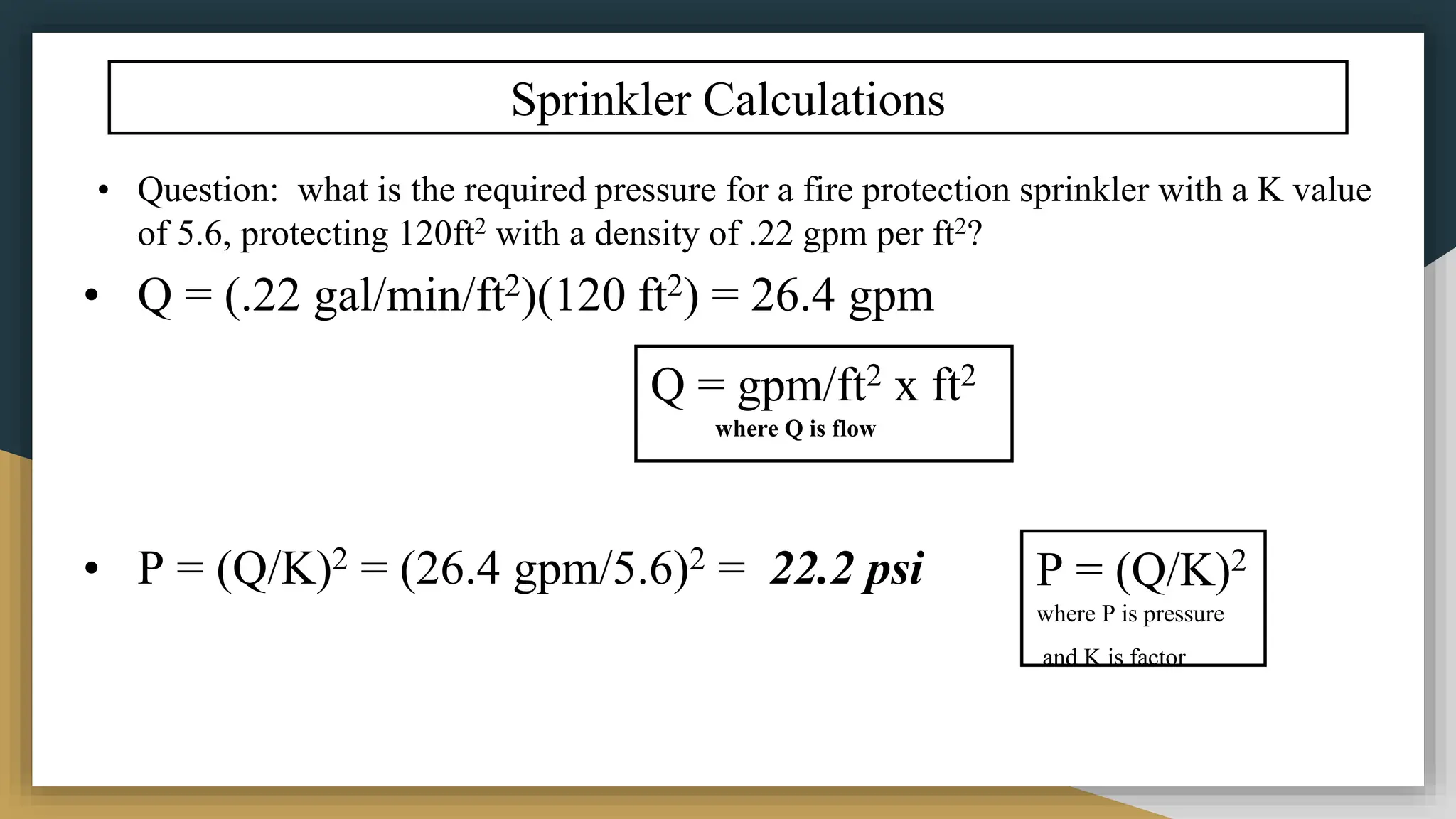
Sprinkler Calculations
• Question: what is the required pressure for a fire protection sprinkler with a K value
of 5.6, protecting 120ft2 with a density of .22 gpm per ft2?
• Q = (.22 gal/min/ft2)(120 ft2) = 26.4 gpm
• P = (Q/K)2 = (26.4 gpm/5.6)2 = 22.2 psi
Q = gpm/ft2 x ft2
where Q is flow
P = (Q/K)2
where P is pressure
and K is factor
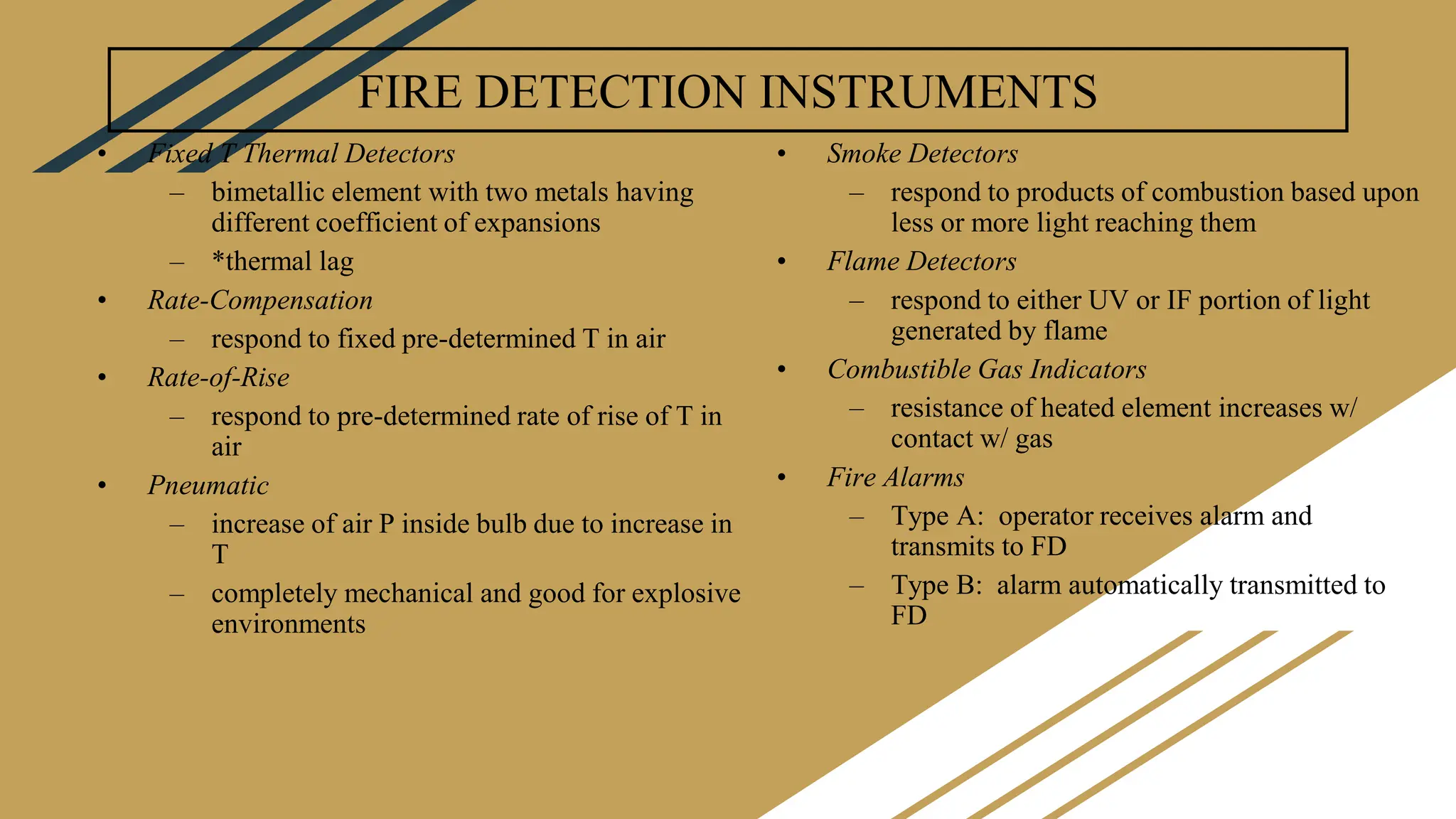
FIRE DETECTION INSTRUMENTS
• Fixed T Thermal Detectors
– bimetallic element with two metals having
different coefficient of expansions
– *thermal lag
• Rate-Compensation
– respond to fixed pre-determined T in air
• Rate-of-Rise
– respond to pre-determined rate of rise of T in
air
• Pneumatic
– increase of air P inside bulb due to increase in
T
– completely mechanical and good for explosive
environments
• Smoke Detectors
– respond to products of combustion based upon
less or more light reaching them
• Flame Detectors
– respond to either UV or IF portion of light
generated by flame
• Combustible Gas Indicators
– resistance of heated element increases w/
contact w/ gas
• Fire Alarms
– Type A: operator receives alarm and
transmits to FD
– Type B: alarm automatically transmitted to
FD
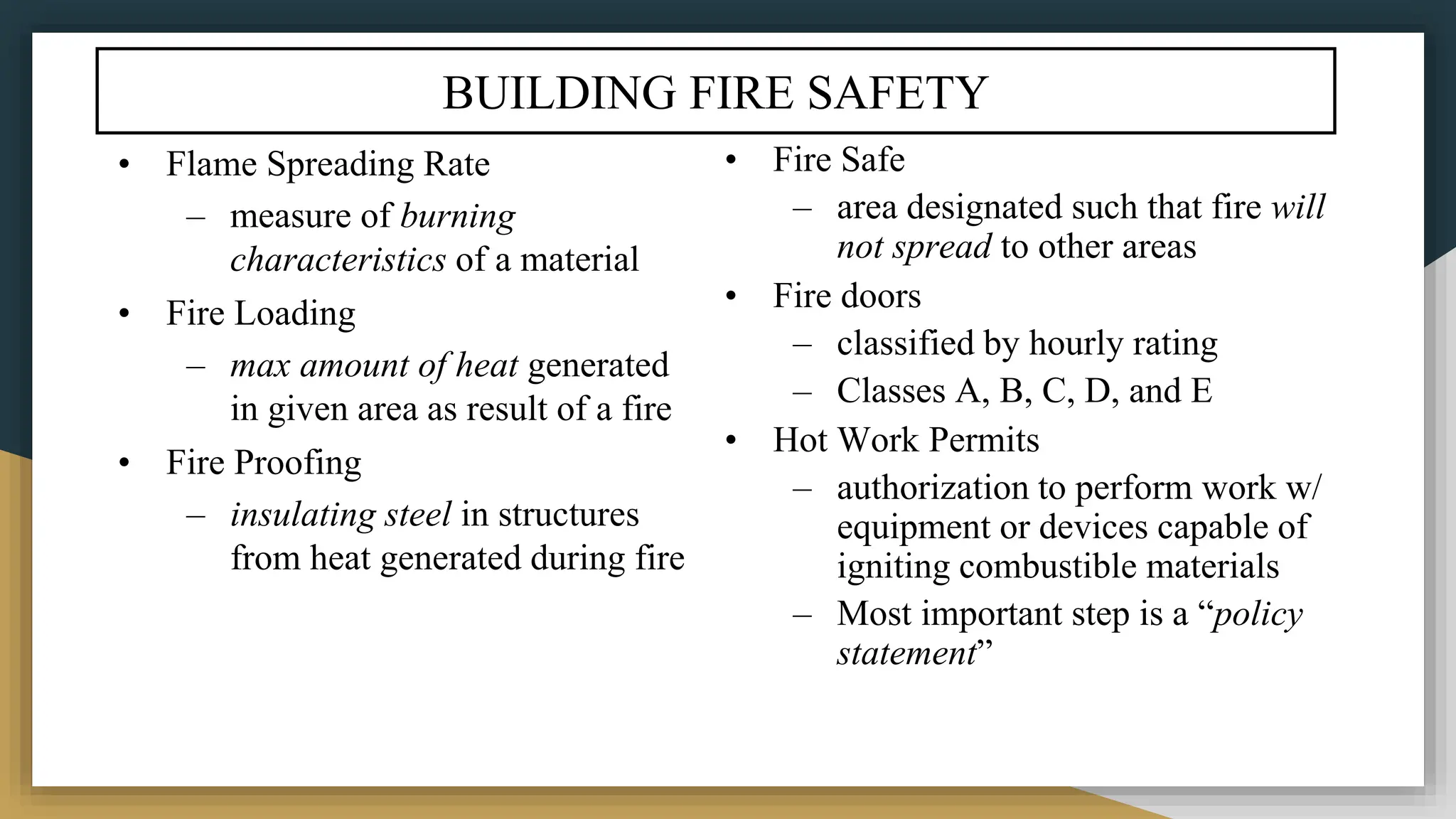
BUILDING FIRE SAFETY
• Flame Spreading Rate
– measure of burning
characteristics of a material
• Fire Loading
– max amount of heat generated
in given area as result of a fire
• Fire Proofing
– insulating steel in structures
from heat generated during fire
• Fire Safe
– area designated such that fire will
not spread to other areas
• Fire doors
– classified by hourly rating
– Classes A, B, C, D, and E
• Hot Work Permits
– authorization to perform work w/
equipment or devices capable of
igniting combustible materials
– Most important step is a “policy
statement”
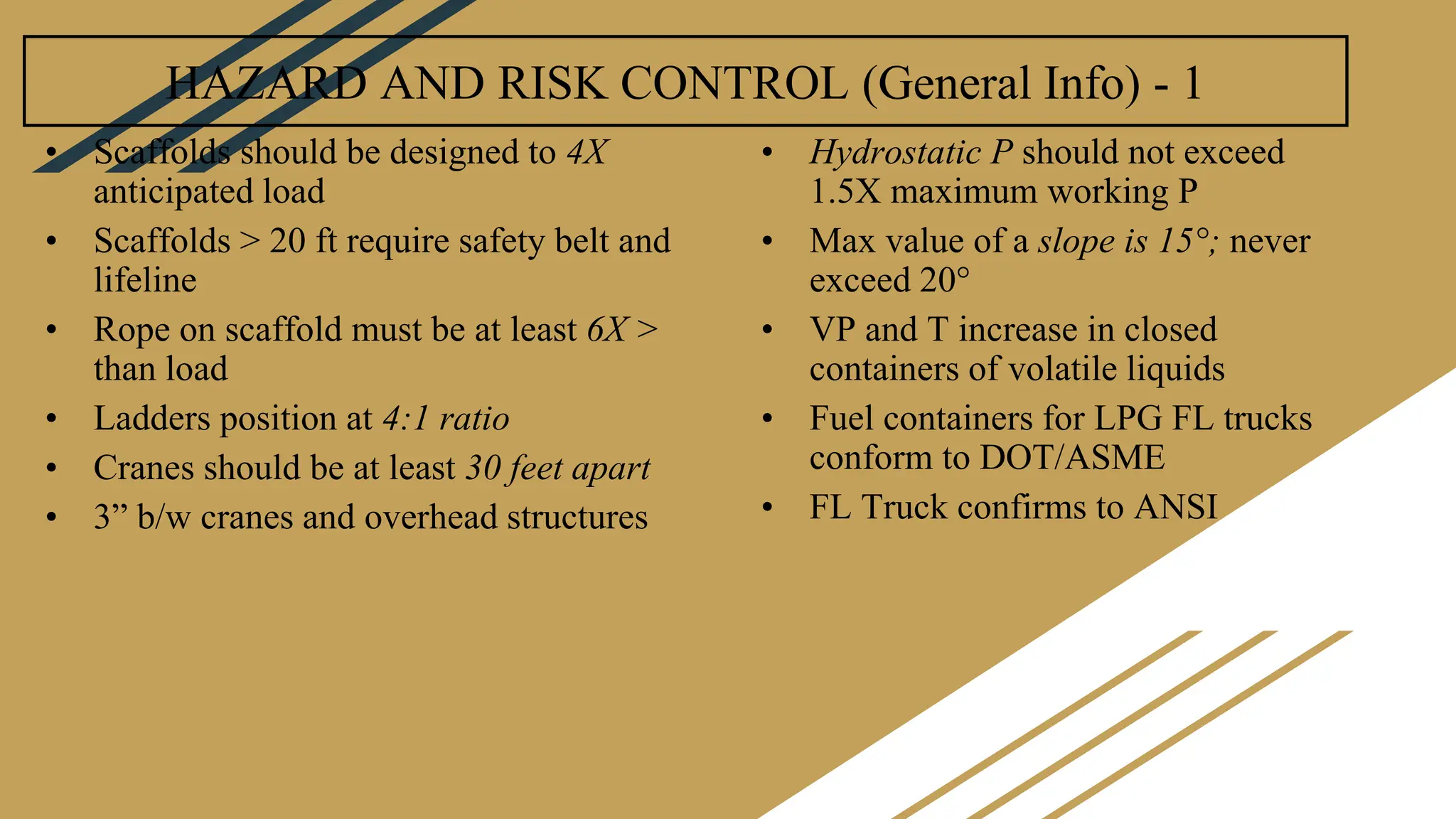
HAZARD AND RISK CONTROL (General Info) - 1
• Scaffolds should be designed to 4X
anticipated load
• Scaffolds > 20 ft require safety belt and
lifeline
• Rope on scaffold must be at least 6X >
than load
• Ladders position at 4:1 ratio
• Cranes should be at least 30 feet apart
• 3” b/w cranes and overhead structures
• Hydrostatic P should not exceed
1.5X maximum working P
• Max value of a slope is 15°; never
exceed 20°
• VP and T increase in closed
containers of volatile liquids
• Fuel containers for LPG FL trucks
conform to DOT/ASME
• FL Truck confirms to ANSI
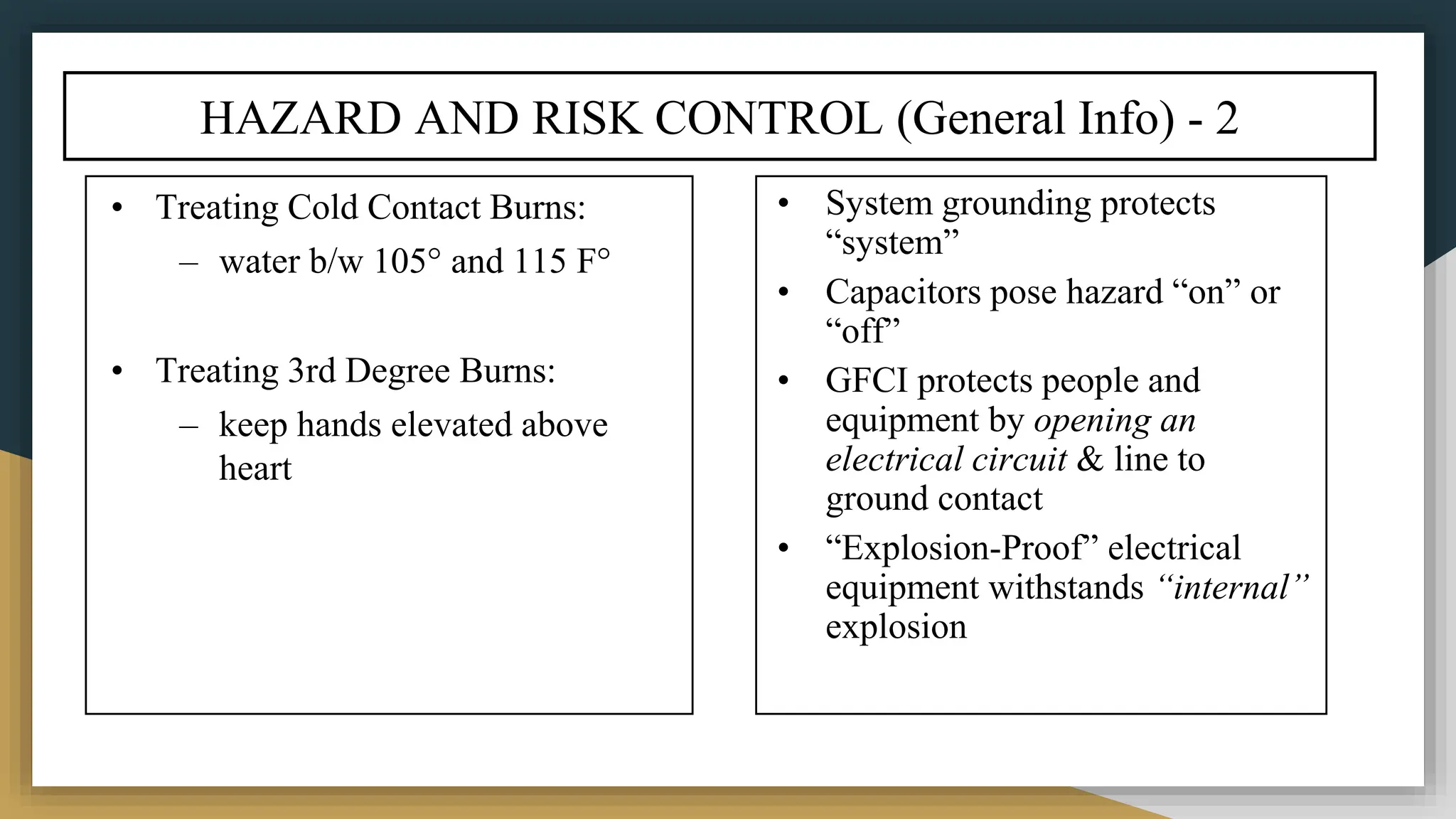
HAZARD AND RISK CONTROL (General Info) - 2
• Treating Cold Contact Burns:
– water b/w 105° and 115 F°
• Treating 3rd Degree Burns:
– keep hands elevated above
heart
• System grounding protects
“system”
• Capacitors pose hazard “on” or
“off”
• GFCI protects people and
equipment by opening an
electrical circuit & line to
ground contact
• “Explosion-Proof” electrical
equipment withstands “internal”
explosion
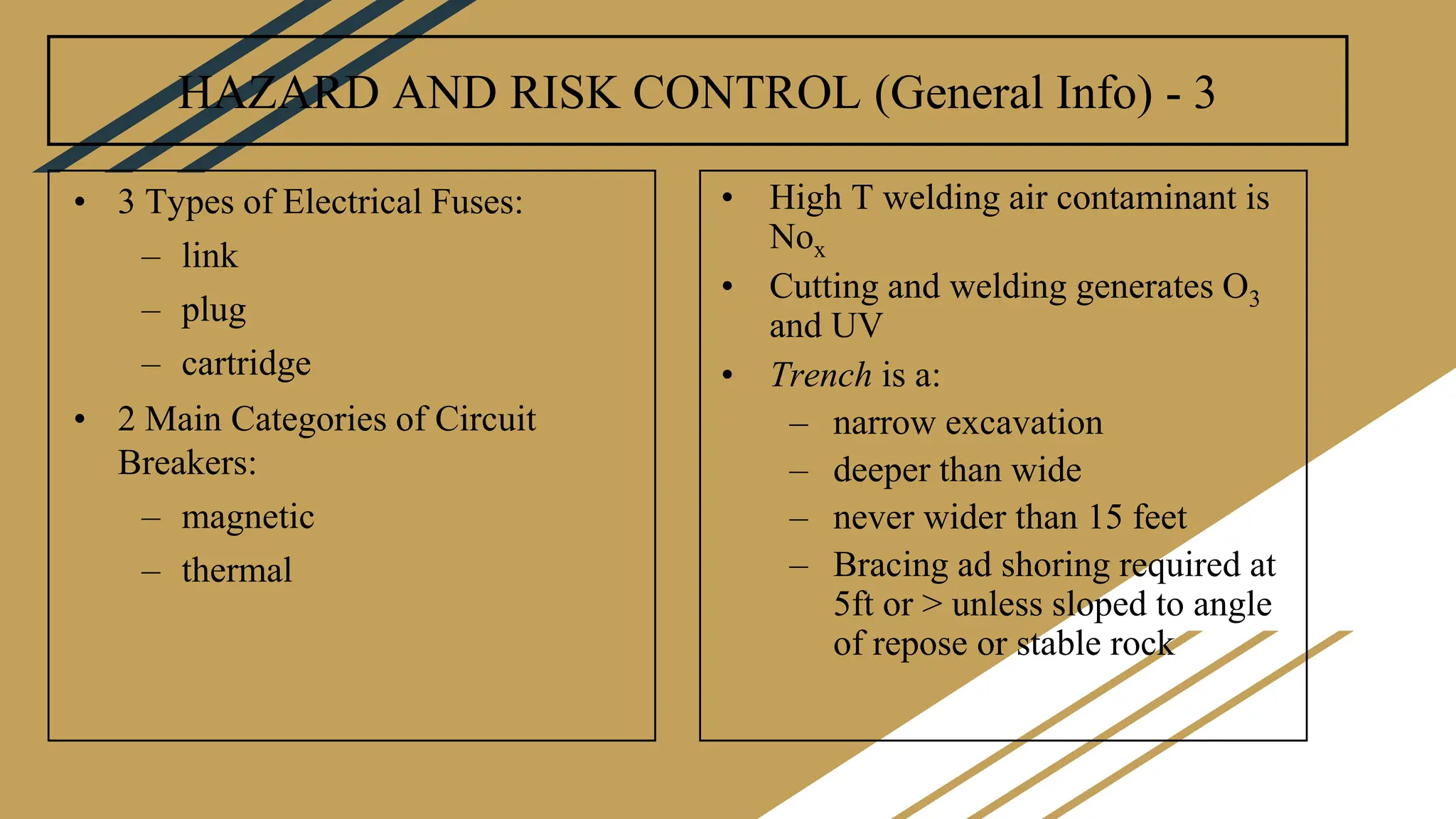
HAZARD AND RISK CONTROL (General Info) - 3
• 3 Types of Electrical Fuses:
– link
– plug
– cartridge
• 2 Main Categories of Circuit
Breakers:
– magnetic
– thermal
• High T welding air contaminant is
Nox
• Cutting and welding generates O3
and UV
• Trench is a:
– narrow excavation
– deeper than wide
– never wider than 15 feet
– Bracing ad shoring required at
5ft or > unless sloped to angle
of repose or stable rock
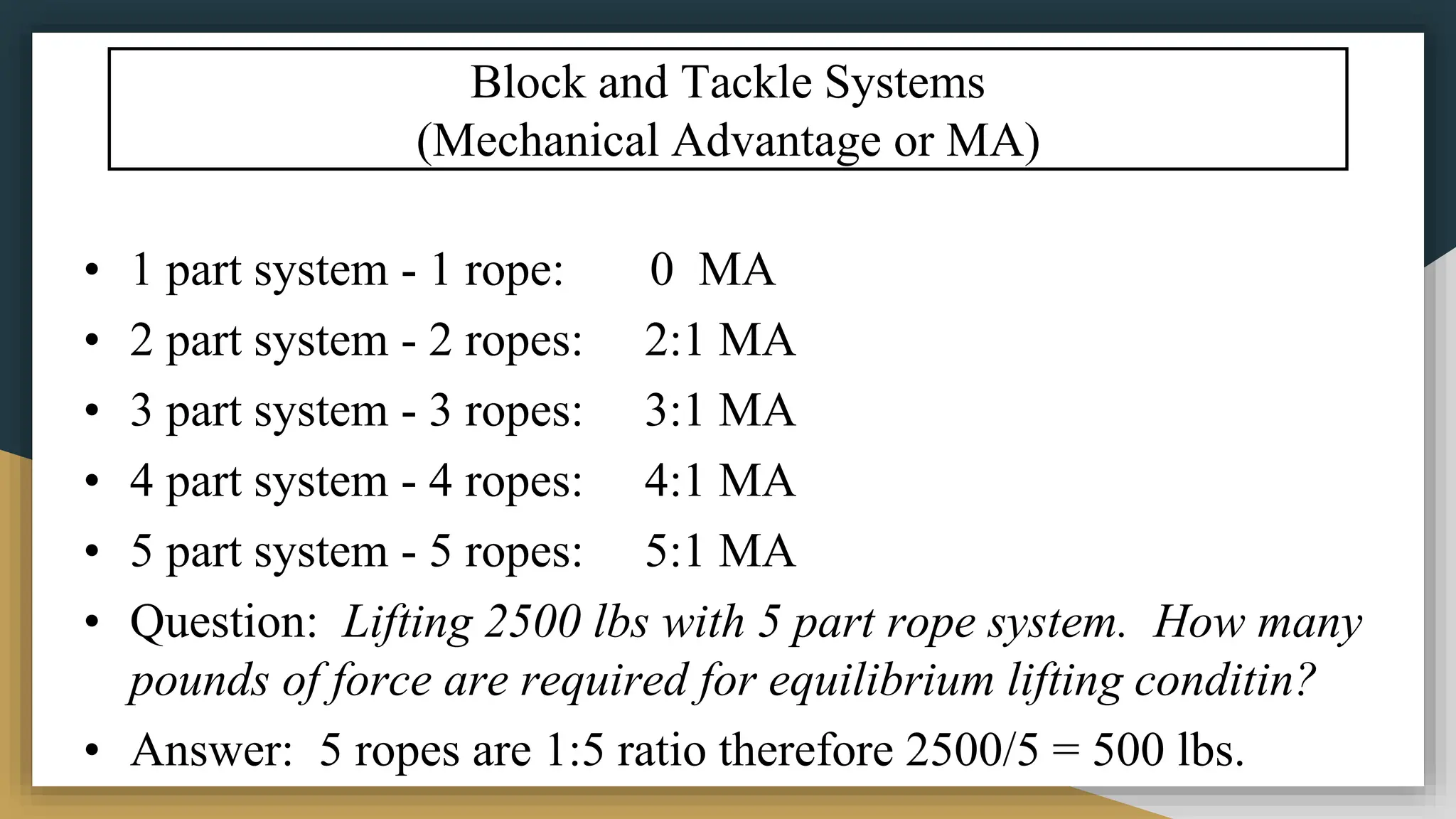
Block and Tackle Systems
(Mechanical Advantage or MA)
• 1 part system - 1 rope: 0 MA
• 2 part system - 2 ropes: 2:1 MA
• 3 part system - 3 ropes: 3:1 MA
• 4 part system - 4 ropes: 4:1 MA
• 5 part system - 5 ropes: 5:1 MA
• Question: Lifting 2500 lbs with 5 part rope system. How many
pounds of force are required for equilibrium lifting conditin?
• Answer: 5 ropes are 1:5 ratio therefore 2500/5 = 500 lbs.
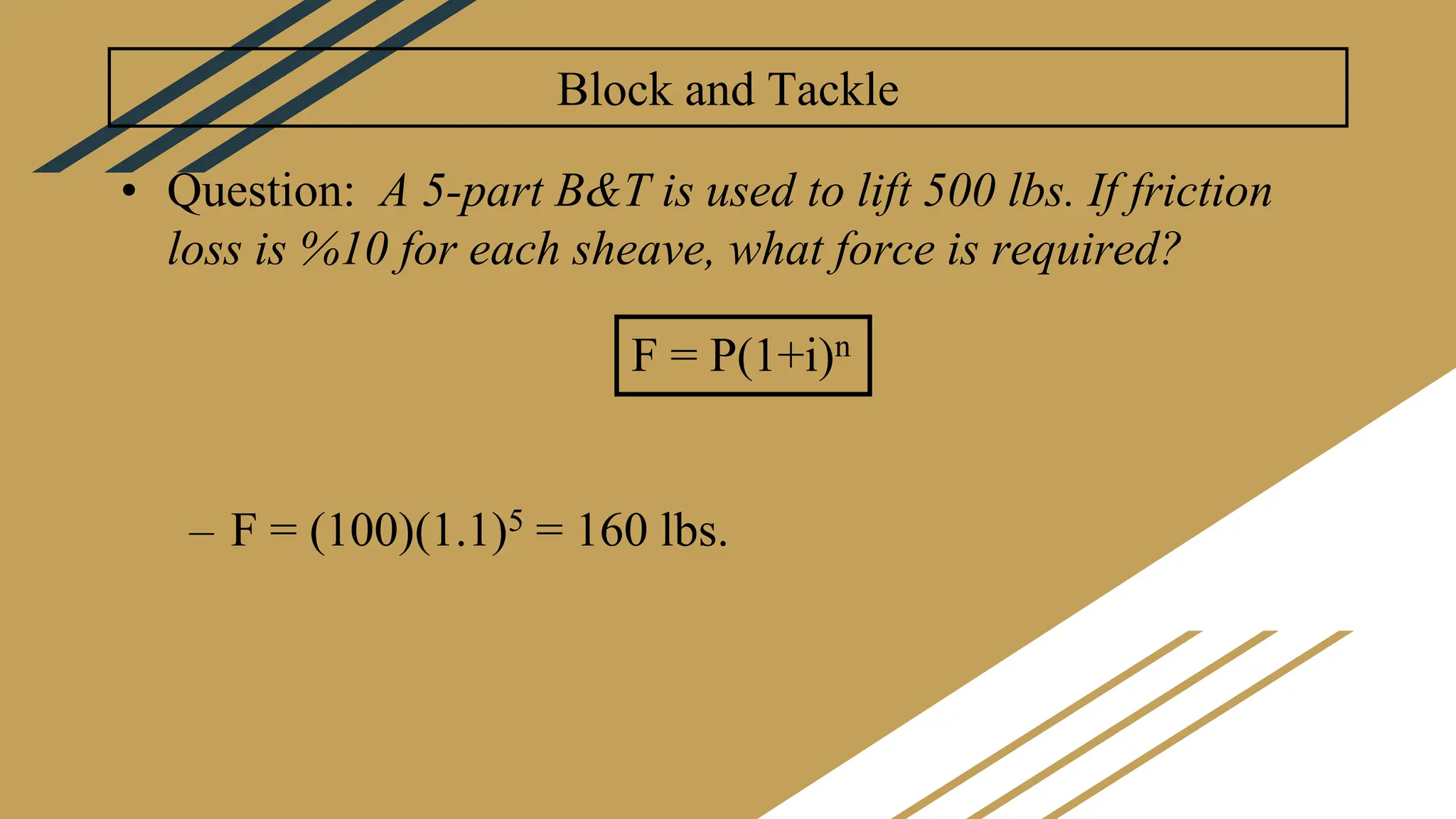
Block and Tackle
• Question: A 5-part B&T is used to lift 500 lbs. If friction
loss is %10 for each sheave, what force is required?
– F = (100)(1.1)5 = 160 lbs.
F = P(1+i)n
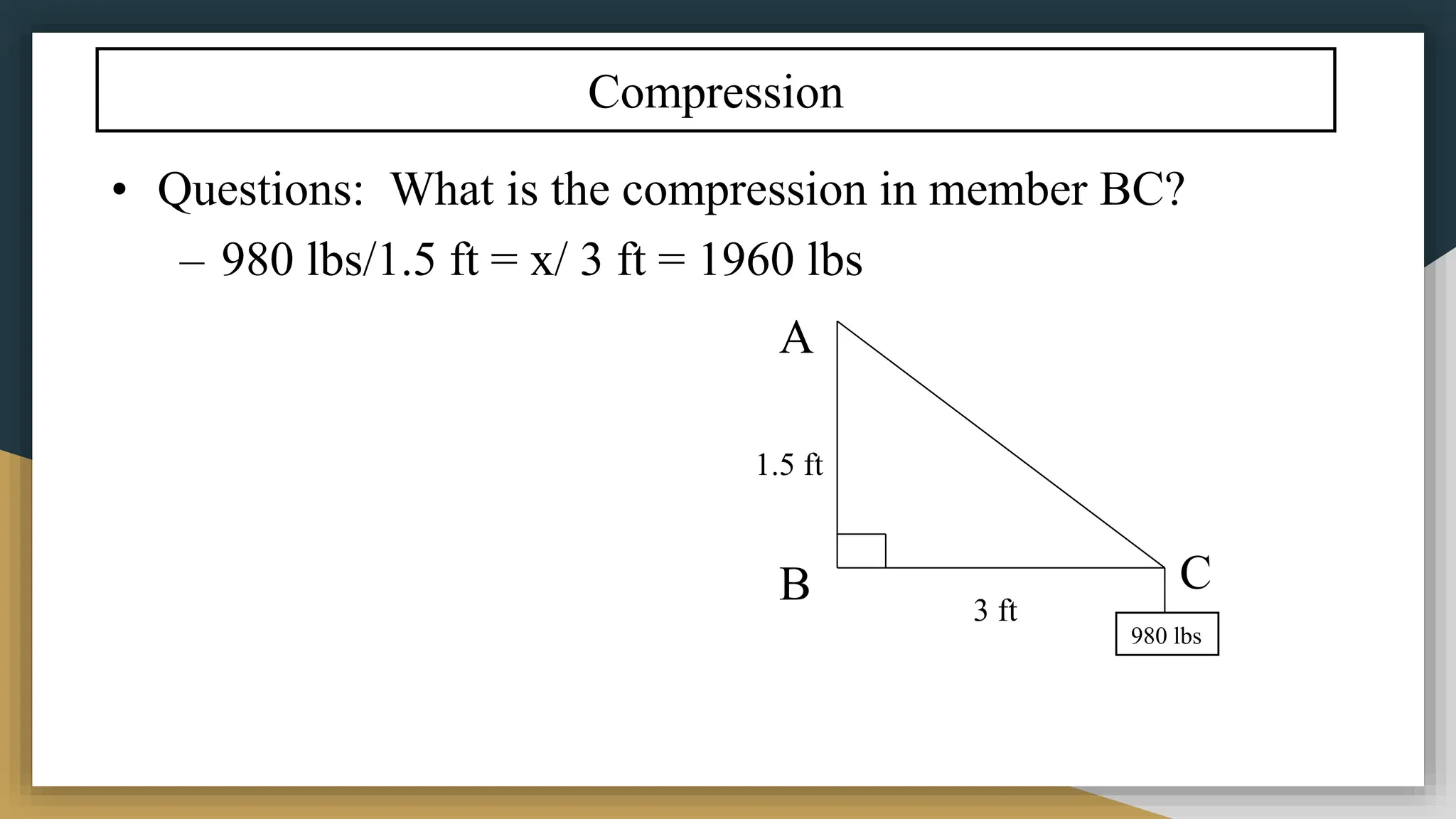
Compression
• Questions: What is the compression in member BC?
– 980 lbs/1.5 ft = x/ 3 ft = 1960 lbs
1.5 ft
3 ft
980 lbs
A
B C
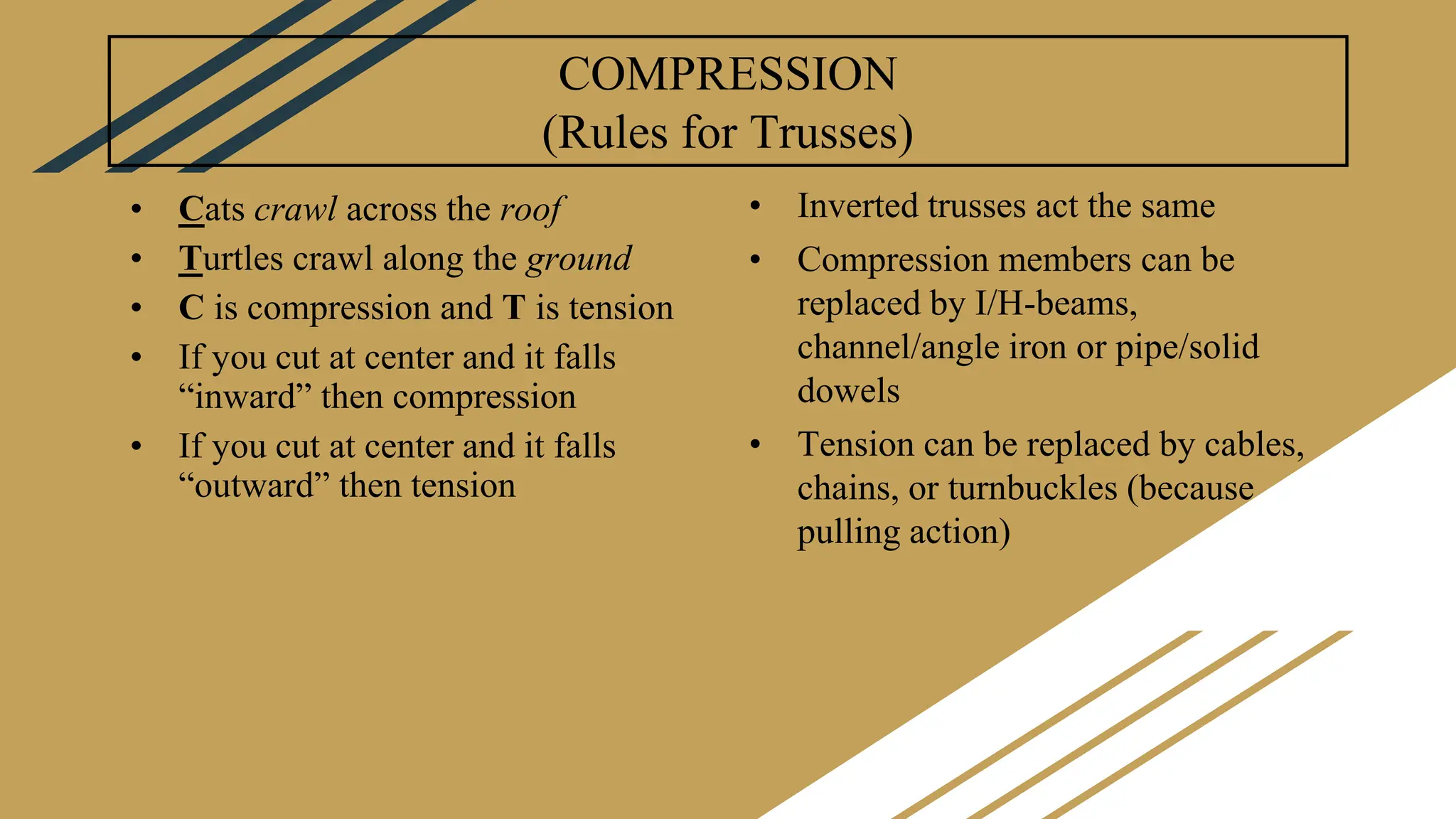
COMPRESSION
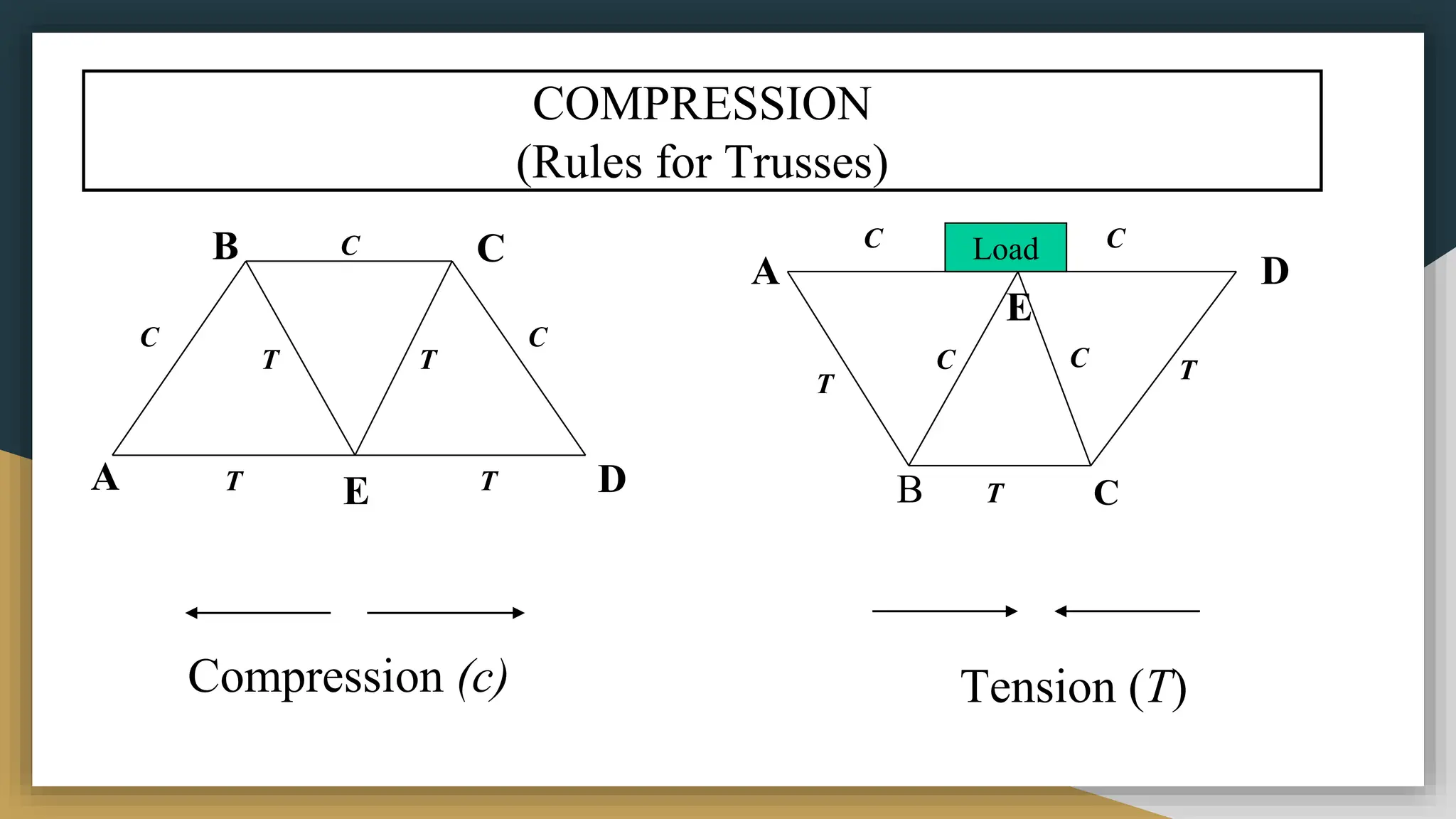
(Rules for Trusses)
• Cats crawl across the roof
• Turtles crawl along the ground
• C is compression and T is tension
• If you cut at center and it falls
“inward” then compression
• If you cut at center and it falls
“outward” then tension
• Inverted trusses act the same
• Compression members can be
replaced by I/H-beams,
channel/angle iron or pipe/solid
dowels
• Tension can be replaced by cables,
chains, or turnbuckles (because
pulling action)
COMPRESSION
(Rules for Trusses)
A E D
B C
Compression (c) Tension (T)
Load
A D
B C
E
C
C
C
T T
T T
C C
C C
T
T
T
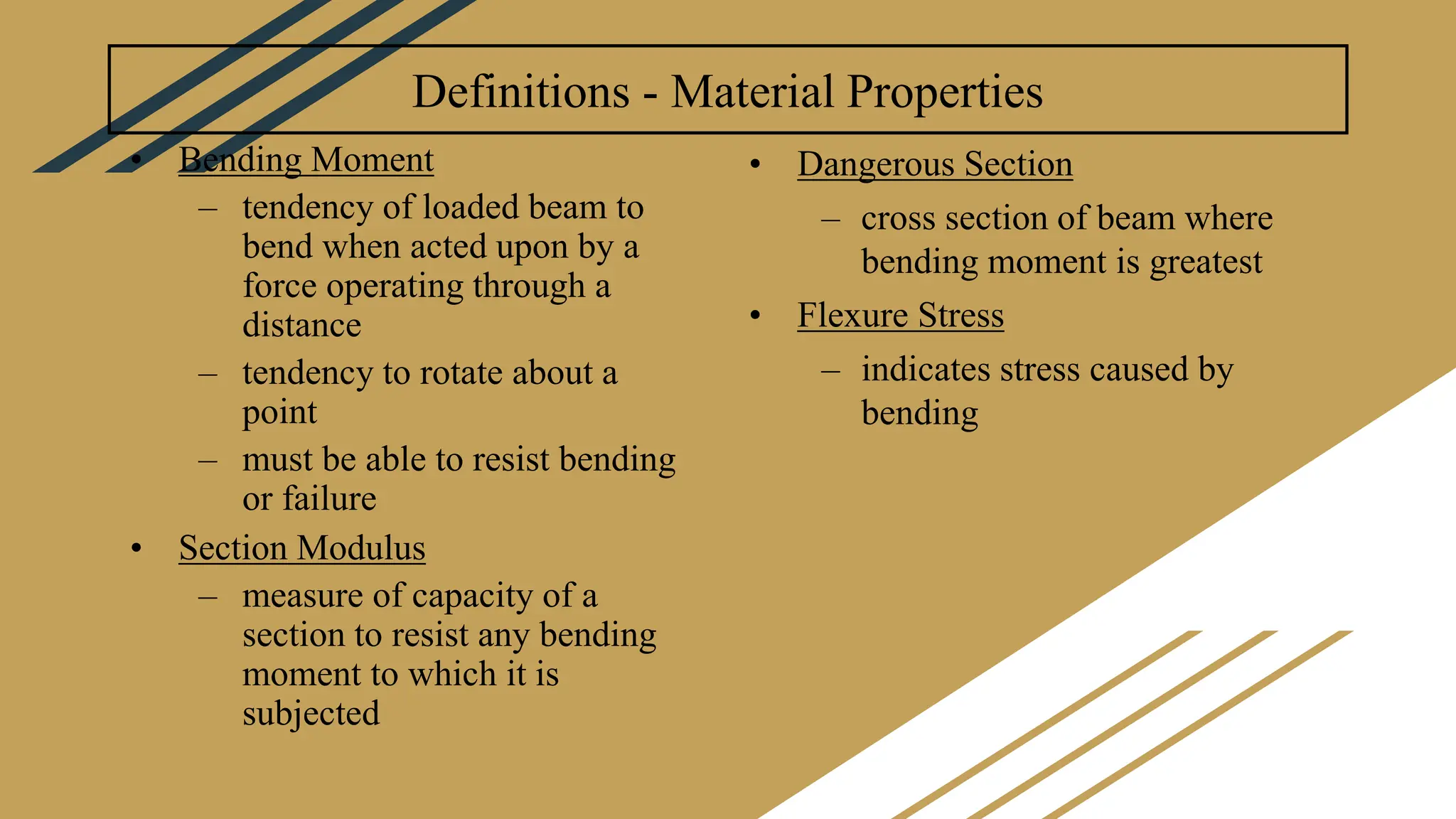
Definitions - Material Properties
• Bending Moment
– tendency of loaded beam to
bend when acted upon by a
force operating through a
distance
– tendency to rotate about a
point
– must be able to resist bending
or failure
• Section Modulus
– measure of capacity of a
section to resist any bending
moment to which it is
subjected
• Dangerous Section
– cross section of beam where
bending moment is greatest
• Flexure Stress
– indicates stress caused by
bending
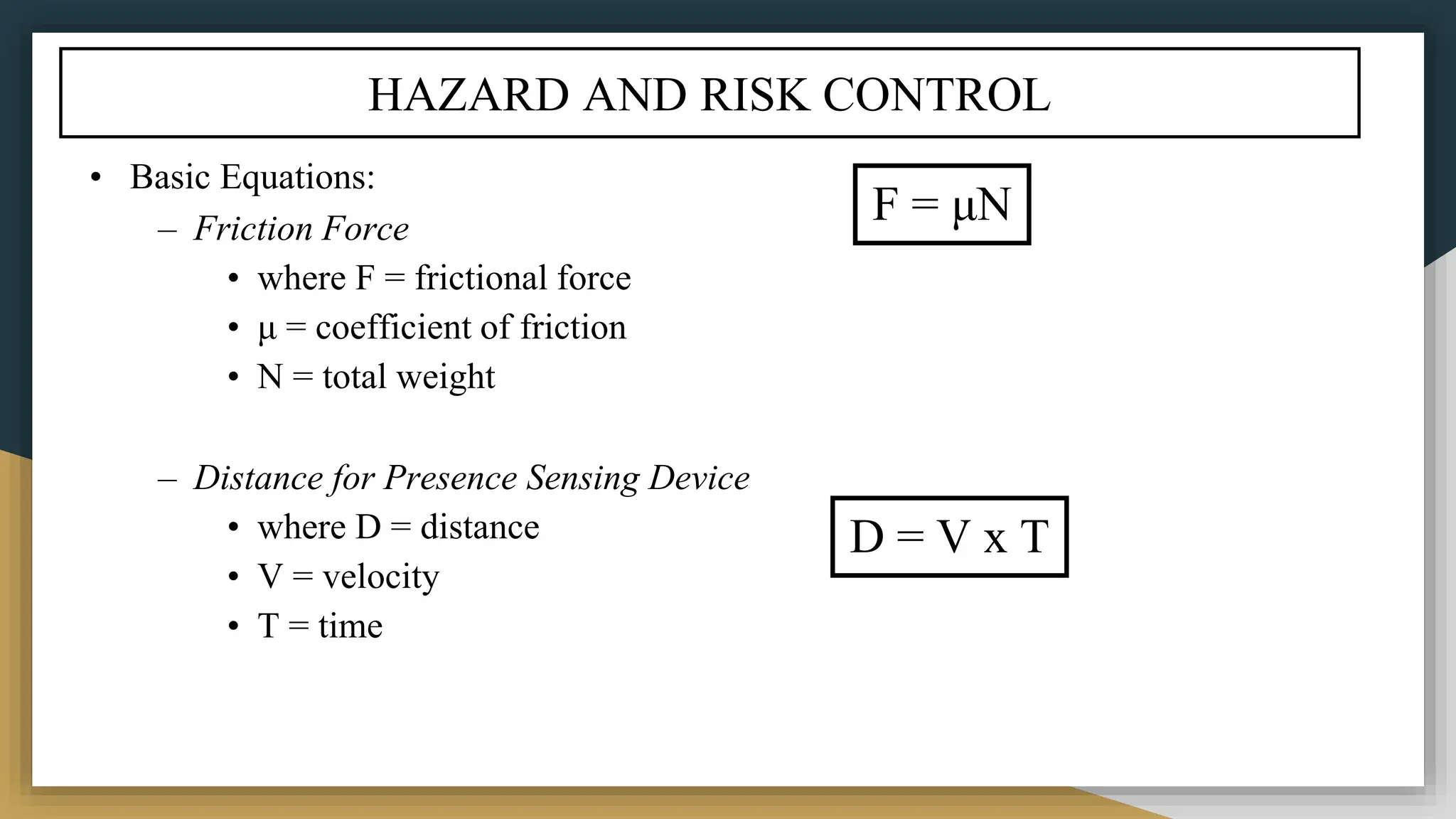
HAZARD AND RISK CONTROL
• Basic Equations:
– Friction Force
• where F = frictional force
• μ = coefficient of friction
• N = total weight
– Distance for Presence Sensing Device
• where D = distance
• V = velocity
• T = time
F = μN
D = V x T
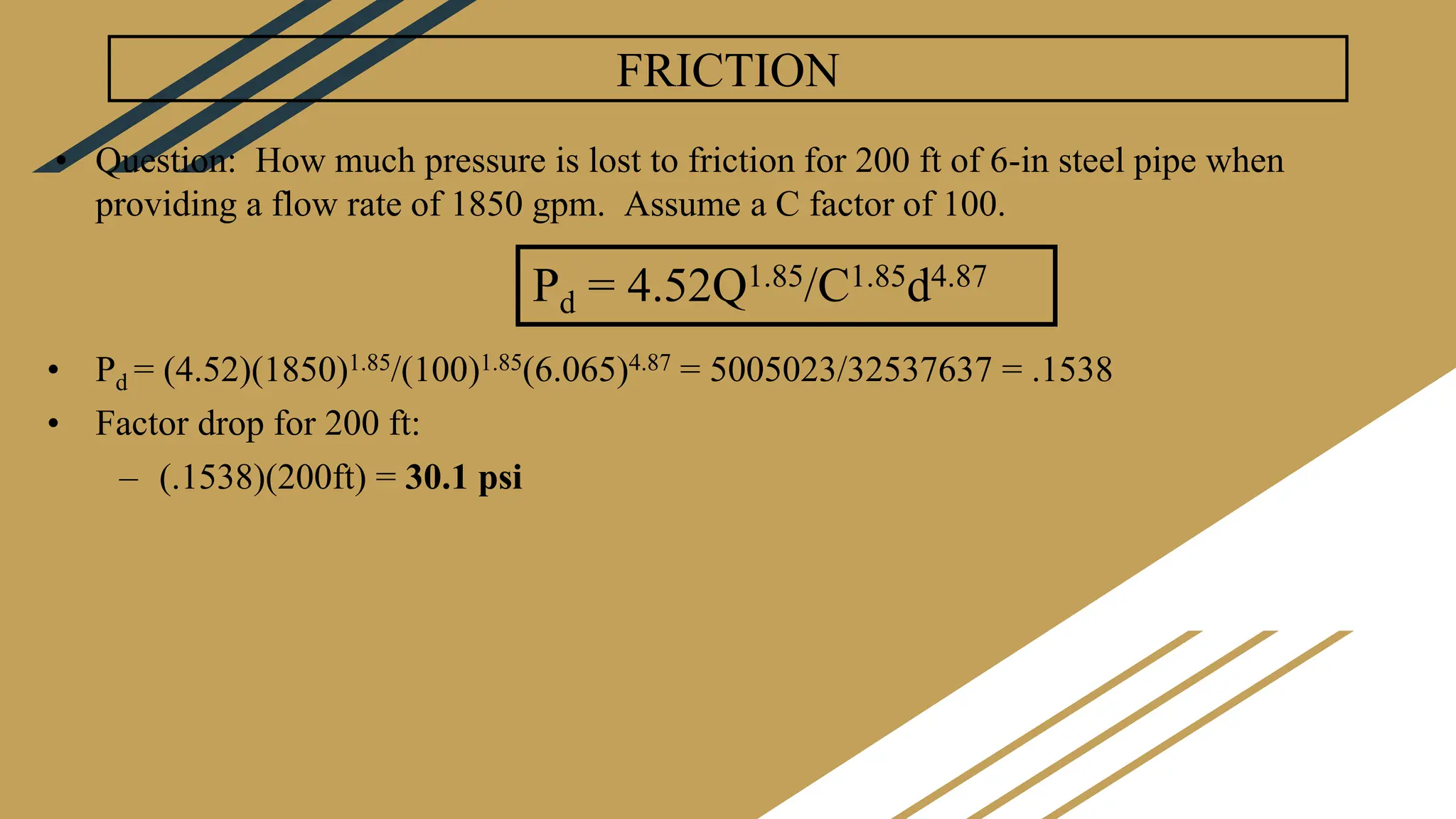
FRICTION
• Question: How much pressure is lost to friction for 200 ft of 6-in steel pipe when
providing a flow rate of 1850 gpm. Assume a C factor of 100.
• Pd = (4.52)(1850)1.85/(100)1.85(6.065)4.87 = 5005023/32537637 = .1538
• Factor drop for 200 ft:
– (.1538)(200ft) = 30.1 psi
Pd = 4.52Q1.85/C1.85d4.87
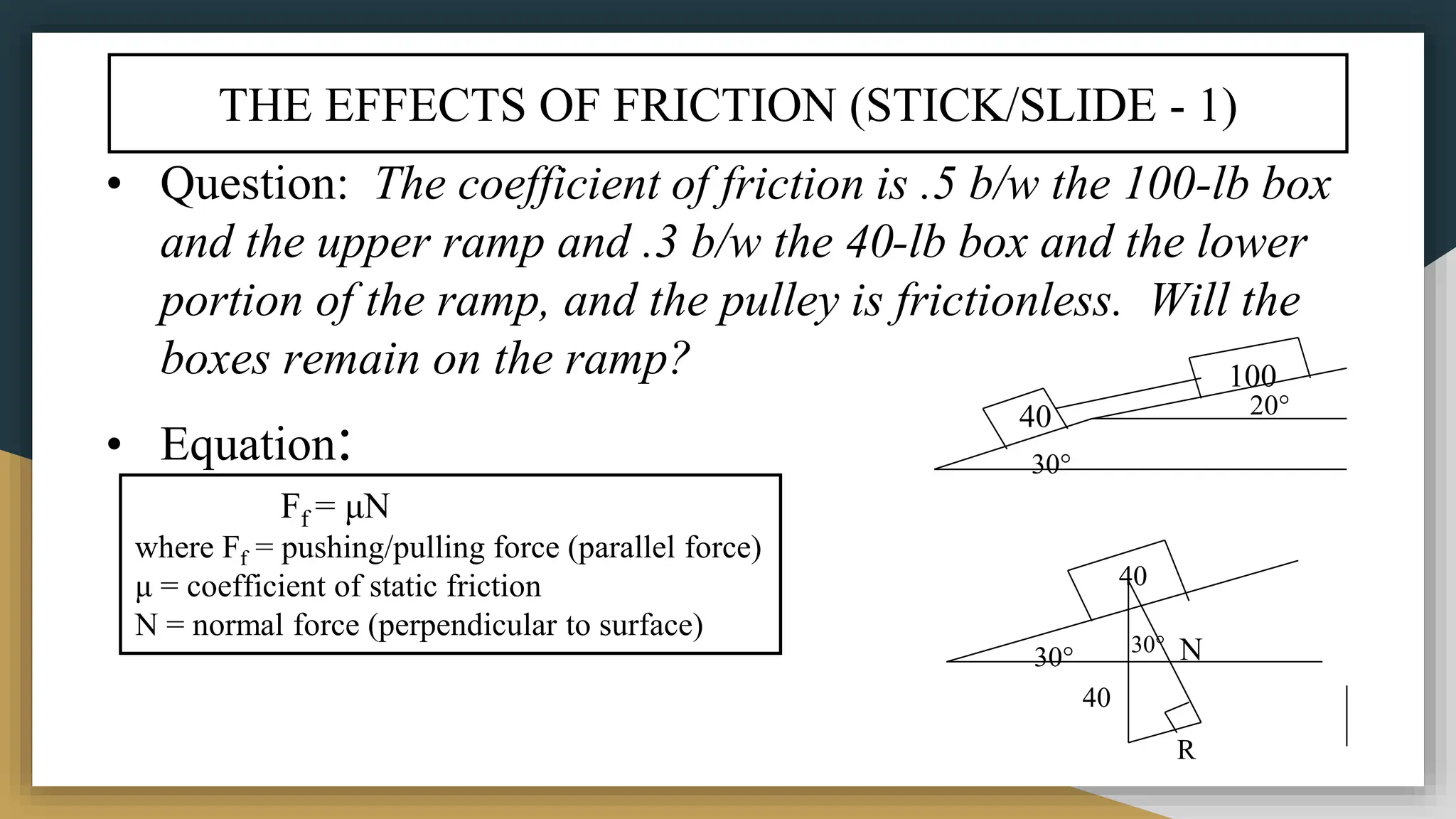
THE EFFECTS OF FRICTION (STICK/SLIDE - 1)
• Question: The coefficient of friction is .5 b/w the 100-lb box
and the upper ramp and .3 b/w the 40-lb box and the lower
portion of the ramp, and the pulley is frictionless. Will the
boxes remain on the ramp?
• Equation:
Ff = μN
where Ff = pushing/pulling force (parallel force)
μ = coefficient of static friction
N = normal force (perpendicular to surface)
40
100
30°
20°
40
30°
40
R
N
30°
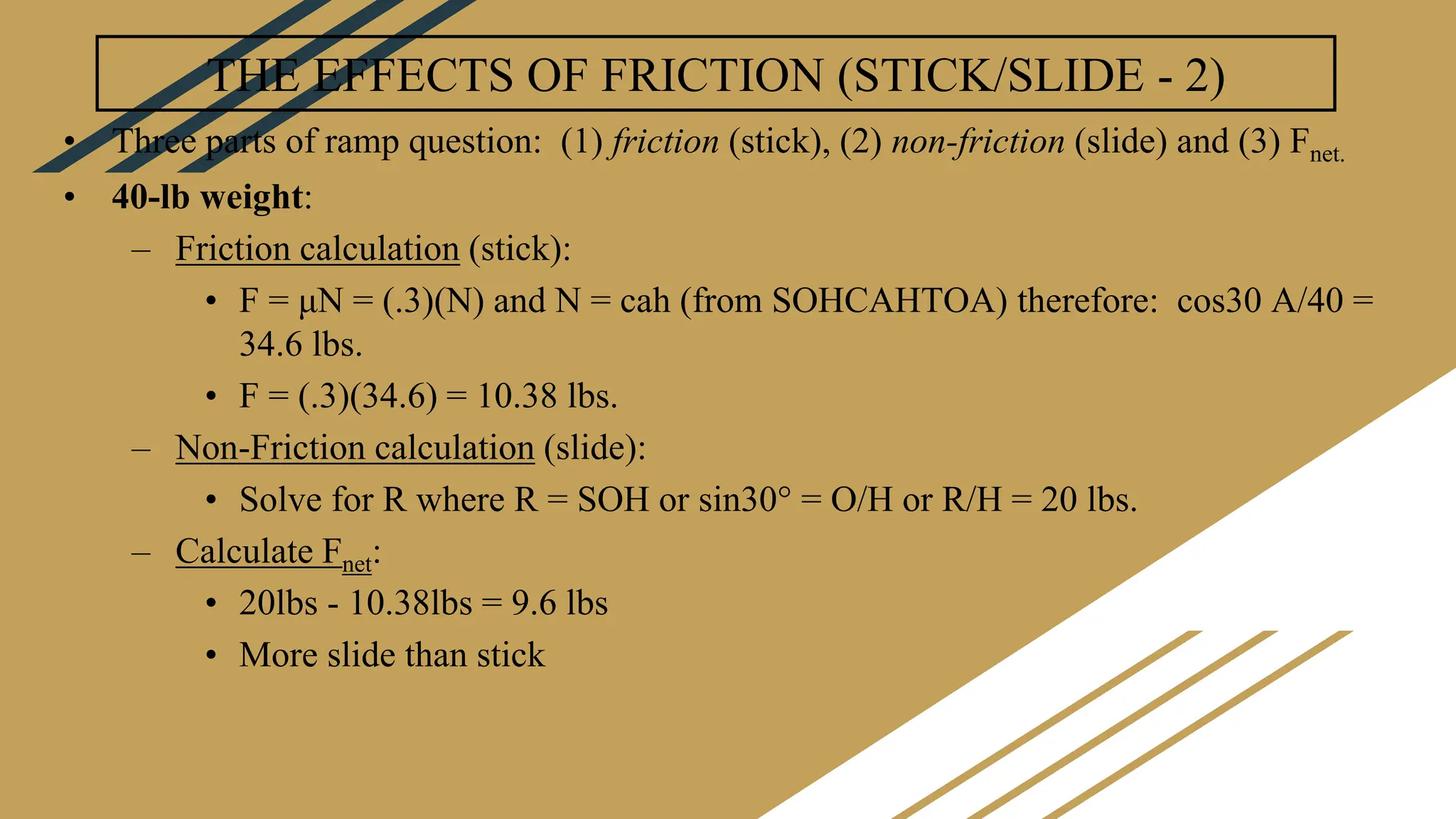
THE EFFECTS OF FRICTION (STICK/SLIDE - 2)
• Three parts of ramp question: (1) friction (stick), (2) non-friction (slide) and (3) Fnet.
• 40-lb weight:
– Friction calculation (stick):
• F = μN = (.3)(N) and N = cah (from SOHCAHTOA) therefore: cos30 A/40 =
34.6 lbs.
• F = (.3)(34.6) = 10.38 lbs.
– Non-Friction calculation (slide):
• Solve for R where R = SOH or sin30° = O/H or R/H = 20 lbs.
– Calculate Fnet:
• 20lbs - 10.38lbs = 9.6 lbs
• More slide than stick
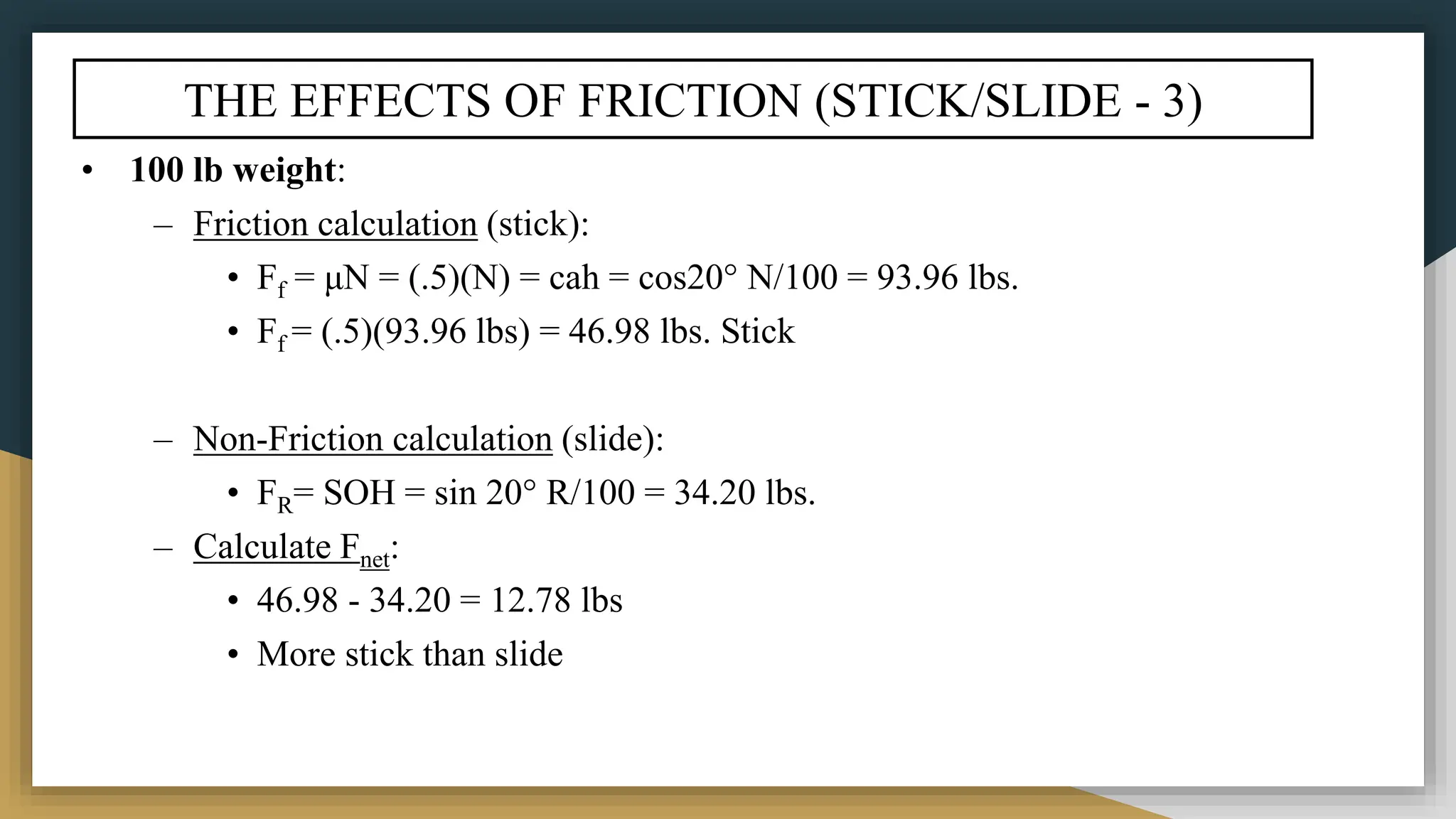
THE EFFECTS OF FRICTION (STICK/SLIDE - 3)
• 100 lb weight:
– Friction calculation (stick):
• Ff = μN = (.5)(N) = cah = cos20° N/100 = 93.96 lbs.
• Ff = (.5)(93.96 lbs) = 46.98 lbs. Stick
– Non-Friction calculation (slide):
• FR= SOH = sin 20° R/100 = 34.20 lbs.
– Calculate Fnet:
• 46.98 - 34.20 = 12.78 lbs
• More stick than slide
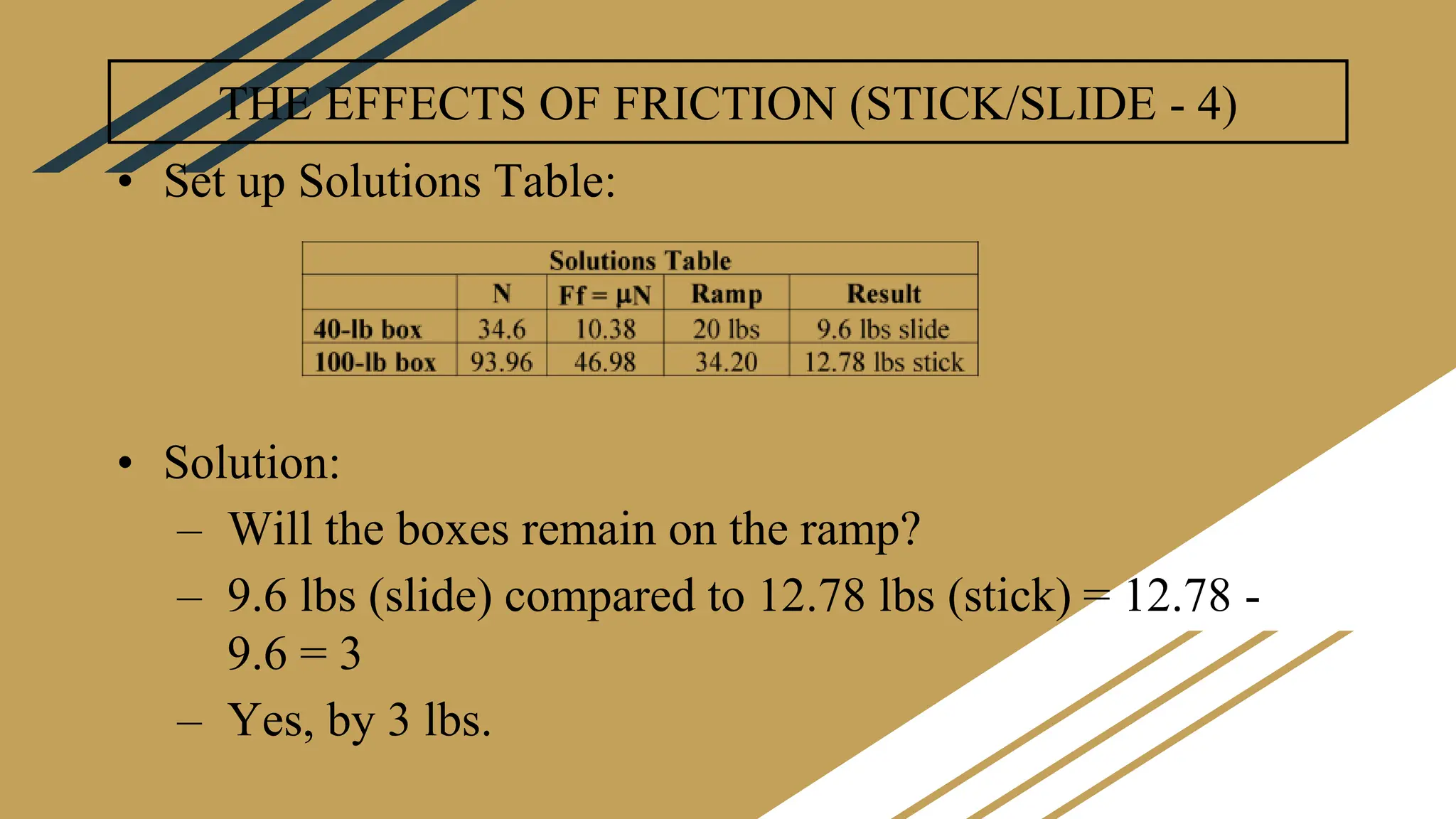
THE EFFECTS OF FRICTION (STICK/SLIDE - 4)
• Set up Solutions Table:
• Solution:
– Will the boxes remain on the ramp?
– 9.6 lbs (slide) compared to 12.78 lbs (stick) = 12.78 -
9.6 = 3
– Yes, by 3 lbs.
HAZARD AND RISK CONTROL
• Breaking Strength:
– where B is rope breaking strength
– S = # of parts of sheaves in rope
– W = weight
– F = Safety Factor B = [W + 0.1WS/S]F
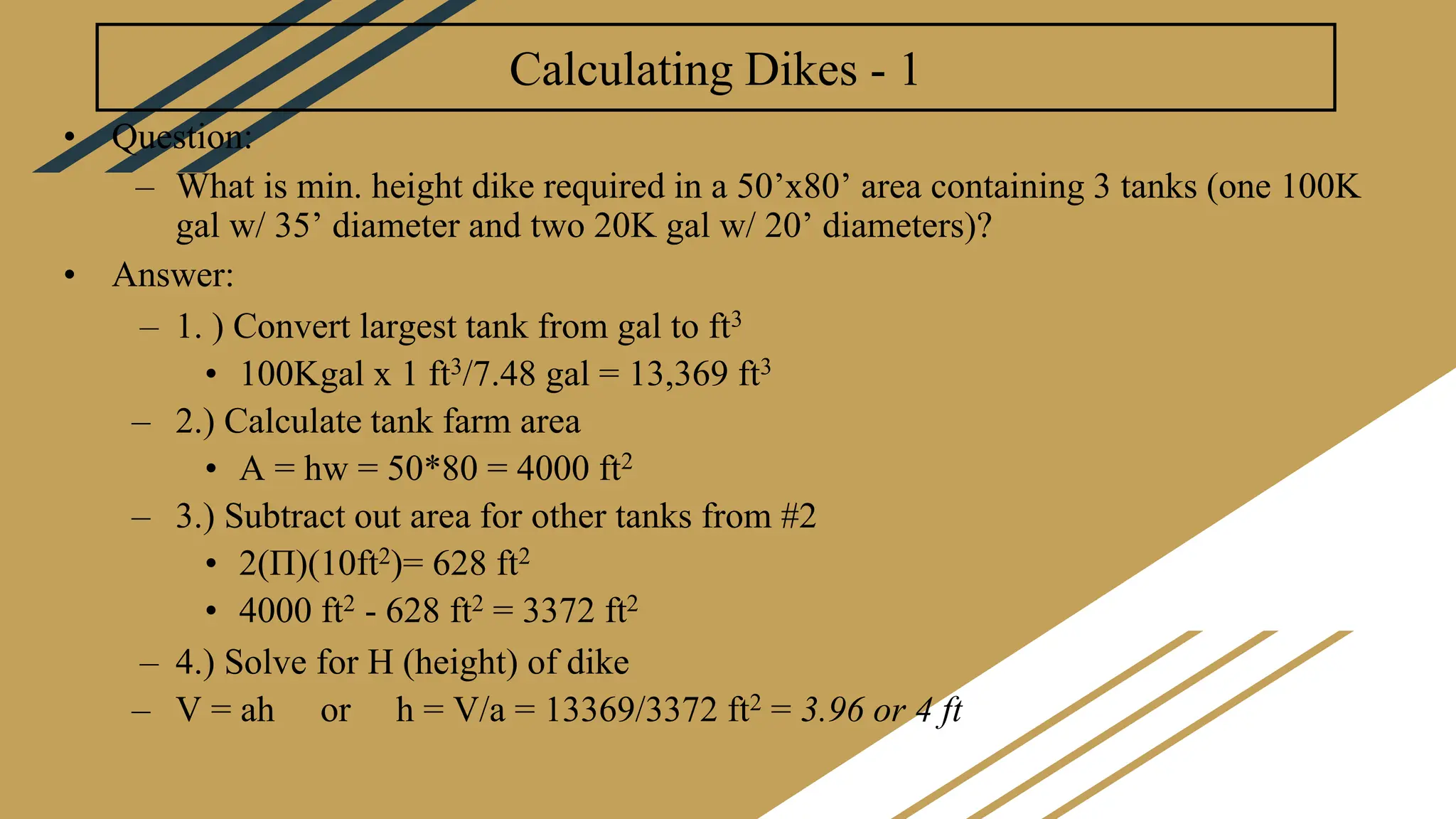
Calculating Dikes - 1
• Question:
– What is min. height dike required in a 50’x80’ area containing 3 tanks (one 100K
gal w/ 35’ diameter and two 20K gal w/ 20’ diameters)?
• Answer:
– 1. ) Convert largest tank from gal to ft3
• 100Kgal x 1 ft3/7.48 gal = 13,369 ft3
– 2.) Calculate tank farm area
• A = hw = 50*80 = 4000 ft2
– 3.) Subtract out area for other tanks from #2
• 2(Π)(10ft2)= 628 ft2
• 4000 ft2 - 628 ft2 = 3372 ft2
– 4.) Solve for H (height) of dike
– V = ah or h = V/a = 13369/3372 ft2 = 3.96 or 4 ft
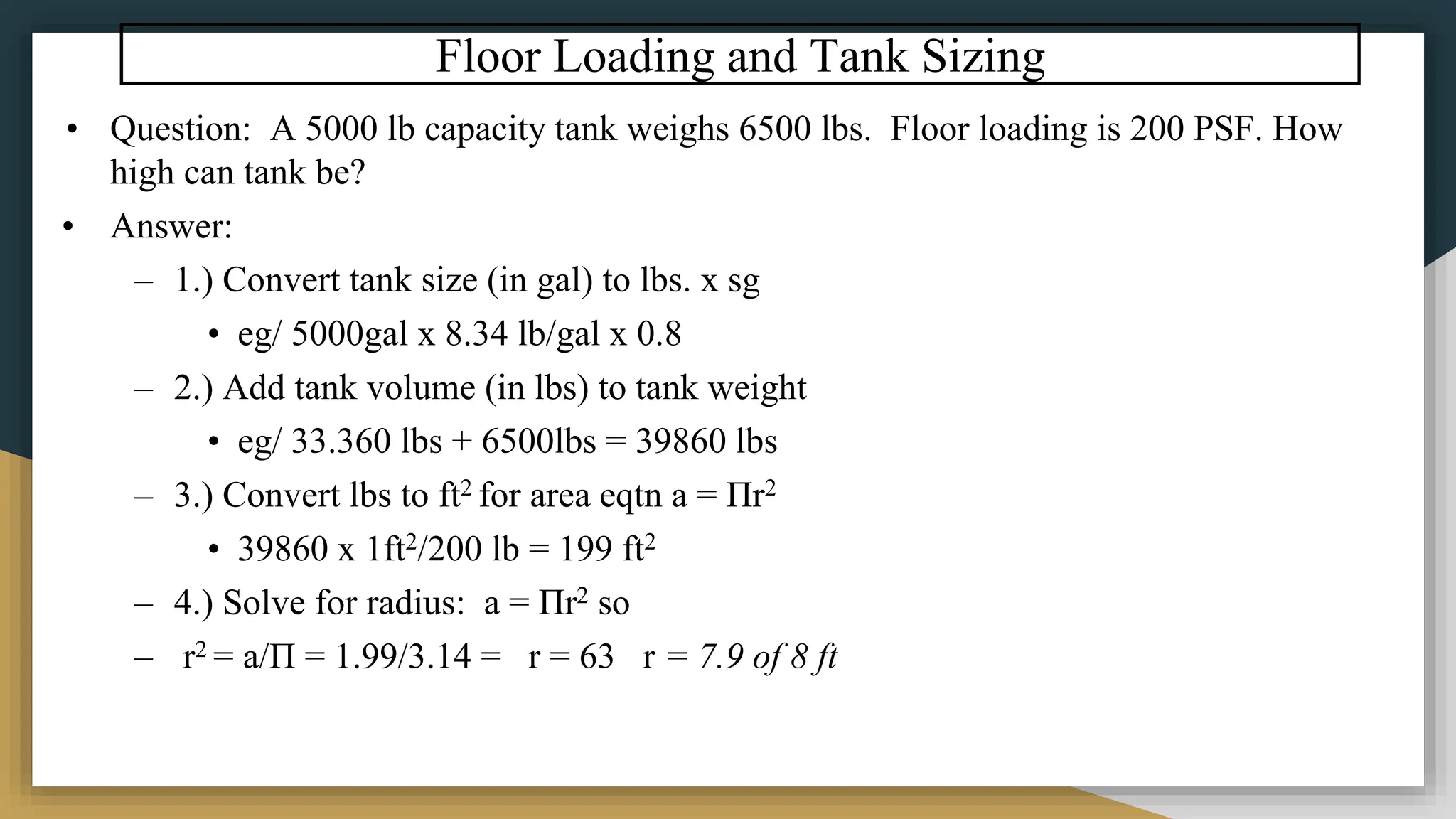
Floor Loading and Tank Sizing
• Question: A 5000 lb capacity tank weighs 6500 lbs. Floor loading is 200 PSF. How
high can tank be?
• Answer:
– 1.) Convert tank size (in gal) to lbs. x sg
• eg/ 5000gal x 8.34 lb/gal x 0.8
– 2.) Add tank volume (in lbs) to tank weight
• eg/ 33.360 lbs + 6500lbs = 39860 lbs
– 3.) Convert lbs to ft2 for area eqtn a = Πr2
• 39860 x 1ft2/200 lb = 199 ft2
– 4.) Solve for radius: a = Πr2 so
– r2 = a/Π = 1.99/3.14 = r = 63 r = 7.9 of 8 ft
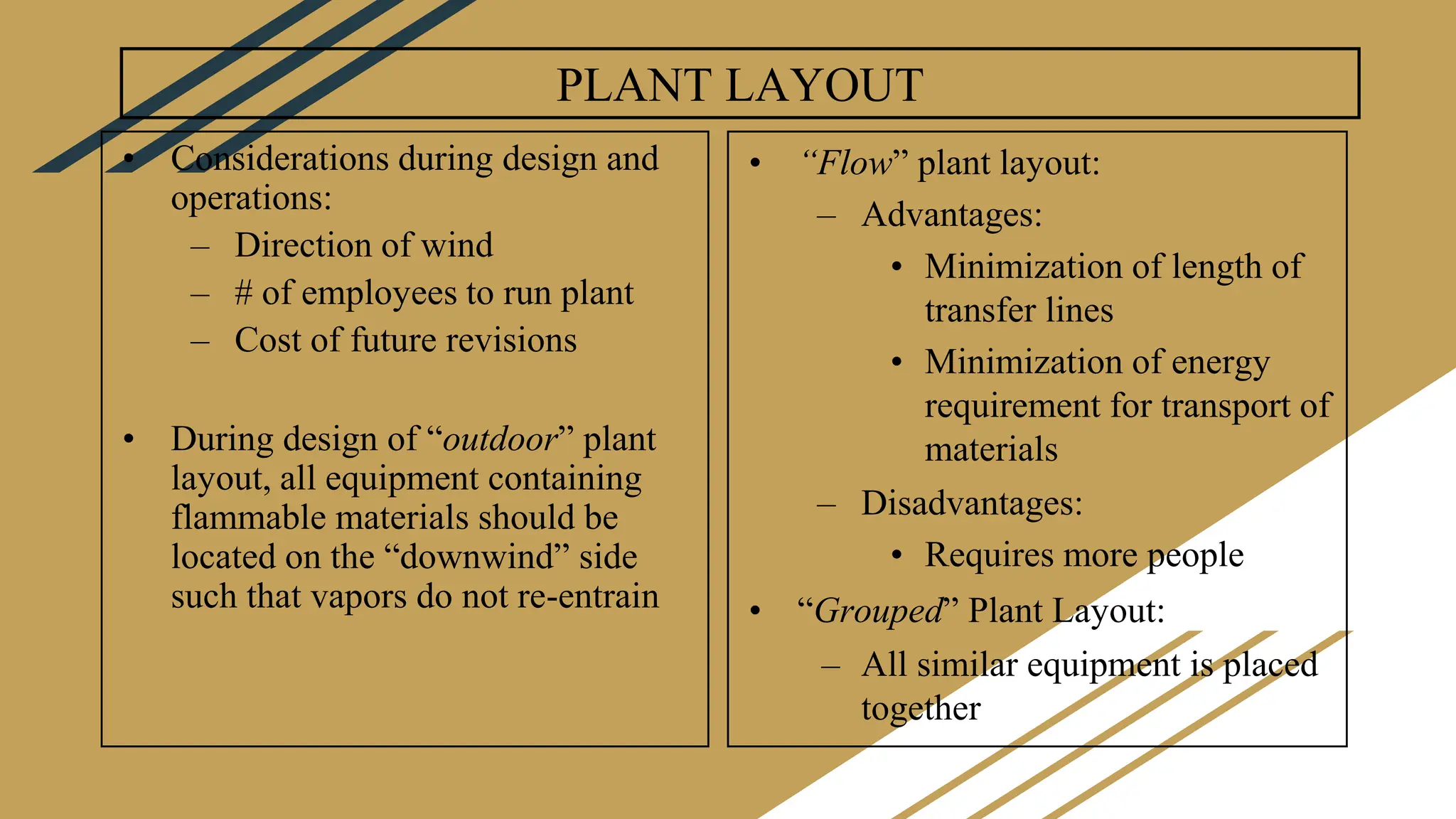
PLANT LAYOUT
• Considerations during design and
operations:
– Direction of wind
– # of employees to run plant
– Cost of future revisions
• During design of “outdoor” plant
layout, all equipment containing
flammable materials should be
located on the “downwind” side
such that vapors do not re-entrain
• “Flow” plant layout:
– Advantages:
• Minimization of length of
transfer lines
• Minimization of energy
requirement for transport of
materials
– Disadvantages:
• Requires more people
• “Grouped” Plant Layout:
– All similar equipment is placed
together
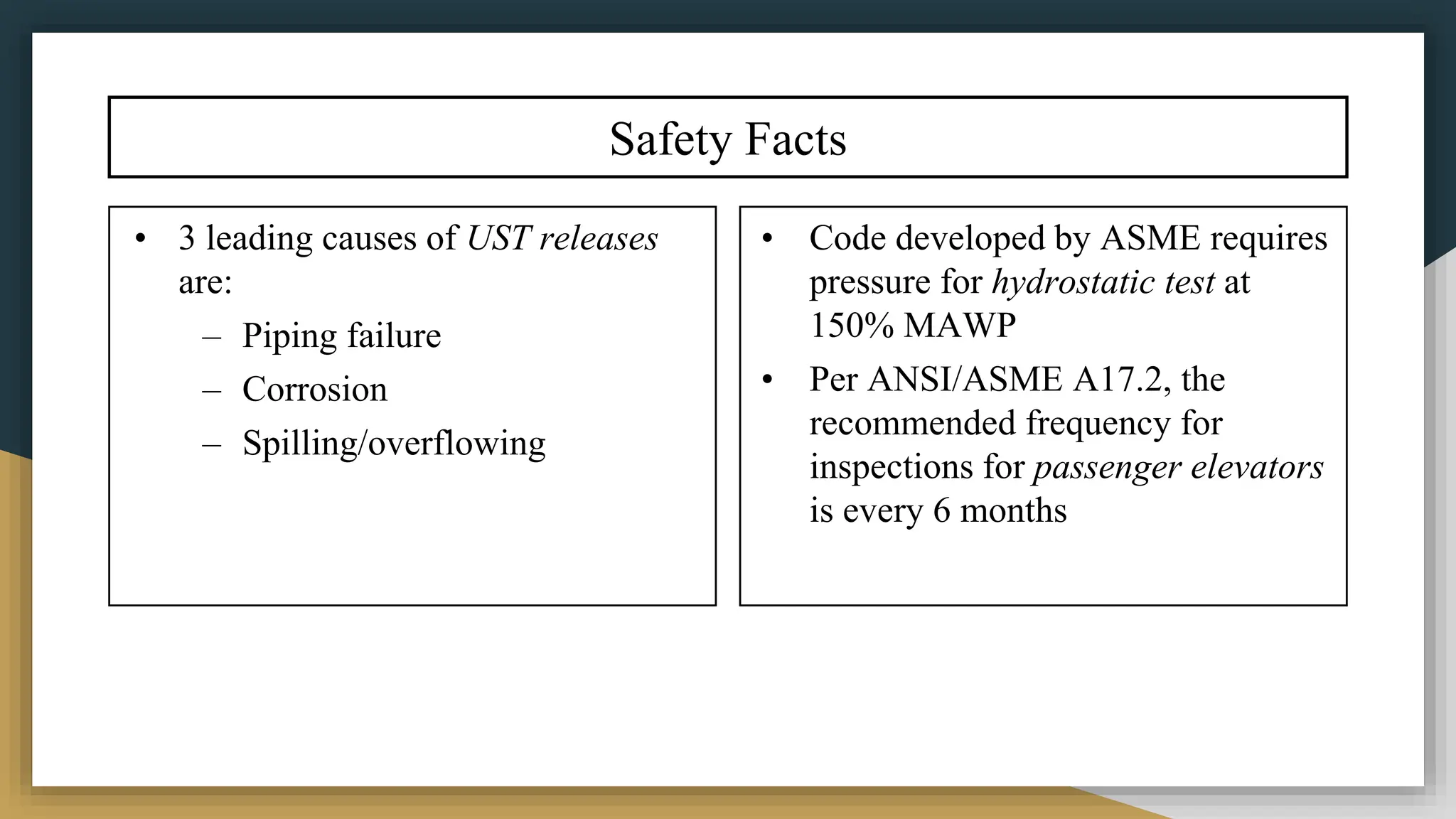
Safety Facts
• 3 leading causes of UST releases
are:
– Piping failure
– Corrosion
– Spilling/overflowing
• Code developed by ASME requires
pressure for hydrostatic test at
150% MAWP
• Per ANSI/ASME A17.2, the
recommended frequency for
inspections for passenger elevators
is every 6 months
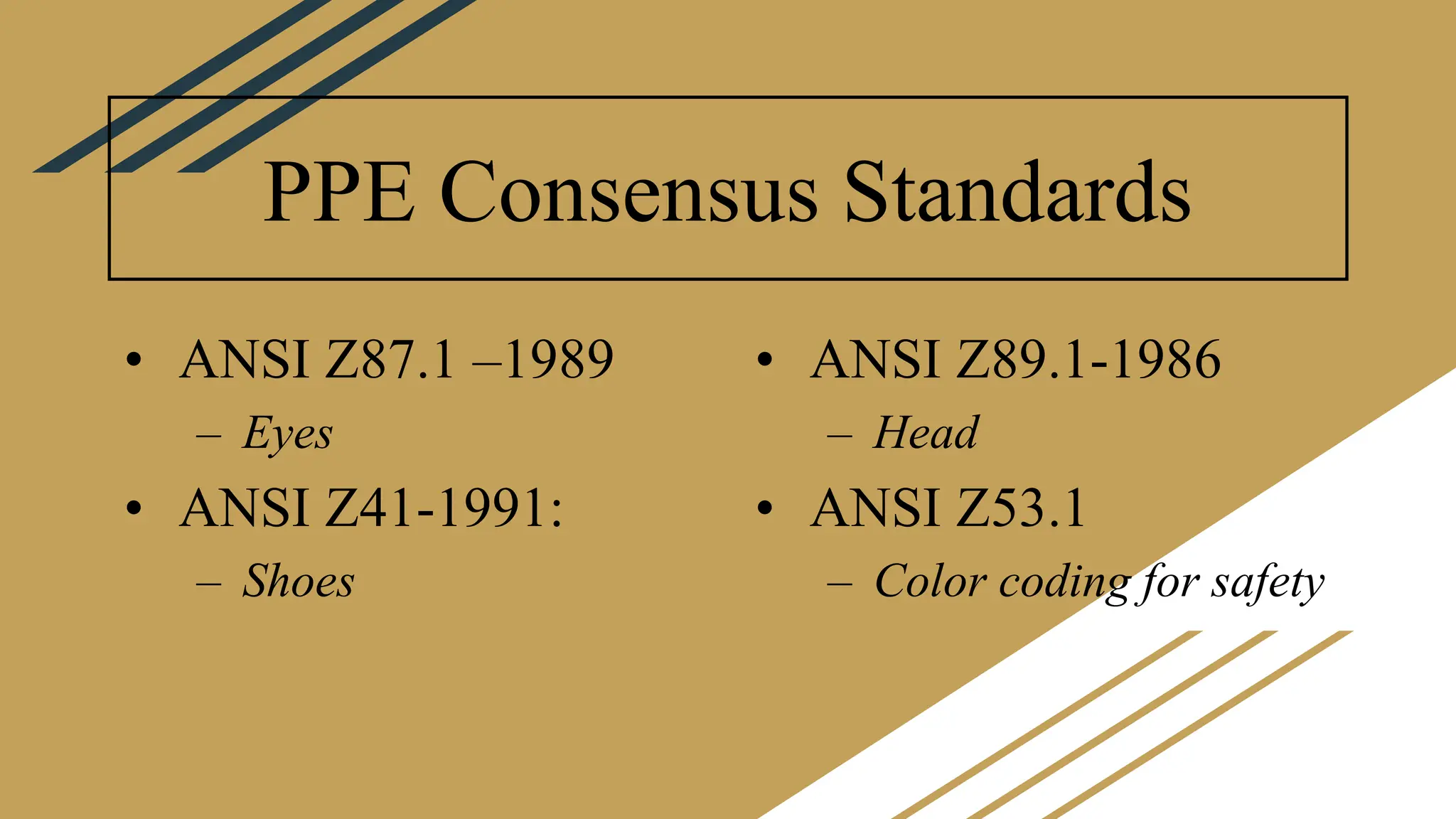
PPE Consensus Standards
• ANSI Z87.1 –1989
– Eyes
• ANSI Z41-1991:
– Shoes
• ANSI Z89.1-1986
– Head
• ANSI Z53.1
– Color coding for safety
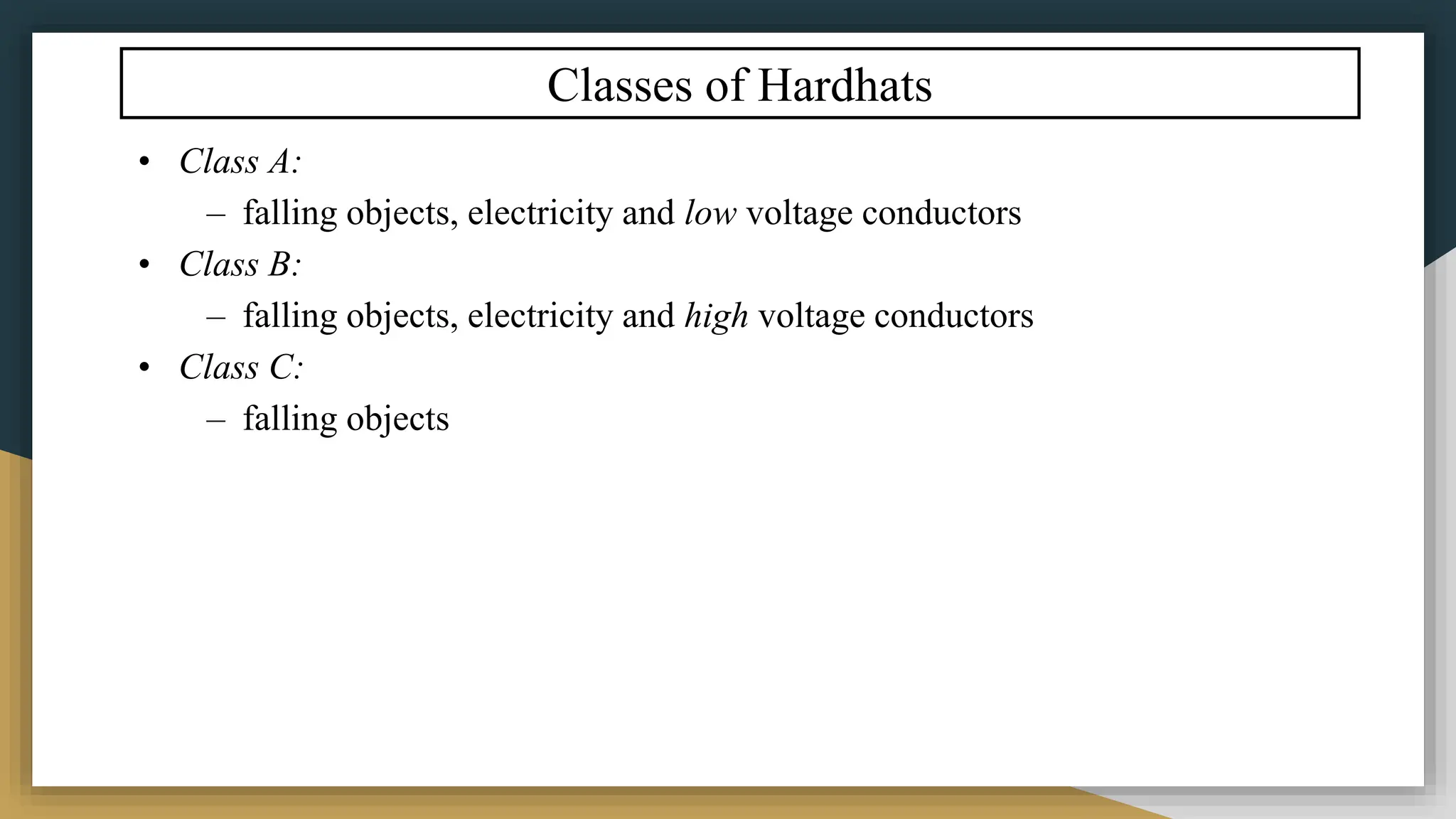
Classes of Hardhats
• Class A:
– falling objects, electricity and low voltage conductors
• Class B:
– falling objects, electricity and high voltage conductors
• Class C:
– falling objects
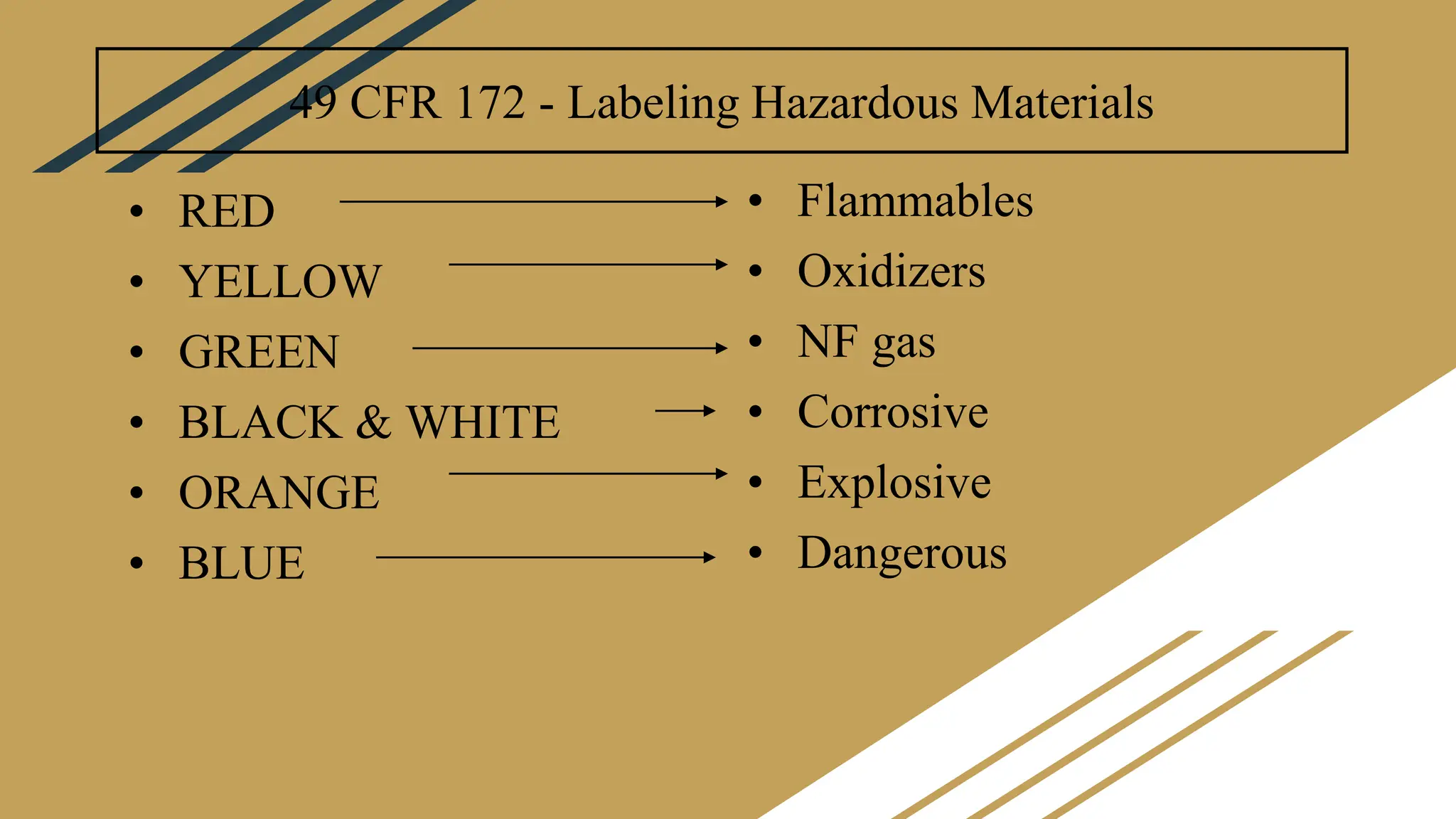
49 CFR 172 - Labeling Hazardous Materials
• RED
• YELLOW
• GREEN
• BLACK & WHITE
• ORANGE
• BLUE
• Flammables
• Oxidizers
• NF gas
• Corrosive
• Explosive
• Dangerous
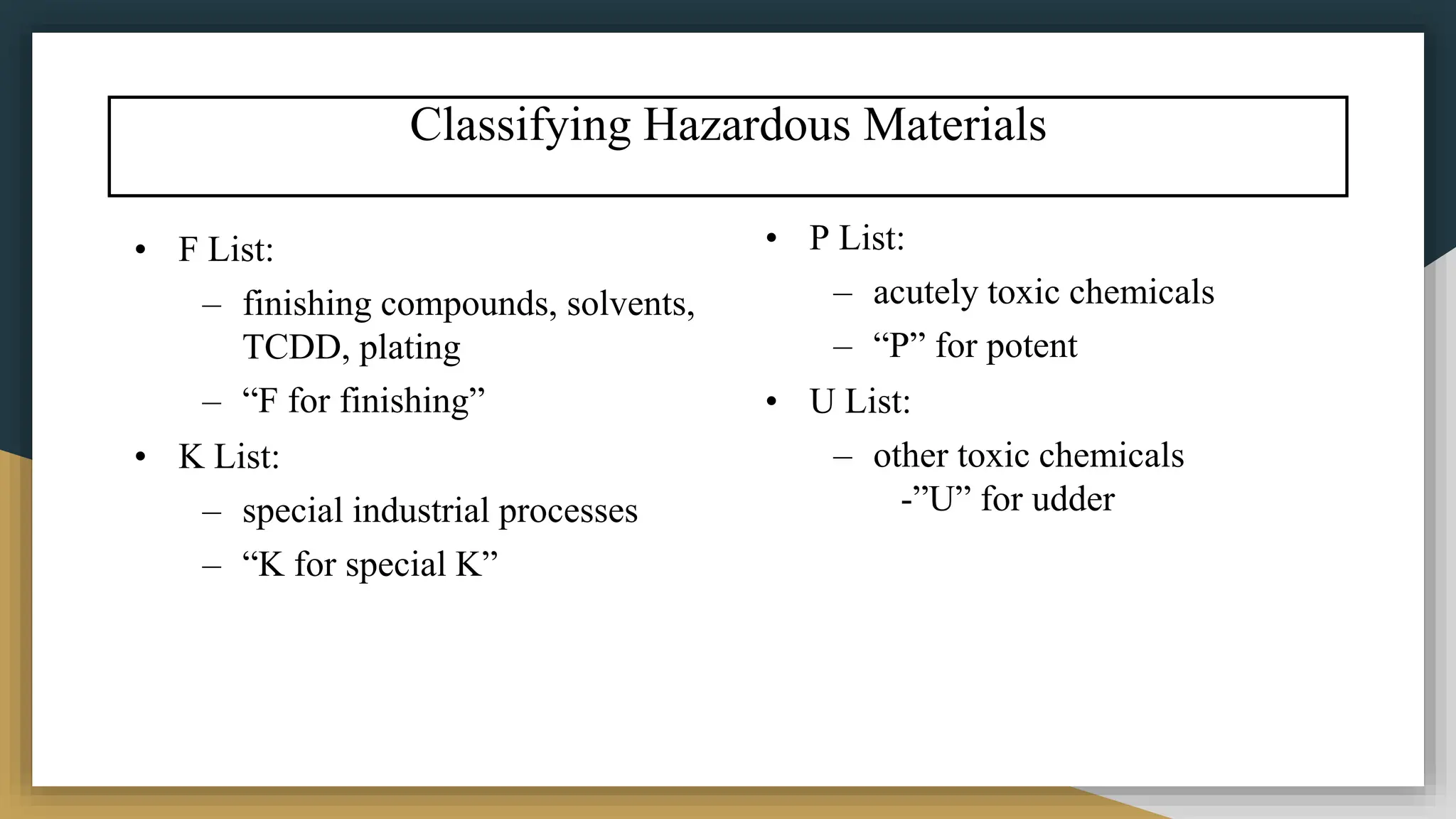
Classifying Hazardous Materials
• F List:
– finishing compounds, solvents,
TCDD, plating
– “F for finishing”
• K List:
– special industrial processes
– “K for special K”
• P List:
– acutely toxic chemicals
– “P” for potent
• U List:
– other toxic chemicals
-”U” for udder
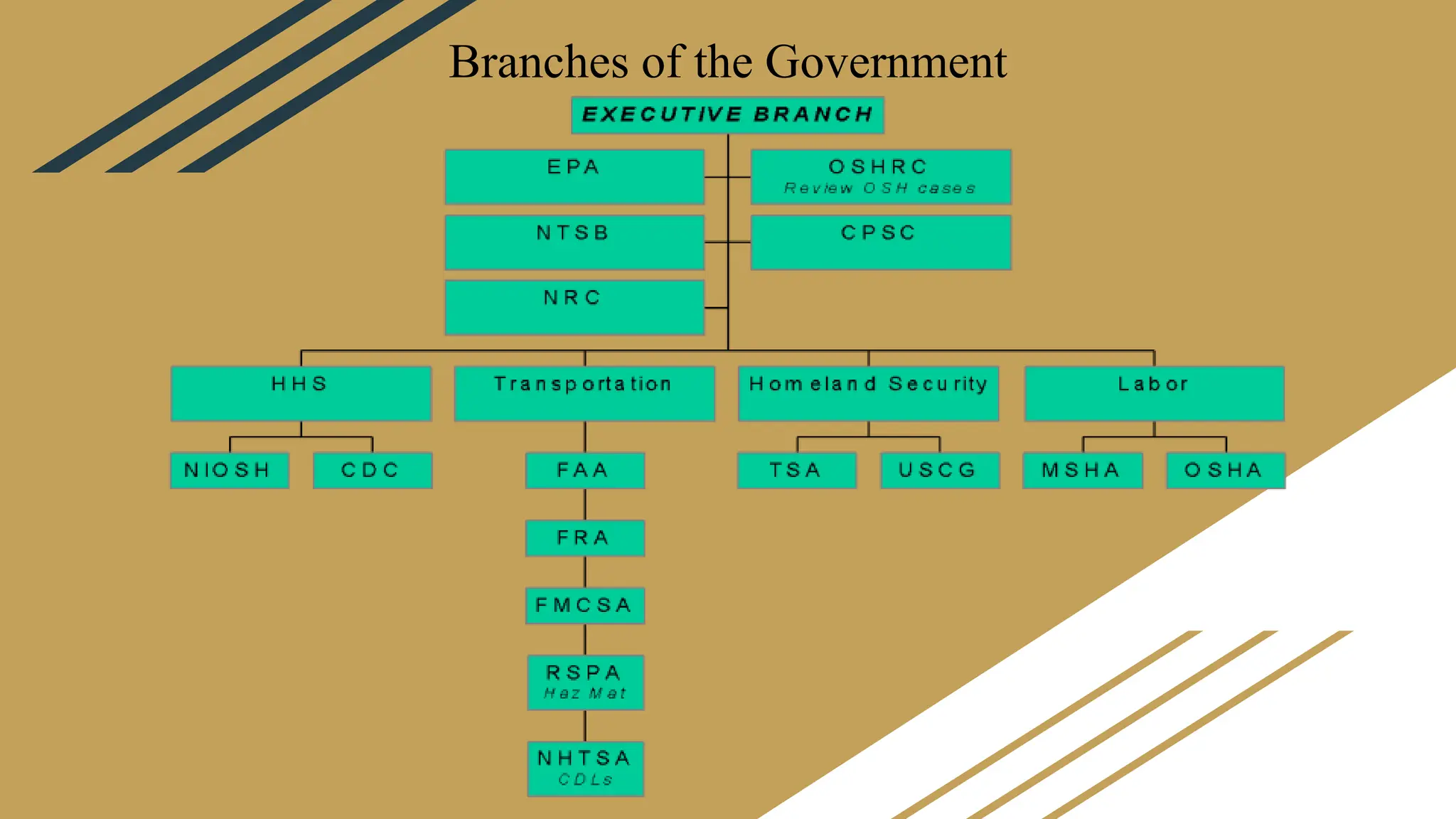
Branches of the Government
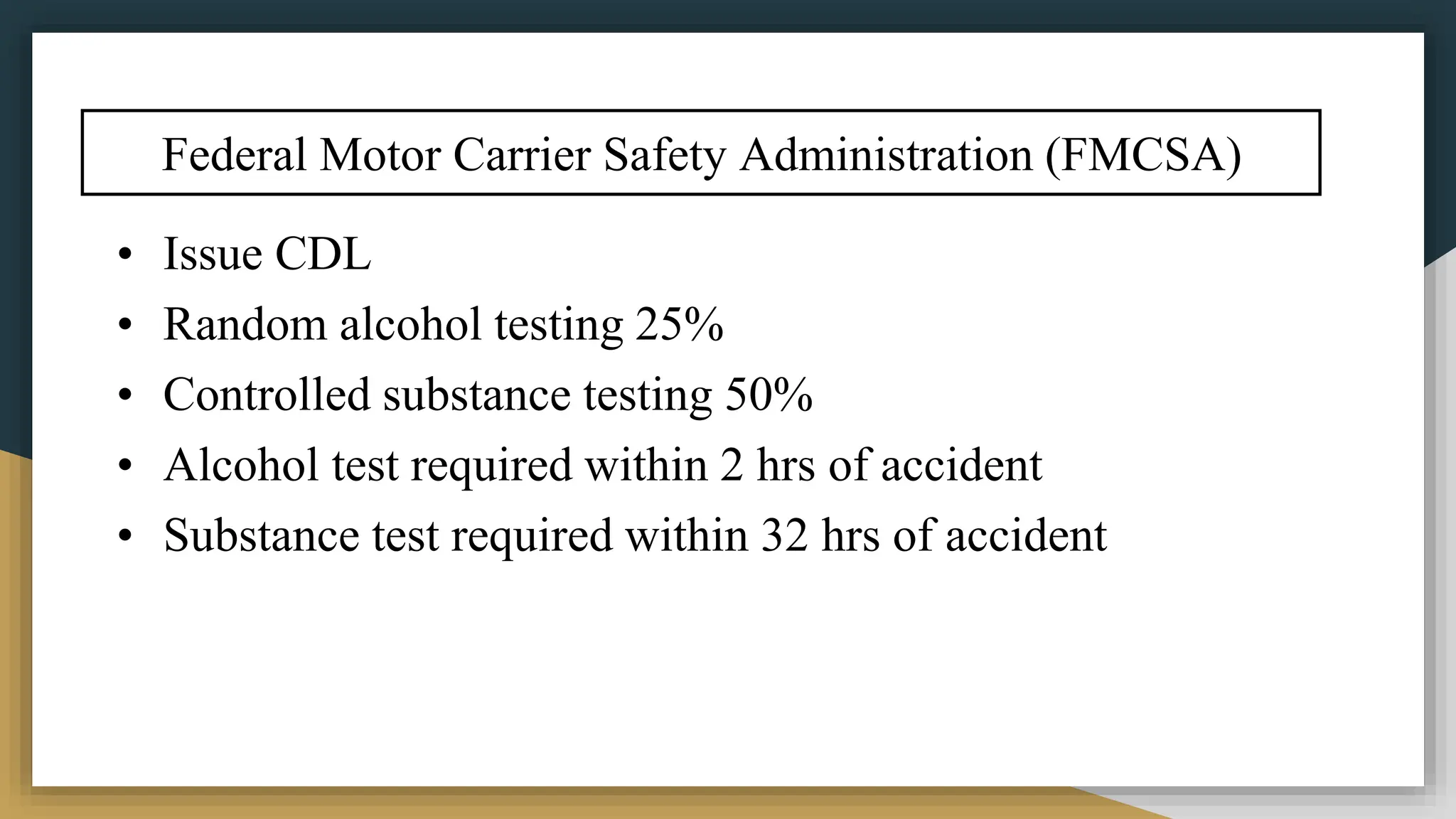
Federal Motor Carrier Safety Administration (FMCSA)
• Issue CDL
• Random alcohol testing 25%
• Controlled substance testing 50%
• Alcohol test required within 2 hrs of accident
• Substance test required within 32 hrs of accident
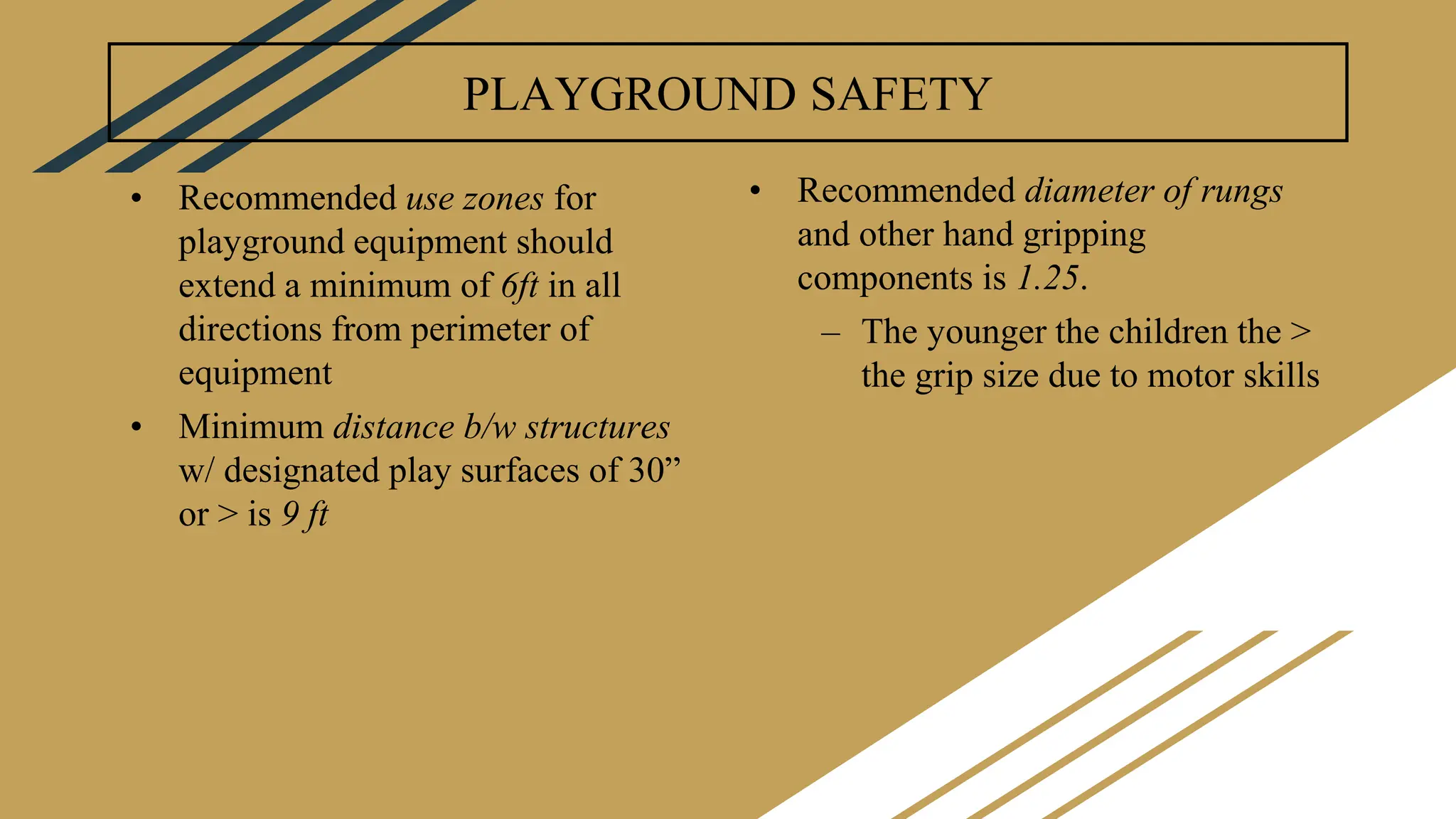
PLAYGROUND SAFETY
• Recommended use zones for
playground equipment should
extend a minimum of 6ft in all
directions from perimeter of
equipment
• Minimum distance b/w structures
w/ designated play surfaces of 30”
or > is 9 ft
• Recommended diameter of rungs
and other hand gripping
components is 1.25.
– The younger the children the >
the grip size due to motor skills
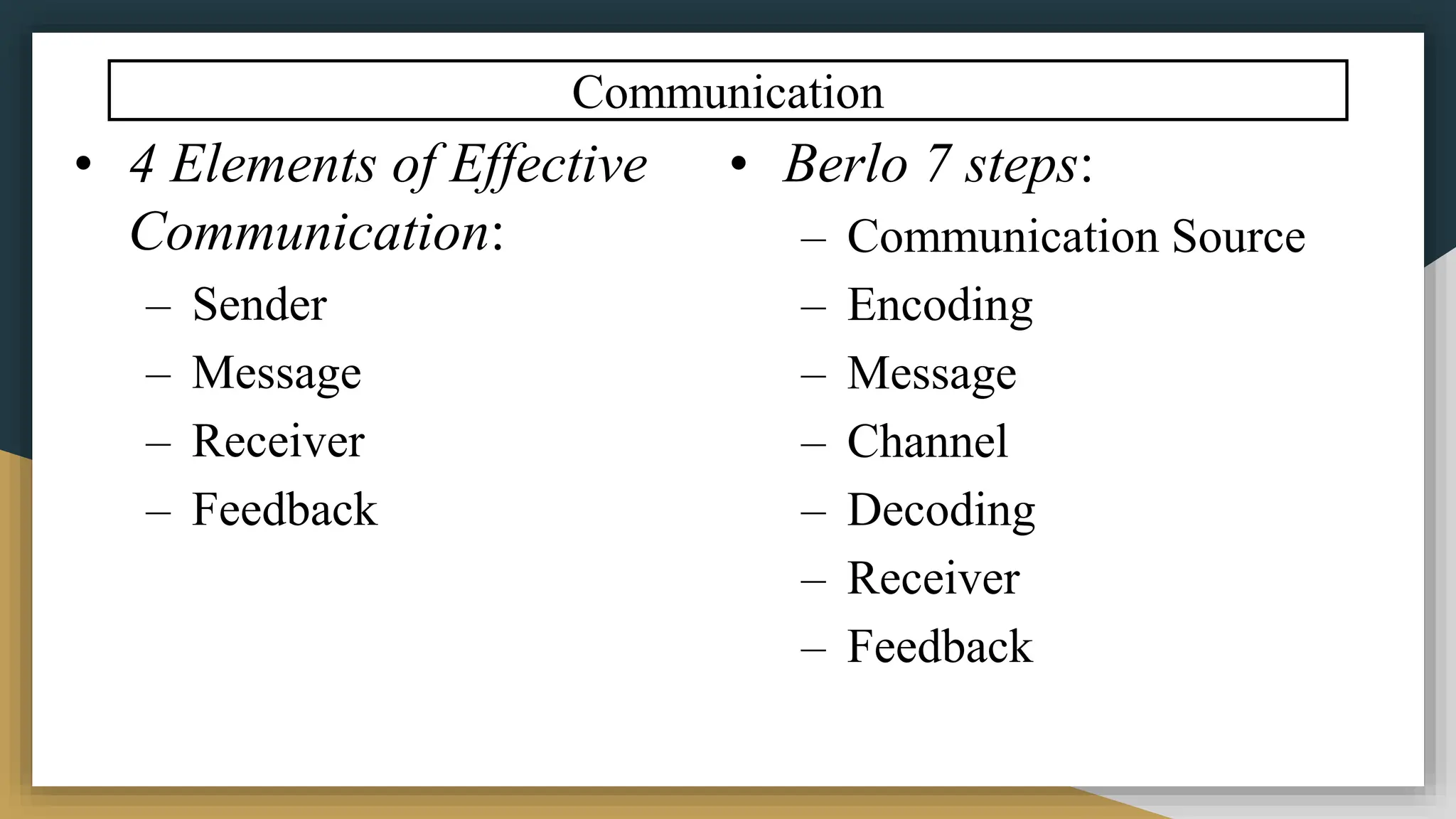
Communication
• 4 Elements of Effective
Communication:
– Sender
– Message
– Receiver
– Feedback
• Berlo 7 steps:
– Communication Source
– Encoding
– Message
– Channel
– Decoding
– Receiver
– Feedback
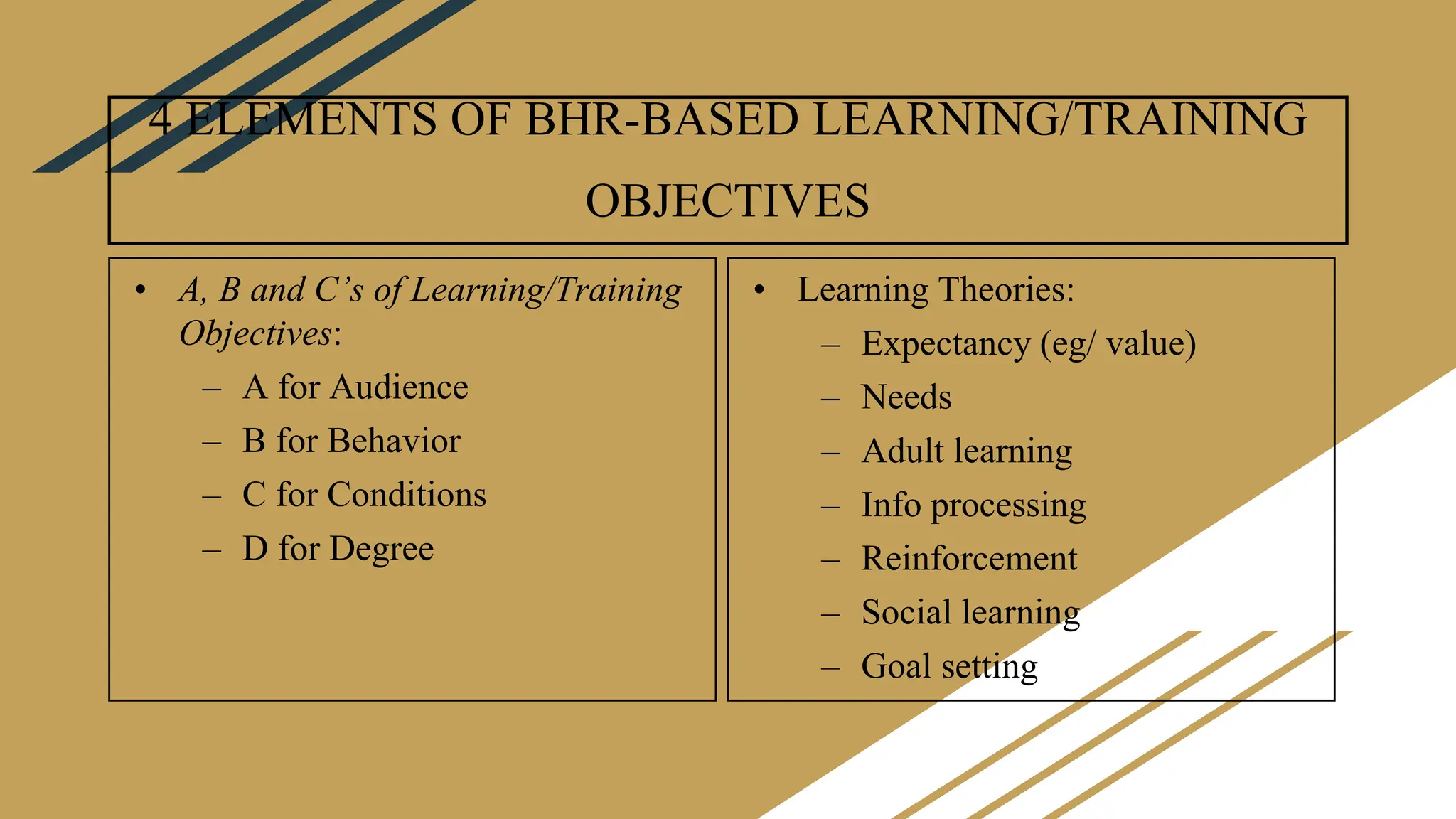
4 ELEMENTS OF BHR-BASED LEARNING/TRAINING
OBJECTIVES
• A, B and C’s of Learning/Training
Objectives:
– A for Audience
– B for Behavior
– C for Conditions
– D for Degree
• Learning Theories:
– Expectancy (eg/ value)
– Needs
– Adult learning
– Info processing
– Reinforcement
– Social learning
– Goal setting
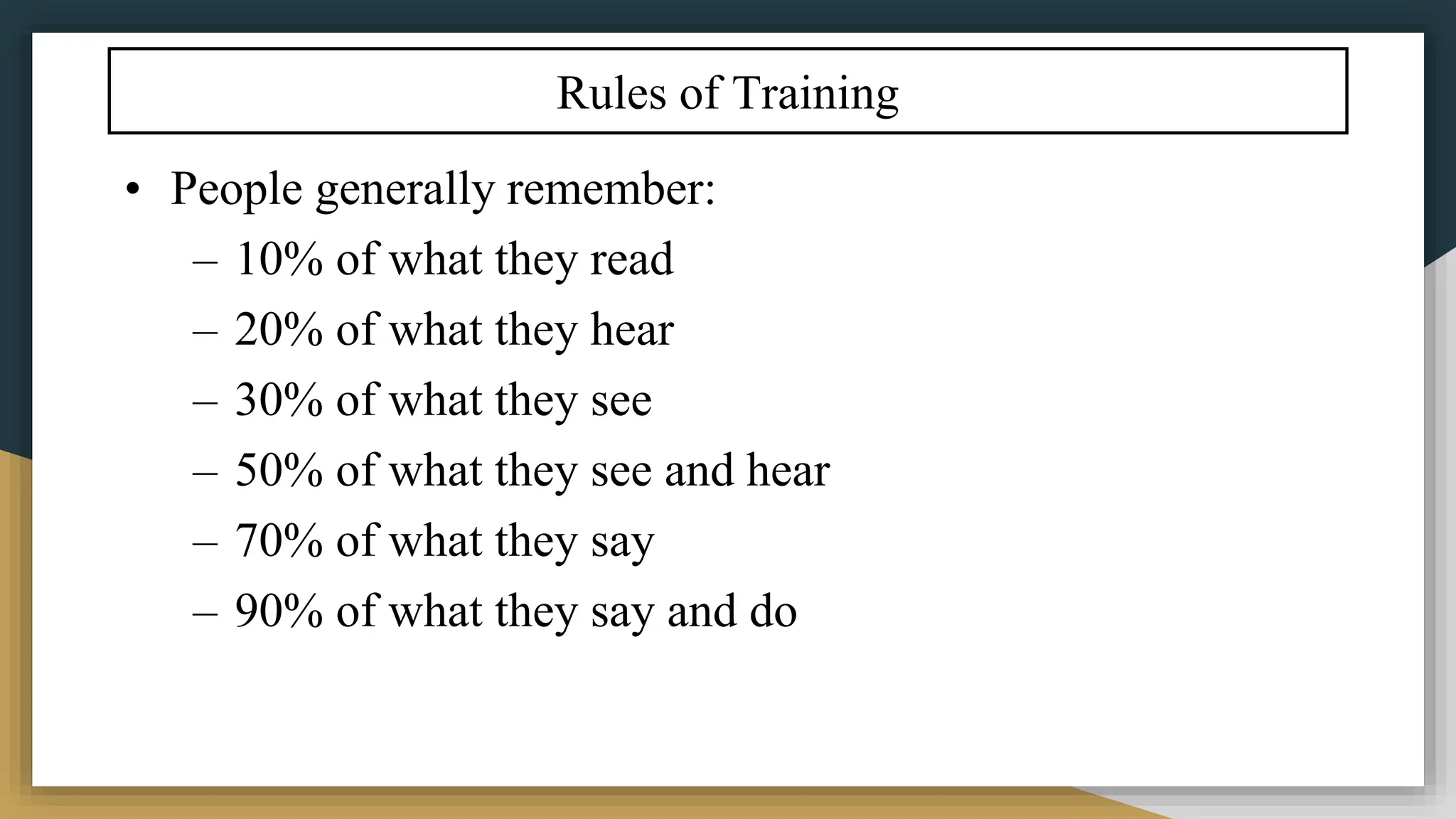
Rules of Training
• People generally remember:
– 10% of what they read
– 20% of what they hear
– 30% of what they see
– 50% of what they see and hear
– 70% of what they say
– 90% of what they say and do
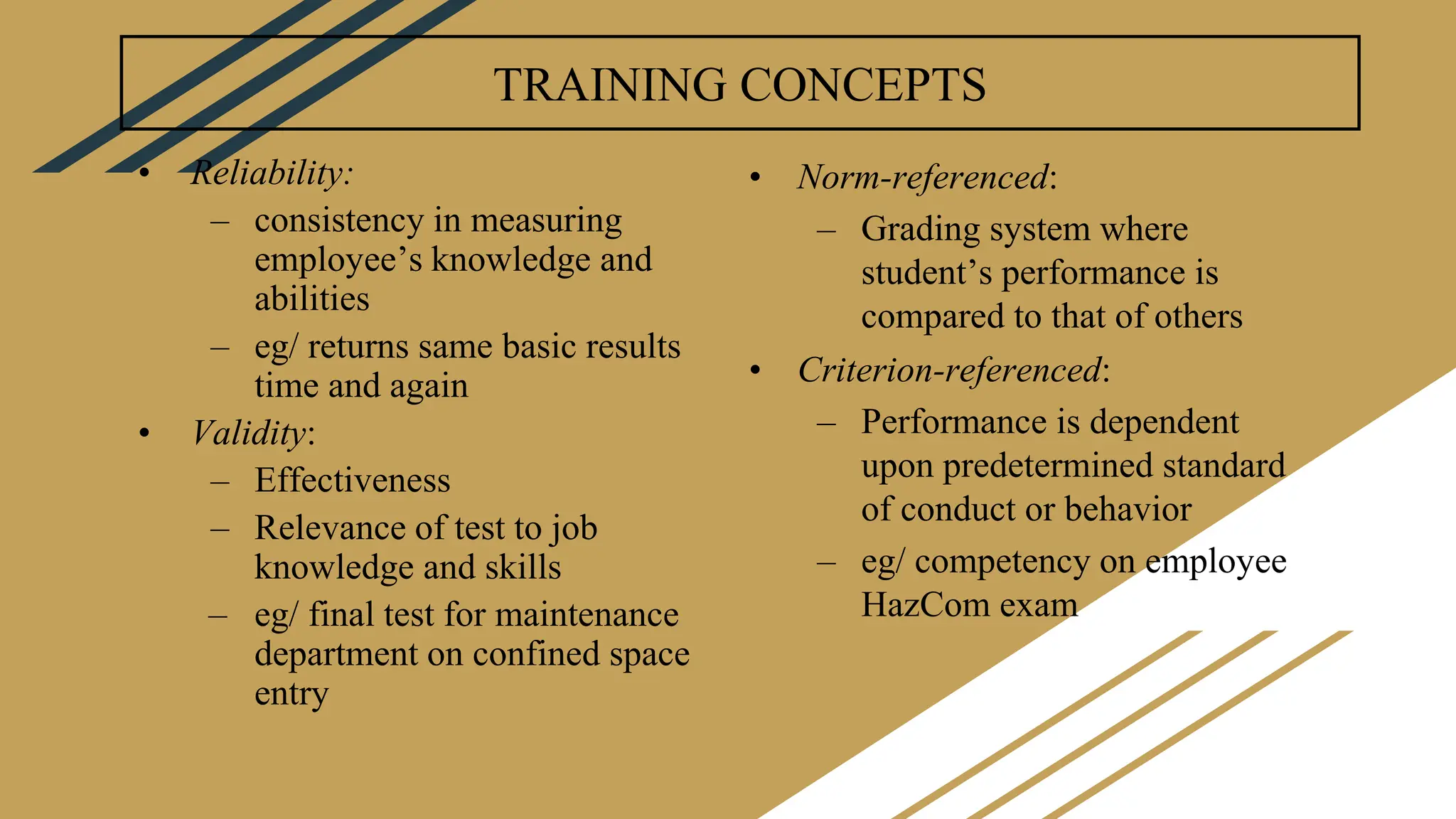
TRAINING CONCEPTS
• Reliability:
– consistency in measuring
employee’s knowledge and
abilities
– eg/ returns same basic results
time and again
• Validity:
– Effectiveness
– Relevance of test to job
knowledge and skills
– eg/ final test for maintenance
department on confined space
entry
• Norm-referenced:
– Grading system where
student’s performance is
compared to that of others
• Criterion-referenced:
– Performance is dependent
upon predetermined standard
of conduct or behavior
– eg/ competency on employee
HazCom exam
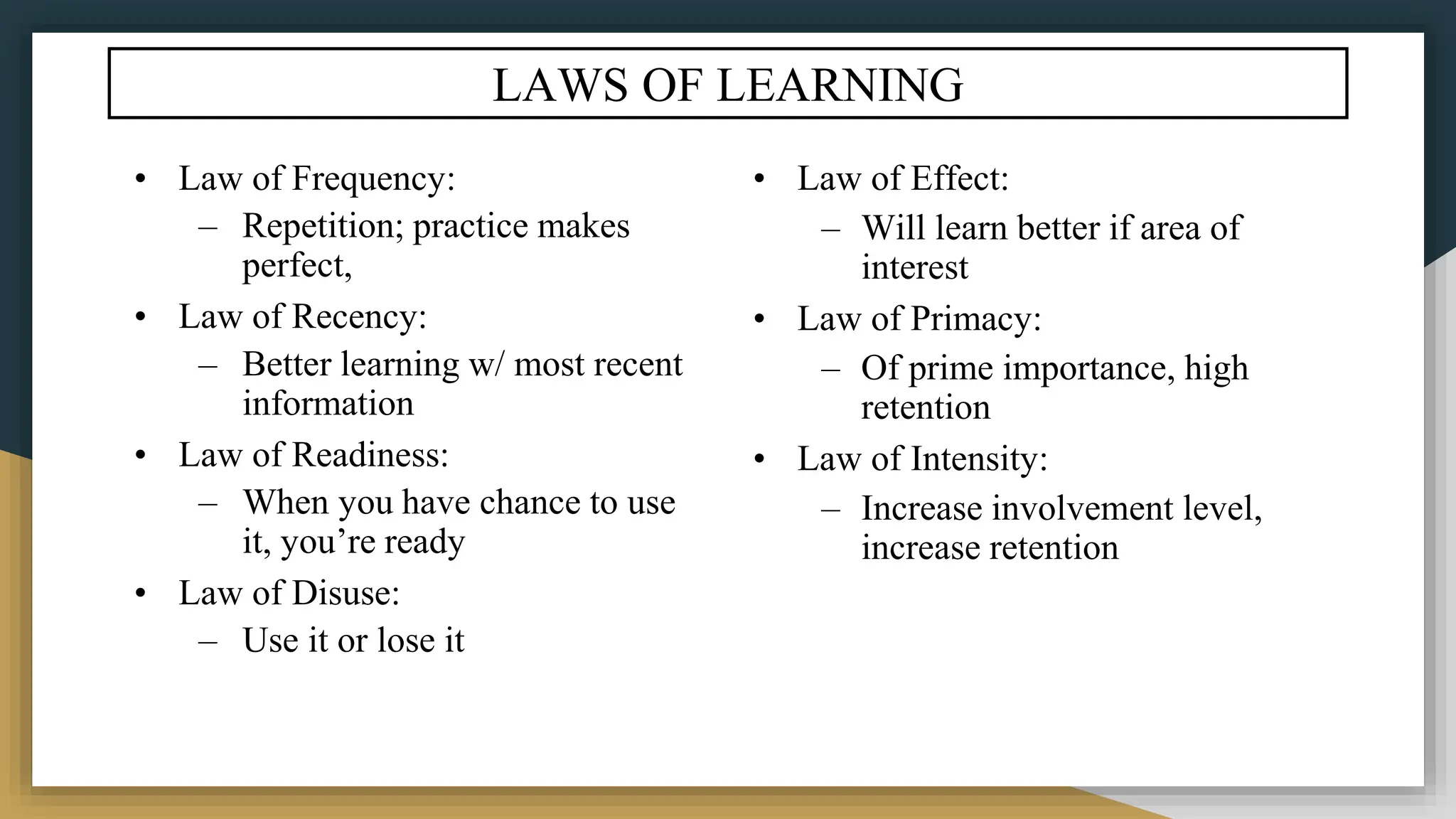
LAWS OF LEARNING
• Law of Frequency:
– Repetition; practice makes
perfect,
• Law of Recency:
– Better learning w/ most recent
information
• Law of Readiness:
– When you have chance to use
it, you’re ready
• Law of Disuse:
– Use it or lose it
• Law of Effect:
– Will learn better if area of
interest
• Law of Primacy:
– Of prime importance, high
retention
• Law of Intensity:
– Increase involvement level,
increase retention
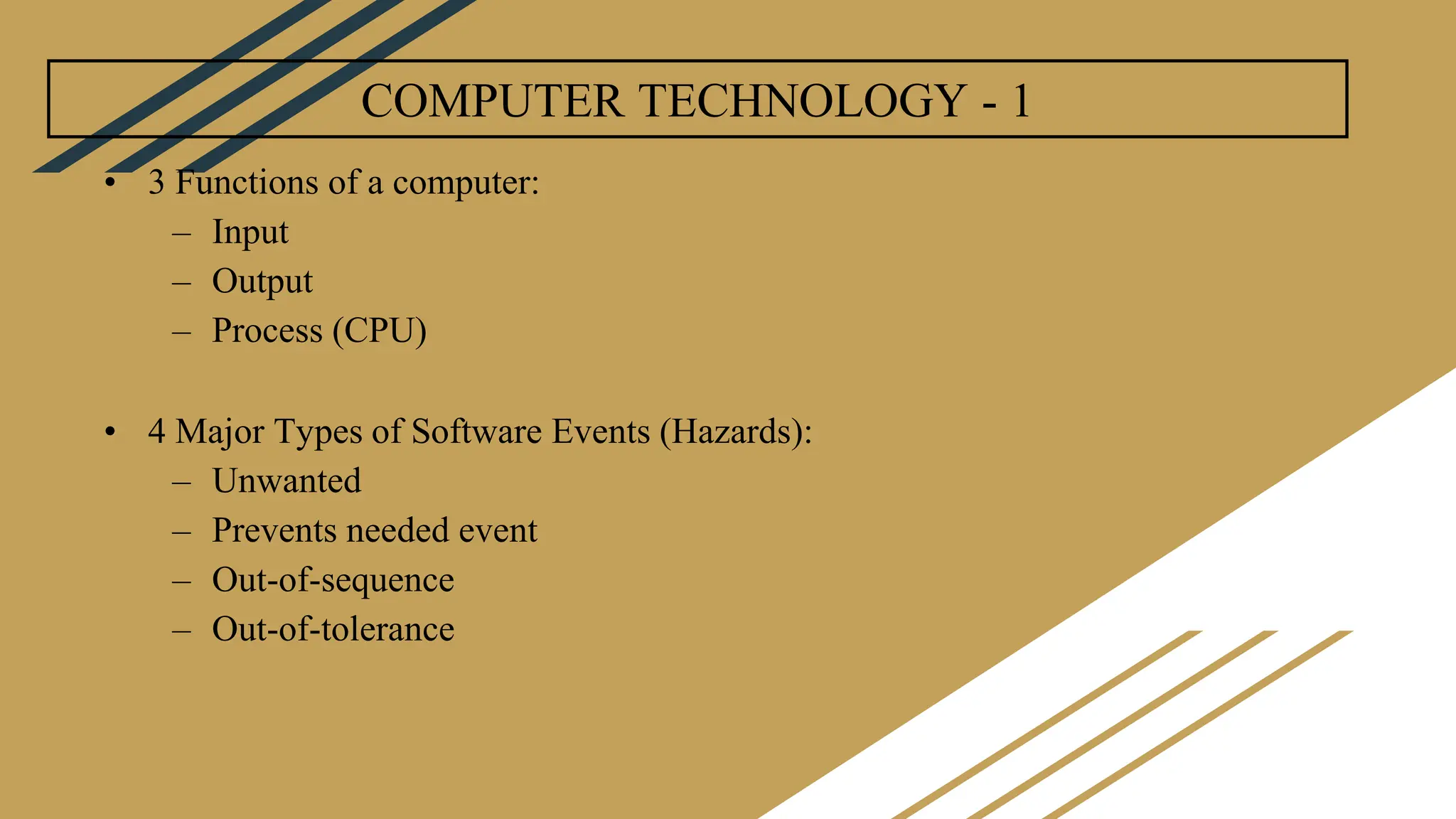
COMPUTER TECHNOLOGY - 1
• 3 Functions of a computer:
– Input
– Output
– Process (CPU)
• 4 Major Types of Software Events (Hazards):
– Unwanted
– Prevents needed event
– Out-of-sequence
– Out-of-tolerance
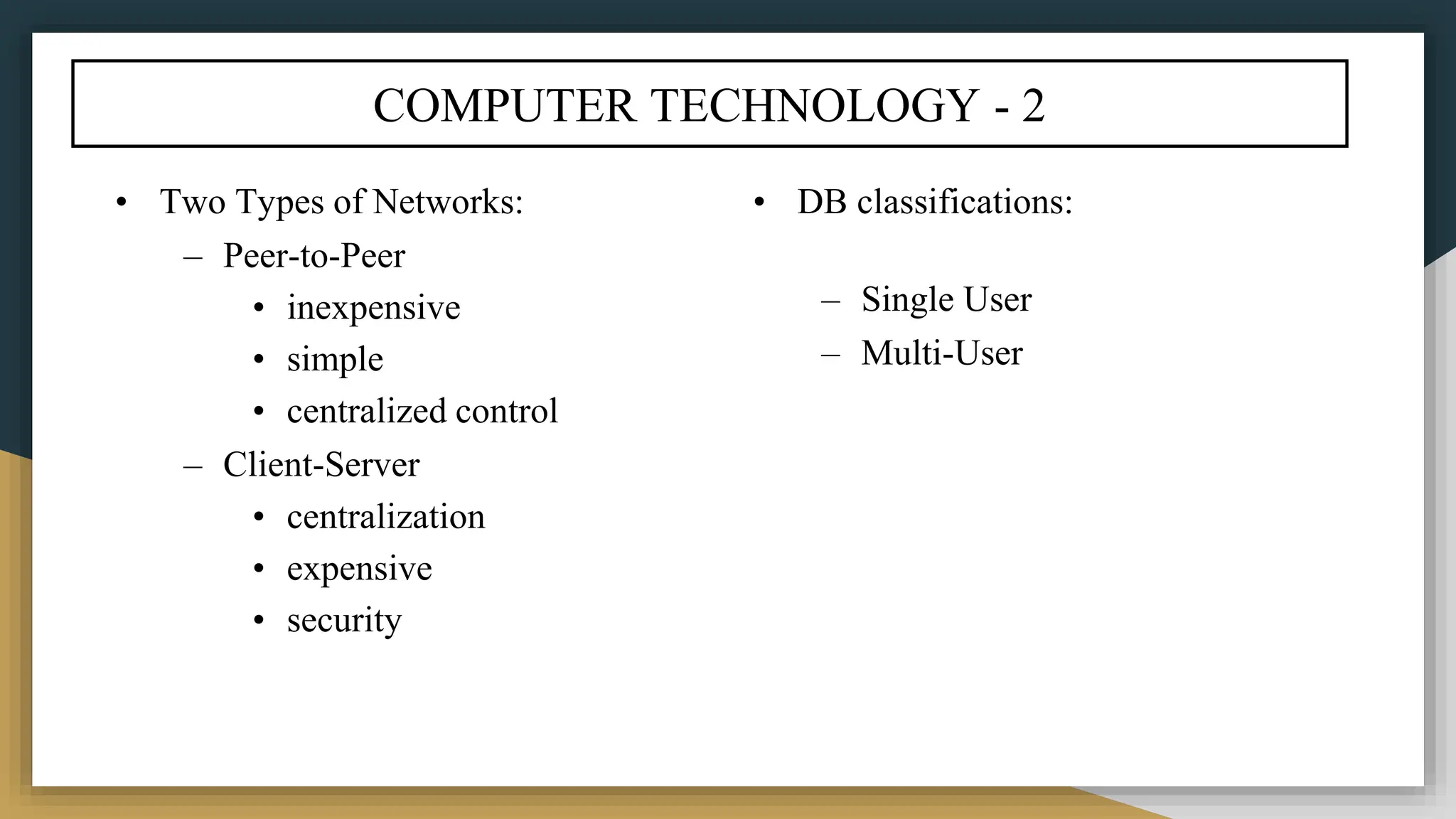
COMPUTER TECHNOLOGY - 2
• Two Types of Networks:
– Peer-to-Peer
• inexpensive
• simple
• centralized control
– Client-Server
• centralization
• expensive
• security
• DB classifications:
– Single User
– Multi-User
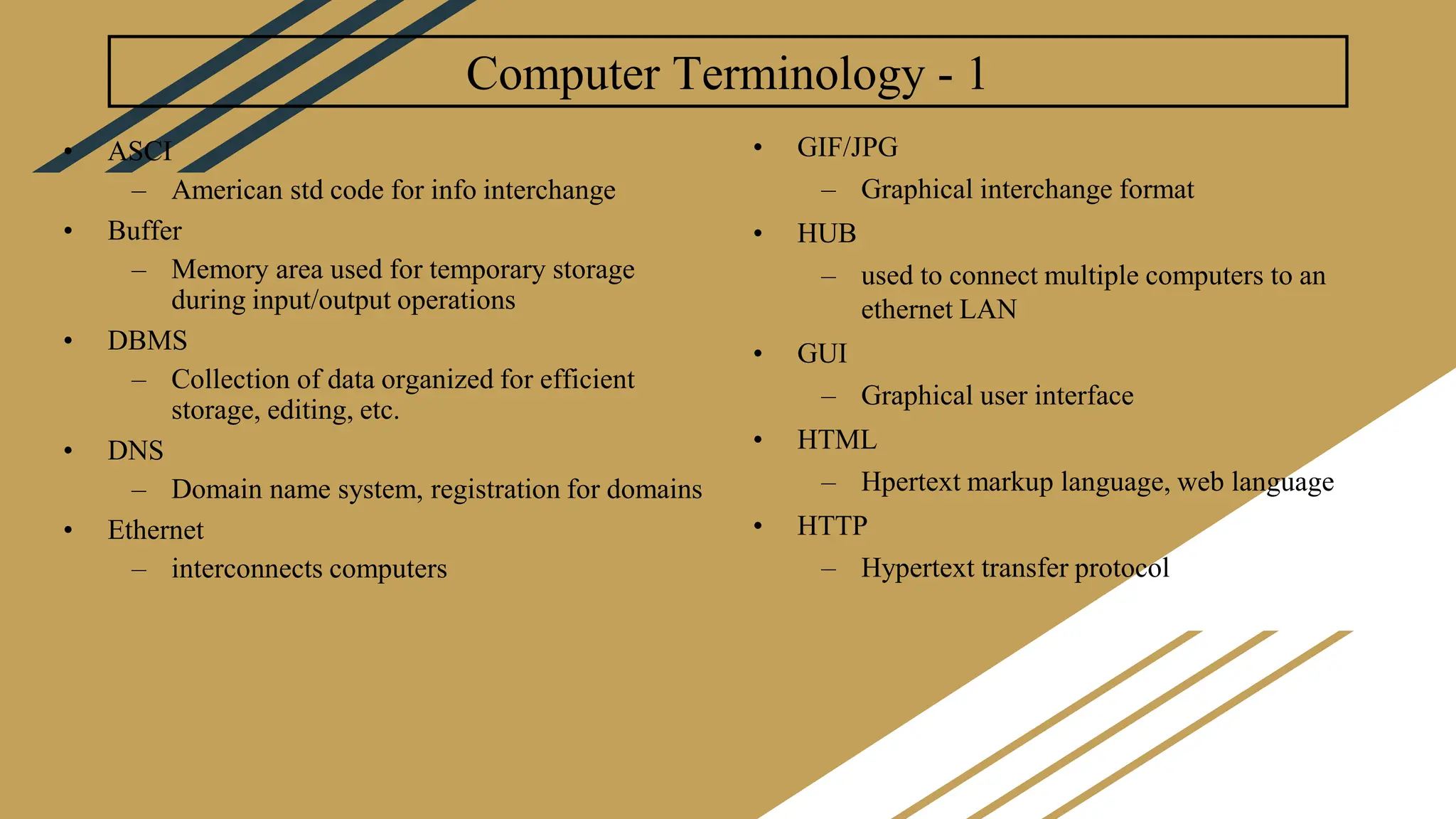
Computer Terminology - 1
• ASCI
– American std code for info interchange
• Buffer
– Memory area used for temporary storage
during input/output operations
• DBMS
– Collection of data organized for efficient
storage, editing, etc.
• DNS
– Domain name system, registration for domains
• Ethernet
– interconnects computers
• GIF/JPG
– Graphical interchange format
• HUB
– used to connect multiple computers to an
ethernet LAN
• GUI
– Graphical user interface
• HTML
– Hpertext markup language, web language
• HTTP
– Hypertext transfer protocol
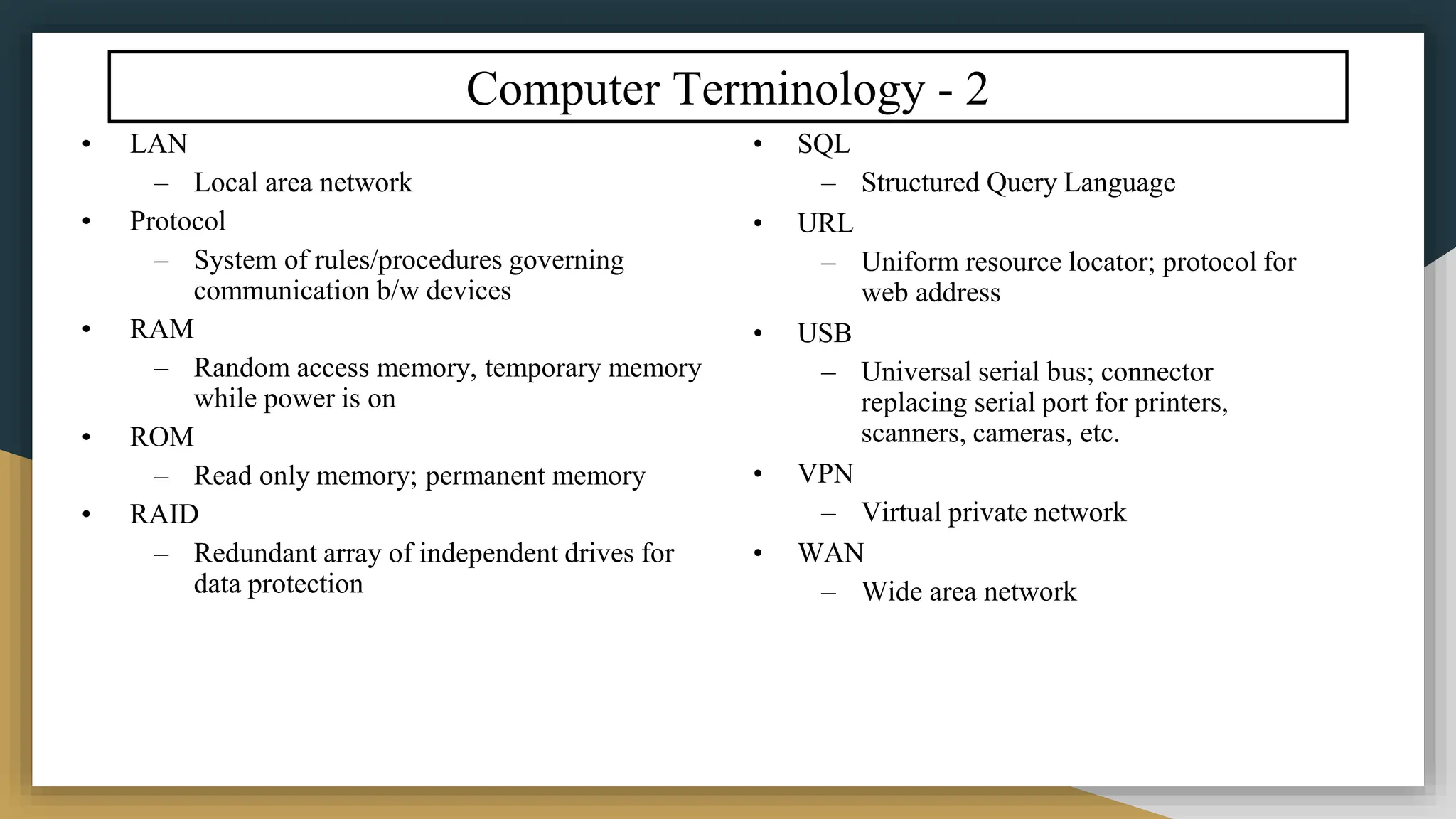
Computer Terminology - 2
• LAN
– Local area network
• Protocol
– System of rules/procedures governing
communication b/w devices
• RAM
– Random access memory, temporary memory
while power is on
• ROM
– Read only memory; permanent memory
• RAID
– Redundant array of independent drives for
data protection
• SQL
– Structured Query Language
• URL
– Uniform resource locator; protocol for
web address
• USB
– Universal serial bus; connector
replacing serial port for printers,
scanners, cameras, etc.
• VPN
– Virtual private network
• WAN
– Wide area network
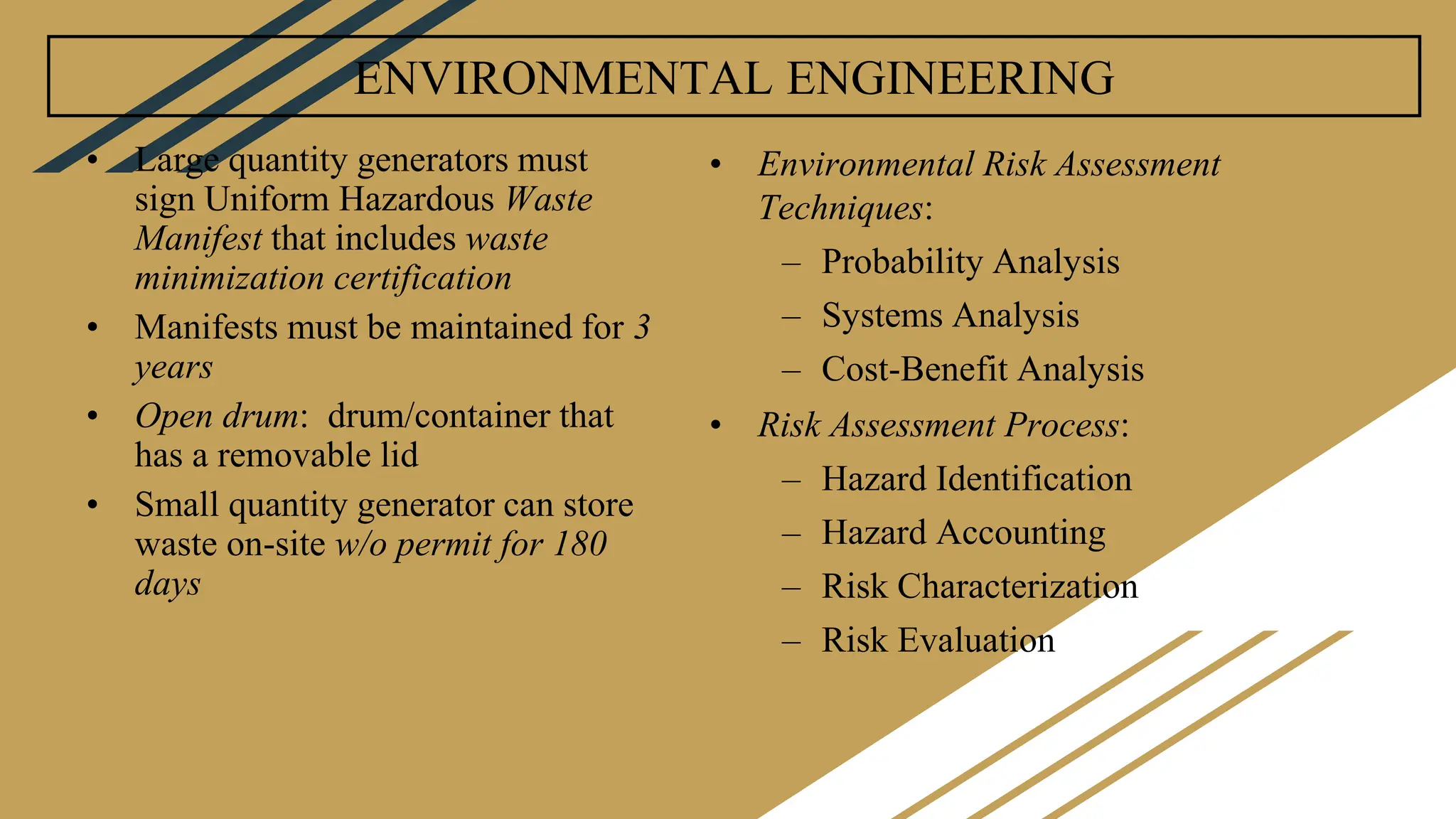
ENVIRONMENTAL ENGINEERING
• Large quantity generators must
sign Uniform Hazardous Waste
Manifest that includes waste
minimization certification
• Manifests must be maintained for 3
years
• Open drum: drum/container that
has a removable lid
• Small quantity generator can store
waste on-site w/o permit for 180
days
• Environmental Risk Assessment
Techniques:
– Probability Analysis
– Systems Analysis
– Cost-Benefit Analysis
• Risk Assessment Process:
– Hazard Identification
– Hazard Accounting
– Risk Characterization
– Risk Evaluation
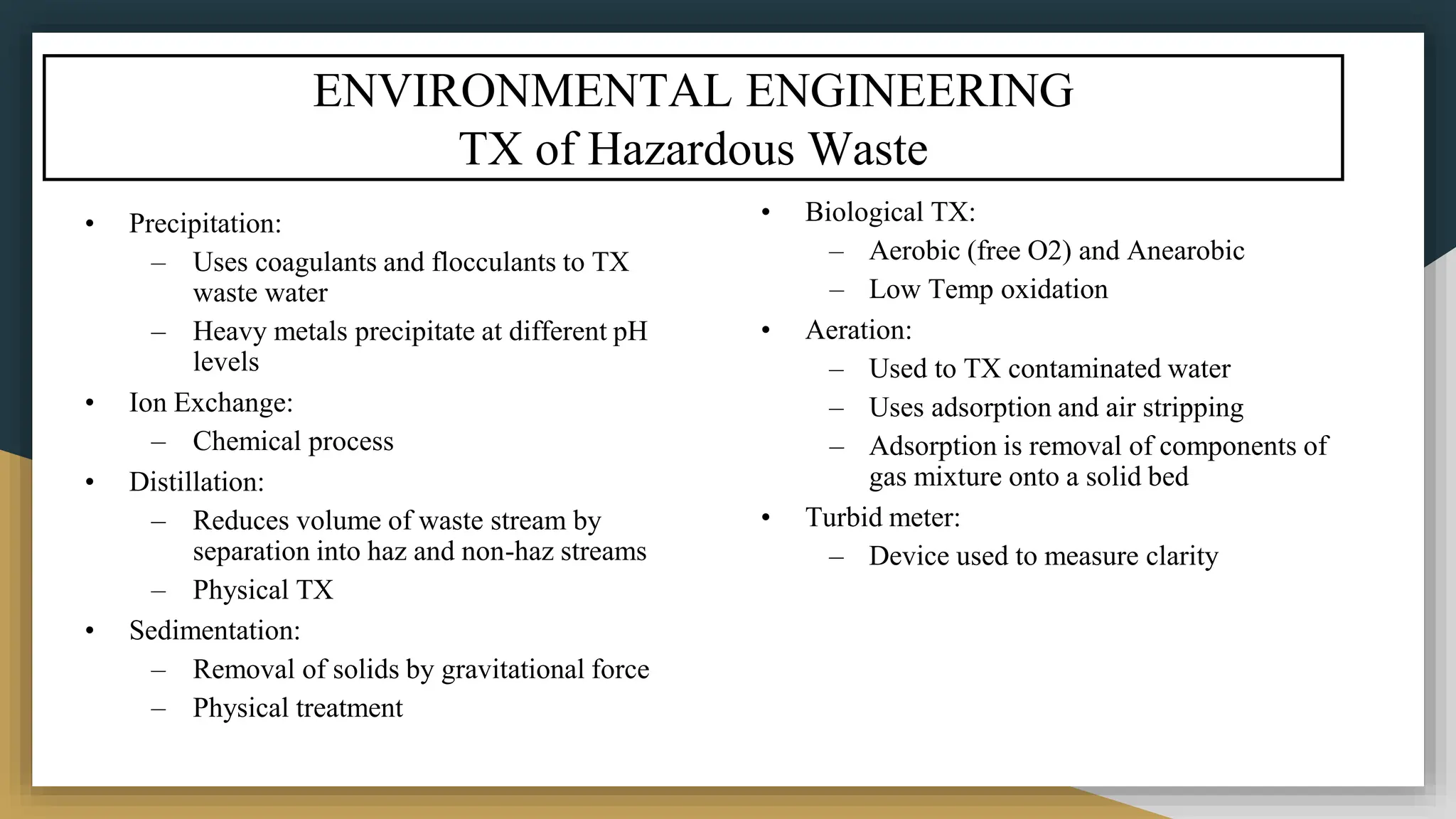
ENVIRONMENTAL ENGINEERING
TX of Hazardous Waste
• Precipitation:
– Uses coagulants and flocculants to TX
waste water
– Heavy metals precipitate at different pH
levels
• Ion Exchange:
– Chemical process
• Distillation:
– Reduces volume of waste stream by
separation into haz and non-haz streams
– Physical TX
• Sedimentation:
– Removal of solids by gravitational force
– Physical treatment
• Biological TX:
– Aerobic (free O2) and Anearobic
– Low Temp oxidation
• Aeration:
– Used to TX contaminated water
– Uses adsorption and air stripping
– Adsorption is removal of components of
gas mixture onto a solid bed
• Turbid meter:
– Device used to measure clarity
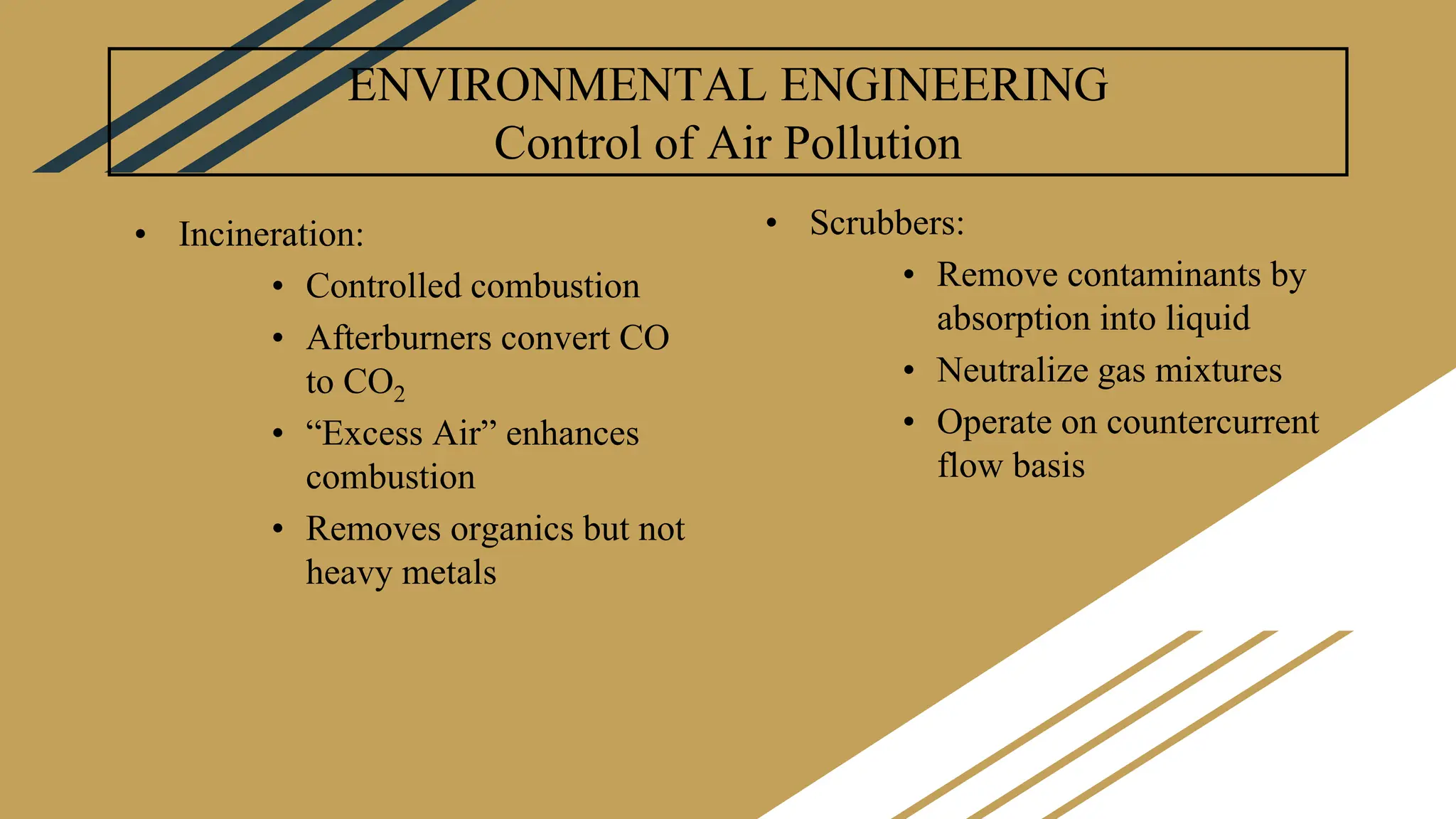
ENVIRONMENTAL ENGINEERING
Control of Air Pollution
• Incineration:
• Controlled combustion
• Afterburners convert CO
to CO2
• “Excess Air” enhances
combustion
• Removes organics but not
heavy metals
• Scrubbers:
• Remove contaminants by
absorption into liquid
• Neutralize gas mixtures
• Operate on countercurrent
flow basis
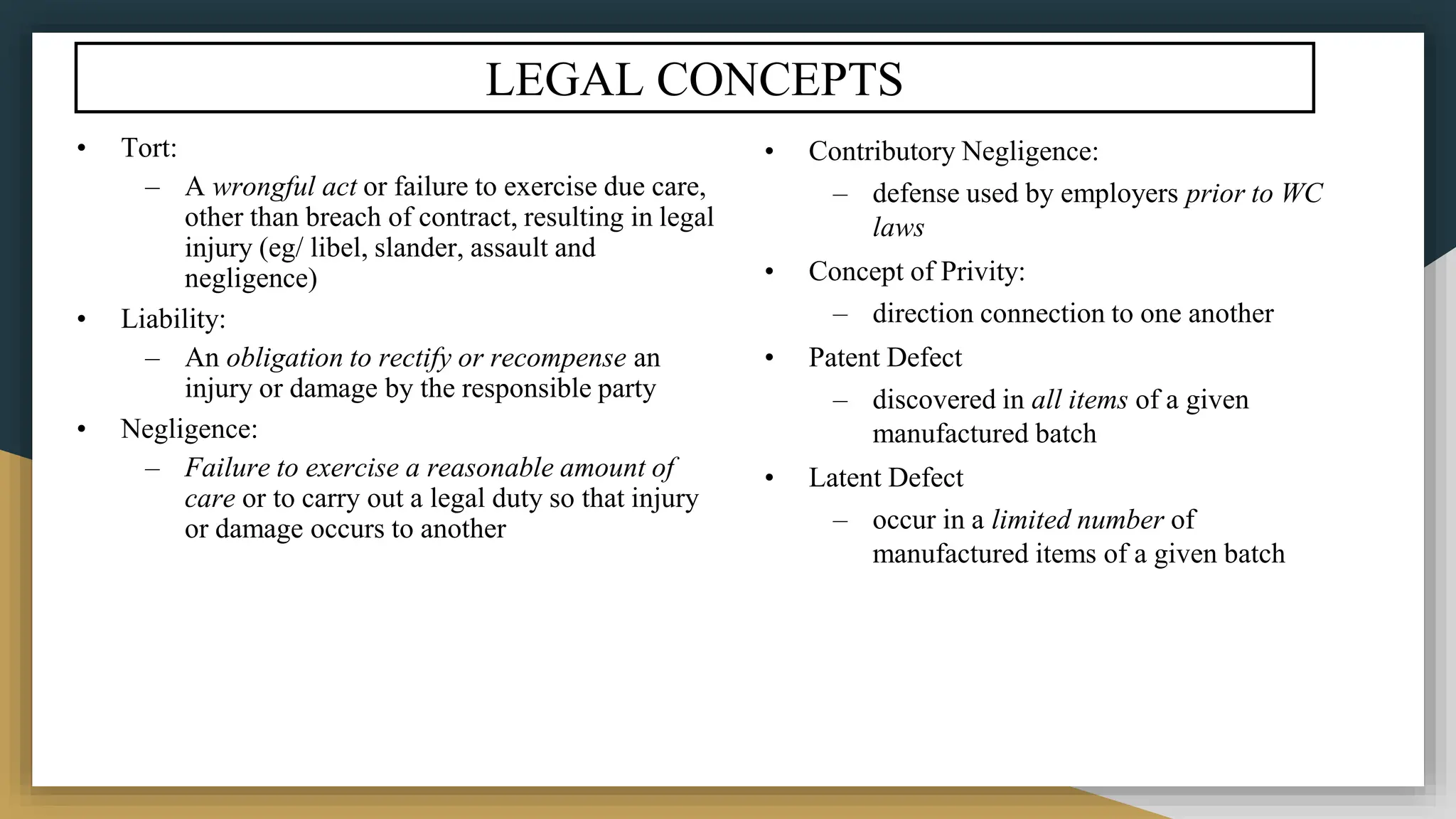
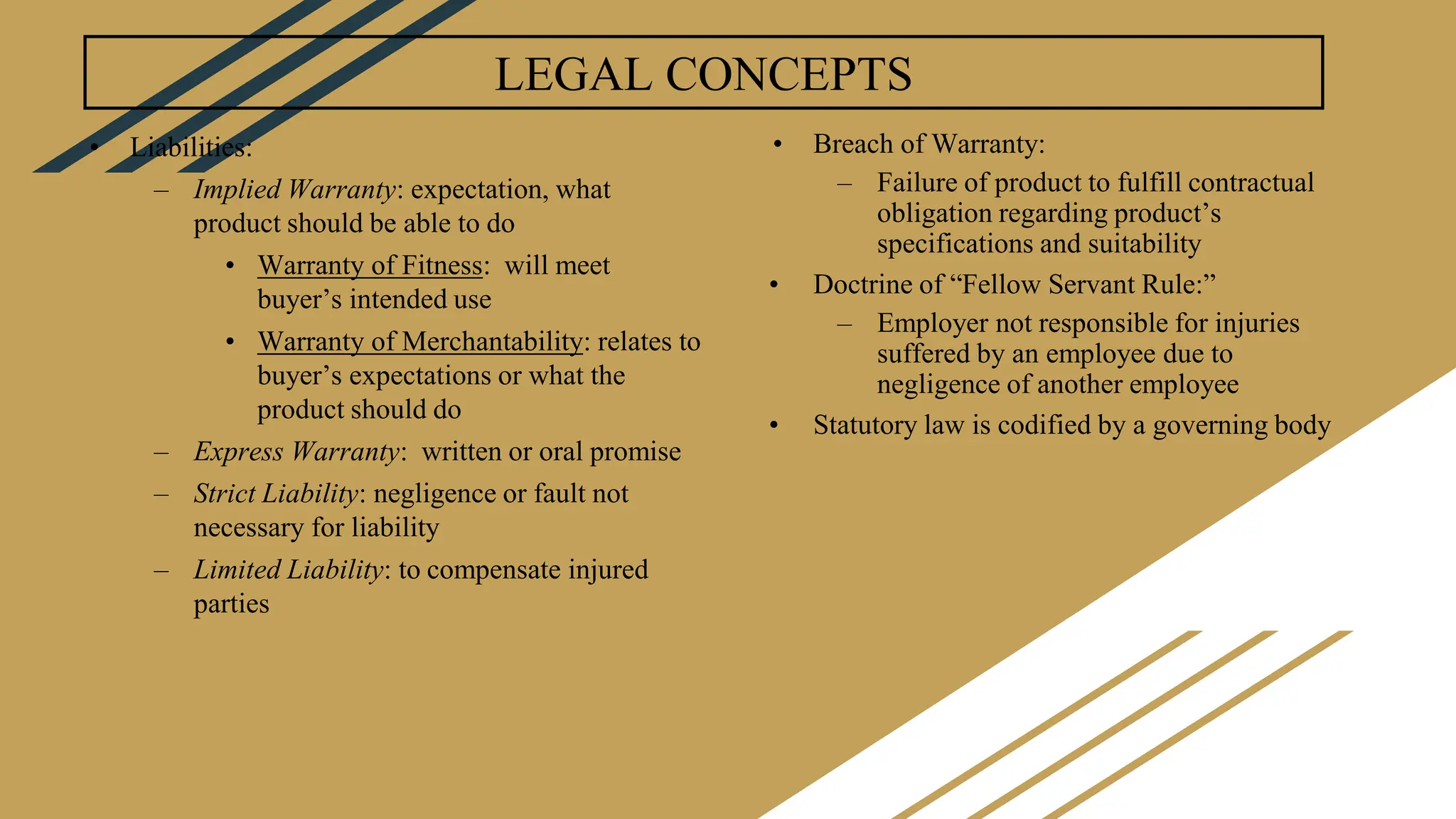
LEGAL CONCEPTS
• Tort:
– A wrongful act or failure to exercise due care,
other than breach of contract, resulting in legal
injury (eg/ libel, slander, assault and
negligence)
• Liability:
– An obligation to rectify or recompense an
injury or damage by the responsible party
• Negligence:
– Failure to exercise a reasonable amount of
care or to carry out a legal duty so that injury
or damage occurs to another
• Contributory Negligence:
– defense used by employers prior to WC
laws
• Concept of Privity:
– direction connection to one another
• Patent Defect
– discovered in all items of a given
manufactured batch
• Latent Defect
– occur in a limited number of
manufactured items of a given batch
LEGAL CONCEPTS
• Liabilities:
– Implied Warranty: expectation, what
product should be able to do
• Warranty of Fitness: will meet
buyer’s intended use
• Warranty of Merchantability: relates to
buyer’s expectations or what the
product should do
– Express Warranty: written or oral promise
– Strict Liability: negligence or fault not
necessary for liability
– Limited Liability: to compensate injured
parties
• Breach of Warranty:
– Failure of product to fulfill contractual
obligation regarding product’s
specifications and suitability
• Doctrine of “Fellow Servant Rule:”
– Employer not responsible for injuries
suffered by an employee due to
negligence of another employee
• Statutory law is codified by a governing body
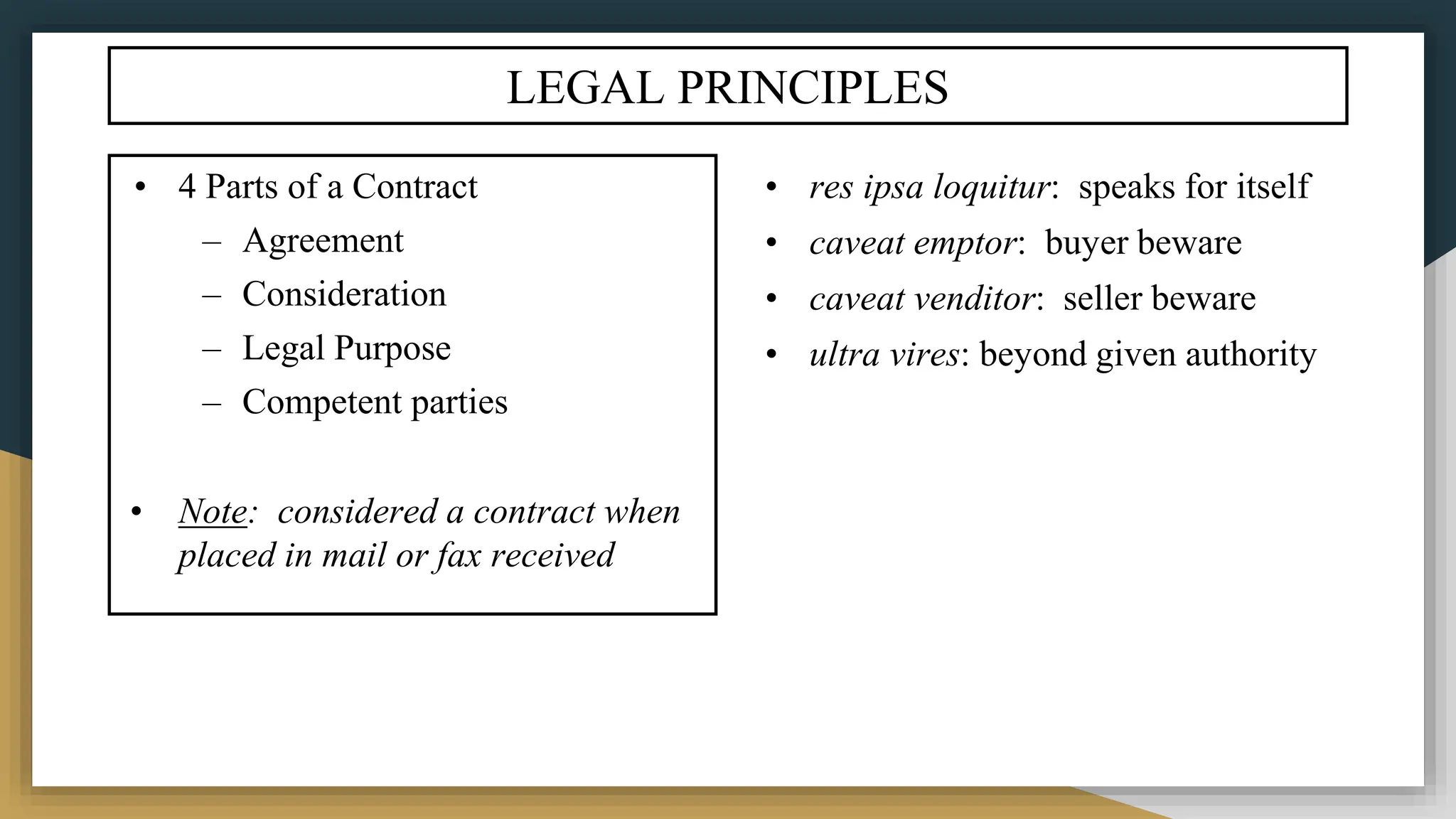
LEGAL PRINCIPLES
• res ipsa loquitur: speaks for itself
• caveat emptor: buyer beware
• caveat venditor: seller beware
• ultra vires: beyond given authority
• 4 Parts of a Contract
– Agreement
– Consideration
– Legal Purpose
– Competent parties
• Note: considered a contract when
placed in mail or fax received
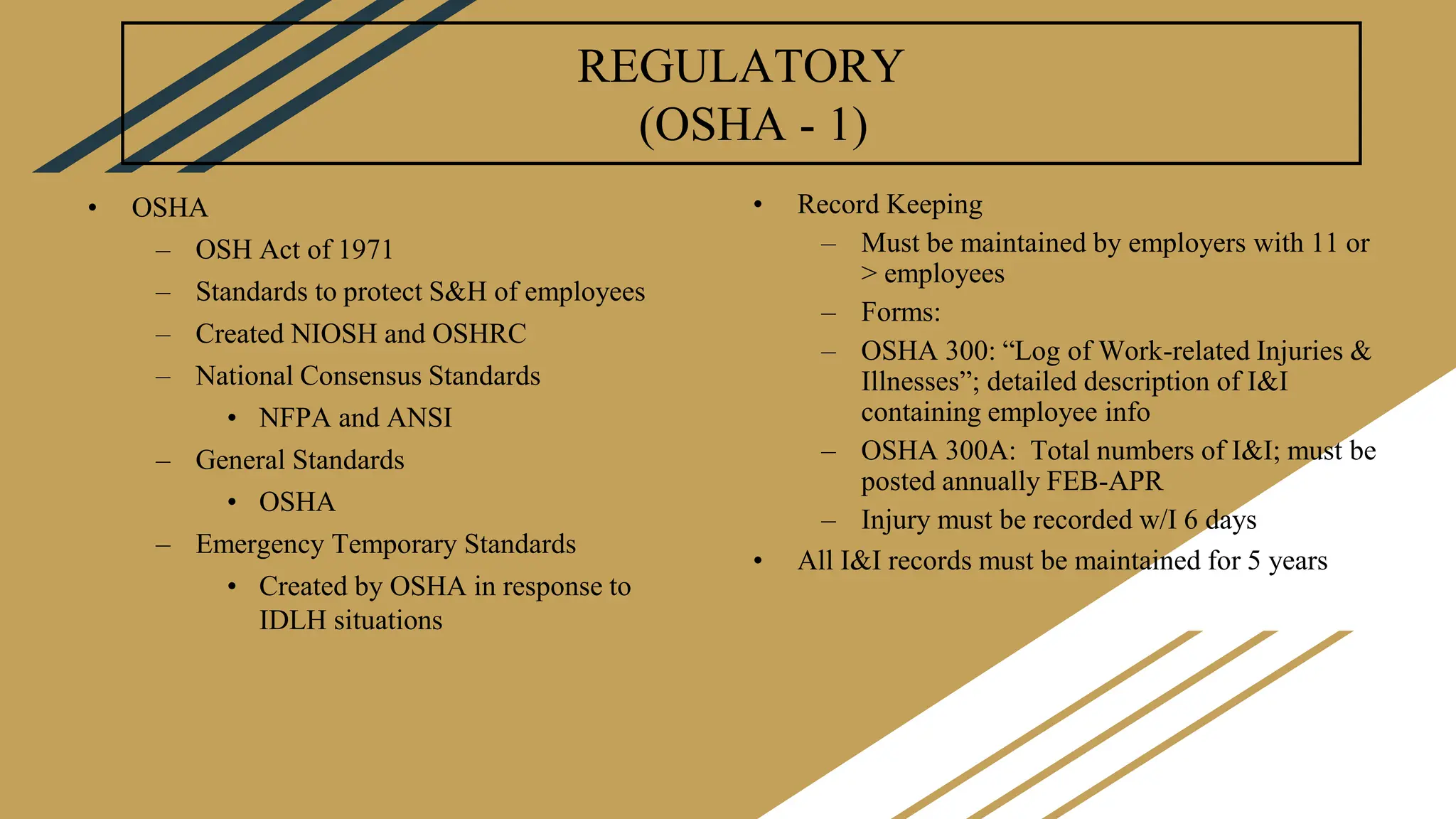
REGULATORY
(OSHA - 1)
• OSHA
– OSH Act of 1971
– Standards to protect S&H of employees
– Created NIOSH and OSHRC
– National Consensus Standards
• NFPA and ANSI
– General Standards
• OSHA
– Emergency Temporary Standards
• Created by OSHA in response to
IDLH situations
• Record Keeping
– Must be maintained by employers with 11 or
> employees
– Forms:
– OSHA 300: “Log of Work-related Injuries &
Illnesses”; detailed description of I&I
containing employee info
– OSHA 300A: Total numbers of I&I; must be
posted annually FEB-APR
– Injury must be recorded w/I 6 days
• All I&I records must be maintained for 5 years
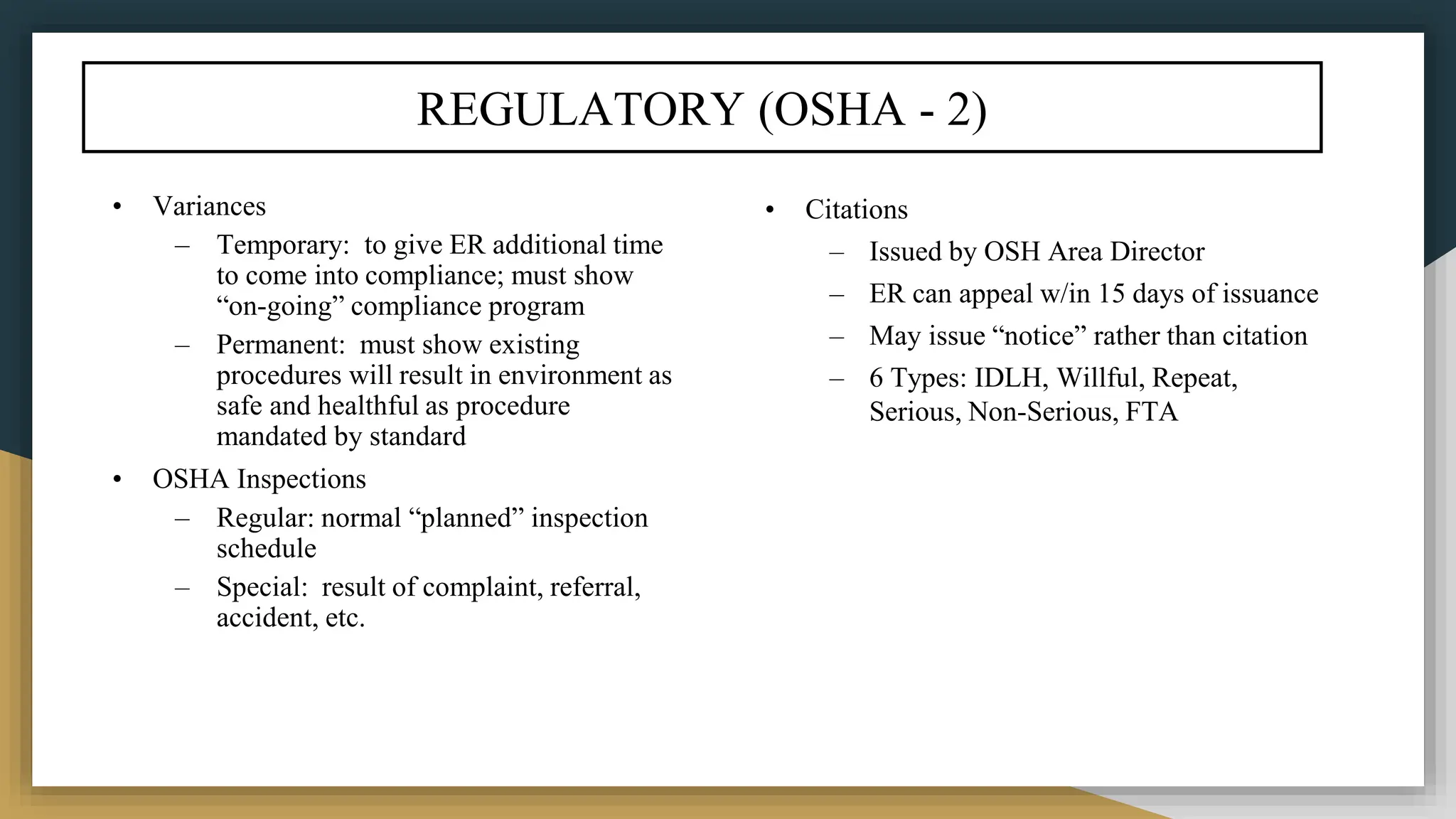
REGULATORY (OSHA - 2)
• Variances
– Temporary: to give ER additional time
to come into compliance; must show
“on-going” compliance program
– Permanent: must show existing
procedures will result in environment as
safe and healthful as procedure
mandated by standard
• OSHA Inspections
– Regular: normal “planned” inspection
schedule
– Special: result of complaint, referral,
accident, etc.
• Citations
– Issued by OSH Area Director
– ER can appeal w/in 15 days of issuance
– May issue “notice” rather than citation
– 6 Types: IDLH, Willful, Repeat,
Serious, Non-Serious, FTA
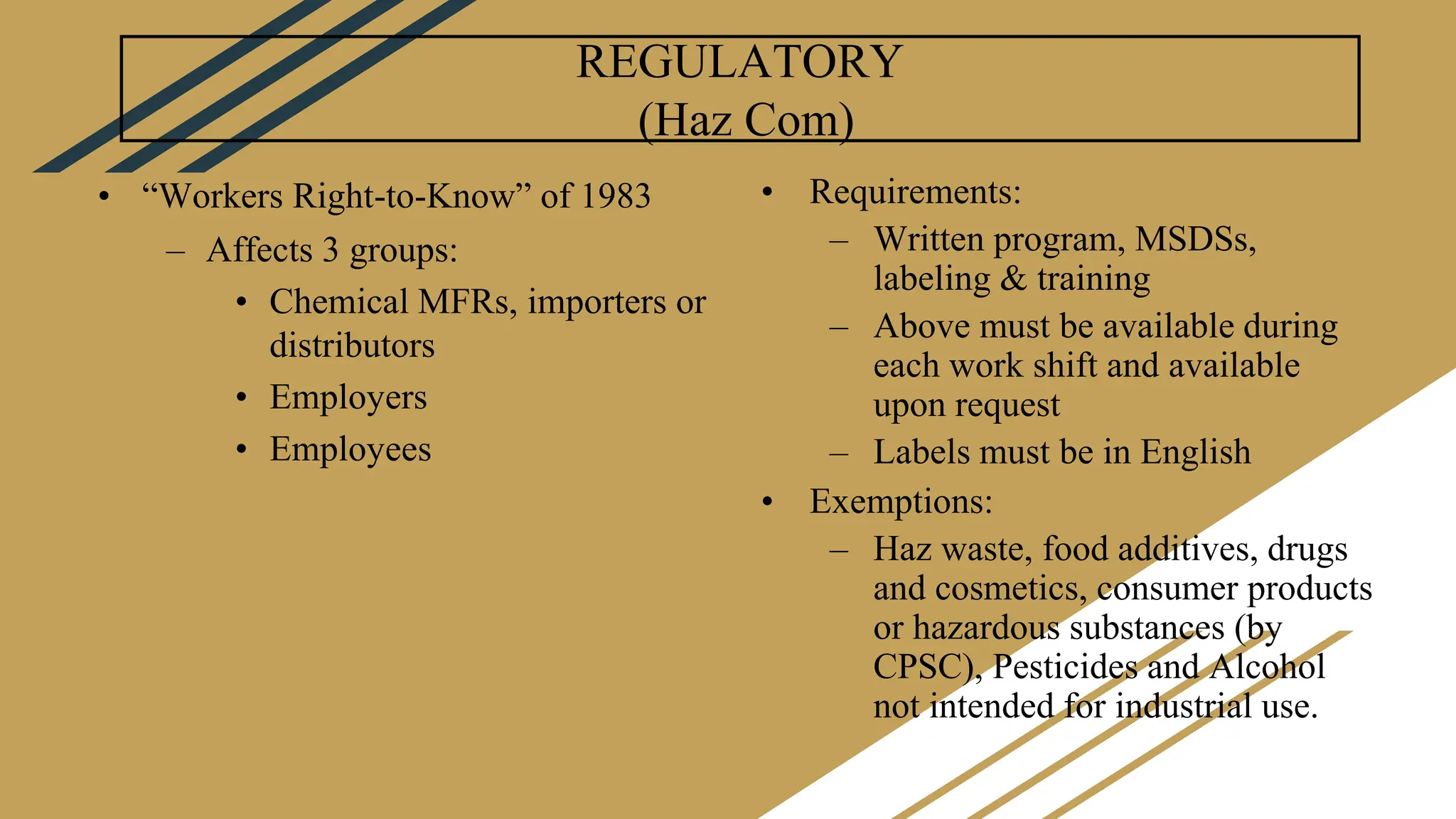
REGULATORY
(Haz Com)
• “Workers Right-to-Know” of 1983
– Affects 3 groups:
• Chemical MFRs, importers or
distributors
• Employers
• Employees
• Requirements:
– Written program, MSDSs,
labeling & training
– Above must be available during
each work shift and available
upon request
– Labels must be in English
• Exemptions:
– Haz waste, food additives, drugs
and cosmetics, consumer products
or hazardous substances (by
CPSC), Pesticides and Alcohol
not intended for industrial use.
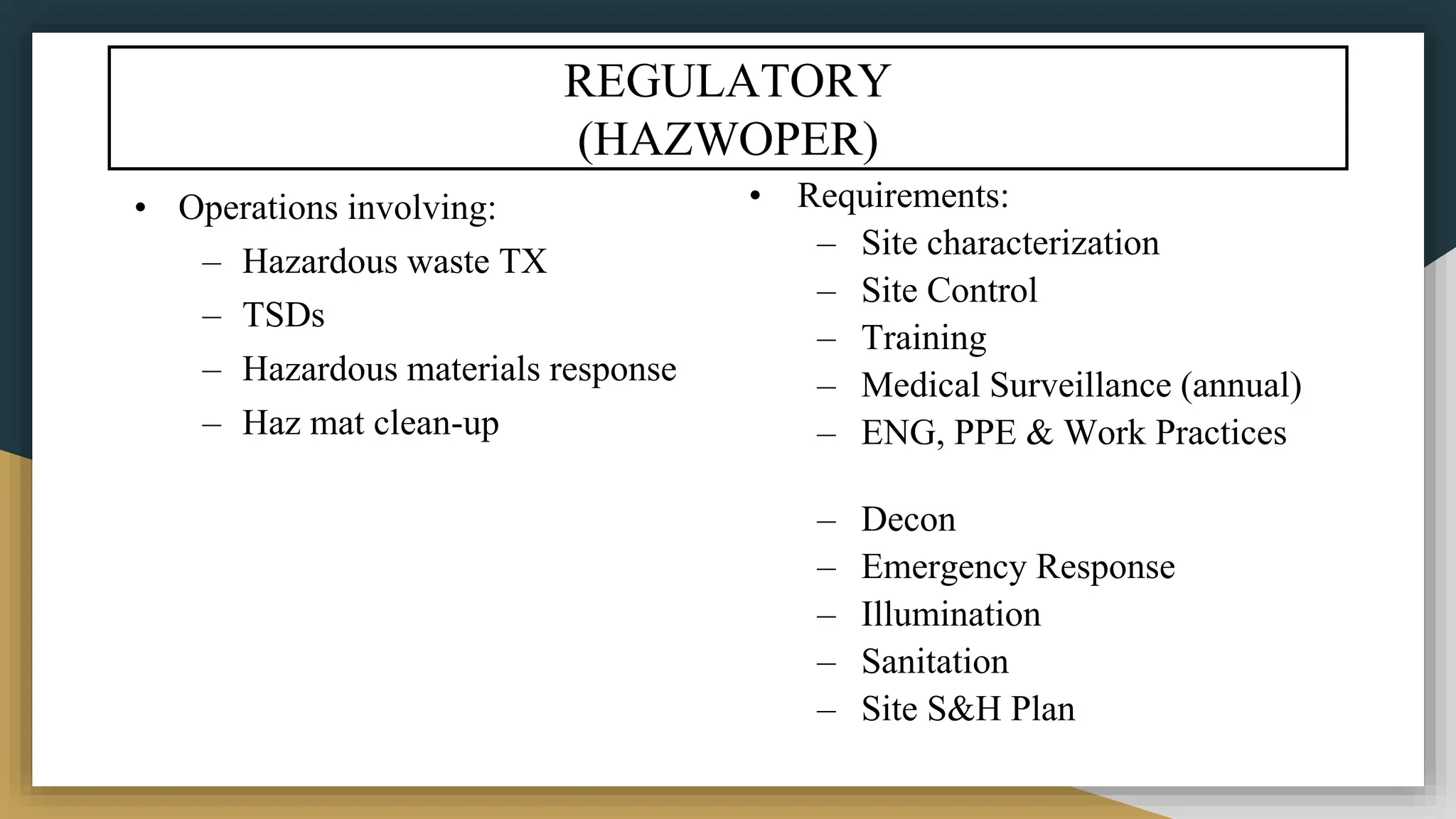
REGULATORY
(HAZWOPER)
• Operations involving:
– Hazardous waste TX
– TSDs
– Hazardous materials response
– Haz mat clean-up
• Requirements:
– Site characterization
– Site Control
– Training
– Medical Surveillance (annual)
– ENG, PPE & Work Practices
– Decon
– Emergency Response
– Illumination
– Sanitation
– Site S&H Plan
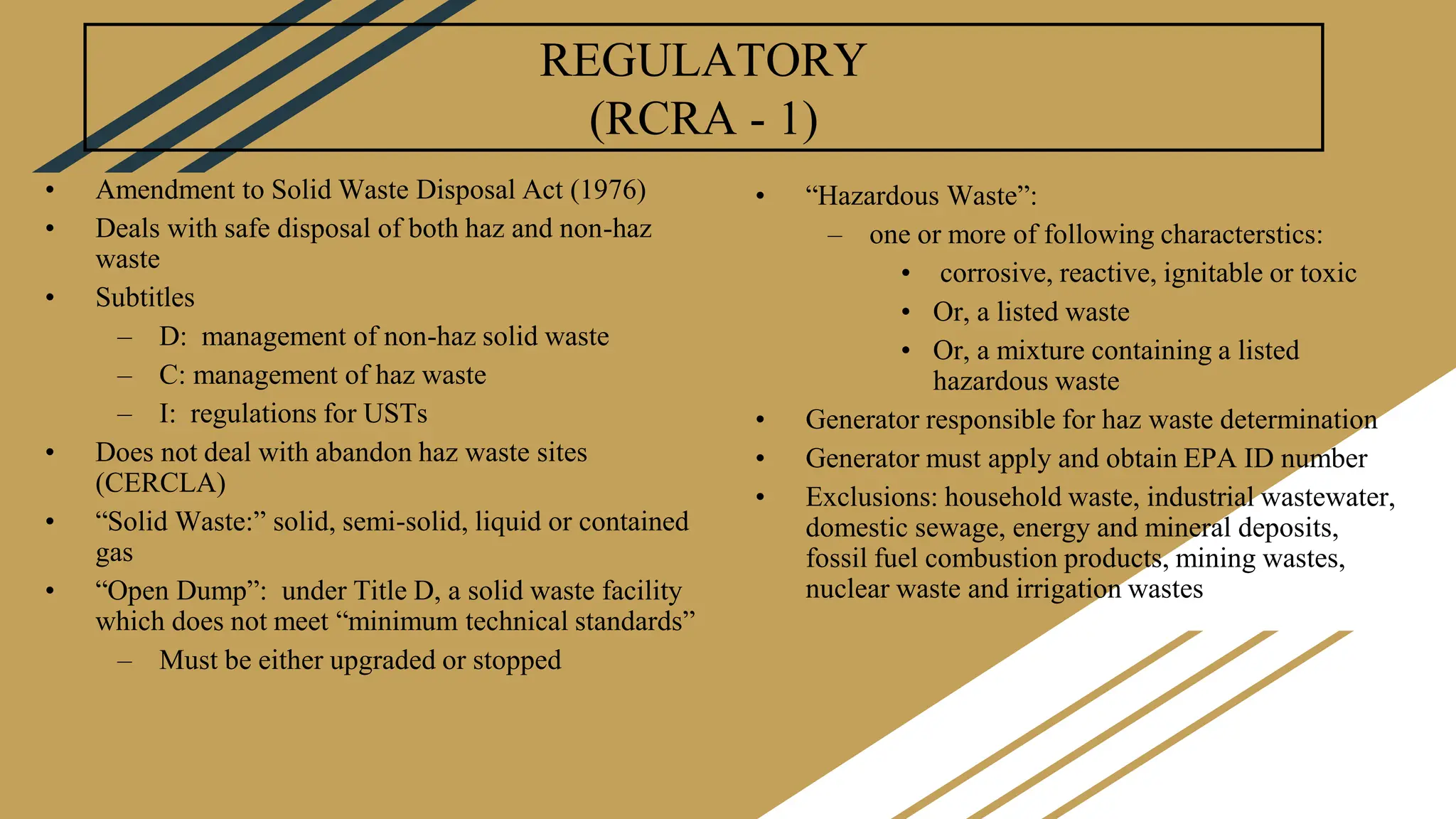
REGULATORY
(RCRA - 1)
• Amendment to Solid Waste Disposal Act (1976)
• Deals with safe disposal of both haz and non-haz
waste
• Subtitles
– D: management of non-haz solid waste
– C: management of haz waste
– I: regulations for USTs
• Does not deal with abandon haz waste sites
(CERCLA)
• “Solid Waste:” solid, semi-solid, liquid or contained
gas
• “Open Dump”: under Title D, a solid waste facility
which does not meet “minimum technical standards”
– Must be either upgraded or stopped
• “Hazardous Waste”:
– one or more of following characterstics:
• corrosive, reactive, ignitable or toxic
• Or, a listed waste
• Or, a mixture containing a listed
hazardous waste
• Generator responsible for haz waste determination
• Generator must apply and obtain EPA ID number
• Exclusions: household waste, industrial wastewater,
domestic sewage, energy and mineral deposits,
fossil fuel combustion products, mining wastes,
nuclear waste and irrigation wastes
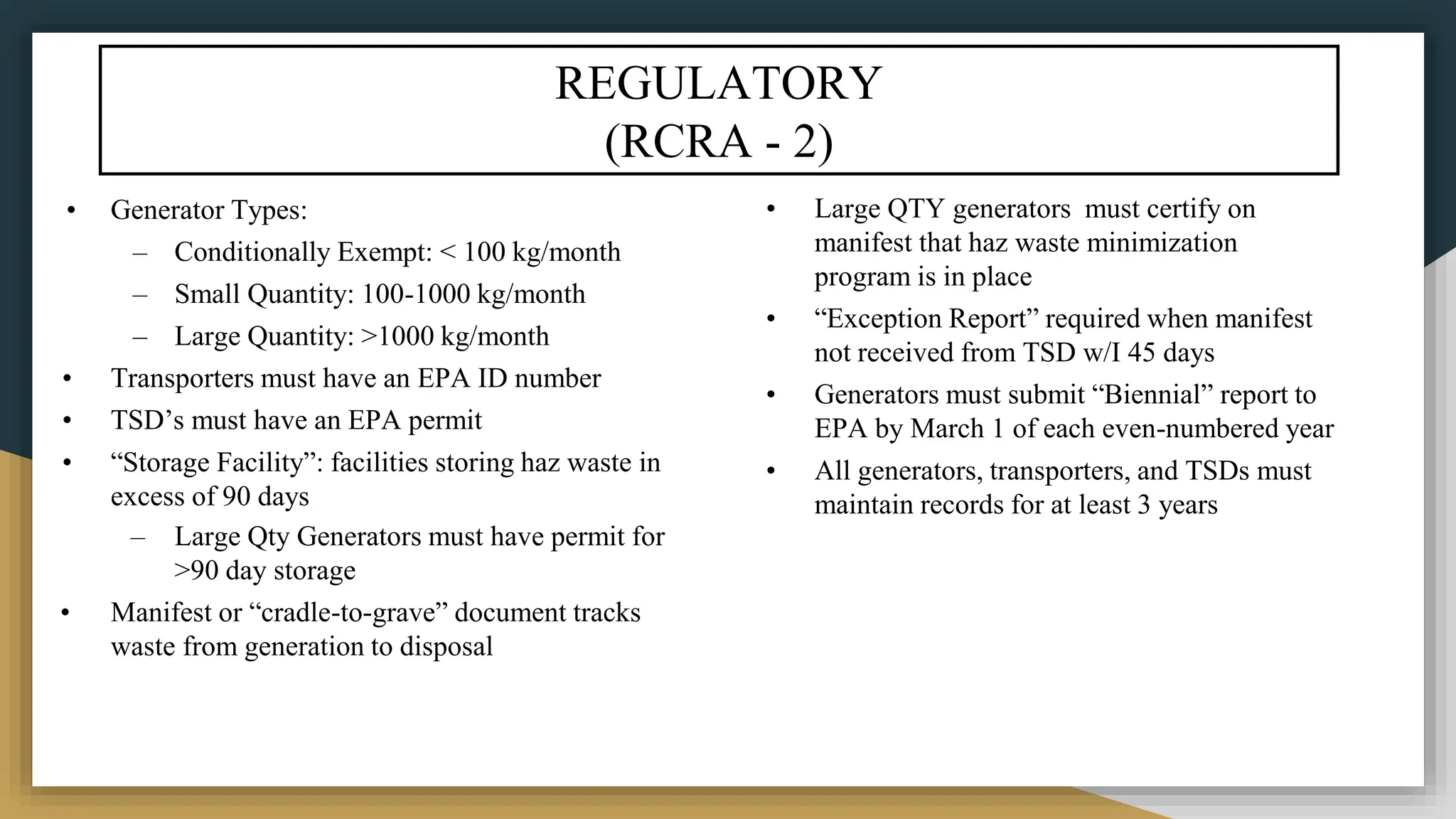
REGULATORY
(RCRA - 2)
• Generator Types:
– Conditionally Exempt: < 100 kg/month
– Small Quantity: 100-1000 kg/month
– Large Quantity: >1000 kg/month
• Transporters must have an EPA ID number
• TSD’s must have an EPA permit
• “Storage Facility”: facilities storing haz waste in
excess of 90 days
– Large Qty Generators must have permit for
>90 day storage
• Manifest or “cradle-to-grave” document tracks
waste from generation to disposal
• Large QTY generators must certify on
manifest that haz waste minimization
program is in place
• “Exception Report” required when manifest
not received from TSD w/I 45 days
• Generators must submit “Biennial” report to
EPA by March 1 of each even-numbered year
• All generators, transporters, and TSDs must
maintain records for at least 3 years
REGULATORY
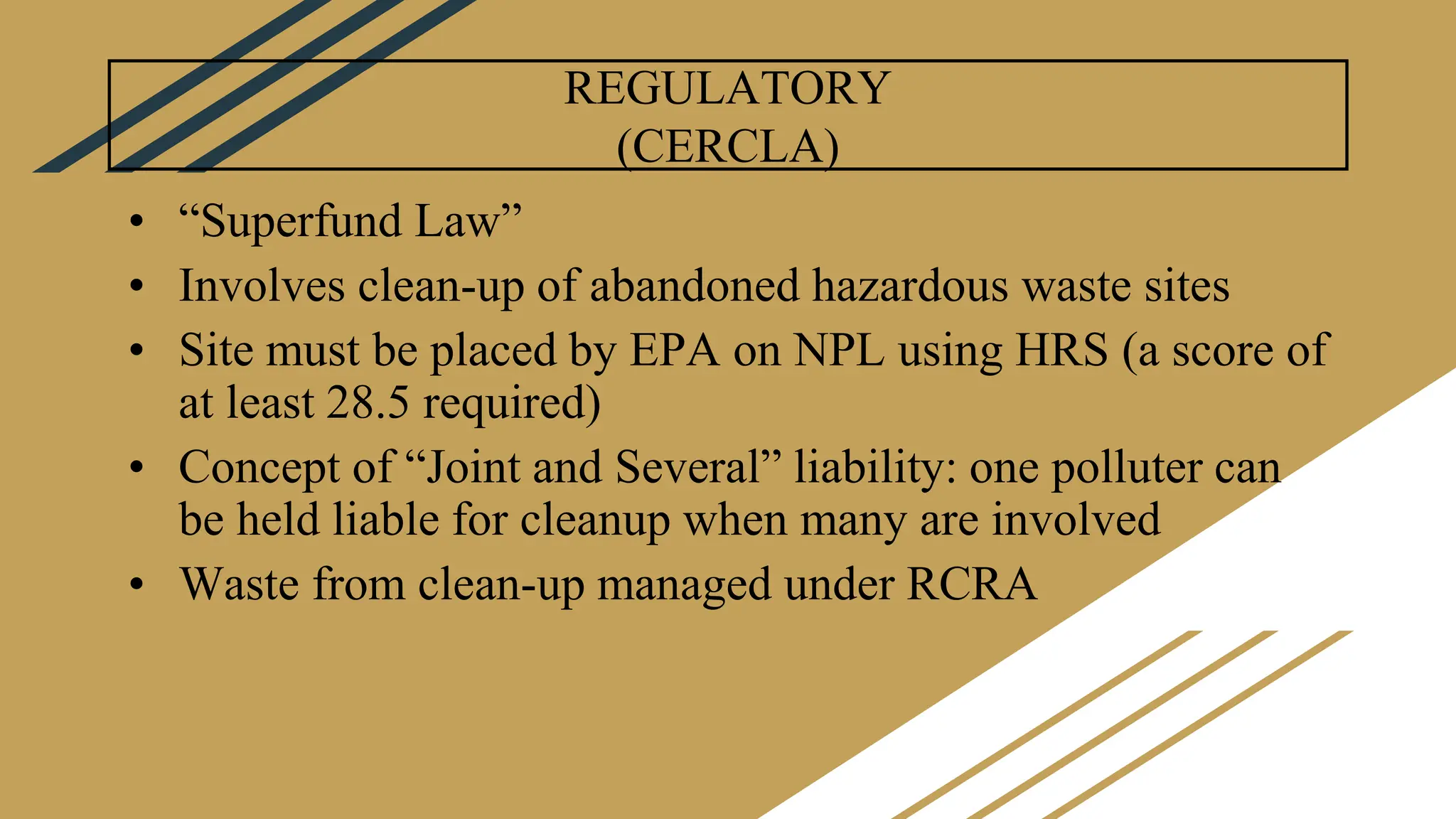
(CERCLA)
• “Superfund Law”
• Involves clean-up of abandoned hazardous waste sites
• Site must be placed by EPA on NPL using HRS (a score of
at least 28.5 required)
• Concept of “Joint and Several” liability: one polluter can
be held liable for cleanup when many are involved
• Waste from clean-up managed under RCRA
REGULATORY
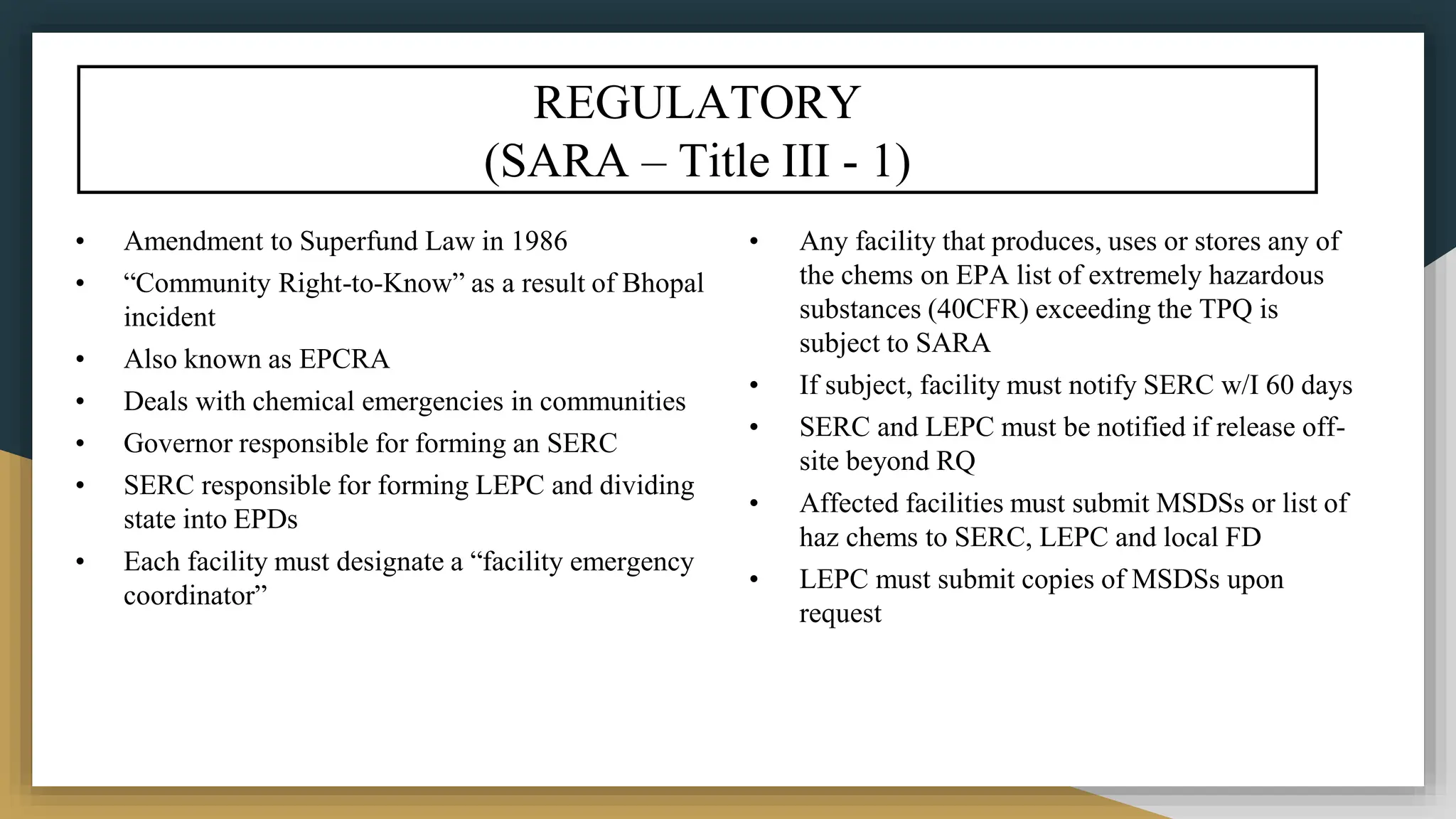
(SARA – Title III - 1)
• Amendment to Superfund Law in 1986
• “Community Right-to-Know” as a result of Bhopal
incident
• Also known as EPCRA
• Deals with chemical emergencies in communities
• Governor responsible for forming an SERC
• SERC responsible for forming LEPC and dividing
state into EPDs
• Each facility must designate a “facility emergency
coordinator”
• Any facility that produces, uses or stores any of
the chems on EPA list of extremely hazardous
substances (40CFR) exceeding the TPQ is
subject to SARA
• If subject, facility must notify SERC w/I 60 days
• SERC and LEPC must be notified if release off-
site beyond RQ
• Affected facilities must submit MSDSs or list of
haz chems to SERC, LEPC and local FD
• LEPC must submit copies of MSDSs upon
request
REGULATORY
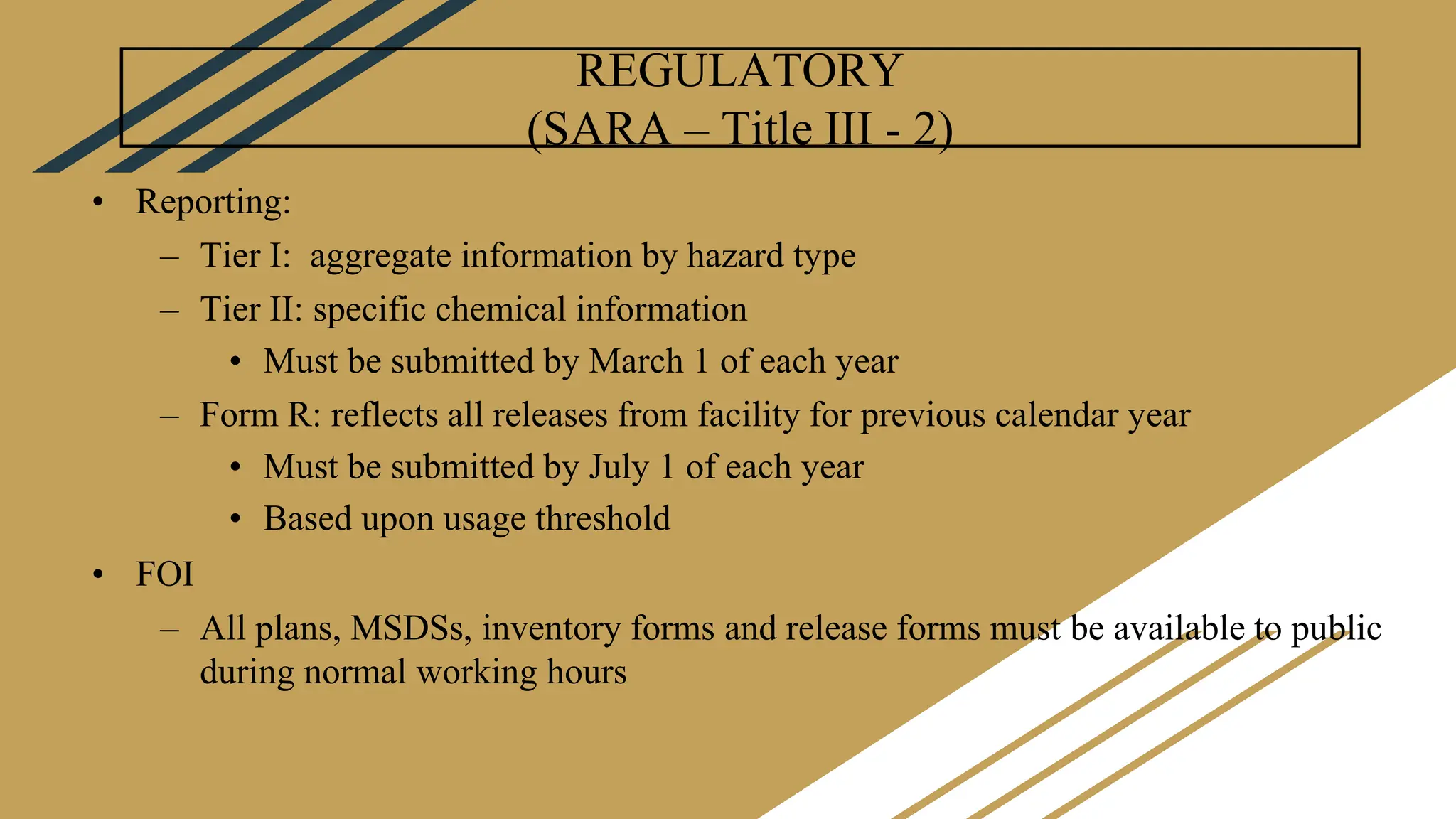
(SARA – Title III - 2)
• Reporting:
– Tier I: aggregate information by hazard type
– Tier II: specific chemical information
• Must be submitted by March 1 of each year
– Form R: reflects all releases from facility for previous calendar year
• Must be submitted by July 1 of each year
• Based upon usage threshold
• FOI
– All plans, MSDSs, inventory forms and release forms must be available to public
during normal working hours
REGULATORY
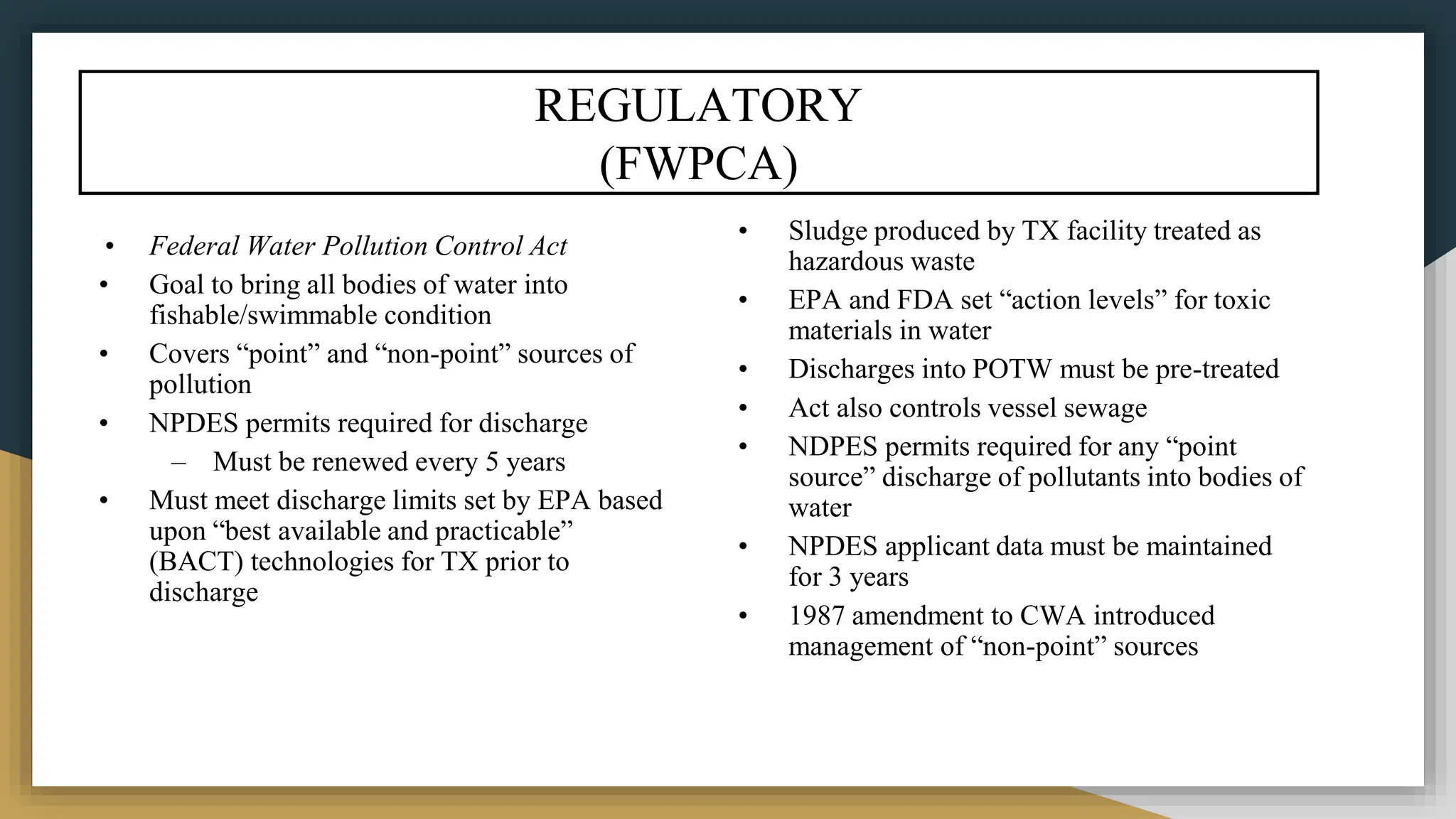
(FWPCA)
• Federal Water Pollution Control Act
• Goal to bring all bodies of water into
fishable/swimmable condition
• Covers “point” and “non-point” sources of
pollution
• NPDES permits required for discharge
– Must be renewed every 5 years
• Must meet discharge limits set by EPA based
upon “best available and practicable”
(BACT) technologies for TX prior to
discharge
• Sludge produced by TX facility treated as
hazardous waste
• EPA and FDA set “action levels” for toxic
materials in water
• Discharges into POTW must be pre-treated
• Act also controls vessel sewage
• NDPES permits required for any “point
source” discharge of pollutants into bodies of
water
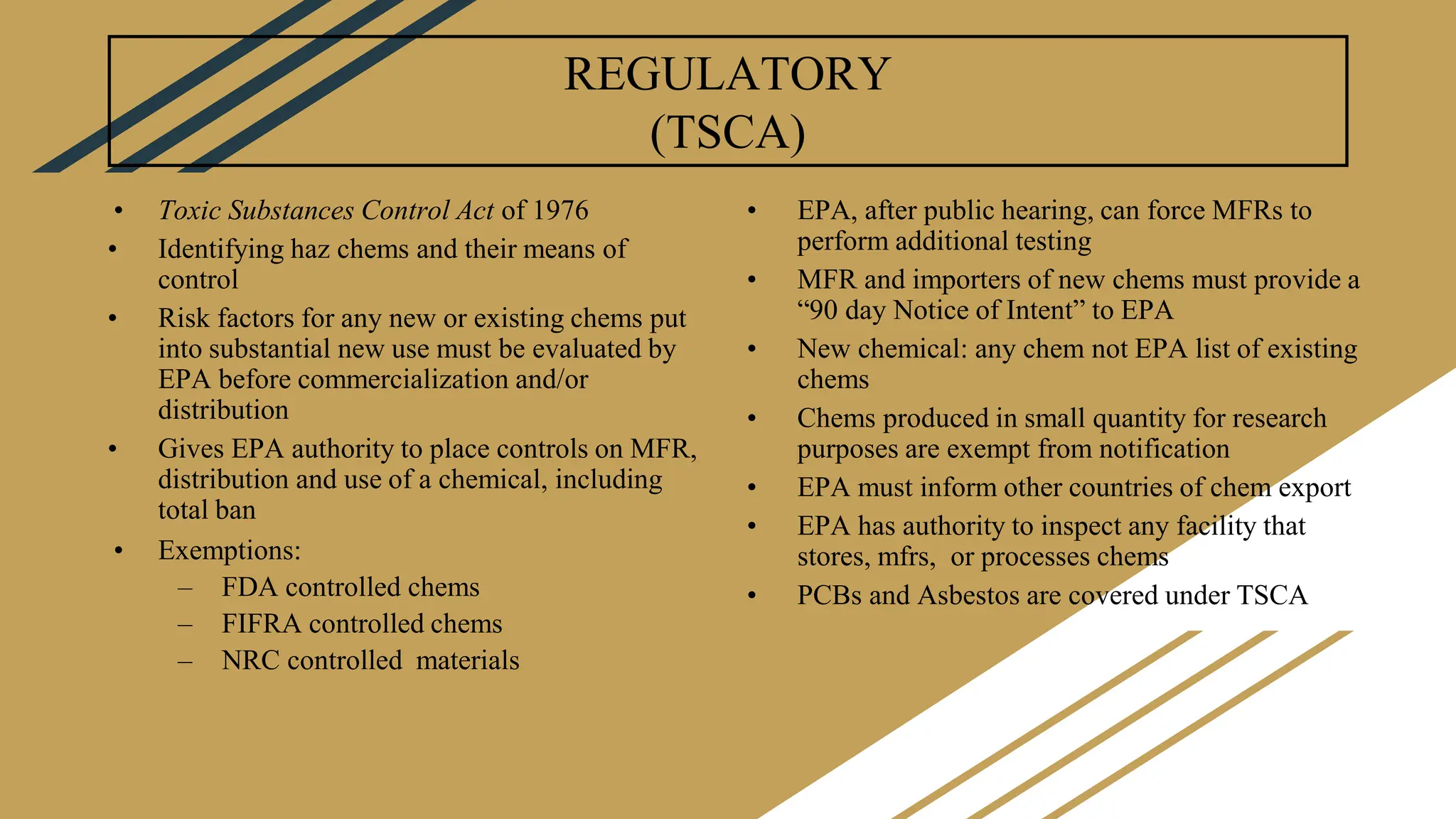
• NPDES applicant data must be maintained
for 3 years
• 1987 amendment to CWA introduced
management of “non-point” sources
REGULATORY
(TSCA)
• Toxic Substances Control Act of 1976
• Identifying haz chems and their means of
control
• Risk factors for any new or existing chems put
into substantial new use must be evaluated by
EPA before commercialization and/or
distribution
• Gives EPA authority to place controls on MFR,
distribution and use of a chemical, including
total ban
• Exemptions:
– FDA controlled chems
– FIFRA controlled chems
– NRC controlled materials
• EPA, after public hearing, can force MFRs to
perform additional testing
• MFR and importers of new chems must provide a
“90 day Notice of Intent” to EPA
• New chemical: any chem not EPA list of existing
chems
• Chems produced in small quantity for research
purposes are exempt from notification
• EPA must inform other countries of chem export
• EPA has authority to inspect any facility that
stores, mfrs, or processes chems
• PCBs and Asbestos are covered under TSCA
REGULATORY
(CAA - 1)
• Clean Air Act passed in 1970
• Primary and secondary NAAQS (national ambient
air quality standards)
• Standards set maximum allowable concentration of
pollutants
• Amendment of 1977 created”
– Prevention of Signification Deterioration
(PSDS):
• intent to limit pollution in areas in
compliance with NAAQS
• requires permit for owner/operator of
“stationary sources” prior to new
construction
• Mandates use of BACT (best available
control technology)
– Non-attainment:
• restricts construction which may add to
sources of air pollution; also requires
permit
• Titles:
– I: stationary sources such as mfg plants
– II: mobile sources such as automobiles
– III: judicial review/citizen lawsuits
REGULATORY
(CAA - 2)
• Standards:
– Ambient: max safe pollutant
concentrations
– Emission: controls amount of pollution
produced by a given source
• NESHAPS (national emission
standars for haz air pollutants)
• NSPS (new source performance
standards)
– State responsible for designing and
implementing a SIP (state
implementation plan) that achieves
NAAQS
• Hazard air pollutant is one which has no
NAAQS
• Operator/owner of emission source must:
– keep records
– Install/maintain monitoring equipment
– Comply with reporting requirements
• If SIP violated, EPA issues notice, to be
corrected within 30 days
• Violations of NESHAPS/NSPS do not require
notice by EPA, but may illicit immediate
action
• Allows citizen suits against EPA and
owner/operator
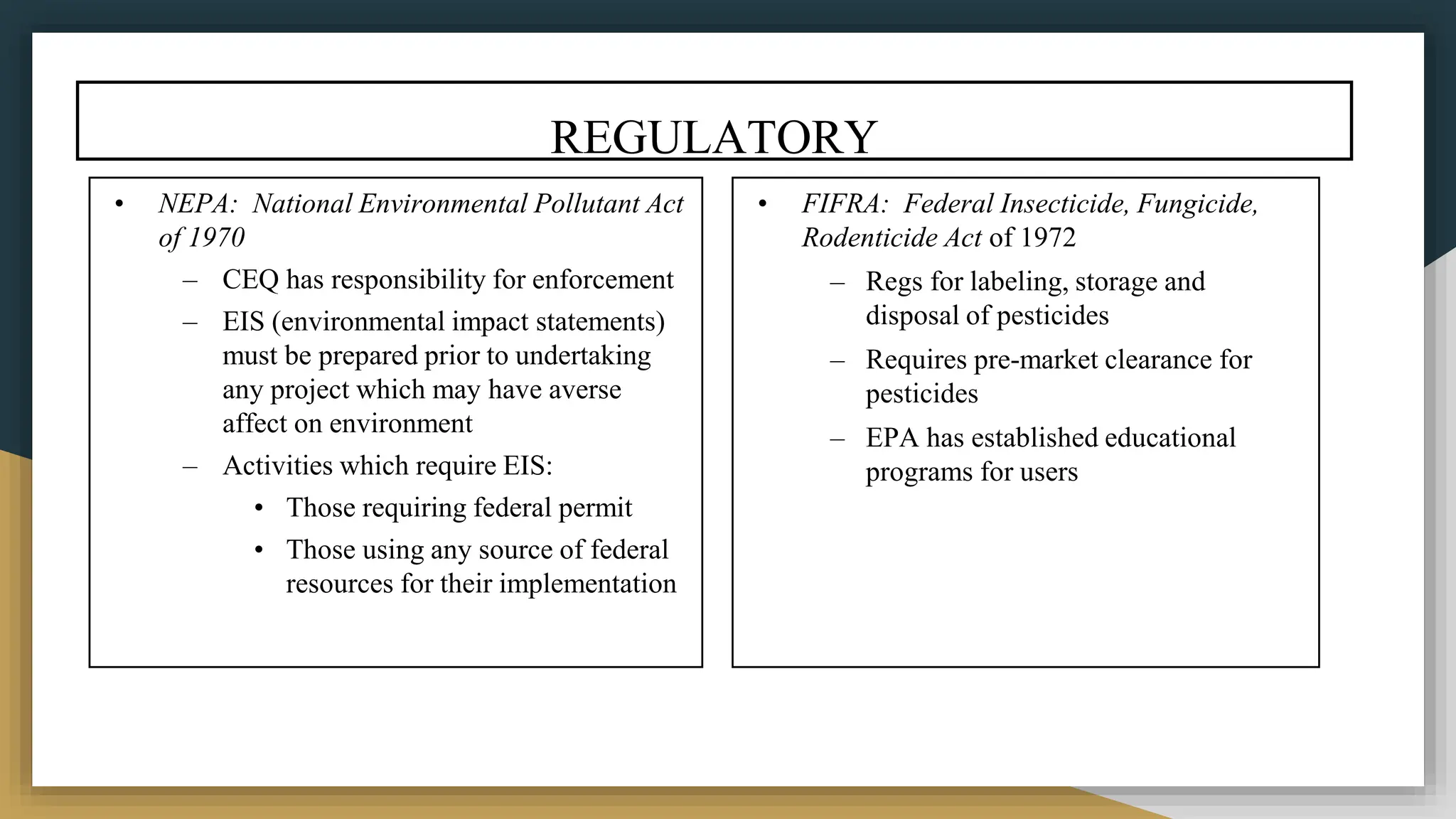
REGULATORY
• NEPA: National Environmental Pollutant Act
of 1970
– CEQ has responsibility for enforcement
– EIS (environmental impact statements)
must be prepared prior to undertaking
any project which may have averse
affect on environment
– Activities which require EIS:
• Those requiring federal permit
• Those using any source of federal
resources for their implementation
• FIFRA: Federal Insecticide, Fungicide,
Rodenticide Act of 1972
– Regs for labeling, storage and
disposal of pesticides
– Requires pre-market clearance for
pesticides
– EPA has established educational
programs for users
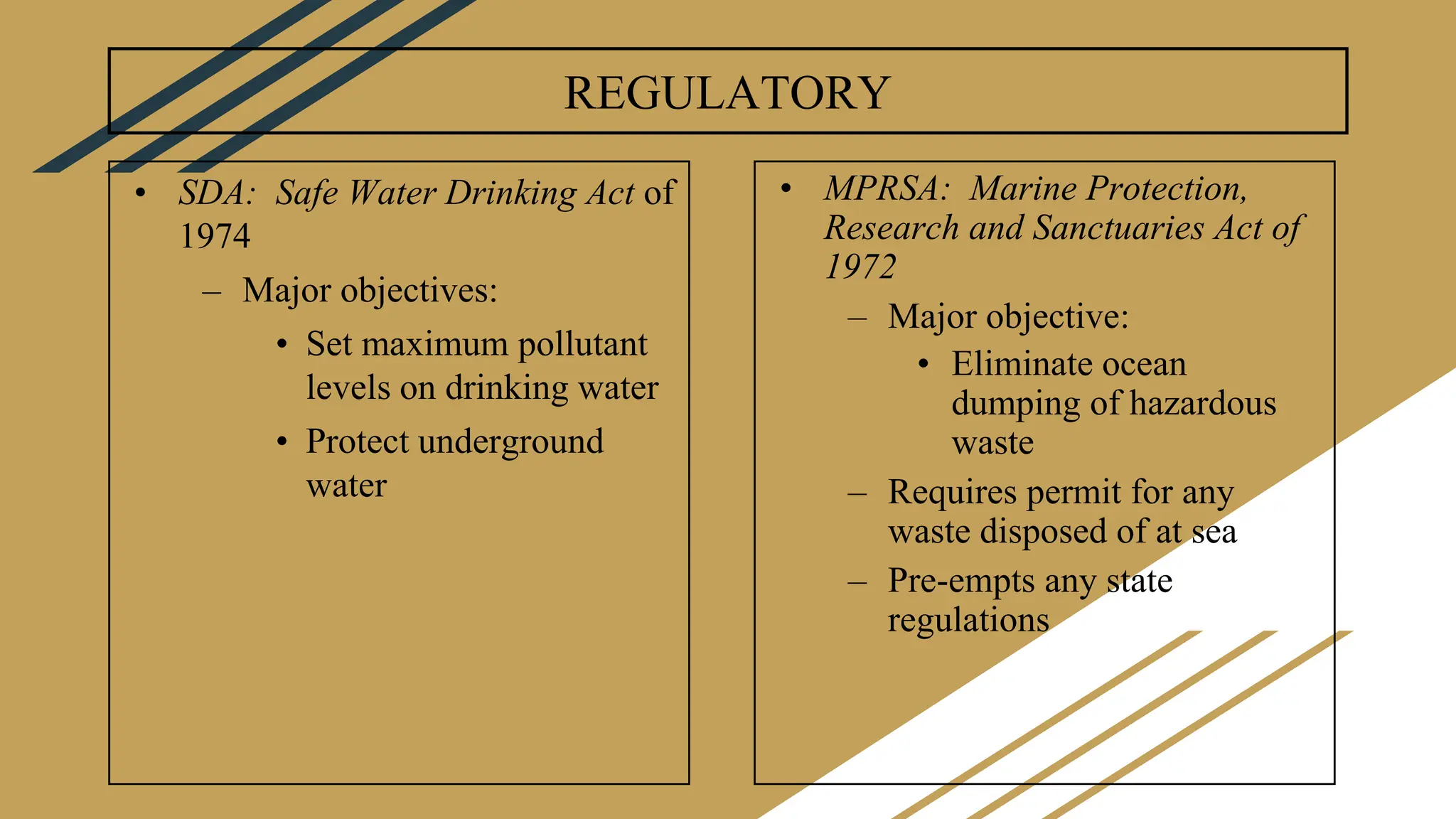
REGULATORY
• SDA: Safe Water Drinking Act of
1974
– Major objectives:
• Set maximum pollutant
levels on drinking water
• Protect underground
water
• MPRSA: Marine Protection,
Research and Sanctuaries Act of
1972
– Major objective:
• Eliminate ocean
dumping of hazardous
waste
– Requires permit for any
waste disposed of at sea
– Pre-empts any state
regulations
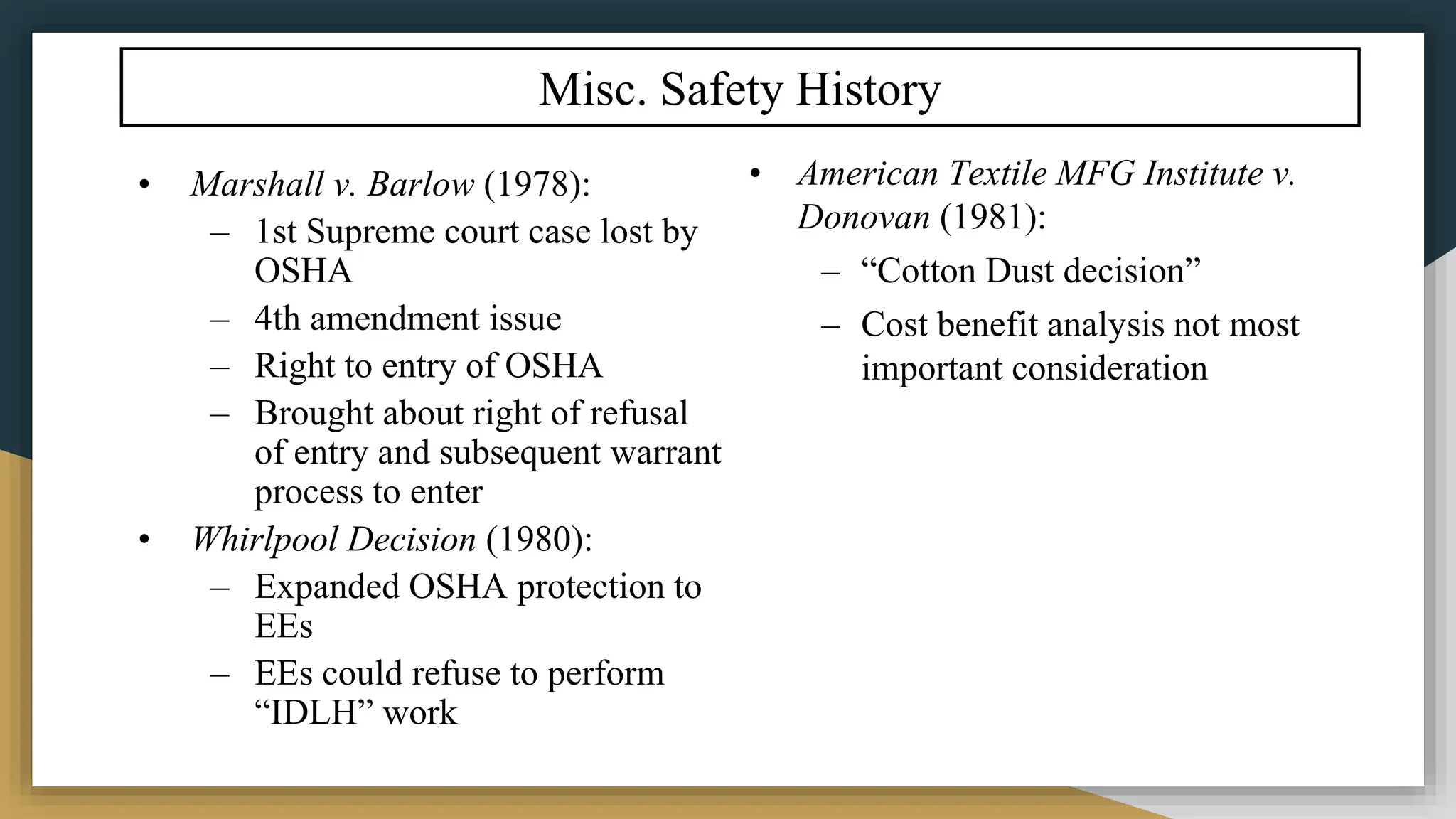
Misc. Safety History
• Marshall v. Barlow (1978):
– 1st Supreme court case lost by
OSHA
– 4th amendment issue
– Right to entry of OSHA
– Brought about right of refusal
of entry and subsequent warrant
process to enter
• Whirlpool Decision (1980):
– Expanded OSHA protection to
EEs
– EEs could refuse to perform
“IDLH” work
• American Textile MFG Institute v.
Donovan (1981):
– “Cotton Dust decision”
– Cost benefit analysis not most
important consideration
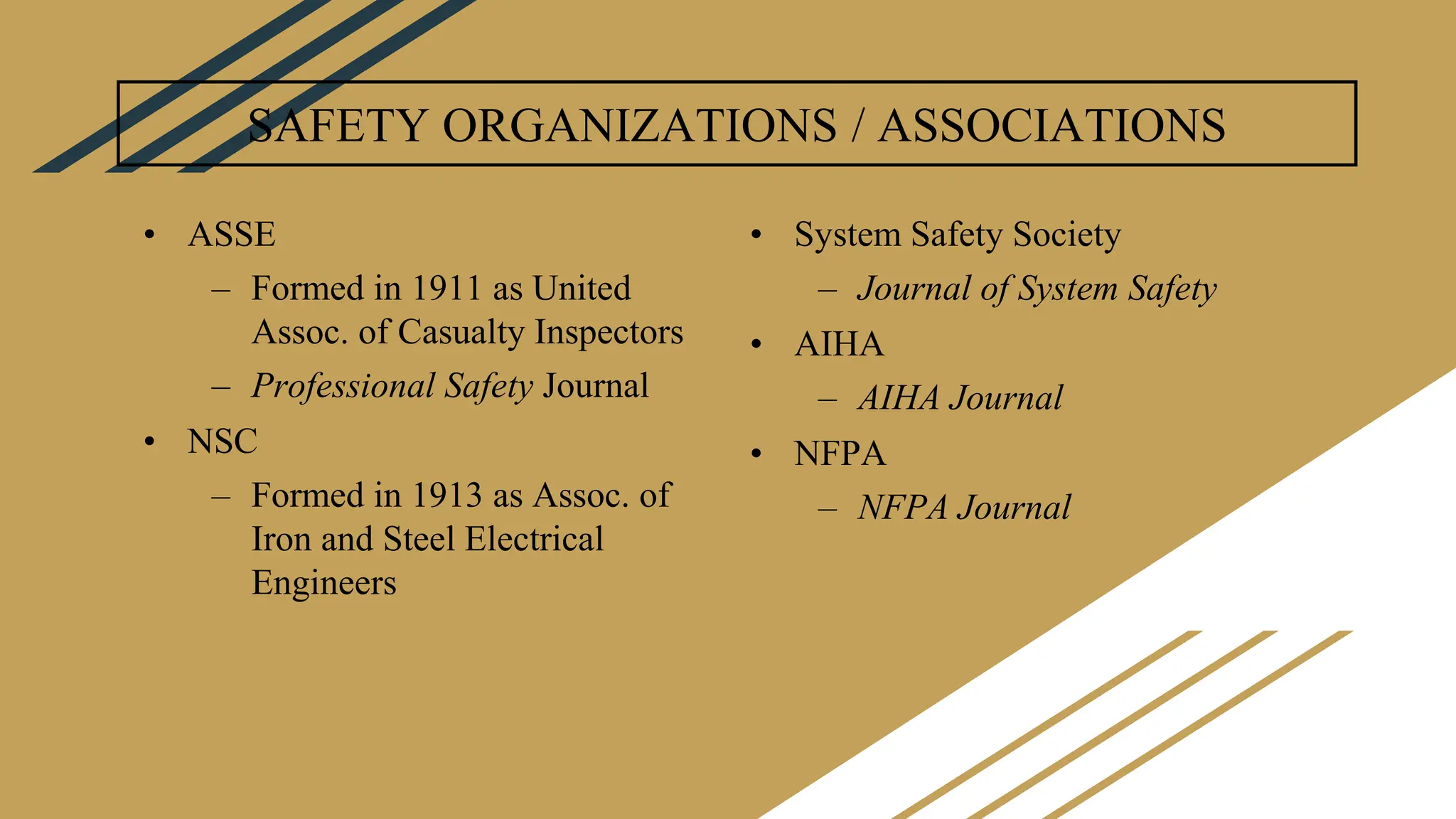
SAFETY ORGANIZATIONS / ASSOCIATIONS
• ASSE
– Formed in 1911 as United
Assoc. of Casualty Inspectors
– Professional Safety Journal
• NSC
– Formed in 1913 as Assoc. of
Iron and Steel Electrical
Engineers
• System Safety Society
– Journal of System Safety
• AIHA
– AIHA Journal
• NFPA
– NFPA Journal
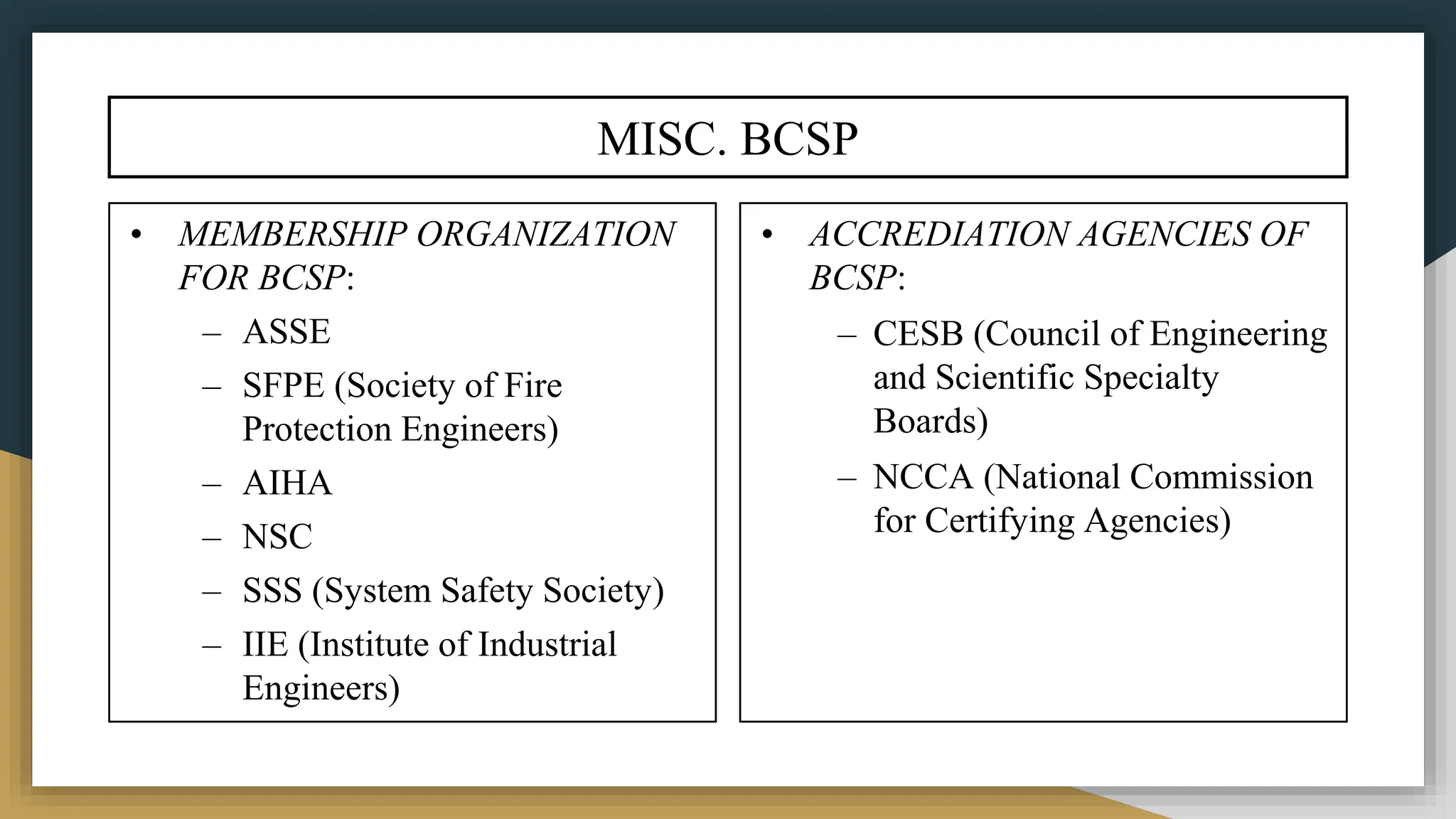
MISC. BCSP
• MEMBERSHIP ORGANIZATION
FOR BCSP:
– ASSE
– SFPE (Society of Fire
Protection Engineers)
– AIHA
– NSC
– SSS (System Safety Society)
– IIE (Institute of Industrial
Engineers)
• ACCREDIATION AGENCIES OF
BCSP:
– CESB (Council of Engineering
and Scientific Specialty
Boards)
– NCCA (National Commission
for Certifying Agencies)
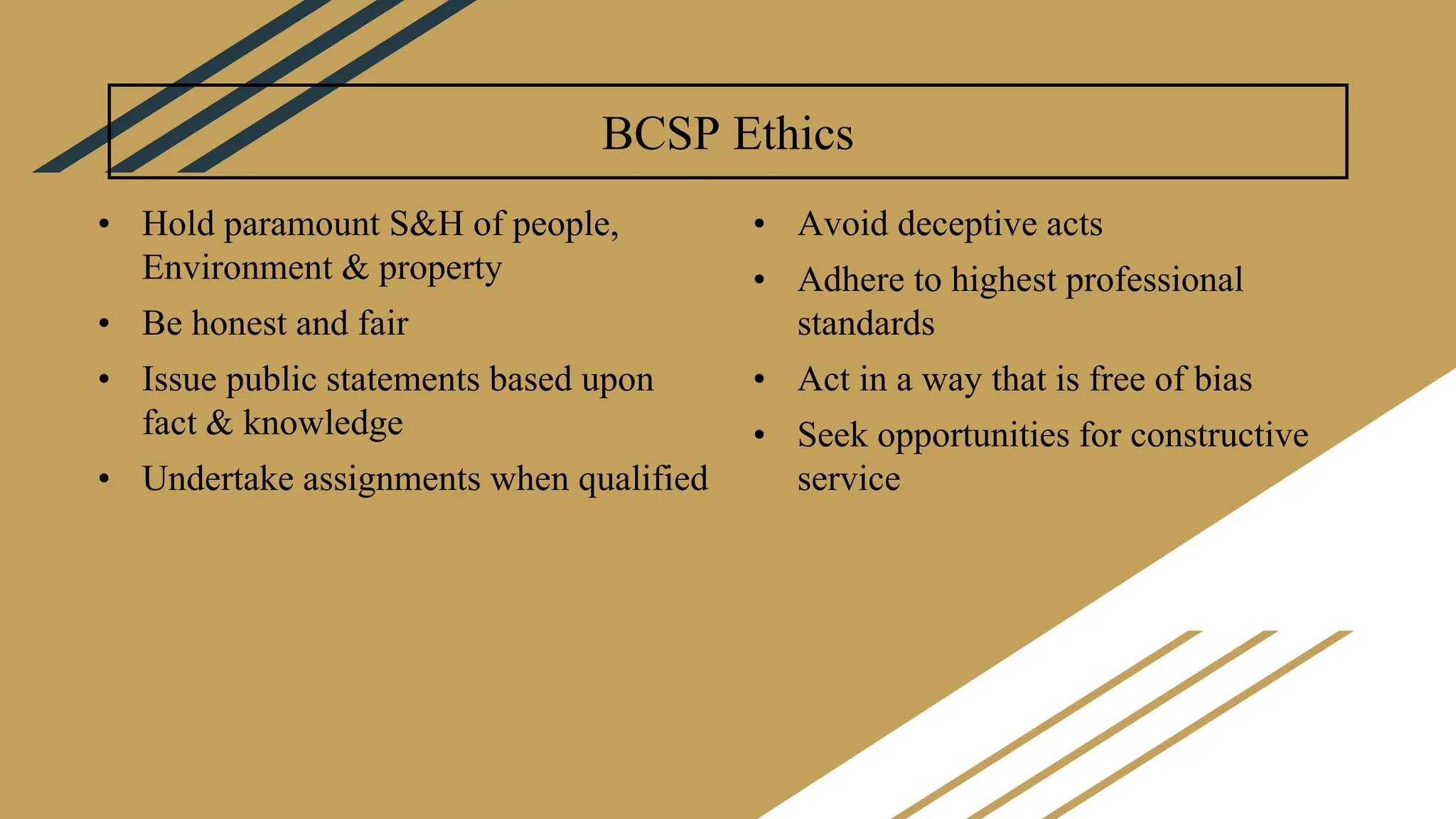
BCSP Ethics
• Hold paramount S&H of people,
Environment & property
• Be honest and fair
• Issue public statements based upon
fact & knowledge
• Undertake assignments when qualified
• Avoid deceptive acts
• Adhere to highest professional
standards
• Act in a way that is free of bias
• Seek opportunities for constructive
service
Thanks!
Paul McNeill, CSP
is a Senior Safety
Consultant with
Insperity
Paul Mcneill, CSP
paul.mcneill@insperity.com

CSP Study Notes 2024 - PAUL Mcneill, CSP

  • 1.
  • 2.
    Management Styles/Theories • Matrix: –rows and columns w/ projects and managers • Leikert: – “participation” at all levels – BHR Theory: worker productivity and supervisor control are inversely proportional – Exploitive-authoritative; Benevolent- authoritative; Consultative • Herzberg: – “Motivation” Hygiene Theory: • hygiene factors: salary, status, challenging work, benefits • motivation factor: achievement, promotion, recognition; responsibility • McGregor: – Theory “X”: lazy employees – Theory “Y”: motivated employees
  • 3.
    Management Styles/Theories • Spanof Control: – # of employees reporting to one manager should be limited • TQM: – philosophy and technique that uses statistical theory to improve production quality and performance – Every employee is responsible for product quality – *Shewhart Cycle: Plan, Do, Study Act • Multiple Causation: – accidents occur when causes and sub-causes combine • Argyris: – Employees treated like children and/or adults will act like such – Conflict theory: – Leveling: boss doesn’t make all the decisions – Incongruence theory: mature workers desire independence • Drucker: MBO
  • 4.
    HEINRICH • Father ofmodern safety • 1st textbook on safety • Domino Theory of Accident Causation(5 events): social, fault, unsafe act, accident, injury • 3 “E’s” of safety: Engineering, Education, Enforcement • 88 (unsafe acts)/10 (unsafe conditions) /2 % (Acts of God) • 4 steps of accident prevention • 4:1 ($ spent indirect vs direct) • Pyramid [NM (300), Minor Event (29), Major Events (1)] MJE MNE Near Miss
  • 5.
    DEMMING’S 14 STEPS •Adopt a new philosophy w/ new age • Base long term relationship on loyalty – single suppliers • Continual improvement • Put everybody to work to accomplish transformation • Institute job training • Create constancy of purpose toward improvement • Drive out fear • Eliminate quotas and numerical goals • Breakdown barriers b/w departments • Eliminate inspection. Build right the first time • Institute a vigorous program education and self-improvement • Institute Leadership: help people do a better job • Eliminate slogans and product targets
  • 6.
    Maslow’s Heirarchy ofNeeds • Pyramid w/ SA at top Self Actualization Self - Esteem Belonging-Love Safety Physiological
  • 7.
    Blake Mouton Grid Conceptualizedmanagement styles by number sequence
  • 8.
    Blake Mouton Grid •Conceptualized management styles by number sequence Task People 1 9 9 *BEST
  • 9.
    BEHAVIOR BASED SAFETY •Geller: – “The ABCs of Behavior” • Antecedent • Behavior • Consequence
  • 10.
    SAFETY MANAGEMENT THEORY • Mostcurrent thinking • Management ultimately responsible for safety • Unsafe behaviors, conditions and accidents symptomatic of management failure • Circumstances can be predicted to produce injuries • Safety should be managed like any other business function • Key to effectiveness is defining management accountability • Safe design is key to preventing root cause of many accidents • Function of safety is to locate and define operation errors that contribute to accidents
  • 11.
    MANAGEMENT PRINCIPLES • PeterPrinciple: – people promoted to level of incompetence • Parkinson’s Principle: – work expands to fill allotted time • Pareto Principle of Mal-distribution: – “80/20” Rule • 20% of employees responsible for 80% of work
  • 12.
    TYPES OF COMMANDS •Unity of Command: – each employee report to only one individual • Span of Control: – number of employees reporting to one individual • Vertically Integrated: – company owns all aspects of the production process (eg/ Ford) • Horizontally Integrated: – company owns little to none of production process (eg/ Dell)
  • 13.
  • 14.
  • 15.
  • 16.
  • 17.
  • 18.
    ESH PROGRAM • Linemanagement is actually responsible • ESH should be a staff function which advises management • Safety culture involves behavioral, environmental and personal factors • Cost of preventing accidents must show a return on profit line or avoid expenses – Annual cost of accidents is $100 billion – Cost of Loss: • Where PM is profit margin COL = (PM)($volume of business) For recovery COL = (PM)(#unit sold)(unit price)
  • 19.
    ACCIDENT CAUSES • BASIC: –Poor management practices • INDIRECT: – Unsafe acts or unsafe conditions – Can lead to direct causes • DIRECT: – Unplanned release of energy resulting in fatality, injury, or property damage
  • 20.
    Safety Analysis Techniques- 1 • Fault Tree Analysis (FTA) • Failure Mode & Effect Analysis (FMEA) • Functional Hazard Analysis (FHA) • MORT • Technique for Human Error Rate Prediction (THERP) • Zonal • JHA/JSA • HAZOP • Critical Incident Technique (CIT) • Systems Hazard Analysis (SHA) • Event Tree Analysis (ETA)
  • 21.
    Safety Analysis Techniques- 2 • Fault Tree Analysis (FTA): – undesired event – deductive (backward) analysis or Top down logic – and/or logic gates (‘and’ multiply, ‘or’ add) – graphical depiction – Uses Boolean postulates, looking for “minimal cut sets” • Failure Mode & Effect Analysis (FMEA): – manner in which failure occurs and their effect on the system – good for reliability studies* – Inductive or “Bottom Up” logic – Criticality rankings; individually • JHA/JSA: – Analysis by task • HAZOP: – study, table/logic diagram – PSM/PHA; failure modes – Initial effort to identify potentially hazardous components w/I a system during design phase • Functional Hazard Analysis (FHA): – deductive – “Top down”
  • 22.
    Safety Analysis Techniques- 3 • Technique for human Error Rate Prediction (THERP) – Calculates probability of human errors • Management Oversight and Risk Tree (MORT): – A logic tree to identify total risk inherent in the system and arising from operational/management inadequacies – Similar to FTA starts w/ undesirable event • Zonal: – Geographical; inspection of hardware • Systems Hazard Analysis (SHA): – Identifies physical and functional incompatibilities b/w adjacent, interconnected and interacting elements • Critical Incident Techniques (CIT): – Individuals are interviewed about accidents, near misses and hazardous conditions • Event Tree Analysis (ETA) – Forward analysis beginning with initiating event to find consequences – Evaluates success or failure of a system
  • 23.
  • 24.
    Cause & EffectDiagram (Fishbone ) Procedures People ENV EQUIP EFFEC T
  • 25.
    SYSTEM SAFETY • CLASSIFYINGFAILURE IMPACTS: – Catastrophic – Critical – Marginal – Negligible • SYSTEM SAFETY: – Fail Safe Passive: • 0 energy state • equipment stops operating • eg/ circuit breakers and fuses – Fail Safe Active: • eg/ emergency lights – Fail Safe Operational: • safest for people • eg/ feed water valve
  • 26.
    REDUNDANT SYSTEMS • SingleParallel: – Multiply failures • Double Parallel: • Standby: – sensor • Series: – Multiply successes – eg/ CGM: sample O2, Flam and Toxics – Pf = 1 – (Ps)x A B FX A B C F X A C B FX B Senso r F X
  • 27.
    RELIABILITY • Basic Equation: •Reliability in Series: • Reliability in Parallel: 1 - # of failures / total # of items exposed R1 x R2 x R3 1 - (1 - Ra)(1-Rb)(1-Rc) . . .
  • 28.
    DEFECTS & PROBABILITIES •Basic Equation: • Redundant Series: – Pf = 1 – (Ps)x • Redundant Parallel: – Ps = 1 – (Pf)x Pf + Ps = 1
  • 29.
    Probability of Defect •Machine A produces 25% of parts, B produces 35% and C produces 40%. Their rate of defects are .05, .04 and .02, respectively. What is probability that machine A will produce a defect? • 1. Construct probability table: • 2. Add up defects – 1.25 + 1.4 + 0.8 = 3.45 • 3. Divide Machine A over total defect rate – 1.25/3.45 = 0.36
  • 30.
    Probability of Success •Question: An airplane has two engines, each with a probability of success of 0.90. What is the probability that the airplane will arrive safely if one or both engines working will ensure a safe arrival? – Both engines working means “and” therefore multiply • Pf = 1- Ps = 1- 0.9 = 0.1 • Ps = 1- [(0.1)(0.1)] = 0.99 Ps + Pf = 1
  • 31.
    Probability of Failure •Question: a component has six parts connected in series, each with a probability of failure of 0.05. Determine probability of component failure. – Pf = 0.05 therefore Ps = .95 – There are six parts therefore: – Pf = 1- (.95)6 = .26
  • 32.
    Probability of Success •Question: A widget is made of three components called wiglets. Wiglet “A” has a Ps of .30, wiglet “B” has a Ps of .45 and wiglet “C” has Ps of .60. Calculate Ps if wiglets B and C are functionally parallel and wiglet “A” is in series. – Calculate Ps of (B+C) • Ps(B+C) = 1 – Pf • Ps(B+C) = 1- [(.55)(.40)] = .78 – Calculate Ps of A(B+C) • Ps = (.30)(.78) = .23 B C A .30 .45 .60
  • 33.
    POISSON DISTRIBUTION • Question:A group of 20 chips are in a piece of equipment. What is the probability of two and only two chips failing if the chips are known to be 0.03 defective. • P2 = (0.03)(20)2 e-(.03)(20)/2! – P2 = (.6)2 ln(-.6) / 2! – P2 = (.36)(.55) / 2 – P2 = .099 or 1.0 P(r) = (λt)r e- λt/r! • Where P is probability • λ = average or rate • t = time • r = number of occurrences • e = natural log base (ln) • ! = factorial (r!)
  • 34.
    Probability Calculation – 1.)Set up diagram – 2.) Get individual Rates a. Combo of 2 men b. Combo of 2 women c. Combo of 2 men and 2 women – 3.) Calculate probability Solution: 1. [6/2]*[4/2]**/[10/4] 2a. 6 nCR 2 = 15 2b. 4 nCR 2 = 6 2c. 10 nCR 4 = 210 3. [15][6]/[210] = 0.43 *Female, **Male •Question: What is the probability that 2 men and 2 women will be selected out of a group of 10 with 6 men and 4 women?
  • 35.
    Statistical Sampling Techniques •Random – each item from a popn has equal probability of being selected • Cluster – items from popn are grouped by similar characterisitics and the sample group is selected randomly • Stratified – items popn grouped by similar characterisitcs and sample taken from random selection in groups – age groups such as: > 60, 20-60, <60 • Systematic – items from popn are selected based upon factors such as time or location/position (eg/ every 5th one) – good for QC
  • 36.
    STATISTICS - 1 •Coefficient of Correlation (r): – relationship b/w two variables to determine “strength and direction” – +/- 0.9-1.0 hi COC; +/- .4-.9 Lo COC; <.4 no COC • Coefficient of Determination (cd): – Explained variation divided by total variation – Or COC (r) is the square root of (cd) • Coefficient of Variation (cv): – Compares % variations of two or more groups by measures of central tendency – eg/ salaries of managers to workers
  • 37.
    STATISTICS - 2 •Z score (Z): – Determines the location of a single score in the normal distribution – % area under the curve – Eg/ your score compared to rest and % widgets that will fail • T-test (t): – compare population mean to sample mean – data sets < 30 – eg/ compares two groups • Chi Square (X2): – “goodness of fit” b/w observed and expected – usually a frequency table
  • 38.
    Coefficient of CorrelationCalculations • High COC: +/- 0.9 - 1.0 • Low COC: =/- 0.4-0.9 • No COC: < =/- 0.4
  • 39.
    • Question: Calculatemanager and employee variation given the following: – Managers paid $4800/mos – Employees paid $780/mos – SDmanager = $820 – SDemployee = $64 • SDm = 820/4800 = .171 or 17% • SDe = 64/780 = .08 or 8% – Conclusion: more variation in managers salary STATISTICS (Coefficient of Variation) CV = SD/X Where SD is std deviation and X is the mean
  • 40.
    Bell Curve • 1SD: +/- 68% • 2 SD: +/- 95% • 3 SD: +/- 99.7% 2.5% 13.5% 34% 34% 13.5% 2.5% 0 -1 -2 -3 +1 +2 +3 75 90 105 120 135 150 165 X = 120 SD = 15
  • 41.
    Z score Calculation (fromprevious curve) • Question: Your score on the exam was 126. What % of those taking exam did better than you? – 1.) Calculate Z-score • Z = X-μ/σ 126-120/15 = 0.40 • where z = # SD, x = data point, μ = popn and σ = popn SD – 2.) Consult table p.2 of HO • Z-score of 0.4 = .1554 – 3.) 0.5 - .1554 = .3446 or 34%
  • 42.
    Z score Calculation (#of SDs from average χ) • Question: Your facility made 1,000 widgets w/ an avg life expectancy of 500 hrs and a SD of 100 hrs. What % will fail in first 225 hrs? – Need area under curve therefore Z: • Z = x-μ/σ = 225-500/100 = -2.75 SDs from χ – Refer to table p2: • 2.75 z-value yields .4970 or 49.7% – Calculate %: • 50% - 49.7% = 0.3% Z = x-μ/σ
  • 43.
    T-Test (Compares μ (popn)to χ (sample) w/ data sets < 30) • Question: The BCSP just released latest exam results. The average score was 125 and the SD 15. A group of 21 people took the ASP prep workshop prior to above exam. Their score was 133 and the SD was 11. Are the scores of the workshop participants significantly better the the average score at the p= .05 level? • Calculate t: t = 133-125/11(√21-1) = 3.25 • Use table p.3 to line p-value and df (N-1= 20) for value of 1.725 • Conclusion: Yes, reject null when t-test value is ≥ table value – 3.25 ≥ 1.725 t = χ – μ/s(√N-1)
  • 44.
    CHI Square -1 (determines difference b/w observed and Expected frequencies) • Question: As Safety Director, you are concerned about the number of first aid and recordable cases involving new employees vs number of cases involving more experienced employees. A survey of employee incident/accident data is revealed below. Can you be 99% sure that any differences observed in above data are not due to chance? NEW EEs OLD EEs TOTAL FIRST AID 100 15 115 RECORDABLE 60 25 85 TOTAL 160 40 200
  • 45.
    CHI Square -2 • Basic Equation: – Where oj = observed frequency – ej = expected frequency – df = (rows-1)(columns-1) – Oj equals: • 100, 60, 15 and 25 – ej equals: • (160)(115)/200 = 92 • (160)(85)/200 = 68 • (115)(40)/200 = 23 • (85)(40)/200 = 17 • Set-up Matrix Solution Table X2 = Σ(oj – ej)2/ej
  • 46.
    CHI Square -3 • Set-up Solutions Matrix: Oj Ej Oj-Ej (oj-ej)2/ej 100 92 8 .69 60 68 -8 .94 15 23 -8 2.78 25 17 8 3.76 Total (Σ) 8.18
  • 47.
    CHI Square -4 • Refer to X2 table on BCSP handout – df = 1, – p = 0.01 (100 - .99 = .01) – Table value is 6.635 • Conclusion: – Reject null H0 b/c X2 > table or 8.18 > 6.635
  • 48.
    Present Value ofMoney • One trip to the bank: • Many payments/trips to the bank: P = F(1 + i)-n where F is future value P = A [(1+i)-n/i(1+i)n] where A is amount of monthly payment and n is # of time periods
  • 49.
    Present Value ofMoney • Question: – What is better deal, 1M over term or $3K monthly? • Answer: – for 1M investment up front: – for $3K monthly: P = F(1+i)-n Where F = 1M, i = interest rate and n= periods (eg/25) P = A[(1+i)n - 1/i(1+i)n] where A = periodic payments (eg/ $3K) and i = monthly interest (/12)
  • 50.
    Future Value of$ from Present Value • Question: $10K returns $5K over 5 years, what is APR? • Answer: – 15K = 10K(1+i)5 – 15K = 10K(x)5 – 1.5k = x5 – 1.5 = x – x = 1.08 F = P(1 + i)n x = 1 + i 1.08 = 1 + i .0845 = i or 8.45%
  • 51.
    PRESENT/FUTURE VALUE OF$ • Question: You need to purchase a new machine. Two options: (1) lease a machine for 10 years @ $2K/yr; or, (2) purchase the machine for $10K with a maintenance agreement of $500/yr. After 10 yrs you can sell the machine for a salvage value of $5K. Interest will be 15% for 10 yrs. Which option is best? – Option 1 - Lease (PV regular payments): • P = (2K)[(1+.15)10-1/(1.5)(1+.15)10] = 3.05/.607 (2K) = $10,038 – Option 2 - Buy (PV lump sum): • (a) Calculate Maintenance Costs = $10,038 x (500/2000)* = 2509 • (b) Initial cost plus maintenance = 10K + 2509 = $12,509 • © calculate salvage: P = F(1+i)-n = (5K)(1.15)-10 = $1236 • © Cost minus salvage = 12509 - 1236 = $11,273 • *maintenance agreement is 1/4 of original monthly lease amount – Option 1 is better as $10,038 < $11,273 P = A[(1+i)n-1/i(1+i)n] P = F(1+i)-n
  • 52.
    PRESENT/FUTURE VALUE OF$ • Question: The initial cost of a safety project will be $15K. The project will cost $2K/yr to maintain, but will save $4K/yr over 6 yrs @ 7%. Should the company invest in the startup? – (a) Calculate PV of maintenance cost: $9533 – (b) Add maintenance cost to project cost: 15K + 9533 = $24,533 – © Calculate PV of savings: use eqn (a) substituting 4K = $19,066 – © Cost is > than Savings P = A[(1+i)n-1/i(1+i)n]
  • 53.
    PHYSIOLOGY OF HEARING •Conductive Loss: – interfere w/ transmission involving outer and middle ear – mechanical • Sensorineural Loss: – damage to “organ of corti” (inner ear) – degeneration of neural elements of auditory nerve – irreversible • Mixed: – combination of above • Central (CNS) Impairment: – lack of ability to interpret what is heard
  • 54.
    LIFTING EQUATION • BasicEquations: – where RWL is recommended weight limit – LC is load constant – HM is horizontal multiplier – VM is vertical multiplier – DM is distance multiplier – AM is angular multiplier/displacement (twist) – FM is frequency multiplier – CM is coupling multiplier RWL = LC x HM x VM x DM x AM x FM x CM
  • 55.
    LIFTING INDEX • BasicEquation: – where LI is index – and L is load – and RWL is recommended weight limit – Most lifted is either 51 lbs or 23 kg • Static Loads may aggravate disorders such as: – Tendonitis – Bursitis – CTS LI = L/RWL
  • 56.
    Safety Factor Calculations •Basic Equation: SF = allowable/actual
  • 57.
    Chemistry Terms • Molarity: –moles of solute dissolved in 1L of solution • Molality: – moles of solute/kg of solvent • Equivalent: – qty of acid/base that yields 1 mole H+ • Normality: – # of equivalents dissolved in a liter
  • 58.
    BENZENE • Sampling Media- charcoal tube • Bioanalysis - urine test after work shift to detect presence of phenols
  • 59.
    TOXICOLOGY - 1 •Bysinossis: cotton dust • Leptospirosis: bacteria in animals • Erysipeloid: fish processing • Trichinosis: pork processing • Pulmonary Edema: acid/gas exposure • Pnuemoconiosis: hardening, scarring and inability to transfer oxygen form tissues to blood in lung • Emphysemsa: smoking • Tetanus: bacillus bacteria
  • 60.
    TOXICOLOGY - 2 •Hantavirus: rat droppings • Anthrax: bacterial infection • Histoplasmosis: pigeon/bird droppings • Brucellosis: bacterial infection in farmers, vets and lab workers • Tularemia: carried by rats; Rabbit fever • Raynaud’s Disease: vibration-induced; “white fingers” • Newcastle Disease: viral infection in birds
  • 61.
    TOXICOLOGY - 2 •Hantavirus: rat droppings • Anthrax: bacterial infection • Histoplasmosis: pigeon/bird droppings • Brucellosis: bacterial infection in farmers, vets and lab workers • Tularemia: carried by rats; Rabbit fever • Raynaud’s Disease: vibration-induced; “white fingers” • Newcastle Disease: viral infection in birds
  • 62.
    GRAM-MOLES • Question: Whatis the volume of 100 grams of N2 at 25°C and one ATM? – NTP conditions – Convert from grams to liters for calculation • 100 g x 1 mole/gram x 24.42 L/moles = 87.32 L • Question: How many molecules are present in 100 grams of N2 at 25°C and one ATM? – Molecules relate to Avogadro’s number, therefore: • 100 g x 1 mole/28g x 6.02 x 1023 molecules/1 mole = 2.15 x 1024
  • 63.
    DILUTION VENTILATION • Question:MIBK solvent based paint is used in a spray booth at steady evaporation rate of 1 qt/hr. How many CFM of dilution ventilation is required to maintain a concentration at or below the TLV? (TLV = 50 ppm; s.g. = .7; MW = 100 and assume K = 6) – Basic Equation: • where Q is flow • SG is speicific gravity • ER is evaporation rate in pts/min • K is safety factor • MW = molecular weight • C = TLV concentration – Convert qt/hr to pts/min for ER: • 1 qt/hr x 2 pts/qt x 1 hr/60 min = .03 pts/min – Dilution calulcation: • Q = 403 x 106 x .7 x .03 pts/min x 6 / (100)(50 ppm) = 11,300 CFM Q = 403 x 106 x SG x ER x K / MW x C
  • 64.
    TWA - ChemicalExposure • Question: What is the TWA of the following exposure: 2 hrs @ 5 ppm, 1 hr @ 2.0 ppm, 3 hrs @ 1 ppm and 2 hrs @ 1.5 ppm? – Basic Equation: • where C = concentration • T = time – TWA = (2)(5) + (1)(2) + (3)(1) + (2)(1.5) / 480 minutes = 1.1 ppm TWA = C1T1 + C2T2 + CnTn / ΣT
  • 65.
    MIXTURES - Exceeding theTLV • Question: Given the following exposure: Toluene 5.5 hrs @ 50 ppm (TLV 50 ppm), MC 1.9 hrs @ 75 ppm (TLV 50 ppm) and Xylene .3 hrs @ 250 ppm (TLV 100 ppm). Has the TLV of the mixture been exceeded? – Set up ratio: Actual/Allowed – Can add because all FX same target organ – TLV = (5.5)(50) + (1.9)(75) + (.3)(250) /(8)(50) + (50)(8) + (100)(8) = 1.175 – 1.175 is > than 1 therefore overexposed TLV = C1T1/TLV1(8hrs) + C2T2/TLV2(8hrs)
  • 66.
    CALCULATING [UNK] • Question:1-L of benzene breaks and evaporates in a 20x20x10m closed room at NTP. If the MW is 78 and the sg is .6, what is the concentration? • Calculate mg: – 1L of benzene = 600 g (60% of L of H20 is 1) – 600g x 1000mg/g = 600K mg • Calculate area: 4000 m3 • Calculate ppm: (600Kmg/4000m3)(24.45)/78 = 47 ppm ppm = mg/m3 x 24.45/ MW
  • 67.
    REDUCING CONCENTRATIONS • Question:A furniture drying area contains 100 ppm of a solvent. If the volume of the room is 100Kft3, the ventilation rate 2,000 cfm, how long to reduce the [solvent] to 25 ppm? – Where C1 is initial [ ] – C2 is final [ ] – Q’ is ventilation rate in cfm – V is volume of room in ft3 – t1 is start time – t2 is end time • Looking for t2: • t2 = ln(C2/C1)(V/Q’) • t2= ln (.25)(100Kft3)/(-2000ft3/min) = 69.31 min ln(C2/C1) = -Q’/V(t2-t1)
  • 68.
    SAMPLING SAEs • Question:A sample reveals xylene exposure for an 8-hr period was 105 ppm. The PEL for xylene is 100 ppm. The SAE is 0.10. What can you conclude from these results? – Where Y = standardized [ ] – X = given concentration – CL = confidence limits • Y = X/PEL = 105/100 = 1.05 • UCL = Y + SAE = 1.05 + 0.1 = 1.15 • LCL = Y - SAE = 1.05 - 0.1 = .95 • Therefore a possible overexposure exists because UCL> 1 and LCL < 1. Y = X/PEL UCL = Y + SAE LCL = Y - SAE
  • 69.
    TLV of MIXTURES •Question: What is the TLV of the following mixture? 50% heptane (TLV 400 ppm or 1640 mg/m3), 30% methyl chloroform (TLV 350 ppm or 1,910 mg/m3) and 20% perchloroethylene (TLV 25 ppm or 170 mg/m3). – Calculate mg: • TLV = 1/(.5/1640) + (.3/1910) + 9.2/170) = 1/34 = 610 mg/m3 – Calculate MW: • (610)((.5) = 305 mg/m3 • (610)(.3) = 183 mg/m3 • (610)(.2) = 122 mg/m3 – Calculate ppm: • 305 mg/m3 x 400 ppm/1640 mg/m3 = 74.39 ppm • 183 x 350/1910 = 33 ppm • 122x 24/170 = 18 ppm – Calculate total PPM: • 74 + 33 + 18 = 125 ppm TLVm = 1/(f1/TLV1) + (f2/TLV2) + (fn/TLVn)
  • 70.
    4 Elements ofRisk Management • Insurance • ESH • Contracts • Avoidance Risk Management INS ESH CONTRACTS AVOIDANCE
  • 71.
    RISK MANAGEMENT • PureRisk: – expectation of an event that will only produce loss should it occur (eg/ FIRE) • Speculative Risk: – result of an event which will produce a gain or loss should it occur (eg/ business venture) • Societal Risk: – # of incidences/consequences that occur per year • Individual Risk: – Probability of a single consequence occurring to an individual in a given year • Types of Companies – Captive: • self-insured; pools, can’t get public insurance – Stock: • for profit – Mutual Company: • Company owned by policy holders • eg/ State Farm, USAA – Lloyds of London: • syndicate (not insurance company)
  • 72.
    INSURANCE • Items coveredunder basic policy: – “WHARVES” • Wind • Hail • Aircraft • Riot • Vandalism • Explosion • Smoke • WC organization’s pay “insured cost” of accidents only • An accident resulting in hospital TX is “insured” cost of accident • Uninsured costs are “deductible” part of policy
  • 73.
    CALCULATING PREMIUMS – BasicEquation: Gross Premium = Pure Premium / 1-Load Percent
  • 74.
    Worker Compensation Definitions •Premiums: • Retrospective: – immediate past year’s loss experience • EMR: • WC Loss Ratio: – ratio of 0.6-0.7 is reasonable PR = (manual rating)(EMR)(earnings/100) EMR = actual expenses/expected expenses LR = losses (or benefits paid)/premium received
  • 75.
    WC Miscellaneous • ScheduleRating: – Assigning companies credits and debits based upon safety performance compared to a baseline • Manual Rating: – Rate based upon hazard associated with occupation • Premium Discounting: – Large employers receive discounts based upon their size • No fault system provides “exclusive remedy” • Retrospective rating based upon immediate past year’s loss experience • Manual rate based upon avg rate per $100 of payroll • EMR based upon loss experience over 3 yrs – adjust company’s premium based upon losses compared to like industry – Uses an average of 1 for industry (eg/ >1 worse than industry std and <1 better)
  • 76.
    WC Calculation • Questions: –Employee earns $1000, manual rating of 3.50 and EMR of 1.5. What is WC premium? • Answer: – $3.50 (rate per $100 of payroll) x 10 ($1000/100) x 1.5 (b/c above avgEMR of 1.0) = $40.25
  • 77.
    OSHA Incident RateCalculations • Basic Equations: – Incident Rate (IR) – Days Away, Restricted, Transfer (DART) • *exposure hours is the # of ee’s x 2000 hrs/yr • Record Maintenance: – I&I Logs must be maintained for 3 years – Medical records must be maintained for 30 yrs past date of employment IR = # cases x 200,000/exposure hours DART = #cases x 200,000/exposure hours*
  • 78.
    CONSUMER PRODUCTS SAFETYCOMMISSION (CPSC) • Established as a result of the CPS Act of 1972 • Operates a national info network called the NEISS • Products regulated: – Apparel and non-apparel fabrics – Hazardous substances – Materials required child- resistant packaging (eg/ food, drugs, cosmetics and fuels) – Household/educational / recreational products • MFRs, Distributors and Retailers must report to CPSC when product: – Fails to comply with standards – Contains a defect which creates hazards – Poses unreasonable risk of serious injury or death – Subject to 3 or more civil actions in one year
  • 79.
    HYDROSTATICS • Basic Equation: –where Q is volume in gpm – where d is distance in inches • Question: The VP in a 2” pipe w/ 1000 gpm flowing is? – Answer: • Pv = (1000)2/(891)(2)4 or 70.14 psi Pv = Q2/891d4
  • 80.
    HYDROSTATICS • Question: A4’x 6’ container is 10’ deep and contains 50% water and 50% oil with a sg of 0.8. What is P ½ distance from surface if oil and water remain separated? – Where P is pressure – H is height – Sg is specific gravity • Ph20 = (.433psi/f)(5ft)(.8) = 1.732 psi P = .433 psi/f (h)(sg) Oil Water 10 ft 5 ft
  • 81.
    ELECTRICITY Ohms Law • BasicEquations: – where P is power – V is volts – I is current – R is resistance P = VI V = IR
  • 82.
    ELECTRICITY (Resistance - 1) •Question: Given the below diagram, what is the total Resistance R? – Rules of Thumb: • w/ parallel R, total R must be < the smallest R • w/ combination series and parallel, do series first than parallel – 1/Rp = 1/50 + 1/10 + 1/10 = 1/.22 – 2.) Invert: 1/.22 = 4.54 ohms 1/Rp = 1/R1 + 1/R2 + 1/Rn Note: always invert final answer Rseries = R1 + R2 + Rn 110V 50Ω 5Ω 5Ω 5Ω 5Ω R
  • 83.
    ELECTRICITY (Resistance - 2) •Question: What is the current in B (on previous page)? – Where V is voltage – I is amps – R is resistance in ohms – V= IR I = V/R = 110V/10ohms = 11 amps • Rule of thumb: • Voltage doesn’t change thru system in parallel/series V = IR
  • 84.
    Bonding and Grounding •Bonding: – connecting two conducting bodies by means of a conductor • Grounding: – provides a conducting path b/w charged objects and the earth – flam liquids build up electrostatic charge when agitated or during transfer
  • 85.
    ELECTRICITY MISC • Interlocksused in electrical equipment must meet “fail-safe” criteria • An electrical “open knife” switch cannot be used in hazardous locations because: – Live parts are exposed – It has sharp edges • “Snap switches” enclose live parts and are safer than open knife switches • Electrical circuit protective devices (eg/ fuse or circuit breaker) open the circuit • Electrical bonding eliminates the potential difference b/w two conductors • Electrolytic fluid in in lead-acid batteries during changing can produce hydrogen gas • An electrical system is “de-energized” only after it has been shut off and tested • Conductive (protective) clothing is used for electrostatic hazards
  • 86.
    Flammable/Combustible Liquids • FlammableLiquids – Class IA: • FP < 73F and BP < 100F – Class IB: • FP < 73F and BP > 100F – Class IC: • FP > 73F and < 100F • Combustible Liquids – Class II: • FP> 100F and < 140F – Class IIIA: • FP > 140F and < 200F – Class IIIB: • FP > 200F
  • 87.
    Electrical Classifications (NEC500) • Class I: – Div. 1:ignitable [flam. Gases and vapors] normally exist, (eg/open systems) – Div. 2: volatile liquids or gases confined • Class II: – Div. 1: comb. dust under normal conditions – Div. 2: sufficient qty of dust not normally present • Class III: – Div. 1: ignitable fibers are handled and/or processed – Div. 2: ignitable fibers are handled only
  • 88.
    FIRE MISCELLANEOUS -1 • Extinguisher Requirements – Visual inspection monthly – Maintenance checks annually – Hydrostatic testing every 5 and 12 years – Travel distance to Class A is 75 feet – Travel distance to Class B &C is 50 ft • 2 TYPES OF SMOKE DETECTORS: – Ionizing • smaller smoke particles • incipient stage of fire – Photoelectric • larger particles • smoldering fires
  • 89.
    • TETRAHYDRAN OFCOMBUSTION: – Requires the following 4 elements: • Fuel • Oxygen • Ignition • Chain Reaction FIRE MISCELLANEOUS - 2
  • 90.
    Fire Prevention (Basic Principles) •Combustion – rapid chemical rxn of 02 w/ a fuel – produces CO and CO2 plus heat – elements include 02, heat, ignition • Convection – a result of movement of air and combustion products – determines direction which a fire will spread • Conduction – mechanism of thermal E transfer b/w materials – materials have high conduction (metals) or low (plastics)
  • 91.
    Fire Prevention Properties ofFlam and Comb Liquids - 2 • Flash Point – lowest temp at which a liquid can generate enough vapor above its surface to support combustion in presence of ignition source • Vapor Pressure – Pressure exerted by a vapor on its liquid at equilibrium – strongly affected by Temperature • Equilibrium – Vaporization and condensation of molecules until the rates of the two become equal – strongly affected by Temperature • Fire Point – lowest temp at which a flam liquid in an open container gives off enough vapors to continue to burn once ignited. • Explosive/flammable Range – Concentration of flam vapor or gas in air that can ignite in presence of ignition source – LFL: min conc of vapor in air below which flame will not propagate (eg/ 1.4 for gas) – UFL: max conc of vapor in air below which flame will not propagate (eg/ 7.6 for gas)
  • 92.
    Fire Prevention Properties ofFlam and Comb Liquids - 2 • Autoignition Temp – lowest temp that will produce combustion w/o an ignition source • Specific Gravity – density of liquid relative to density of water • Vapor Density – measure of relative densities of vapors and gases compared to air – most flam liquids VP> air therefore ventilation needed at floor level – most flam gases VP<1 therefore ventilation needed above floor level • Evaporation Rate – rate at which liquid is converted to vapor at given T and P – ER reported in relation to butylacetate • Water Solubility – many flam liquids (ROHs, ethers, ketones) completely soluble in water – mixture reduces flammability and static charge • Boiling Point (BP) – temp at which the liquid transforms into vapor at given P – a strong function of P and always decreases with a decrease in P • Boiling Liquid-Expanding Vapor Explosion (BLEVE) – failure of a container at atm P holding a liquid above it’s B
  • 93.
    FLAMMABLE GASES • Definition: –Must satisfy either: • a UFL of 13% or less at ambient T and P • Flammability range wider than 12% at ambient T and P • Can be liquified by T and P • Wider explosive range than vapors • Usually lighter than air
  • 94.
    FIRE GASES • CO –results from incomplete combustion of C12- containing compounds – large amounts produced in fires – 210 times more reactive with blood than O2 – Simple Asphyxiant • CO2 – large amounts produced in fires – not toxic gas but reduces concentration of O2 • HCN – deadly, produced from wool, silk, acrylonitrile, ag chems, rodenticides and polyurethane • SO – from sulfur-containing materials; strong irritant • Ammonia – generated from wool, silk, fertilizers, explosives, nylon • HCL – generated by PVC, dyes, perfumes, ag chems • HS2 – generated via incomplete combustion of sulfur- containing compounds such as wool and rubber • NO2 – generated via N2-containing cmpds such as fabrics, cellulose, catalysts and polymerase inhibitors
  • 95.
    FIRE EXTINGUISHER AGENTS •CO2 – flammable liquids, ordinary combustibles, electrical fires – forms barrier b/w O2 and flammable vapors • Dry Chemical – Regular/Ordinary Chems: for flam liquid fires – Multipurpose Dry Chems: flam liquid fires and electrical fires – Use dilution, cooling, radiation, shields and flame-retardant actions to extinguish • Foam – flam liquid fires – use mechanical or chemical means – forms cooling blanket that prevents transfer of flam vapors from surface of liquid • Halogenated Agents – HC with one or more atoms of H2 replaced with halogens – replacement w/ halogen eliminated flammability characteristics and imparts flame-retardant capability – known as Halons – Halons stop combustion rxns by interfering w/ progress and development of combustion intermediate free radicals – Halon numbering system: • eg/1301 (1st place indicates number of C atoms, 2nd is Fl, 3rd is Cl, 4th is Br and 5th is I • Dry Powder – Used on combustible metals
  • 96.
    4 CLASSES OFFIRES AND EXTINGUISHERS • Class A – ordinary combustible materials; use water – eg/ wood, cloth, paper, rubber and plastics • Class B – flam or comb liquids, flam gases, greases – can use water but recommend dry chem and halon • Class C – energized electrical equipment – use halons • Class D – comb metals (eg/ Mg, Ti, Zi, Na, and K) • Numerical rating on Class A and B: – the larger the #, the more the capacity • Should be visible from 3 feet away • OSHA required travel distances: – Class A: 75 feet – Class B: 50 feet – Class D: 75 feet
  • 97.
    SPRINKLER SYSTEMS • RegularDry Pipe – sprinkler heads attached to piping containing air or N2 – sprinkler head opens due to heat • Wet Pipe – heads attached to piping containing water under P at all times – head opens due to heat • Pre-Action Automatic – control fire when possibility of damage to piping or heads – water valve added to dry pipe system – operates like “wet system” w/o water in piping at all times • Deluge – sprinkler heads are open at all times – air in piping • Combined Dry Pipe and Pre-action • Special and Limited Water Supply – special situations only
  • 98.
    COLOR CODING FORSPRINKLER HEADS • Max. Ceiling T (°F): – 100 Uncolored – 150 white – 225 blue – 300 red – 375 green – 425 orange – 475 orange
  • 99.
    Sprinkler Calculations • Question:what is the required pressure for a fire protection sprinkler with a K value of 5.6, protecting 120ft2 with a density of .22 gpm per ft2? • Q = (.22 gal/min/ft2)(120 ft2) = 26.4 gpm • P = (Q/K)2 = (26.4 gpm/5.6)2 = 22.2 psi Q = gpm/ft2 x ft2 where Q is flow P = (Q/K)2 where P is pressure and K is factor
  • 100.
    FIRE DETECTION INSTRUMENTS •Fixed T Thermal Detectors – bimetallic element with two metals having different coefficient of expansions – *thermal lag • Rate-Compensation – respond to fixed pre-determined T in air • Rate-of-Rise – respond to pre-determined rate of rise of T in air • Pneumatic – increase of air P inside bulb due to increase in T – completely mechanical and good for explosive environments • Smoke Detectors – respond to products of combustion based upon less or more light reaching them • Flame Detectors – respond to either UV or IF portion of light generated by flame • Combustible Gas Indicators – resistance of heated element increases w/ contact w/ gas • Fire Alarms – Type A: operator receives alarm and transmits to FD – Type B: alarm automatically transmitted to FD
  • 101.
    BUILDING FIRE SAFETY •Flame Spreading Rate – measure of burning characteristics of a material • Fire Loading – max amount of heat generated in given area as result of a fire • Fire Proofing – insulating steel in structures from heat generated during fire • Fire Safe – area designated such that fire will not spread to other areas • Fire doors – classified by hourly rating – Classes A, B, C, D, and E • Hot Work Permits – authorization to perform work w/ equipment or devices capable of igniting combustible materials – Most important step is a “policy statement”
  • 102.
    HAZARD AND RISKCONTROL (General Info) - 1 • Scaffolds should be designed to 4X anticipated load • Scaffolds > 20 ft require safety belt and lifeline • Rope on scaffold must be at least 6X > than load • Ladders position at 4:1 ratio • Cranes should be at least 30 feet apart • 3” b/w cranes and overhead structures • Hydrostatic P should not exceed 1.5X maximum working P • Max value of a slope is 15°; never exceed 20° • VP and T increase in closed containers of volatile liquids • Fuel containers for LPG FL trucks conform to DOT/ASME • FL Truck confirms to ANSI
  • 103.
    HAZARD AND RISKCONTROL (General Info) - 2 • Treating Cold Contact Burns: – water b/w 105° and 115 F° • Treating 3rd Degree Burns: – keep hands elevated above heart • System grounding protects “system” • Capacitors pose hazard “on” or “off” • GFCI protects people and equipment by opening an electrical circuit & line to ground contact • “Explosion-Proof” electrical equipment withstands “internal” explosion
  • 104.
    HAZARD AND RISKCONTROL (General Info) - 3 • 3 Types of Electrical Fuses: – link – plug – cartridge • 2 Main Categories of Circuit Breakers: – magnetic – thermal • High T welding air contaminant is Nox • Cutting and welding generates O3 and UV • Trench is a: – narrow excavation – deeper than wide – never wider than 15 feet – Bracing ad shoring required at 5ft or > unless sloped to angle of repose or stable rock
  • 105.
    Block and TackleSystems (Mechanical Advantage or MA) • 1 part system - 1 rope: 0 MA • 2 part system - 2 ropes: 2:1 MA • 3 part system - 3 ropes: 3:1 MA • 4 part system - 4 ropes: 4:1 MA • 5 part system - 5 ropes: 5:1 MA • Question: Lifting 2500 lbs with 5 part rope system. How many pounds of force are required for equilibrium lifting conditin? • Answer: 5 ropes are 1:5 ratio therefore 2500/5 = 500 lbs.
  • 106.
    Block and Tackle •Question: A 5-part B&T is used to lift 500 lbs. If friction loss is %10 for each sheave, what force is required? – F = (100)(1.1)5 = 160 lbs. F = P(1+i)n
  • 107.
    Compression • Questions: Whatis the compression in member BC? – 980 lbs/1.5 ft = x/ 3 ft = 1960 lbs 1.5 ft 3 ft 980 lbs A B C
  • 108.
    COMPRESSION (Rules for Trusses) •Cats crawl across the roof • Turtles crawl along the ground • C is compression and T is tension • If you cut at center and it falls “inward” then compression • If you cut at center and it falls “outward” then tension • Inverted trusses act the same • Compression members can be replaced by I/H-beams, channel/angle iron or pipe/solid dowels • Tension can be replaced by cables, chains, or turnbuckles (because pulling action)
  • 109.
    COMPRESSION (Rules for Trusses) AE D B C Compression (c) Tension (T) Load A D B C E C C C T T T T C C C C T T T
  • 110.
    Definitions - MaterialProperties • Bending Moment – tendency of loaded beam to bend when acted upon by a force operating through a distance – tendency to rotate about a point – must be able to resist bending or failure • Section Modulus – measure of capacity of a section to resist any bending moment to which it is subjected • Dangerous Section – cross section of beam where bending moment is greatest • Flexure Stress – indicates stress caused by bending
  • 111.
    HAZARD AND RISKCONTROL • Basic Equations: – Friction Force • where F = frictional force • μ = coefficient of friction • N = total weight – Distance for Presence Sensing Device • where D = distance • V = velocity • T = time F = μN D = V x T
  • 112.
    FRICTION • Question: Howmuch pressure is lost to friction for 200 ft of 6-in steel pipe when providing a flow rate of 1850 gpm. Assume a C factor of 100. • Pd = (4.52)(1850)1.85/(100)1.85(6.065)4.87 = 5005023/32537637 = .1538 • Factor drop for 200 ft: – (.1538)(200ft) = 30.1 psi Pd = 4.52Q1.85/C1.85d4.87
  • 113.
    THE EFFECTS OFFRICTION (STICK/SLIDE - 1) • Question: The coefficient of friction is .5 b/w the 100-lb box and the upper ramp and .3 b/w the 40-lb box and the lower portion of the ramp, and the pulley is frictionless. Will the boxes remain on the ramp? • Equation: Ff = μN where Ff = pushing/pulling force (parallel force) μ = coefficient of static friction N = normal force (perpendicular to surface) 40 100 30° 20° 40 30° 40 R N 30°
  • 114.
    THE EFFECTS OFFRICTION (STICK/SLIDE - 2) • Three parts of ramp question: (1) friction (stick), (2) non-friction (slide) and (3) Fnet. • 40-lb weight: – Friction calculation (stick): • F = μN = (.3)(N) and N = cah (from SOHCAHTOA) therefore: cos30 A/40 = 34.6 lbs. • F = (.3)(34.6) = 10.38 lbs. – Non-Friction calculation (slide): • Solve for R where R = SOH or sin30° = O/H or R/H = 20 lbs. – Calculate Fnet: • 20lbs - 10.38lbs = 9.6 lbs • More slide than stick
  • 115.
    THE EFFECTS OFFRICTION (STICK/SLIDE - 3) • 100 lb weight: – Friction calculation (stick): • Ff = μN = (.5)(N) = cah = cos20° N/100 = 93.96 lbs. • Ff = (.5)(93.96 lbs) = 46.98 lbs. Stick – Non-Friction calculation (slide): • FR= SOH = sin 20° R/100 = 34.20 lbs. – Calculate Fnet: • 46.98 - 34.20 = 12.78 lbs • More stick than slide
  • 116.
    THE EFFECTS OFFRICTION (STICK/SLIDE - 4) • Set up Solutions Table: • Solution: – Will the boxes remain on the ramp? – 9.6 lbs (slide) compared to 12.78 lbs (stick) = 12.78 - 9.6 = 3 – Yes, by 3 lbs.
  • 117.
    HAZARD AND RISKCONTROL • Breaking Strength: – where B is rope breaking strength – S = # of parts of sheaves in rope – W = weight – F = Safety Factor B = [W + 0.1WS/S]F
  • 118.
    Calculating Dikes -1 • Question: – What is min. height dike required in a 50’x80’ area containing 3 tanks (one 100K gal w/ 35’ diameter and two 20K gal w/ 20’ diameters)? • Answer: – 1. ) Convert largest tank from gal to ft3 • 100Kgal x 1 ft3/7.48 gal = 13,369 ft3 – 2.) Calculate tank farm area • A = hw = 50*80 = 4000 ft2 – 3.) Subtract out area for other tanks from #2 • 2(Π)(10ft2)= 628 ft2 • 4000 ft2 - 628 ft2 = 3372 ft2 – 4.) Solve for H (height) of dike – V = ah or h = V/a = 13369/3372 ft2 = 3.96 or 4 ft
  • 119.
    Floor Loading andTank Sizing • Question: A 5000 lb capacity tank weighs 6500 lbs. Floor loading is 200 PSF. How high can tank be? • Answer: – 1.) Convert tank size (in gal) to lbs. x sg • eg/ 5000gal x 8.34 lb/gal x 0.8 – 2.) Add tank volume (in lbs) to tank weight • eg/ 33.360 lbs + 6500lbs = 39860 lbs – 3.) Convert lbs to ft2 for area eqtn a = Πr2 • 39860 x 1ft2/200 lb = 199 ft2 – 4.) Solve for radius: a = Πr2 so – r2 = a/Π = 1.99/3.14 = r = 63 r = 7.9 of 8 ft
  • 120.
    PLANT LAYOUT • Considerationsduring design and operations: – Direction of wind – # of employees to run plant – Cost of future revisions • During design of “outdoor” plant layout, all equipment containing flammable materials should be located on the “downwind” side such that vapors do not re-entrain • “Flow” plant layout: – Advantages: • Minimization of length of transfer lines • Minimization of energy requirement for transport of materials – Disadvantages: • Requires more people • “Grouped” Plant Layout: – All similar equipment is placed together
  • 121.
    Safety Facts • 3leading causes of UST releases are: – Piping failure – Corrosion – Spilling/overflowing • Code developed by ASME requires pressure for hydrostatic test at 150% MAWP • Per ANSI/ASME A17.2, the recommended frequency for inspections for passenger elevators is every 6 months
  • 122.
    PPE Consensus Standards •ANSI Z87.1 –1989 – Eyes • ANSI Z41-1991: – Shoes • ANSI Z89.1-1986 – Head • ANSI Z53.1 – Color coding for safety
  • 123.
    Classes of Hardhats •Class A: – falling objects, electricity and low voltage conductors • Class B: – falling objects, electricity and high voltage conductors • Class C: – falling objects
  • 124.
    49 CFR 172- Labeling Hazardous Materials • RED • YELLOW • GREEN • BLACK & WHITE • ORANGE • BLUE • Flammables • Oxidizers • NF gas • Corrosive • Explosive • Dangerous
  • 125.
    Classifying Hazardous Materials •F List: – finishing compounds, solvents, TCDD, plating – “F for finishing” • K List: – special industrial processes – “K for special K” • P List: – acutely toxic chemicals – “P” for potent • U List: – other toxic chemicals -”U” for udder
  • 126.
    Branches of theGovernment
  • 127.
    Federal Motor CarrierSafety Administration (FMCSA) • Issue CDL • Random alcohol testing 25% • Controlled substance testing 50% • Alcohol test required within 2 hrs of accident • Substance test required within 32 hrs of accident
  • 128.
    PLAYGROUND SAFETY • Recommendeduse zones for playground equipment should extend a minimum of 6ft in all directions from perimeter of equipment • Minimum distance b/w structures w/ designated play surfaces of 30” or > is 9 ft • Recommended diameter of rungs and other hand gripping components is 1.25. – The younger the children the > the grip size due to motor skills
  • 129.
    Communication • 4 Elementsof Effective Communication: – Sender – Message – Receiver – Feedback • Berlo 7 steps: – Communication Source – Encoding – Message – Channel – Decoding – Receiver – Feedback
  • 130.
    4 ELEMENTS OFBHR-BASED LEARNING/TRAINING OBJECTIVES • A, B and C’s of Learning/Training Objectives: – A for Audience – B for Behavior – C for Conditions – D for Degree • Learning Theories: – Expectancy (eg/ value) – Needs – Adult learning – Info processing – Reinforcement – Social learning – Goal setting
  • 131.
    Rules of Training •People generally remember: – 10% of what they read – 20% of what they hear – 30% of what they see – 50% of what they see and hear – 70% of what they say – 90% of what they say and do
  • 132.
    TRAINING CONCEPTS • Reliability: –consistency in measuring employee’s knowledge and abilities – eg/ returns same basic results time and again • Validity: – Effectiveness – Relevance of test to job knowledge and skills – eg/ final test for maintenance department on confined space entry • Norm-referenced: – Grading system where student’s performance is compared to that of others • Criterion-referenced: – Performance is dependent upon predetermined standard of conduct or behavior – eg/ competency on employee HazCom exam
  • 133.
    LAWS OF LEARNING •Law of Frequency: – Repetition; practice makes perfect, • Law of Recency: – Better learning w/ most recent information • Law of Readiness: – When you have chance to use it, you’re ready • Law of Disuse: – Use it or lose it • Law of Effect: – Will learn better if area of interest • Law of Primacy: – Of prime importance, high retention • Law of Intensity: – Increase involvement level, increase retention
  • 134.
    COMPUTER TECHNOLOGY -1 • 3 Functions of a computer: – Input – Output – Process (CPU) • 4 Major Types of Software Events (Hazards): – Unwanted – Prevents needed event – Out-of-sequence – Out-of-tolerance
  • 135.
    COMPUTER TECHNOLOGY -2 • Two Types of Networks: – Peer-to-Peer • inexpensive • simple • centralized control – Client-Server • centralization • expensive • security • DB classifications: – Single User – Multi-User
  • 136.
    Computer Terminology -1 • ASCI – American std code for info interchange • Buffer – Memory area used for temporary storage during input/output operations • DBMS – Collection of data organized for efficient storage, editing, etc. • DNS – Domain name system, registration for domains • Ethernet – interconnects computers • GIF/JPG – Graphical interchange format • HUB – used to connect multiple computers to an ethernet LAN • GUI – Graphical user interface • HTML – Hpertext markup language, web language • HTTP – Hypertext transfer protocol
  • 137.
    Computer Terminology -2 • LAN – Local area network • Protocol – System of rules/procedures governing communication b/w devices • RAM – Random access memory, temporary memory while power is on • ROM – Read only memory; permanent memory • RAID – Redundant array of independent drives for data protection • SQL – Structured Query Language • URL – Uniform resource locator; protocol for web address • USB – Universal serial bus; connector replacing serial port for printers, scanners, cameras, etc. • VPN – Virtual private network • WAN – Wide area network
  • 138.
    ENVIRONMENTAL ENGINEERING • Largequantity generators must sign Uniform Hazardous Waste Manifest that includes waste minimization certification • Manifests must be maintained for 3 years • Open drum: drum/container that has a removable lid • Small quantity generator can store waste on-site w/o permit for 180 days • Environmental Risk Assessment Techniques: – Probability Analysis – Systems Analysis – Cost-Benefit Analysis • Risk Assessment Process: – Hazard Identification – Hazard Accounting – Risk Characterization – Risk Evaluation
  • 139.
    ENVIRONMENTAL ENGINEERING TX ofHazardous Waste • Precipitation: – Uses coagulants and flocculants to TX waste water – Heavy metals precipitate at different pH levels • Ion Exchange: – Chemical process • Distillation: – Reduces volume of waste stream by separation into haz and non-haz streams – Physical TX • Sedimentation: – Removal of solids by gravitational force – Physical treatment • Biological TX: – Aerobic (free O2) and Anearobic – Low Temp oxidation • Aeration: – Used to TX contaminated water – Uses adsorption and air stripping – Adsorption is removal of components of gas mixture onto a solid bed • Turbid meter: – Device used to measure clarity
  • 140.
    ENVIRONMENTAL ENGINEERING Control ofAir Pollution • Incineration: • Controlled combustion • Afterburners convert CO to CO2 • “Excess Air” enhances combustion • Removes organics but not heavy metals • Scrubbers: • Remove contaminants by absorption into liquid • Neutralize gas mixtures • Operate on countercurrent flow basis
  • 141.
    LEGAL CONCEPTS • Tort: –A wrongful act or failure to exercise due care, other than breach of contract, resulting in legal injury (eg/ libel, slander, assault and negligence) • Liability: – An obligation to rectify or recompense an injury or damage by the responsible party • Negligence: – Failure to exercise a reasonable amount of care or to carry out a legal duty so that injury or damage occurs to another • Contributory Negligence: – defense used by employers prior to WC laws • Concept of Privity: – direction connection to one another • Patent Defect – discovered in all items of a given manufactured batch • Latent Defect – occur in a limited number of manufactured items of a given batch
  • 142.
    LEGAL CONCEPTS • Liabilities: –Implied Warranty: expectation, what product should be able to do • Warranty of Fitness: will meet buyer’s intended use • Warranty of Merchantability: relates to buyer’s expectations or what the product should do – Express Warranty: written or oral promise – Strict Liability: negligence or fault not necessary for liability – Limited Liability: to compensate injured parties • Breach of Warranty: – Failure of product to fulfill contractual obligation regarding product’s specifications and suitability • Doctrine of “Fellow Servant Rule:” – Employer not responsible for injuries suffered by an employee due to negligence of another employee • Statutory law is codified by a governing body
  • 143.
    LEGAL PRINCIPLES • resipsa loquitur: speaks for itself • caveat emptor: buyer beware • caveat venditor: seller beware • ultra vires: beyond given authority • 4 Parts of a Contract – Agreement – Consideration – Legal Purpose – Competent parties • Note: considered a contract when placed in mail or fax received
  • 144.
    REGULATORY (OSHA - 1) •OSHA – OSH Act of 1971 – Standards to protect S&H of employees – Created NIOSH and OSHRC – National Consensus Standards • NFPA and ANSI – General Standards • OSHA – Emergency Temporary Standards • Created by OSHA in response to IDLH situations • Record Keeping – Must be maintained by employers with 11 or > employees – Forms: – OSHA 300: “Log of Work-related Injuries & Illnesses”; detailed description of I&I containing employee info – OSHA 300A: Total numbers of I&I; must be posted annually FEB-APR – Injury must be recorded w/I 6 days • All I&I records must be maintained for 5 years
  • 145.
    REGULATORY (OSHA -2) • Variances – Temporary: to give ER additional time to come into compliance; must show “on-going” compliance program – Permanent: must show existing procedures will result in environment as safe and healthful as procedure mandated by standard • OSHA Inspections – Regular: normal “planned” inspection schedule – Special: result of complaint, referral, accident, etc. • Citations – Issued by OSH Area Director – ER can appeal w/in 15 days of issuance – May issue “notice” rather than citation – 6 Types: IDLH, Willful, Repeat, Serious, Non-Serious, FTA
  • 146.
    REGULATORY (Haz Com) • “WorkersRight-to-Know” of 1983 – Affects 3 groups: • Chemical MFRs, importers or distributors • Employers • Employees • Requirements: – Written program, MSDSs, labeling & training – Above must be available during each work shift and available upon request – Labels must be in English • Exemptions: – Haz waste, food additives, drugs and cosmetics, consumer products or hazardous substances (by CPSC), Pesticides and Alcohol not intended for industrial use.
  • 147.
    REGULATORY (HAZWOPER) • Operations involving: –Hazardous waste TX – TSDs – Hazardous materials response – Haz mat clean-up • Requirements: – Site characterization – Site Control – Training – Medical Surveillance (annual) – ENG, PPE & Work Practices – Decon – Emergency Response – Illumination – Sanitation – Site S&H Plan
  • 148.
    REGULATORY (RCRA - 1) •Amendment to Solid Waste Disposal Act (1976) • Deals with safe disposal of both haz and non-haz waste • Subtitles – D: management of non-haz solid waste – C: management of haz waste – I: regulations for USTs • Does not deal with abandon haz waste sites (CERCLA) • “Solid Waste:” solid, semi-solid, liquid or contained gas • “Open Dump”: under Title D, a solid waste facility which does not meet “minimum technical standards” – Must be either upgraded or stopped • “Hazardous Waste”: – one or more of following characterstics: • corrosive, reactive, ignitable or toxic • Or, a listed waste • Or, a mixture containing a listed hazardous waste • Generator responsible for haz waste determination • Generator must apply and obtain EPA ID number • Exclusions: household waste, industrial wastewater, domestic sewage, energy and mineral deposits, fossil fuel combustion products, mining wastes, nuclear waste and irrigation wastes
  • 149.
    REGULATORY (RCRA - 2) •Generator Types: – Conditionally Exempt: < 100 kg/month – Small Quantity: 100-1000 kg/month – Large Quantity: >1000 kg/month • Transporters must have an EPA ID number • TSD’s must have an EPA permit • “Storage Facility”: facilities storing haz waste in excess of 90 days – Large Qty Generators must have permit for >90 day storage • Manifest or “cradle-to-grave” document tracks waste from generation to disposal • Large QTY generators must certify on manifest that haz waste minimization program is in place • “Exception Report” required when manifest not received from TSD w/I 45 days • Generators must submit “Biennial” report to EPA by March 1 of each even-numbered year • All generators, transporters, and TSDs must maintain records for at least 3 years
  • 150.
    REGULATORY (CERCLA) • “Superfund Law” •Involves clean-up of abandoned hazardous waste sites • Site must be placed by EPA on NPL using HRS (a score of at least 28.5 required) • Concept of “Joint and Several” liability: one polluter can be held liable for cleanup when many are involved • Waste from clean-up managed under RCRA
  • 151.
    REGULATORY (SARA – TitleIII - 1) • Amendment to Superfund Law in 1986 • “Community Right-to-Know” as a result of Bhopal incident • Also known as EPCRA • Deals with chemical emergencies in communities • Governor responsible for forming an SERC • SERC responsible for forming LEPC and dividing state into EPDs • Each facility must designate a “facility emergency coordinator” • Any facility that produces, uses or stores any of the chems on EPA list of extremely hazardous substances (40CFR) exceeding the TPQ is subject to SARA • If subject, facility must notify SERC w/I 60 days • SERC and LEPC must be notified if release off- site beyond RQ • Affected facilities must submit MSDSs or list of haz chems to SERC, LEPC and local FD • LEPC must submit copies of MSDSs upon request
  • 152.
    REGULATORY (SARA – TitleIII - 2) • Reporting: – Tier I: aggregate information by hazard type – Tier II: specific chemical information • Must be submitted by March 1 of each year – Form R: reflects all releases from facility for previous calendar year • Must be submitted by July 1 of each year • Based upon usage threshold • FOI – All plans, MSDSs, inventory forms and release forms must be available to public during normal working hours
  • 153.
    REGULATORY (FWPCA) • Federal WaterPollution Control Act • Goal to bring all bodies of water into fishable/swimmable condition • Covers “point” and “non-point” sources of pollution • NPDES permits required for discharge – Must be renewed every 5 years • Must meet discharge limits set by EPA based upon “best available and practicable” (BACT) technologies for TX prior to discharge • Sludge produced by TX facility treated as hazardous waste • EPA and FDA set “action levels” for toxic materials in water • Discharges into POTW must be pre-treated • Act also controls vessel sewage • NDPES permits required for any “point source” discharge of pollutants into bodies of water • NPDES applicant data must be maintained for 3 years • 1987 amendment to CWA introduced management of “non-point” sources
  • 154.
    REGULATORY (TSCA) • Toxic SubstancesControl Act of 1976 • Identifying haz chems and their means of control • Risk factors for any new or existing chems put into substantial new use must be evaluated by EPA before commercialization and/or distribution • Gives EPA authority to place controls on MFR, distribution and use of a chemical, including total ban • Exemptions: – FDA controlled chems – FIFRA controlled chems – NRC controlled materials • EPA, after public hearing, can force MFRs to perform additional testing • MFR and importers of new chems must provide a “90 day Notice of Intent” to EPA • New chemical: any chem not EPA list of existing chems • Chems produced in small quantity for research purposes are exempt from notification • EPA must inform other countries of chem export • EPA has authority to inspect any facility that stores, mfrs, or processes chems • PCBs and Asbestos are covered under TSCA
  • 155.
    REGULATORY (CAA - 1) •Clean Air Act passed in 1970 • Primary and secondary NAAQS (national ambient air quality standards) • Standards set maximum allowable concentration of pollutants • Amendment of 1977 created” – Prevention of Signification Deterioration (PSDS): • intent to limit pollution in areas in compliance with NAAQS • requires permit for owner/operator of “stationary sources” prior to new construction • Mandates use of BACT (best available control technology) – Non-attainment: • restricts construction which may add to sources of air pollution; also requires permit • Titles: – I: stationary sources such as mfg plants – II: mobile sources such as automobiles – III: judicial review/citizen lawsuits
  • 156.
    REGULATORY (CAA - 2) •Standards: – Ambient: max safe pollutant concentrations – Emission: controls amount of pollution produced by a given source • NESHAPS (national emission standars for haz air pollutants) • NSPS (new source performance standards) – State responsible for designing and implementing a SIP (state implementation plan) that achieves NAAQS • Hazard air pollutant is one which has no NAAQS • Operator/owner of emission source must: – keep records – Install/maintain monitoring equipment – Comply with reporting requirements • If SIP violated, EPA issues notice, to be corrected within 30 days • Violations of NESHAPS/NSPS do not require notice by EPA, but may illicit immediate action • Allows citizen suits against EPA and owner/operator
  • 157.
    REGULATORY • NEPA: NationalEnvironmental Pollutant Act of 1970 – CEQ has responsibility for enforcement – EIS (environmental impact statements) must be prepared prior to undertaking any project which may have averse affect on environment – Activities which require EIS: • Those requiring federal permit • Those using any source of federal resources for their implementation • FIFRA: Federal Insecticide, Fungicide, Rodenticide Act of 1972 – Regs for labeling, storage and disposal of pesticides – Requires pre-market clearance for pesticides – EPA has established educational programs for users
  • 158.
    REGULATORY • SDA: SafeWater Drinking Act of 1974 – Major objectives: • Set maximum pollutant levels on drinking water • Protect underground water • MPRSA: Marine Protection, Research and Sanctuaries Act of 1972 – Major objective: • Eliminate ocean dumping of hazardous waste – Requires permit for any waste disposed of at sea – Pre-empts any state regulations
  • 159.
    Misc. Safety History •Marshall v. Barlow (1978): – 1st Supreme court case lost by OSHA – 4th amendment issue – Right to entry of OSHA – Brought about right of refusal of entry and subsequent warrant process to enter • Whirlpool Decision (1980): – Expanded OSHA protection to EEs – EEs could refuse to perform “IDLH” work • American Textile MFG Institute v. Donovan (1981): – “Cotton Dust decision” – Cost benefit analysis not most important consideration
  • 160.
    SAFETY ORGANIZATIONS /ASSOCIATIONS • ASSE – Formed in 1911 as United Assoc. of Casualty Inspectors – Professional Safety Journal • NSC – Formed in 1913 as Assoc. of Iron and Steel Electrical Engineers • System Safety Society – Journal of System Safety • AIHA – AIHA Journal • NFPA – NFPA Journal
  • 161.
    MISC. BCSP • MEMBERSHIPORGANIZATION FOR BCSP: – ASSE – SFPE (Society of Fire Protection Engineers) – AIHA – NSC – SSS (System Safety Society) – IIE (Institute of Industrial Engineers) • ACCREDIATION AGENCIES OF BCSP: – CESB (Council of Engineering and Scientific Specialty Boards) – NCCA (National Commission for Certifying Agencies)
  • 162.
    BCSP Ethics • Holdparamount S&H of people, Environment & property • Be honest and fair • Issue public statements based upon fact & knowledge • Undertake assignments when qualified • Avoid deceptive acts • Adhere to highest professional standards • Act in a way that is free of bias • Seek opportunities for constructive service
  • 163.
    Thanks! Paul McNeill, CSP isa Senior Safety Consultant with Insperity Paul Mcneill, CSP paul.mcneill@insperity.com