Six examples of ways to  take notes
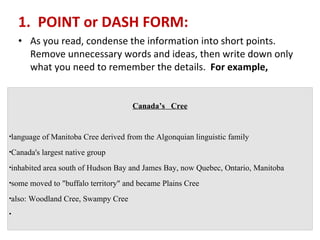
1.  POINT or DASH FORM:   As you read, condense the information into short points.  Remove unnecessary words and ideas, then write down only what you need to remember the details.   For example,  Canada’s  Cree language of Manitoba Cree derived from the Algonquian linguistic family Canada's largest native group inhabited area south of Hudson Bay and James Bay, now Quebec, Ontario, Manitoba some moved to "buffalo territory" and became Plains Cree also: Woodland Cree, Swampy Cree  
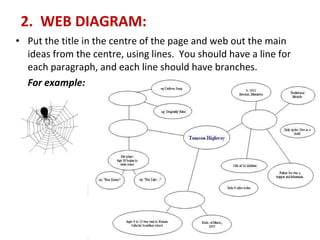
2.  WEB DIAGRAM:     Put the title in the centre of the page and web out the main ideas from the centre, using lines.  You should have a line for each paragraph, and each line should have branches.   For example:
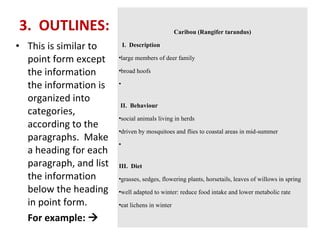
3.  OUTLINES:    This is similar to point form except the information the information is organized into categories, according to the paragraphs.  Make a heading for each paragraph, and list the information below the heading in point form.   For example:   Caribou (Rangifer tarandus)    I.  Description large members of deer family  broad hoofs       II.  Behaviour social animals living in herds  driven by mosquitoes and flies to coastal areas in mid-summer     III.  Diet grasses, sedges, flowering plants, horsetails, leaves of willows in spring  well adapted to winter: reduce food intake and lower metabolic rate  eat lichens in winter
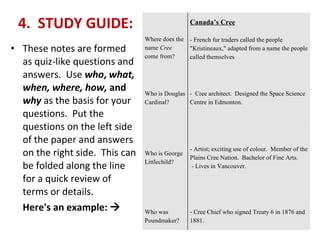
4.  STUDY GUIDE:    These notes are formed as quiz-like questions and answers.  Use  who ,  what, when, where, how,  and  why   as the basis for your questions.  Put the questions on the left side of the paper and answers on the right side.  This can be folded along the line for a quick review of terms or details.   Here's an example:   Where does the name  Cree  come from? Canada’s Cree - French fur traders called the people "Kristineaux," adapted from a name the people called themselves   Who is Douglas Cardinal? -  Cree architect.  Designed the Space Science Centre in Edmonton.   Who is George Littlechild? - Artist; exciting use of colour.  Member of the Plains Cree Nation.  Bachelor of Fine Arts.   - Lives in Vancouver.   Who was Poundmaker? - Cree Chief who signed Treaty 6 in 1876 and 1881. 
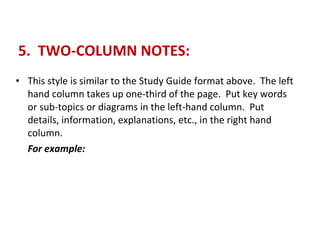
5.  TWO-COLUMN NOTES:     This style is similar to the Study Guide format above.  The left hand column takes up one-third of the page.  Put key words or sub-topics or diagrams in the left-hand column.  Put details, information, explanations, etc., in the right hand column.   For example:
 
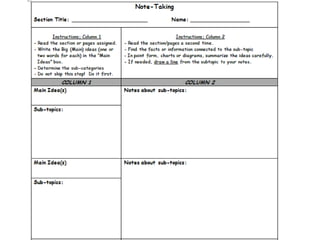
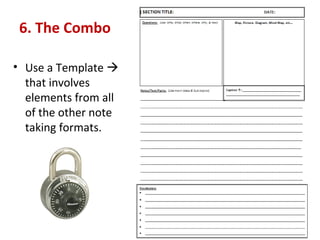
6. The Combo Use a Template    that involves elements from all of the other note taking formats.
General Guidelines for Taking Notes: Always include a title and the date you made the notes. Use a highlighter, a different  colour , or underline  really important concepts or information . Develop your own shorthand:  Use symbols such as  & ,  #,   and  Δ    to show cause-and-effect; word contractions such as  w/in   for  within  and  b/c  for  because,  etc.  Use them often enough to remember what they are when you review your notes. Add diagrams or other visual "tools" wherever appropriate. "customize" your style of notes to the content you are dealing with: each note-taking style works well but your material will determine which one is best for the learning purpose.

Six Examples Of Ways To Take Notes Vr1.1

  • 1.
    Six examples ofways to take notes
  • 2.
    1.  POINT orDASH FORM:   As you read, condense the information into short points.  Remove unnecessary words and ideas, then write down only what you need to remember the details.  For example, Canada’s Cree language of Manitoba Cree derived from the Algonquian linguistic family Canada's largest native group inhabited area south of Hudson Bay and James Bay, now Quebec, Ontario, Manitoba some moved to "buffalo territory" and became Plains Cree also: Woodland Cree, Swampy Cree  
  • 3.
    2.  WEB DIAGRAM:  Put the title in the centre of the page and web out the main ideas from the centre, using lines.  You should have a line for each paragraph, and each line should have branches.  For example:
  • 4.
    3.  OUTLINES:   This is similar to point form except the information the information is organized into categories, according to the paragraphs.  Make a heading for each paragraph, and list the information below the heading in point form.  For example:  Caribou (Rangifer tarandus)   I.  Description large members of deer family broad hoofs     II.  Behaviour social animals living in herds driven by mosquitoes and flies to coastal areas in mid-summer   III.  Diet grasses, sedges, flowering plants, horsetails, leaves of willows in spring well adapted to winter: reduce food intake and lower metabolic rate eat lichens in winter
  • 5.
    4.  STUDY GUIDE:  These notes are formed as quiz-like questions and answers.  Use who , what, when, where, how, and why as the basis for your questions.  Put the questions on the left side of the paper and answers on the right side.  This can be folded along the line for a quick review of terms or details.  Here's an example:  Where does the name Cree come from? Canada’s Cree - French fur traders called the people "Kristineaux," adapted from a name the people called themselves   Who is Douglas Cardinal? -  Cree architect.  Designed the Space Science Centre in Edmonton.   Who is George Littlechild? - Artist; exciting use of colour.  Member of the Plains Cree Nation.  Bachelor of Fine Arts.  - Lives in Vancouver.   Who was Poundmaker? - Cree Chief who signed Treaty 6 in 1876 and 1881. 
  • 6.
    5.  TWO-COLUMN NOTES:  This style is similar to the Study Guide format above.  The left hand column takes up one-third of the page.  Put key words or sub-topics or diagrams in the left-hand column.  Put details, information, explanations, etc., in the right hand column.  For example:
  • 7.
  • 8.
    6. The ComboUse a Template  that involves elements from all of the other note taking formats.
  • 9.
    General Guidelines forTaking Notes: Always include a title and the date you made the notes. Use a highlighter, a different colour , or underline really important concepts or information . Develop your own shorthand:  Use symbols such as & , #,   and Δ    to show cause-and-effect; word contractions such as w/in for within and b/c for because, etc.  Use them often enough to remember what they are when you review your notes. Add diagrams or other visual "tools" wherever appropriate. "customize" your style of notes to the content you are dealing with: each note-taking style works well but your material will determine which one is best for the learning purpose.