What is SIP Trunking?
And How Does it Work
    A basic introduction to SIP trunking
  explaining the concepts of trunking and
 SIP, as well as the benefits of SIP trunking.
SIP Trunking


SIP trunking is a is a basically a type of
communication system which allows
organisations to replace all of their traditional
phone lines with Voice Over Internet Protocol
(VoIP).

VoIP systems carry the call over the internet
rather than the traditional phone line system.

SIP trunking allows VoIP users to call numbers on
the traditional phone and mobile networks. If the
people on both ends have SIP the system will try
to route the entire call over the internet and avoid
traditional phone lines entirely.
SIP


SIP is an internet protocol designed to manage
real time communication (RTC). This covers things
like VoIP, video chat and instant messaging.

An internet protocol is basically a set of rules
which govern how devices connected to the
internet interact with each other.

So SIP is basically a set of rules which allows RTC
software/devices to communicate with each
other over the internet.
Trunking


In telecoms trunking has been around for a long
time. Trunking allows an organisation to cut down
on the amount of lines it needs.

An organisation can have a trunk with a limited
number of phone lines, but still have many more
phones connected to it’s network than lines.

Quite simply, this is because all of the phones
don’t need to be used at once, so they are only
connected to an outside trunk line when they
need to be.
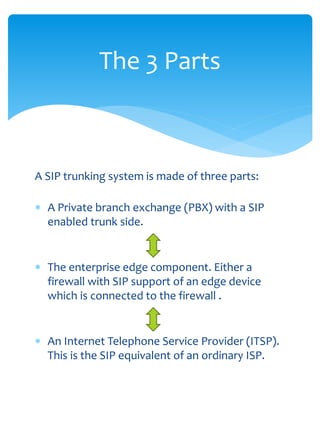
The 3 Parts


A SIP trunking system is made of three parts:

∗ A Private branch exchange (PBX) with a SIP
  enabled trunk side.


∗ The enterprise edge component. Either a
  firewall with SIP support of an edge device
  which is connected to the firewall .


∗ An Internet Telephone Service Provider (ITSP).
  This is the SIP equivalent of an ordinary ISP.
Benefits


There main benefit of a SIP trunk system a
reduction in costs.

Call rates are lower and the exchange systems
required are significantly cheaper.

SIP trunk systems are also more scalable and
flexible, and have a wider range of capabilities
including instant messaging and video calling.

SIP trunking systems are generally cheaper than
their traditional alternatives, however it should be
noted that this is not always necessarily the case.

What is SIP Trunking?

  • 1.
    What is SIPTrunking? And How Does it Work A basic introduction to SIP trunking explaining the concepts of trunking and SIP, as well as the benefits of SIP trunking.
  • 2.
    SIP Trunking SIP trunkingis a is a basically a type of communication system which allows organisations to replace all of their traditional phone lines with Voice Over Internet Protocol (VoIP). VoIP systems carry the call over the internet rather than the traditional phone line system. SIP trunking allows VoIP users to call numbers on the traditional phone and mobile networks. If the people on both ends have SIP the system will try to route the entire call over the internet and avoid traditional phone lines entirely.
  • 3.
    SIP SIP is aninternet protocol designed to manage real time communication (RTC). This covers things like VoIP, video chat and instant messaging. An internet protocol is basically a set of rules which govern how devices connected to the internet interact with each other. So SIP is basically a set of rules which allows RTC software/devices to communicate with each other over the internet.
  • 4.
    Trunking In telecoms trunkinghas been around for a long time. Trunking allows an organisation to cut down on the amount of lines it needs. An organisation can have a trunk with a limited number of phone lines, but still have many more phones connected to it’s network than lines. Quite simply, this is because all of the phones don’t need to be used at once, so they are only connected to an outside trunk line when they need to be.
  • 5.
    The 3 Parts ASIP trunking system is made of three parts: ∗ A Private branch exchange (PBX) with a SIP enabled trunk side. ∗ The enterprise edge component. Either a firewall with SIP support of an edge device which is connected to the firewall . ∗ An Internet Telephone Service Provider (ITSP). This is the SIP equivalent of an ordinary ISP.
  • 6.
    Benefits There main benefitof a SIP trunk system a reduction in costs. Call rates are lower and the exchange systems required are significantly cheaper. SIP trunk systems are also more scalable and flexible, and have a wider range of capabilities including instant messaging and video calling. SIP trunking systems are generally cheaper than their traditional alternatives, however it should be noted that this is not always necessarily the case.