The Basics
signaling communications protocol
Controlling voice calls over (IP) networks
Controlling video calls over (IP) networks
Instant Messages ( IM )
Presence Management .
SIP was originally designed in 1996
The protocol was standardized as RFC 2543
In November 2000, SIP was accepted as a
3GPP signaling protocol and permanent
element of the IP Multimedia Subsystem (IMS)
architecture for IP-based streaming multimedia
services in cellular systems.
At 2013, the latest version of the specification
is RFC 3261 SIPv2 .
The protocol defines the messages that are
sent
between endpoints .
It govern establishment , modifying ,
termination and other essential elements of a
media streaming call.
SIP can be used for two-party (unicast) or
multiparty (multicast) sessions .
video conferencing
streaming multimedia distribution
instant messaging
presence information
file transfer
fax over IP
online games.
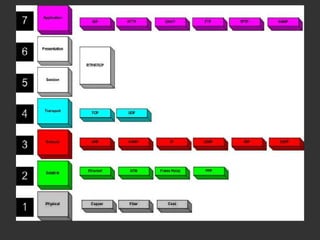
SIP is an application layer protocol
designed to be independent of the underlying
transport layer .
it can run on Transmission Control Protocol
(TCP) .
User Datagram Protocol (UDP)
Stream Control Transmission Protocol (SCTP).
It is a text-based protocol
For the transmission of media streams (voice,
video) SIP typically employs the Real-time
Transport Protocol (RTP)
OR
Secure Real-time Transport Protocol (SRTP).
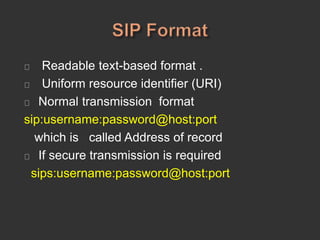
Readable text-based format .
Uniform resource identifier (URI)
Normal transmission format
sip:username:password@host:port
which is called Address of record
If secure transmission is required
sips:username:password@host:port
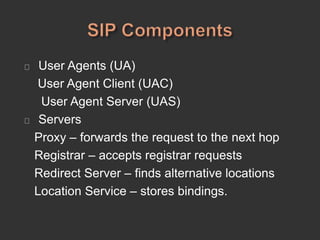
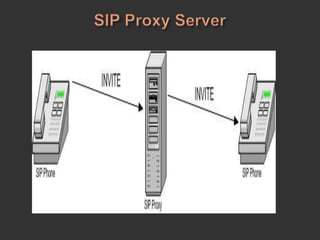
User Agents (UA)
User Agent Client (UAC)
User Agent Server (UAS)
Servers
Proxy – forwards the request to the next hop
Registrar – accepts registrar requests
Redirect Server – finds alternative locations
Location Service – stores bindings.
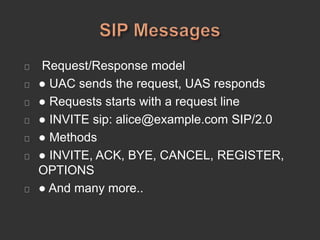
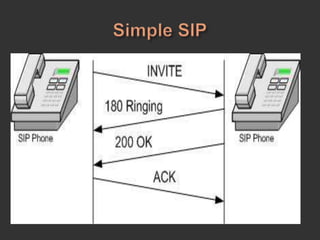
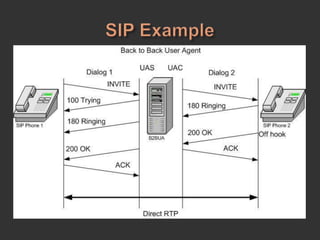
Request/Response model
● UAC sends the request, UAS responds
● Requests starts with a request line
● INVITE sip: alice@example.com SIP/2.0
● Methods
● INVITE, ACK, BYE, CANCEL, REGISTER,
OPTIONS
● And many more..
SIP-address is used to locate and
communicate
with other users.
sip:alice@example.com
sips:alice@example.com
Each user typically have an Address of Record
contacted.
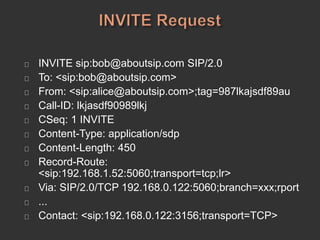
INVITE sip:bob@aboutsip.com SIP/2.0
To: <sip:bob@aboutsip.com>
From: <sip:alice@aboutsip.com>;tag=987lkajsdf89au
Call-ID: lkjasdf90989lkj
CSeq: 1 INVITE
Content-Type: application/sdp
Content-Length: 450
Record-Route:
<sip:192.168.1.52:5060;transport=tcp;lr>
Via: SIP/2.0/TCP 192.168.0.122:5060;branch=xxx;rport
...
Contact: <sip:192.168.0.122:3156;transport=TCP>
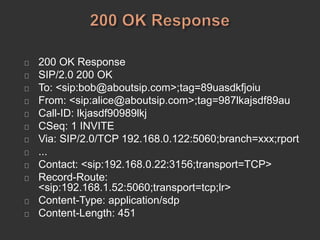
200 OK Response
SIP/2.0 200 OK
To: <sip:bob@aboutsip.com>;tag=89uasdkfjoiu
From: <sip:alice@aboutsip.com>;tag=987lkajsdf89au
Call-ID: lkjasdf90989lkj
CSeq: 1 INVITE
Via: SIP/2.0/TCP 192.168.0.122:5060;branch=xxx;rport
...
Contact: <sip:192.168.0.22:3156;transport=TCP>
Record-Route:
<sip:192.168.1.52:5060;transport=tcp;lr>
Content-Type: application/sdp
Content-Length: 451
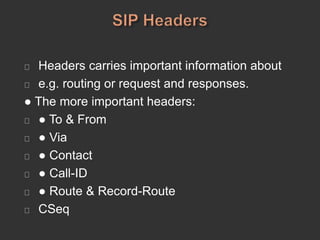
Headers carries important information about
e.g. routing or request and responses.
● The more important headers:
● To & From
● Via
● Contact
● Call-ID
● Route & Record-Route
CSeq
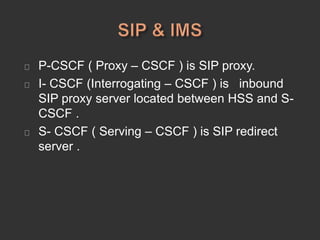
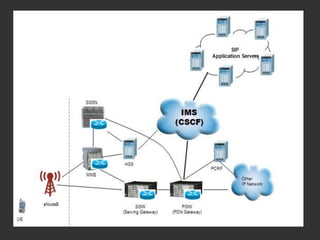
P-CSCF ( Proxy – CSCF ) is SIP proxy.
I- CSCF (Interrogating – CSCF ) is inbound
SIP proxy server located between HSS and S-
CSCF .
S- CSCF ( Serving – CSCF ) is SIP redirect
server .
SIP != VoIP
SIP can do VoIP but is so much more
SIP actually doesn't care about audio or
video at all
SIP helps you route messages through the
network.
SIP helps to locate your friends.

Sip summary

  • 1.
  • 2.
    signaling communications protocol Controllingvoice calls over (IP) networks Controlling video calls over (IP) networks Instant Messages ( IM ) Presence Management .
  • 3.
    SIP was originallydesigned in 1996 The protocol was standardized as RFC 2543 In November 2000, SIP was accepted as a 3GPP signaling protocol and permanent element of the IP Multimedia Subsystem (IMS) architecture for IP-based streaming multimedia services in cellular systems. At 2013, the latest version of the specification is RFC 3261 SIPv2 .
  • 4.
    The protocol definesthe messages that are sent between endpoints . It govern establishment , modifying , termination and other essential elements of a media streaming call. SIP can be used for two-party (unicast) or multiparty (multicast) sessions .
  • 5.
    video conferencing streaming multimediadistribution instant messaging presence information file transfer fax over IP online games.
  • 7.
    SIP is anapplication layer protocol designed to be independent of the underlying transport layer . it can run on Transmission Control Protocol (TCP) . User Datagram Protocol (UDP) Stream Control Transmission Protocol (SCTP). It is a text-based protocol
  • 8.
    For the transmissionof media streams (voice, video) SIP typically employs the Real-time Transport Protocol (RTP) OR Secure Real-time Transport Protocol (SRTP).
  • 9.
    Readable text-based format. Uniform resource identifier (URI) Normal transmission format sip:username:password@host:port which is called Address of record If secure transmission is required sips:username:password@host:port
  • 10.
    User Agents (UA) UserAgent Client (UAC) User Agent Server (UAS) Servers Proxy – forwards the request to the next hop Registrar – accepts registrar requests Redirect Server – finds alternative locations Location Service – stores bindings.
  • 11.
    Request/Response model ● UACsends the request, UAS responds ● Requests starts with a request line ● INVITE sip: alice@example.com SIP/2.0 ● Methods ● INVITE, ACK, BYE, CANCEL, REGISTER, OPTIONS ● And many more..
  • 15.
    SIP-address is usedto locate and communicate with other users. sip:alice@example.com sips:alice@example.com Each user typically have an Address of Record contacted.
  • 16.
    INVITE sip:bob@aboutsip.com SIP/2.0 To:<sip:bob@aboutsip.com> From: <sip:alice@aboutsip.com>;tag=987lkajsdf89au Call-ID: lkjasdf90989lkj CSeq: 1 INVITE Content-Type: application/sdp Content-Length: 450 Record-Route: <sip:192.168.1.52:5060;transport=tcp;lr> Via: SIP/2.0/TCP 192.168.0.122:5060;branch=xxx;rport ... Contact: <sip:192.168.0.122:3156;transport=TCP>
  • 17.
    200 OK Response SIP/2.0200 OK To: <sip:bob@aboutsip.com>;tag=89uasdkfjoiu From: <sip:alice@aboutsip.com>;tag=987lkajsdf89au Call-ID: lkjasdf90989lkj CSeq: 1 INVITE Via: SIP/2.0/TCP 192.168.0.122:5060;branch=xxx;rport ... Contact: <sip:192.168.0.22:3156;transport=TCP> Record-Route: <sip:192.168.1.52:5060;transport=tcp;lr> Content-Type: application/sdp Content-Length: 451
  • 18.
    Headers carries importantinformation about e.g. routing or request and responses. ● The more important headers: ● To & From ● Via ● Contact ● Call-ID ● Route & Record-Route CSeq
  • 19.
    P-CSCF ( Proxy– CSCF ) is SIP proxy. I- CSCF (Interrogating – CSCF ) is inbound SIP proxy server located between HSS and S- CSCF . S- CSCF ( Serving – CSCF ) is SIP redirect server .
  • 22.
    SIP != VoIP SIPcan do VoIP but is so much more SIP actually doesn't care about audio or video at all SIP helps you route messages through the network. SIP helps to locate your friends.