Laplace Transform Analysis of
Signals and Systems
Transfer Functions
5/10/04 M. J. Roberts - All Rights Reserved 2
• Transfer functions of CT systems can
be found from analysis of
– Differential Equations
– Block Diagrams
– Circuit Diagrams
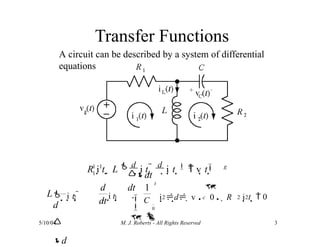
Transfer Functions
A circuit can be described by a system of differential
equations
g
1 1
1
2 

R i t   L  d
i t  
d
i t   v t 
L
5/10/04 M. J. Roberts - All Rights Reserved 3

d

d
d
dt c
t
2
i t   1 2 2 2
1
i t 
dt
dt



   t   0

0
C

i d  v 0  R i
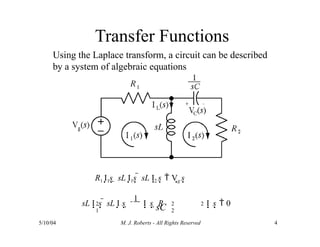
Transfer Functions
Using the Laplace transform, a circuit can be described
by a system of algebraic equations
5/10/04 M. J. Roberts - All Rights Reserved 4
R1 I1s  sL I1s  sL I2 s  Vg s
sC
2
1
2 2
2
sL I s  sL I s 
1
I s  R I s  0
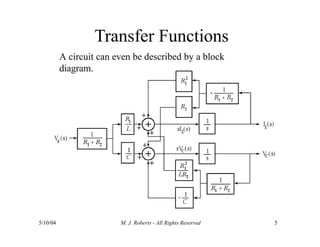
A circuit can even be described by a block
diagram.
5/10/04 M. J. Roberts - All Rights Reserved 5
Transfer Functions
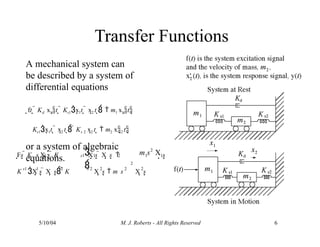
A mechanical system can
be described by a system of
differential equations
ft   Kd x1t   Ks1x1t   x2 t   m1 x1t
Ks1x1t   x2 t   Ks 2 x2 t   m2 x2 t
or a system of algebraic
equations.
5/10/04 M. J. Roberts - All Rights Reserved 6
m s X


Fs  K s X s  K X s  X s  s
K X s  X s  K X s  m s X s
d 1 s1
2
1 2 1 1
s1 1 2 s 2 2
2
2 2
Transfer Functions
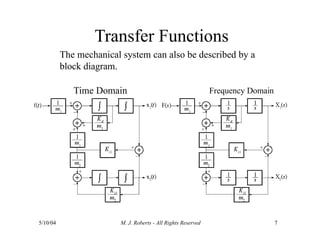
The mechanical system can also be described by a
block diagram.
Time Domain Frequency Domain
5/10/04 M. J. Roberts - All Rights Reserved 7
Transfer Functions
System Stability
5/10/04 M. J. Roberts - All Rights Reserved 8
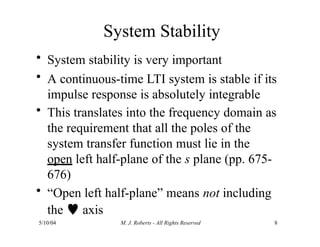
• System stability is very important
• A continuous-time LTI system is stable if its
impulse response is absolutely integrable
• This translates into the frequency domain as
the requirement that all the poles of the
system transfer function must lie in the
open left half-plane of the s plane (pp. 675-
676)
• “Open left half-plane” means not including
the  axis
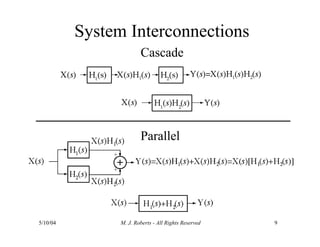
System Interconnections
Cascade
Parallel
5/10/04 M. J. Roberts - All Rights Reserved 9
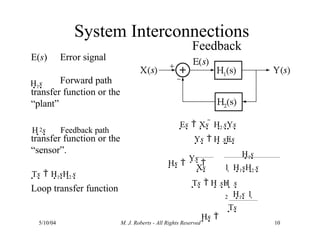
Feedback
Error signal
Es  Xs  H2 sYs
Ys  H sEs
1
Hs 
Ys 
H1s
Xs 1  H1sH2 s
E(s)
Forward path
transfer function or the
“plant”
2
transfer function or the
“sensor”.
H s Feedback path
Ts  H1sH2 s
Loop transfer function
H1s
H1s 1 
Ts
5/10/04 M. J. Roberts - All Rights Reserved 10
System Interconnections
Ts  H sH s
1
2
Hs 
Analysis of Feedback Systems
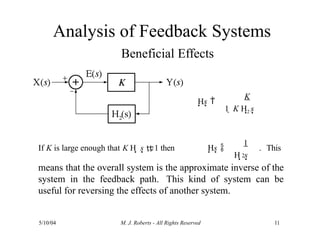
Beneficial Effects
Hs 
K
5/10/04 M. J. Roberts - All Rights Reserved 11
1  K H2 s
2
H s
If K is large enough that K H s  1 then Hs 
1
. This
2
means that the overall system is the approximate inverse of the
system in the feedback path. This kind of system can be
useful for reversing the effects of another system.
Analysis of Feedback Systems
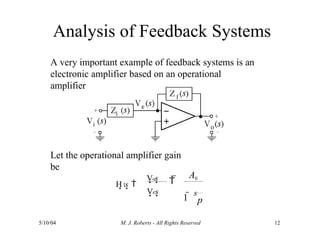
A very important example of feedback systems is an
electronic amplifier based on an operational
amplifier
Let the operational amplifier gain
be
1
5/10/04 M. J. Roberts - All Rights Reserved 12
H s 
A0
p
o
e
V s
V s
 
1 
s
Analysis of Feedback Systems
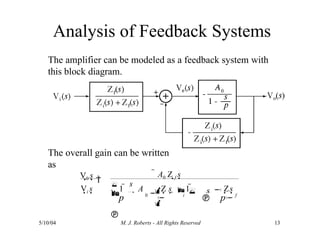
The amplifier can be modeled as a feedback system with
this block diagram.
The overall gain can be written
as
Vi s
5/10/04 M. J. Roberts - All Rights Reserved 13
V0 s 
 A0 Z f s


  s


1 
s
 A Z s  1   Zs
p 0 
 i
 p f
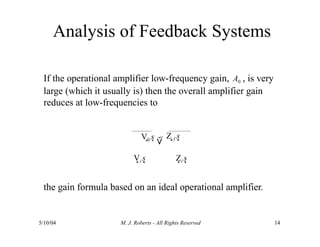
If the operational amplifier low-frequency gain, A0 , is very
large (which it usually is) then the overall amplifier gain
reduces at low-frequencies to
V0 s  
Z f s
Vi s Zi s
the gain formula based on an ideal operational amplifier.
5/10/04 M. J. Roberts - All Rights Reserved 14
Analysis of Feedback Systems
5/10/04 M. J. Roberts - All Rights Reserved 15
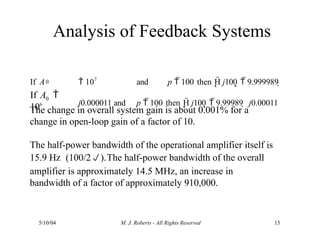
The change in overall system gain is about 0.001% for a
change in open-loop gain of a factor of 10.
The half-power bandwidth of the operational amplifier itself is
15.9 Hz (100/2).The half-power bandwidth of the overall
amplifier is approximately 14.5 MHz, an increase in
bandwidth of a factor of approximately 910,000.
0
0
If A 
106
If A  107
and p  100 then H j100  9.999989 
j0.000011 and p  100 then H j100  9.99989  j0.00011
Analysis of Feedback Systems
5/10/04 M. J. Roberts - All Rights Reserved 16
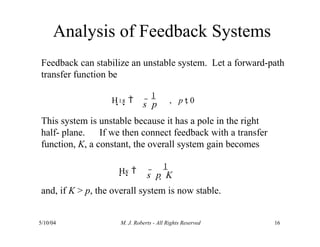
Feedback can stabilize an unstable system. Let a forward-path
transfer function be
This system is unstable because it has a pole in the right
half- plane. If we then connect feedback with a transfer
function, K, a constant, the overall system gain becomes
s  p  K
and, if K > p, the overall system is now stable.
1
s  p
H s 
1
, p  0
Hs 
1
Analysis of Feedback Systems
5/10/04 M. J. Roberts - All Rights Reserved 17
Feedback can make an unstable system stable but it can
also make a stable system unstable. Even though all the
poles
of the forward and feedback systems may be in the open
left half-plane, the poles of the overall feedback system can
be in the right half-plane.
A familiar example of this kind of instability caused by
feedback is a public address system. If the amplifier
gain is set too high the system will go unstable and
oscillate, usually with a very annoying high-pitched tone.
Analysis of Feedback Systems
Public Address System
5/10/04 M. J. Roberts - All Rights Reserved 18
As the amplifier gain is
increased, any sound
entering the microphone
makes a stronger sound
from the speaker until, at
some gain level, the
returned sound from the
speaker is a large as the
originating sound into the
microphone. At that point
the system goes unstable
(pp. 685-689).
Analysis of Feedback Systems
Stable Oscillation Using Feedback
Prototype
Feedback
System
Feedback
System
Without
Excitation
5/10/04 M. J. Roberts - All Rights Reserved 19
Analysis of Feedback Systems
Stable Oscillation Using Feedback
Can the response be non-zero when the
excitation is zero? Yes, if the overall
system gain is infinite. If the system
transfer function has a pole pair on the
axis, then the transfer function is
infinite
at the frequency of that pole pair and there can be a response
without an excitation. In practical terms the trick is to be sure
the
poles stay on the  axis. If the poles move into the left half-
plane
the response attenuates with time. If the poles move into the right
half-plane the response grows with time (until the system goes
non- linear).
5/10/04 M. J. Roberts - All Rights Reserved 20
Analysis of Feedback Systems
Stable Oscillation Using Feedback
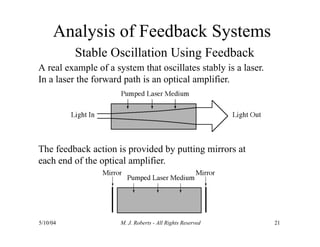
A real example of a system that oscillates stably is a laser.
In a laser the forward path is an optical amplifier.
The feedback action is provided by putting mirrors at
each end of the optical amplifier.
5/10/04 M. J. Roberts - All Rights Reserved 21
Analysis of Feedback Systems
Stable Oscillation Using Feedback
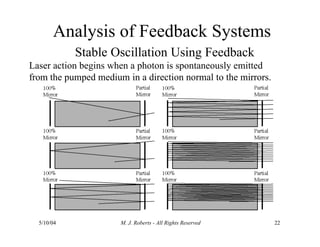
Laser action begins when a photon is spontaneously emitted
from the pumped medium in a direction normal to the mirrors.
5/10/04 M. J. Roberts - All Rights Reserved 22
Analysis of Feedback Systems
Stable Oscillation Using Feedback
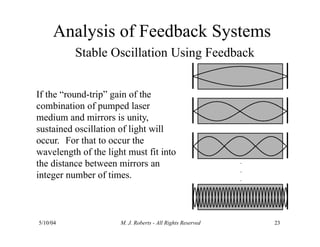
If the “round-trip” gain of the
combination of pumped laser
medium and mirrors is unity,
sustained oscillation of light will
occur. For that to occur the
wavelength of the light must fit into
the distance between mirrors an
integer number of times.
5/10/04 M. J. Roberts - All Rights Reserved 23
Analysis of Feedback Systems
Stable Oscillation Using Feedback
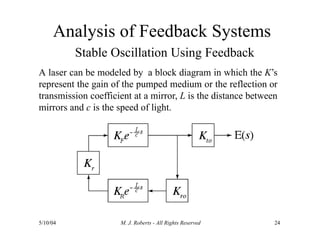
A laser can be modeled by a block diagram in which the K’s
represent the gain of the pumped medium or the reflection or
transmission coefficient at a mirror, L is the distance between
mirrors and c is the speed of light.
5/10/04 M. J. Roberts - All Rights Reserved 24
Analysis of Feedback Systems
The Routh-Hurwitz Stability Test
5/10/04 M. J. Roberts - All Rights Reserved 25
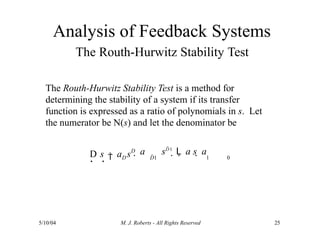
The Routh-Hurwitz Stability Test is a method for
determining the stability of a system if its transfer
function is expressed as a ratio of polynomials in s. Let
the numerator be N(s) and let the denominator be
D s a s
D
D
D1
 a sD1
L a s  a
1 0
  
Analysis of Feedback Systems
The Routh-Hurwitz Stability Test
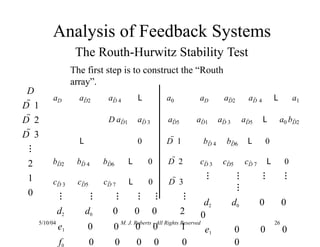
The first step is to construct the “Routh
array”.
D
D  1
D  2
D  3
⁝
2
1
0
5/10/04 M. J. Roberts - All Rights Reserved 26
aD aD2 aD 4 L a0
D aD1 aD 3 aD5
L 0 D  1
bD2 bD 4 bD6 L 0 D  2
cD 3 cD5 cD 7 L 0 D  3
⁝ ⁝ ⁝ ⁝ ⁝ ⁝
d2 d0 0 0 0 2
e1 0 0 0 0 1
f0 0 0 0 0 0
aD aD2 aD 4 L a1
aD1 aD 3 aD5 L a0 bD2
bD 4 bD6 L 0
cD 3 cD5 cD 7 L 0
⁝ ⁝ ⁝ ⁝
⁝
d2 d0 0 0
0
e1 0 0 0
0
The Routh-Hurwitz Stability Test
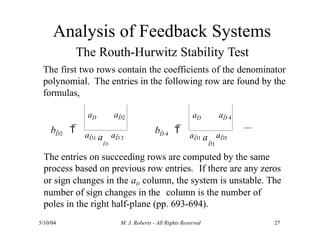
The first two rows contain the coefficients of the denominator
polynomial. The entries in the following row are found by the
formulas,
b  
a
aD aD2
aD1 aD 3
D2
a
5/10/04 M. J. Roberts - All Rights Reserved 27
b  
D 4
aD aD 4
aD1 aD5
D1 D1
...
The entries on succeeding rows are computed by the same
process based on previous row entries. If there are any zeros
or sign changes in the aD column, the system is unstable. The
number of sign changes in the column is the number of
poles in the right half-plane (pp. 693-694).
Analysis of Feedback Systems
Root Locus
Common Type of Feedback System
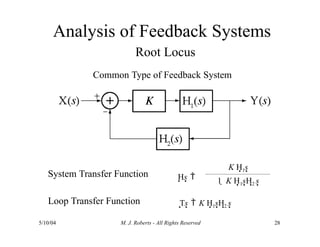
System Transfer Function Hs 
5/10/04 M. J. Roberts - All Rights Reserved 28
K H1s
1  K H1sH2 s
Loop Transfer Function Ts  K H1sH2 s
Analysis of Feedback Systems
Root Locus
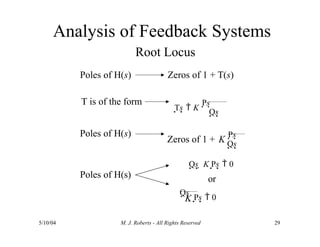
Poles of H(s) Zeros of 1 + T(s)
T is of the form
Ts  K
Ps
Qs
Poles of H(s)
Zeros of 1 + K
Ps
Qs
Poles of H(s)
Qs  K Ps  0
or
K
Qs  Ps  0
5/10/04 M. J. Roberts - All Rights Reserved 29
Analysis of Feedback Systems
Root Locus
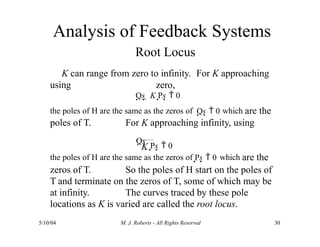
K can range from zero to infinity. For K approaching
zero,
using
the poles of H are the same as the zeros of Qs  0 which are the
poles of T. For K approaching infinity, using
Qs  K Ps  0
K
5/10/04 M. J. Roberts - All Rights Reserved 30
Qs  Ps  0
the poles of H are the same as the zeros of Ps  0 which are the
zeros of T. So the poles of H start on the poles of
T and terminate on the zeros of T, some of which may be
at infinity. The curves traced by these pole
locations as K is varied are called the root locus.
Analysis of Feedback Systems
Root Locus
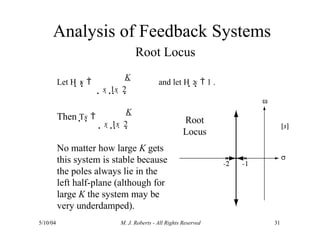
Then Ts 
K
No matter how large K gets
this system is stable because
the poles always lie in the
left half-plane (although for
large K the system may be
very underdamped).
1
s  1s  2
2
Let H s 
K
and let H s  1 .
s  1s  2 Root
Locus
5/10/04 M. J. Roberts - All Rights Reserved 31
Analysis of Feedback Systems
Root Locus
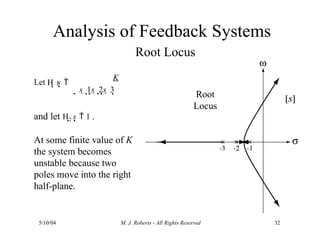
Root
Locus
5/10/04 M. J. Roberts - All Rights Reserved 32
and let H2 s  1 .
At some finite value of K
the system becomes
unstable because two
poles move into the right
half-plane.
1
Let H s 
K
s  1s  2s  3
Analysis of Feedback Systems
5/10/04 M. J. Roberts - All Rights Reserved 33
Root Locus
Four Rules for Drawing a Root Locus
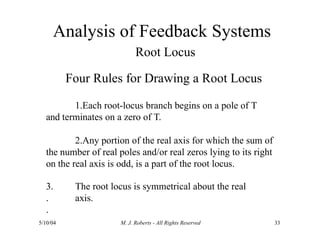
1.Each root-locus branch begins on a pole of T
and terminates on a zero of T.
2.Any portion of the real axis for which the sum of
the number of real poles and/or real zeros lying to its right
on the real axis is odd, is a part of the root locus.
3.
.
.
The root locus is symmetrical about the real
axis.
.
.
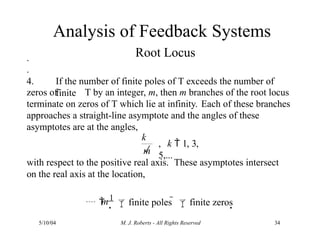
4. If the number of finite poles of T exceeds the number of
finite
zeros of T by an integer, m, then m branches of the root locus
terminate on zeros of T which lie at infinity. Each of these branches
approaches a straight-line asymptote and the angles of these
asymptotes are at the angles,
k

5/10/04 M. J. Roberts - All Rights Reserved 34
m
, k  1, 3,
5,...
Analysis of Feedback Systems
Root Locus
m
with respect to the positive real axis. These asymptotes intersect
on the real axis at the location,
 
1
finite poles  finite zeros
Analysis of Feedback Systems
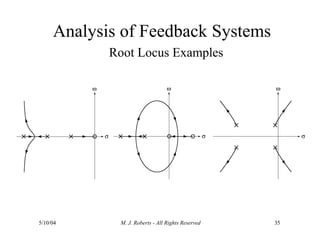
Root Locus Examples
5/10/04 M. J. Roberts - All Rights Reserved 35
Analysis of Feedback Systems
5/10/04 M. J. Roberts - All Rights Reserved 36
Gain and Phase Margin
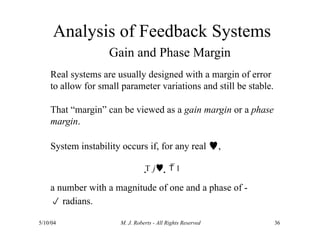
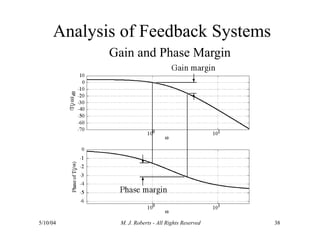
Real systems are usually designed with a margin of error
to allow for small parameter variations and still be stable.
That “margin” can be viewed as a gain margin or a phase
margin.
System instability occurs if, for any real ,
T j   1
a number with a magnitude of one and a phase of -
 radians.
Analysis of Feedback Systems
5/10/04 M. J. Roberts - All Rights Reserved 37
Gain and Phase Margin
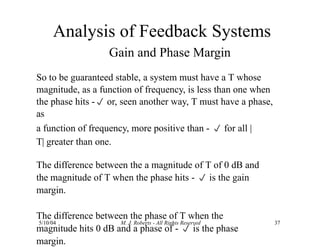
So to be guaranteed stable, a system must have a T whose
magnitude, as a function of frequency, is less than one when
the phase hits - or, seen another way, T must have a phase,
as
a function of frequency, more positive than -  for all |
T| greater than one.
The difference between the a magnitude of T of 0 dB and
the magnitude of T when the phase hits -  is the gain
margin.
The difference between the phase of T when the
magnitude hits 0 dB and a phase of -  is the phase
margin.
Analysis of Feedback Systems
Gain and Phase Margin
5/10/04 M. J. Roberts - All Rights Reserved 38
Analysis of Feedback Systems
Steady-State Tracking Errors in Unity-Gain Feedback Systems
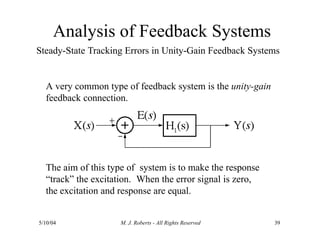
A very common type of feedback system is the unity-gain
feedback connection.
5/10/04 M. J. Roberts - All Rights Reserved 39
The aim of this type of system is to make the response
“track” the excitation. When the error signal is zero,
the excitation and response are equal.
Analysis of Feedback Systems
Steady-State Tracking Errors in Unity-Gain Feedback Systems
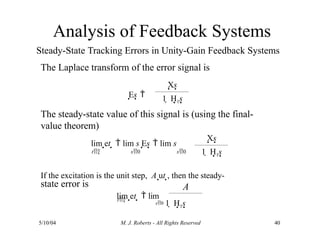
The Laplace transform of the error signal is
The steady-state value of this signal is (using the final-
value theorem)
state error is
If the excitation is the unit step, A ut , then the steady-
Es 
Xs
1  H1s
lim et   lim s Es  lim s
t s0 s0
Xs
1  H1s
A
5/10/04 M. J. Roberts - All Rights Reserved 40
t
lim et   lim
s0 1  H1s
Analysis of Feedback Systems
Steady-State Tracking Errors in Unity-Gain Feedback Systems
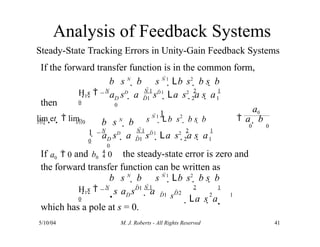
If the forward transfer function is in the common form,
then
which has a pole at s = 0.
a sD
 a
H1s  N N 1 2 1
0
D D1 2 1
0
b s N
 b s N 1
Lb s2
 b s  b
sD1
La s2
 a s  a
b s N
 b
5/10/04 M. J. Roberts - All Rights Reserved 41
a sD
 a
t s0
D D1 2 1
0
lim et   lim
1

1  N N 1 2 1
0
s N 1
Lb s2
 b s  b a  b
0 0
sD1
La s2
 a s  a
If a0  0 and b0  0 the steady-state error is zero and
the forward transfer function can be written as
a0
2 1
s a s
D  a

H1s  N N 1 2 1
0
D1
D1 sD2
b s N
 b s N 1
Lb s2
 b s  b
La s  a 
Analysis of Feedback Systems
Steady-State Tracking Errors in Unity-Gain Feedback Systems
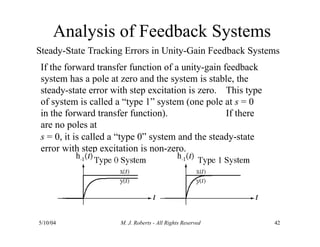
If the forward transfer function of a unity-gain feedback
system has a pole at zero and the system is stable, the
steady-state error with step excitation is zero. This type
of system is called a “type 1” system (one pole at s = 0
in the forward transfer function). If there
are no poles at
s = 0, it is called a “type 0” system and the steady-state
error with step excitation is non-zero.
5/10/04 M. J. Roberts - All Rights Reserved 42
Analysis of Feedback Systems
Steady-State Tracking Errors in Unity-Gain Feedback Systems
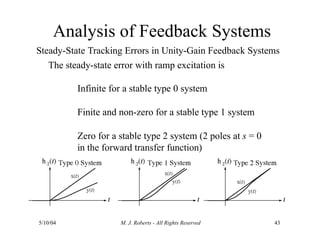
The steady-state error with ramp excitation is
Infinite for a stable type 0 system
Finite and non-zero for a stable type 1 system
Zero for a stable type 2 system (2 poles at s = 0
in the forward transfer function)
5/10/04 M. J. Roberts - All Rights Reserved 43
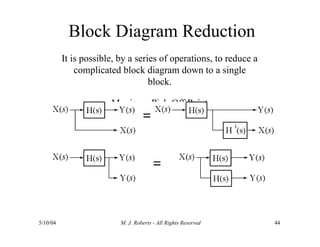
Block Diagram Reduction
It is possible, by a series of operations, to reduce a
complicated block diagram down to a single
block.
Moving a Pick-Off Point
5/10/04 M. J. Roberts - All Rights Reserved 44
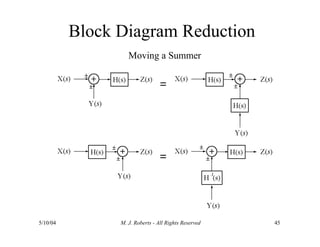
Block Diagram Reduction
Moving a Summer
5/10/04 M. J. Roberts - All Rights Reserved 45
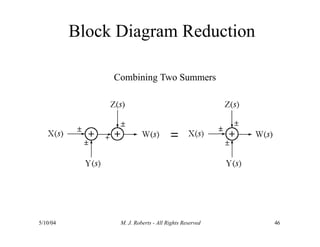
Block Diagram Reduction
Combining Two Summers
5/10/04 M. J. Roberts - All Rights Reserved 46
Block Diagram Reduction
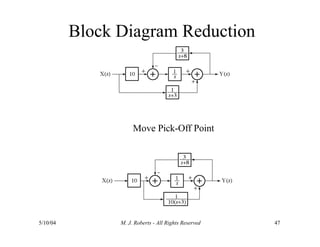
Move Pick-Off Point
5/10/04 M. J. Roberts - All Rights Reserved 47
Block Diagram Reduction
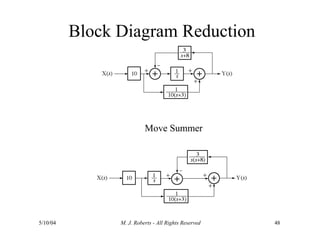
Move Summer
5/10/04 M. J. Roberts - All Rights Reserved 48
Block Diagram Reduction
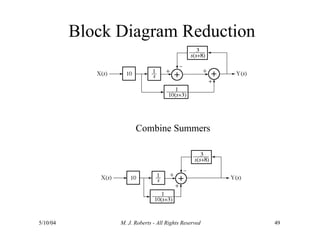
Combine Summers
5/10/04 M. J. Roberts - All Rights Reserved 49
Block Diagram Reduction
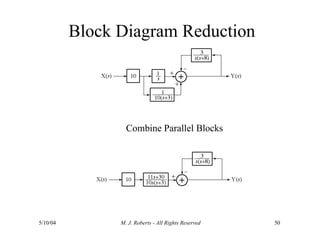
Combine Parallel Blocks
5/10/04 M. J. Roberts - All Rights Reserved 50
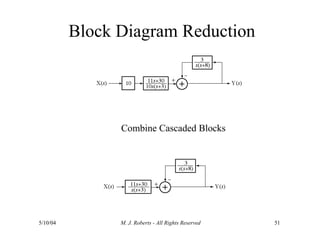
Block Diagram Reduction
Combine Cascaded Blocks
5/10/04 M. J. Roberts - All Rights Reserved 51
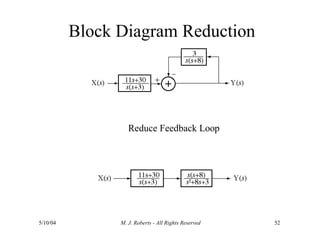
Block Diagram Reduction
Reduce Feedback Loop
5/10/04 M. J. Roberts - All Rights Reserved 52
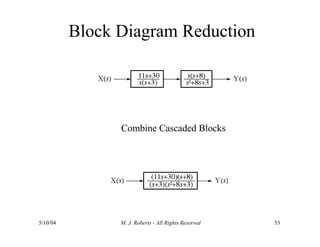
Block Diagram Reduction
Combine Cascaded Blocks
5/10/04 M. J. Roberts - All Rights Reserved 53
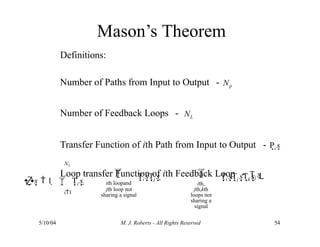
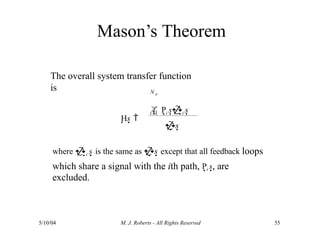
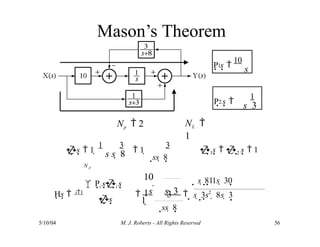
Mason’s Theorem
5/10/04 M. J. Roberts - All Rights Reserved 54
Definitions:
Number of Paths from Input to Output - Np
Number of Feedback Loops - NL
Transfer Function of ith Path from Input to Output - Pi s
Loop transfer Function of ith Feedback Loop - Ti s
Ti sTj s 
NL
s  1   Ti s 
i1

ith loopand
jth loop not
sharing a signal

ith,
jth,kth
loops not
sharing a
signal
Ti sTj sTk s  L
Mason’s Theorem
The overall system transfer function
is
Hs 
5/10/04 M. J. Roberts - All Rights Reserved 55
N p
Pi si s
s
i1
where i s is the same as s except that all feedback loops
which share a signal with the ith path, Pi s, are
excluded.
Mason’s Theorem
1
s
P s 
10
2
P s 
1
s  3
Np  2 NL 
1
s s  8
s  1 
1 3
 1 
3
ss  8
1s  2 s  1
N p
5/10/04 M. J. Roberts - All Rights Reserved 56
Pi si s
s
10

1
Hs  i1  s s  3 
3
ss  8
s  811s  30
s  3s2
 8s  3
1 
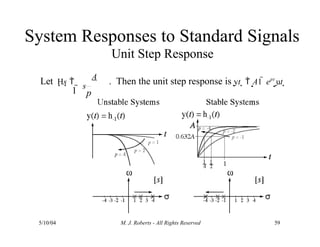
System Responses to Standard Signals
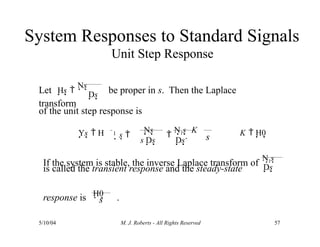
Unit Step Response
Let Hs 
Ns be proper in s. Then the Laplace
transform
Ds
of the unit step response is
Ys  H
s Ds Ds s
1 s 
Ns 
N1s 
K
If the system is stable, the inverse Laplace transform of
N1s
Ds
is called the transient response and the steady-state
response is H0 .
5/10/04 M. J. Roberts - All Rights Reserved 57
s
K  H0
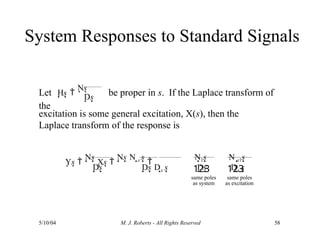
System Responses to Standard Signals
Let Hs 
Ns be proper in s. If the Laplace transform of
the
Ds
excitation is some general excitation, X(s), then the
Laplace transform of the response is
Ds Ds Dx s Ds Dx s
5/10/04 M. J. Roberts - All Rights Reserved 58
Ys 
Ns Xs 
Ns N x s 
N1s 
N x1s
123
same poles
as system
123
same poles
as excitation
p
5/10/04 M. J. Roberts - All Rights Reserved 59
1 
s
Unit Step Response
Let Hs 
A
. Then the unit step response is yt   A1  ept
ut 
System Responses to Standard Signals
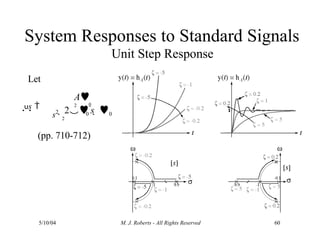
Unit Step Response
Let
s  0
A
2
s2 0 0
 2 s  
2
(pp. 710-712)
5/10/04 M. J. Roberts - All Rights Reserved 60
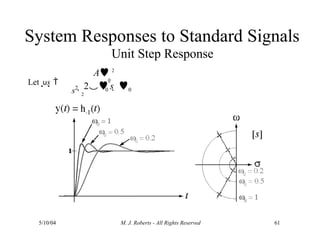
System Responses to Standard Signals
Let s  0
s2 0 0
 2 s  
2
Unit Step Response
A 2
5/10/04 M. J. Roberts - All Rights Reserved 61
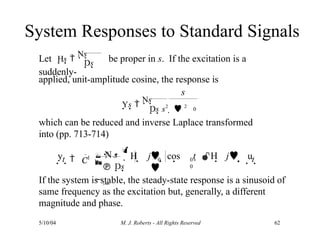
System Responses to Standard Signals
Let Hs 
Ns be proper in s. If the excitation is a
suddenly-
Ds
applied, unit-amplitude cosine, the response is
If the system is stable, the steady-state response is a sinusoid of
same frequency as the excitation but, generally, a different
magnitude and phase.
s
Ys 
Ns
0
which can be reduced and inverse Laplace transformed
into (pp. 713-714)
Ds s2
  2
y
5/10/04 M. J. Roberts - All Rights Reserved 62
 H j
t  
 
 N s


 Ds


     t 
C1
1
0 0
0
 cos

t  H j u
Pole-Zero Diagrams and
Frequency Response
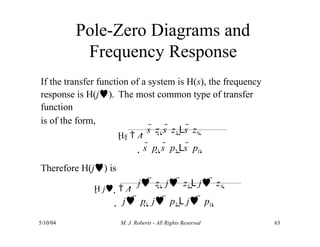
If the transfer function of a system is H(s), the frequency
response is H(j). The most common type of transfer
function
is of the form,
Hs  A
s  z1 s  z2 Ls  zN 
s  p1 s  p2 Ls  pD 
Therefore H(j) is
H j   A
 j  z1  j  z2 L j  zN 
 j  p1  j  p2 L j  pD 
5/10/04 M. J. Roberts - All Rights Reserved 63
Pole-Zero Diagrams and
Frequency Response
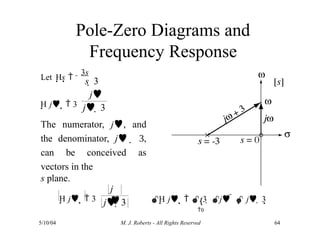
Let Hs 
3s
s  3
j
j  3
H j   3
The numerator, j, and
the denominator, j  ,
can be conceived as
vectors in the
s plane.
H j   3
5/10/04 M. J. Roberts - All Rights Reserved 64
j

j  3 H j   {3  j   j  3
0
Pole-Zero Diagrams and
Frequency Response
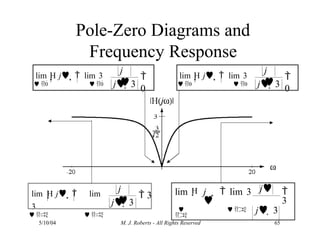

0
lim H j   lim 3
 0
 0
j

j  3

0
lim H j   lim 3
 0
 0
j

j  3
lim H j

  lim 3 j 
3


  j  3
j

lim H j   lim
3
   
j  3
 3
5/10/04 M. J. Roberts - All Rights Reserved 65
Pole-Zero Diagrams and
Frequency Response
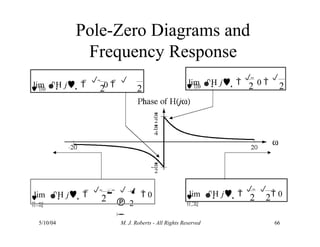
 0
2 2
lim H j  

 0 

 0
2 2
lim H j   

 0  



2  2

lim H j   

  
   0 

2 2
lim H j  



 0
5/10/04 M. J. Roberts - All Rights Reserved 66
Butterworth Filters
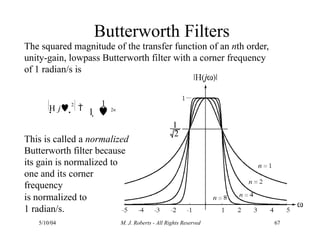
The squared magnitude of the transfer function of an nth order,
unity-gain, lowpass Butterworth filter with a corner frequency
of 1 radian/s is
This is called a normalized
Butterworth filter because
its gain is normalized to
one and its corner
frequency
is normalized to
1 radian/s.
H j 2

1
5/10/04 M. J. Roberts - All Rights Reserved 67
1   2n
Butterworth Filters
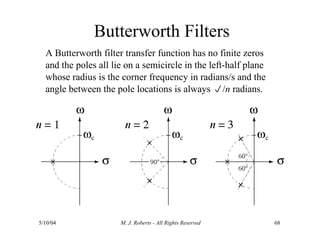
A Butterworth filter transfer function has no finite zeros
and the poles all lie on a semicircle in the left-half plane
whose radius is the corner frequency in radians/s and the
angle between the pole locations is always /n radians.
5/10/04 M. J. Roberts - All Rights Reserved 68
Butterworth Filters
Frequency Transformations
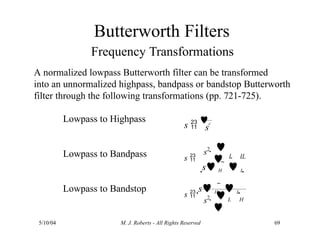
A normalized lowpass Butterworth filter can be transformed
into an unnormalized highpass, bandpass or bandstop Butterworth
filter through the following transformations (pp. 721-725).
Lowpass to Highpass
Lowpass to Bandpass
Lowpass to Bandstop
s
s 
c
s  L H
s2  

s H   L 
L H
5/10/04 M. J. Roberts - All Rights Reserved 69
s 
s H   L 
 

s2
Standard Realizations of Systems
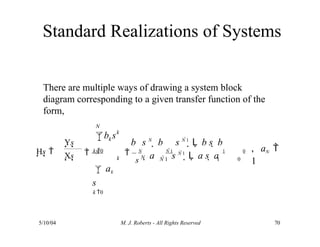
There are multiple ways of drawing a system block
diagram corresponding to a given transfer function of the
form,
Hs 
5/10/04 M. J. Roberts - All Rights Reserved 70
Ys
Xs
, aN 
1
b s
k
k
N
k
N
s N
b s N
 b

ak
s
k 0
 k 0  N N 1 1 0
N 1 1 0
s N 1
L b s  b
 a s N 1
L a s  a
Standard Realizations of Systems
Canonical Form
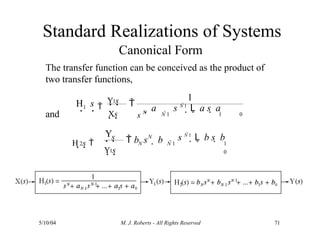
The transfer function can be conceived as the product of
two transfer functions,
and
1
H s 1
Y s
Xs
1
s N N 1
 a s N 1
L a s  a
1 0
   
Y
2
H s 
1
s
Y s
N
N
 b s  b N 1
s N 1
L b s  b
1
0
5/10/04 M. J. Roberts - All Rights Reserved 71
Standard Realizations of Systems
Canonical Form
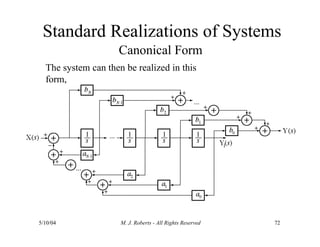
The system can then be realized in this
form,
5/10/04 M. J. Roberts - All Rights Reserved 72
Standard Realizations of Systems
Cascade Form
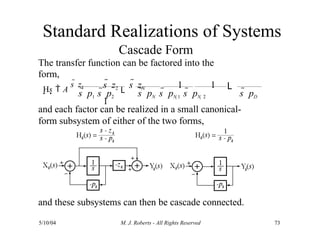
The transfer function can be factored into the
form,
and each factor can be realized in a small canonical-
form subsystem of either of the two forms,
and these subsystems can then be cascade connected.
Hs  A
s  z1
s  p1 s  p2 s  pN s  pN 1 s  pN  2 s  pD
s  z2
L
s  zN 1 1
1
L
5/10/04 M. J. Roberts - All Rights Reserved 73
Standard Realizations of Systems
Cascade Form
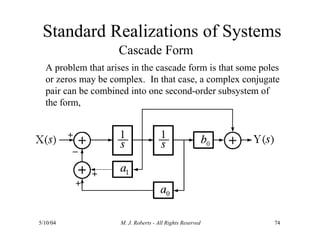
A problem that arises in the cascade form is that some poles
or zeros may be complex. In that case, a complex conjugate
pair can be combined into one second-order subsystem of
the form,
5/10/04 M. J. Roberts - All Rights Reserved 74
Standard Realizations of Systems
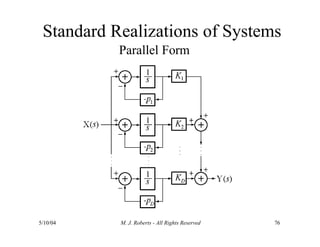
Parallel Form
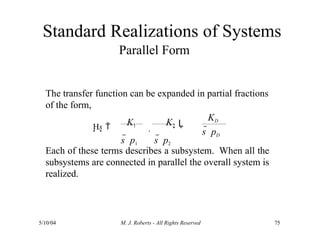
The transfer function can be expanded in partial fractions
of the form,
Each of these terms describes a subsystem. When all the
subsystems are connected in parallel the overall system is
realized.
Hs 
5/10/04 M. J. Roberts - All Rights Reserved 75
KD
s  pD
K1

K2
s  p1 s  p2
L
Standard Realizations of Systems
Parallel Form
5/10/04 M. J. Roberts - All Rights Reserved 76
State-Space Analysis
5/10/04 M. J. Roberts - All Rights Reserved 77
• In larger systems it is important to keep the
analysis methods systematic to avoid
errors
• One popular method for doing this is
through the use of state variables
• State variables are signals in a system
which, together with the excitations,
completely characterize the state of the
system
• As the system changes dynamically the state
variables change value and the system
moves on a trajectory through state space
State-Space Analysis
5/10/04 M. J. Roberts - All Rights Reserved 78
• State space is an N-dimensional space
where
N is the order of the system
• The order of a system is the number of
state variables needed to characterize it
• State variables are not unique, there can
be multiple correct sets
State-Space Analysis
5/10/04 M. J. Roberts - All Rights Reserved 79
• There are several advantages to state-
space analysis
– Reduction of the probability of analysis errors
– Complete description of the system signals
– Insight into system dynamics
– Can be formulated using matrix methods and the
system state can be expressed in two
matrix equations
– Combined with transform methods it is very
powerful
State-Space Analysis
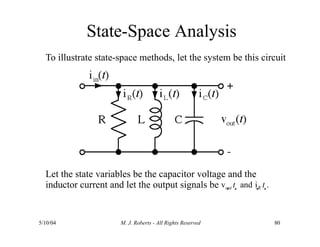
To illustrate state-space methods, let the system be this circuit
Let the state variables be the capacitor voltage and the
inductor current and let the output signals be vout t  and iR t .
5/10/04 M. J. Roberts - All Rights Reserved 80
State-Space Analysis
5/10/04 M. J. Roberts - All Rights Reserved 81
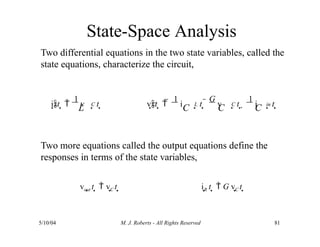
Two differential equations in the two state variables, called the
state equations, characterize the circuit,
Two more equations called the output equations define the
responses in terms of the state variables,
vout t   vC t  iR t   G vC t 
L C
L
it  
1
v t  C L C in
C C C
vt   
1
i t  
G
v t  
1
i t 
State-Space Analysis
The state equations can be written in matrix form
as


5/10/04 M. J. Roberts - All Rights Reserved 82



L
C
L
C
in
 it 

vt

L



C

C 
 
and the output equations can be written in matrix
form as
G v
t 

C


0
1 
 i
t  
1
 0

  1 i
t 
i
R
L
C
in


 i t   

G 

v
t 

  

t 


vout t 

0  


0
1 i t 0

0


State-Space Analysis
5/10/04 M. J. Roberts - All Rights Reserved 83
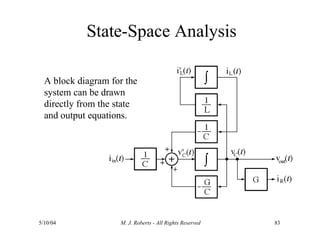
A block diagram for the
system can be drawn
directly from the state
and output equations.
State-Space Analysis
L
C
qt   



 i
t 

v t 
A 

0
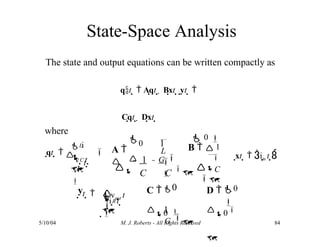
The state and output equations can be written compactly as
qt   Aqt   Bxt  yt  
Cqt   Dxt 
where
1



1
L


G 
 0 
B   1

C

5/10/04 M. J. Roberts - All Rights Reserved 84
xt   iin t 
yt  
R





vout t

i t 
C 

0
C C 
0
1 
G 
0

D 

0

State-Space Analysis
5/10/04 M. J. Roberts - All Rights Reserved 85
or
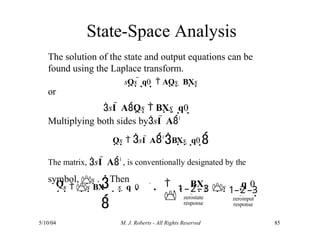
The solution of the state and output equations can be
found using the Laplace transform.
sQs  q0
  AQs  BXs
sI  AQs  BXs  q0

Multiplying both sides bysI  A1
Qs  sI  A1
BXs  q0

The matrix, sI  A1
, is conventionally designated by the
symbol, s . Then
Q BX


  



s  s BX 

s s  s
s  q 0 q 0
1–2–3
zerostate
response
1–2 –3
zeroinput
response
State-Space Analysis
5/10/04 M. J. Roberts - All Rights Reserved 86
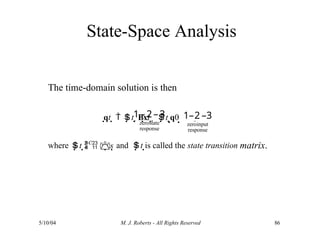
The time-domain solution is then
where t 
C
 s and t is called the state transition matrix.
1–2–3
zerostate
response
1–2 –3
zeroinput
response
qt   t  Bxt   t q0

State-Space Analysis
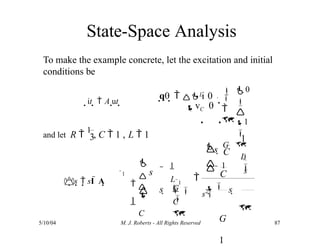
To make the example concrete, let the excitation and initial
conditions be
it   A ut 
0


1



 

 
q0
  





 i 0
v 0
L
C
3
and let R 
1
, C  1 , L  1
s  sI  A
5/10/04 M. J. Roberts - All Rights Reserved 87

C
s 
C

L

G

C
C
s 
G

 s 

 
1
1

1





L

 s 
s2
1



1
s



G
1
1
State-Space Analysis
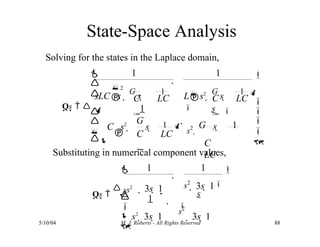
Solving for the states in the Laplace domain,

 C LC



s 

G
C LC

s 



Qs  




C LC
 






sLC s 
G
s 
1
 1 s
1 


G 1
C
LC
1 1
2
L s2

G
s 
1 

C s2
 s2
Substituting in numerical component values,

5/10/04 M. J. Roberts - All Rights Reserved 88

 
s

 3s  1
1 1
 3s  1

1
Qs 
 ss2 s2


 s2
 3s  1  3s  1

s2
State-Space Analysis
5/10/04 M. J. Roberts - All Rights Reserved 89
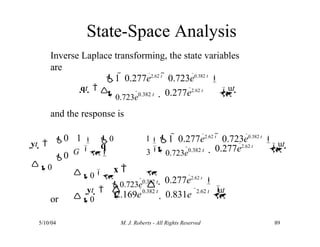
Inverse Laplace transforming, the state variables
are
and the response is
yt  

0
or
 0.277e2.62 t

qt   

ut 
1  0.277e2.62 t
 0.723e0.382 t

0.723e0.382 t
 0.277e2.62 t
0

0 1 
0 G 

q 

0

x 

0
 
3


ut 
11  0.277e2.62 t
 0.723e0.382 t

0.723e0.382 t
yt  
0.723e0.382 t
 0.831e 2.62 t


2.169e0.382 t


ut 
 0.277e2.62 t

State-Space Analysis
5/10/04 M. J. Roberts - All Rights Reserved 90
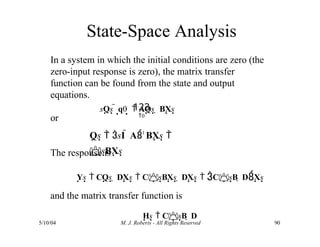
In a system in which the initial conditions are zero (the
zero-input response is zero), the matrix transfer
function can be found from the state and output
equations.
or
The response is
Ys  CQs  DXs  CsBXs  DXs  CsB  DXs
and the matrix transfer function is
Hs  CsB  D
sQs  q0
  AQs  BXs
123
0
Qs  sI  A1
BXs 
sBXs
State-Space Analysis
5/10/04 M. J. Roberts - All Rights Reserved 91
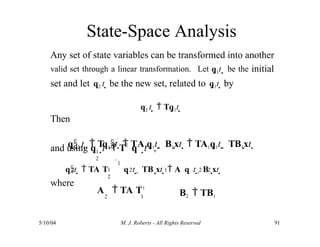
Any set of state variables can be transformed into another
valid set through a linear transformation. Let q1t  be the initial
set and let q2 t  be the new set, related to q1t  by
q2 t   Tq1t 
Then
q2 t   Tq1t   TA1q1t   B1xt   TA1q1t   TB1xt 
and using q
2
where
1
2
t  T q t ,
   
1
1
1 2 1 2 2
2
qt   TA T q t   TB xt   A q t   B xt 
A  TA T1
2 1 B2  TB1
State-Space Analysis
5/10/04 M. J. Roberts - All Rights Reserved 92
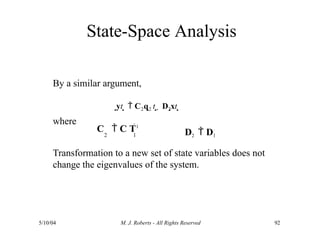
By a similar argument,
yt   C2q2 t   D2xt 
where
Transformation to a new set of state variables does not
change the eigenvalues of the system.
C  C T1
2 1 D2  D1

Sinyal sistem engineering Chapter10Slides.pptx

  • 1.
    Laplace Transform Analysisof Signals and Systems
  • 2.
    Transfer Functions 5/10/04 M.J. Roberts - All Rights Reserved 2 • Transfer functions of CT systems can be found from analysis of – Differential Equations – Block Diagrams – Circuit Diagrams
  • 3.
    Transfer Functions A circuitcan be described by a system of differential equations g 1 1 1 2   R i t   L  d i t   d i t   v t  L 5/10/04 M. J. Roberts - All Rights Reserved 3  d  d d dt c t 2 i t   1 2 2 2 1 i t  dt dt       t   0  0 C  i d  v 0  R i
  • 4.
    Transfer Functions Using theLaplace transform, a circuit can be described by a system of algebraic equations 5/10/04 M. J. Roberts - All Rights Reserved 4 R1 I1s  sL I1s  sL I2 s  Vg s sC 2 1 2 2 2 sL I s  sL I s  1 I s  R I s  0
  • 5.
    A circuit caneven be described by a block diagram. 5/10/04 M. J. Roberts - All Rights Reserved 5 Transfer Functions
  • 6.
    A mechanical systemcan be described by a system of differential equations ft   Kd x1t   Ks1x1t   x2 t   m1 x1t Ks1x1t   x2 t   Ks 2 x2 t   m2 x2 t or a system of algebraic equations. 5/10/04 M. J. Roberts - All Rights Reserved 6 m s X   Fs  K s X s  K X s  X s  s K X s  X s  K X s  m s X s d 1 s1 2 1 2 1 1 s1 1 2 s 2 2 2 2 2 Transfer Functions
  • 7.
    The mechanical systemcan also be described by a block diagram. Time Domain Frequency Domain 5/10/04 M. J. Roberts - All Rights Reserved 7 Transfer Functions
  • 8.
    System Stability 5/10/04 M.J. Roberts - All Rights Reserved 8 • System stability is very important • A continuous-time LTI system is stable if its impulse response is absolutely integrable • This translates into the frequency domain as the requirement that all the poles of the system transfer function must lie in the open left half-plane of the s plane (pp. 675- 676) • “Open left half-plane” means not including the  axis
  • 9.
    System Interconnections Cascade Parallel 5/10/04 M.J. Roberts - All Rights Reserved 9
  • 10.
    Feedback Error signal Es Xs  H2 sYs Ys  H sEs 1 Hs  Ys  H1s Xs 1  H1sH2 s E(s) Forward path transfer function or the “plant” 2 transfer function or the “sensor”. H s Feedback path Ts  H1sH2 s Loop transfer function H1s H1s 1  Ts 5/10/04 M. J. Roberts - All Rights Reserved 10 System Interconnections Ts  H sH s 1 2 Hs 
  • 11.
    Analysis of FeedbackSystems Beneficial Effects Hs  K 5/10/04 M. J. Roberts - All Rights Reserved 11 1  K H2 s 2 H s If K is large enough that K H s  1 then Hs  1 . This 2 means that the overall system is the approximate inverse of the system in the feedback path. This kind of system can be useful for reversing the effects of another system.
  • 12.
    Analysis of FeedbackSystems A very important example of feedback systems is an electronic amplifier based on an operational amplifier Let the operational amplifier gain be 1 5/10/04 M. J. Roberts - All Rights Reserved 12 H s  A0 p o e V s V s   1  s
  • 13.
    Analysis of FeedbackSystems The amplifier can be modeled as a feedback system with this block diagram. The overall gain can be written as Vi s 5/10/04 M. J. Roberts - All Rights Reserved 13 V0 s   A0 Z f s     s   1  s  A Z s  1   Zs p 0   i  p f
  • 14.
    If the operationalamplifier low-frequency gain, A0 , is very large (which it usually is) then the overall amplifier gain reduces at low-frequencies to V0 s   Z f s Vi s Zi s the gain formula based on an ideal operational amplifier. 5/10/04 M. J. Roberts - All Rights Reserved 14 Analysis of Feedback Systems
  • 15.
    Analysis of FeedbackSystems 5/10/04 M. J. Roberts - All Rights Reserved 15 The change in overall system gain is about 0.001% for a change in open-loop gain of a factor of 10. The half-power bandwidth of the operational amplifier itself is 15.9 Hz (100/2).The half-power bandwidth of the overall amplifier is approximately 14.5 MHz, an increase in bandwidth of a factor of approximately 910,000. 0 0 If A  106 If A  107 and p  100 then H j100  9.999989  j0.000011 and p  100 then H j100  9.99989  j0.00011
  • 16.
    Analysis of FeedbackSystems 5/10/04 M. J. Roberts - All Rights Reserved 16 Feedback can stabilize an unstable system. Let a forward-path transfer function be This system is unstable because it has a pole in the right half- plane. If we then connect feedback with a transfer function, K, a constant, the overall system gain becomes s  p  K and, if K > p, the overall system is now stable. 1 s  p H s  1 , p  0 Hs  1
  • 17.
    Analysis of FeedbackSystems 5/10/04 M. J. Roberts - All Rights Reserved 17 Feedback can make an unstable system stable but it can also make a stable system unstable. Even though all the poles of the forward and feedback systems may be in the open left half-plane, the poles of the overall feedback system can be in the right half-plane. A familiar example of this kind of instability caused by feedback is a public address system. If the amplifier gain is set too high the system will go unstable and oscillate, usually with a very annoying high-pitched tone.
  • 18.
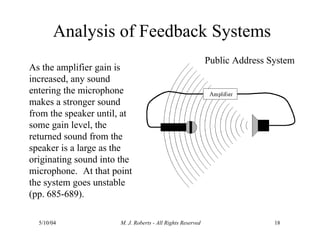
    Analysis of FeedbackSystems Public Address System 5/10/04 M. J. Roberts - All Rights Reserved 18 As the amplifier gain is increased, any sound entering the microphone makes a stronger sound from the speaker until, at some gain level, the returned sound from the speaker is a large as the originating sound into the microphone. At that point the system goes unstable (pp. 685-689).
  • 19.
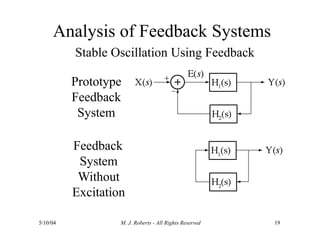
    Analysis of FeedbackSystems Stable Oscillation Using Feedback Prototype Feedback System Feedback System Without Excitation 5/10/04 M. J. Roberts - All Rights Reserved 19
  • 20.
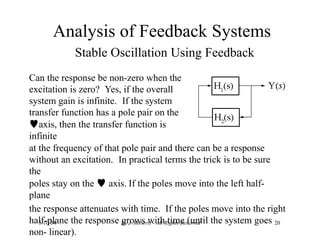
    Analysis of FeedbackSystems Stable Oscillation Using Feedback Can the response be non-zero when the excitation is zero? Yes, if the overall system gain is infinite. If the system transfer function has a pole pair on the axis, then the transfer function is infinite at the frequency of that pole pair and there can be a response without an excitation. In practical terms the trick is to be sure the poles stay on the  axis. If the poles move into the left half- plane the response attenuates with time. If the poles move into the right half-plane the response grows with time (until the system goes non- linear). 5/10/04 M. J. Roberts - All Rights Reserved 20
  • 21.
    Analysis of FeedbackSystems Stable Oscillation Using Feedback A real example of a system that oscillates stably is a laser. In a laser the forward path is an optical amplifier. The feedback action is provided by putting mirrors at each end of the optical amplifier. 5/10/04 M. J. Roberts - All Rights Reserved 21
  • 22.
    Analysis of FeedbackSystems Stable Oscillation Using Feedback Laser action begins when a photon is spontaneously emitted from the pumped medium in a direction normal to the mirrors. 5/10/04 M. J. Roberts - All Rights Reserved 22
  • 23.
    Analysis of FeedbackSystems Stable Oscillation Using Feedback If the “round-trip” gain of the combination of pumped laser medium and mirrors is unity, sustained oscillation of light will occur. For that to occur the wavelength of the light must fit into the distance between mirrors an integer number of times. 5/10/04 M. J. Roberts - All Rights Reserved 23
  • 24.
    Analysis of FeedbackSystems Stable Oscillation Using Feedback A laser can be modeled by a block diagram in which the K’s represent the gain of the pumped medium or the reflection or transmission coefficient at a mirror, L is the distance between mirrors and c is the speed of light. 5/10/04 M. J. Roberts - All Rights Reserved 24
  • 25.
    Analysis of FeedbackSystems The Routh-Hurwitz Stability Test 5/10/04 M. J. Roberts - All Rights Reserved 25 The Routh-Hurwitz Stability Test is a method for determining the stability of a system if its transfer function is expressed as a ratio of polynomials in s. Let the numerator be N(s) and let the denominator be D s a s D D D1  a sD1 L a s  a 1 0   
  • 26.
    Analysis of FeedbackSystems The Routh-Hurwitz Stability Test The first step is to construct the “Routh array”. D D  1 D  2 D  3 ⁝ 2 1 0 5/10/04 M. J. Roberts - All Rights Reserved 26 aD aD2 aD 4 L a0 D aD1 aD 3 aD5 L 0 D  1 bD2 bD 4 bD6 L 0 D  2 cD 3 cD5 cD 7 L 0 D  3 ⁝ ⁝ ⁝ ⁝ ⁝ ⁝ d2 d0 0 0 0 2 e1 0 0 0 0 1 f0 0 0 0 0 0 aD aD2 aD 4 L a1 aD1 aD 3 aD5 L a0 bD2 bD 4 bD6 L 0 cD 3 cD5 cD 7 L 0 ⁝ ⁝ ⁝ ⁝ ⁝ d2 d0 0 0 0 e1 0 0 0 0
  • 27.
    The Routh-Hurwitz StabilityTest The first two rows contain the coefficients of the denominator polynomial. The entries in the following row are found by the formulas, b   a aD aD2 aD1 aD 3 D2 a 5/10/04 M. J. Roberts - All Rights Reserved 27 b   D 4 aD aD 4 aD1 aD5 D1 D1 ... The entries on succeeding rows are computed by the same process based on previous row entries. If there are any zeros or sign changes in the aD column, the system is unstable. The number of sign changes in the column is the number of poles in the right half-plane (pp. 693-694). Analysis of Feedback Systems
  • 28.
    Analysis of FeedbackSystems Root Locus Common Type of Feedback System System Transfer Function Hs  5/10/04 M. J. Roberts - All Rights Reserved 28 K H1s 1  K H1sH2 s Loop Transfer Function Ts  K H1sH2 s
  • 29.
    Analysis of FeedbackSystems Root Locus Poles of H(s) Zeros of 1 + T(s) T is of the form Ts  K Ps Qs Poles of H(s) Zeros of 1 + K Ps Qs Poles of H(s) Qs  K Ps  0 or K Qs  Ps  0 5/10/04 M. J. Roberts - All Rights Reserved 29
  • 30.
    Analysis of FeedbackSystems Root Locus K can range from zero to infinity. For K approaching zero, using the poles of H are the same as the zeros of Qs  0 which are the poles of T. For K approaching infinity, using Qs  K Ps  0 K 5/10/04 M. J. Roberts - All Rights Reserved 30 Qs  Ps  0 the poles of H are the same as the zeros of Ps  0 which are the zeros of T. So the poles of H start on the poles of T and terminate on the zeros of T, some of which may be at infinity. The curves traced by these pole locations as K is varied are called the root locus.
  • 31.
    Analysis of FeedbackSystems Root Locus Then Ts  K No matter how large K gets this system is stable because the poles always lie in the left half-plane (although for large K the system may be very underdamped). 1 s  1s  2 2 Let H s  K and let H s  1 . s  1s  2 Root Locus 5/10/04 M. J. Roberts - All Rights Reserved 31
  • 32.
    Analysis of FeedbackSystems Root Locus Root Locus 5/10/04 M. J. Roberts - All Rights Reserved 32 and let H2 s  1 . At some finite value of K the system becomes unstable because two poles move into the right half-plane. 1 Let H s  K s  1s  2s  3
  • 33.
    Analysis of FeedbackSystems 5/10/04 M. J. Roberts - All Rights Reserved 33 Root Locus Four Rules for Drawing a Root Locus 1.Each root-locus branch begins on a pole of T and terminates on a zero of T. 2.Any portion of the real axis for which the sum of the number of real poles and/or real zeros lying to its right on the real axis is odd, is a part of the root locus. 3. . . The root locus is symmetrical about the real axis.
  • 34.
    . . 4. If thenumber of finite poles of T exceeds the number of finite zeros of T by an integer, m, then m branches of the root locus terminate on zeros of T which lie at infinity. Each of these branches approaches a straight-line asymptote and the angles of these asymptotes are at the angles, k  5/10/04 M. J. Roberts - All Rights Reserved 34 m , k  1, 3, 5,... Analysis of Feedback Systems Root Locus m with respect to the positive real axis. These asymptotes intersect on the real axis at the location,   1 finite poles  finite zeros
  • 35.
    Analysis of FeedbackSystems Root Locus Examples 5/10/04 M. J. Roberts - All Rights Reserved 35
  • 36.
    Analysis of FeedbackSystems 5/10/04 M. J. Roberts - All Rights Reserved 36 Gain and Phase Margin Real systems are usually designed with a margin of error to allow for small parameter variations and still be stable. That “margin” can be viewed as a gain margin or a phase margin. System instability occurs if, for any real , T j   1 a number with a magnitude of one and a phase of -  radians.
  • 37.
    Analysis of FeedbackSystems 5/10/04 M. J. Roberts - All Rights Reserved 37 Gain and Phase Margin So to be guaranteed stable, a system must have a T whose magnitude, as a function of frequency, is less than one when the phase hits - or, seen another way, T must have a phase, as a function of frequency, more positive than -  for all | T| greater than one. The difference between the a magnitude of T of 0 dB and the magnitude of T when the phase hits -  is the gain margin. The difference between the phase of T when the magnitude hits 0 dB and a phase of -  is the phase margin.
  • 38.
    Analysis of FeedbackSystems Gain and Phase Margin 5/10/04 M. J. Roberts - All Rights Reserved 38
  • 39.
    Analysis of FeedbackSystems Steady-State Tracking Errors in Unity-Gain Feedback Systems A very common type of feedback system is the unity-gain feedback connection. 5/10/04 M. J. Roberts - All Rights Reserved 39 The aim of this type of system is to make the response “track” the excitation. When the error signal is zero, the excitation and response are equal.
  • 40.
    Analysis of FeedbackSystems Steady-State Tracking Errors in Unity-Gain Feedback Systems The Laplace transform of the error signal is The steady-state value of this signal is (using the final- value theorem) state error is If the excitation is the unit step, A ut , then the steady- Es  Xs 1  H1s lim et   lim s Es  lim s t s0 s0 Xs 1  H1s A 5/10/04 M. J. Roberts - All Rights Reserved 40 t lim et   lim s0 1  H1s
  • 41.
    Analysis of FeedbackSystems Steady-State Tracking Errors in Unity-Gain Feedback Systems If the forward transfer function is in the common form, then which has a pole at s = 0. a sD  a H1s  N N 1 2 1 0 D D1 2 1 0 b s N  b s N 1 Lb s2  b s  b sD1 La s2  a s  a b s N  b 5/10/04 M. J. Roberts - All Rights Reserved 41 a sD  a t s0 D D1 2 1 0 lim et   lim 1  1  N N 1 2 1 0 s N 1 Lb s2  b s  b a  b 0 0 sD1 La s2  a s  a If a0  0 and b0  0 the steady-state error is zero and the forward transfer function can be written as a0 2 1 s a s D  a  H1s  N N 1 2 1 0 D1 D1 sD2 b s N  b s N 1 Lb s2  b s  b La s  a 
  • 42.
    Analysis of FeedbackSystems Steady-State Tracking Errors in Unity-Gain Feedback Systems If the forward transfer function of a unity-gain feedback system has a pole at zero and the system is stable, the steady-state error with step excitation is zero. This type of system is called a “type 1” system (one pole at s = 0 in the forward transfer function). If there are no poles at s = 0, it is called a “type 0” system and the steady-state error with step excitation is non-zero. 5/10/04 M. J. Roberts - All Rights Reserved 42
  • 43.
    Analysis of FeedbackSystems Steady-State Tracking Errors in Unity-Gain Feedback Systems The steady-state error with ramp excitation is Infinite for a stable type 0 system Finite and non-zero for a stable type 1 system Zero for a stable type 2 system (2 poles at s = 0 in the forward transfer function) 5/10/04 M. J. Roberts - All Rights Reserved 43
  • 44.
    Block Diagram Reduction Itis possible, by a series of operations, to reduce a complicated block diagram down to a single block. Moving a Pick-Off Point 5/10/04 M. J. Roberts - All Rights Reserved 44
  • 45.
    Block Diagram Reduction Movinga Summer 5/10/04 M. J. Roberts - All Rights Reserved 45
  • 46.
    Block Diagram Reduction CombiningTwo Summers 5/10/04 M. J. Roberts - All Rights Reserved 46
  • 47.
    Block Diagram Reduction MovePick-Off Point 5/10/04 M. J. Roberts - All Rights Reserved 47
  • 48.
    Block Diagram Reduction MoveSummer 5/10/04 M. J. Roberts - All Rights Reserved 48
  • 49.
    Block Diagram Reduction CombineSummers 5/10/04 M. J. Roberts - All Rights Reserved 49
  • 50.
    Block Diagram Reduction CombineParallel Blocks 5/10/04 M. J. Roberts - All Rights Reserved 50
  • 51.
    Block Diagram Reduction CombineCascaded Blocks 5/10/04 M. J. Roberts - All Rights Reserved 51
  • 52.
    Block Diagram Reduction ReduceFeedback Loop 5/10/04 M. J. Roberts - All Rights Reserved 52
  • 53.
    Block Diagram Reduction CombineCascaded Blocks 5/10/04 M. J. Roberts - All Rights Reserved 53
  • 54.
    Mason’s Theorem 5/10/04 M.J. Roberts - All Rights Reserved 54 Definitions: Number of Paths from Input to Output - Np Number of Feedback Loops - NL Transfer Function of ith Path from Input to Output - Pi s Loop transfer Function of ith Feedback Loop - Ti s Ti sTj s  NL s  1   Ti s  i1  ith loopand jth loop not sharing a signal  ith, jth,kth loops not sharing a signal Ti sTj sTk s  L
  • 55.
    Mason’s Theorem The overallsystem transfer function is Hs  5/10/04 M. J. Roberts - All Rights Reserved 55 N p Pi si s s i1 where i s is the same as s except that all feedback loops which share a signal with the ith path, Pi s, are excluded.
  • 56.
    Mason’s Theorem 1 s P s 10 2 P s  1 s  3 Np  2 NL  1 s s  8 s  1  1 3  1  3 ss  8 1s  2 s  1 N p 5/10/04 M. J. Roberts - All Rights Reserved 56 Pi si s s 10  1 Hs  i1  s s  3  3 ss  8 s  811s  30 s  3s2  8s  3 1 
  • 57.
    System Responses toStandard Signals Unit Step Response Let Hs  Ns be proper in s. Then the Laplace transform Ds of the unit step response is Ys  H s Ds Ds s 1 s  Ns  N1s  K If the system is stable, the inverse Laplace transform of N1s Ds is called the transient response and the steady-state response is H0 . 5/10/04 M. J. Roberts - All Rights Reserved 57 s K  H0
  • 58.
    System Responses toStandard Signals Let Hs  Ns be proper in s. If the Laplace transform of the Ds excitation is some general excitation, X(s), then the Laplace transform of the response is Ds Ds Dx s Ds Dx s 5/10/04 M. J. Roberts - All Rights Reserved 58 Ys  Ns Xs  Ns N x s  N1s  N x1s 123 same poles as system 123 same poles as excitation
  • 59.
    p 5/10/04 M. J.Roberts - All Rights Reserved 59 1  s Unit Step Response Let Hs  A . Then the unit step response is yt   A1  ept ut  System Responses to Standard Signals
  • 60.
    System Responses toStandard Signals Unit Step Response Let s  0 A 2 s2 0 0  2 s   2 (pp. 710-712) 5/10/04 M. J. Roberts - All Rights Reserved 60
  • 61.
    System Responses toStandard Signals Let s  0 s2 0 0  2 s   2 Unit Step Response A 2 5/10/04 M. J. Roberts - All Rights Reserved 61
  • 62.
    System Responses toStandard Signals Let Hs  Ns be proper in s. If the excitation is a suddenly- Ds applied, unit-amplitude cosine, the response is If the system is stable, the steady-state response is a sinusoid of same frequency as the excitation but, generally, a different magnitude and phase. s Ys  Ns 0 which can be reduced and inverse Laplace transformed into (pp. 713-714) Ds s2   2 y 5/10/04 M. J. Roberts - All Rights Reserved 62  H j t      N s    Ds        t  C1 1 0 0 0  cos  t  H j u
  • 63.
    Pole-Zero Diagrams and FrequencyResponse If the transfer function of a system is H(s), the frequency response is H(j). The most common type of transfer function is of the form, Hs  A s  z1 s  z2 Ls  zN  s  p1 s  p2 Ls  pD  Therefore H(j) is H j   A  j  z1  j  z2 L j  zN   j  p1  j  p2 L j  pD  5/10/04 M. J. Roberts - All Rights Reserved 63
  • 64.
    Pole-Zero Diagrams and FrequencyResponse Let Hs  3s s  3 j j  3 H j   3 The numerator, j, and the denominator, j  , can be conceived as vectors in the s plane. H j   3 5/10/04 M. J. Roberts - All Rights Reserved 64 j  j  3 H j   {3  j   j  3 0
  • 65.
    Pole-Zero Diagrams and FrequencyResponse  0 lim H j   lim 3  0  0 j  j  3  0 lim H j   lim 3  0  0 j  j  3 lim H j    lim 3 j  3     j  3 j  lim H j   lim 3     j  3  3 5/10/04 M. J. Roberts - All Rights Reserved 65
  • 66.
    Pole-Zero Diagrams and FrequencyResponse  0 2 2 lim H j     0    0 2 2 lim H j      0      2  2  lim H j           0   2 2 lim H j       0 5/10/04 M. J. Roberts - All Rights Reserved 66
  • 67.
    Butterworth Filters The squaredmagnitude of the transfer function of an nth order, unity-gain, lowpass Butterworth filter with a corner frequency of 1 radian/s is This is called a normalized Butterworth filter because its gain is normalized to one and its corner frequency is normalized to 1 radian/s. H j 2  1 5/10/04 M. J. Roberts - All Rights Reserved 67 1   2n
  • 68.
    Butterworth Filters A Butterworthfilter transfer function has no finite zeros and the poles all lie on a semicircle in the left-half plane whose radius is the corner frequency in radians/s and the angle between the pole locations is always /n radians. 5/10/04 M. J. Roberts - All Rights Reserved 68
  • 69.
    Butterworth Filters Frequency Transformations Anormalized lowpass Butterworth filter can be transformed into an unnormalized highpass, bandpass or bandstop Butterworth filter through the following transformations (pp. 721-725). Lowpass to Highpass Lowpass to Bandpass Lowpass to Bandstop s s  c s  L H s2    s H   L  L H 5/10/04 M. J. Roberts - All Rights Reserved 69 s  s H   L     s2
  • 70.
    Standard Realizations ofSystems There are multiple ways of drawing a system block diagram corresponding to a given transfer function of the form, Hs  5/10/04 M. J. Roberts - All Rights Reserved 70 Ys Xs , aN  1 b s k k N k N s N b s N  b  ak s k 0  k 0  N N 1 1 0 N 1 1 0 s N 1 L b s  b  a s N 1 L a s  a
  • 71.
    Standard Realizations ofSystems Canonical Form The transfer function can be conceived as the product of two transfer functions, and 1 H s 1 Y s Xs 1 s N N 1  a s N 1 L a s  a 1 0     Y 2 H s  1 s Y s N N  b s  b N 1 s N 1 L b s  b 1 0 5/10/04 M. J. Roberts - All Rights Reserved 71
  • 72.
    Standard Realizations ofSystems Canonical Form The system can then be realized in this form, 5/10/04 M. J. Roberts - All Rights Reserved 72
  • 73.
    Standard Realizations ofSystems Cascade Form The transfer function can be factored into the form, and each factor can be realized in a small canonical- form subsystem of either of the two forms, and these subsystems can then be cascade connected. Hs  A s  z1 s  p1 s  p2 s  pN s  pN 1 s  pN  2 s  pD s  z2 L s  zN 1 1 1 L 5/10/04 M. J. Roberts - All Rights Reserved 73
  • 74.
    Standard Realizations ofSystems Cascade Form A problem that arises in the cascade form is that some poles or zeros may be complex. In that case, a complex conjugate pair can be combined into one second-order subsystem of the form, 5/10/04 M. J. Roberts - All Rights Reserved 74
  • 75.
    Standard Realizations ofSystems Parallel Form The transfer function can be expanded in partial fractions of the form, Each of these terms describes a subsystem. When all the subsystems are connected in parallel the overall system is realized. Hs  5/10/04 M. J. Roberts - All Rights Reserved 75 KD s  pD K1  K2 s  p1 s  p2 L
  • 76.
    Standard Realizations ofSystems Parallel Form 5/10/04 M. J. Roberts - All Rights Reserved 76
  • 77.
    State-Space Analysis 5/10/04 M.J. Roberts - All Rights Reserved 77 • In larger systems it is important to keep the analysis methods systematic to avoid errors • One popular method for doing this is through the use of state variables • State variables are signals in a system which, together with the excitations, completely characterize the state of the system • As the system changes dynamically the state variables change value and the system moves on a trajectory through state space
  • 78.
    State-Space Analysis 5/10/04 M.J. Roberts - All Rights Reserved 78 • State space is an N-dimensional space where N is the order of the system • The order of a system is the number of state variables needed to characterize it • State variables are not unique, there can be multiple correct sets
  • 79.
    State-Space Analysis 5/10/04 M.J. Roberts - All Rights Reserved 79 • There are several advantages to state- space analysis – Reduction of the probability of analysis errors – Complete description of the system signals – Insight into system dynamics – Can be formulated using matrix methods and the system state can be expressed in two matrix equations – Combined with transform methods it is very powerful
  • 80.
    State-Space Analysis To illustratestate-space methods, let the system be this circuit Let the state variables be the capacitor voltage and the inductor current and let the output signals be vout t  and iR t . 5/10/04 M. J. Roberts - All Rights Reserved 80
  • 81.
    State-Space Analysis 5/10/04 M.J. Roberts - All Rights Reserved 81 Two differential equations in the two state variables, called the state equations, characterize the circuit, Two more equations called the output equations define the responses in terms of the state variables, vout t   vC t  iR t   G vC t  L C L it   1 v t  C L C in C C C vt    1 i t   G v t   1 i t 
  • 82.
    State-Space Analysis The stateequations can be written in matrix form as   5/10/04 M. J. Roberts - All Rights Reserved 82    L C L C in  it   vt  L    C  C    and the output equations can be written in matrix form as G v t   C   0 1   i t   1  0    1 i t  i R L C in    i t     G   v t       t    vout t   0     0 1 i t 0  0  
  • 83.
    State-Space Analysis 5/10/04 M.J. Roberts - All Rights Reserved 83 A block diagram for the system can be drawn directly from the state and output equations.
  • 84.
    State-Space Analysis L C qt       i t   v t  A   0 The state and output equations can be written compactly as qt   Aqt   Bxt  yt   Cqt   Dxt  where 1    1 L   G   0  B   1  C  5/10/04 M. J. Roberts - All Rights Reserved 84 xt   iin t  yt   R      vout t  i t  C   0 C C  0 1  G  0  D   0 
  • 85.
    State-Space Analysis 5/10/04 M.J. Roberts - All Rights Reserved 85 or The solution of the state and output equations can be found using the Laplace transform. sQs  q0   AQs  BXs sI  AQs  BXs  q0  Multiplying both sides bysI  A1 Qs  sI  A1 BXs  q0  The matrix, sI  A1 , is conventionally designated by the symbol, s . Then Q BX         s  s BX   s s  s s  q 0 q 0 1–2–3 zerostate response 1–2 –3 zeroinput response
  • 86.
    State-Space Analysis 5/10/04 M.J. Roberts - All Rights Reserved 86 The time-domain solution is then where t  C  s and t is called the state transition matrix. 1–2–3 zerostate response 1–2 –3 zeroinput response qt   t  Bxt   t q0 
  • 87.
    State-Space Analysis To makethe example concrete, let the excitation and initial conditions be it   A ut  0   1         q0          i 0 v 0 L C 3 and let R  1 , C  1 , L  1 s  sI  A 5/10/04 M. J. Roberts - All Rights Reserved 87  C s  C  L  G  C C s  G   s     1 1  1      L   s  s2 1    1 s    G 1 1
  • 88.
    State-Space Analysis Solving forthe states in the Laplace domain,   C LC    s   G C LC  s     Qs       C LC         sLC s  G s  1  1 s 1    G 1 C LC 1 1 2 L s2  G s  1   C s2  s2 Substituting in numerical component values,  5/10/04 M. J. Roberts - All Rights Reserved 88    s   3s  1 1 1  3s  1  1 Qs   ss2 s2    s2  3s  1  3s  1  s2
  • 89.
    State-Space Analysis 5/10/04 M.J. Roberts - All Rights Reserved 89 Inverse Laplace transforming, the state variables are and the response is yt    0 or  0.277e2.62 t  qt     ut  1  0.277e2.62 t  0.723e0.382 t  0.723e0.382 t  0.277e2.62 t 0  0 1  0 G   q   0  x   0   3   ut  11  0.277e2.62 t  0.723e0.382 t  0.723e0.382 t yt   0.723e0.382 t  0.831e 2.62 t   2.169e0.382 t   ut   0.277e2.62 t 
  • 90.
    State-Space Analysis 5/10/04 M.J. Roberts - All Rights Reserved 90 In a system in which the initial conditions are zero (the zero-input response is zero), the matrix transfer function can be found from the state and output equations. or The response is Ys  CQs  DXs  CsBXs  DXs  CsB  DXs and the matrix transfer function is Hs  CsB  D sQs  q0   AQs  BXs 123 0 Qs  sI  A1 BXs  sBXs
  • 91.
    State-Space Analysis 5/10/04 M.J. Roberts - All Rights Reserved 91 Any set of state variables can be transformed into another valid set through a linear transformation. Let q1t  be the initial set and let q2 t  be the new set, related to q1t  by q2 t   Tq1t  Then q2 t   Tq1t   TA1q1t   B1xt   TA1q1t   TB1xt  and using q 2 where 1 2 t  T q t ,     1 1 1 2 1 2 2 2 qt   TA T q t   TB xt   A q t   B xt  A  TA T1 2 1 B2  TB1
  • 92.
    State-Space Analysis 5/10/04 M.J. Roberts - All Rights Reserved 92 By a similar argument, yt   C2q2 t   D2xt  where Transformation to a new set of state variables does not change the eigenvalues of the system. C  C T1 2 1 D2  D1