Transfer Function
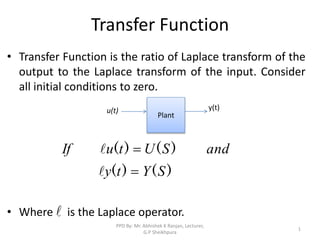
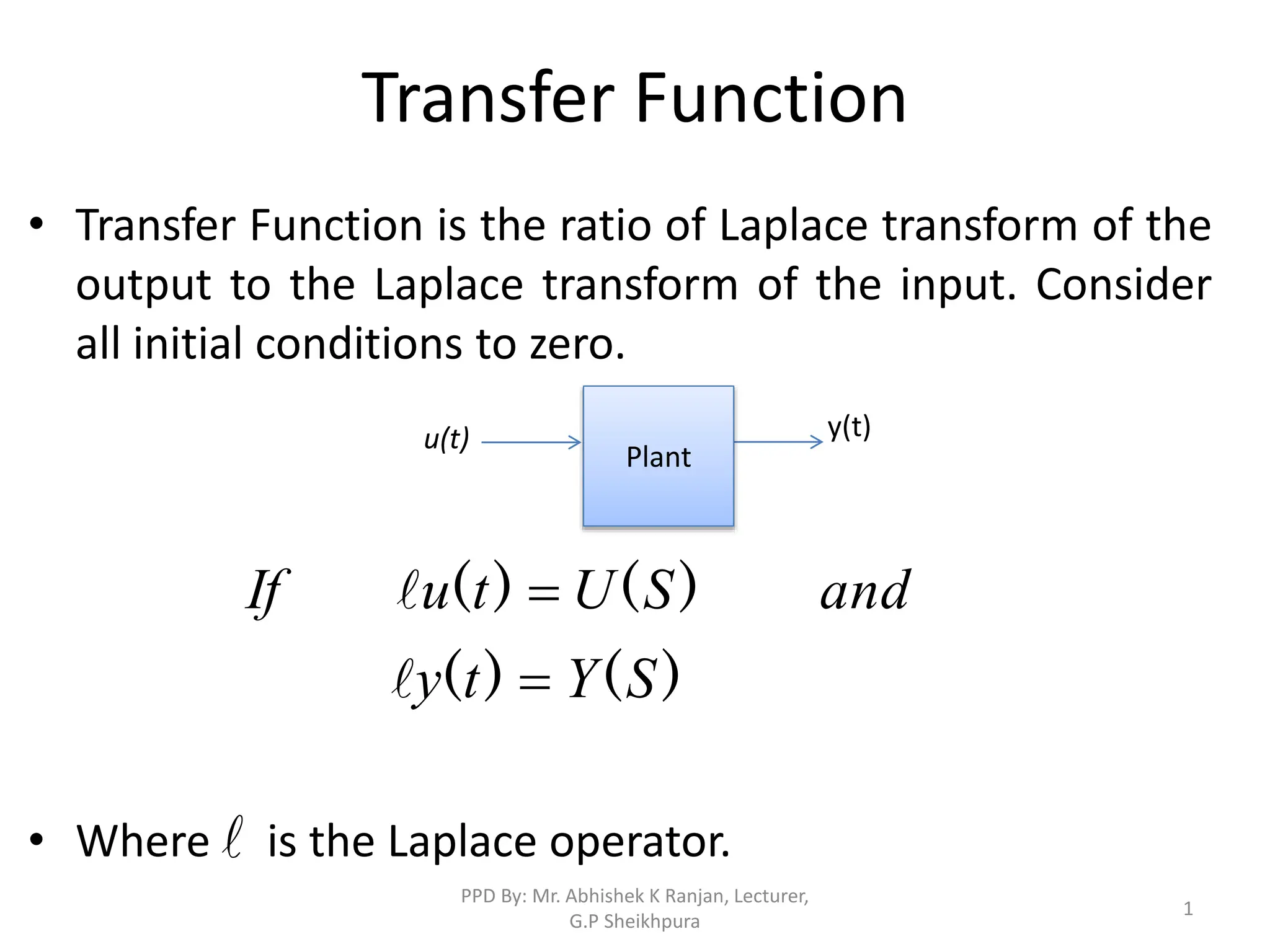
• Transfer Function is the ratio of Laplace transform of the
output to the Laplace transform of the input. Consider
all initial conditions to zero.
• Where is the Laplace operator.
Plant
y(t)
u(t)
)
(
)
(
)
(
)
(
S
Y
t
y
and
S
U
t
u
If





1
PPD By: Mr. Abhishek K Ranjan, Lecturer,
G.P Sheikhpura
Transfer Function
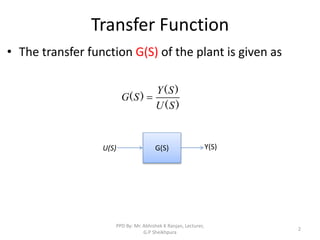
• The transfer function G(S) of the plant is given as
G(S) Y(S)
U(S)
)
(
)
(
)
(
S
U
S
Y
S
G 
2
PPD By: Mr. Abhishek K Ranjan, Lecturer,
G.P Sheikhpura
Why Laplace Transform?
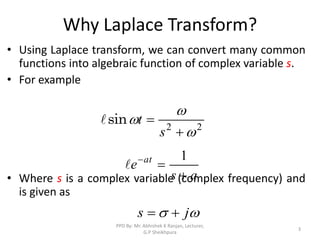
• Using Laplace transform, we can convert many common
functions into algebraic function of complex variable s.
• For example
• Where s is a complex variable (complex frequency) and
is given as
2
2





s
t
sin

a
s
e at


 1


 j
s 

3
PPD By: Mr. Abhishek K Ranjan, Lecturer,
G.P Sheikhpura
Laplace Transform of Derivatives
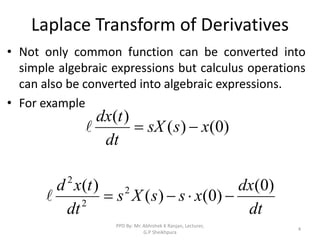
• Not only common function can be converted into
simple algebraic expressions but calculus operations
can also be converted into algebraic expressions.
• For example
)
0
(
)
(
)
(
x
s
sX
dt
t
dx



dt
dx
x
s
s
X
s
dt
t
x
d )
0
(
)
0
(
)
(
)
( 2
2
2





4
PPD By: Mr. Abhishek K Ranjan, Lecturer,
G.P Sheikhpura
Laplace Transform of Derivatives
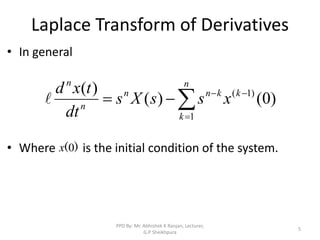
• In general
• Where is the initial condition of the system.






n
k
k
k
n
n
n
n
x
s
s
X
s
dt
t
x
d
1
)
1
(
)
0
(
)
(
)
(

)
(0
x
5
PPD By: Mr. Abhishek K Ranjan, Lecturer,
G.P Sheikhpura
Laplace Transform of Integrals
)
(
1
)
( s
X
s
dt
t
x 


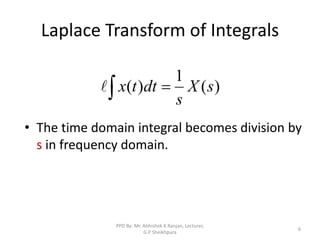
• The time domain integral becomes division by
s in frequency domain.
6
PPD By: Mr. Abhishek K Ranjan, Lecturer,
G.P Sheikhpura
Calculation of the Transfer Function
dt
t
dx
B
dt
t
dy
C
dt
t
x
d
A
)
(
)
(
)
(


2
2
• Consider the following ODE where y(t) is input of the system and
x(t) is the output.
• or
• Taking the Laplace transform on either sides
)
(
'
)
(
'
)
(
'
' t
Bx
t
Cy
t
Ax 

)]
(
)
(
[
)]
(
)
(
[
)]
(
'
)
(
)
(
[ 0
0
0
0
2
x
s
sX
B
y
s
sY
C
x
sx
s
X
s
A 





7
PPD By: Mr. Abhishek K Ranjan, Lecturer,
G.P Sheikhpura
Calculation of the Transfer Function
• Considering Initial conditions to zero in order to find the transfer
function of the system
• Rearranging the above equation
)]
(
)
(
[
)]
(
)
(
[
)]
(
'
)
(
)
(
[ 0
0
0
0
2
x
s
sX
B
y
s
sY
C
x
sx
s
X
s
A 





)
(
)
(
)
( s
BsX
s
CsY
s
X
As 

2
)
(
]
)[
(
)
(
)
(
)
(
s
CsY
Bs
As
s
X
s
CsY
s
BsX
s
X
As




2
2
B
As
C
Bs
As
Cs
s
Y
s
X



 2
)
(
)
(
8
PPD By: Mr. Abhishek K Ranjan, Lecturer,
G.P Sheikhpura
Transfer Function
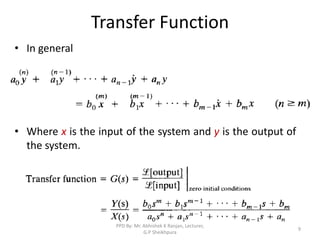
• In general
• Where x is the input of the system and y is the output of
the system.
9
PPD By: Mr. Abhishek K Ranjan, Lecturer,
G.P Sheikhpura
Transfer Function
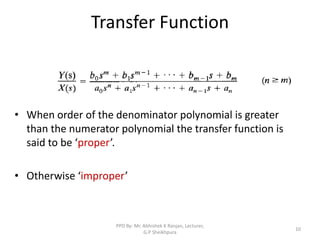
• When order of the denominator polynomial is greater
than the numerator polynomial the transfer function is
said to be ‘proper’.
• Otherwise ‘improper’
10
PPD By: Mr. Abhishek K Ranjan, Lecturer,
G.P Sheikhpura
Transfer Function
• Transfer function can be used to check
– The stability of the system
– Time domain and frequency domain characteristics of the
system
– Response of the system for any given input
11
PPD By: Mr. Abhishek K Ranjan, Lecturer,
G.P Sheikhpura
Stability of Control System
• There are several meanings of stability, in general
there are two kinds of stability definitions in control
system study.
– Absolute Stability
– Relative Stability
12
PPD By: Mr. Abhishek K Ranjan, Lecturer,
G.P Sheikhpura
Stability of Control System
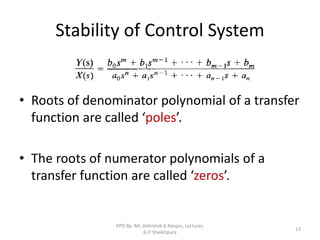
• Roots of denominator polynomial of a transfer
function are called ‘poles’.
• The roots of numerator polynomials of a
transfer function are called ‘zeros’.
13
PPD By: Mr. Abhishek K Ranjan, Lecturer,
G.P Sheikhpura
Stability of Control System
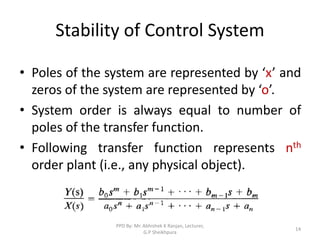
• Poles of the system are represented by ‘x’ and
zeros of the system are represented by ‘o’.
• System order is always equal to number of
poles of the transfer function.
• Following transfer function represents nth
order plant (i.e., any physical object).
14
PPD By: Mr. Abhishek K Ranjan, Lecturer,
G.P Sheikhpura
Stability of Control System
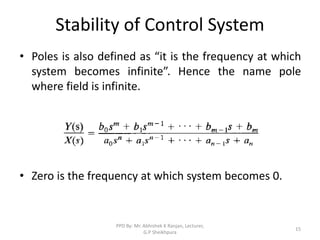
• Poles is also defined as “it is the frequency at which
system becomes infinite”. Hence the name pole
where field is infinite.
• Zero is the frequency at which system becomes 0.
15
PPD By: Mr. Abhishek K Ranjan, Lecturer,
G.P Sheikhpura
Stability of Control System
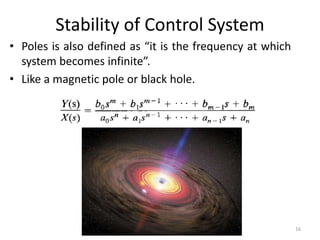
• Poles is also defined as “it is the frequency at which
system becomes infinite”.
• Like a magnetic pole or black hole.
16
Example
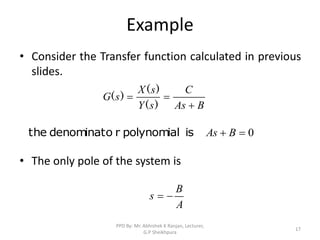
• Consider the Transfer function calculated in previous
slides.
• The only pole of the system is
17
B
As
C
s
Y
s
X
s
G



)
(
)
(
)
(
0

 B
As
is
polynomial
r
denominato
the
A
B
s 

PPD By: Mr. Abhishek K Ranjan, Lecturer,
G.P Sheikhpura
Examples
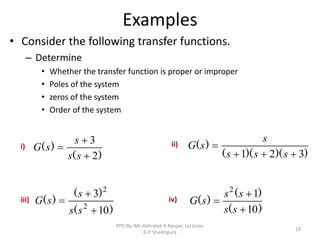
• Consider the following transfer functions.
– Determine
• Whether the transfer function is proper or improper
• Poles of the system
• zeros of the system
• Order of the system
18
)
(
)
(
2
3



s
s
s
s
G
)
)(
)(
(
)
(
3
2
1 



s
s
s
s
s
G
)
(
)
(
)
(
10
3
2
2



s
s
s
s
G
)
(
)
(
)
(
10
1
2



s
s
s
s
s
G
i) ii)
iii) iv)
PPD By: Mr. Abhishek K Ranjan, Lecturer,
G.P Sheikhpura
Stability of Control Systems
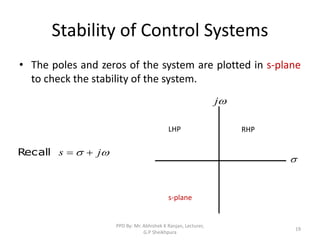
• The poles and zeros of the system are plotted in s-plane
to check the stability of the system.
19
s-plane
LHP RHP


j

 j
s 

Recall
PPD By: Mr. Abhishek K Ranjan, Lecturer,
G.P Sheikhpura
Stability of Control Systems
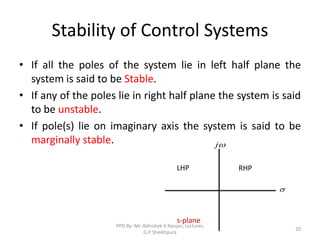
• If all the poles of the system lie in left half plane the
system is said to be Stable.
• If any of the poles lie in right half plane the system is said
to be unstable.
• If pole(s) lie on imaginary axis the system is said to be
marginally stable.
20
s-plane
LHP RHP


j
PPD By: Mr. Abhishek K Ranjan, Lecturer,
G.P Sheikhpura
Stability of Control Systems
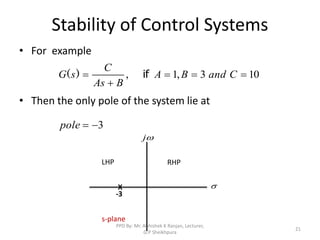
• For example
• Then the only pole of the system lie at
21
10
3
1 



 C
and
B
A
B
As
C
s
G if ,
,
)
(
3


pole
s-plane
LHP RHP


j
X
-3
PPD By: Mr. Abhishek K Ranjan, Lecturer,
G.P Sheikhpura
Examples
• Consider the following transfer functions.
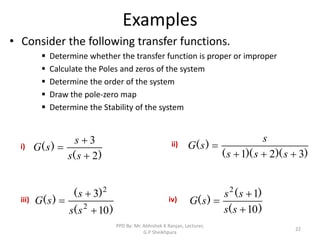
 Determine whether the transfer function is proper or improper
 Calculate the Poles and zeros of the system
 Determine the order of the system
 Draw the pole-zero map
 Determine the Stability of the system
22
)
(
)
(
2
3



s
s
s
s
G
)
)(
)(
(
)
(
3
2
1 



s
s
s
s
s
G
)
(
)
(
)
(
10
3
2
2



s
s
s
s
G
)
(
)
(
)
(
10
1
2



s
s
s
s
s
G
i) ii)
iii) iv)
PPD By: Mr. Abhishek K Ranjan, Lecturer,
G.P Sheikhpura
The Other Definition of Stability
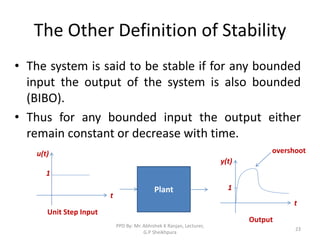
• The system is said to be stable if for any bounded
input the output of the system is also bounded
(BIBO).
• Thus for any bounded input the output either
remain constant or decrease with time.
23
u(t)
t
1
Unit Step Input
Plant
y(t)
t
Output
1
overshoot
PPD By: Mr. Abhishek K Ranjan, Lecturer,
G.P Sheikhpura
The Other Definition of Stability
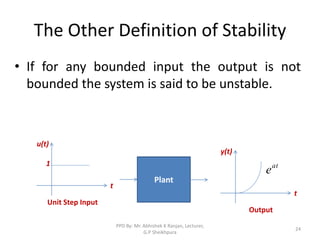
• If for any bounded input the output is not
bounded the system is said to be unstable.
24
u(t)
t
1
Unit Step Input
Plant
y(t)
t
Output
at
e
PPD By: Mr. Abhishek K Ranjan, Lecturer,
G.P Sheikhpura
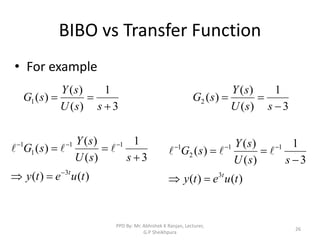
BIBO vs Transfer Function
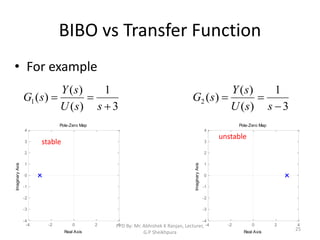
• For example
3
1
)
(
)
(
)
(
1



s
s
U
s
Y
s
G
3
1
)
(
)
(
)
(
2



s
s
U
s
Y
s
G
-4 -2 0 2 4
-4
-3
-2
-1
0
1
2
3
4
Pole-Zero Map
Real Axis
Imaginary
Axis
-4 -2 0 2 4
-4
-3
-2
-1
0
1
2
3
4
Pole-Zero Map
Real Axis
Imaginary
Axis
stable
unstable
PPD By: Mr. Abhishek K Ranjan, Lecturer,
G.P Sheikhpura
25
BIBO vs Transfer Function
• For example
3
1
)
(
)
(
)
(
1



s
s
U
s
Y
s
G
3
1
)
(
)
(
)
(
2



s
s
U
s
Y
s
G
)
(
)
(
3
1
)
(
)
(
)
(
3
1
1
1
1
t
u
e
t
y
s
s
U
s
Y
s
G
t








 


)
(
)
(
3
1
)
(
)
(
)
(
3
1
1
2
1
t
u
e
t
y
s
s
U
s
Y
s
G
t




 





PPD By: Mr. Abhishek K Ranjan, Lecturer,
G.P Sheikhpura
26
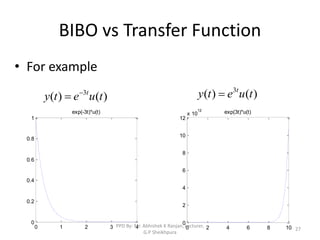
BIBO vs Transfer Function
• For example
)
(
)
( 3
t
u
e
t
y t

 )
(
)
( 3
t
u
e
t
y t

0 1 2 3 4
0
0.2
0.4
0.6
0.8
1
exp(-3t)*u(t)
0 2 4 6 8 10
0
2
4
6
8
10
12
x 10
12
exp(3t)*u(t)
PPD By: Mr. Abhishek K Ranjan, Lecturer,
G.P Sheikhpura
27
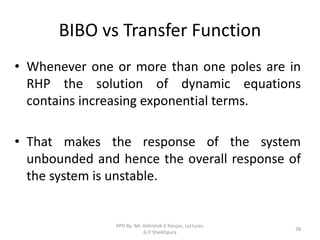
BIBO vs Transfer Function
• Whenever one or more than one poles are in
RHP the solution of dynamic equations
contains increasing exponential terms.
• That makes the response of the system
unbounded and hence the overall response of
the system is unstable.
PPD By: Mr. Abhishek K Ranjan, Lecturer,
G.P Sheikhpura
28
Summary
• Transfer Function
• The Order of Control Systems
• Poles, Zeros
• Stability
• BIBO
29
PPD By: Mr. Abhishek K Ranjan, Lecturer,
G.P Sheikhpura

Fundamentals of Transfer Function in control system.pptx

  • 1.
    Transfer Function • TransferFunction is the ratio of Laplace transform of the output to the Laplace transform of the input. Consider all initial conditions to zero. • Where is the Laplace operator. Plant y(t) u(t) ) ( ) ( ) ( ) ( S Y t y and S U t u If      1 PPD By: Mr. Abhishek K Ranjan, Lecturer, G.P Sheikhpura
  • 2.
    Transfer Function • Thetransfer function G(S) of the plant is given as G(S) Y(S) U(S) ) ( ) ( ) ( S U S Y S G  2 PPD By: Mr. Abhishek K Ranjan, Lecturer, G.P Sheikhpura
  • 3.
    Why Laplace Transform? •Using Laplace transform, we can convert many common functions into algebraic function of complex variable s. • For example • Where s is a complex variable (complex frequency) and is given as 2 2      s t sin  a s e at    1    j s   3 PPD By: Mr. Abhishek K Ranjan, Lecturer, G.P Sheikhpura
  • 4.
    Laplace Transform ofDerivatives • Not only common function can be converted into simple algebraic expressions but calculus operations can also be converted into algebraic expressions. • For example ) 0 ( ) ( ) ( x s sX dt t dx    dt dx x s s X s dt t x d ) 0 ( ) 0 ( ) ( ) ( 2 2 2      4 PPD By: Mr. Abhishek K Ranjan, Lecturer, G.P Sheikhpura
  • 5.
    Laplace Transform ofDerivatives • In general • Where is the initial condition of the system.       n k k k n n n n x s s X s dt t x d 1 ) 1 ( ) 0 ( ) ( ) (  ) (0 x 5 PPD By: Mr. Abhishek K Ranjan, Lecturer, G.P Sheikhpura
  • 6.
    Laplace Transform ofIntegrals ) ( 1 ) ( s X s dt t x    • The time domain integral becomes division by s in frequency domain. 6 PPD By: Mr. Abhishek K Ranjan, Lecturer, G.P Sheikhpura
  • 7.
    Calculation of theTransfer Function dt t dx B dt t dy C dt t x d A ) ( ) ( ) (   2 2 • Consider the following ODE where y(t) is input of the system and x(t) is the output. • or • Taking the Laplace transform on either sides ) ( ' ) ( ' ) ( ' ' t Bx t Cy t Ax   )] ( ) ( [ )] ( ) ( [ )] ( ' ) ( ) ( [ 0 0 0 0 2 x s sX B y s sY C x sx s X s A       7 PPD By: Mr. Abhishek K Ranjan, Lecturer, G.P Sheikhpura
  • 8.
    Calculation of theTransfer Function • Considering Initial conditions to zero in order to find the transfer function of the system • Rearranging the above equation )] ( ) ( [ )] ( ) ( [ )] ( ' ) ( ) ( [ 0 0 0 0 2 x s sX B y s sY C x sx s X s A       ) ( ) ( ) ( s BsX s CsY s X As   2 ) ( ] )[ ( ) ( ) ( ) ( s CsY Bs As s X s CsY s BsX s X As     2 2 B As C Bs As Cs s Y s X     2 ) ( ) ( 8 PPD By: Mr. Abhishek K Ranjan, Lecturer, G.P Sheikhpura
  • 9.
    Transfer Function • Ingeneral • Where x is the input of the system and y is the output of the system. 9 PPD By: Mr. Abhishek K Ranjan, Lecturer, G.P Sheikhpura
  • 10.
    Transfer Function • Whenorder of the denominator polynomial is greater than the numerator polynomial the transfer function is said to be ‘proper’. • Otherwise ‘improper’ 10 PPD By: Mr. Abhishek K Ranjan, Lecturer, G.P Sheikhpura
  • 11.
    Transfer Function • Transferfunction can be used to check – The stability of the system – Time domain and frequency domain characteristics of the system – Response of the system for any given input 11 PPD By: Mr. Abhishek K Ranjan, Lecturer, G.P Sheikhpura
  • 12.
    Stability of ControlSystem • There are several meanings of stability, in general there are two kinds of stability definitions in control system study. – Absolute Stability – Relative Stability 12 PPD By: Mr. Abhishek K Ranjan, Lecturer, G.P Sheikhpura
  • 13.
    Stability of ControlSystem • Roots of denominator polynomial of a transfer function are called ‘poles’. • The roots of numerator polynomials of a transfer function are called ‘zeros’. 13 PPD By: Mr. Abhishek K Ranjan, Lecturer, G.P Sheikhpura
  • 14.
    Stability of ControlSystem • Poles of the system are represented by ‘x’ and zeros of the system are represented by ‘o’. • System order is always equal to number of poles of the transfer function. • Following transfer function represents nth order plant (i.e., any physical object). 14 PPD By: Mr. Abhishek K Ranjan, Lecturer, G.P Sheikhpura
  • 15.
    Stability of ControlSystem • Poles is also defined as “it is the frequency at which system becomes infinite”. Hence the name pole where field is infinite. • Zero is the frequency at which system becomes 0. 15 PPD By: Mr. Abhishek K Ranjan, Lecturer, G.P Sheikhpura
  • 16.
    Stability of ControlSystem • Poles is also defined as “it is the frequency at which system becomes infinite”. • Like a magnetic pole or black hole. 16
  • 17.
    Example • Consider theTransfer function calculated in previous slides. • The only pole of the system is 17 B As C s Y s X s G    ) ( ) ( ) ( 0   B As is polynomial r denominato the A B s   PPD By: Mr. Abhishek K Ranjan, Lecturer, G.P Sheikhpura
  • 18.
    Examples • Consider thefollowing transfer functions. – Determine • Whether the transfer function is proper or improper • Poles of the system • zeros of the system • Order of the system 18 ) ( ) ( 2 3    s s s s G ) )( )( ( ) ( 3 2 1     s s s s s G ) ( ) ( ) ( 10 3 2 2    s s s s G ) ( ) ( ) ( 10 1 2    s s s s s G i) ii) iii) iv) PPD By: Mr. Abhishek K Ranjan, Lecturer, G.P Sheikhpura
  • 19.
    Stability of ControlSystems • The poles and zeros of the system are plotted in s-plane to check the stability of the system. 19 s-plane LHP RHP   j   j s   Recall PPD By: Mr. Abhishek K Ranjan, Lecturer, G.P Sheikhpura
  • 20.
    Stability of ControlSystems • If all the poles of the system lie in left half plane the system is said to be Stable. • If any of the poles lie in right half plane the system is said to be unstable. • If pole(s) lie on imaginary axis the system is said to be marginally stable. 20 s-plane LHP RHP   j PPD By: Mr. Abhishek K Ranjan, Lecturer, G.P Sheikhpura
  • 21.
    Stability of ControlSystems • For example • Then the only pole of the system lie at 21 10 3 1      C and B A B As C s G if , , ) ( 3   pole s-plane LHP RHP   j X -3 PPD By: Mr. Abhishek K Ranjan, Lecturer, G.P Sheikhpura
  • 22.
    Examples • Consider thefollowing transfer functions.  Determine whether the transfer function is proper or improper  Calculate the Poles and zeros of the system  Determine the order of the system  Draw the pole-zero map  Determine the Stability of the system 22 ) ( ) ( 2 3    s s s s G ) )( )( ( ) ( 3 2 1     s s s s s G ) ( ) ( ) ( 10 3 2 2    s s s s G ) ( ) ( ) ( 10 1 2    s s s s s G i) ii) iii) iv) PPD By: Mr. Abhishek K Ranjan, Lecturer, G.P Sheikhpura
  • 23.
    The Other Definitionof Stability • The system is said to be stable if for any bounded input the output of the system is also bounded (BIBO). • Thus for any bounded input the output either remain constant or decrease with time. 23 u(t) t 1 Unit Step Input Plant y(t) t Output 1 overshoot PPD By: Mr. Abhishek K Ranjan, Lecturer, G.P Sheikhpura
  • 24.
    The Other Definitionof Stability • If for any bounded input the output is not bounded the system is said to be unstable. 24 u(t) t 1 Unit Step Input Plant y(t) t Output at e PPD By: Mr. Abhishek K Ranjan, Lecturer, G.P Sheikhpura
  • 25.
    BIBO vs TransferFunction • For example 3 1 ) ( ) ( ) ( 1    s s U s Y s G 3 1 ) ( ) ( ) ( 2    s s U s Y s G -4 -2 0 2 4 -4 -3 -2 -1 0 1 2 3 4 Pole-Zero Map Real Axis Imaginary Axis -4 -2 0 2 4 -4 -3 -2 -1 0 1 2 3 4 Pole-Zero Map Real Axis Imaginary Axis stable unstable PPD By: Mr. Abhishek K Ranjan, Lecturer, G.P Sheikhpura 25
  • 26.
    BIBO vs TransferFunction • For example 3 1 ) ( ) ( ) ( 1    s s U s Y s G 3 1 ) ( ) ( ) ( 2    s s U s Y s G ) ( ) ( 3 1 ) ( ) ( ) ( 3 1 1 1 1 t u e t y s s U s Y s G t             ) ( ) ( 3 1 ) ( ) ( ) ( 3 1 1 2 1 t u e t y s s U s Y s G t            PPD By: Mr. Abhishek K Ranjan, Lecturer, G.P Sheikhpura 26
  • 27.
    BIBO vs TransferFunction • For example ) ( ) ( 3 t u e t y t   ) ( ) ( 3 t u e t y t  0 1 2 3 4 0 0.2 0.4 0.6 0.8 1 exp(-3t)*u(t) 0 2 4 6 8 10 0 2 4 6 8 10 12 x 10 12 exp(3t)*u(t) PPD By: Mr. Abhishek K Ranjan, Lecturer, G.P Sheikhpura 27
  • 28.
    BIBO vs TransferFunction • Whenever one or more than one poles are in RHP the solution of dynamic equations contains increasing exponential terms. • That makes the response of the system unbounded and hence the overall response of the system is unstable. PPD By: Mr. Abhishek K Ranjan, Lecturer, G.P Sheikhpura 28
  • 29.
    Summary • Transfer Function •The Order of Control Systems • Poles, Zeros • Stability • BIBO 29 PPD By: Mr. Abhishek K Ranjan, Lecturer, G.P Sheikhpura