SIMULTANEOUS AMOEBIC
COLONIC PERFORATION WITH
RUPTURED LIVER ABSCESS –
A RARE PRESENTATION
Dr.B.GOPIKRISHNA
PG.in General surgery
INTRODUCTION
 amoebiasis caused by Entamoeba histolytica manifest as
acute intestinal infectious diarrhoea clinically,
pathologically as ulcerative and inflammatory lesion(
bottle-neck ulceration )in the caecum and the entire
colon.
 Trophozoites of Entamoeba histolytica usually invade
interglandular tissue of the crypts of Lieberkuhn and
burrow through the mucous membrane to lodge in the
submucosal plane for multiplication.
 The organism during the invasive stage, gain access
to the liver via the portal vein where marked tissue
destruction occur resulting in a liver abscess.
 Liver abscess and colon perforation are the clinical
syndromes associated with amoebiasis.
 Management of a complicated severe form of
invasive amoebiasis is challengeable.
o As many as 55% of those in endemic regions are
infected, although less than 50% are
symptomatic.
 severe amoebic infection is known as invasive or
fulminant amoebiasis.
o Still rarer is the occurrence of simultaneous
amoebic colonic perforation and ruptured
amoebic liver abscess presenting as an acute
abdomen
 One such presentation of synchronous ruptured liver
abscess with large bowel perforation in a 70 years old
male is reported.
CASE REPORT
 A 70-year-old male, a chronic alcoholic (35years) non-
hypertensive, non-diabetic coolie presented with high
fever and pain in right upper and lower abdominal pain
for one weak.
 Physical examination revealed tenderness and guarding
in the whole abdomen, simulating peritonitis.
 Routine investigations revealed leucocytosis, raised
blood urea and serum creatinine. Mild elevation of liver
enzymes, elevated PT-INR levels and hypoprotenemia.
 X-ray of the abdomen showed elevated right diaphragm
and pleural effusion.
 Ultrasonography of the abdomen revealed free fluid in
the peritoneal cavity with ruptured liver abscess .
 CT abdomen showed ruptured liver abscess and minimal
right –sided pleural effusion .
 A provisional diagnosis of peritonitis due to ruptured
liver abscess with sepsis was made and the patient was
taken up for emergency laparotomy.
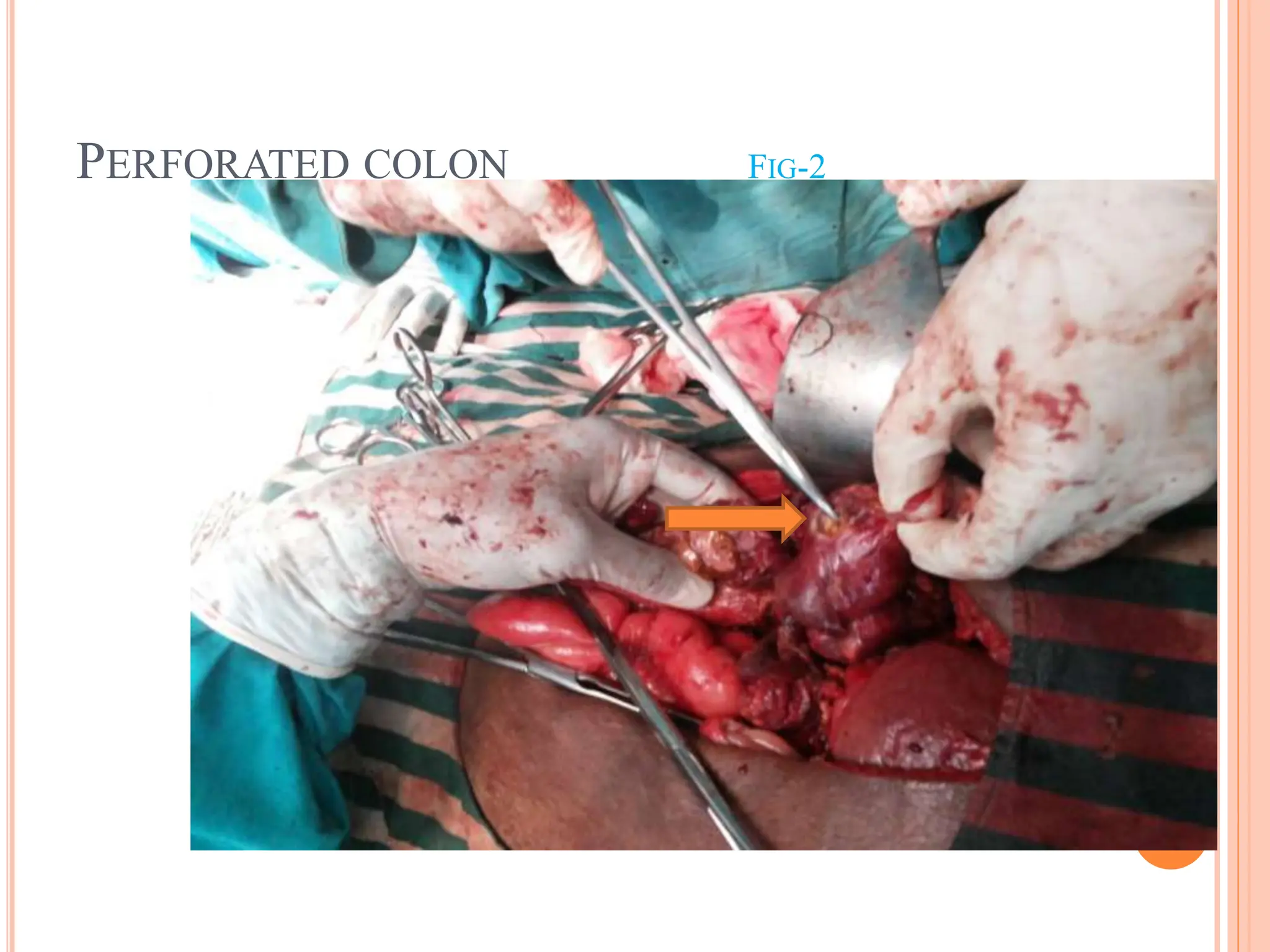
 Laparotomy revealed, ruptured liver abscess in the right
lobe of liver and large bowel perforation in the caecum
and ascending and transverse colon, with patchy colonic
wall necrosis and massive peritoneal faecal and pus
contamination.
 Right hemicolectomy with covering ileostomy and
peritoneal wash with tube drainage of the liver abscess
cavity was performed , postoperative period uneventful.
 Drains were removed on 9th postoperative day and
patient was discharged on 15th postoperative day.
COMPUTED TOMOGRAPHY: RUPTURED LIVER
ABSCESS CAVITY FIG-1
PERFORATED COLON FIG-2
RIGHT HEMICOLECTOMY SPECIMEN
FIG-3
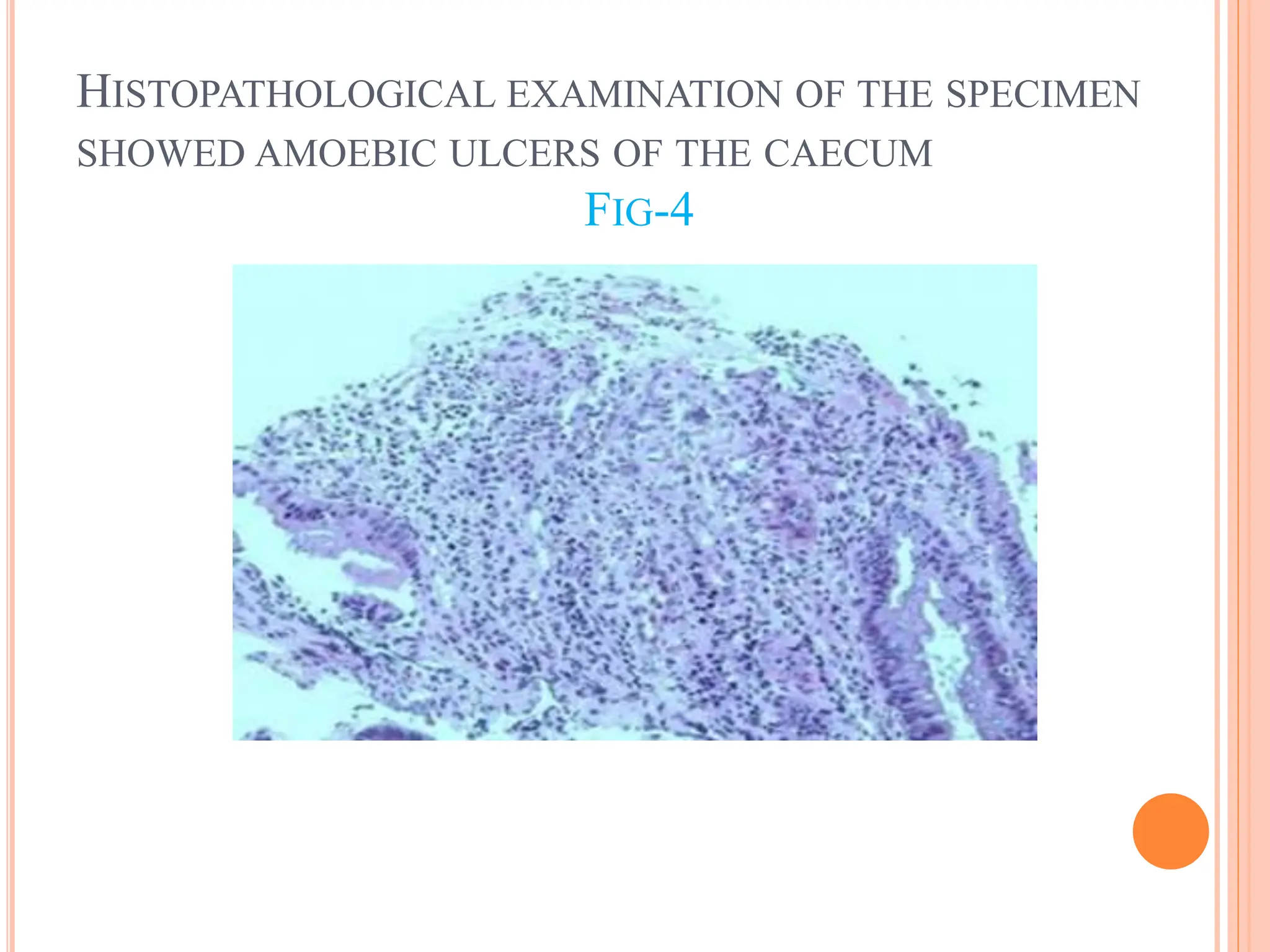
HISTOPATHOLOGICAL EXAMINATION OF THE SPECIMEN
SHOWED AMOEBIC ULCERS OF THE CAECUM
FIG-4
DISCUSSION
 Amoebic liver abscess is the most common manifestation
of extra intestinal amoebiasis. The causative agent is a
protozoan, Entameba histolytica.
 10% of the world population harbours
E.histolytica in their colon, 10% of them may develop
invasive amoebiasis and 1-10% of these patients develop
amoebic liver abscess.
 Amoebic liver abscess is common in tropical countries
and prevalent in low socioeconomic class living in
unhygienic conditions
 Trophozoites of Entameba histolytica usually invade
mucosa and submucosa of colon [4].
 Invasion may reach up to musclar layer and serosa causing
silent perforation often involving caecum [1,2].
 Bowel perforation occurs between 1%-6% of the patients
with amoebiasis [5].
 The surgical approach is most efficient to treat a large liver
amoebic abscess(>5cm) and intraperitoneal collection and
colonic perforation [1,3,4].
 Fecal peritonitis with concomitant ruptured liver abscess
usually leads to severe septicemia. If not detected at an early
stage ,mortality ranges from 6% to as high as 50% [4,5].
 The presentation of amoebic caecal perforation may vary
from well contained abscess to faecal peritonitis with or
without concomitant hepatic abscess or fulminant colitis.
 Traditionally, the treatment option was faecal diversion.
 FC Eggleston et al. documented a study of 26 patients with
amoebic colonic perforation with 71% mortality in the
resection group and 43% mortality in the faecal diversion
group.
 Hasan et al. showed that in patients with well contained disease
or minimal faecal peritonitis, resection of caecum with primary
ileo-colic anastomosis could offer comparable results.
CONCLUSION
 Uncomplicated liver abscess 90% curative rate with
metronidazole and luminal agents.
 Ruptured liver abscess may treated successfully with
percutaneous drainage.
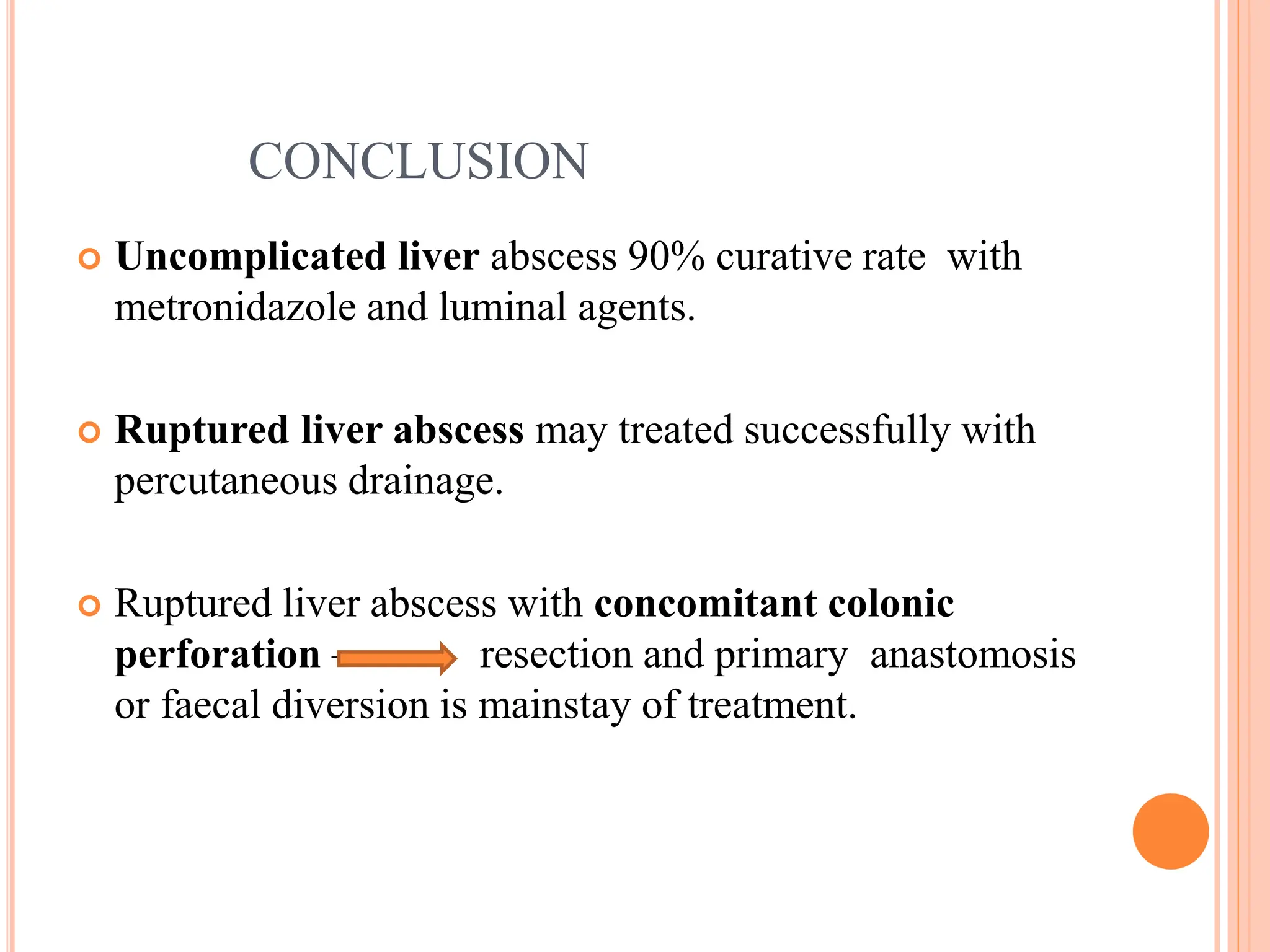
 Ruptured liver abscess with concomitant colonic
perforation – resection and primary anastomosis
or faecal diversion is mainstay of treatment.
REFERENCES
1. Das S, Gupta M, Banerjee M, Khamrui TK: Simultaneous
amoebic caecal perforation with ruptured liver abscess - a rare
presentation. The Internet Journal of Surgery; 2009, Vol. 19,
Number 2.
2. Manukaran MN, Ahmad H, Abdullah I: Amoebiasis with multiple
colonic perforations and ruptured liver abscess - a case report.
Med J Malaysia; 1983; 38(1): 71-3.
3. Gills HM, Cuschieri A: Parasitic infection of surgical importance.
Essential surgical practice, 3rd edition, Cuschieri A, Giles GR,
Moossa AR (Eds.), Butterworth Heinemann Ltd. Oxford; 1995;
243-61.
4. Adam EB, McLeod IN: Invasive amebiasis II. Amoebic liver
abscess and its complications. Medicine 1977; 56: 324-34.
5. H. Ishida, S. Inokuma, N. Murata, D. Hashimoto, K. Satoh, S.
Ohta Fulminant amoebic colitis with perforation successfully
treated by staged surgery: a case report J Gastroenterol, 38 (2003),
pp. 92–96.
Simultaneous Amoebic Caecal Perforation with Ruptured Liver Abscess.pptx

Simultaneous Amoebic Caecal Perforation with Ruptured Liver Abscess.pptx

  • 1.
    SIMULTANEOUS AMOEBIC COLONIC PERFORATIONWITH RUPTURED LIVER ABSCESS – A RARE PRESENTATION Dr.B.GOPIKRISHNA PG.in General surgery
  • 2.
    INTRODUCTION  amoebiasis causedby Entamoeba histolytica manifest as acute intestinal infectious diarrhoea clinically, pathologically as ulcerative and inflammatory lesion( bottle-neck ulceration )in the caecum and the entire colon.  Trophozoites of Entamoeba histolytica usually invade interglandular tissue of the crypts of Lieberkuhn and burrow through the mucous membrane to lodge in the submucosal plane for multiplication.
  • 3.
     The organismduring the invasive stage, gain access to the liver via the portal vein where marked tissue destruction occur resulting in a liver abscess.  Liver abscess and colon perforation are the clinical syndromes associated with amoebiasis.  Management of a complicated severe form of invasive amoebiasis is challengeable.
  • 4.
    o As manyas 55% of those in endemic regions are infected, although less than 50% are symptomatic.  severe amoebic infection is known as invasive or fulminant amoebiasis. o Still rarer is the occurrence of simultaneous amoebic colonic perforation and ruptured amoebic liver abscess presenting as an acute abdomen
  • 5.
     One suchpresentation of synchronous ruptured liver abscess with large bowel perforation in a 70 years old male is reported.
  • 6.
    CASE REPORT  A70-year-old male, a chronic alcoholic (35years) non- hypertensive, non-diabetic coolie presented with high fever and pain in right upper and lower abdominal pain for one weak.  Physical examination revealed tenderness and guarding in the whole abdomen, simulating peritonitis.  Routine investigations revealed leucocytosis, raised blood urea and serum creatinine. Mild elevation of liver enzymes, elevated PT-INR levels and hypoprotenemia.
  • 7.
     X-ray ofthe abdomen showed elevated right diaphragm and pleural effusion.  Ultrasonography of the abdomen revealed free fluid in the peritoneal cavity with ruptured liver abscess .  CT abdomen showed ruptured liver abscess and minimal right –sided pleural effusion .
  • 8.
     A provisionaldiagnosis of peritonitis due to ruptured liver abscess with sepsis was made and the patient was taken up for emergency laparotomy.  Laparotomy revealed, ruptured liver abscess in the right lobe of liver and large bowel perforation in the caecum and ascending and transverse colon, with patchy colonic wall necrosis and massive peritoneal faecal and pus contamination.
  • 9.
     Right hemicolectomywith covering ileostomy and peritoneal wash with tube drainage of the liver abscess cavity was performed , postoperative period uneventful.  Drains were removed on 9th postoperative day and patient was discharged on 15th postoperative day.
  • 10.
    COMPUTED TOMOGRAPHY: RUPTUREDLIVER ABSCESS CAVITY FIG-1
  • 11.
  • 12.
  • 13.
    HISTOPATHOLOGICAL EXAMINATION OFTHE SPECIMEN SHOWED AMOEBIC ULCERS OF THE CAECUM FIG-4
  • 14.
    DISCUSSION  Amoebic liverabscess is the most common manifestation of extra intestinal amoebiasis. The causative agent is a protozoan, Entameba histolytica.  10% of the world population harbours E.histolytica in their colon, 10% of them may develop invasive amoebiasis and 1-10% of these patients develop amoebic liver abscess.  Amoebic liver abscess is common in tropical countries and prevalent in low socioeconomic class living in unhygienic conditions  Trophozoites of Entameba histolytica usually invade mucosa and submucosa of colon [4].
  • 15.
     Invasion mayreach up to musclar layer and serosa causing silent perforation often involving caecum [1,2].  Bowel perforation occurs between 1%-6% of the patients with amoebiasis [5].  The surgical approach is most efficient to treat a large liver amoebic abscess(>5cm) and intraperitoneal collection and colonic perforation [1,3,4].  Fecal peritonitis with concomitant ruptured liver abscess usually leads to severe septicemia. If not detected at an early stage ,mortality ranges from 6% to as high as 50% [4,5].
  • 16.
     The presentationof amoebic caecal perforation may vary from well contained abscess to faecal peritonitis with or without concomitant hepatic abscess or fulminant colitis.  Traditionally, the treatment option was faecal diversion.
  • 17.
     FC Egglestonet al. documented a study of 26 patients with amoebic colonic perforation with 71% mortality in the resection group and 43% mortality in the faecal diversion group.  Hasan et al. showed that in patients with well contained disease or minimal faecal peritonitis, resection of caecum with primary ileo-colic anastomosis could offer comparable results.
  • 18.
    CONCLUSION  Uncomplicated liverabscess 90% curative rate with metronidazole and luminal agents.  Ruptured liver abscess may treated successfully with percutaneous drainage.  Ruptured liver abscess with concomitant colonic perforation – resection and primary anastomosis or faecal diversion is mainstay of treatment.
  • 19.
    REFERENCES 1. Das S,Gupta M, Banerjee M, Khamrui TK: Simultaneous amoebic caecal perforation with ruptured liver abscess - a rare presentation. The Internet Journal of Surgery; 2009, Vol. 19, Number 2. 2. Manukaran MN, Ahmad H, Abdullah I: Amoebiasis with multiple colonic perforations and ruptured liver abscess - a case report. Med J Malaysia; 1983; 38(1): 71-3. 3. Gills HM, Cuschieri A: Parasitic infection of surgical importance. Essential surgical practice, 3rd edition, Cuschieri A, Giles GR, Moossa AR (Eds.), Butterworth Heinemann Ltd. Oxford; 1995; 243-61. 4. Adam EB, McLeod IN: Invasive amebiasis II. Amoebic liver abscess and its complications. Medicine 1977; 56: 324-34. 5. H. Ishida, S. Inokuma, N. Murata, D. Hashimoto, K. Satoh, S. Ohta Fulminant amoebic colitis with perforation successfully treated by staged surgery: a case report J Gastroenterol, 38 (2003), pp. 92–96.